Review

Design Strategies and Challenges of Proton-Exchange Membranes for Medium- and High-Temperature Fuel Cell Applications

1
Beijing Key Laboratory of Advanced Functional Polymer Composites, College of Material Science and Engineering, Beijing University of Chemical Technology, Beijing 100029, China
2
Alan G. MacDiarmid Institute, Jilin University, Changchun 130012, China
3
Department of Chemical Engineering, Tsinghua University, Beijing 100084, China
*
Author to whom correspondence should be addressed.
J. Compos. Sci. 2026, 10(4), 218; https://doi.org/10.3390/jcs10040218
Submission received: 11 March 2026 / Revised: 6 April 2026 / Accepted: 15 April 2026 / Published: 21 April 2026
(This article belongs to the Section Polymer Composites)

Abstract

Perfluorosulfonic acid (PFSA) membranes, exemplified by Nafion, suffer dehydration-induced degradation at elevated temperatures, although modifications enhance their conductivity and performance. Sulfonated aromatic polymers (SAPs) exhibit weaker phase separation, yielding narrow, tortuous ion channels and lower conductivity than their PFSA membrane counterparts at equivalent ion exchange capacity; however, excessive sulfonation causes swelling and mechanical instability, offset by cost advantages. Phosphoric acid-doped polybenzimidazole (PBI) offers superior thermal stability and high conductivity, with recent advances in polybenzimidazole derivatives and composites driving medium-to-high temperature proton-exchange membrane fuel cell innovation. This review summarizes progress in three major medium-to-high temperature proton-exchange membrane fuel cell categories—perfluorosulfonic acid, sulfonated polymers, and PBI-based membranes—while addressing challenges and future goals for enhanced performance.

1. Introduction

Proton-exchange membrane fuel cells (PEMFCs) have been widely deployed across transportation, portable power systems, distributed energy generation, aerospace, and other specialized sectors [1,2,3,4]. Applications in transportation include passenger vehicles, light-duty commercial vehicles, buses, heavy-duty trucks, and unmanned aerial vehicles; portable power systems encompass consumer electronics, emergency power supplies, and military devices; distributed power applications include residential energy provision, telecommunication stations, and data centers; and aerospace uses involve auxiliary power units for unmanned and spacecraft systems [5]. Owing to its large market potential, direct contribution to carbon-neutrality goals, and strong technological compatibility with PEMFCs, the transportation sector has emerged as the most strategically significant field for PEMFC commercialization.
In transportation, PEMFCs serve as the core powertrain for fuel cell electric vehicles (FCEVs), exemplified by the Toyota Mirai, Honda Clarity, and Hyundai Nexo. These vehicles leverage the inherent advantages of low-temperature PEMFCs (Low temperature-PEMFCs)—including second-level start-up capability, high power density (0.3~0.7 W·cm−2), and excellent proton conductivity (~0.1 S·cm−1 under humidified conditions)—to deliver stable dynamic power output suitable for frequent stop–start operation. With 40~60% electrical efficiency, driving ranges exceeding 500 km, and hydrogen refueling times of 3~5 min, PEMFC-powered vehicles offer compelling advantages over battery electric vehicles, particularly in long-range scenarios.
PEMFCs have also been recognized as a key pathway for achieving decarbonization in long-haul heavy-duty transportation. To meet the stringent durability and system efficiency requirements of this sector, current technological development emphasizes enhancing power density, extending operational lifetime, and lowering system cost. Meanwhile, major economies—including the United States, China, Japan, and the European Union—have implemented strong policy instruments, such as financial incentives, stricter emission regulations, and infrastructure development schemes, to accelerate the large-scale deployment of PEMFC technologies in medium and heavy-duty transportation.
In heavy-duty applications, fuel cell systems frequently operate under sustained high-load conditions, demanding higher thermal efficiency, higher power density, and wider operational flexibility. Conventional Low temperature-PEMFCs (60~80 °C) face challenges under such demanding conditions due to complex water–thermal management requirements, cold-start constraints, and unavoidable two-phase transport limitations in humidified environments [6]. These limitations have motivated the shift toward medium- and high-temperature operations.
Medium- and high-temperature PEMFCs (Medium-to-High temperature PEMFCs, >100 °C) offer distinct kinetic and system-level advantages: (1) enhanced CO tolerance [7,8,9,10]—elevated temperature suppresses CO adsorption on Pt-based catalysts, mitigating poisoning and enabling the direct use of reformate hydrogen without deep purification; (2) simplified thermal management [11,12]—a larger temperature differential improves heat rejection efficiency, simplifies cooling system design, and enables high-grade waste heat utilization, thereby improving overall system efficiency; (3) optimized water management [13]—water produced at the cathode exits in vapor form, eliminating two-phase transport issues and water flooding, significantly reducing flow-field complexity; and (4) improved mass transport [11,14]—elevated temperature increases gas diffusivity and permeability, reducing concentration polarization and enhancing oxygen reduction reaction (ORR) kinetics.
A PEMFC consists of key components, including the proton-exchange membrane (PEM), catalyst layers (CLs), gas diffusion layers (GDLs), bipolar plates (BPPs), and end plates. Hydrogen diffuses through the anode GDL and reaches the anode CL, where it undergoes the hydrogen oxidation reaction (HOR): H 2 2 H + + 2 e . Protons migrate through the PEM to the cathode, while electrons flow externally to perform electrical work. Oxygen diffuses through the cathode GDL into the cathode CL, where it participates in the oxygen reduction reaction (ORR): 1 2 O 2 + 2 H + + 2 e H 2 O . A schematic representation of the PEMFC structure, charge-transfer pathways, and key materials is provided in Figure 1.
The PEM performs three essential functions: proton conduction, physical separation of reactant gases, and electronic insulation. As the component that determines the cell’s operational temperature window, the thermal stability and proton-transport mechanism of the PEM define the boundaries of viable PEMFC operation. Based on their optimal operating temperature, PEMs are categorized into low-temperature (Low temperature-PEM, <100 °C), medium-temperature (Medium temperature-PEM, 100~120 °C), and high-temperature (High temperature-PEM, >120 °C) classes [15].
Currently, three primary types of PEMs (Table 1) are used for medium- and high-temperature operations: (i) modified PFSA membranes; (ii) phosphoric acid-doped PBI and poly(2,5-benzimidazole) poly(2,5-benzimidazole) (ABPBI) membranes; and (iii) SAPs and their composites.
Recent reviews have offered valuable insights into specific aspects of PEM development. For example, Madhav et al. [16] systematically examined the degradation pathways and mitigation strategies in conventional PEMFCs. Focusing on material-specific progress, De Gregorio et al. [17] highlighted emerging fabrication techniques, especially electrospinning, for optimizing PBI membranes. Additionally, Deng et al. [18] reviewed the wider applicability of PBI-based materials, emphasizing their emerging roles in lithium-ion batteries beyond fuel cell systems.
Despite these significant contributions addressing degradation mechanisms, fabrication strategies, and cross-domain applications, a unified understanding of how multi-scale structural engineering can bridge the “thermal gap” (100–200 °C) across different polymer platforms remains lacking. Current studies usually focus on individual material systems (e.g., modified PFSA or PBI derivatives) or specific performance aspects, which limits the development of a comprehensive design framework. This review adopts a comparative, cross-platform approach to analyze the design evolution of three key polymer families—modified PFSAs, PBIs, and SAPs. By examining how these distinct systems tackle issues like high-temperature dehydration and mechanical instability, we identify common structural engineering principles, such as “structural locking” and “interfacial synergy.” This integrated view connects the gap between low- and high-temperature PEMs and offers a unified framework for designing next-generation membranes with broad-temperature adaptability.
This review is organized from a structure–property–function perspective. We start by outlining the fundamental operating principles of PEMFCs and defining key performance metrics across relevant temperature ranges. The discussion then focuses on three main material categories: (1) hydration retention and structural changes in modified PFSAs for medium-temperature operation; (2) acid confinement and backbone engineering in PBI-based high-temperature membranes; and (3) crosslinking and composite reinforcement strategies in cost-effective SAP systems. Finally, we address remaining challenges and future directions for wide-temperature-range PEMs.
Table 1. Overview of PEM types with conduction mechanisms, conductivity, key limitations, and enhancement approaches.
Membrane TypePrimary MechanismTypical σ (S/cm)Key ChallengesModifications for EnhancementRef.
Modified PFSAHybrid Vehicular/Grotthuss (water-dependent)0.01~0.05 at 120 °C, low RHDehydration
Thermal instability
Fillers
IL doping
Hybridization
[19,20,21]
SPAs & CompositesGrotthuss via –SO3H/water0.025~0.1 at 100~140 °CSwelling
Degradation
Crosslinking
Nanofillers
Acid doping
[22,23]
PA-Doped PBI/ABPBIAnhydrous Grotthuss (PA network)0.05~0.07 at 150~200 °CPA leaching,
Mechanical decline
Copolymers
Crosslinking
Nanocomposites
[24,25,26]

2. Medium-Temperature Domain (100–120 °C)—Perfluorosulfonic Acid (PFSA)

2.1. Intrinsic Architecture, Transport Dynamics, and Key Challenges of PFSA

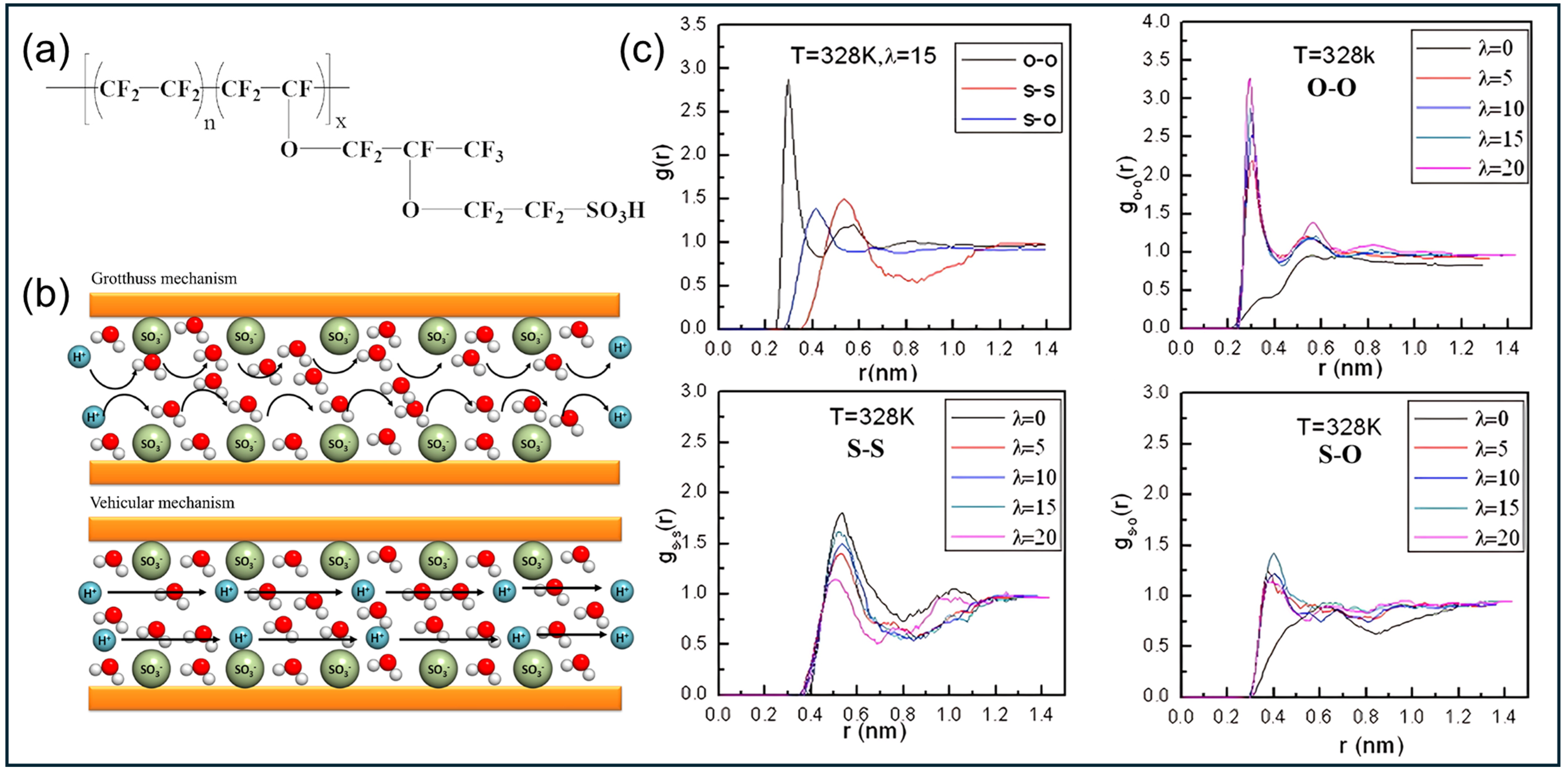
Nafion, the first commercial PFSA ionomer developed by DuPont, has long served as the benchmark PEM for fuel cells [27]. Despite the emergence of new PEM materials, Nafion remains widely adopted due to its exceptional electrochemical stability, mechanical robustness, and high ionic conductivity. Its multiphase morphology consists of a hydrophobic PTFE backbone and hydrophilic side chains terminated with sulfonic acid groups (Figure 2). Under hydrated conditions, this architecture yields a characteristic nanoscale phase-separated structure: the PTFE matrix provides mechanical integrity, while the hydrophilic ionic clusters enable water uptake and proton transport [28].
Proton transport in PFSAs proceeds through a combination of the Grotthuss hopping mechanism and the vehicular mechanism. Protons migrate along water-mediated ionic channels formed by sulfonic acid groups and hydrogen-bonded water networks [29,30,31,32]. Molecular-level insights obtained through radial distribution function (RDF) analysis reveal that the O–O distance between water molecules (~0.30 nm) and the S–O distance between sulfonate sulfur and water oxygen (~0.41 nm) are both significantly shorter than the S–S distance between adjacent sulfonate groups (~0.54 nm) [33]. This confirms that proton hopping between sulfonate groups requires water-mediated “bridges” rather than direct transfer between fixed ionic sites. A dense and continuous hydrogen-bond network is thus essential for rapid Grotthuss transport.
The hydration level (λ) strongly influences the RDF characteristics of O–O, S–O, and S–S pairs, and thereby the formation and continuity of effective proton-conduction pathways. Increased hydration enhances the O–O RDF intensity, indicating that the formation of more extensive hydrogen-bond networks is favorable for Grotthuss hopping. Swelling of ionic domains reduces the S–S distance, improving the geometric alignment of water bridges. Although the S–O distribution is less affected, additional water aids the construction of continuous S–O–O–S proton-conduction chains.
Due to this inherent coupling between proton-transport efficiency and hydration state, PFSA membranes suffer from intrinsic limitations under high-temperature conditions. Above 100 °C—particularly beyond 120 °C—rapid dehydration disrupts water-mediated proton-conduction channels, significantly diminishing both Grotthuss hopping and vehicular proton diffusion. Consequently, proton conductivity declines sharply under low-humidity/high-temperature operation [34].
Furthermore, Nafion has a relatively low glass-transition temperature (Tg ≈ 125 °C). Under high-temperature/low-humidity conditions, thermal softening of the polymer matrix can lead to morphological collapse of the hydrophilic–hydrophobic nanophase separation, further impairing proton transport. Therefore, unmodified PFSA membranes are insufficient for medium-temperature PEM operation [35,36,37,38].
Therefore, relying solely on the traditional Nafion structure is insufficient to bridge this “thermal gap.” To maintain an efficient proton-transport network under high-temperature/low-humidity conditions, intrinsic structural modifications to PFSA (such as shortening side chains to increase Tg and crystallinity) or heterogeneous functionalization designs (introducing nano-scale water-retaining centers) are essential for reconfiguring proton-transport kinetics at elevated temperatures.
Figure 2. (a) Chemical structure of Nafion. (b) H+ conduction mechanism in Nafion membrane. Adapted from [39]. (c) (O–O, S–S, S–O) radial distribution function (RDF). Reprinted with permission from [33]. Copyright 1972 Royal Chemical Society.
Jcs 10 00218 g002

2.2. Evolution of PFSA Architecture: From LSC to SSC Structural Regulation

PFSA proton-exchange membranes are widely used across industrial and energy sectors. Representative commercial products include Nafion (DuPont, now Chemours), 3M ionomers (3M), Aciplex (Asahi Chemicals), Flemion (Asahi Glass), Gore-Select (Gore and Associates), and Aquivion (Solvay-Solexis, now Syensqo) [40]. Although these materials share a common structural motif—a polytetrafluoroethylene (PTFE) backbone and sulfonic acid-functionalized side chains—their key differences originate from the molecular design of the side chain architecture [41]. Side chain length directly governs the thermal stability, crystallization behavior, and mechanical properties of PFSAs. Shorter side chains generally lead to higher thermal resistance and more compact crystalline domains, whereas longer side chains increase chain flexibility but reduce the Young’s modulus and tensile strength [42]. Therefore, side chain length serves as a critical design parameter that defines the performance orientation of each PFSA product family and determines their suitability for automotive, aerospace, and portable energy applications [28,43].
Long-side-chain (LSC) Nafion currently serves as the benchmark PFSA ionomer for PEMFCs owing to its superior proton conductivity and electrochemical stability. However, recent research has increasingly focused on alternative materials capable of surpassing the thermal limitations of Nafion, particularly to meet the demands of automotive applications. While the optimal operating temperature for these systems exceeds 120 °C, most existing PFSAs are functionally limited to approximately 95 °C. In this context, short-side-chain (SSC) ionomers have emerged as a promising solution.
The superior high-temperature performance of SSC-PFSAs is derived from their unique structure–property relationship. The shortened side chain architecture removes the steric hindrance associated with pendant -CF3 groups, enabling tighter packing of the PTFE backbone and resulting in significantly enhanced crystallinity and a higher glass-transition temperature (Tg) [44]. This improved thermomechanical stability prevents creep or collapse of hydrophilic channels under elevated temperatures. Moreover, the lower equivalent weight (EW) of SSC-PFSAs yields a higher ion-exchange capacity (IEC), facilitating the formation of well-connected hydrophilic clusters [45]. These clusters provide continuous, efficient proton-hopping pathways and improve water retention at elevated temperatures, thereby mitigating the well-known conductivity losses of LSC membranes under high-temperature/low-humidity conditions [46].
Jeon reported PEMFCs based on SSC-PFSA membranes capable of operating under high-temperature and low-humidity environments [47]. Above 100 °C, SSC-PFSA-based cells demonstrated higher performance than their LSC-PFSA counterparts. For instance, under 120 °C and 20% RH, a PEM employing Aquivion™ E87-05S reached a current density of 0.524 A·cm2− at 0.6 V, whereas a corresponding Nafion 212 cell achieved only 0.298 A·cm2−, attributable to the superior thermal stability of the SSC-PFSA membrane [48]. The performance of short-side-chain (SSC) perfluorosulfonic acid (PFSA) proton-exchange membranes can be greatly enhanced by optimizing the post-casting treatment process. Recast SSC-PFSA membranes were produced using a Syensqo Aquivion® D72-25BS dispersion via the doctor-blade casting method, followed by thermal annealing at 155 °C and subsequent acid treatment. Compared to an e-PTFE reinforced reference membrane, the optimized recast membrane demonstrated significant advantages under moderate-to-high temperature and low-humidity conditions. At harsh operating conditions of 110 °C and 50% RH, proton conductivity reached 0.073 S/cm. Additionally, in H2/air single-cell tests conducted at 95 °C and 50% RH, the membrane achieved a power density of 0.67 W/cm2 at 0.6 V (while the reference membrane only reached 0.43 W/cm2), attaining a maximum power density of about 834 mW/cm2 [49]. The notable impact of these macro-level processing strategies primarily results from changes in the microscopic structure of the polymer chains.
Engineering and controlling nanoscale ion-transport channels remain central challenges in designing high-performance PEMs, as polymer electrolytes must balance complex intra and interchain interactions both in solution and in the solid membrane state. Nafion assembles into rigid coils in solution and forms interconnected micellar ionic domains in the membrane [50]. By contrast, SSC-PFSAs contain higher sulfonic acid densities, which alter polymer solubility and assembly behavior; their processing must delicately control polymer aggregation to translate solution-phase structures into efficient ion-transport pathways within the membrane.
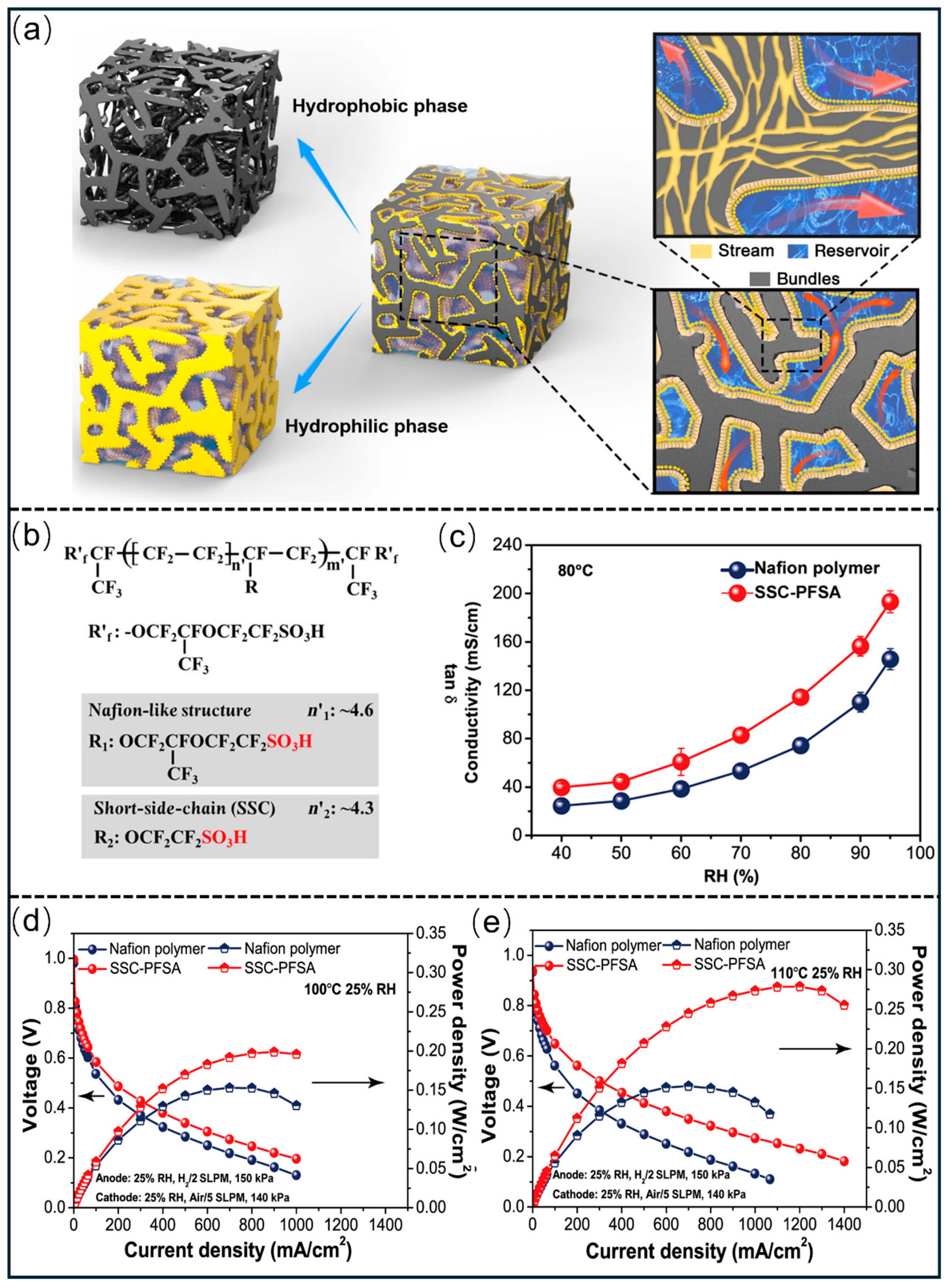
Using in situ synchrotron scattering, Guan identified a characteristic “stream–reservoir” morphology in PFSA membranes (Figure 3a) [51]. “Streams” correspond to small ionic channels (2~3 nm) embedded within polymer-rich regions, while “reservoirs” represent larger water-swollen pores (~10 nm). These two domains interconnect through phase-separation-driven mechanisms, forming a 3D hierarchical transport network. Both streams and reservoirs rapidly take up water; at high humidity, reservoirs expand to accommodate additional water. Differences between SSC-PFSA and Nafion chemical structures (Figure 3b) lead to distinct membrane morphologies and transport behaviors. At 80 °C across various humidity levels, SSC-PFSA consistently exhibited higher proton conductivity than Nafion (Figure 3c). Single-cell tests further highlighted the performance advantage of SSC-PFSA membranes under low humidity. Under 100 °C/25% RH, SSC-PFSA MEAs delivered a peak power density of 0.200 W·cm2− (at 0.9 A·cm2−), surpassing the 0.153 W·cm2− of Nafion membrane electrode assemblies (MEAs) (at 0.7 A·cm2−). At 110 °C/25% RH, SSC-PFSA MEAs achieved a markedly higher 0.279 W·cm2−, whereas Nafion MEAs displayed performance nearly identical to that at 100 °C. Quantitatively, SSC-PFSA MEAs exhibited 30.7% higher peak power density than Nafion at 100 °C and an 82.3% improvement at 110 °C, clearly demonstrating the advantages of SSC-PFSA under harsh low-humidity/high-temperature conditions.
Driven by the stringent requirements for higher power density, extended durability, and device compactness, PEMs must demonstrate superior thermal tolerance and ion mobility [28,52]. In this regard, SSC-PFSA distinguishes itself from conventional Nafion through its tailored short side chain architecture. This structural design confers intrinsic advantages, including a higher ion exchange capacity and enhanced thermomechanical stability, which translate into exceptional proton conductivity and elevated peak power densities even under low-humidity conditions. Despite these intrinsic benefits compared to LSC ionomers, significant challenges remain for operation above 100 °C, where issues such as dehydration-induced shrinkage or excessive swelling can still compromise the membrane’s structural integrity.

2.3. Extrinsic Composite Engineering: Nano-Reservoirs and Conductive Facilitators

2.3.1. Hygroscopic Nanocomposites: The “Water Reservoirs”

Metal oxide nanoparticles such as SiO2 and TiO2 have been widely employed as hygroscopic fillers in PFSA membranes due to their strong hydrophilicity, large specific surface area, and inherently porous structures [53]. Their surface hydroxyl groups readily adsorb water molecules, substantially increasing Nafion’s water uptake and suppressing water evaporation under elevated temperatures. As a result, continuous water-rich channels can be maintained within the membrane, improving proton conduction, operational stability, and long-term cell durability. When these hydrophilic particles are incorporated into the hydrophilic domains of Nafion, the membrane exhibits enhanced water retention at high temperatures, making it better suited for medium-to-high temperature fuel cell operation [54]. However, because metal oxides lack acidic sites capable of releasing mobile protons, their intrinsic proton conductivity is extremely low. Therefore, their primary contribution lies in water management rather than directly enhancing Nafion’s proton conductivity.
Composite membranes incorporating metal oxides are generally fabricated either by physically mixing oxide powders with Nafion solution or by inducing sol–gel reactions within the polymer matrix. The fabrication route significantly influences the dispersion state of the filler and thus the resulting membrane properties. For example, when identical TiO2 loadings were introduced via sol–gel synthesis and solution casting, the sol–gel method yielded a nearly uniform TiO2 distribution, whereas solution-cast membranes exhibited noticeable particle aggregation [55]. Conventional solution casting also tends to disrupt Nafion’s nanoscale phase-separated morphology and its ionic pathways. To address this, Wu et al. [56] enhanced proton conductivity by introducing hydrophilic and hydrophobic quantum dots into specific nanophase regions of Nafion.
In situ sol–gel processing enables SiO2 nanoparticles to grow directly within ion channel regions, helping preserve Nafion’s microphase separation [57]. For example, SiO2/Nafion 117 composite membranes produced using this method showed markedly higher water uptake: at 7 wt% SiO2 loading, the membrane achieved a water uptake of 43%, representing a 30% improvement compared with pristine Nafion 117. However, the conventional in situ sol–gel method may also lead to SiO2 growth in nonionic domains or on the membrane surface, which compromises mechanical strength and disrupts ion-transport channels, thereby decreasing proton conductivity.
An improved sol–gel strategy [58] overcomes these issues by (i) performing the reaction at low temperature (0 °C), and (ii) using tetraethyl orthosilicate (TEOS) as the precursor, which co-swells with the solvent into the Nafion matrix and forms self-anchored interactions with –SO3H groups. This approach enables non-destructive, targeted filling of hydrophilic domains while fully preserving Nafion’s native nanophase-separated structure. Composite SiO2/Nafion membranes prepared using this improved method exhibited a twofold enhancement in proton conductivity under low humidity (20~60% RH) and high temperature (110~120 °C), along with a ~45% improvement in fuel cell performance.
The method used to introduce metal oxide fillers determines their spatial distribution within Nafion, thereby influencing the membrane’s phase-separated morphology and the integrity of its ion channels. Compared with conventional approaches that often induce particle aggregation or structural disruption, the improved in situ sol–gel strategy enables precise, targeted filling of hydrophilic domains. This approach preserves the structural stability of the membrane while significantly enhancing its water-retention capability and high-temperature proton conductivity.

2.3.2. Compensating Proton Conduction: Proton-Conducting Materials

High-temperature proton-conducting materials—typically heteropolyacids such as phosphotungstic acid (PWA) and silicotungstic acid (SWA)—can maintain high proton conductivity under low-humidity conditions, making them an effective means to compensate for the conductivity loss of Nafion at elevated temperature and reduced humidity. Representative heteropolyacids such as PWA possess exceptionally strong Brønsted acidity, exceeding that of 100% H2SO4 and the –SO3H groups in Nafion. Through the Grotthuss proton-hopping mechanism, they can deliver intrinsic conductivities of 0.02–0.1 S·cm1− even in solid or low-humidity environments [59]. Moreover, the large molecular size and structural stability of heteropolyacids enable them to act as local proton reservoirs, enriching acidic sites within Nafion’s ionic clusters, accelerating proton dissociation, and significantly enhancing proton conductivity and cell performance in the 100–150 °C range [60].
However, the high water solubility of PWA makes it difficult to retain within the membrane. During operation, PWA readily migrates with water and leaches out, leading to gradual loss of reinforcement, corrosion of bipolar plates, and severe reduction in fuel cell durability [61]. Therefore, improving the structural fixation of heteropolyacids within Nafion is essential for practical applications. A common strategy employs porous SiO2 networks to immobilize PWA [62]. Typical methods include direct mixing of preformed fillers [59], ion-exchange/immersion approaches [63], and sol–gel immobilization [62].
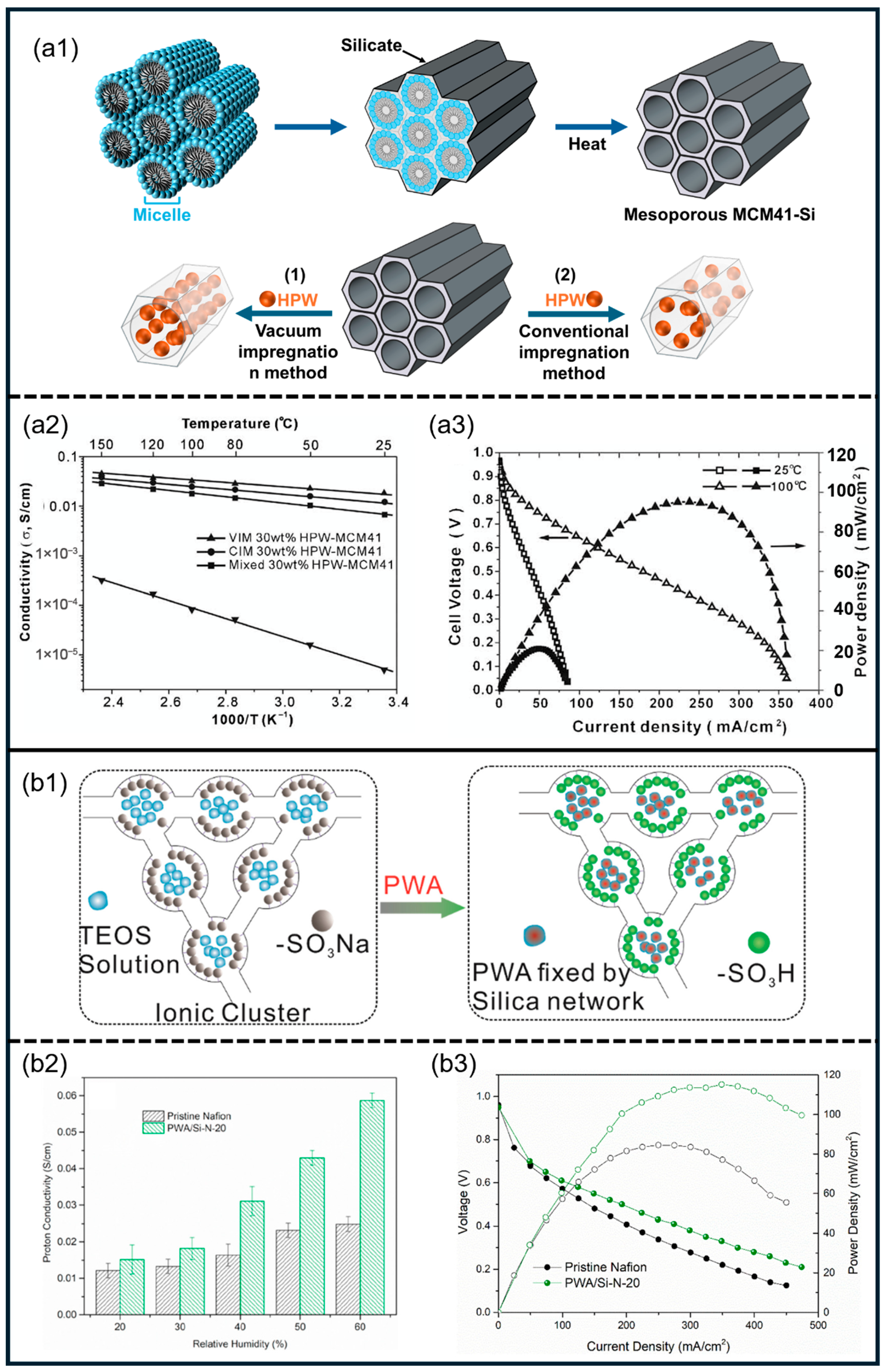
Given that heteropolyacids enhance proton conduction by strengthening the local acidic environment of ionic clusters and promoting proton dissociation and Grotthuss transport, improving the structural stability of PWA within the membrane becomes critical for further elevating Nafion’s high-temperature performance. Lu et al. [64] proposed a vacuum-assisted impregnation method (VIM), in which PWA is confined within ordered mesoporous SiO2 (e.g., MCM-41 [65]). In this architecture, PWA is localized within continuous inorganic mesopores, which act as stable “containers” that significantly suppress leaching. Meanwhile, hydrophilic silanol groups (≡Si–OH) on the pore walls enrich structured water, enabling the PWA–SiO2 composite to maintain high proton mobility over 25~150 °C. The composite achieved a conductivity of 0.045 S·cm1− at 150 °C and delivered 95 mW·cm2− in single-cell tests at 100 °C/100% RH, demonstrating the synergistic contribution of “PWA and mesoporous water structures” to high-temperature proton transport.
In contrast to these external container strategies, Xu et al. [66] proposed a more structurally targeted approach—targeted silica fixation. In this method, the intrinsic acidity of PWA catalyzes the hydrolysis of TEOS in situ within Nafion’s –SO3 ionic clusters, generating SiO2 directly inside the proton-conduction channels. Because the silica network forms exclusively within hydrated ionic clusters, PWA becomes embedded and hydrogen bond-anchored near the –SO3H groups, creating synergistic “acid cluster–PWA–SiO2” nodes. This nanoscale targeted filling preserves Nafion’s native phase-separated morphology, avoids the channel disruption typical of conventional casting methods, and ensures the long-term stabilization of PWA. The resulting composite membrane achieved a proton conductivity of 0.058 S·cm1− at 110 °C/60% RH, representing a 2.4-fold enhancement over pristine Nafion. And it improved single-cell power density by 41% at 110 °C/20% RH, confirming that the synergistic mechanism of “anchored strong-acid centers and stable water domains” significantly broadens Nafion’s effective operating window.
Together, these two strategies—external mesoporous confinement (VIM) and internal targeted fixation—enhance the structural stability and proton-conduction contribution of PWA (Figure 4). Despite their differing approaches, both operate on the same mechanistic principle: stabilizing “acidic proton sites and localized water environments” to suppress PWA leaching and maintain continuous proton-migration networks under high-temperature/low-humidity conditions, thereby fundamentally strengthening Nafion’s proton-transport capability.

2.3.3. Enhanced Proton-Conduction Pathways: Functionalized Materials

Introducing proton-conductive functional groups onto selected carriers through chemical modification and subsequently incorporating them into Nafion represents an important strategy for improving composite membrane performance. This approach not only leverages the intrinsic proton conductivity of functional groups but also benefits from the structural and interfacial characteristics of the carriers. Together, they construct stable proton-conduction pathways at the nanoscale while enhancing the thermal stability and electrochemical durability of the membrane.
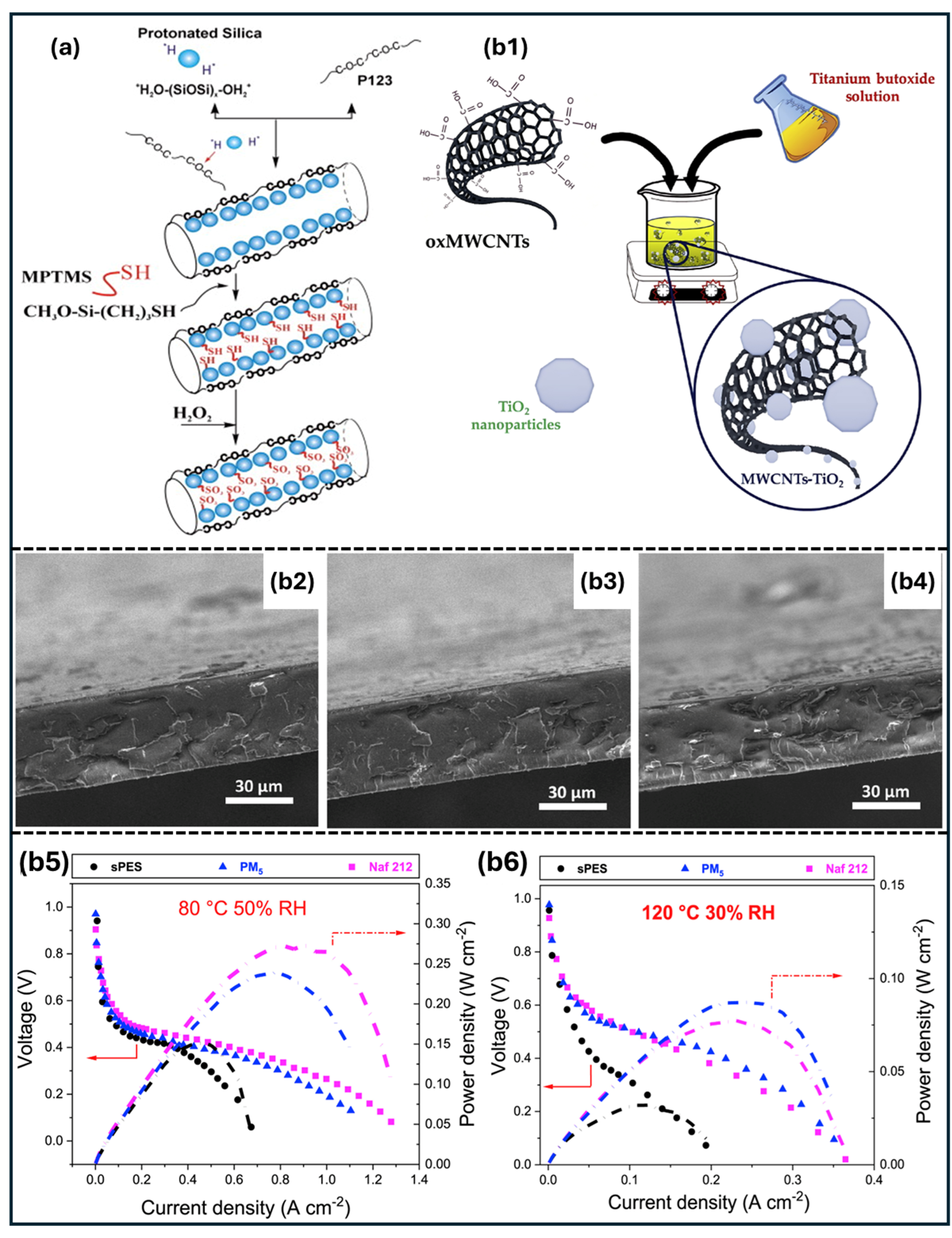
Carbon nanotubes (CNTs), composed of sp2-hybridized carbon atoms in a one-dimensional tubular configuration, exhibit extremely high tensile strength (~63 GPa), rigidity, low density, and favorable optical properties, enabling them to act as robust mechanical scaffolds for Nafion [67]. CNTs are classified as single-walled (SWCNTs) and multiwalled (MWCNTs); the latter contain more surface defects, which facilitate functionalization and interfacial bonding, making them more suitable as fillers in PEMs [68]. Direct incorporation of CNTs into polymer matrices often leads to aggregation due to van der Waals interactions, limiting dispersion and interfacial coupling. Therefore, surface functionalization—introducing –SO3H, –P2O5, –COOH, –NH2 groups, or loading nanoparticles such as Fe3O4, SiO2, or CeO2—is commonly employed to simultaneously improve proton-transport continuity and matrix compatibility.
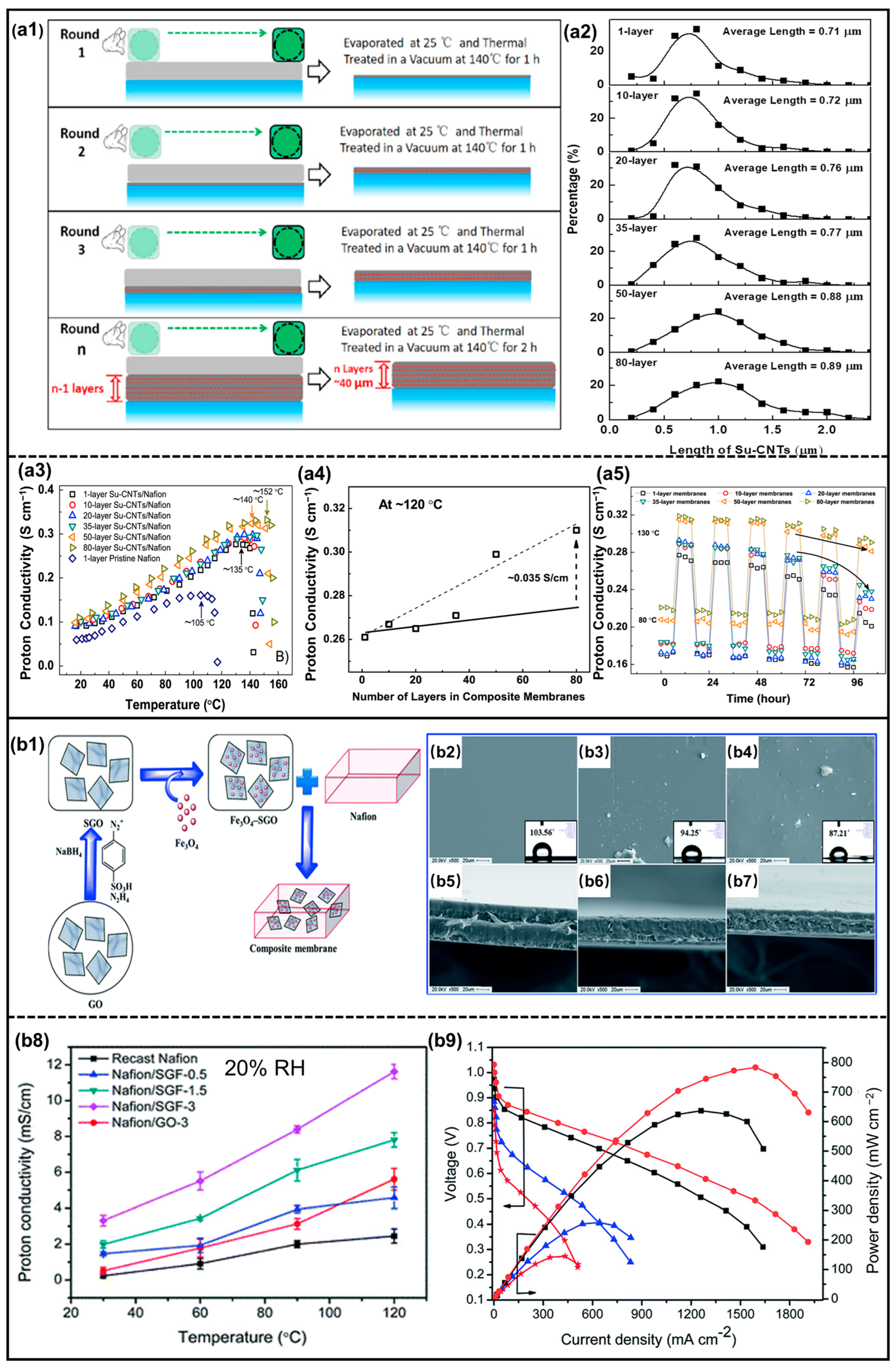
Yin et al. [69] prepared multilayer sulfonated CNT/Nafion composite membranes (Su-CNTs/Nafion) via layer-by-layer assembly, with a total membrane thickness of 40 ± 3 μm and layer numbers ranging from 1 to 80. When each layer approaches or falls below the average Su-CNT length, the CNTs tend to align within the membrane plane, forming proton-conduction pathways along the tube axis. This oriented arrangement provides dual benefits: (i) in-plane Su-CNT alignment forms continuous proton-transport routes that facilitate efficient migration of both protons and water molecules; and (ii) the physical crosslinking effect arising from CNT alignment reinforces the structural stability of the Nafion matrix (Figure 5a). Under 150 °C/100% RH, the 80-layer Su-CNTs/Nafion membrane achieved a proton conductivity of 0.33 S·cm1− and a transverse stress of ~40 MPa, demonstrating the strong correlation between structural control and functional improvement.
Graphene oxide (GO), a two-dimensional carbon material with a thickness of 1.1 ± 0.2 nm, contains both sp2 and sp3 carbon domains and abundant hydrophilic functional groups (–OH, –O–, –COOH) distributed across its basal plane and edges. These groups endow GO with intrinsic proton conductivity (~0.001 S·cm1− at 300 K) and enable further chemical modification [70]. Functionalized GO (e.g., sulfonated GO) can generate dense proton-conductive sites and hydrophilic interfaces within Nafion, improving water retention and proton mobility. Vinothkannan et al. [71] developed a composite membrane (Nafion/Fe3O4-SGO) in which ferrite (Fe3O4) nanoparticles are anchored onto sulfonated GO (Figure 5b). The high density of –SO3H, –COOH, and –OH groups significantly enhanced water uptake, ion exchange capacity, and proton conductivity. At 120 °C and 20% RH, a 3 wt% Nafion/Fe3O4-SGO membrane achieved a proton conductivity of 11.62 mS·cm1−, which was 4.7 times higher than that of recast Nafion. Its mechanical strength and thermal stability improved by factors of 3.16 and 31.6, respectively. Fullerenes have also been used to improve the performance of high-temperature PEMs through doping modification. Balgis et al. [72] reported a series of water-soluble fullerene derivatives uniformly incorporated into Nafion membranes to act as free radical scavengers. Due to their multiple hydroxyl and carboxyl functional groups, these derivatives showed excellent water solubility and strong compatibility with the Nafion matrix. They effectively scavenged ·OH and ·OOH radicals, significantly reducing membrane degradation caused by Fenton reactions. In open-circuit voltage accelerated durability tests at 90 °C and 30% relative humidity, the hybrid membrane operated continuously for over 1050 h without observable voltage loss. This performance greatly surpassed that of the pristine Nafion membrane (about 100 h) and was accompanied by a notable decrease in the membrane’s fluoride emission rate.
Performance enhancement in functionalized-carrier composite membranes arises from three synergistic mechanisms: (i) continuity of proton-conduction pathways: functional groups arranged along the carrier provide efficient proton-hopping routes; (ii) water retention via hydrophilic interfaces: carriers and functional groups create hydrophilic microenvironments that support proton conduction under high-temperature/low-humidity conditions; and (iii) structural reinforcement of the polymer matrix: oriented carbon nanostructures or nanoparticle-modified carriers enhance the mechanical and electrochemical durability of Nafion. Overall, functionalized carbon-based carriers not only improve proton conductivity but also optimize membrane microstructure and interfacial organization, offering mechanistic insights and practical design routes for next-generation high-performance proton-exchange membranes.
Figure 5. (a1) Schematic illustration of the preparation of multilayer Su-CNTs/Nafion composite membranes. (a2) Schematic representation of the length distribution of Su-CNTs in the multilayer composite membrane. (a3) Proton conductivity–temperature relationship of multilayer Su-CNTs under 100% RH. (a4) Thermal gravity analysis of multilayer Su-CNTs/Nafion composite membranes. (a5) Break stress of multilayer Su-CNTs/Nafion composite membranes in the lateral direction. Adapted with permission from [69]. Copyright 2019 Elsevier. (b1) Schematic illustration of the preparation of Nafion/SGF composite membranes. Surface SEM images of (b2) pristine recast Nafion, (b3) Nafion/GO-3, and (b4) Nafion/SGF-3, along with corresponding water contact angle insets. Cross-sectional SEM images of (b5) pristine recast Nafion, (b6) Nafion/GO-3, and (b7) Nafion/SGF-3. (b8) Proton conductivity of various proton-exchange membranes at 20% RH and different temperatures. (b9) Performance of H2/O2PEMFC at 70 °C under 100% RH with (Jcs 10 00218 i001) pristine recast Nafion and (Jcs 10 00218 i002) Nafion/SGF-3 and at 120 °C under 25% RH with (Jcs 10 00218 i003) pristine recast Nafion and (Jcs 10 00218 i004) Nafion/SGF-3. Adapted from [71].
Jcs 10 00218 g005

3. High-Temperature Domain (>120 °C)—Polybenzimidazole-Polybenzimidazole (PBI)

3.1. Intrinsic Architecture, Mass-Transport Kinetics, and Key Challenges

PBI, featuring a rigid aromatic heterocyclic backbone enriched with nitrogen atoms, exhibits exceptional thermo-mechanical stability (Tg = 426~436 °C) and chemical durability, establishing its benchmark status in high-temperature proton-exchange membranes (High temperature-PEMs) [73]. Although pristine PBI is intrinsically insulating (proton conductivity ~109− S·cm1−), the basic nitrogen sites on its imidazole rings endow it with a unique proton-accepting capability [74]. Through acid–base complexation with strong acids—particularly phosphoric acid (PA)—PBI can be converted into an efficient proton conductor. Compared with other inorganic acids such as sulfuric acid, PA offers not only exceptional thermal stability [75,76] but, critically, the ability to sustain high proton conductivity in anhydrous environments up to 200 °C without relying on humidity [77,78]. In PA-doped PBI, phosphoric acid exists as bound acid (anchored via hydrogen bonding to basic sites) and free acid (residing within the polymer free volume). Proton transport proceeds not through water-mediated vehicular mechanisms but via the Grotthuss process: protons hop rapidly along extended hydrogen-bond networks composed of PA molecules and their ionic pairs (H4PO4+/H2PO4) through structural diffusion [79].
However, this proton-conduction mechanism—fundamentally dependent on “liquid-like molecular doping”—leads to an intrinsic trade-off in membrane stability. A central challenge arises from the conflict between achieving high acid-doping levels (ADL) and maintaining mechanical robustness and long-term durability. On the one hand, high ADL is essential for achieving high proton conductivity; on the other hand, excessive doping induces pronounced plasticization, causing significant mechanical softening and creep of the polymer backbone at elevated temperatures [80]. Furthermore, because PA interacts with the PBI framework only through noncovalent forces (hydrogen bonding or ionic interactions), the weakly bound fraction of free acid can readily migrate or leach during long-term operation or thermal cycling. Such acid loss not only results in irreversible declines in membrane proton conductivity but also leads to acid leakage into the catalyst layer and bipolar plates, causing corrosion and severely limiting fuel-cell lifetime [81].
Thus, developing strategies that enhance acid retention without compromising conductivity—whether through intrinsic backbone engineering (e.g., crosslinking and branching) or composite confinement approaches (e.g., incorporation of MOFs or ionic liquids)—represents a critical technological pathway for advancing PBI-based membranes toward practical commercialization.

3.2. PBI Intrinsic Polymer Engineering

Following the pioneering work of Wainright et al. in 1995, who first proposed the use of PBI-based membranes in fuel cells [82], extensive efforts have since been devoted to the development of PBI and its derivatives. The intrinsic rigidity of the PBI backbone, combined with strong intermolecular interactions arising from hydrogen bonding between the N-H moieties on the imidazole rings, results in poor solubility and limited processability. These characteristics significantly constrain the practical application of PA-doped PBI membranes (PA-PBI) in High temperature-PEMFCs [83]. Only a few PBI polymers can be processed into membranes suitable for high-temperature PEM applications. Among them, poly(2,2′-m-(phenylene)-5,5′-bibenzimidazole) (m-PBI) became the earliest commercialized PBI membrane material due to its balance of thermal stability and manufacturability.
The design and development of novel PBI derivatives remain an effective strategy for expanding the material scope of PA-PBI systems and to further enhance membrane performance [84]. Approaches such as increasing the density of basic functional groups along the PBI backbone, introducing branching to modulate the microstructure, creating microphase-separated architectures, and incorporating covalent crosslinking have all demonstrated significant potential for improving the conductivity–stability balance in PBI-based membranes.

3.2.1. Basicity Enhancement

In its native form, each repeating unit of PBI contains only two nitrogen atoms (i.e., basic sites) capable of forming acid–base interactions with PA. To promote PA adsorption within PBI membranes, researchers have developed PBI derivatives incorporating additional basic nitrogen heterocycles—such as pyridine, bipyridine, and benzoccinnoline—thereby increasing the density of proton-accepting sites along the polymer backbone [73]. For example, OHPyPBI (hydroxyl pyridine-based PBI), synthesized via the polycondensation of 3,3′-diaminobenzidine tetrahydrochloride and 4-hydroxy-2,6-pyridinedicarboxylic acid, demonstrates a doping level-dependent enhancement in conductivity. At ADL below 6 phosphoric acid molecules per polymer repeating unit (PRU1−), the proton conductivity of OHPyPBI is slightly lower than that of m-PBI; however, once the ADL reaches 7.5 PRU1−, OHPyPBI exhibits a markedly higher conductivity than m-PBI [85]. This improvement is attributed to the hydroxypyridine groups introduced into the polymer, which strengthen acid–base interactions during PA doping and thereby facilitate higher doping levels.
Berber et al. [86] synthesized a series of Bipy-PBI polymers with molecular weights ranging from 48 to 141 kDa and fabricated corresponding proton-exchange membranes. Under 120 °C and 0% RH, the high-molecular-weight Bipy-PBI membrane exhibited a 146% increase in proton conductivity compared with a PBI membrane of similar molecular weight, along with a 32% enhancement in peak power density. Moreover, MEAs fabricated with Bipy-PBI demonstrated an 18% higher fuel-cell power density, attributed to the additional nitrogen atoms in the bipyridine units, which provide extra PA-binding sites.
Increasing the density of basic sites within the PBI backbone not only significantly enhances the proton conductivity of Bipy-PBI (relative to PBI of comparable molecular weight) and its MEA performance under high-temperature/low-humidity conditions but also enables OHPyPBI to maintain high thermal stability (comparable to m-PBI) while achieving improved PA uptake.

3.2.2. Topological Structure Control

Introducing rigid monomers into the PBI backbone increases the intrinsic free-volume fraction of the polymer. An enlarged free volume enhances the adsorption and retention of PA molecules within the membrane, which is essential for improving the stability and conductivity of PA-PBI systems. Compared with linear backbones, branched PBI architectures generate substantial internal free space, which improves functional stability and proton conductivity by facilitating PA uptake and molecular mobility [87].
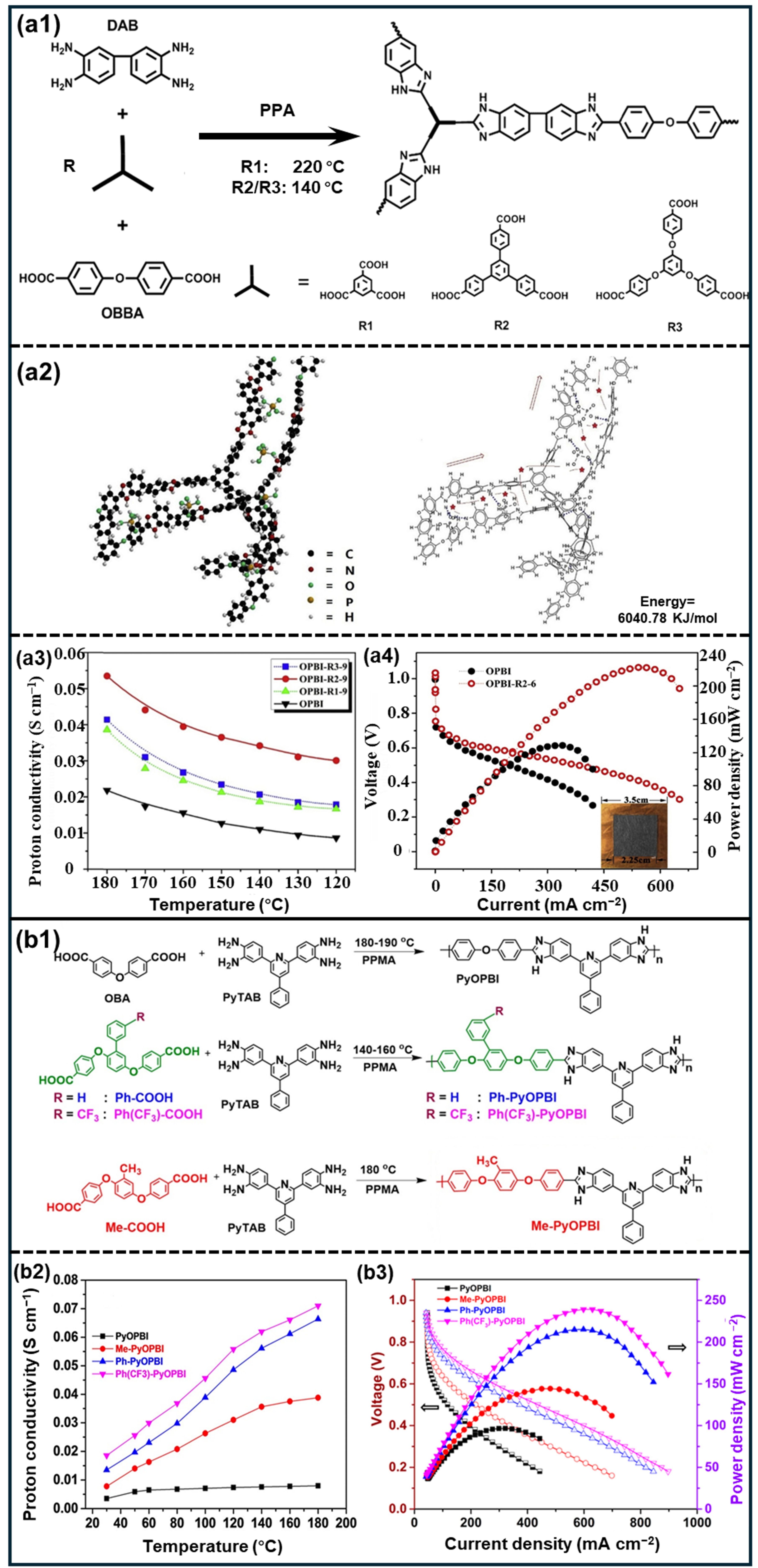
Wang et al. [88] introduced a series of bulky, rigid branching agents—4-fluorobenzonitrile, trimesic acid (R1), 1,3,5-tri(4-carboxyphenyl)benzene (R2), and 1,3,5-tri(4-carboxyphenoxy)benzene (R3)—to synthesize OPBI (ether-linked PBI) derivatives with three distinct branched structures (Figure 6(a1)). The resulting branched polymers were denoted as OPBI-R-X, where R indicates the branching agent and X is its molar ratio relative to the monomer (3,3′-diaminobenzidine). The authors systematically examined the PA-doping level, proton conductivity, and oxidative stability of the branched membranes. Relative to linear OPBI, the branched structures exhibited significantly higher PA uptake, enhanced proton conductivity, and stronger oxidative robustness. Among the three designs, the polymer containing the large, highly rigid R2 branching unit showed the most balanced and superior overall performance, specifically noted for its high anhydrous proton conductivity, outstanding oxidative stability, and significantly increased single-cell power density (Figure 6(a2)). OPBI-R2-9 achieved a proton conductivity of 5.3 × 10²− S·cm1− at 180 °C under anhydrous conditions due to its enlarged free volume (Figure 6(a3)). Moreover, OPBI-R2-6 retained 93% of its mass after immersion in Fenton’s reagent (4 ppm Fe2+, 3% H2O2) for 180 h. In single-cell tests (H2/air, 160 °C, anhydrous), OPBI-R2-6 delivered a power density of 222 mW·cm2−—nearly twice that of linear OPBI (Figure 6(a4)). These results highlight that branching enhances OPBI processability, proton conductivity, oxidative stability, and overall fuel cell performance.
Harilal et al. [89] reported a new class of nitrogen-rich heterocyclic tetraamine monomers used to synthesize both homopolymers and copolymers of PBI, referred to as PyPBI (pyridine-based PBI) (Figure 6(b1)). These polymers demonstrate strong potential as PEM materials for High temperature-PEMFCs. To address the reduced chemical stability of PyPBI caused by excessive PA uptake, the authors further developed a more easily accessible and scalable pendant-type PyOPBI. Three designed bulky-substituent PyOPBI membranes exhibited remarkably high PA loading (16~22 PRU1−) and proton conductivity (0.04–0.078 S·cm1− at 180 °C), significantly outperforming previously reported unsubstituted PyOPBI (14 PRU1−, 0.007 S·cm1− at 180 °C). The enhanced performance originated from the abundant hydrogen-bond acceptor sites (N and O atoms in the backbone), which facilitated proton conduction, and from strong intermolecular interactions between imidazole units, which promoted facile proton transfer. Asymmetric phenyl–aryl ether pendant substituents formed more efficient proton-transport pathways compared with simple PyPBI. Acid-leaching tests further showed that although all membranes experienced rapid initial mass loss, the Ph(CF3)-PyOPBI membrane—despite absorbing the most PA—exhibited the least mass loss, whereas unsubstituted PyOPBI showed the greatest loss. These results suggest that pendant groups interact with PA molecules to enhance acid retention.
Overall, compared with linear PBI, branched architectures—whether through bulky 1,3,5-tri(4-carboxyphenyl)benzene structures or pendant substituents—introduce substantial internal free volume, significantly improving acid retention and ultimately enhancing proton conductivity and fuel cell performance.
To achieve high proton conductivity in PBI membranes, the PA doping level must be increased. However, due to the plasticizing effect of PA, excessive doping can compromise the mechanical properties of the membrane. Balancing the proton conductivity and mechanical strength of PA/PBI PEMs remains a significant challenge. Introducing a crosslinked structure into PBI is an effective strategy. Crosslinked PBI networks can be constructed through various approaches, including: (i) mixing basic PBI with acidic polymers to prepare ionically crosslinked membranes via Lewis acid-base interactions [90]; (ii) forming stronger covalently crosslinked membranes through typical N-substitution reactions between PBI and crosslinkers containing halogen [91] or epoxy groups [92]; and (iii) employing thermal curing [93], Friedel–Crafts [94], and Diels–Alder [95] reactions, as well as other reactive functional groups, such as hydroxyl [96], amino [97], and benzoxazine [98] groups, to generate covalent crosslinks. Conventional crosslinkers can generally improve membrane stability; however, they inevitably consume functional imidazole units and create denser molecular structures. These two factors typically reduce the membrane’s intrinsic activity, leading to decreased proton conductivity and fuel cell performance [99].
Figure 6. (a1) Synthetic route and chemical structures of different branched OPBIs. (a2) The molecular model of OPBI-R2 doped with PA demonstrates the minimum calculated energy for proton transfer between copolymer branches and the potential pathways for proton transfer. (a3) The proton conductivity of OPBI-Rx-9. (a4) Single-cell performance of PA-doped OPBI and OPBI-R2-6 membranes at 160 °C under anhydrous conditions. Adapted with permission from [88]. Copyright 2018 Elsevier. (b1) Reaction schemes for the synthesis of PyOPBI polymers. (b2) Proton conductivity–temperature variation curves of three novel PyPBI membranes. (b3) Battery test performance of three novel PyPBI membranes doped with PA at 160 °C/0% RH. Adapted from [89].
Jcs 10 00218 g006
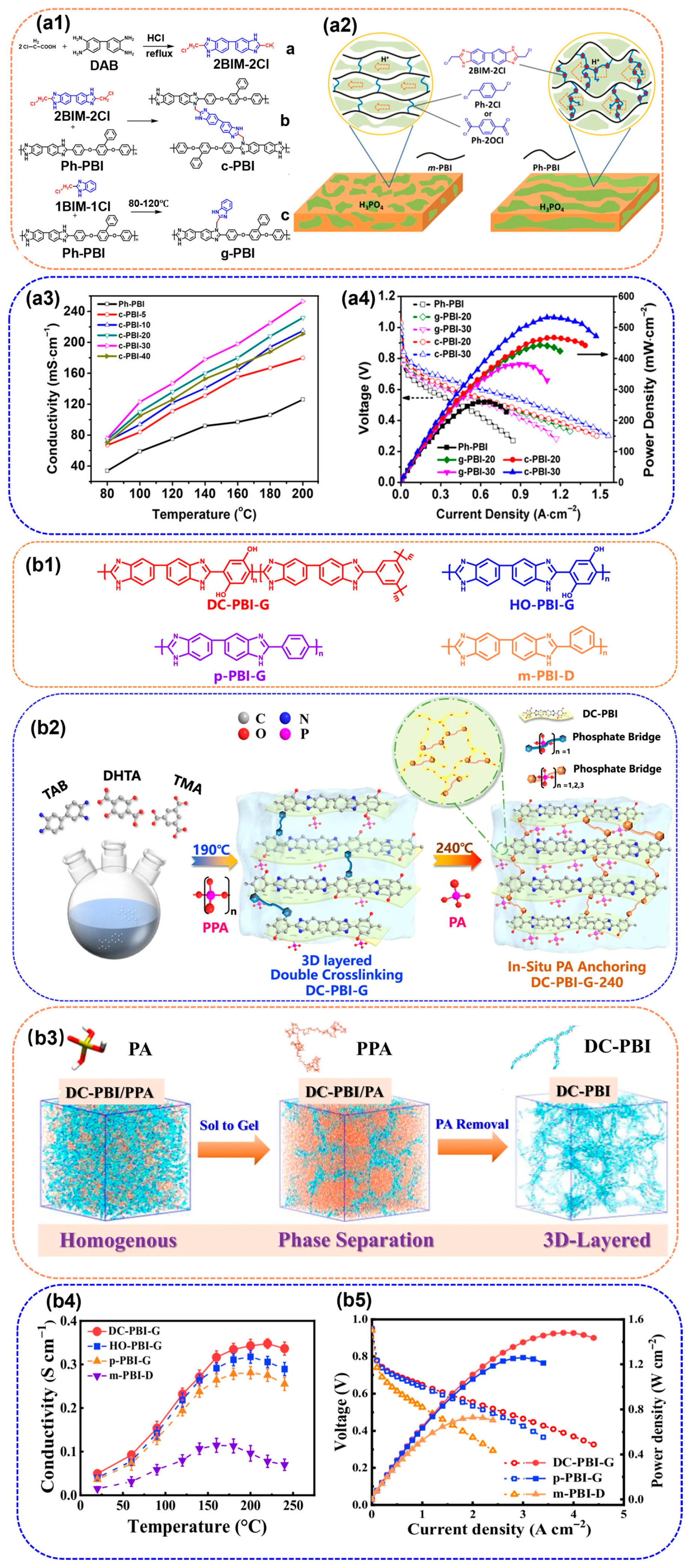
A multifunctional crosslinker with a unique dichloro/benzimidazole (A2B2-type) molecular structure exhibits extremely high reactivity, enabling both “self-reaction” among crosslinkers and “mutual reaction” between the crosslinker and PBI chains, resulting in a crosslinked network rich in functional imidazole groups (Figure 7a) [100]. Owing to the small-molecule monomer 2BIM-Cl, which has excellent film-forming and gelling properties, the prepared c-PBI-30 membrane (30% degree of crosslinking) achieved a proton conductivity of 253 mS cm1− at 200 °C, and an H2-O2 fuel cell employing the membrane at 160 °C without humidification delivered a power density of 533 mW·cm2−. Meanwhile, the membrane exhibited superior mechanical strength compared with commercial m-PBI, effectively balancing proton conductivity and mechanical stability, thus meeting the durability requirements for high-temperature operation.
At temperatures above 200 °C, PA-doped PEMs suffer from membrane creep, phosphoric acid evaporation, migration, dehydration, and condensation, leading to performance degradation. To address this, a high-performance gel-state PBI-G PEM was prepared via a polyphosphoric acid (PPA)-based sol–gel method [101]. By introducing hydroxyl groups into the PBI network, proton-conducting crosslinked phosphate ester bridges were formed, anchoring PPA and PA molecules (Figure 7b). Additionally, trifunctional trimellitic acid (TMA) monomers were incorporated between the branched PBI chains to provide dual crosslinking, generating a stable three-dimensional (3D) layered DC-PBI-G structure [102]. The combination of proton-conducting crosslinked phosphate ester bridges and the 3D branched PBI network effectively immobilized PA molecules, preventing 96% of PA dehydration and condensation at high temperatures.
Furthermore, the self-reaction of the crosslinker and mutual reaction between the crosslinker and PBI allow excess crosslinker molecules to continuously “grow” within the PBI network. This not only increases the free volume of the polymer but also creates regions enriched with basic sites, further enhancing ADLs and proton conductivity.
Figure 7. Schematic representation of the effect of crosslinking agents on membrane structure and proton conduction. (a1) Synthesis of 2,2′-bis(chloromethyl)-5,5′-bibenzimidazole (2BIM-2Cl). (a2) Hypothetical chain filling and proton conduction in crosslinked PBI membranes doped with PA. (a3) Temperature-dependent conductivity of c-PBI and Ph-PBI membranes measured at ambient humidity levels. (a4) Battery performance of Ph-PBI membranes for H2/O2 at 160 °C/0% RH. Adapted from [100]. (b1) Chemical structure of PBI membranes. (b2) Preparation process of PA-doped gel-state DC-PBI-G and DC-PBI-G-240 membranes. (b3) Three-dimensional visualisation and spatial configuration of DC-PBI model structures in 12 × 12 × 12 nm3 amorphous cubic cells. (b4) Proton conductivity at various temperatures. (b5) Single-cell performance comparison based on DC-PBI-G, p-PBI-G, and m-PBI-D membranes at 200 °C. Adapted from [102].
Jcs 10 00218 g007

3.2.3. Microphase Separation Engineering

During the development of low-temperature polymer electrolyte membranes, controlling the microphase-separated structure of polymer electrolyte membranes (PEMs) plays a crucial role in enhancing ion-transport efficiency while maintaining functional stability. Constructing and regulating phase-separated morphologies facilitates the formation of continuous, interconnected hydrophilic networks within the membrane, thereby significantly improving ion-transport efficiency [103]. In Nafion membranes, the highly hydrophobic PTFE backbone and highly hydrophilic sulfonic acid side chains form distinct nanoscale microphase-separated structures, exhibiting excellent H+-transport performance; this strategy can also be applied to PBI-based polymers [104].
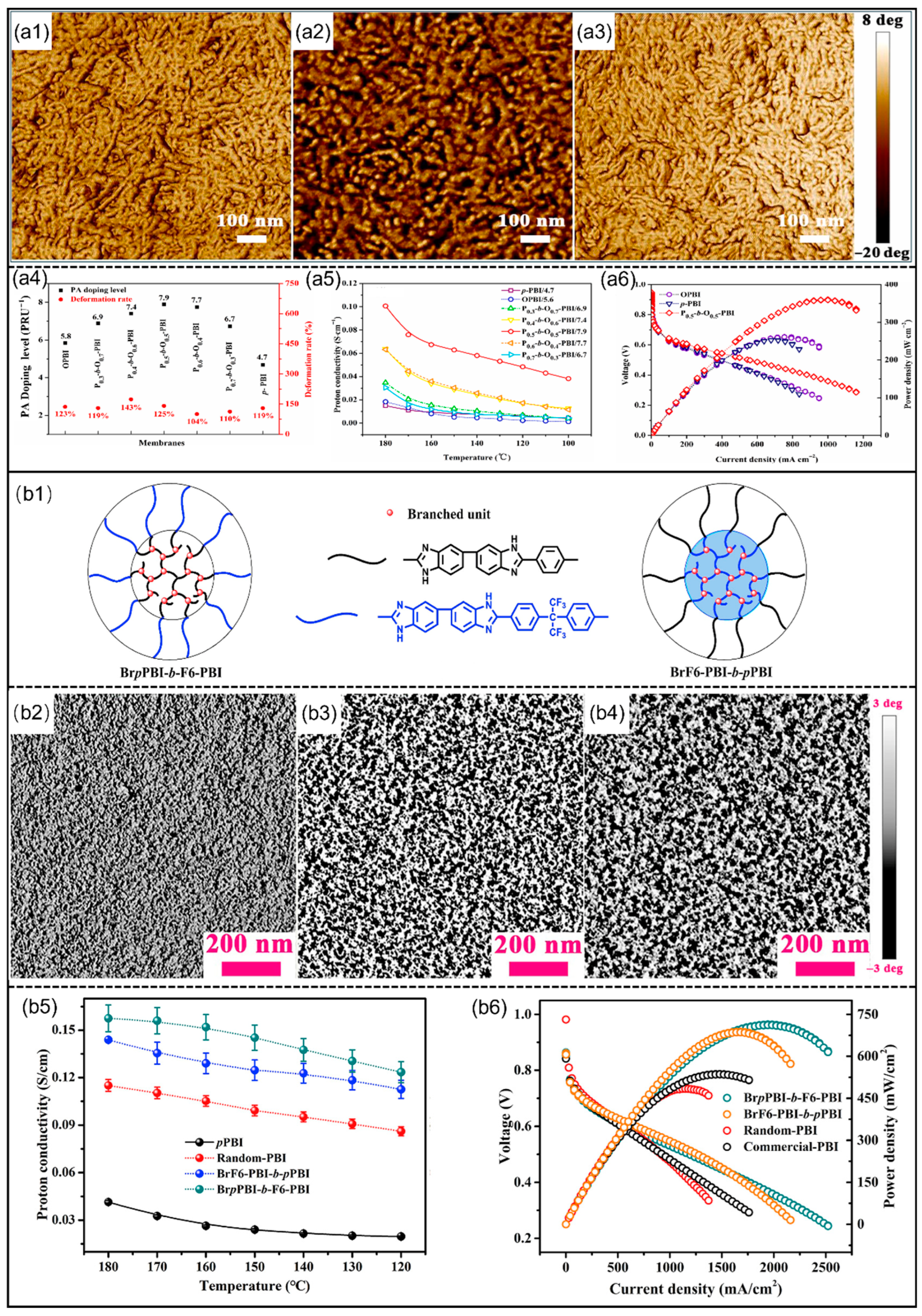
Strategies for constructing microphase-separated structures include copolymerization with high-density sulfonated monomers, long-side-chain grafting, block copolymerization, and high-temperature annealing. Among these approaches, block copolymerization is predominantly employed in PBI-based polymers to induce microphase separation. Atomic force microscopy images (Figure 8(a1–a3)) revealed that in segmented block copolymers of polybenzimidazole (Pm-b-On-PBI) (denoted as Pm-b-On-PBI, where ‘P’ and ‘O’ represent PBI and OPBI blocks, and ‘m’ and ‘n’ represent their respective molar ratios), a closer composition ratio of OPBI and P-PBI yields a more pronounced nanoscale phase-separation effect [105]. Among these PEMs, the P0.5-b-O0.5-PBI membrane exhibited the most distinct phase separation, achieving a proton conductivity of 0.1 S·cm1− under anhydrous conditions at 180 °C, with an ADL of 7.9 PRU1−, comparable to traditional linear PBI (Figure 8(a4)). As the degree of phase separation increased, both PA uptake and proton conductivity were correspondingly enhanced (Figure 8(a5)).
Both the increased free volume induced by branched PBI, which can accommodate more PA, and the microphase-separated structure generated by block PBI are beneficial for proton transport. Based on these two approaches, Wang [106] further developed a novel core–branched block membrane (BrF6-PBI-b-pPBI) from the P0.5-b-O0.5-PBI system (Figure 8b). When soaked in 85% PA at 80 °C, the BrF6-PBI-b-pPBI membrane exhibited an ADL of 17.3. Under anhydrous conditions at 160 °C (0% RH), the membrane achieved a high proton conductivity of 0.15 S·cm1−. Single-cell testing revealed a peak power density of 713 mW·cm2−, which was 1.5 times higher than that of random PBI (483 mW·cm2−).
The use of block copolymerization to construct microphase-separated structures facilitates the formation of continuous, interconnected hydrophilic networks within PBI membranes, enhancing proton-conduction efficiency. By tuning the composition of Pm-b-On-PBI, the degree of phase separation can be precisely controlled, enabling high proton conductivity even at relatively low acid doping levels. The novel BrF6-PBI-b-pPBI membrane, combining branched and block copolymer strategies, exhibited significantly enhanced conductivity, demonstrating that integrating branched and block structures is a promising approach for developing high-performance high-temperature
Figure 8. Atomic force microscopy (AFM) phase diagram of segmented block PBI membranes (a1a3): (a1) P0.3-b-O0.7-PBI, (a2) P0.5-b-O0.5-PBI, and (a3) P0.7-b-O0.3-PBI. (a4) ADL and deformation rate of the membranes. (a5) Proton conductivity of each PBI membrane under anhydrous conditions. (a6) Single-cell test performance of each PBI membrane. Adapted with permission from [105]. Copyright 2019 Elsevier. (b1) Schematic diagram of BrpPBI-b-F6-PBI and BrF6-PBI-pPBI structures. (b2) AFM images obtained from the random-PBI. (b3) BrF6-PBI-b-pPBI and (b4) Br pPBI-b-F6-PBI membranes in the dry state. (b5) Proton conductivity of pPBI, Random-PBI, BrF6-PBI-b-PBI, and BrpPBI-b-F6-PBI. (b6) Single-cell performance of PA-doped BrpPBI-b-F6-PBI, BrF6-PBI-bpPBI random-PBI, and commercial-PBI membranes operating with H2 (80 sccm)/O2 (160 sccm) at 160 °C under anhydrous conditions. Adapted with permission from [106]. Copyright 2020 Elsevier.
Jcs 10 00218 g008

3.3. Extrinsic Composite Engineering: Confinement and Synergy

3.3.1. Hygroscopic Inorganic Fillers: “Nano-Reservoir” Effect

Similar to composite Nafion membranes, the incorporation of inorganic nanofillers into PA-doped PBI membranes represents a viable strategy. Common inorganic fillers can be categorized into four types: (1) metal or non-metal oxide particles, such as SiO2, TiO2, and GO; (2) functionalized carbon materials; (3) proton-conducting materials, including heteropoly acids (SiWA, PWA, and PMoA), their cesium salts (HPAs), polyhedral oligomeric silsesquioxane (POSS), and zirconium oxides or salts—particularly zirconium phosphate (ZrP)—which provide additional acid sites and proton-conducting pathways; and (4) clays, which are widely used as electrode materials due to their low cost, proton-exchange properties, and layered structures.
Yilser Devrim et al. [107] prepared highly homogeneous PBI/SiO2 hybrid membranes, which exhibited enhanced acid uptake, retention, and proton conductivity (up to 0.1027 S·cm1− at 180 °C under anhydrous conditions). Single-cell performance tests at various temperatures demonstrated that the PBI/SiO2 hybrid membranes outperformed pristine PBI. Specifically, the PBI/SiO2 membrane achieved a maximum current density of 0.24 A·cm2− at 165 °C and 0.6 V, with a peak power density of 0.250 W·cm2−, compared to 0.185 W·cm2− for the pristine PBI membrane, indicating significant potential for practical applications.
The incorporation of sulfonated graphene oxide (sGO) can significantly enhance the proton conductivity of composite membranes, which is attributed to the increased –SO3H group content in the PBI/sGO composites [108]. Using a casting method, Yilser Devrim [109] fabricated PBI-sGO membranes. Under anhydrous conditions at 160 °C, PBI/sGO-2 (containing 5 wt.% GO) exhibited a peak power density of 364 mW·cm2−, compared to 235 mW·cm2− for pristine PBI. After 200 h of stability testing, the performance loss of PBI/sGO-2 was only 9%, whereas PBI lost 13% of its performance, highlighting the improved durability of the composite membrane.
Heteropoly acids (HPAs) have also been investigated as PEMFC membrane additives to enhance proton conductivity and reduce fuel crossover [110]. Verma et al. [111] prepared PWA/PBI and SiWA/PBI membranes with varying doping levels. Under 150 °C, 20% PWA/PBI showed only slightly higher conductivity than pristine PBI, while 40% PWA/PBI and 20% SiWA/PBI exhibited similar conductivities around 0.12 S·cm1−. Notably, the 40% SiWA/PBI composite achieved the highest conductivity at 0.1774 S·cm1−. Özdemir [112] prepared and characterized ZrP/PBI membranes. Due to favorable interactions between PBI and the filler, PBI/ZrP exhibited a proton conductivity of 0.200 S·cm1− at 180 °C, along with improved acid retention. An acid-affinitive crosslinked network constructed using alkyl chloride-functionalized POSS with high grafting density markedly enhanced phosphoric acid (PA) retention in PBI membranes (up to 91.7%) while modulating segmental dynamics to facilitate PA uptake and transport. Consequently, the membrane achieved a high proton conductivity of 121.5 mS cm−1 at 160 °C under anhydrous conditions and delivered a peak power density of 1109.1 mW cm−2 in HT-PEMFCs, along with excellent operational stability (voltage decay rate of 0.007 mV h−1) [113]. However, the underlying synergy between crosslinking-induced structural reinforcement and enhanced segmental mobility remains to be further elucidated.
Clay-based materials, owing to their hygroscopicity, high surface area, and low cost, such as laponite [114], montmorillonite [115],sepiolite [116], and vermiculite [117], have also been used as membrane additives for High temperature-PEMFCs. Recent studies [118] successfully incorporated muscovite (Mus) into PBI matrices via a casting method. At 150 °C under anhydrous conditions, a 1 wt.% Mus composite membrane exhibited a proton conductivity of 42.7 mS·cm1− and a peak power density of 586 mW·cm2−, which was 24% higher than that of pristine PBI (474 mW·cm2−). Additionally, the 1 wt.% Mus/PA-doped composite membrane demonstrated the highest mechanical strength (7.5 MPa) and lowest dimensional expansion (area expansion 70.99%, volume expansion 202%). The enhanced acid retention, proton conductivity, and durability were attributed to the formation of Mus-PA and Mus-PBI crosslinking, which facilitated interactions between PA molecules and polymer chains, highlighting the potential of Mus as a cost-effective filler for High temperature-PEM applications.
When incorporating inorganic nanomaterials into PA-PBI membranes, it is essential to consider interactions between the fillers and the polymer matrix, such as their effects on proton conductivity, thermal stability, and mechanical strength. Similar to PFSA membranes modified with inorganic fillers, attention must be paid to the impact of the fillers on PA adsorption, ensuring sufficient acid retention to prevent PA leakage.

3.3.2. Ionic Liquids: Synergistic Anhydrous Carriers

Nitrogen-containing heterocyclic ionic liquids (ILs) are a class of room-temperature molten salts with melting points typically below 100 °C that exhibit high ionic conductivity (102−–101− S·cm1−), low volatility, nonflammability, wide electrochemical windows, and good thermal stability. Owing to these excellent electrochemical properties, the incorporation of ILs can significantly enhance the electrochemical performance of PEMs [119]. At low apparent degrees of loading (ADL), ILs can also facilitate proton transport within PA-PBI membranes, achieving high proton conductivity [120].
Liu et al. [121] fabricated a series of high-conductivity composite membranes based on fluorinated polybenzimidazole (6FPBI) and poly(ionic liquids) (PILs). The epoxy groups in the PILs not only form an in situ crosslinked network to mitigate PA loss but also immobilize proton carriers (H2PO4) through ionic interactions. Regarding conductivity, the 6FPBI-PIL 30 membrane (30 indicates the mass ratio of PIL to the composite membrane) achieved a proton conductivity of 0.06 S·cm1− at 170 °C, compared to 0.039 S·cm1− for 6FPBI membranes with similar PA uptake (151–171%). In terms of acid retention, the 6FPBI-PIL 30 membrane retained 73.1% of its PA content after 400 h operation at 160 °C under anhydrous conditions, demonstrating significantly improved stability.
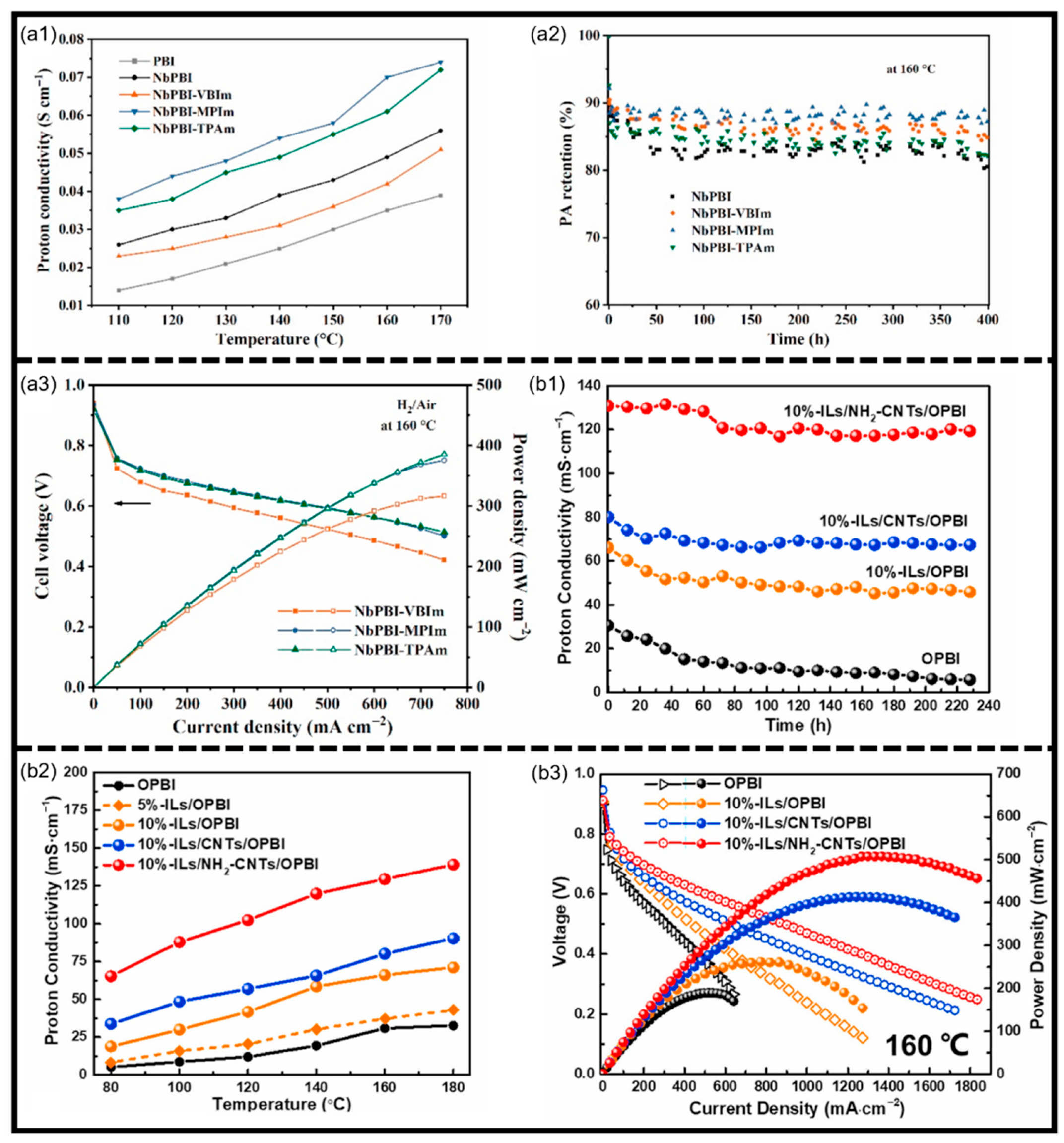
Liu [122] further developed novel High temperature-PEMs by combining norbornene-type PBI (NbPBI) with double-bond ionic liquids and doping three different ILs (VBIm, MPIm, and TPAm) (Figure 9a). The NbPBI-PIL membranes exhibited both high proton conductivity and strong PA retention. Specifically, the NbPBI-MPIm membrane achieved a proton conductivity of 0.074 S·cm1− at 170 °C, while the PA retention rates were 87.2% after 400 h at 160 °C and 73.8% after 80 h at 80 °C/40% RH.
However, the use of a single PIL additive faces challenges such as leaching from the membrane or reduced mechanical strength of the composite. To address this, it is recommended to combine PILs with other additives to ensure the physical integrity of the membrane, and successful cases have been reported. For example, Xiao et al. [123] prepared PILs/NH2-functionalized CNTs/OPBI hybrid membranes. The resulting hybrid membranes exhibited excellent proton conductivity and mechanical performance. After PA doping, the 10 wt.% PILs/NH2-CNTs/OPBI membrane showed an improved tensile strength of 18.1 MPa, which was approximately 1.8 times that of the CNT-free membrane. Under anhydrous conditions at 160 °C, the membrane delivered a proton conductivity of 130.8 mS·cm1− and a peak power density of 508 mW·cm2−, which were significantly higher than those of pristine OPBI and other hybrid OPBI membranes (Figure 9b).
Figure 9. (a1) Temperature-dependent proton conductivity curves of PBI, NbPBI, NbPBI-VBIm, NbPBI-MPIm, and NbPBI-TPAm. (a2) PA retention ratio of all membranes as a function of time under 160 °C and 0% RH. (a3) Single-cell performance curves of NbPBI-VBIm, NbPBI-MPIm, and NbPBI-TPAm. Adapted with permission from [122]. Copyright 2021 Elsevier. (b1) Proton conductivity stability. (b2) Proton conductivity and (b3) fuel cell performance of OPBI membranes without humidification at 160 °C. Adapted with permission from [123]. Copyright 2022 Elsevier.
Jcs 10 00218 g009

3.3.3. MOFs: Pore Confinement Effect

Metal–organic frameworks (MOFs) are functional crystalline materials characterized by high porosity and large specific surface areas. Due to these properties, MOFs have attracted increasing attention as fillers for High temperature-PEMs. The unique characteristics of MOFs arise from their hybrid structures that combine inorganic and organic components, which can be fine-tuned to generate a wide range of subclasses suitable for diverse applications. Currently, MOFs are widely studied in fields such as selective separation and heterogeneous catalysis owing to their controllable structures and tunable pore surfaces [124]. Numerous MOFs exhibit high proton conductivity (σ), with some surpassing 10−1 S·cm−1 [125,126].
The advantages of MOFs as proton conductors include: (1) their porous nature, which enables efficient adsorption of proton carriers and provides active sites for proton transport; (2) the ordered pore structure, which forms effective pathways for proton conduction; and (3) facile synthesis, which allows large-scale production of proton conductors tailored for specific requirements [127].
However, most MOFs lack film-forming capability, which limits their direct application. In current research, UIO-66 and ZIF-8, as representative MOF subclasses, have emerged as effective platforms for designing MOF-based efficient proton-conducting materials [128]. The incorporation of MOF fillers can enhance interfacial interactions within the membrane, improving proton-conduction mechanisms and simultaneously enhancing the mechanical stability of the composite membranes. Recently, Enis Oğuzhan Eren [129] prepared PBI-UIO66 and PBI-ZIF8 composite membranes with varying filler content. The PA uptake of the composites showed slight improvement, while proton conductivity increased significantly. The highest proton conductivities of PBI-UIO66 (10.0 wt.%) and PBI-ZIF8 (10.0 wt.%) were 0.311 and 0.316 S·cm1−, respectively, under 160 °C conditions.
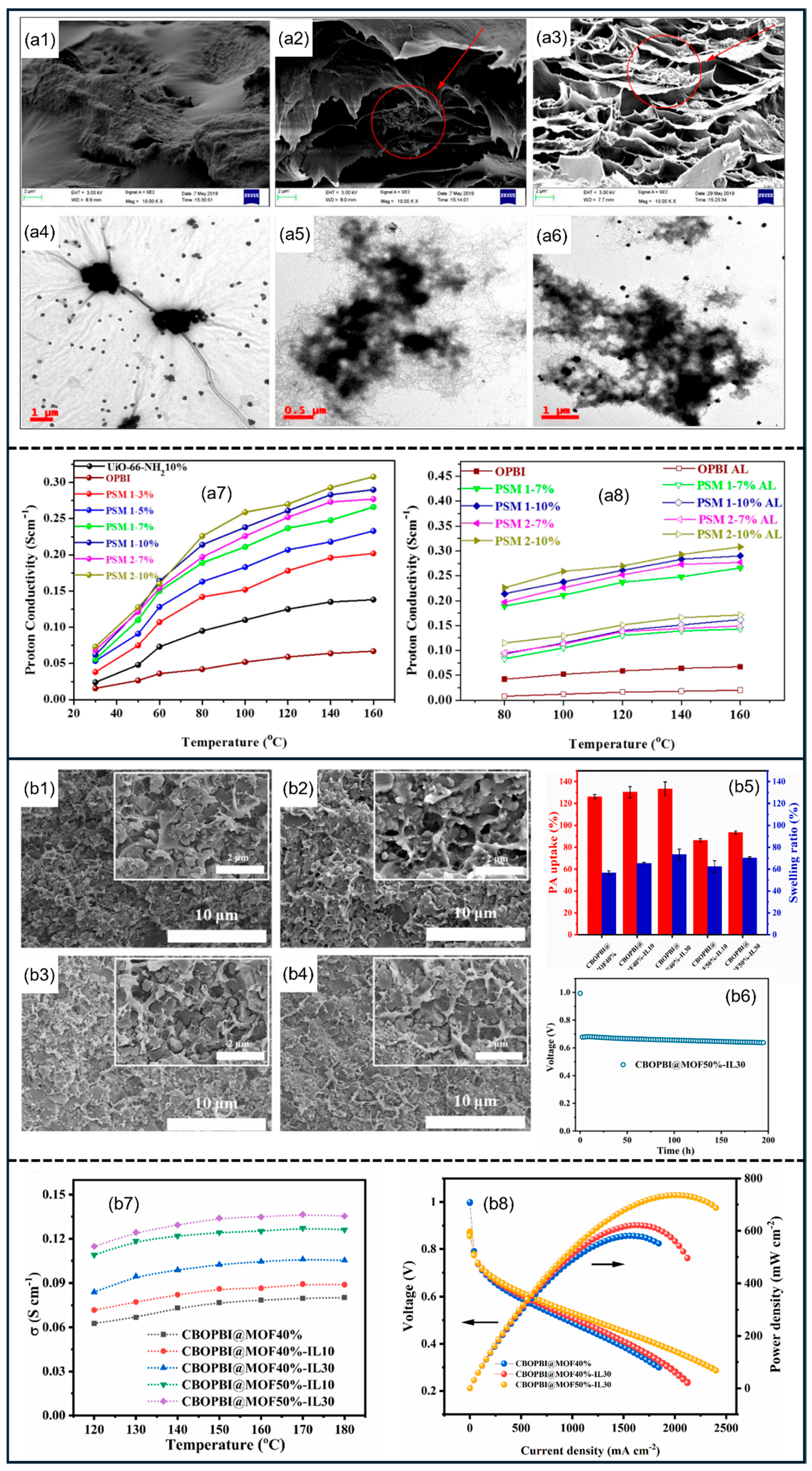
MOFs can also be post-modified before incorporation into PBI composite membranes. For example, UIO66-NH2 can be functionalized via reaction with sulfonic anhydrides to produce two homologous compounds, denoted PSM 1 and PSM 2 [130]. PSM 1 exhibits a proton conductivity as high as 1.64 × 101− S·cm1− at 80 °C, representing one of the highest values reported among MOF-based systems. Subsequently, Subhabrata Mukhopadhyay [131] incorporated PSM into an ether-linked OPBI matrix to fabricate PA-doped PEMs. FESEM analysis revealed that, unlike the cross-sectional morphology of pristine OPBI, the PSM 1 and PSM 2 composite membranes exhibit a coarse fibrous network (Figure 10(a1–a3)). TEM images confirmed that PSM 1 and PSM 2 nanoparticles can self-assemble within the OPBI matrix, forming continuous networks even at high loading levels (Figure 10(a4,a5)). The proton conductivities of the PSM composite membranes were significantly higher than those of the individual components and most other MOF-based polymer-supported membranes, with the PSM 1–10% and PSM 2–10% membranes exhibiting 0.29 S·cm1− and 0.308 S·cm1− at 160 °C under anhydrous conditions, respectively. Acid leaching tests (3 h immersion, simulating PEM exposure to harsh acidic conditions) demonstrated that the PSM composite membranes possessed far superior acid resistance compared to pristine OPBI (Figure 10(a8)). This study highlights the critical role of extensive interfacial hydrogen bonding and clearly demonstrates the advantages of rationally designed PSM 1 and PSM 2 MOFs as nanofillers in OPBI-supported membranes.
However, increasing UIO-66 loading can lead to a decline in the mechanical properties of the PEM, particularly an increase in brittleness. To address this, ionic liquids have been introduced as alternative electrolytes to enhance the flexibility of PBI membranes, mitigating the brittleness induced by MOF incorporation [132]. By using BMIMTFSI as a plasticizer, the brittleness of high-MOF-loading PEMs was effectively overcome. A high-loading (50 wt.%) crosslinked BOPBI (CBOPBI)@MOF composite membrane was successfully fabricated [133]. The MOF (UIO-66) enhanced proton-conduction pathways, and the CBOPBI@MOF50%-IL30 membrane achieved a proton conductivity of 0.135 S·cm1− at 160 °C, with a single-cell peak power density of 736 mW·cm2− (Figure 10b). Li et al. [134] developed a confined MOF-derived strategy by in situ growing ZIFs on PBI chains followed by PA-induced metal removal, generating nanoporous structures that enhanced PA uptake and retention. The resulting membrane effectively suppressed acid loss at elevated temperatures while maintaining efficient proton transport, leading to improved performance under anhydrous or low-humidity HT-PEMFC conditions. However, the long-term structural stability and durability of the metal-free porous framework remain to be further clarified.
Figure 10. FE-SEM cross-sectional images of (a1) the original OPBI. (a2) PSM 1–10%, and (a3) PSM 2–10% composite membranes (the red circles indicate the distribution of nanofillers in the cross section of the composite membrane). (a4) TEM image of PSM 1–10%. (a5,a6) TEM images of PSM 2–10%. (a7) Proton conductivity of OPBI, PSM composite membranes, along with UiO-66-NH2 10% membrane. (a8) Proton conductivity of OPBI composite membranes before and after acid leaching study (AL means after leaching). Adapted with permission from [131]. Copyright 2020 American Chemical Society. Cross-sectional SEM images of (b1) CBOPBI@MOF40%-IL10. (b2) CBOPBI@MOF40%-IL30, (b3) CBOPBI@MOF50%-IL10, and (b4) CBOPBI@MOF50%-IL30. (b5) PA uptake and swelling ratios of CBOPBI@MOF-IL membranes. (b6) Proton conductivity of CBOPBI@MOF-IL membranes. (b7) Proton conductivities of CBOPBI@MOF-IL membranes. (b8) Fuel cell performance of CBOPBI@MOF-IL membranes after PA doping without humidification at 160 °C Adapted from [133].
Jcs 10 00218 g010
The incorporation of MOFs into PBI has been demonstrated to enhance its stability under high-temperature conditions. However, the challenge of maintaining the structural integrity of MOFs in PA environments at elevated temperatures over extended periods remains significant. This phenomenon can be attributed to the formation of proton-transfer channels, which are either facilitated by residual ligands or emerge through continuous nanopores. The nature of the ligands and the extent of MOF dissolution in PA play a pivotal role in determining the observed outcomes. In the case of MOFs with insoluble ligands, a higher ligand ratio and the presence of abundant side groups can markedly improve the fuel cell performance of High temperature-PEMs. Conversely, in the case of MOFs with soluble ligands, the dissolution of small-particle MOFs results in the formation of nanopores that exhibit a pronounced capillary effect. This effect favors PA retention, thereby contributing to performance enhancement [135]. Despite the potential instability of MOFs under harsh operating conditions, the integration of these materials into the polymer matrix to create proton-conductive pathways remains a viable strategy to enhance the performance of PBI-based High temperature-PEMFC.

4. Cost-Effective Solutions for Wide-Temperature-Range (100~160 °C)- Sulfonated Aromatic Polymers (SPAs)

4.1. Intrinsic Architecture, Transport Dynamics, and Key Challenges of SPA

SPAs are a class of proton-exchange membrane materials prepared by introducing hydrophilic sulfonic acid groups (–SO3H) onto high-performance fully aromatic polymer backbones. Representative systems include sulfonated poly(ether ether ketone) (SPEEK), sulfonated poly(phenylene sulfone) (SPSU), and sulfonated poly(ether sulfone) (SPES) [136,137]. Compared with PFSA membranes, which are costly and involve complex synthesis, SPAs offer significant advantages in terms of raw material availability (mainly derived from engineering plastics) and facile synthetic routes, making them long considered economical alternatives to PFSA for low-temperature applications.
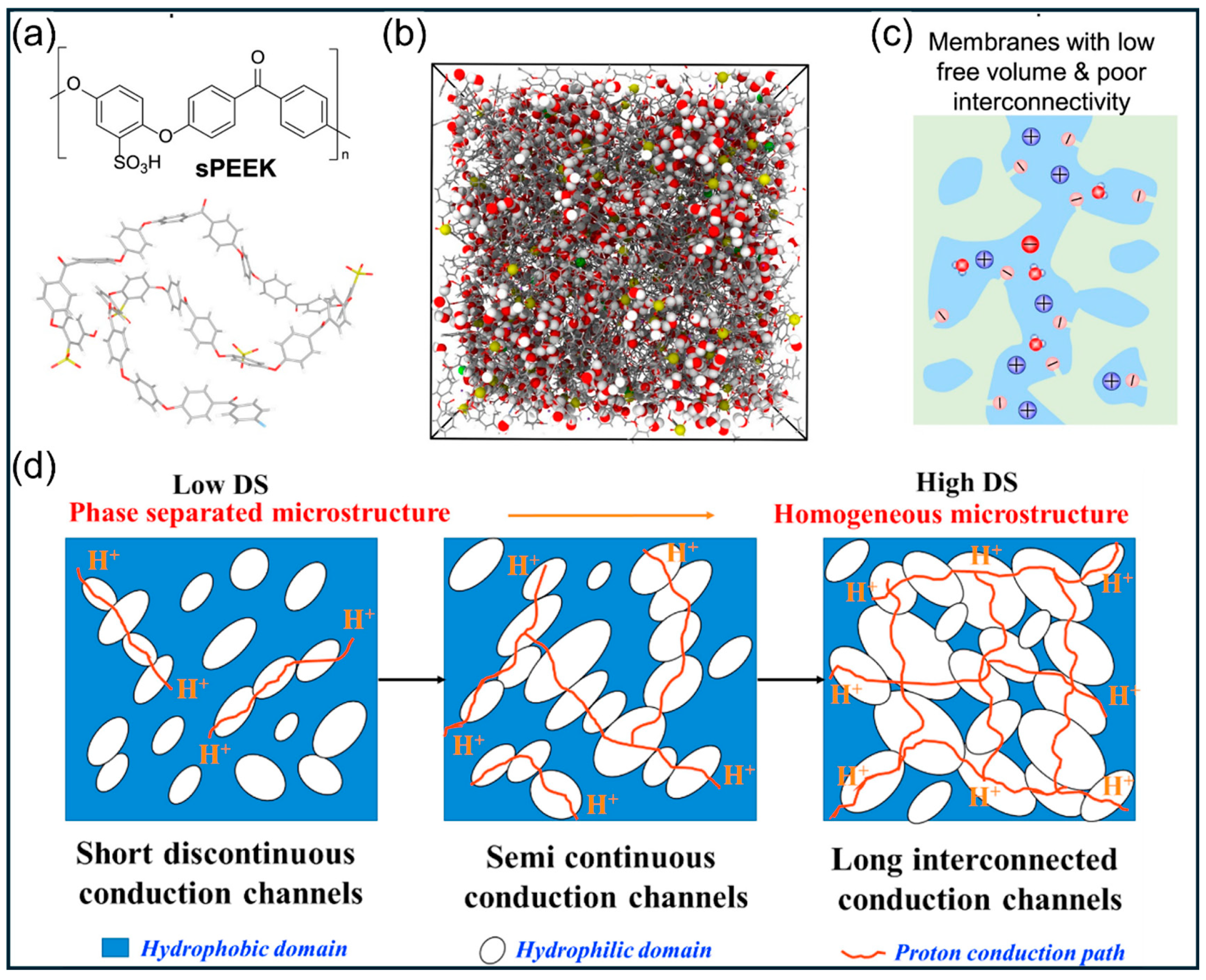
The potential of SPAs, however, extends beyond cost-effectiveness. Owing to the strong intramolecular π–π interactions of the fully aromatic backbone, these polymers exhibit excellent intrinsic thermal stability (Tg typically >180 °C) and superior mechanical strength. Such structural characteristics allow SPAs not only to operate under low-temperature conditions but also to maintain dimensional stability at temperatures above 120 °C, establishing them as promising candidates for wide-temperature-range proton-exchange membranes (Figure 11a,b) [138].
The proton-conduction functionality of SPAs is mainly achieved through sulfonation, either by post-sulfonation of the aromatic rings using reagents such as concentrated sulfuric acid, chlorosulfonic acid, or acetyl sulfate, or by polymerizing sulfonated monomers directly (pre-sulfonation) to precisely control the grafting density of –SO3H groups [139]. From a microscopic transport perspective, the introduced sulfonic acid groups induce the formation of hydrophilic ionic clusters within the hydrophobic backbone. Under low-temperature/high-humidity conditions (<100 °C), these clusters absorb water to form continuous proton-conducting channels, where proton migration is facilitated synergistically by vehicle diffusion of hydrated protons (H3O+) and Grotthuss hopping along hydrogen-bond networks. At temperatures exceeding 120 °C under anhydrous conditions, proton conduction primarily occurs via Grotthuss-type structural diffusion between solvent molecules (e.g., H4PO4+/H2PO4 pairs), complemented by vehicle migration of protonated solvent ions.
In practical applications, however, SPAs still face a critical trade-off between high proton conductivity and mechanical integrity (Figure 11c). Achieving proton transport comparable to Nafion requires increasing the degree of sulfonation (DS) to enhance the IEC [140]. Excessive sulfonation, however, significantly weakens the π–π interactions that maintain backbone strength and leads to severe volumetric swelling upon water or acid uptake, potentially resulting in gelation or dissolution at high DS, which severely compromises dimensional stability and mechanical strength (Figure 11d). Furthermore, in high-temperature anhydrous proton-conducting systems, the acidic SPA backbone lacks strong interaction sites with high-temperature proton carriers (e.g., phosphoric acid), causing the carriers to migrate or leach over prolonged operation [141].
Thus, the central challenge for applying SPAs across a wide temperature range lies in overcoming this inherent trade-off by constructing a robust “backbone–carrier” system. On the one hand, intrinsic structural engineering (e.g., chemical or thermal crosslinking) is needed to lock polymer chain mobility, suppress excessive swelling, and improve creep resistance. On the other hand, heterogenous composite engineering, involving the incorporation of functional inorganic fillers or porous frameworks, can physically confine or chemically anchor proton carriers while simultaneously enhancing mechanical strength.
Figure 11. (a) Chemical structure and block segments of sPEEK. (b) A simulated amorphous cell of sPEEK. (c) Schematic diagrams of the ion-channel morphology of sPEEK membranes. Adapted from [142]. (d) Evolution of microstructure with degree of sulfonation. Adapted from [143].
Jcs 10 00218 g011

4.2. Intrinsic Structural Engineering: Crosslinking Locking Strategies

To fundamentally overcome the intrinsic trade-off between high ion-exchange capacity (IEC) and dimensional stability in SPAs, constructing three-dimensional (3D) crosslinked networks has proven to be the most effective intrinsic structural regulation strategy. Unlike conventional linear polymer modifications, the essence of crosslinking lies in the “topological reconstruction” of polymer chains. Strong interaction nodes introduced between molecular chains via thermally induced self-crosslinking (forming sulfone bridges) or chemically assisted crosslinking (forming ester, amide, or other covalent bonds) can transform loosely packed linear chains into tightly interlocked 3D network architectures [144]. This structural transition primarily manifests as a physical restriction of segmental motion. Studies have shown that crosslinked networks significantly limit chain slippage and relaxation under high temperatures or solvent exposure. For example, in a thermally crosslinked blend of SPEEK and PVA, the synergistic effect of dense hydrogen bonds and covalent crosslinking points increases the glass transition temperature (Tg) from 97 °C (pre-modification) to 160 °C [145]. This marked enhancement in thermomechanical properties not only endows SPAs with resistance to thermal creep across a wide temperature range of 120–200 °C but also fundamentally alters the membrane’s solubility behavior, converting it from “dissolving” in hot water or highly polar solvents (e.g., DMSO) to merely undergoing limited swelling.
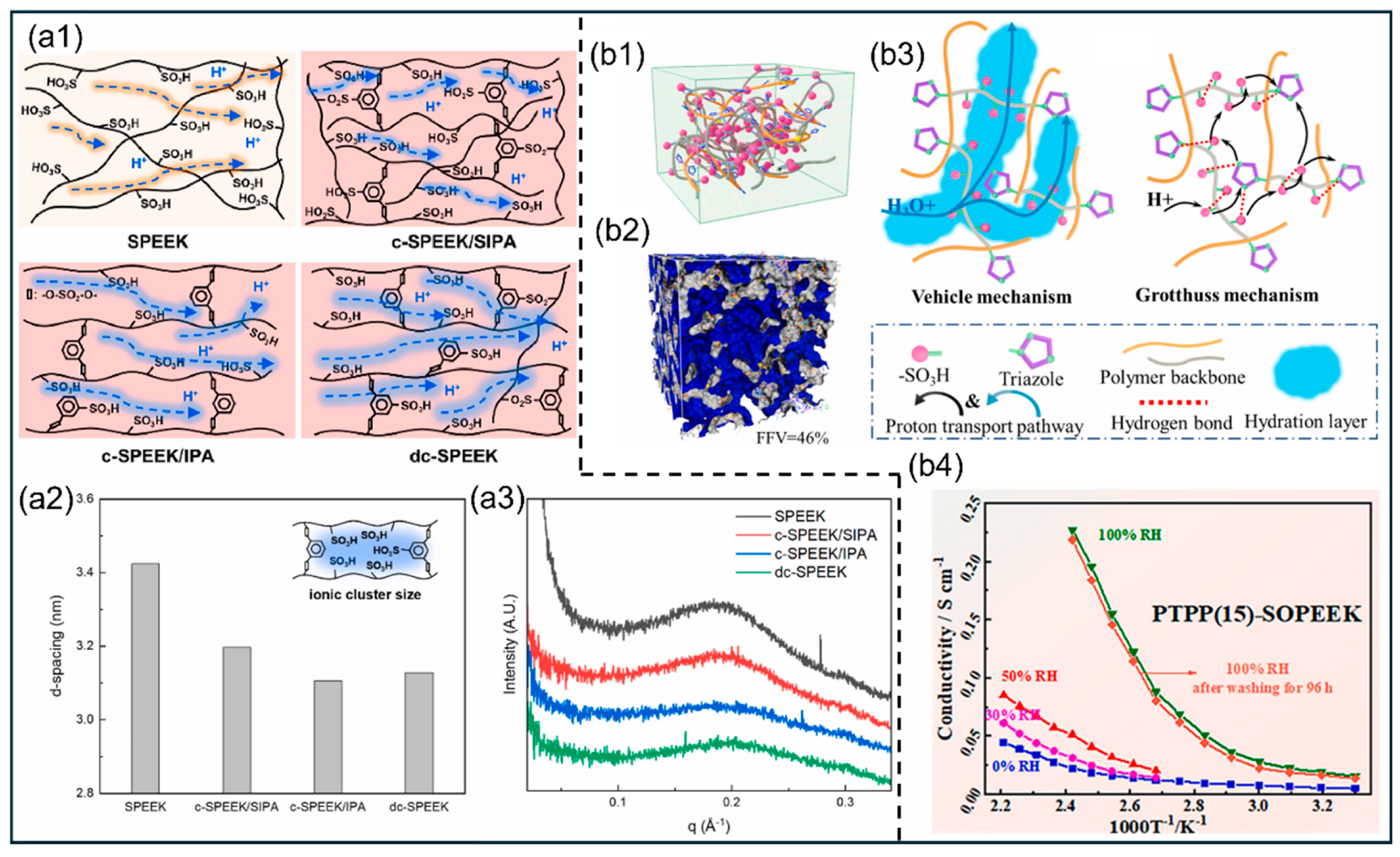
Importantly, the introduction of crosslinking does not merely “harden” the material; it profoundly reshapes the microphase-separation morphology and proton-transport channels within the membrane. In un-crosslinked high-IEC SPAs, excessive water uptake often causes uncontrolled expansion of hydrophilic domains, disrupting the connectivity of ion channels [138]. In crosslinked networks, the rigid backbone constrains excessive hydrophilic domain swelling, inducing a more ordered nanoscale rearrangement of ionic clusters [146]. For instance, in a dual-crosslinked SPEEK/iso-phthalic acid (IPA/SIPA) system (Figure 12a), SAXS and AFM analyses confirmed that crosslinking induced the formation of more uniform (3~4 nm) and highly interconnected hydrophilic channels [147].
A particularly innovative “triple-network crosslinking” strategy utilizes triazole-grafted polyphosphazene (PTPP) as a multifunctional crosslinker to react with terminal hydroxyl-functionalized SPEEK (SOPEEK) [148]. Here, the active P–Cl bonds on PTPP form covalent linkages with SOPEEK hydroxyls to lock the backbone, while the nitrogen-rich triazole side chains establish strong acid–base ionic interactions and hydrogen-bonding networks with sulfonic acid groups (Figure 12b). This unique topology not only completely prevents SOPEEK dissolution in hot water (conductivity remains nearly unchanged after 96 h of water immersion) but also provides triazole moieties as proton-accepting sites that facilitate efficient Grotthuss hopping, maintaining a high proton conductivity of 0.045 S·cm1− under anhydrous conditions at 180 °C.
The confined microphase separation induced by crosslinking offers dual advantages. First, the dense network compresses free volume and, through capillary effects, effectively “locks” the water or doped acids essential for proton conduction, reducing carrier loss. Second, the highly interconnected ionic clusters shorten proton-hopping distances, enabling efficient Grotthuss conduction even under low-humidity conditions. Consequently, the crosslinking-locking strategy balances backbone rigidity and channel flexibility at the molecular scale, successfully transforming SPAs from simple low-temperature conductors into robust electrolytic matrices suitable for wide-temperature operation.

4.3. Heterogeneous Functionalization: Composite Design for Wide Temperature Range

4.3.1. Hygroscopic Inorganic Fillers: “Nano-Reservoir” Effect and Mechanical Reinforcement

To address the conductivity decay of SPAs and related materials under high-temperature/low-humidity conditions caused by dehydration, the incorporation of highly hydrophilic inorganic nanoparticles as “nano-water reservoirs” has emerged as a classical and effective strategy. For instance, dispersing 5 wt% sulfonated ZrO2 (s-ZrO2) within a SPES matrix leverages the abundant sulfonic acid groups on the particle surface to adsorb water molecules, thereby significantly enhancing the connectivity of hydrophilic domains. As a result, the membrane achieves a proton conductivity of 1.78 mS·cm1− under anhydrous conditions at 120 °C [149]. Notably, the thermally stable sulfonated oxide nanoelectrolyte induces capillary condensation within periodically arranged hydrophilic nanocapillaries, which effectively sustains water retention and boosts proton conductivity under high-temperature, low-humidity conditions [150]. To further overcome the tendency of inorganic nanoparticles to aggregate, one-dimensional CNTs have been employed as supports. By in situ growing TiO2 on multi-walled carbon nanotubes (Figure 13b), the high aspect ratio of MWCNTs ensures uniform TiO2 dispersion and constructs long-range proton-transport channels, while also markedly improving the thermomechanical stability of the polymer matrix [151,152]. The optimized hybrid membrane exhibits a peak power density of 87.2 mW·cm2− at 120 °C and 30% RH, surpassing that of Nafion under the same conditions [153].
The physical doping strategy using hygroscopic inorganic fillers is primarily effective in the intermediate temperature range below 120 °C. Within this regime, the strong water-retaining capacity of the fillers effectively counters rapid water evaporation, maintaining the critical hydration level required for vehicle proton transport and thereby mitigating abrupt declines in membrane performance.

4.3.2. Non-Aqueous Proton Carriers: Synergistic Conduction and Confinement Engineering
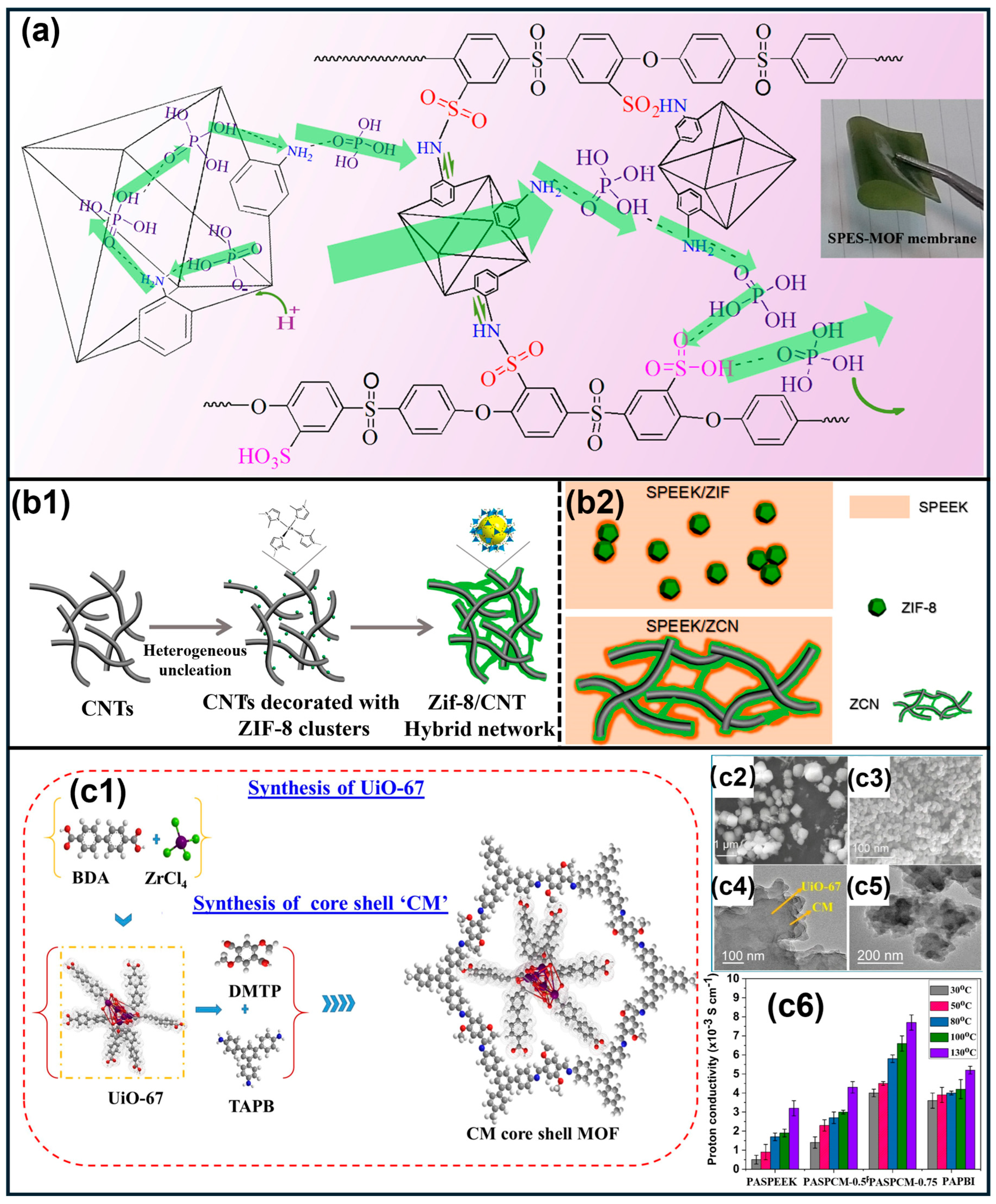
To overcome the intrinsic failure of water-mediated proton transport above 100 °C, incorporating non-aqueous proton carriers with high boiling points, excellent thermal stability, and inherent proton conductivity has become a key strategy for enabling wide-temperature operation in SPAs. Among these carriers, ILs and PA are the two most representative examples [154]. However, the polymer backbones of SPAs typically lack strong interaction sites for these small-molecule solvents, making carrier leaching during long-term operation one of the principal challenges that limits membrane durability. To address this issue, researchers have developed “chemical crosslinking immobilization” and “nanoconfinement within porous frameworks” to build robust non-aqueous proton-conduction systems.
Constructing a chemically crosslinked network can effectively restrict chain mobility and physically “lock” ionic liquids within the polymer matrix. For example, using ethylene glycol (EG) as a crosslinker, BMIMOTf ionic liquid was introduced into a SPEEK matrix followed by in situ thermal treatment. The resulting crosslinked structure significantly enhanced mechanical and thermal stability while effectively suppressing the loss of ILs in aqueous environments [155]. Additionally, leveraging the strong affinity between IL cations (e.g., BMIM+) and sulfonic acid groups helps immobilize ILs within SPEEK and facilitates the formation of continuous PA molecular chains, which dominate proton transport. The SPEEK/50% BMIMPF6/4.6 PA composite membrane achieved a high proton conductivity of 3.0 × 10²− S·cm1− at 160 °C and retained a stable conductivity of 2.0 × 10²− S·cm1− for over 600 h [156].
To achieve more refined control over membrane composition and architecture, layer-by-layer (LBL) assembly has been applied to construct multicomponent hybrid structures (Figure 14a). An LBL-built (SPEEK/PU/SPEEK/bmim)100 multilayer membrane—composed of SPEEK, polyurethane (PU), and bmim+ ionic liquid cations—not only enhanced interlayer adhesion through electrostatic interactions but also exploited BMIM+ to promote PA uptake and retention [157]. The resulting membrane exhibited a high anhydrous proton conductivity of 1.03 × 101− S·cm1− at 160 °C, outperforming binary SPEEK/PU systems, while maintaining favorable mechanical strength (tensile stress 2.38 MPa). These results underscore the ability of LBL assembly to balance conductivity and structural stability.
At elevated temperatures, IL leaching becomes increasingly severe due to enhanced water generation and reduced viscosity of the ionic liquid. To mitigate this issue, sulfonated hollow mesoporous organosilica (sHMO) has been employed as a “nanocontainer” to encapsulate ILs (Figure 14b). This physical confinement substantially suppresses IL loss, while the sulfonic acid groups on sHMO surfaces synergize with ILs to create continuous, anhydrous proton-conduction pathways [158]. The SP/IL50/sHMO-7.5 membrane achieved a proton conductivity of 10.5 mS·cm1− at 200 °C—significantly higher than its unmodified counterpart—while markedly reducing IL leakage.
Unlike PBIs, SPAs lack basic sites capable of chemically anchoring phosphoric acid. Therefore, incorporating metal–organic frameworks (MOFs) or covalent organic frameworks (COFs) with high surface areas and well-defined pore architectures as acid reservoirs has become a mainstream strategy for mitigating PA leaching (Figure 15). These porous frameworks utilize the confinement effect of their ordered nanochannels to immobilize PA and stabilize the proton-conduction environment.
One representative approach involves covalently anchoring MOFs onto the polymer backbone (Figure 15a). By employing a Hinsberg reaction, amine-functionalized mesoporous MOFs (Cr-MIL-101-NH2) were covalently grafted onto a SPES matrix, forming a dimensionally stable crosslinked network [159]. This architecture not only leveraged the pore confinement of MOFs to effectively suppress PA loss but also introduced –NH2 groups that facilitate Grotthuss-type proton transfer. The modified membrane achieved a high anhydrous proton conductivity of 41 mS cm1− at 160 °C—far exceeding that of Nafion—while substantially reducing swelling (from 57% to 4%) and improving mechanical and oxidative stability. To further enhance interfacial compatibility and optimize proton-transport pathways, multidimensional hybrid fillers have been developed. Examples include S-UiO-66@GO, where two-dimensional graphene oxide prevents MOF aggregation and provides abundant sulfonic acid sites [160], and ZIF-8/CNTs, where one-dimensional CNTs create long-range quasi-continuous conduction pathways (Figure 15b) [161].
Figure 15. (a) The hydrogen-bonding networks and the proton-transport mechanism (Grotthuss) along the SPES-MOF membrane. Adapted with permission from [159]. Copyright 2018 Elsevier (b1) Illustration of the synthesis process of ZCN through an in situ growth procedure. (b2) Schematic illustration for the interface design of SPEEK/ZIF or SPEEK/ZCN composite membranes. Adapted with permission from [161]. Copyright 2017 ACS (c1) Core–shell MOF synthetic root. SEM images of (c2) UiO-67 and (c3) TAPB/DMTP COF. (c4,c5) TEM images of CM core–shell MOF (at different scales 100 nm and 200 nm). (c6) Proton conductivity of PASPEEK, PASPCM-0.5, PASPCM-0.75, and PA PBI membranes at different temperatures. Adapted with permission from [162]. Copyright 2025 Elsevier.
Jcs 10 00218 g015
More recent work has focused on the precise engineering of hierarchical pore structures. A notable example is a core–shell hybrid of MOF (UiO-67) and COF (TAPB@DMTP), which integrates the advantages of both micropores and mesopores (Figure 15c) [162]. This dual-porosity architecture significantly increases the acid doping level while simultaneously balancing mechanical robustness and proton conductivity. Compared with commercial PA/PBI membranes, the hybrid SPEEK membrane exhibited superior proton conductivity (7.6 × 10³− S·cm1− at 130 °C) and excellent tensile strength (27.3 MPa), outperforming both MOF-only and COF-only composites. These results clearly demonstrate the strong potential of porous framework confinement strategies for constructing high-performance, high-temperature SPA membranes. Li et al. [163] developed multilayer HT-PEMs through layer-by-layer spin coating of CDs@MOF composites and SPEEK, where –OH/–COOH groups enabled strong hydrogen-bonding interactions with phosphoric acid (PA) and the organized architecture supported continuous proton-transport pathways. This design improved both PA retention and proton conduction. As a result, the membrane achieved a proton conductivity of (5.02 ± 0.64) × 10−2 S cm−1 at 160 °C and delivered peak power densities of 369.9 mW cm−2 at 120 °C (258.2 mW cm−2 at 100 °C), outperforming conventional SPEEK/PA systems. However, the interfacial stability of the multilayer structure and its resistance to delamination during prolonged high-temperature operation still need further validation.

5. Conclusions

Driven by the urgent need for long-lasting and highly efficient energy-conversion technologies in heavy-duty transportation and related sectors, PEMs are experiencing a fundamental shift from single-regime, low-temperature materials toward systems that operate across a wide temperature range with improved structural stability. In this comprehensive review, we systematically evaluate the material design strategies and structure–property relationships of the three main PEM systems—modified PFSAs, PBIs, and SAPs—as they address the critical thermal gap between 100 and 200 °C.
As the standard low-temperature material, PFSA has expanded its operational range to 100–120 °C through short-side-chain (SSC) molecular engineering and the addition of hygroscopic nanofillers, effectively preventing dehydration-related failures and solidifying its dominant role in the medium-temperature transition region. For the >120 °C anhydrous domain, PBI has become the preferred system because of its unique acid–base proton-transport mechanism. Current research is shifting from simple acid doping toward strategies involving crosslinked backbones and mesoporous confinement to prevent acid leaching and mechanical creep. Finally, SAPs (e.g., SPEEK) have gained attention as inexpensive alternatives. By creating rigid crosslinked networks and adding non-aqueous proton carriers such as ionic liquids or phosphoric acid, these materials have shown the ability to balance high conductivity with dimensional stability over a broad temperature range, presenting a new paradigm for next-generation low-cost PEM design. Despite differences across material platforms, “structural locking” and “interfacial synergy” have emerged as universal guiding principles for expanding the thermal range across all PEM types.

6. Future Directions

From a lifecycle perspective, current PEM materials still pose significant environmental challenges. PFSA membranes are linked to major environmental burdens due to fluorinated chemistry and persistent PFAS-related risks, whereas hydrocarbon-based alternatives such as SAPs and PBIs, despite avoiding fluorination, continue to depend on toxic organic solvents during manufacturing. Additionally, their degradation pathways further influence their environmental impacts, with PFSAs producing corrosive fluorinated byproducts, while hydrocarbon membranes generally emit less hazardous substances. Overall, these points highlight that current PEM systems are limited by inherent trade-offs between performance and environmental sustainability, encouraging the pursuit of more advanced material design strategies.
Looking ahead, the development of next-generation high-temperature PEMs should be guided by several key principles:
(1) Solid-state proton-transport media with built-in retention capabilities. Designing solid proton conductors or chemically anchored ionic species is crucial for eliminating reliance on mobile liquid acids or water, ensuring long-term stability under anhydrous and high-temperature conditions.
(2) Hierarchically ordered ion-transport structures. Creating well-defined, long-range proton-conduction pathways—through self-assembly or external field alignment—can facilitate efficient through-plane transport, providing high conductivity with less proton-carrier material.
(3) Membranes adaptable to a wide temperature range. Bridging the gap between low- and high-temperature PEMs requires developing responsive materials that can adjust dynamically to changing hydration and thermal environments, from cold-start to high-temperature/low-humidity conditions.
(4) Environmentally sustainable lifecycle design. Future efforts should focus on green manufacturing methods, such as water-based or solvent-free processing, utilizing bioderived aromatic components, and creating recyclable or depolymerizable polymer networks to reduce overall environmental impact.
By integrating molecular-level design, hierarchical structural engineering, advanced proton-transport mechanisms, and sustainable manufacturing approaches, next-generation PEMs aim to overcome current limitations and promote the large-scale adoption of fuel-cell technologies.

Funding

This research received no external funding.

Data Availability Statement

No new data were created or analyzed in this study. Data sharing is not applicable to this article.

Conflicts of Interest

The authors declare no conflict of interest.

References

  1. Shang, Z.; Wycisk, R.; Pintauro, P. Electrospun Composite Proton-Exchange and Anion-Exchange Membranes for Fuel Cells. Energies 2021, 14, 6709. [Google Scholar] [CrossRef]
  2. Gao, Y.; Pan, J.; Yang, Z.; Gao, F.; Ji, G. Optimization Based Accurate Scheduling for Generation and Reserve of Power System. Sci. China Technol. Sci. 2012, 55, 223–232. [Google Scholar] [CrossRef]
  3. De Luna, P.; Hahn, C.; Higgins, D.; Jaffer, S.A.; Jaramillo, T.F.; Sargent, E.H. What Would It Take for Renewably Powered Electrosynthesis to Displace Petrochemical Processes? Science 2019, 364, eaav3506. [Google Scholar] [CrossRef]
  4. Grove, W.R. On a Gaseous Voltaic Battery. J. Frankl. Inst. 1843, 35, 277–280. [Google Scholar] [CrossRef]
  5. Wang, Y.; Ruiz Diaz, D.F.; Chen, K.S.; Wang, Z.; Adroher, X.C. Materials, Technological Status, and Fundamentals of PEM Fuel Cells—A Review. Mater. Today 2020, 32, 178–203. [Google Scholar] [CrossRef]
  6. Cullen, D.A.; Neyerlin, K.C.; Ahluwalia, R.K.; Mukundan, R.; More, K.L.; Borup, R.L.; Weber, A.Z.; Myers, D.J.; Kusoglu, A. New Roads and Challenges for Fuel Cells in Heavy-Duty Transportation. Nat. Energy 2021, 6, 462–474. [Google Scholar] [CrossRef]
  7. Das, S.K.; Reis, A.; Berry, K.J. Experimental Evaluation of CO Poisoning on the Performance of a High Temperature Proton Exchange Membrane Fuel Cell. J. Power Sources 2009, 193, 691–698. [Google Scholar] [CrossRef]
  8. Xu, J.; Xiao, S.; Xu, X.; Xu, X. Numerical Study of Carbon Monoxide Poisoning Effect on High Temperature PEMFCs Based on an Elementary Reaction Kinetics Coupled Electrochemical Reaction Model. Appl. Energy 2022, 318, 119214. [Google Scholar] [CrossRef]
  9. Chung, D.Y.; Kim, H.; Chung, Y.-H.; Lee, M.J.; Yoo, S.J.; Bokare, A.D.; Choi, W.; Sung, Y.-E. Inhibition of CO Poisoning on Pt Catalyst Coupled with the Reduction of Toxic Hexavalent Chromium in a Dual-Functional Fuel Cell. Sci. Rep. 2014, 4, 7450. [Google Scholar] [CrossRef]
  10. Baschuk, J.J.; Li, X. Carbon Monoxide Poisoning of Proton Exchange Membrane Fuel Cells. Int. J. Energy Res. 2001, 25, 695–713. [Google Scholar] [CrossRef]
  11. Zhang, J.; Xie, Z.; Zhang, J.; Tang, Y.; Song, C.; Navessin, T.; Shi, Z.; Song, D.; Wang, H.; Wilkinson, D.P.; et al. High Temperature PEM Fuel Cells. J. Power Sources 2006, 160, 872–891. [Google Scholar] [CrossRef]
  12. Yang, L.; Nik-Ghazali, N.-N.; Ali, M.A.H.; Chong, W.T.; Yang, Z.; Liu, H. A Review on Thermal Management in Proton Exchange Membrane Fuel Cells: Temperature Distribution and Control. Renew. Sustain. Energy Rev. 2023, 187, 113737. [Google Scholar] [CrossRef]
  13. Taccani, R.; Zuliani, N. Effect of Flow Field Design on Performances of High Temperature PEM Fuel Cells: Experimental Analysis. Int. J. Hydrogen Energy 2011, 36, 10282–10287. [Google Scholar] [CrossRef]
  14. Lee, K.; Ishihara, A.; Mitsushima, S.; Kamiya, N.; Ota, K. Effect of Recast Temperature on Diffusion and Dissolution of Oxygen and Morphological Properties in Recast Nafion. J. Electrochem. Soc. 2004, 151, A639. [Google Scholar] [CrossRef]
  15. Zhang, H.; Shen, P.K. Advances in the High Performance Polymer Electrolyte Membranes for Fuel Cells. Chem. Soc. Rev. 2012, 41, 2382–2394. [Google Scholar] [CrossRef]
  16. Madhav, D.; Wang, J.; Keloth, R.; Mus, J.; Buysschaert, F.; Vandeginste, V. A Review of Proton Exchange Membrane Degradation Pathways, Mechanisms, and Mitigation Strategies in a Fuel Cell. Energies 2024, 17, 998. [Google Scholar] [CrossRef]
  17. De Gregorio, E.; Roviello, G.; Naticchioni, V.; Cigolotti, V.; Pozio, A.; Hein, L.A.; De Luca, C.; Ferone, C.; Rinaldi, A.; Tarallo, O. Electrospun Polybenzimidazole Membranes: Fabrication and Fine-Tuning through Physical and Statistical Approaches. Polymers 2025, 17, 1594. [Google Scholar] [CrossRef]
  18. Deng, Y.; Hussain, A.; Raza, W.; Cai, X.; Liu, D.; Shen, J. Review on Current Development of Polybenzimidazole Membrane for Lithium Battery. J. Energy Chem. 2024, 91, 579–608. [Google Scholar] [CrossRef]
  19. Chen, G.; Ge, L.; Lee, J.H.; Zhu, Z.; Wang, H. Porous Coordination Polymer-Based Composite Membranes for High-Temperature Polymer Exchange Membrane Fuel Cells. Matter 2022, 5, 2031–2053. [Google Scholar] [CrossRef]
  20. Wang, H.; Zhao, Y.; Shao, Z.; Xu, W.; Wu, Q.; Ding, X.; Hou, H. Proton Conduction of Nafion Hybrid Membranes Promoted by NH3 -Modified Zn-MOF with Host–Guest Collaborative Hydrogen Bonds for H2/O2 Fuel Cell Applications. ACS Appl. Mater. Interfaces 2021, 13, 7485–7497. [Google Scholar] [CrossRef]
  21. Patel, H.A.; Mansor, N.; Gadipelli, S.; Brett, D.J.L.; Guo, Z. Superacidity in Nafion/MOF Hybrid Membranes Retains Water at Low Humidity to Enhance Proton Conduction for Fuel Cells. ACS Appl. Mater. Interfaces 2016, 8, 30687–30691. [Google Scholar] [CrossRef]
  22. Gahlot, S.; Kulshrestha, V. Dramatic Improvement in Water Retention and Proton Conductivity in Electrically Aligned Functionalized CNT/SPEEK Nanohybrid PEM. ACS Appl. Mater. Interfaces 2015, 7, 264–272. [Google Scholar] [CrossRef]
  23. Xing, Y.-Y.; Wang, J.; Zhang, C.-X.; Wang, Q.-L. High Proton Conductivity of the UiO-66-NH2-SPES Composite Membrane Prepared by Covalent Cross-Linking. ACS Appl. Mater. Interfaces 2023, 15, 33003–33012. [Google Scholar] [CrossRef]
  24. Meyer, Q.; Yang, C.; Cheng, Y.; Zhao, C. Overcoming the Electrode Challenges of High-Temperature Proton Exchange Membrane Fuel Cells. Electrochem. Energy Rev. 2023, 6, 16. [Google Scholar] [CrossRef]
  25. Chen, J.; Wang, L.; Wang, L. Highly Conductive Polybenzimidazole Membranes at Low Phosphoric Acid Uptake with Excellent Fuel Cell Performances by Constructing Long-Range Continuous Proton Transport Channels Using a Metal–Organic Framework (UIO-66). ACS Appl. Mater. Interfaces 2020, 12, 41350–41358. [Google Scholar] [CrossRef] [PubMed]
  26. Zhang, J.; Aili, D.; Lu, S.; Li, Q.; Jiang, S.P. Advancement toward Polymer Electrolyte Membrane Fuel Cells at Elevated Temperatures. Research 2020, 2020, 9089405. [Google Scholar] [CrossRef] [PubMed]
  27. Mauritz, K.A.; Moore, R.B. State of Understanding of Nafion. Chem. Rev. 2004, 104, 4535–4586. [Google Scholar] [CrossRef]
  28. Kusoglu, A.; Weber, A.Z. New Insights into Perfluorinated Sulfonic-Acid Ionomers. Chem. Rev. 2017, 117, 987–1104. [Google Scholar] [CrossRef]
  29. Bose, S.; Kuila, T.; Nguyen, T.X.H.; Kim, N.H.; Lau, K.; Lee, J.H. Polymer Membranes for High Temperature Proton Exchange Membrane Fuel Cell: Recent Advances and Challenges. Prog. Polym. Sci. 2011, 36, 813–843. [Google Scholar] [CrossRef]
  30. Yin, C.; Li, J.; Zhou, Y.; Zhang, H.; Fang, P.; He, C. Enhancement in Proton Conductivity and Thermal Stability in Nafion Membranes Induced by Incorporation of Sulfonated Carbon Nanotubes. ACS Appl. Mater. Interfaces 2018, 10, 14026–14035. [Google Scholar] [CrossRef]
  31. Kreuer, K.D. On the Development of Proton Conducting Materials for Technological Applications. Solid State Ion. 1997, 97, 1–15. [Google Scholar] [CrossRef]
  32. Kreuer, K.D. On the Complexity of Proton Conduction Phenomena. Solid State Ion. 2000, 136, 149–160. [Google Scholar] [CrossRef]
  33. Sun, H.; Sun, Z.; Wu, Y. Proton Transfer Mechanism in Perfluorinated Sulfonic Acid Polytetrafluoroethylene. Int. J. Hydrogen Energy 2012, 37, 12821–12826. [Google Scholar] [CrossRef]
  34. Vinothkannan, M.; Kim, A.R.; Ramakrishnan, S.; Yu, Y.-T.; Yoo, D.J. Advanced Nafion Nanocomposite Membrane Embedded with Unzipped and Functionalized Graphite Nanofibers for High-Temperature Hydrogen-Air Fuel Cell System: The Impact of Filler on Power Density, Chemical Durability and Hydrogen Permeability of Membrane. Compos. Part B Eng. 2021, 215, 108828. [Google Scholar] [CrossRef]
  35. Liu, X.; Li, Y.; Xue, J.; Zhu, W.; Zhang, J.; Yin, Y.; Qin, Y.; Jiao, K.; Du, Q.; Cheng, B.; et al. Magnetic Field Alignment of Stable Proton-Conducting Channels in an Electrolyte Membrane. Nat. Commun. 2019, 10, 842. [Google Scholar] [CrossRef]
  36. Xu, G.; Li, J.; Ma, L.; Xiong, J.; Mansoor, M.; Cai, W.; Cheng, H. Performance Dependence of Swelling-Filling Treated Nafion Membrane on Nano-Structure of Macromolecular Filler. J. Membr. Sci. 2017, 534, 68–72. [Google Scholar] [CrossRef]
  37. Sun, D.; Zhou, J. Ionic Liquid Confined in Nafion: Toward Molecular-Level Understanding. AIChE J. 2013, 59, 2630–2639. [Google Scholar] [CrossRef]
  38. Zhang, B.; Cao, Y.; Jiang, S.; Li, Z.; He, G.; Wu, H. Enhanced Proton Conductivity of Nafion Nanohybrid Membrane Incorporated with Phosphonic Acid Functionalized Graphene Oxide at Elevated Temperature and Low Humidity. J. Membr. Sci. 2016, 518, 243–253. [Google Scholar] [CrossRef]
  39. Escorihuela, J.; Olvera-Mancilla, J.; Alexandrova, L.; Del Castillo, L.F.; Compañ, V. Recent Progress in the Development of Composite Membranes Based on Polybenzimidazole for High Temperature Proton Exchange Membrane (PEM) Fuel Cell Applications. Polymers 2020, 12, 1861. [Google Scholar] [CrossRef]
  40. Delfino, S.; Villa, D.C.; Giannetti, A.; Tomasino, D.V.; Oldani, C.; Storti, G.; Sponchioni, M. Short Side-Chain Perfluorosulfonic Acid Aquivion: From Production to Application. Macromol. Mater. Eng. 2025, 311, e00262. [Google Scholar] [CrossRef]
  41. Shabani, M.; Younesi, H.; Pontié, M.; Rahimpour, A.; Rahimnejad, M.; Zinatizadeh, A.A. A Critical Review on Recent Proton Exchange Membranes Applied in Microbial Fuel Cells for Renewable Energy Recovery. J. Clean. Prod. 2020, 264, 121446. [Google Scholar] [CrossRef]
  42. Shin, S.-H.; Nur, P.J.; Kodir, A.; Kwak, D.-H.; Lee, H.; Shin, D.; Bae, B. Improving the Mechanical Durability of Short-Side-Chain Perfluorinated Polymer Electrolyte Membranes by Annealing and Physical Reinforcement. ACS Omega 2019, 4, 19153–19163. [Google Scholar] [CrossRef] [PubMed]
  43. Katzenberg, A.; Chowdhury, A.; Fang, M.; Weber, A.Z.; Okamoto, Y.; Kusoglu, A.; Modestino, M.A. Highly Permeable Perfluorinated Sulfonic Acid Ionomers for Improved Electrochemical Devices: Insights into Structure–Property Relationships. J. Am. Chem. Soc. 2020, 142, 3742–3752. [Google Scholar] [CrossRef] [PubMed]
  44. Ghielmi, A.; Vaccarono, P.; Troglia, C.; Arcella, V. Proton Exchange Membranes Based on the Short-Side-Chain Perfluorinated Ionomer. J. Power Sources 2005, 145, 108–115. [Google Scholar] [CrossRef]
  45. Li, J.; Pan, M.; Tang, H. Understanding Short-Side-Chain Perfluorinated Sulfonic Acid and Its Application for High Temperature Polymer Electrolyte Membrane Fuel Cells. RSC Adv. 2014, 4, 3944–3965. [Google Scholar] [CrossRef]
  46. Kreuer, K.D.; Schuster, M.; Obliers, B.; Diat, O.; Traub, U.; Fuchs, A.; Klock, U.; Paddison, S.J.; Maier, J. Short-Side-Chain Proton Conducting Perfluorosulfonic Acid Ionomers: Why They Perform Better in PEM Fuel Cells. J. Power Sources 2008, 178, 499–509. [Google Scholar] [CrossRef]
  47. Jeon, Y.; Hwang, H.; Park, J.; Hwang, H.; Shul, Y.-G. Temperature-Dependent Performance of the Polymer Electrolyte Membrane Fuel Cell Using Short-Side-Chain Perfluorosulfonic Acid Ionomer. Int. J. Hydrogen Energy 2014, 39, 11690–11699. [Google Scholar] [CrossRef]
  48. Ding, C.; Zhang, H.; Li, X.; Zhang, H.; Yao, C.; Shi, D. Morphology and Electrochemical Properties of Perfluorosulfonic Acid Ionomers for Vanadium Flow Battery Applications: Effect of Side-Chain Length. ChemSusChem 2013, 6, 1262–1269. [Google Scholar] [CrossRef]
  49. Saccà, A.; Baglio, V.; Paci, B.; Generosi, A.; Riva, F.R.; Gatto, I. Electrochemical and Structural Characterization of Recast Aquivion® EW720 Polymer Electrolyte Membranes for Proton Exchange Membrane Fuel Cell (PEMFC) Applications. Mater. Renew. Sustain. Energy 2026, 15, 4–18. [Google Scholar] [CrossRef]
  50. Bass, M.; Berman, A.; Singh, A.; Konovalov, O.; Freger, V. Surface-Induced Micelle Orientation in Nafion Films. Macromolecules 2011, 44, 2893–2899. [Google Scholar] [CrossRef]
  51. Guan, P.; Zou, Y.; Zhang, M.; Zhong, W.; Xu, J.; Lei, J.; Ding, H.; Feng, W.; Liu, F.; Zhang, Y. High-Temperature Low-Humidity Proton Exchange Membrane with “Stream-Reservoir” Ionic Channels for High-Power-Density Fuel Cells. Sci. Adv. 2023, 9, eadh1386. [Google Scholar] [CrossRef] [PubMed]
  52. Rodgers, M.P.; Bonville, L.J.; Kunz, H.R.; Slattery, D.K.; Fenton, J.M. Fuel Cell Perfluorinated Sulfonic Acid Membrane Degradation Correlating Accelerated Stress Testing and Lifetime. Chem. Rev. 2012, 112, 6075–6103. [Google Scholar] [CrossRef] [PubMed]
  53. Adjemian, K.T.; Lee, S.J.; Srinivasan, S.; Benziger, J.; Bocarsly, A.B. Silicon Oxide Nafion Composite Membranes for Proton-Exchange Membrane Fuel Cell Operation at 80–140 °C. J. Electrochem. Soc. 2002, 149, A256. [Google Scholar] [CrossRef]
  54. Vengatesan, S.; Kim, H.-J.; Lee, S.-Y.; Cho, E.; Ha, H.Y.; Oh, I.-H.; Lim, T.-H. Operation of a Proton Exchange Membrane Fuel Cell under Non-Humidified Conditions Using a Membrane–Electrode Assemblies with Composite Membrane and Electrode. J. Power Sources 2007, 167, 325–329. [Google Scholar] [CrossRef]
  55. Amjadi, M.; Rowshanzamir, S.; Peighambardoust, S.J.; Hosseini, M.G.; Eikani, M.H. Investigation of Physical Properties and Cell Performance of Nafion/TiO2 Nanocomposite Membranes for High Temperature PEM Fuel Cells. Int. J. Hydrogen Energy 2010, 35, 9252–9260. [Google Scholar] [CrossRef]
  56. Wu, W.; Li, Y.; Liu, J.; Wang, J.; He, Y.; Davey, K.; Qiao, S. Molecular-Level Hybridization of Nafion with Quantum Dots for Highly Enhanced Proton Conduction. Adv. Mater. 2018, 30, 1707516. [Google Scholar] [CrossRef]
  57. Amjadi, M.; Rowshanzamir, S.; Peighambardoust, S.J.; Sedghi, S. Preparation, Characterization and Cell Performance of Durable Nafion/SiO2 Hybrid Membrane for High-Temperature Polymeric Fuel Cells. J. Power Sources 2012, 210, 350–357. [Google Scholar] [CrossRef]
  58. Xu, G.; Li, S.; Li, J.; Liu, Z.; Li, Y.; Xiong, J.; Cai, W.; Qu, K.; Cheng, H. Targeted Filling of Silica in Nafion by a Modified in Situ Sol–Gel Method for Enhanced Fuel Cell Performance at Elevated Temperatures and Low Humidity. Chem. Commun. 2019, 55, 5499–5502. [Google Scholar] [CrossRef]
  59. Shao, Z.-G.; Joghee, P.; Hsing, I.-M. Preparation and Characterization of Hybrid Nafion–Silica Membrane Doped with Phosphotungstic Acid for High Temperature Operation of Proton Exchange Membrane Fuel Cells. J. Membr. Sci. 2004, 229, 43–51. [Google Scholar] [CrossRef]
  60. Ramani, V.; Kunz, H.R.; Fenton, J.M. Investigation of Nafion®/HPA Composite Membranes for High Temperature/Low Relative Humidity PEMFC Operation. J. Membr. Sci. 2004, 232, 31–44. [Google Scholar] [CrossRef]
  61. Javed, A.; Palafox Gonzalez, P.; Thangadurai, V. A Critical Review of Electrolytes for Advanced Low- and High-Temperature Polymer Electrolyte Membrane Fuel Cells. ACS Appl. Mater. Interfaces 2023, 15, 29674–29699. [Google Scholar] [CrossRef] [PubMed]
  62. Mahreni, A.; Mohamad, A.B.; Kadhum, A.A.H.; Daud, W.R.W.; Iyuke, S.E. Nafion/Silicon Oxide/Phosphotungstic Acid Nanocomposite Membrane with Enhanced Proton Conductivity. J. Membr. Sci. 2009, 327, 32–40. [Google Scholar] [CrossRef]
  63. Alberti, G.; Casciola, M.; Capitani, D.; Donnadio, A.; Narducci, R.; Pica, M.; Sganappa, M. Novel Nafion–Zirconium Phosphate Nanocomposite Membranes with Enhanced Stability of Proton Conductivity at Medium Temperature and High Relative Humidity. Electrochim. Acta 2007, 52, 8125–8132. [Google Scholar] [CrossRef]
  64. Lu, S.; Wang, D.; Jiang, S.P.; Xiang, Y.; Lu, J.; Zeng, J. HPW/MCM-41 Phosphotungstic Acid/Mesoporous Silica Composites as Novel Proton-Exchange Membranes for Elevated-Temperature Fuel Cells. Adv. Mater. 2010, 22, 971–976. [Google Scholar] [CrossRef]
  65. Kresge, C.T.; Leonowicz, M.E.; Roth, W.J.; Vartuli, J.C.; Beck, J.S. Ordered Mesoporous Molecular Sieves Synthesized by a Liquid-Crystal Template Mechanism. Nature 1992, 359, 710–712. [Google Scholar] [CrossRef]
  66. Xu, G.; Xue, S.; Wei, Z.; Li, J.; Qu, K.; Li, Y.; Cai, W. Stabilizing Phosphotungstic Acid in Nafion Membrane via Targeted Silica Fixation for High-Temperature Fuel Cell Application. Int. J. Hydrogen Energy 2021, 46, 4301–4308. [Google Scholar] [CrossRef]
  67. Vinothkannan, M.; Hariprasad, R.; Ramakrishnan, S.; Kim, A.R.; Yoo, D.J. Potential Bifunctional Filler (CeO2–ACNTs) for Nafion Matrix toward Extended Electrochemical Power Density and Durability in Proton-Exchange Membrane Fuel Cells Operating at Reduced Relative Humidity. ACS Sustain. Chem. Eng. 2019, 7, 12847–12857. [Google Scholar] [CrossRef]
  68. Girishkumar, G.; Rettker, M.; Underhile, R.; Binz, D.; Vinodgopal, K.; McGinn, P.; Kamat, P. Single-Wall Carbon Nanotube-Based Proton Exchange Membrane Assembly for Hydrogen Fuel Cells. Langmuir 2005, 21, 8487–8494. [Google Scholar] [CrossRef]
  69. Yin, C.; Xiong, B.; Liu, Q.; Li, J.; Qian, L.; Zhou, Y.; He, C. Lateral-Aligned Sulfonated Carbon-Nanotubes/Nafion Composite Membranes with High Proton Conductivity and Improved Mechanical Properties. J. Membr. Sci. 2019, 591, 117356. [Google Scholar] [CrossRef]
  70. Vinothkannan, M.; Kim, A.R.; Yoon, J.-M.; Yoo, D.J. Toward Improved Mechanical Strength, Oxidative Stability and Proton Conductivity of an Aligned Quadratic Hybrid (SPEEK/FPAPB/Fe3O4-FGO) Membrane for Application in High Temperature and Low Humidity Fuel Cells. RSC Adv. 2017, 7, 39034–39048. [Google Scholar] [CrossRef]
  71. Vinothkannan, M.; Kim, A.R.; Gnana Kumar, G.; Yoo, D.J. Sulfonated Graphene Oxide/Nafion Composite Membranes for High Temperature and Low Humidity Proton Exchange Membrane Fuel Cells. RSC Adv. 2018, 8, 7494–7508. [Google Scholar] [CrossRef] [PubMed]
  72. Balgis, R.; Ohashi, H.; Miwa, K.; Ono, Y.; Suyama, S.; Yanai, T.; Huda, M.; Watanabe, T.; Aoki, T.; Ogino, T.; et al. Water-Soluble Fullerene Derivatives as Radical Scavengers for Highly Durable Proton Exchange Membrane Fuel Cells. Commun. Mater. 2025, 6, 136. [Google Scholar] [CrossRef]
  73. Li, Q.; Jensen, J.O.; Savinell, R.F.; Bjerrum, N.J. High Temperature Proton Exchange Membranes Based on Polybenzimidazoles for Fuel Cells. Prog. Polym. Sci. 2009, 34, 449–477. [Google Scholar] [CrossRef]
  74. Asensio, J.A.; Sánchez, E.M.; Gómez-Romero, P. Proton-Conducting Membranes Based on Benzimidazole Polymers for High-Temperature PEM Fuel Cells. A Chemical Quest. Chem. Soc. Rev. 2010, 39, 3210. [Google Scholar] [CrossRef] [PubMed]
  75. Leikin, A.Y.; Bulycheva, E.G.; Rusanov, A.L.; Likhachev, D.Y. High-Temperature Proton-Exchange Membranes Based on Polymer-Acid Complexes. Polym. Sci. Ser. B 2006, 48, 144–151. [Google Scholar] [CrossRef]
  76. Steininger, H.; Schuster, M.; Kreuer, K.D.; Kaltbeitzel, A.; Bingöl, B.; Meyer, W.H.; Schauff, S.; Brunklaus, G.; Maier, J.; Spiess, H.W. Intermediate Temperature Proton Conductors for PEM Fuel Cells Based on Phosphonic Acid as Protogenic Group: A Progress Report. Phys. Chem. Chem. Phys. 2007, 9, 1764–1773. [Google Scholar] [CrossRef]
  77. Schechter, A.; Savinell, R.F. Imidazole and 1-Methyl Imidazole in Phosphoric Acid Doped Polybenzimidazole, Electrolyte for Fuel Cells. Solid State Ion. 2002, 147, 181–187. [Google Scholar] [CrossRef]
  78. Schuster, M.; Rager, T.; Noda, A.; Kreuer, K.; Maier, J. About the Choice of the Protogenic Group in PEM Separator Materials for Intermediate Temperature, Low Humidity Operation: A Critical Comparison of Sulfonic Acid, Phosphonic Acid and Imidazole Functionalized Model Compounds. Fuel Cells 2005, 5, 355–365. [Google Scholar] [CrossRef]
  79. Zeis, R. Materials and Characterization Techniques for High-Temperature Polymer Electrolyte Membrane Fuel Cells. Beilstein J. Nanotechnol. 2015, 6, 68–83. [Google Scholar] [CrossRef]
  80. Araya, S.S.; Zhou, F.; Liso, V.; Sahlin, S.L.; Vang, J.R.; Thomas, S.; Gao, X.; Jeppesen, C.; Kær, S.K. A Comprehensive Review of PBI-Based High Temperature PEM Fuel Cells. Int. J. Hydrogen Energy 2016, 41, 21310–21344. [Google Scholar] [CrossRef]
  81. Chen, J.; Lu, X.; Wang, L.; Du, W.; Guo, H.; Rimmer, M.; Zhai, H.; Liu, Y.; Shearing, P.R.; Haigh, S.J.; et al. Laser Scribed Proton Exchange Membranes for Enhanced Fuel Cell Performance and Stability. Nat. Commun. 2024, 15, 10811. [Google Scholar] [CrossRef]
  82. Wainright, J.S.; Wang, J.-T.; Weng, D.; Savinell, R.F.; Litt, M. Acid-Doped Polybenzimidazoles: A New Polymer Electrolyte. J. Electrochem. Soc. 1995, 142, L121–L123. [Google Scholar] [CrossRef]
  83. Park, J.; Wang, L.; Advani, S.G.; Prasad, A.K. Mechanical Stability of H3PO4-Doped PBI/Hydrophilic-Pretreated PTFE Membranes for High Temperature PEMFCs. Electrochim. Acta 2014, 120, 30–38. [Google Scholar] [CrossRef]
  84. Yang, J.; He, R.; Aili, D. Synthesis of Polybenzimidazoles. In High Temperature Polymer Electrolyte Membrane Fuel Cells; Li, Q., Aili, D., Hjuler, H.A., Jensen, J.O., Eds.; Springer International Publishing: Cham, Switzerland, 2016; pp. 151–167. ISBN 978-3-319-17081-7. [Google Scholar]
  85. Yang, J.; Xu, Y.; Zhou, L.; Che, Q.; He, R.; Li, Q. Hydroxyl Pyridine Containing Polybenzimidazole Membranes for Proton Exchange Membrane Fuel Cells. J. Membr. Sci. 2013, 446, 318–325. [Google Scholar] [CrossRef]
  86. Berber, M.R.; Nakashima, N. Bipyridine-Based Polybenzimidazole Membranes with Outstanding Hydrogen Fuel Cell Performance at High Temperature and Non-Humidifying Conditions. J. Membr. Sci. 2019, 591, 117354. [Google Scholar] [CrossRef]
  87. Ni, J.; Hu, M.; Liu, D.; Xie, H.; Xiang, X.; Wang, L. Synthesis and Properties of Highly Branched Polybenzimidazoles as Proton Exchange Membranes for High-Temperature Fuel Cells. J. Mater. Chem. C 2016, 4, 4814–4821. [Google Scholar] [CrossRef]
  88. Wang, L.; Ni, J.; Liu, D.; Gong, C.; Wang, L. Effects of Branching Structures on the Properties of Phosphoric Acid-Doped Polybenzimidazole as a Membrane Material for High-Temperature Proton Exchange Membrane Fuel Cells. Int. J. Hydrogen Energy 2018, 43, 16694–16703. [Google Scholar] [CrossRef]
  89. Harilal; Shukla, A.; Ghosh, P.C.; Jana, T. Pyridine-Bridged Polybenzimidazole for Use in High-Temperature PEM Fuel Cells. ACS Appl. Energy Mater. 2021, 4, 1644–1656. [Google Scholar] [CrossRef]
  90. Song, M.; Lu, X.; Li, Z.; Liu, G.; Yin, X.; Wang, Y. Compatible Ionic Crosslinking Composite Membranes Based on SPEEK and PBI for High Temperature Proton Exchange Membranes. Int. J. Hydrogen Energy 2016, 41, 12069–12081. [Google Scholar] [CrossRef]
  91. Yang, J.; Li, Q.; Cleemann, L.N.; Jensen, J.O.; Pan, C.; Bjerrum, N.J.; He, R. Crosslinked Hexafluoropropylidene Polybenzimidazole Membranes with Chloromethyl Polysulfone for Fuel Cell Applications. Adv. Energy Mater. 2013, 3, 622–630. [Google Scholar] [CrossRef]
  92. Yang, J.; Xu, Y.; Liu, P.; Gao, L.; Che, Q.; He, R. Epoxides Cross-Linked Hexafluoropropylidene Polybenzimidazole Membranes for Application as High Temperature Proton Exchange Membranes. Electrochim. Acta 2015, 160, 281–287. [Google Scholar] [CrossRef]
  93. Aili, D.; Cleemann, L.N.; Li, Q.; Jensen, J.O.; Christensen, E.; Bjerrum, N.J. Thermal Curing of PBI Membranes for High Temperature PEM Fuel Cells. J. Mater. Chem. 2012, 22, 5444. [Google Scholar] [CrossRef]
  94. Joseph, D.; Krishnan, N.N.; Henkensmeier, D.; Jang, J.H.; Choi, S.H.; Kim, H.-J.; Han, J.; Nam, S.W. Thermal Crosslinking of PBI/Sulfonated Polysulfone Based Blend Membranes. J. Mater. Chem. A 2017, 5, 409–417. [Google Scholar] [CrossRef]
  95. Luo, H.; Pu, H.; Chang, Z.; Wan, D.; Pan, H. Crosslinked Polybenzimidazole via a Diels–Alder Reaction for Proton Conducting Membranes. J. Mater. Chem. 2012, 22, 20696. [Google Scholar] [CrossRef]
  96. Shen, C.-H.; Hsu, S.L. Synthesis of Novel Cross-Linked Polybenzimidazole Membranes for High Temperature Proton Exchange Membrane Fuel Cells. J. Membr. Sci. 2013, 443, 138–143. [Google Scholar] [CrossRef]
  97. Bhadra, S.; Kim, N.H.; Lee, J.H. A New Self-Cross-Linked, Net-Structured, Proton Conducting Polymer Membrane for High Temperature Proton Exchange Membrane Fuel Cells. J. Membr. Sci. 2010, 349, 304–311. [Google Scholar] [CrossRef]
  98. Kim, S.-K.; Choi, S.-W.; Jeon, W.S.; Park, J.O.; Ko, T.; Chang, H.; Lee, J.-C. Cross-Linked Benzoxazine–Benzimidazole Copolymer Electrolyte Membranes for Fuel Cells at Elevated Temperature. Macromolecules 2012, 45, 1438–1446. [Google Scholar] [CrossRef]
  99. Nasef, M.M. Radiation-Grafted Membranes for Polymer Electrolyte Fuel Cells: Current Trends and Future Directions. Chem. Rev. 2014, 114, 12278–12329. [Google Scholar] [CrossRef] [PubMed]
  100. Li, X.; Ma, H.; Wang, P.; Liu, Z.; Peng, J.; Hu, W.; Jiang, Z.; Liu, B.; Guiver, M.D. Highly Conductive and Mechanically Stable Imidazole-Rich Cross-Linked Networks for High-Temperature Proton Exchange Membrane Fuel Cells. Chem. Mater. 2020, 32, 1182–1191. [Google Scholar] [CrossRef]
  101. Xiao, L.; Zhang, H.; Scanlon, E.; Ramanathan, L.S.; Choe, E.-W.; Rogers, D.; Apple, T.; Benicewicz, B.C. High-Temperature Polybenzimidazole Fuel Cell Membranes via a Sol–Gel Process. Chem. Mater. 2005, 17, 5328–5333. [Google Scholar] [CrossRef]
  102. Zhang, L.; Liu, M.; Zhu, D.; Tang, M.; Zhu, T.; Gao, C.; Huang, F.; Xue, L. Double Cross-Linked 3D Layered PBI Proton Exchange Membranes for Stable Fuel Cell Performance above 200 °C. Nat. Commun. 2024, 15, 3409. [Google Scholar] [CrossRef]
  103. Takamuku, S.; Jannasch, P. Multiblock Copolymers with Highly Sulfonated Blocks Containing Di- and Tetrasulfonated Arylene Sulfone Segments for Proton Exchange Membrane Fuel Cell Applications. Adv. Energy Mater. 2012, 2, 129–140. [Google Scholar] [CrossRef]
  104. Li, N.; Guiver, M.D. Ion Transport by Nanochannels in Ion-Containing Aromatic Copolymers. Macromolecules 2014, 47, 2175–2198. [Google Scholar] [CrossRef]
  105. Wang, L.; Liu, Z.; Ni, J.; Xu, M.; Pan, C.; Wang, D.; Liu, D.; Wang, L. Preparation and Investigation of Block Polybenzimidazole Membranes with High Battery Performance and Low Phosphoric Acid Doping for Use in High-Temperature Fuel Cells. J. Membr. Sci. 2019, 572, 350–357. [Google Scholar] [CrossRef]
  106. Wang, L.; Wu, Y.; Fang, M.; Chen, J.; Liu, X.; Yin, B.; Wang, L. Synthesis and Preparation of Branched Block Polybenzimidazole Membranes with High Proton Conductivity and Single-Cell Performance for Use in High Temperature Proton Exchange Membrane Fuel Cells. J. Membr. Sci. 2020, 602, 117981. [Google Scholar] [CrossRef]
  107. Devrim, Y.; Devrim, H.; Eroglu, I. Polybenzimidazole/SiO2 Hybrid Membranes for High Temperature Proton Exchange Membrane Fuel Cells. Int. J. Hydrogen Energy 2016, 41, 10044–10052. [Google Scholar] [CrossRef]
  108. Shirdast, A.; Sharif, A.; Abdollahi, M. Effect of the Incorporation of Sulfonated Chitosan/Sulfonated Graphene Oxide on the Proton Conductivity of Chitosan Membranes. J. Power Sources 2016, 306, 541–551. [Google Scholar] [CrossRef]
  109. Devrim, Y.; Bulanık Durmuş, G.N. Composite Membrane by Incorporating Sulfonated Graphene Oxide in Polybenzimidazole for High Temperature Proton Exchange Membrane Fuel Cells. Int. J. Hydrogen Energy 2022, 47, 9004–9017. [Google Scholar] [CrossRef]
  110. Nimir, W.; Al-Othman, A.; Tawalbeh, M.; Al Makky, A.; Ali, A.; Karimi-Maleh, H.; Karimi, F.; Karaman, C. Approaches towards the Development of Heteropolyacid-Based High Temperature Membranes for PEM Fuel Cells. Int. J. Hydrogen Energy 2023, 48, 6638–6656. [Google Scholar] [CrossRef]
  111. Verma, A.; Scott, K. Development of High-Temperature PEMFC Based on Heteropolyacids and Polybenzimidazole. J. Solid State Electrochem. 2010, 14, 213–219. [Google Scholar] [CrossRef]
  112. Özdemir, Y.; Üregen, N.; Devrim, Y. Polybenzimidazole Based Nanocomposite Membranes with Enhanced Proton Conductivity for High Temperature PEM Fuel Cells. Int. J. Hydrogen Energy 2017, 42, 2648–2657. [Google Scholar] [CrossRef]
  113. Peng, J.; Xu, Y.; Fu, X.; Wang, L. High-Acid-Retention POSS-Crosslinked PBI Membranes for Durable High-Power HT-PEMFCs. J. Membr. Sci. 2026, 738, 124783. [Google Scholar] [CrossRef]
  114. Plackett, D.; Siu, A.; Li, Q.; Pan, C.; Jensen, J.O.; Nielsen, S.F.; Permyakova, A.A.; Bjerrum, N.J. High-Temperature Proton Exchange Membranes Based on Polybenzimidazole and Clay Composites for Fuel Cells. J. Membr. Sci. 2011, 383, 78–87. [Google Scholar] [CrossRef]
  115. Ublekov, F.; Penchev, H.; Georgiev, V.; Radev, I.; Sinigersky, V. Protonated Montmorillonite as a Highly Effective Proton-Conductivity Enhancer in p-PBI Membranes for PEM Fuel Cells. Mater. Lett. 2014, 135, 5–7. [Google Scholar] [CrossRef]
  116. Zhang, X.; Liu, Q.; Xia, L.; Huang, D.; Fu, X.; Zhang, R.; Hu, S.; Zhao, F.; Li, X.; Bao, X. Poly(2,5-Benzimidazole)/Sulfonated Sepiolite Composite Membranes with Low Phosphoric Acid Doping Levels for PEMFC Applications in a Wide Temperature Range. J. Membr. Sci. 2019, 574, 282–298. [Google Scholar] [CrossRef]
  117. Guo, Z.; Chen, J.; Byun, J.J.; Cai, R.; Perez-Page, M.; Sahoo, M.; Ji, Z.; Haigh, S.J.; Holmes, S.M. High-Performance Polymer Electrolyte Membranes Incorporated with 2D Silica Nanosheets in High-Temperature Proton Exchange Membrane Fuel Cells. J. Energy Chem. 2022, 64, 323–334. [Google Scholar] [CrossRef]
  118. Guo, Z.; Chen, J.; Byun, J.J.; Perez–Page, M.; Ji, Z.; Zhao, Z.; Holmes, S.M. Insights into the Performance and Degradation of Polybenzimidazole/Muscovite Composite Membranes in High–Temperature Proton Exchange Membrane Fuel Cells. J. Membr. Sci. 2022, 641, 119868. [Google Scholar] [CrossRef]
  119. Díaz, M.; Ortiz, A.; Vilas, M.; Tojo, E.; Ortiz, I. Performance of PEMFC with New Polyvinyl-Ionic Liquids Based Membranes as Electrolytes. Int. J. Hydrogen Energy 2014, 39, 3970–3977. [Google Scholar] [CrossRef]
  120. Yan, F.; Yu, S.; Zhang, X.; Qiu, L.; Chu, F.; You, J.; Lu, J. Enhanced Proton Conduction in Polymer Electrolyte Membranes as Synthesized by Polymerization of Protic Ionic Liquid-Based Microemulsions. Chem. Mater. 2009, 21, 1480–1484. [Google Scholar] [CrossRef]
  121. Liu, F.; Wang, S.; Chen, H.; Li, J.; Wang, X.; Mao, T.; Wang, Z. The Impact of Pol(Ionic Liquid) on the Phosphoric Acid Stability of Polybenzimidazole-Base HT-PEMs. Renew. Energy 2021, 163, 1692–1700. [Google Scholar] [CrossRef]
  122. Liu, F.; Wang, S.; Wang, D.; Liu, G.; Cui, Y.; Liang, D.; Wang, X.; Yong, Z.; Wang, Z. Multifunctional Poly(Ionic Liquid)s Cross-Linked Polybenzimidazole Membrane with Excellent Long-Term Stability for High Temperature-Proton Exchange Membranes Fuel Cells. J. Power Sources 2021, 494, 229732. [Google Scholar] [CrossRef]
  123. Xiao, Y.; Shen, X.; Sun, R.; Wang, S.; Xiang, J.; Zhang, L.; Cheng, P.; Du, X.; Yin, Z.; Tang, N. Enhanced Proton Conductivity and Stability of Polybenzimidazole Membranes at Low Phosphoric Acid Doping Levels via Constructing Efficient Proton Transport Pathways with Ionic Liquids and Carbon Nanotubes. J. Power Sources 2022, 543, 231802. [Google Scholar] [CrossRef]
  124. Lili, L.; Xin, Z.; Jinsen, G.; Chunming, X. Engineering Metal–Organic Frameworks Immobilize Gold Catalysts for Highly Efficient One-Pot Synthesis of Propargylamines. Green Chem. 2012, 14, 1710–1720. [Google Scholar] [CrossRef]
  125. Yang, F.; Xu, G.; Dou, Y.; Wang, B.; Zhang, H.; Wu, H.; Zhou, W.; Li, J.-R.; Chen, B. A Flexible Metal–Organic Framework with a High Density of Sulfonic Acid Sites for Proton Conduction. Nat. Energy 2017, 2, 877–883. [Google Scholar] [CrossRef]
  126. Kim, S.; Joarder, B.; Hurd, J.A.; Zhang, J.; Dawson, K.W.; Gelfand, B.S.; Wong, N.E.; Shimizu, G.K.H. Achieving Superprotonic Conduction in Metal–Organic Frameworks through Iterative Design Advances. J. Am. Chem. Soc. 2018, 140, 1077–1082. [Google Scholar] [CrossRef]
  127. Shimizu, G.K.H.; Taylor, J.M.; Kim, S. Proton Conduction with Metal-Organic Frameworks. Science 2013, 341, 354–355. [Google Scholar] [CrossRef]
  128. Taylor, J.M.; Komatsu, T.; Dekura, S.; Otsubo, K.; Takata, M.; Kitagawa, H. The Role of a Three Dimensionally Ordered Defect Sublattice on the Acidity of a Sulfonated Metal–Organic Framework. J. Am. Chem. Soc. 2015, 137, 11498–11506. [Google Scholar] [CrossRef] [PubMed]
  129. Eren, E.O.; Özkan, N.; Devrim, Y. Preparation of Polybenzimidazole/ZIF-8 and Polybenzimidazole/UiO-66 Composite Membranes with Enhanced Proton Conductivity. Int. J. Hydrogen Energy 2022, 47, 19690–19701. [Google Scholar] [CrossRef]
  130. Mukhopadhyay, S.; Debgupta, J.; Singh, C.; Sarkar, R.; Basu, O.; Das, S.K. Designing UiO-66-Based Superprotonic Conductor with the Highest Metal–Organic Framework Based Proton Conductivity. ACS Appl. Mater. Interfaces 2019, 11, 13423–13432. [Google Scholar] [CrossRef]
  131. Mukhopadhyay, S.; Das, A.; Jana, T.; Das, S.K. Fabricating a MOF Material with Polybenzimidazole into an Efficient Proton Exchange Membrane. ACS Appl. Energy Mater. 2020, 3, 7964–7977. [Google Scholar] [CrossRef]
  132. Skorikova, G.; Rauber, D.; Aili, D.; Martin, S.; Li, Q.; Henkensmeier, D.; Hempelmann, R. Protic Ionic Liquids Immobilized in Phosphoric Acid-Doped Polybenzimidazole Matrix Enable Polymer Electrolyte Fuel Cell Operation at 200 °C. J. Membr. Sci. 2020, 608, 118188. [Google Scholar] [CrossRef]
  133. Wang, P.; Lin, J.; Wu, Y.; Wang, L. Construction of High-Density Proton Transport Channels in Phosphoric Acid Doped Polybenzimidazole Membranes Using Ionic Liquids and Metal-Organic Frameworks. J. Power Sources 2023, 560, 232665. [Google Scholar] [CrossRef]
  134. Li, Y.; Tu, S.; Liu, G.; Pan, H.; Jia, Y.; Lou, W.; Tang, H.; Zhang, H. Porous Polybenzimidazole Membrane with Enhanced Phosphoric Acid Retention Derived from Incorporation of Confined Metal Organic Frameworks for High-Temperature Proton Exchange Membrane Fuel Cells. Chem. Eng. J. 2026, 531, 174101. [Google Scholar] [CrossRef]
  135. Wei, G.; Liu, Y.; Wu, A.; Min, Y.; Liao, Z.; Zhu, R.; Liang, Y.; Wang, L. Are Complete Metal-Organic Frameworks Really Responsible for Improving the Performance of High-Temperature Proton Exchange Membranes? Mater. Today Chem. 2023, 27, 101276. [Google Scholar] [CrossRef]
  136. Miyatake, K.; Chikashige, Y.; Higuchi, E.; Watanabe, M. Tuned Polymer Electrolyte Membranes Based on Aromatic Polyethers for Fuel Cell Applications. J. Am. Chem. Soc. 2007, 129, 3879–3887. [Google Scholar] [CrossRef] [PubMed]
  137. Devanathan, R. Recent Developments in Proton Exchange Membranes for Fuel Cells. Energy Environ. Sci. 2008, 1, 101. [Google Scholar] [CrossRef]
  138. Shin, D.W.; Guiver, M.D.; Lee, Y.M. Hydrocarbon-Based Polymer Electrolyte Membranes: Importance of Morphology on Ion Transport and Membrane Stability. Chem. Rev. 2017, 117, 4759–4805. [Google Scholar] [CrossRef]
  139. Khomein, P.; Ketelaars, W.; Lap, T.; Liu, G. Sulfonated Aromatic Polymer as a Future Proton Exchange Membrane: A Review of Sulfonation and Crosslinking Methods. Renew. Sustain. Energy Rev. 2021, 137, 110471. [Google Scholar] [CrossRef]
  140. Kreuer, K.D. On the Development of Proton Conducting Polymer Membranes for Hydrogen and Methanol Fuel Cells. J. Membr. Sci. 2001, 185, 29–39. [Google Scholar] [CrossRef]
  141. Hickner, M.A.; Ghassemi, H.; Kim, Y.S.; Einsla, B.R.; McGrath, J.E. Alternative Polymer Systems for Proton Exchange Membranes (PEMs). Chem. Rev. 2004, 104, 4587–4612. [Google Scholar] [CrossRef] [PubMed]
  142. Wong, T.; Yang, Y.; Tan, R.; Wang, A.; Zhou, Z.; Yuan, Z.; Li, J.; Liu, D.; Alvarez-Fernandez, A.; Ye, C.; et al. Sulfonated Poly(Ether-Ether-Ketone) Membranes with Intrinsic Microporosity Enable Efficient Redox Flow Batteries for Energy Storage. Joule 2025, 9, 101795. [Google Scholar] [CrossRef]
  143. Banerjee, S.; Kar, K.K. Impact of Degree of Sulfonation on Microstructure, Thermal, Thermomechanical and Physicochemical Properties of Sulfonated Poly Ether Ether Ketone. Polymer 2017, 109, 176–186. [Google Scholar] [CrossRef]
  144. Kim, J.-D.; Donnadio, A.; Jun, M.-S.; Di Vona, M.L. Crosslinked SPES-SPPSU Membranes for High Temperature PEMFCs. Int. J. Hydrogen Energy 2013, 38, 1517–1523. [Google Scholar] [CrossRef]
  145. Yagizatli, Y.; Sahin, A.; Ar, I. Effect of Thermal Crosslinking Process on Membrane Structure and PEM Fuel Cell Applications Performed with SPEEK-PVA Blend Membranes. Int. J. Hydrogen Energy 2022, 47, 40445–40461. [Google Scholar] [CrossRef]
  146. Shin, D.W.; Lee, S.Y.; Kang, N.R.; Lee, K.H.; Cho, D.H.; Lee, M.J.; Lee, Y.M.; Suh, K.D. Effect of Crosslinking on the Durability and Electrochemical Performance of Sulfonated Aromatic Polymer Membranes at Elevated Temperatures. Int. J. Hydrogen Energy 2014, 39, 4459–4467. [Google Scholar] [CrossRef]
  147. Yun, G.; Lee, D.; Bae, I. Dual-Crosslinked Sulfonated Poly(Ether Ether Ketone) Membranes with Isophthalic Acids for Enhanced Proton Exchange Membrane Fuel Cells. J. Power Sources 2025, 633, 236450. [Google Scholar] [CrossRef]
  148. Li, P.; Guo, H.; Sun, P.; Zhang, L.; Zhi, X.; Li, Z. N-Substitute Polyphosphazenes Cross-Linked Hydroxyl-Terminated SPEEK High Temperature Proton Exchange Membrane to Achieve High Proton Conductivity over Low Relative Humidity. J. Membr. Sci. 2023, 666, 121159. [Google Scholar] [CrossRef]
  149. Kim, T.; Choi, Y.-W.; Kim, C.-S.; Yang, T.-H.; Kim, M.-N. Sulfonated Poly(Arylene Ether Sulfone) Membrane Containing Sulfated Zirconia for High-Temperature Operation of PEMFCs. J. Mater. Chem. 2011, 21, 7612. [Google Scholar] [CrossRef]
  150. Bangyang, J.; Tang, H.; Pan, M. Well-Ordered Sulfonated Silica Electrolyte with High Proton Conductivity and Enhanced Selectivity at Elevated Temperature for DMFC. Int. J. Hydrogen Energy 2012, 37, 4612–4618. [Google Scholar] [CrossRef]
  151. Nicotera, I.; Khalfan, A.; Goenaga, G.; Zhang, T.; Bocarsly, A.; Greenbaum, S. NMR Investigation of Water and Methanol Mobility in Nanocomposite Fuel Cell Membranes. Ionics 2008, 14, 243–253. [Google Scholar] [CrossRef]
  152. Roy, T.; Wanchoo, S.K.; Pal, K. Synergetic Proton-Conducting Effect of Sulfonated PEEK-MO2-CNT Membranes for PEMFC Applications. Ionics 2021, 27, 4859–4873. [Google Scholar] [CrossRef]
  153. Nicotera, I.; Coppola, L.; Simari, C. Enhancing Sulfonated Polyethersulfone Performance by Incorporating TiO2-Decorated MWCNTs: A Viable Solution for High-Temperature Polymer Electrolyte Fuel Cell Applications. Int. J. Hydrogen Energy 2024, 89, 56–65. [Google Scholar] [CrossRef]
  154. Elwan, H.A.; Mamlouk, M.; Scott, K. A Review of Proton Exchange Membranes Based on Protic Ionic Liquid/Polymer Blends for Polymer Electrolyte Membrane Fuel Cells. J. Power Sources 2021, 484, 229197. [Google Scholar] [CrossRef]
  155. Malik, R.S.; Verma, P.; Choudhary, V. A Study of New Anhydrous, Conducting Membranes Based on Composites of Aprotic Ionic Liquid and Cross-Linked SPEEK for Fuel Cell Application. Electrochim. Acta 2015, 152, 352–359. [Google Scholar] [CrossRef]
  156. Che, Q.; Zhou, L.; Wang, J. Fabrication and Characterization of Phosphoric Acid Doped Imidazolium Ionic Liquid Polymer Composite Membranes. J. Mol. Liq. 2015, 206, 10–18. [Google Scholar] [CrossRef]
  157. Che, Q.; Fan, H.; Duan, X.; Feng, F.; Mao, W.; Han, X. Layer by Layer Self-Assembly Fabrication of High Temperature Proton Exchange Membrane Based on Ionic Liquids and Polymers. J. Mol. Liq. 2018, 269, 666–674. [Google Scholar] [CrossRef]
  158. Li, Z.; Guan, Z.; Wang, C.; Quan, B.; Zhao, L. Addition of Modified Hollow Mesoporous Organosilica in Anhydrous SPEEK/IL Composite Membrane Enhances Its Proton Conductivity. J. Membr. Sci. 2021, 620, 118897. [Google Scholar] [CrossRef]
  159. Anahidzade, N.; Abdolmaleki, A.; Dinari, M.; Firouz Tadavani, K.; Zhiani, M. Metal-Organic Framework Anchored Sulfonated Poly(Ether Sulfone) as a High Temperature Proton Exchange Membrane for Fuel Cells. J. Membr. Sci. 2018, 565, 281–292. [Google Scholar] [CrossRef]
  160. Sun, H.; Tang, B.; Wu, P. Rational Design of S-UiO-66@GO Hybrid Nanosheets for Proton Exchange Membranes with Significantly Enhanced Transport Performance. ACS Appl. Mater. Interfaces 2017, 9, 26077–26087. [Google Scholar] [CrossRef]
  161. Sun, H.; Tang, B.; Wu, P. Two-Dimensional Zeolitic Imidazolate Framework/Carbon Nanotube Hybrid Networks Modified Proton Exchange Membranes for Improving Transport Properties. ACS Appl. Mater. Interfaces 2017, 9, 35075–35085. [Google Scholar] [CrossRef] [PubMed]
  162. Divya, K.; Liu, Q.; Murali, R.; Asghar, M.R.; Liu, H.; Zhang, W.; Xu, Q.; Ren, J.; Su, H. Integration of Phosphorylated MOF/COF Core-Shell Structures into Hybrid Membrane for High-Temperature Fuel Cell Application. Appl. Surf. Sci. 2025, 681, 161544. [Google Scholar] [CrossRef]
  163. Li, Q.; Gao, W.; Zhang, N.; Gao, X.; Wu, D.; Che, Q. Preparation of High Temperature Proton Exchange Membranes with Multilayered Structures through Alternate Deposition of Carbon Dots@metal Organic Framework and Sulfonated Poly(Ether Ketone). J. Membr. Sci. 2025, 713, 123306. [Google Scholar] [CrossRef]
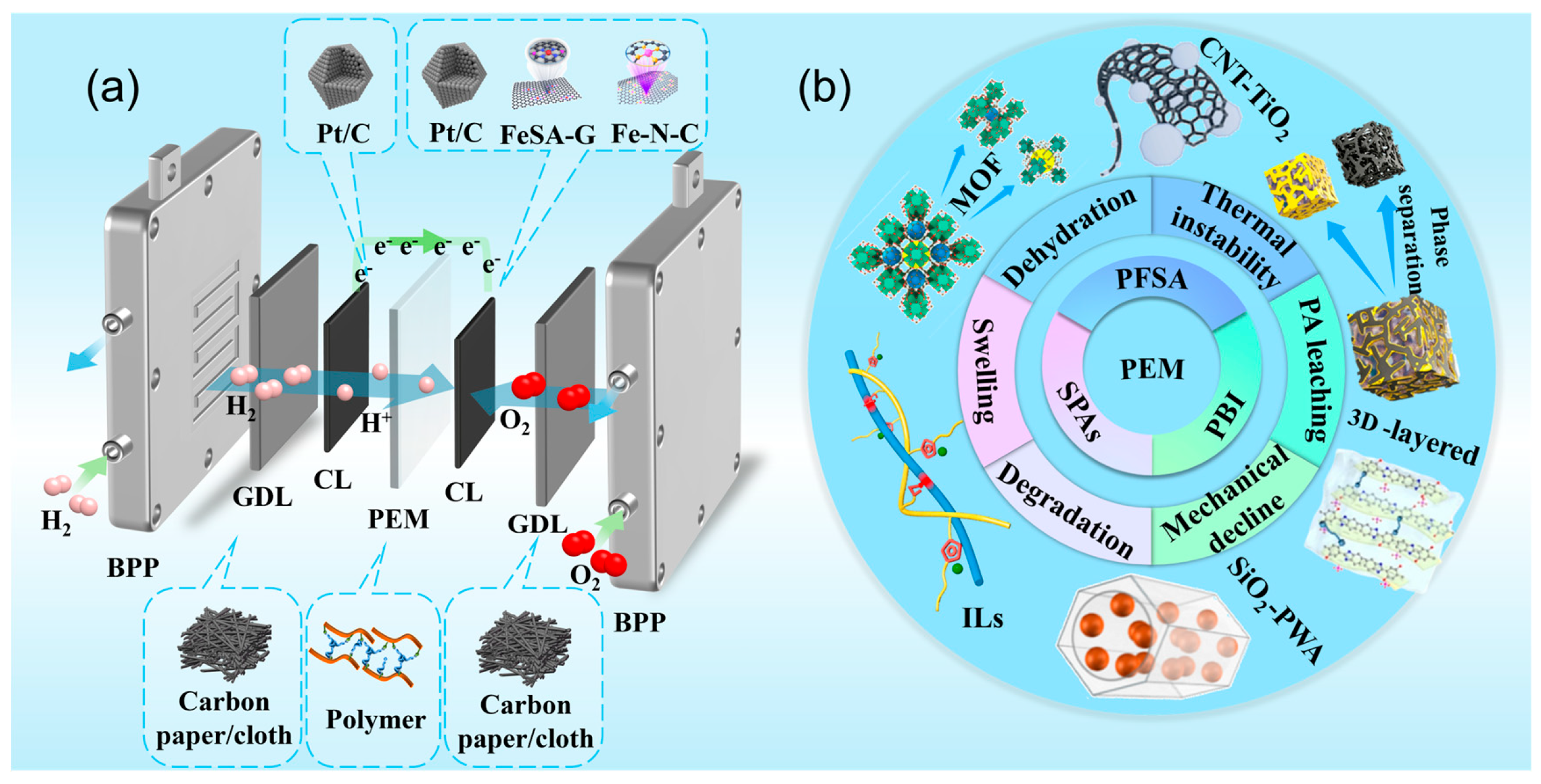
Figure 1. (a) A schematic of the main components, charge-transfer mechanism, and key materials for PEMFCs. (b) Schematic illustration of key challenges faced by PEMs and corresponding modification strategies.
Jcs 10 00218 g001
Figure 3. (a) Three-dimensional scheme of the SSC-PFSA membrane structure: the gray area represents the hydrophobic phase, and the yellow area represents the hydrophilic phase. (b) Chemical structures of PFSA ionomers. (c) Proton conductivity of PFSA membranes at 80 °C with different RH values. FC properties at high temperatures. (d) 100 °C and 25% RH. (e) 110 °C and 25%RH under H2/air. Adapted with permission from [51]. Copyright 2023 The American Association for the Advancement of Science.
Jcs 10 00218 g003
Figure 4. (a1) Synthesis of the mesoporous solid MCM41-Si. Adapted from [65] and vacuum impregnation method (VIM) and conventional impregnation method (CIM). (a2) Conductivity as a function of (inverse) test temperature and polarization curves (empty symbols), (a3) Power density (filled symbols) of a single cell with a VIM-30 wt% HPW/MCM-41 mesoporous silica electrolyte membrane in H2/O2 at 25 and 100 °C under 100% RH. The Pt loading was 0.5 mg·cm2− for both anode and cathode. Adapted from [64]. (b1) Preparation of PWA/Si-Nafion membranes via the sol–gel method. (b2) Humidity dependence of proton conductivity of pristine Nafion and PWA/Si-Nafion membrane. (b3) Polarization curves and power density of pristine Nafion and PWA/Si-Nafion-20 at 110 °C/20% RH [66]. Adapted with permission from [64,66]. Copyright 2010 John Wiley and Sons and 2021 Elsevier, respectively.
Jcs 10 00218 g004
Figure 12. (a1) Schematic illustrations of crosslinked SPEEK membranes. (a2) SAXS and (a3) ionic cluster size of the membranes [147]. (b1) The schematic diagram of membrane structure. (b2) The free volume analysis of molecular dynamics simulation for membrane. (b3) Supposed proton-transfer mechanism and pathways in PTPP-SOPEEK membranes. (b4) Proton conductivity of PTPP(15)-SOPEEK [148].
Jcs 10 00218 g012
Figure 13. (a) Schematic diagram illustrating the formation of periodic ordered sulphonated-silica nanoelectrolytes. Adapted with permission from [150]. Copyright 2012 Elsevier (b1) Synthesis pathway for the MWCNTs-TiO2 nanohybrid material. SEM images of (b2) pristine sPES, (b3) PM5, and (b4) PM10. (b5,b6) Polarization and power density curves of sPES, PM5, and Nafion 212. Adapted from [153].
Jcs 10 00218 g013
Figure 14. (a1a4) The surfaces of (SPEEK/PU)210, (SPEEK/PU/SPEEK/bmim)100, (SPEEK/PU)210/PA, and (SPEEK/PU/SPEEK/bmim)100/PA membranes. (a5,a6) The cross-sectional structures of (SPEEK/PU/SPEEK/bmim)100 and (SPEEK/PU/SPEEK/bmim)100/PA membranes and the cross-sectional structures after heating at 160 °C (a7,a8). (a9) Anhydrous proton conductivity of (SPEEK/PU/SPEEK/bmim)100/PA membranes. (a10) Anhydrous proton conductivity of (SPEEK/PU)210/50%PA and (SPEEK/PU/SPEEK/bmim)100/50%PA membranes at 100 °C as a function of time. Adapted with permission from [157]. Copyright 2018 Elsevier. (b1) Proton-transfer mechanism of SP/IL/sHMO membrane. (b2) IL loss of SP/IL/y-sHMO-7.5 composite membranes at 25 °C. (b3) Proton conductivity of SP/IL/y-sHMO-7.5 Adapted with permission from [158]. Copyright 2021 Elsevier.
Jcs 10 00218 g014
Disclaimer/Publisher’s Note: The statements, opinions and data contained in all publications are solely those of the individual author(s) and contributor(s) and not of MDPI and/or the editor(s). MDPI and/or the editor(s) disclaim responsibility for any injury to people or property resulting from any ideas, methods, instructions or products referred to in the content.