Article

Surface Modification of FeSiB Soft Magnetic Amorphous Powders for High Processability in 3D Direct Writing


1
School of Light Industry Science and Engineering, Beijing Technology and Business University, Beijing 100048, China
2
Beijing Key Laboratory of Quality Evaluation Technology for Hygiene and Safety of Plastics, Beijing Technology and Business University, Beijing 100048, China
*
Author to whom correspondence should be addressed.
J. Compos. Sci. 2026, 10(4), 217; https://doi.org/10.3390/jcs10040217
Submission received: 5 February 2026 / Revised: 31 March 2026 / Accepted: 4 April 2026 / Published: 21 April 2026
(This article belongs to the Topic 3D Printing Materials: An Option for Sustainability)

Abstract

Soft magnetic composite materials have a low total loss and high magnetic conductivity and are highly desirable for high-frequency motors, semiconductors, and 5G communication technologies. However, these composites often contain a high-volume fraction of soft magnetic metallic powders and are difficult to process into complex shapes. Herein, iron-based amorphous powders were surface-modified with silane coupling agents (DTMS and KH570) and applied in 3D direct ink writing (DIW). The modified powders exhibit improved compatibility and dispersion in epoxy resin. The optimized 92.3 wt% FeSiB@3.35 wt% KH570/EP slurry shows favorable rheological properties and a dense interfacial microstructure. The printed composite achieves the best magnetic performance (Ms: 137.02 ± 1.2 emu/g, Hc: 6.63 ± 0.2 Oe) and stable permeability up to 1 GHz. The surface modification enhanced slurry fluidity, preventing nozzle blockage and increasing powder loading. Various shaped magnetic cores were successfully fabricated with excellent magnetic properties and printing quality. Our work paves a new way for realizing the high processibility of soft magnetic composites, which lays a foundation for a technique for the wide applications of these materials in various electronic devices.

1. Introduction

Soft magnetic composites(SMCS) [1,2,3] are magnetic functional materials composed of soft magnetic metal powders and insulating coatings, usually prepared by powder metallurgy and then annealed at the optimal temperature. Fe-based amorphous powders are widely used for the composite because of their excellent high saturation magnetic induction strength (Ms) and low coercivity (Hc) [4,5]. However, with the boom of high-frequency motors, semiconductors, and 5G communication, the increase in total loss and low efficiency have become key issues limiting the application of soft magnetic composite materials [6,7]. Iron based amorphous alloy and powders with better soft magnetic properties have become a new favorite in high-frequency applications [4]. However, it has been found that when the proportion of magnetic powder increases compared to the insulating materials, it is more difficult to control the stability and dispersion of the composite [8], and causes a decrease in soft magnetic nanocrystalline and mechanical properties. This is due to the poor compatibility and bonding characteristics between the insulation materials and magnetic powder [9]. Therefore, enhancing the compatibility of the two-phase interface is essential for improving the overall stability of the composite [10].
Acid treatment [11], inorganic salt surface modification [12], and silane coupling agent modification [13,14] are the commonly used surface modification methods. However, acid or passivation solutions can potentially affect the microwave characteristics and the complex composition of the passivation solution, such that the concentration of phosphoric acid, metal ions, and stabilizers could all have a significant impact on the modification of the metal powder, further leading to poor stability of the preparation process. The inorganic insulation layer of the prepared soft magnetic composite material will be unevenly distributed, with low resistivity and high eddy current loss. Regarding inorganic salt surface modification, the thick phosphating layer of metal powder treated with phosphate solution [15] results in poor formability. Inorganic salt surface modifiers have high brittleness and are prone to cracking under high compressive pressure [16], resulting in direct particle contact and increased eddy current loss. Silane coupling agents can not only be used to modify the surface of aluminum alloys [17], tungsten metals [18], nano-zinc oxide [19], and nano-alumina [20] but also have excellent dispersibility and wettability. Moreover, they can modify iron powder [21], FeSiAl [22], and (Fe0.76Si0.09B0.1P0.05)99Nb1 amorphous alloy powder [23] to increase their wettability with the resin matrix. Furthermore, they help enhance the fluidity of the resin, thereby increasing the magnetic permeability of the composite material and reducing eddy current losses. Chang et al. [23] used cold compressing to prepare Fe-based magnetic cores, where 2% of the phosphating solution was used as the passivation solution, 1% of KH550 was used as the coupling agent, and 2% of epoxy resin was used as the organic adhesive. The multi-layer insulating coating can effectively address the issues of metal powder agglomeration, uneven layer thickness, porous layer structure, and poor mechanical strength caused by a single coating. However, internal stress is easily generated during cold compression, which hinders the rotation of the magnetic domains and the displacement of the domain walls, thus affecting the magnetic properties of the material [24].
Although post-annealing can relieve such internal stress [25], the improvement in magnetic properties is limited by the presence of the silane coupling agent. The silane coupling agent has a thermal decomposition temperature around 200 °C, which limits the maximum heat treatment temperature and may cause its aging or decomposition. Therefore, to resolve the trade-off between stress relief and the stability of the organic coating, 3D direct ink writing (DIW) was adopted in this work [26,27,28,29]. This additive manufacturing technique enables the fabrication of complex components at room temperature, thus inherently avoiding internal stress formation without requiring high-temperature annealing.
Recent advances by Khazaei Feizabad et al. [30] have explored utilizing the unique properties of amorphous alloys for composite fabrication, such as exploiting their supercooled liquid region for viscous flow consolidation [31]. While these “amorphous phase-assisted” strategies can achieve high density, they typically require high-temperature processing, which poses the risk of crystallization-induced degradation of the soft magnetic properties, while severely restricting the design freedom for components with complex geometries. In contrast, the approach proposed in this study—surface modification with silane coupling agents combined with room-temperature 3D direct ink writing—provides a distinct and complementary pathway. Here, we successfully realized the room-temperature 3D direct ink writing of the SMCs by surface modification of Fe-based amorphous powders with a silane coupling agent. Soft magnetic composites were prepared by 3D direct ink writing, and the influence of modification on their properties was explored.

2. Materials and Methods

The bisphenol-A epoxy E-44 (ER) with an epoxy value of 0.41–0.47 and the polyamide curing agent were provided by Shanghai Licheng Adhesive Co., Ltd., Shanghai, China. FeSiB amorphous alloy powder was provided by Advanced Technology and Materials Co., Ltd., Beijing, China. Anhydrous ethanol, sodium hydroxide, and xylene (purity 99%) were purchased from Shanghai Maclin Biochemical Technology Co., Ltd., Shanghai, China. Dodecyltrimethoxysilane, (silane coupling agent DTMS, 93%) was purchased from Aladdin Reagent Co., Ltd. Shanghai, China, and 2-methyl-2-propenoic acid [3-(trimethoxysilane) propyl] ester (silane coupling agent KH570, 98%) was supplied from Shanghai Yuanye Biotechnology Co., Ltd., Shanghai, China.

2.1. Surface Modification of FeSiB Amorphous Powders

2.1.1. Surface Modification by KH570

The FeSiB powders were dried in a vacuum drying oven at 80 °C for 2 h, then soaked in 0.1 mol/L NaOH C2H5OH solution for 24 h, ultrasonically dispersed for 10 min. Finally, the resulting precipitate was collected and dried in a vacuum drying oven at 80 °C.
Then, the FeSiB powders were placed into three-necked flasks, and xylene solutions were prepared using different KH570 mass fractions of 1.4%, 2.3%, 3.4%, and 4.1%. The mixed solutions were mechanically stirred for 2 h at 100 r/min and dried naturally to obtain modified FeSiB powders.

2.1.2. Surface Modification by DTMS

A certain amount of DTMS was dissolved in deionized water and stirred for 5 min with magnetic stirring. After that, the solution was added to ethanol, and the mass ratio of DTMS:deionized water:ethanol was 1:1:3. Certain amounts of FeSiB powders were ultrasonically dispersed in the mixed solution within 5 min, and then mechanically stirred at a speed of 100 r/min for 2 h at 60 °C. After washing with ethanol and deionized water, the remainder was dried in a vacuum drying oven for 4 h. The mass fractions of silane coupling agent DTMS were 2 wt%, 3 wt%, 4 wt%, and 5 wt%, respectively.

2.2. Preparation of Modified FeSiB/Epoxy Composite Slurry

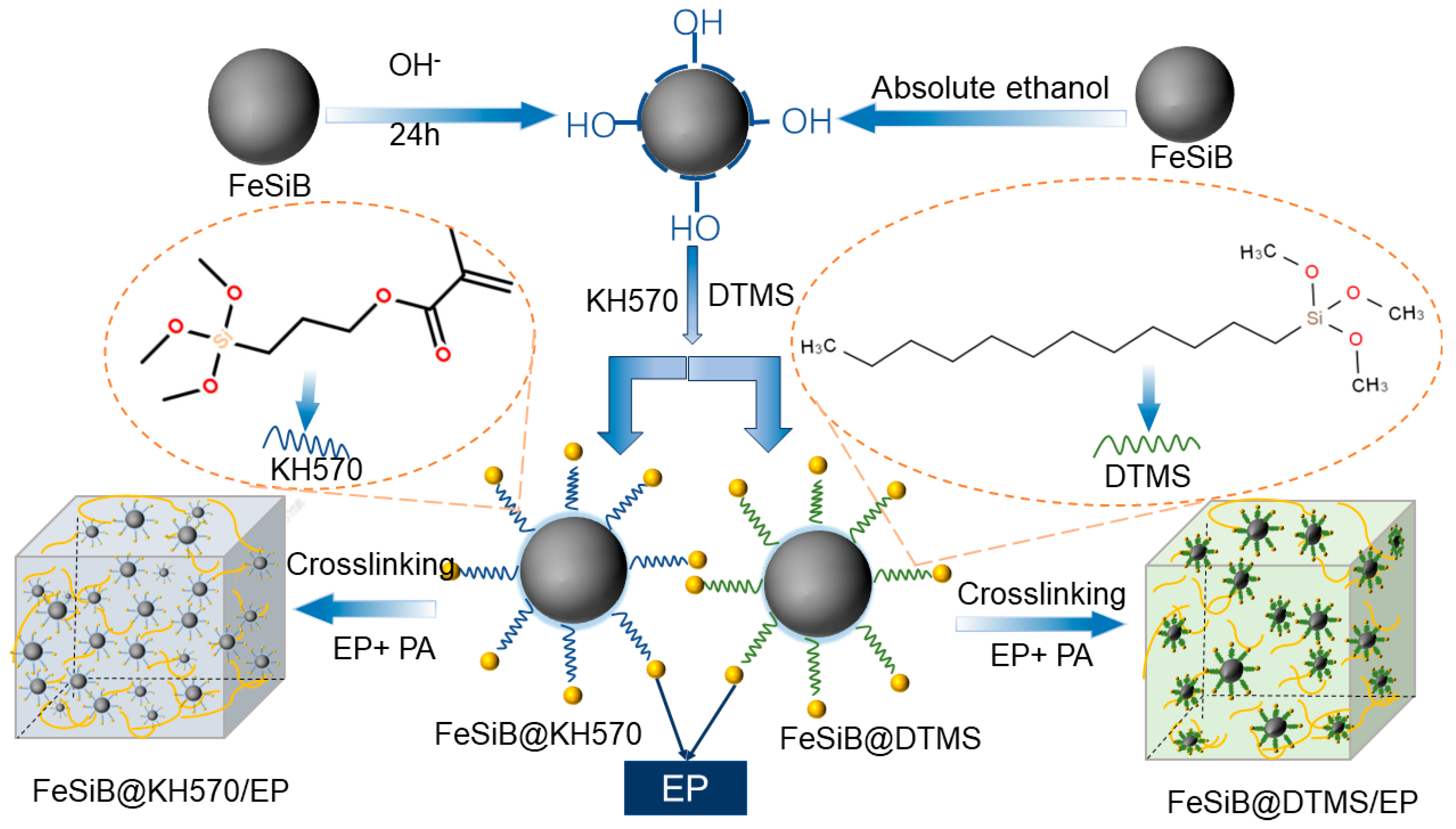
EP and polyamide curing agent with a mass ratio of 1:1 was prepared, to which different mass fractions of modified FeSiB powders (88.0%, 90.0%, 90.9%, 92.3%, 92.8%, and 93.3%) were added and stirred for ~5 min to obtain the slurry for 3D printing. The preparation of the modified FeSiB/epoxy composite slurry for 3D printing is shown in Figure 1.

2.3. Direct Ink Writing

A customized 3D direct ink writing printer based on Fused Deposition Modeling (FDM) forming was employed to print the composite slurry. The printing process was carried out on a substrate; the diameter of the needle cylinder used was 30 mm, and the inner diameter of the nozzle was 0.6 mm. The slurry forced by air pressure was deposited on a substrate plate spread with polyimide film. The printing conditions included layer height of 0.4 mm, line spacing of 0.4 mm, and printing speed of 1 mm/s. In this way, the green body of the three-dimensional network structure was obtained by stacking layer by layer. After 24 h of completed curing at room temperature, the printed samples were obtained.

2.4. Structural and Property Characterization

Scanning electron microscopy (SEM, ZEISS Gemini 300, Carl Zeiss AG, Oberkochen, Germany) equipped with energy dispersion spectroscopy (EDS) and Fourier transform infrared spectroscopy (FTIR, Thermo Electron, Corporation, Madison, WI, USA) were used to analyze the powders’ microstructure, elements distribution, and contents. A rotating rheometer (HAAKE MARSIII, Thermo Fisher Scientific Inc., Waltham, MA, USA)was used in oscillatory scan mode at 25 °C to test the rheological behavior of the slurry at a frequency of 1.0 Hz; the scan range modulus was determined by setting the scan mode as stress-logarithmic scan and the scan range to 0.1~1000 Pa. Scanning electron microscopy (SEM, ZEISS Gemini 300, Germany) was used to observe the cross sections and surfaces of the printed samples. The samples were cut in half and attached to a stub with conductive adhesive and then sputter-coated with 25 nm gold particles in a nitrogen atmosphere. The samples were scanned at an accelerating voltage of 105~10 kV using secondary electron detection. Their magnetic properties at a frequency from −1.5~1.5 T were measured using a vibrating sample magnetometer (LakeShore7404, Linkphysics Corporation, Shanghai, China). The magnetic permeability of SMCS was determined as 1 MHz–1 GHz using the coaxial method by employing a measuring instrument (Agilent E4991A impedance analyzer, Agilent Technologies, Santa Clara, CA, USA).

3. Results and Discussion

3.1. Analysis of the Surface-Modified Magnetic Powders

The FeSiB powder was the commercial FeSiB amorphous powder provided by Adv. Tech & Mater. Co., Ltd., Beijing, China. We then performed the XRD experiments on these powders, and the respective curve can be seen in Figure S1. The curve displays a typical broad halo and no crystalline peaks, indicating the amorphous nature of the powders.
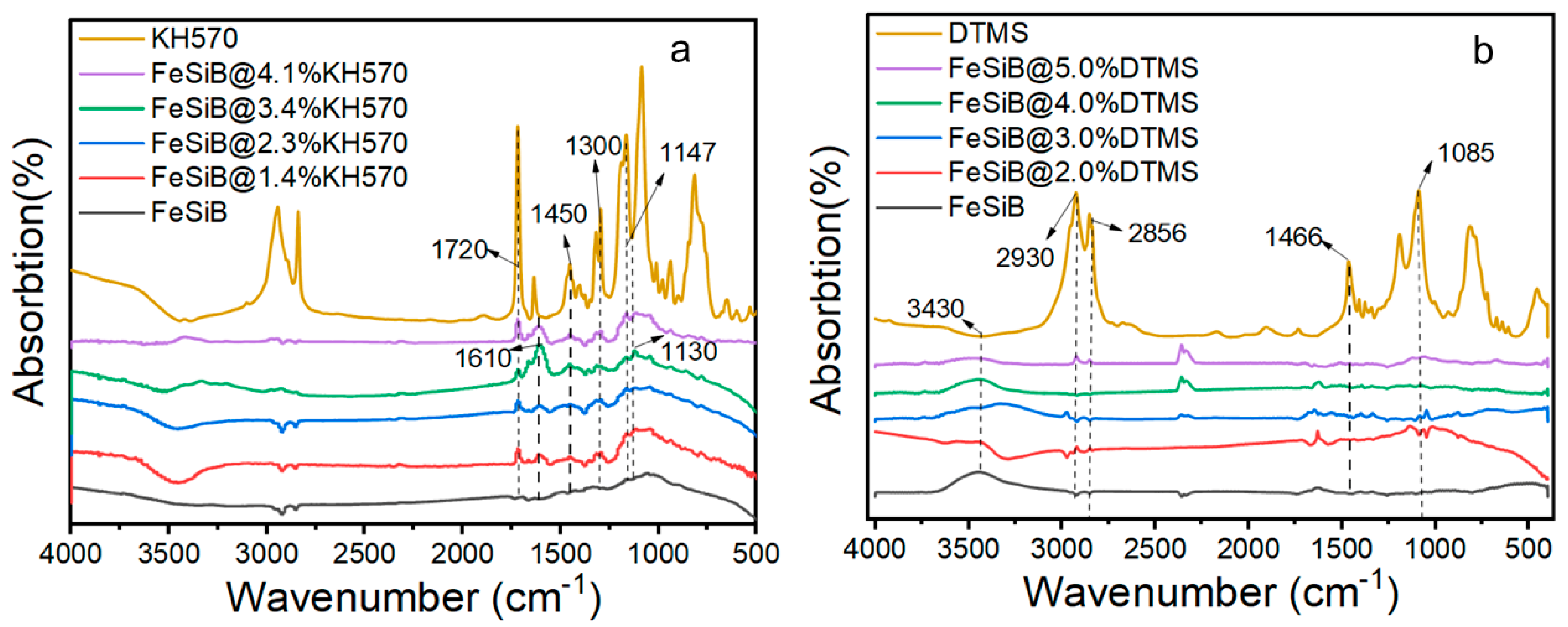
Figure 2a shows the FTIR spectra of KH570, pure FeSiB powder, and FeSiB powder modified using different KH570 contents. Contrary to pure FeSiB powder, KH570@FeSiB showed a peak at 1720 cm−1 corresponding to C=O and a peak at 1300 cm−1 corresponding to the -CH2 asymmetric stretching vibration. These absorption peaks were characteristic of KH570. KH570@FeSiB powder exhibits a peak at 1147 cm−1, which was the stretching vibration of Si-O-Si. The Si-O-C peak intensity increased primarily due to the hydrolysis of KH570. The peak at 1130 cm−1 was the characteristic absorption peak of Si-O-Fe. This indicated that KH570 reacted with FeSiB via hydroxyl condensation. These findings indicate that KH570 successfully modified the surface of the FeSiB amorphous alloy powder.
Figure 2b shows the FTIR spectra of pure FeSiB magnetic powder and that treated with DTMS of different contents. The broad peak concentrated at 3400 cm−1 belongs to the telescopic vibration peak of the -OH group. Moreover, the tensile vibration peak strength of the -OH group of the DTMS-modified magnetic powders decreases, indicating that the number of -OH groups on the surface of the magnetic powder decreased because DTMS occupies part of the -OH group on the powder particle surface. The absorption peaks of the DTMS-modified magnetic powder at 2950 and 2880 cm−1 correspond to the telescopic vibration of C-H, that at 1466 cm−1 corresponds to the bending vibration of C-H, and that at 1085 cm−1 belongs to the vibration of Si-OH. This indicates that DTMS was successfully grafted onto the surface of the magnetic powder. The absorption peak intensity increased as the DTMS grafting density increased.
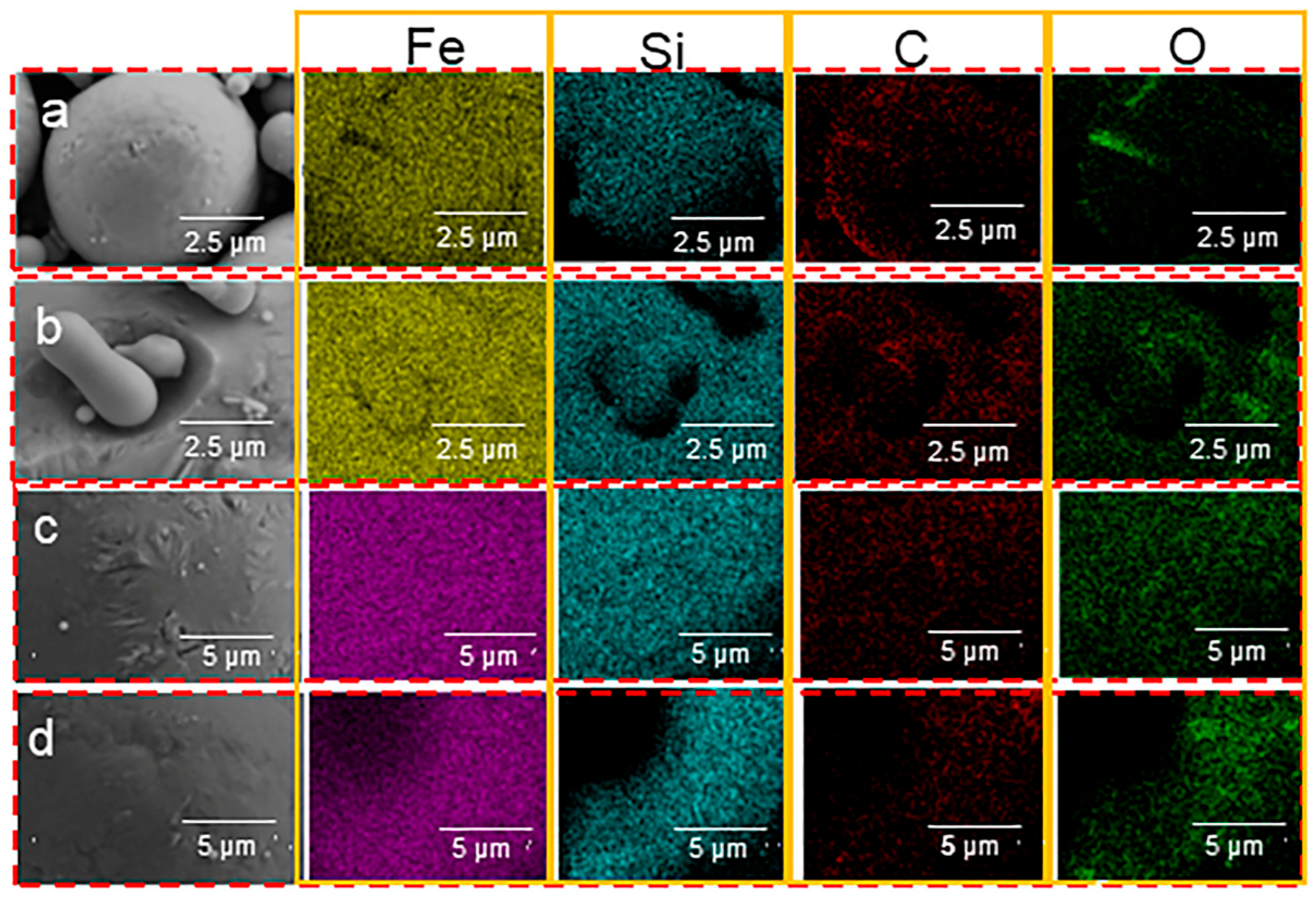
Figure 3 shows the SEM images of FeSiB powders modified using different contents of KH570 and DTMS and the corresponding EDS plots. A continuous insulating layer of silane coupling agents was observed on the surface of the FeSiB powders, which was confirmed by the coinciding EDS signals of C, O, Fe, and Si. This layer increased the compatibility of FeSiB powders and EP [17], which was also confirmed by the rheological analysis and comparative analysis of the microstructure of the printed samples.

3.2. Rheological Analysis

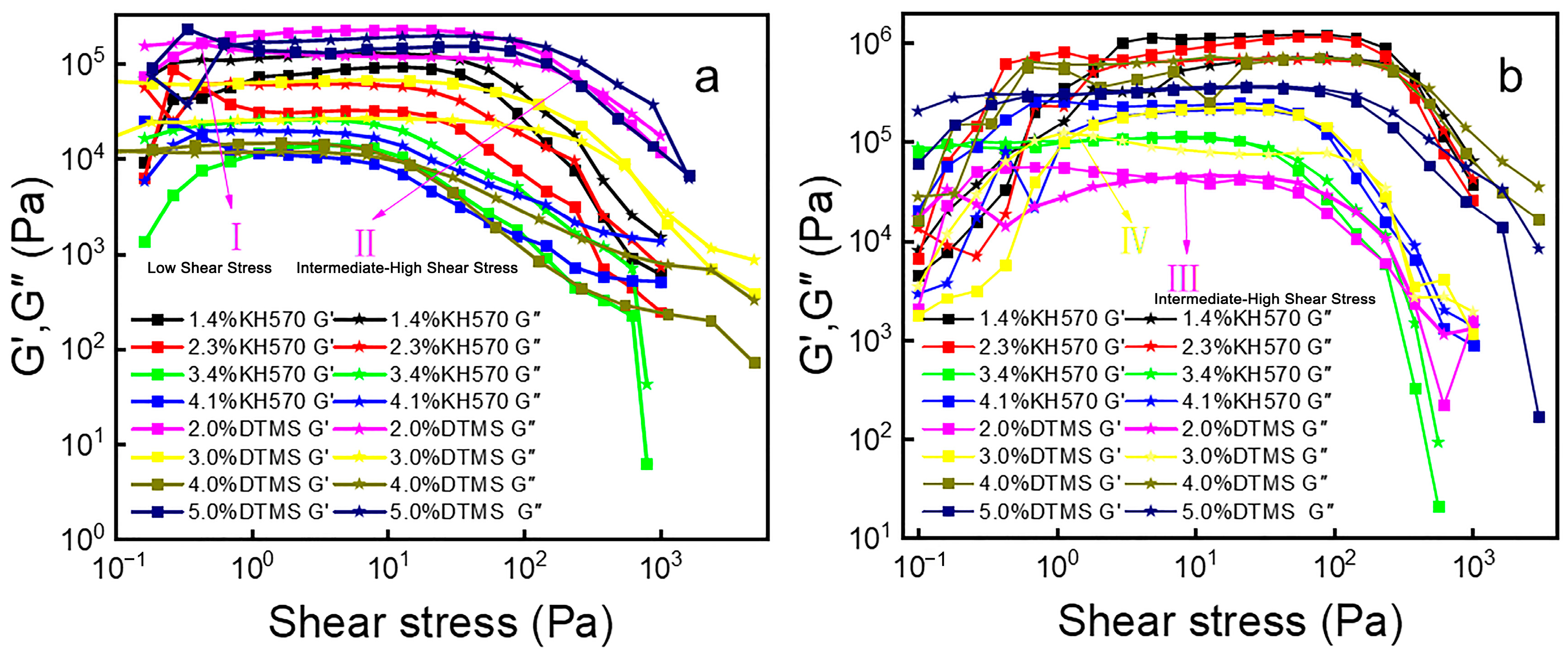
Figure 4a refers to the comparison of the rheological properties of 90.9 wt%FeSiB@KH570/EP slurry and 90.9 wt%FeSiB@DTMS/EP slurry. Figure 4b refers to the comparison of the rheological properties of 92.3 wt%FeSiB@KH570/EP slurries and 92.3 wt%FeSiB@DTMS/EP slurries. Kyoohee Woo et al. [32] pointed out that in the rheological test, G′ (storage modulus) was higher than G″ (loss modulus) at low frequency, indicating elastic response was predominant; G″ was higher than G′ at high frequency, indicating viscous response was dominant. When G′ was equivalent to G″, the material was semi-solid, and the intersection point was called the yield stress point. After reaching the yield stress point, G″ was lower than G′, indicating that the slurry exhibits good self-supporting capability under the influence of the shear stress, and G′ has stronger shape retention ability being less easily deformed. As shown in the Figure 4, Region I (low shear stress in Figure 4a) corresponds to the linear viscoelastic region, where the storage modulus G′ remains constant and is significantly higher than the loss modulus G″, indicating a stable elastic network structure. Region II (intermediate shear stress in Figure 4a represents the yielding transition region, where G′ decreases sharply as the internal filler network begins to break down, marking the onset of nonlinear viscoelastic behavior. Region III (high shear stress in Figure 4b is the terminal flow region, where G′ drops dramatically below G″, and the material transitions to a viscous liquid state with complete network destruction. Region IV (low-to-intermediate shear stress in Figure 4b denotes the extended for samples with strong filler networks, characterized by a wide, stable G′ plateau that reflects excellent elastic resistance to deformation.
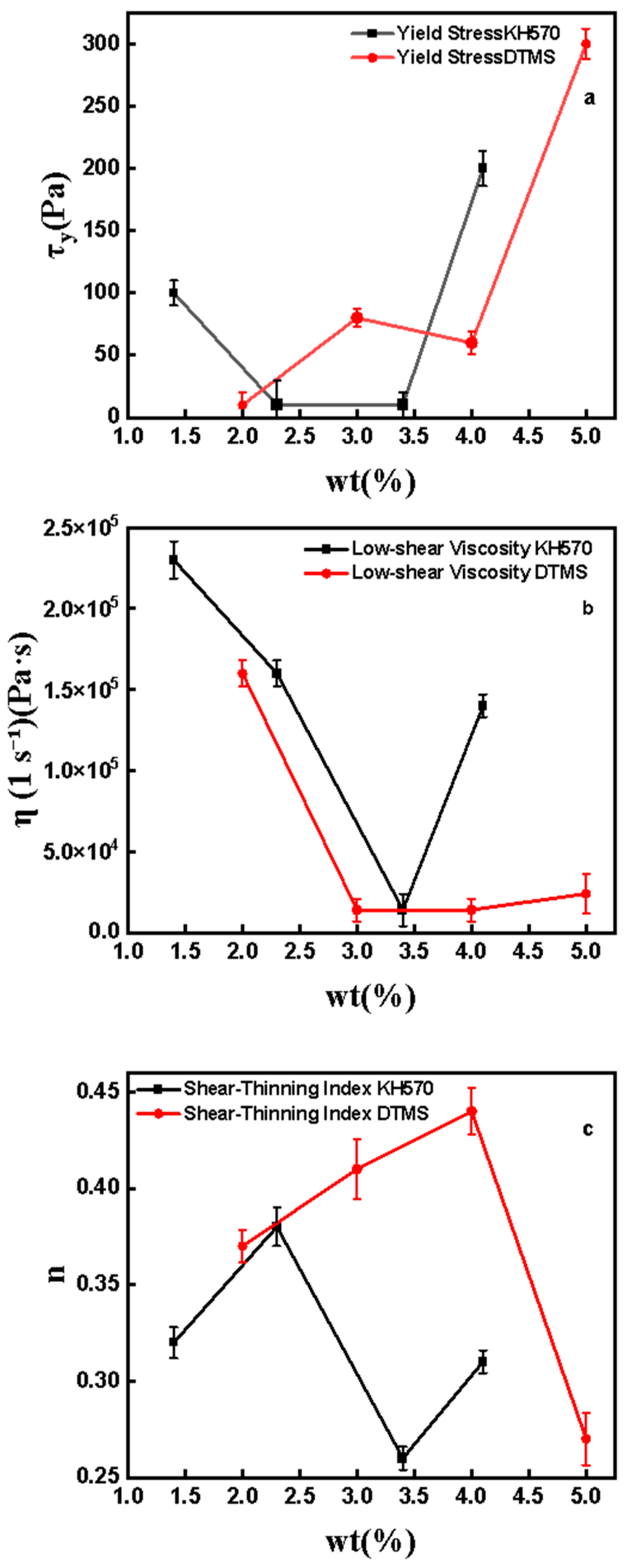
Figure 5 illustrates the key rheological parameters of 92.3 wt% FeSiB/EP slurries modified with KH570 and DTMS, including yield stress (τy), low-shear complex viscosity (η), and shear-thinning index (n), to assess their suitability for 3D direct ink writing (DIW). We can see that τy of KH570-modified slurries decreases to nearly 0 Pa at 3.4 wt% and then rises, while DTMS-modified slurries show an increasing τy up to ~300 Pa at 5.0 wt%. Plot (b) shows that low-shear η follows a similar trend to τy, with 3.4 wt% KH570 and 3.0–4.0 wt% DTMS exhibiting the lowest η. Plot (c) reveals that DTMS slurries have n ranging from 0.27 to 0.44, while KH570 slurries maintain n = 0.26–0.38. The optimal formulations (2.3 wt% KH570 and 2.0 wt% DTMS) exhibit τy ≈ 10 Pa, η ≈ 1.6 × 10⁵ Pa·s, and n ≈ 0.37–0.38, balancing shape retention and extrusion fluidity for DIW.
The G′ of 90.9 wt%FeSiB@KH570/EP slurry was consistently lower than G″ with the shear stress increased (Figure 4a). This indicates that the slurry exhibited good fluidity but poor self-supporting capability, consequently, the printed samples showed poor shape retention. In contrast, for slurries with DTMS-modified magnetic powders, the 90.9 wt%FeSiB@2.0 wt%DTMS/EP slurry showed two intersection points between G′ and G″: Point I and Point II. Before Point I, the slurry was liquid. Between Points I and II, it was a solid, and after Point II, it was a liquid again. This indicates the poor shape-retention ability of the material under high shear stress. Under low shear stress, G′ of 90.9 wt%FeSiB@3.0 wt%DTMS/EP slurry was higher than G″, indicating that the slurry exhibited the properties of a solid. As the shear stress increased, the two curves intersected, and G″ after the intersection point was higher than G′, indicating the liquid property of the slurry and that it could be printed. The 90.9 wt%FeSiB@4.0 wt%DTMS/EP slurry has a similar performance to that of 90.9 wt%FeSiB@2.0wt%DTMS/EP but has a lower yield point. This indicates that the slurry could be transformed from a viscoelastic solid to a liquid at low shear stress. Moreover, G″ of 90.9 wt%FeSiB@5.0 wt%DTMS/EP is slightly higher than G′, showing an elastic response. This indicates that the slurry is semisolid and has good liquidity; therefore, higher amounts of FeSiB can be added to it.
Figure 4b shows the curves of G′ and G″ of 92.3%FeSiB@1.4%KH570/EP slurry with two intersections as the shear stress increases. These findings are similar to those of the 90.9%FeSiB@2.0%DTMS/EP slurry. For the 92.3% FeSiB@2.3% KH570/EP slurry, under low shear stress, G′ is higher than G″. However, when the shear stress is higher than the yield stress, G″ is higher than G′ and the slurry exhibits the properties of a liquid. This indicates that the slurry has good printability. For FeSiB@3.4%KH570/EP slurry, the curves of G′ and G″ did not intersect but almost coincided. However, G″ increases with the shear stress and a yield point is observed at a lower shear stress, indicating that the slurry transitions into a liquid earlier and has good liquidity. The 92.3%FeSiB@4.1%KH570/EP slurry has a similar performance to the 92.3%FeSiB@3.4%KH570/EP slurry. For 92.3%FeSiB@2.0%DTMS/EP slurry, the G′ and G″ curves intersect at Point III. This indicates that the slurry exhibits the properties of a solid at low shear stress. After Point III, the slurry shows the properties of a liquid and good printability. The 92.3%FeSiB@3.0%DTMS/EP slurry is in the liquid state before the G′ and G″ curves intersect at Point IV. After this point, the slurry is in a solid state and the two curves almost coincide. This indicates the printability of the slurry, although it requires high pressures. The 92.3%FeSiB@4.0%DTMS/EP slurry performs similarly to the 92.3% FeSiB@3.4%KH570/EP slurry. For the 92.3%FeSiB@5.0% DTMS/EP slurry, the difference between the curves G′ and G″ is small. However, G″ is higher than G′, indicating that the slurry flows out easily from the nozzle but has poor self-supporting ability. From the results above, one can see that 90.9%FeSiB@3.0%DTMS/EP, 92.3%FeSiB@2.3%KH570/EP, and 92.3%FeSiB@2.0%DTMS/EP slurries exhibited better printability than the other slurry compositions.

3.3. Comparative Analysis of Sample Micromorphology

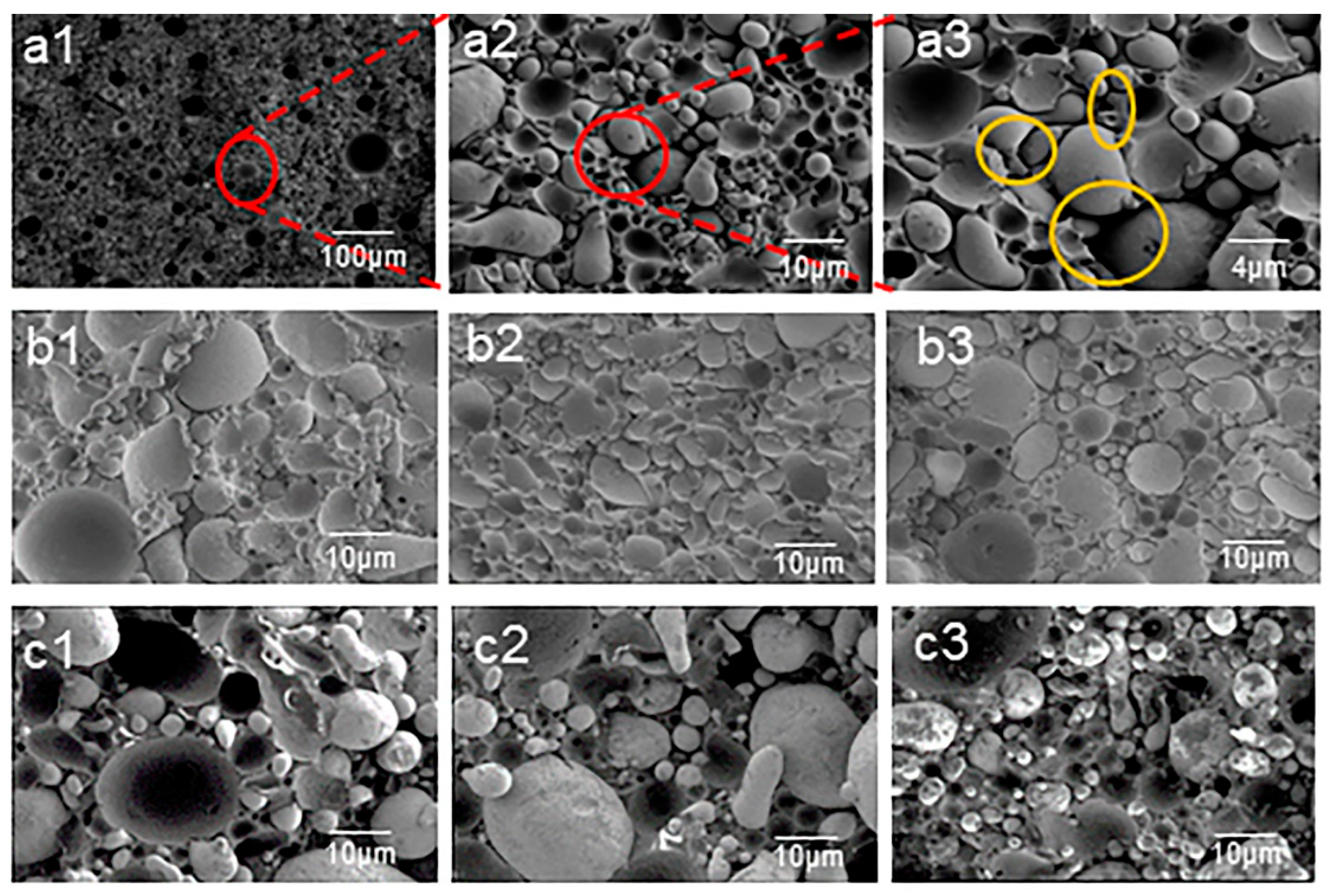
We also performed an analysis on the micromorphology of the magnetic composites with and without surface modification, respectively. Figure 6(a1–a3) shows the SEM images of the cross-sectional morphology of the 90.9%FeSiB/EP printed samples, wherein FeSiB indicates the surface is not modified. The distribution and interface between the magnetic particle and resin can be observed. The dark and bright areas correspond to the EP and FeSiB amorphous alloys, respectively. One can clearly see the poor interface compatibility between FeSiB and EP. This can be attributed to the fact that FeSiB powder can easily agglomerate due to its high surface energy, and thus is not well dispersed in the EP matrix; as a result, the powder characteristics cannot be fully reflected.
Figure 6(b1–b3) shows the images of printed samples with FeSiB powder modified by KH570, and Figure 6(c1–c3) shows the images of printed samples with FeSiB powder modified by DTMS. These images clearly show that FeSiB powders have not agglomerated and are distributed uniformly. FeSiB powders can be easily removed from EP because of the good interfacial interaction. The interfacial compatibility in FeSiB@KH570/EP is enhanced after the introduction of the -OH group on the FeSiB surface. The hydrolytic group of KH570 is chemically bonded or physisorbed with -OH on the powder surface, forming an organic adsorption layer. Therefore, modified FeSiB powders are better dispersed in the organic medium, with improved interfacial interaction. In addition, KH570 forms a hydrophilic or lipophilic interface layer between EP and FeSiB, improving the dielectric resistance of the composite.
The interfacial compatibility in FeSiB@DTMS/EP is also considerably improved, particularly for 90.9%FeSiB@5.0%DTMS/EP (Figure 6(c3)) and 92.3%FeSiB@5.0% DTMS/EP (Figure S2(c3)). This may be due to the fact that the interaction between DTMS and organosilicon matrix enhances the interaction between the FeSiB filler and epoxy matrix, thereby improving the interfacial bonding. Moreover, the introduction of DTMS enhances the hydrophobicity of the FeSiB surface, reduces the hydrogen–hydrogen bonding interaction, and improves the filler–matrix interaction. However, Figure S2(b2,b3) shows holes at the edge of the magnetic powder particles, without a continuous insulating layer. This may be due to the fact that when DTMS modified the magnetic powder surface, the insulating layer was not dense. After all, it was not treated with NaOH. DTMS has poor adhesion to the resin as compared with KH570. These issues can affect the mechanical and magnetic properties of the printed sample, as is clarified in the magnetic performance analysis.

3.4. Magnetic Performance Analysis

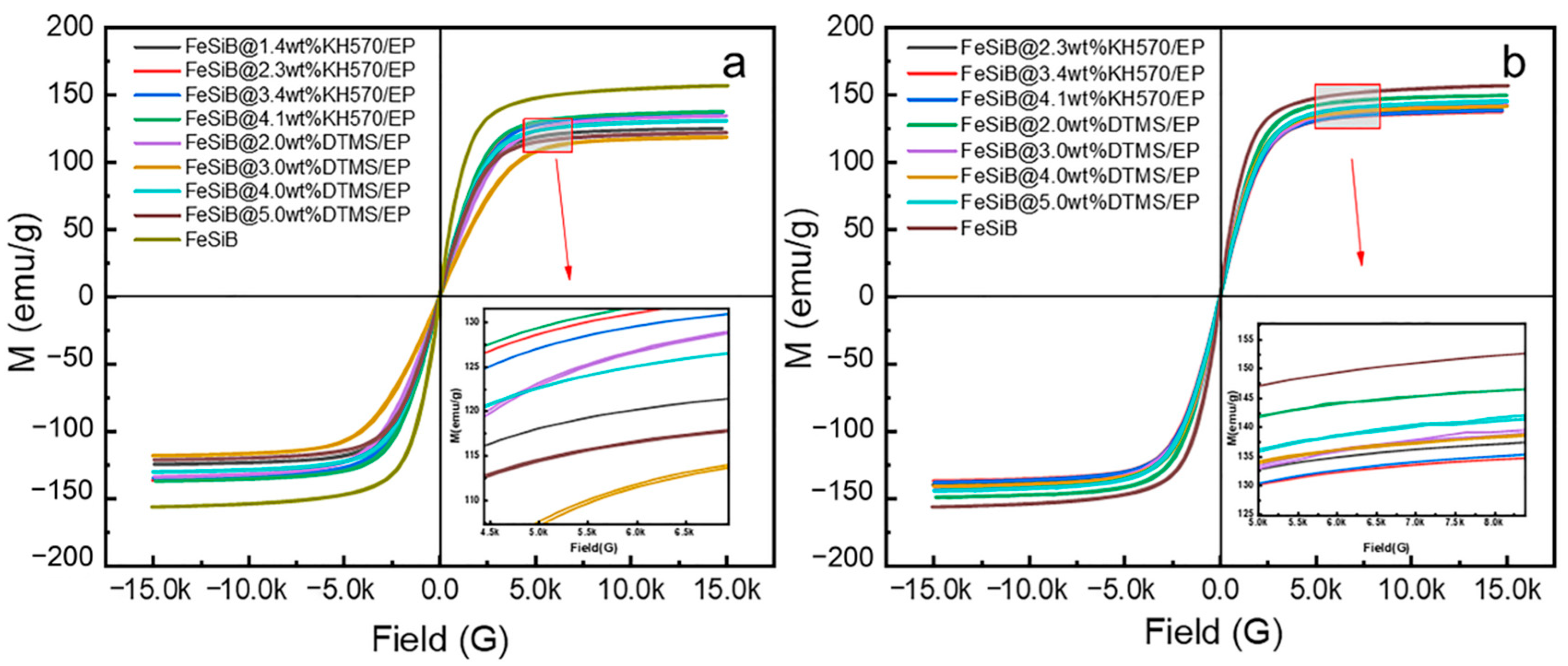
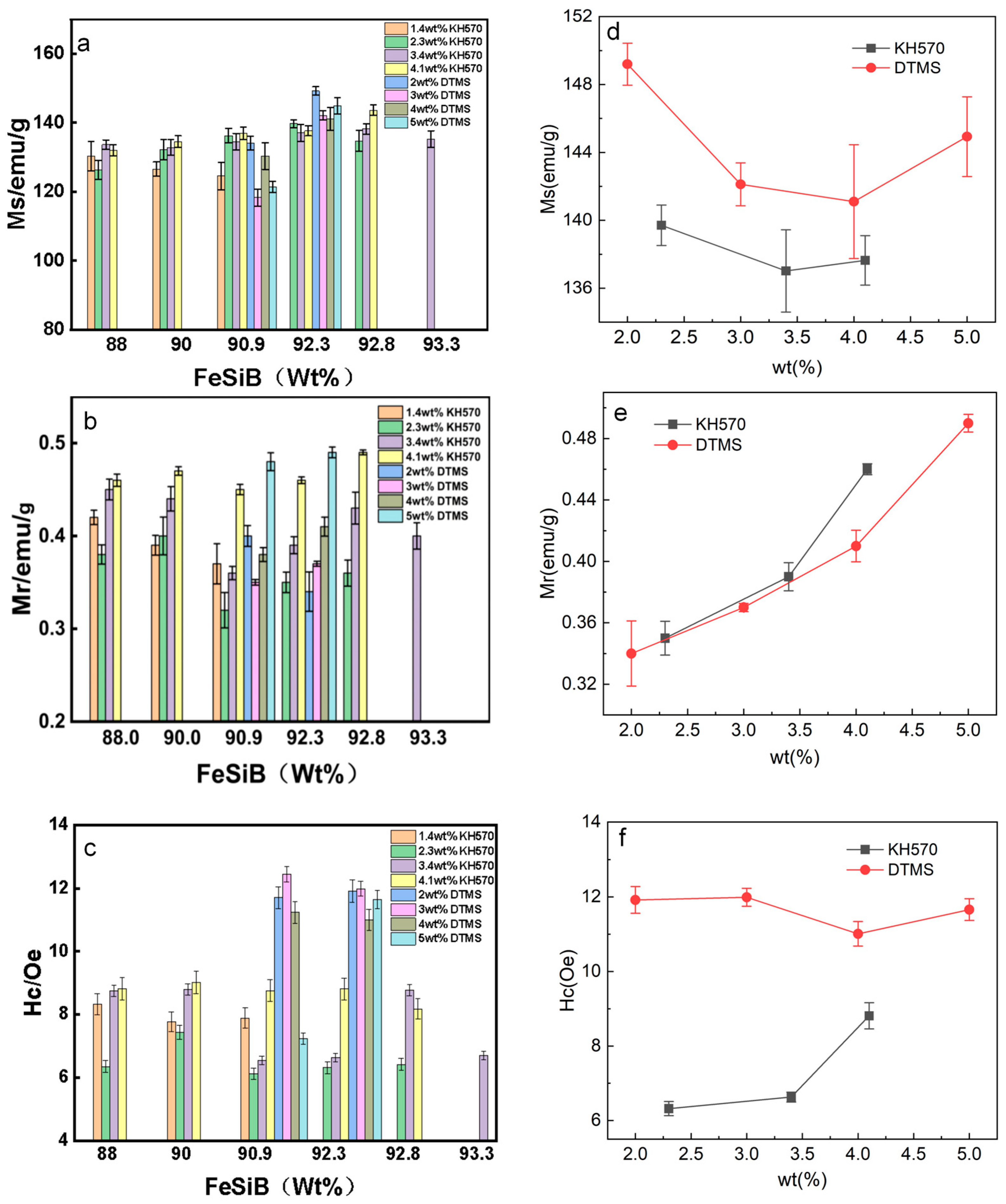
Figure 7 shows that the printed samples have typical characteristics of SMCs, with very narrow hysteresis loop distribution and very low residual magnetism and coercivity of printed samples. The measured values of saturated magnetization (Ms), remanent magnetization (Mr), and coercivity (Hc) value are given in Figure 8a–c, and Ms, Mr, and Hc of samples prepared with different surface modifiers at an FeSiB content of 92.3% are shown in Figure 8d–f, respectively. One can see that the coercivity of the FeSiB@KH570/EP printed samples first decreases and then increases as the KH570 content increases, ultimately staying between 6.12 Oe and 7.43 Oe. Meanwhile, the saturation magnetization increases with the increasing FeSiB content in the sample. The FeSiB@KH570/EP printed samples had a low coercivity because EP and KH570 formed a double-layer insulation layer, while the FeSiB@DTMS/EP printed samples had a relatively high coercivity. When the FeSiB powder was modified by DTMS and the -OH group was not introduced, an insufficiently dense insulation layer was formed on the surface of the FeSiB powder. Moreover, the binding ability of DTMS and EP was poor, which generated holes in the interface between the magnetic powder and EP. Therefore, the insulation effect of DTMS was not as good as that of KH570. Figure 8a,d shows that the FeSiB@DTMS/EP printed samples have a high saturation magnetic induction intensity. In particular, the saturation magnetic induction intensity of the 92.3% FeSiB@DTMS/EP printed sample exceeded 140 emu/g. Overall, the printed sample of KH570-modified magnetic powder has better magnetic properties than that of DTMS-modified magnetic powder.
Figure 8 presents the soft magnetic properties of 3D-printed FeSiB/EP composites, including saturation magnetization (Ms), remanent magnetization (Mr), and coercivity (Hc), as functions of FeSiB loading and silane modification (KH570 and DTMS). Figure 8a–c show that Ms and Hc increase with FeSiB loading, while Mr exhibits a moderate upward trend, reflecting the dominant role of magnetic filler content. At 92.3 wt% FeSiB loading shown in Figure 8d–f, KH570-modified composites show Ms ≈ 136–141 emu/g, Mr ≈ 0.36–0.47 emu/g, and Hc ≈ 6–9 Oe, whereas DTMS-modified composites exhibit Ms ≈ 140–149 emu/g, Mr ≈ 0.34–0.49 emu/g, and Hc ≈ 10–12 Oe. KH570-modified samples display lower Hc due to a dense insulating layer formed by the silane and epoxy resin, which suppresses eddy current loss. In contrast, DTMS-modified samples maintain higher Ms but show slightly increased Hc, attributed to a porous insulating interface. Overall, 2.3 wt% KH570 and 2.0 wt% DTMS modifications achieve a balanced combination of high Ms and low Hc.
Based on the experimentally measured insulation thicknesses being 5 nm for KH570 and 3 nm for DTMS, combined with the exponential decay model of the exchange integral, the exchange pinning field model, and the mixing law, the corresponding Jex values were calculated [33,34]. The theoretical Hc and Ms values derived from the models are highly consistent with the experimental data: for KH570-modified samples, Hc ≈ 6.5 Oe and Ms ≈ 136.8 emu/g; for DTMS-modified samples, Hc ≈ 11.8 Oe and Ms ≈ 148.9 emu/g. Quantitative analysis confirms that the thicker and denser insulation layer formed by KH570 weakens the magnetic exchange coupling, reducing Hc, while the thinner and porous DTMS insulation layer enhances coupling, leading to higher Hc. The difference in Ms is related to the effective magnetic volume fraction and the strength of the exchange coupling, deepening the scientific mechanism of surface modification regulating soft magnetic properties.
In summary, the printed samples from KH570-modified powder exhibit superior quasi-static magnetic properties compared to those modified with DTMS. Among all compositions, the 92.3 wt%FeSiB@3.4 wt%KH570/EP printed sample demonstrates the best overall soft magnetic performance, with a saturation magnetization of 137.02 ± 1.2 emu/g and a coercivity of 6.63 ± 0.2 Oe. The consistently high standard deviation observed in the H~C~ values of FeSiB@DTMS/EP samples (e.g., 11.71 ± 1.5 Oe). This underscores the critical role of a dense and uniform insulating layer in achieving stable and enhanced magnetic performance.

3.5. Effective Permeability Analysis

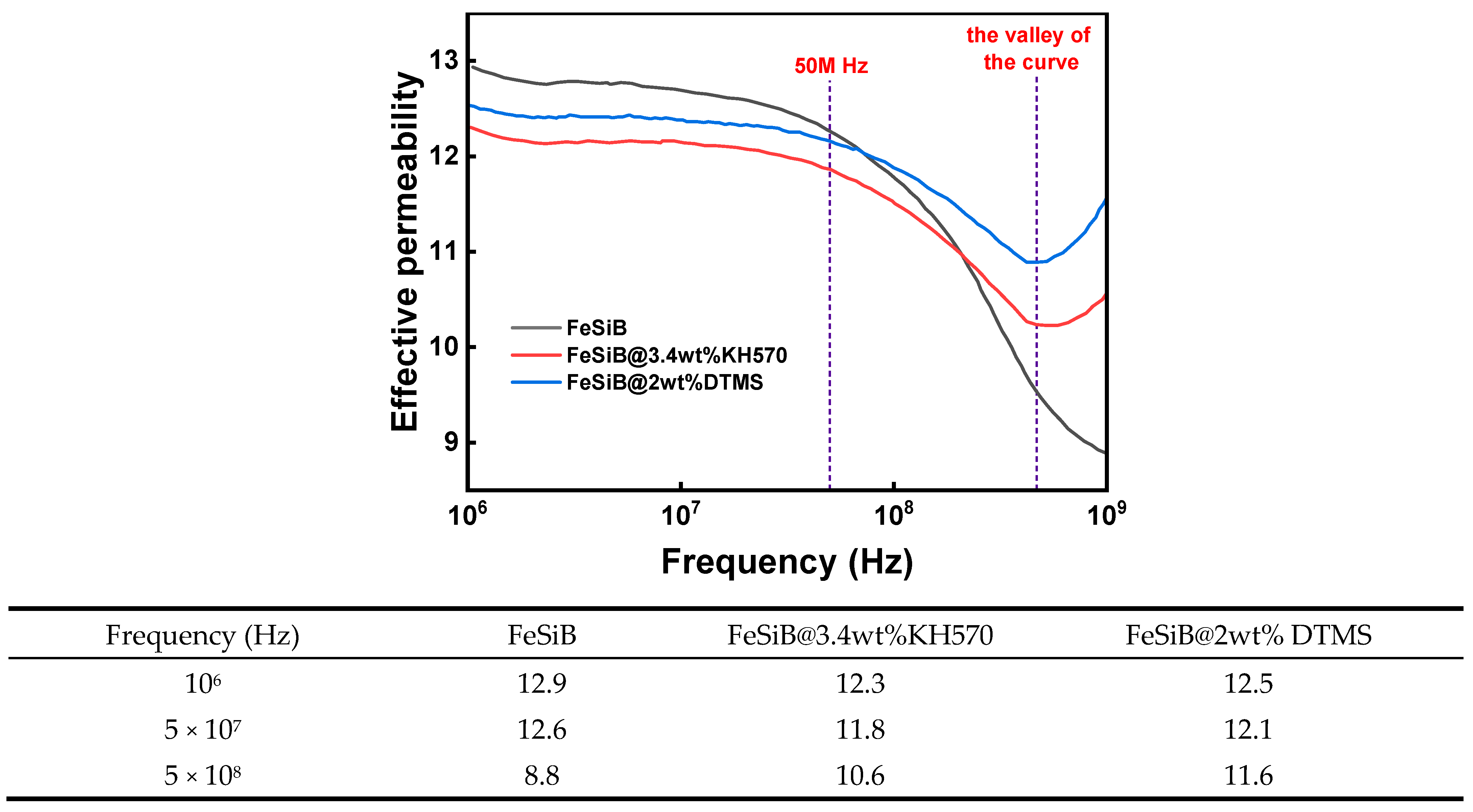
Effective magnetic permeability is an important parameter for measuring the stability of SMCS operating within a high frequency range (106–109 Hz) [35]. Toroidal samples with inner diameter of 4 mm, an outer diameter of 18 mm, and a height of 3.5 mm were prepared for testing in this experiment, Figure 9 shows the effective magnetic permeability of a soft magnetic composite material SMC with a mass fraction of 92.3 wt% of FeSiB modified with different silane coupling agents at 1 MHz~1 GHz(μe) and the relationship with working frequency. It is well known that μe is inversely proportional to Hc and directly proportional to Ms [36].
As shown in Figure 9, FeSiB/EP SMC, FeSiB@3.4 wt%KH570/EP SMC, and FeSiB@2 wt% DTMS/EP SMC all increase the loss and decrease the effective permeability with the increase of frequency at low frequencies. However, the effective permeability of FeSiB@3.4 wt%KH570/EP SMC and FeSiB@2 wt% DTMS/EP SMC were considerably lower than that of FeSiB/EP SMC. After modification with KH570, EP tended to fill the gap between the amorphous powders. This can increase the conduction area of the magnetic circuit. At high frequencies, the effective permeability of FeSiB@3.4%KH570/EP and FeSiB@2.0%DTMS/EP samples increased due to the wide conductive area and low demagnetization effect that decreases the magnetic reluctance of the magnetic circuit [36]; the average values of the effective permeability of frequencies 106, 5 × 10⁷ and the valley of the curve as well as their standard deviation are given in the table. Therefore, FeSiB@3.4 wt%KH570/EP SMC and FeSiB@2 wt% DTMS/EP SMC have certain magnetism at high frequencies and can work stably at high frequencies.

3.6. Comparative Assessment with Conventional Coating Methods

A comparative evaluation of the optimized FeSiB@3.35 wt% KH570/EP composite against the conventional APTS-phenolic insulation system for iron-based SMCs (Taghvaei et al.) [14] highlights the notable superiority of the proposed strategy. Conventional APTS-phenolic modified SMCs rely on high-pressure compaction (800 MPa) and high-temperature curing (175 °C), where the brittle passive oxide layer is prone to cracking under compaction, leading to discontinuous insulation and elevated eddy current loss, with effective magnetic performance only maintained up to 1 MHz and no notable reduction in coercivity achieved. In contrast, the KH570-modified FeSiB SMCs combined with room-temperature 3D DIW in this work form a flexible, dense dual-layer insulating structure (KH570 + epoxy resin) that avoids internal stress from high-pressure compaction and high-temperature annealing, realizing an ultra-low coercivity of 6.63 ± 0.2 Oe and a high saturation magnetization of 137.02 ± 1.2 emu/g. The composite maintains stable effective permeability up to 1 GHz—a three-order-of-magnitude improvement in operating frequency over the conventional system—and achieves a high FeSiB loading of 92.3 wt% with excellent printability. Most importantly, the 3D DIW technique enables the fabrication of complex-shaped magnetic cores with precise geometries, breaking the mold limitation of conventional compaction that only produces monolithic cylindrical compacts. This synergistic integration of silane surface modification and room-temperature 3D direct writing thus achieves a superior balance of magnetic performance, high-frequency stability, processability, and structural design freedom, which is unattainable for conventional silane-modified SMC preparation processes.

3.7. 3D Direct Writing of Different Parts

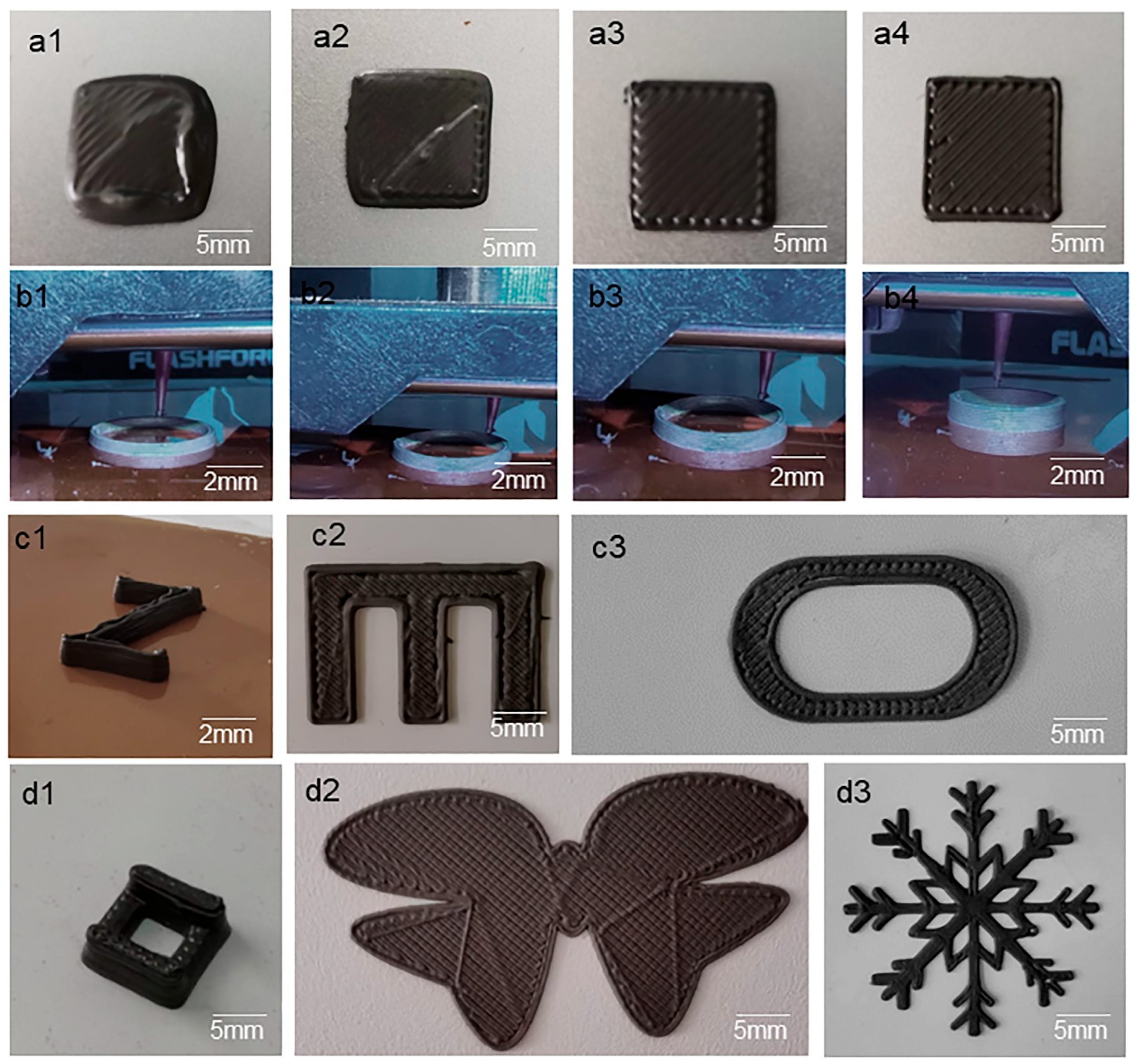
According to the rheological analysis, the 92.3%FeSiB@2.0%DTMS/EP slurry was chosen for 3D direct writing, to obtain good printability of the slurry. The different printed parameters (nozzle diameter, extrusion pressure, and nozzle travel speed tested) are shown in Table S1, and the printed samples are shown in Figure 10(a1–a4). The printed conditions of nozzle diameter 200 µm, pressure 6 Mpa, and speed 1 mm/s were confirmed as the best. The printed sample is shown in Figure 10(a4), which exhibits good filament continuity, high dimensional accuracy, and clear printing paths. Based on the printing condition, the printing process of the 3D circular ring model is shown in Figure 10(b1–b4). The printed workpiece exhibits excellent shape-maintaining ability without any signs of creep, indicating the exceptional shape-retention capability of the printed slurry. The printed opposite-sex magnetic powder core is shown in Figure 10(c2,c3). The magnetic powder core customized with the 3D printing method not only has the advantages of FeSiB materials but also can overcome the limitations brought by the mold forming method. In addition, we successfully printed various complex-shaped and structured workpieces, including three-dimensional letters “Z”, a snowflake, a hollow cube, and a butterfly, as shown in Figure 10(c1,d1–d3). The 3D-printed samples of 92.3%FeSiB@2.0%DTMS/EP slurry demonstrate precise geometries and high printing resolution. It can be used in ultra-small, shaped parts, complex, multi-step, and other precision product powder molding devices, with stability, accuracy, and other characteristics.
The densities of FeSiB power, FeSiB@3.35 wt% KH570/EP, and FeSiB@2 wt% DTMS/EP samples are 4.612, 4.456, and 4.533 g/cm3, respectively. All modified samples display lower density than pristine FeSiB, primarily due to the much lower intrinsic density of epoxy resin and silane modifiers relative to FeSiB alloy, which dilutes the overall composite density. Interfacial pores or decreased particle packing efficiency during composite fabrication also contribute to this reduction. The slightly lower density of the KH570-modified sample compared to the DTMS counterpart suggests different grafting efficiency, coating thickness, and interfacial structure induced by the two silane modifiers.
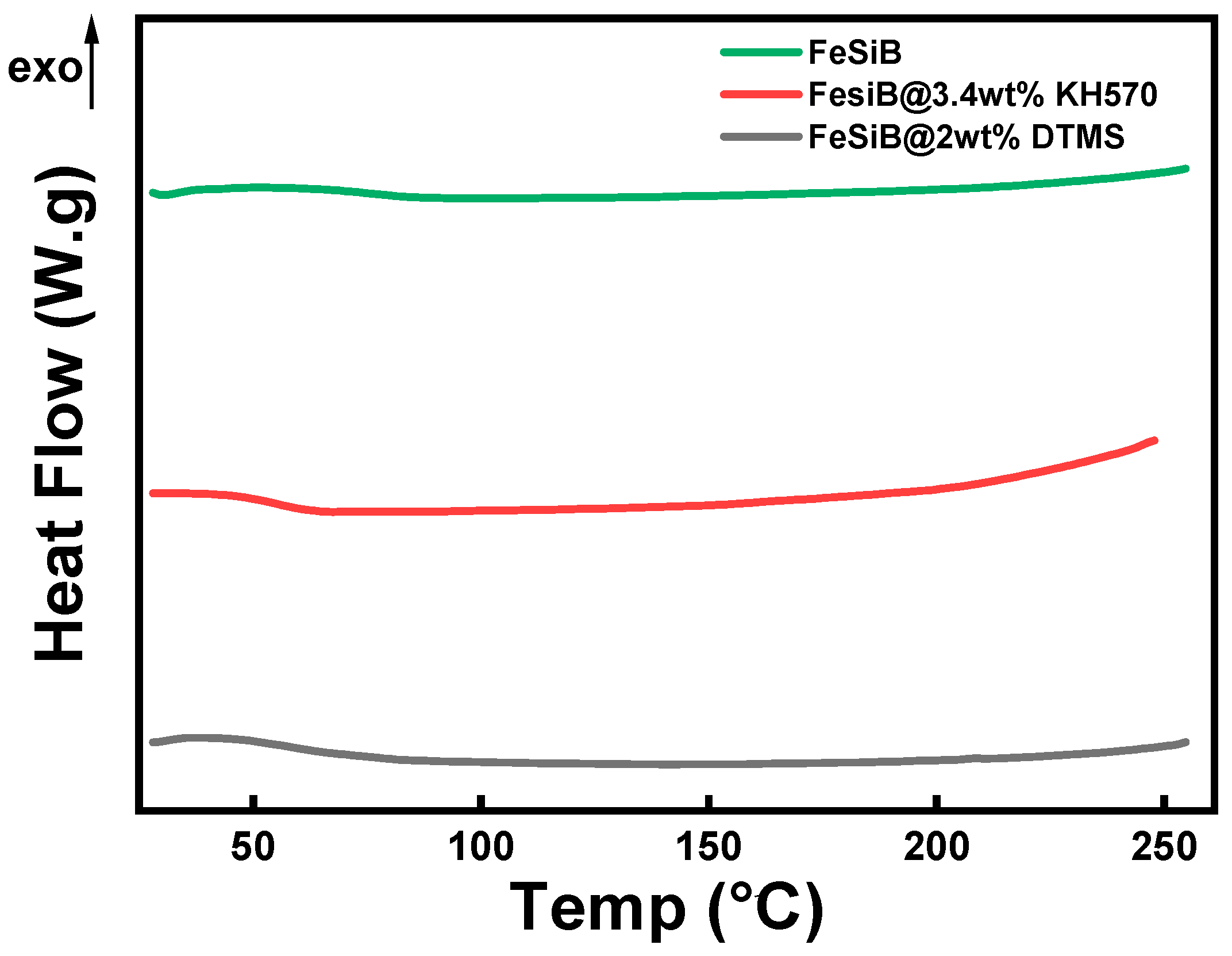
As shown in Figure 11, this work investigated the thermal behavior of pristine and surface-modified FeSiB amorphous alloys via differential scanning calorimetry (DSC), focusing on the effects of H570 (3.4 wt%) and DTMS (2 wt%). One can see that in the temperature range of 50–250 °C, the heat flow curves are flat without any peaks, indicating that the printed samples are thermally stable up to a temperature of 250 °C. The printed sample or components can be readily used in the temperature range.
In comparison with the work reported by Li et al. [37], which fabricated FeSiB/epoxy (EP) composites via direct ink writing (DIW) without silane coupling agent surface modification and achieved a maximum FeSiB loading of 92.8 wt%, our research exhibits comparable saturation magnetization with Ms = 137.02 ± 1.2 emu/g (vs. 137.98 emu/g in Li et al. [37], while a slightly higher coercivity of Hc = 6.63 ± 0.2 Oe is observed as a reasonable trade-off for enhanced high-frequency magnetic performance—an aspect that was not investigated or reported in the aforementioned study. Beyond the comparable static magnetic properties at a near-identical high powder loading (92.3 wt% in our work), our KH570 surface modification strategy addresses the critical issues of poor interface compatibility and inhomogeneous powder dispersion in the unmodified FeSiB/EP system noted in Li et al. [37], and more importantly, for the first time enables the FeSiB/EP composite to maintain stable, effective permeability up to 1 GHz.

4. Conclusions

In this study, we demonstrated that surface modification of FeSiB amorphous powders with silane coupling agents enables high-performance 3D direct ink writing of soft magnetic composites. Compared with unmodified slurries at the same filling ratio, the modified slurries exhibited better fluidity during printing, alleviating uneven discharging and nozzle blockage while improving the filling rate of magnetic particles. FTIR and surface morphology analyses confirmed that both KH570 and DTMS were successfully coated on the FeSiB powder surface. Rheological characterization revealed that DTMS modification resulted in superior printability, while microstructural analysis confirmed that KH570 modification promoted denser interfacial bonding, with samples such as 92.3% FeSiB@3.4% KH570/EP exhibiting a void-free powder–matrix interface. Magnetic property analysis showed that KH570-modified powders exhibited higher saturation magnetization and lower coercivity than DTMS-modified ones. The printed composite achieves the best magnetic performance (Ms: 137.02 ± 1.2 emu/g, Hc: 6.63 ± 0.2 Oe) and stable permeability up to 1 GHz.
Based on rheological analysis, the 92.3% FeSiB@2.0% DTMS/EP slurry was selected for 3D printing. After optimizing the printing parameters, the printed workpieces exhibited excellent shape-maintaining ability without any signs of creep. In addition, the 3D-printed samples demonstrated precise geometries and high printing resolution not only having the advantages of FeSiB materials but also able to overcome the limitations brought by the mold forming method. It can be used in ultra-small, shaped parts, complex, multi-step, and other precision product powder molding devices, with stability, accuracy, and other characteristics.

Supplementary Materials

The following supporting information can be downloaded at: https://www.mdpi.com/article/10.3390/jcs10040217/s1. Figure S1. XRD Pattern of the As-Received FeSiB Amorphous Powder; Figure S2. The images of SEM of cross-sectional morphology of samples; Table S1. Printing parameters of the printed structures.

Author Contributions

X.Y.: Conceptualization, Investigation, Methodology, Formal analysis, Writing—original draft, Writing—review and editing, Visualization. Y.J.: Conceptualization, Investigation, Methodology, Formal analysis, Writing—review and editing. J.H.: Conceptualization, Investigation, Methodology, Formal analysis, Writing—review and editing. All authors have read and agreed to the published version of the manuscript.

Funding

This work was supported by a fund from The National Natural Science Fund (project no. 52171149).

Data Availability Statement

The raw data supporting the conclusions of this article will be made available by the authors on request.

Conflicts of Interest

The authors declare that they have no known conflicts of interest, competing financial interests or personal relationships that could have appeared to influence the work reported in this paper.

References

  1. Nie, M.; Jiang, C.; Yang, Y.; Zhou, B.; Chen, Z.; Jia, G.; Li, Z.; Dai, C.; He, J.; Guo, H. Multicomponent soft magnetic alloys for soft magnetic composites: A review. Mater. Today Electron. 2025, 12, 100153. [Google Scholar] [CrossRef]
  2. Luo, Z.; Wu, W.; Jin, Q.; Yang, Z.; Li, G.; Li, Y.; Fan, X. Structural evolution mechanism and magnetic properties of soft magnetic composites transformed from FeSiAl/Co3O4 composites. J. Alloys Compd. 2024, 1004, 175819. [Google Scholar] [CrossRef]
  3. Muñoz, Á.S.; Burgos, N.; Zhukova, V.; Talaat, A.; Martín, J.M.; González, J.; Osinalde, M. Magnetic properties and power losses of inorganic, organic and hybrid-based soft magnetic composites. Ceram. Int. 2024, 50, 55099–55112. [Google Scholar] [CrossRef]
  4. Chi, Q.; Chang, L.; Dong, Y.; Zhang, Y.; Zhou, B.; Zhang, C.; Pan, Y.; Li, Q.; Li, J.; He, A.; et al. Enhanced high frequency properties of FeSiBPC amorphous soft magnetic powder cores with novel insulating layer. Adv. Powder Technol. 2021, 32, 1602–1610. [Google Scholar] [CrossRef]
  5. Lu, S.H.; Wang, M.G.; Zhao, Z.K. Recent advances and future developments in Fe-based amorphous soft magnetic composites. J. Non-Cryst. Solids 2023, 616, 16. [Google Scholar] [CrossRef]
  6. Li, W.; Li, W.; Wu, J.; Han, X.; Ying, Y.; Yu, J.; Zheng, J.; Qiao, L.; Li, J.; Che, S. Particles size-dependent magnetic properties of a FeSiAl soft magnetic composite with hybrid insulating coating for MHz applications. Mater. Sci. Eng. B 2023, 291, 116387. [Google Scholar] [CrossRef]
  7. Wu, F.; Liu, Z.; Dong, Y.; Zhang, R.; He, A.; Ling, Y.; Li, J.; Liu, X. Correlation mechanism of microstructure, magnetic domain, and magnetic softness of Fe-6.5 wt.% Si composites with high saturation. J. Supercond. Nov. Magn. 2023, 36, 733–743. [Google Scholar] [CrossRef]
  8. Badkoobeh, F.; Mostaan, H.; Rafiei, M.; Bakhsheshi-Rad, H.R.; RamaKrishna, S.; Chen, X. Additive manufacturing of biodegradable magnesium-based materials: Design strategies, properties, and biomedical applications. J. Magnes. Alloys 2023, 11, 801–839. [Google Scholar] [CrossRef]
  9. Huang, S.; Ma, J.; Liu, Y.; He, H.; Lyu, P.; Huang, H.; Dai, B. Regulation of Interface Compatibility and Performance in Soft Magnetic Composites with Inorganic Insulation Layers by FePO4 Intermediate Transition Layer. Molecules 2024, 29, 5281. [Google Scholar] [CrossRef] [PubMed]
  10. Guo, Z.; Song, X.; Wang, X.; Wang, C.; An, X.; Liu, X.; Wu, W.; Bian, T.; Zhao, Y. Inhibition of polysulfide shuttling in high-polarity electrolytes via liquid/quasi-solid interface in lithium-sulfur batteries. Sci. China Mater. 2023, 66, 505–512. [Google Scholar] [CrossRef]
  11. Khan, M.; Khurram, A.A.; Tiehu, L.; Zhao, T.K.; Xiong, C.; Ali, Z.; Ali, N.; Ullah, A. Reinforcement effect of acid modified nanodiamond in epoxy matrix for enhanced mechanical and electromagnetic properties. Diam. Relat. Mater. 2017, 78, 58–66. [Google Scholar] [CrossRef]
  12. Wang, Y.; Ni, L.J.; Yang, F.; Gu, F.Q.; Liang, K.; Marcus, K.; Wan, Y.D.; Chen, J.J.; Feng, Z.S. Facile preparation of a high-quality copper layer on epoxy resin via electroless plating for applications in electromagnetic interference shielding. J. Mater. Chem. C 2017, 5, 12769–12776. [Google Scholar] [CrossRef]
  13. Choi, M.H.; Jeon, B.H.; Chung, I.J. The effect of coupling agent on electrical and mechanical properties of carbon fiber/phenolic resin composites. Polymer 2000, 41, 3243–3252. [Google Scholar] [CrossRef]
  14. Taghvaei, A.H.; Shokrollahi, H.; Ebrahimi, A.; Janghorban, K. Soft magnetic composites of iron-phenolic and the influence of silane coupling agent on the magnetic properties. Mater. Chem. Phys. 2009, 116, 247–253. [Google Scholar] [CrossRef]
  15. Yu, N.; Li, Y.; She, W.; Li, H.; Chen, H.; Cheng, W.; Chen, J.; Liu, H.; Tu, Y.; Huang, Z. Binder-free sodium zinc phosphate protection layer enabled dendrite-free Zn metal anode. ACS Appl. Mater. Interfaces 2022, 14, 50827–50835. [Google Scholar] [CrossRef] [PubMed]
  16. Wei, H.; Yu, H.; Feng, Y.; Wang, Y.; He, J.; Liu, Z. High permeability and low core loss nanocrystalline soft magnetic composites based on FeSiBNbCu@Fe3O4 powders prepared by HNO3 oxidation. Mater. Chem. Phys. 2021, 263, 124427. [Google Scholar] [CrossRef]
  17. Qin, Z.; Zeng, Y.; Hua, Q.; Xu, Q.; Shen, X.; Min, Y. Synergistic effect of hydroxylated boron nitride and silane on corrosion resistance of aluminum alloy 5052. J. Taiwan Inst. Chem. Eng. 2019, 100, 285–294. [Google Scholar] [CrossRef]
  18. Jenson Joseph, E.; Akshayraj, V.R.; Panneerselvam, K. Surface modification of tungsten fillers for application in polymer matrix composites. Mater. Today Proc. 2021, 45, 7930–7933. [Google Scholar] [CrossRef]
  19. Nageswara Rao, B.; Tirupathi Rao, P.; Vasudha, K.; Esub Basha, S.; Prasanna, D.S.L.; Bhushana Rao, T.; Samatha, K.; Ramachandra, R.K. Physiochemical characterization of sodium doped zinc oxide nano powder for antimicrobial applications. Spectrochim. Acta Part A Mol. Biomol. Spectrosc. 2023, 291, 122297. [Google Scholar] [CrossRef]
  20. Ashitha, P.N.; Akhil, S.; Gaurav, L.S.; Varughese, K.T. Spectroscopic, Mechanical and Electrical Studies on Surfactant Modified HTV-SiR/Nano Alumina Composites. IEEE Trans. Dielectr. Electr. Insul. 2021, 28, 1189–1197. [Google Scholar] [CrossRef]
  21. Guo, X.; Xu, H.; Pu, J.; Yao, C.; Yang, J.; Liu, S. Corrosion Performance and Rust Conversion Mechanism of Graphene Modified Epoxy Surface Tolerant Coating. Front. Mater. 2021, 8, 767776. [Google Scholar] [CrossRef]
  22. Guan, W.W.; Shi, X.Y.; Xu, T.T.; Wan, K.; Zhang, B.W.; Liu, W.; Su, H.L.; Zou, Z.Q.; Du, Y.W. Synthesis of well-insulated Fe–Si–Al soft magnetic composites via a silane-assisted organic/inorganic composite coating route. J. Phys. Chem. Solids 2021, 150, 109841. [Google Scholar] [CrossRef]
  23. Chang, C.; Guo, J.; Li, Q.; Zhou, S.; Liu, M.; Dong, Y. Improvement of soft magnetic properties of FeSiBPNb amorphous powder cores by addition of FeSi powder. J. Alloys Compd. 2019, 788, 1177–1181. [Google Scholar] [CrossRef]
  24. Gheiratmand, T.; Madaah Hosseini, H.R.; Seyed Reihani, S.M. Iron-borosilicate soft magnetic composites: The correlation between processing parameters and magnetic properties for high frequency applications. J. Magn. Magn. Mater. 2017, 429, 241–250. [Google Scholar] [CrossRef]
  25. Wu, X.; Chen, C.; Hao, J.; Zhao, T.; Ma, H.; Lu, Y.; Ren, Z. Effect of phosphating and heat treatment on magnetic properties of Fe-3.3 Si-6.5 Cr soft magnetic composites. J. Supercond. Nov. Magn. 2020, 33, 1889–1897. [Google Scholar] [CrossRef]
  26. Li, Z.; Li, J.; Luo, H.; Yuan, X.; Wang, X.; Xiong, H.; Zhang, D. Direct ink writing of 3D piezoelectric ceramics with complex unsupported structures. J. Eur. Ceram. Soc. 2022, 42, 3841–3847. [Google Scholar] [CrossRef]
  27. Wang, H.; Chen, C.; Yang, F.; Shao, Y.; Guo, Z. Direct ink writing of metal parts with curing by UV light irradiation. Mater. Today Commun. 2021, 26, 102037. [Google Scholar] [CrossRef]
  28. Zhang, X.; Hu, H.; Tang, D.; Zhang, C.; Fu, J.; Zhao, P. Magnetic flexible tactile sensor via direct ink writing. Sens. Actuators A Phys. 2021, 327, 112753. [Google Scholar] [CrossRef]
  29. Li, S.-S.; Guo, R.-F.; Zhao, D.-X.; Yang, L.-K.; Shen, P. Preparation of laminated Cr3C2/Cu composites by direct ink writing and pressureless infiltration. Addit. Manuf. 2022, 59, 103189. [Google Scholar] [CrossRef]
  30. Khazaei Feizabad, M.H.; Khayati, G.R.; Minouei, H. A kinetic study approach for in-situ preparation of amorphous Ni based nanocomposite reinforced by nanocrystalline Ni-Ti shape memory alloy. J. Non-Cryst. Solids 2019, 524, 119652. [Google Scholar] [CrossRef]
  31. Xiang, J.-X.; Liu, Z. Observation of a large slip effect in the nanoscale flow of highly viscous supercooled liquid metals. Langmuir 2023, 39, 11224–11230. [Google Scholar] [CrossRef]
  32. Woo, K.; Jang, D.; Kim, Y.; Moon, J. Relationship between printability and rheological behavior of ink-jet conductive inks. Ceram. Int. 2013, 39, 7015–7021. [Google Scholar] [CrossRef]
  33. Park, J.; Hong, Y.-K.; Lee, W.; Kim, S.-G.; Rong, C.; Poudyal, N.; Liu, J.P.; Choi, C.-J. A simple analytical model for magnetization and coercivity of hard/soft nanocomposite magnets. Sci. Rep. 2017, 7, 4960. [Google Scholar] [CrossRef]
  34. da Silva, F.G.; Vasilakaki, M.; Gomes, R.C.; Aquino, R.; Campos, A.F.C.; Dubois, E.; Perzynski, R.; Depeyrot, J.; Trohidou, K. A numerical study on the interplay between the intra-particle and interparticle characteristics in bimagnetic soft/soft and hard/soft ultrasmall nanoparticle assemblies. Nanoscale Adv. 2022, 4, 3777–3785. [Google Scholar] [CrossRef]
  35. Zhou, J.; Li, X.S.; Hou, X.B.; Ke, H.B.; Fan, X.D.; Luan, J.H.; Peng, H.L.; Zeng, Q.S.; Lou, H.B.; Wang, J.G.; et al. Ultrahigh Permeability at High Frequencies via A Magnetic-Heterogeneous Nanocrystallization Mechanism in an Iron-Based Amorphous Alloy. Adv. Mater. 2023, 35, 13. [Google Scholar] [CrossRef] [PubMed]
  36. Wang, C.; Liu, J.H.; Peng, X.L.; Li, J.; Yang, Y.T.; Han, Y.B.; Xu, J.C.; Hong, B.; Gong, J.; Ge, H.L.; et al. FeSiCrB amorphous soft magnetic composites filled with Co2Z hexaferrites for enhanced effective permeability. Adv. Powder Technol. 2022, 33, 103378. [Google Scholar] [CrossRef]
  37. Qing, M.; Chong, T.; Jing, H.; Sun, B. Study on the Soft Magnetic Properties of FeSiB/EP Composites by Direct Ink Writing. Front. Mater. 2021, 8, 792768. [Google Scholar] [CrossRef]
Figure 1. Principle of FeSiB powder modified by silane coupling agent.
Jcs 10 00217 g001
Figure 2. FT-IR spectra of FeSiB powders modified using two different silane coupling agents. (a) FeSiB powder with different KH570 modified proportions. (b) FeSiB powder with different DTMS modified proportions.
Jcs 10 00217 g002
Figure 3. SEM and corresponding EDS images of FeSiB powders modified with KH570 and DTMS. (a) FeSiB@1.4%KH570, (b) FeSiB@2.3%KH570, (c) FeSiB@4.0%DTMS, (d) FeSiB@5.0%DTMS.
Jcs 10 00217 g003
Figure 4. The rheological plots of FeSiB@KH570/EP and FeSiB@DTMS/EP slurries with different mass fractions: (a) 90.9 wt%FeSiB/EP; (b) 92.3 wt%FeSiB/EP.
Jcs 10 00217 g004
Figure 5. The rheological properties of FeSiB/EP slurries modified with KH570 and DTMS silane coupling agents at 92.3 wt% FeSiB: (a) Yield stress (τy) as a function of silane content; (b) Low-shear complex viscosity (η, at 1 s−1) as a function of silane content; (c) Shear-thinning index (n) as a function of silane content.
Jcs 10 00217 g005
Figure 6. SEM images of the cross-sectional morphology of samples. (a1a3) 90.9% FeSiB/EP sample at different magnifications, FeSiB not modified. (b1b3) FeSiB powders modified with KH570: (b1) 90.9%FeSiB@1.4%KH570/EP, (b2) 90.9%FeSiB@2.3%KH570/EP, (b3) 90.9%FeSiB@3.4%KH570/EP. (c1c3) FeSiB powders modified with DTMS: (c1) 90.9%FeSiB@3.0%DTMS/EP, (c2) 90.9%FeSiB@4.0%DTMS/EP, (c3) 90.9%FeSiB@5.0%DTMS/EP.
Jcs 10 00217 g006
Figure 7. The comparison of the hysteresis loop of the printed samples. (a) 90.9 wt%FeSiB@(KH570/DTMS)/EP, (b) 92.3 wt%FeSiB@(KH570/DTMS)/EP.
Jcs 10 00217 g007
Figure 8. Saturated magnetization (Ms), remanent magnetization and (Mr), and coercivity (Hc) value (ac) of different samples, and Ms, Mr, and Hc of samples prepared with different surface modifiers at an FeSiB content of 92.3% (df).
Jcs 10 00217 g008
Figure 9. Plot of the effective permeability change with frequency (1 MHz–1 GHz) and the effective permeability value of 1 MHz, 5 × 10⁷ HZ, and 5 × 10⁸ Hz.
Jcs 10 00217 g009
Figure 10. The printed samples with different printed parameters. (a1a4) Printed samples of 92.3%FeSiB@2.0%DTMS/EP by different nozzle diameters. (b1b4) The preparation of the inks and the 3D printing process. (c1c3) Some photos of the 3D printed objects: three-dimensional letters “Z” and “E”, runway. (d1d3) Photos of the 3D printed objects: butterfly, hollow cube, snowflake.
Jcs 10 00217 g010
Figure 11. DSC heat flow curves of printed samples.
Jcs 10 00217 g011
Disclaimer/Publisher’s Note: The statements, opinions and data contained in all publications are solely those of the individual author(s) and contributor(s) and not of MDPI and/or the editor(s). MDPI and/or the editor(s) disclaim responsibility for any injury to people or property resulting from any ideas, methods, instructions or products referred to in the content.