Review

A Review About Centrifugal Spun Polymer and Polymer Composites Nanofibers in Filtration Process: Mechanism, Efficiency and Applications


by
Niloy Chowdhury
1,
Arifur Rahman
2 and
Mazeyar Parvinzadeh Gashti
2,3,*
1
Department of Yarn Engineering, Textile Engineering College, Begumganj, Noakhali 3831, Bangladesh
2
Department of Chemistry, Pittsburg State University, 1701 South Broadway Street, Pittsburg, KS 66762, USA
3
National Institute for Materials Advancement, Pittsburg State University, Pittsburg, KS 66762, USA
*
Author to whom correspondence should be addressed.
J. Compos. Sci. 2026, 10(4), 199; https://doi.org/10.3390/jcs10040199
Submission received: 11 February 2026 / Revised: 22 March 2026 / Accepted: 2 April 2026 / Published: 7 April 2026

Abstract

Electrospinning is the most widely used technique for creating nanofibers. However, the low production rate and the usage of a high-voltage setup have become obstacles to its widespread application. One effective method for creating nanofibers from a variety of materials is centrifugal spinning. This review discusses centrifugal spinning (CS) as an effective and scalable nanofiber manufacturing technology, particularly in filtration systems, and presents it as a promising alternative to existing methods, such as electrospinning. The review highlights the advantages of CS, including its high production rate, cost efficiency, and the ability to process various materials to produce nano- and microfibers. Despite its high potential, the issues associated with CS technology include the unpredictability of fiber quality, the inability to control diameters, and the need for more robust mathematical models to predict fiber characteristics. To eliminate these shortcomings and further enhance the industrial utility of centrifugally spun nanofibers in filtration, future studies should focus on improving process control, exploring a broader range of polymers, optimizing melt electrospinning, and designing more advanced nozzle profiles.

1. Introduction

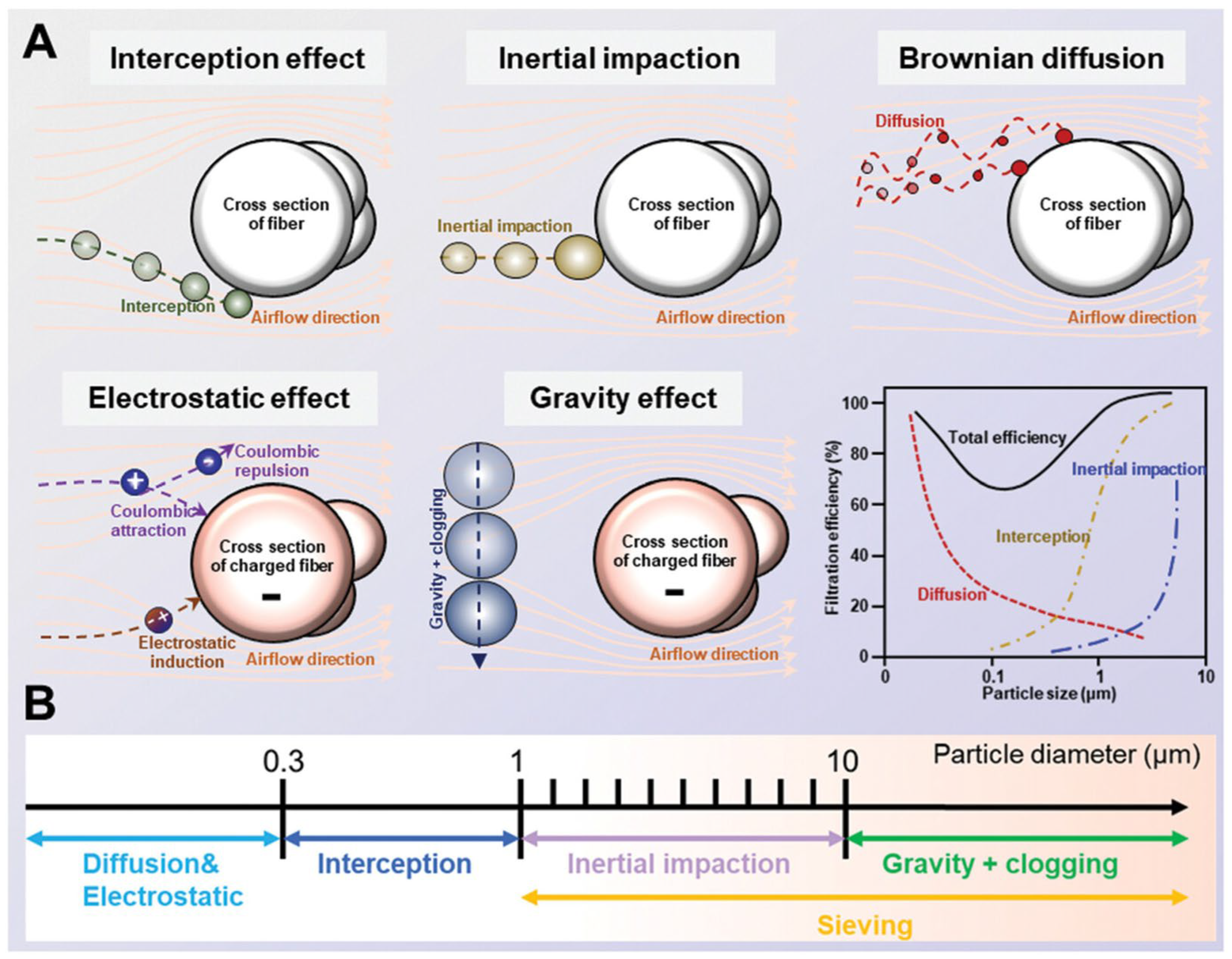
Airborne particulate matter (PM), particularly fine (PM2.5) and ultrafine particles (PM1 and PM0.3), poses significant health risks, including respiratory, cardiovascular, and neurological disorders, due to its ability to penetrate deep into the lungs and enter the bloodstream [1,2,3]. The sources of these pollutants are diverse, encompassing vehicular emissions, industrial activities, and natural phenomena, which contribute to their varying composition and toxicity. In industrial settings, oily aerosols exacerbate equipment corrosion and increase occupational hazards [4]. Consequently, the development of high-performance filtration materials capable of efficiently capturing submicron particles while maintaining low airflow resistance has become a critical research focus [5].
Nanofibrous membranes have emerged as a superior alternative to conventional filtration materials, addressing the limitations of larger fiber diameters that hinder ultrafine particle capture and increase pressure drop. Existing commercial filtration materials, such as melt-blown nonwovens and microfiber-based filters, rely primarily on surface straining and depth filtration mechanisms. Their relatively large and nonuniform fiber diameters often result in limited filtration efficiency for ultrafine particles and increased pressure drop, leading to higher energy consumption and reduced service life [6,7]. Techniques such as electrospinning (ES) enable the production of nanofibers with diameters as small as 50 nm, significantly enhancing filtration efficiency due to mechanisms such as interception and electrostatic interactions [8]. A three-dimensional electro-spun PVDF nanofibrous membrane exhibited a filtration efficiency of 93.6% for 0.3 µm NaCl aerosols with a relatively low-pressure drop of 89 Pa and quality factor (QF) of 0.0309 Pa−1 [9]. ES is a widely recognized technique for producing nanofibers with uniform diameters and controlled morphology. However, despite its success at the laboratory scale, it suffers from inherent limitations. Traditional ES methods, particularly needle-based systems, suffer from low production rates and blockage issues, while needle-less alternatives still require high voltages and face configuration challenges [10,11]. Recent advancements have significantly improved production efficiency. For example, liquid-assisted ultrahigh-speed electrospinning has achieved production rates more than 220 times higher than conventional methods without compromising fiber quality [12]. Additionally, various innovative techniques, including multi-needle and bubble ES, are being explored to enhance scalability and meet industrial demands for applications in filtration, biomedical devices, and textiles [13]. However, despite these advancements, the reliance on high-voltage systems and sensitivity to solution properties remain critical challenges that need to be addressed for broader industrial adoption [10,13].
Centrifugal spinning (CS) has emerged as a promising alternative to ES for the fabrication of nanofibers, offering several advantages that make it particularly suitable for large-scale manufacturing and filtration applications. Unlike electrospinning, which relies on high-voltage electric fields, Centrifugal spinning utilizes centrifugal force to generate and stretch polymer jets. As a result, it eliminates the need for complex and potentially hazardous high-voltage setups [14,15], and allows for the production of nanofibers at a significantly higher rate and lower cost, with simpler equipment configurations, making it more accessible for commercial applications [16]. Furthermore, the process is versatile, available for a wide range of materials, including polymers with low electrical conductivity, polymer blends, and even recycled materials. For instance, polycaprolactone (PCL) exhibits limited electrical conductivity in its melt form. Therefore, it often requires conductivity-enhancing additives to improve jet stability and reduce fiber diameter. The very high viscosity (25,580 mPa·s at 473.15 k) and extremely low conductivity (2 pS) of pure PCL necessitate the use of solvents or functional additives to enable fiber formation. To address this, Kim et al. demonstrated that incorporating natural additives like gallic acid (GA) could dramatically improve these properties, with 7 wt% GA increasing the conductivity by 81-fold and reducing the viscosity by a factor of 8526, thereby facilitating the melt electrospinning process [17]. In contrast, alternative fiber production methods such as centrifugal spinning can overcome these material limitations without the need for any additives. As shown by Zander et al., centrifugal spinning successfully produced PCL fibers directly from both the melt and solution by optimizing mechanical parameters, achieving fiber diameters ranging from 0.81 ± 0.5 µm to 7.05 ± 1.1 µm, which is consistent with the 2 to several tens of micrometer range typically achieved in melt electrospinning [18]. However, it should be noted that direct comparative studies evaluating additive-assisted melt electrospinning and centrifugal spinning under equivalent processing conditions remain limited. Table 1 briefly describes the comparison between centrifugal spinning (CS), meltblown, and electrospinning (ES).
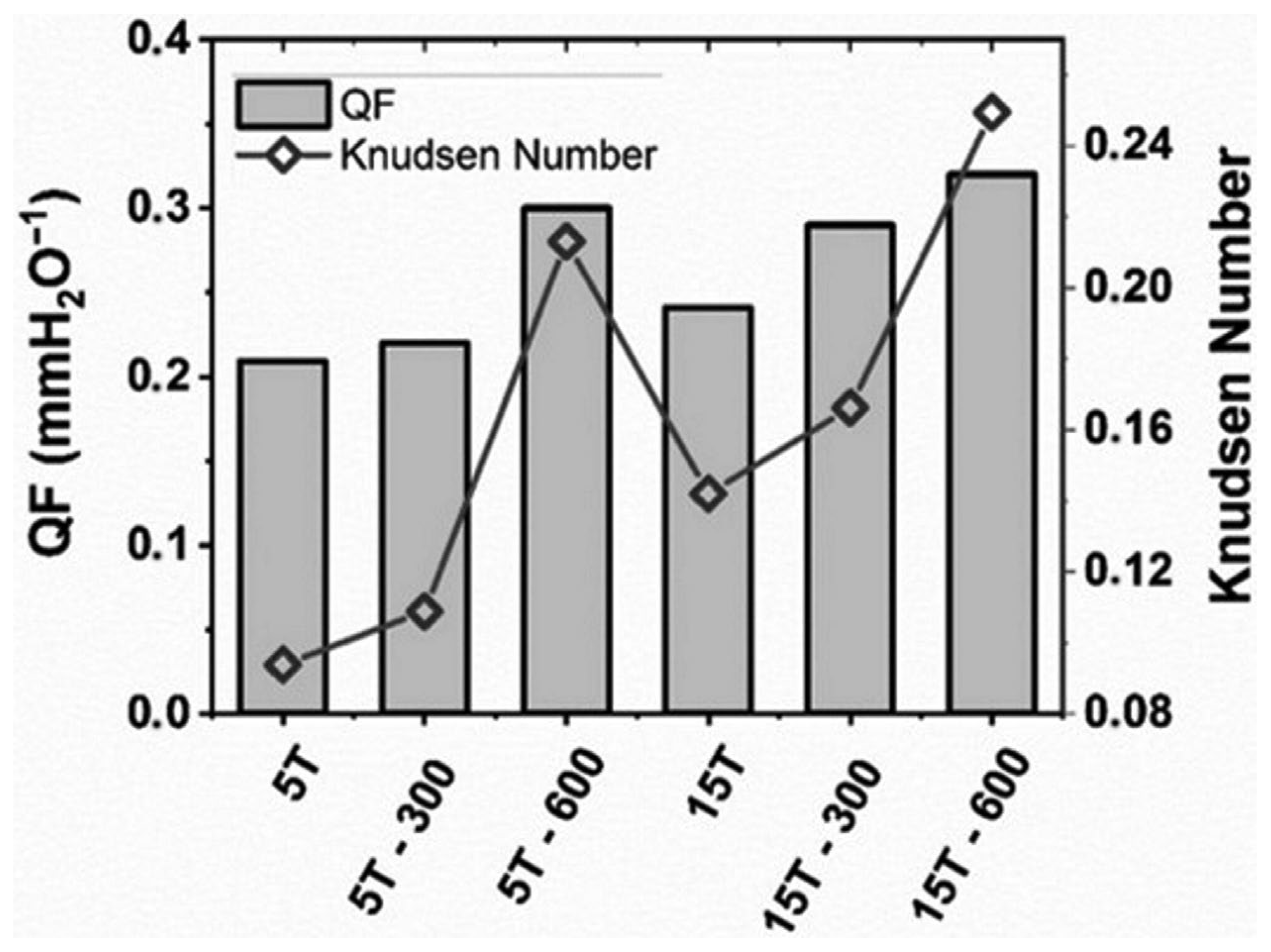
From a filtration perspective, centrifugally spun nanofibers offer a unique structural advantage due to their broader diameter distribution, which ranges from nanometer to micrometer scales. This multiscale fiber structure enhances filtration efficiency by capturing particles with finer fibers while maintaining open airflow channels with coarser fibers, thus reducing pressure drop. Additionally, the presence of nanoscale fibers in these membranes promotes slip-flow effects, further lowering pressure drop without compromising filtration performance [14]. The method’s simplicity and efficiency, combined with its ability to produce high-quality nanofibers from diverse materials, underscore its potential as a superior alternative to traditional electrospinning, particularly in applications requiring high throughput and cost-effectiveness [19].
Recent developments in centrifugal spinning, including ES-incorporated CS [20], vacuum-assisted collection (VCS) [21], and multilayer or interwoven fiber architectures [22], have further expanded its applicability in filtration. These advancements enable enhanced control over fiber morphology, membrane thickness, and hierarchical pore structure, leading to improved reusability, mechanical robustness, and functional performance [21,22,23]. Consequently, centrifugally spun nanofibers have demonstrated excellent performance across a wide range of filtration applications, including air and aerosol filtration, respiratory protection, oily aerosol removal, high-temperature filtration, and biodegradable filtration systems [21,22,23,24,25,26,27,28,29]. Compared to electro-spun fibers, the distinctive structural features of centrifugally spun nanofibers, such as their high porosity and broad fiber diameter distribution, improve particle capture efficiency while preserving a reduced pressure drop. Although the potential is large, the challenges that tend to trouble the CS technology include consistency in fiber quality, successfully controlling fiber diameter, and the necessity to come up with more powerful mathematical models to forecast fiber properties. As a result, our research on the application of centrifugal spun nanofibers in filtering processes emphasizes the benefits of CS, such as its high production rate, affordability, and adaptability in processing different materials to produce nano- or microfibers, with their potential limitations and future research areas.
Table 1. Comparison between centrifugal spinning, meltblown and electrospinning.
FeatureCentrifugal SpinningElectrospinningMeltblownReference
Driving forceCentrifugal force generated by high-speed rotation with no need for high voltage.Driven by high voltage electric forces during jet thinning.In the melt-blowing process, the airflow field has a significant impact on the creation of fibers. The attenuation force that pulls the polymer streams into fine-diameter fibers is provided by the aerodynamic drag of the air jets on the molten polymer.[30,31,32,33,34,35]
Production RateHigh production rates (up to 1500 g/h)Around 350–450 g/hup to 1500 g/h[36,37,38,39]
ScalabilityLarge-scale productionLimited scalabilityHighly scalable[37,40,41]
Materials RequirementVersatile; processes solution or melt, including low-conductivity and recycled materials.Requires specific conductivity and solution properties.Thermoplastic Polymers i.e., Polypropylene (PP).[42,43]
Fiber Diameter ControlThe diameter of the fibers produced by it is relatively large, mostly above the micrometer levelElectrospinning can produce fibers with excellent morphology and high uniformity.The average diameter of fibers is mainly determined by blowing rate, melt viscosity, air temperature, melt temperature and air flow rate[44,45]
Key Advantage for FiltrationCS samples exhibited a consistently higher quality factor than ES samples, largely due to the lower Δp values.Higher pressure drop (Δp) of 100–350 PaProduces superfine fibers on the submicron or micron scale. Fibers smaller than 1 μm achieve greater filtering qualities with lower weights.[23,46]
Energy Consumption0.001–0.01 kWh/kgan average power consumption of 5.41 kWh kg−10.91–2.2 kWh·kg−1[47,48,49]
[48] Filter ReusabilityHigher after washingLowerThe MB filter is only effective for a single usage, since it reduces to around 64% after ethanol cleaning.[23,50]
CostMuch lower than establishing an electrospinning deviceHigher cost due to high voltage power supplyCost effective, less than $10/kg[51,52]

2. Fundamental of Centrifugal Spinning

Electrospinning is the most widely used technique for creating nanofibers. However, the low production rate and the need for a high-voltage setup have turned into obstacles to its widespread adoption. One effective method for creating nanofibers from a variety of materials is centrifugal spinning [16].

2.1. Underlying Physics

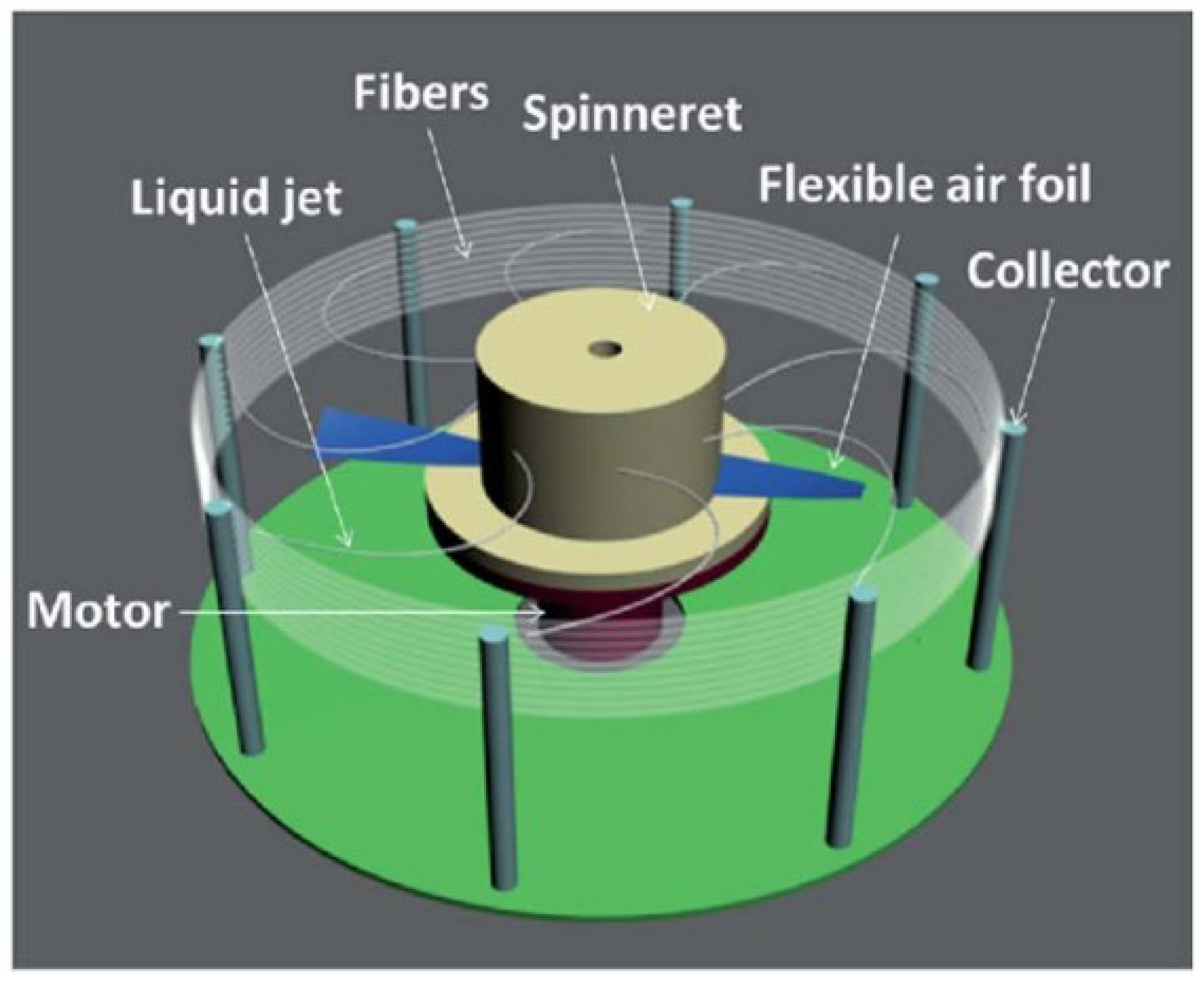
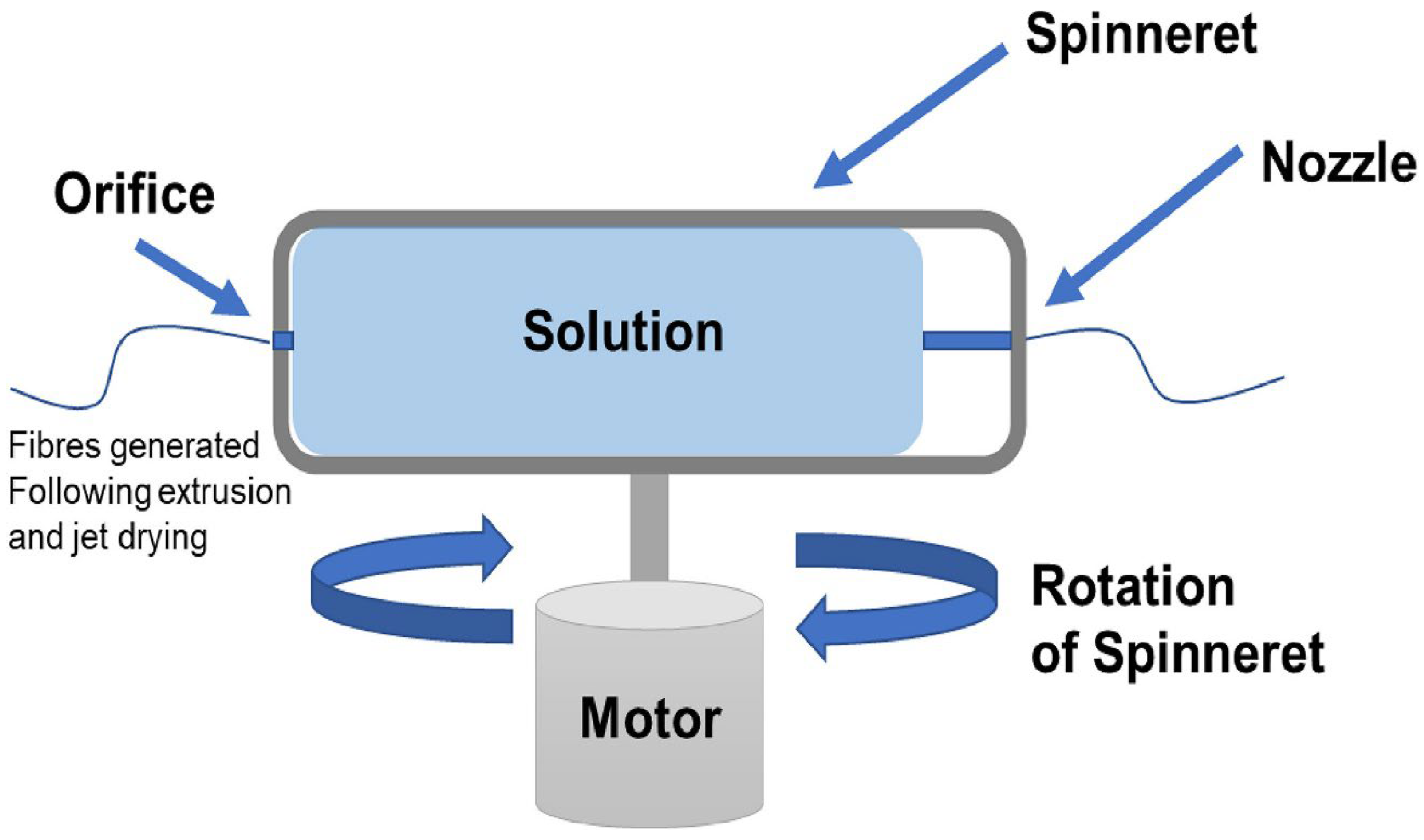
In basic terms, centrifugal forces are used in this process to create nanofibers. Typically, a polymer melt or solution is poured into a rotating chamber with many orifices. The centrifugal force created by rotation pushes the melt or solution to the chamber’s inner surfaces, guiding it towards the orifices. As soon as the centrifugal force overcomes the solution’s or melt’s surface tension and viscosity, the polymer jet leaves the orifices. The jet is then sufficiently stretched during the jet flight in the direction of the collector, causing the solvent to evaporate or the melt to cool, forming dry and nanoscale fibers. Figure 1 and Figure 2 depict the schematic operation and a general overview of technologies based on centrifugal spinning of a centrifugal spinning device [53]. Here, the motor functions as the main engine, supplying the mechanical energy required to propel the rotating head at high speeds (usually between 9000 and 30,000 rpm) [54]. In order to create nanofibers, the spinneret serves as the revolving core that contains the polymer solution or melt and pushes it through tiny holes or nozzles. Although no external electric field is employed, the liquid jet is crucial to the synthesis of fibers and is essentially the same process used in electrospinning. The process is completed when dry fibers are deposited onto the collector as the solvent component of the jet evaporates [30]. To help with fiber collection, a flexible airfoil is placed on the shaft above the pool. Air turbulence produced by an airfoil positioned beneath the spinneret may have an impact on solvent evaporation, and allows fiber solidification, deposition, and, depending on its design, nanofiber alignment by capturing ejected polymer jets. The orifice determines important properties like diameter, homogeneity, and production rate by acting as the crucial exit point where the polymer solution or melt is converted into fibers [15,55,56]. The ability to modify parameters to produce fibers with various morphologies or diameters is one of the primary benefits of centrifugal spinning. The properties and porosities of the various polymers may vary. The fibers’ ultimate orientation and diameter are also altered by the settings used to produce them [57]. Additionally, the high production rate of the centrifugal spinning process is another significant characteristic. A basic centrifugal spinning setup with just two side-wall nozzles may produce around 50 g/h on average, which is at least two orders of magnitude more than what is typically produced by a lab-scale electrospinning procedure [58,59]. The polymer solution or melt is ejected from the rotating spinning head during centrifugal spinning. The polymer jet then stretches and is finally deposited on the collector, where it solidifies into nanofibers when the centrifugal force surpasses the surface tension of the liquid polymer [16,54]. This novel method creates nano or microfibers in large quantities by using centrifugal forces. This method has been shown experimentally to create nanofibers with a diameter in the nanometer range by ejecting fibers radially outward onto a collector. Centrifugal spinning requires the polymer to be liquid in order to produce nanofibers. This can be achieved by heating the polymer to a temperature at which polymer chains begin to flow or by dissolving it in different solvents [56]. However, the active ingredient (drug, for example)–polymer or polymer–polymer combinations must dissolve in the common solvent when using the centrifugal solution spinning (CSS) approach. The viscosity and surface tension parameters of the polymer solution utilized, along with the rotational speed of the rotating unit, are connected to the desired fiber diameter, porosity, and shape of the final mass structure. The fundamental device-based characteristics that influence fiber formation are the centrifuge unit’s geometry, the orifices’ sizes, their separation from one another, and the collecting distance—the distance between the collector unit and the centrifuge unit [30].

2.1.1. Force Balance

Numerous forces, including friction, gravity, surface tension, and centrifugal force, are applied to the material as it rotates with the spinneret. However, surface tension and centrifugal force dominate, with the other forces being insignificant. Because of the centrifugal forces acting on the solution inside the spinneret, a tiny solution droplet is observed to emerge from the orifice as the spinneret rotates [15].
Centrifugal spinning’s high production rate indicates that it may be a large-scale, inexpensive method for producing nanofibers in vast quantities [14]. According to Equation (1):
F = m r ω 2
where r is the radius, ω is the angular speed, m is the mass of the spinning drug, and F is the centrifugal force. Increasing the angular speed or the spinning head’s radius helps to increase the centrifugal force [51].

2.1.2. Jet Initiation

The centrifugal force becomes sufficient to overcome the surface tension and viscous shear stress of the polymer solution when the spinneret rotation speed reaches a specific critical condition. The solution is forced out of the orifices and a primary jet forms when this critical condition is exceeded. Although no external electric field is employed, this polymer jet is crucial for the formation of fibers and is essentially the same process used in electrospinning. The jet, which atomizes the solvent and causes quick evaporation, can be described as a high-velocity liquid spray [30,61].

2.1.3. Jet Flight

Shear forces produced by a combination of centrifugal forces, air resistance, and solvent evaporation cause the ejected solution jet to become thinner and longer. The continuous structure of the solution jet is preserved by its intrinsic viscosity. The angular speed of the spinning chamber is one of the parameters that affects the ultimate diameter of the fiber, which is determined by how much the jet thins. The centrifugal force that the solution jet causes increases with the spinning chamber’s angular speed. In this instance, the angular speed may be converted to the rotating speed of the chamber. The solution jet becomes thinner as the spinning process continues due to solvent evaporation, and eventually the liquid jet solidifies into fibers. In order to gather hardened fibers in between the rods, the collecting posts were placed radially throughout the system [61,62].

2.2. Devices

Centrifugal spinning typically consists of a drive engine that can rotate a centrifugal spinneret at different speeds; minor variants of this technique are unavoidable. A spinneret, which is often made of metal, can either hold a chamber directly or help move solution into the nozzle. The function of the nozzle, which is an aperture at the spinneret’s terminals that resembles tiny open orifices, is to extrude the solution through the apertures quickly. Figure 2. A spinneret is typically made of metal and either contains a chamber or enables the passage of solution into the nozzles. The purpose of the nozzle, which is an aperture at the spinneret’s terminals that can be described as tiny open orifices, is to extrude the solution through them quickly [30].

2.2.1. Spinning Head/Spinneret

The revolving spinning head is one of the most crucial parts of a functional centrifugal spinning system. With and without a nozzle, spinning heads come in two primary varieties that share a similar jet elongation mechanism. Two identical syringes with the same volume of spinning fluids are typically symmetrically attached to the rotor for the nozzle spinning head. The polymer solutions separate and form nanofibers when they are discharged from the syringes during spinning [16]. Rotating speed is a key factor in adjusting fiber diameter for a well-established spinning head. Nevertheless, an increase in rotational speed does not necessarily result in a decrease in fiber diameter. The fiber diameter may grow as the rotating speed increases when a certain threshold is achieved. This can be explained by the fact that a higher centrifugal force would result in a higher stretching force in order to achieve a smaller fiber diameter. Conversely, when the rotational speed increases, so does the spinning dope’s flow rate. Therefore, the desired fiber diameter that can be generated at a relatively low speed determines the ideal spinning speed [51]. The ejected liquid jet meets a stream of spinning air and quickly loses its solvent while still floating in the air since the electro-centrifuge spinning (ECS) system was not sealed from outside airflow and its collector was stationary. The surrounding air speed increases significantly as the rotation speed is increased. As a result, raising the rotation speed increases the evaporation rate. As a result, the jet’s elongational viscosity reaches a point where further stretching or distortion is not conceivable. The average nanofiber diameter was considerably reduced by an initial increase in rotation speed from 1440 to 2160 rpm; however, further increases to 2880, 3600, and 4320 rpm caused an increase in diameter, reverting to values comparable to those seen at 1440 rpm. The collector of the ECS system was stationary, and it was not sealed off from external airflow. This resulted in thicker and uneven fibers because the ejected liquid jet came into contact with a stream of spinning air, which hindered jet extension and caused fast solvent loss [63]. Because of the greater rpm, the effects might potentially be reversed. The solvent evaporation rate can be enhanced as the rotating speed affects the air flow, reducing the polymer jet elongation and producing thicker fiber [64]. In an experiment by Peiyan Ye et al., the fiber shape degraded and started to break at speeds higher than 3300 rpm. Complete fibers were no longer gathered at the collection rod at speeds higher than 3600 rpm [65]. Solvent evaporates quickly and polymer jets solidify before elongation, which results in a high fiber diameter at speeds more than 4000 rpm. Higher average fiber diameter was noted at lower rotational speeds, below 4000 rpm; below 3000 rpm, there is insufficient speed for the polymer jet to elongate and thin [66]. The polymer jets are broken by extremely high rotation rates, resulting in the creation of beads rather than fibers. The effects of inertia and aerodynamics cause a key instability in several ways when creating polymer fibers via jets, breaking the polymer jet [57]. The viscosity of the polymer melts or solution determines good fiber formation. The forces employed to pull the fiber might not be sufficient to produce a jet because of the high viscosity. However, if the viscosity is low, the jet may fragment and create beads rather than fibers. If the viscosity of the polymer solution is too high, the molecules will gravitationally interact and become tangled, the solution cannot be forced out of the spinneret by an external force, and nanofibers cannot be created. A droplet will develop or the substance will shatter if the solution’s viscosity is too low [15].
A three-plate spinning head facilitates the spinning of nanofibers at greater rotational speeds. They are able to create polyethylene oxide (PEO) nanofibers with diameters as large as 300 nm by using a spinning head system with rotational rates between 3000 and 5000 rpm [14]. A spinneret is used to quickly rotate a material in a molten state or solution. The contents of the spinning head are then expelled from orifices around the boundary, creating fibers on a stationary collector. A liquid jet emerges from the nozzle tip when the spinning head reaches a critical speed because the centrifugal force overcomes the spinning liquid’s surface tension. Further stretching of the jet causes the nanofibers to solidify on the collector [67]. In order to regulate the fiber diameter, the nozzle’s length and diameter are crucial. Nanofibers from a polymer solution may be spun directly by this cylinder-shaped spinning head. Inductive heating coils or other heating sources must be added in order to melt the polymer and spin nanofibers from it. The production rate may be increased by adding more nozzles. Other kinds of spinning heads with spheroid, oblate spheroid, or trapezoidal forms can be employed in addition to cylinder-shaped ones [14].

2.2.2. Nanofiber Collecting System

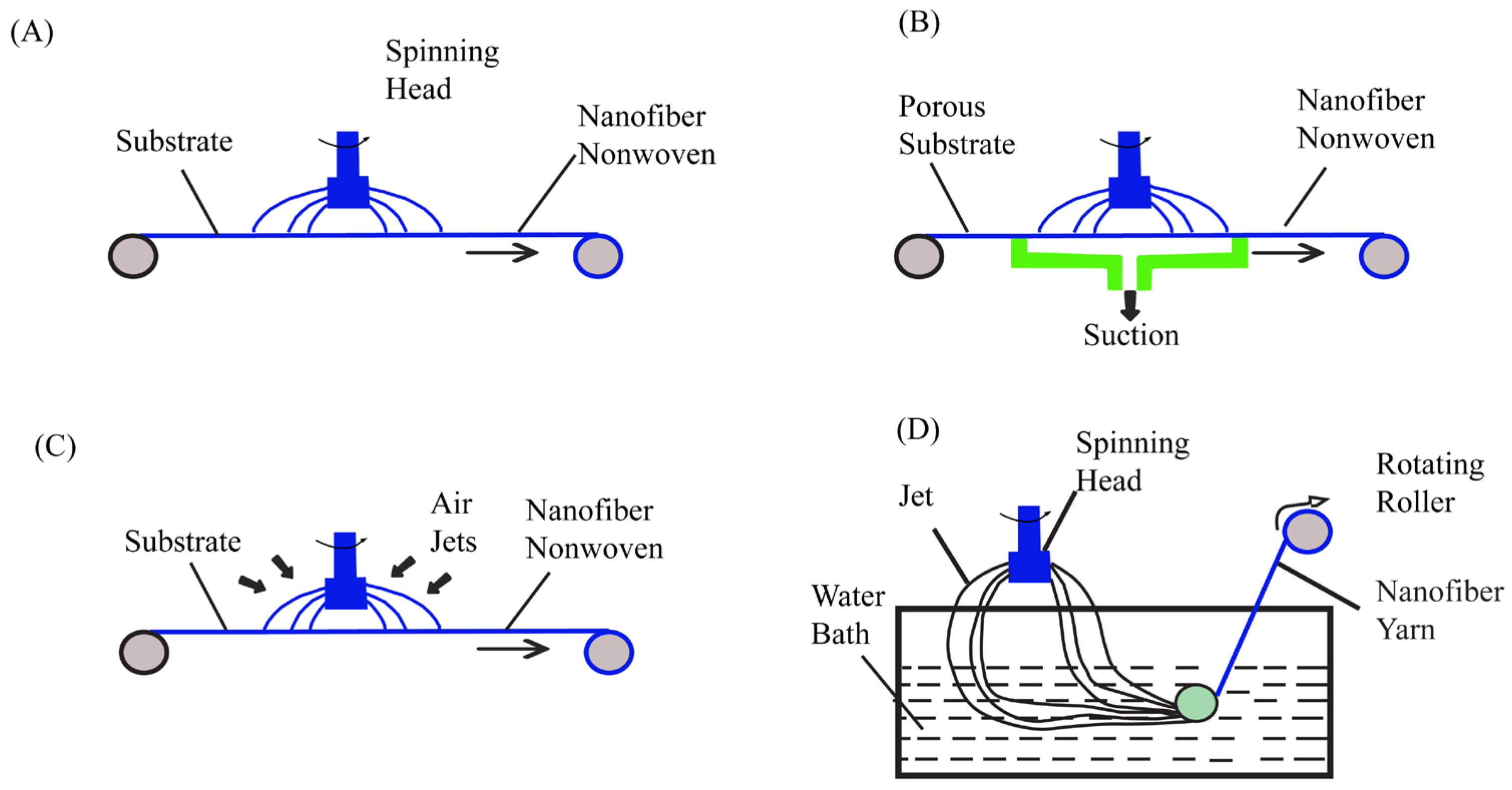
The most often-used fiber collector in centrifugal spinning is composed of circular plastic or metal. The nanofibers are gathered on the inner wall’s surface as the polymer jet is expelled from the rotating head. Nanofibers with droplets will deposit on the collector for a short spinneret collector distance, indicating insufficient solvent evaporation time and the absence of nanofibers on the collector. During spinning, airflow is dispersed throughout the spinner and has the potential to create air friction at the gas layer–jet interface, which will alter the morphology of the nanofibers and encourage jet elongation [16]. A moving substrate positioned beneath the rotating head can be used to produce nanofibers continuously (Figure 3A). In order to create a continuous nonwoven, nanofibers are deposited onto the substrate with the aid of gravity. Suction force (Figure 3B) and air jets (Figure 3C) can aid with the continuous collection of nanofiber nonwovens by modifying their distribution and packing density. Porous substrates, such as paper, textile fabric, or other porous membranes, are required for the collection of nanofiber nonwovens when suction force is applied. A yarn collector is shown in Figure 3D. Here, nanofibers are gathered in a water bath, and the revolving roller makes it possible to gather continuous nanofiber threads [14]. The fibers are often gathered using a vacuum collecting device, a group of column collectors, or a deep-dish fiber collector with uniformly spaced steel pillars arranged in a web shape. Nonwoven fibrous films can also be created by depositing fibers over a polypropylene substrate in an air-free box. Fibers might need to be directly deposited onto a metal substrate, such as titanium foil, which has been cut to the proper size and fastened to alumina collectors using polytetrafluoroethylene (PTFE) tape, before the spinning process can begin. Moreover, a rotating cylindrical collector powered by a reciprocating mechanism can be used to collect fiber. a small, handheld centrifugal spinning device that uses a flow-induced mechanism to collect produced fiber perpendicularly. Additionally, an automatic track collector was integrated with a revolving head to gather fibers in a coordinated manner. Such a procedure produces a continuous stream of individually aligned nanofibers as opposed to the nanofiber mesh ring that is normally accumulated on conventional stationary collectors [56]. Solvent atomization and subsequent fast evaporation are caused by the polymer jet, which is best described as a high- velocity liquid spray. The jet goes through a stretching process as it exits the spinneret orifices, moving centrifugally around the axis of rotation and bending to an arch-shaped trajectory as a result of the rotating force. The centrifugal spinning principle is completed when dry fibers are deposited onto the collector as the solvent component of the jet evaporates [30]. A variety of collectors are in use, including (i) the gravity-assisted nanofiber nonwoven collector, which uses gravity to gather fibers; (ii) the suction force-assisted collector, which uses suction force to draw fibers and deposit them on the collector; (iii) the air jet-assisted collector, which uses a jet of air to push spun fibers to the collector to be deposited as nonwoven mats; and (iv) the water bath-assisted collector, which gathers nanofiber yarns using a water bath and rotating roller [68].
Water Bath-Assisted Assisted
Polyvinyl acetate (PVA), polyvinylidene difluoride, and polyacrylonitrile polymers were employed in an electrospinning setup with a water bath grounded collector to produce nanofibers. A water surface that is accessible to collect nanofibers is included in a configuration with a water bath grounded collector. The collector electrode (140 × 0.42 mm) is submerged in distilled water at the bottom of a Petri plate (150 × 15 mm) that has a water bath in it. Next, a tiny copper wire is used to ground this submerged collection plate. The electrospinning solution is poured into a glass micropipette with a 0.5 mm aperture and pressed at a rate of 1 mL h−1 in accordance with gravity flow. A spinning collection drum is then used to draw the produced nanofibers in the Petri plate throughout the water bath [69]. The size of the pipette aperture, the amount of the solution in the reservoir, and the angle at which the plates were held all affected the gravity-assisted polymer flow in edge-plate and waterfall setups [70].
Gravity Assisted
Using a flat plate’s edge as a source electrode, droplets of polymeric solution were poured over it to create high-quality nanofibers from a variety of polymeric fluids. When the voltage was applied, the droplets gathered on the grounded collector after undergoing a gravity-assisted flow. For the trials, three flat plate configurations—parallel plate, edge plate, and waterfall geometry—were employed. The needleless technique generated nanofibers with consistent diameters. This innovative method has a tremendous potential for scaling up, is free from clogging issues, and functions astonishingly similarly to traditional electrospinning [71].
Suction and Air Jet Forced Assisted Collector
An aligned nanofiber strand was formed with the aid of suction airflow. A specially designed revolving collector was used to twist yarn strands. Another intriguing study employed AC electrospinning to directly create nanofiber bundles without the need for a collector [72]. Fans or air jets drive the fibers in the direction of a collector as the airflow catches hold of them while they are being spun. The nanofibers can also be drawn up against the collection by suction. The procedure may not be as continuous if the collector is static. Conveyor belts may be used to gather a continuous piece of nonwoven nanofiber mats in order to make the collecting process continuous. However, the conveyor belt must be permeable to allow air to flow through when suction is used. These porous belts are frequently constructed from paper, textiles, or other porous membranes [73]. Moreover, a moving substrate positioned beneath the spinning head can be used to achieve continuous nanofiber manufacturing (Figure 3A). In order to create a continuous nonwoven, nanofibers are deposited onto the substrate with the aid of their gravity. Although this configuration suggests a potentially simple strategy for continuous nonwoven formation and is widely employed in industrial processes such as fiberglass manufacturing, it remains largely conceptual and lacks detailed experimental validation for polymer-based filtration applications. In addition, the inherent outward (radial) trajectory of fibers in conventional centrifugal spinning, driven by dominant centrifugal forces, presents a fundamental limitation to gravity-assisted deposition, as it reduces the likelihood of fibers being directed downward toward the substrate. Moreover, polymer fibers are typically lighter than glass fibers owing to their lower density [74], which further diminishes the influence of gravity on their deposition behavior. In suction-assisted (vacuum-assisted) systems, a negative pressure is applied beneath a porous collector. This actively directs fibers toward the deposition surface. As a result, the radial trajectory induced by centrifugal forces is overcome. This external suction modifies the airflow field around the jet, enhancing fiber capture efficiency and reducing fiber scattering during flight. As a result, fibers are deposited more uniformly, leading to improved packing density and reduced pore size variability within the fibrous mat. Studies have shown that suction-assisted systems can significantly influence fiber morphology and web structure by stabilizing the jet trajectory and promoting more controlled deposition behavior. In addition, the presence of a pressure gradient across the collector enables better control over mat thickness and structural homogeneity. However, excessive suction may compress the deposited fibers, decreasing porosity and increasing airflow resistance, and may also reduce permeability if not properly optimized. For filtration applications, this method is particularly advantageous, as the improved uniformity and controlled pore structure enhance particle capture efficiency while allowing tuning of pressure drop, ultimately enabling optimization of the filtration quality factor. This behavior is further supported by experimental findings reported by Salussoglia et al., where the use of a vacuum collection system (VCS) enabled controlled fiber thinning and enhanced filtration performance while maintaining low pressure drop [21]. Air jet-assisted collection, as demonstrated by Ayati et al., employs pressurized gas streams to manipulate fiber trajectory and enhance collection. In this method, the rotating reservoir extrudes polymer solution while high-velocity airflow from the outer wall acts on the jet surface, creating aerodynamic forces that promote stretching and thinning. This airflow-induced interaction contributes to the stretching of the jet and assist in controlling fiber distribution and packing during deposition. This study showed that increasing gas pressure significantly improved fiber morphology. At 6 wt% polymer concentration, applying air pressure increased continuous fiber formation, and raising pressure from 1 to 1.5 bar reduced fiber diameter from 467 ± 193 nm to 226 ± 176 nm. At higher concentrations, airflow produced narrower diameter distributions with consistent morphology. This process balances viscous, surface tension, centrifugal, and aerodynamic forces, with airflow mitigating bead formation and fiber malformations. However, airflow within the spinning region may introduce instability if not properly controlled, as it can disturb the jet trajectory and affect uniform fiber collection. For filtration applications, this method enables the control of tunable fiber diameters and controlled web uniformity, making it suitable for engineering filter media with specific pore sizes and capture efficiencies [54]. Gonzalez et al. employed water bath-assisted collection system to collect and solidify nylon nanofibers. In this method, polymer solution is extruded through a rotating reservoir by centrifugal force, forming a jet that travels through an adjustable air gap before entering a flowing precipitation bath. Within the bath, the carrier solvent diffuses out while the polymer precipitates or chemically crosslinks, forming solid nanofibers that are collected onto a rotating collector as oriented sheets. The key advantage of this approach is the minimization of surface tension-driven instabilities. By spinning into a bath miscible with the carrier solvent but immiscible with the polymer, the interfacial tension approaches zero, producing bead-free fibers. Fiber diameter can be controlled by adjusting air gap distance (2–6 cm), rotation speed (15–45 kRPM), and solution concentration (5–20% w/v), producing nylon fibers from 250 nm to 2.75 μm. Collection configurations include rotating drums for aligned sheets, funnel systems for yarn formation, and vortex adjustments for random fiber orientation. However, limitations exist. The bath must dissolve the carrier solvent while precipitating the polymer; improper bath composition causes beading. The air gap must be sufficiently small to prevent jet breakup before bath entry. Accumulated solvent in the bath can hinder fiber formation, requiring bath changes. Different polymers need different bath compositions, requiring system reconfiguration, and some materials need elevated temperatures to avoid gelation [75]. Despite its effectiveness for fiber processing and yarn formation, this method has not been widely explored for filtration applications.
Suction force (Figure 3B) or air jets (Figure 3C) can aid with the continuous collection of nanofiber nonwovens by adjusting their distribution and packing density. The collection of nanofiber nonwovens requires porous substrates, such as paper, textile fabric, or other porous membranes, when suction force is applied. A yarn collector is shown in Figure 3D. The revolving roller in this instance enables the collection of continuous skeins of nanofibers, which are gathered in a water bath [14].

2.3. Types of Centrifugal Spinning

The primary divisions of centrifugal spinning, as previously mentioned, are melt or solution centrifugal spinning and centrifugal spinning with or without a nozzle. These divides can be made based on the manufacturing process [57].

2.3.1. Centrifugal Spinning Without Nozzle (Nozzle-Free)

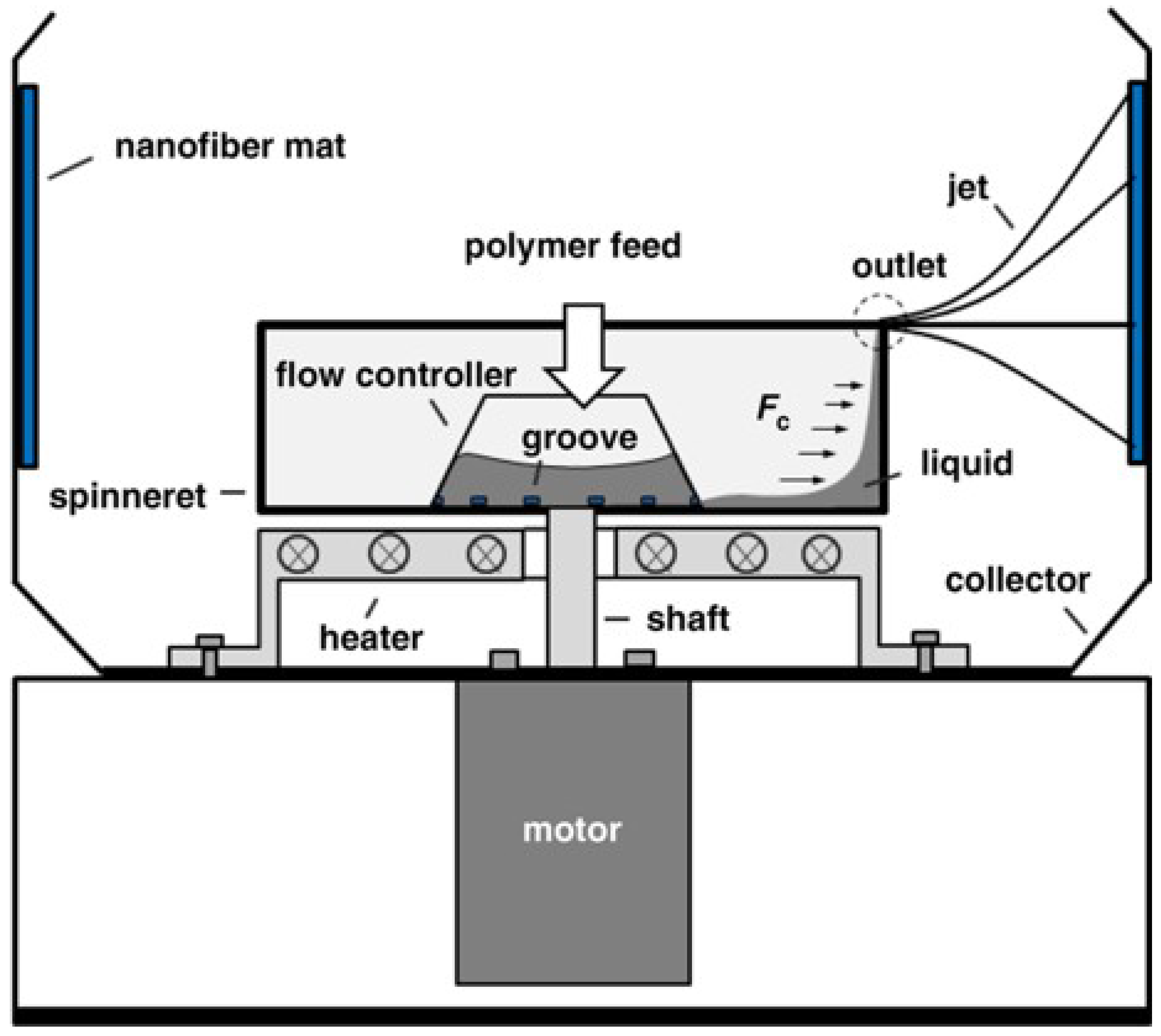
A polymer solution was dropped into a conventional spin coater to create a nozzle-free centrifugal spinning technique. Several jets might emerge from the flat disk’s edge without the requirement for a needle nozzle. Although there are still certain difficulties in the process, this method provides a new and appealing path to centrifugal spinning for the effective, straightforward, and nozzle-free fabrication of ultrafine fibers. For instance, the diameter of the fibers produced using this method varies from 25 nm to 5 µm, and the morphology of the fibers is difficult to control due to the unstable external forces acting on the jets. Figure 4 shows a schematic of our high-throughput NCS apparatus. A ring heater, a direct-current (DC) motor, a circular receiver, and a nozzle-free spinning spinneret make up its four main parts. A flow controller is mounted in the middle of the spinneret, which is shaped like a revolving disk that is 100 mm in diameter and 25 mm in height. The flow controller’s bottom is evenly covered with a number of rectangular grooves that are 2 mm wide and 1 mm high. In the present set-up, the speed of the DC motor can be varied from 500 to 12,000 rpm by a speed controller. The flow controller is designed to control the flow rate and reduce the impact of air on the polymer liquid properties. With the current configuration, a speed controller can adjust the DC motor’s speed between 500 and 12,000 rpm. The purpose of the flow controller is to regulate the flow rate and lessen the effect of air on the liquid characteristics of polymers [76]. When using nozzle-less centrifugal spinning, the spinning solution first forms a homogeneous liquid layer on the rotating disk before splitting into fingers as a result of Rayleigh–Taylor instability. With a faster rotational speed and a lower concentration solution, the fingers will be longer and thinner. In high viscosity solutions, nozzle-less centrifugal spinning promotes fiber formation because its critical angular velocity is significantly lower than that of the nozzle-spinneret. When the rotational speed exceeds a threshold, nozzle-centrifugal spinning will produce thicker fibers than nozzle-less centrifugal spinning [77]. Because of their small pore sizes—typically on the order of units of micrometers, but sporadically up to tens of micrometers—single polymers, including PLA, PHB, PBS, and PCL, created a rather dense network of micro/nanofibers that were inappropriate for cell colonization. Similarly, regardless of the ratio of individual polymers in the blends, PLA/PHB, PHB/PCL, and PHB/PBS blends once more created moderately dense networks with pore sizes in the order of units up to tens of micrometers. Regardless of the studied ratios (5/1; 13.5/4 w/w) of both polymers, the PLA/PCL mixes produced the biggest holes (in tens of micrometers). fibers’ interior nano porosity, with pores ranging in size from 1 to 14. Our polymeric micro/nanofibrous scaffolds’ hierarchical porosity may greatly affect their fiber roughness and water retention capacity, both of which are critical for the scaffolds’ ability to support cell colonization and their suitability for tissue engineering [78]. Similar to slit-based spinning, nozzle-less CS generates a homogeneous polymer layer prior to fiber synthesis by generating numerous jets using centrifugal force [79]. The fibers are created using a polymer liquid that is generated by employing solvents or temperature in nozzle-free equipment, and they are rapidly injected into the center of a metallic flat disk. The polymer is pushed onto the disk’s borders by means of a bulkhead or other specialized apparatus, creating what are referred to as polymer solution fingers [57] (Figure 5).

2.3.2. Centrifugal Spinning with Nozzle

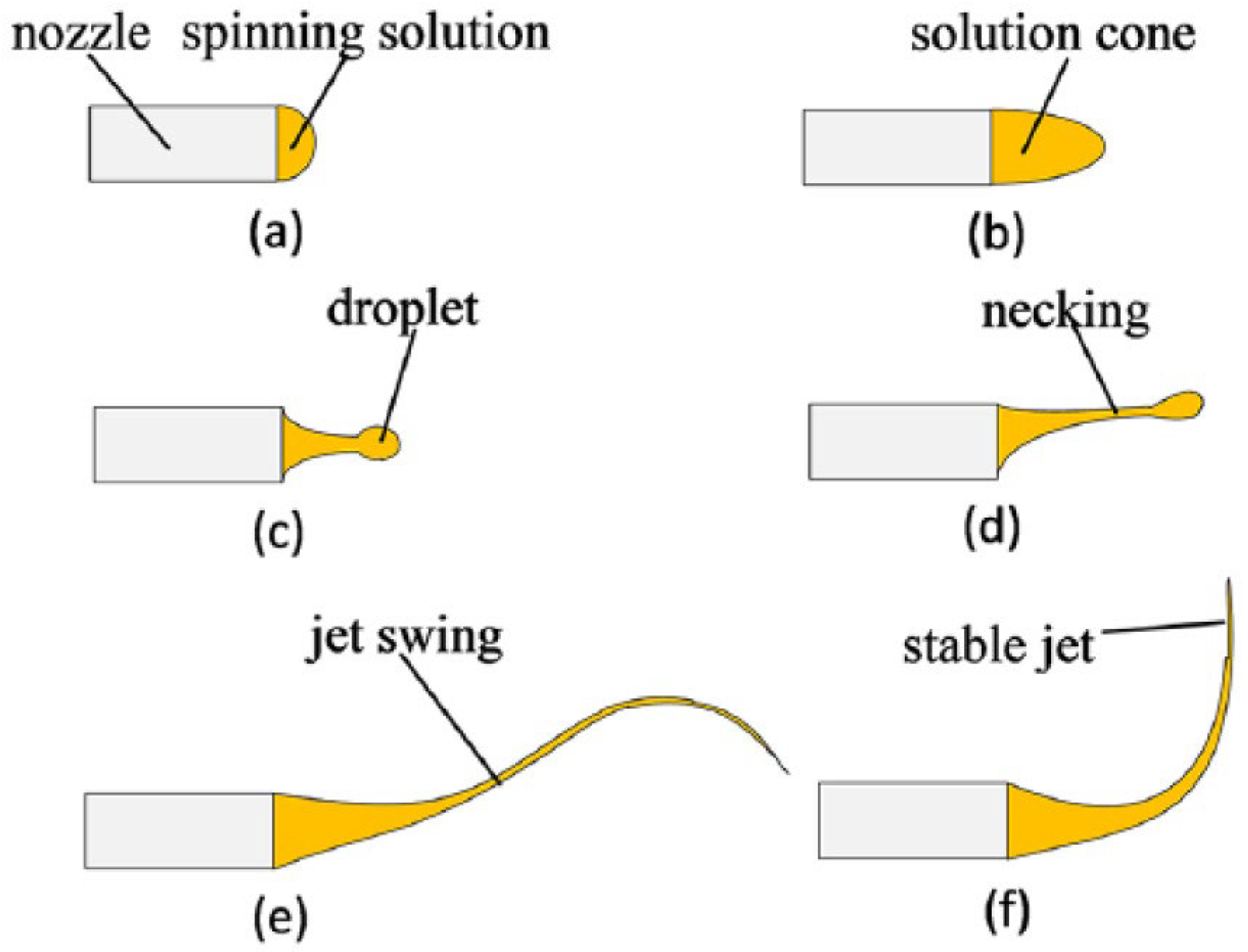
The diameter, length, and form of the nozzle all influence the morphology and quality of the nanofiber, making it a crucial component of high-speed centrifugal spinning machinery. The motor turns the container and nozzle, and by varying the motor speed, the rotational speed of the container and nozzle may be changed. The container is filled with the spinning solution. When creating nanofibers, it revolves alongside the container. The most powerful force for creating nanofiber is centrifugal force, which is produced by a spinning solution. The characteristics of the spinning solution and the apparatus define the critical rotation speed. The forces of the spinning solution are balanced when the motor speed is raised to the critical speed. At the nozzle, an ellipsoidal spinning solution cone forms. In electrospinning, the ellipsoidal cone and the Taylor cone are comparable. When the motor speed exceeds the critical speed, the spinning solution will be expelled out of the nozzle. A spinning jet then forms, as illustrated in Figure 6 [81].
The solution container is fastened to the fastener using screw threads and linked to the drive motor shaft via spinning nozzles. The collectors are rods made of stainless steel. When the gadget is operating, the drive motor turns while the nozzle rotates quickly. Centrifugal force propels the spinning solution to the nozzle, where it is expelled as a spinning jet from the nozzle outlet. The jet then travels along the air’s curve as the solvent evaporates, stretching into nanofibers as a result of the inertial force. Lastly, the collectors gather the nanofibers [82]. The centrifugal force acting on the spinning solution progressively increases as the motor speed rises. The centrifugal force equals the sum of the surface and viscous forces when it reaches a critical threshold. Then, as the motor speed keeps increasing, the spinning solution will be forced out of the nozzles by centrifugal force, which overcomes the solution’s surface and viscous forces. The solution is then stretched and thinned in the air. After that, the solvent evaporates and turns into nanofibers. Lastly, the fiber-collecting apparatus gathers nanofibers [83]. After optimization, the curved-tube nozzle can enhance the nanofibers’ shape and quality. When examining the velocity distribution of the spinning solution in the four distinct spinning nozzles, the curved-tube nozzle performs better for high-speed centrifugal spinning. Out of the five curved-tube nozzle parameters, the outlet diameter has the biggest impact on the spinning solution’s outflow velocity. The outlet velocity of the solution in the curved-tube nozzle may be considerably increased by decreasing the outlet diameter. The fiber shape and quality produced by a curved tube nozzle following optimization are superior to those produced by a curved tube nozzle prior to optimization [84]. Single continuous nanofibers might be effectively produced by high-speed centrifugal spinning. The concentration of the spinning solution was directly correlated with the critical rotational speed needed to generate the spinning jet, whereas the nozzle diameter was inversely correlated. The spinning settings might be changed to modify the shape of PEO nanofibers. A new technique for creating continuous nanofibers with a consistent diameter and smooth surface is high-speed centrifugal spinning [85]. The polymer liquid is propelled through the nozzle capillary by centrifugal force, which prevails over capillary and inertia forces inside the nozzle aperture. The centrifugal force uses a high-speed spinning nozzle to create a polymer jet, which avoids many of the restrictions on fiber formation [54]. Guo et al. demonstrated that when the nozzle bending angle is 15°, the curvature radius is 10 mm, and the nozzle outlet radius is 0.205 mm, the solution’s head loss may be reduced. This results in improved surface morphology and a more consistent diameter are features of the nanofibers produced with improved nozzles. However, the findings are unsatisfactory due to the impact of gravity and the solution’s Coriolis force [83]. The high viscosity clogs the nozzle, and no fiber forms even at higher concentrations. To avoid such obstruction, channeled nozzles with shapes should have their self-cleaning behavior addressed. The crucial polymer chain entanglement that encourages the creation of fiber requires an extremely low concentration. When the majority of fluid jets extend parallel to one another during centrifugal spinning, aligned fiber is produced. Because the polymer and filler, including carbon nanotubes (CNTs), may pass through the nozzles, the orifice can also help the polymeric chains align. Different mass throughput from varying nozzle diameter can either accelerate or decelerate fiber diameter. The relationship between fiber diameter and parameters can be provided by Equation (2):
D = a/RC3/2n
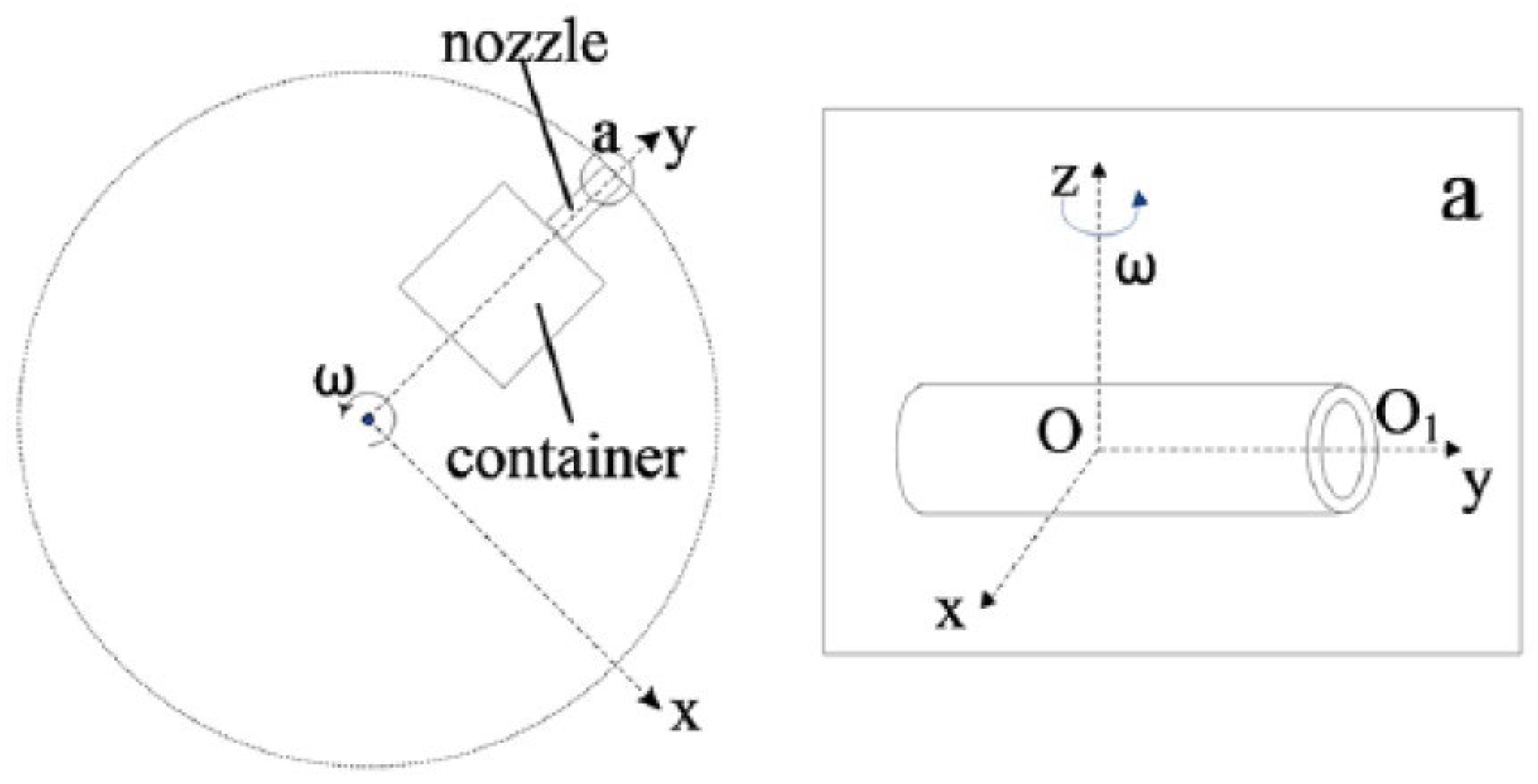
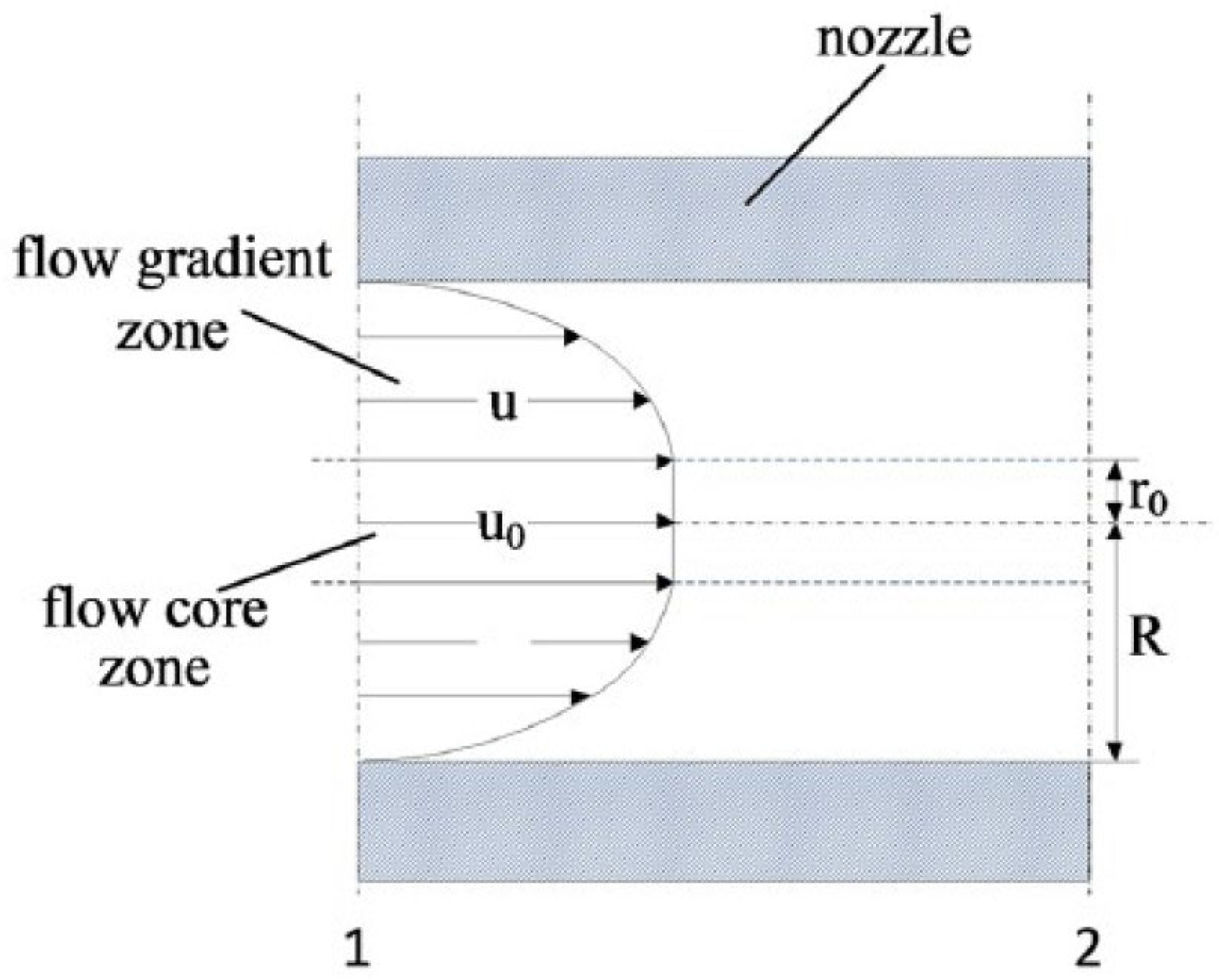
where D represents fiber diameter, a is the nozzle diameter, Rc is the nozzle–collector distance, and n is the rotational speed [56]. With a linked nozzle that extends just past the spinning disk’s outer surface, the two vessels inside the spinning disk were employed to hold the polymeric solution. In order to avoid the solution from drying at the needle tip and obstructing free flow, the air stream’s effects on the nozzle tip during rotation had to be minimized. The needle’s nozzle length may be changed to alter the flow rate [86]. The origin O is on the driving shaft’s axis, as seen in Figure 7. Along the nozzle’s axis lies the O1. The angular velocity of rotation is represented by the symbol ω. When the motor is not rotating, the spinning solution experiences surface tension, viscous force, static pressure, and gravity. One might disregard gravity in the upward direction. The spinning solution is still stationary in the nozzle at this point because its tiny static pressure is insufficient to overcome the viscous pull. From a halt, the motor accelerates. As the rotational speed rises, the centrifugal force progressively increases as well. When the combined force of centrifugal and static pressure exceeds the viscous force of spinning, the spinning solution starts to flow in the nozzle. When the centrifugal and static pressure forces together exceed the spinning solution’s viscous force, the spinning solution starts to flow in the nozzle. As seen in Figure 8, the flow of spinning solution may be separated into two areas: the flow gradient zone and the flow core zone [81].
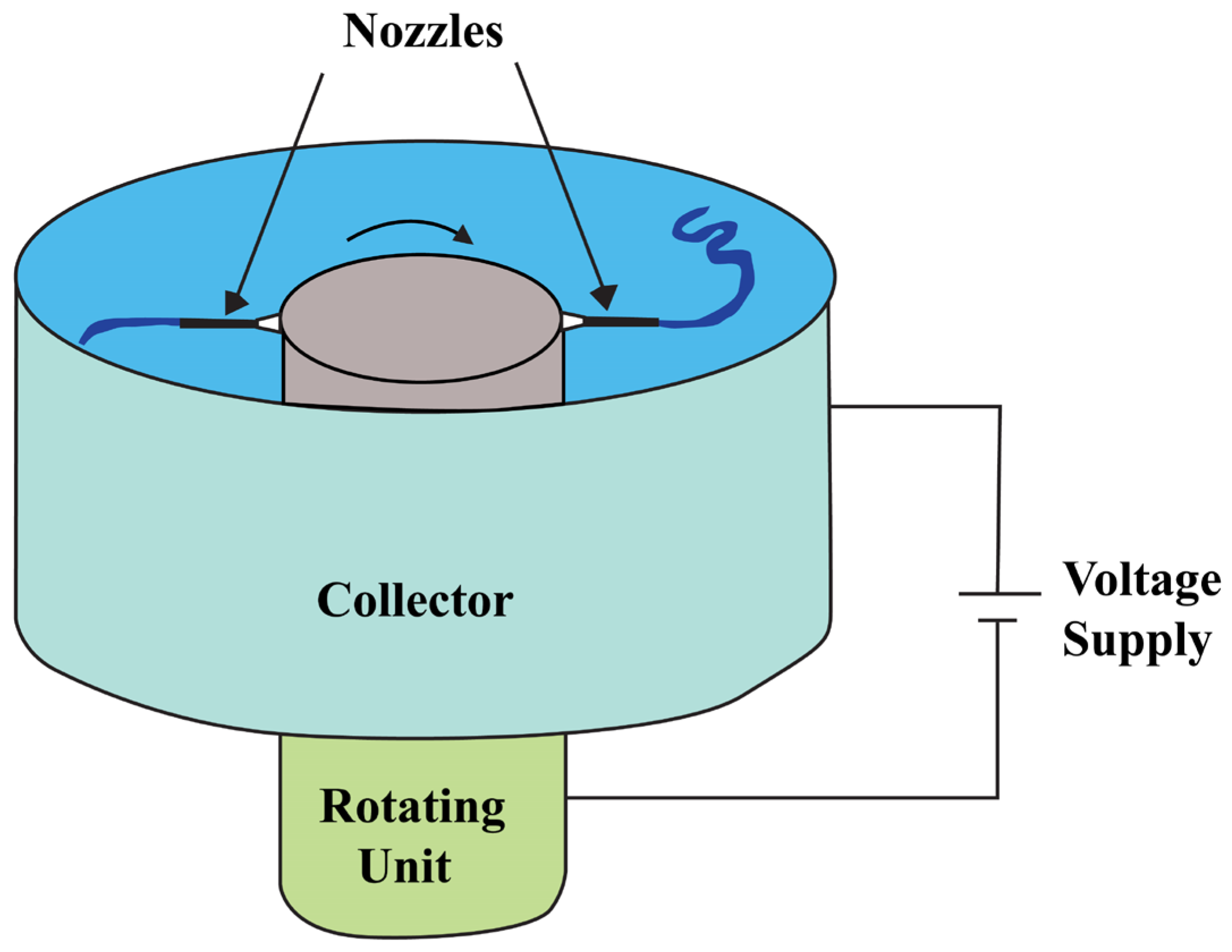
Figure 9 illustrates a centrifugal electrospinning arrangement with several nozzles. By reducing the whipping action and enabling further jet stretching, centrifugal force improves fiber alignment control. Two needles and an annular collector are used in a centrifugal electrospinning setup to create aligned fibers at relatively modest voltages (2.8–6 kV) and rotational velocities (360–540 rpm), at the cost of widely dispersed fiber diameters on both micron and submicron scales [87]. In order to produce aligned and random fibers at a faster pace, Kancheva et al. used centrifugal electrospinning with up to four needles. However, this was performed at a notably high voltage (40 kV) and rotating speed (1900 rpm) [88]. Increasing the number of needles improves spinning operations, leading to increased efficiency and yields. This is very useful for producing nanofibers on a big scale. Nevertheless, the quality of the fiber may be impacted by the needle addition. First off, the distribution of spinning fluid may change with more needles, resulting in irregular fiber diameters. Second, too many needles can change the distribution of the electric field when spinning, which can change the structure and morphology of the fiber. Additionally, the complexity of the equipment and operating difficulties rise with the number of needles. Therefore, it is critical to take equipment design, manufacture, and maintenance costs into account while striving for increased output. A number of criteria, including fiber quality, production rate, machine complexity, and operational issues, must be carefully considered when determining the ideal number of needles [44].
The viscosity will prevent the spinning solution from flowing and cause friction to build between the fluid and the solid wall surface as well as between the moving fluids. As a result, heat energy will be produced from that portion of the moving mechanical energy. The head loss of the spinning solution along the way in Zone I is
h f I = λ L 1 2 R 1 V 2 2 g
In the above formula, L1 is the length of Zone I, 2R1 is the tank diameter, V represents the average speed V1 of Zone I, and g is the acceleration of gravity. λ is the loss coefficient along the way, which is determined by the following formula:
λ = 64 R e
Re is the Reynolds number, which is a dimensionless constant used to characterize the ratio of inertial force to viscous force when the spinning solution flows [83]. The viscosity of the spinning solution changes with the change of shear rate. The rheological equation of the spinning solution is:
τ = k ( d v d z ) 2 = ( d θ d t ) n
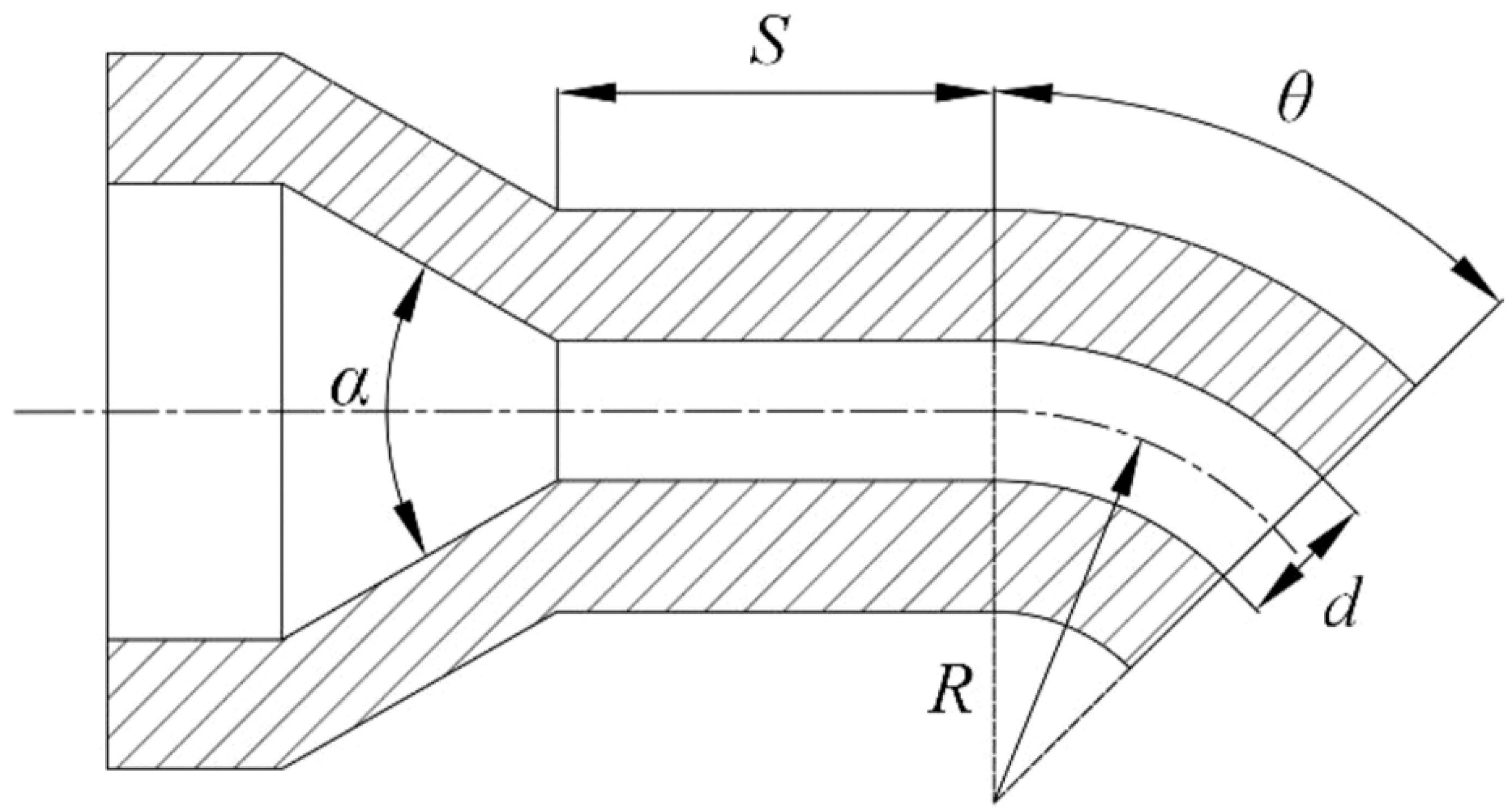
where dv/dz is the spinning solution’s shear rate. The consistency coefficient of spinning solution, or k, is a measure of the solution’s viscosity. The rheological property of a spinning solution is indicated by its rheological index, n. The spinning solution is a Newtonian fluid when n = 1. The spinning solution is an expansion solution when n > 1. The spinning solution is a pseudoplastic fluid when n is less than 1 [85]. Figure 10 depicts the curved-tube nozzle’s construction; its characteristics are bending angle θ, straight tube length S, curvature radius R, nozzle diameter d, and taper α. The research of rotating spinning mechanisms has made significant strides recently. Nevertheless, nozzle structural optimization is still in its early stages. This paper develops an optimization approach for curved-tube nozzle structure design, using a genetic algorithm to find the best combination of nozzle structure parameters and the outlet power obtained by the product of outlet velocity and force as the objective function [89].
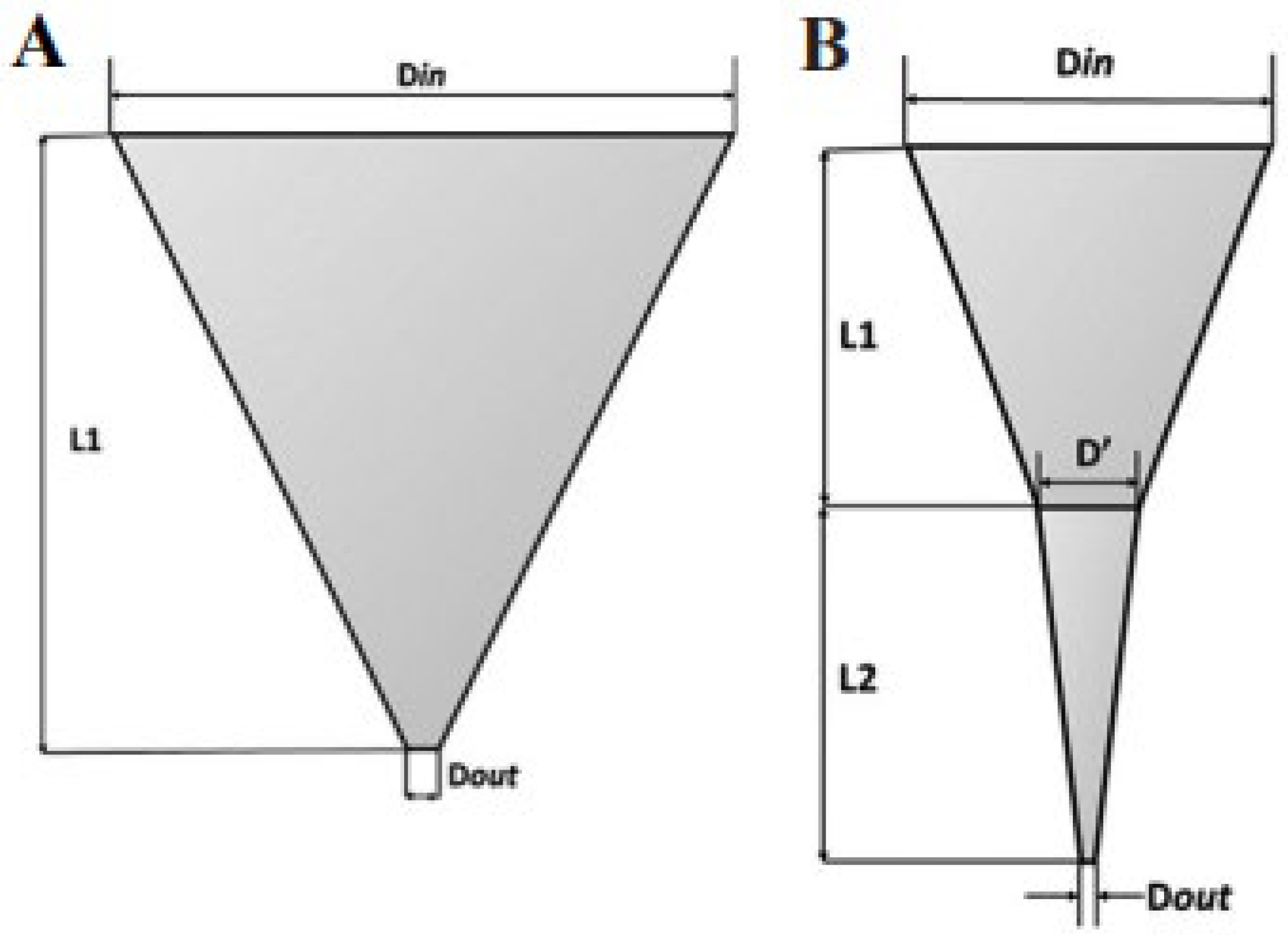
While the curve-shaped nozzle shows extremely high turbulence, the tapered conical nozzle consistently anticipates the turbulence. The impact of flow and geometrical parameters on the size and shape of the conical nozzle was studied and found that, when the inlet Reynolds number is less than 11,000, the air core diameter increases dramatically. Attaching a conical nozzle and swirl generator with a circular tube at a uniform heat flux condition significantly increases the rate of heat transfer [90]. Figure 11 illustrates these two types of nozzle geometry.
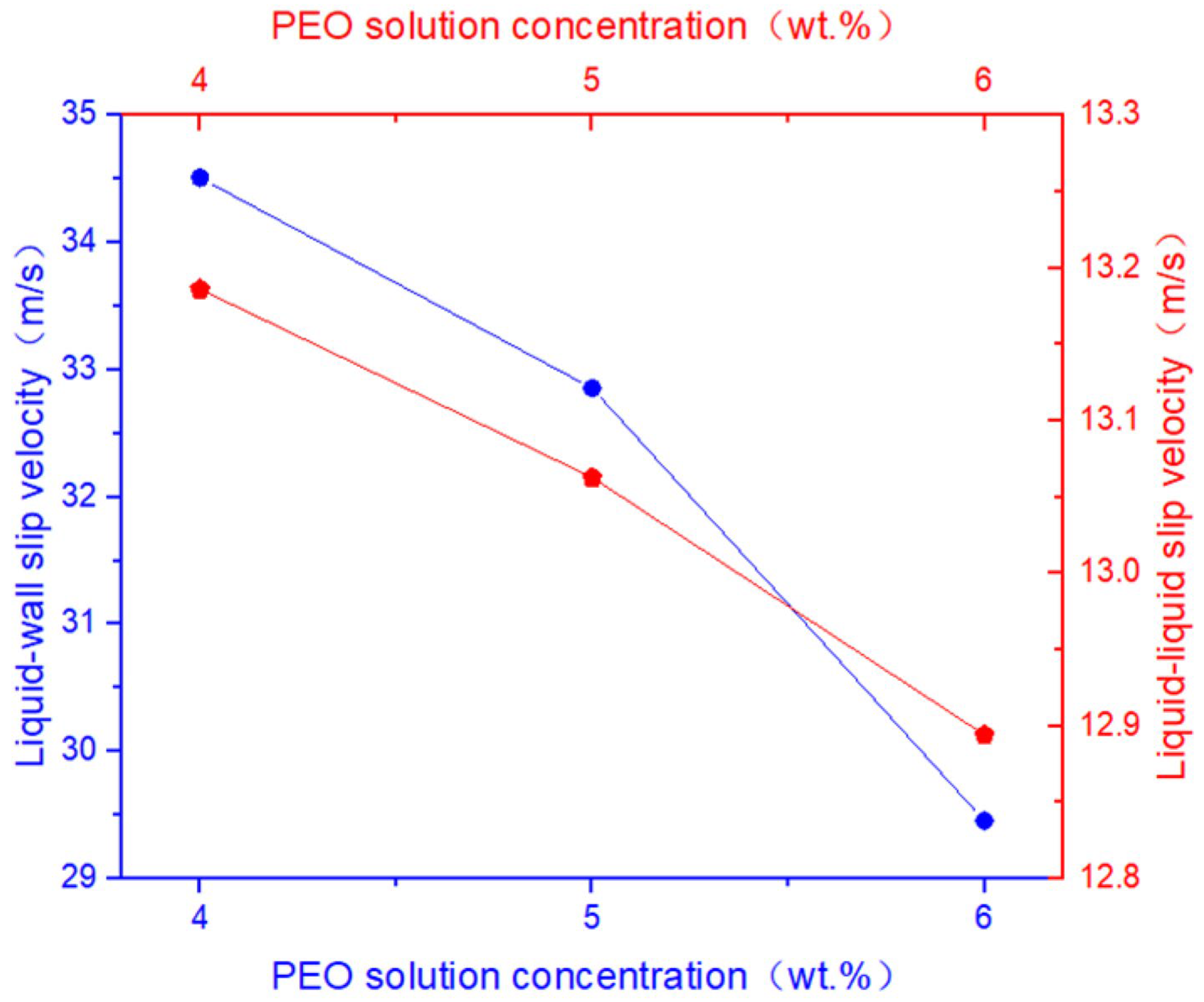
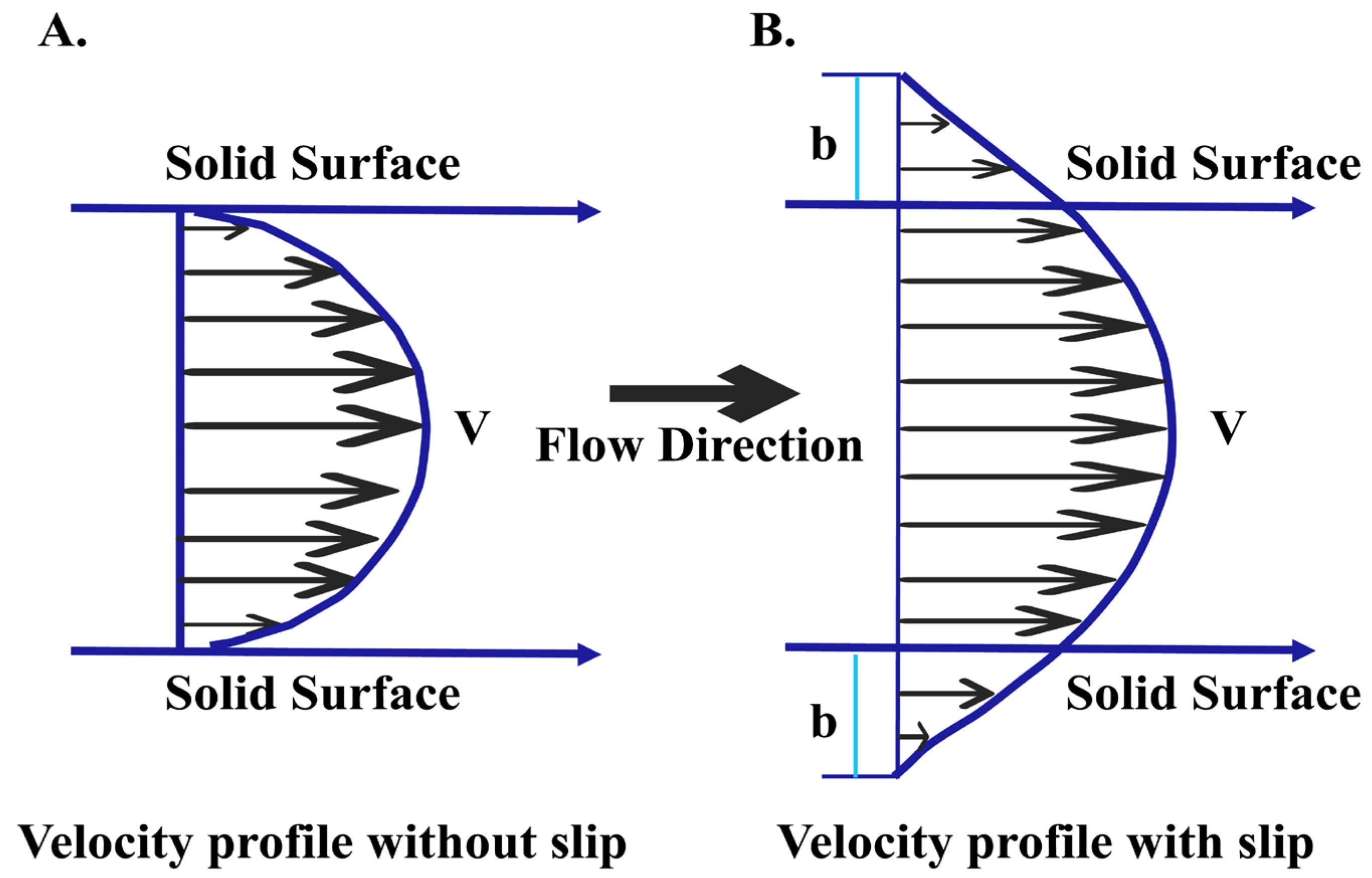
Liquid–wall slip is caused by the shear rate, which creates a differential between the viscosity of the solution inside the nozzle and the viscosity of the solution on the nozzle wall. When the adhesion layer’s viscosity rises, both the sliding extrapolation length and the wall slip velocity drop. As the concentration of spinning solution increases, the average diameter of the composite fiber indicates a decrease in wall slip velocity. As the wall slip velocity decreases, the composite nanofiber’s average diameter rises, and its distribution becomes non-uniform. The average diameter of the composite nanofiber falls, the wall slippage speed rises, and the adhesion layer’s viscosity reduces [92]. Figure 12 illustrates how, at the same rotating speed, the liquid–liquid and liquid–wall slip velocities at the nozzle output steadily decrease as the concentration of the PEO polymer solution increases. According to the research, a less noticeable liquid–liquid slide phenomena occur within the micro-triangle at greater PEO concentrations. A more stable jet is formed throughout the spinning process as a result of the two polymer solutions’ interaction being more stable at the same time [93].

2.3.3. Melt and Solution Centrifugal Spinning

Melt centrifugal spinning involves melting the polymer within the spinneret using an external heating element. The molten polymer emerges from the spinneret, cools owing to air frictional force, and settles on the collector. If the temperature is not managed properly, the polymer may degrade. Melt centrifugal spinning is ideal for thermoplastic polymers with appropriate melt viscosity. This process produces polymer nanofibers without using solvents, making it more environmentally friendly. This procedure includes dissolving the material in a solvent before inserting it into the spinneret. Centrifugal force forces the solution out of the rotating cylinder via the nozzle hole in the cylinder wall during spinning, causing the solvent to evaporate and harden the fibers. A collector that is positioned around the cylinder gathers the fibers [67]. Centrifugal spinning offers significantly higher production efficiency than classical electrospinning. In some cases, the improvement reaches nearly 2000 times (1 g/min per hole). This method offers great spinning efficiency, cheap cost, and environmental protection. It can also produce metal, ceramic, and composite fibers in addition to polymer fibers. Centrifugal spinning is classified as solution spinning or melt centrifugal spinning based on the materials employed. Manufacturing high-performance nanofibers is challenging due to the environmental impact of solvent-based solution centrifugal spinning, the complexity of solvent recovery, and the polymer’s ease of dissolution in solvents. Nanofibers are commonly employed in thermal chemical filtration and lightweight composite materials for aerospace and defense applications. This is melted centrifugal whirling. Spinning materials are in a melt state. Melt centrifugal spinning involves melting polymers or other compounds using centrifugal force, which is then cooled to make fibers [45]. A high-speed rotating reservoir extrudes molten or solvent-based polymer via orifices to form fibers. Using polymer melt reduces solvent elimination and toxicity, but the procedure is more complicated. Thus, Jason et al. developed a modular lab-scale hot melt spinneret capable of continually pouring pellets within to advance our understanding of the CS approach. The spinneret features a heating temperature of up to 573.15 k and two interchangeable 3D printer nozzles. The temperature is kept stable using an Arduino code. The system’s performance is evaluated using polypropylene and polylactide. The study found that fibers with a diameter of less than 15 μm were formed [38]. The primary advantage of melt centrifugal spinning/blowing is that it eliminates the need for organic solvents, which reduces pollution and the energy needed for solvent capture. However, this comes at the cost of extra energy being used to heat the polymer and the inability to mix heat-sensitive substances with it [94]. Centrifugal melt-spinning at 333.15 k was used by Kai Wang et al. to create ZrC precursor fibers from a paste consisting of 75% zirconium-containing polymer and 25% toluene. The precursor fibers had a diameter of 29.2 μm and a smooth surface. Single-phase zirconium carbide ceramic fibers (15.5 μm) with a compact shape were produced during pyrolysis at 1773.15 k [95]. Given that some solvents, such as methylene chloride and chloroform, are dangerous to both people and the environment, it is an excellent substitute because it does not require the use of solvents. The expense of eliminating these hazardous solvents may prevent some nanofiber production methods from being widely used for large-scale manufacturing [38,96]. According to research by Gian Francesco Dos Reis Paganotto et al., the polymer solution’s concentration had the biggest impact on the range of diameters that were measured. There was no directional ordering to the entangled fibers seen in this study. We observed that continuous fibers with more uniform surfaces formed in less concentrated solutions, but that the amount of beads produced was larger. Porous fibers and very rough surfaces, together with fused and interweaving fibers, were seen to develop in the highest concentrated solutions [97]. The spanning of polymer chains demonstrates adequate entanglement of the networks, introducing a viscoelastic effect [55], as the concentration of polymers increases. The addition of chitosan to a polyamide solution defines the viscoelastic characteristics of chitosan/polyamide (CP). The concentration at which the fiber starts to show a uniform, continuous, bead-free fiber is known as the critical concentration. The presence of beads along the fibers may be reduced by increasing the concentration of the polymer [56]. If the solution’s viscosity is too high, the molecules will gravitate with one another and become tangled; the solution cannot be forced out of the spinneret by an external force, and nanofibers cannot be created. A droplet will develop, or the substance will shatter if the solution’s viscosity is too low. The temperature and the characteristics of the solution are connected to the viscosity number. The diameter of the nanofibers will shrink as the solution’s velocity rises [15]. Fiber diameter may be significantly reduced by employing an electric field during the fiber extrusion process. Smaller fibers are directly extruded through the spineret’s smaller apertures. Higher MFI polypropylene (PP) resins often result in fiber diameter distributions with a greater percentage of smaller diameter fiber (around 1 µm). Increased polymer flow rates can produce finer fibers and solve issues like microsphere contamination [98].
The fiber diameter decreases when the solution concentration and rotation speed are increased. The Melt CS and Solution CS methods yielded the lowest fiber diameters of 7.05  ±  1.1 and 0.81  ±  0.5 μm, respectively. Compared to solution centrifugal spinning, the fiber diameter dispersion achieved by melt centrifugal spinning is around ten times greater. In fibers made using both methods, cell attachment and vitality had comparable outcomes. No harmful consequences were seen because PCL is a biocompatible polymer [30]. Therefore, the solvent-free melt technique offers easier processing but somewhat larger fiber diameters, whereas the solvent-based approach allows for lower fiber diameters at the cost of solvent handling and post-treatment.
While the viscosity of a polymer solution may be changed by simply varying the concentration of the solution, the best approach to manage the viscosity of a polymer melt is to modify the molecular weight, structure, and processing temperature of the polymer. The shape of centrifugally spun nanofibers is also significantly influenced by the surface tension of the spinning fluid in both polymer solutions and polymer melts [16].
Increasing the temperature of the processing, especially of the extruder during the melt spinning, assists in the polymer jet sustaining its melted nature over a length of time. This long liquid form enhances further extension before the polymer hardens and crystallizes resulting in finer fibers. High viscosity may be a barrier to processability in melt spinning. Closeness in the processing temperature range to the decomposition temperature ensures that there should be constant flow. Raising temperatures may decrease the viscosity that may speed up the evaporation of the solvent, and the resulting lowering of the liquid viscosity, affecting fiber shape. The more the spinneret is angularly rotated, the higher the centrifugal force thus resulting in more efficient extensions and thinning of the polymer jet resulting in finer fiber diameters. This is also useful in cutting down the production of beads [56].

2.3.4. Roll to Roll Centrifugal Spinning

On the collecting substrate, fibers produced during the centrifugal spinning process gather at the same intended height. Fibers build on top of one another on a stationary collecting substrate, creating a thick ring that is ripped apart by the spinning head and air currents. To overcome the drawbacks of static collection substrates, a specially designed roll-to-roll collection substrate with horizontal translation was developed [99]. A roll-to-roll method for creating ultrathin nonwoven meshes of recombinant spider silk suitable for fine dust filtration systems was developed in research by Fabian Müller et al. The sophisticated CES gadget efficiently produces spider silk nanofibers at a pace up to 1000 times higher than that of conventional spinning techniques by combining an electrical and centrifugal field with an air stream. Compared to fibers spun by needle-based electrospinning, fibers spun using this CES approach had a much higher β-sheet content, indicating superior mechanical and chemical stability. As a result, a roll-to-roll method could be developed as no post-treatment was required. Spider silk meshes made with this configuration demonstrated filter efficiency (PM2.5) and quality factors considerably greater than those of a commercial filter system in fine dust filtration tests, paving the way for applications in scale-up procedures [20]. A continuous, economically feasible production system may be made possible by using the roll-to-roll technique developed by Jason Ippolito and Vince Beachley to gather centrifugally spun polyacrylonitrile fiber (PAN) fibers. The increased scalability of the suggested collecting approach would enable a significant rise in centrifugally spun fiber throughput, which would immediately lead to a significantly greater availability of PAN nanofiber and goods connected to PAN nanofiber. Furthermore, the suggested fiber collecting system would work with any kind of fiber made by centrifugal spinning, expanding the collection method’s influence by catering to a broad range of sectors and uses [100].

3. Processing–Structure–Performance Relationships

3.1. Polymer Concentration

Lower polymer concentration results in lower fiber formation with many beads, whereas bead-free fibers with a high production rate and uniform fiber diameter distribution were obtained from the optimum polymer concentration with tetrahydrofuran (THF) as the solvent. Moreover, the fiber diameter gradually increases as the concentration rises, but the size and quantity of beads decrease. Because the bulk material must remain in the fiber rather than draining into the beads as it would at lower concentrations, there will be a quicker increase in the fiber diameter as the concentration rises [101,102]. The average fiber diameter grows as the polymer flow rate rises over the critical minimum. The thinnest fibers, with an average diameter of just 112 nm, were produced with a flow rate of 500 μL/min for 10 weight percent PEO solutions, which were thought to be the best solution for spinning. The thickest fibers, with an average diameter of 206 nm, were produced with a flow rate of 5000 μL/min. As would be expected with a water-soluble polymer system, the average fiber diameter decreased as working pressure increased [30]. According to Asuka Shinagawa and Shogo Miyata’s contact angle investigation, a larger percentage of microfibers in the scaffold was associated with a decrease in the wettability of the fiber sheets (i.e., an increase in the contact angle) as the polymer concentration increased. The higher presence of nanofibers results in a greater exposure of the material surface since they have a significantly bigger surface area per unit volume. Consequently, the nanofiber-dominant scaffold’s higher surface area demonstrated improved hydrophilicity, as seen by the reduced contact angles that were noted [103]. However, concentrations above 24 weight percent caused the polymer to clog at the spinneret orifice and did not create fiber, while concentrations below 18 weight percent produced droplets. Localized fiber thickening may also result from incomplete solvent evaporation. Increasing the concentration of the polymer in the solution will reduce the amount of bead formation [104].

3.2. Viscosity

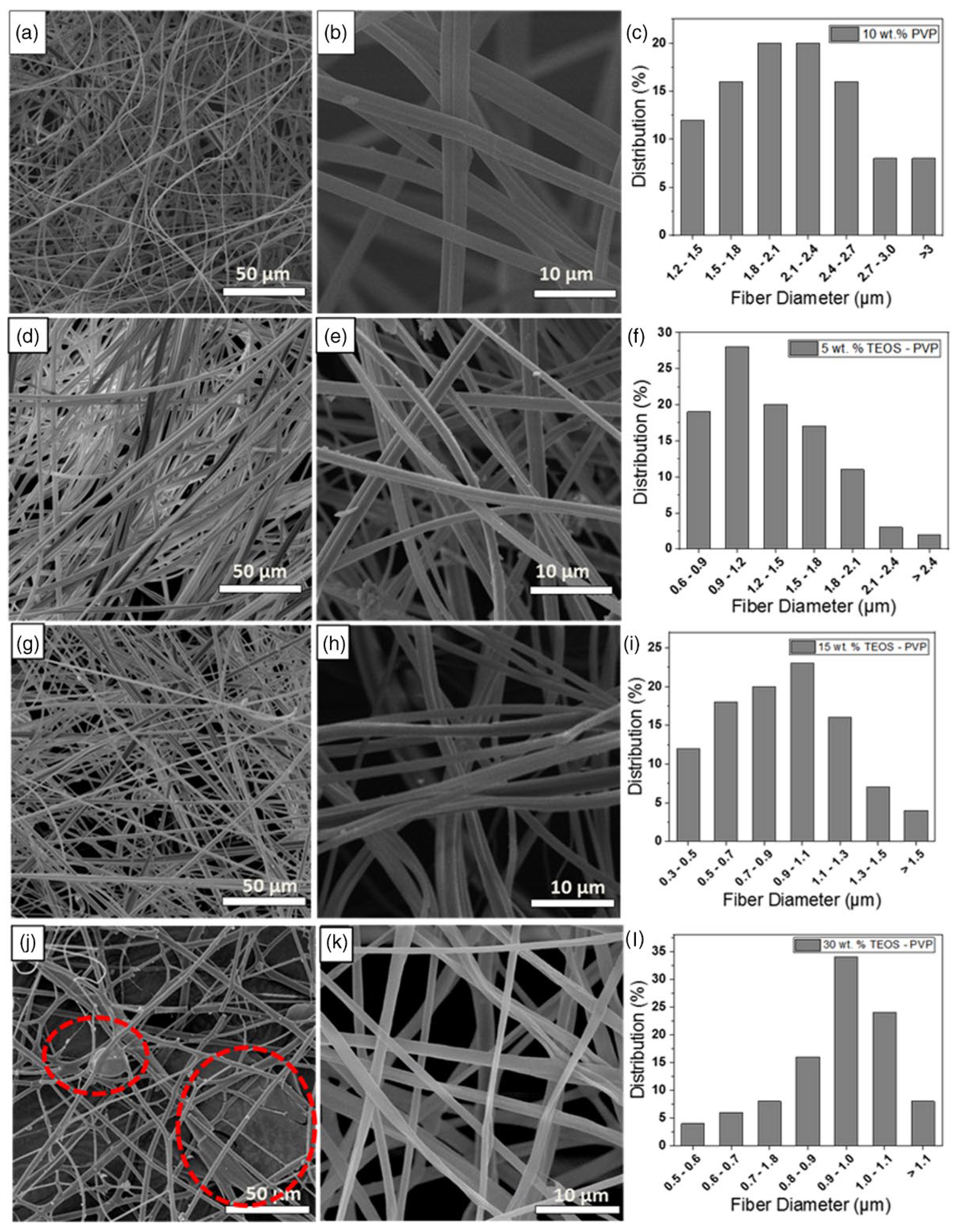
Viscosity is important in many elements of the spinning process, such as jet creation and stability, fiber shape, diameter consistency, surface tension management, solvent evaporation regulation, and fiber uniformity and defect-free quality [105]. The viscous force aids in the formation of smooth nanofibers and stops the jet shape from changing quickly. It is challenging to create jets and create nanofibers because the polymer solutions used to create them are extremely viscous; if the centrifugal force is insufficient to overcome the viscous force, the solution cannot be expelled from the nozzle. However, if the viscosity is too low, the jet will shatter or create droplets. The viscosity of the spinning solution will also have an impact on the flow rate of the spinning fluid because the viscous force may oppose the relative motion between the spinning solution and the interior wall of the nozzle. Additionally, the viscosity of the spinning solution will alter as the jet diameter shrinks and the solvent evaporates, increasing the jet’s instability. When the concentration of the spinning solution is low, the jet is discontinuous. As the concentration rises, the ordered degree of the nanofibers grows and they tend to be uniform. When polyethylene oxide with a molecular weight of 1,000,000 g/mol is used to create nanofibers, the nanofiber diameter is comparatively homogeneous at concentrations of 3–7 weight percent. When the concentration of the spinning fluid is 6 weight percent, the average diameter of the nanofibers is between 400 and 700 nm. On the other hand, the average diameter approaches 900 nm when the concentration of spinning solution is 8 weight percent [19,106,107]. Figure 8 shows the fiber diameter distributions and SEM images of PVP and 5T, 15T, and 30T fibers. The C-spun process made it feasible to produce smooth, non-oriented fibers in micron and submicron diameters from PVP and TEOS-PVP solutions. For PVP, 5T, 15T, and 30T samples, the average fiber diameters were 2.19  ±  0.63, 1.36  ±  0.54, 0.90  ±  0.33, and 0.88  ±  0.17 µm, respectively. We may infer from the illustration that a thicker fiber structure is the result of greater viscosity. Furthermore, many droplets were seen at 30 weight percent TEOS concentration (shown in red circles in Figure 13j), which caused the nanofiber layer to adhere to the substrate and disrupted the fibrous structure [25].

3.3. Surface Tension

A crucial factor in the creation of nanofibers using all spinning processes is the surface tension of a polymer solution. Surface tension affects both the rheological behavior and the fiber morphology. A droplet of solution is more likely to form when the surface tension is high. However, the polymeric droplets can be brought together by the centrifugal force to create a homogeneous jet of polymer solution. Surface tension causes the jets to become spheres, which reduces the surface area [52]. According to Lu et al.’s results [45], no fibers developed when the PAN solution concentration was less than 6 weight percent. However, when the PAN concentration was increased to 8%, fibers formed, followed by beads because of high surface tension. Additionally, the results demonstrate that the morphology changed to a greater quantity of fibers followed by a few beads, with an increase in fiber diameters from 406 nm to about 1077 nm, with a further rise in the concentration of PAN solution in the range of 10 weight percent to 15 weight percent. They came to the conclusion that a concentration increases of more than 10 weight percent had a minor impact on rising surface tension and a large impact on solution viscosity. Thus, chain entanglement played a useful part in jet stabilization to create continuous fibers without beads [108].
Nanofiber manufacturing relies heavily on material surface tension during centrifugal spinning. Nanofibers are formed by a combination of centrifugal force and surface tension. Centrifugal force is necessary to overcome surface tension and generate a Taylor cone at the opening. Surface tension reduces the energy of the solution, causing droplets to form instead of nanofibers. However, centrifugal force connects the droplets and prevents the nanofibers from breaking, making it crucial in the process of nanofiber formation. When other conditions are correct, lowering the material’s surface tension can aid in the formation of nanofibers. The final fiber shape is determined by the interaction of surface tension, centrifugal force, and viscous force during centrifugal spinning. The centrifugal force field tends to stretch the jet and enlarge the surface area. Because surface tension tends to reduce the surface area of the jet, the surface tension of a spinning solution must be kept within a certain range. A jet is created when the angular velocity exceeds the critical velocity, which is defined by surface tension and centrifugal force. If the surface tension of the polymer solution is too high, the jet will burst and produce little droplets. If the surface tension is too strong, the jet will shatter and produce beaded fibers [19].
Changing the polymer solution’s surface tension can have a big impact on bead formation. The surface tension of the fluid may cause a polymer jet originating from the orifice to break when it is extended, resulting in droplets or instability of the jet continuity. Because spherical shapes reduce surface tension, bead formation happens. This may be made up for by varying the concentration of polymers. Such surface tension caused by Rayleigh–Taylor instability is also seen in starch nanofibers, which form beads. Surfactants like sodium chloride (NaCl) can be added to PAN fibers to lower surface tension, which will significantly reduce the fiber’s diameter. The proportion of nitrogen decreases with increasing salt content, according to a comparison of the nitrogen composition and nitrogen-to-carbon ratio of the surfaces of different samples. Furthermore, it is crucial to take into account salt’s capacity to promote the development of thin veils in polymer solutions. Surface tension variation causes the fibers in a jet to align haphazardly. Continuous homogeneity is produced over the fiber length when the concentration of a polymer, such as PVDF, increases and the fiber diameter decreases [56]. As the concentration increases, the average diameter of the nanofibers initially grows, then decrease, reaching a critical point at 5 % concentration. This trend arises from the competing effects of surface tension and viscosity on nanofiber formation. Increased surface tension enhances the jet’s axial elongation rate, resulting in a higher tendency for nanofiber aggregation and, consequently, smaller diameters. Conversely, higher viscosity promotes chain entanglement within the polymer solution, yielding thicker nanofibers with larger diameters [109]. The surface tension of the polymer solution will cause the jet to fragment and form beads if the forces acting on it are significantly high [15].

3.4. Molecular Weight

The polymer molecular weight (MW), which promotes polymer chain entanglement, also affects the continuity of fiber shape. The fiber shape is affected by critical chain overlap as measured by the minimum molecular weight. The ideal concentration range for whirling cycles is shown to be inversely affected by the polymer MW. To understand the intricate interactions between the other factors involved in morphology evaluation, the MW and the polydispersity degree are required. Additionally, MW promotes the polymer blend’s spinnability [56]. Molecular weight affects fiber shape and spinnability, requiring balance for uniform fibers [79]. The molecular weight and solvent choice did affect the final fiber diameter, according to research by Sk Shamim Hasan Abir et al. The samples made using N,N-dimethylformamide DMF as the solvent had the shortest fiber diameters (27 nm for Mw 1,300,000 and 58 nm for Mw 360,000). Regarding the impact of molecular weights, the findings showed that solutions made with Poly(vinylpyrrolidone) PVP of Mw 360,000 in both solvents had a thicker diameter than PVP of Mw 1,300,000, although samples made with this higher molecular weight had a significantly higher standard deviation. While fibers made from aqueous solutions had smooth fiber surfaces, fibers made from PVP solutions (Mw 1,300,000) in DMF had a very homogeneous porosity surface. A progressive transition from circular to flat fibers resulted from increasing the molecular weight, increasing the intrinsic viscosity until a critical intrinsic viscosity was achieved, and increasing the fiber diameter and interfiber spacing [110].

3.5. Rotational Speed

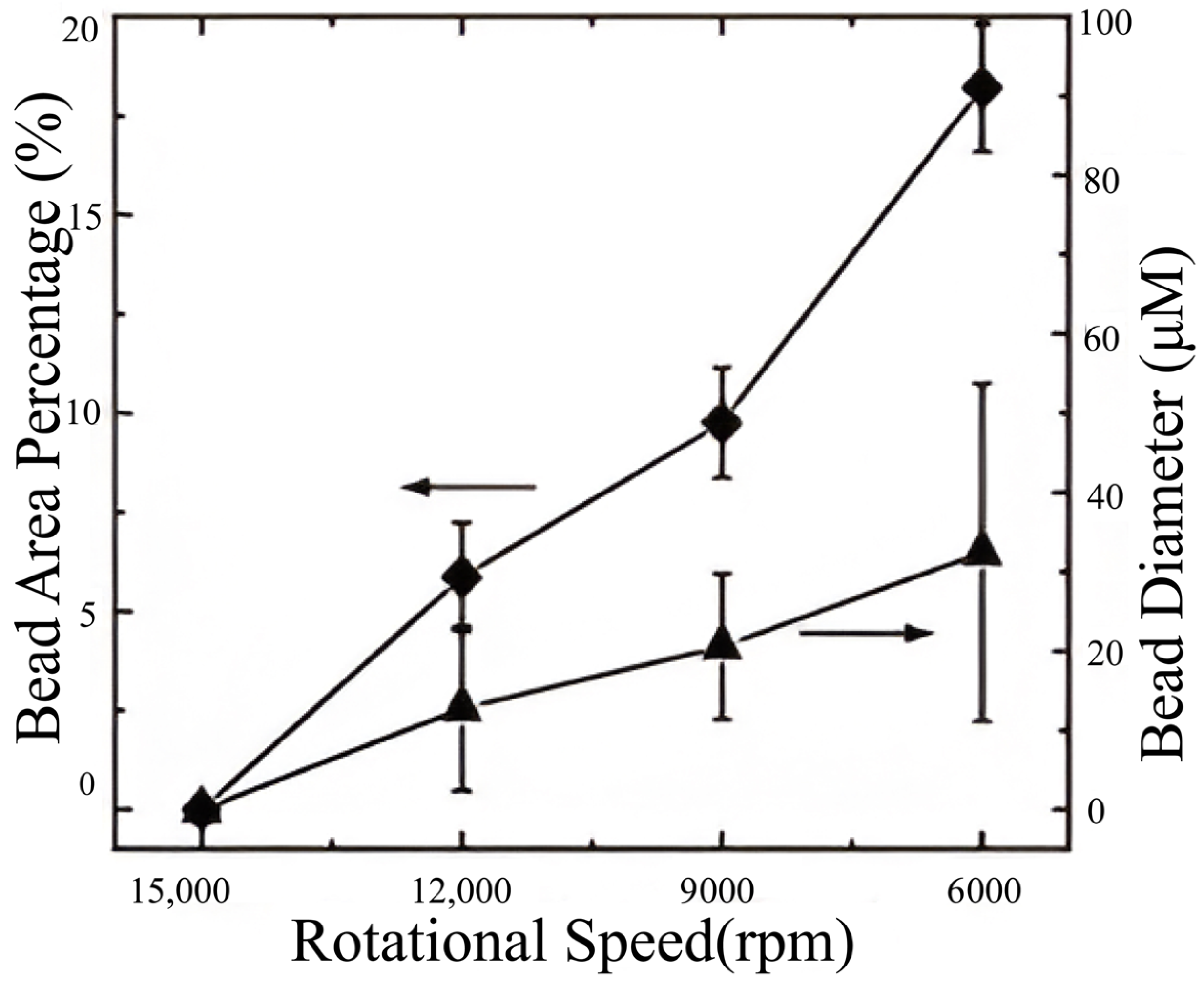
As spinning speeds increased, fiber diameters shrank. The distribution of fiber diameters grew more uniform, and the surface quality and shape of the nanofibers also improved. When the rotation speed was too low, significant droplets were expelled and no fibers were gathered, indicating that the polymer solution was not sufficiently stretched and that an unstable jet was developing [30,65]. The fiber’s diameter will shrink as the angular speed increases. The resulting fibers were smooth and bead-free [111]. A study by Atikah Ardi et al. revealed that microscope pictures of PVP/GE fibers rotating at 10,000 to 15,000 rpm using a precursor solution containing 17 weight percent PVP/GE. The precursor solution of 17 weight percent PVP solution/GE was used to create composite fibers, which resulted in homogeneous, smooth, and bead-free fibers. At a rotating speed of 15,000 rpm and 13 weight percent PVP/GE, the smallest average diameter was 0.71 µm. The highest average diameter, on the other hand, was 1.48 µm, resulting with a rotational speed of 10,000 rpm and 17 weight percent PVP/GE [112]. According to a study by Yevgen Zhmayev et al., the polymer jet thins more quickly at first when viscoelasticity is increased. However, the effect is significantly correlated with rotation speed, and the thinning slows down as angular velocity increases because highly viscoelastic fluids have a quicker rise in extensional viscosity. It is demonstrated that lower flow rates result in faster initial thinning. The jet contour radii are significantly influenced by centrifugal force and viscoelasticity. As the rotational velocity increases owing to the growth of the elastic hoop stress, the maximum radius will decrease for more viscoelastic fluids [113]. Figure 14 shows that when the rotating speed for rPET is reduced from 15,000 rpm to 12,000 rpm or below, the beads-on-string fibers are visible [56].

3.6. Orifice Diameter and Needle Size

A larger orifice enables the delivery of more monomer. As a result, with larger orifices, the impact of viscosity on the flow rate increases. The average fiber diameter rises as the orifice diameter increases. To enable spinning at low speed at high viscosity, a larger inner diameter was needed; for the low viscosity solution, a smaller inner diameter was required. However, nanofibers are not affected much by needle gage [107,114].

3.7. Collector Design and Type

The trajectory of the material will broaden as the spinneret speed rises, resulting in an increase in the collector’s distance. The collector’s distance should decrease as the solution’s viscosity rises because the nanofibers’ speed will drop. Thinner fibers are often deposited as a result of more jet elongation caused by a higher collection distance. The fibers may break during their stretching phase if the collecting distance is set too high. On the other hand, thicker fibers will be gathered if the collection distance is too short since the jet won’t experience enough elongation and the solvent will not evaporate entirely [15,30].
The development of oriented nanofibers in the mats is indicated by a rise in FFT alignment values. Denser collectors allowed for greater production, which decreased waste and improved fiber beading. The fiber formation and the collector spacing have a very negative relationship. The production increases with decreasing separation; as fiber formation rises, so does fiber diameter. Because of the stress this reservoir provides, the nanofiber scaffolds produced by the cylindrical collector are closely packed and oriented. a small, handheld centrifugal spinning device that uses a flow-induced mechanism to collect produced fiber perpendicularly. To gather fibers in an aligned manner, an automated track collector was coupled with a spinning head. Fibers that are gathered with denser collectors and spun with smaller needle sizes are more homogenous and have fewer structural flaws [55,56].

3.8. Temperature and Humidity

The viscosity of the polymer solution, which is affected by temperature and solution properties, directly affects surface tension. If the viscosity is high, the centrifugal forces may not be strong enough to create a jet. However, in the case of low viscosity, when centrifugal forces are applied, droplets rather than jets will form [53]. An automatic shutdown occurs when an output current exceeds a hazardous level due to high humidity. Fiber diameters significantly drop to those seen in electrospinning when relative humidity increases throughout the centrifugal spinning process [51,115].

3.9. Modeling and Simulation of Centrifugal Spinning

The capability of CS to produce micro- and nanofibers at high production rates has stimulated considerable interest in the theoretical modeling and simulation of the process. In CS, fibers are generated from polymer solutions or melts that are expelled through rotating nozzles under the influence of centrifugal force, forming highly curved liquid jets. As these jets move away from the rotational center toward the collector, they undergo continuous stretching and thinning until solid fibers are deposited on the collector surface. However, the spinning process can be affected by various jet instabilities, which may lead to jet breakup or bead formation during fiber generation. Despite ongoing improvements in centrifugal spinning technology, achieving a comprehensive understanding of the process remains challenging because the jet dynamics are governed by numerous interacting parameters. These include inertial, viscous, centrifugal, surface tension, and aerodynamic forces, in addition to solvent evaporation and the rheological behavior of the polymer solution. Consequently, the flow behavior of the spinning jet represents a complex multiphysics problem [116]. To date, several experimental studies have attempted to characterize centrifugal spinning and evaluate the influence of different processing parameters, such as polymer solution temperature [117], polymer concentration [108,118], rotational speed and orifice diameter [80,119], and solution thermal treatment [120]. Although experimental investigations provide valuable insights into the process, they often require significant time and effort to systematically explore the large parameter space involved. Moreover, certain phenomena, such as aerodynamic drag and solvent evaporation during jet flight, are difficult to isolate and analyze experimentally. For these reasons, mathematical modeling and numerical simulation have emerged as powerful complementary approaches, offering a promising framework for improving the fundamental understanding of centrifugal spinning and predicting fiber formation behavior [116,121].
Researchers have been working to develop models for CS to better understand and control the fiber formation process. For example, according to Chen et al. [61], jet extension of fiber is one of the dominant processes controlling the overall quality and diameter of fibers in CS as most of the thinning of the polymer jet occurs during the stretching stage after it leaves the nozzle. To model this process, the jet motion is commonly described using conservation of mass and momentum. For a jet where the fluid density remains constant, the continuity equation is Δ. u = 0, while the momentum balance is written as ρ D V D t = ρƒ + Δ. P, where ρ is the fluid density, u is the jet velocity, ƒ is the gravity, and P represents pressure. Because polymer solutions do not have a constant viscosity (non-Newtonian fluids), the model also includes a power-law equation τ = KγN, where τ is shear stress, K is the consistency coefficient, γ shear rate and N is the rheological index that describes how the fluid thins during stretching. Based on this framework, the model indicates that centrifugal force, viscous stresses, and Coriolis forces generated by rotation govern the jet trajectory and elongation dynamics, enabling predictions of jet velocity, variation of jet radius along its path, and the overall stability of the spinning process. Further developments have extended these models by incorporating additional physical effects. Divvela et al. [121] developed a model describing the dynamics of curved viscous fiber jets in centrifugal spinning, accounting for momentum transport, heat transfer, and temperature-dependent viscosity during jet flight. Their model predicts the evolution of jet velocity, temperature, and cross-sectional area along the jet trajectory, providing further insight into the coupled thermal and fluid dynamic mechanisms governing fiber formation.
Subsequent modeling efforts incorporated the rheological behavior of polymer solutions and the viscoelastic nature of spinning fluids. Rogalski et al. [122] investigated the rheological limitations of polymer solutions and melts in rotary jet spinning, also known as CS, using a combination of rheological measurements and computational fluid dynamics (CFD) simulations. Their study demonstrated that the ability of a polymer solution to form continuous fibers strongly depends on its viscosity and molecular characteristics. They identified a practical viscosity window for successful fiber formation, typically between approximately 1 and 10 Pa·s, where sufficient polymer chain entanglement exists to prevent jet breakup while still allowing the material to flow through the spinneret. Furthermore, their CFD simulations revealed that significantly high shear rates on the order of 103–104 s−1 can develop inside the spinneret, especially near the nozzle exit. These high shear rates significantly influence the apparent viscosity of the polymer solution due to shear-thinning behavior, thereby affecting jet stability, spinnability, and the resulting fiber morphology during centrifugal spinning. Noroozi et al. [116] further advanced modeling efforts by developing an integrated string model, a one-dimensional mathematical framework that treats the spinning jet as a slender filament whose velocity, radius, and stress evolve along its length. In their approach, the rheological behavior of the spinning fluid was described using the Giesekus model, a nonlinear viscoelastic constitutive equation commonly used to represent polymer solutions and melts by accounting for elastic stresses and shear-thinning effects. This formulation enables a more realistic representation of polymer fluids during jet stretching. Using this framework, the authors performed a detailed parametric analysis of key dimensionless parameters, including the Weissenberg number ( W i ), which quantifies elastic effects in the flow, and the viscosity ratio ( δ s ), which represents the relative contribution of solvent viscosity. Their results showed that increasing fluid elasticity (higher W i ) leads to thicker fibers and stronger coiling of the jet around the rotational axis, highlighting the important role of viscoelastic effects in governing jet dynamics and fiber morphology in centrifugal spinning. Together, these advanced models represent a significant step toward a predictive understanding of the process, enabling the rational design of materials and operating conditions for targeted fiber properties.

4. Filtration Mechanism

Centrifugal spun filters produced a broader dispersion of diameters inside a mat, resulting in a substantially smaller pressure drop of 200 Pa or less. They have exceptional reusability; after 10 cycles of either ethanol dipping or isopropyl alcohol spraying, the filter performance retained a filtering efficiency of ≥95% while keeping the pressure drop at 270 Pa or less, easily meeting the NIOSH N95 criteria. In contrast, after 10 cycles of spraying or dipping, ES samples produced a pressure reduction over 343 Pa [23]. Fiber diameter, airflow velocity, and particle size are the primary determinants of the particle filtering process. The filtration mechanism of conventional filtering materials is the consequence of a variety of synthetic effects, including gravity, the inertial effect, the diffusion effect, the interception effect, the electrostatic effect, the thermophoresis effect, etc. [123]. Extremely fine particle filtration is one area of filtration where nanofiber mats will be very helpful. Conventional filter media can readily collect micron-sized and sub-micron particles, but a fibrous filter comprising finer fibers is required to effectively capture nanoparticles. Furthermore, depth filtration does not rely on pore size separation; instead, it uses a variety of molecule-to-fiber interactions in which the particle is actively attracted to the fiber surface spaces, which are significantly smaller for finer fibers. Nanofibrous webs may be created to provide a highly selective membrane by adjusting the pore size. Instead of employing pore size separation, depth filtration uses a variety of molecule-to-fiber interactions in which the particle is actively attracted to the fiber surface [124]. More surface area was produced throughout the medium by the smaller diameter fibers and increased filter solidity, which improved diffusion and interception collecting efficiency. Compared to filters with bigger diameters and less firmness, air filters with smaller diameter fibers and more solidity have better airflow resistance. A thicker filter medium would result in higher filtering efficiency. The projected overall filter effectiveness increases from 99.81% to 99.98% when a hypothetical clean media that is 1.4 times thicker than the 6% medium is taken into account. Similarly, the overall filter effectiveness increases from 97.85% to 99.95% when a hypothetical clean medium is double the thickness of the 9% material [125]. A fiber layer with distinct properties was created when VCS and substrates with varying permeabilities were combined; the more permeable the substrates, the smaller the porosity of the resulting fiber layer. The VCS’s increased power encouraged the production of more fibers, which in turn led to a decrease in the fibers’ size and the porosity of the fiber layer and an increase in the pressure drop. The collection time had a significant impact on the diameter of the fibers, with longer collection times increasing the diameter. The fiber layer’s inclusion raised the pressure drop and collection efficiency while decreasing the filter medium’s permeability. The fiber layer’s inclusion encouraged surface filtering, which raised the collection efficiency to 97.2% [126].

4.1. Mechanisms of Capture

4.1.1. Interception Effect

Interception involves physically attaching particles to the fiber medium. Since the intercepted particles are smaller, their inertia is insufficient to keep them moving in a straight line. The center of a massless particle will follow the streamlines of the fluid since it has no inertia. As the particle follows the main mechanism that permits cooperation between the filter medium and particle inside a single particle width surface of the fiber, an interception takes place. As the particle size decreases, interception becomes increasingly apparent rather than clearly determined by the particle’s velocity. Inertial impaction and interception are fundamentally different. When the filter material intercepts the element, there is no departure from the core interception foundation [127]. Particles between 0.5 and 1 µm in size can be effectively captured via interception, which is acknowledged as the major filtering process and is independent of air flowrate [128]. The particles first travel with the airflow, but when they are closer to the fiber’s surface than its radius, they interact with it, are drawn to it, and the fiber immediately intercepts them. Aerosol particles less than 0.6 μm may often be successfully intercepted by interception systems. Notably, the van der Waals force provides the attraction for interception. There is no clear correlation between interception and a decrease in particle size; however, in the interception process, the smaller the particle size, the more noticeable the interception. Diffusion and interception processes are important when the aerosol particles are between 100 nm and 1 μm in size [129].

4.1.2. Inertial Impaction

Inertial impaction happens whenever the inertia of big, heavy particles in the flow stream leads them to follow a straight route as the flow stream passes around a filter fibber. Following their impact, the particles adhere to the filter medium and remain there. Inertial impaction works well in high-velocity filtration systems and can be used to capture particles bigger than 1 μm in diameter [130]. In a HiGee system, dust particles typically follow the exhaust flow streamline due to the impaction process. However, when small liquid droplets are added to the system, the particles diverge around the droplet, making it impossible for them to always follow the original stream. Because of their mass, this causes the particles to impaction onto the droplet. Equation (6) may be used to determine particle collecting efficiency owing to inertial impaction ( η i ) [131]. Here, St means Stokes numbers, and Ku is the Kuwana hydrodynamic factor [132].
η i = f 2 . S t K u 2
where the f value is assumed to be 2 if the S value is greater than 0.4. Otherwise, the f value should be determined by Equation (7):
f = ( 29.6 ρ L ) S 2 27.5 . S 2.8
Here, ρ L (kg/m3) is the density of liquid droplets, and S means is the interception parameter of the particle. The likelihood of particle impaction rises as the droplet size decreases and the particle diameter and relative velocity between the particle and droplets both increase.
Particles larger than 1.0 μm may typically be gathered by the impaction mechanism if the generated droplets are between 150 and 500 μm (in the case of a wet scrubber). On the other hand, given the HiGee’s minimum droplet sizes are thought to be between 0.0013 and 50 μm, impaction in the HiGee should greatly increase PM2.5 removal effectiveness [131].

4.1.3. Brownian Diffusion

Given its tendency to contradict common sense, Brownian diffusion is arguably the most enigmatic of the filtering effects. A random route will be created across the medium when tiny particles in the air stream clash with gas molecules. The longer the particle zigzags, the smaller it is. The likelihood that the particle may come into touch with the fiber is increased by this random motion. For all particles smaller than 0.1 μm, this impact is predominant [133]. The particles will often move out from the center zone due to Brownian diffusion. After that, the particles will move into a fluid layer, where the centrifugal field will affect them once more. They will return to the zone’s center as a result, either by flotation or sedimentation. It is known that isopycnic banding and diffusion spreading interact to produce thin, Gaussian-shaped bands. As a result, this enables a very high level of purity for all particle mixes whose species have different densities. Additionally, the separation on a centrifuge tube scale may be used to precisely calculate the buoyant densities of colloid particles [134].

4.1.4. Electrostatic Effect

Electrostatic filtration is a solution that improves filtering efficiency without increasing resistance. In contrast to previous electret techniques, this approach uses a high-voltage electrostatic field to stretch and pull polymer chains to create continuous electret threads. High-efficiency, low-resistance air filtration is achieved using electrostatic filtration, which uses charged fiber traps to catch particles and greatly increase filtration efficiency without increasing resistance. Electret treatment of the PP fibers is necessary for such filtering [135]. When it comes to improving the filtering impact of tiny particles (less than 0.3 μm), the electrostatic effect works very well. Higher filtration effectiveness can therefore be attained while keeping the filter mask’s pressure drop smaller by raising the charge of the filter material. This can be performed with the majority of filter masks available today [136]. Electrostatic charges between the particles and the filtering material are essential to electrostatic filtration methods. Depending on the charged state of the fiber and particle, two types of electrostatic forces—Coulomb and dielectrophoretic forces—usually occur in the electrostatic capture of PM. For example, Coulombic forces attract particles and fibers with unipolar or bipolar charges. In a different scenario, charging one particle or fiber polarizes the other when it is in a neutral state, which results in attraction by dielectrophoretic forces. Interestingly, the electrostatic mechanism can increase filtering effectiveness without decreasing air permeability since it has no effect on the airstream. Because it is challenging to quantify charge distributions across microscopic levels, it is still challenging to accurately predict capture behaviors by electrostatic attraction, despite the numerous theoretical models for electrostatic filtering that have been put out. Despite these challenges, it is evident that the dielectric constants of the fiber and particle have a significant impact on the electrostatic mechanism’s charge distribution and particle capture effectiveness. An electrostatic precipitator is a kind of filter that uses a strong electric field to charge and successively precipitate particles to the flat metallic dust collectors. When compared to electret filters, which constantly lose their electric charges, electrostatic precipitators’ filtering effectiveness is far more resilient over time since they are primarily powered by external energy. Therefore, fibrous filters and electrostatic precipitators have been combined to provide long-lasting, high-performing air filters [137]. A hybrid electrostatic filter is a kind of fibrous (bag) filter that is preceded by an electrostatic particle precharger. The electrostatic charge of particles and, if desired, the application of an extra external electric field to the filtration medium improve the filtering process in hybrid electrostatic filters. A hybrid electrostatic filter is a kind of fibrous (bag) filter that is preceded by an electrostatic particle precharger. The electrostatic charge of particles and, if desired, the application of an extra external electric field to the filtration medium improves the filtering process in hybrid electrostatic filters. In contrast to hybrid electrostatic precipitators, which use an electrostatic precipitator to remove coarse particles, hybrid electrostatic filters only use a bag filter and an electrostatic precharger for particle charging. This suggests that the filtration process only takes place at the fibrous filter and that particle penetration through the precharger should be as high as feasible [138].

4.1.5. Gravity Effect

When particles travel through fibrous layers, they will deviate from the streamline due to gravity, which causes them to deposit gravitationally on the fiber surface. However, because the particles are so small, the gravitational force appears to have very little influence, and when the particles are smaller than 0.5 μm, sedimentation may be completely disregarded [123]. Ultra-low transmembrane pressure is used in the gravity-driven membrane (GDM) filtering process. Biofouling, which creates a biofilm on the membrane surface, aids the GDM process and enables steady flow during long-term operation, despite fouling being the most significant obstacle for membrane processes. The qualities of the biofilm layer are influenced by a number of factors that fall into three primary categories: feedwater characteristics, operating parameters, and membrane module designs. The GDM process’s primary benefits are its ease of use, low energy usage, and lack of the need for chemical cleaning, backflushing, or an external energy source, all of which lower expenses and make the procedure cost-effective. However, pretreatment techniques are employed in conjunction with the GDM process to boost the stable flux and enhance the permeate quality. In actuality, pretreatment results in a steady flow and enhances the biofilm structure by enhancing the feedwater quality [139]. Qian Wang et al. investigated in the employed drinking water treatment. The removal efficiency of the CGDM process was significantly better than that of the submerged filtration mode (SGDM) procedure. Additionally, it is discovered that the CGDM system is capable of efficiently eliminating fluorescent protein-like substances, and the intensities of soluble microbial products and tryptophans material were lowered by 55.08% and 64.61%, respectively, compared to the SGDM. As a result, it can be concluded that the filtration mode was crucial to the GDM system’s long-term flux stabilization, and that the cross-flow filtration mode may concurrently enhance the removal performance and stable flux level [140]. The impact of tiny (<10 μm) microplastics (MPs) on GDM filtration was investigated by Meng Chen et al. The findings demonstrate that while microplastics contribute very little to membrane fouling, the flow of noncoagulation systems is low (2.67 L/m2 h) due to pore blockage brought on by the low molecular weight of HA. Additionally, pre-coagulation greatly reduces membrane fouling and boosts fluxes (13.68–20.93 L/m2 h). We demonstrate that the presence of microplastics in the PACl pre-coagulated GDM system is advantageous to form a more uniform cake layer and achieve the physical stabilization of flux by using optical coherence tomography and ultra-depth three-dimensional microscopy to observe the physical structure of the cake layer and then using the quasi-uniform cake filtration model for analysis [141]. Figure 15 illustrates different mechanisms of capture in the filtration process.

4.2. Slip Flow Effect

Nanofibers enhance filtration efficiency by reducing resistance to airflow, resulting in a reduced pressure drop across the filter medium. This leads to increased filtration efficiency and lower pressure drop in filtering applications [142]. The “slip-flow effect” and smaller pore size of nanofibrous filter medium provide lower resistance to airflow, further improving filtering efficacy. For high-temperature air filtration, inorganic nanofibers like SiO2, Al2O3, and ZrO2 are required due to the low heat resistances of polymer-based nanofibrous filters. Slip flow, where the air velocity at the fiber surface is non-zero, is a fundamental benefit of using nanofibrous medium in filtration. Knudsen number (Kn, a dimensionless parameter (Kn = 2λ/df), is used to define the flow regime for the gas flow around the fibers. The slip flow effect, which results in a reduced pressure drop and higher diffusion, interception, and inertial impaction efficiency, happens when Kn is larger than 0.1. As seen in Figure 16, samples having a slip flow effect have higher QF values. There was a strong correlation between the increase in QF and Kn values, with the 15T-600 sample having the greatest QF at around 0.32 [25]. Rotational speed influences the slip distribution of the polymer. Slip occurs as the rotational speed rises, first between the nozzle wall and the polymer solution, then between the interfaces of the two polymer solutions, and lastly at the gas-liquid contact. At the same polymer solution concentration, fluctuations at the two-phase interface can cause an unstable flow of the two polymer solutions, and slip velocity is a key factor influencing the fluctuations between the liquid-liquid interfaces. After determining the solution concentration, use a modest motor speed to prevent fiber development. As the motor speed increases, the polymer solution flow stabilizes and the collected fiber form, and quality improve dramatically; however, when the speed surpasses a particular threshold, the composite nanofibers break on the collecting device [65]. Equation uses the Knudsen number (Kn) (5) to analyze air flow conditions around a single fiber.
K n = 2 λ d
where d is the fiber diameter, and λ is the mean free path of air molecules (about 66 nm). Specifically, when d lowers, the Knudsen number increases, indicating that air resistance reduces [136]. Under typical air conditions, fibers with diameters less than 0.5 µm require slip flow, which assumes non-zero air velocity at the fiber surface [26].
The quality factor values rose as the fiber diameter shrank. Because the optimized sample had a low penetration ratio at the tradeoff of decreased air resistance, it had the greatest quality factor. The dimensionless Knudsen number confirms that the slip flow regime across the filter medium was made possible by the reduced fiber diameter [27]. The slip effect is measured using the Knudsen number, which is dependent on the fiber diameter, Knf (Knudsen number, based on the fiber diameter). When Knf < 0.001, the fluid is in a continuous state, meaning that it does not slide on the solid surface. (In other words, the fluid’s velocity is equal to that of the solid surface it comes into contact with.) In the broad range, fluid flow is in a “slip state” when 0.001 < Knf < 0.25. When 0.25 < Knf < 10, fluid flow is in transition (that is, transitioning from slip state to free molecular flow). When Knf > 10, fluid movement is in free molecular flow [143]. In accordance with the continuum flow assumption for air under the specified operating parameters (facial velocity = 6.89 cm/s, ambient pressure), the fluid velocity at the fiber surface is equal to the velocity of the fiber itself (zero velocity since the fibers are stationary). The airflow in this investigation had a Knudsen number (Kn) of around 0.001, which is much less than 0.01. According to the continuum flow theory, this validates the no-slip requirement (Kn < 0.01 denotes a continuum flow regime where the no-slip criterion is applicable) [144]. Kn ≤ 0.001, continuum flow regime; 0.001 < Kn < 0.1, slip flow regime; 0.1 ≤ Kn < 10, transitional flow regime; Kn ≥ 10, free molecular flow regime [145].
When compared to the no-slip scenario, slip flow reduces the pressure drop. The addition of slip conditions in fibrous filter flow calculations will anticipate lower filter media pressure drops and enhance prediction agreement with actual pressure decreases since fibrous filters are basically mixtures of these geometric features. This occurs when the gap size or fiber diameter, d, equals the mean free path of fluid elements, λf (i.e., when kn = λf/d ≤ 1) [146]. It is preferable to minimize the drag force in the solid–liquid interface in order to decrease pressure drop and volume loss in micro/nanochannels. The so-called “no-slip boundary condition” (Figure 17A, left) is the widely held belief that the relative velocity between a solid wall and a liquid is zero at the solid–liquid contact. A slip length is a measure of the extent of boundary slip at the solid-liquid interface. When a tangent line is formed along the velocity profile at the interface, the length of the vertical intercept along the axis orthogonal to the interface is known as the slip length (Figure 17B, right). slide lengths on hydrophobic surfaces, but hydrophilic surfaces showed no signs of slippage [147].
Nano-fibers increase filtration efficiency by enhancing the “slip effect” to minimize airflow resistance, resulting in a smaller pressure drop on the filtration medium and hence improved filtration efficiency and a lower pressure drop in filtration applications. It has been claimed that centrifugally spun non-woven porous membranes based on silica (SiO2), PVP, thermoplastic polyurethane (TPU), and PAN can be used as air, aerosol, and particle filtering media. Because centrifugally spun fibers have a highly porous and changeable pore structure, it is possible to produce nano-fibers quickly and affordably with tunable chemical and physical characteristics to achieve minimal pressure drop and great filtration efficiency [142]. The distribution of fiber diameter leads to a better level of filtering efficiency [148]. Flow shifts from bigger pores to smaller holes as the Knudsen number rises, reducing pressure drop and improving capture efficiency. Because smaller pores are better at catching particles, this redirection of flow towards them enhances capture efficiency. For filter media working in the slip regime, the quality factor dramatically rose by around 80%, suggesting that these filters may achieve comparable capture efficiencies with smaller pressure drops. Due to increased flow slippage within smaller holes, the transfer of flow from larger to smaller pores is more noticeable in the slip regime, which enhances capture efficiency. In conclusion, the slip-flow effect greatly enhances the wide diameter distribution in multilayered fibrous filter media, especially those that contain nanofibers [149].

4.3. Filtration Efficiency

Filtration efficiency (η) is calculated using the formula η = (Ci − Cf)/Ci, where Ci and Cf stand for the initial and final pollutant concentrations, respectively. The quality factor (QF) values were computed using these parameters. The QF was computed using QF = −ln (1 − η)/ΔP, where ΔP and η stand for the nonwoven’s filtering effectiveness and pressure drop, respectively. Pressure drop (ΔP) is used to describe the airflow resistance across the filter medium [28]. Dhanya Venkataraman et al. examined centrifugal spinning and electrospinning as two techniques for creating nanofiber filters utilizing a well-known biodegradable polymer, such as polylactic acid (PLA). The current study found that the centrifugal spun PLA filters produced a wider distribution of diameters within a mat, which helped achieve a significantly lower pressure drop of 200 Pa or less. Both centrifugal spinning and electrospinning techniques successfully produced submicron fibers capable of filtering nearly 99% of 0.3 μm NaCl particles. At the same aerial mass or mean fiber diameter, CS samples consistently have a better-quality factor than ES samples. The exceptional reusability of CS PLA filters is what makes them even more unique. After treatment, 10 cycles of either ethanol dipping or isopropyl alcohol spraying resulted in a retention of filtration efficiency of ≥95% with a pressure drop of 270 Pa or less, comfortably meeting the NIOSH N95 standard. In contrast, after ten cycles of spraying or dipping, ES samples produced a pressure reduction greater than 343 Pa [23]. Mao et al. [150] used electrospinning to create flexible and thermally stable (up to 1273.15 k) silica-based air filters. At the cost of a 163 Pa pressure loss, the nanofibrous medium offered 99.99% efficiency. Although electrospinning is a straightforward and popular technique for creating fibrous membranes at the nanoscale and submicron levels, it has drawbacks, including a high voltage requirement (>10 kV), a low production rate, and a strong reliance on solution characteristics like viscosity, surface tension, conductivity, and dielectric constant. Alternatively, it has been observed elsewhere that centrifugal spinning (C-spin) is more practical (Gundogdu et al.; Rogalski et al.) [27,151]. This method involves feeding the polymer solution into a spinneret that rotates at a high speed. The polymer jet spreads in the direction of the vacuum collector when the centrifugal force surpasses the solution’s viscosity and surface tension [25]. Gelatin nanofiber webs with a diameter ranging from 232 to 778 nm were successfully created by Fatih Arican et al. using a centrifugal spinning process. Gelatin nanofiber webs met the N95 filter’s 95% filtration efficiency criteria when their air permeability and filtration efficiency were assessed. Gelatin nanofiber may be utilized as an N95 filtering medium from this perspective. Partially biomaterial-containing mask material is an eco-friendly alternative to fully biodegradable mask fabrications given the widespread use of face and surgical masks [24]. In an investigation by Melike Gungor et al., centrifugal spinning was used to create polyvinylpyrrolidone-based nanofibrous air filter media, which were then stabilized by thermal cross-linking. Solutions with three distinct polymer concentrations (5, 10, and 20 weight percent) and three distinct rotating speeds (4000, 6000, and 8000 r/min) were used to create the samples. The webs were further thermally cross-linked to stabilize polyvinylpyrrolidone against the degradative effects of water after the ideal web structure with the lowest average fiber diameter and the most uniform distribution was achieved. With a high filter efficiency of 99.995% and a high QF of 0.39 mm H2O−1, the manufactured water-resistant, eco-friendly polyvinylpyrrolidone nanofibrous filter media has demonstrated a good filtration performance [26].

5. Applications

Filtration is a vital process for enhancing environmental quality by removing solid particles and contaminants from the air. Key parameters influencing the performance and durability of filtration media include filtration efficiency, pressure drop, and mechanical stability. Various filtration mechanisms, such as surface straining and depth filtration, are employed based on the specific application, with the choice of filter media, such as membrane or nanofiber filters, being crucial for achieving optimal results [152]. Nanofibrous membranes have gained increasing attention in filtration applications owing to their high specific surface area, excellent filtration efficiency, low airflow resistance, and lightweight structure [153,154]. Smaller fiber diameters are advantageous in filtration applications because they yield a higher surface area. This structure enhances performance by physically trapping particles larger than the fiber’s pore size directly on the filter’s surface. Consequently, this surface-level blocking mechanism leads to higher overall filtration efficiency [25,152,155]. Conventional filter media, characterized by larger and inconsistent fiber diameters, struggle with filtration efficiency due to non-uniform pore sizes and increased pressure drops, leading to higher energy consumption and material costs [156,157]. In contrast, nanofibers, with diameters less than 1 micron, provide a significant advantage by creating smaller, more consistent pore sizes that enhance filtration performance [157]. These nanofiber-based filters utilize the “slip effect,” which reduces airflow resistance and results in lower pressure drops while achieving over 90% efficiency in capturing fine particulate matter (PM2.5). Additionally, the incorporation of nanofibers improves the filter’s contaminant holding capacity and extends its lifespan, making it a cost-effective solution for high-performance applications [7]. Kim et al. [158] investigated the filtration performance of electrospun Nylon-6 nanofiber membranes with mean fiber diameters ranging from approximately 100 to 730 nm and compared their behavior with a commercial HEPA filter. The results showed that the decreasing fiber diameter led to enhanced filtration efficiency and reduced most penetrating particle size, while maintaining a relatively low-pressure drop. Notably, the Nylon-6 nanofilter with an average fiber diameter of 100 nm achieved filtration efficiencies exceeding 99.98% for particles in the 0.02–1.0 µm range and exhibited a significantly lower pressure drop than the commercial HEPA filter at the same face velocity. At an air velocity of 5 cm s−1, the pressure drop was measured to be approximately 27 mmAq (264.8 Pa) for the Nylon-6 nanofilter, compared to about 37 mmAq (363.8 Pa) for the HEPA filter. These findings were attributed to the smaller fiber diameter and reduced pore size of the nanofiber membrane, which enhanced particle capture while benefiting from slip-flow effects that mitigated airflow resistance.
The unique structural characteristics of centrifugally spun nanofibers, notably their wide fiber diameter distribution and high porosity, make them highly attractive materials for filtration applications. These features enhance particle capture efficiency through various mechanisms such as interception, inertial impaction, Brownian diffusion, and electrostatic attraction, while also contributing to a significantly lower pressure drop compared to electrospun fibers, which often exhibit tighter packing and higher resistance. Studies indicate that centrifugal spun filters can achieve filtration efficiencies exceeding 95% with a pressure drop of 200 Pa or less, making them comparable to traditional N95 masks [23]. In contrast, electrospun nanofibers, while offering tunable porosity and high surface area, often face challenges related to pressure drop and reusability [23,159]. Venkataraman et al. [23] demonstrated that both centrifugally spun (CS) and electrospun (ES) techniques achieved high filtration efficiencies (95–99%) for 0.3 µm NaCl aerosols. However, the CS filters consistently exhibited a lower pressure drop (typically below 200 Pa) than their ES counterparts at comparable filtration efficiencies. This behavior was attributed to the wider fiber diameter distribution in centrifugally spun mats, which combines submicron fibers for efficient particle capture with larger fibers that create open airflow pathways. In contrast, electrospun membranes showed narrower fiber diameter distributions, leading to tighter packing, increased airflow resistance, and higher pressure drop. For instance, CS PLA fibers exhibited relatively broad diameter distributions, with relative standard deviations ranging from approximately 40% to 100% of the mean fiber diameter. In contrast, ES fibers displayed consistently narrower distributions of only 20–40%. This quantitative difference directly correlates with filtration performance. For example, the CS sample with the widest distribution (1.6 ± 1.1 μm, corresponding to a distribution width of ~69%) achieved 98–99% filtration efficiency with a relatively low pressure drop of 60–160 Pa. In comparison, the ES sample with a similar mean diameter (1.6 ± 0.3 μm, corresponding to ~19% distribution width) required a higher pressure drop to achieve comparable efficiency, ultimately resulting in a higher QF for the CS filter. From a theoretical perspective, classical filtration models such as the Davies model, along with later correlations proposed by Wong et al. [160] described the pressure drop across fibrous filters as a function of fiber diameter, packing density, and flow velocity. These models highlight the strong dependence of airflow resistance on fiber structural parameters. Therefore, incorporating multiple fiber diameter scales within a fibrous mat can effectively balance filtration efficiency and pressure drop. Moreover, in terms of reusability, the CS filters retained filtration efficiencies above 95% and maintained pressure drop below the NIOSH N95 threshold even after multiple ethanol dipping and isopropyl alcohol spraying cycles, whereas electrospun filters experienced a more pronounced increase in pressure drop after repeated reuse [23]. Müller et al. [20] integrated CS with ES (CES) to address low productivity and poor scalability of ES, by enabling high-throughput, roll-to-roll fabrication of nanofibrous filtration media. Using CES, recombinant spider silk nanofibers with an average diameter of 90 ± 3 nm were uniformly deposited onto a polyamide support, producing a highly porous nonwoven structure. The best-performing CES-fabricated filter exhibited a filtration efficiency of approximately 94% for 0.2 µm particles and >95% for PM2.5, while maintaining a low-pressure drop of about 131 Pa at an air velocity of 25 cm/s, outperforming a commercial reference filter AEG MicrofiltPlus AE120 Dust Filter Bags. The resulting highest quality factor (~0.02) highlights the ability of CES in enabling scalable, high-throughput fabrication of nanofibrous filters while maintaining fine fiber control and low airflow resistance [20]. Salussoglia et al. [21] employed a vacuum collection system (VCS) to introduce reverse airflow during centrifugal spinning and examined its influence on polyacrylonitrile (PAN) ultrafine fibers morphology and aerosol filtration performance. Increasing the VCS power from 25% to 100% resulted in enhanced fiber stretching, leading to a reduction in average fiber diameter from approximately 1.24 µm to 0.9 µm. As the VCS power increased, both collection efficiency and pressure drop showed a gradual rise, with filtration efficiency improving from 48.4% to 51.8% and pressure drop increasing from 10.0 Pa to 12.5 Pa. For the M4 configuration, the enhanced fiber stretching induced by high VCS power produced finer fibers with an average diameter of 0.90 ± 0.28 µm. Under these conditions, the filter exhibited a collection efficiency of 51.8 ± 2.2% for aerosol particles, while maintaining a low-pressure drop of 12.5 ± 0.6%, indicating limited airflow resistance. These results demonstrate that VCS-assisted centrifugal spinning enables effective tuning of fiber size and filtration performance, improving aerosol collection efficiency while preserving low pressure drop [21].
Centrifugally spun nanofibers have emerged as a leading technology in air, aerosol, and particle filtration, which are reviewed in Table 2. Tepekiran et al. [25] reported the fabrication of centrifugally spun silica (SiO2) nanofibrous membranes for high-temperature air filtration by combining centrifugal spinning with subsequent calcination of Polyvinylpyrrolidone-tetraethyl orthosilicate (PVP–TEOS) precursor fibers. After calcination at 873.15 k, the optimized silica nanofibrous membrane exhibited a reduced average fiber diameter of approximately 521 ± 308 nm, resulting in an enhanced filtration efficiency of about 75.89% for 0.4 µm NaCl particles. Although the pressure drop increased with decreasing fiber diameter due to the formation of a denser fibrous structure, the 15 wt% membrane maintained a relatively low pressure drop (43.35 Pa), yielding the highest QF (0.32 mmH2O−1), which is comparable to that of commercial high-temperature filters operating at an initial pressure drop of approximately 250 Pa. This performance was attributed to the high porosity of the nanofibrous membrane and the slip-flow effect associated with nanoscale fibers. In addition to filtration performance, the centrifugally spun silica membranes exhibited excellent thermal stability, with no significant mass loss observed between 500 and 1273.15 k, and good mechanical flexibility (elongation at break of 20.9 ± 6.44%), highlighting their potential for industrial high-temperature air filtration applications [25]. Melike et al. [26] fabricated polyvinylpyrrolidone (PVP) nanofibrous air filter media by CS. The study showed that high rotational speeds (≥6000 rpm), particularly at a low polymer concentration of 5 wt% PVP, promoted the formation of finer and more compact fiber networks, resulting in superior filtration performance. In contrast, increasing the solution concentration to 10–20 wt% produced coarser fibers with denser structures and limited bead formation, which negatively affected filtration efficiency. Additionally, increasing the number of nanofiber layers improved particle capture at the expense of higher airflow resistance, with single-, double-, and triple-layer 5 wt% PVP filters exhibiting filtration efficiencies of 95.40%, 99.73%, and 99.98%, and corresponding pressure drops of 80, 170, and 280 Pa, respectively. Notably, the optimized 5 wt% PVP nanofibrous membrane produced at 8000 rpm achieved a filtration efficiency of 99.995%, exceeding the HEPA standard (>99.97%) [26]. Gundogdu et al. optimized the fabrication of thermoplastic polyurethane (TPU) nanofibrous membranes via centrifugal spinning for air and aerosol filtration applications using the Taguchi experimental design method. The optimum processing conditions were identified as a 22 G orifice, rotational speed of 4000 rpm, and polymer solution concentration of 10 wt%, producing nanofibers with an average diameter of 205 ± 84 nm. The filtration properties of the nanofibrous webs were evaluated using Emery 3004 aerosols with a particle size of 0.3 µm at a face velocity of 5.3 cm s−1, under which the optimized sample exhibited a high filtration efficiency of 99.4%. Furthermore, a clear increase in QF was observed with decreasing fiber diameter, with the optimized membrane achieving the highest QF due to a low penetration ratio combined with reduced air resistance. This enhancement was attributed to the slip-flow regime, confirmed by a Knudsen number greater than 0.1, indicating that slip flow through the nanofibrous layer played a key role in the superior filtration performance [27].
Centrifugally spun biodegradable nanofibers are increasingly investigated for aerosol and respiratory filtration applications to address the need for high filtration efficiency combined with environmental sustainability. Arıcan et al. [24] investigated the fabrication of biodegradable gelatin nanofibers via centrifugal spinning and their integration into a multilayer mask structure for N95 respiratory filtration. The optimized gelatin nanofiber membrane, produced using a 20 wt% gelatin solution at a rotational speed of 6000 rpm, consisted of a uniform, bead-free nanofibrous layer with an average fiber diameter of 232 nm and a pore size of 0.37 µm, sandwiched between supporting nonwoven layers to provide mechanical stability and effective particle capture. The resulting nanofibrous layer formed a highly porous and interconnected structure, enabling filtration efficiencies exceeding 95% for 0.3 µm NaCl aerosols, thereby meeting N95 standards, while maintaining acceptable air permeability and breathability comparable to commercial surgical masks [24]. Pakolpakçıl et al. [28] fabricated biodegradable, bead-free poly(butylene succinate) (PBS) nanofibers with average fiber diameters ranging from 172 to 349 nm for aerosol filtration applications by systematically varying solution concentration (7–13 wt%), rotational speed (6000–10,000 rpm), and needle size. The minimum fiber diameter was obtained at 7 wt% PBS, 6000 rpm, and a 0.7 mm needle. The nanofibrous filter exhibited high filtration efficiencies of 98.61%, 98.35%, and 98.14% for 0.3 µm NaCl aerosols, with corresponding pressure drops of 95, 238, and 248 Pa at face velocities of 5.33, 14.17, and 15.83 cm s−1, respectively, satisfying NIOSH N95 requirements (efficiency > 95% and pressure drop < 343 Pa). In addition, the filter demonstrated a porous structure with a BET surface area of 8.93 m2 g−1, good mechanical flexibility (elongation at break of 58.14 ± 2.13%), and inherent hydrophobicity (water contact angle of 131.98 ± 3.85°), while retaining biodegradability through hydrolytic degradation [28].
The high porosity and tunable pore architecture of centrifugally spun nanofibrous membranes make centrifugal spinning a highly effective platform for filtration applications. The ability to control fiber diameter distribution, membrane thickness, and surface chemistry enables the simultaneous achievement of high filtration efficiency and low pressure drop across a wide range of operating conditions. Moreover, the inherently high production rate, low energy consumption, and absence of high-voltage requirements position centrifugal spinning as a cost-effective and scalable alternative to conventional nanofiber fabrication techniques. These advantages, combined with the flexibility to process both synthetic and biodegradable polymers, highlight the strong potential of centrifugally spun nanofibers for next-generation air, aerosol, and respiratory filtration systems.

6. Limitations

Centrifugal spinning technology is still not ideal since it develops slowly and begins late. For example, because centrifugal spinning technology and equipment are still in their infancy, the fiber diameter is thick, and the fiber quality is difficult to guarantee. Although recent advances in centrifugal spinning have highlighted significant advantages for scalable production, but challenges still persist. For example, the integration of VCS enhances fiber stretching, deposition stability, and web uniformity, which are critical factors for continuous and scalable roll-to-roll manufacturing [21], and interwoven cross-scale fiber architectures reduce reliance on multilayer stacking and interfacial bonding, thereby simplifying fabrication processes and improving mechanical integrity for large-area production [22]. However, challenges persist in achieving large-scale industrial implementation. For instance, maintaining uniform fiber deposition in roll-to-roll systems necessitates precise coordination of centrifugal force and airflow [161]. Additionally, stabilizing bimodal fiber distributions at high throughput is complicated by fluctuations in rheology and jet instability [16]. Efficient solvent evaporation control and solvent recovery integration are also critical for sustainable production, especially in solution-based processes [118]. Additionally, a high rotational speed is required for the spinning process, which might pose a safety risk. There is currently no proven mathematical model for the link between geometric parameters, technical parameters, and nanofiber diameters. This limitation arises from the inherently multiphysics nature of the centrifugal spinning process, where centrifugal acceleration, inertial forces, and aerodynamic drag interact with the non-Newtonian and viscoelastic behavior of polymer solutions during rapid jet elongation [116,122] Additionally, solvent evaporation dynamically alters viscosity and concentration along the jet trajectory, further complicating predictive modeling [116]. As a result, developing a unified framework that integrates geometric parameters (e.g., nozzle diameter, collector distance) and operational conditions (e.g., rotational speed, solution concentration) to accurately predict fiber diameter distribution remains challenging. For filtration applications, such models should ultimately aim to predict fiber diameter distribution, porosity, and pore size characteristics, as these structural features directly determine filtration efficiency and pressure drop [61]. Additionally, the settings have not been adjusted for effective green production. Furthermore, when the polymer is melted, the design and selection of the heating equipment, temperature measurement, and control system become more complex [19]. Lebo Maduna and Asis Patnaik’s work brought up problems such as the need to recover the solvent, fiber instability, and coarse fibers [96]. The filter bag is one of the most used filter mediums for industrial pollutants. Filter bags are widely used; however, their performance is inadequate for the filtering of high-temperature emissions from industry due to a number of disadvantages (such as limited resilience to high temperatures, significant pressure drop, and suboptimal efficiency). Additionally, cyclone dust collectors have been widely used for particulate matter (PM) filtering in filter bags. A cyclone dust collector is a device that uses centrifugal force to gather dust from the air stream. Because to its straightforward design, inexpensive production costs, and adaptability, this technique is highly well-liked. Cyclone dust collectors have only been shown to filter PM with diameters greater than 10 µm, and its capacity to filter extremely tiny particles is still in doubt [162]. According to a study by Dhanya Venkataraman et al., polylactic acid (PLA) filters can open the door for a sustainable future in the PPE industry by reducing the drawbacks of single-use filters, such as waste management issues [23]. Simply increasing the number of spinning heads and the number of nozzles on each spinning head will enhance the production rate for the centrifugal spinning method of producing nanofibers in large quantities. Second, centrifugal spinning often employs polymer solutions with greater concentrations than electrospinning, resulting in somewhat thicker fibers [14]. Only beads were made using centrifugal spinning using PCL as the polymer and tetrahydrofuran as the solvent, whereas fibers were created at applied gas pressures of 0.1–0.3 MPa. During fiber formation, the PG vessel’s provided gas pressure adds a driving force that is not present in centrifugal spinning alone. This driving force causes the polymer jet to elongate farther, resulting in the deposition of thinner fibers [30]. Compared to other spinning techniques, very few polymers have been employed to generate nanofibers by centrifugal electrospinning, and several studies are required to increase the variety of polymer synthesis. Further research and theoretical validation are needed to clarify the processes of voltage and other factors that influence the fiber shape in centrifugal electrospinning. Before centrifugal melt electrospinning can be used in industry, a significant amount of effort must be undertaken [163].

7. Future Prospects

Despite its many benefits, there are still certain problems that need to be fixed, and researchers can undertake the following studies in the future:
The technology of centrifugal spinning is in its early stages and there are still issues related to ensuring the uniformity of the fibers and the fine regulation of the fiber diameter, which is frequently too thick. Future studies should have the aim of eliminating these problems to achieve more homogeneous and finer nanofibers.
Building on findings that CS filters can maintain >95% filtration efficiency after 10 cleaning cycles, future designs should focus on “permanent” filter media that withstand rigorous industrial washing or sterilization protocols without the structural degradation often seen in electrospun counterparts.
A deficiency in mathematical models that are proven to connect geometric parameters, technical parameters, and nano fiber diameter currently exists. The development of such models is important in controlling and predicting the characteristics of fibers more precisely. The necessity for computational methods to identify “sweet spots” for various polymer–solvent systems is highlighted by current experimental data, such as the fiber quality decline reported beyond 3300 rpm. Extending the rod model to include the surface forces and nonlinear viscoelastic models is more difficult and the resulting model equations are eventually more demanding to solve. Fiber morphology and structural characteristics, filtration efficiency, pressure drop, quality factor, maximum penetration, process dynamics, stability, and head loss should all be the focus of these mathematical models.
The spinning process requires high rotational speeds which may be hazardous to safety. Studies need to be conducted on how to ensure high production levels without reducing these risks and making settings conducive to effective green production.
In case of solution centrifugal spinning, issues that are involved are that solvents are to be recovered, fibers are unstable, and that fine fibers are not made. In the future, it is advised to work on enhancing solvent recovery processes and come up with a process that produces more stable and finer fiber.
Centrifugal spinning has used a significantly low number of polymers in comparison with other spinning techniques to produce nanofibers. Further research is needed to enhance the range of polymers that can be spun successfully by this technique.
The heating equipment, temperature measurement and control system design and choice should also be optimized further in the case of melted polymers. Channels nozzles with self-cleaning capabilities need to be studied to avoid clogging of the nozzles due to high-viscosity solutions.
The ongoing investigation of the various filtration mechanisms with the interception, inertial impaction, Brownian diffusion and electrostatic mechanism among others will assist in the development of a more efficient filter. In particular, it is essential to know how these mechanisms can be used to achieve total filtration efficiency across particle sizes.
A critical measure is the quality factor that takes into account the filtration efficiency and pressure drop. The design of future work should be geared towards maximizing the QF values, particularly those applicable to high-temperature applications, by capitalizing on such properties as high porosity and the slip-flow effect with respect to nanoscale fibers.
Although nonwoven nanofibers moving substrates can be used in continuous mode or supported by the suction force and air jets, future developments can make the systems even more efficient and continuous.

8. Conclusions

The majority of alternative techniques for producing nanofibers, including melt-blowing, bicomponent fiber spinning, phase separation, template synthesis, and self-assembly, are complicated and confined to producing nanofibers from specific kinds of polymers. An alternate technique for quickly and affordably creating nanofibers from a variety of materials is centrifugal spinning. Centrifugal spinning (CS) is presented as a highly effective and scalable method for producing nanofibers, particularly for filtration applications. The concentration of the polymer used, its viscosity, its molecular weight, the rotational speed, orifice diameter used, the size of the needle, and the design of the collector are all critical parameters that affect fiber morphology as well as the diameter. Other environmental influences such as temperature and humidity also have a role to play, and high humidity may decrease the fiber diameters. The real significance of CS in filtration can be summarized as its capacity to design multiscale fiber structures to overcome the conventional quandary between great capture efficiency and low air resistance. By incorporating submicron fibers to capture very fine particles into filter structures coupled with larger structural fibers, the CS membranes always keep pressure drop less than 200 Pa and filtration efficiencies of the membranes regularly reach over 95%. Certain advances underscore this possible: 5 wt% PVP membranes have reached with relative ease an efficiency of 99.995%, and this is comfortably higher than the HEPA standard (>99.97%). Moreover, the excellent performance of these filters is determined by high Quality Factors (QF), which include the 0.32 mmH2O−1 obtained on silica nanofibrous membranes, which demonstrates their ability to trap hazardous aerosol with minimal power loss. With the further advancement of mathematical modeling to increase the accuracy of fiber diameters and pore structures, centrifugal spinning will be the new technology of the world to cleanse the air and water, which is scalable, environmentally friendly, and has the ultra-high-efficiency of removing submicron pollutants.

Author Contributions

Conceptualization, N.C.; methodology, N.C.; formal analysis, N.C., A.R. and M.P.G.; investigation, N.C. and A.R.; data curation, N.C. and A.R.; writing—original draft preparation, N.C. and A.R.; writing—review and editing, N.C., A.R. and M.P.G.; visualization, N.C. and A.R.; supervision, M.P.G. All authors have read and agreed to the published version of the manuscript.

Funding

This research received no external funding.

Data Availability Statement

Data are contained within the article and proper citation. The figure we used has obtained permission.

Conflicts of Interest

The authors declare no conflicts of interest.

Abbreviations

The following abbreviations are used in this manuscript:
mPa·sMillipascal-Second
VCSVacuum-assisted Col-lection
CSSCentrifugal Solution Spinning
PEOPolyethylene Oxide
PTFEPolytetrafluoroeth-ylene
NCSNeedleless Centrifugal Spinning
DCDirect Charge
PLAPolylactic Acid
PHBPolyhydroxybutyrate
PBSPolybutylene succinate
CNTCarbon Nanotube
PEOPoly(ethylene oxide)
PANPolyacrylonitrile fiber
CESCentrifugal Electrospinning
THFTetrahydrofuran
TEOSTetraethyl orthosilicate
PVDFPolyvinylidene Fluoride
MWMolecular Weight
DMFN,N-Dimethylformamide
GEGarlic Extract
FFTFast Fourier Transform
GDMGravity-driven Membrane
SGDMSubmerged filtration mode
CGDMCross-flow mode
HAHyaluronic Acid
PACLPolyaluminum Chloride
KnfKnudsen number, based on the fiber diameter
PVPPoly
CSCentrifugal Spinning
PMParticulate matter
ESElectrospinning
QFQuality Factor
PCLPolycaprolactone
GAGallic acid

References

  1. Kim, K.H.; Kabir, E.; Kabir, S. A review on the human health impact of airborne particulate matter. Environ. Int. 2015, 74, 136–143. [Google Scholar] [CrossRef] [PubMed]
  2. Liu, H.Y.; Dunea, D.; Iordache, S.; Pohoata, A. A review of airborne particulate matter effects on young children’s respiratory symptoms and diseases. Atmosphere 2018, 9, 150. [Google Scholar] [CrossRef]
  3. Ali, M.U.; Liu, G.; Yousaf, B.; Ullah, H.; Abbas, Q.; Munir, M.A.M. A systematic review on global pollution status of particulate matter-associated potential toxic elements and health perspectives in urban environment. Environ. Geochem. Health 2019, 41, 1131–1162. [Google Scholar] [CrossRef]
  4. Moreno-Ríos, A.L.; Tejeda-Benítez, L.P.; Bustillo-Lecompte, C.F. Sources, characteristics, toxicity, and control of ultrafine particles: An overview. Geosci. Front. 2022, 13, 101147. [Google Scholar] [CrossRef]
  5. Zhang, X.; Liu, J.X.; Zhang, H.F.; Hou, J.; Wang, Y.X.; Deng, C.; Huang, C.; Jin, X. Multi-layered, corona charged melt blown nonwovens as high performance PM0.3 air filters. Polymers 2021, 13, 485. [Google Scholar] [CrossRef]
  6. Kimmer, D.; Vincent, I.; Sambaer, W.; Zatloukal, M.; Ondracek, J. The effect of combination electrospun and meltblown filtration materials on their filtration efficiency. AIP Conf. Proc. 2015, 1662, 050001. [Google Scholar] [CrossRef]
  7. Tran, P.; Sundarrajan, S.; Chowdhury, S.; Balasubramanian, R. Nanofiber-coated air filters for highly efficient PM2.5 removal. Aerosol Sci. Technol. 2025, 60, 122–134. [Google Scholar] [CrossRef]
  8. Sanyal, A.; Sinha-Ray, S. Ultrafine PVDF nanofibers for filtration of air-borne particulate matters: A comprehensive review. Polymers 2021, 13, 1864. [Google Scholar] [CrossRef] [PubMed]
  9. Zheng, G.; Shao, Z.; Chen, J.; Jiang, J.; Zhu, P.; Wang, X.; Li, W.; Liu, Y. Self-supporting three-dimensional electrospun nanofibrous membrane for highly efficient air filtration. Nanomaterials 2021, 11, 2567. [Google Scholar] [CrossRef]
  10. Prabu, G.T.V.; Vigneshwaran, N. ElectrospinningLab to Industry for Fabrication of Devices. In Electrospun Nanofibers from Bioresources for High-Performance Applications, 1st ed.; Praveen, K.M., Murickan, R.T., Joy, J., Maria, H.J., Haponiuk, J.T., Thomas, S., Eds.; CRC Press: Boca Raton, FL, USA, 2022; p. 286. [Google Scholar]
  11. Guo, L.L.; Liu, Y.B.; Yao, J.B. A Review on Existing Tecgnology of Electrospinning at Large Scale. In Proceedings of the 2010 International Conference on Information Technology and Scientific Management, Tianjin, China, 20–21 December 2010. [Google Scholar]
  12. Schossig, J.; Hao, Q.; Davide, T.; Towolawi, A.; Zhang, C.; Lu, P. Breaking through Electrospinning Limitations: Liquid-Assisted Ultrahigh-Speed Production of Polyacrylonitrile Nanofibers. ACS Appl. Eng. Mater. 2024, 2, 2970–2983. [Google Scholar] [CrossRef]
  13. Persano, L.; Camposeo, A.; Tekmen, C.; Pisignano, D. Industrial upscaling of electrospinning and applications of polymer nanofibers: A review. Macromol. Mater. Eng. 2013, 298, 504–520. [Google Scholar] [CrossRef]
  14. Zhang, X.; Lu, Y. Centrifugal spinning: An alternative approach to fabricate nanofibers at high speed and low cost. Polym. Rev. 2014, 54, 677–701. [Google Scholar] [CrossRef]
  15. Zhang, Z.; Sun, J. Research on the development of the centrifugal spinning. MATEC Web Conf. 2017, 95, 07003. [Google Scholar] [CrossRef]
  16. Chen, C.; Dirican, M.; Zhang, X. Centrifugal spinning-High rate production of nanofibers. In Electrospinning: Nanofabrication and Applications; William Andrew Publishing: New York, NY, USA, 2019; pp. 321–338. [Google Scholar] [CrossRef]
  17. Kim, J.W.; Park, S.; Park, K.; Kim, B.-K. Non-Toxic Natural Additives to Improve the Electrical Conductivity and Viscosity of Polycaprolactone for Melt Electrospinning. Appl. Sci. 2023, 13, 1844. [Google Scholar] [CrossRef]
  18. Zander, N.E. Formation of melt and solution spun polycaprolactone fibers by centrifugal spinning. J. Appl. Polym. Sci. 2015, 132, 41269. [Google Scholar] [CrossRef]
  19. Zhang, Z.-M.; Duan, Y.-S.; Xu, Q.; Zhang, B. A review on nanofiber fabrication with the effect of high-speed centrifugal force field. J. Eng. Fibers Fabr. 2019, 14, 1558925019867517. [Google Scholar] [CrossRef]
  20. Müller, F.; Zainuddin, S.; Scheibel, T. Roll-to-roll production of spider silk nanofiber nonwoven meshes using centrifugal electrospinning for filtration applications. Molecules 2020, 25, 5540. [Google Scholar] [CrossRef]
  21. Salussoglia, A.I.P.; Tanabe, E.H.; Aguiar, M.L. Evaluation of a vacuum collection system in the preparation of PAN fibers by forcespinning for application in ultrafine particle filtration. J. Appl. Polym. Sci. 2020, 137, 49334. [Google Scholar] [CrossRef]
  22. Li, W.; Xu, J.; Li, X.; Zhao, M.; Yu, P.; Liang, R.; Li, Z.; Yang, B. Cross-scale interwoven fibrous membranes with high-efficiency air filtration performance based on electrostatic centrifugal spinning. Colloids Surf. A Physicochem. Eng. Asp. 2026, 733, 139212. [Google Scholar] [CrossRef]
  23. Venkataraman, D.; Shabani, E.; Joshi, K.; Widjaja, O.; Park, J.H. Comparative Investigation of Electrospun and Centrifugal Spun Polylactic Acid for Filtration Performance and Reusability. ACS Appl. Eng. Mater. 2023, 1, 2315–2323. [Google Scholar] [CrossRef]
  24. Arican, F.; Uzuner-Demir, A.; Polat, O.; Sancakli, A.; Ismar, E. Fabrication of gelatin nanofiber webs via centrifugal spinning for N95 respiratory filters. Bull. Mater. Sci. 2022, 45, 93. [Google Scholar] [CrossRef]
  25. Tepekiran, B.N.; Calisir, M.D.; Polat, Y.; Akgul, Y.; Kilic, A. Centrifugally spun silica (SiO2) nanofibers for high-temperature air filtration. Aerosol Sci. Technol. 2019, 53, 921–932. [Google Scholar] [CrossRef]
  26. Melike, G.; Calisir, M.D.; Akgul, Y.; Selcuk, S.; Ali, D.; Kilic, A. Submicron aerosol filtration performance of centrifugally spun nanofibrous polyvinylpyrrolidone media. J. Ind. Text. 2021, 50, 1545–1558. [Google Scholar] [CrossRef]
  27. Gundogdu, N.A.S.; Akgul, Y.; Kilic, A. Optimization of centrifugally spun thermoplastic polyurethane nanofibers for air filtration applications. Aerosol Sci. Technol. 2018, 52, 515–523. [Google Scholar] [CrossRef]
  28. Pakolpakçıl, A.; Kılıç, A.; Draczynski, Z. Optimization of the Centrifugal Spinning Parameters to Prepare Poly(butylene succinate) Nanofibers Mats for Aerosol Filter Applications. Nanomaterials 2023, 13, 3150. [Google Scholar] [CrossRef]
  29. Gungor, M.; Kilic, A. Recycled polyamide 6 nanofiber medium with bead-on-string structures for oily aerosol filtration. Sustain. Mater. Technol. 2025, 45, e01599. [Google Scholar] [CrossRef]
  30. Ahmed, J.; Gultekinoglu, M.; Edirisinghe, M. Recent developments in the use of centrifugal spinning and pressurized gyration for biomedical applications. WIREs Nanomed. Nanobiotechnol. 2024, 16, e1916. [Google Scholar] [CrossRef] [PubMed]
  31. Wang, X.; Qu, W.; Yu, R.; Tong, W.; Liu, C.; Liu, Y.; Zhang, Y.; Wang, M. Aligned triboelectric dipoles in fiber structure via centrifugal spinning for airflow sensing. Chem. Eng. J. 2025, 524, 169302. [Google Scholar] [CrossRef]
  32. Yu, H.; Tan, Z. Electrospinning Basics. In Introduction to Electrospinning and Nanofiber; Springer Nature: Cham, Switzerland, 2025; pp. 7–37. [Google Scholar] [CrossRef]
  33. Li, H.; Yang, W. Electrospinning Technology in Non-Woven Fabric Manufacturing. In Non-Woven Fabrics; IntechOpen: London, UK, 2016. [Google Scholar] [CrossRef]
  34. Wu, W.; Han, W.; Sun, Y.; Yi, H.; Wang, X. Experimental Study of the Airflow Field and Fiber Motion in the Melt-Blowing Process. Polymers 2024, 16, 469. [Google Scholar] [CrossRef]
  35. Moyo, D.; Patanaik, A.; Anandjiwala, R. Process control in nonwovens production. In Process Control in Textile Manufacturing; Elsevier: Amsterdam, The Netherlands, 2013; pp. 279–299. [Google Scholar] [CrossRef]
  36. Vass, P.; Szabó, E.; Domokos, A.; Hirsch, E.; Galata, D.; Farkas, B.; Démuth, B.; Andersen, S.K.; Vigh, T.; Verreck, G.; et al. Scale-up of electrospinning technology: Applications in the pharmaceutical industry. WIREs Nanomed. Nanobiotechnol. 2019, 12, e1611. [Google Scholar] [CrossRef]
  37. Atas, E.; Belet, A.; Kazanci, M. Carboxymethyl Cellulose (CMC)-Reinforced Polyvinyl Alcohol (PVA) Fibrillar Composite Membranes: Production by Centrifugal Spinning and Characterization. Adv. Polym. Technol. 2025, 2025, 2382763. [Google Scholar] [CrossRef]
  38. Gunther, J.; Lengaigne, J.; Girard, M.; Toupin-Guay, V.; Teasdale, J.T.; Dubé, M.; Tabiai, I. A versatile hot melt centrifugal spinning apparatus for thermoplastic microfibres production. HardwareX 2023, 15, e00454. [Google Scholar] [CrossRef]
  39. Omer, S.; Forgách, L.; Zelkó, R.; Sebe, I. Scale-up of Electrospinning: Market Overview of Products and Devices for Pharmaceutical and Biomedical Purposes. Pharmaceutics 2021, 13, 286. [Google Scholar] [CrossRef]
  40. Hernandez, J.L.; Doan, M.-A.; Stoddard, R.; VanBenschoten, H.M.; Chien, S.-T.; Suydam, I.T.; Woodrow, K.A. Scalable Electrospinning Methods to Produce High Basis Weight and Uniform Drug Eluting Fibrous Biomaterials. Front. Biomater. Sci. 2022, 1, 928537. [Google Scholar] [CrossRef]
  41. Yu, R.; Li, Y.; Cheng, Z.; Cui, Z.; Li, Z.; Yang, C.; Dou, L.; Zhao, S.; Zhao, L.; Wu, H. Orifice-Free Melt Blowing of Highly Curved Polypropylene Nanofibers for Superior Warmth Retention. Nano Lett. 2025, 25, 17424–17432. [Google Scholar] [CrossRef]
  42. Bidault, X.; Pneau, N. Impact of the granularity of a high-explosive material on its shock properties. Res. Rev. J. Mater. Sci. 2017, 5. [Google Scholar] [CrossRef]
  43. Fang, Z.; Wang, J.; Xie, S.; Lian, Z.; Luo, Z.; Du, Y.; Zhang, X. Advancements in Research and Applications of PP-Based Materials Utilizing Melt-Blown Nonwoven Technology. Polymers 2025, 17, 1013. [Google Scholar] [CrossRef] [PubMed]
  44. Zhang, Y.; Wang, P.; Shi, Q.; Ning, X.; Zheng, J.; Long, Y.-Z. Research progress and prospect of centrifugal electrospinning and its application. J. Alloy. Compd. 2024, 990, 174433. [Google Scholar] [CrossRef]
  45. Wei, Z. Research Process of Polymer Nanofibers Prepared by Melt Spinning. IOP Conf. Ser. Mater. Sci. Eng. 2018, 452, 022002. [Google Scholar] [CrossRef]
  46. Saleem, H.; Trabzon, L.; Kilic, A.; Zaidi, S.J. Recent advances in nanofibrous membranes: Production and applications in water treatment and desalination. Desalination 2020, 478, 114178. [Google Scholar] [CrossRef]
  47. Li, Z.; Xie, W.; Yao, F.; Du, A.; Wang, Q.; Guo, Z.; Gu, H. Comprehensive electrocatalytic degradation of tetracycline in wastewater by electrospun perovskite manganite nanoparticles supported on carbon nanofibers. Adv. Compos. Hybrid Mater. 2022, 5, 2092–2105. [Google Scholar] [CrossRef]
  48. Nagapurkar, P.; Lara-Curzio, E. Technoeconomic and life cycle energy analysis of carbon fiber manufactured from coal via a novel solvent extraction process. Int. J. Coal Sci. Technol. 2025, 12, 27. [Google Scholar] [CrossRef]
  49. Höhnemann, T.; Schnebele, J.; Arne, W.; Windschiegl, I. Nanoval Technology—An Intermediate Process between Meltblown and Spunbond. Materials 2023, 16, 2932. [Google Scholar] [CrossRef] [PubMed]
  50. Ullah, S.; Ullah, A.; Lee, J.; Jeong, Y.; Hashmi, M.; Zhu, C.; Joo, K.I.; Cha, H.J.; Kim, I.S. Reusability Comparison of Melt-Blown vs Nanofiber Face Mask Filters for Use in the Coronavirus Pandemic. ACS Appl. Nano Mater. 2020, 3, 7231–7241. [Google Scholar] [CrossRef] [PubMed]
  51. Xu, H.; Yagi, S.; Ashour, S.; Du, L.; Hoque, E.; Tan, L. A Review on Current Nanofiber Technologies: Electrospinning, Centrifugal Spinning, and Electro-Centrifugal Spinning. Macromol. Mater. Eng. 2023, 308, 2200502. [Google Scholar] [CrossRef]
  52. Uppal, R.; Bhat, G.; Eash, C.; Akato, K. Meltblown nanofiber media for enhanced quality factor. Fibers Polym. 2013, 14, 660–668. [Google Scholar] [CrossRef]
  53. Gholipour-Kanani, A.; Daneshi, P. A Review on Centrifugal and Electro-Centrifugal Spinning as New Methods of Nanofibers Fabrication. J. Text. Polym. 2022, 10, 41–55. [Google Scholar] [CrossRef]
  54. Ayati, S.S.; Karevan, M.; Stefanek, E.; Bhia, M.; Akbari, M. Nanofibers Fabrication by Blown-Centrifugal Spinning. Macromol. Mater. Eng. 2022, 307, 2100368. [Google Scholar] [CrossRef]
  55. Joda, N.N.; Ince, A.E.; Rihova, M.; Pavlinak, D.; Macak, J.M. Design of collectors in centrifugal spinning: Effect on the fiber yield and morphology. J. Ind. Text. 2024, 54, 15280837241298641. [Google Scholar] [CrossRef]
  56. Marjuban, S.M.H.; Rahman, M.; Duza, S.S.; Ahmed, M.B.; Patel, D.K.; Rahman, S.; Lozano, K. Recent Advances in Centrifugal Spinning and Their Applications in Tissue Engineering. Polymers 2023, 15, 1253. [Google Scholar] [CrossRef]
  57. Luz, H.Z.; dos Santos, L.A.L. Centrifugal spinning for biomedical use: A review. Crit. Rev. Solid State Mater. Sci. 2023, 48, 519–534. [Google Scholar] [CrossRef]
  58. Almasian, A.; Najafi, F.; Mirjalili, M.; Gashti, M.P.; Fard, G.C. Zwitter ionic modification of cobalt-ferrite nanofiber for the removal of anionic and cationic dyes. J. Taiwan Inst. Chem. Eng. 2016, 67, 306–317. [Google Scholar] [CrossRef]
  59. Gashti, M.P.; Dehdast, S.A.; Berenjian, A.; Shabani, M.; Zarinabadi, E.; Fard, G.C. PDDA/Honey Antibacterial Nanofiber Composites for Diabetic Wound-Healing: Preparation, Characterization, and In Vivo Studies. Gels 2023, 9, 173. [Google Scholar] [CrossRef]
  60. Li, Y.; Zou, C.; Shao, J.; Zhang, X.; Li, Y. Preparation of SiO2/PS superhydrophobic fibers with bionic controllable micro–nano structure via centrifugal spinning. RSC Adv. 2017, 7, 11041–11048. [Google Scholar] [CrossRef]
  61. Chen, B.; Wang, J.; Lai, Z.; Zhang, Z.; Wu, Z. Modeling of spinning jet behavior and evaluation on fiber morphology for centrifugal spinning. J. Text. Inst. 2022, 113, 1438–1449. [Google Scholar] [CrossRef]
  62. Ren, L.; Kotha, S.P. Centrifugal jet spinning for highly efficient and large-scale fabrication of barium titanate nanofibers. Mater. Lett. 2014, 117, 153–157. [Google Scholar] [CrossRef]
  63. Valipouri, A.; Ravandi, S.A.H.; Pishevar, A.R. A novel method for manufacturing nanofibers. Fibers Polym. 2013, 14, 941–949. [Google Scholar] [CrossRef]
  64. Merchiers, J.; Narváez, C.D.V.M.; Slykas, C.; Reddy, N.K.; Sharma, V. Evaporation and Rheology Chart the Processability Map for Centrifugal Force Spinning. Macromolecules 2021, 54, 11061–11073. [Google Scholar] [CrossRef]
  65. Ye, P.; Guo, Q.; Zhang, Z.; Xu, Q. High-Speed Centrifugal Spinning Polymer Slip Mechanism and PEO/PVA Composite Fiber Preparation. Nanomaterials 2023, 13, 1277. [Google Scholar] [CrossRef] [PubMed]
  66. Atıcı, B.; Ünlü, C.H.; Yanilmaz, M. A statistical analysis on the influence of process and solution properties on centrifugally spun nanofiber morphology. J. Ind. Text. 2021, 51, 613S–639S. [Google Scholar] [CrossRef]
  67. Satish, S.; Priya, R. A mini review on centrifugal spinning technique for production of nanofibers and its applications in drug delivery. J. Med. Pharm. Allied Sci. 2022, 11, 4349–4352. [Google Scholar] [CrossRef]
  68. Venkataraman, D.; Shabani, E.; Park, J.H. Advancement of Nonwoven Fabrics in Personal Protective Equipment. Materials 2023, 16, 3964. [Google Scholar] [CrossRef]
  69. Nadaf, A.; Gupta, A.; Hasan, N.; Fauziya; Ahmad, S.; Kesharwani, P.; Ahmad, F.J. Recent update on electrospinning and electrospun nanofibers: Current trends and their applications. RSC Adv. 2022, 12, 23808–23828. [Google Scholar] [CrossRef] [PubMed]
  70. Thoppey, N.M.; Bochinski, J.R.; Clarke, L.I.; Gorga, R.E. Unconfined fluid electrospun into high quality nanofibers from a plate edge. Polymer 2010, 51, 4928–4936. [Google Scholar] [CrossRef]
  71. Nayak, R.; Padhye, R.; Kyratzis, I.L.; Truong, Y.B.; Arnold, L. Recent advances in nanofibre fabrication techniques. Text. Res. J. 2011, 82, 129–147. [Google Scholar] [CrossRef]
  72. Niu, H.; Zhou, H.; Wang, H. Electrospinning: An advanced nanofiber production technology. In Energy Harvesting Properties of Electrospun Nanofibers; IOP Publishing: Bristol, UK, 2019; pp. 1-1–1-44. [Google Scholar] [CrossRef]
  73. Meurs, W. Centrifuge Fiber-Spinning Setup for Production of Micro/Nano Fibers. Master’s Thesis, Hasselt University, Hasselt, Belgium, 2019. [Google Scholar]
  74. Santrach, D. Industrial applications and properties of short glass fiber-reinforced plastics. Polym. Compos. 1982, 3, 239–244. [Google Scholar] [CrossRef]
  75. Gonzalez, G.M.; MacQueen, L.A.; Lind, J.U.; Fitzgibbons, S.A.; Chantre, C.O.; Huggler, I.; Golecki, H.M.; Goss, J.A.; Parker, K.K. Production of Synthetic, Para-Aramid and Biopolymer Nanofibers by Immersion Rotary Jet-Spinning. Macromol. Mater. Eng. 2017, 302, 1600365. [Google Scholar] [CrossRef]
  76. Chen, H.; Xu, H.; Sun, J.; Liu, C.; Yang, B. Effective method for high-throughput manufacturing of ultrafine fibres via needleless centrifugal spinning. Micro Nano Lett. 2015, 10, 81–84. [Google Scholar] [CrossRef]
  77. Xu, H.; Chen, H.; Li, X.; Liu, C.; Yang, B. A comparative study of jet formation in nozzle- and nozzle-less centrifugal spinning systems. J. Polym. Sci. Part B Polym. Phys. 2014, 52, 1547–1559. [Google Scholar] [CrossRef]
  78. Beran, M.; Musílková, J.; Sedlář, A.; Slepička, P.; Veselý, M.; Kolská, Z.; Vltavský, O.; Molitor, M.; Bačáková, L. Evaluation of Polymeric Micro/Nanofibrous Hybrid Scaffolds Prepared via Centrifugal Nozzleless Spinning for Tissue Engineering Applications. Polymers 2025, 17, 386. [Google Scholar] [CrossRef] [PubMed]
  79. Fang, G.; Aghababaei, F.; Khan, A.; Riahi, Z.; Goksen, G.; Hadidi, M.; Yi, G. Valorizing animal waste protein through spinning: Sustainable nanofiber innovation for advanced food packaging. Food Qual. Saf. 2025, 10, fyaf042. [Google Scholar] [CrossRef]
  80. Weitz, R.T.; Harnau, L.; Rauschenbach, S.; Burghard, M.; Kern, K. Polymer Nanofibers via Nozzle-Free Centrifugal Spinning. Nano Lett. 2008, 8, 1187–1191. [Google Scholar] [CrossRef]
  81. Duan, Y.; Zhang, Z.; Lu, B.; Chen, B.; Lai, Z. The movement and forces of spinning solution in the nozzle during high-speed centrifugal spinning. J. Eng. Fibers Fabr. 2019, 14, 1558925019828207. [Google Scholar] [CrossRef]
  82. Zhang, Z.; Liu, K.; Li, W.; Ji, Q.; Xu, Q.; Lai, Z.; Ke, C. Orthogonal Optimization Research on Various Nozzles of High-Speed Centrifugal Spinning. Front. Bioeng. Biotechnol. 2022, 10, 884316. [Google Scholar] [CrossRef] [PubMed]
  83. Guo, Q.; Ye, P.; Zhang, Z.; Xu, Q. Optimization Mechanism of Nozzle Parameters and Characterization of Nanofibers in Centrifugal Spinning. Nanomaterials 2023, 13, 3057. [Google Scholar] [CrossRef]
  84. Lai, Z.; Wang, J.; Liu, K.; Li, W.; Zhang, Z.; Chen, B. Research on rotary nozzle structure and flow field of the spinneret for centrifugal spinning. J. Appl. Polym. Sci. 2021, 138, 50832. [Google Scholar] [CrossRef]
  85. Zhiming, Z.; Boya, C.; Zilong, L.; Jiawei, W.; Yaoshuai, D. Spinning solution flow model in the nozzle and experimental study of nanofibers fabrication via high speed centrifugal spinning. Polymer 2020, 205, 122794. [Google Scholar] [CrossRef]
  86. Treviño, D.A. Development of an Electro-Centrifugal Spinning Setup for Nanofiber Production Research. Master’s Thesis, The University of Texas Rio Grande Valley, Edinburg, TX, USA, 2022. [Google Scholar]
  87. SalehHudin, H.S.; Mohamad, E.N.; Mahadi, W.N.L.; Afifi, A.M. Multiple-jet electrospinning methods for nanofiber processing: A review. Mater. Manuf. Process. 2017, 33, 479–498. [Google Scholar] [CrossRef]
  88. Kancheva, M.; Toncheva, A.; Manolova, N.; Rashkov, I. Advanced centrifugal electrospinning setup. Mater. Lett. 2014, 136, 150–152. [Google Scholar] [CrossRef]
  89. Li, W.; Liu, K.; Guo, Q.; Zhang, Z.; Ji, Q.; Wu, Z. Genetic Algorithm-Based Optimization of Curved-Tube Nozzle Parameters for Rotating Spinning. Front. Bioeng. Biotechnol. 2021, 9, 781614. [Google Scholar] [CrossRef] [PubMed]
  90. Khan, T.; Debnath, S.; Ahmed, Z.U. Thermo-fluidic characteristics of an aerodynamic swirl nozzle with low-concentration nanofluids. Int. J. Thermofluid Sci. Technol. 2023, 10, 100401. [Google Scholar] [CrossRef]
  91. Chand, R.; Muhire, B.S.; Vijayavenkataraman, S. Computational Fluid Dynamics Assessment of the Effect of Bioprinting Parameters in Extrusion Bioprinting. Int. J. Bioprinting 2022, 8, 45–60. [Google Scholar] [CrossRef] [PubMed]
  92. Wang, J.; Liu, K.; Li, W.; Zhang, Z.; Wu, Z.; Zhang, C. Investigation on slippage mechanism in the micro-triangle and preparation of composite nanofiber by centrifugal spinning. J. Text. Inst. 2023, 114, 151–162. [Google Scholar] [CrossRef]
  93. Ma, J.; Zhang, M.; Zhao, S.; Zhang, Z.; Chen, Z.; Ji, Q. Mechanism of Interfacial Slippage in the Micro-Triangle and Composite Fiber Membrane Characteristics in Rotary-Force Spinning. Polymers 2025, 17, 3235. [Google Scholar] [CrossRef] [PubMed]
  94. Kántor, J.; Farmos, R.L.; Gergely, A.L. Optimization of Oil Sorbent Thermoplastic Elastomer Microfiber Production by Centrifugal Spinning. Polymers 2023, 15, 3368. [Google Scholar] [CrossRef]
  95. Wang, K.; Meng, Q.; Zhao, K.; Li, X.; Bai, Q.; Jiao, H.; Tang, Y. A facile method to prepare ZrC ceramic fibers by centrifugal melt-spinning using zirconium-containing polymeric precursors. Mater. Lett. 2022, 312, 131693. [Google Scholar] [CrossRef]
  96. Maduna, L.; Patnaik, A. Challenges Associated with the Production of Nanofibers. Processes 2024, 12, 2100. [Google Scholar] [CrossRef]
  97. Paganotto, G.F.d.R.; de Barros, G.D.; Marques, V.G.; Takimi, A.S. Production of recycled EPS fibers by centrifugal spinning. Matéria (Rio J.) 2021, 26, e12954. [Google Scholar] [CrossRef]
  98. Molina, A.; Vyas, P.; Khlystov, N.; Kumar, S.; Kothari, A.; Deriso, D.; Liu, Z.; Banavar, S.; Flaum, E.; Prakash, M. Low cost centrifugal melt spinning for distributed manufacturing of non-woven media. PLoS ONE 2022, 17, e0264933. [Google Scholar] [CrossRef]
  99. Sedar, E. Improved Production of Polymer Nanofibers via High Speed Centrifugal Spinning. Master’s Thesis, Rowan University, Glassboro, NJ, USA, 2020. [Google Scholar]
  100. Ippolito, J.; Beachley, V. A vertically translating collection system to facilitate roll-to-roll centrifugal spinning of highly aligned polyacrylonitrile nanofibers. Discov. Mater. 2023, 3, 31. [Google Scholar] [CrossRef]
  101. Obregon, N.; Agubra, V.; Pokhrel, M.; Campos, H.; Flores, D.; De la Garza, D.; Mao, Y.; Macossay, J.; Alcoutlabi, M. Effect of polymer concentration, rotational speed, and solvent mixture on fiber formation using forcespinning®. Fibers 2016, 4, 20. [Google Scholar] [CrossRef]
  102. Merchiers, J.; Meurs, W.; Deferme, W.; Peeters, R.; Buntinx, M.; Reddy, N.K. Influence of polymer concentration and nozzle material on centrifugal fiber spinning. Polymers 2020, 12, 575. [Google Scholar] [CrossRef]
  103. Shinagawa, A.; Miyata, S. Centrifugal Fiber-Spinning Device Using Two Pairs of Counter-Facing Syringes for Fabricating Composite Micro/Nanofibers and Three-Dimensional Cell Culture. Polymers 2025, 18, 16. [Google Scholar] [CrossRef]
  104. Silva, A.; Kuranage, S.W.; Baji, A. Centrifugal force spinning for producing polymer fibers and polymer yarns. J. Polym. Res. 2025, 32, 448. [Google Scholar] [CrossRef]
  105. Hassan, M.D.; Khan, M.I.; Nauman, S. Centrifugal Spun Nanoparticle Doped Sensor for Strain and Impact Monitoring Applications. Appl. Compos. Mater. 2026, 33, 61. [Google Scholar] [CrossRef]
  106. Bose, S.; Salinas, A.; Torres, E.; Ramirez, J.; Gamez, E.; Zhao, H.; Calabrese, M.A.; Lozano, K.; Padilla, V. Rheology-Guided Spinnability in Emulsion Forcespinning of Water-in-Oil Nanofibers: Influence of Surfactants and Internal Phase Concentration. ACS Appl. Polym. Mater. 2026, 8, 817–828. [Google Scholar] [CrossRef]
  107. Hammami, M.A.; Krifa, M.; Harzallah, O. Centrifugal force spinning of PA6 nanofibers–processability and morphology of solution-spun fibers. J. Text. Inst. 2013, 105, 637–647. [Google Scholar] [CrossRef]
  108. Lu, Y.; Li, Y.; Zhang, S.; Xu, G.; Fu, K.; Lee, H.; Zhang, X. Parameter study and characterization for polyacrylonitrile nanofibers fabricated via centrifugal spinning process. Eur. Polym. J. 2013, 49, 3834–3845. [Google Scholar] [CrossRef]
  109. Gao, Z.; Zhang, X.; Ren, R.; Li, M.; Bai, R.; Wang, H. Fast-dissolving oral drug delivery film prepared from polyvinylpyrrolidone/hydroxypropyl cellulose centrifugal spun nanofibers. Mater. Today Commun. 2025, 46, 112703. [Google Scholar] [CrossRef]
  110. Abir, S.S.H.; Hasan, T.; Alcoutlabi, M.; Lozano, K. The Effect of Solvent and Molecular Weight on the Morphology of Centrifugally Spun Poly(vinylpyrrolidone) Nanofibers. Fibers Polym. 2021, 22, 2394–2403. [Google Scholar] [CrossRef]
  111. Afriani, F.; Priyanto, A.; Hapidin, D.A.; Dwivany, F.M.; Khairurrijal, K. Effects of angular speed and spinning solution on morphology of polyvinylpyrrolidone nanofibers under rotary force spinning. AIP Conf. Proc. 2025, 3195, 040020. [Google Scholar] [CrossRef]
  112. Ardi, A.; Fauzi, A.; Rajak, A.; Khairurrijal, K. The effect of rotational speed of rotary forcespinning to the morphology of polyvinylpyrrolidone (PVP) fibers with garlic extract. Mater. Today Proc. 2021, 44, 3403–3407. [Google Scholar] [CrossRef]
  113. Zhmayev, Y.; Divvela, M.J.; Ruo, A.-C.; Huang, T.; Joo, Y.L. The jetting behavior of viscoelastic Boger fluids during centrifugal spinning. Phys. Fluids 2015, 27, 123101. [Google Scholar] [CrossRef]
  114. Fang, Y.; Dulaney, A.R.; Gadley, J.; Maia, J.; Ellison, C.J. A comparative parameter study: Controlling fiber diameter and diameter distribution in centrifugal spinning of photocurable monomers. Polymer 2016, 88, 102–111. [Google Scholar] [CrossRef]
  115. Rihova, M.; Ince, A.E.; Cicmancova, V.; Hromadko, L.; Castkova, K.; Pavlinak, D.; Vojtova, L.; Macak, J.M. Water-born 3D nanofiber mats using cost-effective centrifugal spinning: Comparison with electrospinning process: A complex study. J. Appl. Polym. Sci. 2020, 138, 49975. [Google Scholar] [CrossRef]
  116. Noroozi, S.; Arne, W.; Larson, R.G.; Taghavi, S.M. A comprehensive mathematical model for nanofibre formation in centrifugal spinning methods. J. Fluid Mech. 2020, 892, A26. [Google Scholar] [CrossRef]
  117. Sedaghat, A.; Taheri-Nassaj, E.; Naghizadeh, R. An alumina mat with a nano microstructure prepared by centrifugal spinning method. J. Non-Cryst. Solids 2006, 352, 2818–2828. [Google Scholar] [CrossRef]
  118. Ren, L.; Pandit, V.; Elkin, J.; Denman, T.; Cooper, J.A.; Kotha, S.P. Large-scale and highly efficient synthesis of micro- and nano-fibers with controlled fiber morphology by centrifugal jet spinning for tissue regeneration. Nanoscale 2013, 5, 2337–2345. [Google Scholar] [CrossRef]
  119. Padron, S.; Fuentes, A.; Caruntu, D.; Lozano, K. Experimental study of nanofiber production through forcespinning. J. Appl. Phys. 2013, 113, 024318. [Google Scholar] [CrossRef]
  120. Andrade, P.O.; Santo, A.M.; Costa, M.M.; Lobo, A.O. Production of rotary jet spun ultrathin fibers of poly-butylene adipate-co-terephthalate (PBAT) filled with nanocomposites. In Advances in Microscopic Imaging; Pavone, F.S., Beaurepaire, E., So, P.T., Eds.; Optical Society of America: Washington, DC, USA, 2017. [Google Scholar] [CrossRef]
  121. Divvela, M.J.; Ruo, A.-C.; Zhmayev, Y.; Joo, Y.L. Discretized modeling for centrifugal spinning of viscoelastic liquids. J. Non-Newtonian Fluid Mech. 2017, 247, 62–77. [Google Scholar] [CrossRef]
  122. Rogalski, J.J.; Botto, L.; Bastiaansen, C.W.M.; Peijs, T. A study of rheological limitations in rotary jet spinning of polymer nanofibers through modeling and experimentation. J. Appl. Polym. Sci. 2020, 137, 48963. [Google Scholar] [CrossRef]
  123. Habibi, S.; Ghajarieh, A. Application of Nanofibers in Virus and Bacteria Filtration. Russ. J. Appl. Chem. 2022, 95, 486–498. [Google Scholar] [CrossRef]
  124. O’haire, T. The Production of Ultrafine Fibres Using Variations of the Centrifugal Spinning Technique. 2015. Available online: https://etheses.whiterose.ac.uk/id/eprint/10484/1/PhD%20thesis%20T%20O%27Haire.pdf (accessed on 19 March 2026).
  125. Beckman, I.P.; Berry, G.; Ucak-Astarlioglu, M.; Thornell, T.L.; Cho, H.; Riveros, G. Stabilized Electrospun Polyacrylonitrile Fibers for Advancements in Clean Air Technology. Atmosphere 2023, 14, 573. [Google Scholar] [CrossRef]
  126. Salussoglia, A.I.P. Evaluation of Filter Media with Fiber Layer Produced by the Centrifugal Spinning Method with Biocidal Effect. Ph.D. Thesis, Universidade Federal de São Carlos, São Carlos, Brazil, 2020. Available online: https://repositorio.ufscar.br/handle/20.500.14289/12654 (accessed on 19 March 2026).
  127. Archer, B.; Shaumbwa, V.R.; Liu, D.; Li, M.; Iimaa, T.; Surenjav, U. Nanofibrous Mats for Particulate Matter Filtration. Ind. Eng. Chem. Res. 2021, 60, 7517–7534. [Google Scholar] [CrossRef]
  128. Scaffaro, R.; Citarrella, M.C. Nanofibrous Polymeric Membranes for Air Filtration Application: A Review of Progress after the COVID-19 Pandemic. Macromol. Mater. Eng. 2023, 308, 2300072. [Google Scholar] [CrossRef]
  129. Wang, A.-B.; Zhang, X.; Gao, L.-J.; Zhang, T.; Xu, H.-J.; Bi, Y.-J. A Review of Filtration Performance of Protective Masks. Int. J. Environ. Res. Public Health 2023, 20, 2346. [Google Scholar] [CrossRef] [PubMed]
  130. Haikin, N.; Multanen, V.; Lerman, S.; Kutsher, J.; Vinod, A.; Shendalov, S.; Tsur, O.; Haimson, A.; Tadmor, R.; Katoshevski, D. Increasing particle-size by air-flow modification—An experimental study. Sep. Purif. Technol. 2024, 354, 129441. [Google Scholar] [CrossRef]
  131. Pan, S.-Y.; Wang, P.; Chen, Q.; Jiang, W.; Chu, Y.-H.; Chiang, P.-C. Development of high-gravity technology for removing particulate and gaseous pollutant emissions: Principles and applications. J. Clean. Prod. 2017, 149, 540–556. [Google Scholar] [CrossRef]
  132. Kouropoulos, G. The calculation of air filtration efficiency through the visual basic programming language. arXiv 2014. [Google Scholar] [CrossRef]
  133. Dey, E.; Choudhary, U.; Ghosh, S.K. A review on surface modification of textile fibre by High Efficiency Particulate Air (HEPA) Filtration process. Am. J. Eng. Res. (AJER) 2017, 6, 190–193. [Google Scholar]
  134. Plüisch, C.S.; Stuckert, R.; Wittemann, A. Hybrid Nanoparticles Separated by Buoyant Density in a Large-Scale Centrifugal Process. J. Polym. Sci. 2025, 63, 4488–4502. [Google Scholar] [CrossRef]
  135. Ye, H.; Chen, J.; Ge, J.; Huang, Y.; Ye, J.; Qu, X.; Mohamedazeem, M.M.; Wang, C.; Hu, P.; Liu, Y. Simulation and experimental investigation of electret polypropylene fiber preparation via centrifugal melt electrospinning for enhanced air filtration. Sep. Purif. Technol. 2025, 357, 130113. [Google Scholar] [CrossRef]
  136. Shi, S.; Bai, W.; Chen, X.; Si, Y.; Zhi, C.; Wu, H.; Su, Y.; Cai, W.; Fei, B.; Kan, C.; et al. Advances in Nanofiber Filtration Membranes: From Principles to Intelligent Applications. Adv. Funct. Mater. 2025, 35, 202423284. [Google Scholar] [CrossRef]
  137. Han, S.; Kim, J.; Ko, S. Advances in air filtration technologies: Structure-based and interaction-based approaches. Mater. Today Adv. 2021, 9, 100134. [Google Scholar] [CrossRef]
  138. Jaworek, A.; Sobczyk, A.; Krupa, A.; Marchewicz, A.; Czech, T.; Śliwiński, L. Hybrid electrostatic filtration systems for fly ash particles emission control. A review. Sep. Purif. Technol. 2019, 213, 283–302. [Google Scholar] [CrossRef]
  139. Pishbin, R.; Moghadasin, M.H.; Mohammadi, T.; Tofighy, M.A. Gravity-driven membrane separation for water treatment. In Green Membrane Technologies towards Environmental Sustainability; Elsevier: Amsterdam, The Netherlands, 2023; pp. 443–468. [Google Scholar] [CrossRef]
  140. Wang, Q.; Tang, X.; Liang, H.; Cheng, W.; Li, G.; Zhang, Q.; Chen, J.; Chen, K.; Wang, J. Effects of Filtration Mode on the Performance of Gravity-Driven Membrane (GDM) Filtration: Cross-Flow Filtration and Dead-End Filtration. Water 2022, 14, 190. [Google Scholar] [CrossRef]
  141. Chen, M.; Nan, J.; Xu, Y.; Yao, J.; Wang, H.; Zu, X. Effect of microplastics on the physical structure of cake layer for pre-coagulated gravity-driven membrane filtration. Sep. Purif. Technol. 2022, 288, 120632. [Google Scholar] [CrossRef]
  142. Atıcı, B.; Ünlü, C.H.; Yanilmaz, M. A Review on Centrifugally Spun Fibers and Their Applications. Polym. Rev. 2022, 62, 1–64. [Google Scholar] [CrossRef]
  143. Leung, W.W.-F.; Hung, C.-H. Pressure drop of a nanofiber filter with Knudsen number about unity to investigate flow slip. Sep. Purif. Technol. 2025, 380, 135131. [Google Scholar] [CrossRef]
  144. Hu, W.; Qian, F.; Cheng, S.; Chen, L.; Ma, X.; Zhong, H. Numerical Study of the Filtration Performance for Electrospun Nanofiber Membranes. Appl. Sci. 2025, 15, 8667. [Google Scholar] [CrossRef]
  145. Guo, Y.; Wang, M. Phonon hydrodynamics and its applications in nanoscale heat transport. Phys. Rep. 2015, 595, 1–44. [Google Scholar] [CrossRef]
  146. Zhou, B.; Bertola, V.; Cafaro, E.; De Giorgi, L.; Tronville, P. Effect of Slip Flow on the Pressure Drop in Fibrous Filters. In Proceedings of the Filtech 2009, Wiesbaden, Germany, 13–15 October 2009. [Google Scholar]
  147. Jung, Y.C.; Bhushan, B. Biomimetic structures for fluid drag reduction in laminar and turbulent flows. J. Phys. Condens. Matter 2010, 22, 035104. [Google Scholar] [CrossRef]
  148. Kamiński, M.; Gac, J.M.; Sobiech, P.; Kozikowski, P.; Jankowski, T. Mixture Aerosols Filtration on Filters with Wide Fibre Diameter Distribution–Comparison with Theoretical and Empirical Models. Aerosol Air Qual. Res. 2022, 22, 220039. [Google Scholar] [CrossRef]
  149. Tucny, J.-M.; Leclaire, S.; Bertrand, F.; Vidal, D. Slip flow and shadowing effects in multilayered fibrous filter media. Aerosol Sci. Technol. 2025, 60, 450–468. [Google Scholar] [CrossRef]
  150. Mao, X.; Si, Y.; Chen, Y.; Yang, L.; Zhao, F.; Ding, B.; Yu, J. Silica nanofibrous membranes with robust flexibility and thermal stability for high-efficiency fine particulate filtration. RSC Adv. 2012, 2, 12216–12223. [Google Scholar] [CrossRef]
  151. Rogalski, J.J.; Bastiaansen, C.W.; Peijs, T. PA6 Nanofibre Production: A Comparison between Rotary Jet Spinning and Electrospinning. Fibers 2018, 6, 37. [Google Scholar] [CrossRef]
  152. Qin, X.; Subianto, S. Electrospun nanofibers for filtration applications. In Electrospun Nanofibers; Woodhead Publishing: Cambridge, UK, 2017; pp. 449–466. [Google Scholar] [CrossRef]
  153. Aliabadi, M. Effect of Electrospinning Parameters on the Air Filtration Performance Using Electrospun Polyamide-6 Nanofibers. Chem. Ind. Chem. Eng. Q. 2017, 23, 441–446. [Google Scholar] [CrossRef]
  154. Zhang, Q.; Welch, J.; Park, H.; Wu, C.-Y.; Sigmund, W.; Marijnissen, J.C. Improvement in nanofiber filtration by multiple thin layers of nanofiber mats. J. Aerosol Sci. 2010, 41, 230–236. [Google Scholar] [CrossRef]
  155. Mary, L.A.; Senthilram, T.; Suganya, S.; Nagarajan, L.; Venugopal, J.; Ramakrishna, S.; Dev, V.R.G. Centrifugal spun ultrafine fibrous web as a potential drug delivery vehicle. Express Polym. Lett. 2013, 7, 238–248. [Google Scholar] [CrossRef]
  156. Kotzianová, A.; Hrubá, Z.; Vondrovic, Š.; Židek, O.; Pokorný, M.; Velebný, V. The deposition of nanofibers onto a traditional filtration medium and their effects on filtration efficiency. Text. Res. J. 2021, 92, 717–729. [Google Scholar] [CrossRef]
  157. Khude, P. Nanofibers for High Efficiency Filtration. J. Mater. Sci. Eng. 2017, 6, 1–10. [Google Scholar] [CrossRef]
  158. Kim, G.T.; Ahn, Y.C.; Lee, J.K. Characteristics of Nylon 6 nanofilter for removing ultra fine particles. Korean J. Chem. Eng. 2008, 25, 368–372. [Google Scholar] [CrossRef]
  159. Jin, S.; Xin, B.; Kan, C.-W. Electrospun nanofibers and applications: A review. AATCC J. Res. 2020, 7, 20–25. [Google Scholar] [CrossRef]
  160. Wong, J.B.; Ranz, W.E.; Johnstone, H.F. Collection Efficiency of Aerosol Particles and Resistance to Flow through Fiber Mats. J. Appl. Phys. 1956, 27, 161–169. [Google Scholar] [CrossRef]
  161. Song, J.; Kim, M.; Lee, H. Recent Advances on Nanofiber Fabrications: Unconventional State-of-the-Art Spinning Techniques. Polymers 2020, 12, 1386. [Google Scholar] [CrossRef]
  162. Aflaha, R.; Putri, L.A.; Farrel, A.; Anzinger, S.; Rianjanu, A.; Yulianto, N.; Fueldner, M.; Roto, R.; Peiner, E.; Wasisto, H.S.; et al. Crafting high-temperature stable and hydrophobic nanofiber membranes for particulate matter filtration. Commun. Mater. 2025, 6, 87. [Google Scholar] [CrossRef]
  163. Chen, J.; Yu, Z.; Li, C.; Lv, Y.; Hong, S.; Hu, P.; Liu, Y. Review of the Principles, Devices, Parameters, and Applications for Centrifugal Electrospinning. Macromol. Mater. Eng. 2022, 307, 2200057. [Google Scholar] [CrossRef]
Figure 1. Schematic representation of conventional centrifugal spinning [60] (Source: RSC Advance, using under a Creative Commons Attribution—Noncommercial 3.0 Unported License).
Jcs 10 00199 g001
Figure 2. An outline of the fundamental centrifugal spinning configuration is shown in the diagram. The solution exists in the spinneret at high speeds through an exit orifice or a nozzle made through the spinneret walls. The spinneret may directly hold the solution reservoir or link to it [30]. (Source: Wiley, using under the terms of the Creative Commons CC BY license).
Jcs 10 00199 g002
Figure 3. Schematics for the following types of nanofiber yarn collectors: (A) gravity-assisted, (B) suction force-assisted, (C) air jet-assisted, and (D) water bath-assisted [14]. (Reused with permission, copyright © Taylor & Francis).
Jcs 10 00199 g003
Figure 4. Schematic of the NCS system [76] (reused with permission).
Jcs 10 00199 g004
Figure 5. SEM image showing a solidified polymeric finger. The upper figure shows the tip of a polymeric finger with the fiber jets being formed and the ejection of a polymeric drop that would be a bead (drop) in the membrane if the process had continued. The lower figures show each region in greater detail [80] (reused with permission).
Jcs 10 00199 g005
Figure 6. Process of spinning solution ejection: (a) spinning solution at the nozzle, (b) solution cone is formed, (c) droplet at the top of the spinning solution, (d) necking appears, (e) unstable stage, and (f) stable stage [81]. (Source: Sage Publication, using under the terms of the Creative Commons Attribution 4.0 License).
Jcs 10 00199 g006
Figure 7. The coordinate system of the nozzle [81]. (Source: Sage Journal, using under the terms of the Creative Commons Attribution 4.0 License (http://www.creativecommons.org/licenses/by/4.0/).
Jcs 10 00199 g007
Figure 8. Schematic diagram of spinning solution velocity distribution [81]. (Source: Sage Journal, using under the terms of the Creative Commons Attribution 4.0 License (http://www.creativecommons.org/licenses/by/4.0/).
Jcs 10 00199 g008
Figure 9. Multiple-nozzle centrifugal electrospinning.
Jcs 10 00199 g009
Figure 10. The structure of a curved-tube nozzle [89] (Source: Frontiers, using under the terms of the Creative Commons Attribution License (CC BY)).
Jcs 10 00199 g010
Figure 11. Diagram of selected nozzle geometry. (A) Tapered conical nozzle. (B) Conical nozzle [91] (Source: ACCscience using under (https://creativecommons.org/licenses/by/4.0/) license).
Jcs 10 00199 g011
Figure 12. The liquid–liquid slip velocity and liquid–wall slip velocity at different PEO solution concentrations [93]. (Source: MDPI, Using under Creative Commons Attribution (CC BY) license (https://creativecommons.org/licenses/by/4.0/ License).
Jcs 10 00199 g012
Figure 13. SEM images and fiber diameter distributions of uncalcined (ac) PVP; (df) 5T; (gi) 15T; (jl) 30T samples, respectively [25]. (copyright © 2019 American Association for Aerosol Research, reprinted by permission of Informa UK Limited, trading Taylor & Francis Group, https://www.tandfonline.com, accessed on 17 February 2026, on behalf of American Association for Aerosol Research).
Jcs 10 00199 g013
Figure 14. Percent bead area and bead diameter of rPET mats fabricated under different rotational speeds [56]. (reused with permission).
Jcs 10 00199 g014
Figure 15. Different filtering processes and how particle size affects filtering techniques. (A) Diagrammatic representation of gravitational effects, Brownian diffusion, inertial impaction, electrostatic effect, and filtering processes. Each mechanism’s contribution to the total filtering efficiency. (B) The connection between various filtering techniques and particle size [136]. (Reused with permission).
Jcs 10 00199 g015
Figure 16. Correlation between the Knudsen number (Kn) and Quality Factor (QF) for centrifugally spun nanofibrous membranes. The graph illustrates that as the Kn increases—signifying a transition into the slip-flow regime where air velocity at the fiber surface is non-zero—the QF improves significantly. Notably, the 15T-600 sample demonstrates the highest performance with a QF of approximately 0.32, marking the optimal balance between high filtration efficiency and low pressure drop. The key takeaway is that maximizing the slip-flow effect through the reduction in fiber diameters is a critical strategy for enhancing the overall quality of air filtration media [25]. (Reused with permission, copyright © 2019 American Association for Aerosol Research, reprinted by permission of Informa UK Limited, trading Taylor & Francis Group, https://www.tandfonline.com, Accessed on 17 February 2026 on behalf of American Association for Aerosol Research).
Jcs 10 00199 g016
Figure 17. Diagram showing fluid flow velocity profiles with (B) and without boundary slip (A). The degree of boundary slip at the solid–liquid interface is described by the definition of slip length b. The fluid flow directions are shown by the arrows.
Jcs 10 00199 g017
Table 2. Centrifugally spun nanofibers for filtration applications.
MaterialSolventConcentrationSpeed, rpmFiber DiameterAir VelocityFiltration Efficiency (%)Pressure DropQF (Pa−1)ApplicationsReferences
PLAchloroform/N,N-Dimethylformamide (DMF)1045000.86 ± 0.44 μm14.17 cm/s99.81400.044Air and aerosol filtration, reusable PPE [23]
GelatinAcetic Acid206000232 nm15.83 cm/s>95-0.011N95 respiratory filtration, biodegradable mask filters[24]
SiO2 (from PVP–TEOS)Ethanol15 wt% TEOS7000521 ± 308 nm5.3 cm/s75.8943.350.033High-temperature air filtration[25]
PVPEthanol5 wt%8000~500 nm5.3 cm/s99.9952500.0398Submicron air filtration/HEPA-level filters[26]
TPUDMF and Ethyl Acetate10 wt%4000342 nm5.3 cm/s99.498~0.051Air and aerosol filtration[27]
PANDMF12 wt%40000.93 ± 0.32 μm4.8 cm/s51.8 ± 2.212.5 ± 0.60.06Ultrafine particle/air filtration[21]
Ethyl cellulose (EC), Polyethylene oxide (PEO), Sodium alginate (SA)Isopropyl alcohol--EC: 3.38 ± 0.60 µm; SA: 230 ± 40 nm32 L/min (flow rate)98.7261.40-Air Filtration (Masks, PM0.3 Protection)[22]
PBSchloroform and ethanol7 wt%6000172 ± 117 nm5.33 cm/s98.61950.045Aerosol Filter (N95/FFP2 Grade Masks)[28]
Recombinant Spider Silk Protein eADF4(C16)Hexafluoroisopropanol2 wt%10,00090 ± 3 nm25 cm/s94131~0.02Fine dust/air filtration[20]
Recycled polyamide 6/Fluoroalkyl SiloxaneFormic Acid15 wt%10,00076.6 nm-99.62~2640.0039Oily Aerosol Filtration[29]
Disclaimer/Publisher’s Note: The statements, opinions and data contained in all publications are solely those of the individual author(s) and contributor(s) and not of MDPI and/or the editor(s). MDPI and/or the editor(s) disclaim responsibility for any injury to people or property resulting from any ideas, methods, instructions or products referred to in the content.