1. Introduction
The electrochemical durability and mechanical integrity of electrodes in lithium-ion batteries depend critically on the binder, not only as a coating “adhesive,” but also as a modulator of microstructure, wettability, electronic/ionic connectivity, and interfacial stability during (de)lithiation cycles. In particular, the transition from PVDF/NMP-based systems to aqueous routes and bio-based materials responds simultaneously to regulatory pressures and to the need to improve tolerance to large deformations (e.g., in Si anodes) and to minimize degradation from loss of electrode cohesion. In this context, recent reviews have highlighted that binder performance is governed by a balance among interfacial anchoring (specific interactions with the active surface), stress-dissipation capacity (modulus/elasticity and bonding networks), and surface chemistry (polarity, functionality, and affinity for the SEI) [
1,
2].
Among aqueous binders, carboxymethylcellulose (CMC) has established itself as the benchmark due to its high density of polar groups (–COO
−/–OH) and its ability to form hydrogen-bond and ionic-bond networks with surface sites, which promote the adhesion and morphological stability of the electrode. Mechanistic studies have shown that its performance is linked to adsorption selectivity and conformational reorganization near the surface, which in turn affect interfacial energy and stress distribution during cycling [
3]. At the same time, lignocellulosic binders (and lignin derivatives) have emerged as low-environmental-footprint alternatives with potential advantages: partial aromatization, a high density of hydrogen-bond donor/acceptor sites, and the possibility of π–π interactions with carbonaceous materials [
4,
5,
6,
7]. Taken together, the evidence suggests that there is no universal “best” binder: its effectiveness depends on the electronic and topological chemistry of the surface of the active material or conductive additive with which it interacts [
1,
2].
At the same time, graphene and its doped analogs have become attractive interface platforms due to their high conductivity, specific surface area, and ability to modulate electronic distribution through heteroatomic doping. In particular, nitrogen doping alters the density of states near the Fermi level. It creates sites with adjustable Lewis character (e.g., graphitic/pyridinic/pyrrolic N), thereby directly affecting adsorption and charge transfer [
8]. Of particular interest for this research is disubstitutional doping (two C atoms replaced by two heteroatoms), because it introduces cooperative electronic perturbations and local anisotropies that are more pronounced than simple substitution. For example, configurations with two almost adjacent substitution N atoms have been reported to induce localized states and modify the local reactivity of the network [
9]. In the case of N/S co-doping, in addition to changes in polarization and electron density, it is argued that the synergy manifests through neighboring carbon atoms (and not necessarily through direct N–S bonds), thereby altering the surface chemistry in a non-trivial way [
10,
11]. These modifications are not only relevant for catalysis; they also impact carbonaceous materials used in electrochemical storage, where dual doping can improve wettability, interfacial kinetics, and structural stability [
12].
Despite these advances, a gap remains: the molecular understanding of how disubstituted doped graphene surfaces (N
2 or S
2) reorder the adsorption, anchoring, and charge transfer of polar binders (CMC) versus model lignocellulosic binders (LCmA) remains limited. This is relevant because, in a real electrode, the binder does not “see” an ideal carbon: it interacts with heterogeneous domains (defects, dopants, more/less polarizable regions), and small differences in electronic topology can translate into large differences in coating cohesion and interfacial resistance. In computational terms, capturing these differences requires methods that accurately describe non-covalent interactions (dispersion/π–π) and electrostatic contributions; therefore, the use of dispersion corrections is essential to avoid systematic biases in adsorption energies and equilibrium geometries [
13,
14].
From this perspective, conceptual DFT descriptors provide a quantitative framework for connecting changes in electronic structure with trends in reactivity/charge acceptance (e.g., electrophilicity, hardness/softness, propensity for electron transfer), allowing us to rationalize why the same molecule anchors differently on surfaces with different effective “acceptor/donor capacity” [
15,
16,
17,
18]. However, for a physically defensible interpretation at extended interfaces, it is equally important to complement global descriptors with real-space analysis: the electronic localization function (ELF) to identify regions of localization/delocalization and doping-induced electronic reorganization [
19], QTAIM to characterize critical points and bonding pathways (including weak interactions) [
20], and NCI to visualize and classify interaction regions (dispersion, weak hydrogen bonds, and steric repulsion) directly and comparatively between pristine and doped surfaces [
21]. Robust post-processing tools such as Multiwfn facilitate this integration of descriptors and topological analysis, making comparisons between systems reproducible [
15].
Despite the broad literature on sustainable binders for lithium-ion batteries and on heteroatom-doped graphene, a comparative mechanistic picture that connects double substitutional doping (2N vs. 2S), interfacial selectivity (CMC vs. LCmA), and real-space/topological electronic descriptors within a single and internally consistent DFT framework remains limited. Most previous studies have focused either on binder performance at the macroscopic/electrode level or on the intrinsic electronic properties of doped graphene, without explicitly resolving how dopant-induced local electronic heterogeneity reshapes binder-specific adsorption pathways.
In this context, the novelty of the present work lies in the combined analysis of adsorption energetics, frontier orbitals, ESP, ELF/LOL, QTAIM, and Laplacian maps to establish a mechanistic comparison between a polar cellulosic binder (CMC) and an aromatic lignocellulosic model fragment (LCmA) on pristine, 2N-doped, and 2S-doped graphene models under the same computational protocol. The central hypothesis is that 2N and 2S dopants not only modify the average adsorption energy but also reorganize the local non-covalent and electrostatic interaction landscape, thereby changing preferred anchoring routes and interfacial stability. Although the present work is theoretical, several predicted trends can be examined experimentally through indirect validation (e.g., XPS/Raman for dopant incorporation and surface chemistry, and adhesion/wettability/electrochemical tests for binder–surface compatibility). Thus, the present study aims to provide a mechanistic map to support the rational design of doped carbonaceous interfaces compatible with sustainable aqueous binders in advanced electrodes.
2. Computational Details
2.1. System Selection and Model Construction
The models in this study were defined and evaluated using density functional theory (DFT) electronic structure calculations performed with Gaussian 16, Revision C.01 (Gaussian, Inc., Wallingford, CT, USA) [
22]. To represent binders compatible with sustainable formulations, two lignocellulosic species with contrasting interfacial characteristics were chosen. First, carboxymethylcellulose (CMC) was included due to its recurrent use as a binder in aqueous processing and the presence of multiple polar groups (–OH/–COO
−) capable of reinforcing adhesion and stability at the electrode-conductive additive interface [
23,
24]. Second, p-coumaryl alcohol (LCmA) was used as an aromatic monolignin unit, suitable for controlling the contribution of π–π interactions and hydrogen bonds typical of phenolic motifs on carbonaceous surfaces [
25,
26,
27]. This combination allows comparison of a highly functionalized, conformationally flexible macromolecular binder (CMC) with an aromatic lignin fragment (LCmA), whose adsorption may be more influenced by dispersion and polarizability [
25,
26,
27].
A graphene nanoflake with hydrogen-terminated edges (C
66H
20) was adopted as the support, a choice aimed at stabilizing the sp
2 domain and minimizing artifacts associated with reactive edges (e.g., radical states or spurious electronic localization) [
28,
29,
30]. A single configuration doped by bisubstitution was generated from the pristine sheet, i.e., the replacement of only two carbon atoms by a heteroatom (N or S). To preserve comparability and minimize contributions from direct dopant–dopant interactions, the two substitution sites were selected to be noncontiguous, maintaining sufficient spatial separation within the lattice [
31,
32,
33,
34]. The location of the doping sites was defined according to previously reported criteria for greater relative thermodynamic stability, minimal lattice distortion, and preservation of effective symmetry in N- or S-doped graphene, so that the trends obtained mainly reflect the electronic effects of doping rather than the geometric peculiarities of the model.
Only one representative 2N and one representative 2S substitution pattern were considered in the present work. This choice was made to preserve a controlled comparison between pristine and doped systems (same nanoflake size, edge termination, and comparable adsorption protocol), so that the observed trends can be attributed primarily to the dopant chemical identity rather than to simultaneous changes in dopant topology. We acknowledge that alternative arrangements (e.g., adjacent substitutions, edge-proximal substitutions, or different relative positions in the lattice) may modify local stability, electronic descriptors, and adsorption energies; therefore, the present results should be interpreted as a mechanistic comparative study for selected model configurations rather than exhaustive configurational screening.
2.2. Geometry Optimization Strategy and Theory Level Selection
To physically consistently model the binder–graphene interaction, where electrostatic contributions, polarization, and dispersion forces coexist, three functional approaches with recognized performance in non-covalent-dominated systems were explored: CAM-B3LYP, M06-2X, and ωB97X-D [
35,
36,
37]. The LANL2DZ basis set was used in all calculations, selected as a practical solution that allows an extensive series of doped surfaces and adsorbed complexes to be treated while maintaining a controlled computational cost without sacrificing comparability between systems [
38,
39]. Since adsorption on sp
2 domains and aromatic stacking strongly depend on long-range interactions, a D3-type dispersion correction was included in cases where the functional does not explicitly incorporate it (e.g., CAM-B3LYP and M06-2X). At the same time, ωB97X-D integrates a dispersion term within its own formulation [
37,
40].
The workflow was structured in two stages: first, the binders (CMC and LCmA) and each surface (pristine graphene and doped graphenes) were optimized separately. The corresponding adsorbate–surface complexes were optimized. The optimizations were performed with the UltraFine mesh and strict geometric convergence criteria in accordance with the standard Gaussian implementation [
22,
41]. As a reproducible initial condition, each binder was placed approximately parallel to the graphene basal plane at an initial distance of approximately 3.0 Å. Then all degrees of freedom were fully relaxed [
28,
29,
30]. Upon convergence, the complexes showed equilibrium separations typically in the range 2.9–3.3 Å, consistent with a physisorption scenario dominated by non-covalent interactions, in which dispersion makes a major stabilizing contribution [
30,
40].
Initial geometries of CMC and LCmA were constructed from chemically reasonable structures based on their known molecular motifs and then pre-relaxed before the final DFT optimizations. For CMC, a representative fragment was constructed to preserve the relevant oxygenated functionalities (–OH/–COO−), while LCmA was modeled as p-coumaryl alcohol in its neutral form. These initial structures were subsequently fully optimized within the computational protocol described below. In this work, the configurational search was intentionally restricted to lay-down adsorption motifs (initially near-parallel to the graphene basal plane), which are physically relevant for π-rich carbon surfaces and enable direct comparison among pristine, 2N-doped, and 2S-doped sheets. This strategy was adopted as a controlled screening protocol rather than a full global exploration of the adsorbate–surface potential energy surface. Therefore, especially for the highly flexible CMC, additional local minima associated with alternative orientations/conformations may exist outside the sampled space.
To establish the level of theory to adopt as the final protocol, the electronic energies and thermochemical contributions (enthalpy, entropy, and Gibbs free energy) obtained for surfaces and binders were systematically compared, with priority given to internal consistency and to the ability to describe weak interactions in organic-carbon systems adequately. Based on this comparison and prior performance evidence for non-covalent interactions on π-conjugated systems, ωB97X-D/LANL2DZ was selected as the final operational level for geometry optimization and subsequent electronic/topological analyses [
36,
38,
40].
LANL2DZ was adopted as a cost-effective basis set to enable the consistent treatment of all isolated fragments, doped surfaces, and adsorbed complexes within a single protocol. We recognize, however, that for main-group systems and dispersion-dominated physisorption regimes, this basis set is modest and may affect absolute values (e.g., interaction energies and orbital gaps). Accordingly, the results are discussed primarily in terms of internally consistent comparative trends across the studied systems.
2.3. Single-Point Energies and Estimation of Interaction Energy
Once the lowest-energy geometries for each binder–surface complex had been identified, single-point energy calculations were performed to refine the energy comparison between pristine and doped systems, preventing small geometric differences between functionals from dominating the discussion. At this stage, the ωB97X-D functional was used together with the LANL2DZ basis set, a combination widely used to consistently describe non-covalent contributions in π-conjugated surfaces and adsorbed complexes, by incorporating dispersion treatment within the functional formulation itself [
37,
38,
39].
The interaction energy (
) was estimated under the supermolecular scheme as the difference between the total energy of the complex and the sum of the energies of the isolated fragments evaluated consistently (same theoretical level). In particular:
where
EGB denotes the total electronic energy of the graphene-binder complex, and
EG and
EB are the energies of graphene (pristine or doped) and the binder, respectively. This approach is standard in the analysis of interaction energies. This supermolecular scheme, expressed in Equation (1), is standard in the analysis of interaction energies and is interpreted here as a direct measure of energetic stabilization associated with fixed-geometry interfacial contact [
41].
No counterpoise correction was applied in the present supermolecular calculations. We acknowledge that, in physisorption-dominated complexes, basis set superposition error (BSSE) may contribute to the overestimation of interaction energies, particularly when using a modest basis set. For this reason, the interaction energies reported here are interpreted primarily as comparative descriptors of relative affinity and selectivity trends across the consistently treated set of systems, rather than as high-accuracy absolute adsorption energies.
2.4. Topological Analysis and Local Electronic Location Functions
To characterize the nature of the interactions that stabilize the complexes (and how these interactions are modulated by N/S doping), the .fchk files obtained from Gaussian were analyzed using Multiwfn 3.8 (Tian Lu, Beijing Kein Research Center for Natural Sciences, Beijing, China), employing its real-space evaluation routines. Within the framework of the quantum theory of atoms in molecules (QTAIM/AIM), critical bonding points were located. Local descriptors were calculated at the critical point
rc, including the electron density
ρ(
rc), the Laplacian ∇
2ρ(
rc), and the potential energy
V(
rc), kinetic
G(
rc), and total
H(
rc) densities [
42].
To classify the type of interaction (closed-layer vs. shared-layer regimes and transition zones), the ratio |V|/G was used as a complementary assignment criterion, since it captures the competition between potential stabilization and electronic mobility within the interaction region. This approach has been extensively discussed and applied in density topology to describe phenomena ranging from weak contacts to high-density link sharing. Additionally, Laplacian contour maps were generated to recognize regions of electron accumulation or depletion associated with doping-induced polarization.
Finally, to support interpretation with localization functions, ELF and LOL representations were constructed, useful for visualizing changes in electronic localization and in the organization of bonding/non-bonding regions when moving from pristine graphene to doped graphene and when introducing binders with different chemical natures [
43].
No Bader charge-partitioning analysis was performed in the present work. Instead, the interfacial electronic response was characterized qualitatively through complementary real-space descriptors (ESP, ELF/LOL, QTAIM, and Laplacian maps), which are appropriate for identifying polarization, local charge redistribution, and interaction-site heterogeneity in physisorption-dominated systems. A quantitative charge-partitioning analysis (e.g., Bader, Hirshfeld, or related schemes) may be incorporated in future work as an additional descriptor of net charge transfer.
3. Results
3.1. Comparative Evaluation of Theoretical Methods
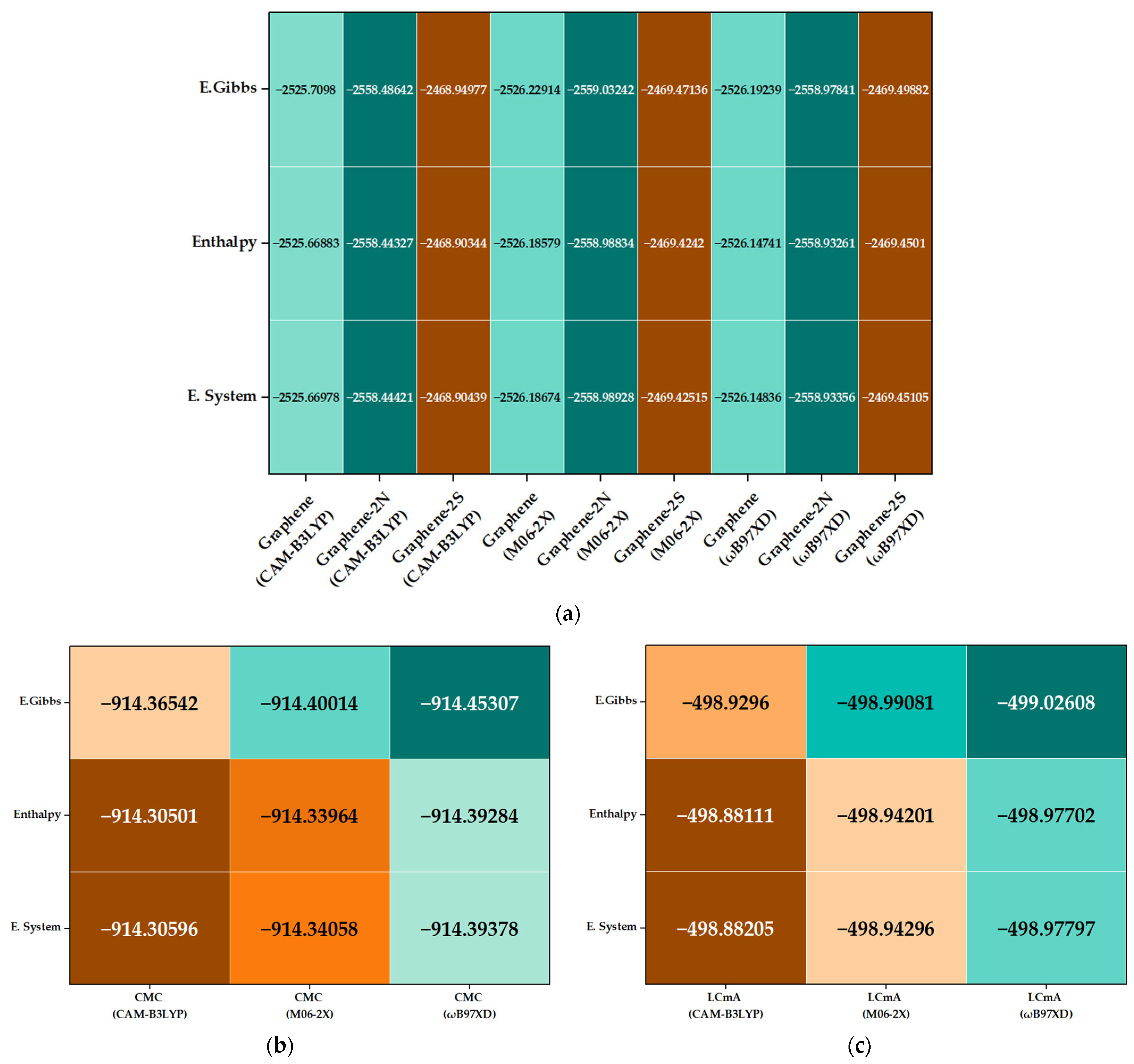
In the comparative evaluation of theoretical methods (
Figure 1a–c), the (E. system), (H) and (G) (Hartree) obtained with CAM-B3LYP, M06-2X, and ωB97X-D for pristine graphene, doped graphene (2N and 2S), and two representative ligands (CMC and LCmA) to verify the thermochemical consistency of the protocol and estimate the sensitivity of the energy profile to the choice of functional.
Figure 1a shows highly consistent internal behavior for all surfaces: the order (E. system < H<G) is strictly preserved. The thermal correction (H-E. system) remains virtually unchanged in all cases, ≈(9.4–9.5) × 10
−4 Ha (≈0.59–0.60 kcal·mol
−1, using 1 Ha = 627.51 kcal·mol
−1), indicating that the thermal contributions incorporated (from the vibrational treatment used) do not introduce appreciable dispersion between functionals or between compositions. In contrast, the separation (H-G), dominated by the entropic term (−TΔS), is the contribution that controls the magnitude of (G) with respect to (H) and shows reproducible trends with both doping and functional: for pristine graphene, (H-G) increases from 0.04097 Ha (CAM-B3LYP) to 0.04335 Ha (M06-2X) and 0.04498 Ha (ωB97X-D), while in graphene-2N it is 0.04315–0.04580 Ha, and in graphene-2S it ranges from 0.04633–0.04872 Ha, preserving the hierarchy (H-G)(2S) > (H-G)(2N) > (H-G)(pristine) across all three levels of theory. This consistency suggests that doping systematically increases the effective entropic contribution to (G), which is chemically reasonable, given that the incorporation of heteroatoms modifies the sheet’s vibrational spectrum and polarizability, with the contribution associated with 2S being more pronounced. At the same time, the absolute energies show the expected shift when the functional is varied (for example, in pristine graphene (E. system) it goes from −2525.66978 with CAM-B3LYP to −2526.18674 with M06-2X and −2526.14836 with ωB97X-D), an effect attributable to intrinsic differences in the exchange-correlation balance and in the description of long-range interactions. Therefore, these values should be interpreted as internal references for each method, not as magnitudes directly comparable across functionals.
In
Figure 1b, corresponding to CMC, the same consistency signature is reproduced: (H-E. system) remains in the same order (≈9.4 × 10
−4 Ha), confirming the stability of the thermal component, while (H-G) is significantly higher than on the surfaces (0.06023–0.06050 Ha, ≈37.8–38.0 kcal·mol
−1), which is consistent with a more flexible polymeric ligand and a higher density of accessible vibrational modes that increase the entropic contribution to (G). In addition, the progressive stabilization of the absolute energies can be seen when moving from CAM-B3LYP to M06-2X and ωB97X-D (for example, (G): −914.36542 → −914.40014 → −914.45307), showing that the sensitivity to the functional is mainly concentrated in the electronic term. Similarly,
Figure 1c (LCmA) retains a practically constant (H-E. system) and exhibits a lower (H-G) than CMC (0.04849–0.04906 Ha, ≈30.4–30.8 kcal·mol
−1, consistent with lower conformational flexibility and/or a reduced effective vibrational contribution. Here too, the systematic shift of (E. system), (H), and (G) with the functional (e.g., (G): −498.92960 → −498.99081 → −499.02608) confirms that the electronic description dominates the variation between methods, while the thermal corrections remain controlled and comparable.
Figure 1 demonstrates that the thermochemical protocol is internally consistent and that the trends in (H-G) with respect to doping and ligand type are reproducible across functional changes; therefore, the methodological decision was based on identifying the functional that most accurately describes the electronic component relevant to the phenomenon of interest. Considering that non-covalent and long-range contributions strongly influence the interaction of organic ligands on sp
2 surfaces, ωB97X-D/LANL2DZ was selected as the theory level for the comparative energy and thermochemical analysis of the system, since it offers a more robust description of these effects than CAM-B3LYP and, in relation to M06-2X, the more consistent treatment of dispersion interactions in adsorption scenarios on graphene.
3.2. Optimized Configurations and Minimum Energy Complexes
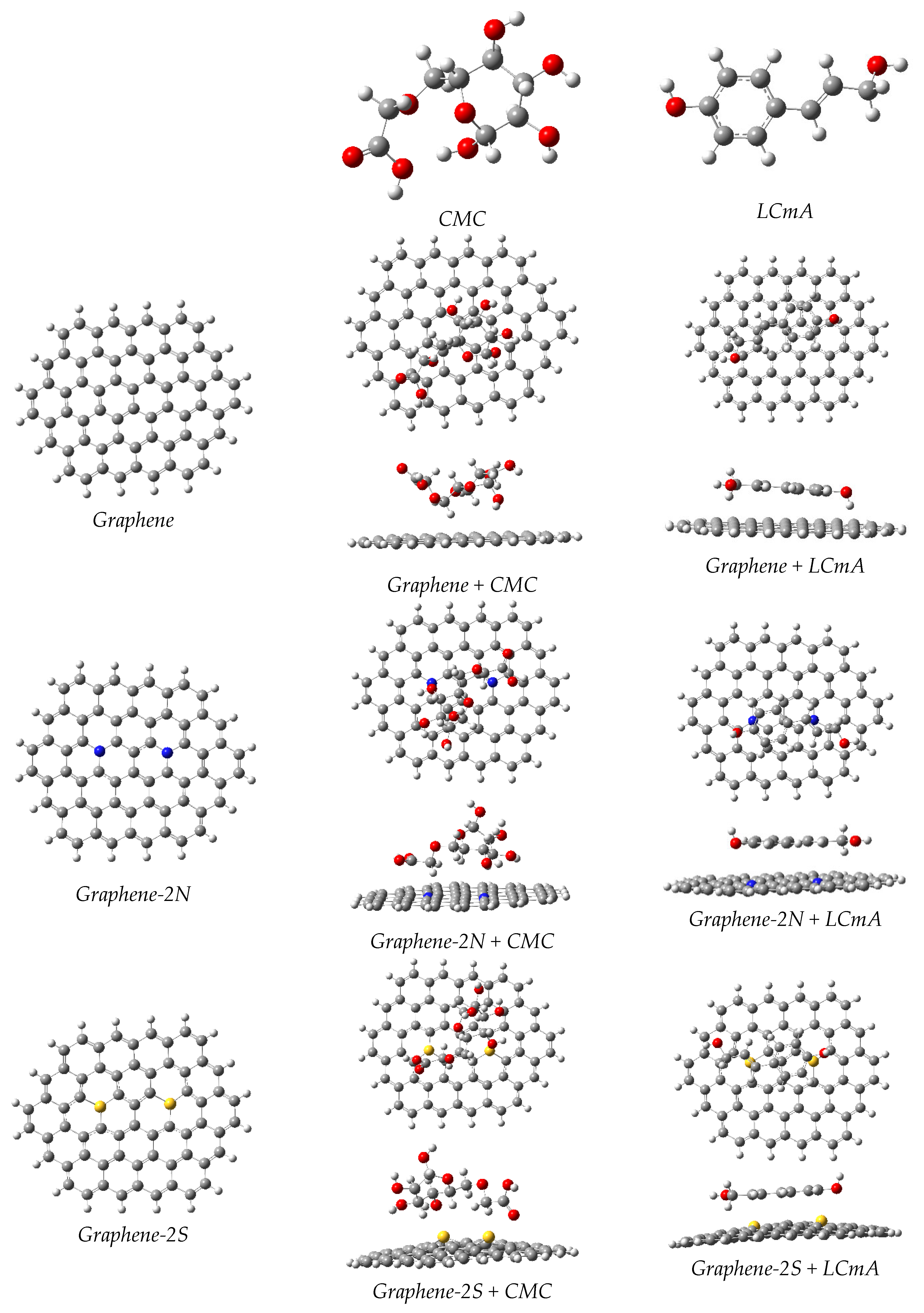
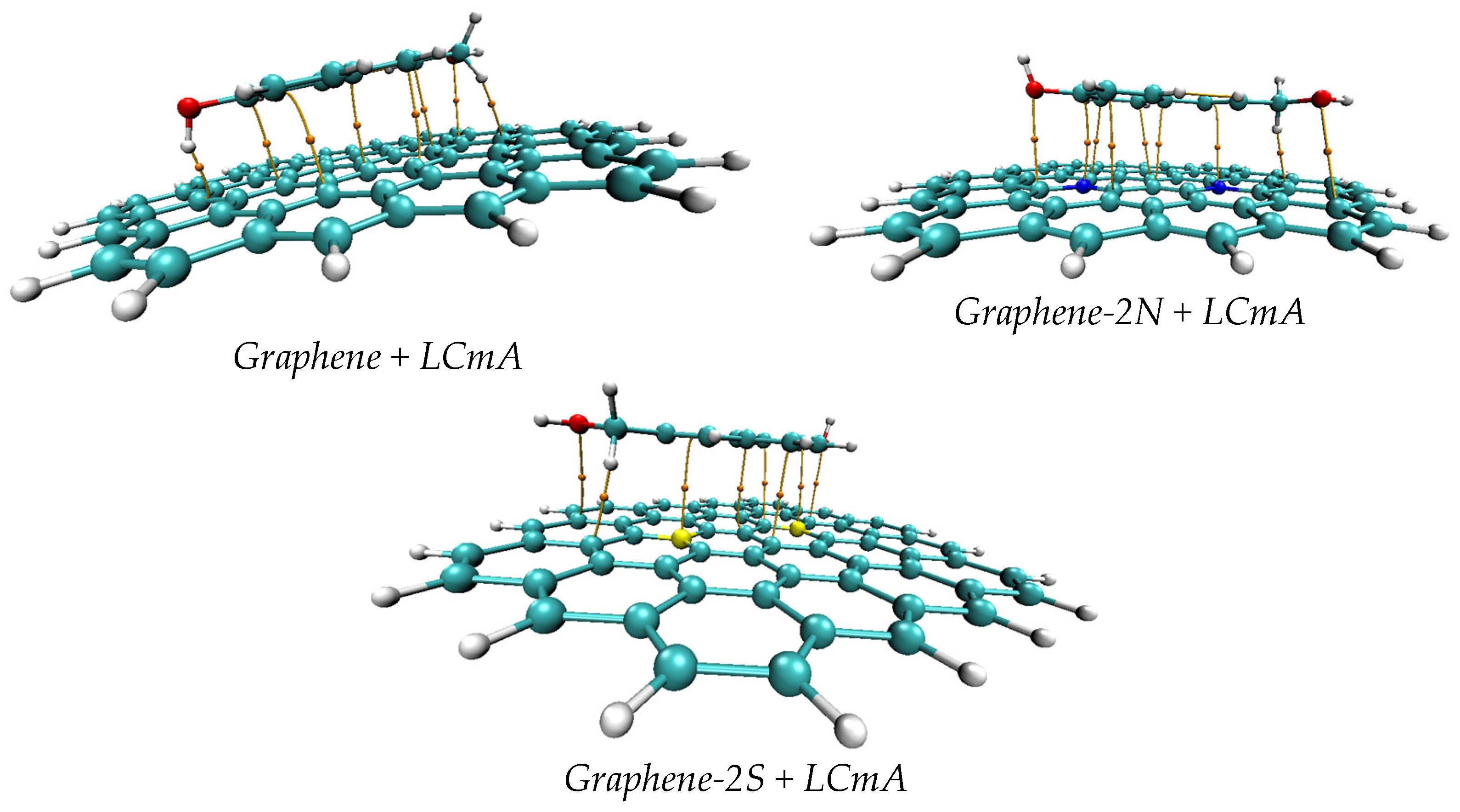
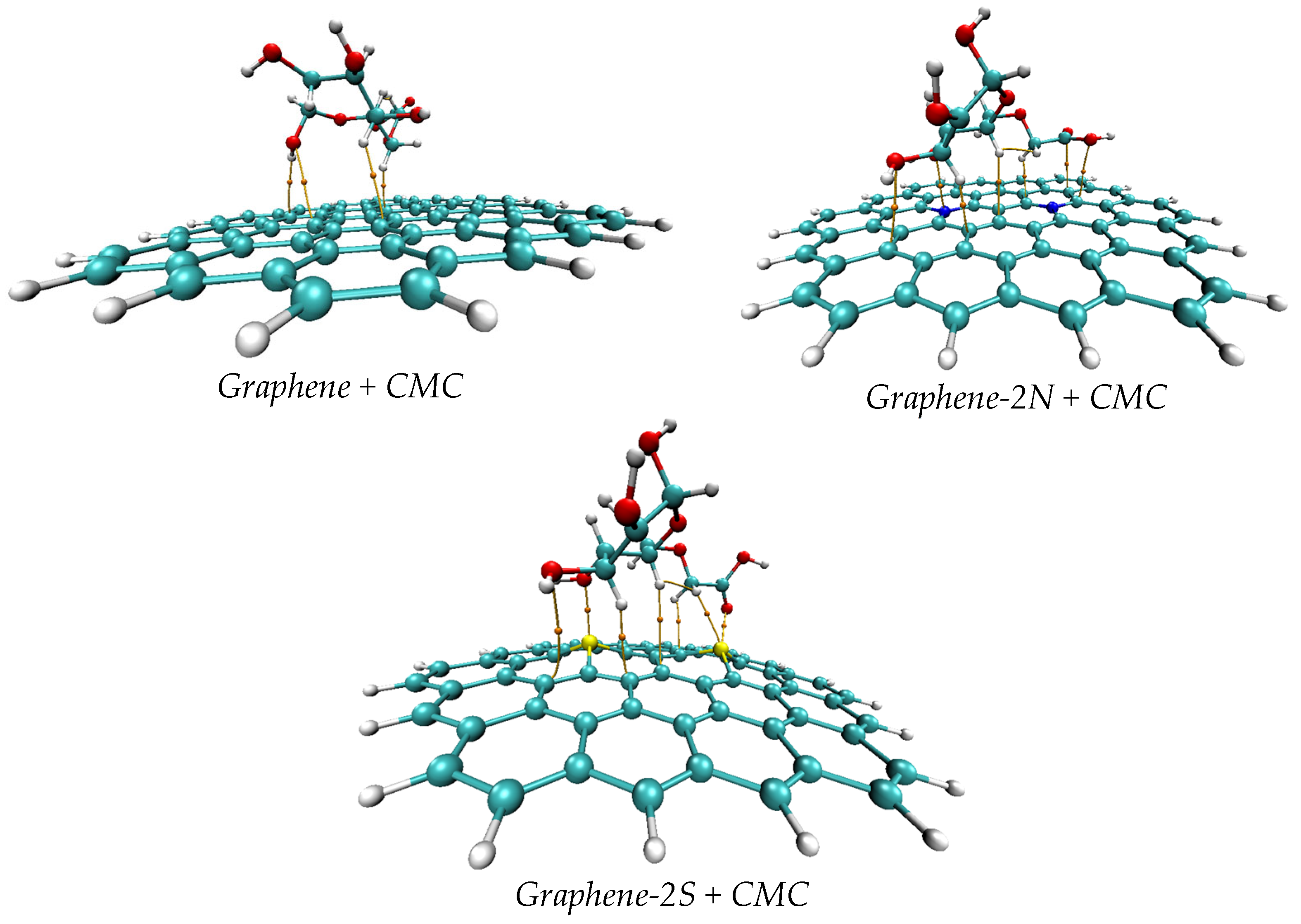
Figure 2 shows the optimized geometries at the ωB97X-D/LANL2DZ level for the CMC and LCmA binders and their lowest-energy complexes within the sampled parallel-orientation set on pristine graphene and on doped graphene-2N and graphene-2S surfaces, with the conformational space restricted to parallel orientations (lay-down adsorption).
This analysis reveals a clear structural contrast between the isolated ligands: CMC adopts more flexible conformations enriched in oxygenated groups, enabling multiple simultaneous contacts, whereas LCmA exhibits a more rigid framework with a greater aromatic contribution, which anticipates distinct coupling mechanisms on an sp
2 carbon surface. After optimization at the ωB97X-D/LANL2DZ level, the top and side views confirm that complex stabilization occurs predominantly through physisorption, with no geometric evidence of covalent C–C or C–X bond formation with the substrate. Instead, the assembly is governed by a balance between maximizing the effective contact area and accommodating polar substituents without excessively disrupting graphene’s flatness and conjugation. In pristine graphene, the conjugated network preserves its characteristic hexagonal planarity (C–C bonds of ~1.42 Å), which favors parallel adsorption configurations. Under these conditions, LCmA predominantly adopts an almost coplanar π–surface stacking arrangement, typically associated with interfacial separations close to the graphitic distance (~3.3–3.5 Å), with average C···C contacts of ~3.4 Å. By contrast, CMC tends to partially flatten over the surface by increasing the number of O···π and CH···π interactions; this multipoint anchoring allows several oxygen atoms to orient toward the sheet without requiring pronounced inclinations, maintaining a lay-down-type adsorption motif. In addition to the qualitative structural inspection presented in
Figure 2, the adsorption geometry can be described using two comparative descriptors: (i) an interfacial spacing parameter and (ii) an orientation parameter. For LCmA, the spacing is conveniently interpreted as the representative separation between the aromatic moiety and the graphene basal plane (or, equivalently, the average aromatic C···surface contact distances). At the same time, the orientation is described by the tilt angle of the aromatic ring relative to the graphene plane. For CMC, however, adsorption proceeds through a flexible multipoint motif involving several oxygenated groups and non-equivalent local contacts; therefore, a single global spacing or angle is less representative of the actual interfacial arrangement. Accordingly, the CMC adsorption geometry is more appropriately discussed in terms of multipoint anchoring, local contact distances, and conformational accommodation over the surface.
The introduction of dopants modifies both the sheet’s local response and the ligand accommodation pattern. In Graphene-2N, substitution by N introduces a more polar and slightly contracted region due to the smaller covalent radius of nitrogen and the relative shortening of the C–N bond (typically ~1.37–1.40 Å versus ~1.42 Å in C–C), which favors more compact stacking and, in CMC, the reorientation of hydroxyl/carboxylate groups toward the doped area. In these geometries, the multipoint contact of CMC becomes more evident because, in addition to dispersion, directional N···H–O interactions can be established H–O interactions (with characteristic non-covalent distances of the order of ~2.0–2.3 Å, when the orientation allows it) can be established, maintaining small angles of inclination with respect to the substrate plane (usually ≤15° in parallel configurations) and promoting moderate local corrugation in the sheet observed in the side view. In contrast, LCmA retains a “cleaner” and more homogeneous π–surface stacking, with less need for global deformation of the graphene; however, the functional fragment tends to position itself close to the doped domain, where local polarity can stabilize weak electrostatic contacts and modulate the interfacial distance without losing the parallel orientation of the aromatic core.
In Graphene-2S, the larger radius and different effective hybridization around S manifest themselves in longer C–S bonds (typically ~1.74–1.78 Å) and out-of-plane protrusions that increase local roughness (buckling of the order of ~0.3–0.5 Å). This topography reduces the uniformity of π stacking and forces a more pronounced geometric adjustment of the adsorbate: in CMC, part of the oxygenated ensemble is concentrated over the doped region, where polarizable O···S contacts (non-covalent, usually in the range ~3.2–3.6 Å) can be optimized, accompanied by local deformation of the sheet compatible with dispersion/polarizability-enhanced anchoring and steric adaptation; in LCmA, the aromatic nucleus remains essentially parallel, but a readjustment occurs to accommodate the roughness induced by S, with an interfacial separation that tends to increase with respect to pristine graphene (often towards values of the order of ~3.6–3.8 Å in scenarios with greater corrugation) and with more noticeable twists in the substituents to avoid steric repulsions.
3.3. Boundary Orbital Energies and HOMO–LUMO Gap
Table 1 shows that pristine graphene has a ΔEgap of 0.16052 eV (HOMO = −0.21528 eV; LUMO = −0.05476 eV), indicating a highly conjugated π system in which the frontier levels are relatively close in the finite model used. When doping is introduced, the response depends on the heteroatom and the level that shifts most intensely.
It is important to note that the reported HOMO–LUMO gaps correspond to finite hydrogen-terminated graphene nanoflakes (C66H20-based models) and therefore should not be interpreted as direct substitutes for the electronic gap of extended/infinite graphene. In finite flakes, the orbital gap depends strongly on flake size, shape, edge termination, and dopant placement. Accordingly, the values reported here are used as internal comparative descriptors to assess the relative electronic perturbation induced by 2N and 2S substitution within a fixed model family.
A direct comparison with experimental HOMO–LUMO (or band-gap-like) values is not straightforward in this case, because the present descriptors correspond to Kohn–Sham orbital energy differences in finite, hydrogen-terminated nanoflake models in vacuums. Experimental values for graphene-based materials usually depend on morphology, defect density, edge chemistry, substrate/support effects, and the measurement technique (optical vs. transport response), which are not equivalent to the present theoretical observable.
In Graphene-2N, the gap decreases to 0.10560 eV, representing a reduction of 0.05492 eV (≈34.2%) compared to pristine Graphene. This narrowing is dominated by an increase in the HOMO (from −0.21528 to −0.16542 eV; Δ = 0.04986 eV), while the LUMO changes to a lesser extent (−0.05476 → −0.05982 eV; Δ = −0.00506 eV). In physicochemical terms, N doping “brings” the HOMO closer to the reference level, increasing the relative ease with which the material donates electron density and responds to external perturbations, which translates into greater “electronic activation” of the substrate within the analyzed set. In contrast, Graphene-2S has a ΔEgap of 0.14222 eV, with a more moderate reduction of 0.01830 eV (≈11.4%) compared to pristine Graphene; here the dominant effect is the decrease in LUMO (−0.05476 → −0.06929 eV; Δ = −0.01453 eV), while HOMO remains virtually unchanged (−0.21528 → −0.21151 eV; Δ = 0.00377 eV). This indicates that, for S, gap modulation is primarily mediated by the acceptor pathway (stabilization of the LUMO), whereas for N it is primarily mediated by the donor pathway (elevation of the HOMO). Consistently, Graphene-2N has the lowest gap in the set, with a difference of 0.03662 eV compared to Graphene-2S.
For the binders,
Table 1 shows significantly larger gaps: CMC has ΔEgap = 0.39341 eV (HOMO = −0.35190 eV; LUMO = 0.04151 eV) and LCmA ΔEgap= 0.31634 eV (HOMO = −0.28201 eV; LUMO = 0.03433 eV). Consequently, both ligands are electronically “harder” (greater HOMO–LUMO separation) than graphene surfaces, suggesting that, under an adsorption scenario dominated by physisorption, the carbonaceous substrate is the component that defines most of the overall electronic response. The comparison between CMC and LCmA is also informative: CMC has a more stabilized (more negative) HOMO and a larger gap, while LCmA shows a smaller gap (difference of 0.07707 eV), consistent with a relatively greater contribution of π/effective conjugation in LCmA compared to a more polar and electronically stabilized system in CMC.
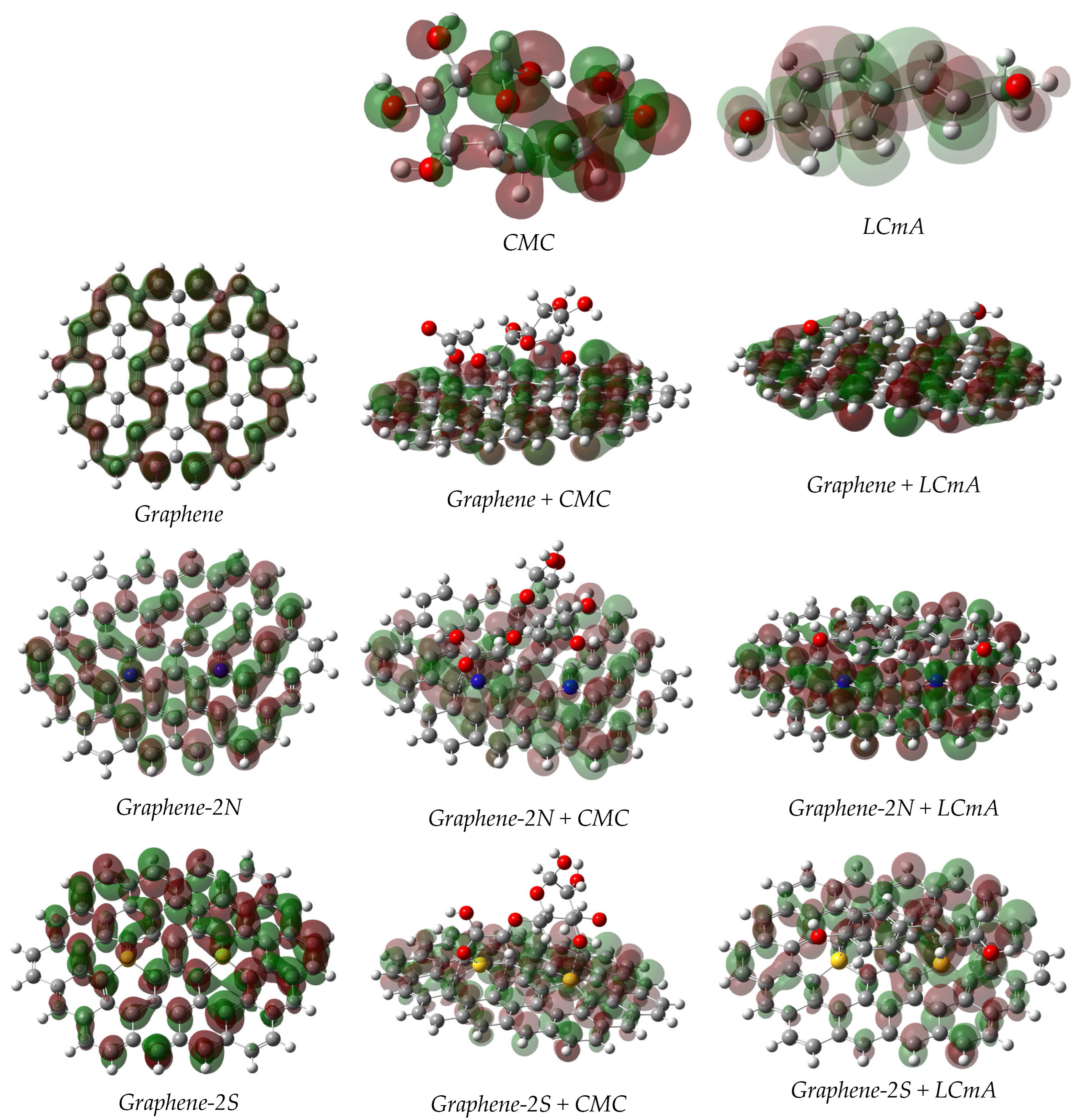
This energetic interpretation is supported by
Figure 3, which shows that the HOMO/LUMO isosurfaces of pristine graphene are widely delocalized over the sp
2 lattice, whereas doping introduces electronic heterogeneity with enhanced contributions around heteroatomic sites. In particular, the greater reduction in the gap in Graphene-2N is consistent with a more pronounced electronic perturbation of the π manifold, which favors a more sensitive interfacial coupling to the presence of the ligand (due to polarization and partial density mixing in the contact region). In surface-binder complexes, the density associated with the frontier orbitals remains dominated by the sheet, but with localized participation of the ligand in the interface, consistent with a moderate coupling regime typical of non-covalent adsorption, where the electronic modification induced by doping (especially with N) is key to modulating the reactivity and relative stability of the complexes.
3.4. Map/Distribution of Molecular Electrostatic Potential (ESP)
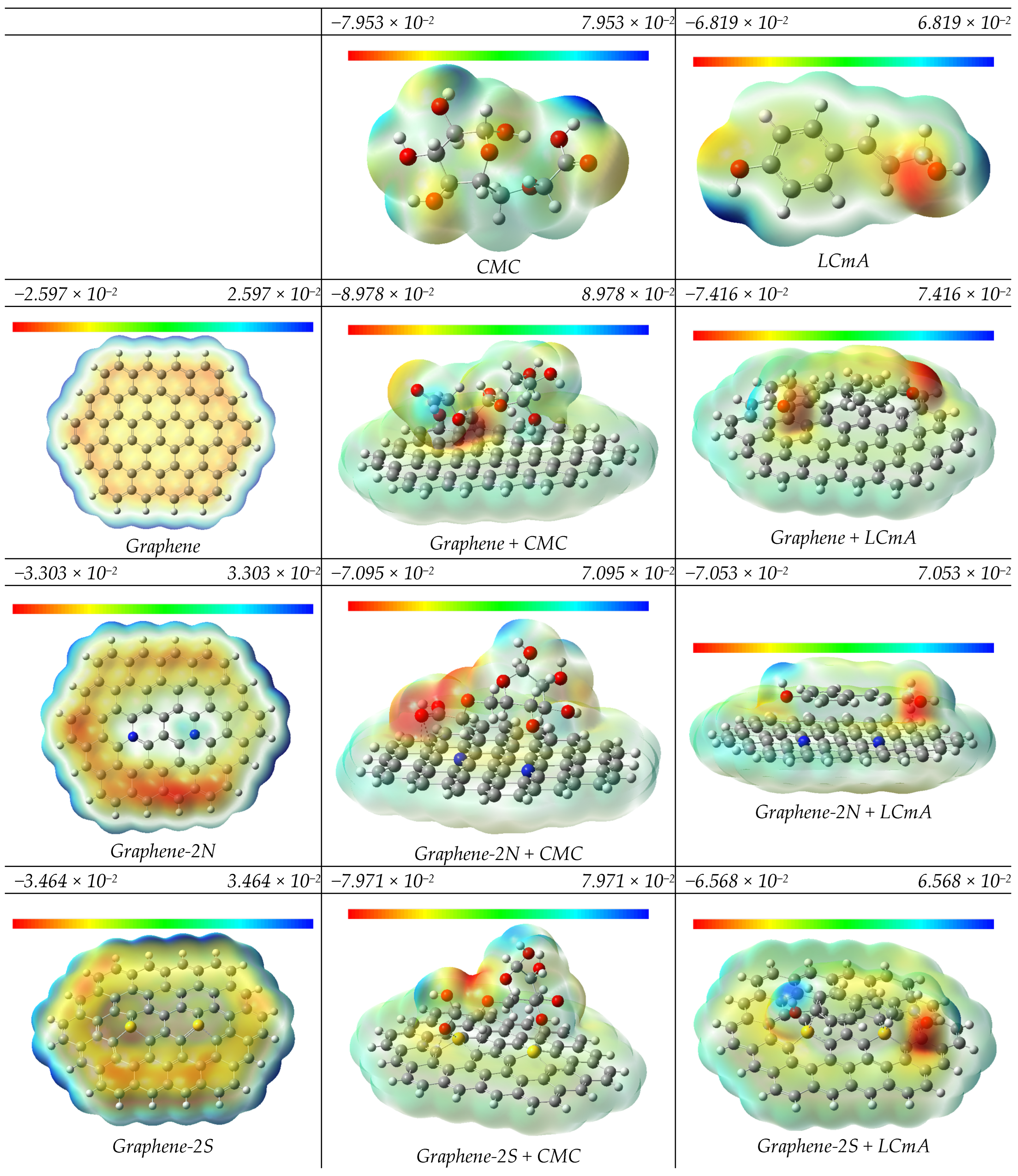
The distribution of molecular electrostatic potential (ESP) allows direct identification of domains with higher effective electron density (more negative potentials) and electrophilic regions (more positive potentials), thereby providing a physicochemical criterion for predicting preferential sites for approximation, polarization, and anchoring in non-covalent complexes. In this study, ESP maps calculated at the ωB97X-D/LANL2DZ level show a marked contrast between the lignocellulosic binders (CMC and LCmA) and the graphene surfaces (pristine and doped), as well as a characteristic redistribution upon formation of surface-binder complexes (
Figure 4).
In isolated ligands, ESP reveals high heterogeneity dominated by oxygenated heteroatoms. CMC has a wider potential range (±7.953 × 10⁻² a.u.) than LCmA (±6.819 × 10⁻² a.u.), consistent with its higher density of oxygenated functional groups and, therefore, with a higher overall polarity. In both cases, the potential minima (most negative regions) are located around the O atoms (hydroxyls/ethers/carboxyls). At the same time, the most positive areas are associated with H-rich environments and less electronegative segments of the carbon skeleton. This spatial separation of domains confirms that the ligands have complementary electrostatic “patches” that interact with polarized regions of the substrate and contribute to interaction networks through induced polarization.
In contrast, isolated graphene exhibits a much more homogeneous ESP map, closer to electrostatic neutrality, with a significantly smaller range (±2.597 × 10⁻² a.u.), characteristic of an extended sp2 sheet with delocalized π density and no heteroatoms. When doping is introduced, the range increases moderately and, above all, the electrostatic symmetry is broken: Graphene-2N reaches ±3.303 × 10⁻² a.u. and Graphene-2S reaches ±3.464 × 10⁻² a.u., showing that both dopants induce anisotropy and local polarization. In Graphene-2N, the presence of N tends to generate more pronounced domains associated with the electronegativity of the dopant and the redistribution of density in the local ring. At the same time, in Graphene-2S, the effect manifests itself with an additional component of polarizability (and the local topography associated with the dopant), which favors differentiated potential patches capable of acting as “recognition points” for polar groups of the ligand.
The formation of surface–binder complexes clearly amplifies the ESP of the total system and, simultaneously, evidences interfacial polarization. For pristine graphene, the graphene + CMC complex has the highest observed range (±8.978 × 10⁻² a.u.), while graphene + LCmA reaches ±7.416 × 10⁻² a.u.; this quantitative difference is consistent with the greater intrinsic polarity of CMC (more oxygen atoms and greater separation of partial charges), which increases the intensity of the electrostatic patches at the interface. Visually, it can be seen that the most negative domains are concentrated on the oxygenated groups of the ligand oriented towards the sheet. At the same time, the substrate develops regions of complementary potential in the contact zone, indicating a mechanism dominated by physisorption, with appreciable contributions from short-range electrostatic interactions, induced dipoles, and dispersion.
On doped surfaces, the complexes maintain this polarization signature, but with a more localized reorganization around the dopant. In Graphene-2N, the Graphene-2N + CMC and Graphene-2N + LCmA complexes show similar ranges (±7.095 × 10⁻² and ±7.053 × 10⁻² a.u., respectively), suggesting that the presence of N favors a focusing of the electrostatic field in the doped vicinity, “channeling” the interaction toward a more specific domain of the interface (rather than a more distributed pattern over the pristine sheet). In Graphene-2S, the complex with CMC (±7.971 × 10⁻² a.u.) retains a high intensity. At the same time, Graphene-2S + LCmA has the smallest range among the complexes (±6.568 × 10⁻² a.u.), consistent with CMC providing a higher density of polar sites that can exploit the polarizability induced by S and LCmA. Being less polar, it depends more on π–surface complementarity than on intense electrostatic contributions. These maps support the idea that doping not only alters the “level” of polarization of the substrate, but also the effective geometry of anchoring: N tends to promote more focused electrostatic coupling, while S combines polarization with topographical/polarizable effects that can favor or limit the intensity of the coupling depending on the density of oxygenated groups in the ligand.
In mechanistic terms, the integrated reading of
Figure 4 is consistent with a scenario where the stability of the complexes arises from the sum of dispersion (explicitly captured by ωB97X-D) and an electrostatic contribution modulated by (a) the polarity of the binder (CMC > LCmA) and (b) the electronic heterogeneity introduced by doping (2N and 2S). Thus, the ESP maps provide qualitative and semi-quantitative evidence of electrostatic complementarity at the interface, identifying active regions for interaction and supporting the conclusion that CMC, due to its greater electrostatic anisotropy, has a higher potential to establish multipoint contacts with graphene and its doped variants.
Although a net charge-transfer value was not quantified through Bader partitioning in this study, the ESP maps provide clear qualitative evidence of adsorption-induced interfacial polarization and local charge redistribution, especially in the vicinity of the doped domains. In the present closed-shell physisorption regime, these polarization effects are mechanistically more informative than assuming a large net electron transfer between fragments.
3.5. Spatial Analysis of the Electronic Location Function (ELF)
The Electronic Localization Function (ELF) allows us to describe, in real space, the degree of localization of electron pairs (high ELF values, typically associated with bonding regions or free pairs) versus delocalization regions (lower values, characteristic of more “electron gas-like” density or extended conjugation).
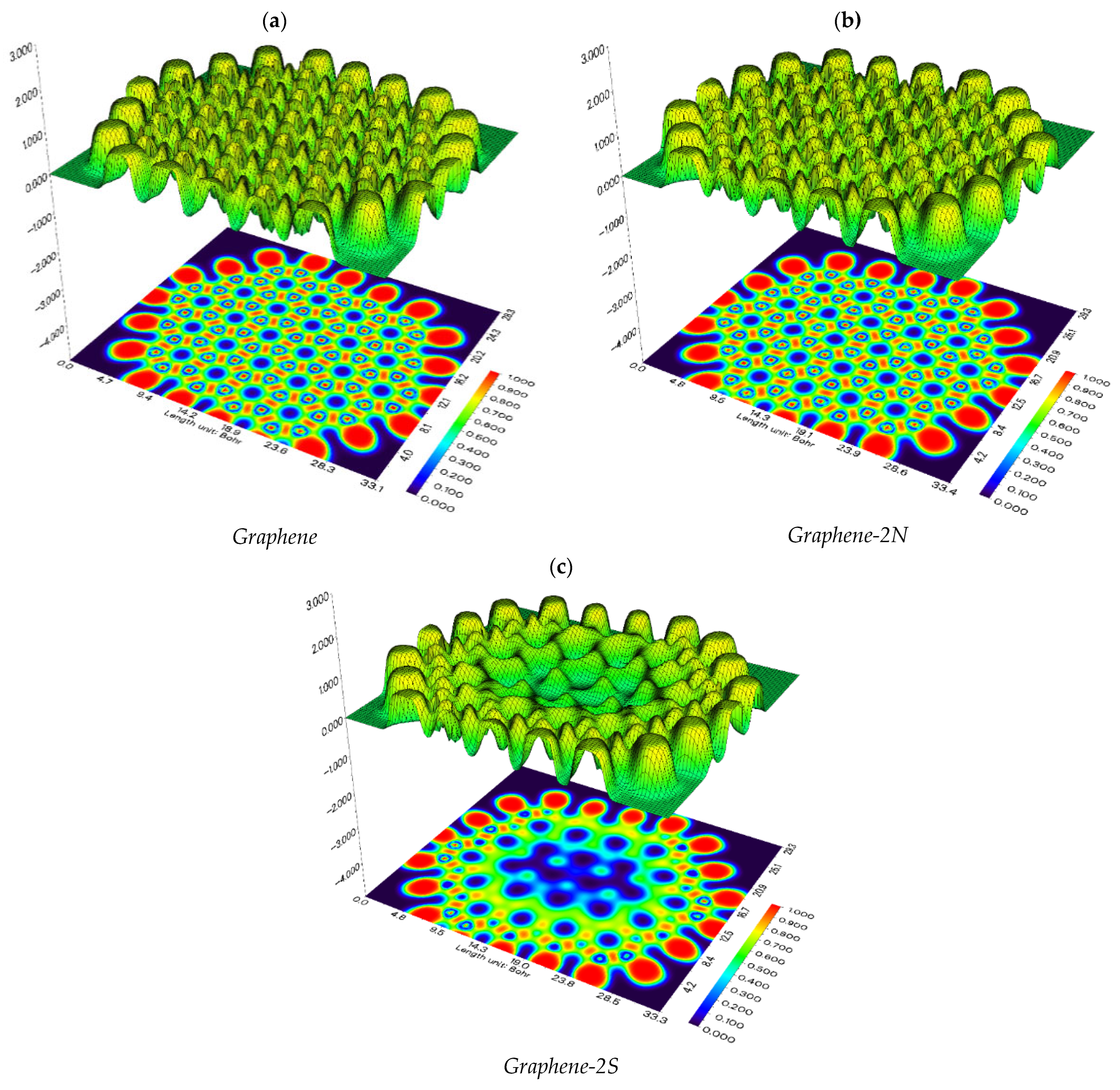
Figure 5 shows shaded-relief maps and their 2D projections for pristine graphene (
Figure 5a), Graphene-2N (
Figure 5b), and Graphene-2S (
Figure 5c), calculated at the ωB97X-D/LANL2DZ level, to visualize how doping alters the electronic organization of the sp
2 sheet.
In pristine graphene (
Figure 5a), a highly periodic and homogeneous pattern is observed, with ELF maxima distributed regularly over the hexagonal lattice. This periodicity is consistent with a sp
2 sheet, in which σ bonds remain relatively localized in the bonding regions. At the same time, π density remains delocalized over the conjugated plane, resulting in a moderate and uniform localization “background.” In physicochemical terms, this map supports the idea of an electronically homogeneous substrate, in which local reactivity (in the absence of defects) is poorly differentiated, and interactions with adsorbates depend more on the effective contact surface and dispersion than on specific electronic “active sites.”
For Graphene-2N (
Figure 5b), the general pattern of periodicity is preserved, but local disturbances associated with the dopant atoms appear. This preservation indicates that doping with N, although it introduces electronic heterogeneity, does not significantly disrupt the sheet’s overall conjugation in the model considered. The ELF variations are concentrated in the vicinity of the dopant, which is consistent with the higher electronegativity of N and the redistribution of density in its vicinity: local domains are generated where the location/organization of electron pairs changes with respect to pristine graphene, creating regions with a greater capacity to polarize and interact directionally with functional groups of the ligand (for example, domains favorable for electrostatic contacts or polarization coupling).
In contrast, Graphene-2S (
Figure 5c) shows the most obvious modification: the map loses some of the uniformity observed in (a) and (b), and a large central region with relatively lower ELF values appears (blue area in the 2D projection), accompanied by a marked redistribution of the maxima. This behavior is consistent with the fact that doping with S, due to its larger size and polarizability, induces more pronounced structural and electronic perturbations, reducing the equivalence of the sp
2 domains and disrupting the continuity of local conjugation. In practical terms, the breakdown of ELF homogeneity implies that the S-doped sheet develops more contrasting electronic “landscapes,” where areas with lower localization (more susceptible to collective delocalization/polarization) coexist with areas with higher localization concentration associated with the dopant environment. This heterogeneity is particularly relevant for adsorption: compared to Graphene and Graphene-2N, Graphene-2S tends to behave as a substrate with more differentiated electronic and topological sites, which can favor specific anchoring of ligands with oxygenated groups (due to polarization and local complementarity), but it can also penalize ideally coplanar π stacking configurations if the perturbation reduces the electronic continuity of the plane.
3.6. Electronic Characterization Using Relief LOL Maps
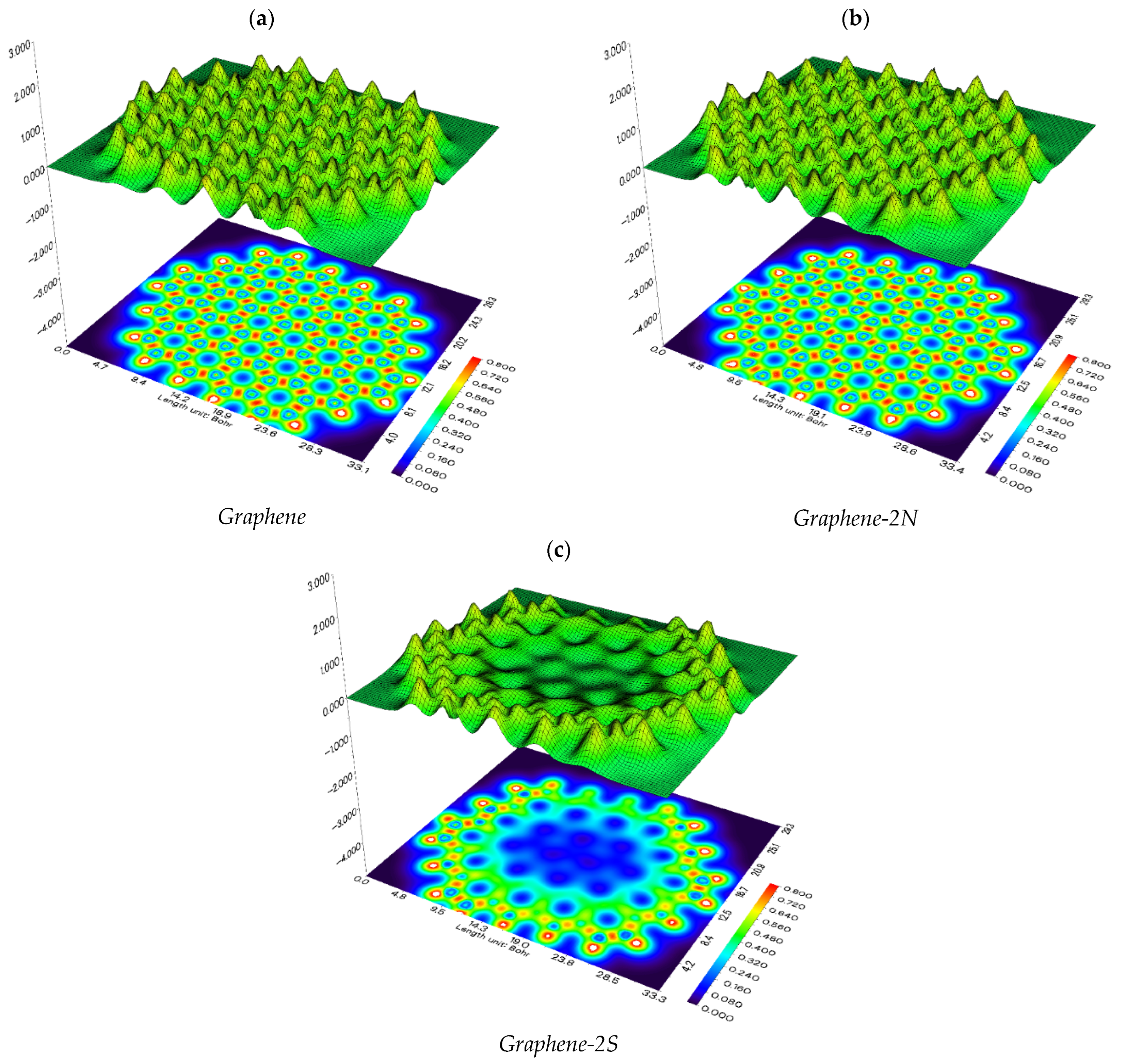
Figure 6 shows the relief topographic maps of the Localized Orbital Locator (LOL) for pristine graphene, graphene-2N, and graphene-2S, obtained at the ωB97X-D/LANL2DZ level. The LOL is a real-space descriptor closely related to the organization of electron density: high values (peaks in the relief) correspond to regions where the density is more localized (σ component and areas of greater orbital confinement). In contrast, low values reflect regions with greater delocalization, consistent with the extended nature of the π system in graphitic materials. Therefore, comparative analysis of the relief and its 2D projection allows us to evaluate how doping introduces electronic heterogeneity and, consequently, modifies the “landscape” of surface interaction.
In pristine graphene (
Figure 6a), a highly periodic and regular pattern is observed, with repetitive maxima distributed uniformly throughout the hexagonal lattice. This topography is consistent with an ideal sp
2 sheet, in which σ bonds maintain a well-defined local order and the π system contributes to extended delocalization without breaking the map’s symmetry. In physicochemical terms, the periodicity of the LOL indicates an electronically homogeneous substrate, with no pronounced “preferential electronic sites,” so that the differentiation of anchoring regions for adsorbates would depend mainly on geometric effects (contact area) and induced polarization.
For Graphene-2N (
Figure 6b), the relief retains the overall periodic structure of graphene, but with local disturbances attributable to nitrogen substitution. The preservation of periodicity suggests that doping with N, at least for the configuration considered (2N), does not destroy the extended conjugated character of the sheet, but rather introduces locally modified domains around the dopants. These perturbations manifest as specific changes in the intensity/shape of the LOL peaks and in the local symmetry of the 2D projection, consistent with a focused electronic redistribution that increases the anisotropy of the substrate without substantially compromising uniformity. In the context of ligand interactions, this implies that Graphene-2N can offer regions of differential affinity associated with the dopant environment, without losing the ability to stabilize coplanar configurations via π-surface coupling.
In contrast, Graphene-2S (
Figure 6c) exhibits the most marked modification of the LOL landscape. The 2D projection reveals an extensive central region of low values (dominance of cold tones) and a redistribution of maxima toward peripheral regions, indicating a partial loss of the uniformity observed in Graphene and Graphene-2N. This pattern is consistent with sulfur doping, which introduces a stronger perturbation due to its larger size and polarizability, generating greater electronic heterogeneity and increasing the spatial anisotropy of the descriptor. From a surface point of view, the result implies that Graphene-2S develops domains with different propensities for localization/delocalization, which favors more “site-specific” behavior: certain regions can polarize or couple more intensely with the adsorbate’s functional groups. In contrast, others behave as domains that are relatively less favorable for ideally homogeneous π stacking.
3.7. Interaction Energy
Table 2 compiles the interaction energies,
(kcal·mol
−1), corresponding to the association of CMC and LCmA binders with three graphene surfaces: pristine, doped with 2N, and doped with 2S. In this context, lower
values are interpreted as greater affinity and, consequently, more pronounced interfacial stabilization.
Given that BSSE corrections were not included, the values are discussed in a comparative/semi-quantitative sense, with emphasis on relative selectivity trends rather than absolute adsorption magnitudes.
In pristine graphene, LCmA exhibits a substantially more favorable interaction (−99.3 kcal·mol−1) than CMC (−23.7 kcal·mol−1). This gap suggests that, on a flat, electronically uniform sp2 surface, contributions from extended contact and dispersion/π–π prevail, favoring a ligand with greater aromatic character, such as LCmA, which can maximize stacking. In contrast, although CMC has numerous oxygenated groups, its stabilization depends more on multipoint anchors and local electrostatic complementarity, mechanisms that pristine graphene does not enhance to the same extent, resulting in a comparatively weak interaction.
When 2N is introduced, selectivity changes markedly: CMC strengthens dramatically to −93.7 kcal·mol−1, while LCmA remains strongly stabilized at −74.3 kcal·mol−1. The jump in CMC compared to pristine graphene (≈70 kcal·mol−1 more favorable) is consistent with nitrogen doping, generating electronic heterogeneity and more polarizable sites, thereby facilitating cooperative coupling in which several oxygenated groups contribute simultaneously. For LCmA, the reduction compared to the pristine case (from −99.3 to −74.3 kcal·mol−1) can be attributed to the doped surface losing some of the homogeneity necessary for ideal stacking, although without nullifying the dominant non-covalent regime.
The most disparate behavior is observed in Graphene–2S: CMC still retains an intense interaction (−71.9 kcal·mol−1), whereas LCmA drops to a practically marginal coupling (−4.1 kcal·mol−1). The drop in LCmA (≈95 kcal·mol−1 less favorable than in pristine graphene) suggests that sulfur doping induces a structural and/or electronic disturbance that severely penalizes the main stabilization mechanism of LCmA based on stacking and extended contact. In contrast, CMC maintains affinity due to its conformational flexibility and high density of oxygenated functionalities, features which allow it to adapt to local roughness/heterogeneity and sustain interactions through polarization and multi-point anchoring, albeit with less intensity than in Graphene–2N.
The results show selectivity modulated by doping: pristine graphene strongly favors LCmA; graphene–2N significantly enhances the interaction of CMC and maintains that of LCmA at a high level; and graphene–2S practically suppresses the adsorption of LCmA while preserving, to a greater extent, the affinity of CMC. This hierarchy is consistent with the ligands’ distinct chemical nature and with doping’s ability to alter both the electronic distribution and the substrate’s interfacial response.
3.8. Topological Analysis Based on AIM Theory (Atoms in Molecules)
Table 3 compiles the sums of AIM/QTAIM descriptors evaluated at the critical bonding points (BCP) that connect the surface to the binder. This analysis provides a strictly electronic reading of the anchorage, complementary to
, and allows for discussion of the type of interaction and compaction of the interfacial contact.
Consistent with this QTAIM signature, the adsorption process is better interpreted as polarization-assisted physisorption with local electronic redistribution rather than strong net electron transfer. This interpretation is also supported by the ESP, ELF/LOL, and Laplacian trends discussed above, which show dopant-dependent electronic heterogeneity and interfacial polarization without evidence of covalent bond formation.
In all complexes, the electron density at the (Pc) is low, and the Laplacian ∇2Pc is positive (0.151–0.568). In parallel, V is negative, G is positive, the ratio |V|/G remains below 1 (0.760–0.994), and the total energy density H is positive in all cases. This pattern is characteristic of closed-shell interactions, governed by dispersion, polarization, and weak electrostatic contributions. It is not accompanied by a topological signature consistent with covalent shared bonds at the interface. The conclusion is consistent with a physisorption regime, in agreement with what was previously inferred from geometries, HOMO–LUMO analyses, and ESP maps.
Within this non-covalent framework, the relative magnitudes of Pc, ∇2Pc, and |V|/G allow us to discriminate between effective strength and contact “compaction”. In pristine graphene, the complex with LCmA has the highest sum of Pc (1.55 × 10⁻¹) and a |V|/G that is practically unitary (0.994), together with a very small H (7.37 × 10⁻⁴). This combination indicates a particularly efficient contact: the potential stabilization |V| almost compensates for the kinetic cost G, a typical feature of a strong, compact non-covalent interaction, compatible with extended π–surface coupling. In contrast, Graphene–CMC exhibits a lower sum of Pc (4.14 × 10⁻²) and a |V|/G further from 1 (0.882), with a more positive H (3.98 × 10⁻³), suggesting a less compact and more kinetically penalized contact; this aligns with a weaker overall interaction that is more dependent on local contacts. In topological terms, this contrast rationalizes the energy selectivity observed in pristine Graphene, where LCmA was much more favorable than CMC.
Doping with 2N alters the interfacial balance, and the AIM topology directly reflects this. For Graphene-2N–CMC, Pc increases to 9.00 × 10⁻² and ∇2Pc to 3.43 × 10⁻¹, while |V|/G remains in the closed-layer regime (0.855). The simultaneous increase in Pc and the Laplacian is consistent with more effective contacts and/or a shorter average interfacial distance, i.e., multipoint anchoring favored by N-induced electronic heterogeneity and more pronounced interfacial polarization; this is consistent with the energetic strengthening of CMC on Graphene-2N. In Graphene-2N–LCmA, the sum of Pc decreases to 7.79 × 10⁻² and |V|/G falls to the minimum of the set (0.760), pointing to a “softer” and less compact non-covalent contact than that of LCmA on pristine graphene; the result is consistent with doping disrupting the ideal extended stacking and reducing the efficiency of π–surface coupling, while maintaining favorable overall adsorption.
In Graphene-2S, the response depends heavily on the binder. The Graphene-2S–CMC system reaches Pc = 1.29 × 10⁻¹ and the highest ∇2Pc (5.68 × 10⁻¹) of the entire series, with |V|/G = 0.920. This set suggests an interface with intense, highly polarizable contacts, consistent with CMC’s ability to adapt its conformation and capitalize on the heterogeneity introduced by S to sustain multiple closed-layer interactions (enhanced polarization and scattering). In contrast, Graphene-2S–LCmA maintains Pc around 7.91 × 10⁻² and |V|/G = 0.822, indicating that local non-covalent contacts persist; however, these descriptors do not support efficient extended coupling. In this scenario, the AIM topology agrees that doping with S compromises the flatness/registration necessary for sustained aromatic stacking, leaving localized residual interactions; this explains the low overall stabilization of the complex, despite the presence of interfacial BCPs.
Table 3 confirms that the adsorption of CMC and LCmA on graphene (pristine and doped) is governed by closed-layer non-covalent interactions (∇
2Pc > 0, H > 0, |V|/G < 1). Furthermore, it shows that doping modulates the compaction and distribution of the contact: LCmA achieves the most efficient contact on pristine graphene (|V|/G → 1 and H almost zero), while CMC benefits significantly from the electronic heterogeneity introduced by 2N and 2S, which increases Pc and ∇
2Pc and favors multipoint anchoring (
Figure 7 and
Figure 8).
In line with the trends discussed in HOMO–LUMO, ESP, ELF/LOL, interaction energies, and AIM descriptors,
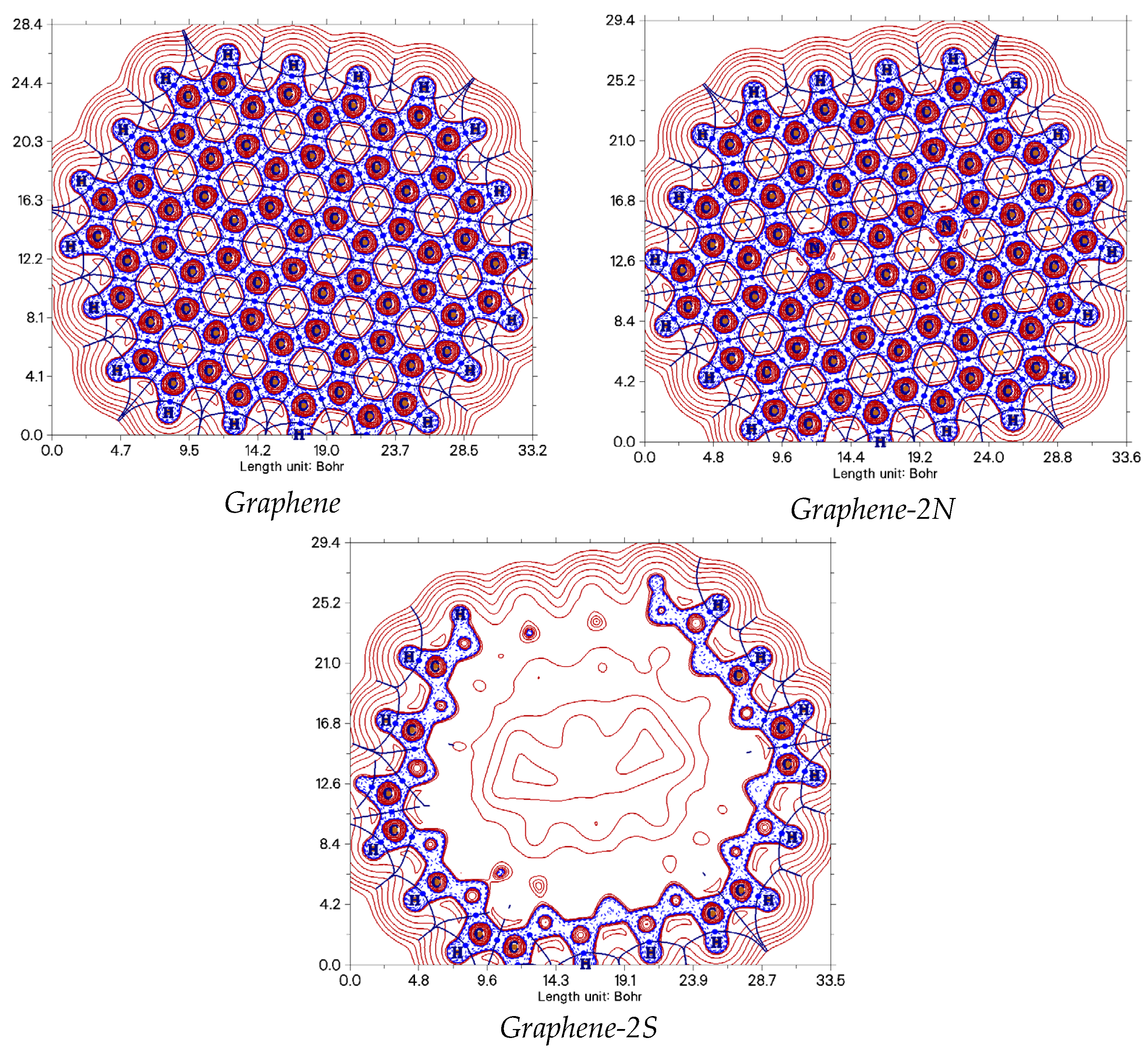
Figure 9 provides real-space evidence of how doping redefines the charge distribution in the sheet through contour maps of the Laplacian of the electron density ∇
2P. In these maps, blue regions (∇
2P < 0) are associated with charge accumulation, while red regions (∇
2P > 0) correspond to depletion. For pristine graphene, the pattern is highly periodic and homogeneous, reflecting the electronic equivalence of the sp
2 lattice and explaining why, in the absence of polarized sites, the interfacial affinity is dominated by extended contact and dispersion mechanisms. This reading is consistent with
Table 2, where the pristine surface markedly favors LCmA through effective π–surface coupling, and with
Table 3, where the graphene–LCmA complex shows the most “compact” AIM contact within the non-covalent regime, with |
V|/
G close to unity.
When doped with 2N,
Figure 9 shows a localized break in the symmetry of the graphene, with a redistribution of blue and red domains around the N atoms, without completely losing the overall periodicity. This behavior is the signature of the local polarization of the basal plane, which increases the substrate’s ability to stabilize approaches to electronegative groups through electrostatic complementarity and induced polarization. Consequently, it is directly connected to the more pronounced decrease in ΔEgap observed for Graphene-2N and in the ESP maps, where doping increases the anisotropy of the surface potential. This local electronic activation also explains the change in selectivity in
Table 2, where Graphene-2N strongly enhances interaction with CMC, as reflected in
Table 3 as an increase in Pc and ∇2Pc for the Graphene-2N–CMC complex, consistent with intensified multipoint anchoring, although always within a closed-layer regime.
In contrast, doping with 2S produces the most drastic change in
Figure 9, where the distribution ceases to be uniformly periodic and a larger-scale reorganization appears with extensive regions dominated by contours associated with depletion and more localized accumulations at the edge and in the vicinity of the dopant. This landscape is consistent with what has already been observed in ELF and LOL, where Graphene-2S showed a loss of uniformity, with central domains exhibiting lower relative localization, indicating a deeper disruption of effective conjugation along the basal plane. From an interfacial perspective, this heterogeneity explains why Graphene-2S maintains a favorable interaction with CMC but effectively inhibits efficient coupling of LCmA, as shown in
Table 2. The extended depletion and associated electronic roughness penalize the uniform π stacking required by LCmA, leaving only localized residual contributions, consistent with the AIM descriptors for Graphene-2S–LCmA, indicating that non-covalent contacts are present but do not achieve the compact character of the pristine system.
Figure 9 integrates and validates the common thread running through the previous analysis, in which 2N acts as a dopant that introduces locally polarized sites without destroying global conjugation, thereby favoring multipoint anchors with polar ligands such as CMC. At the same time, 2S imposes a more extensive and heterogeneous electronic redistribution, reducing compatibility with ligands whose dominant mechanism depends on extended π–surface contact, such as LCmA.
4. Conclusions
This DFT study shows that double substitutional doping in graphene (2N and 2S) acts as an effective control parameter for both electronic activation and interfacial selectivity toward lignocellulosic binders with different chemical character (CMC and LCmA). Within the finite nanoflake models used, 2N doping produces the strongest perturbation of the frontier-orbital structure (largest reduction in the HOMO–LUMO gap), whereas 2S doping induces a more moderate gap change but a stronger disruption of local electronic uniformity, as evidenced by ESP, ELF/LOL, and Laplacian analyses. The adsorption-energy trends reveal dopant-dependent selectivity. Pristine graphene strongly favors LCmA, consistent with efficient aromatic/dispersion-driven surface contact. In contrast, Graphene-2N substantially enhances CMC adsorption while maintaining strong LCmA interaction, indicating a more balanced interfacial compatibility. Graphene-2S maintains a favorable interaction with CMC but strongly penalizes LCmA, consistent with a surface environment less compatible with extended coplanar aromatic stacking. QTAIM analysis supports a closed-shell, non-covalent interaction regime in all complexes and shows that doping modulates contact compactness and multipoint anchoring efficiency rather than inducing covalent interfacial bonding.
From a design perspective, these results suggest that double substitutional doping should be treated as a surface-engineering variable for tuning binder compatibility in graphene-based electrode interfaces: pristine graphene is more compatible with aromatic lignin-like fragments, 2N doping offers the most balanced behavior for polar and aromatic binders, and 2S doping is more favorable for oxygenated, conformationally adaptable binders such as CMC. Although the present study is theoretical, several predicted trends can be indirectly examined experimentally through XPS/Raman analysis of doped surface chemistry and through binder–surface compatibility metrics such as wettability, adhesion/peel tests, and electrochemical performance evolution. The present calculations also have limitations when compared with broader modeling approaches reported in the literature, including the use of finite hydrogen-terminated graphene nanoflakes (rather than periodic surfaces), a single representative dopant arrangement for each dopant type (2N and 2S), restricted adsorption sampling (parallel/lay-down configurations), the LANL2DZ basis set, and the absence of BSSE-corrected interaction energies. Therefore, the conclusions should be interpreted as controlled comparative mechanistic trends, which can guide future periodic, broader configurational, and experimentally informed studies.