
Review

Green Approaches to the Surface Modification of Cellulose: Methods and Mechanisms

1
Department of Chemistry, Manipal Institute of Technology, Manipal Academy of Higher Education, Manipal 576104, India
2
Department of Aeronautical and Automobile Engineering, Manipal Institute of Technology, Manipal Academy of Higher Education, Manipal 576104, India
*
Author to whom correspondence should be addressed.
J. Compos. Sci. 2026, 10(2), 99; https://doi.org/10.3390/jcs10020099
Submission received: 7 November 2025 / Revised: 23 December 2025 / Accepted: 16 January 2026 / Published: 13 February 2026
(This article belongs to the Section Biocomposites)

Abstract

Cellulose, as the most abundant renewable biopolymer on Earth, provides significant potential for sustainable material development. However, its native hydrophilicity, crystallinity, and poor compatibility with nonpolar systems limit its use in advanced applications. To overcome these challenges, a broad spectrum of organic reactions has been employed to chemically modify cellulose, enabling fine-tuning of its surface chemistry, solubility, thermal stability, and interfacial behavior. This review highlights key modification strategies, including esterification, etherification, click chemistry, and isocyanate-based urethanization, as well as oxidation methods that introduce reactive functionalities for further coupling. The discussion includes both dispersion-based (heterogeneous) and solution-based (homogeneous) reaction systems, emphasizing the influence of reaction conditions, solvent selection, and catalytic approaches. These organic transformation routes allow the integration of cellulose into a wide range of functional materials such as biodegradable plastics, hydrophobic coatings, biomedical scaffolds, flame-retardant composites, and flexible electronics, thereby positioning chemically modified cellulose as a versatile platform for next-generation sustainable technologies.

1. Introduction

The growing demand for high-performance materials, along with increasing environmental issues, has created a need for sustainable alternatives to conventional petroleum-derived polymers. Although synthetic plastics are versatile and cost-effective, they contribute to long-term environmental damage, including ongoing environmental pollution, limited recyclability, and dependence on non-renewable resources [1,2]. These issues need urgent attention to identify and develop renewable, biodegradable materials that can match or exceed the functionality of the existing polymers and minimize the environmental impact.
Cellulose is a linear polysaccharide that is composed of β (1 → 4)-linked D-glucose units and is one of Earth’s most abundant biopolymers. Cellulose is an important sustainable resource due to its abundance and renewable sourcing from plants, tunicates, algae, and bacteria. When two glucose molecules connect through a β (1→4) glycosidic bond, they form a compound called cellobiose, a simple sugar pair that repeats to build the long chains of cellulose. These straight chains are composed of hundreds to thousands of glucose monomers linked together, which is why cellulose has a high molecular weight. Each glucose unit of cellulose has three reactive -OH (hydroxyl) groups at C2, C3, and C6 positions, making the structure highly versatile for chemical modifications. Cellulose is the primary structural component of plant cell walls. The degree of polymerization of native cellulose can vary significantly depending on the source of the cellulose [3]. For example, in wood pulp, it is a few hundred, whereas in cotton, it exceeds ten thousand. This length influences properties like fiber strength. Cellulose is insoluble in water and most common solvents due to its strong hydrogen-bonded network. Certain microbes, such as bacteria, fungi, and protozoa, produce enzymes called cellulases that hydrolyze β (1 → 4) linkages in cellulose. Ruminant animals utilize cellulose as a food source through the action of cellulase producing symbiotic microbes in their digestive tracts, while termites can digest cellulose using both endogenous cellulase and cellulases produced by their symbiotic gut microbes [4].
Native cellulose features a semi-crystalline fibrillar structure with alternating crystalline domains and amorphous regions, which form the structural basis of plant cell walls. Many celluloses are packed and held together side by side, creating a dense network of hydrogen bonds. This produces long ribbon-like bundles called microfibrils [5,6].
In recent decades, cellulose has been used in nano form, collectively known as nanocellulose. It is mainly classified into nanocrystalline cellulose and cellulose nanofibrils. Additionally, bacteria produce cellulose in nanofibrillar forms, resulting in the formation of bacterial nanocellulose. These materials have been widely studied for their potential as sustainable nanomaterials due to their high mechanical strength, large surface area, biodegradability, and renewable sources. Cellulose nanocrystals, which are tiny rod-like particles around 5–20 nanometers wide and up to a few hundred nanometers long, are usually made by breaking down plant fibers using acid, whereas cellulose nanofibrils are longer, more flexible fibers created through mechanical fibrillation [7,8].
Despite its excellent natural qualities, cellulose has some limitations, such as strong hydrophilicity and being insoluble in water, making it difficult to use in advanced material applications. The surface of unmodified nanocellulose is rich in hydroxyl groups, which readily form extensive hydrogen bonds. This tendency can lead to the aggregation of cellulose in non-polar materials. Additionally, nanocellulose easily absorbs water from its environment, causing swelling and altering its properties, such as mechanical strength. These factors have led to extensive research into chemical surface modification of cellulose. By introducing new functionalities onto the cellulose backbone, it can adjust its interfacial characteristics, such as thermal stability, biodegradation rate, and optical properties [9]. In recent decades, researchers have been using organic reactions, such as acetylation, esterification, and etherification, as well as incorporating modern techniques like click chemistry, which is typically performed under mild conditions.
Chemical modification of cellulose significantly improves the performance of the material, depending on which specific application it is being used for. For instance, take acetylation of cellulose, in which cellulose acetate is formed, which gives a biodegradable plastic with tunable solubility and mechanical properties. Grafting water-repelling long-chain acyl groups or silane onto the surface of cellulose nanocrystals improves dispersability in hydrophobic polymer and makes them more resistant to water [10,11]. The addition of charged groups can provide antimicrobial properties or enable them to hold onto heavy metals, helping in water purification. Click chemistry enables the introduction of reactive functional groups, such as alkynes or azides, onto the cellulose backbone, facilitating the efficient and selective attachment of various moieties, including dyes, nanoparticles, and therapeutic agents. This strategy is particularly advantageous for the development of functional materials in biomedical devices and sensing applications [12,13,14]. Chemically modified nanocellulose has found increasing utility across a wide range of advanced applications. In the food packaging sector, it functions as a moisture barrier and provides antimicrobial properties [15]. In textiles, it contributes to improved mechanical strength and enhances fire resistance [16]. In biomedical applications, it is used in wound dressings and as a carrier for targeted drug delivery [17]. In electronics and structural composites, it acts as a lightweight, high-strength filler and, in some cases, as a conductive component. Through these functional modifications, native cellulose is transformed into a versatile and high-performance material platform suited for modern technological applications [18]. Enzymatic and biocatalytic approaches for cellulose modification have also attracted increasing attention due to their high sensitivity and mild reaction conditions. However, since several comprehensive reviews already focus on enzyme-mediated cellulose functionalization, these approaches are not discussed in detail in the present review, which instead emphasizes organic reaction-based modification strategies [19].
The following Section 2 provides an overview of common strategies for cellulose functionalization. It compares dispersion-based (heterogeneous) reaction and solution-based (homogeneous) reaction systems, explores emerging solvent systems like ionic liquids and deep eutectic solvents for cellulose dissolution, and discusses the analytical techniques used to characterize modified cellulose, such as measuring the degree of substitution and identifying chemical structures. An important consideration in cellulose modification is the selectivity of functionalization among the three hydroxyl groups located at the C2, C3, and C6 positions of the anhydroglucose unit. The primary hydroxyl group at the C6 position is generally more reactive due to its lower steric hindrance and higher accessibility, particularly in surface- or dispersion-based modification systems. As a result, many surface-selective reactions, including TEMPO-mediated oxidation, esterification under mild conditions, and certain grafting reactions, preferentially target the C6-OH group. In comparison, modifications at the secondary hydroxyl groups (C2 and C3) often require harsher conditions or homogeneous, solution-based systems, which can lead to reduced selectivity and the formation of multiple substituted products. Consequently, both the degree of substitution (DS) and the regioselectivity of functionalization play critical roles in determining the physicochemical properties of modified cellulose, including solubility, reactivity, and interfacial behavior. Where reported in the literature, selectivity information has been highlighted in this review to emphasize its importance in designing application-specific cellulose-based materials.
Recent comprehensive reviews have advanced specific aspects of cellulose modification. Some reviews provide an in-depth green chemistry perspective on click approaches for cellulose functionalization [13]. Some reviews have already surveyed aspects of “green” cellulose modification. Hubbe et al. (2025) provide an extensive overview of green strategies to modify cellulosic surfaces at the molecular and nanoscale, with strong emphasis on environmental motivation and qualitative descriptions of modification routes [20]. In comparison, some focus on innovative green processes for cellulose and nanocellulose, highlighting emerging process technologies but with limited mechanistic detail regarding specific reaction pathways at the surface [21]. Ge et al. (2022) summarize progress in chemical modification of cellulose in “green” solvents, concentrating on solvent systems such as ionic liquids and deep eutectic solvents [22].
This review adopts a broader scope across esterification, silylation, urethanization, and oxidation methods, integrating mechanistic details with green solvent/catalyst strategies and linking modifications to performance in composites, coatings, and membranes. The present review aims to integrate organic reaction mechanisms with green chemistry principles, covering both classical and emerging modification routes, including esterification, oxidation, silylation, urethanization, and click chemistry within a unified framework. Emphasis is placed on click chemistry as a modular and sustainable post-functionalization platform, while also contextualizing it alongside other widely used cellulose modification strategies. By combining reaction mechanisms, degree of functionalization, and application-driven considerations, this review seeks to provide a complementary perspective that bridges fundamental chemistry with practical material design.

2. Methodologies for Cellulose Modification

Chemical modification of cellulose can be performed using either dispersion-based (heterogeneous) or solution-based (homogeneous) reaction strategies, each with its own set of advantages and limitations. In dispersion-based (heterogeneous) systems, cellulose in its solid form, such as fibers, particles, or nanocrystals, is suspended in a reaction medium where chemical transformations occur primarily at the surface-level hydroxyl groups [23]. Because the polymer remains undissolved, reagents often require the aid of swelling agents or catalysts to improve penetration into the cellulose structure. A well-established example is the surface acetylation of cellulose using acetic anhydride in the presence of catalysts like sulfuric acid or iodine, under conditions that preserve the polymer’s insolubility. Dispersion-based (heterogeneous) reactions typically result in surface-selective substitution, with modifications concentrated in amorphous regions, thereby producing materials with a non-uniform degree of substitution (DS). Despite this, such approaches are particularly valuable for modifying insoluble cellulose forms, especially cellulose nanocrystals, while preserving their native crystallinity. To improve uniformity and reaction efficiency, researchers have employed co-solvents or swelling agents such as dimethylformamide (DMF) or N,N-dimethylacetamide (DMAc) in conjunction with catalytic systems, enabling more effective acetylation and acylation [24,25]. Additionally, mechanochemical approaches, such as ball-milling cellulose with reactive agents, have gained attention as solvent-free heterogeneous routes for grafting long-chain moieties (e.g., fatty acyl groups), offering a greener alternative with promising efficiency [26].
In solution-based (homogeneous) modification processes, cellulose is fully dissolved in an appropriate solvent system, enabling reagents to access nearly all hydroxyl groups along with the polymer backbone. This approach allows for a more uniform and often higher degree of substitution (DS), potentially reaching the theoretical maximum of three substituents per anhydroglucose unit. However, dissolving cellulose is inherently challenging due to its dense network of intra- and intermolecular hydrogen bonds, necessitating the use of specialized solvent systems. Traditional solvents such as N,N-dimethylacetamide/lithium chloride (DMAc/LiCl) and N-methylmorpholine N-oxide (NMMO) have been widely employed, while more recent advancements include ionic liquids (ILs) like 1-ethyl-3-methylimidazolium acetate ([EMIM][OAc]) and deep eutectic solvents, which offer effective cellulose solubilization without prior derivatization. Homogeneous acylation in ionic liquids such as 1-butyl-3-methylimidazolium chloride ([BMIM]Cl) or [EMIM][OAc] can yield cellulose esters with DS values approaching 3 in a single reaction step. An efficient cellulose acetylation in [EMIM][OAc], which served both as solvent and organocatalyst, enabling the synthesis of cellulose triacetate under mild conditions, was demonstrated. Similarly, homogeneous etherification reactions, such as carboxymethylation, are commonly conducted in alkaline aqueous systems, wherein cellulose swells or dissolves to form alkali cellulose, facilitating uniform modification and consistent ether substitution across the polymer chain [27,28,29].
An essential parameter in evaluating cellulose modification is the degree of substitution (DS), which represents the average number of substituent groups attached per anhydroglucose unit, with a theoretical maximum of three. DS can be quantified using various analytical techniques, including elemental analysis, titration methods, particularly for charged functional groups, and spectroscopic approaches. 13C nuclear magnetic resonance (NMR) spectroscopy enables the distinction between substituted and unsubstituted carbon signals, allowing precise integration and DS calculation [30]. Fourier-transform infrared (FTIR) spectroscopy is commonly used for qualitative assessment, where the presence of characteristic absorption bands, such as the carbonyl stretch, confirms successful esterification. In cases of surface-specific modifications, particularly on nanocellulose, X-ray photoelectron spectroscopy (XPS) is frequently applied to analyze changes in surface elemental composition, such as an increased nitrogen-to-carbon (N/C) ratio following amine functionalization [31]. Additionally, solid-state NMR serves as a reliable technique for characterizing chemical modifications in insoluble cellulose samples, eliminating the need for dissolution before analysis [32].
Precise control over reaction conditions is essential for achieving efficient and selective cellulose functionalization. Catalysts play a vital role in directing reactivity and minimizing undesired side reactions. Mineral acids such as sulfuric acid (H2SO4) and hydrochloric acid (HCl) are commonly used to catalyze esterification reactions, including Fischer esterification with carboxylic acids. However, these acidic conditions may also induce cellulose depolymerization. In contrast, organocatalysts such as imidazoles and certain ionic liquids have been shown to facilitate acylation reactions effectively while reducing the risk of polymer chain degradation [33]. Base catalysts like sodium hydroxide (NaOH) are typically employed in etherification reactions, such as in the Williamson ether synthesis using alkyl halides. The choice of reaction temperature and duration must also be optimized to ensure sufficient substitution without compromising the polymer’s structural integrity. Harsh conditions can lead to cellulose degradation through mechanisms such as acid hydrolysis or oxidative cleavage. As a result, cellulose modifications are generally conducted at moderate temperatures (50–120 °C) over several hours, although some click reactions proceed efficiently at ambient temperature within much shorter timescales.
An additional critical methodological consideration in cellulose functionalization is pre-activation of the polymer. In several modification methods, cellulose is first converted into a more reactive intermediate to facilitate subsequent chemical transformations. Considering tosylation, where p-toluenesulfonyl groups are introduced at selected hydroxyl sites, creates effective leaving groups that nucleophiles can displace. This approach is frequently employed to graft complex molecules or to initiate polymerization reactions from the cellulose backbone. Another widely used strategy involves periodate oxidation, which selectively cleaves the C2–C3 bond of the glucose unit, generating dialdehyde cellulose. The resulting aldehyde groups can then undergo nucleophilic addition with amines to form imine (Schiff base) or aminal linkages. Although such multi-step procedures require carefully sequenced reactions, they enable the fabrication of highly functional cellulose-based materials. Aldehyde-functionalized cellulose nanofibrils (CNFs) can be cross-linked with polyamines to form hydrogels with tunable mechanical and chemical properties [34].
Choosing the right solvent system is just as important as selecting the reaction itself, especially in solution-based cellulose modifications. Ionic liquids have opened many new possibilities by effectively dissolving cellulose, but their thick, syrupy texture and high cost can make them less practical for large-scale applications. To overcome these challenges, researchers have turned to more affordable and eco-friendly options like deep eutectic solvents or even water-based mixtures. Such as cold NaOH/urea aqueous solution, which can dissolve cellulose and has been successfully used for reactions like etherification and grafting in a much greener setting [35]. There’s also growing interest in using enzymes and biocatalysts as part of sustainable, low-impact chemistry. For instance, lipases can drive transesterification reactions in suitable solvents, and laccases have been used to attach phenolic compounds to cellulose [36,37].

3. Reaction Categories for Cellulose Modification

3.1. Esterification and Acylation of Cellulose

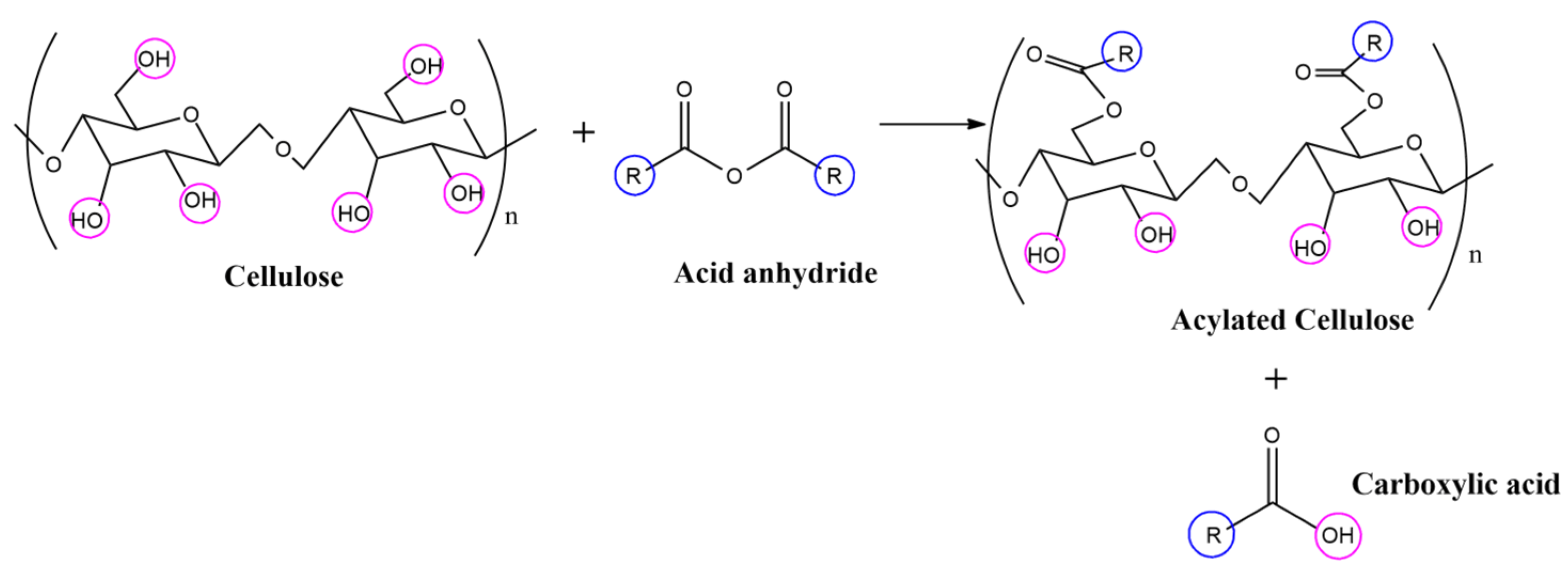
Esterification is one of the most well-established and commonly used strategies for modifying cellulose [38]. In this reaction, some of the hydroxyl (-OH) groups on the nanocellulose backbone are transformed into ester (-O-C(=O)R) groups. More broadly, such modifications fall under the category of acylation, which can be carried out using carboxylic acid derivatives like acyl chlorides or acid anhydrides, or through transesterification with esters, as shown in Figure 1 [39,40].
The main purpose of this approach is to reduce the natural hydrophilicity and strong hydrogen bonding of native cellulose by introducing hydrophobic acyl chains. This change in surface characteristics often leads to better processability and improved compatibility with hydrophobic polymer matrices, making acylated cellulose more suitable for a range of composite and coating applications [41,42].
Acetylation, which involves introducing acetyl groups (R = CH3), is one of the most prominent methods for cellulose modification. The resulting product, cellulose acetate (CA), has been produced since the early 20th century and continues to hold significant industrial relevance, particularly in the manufacture of fibers, films, and biodegradable plastics. Conventional acetylation typically employs acetic anhydride in the presence of mineral acid catalysts such as sulfuric acid, or a mixture of acetic acid and acetic anhydride catalyzed by sulfuric acid, a process historically known as the Schutzenberger method. By adjusting parameters such as reaction time and reagent ratios, varying degrees of substitution (DS) can be achieved, ranging from fully acetylated cellulose triacetate (DS ≈ 3) to partially acetylated forms (DS ≈ 2–2.5), often referred to as secondary acetate [43].
Acetylation significantly decreases the hydrophilicity of cellulose. Cellulose triacetate becomes insoluble in water and many polar solvents, while remaining soluble in solvents like acetone, demonstrating thermoplastic behavior. Acetylated nanocelluloses, such as cellulose nanocrystals (CNCs) and nanofibrils (CNFs), exhibit enhanced thermal stability, with decomposition temperatures shifting to higher values, and can form transparent films due to reduced hydrogen bonding and aggregation. An acetylation was demonstrated of CNCs using acetic anhydride, achieving DS values ranging from approximately 0.3 to 2.2. The resulting hydrophobic CNCs effectively served as reinforcing fillers in polylactic acid (PLA) nanocomposites [44]. Similarly, CNCs acetylated to a DS of about 0.5 were used as water-repellent coatings on paper and polymer films. Acetylated CNFs have also been employed in the production of aerogels and films with improved moisture resistance and greater dimensional stability [45,46].
Beyond altering hydrophilicity and thermal behavior, acetylation also exhibits a distinctive and non-linear influence on cellulose solubility. An important and often underappreciated feature of cellulose esterification is the non-linear dependence of solubility onthe degree of substitution. Native cellulose is insoluble in water due to its dense intra and intermolecular hydrogen-bonding network, while highly substituted cellulose acetates (DS ≳ 2–3) also become water-insoluble because extensive acetylation suppresses hydrogen bonding and renders the polymer predominantly hydrophobic. However, cellulose acetate exhibits water solubility within an intermediate DS window, typically in the range of approximately 0.4–0.9, where partial substitution sufficiently disrupts the hydrogen-bonded crystalline domains while retaining enough hydroxyl groups to maintain hydrophilicity.
At this intermediate DS, the distribution of acetyl groups along the glucopyranose units plays a critical role. Studies have shown that not only the average DS, but also the substitution pattern across the C2, C3, and C6 hydroxyl positions, influences solubility and chain conformation in aqueous media. Preferential substitution at the more accessible C6-OH positions can promote water solubility at lower overall DS values, whereas more uniform substitution across all hydroxyl sites tends to require a narrower DS range to achieve comparable solubility.
From a processing perspective, water-soluble cellulose acetates offer significant advantages for green and sustainable material fabrication, as they enable solution processing in aqueous systems without the need for toxic organic solvents. Such materials can be cast into films, coatings, and membranes using water-based methods, reducing environmental impact and improving industrial safety. Recent studies have highlighted the potential of partially acetylated cellulose in applications such as membrane separation, controlled-release systems, and environmentally friendly coatings, where tunable solubility and film-forming behavior are essential. Importantly, the ability to precisely control DS through reaction conditions, solvent systems, and catalysts provides a powerful tool for tailoring cellulose properties for specific applications. This tunability underscores the importance of DS as a design parameter in green cellulose modification strategies, bridging molecular-level chemistry with macroscopic material performance [47,48].
Beyond simple acetylation, a wide range of long-chain acyl groups have been grafted onto cellulose to tailor its surface energy and compatibility with nonpolar systems. A common method for introducing these higher acyl groups involves reacting cellulose with acyl chlorides (RCOCl) under basic conditions. Cellulose nanocrystals (CNCs) have been successfully modified with lauroyl (C12) and stearoyl (C18) chlorides in solvents such as pyridine or N,N-dimethylacetamide (DMAc), producing DS in the range of 0.2 to 0.8. These modifications render CNCs organophilic, significantly enhancing their dispersibility in nonpolar solvents and polymer matrices [49,50]. In one study, palmitoyl (C16) chloride was grafted onto bacterial cellulose nanofibers, which led to improved dispersion and compatibility in polyolefin-based composite materials [51]. Additionally, aromatic acylation using benzoyl chloride has been explored, sometimes using ionic liquids as reaction media. The resulting cellulose benzoates not only exhibit altered solubility and hydrophobicity but may also offer functional properties such as optical activity or suitability as chiral stationary phases in chromatographic applications [52].
Anhydrides such as succinic anhydride and maleic anhydride offer versatile options for introducing bifunctional groups onto cellulose. These reactions typically yield half-esterified cellulose derivatives, where one carboxylic acid remains available for ionization or further chemical modification. Succinic anhydride reacts with cellulose in the presence of catalysts like pyridine or 4-dimethylaminopyridine (DMAP), forming cellulose succinates with degrees of substitution typically below 1. Upon subsequent base treatment, the free carboxylic acid groups are converted to carboxylates, enhancing the material’s hydrophilicity and metal-binding capacity. Succinylated nanocellulose has shown great promise in environmental applications, particularly for the adsorption of dyes and the removal of heavy metals from aqueous systems [53,54]. In addition, citric acid, a trifunctional carboxylic acid, can be employed to crosslink cellulose under elevated temperatures, leading to the formation of water-insoluble cellulose networks. These citric-acid-crosslinked materials are especially useful in fabricating hydrogels and binders, where structural integrity and water retention are critical [55,56].
In recent years, organocatalytic and solvent-free strategies for esterifying cellulose have attracted growing interest as more sustainable and efficient alternatives to conventional methods. While organic acids such as acetic acid generally require elevated temperatures and catalysts to react with cellulose, novel approaches have emerged to overcome these limitations. Transesterification reactions performed in ionic liquids (ILs) have emerged as highly effective strategies for solution-based cellulose esterification. Certain ILs, such as 1-ethyl-3-methylimidazolium acetate ([EMIM][OAc]), not only dissolve cellulose but can also function catalytically by acting as mild bases during acetylation reactions. An experiment demonstrated the use of a dual-functional ionic liquid, [DBNH][OAc], which simultaneously solubilized cellulose and catalyzed its acetylation with acetic anhydride at 60–70 °C. This process achieved a high degree of substitution (DS ≈ 3) within just one hour, eliminating the need for mineral acid catalysts and enabling nearly complete modification [57]. Another promising ionic liquid-mediated approach involves acylation via transesterification with vinyl esters, such as vinyl acetate or vinyl laurate. In these systems, the IL, often in combination with an organocatalyst like an N-heterocycle, facilitates the transfer of the acyl group from the vinyl ester to the cellulose hydroxyl groups, with acetaldehyde released as the only by-product. This route offers an efficient, acid-free alternative for solution-based esterification and highlights the versatility of ionic liquids in green cellulose chemistry [42]. The impact of esterification on cellulose is commonly assessed by evaluating the DS along with changes in thermal and mechanical properties. Thermogravimetric analysis (TGA) often reveals that introducing low levels of acyl groups (DS < 1) can enhance the thermal stability of cellulose. This improvement is typically attributed to the hydrophobic substituents, which reduce the polymer’s tendency to undergo early-stage dehydration [58]. However, when the DS is very high, such as in fully acetylated cellulose triacetate, the onset of thermal degradation may occur at lower temperatures compared to native cellulose, due to substantial alterations in the polymer structure [59].
Cellulose benzoate, a cellulose ester, was developed using solution-based transesterification catalyzed by a novel superbase-derived ionic liquid. This process allows control over substitution by varying reaction conditions, such as temperature, time, and altering the ratio of cellulose and ionic liquids. These have excellent properties as membranes, which are excellent in separating oil from water. Additionally, cellulose benzoate aerogels provide thermal insulation and offer a lightweight structure [60]. A recent study presents a simple yet effective method for the surface acetylation of cellulose materials using a room-temperature immersion technique. By briefly immersing cellulose in a solution containing vinyl acetate, after a mild alkaline pretreatment, the surface hydroxyl groups can be selectively acetylated within just a few minutes. This fast, solvent-free process significantly reduces the material’s moisture absorption while preserving its internal crystalline structure. Notably, when the modified cellulose was used in cigarette filters, it demonstrated a marked improvement in particulate matter retention, dropping from 11.0 mg to 6.0 mg per cigarette. The approach is environmentally friendly, avoids harsh reaction conditions, and shows strong potential for scalable surface functionalization of cellulose for industrial applications [61].
Esterification reactions are typically carried out in organic solvents such as pyridine, DMAc, or ionic liquids, at temperatures ranging from 40 to 120 °C, depending on the acylating agent and solvent system. Acid catalysts or organocatalysts are commonly used to enhance reaction efficiency, while solvent-free or mechanochemical approaches have also been reported as greener alternatives. Esterification also influences mechanical behavior. In film or fiber form, moderate levels of acetylation may reduce the tensile strength of cellulose materials like nanopaper, primarily due to the disruption of inter-fiber hydrogen bonding. On the other hand, in polymer composites, acetylated cellulose nanocrystals (CNCs) often enhance interfacial compatibility with hydrophobic matrices. This improved interaction can lead to more efficient stress transfer within the composite, ultimately resulting in greater mechanical strength.

3.2. Click Chemistry and Coupling Reactions on Cellulose

Click chemistry refers to a class of modular, high-efficiency reactions that proceed under mild conditions, often forming carbon-heteroatom bonds, frequently in heterocyclic structures. These transformations are particularly attractive for polymer functionalization due to their high yields, selectivity, orthogonality to other reaction pathways, and minimal purification requirements [62]. For cellulose, click chemistry provides a flexible and powerful approach for introducing functional groups without requiring harsh conditions or complex purification steps. Click-based functionalization of cellulose is generally performed under mild conditions, often at room temperature or below 80 °C, using aqueous or mixed solvent systems. Copper(I) catalysts or in situ Cu(II)/reducing agent systems are commonly used for azide–alkyne cycloaddition, while thiol-ene and Diels–Alder reactions may require UV irradiation or moderate thermal activation, depending on the reaction design. The main advantage is the ability to pre-functionalize cellulose with a clickable handle, such as an azide or alkyne group, and subsequently conjugate a wide variety of complementary molecules, including dyes, drugs, polymers, or nanoparticles bearing the matching functional group. Click chemistry generally involves low to moderate DS, as functionalization is often surface-confined. These approaches have enabled a broad range of post-modification strategies for cellulose materials.

3.2.1. Azide–Alkyne Cycloaddition (CuAAC)

The copper(I)-catalyzed azide–alkyne cycloaddition (CuAAC) is arguably the most widely known click reaction, forming stable 1,2,3-triazole linkages. In cellulose chemistry, a typical strategy involves introducing azide groups onto the cellulose backbone, often by converting hydroxyl groups to tosylates, followed by nucleophilic substitution with sodium azide. Alternatively, alkyne groups can be introduced via propargyl chloride or glycidyl propargyl ether. Once azide or alkyne functionality is present, cellulose can undergo CuAAC with a diverse set of other molecules. An early and influential example involved tosylating the surface of cellulose nanocrystals (CNCs), converting them to azide-functionalized CNCs, and subsequently “clicking” with alkyne-terminated polymers. This reaction proceeded under mild conditions, aqueous, room temperature, with Cu(I) catalyst, and resulted in dense polymer grafting through triazole linkages [63].
A wide range of functional molecules has been successfully grafted onto cellulose through click chemistry. Cellulose nanocrystals bearing azide groups (CNC–N3) have been conjugated with propargyl-functionalized poly(ethylene phosphate), introducing hydrophilic polymer chains to the nanocellulose surface. In an alternative approach, CNCs functionalized with terminal alkynes have been reacted with azide-terminated polycaprolactone diol, significantly improving their compatibility with hydrophobic polymer matrices. Further demonstration of the grafting of polycaprolactone onto CNC via Cu(I)-catalyzed azide–alkyne cycloaddition (CuAAC), which led to enhancements in both thermal stability and dispersibility [64]. These studies demonstrate the versatility, efficiency, and tunability that click chemistry offers for cellulose functionalization. The ability to perform particular, modular reactions on nanocellulose substrates significantly expands their utility across various fields, including drug delivery, composite engineering, sensing, and biomedicine.
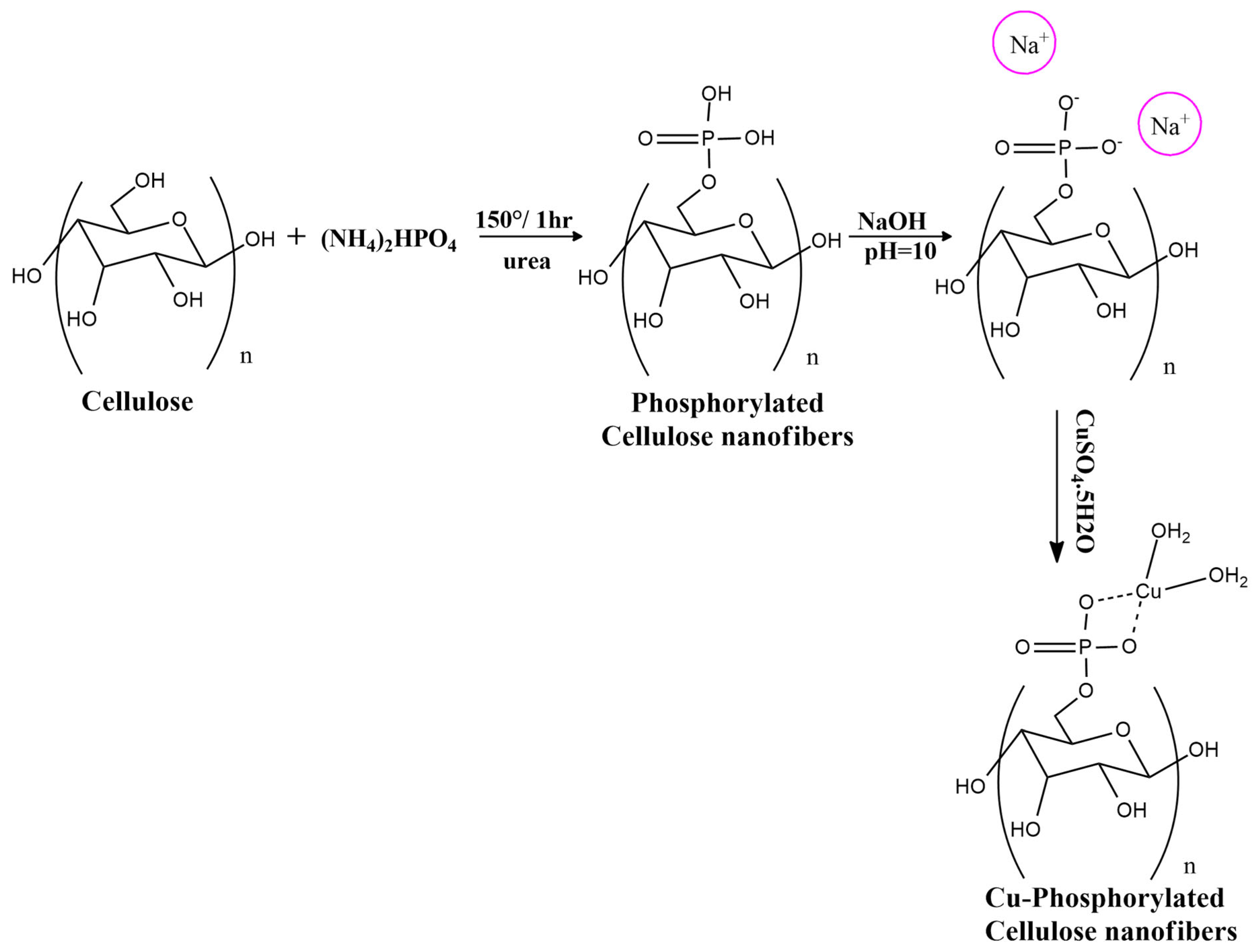
Cellulose was initially phosphorylated because it serves as an excellent chelator for metal ions such as Cu2+. Next, these phosphorylated cellulose nanofibers are immersed in an aqueous solution of Cu2+ salts. The final step involves catalyzing the azide–alkyne cycloaddition, commonly known as the click reaction, by adding azide and a terminal alkyne. The Cu(II)-PCNF catalyst is then dispersed in water, as illustrated in Figure 2 [65].

3.2.2. Diels–Alder and Hetero-Diels–Alder Cycloadditions

Diels–Alder reaction, involving the [4+2] cycloaddition between a diene and a dienophile, has been successfully adapted for cellulose modification by incorporating one of the reactive partners onto the cellulose backbone. Hardwood cellulose nanofibers were TEMPO-oxidized and functionalized with furan groups from furfurylamine. These furan-functionalized nanocellulose fibers were then reacted with bismaleimide as the dienophile under mild conditions, ~65 °C, forming thermal-reversible cross-linked hydrogels. This study highlights the potential for Diels–Alder chemistry to create dynamic, stimuli-responsive cellulose-based materials [66].
A unique self-healing hydrogel is formed by combining cellulose nanocrystals (CNCs) with poly(ethylene glycol) (PEG) using a Diels–Alder (DA) click reaction. The main work is in chemically modifying CNCs with furan groups, which were then crosslinked with bis-maleimide-terminated PEG through a thermally reversible DA cycloaddition. This reaction enabled the formation of a three-dimensional nanocomposite hydrogel that could self-heal upon mild heating. The resulting material demonstrated outstanding mechanical properties, including high stretchability up to 690% elongation and a healing efficiency of approximately 78% after damage. Thanks to the reversible nature of the DA bond, the hydrogel could recover its shape and mechanical strength after being cut and reheated. This work highlights the potential of combining natural nanomaterials like cellulose with dynamic covalent chemistry to engineer smart, responsive, and sustainable materials for biomedical and structural applications [67]. RAFT-synthesized polymers were grafted onto cellulose using a hetero-Diels–Alder (HDA) strategy, which proceeded efficiently at ambient temperature.
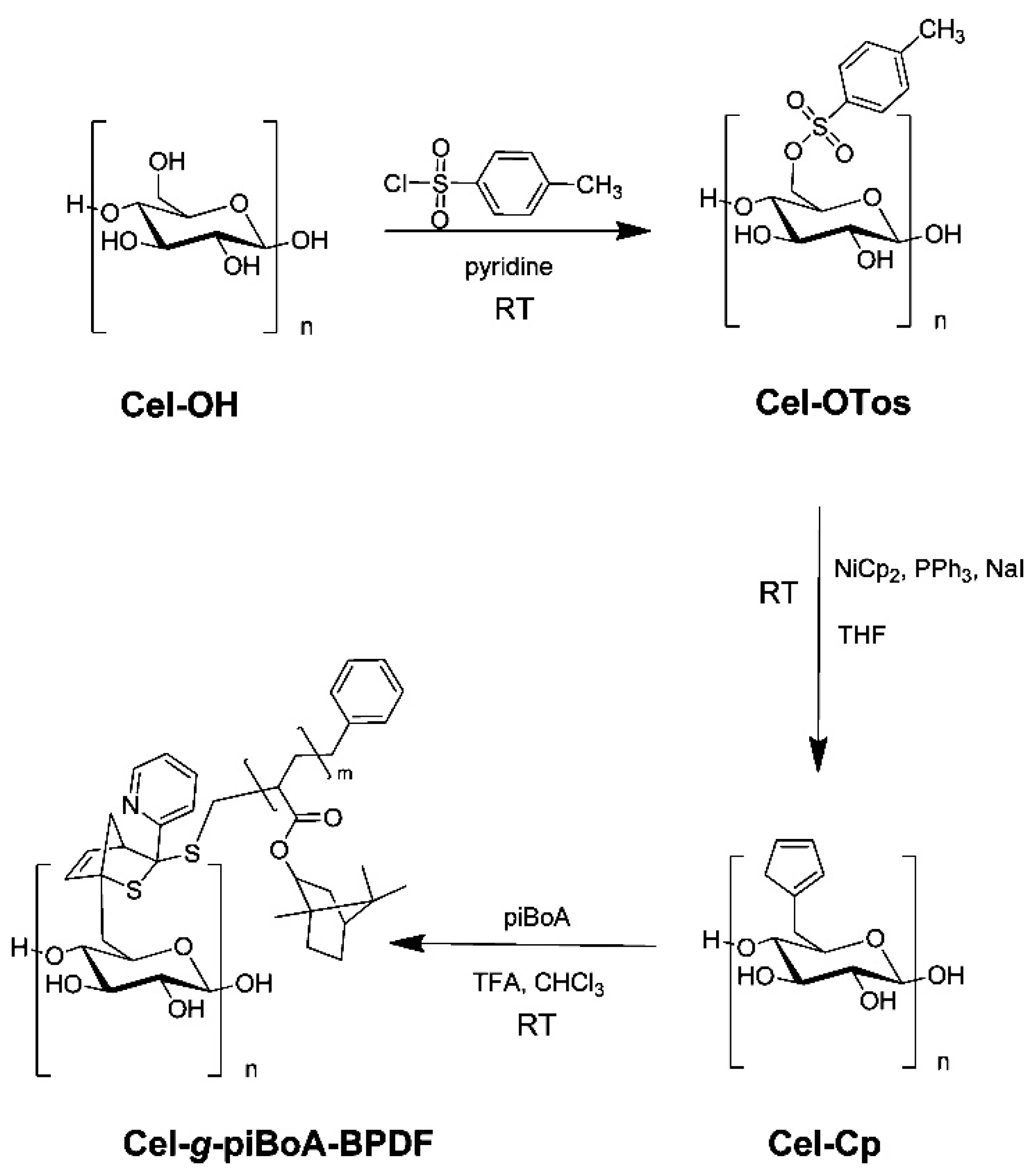
A simple and eco-friendly method to modify the surface of cellulose fibers using hetero Diels–Alder (HDA) cycloaddition was developed. The process begins by making cellulose more reactive. The natural hydroxyl groups on the fiber surface are first converted into better leaving groups through a process called tosylation, and then replaced with cyclopentadiene groups, which act as the “diene” in the click reaction. On the other hand, a synthetic polymer, poly(isobornyl acrylate), is prepared using a controlled technique called RAFT polymerization, and this polymer is designed to have a reactive thiocarbonyl thio group at one end. This end group acts as the “dienophile” in the reaction. When the modified cellulose and the end-functionalized polymer are mixed in water at room temperature, they undergo a spontaneous and efficient HDA reaction. This “click” process links the polymer chains directly onto the cellulose surface, forming strong covalent bonds without needing any metal catalysts, heat, or toxic solvents. What makes this method particularly attractive is how mild and modular it is. You can easily change the type of polymer you want to attach, and the whole reaction is environmentally friendly. To confirm the success of the surface modification, the team used techniques like FTIR, XPS, SEM, and infrared microscopy, all of which showed that the polymer was evenly and firmly attached to the cellulose fibers. Overall, this approach provides a versatile and sustainable way to functionalize cellulose, opening new possibilities for applications in advanced materials, coatings, and bioactive surfaces as seen in Figure 3 [68].

3.2.3. Thiol–Ene and Thiol–Yne Click Chemistry

Thiol-based click reactions, particularly thiol-ene and thiol-yne couplings, have also gained attention for modifying cellulose [69]. These reactions proceed through radical mechanisms and typically require UV light and a photoinitiator. Cellulose can first be functionalized with vinyl or alkyne groups, by introducing allyl moieties, to enable such reactions.
A cellulose nanocrystal (CNC) film was prepared bearing surface vinyl groups introduced via glycidyl methacrylate treatment and subsequently grafted perfluorinated thiols onto the surface via UV-initiated thiol-ene click chemistry. This treatment significantly increased the hydrophobicity of the cellulose surface, yielding transparent films with excellent water-repellent properties [70]. Similarly, a fabricated porous cellulose sponge was prepared by polymerizing allyl-functionalized cellulose, and then grafted thiol-containing compounds onto the sponge surface using thiol-ene chemistry. The resulting material displayed amphiphobic behavior, repelling both water and oil, and demonstrated utility in oil/water separation applications [71]. Thiol-yne reactions, though less common, offer additional versatility by allowing multiple thiol additions per alkyne, enabling denser functionalization. Variants such as tetrazole-ene photoligation have also been explored, where UV light activates tetrazole to form a nitrile imine intermediate that rapidly adds to alkenes. This reaction has been employed to attach fluorescent tags to cellulose under light exposure [72].
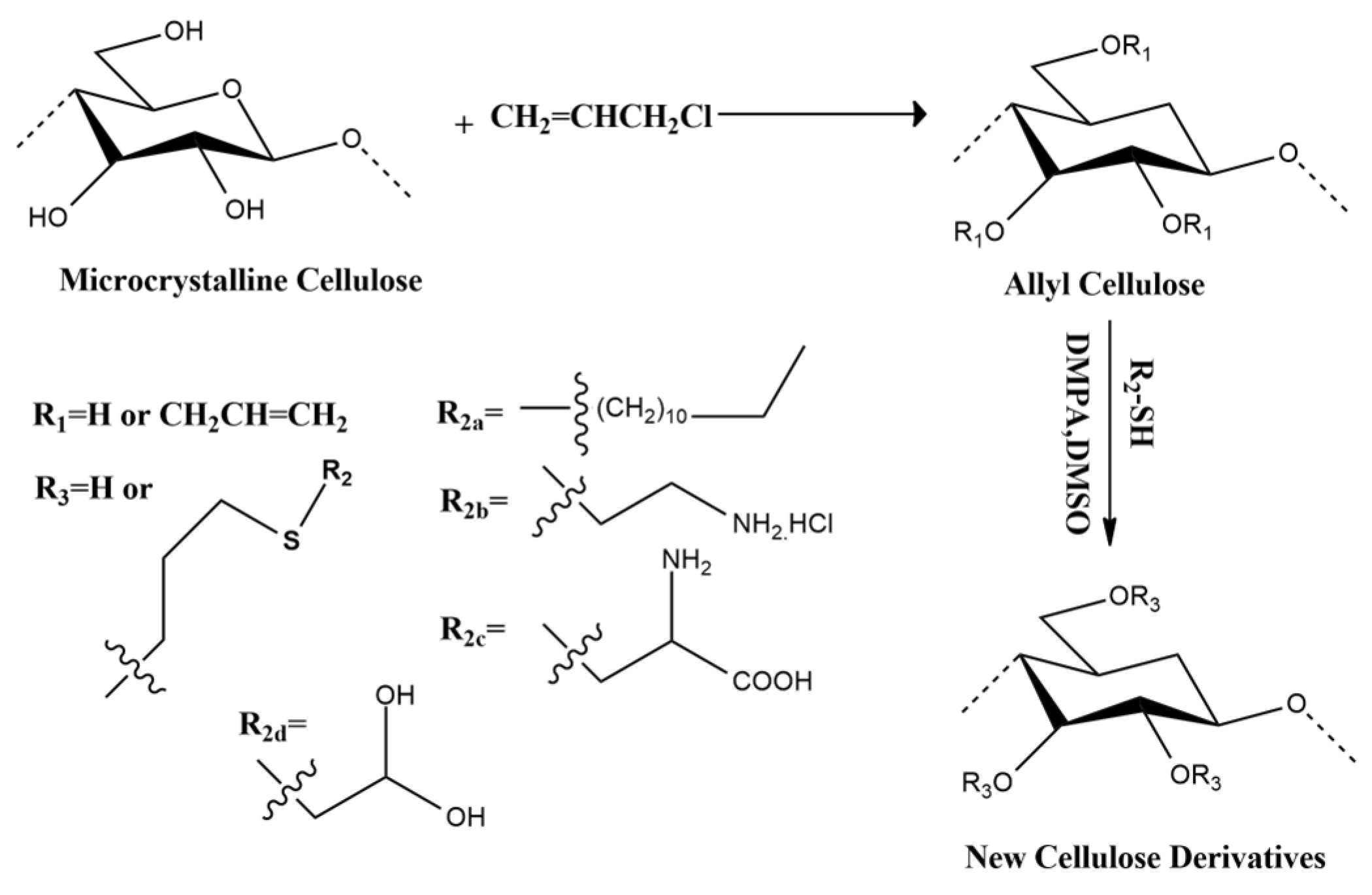
Photochemical strategies were reviewed in cellulose-based fluorescence sensors and they noted that thiol-ene and related chemistries enable the incorporation of coumarin and other fluorophores onto cellulose, yielding materials with stable, tunable optical properties. Such fluorescently modified celluloses are being developed for applications in visual sensing, bio-imaging, and responsive materials [73]. A simple and environmentally friendly approach to modify cellulose by combining two key steps: allylation and thiol-ene click chemistry. The process begins by dissolving cellulose in a cold aqueous solution of sodium hydroxide and urea, which allows the cellulose chains to swell and react efficiently. Allyl chloride is then introduced to graft allyl groups onto the cellulose backbone, resulting in allyl cellulose with a tunable degree of substitution depending on the amount of reagent used. Then the allyl-functionalized cellulose undergoes a thiol-ene reaction, where various thiol-containing molecules are added across the carbon-carbon double bonds of the allyl groups under mild, UV-induced radical conditions. This reaction proceeds with high efficiency and selectivity, forming stable thioether linkages without unwanted side products. The final materials show good solubility in organic solvents and can be tailored for a range of applications. The success of both allylation and thiol-ene reactions was confirmed through techniques like NMR, FTIR, elemental analysis, and light scattering. Overall, the method provides a modular platform for designing functional cellulose-based materials using water-based chemistry and versatile click reactions as illustrated in Figure 4 [74].

3.2.4. Grafting-To vs. Grafting-From Strategies in Click-Based Cellulose Modification

In the functionalization of cellulose using click chemistry, two primary polymer grafting strategies are involved: grafting-to and grafting-from, each with its advantages and limitations. Grafting-to involves attaching pre-synthesized, well-defined polymers bearing click-reactive end groups such as alkynes or azides onto cellulose surfaces that have been appropriately functionalized with complementary groups. This method is typically straightforward and allows precise control over polymer structure since the polymer is prepared in advance. However, it often suffers from steric hindrance, particularly when large polymer chains struggle to access and react with the surface, resulting in lower grafting densities. On the other hand, grafting-from builds polymer chains directly from initiator sites attached to the cellulose. This strategy enables higher grafting densities because the polymer grows outward from the surface, avoiding initial steric constraints. Techniques like ATRP, RAFT, and NMP are commonly employed. Although this method provides better control over the grafting density and distribution, it often requires more careful reaction control and can be harder to characterize compared to grafting-to approaches. Click chemistry, particularly copper-catalyzed azide–alkyne cycloaddition (CuAAC), has proven valuable in both strategies. In grafting-to, the high efficiency and mild conditions of CuAAC reactions help overcome steric limitations to some extent. In grafting-from, click chemistry is often used to introduce or activate initiator sites or to perform post-polymerization modifications [75,76].

3.3. Silylation of Cellulose

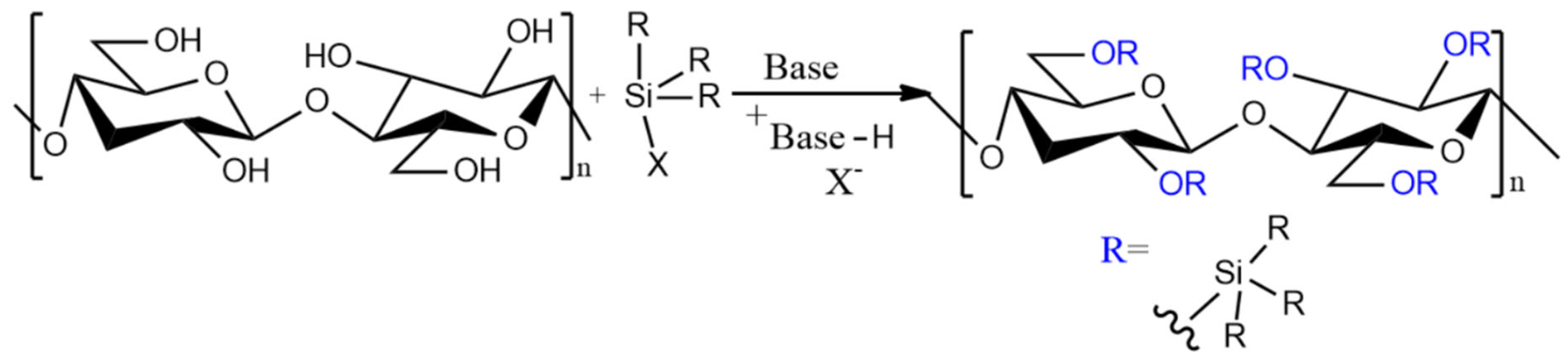
Silylation refers to the chemical modification of cellulose through the attachment of organosilane groups to its hydroxyl (-OH) sites. This is typically attained using chlorosilanes or trialkoxysilanes, which react with the hydroxyl functionalities on the cellulose backbone. Common reagents include chlorotrimethylsilane (TMSCl) to produce trimethylsilyl-cellulose (TMS-cellulose) and (3-aminopropyl)triethoxysilane (APTES), which introduces amine groups while also imparting hydrophobicity. For nanocellulose, silylation has proven to be a versatile strategy for enhancing material properties such as water repellency, thermal stability, and compatibility with polymer matrices. The silylation of cellulose nanofibrils (CNFs) with APTES was performed, which led to improved thermal properties and better dispersion within composite materials [77]. A study functionalizes cellulose nanocrystals (CNCs) using 3-isocyanatopropyltriethoxysilane (IPTS), forming urethane bonds (via the isocyanate group) while the triethoxysilane groups hydrolyze and condense, producing a siloxane network on the CNC surface. Silylation can also introduce specialized functionalities, such as flame retardancy or gas adsorption capacity. Phosphorus-containing silanes like tris(2-chloroethyl)phosphate (TCEP) have been grafted onto CNCs to improve fire resistance by increasing the Limiting Oxygen Index (LOI) [78]. The underlying chemistry of silylation involves nucleophilic attack by cellulose-OH groups on silicon centers bearing good leaving groups, such as chloride or alkoxy substituents. Chlorosilanes require strictly anhydrous conditions due to their high reactivity with water, which can lead to side reactions. While trialkoxysilanes such as APTES are more versatile. They initially form a single Si-O-cellulose bond, and the remaining alkoxy groups undergo hydrolysis and condensation to generate a crosslinked siloxane network. This in situ network formation not only enhances interfacial bonding in composites but also reduces water uptake due to the inherent hydrophobicity of siloxane. Analogous to their use in silane-treated glass fiber composites, organosilane coupling agents have been effectively applied to cellulose to improve compatibility with various polymer matrices. Vinyl-functional silanes like vinyltriethoxysilane allow the resulting cellulose to co-polymerize with vinyl monomers, effectively anchoring nanocellulose into the growing polymer matrix and improving mechanical reinforcement [79,80].
Silylation significantly enhances the functional performance of cellulose by introducing organosilicon moieties onto its surface. One of the key advantages is improved hydrophobicity. Silylated cellulose often exhibits water contact angles greater than 90°, effectively transforming the surface into a water-repellent barrier. In addition, silylation improves thermal stability, as the presence of silicon facilitates the formation of thermally stable char during degradation, offering protective properties particularly valuable in flame-retardant applications. Beyond these physical enhancements, silylation also introduces chemically reactive functionalities. Amino groups introduced via silanes such as APTES or APS can serve as active sites for further chemical conjugation or enable specific interactions, such as gas adsorption or metal ion chelation. These combined improvements make silylated cellulose a versatile platform for advanced composite materials, environmental remediation, and functional coatings [81]. Silylation typically results in low DS (<0.5), sufficient to impart hydrophobicity. Silylation reactions usually require aprotic organic solvents such as toluene and are conducted at temperatures between 25 and 80 °C. Acidic or basic catalysts may be employed to promote silane hydrolysis and condensation, although excessive crosslinking must be carefully controlled to preserve cellulose flexibility.
However, achieving uniform silane coverage on the cellulose surface without excessive crosslinking remains a technical challenge. Over-crosslinking can lead to brittleness or loss of flexibility. Thus, controlling silane concentration, catalyst conditions, and reaction pH is essential. Residual silanol groups and unreacted silanes also need to be thoroughly removed post-reaction to ensure material stability and purity. Silylated nanocellulose is increasingly utilized in composite fabrication, aerogels for environmental applications such as CO2 capture and oil absorption, and biomedical scaffolds, where bioactive groups can be introduced through functional silanes for tissue engineering purposes [82].
A clean and efficient way to chemically modify cellulose was performed using a process called dehydrogenative silylation. Instead of relying on harsh chemicals or heavy-metal catalysts, the team used an eco-friendly mixture of an ionic liquid (1-ethyl-3-methylimidazolium acetate) and DMSO to dissolve cellulose and carry out the reaction. In this setup, hydrosilanes were directly attached to the cellulose backbone at just 60 °C, releasing only hydrogen gas as a by-product, making the process both simple and environmentally sustainable, as seen in Figure 5 [3].
After the reaction, the modified cellulose was easily recovered by adding methanol. Spectroscopic techniques like FTIR and 1H NMR confirmed that silyl groups had been successfully attached, and the backbone of the cellulose remained intact. The method achieved a high degree of substitution and impressive yields, with nearly perfect atom efficiency. This presents a practical and scalable strategy for creating silylated cellulose materials that can be used in coatings, films, and other advanced applications, without compromising on sustainability [83]. Overall, silylation is a powerful method for tailoring cellulose properties, offering a pathway to create hybrid organic-inorganic materials with desirable mechanical, thermal, and interfacial characteristics.

3.4. Isocyanate and Urethanization Reactions

Isocyanate-based reactions provide an effective method to chemically modify cellulose by forming urethane (carbamate) linkages. Each hydroxyl group (-OH) on the cellulose backbone can react with an isocyanate group (-N=C=O), creating a urethane bond, i.e., cellulose-O-(C=O)-NH-R. This process is like the chemistry used in polyurethane production, where diols react with diisocyanates. In cellulose, both monofunctional and multifunctional isocyanates are used. Monofunctional isocyanates mainly attach functional or hydrophobic groups, while di- or polyisocyanates promote crosslinking between cellulose chains. A classic application is the carbanilation of cellulose through reaction with phenyl isocyanate. This produces cellulose phenylcarbamate derivatives, which have been widely used in analytical chemistry, especially as chiral stationary phases in high-performance liquid chromatography (HPLC). Cellulose could be fully derivatized (DS ≈ 3) with phenyl isocyanate in a homogeneous medium such as 1-butyl-3-methylimidazolium chloride ([BMIM]Cl), without needing a catalyst. The resulting cellulose phenylcarbamates are soluble in various organic solvents and exhibit optical activity, allowing their application in commercial chiral separation columns. Similar modifications have also been successfully made on bacterial cellulose, maintaining its solubility and chiroptical properties [84,85,86].
Beyond aromatic isocyanates, aliphatic isocyanates like hexamethylene diisocyanate (HDI) are also used. HDI contains two isocyanate groups, allowing it to act as a bridging agent. One end can react with a cellulose hydroxyl, while the other can react with another cellulose chain or functional moiety. This strategy has been employed to prepare cellulose urethane networks, as well as polyurethane coatings that incorporate cellulose derivatives. Using HDI trimers, researchers have developed crosslinked cellulose films with enhanced mechanical integrity and solvent resistance. A particularly multifunctional reagent is 3-isocyanatopropyltriethoxysilane (IPTS). This bifunctional molecule contains both an isocyanate group for reaction with cellulose-OH to form a urethane bond and a triethoxysilane group capable of hydrolysis and condensation to form silica-like networks. As such, IPTS enables simultaneous urethanization and silylation, creating hybrid organic-inorganic cellulose materials with enhanced thermal, chemical, and interfacial properties. This dual-reactivity makes IPTS valuable for applications ranging from aerogels to composite reinforcements [87,88].
Practically, urethanization reactions are typically carried out in anhydrous polar aprotic solvents like DMF or DMSO. Ionic liquids (ILs) such as [BMIM]Cl are also increasingly used, particularly for homogeneous modifications. While catalysts such as dibutyltin dilaurate (DBTDL) can be employed to accelerate urethane formation, the inherent reactivity of isocyanates with cellulose hydroxyls usually makes catalysis unnecessary under mild heating conditions, 50–100 °C. Importantly, moisture exclusion is critical for isocyanates, which readily hydrolyze in the presence of water to form urea byproducts, which not only reduce reaction efficiency but may also interfere with desired product performance [89].
Cellulose urethanes formed by reacting cellulose with isocyanates exhibit a diverse range of properties that depend strongly on the nature of the isocyanate substituent. Grafting bulky or long-chain isocyanates such as tert-butyl or alkyl isocyanates onto cellulose can significantly enhance thermal stability, as the added steric hindrance restricts molecular mobility and suppresses early thermal degradation, including dehydration reactions. Moreover, certain cellulose carbamate derivatives display liquid crystalline behavior and unique optical characteristics. Cellulose tris(3,5-dimethylphenylcarbamate), which is widely used as a chiral selector in HPLC columns and is known to form liquid crystalline solutions at higher concentrations, attributes valuable in both analytical and materials science applications [90,91,92].
Beyond thermal and optical properties, isocyanate-functionalized cellulose has been explored for adsorptive applications. When reacted with isothiocyanates, cellulose forms thiocarbamate derivatives, which introduce sulfur-containing donor groups capable of chelating heavy metals. These materials have been investigated for water purification and environmental remediation [93].
In the field of wood and fiber science, isocyanate chemistry plays a main role in enhancing compatibility between cellulose fibers and polyurethane matrices. Commonly used isocyanates like 4,4′-methylene diphenyl diisocyanate (MDI) react not only with cellulose but also with lignin, enabling chemical bonding between wood fibers and polymer networks. This principle underpins the chemistry of many wood adhesives and engineered composites. In nanocellulose applications, diisocyanates can act as molecular bridges, linking cellulose nanocrystals (CNCs) to each other or synthetic polymers. When CNCs are incorporated into polyurethane elastomers, pre-treating them with diisocyanates significantly improves interfacial adhesion and mechanical stress transfer, resulting in reinforced composite materials [87].
However, while effective, the toxicity and environmental concerns associated with isocyanates, especially aromatic types like toluene diisocyanate (TDI) and MDI, cannot be overlooked. These compounds are known irritants and pose health hazards during handling, leading to regulatory scrutiny and restrictions. As a result, there is growing interest in isocyanate-free alternatives that achieve similar functional outcomes. One promising strategy involves the use of cyclic carbonates, which can react with amines to form non-isocyanate polyurethanes (NIPUs). Such approaches are gaining traction as greener pathways for cellulose modification, aligning with sustainable materials chemistry principles [94,95].

3.5. Oxidation and Related Functionalizations

Among oxidative methods for cellulose functionalization, TEMPO-mediated oxidation remains the most prominent. This reaction selectively targets the primary hydroxyl group at the C6 position, converting it to a carboxylate (-COO) while preserving the secondary hydroxyls at C2 and C3. Conducted in a mildly alkaline medium, typically pH ~10 with sodium hypochlorite, TEMPO, and a bromide co-catalyst, this approach produces cellulose nanofibrils bearing surface carboxyl groups, commonly referred to as TEMPO-CNF [96]. These negatively charged surfaces improve water dispersibility through electrostatic repulsion and facilitate the formation of uniform films. Additionally, TEMPO-CNF serves as a versatile platform for post-functionalization, including amidation through carbodiimide coupling with amine-containing molecules. The process is mild and predominantly surface-selective, making it well-suited for nanocellulose modification. Recent advances in TEMPO oxidation, including new catalyst systems and extended applications, have been extensively reviewed [97].
Another common oxidative method is periodate oxidation, which breaks the C2–C3 bond in the glucose unit to produce dialdehyde cellulose (DAC). The aldehyde groups formed can create intramolecular or intermolecular hemiacetal crosslinks or participate in further reactions, such as Schiff-base formation with amines or hydrazone linkages with hydrazides. These modifications are especially useful in biomedical applications, like forming hydrogels through crosslinking with biopolymers like gelatin or chitosan. Additionally, DAC shows photoactivity, and its aldehyde groups can be easily detected or used for further derivatization [98,99,100,101,102].
Variations in nitroxide-mediated oxidation conditions allow for partial oxidation to aldehydes, e.g., C6-aldehyde intermediates, which enables additional reductive coupling or further oxidation. TEMPO-CNF films demonstrate improved gas barrier properties in dry conditions due to stronger intermolecular interactions. However, in aqueous environments, the negatively charged surface promotes swelling, a feature that can be advantageous in hydrogel systems or absorbent materials [103,104,105]. A comparative summary of green cellulose modification routes, including reaction conditions, degree of functionalization, selectivity, and sustainability considerations, is provided in Table 1.
Table 1. Summary of green cellulose modification routes, reaction conditions, degree of functionalization, and sustainability considerations.
Modification RouteCellulose FormReaction SystemTypical ConditionsDegree of Substitution/FunctionalizationSelectivitySustainability
Esterification and AcetylationMCC, CNCSolution/dispersion50–120 °C, ILs, anhydridesDS ≈ 0.3–3.0C6 preferred at low DSReduced solvent use, tunable solubility
TEMPO oxidationCNFAqueousPh ~10, RT~0.5–1.5 mmol COOH/gHighly C6 selectiveWater-based conditions
Click chemistry (CuAAC)CNCDispersionRT to 60 °C, aqueous/ILSurface-limitedDepends on pre-functionalizationHigh efficiency
SilylationCNFDispersionRT to 80 °CSurface graftingNon-selectiveImproved durability
UrethanizationMCCSolution50–100 °C, DMFDS up to ~3BroadPerformance and toxicity considerations

4. Industrial Applications of Modified Nanocellulose

4.1. Packaging Materials

Biodegradable packaging is one area where modified cellulose and nanocellulose are considered greener alternatives to oil-based plastics. Normal cellulose in its natural form has inherent good film-forming properties and barrier properties to gases, most significantly oxygen, when in its dry form, owing to its strongly interconnected network of hydrogen bonds. However, its high water-affinity can lead to loss of barrier performance at high humidity and poor compatibility with hydrophobic food or coating layers. Chemical modifications cure these disadvantages.
One approach is to create cellulose esters that are hydrophobic yet still biodegradable. Cellulose acetate, a packaging-relevant material, is used as a film and wrap. Its biodegradation in compost is faster than that of many plastics, especially if partially acetylated. Researchers are developing cellulose acetate from agricultural waste sources for packaging films. Additionally, long-chain acylated nanocellulose has been explored as a coating on paper or biopolymer films to impart water resistance [106]. Canola oil fatty acid-grafted CNC via transesterification served as an effective hydrophobic coating, raising the water contact angle and reducing the moisture permeability of coated paper [107]. Another strategy is surface silylation or wax-grafting on nanocellulose films. A PLA composite with improved strength and hydrophobicity was prepared by silanizing CNF with amino-silane, then compounding it into PLA. The resulting composite had lower moisture absorption and enhanced mechanical integrity, crucial for packaging that encounters varying humidity [108].
Modified nanocellulose can also act as emulsifiers and coating additives. Octenyl succinic anhydride (OSA)-modified cellulose, commonly used to hydrophobize starch, has been applied to cellulose nanofibers to create amphiphilic particles that stabilize oil-in-water emulsions. Such CNC Pickering emulsions can be dried to form packaging foams or coatings containing uniformly dispersed actives like antimicrobial essential oils. Indeed, some packaging concepts incorporate active components like CNC with attached antimicrobial agents like quaternary ammonium or silver nanoparticles embedded in films to extend food shelf-life. To ensure these actives are retained, chemical bonding is used: a recent example is layer-by-layer deposition of chitosan on TEMPO-oxidized CNF via ionic bonding to create antimicrobial coatings that do not leach quickly [109,110].
Nanocellulose-reinforced bioplastics form another class of packaging material. Mater-Bi, a starch-based bioplastic, or PLA, can be brittle, but adding a small fraction of modified CNF improves its strength and reduces gas permeability. The key is to ensure good dispersion and interface. Here, functionalized nanocellulose, like acetylated CNC or polycaprolactone-grafted CNC, disperses within the polymer matrix without agglomerating, yielding a high-performance composite. Reinforced PLA with CNC functionalized by adipic acid grafted via anhydride to improve dispersion. The composite showed better toughness and clarity, both important for packaging film [111].
Overall, through esterification, etherification, and composite formation, modified nanocellulose is enabling the next generation of green packaging that rivals conventional plastics in performance while being environmentally benign.

4.2. Advanced Composites and Functional Materials

Beyond packaging and bulk composites, modified nanocellulose is finding roles in high-value advanced materials, including structural composites, energy storage devices, sensors, and catalytic systems. Structural composites for load-bearing materials in automotive, aerospace, or construction. Traditionally, glass or carbon fibers reinforce polymers. Now, cellulose fibers, especially microfibrillated cellulose or CNFs, are considered green alternatives. The challenge is often their dispersion in hydrophobic resins such as epoxy, polyester, polypropylene, and interface adhesion. Chemical modification improves this. Acetylated or propionylated microfibrillated cellulose disperses well in nonpolar matrices and increases composite strength without as much moisture sensitivity. Another structural context is rubber composites. Unmodified cellulose has poor compatibility with hydrophobic rubber [112,113,114].
Modified cellulose is increasingly used in flexible electronics, batteries, and sensors, such as paper-based supercapacitors, textile supercapacitors, by constructing a reliable conductive polymer-cellulose interface. They likely carboxylated cellulose to bind a conductive polymer via hydrogen bonding or covalent linking [115]. MoS2 quantum dots were attached to cellulose for dopamine sensing, probably because cellulose provided a matrix to stabilize MoS2, possibly via some functional group on cellulose interacting with MoS2 edges [116].

4.3. Membranes and Ion-Exchange Applications

Chemically modified cellulose is rapidly emerging as a versatile platform for membrane technologies, including proton and anion exchange membranes (PEMs/AEMs), separation membranes, and separators for redox-flow batteries. Native cellulose forms mechanically required thin films, but its intrinsic hydrophilicity and lack of ionic functionality prevent efficient ion transport or selective ion exclusion in many electrochemical applications. Specific chemical modification overcomes these limitations by introducing charged groups or ion-conducting groups while keeping mechanical integrity and renewability [117]. Oxidation, like TEMPO-mediated, converts C6-OH to carboxylates, producing negatively charged networks that improve water dispersibility and provide fixed anionic sites useful in cation-exchange or as scaffolds for further functionalization. TEMPO-oxidized CNFs can also serve as reinforcing, nanofibrillar scaffolds that can form nanofludic channels for ion transport. TEMPI-CNF membranes are used as hydrogel electrolytes or as charged selective layers [118].
Quaternization introduces quaternary ammonium groups, which yield anion-exchange membranes suitable for hydroxide conduction in alkaline fuel cells and some batteries. Composite approaches that embed quaternized polymers within bacterial-cellulose templates achieve high OH conductivities while preserving dimensional stability [119]. Sulfonation brings -SO3H group or sulfonated fillers that produce proton-conducting membranes that have been explored as low-cost, partially biodegradable PEM alternatives [120]. Crosslinking addresses swelling, mechanical, and crossover problems in redox-flow batteries (RFBs) and fuel cells. For vanadium flow batteries and other RFBs, filler-reinforced cellulose membranes lower active-species crossover while preserving conductivity [121].

5. Conclusions and Future Perspectives

Nanocellulose, with its natural abundance and unique properties, has emerged as a promising building block for sustainable materials. However, its full potential can only be unlocked through chemical modifications that tailor its surface characteristics to meet the demands of modern applications. This review has highlighted a range of organic reactions, such as esterification, click chemistry, silylation, and urethanization, that have been effectively used to modify nanocellulose in environmentally friendly ways. These modifications have improved its compatibility with polymers, increased its thermal stability, introduced reactive sites, and expanded its functionality in areas like packaging, biomedicine, and electronics.
What stands out is how green chemistry approaches are steadily replacing traditional, harsher methods. The use of ionic liquids, deep eutectic solvents, and even enzymes has made it possible to achieve high levels of modification while minimizing environmental impact. Click reactions, for example, offer a highly selective and efficient way to attach functional molecules under mild conditions, opening doors to innovative material design.
Looking forward, there is still room for growth. Developing safer alternatives to isocyanates, improving the uniformity of surface modifications, and scaling up eco-friendly methods for industrial use are some of the challenges that researchers need to tackle. There is also a growing interest in creating smart cellulose-based materials, those that can respond to changes in temperature, light, or pH, or even self-heal. In addition to chemical efficiency, the environmental and economic viability of cellulose modification strategies is increasingly important for large-scale adoption. Green transformation routes that rely on renewable feedstocks, recyclable solvents, and mild reaction conditions offer clear advantages in reducing carbon footprints and process energy demand. For example, water-based systems, ionic liquids with high recyclability, and deep eutectic solvents minimize volatile organic solvent use while enabling efficient cellulose functionalization.
From an economic perspective, the availability of cellulose from regional biomass sources, combined with scalable surface modification techniques, supports cost-effective production. However, challenges remain in balancing solvent cost, recovery efficiency, and reaction scalability, particularly for homogeneous modification routes. Future work should also focus on how these modified materials behave over their entire life cycle, from production to disposal. Understanding their environmental footprint will be key to ensuring that the shift toward biobased materials truly supports sustainability goals. Looking ahead, the field of nanocellulose modification offers exciting opportunities to create truly sustainable, high-performance materials. A major goal is to move away from toxic reagents like isocyanates and adopt safer, eco-friendly alternatives such as cyclic carbonates that can achieve similar chemical linkages without health or environmental risks. Enzyme-based approaches also hold great promise; they can carry out precise modifications under mild conditions, using little energy and producing minimal waste. Future developments in cellulose modification are expected to increasingly incorporate enzyme-based and biocatalytic strategies, which offer high regioselectivity and low environmental impact, working alongside the organic reaction routes discussed in this review. Another exciting direction is the use of advanced “click” chemistries that allow researchers to attach multiple functional groups in a controlled, stepwise manner. This opens the door to designing smart materials that respond to temperature, pH, or light, or that have properties like antimicrobial activity or self-healing behavior. As these materials find new uses in flexible electronics, wearable sensors, medical devices, and even responsive packaging, there will be a growing need to control how and where the modifications happen on the nanocellulose surface. At the same time, it is important to think about the full life cycle of these products, how they are made, used, and eventually disposed of. Integrating green chemistry with life-cycle thinking and cost analysis will be crucial to ensure that the materials we develop are not only functional but also practical and truly sustainable. With continued innovation, green surface modification of nanocellulose holds great promise for creating the next generation of materials, ones that are not only high-performing but also kind to the planet.

Author Contributions

M.M.: Collection of literature, preparation of draft, writing and revision; G.T.M.: Editing of the manuscript; H.V.: Editing and review; K.S.B.: Editing, supervision and improvement of the content. All authors have read and agreed to the published version of the manuscript.

Funding

No funding was received for writing this review.

Data Availability Statement

The data from the literature has been used and discussed within the manuscript.

Conflicts of Interest

The authors do not have any known conflicts of interest to declare.

References

  1. Geyer, R.; Jambeck, J.R.; Law, K.L. Production, use, and fate of all plastics ever made. Sci. Adv. 2017, 3, e1700782. [Google Scholar] [CrossRef]
  2. Hopewell, J.; Dvorak, R.; Kosior, E. Plastics recycling: Challenges and opportunities. Philos. Trans. R. Soc. B Biol. Sci. 2009, 364, 2115–2126. [Google Scholar] [CrossRef]
  3. Madhushree, M.; Vairavel, P.; Mahesha, G.; Bhat, K.S. A Comprehensive Review of Cellulose and Cellulose-Based Materials: Extraction, Modification, and Sustainable Applications. J. Nat. Fibers 2024, 21, 2418357. [Google Scholar] [CrossRef]
  4. Liu, Q.; Wu, S.; Sun, X. Improvement in the rheological properties and gas phase of dough, and overall quality of dietary fibre enriched products: Enzymatic modification on the composition and structure of dietary fibre. Food Hydrocoll. 2025, 160, 110742. [Google Scholar] [CrossRef]
  5. Klemm, D.; Heublein, B.; Fink, H.-P.; Bohn, A. Cellulose: Fascinating Biopolymer and Sustainable Raw Material. Angew. Chem. Int. Ed. 2005, 44, 3358–3393. [Google Scholar] [CrossRef]
  6. Nechyporchuk, O.; Belgacem, M.N.; Bras, J. Production of cellulose nanofibrils: A review of recent advances. Ind. Crop. Prod. 2016, 93, 2–25. [Google Scholar] [CrossRef]
  7. Moon, R.J.; Martini, A.; Nairn, J.; Simonsen, J.; Youngblood, J. Cellulose nanomaterials review: Structure, properties and nanocomposites. Chem. Soc. Rev. 2011, 40, 3941–3994. [Google Scholar] [CrossRef]
  8. Thomas, B.; Raj, M.C.; Athira, K.B.; Rubiah, M.H.; Joy, J.; Moores, A.; Drisko, G.L.; Sanchez, C. Nanocellulose, a Versatile Green Platform: From Biosources to Materials and Their Applications. Chem. Rev. 2018, 118, 11575–11625. [Google Scholar] [CrossRef]
  9. Zhang, K.; Barhoum, A.; Xiaoqing, C.; Haoyi, L.; Samyn, P. Cellulose Nanofibers: Fabrication and Surface Functionalization Techniques. In Handbook of Nanofibers; Springer International Publishing: Cham, Germany, 2019; pp. 1–41. [Google Scholar] [CrossRef]
  10. Wolfs, J.; Meier, M.A.R. A more sustainable synthesis approach for cellulose acetate using the DBU/CO2 switchable solvent system. Green Chem. 2021, 23, 4410–4420. [Google Scholar] [CrossRef]
  11. Lin, W.; Hu, X.; You, X.; Sun, Y.; Wen, Y.; Yang, W.; Zhang, X.; Li, Y.; Chen, H. Hydrophobic Modification of Nanocellulose via a Two-Step Silanation Method. Polymers 2018, 10, 1035. [Google Scholar] [CrossRef] [PubMed]
  12. Raji, Z.; Karim, A.; Karam, A.; Khalloufi, S. Adsorption of Heavy Metals: Mechanisms, Kinetics, and Applications of Various Adsorbents in Wastewater Remediation—A Review. Waste 2023, 1, 775–805. [Google Scholar] [CrossRef]
  13. Li, B.; Xu, C.; Zhu, X.; Yu, J.; Zhang, X.; Fan, Y. Green chemistry perspectives on click chemistry approaches for cellulose functionalization: A critical review. Green Chem. 2025, 27, 6342–6361. [Google Scholar] [CrossRef]
  14. Bukharina, D.; Cauffiel, K.; Killingsworth, L.M.; Brackenridge, J.A.; Poliukhova, V.; Kim, M.; Brower, J.; Bernal-Chanchavac, J.; Stephanopoulos, N.; Tsukruk, V.V. Click-Chemistry-Enabled Functionalization of Cellulose Nanocrystals with Single-Stranded DNA for Directed Assembly. ACS Biomater. Sci. Eng. 2024, 10, 6155–6166. [Google Scholar] [CrossRef]
  15. Ferrer, A.; Pal, L.; Hubbe, M. Nanocellulose in packaging: Advances in barrier layer technologies. Ind. Crop. Prod. 2017, 95, 574–582. [Google Scholar] [CrossRef]
  16. Turku, I.; Rohumaa, A.; Tirri, T.; Pulkkinen, L. Progress in Achieving Fire-Retarding Cellulose-Derived Nano/Micromaterial-Based Thin Films/Coatings and Aerogels: A Review. Fire 2024, 7, 31. [Google Scholar] [CrossRef]
  17. Cattelaens, J.; Turco, L.; Berclaz, L.M.; Huelsse, B.; Hitzl, W.; Vollkommer, T.; Bodenschatz, K.J. The Impact of a Nanocellulose-Based Wound Dressing in the Management of Thermal Injuries in Children: Results of a Retrospective Evaluation. Life 2020, 10, 212. [Google Scholar] [CrossRef] [PubMed]
  18. Dias, O.A.T.; Konar, S.; Leão, A.L.; Yang, W.; Tjong, J.; Sain, M. Current State of Applications of Nanocellulose in Flexible Energy and Electronic Devices. Front. Chem. 2020, 8, 420. [Google Scholar] [CrossRef] [PubMed]
  19. Bilal, M.; Zhao, Y.; Noreen, S.; Shah, S.Z.H.; Bharagava, R.N.; Iqbal, H.M.N. Modifying bio-catalytic properties of enzymes for efficient biocatalysis: A review from immobilization strategies viewpoint. Biocatal. Biotransform. 2019, 37, 159–182. [Google Scholar] [CrossRef]
  20. Hubbe, M.A.; Rojas, O.J.; Lucia, L.A. Green Modification of Surface Characteristics of Cellulosic Materials at the Molecular or Nano Scale: A Review. BioResources 2015, 10, 6095–6206. Available online: https://www.consumerreports.org (accessed on 1 January 2026). [CrossRef]
  21. Le Gars, M.; Douard, L.; Belgacem, N.; Bras, J. Cellulose Nanocrystals: From Classical Hydrolysis to the Use of Deep Eutectic Solvents. In Smart Nanosystems for Biomedicine, Optoelectronics and Catalysis; Shabatina, T., Bochenkov, V., Eds.; IntechOpen: London, UK, 2020. [Google Scholar] [CrossRef]
  22. Ge, W.; Shuai, J.; Wang, Y.; Zhou, Y.; Wang, X. Progress on chemical modification of cellulose in “green” solvents. Polym. Chem. 2022, 13, 359–372. [Google Scholar] [CrossRef]
  23. Marcos Celada, L.; Dvinskikh, S.V.; Olsén, P. Controlled green heterogenous functionalization of cellulose via strategic reaction system design. Carbohydr. Polym. 2025, 354, 123310. [Google Scholar] [CrossRef] [PubMed]
  24. Olaru, N.; Olaru, L.; Vasile, C.; Ander, P. Surface modified cellulose obtained by acetylation without solvents of bleached and unbleached kraft pulps. Polimery 2011, 56, 834–840. [Google Scholar] [CrossRef]
  25. Frisoni, G.; Baiardo, M.; Scandola, M.; Lednická, D.; Cnockaert, M.C.; Mergaert, J.; Swings, J. Natural Cellulose Fibers: Heterogeneous Acetylation Kinetics and Biodegradation Behavior. Biomacromolecules 2001, 2, 476–482. [Google Scholar] [CrossRef] [PubMed]
  26. Hou, D.-F.; Li, P.-Y.; Zhang, K.; Li, M.-L.; Feng, Z.-W.; Yan, C.; Liu, C.; Yang, M.-B. Insight into the Feasibility of Fatty Acyl Chlorides with 10–18 Carbons for the Ball-Milling Synthesis of Thermoplastic Cellulose Esters. Biomacromolecules 2024, 25, 1923–1932. [Google Scholar] [CrossRef]
  27. Barthel, S.; Heinze, T. Acylation and carbanilation of cellulose in ionic liquids. Green Chem. 2005, 8, 301–306. [Google Scholar] [CrossRef]
  28. Suzuki, S.; Shibata, Y.; Hirose, D.; Endo, T.; Ninomiya, K.; Kakuchi, R.; Takahashi, K. Cellulose triacetate synthesis via one-pot organocatalytic transesterification and delignification of pretreated bagasse. RSC Adv. 2018, 8, 21768–21776. [Google Scholar] [CrossRef]
  29. Roy, D.; Semsarilar, M.; Guthrie, J.T.; Perrier, S. Cellulose modification by polymer grafting: A review. Chem. Soc. Rev. 2009, 38, 2046–2064. [Google Scholar] [CrossRef]
  30. Atalla, R.H.; VanderHart, D.L. The role of solid state 13C NMR spectroscopy in studies of the nature of native celluloses. Solid State Nucl. Magn. Reson. 1999, 15, 1–19. [Google Scholar] [CrossRef]
  31. Eyley, S.; Thielemans, W. Surface modification of cellulose nanocrystals. Nanoscale 2014, 6, 7764–7779. [Google Scholar] [CrossRef] [PubMed]
  32. Foston, M. Advances in solid-state NMR of cellulose. Curr. Opin. Biotechnol. 2014, 27, 176–184. [Google Scholar] [CrossRef]
  33. Tao, Y.; Dong, R.; Pavlidis, I.V.; Chen, B.; Tan, T. Using imidazolium-based ionic liquids as dual solvent-catalysts for sustainable synthesis of vitamin esters: Inspiration from bio- and organo-catalysis. Green Chem. 2015, 18, 1240–1248. [Google Scholar] [CrossRef]
  34. Langerreiter, D.; Attallah, N.L.; Schlapp-Hackl, I.; Kostiainen, M.A.; Kaabel, S. Mechanochemical modification of cellulose nanocrystals by tosylation and nucleophilic substitution. Green Chem. 2024, 26, 9823–9832. [Google Scholar] [CrossRef]
  35. Wang, Y.; Deng, Y. The kinetics of cellulose dissolution in sodium hydroxide solution at low temperatures. Biotechnol. Bioeng. 2008, 102, 1398–1405. [Google Scholar] [CrossRef]
  36. Sharma, R.; Putera, K.H.; Holl, M.M.B.; Garnier, G.; Haritos, V.S. Modulating the hydrophobicity of cellulose by lipase-catalyzed transesterification. Int. J. Biol. Macromol. 2023, 254, 127972. [Google Scholar] [CrossRef]
  37. Elegir, G.; Kindl, A.; Sadocco, P.; Orlandi, M. Development of antimicrobial cellulose packaging through laccase-mediated grafting of phenolic compounds. Enzym. Microb. Technol. 2008, 43, 84–92. [Google Scholar] [CrossRef]
  38. Rao, S.; Madhushree, M.; Bhat, K.S. Characteristics of surface modified sugarcane bagasse cellulose: Application of esterification and oxidation reactions. Sci. Rep. 2024, 14, 1–11. [Google Scholar] [CrossRef] [PubMed]
  39. Wang, Y.; Wang, X.; Xie, Y.; Zhang, K. Functional nanomaterials through esterification of cellulose: A review of chemistry and application. Cellulose 2018, 25, 3703–3731. [Google Scholar] [CrossRef]
  40. Rodrigues, B.V.M.; Polez, R.T.; El Seoud, O.A.; Frollini, E. Cellulose acylation in homogeneous and heterogeneous media: Optimization of reactions conditions. Int. J. Biol. Macromol. 2023, 243, 125256. [Google Scholar] [CrossRef]
  41. Lakovaara, M.; Sirviö, J.A.; Ismail, M.Y.; Liimatainen, H.; Sliz, R. Hydrophobic modification of nanocellulose and all-cellulose composite films using deep eutectic solvent as a reaction medium. Cellulose 2021, 28, 5433–5447. [Google Scholar] [CrossRef]
  42. Tarasova, E.; Savale, N.; Krasnou, I.; Kudrjašova, M.; Rjabovs, V.; Reile, I.; Vares, L.; Kallakas, H.; Kers, J.; Krumme, A. Preparation of Thermoplastic Cellulose Esters in [mTBNH][OAC] Ionic Liquid by Transesterification Reaction. Polymers 2023, 15, 3979. [Google Scholar] [CrossRef]
  43. Habibi, Y.; Lucia, L.A.; Rojas, O.J. Cellulose nanocrystals: Chemistry, self-assembly, and applications. Chem. Rev. 2009, 110, 3479–3500. [Google Scholar] [CrossRef]
  44. Wei, L.; Azdel, H.; Stark, N.M.; Sabo, R.; Matuana, L.M. Modification of Cellulose Nanocrystals (CNCs) for Use in Poly (Lactic Acid) (PLA)-CNC Composite Packaging Products. 2016. Available online: https://www.researchgate.net/publication/311486586 (accessed on 1 January 2026).
  45. Chen, T.; Li, J.; Xu, J.; Gao, Y.; Zhu, S.; Wang, B.; Ying, G. Effect of Acetylation of Two Cellulose Nanocrystal Polymorphs on Processibility and Physical Properties of Polylactide/Cellulose Nanocrystal Composite Film. Molecules 2023, 28, 4667. [Google Scholar] [CrossRef] [PubMed]
  46. Sukmawan, R.; Kusmono; Wildan, M.W. Optimizing Acetic Anhydride Amount for Improved Properties of Acetylated Cellulose Nanofibers from Sisal Fibers Using a High-Speed Blender. ACS Omega 2023, 8, 27117–27126. [Google Scholar] [CrossRef] [PubMed]
  47. Pang, J.; Liu, X.; Yang, J. Synthesis of Highly Polymerized Water-soluble Cellulose Acetate by the Side Reaction in Carboxylate Ionic Liquid 1-ethyl-3-methylimidazolium Acetate. Sci. Rep. 2016, 6, 33725. [Google Scholar] [CrossRef]
  48. McNeice, P.; Brink, G.H.T.; Gran, U.; Karlson, L.; Edvinsson, R.; Feringa, B.L. Cellulose modification for sustainable polymers: Overcoming problems of solubility and processing. RSC Sustain. 2024, 2, 369–376. [Google Scholar] [CrossRef] [PubMed]
  49. de Menezes, A.J.; Longo, E.; Leite, F.L.; Dufresne, A. Characterization of Cellulose Nanocrystals Grafted with Organic Acid Chloride of Different Sizes. J. Renew. Mater. 2014, 2, 306–313. [Google Scholar] [CrossRef]
  50. Huang, K.; Xia, J.; Li, M.; Lian, J.; Yang, X.; Lin, G. Homogeneous synthesis of cellulose stearates with different degrees of substitution in ionic liquid 1-butyl-3-methylimidazolium chloride. Carbohydr. Polym. 2011, 83, 1631–1635. [Google Scholar] [CrossRef]
  51. Fumagalli, M.; Ouhab, D.; Boisseau, S.M.; Heux, L. Versatile Gas-Phase Reactions for Surface to Bulk Esterification of Cellulose Microfibrils Aerogels. Biomacromolecules 2013, 14, 3246–3255. [Google Scholar] [CrossRef]
  52. Chang, L.; Zhang, J.; Chen, W.; Zhang, M.; Yin, C.; Tian, W.; Luo, Z.; Liu, W.; He, J.; Zhang, J. Controllable synthesis of cellulose benzoates for understanding of chiral recognition mechanism and fabrication of highly efficient chiral stationary phases. Anal. Methods 2018, 10, 2844–2853. [Google Scholar] [CrossRef]
  53. Birgani, S.A.; Talaeipour, M.; Hemmasi, A.; Bazyar, B.; Larijani, K. Removal of heavy metal ions using cellulose nanocrystals and succinic anhydride-modified cellulose nanocrystals prepared from bleached soda bagasse pulp. BioResources 2022, 17, 4886–4904. [Google Scholar] [CrossRef]
  54. Zhou, Y.; Jin, Q.; Hu, X.; Zhang, Q.; Ma, T. Heavy metal ions and organic dyes removal from water by cellulose modified with maleic anhydride. J. Mater. Sci. 2012, 47, 5019–5029. [Google Scholar] [CrossRef]
  55. Raucci, M.G.; Alvarez-Perez, M.A.; Demitri, C.; Giugliano, D.; De Benedictis, V.; Sannino, A.; Ambrosio, L. Effect of citric acid crosslinking cellulose-based hydrogels on osteogenic differentiation. J. Biomed. Mater. Res. Part A 2014, 103, 2045–2056. [Google Scholar] [CrossRef]
  56. Golor, M.M.; Rosma, D.; Santoso, S.P.; Soetaredjo, F.; Yuliana, M.; Ismadji, S.; Ayucitra, A. Citric Acid-crosslinked Cellulosic Hydrogel from Sugarcane Bagasse: Preparation, Characterization, and Adsorption Study. J. Indones. Chem. Soc. 2020, 3, 59. [Google Scholar] [CrossRef]
  57. Kakko, T.; King, A.W.T.; Kilpeläinen, I. Homogenous esterification of cellulose pulp in [DBNH][OAc]. Cellulose 2017, 24, 5341–5354. [Google Scholar] [CrossRef]
  58. Jandura, P.; Riedl, B.; Kokta, B.V. Thermal degradation behavior of cellulose fibers partially esterified with some long chain organic acids. Polym. Degrad. Stab. 2000, 70, 387–394. [Google Scholar] [CrossRef]
  59. Scotney, A. The thermal degradation of cellulose triacetate—I. The reaction products. Eur. Polym. J. 1972, 8, 163–174. [Google Scholar] [CrossRef]
  60. Ci, Y.; Yang, X.; Ma, Y.; Xu, F.; Tang, Y. Cellulose benzoate synthesis via homogeneous transesterification catalyzed by superbase-derived ionic liquids for advanced applications. Green Chem. 2025, 27, 3764–3776. [Google Scholar] [CrossRef]
  61. Zhao, T.; Xing, T.; Cao, X.; Sun, S. Rapid surface acetylation of cellulosic materials at room temperature by immersion method. Carbohydr. Polym. 2024, 348, 122932. [Google Scholar] [CrossRef]
  62. Pahimanolis, N.; Hippi, U.; Johansson, L.-S.; Saarinen, T.; Houbenov, N.; Ruokolainen, J.; Seppälä, J. Surface functionalization of nanofibrillated cellulose using click-chemistry approach in aqueous media. Cellulose 2011, 18, 1201–1212. [Google Scholar] [CrossRef]
  63. Sadeghifar, H.; Filpponen, I.; Clarke, S.P.; Brougham, D.F.; Argyropoulos, D.S. Production of cellulose nanocrystals using hydrobromic acid and click reactions on their surface. J. Mater. Sci. 2011, 46, 7344–7355. [Google Scholar] [CrossRef]
  64. Zhou, L.; He, H.; Li, M.-C.; Huang, S.; Mei, C.; Wu, Q. Grafting polycaprolactone diol onto cellulose nanocrystals via click chemistry: Enhancing thermal stability and hydrophobic property. Carbohydr. Polym. 2018, 189, 331–341. [Google Scholar] [CrossRef]
  65. Bahsis, L.; Ablouh, E.-H.; Hanani, Z.; Sehaqui, H.; El Achaby, M.; Julve, M.; Stiriba, S.-E. Copper phosphorylated cellulose nanofibers mediated azide-alkyne cycloaddition click reaction in water. Carbohydr. Polym. 2023, 324, 121501. [Google Scholar] [CrossRef]
  66. Kramer, R.K.; Belgacem, M.N.; Carvalho, A.J.F.; Gandini, A. Thermally reversible nanocellulose hydrogels synthesized via the furan/maleimide Diels-Alder click reaction in water. Int. J. Biol. Macromol. 2019, 141, 493–498. [Google Scholar] [CrossRef]
  67. Shao, C.; Wang, M.; Chang, H.; Xu, F.; Yang, J. A Self-Healing Cellulose Nanocrystal-Poly (ethylene glycol) Nanocomposite Hydrogel via Diels–Alder Click Reaction. ACS Sustain. Chem. Eng. 2017, 5, 6167–6174. [Google Scholar] [CrossRef]
  68. Goldmann, A.S.; Tischer, T.; Barner, L.; Bruns, M.; Barner-Kowollik, C. Mild and Modular Surface Modification of Cellulose via Hetero Diels−Alder (HDA) Cycloaddition. Biomacromolecules 2011, 12, 1137–1145. [Google Scholar] [CrossRef]
  69. Long, J.; Li, Z.; Zhong, T. Fabrication of clickable bamboo-sourced cellulose nanofibrils for diverse surface modifications: Hydrophobicity and fluorescence functionalities. Carbohydr. Polym. 2025, 348, 122786. [Google Scholar] [CrossRef] [PubMed]
  70. Huang, J.-L.; Li, C.-J.; Gray, D.G. Functionalization of cellulose nanocrystal films via “thiol–ene” click reaction. RSC Adv. 2014, 4, 6965–6969. [Google Scholar] [CrossRef]
  71. Wu, Z.; Li, Y.; Zhang, L.; Zhong, Y.; Xu, H.; Mao, Z.; Wang, B.; Sui, X. Thiol–ene click reaction on cellulose sponge and its application for oil/water separation. RSC Adv. 2017, 7, 20147–20151. [Google Scholar] [CrossRef]
  72. Guo, J.; Filpponen, I.; Johansson, L.-S.; Heiβler, S.; Li, L.; Levkin, P.; Rojas, O.J. Micro-patterns on nanocellulose films and paper by photo-induced thiol–yne click coupling: A facile method toward wetting with spatial resolution. Cellulose 2017, 25, 367–375. [Google Scholar] [CrossRef]
  73. Li, M.; Li, X.; Xiao, H.; James, T.D. Fluorescence Sensing with Cellulose-Based Materials. ChemistryOpen 2017, 6, 685–696. [Google Scholar] [CrossRef]
  74. Hu, H.; You, J.; Gan, W.; Zhou, J.; Zhang, L. Synthesis of allyl cellulose in NaOH/urea aqueous solutions and its thiol–ene click reactions. Polym. Chem. 2015, 6, 3543–3548. [Google Scholar] [CrossRef]
  75. Zhu, G.; Lin, N. Polymer grafting on nanocellulose. In Surface Modifications of Nanocellulose; Elsevier: Amsterdam, The Netherlands, 2024; pp. 105–137. [Google Scholar] [CrossRef]
  76. Morandi, G.; Thielemans, W. Synthesis of cellulose nanocrystals bearing photocleavable grafts by ATRP. Polym. Chem. 2012, 3, 1402–1407. [Google Scholar] [CrossRef]
  77. Khanjanzadeh, H.; Behrooz, R.; Bahramifar, N.; Gindl-Altmutter, W.; Bacher, M.; Edler, M.; Griesser, T. Surface chemical functionalization of cellulose nanocrystals by 3-aminopropyltriethoxysilane. Int. J. Biol. Macromol. 2018, 106, 1288–1296. [Google Scholar] [CrossRef]
  78. Taipina, M.d.O.; Ferrarezi, M.M.F.; Yoshida, I.V.P.; Gonçalves, M.D.C. Surface modification of cotton nanocrystals with a silane agent. Cellulose 2013, 20, 217–226. [Google Scholar] [CrossRef]
  79. Lorwanishpaisarn, N.; Sae-Oui, P.; Amnuaypanich, S.; Siriwong, C. Fabrication of untreated and silane-treated carboxylated cellulose nanocrystals and their reinforcement in natural rubber biocomposites. Sci. Rep. 2023, 13, 1–14. [Google Scholar] [CrossRef]
  80. Kröger, M.; Pääkkönen, T.; Fliri, L.; Lehrhofer, A.F.; Sulaeva, I.; Potthast, A.; Kontturi, E. Surface-Vinylated Cellulose Nanocrystals as Cross-Linkers for Hydrogel Composites. Biomacromolecules 2025, 26, 2282–2292. [Google Scholar] [CrossRef] [PubMed]
  81. Kim, H.; Youn, J.R.; Song, Y.S. Eco-friendly flame retardant nanocrystalline cellulose prepared via silylation. Nanotechnology 2018, 29, 455702. [Google Scholar] [CrossRef] [PubMed]
  82. Salon, M.-C.B.; Abdelmouleh, M.; Boufi, S.; Belgacem, M.N.; Gandini, A. Silane adsorption onto cellulose fibers: Hydrolysis and condensation reactions. J. Colloid Interface Sci. 2005, 289, 249–261. [Google Scholar] [CrossRef] [PubMed]
  83. Hirose, D.; Kusuma, S.B.W.; Yoshizawa, A.; Wada, N.; Takahashi, K. Dehydrogenative silylation of cellulose in ionic liquid. Green Chem. 2023, 25, 7062–7067. [Google Scholar] [CrossRef]
  84. Gericke, M.; Fardim, P.; Heinze, T. Ionic Liquids—Promising but Challenging Solvents for Homogeneous Derivatization of Cellulose. Molecules 2012, 17, 7458–7502. [Google Scholar] [CrossRef]
  85. Cao, S.; Ma, Q.; Liu, Y.; Zhang, J.; Wang, Z. Cellulose tris-(3,5-dimethyl phenyl carbamate) as a chiral stationary phase for enantiomeric determination of ofloxacin enantiomers and molecular docking study on the chiral separation mechanism. New J. Chem. 2022, 46, 9704–9709. [Google Scholar] [CrossRef]
  86. Heinze, T.; Schwikal, K.; Barthel, S. Ionic Liquids as Reaction Medium in Cellulose Functionalization. Macromol. Biosci. 2005, 5, 520–525. [Google Scholar] [CrossRef] [PubMed]
  87. Girouard, N.M.; Xu, S.; Schueneman, G.T.; Shofner, M.L.; Meredith, J.C. Site-Selective Modification of Cellulose Nanocrystals with Isophorone Diisocyanate and Formation of Polyurethane-CNC Composites. ACS Appl. Mater. Interfaces 2016, 8, 1458–1467. [Google Scholar] [CrossRef] [PubMed]
  88. Yang, C.; Wang, G.; Zhang, A.; Zhao, J.; Xu, Z.; Li, S.; Zhao, G. High-elastic and strong hexamethylene diisocyanate (HDI)-based thermoplastic polyurethane foams derived by microcellular foaming with co-blowing agents. J. CO2 Util. 2023, 74, 102543. [Google Scholar] [CrossRef]
  89. Liebert, T. Cellulose Solvents–Remarkable History, Bright Future; ACS Symposium Series; American Chemical Society (ACS): Washington, DC, USA, 2010; pp. 3–54. [Google Scholar]
  90. Abushammala, H.; Mao, J. A Review of the Surface Modification of Cellulose and Nanocellulose Using Aliphatic and Aromatic Mono- and Di-Isocyanates. Molecules 2019, 24, 2782. [Google Scholar] [CrossRef]
  91. Liu, R.-Q.; Bai, L.-Y.; Zhang, Y.-J.; Zhang, Y.-P. Green synthesis of a typical chiral stationary phase of cellulose-tris (3, 5-dimethylphenylcarbamate). BMC Chem. 2013, 7, 129. [Google Scholar] [CrossRef]
  92. Norisuye, T.; Tsuboi, A.; Sato, T.; Teramoto, A. Solution properties of cellulose tris(3,5-dimethyl-phenylcarbamate). Macromol. Symp. 1997, 120, 65–76. [Google Scholar] [CrossRef]
  93. Abdelhamid, H.N.; Mathew, A.P. Cellulose-Based Materials for Water Remediation: Adsorption, Catalysis, and Antifouling. Front. Chem. Eng. 2021, 3, 790314. [Google Scholar] [CrossRef]
  94. Lockey, J.E.; Redlich, C.A.; Streicher, R.; Pfahles-Hutchens, A.; Hakkinen, P.J.; Ellison, G.L.; Harber, P.; Utell, M.; Holland, J.; Comai, A.; et al. Isocyanates and Human Health. J. Occup. Environ. Med. 2015, 57, 44–51. [Google Scholar] [CrossRef]
  95. Guan, J.; Song, Y.; Lin, Y.; Yin, X.; Zuo, M.; Zhao, Y.; Tao, X.; Zheng, Q. Progress in Study of Non-Isocyanate Polyurethane. Ind. Eng. Chem. Res. 2011, 50, 6517–6527. [Google Scholar] [CrossRef]
  96. Madhushree, M.; Vairavel, P.; Mahesha, G.T.; Bhat, K.S. Oxidative Modifications of Cellulose: Methods, Mechanisms, and Emerging Applications. J. Nat. Fibers 2025, 22, 2497910. [Google Scholar] [CrossRef]
  97. Isogai, A.; Saito, T.; Fukuzumi, H. TEMPO-oxidized cellulose nanofibers. Nanoscale 2011, 3, 71–85. [Google Scholar] [CrossRef]
  98. Plappert, S.F.; Quraishi, S.; Pircher, N.; Mikkonen, K.S.; Veigel, S.; Klinger, K.M.; Potthast, A.; Rosenau, T.; Liebner, F.W. Transparent, Flexible, and Strong 2,3-Dialdehyde Cellulose Films with High Oxygen Barrier Properties. Biomacromolecules 2018, 19, 2969–2978. [Google Scholar] [CrossRef]
  99. Wegrzynowska-Drzymalska, K.; Mlynarczyk, D.T.; Chelminiak-Dudkiewicz, D.; Kaczmarek, H.; Goslinski, T.; Ziegler-Borowska, M. Chitosan-Gelatin Films Cross-Linked with Dialdehyde Cellulose Nanocrystals as Potential Materials for Wound Dressings. Int. J. Mol. Sci. 2022, 23, 9700. [Google Scholar] [CrossRef] [PubMed]
  100. Koshani, R.; Tavakolian, M.; van de Ven, T.G.M. Natural Emulgel from Dialdehyde Cellulose for Lipophilic Drug Delivery. ACS Sustain. Chem. Eng. 2021, 9, 4487–4497. [Google Scholar] [CrossRef]
  101. Sun, X.; Jiang, F. Periodate oxidation-mediated nanocelluloses: Preparation, functionalization, structural design, and applications. Carbohydr. Polym. 2024, 341, 122305. [Google Scholar] [CrossRef] [PubMed]
  102. Sultana, N.; Edlund, U.; Guria, C.; Westman, G. Kinetics of Periodate-Mediated Oxidation of Cellulose. Polymers 2024, 16, 381. [Google Scholar] [CrossRef]
  103. Sun, B.; Gu, C.; Ma, J.; Liang, B. Kinetic study on TEMPO-mediated selective oxidation of regenerated cellulose. Cellulose 2005, 12, 59–66. [Google Scholar] [CrossRef]
  104. Torstensen, J.Ø.; Liu, M.; Jin, S.-A.; Deng, L.; Hawari, A.I.; Syverud, K.; Spontak, R.J.; Gregersen, Ø.W. Swelling and Free-Volume Characteristics of TEMPO-Oxidized Cellulose Nanofibril Films. Biomacromolecules 2018, 19, 1016–1025. [Google Scholar] [CrossRef]
  105. Sirviö, J.A.; Hyypiö, K.; Asaadi, S.; Junka, K.; Liimatainen, H. High-strength cellulose nanofibers produced via swelling pretreatment based on a choline chloride–imidazole deep eutectic solvent. Green Chem. 2020, 22, 1763–1775. [Google Scholar] [CrossRef]
  106. Yaradoddi, J.S.; Banapurmath, N.R.; Ganachari, S.V.; Soudagar, M.E.M.; Mubarak, N.M.; Hallad, S.; Hugar, S.; Fayaz, H. Biodegradable carboxymethyl cellulose based material for sustainable packaging application. Sci. Rep. 2020, 10, 1–13. [Google Scholar] [CrossRef]
  107. Wei, L.; Agarwal, U.P.; Hirth, K.C.; Matuana, L.M.; Sabo, R.C.; Stark, N.M. Chemical modification of nanocellulose with canola oil fatty acid methyl ester. Carbohydr. Polym. 2017, 169, 108–116. [Google Scholar] [CrossRef]
  108. Robles, E.; Urruzola, I.; Labidi, J.; Serrano, L. Surface-modified nano-cellulose as reinforcement in poly (lactic acid) to conform new composites. Ind. Crop. Prod. 2015, 71, 44–53. [Google Scholar] [CrossRef]
  109. Ji, C.; Wang, Y. Nanocellulose-stabilized Pickering emulsions: Fabrication, stabilization, and food applications. Adv. Colloid Interface Sci. 2023, 318, 102970. [Google Scholar] [CrossRef] [PubMed]
  110. Jiang, J.; Chen, X.; Zhang, G.-L.; Hao, H.; Hou, H.-M.; Bi, J. Preparation of chitosan-cellulose-benzyl isothiocyanate nanocomposite film for food packaging applications. Carbohydr. Polym. 2022, 285, 119234. [Google Scholar] [CrossRef]
  111. Zhu, J.; Sun, H.; Yang, B.; Weng, Y. Modified Biomass-Reinforced Polylactic Acid Composites. Materials 2024, 17, 336. [Google Scholar] [CrossRef] [PubMed]
  112. Omran, A.A.B.; Mohammed, A.A.B.A.; Sapuan, S.M.; Ilyas, R.A.; Asyraf, M.R.M.; Koloor, S.S.R.; Petrů, M. Micro- and Nanocellulose in Polymer Composite Materials: A Review. Polymers 2021, 13, 231. [Google Scholar] [CrossRef] [PubMed]
  113. Jamaluddin, N.; Hsu, Y.-I.; Asoh, T.-A.; Uyama, H. Effects of Acid-Anhydride-Modified Cellulose Nanofiber on Poly (Lactic Acid) Composite Films. Nanomaterials 2021, 11, 753. [Google Scholar] [CrossRef]
  114. Lu, J.; Askeland, P.; Drzal, L.T. Surface modification of microfibrillated cellulose for epoxy composite applications. Polymer 2008, 49, 1285–1296. [Google Scholar] [CrossRef]
  115. Zhao, D.; Zhang, Q.; Chen, W.; Yi, X.; Liu, S.; Wang, Q.; Liu, Y.; Li, J.; Li, X.; Yu, H. Highly Flexible and Conductive Cellulose-Mediated PEDOT:PSS/MWCNT Composite Films for Supercapacitor Electrodes. ACS Appl. Mater. Interfaces 2017, 9, 13213–13222. [Google Scholar] [CrossRef]
  116. Wang, X.; Wu, Q.; Jiang, K.; Wang, C.; Zhang, C. One-step synthesis of water-soluble and highly fluorescent MoS2 quantum dots for detection of hydrogen peroxide and glucose. Sens. Actuators B Chem. 2017, 252, 183–190. [Google Scholar] [CrossRef]
  117. Cheng, C.; Zhu, S.; Lu, C.; Xu, Z.J. Modification strategies for cellulose-based anion exchange membranes. Green Chem. 2025, 27, 8041–8054. [Google Scholar] [CrossRef]
  118. Kimura, K.; Marangon, V.; Fukuda, T. TEMPO-oxidized cellulose nanofiber hydrogel electrolyte for rechargeable Zn-ion batteries. Chem. Commun. 2024, 60, 13698–13701. [Google Scholar] [CrossRef] [PubMed]
  119. Wang, F.; Qu, T.; Yang, H. Fabrication of Dual-Functional Bacterial-Cellulose-Based Composite Anion Exchange Membranes with High Dimensional Stability and Ionic Conductivity. ACS Appl. Mater. Interfaces 2024, 16, 2751–2762. [Google Scholar] [CrossRef] [PubMed]
  120. Palanisamy, G.; Im, Y.M.; Muhammed, A.P.; Palanisamy, K.; Thangarasu, S.; Oh, T.H. Fabrication of Cellulose Acetate-Based Proton Exchange Membrane with Sulfonated SiO2 and Plasticizers for Microbial Fuel Cell Applications. Membranes 2023, 13, 581. [Google Scholar] [CrossRef]
  121. Tsehaye, M.T.; Tufa, R.A.; Berhane, R.; Deboli, F.; Gebru, K.A.; Velizarov, S. Modified Membranes for Redox Flow Batteries—A Review. Membranes 2023, 13, 777. [Google Scholar] [CrossRef] [PubMed]
Figure 1. Cellulose acylation reaction using acid anhydrides as esterification agents [40].
Jcs 10 00099 g001
Figure 2. Copper phosphorylated cellulose nanofibers mediated azide–alkyne cycloaddition click reaction in water [65].
Jcs 10 00099 g002
Figure 3. Strategy for Surface Modification of Cellulose via RAFT Hetero-Diels–Alder Cycloaddition [68].
Jcs 10 00099 g003
Figure 4. Allylation of cellulose in NaOH/urea aqueous solutions and thiol–ene reaction between AC and various thiol compounds: (a) n-dodecyl mercaptan (NDM); (b) 2-aminoethanethiol hydrochloride (AET); (c) cysteine (Cys); (d) monothioglycerol (MG) [74].
Jcs 10 00099 g004
Figure 5. Silylation of cellulose: conventional silylation [3].
Jcs 10 00099 g005
Disclaimer/Publisher’s Note: The statements, opinions and data contained in all publications are solely those of the individual author(s) and contributor(s) and not of MDPI and/or the editor(s). MDPI and/or the editor(s) disclaim responsibility for any injury to people or property resulting from any ideas, methods, instructions or products referred to in the content.