Article

Energy-Aware Tribology of Nanoclay-Reinforced Biobased-Epoxy Integrating Taguchi Optimization, Machine Learning, and Surface Morphology


Manipal Institute of Technology, Manipal Academy of Higher Education, Manipal, Udupi 576104, India
*
Author to whom correspondence should be addressed.
J. Compos. Sci. 2026, 10(2), 98; https://doi.org/10.3390/jcs10020098
Submission received: 22 January 2026 / Revised: 30 January 2026 / Accepted: 10 February 2026 / Published: 13 February 2026
(This article belongs to the Section Biocomposites)

Abstract

The dry sliding wear behaviour of nanoclay-filled bio-based epoxy composites was systematically investigated using a Taguchi L16 experimental design by varying nanoclay content (0–0.35 wt.%), normal load, sliding speed, and sliding time against an EN24 steel counterface. Wear loss, specific wear rate (SWR), frictional response, thermal rise, and energy-based descriptors were quantified, followed by mathematical and machine-learning (ML) based modelling. The results demonstrate that nanoclay addition significantly improves tribological performance up to an optimal content of 0.25 wt.%, beyond which wear instability increases. Compared with neat epoxy, the 0.25 wt.% nanoclay composite exhibited a reduction in steady-state coefficient of friction from ~0.53 to ~0.42, along with a 25–30% decrease in specific wear rate and the lowest energy-to-wear conversion efficiency, indicating more effective utilization of frictional energy. Taguchi analysis identified normal load as the dominant factor governing wear variation (~68% contribution), followed by sliding speed (~17%), while nanoclay content contributed ~5%. An energy-based wear model showed improved correlation with experimental wear volume (R2 ≈ 0.93) compared to a classical Archard-type formulation. ML prediction using a random forest model with leave-one-out cross-validation achieved an R2 ≈ 0.64 for SWR. Scanning electron microscopy (SEM) and atomic force microscopy (AFM) analyses confirmed a transition from severe abrasive wear in neat epoxy to stable tribofilm formation at 0.25 wt.% nanoclay, followed by heterogeneous debris-mediated wear at higher filler content. The observed reduction in wear loss and frictional energy dissipation supports sustainable materials innovation aligned with SDG 9 (Industry, Innovation and Infrastructure) and SDG 12 (Responsible Consumption and Production), while improved operational efficiency is consistent with SDG 7 (Affordable and Clean Energy).

1. Introduction

Epoxy resins are extensively used in structural, automotive, coating, and tribological applications owing to their excellent adhesion, chemical resistance, and ease of processing [1,2]. Despite these advantages, neat epoxy exhibits limited wear resistance and frictional stability under dry sliding conditions, primarily due to its relatively low toughness and susceptibility to microcracking and adhesive wear [3,4]. These limitations restrict its use in components subjected to repeated sliding contact and moderate-to-high contact stresses. Consequently, improving the tribological performance of epoxy through material modification remains an active area of research [5].
Among various reinforcement strategies, the incorporation of nano-scale fillers has emerged as an effective approach to enhance the wear resistance of epoxy systems without significantly altering their processability [6,7]. In particular, nanoclay fillers have attracted considerable attention due to their layered platelet morphology, high aspect ratio, and ability to improve load transfer, restrict polymer chain mobility, and promote the formation of protective tribofilms during sliding [8]. However, the tribological response of nanoclay-filled epoxy is highly sensitive to filler content and operating conditions. While optimal nanoclay addition can substantially reduce wear and stabilize friction, excessive filler loading may lead to agglomeration, interfacial defects, and debris-mediated third-body abrasion, ultimately degrading performance [9,10].
Although several studies have investigated the wear behavior of nanofilled epoxy composites, most reports focus either on experimental optimization using statistical design of experiments or on predictive modelling approaches in isolation. Limited work has attempted to integrate systematic wear testing, energy-based mathematical modelling, ML prediction, and surface-sensitive microstructural validation within a single framework, particularly for fiber-free, bio-based epoxy systems. Moreover, the role of frictional stability, thermal response, and surface morphology in governing wear transitions is often discussed qualitatively rather than being quantitatively linked to predictive models.
In this context, the present study aims to develop a comprehensive understanding of the dry sliding wear behavior of nanoclay-filled bio-based epoxy composites. A Taguchi-based experimental design is employed to systematically evaluate the effects of nanoclay content and operating parameters on wear and frictional response. The experimental results are further interpreted using energy-based mathematical models and ML techniques to compare predictive capabilities. Finally, SEM and AFM analyses are used to correlate macroscopic wear trends with surface morphology and dominant wear mechanisms. This integrated approach provides both predictive accuracy and mechanistic insight, offering a robust framework for designing wear-resistant epoxy-based nanocomposites.

2. Background Study

2.1. Tribological Performance of Nanofiller-Reinforced Composites

Numerous studies demonstrate that incorporating nanoclays or other nanofillers into polymer composites markedly improves wear resistance and reduces friction. Optimal filler loadings are typically low (often 2–5 wt.% for nanoparticles or up to ~9 wt.% for layered nanoclays), yielding significant reductions in wear rate (on the order of 10–50%) and coefficient of friction (COF) while preserving mechanical integrity. For example, Hiremath et al. [11] reported that adding 3 wt.% organoclay to PVDF lowered the wear rate by ~23% and the COF by ~12% compared to neat polymer. Similarly, Rashmi et al. [12] observed that epoxy nanocomposites with organo-montmorillonite showed substantially reduced wear and friction, with an optimum clay content (~5 wt.%) yielding the greatest improvement. Mohan and Kanny [13] found that in glass-fiber/epoxy laminates, nanoclay inclusion significantly benefitted low-fiber composites at 25–50% fiber content, nanoclay greatly decreased wear rate whereas at very high fiber fraction (75%) the effect was negligible. This was attributed to improved matrix-rich tribolayers at lower fiber contents, as confirmed by microscopy. In general, nanofillers promote the formation of protective films and smoother worn surfaces, which delays the onset of severe wear.

2.2. Optimization via Taguchi and RSM

A wide range of experiments employed Taguchi designs or Response Surface Methodology (RSM) to optimize parameters and quantify factor influences. Senthil Kumar et al. [14] used an L25 Taguchi design for nano-clay filled epoxy (with and without E-glass fiber) and showed that the right factor combination minimized wear and COF. They noted that fiber reinforcement generally lowered wear and friction, though interestingly the Taguchi ANOVA indicated fiber presence had a smaller effect than other factors like load in some cases. Ragunath et al. [15] applied a Box–Behnken RSM on hybrid natural/synthetic fiber epoxy composites with nanoclay. Filler content emerged as the most influential factor on both specific wear rate and COF, more so than applied load or sliding speed. They identified that at an optimal filler loading of ~9 wt.% with nanoclay at 9% the wear loss and friction were minimized, with further addition causing no benefit. Indeed, the optimal combination for lowest wear loss and COF was 9 wt.% clay at moderate sliding speed (2 m/s) and load (20 N). Beyond that threshold, filler agglomeration and voids were observed to increase wear. Using Taguchi L27 on a natural fiber composite, Karuppiah et al. [16] found the ranking of control factors via Grey relational analysis: sliding speed was dominant (~64% influence) in governing wear/friction, followed by load, whereas filler presence (eggshell vs. nanoclay) mainly affected the wear mechanism rather than appearing as a primary factor in ANOVA. Notably, the nanoclay-filled biocomposite showed less ploughing wear at high load/low speed conditions, indicating improved wear performance despite aggressive sliding conditions. In a hybrid aluminum matrix composite (AA6026 with 4% Cu-coated fibers), Senthilkumar et al. [17] used Taguchi Grey optimization and identified 3 wt.% nanoclay as optimal. At this filler loading, wear loss was markedly lower; wear was 15–24% higher when using 1%, 2%, 4%, or 5% instead of 3% nanoclay underscoring the existence of an optimum. Their ANOVA showed sliding speed contributed ~74.9% to the multi-response performance (Grey grade), whereas nanoclay content contributed 10.1% and load ~8.3%. These designs not only pinpoint optimal formulations but also quantify that applied load and sliding distance are often the most significant tribological factors (e.g., load accounted for ~68–69% of wear variance in both neat and clay-filled composites in one RSM study). Still, the inclusion of nanoclay has a measurable secondary effect: Hiremath et al. [11] found nanoclay itself contributed ~51% of the total wear rate reduction in their PVDF composites (second only to load).

2.3. ANN and Machine-Learning Modeling

Modern studies increasingly combine statistical DOE with ML to improve predictive accuracy. Demir et al. [18] employed an L36 Taguchi design on glass- vs. carbon-fiber epoxy composites and then trained an Artificial Neural Network (ANN) to predict friction and wear. They found fiber type and normal load to be the most significant factors affecting COF and mass loss. The trained ANN achieved excellent agreement with experiments (overall R2 ≈ 0.989 for COF and 0.983 for wear) and provided more consistent predictions than Taguchi’s linear analysis. In a similar vein, Shettar et al. [19] compared RSM and ANN models for epoxy composites with nanoclay. Both models confirmed that increasing nanoclay loading greatly enhances wear resistance (reducing mass loss), whereas environmental factors like moisture (water soaking time) deteriorate it, but the ANN yielded more accurate predictions with minimal error. Suresh et al. [20] took a multi-response Taguchi Utility RSM approach to PTFE/Halloysite nanocomposites. By combining multiple objectives (minimize wear rate and COF, maximize “specific wear energy”), they identified an optimal formulation of ~4% HNT at ~8.5 N load and 2 km sliding distance, achieving a maximum utility index of 15.5 (desirability = 1). This multi-criterion optimum corresponded to significantly improved self-lubricating performance. In another study, Sathiyamurthy et al. [21] conducted an RSM-based regression and fuzzy logic modelling study on hybrid polymer composite wear, where the combined approach yielded regression models with high prediction fidelity (typically <5% error in confirmation tests) and strong agreement between experimental and predicted wear behavior. For instance, Santosh Kumar et al. [22] optimized dry sliding wear of glass/epoxy with different organoclay grades via RSM. Their regression models had R2 = 95–96% and low prediction error, (≈4–12%), accurately capturing that an organoclay-treated composite consistently exhibited ~7% lower specific wear rates than the neat composite across a range of loads and speeds. They confirmed via ANOVA that load is the dominant wear factor (~69% contribution), but the nanoclay-reinforced composite’s improved interfacial adhesion and dispersion (verified by XRD/FTIR) yielded uniformly lower wear under all conditions. Muralidhara et al. [23] used a Taguchi L16 to study carbon-fiber/epoxy with halloysite nanotubes and found the best overall performance at only 0.75 wt.% HNT. At this low loading, the composite showed outstanding wear resistance under both dry sliding (60 N, 3 m/s) and three-body abrasion (sand entrained) tests, outperforming higher filler loadings. Notably, ANOVA indicated that interactions (load × distance and load × filler) were significant for wear loss in this system, implying the beneficial effect of HNTs became pronounced at higher loads/distances by forming a protective tribo-layer.

2.4. Microstructural Validation

Virtually all researchers conducted microstructural analyses of worn surfaces to validate wear mechanisms. Scanning electron microscopy (SEM) of wear tracks consistently shows that nanofillers lead to smoother surfaces with less debris, corroborating the quantitative improvements. For instance, Ravichandran et al. [24] examined SEM images of worn glass–epoxy composites with 0–4 wt.% halloysite and found that the neat composite suffered severe fiber-matrix debonding and extensive matrix debris under high load, whereas the 2 wt.% HNT sample had far less damage. That 2 wt.% HNT composites exhibited the minimum wear rate (identified as optimal) because the nanoparticles improved load transfer and abrasion resistance, until excessive HNT (>2%) introduced brittleness and micro-cracking that worsened wear again. Mohan & Kanny [13] observed via TEM that nanoclay platelets were well exfoliated and intercalated in the matrix at lower fiber contents, leading to improved fiber–matrix bonding and fewer micro-cracks during sliding. This explains why their 25–50% fiber laminates saw a notable wear rate drop with nanoclay, whereas in 75% fiber laminates (very little matrix to reinforce) the clay’s effect was negligible. Mallampati et al. [25] analyzed the effect of nanoclay on the erosion wear of hybrid sisal/S-glass fiber polymer composites under silica sand impact. They found that at 2 wt.% nanoclay, the polyester/GSSG hybrid exhibited a ~43% reduction in wear rate and the epoxy/GSSG hybrid an ~18% reduction relative to unfilled counterparts, with SEM revealing less fiber exposure and micro-cutting damage at optimal filler loading. Muralidhara et al. [23] noted that only ~0.75 wt.% halloysite nanotubes (HNT) were needed to create an effective protective film in carbon/epoxy composites; SEM of worn surfaces showed markedly reduced micro-ploughing and debris removal at 0.75 wt.% HNT, whereas higher filler loadings did not further improve surface condition, highlighting the importance of optimal nanofiller dispersion and content in reducing wear.

2.5. Quantifiable Improvements

Across these studies, certain quantifiable trends stand out. Optimal nanoclay/halloysite contents (usually in the low single-digit wt.% range) yield the largest gains, e.g., 3 wt.% clay in PVDF cut wear by ~23% and COF by 12%; 3 wt.% clay in an Al-hybrid composite minimized wear, with wear loss 15–25% lower than at other filler levels; 0.75 wt.% HNT in CF/epoxy gave the best wear and mechanical performance, with ~50% less wear volume than the unfilled composite in abrasion tests (per authors’ discussion). In contrast, excessive filler can diminish returns, e.g., beyond 5 wt.% clay in epoxy, particle aggregation and voids lead to poorer bonding and higher wear. Taguchi ANOVA often quantifies the filler’s contribution: in one case nanoclay accounted for ~16–22% of the wear rate variance (versus ~51% by load) in an optimized composite, while in another, filler content was the single greatest factor (82.3% contribution) in reducing wear of a hybrid composite. Wear rate reductions of 30–65% and friction reductions of 20–45% have been reported when comparing optimally filled composites to unfilled ones. For example, Biswas and Satapathy [26] showed a ~35% wear rate reduction in red-mud filled epoxy using Taguchi optimization, and Agrawal et al. [27] recorded friction coefficient drops up to ~0.15 (in absolute terms) when oil lubrication or inert environment was combined with nanofiller in glass–epoxy systems. Advanced regression and ANN models achieve very high accuracy (R2 ~0.98–0.99) in predicting these improvements, reinforcing confidence in the optimized results. In summary, integrating nanoclays or analogous nanofillers into polymers (including fiber-reinforced hybrids) consistently enhances tribological performance. The greatest benefits are realized at an optimal filler content that balances improved load bearing and film-forming capacity against issues of agglomeration. Statistical optimization techniques (Taguchi, RSM) efficiently identify these optima and rank the influence of factors (often finding that while applied load and sliding distance govern absolute wear, the nanofiller is a critical secondary factor enabling wear reduction). The improvements in lower wear rates, lower friction, and stabilized thermal behavior are corroborated by microstructural evidence of better interfacial bonding and protective surface films [3,28,29,30]. These findings collectively underscore that nano-reinforcement combined with careful process optimization can yield wear-resistant, low-friction composites tailored for high-performance applications in automotive, aerospace, and energy sectors [9,31]. Each study contributes a piece to this broad conclusion: nanofiller-reinforced composites, optimized through Taguchi/RSM and validated by ANN modeling and SEM analysis, achieve significantly superior tribological metrics (wear and friction) compared to their unfilled counterparts [32]. The literature thus provides a quantitative foundation (e.g., optimal filler content, percentage improvements, ANOVA contributions, R2 values) for designing next-generation composite materials with enhanced wear resistance and reliable predictive models for their behavior.

3. Materials and Methodology

3.1. Materials

A bio-based epoxy resin system (FormuLITE—properties can be found in the author’s previous work [33]) was used as the matrix material in this study. Nanoclay was incorporated as a particulate filler at four weight fractions: 0, 0.15, 0.25, and 0.35 wt.%. An organo-modified montmorillonite nanoclay was used as a particulate filler in the epoxy matrix. The nanoclay consisted of platelet-shaped particles with a thickness of approximately 1 nm and lateral dimensions in the nanometer range, providing a high aspect ratio. Organic surface modification enhanced compatibility with the epoxy resin and promoted uniform dispersion. Nanoclay was incorporated at low weight fractions (0–0.35 wt.%) to improve wear resistance through load sharing, tribofilms stabilization, and crack-deflection mechanisms, while avoiding agglomeration-induced third-body abrasion. No fibrous reinforcement was used, ensuring that the tribological response arises exclusively from epoxy–nanoclay interactions. Dry sliding wear tests were conducted against an EN24 steel disc hardened to 64 HRC, selected to minimize counterface wear and to provide stable and repeatable tribological conditions.

3.2. Preparation of Epoxy–Nanoclay Specimens

Nanoclay was initially dried to eliminate moisture and then gradually added to the epoxy resin. Dispersion was achieved using controlled mechanical stirring, followed by vacuum degassing to remove entrapped air. This procedure was selected to obtain a uniform particle distribution while avoiding excessive agglomeration. After homogeneous mixing, the hardener was added in the manufacturer-recommended ratio and mixed thoroughly. The mixture was cast into cylindrical molds and cured under ambient conditions, followed by post-curing to ensure complete cross-linking. Cylindrical pins of 8 mm diameter and 35 mm length were machined from the cured specimens. The density (ρ) of each composition was measured experimentally and used for wear volume calculations. Prior to testing, the contact faces of the pins were polished using successive grades of silicon carbide abrasive papers to obtain a consistent surface finish. The specimens were cleaned with acetone and dried to remove contaminants. This ensured comparable initial surface conditions for all tests.

3.3. Experimental Design (Taguchi Method)

A Taguchi L16 (44) orthogonal array was adopted to evaluate the influence of multiple operating parameters on wear and friction behavior with a reduced number of experiments. The control factors and levels were as follows: nanoclay content (wt.%): 0, 0.15, 0.25, 0.35; normal load (N): 10, 20, 30, 40; sliding speed (m/s): 0.5, 1.0, 1.5, 2.0; and sliding time (min): 5, 10, 15, 20. Since the tribometer operated under time-controlled conditions, the sliding distance was calculated as s = vt, where v is the sliding speed and t is the test duration in seconds. Each experimental condition in the Taguchi L16 design was conducted as a single run, consistent with standard Taguchi methodology aimed at maximizing information gain with a limited number of experiments. Steady state tribological metrics, including mass loss, specific wear rate (SWR), and coefficient of friction, were extracted from the stabilized portion of each test. Variability within each condition was assessed through time-resolved friction data, from which steady-state mean, and standard deviation values were calculated. The complete set of measured responses for all L16 trials is provided in the Supplementary Materials of this article.
The Taguchi L16 (44) orthogonal array was selected to efficiently evaluate the main effects of multiple tribological parameters while maintaining experimental feasibility. Compared to full factorial designs, the Taguchi approach significantly reduces the number of required experiments, enabling systematic screening of dominant factors with lower experimental cost and time. Although Response Surface Methodology (RSM) is effective for resolving higher-order interactions and second-order effects, it typically requires a denser experimental matrix. Since the primary objective of this study was to identify the relative influence of operating parameters and nanoclay content on friction, wear, and energy dissipation, the Taguchi design was deemed appropriate, with higher-order interactions addressed indirectly through subsequent modelling.

3.4. Pin-on-Disc Wear Testing

Dry sliding wear tests were performed using a pin-on-disc tribometer(TR-20LE, Ducom Instruments, Bengaluru, India). The epoxy–nanoclay pin was held stationary against the rotating EN24 disc at a fixed track radius. All tests were conducted at an ambient temperature of 24 °C without forced cooling. The COF was recorded continuously at a sampling frequency of 100 Hz, enabling accurate capture of run-in behavior, steady-state friction, and stick–slip fluctuations. The interface temperature was monitored throughout each test.

3.5. Quantitative Tribological Analysis and Modelling Framework

3.5.1. Contact Pressure and Kinematic Considerations

The nominal contact pressure at the pin–disc interface was estimated as
P = W A
where W is the applied normal load and A is the apparent contact area. For a flat-ended cylindrical pin:
A = π d 2 4
With d = 8 mm.
These relations provide insight into the load-induced stress levels governing wear mechanism transitions.

3.5.2. Wear Volume and Specific Wear Rate

The pins were weighed before and after testing using a precision balance. The mass loss was calculated as
Δ m = m before m after
The corresponding wear volume was determined using
V = Δ m ρ
The specific wear rate (SWR) was calculated as
k = V W s
where W is the applied normal load and s is the sliding distance.

3.5.3. Friction Signal Analysis and Stability Metrics

The COF-time signal was processed by excluding the initial run-in region and analyzing the steady-state portion. The following parameters were extracted:
  • Mean coefficient of friction ( μ mean )
  • Standard deviation of COF ( μ std )
  • Maximum coefficient of friction ( μ max )
  • Run-in time
  • Stick–slip index (SSI)
The COF stability index was defined as:
COF   Stability   Index = μ std μ mean
The stick-slip severity index was quantified as
SSI = 1 N i = 1 N μ i μ i 1
where μ i is the instantaneous COF value, and N is the number of data points in the steady-state region.

3.5.4. Thermal Severity Analysis

The temperature rise during sliding was evaluated as
Δ T = T max T ambient
To assess thermo-mechanical severity, a normalized thermal severity index was defined as
Θ = Δ T W v

3.5.5. Frictional Energy and Power Dissipation

The frictional energy dissipated at the sliding interface was calculated as
E f = 0 t μ ( t )   W   v   d t
For steady-state sliding conditions, this was approximated as
E f μ s s   W   s
The frictional power was computed as
P f = μ s s   W   v
A wear efficiency parameter was defined to quantify the energy-to-wear conversion as
η = V E f
The steady-state coefficient of friction, μss, is defined as the average coefficient of friction measured after completion of the run-in phase. The run-in period was identified from the COF–time curve as the initial transient region prior to friction stabilization and was excluded from analysis. The value of μss was calculated as the arithmetic mean of the COF values over the remaining stable sliding interval, with the corresponding standard deviation and maximum value evaluated over the same window.

3.5.6. Mathematical Wear Modelling

Two complementary mathematical models were employed:
Archard-Based Model
V = K W m s n H
where K is the wear coefficient, H is the hardness, and the m and n capture non-linear wear behavior.
Energy-Based Wear Model
V = α E f + β
where α and β are material-dependent constants.

3.5.7. Machine Learning Framework

The wear prediction problem was formulated as
y = f ( x ) + ε
The input feature vector was defined as
x = [ W ,   v ,   t ,   clay   wt . % ,   μ mean ,   μ std ,   SSI ,   E f ,   P f ,   Δ T ]
The output variable was the specific wear rate (k). Model performance was evaluated using
R 2 = 1 ( y i y ^ i ) 2 ( y i y ¯ ) 2
RMSE = 1 n ( y i y ^ i ) 2
The machine learning model used in this study was a random forest regressor implemented with a fixed and reproducible configuration. The model employed 600 decision trees, with default bootstrap sampling and unconstrained tree depth to capture non-linear feature interactions. The minimum number of samples required to split a node and to form a leaf were set to 2 and 1, respectively. Input features were used in their original physical units and were not standardized, as random forest models are insensitive to feature scaling. No explicit feature selection was performed; instead, feature importance ranking and partial dependence plots were used to assess the relative influence of input variables. Model performance was evaluated using leave-one-out cross-validation (LOOCV), where each data point was iteratively used as the test sample. A fixed random seed (random state = 42) was applied to ensure reproducibility.

4. Results and Discussion

4.1. Evolution of Frictional Behaviour and Run-In Characteristics

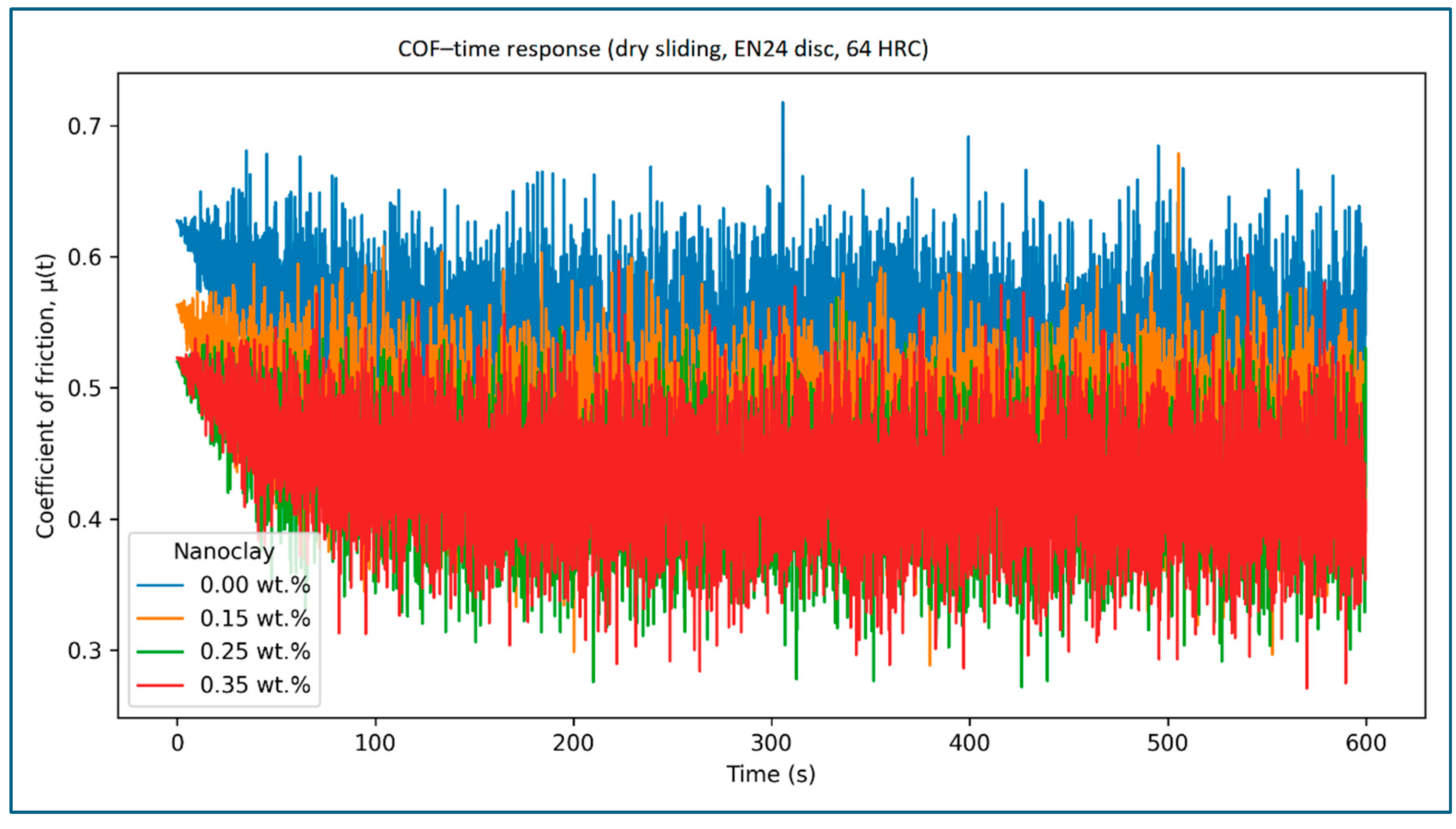
Figure 1 illustrates the evolution of the coefficient of friction during dry sliding, clearly revealing the transition from the run-in stage to steady-state friction. Neat bio-epoxy (0 wt.%) shows comparatively higher friction levels with larger fluctuations, indicating an unstable interfacial regime dominated by intermittent debris entrainment and non-uniform transfer layer formation. The addition of nanoclay produces a progressive improvement in frictional stability, evidenced by lower steady-state COF and reduced fluctuation amplitude. Among the investigated compositions, the 0.25 wt.% nanoclay system exhibits the most stable friction behavior, suggesting the formation of a relatively uniform and load bearing tribolayer that suppresses interfacial instabilities. At 0.35 wt.% nanoclay, small oscillations persist despite reduced mean COF, which is consistent with the onset of third-body effects arising from filler agglomerates and compacted debris. Overall, the observed friction stabilization with optimal nanoclay loading provides a quantitative basis for incorporating friction-signal features (μ_mean, μ_std, μ_max, run-in time, and stick–slip index) into subsequent mathematical and ML based wear models.
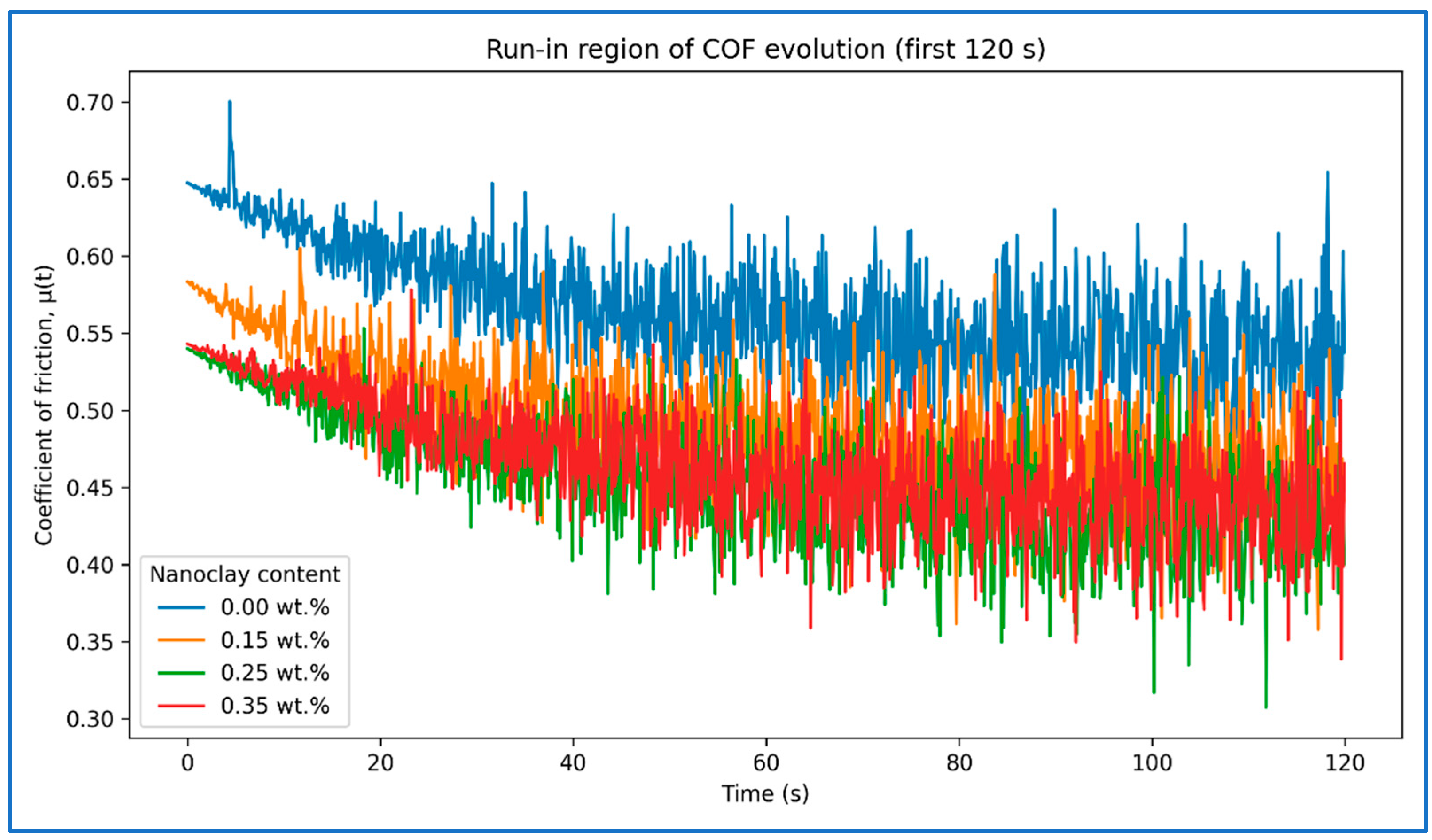
Figure 2 presents a magnified view of the initial run-in region of the COF–time response, providing insight into the early-stage frictional stabilization of the epoxy–nanoclay system. Neat bio-epoxy exhibits a pronounced decay in COF accompanied by significant fluctuations during the initial stages of sliding, reflecting unstable interfacial contact and progressive development of the transfer layer. The incorporation of nanoclay markedly alters this behavior, resulting in a smoother and more rapid convergence toward steady-state friction. In particular, the composite containing 0.25 wt.% nanoclay shows the fastest stabilization with reduced fluctuation amplitude during the run-in period, indicating effective load sharing and early formation of a mechanically stable tribolayer. Although the 0.35 wt.% nanoclay composition also demonstrates a reduction in initial COF relative to neat epoxy, intermittent fluctuations persist, suggesting the onset of debris-mediated interactions at higher filler loading. These observations confirm that nanoclay content plays a critical role in governing early-stage friction dynamics and justify the use of run-in time as a quantitative descriptor in subsequent wear modelling.

4.2. Quantitative Assessment of Friction Stability

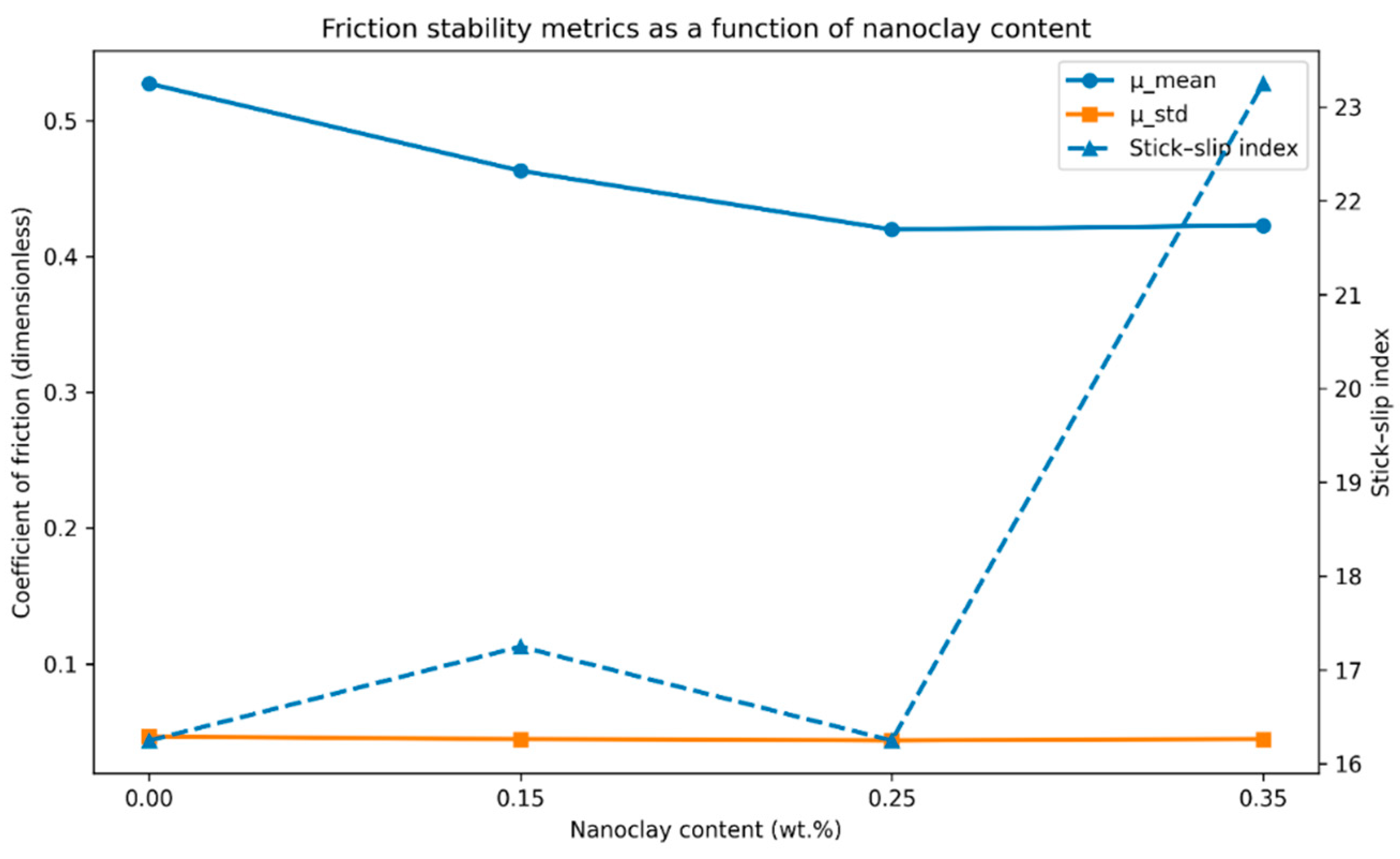
Figure 3 presents a quantitative comparison of friction stability parameters as a function of nanoclay content, complementing the qualitative observations from Figure 1 and Figure 2. The steady-state mean coefficient of friction shows a clear reduction with the addition of nanoclay, confirming its beneficial role in lowering interfacial shear resistance. More importantly, the standard deviation of COF and the stick–slip index provide insight into the dynamic stability of the sliding interface. Neat bio-epoxy exhibits comparatively higher friction fluctuations, indicative of unstable contact conditions and intermittent debris involvement. The incorporation of nanoclay leads to a noticeable reduction in friction variability, with the 0.25 wt.% composition displaying the lowest combined values of μ_std and stick–slip index. This behavior suggests the formation of a stable and continuous tribolayer capable of sustaining steady sliding. At 0.35 wt.% nanoclay, although the mean COF remains relatively low, an increase in stick–slip activity is observed, which may be attributed to the presence of agglomerated particles acting as third-body abrasives. Overall, these results demonstrate that friction stability, rather than mean friction alone, is a critical parameter governing the tribological performance of epoxy–nanoclay systems.

4.3. Effect of Normal Load on Specific Wear Rate

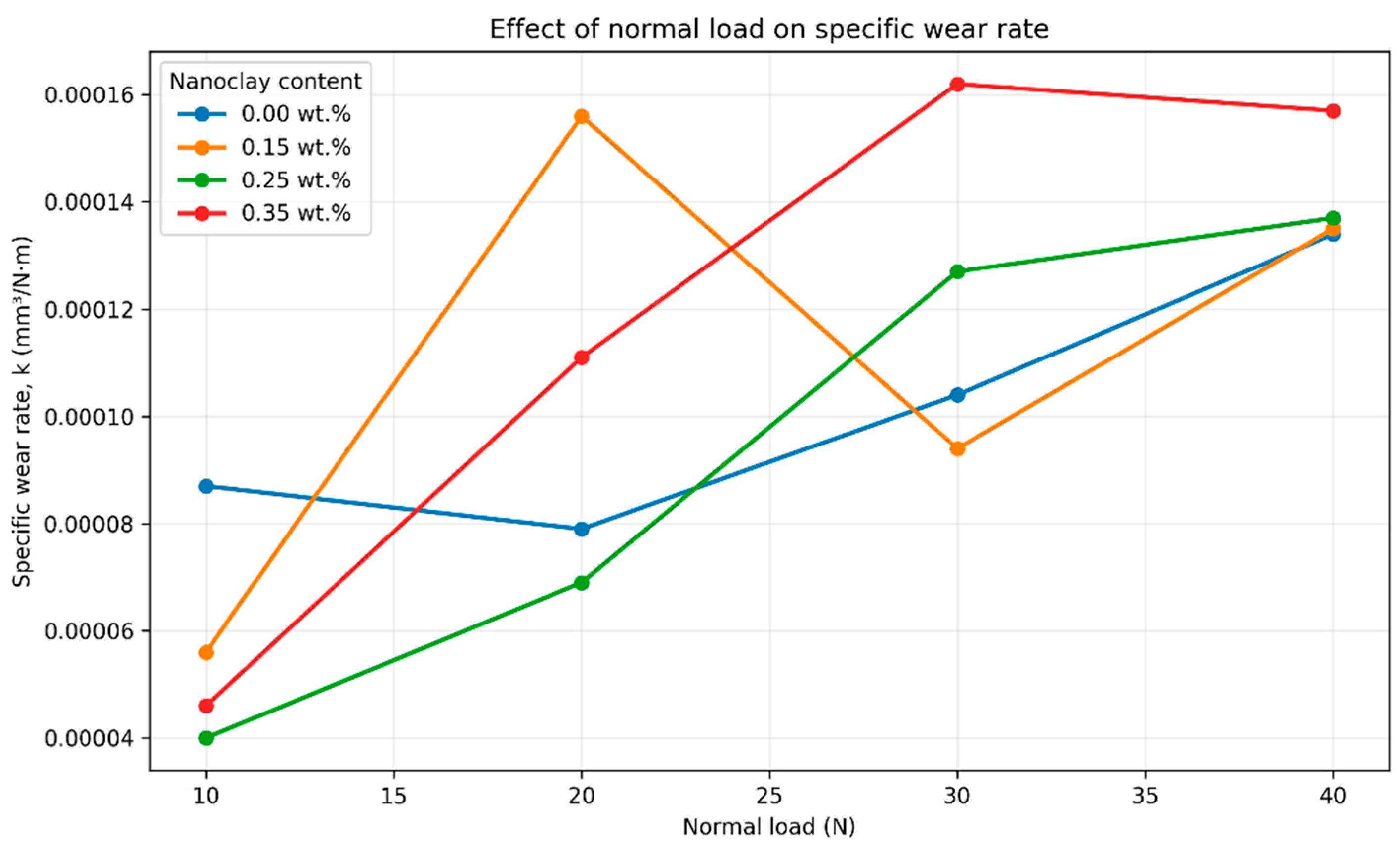
Figure 4 shows the variation of specific wear rate as a function of normal load for different nanoclay contents. For all compositions, an overall increase in wear rate with increasing load is observed, which is consistent with higher contact stresses and enhanced subsurface deformation at elevated loads. Neat bio-epoxy exhibits relatively higher wear rates across the investigated load range, reflecting its limited load-bearing capability under dry sliding. The addition of nanoclay significantly reduces the wear rate, particularly at lower and intermediate loads, indicating effective load sharing and improved resistance to material removal. Among the studied compositions, the epoxy containing 0.25 wt.% nanoclay consistently demonstrates the lowest wear rate, highlighting the existence of an optimal filler content for wear mitigation. At 0.35 wt.% nanoclay, the wear rate increases, especially at higher loads, suggesting that particle agglomeration and debris-induced third-body abrasion begin to dominate the wear process under severe contact conditions. These results confirm that normal load remains the primary controlling factor for wear, while nanoclay content governs the extent of wear reduction and the stability of the sliding interface.

4.4. Influence of Sliding Speed, Sliding Time, and Combined Severity on Wear Behaviour

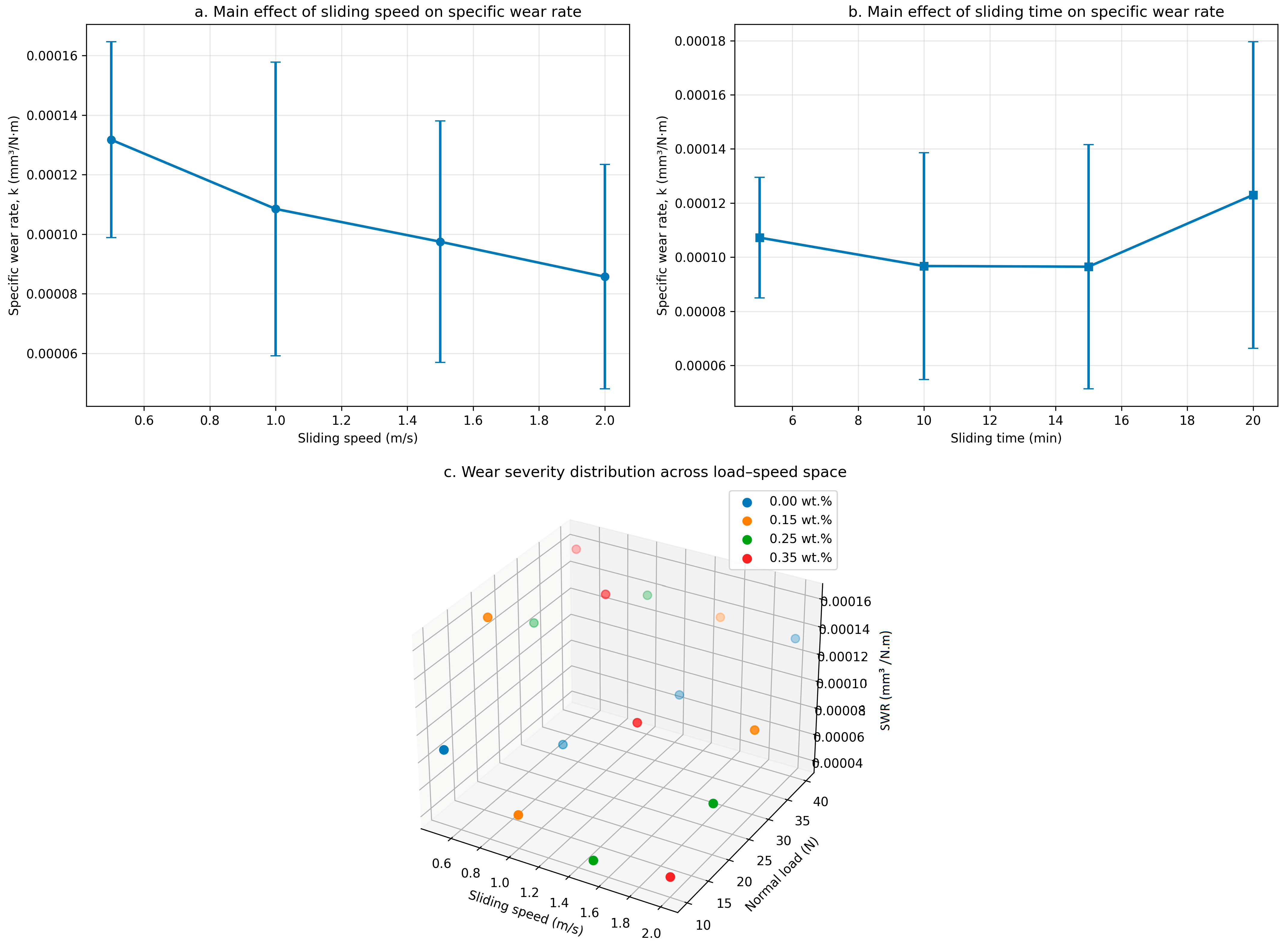
Figure 5 summarizes the influence of sliding kinematics and test duration on wear and also visualizes how wear severity is distributed across combined load–speed conditions. As shown in Figure 5a, the mean specific wear rate decreases with increasing sliding speed across the orthogonal set. This indicates that, within the present operating window, higher sliding speed promotes more stable interfacial sliding likely aided by transfer-layer development rather than accelerating wear through thermal softening. Figure 5b shows that sliding time has a weaker and non-monotonic influence on wear rate compared with load, with the highest mean wear rate observed at the longest duration. This behavior is consistent with progressive surface damage accumulation, where extended sliding increases the probability of microcrack coalescence and delamination events, particularly under severe combinations of load and speed.
The combined effect of load and speed becomes clearer in Figure 5c, where wear severity increases as the operating point shifts toward higher loads, regardless of nanoclay content. At similar severity, the nanoclay-filled compositions tend to populate lower wear-rate regions compared to neat epoxy, with the 0.25 wt.% composition frequently appearing among the lowest-wear conditions. In contrast, the 0.35 wt.% composition shows some high-wear points under severe regimes, supporting the idea that excessive filler loading can increase debris participation and third-body abrasion. Overall, these trends confirm that speed and time modulate wear behavior, but the dominant escalation in wear occurs under high contact severity, which is later quantified more directly through frictional power and energy dissipation.

4.5. Energy Dissipation, Thermal Response, and Wear Efficiency

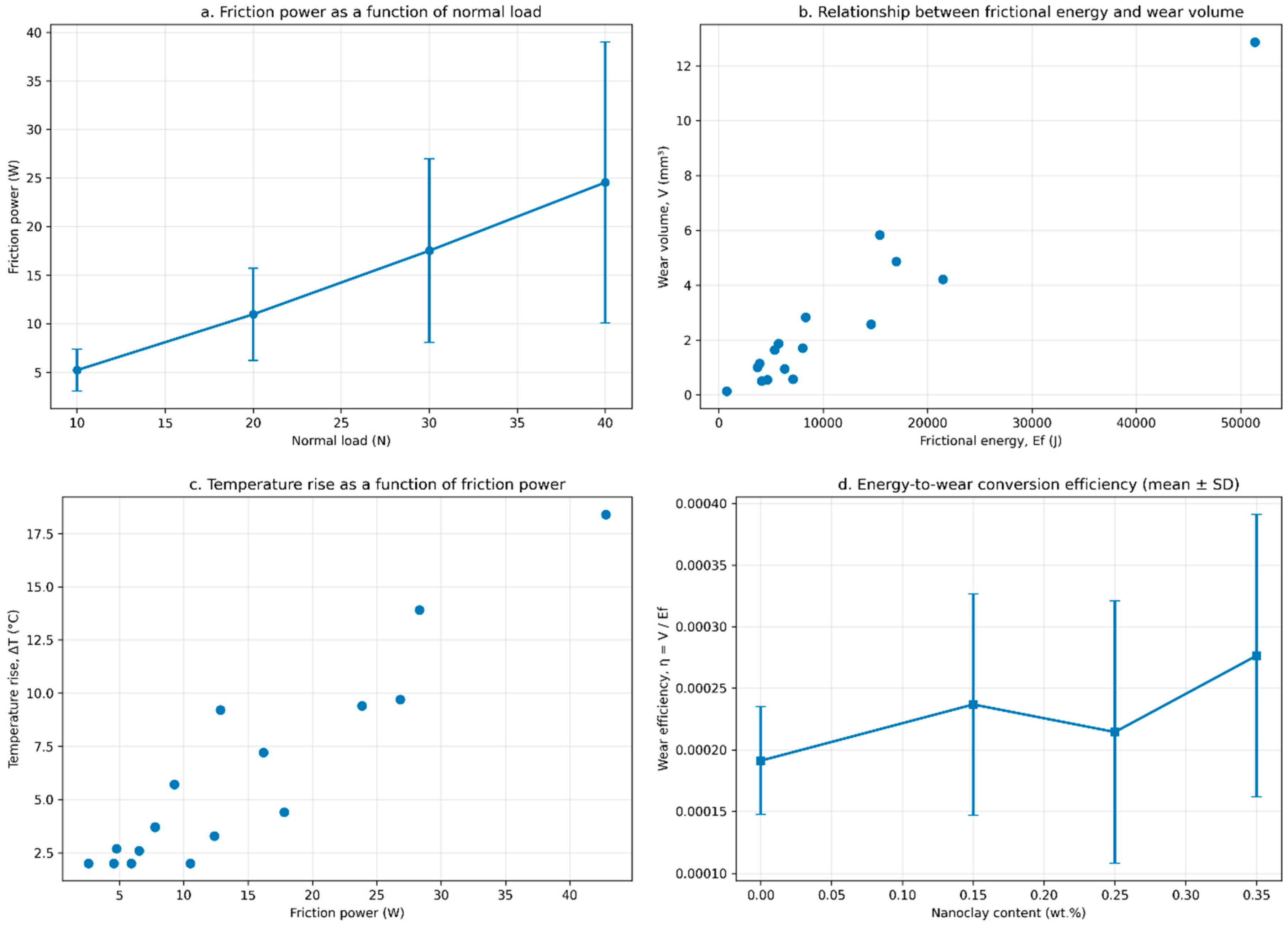
Figure 6 provides an energy-based perspective of the wear process, linking mechanical loading, frictional dissipation, and thermal response. As shown in Figure 6a, frictional power increases monotonically with normal load, reflecting higher interfacial shear work under severe contact conditions. The accumulated frictional energy exhibits a strong correlation with wear volume (Figure 6b), indicating that wear in the present epoxy–nanoclay system is primarily governed by energy dissipation rather than load or speed alone.
The thermal response shown in Figure 6c further supports this interpretation, where the temperature rise follows the trend of frictional power, confirming that interfacial heating originates from frictional work. Despite the observed temperature increase, the magnitude of ΔT remains moderate, suggesting that thermal softening contributes to wear primarily through localized interfacial effects rather than bulk degradation. Figure 6d presents the energy-to-wear conversion efficiency, offering a compact metric to compare material performance across compositions. The minimum efficiency observed for the 0.25 wt.% nanoclay composite indicates that a larger fraction of the dissipated energy is accommodated through stable sliding and tribolayer formation rather than material removal. In contrast, the higher efficiency at 0.35 wt.% nanoclay suggests increased conversion of energy into wear, likely due to debris-mediated third-body interactions. These findings establish a strong physical basis for the energy-based wear model and provide meaningful features for subsequent ML analysis.

4.6. Taguchi-Based Optimization and Factor Dominance Analysis

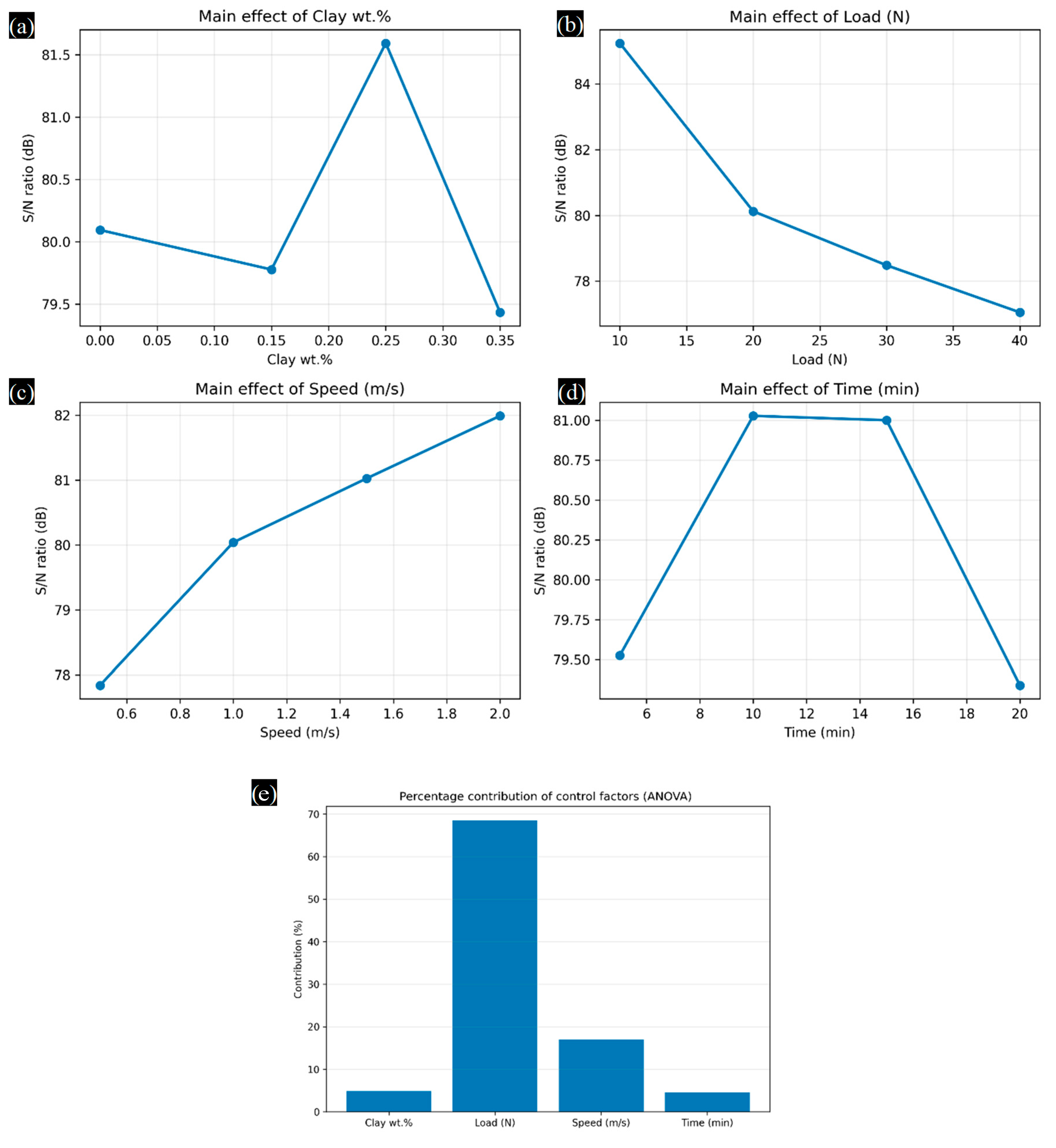
Figure 7 presents the Taguchi-based statistical evaluation of wear behavior, highlighting both the optimal parameter levels and the relative dominance of the control factors. The main effects plots in Figure 7a–d indicate that normal load has the strongest influence on the specific wear rate, with the S/N ratio decreasing sharply as load increases. This confirms that contact severity governs material removal in epoxy–nanoclay systems. Sliding speed exhibits a secondary influence, with higher speeds resulting in improved S/N ratios, suggesting more stable sliding conditions within the investigated range. Nanoclay content shows a clear optimum at 0.25 wt.%, while a further increase to 0.35 wt.% leads to deterioration in wear performance, consistent with agglomeration-induced third-body effects. Sliding time has the least influence among the considered factors.
The ANOVA results shown in Figure 7e further quantify these trends, indicating that load contributes the majority of the variance in wear behavior, followed by sliding speed and nanoclay content. The relatively low contribution of sliding time suggests that wear severity is governed more by instantaneous contact conditions than by test duration within the examined window. Overall, the Taguchi analysis statistically validates the experimentally observed trends and provides a robust foundation for subsequent comparison with mathematical and ML based wear models.

4.7. Modelling Comparison: Mathematical Models vs. Machine Learning

4.7.1. Physics-Based Mathematical Models

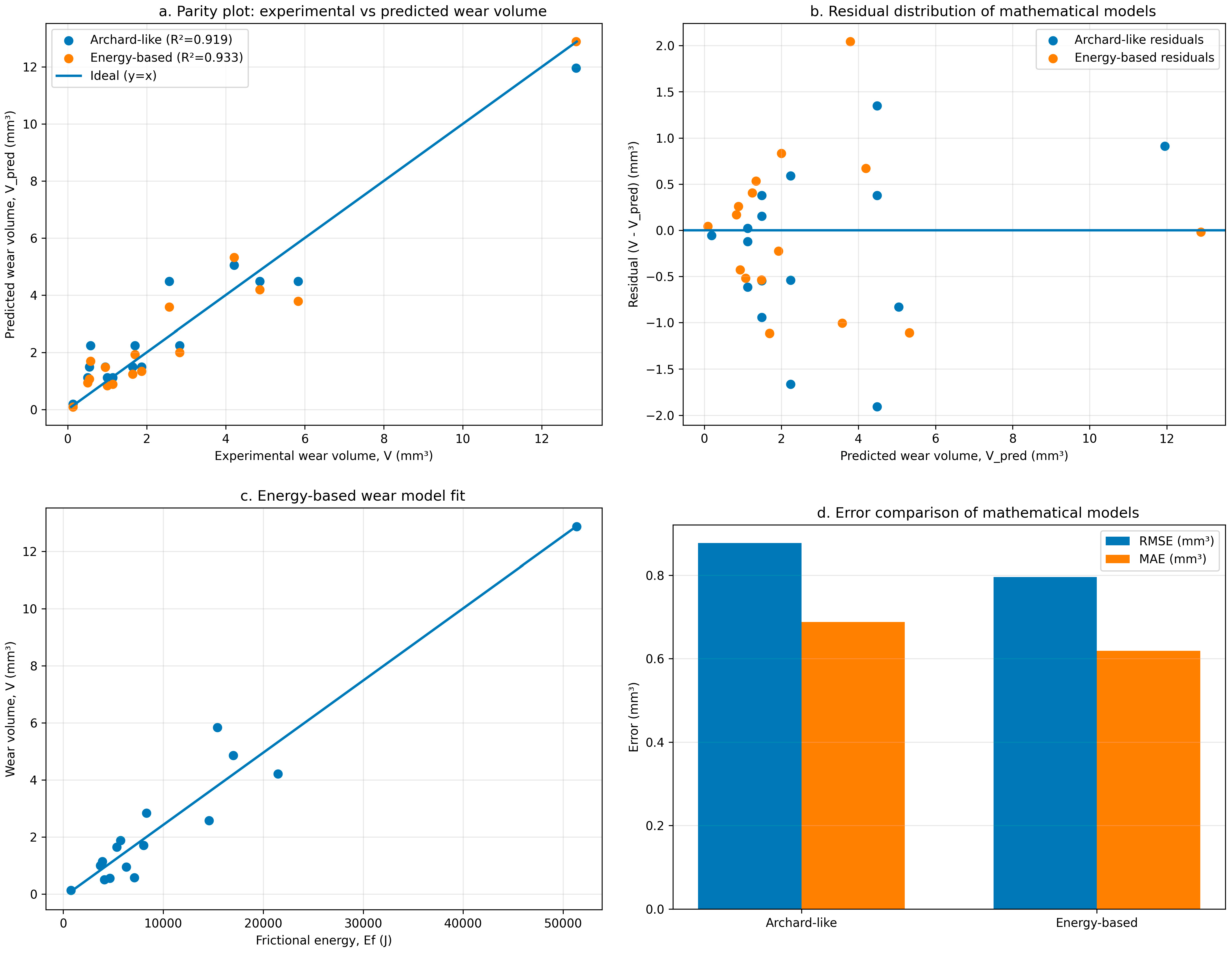
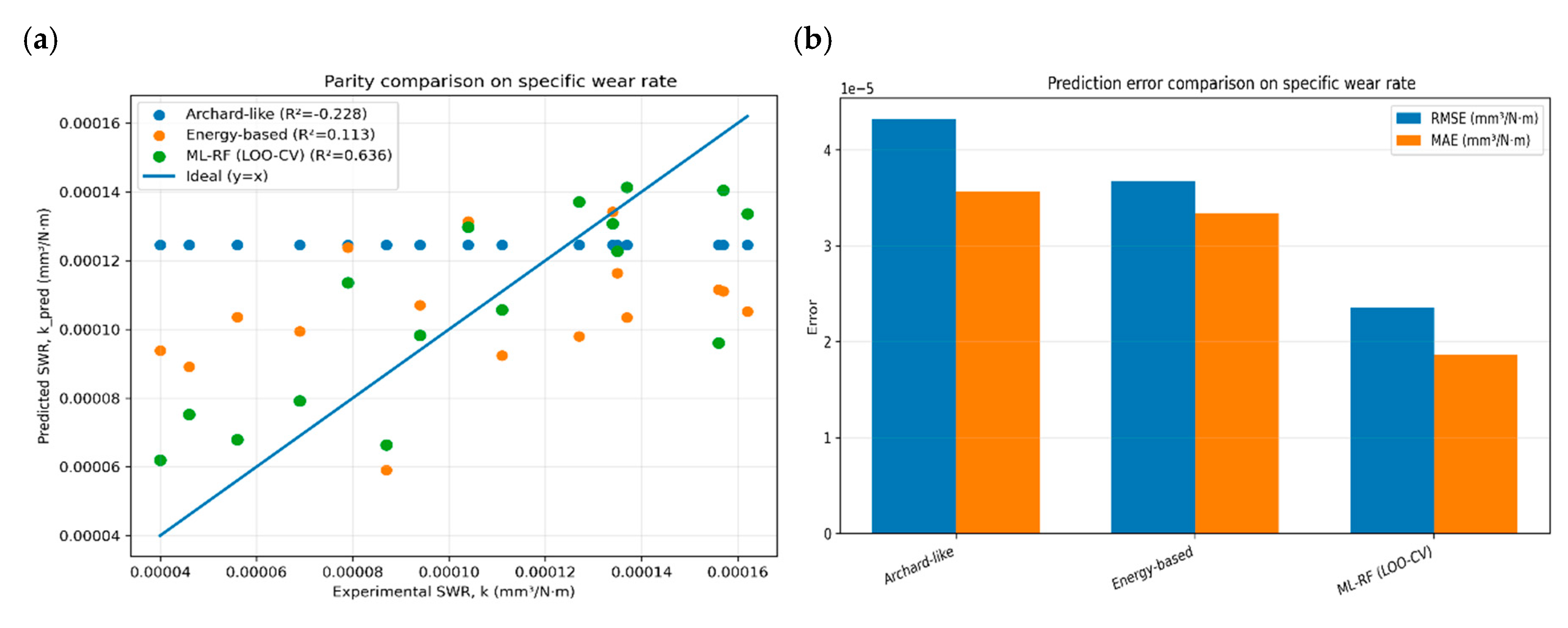
Figure 8 compares physics-based models and a data-driven model in terms of their ability to reproduce experimentally observed wear. When wear volume is treated as the response, both the Archard-type proportionality and the energy-based wear model capture the overall trend, with the energy-based model showing closer agreement and lower error dispersion (Figure 8a–d). This behavior is expected for polymer sliding, where frictional work and transfer-layer stability strongly influence material removal.

4.7.2. Model Comparison on the Primary Response Used in Taguchi

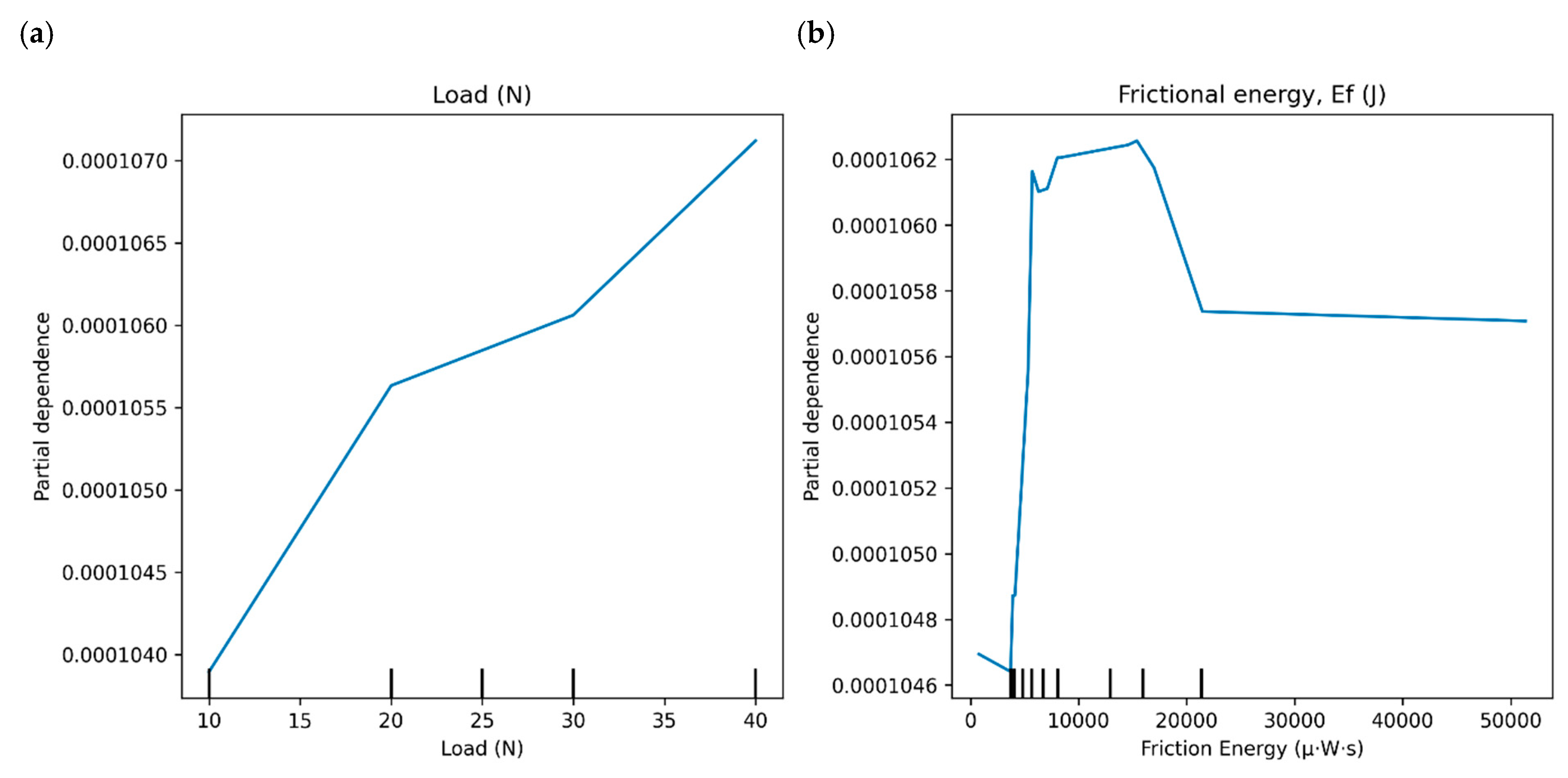
When the response is expressed as specific wear rate (k), the limitations of simple proportional models become clearer (Figure 9a,b). The Archard-type form collapses to an almost constant k across conditions and therefore fails to represent the variation observed experimentally. The energy-based model improves the trend but remains limited under mixed regimes where friction stability and debris participation change with operating condition. To ensure that the ML predictions remain physically interpretable, partial dependence plots were examined for the two key drivers (Figure 10a,b). The ML response shows a clear monotonic increase in wear severity with increasing normal load, consistent with contact-severity arguments. The dependence on frictional energy reveals a regime-sensitive response, indicating that energy dissipation captures variations not represented by load alone.

4.7.3. ML Interpretability

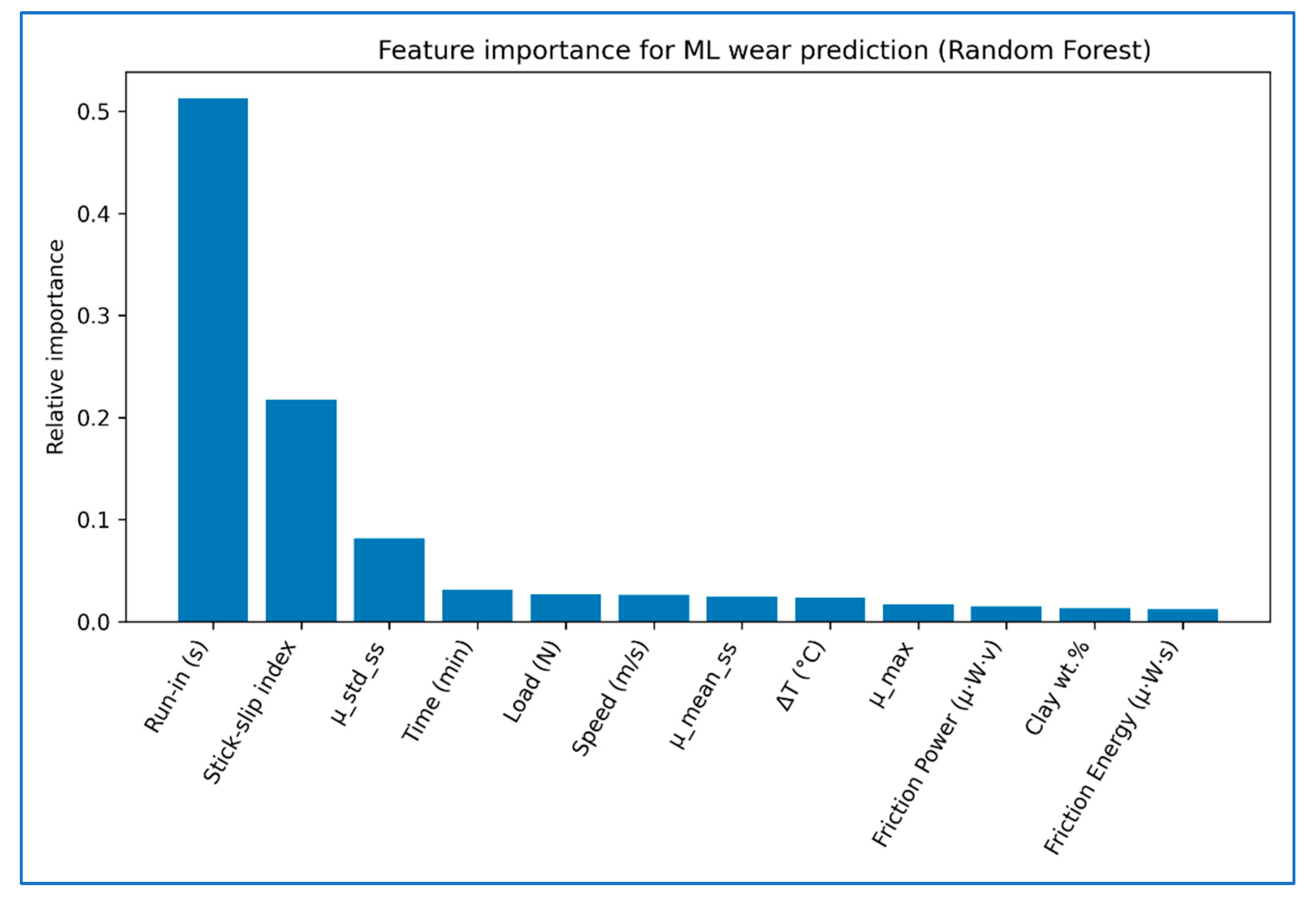
Figure 11 presents the relative importance of input features used in the ML model for predicting the specific wear rate. Parameters associated with contact severity and frictional response, including normal load, frictional energy, and friction stability descriptors, emerge as dominant contributors to wear prediction. The prominence of friction-related features such as the steady-state coefficient of friction, its variability, and stick–slip index indicates that wear in epoxy–nanoclay composites is strongly governed by interfacial stability rather than load alone. Thermal indicators also exhibit a measurable contribution, reflecting the role of frictional heating in modulating wear mechanisms under dry sliding. Importantly, the ranking of features aligns well with the experimental observations and the Taguchi–ANOVA analysis, confirming that the ML model captures physically meaningful relationships rather than relying on spurious correlations.

4.8. SEM–AFM Correlation and Wear Mechanism Evolution

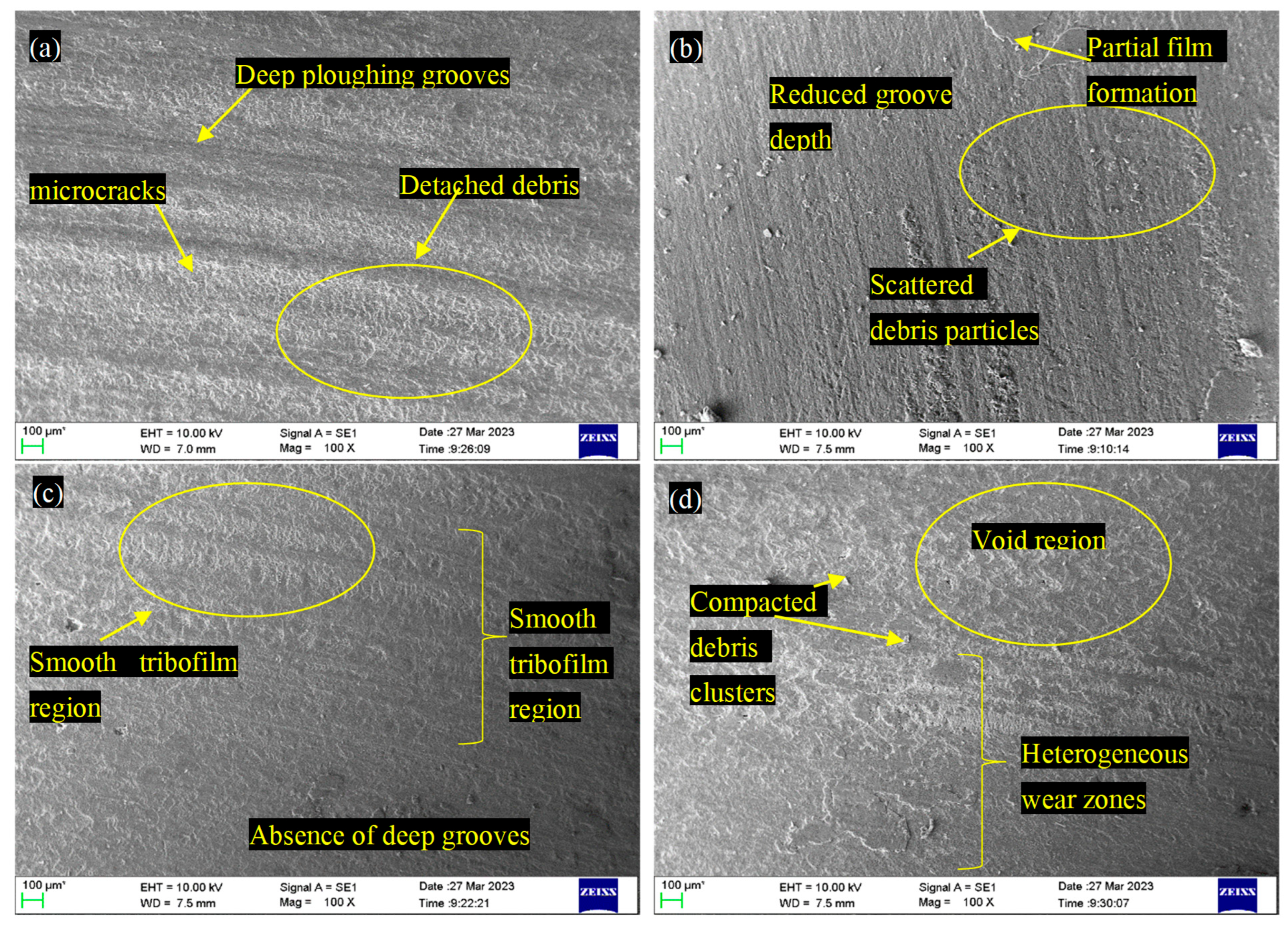
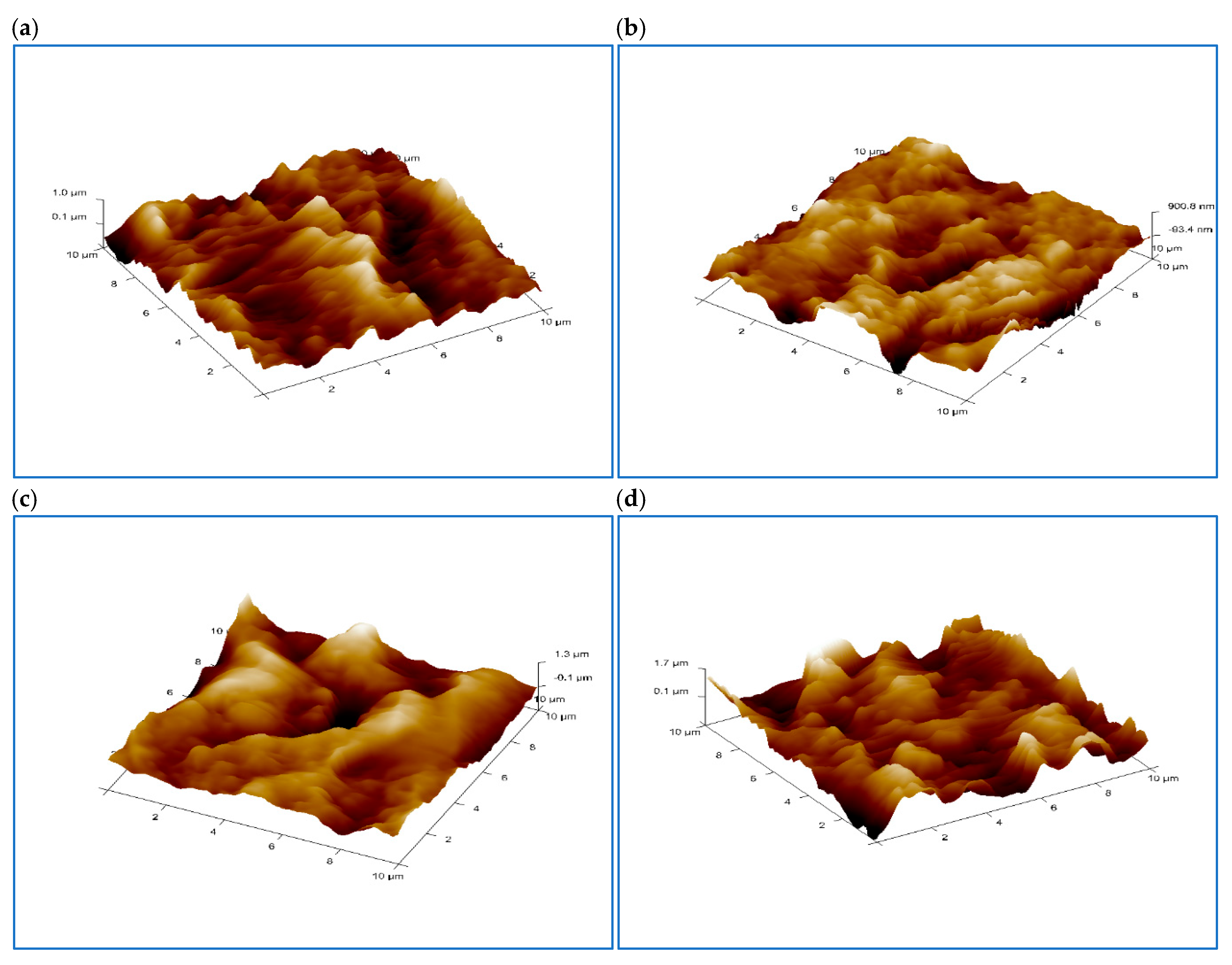
The SEM micrograph corresponding to Figure 12a reveals severe surface damage characterized by deep, continuous ploughing grooves oriented along the sliding direction, along with localized delamination and material pull-out. These features are indicative of dominant abrasive wear coupled with adhesive failure of the epoxy matrix under dry sliding. The absence of any protective tribolayer suggests poor load-bearing capability and unstable interfacial conditions. Consistent with this observation, the AFM topography shown in Figure 13a exhibits the highest surface roughness among all compositions, with sharp peak–valley transitions and pronounced height fluctuations. The combined SEM–AFM evidence confirms that neat epoxy undergoes extensive material removal driven by repeated asperity fracture and debris detachment, which directly correlates with the high specific wear rate, large friction fluctuations, and elevated energy-to-wear conversion observed experimentally.
At 0.15 wt.% nanoclay loading, the SEM image in Figure 12b shows a noticeable reduction in groove depth and continuity compared to neat epoxy, accompanied by scattered debris particles distributed across the wear track. While abrasive grooves are still present, their reduced severity suggests partial suppression of severe wear mechanisms. The corresponding AFM image (Figure 13b) displays a lower overall roughness with fewer sharp asperities, although localized height variations remain evident. These features indicate the onset of surface stabilization due to nanoclay addition, where load sharing and micro-scale reinforcement begin to restrict large-scale matrix deformation. However, the tribolayer formed at this composition remains discontinuous, explaining why the wear performance improves relative to neat epoxy but does not yet reach optimal stability.
The SEM micrograph presented in Figure 12c shows a comparatively smooth and uniform wear track, with a significant reduction in ploughing grooves and the presence of smeared regions indicative of a stable tribofilm. Large debris fragments and deep grooves are largely absent, suggesting effective protection of the epoxy matrix during sliding. AFM analysis in Figure 13c further supports this observation, revealing the lowest surface roughness among all samples, characterized by a plateau-like morphology and minimal peak–valley contrast. The strong agreement between SEM and AFM results confirms the formation of a continuous and mechanically stable tribolayer that accommodates sliding through mild shear rather than fracture-driven material removal. This microstructural stability explains the lowest specific wear rate, minimal friction instability, and lowest energy-to-wear conversion efficiency observed for this composition, establishing 0.25 wt.% nanoclay as the optimal filler content.
For the epoxy containing 0.35 wt.% nanoclay, the SEM image shown in Figure 12d reveals a heterogeneous wear surface characterized by patchy regions, compacted debris clusters, and localized pull-out features. Although severe ploughing is suppressed compared to neat epoxy, the surface morphology indicates non-uniform damage associated with debris-mediated third-body abrasion. This behavior is corroborated by the AFM topography in Figure 13d, which shows increased roughness relative to the 0.25 wt.% composite, with clustered asperities and uneven height distribution. These observations suggest that excessive nanoclay loading promotes agglomeration and debris accumulation, disrupting tribofilm continuity and reintroducing interfacial instability. As a result, a larger fraction of frictional energy is converted into wear, consistent with the increased wear efficiency, higher stick–slip activity, and deviation from optimal wear behavior at this composition.
To quantitatively support the AFM topography observations, surface roughness parameters were measured from the height profiles obtained using atomic force microscopy. The arithmetic mean roughness (Ra), root-mean-square roughness (Rq), and maximum height roughness (Rz) were evaluated from multiple scan areas on each worn surface, and the reported values represent the mean ± standard deviation obtained from different locations within the wear track. The nanoclay content of 0.25 wt.% exhibited the lowest Ra, Rq, and Rz values, indicating the formation of a smoother and more homogeneous tribofilm, whereas neat epoxy showed the highest roughness due to severe asperity damage and debris formation. At 0.35 wt.% nanoclay, an increase in all roughness parameters was observed, consistent with heterogeneous wear and localized debris accumulation. The quantitative roughness values are summarized in Table 1.

5. Conclusions

Nanoclay reinforcement significantly alters the tribological response of bio-based epoxy composites, with an optimal filler content of 0.25 wt.% providing the best overall performance. At this composition, the steady-state coefficient of friction decreased from ~0.53 to ~0.42, and the specific wear rate was reduced by approximately 25–30% relative to neat epoxy. Wear stability deteriorated beyond the optimal nanoclay loading. At 0.35 wt.%, increased stick–slip behavior, longer run-in duration, and heterogeneous surface morphology indicated the onset of debris-mediated third-body abrasion associated with filler agglomeration. Taguchi-based analysis confirmed that normal load is the dominant control parameter, contributing ~68% to wear variation, followed by sliding speed (~17%), while nanoclay content and sliding time exhibited smaller but measurable effects (~5% each). Energy-based wear modelling provided improved physical relevance compared to classical load–distance formulations, yielding a stronger correlation with experimental wear volume (R2 ≈ 0.93), demonstrating that frictional energy dissipation governs material removal more effectively in the studied system.
ML prediction using a random forest model achieved a predictive accuracy of R2 ≈ 0.64 under leave-one-out cross-validation, outperforming simple regression-based approaches and confirming the suitability of data-driven models for wear prediction in limited datasets. SEM and AFM analyses corroborated the macroscopic trends, revealing severe ploughing and matrix delamination in neat epoxy, smooth and continuous tribofilm formation at 0.25 wt.% nanoclay, and heterogeneous roughness with compacted debris at higher filler content. Overall, the demonstrated reduction in wear loss, frictional instability, and energy dissipation through optimized nanoclay reinforcement and predictive modelling contributes to durable and resource-efficient tribological material design, supporting SDG 9 (Industry, Innovation and Infrastructure) and SDG 12 (Responsible Consumption and Production), while reduced frictional losses are consistent with SDG 7 (Affordable and Clean Energy).

Supplementary Materials

The following supporting information can be downloaded at: https://www.mdpi.com/article/10.3390/jcs10020098/s1.

Author Contributions

Methodology, P.H., S.P. and G.B.M.; Software, S.P. and A.H.S.; Validation, Prateek Jain; Formal analysis, G.B.M. and G.D.D.; Investigation, K.K., P.J., G.D.D. and A.H.S.; Resources, P.H.; Data curation, K.K. and S.P.; Writing – original draft, K.K.; Writing – review & editing, P.H.; Supervision, P.H.; Project administration, P.H. All authors have read and agreed to the published version of the manuscript.

Funding

The authors declare that no specific funding was received for this work.

Data Availability Statement

The datasets generated and analyzed during the current study are available from the corresponding author on reasonable request.

Conflicts of Interest

The authors declare that they have no known competing financial interests or personal relationships that could have appeared to influence the work reported in this paper.

References

  1. Ramakrishnan, T.; Karthikeyan, K.R.; Tamilselvan, V.; Sivakumar, S.; Gangodkar, D.; Radha, H.R.; Singh, A.N.; Waji, Y.A. Study of Various Epoxy-Based Surface Coating Techniques for Anticorrosion Properties. Adv. Mater. Sci. Eng. 2022, 2022, 5285919. [Google Scholar] [CrossRef]
  2. Ou, B.; Wang, Y.; Lu, Y. A review on fundamentals and strategy of epoxy-resin-based anticorrosive coating materials. Polym. Technol. Mater. 2021, 60, 601–625. [Google Scholar] [CrossRef]
  3. Tian, J.; Qi, X.; Li, C.; Xian, G. Friction behaviors and wear mechanisms of multi-filler reinforced epoxy composites under dry and wet conditions: Effects of loads, sliding speeds, temperatures, water lubrication. Tribol. Int. 2023, 179, 108148. [Google Scholar] [CrossRef]
  4. Zhai, W.; Bai, L.; Zhou, R.; Fan, X.; Kang, G.; Liu, Y.; Zhou, K. Recent Progress on Wear-Resistant Materials: Designs, Properties, and Applications. Adv. Sci. 2021, 8, 2003739. [Google Scholar] [CrossRef]
  5. Kumar, N.; Setia, G.; Nanda, T.; Singh, V.; Mehta, R.; Bansal, A. Dry abrasion and sliding wear resistance of GFRP composites with synergistic reinforcement of platelet and tubular-type nanoclays. Wear 2026, 584–585, 206389. [Google Scholar] [CrossRef]
  6. Nanda, T.; Singh, K.; Shelly, D.; Mehta, R. Advancements in multi-scale filler reinforced epoxy nanocomposites for improved impact strength: A review. Crit. Rev. Solid State Mater. Sci. 2021, 46, 281–329. [Google Scholar] [CrossRef]
  7. Wazalwar, R.; Sahu, M.; Raichur, A.M. Mechanical properties of aerospace epoxy composites reinforced with 2D nano-fillers: Current status and road to industrialization. Nanoscale Adv. 2021, 3, 2741–2776. [Google Scholar] [CrossRef]
  8. Chan, J.X.; Wong, J.F.; Petrů, M.; Hassan, A.; Nirmal, U.; Othman, N.; Ilyas, R.A. Effect of Nanofillers on Tribological Properties of Polymer Nanocomposites: A Review on Recent Development. Polymers 2021, 13, 2867. [Google Scholar] [CrossRef]
  9. Kumar, N.; Setia, G.; Singh, V.; Bansal, A.; Nanda, T.; Mehta, R. Tribological performance and microstructural insights of epoxy-based GFRP nanocomposites reinforced with ceramic nanoclays for wear-resistant applications. J. Manuf. Process. 2025, 151, 460–475. [Google Scholar] [CrossRef]
  10. Beryl, J.R.; Xavier, J.R. Halloysite for clay–polymer nanocomposites: Effects of nanofillers on the anti-corrosion, mechanical, microstructure, and flame-retardant properties—A review. J. Mater. Sci. 2023, 58, 10943–10974. [Google Scholar] [CrossRef]
  11. Hiremath, P.; Shivamurthy, R.C.; Kamath, G.B.; Naik, N. Comprehensive Analysis of Wear, Friction, and Thermal Resistance in PVDF/Nanoclay Composites Using Taguchi Methodology for Enhanced Tribological Performance. J. Compos. Sci. 2025, 9, 37. [Google Scholar] [CrossRef]
  12. Rashmi; Renukappa, N.M.; Suresha, B.; Devarajaiah, R.M.; Shivakumar, K.N. Dry sliding wear behaviour of organo-modified montmorillonite filled epoxy nanocomposites using Taguchi’s techniques. Mater. Des. 2011, 32, 4528–4536. [Google Scholar] [CrossRef]
  13. Mohan, T.P.; Kanny, K. Tribological Studies of Nanoclay Filled Epoxy Hybrid Laminates. Tribol. Trans. 2017, 60, 681–692. [Google Scholar] [CrossRef]
  14. Kumar, M.S.S.; Raju, N.M.S.; Sampath, P.S.; Vivek, U. Tribological analysis of nano clay/epoxy/glass fiber by using Taguchi’s technique. Mater. Des. 2015, 70, 1–9. [Google Scholar] [CrossRef]
  15. Ragunath, S.; Velmurugan, C.; Kannan, T. Optimization of tribological behavior of nano clay particle with sisal/jute/glass/epoxy polymer hybrid composites using RSM. Polym. Adv. Technol. 2017, 28, 1813–1822. [Google Scholar] [CrossRef]
  16. Karuppiah, G.; Kuttalam, K.C.; Ayrilmis, N.; Nagarajan, R.; Devi, M.P.I.; Palanisamy, S.; Santulli, C. Tribological Analysis of Jute/Coir Polyester Composites Filled with Eggshell Powder (ESP) or Nanoclay (NC) Using Grey Rational Method. Fibers 2022, 10, 60. [Google Scholar] [CrossRef]
  17. Senthilkumar, N.; Gajalakshmi, K.; Palanikumar, K.; Deepanraj, B.; Afzal, A.R. Wear analysis and optimization of nanoclay and copper coated carbon fiber strengthened hybrid aluminium composite. Results Eng. 2025, 25, 103711. [Google Scholar] [CrossRef]
  18. Demir, M.E. Investigation of The Abrasive Wear Behavior of GFRC and CFRC with Different Parameters Using Taguchi And Artificial Neural Networks Method. Politek. Derg. 2025, 28, 215–228. [Google Scholar] [CrossRef]
  19. Shettar, M.; Bhat, A.; Katagi, N.N. Estimation of mass loss under wear test of nanoclay-epoxy nanocomposite using response surface methodology and artificial neural networks. Sci. Rep. 2025, 15, 19978. [Google Scholar] [CrossRef] [PubMed]
  20. Suresh, G.; Vasu, V.; Rao, M.V. A Composite (Taguchi-Utility-RSM) Approach for Optimizing the Tribological Responses of Polytetrafluoroethylene (PTFE) Nanocomposites for Self-lubrication Applications. Silicon 2018, 10, 2043–2053. [Google Scholar] [CrossRef]
  21. Sathiyamurthy, S.; Saravanakumar, S.; Vinoth, V. Enhancing tribological performance of hybrid fiber-reinforced composites through machine learning and response surface methodology. J. Reinf. Plast. Compos. 2025, 44, 2306–2324. [Google Scholar] [CrossRef]
  22. Kumar, K.J.S.; Rajanna, S.; Krishnamurthy, K.N.; Deep, B.N.A.; Razak, A.; Anqi, A.E.; Rajhi, A.A.; Emma, A.F. Wear behaviour and statistical assessment of organomodified nanoclay reinforced glass fiber epoxy nanocomposites. Sci. Rep. 2025, 16, 3722. [Google Scholar] [CrossRef]
  23. Muralidhara, B.; Babu, S.P.K.; Suresha, B.; Yogesha, K.K.; Vasundhara, M.G.; Kalavathi, G.K.; Goudar, D.M.; Kurahatti, R.V.; Bhat, S.K. Enhanced mechanical, thermal, and wear performance of halloysite nanotube infused carbon fiber epoxy composites. Sci. Rep. 2025, 15, 30019. [Google Scholar] [CrossRef]
  24. Ravichandran, G.; Rathnakar, G.; Santhosh, N.; Thejaraju, R. Antiwear Performance Evaluation o f Halloysite Nanotube (HNT) Filled Polymer Nanocomposites. Int. J. Eng. Adv. Technol. 2019, 9, 3314–3321. [Google Scholar] [CrossRef]
  25. Mallampati, S.C.; Gujjala, R.; Manne, A.A.; Kumar, M.S.R.N.; Kanakam, R.; Babu, V.S.; Banea, M.D. A study on the effect of nanoclay addition on the erosion wear characteristics of S-glass/sisal reinforced hybrid polymer composites. Discov. Mater. 2024, 4, 82. [Google Scholar] [CrossRef]
  26. Biswas, S.; Satapathy, A. Tribo-performance analysis of red mud filled glass-epoxy composites using Taguchi experimental design. Mater. Des. 2009, 30, 2841–2853. [Google Scholar] [CrossRef]
  27. Agrawal, S.; Singh, K.K.; Sarkar, P.K. A comparative study of wear and friction characteristics of glass fibre reinforced epoxy resin, sliding under dry, oil-lubricated and inert gas environments. Tribol. Int. 2016, 96, 217–224. [Google Scholar] [CrossRef]
  28. Shan, Z.; Jia, X.; Li, S.; Li, Y.; Yang, J.; Fan, H.; Song, H. Self-lubricating and wear-resistant epoxy resin coatings based on the ‘soft-hard’ synergistic mechanism for rapid self-healing under photo-thermal conditions. Chem. Eng. J. 2024, 481, 148664. [Google Scholar] [CrossRef]
  29. Karthik Babu, N.B.; Ramesh, T. Enhancement of thermal and mechanical properties of novel micro-wear debris reinforced epoxy composites. Mater. Res. Express 2019, 6, 105358. [Google Scholar] [CrossRef]
  30. Cao, S.; Liang, J.; Zhou, J.; Wang, L. Microstructure evolution and wear resistance of in-situ nanoparticles reinforcing Fe-based amorphous composite coatings. Surf. Interfaces 2020, 21, 100652. [Google Scholar] [CrossRef]
  31. Jose, S.A.; Lapierre, Z.; Williams, T.; Hope, C.; Jardin, T.; Rodriguez, R.; Menezes, P.L. Wear- and Corrosion-Resistant Coatings for Extreme Environments: Advances, Challenges, and Future Perspectives. Coatings 2025, 15, 878. [Google Scholar] [CrossRef]
  32. Kesarwani, S.; Verma, R.K.; Xu, J. Modified whale intelligence algorithm and Combined Compromise Solution (CoCoSo) for machinability evaluation of polymer nanocomposites. J. Brazilian Soc. Mech. Sci. Eng. 2024, 46, 66. [Google Scholar] [CrossRef]
  33. Hiremath, P.; Ranjan, R.; DeSouza, V.; Bhat, R.; Patil, S.; Maddodi, B.; Shivamurthy, B.; Perez, T.C.; Naik, N. Enhanced Wear Resistance in Carbon Nanotube-Filled Bio-Epoxy Composites: A Comprehensive Analysis via Scanning Electron Microscopy and Atomic Force Microscopy. J. Compos. Sci. 2023, 7, 478. [Google Scholar] [CrossRef]
Figure 1. Coefficient of friction evolution during dry sliding.
Jcs 10 00098 g001
Figure 2. Run-in region of coefficient of friction evolution.
Jcs 10 00098 g002
Figure 3. Friction stability metrics as a function of nanoclay content.
Jcs 10 00098 g003
Figure 4. Effect of normal load on specific wear rate.
Jcs 10 00098 g004
Figure 5. Wear behavior: (a) Main effect of sliding speed on specific wear rate; (b) Main effect of sliding time on specific wear rate; (c) Wear severity distribution across load–speed space.
Jcs 10 00098 g005
Figure 6. Frictional characteristics: (a) Friction power vs. normal load; (b) Wear volume vs. frictional energy; (c) Temperature rise vs. friction power; (d) Energy-to-wear conversion efficiency (η = V/Ef) vs. nanoclay content.
Jcs 10 00098 g006
Figure 7. Taguchi results: (a) Main effect of clay wt.%; (b) Main effect of load (N); (c) Main effect of speed (m/s); (d) Main effect of time (min); (e) Percentage contribution of each factor.
Jcs 10 00098 g007
Figure 8. Mathematical model fitting and error behavior: (a) Parity plot; (b) Residuals; (c) Energy-based model fit; (d) Error comparison.
Jcs 10 00098 g008
Figure 9. Prediction comparison on specific wear rate: (a) Parity comparison on SWR; (b) Error comparison on SWR.
Jcs 10 00098 g009
Figure 10. Partial dependence of ML-predicted SWR (a) Load (b) Frictional energy.
Jcs 10 00098 g010
Figure 11. Feature importance for ML-based prediction of specific wear rate.
Jcs 10 00098 g011
Figure 12. Worn-out surface SEM analysis (a) 0 wt.% nanoclay (b) 0.15 wt.% nanoclay (c) 0.25 wt.% nanoclay (d) 0.35 wt.% nanoclay.
Jcs 10 00098 g012
Figure 13. AFM analysis: (a) 0 wt.% nanoclay; (b) 0.15 wt.% nanoclay; (c) 0.25 wt.% nanoclay; (d) 0.35 wt.% nanoclay.
Jcs 10 00098 g013
Table 1. Surface roughness parameters of worn epoxy–nanoclay composites.
Nanoclay (wt.%)Ra (nm)Rq (nm)Rz (nm)Mechanistic Interpretation
0192 ± 24323 ± 411435 ± 180Deep grooves and debris islands
0.15132 ± 18165 ± 221134 ± 150Reduced ploughing, partial tribofilm
0.2581 ± 9112 ± 14923 ± 105Smoothest surface, continuous tribofilm
0.35109 ± 16156 ± 201054 ± 135Heterogeneous wear with compacted debris
Disclaimer/Publisher’s Note: The statements, opinions and data contained in all publications are solely those of the individual author(s) and contributor(s) and not of MDPI and/or the editor(s). MDPI and/or the editor(s) disclaim responsibility for any injury to people or property resulting from any ideas, methods, instructions or products referred to in the content.