
Article

An Electrochemical Cortisol Sensor Based on rGO-Modified Molecularly Imprinted Polymers
1
State Key Laboratory of Electronic Thin Films and Integrated Devices, School of Optoelectronic Science and Engineering, University of Electronic Science and Technology of China, Chengdu 610054, China
2
School of Automation Science and Electrical Engineering, Beihang University, Beijing 100191, China
*
Authors to whom correspondence should be addressed.
J. Compos. Sci. 2026, 10(2), 96; https://doi.org/10.3390/jcs10020096
Submission received: 4 January 2026 / Revised: 30 January 2026 / Accepted: 9 February 2026 / Published: 11 February 2026
(This article belongs to the Section Polymer Composites)

Abstract

The growing burden of stress-related mental disorders has intensified the demand for practical tools that enable objective and continuous stress assessment. Cortisol is a well-established biochemical indicator of stress and is detectable in sweat, making it attractive for portable monitoring. In this work, we present a portable electrochemical cortisol sensor (PECS) constructed on a screen-printed carbon electrode, where reduced graphene oxide (rGO) enhances charge transfer and an electropolymerized molecularly imprinted polymer (MIP) provides selective recognition. The PECS delivers reliable quantification from 0.01 to 100 nM with stable signal output, achieving a sensitivity of 670.0 nA·nM−1·cm−2 and a limit of detection of 0.0031 nM (i–t mode). The proposed platform supports non-invasive, real-time cortisol readout and offers a feasible route toward soft bioelectronic systems for mental-health-oriented monitoring.

1. Introduction

In modern society, psychological problems are becoming increasingly prevalent, affecting daily life and work while also posing serious risks to physical health. Prolonged psychological stress can lead not only to mental disorders but also to various physiological diseases. When stress is not relieved in a timely manner, its continued accumulation—even without developing into a clinical disorder—can impose significant burdens on families and society and may, in extreme cases, result in severe consequences [1,2,3,4].
At present, psychological stress is primarily assessed through psychological scales and evaluations conducted by professionals. However, these methods have notable limitations: they often fail to accurately capture an individual’s real stress level and are both time-consuming and costly. Therefore, there is a pressing need for a real-time, accurate, and quantitative method for measuring psychological stress [5,6,7,8].
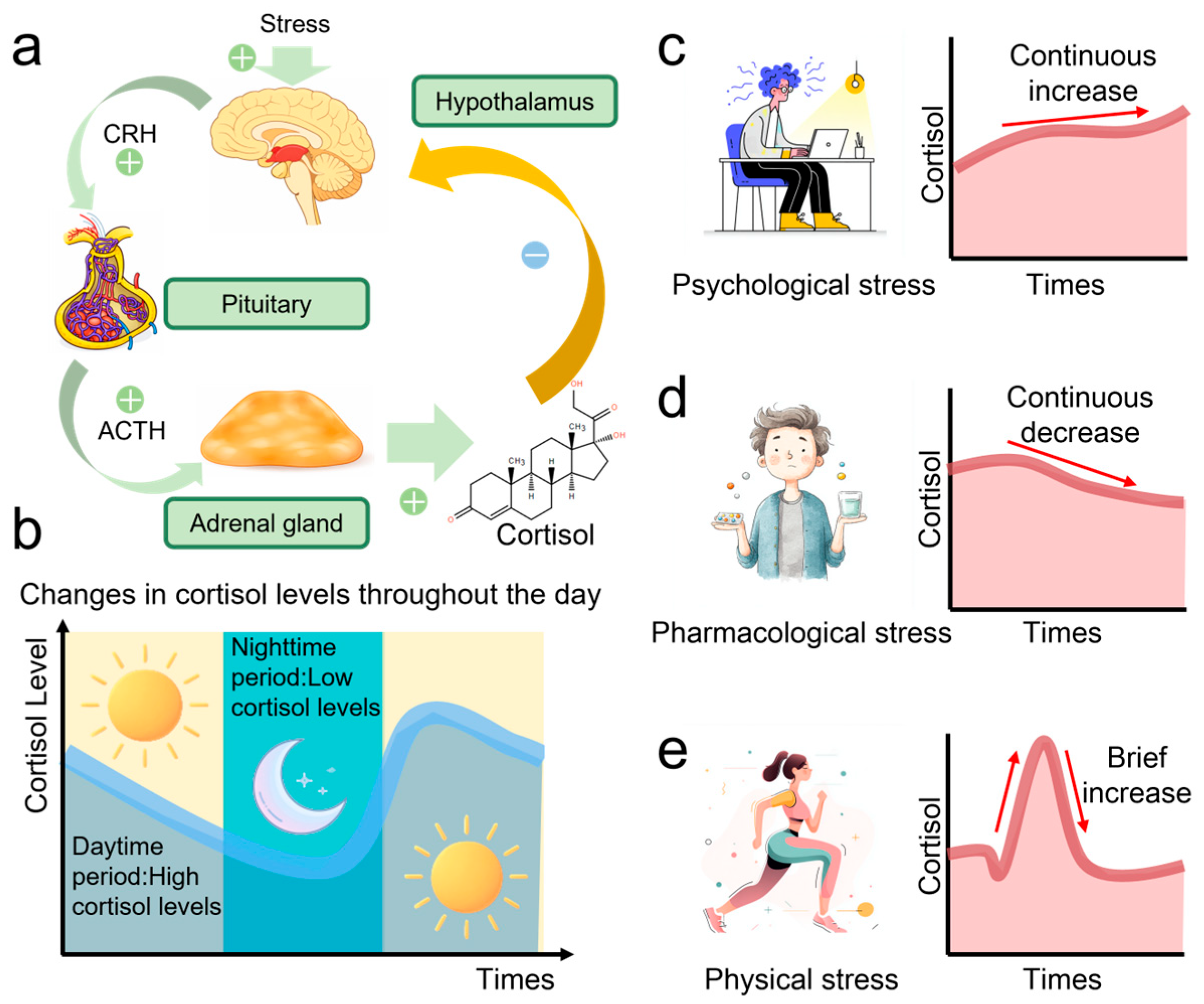
Cortisol is a key indicator of psychological stress and is involved in disorders like depression [9]. Its levels are primarily regulated by the hypothalamic–pituitary–adrenal (HPA) axis (Figure 1a), an endocrine feedback loop that converts stress signals into hormonal output. Stress triggers the hypothalamus to release corticotropin-releasing hormone (CRH), stimulating adrenocorticotropic hormone (ACTH) secretion from the pituitary, which in turn prompts cortisol production and release from the adrenal cortex. As cortisol easily crosses cell membranes, blood levels provide a direct measure of adrenal secretion [9].
Importantly, cortisol varies predictably over the day (Figure 1b). Concentrations usually peak in the morning (around 8 a.m., 138–634 nM) in blood and decline gradually toward the evening, when the lowest levels are typically observed (83–441 nM) [10,11,12]. Beyond this circadian baseline, acute stress can trigger a transient rise in cortisol and related hormones. Once the stressor subsides, negative feedback within the HPA axis suppresses further hormone release and helps restore concentrations to their basal range [10,11,12].
Chronic psychological stress can disrupt regulatory mechanisms, leading to sustained activation of the HPA axis and persistently elevated cortisol (Figure 1c). Prolonged hypercortisolemia is linked to inflammation, immune dysfunction, metabolic issues, mood disturbances, and cardiovascular risk. Cortisol dynamics vary across contexts: psychiatric treatments often reduce cortisol gradually (Figure 1d), while vigorous exercise causes a temporary increase followed by recovery to baseline (Figure 1e).
At present, commonly used methods for cortisol detection include radioimmunoassay (RIA), spectrophotometric methods (absorbance- or fluorescence-based), high-performance liquid chromatography (HPLC), liquid chromatography–mass spectrometry (LC–MS), enzyme-linked immunosorbent assay (ELISA), and surface plasmon resonance (SPR). However, these techniques generally suffer from long analysis times and high costs, require complex sample pretreatment and skilled operators, and rely on sophisticated instrumentation that is largely confined to laboratory settings. Moreover, biosensors based on these methods are difficult to miniaturize, which limits their application in wearable sweat-based sensing devices for personalized and portable stress monitoring [13,14,15,16,17].
Conventional assays for cortisol measurement (e.g., blood-, saliva-, and urine-based tests) typically provide only intermittent readouts and may be limited by invasiveness and sample-handling variability, which restricts their use for continuous or real-time assessment. Portable sweat sensing offers a complementary, noninvasive route to capture cortisol fluctuations with high temporal resolution and sensitivity. As a result, sweat-based platforms enable longitudinal profiling of stress-related endocrine dynamics and support applications such as personalized healthcare and remote monitoring [18,19,20,21].
In parallel with sweat-based sensing, other noninvasive strategies for real-time cortisol and hormonal state monitoring have also been explored. Breath-based analysis, particularly via exhaled breath condensate (EBC), has been investigated as a route for continuous physiological monitoring, and recent advances in wearable breath-collection platforms highlight its potential for stress-related biomarker analysis [22,23]. In addition, quantum-enabled approaches such as quantum point-contact (QPC) sensors, which exploit nanoscale quantum conductance modulation, have been reported for highly sensitive breath analysis and for probing hormone-associated physiological states [24,25,26]. While these emerging technologies offer exceptional sensitivity, they typically rely on complex instrumentation and stringent operating conditions, limiting their scalability and integration into low-cost wearable systems.
Accurate quantification of target biomarkers in sweat remains challenging because sweat is a highly heterogeneous matrix containing many potential interferents. While antibodies and aptamers can provide strong affinity, their implementation in wearable formats is often constrained by cost, limited shelf-life, and performance drift caused by on-skin conditions (e.g., temperature and pH variations) that can compromise biomolecular integrity. These considerations motivate the development of cortisol sensors that deliver sensitive detection while maintaining long-term stability and scalable, cost-effective fabrication [21,27,28,29,30,31,32].
Molecularly imprinted polymers (MIPs) endow materials with antibody-like molecular recognition capability by constructing three-dimensional recognition cavities within polymer networks that are highly complementary to the substance to be tested [33]. Compared with conventional biorecognition elements such as antibodies, MIPs offer advantages including high design flexibility, low cost, and excellent stability even when exposed to extreme environmental factors [34]. When incorporated into electrochemical sensing systems, molecularly imprinted polymers facilitate highly accurate detection by selectively binding target molecules with strong affinity [35,36].
Cortisol MIP sensors’ development path has generally progressed from proof-of-concept studies to portable and engineered applications. Early research primarily focused on the selective recognition of the small-molecule hormone cortisol using electropolymerized molecularly imprinted polymers (eMIPs), with electropolymerized polypyrrole (PPy) serving as a representative example [37]. By constructing recognition sites on electrode surfaces in situ that are well matched to cortisol in terms of spatial structure and chemical functional groups, these studies first demonstrated that MIPs could substitute antibodies for the specific detection of cortisol while offering reusability [38,39]. As research advanced, efforts gradually expanded from solution-based or saliva-based systems to more challenging complex biological matrices such as sweat, driving the development of flexible electrodes, wearable substrates, and low-power electrochemical readout strategies [40,41]. In recent years, research has increasingly emphasized practical implementation and scalable manufacturing to meet the demands for low-cost, disposable, or continuous monitoring devices [41,42]. Meanwhile, to address the limitations of traditional MIPs in electrical conductivity and mass transport, various functional components such as noble metal nanomaterials and MXene-based materials have been introduced as signal amplifiers or built-in redox probes, significantly enhancing sensitivity and simplifying detection schemes [32,37,41,43]. More recent studies have focused on optimizing fabrication parameters, improving long-term stability, and achieving deep integration with wearable systems, such as epidermal patches and microfluidic sweat collection units, thereby endowing cortisol MIP sensors with promising prospects for real-time and non-invasive monitoring of stress [26,32,37,43].
MIP-based sensing layers offer attractive selectivity and robustness; however, the overall analytical performance is frequently constrained by the electrochemical interface, particularly when using bare electrodes with limited conductivity, low accessible surface area, and sluggish mass transport. A practical way to overcome these bottlenecks is to integrate conductive nanostructures into the transducer. Reduced graphene oxide (rGO) is well suited for this purpose because its high-area, porous lamellar network facilitates template enrichment during imprinting and increases the density of effective binding sites. At the same time, rGO improves electron transfer, which can expand the working range and lower the achievable detection limit. Beyond performance enhancement, rGO is also cost-efficient, biocompatible, and compatible with scalable fabrication. Here, we construct a flexible electrochemical cortisol MIP sensor by forming a PPy/Prussian blue–based imprinting layer on rGO-modified screen-printed electrodes [44,45,46,47,48,49].

2. Experimental Section

2.1. Materials

Sichuan Youpu Ultrapure Technology Co., Ltd. (Chengdu, China): Ultrapure water (resistivity ≥ 18.2 MΩ·cm).
Chengdu Cologne Chemicals Co., Ltd. (Chengdu, China): Anhydrous ethanol (≥99.7%); potassium chloride (99.5%); potassium ferricyanide; potassium ferrocyanide; anhydrous glucose; ascorbic acid (99.7%).
Titan Scientific Co., Ltd. (Shanghai, China): Isopropanol (≥99.7%).
Shanghai Macklin Biochemical Co., Ltd. (Shanghai, China): Reduced graphene oxide (purity > 95%); cortisol (99%); glycine (≥98.5%); dopamine (98%); progesterone (≥98%).
DuPont (Wilmington, DE, USA): Nafion solution (5 wt.%).
Biosharp (Nantong, China): Phosphate-buffered saline (PBS) dry powder (pH 7.2–7.4).

2.2. Drop-Cast rGO Layer

To obtain a stable rGO coating on the working electrode, rGO was dispersed at 2 mg/mL in a 1:1 (v/v) mixture of deionized water and anhydrous ethanol and sonicated for 2 h. A Nafion binder was prepared by sonicating 1 mL of Nafion solution with 10 mL of isopropanol for 30 min. Next, 0.1 mL of the diluted Nafion binder was mixed with 1 mL of the rGO dispersion and sonicated for an additional 30 min until a uniform suspension was formed. The resulting suspension (3, 6, 9, or 12 μL) was drop-cast onto the working area of the screen-printed carbon electrodes, and the electrodes were kept in the dark at room temperature until the solvent had fully evaporated.

2.3. Preparation of the Prepolymerization Mixture

The prepolymerization solution was prepared by dissolving pyrrole (20 mM) and cortisol (6 mM) in PBS containing Prussian blue precursors (FeCl3, 10 mM and K3[Fe(CN)6], 10 mM, HCl 1 mM and KCl 1 mM), from which Prussian blue was generated in situ during the electropolymerization process (effective concentration: 5 mM). The resulting mixture was homogenized by sonication for 30 min and then stirred at room temperature for 1 h prior to polymerization.

2.4. Electropolymerization and Elution

Electrochemical measurements were performed in a three-electrode cell using a screen-printed carbon electrode as the working electrode, a graphite rod as the counter electrode, and Ag/AgCl as the reference electrode. The imprinted PPy layer was formed on the working electrode by cyclic voltammetric electropolymerization of pyrrole (−0.2 to +0.9 V, 50 mV s−1, 10 cycles), which simultaneously incorporated Prussian blue nanocubes and cortisol molecules into the polymer matrix. After deposition, the electrode was rinsed and the cortisol template was electrochemically extracted by CV scanning in PBS (−0.2 to +0.8 V, 20 cycles). A non-imprinted polymer (NIP) control electrode was fabricated under identical conditions without adding cortisol.

2.5. Characterization

SEM: GeminiSEM 300, Zeiss, Jena, Germany, was used to assess the surface microstructure of the synthesized materials; EDS: Octane Elect Super C5, AMETEK, Shanghai, China, provided elemental composition and distribution information.

2.6. Measurement Conditions

DPV was recorded with E start / E end = 0 / 0.30   V , sampling interval of 0.01, and pulse amplitude of 0.05 V unless otherwise specified. Electrode preparation used pyrrole (20 mM), cortisol (6 mM), and Prussian blue (5 mM) (10 polymerization cycles, 20 elution cycles), together with 9 μL rGO dispersion.

3. Results and Discussion

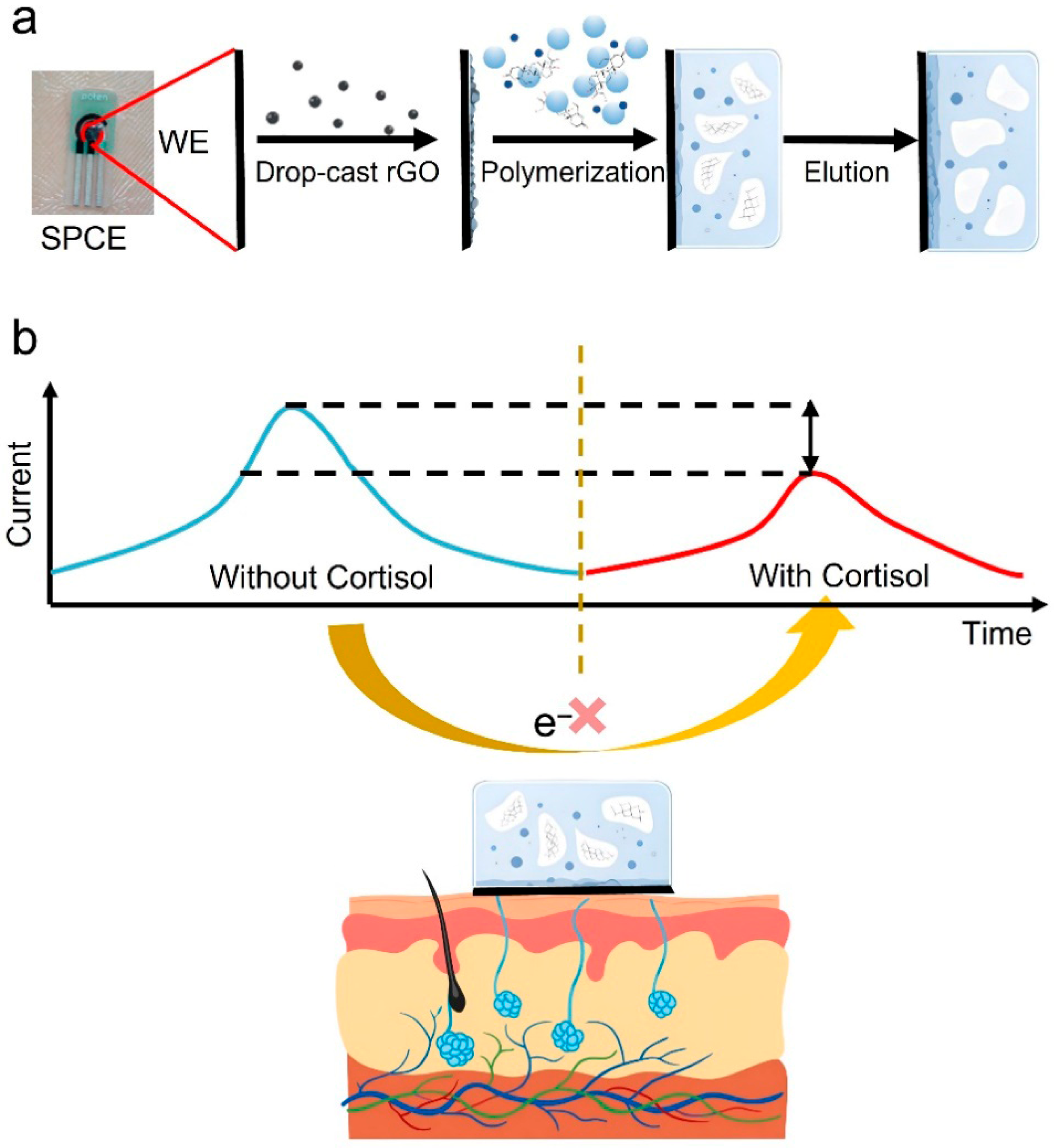
Figure 2 summarizes the design and working mechanism of the PECS. The device combines an rGO-modified SPCE with a PPy/Prussian blue MIP layer and template extraction (Figure 2a). Prussian blue produces a characteristic redox current in cortisol-free conditions; rebinding of cortisol within the imprinted cavities partially blocks electron transfer, thereby decreasing the current (Figure 2b). The resulting inverse current–concentration relationship enables quantitative analysis and supports portable, on-skin measurements.
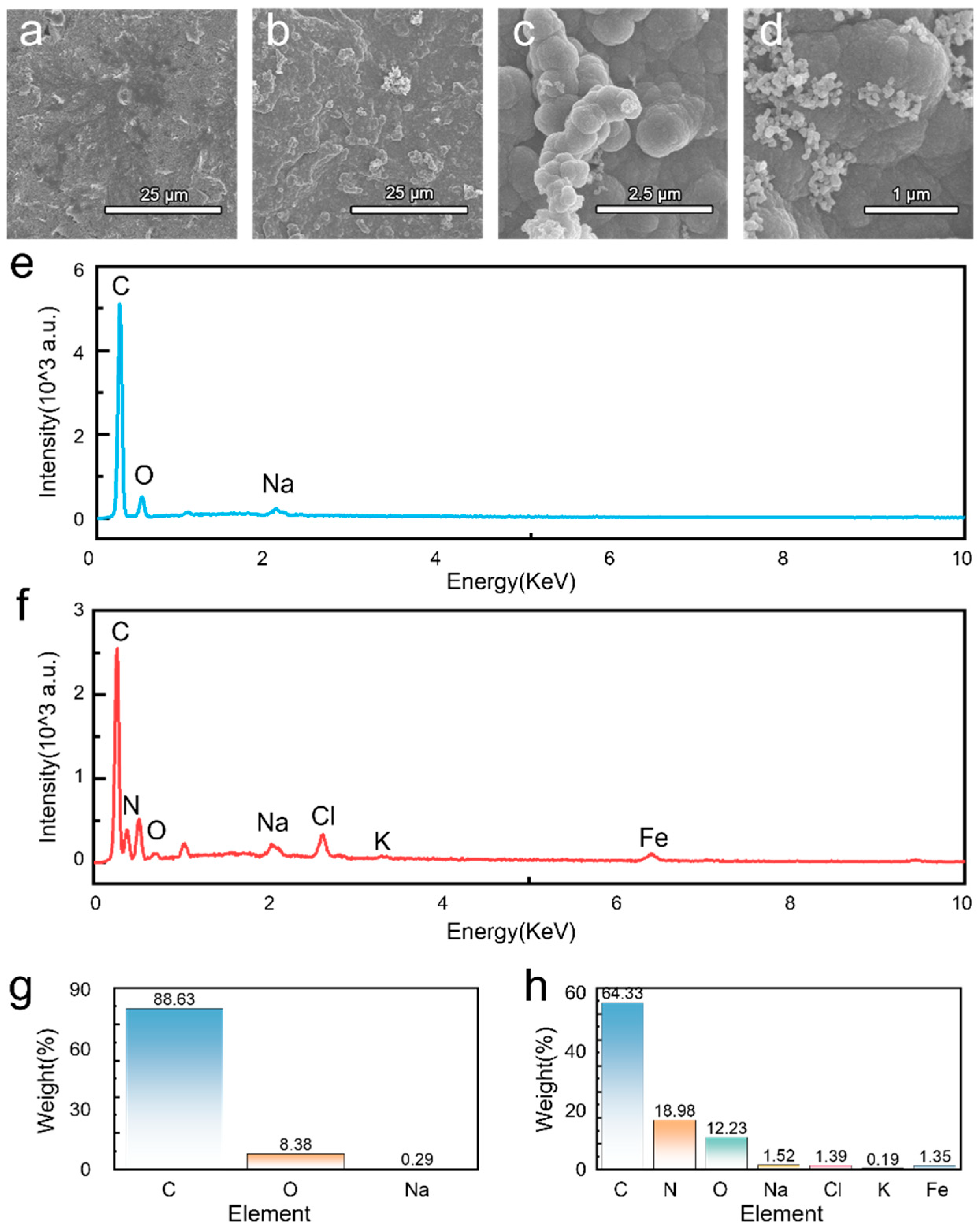
The surface characteristics of the electrodes at various stages of fabrication were examined using scanning electron microscopy (SEM), as shown in Figure 3a–d. Figure 3a displays the surface of the bare electrode, while the modified electrodes exhibit a granular morphology associated with the formation of a polypyrrole film (Figure 3b–d). Notably, removal of the template molecules produces a rough and porous microstructure, resulting in the formation of three-dimensional molecularly imprinted cavities.
Energy-dispersive X-ray spectroscopy (EDS) was used to confirm the stepwise surface modification of the electrodes. The bare electrode (Figure 3e,g) initially exhibited signals corresponding to carbon and oxygen, along with trace amounts of sodium from the pretreatment process, indicating that the carbon substrate was clean and free of contamination. After formation of the molecularly imprinted polymer (Figure 3f,h), a pronounced increase in nitrogen content was observed, manifested by the appearance of a characteristic nitrogen peak. Since nitrogen is an essential component of polypyrrole, the observed signal directly confirms the successful deposition of the polymer layer on the electrode surface.
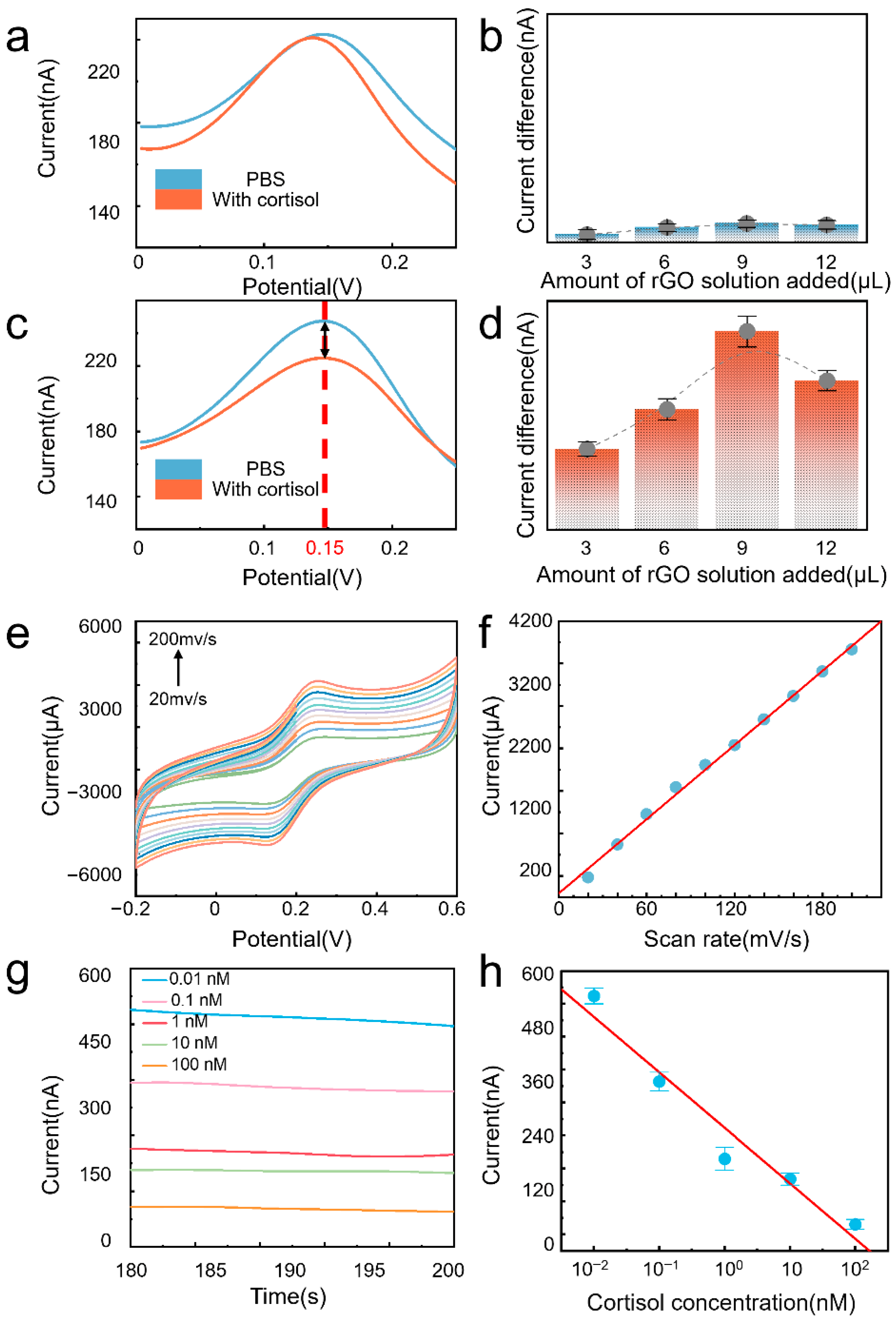
Performance of the fabricated sensors was evaluated, and key parameters were optimized by comparing the differences in DPV peak currents between the non-imprinted polymer (NIP) sensor (Figure 4a,b) and the MIP sensor (Figure 4c,d) in PBS with 1 μM cortisol and blank PBS. rGO loading was systematically varied from 3 to 12 μL to investigate its effect on sensor performance. As shown in Figure 4d, the current difference increases with increasing rGO loading, reaching a maximum at 9 μL, followed by a decrease at higher loadings. The largest and most stable current difference was observed at an rGO loading of 9 μL, beyond which further increases did not result in significant improvement. When the rGO loading was low, the scarcity of recognition sites on the electrode surface constrained the sensor response. In contrast, higher rGO levels introduced additional active sites, leading to an enhanced peak current. When the rGO loading exceeded 9 μL, the surface sites became saturated, and additional rGO likely induced site competition or excessive conductivity, resulting in a stabilized current difference. In contrast, the NIP sensor exhibited only minor variations in current difference across all rGO loadings, indicating that the observed current changes primarily originate from specific interactions between cortisol molecules and the imprinted cavities. These results confirm the successful fabrication of the cortisol molecularly imprinted sensor.
Scan-rate studies were carried out to evaluate the electron-transfer behavior of the modified electrode in the presence of a benchmark redox probe. As the scan rate increased, the oxidation and reduction peak currents rose accordingly (Figure 4e). Meanwhile, the anodic peak moved toward higher potentials and the cathodic peak shifted toward lower potentials, which progressively widened the peak-to-peak separation (ΔEp) at faster scans. These features suggest a quasi-reversible charge-transfer process at the electrode interface. Moreover, plotting the anodic peak current against scan rate produced a strong linear correlation (R2 = 0.9963, Figure 4f), supporting a predominantly surface-controlled (adsorption-governed) electrochemical response rather than a diffusion-limited one.
The amperometric performance of the optimized sensor was assessed by chronoamperometry at a series of cortisol concentrations (Figure 4g). Prior to measurement, MIP-functionalized electrodes were conditioned for 10 min in PBS solutions containing cortisol to promote rebinding within the imprint-derived cavities. The current–time response was then recorded for 200 s at an applied potential of +0.15 V determined by the DPV test. As shown in Figure 4h, the steady-state current extracted from these traces displayed a linear relationship with log (cortisol concentration) over a broad dynamic range, yielding an R2 of 0.9474 and a sensitivity of 670.0 nA·(log nM)−1·cm−2.
The limit of detection was derived from 3 σ / S (IUPAC) and reached 0.0031 nM. Reliable quantification was obtained between 0.01 and 100 nM, covering the concentration window reported for resting sweat cortisol (approxi. 0.66–7.7 nM [50,51]). Together with the compact electrode architecture and low-power readout, the sensor is suitable for miniaturized and portable cortisol sensing applications.
A linear calibration was obtained from 0.01 to 100 nM, matching the basal cortisol levels generally found in human sweat. Notably, the achieved LOD (0.0031 nM) is ~ 10 3 times below the typical physiological concentration (approxi. 0.66–7.7 nM), allowing clear detection even at ultra-low concentrations. Moreover, the miniaturized design and low-voltage operation make the sensor readily adaptable to wearable platforms for continuous sweat cortisol tracking.
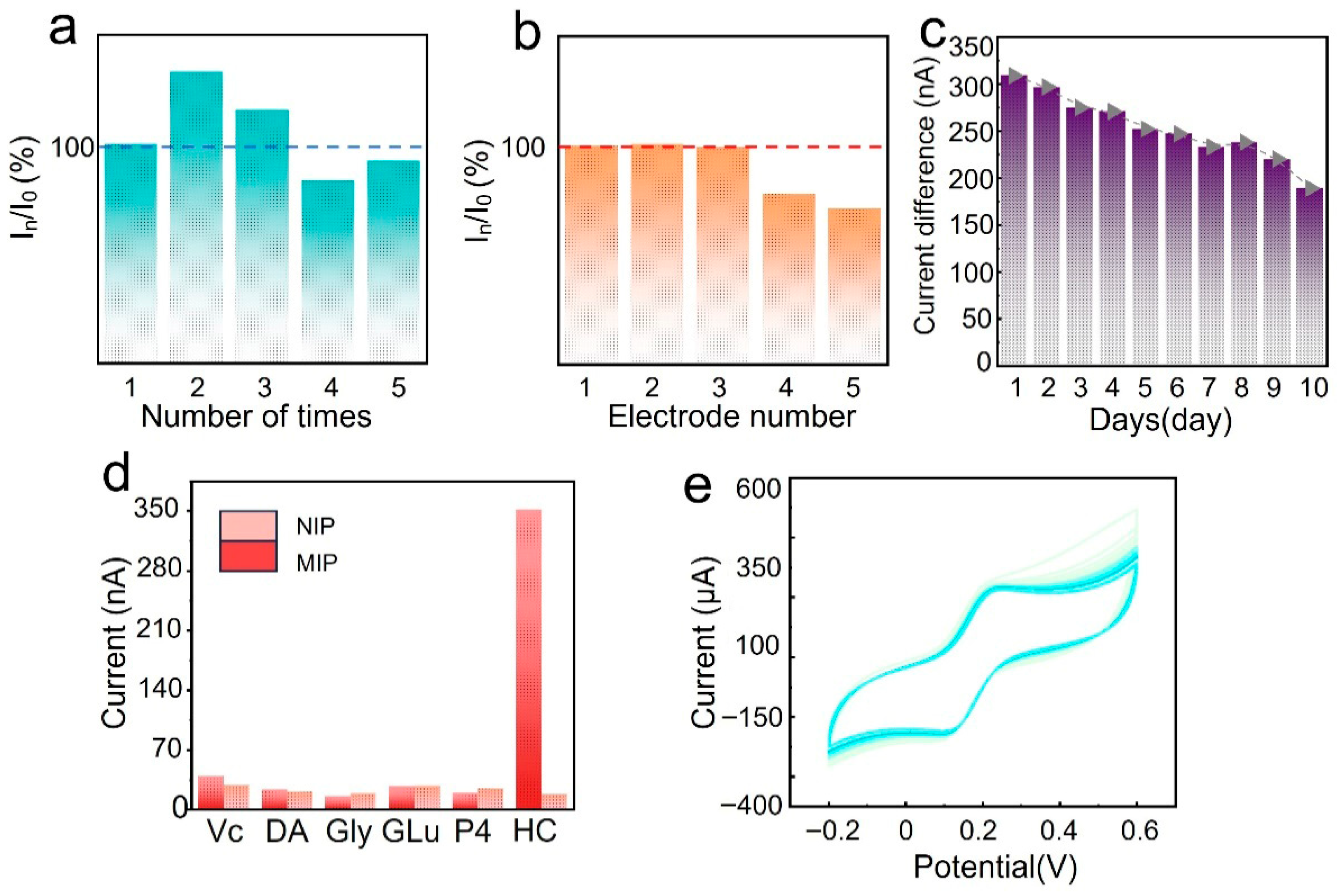
Figure 5a shows the repeatability of the PECS, evaluated by five consecutive DPV measurements in a 1 µM cortisol solution. The obtained relative standard deviation (RSD) was 16.8%, which indicates moderate repeatability and is acceptable for the intended application of trend monitoring. To assess fabrication uniformity, five MIP sensors prepared in separate batches were tested under identical chronoamperometric conditions by monitoring their responses to 1 µM cortisol at an applied potential of +0.15 V. As shown in Figure 5b, the RSD of the steady-state current was below 15.8%, suggesting acceptable batch-to-batch reproducibility. These results support the fit-for-purpose performance of the proposed sensor for trend monitoring, while acknowledging that further optimization would be required for high-precision absolute quantification.
To examine longterm stability, the same MIP sensor was tested once per day for 10 consecutive days. Each day, the steady-state current difference (ΔI) between 1 μM cortisol in PBS and blank PBS was collected under identical conditions (10 mM PBS, pH 7.4, 25 °C). As summarized in Figure 5c, the normalized response remained at ~64% of its initial value after 10 days, corresponding to an average loss of 3.6% per day. The retained signal indicates that the imprinted layer maintains good structural robustness, consistent with a cross-linked polymer network. The gradual decay is most likely associated with slow oxidation of the polypyrrole film and aging of the screen-printed electrode during exposure to air, suggesting that the device can sustain extended operation in portable settings.
Selectivity was investigated by comparing the chronoamperometric current responses of the MIP electrode with those of a non-imprinted polymer (NIP) control in the presence of cortisol and representative interferents (each 1 μM). Measurements were performed at +0.15 V versus Ag/AgCl. As shown in Figure 5d (Vc: ascorbic acid, DA: dopamine, Gly: glycine, Glu: anhydrous glucose, P4: progesterone, and HC: cortisol), cortisol produced a markedly larger current change on the MIP sensor than did the interfering species, whereas the NIP electrode exhibited uniformly low responses without clear differentiation. This contrast confirms that specific cortisol recognition originates from the imprint-derived binding cavities.
Operational reproducibility was further verified by cycling the MIP sensor for 50 consecutive CV scans in deionized water containing 5.0 mM K3[Fe(CN)6]/K4[Fe(CN)6] and 0.1 M KCl. The nearly superimposed voltammograms in Figure 5e indicate minimal drift during repeated operation, demonstrating robust electrochemical stability. As shown in Table 1, the sensor developed in this work exhibits a low limit of detection of 3.1 pM together with a wide linear detection range from 10 pM to 0.1 μM. Compared with previously reported cortisol sensors, these results demonstrate that the proposed sensor offers favorable and competitive sensing performance.

4. Conclusions

In this work, we developed a portable sweat cortisol sensing strategy by integrating an electropolymerized MIP recognition layer with an rGO-engineered screen-printed carbon electrode. The device provides selective cortisol binding and stable electrochemical readout, enabling quantification across 0.01–100 nM with a detection limit of 0.0031 nM. The combination of imprint-based specificity and scalable fabrication supports translation into compact wearables for continuous, non-invasive stress biomarker monitoring, offering a practical route toward soft bioelectronics for mental-health-oriented assessment.

Author Contributions

Conceptualization, J.L. and Y.S.; methodology, G.X. and Y.S.; investigation, Z.L.; data curation, Z.L. and J.L.; writing—original draft preparation, Z.L. and Y.S.; writing—review and editing, Y.S.; supervision, G.X. and Y.S.; funding acquisition, Y.S. All authors have read and agreed to the published version of the manuscript.

Funding

This research was funded by National Natural Science Foundation of China grant number [62074027] and Sichuan Province Hong Kong, Macao and Taiwan Science and Technology Innovation Cooperation Project grant number [2024YFHZ0367].

Data Availability Statement

The data are available from the corresponding author on reasonable request.

Conflicts of Interest

The authors declare no competing interests.

References

  1. Chandola, T.; Brunner, E.; Marmot, M. Chronic stress at work and the metabolic syndrome: Prospective study. Br. Med. J. 2006, 332, 521–525. [Google Scholar] [CrossRef]
  2. van der Molen, H.F.; Nieuwenhuijsen, K.; Frings-Dresen, M.H.; de Groene, G. Work-related psychosocial risk factors for stress-related mental disorders: An updated systematic review and meta-analysis. Br. Med. J. Open 2020, 10, e034849. [Google Scholar] [CrossRef] [PubMed]
  3. WHO. World Mental Health Today: Latest Data; World Health Organization: Geneva, Switzerland, 2025. [Google Scholar]
  4. WHO. Guidelines on Mental Health at Work; World Health Organization: Geneva, Switzerland, 2022. [Google Scholar]
  5. Crosswell, A.D.; Lockwood, K.G. Best practices for stress measurement: How to measure psychological stress in health research. Health Psychol. Open 2020, 7, 2055102920933072. [Google Scholar] [CrossRef] [PubMed]
  6. Dorsey, A.; Scherer, E.; Eckhoff, R.; Furberg, R. Measurement of Human Stress: A Multidimensional Approach; RTI Press: Research Triangle Park, NC, USA, 2022. [Google Scholar] [CrossRef]
  7. Pinge, A.; Gad, V.; Jaisighani, D.; Ghosh, S.; Sen, S. Detection and monitoring of stress using wearables: A systematic review. Front. Comput. Sci. 2024, 6, 1478851. [Google Scholar] [CrossRef]
  8. Egger, S.T.; Knorr, M.; Bobes, J.; Bernstein, A.; Seifritz, E.; Vetter, S. Real-time assessment of stress and stress response using digital phenotyping: A study protocol. Front. Digit. Health 2020, 2, 544418. [Google Scholar] [CrossRef]
  9. Sitorus, H.P.; Silitonga, M. The Role of cortisol in the stress response. Int. J. Ecophysiol. 2025, 7, 48–58. [Google Scholar] [CrossRef]
  10. Singh, N.K.; Chung, S.; Chang, A.-Y.; Wang, J.; Hall, D.A. A non-invasive wearable stress patch for real-time cortisol monitoring using a pseudoknot-assisted aptamer. Biosens. Bioelectron. 2023, 227, 115097. [Google Scholar] [CrossRef]
  11. Zhang, R.; Jia, Y. A disposable printed liquid gate graphene field effect transistor for a salivary cortisol test. ACS Sens. 2021, 6, 3024–3031. [Google Scholar] [CrossRef]
  12. Huang, Z.; Chen, H.; Ye, H.; Chen, Z.; Jaffrezic-Renault, N.; Guo, Z. An ultrasensitive aptamer-antibody sandwich cortisol sensor for the noninvasive monitoring of stress state. Biosens. Bioelectron. 2021, 190, 113451. [Google Scholar] [CrossRef]
  13. Tang, M.H.; Shi, Y.; Jiang, X.L.; Xu, H.; Ma, Y.; Zhao, B. A high sensitivity luminescent sensor for the stress biomarker cortisol using four-fold interpenetrated europium–organic frameworks integrated with logic gates. J. Mater. Chem. C 2021, 9, 9643–9649. [Google Scholar] [CrossRef]
  14. Weng, X.; Fu, Z.; Zhang, C.; Jiang, W.; Jiang, H. A portable 3D microfluidic origami biosensor for cortisol detection in human sweat. Anal. Chem. 2022, 94, 3526–3534. [Google Scholar] [CrossRef]
  15. Leitão, C.; Pereira, S.O.; Alberto, N.; Lobry, M.; Loyez, M.; Costa, F.M.; Pinto, J.L.; Caucheteur, C.; Marques, C. Cortisol in-fiber ultrasensitive plasmonic immunosensing. IEEE Sens. J. 2020, 21, 3028–3034. [Google Scholar] [CrossRef]
  16. Dhull, N.; Kaur, G.; Gupta, V.; Tomar, M. Highly sensitive and non-invasive electrochemical immunosensor for salivary cortisol detection. Sens. Actuators B Chem. 2019, 293, 281–288. [Google Scholar] [CrossRef]
  17. Yeasmin, S.; Wu, B.; Liu, Y.; Ullah, A.; Cheng, L.-J. Nano gold-doped molecularly imprinted electrochemical sensor for rapid and ultrasensitive cortisol detection. Biosens. Bioelectron. 2022, 206, 114142. [Google Scholar] [CrossRef] [PubMed]
  18. El-Farhan, N.; Rees, D.A.; Evans, C. Measuring cortisol in serum, urine and saliva–are our assays good enough? Ann. Clin. Biochem. 2017, 54, 308–322. [Google Scholar] [CrossRef] [PubMed]
  19. Juliana, N.; Maluin, S.M.; Effendy, N.M.; Abu, I.F.; Azmani, S. Cortisol Detection Methods and the Hormone’s Role in Evaluating Circadian Rhythm Disruption. Int. J. Mol. Sci. 2025, 26, 9141. [Google Scholar] [CrossRef] [PubMed]
  20. Balasamy, S.; Atchudan, R.; Arya, S.; Gunasekaran, B.M.; Nesakumar, N.; Sundramoorthy, A.K. Cortisol: Biosensing and detection strategies. Clin. Chim. Acta 2024, 562, 119888. [Google Scholar] [CrossRef]
  21. Song, Z.; Yin, M.; Rui, B.; Liu, T.; Song, W.; Sun, L.; Liu, C. A novel molecularly imprinted polymer sensor for sweat cortisol with embedded probe based on the co-deposition of Prussian Blue and Polypyrrole. Sens. Actuators Rep. 2024, 8, 100217. [Google Scholar] [CrossRef]
  22. Ghanem, E. Nanosensors for Exhaled Breath Condensate: Explored Models, Analytes, and Prospects. J. Nanotheranostics 2025, 6, 14. [Google Scholar] [CrossRef]
  23. Vasilescu, A.; Hrinczenko, B.; Swain, G.M.; Peteu, S.F. Exhaled breath biomarker sensing. Biosens. Bioelectron. 2021, 182, 113193. [Google Scholar] [CrossRef]
  24. Santonocito, R.; Puglisi, R.; Cavallaro, A.; Pappalardo, A.; Sfrazzetto, G.T. Cortisol sensing by optical sensors. Analyst 2024, 149, 989–1001. [Google Scholar] [CrossRef]
  25. Vignesh, V.; Castro-Dominguez, B.; James, T.D.; Gamble-Turner, J.M.; Lightman, S.; Reis, N.M. Advancements in cortisol detection: From conventional methods to next-generation technologies for enhanced hormone monitoring. ACS Sens. 2024, 9, 1666–1681. [Google Scholar] [CrossRef]
  26. Liu, Y.; Wu, B.; Tanyi, E.K.; Yeasmin, S.; Cheng, L.J. Label-free sensitive detection of steroid hormone cortisol based on target-induced fluorescence quenching of quantum dots. Langmuir 2020, 36, 7781–7788. [Google Scholar] [CrossRef] [PubMed]
  27. Yeung, K.K.; Huang, T.; Hua, Y.; Zhang, K.; Yuen, M.M.; Gao, Z. Recent advances in electrochemical sensors for wearable sweat monitoring: A review. IEEE Sens. J. 2021, 21, 14522–14539. [Google Scholar] [CrossRef]
  28. Zhou, J.; Men, D. Progress in wearable sweat sensors and their applications. Chin. J. Anal. Chem. 2022, 50, 87–96. [Google Scholar] [CrossRef]
  29. Santos, T.F.; Fontes Galvão, F.M.; Neto, L.O.; Nascimento, J.H. Emerging Technologies in Wearable Sweat Sensors for Next-Generation Real-Time Health Monitoring. ACS Mater. Lett. 2025, 7, 3341–3362. [Google Scholar] [CrossRef]
  30. Li, X.; Liu, S.; Huang, X.; Yao, C.; Chen, J.; Gao, L.; Xie, X. Aptamers-based wearable electrochemical sensors for continuous monitoring of biomarkers in vivo. Microsyst. Nanoeng. 2025, 11, 241. [Google Scholar] [CrossRef]
  31. Sequeira-Antunes, B.; Ferreira, H.A. Nucleic acid aptamer-based biosensors: A review. Biomedicines 2023, 11, 3201. [Google Scholar] [CrossRef]
  32. Mugo, S.M.; Alberkant, J. Flexible molecularly imprinted electrochemical sensor for cortisol monitoring in sweat. Anal. Bioanal. Chem. 2020, 412, 1825–1833. [Google Scholar] [CrossRef] [PubMed]
  33. El-Schich, Z.; Zhang, Y.; Feith, M.; Beyer, S.; Sternbæk, L.; Ohlsson, L.; Wingren, A.G. Molecularly imprinted polymers in biological applications. Biotechniques 2020, 69, 407–420. [Google Scholar] [CrossRef]
  34. Önal Acet, B.; İnanan, T.; Salieva, K.; Borkoev, B.; Odabaşı, M.; Acet, Ö. Molecular imprinted polymers: Important advances in biochemistry, biomedical and biotechnology. Polym. Bull. 2024, 81, 10439–10459. [Google Scholar] [CrossRef]
  35. Dixit, C.K.; Bhakta, S.; Reza, K.K.; Kaushik, A. Exploring molecularly imprinted polymers as artificial antibodies for efficient diagnostics and commercialization: A critical overview. Hybrid Adv. 2022, 1, 100001. [Google Scholar] [CrossRef]
  36. Maheshwari, S.; Kaur, K.; Kaur, S.; Malik, A.K. Advancements in Molecularly Imprinted Polymer-Based Electrochemical Sensors: Fabrication, Functionalization, Applications, and Future Perspectives. In Molecularly Imprinted Polymers: Path to Artificial Antibodies; Springer: Singapore, 2024; pp. 245–272. [Google Scholar] [CrossRef]
  37. Manickam, P.; Pasha, S.K.; Snipes, S.A.; Bhansali, S. A reusable electrochemical biosensor for monitoring of small molecules (cortisol) using molecularly imprinted polymers. J. Electrochem. Soc. 2016, 164, B54. [Google Scholar] [CrossRef]
  38. Parlak, O.; Keene, S.T.; Marais, A.; Curto, V.F.; Salleo, A. Molecularly selective nanoporous membrane-based wearable organic electrochemical device for noninvasive cortisol sensing. Sci. Adv. 2018, 4, eaar2904. [Google Scholar] [CrossRef]
  39. Yulianti, E.S.; Rahman, S.F.; Whulanza, Y. Molecularly imprinted polymer-based sensor for electrochemical detection of cortisol. Biosensors 2022, 12, 1090. [Google Scholar] [CrossRef] [PubMed]
  40. Kim, J.; Campbell, A.S.; de Ávila, B.E.F.; Wang, J. Wearable biosensors for healthcare monitoring. Nat. Biotechnol. 2019, 37, 389–406. [Google Scholar] [CrossRef] [PubMed]
  41. Naeem, A.N.; Guldin, S.; Ghoreishizadeh, S.S. Electrochemical sensors for cortisol: A review. IEEE Sens. J. 2024, 24, 5746–5758. [Google Scholar] [CrossRef]
  42. Heikenfeld, J.; Jajack, A.; Rogers, J.; Gutruf, P.; Tian, L.; Pan, T.; Li, R.; Khine, M.; Kim, J.; Wang, J. Wearable sensors: Modalities, challenges, and prospects. Lab Chip 2018, 18, 217–248. [Google Scholar] [CrossRef]
  43. Gillan, L.; Jansson, E. Molecularly imprinted polymer on roll-to-roll printed electrodes as a single use sensor for monitoring of cortisol in sweat. Flex. Print. Electron. 2022, 7, 025014. [Google Scholar] [CrossRef]
  44. Suryanarayanan, V.; Wu, C.T.; Ho, K.C. Molecularly imprinted electrochemical sensors. Electroanalysis 2010, 22, 1795–1811. [Google Scholar] [CrossRef]
  45. Pei, S.; Cheng, H.M. The reduction of graphene oxide. Carbon 2012, 50, 3210–3228. [Google Scholar] [CrossRef]
  46. Afzali, Z.; Mohadesi, A.; Karimi, M.A.; Fathirad, F. A highly selective and sensitive electrochemical sensor based on graphene oxide and molecularly imprinted polymer magnetic nanocomposite for patulin determination. Microchem. J. 2022, 177, 107215. [Google Scholar] [CrossRef]
  47. Tara, N.; Sharma, A.; Choudhry, A.; Abdulla, N.K.; Rathi, G.; Khan, A.M.; Chaudhry, S.A. Graphene, graphene oxide, and reduced graphene oxide-based materials: A comparative adsorption performance. In Contamination of Water; Academic Press: Cambridge, MA, USA, 2021; pp. 495–507. [Google Scholar] [CrossRef]
  48. Rashid, J.I.A.; Kannan, V.; Ahmad, M.H.; Mon, A.A.; Taufik, S.; Miskon, A.; Yusof, N.A. An electrochemical sensor based on gold nanoparticles-functionalized reduced graphene oxide screen printed electrode for the detection of pyocyanin biomarker in Pseudomonas aeruginosa infection. Mater. Sci. Eng. C 2021, 120, 111625. [Google Scholar] [CrossRef]
  49. Zhang, Y.; Sun, X.; Zhu, L.; Shen, H.; Jia, N. Electrochemical sensing based on graphene oxide/Prussian blue hybrid film modified electrode. Electrochim. Acta 2011, 56, 1239–1245. [Google Scholar] [CrossRef]
  50. Jia, M.; Chew, W.M.; Feinstein, Y.; Skeath, P.; Sternberg, E.M. Quantification of cortisol in human eccrine sweat by liquid chromatography—Tandem mass spectrometry. Analyst 2016, 141, 2053–2060. [Google Scholar] [CrossRef]
  51. King, M.A.; Brown, S.D.; Barnes, K.A.; De Chavez, P.J.D.; Baker, L.B. Regional and time course differences in sweat cortisol, glucose, and select cytokine concentrations during exercise. Eur. J. Appl. Physiol. 2023, 123, 1727–1738. [Google Scholar] [CrossRef] [PubMed]
  52. Sharma, V.; Sharma, T.K.; Kaur, I. Electrochemical detection of cortisol using a structure-switching aptamer immobilized on gold nanoparticles-modified screen-printed electrodes. J. Appl. Electrochem. 2023, 53, 1765–1776. [Google Scholar] [CrossRef]
  53. Liu, H.; Qin, W.; Li, X.; Feng, L.; Gu, C.; Chen, J.; Tian, Z.; Chen, J.; Yang, M.; Qiao, H.; et al. Molecularly imprinted electrochemical sensors based on Ti3C2Tx-MXene and graphene composite modifications for ultrasensitive cortisol detection. Anal. Chem. 2023, 95, 16079–16088. [Google Scholar] [CrossRef]
  54. Liu, X.; Wang, Y.; Liu, H.; He, R.; Zhao, X.; Wang, Y.; Qin, W.; Yin, S. Molecularly imprinted sensors based on highly stretchable electrospun membranes for cortisol detection. Microchem. J. 2024, 207, 112115. [Google Scholar] [CrossRef]
  55. Mugo, S.M.; Robertson, S.V.; Lu, W. A molecularly imprinted screen-printed carbon electrode for electrochemical epinephrine, lactate, and cortisol metabolites detection in human sweat. Anal. Chim. Acta 2023, 1278, 341714. [Google Scholar] [CrossRef] [PubMed]
  56. Yang, S.; Shi, Z.; Ma, Z.; Li, Z.; Wei, G.; Švorc, Ľ.; Zhu, Z. Ti-Cu BMOFs based molecularly imprinted electrochemical sensor for non-invasive cortisol detection in sweat. Microchem. J. 2025, 218, 115497. [Google Scholar] [CrossRef]
Figure 1. Schematic illustration of cortisol regulation and stress responses. (a) Physiological pathways involved in cortisol synthesis and secretion; (b) Circadian fluctuation pattern of cortisol levels; (c) Alterations in cortisol concentration under psychological stress; (d) Modulatory effects of pharmacological interventions on endogenous cortisol levels; (e) Impact of physical activity on cortisol concentration.
Jcs 10 00096 g001
Figure 2. Synthesis process and MIP mechanism. (a) Fabrication process of the rGO-modified cortisol MIP sensor; (b) Current response before and after changes in cortisol concentration, the yellow dash lines indicate the conditions before and after increasing the cortisol concentration, and the red crosses represent the obstruction of electron transport.
Jcs 10 00096 g002
Figure 3. Characterization of the sensor. (a) Surface morphology of the cleaned, unmodified electrode; (bd) Morphological characteristics of the electrode after MIP coating; (e) EDS profile of the cleaned bare electrode; (f) EDS profile obtained after removal of the template molecules; (g) Elemental mass distribution on the cleaned bare electrode surface; (h) Elemental mass distribution on the electrode surface following elution.
Jcs 10 00096 g003
Figure 4. Electrochemical characterization and optimization of the MIP cortisol sensor. (a) DPV traces of the NIP electrode in 1 μM cortisol and PBS. (b) rGO-loading dependence of the NIP peak-current contrast (cortisol vs. PBS). (c) DPV traces of the MIP electrode in 1 μM cortisol and PBS. (d) Effect of deposited rGO amount on the MIP peak-current contrast. (e) CV curves acquired at 20–200 mV s−1. (f) Scan-rate-dependent peak currents with regression fitting. (g) Current–time responses recorded at cortisol concentrations from 100 nM to 0.01 nM. (h) Calibration obtained from the steady-state current.
Jcs 10 00096 g004
Figure 5. Overall performance evaluation of the MIP-based cortisol sensor. (a) Bar plot showing the relative steady-state current responses obtained from five repeated measurements using the same sensor to assess operational stability; (b) comparison of normalized steady-state currents from different sensors after stabilization to evaluate fabrication consistency; (c) long-term stability assessment of the sensor over a 10-day period; (d) selectivity comparison between MIP and NIP sensors toward cortisol and potential interfering species; and (e) cyclic voltammetry profiles of the sensor recorded over 50 consecutive cycles.
Jcs 10 00096 g005
Table 1. The comparison of sensing performance.
Sensing PlatformSensing MoleculeLinear RangeLODReferences
Aptamer-bound AuNP-modified screen-printed electrodeAptamer2.8 × 10−7–0.28 μM7.7 × 10−7 μM[52]
MIP-MXG/GrMIP1 fM–10 μM0.4 fM[53]
MIP-MXene/CNTsMIP0.417 nM–1.28 μM0.417 nM[54]
(GMA-co-EGDMA)/AuNP MIP SPCE sensorMIP0.013–0.28 μM0.042 μM[55]
Ti-Cu BMOFs/MIPs MIP0.05 nM–1 μM37 pM[56]
MIP-PPy-PB/rGO@SPCEMIP10 pM–0.1 μM3.1 pMThis work
Disclaimer/Publisher’s Note: The statements, opinions and data contained in all publications are solely those of the individual author(s) and contributor(s) and not of MDPI and/or the editor(s). MDPI and/or the editor(s) disclaim responsibility for any injury to people or property resulting from any ideas, methods, instructions or products referred to in the content.