Article

Elastic Recovery and Thickness Effect in Vacuum Infusion Molding Process

1
College of Aerospace Science and Engineering, National University of Defense Technology, Changsha 410073, China
2
The 68th Base of Rocket Force, Luoyang 471300, China
*
Authors to whom correspondence should be addressed.
J. Compos. Sci. 2026, 10(2), 83; https://doi.org/10.3390/jcs10020083
Submission received: 5 January 2026 / Revised: 23 January 2026 / Accepted: 27 January 2026 / Published: 5 February 2026
(This article belongs to the Section Composites Modelling and Characterization)

Abstract

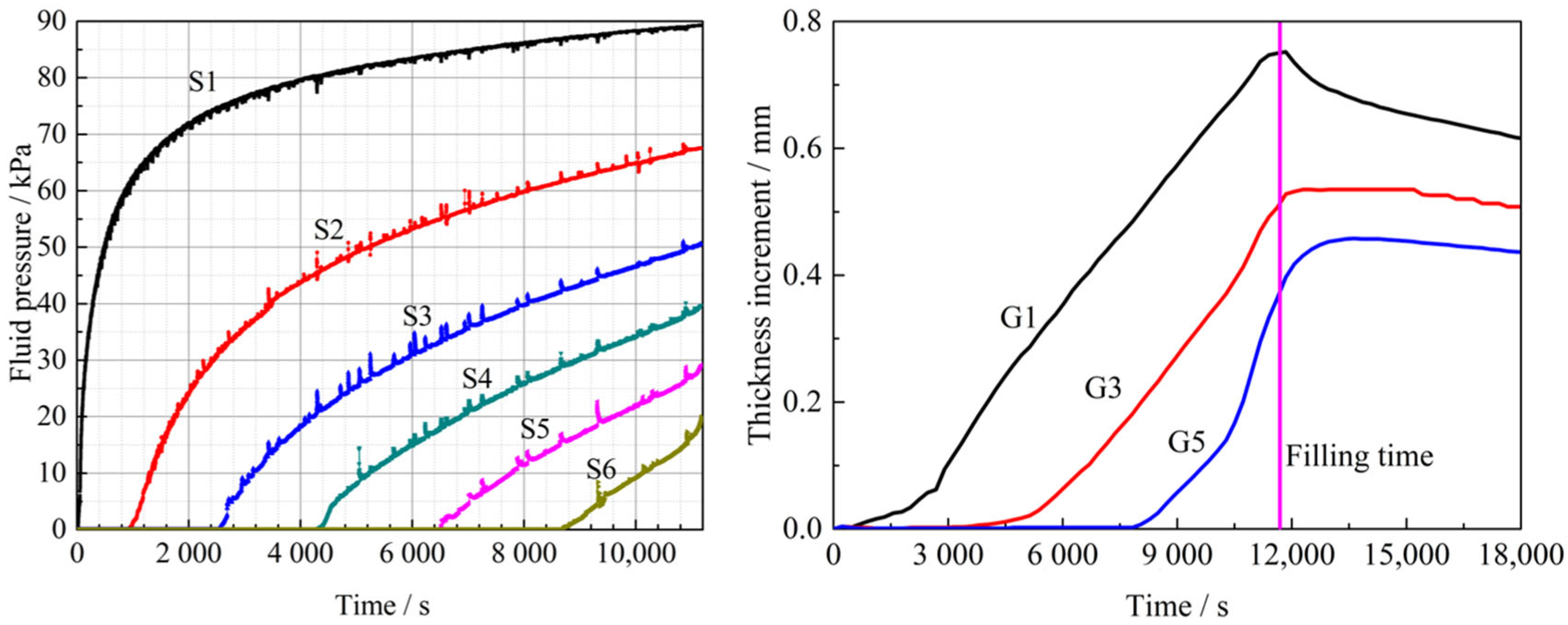
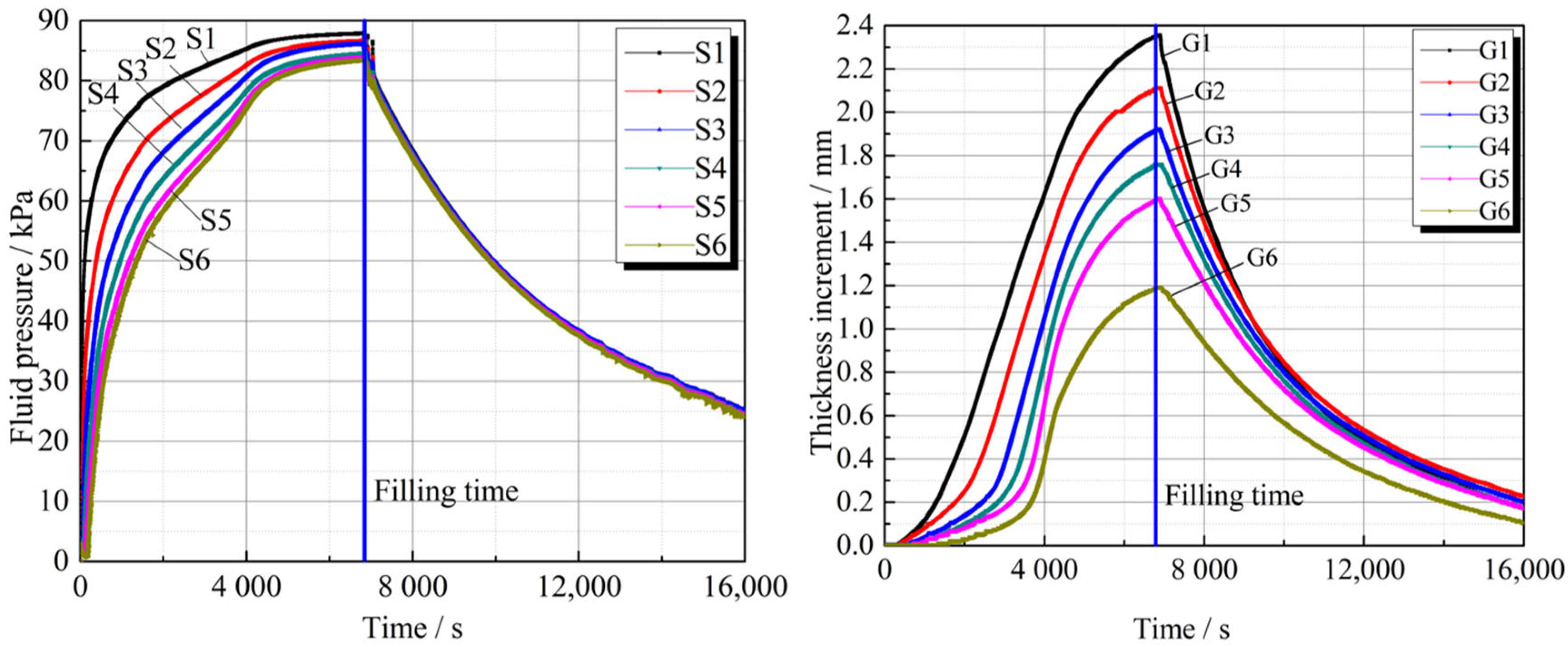
Vacuum infusion experiments were conducted to characterize the elastic recovery and thickness effect in the vacuum infusion molding process (VIMP). The results indicate that both the local fluid pressure and the part thickness increment increase with flow propagation until filling completion, and subsequently decrease during the post-filling stage. The maximum thickness increment increases with the number of reinforcement layers, while the thickness-increment rate decreases due to the enhanced compliance of the reinforcement. Specifically, for reinforcements with 10, 20, and 30 layers under in-plane 1D (One-Dimensional) flow, the thickness-increment rates are 4.97%, 4.74%, and 3.86%, respectively. In out-plane 1D flow, a distinct progressive three-stage thickness growth is observed, with corresponding increment rates of 43.7%, 23.0%, and 15.8% for 10, 20, and 30 layers, highlighting a significantly more pronounced effect. In contrast, for both coupled seepage-flow configurations (A and B), the thickness-increment rate shows no significant variation with layer number and remains consistently around 6%. This suggests that the thickness effect is offset by the coupled seepage-flow interaction of in-plane, out-plane, and distribution medium (DM) flows. It can be concluded that elastic recovery decreases with increasing part thickness. The thickness effect exerts a positive influence on the vacuum infusion molding of large-scale (thick-section) composite structures. Both elastic recovery and thickness effect are closely related to the injection mode (process strategy), with the effect in out-plane 1D flow being significantly greater than that in in-plane flow and coupled seepage flow.
Keywords: vacuum infusion molding process; elastic recovery; thickness effect; polymer–matrix composites; fabric preform; fluid pressure vacuum infusion molding process; elastic recovery; thickness effect; polymer–matrix composites; fabric preform; fluid pressure