
Carbon Nanotubes and Graphene in Polymer Composites for Strain Sensors: Synthesis, Functionalization, and Application

Abstract
1. Introduction
- (1)
- Comprehensive analysis of carbon nanomaterials (CNMs).
- (2)
- Study of methods for obtaining CNMs (CNTs and graphene).
- (3)
- Analysis of different factors impacting CNM-based polymer composites used in strain sensors.
2. Carbon Nanotubes
2.1. Electrical Properties of CNTs
2.2. Methods for Synthesizing CNTs
2.3. Flame Synthesis of CNTs
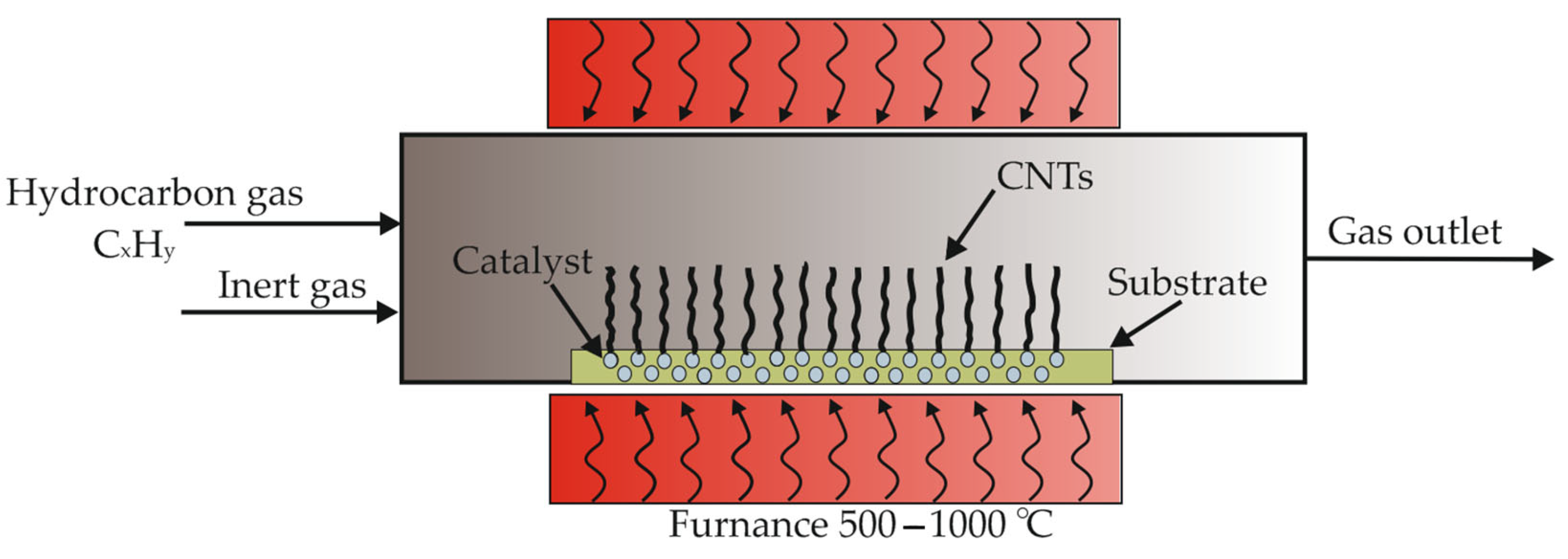
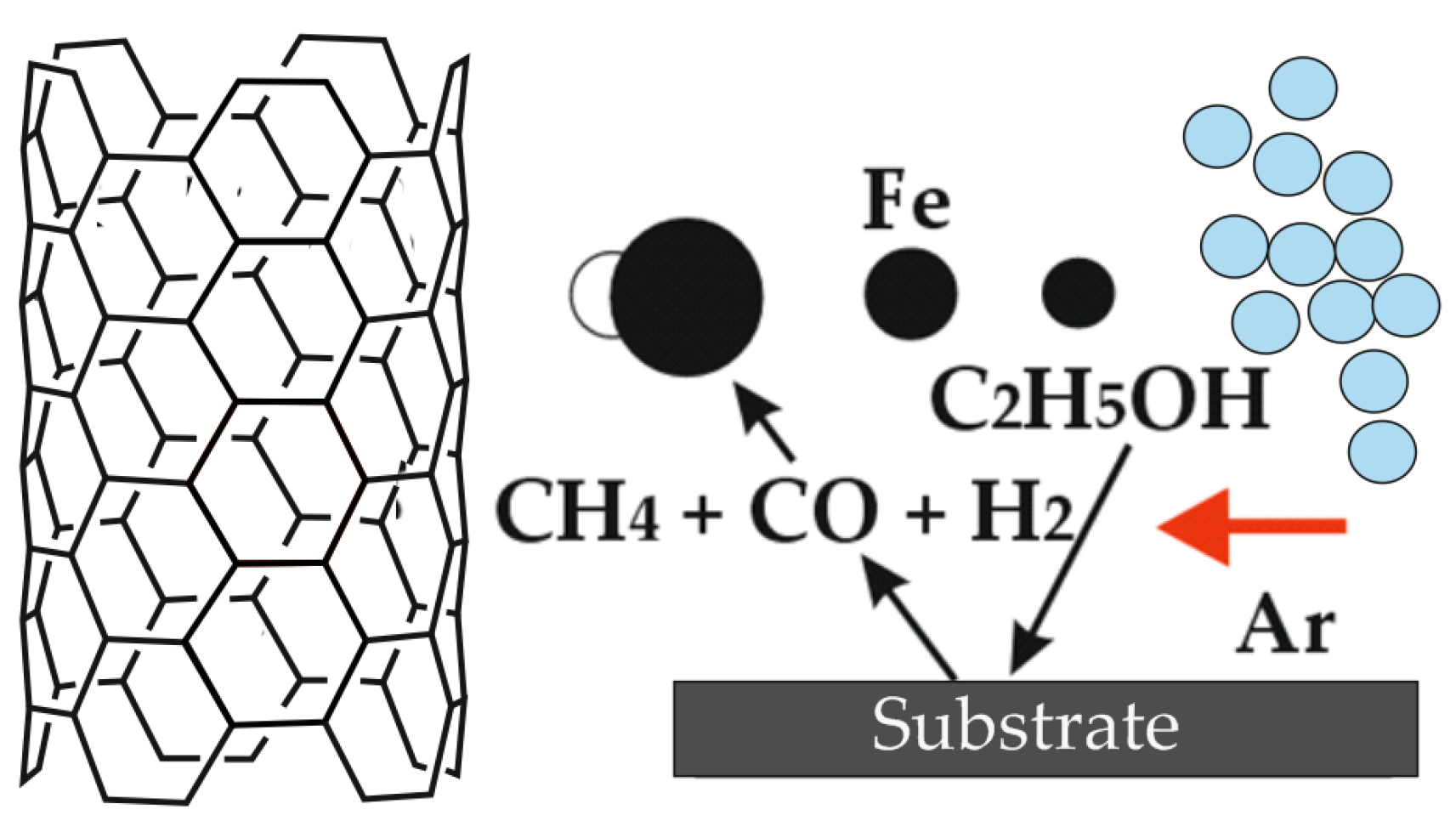
2.4. CVD Method
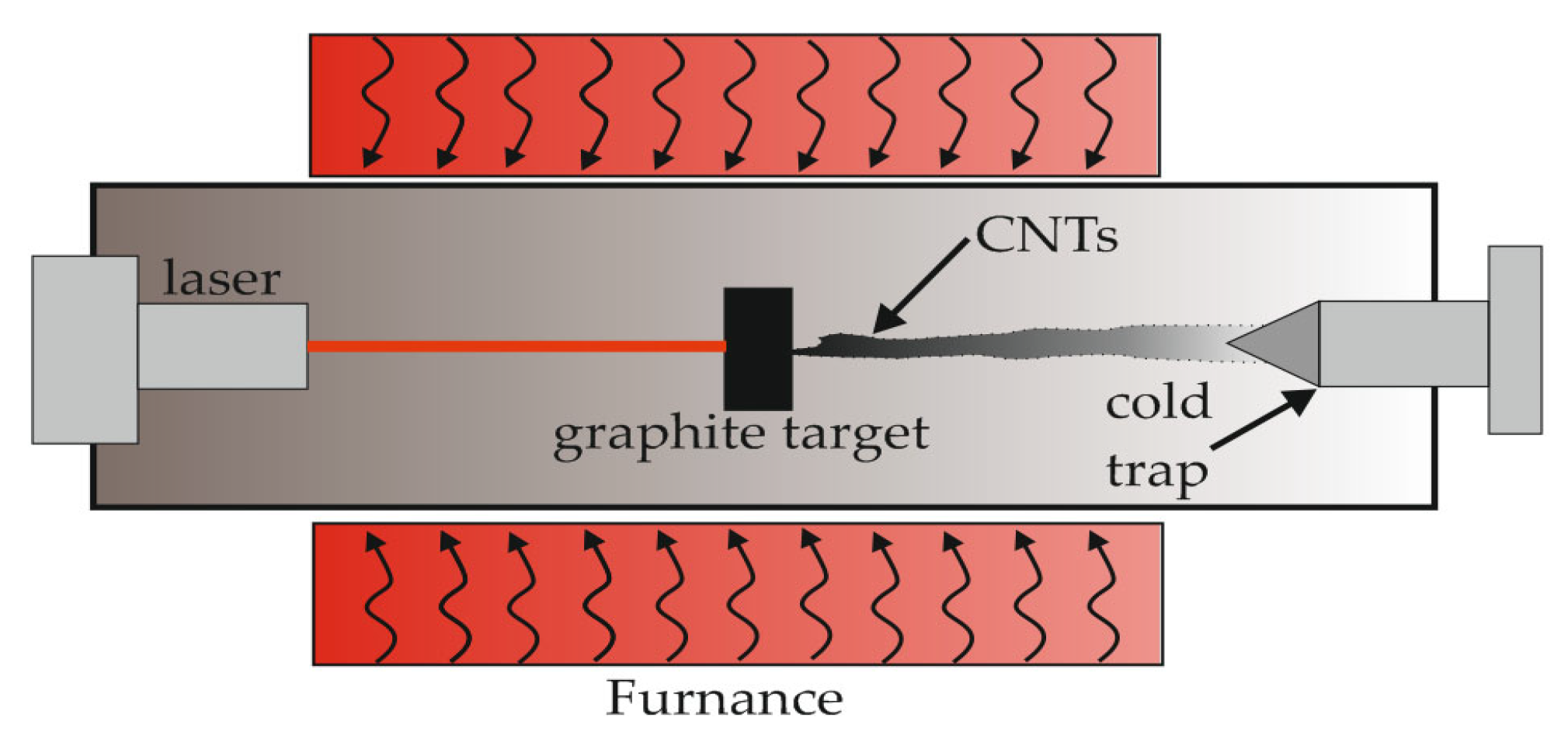
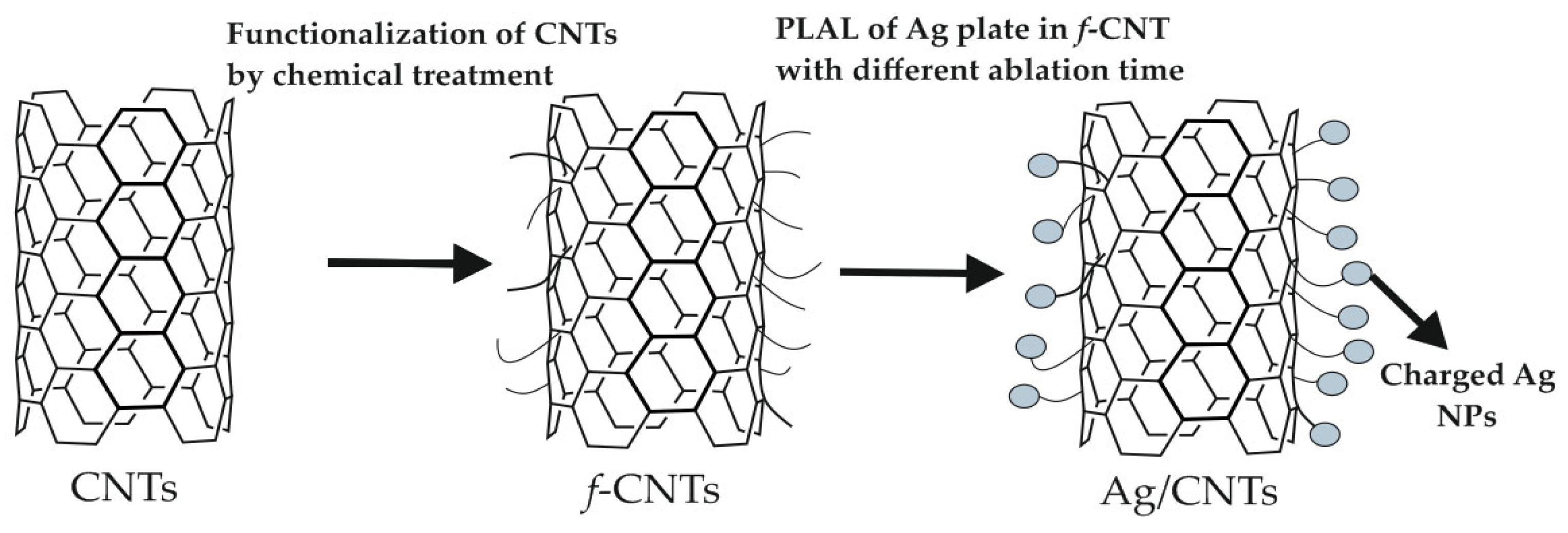
2.5. Laser Ablation
2.6. Arc Discharge Synthesis Method
3. Graphene and Its Derivatives
3.1. Graphene Synthesis Methods and Properties
3.2. A Comparative Analysis of Graphene Synthesis Methods for Piezoresistive Sensors
3.3. Graphene Oxide
4. Functionalization of CNTs and Graphene
4.1. Special Functionalization Methods
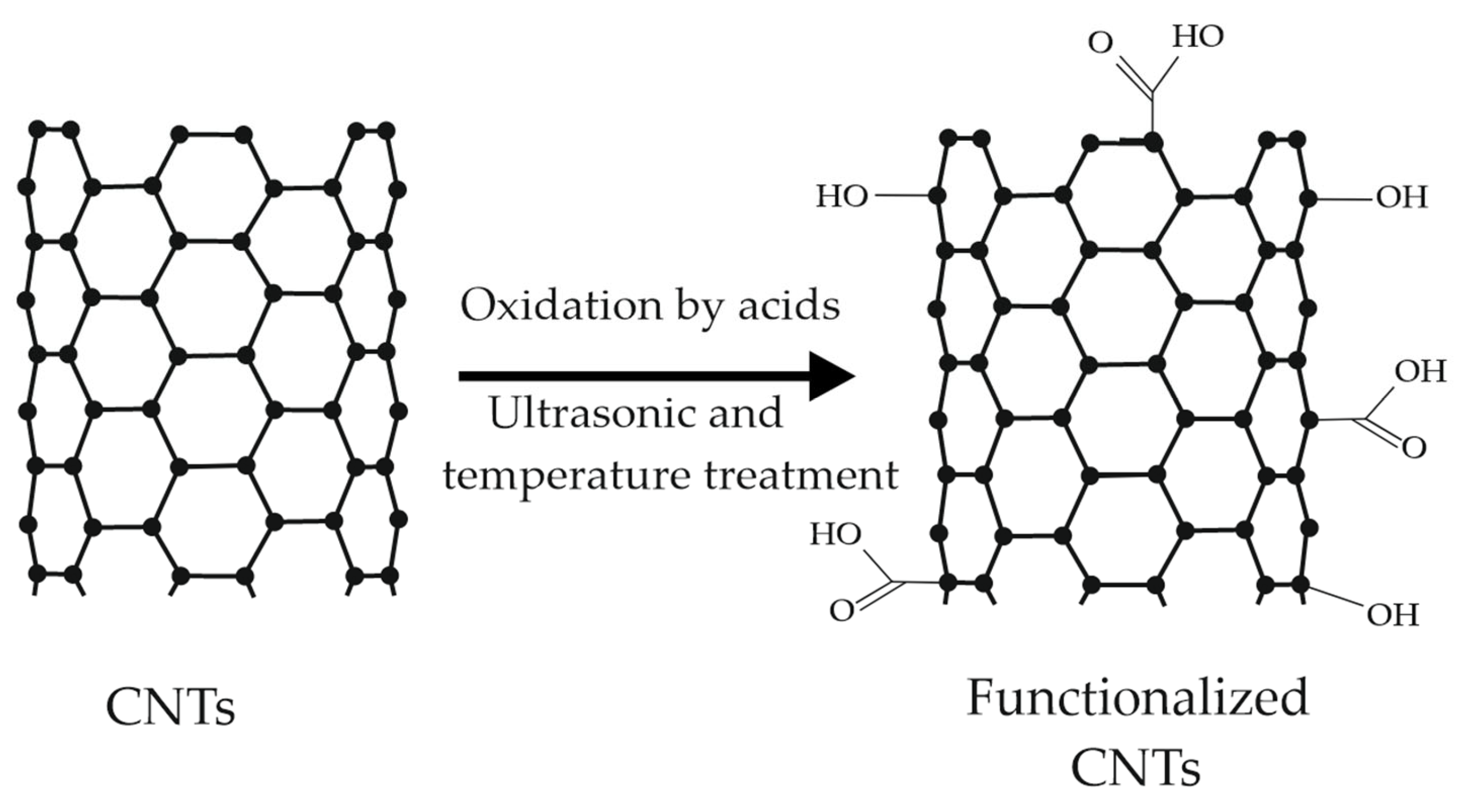
4.2. CNTs and Graphene with Acidic Functional Groups
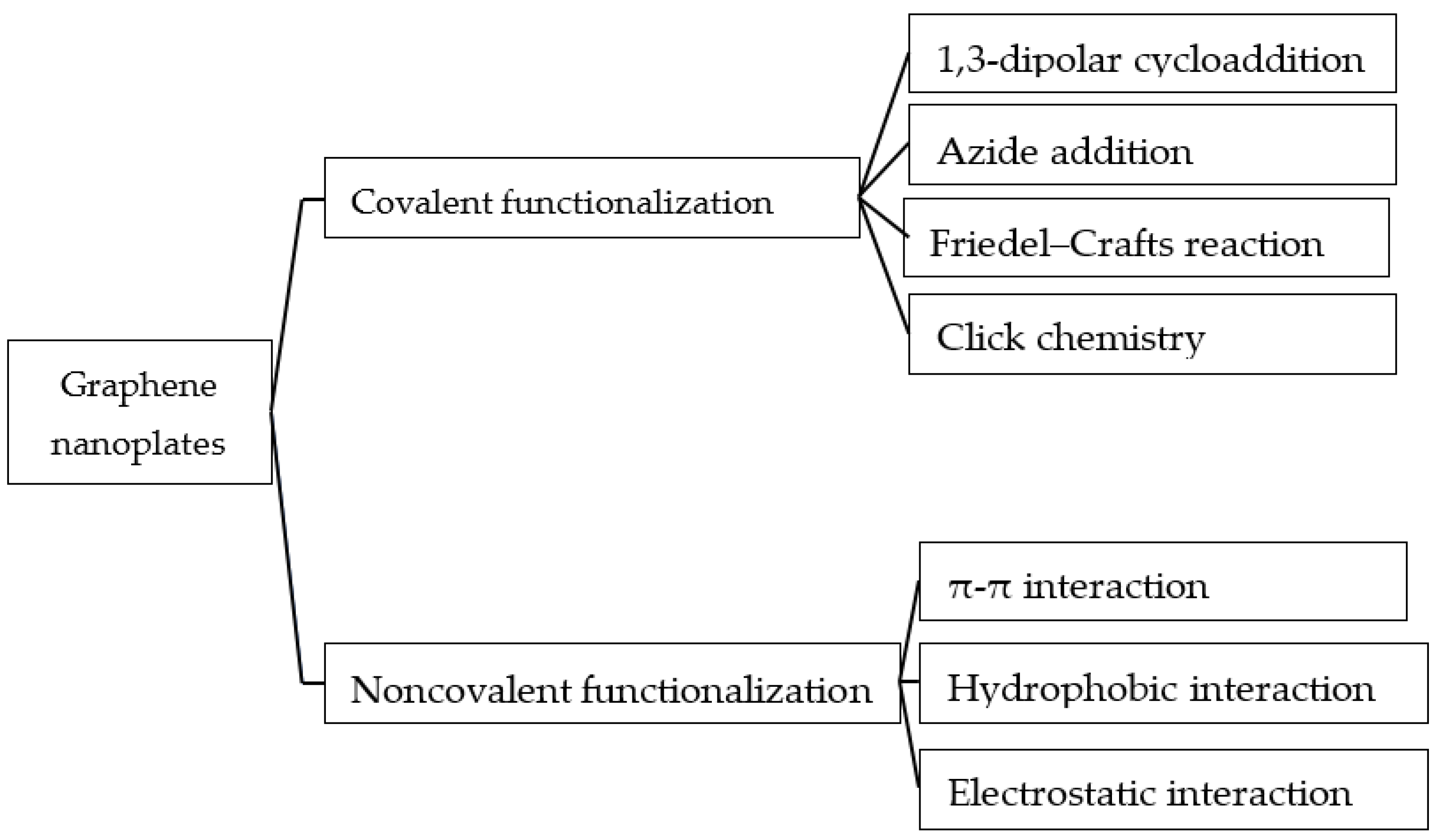
4.3. Modern Functionalization Methods
- Altered interparticle tunneling: Strain changes nanoscale gaps, exponentially affecting tunneling resistance—a primary source of high sensitivity.
- Reconfiguration of the conductive network: Under large deformations, contacts break and reform, influenced by the filler’s mechanical flexibility, which defines the sensor’s working range and hysteresis.
- Change in the filler’s intrinsic resistance: Reversible lattice distortion in high-quality CNTs or graphene can modulate their own conductivity.
4.4. Impact of Functionalization Techniques on Composite Properties and Sensor Performance
5. Polymer Composites with CNTs or Graphene
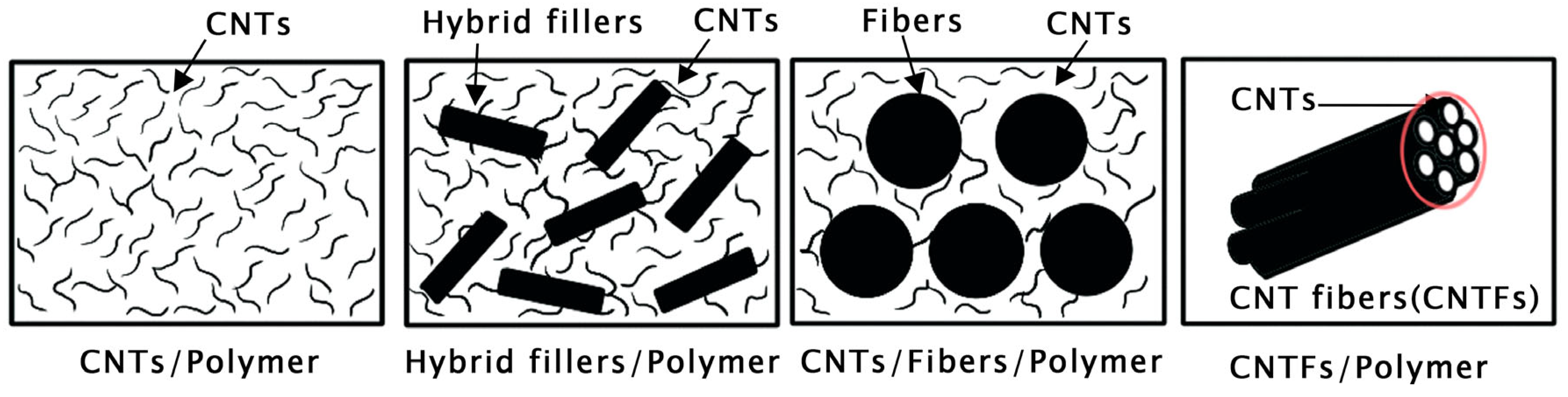
5.1. Classification of Polymer Composites
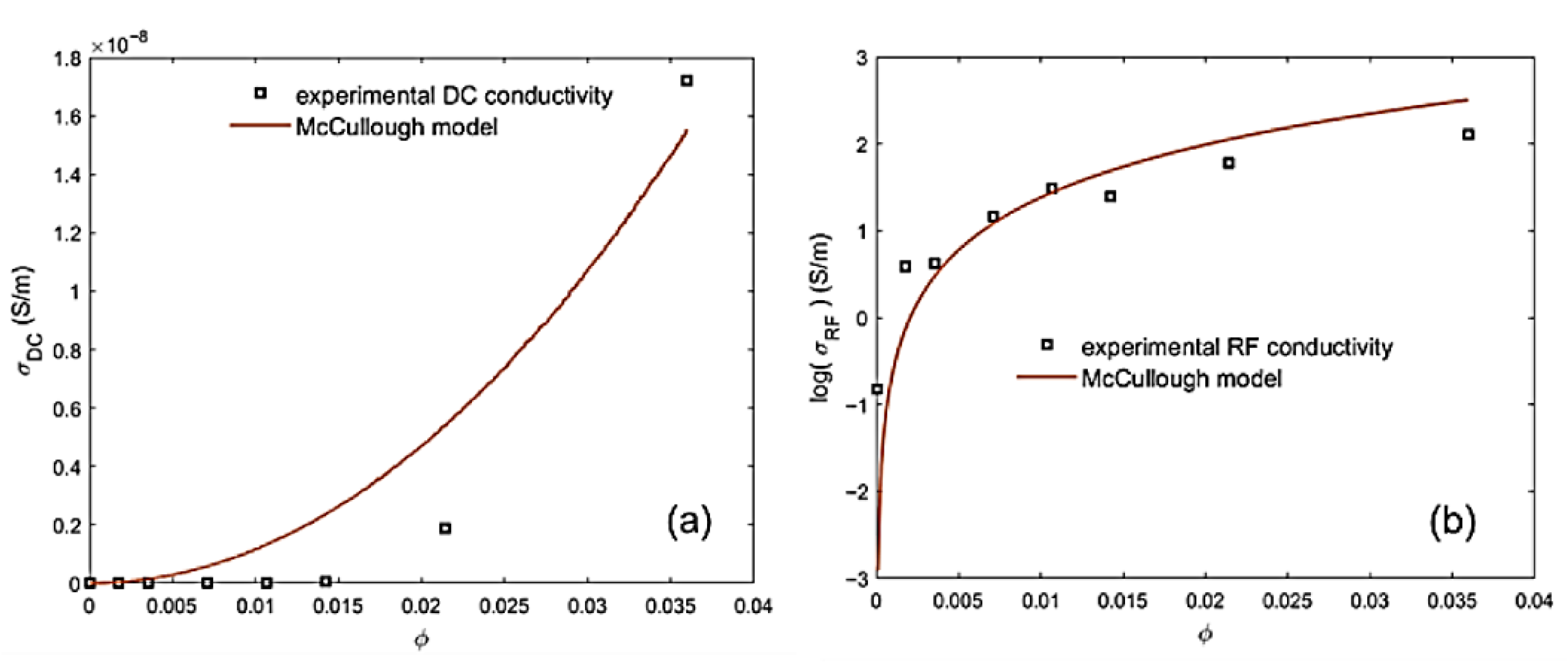
5.2. Electrical Resistance of Polymer Composites
- σ is the electrical conductivity of the composite, S·m−1;
- σ0 is the electrical conductivity of the CNTs or the conductivity of an ideal network, S·m−1;
- φ is the volume fraction (concentration) of CNTs in the composite, vol. %;
- φc is the critical volume fraction at which an infinite conducting cluster forms in the system and conductivity increases sharply, vol. %;
- t is the critical exponent, a dimensionless parameter that depends on the filler geometry and system dimensionality.
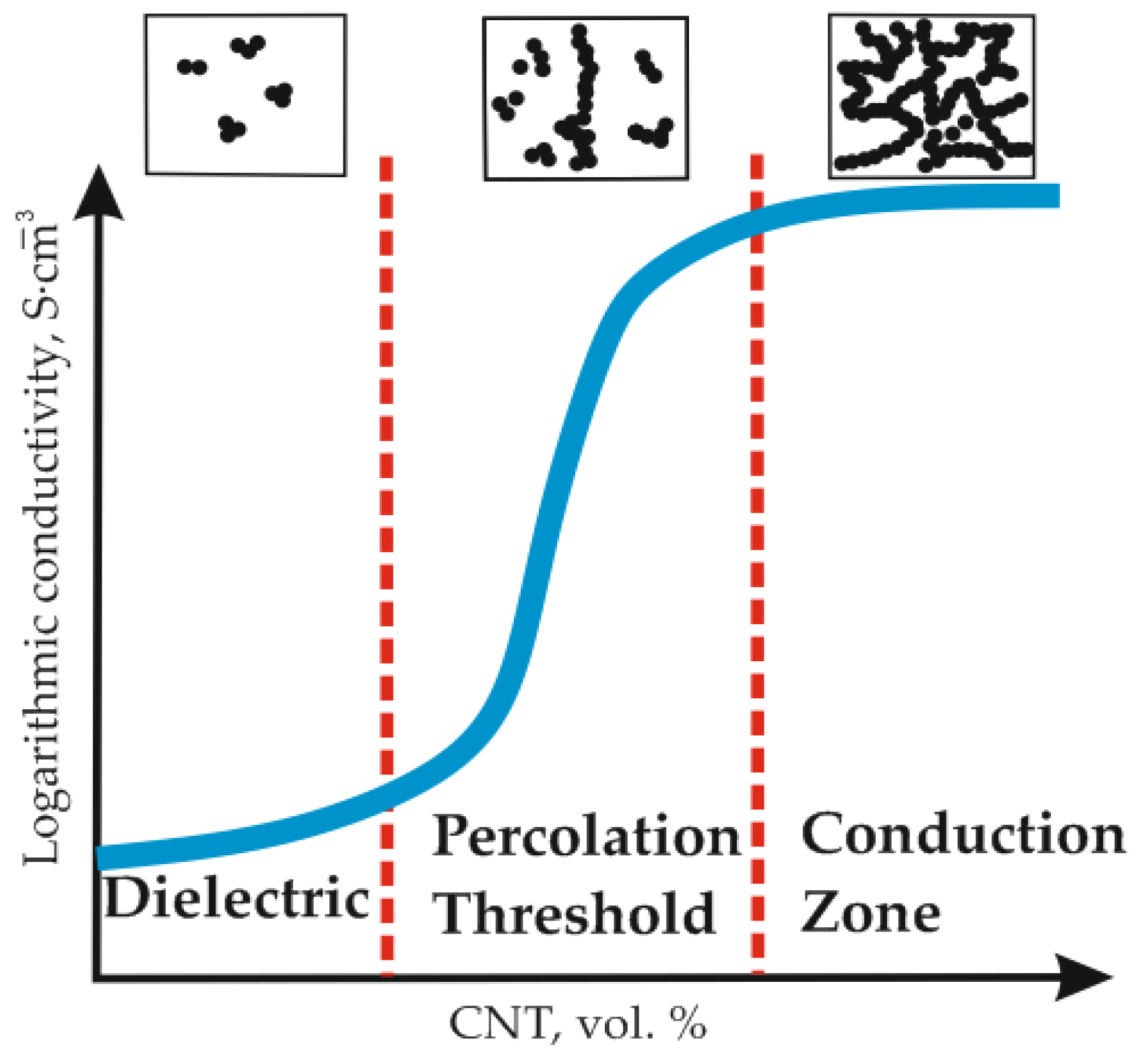
- (1)
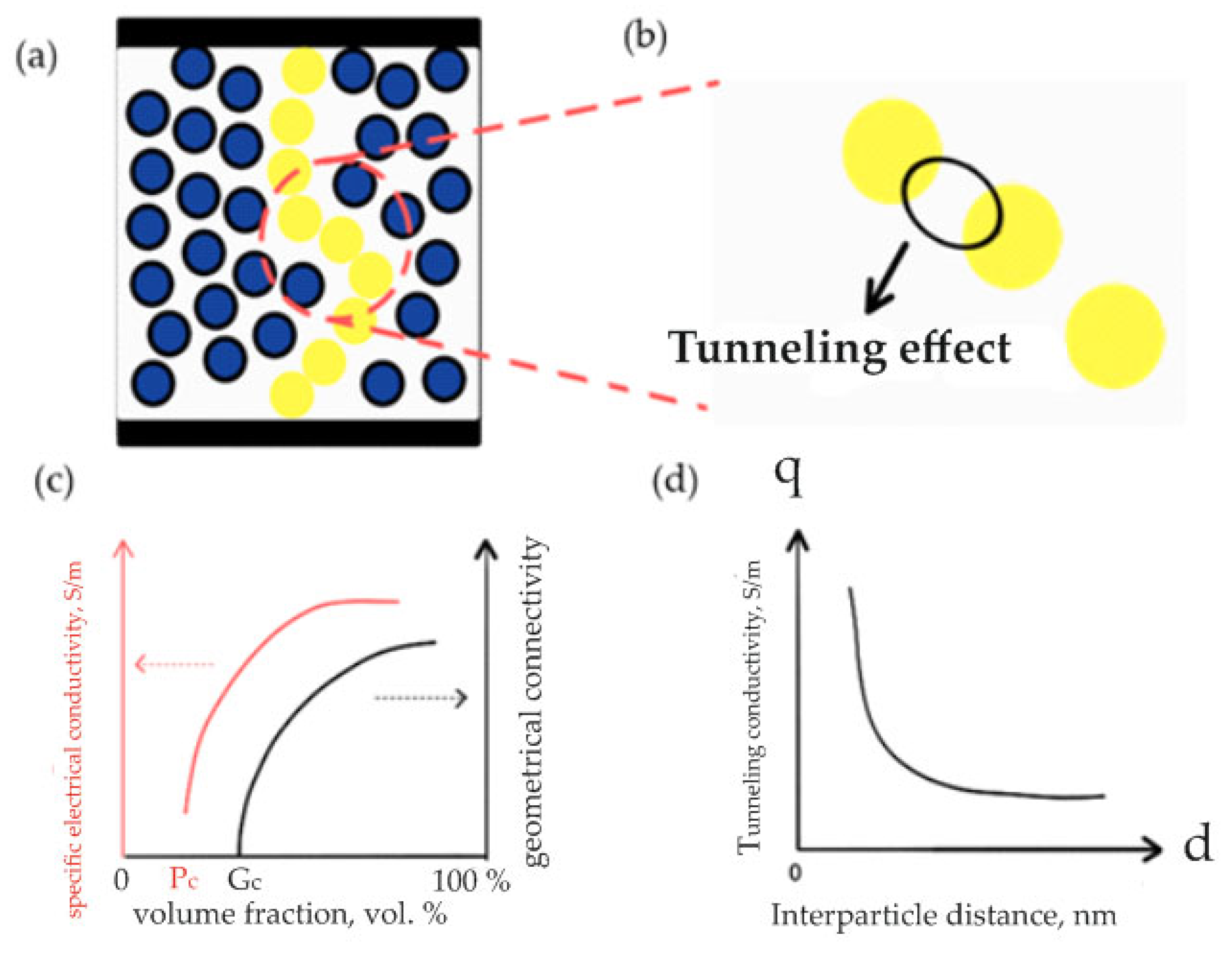
- Dielectric Zone: at low CNT content, the material behaves as a dielectric.
- (2)
- Percolation Threshold: conductivity increases sharply when CNTs begin to form a continuous network.
- (3)
- Conduction Zone: at high CNT content, the material reaches its maximum conductivity.
5.3. PEDOT:PSS-Modified CNT/Polymer Nanocomposites for Piezoresistive Sensors
5.4. Influence of Composite Structure and Composition on Properties
5.5. Conductive Polymer Composites for Strain Sensors
- (1)
- They form an electrically conductive network within the insulating polymer matrix via the percolation effect;
- (2)
- Their intrinsic properties and morphology dictate the mechanism of conductivity change under strain. The high aspect ratio of CNTs promotes a low percolation threshold, while graphene’s large specific surface area provides numerous interparticle contacts that are critical for sensitivity.
5.6. Microscopic Mechanisms of Strain Sensitivity (Piezoresistive Effect)
5.7. AI and Machine Learning for Developing Strain Sensors from Nanomodified Composites
5.8. Multiphysics Computer Modeling
- Despite their high predictive capability, these computational methods require separate in-depth examination. In practice, they are most effective when used in conjunction with experimental studies—for hypothesis verification, model refinement, and reducing the number of resource-intensive trial syntheses. Within the scope of this review, which focuses on the practical aspects of material production and application, a detailed discussion of these models lies beyond the established framework. However, the development and integration of multiphysics computer modeling, especially in combination with machine learning methods, remain the most promising directions for future research in the field of intelligent design of next-generation polymer composites.
5.9. Engineering Requirements for Strain Sensors Based on Polymer Nanocomposites
- Functional and Operational Characteristics. The core of the sensor lies in its sensing properties. A high and stable GF enables the detection of both minor deformations (low activation threshold) and a reliable response across a broad working range—from microdeformations (<1%) to significant elongations (50–500%). Linearity of response and minimal hysteresis are critically important, ensuring that the change in resistance accurately follows the applied deformation and quickly returns to its initial value after the load is removed. Long-term cyclic stability is also essential—the ability to withstand thousands of cycles without resistance drift or loss of sensitivity.
- Mechanical and Dynamic Properties. The sensor must be integrable into flexible systems. The material should possess mechanical strength, flexibility, and stretchability to withstand loads and conform to curved surfaces. Fast response and low relaxation time are necessary for accurately tracking dynamic processes and vibrations.
- Manufacturing and Reliability. For widespread adoption, reproducibility and cost-effectiveness are crucial. Key factors include the simplicity and scalability of manufacturing methods, such as 3D printing, casting, or screen printing. Environmental stability refers to maintaining performance under variations in temperature, humidity, and exposure to sweat or oils, which is particularly important for wearable electronics.
6. Conclusions and Perspectives
- (1)
- CNTs and graphene, with their outstanding electrophysical and mechanical properties, serve as exceptionally effective functional fillers for creating a versatile class of electrically conductive polymer composites, which are particularly suitable for advanced sensing applications.
- (2)
- Precise control over nanomaterial synthesis (via methods like CVD) combined with surface functionalization strategies is crucial. These processes enable the fine-tuning of nanofiller properties, enhance their dispersion within the polymer matrix, and allow for the reduction of the electrical percolation threshold to very low levels.
- (3)
- The resulting new generation of conductive polymer composite-based strain sensors achieves unprecedented performance metrics, including gauge factors (GFs) exceeding 80,000 and operational strain ranges spanning from micro-deformations (<0.1%) to several hundred percent (up to ~440%). Their high sensitivity is governed by synergistic piezoresistive, tunneling, and dynamic network restructuring mechanisms.
- (4)
- Microstructural engineering, particularly the design of hybrid conductive networks (e.g., combining CNTs and graphene/rGO), creates a synergistic effect that significantly boosts sensor response, improving both sensitivity (GF) and electrical conductivity compared to composites with single-type fillers.
- (5)
- Surface functionalization of CNTs and graphene (e.g., via oxidation or ozonolysis) is a critical step that directly enhances the compatibility and interfacial adhesion between the nanofillers and the polymer matrix, which is essential for achieving a uniform dispersion and preventing agglomeration.
- (6)
- Beyond improving dispersibility, chemical functionalization tailors the surface chemistry of nanomaterials, enabling precise modulation of the composite’s electronic properties, optimizing charge transport, and facilitating the creation of more stable and efficient conductive networks within the polymer.
- (7)
- Functionalization strategies are key to developing advanced hybrid systems. By selectively modifying the surface properties of different nanofillers (e.g., CNTs vs. graphene), their synergistic integration is enhanced, leading to composites with superior and multifunctional performance characteristics.
- (8)
- Future progress in the field is directed toward the development of complex hybrid/hierarchical systems, the integration of additive manufacturing (3D/4D printing) for fabricating programmable microstructures, and the application of AI/ML for the inverse design of composites with tailored properties. These advancements pave the way for intelligent, flexible, and durable next-generation sensors for wearable electronics, soft robotics, and health/structural monitoring.
Author Contributions
Funding
Data Availability Statement
Acknowledgments
Conflicts of Interest
Abbreviations
| AFM | Atomic Force Microscopy |
| AI | Artificial Intelligence |
| BLG | Bilayer Graphene |
| CB | Carbon Black |
| CH-FWS | Carbon Hybrid Flexible Wireless Sensor |
| CNF | Carbon Nanofiber |
| CNM | Carbon Nanomaterial |
| CNT | Carbon Nanotube |
| CVD | Chemical Vapor Deposition |
| DC | Direct Current |
| DSC | Differential Scanning Calorimetry |
| ECE | Electrochemical Exfoliation |
| FEA | Finite Element Analysis |
| FLG | Few-Layer Graphene |
| GF | Gauge Factor |
| GO | Graphene Oxide |
| GNP | Graphene Nanoparticle |
| HR-TEM | High-Resolution Transmission Electron Microscopy |
| ML | Machine Learning |
| MWCNT | Multi-Walled Carbon Nanotube |
| NPB | Needle Bronze Powder |
| PDMS | Polydimethylsiloxane |
| PECVD | Plasma-Enhanced Chemical Vapor Deposition |
| PEDOT:PSS | Poly(3,4-ethylenedioxythiophene) Polystyrene Sulfonate |
| PLA | Pulsed-Laser Ablation |
| PLAL | Pulsed-Laser Ablation in Liquid |
| PMMA | Poly(methyl methacrylate) |
| PS | Polystyrene |
| PTC | Positive Temperature Coefficient |
| PU | Polyurethane |
| RF | Radio Frequency |
| rGO | Reduced-Graphene Oxide |
| RNN | Recurrent Neural Networks |
| SEM | Scanning Electron Microscopy |
| SI | Sensitivity Index |
| SMPs | Shape Memory Polymers |
| SWCNT | Single-Walled Carbon Nanotube |
| TEM | Transmission Electron Microscopy |
| TGA | Thermogravimetric Analysis |
| TPU | Thermoplastic Polyurethane |
| UTS | Ultimate Tensile Strength |
| UV | Ultraviolet |
| XRD | X-Ray Diffraction |
References
- Alhamidi, A.; Anis, A.; Bashir, Z.; Alam, M.A.; Al-Zahrani, S.M. Studies on the effect of the addition of Nano-Spherical particles of aluminum on the thermal, mechanical, and morphological properties of PBT–PET blend composites. Polymers 2023, 15, 3625. [Google Scholar] [CrossRef]
- Allahverdiyeva, K.V.G.; Kakhramanov, N.T.O.; Gurbanova, R.V.G. Structural, electrical, and physical–mechanical properties of composites obtained based on filled polyolefins and thermoplastic elastomers. RSC Adv. 2025, 15, 6541–6563. [Google Scholar] [CrossRef] [PubMed]
- Oktaee, A.; Klier, K.; Giesen, R.; Heim, H. Thermal conductivity of silicone rubber composites: Effects of ceramic fillers, pressure, and temperature. Adv. Eng. Mater. 2025, 27, 2500444. [Google Scholar] [CrossRef]
- Kwon, Y.; Park, J.; Jeon, Y.; Hong, J.; Park, H.; Lee, J. A review of Polymer composites based on carbon fillers for thermal Management Applications: Design, preparation, and Properties. Polymers 2021, 13, 1312. [Google Scholar] [CrossRef]
- Abdollahi, F.; Mohammadi, M.; Zare, Y.; Munir, M.T.; Rhee, K.Y.; Park, S. A predictive model for electrical conductivity of polymer carbon black nanocomposites. Polym. Compos. 2024, 46, 7491–7502. [Google Scholar] [CrossRef]
- Punetha, V.D.; Rana, S.; Yoo, H.J.; Chaurasia, A.; McLeskey, J.T.; Ramasamy, M.S.; Sahoo, N.G.; Cho, J.W. Functionalization of carbon nanomaterials for advanced polymer nanocomposites: A comparison study between CNT and graphene. Prog. Polym. Sci. 2016, 67, 1–47. [Google Scholar] [CrossRef]
- Maji, P.K. Graphene-Based Polymer Nanocomposites: Materials for Future Revolution. MOJ Polym. Sci. 2017, 1, 00013. [Google Scholar] [CrossRef]
- Saleh, M.; Gul, A.; Nasir, A.; Moses, T.O.; Nural, Y.; Yabalak, E. Comprehensive review of Carbon-based nanostructures: Properties, synthesis, characterization, and cross-disciplinary applications. J. Ind. Eng. Chem. 2024, 146, 176–212. [Google Scholar] [CrossRef]
- Liu, L.; Xu, C.; Yang, Y.; Fu, C.; Ma, F.; Zeng, Z.; Wang, G. Graphene-based polymer composites in thermal management: Materials, structures and applications. Mater. Horiz. 2024, 12, 64–91. [Google Scholar] [CrossRef]
- Antipova, O.M.; Trukhanova, M.; Kharlamova, M.V.; Levin, D.D.; Komarov, I.A. Coupling of aptamers with reduced graphene oxide for detection of herpes simplex virus 2 protein marker. Fuller. Nanotub. Carbon Nanostructures 2025, 33, 934–945. [Google Scholar] [CrossRef]
- Danilov, E.A.; Kharlamova, M.V.; Guschin, A.V.; Dinkova, E.N.; Rayanova, K.A.; Babenko, S.I.; Bryleva, A.S.; Kudryavtsev, O.A.; Slaitrinnik, L.I.; Trukhanova, M.I.; et al. Multicomponent graphene oxide dispersions for thin reduced graphene oxide film formation. J. Mater. Sci. 2025, 60, 6888–6906. [Google Scholar] [CrossRef]
- Zhang, J.; Chen, X.; Maimaitiyiming, X.; Obolda, A. Impact of imine positional isomerism on polymer/semiconducting single-walled carbon nanotube sensors for selective NO2 detection. Sens. Actuators B Chem. 2025, 450, 139210. [Google Scholar] [CrossRef]
- Golovakhin, V.; Litvinova, V.I.; Manakhov, A.; Latypova, A.R.; Novgorodtseva, O.N.; Ukhina, A.V.; Ishchenko, A.V.; Al-Qasim, A.S.; Maksimovskiy, E.A.; Bannov, A.G. Conductive polymer-multi-walled carbon nanotube composites for gas sensors and supercapacitors. Mater. Today Commun. 2024, 39, 109163. [Google Scholar] [CrossRef]
- Wu, J.; Wu, H.; Huang, N.; Masson, J.-F.; Zhou, H. Dual-role thionine-enabled ratiometric electrochemical sensor based on Ni-MOF/MWCNTs and molecularly imprinted polymer for bisphenol A detection. J. Electroanal. Chem. 2025, 1000, 119616. [Google Scholar] [CrossRef]
- Luo, J.; Wang, S.; Kang, X.; Peng, C.; Yuan, Q.; Liu, Z.; Zhou, M.; Chen, J. Multilayer heterogeneous composite material based on multi-walled carbon nanotube with wide bandwidth microwave absorption. Mater. Today Nano 2025, 31, 100669. [Google Scholar] [CrossRef]
- Breen, S.; Jadhav, V.; Glynn, C.; O’Dwyer, C. Porous carbon nanotube electrodes in 3D printed symmetric supercapacitors with stable electrochemical response. Electrochem. Commun. 2025, 177, 107988. [Google Scholar] [CrossRef]
- Bulla, M.; Kumar, V.; Devi, R.; Kumar, S.; Dahiya, R.; Singh, P.; Mishra, A.K. Exploring the frontiers of carbon nanotube synthesis techniques and their potential applications in supercapacitors, gas sensing, and water purification. J. Environ. Chem. Eng. 2024, 12, 114504. [Google Scholar] [CrossRef]
- Mytafides, C.K.; Tzounis, L.; Tsirka, K.; Karalis, G.; Liebscher, M.; Lambrou, E.; Gergidis, L.N.; Paipetis, A.S. A hierarchically modified fibre-reinforced polymer composite laminate with graphene nanotube coatings operating as an efficient thermoelectric generator. Mater. Adv. 2024, 5, 3721–3734. [Google Scholar] [CrossRef]
- Kuznowicz, M.; Rębiś, T.; Jędrzak, A.; Nowaczyk, G.; Jesionowski, T. Facile Fabrication of a Selective Poly(caffeic acid)@MWCNT-Ni(OH)2 Hybrid Nanomaterial and Its Application as a Non-Enzymatic Glucose Sensor. Chemosensors 2023, 11, 452. [Google Scholar] [CrossRef]
- Oliveira, A.R.; Correia, A.A.; Rasteiro, M.G. Heavy Metals Removal from Aqueous Solutions by Multiwall Carbon Nanotubes: Effect of MWCNTs Dispersion. Nanomaterials 2021, 11, 2082. [Google Scholar] [CrossRef]
- Wood, N.D.; Gillie, L.J.; Cooke, D.J.; Molinari, M. A review of key properties of thermoelectric composites of polymers and inorganic materials. Materials 2022, 15, 8672. [Google Scholar] [CrossRef] [PubMed]
- Shchegolkov, A.V.; Shchegolkov, A.V.; Parfimovich, I.D.; Komarov, F.F.; Novikov, L.S.; Chernik, V.N. Functional Characteristics of Conductive Polymer Composites with Built-In Carbon Nanotubes and Metallic Particles. J. Compos. Sci. 2025, 9, 429. [Google Scholar] [CrossRef]
- John, J.P.; Mary, N.T.E.; Bindu, S.T.K. A comprehensive review on the environmental applications of graphene–carbon nanotube hybrids: Recent progress, challenges and prospects. Mater. Adv. 2021, 2, 6816–6838. [Google Scholar] [CrossRef]
- Camlibel, N.O.; Kandola, B.K. Highly sensitive textile pressure sensors with novel hierarchical architecture based on conductive polymers, silver nanoparticles and carbon nanotubes. Sens. Actuators A Phys. 2024, 382, 116166. [Google Scholar] [CrossRef]
- Zhang, X.; Xiang, D.; Wu, Y.; Harkin-Jones, E.; Shen, J.; Ye, Y.; Tan, W.; Wang, J.; Wang, P.; Zhao, C.; et al. High-performance flexible strain sensors based on biaxially stretched conductive polymer composites with carbon nanotubes immobilized on reduced graphene oxide. Compos. Part A Appl. Sci. Manuf. 2021, 151, 106665. [Google Scholar] [CrossRef]
- Wang, L.; Zhang, Z.; Guo, D.; Hu, Z. Intrinsically flexible thickness sensor system made of coil-shaped carbon nanotube-filled polymer composite. Sens. Actuators A Phys. 2025, 390, 116627. [Google Scholar] [CrossRef]
- Mondal, A.; Aadad, H.E.; Hamzaoui, H.E.; Douay, M.; Morel, F.E.; Laffont, G.; Quiquempois, Y. Highly stable 3D printed microsensors at optical fiber tips. Sens. Actuators A Phys. 2025, 390, 116620. [Google Scholar] [CrossRef]
- Ahmed, S.M.; Soin, N.; Hatta, S.F.W.M.; Wahab, Y.A. Flexible CNT/silicon piezo-resistive strain sensors geometrical influences on sensitivity for human motion detection. J. Comput. Electron. 2024, 23, 456–466. [Google Scholar] [CrossRef]
- Sreeja, P.; Ravi, V. Sustainable synthesis of multi-walled carbon nanotubes from waste polystyrene using alumina-supported single and bimetallic catalyst. Diam. Relat. Mater. 2025, 159, 112747. [Google Scholar] [CrossRef]
- Gou, X.; Zhao, D.; Wu, C. Catalytic conversion of hard plastics to valuable carbon nanotubes. J. Anal. Appl. Pyrolysis 2019, 145, 104748. [Google Scholar] [CrossRef]
- Kaushal, A.; Alexander, R.; Prakash, J.; Dasgupta, K. Engineering challenges and innovations in controlled synthesis of CNT fiber and fabrics in floating catalyst chemical vapor deposition (FC-CVD) process. Diam. Relat. Mater. 2024, 148, 111474. [Google Scholar] [CrossRef]
- AlHumaidan, F.S.; Vinoba, M.; AlSheeha, H.; Rajasekaran, N.; Rana, M.S. Modifying improved-Hummer’s method to synthesize graphene derivatives from waste asphaltene. J. Ind. Eng. Chem. 2023, 133, 284–297. [Google Scholar] [CrossRef]
- Wu, Y.; Wang, S.; Komvopoulos, K. A review of graphene synthesis by indirect and direct deposition methods. J. Mater. Res./Pratt’s Guide Ventur. Cap. Sources 2020, 35, 76–89. [Google Scholar] [CrossRef]
- Tian, S.; Yang, C.; Gu, Y.; Zhao, S.; Jian, X. The entangled CNT anchoring in graphene using CVD approach for intelligent absorbing materials with thermal sensitivity effect. Compos. Part A Appl. Sci. Manuf. 2025, 200, 109311. [Google Scholar] [CrossRef]
- Rajeevan, S.; John, S.; Ponnamma, D.; George, S.C. Tuning the electrochemical performance of graphene via covalent surface functionalization using silane coupling agent and incorporation of acid-modified multi-walled carbon nanotube for high energy and high power supercapacitor application. J. Power Sources 2025, 661, 238622. [Google Scholar] [CrossRef]
- Cai, A.; Fang, C.; Pan, L.; Chen, W.; Liu, P.; Huang, H.; Liu, Y. Non-covalent bonding induced superior fire resistance of functionalized graphene oxide and carbon nanotubes paper for Joule heating and ultra-durable fire alarming. Chem. Eng. J. 2025, 515, 163467. [Google Scholar] [CrossRef]
- Gerasimenko, A.Y.; Kuksin, A.V.; Shaman, Y.P.; Kitsyuk, E.P.; Fedorova, Y.O.; Sysa, A.V.; Pavlov, A.A.; Glukhova, O.E. Electrically Conductive Networks from Hybrids of Carbon Nanotubes and Graphene Created by Laser Radiation. Nanomaterials 2021, 11, 1875. [Google Scholar] [CrossRef]
- Kuksin, A.V.; Kurilova, U.E.; Glukhova, O.E.; Eganova, E.M.; Dudin, A.A.; Gerasimenko, A.Y. Electrically conductive CNT networks formed by laser. J. Phys. Conf. Ser. 2021, 2086, 012011. [Google Scholar] [CrossRef]
- Wang, Y.; Sun, W.; Li, H. Microwave-assisted synthesis of graphene nanocomposites: Recent developments on lithium-ion batteries. Rep. Electrochem. 2015, 5, 1–19. [Google Scholar] [CrossRef]
- Kumar, P.; Nian, Q.; Xiong, G.; Fisher, T.S.; Cheng, G.J. Laser engineering of heterostructured graphitic petals on carbon nanotube forests for robust thermal interface capable of swift heat transfer. Mater. Adv. 2023, 4, 2402–2409. [Google Scholar] [CrossRef]
- Chae, S.H.; Lee, Y.H. Carbon nanotubes and graphene towards soft electronics. Nano Converg. 2014, 1, 15. [Google Scholar] [CrossRef]
- Kharlamova, M.V.; Paukov, M.; Burdanova, M.G. Nanotube functionalization: Investigation, methods and demonstrated applications. Materials 2022, 15, 5386. [Google Scholar] [CrossRef]
- Pimentel, E.; Costa, P.; Vilaça, J.; Costa, C.; Lanceros-Méndez, S.; Miranda, D. Piezoresistive materials based on natural polymers for medical device applications. React. Funct. Polym. 2025, 217, 106502. [Google Scholar] [CrossRef]
- Wang, X.; Lim, E.G.; Hoettges, K.; Song, P. A review of carbon nanotubes, graphene and nanodiamond based strain sensor in harsh environments. C 2023, 9, 108. [Google Scholar] [CrossRef]
- Shchegolkov, A.V.; Shchegolkov, A.V.; Kaminskii, V.V.; Chumak, M.A. Polymer Composites with Nanomaterials for Strain Gauging: A Review. J. Compos. Sci. 2025, 9, 8. [Google Scholar] [CrossRef]
- Yamada, T.; Hayamizu, Y.; Yamamoto, Y.; Yomogida, Y.; Izadi-Najafabadi, A.; Futaba, D.N.; Hata, K. A stretchable carbon nanotube strain sensor for human-motion detection. Nat. Nanotechnol. 2011, 6, 296–301. [Google Scholar] [CrossRef]
- Del Bosque, A.; Sánchez-Romate, X.F.; Cadini, F.; Sbarufatti, C.; Sánchez, M.; Giglio, M.; Ureña, A. Dual effect of temperature and strain on the electrical response of highly sensitive silicone elastomers doped with graphene nanoplatelets. Polymer 2023, 286, 126419. [Google Scholar] [CrossRef]
- Yang, J.; Ling, K.; Liu, L.; Zeng, X.; Xu, X.; Li, Z.; He, P. Printable and wearable Graphene-Based strain sensor with high sensitivity for human motion monitoring. IEEE Sens. J. 2022, 22, 13937–13944. [Google Scholar] [CrossRef]
- Hamzat, A.K.; Murad, M.S.; Adediran, I.A.; Asmatulu, E.; Asmatulu, R. Fiber-reinforced composites for aerospace, energy, and marine applications: An insight into failure mechanisms under chemical, thermal, oxidative, and mechanical load conditions. Adv. Compos. Hybrid Mater. 2025, 8, 152. [Google Scholar] [CrossRef]
- Shi, Z.; Lu, H.; Chen, Z.; Cheng, R.; Chen, D. Rational design, syntheses, characterization and solution behavior of amphiphilic azobenzene-containing linear-dendritic block copolymers. Polymer 2011, 53, 359–369. [Google Scholar] [CrossRef]
- Wang, Z.; Zhang, Z.; Kuang, X. Recent advances in polymer 4D printing: 3D printing techniques, smart material design, and healthcare applications. Smart Mater. Med. 2025, 6, 305–333. [Google Scholar] [CrossRef]
- Oboirien, B.O. Piezoelectric polymer nanocomposite: Fabricating methods for materials and devices. Nano Trends 2025, 12, 100166. [Google Scholar] [CrossRef]
- Libber, M.; Gariya, N.; Kumar, M. Exploring shape memory polymer activation via terahertz stimuli for next-generation soft robotics. Mater. Today Commun. 2025, 49, 113903. [Google Scholar] [CrossRef]
- Pak, K.; Yang, J.C.; Sim, J.Y.; Lee, T.; Lee, D.H.; Lee, S.; Kang, M.; Oh, B.; Kim, J.; Park, S. Fabrication of multifunctional wearable interconnect E-textile platform using direct ink writing (DIW) 3D printing. Npj Flex. Electron. 2025, 9, 48. [Google Scholar] [CrossRef]
- Nan, X.; Wang, X.; Kang, T.; Zhang, J.; Dong, L.; Dong, J.; Xia, P.; Wei, D. Review of Flexible Wearable Sensor Devices for Biomedical Application. Micromachines 2022, 13, 1395. [Google Scholar] [CrossRef]
- Zou, Y.; Zhong, M.; Li, S.; Qing, Z.; Xing, X.; Gong, G.; Yan, R.; Qin, W.; Shen, J.; Zhang, H.; et al. Flexible wearable strain sensors based on Laser-Induced graphene for monitoring human physiological signals. Polymers 2023, 15, 3553. [Google Scholar] [CrossRef]
- Gaudiuso, R. Pulsed Laser Deposition of Carbon-Based Materials: A Focused review of methods and results. Processes 2023, 11, 2373. [Google Scholar] [CrossRef]
- Thapliyal, V.; Alabdulkarim, M.E.; Whelan, D.R.; Mainali, B.; Maxwell, J.L. A concise review of the Raman spectra of carbon allotropes. Diam. Relat. Mater. 2022, 127, 109180. [Google Scholar] [CrossRef]
- Paradise, M.; Goswami, T. Carbon nanotubes–Production and industrial applications. Mater. Des. 2006, 28, 1477–1489. [Google Scholar] [CrossRef]
- Huang, B. Carbon nanotubes and their polymeric composites: The applications in tissue engineering. Biomanufacturing Rev. 2020, 5, 3. [Google Scholar] [CrossRef]
- Chen, X.; Duan, H.; Cao, B. The evolution mechanism of Mo catalyst at the initial stage of catalytic growth of single-walled carbon nanotubes. Carbon 2023, 211, 118106. [Google Scholar] [CrossRef]
- Baddour, C.E.; Briens, C. Carbon Nanotube Synthesis: A review. Int. J. Chem. React. Eng. 2005, 3, 1–20. [Google Scholar] [CrossRef]
- Todri-Sanial, A.; Dijon, J.; Maffucci, A. Carbon Nanotubes for Interconnects; Springer Nature: Dordrecht, The Netherlands, 2016. [Google Scholar] [CrossRef]
- Sisto, T.J.; Zakharov, L.N.; White, B.M.; Jasti, R. Towards pi-extended cycloparaphenylenes as seeds for CNT growth: Investigating strain relieving ring-openings and rearrangements. Chem. Sci. 2016, 7, 3681–3688. [Google Scholar] [CrossRef] [PubMed]
- Saito, R.; Dresselhaus, G.; Dresselhaus, M.S. Physical Properties of Carbon Nanotubes; Imperial College Press: London, UK, 1998. [Google Scholar] [CrossRef]
- Shuba, M.V.; Paddubskaya, A.G.; Kuzhir, P.P.; Maksimenko, S.A.; Valusis, G.; Poklonski, N.A.; Bellucci, S.; Kenanakis, G.; Kafesaki, M. Temperature induced modification of the mid-infrared response of single-walled carbon nanotubes. J. Appl. Phys. 2016, 119, 104303. [Google Scholar] [CrossRef]
- Jagadeesan, A.K.; Thangavelu, K.; Dhananjeyan, V. Carbon nanotubes: Synthesis, properties and applications. In 21st Century Surface Science—A Handbook; IntechOpen: London, UK, 2020. [Google Scholar] [CrossRef]
- Nag, A.; Alahi, M.E.E.; Mukhopadhyay, S.C.; Liu, Z. Multi-Walled carbon Nanotubes-Based sensors for strain sensing applications. Sensors 2021, 21, 1261. [Google Scholar] [CrossRef]
- Zhang, Z.; Dong, H.; Liao, Y.; Xiong, X.; Yan, J.; Li, H.; Lv, L.; Zhou, X.; Gao, Y. Controlled synthesis of single-walled carbon nanotubes by floating catalyst CVD for transparent conducting films: A critical role of loops. Diam. Relat. Mater. 2022, 124, 108942. [Google Scholar] [CrossRef]
- Lv, S.; Wu, Q.; Xu, Z.; Yang, T.; Jiang, K.; He, M. Chirality distribution of single-walled carbon nanotubes grown from gold nanoparticles. Carbon 2022, 192, 259–264. [Google Scholar] [CrossRef]
- Szabó, A.; Perri, C.; Csató, A.; Giordano, G.; Vuono, D.; Nagy, J.B. Synthesis methods of carbon nanotubes and related materials. Materials 2010, 3, 3092–3140. [Google Scholar] [CrossRef]
- Wang, X.; Vinodgopal, K.; Dai, G. Synthesis of carbon nanotubes by catalytic chemical vapor deposition. In Perspective of Carbon Nanotubes; IntechOpen: London, UK, 2019. [Google Scholar] [CrossRef]
- Shoukat, R.; Khan, M.I. Carbon nanotubes: A review on properties, synthesis methods and applications in micro and nanotechnology. Microsyst. Technol. 2021, 27, 4183–4192. [Google Scholar] [CrossRef]
- Shchegolkov, A.V.; Babaev, A.A.; Shchegolkov, A.V.; Chumak, M.A. Synthesis of carbon nanotubes by Microwave Method: Mathematical modeling and Practical implementation. Theor. Found. Chem. Eng. 2024, 58, 929–935. [Google Scholar] [CrossRef]
- Hamzah, N.; Yasin, M.F.M.; Yusop, M.Z.M.; Saat, A.; Subha, N.A.M. Rapid production of carbon nanotubes: A review on advancement in growth control and morphology manipulations of flame synthesis. J. Mater. Chem. A 2017, 5, 25144–25170. [Google Scholar] [CrossRef]
- Chen, W.; Chang, I. A Thermal Transport Study of Branched Carbon Nanotubes with Cross and T-Junctions. Appl. Sci. 2021, 11, 5933. [Google Scholar] [CrossRef]
- Naha, S.; Sen, S.; De, A.K.; Puri, I.K. A detailed model for the flame synthesis of carbon nanotubes and nanofibers. Proc. Combust. Inst. 2006, 31, 1821–1829. [Google Scholar] [CrossRef]
- Wal, R.L.V. Fe-catalyzed single-walled carbon nanotube synthesis within a flame environment. Combust. Flame 2002, 130, 37–47. [Google Scholar] [CrossRef]
- Zhang, H.; Dai, J.; Zhou, H.; Hong, R.; Dong, W.; Chu, H. Flame synthesis of carbon nanotubes: Focus on designs, growth mechanisms and application. J. Anal. Appl. Pyrolysis 2025, 192, 107272. [Google Scholar] [CrossRef]
- Chu, H.; Zhou, H.; Hong, R.; Yang, Y.; Zhang, X.; Zhang, H. Selection of catalysts in the synthesis of carbon nanotubes by flame method and their application: Status and challenges. Fuel 2025, 403, 136131. [Google Scholar] [CrossRef]
- Wong, H.Y.; How, H.C.; Ho, J.H. Synthesis of carbon nanotubes on copper substrates on inverse diffusion flame with various surface pre-treatment. Diam. Relat. Mater. 2025, 158, 112651. [Google Scholar] [CrossRef]
- Ibrahim, M.H.; Hamzah, N.; Yusop, M.Z.M.; Yasin, M.F.M. Effects of local temperature on carbon nanotubes growth in premixed flame. Mater. Today Proc. 2023, 110, 163–168. [Google Scholar] [CrossRef]
- Bishal, I.R.; Ibrahim, M.H.; Hamzah, N.; Yusop, M.Z.M.; Abdullah, F.B.; Indrayana, I.P.T.; Yasin, M.F.M. Feasibility analysis of carbon nanofiber synthesis and morphology control using a LPG premixed flame. Beilstein J. Nanotechnol. 2025, 16, 581–590. [Google Scholar] [CrossRef]
- Shandakov, S.D.; Kosobutsky, A.V.; Rybakov, M.S.; Sevostyanov, O.G.; Russakov, D.M.; Lomakin, M.V.; Vershinina, A.I.; Chirkova, I.M. Effect of gaseous and condensate products of ethanol decomposition on aerosol CVD synthesis of single-walled carbon nanotubes. Carbon 2017, 126, 522–531. [Google Scholar] [CrossRef]
- Shchegolkov, A.V.; Shchegolkov, A.V.; Kaminskii, V.V.; Iturralde, P.; Chumak, M.A. Advances in electrically and thermally conductive functional nanocomposites based on carbon nanotubes. Polymers 2024, 17, 71. [Google Scholar] [CrossRef] [PubMed]
- Tao, X.; Zhang, X.; Sun, F.; Cheng, J.; Liu, F.; Luo, Z. Large-scale CVD synthesis of nitrogen-doped multi-walled carbon nanotubes with controllable nitrogen content on a CoxMg1−xMoO4 catalyst. Diam. Relat. Mater. 2006, 16, 425–430. [Google Scholar] [CrossRef]
- Tao, X.; Zhang, X.; Cheng, J.; Luo, Z.; Zhou, S.; Liu, F. Thermal CVD synthesis of carbon nanotubes filled with single-crystalline Cu nanoneedles at tips. Diam. Relat. Mater. 2005, 15, 1271–1275. [Google Scholar] [CrossRef]
- Tao, X.; Zhang, X.; Cheng, J.; Liu, F.; Luo, J.; Luo, Z. Morphology-Controllable CVD synthesis of carbon nanomaterials on an Alkali-Element-Doped cu catalyst. Chem. Vap. Depos. 2006, 12, 353–356. [Google Scholar] [CrossRef]
- Cheng, J.; Zhang, X.; Tu, J.; Tao, X.; Ye, Y.; Liu, F. Catalytic chemical vapor deposition synthesis of helical carbon nanotubes and triple helices carbon nanostructure. Mater. Chem. Phys. 2005, 95, 12–15. [Google Scholar] [CrossRef]
- Cheng, J.; Zhang, X.; Ye, Y. Synthesis of nickel nanoparticles and carbon encapsulated nickel nanoparticles supported on carbon nanotubes. J. Solid State Chem. 2005, 179, 91–95. [Google Scholar] [CrossRef]
- Akter, M.; Haque, M.E.; Parvez, M.M.; Matin, M.A. Synthesis of carbon nanotube by chemical vapor deposition (CVD) method. Sci. Res. J. 2020, 8, 30–33. [Google Scholar] [CrossRef]
- Guo, T.; Nikolaev, P.; Rinzler, A.G.; Tomanek, D.; Colbert, D.T.; Smalley, R.E. Self-Assembly of tubular fullerenes. J. Phys. Chem. 1995, 99, 10694–10697. [Google Scholar] [CrossRef]
- Guo, T.; Nikolaev, P.; Thess, A.; Colbert, D.; Smalley, R. Catalytic growth of single-walled nanotubes by laser vaporization. Chem. Phys. Lett. 1995, 243, 49–54. [Google Scholar] [CrossRef]
- Yudasaka, M.; Ichihashi, T.; Iijima, S. Roles of laser light and heat in formation of Single-Wall carbon nanotubes by pulsed laser ablation of CXNIYCOY targets at high temperature. J. Phys. Chem. B 1998, 102, 10201–10207. [Google Scholar] [CrossRef]
- Yudasaka, M.; Kokai, F.; Takahashi, K.; Yamada, R.; Sensui, N.; Ichihashi, T.; Iijima, S. Formation of Single-Wall carbon nanotubes: Comparison of CO2 laser ablation and ND:YAG laser ablation. J. Phys. Chem. B 1999, 103, 3576–3581. [Google Scholar] [CrossRef]
- Chen, S.; Chen, Y.; Xu, H.; Lyu, M.; Zhang, X.; Han, Z.; Liu, H.; Yao, Y.; Xu, C.; Sheng, J.; et al. Single-walled carbon nanotubes synthesized by laser ablation from coal for field-effect transistors. Mater. Horiz. 2023, 10, 5185–5191. [Google Scholar] [CrossRef] [PubMed]
- Hoffman, J.; Chrzanowska, J.; Kucharski, S.; Moscicki, T.; Mihailescu, I.N.; Ristoscu, C.; Szymanski, Z. The effect of laser wavelength on the ablation rate of carbon. Appl. Phys. A 2014, 117, 395–400. [Google Scholar] [CrossRef]
- Braidy, N.; Khakani, M.E.; Botton, G. Single-wall carbon nanotubes synthesis by means of UV laser vaporization. Chem. Phys. Lett. 2002, 354, 88–92. [Google Scholar] [CrossRef]
- Bahador, A.; Otaqsara, S.T.; Baizaee, S. A fast, room temperature excimer laser route for the synthesis of Ag/MWCNT nanocomposite without using reducing agent and investigating its photoresponse behavior to visible illumination. Appl. Surf. Sci. 2018, 457, 1087–1095. [Google Scholar] [CrossRef]
- ElFaham, M.M.; Okil, M.; Mostafa, A.M. Fabrication of magnesium metallic nanoparticles by liquid-assisted laser ablation. J. Opt. Soc. Am. B 2020, 37, 2620. [Google Scholar] [CrossRef]
- Collins, P.G.; Avouris, P. Nanotubes for electronics. Sci. Am. 2000, 283, 62–69. [Google Scholar] [CrossRef]
- Yatom, S.; Selinsky, R.S.; Koel, B.E.; Raitses, Y. “Synthesis-on” and “synthesis-off” modes of carbon arc operation during synthesis of carbon nanotubes. Carbon 2017, 125, 336–343. [Google Scholar] [CrossRef]
- Zhou, G.; Wu, H.; Deng, Y.; Miao, R.; Lai, D.; Deng, J.; Zhang, J.; Chen, Q.; Shao, Q.; Shao, C. Synthesis of high-quality multi-walled carbon nanotubes by arc discharge in nitrogen atmosphere. Vacuum 2024, 225, 113198. [Google Scholar] [CrossRef]
- Su, Y.; Yang, Z.; Wei, H.; Kong, E.S.-W.; Zhang, Y. Synthesis of single-walled carbon nanotubes with selective diameter distributions using DC arc discharge under CO mixed atmosphere. Appl. Surf. Sci. 2010, 257, 3123–3127. [Google Scholar] [CrossRef]
- Sari, A.H.; Khazali, A.; Parhizgar, S.S. Synthesis and characterization of long-CNTs by electrical arc discharge in deionized water and NaCl solution. Int. Nano Lett. 2018, 8, 19–23. [Google Scholar] [CrossRef]
- Wang, Z.; Zhao, Z.; Qiu, J. Synthesis of branched carbon nanotubes from coal. Carbon 2006, 44, 1321–1324. [Google Scholar] [CrossRef]
- Zhang, T.; Wang, Q. Preparation and formation mechanism of carbon nanotubes via coal pyrolysis using alkaline potassium catalysts. Nanomaterials 2025, 15, 1691. [Google Scholar] [CrossRef] [PubMed]
- Truus, K.; Volobujeva, O.; Kaupmees, R.; Tamm, A.; Rähn, M.; Raid, R.; Koppel, K.; Tuvikene, R. Recent advances of carbon nanotubes synthesis by the electric arc technique using atomized platinum-group metal catalysts. Mater. Sci. Eng. B 2023, 300, 117121. [Google Scholar] [CrossRef]
- Fang, X.; Shashurin, A.; Teel, G.; Keidar, M. Determining synthesis region of the single wall carbon nanotubes in arc plasma volume. Carbon 2016, 107, 273–280. [Google Scholar] [CrossRef]
- Geim, A.K. Graphene: Status and Prospects. Science 2009, 324, 1530–1534. [Google Scholar] [CrossRef]
- Paton, K.R.; Varrla, E.; Backes, C.; Smith, R.J.; Khan, U.; O’Neill, A.; Boland, C.; Lotya, M.; Istrate, O.M.; King, P.; et al. Scalable production of large quantities of defect-free few-layer graphene by shear exfoliation in liquids. Nat. Mater. 2014, 13, 624–630. [Google Scholar] [CrossRef]
- Cortez, M.A.; Masrorpour, F.; Ivan, C.; Zhang, J.; Younes, A.I.; Lu, Y.; Estecio, M.R.; Barsoumian, H.B.; Menon, H.; Da Silva Caetano, M.; et al. Author Correction: Bone morphogenetic protein 7 promotes resistance to immunotherapy. Nat. Commun. 2020, 11, 5144. [Google Scholar] [CrossRef]
- Antonova, I.V. Chemical vapor deposition growth of graphene on copper substrates: Current trends. Physics-Uspekhi 2013, 56, 1013–1020. [Google Scholar] [CrossRef]
- Li, X.; Cai, W.; An, J.; Kim, S.; Nah, J.; Yang, D.; Piner, R.; Velamakanni, A.; Jung, I.; Tutuc, E.; et al. Large-Area synthesis of High-Quality and uniform graphene films on copper foils. Science 2009, 324, 1312–1314. [Google Scholar] [CrossRef]
- Liu, F.; Ming, P.; Li, J. Ab initiocalculation of ideal strength and phonon instability of graphene under tension. Phys. Rev. B 2007, 76, 064120. [Google Scholar] [CrossRef]
- Wei, W.; Gao, X.; Yu, C.; Sun, X.; Wei, T.; Jia, L.; Sun, J. Ethanol-assisted direct synthesis of wafer-scale nitrogen-doped graphene for III-nitride epitaxial growth. New Carbon Mater. 2025, 40, 678–686. [Google Scholar] [CrossRef]
- Al-Hilfi, S.H.; Kinloch, I.A.; Derby, B. Chemical vapor deposition of graphene on CU-NI alloys: The impact of carbon solubility. Coatings 2021, 11, 892. [Google Scholar] [CrossRef]
- Li, S.; Hou, B.; Dai, D.; Shu, S.; Wu, M.; Li, A.; Han, Y.; Zhu, Z.; Chen, B.; Ding, Y.; et al. CVD Synthesis of Monodisperse Graphene/Cu Microparticles with High Corrosion Resistance in Cu Etchant. Materials 2018, 11, 1459. [Google Scholar] [CrossRef]
- Rajput, N.S.; Correia, E.; Alketbi, A.S.; Gutierrez, M. Electrochemical synthesis of graphene and holey graphene: The role of material selection and an approach to a simultaneous synthesis process. Mater. Chem. Phys. 2025, 348, 131576. [Google Scholar] [CrossRef]
- Alshamkhani, M.T.; Lahijani, P.; Lee, K.T.; Mohamed, A.R. Electrochemical exfoliation of graphene using dual graphite electrodes by switching voltage and green molten salt electrolyte. Ceram. Int. 2022, 48, 22493–22505. [Google Scholar] [CrossRef]
- Danial, W.H.; Norhisham, N.A.; Noorden, A.F.A.; Majid, Z.A.; Matsumura, K.; Iqbal, A. A short review on electrochemical exfoliation of graphene and graphene quantum dots. Carbon Lett. 2021, 31, 371–388. [Google Scholar] [CrossRef]
- Lu, Y.; Hong, S. Preparation of Electrodes with β-Nickel Hydroxide/CVD-Graphene/3D-Nickel Foam Composite Structures to Enhance the Capacitance Characteristics of Supercapacitors. Materials 2023, 17, 23. [Google Scholar] [CrossRef]
- Sadeghi, H.; Solati, E.; Dorranian, D. Producing graphene nanosheets by pulsed laser ablation: Effects of liquid environment. J. Laser Appl. 2019, 31, 042003. [Google Scholar] [CrossRef]
- Fortugno, P.; Sahinovic, A.; Wilson, N.; Tuling, J.; López-Cámara, C.; Pentcheva, R.; Wiggers, H. Microwave plasma synthesis of freestanding sulfur-doped few-layer graphene and the impact of the dopant on the electrical transport properties: Experiment and simulation. Carbon 2025, 245, 120815. [Google Scholar] [CrossRef]
- Yu, Z.; Song, M.; Guo, J.; Wei, H.; Xia, W.; Wang, C. One-step thermal-plasma synthesis of sulphur and nitrogen dual-doped graphene with improved microwave-absorption efficiency. J. Alloys Compd. 2024, 1000, 175106. [Google Scholar] [CrossRef]
- López-Cámara, C.; Fortugno, P.; Asif, M.; Musikhin, S.; Prindler, C.; Wiggers, H.; Endres, T.; Eaves, N.; Daun, K.J.; Schulz, C. Evolution of particle size and morphology in plasma synthesis of few-layer graphene and soot. Combust. Flame 2023, 258, 112713. [Google Scholar] [CrossRef]
- Wang, Y.; Li, P.; Liu, Z.; Kang, J.; Liu, K.; Sun, Y.; Zhao, C.; Tang, J.; Cheng, J. Highly stretchable and reliable Graphene-Based strain sensor for plant health monitoring and Deep Learning-Assisted crop recognition. Research 2025, 8, 0933. [Google Scholar] [CrossRef] [PubMed]
- Breakthrough in Roll-to-Roll CVD Graphene Polymer Composites. 2023. Available online: https://generalgraphenecorp.com/breakthrough-in-roll-to-roll-cvd-graphene-polymer-composites/ (accessed on 1 December 2025).
- Liu, J.; Bao, S.; Wang, X. Applications of Graphene-Based Materials in Sensors: A review. Micromachines 2022, 13, 184. [Google Scholar] [CrossRef]
- Jankauskas, Š.; Meškinis, Š.; Žurauskienė, N.; Guobienė, A. Influence of synthesis parameters on structure and characteristics of the graphene grown using PECVD on sapphire substrate. Nanomaterials 2024, 14, 1635. [Google Scholar] [CrossRef]
- Marsala, V.; Gerasymchuk, Y.; Saladino, M.L.; Paluch, E.; Wawrzyńska, M.; Boiko, V.; Li, X.; Giordano, C.; Hreniak, D.; Sobieszczańska, B. Structural, morphological, and antibacterial attributes of graphene oxide prepared by Hummers’ and Brodie’s methods. Molecules 2025, 30, 240. [Google Scholar] [CrossRef] [PubMed]
- Jiříčková, A.; Jankovský, O.; Sofer, Z.; Sedmidubský, D. Synthesis and applications of graphene oxide. Materials 2022, 15, 920. [Google Scholar] [CrossRef]
- Anegbe, B.; Ifijen, I.H.; Maliki, M.; Uwidia, I.E.; Aigbodion, A.I. Graphene oxide synthesis and applications in emerging contaminant removal: A comprehensive review. Environ. Sci. Eur. 2024, 36, 15. [Google Scholar] [CrossRef]
- Bonet-San-Emeterio, M.; Montiel, N.F.; Del Valle, M. Graphene for the building of electroanalytical Enzyme-Based biosensors. application to the inhibitory detection of emerging pollutants. Nanomaterials 2021, 11, 2094. [Google Scholar] [CrossRef]
- Pei, S.; Cheng, H. The reduction of graphene oxide. Carbon 2011, 50, 3210–3228. [Google Scholar] [CrossRef]
- Shiyanova, K.A.; Gudkov, M.V.; Torkunov, M.K.; Goncharuk, G.P.; Gulin, A.A.; Sysa, A.V.; Ryvkina, N.G.; Bazhenov, S.L.; Melnikov, V.P. Effect of reduced graphene oxide, multi-walled carbon nanotubes and their mixtures on the electrical conductivity and mechanical properties of a polymer composite with a segregated structure. J. Compos. Mater. 2022, 57, 111–119. [Google Scholar] [CrossRef]
- Hontoria-Lucas, C.; López-Peinado, A.; López-González, J.D.; Rojas-Cervantes, M.; Martín-Aranda, R. Study of oxygen-containing groups in a series of graphite oxides: Physical and chemical characterization. Carbon 1995, 33, 1585–1592. [Google Scholar] [CrossRef]
- Rabchinskii, M.K.; Ryzhkov, S.A.; Kirilenko, D.A.; Ulin, N.V.; Baidakova, M.V.; Shnitov, V.V.; Pavlov, S.I.; Chumakov, R.G.; Stolyarova, D.Y.; Besedina, N.A.; et al. From graphene oxide towards aminated graphene: Facile synthesis, its structure and electronic properties. Sci. Rep. 2020, 10, 6902. [Google Scholar] [CrossRef]
- Chen, Y.; Zhang, B.; Liu, G.; Zhuang, X.; Kang, E. Graphene and its derivatives: Switching ON and OFF. Chem. Soc. Rev. 2012, 41, 4688. [Google Scholar] [CrossRef] [PubMed]
- Wang, B.; Hu, C.; Dai, L. Functionalized carbon nanotubes and graphene-based materials for energy storage. Chem. Commun. 2016, 52, 14350–14360. [Google Scholar] [CrossRef]
- Yahyazadeh, A.; Nanda, S.; Dalai, A.K. Carbon Nanotubes: A review of synthesis Methods and applications. Reactions 2024, 5, 429–451. [Google Scholar] [CrossRef]
- Taib, N.A.B.; Rahman, M.R.; Matin, M.M.; Uddin, J.; Bakri, M.K.B.; Khan, A. A Review on Carbon Nanotubes (CNT): Structure, Synthesis, Purification and Properties for Modern day Applications. Res. Sq. 2021, 1–22. [Google Scholar] [CrossRef]
- Baibarac, M.; Lira-Cantú, M.; Oró-Solé, J.; Casañ-Pastor, N.; Gomez-Romero, P. Electrochemically Functionalized Carbon Nanotubes and their Application to Rechargeable Lithium Batteries. Small 2006, 2, 1075–1082. [Google Scholar] [CrossRef]
- Gupta, V.; Saleh, T.A. Syntheses of carbon Nanotube-Metal oxides composites; adsorption and photo-degradation. In Carbon Nanotubes-From Research to Applications; IntechOpen: London, UK, 2011. [Google Scholar] [CrossRef]
- Osorio, A.; Silveira, I.; Bueno, V.; Bergmann, C. H2SO4/HNO3/HCl—Functionalization and its effect on dispersion of carbon nanotubes in aqueous media. Appl. Surf. Sci. 2008, 255, 2485–2489. [Google Scholar] [CrossRef]
- Li, H.; Wang, G.; Wu, Y.; Jiang, N.; Niu, K. Functionalization of carbon nanotubes in polystyrene and properties of their composites: A review. Polymers 2024, 16, 770. [Google Scholar] [CrossRef]
- Iijima, S. Helical microtubules of graphitic carbon. Nature 1991, 354, 56–58. [Google Scholar] [CrossRef]
- Ramanathan, T.; Abdala, A.A.; Stankovich, S.; Dikin, D.A.; Herrera-Alonso, M.; Piner, R.D.; Adamson, D.H.; Schniepp, H.C.; Chen, X.; Ruoff, R.S.; et al. Functionalized graphene sheets for polymer nanocomposites. Nat. Nanotechnol. 2008, 3, 327–331. [Google Scholar] [CrossRef] [PubMed]
- Mashhadzadeh, A.H.; Mashhadzadeh, A.H.; Golman, B.; Spitas, C.; Faroughi, S.A.; Kostas, K.V. Recent advancements in mechanical properties of graphene-enhanced polymer nanocomposites: Progress, challenges, and pathways forward. J. Mol. Graph. Model. 2024, 135, 108908. [Google Scholar] [CrossRef] [PubMed]
- Cai, L.; Bahr, J.L.; Yao, Y.; Tour, J.M. Ozonation of Single-Walled carbon nanotubes and their assemblies on rigid Self-Assembled monolayers. Chem. Mater. 2002, 14, 4235–4241. [Google Scholar] [CrossRef]
- Ateia, M.; Ceccato, M.; Budi, A.; Ataman, E.; Yoshimura, C.; Johnson, M.S. Ozone-assisted regeneration of magnetic carbon nanotubes for removing organic water pollutants. Chem. Eng. J. 2017, 335, 384–391. [Google Scholar] [CrossRef]
- Sezer, N.; Koç, M. Oxidative acid treatment of carbon nanotubes. Surf. Interfaces 2018, 14, 1–8. [Google Scholar] [CrossRef]
- Labunov, V.A.; Tabulina, L.V.; Komissarov, I.V.; Rusal’skaya, T.G.; Kashko, I.A.; Shulitskii, B.G.; Shaman, Y.P.; Kitsyuk, E.P.; Sysa, A.V.; Polokhin, A.A.; et al. Effect of Liquid-Phase oxidative treatments on the purity, hydrophilicity, and structure of Single-Wall carbon nanotubes and on the electrical conductivity of their arrays. Russ. J. Appl. Chem. 2020, 93, 679–690. [Google Scholar] [CrossRef]
- Chen, L.; Xie, H.; Li, Y.; Yu, W. Surface chemical modification of multiwalled carbon nanotubes by a Wet-Mechanochemical reaction. J. Nanomater. 2008, 2008, 783981. [Google Scholar] [CrossRef]
- Masood, M.; Albayouk, T.; Saleh, N.; El-Shazly, M.; El-Nashar, H.A.S. Carbon nanotubes: A novel innovation as food supplements and biosensing for food safety. Front. Nutr. 2024, 11, 1381179. [Google Scholar] [CrossRef]
- Peng, C.; Zhang, X. Chemical Functionalization of Graphene Nanoplatelets with Hydroxyl, Amino, and Carboxylic Terminal Groups. Chemistry 2021, 3, 873–888. [Google Scholar] [CrossRef]
- Bardhan, N.M. 30 years of advances in functionalization of carbon nanomaterials for biomedical applications: A practical review. J. Mater. Res/Pratt’s Guide Ventur. Cap. Sources 2016, 32, 107–127. [Google Scholar] [CrossRef]
- Banerjee, S.; Wong, S.S. Functionalization of Carbon Nanotubes with a Metal-Containing Molecular Complex. Nano Lett. 2001, 2, 49–53. [Google Scholar] [CrossRef]
- Dubey, R.; Dutta, D.; Sarkar, A.; Chattopadhyay, P. Functionalized carbon nanotubes: Synthesis, properties and applications in water purification, drug delivery, and material and biomedical sciences. Nanoscale Adv. 2021, 3, 5722–5744. [Google Scholar] [CrossRef] [PubMed]
- Salah, L.S.; Ouslimani, N.; Bousba, D.; Huynen, I.; Danlée, Y.; Aksas, H. Carbon Nanotubes (CNTs) from Synthesis to Functionalized (CNTs) Using Conventional and New Chemical Approaches. J. Nanomater. 2021, 2021, 4972770. [Google Scholar] [CrossRef]
- Fairley, M.; Bole, L.J.; Mulks, F.F.; Main, L.; Kennedy, A.R.; O’Hara, C.T.; García-Alvarez, J.; Hevia, E. Ultrafast amidation of esters using lithium amides under aerobic ambient temperature conditions in sustainable solvents. Chem. Sci. 2020, 11, 6500–6509. [Google Scholar] [CrossRef]
- Piwoński, I.; Grobelny, J.; Cichomski, M.; Celichowski, G.; Rogowski, J. Investigation of 3-mercaptopropyltrimethoxysilane self-assembled monolayers on Au(111) surface. Appl. Surf. Sci. 2004, 242, 147–153. [Google Scholar] [CrossRef]
- Yuan, Z.; Xiao, X.; Li, J.; Zhao, Z.; Yu, D.; Li, Q. Self-Assembled Graphene-Based architectures and their applications. Adv. Sci. 2017, 5, 1700626. [Google Scholar] [CrossRef]
- Nine, M.; Tung, T.; Losic, D. Self-Assembly of Graphene Derivatives: Methods, Structures, and Applications; Elsevier: Amsterdam, The Netherlands, 2016; pp. 47–74. [Google Scholar] [CrossRef]
- Pan, X.; Liu, R.; Yu, Z.; Haas, B.; Kochovski, Z.; Cao, S.; Sarhan, R.M.; Chen, G.; Lu, Y. Multi-functionalized carbon nanotubes towards green fabrication of heterogeneous catalyst platforms with enhanced catalytic properties under NIR light irradiation. Nanoscale 2023, 15, 15749–15760. [Google Scholar] [CrossRef]
- Chinh, V.D.; Speranza, G.; Migliaresi, C.; Van Chuc, N.; Tan, V.M.; Phuong, N. Synthesis of Gold Nanoparticles Decorated with Multiwalled Carbon Nanotubes (Au-MWCNTs) via Cysteaminium Chloride Functionalization. Sci. Rep. 2019, 9, 5667. [Google Scholar] [CrossRef]
- Lee, S.J.; Yoon, S.J.; Jeon, I.-Y. Graphene/Polymer nanocomposites: Preparation, mechanical properties, and application. Polymers 2022, 14, 4733. [Google Scholar] [CrossRef]
- Jasbi, N.E.; Solati, E.; Dorranian, D. Role of laser fluence in decoration of graphene nanosheets with TiO2 nanoparticles by pulsed laser ablation method. J. Alloys Compd. 2020, 861, 157956. [Google Scholar] [CrossRef]
- Solati, E.; Tari, S.H.; Dorranian, D. Laser ablation assisted synthesis of graphene/CuO nanocomposite: Effect of laser fluence. Mater. Technol. 2022, 37, 2809–2818. [Google Scholar] [CrossRef]
- Kumar, V.L.; Siddhardha, R.S.S.; Kaniyoor, A.; Podila, R.; Molli, M.; Kumar, S.M.; Venkataramaniah, K.; Ramaprabhu, S.; Rao, A.M.; Ramamurthy, S.S. Gold decorated graphene by laser ablation for efficient electrocatalytic oxidation of methanol and ethanol. Electroanalysis 2014, 26, 1850–1857. [Google Scholar] [CrossRef]
- Tawfik, M.; Khalid, A.; Abdallah, S.; Negm, S. Graphene oxide nanosheets decorated with Gold-Silver core-shell using pulsed laser ablation technique. Egypt. J. Solids 2024, 46, 118–133. [Google Scholar] [CrossRef]
- Kodu, M.; Pärna, R.; Avarmaa, T.; Renge, I.; Kozlova, J.; Kahro, T.; Jaaniso, R. Gas-Sensing Properties of Graphene Functionalized with Ternary Cu-Mn Oxides for E-Nose Applications. Chemosensors 2023, 11, 460. [Google Scholar] [CrossRef]
- Bischoff, M.; Köhler, T.; Bandelin, J.; Möhricke, J.; Jung, R.; Gries, T. CNTs in polymer melt: The influence on dispersion by sonication. IOP Conf. Ser. Mater. Sci. Eng. 2017, 254, 032001. [Google Scholar] [CrossRef]
- Nguyen, T.T.L.; Cho, S.J.; Ko, J.; Nguyen, D.C.T.; Kim, M.W.; Kim, N.D.; Lee, D.S.; Joo, Y. Exceptional electromagnetic interference shielding using single-walled carbon nanotube/conductive polymer composites films with ultrathin, lightweight properties. Carbon 2024, 230, 119567. [Google Scholar] [CrossRef]
- Eren, O.; Ucar, N.; Onen, A.; Kizildag, N.; Karacan, I. Synergistic effect of polyaniline, nanosilver, and carbon nanotube mixtures on the structure and properties of polyacrylonitrile composite nanofiber. J. Compos. Mater. 2015, 50, 2073–2086. [Google Scholar] [CrossRef]
- Shahnaz, T.; Hayder, G.; Shah, M.A.; Ramli, M.Z.; Ismail, N.; Hua, C.K.; Zahari, N.M.; Mardi, N.H.; Selamat, F.E.; Kabilmiharbi, N.; et al. Graphene-based nanoarchitecture as a potent cushioning/filler in polymer composites and their applications. J. Mater. Res. Technol. 2023, 28, 2671–2698. [Google Scholar] [CrossRef]
- Charitos, I.; Georgousis, G.; Klonos, P.A.; Kyritsis, A.; Mouzakis, D.; Raptis, Y.; Kontos, A.; Kontou, E. The synergistic effect on the thermomechanical and electrical properties of carbonaceous hybrid polymer nanocomposites. Polym. Test. 2021, 95, 107102. [Google Scholar] [CrossRef]
- Yim, Y.-J.; Yoon, Y.-H.; Kim, S.-H.; Lee, J.-H.; Chung, D.-C.; Kim, B.-J. Carbon Nanotube/Polymer composites for functional applications. Polymers 2025, 17, 119. [Google Scholar] [CrossRef]
- Demidenko, N.A.; Kuksin, A.V.; Molodykh, V.V.; Pyankov, E.S.; Ichkitidze, L.P.; Zaborova, V.A.; Tsymbal, A.A.; Tkachenko, S.A.; Shafaei, H.; Diachkova, E.; et al. Flexible Strain-Sensitive Silicone-CNT sensor for human motion detection. Bioengineering 2022, 9, 36. [Google Scholar] [CrossRef] [PubMed]
- Lai, H.; Li, Q.; Wang, X.; Xu, S. A comprehensive morphology study on the carbon nanotube agglomerations in cementitious composite. Carbon 2024, 223, 119014. [Google Scholar] [CrossRef]
- Yehliu, K.; Wal, R.L.V.; Boehman, A.L. Development of an HRTEM image analysis method to quantify carbon nanostructure. Combust. Flame 2011, 158, 1837–1851. [Google Scholar] [CrossRef]
- Larraza, I.; Ugarte, L.; Fayanas, A.; Gabilondo, N.; Arbelaiz, A.; Corcuera, M.; Eceiza, A. Influence of process parameters in graphene oxide obtention on the properties of mechanically strong alginate nanocomposites. Materials 2020, 13, 1081. [Google Scholar] [CrossRef] [PubMed]
- Li, Z.; Deng, L.; Kinloch, I.A.; Young, R.J. Raman spectroscopy of carbon materials and their composites: Graphene, nanotubes and fibres. Prog. Mater. Sci. 2023, 135, 101089. [Google Scholar] [CrossRef]
- Tarani, E.; Arvanitidis, I.; Christofilos, D.; Bikiaris, D.N.; Chrissafis, K.; Vourlias, G. Calculation of the degree of crystallinity of HDPE/GNPs nanocomposites by using various experimental techniques: A comparative study. J. Mater. Sci. 2023, 58, 1621–1639. [Google Scholar] [CrossRef]
- Kaczor, D.; Fiedurek, K.; Bajer, K.; Raszkowska-Kaczor, A.; Domek, G.; Macko, M.; Madajski, P.; Szroeder, P. Impact of the Graphite Fillers on the Thermal Processing of Graphite/Poly(lactic acid) Composites. Materials 2021, 14, 5346. [Google Scholar] [CrossRef]
- Hagita, K.; Morita, H. Effects of polymer/filler interactions on glass transition temperatures of filler-filled polymer nanocomposites. Polymer 2019, 178, 121615. [Google Scholar] [CrossRef]
- Ali, I.; Shchegolkov, A.V.; Shchegolkov, A.V.; Chumak, M.A.; Kurniawan, T.A.; Jumah, A.B.; Imanova, G. Synthesis and characterization of MWCNTs nanocomposite for fabrication of tensometric transducers. Fuller. Nanotub. Carbon Nanostructures 2024, 33, 224–233. [Google Scholar] [CrossRef]
- Mamunya, E.; Davidenko, V.; Lebedev, E. Effect of polymer-filler interface interactions on percolation conductivity of thermoplastics filled with carbon black. Compos. Interfaces 1996, 4, 169–176. [Google Scholar] [CrossRef]
- Han, J.; Wang, S.; Zheng, W.; Wu, M.; Han, X.; Long, T.; Zhou, C. Reduced graphene oxide aerogel/polydimethylsiloxane biphasic composite with “button-like” interpenetrating dual-network structure for ultra-high and ultra-broad tunable sensitivity strain sensor. Chem. Eng. J. 2025, 521, 166624. [Google Scholar] [CrossRef]
- Cai, G.; Wang, J.; Lin, M.; Chen, J.; Cui, M.; Qian, K.; Li, S.; Cui, P.; Lee, P.S. A semitransparent snake-like tactile and olfactory bionic sensor with reversibly stretchable properties. NPG Asia Mater. 2017, 9, e437. [Google Scholar] [CrossRef]
- Jung, Y.; Jung, K.; Park, B.; Choi, J.; Kim, D.; Park, J.; Ko, J.; Cho, H. Wearable piezoresistive strain sensor based on graphene-coated three-dimensional micro-porous PDMS sponge. Micro Nano Syst. Lett. 2019, 7, 20. [Google Scholar] [CrossRef]
- Adepu, V.; Bokka, N.; Selamneni, V.; Paramasivan, T.G.; Sahatiya, P. Flexible and Wearable Strain/Pressure Sensors; Elsevier: Amsterdam, The Netherlands, 2023; pp. 180–198. [Google Scholar] [CrossRef]
- Ventura, I.A.; Zhou, J.; Lubineau, G. Drastic modification of the piezoresistive behavior of polymer nanocomposites by using conductive polymer coatings. Compos. Sci. Technol. 2015, 117, 342–350. [Google Scholar] [CrossRef]
- Ventura, I.A.; Zhou, J.; Lubineau, G. Investigating the Inter-Tube Conduction Mechanism in Polycarbonate Nanocomposites Prepared with Conductive Polymer-Coated Carbon Nanotubes. Nanoscale Res. Lett. 2015, 10, 485. [Google Scholar] [CrossRef]
- Hasni, H.; Alavi, A.H.; Lajnef, N.; Abdelbarr, M.; Masri, S.F.; Chakrabartty, S. Self-powered piezo-floating-gate sensors for health monitoring of steel plates. Eng. Struct. 2017, 148, 584–601. [Google Scholar] [CrossRef]
- Cai, G.; Wang, J.; Qian, K.; Chen, J.; Li, S.; Lee, P.S. Extremely stretchable strain sensors based on conductive Self-Healing dynamic Cross-Links hydrogels for Human-Motion detection. Adv. Sci. 2016, 4, 1600190. [Google Scholar] [CrossRef]
- Cao, J.; Zhang, X. Modulating the percolation network of polymer nanocomposites for flexible sensors. J. Appl. Phys. 2020, 128, 220901. [Google Scholar] [CrossRef]
- Beltrán, F.R.; Aksas, H.; Salah, L.S.; Danlée, Y.; Huynen, I. Theoretical Prediction of Electrical Conductivity Percolation of Poly(lactic acid)—Carbon Nanotube Composites in DC and RF Regime. Materials 2023, 16, 5356. [Google Scholar] [CrossRef]
- Raza, Y.; Raza, H.; Ahmad, A.; Quazi, M.M.; Abid, M.; Kazmi, M.R.; Rahman, S.M.A.; Zulfattah, Z.M.; Fattah, I.M.R. Production and investigation of mechanical properties of graphene/polystyrene nano composites. J. Polym. Res. 2021, 28, 217. [Google Scholar] [CrossRef]
- Govorov, A.; Wentzel, D.; Miller, S.; Kanaan, A.; Sevostianov, I. Electrical conductivity of epoxy-graphene and epoxy-carbon nanofibers composites subjected to compressive loading. Int. J. Eng. Sci. 2017, 123, 174–180. [Google Scholar] [CrossRef]
- Goel, M.; Hochgesang, A.; Bhui, A.; Biswas, K.; Thelakkat, M. Highly Efficient and Flexible Thin Film Thermoelectric Materials from Blends of PEDOT:PSS and AgSb0.94Cd0.06Te2. Adv. Electron. Mater. 2025, 1, 2500118. [Google Scholar] [CrossRef]
- Lange, U.; Roznyatovskaya, N.V.; Mirsky, V.M. Conducting polymers in chemical sensors and arrays. Anal. Chim. Acta 2008, 614, 1–26. [Google Scholar] [CrossRef] [PubMed]
- Hu, K.; Kulkarni, D.D.; Choi, I.; Tsukruk, V.V. Graphene-polymer nanocomposites for structural and functional applications. Prog. Polym. Sci. 2014, 39, 1934–1972. [Google Scholar] [CrossRef]
- Pang, H.; Xu, L.; Yan, D.; Li, Z. Conductive polymer composites with segregated structures. Prog. Polym. Sci. 2014, 39, 1908–1933. [Google Scholar] [CrossRef]
- Singh, K.; Ohlan, A.; Dhaw, S. Polymer-Graphene nanocomposites: Preparation, characterization, properties, and applications. In Nanocomposites-New Trends and Developments; IntechOpen: London, UK, 2012. [Google Scholar] [CrossRef]
- Li, H.; John, J.V.; Byeon, S.J.; Heo, M.S.; Sung, J.H.; Kim, K.; Kim, I. Controlled accommodation of metal nanostructures within the matrices of polymer architectures through solution-based synthetic strategies. Prog. Polym. Sci. 2014, 39, 1878–1907. [Google Scholar] [CrossRef]
- Kolosov, A.E. Low-Frequency Ultrasonic Treatment of Liquid Reactoplastic Media with Pressure Variation. Chem. Pet. Eng. 2014, 50, 339–342. [Google Scholar] [CrossRef]
- Liu, B.; Sun, J.; Zhao, J.; Yun, X. Hybrid graphene and carbon nanotube–reinforced composites: Polymer, metal, and ceramic matrices. Adv. Compos. Hybrid Mater. 2024, 8, 1–78. [Google Scholar] [CrossRef]
- He, Z.; Byun, J.-H.; Zhou, G.; Park, B.-J.; Kim, T.-H.; Lee, S.-B.; Yi, J.-W.; Um, M.-K.; Chou, T.-W. Effect of MWCNT content on the mechanical and strain-sensing performance of Thermoplastic Polyurethane composite fibers. Carbon 2019, 146, 701–708. [Google Scholar] [CrossRef]
- Xu, Y.; Xie, X.; Huang, H.; Wang, Y.; Yu, J.; Hu, Z. Encapsulated core–sheath carbon nanotube–graphene/polyurethane composite fiber for highly stable, stretchable, and sensitive strain sensor. J. Mater. Sci. 2020, 56, 2296–2310. [Google Scholar] [CrossRef]
- Xiang, D.; Zhang, X.; Han, Z.; Zhang, Z.; Zhou, Z.; Harkin-Jones, E.; Zhang, J.; Luo, X.; Wang, P.; Zhao, C.; et al. 3D printed high-performance flexible strain sensors based on carbon nanotube and graphene nanoplatelet filled polymer composites. J. Mater. Sci. 2020, 55, 15769–15786. [Google Scholar] [CrossRef]
- Choi, H.Y.; Shin, E.J.; Lee, S.H. Design and evaluation of 3D-printed auxetic structures coated by CWPU/graphene as strain sensor. Sci. Rep. 2022, 12, 7780. [Google Scholar] [CrossRef] [PubMed]
- Wang, Y.; Hao, J.; Huang, Z.; Zheng, G.; Dai, K.; Liu, C.; Shen, C. Flexible electrically resistive-type strain sensors based on reduced graphene oxide-decorated electrospun polymer fibrous mats for human motion monitoring. Carbon 2018, 126, 360–371. [Google Scholar] [CrossRef]
- Nag-Chowdhury, S.; Bellegou, H.; Pillin, I.; Castro, M.; Longrais, P.; Feller, J.F. Non-intrusive health monitoring of infused composites with embedded carbon quantum piezo-resistive sensors. Compos. Sci. Technol. 2016, 123, 286–294. [Google Scholar] [CrossRef]
- Ning, N.; Wang, S.; Zhang, L.; Lu, Y.; Tian, M.; Chan, T. Synchronously tailoring strain sensitivity and electrical stability of silicone elastomer composites by the synergistic effect of a dual conductive network. Polymers 2016, 8, 100. [Google Scholar] [CrossRef]
- Madhavan, R. Nanocrack-based ultrasensitive wearable and skin-mountable strain sensors for human motion detection. Mater. Adv. 2022, 3, 8665–8676. [Google Scholar] [CrossRef]
- Wang, X.; Li, H.; Wang, T.; Niu, X.; Wang, Y.; Xu, S.; Jiang, Y.; Chen, L.; Liu, H. Flexible and high-performance piezoresistive strain sensors based on multi-walled carbon nanotubes@polyurethane foam. RSC Adv. 2022, 12, 14190–14196. [Google Scholar] [CrossRef]
- Lee, J.; Kim, J.; Shin, Y.; Jung, I. Ultra-robust wide-range pressure sensor with fast response based on polyurethane foam doubly coated with conformal silicone rubber and CNT/TPU nanocomposites islands. Compos. Part B Eng. 2019, 177, 107364. [Google Scholar] [CrossRef]
- Song, P.; Song, J.; Zhang, Y. Stretchable conductor based on carbon nanotube/carbon black silicone rubber nanocomposites with highly mechanical, electrical properties and strain sensitivity. Compos. Part B Eng. 2020, 191, 107979. [Google Scholar] [CrossRef]
- Chen, Y.-F.; Li, J.; Tan, Y.-J.; Cai, J.-H.; Tang, X.-H.; Liu, J.-H.; Wang, M. Achieving highly electrical conductivity and piezoresistive sensitivity in polydimethylsiloxane/multi-walled carbon nanotube composites via the incorporation of silicon dioxide micro-particles. Compos. Sci. Technol. 2019, 177, 41–48. [Google Scholar] [CrossRef]
- Zheng, Y.; Li, Y.; Dai, K.; Liu, M.; Zhou, K.; Zheng, G.; Liu, C.; Shen, C. Conductive thermoplastic polyurethane composites with tunable piezoresistivity by modulating the filler dimensionality for flexible strain sensors. Compos. Part A Appl. Sci. Manuf. 2017, 101, 41–49. [Google Scholar] [CrossRef]
- Pimentel, E.; Pereira, N.; Costa, P.; Tubio, C.R.; Vilaça, J.L.; Costa, C.M.; Lanceros-Méndez, S.; Miranda, D. Piezoresistive polymer composites based on polyether block amide and carbon nanotubes for self-sensing medical urinary catheters. J. Alloys Compd. 2025, 1034, 181447. [Google Scholar] [CrossRef]
- Zhao, W.; He, P.; Ling, K.; Gao, C.; Wang, K.; Wu, L.; Yang, J. Printed graphene/CNTs/TPU-fabric wearable strain sensor for healthcare monitoring. Soft Sci. 2025, 5, 10. [Google Scholar] [CrossRef]
- Xiang, D.; Liu, L.; Chen, X.; Wu, Y.; Wang, M.; Zhang, J.; Zhao, C.; Li, H.; Li, Z.; Wang, P.; et al. High-performance fiber strain sensor of carbon nanotube/thermoplastic polyurethane@styrene butadiene styrene with a double percolated structure. Front. Mater. Sci. 2022, 16, 220586. [Google Scholar] [CrossRef]
- Kang, L.; Ma, J.; Wang, C.; Li, K.; Wu, H.; Zhu, M. Highly Sensitive and Wide Detection Range Thermoplastic Polyurethane/Graphene Nanoplatelets Multifunctional Strain Sensor with a Porous and Crimped Network Structure. ACS Appl. Mater. Interfaces 2024, 16, 2814–2824. [Google Scholar] [CrossRef]
- Xu, W.; Hu, S.; Zhao, Y.; Zhai, W.; Chen, Y.; Zheng, G.; Dai, K.; Liu, C.; Shen, C. Nacre-inspired tunable strain sensor with synergistic interfacial interaction for sign language interpretation. Nano Energy 2021, 90, 106606. [Google Scholar] [CrossRef]
- Li, S.; Fu, Q.; Pan, C. A multi-functional wearable sensor based on carbon nanomaterials reinforced TPU fiber with high sensitivity. J. Alloys Compd. 2022, 927, 167041. [Google Scholar] [CrossRef]
- Zhang, Y.; Li, C.; Zhou, B.; He, H.; Zhou, Y.; Jiang, L.; Zhou, F.; Chen, S. A flexible strain sensor based on conductive TPU/CNTs-Gr composites. J. Appl. Polym. Sci. 2022, 139, e52475. [Google Scholar] [CrossRef]
- Huang, H.; Su, S.; Wu, N.; Wan, H.; Wan, S.; Bi, H.; Sun, L. Graphene-Based sensors for human health monitoring. Front. Chem. 2019, 7, 399. [Google Scholar] [CrossRef]
- Tanabi, H.; Erdal, M. Effect of CNTs dispersion on electrical, mechanical and strain sensing properties of CNT/epoxy nanocomposites. Results Phys. 2018, 12, 486–503. [Google Scholar] [CrossRef]
- Joseph, J.; Munda, P.R.; John, D.A.; Sidpara, A.M.; Paul, J. Graphene and CNT filled hybrid thermoplastic composites for enhanced EMI shielding effectiveness. Mater. Res. Express 2019, 6, 085617. [Google Scholar] [CrossRef]
- Zhao, X.; Xu, L.; Chen, Q.; Peng, Q.; Yang, M.; Zhao, W.; Lin, Z.; Xu, F.; Li, Y.; He, X. Highly conductive multifunctional RGO/CNT hybrid sponge for electromagnetic wave shielding and strain sensor. Adv. Mater. Technol. 2019, 4, 1900443. [Google Scholar] [CrossRef]
- Alamusi, N.; Hu, N.; Fukunaga, H.; Atobe, S.; Liu, Y.; Li, J. Piezoresistive Strain Sensors Made from Carbon Nanotubes Based Polymer Nanocomposites. Sensors 2011, 11, 10691–10723. [Google Scholar] [CrossRef]
- Yi, Y.; Wang, B.; Liu, X.; Li, C. Flexible piezoresistive strain sensor based on CNTs–polymer composites: A brief review. Carbon Lett. 2022, 32, 713–726. [Google Scholar] [CrossRef]
- Abedi, K.; Seraj, H.; Ansari, R.; Hassanzadeh-Aghdam, M.K.; Jamali, J.; Sahmani, S. A micromechanics-based numerical study on the viscoelastic damping in carbon nanotube/polymer nanocomposites. Compos. Sci. Technol. 2025, 274, 111449. [Google Scholar] [CrossRef]
- Chung, D.D.L. A review to elucidate the multi-faceted science of the electrical-resistance-based strain/temperature/damage self-sensing in continuous carbon fiber polymer-matrix structural composites. J. Mater. Sci. 2023, 58, 483–526. [Google Scholar] [CrossRef]
- Kanoun, O.; Bouhamed, A.; Ramalingame, R.; Bautista-Quijano, J.R.; Rajendran, D.; Al-Hamry, A. Review on Conductive Polymer/CNTs Nanocomposites based flexible and stretchable strain and pressure sensors. Sensors 2021, 21, 341. [Google Scholar] [CrossRef]
- Mostafa, M.H.; Ali, E.S.; Darwish, M.S.A. Recent developments of Conductive Polymers/Carbon Nanotubes Nanocomposites for sensor applications. Polym.-Plast. Technol. Mater. 2022, 61, 1456–1480. [Google Scholar] [CrossRef]
- Avilés, F.; Oliva-Avilés, A.I.; Cen-Puc, M. Piezoresistivity, Strain, and Damage Self-Sensing of Polymer Composites Filled with Carbon Nanostructures. Adv. Eng. Mater. 2018, 20, 1701159. [Google Scholar] [CrossRef]
- An, J.; Chen, T.; Pouri, H.; Liu, T.; Zhang, J. Machine learning-assisted development of conductive polymers. Polymer 2025, 333, 128684. [Google Scholar] [CrossRef]
- Ma, R.; Zhang, H.; Xu, J.; Sun, L.; Hayashi, Y.; Yoshida, R.; Shiomi, J.; Wang, J.-X.; Luo, T. Machine learning-assisted exploration of thermally conductive polymers based on high-throughput molecular dynamics simulations. Mater. Today Phys. 2022, 28, 100850. [Google Scholar] [CrossRef]
- Thummalapalli, S.V.; Patil, D.; Ramanathan, A.; Ravichandran, D.; Zhu, Y.; Thippanna, V.; Sobczak, M.T.; Sajikumar, A.; Chambers, L.B.; Guo, S.; et al. Machine learning–enabled direct ink writing of conductive polymer composites for enhanced performance in thermal management and current protection. Energy Storage Mater. 2024, 71, 103670. [Google Scholar] [CrossRef]
- Geng, Y.; Zhou, J.; Liu, M.; Hu, Z.; Zhu, L.; Wang, L.; Yu, S.; Xiang, H.; Zhu, M. A Machine Learning-Enabled Real-Time temperature response system based on Polymer-Filler interactions for conductive network assembly. Chem. Eng. J. 2024, 504, 158778. [Google Scholar] [CrossRef]







| Material | Electrical Conductivity, S·m−1 | Thermal Conductivity, Wm−1·K−1 | Young’s Modulus, GPa | Crystal Lattice Parameters, nm | Band Gap, eV |
|---|---|---|---|---|---|
| CNTs | 0.17–2.0 × 10⁷ | 6600 | 270–950 | sp2: 1.7 | ~0.2 |
| Graphene | 1 × 10⁶–107 | 5000 | 853.3 ± 0.9 | sp2: 0.25 | ~1.25 |
| № | Mechanism of Influence | Description | Ref. |
|---|---|---|---|
| 1 | Intrinsic Piezoresistive Effect | In metallic and semiconducting CNTs, deformation changes their band structure, which directly affects electrical conductivity. This forms the basis for the operation of polymer composite sensors using CNTs. | [67] |
| 2 | Change in Tunneling Resistance within Composites | In composite materials (CNT/polymer), deformation changes the distance between adjacent CNTs in the conductive network. This changes the tunneling resistance between them, which dominates the piezoresistive response of macroscopic sensors. | [68] |
| 3 | Reconfiguration of the Conductive Network | When the composite is stretched, some of the conductive pathways formed by individual CNTs break, leading to a sharp increase in resistance. This provides very high sensitivity (Gauge Factor). | [69] |
| № | Synthesis Method | Description/Features | Catalysts/Conditions | Type of CNTs | Refs. |
|---|---|---|---|---|---|
| 1 | Chemical Vapor Deposition (CVD) | A highly promising method for large-scale production; allows control over morphology and growth of CNTs on substrates. | Nickel (Ni), cobalt (Co), iron (Fe), or their combinations; temperature 500–1000 °C. | SWCNTs, MWCNTs | [31,34,69,73] |
| 2 | Laser Ablation | Pulsed laser vaporizes a graphite target; enables control over CNT diameter, but the method is costly. | Graphite target with metal catalyst particles (Co, Ni); inert gas. | Primarily SWCNTs | [37,38] |
| 3 | Arc Discharge | One of the earliest developed methods; synthesis at very high temperatures (~1700–2500 °C); allows for the production of CNTs with a low defect density. | Graphite electrodes, often with catalysts (Fe, Ni, Co, Y); current 50–150 A, inert atmosphere. | SWCNTs, MWCNTs | [8,41,62,71] |
| 4 | Microwave Synthesis | Uses microwave radiation to treat carbon-containing catalytic systems. | Catalytic systems based on ferrocene (C10H10Fe)/graphite. | MWCNTs | [74] |
| 5 | Flame Synthesis | High-temperature method utilizing controlled flame energy to decompose hydrocarbons; considered a variant of CVD. Distinguished by process continuity, high speed, and potential for industrial scaling. Main challenge: controlling temperature and composition in a turbulent flame. | Fe, Ni, Co (aerosol or on substrate); hydrocarbon fuel (CH4, C2H2, C2H4); temperature in growth zone ~1000–1300 °C. | SWCNTs, MWCNTs | [75] |
| № | Aspect | Flame Synthesis | CVD |
|---|---|---|---|
| 1 | Process Type | Continuous process | Batch process |
| 2 | Scalability | High (industrial) | Moderate (laboratory)/High (industrial) |
| 3 | Cost | Low (uses fuel as carbon and energy source) | High (requires energy-intensive furnace) |
| 4 | Control/Precision | Moderate (turbulent flame environment) | High (enables controlled synthesis) |
| № | Method | Description | Aspects | Ref. |
|---|---|---|---|---|
| Physical Methods (Exfoliation) | ||||
| 1 | Mechanical Exfoliation | Layer-by-layer separation of graphite using mechanical forces (e.g., scotch tape) | High quality of obtained flakes, but low throughput; suitable for laboratory research | [111] |
| 2 | Liquid-Phase Shear Exfoliation | Delamination of graphite in a liquid under high shear stress | Scalability, production of defect-free graphene in large volumes | [112] |
| Chemical Methods | ||||
| 3 | Hummers Method (Oxidation–Reduction) | Oxidation of graphite to form graphene oxide (GO), followed by chemical reduction | High throughput, but introduces a large number of defects into the structure | [113] |
| CVD | ||||
| 4 | CVD on Copper Substrate | Based on surface catalysis and decomposition of carbon-containing gases (e.g., methane) on heated copper foil | The most promising method for producing high-quality, large-area single-layer graphene films | [114] |
| 5 | CVD on Nickel Substrate | Based on carbon dissolution in nickel at high temperature, followed by segregation upon cooling | Difficulty in controlling the number of layers; tendency to form multilayer graphene | [115] |
| Method/Ref. | Main Functional Groups/Surface Change | Dispersion in Polymer | Interfacial Adhesion | Network Conductivity | Key Sensor Effect | Optimal Application |
|---|---|---|---|---|---|---|
| Oxidative treatment (HNO3, H2SO4, H2O2) [143,144] | –COOH, –OH at defects/ends | Greatly improves (polar matrix affinity) | Enhances (polar interactions) | Reduces (sp2 damage → defects) | Trade-off: Better dispersion → more tunneling → higher GF, but excessive oxidation limits max GF; improves reproducibility | Polar matrices (epoxy, PVA); baseline method |
| Ozonation [150,151] | Oxygen groups (selective, “soft”) | Moderately improves (controlled) | Moderately enhances | Preserves high (minimal damage) | Balance: Optimal dispersion + intrinsic conductivity; regeneration capability | Systems requiring balanced sensitivity and baseline stability |
| Acid treatment (conc. H2SO4, oleum) [152,153] | Deep oxidation, sulfonation, C–H groups | Strongly improves (active sites for grafting) | Maximizes (covalent cross-linking) | Significantly reduces (severe structure damage) | Durability: critical for drift/peeling prevention under high cyclic loads; long-term stability | Extreme conditions, high-cycling sensors |
| Mechanochemical (e.g., molten KOH) [154] | High –OH concentration | Effective for hierarchical/hybrid structures | Enhances | May reduce (degree-dependent) | Architecture: porous/layered high-surface structures → high sensitivity to micro-strains | Micro-strain detection (pulse, vibration) |
| Thermal treatment (>350 °C) of func. CNTs [155] | Defunctionalization, defect healing, pore formation | May degrade (reversal) | May decrease (loss of polar groups) | Restores/increases (π-system recovery) | Post-processing: strategy “functionalize → disperse → anneal” for uniform distribution + restored conductivity | Final tuning of composite electrophysical properties |
| № | Analysis Category | Method/Equipment | Target | Application Examples for Polymers with CNTs/Graphene |
|---|---|---|---|---|
| 1 | Morphology and structure | Scanning electron microscopy (SEM) | Surface morphology, filler distribution, agglomerates, and fractures. | Visualization of CNT dispersion in the matrix and study of the composite structure after deformation [180] |
| Transmission electron microscopy (TEM, HR-TEM) | Internal structure at the atomic level, diameter and walls of CNTs, defects, and packing of graphene layers. | Determination of the diameter and number of CNT walls and study of interfacial boundaries in the composite [181] | ||
| Atomic force microscopy (AFM) | Surface topography with nanometer resolution, thickness of graphene flakes, and mechanical properties (Young’s modulus). | Measurement of the thickness of graphene/graphene oxide flakes and mapping of the elastic properties of the composite [182] | ||
| 2 | Structural and phase analysis | Raman spectroscopy (Raman) | Crystallinity, defectiveness, number of graphene layers, type of CNT conductivity (metal/semiconductor), and load in the polymer. | Quality control of CNTs (D/G-band ratio), determination of the number of graphene layers, and analysis of stresses in the composite [183] |
| X-ray diffraction analysis (XRD) | Phase composition, interlayer distance (in graphite/graphene), and degree of polymer crystallinity. | Determination of the degree of graphite intercalation/exfoliation and the effect of the filler on the crystallinity of the polymer matrix [184] | ||
| 3 | Thermal analysis | Thermogravimetric analysis (TGA) | Thermal stability, filler content, decomposition temperature, and residue (ash content). | Determination of the exact mass content of CNT/graphene in the composite and evaluation of its thermo-oxidative stability [185] |
| Differential scanning calorimetry (DSC/DSK) | Temperatures of phase transitions (glass formation, melting, crystallization), degree of crystallinity, and heat of reactions. | Studying the effect of the filler on the polymer’s glass transition temperature and crystallization kinetics [186] |
| № | Polymer | Conductive Fillers | GF | Working Strain, % | Sensitivity index (SI) = GF × εmax | Ref. |
|---|---|---|---|---|---|---|
| 1 | Fluoroelastomer | CNTs | 1.36 × 10⁵ | 85–100 | 1.36 × 10⁷ | [208] |
| 2 | TPU | MWCNT | 5200 | 5–50 | 2.60 × 10⁵ | [209] |
| 3 | TPU | SWCNT/RGO | 114.7 | 200–300 | 3.44 × 10⁴ | [210] |
| 4 | TPU | CNTs+ GNP | 136,327.4 | 250 | 545 | [211] |
| 5 | TPU | RGO | 79 | 10–100 | 7.90 × 10³ | [212] |
| 6 | TPU | RGO | 79 | 10–100 | 7.90 × 10³ | [213] |
| 7 | Epoxy resin | CNTs | 0.6–14 | 6 | 8.40 × 101 | [214] |
| 8 | PMVS | CNTAS/CB | 10 | 0–60 | 6.00 × 10² | [215] |
| 9 | Nitrile elastomers | Graphite nanoflakes | 868.12 ± 56.90 | 30 | 2.60 × 10⁴ | [216] |
| 10 | PU | MWCNTs | 62.37 | 80 | 4.99 × 10³ | [217] |
| 11 | TPU | CNT | 1.41 | 10–100 | 1.41 × 10² | [218] |
| 12 | Silicone rubber | MWCNT/carbon black | 11.4 | 211 | 2.41 × 10³ | [219] |
| 13 | PDMS | MWCNT/μ-SiO2 | 62.9 | 30 | 1.89 × 10³ | [220] |
| 14 | TPU | CNTs | 6.8 | 135 | 9.18 × 10² | [221] |
| 15 | PEBAX | MWCNT | 4.5 | 5 | 2.25 × 10 | [222] |
| 16 | TPU | Graphene/CNTs hybrid | 210 | 112 | 2.35 × 10⁴ | [223] |
| 17 | TPU@SBS | CNT | 32,411 | 100 | 3.24 × 10⁶ | [224] |
| 18 | TPU | GNP | 4047.5 | 350 | 1.42 × 10⁶ | [225] |
| 19 | TPU | MXene/rGO | 84,326 | 220 | 1.86 × 10⁷ | [226] |
| 20 | PDMS/TPU | CB + CNTs | 49,863.5 | 437.9 | 2.18 × 10⁷ | [227] |
| 21 | TPU | Graphene/CNTs | 217 | 172 | 3.73 × 10⁴ | [228] |
| № | Parameter/Properties | Description/Comments |
|---|---|---|
| 1 | High and stable sensitivity (GF) | Ability to detect minor deformations with a clear, reproducible signal |
| 2 | Wide working strain range | Capability to operate under both micro-deformations (<1%) and large strains (>50%, often up to 100–500%) |
| 3 | Good linearity and low hysteresis | The change in resistance should follow the deformation linearly and quickly return to the baseline after unloading |
| 4 | Cyclic stability and long-term reliability | Ability to withstand thousands of cycles without baseline resistance drift or loss of sensitivity |
| 5 | Fast response and short relaxation time | The sensor must respond rapidly to changes in strain and stabilize quickly |
| 6 | Mechanical strength and flexibility | The material must withstand loads without failure and be integrable into flexible systems |
| 7 | Ease of fabrication and scalability | The technology should be compatible with industrial processes (printing, molding) to reduce cost |
| 8 | Environmental stability | Resistance to temperature, humidity, exposure to oils, and other environmental factors |
Disclaimer/Publisher’s Note: The statements, opinions and data contained in all publications are solely those of the individual author(s) and contributor(s) and not of MDPI and/or the editor(s). MDPI and/or the editor(s) disclaim responsibility for any injury to people or property resulting from any ideas, methods, instructions or products referred to in the content. |
© 2026 by the authors. Licensee MDPI, Basel, Switzerland. This article is an open access article distributed under the terms and conditions of the Creative Commons Attribution (CC BY) license.
Share and Cite
Shchegolkov, A.V.; Shchegolkov, A.V.; Kaminskii, V.V. Carbon Nanotubes and Graphene in Polymer Composites for Strain Sensors: Synthesis, Functionalization, and Application. J. Compos. Sci. 2026, 10, 43. https://doi.org/10.3390/jcs10010043
Shchegolkov AV, Shchegolkov AV, Kaminskii VV. Carbon Nanotubes and Graphene in Polymer Composites for Strain Sensors: Synthesis, Functionalization, and Application. Journal of Composites Science. 2026; 10(1):43. https://doi.org/10.3390/jcs10010043
Chicago/Turabian StyleShchegolkov, Aleksei V., Alexandr V. Shchegolkov, and Vladimir V. Kaminskii. 2026. "Carbon Nanotubes and Graphene in Polymer Composites for Strain Sensors: Synthesis, Functionalization, and Application" Journal of Composites Science 10, no. 1: 43. https://doi.org/10.3390/jcs10010043
APA StyleShchegolkov, A. V., Shchegolkov, A. V., & Kaminskii, V. V. (2026). Carbon Nanotubes and Graphene in Polymer Composites for Strain Sensors: Synthesis, Functionalization, and Application. Journal of Composites Science, 10(1), 43. https://doi.org/10.3390/jcs10010043