Article

Accelerated H2O2 Scavenging on a Nano-MnO2/Ti/PVTF Sandwich

1
School of Materials Science and Engineering, Zhejiang University, Hangzhou 310027, China
2
Institute of Wenzhou, Zhejiang University, Wenzhou 325006, China
3
Zhejiang Key Laboratory of Acoustic Intelligent Sensing and Advanced Measurement, Hangzhou 310013, China
*
Authors to whom correspondence should be addressed.
These authors contributed equally to this work.
J. Compos. Sci. 2026, 10(1), 27; https://doi.org/10.3390/jcs10010027
Submission received: 2 December 2025 / Revised: 18 December 2025 / Accepted: 4 January 2026 / Published: 7 January 2026
(This article belongs to the Section Composites Manufacturing and Processing)

Abstract

Early oxidative stress caused by titanium implants can impair osseointegration. Manganese dioxide (MnO2) nanozyme coatings have the potential to scavenge H2O2 and simultaneously generate O2 to alleviate hypoxia, but their activity is mostly static, and the ion release is detrimental. A nano-MnO2/Ti/P(VDF-TrFE) sandwich-structured composite was fabricated, and ferroelectric polarization was applied to preset a tunable surface potential. Kelvin probe force microscopy (KPFM) verified a presettable potential within ±500 mV. Steady-state kinetics confirmed an enhancement in overall catalytic efficiency (higher Vmax and lower Km). This translated to a faster initial decomposition rate at a low, physiologically relevant H2O2 concentration (300 μM). Correspondingly, under these oxidative stress conditions, cell survival in the polarized group was higher than that in the unpolarized group, indicating that the enhanced initial rate can have a positive effect in such conditions. Overall, this study demonstrates a proof-of-concept strategy to tune MnO2 nanozyme catalysis using a polarization-preset surface potential, targeting implantation-relevant ROS-rich conditions.

1. Introduction

Titanium (Ti) and its alloys have become the most widely used metal implant materials in oral implantology and orthopedic restoration due to their excellent mechanical properties and biocompatibility [1,2]. However, despite its great clinical success, titanium implants still face a series of challenges after implantation, especially at the tissue-material interface in the early stage of implantation. Surgical trauma inevitably triggers a severe local inflammatory response, leading to the explosive production of reactive oxygen species (ROS) such as hydrogen peroxide (H2O2), forming an “oxidative stress” state [3]. This excessive oxidative stress can damage osteoblasts, inhibit their proliferation and differentiation, and thus delay or even hinder the normal process of osseointegration, which is one of the key factors leading to early implant failure [4]. Furthermore, this early-stage microenvironment often suffers from hypoxia due to surgical disruption of the blood supply, which further inhibits osteoblast function and angiogenesis. Therefore, endowing the surface of titanium implants with the ability to actively scavenge ROS and regulate oxidative stress has become a cutting-edge research direction to improve their clinical performance [5,6,7].
To address this challenge, researchers have developed a variety of strategies, including constructing layers loaded with antioxidant drugs or natural antioxidant enzymes (such as catalase CAT) on titanium surfaces [8,9]. However, these traditional methods have inherent limitations such as limited loading capacity, susceptibility to inactivation, and short duration of action [10,11,12]. In recent years, nanomaterials with enzyme-like activity, nanozymes, have provided new ideas for solving the above problems [13,14]. Among them, manganese dioxide (MnO2) nanomaterials have attracted much attention due to their efficient catalase-like activity and controllable preparation methods [15,16,17]. By constructing a MnO2 nanozyme layer on the titanium surface, it is expected to achieve continuous, in situ removal of local H2O2 and generation of O2, which simultaneously alleviates oxidative stress and hypoxia to provide a favorable osteogenic microenvironment for cells [18,19,20]. Despite their promising potential, existing nanozyme layers typically exhibit static catalytic activity.
From a mechanistic standpoint, MnO2 nanozyme catalysis is governed by interfacial electron transfer; local electric fields and surface potential can modulate band alignment and adsorption, thereby shifting kinetic parameters. Similar concepts have been exploited in electroenzymatic mediator (EM) assemblies for electrochemical bioanalysis, where enzyme mediator layers are constructed on electrodes to facilitate and tune interfacial electron transfer under applied potentials [21]. In contrast, the present work employs a polarization-induced static surface potential to modulate MnO2 nanozyme kinetics for H2O2 scavenging. Electroactive biomaterials offer a route to actively regulate catalysis via polarization effects. Among these, ferroelectric materials are attractive because their remnant polarization yields stable, programmable polarization-induced electric fields after poling. P(VDF-TrFE) is a representative polymer that can form compliant, biocompatible layers on titanium, while retaining polarization [22,23,24]. This electrical control is further supported by reports of accelerated osteogenesis and favorable immune responses [25,26,27]. Accordingly, a polarized ferroelectric substrate is posited to modulate electron-transfer dynamics in adjacent MnO2 nanozyme, enabling presettable regulation of catalytic activity at the implant–tissue interface.
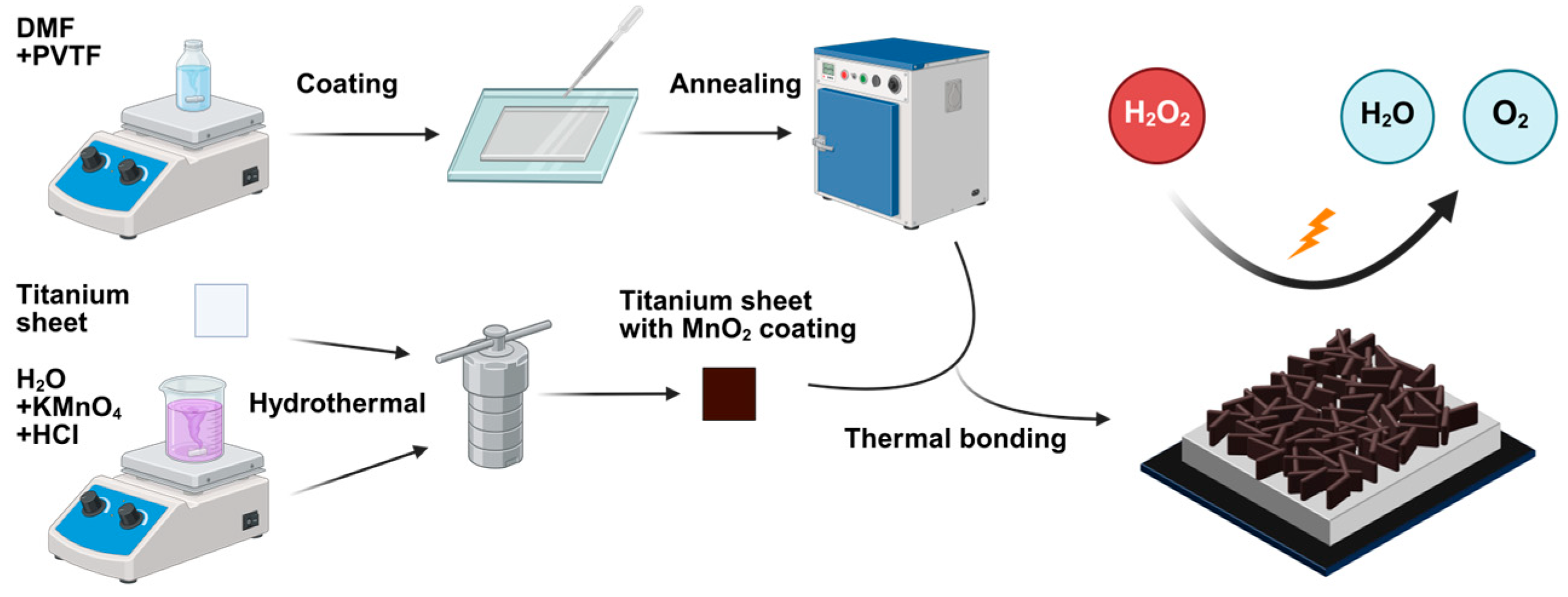
Motivated by the need to mitigate early oxidative stress at the implant–tissue interface, a nano-MnO2/Ti/P(VDF-TrFE) sandwich-structured composite with a presettable surface potential was fabricated via hydrothermal growth and thermal bonding. The surface potential was adjusted by contact poling, and its influence on the catalase-like kinetics of MnO2 nanozymes was quantified. In vitro assays under H2O2 challenge assessed cytoprotective effects and their dependence on the preset potential. The overall fabrication workflow and the surface-potential-assisted catalytic mechanism are illustrated in Figure 1.

2. Materials and Methods

2.1. Materials

Poly(vinylidene fluoride-co-trifluoroethylene) (P(VDF-TrFE); hereafter abbreviated as PVTF) powder (Piezotech® FC30; VDF/TrFE = 70/30 mol%) was purchased from Piezotech (Pierre-Bénite, France). Commercially pure titanium sheet (TA2) was purchased from Taizhou Huihuang New Materials Co., Ltd., Taizhou, China. Potassium permanganate (KMnO4) and N,N-dimethylformamide (DMF) were both analytical grade and purchased from Sinopharm Chemical Reagent Co., Ltd., Shanghai, China. Hydrochloric acid (HCl, 37 wt%) was purchased from Hangzhou Chemical Reagent Co., Ltd., Hangzhou, China. Deionized water was used for the experiments.
All other chemical reagents were of analytical grade and used as received.

2.2. Material Preparation and Polarization

Ti sheets (10 mm × 10 mm) were ultrasonically treated with acetone, anhydrous ethanol, and deionized water for 15 min each. The sheets were then etched with mixed acid (HF:HNO3:H2O = 1:3:6) for 20 s, then rinsed and purged with nitrogen. MnO2 was hydrothermally grown on the Ti surface in one step. First, KMnO4 and HCl were dissolved in water at a molar ratio of 1:40. After magnetic stirring for 30 min, the Ti sheet and hydrothermal precursor solution were placed in an autoclave and reacted at 110 °C for 10 h to obtain Ti substrates with a grown MnO2 layer.
PVTF solution was prepared by dissolving 1 g of PVTF powder in 6 mL of DMF. This solution was then cast into a film and annealed. The film was then thermally bonded to MnO2/Ti at 210 °C for 1 h to obtain nano-MnO2/Ti/PVTF. Contact polarization was performed using a homemade polarization apparatus placed in dimethyl silicone oil. The sample was placed between electrodes and a high-voltage DC electric field of 60 kV·mm−1 was applied for 3 min. Positive and negative surface potentials were induced by reversing the polarity of the applied voltage. After polarization, the residual silicone oil on the sample surface was ultrasonically washed with anhydrous ethanol and deionized water, and the sample was dried at room temperature for later use.
For ease of description, this paper refers to Ti substrates with a grown MnO2 layer as MNTs; samples thermally bonded with PVTF but not poled are referred to as Un-MNT/PVTF; and samples subjected to contact polarization are referred to as Po-MNT/PVTF (positive) or Ne-MNT/PVTF (negative).

2.3. Materials Characterization

The surface and cross-sectional morphologies of the samples were acquired using field emission scanning electron microscopy (FESEM; Hitachi SU-70, Hitachi High-Tech Corporation, Tokyo, Japan; 3 kV). Pt was sputtered before testing to prevent charging, and elemental scanning was performed using EDS (Oxford Instruments, Abingdon, UK). Surface roughness was measured by AFM (NTEGRA Spectra C, NT-MDT Spectrum Instruments, Moscow, Russia) in tapping mode using an NSG013 probe. Surface potential was measured by KPFM (Dimension Icon XR, Bruker Corporation, Billerica, MA, USA) using a conductive SCM-PIT-V2 probe with a tip–sample separation (lift height) of 100 nm, and the sample was electrically connected to the grounded stage using silver paste. The crystal structure was characterized using X-ray diffractometry (Thermo ARL X’TRA, Thermo Fisher Scientific, Waltham, MA, USA; Cu Kα, λ = 1.5406 Å, scan rate 2° min−1). Surface elemental composition and chemical valence states were analyzed using X-ray photoelectron spectroscopy (Kratos AXIS SUPRA, Kratos Analytical Ltd., Manchester, UK; Al Kα). Specific surface area and pore size distribution were calculated using N2 adsorption–desorption at 77 K (ASAP 2460, Micromeritics Instrument Corporation, Norcross, GA, USA) using the BET and DFT models, respectively. Wettability was measured using a contact angle meter (OCA 20, DataPhysics Instruments GmbH, Filderstadt, Germany; room temperature, deionized water). Piezoelectric properties were obtained using a quasi-static d33 meter (ZJ-3A, Institute of Acoustics, Chinese Academy of Sciences, Beijing, China). Interfacial adhesion between the PVTF layer and the Ti substrate in the MnO2/Ti/PVTF composite was evaluated by a tensile–shear test using a universal testing machine (Instron 5943, Instron, Norwood, MA, USA), and a representative stress–displacement curve is provided in Figure S1.

2.4. Nanozyme Activity and Dissolved Oxygen Assay

Reaction solutions (2.0 mL per well) containing 300 μM H2O2 were prepared for each sample. The reaction was carried out with a sample (effective area 1.0 cm2) at 25 °C and 300 rpm. Samples were taken at 0.5, 2, and 4 h, and residual H2O2 was quantified colorimetrically at λ = 560 nm according to the kit protocol.
Dissolved oxygen curves were recorded using a polarographic dissolved oxygen electrode (Seven2Go S4 meter with InLab 605-ISM IP67 electrode, METTLER TOLEDO, Greifensee, Switzerland) under the same conditions. After two-point calibration, the data were recorded every 30 s for up to 10 min (25 °C, 300 rpm).
Steady-state kinetic assays were performed using dissolved oxygen data at substrate concentrations of 5–200 mM. The initial velocity, V0, was taken from the linear region of 0–60 s, and Vmax was expressed in units of μM·s−1. Michaelis–Menten fitting was performed in OriginPro 2025 (OriginLab Corporation, Northampton, MA, USA) to obtain Michaelis–Menten constant (Km) and maximum rate (Vmax).

2.5. In Vitro Biological Experiments

Bone marrow mesenchymal stem cells (BMSCs) were isolated from the femoral bone marrow of approximately three-week-old male Sprague-Dawley rats (provided by the Animal Care and Use Committee of Zhejiang University). Cells were cultured in DMEM (low glucose, 1 g/L; HyClone, Logan, UT, USA) with 10% FBS (Cellmax, Kista, Sweden) and 1% penicillin–streptomycin at 37 °C, 5% CO2. Extracts were prepared by incubating samples in 0.5 mL of culture medium at 37 °C for 24 h, and Mn ion concentrations were measured by ICP-MS (Agilent 8900, Agilent Technologies, Santa Clara, CA, USA). BMSCs were treated with 5%, 20%, 50%, and 100% extracts for 24 h, and cell viability was assessed using CCK-8 (Dojindo, Kumamoto, Japan). BMSCs were seeded on each sample surface at 5 × 10⁴ cells/well, and CCK-8 assays were performed on days 1 and 3 after cell seeding. Cell morphology was analyzed by fixing with 4% paraformaldehyde for 15 min and permeabilizing with 0.1% Triton X-100 for 2 min. After blocking with 2% BSA, the cell cytoskeleton was stained with rhodamine phalloidin (Phalloidin-iFluorTM 594 Conjugate, AAT Bioquest, Inc., Pleasanton, CA, USA), and the nuclei were stained with 4′,6-diamidino-2-phenylindole (DAPI, ENZ-52404, Enzo Life Sciences (ELS) AG, Lausen, Switzerland). All stained samples were observed using a confocal laser scanning microscope (LSM 780, Carl Zeiss Microscopy GmbH, Jena, Germany). For experiments involving cells exposed to oxidative stress, cells were pre-incubated with the samples for 24 h and then incubated in medium containing 300 μM H2O2 for an additional 12 or 24 h. Relative viability was calculated using CCK-8.

2.6. Statistics

All data are expressed as mean ± SD (n = 3). Shapiro–Wilk normality and Levene’s homogeneity of variance tests were performed before analysis. Two-group comparisons were performed using a two-sided t-test, and multiple-group comparisons were performed using a one-way ANOVA with Tukey’s post hoc test. The significance threshold was α = 0.05. Statistics were performed in OriginPro 2025.

3. Results

3.1. Surface Properties

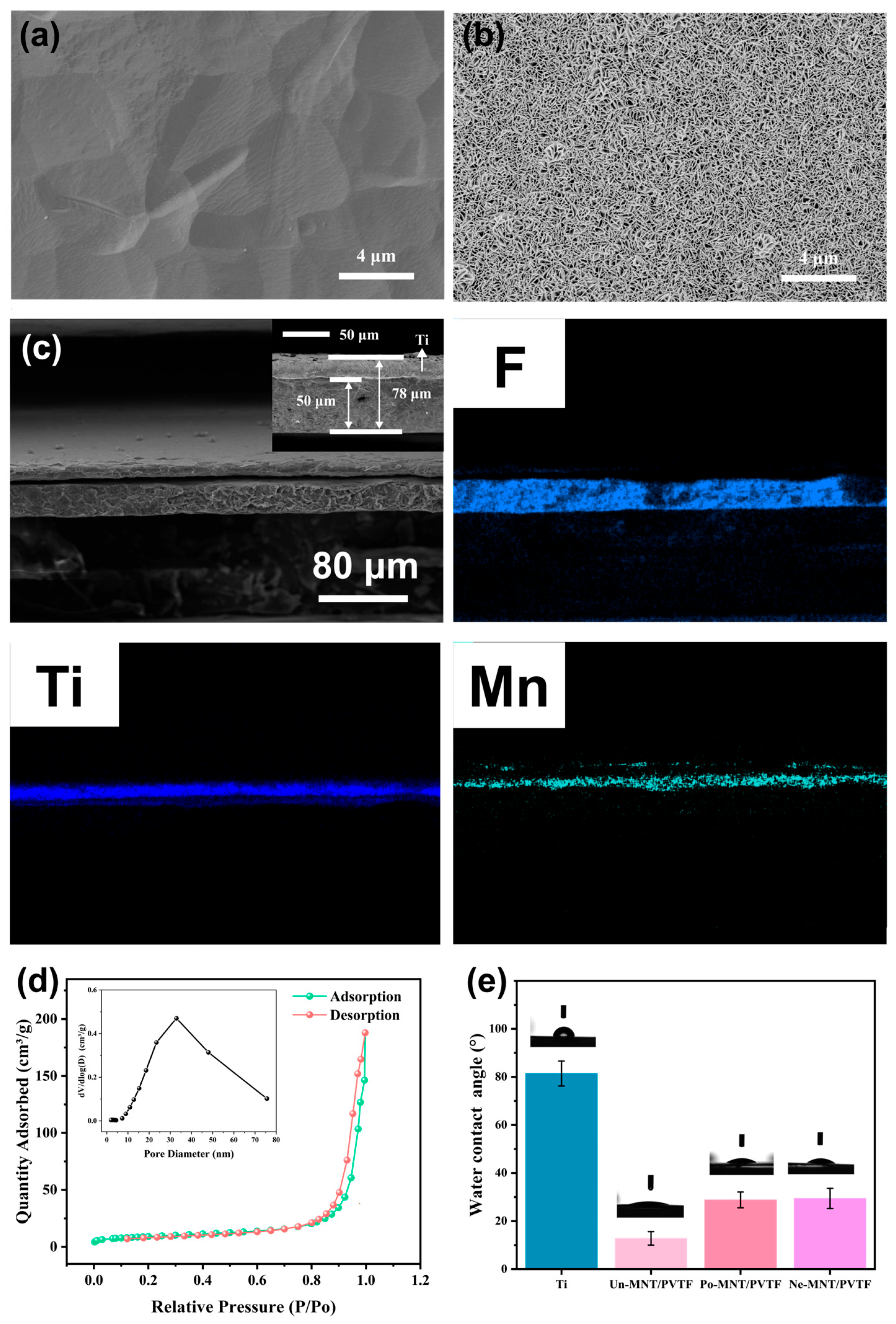
As shown in Figure 2a,b, the polished Ti surface is relatively flat, with only visible machining textures. After the hydrothermal reaction, the surface is covered with a dense and uniform array of MnO2 nanosheets, forming a multi-scale rough structure. The microscopic undulations were quantitatively characterized using AFM. The average roughness of untreated Ti was Ra = 33.3 nm; this increased to 93.2 nm for MNT after hydrothermal treatment. High roughness is maintained after thermal bonding with PVTF and poling (MNT/PVTF: 88.4 nm; Po-MNT/PVTF: 84.6 nm). This suggests that the thermal bonding and contact poling processes do not significantly damage the nanosheet array, causing only slight flattening, and the overall roughness level remains stable. The cross-sectional analysis in Figure 2c reveals the three-layer structure of the MNT/PVTF composite, including its elemental distribution. The MnO2 nanosheet layer is approximately 2 μm thick, and the Ti (~28 μm) and PVTF (~50 μm) layers are both sufficient for subsequent poling of the ferroelectric layer. The cross-sectional image taken from the central region shows a continuous and intimate contact at the PVTF/Ti interface without a continuous gap. Interfacial adhesion was further assessed by a tensile–shear test, and the results are provided in Figure S1.
The gas–solid interface structure was further investigated by N2 adsorption/desorption (Figure 2d). The MNTs exhibited a porous structure dominated by mesopores, with a BET surface area of 32.1 m2·g−1, a total pore volume of 0.239 cm3·g−1, and an average pore diameter of 31.5 nm; the BET surface area and total pore volume are significantly higher than those of Ti (4.84 m2·g−1 and 0.0033 cm3·g−1) (Table 1). DFT fitting revealed a very low micropore volume fraction, with meso/macroporous pores dominating (Table 1). At the same time, the isotherm in the high-pressure region (P/P0→1) exhibits an H3-type hysteresis loop characteristic of a type IV isotherm [28], which is commonly observed for slit-like pores formed by stacks of sheet-like particles, consistent with the MnO2 nanosheet arrays observed by SEM (Figure 2b). In summary, the structural features of the nanosheets, such as roughening and mesoporous channels, likely increase the accessible surface area and diffusion pathways for subsequent H2O2 mass transfer and surface catalysis.
Surface wettability followed a similar trend (Figure 2e). The contact angle decreases from 81.5° (Ti) to 12.9° (MNT); good hydrophilicity is maintained after thermal bonding and poling (28.9° and 29.4°). The roughened morphology and polarization-induced surface energy changes may be conducive to droplet spreading, providing favorable conditions for mass transfer of liquid reactants at the interface.

3.2. Composition and Chemical State

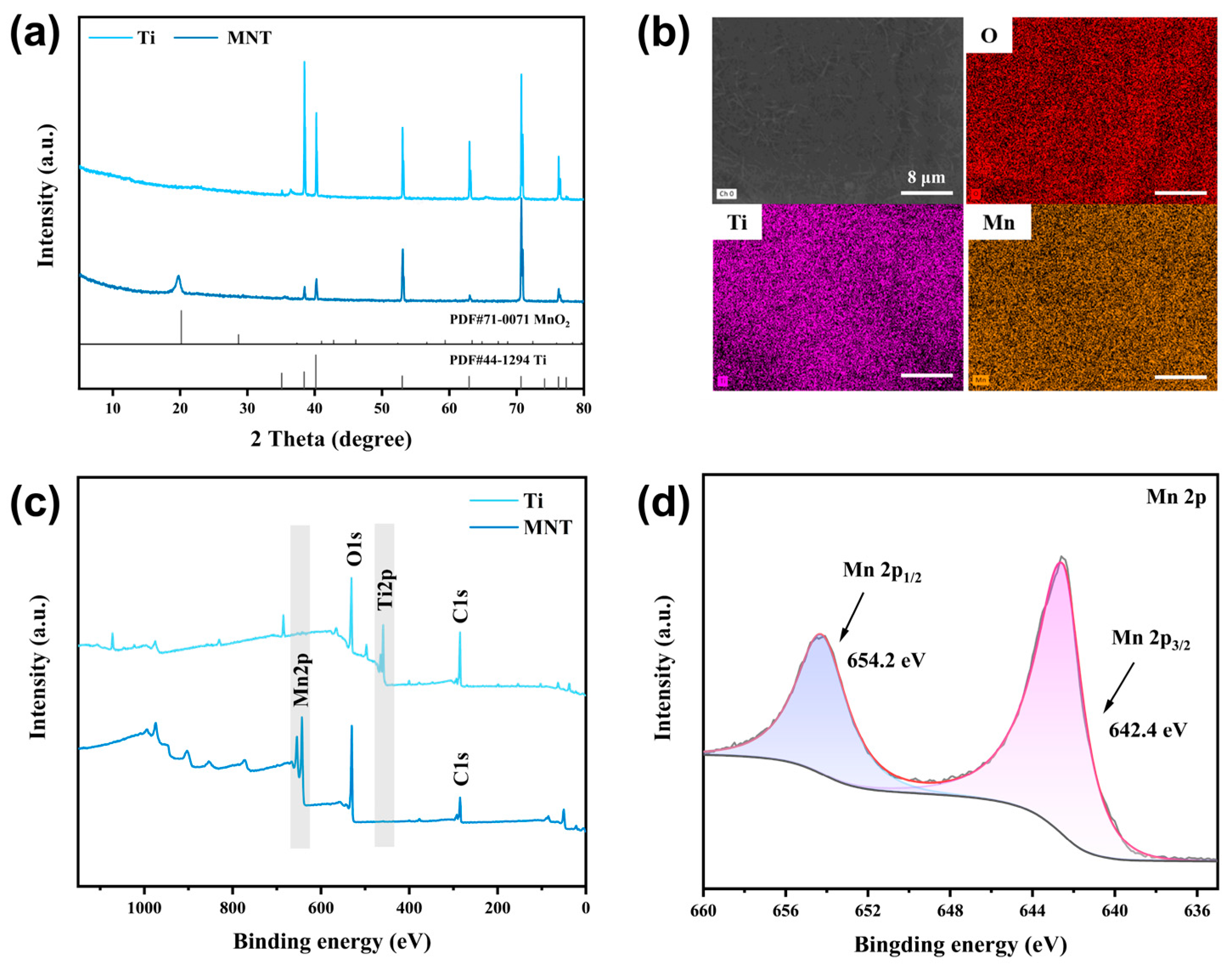
The sample’s phase and elemental composition were systematically characterized using XRD, EDS, and XPS (Figure 3). As shown in Figure 3a, the XRD pattern of the MNT sample, with the exception of characteristic diffraction peaks from the titanium substrate (PDF#44-1294), matches that of the α-MnO2 standard card (PDF#71-0071). Combined with XPS, this supports the predominance of α-MnO2 in the sample. The SEM-EDS elemental scan results in Figure 3b demonstrate the uniform and dense distribution of Mn and O elements on the sample surface, further confirming the integrity of the MnO2 layer.
To investigate the surface chemical composition and valence states, XPS analysis was performed. The full spectrum in Figure 3c clearly demonstrates the presence of a significant Mn 2p signal peak on the MNT surface compared to the pure Ti control. In the high-resolution Mn 2p spectrum in Figure 3d, the peaks at 642.4 eV and 654.2 eV correspond to the spin–orbit splitting peaks of Mn 2p3/2 and Mn 2p1/2, respectively. The binding energy of 642.4 eV is characteristic of the Mn4+ valence state. Combined XRD and XPS results support the preparation of a uniformly distributed layer composed primarily of α-MnO2.

3.3. Electrical Properties and Surface Potential

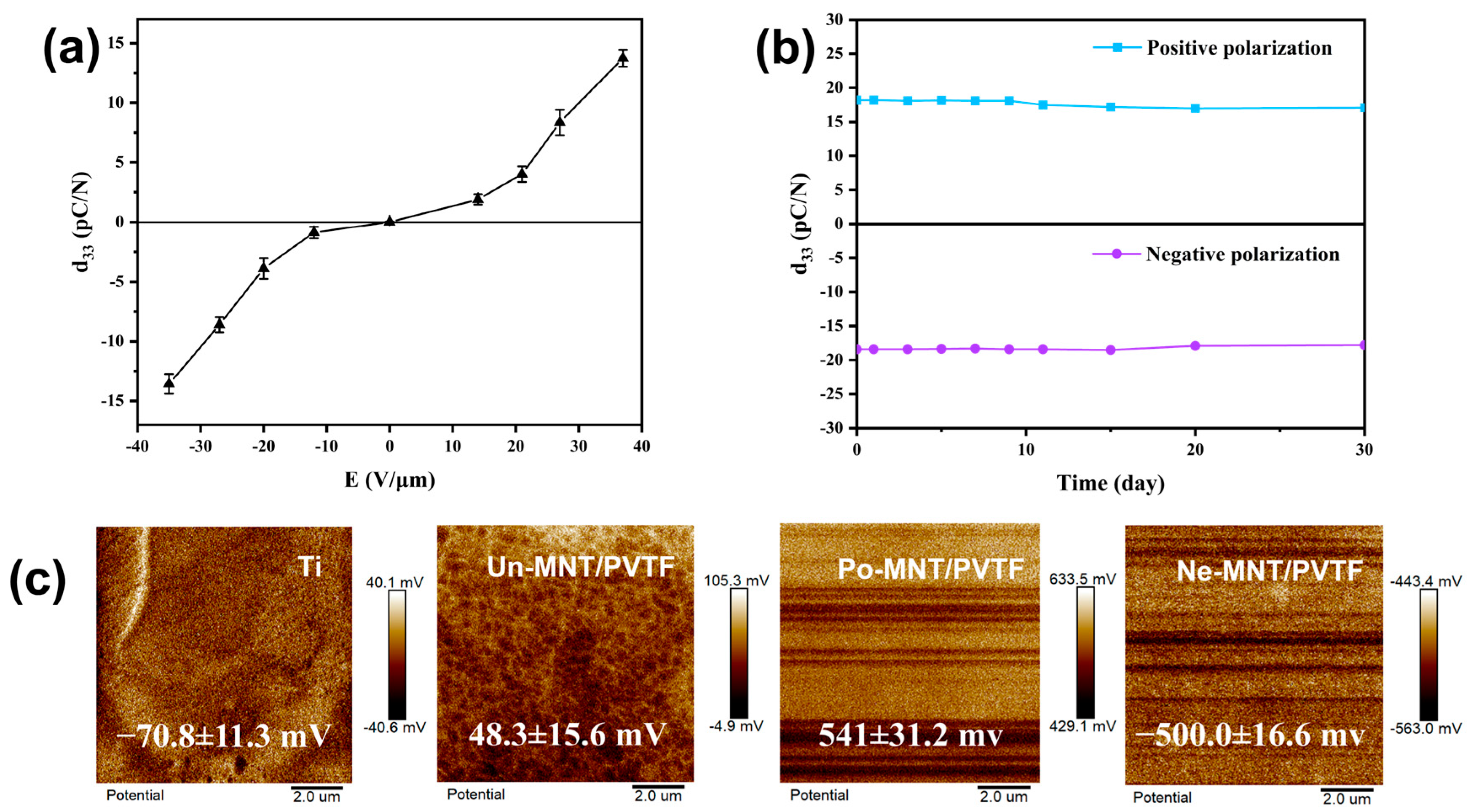
The core strategy of this study is to leverage the polarizable properties of the PVTF ferroelectric substrate to apply a controllable and stable static electric field to the surface MnO2 nanozyme. To confirm the successful ferroelectric poling and monitor its stability, the piezoelectric response of the composite was first evaluated. For ferroelectric polymers like PVTF, the remnant polarization (Pr)—which generates the static surface potential via bound charges—is also the source of the material’s piezoelectricity [29,30,31,32,33]. The effective piezoelectric coefficient (d33) is known to be directly proportional to this remnant polarization [34].
As shown in Figure 4a, the absolute value of the effective d33 coefficient, measured using a piezoelectric coefficient meter, increases with increasing applied polarization electric field strength. This result demonstrates that the magnitude of the remnant polarization can be effectively controlled by the poling process.
The stability of this poled state was then examined (Figure 4b). The results showed that after both positive and negative polarization treatments, the d33 values remained stable over a monitoring period of up to 30 days, showing no significant attenuation. This 30-day stability in d33 serves as a robust proxy for the stability of the underlying remnant polarization, which in turn lays the foundation for the long-lasting and stable surface electric field measured by KPFM.
Based on this, the static surface potential of each sample group was characterized using KPFM (Figure 4c). The Ti/PVTF surface without the MnO2 layer exhibited a negative potential of approximately −70.8 ± 11.3 mV. After the MnO2 layer, the surface potential of the unpolarized sample (Un-MNT/PVTF) shifted to +48.3 ± 15.6 mV. After contact polarization, the surface potential of the samples underwent a controlled change: the positively polarized sample (Po-MNT/PVTF) achieved a stable positive potential of approximately +541 ± 31.2 mV, while the negatively polarized sample (Ne-MNT/PVTF) exhibited a strongly negative potential of −500 ± 16.6 mV. This potential difference arises from the alignment of the internal electric dipoles of the PVTF under an external electric field, resulting in a stable net bound charge on the surface, which manifests itself as a surface potential detectable by KPFM. These results demonstrate the successful construction of a MnO2 nanozyme catalytic platform with a tunable surface potential within a ± 500 mV range. All KPFM measurements were performed using the same SCM-PIT-V2 probe at a lift height of 100 nm with the sample grounded via silver paste; therefore, the reported potentials are interpreted as relative differences between sample groups measured under identical settings. Given the strong coupling between ferroelectric polarization and surface potential in PVTF, the 30-day stability of d33 supports the persistence of the preset potential.

3.4. Nanozyme Catalytic Performance

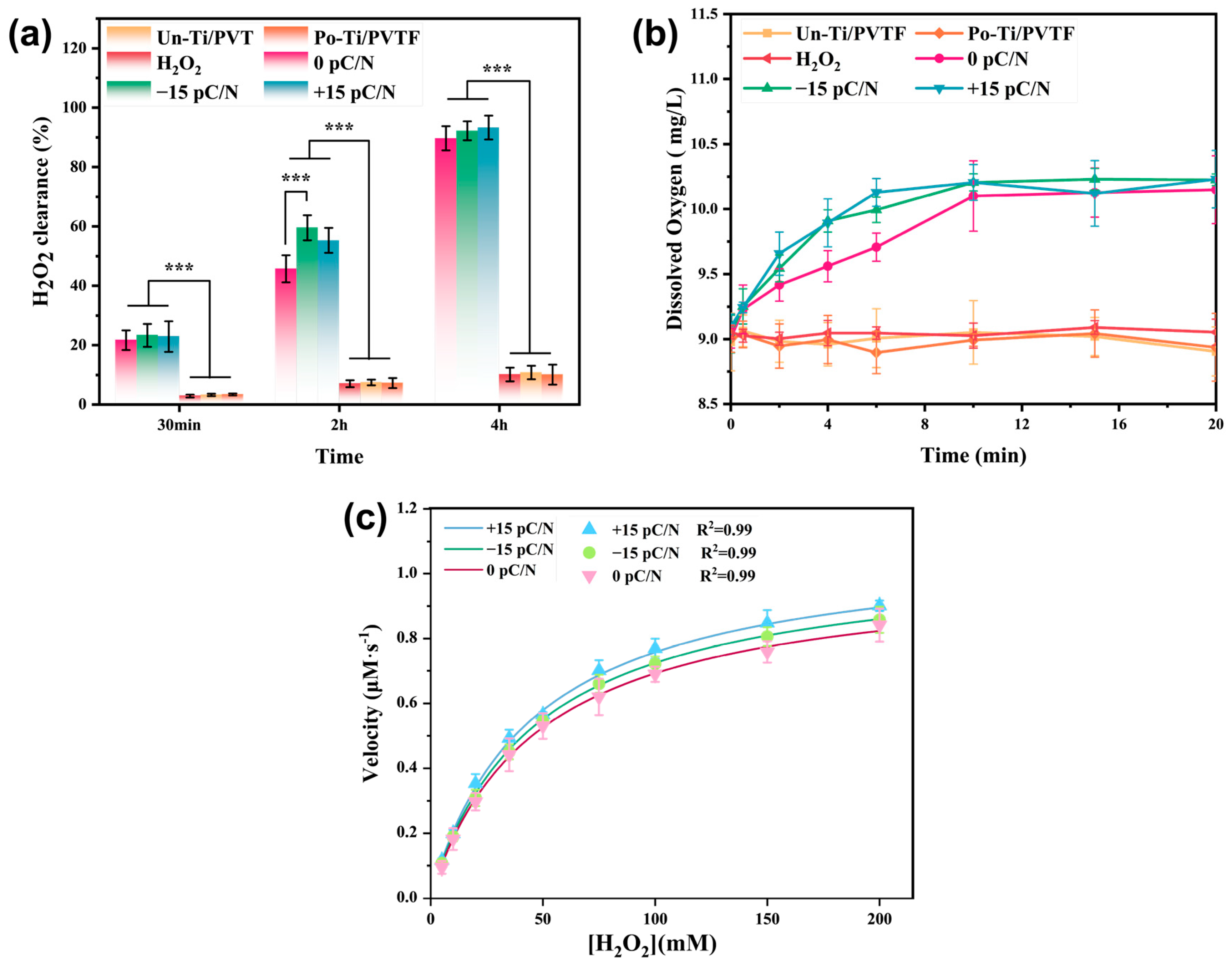
The composite’s catalase-like (CAT-like) activity—the ability to catalyze the decomposition of H2O2—was systematically evaluated (Figure 5). As shown in Figure 5a, the H2O2 blank and the Ti/PVTF controls (Ti/PVTF-Un and Ti/PVTF-Po) exhibited only a slight decrease in H2O2 concentration within 4 h, indicating negligible catalytic activity under the present conditions. In contrast, all samples containing the MnO2 layer (Un-MNT/PVTF, Po-MNT/PVTF and Ne-MNT/PVTF) showed dramatically enhanced H2O2 scavenging: the removal efficiency approached ~90% after 4 h for all three groups. This confirms that the accelerated H2O2 clearance originates from the MnO2 nanozyme coating rather than from H2O2 self-decomposition or any catalytic activity of the Ti/PVTF substrate.
The practical effect of this catalysis was further assessed in the dissolved oxygen as-say (Figure 5b) at a physiologically relevant H2O2 concentration of 300 μM. Consistent with the degradation results, the H2O2-only blank and the Ti/PVTF controls produced al-most no detectable increase in dissolved oxygen, whereas all MnO2-containing samples generated oxygen rapidly. Although the final plateau values of dissolved oxygen were similar among the MnO2 groups (because the same initial amount of H2O2 was completely decomposed and the O2 concentration remained below saturation), the polarized samples reached the plateau in approximately 8 min, while the unpolarized sample required ~10 min. This provides direct visual evidence that polarization accelerates the initial decom-position rate of H2O2.
To systematically quantify this rate enhancement, steady-state enzyme kinetics were measured using initial-rate data collected at 5–200 mM H2O2. Key kinetic parameters (Vmax and Km) were obtained by nonlinear least-squares regression to the Michaelis–Menten equation (Figure 5c). Standard errors (SE) of fitted parameters were provided by the nonlinear regression, and 95% confidence intervals (95% CI) were calculated and summarized in the Supporting Information (Table S1). The Lineweaver–Burk (double-reciprocal) plot is provided only as a supplementary visualization (Figure S2), and is not used as the primary basis for parameter extraction. Calculations revealed that polarization modulated the catalytic kinetics: the Vmax increased from 1.015 μM·s−1 (0 pC/N) to 1.095 μM·s−1 (+15 pC/N) and 1.056 μM·s−1 (−15 pC/N). Regarding substrate affinity, the Km values decreased to 45.21 mM (+15 pC/N) and 46.47 mM (−15 pC/N), compared to 47.21 mM for the unpolarized group. This simultaneous increase in Vmax and decrease in Km indicates an accelerated turnover rate and enhanced substrate affinity. According to Michaelis-Menten kinetics, the reaction rate in a low-concentration regime (where [S] << Km) is directly proportional to the catalytic efficiency (Vmax/Km) [35,36]. The 300 μM H2O2 concentration used in the dissolved oxygen assay (Figure 5b) represents such a regime, which is further supported by additional initial-rate measurements at 200–500 μM (Figure S3). Therefore, the improved kinetic parameters obtained from nonlinear Michaelis–Menten fitting (Figure 5c; Table S1) align with the faster initial reaction rate observed in Figure 5b, confirming that the intrinsic kinetic parameters and their combined effect on Vmax/Km govern the practical catalytic performance at low, physiologically relevant concentrations.

3.5. In Vitro Biological Evaluation

Before biomaterials are used in vivo, it is crucial to assess their potential toxicity and biocompatibility. Accordingly, the in vitro biological performance of the composite was evaluated.
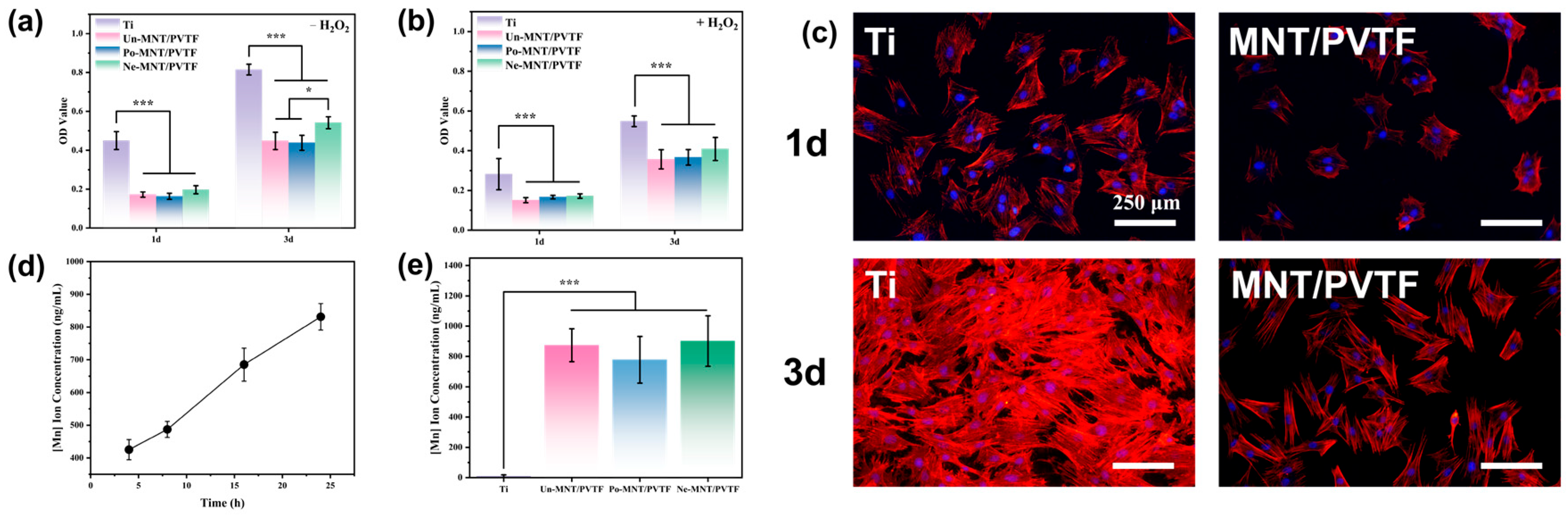
First, the biocompatibility of the material surface under normal culture conditions was evaluated using a direct contact method. CCK-8 quantitative results (Figure 6a) showed that under normal culture conditions, cell viability in all samples with the MnO2 layer was significantly lower than that in the pure titanium group. Fluorescence staining of the cytoskeleton (Figure 6c) confirmed this finding. Compared to cells that spread well on pure titanium, BMSCs adhered to the MnO2 layer in smaller numbers and were mostly rounded and poorly spread. These results indicate that the MnO2 layer itself possesses some basal cytotoxicity compared to bare Ti, characterized by fewer adherent cells and reduced cell spreading (Figure 6c). Note that the specific influence of ferroelectric polarization on BMSC morphology (e.g., elongation and cytoskeletal organization) has been systematically established in our previous study [25]. Consequently, the current evaluation focuses primarily on the quantitative assessment of cell viability under oxidative stress conditions to verify the specific cytoprotective function of the polarized nanozyme.
Therefore, although bare Ti shows the highest baseline cytocompatibility under normal culture conditions, the MnO2/Ti/PVTF coatings are intended to provide functional protection primarily in ROS-rich (oxidative-stress) microenvironments, where the Ti control suffers pronounced H2O2-induced damage.
In contrast, when cells were challenged with an oxidative stress microenvironment (300 μM H2O2), the nanozyme layer demonstrated a strong cytoprotective effect (Figure 6b). Cell viability in the pure titanium group was severely inhibited by H2O2 toxicity. However, all MnO2 samples significantly mitigated this oxidative damage, resulting in higher cell viability compared to the Ti control. Importantly, this cytoprotective effect was modulated by surface potential: cell viability in the positively polarized (Po-MNT/PVTF) and negatively polarized (Ne-MNT/PVTF) samples was higher than that in the unpolarized (Un-MNT/PVTF) sample.
To investigate the potential source of the basal cytotoxicity observed in Figure 6a,c, the chemical stability and ion release of the layers were examined. The release of manganese ions in culture medium was measured by ICP-MS (Figure 6d,e). The results showed that the amount of manganese ion released increased with immersion time, reaching approximately 850 ng/mL after 24 h (Figure 6d). This cumulative concentration corresponds to ~15 μM Mn2+, which may contribute to the reduced baseline cytocompatibility observed on MnO2-containing surfaces [38]. Therefore, reducing Mn2+ leakage is required before any long-term implant-oriented translation can be considered [18]. The ion release from all MnO2 sample groups was significantly higher than the nearly undetectable release from the pure titanium group (Figure 6e).

4. Discussion

A nano-MnO2/Ti/PVTF sandwich-structured composite with a presettable surface potential was fabricated via hydrothermal growth and thermal bonding and contact poling generated positive or negative potentials that modulated MnO2 nanozyme catalysis. Steady-state kinetics (Figure 5c; Table S1) indicated that polarization induced a dual enhancement of the catalytic parameters: it increased Vmax (from 1.015 to 1.056–1.096 μM·s−1) and decreased Km (from 47.21 to 45.21–46.47 mM). This combination results in an improved overall catalytic efficiency (Vmax/Km). In addition, the inclusion of the H2O2-only blank and MnO2-free Ti/PVTF controls in Figure 5a,b showed that both the Ti/PVTF substrate and its polarization alone are almost inert toward H2O2 decomposition, and their behavior closely overlaps with the H2O2-only group. This confirms that the observed enhancement in H2O2 scavenging is dominated by the MnO2 nanozyme layer and its polarization-tuned catalytic kinetics, rather than by side reactions of the substrate. The polarization-induced potential (up to ~500 mV) may contribute to this dual enhancement by biasing the MnO2/solution interface and thereby influencing H2O2 adsorption (reflected by lower Km) and interfacial redox/electron-transfer steps (reflected by higher Vmax) [39,40]. Notably, this regulation does not require a ferroelectric field to penetrate a micrometer-thick MnO2 layer in aqueous media, because in the MnO2/Ti/PVTF sandwich structure the preset potential can be transmitted through the conductive Ti layer to the MnO2 surface; direct electronic-structure validation (e.g., UPS/Mott–Schottky/oxidation-state analysis) will be pursued in future work. This potential-regulated nanozyme catalysis is conceptually reminiscent of EM-based electroenzymatic assemblies used for electrochemical transduction [21], but here the regulation is achieved by a built-in ferroelectric field rather than by introducing redox mediators.
Biological assays revealed a trade-off between cytotoxicity and antioxidant protection. Accordingly, the present biological findings are discussed as a time- and condition-sensitive in vitro proof-of-concept for ROS-rich peri-implant environments, and mitigating Mn-ion leakage is required before considering performance under physiological steady-state conditions. As expected, bare Ti exhibits the highest baseline cytocompatibility under normal culture conditions, whereas introducing the MnO2 nanozyme layer entails a trade-off between baseline cytotoxicity and functional antioxidant protection under oxidative stress. Under basal conditions, the composites exhibited clear cytotoxicity (Figure 6a,c), significantly reducing BMSC viability. This observation is strongly correlated with the significant Mn-ion release measured by ICP-MS (Figure 6d,e). Such Mn-ion-induced cytotoxicity is consistent with other reports on MnO2 materials [41,42]. Conversely, under simulated early implantation oxidative stress (300 μM H2O2), the composites mitigated ROS-induced damage (Figure 6b). This cytoprotective capability is a known attribute of MnO2-based nanozymes, which effectively scavenge H2O2 to protect cells and tissues in ROS-rich microenvironments [43,44,45]. Notably, the polarized samples showed higher cell survival than unpolarized controls, which aligns with the enhanced catalytic efficiency (Vmax/Km) confirmed in our kinetic analysis. Although in the present study we mainly relied on viability assays as the quantitative readout, future work will include more detailed comparisons of BMSC morphology on Po-MNT/PVTF and Ne-MNT/PVTF under both basal and oxidative-stress conditions to directly visualize the polarization-dependent effects.
This enhanced cytoprotection in the polarized groups is attributed to a dual mechanism. The primary factor is the accelerated nanozyme catalysis (the higher Vmax/Km), which provided a faster, more efficient removal of H2O2 from the microenvironment. Concurrently, the surface potential itself may act as a direct bioactive cue, as ferroelectric polarization has been shown to directly regulate cell adhesion and proliferation [46,47].
The principal limitation remains cytotoxicity associated with ion release. Another methodological limitation is the absence of an MnO2-only control: in this study, the MnO2 layer was hydrothermally grown on Ti, followed by thermal bonding of PVTF, and preparing a free-standing MnO2-only sample without changing its morphology or loading proved impractical; therefore, our kinetic analysis is restricted to the coating-type MnO2/Ti/PVTF electrodes and their relevant controls, and dedicated MnO2-only model systems will be designed in future work to quantitatively dissect the intrinsic catalytic contribution of MnO2. Given that post-implantation inflammation and ROS bursts are transient [3,48,49], time-sensitive application may still be clinically meaningful; nevertheless, reducing toxicity while preserving tunability is preferable. To address this, future strategies such as process optimization and composition engineering (e.g., Zn doping) offer promising routes to suppress ion release while maintaining activity [18,50]. Accordingly, we emphasize that the present study should be interpreted as an in vitro proof-of-concept for ROS-rich conditions, and that long-term implant translation requires further suppression of Mn-ion leakage and systematic in vivo safety evaluation. Verification in animal models is required to confirm efficacy and safety in complex in vivo microenvironments and to establish impacts on osseointegration.

5. Conclusions

In this study, a nano-MnO2/Ti/PVTF composite with active surface potential control was successfully constructed. The key conclusions are as follows:
  • A structurally stable sandwich-structured composite was fabricated, where contact polarization established a presettable and long-term stable surface potential within a range of ±500 mV.
  • The polarization-induced electric field modulated the nanozyme kinetics by consistently increasing Vmax, which translated to a significantly faster initial H2O2 decomposition rate.
  • Despite some basal cytotoxicity from ion release, the polarized composites exhibited superior cytoprotection under oxidative stress compared to unpolarized controls, attributed to the field-enhanced catalytic efficiency.
  • This work provides a proof-of-concept route for designing polarization-tunable antioxidant surfaces under ROS-rich conditions. In vivo studies are required to evaluate osseointegration outcomes and long-term biosafety before any implant translation.

Supplementary Materials

The following supporting information can be downloaded at: https://www.mdpi.com/article/doi/s1, Figure S1: Representative stress–displacement curve obtained from the tensile–shear adhesion test for the Ti/PVTF interface in the MNT/PVTF composite; Figure S2: Lineweaver–Burk (double-reciprocal) plot of the initial-rate kinetic data for the Un-, Po-, and Ne-MNT/PVTF samples; Figure S3: Initial O2-generation rate v0 as a function of H2O2 concentration in the micromolar range (200–500 μM); Table S1: Kinetic parameters obtained from nonlinear Michaelis–Menten fitting.

Author Contributions

Conceptualization, L.M., W.L. and K.C.; methodology, L.M., W.L. and Y.H.; software, L.M.; validation, X.J., X.X. and C.W.; formal analysis, L.M.; investigation, L.M.; resources, W.L. and K.C.; data curation, L.M.; writing—original draft preparation, L.M.; writing—review and editing, W.L., Y.H., C.W. and K.C.; visualization, L.M.; supervision, W.L. and K.C.; project administration, K.C.; funding acquisition, K.C. All authors have read and agreed to the published version of the manuscript. L.M. and W.L. contributed equally to this work.

Funding

This work was financially supported by the National Natural Science Foundation of China (Grant No. 52271252, 32271373 and U24A20762), Key Research and Development Program of Zhejiang Province (2021C03061), and the Postdoctoral Fellowship Program of China Postdoctoral Science Foundation (GZC20232243).

Data Availability Statement

The raw data supporting the conclusions of this article will be made available by the authors on request.

Acknowledgments

The authors thank Jing He at State Key Laboratory of Chemical Engineering in Zhejiang University for performing KPFM test.

Conflicts of Interest

The authors declare no conflicts of interest.

References

  1. Geetha, M.; Singh, A.K.; Asokamani, R.; Gogia, A.K. Ti Based Biomaterials, the Ultimate Choice for Orthopaedic Implants—A Review. Prog. Mater. Sci. 2009, 54, 397–425. [Google Scholar] [CrossRef]
  2. Chen, Q.; Thouas, G.A. Metallic Implant Biomaterials. Mater. Sci. Eng. R Rep. 2015, 87, 1–57. [Google Scholar] [CrossRef]
  3. Anderson, J.M.; Rodriguez, A.; Chang, D.T. Foreign Body Reaction to Biomaterials. Semin. Immunol. 2008, 20, 86–100. [Google Scholar] [CrossRef]
  4. Charles, J.F.; Aliprantis, A.O. Osteoclasts: More than ‘Bone Eaters’. Trends Mol. Med. 2014, 20, 449–459. [Google Scholar] [CrossRef]
  5. Vishnu, J.; Kesavan, P.; Shankar, B.; Dembińska, K.; Swiontek Brzezinska, M.; Kaczmarek-Szczepańska, B. Engineering Antioxidant Surfaces for Titanium-Based Metallic Biomaterials. J. Funct. Biomater. 2023, 14, 344. [Google Scholar] [CrossRef] [PubMed]
  6. Huang, J.; Li, R.; Yang, J.; Cai, M.; Lee, Y.; Wang, A.; Cheng, B.; Wang, Y. Bioadaptation of Implants to In Vitro and In Vivo Oxidative Stress Pathological Conditions via Nanotopography-Induced FoxO1 Signaling Pathways to Enhance Osteoimmunal Regeneration. Bioact. Mater. 2021, 6, 3164–3176. [Google Scholar] [CrossRef] [PubMed]
  7. Sun, H.; Xu, J.; Wang, Y.; Shen, S.; Xu, X.; Zhang, L.; Jiang, Q. Bone Microenvironment Regulative Hydrogels with ROS Scavenging and Prolonged Oxygen-Generating for Enhancing Bone Repair. Bioact. Mater. 2023, 24, 477–496. [Google Scholar] [CrossRef]
  8. Zhang, T.; Qin, X.; Gao, Y.; Kong, D.; Jiang, Y.; Cui, X.; Guo, M.; Chen, J.; Chang, F.; Zhang, M.; et al. Functional Chitosan Gel Coating Enhances Antimicrobial Properties and Osteogenesis of Titanium Alloy under Persistent Chronic Inflammation. Front. Bioeng. Biotechnol. 2023, 11, 1118487. [Google Scholar] [CrossRef]
  9. Li, K.; Geng, W.; Zhao, W.; Huang, K.; Lu, Q.; Tao, B.; Chen, S.; Yan, C.; Jiang, D.; Guo, A. Design and Development of Titanium-Coated Implants with Advanced Antioxidant Properties for Enhanced Regenerative Repair of Diabetic Bone. Chem. Eng. J. 2024, 497, 154522. [Google Scholar] [CrossRef]
  10. Bakhrushina, E.O.; Sakharova, P.S.; Konogorova, P.D.; Pyzhov, V.S.; Kosenkova, S.I.; Bardakov, A.I.; Zubareva, I.M.; Krasnyuk, I.I. Burst Release from In Situ Forming PLGA-Based Implants: 12 Effectors and Ways of Correction. Pharmaceutics 2024, 16, 115. [Google Scholar] [CrossRef]
  11. Sheldon, R.A.; van Pelt, S. Enzyme Immobilisation in Biocatalysis: Why, What and How. Chem. Soc. Rev. 2013, 42, 6223–6235. [Google Scholar] [CrossRef]
  12. Abdalbagemohammedabdalsadeg, S.; Xiao, B.-L.; Ma, X.-X.; Li, Y.-Y.; Wei, J.-S.; Moosavi-Movahedi, A.A.; Yousefi, R.; Hong, J. Catalase Immobilization: Current Knowledge, Key Insights, Applications, and Future Prospects—A Review. Int. J. Biol. Macromol. 2024, 276, 133941. [Google Scholar] [CrossRef]
  13. Wu, J.; Wang, X.; Wang, Q.; Lou, Z.; Li, S.; Zhu, Y.; Qin, L.; Wei, H. Nanomaterials with Enzyme-like Characteristics (Nanozymes): Next-Generation Artificial Enzymes (II). Chem. Soc. Rev. 2019, 48, 1004–1076. [Google Scholar] [CrossRef] [PubMed]
  14. Zhang, R.; Jiang, B.; Fan, K.; Gao, L.; Yan, X. Designing Nanozymes for in Vivo Applications. Nat. Rev. Bioeng. 2024, 2, 849–868. [Google Scholar] [CrossRef]
  15. Wei, H.; Wang, E. Nanomaterials with Enzyme-like Characteristics (Nanozymes): Next-Generation Artificial Enzymes. Chem. Soc. Rev. 2013, 42, 6060–6093. [Google Scholar] [CrossRef]
  16. Hinolan, D.S.; Cheng, P.-F.; Kaveevivitchai, W.; Chen, T.-H. Core@shell MnO2@MOF Nanozymes with Accelerated Oxygen Generation for Synergistic Chemodynamic and Starvation Therapy. ACS Appl. Nano Mater. 2025, 8, 16267–16278. [Google Scholar] [CrossRef]
  17. Tan, M.; Gao, Z.; Wang, X.; Lin, C.; Wan, Y.; Xie, W.; Chen, W.; Zhang, Y.; Quan, Z.; Hou, Z. MnO2 Nanozyme with Lanthanide-Based Radiosensitization for Advanced Radiotherapy by Tumor Microenvironment Triggering STING Pathway Activation. Chem. Eng. J. 2024, 486, 150364. [Google Scholar] [CrossRef]
  18. Liu, S.; Li, K.; Hu, T.; Shao, D.; Huang, S.; Xie, Y.; Zheng, X. Zn-Doped MnO2 Nanocoating with Enhanced Catalase-Mimetic Activity and Cytocompatibility Protects Pre-Osteoblasts against H2O2-Induced Oxidative Stress. Colloids Surf. B Biointerfaces 2021, 202, 111666. [Google Scholar] [CrossRef]
  19. Chen, W.; Pan, Y.; Chu, C.H.; Dong, S.; Wang, M.; Wang, L.; Wang, L.; Lin, X.; Tang, C. Microenvironment-Responsive Nanoparticles Functionalized Titanium Implants Mediate Redox Balance and Immunomodulation for Enhanced Osseointegration. Mater. Today Bio 2025, 31, 101628. [Google Scholar] [CrossRef]
  20. Liu, X.; Zhang, H.; Chen, L.; Zheng, Z.; Li, W.; Huang, C.; Zhou, H.; Chen, Y.; Jiang, Z.; Liang, J.; et al. Advanced Wound Healing with Stimuli-Responsive Nanozymes: Mechanisms, Design and Applications. J. Nanobiotechnol. 2025, 23, 479. [Google Scholar] [CrossRef]
  21. Zheng, A.; Li, C.; Xu, S.; Guo, Z.; Li, C.; Zhang, C.; Yao, J.; Zhang, Z.; Li, J.; Du, L.; et al. Efficient Simultaneous Detection of Metabolites Based on Electroenzymatic Assembly Strategy. BME Front. 2023, 4, 27. [Google Scholar] [CrossRef]
  22. Xin, X.; Yee, A.; Zhou, Z.; He, X.; Weng, W.; Wu, C.; Cheng, K. Fabrication of PVTF Films with High Piezoelectric Properties Through Directional Heat Treatment. J. Compos. Sci. 2024, 8, 512. [Google Scholar] [CrossRef]
  23. Wang, Z.; Li, X.; Sun, F.; Zhang, K.; Long, F.; Zhou, T.; Liu, L. High-Performance Flexible Piezoelectric Film through in Situ Engineered P(VDF-TrFE)/BaTiO3 on Titanium Foils. Chem. Eng. J. 2025, 520, 165697. [Google Scholar] [CrossRef]
  24. Zhu, Y.; Liu, X.; Ma, J.; Wang, Z.; Jiang, H.; Sun, C.; Jeong, D.-Y.; Guan, H.; Chu, B. Wireless and Opto-Stimulated Flexible Implants: Artificial Retina Constructed by Ferroelectric BiFeO3-BaTiO3/P(VDF-TrFE) Composites. ACS Appl. Mater. Interfaces 2024, 16, 48395–48405. [Google Scholar] [CrossRef]
  25. Lin, W.; Zhou, Z.; Chen, Z.; Xu, K.; Wu, C.; Duan, X.; Dong, L.; Chen, Z.; Weng, W.; Cheng, K. Accelerated Bone Regeneration on the Metal Surface through Controllable Surface Potential. ACS Appl. Mater. Interfaces 2023, 15, 46493–46503. [Google Scholar] [CrossRef]
  26. Gu, J.; Wu, C.; He, X.; Chen, X.; Dong, L.; Weng, W.; Cheng, K.; Wang, D.; Chen, Z. Enhanced M2 Polarization of Oriented Macrophages on the P(VDF-TrFE) Film by Coupling with Electrical Stimulation. ACS Biomater. Sci. Eng. 2023, 9, 2615–2624. [Google Scholar] [CrossRef]
  27. Yee, A.; Xin, X.; Liu, H.; Ma, L.; Cheng, K. Fabrication of PVTF Electroactive Coatings on PEEK Implant to Provide Surface Potential for Enhancing Osteogenesis. Coatings 2025, 15, 261. [Google Scholar] [CrossRef]
  28. Thommes, M.; Kaneko, K.; Neimark, A.V.; Olivier, J.P.; Rodriguez-Reinoso, F.; Rouquerol, J.; Sing, K.S.W. Physisorption of Gases, with Special Reference to the Evaluation of Surface Area and Pore Size Distribution (IUPAC Technical Report). Pure Appl. Chem. 2015, 87, 1051–1069. [Google Scholar] [CrossRef]
  29. Mallick, Z.; Sarkar, R.; Kundu, T.K.; Mandal, D. Molecular Dipole Regulated Surface Potential and Ferroelectric Characteristics in Nanoconfined P(VDF-TrFE) Architectures. Appl. Surf. Sci. 2024, 646, 158925. [Google Scholar] [CrossRef]
  30. Abdolmaleki, H.; Haugen, A.B.; Buhl, K.B.; Daasbjerg, K.; Agarwala, S. Interfacial Engineering of PVDF-TrFE toward Higher Piezoelectric, Ferroelectric, and Dielectric Performance for Sensing and Energy Harvesting Applications. Adv. Sci. 2023, 10, 2205942. [Google Scholar] [CrossRef]
  31. Meier, D.; Selbach, S.M. Ferroelectric Domain Walls for Nanotechnology. Nat. Rev. Mater. 2022, 7, 157–173. [Google Scholar] [CrossRef]
  32. Takamoto, M.; Toyama, S.; Seki, T.; Futazuka, T.; Findlay, S.D.; Ikuhara, Y.; Shibata, N. Real-Space Observation of Polarization Induced Charges at Nanoscale Ferroelectric Interfaces. Sci. Adv. 2025, 11, eadu8021. [Google Scholar] [CrossRef]
  33. Li, F.; Wang, B.; Gao, X.; Damjanovic, D.; Chen, L.-Q.; Zhang, S. Ferroelectric Materials toward Next-Generation Electromechanical Technologies. Science 2025, 389, eadn4926. [Google Scholar] [CrossRef] [PubMed]
  34. Damjanovic, D. Ferroelectric, Dielectric and Piezoelectric Properties of Ferroelectric Thin Films and Ceramics. Rep. Prog. Phys. 1998, 61, 1267. [Google Scholar] [CrossRef]
  35. Johnson, K.A.; Goody, R.S. The Original Michaelis Constant: Translation of the 1913 Michaelis–Menten Paper. Biochemistry 2011, 50, 8264–8269. [Google Scholar] [CrossRef]
  36. Zheng, J.-J.; Zhu, F.; Song, N.; Deng, F.; Chen, Q.; Chen, C.; He, J.; Gao, X.; Liang, M. Optimizing the Standardized Assays for Determining the Catalytic Activity and Kinetics of Peroxidase-like Nanozymes. Nat. Protoc. 2024, 19, 3470–3488. [Google Scholar] [CrossRef] [PubMed]
  37. Isho, R.D.; Mohammad, N.M.S.; Omer, K.M. Synthesis of MnO2 Sub-Microspheres with Effective Oxidase-Mimicking Nanozymes for the Colorimetric Assay of Ascorbic Acid in Orange Fruits and Juice. New J. Chem. 2023, 47, 7800–7809. [Google Scholar] [CrossRef]
  38. Lüthen, F.; Bulnheim, U.; Müller, P.D.; Rychly, J.; Jesswein, H.; Nebe, J.G.B. Influence of Manganese Ions on Cellular Behavior of Human Osteoblasts in Vitro. Biomol. Eng. 2007, 24, 531–536. [Google Scholar] [CrossRef]
  39. Wan, T.L.; Ge, L.; Pan, Y.; Yuan, Q.; Liu, L.; Sarina, S.; Kou, L. Catalysis Based on Ferroelectrics: Controllable Chemical Reaction with Boosted Efficiency. Nanoscale 2021, 13, 7096–7107. [Google Scholar] [CrossRef]
  40. Tang, C.; Su, M.; Lu, T.; Zheng, J.; Wang, J.; Zhou, Y.; Zou, Y.-L.; Liu, W.; Huang, R.; Xu, W.; et al. Massive Acceleration of SN2 Reaction Using the Oriented External Electric Field. Chem. Sci. 2024, 15, 13486–13494. [Google Scholar] [CrossRef]
  41. Yang, G.; Xu, L.; Chao, Y.; Xu, J.; Sun, X.; Wu, Y.; Peng, R.; Liu, Z. Hollow MnO2 as a Tumor-Microenvironment-Responsive Biodegradable Nano-Platform for Combination Therapy Favoring Antitumor Immune Responses. Nat. Commun. 2017, 8, 902. [Google Scholar] [CrossRef]
  42. Balwe, S.G.; Moon, D.; Hong, M.; Song, J.M. Manganese Oxide Nanomaterials: Bridging Synthesis and Therapeutic Innovations for Cancer Treatment. Nano Converg. 2024, 11, 48. [Google Scholar] [CrossRef] [PubMed]
  43. Chen, Q.; Feng, L.; Liu, J.; Zhu, W.; Dong, Z.; Wu, Y.; Liu, Z. Intelligent Albumin–MnO2 Nanoparticles as pH-/H2O2-Responsive Dissociable Nanocarriers to Modulate Tumor Hypoxia for Effective Combination Therapy. Adv. Mater. 2016, 28, 7129–7136. [Google Scholar] [CrossRef] [PubMed]
  44. Yang, Y.; Yao, Z.; Sun, Y.; Nie, Y.; Zhang, Y.; Li, Z.; Luo, Z.; Zhang, W.; Wang, X.; Du, Y.; et al. 3D-Printed Manganese Dioxide Incorporated Scaffold Promotes Osteogenic-Angiogenic Coupling for Refractory Bone Defect by Remodeling Osteo-Regenerative Microenvironment. Bioact. Mater. 2025, 44, 354–370. [Google Scholar] [CrossRef]
  45. Sun, J.; Zhu, H.; Wang, H.; Li, J.; Li, B.; Liu, L.; Yang, H. A Multifunctional Composite Scaffold Responds to Microenvironment and Guides Osteogenesis for the Repair of Infected Bone Defects. J. Nanobiotechnol. 2024, 22, 577. [Google Scholar] [CrossRef]
  46. Tang, B.; Zhang, B.; Zhuang, J.; Wang, Q.; Dong, L.; Cheng, K.; Weng, W. Surface Potential-Governed Cellular Osteogenic Differentiation on Ferroelectric Polyvinylidene Fluoride Trifluoroethylene Films. Acta Biomater. 2018, 74, 291–301. [Google Scholar] [CrossRef]
  47. Wu, H.; Dong, H.; Tang, Z.; Chen, Y.; Liu, Y.; Wang, M.; Wei, X.; Wang, N.; Bao, S.; Yu, D.; et al. Electrical Stimulation of Piezoelectric BaTiO3 Coated Ti6Al4V Scaffolds Promotes Anti-Inflammatory Polarization of Macrophages and Bone Repair via MAPK/JNK Inhibition and OXPHOS Activation. Biomaterials 2023, 293, 121990. [Google Scholar] [CrossRef]
  48. Sheppard, A.J.; Barfield, A.M.; Barton, S.; Dong, Y. Understanding Reactive Oxygen Species in Bone Regeneration: A Glance at Potential Therapeutics and Bioengineering Applications. Front. Bioeng. Biotechnol. 2022, 10, 836764. [Google Scholar] [CrossRef] [PubMed]
  49. Ren, X.; Liu, H.; Wu, X.; Weng, W.; Wang, X.; Su, J. Reactive Oxygen Species (ROS)-Responsive Biomaterials for the Treatment of Bone-Related Diseases. Front. Bioeng. Biotechnol. 2022, 9, 820468. [Google Scholar] [CrossRef]
  50. Liu, S.; Li, K.; Shao, D.; Shen, Q.; Huang, S.; Ji, H.; Xie, Y.; Zheng, X. Dual Enzyme-like Activities of Transition Metal-Doped MnO2 Nanocoatings and Their Dependence on the Electronic Band Structure and Ionic Dissolution. Appl. Surf. Sci. 2020, 534, 147649. [Google Scholar] [CrossRef]
Figure 1. Schematic diagram of nano-MnO2/Ti/P(VDF-TrFE) composite fabrication and surface-potential–assisted nanozyme catalysis.
Jcs 10 00027 g001
Figure 2. Surface and cross-sectional morphology and surface property characterization. (a,b) Surface SEM images of Ti and MNT; (c) cross-sectional SEM image of the MNT/PVTF composite and corresponding EDS elemental maps (F, Ti and Mn), with layer thickness indicated in the inset; (d) N2 adsorption/desorption isotherm and pore-size distribution of MNT; (e) water contact angles of Ti and MNT/PVTF under different polarization treatments.
Jcs 10 00027 g002
Figure 3. Composition and chemical state characterization. (a) XRD spectra of Ti/PVTF and MNT/PVTF; (b) EDS surface scan elemental distribution (O, Ti, Mn) of MNT/PVTF; (c) XPS survey spectra of Ti/PVTF and MNT/PVTF; (d) high-resolution Mn 2p XPS and peak fitting of MNT/PVTF.
Jcs 10 00027 g003
Figure 4. Electrical properties and surface potential control of composites. (a) Curve of the effective piezoelectric coefficient d33 of the composite as a function of the applied polarization electric field; (b) stability monitoring of the d33 value over time (30 days) after positive and negative polarization; (c) Kelvin probe force microscopy (KPFM) potential maps of different sample surfaces with corresponding average surface potentials.
Jcs 10 00027 g004
Figure 5. Characterization of nanozyme catalytic performance. (a) H2O2 clearance rate of different samples at 30 min, 2 h, and 4 h; (b) time-varying curve of dissolved oxygen concentration generated by H2O2 decomposition catalyzed by different samples; (c) Michaelis–Menten curve of steady-state enzyme kinetic analysis [35,36,37]. Data are expressed as mean ± SD (n = 3), *** p < 0.001.
Jcs 10 00027 g005
Figure 6. Ion release and in vitro biological performance of the composite. (a) Activity of BMSCs on different sample surfaces in culture medium without H2O2; (b) activity of BMSCs on different sample surfaces in normal culture medium with H2O2; (c) fluorescence staining of the cytoskeleton of BMSCs cultured on Ti and MnO2 surfaces after 1 and 3 days (red: F-actin, blue: nuclei); (d) cumulative manganese ion release curve of the MnO2 layer after immersion in culture medium for 24 h; (e) comparison of manganese ion concentrations of different sample groups after immersion for 24 h; data are expressed as mean ± SD (n = 3). * p < 0.05, *** p < 0.001.
Jcs 10 00027 g006
Table 1. Physical adsorption (BET/DFT) parameters of Ti and MNT samples.
Thermophysical PropertiesTiMNT
BET Surface area (m2/g)4.838732.1069
Pore volume (cm3/g)0.0032910.238989
Average pore size (nm)-31.522
DFT analysis (cm3/g) TiMNT
Total pore volume ≤400 nm-0.28466
Micropore volume<1.269 nm-0.00107
Mesopore/macropore volume ≥1.269 nm1.49519.319
Disclaimer/Publisher’s Note: The statements, opinions and data contained in all publications are solely those of the individual author(s) and contributor(s) and not of MDPI and/or the editor(s). MDPI and/or the editor(s) disclaim responsibility for any injury to people or property resulting from any ideas, methods, instructions or products referred to in the content.