
Article

Eco-Friendly Synthesis of ZnO-Based Nanocomposites Using Haloxylon and Calligonum Extracts for Enhanced Photocatalytic Degradation of Methylene Blue

by
Elham A. Alzahrani
1,4,
Sabri Ouni
2,
Mohamed Bouzidi
3,4,*,
Abdullah S. Alshammari
3,4,*,
Ahlam F. Alshammari
1,4,
Rizwan Ali
5,
Odeh A. O. Alshammari
1,4,
Naim Belhaj Mohamed
2 and
Noureddine Chaaben
2
1
Department of Chemistry, College of Science, University of Ha’il, Ha’il 81451, Saudi Arabia
2
Research Laboratory on Hetero-Epitaxies and Applications (LRHEA)-LR20ES07, Faculty of Sciences of Monastir, University of Monastir, Boulevard of Environment, Monastir 5019, Tunisia
3
Department of Physics, College of Science, University of Ha’il, Ha’il P.O. Box 2440, Saudi Arabia
4
Scientific and Engineering Research Center, University of Ha’il, Ha’il 2440, Saudi Arabia
5
King Abdullah International Medical Research Center (KAIMRC), King Saud Bin Abdulaziz University for Health Sciences, Ministry of National Guard-Health Affairs, Riyadh 14811, Saudi Arabia
*
Authors to whom correspondence should be addressed.
J. Compos. Sci. 2026, 10(1), 18; https://doi.org/10.3390/jcs10010018
Submission received: 24 October 2025 / Revised: 15 December 2025 / Accepted: 17 December 2025 / Published: 4 January 2026
(This article belongs to the Special Issue Composites: A Sustainable Material Solution, 2nd Edition)

Abstract

This study presents a green synthesis of zinc oxide (ZnO) nanoparticles (NPs) capped with Haloxylon (P1) and Calligonum (P2) extracts. The use of plant-derived biomolecules as natural capping agents offers an environmentally friendly strategy to tune surface chemistry and to enhance the photocatalytic behavior of ZnO NPs. ZnO/plant extracts nanocomposites were prepared via a hydrothermal route and systematically characterized using transmission electron microscopy (TEM), X-ray diffraction (XRD), UV–Vis spectroscopy, and photoluminescence (PL), followed by evaluation of their photocatalytic performance against methylene blue (MB) under UV irradiation. XRD confirmed a wurtzite structure with crystallite sizes ranging from 8.95 to 10.93 nm, while PL spectra indicated an improved charge carrier separation in extract-capped ZnO. The characteristics and pollutant removal performance of the greenly synthesized ZnO composites were compared with those of a chemically synthesized ZnO nanoparticles reference sample. Adsorption tests under dark conditions revealed a strong difference between the materials: ZnO-P1 removed 48% of MB, whereas ZnO-P2 adsorbed only 7%, demonstrating a much higher affinity of the Haloxylon-derived surface groups toward MB. In comparison, the chemically synthesized ZnO exhibited an adsorption capacity of 54%, confirming that the Haloxylon-mediated surface provides a comparable efficient dye uptake prior to irradiation. After UV irradiation, all samples exhibited a photocatalytic activity with a total MB removal reached ~59% for the reference ZnO sample and ~53% for ZnO-P1 compared to about 13% for the ZnO-P2. Kinetic analysis also confirmed that ZnO-P1 possessed a high degradation rate constant, indicating a better intrinsic photocatalytic efficiency in addition to the strong adsorption contribution. The enhanced performance of plant-capped ZnO is attributed to phytochemical-induced surface defects, which facilitated charge separation and boosted the generation of reactive oxygen species (ROS). Overall, these results demonstrate that Haloxylon and Calligonum extracts are effective and sustainable capping agents, providing a low-cost, eco-friendly approach for designing ZnO nanocatalysts composites with promising applications in wastewater treatment and environmental remediation.

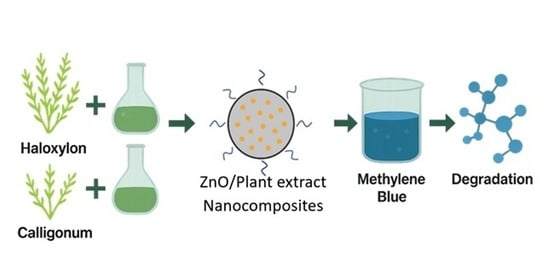
Graphical Abstract

1. Introduction

Nanomaterials and their composites have attracted significant interest due to their size-dependent physicochemical properties, which differ markedly from those of bulk materials. They are widely used in applications such as photocatalysis reactions, environmental remediation, and energy-related processes because of their favorable optical and electronic characteristics [1,2,3]. Many physical and chemical methods, including laser ablation, pyrolysis, chemical or physical vapor deposition, sol–gel, and electroplating by lithography, are typically used to synthesize nanoparticles. The majority of these procedures are costly and involve the use of hazardous solvents [4]. Considerable work has recently been done to synthesize noble metal based nanoparticles using eco-friendly techniques [5]. These environmentally friendly techniques are quick, cheap, and effective, and they often produce crystalline nanoparticles with diameters between 1 and 100 nm and a range of morphologies [6]. Since it doesn’t require harmful reducing and stabilizing chemicals, biologically based production of nanoparticles is a green technique that is frequently used [7]. In order to address the drawbacks of traditional synthetic procedures like physical and chemical processes, biological methods have been developed as promising alternatives. Various biological materials and bioactive compounds have been used to create metal-based nanoparticles, including algae [8], enzymes [9], and plant extracts [10]. These stabilizers are all regarded as potent green nanofactories. Numerous biological applications have taken advantage of metal-microbe or plant extract interactions. As a result, research on biologically based methods for creating nanoparticles, including combinations of nanotechnology and biotechnologies, has become increasingly promising. The most straightforward, dependable, economical, and non-toxic of these biological processes is plant-mediated synthesis. This approach can be readily scaled up for large-scale synthesis and can overcome the drawback of maintaining clean microbial cultures, which is necessary for microbial approaches [11]. Metal nanoparticles have been synthesized from a variety of plant elements, including leaves, roots, callus, stems, seeds, bark, fruits, and peels. Numerous biomolecules found in plant extracts, including phenols, proteins, amino acids, flavonoids, enzymes, and terpenoids, can function as stabilizing for the creation of nanoparticles [12]. Among these metal oxide nanoparticles, zinc oxide (ZnO) has attracted attention because of its properties such as non-toxicity, low cost, availability, and high optical absorption in the visible and ultraviolet range [13]. The electronic properties of zinc oxides offer a vast potential of applications in solar energy conversion [14]. electronic devices [15], magnetic storage devices [16], biosensors [17], photocatalysis [18], and antibacterial activities [19]. Extensive research has focused on the green synthesis of ZnO nanoparticles using plant extracts as eco-friendly capping, stabilizing, and reducing agents. Numerous studies have reported that phytochemicals such as polyphenols, flavonoids, alkaloids, and terpenoids can effectively mediate ZnO nucleation and growth while enhancing surface functionality and stability. Various plant species including Lupinus albus L. [20], Polyalthia longifolia [21], Nyctanthes arbor-tristis [22], Hardwickia binata [23], and Plectranthus amboinicus [24] have been used in the environmentally friendly synthesis of ZnO NPs with improved biocompatibility, reduced toxicity, and tunable optical and catalytic properties. These studies collectively demonstrate the potential of plant-mediated synthesis as a sustainable alternative to conventional chemical routes. However, despite these advances, only limited attention has been given to exploring the influence of less common desert plants such as Haloxylon and Calligonum, whose unique phytochemical compositions may yield distinct physicochemical characteristics and enhanced photocatalytic performance. Combining these plant extracts with ZnO nanoparticles as a novel composite material for water treatment applications forms the main motivation of the present study and contributes to the ongoing efforts aimed at finding solutions to global water security challenges. In this context, developing nations are especially severely affected by a lack of access to clean drinking water because they lack the financial means to adequately address the rising contamination of the water supply. Furthermore, as the population grows, the situation worsens, and rampant industrialization adds to the strain on water supplies. The pursuit of higher agricultural yields, along with advancements in the pharmaceutical, chemical, and textile sectors, has led to the use of several complex molecules with novel functionalities. These compounds are then discovered in industrial effluents and enter watercourses [25]. Some of these chemicals are highly hazardous, posing a threat to human health as well as aquatic flora and animals. These chemicals can also build up in cultivated plants, and consuming them might cause digestive problems and organ abnormalities [26]. Therefore, it is advised to use easy, affordable, and efficient techniques to eliminate these contaminants. Advanced Oxidation Processes (AOPs) have been developed to address this issue [27]. AOPs have demonstrated remarkable efficacy in eliminating hazardous and tenacious pollutants. Their efficacy is primarily based on the in situ production of OH-, which has a higher oxidizing power than other more traditionally used oxidants like H2O2. Organic molecules in suspension can be mineralized in whole or partly by hydroxyl radicals. These radicals can be easily produced by utilizing the heterogeneous ZnO/UV photocatalysis technique, which has drawn a lot of attention lately. The interest in this process is due to its simplicity and its ability to eliminate a wide range of pollutants at ambient temperature [28]. Photocatalysis is a frequently used supplementary treatment technology for liquid effluent, demonstrating efficacy in degrading organic pollutants. Therefore, it represents a very promising substitute for traditional separation/degradation methods. However, implementing a photocatalysis process in a real-world application requires overcoming two challenges: optimizing the technical, energy, and economic costs of the ZnO nanoparticles recovery stage following photocatalysis, which necessitates a treatment station for filtration, and addressing the limit of semiconductor absorbance in the ultraviolet range.
In the present work, we aim to contribute to ongoing research on developing highly efficient catalyst materials for environmental applications through low-cost and green synthesis methods. We report a novel green method for synthesizing ZnO based composites using two different plant extracts, in contrast to the conventional chemical synthesis methods. We also present a comprehensive characterization of the prepared nanocomposites along with an evaluation of their performance in the photodegradation of methylene blue (MB), a cationic thiazine dye, as a model pollutant.

2. Experimental Section

2.1. Materials

Analytical-grade chemicals were procured from Sigma-Aldrich (Sigma-Aldrich, Gillingham, UK) without any further purification, ensuring the purity and reliability needed for accurate experimental results. The main chemicals used include Zinc (II) acetate dihydrate (Zn[CH3COO]2·2H2O, MW = 219.51 g/mol, purity ≥ 98%), which serves as a zinc source for the synthesis of ZnO NPs. L-cysteine (C3H7NO2S, MW = 121.16 g/mol, purity ≥ 98%) was used as capping agent fo the chemically prepared ZnO reference sample. Sodium hydroxide (NaOH, MW = 40.00 g/mol, purity ≥ 98%) was used to adjust the pH during nanoparticle synthesis and to facilitate the precipitation of ZnO NPs. Haloxylon and Calligonum plant extracts were utilized for the nanocomposite synthesis, with methanol (CH3OH, purity ≥ 99.8%) serving as the solvent. Additionally, an ultrapure water (resistivity > 18 MΩ·cm) was employed for the extraction process.

2.2. Plants Extraction

Haloxylon and Calligonum plants were collected from Hail region in Saudi Arabia. The selected leaves were thoroughly washed with deionized water, then air-dried in the shade at room temperature before being ground into a fine powder. A portion of 11.5 g of this powder was mixed with 200 mL of distilled water and boiled for 2 h at 100 °C. After cooling to room temperature, the mixtures were filtered, and the resulting aqueous filtrate was collected. This extract was subsequently employed in the synthesis of ZnO nanoparticles in the present study.

2.3. Preparation of Green ZnO Based Nanocomposites Using Plants Extract/L-Cysteine

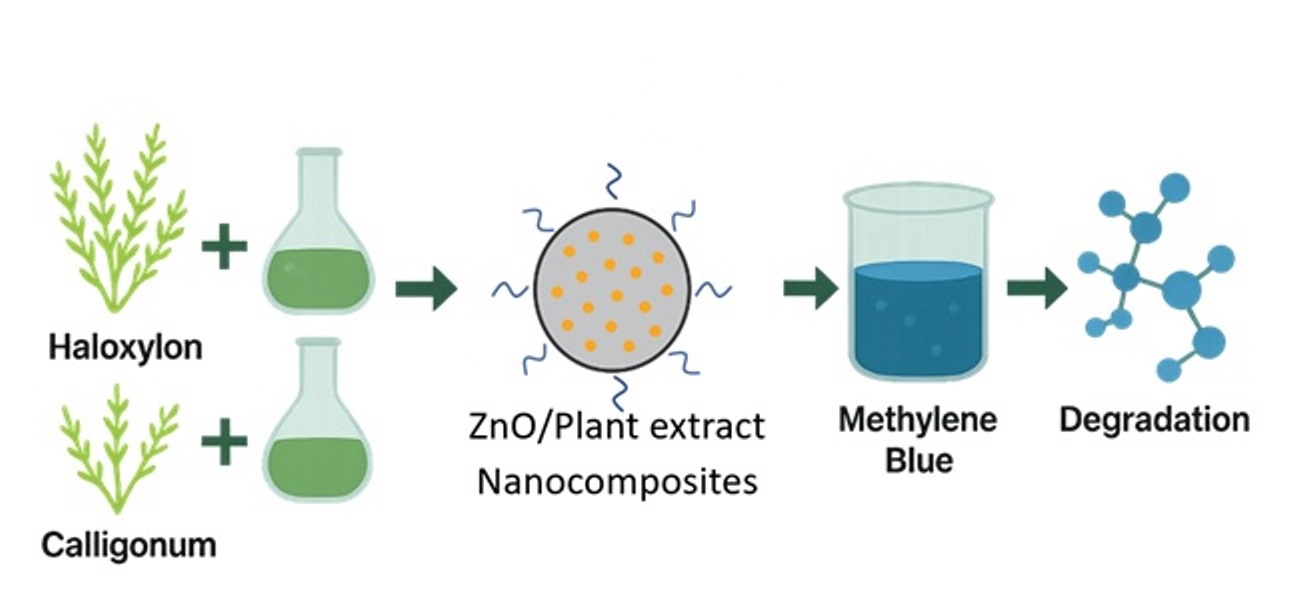
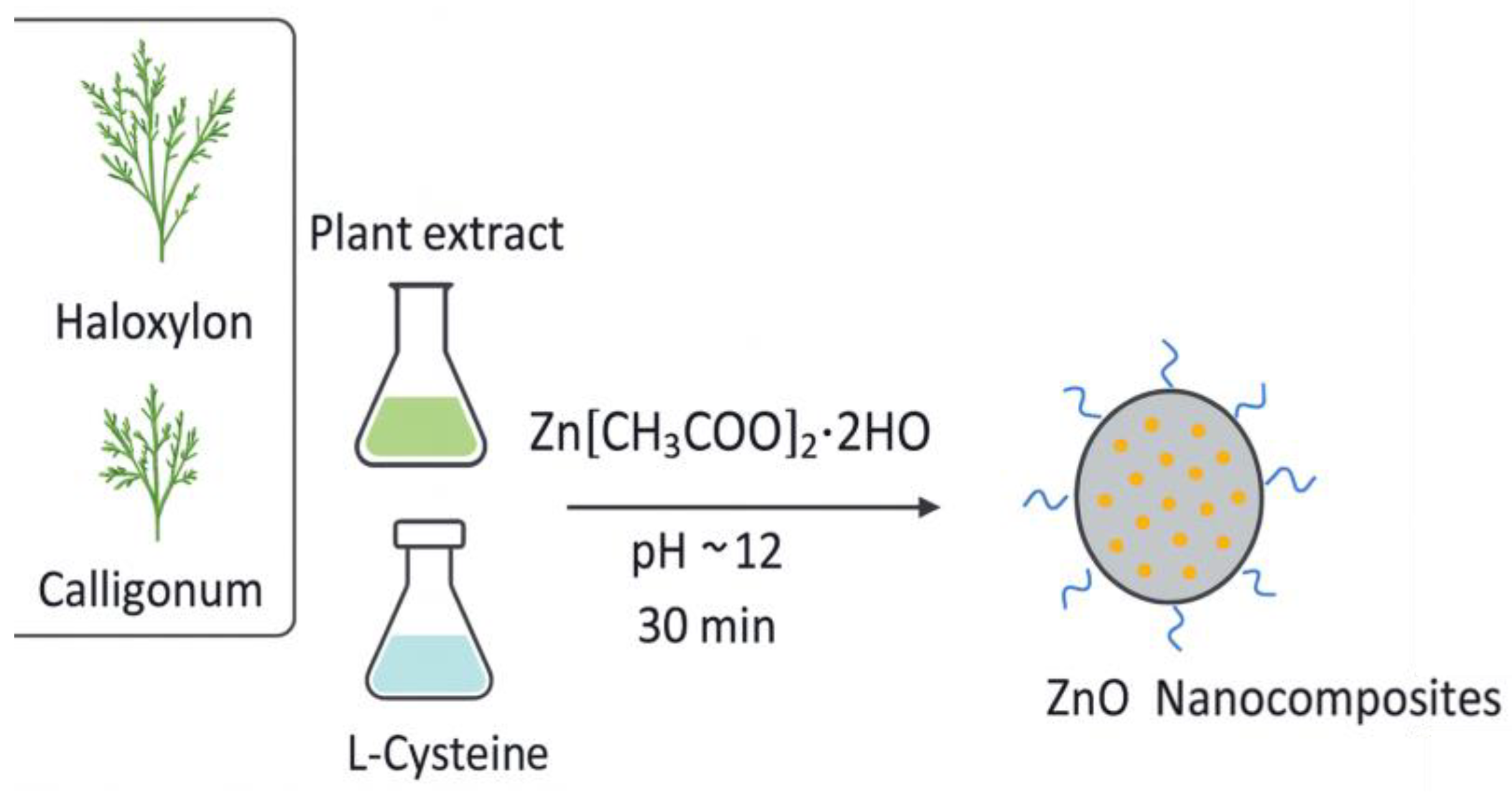
ZnO nanoparticles were synthesized through a green aqueous route using Haloxylon and Calligonum plant extracts (Figure 1) [29]. A reference ZnO sample was also synthesized for comparison purposes using a common chemical method with L-cysteine as a capping agent. A zinc acetate precursor molarity was prepared in methanol, and the amount was added dropwise under constant stirring for 30 min. The pH of the mixture was adjusted to ~12 using sodium hydroxide (2 M) to promote the nucleation of ZnO NPs. The reaction was allowed to continue for 24 h at room temperature to ensure complete interaction between Zn2+ ions and phytochemicals. The precipitated nanoparticles were collected by centrifugation, washed thoroughly with distilled water and ethanol to remove residual organics and were kept in vacuum at room temperature. In this approach, the phytochemicals present in the plant extracts act as surface capping agents, stabilizing the ZnO nanoparticles without requiring thermal calcination [30].

2.4. Nanocomposite Catalysts Characterization

The ZnO-plant extracts nanocomposites and the chemically synthesized ZnO reference sample catalysts were characterized using a combination of analytical techniques. X-ray diffraction (XRD) patterns were recorded on a Panalytical X’Pert Pro diffractometer equipped with a Cu Kα radiation source (λ = 1.542 Å). Fourier transform infrared (FTIR) spectra of the ZnO nanostructures were obtained at room temperature in the 400–4000 cm−1 range using a Perkin Elmer spectrophotometer (version 5.3) in transmission mode with KBr pellet disks. A double aberration-corrected transmission electron microscope (TEM) of the model Titan Themis Z from Thermo Fisher Scientific (TFS), with an accelerating voltage of 300 kV, was used to obtain the morphological images of the samples. Bright-field TEM (BF-TEM) mode was utilized to acquire images at different magnifications for investigating the morphology of the samples. The images were recorded using a scintillator-based complementary metal-oxide-semiconductor (CMOS) detector, model Ceta, from TFS. The samples for TEM investigation were obtained by pouring a drop of nanocrystal solution over carbon-coated copper grids, allowing the excess solvent to drain. At least 100 randomly chosen nanocrystals were measured using an image processing application (ImageJ, version 1.50) to determine their size and size-distribution data according to the TEM images. UV–Vis absorption spectra were recorded at room temperature in the 200–700 nm range using a SPECORD 210 Plus spectrophotometer with a quartz cuvette. Photoluminescence (PL) spectroscopy was carried out using a helium–cadmium laser source (λ = 325 nm) as the excitation source to investigate the emission properties and defect states of the ZnO samples.

2.5. Photocatalytic Degradation Experiments

The photocatalytic performance of the synthesized ZnO nanoparticles based nanocomposite catalysts were evaluated through the degradation of methylene blue (MB) dye, following a procedure previously reported in the literature [31]. Methylene blue was selected in this study due to its high molar extinction coefficient and well-defined optical properties, which make it a standard model pollutant for benchmarking photocatalytic activity. In the current study, water treatment experiments were conducted using MB-contaminated solutions with an initial concentration of ~2 × 10⁻⁵ M and a pH of approximately 7. For each test, 10 mg of ZnO nanoparticles composite were dispersed in 10 mL of MB aqueous solution. The absorption spectra of the samples were first recorded after 30 min of equilibration in the dark, followed by measurements at 30, 90, and 180 min under UV irradiation. The degradation efficiency and reaction rate were calculated using the following equations [32]:
η =   C 0 C t C 0 × 100
L n   C 0 C t = k t
where k (min−1) represents the apparent reaction rate constant, and Ct denotes the dye concentration (mg/L) at irradiation time t (min). The value of k was obtained by calculating the slope of the linear fitting of the experimental data using the plot of ln (Ct/C0) versus t.

3. Results and Discussion

3.1. Nanoparticles Characterization

3.1.1. Morphological Study

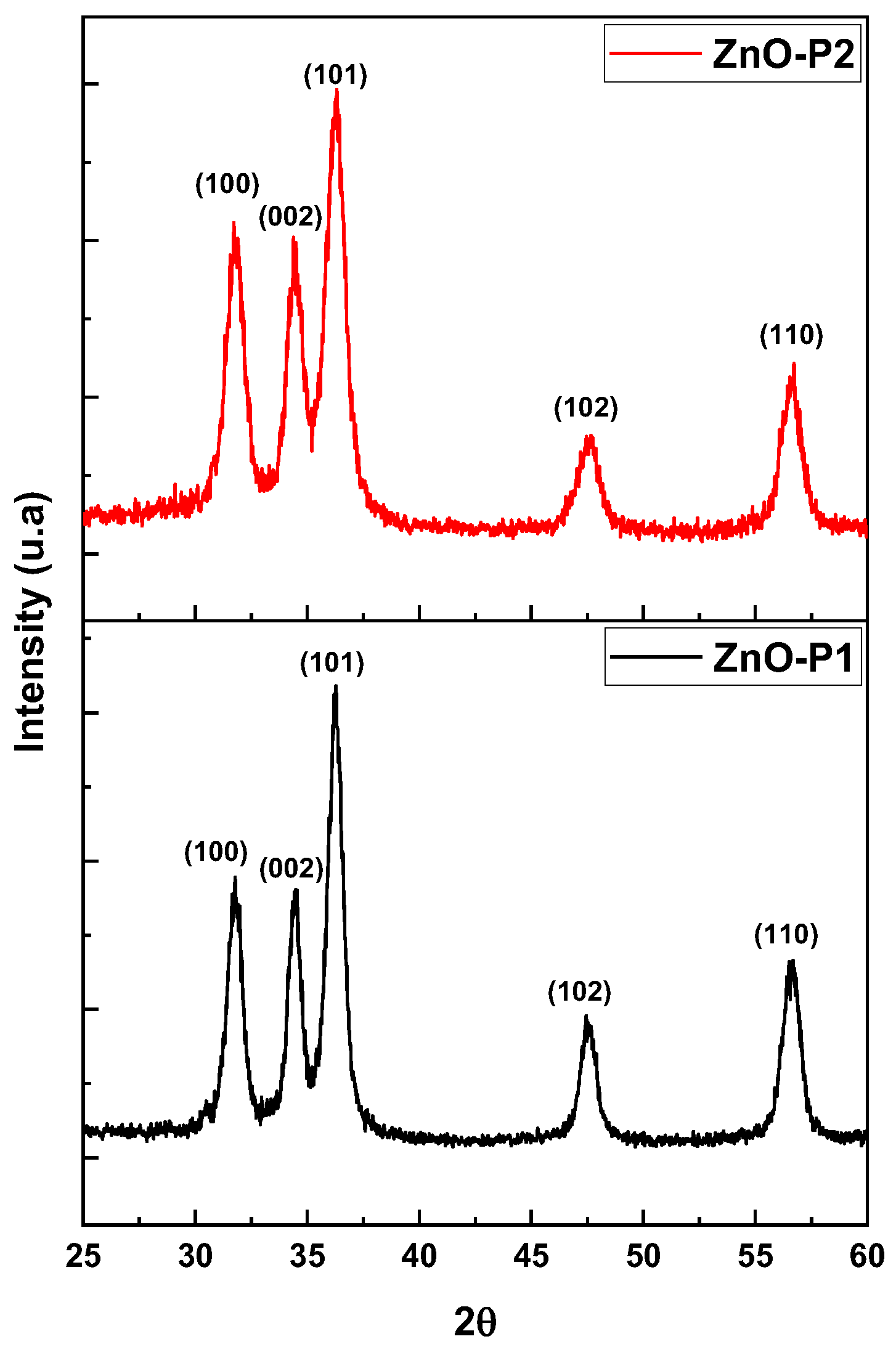
Figure 2 shows the XRD patterns of the ZnO-P1 and ZnO-P2 nanocomposites. According to standard ZnO XRD patterns, the obtained hexagonal structure successfully matched the peaks in the reference card of hexagonal structure (JCPDS No79-2205) [33]. Additionally, the broad XRD diffraction bands in Figure 2 demonstrate the nanoscale nature of the synthesized materials. XRD diffraction patterns for ZnO-P1 NPs exhibit peaks at 2θ = 31.80°, 34.47°, 36.27°, 47.46° and 56.55°. These peaks correspond to the hexagonal diffraction planes (100), (002), (101), (102), and (110) of ZnO. Similarly, the XRD pattern of ZnO-P2 nanoparticles displays nearly identical diffraction peaks to those of ZnO-P1, confirming that the nanoparticles synthesized with the P2 plant extract also crystallize in the hexagonal phase. The diffraction peaks observed at 2θ values of 31.73°, 34.43°, 36.51°, 47.58°, and 56.58° are indexed to the (100), (002), (101), (102), and (110) planes of hexagonal ZnO, respectively. The pronounced intensity of these peaks confirms the high crystallinity of the synthesized ZnO nanoparticles. The average crystallite size was further estimated using the Debye–Scherrer equation [34]:
D = K λ β cos θ
where D is the crystallite size of ZnO in nm, K is the Scherrer shape factor (0.90), λ is the X-ray wavelength used (1.5406 Å), β is the full width at half maximum (FWHM) in radians and θ is the Bragg diffraction angle in degrees. The average particle sizes of ZnO-P1 and ZnO-P2 were estimated as 10.93 and 8.95 nm, respectively. Different plant extracts contain varying concentrations of phytochemicals, which can influence the nucleation and the growth of the nanoparticles. The difference in the crystallite size of the grown samples is most likely explained by the fact that the P1-Zn interaction is much weaker than that of P2-Zn [35]. In the case of P1, the relatively weak interaction with Zn results in a weaker binding affinity to the ZnO quantum dot surface, thereby promoting a faster crystal growth rate. Conversely, the stronger interaction between P2 and Zn enhances the binding force at the ZnO surface, which slows down the crystal growth and limits the formation of larger particles [35]. Furthermore, the lattice constant of the hexagonal ZnO nanocrystals can be determined using the following expression [34]:
d h k l 2 =   1 4   h 2 + h K + K 2 3 a 2   + l c 2
where dhkl is the inter-reticular distance that is given for the hexagonal cubic structure; h, k, and l are Miller’s indices of; a and c are the lattice constants of the hexagonal phase of nanocrystals. The average calculated values of lattice parameters are presented in Table 1. The Scherrer formula provides a lower limit for the size of the nanocrystals as it ignores the micro-strain and only considers the size effects resulting from the diffraction data. Consequently, the grown NCs may be further investigated by a few structural factors, such as the stacking fault (SF), dislocation density (δ), and lattice strain (ε). The following formulas are used to evaluate these parameters, and Table 1 shows their calculated values [36]:
ε = β c o s θ 4 ;   δ = 1 D 2 ;   S F = 2 π 2 45 3 t a n θ 1 2 β h k l
The disruption of lattice constants resulting from crystal defects such lattice dislocation is measured by the lattice strain (ε) [37]. Due to size restriction, the lattice expansion or contraction in the nanocrystals is the primary cause of the lattice strain. Accordingly, the number of defects in the nanocrystal size is described by the stacking fault (SF) and dislocation density (δ) [38]. Because of their tiny dimensions, the semiconductor nanocrystals are less organized, as indicated by the dislocation density value. ZnO-P2 has the highest possibility of dislocations compared to ZnO-P1, as seen from the table, which increases from 8.37 × 10¹⁵ to 12.48 × 10¹⁵ m−2 when the crystallite size (D), decreases from 10.93 to 8.95 nm. This is may be due to the small dimensionality of ZnO-P2 NCs which are the lesser ordered as well as the nature of P2-Zn interaction [39]. Micro-strain and stacking fault both exhibited similar patterns, rising as the P1 to P2 ligand crossed. ZnO-P2 sample has more lattice defects and vacancies than ZnO-P1 samples, according to the increasing drift of micro-strain. The distortion of crystallographic planes is likewise reflected in the stacking fault (SF). The observed increase in SF from the P1 to the P2 samples suggests that ligand exchange intensified the structural imperfections. Therefore, it can be concluded that the proposed crystalline arrangements of the Haloxylon and Calligonum-capped ZnO quantum dots remain inconclusive. Compared with previously reported plant-mediated ZnO nanoparticles, which often exhibit sizes above 20 nm such as ~24.5 nm with Polyalthia longifolia, ~23.8 nm with Passiflora foetida, and ~24.6 nm with Vachellia erioloba extracts [21,40,41]. ZnO nanoparticles synthesized in this study using Haloxylon and Calligonum extracts are significantly smaller, with average crystallite sizes around 10 nm. This indicates that the choice of plant extract and specific synthesis conditions can strongly influence nucleation and growth, allowing the production of finer nanostructures. Despite the smaller size, the structural integrity and crystallinity of the prepared ZnO based samples in the current study are maintained, demonstrating that these plant-derived capping agents provide an effective and tunable green approach to controlling nanoparticle dimensions compared with previously reported systems. To further investigate the plant-extract-capped nanoparticles, we utilized high-resolution TEM (HRTEM).
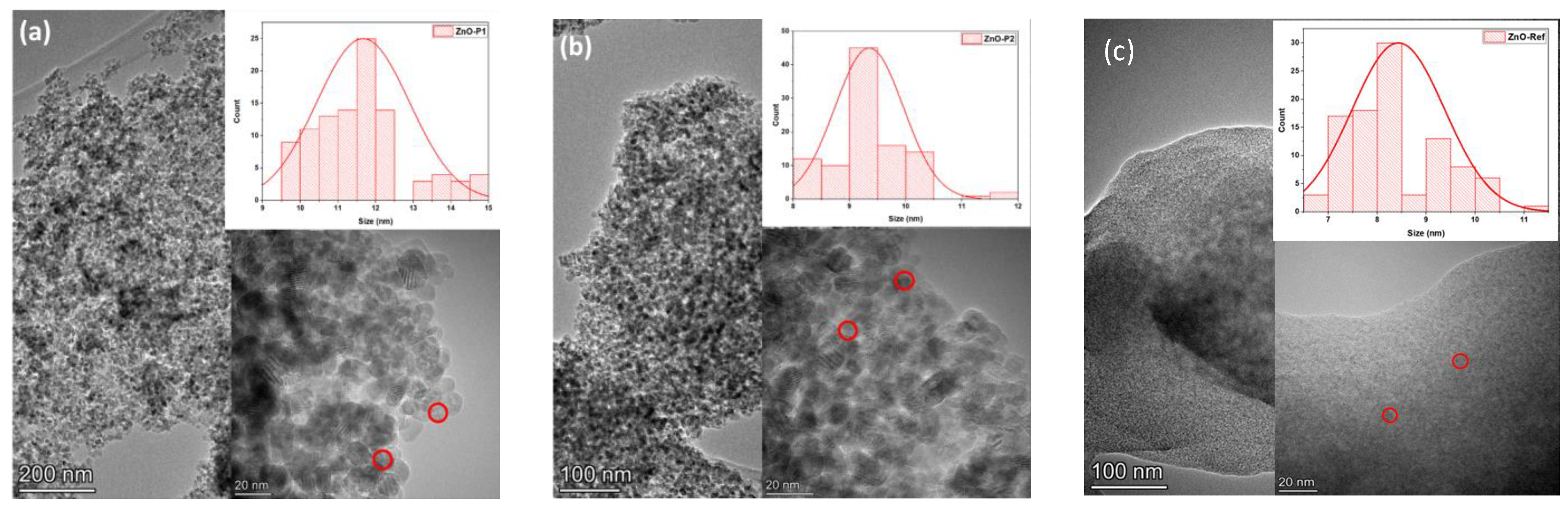
Furthermore, TEM was employed to investigate the size distribution and morphology of ZnO nanoparticles synthesized using plant extracts and L-cysteine as capping agents. TEM images revealed that ZnO nanoparticles capped with Haloxylon extract (Figure 3a) are predominantly spherical with slight asymmetry and with an average particle size of 11.7 ± 0.5 nm. The presence of phytochemicals such as flavonoids and phenolic compounds likely contributed to the complexation and stabilization of Zn2+ species during nucleation, as well as to the capping of the resulting ZnO nanocrystals, thereby controlling their growth and preventing agglomeration [42]. Mild aggregation observed in the images can be attributed to the complex organic matrix surrounding the nanoparticles and the uneven surface coverage provided by the extract components. In comparison, ZnO nanoparticles synthesized with Calligonum extract (Figure 3b) displayed a slightly smaller mean size of 9.4 ± 0.5 nm, with shapes ranging from nearly spherical to oval. Biomolecules, including tannins and polysaccharides in the Calligonum extract, appeared to influence nucleation and growth kinetics, resulting in a narrower size and shape distribution of the particles in this sample [43]. TEM analysis also showed moderate clustering, suggesting that while plant-derived capping agents provide a degree of stability, some interparticle contact remains. Overall, TEM observations are consistent with XRD data, confirming the successful synthesis of nanosized ZnO particles using both plant extracts. The average crystallite sizes obtained from XRD (8.95–10.93 nm, Table 1) were slightly smaller than the particle sizes measured by TEM (9.4–11.7 nm). This discrepancy arises because XRD estimates the crystalline core size, whereas TEM measures the entire particle, including amorphous or polycrystalline surface layers. Despite the difference, both techniques consistently confirm the nanoscale regime and the same size trend (P2 < P1) [44]. These results highlight the crucial role of phytochemicals in tailoring nanoparticle size and morphology, while also demonstrating that Haloxylon and Calligonum extracts represent sustainable and eco-friendly alternatives for ZnO nanoparticle production. The reference ZnO particles synthesized using the non-green chemical method exhibited a particle size slightly smaller than those synthesized using plant extracts with an average size of about 8.44 ± 0.5 nm as seen from Figure 3c. The TEM characterization of ZnO nanoparticles synthesized in this study using Haloxylon and Calligonum extracts reveals nearly spherical particles with average sizes around 10 nm, which are significantly smaller than many previously reported plant-mediated ZnO nanoparticles. For instance, ZnO synthesized with Polyalthia longifolia extract exhibited particles in the range of 27.5 nm, while Punica granatum extract produced ZnO nanoparticles of ~25 nm, and Evolvulus alsinoides extracts typically yielded sizes around 100 nm [21,45,46]. These comparisons indicate that the proposed synthesis route using Haloxylon and Calligonum extracts effectively limit particle growth during synthesis, producing finer nanostructures.
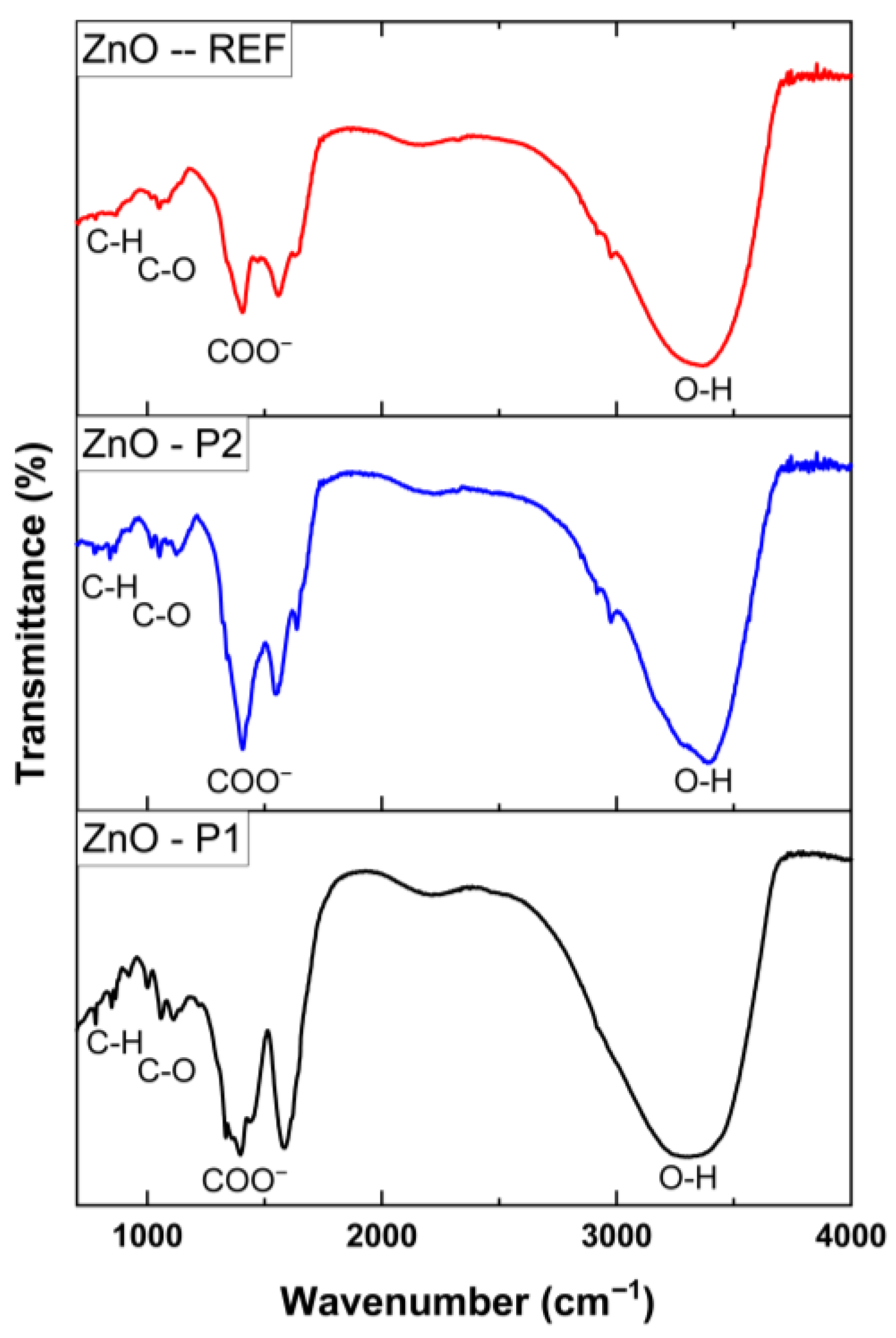
The functional groups involved in the synthesis of ZnO nanoparticles composites were identified using FTIR spectroscopy, as shown in Figure 4. For P1-capped ZnO NPs, a broad absorption band at 3302 cm−1 is observed, corresponding to hydrogen-bonded O–H stretching vibrations of phenolic compounds and flavonoids present in the plant extract. Additional characteristic bands appeared at ~722 cm−1 and 1107 cm−1, which can be attributed to C–H and C–O stretching modes, respectively [47]. Moreover, distinct peaks at 1400 and 1601 cm−1 are assigned to carboxylate groups, with the signal near 1595 cm−1 corresponding to the asymmetric COO stretch and that at 1400 cm−1 to the symmetric COO stretch, confirming the interaction of phytochemicals with Zn ions [48]. In the case of P2-capped ZnO NPs, a broad absorption band at 3390 cm−1 indicates O–H stretching of phenolic compounds and flavonoids, while weak absorptions at ~780 and 1054 cm−1 are assigned to C–H and C–O vibrations, respectively [49]. Overall, FTIR analysis confirms that the greenly synthesized ZnO nanoparticles are stabilized by the major phytoconstituents present in both P1 and P2 extracts. Similar vibrational bands can also be seen in the case of the reference sample including C–H, C–O, COO and O–H stretching modes. Earlier studies on plant-extract–synthesized ZnO have reported FTIR spectra with bands from organic functional groups (e.g., –OH, –C=O, –C–O) attributed to phytochemicals acting as reducing and stabilizing agents on the ZnO surface, in contrast to uncapped ZnO which lacks these features [50,51]. In particular, as-synthesized ZnO prepared with plant extracts shows clear FTIR evidence of surface organic species compared with commercial or uncapped ZnO, indicating the presence of the capping agents that modify the surface chemistry [52]. Integrated with the obtained data, the presence of strong and shifted carboxylate and carbonyl bands in Haloxylon- and Calligonum-derived ZnO samples confirms stronger coordination and distinct photophysical modifications compared to other green ZnO reports.

3.1.2. Optical Study

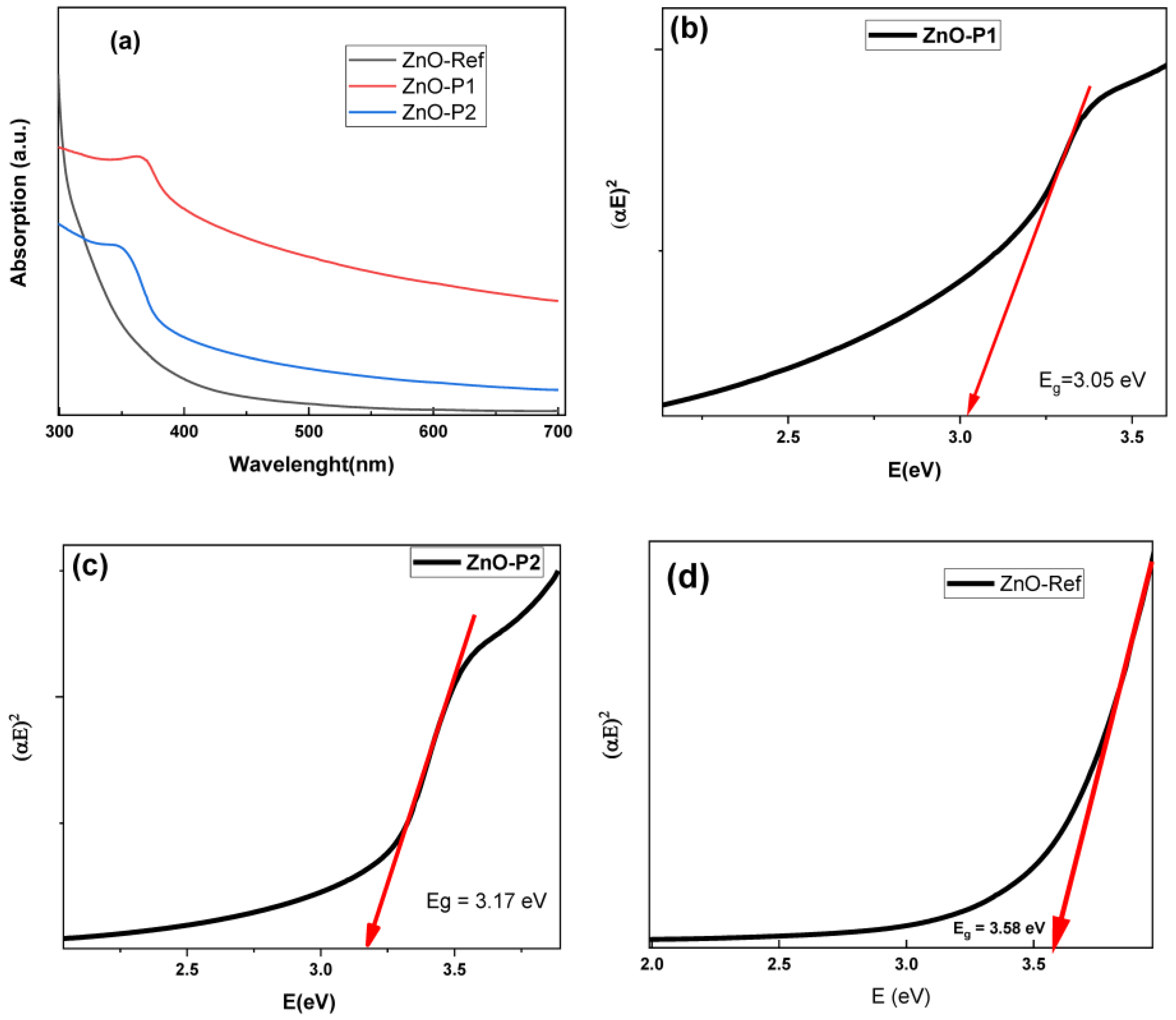
The optical properties of the ZnO nanoparticles were investigated by UV–Vis absorption spectroscopy in the 300–700 nm range (Figure 5) to examine their optical characteristics as well as the influence of the possible quantum confinement effects. All composite samples exhibited a noticeable blue shift in their absorption edges compared to the bulk ZnO band gap (~375 nm), confirming the formation of nanocrystalline structures [53]. Specifically, the absorption edge was observed at 364 nm for ZnO-P1 and at 347 nm for ZnO-P2, which can be attributed to quantum confinement effects relative to bulk ZnO (Eg ≈ 3.3 eV) [54]. These results are in good agreement with the TEM and XRD analyses, as the pronounced blue shift further substantiates the nanoscale dimensions of the synthesized particles. The pronounced blue shift observed in Calligonum-capped ZnO nanoparticles can be attributed to the combined effects of reduced particle size and strong surface coordination [53]. The functional groups present in Calligonum extract, such as hydroxyl and carboxyl groups, effectively bind to the nanoparticle surface, limiting growth and preventing aggregation [55]. This results in smaller crystallite sizes, enhancing the quantum confinement effect and leading to an increase in the bandgap energy, manifested as a blue shift in the absorption spectrum. In contrast, ZnO nanoparticles capped with Haloxylon extract exhibited a less pronounced spectral shift, which can be attributed to weaker surface coordination and slightly larger particle sizes. By comparison, the stronger surface passivation imparted by Calligonum extract enhances nanoparticle stability and minimizes defect states, thereby contributing to the more significant blue shift observed [56].The optical band gap energy (Eg) was then estimated graphically using the Tauc relation [57]:
α h ν =   A   h ν E g 1 / 2
In this relation, α represents the absorption coefficient, A is a proportionality constant, h is Planck’s constant, and ν denotes the photon frequency.
The optical band gap (Eg) of the capped ZnO nanoparticles was determined from a Tauc plot by extrapolating the linear portion of the curve of (αhν)2 versus to the energy axis at α = 0. The intercept of this extrapolation with the axis corresponds to the estimated band gap value. The calculated band gap energies of the capped ZnO nanoparticles were found to be 3.05 and 3.17 eV for Haloxylon and Calligonum-capped ZnO NPs, respectively. Although these values are lower than the typical band gap of bulk ZnO 3.3 eV), they are consistent with the behavior of ZnO nanostructures, which can exhibit band gap narrowing due to quantum confinement effects or the presence of surface defects [30]. The variation in band gap between the two samples reflects the influence of particle size, morphology, surface capping, and synthesis conditions on the electronic structure of ZnO nanoparticles. In addition, a direct comparison with the chemically synthesized ZnO (L-cysteine–assisted) has been incorporated to strengthen the assessment of the green-synthesized materials. The calculated band-gap energy of the chemical ZnO (3.58 eV) is noticeably higher than those of the plant-extract–capped ZnO nanoparticles. This band-gap narrowing in the green-synthesized samples is attributed to the presence of phytochemical species acting as surface modifiers, which enhance light absorption in the near-UV region. Despite its higher band gap, the chemically synthesized ZnO possesses significantly smaller particle size, which increases its specific surface area and the number of accessible active sites. This enhanced surface-to-volume ratio facilitates faster adsorptive interactions and more efficient charge-transfer processes at the interface.
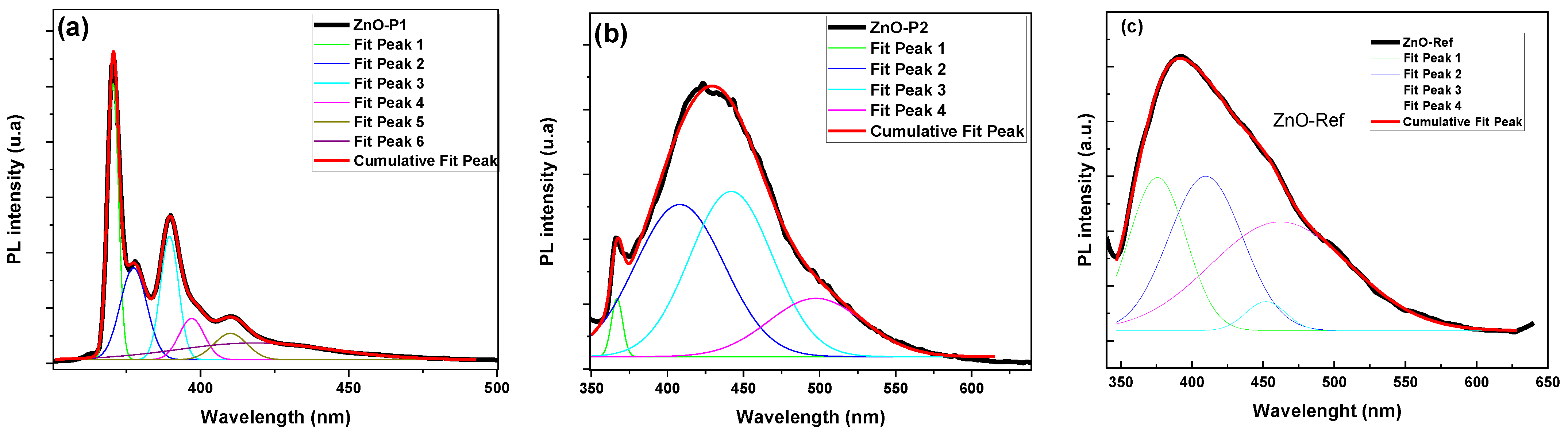
The photoluminescence (PL) spectra of ZnO nanoparticles synthesized with different capping agents were recorded to investigate how variations in surface chemistry and quantum confinement influence their optical properties. Significant differences were observed between Haloxylon and Calligonum-capped ZnO nanoparticles, reflecting variations in particle size, degree of crystallinity, and the extent of surface passivation.
The photoluminescence (PL) spectra were recorded in the wavelength range of 350–640 nm, and the results are presented in Figure 6. Multiple emission peaks are visible in the photoluminescence (PL) spectrum of ZnO nanoparticles capped with Haloxylon plant extract. These peaks may be deconvoluted into discrete transitions associated with both intrinsic and surface-related defects. The crystalline structure of the nanoparticles is reflected in the strong emission peak centered about 370 nm (~3.35 eV), which is attributed to the direct band-to-band recombination of excitons of ZnO [53]. However, the second emission peak centered around 377 nm (~3.29 eV) could be assigned to the nanocrystals’ size distribution, which causes another emission peak related to the direct band-to-band recombination of excitons [58]. The presence of such a sharp UV emission indicates that the ZnO nanoparticles have good crystallinity and relatively low defect density, since radiative recombination dominates over defect-mediated recombination. The Haloxylon phytochemicals acting as capping agents likely stabilized the nanoparticle surface, reducing non-radiative centers. Small changes in crystal size allow quantum confinement to slightly shift the bandgap, which results in an extra near-band-edge emission attributed to direct band-to-band excitonic recombination [59]. In addition, the subsequent emissions at 389 nm (~3.19 eV) and 396 nm (~3.13 eV) arise from shallow-level processes, including donor–acceptor pair (DAP) recombination and longitudinal optical (LO) phonon replicas of the near-band-edge emission, as well as possible free-to-acceptor transitions [60]. The band appearing at 410 nm (~3.02 eV) is attributed to band-edge emission, confirming the band gap value obtained from the absorption studies. In contrast, the band at 430 nm (~2.88 eV) is associated with intrinsic defect states, specifically the extended state of zinc interstitials (ex-IZn)—VB transition and/or zinc interstitials (IZn)—zinc vacancies (VZn) transition [61,62]. These defect-related emissions are strongly influenced by the phytochemical capping layer, which modifies surface states and introduces additional carrier traps, thereby shaping the optical properties of the ZnO-P1 nanoparticles [63]. Both intrinsic excitonic recombination and defect-mediated transitions contribute to the deconvoluted photoluminescence spectrum of the Calligonum plant extract-capped ZnO nanoparticles, exhibiting several emission bands ranging from the near-UV to the visible range (350–600 nm) [64]. The crystalline structure of the nanostructures is confirmed by the strong emission narrowed at 366 nm (~3.39 eV), which is consistent with the near-band-edge (NBE) excitonic process [65]. The subsequent emissions observed at 408 nm (~3.04 eV) can be ascribed to shallow defect levels, primarily involving zinc interstitials and singly ionized oxygen vacancies [62]. A broader emission band at 441 nm (~2.81 eV) is associated with zinc vacancies or oxygen interstitials [66]. The green emission band centered at ~497 nm, commonly referred to as the “green luminescence band” of ZnO-P2, is where the strongest contribution is seen. It is caused by deep-level states of oxygen vacancies (VO••) and unsaturated surface states that are maintained by the phytochemical capping layer [67,68]. In addition to introducing new trap sites, the plant-derived ligands are more likely to promote surface passivation, altering the defect density and stabilizing radiative recombination pathways. Collectively, the presence and relative intensities of these emission features indicate that the plant extracts play a pivotal role in regulating the balance between shallow and deep defect states. This control is crucial not only for the optical and photocatalytic properties of the nanoparticles but also for tuning their growth dynamics and crystallinity [69]. The positions and Full width at half maximum (FWHM) of PL peaks in each sample are compiled in Table 2.
The reference ZnO sample also exhibits emission features corresponding to near-band-edge band-to-band transitions along with defect-related emissions arising from zinc vacancies, oxygen vacancies, and zinc interstitials. However, compared with ZnO-P1 and ZnO-P2, the reference ZnO shows fewer defect-related peaks, indicating a lower density of intrinsic defects and a more controlled surface passivation. These findings demonstrate that the optical properties of ZnO nanoparticles are significantly influenced by the capping agent utilized. Photoluminescence analysis clearly shows that the ZnO-P1 sample (Haloxylon extract) exhibits a higher number of defect-related emission peaks compared to ZnO-P2, indicating that its surface is less passivated. In contrast, the Calligonum-capped ZnO (ZnO-P2) displays fewer PL peaks, suggesting a relatively more passivated surface with a lower density of radiative defect states. A similar trend is observed for the L-cysteine–capped ZnO, which likewise shows reduced defect-related emissions, indicating effective surface passivation comparable to that of the Calligonum-capped nanoparticles. Although high defect density in ZnO can increase non-radiative recombination, in photocatalytic systems these surface and bulk defects are often beneficial because they act as adsorption sites and promote the formation of reactive oxygen species (ROS) under UV illumination [68]. Haloxylon capping leads to a richer defect profile that enhances charge carrier lifetime, interfacial redox activity and interaction with pollutant molecules, thereby improving photocatalytic performance despite less complete surface passivation. Therefore, the stronger defect-related emissions observed in ZnO-P1 imply a higher density of active sites, which can enhance dye adsorption through efficient interaction with pollutant molecules and facilitate photocatalytic reactions. Nonetheless, the nature and distribution of these defects rather than their number alone play a decisive role in determining the overall pollutant removal performance of the prepared ZnO nanoparticles.

3.2. Photocatalytic Activity of MB Using ZnO Based Nanocomposite Catalysts

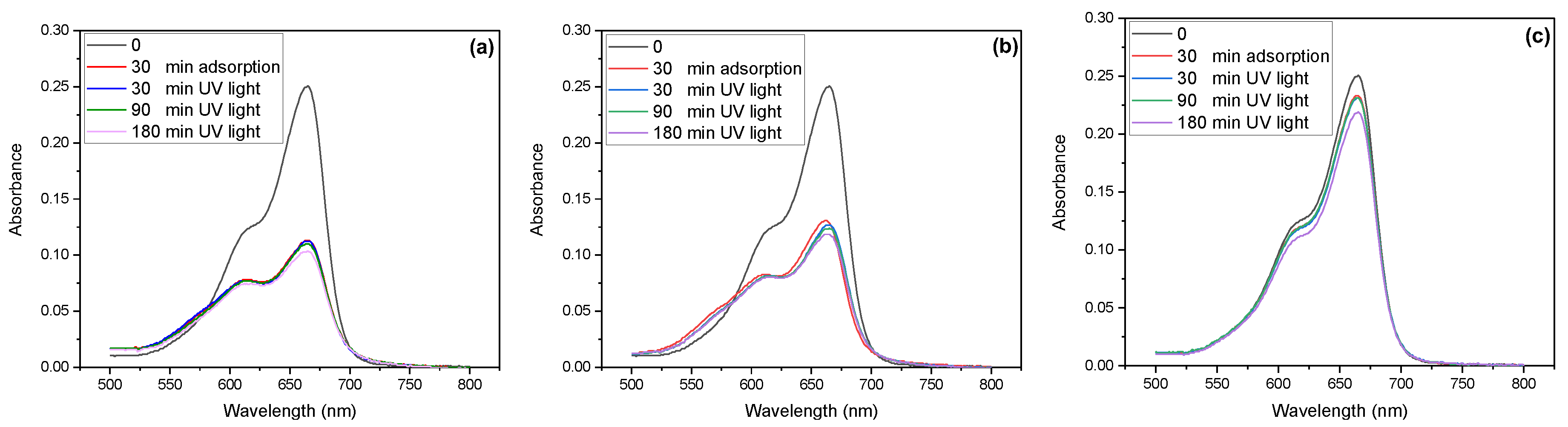
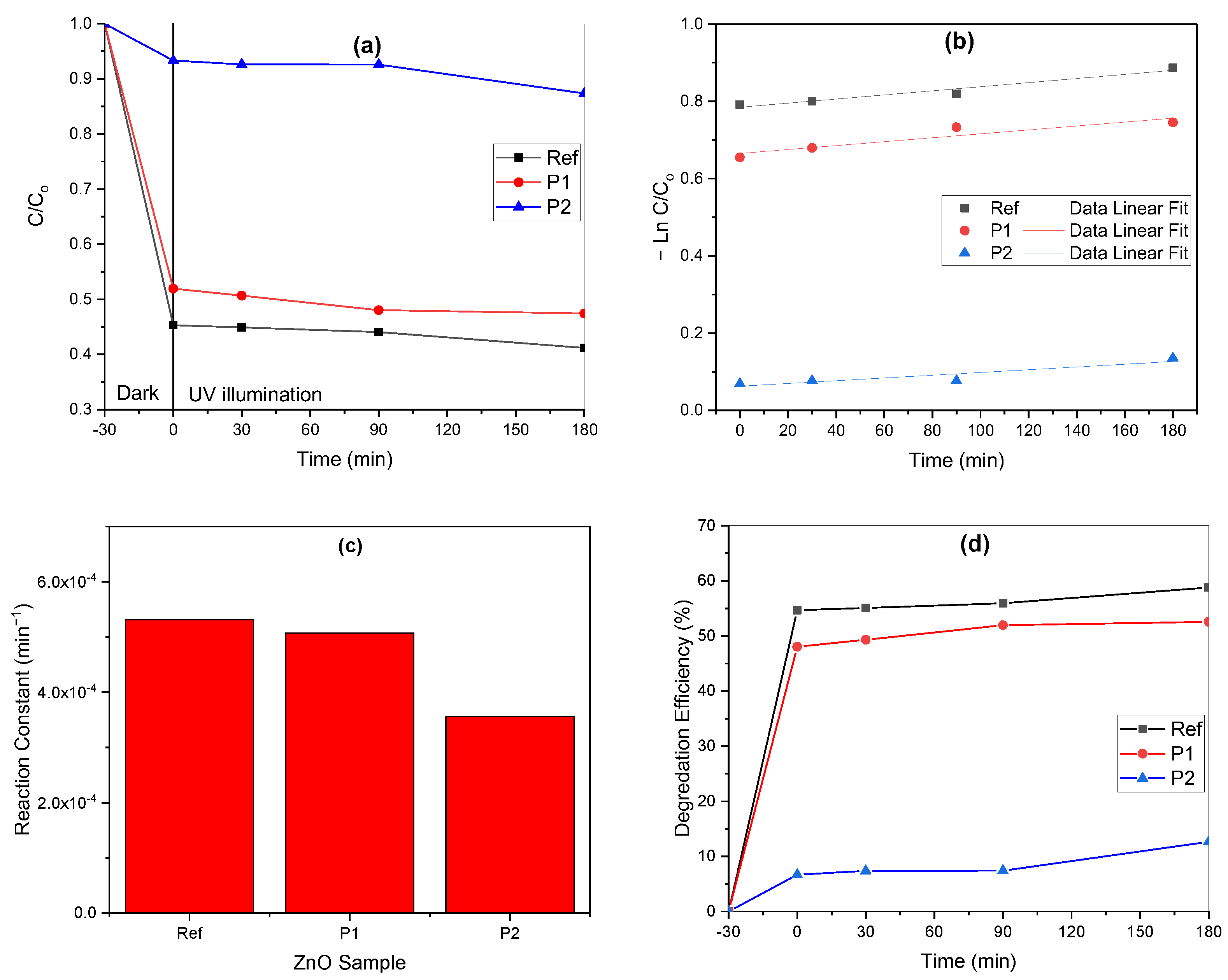
The photocatalytic performance of the synthesized ZnO nanoparticles composites was evaluated through the degradation of methylene blue (MB) under UV irradiation. Prior to illumination, all samples—including the reference chemically synthesized ZnO—were subjected to a 30-min dark adsorption step to establish adsorption–desorption equilibrium. In all catalysts, the MB absorption peak at ~664 nm showed a gradual decrease with longer irradiation time, indicating effective photodegradation [70]. As shown in Figure 7, the extent of MB removal during this stage strongly depends on the capping agent used during synthesis. After 30 min of adsorption, the MB concentration decreased by approximately 48% for ZnO-P1, 7% for ZnO-P2, and around 54% for the reference ZnO, confirming that the chemically-capped nanoparticles possess the highest adsorption capacity, followed by the Haloxylon synthesized ZnO, while the Calligonum-capped sample exhibits minimal adsorption. This figure also demonstrates that the extent of MB degradation depends on the capping agent used in nanoparticles synthesis. Upon UV exposure, all samples demonstrated additional MB removal due to photocatalytic degradation. After 180 min of irradiation, ZnO-P1 and ZnO-P2 reduced the dye concentration to approximately 53% and 13% of the initial value, respectively. In contrast, the reference chemically synthesized ZnO achieved a total removal of nearly 59. Both ZnO-Ref and ZnO-P1 samples show a comparable photocatalytic activity, although ZnO-P1 exhibits a higher defect density and a wider defect range. However, the slightly higher MB photocatalytic activity of ZnO-P1 in comparison to ZnO-P2 may arise from its defect-rich PL signatures, i.e., multiple shallow and deep emission bands that prolong carrier lifetimes, enhance dye adsorption at defect/surface sites, and promote ROS generation [71]. The presence of these multiple defect states is highly beneficial for photocatalysis, since shallow traps can temporarily capture photogenerated electrons or holes, delaying their direct recombination and thereby prolonging carrier lifetimes.
In parallel, deeper and surface-associated states act as active adsorption and reaction sites, facilitating the transfer of charge carriers to dissolved oxygen or surface-bound dye molecules, which accelerates the production of reactive oxygen species (OH*, O2*) [72]. Compared to ZnO-P2, whose PL profile is dominated by a broad visible emission with fewer resolved components, ZnO-P1 presents a more favorable balance between carrier trapping and recombination suppression. This synergy between efficient carrier separation and surface-mediated redox reactions explains why ZnO-P1 achieves enhanced photocatalytic activity despite similar band-gap characteristics [73]. Additionally, the reduced MB adsorption ability of the sample ZnO-P2 in comparison to the superior adsorption performance demonstrated by the sample ZnO-P1 can be attributed to the large contribution of defects, especially IZn to the PL spectrum of the ZnO-P2 sample. The presence of IZn defects introduces positive charges to the nanoparticle surface and reduces its ability to adsorb the cationic dye due to repulsion interactions [74,75]. Figure 8 presents the relation between Ln C/Co and irradiation time for the prepared samples. The observed linearity of the fitted experimental data confirms that the MB photodegradation by the prepared samples follows pseudo-first-order kinetics [76]. The obtained reaction constant values from the slopes of these curves show that the sample P1 exhibits a better K-value compared to the sample P2 that has a slightly lower reaction value indicating its less ability to photocatalytically degrade MB dye. This can also be seen from Figure 8d, which illustrates the MB degradation efficiency of the prepared samples. The P2 sample shows the lowest overall removal, with only about 13% total degradation after 180 min of UV irradiation. In contrast, the P1 sample synthesized using Haloxylon extract achieves a significantly higher degradation efficiency of approximately 53%. For comparison, the chemically synthesized ZnO sample exhibits a total MB removal of around 59% under the same conditions. This comparison clearly shows that the green-synthesized Haloxylon-capped ZnO not only outperforms the Calligonum-capped sample but also provides photocatalytic activity comparable to the chemically produced ZnO reference. Investigations of MB removal showed that both adsorption and photocatalysis contributed to the overall performance of the materials. Dark adsorption tests revealed a pronounced difference between the two nanocomposites where Haloxylon-capped ZnO exhibited a much higher adsorption capacity than Calligonum-capped ZnO. During subsequent UV irradiation, all samples displayed photocatalytic activity, and kinetic analysis confirmed that Haloxylon-capped ZnO also possessed enhanced intrinsic photocatalytic degradation efficiency. Therefore, the superior total MB removal observed for ZnO-P1 arises from a synergistic combination of strong adsorption and improved photocatalytic charge separation, rather than from photocatalysis alone. These results demonstrate the effectiveness of the used green route synthesis in preparing ZnO nanoparticles with improved MB degradation performance. The enhanced photocatalytic activity of Haloxylon-capped ZnO nanoparticles compared to their Calligonum-capped nanocatalysts can be attributed to a more favorable interplay between surface chemistry and dye–nanoparticle interactions. Phytochemical analyses show that Haloxylon extracts are rich in phenolic acids, flavonoids, tannins, and other bioactive molecules bearing hydroxyl and carbonyl groups [77]. These functional moieties strongly bind to the ZnO surface, creating abundant active sites for methylene blue adsorption and facilitating intimate dye–catalyst contact.
To better understand the photocatalytic process, the degradation mechanism of methylene blue in the presence of capped ZnO nanoparticles can be described in two main stages: adsorption and photocatalysis. In the initial stage, MB molecules adsorb onto the nanoparticle surface, ensuring close dye–catalyst interaction. Upon UV irradiation, ZnO absorbs photons with sufficient energy, promoting electrons from the valence band to the conduction band, leaving behind positively charged holes. This excitation generates electron–hole pairs, which are the key drivers of the photocatalytic reaction. The capping agents not only enhance the colloidal stability of ZnO nanoparticles but also play a crucial role in suppressing charge carrier recombination, thereby improving photocatalytic efficiency. The photogenerated holes oxidize water molecules or hydroxide ions to form highly reactive hydroxyl radicals (OH*), while the excited electrons reduce adsorbed oxygen into superoxide radicals (O2*). These reactive oxygen species subsequently attack MB molecules, breaking them down into less complex and non-toxic intermediates. Several reports have highlighted the plant-extract-mediated synthesis of metal oxide nanostructures and have evaluated their photocatalytic activity toward methylene blue (MB) degradation. For instance, TiO2 nanoparticles synthesized using Aloe vera extract showed only ~50% MB degradation after 180 min under UV light, and the presence of organic residues on the catalyst surface further reduced the efficiency to ~10% under certain conditions [78]. Similarly, ZnO nanoparticles prepared with Lupinus albus extract achieved ~47.55% MB degradation under UV irradiation [79]. Finally, non-plant synthesized systems such as pristine MoS2 also demonstrated low MB degradation (~23–44%), supporting the concept that certain catalyst designs strongly correlate with the photodegradation efficiencies [80]. However, the obtained MB degradation efficiency in this study for the nanocomposite obtained by the green synthesis of ZnO nanoparticles with Haloxylon is clearly better than the above given examples and demonstrates its high potential as an efficient photocatalyst material under green synthesis conditions.
The underlying mechanism can be described by the following key reactions [81]:
(a)
Adsorption phase
ZnO-P + MB → ZnO-P-MB
(b)
Photon absorption and electron–hole generation
ZnO-P + → eBC + hBV+
(c)
Reduction of dissolved oxygen to superoxide radicals
eCB + O2 → O2*
(d)
Production of superoxide and hydroxyl radicals
e + O2 → O2*
H2O + h+ → OH* + H+
h+ + OH → OH*
(e)
Degradation phase
O2*/OH* + MB→ Intermediates + CO2 + H2O
The photocatalytic degradation of MB dye is primarily governed by the action of hydroxyl (OH*) and superoxide (O2*) radicals. Bioactive compounds present in plant extracts, such as phenols and flavonoids, can further contribute to the generation of these reactive species [82]. The superior photocatalytic performance of ZnO-P1 nanoparticles is largely attributed to the rich organic composition of Haloxylon extract, which contains phenolic acids, flavonoids, tannins, and other bioactive molecules [77]. These functional groups coordinate strongly with the ZnO surface, promoting efficient electron transfer while reducing the recombination probability of photogenerated electron–hole pairs under UV irradiation. In addition, biomolecules anchored to the nanoparticle surface act as electron-trapping sites, thereby enhancing the production of reactive oxygen species (OH*, O2*) that drive the oxidative degradation of pollutants. During the breakdown of methylene blue, hydroxyl radicals preferentially attack the C–S+=C bond and other vulnerable sites within the dye molecules, leading to their stepwise mineralization [83]. Therefore, based on these findings, ZnO nanoparticles capped with Haloxylon extract emerge as a highly promising photocatalyst for organic pollutant removal. Beyond dye degradation, the natural biomolecules from phenolic acids, flavonoids, tannins, and other bioactive molecules also render these capped nanoparticles a sustainable platform for extended applications, including antibacterial activity and gas sensing.

4. Conclusions

In this work, ZnO nanocomposites capped with Haloxylon (P1) and Calligonum (P2) extracts were successfully synthesized through an eco-friendly route and compared with a a chemically synthesized ZnO reference sample. The structural, optical, and morphological analyses confirmed the formation of crystalline, surface-functionalized ZnO nanoparticles whose properties were influenced by the choice of capping agent. The photocatalytic studies revealed that MB removal by the green-synthesized nanocomposites results from both adsorption and photodegradation. Haloxylon-capped ZnO (P1) exhibited significantly higher dark adsorption and more effective charge separation, leading to greater overall MB removal compared with P2. The findings demonstrate that plant-based capping agents not only enable green synthesis and stabilization of ZnO nanoparticles but also allow tuning of their adsorption behavior and photocatalytic response with a pollutant removal performance comparable to that of the samples prepared using conventional chemical methods. Overall, this study highlights the potential of biologically capped ZnO nanocomposites as environmentally sustainable materials for wastewater treatment and underscores the importance of capping-agent selection in optimizing photocatalytic performance.

Author Contributions

Conceptualization, E.A.A., A.F.A. and M.B.; methodology, E.A.A., S.O., M.B., A.F.A. and O.A.O.A.; validation, S.O., M.B. and A.S.A.; formal analysis, S.O., M.B. and A.S.A.; investigation, S.O., M.B., A.S.A. and N.B.M.; writing—original draft preparation, E.A.A., S.O., M.B. and A.F.A.; writing—review and editing, A.S.A., R.A., O.A.O.A., N.B.M. and N.C. All authors have read and agreed to the published version of the manuscript.

Funding

This work was funded by the Scientific Research Deanship at University of Ha’il -Saudi Arabia, through project number <<RCP-24 064>>.

Institutional Review Board Statement

Not applicable.

Data Availability Statement

The original contributions presented in this study are included in the article. Further inquiries can be directed to the corresponding authors.

Conflicts of Interest

The authors declare no conflicts of interest.

References

  1. Luque-Morales, P.A.; Lopez-Peraza, A.; Nava-Olivas, O.J.; Amaya-Parra, G.; Baez-Lopez, Y.A.; Orozco-Carmona, V.M.; Garrafa-Galvez, H.E.; Chinchillas-Chinchillas, M.D.J. ZnO Semiconductor Nanoparticles and Their Application in Photocatalytic Degradation of Various Organic Dyes. Materials 2021, 14, 7537. [Google Scholar] [CrossRef]
  2. Xu, J.; Huang, Y.; Zhu, S.; Abbes, N.; Jing, X.; Zhang, L. A review of the green synthesis of ZnO nanoparticles using plant extracts and their prospects for application in antibacterial textiles. J. Eng. Fibers Fabr. 2021, 16, 15589250211046242. [Google Scholar] [CrossRef]
  3. Manoharan, R.; Manjceevan, A.; Velauthamurty, K.; Sashikesh, G.; Vignarooban, K. Conversion of both photon and mechanical energy into chemical energy using higher concentration of Al doped ZnO. J. Alloys Compd. 2023, 948, 169712. [Google Scholar] [CrossRef]
  4. Hessel, V.; Tran, N.N.; Asrami, M.R.; Tran, Q.D.; Long, N.V.D.; Escribà-Gelonch, M.; Tejada, J.O.; Linke, S.; Sundmacher, K. Sustainability of green solvents—Review and perspective. Green Chem. 2022, 24, 410–437. [Google Scholar] [CrossRef]
  5. Kandav, G.; Sharma, T. Green synthesis: An eco friendly approach for metallic nanoparticles synthesis. Part. Sci. Technol. 2024, 42, 874–894. [Google Scholar] [CrossRef]
  6. Ouassil, M.; Abdoul-latif, F.; Attahar, W.; Ainane, A.; Mohamed, J.; Tarik, A. Plant-derived metal nanoparticles based nanobiopesticides to control common beans (Phaseolus vulgaris) pests and diseases in Morocco. Ama Agric. Mech. Asia Afr. Lat. Am. 2021, 51, 837–847. [Google Scholar]
  7. Alqahtani, A.S.; Elbeltagi, S. Advancing chemistry sustainably: From synthesis to benefits and applications of green synthesis. J. Organomet. Chem. 2025, 1027, 123508. [Google Scholar] [CrossRef]
  8. Khanna, P.; Kaur, A.; Goyal, D. Algae-based metallic nanoparticles: Synthesis, characterization and applications. J. Microbiol. Methods 2019, 163, 105656. [Google Scholar] [CrossRef]
  9. Gangal, A.; Choudhary, K.; Duseja, M.; Shukla, R.K.; Kumar, S. Green synthesis of Silver nanoparticles from plant oil for enzyme-functionalized optical fiber biosensor: Improved sensitivity and selectivity in ascorbic acid detection. Opt. Laser Technol. 2025, 186, 112635. [Google Scholar] [CrossRef]
  10. Majeed, H.; Iftikhar, T.; Abid, R. Green synthesis of zinc nanoparticles with plant material and their potential application in bulk industrial production of mosquito-repellent antibacterial paint formulations. React. Chem. Eng. 2024, 9, 677–683. [Google Scholar] [CrossRef]
  11. Venkatraman, S.; Rajendran, D.S.; Vaidyanathan, V.K. Development and Scale-Up of the Bioreactor System in Biorefinery: A Significant Step Toward a Green and Bio-Based Economy. In Biotechnological Advances in Biorefinery; Agrawal, K., Verma, P., Eds.; Springer Nature: Singapore, 2024; pp. 207–230. [Google Scholar]
  12. Pirsaheb, M.; Gholami, T.; Seifi, H.; Dawi, E.A.; Said, E.A.; Hamoody, A.-H.M.; Altimari, U.S.; Salavati-Niasari, M. Green synthesis of nanomaterials by using plant extracts as reducing and capping agents. Env. Sci. Pollut. Res. 2024, 31, 24768–24787. [Google Scholar] [CrossRef]
  13. Vagena, I.-A.; Gatou, M.-A.; Theocharous, G.; Pantelis, P.; Gazouli, M.; Pippa, N.; Gorgoulis, V.G.; Pavlatou, E.A.; Lagopati, N. Functionalized ZnO-Based Nanocomposites for Diverse Biological Applications: Current Trends and Future Perspectives. Nanomaterials 2024, 14, 397. [Google Scholar] [CrossRef]
  14. Saeed, M.; Marwani, H.M.; Shahzad, U.; Asiri, A.M.; Rahman, M.M. Recent Advances, Challenges, and Future Perspectives of ZnO Nanostructure Materials Towards Energy Applications. Chem. Rec. 2024, 24, e202300106. [Google Scholar] [CrossRef] [PubMed]
  15. Gopi, C.V.V.M.; Alzahmi, S.; Al-Haik, M.Y.; Kumar, Y.A.; Hamed, F.; Haik, Y.; Obaidat, I.M. Recent advances in pseudocapacitive electrode materials for high energy density aqueous supercapacitors: Combining transition metal oxides with carbon nanomaterials. Mater. Today Sustain. 2024, 28, 100981. [Google Scholar] [CrossRef]
  16. Gulab, H.; Fatima, N.; Tariq, U.; Gohar, O.; Irshad, M.; Khan, M.Z.; Saleem, M.; Ghaffar, A.; Hussain, M.; Khaliq Jan, A.; et al. Advancements in zinc oxide nanomaterials: Synthesis, properties, and diverse applications. Nano-Struct. Nano-Objects 2024, 39, 101271. [Google Scholar] [CrossRef]
  17. Maafa, I.M. Potential of Zinc Oxide Nanostructures in Biosensor Application. Biosensors 2025, 15, 61. [Google Scholar] [CrossRef]
  18. Saadi, H.; Atmani, E.H.; Fazouan, N. Enhanced photocatalytic degradation of methylene blue dye by ZnO nanoparticles: Synthesis, characterization, and efficiency assessment. Environ. Prog. Sustain. Energy 2025, 44, e14529. [Google Scholar] [CrossRef]
  19. Nawaz, A.; Farhan, A.; Maqbool, F.; Ahmad, H.; Qayyum, W.; Ghazy, E.; Rahdar, A.; Díez-Pascual, A.M.; Fathi-karkan, S. Zinc oxide nanoparticles: Pathways to micropollutant adsorption, dye removal, and antibacterial actions—A study of mechanisms, challenges, and future prospects. J. Mol. Struct. 2024, 1312, 138545. [Google Scholar] [CrossRef]
  20. Bizuayen Adamu, T.; Melese Mengesha, A.; Assefa Kebede, M.; Lake Bogale, B.; Walle Kassa, T. Facile biosynthesis of zinc oxide nanoparticles (ZnO NPs) using Lupinus albus L (Gibto) seed extract for antibacterial and photocatalytic applications. Results Chem. 2024, 10, 101724. [Google Scholar] [CrossRef]
  21. Raza, A.; Malan, P.; Ahmad, I.; Khan, A.; Haris, M.; Zahid, Z.; Jameel, M.; Ahmad, A.; Shekhar Seth, C.; Asseri, T.A.Y.; et al. Polyalthia longifolia-mediated green synthesis of zinc oxide nanoparticles: Characterization, photocatalytic and antifungal activities. RSC Adv. 2024, 14, 17535–17546. [Google Scholar] [CrossRef]
  22. Mohideen, A.P.; Loganathan, C.; Khan, M.S.; Abdelzaher, M.H.; Alsanousi, N.; Dayel, S.B. Green Synthesis and Characterization of Zinc Oxide Nanoparticles Mediated by Nyctanthes arbor-tristis Leaf Extract: Exploring Antidiabetic, Anticancer, and Antimicrobial Activities. J. Clust. Sci. 2025, 36, 57. [Google Scholar] [CrossRef]
  23. Manimegalai, P.; Selvam, K.; Loganathan, S.; Kirubakaran, D.; Shivakumar, M.S.; Govindasamy, M.; Rajaji, U.; Bahajjaj, A.A.A. Green synthesis of zinc oxide (ZnO) nanoparticles using aqueous leaf extract of Hardwickia binata: Their characterizations and biological applications. Biomass Conv. Bioref 2024, 14, 12559–12574. [Google Scholar] [CrossRef]
  24. Sarah, M.; Sihem, A.; Nabila, B.; Asma, Y.; Rafik, C.; Kamilia, M.; Karima, A. Corrosion inhibiting effects of biosynthesized ZnO nanoparticles by the extract of Plectranthus amboinicus leaves. Inorg. Chem. Commun. 2024, 168, 112836. [Google Scholar] [CrossRef]
  25. Singh, R.; Singh, A.; Balomajumder, C.; Vidyarthi, A.K. Assessment of industrial effluent discharges contributing to Ganga water pollution through a multivariate statistical framework: Investigating the context of Indian industries. Env. Sci. Pollut. Res. 2025. [Google Scholar] [CrossRef]
  26. Madhav, S.; Mishra, R.; Kumari, A.; Srivastav, A.L.; Ahamad, A.; Singh, P.; Ahmed, S.; Mishra, P.K.; Sillanpää, M. A review on sources identification of heavy metals in soil and remediation measures by phytoremediation-induced methods. Int. J. Environ. Sci. Technol. 2024, 21, 1099–1120. [Google Scholar] [CrossRef]
  27. Li, X.; You, J.; Li, J.; Wang, Z.; Zhao, Y.; Xu, J.; Duan, M.; Zhang, H. Progress of Copper-based Nanocatalysts in Advanced Oxidation Degraded Organic Pollutants. ChemCatChem 2024, 16, e202301108. [Google Scholar] [CrossRef]
  28. Adibzadeh, A.; Khodabakhshi, M.R.; Maleki, A. Preparation of novel and recyclable chitosan-alumina nanocomposite as superabsorbent to remove diazinon and tetracycline contaminants from aqueous solution. Heliyon 2024, 10, e23139. [Google Scholar] [CrossRef] [PubMed]
  29. Mahjoub, M.A.; Monier, G.; Robert-Goumet, C.; Réveret, F.; Echabaane, M.; Chaudanson, D.; Petit, M.; Bideux, L.; Gruzza, B. Synthesis and Study of Stable and Size-Controlled ZnO–SiO2 Quantum Dots: Application as a Humidity Sensor. J. Phys. Chem. C 2016, 120, 11652–11662. [Google Scholar] [CrossRef]
  30. Haiouani, K.; Hegazy, S.; Alsaeedi, H.; Bechelany, M.; Barhoum, A. Green Synthesis of Hexagonal-like ZnO Nanoparticles Modified with Phytochemicals of Clove (Syzygium aromaticum) and Thymus capitatus Extracts: Enhanced Antibacterial, Antifungal, and Antioxidant Activities. Materials 2024, 17, 4340. [Google Scholar] [CrossRef]
  31. Alshammari, A.S.; Mohamed, M.; Bouzidi, M.; Abdulaziz, F. Tailoring the structural and optical properties of sulphur doped g-C3N4 nanostructures and maximizing their photocatalytic performance via controlling carbon content. Opt. Quant. Electron. 2024, 56, 1974. [Google Scholar] [CrossRef]
  32. Bouzidi, M.; Yahia, F.; Ouni, S.; Mohamed, N.; Alshammari, A.; Khan, Z.; Mohamed, M.; Alshammari, O.; Abdelwahab, A.; Bonilla-Petriciolet, A.; et al. New insights of the adsorption and photodegradation of reactive black 5 dye using water-soluble semi-conductor nanocrystals: Mechanism interpretation and statistical physics modeling. Opt. Mater. 2024, 159, 116575. [Google Scholar] [CrossRef]
  33. Chouhan, N.; Yeh, C.; Hu, S.; Huang, J.; Tsai, C.; Liu, R.-S.; Chang, W.; Chen, K. Array of CdSe QD-Sensitized ZnO Nanorods Serves as Photoanode for Water Splitting. J. Electrochem. Soc. 2010, 157, B1430–B1433. [Google Scholar] [CrossRef]
  34. Gupta, P.; Patel, P.; Sujata, K.; Litoriya, P.K.; Solanki, R.G. Facile synthesis and characterization of ZnSe nanoparticles. Mater. Today Proc. 2023, 80, 1556–1561. [Google Scholar] [CrossRef]
  35. Ouni, S.; Mohamed, N.B.H.; Haouari, M.; Elaissari, A.; Errachid, A.; Jaffrezic-Renault, N. A Novel Green Synthesis of Zinc Sulfide Nano-Adsorbents Using Artemisia Herba Alba Plant Extract for Adsorption and Photocatalysis of Methylene Blue Dye. Chem. Afr. 2023, 6, 2523–2535. [Google Scholar] [CrossRef]
  36. Mohamed, B.H.N.; Bouzidi, M.; Ben brahim, N.; Sellaoui, L.; Haouari, M.; Ezzaouia, H.; Bonilla-Petriciolet, A. Impact of the stacking fault and surface defects states of colloidal CdSe nanocrystals on the removal of reactive black 5. Mater. Sci. Eng. B 2021, 265, 115029. [Google Scholar] [CrossRef]
  37. Dolabella, S.; Borzì, A.; Dommann, A.; Neels, A. Lattice Strain and Defects Analysis in Nanostructured Semiconductor Materials and Devices by High-Resolution X-Ray Diffraction: Theoretical and Practical Aspects. Small Methods 2022, 6, 2100932. [Google Scholar] [CrossRef]
  38. Qin, W.; Nagase, T.; Umakoshi, Y.; Szpunar, J. Lattice distortion and its effects on physical properties of nanostructured materials. J. Phys.-Condens. Matter 2007, 19, 236217. [Google Scholar] [CrossRef]
  39. Bukhtiar, A.; Zou, B. Low-dimensional II–VI semiconductor nanostructures of ternary alloys and transition metal ion doping: Synthesis, optical properties and applications. Mater. Adv. 2024, 5, 6739–6795. [Google Scholar] [CrossRef]
  40. Khan, M.; Ware, P.; Shimpi, N. Synthesis of ZnO nanoparticles using peels of Passiflora foetida and study of its activity as an efficient catalyst for the degradation of hazardous organic dye. SN Appl. Sci. 2021, 3, 528. [Google Scholar] [CrossRef]
  41. Ravhudzulo, I.; Mthana, M.S.; Ogwuegbu, M.C.; Ramachela, K.; Mthiyane, D.M.N.; Onwudiwe, D.C. Phytogenic synthesis of zinc oxide nanoparticles using extract of Vachellia erioloba seed and their anticancer and antioxidant activity. Discov. Appl. Sci. 2025, 7, 293. [Google Scholar] [CrossRef]
  42. Sayed, A.M.; Salama, F.M.; Galal, H.K.; Said, M.I. Sustainable production of ZnO nanoparticles via capparis decidua stem extract for efficient photocatalytic Rh 6G dye degradation. RSC Adv. 2025, 15, 46890–46907. [Google Scholar] [CrossRef]
  43. Gangwar, C.; Yaseen, B.; Kumar, I.; Singh, N.K.; Naik, R.M. Growth Kinetic Study of Tannic Acid Mediated Monodispersed Silver Nanoparticles Synthesized by Chemical Reduction Method and Its Characterization. ACS Omega 2021, 6, 22344–22356. [Google Scholar] [CrossRef] [PubMed]
  44. Bushell, M.; Beauchemin, S.; Kunc, F.; Gardner, D.; Ovens, J.; Toll, F.; Kennedy, D.; Nguyen, K.; Vladisavljevic, D.; Rasmussen, P.E.; et al. Characterization of Commercial Metal Oxide Nanomaterials: Crystalline Phase, Particle Size and Specific Surface Area. Nanomaterials 2020, 10, 1812. [Google Scholar] [CrossRef]
  45. Fouda, A.; Saied, E.; Eid, A.M.; Kouadri, F.; Alemam, A.M.; Hamza, M.F.; Alharbi, M.; Elkelish, A.; Hassan, S.E.-D. Green Synthesis of Zinc Oxide Nanoparticles Using an Aqueous Extract of Punica granatum for Antimicrobial and Catalytic Activity. J. Funct. Biomater. 2023, 14, 205. [Google Scholar] [CrossRef] [PubMed]
  46. Yadav, A.; Jangid, N.K.; Khan, A.U. Biogenic synthesis of ZnO nanoparticles from Evolvulus alsinoides plant extract. J. Umm Al-Qura Univ. Appll. Sci. 2024, 10, 51–57. [Google Scholar] [CrossRef]
  47. Aldeen, T.S.; Ahmed Mohamed, H.E.; Maaza, M. ZnO nanoparticles prepared via a green synthesis approach: Physical properties, photocatalytic and antibacterial activity. J. Phys. Chem. Solids 2022, 160, 110313. [Google Scholar] [CrossRef]
  48. Mirnajafizadeh, F.; Ramsey, D.; McAlpine, S.; Wang, F.; Reece, P.; Stride, J.A. Hydrothermal synthesis of highly luminescent blue-emitting ZnSe(S) quantum dots exhibiting low toxicity. Mater. Sci. Eng. C 2016, 64, 167–172. [Google Scholar] [CrossRef]
  49. Piña-Pérez, Y.; Aguilar-Martínez, O.; Acevedo-Peña, P.; Santolalla-Vargas, C.E.; Oros-Ruíz, S.; Galindo-Hernández, F.; Gómez, R.; Tzompantzi, F. Novel ZnS-ZnO composite synthesized by the solvothermal method through the partial sulfidation of ZnO for H2 production without sacrificial agent. Appl. Catal. B Environ. 2018, 230, 125–134. [Google Scholar] [CrossRef]
  50. Rahayu, E.; Wonoputri, V.; Samadhi, T. Plant extract-assisted biosynthesis of zinc oxide nanoparticles and their antibacterial application. IOP Conf. Ser. Mater. Sci. Eng. 2020, 823, 012036. [Google Scholar] [CrossRef]
  51. Faisal, S.; Jan, H.; Shah, S.A.; Shah, S.; Khan, A.; Akbar, M.T.; Rizwan, M.; Jan, F.; Wajidullah; Akhtar, N.; et al. Green Synthesis of Zinc Oxide (ZnO) Nanoparticles Using Aqueous Fruit Extracts of Myristica fragrans: Their Characterizations and Biological and Environmental Applications. ACS Omega 2021, 6, 9709–9722. [Google Scholar] [CrossRef]
  52. Al-Harbi, H.F.; Awad, M.A.; Ortashi, K.M.O.; AL-Humaid, L.A.; Ibrahim, A.A.; Al-Huqail, A.A. Green Synthesis of Zinc Oxide Nanoparticles: Physicochemical Characterization, Photocatalytic Performance, and Evaluation of Their Impact on Seed Germination Parameters in Crops. Catalysts 2025, 15, 924. [Google Scholar] [CrossRef]
  53. Jangir, L.K.; Kumari, Y.; Kumar, A.; Kumar, M.; Awasthi, K. Investigation of luminescence and structural properties of ZnO nanoparticles, synthesized with different precursors. Mater. Chem. Front. 2017, 1, 1413–1421. [Google Scholar] [CrossRef]
  54. Singh, J.; Kaur, S.; Kaur, G.; Basu, S.; Rawat, M. Biogenic ZnO nanoparticles: A study of blueshift of optical band gap and photocatalytic degradation of reactive yellow 186 dye under direct sunlight. Green Process. Synth. 2019, 8, 272–280. [Google Scholar] [CrossRef]
  55. Neamah, S.A.; Albukhaty, S.; Falih, I.Q.; Dewir, Y.H.; Mahood, H.B. Biosynthesis of Zinc Oxide Nanoparticles Using Capparis spinosa L. Fruit Extract: Characterization, Biocompatibility, and Antioxidant Activity. Appl. Sci. 2023, 13, 6604. [Google Scholar] [CrossRef]
  56. Singh, P.; Sinha, O.P.; Srivastava, R.; Srivastava, A.K.; Thomas, S.V.; Sood, K.N.; Kamalasanan, M.N. Surface modified ZnO nanoparticles: Structure, photophysics, and its optoelectronic application. J. Nanopart Res. 2013, 15, 1758. [Google Scholar] [CrossRef]
  57. Sharma, S.; Singh, A.; Singh, S.; Singh, R. Synthesis and characterization of ZnO nanoparticles prepared by green routes: Controlling morphologies by maintaining pH. Phys. Scr. 2024, 99, 1059b9. [Google Scholar] [CrossRef]
  58. Chang, Y.-M.; Shieh, J.; Chu, P.-Y.; Lee, H.-Y.; Lin, C.-M.; Juang, J.-Y. Enhanced free exciton and direct band-edge emissions at room temperature in ultrathin ZnO films grown on Si nanopillars by atomic layer deposition. ACS Appl. Mater. Interfaces 2011, 3, 4415–4419. [Google Scholar] [CrossRef]
  59. SMITH, A.M.; NIE, S. Semiconductor Nanocrystals: Structure, Properties, and Band Gap Engineering. Acc. Chem. Res. 2010, 43, 190–200. [Google Scholar] [CrossRef]
  60. Giles, N.C.; Xu, C.; Callahan, M.J.; Wang, B.; Neal, J.S.; Boatner, L.A. Effects of phonon coupling and free carriers on band-edge emission at room temperature in n-type ZnO crystals. Appl. Phys. Lett. 2006, 89, 251906. [Google Scholar] [CrossRef]
  61. Willander, M.; Nur, O.; Sadaf, J.R.; Qadir, M.I.; Zaman, S.; Zainelabdin, A.; Bano, N.; Hussain, I. Luminescence from Zinc Oxide Nanostructures and Polymers and their Hybrid Devices. Materials 2010, 3, 2643–2667. [Google Scholar] [CrossRef]
  62. Kayaci, F.; Vempati, S.; Donmez, I.; Biyikli, N.; Uyar, T. Role of zinc interstitials and oxygen vacancies of ZnO in photocatalysis: A bottom-up approach to control defect density. Nanoscale 2014, 6, 10224–10234. [Google Scholar] [CrossRef]
  63. Król-Górniak, A.; Railean, V.; Pomastowski, P.; Płociński, T.; Gloc, M.; Dobrucka, R.; Kurzydłowski, K.J.; Buszewski, B. Comprehensive study upon physicochemical properties of bio-ZnO NCs. Sci. Rep. 2023, 13, 587. [Google Scholar] [CrossRef]
  64. Basnet, P.; Inakhunbi Chanu, T.; Samanta, D.; Chatterjee, S. A review on bio-synthesized zinc oxide nanoparticles using plant extracts as reductants and stabilizing agents. J. Photochem. Photobiol. B Biol. 2018, 183, 201–221. [Google Scholar] [CrossRef]
  65. Kahraman, A.; Socie, E.; Nazari, M.; Kazazis, D.; Buldu-Akturk, M.; Kabanova, V.; Biasin, E.; Smolentsev, G.; Grolimund, D.; Erdem, E.; et al. Tailoring p-Type Behavior in ZnO Quantum Dots through Enhanced Sol–Gel Synthesis: Mechanistic Insights into Zinc Vacancies. J. Phys. Chem. Lett. 2024, 15, 1755–1764. [Google Scholar] [CrossRef]
  66. Knutsen, K.E.; Galeckas, A.; Zubiaga, A.; Tuomisto, F.; Farlow, G.C.; Svensson, B.G.; Kuznetsov, A.Y. Zinc vacancy and oxygen interstitial in ZnO revealed by sequential annealing and electron irradiation. Phys. Rev. B 2012, 86, 121203. [Google Scholar] [CrossRef]
  67. Ayoub, I.; Kumar, V.; Abolhassani, R.; Sehgal, R.; Sharma, V.; Sehgal, R.; Swart, H.C.; Mishra, Y.K. Advances in ZnO: Manipulation of defects for enhancing their technological potentials. Nanotechnol. Rev. 2022, 11, 575–619. [Google Scholar] [CrossRef]
  68. Yang, Y.; Zhang, Y.; Fernandez-Alberti, S.; Long, R. Resolving the Puzzle of Charge Carrier Lifetime in ZnO by Revisiting the Role of Oxygen Vacancy. J. Phys. Chem. Lett. 2024, 15, 1–8. [Google Scholar] [CrossRef] [PubMed]
  69. Purushotham, D.; Mavinakere Ramesh, A.; Shetty Thimmappa, D.; Kalegowda, N.; Hittanahallikoppal Gajendramurthy, G.; Kollur, S.P.; Mahadevamurthy, M. Green Synthesis of Zinc Oxide Nanoparticles Using Aqueous Extract of Pavonia zeylanica to Mediate Photocatalytic Degradation of Methylene Blue: Studies on Reaction Kinetics, Reusability and Mineralization. Int. J. Mol. Sci. 2025, 26, 4739. [Google Scholar] [CrossRef]
  70. Atta, D.; Wahab, H.A.; Ibrahim, M.A.; Battisha, I.K. Photocatalytic degradation of methylene blue dye by ZnO nanoparticle thin films, using Sol–gel technique and UV laser irradiation. Sci. Rep. 2024, 14, 26961. [Google Scholar] [CrossRef]
  71. Liu, Y.; Chen, X.; Xu, Y.; Zhang, Q.; Wang, X. Highly Branched Sn-Doped ZnO Nanostructures for Sunlight Driven Photocatalytic Reactions. J. Nanomater. 2014, 2014, 381819. [Google Scholar] [CrossRef]
  72. Hendrix, Y.; Rauwel, E.; Nagpal, K.; Haddad, R.; Estephan, E.; Boissière, C.; Rauwel, P. Revealing the Dependency of Dye Adsorption and Photocatalytic Activity of ZnO Nanoparticles on Their Morphology and Defect States. Nanomaterials 2023, 13, 1998. [Google Scholar] [CrossRef]
  73. Ilyas, A.M.; Musah, J.-D.; Or, S.W.; Awodugba, A.O. Precursor impurity-mediated effect in the photocatalytic activity of precipitated zinc oxide. J. Am. Ceram. Soc. 2024, 107, 8269–8280. [Google Scholar] [CrossRef]
  74. Sun, C.; Li, T.; Wen, W.; Luo, X.; Zhao, L. ZnSe/CdSe core-shell nanoribbon arrays for photocatalytic applications. CrystEngComm 2020, 22, 895–904. [Google Scholar] [CrossRef]
  75. Tabar, M.B.; Elahi, S.M.; Ghoranneviss, M.; Yousefi, R. Controlled morphology of ZnSe nanostructures by varying Zn/Se molar ratio: The effects of different morphologies on optical properties and photocatalytic performance. CrystEngComm 2018, 20, 4590–4599. [Google Scholar] [CrossRef]
  76. Etay, H. Kinetics of photocatalytic degradation of methylene blue dye in aqueous medium using ZnO nanoparticles under UV radiation. Environ. Sci. Pollut. Res. 2016, 23, 25485–25493. [Google Scholar]
  77. Lachkar, N.; Lamchouri, F.; Bouabid, K.; Boulfia, M.; Senhaji, S.; Stitou, M.; Toufik, H. Mineral Composition, Phenolic Content, and In Vitro Antidiabetic and Antioxidant Properties of Aqueous and Organic Extracts of Haloxylon scoparium Aerial Parts. Evid. Based Complement. Altern. Med. 2021, 2021, 9011168. [Google Scholar] [CrossRef]
  78. Rinaldi, R.; Benedetto, A.D.; Cascione, M.; Matteis, V.D.; Corato, R.D.; Corrado, M.; Rinaldi, R. Eco-Friendly TiO2 Nanoparticles: Harnessing Aloe Vera for Superior Photocatalytic Degradation of Methylene Blue. Catalysts 2024, 14, 820. [Google Scholar] [CrossRef]
  79. Mirza, S.; Hussaini, A.A.; Ozturk, G.; Turgut, M.; Ozturk, T.; Tugay, O.; Ulukus, D.; Yildirim, M. Photocatalytic and antibacterial activities of ZnO nanoparticles synthesized from Lupinus albus and Lupinus pilosus plant extracts via green synthesis approach. Inorg. Chem. Commun. 2023, 155, 10. [Google Scholar] [CrossRef]
  80. Rani, A.; Patel, A.S.; Chakraborti, A.; Singh, K.; Sharma, P. Enhanced photocatalytic activity of plasmonic Au nanoparticles incorporated MoS2 nanosheets for degradation of organic dyes. J. Mater. Sci. Mater. Electron. 2021, 32, 6168–6184. [Google Scholar] [CrossRef]
  81. Ouni, S.; Yahia, F.; BelHaj Mohamed, N.; Bouzidi, M.; Alshammari, A.S.; Abdulaziz, F.; Bonilla-Petriciolet, A.; Mohamed, M.; Khan, Z.R.; Chaaben, N.; et al. Effective removal of textile dye via synergy of adsorption and photocatalysis over ZnS nanoparticles: Synthesis, modeling, and mechanism. Heliyon 2024, 10, e36949. [Google Scholar] [CrossRef]
  82. Alprol, A.E.; Eleryan, A.; Abouelwafa, A.; Gad, A.M.; Hamad, T.M. Green synthesis of zinc oxide nanoparticles using Padina pavonica extract for efficient photocatalytic removal of methylene blue. Sci. Rep. 2024, 14, 32160. [Google Scholar] [CrossRef] [PubMed]
  83. Houas, A.; Lachheb, H.; Ksibi, M.; Elaloui, E.; Guillard, C.; Herrmann, J.-M. Photocatalytic degradation pathway of methylene blue in water. Appl. Catal. B Environ. 2001, 31, 145–157. [Google Scholar] [CrossRef]
Figure 1. A schematic illustration of ZnO Plant extracts nanocomposites and ZnO reference sample synthesis.
Jcs 10 00018 g001
Figure 2. XRD spectra of ZnO nanocomposites with different capping agents.
Jcs 10 00018 g002
Figure 3. TEM images of ZnO-P1 (a) ZnO-P2 (b) nanocomposites and reference ZnO sample (c). The images show the presence of the nanoparticles as indicated by the red circles in the figure.
Jcs 10 00018 g003
Figure 4. FTIR spectra of ZnO nanocomposite with P1 and P2 as capping agents and reference ZnO sample.
Jcs 10 00018 g004
Figure 5. Optical absorption spectra (a) and bandgap energy evaluation (bd) of ZnO-P1, ZnO-P2 nanocomposites and reference ZnO sample.
Jcs 10 00018 g005
Figure 6. Emission spectra of ZnO-P1 (a), ZnO-P2 (b) nanocomposites and reference ZnO sample (c).
Jcs 10 00018 g006
Figure 7. Degradation of MB over (a) reference ZnO sample and ZnO nanocomposite samples with (b) P1 and (c) P2.
Jcs 10 00018 g007
Figure 8. Performance of reference ZnO sample and ZnO nanocomposite samples with P1 and P2 in degrading MB dye (a) C/Co, (b) Ln C/Co vs. time, (c) Reaction constant (K) and (d) MB degradation efficiency.
Jcs 10 00018 g008
Table 1. Structural properties of ZnO-P1 and ZnO-P2 nanocrystals.
SampleCrystallite Size D (nm)Dominant Plans dhklLattice
Constant (Å)
Strain(ε)Dislocation Density (δ) (lines/m2) × 1015Stacking Fault (SF)
ZnO-P110.93−101a = 3.23
c = 5.21
0.00328.370.006
ZnO-P28.95−101a = 3.19
c = 5.15
0.004112.480.0077
Table 2. Photoluminescence Analysis of ZnO Nanoparticles with P1, P2 and reference sample Surface Modifications.
NanoparticlesPeaks (nm)FWHM (nm)
ZnO-P1Peak 1 = 3704.26
Peak 2 = 37710.57
Peak 3 = 3897.21
Peak 4 = 3969.97
Peak 5 = 41012.99
Peak 6 = 43060.81
ZnO-P2Peak 1 = 36650.43
Peak 2 = 40842.84
Peak 3 = 44283.57
Peak 4 = 49773.46
ZnO-RefPeak 1 = 37647.4
Peak 2 = 40961.04
Peak 3 = 45233.33
Peak 4 = 462115.06
Disclaimer/Publisher’s Note: The statements, opinions and data contained in all publications are solely those of the individual author(s) and contributor(s) and not of MDPI and/or the editor(s). MDPI and/or the editor(s) disclaim responsibility for any injury to people or property resulting from any ideas, methods, instructions or products referred to in the content.