
Article

Dental Model Analysis in Orthognathic Surgery: Accuracy of 3D Printed FDM and SLA Models in Comparison to Original STL File: An In Vitro Analysis

1
Department of Oral and Craniomaxillofacial Surgery, University Hospital Ghent, Corneel Heymanslaan 10, 9000 Ghent, Belgium
2
Department of Oral and Craniomaxillofacial Surgery, AZ Rivierenland, ‘s Herenbaan 172, 2940 Rumst, Belgium
*
Author to whom correspondence should be addressed.
J. Manuf. Mater. Process. 2026, 10(3), 99; https://doi.org/10.3390/jmmp10030099
Submission received: 23 January 2026 / Revised: 1 March 2026 / Accepted: 9 March 2026 / Published: 16 March 2026

Abstract

3D printing is an important part of orthognathic surgery by enabling accurate anatomical models for preoperative planning. While Stereolithography (SLA) is widely regarded as the gold standard due to its high precision, recent improvements in Fused Deposition Modeling (FDM) raise the question whether PLA-based dental models can provide comparable dimensional accuracy at a lower cost. This study compares FDM and SLA dental models to evaluate whether FDM represents a clinically viable alternative. STL files derived from maxillary and mandibular intraoral scans (IOS) of 20 patients, yielding 40 dental models, were fabricated using both printing techniques. All models were aligned to the reference STL files and analyzed for dimensional deviations. SLA models demonstrated significantly higher dimensional accuracy than PLA-based FDM models, with lower maximum deviations from the reference STL (1.42 mm vs. 1.84 mm). Both techniques achieved clinically acceptable accuracy for splint fitting, with mean deviations below 0.05 mm. Regarding internal validity, both printers showed high reproducibility, although FDM models exhibited a higher median deviation compared to SLA models (0.0267 mm vs. 0.00145 mm). While SLA remains preferable for high-precision indications, FDM offers a cost-effective alternative for routine clinical use without compromising clinical applicability.

1. Introduction

In orthognathic surgery, 3D-printed dental models have become essential tools in preoperative planning, allowing surgeons to assess dental occlusion, evaluate tooth positioning, and test the fit of surgical wafers [1,2,3,4,5,6]. These physical models not only aid surgical precision but also enhance communication with patients by offering a realistic visualization of the planned procedure. Typically, intraoral scans (IOS) are used as the anatomical reference for virtual planning [7]. After printing, the wafers are evaluated on the dental models and subsequently tested intraorally to verify occlusal accuracy.
Among the available 3D printing technologies, Fused Deposition Modeling (FDM) and Stereolithography (SLA) are widely used [8]. FDM builds models by layering thermoplastic material, such as polylactic acid (PLA), through a precise extrusion process. It is favored for its affordability, accessibility, and durability, making it a popular choice for in-house applications [9,10,11,12]. However, FDM has limitations, including potential material shrinkage and lower resolution compared to other technologies. In contrast, SLA utilizes ultraviolet lasers to cure liquid resins layer by layer, achieving exceptionally high resolution and a smooth surface finish. These advantages, however, are offset by increased costs, time-intensive post-processing, and dependency on more hazardous materials [13].
Historically, studies have confirmed the superior accuracy of SLA over FDM [14,15,16,17]. For instance, Finnes et al. demonstrated significantly better dimensional performance of SLA printers in detailed dental applications [18]. However, recent technological improvements in FDM have challenged this hierarchy. For instance, Abbasi et al. noted that modern PLA-based FDM printers now achieve dimensional tolerances around ±0.15 mm, sufficient for many clinical applications and at considerably lower cost [19]. Furthermore, another study comparing SLA, PolyJet, and FDM technologies even found that FDM exhibited the lowest error margins in specific dental applications [20]. These developments highlight a shift in the landscape of additive manufacturing, where FDM’s enhanced capabilities and lower costs increasingly position it as a viable alternative to SLA [3,21,22,23].
In line with these evolving insights, clinical experience within our department suggests that PLA-based FDM models provide sufficient accuracy and reliability for preoperative occlusal verification in orthognathic surgery, supporting their use alongside SLA models in selected indications. Several in vitro studies and systematic reviews have evaluated the trueness, and, to a lesser extent, the precision of 3D-printed dental models produced with various technologies, generally reporting that SLA and related resin-based systems achieve high accuracy, while FDM can reach clinically acceptable tolerances for many orthodontic and prosthodontic applications [24,25]. Most of these investigations, however, have focused on linear measurements or global surface deviations in full-arch models, and only a few have specifically analyzed the accuracy of different tooth surfaces, such as occlusal areas, typically using a single printing technology rather than directly comparing FDM and SLA against the IOS reference STL [25,26,27].
This experimental study evaluates the internal validity (precision) of dental models fabricated using PLA-based FDM and SLA, defined as the consistency between repeated prints of identical STL files, and their accuracy, defined as the deviation of each printed model from the intraoral scan, which is considered the true anatomical reference. The aim is to determine whether FDM models can serve as a clinically acceptable alternative to SLA models for orthognathic surgery when their occlusal dental surfaces are directly evaluated against the original IOS STL reference.

2. Materials and Methods

This study was conducted in accordance with the ethical principles stated in the Declaration of Helsinki. The Ethics Committee of University Hospital Ghent granted ethical approval for this research on 13 April 2025.

2.1. Study Population

A total of 20 patients were included in the study, with a mean age of 28.9 years (SD: 10.6 years; range: 17–50 years). Nineteen of the twenty patients presented with orthodontic brackets in both the maxillary and mandibular arches, while one patient had no brackets in either arch. Dental arch assessment revealed an average of 2.2 missing elements per jaw, most commonly third molars, followed by second premolars, reflecting typical extraction patterns in orthodontic and orthognathic contexts. The number and distribution of missing elements varied, ranging from full dentitions to multiple edentulous sites in both arches.
For each patient, upper and lower jaw models were fabricated based on their IOS, resulting in 20 maxillary and 20 mandibular models per printing technique. The corresponding STL files were directly exported from the original intraoral scans obtained at the initial consultation and served both as the anatomical reference and as the printing input. All models were printed using these identical STL files to ensure comparability between FDM and SLA. FDM models were produced with the Bambu X1E® printer (Bambu Lab, Shenzhen, China), while SLA models were fabricated using the Ultracraft A2D 4K® printer (UltraCraft, Shenzhen, China).

2.2. Study Design and Outcome Measures

This study assessed two distinct aspects of 3D printing performance: accuracy (external validity) and precision (internal validity).
Accuracy was evaluated by comparing printed models against the original IOS, considered the ground truth anatomical reference. Specifically:
A.
SLA models vs. IOS STL files
B.
FDM models vs. IOS STL files.
Precision was assessed by repeatedly printing a subset of STL files on each printer. For three randomly selected patients, both the maxillary and mandibular STL files, thus six arches in total, were reprinted five times per printer. All repeated prints of the same arch and printer were then compared pairwise after best-fit alignment to quantify the intrinsic reproducibility of each printing system.
A.
Repeated FDM prints of the same model vs. each other
B.
Repeated SLA prints of the same model vs. each other.
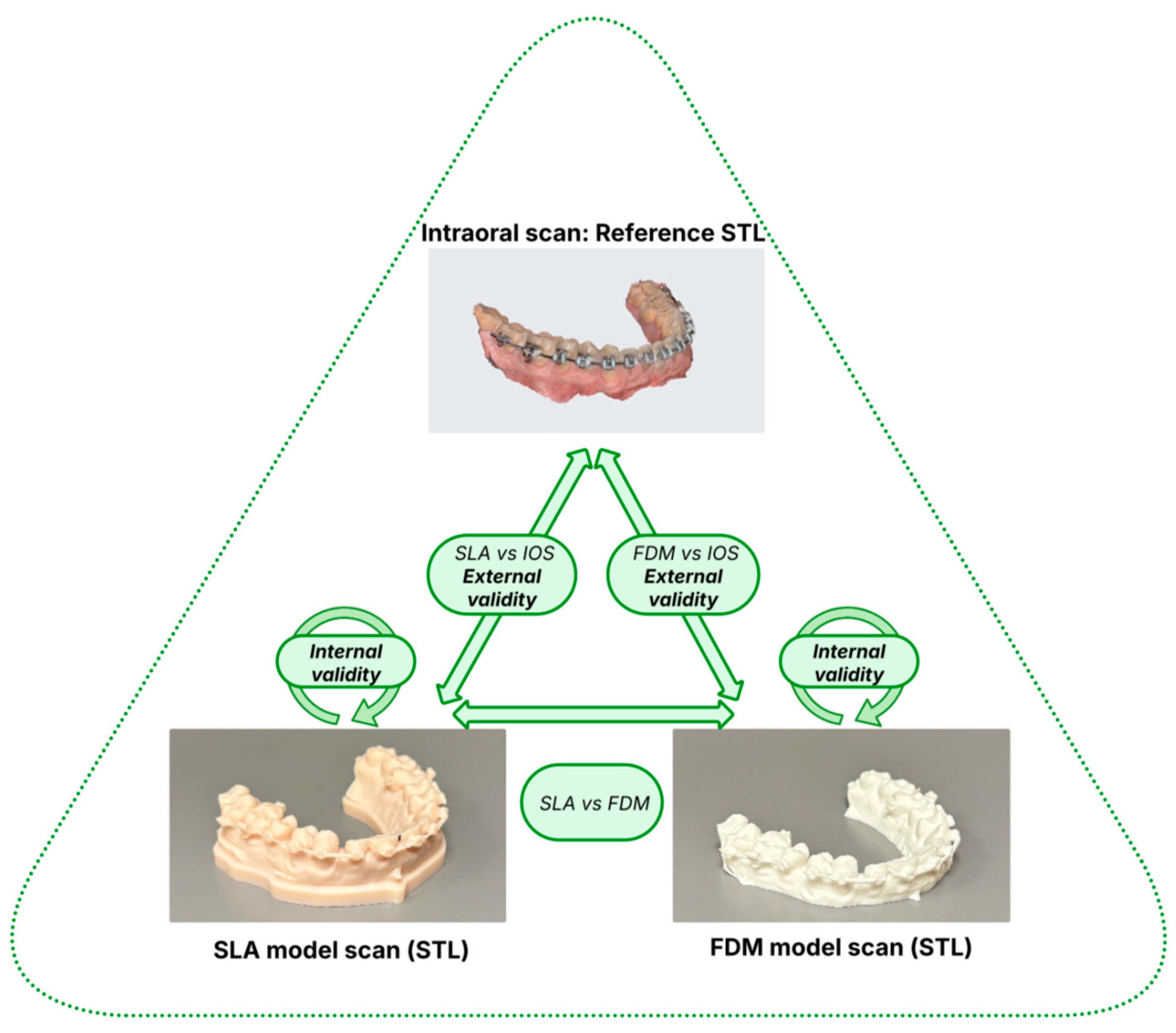
Additionally, a direct head-to-head comparison between FDM and SLA models fabricated from identical STL files was performed to quantify differences between the two technologies. This three-tier analytical framework is illustrated in Figure 1.

2.3. 3D Printing Workflow

FDM models were fabricated using white PLA Basic filament manufactured by Bambu Lab (Bambu Lab, Shenzhen, China) with material properties including a density of 1.31 g/cm3, a Vicat softening temperature of 63 °C, and a tensile strength of 30 ± 5 MPa. Printing was performed with a 0.4 mm nozzle at 210 °C, and the print bed was maintained at 40 °C to optimize adhesion. A layer height of 0.08 mm was selected to ensure high resolution while maintaining a reasonable printing time. The printing speed for the outer walls was set at 60 mm/s.
To optimize clinical relevance and reduce the need for post-processing, models were printed horizontally on the print bed, simulating a workflow typical in a busy clinical setting where angled printing is impractical. Support structures were applied to stabilize the models during printing while avoiding interference with the dental surfaces. These structures were manually removed post-fabrication, and no additional surface finishing or smoothing was applied. This decision was made to prevent variability in post-processing, which could introduce subjective alterations that would compromise the objectivity of the study.
SLA models were fabricated using UltraPrint-Dental Model HP UV resin (Guangzhou Heygears IMC.INC, Guangzhou, China), a photopolymer optimized for dental applications. The resin, composed of acrylated urethanes, has a viscosity of 900–1500 mPa·s at 25 °C. Printing was performed with a layer thickness of 50 µm, using a UV exposure time per layer of 2 s at a wavelength of 385 nm.
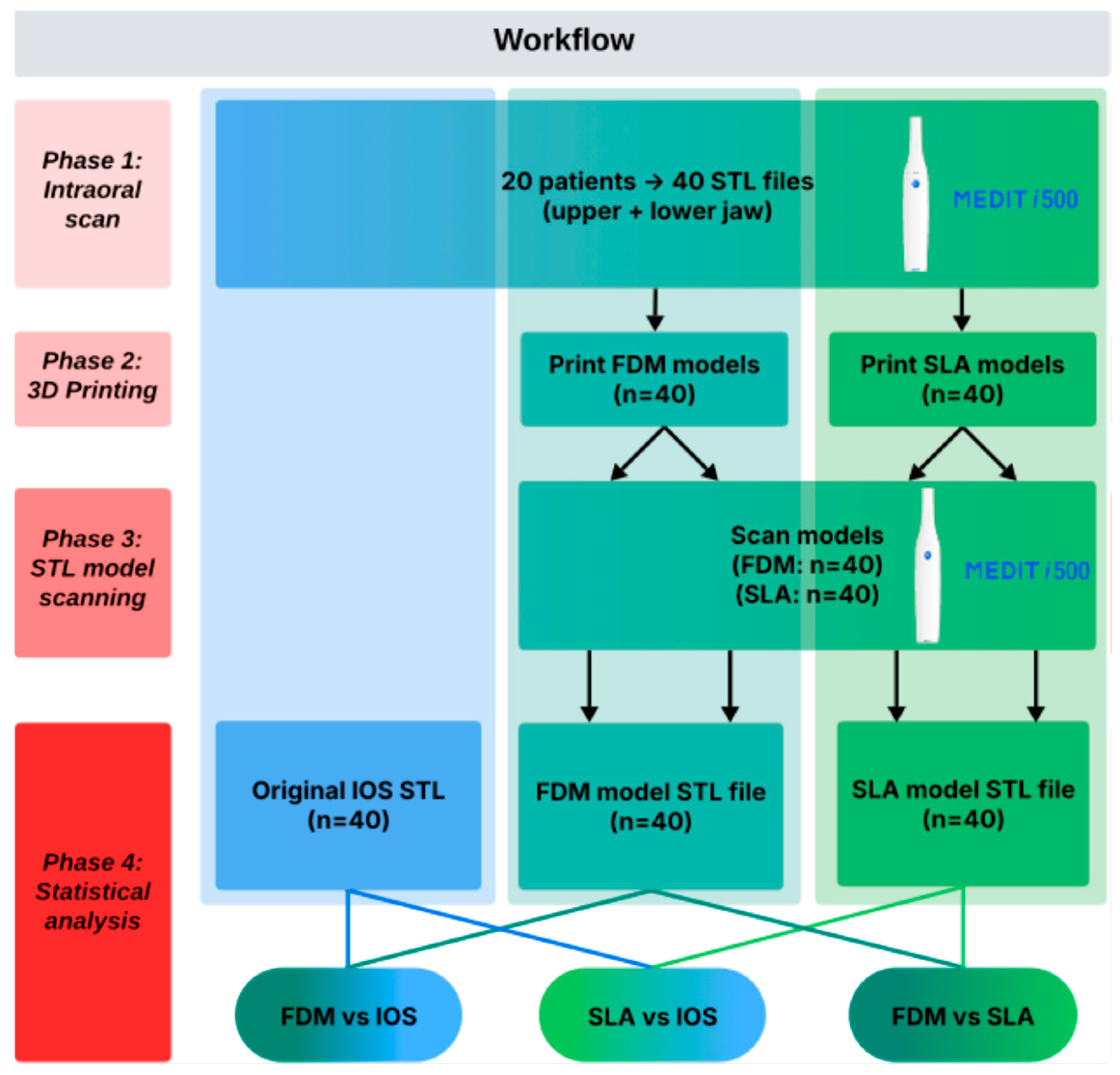
Post-processing involved cleaning the printed models in 96% isopropanol (IPA) to remove uncured resin, followed by UV curing for 2 × 3 min in a polymerization unit operating at the same wavelength. These steps ensured complete polymerization and dimensional stability of the SLA models. The workflow process is illustrated in Figure 2.
In addition, for the precision analysis, one maxillary and one mandibular STL file from three patients were each printed five times under identical FDM settings, resulting in repeated model sets for reproducibility assessment. The same six STL files were likewise reprinted five times on the SLA printer using identical parameters, generating corresponding repeated SLA model sets for internal validity analysis.

2.4. Environmental Conditions

The printing environment was strictly controlled. The room temperature was maintained between 19 °C and 21 °C, and humidity levels were kept below 20%, with desiccants used to ensure optimal filament and resin storage conditions. The print bed of the FDM printer was cleaned before each print using a standard cleaning spray to ensure adhesion and eliminate surface contamination.

2.5. Post-Print Stabilization and Timing of Measurements

To minimize the potential influence of post-print dimensional changes related to thermal relaxation, residual stress release, or ongoing polymerization, a standardized time interval between printing and accuracy assessment was applied for all models. All SLA models were received from the external laboratory and scanned no earlier than 72 h after completion of printing and post-curing, in accordance with the laboratory’s routine workflow.
To ensure methodological consistency and comparability between both printing technologies, all PLA-based FDM models were likewise allowed to rest for a minimum of 72 h at controlled ambient conditions before scanning. During this stabilization period, models were stored at room temperature without mechanical loading or further post-processing.
This standardized delay was implemented to allow complete cooling of thermoplastic models and stabilization of photopolymerized resin models prior to digitization, thereby reducing potential time-dependent deformation effects on the accuracy measurements. All tested specimens were scanned according to this uniform time standard.

2.6. Scanning Process

Following fabrication, all models were scanned using the Medit® i500 intraoral scanner (Medit Corp., Seoul, South Korea), a structured-light scanner with a reported trueness and precision of 10–20 µm. Scanning was conducted in a controlled environment with dimmed artificial lighting to prevent reflections. All models were placed on a flat, non-reflective surface during scanning to ensure stability, and the scanner was calibrated before each use. The raw STL files generated from the scans were not subjected to surface smoothing or hole-filling to preserve the integrity of the data.

2.7. Pre-Analysis Phase

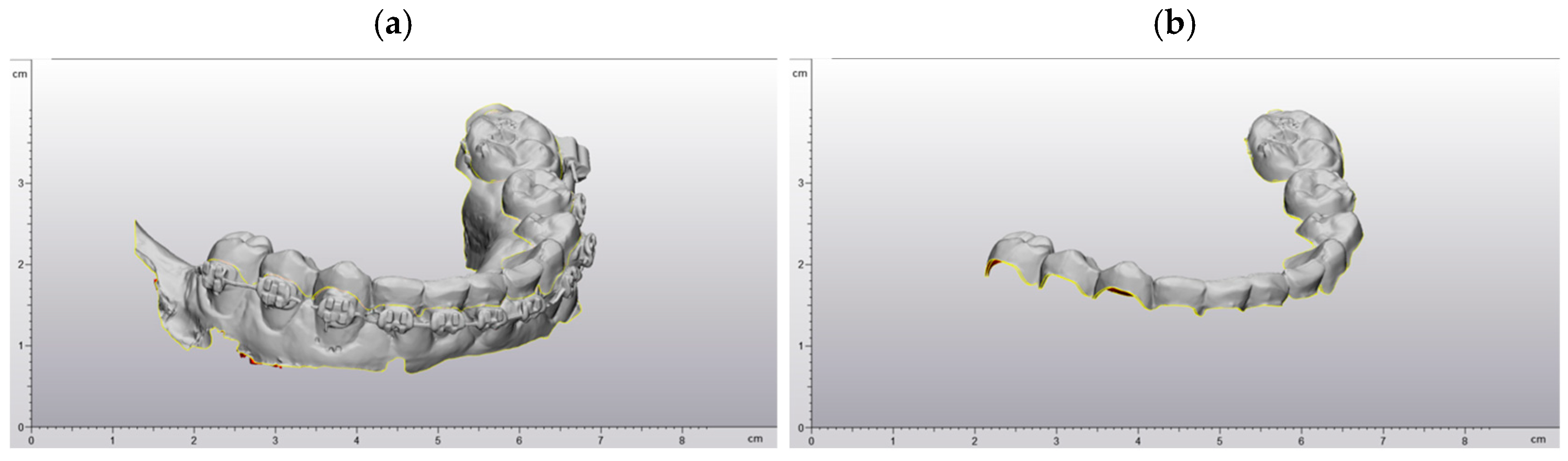
After scanning, the models were aligned with the original STL files using Materialise® 3-matic software (v18.0; Materialise®, Leuven, Belgium). The alignment process was performed iteratively until the software indicated no further adjustments were mathematically possible. To simulate the maximum wafer depth commonly required in surgical planning, both FDM and SLA models were sectioned using the Curve function in the software. For models with orthodontic brackets, the sectioning was performed at the transition point between the upper bracket base and the enamel surface. To ensure consistency and avoid introducing systematic bias during this step, an identical cutting geometry was applied to each corresponding model pair. For every patient, a single cutting curve was defined and subsequently applied without modification to both the SLA- and FDM-derived scans originating from the same STL file. This ensured uniform sectioning of paired models and minimized variability introduced during the pre-analysis phase (Figure 3).
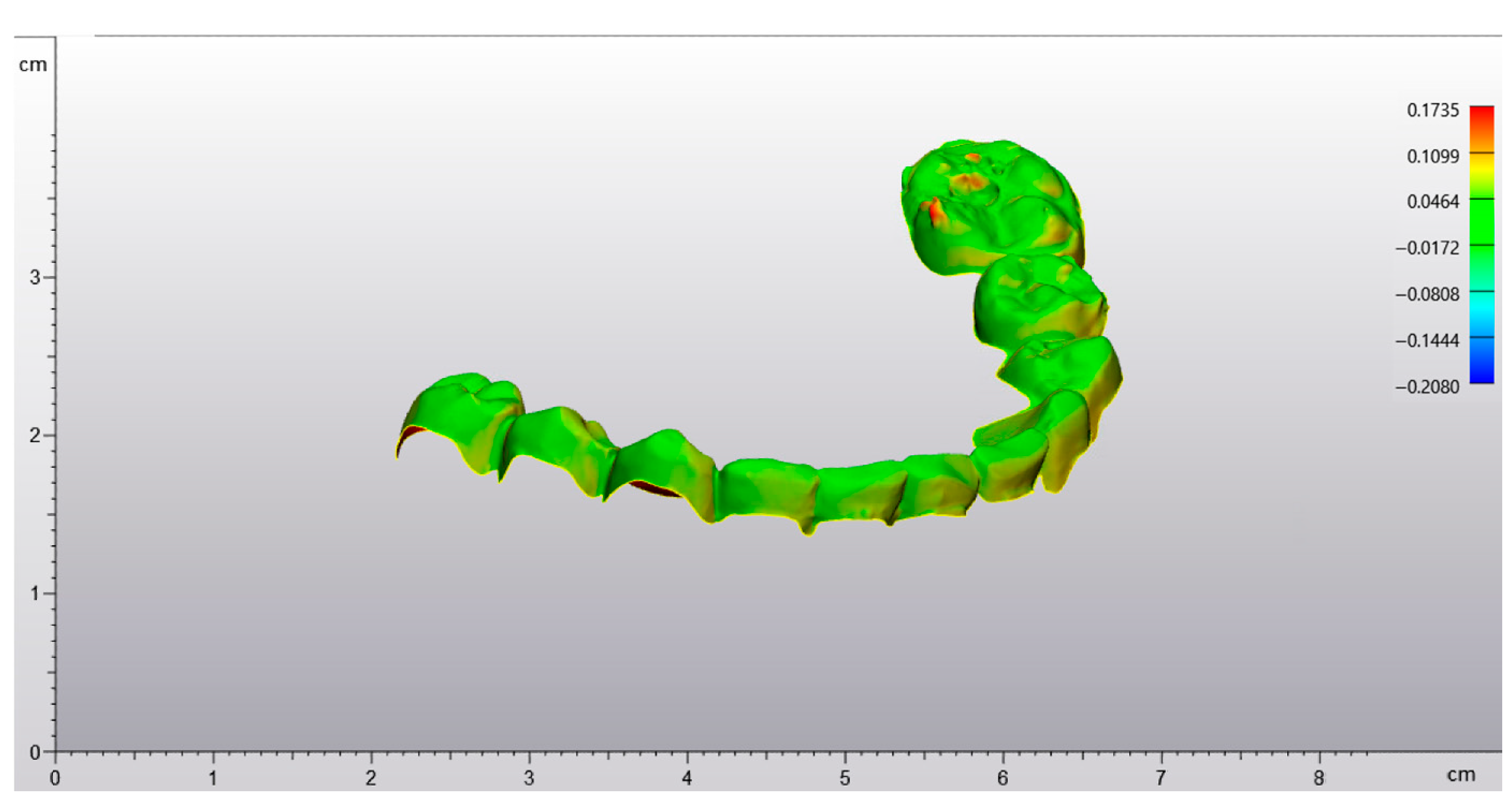
After sectioning, the models were re-aligned to ensure optimal congruence, and heat maps were generated to visualize dimensional deviations (Figure 4).

2.8. Data Analysis

Dimensional deviations were quantified using best-fit surface alignment in Materialise 3-matic software (v18.0; Materialise®, Leuven, Belgium), as illustrated in Figure 4. Three distinct comparisons were performed (n = 40 per comparison):
A.
Internal validity (precision): Reproducibility within each printer was evaluated using the repeated-print sets. For three patients, the maxillary and mandibular STL files were each printed five times per technology. Within each arch and printer, all possible pairwise combinations of the five prints were compared after best-fit alignment, yielding deviation maps that reflected the intrinsic variability of the FDM and SLA processes:
a.
SLA print #1 vs. SLA print #2, SLA print #1 vs. SLA print #3, etc.
b.
FDM print #1 vs. FDM print #2, FDM print #1 vs. FDM print #3, etc.
B.
External validity (accuracy): Printed models aligned to original IOS STL files (ground truth):
a.
FDM model scan vs. IOS STL (n = 40)
b.
SLA model scan vs. IOS STL (n = 40).
C.
Technology comparison: FDM vs. SLA models from identical STL files (n = 40 pairs)
For each comparison, we calculated the maximum absolute deviation (largest point-to-point distance), the median deviation, the interquartile range (IQR), and the overall range based on all surface points after alignment.
All statistical analyses were performed in IBM SPSS (version 29.0.2.0). Because several variables showed deviations from strict normality, group comparisons were carried out using the Wilcoxon signed-rank test. Descriptive statistics are reported as means and standard deviations, along with minima and maxima, to provide an intuitive summary of the overall deviation magnitudes.
The magnitude of differences was expressed as effect size r = |Z|/√N and interpreted according to Cohen’s thresholds (0.1 small, 0.3 moderate, 0.5 large). A p-value < 0.05 was considered statistically significant.

3. Results

3.1. Precision or Internal Validity

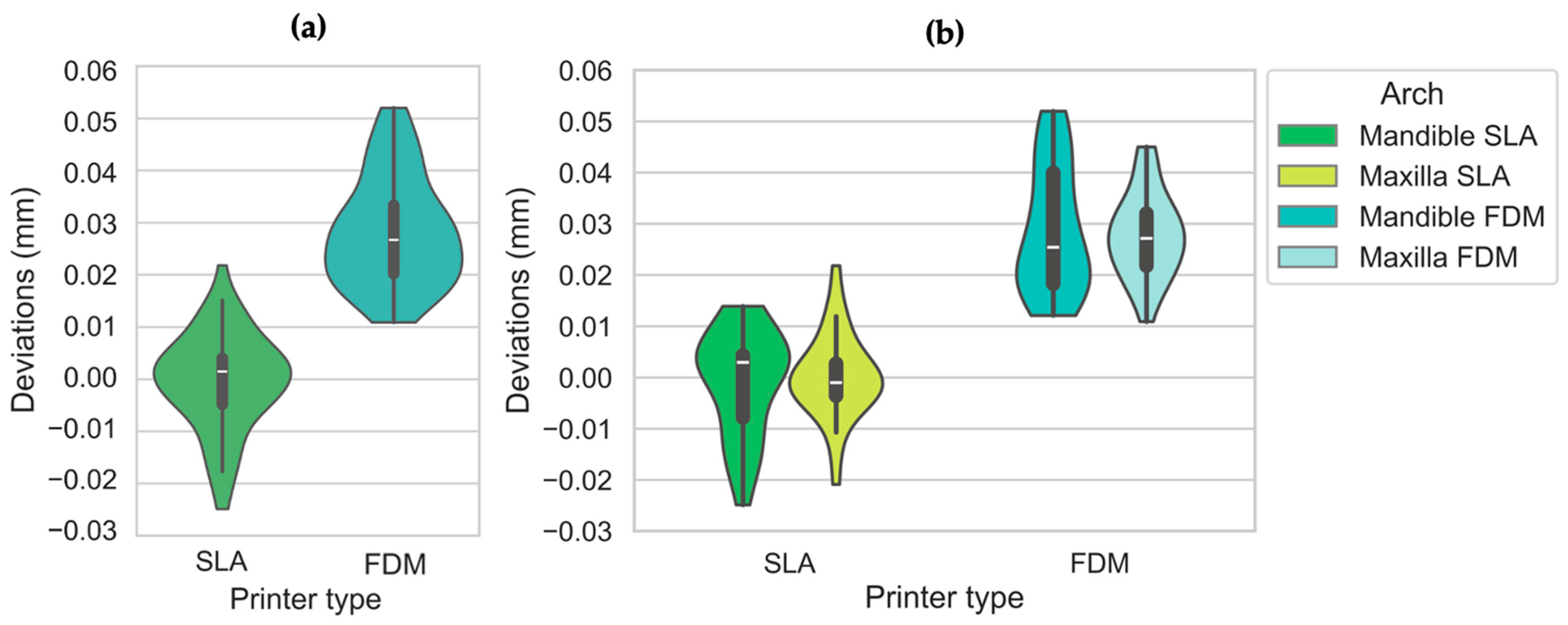
For the SLA printer, the median deviation was 0.00145 mm with a minimum of −0.0249 mm and a maximum of 0.0218 mm. The interquartile range was 0.0091 mm, and the standard deviation 0.0093 mm. For the FDM printer, the median deviation was 0.0267 mm, with a minimum of 0.0109 mm and a maximum of 0.0520 mm. The interquartile range was 0.0132 mm, and the standard deviation 0.0104 mm. Both datasets showed approximately symmetric distributions, which are visualized as violin plots in Figure 5a, highlighting the narrower distribution and lower median deviations for the SLA printer compared to the FDM printer. When analyzed per arch, SLA models showed a median deviation of −0.00105 mm for maxillary arches (IQR: 0.00622 mm) and 0.00290 mm for mandibular arches (IQR: 0.01215 mm). For FDM, the corresponding values were 0.02715 mm (IQR: 0.01020 mm) for the maxilla and 0.02540 mm (IQR: 0.02175 mm) for the mandible. The same dataset was subdivided by arch and displayed as paired violin plots in Figure 5b, illustrating the distributions for the mandible (green) and maxilla (yellow-green) in SLA prints and for the mandible (blue-green) and maxilla (light blue-green) in FDM prints for each printer type.

3.2. Accuracy or External Validity

Considering accuracy, SLA models exhibited lower maximum deviations (0.417 ± 0.319 mm) compared to FDM models (0.780 ± 0.404 mm) (p = 0.002, r = 0.50, large effect size) (Table 1).
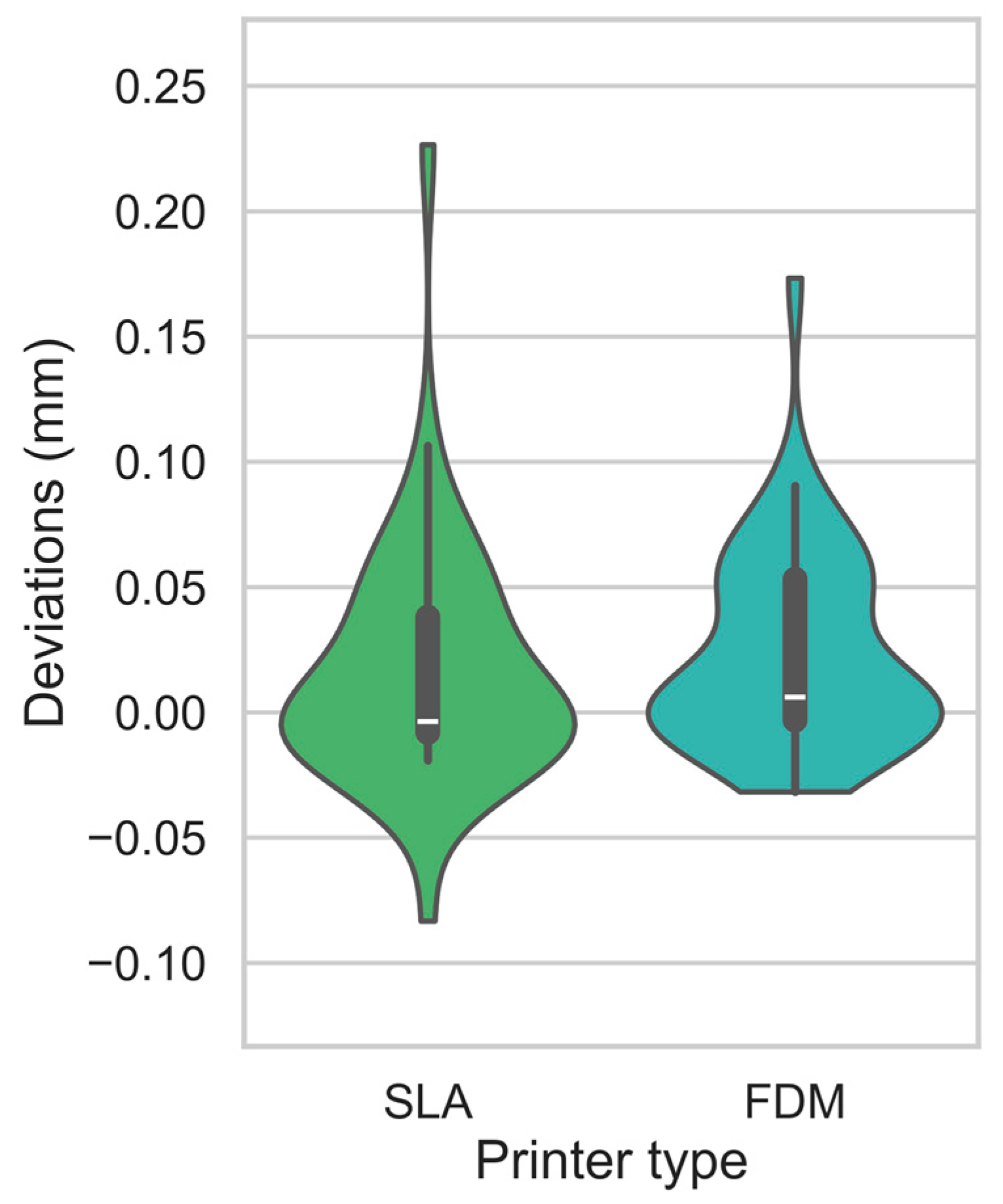
Furthermore, SLA models showed a lower mean interquartile range (0.091 ± 0.042 mm) than FDM models (0.105 ± 0.043 mm), with values ranging from 0.040 mm to 0.242 mm for SLA and from 0.047 mm to 0.216 mm for FDM. This difference was statistically significant (p < 0.001, r = 0.63) (Table 1). Additionally median surface deviations, as shown in Table 1, were visually presented by violin plots in Figure 6.

3.3. Technology Comparison: SLA vs. FDM

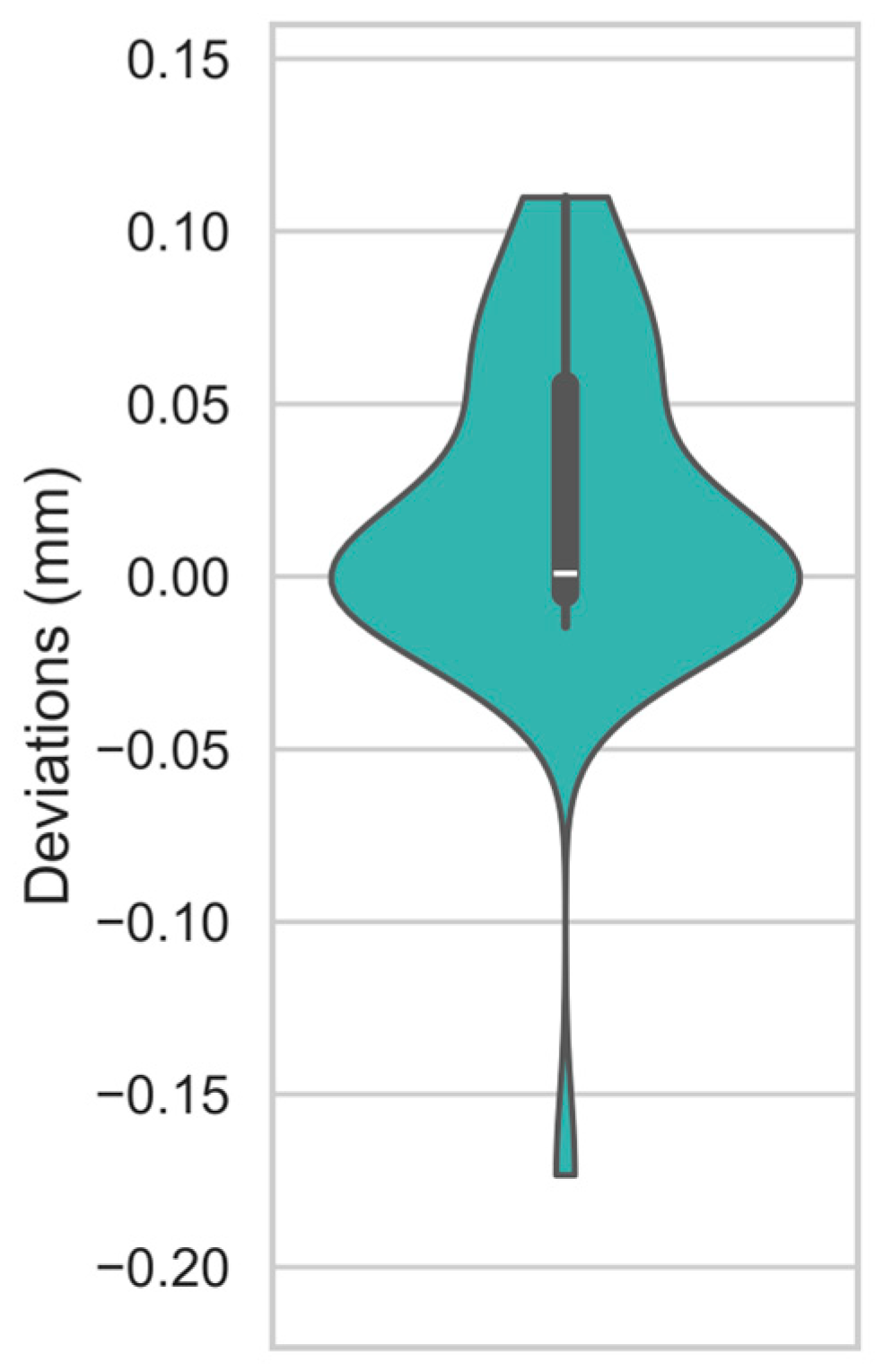
To compare both printing techniques, dimensional deviations were calculated between FDM and SLA models fabricated from the same STL file. For each model pair, the maximum deviation, median deviation, IQR, and overall range were assessed. Descriptive statistics, mean, standard deviation, minimum, and maximum, were calculated across the 20 matched model pairs (Table 2). The mean maximum deviation between FDM and SLA models was 0.623 mm, ranging from 0.169 mm to 2.249 mm. A one-sample Wilcoxon signed-rank test was performed to assess whether these deviations were significantly different from zero. Results showed statistically significant differences for all tested parameters, with p-values < 0.001. The median deviations, as shown in Table 2, were graphically presented by a violin plot (Figure 7).

3.4. Effect Sizes

Median deviation differed significantly between groups (FDM: −0.024 ± 0.410 mm; SLA: 0.015 ± 0.284 mm; p = 0.044, r = 0.32). The Wilcoxon signed-rank test revealed significant differences across all evaluated parameters, with p-values ranging from < 0.001 to 0.044 and effect sizes indicating moderate to very large effects (Table 3).

4. Discussion

The integration of 3D printing technology into maxillofacial surgery has provided significant enhancements in surgical planning, post-operative accuracy, and patient education. This study aimed to evaluate and compare the dimensional accuracy of dental models produced by two widely used 3D printing technologies: SLA and FDM, specifically assessing their accuracy after printing.
The findings indicate that SLA-printed dental models exhibited higher dimensional accuracy than models printed with FDM when compared to the original IOS. The IOS STL files served as the anatomical ground truth for accuracy assessment, while the direct FDM-SLA comparison quantified technological differences independent of the reference scan. Specifically, the maximum deviation for SLA models was notably lower (0.417 ± 0.319 mm) compared to FDM models (0.780 ± 0.404 mm) (p = 0.002). Additionally, the absolute maximum deviations observed were 1.423 mm for SLA models versus 1.842 mm for FDM models, indicating that the maximum difference was substantial and might be relevant for other clinical practices. This result aligns with previous research suggesting SLA’s inherent precision advantages due to its layer-by-layer curing of photopolymer resins with UV lasers, achieving high resolution and surface smoothness [15,16,17,18,28]. Conversely, FDM printing, involving thermoplastic extrusion, naturally possesses limitations related to layer adhesion and potential material shrinkage, thus slightly reducing its accuracy [13,19,29].
Despite these statistical differences, the clinical relevance must be carefully evaluated. The significant Cohen’s d values, alongside statistically significant differences, suggest a noticeable difference between the two printing technologies. Nevertheless, the magnitude of these deviations was limited, with median deviations of −0.024 ± 0.410 mm for FDM models and 0.015 ± 0.284 mm for SLA models, indicating that the observed differences may not translate into meaningful clinical impact.
Moreover, by evaluating both accuracy and precision, this study confirms the validity of the tested 3D printing workflows. Accuracy, assessed through comparison with IOS references, demonstrated external validity, with SLA models showing significantly lower maximum deviations (p = 0.002) and ranges (p < 0.001) compared to FDM models. These findings are consistent with other articles, who likewise reported lower dimensional variation for SLA relative to FDM, while noting that FDM remains a clinically viable option primarily due to cost and workflow advantages rather than superior accuracy [19,30]. Notably, the deviation values observed in the current study were somewhat higher than those reported by Abbasi et al., which may be attributed to the increased anatomical complexity of full-arch models and multiple edentulous zones, as well as methodological differences in alignment and error quantification. Additionally, all models in this study were printed in a horizontal orientation, which, although efficient in terms of print time and material use, has been associated with reduced surface resolution compared to angled (e.g., 45°) printing for FDM prints [31]. This factor may have further contributed to the observed discrepancies with, for example, the study of Gao et al. [32]. In an orthodontic context, Atam et al. reported slightly lower deviations for vertically oriented models compared to horizontally printed models, while all orientations remained clinically acceptable for thermoformed appliance fabrication, suggesting that non-horizontal orientations can yield modest gains in trueness without compromising clinical usability [33]. Furthermore, a recent systematic review by Alghauli et al. confirmed that build orientation significantly affects the accuracy, surface properties, cost, and time efficiency of additively manufactured dental models, but also highlighted that horizontal orientation is frequently favored for its combination of high accuracy, shorter printing times, and lower production costs, particularly when single models are fabricated [34]. Consequently, our use of a horizontal build orientation likely represents a clinically realistic yet conservative estimate of FDM performance; optimized orientations might further improve FDM accuracy at the expense of increased print time and more complex workflows.
Precision, evaluated through a one-sample Wilcoxon signed-rank test, revealed statistically significant dimensional differences between FDM and SLA models for all assessed parameters (p < 0.001), indicating that both technologies do not yield identical outputs. Nonetheless, the extent of these deviations remained within clinically acceptable margins, allowing for context-dependent application of FDM models where cost or turnaround time is a decisive factor.
In addition to these observations, the analysis of median deviations further supports the clinical applicability of both technologies. The median deviation for SLA and FDM models was 0.015 mm and −0.024 mm, respectively. This threshold is in line with previous work on the dimensional accuracy of 3D-printed polymers, where deviations below approximately 0.05–0.10 mm have been shown not to meaningfully affect clinical fit in orthodontic and implant-related applications [25]. Johansson et al. likewise demonstrated that deviations within roughly 0.05 mm are acceptable for 3D-printed polymers intended for dental models and surgical guides, and similar ranges have been reported for orthodontic models used for appliance fabrication [35]. In our context, this threshold primarily relates to full-arch dental models used for surgical wafer fabrication in orthognathic surgery, where minor dimensional discrepancies are compensated by occlusal settling and intraoperative verification. These findings indicate that for typical clinical tasks such as surgical wafer fitting, both SLA and FDM models provide clinically acceptable precision. Previous studies support this interpretation, noting minimal clinically meaningful impact of minor deviations [19,20,33,36,37,38].
Nonetheless, for applications demanding the highest accuracy, SLA printing may indeed present advantages as seen by the large effect size (Table 3) [38,39,40]. The superior resolution and accuracy of SLA models can facilitate detailed preoperative preparation, potentially improving surgical outcomes and efficiency in these scenarios. However, this higher accuracy also introduces practical considerations including increased costs and time-intensive post-processing steps [41].
An important contributor to cost differences lies in the required post-processing. SLA models typically necessitate more time-consuming procedures, such as isopropanol cleaning, UV curing, and especially the manual removal of support structures, which increases production time and labor requirements compared to FDM prints [42,43]. For institutions with limited resources or high-volume clinical operations, adopting FDM technology can significantly lower operational expenses without substantial compromise in quality for standard applications [44,45]. Conversely, institutions with substantial orthognathic surgery caseloads or those able to collaborate across departments might justify investment in SLA technology, distributing associated costs and maximizing its precision advantages [34,39].
To assess the internal validity of the methodology, repeated prints of identical STL files were analyzed to evaluate the intrinsic reproducibility of both printing systems. The median deviation between repeated prints measured 0.00145 mm for SLA and 0.0267 mm for FDM, indicating minimal variability within each printer type. Both datasets displayed symmetric distributions with limited dispersion and few outliers, confirming a stable and consistent printing performance. Interestingly, the 95% confidence intervals of both printers were comparable in width, suggesting a similar degree of reliability. However, these intervals were centered around slightly different median values. The FDM printer consistently produced marginally larger models, which may be explained by differences in material behavior, specifically thermal expansion and cooling shrinkage inherent to filament-based extrusion as well as by potential micro-layer inaccuracies during deposition [46,47,48,49]. However, a small systematic bias introduced by the IOS cannot be entirely excluded. Overall, these findings indicate that the printing process itself contributes negligibly to dimensional variability.
In the arch-stratified precision analysis, mandibular models exhibited larger interquartile ranges than maxillary models for both printing technologies (Figure 5b), whereas the median deviations remained similar between arches. This indicates that variability in dimensional deviations is more pronounced in the mandible, even though the central tendency of the error distribution is comparable for maxillary and mandibular arches. From a geometric standpoint, this observation is plausible, as mandibular arches typically present more pronounced curvature, deeper lingual undercuts, and steeper posterior slopes, particularly in the molar region, and in our workflow the mandibular models were printed in a horseshoe configuration while the maxillary models formed a more continuous block, making mandibular casts more susceptible to deformation from residual stresses. Several studies on digital and printed full-arch dental models have reported that posterior and highly curved segments tend to show greater local deviations than anterior or less complex regions, and that mandibular models or posterior segments are more susceptible to cumulative errors arising from scanning access, angulation, and reconstruction complexity [2,50,51]. In the present study, this effect may have been amplified by the use of full-arch models and a clinically realistic workflow without additional support structures or surface smoothing, which likely yields a conservative estimate of mandibular reproducibility. Nevertheless, the absolute magnitude of the mandibular IQRs, again, remained well below the commonly cited clinical thresholds for model accuracy, suggesting that the observed increase in variability between maxilla and mandible is unlikely to compromise wafer fabrication or occlusal verification in routine orthognathic planning [35].
Several limitations of the present study should be acknowledged. First, the sample size was relatively small (N = 20), which may limit the generalizability of the findings and increase the risk of type II error. Second, the majority of patients (19 out of 20) presented with orthodontic brackets, which could theoretically affect the trueness of IOS acquisition and subsequent model alignment. However, the potential impact of bracket-related artefacts on our measurements is likely limited, as all models were uniformly sectioned above the bracket level using a single predefined cutting curve that was identically applied to each corresponding FDM–SLA pair. This approach ensured that the regions directly influenced by bracket geometry were largely excluded from the deviation analysis, thereby minimizing bracket-induced bias. Third, all FDM models were printed in a horizontal orientation to reflect a realistic, time-efficient clinical workflow in a busy hospital environment. While this choice enhances the external validity of our protocol, it may represent a conservative estimate of FDM performance, as alternative build orientations (e.g., 30–45°) have been associated with improved surface quality and trueness in previous work [31]. Finally, this was a single-center in vitro study using one FDM and one SLA system; extrapolation to other printers, materials, or clinical workflows should therefore be made with caution, and future studies including larger, more diverse samples and optimized FDM print parameters are warranted.
Ultimately, the clinical selection between SLA and FDM models should consider the specific surgical application, economic constraints, and workflow efficiency. Given the statistically significant yet clinically marginal differences demonstrated, both technologies have their own advantages. Future research should therefore investigate whether dental models are always required for pre-operative wafer fit, or whether, in selected straightforward cases, digital planning alone may provide sufficient accuracy for occlusal assessment and splint design.

5. Conclusions

Based on intraoral scans, SLA dental models showed significantly better dimensional accuracy than FDM models, with mean maximum deviations of 0.42 ± 0.32 mm for SLA versus 0.78 ± 0.40 mm for FDM, and a large effect size for this difference. Despite this, median surface deviations for both printing techniques remained below the commonly cited clinically acceptable threshold of 0.05 mm. SLA is therefore best suited for high-precision indications, whereas FDM offers a cost-effective solution for routine clinical applications without major performance trade-offs. Both printers also demonstrated strong internal validity, with repeated prints yielding median deviations of 0.00145 mm for SLA and 0.0267 mm for FDM, indicating highly consistent performance within each technology.

Author Contributions

Conceptualization: R.C., T.B. and B.D.; Methodology: T.B., R.C. and P.C.; Software: T.B.; Validation: T.B., M.U. and R.C.; Formal analysis: T.B.; Investigation: T.B., P.C. and R.C.; Resources: R.C. and P.C.; Data curation: T.B.; Writing—original draft preparation: T.B.; Writing—review and editing: P.C., L.D.K., B.D., M.U. and R.C.; Visualization: R.C. and T.B.; Supervision: R.C.; Project administration: R.C. All authors have read and agreed to the published version of the manuscript.

Funding

This research did not receive any external funding.

Data Availability Statement

Data available upon request.

Acknowledgments

AI-assisted language editing tools (ChatGPT (GPT-5.3; OpenAI, San Francisco, CA, USA) were used during the preparation of this manuscript to enhance clarity, grammar, and overall readability.

Conflicts of Interest

The authors declare no conflicts of interest.

Abbreviations

The following abbreviations are used in this manuscript:
3DThree-Dimensional
CAD-CAMComputer-Aided Design and Computer-Aided Manufacturing
CMFCraniomaxillofacial
DDSDoctor of Dental Surgery
FDMFused Deposition Modeling
IOSIntraoral Scan
IQRInterquartile Range
MDMedical Doctor
PLAPolylactic Acid
PSIPatient-Specific Implant
RMSDRoot Mean Square Deviation
SLAStereolithography Apparatus
STLStandard Tessellation Language (file format)
UVUltraviolet

References

  1. Wang, X.; Shujaat, S.; Shaheen, E.; Jacobs, R. Accuracy of Desktop versus Professional 3D Printers for Maxillofacial Model Production. A Systematic Review and Meta-Analysis. J. Dent. 2021, 112, 103741. [Google Scholar] [CrossRef]
  2. Dong, T.; Wang, X.; Xia, L.; Yuan, L.; Ye, N.; Fang, B. Accuracy of Different Tooth Surfaces on 3D Printed Dental Models: Orthodontic Perspective. BMC Oral Health 2020, 20, 340. [Google Scholar] [CrossRef]
  3. Legocki, A.T.; Duffy-Peter, A.; Scott, A.R. Benefits and Limitations of Entry-Level 3-Dimensional Printing of Maxillofacial Skeletal Models. JAMA Otolaryngol. Head Neck Surg. 2017, 143, 389–394. [Google Scholar] [CrossRef]
  4. Shaheen, E.; Sun, Y.; Jacobs, R.; Politis, C. Three-Dimensional Printed Final Occlusal Splint for Orthognathic Surgery: Design and Validation. Int. J. Oral Maxillofac. Surg. 2017, 46, 67–71. [Google Scholar] [CrossRef] [PubMed]
  5. Louvrier, A.; Marty, P.; Barrabé, A.; Euvrard, E.; Chatelain, B.; Weber, E.; Meyer, C. How Useful Is 3D Printing in Maxillofacial Surgery? J. Stomatol. Oral Maxillofac. Surg. 2017, 118, 206–212. [Google Scholar] [CrossRef] [PubMed]
  6. Zinser, M.J.; Mischkowski, R.A.; Sailer, H.F.; Zöller, J.E. Computer-Assisted Orthognathic Surgery: Feasibility Study Using Multiple CAD/CAM Surgical Splints. Oral Surg. Oral Med. Oral Pathol. Oral Radiol. 2012, 113, 673–687. [Google Scholar] [CrossRef]
  7. Juneja, M.; Bajaj, D.; Thakur, N.; Jindal, P. Reproduction of Human Dental Models Using Different 3D Printing Techniques. Proc. Inst. Mech. Eng. E J. Process Mech. Eng. 2022, 240, 292–301. [Google Scholar] [CrossRef]
  8. Kafle, A.; Luis, E.; Silwal, R.; Pan, H.M.; Shrestha, P.L.; Bastola, A.K. 3D/4D Printing of Polymers: Fused Deposition Modelling (FDM), Selective Laser Sintering (SLS), and Stereolithography (SLA). Polymers 2021, 13, 3101. [Google Scholar] [CrossRef]
  9. Rajan, K.; Samykano, M.; Kadirgama, K.; Harun, W.S.W.; Rahman, M.M. Fused Deposition Modeling: Process, Materials, Parameters, Properties, and Applications. Int. J. Adv. Manuf. Technol. 2022, 120, 1531–1570. [Google Scholar] [CrossRef]
  10. Tian, Y.; Chen, C.X.; Xu, X.; Wang, J.; Hou, X.; Li, K.; Lu, X.; Shi, H.Y.; Lee, E.S.; Jiang, H.B. A Review of 3D Printing in Dentistry: Technologies, Affecting Factors, and Applications. Scanning 2021, 2021, 9950131. [Google Scholar] [CrossRef]
  11. Patel, P.; Rajoriya, A.; Ghosh, A.; Roshan, R.; Kadhum, S.A.H. Exploring Fused Deposition Modeling Processes: Mechanics, Working Principles, and Applications in Research and Development. In Fused Deposition Modeling: Technology, Applications, and Developments; CRC Press: Boca Raton, FL, USA, 2025; pp. 1–36. [Google Scholar] [CrossRef]
  12. Bănică, C.F.; Sover, A.; Anghel, D.C. Printing the Future Layer by Layer: A Comprehensive Exploration of Additive Manufacturing in the Era of Industry 4.0. Appl. Sci. 2024, 14, 9919. [Google Scholar] [CrossRef]
  13. Balhaddad, A.A.; Garcia, I.M.; Mokeem, L.; Alsahafi, R.; Majeed-Saidan, A.; Albagami, H.H.; Khan, A.S.; Ahmad, S.; Collares, F.M.; Della Bona, A.; et al. Three-Dimensional (3D) Printing in Dental Practice: Applications, Areas of Interest, and Level of Evidence. Clin. Oral Investig. 2023, 27, 2465–2481. [Google Scholar] [CrossRef] [PubMed]
  14. O’Connor, L. Comparative analysis of the mechanical properties of FDM and SLA 3D printed components. J. Micromanufacturing 2025. [Google Scholar] [CrossRef]
  15. Abduo, J.; Lyons, K.; Bennamoun, M. Trends in Computer-Aided Manufacturing in Prosthodontics: A Review of the Available Streams. Int. J. Dent. 2014, 2014, 783948. [Google Scholar] [CrossRef]
  16. Melchels, F.P.W.; Feijen, J.; Grijpma, D.W. A Review on Stereolithography and Its Applications in Biomedical Engineering. Biomaterials 2010, 31, 6121–6130. [Google Scholar] [CrossRef]
  17. Van Noort, R. The Future of Dental Devices Is Digital. Dent. Mater. 2012, 28, 3–12. [Google Scholar] [CrossRef] [PubMed]
  18. Finnes, T. High Definition 3D Printing—Comparing SLA and FDM Printing Technologies. J. Undergrad. Res. 2015, 13, 3. [Google Scholar]
  19. Abbasi, M.; Váz, P.; Silva, J.; Martins, P. Head-to-Head Evaluation of FDM and SLA in Additive Manufacturing: Performance, Cost, and Environmental Perspectives. Appl. Sci. 2025, 15, 2245. [Google Scholar] [CrossRef]
  20. Rebong, R.E.; Stewart, K.T.; Utreja, A.; Ghoneima, A.A. Accuracy of Three-Dimensional Dental Resin Models Created by Fused Deposition Modeling, Stereolithography, and Polyjet Prototype Technologies: A Comparative Study. Angle Orthod. 2018, 88, 363–369. [Google Scholar] [CrossRef] [PubMed]
  21. Begum, S.A.; Aryani, K. 3D Printing Technologies—An Overview. Int. J. Pharm. Sci. Res. 2022, 13, 3465–3472. [Google Scholar] [CrossRef]
  22. Jaber, S.T.; Hajeer, M.Y.; Khattab, T.Z.; Mahaini, L. Evaluation of the Fused Deposition Modeling and the Digital Light Processing Techniques in Terms of Dimensional Accuracy of Printing Dental Models Used for the Fabrication of Clear Aligners. Clin. Exp. Dent. Res. 2021, 7, 591–600. [Google Scholar] [CrossRef]
  23. Németh, A.; Vitai, V.; Czumbel, M.L.; Szabó, B.; Varga, G.; Kerémi, B.; Hegyi, P.; Hermann, P.; Borbély, J. Clear Guidance to Select the Most Accurate Technologies for 3D Printing Dental Models—A Network Meta-Analysis✰. J. Dent. 2023, 134, 104532. [Google Scholar] [CrossRef]
  24. Kim, S.Y.; Shin, Y.S.; Jung, H.D.; Hwang, C.J.; Baik, H.S.; Cha, J.Y. Precision and trueness of dental models manufactured with different 3-dimensional printing techniques. Am. J. Orthod. Dentofacial. Orthop. 2018, 153, 144–153. [Google Scholar] [CrossRef] [PubMed]
  25. Etemad-Shahidi, Y.; Qallandar, O.B.; Evenden, J.; Alifui-Segbaya, F.; Ahmed, K.E. Accuracy of 3-Dimensionally Printed Full-Arch Dental Models: A Systematic Review. J. Clin. Med. 2020, 9, 3357. [Google Scholar] [CrossRef] [PubMed]
  26. Rajagopalan, A.; Verma, S.; Kumar, V.; Verma, R.K.; Singh, S.P. Accuracy of 3D Printing in Orthodontics: A Systematic Review and Meta-Analysis. J. Indian Orthod. Soc. 2024, 58, 218–235. [Google Scholar] [CrossRef]
  27. García Gil, I.; Rodríguez Alonso, V.; Tobar Arribas, C.; Mosaddad, S.A.; Peláez, J.; Suárez, M.J. Effect of 3D Printing Technology, Build Orientation, and Shell Thickness on the Accuracy of Full-Arch Dental Models for Fixed Dental Prostheses: An In Vitro Study. Sci. Rep. 2025, 15, 40938. [Google Scholar] [CrossRef] [PubMed]
  28. Husna, A.; Ashrafi, S.; Tomal, A.A.; Tuli, N.T.; Bin Rashid, A. Recent Advancements in Stereolithography (SLA) and Their Optimization of Process Parameters for Sustainable Manufacturing. Hybrid Adv. 2024, 7, 100307. [Google Scholar] [CrossRef]
  29. Acierno, D.; Patti, A. Fused Deposition Modelling (FDM) of Thermoplastic-Based Filaments: Process and Rheological Properties—An Overview. Materials 2023, 16, 7664. [Google Scholar] [CrossRef]
  30. Park, J.M.; Jeon, J.; Koak, J.Y.; Kim, S.K.; Heo, S.J. Dimensional Accuracy and Surface Characteristics of 3D-Printed Dental Casts. J. Prosthet. Dent. 2021, 126, 427–437. [Google Scholar] [CrossRef] [PubMed]
  31. Harikrishnan, S.; Subramanian, A. 3D Printing in Orthodontics: A Narrative Review. J. Int. Oral Health 2023, 15, 15–27. [Google Scholar] [CrossRef]
  32. Gao, H.; Yang, Z.; Lin, W.S.; Tan, J.; Chen, L. The Effect of Build Orientation on the Dimensional Accuracy of 3D-Printed Mandibular Complete Dentures Manufactured with a Multijet 3D Printer. J. Prosthodont. 2021, 30, 684–689. [Google Scholar] [CrossRef]
  33. Atam, S.; Pereira, C.L.; Shah, H.R.; Hou, W.; Rody, W.J. Optimization of Three-Dimensional Printing Parameters for Orthodontic Applications. Angle Orthod. 2024, 94, 375–382. [Google Scholar] [CrossRef]
  34. Alghauli, M.A.; Almuzaini, S.A.; Aljohani, R.; Alqutaibi, A.Y. Impact of 3D Printing Orientation on Accuracy, Properties, Cost, and Time Efficiency of Additively Manufactured Dental Models: A Systematic Review. BMC Oral Health 2024, 24, 1550. [Google Scholar] [CrossRef] [PubMed]
  35. Johansson, C.; Dibes, J.; Lopez Rodriguez, L.E.; Papia, E. Accuracy of 3d Printed Polymers Intended for Models and Surgical Guides Printed with Two Different 3d Printers. Dent. Mater. J. 2021, 40, 339–347. [Google Scholar] [CrossRef]
  36. Wu, P.; Hu, L.; Li, H.; Feng, L.; Liu, Y.; Zhang, S.; Li, X.-C.; Zhang, M.-L.; Yang, S.-Y.; Lu, R.-J. Clinical Application and Accuracy Analysis of 3D Printing Guide Plate Based on Polylactic Acid in Mandible Reconstruction with Fibula Flap. Ann. Transl. Med. 2021, 9, 460. [Google Scholar] [CrossRef] [PubMed]
  37. Rouzé l’Alzit, F.; Cade, R.; Naveau, A.; Babilotte, J.; Meglioli, M.; Catros, S. Accuracy of Commercial 3D Printers for the Fabrication of Surgical Guides in Dental Implantology. J. Dent. 2022, 117, 103909. [Google Scholar] [CrossRef]
  38. Msallem, B.; Vavrina, J.J.; Beyer, M.; Halbeisen, F.S.; Lauer, G.; Dragu, A.; Thieringer, F.M. Dimensional Accuracy in 3D Printed Medical Models: A Follow-Up Study on SLA and SLS Technology. J. Clin. Med. 2024, 13, 5848. [Google Scholar] [CrossRef]
  39. Hadad, H.; Boos Lima, F.B.D.J.; Shirinbak, I.; Porto, T.S.; Chen, J.E.; Guastaldi, F.P.S. The Impact of 3D Printing on Oral and Maxillofacial Surgery. J. 3D Print. Med. 2023, 7, 3DP007. [Google Scholar] [CrossRef]
  40. Zoabi, A.; Redenski, I.; Oren, D.; Kasem, A.; Zigron, A.; Daoud, S.; Moskovich, L.; Kablan, F.; Srouji, S. 3D Printing and Virtual Surgical Planning in Oral and Maxillofacial Surgery. J. Clin. Med. 2022, 11, 2385. [Google Scholar] [CrossRef]
  41. Mehra, P.; Miner, J.; D’Innocenzo, R.; Nadershah, M. Use of 3-D Stereolithographic Models in Oral and Maxillofacial Surgery. J. Maxillofac. Oral Surg. 2011, 10, 6–13. [Google Scholar] [CrossRef] [PubMed]
  42. Chen, J.V.; Dang, A.B.C.; Dang, A. Comparing Cost and Print Time Estimates for Six Commercially-Available 3D Printers Obtained through Slicing Software for Clinically Relevant Anatomical Models. 3D Print. Med. 2021, 7, 1. [Google Scholar] [CrossRef]
  43. Lawless, M.; Swendseid, B.; von Windheim, N.; VanKoevering, K.; Seim, N.; Old, M. Review of Cost and Surgical Time Implications Using Virtual Patient Specific Planning and Patient Specific Implants in Midface Reconstruction. Plast. Aesthet. Res. 2022, 9, 26. [Google Scholar] [CrossRef]
  44. Ballard, D.H.; Mills, P.; Duszak, R.; Weisman, J.A.; Rybicki, F.J.; Woodard, P.K. Medical 3D Printing Cost-Savings in Orthopedic and Maxillofacial Surgery: Cost Analysis of Operating Room Time Saved with 3D Printed Anatomic Models and Surgical Guides. Acad. Radiol. 2020, 27, 1103–1113. [Google Scholar] [CrossRef]
  45. Murtezani, I.; Sharma, N.; Thieringer, F.M. Medical 3D Printing with a Focus on Point-of-Care in Cranio- and Maxillofacial Surgery. A Systematic Review of Literature. Ann. 3D Print. Med. 2022, 6, 100059. [Google Scholar] [CrossRef]
  46. Hanon, M.M.; Zsidai, L.; Ma, Q. Accuracy Investigation of 3D Printed PLA with Various Process Parameters and Different Colors. Mater. Today Proc. 2021, 42, 3089–3096. [Google Scholar] [CrossRef]
  47. Solouki, A.; Aliha, M.R.M.; Makui, A.; Choupani, N.; Seiti, H. Analyzing the Effects of Printing Parameters to Minimize the Dimensional Deviation of Polylactic Acid Parts by Applying Three Different Decision-Making Approaches. Sci. Rep. 2024, 14, 27674. [Google Scholar] [CrossRef]
  48. Li, Y.; Molazem, A.; Kuo, H.I.; Ahmadi, V.; Shastri, V.P. Comparative Analysis of Dimensional Accuracy in PLA-Based 3D Printing: Effects of Key Printing Parameters and Related Variables. Polymers 2025, 17, 1698. [Google Scholar] [CrossRef]
  49. Nguyen, P.; Stanislaus, I.; McGahon, C.; Pattabathula, K.; Bryant, S.; Pinto, N.; Jenkins, J.; Meinert, C. Quality Assurance in 3D-Printing: A Dimensional Accuracy Study of Patient-Specific 3D-Printed Vascular Anatomical Models. Front. Med. Technol. 2023, 5, 1097850. [Google Scholar] [CrossRef]
  50. Aly, P.; Mohsen, C. Comparison of the Accuracy of Three-Dimensional Printed Casts, Digital, and Conventional Casts: An In Vitro Study. Eur. J. Dent. 2020, 14, 189–193. [Google Scholar] [CrossRef] [PubMed]
  51. Joteppa, V.; Niras, S.; Chokhani, D.; Jadhao, T.A.; Bandgar, S.T.; Bayaskar, S.G. Accuracy of 3D Printed Model Acquired from Different Types of Intra Oral Scanners and 3D Printers. J. Pharm. Bioallied Sci. 2024, 16, S1433–S1434. [Google Scholar] [CrossRef] [PubMed]
Figure 1. Analytical framework for 3D printing assessment. External validity (accuracy): printed models vs. original IOS STL. Internal validity (precision): repeated prints within each technology. Technology comparison: FDM vs. SLA from identical STL input.
Jmmp 10 00099 g001
Figure 2. Workflow overview for external validity. Phase 1: Intraoral scans from 20 patients yielded 40 STL files (20 upper + 20 lower jaws). Phase 2: Parallel 3D printing produced 40 FDM models and 40 SLA models. Phase 3: All printed models were scanned using the Medit i500 intraoral scanner. Phase 4: Three-tier statistical analysis comparing FDM vs. IOS, SLA vs. IOS, and FDM vs. SLA.
Jmmp 10 00099 g002
Figure 3. Illustration of the sectioning process performed in Materialise® 3-matic software. Picture (a) represents the initial intraoral scan. Picture (b) represents the model after processing in the Materialise® 3-matic software.
Jmmp 10 00099 g003
Figure 4. Example of a color-coded heat map generated in Materialise® 3-matic software, illustrating the dimensional deviations (in mm) between the scanned model and the original STL file.
Jmmp 10 00099 g004
Figure 5. (a) Violin plots showing the distribution of 3D deviations for all arches pooled per printer type. (b) The same dataset subdivided by arch and visualized as paired violin plots for each printer type. The green violins represent SLA models, whereas the blue violins represent FDM models.
Jmmp 10 00099 g005
Figure 6. Violin plots showing the distribution of median surface deviations between printed dental models and the IOS for each printer type. For each of the 40 arches, the median point-to-point deviation was calculated after best-fit alignment of the FDM or SLA model to the corresponding IOS STL file, and these values were pooled per printer. The green violins represent SLA models, whereas the blue violins represent FDM models.
Jmmp 10 00099 g006
Figure 7. Violin plot of median surface deviations between FDM and SLA models fabricated from identical STL files. For each of the 40 model pairs, the median point-to-point deviation between the FDM and SLA surfaces was computed after best-fit alignment, and the resulting values were pooled across all pairs.
Jmmp 10 00099 g007
Table 1. Descriptive Statistics for Model Comparisons (FDM vs. IOS and SLA vs. IOS, N = 40). Maximum deviation is defined as the largest absolute point-to-point distance between corresponding surfaces per model pair. Median deviation and IQR were calculated from the distribution of pointwise deviations for each model. Absolute mean values across all models are reported in mm.
ParameterMean (mm)Std Deviation (mm)Minimum (mm)Maximum (mm)
Maximum deviation (FDM vs. IOS)0.7800.4040.2201.842
Maximum deviation (SLA vs. IOS)0.4170.319−0.1831.423
Median deviation (FDM vs. IOS)−0.0240.410−0.3121.732
Median deviation (SLA vs. IOS)0.1500.284−0.2771.138
Interquartile range (FDM vs. IOS)0.1050.0430.0470.216
Interquartile range (SLA vs. IOS)0.0910.0420.0400.242
Range (FDM vs. IOS)1.1060.4090.5111.942
Range (SLA vs. IOS)0.8230.4500.2331.658
Table 2. Descriptive statistics of dimensional deviations between FDM and SLA models in mm. (Absolute mean was used for this table).
ParameterMean
(mm)
Std. Deviation (mm)Minimum (mm)Maximum (mm)
Maximum deviation (FDM vs. SLA)0.6230.4770.1692.249
Median deviation (FDM vs. SLA)0.0180.049−0.1730.110
Interquartile range (FDM vs. SLA)0.1080.0520.0430.243
Range
(FDM vs. SLA)
1.0170.4490.1402.249
Table 3. Comparison of Dimensional Deviations Between SLA and FDM Models Relative to the IOS (Wilcoxon Signed-Rank Test, N = 40). Effect sizes (r) were calculated using the formula r = |Z|/√N,. Effect sizes were interpreted according to Cohen’s conventional thresholds (0.1 = small, 0.3 = moderate, 0.5 = large effect).
Parameterp-ValueEffect Size (r)Interpretation
Maximum deviation0.0020.50Large effect
Median deviation0.0440.32Moderate effect
Interquartile range<0.0010.871Very large effect
Overall range<0.0010.60Large to very large
Disclaimer/Publisher’s Note: The statements, opinions and data contained in all publications are solely those of the individual author(s) and contributor(s) and not of MDPI and/or the editor(s). MDPI and/or the editor(s) disclaim responsibility for any injury to people or property resulting from any ideas, methods, instructions or products referred to in the content.