1. Introduction
The global manufacturing industry is undergoing a profound transformation driven by shifting consumer expectations, mass customization, rapid delivery requirements, and increasing demands for sustainability and operational efficiency [
1,
2,
3]. These pressures are particularly significant for small and medium-sized enterprises (SMEs) operating in emerging markets, where competitiveness depends on reducing costs, shortening lead times, and enhancing production flexibility [
4,
5]. Operational performance has therefore become a strategic differentiator that directly influences long-term business sustainability and profitability [
6,
7].
Indonesia’s toy manufacturing industry, especially the mechanical and plastic toy car sector, has grown significantly in the past decade [
8,
9]. In 2023, Indonesia exported toys, games, and sports requisites worth about USD 677 million [
10]. Despite a 9.5% decline from the previous year, demand in key markets such as the United States, the United Kingdom, and ASEAN countries remains strong. This growth is driven by multinational manufacturers in Indonesia, including PT. XYZ is a major toy producer in Central Java with two large facilities and over 8600 employees. Its production covers rotocasting, painting, injection molding, and assembly. This study focuses on PT. XYZ’s production system examines two related but physically separate processes: the molding unit and the chassis-body assembly unit. The molding unit shapes the toy car body; the assembly unit installs wheels, circuits, and chassis parts. The lack of integration between these units causes operational inefficiencies [
11]. Problems include excessive work-in-progress (WIP), excess packaging, higher transport costs, long lead times, and unbalanced workloads [
12]. Observations also Show Frequent (NNVA) activities, such as excessive walking, repetitive motions, and poor tool layout, which hurt productivity and cause ergonomic issues.
Lean manufacturing, rooted in the Toyota Production System, provides a systematic framework to eliminate the seven classical wastes (Transportation, Waiting, Overproduction, Defects, Inventory, Motion, and Extra Processing) [
13,
14,
15]. At PT. XYZ, the most dominant wastes are transportation between molding and assembly units, excessive motion, and WIP buildup from disconnected layouts. Correcting these inefficiencies requires a structured redesign of the production system, focused on flow integration and value maximization [
16]. Although Value Stream Mapping (VSM) is widely used as a Lean tool, most applications remain static, relying on manually collected, retrospectively analyzed data. These practices limit responsiveness, add subjectivity to waste prioritization, and restrict continuous improvement. Many studies that use line balancing or optimization do not validate their effectiveness under dynamic conditions. These gaps show the need for a more data-driven, predictive, and validated Lean framework aligned with Industry 4.0 principles.
This study adds three main contributions. First, it develops a real-time data–based Digital Value Stream Mapping (Digital VSM) framework. The framework collects data on production cycle time, waiting time, transfer time, and defect rates to enable continuous, objective measurement of waste. This cuts manual bias, improves analysis, and supports real-time decisions. Second, Digital VSM links to AI-based feature selection using Artificial Neural Networks (ANN) and Genetic Algorithms (GA). Instead of only qualitative waste identification, dominant variables are found algorithmically. This sharpens analysis and makes improvement efforts more data-driven. Third, the future-state production design is verified by discrete-event simulation in Tecnomatix Plant Simulation. Instead of assuming success, the optimized setup is tested with dynamic conditions. This approach ensures robust improvements, cuts risk, and improves reliability.
In addition to Digital Value Stream Mapping (VSM), Artificial Intelligence (AI), and simulation integration, this study uses Ranked Positional Weight (RPW), a method that prioritizes manufacturing tasks and balances production lines by calculating each task’s relative importance. Methods-Time Measurement (MTM), a technique for analyzing detailed motions and setting time standards, is applied for micro-level motion analysis and ergonomic improvement [
17,
18]. RPW redistributes tasks across workstations to improve flow efficiency, while MTM eliminates unnecessary operator movements and reduces fatigue. The redesigned layout is evaluated in Tecnomatix Plant Simulation V16, a software used to assess manufacturing performance, to measure improvements in lead time, productivity, and resource utilization [
19,
20]. The performance objectives of this study focus on three critical areas: (1) reducing work-in-process (WIP) inventory, (2) minimizing space utilization and internal handling costs, and (3) improving operator productivity and overall line efficiency.
Key decision variables include material transfer distances (distance materials travel between processes), output per cycle (units produced per production round), workstation spatial needs (space per work area), and task distribution (work tasks assigned to operators). The goal is to establish a seamless one-piece-flow model, ensuring each unit moves continuously through the production line without intermediate buildup. This design eliminates bottlenecks and enhances synchronization across all stages. By systematically integrating Digital VSM, AI-based feature selection, RPW, MTM, and discrete-event simulation, this study advances Lean implementation toward a predictive, data-driven, and Industry 4.0–aligned framework. The methodology provides a scalable, replicable approach for discrete manufacturing industries aiming to boost competitiveness, reduce waste, and adapt to changing market demands. For Indonesia’s toy manufacturing sector, particularly in the high-export toy car segment, this research presents a strategic path toward sustainable operational excellence.
2. Material and Method
2.1. Lean Manufacturing Concept
Lean Manufacturing is a production philosophy focused on maximizing customer value while minimizing resource use by systematically eliminating waste referred to as
Muda in Japanese [
21,
22,
23,
24]. Central to Lean are the seven forms of waste: overproduction, inventory, waiting, motion, transportation, rework (defects), and overprocessing, with a widely recognized eighth waste being the underutilization of human potential [
25,
26]. Overproduction leads to excess inventory and increased storage costs; inventory ties up capital and hides inefficiencies; waiting causes delays; motion and transportation add unnecessary effort and time; defects require costly corrections; and overprocessing reflects doing more than what is required. Lean combats these wastes using various tools including 5S for workplace organization, Kaizen for continuous improvement, to visualize processes, Kanban for demand-based scheduling, Standardized Work to ensure consistency, TPM for equipment reliability, and SMED to reduce setup times [
27]. These tools are grounded in five core Lean principles: defining value from the customer’s perspective, mapping the value stream, establishing smooth flow, pulling products based on demand, and pursuing perfection through continuous improvement [
28,
29]. Effective Lean implementation involves strong leadership commitment, staff training, current state assessment, pilot projects, application of visual management, standardization, and ongoing performance monitoring using metrics like takt time and cycle time [
30,
31,
32].
2.2. Research Methodology
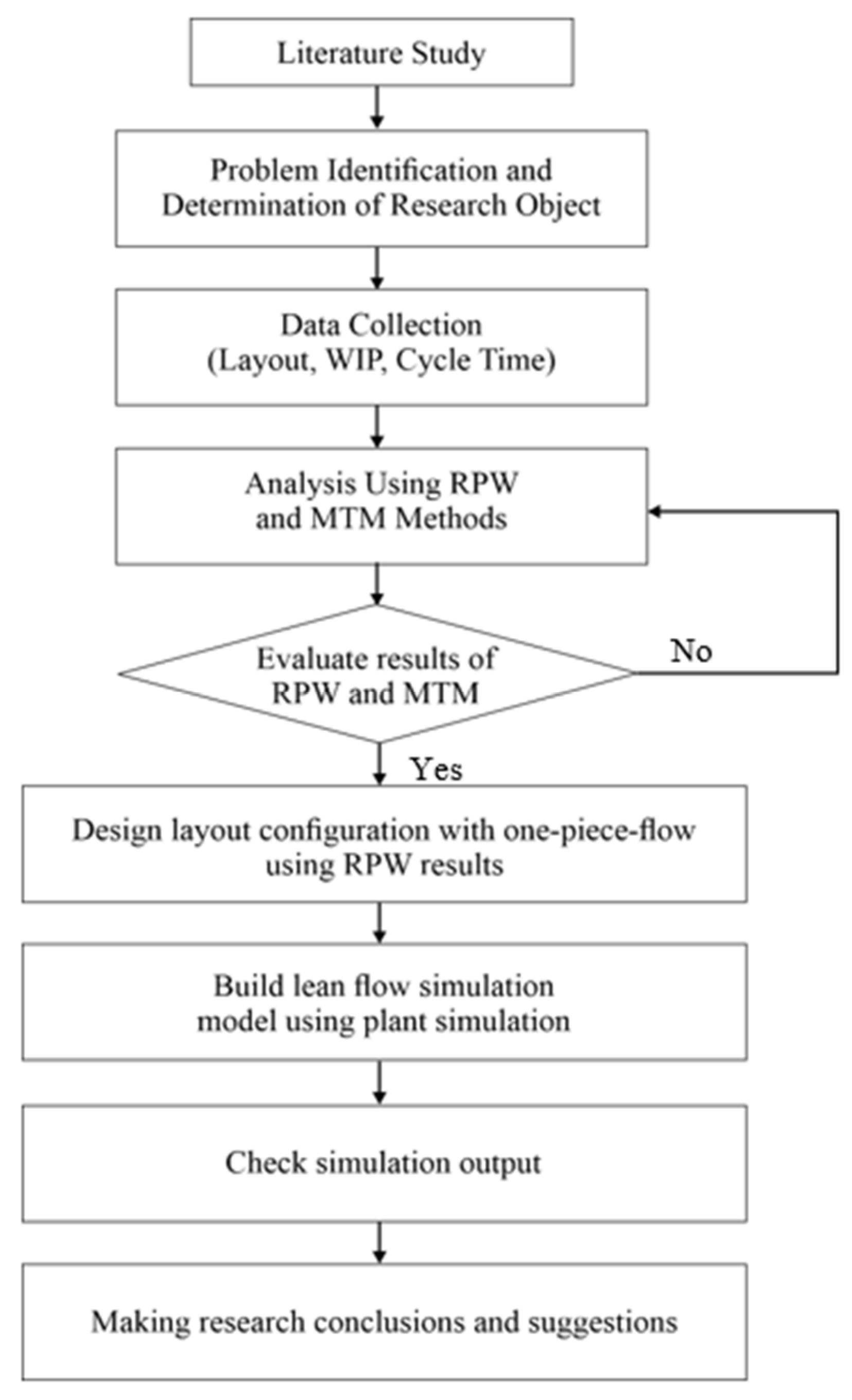
According to
Figure 1, the research methodology illustrated in the flowchart begins with a comprehensive literature study to build foundational knowledge on lean manufacturing, RPW (Ranked Positional Weight), MTM (Methods-Time Measurement), and simulation in production systems. It proceeds with identifying the research problem and defining the specific object of study, followed by data collection involving layout dimensions, WIP levels, and cycle times. This data is analyzed using RPW to balance workloads across stations and MTM to evaluate operator motion efficiency. The results are then assessed to determine their adequacy if found insufficient, the process loops back to refine the analysis. Once validated, the study advances to designing a new layout configuration based on one-piece-flow principles using RPW results. This proposed system is modeled in a digital environment using Plant Simulation software to visualize and test performance improvements. Simulation outputs are examined to verify reductions in WIP, improved lead times, and balanced utilization. Finally, the research concludes by summarizing key findings and offering practical suggestions for system improvement.
2.3. Methodology for Measuring Working Time
Time measurement is a method in work study that aims to record the duration and variation in the execution of a work element under specific conditions [
33]. This data is then analyzed to determine the time required to complete the work at a given level of performance. This measurement plays a crucial role in establishing normal and standard times, which can then be used for various purposes in improving production systems.
The data uniformity test is used to verify whether the collected data is derived from a consistent system. It also helps distinguish data with varying characteristics. This test is conducted based on a specified confidence level or precision level. The confidence level represents the desired degree of certainty when deciding not to conduct an extensive number of observations [
34]. In this study, a 90% confidence level is applied. The uniformity test uses the following formulas:
The test for data uniformity and sufficiency is intended to evaluate whether the collected data originates from a consistent and stable process, as well as to determine if the number of observations is adequate for conducting reliable statistical analysis. It begins with the calculation of the sample mean to determine the central tendency of the data, followed by the computation of the sample standard deviation to assess the degree of variability among the observations. To identify whether the data falls within acceptable limits, control boundaries are established in the form of upper and lower control limits, which are based on a chosen confidence level commonly 90%, with a corresponding statistical constant. These limits serve as benchmarks to detect any outliers or inconsistencies in the dataset. Additionally, the adequacy of the sample size is verified by estimating the minimum number of required observations, which is calculated using the t-distribution, the current standard deviation, and the acceptable margin of error. If the actual sample size is equal to or greater than this minimum requirement, the data is deemed sufficient for further analysis.
- 2.
Normal Time and Standard Time
In the context of work measurement, normal time refers to the time required by an average skilled worker to perform a specific task under typical working conditions, after adjusting the observed time with a performance rating. This adjustment accounts for the pace at which the worker completes the task relative to a defined standard performance level. To calculate the normal time, the observed average time (
tavg) is multiplied by a rating factor (R), which reflects the worker’s speed or effort compared to the standard:
Normal time is determined by adjusting the average observed time based on a worker’s performance level, represented by a rating factor. This factor reflects how efficiently a worker performs a task compared to a standard pace, allowing the calculation of how long the task should ideally take under typical working conditions. To calculate standard time the total time allocated to complete task additional considerations are included to account for unavoidable factors such as fatigue, personal needs, and minor delays. These are incorporated using an allowance factor, which ensures the calculated time remains reasonable and achievable without placing excessive demands on the worker. Expressed as a percentage, this factor adjusts the normal time to better reflect real workplace conditions. By applying both the performance rating and the allowance adjustment, the resulting time standard becomes a reliable and equitable benchmark. This method supports effective workforce planning, realistic scheduling, accurate cost estimation, and performance evaluation within industrial engineering practices.
- 3.
Line Balancing
The assembly process is a manufacturing method in which interchangeable components are put together sequentially, following a specific material flow and layout design. The primary goal of an assembly line system is to maximize the efficient use of production facilities, minimize material handling, and simplify production control. In this context, aligning the flow of production across each workstation becomes crucial. Imbalances in workload capacity, processing time, operator utilization, and equipment efficiency often hinder smooth operations. Therefore, line balancing emerges as a systematic approach aimed at evenly distributing workloads across workstations in a production line, ensuring uninterrupted and coordinated production.
The purpose of line balancing is to allocate tasks to a set of workstations in such a way that the working time at each station closely matches the available cycle time. In other words, it ensures that no station is excessively overloaded or underutilized (idle), which could lead to inefficiencies across the production flow. If not properly managed, such imbalances can result in delays, increased production costs, and reduced productivity and product quality. Soliman [
14] emphasize two key metrics for evaluating the performance of line balancing: Line Efficiency (
LE) and Balance Delay (
BD). Line efficiency is calculated using the formula:
A high LE value indicates optimal utilization of the production line with minimal idle time, whereas a high BD value signifies a significant imbalance in task distribution across stations. These two parameters thus serve as essential indicators for assessing the design and implementation of line balancing and provide a foundation for making improvements in production system performance.
2.4. Data Processing Method
The dataset used in this study was sourced from a toy manufacturing facility and includes various operational observations, specifically related to car fabrication production data. The dataset’s target feature is binary, representing the production status as either Failure or Success, and is encoded as 0 and 1 [
35]. The initial phase of data analysis focuses on data cleansing to address multiple data quality concerns, such as noise, outliers, inconsistencies, and missing values. In this process, we specifically handled missing values and noise, which stemmed from imprecise data collection methods. These issues can have a detrimental impact on subsequent analysis and process outcomes. To manage outliers, we employed outlier labelling techniques, in combination with T-squared statistics (T
2), a method that helps identify multivariate outliers by measuring the distance of each data point from the mean of the data set [
36]. Observations that fell outside the established interval for normal values were considered outliers and were therefore removed. By applying this procedure, we ensured that the data used for further analysis was both consistent and reliable, thus improving the quality and accuracy of the results. The cleansing steps were crucial for ensuring that any data anomalies, such as extreme values or inconsistencies in the dataset, did not distort the final findings. This approach enhanced the robustness of the model, making it more effective in subsequent stages of analysis, and contributed to the overall reliability of the production data used for evaluating operational performance [
37].
In data analysis, a key technique is the identification of outliers, which are data points that deviate significantly from the majority of the data. Outliers can have a profound effect on data models, causing inaccuracies or misleading results. Therefore, it is crucial to detect and appropriately handle these outliers during analysis. A common approach is to work with a set of features,
, which represent the attributes or characteristics of the dataset. Each data point is also associated with a label set,
, that denotes the outcome or category of the data point. The total number of features is represented by
, and the total number of observations in the dataset is denoted by
. To organize and structure the dataset for analysis, a matrix
is used. This matrix contains the feature values for each observation, and it has dimensions of
, where each row represents a different observation, and each column corresponds to a specific feature of those observations. Mathematically, this matrix
can be represented as follows:
where the symbol
represents the set of real numbers, and
refers to the
observation in the dataset. Each observation is defined as an m-tuple (with
being the number of features), and each observation contains all the features corresponding to that data point. The total number of observations in the dataset is denoted by
. Furthermore, the dataset labels are stored in the vector
, which contains the outcome for each observation. This vector is represented as:
where each
represents the label (either Failure or Success) of the corresponding observation. The covariance matrix
of the dataset is given by the following equation:
where
represents the mean of the feature values, and
is the covariance matrix of the dataset. This covariance matrix is computed using the following formula:
This calculation ensures that the covariance is normalized by the number of observations minus one to avoid bias, which is particularly important when working with sample data.
- 1.
Tecnomatix Plant Simulation
Tecnomatix Plant Simulation is a digital manufacturing software used to create computer models of production systems, enabling the visualization, analysis, and testing of material and information flows within a virtual environment. It is selected as a strategic tool because it allows manufacturers to simulate Lean Manufacturing principles, such as one-piece flow and ergonomic workstation redesigns, to identify inefficiencies, such as bottlenecks and excessive work-in-progress (WIP), before physical implementation. The software’s primary value lies in its model validation capabilities, as it quantitatively verifies performance improvements in lead time, productivity, and resource utilization; for example, it was used to validate a 54% reduction in production lead time and a leap in the process ratio from 33.64% to 73.2% in a toy manufacturing case study. Additionally, it validates the success of layout optimizations by measuring the reduction of non-value-added (NNVA) activities and calculating key performance indicators such as Balance Delay and Line Efficiency to ensure a synchronized and balanced workflow. Digital manufacturing software used to create computer models of production systems, enabling the visualization, analysis, and testing of material and information flows within a virtual environment. It is selected as a strategic tool because it allows manufacturers to simulate Lean Manufacturing principles, such as one-piece flow and ergonomic workstation redesigns, to identify inefficiencies, such as bottlenecks and excessive work-in-progress (WIP), before physical implementation. The software’s primary value lies in its model validation capabilities, as it quantitatively verifies performance improvements in lead time, productivity, and resource utilization; for example, it was used to validate a 54% reduction in production lead time and a leap in the process ratio from 33.64% to 73.2% in a toy manufacturing case study. Additionally, it validates the success of layout optimizations by measuring the reduction of non-value-added (NNVA) activities and calculating key performance indicators such as Balance Delay and Line Efficiency to ensure a synchronized and balanced workflow.
- 2.
Feature Selection with Digital AI-Method
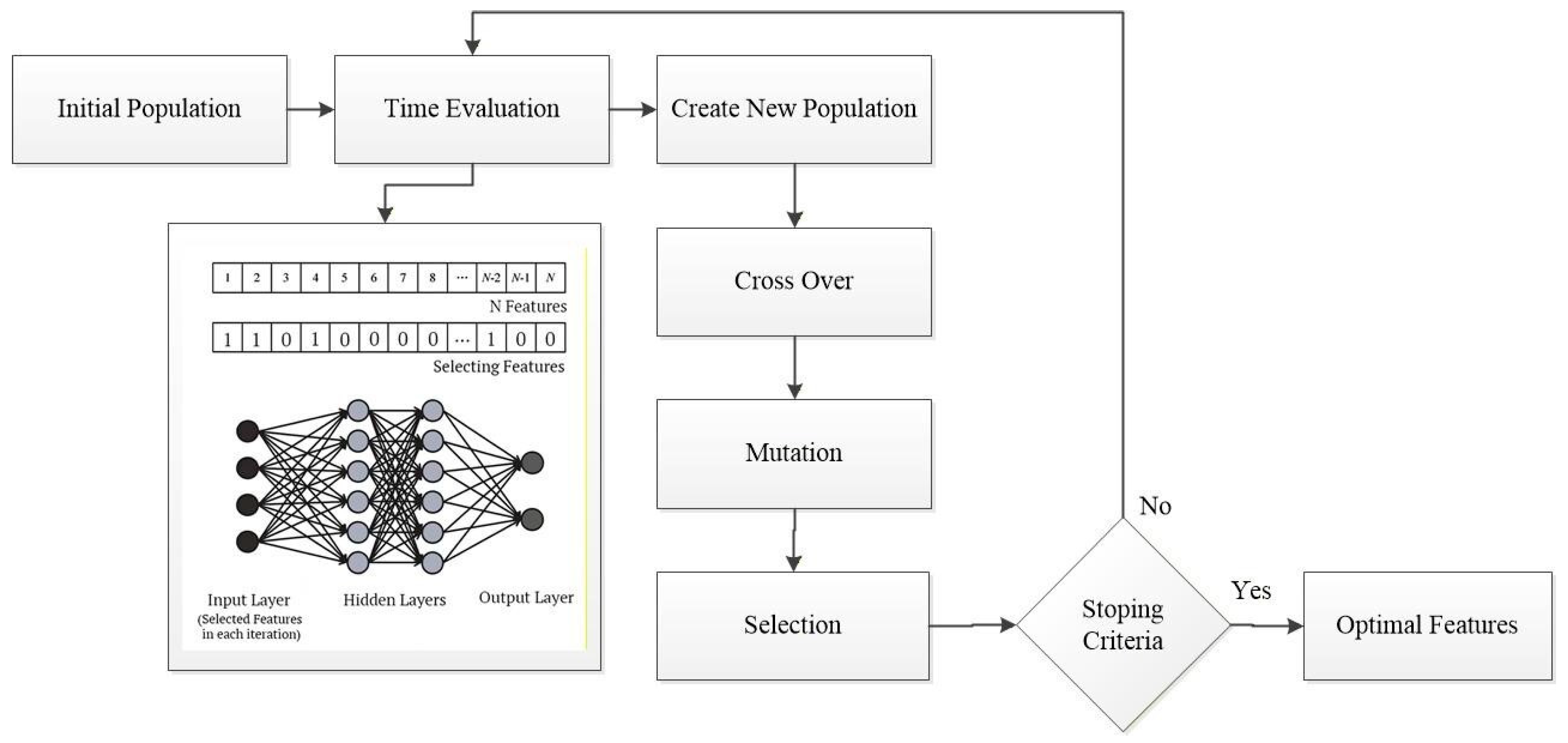
The feature selection model in
Figure 2 uses a combination of Artificial Neural Networks (ANN) and Genetic Algorithms (GA) to identify the most relevant features for a machine learning model, thereby improving its efficiency and performance [
38,
39]. The process begins with the generation of an initial population. Each individual in this population represents a subset of features selected from the original dataset [
40]. These subsets are represented as chromosomes, where each gene (bit) indicates whether a particular feature is selected (1) or not (0). The initial population is randomly created, and its individuals are used as starting points for the evolutionary process that follows. The goal at this stage is to evaluate the performance of these subsets in terms of how well they contribute to the overall model, which is assessed using the time evaluation step. During the time evaluation phase, each individual’s performance is evaluated by training a machine learning model, such as an Artificial Neural Network (ANN), using the selected features. The ANN processes the input features and produces an output that is compared to the expected result to calculate a performance metric (e.g., accuracy, error rate) [
41]. The quality of each individual (subset of features) is determined by how well the model performs with those features. This evaluation is crucial because it helps to identify which feature subsets are most relevant for the model’s success. Once the evaluation is complete, the next step is to create a new population based on the results. This is done using the principles of genetic algorithms, which include crossover and mutation.
Crossover is the first genetic operator used in the creation of the new population. It involves selecting two individuals (parent solutions) and combining their selected features to produce one or more offspring. This operator helps explore new combinations of features by transferring portions of the parent chromosomes to the offspring. After the crossover, the mutation step introduces random changes to some of the offspring’s chromosomes. This mutation helps maintain diversity within the population by occasionally introducing new feature combinations that might not have been discovered through crossover alone. The purpose of mutation is to prevent the algorithm from getting stuck in a local optimum and to encourage exploration of the feature space. Once crossover and mutation are applied, the selection step begins, where the new population is evaluated again, and the fittest individuals (those that have the best performance according to the ANN) are selected to proceed to the next generation. The evolutionary process repeats itself iteratively, with each generation refining the feature subsets through crossover, mutation, and selection, gradually improving the quality of the population. This process continues until a stopping criterion is met. The stopping criterion could be based on reaching a specific performance threshold, a predefined number of generations, or when the population reaches a state of convergence (i.e., when there are no significant improvements in the feature subsets over successive generations). Once the stopping criterion is met, the algorithm outputs the optimal features. These are the selected features that have been determined to provide the best performance for the machine learning model. By using ANN for performance evaluation and GA for optimization, the model efficiently narrows down the most relevant features from a larger set, thus improving the model’s accuracy and reducing computational cost [
40,
42].
2.5. Component Process
In the toy car molding, assembly, and packing process, the work areas are divided into eight component sub-assemblies:
Molding Sub-component;
Molding Accessories;
Assy Sub-component;
Assy Accessories;
Sub-Assembly Complete;
Packing;
Final QC.
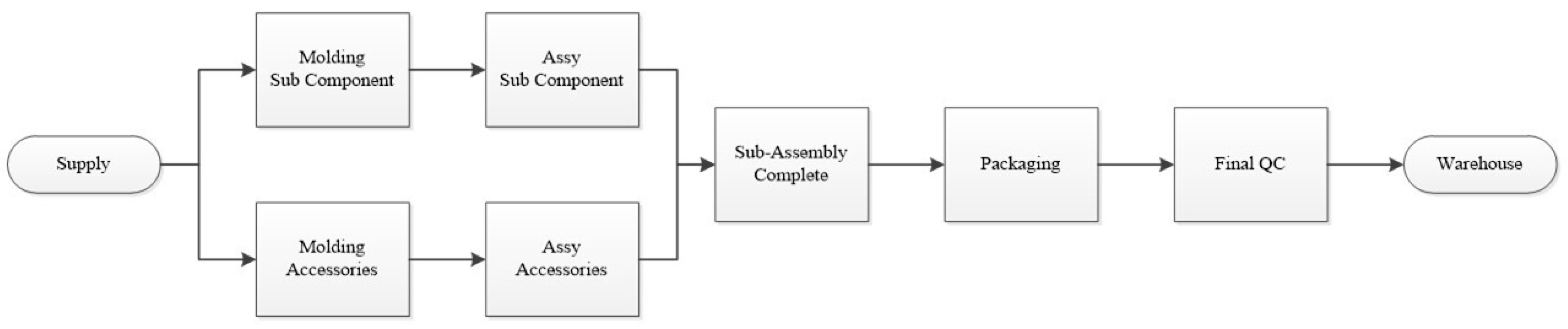
Some of these sub-assemblies are performed in parallel, while others are carried out in series, meaning that the preceding process must be completed first. The work process of these eight sub-assemblies is depicted in
Figure 3.
Figure 3 illustrates the integrated process flow for toy car production, beginning with the supply of raw materials and components. From this point, the process branches into two parallel molding streams: Molding Sub-Component and Molding Accessories. Each molded item then proceeds to its respective assembly stage Assy Sub-Component for primary parts and Assy Accessories for additional features. After assembly, both streams converge at the Sub-Assembly Complete station, where all components are integrated into a complete toy car unit. The assembled units then move to the Packaging stage, followed by Final Quality Control (Final QC) to ensure each product meets quality and safety standards. Upon passing QC, the finished goods are transferred to the Warehouse for storage and eventual distribution. This structured and parallel workflow enhances production efficiency while ensuring rigorous quality assurance.
In the studied production system, boundary conditions are defined statistically as the upper and lower control limits used in data uniformity and sufficiency tests to identify outliers, and operationally as the dashed lines in process diagrams that separate distinct segments, such as molding and assembly. While production is considered “normal” in the sense that workers perform tasks under typical conditions with 100% equipment uptime, the initial current state is highly inefficient with a process ratio of only 33.64% due to significant non-value-added activities. There are no reported breakdowns in the current system, but the sources recommend establishing a weekly preventive maintenance (PM) schedule to ensure continued smooth operations and prevent future machine stoppages. Finally, the provided sources focus on optimizing standard time, cycle time, and line balancing to improve efficiency and do not contain any information regarding the use or necessity of overtime.
2.6. Real-Time Digital Value Stream Mapping System Architecture
The proposed Digital Value Stream Mapping (Digital VSM) framework is developed as a real-time, data-driven analytical architecture that extends conventional static VSM into a continuously updated computational system. Unlike traditional VSM, which relies on manually collected time studies and retrospective analysis, the present framework operates through an event-driven structure integrating production data acquisition, automated processing, AI-based feature selection, and simulation validation. The system architecture consists of interconnected functional layers that enable continuous monitoring and dynamic decision support.
At the data-acquisition level, real-time operational data are captured directly from the production environment via programmable logic controller (PLC) signals, barcode or RFID tracking systems, quality inspection inputs, and operator interface terminals. Each production event, such as cycle start, cycle completion, material transfer, idle occurrence, or defect recording, is timestamped and transmitted to a centralized production database. These raw signals are automatically synchronized and structured to generate key variables, including cycle time, waiting time, transfer time, defect rate, work-in-process (WIP), and machine utilization. This direct integration eliminates subjectivity and measurement bias associated with manual time recording.
The data processing engine classifies operational time into value-added (VA), non-value-added (NVA), and necessary non-value-added (NNVA) categories based on predefined logical rules. Total lead time is automatically calculated as the sum of cycle time, waiting time, and transfer time across all workstations. At the same time, the process ratio is continuously updated as the proportion of value-added time to total lead time. Bottlenecks are detected algorithmically by identifying the workstation with the maximum effective cycle time under current flow conditions. Because calculations are event-triggered, the Digital VSM map dynamically updates after each production cycle, ensuring real-time visibility into performance deviations.
To enhance analytical rigor, the Digital VSM framework integrates an Artificial Neural Network (ANN) model combined with a Genetic Algorithm (GA) for feature selection. The ANN captures nonlinear relationships between production variables and performance outcomes, while the GA optimizes feature subsets by minimizing prediction error. Through this mechanism, dominant waste drivers influencing lead time and imbalance are identified objectively rather than through qualitative judgment. This integration transforms Digital VSM from a descriptive visualization tool into a predictive analytical system capable of prioritizing improvement actions based on quantified impact.
Furthermore, proposed improvements derived from waste prioritization and Ranked Positional Weight (RPW) balancing are validated using discrete-event simulation in Tecnomatix Plant Simulation. The validated future-state configuration is tested under dynamic production conditions to evaluate throughput stability, lead time reduction, and bottleneck elimination before physical implementation. This simulation layer serves as a risk mitigation mechanism, preventing overestimation of Lean gains and ensuring robustness of the proposed redesign. The system also includes a real-time dashboard that visualizes the updated value stream map, line efficiency, balance delay, WIP levels, and dominant waste contributors. When performance indicators exceed predefined thresholds, such as lead time surpassing target values, the system triggers the recalculation of balancing parameters and initiates scenario validation within the simulation environment. This closed-loop logic enables continuous monitoring, adaptive recalibration, and evidence-based decision making. Through this architecture, Digital VSM operates not merely as a digital representation of the process flow but as an integrated computational framework that combines real-time data acquisition, automated performance calculation, AI-driven prioritization, and simulation-based validation. This structural integration addresses the limitations of traditional and static digital VSM approaches by introducing predictive capability, methodological transparency, and dynamic validation aligned with Industry 4.0 manufacturing environments.
3. Result and Discussion
3.1. Current VSM in Production Flow
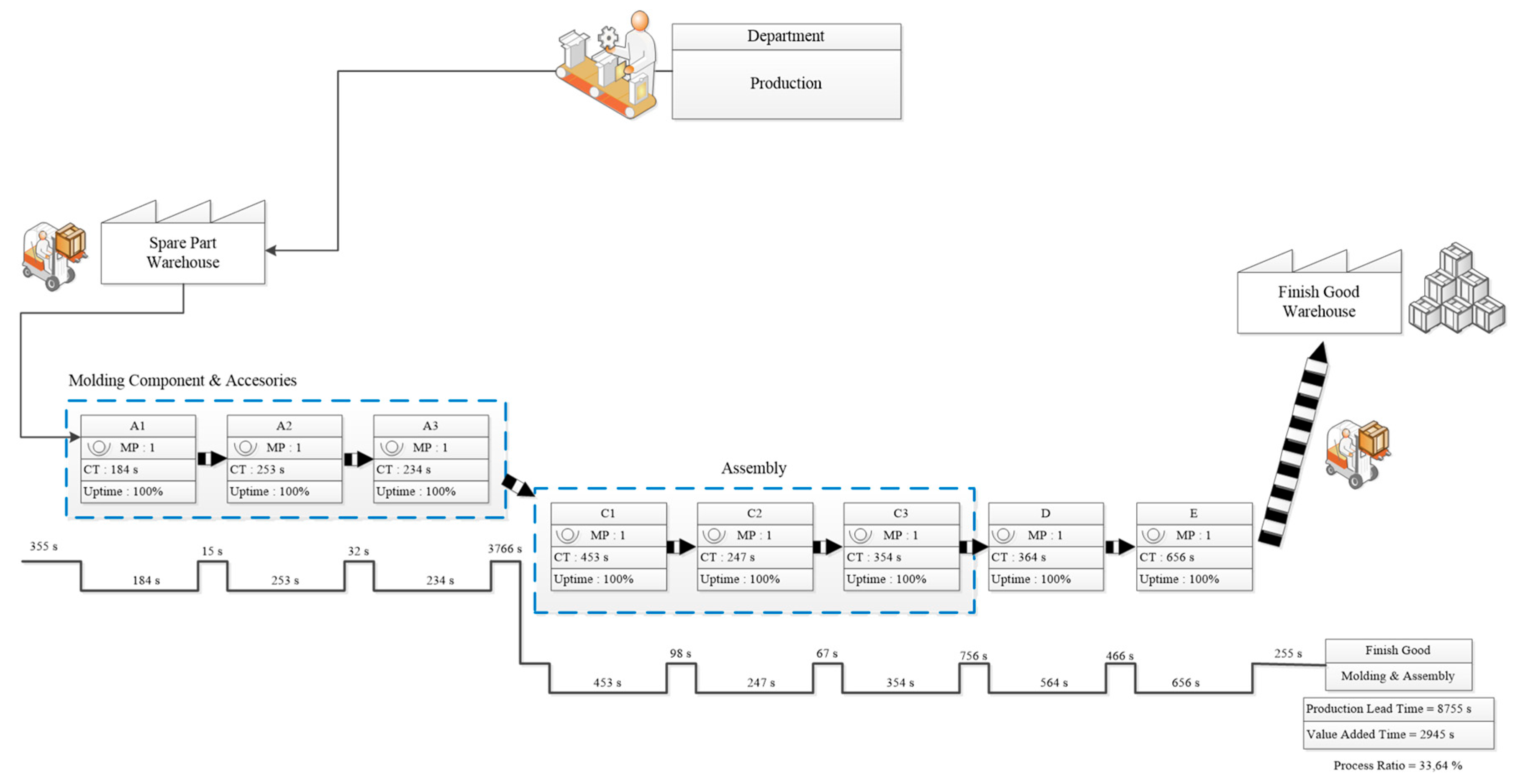
According to
Figure 4 the Digital VSM diagram illustrates a detailed production flow from raw material reception to the final goods warehouse, covering two major segments: Molding Component and Accessories and Assembly. The process begins with the arrival of materials into the system, indicated by an initial buffer time of 355 s. In the Molding Component and Accessories section, three sequential stations A1, A2, and A3 each staffed by one operator (MP:1) and operating with 100% uptime, conduct individual cycle times (CT) of 564, 434, and 434 s respectively. Between these molding stations are buffer times of 184, 15, and 253 s, which may represent inventory buildup or transport delays. Upon completion of the molding stage, materials proceed to the Assembly phase, marked by a queue delay of 32 s. This phase includes six processes: C1, C2, C3, D, and E, each with a CT of 434 s and again with 100% uptime, indicating efficient machine availability but potentially excessive processing time. Each station is operated by one person. Between the assembly stations, buffer or transfer delays include 234, 453, 98, 247, 354, 564, 466, 656, and 255 s respectively these gaps indicate idle times or inefficiencies within the system that add significantly to the total lead time.
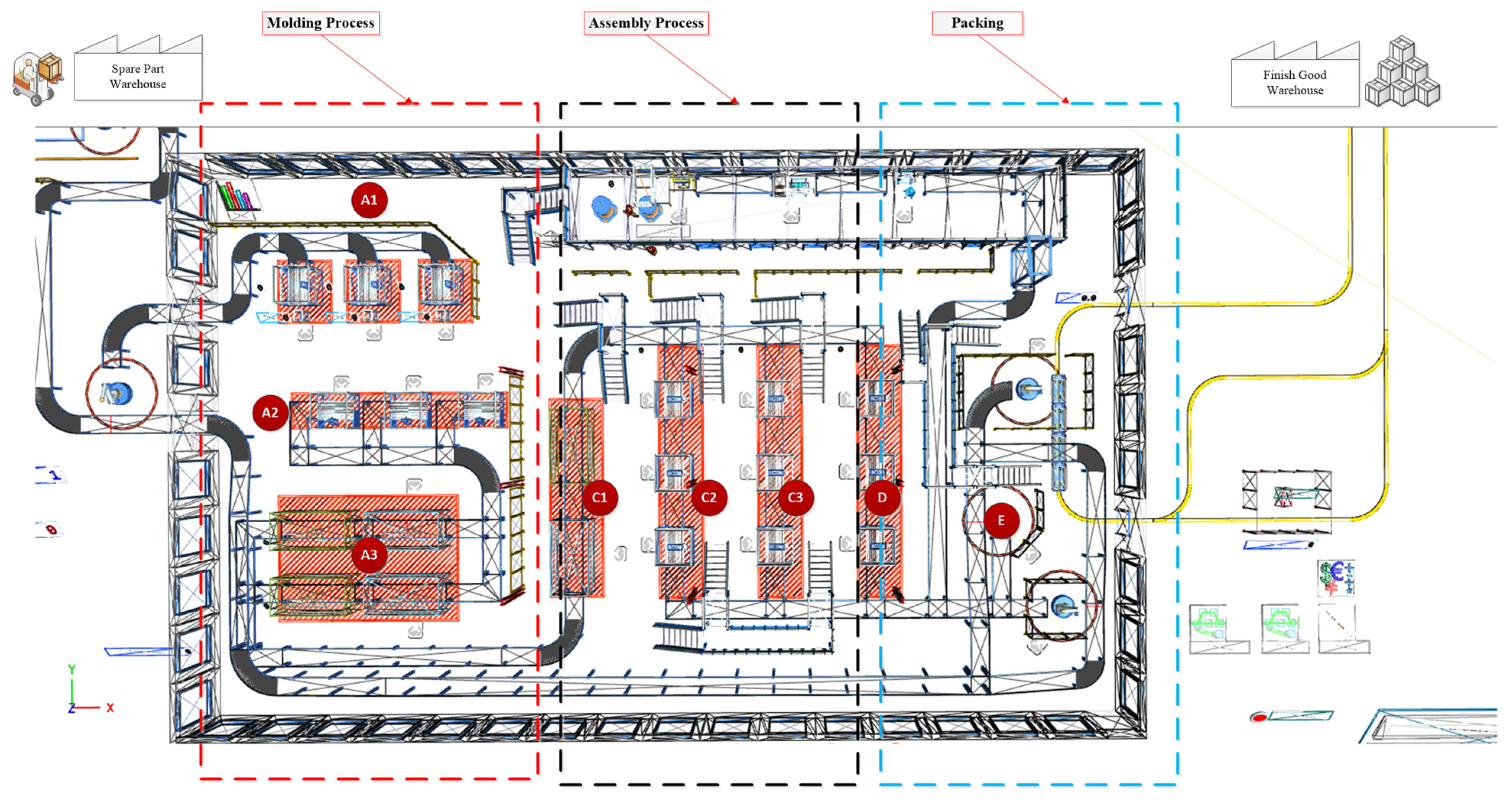
Figure 5 shows illustrate the detailed production flow from raw material reception to the final goods warehouse, divided into two major segments: Molding Component and Accessories and Assembly. In the Molding Component and Accessories section, raw materials are processed through stages such as A1, A2, and A3 to produce molded components. These components then move to the Assembly Process, where they go through multiple assembly stages, marked as B1, B2, etc., to be assembled into the final product. Finally, in the Posting section, the assembled products are packaged and prepared for distribution to the final goods warehouse. The dashed lines in the diagram indicate the boundaries of each process segment, helping to identify potential bottlenecks or inefficiencies throughout the production flow.
The cumulative production lead time for the entire system is calculated at 8755 s, while the value-added time (sum of all CTs) is 2945 s. This results in a process ratio of 33.64%, meaning that only about a third of the total production time is actively used to add value to the product, while the remaining two-thirds represent potential waste in the form of waiting, transport, or inventory. This indicates a relatively low efficiency system that could benefit from lean improvements such as process synchronization, buffer reduction, and layout optimization. Notably, the 100% uptime across all workstations is a positive indicator, suggesting that downtime is not a bottleneck in this system. However, the numerous and sizeable delay intervals between processes suggest issues in flow consistency and inventory management, perhaps caused by batching, lack of pull-system implementation, or limited takt time alignment. Ultimately, this Digital VSM reveals a production line with reliable equipment performance but significant opportunity for throughput and flow optimization. It provides a useful visual tool for identifying non-value-added activities and serves as a foundation for continuous improvement initiatives such as just-in-time production or one-piece flow implementation, aimed at reducing lead time and improving the process ratio beyond its current 33.64%.
3.2. Process Activity Mapping Improvement
Table 1 shows the Process Activity Mapping (Before-Waste Elimination) table outlines the detailed flow of production for toy cars in 500-piece batches, providing a comprehensive view of each process step, the equipment used, time consumed, number of operators involved, and whether the activity adds value (VA) or is classified as non-value-added (NNVA). The process initiates with Step 1, where raw materials are transported from the warehouse to the molding station using a forklift over a 12-m distance, taking 355 s. As this step involves only material movement without transformation, it is categorized as NNVA. Step 2 begins the first value-adding task, involving the molding of Component A1 using Molding Machine A1, taking 184 s. This is followed by a short transfer (Step 3) of 15 s, which, although essential for continuity, is non-value-adding. Component A2 is molded in Step 4 using a second molding machine over 253 s and is followed by another NNVA transfer (Step 5) lasting 32 s. The last molding operation occurs in Step 6 for Component A3 using Molding Machine A3 with a process time of 234 s, marking further VA activity.
Process Activity Mapping Improvements: The following table shows the production process for toy cars in 500-piece packages before waste elimination:
Process faces a substantial bottleneck in Step 7, where a manual transfer to the assembly area spans 42 m and takes 3766 s a significantly large NNVA duration that severely impacts overall process efficiency. Once in the assembly zone, Step 8 resumes value-adding with the sub-assembly of Part C1 at Assembly Station C1, requiring 453 s and one operator. The flow proceeds to Step 9 with a short transfer of 98 s to the next station, which remains non-value-adding. Step 10 handles sub-assembly of Part C2 with a VA duration of 247 s, followed by another short transfer (Step 11) of 67 s to C3. The last sub-assembly step (Step 12) at Station C3 involves 354 s of VA, completing the sub-assembly stage. However, the process encounters another delay in Step 13 with a transfer to Final Assembly Station D over 18 m, taking 756 s another substantial NNVA contributor. Final assembly resumes with Part D in Step 14 at 364 s (VA), followed by Step 15 with yet another transfer (4 m) to Station E, taking 466 s of NNVA time.
The last value-added operation (Step 16) occurs at Station E, where Part E undergoes a 656-s final assembly process. The flow concludes with Step 17, where the finished goods are transported by forklift over 12 m to the Finished Goods Warehouse, consuming 255 s in another NNVA activity. Throughout the mapping, it is evident that although the total process comprises essential manufacturing and assembly steps, a significant portion of the time is occupied by non-value-adding activities particularly Step 7 (3766 s), Step 13 (756 s), and Step 15 (466 s), which collectively form the major bottlenecks. These delays stem primarily from excessive transport, queuing, and potential layout inefficiencies. The table indicates that while the cycle times for actual production steps are consistent and reflect good equipment utilization (each value-added step being under a single operator with 100% uptime), the lengthy idle times between stages drastically reduce overall process efficiency. These inefficiencies contribute to a production lead time of 8755 s, of which only 2945 s are classified as value-added, resulting in a process ratio of just 33.64%. This low ratio underlines the urgent need for lean interventions such as layout optimization, reduction of manual transport time, implementation of synchronized flow, and possibly adoption of automation in transfer processes.
The production process has a total lead time of 8755 s, with only 2945 s contributing directly to value-added activities, resulting in a process ratio of 33.64%. A significant portion of the total time is consumed by non-value-added activities, primarily in three major steps: Step 7, which involves transferring components to the assembly area and takes 3766 s; Step 13, which includes the transfer to station D and accounts for 756 s; and Step 15, the transfer to station E, which adds another 466 s. These steps represent the key bottlenecks and inefficiencies that should be prioritized for improvement in order to enhance overall process effectiveness.
3.3. Identification Waste
The Digital VSM clearly illustrates multiple forms of waste that significantly hinder process efficiency, with the most critical being excessive waiting time, particularly the 453-s delay between C3 and D and the 564-s gap following process E. These idle durations reflect poor process synchronization and unbalanced workflow, contributing to a low process ratio of just 33.64% and resulting in the accumulation of unnecessary work-in-progress (WIP) and inventory between stations. The uniform cycle times predominantly 434 s across several value-added stations suggest possible overprocessing, where tasks may not be aligned with actual complexity, leading to inefficiencies and masking true capacity needs. Furthermore, the continuous 100% uptime at each workstation, in the absence of demand-driven (pull) control, indicates overproduction, potentially generating excess parts that are not immediately required downstream. Another concern is the lack of integrated quality control points within the process flow, which increases the risk of defects passing through undetected until final stages, thereby reducing first-pass yield and increasing rework potential. Transportation waste is also evident, especially in the long transfer from the molding area to the assembly line, while motion waste may result from suboptimal workstation layouts that require operators to perform unnecessary movements. Although each station is manned by a single operator, the inefficiencies across the entire system are compounded by these various forms of Muda (waste). These observations reinforce the need for lean manufacturing interventions, including takt time alignment, implementation of inline quality assurance, reduction of excessive buffers, and improved layout planning to streamline flow, minimize non-value-added time, and ultimately enhance the process ratio and overall productivity of the production system.
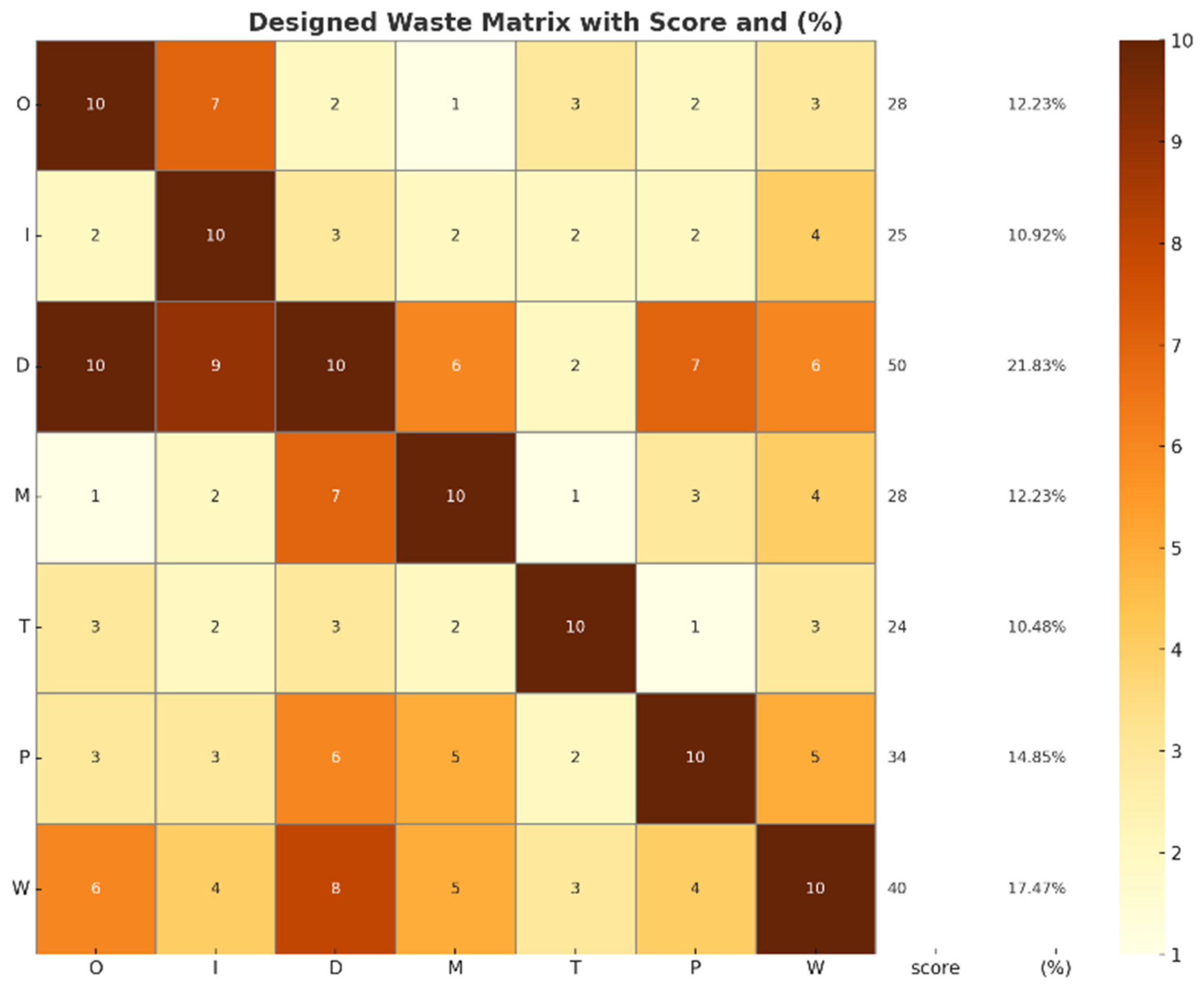
3.4. Waste Relationship Matrix (WRM)
Figure 6 shows a Waste Matrix Visualization, the three most influential types of waste in generating other wastes are identified as Defects (21.83%), Overprocessing (14.85%), and Waiting (17.47%), based on the row-wise percentage contribution (i.e., values from each type of waste). This suggests that these categories are the dominant sources of waste propagation throughout the production system. Specifically, defect waste, contributing the highest score of 50 points or 21.83%, plays a critical role in affecting other types of waste, highlighting how quality issues can lead to additional processing, material wastage, rework, and delays in the production cycle. Overprocessing, at 14.85%, often emerges when operations are more complex or prolonged than necessary, frequently linked to poorly defined standards, redundant steps, or misalignment between design and process capabilities. This not only increases time and resource use but also contributes to downstream defects, motion, and waiting. Meanwhile, waiting accounts for 17.47%, reflecting idle time in the production flow caused by imbalance, bottlenecks, or lack of synchronization, which in turn can induce inventory pile-ups and underutilized manpower. When we examine the column-wise analysis (i.e., “value to” each waste), the Defect waste again stands out, receiving 17.03% of cumulative impact, indicating it is the most frequently triggered waste type by other wastes in the system.
This double occurrence being both a major source and receiver places Defect waste as a central node of inefficiency that links and amplifies other forms of waste. For instance, overproduction can lead to quality degradation due to excessive machine use or unmonitored stock; overprocessing can increase variation and error probability; and waiting can delay feedback or corrective action, allowing quality issues to propagate unnoticed. The scores of motions (12.23%) and Overproduction (12.23%) also indicate a moderate level of systemic interaction, usually tied to inefficient layouts, excessive handling, or lack of streamlined flow. Transportation, at 10.48%, while less dominant, still contributes to operational drag and accumulative delays. Inventory and Transportation appear both as causal and resultant categories but are less critical than the top three. This analysis, rooted in the Waste Relationship Matrix, illustrates how interconnected waste dynamics can be mapped and prioritized for continuous improvement. By targeting high-impact wastes particularly Defect, Overprocessing, and Waiting organizations can break waste chains and realize more effective lean strategies. In conclusion, the matrix provides a clear diagnostic view of which wastes to tackle first and how they ripple through the system, offering actionable insight for root-cause-based waste elimination.
3.5. Identifying Lean Manufacturing
Table 2 illustrates this table provides a valuable basis for prioritizing improvement efforts in Lean Manufacturing initiatives by clearly identifying which waste types have the greatest influence and should therefore be targeted first for elimination or reduction to enhance overall process performance.
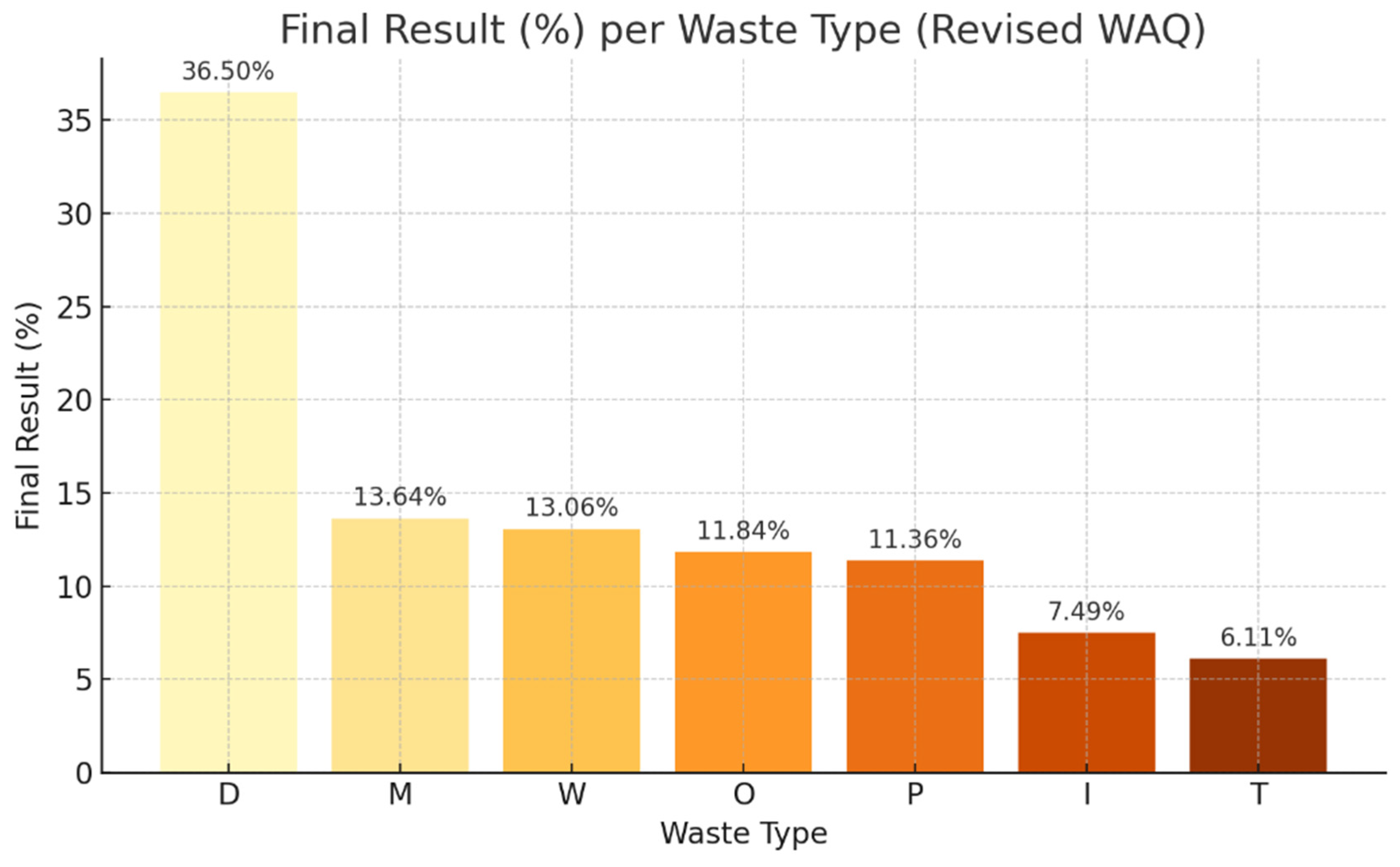
Table 2 presents the revised WAQ, which quantitatively assesses the contribution of each type of waste within the production process based on two core parameters: the weight factor (Yj) and the priority factor (Pj). The multiplication of these two yields the Yj Final score, which reflects the severity and frequency of each waste type, subsequently normalized into a percentage contribution (Final Result %) and ranked for prioritization. Based on the data, Defect (D) stands out as the most critical waste, with the highest Yj value (2.10), a significantly high Pj Factor (499.86), and a resulting Yj Final of 1049.71, contributing to 36.5% of the total waste impact this clearly positions it as the top priority for corrective action. The second and third highest contributions come from Motion (M) and Waiting (W), with final contributions of 13.64% and 13.06% respectively, reflecting inefficiencies such as excessive operator movement, poor workstation layout, or idle time between process steps all of which were also evident in the Process Activity Mapping (e.g., long transfer times and asynchronous workstations). Overproduction (O) ranks fourth, highlighting a mismatch between production output and demand, likely caused by the lack of a pull-based system, as seen in the uniform 100% uptime across stations. Processing (P) also shows a moderate contribution (11.36%), indicating possible redundancies in steps or unoptimized task sequences.
In contrast, Inventory (I) and Transportation (T) are ranked lowest at 6 and 7, with final results of 7.49% and 6.11%, suggesting they are relatively less problematic compared to other types, although still notable in lean assessments. The consistency between WAQ results and the previously analyzed Digital VSM and Process Activity Mapping confirms that the production system suffers primarily from quality issues (defects), long transfer durations (motion and waiting), and batch-driven overproduction, which collectively reduce efficiency and increase operational cost. The structured quantification in the WAQ enables data-driven prioritization, emphasizing the need to implement immediate quality control improvements, layout optimization, operator standardization, and synchronization through takt time alignment. This data not only supports strategic lean implementation but also provides a compelling justification for resource allocation to high-impact problem areas, driving continuous improvement across the production lifecycle.
Figure 7 illustrates the relative impact of each type of waste within the production process, based on updated WAQ calculations. The most significant contributor is Defect (D), accounting for 36.50% of the total waste impact, indicating a major issue with product quality and a pressing need for immediate corrective measures such as inline inspection or process control. This is followed by Motion (M) at 13.64% and Waiting (W) at 13.06%, reflecting inefficiencies caused by excessive operator movement and idle time between processes both of which point to poor layout and unsynchronized workflow. Overproduction (O) and Overprocessing (P) also show considerable contributions at 11.84% and 11.36%, suggesting misaligned output with demand and potentially redundant process steps. Meanwhile, Inventory (I) and Transportation (T) represent the least impactful waste types at 7.49% and 6.11%, respectively, though they still contribute to overall inefficiency.
3.6. Improvement Recommendations
According to
Table 3 the improvement recommendations outlined in the table address critical issues contributing to waste and inefficiency in the production process. Key actions include redesigning the workstation layout to minimize operator movement, converting manual valves to automated systems for improved control and consistency, and addressing poor understanding of Standard Operating Procedures (SOP) by implementing retraining programs. These solutions focus on eliminating inefficiencies, reducing manual errors, and ensuring consistent adherence to established processes. Additionally, motivational coaching and engagement programs will help address low operator focus, ultimately leading to improved performance and morale. Improving material storage through the standardization of shelves and labeling will enhance material handling, reduce time lost searching for items, and minimize misplacement. By targeting root causes such as inefficient layouts, manual processes, and lack of focus, these recommendations aim to streamline operations and reduce defects. Automation and layout redesign offer immediate, high-impact improvements, while retraining and motivational coaching contribute to long-term sustainable improvements in employee performance and adherence to standards.
Table 4 explain a major cause of operator inefficiency is the inefficient workstation layout, which leads to excessive walking back-and-forth. The solution is to redesign the workstation layout to optimize the flow of work, minimizing unnecessary movement. This action will be led by the production manager post-audit. Another significant issue is the use of manual valves due to a lack of automation. The solution is to convert the manual valves to automatic valves with sensors, ensuring smoother and more efficient operations at the dumping station. This will be a one-time upgrade implemented by the technician. Furthermore, poor adherence to SOPs is addressed by retraining staff to ensure a better understanding and compliance. This refresher training will be conducted on the production floor during onboarding and led by the supervisor. Additionally, low work motivation among operators is contributing to a lack of focus and productivity. To resolve this, the supervisor will implement weekly one-on-one motivational coaching sessions to engage and improve the operators’ performance. Lastly, poor material storage practices are creating inefficiencies in accessing and handling materials. The solution is to redesign the storage system in the raw material warehouse, standardizing shelves and labeling. This one-time action will be executed by the operators. By addressing these root causes through a combination of layout redesign, automation, training, motivation, and better storage practices, these recommendations are designed to improve productivity, reduce defects, and create a more efficient and motivated workforce.
Table 5 ranked third with 13.52% impact, focus on resolving key issues within the production process. The first issue, operator idle time, arises from delays in material arrival, which can be addressed by improving the internal logistics system. By integrating internal delivery SOP and enhancing warehouse coordination, the logistics and operator teams can ensure timely material delivery. The second issue, machine stoppage, is caused by the absence of a preventive maintenance schedule. To mitigate this, a weekly PM schedule will be established in the filling and packing areas, with technicians creating an SOP and checklist to ensure the system’s smooth operation. The third issue, shift transition delays, stems from an unstructured handover process. To resolve this, a shift handover SOP will be implemented, and supervisors will use handover forms and allocate buffer time between shifts to ensure seamless transitions. The fourth issue, warehouse capacity constraints, results from production exceeding storage space. The solution involves expanding the warehouse or outsourcing storage during Q1–Q2, with management responsible for collaborating with external logistics partners to secure additional space.
3.7. Activity Mapping Improvements
Process Activity Mapping Improvements: The following
Table 6 shows the production process for toy cars in 500-piece packages after waste elimination.
Table 6 shows the after improvements Process Activity Mapping; this table presents a streamlined production workflow for toy cars in 500-piece batches following waste elimination, showing significant enhancements compared to the pre-improvement process. Most notably, the total time for NNVA activities has been drastically reduced in critical transfer steps. For example, the transfer from molding to assembly (Step 7) was reduced from 3766 s to just 165 s, and the transfer to stations D and E (Steps 13 and 15) were cut from 756 and 466 s to 56 and 52 s, respectively. These reductions indicate major layout optimization, better workstation placement, or improved material handling systems. Although the number of process steps remains the same, the total time devoted to value-added (VA) operations is preserved such as molding and assembly cycle times ensuring that productivity is maintained while reducing idle periods. Compared to the previous mapping, where the process ratio was just 33.64%, these improvements significantly enhance flow efficiency, reduce bottlenecks, and likely increase the process ratio substantially. The updated sequence also suggests better task synchronization and a leaner layout, resulting in less waiting, less motion, and minimized work-in-progress buildup between stations.
3.8. Future State Digital VSM After Improvement
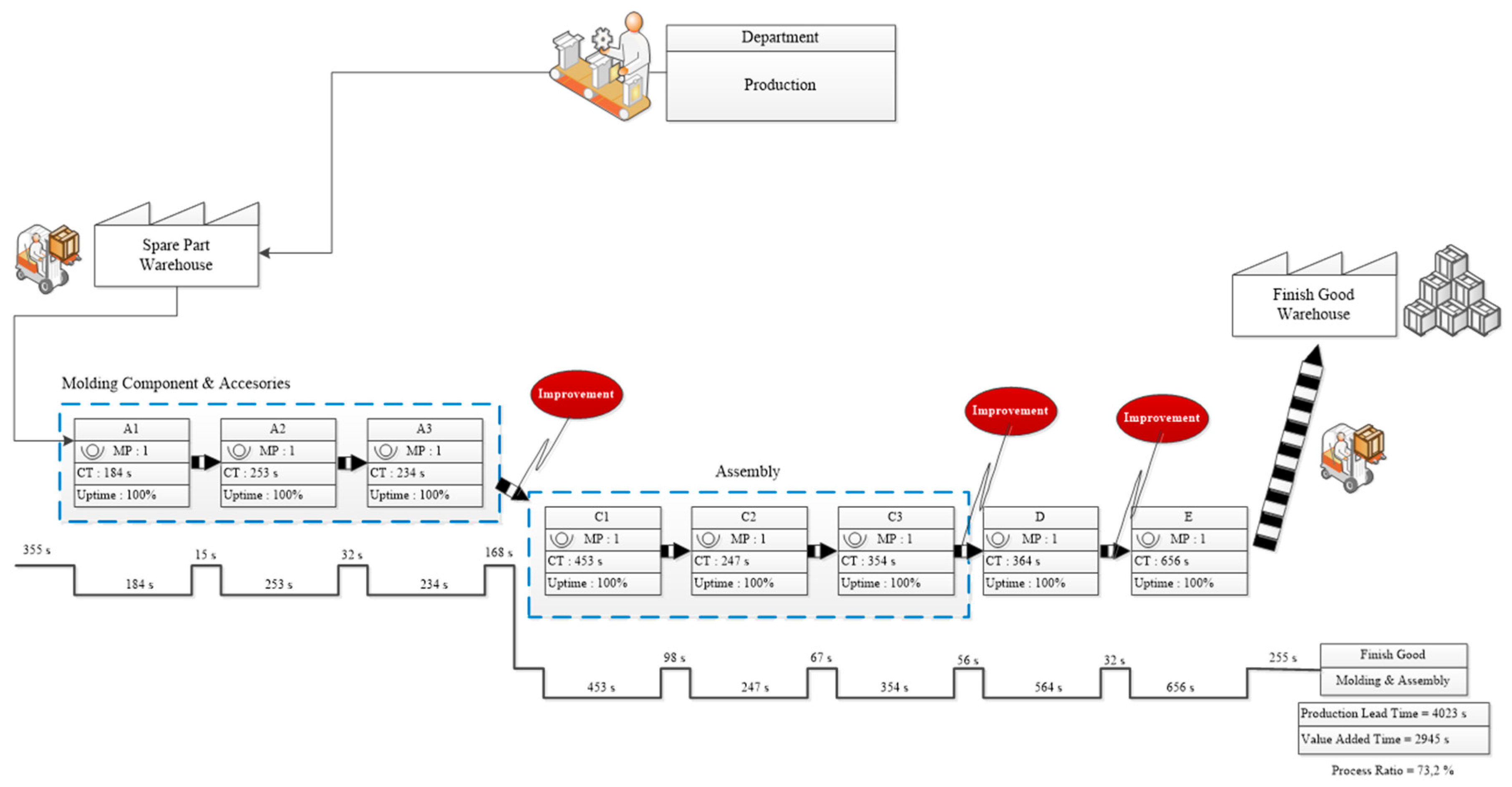
Figure 8 shows the Future State Digital VSM, visualizing the post-improvement production flow for toy car manufacturing, emphasizing significant lean advancements compared to the previous (Current State) condition. In this future state, major inefficiencies particularly excessive NNVA time between critical operations have been systematically eliminated or drastically reduced, leading to a much leaner and more synchronized process flow. The total Production Lead Time has been reduced from 8755 s (before improvement) to just 4023 s, marking a remarkable 54% reduction in total process duration. Meanwhile, the Value-Added Time (VAT) remains relatively constant at 2945 s, indicating that productive, value-creating work is preserved, and all reductions stem from removing waste and improving flow. As a result, the Process Ratio (VAT/PLT), which previously stood at a low 33.64%, has now jumped to an impressive 73.2%, reflecting a highly efficient, waste-minimized process.
Figure 8 highlights three key areas labeled “Improvement” that correspond to previously identified bottlenecks: (1) the transfer from molding to assembly, (2) the handoff from sub-assembly to final assembly at station D, and (3) the transition to station E. In the pre-improvement state, these transitions took 3766 s, 756 s, and 466 s respectively representing the bulk of NNVA activities. Post-improvement, they are now reduced to 168 s, 56 s, and 32 s, demonstrating layout optimization, better workstation arrangement, and likely improved internal logistics or scheduling synchronization. Moreover, while each machine’s uptime remains at 100% and cycle times (CT) for operations such as C1 (453 s), C2 (247 s), C3 (354 s), D (364 s), and E (656 s) are unchanged, the key gain lies in minimizing idle and waiting time between them. This suggests that the improvements were not based on equipment upgrades but on systemic lean interventions such as reducing batch sizes, implementing FIFO lanes, pull-based flow, or takt time balancing.
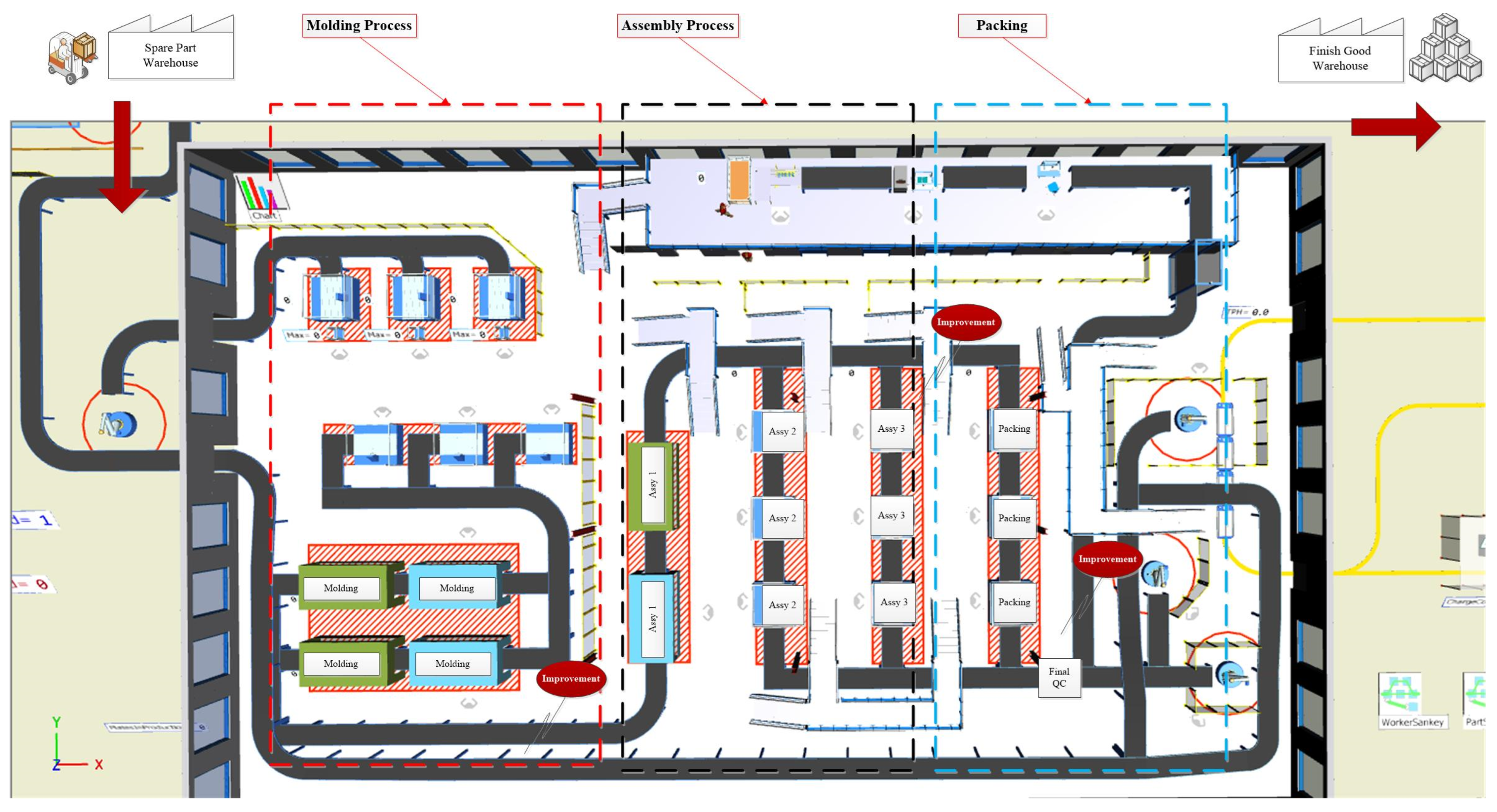
Figure 9 illustrates the post-improvement simulation of a production facility, highlighting key areas such as the Spare Part Warehouse, Molding Process, Assembly Process, Packing, and Final Quality Control (QC). Raw materials are transported to the molding section, where parts are molded and then moved to assembly areas (Assy 1, Assy 2, Assy 3). The products go through packing stations and final QC before reaching the Finished Goods Warehouse. Improvements are marked in red, indicating optimized workflows, better material handling, reduced bottlenecks, and enhanced operator efficiency. Conveyors and designated workstations streamline the production process, ensuring smooth transitions between stages. The layout reflects operational enhancements that aim to minimize waste, balance workloads, and maximize space utilization, ultimately improving overall productivity and reducing operational costs.
Additionally, the visual shows well-aligned material flow from the spare part warehouse to the molding area and eventually to the finished goods warehouse, maintaining smooth horizontal and vertical integration across departments. Compared to the current state, where long horizontal handoffs and process gaps led to scattered WIP and unbalanced task timing, the future state reflects a synchronized production environment with clearer sequencing and reduced accumulation. The efficient line movement also indicates better operator allocation and task division, ensuring that each workstation works in harmony rather than in isolation. It is also evident that the number of operators (MP:1) per station has remained consistent, meaning that throughput gains were not the result of adding manpower, but of optimizing flow and eliminating waste. The structured handoff between C1, C2, and C3 sub-assemblies, followed by D and E in final assembly, forms a well-paced continuous flow supported by lean layout planning. Furthermore, since value-added times remain the same but are now a significantly higher portion of total lead time, the future state exemplifies a successful shift toward lean maturity, where the goal is not just to work faster but to work smarter by eliminating non-value-producing steps. The ultimate benefit is a more agile, responsive, and cost-effective production system, capable of meeting demand without overproduction or excessive inventory. In conclusion, the Future State Digital VSM serves as a clear visual and quantitative representation of the success of lean transformation, showcasing how targeted improvements in high-waste areas particularly motion, waiting, and transportation can yield dramatic results in lead time reduction and process efficiency without sacrificing quality or throughput. It also serves as a model for continuous improvement by demonstrating the power of data-driven mapping, root cause identification, and process reengineering in manufacturing environments.
- 1.
Future State Map of the Molding and Assembly Process
The total operating time across the entire toy car production process from raw material input to the finished goods warehouse has been significantly reduced. The Production Lead Time dropped from 8755 s to 4023 s, while Value Added Time remained constant at 2945 s, resulting in a substantial increase in process ratio from 33.64% to 73.2%. This indicates a major leap in process efficiency and responsiveness. Three primary areas marked as “Improvement” in the Digital VSM specifically the transitions from Molding to Assembly (formerly 3766 s, now 168 s), C3 to D (from 756 s to 56 s), and D to E (from 466 s to 32 s) were targeted for lean enhancement, such as ergonomic rearrangement, workstation proximity, and better flow synchronization.
- 2.
Future State of Sub-Assembly Flow (C1–C3)
The sub-assembly area, consisting of stations C1, C2, and C3, experienced total cycle time optimization through the preservation of value-added activities and elimination of unnecessary delays. With constant cycle times of 453 s, 247 s, and 354 s respectively and the elimination of excessive transfer times, the sub-assembly flow is now more streamlined and balanced, contributing significantly to the improved process ratio. WIP is minimized through FIFO or direct handoffs, ensuring better inventory control.
- 3.
Future State of Final Assembly Area (D–E)
Improvements in the final assembly stations D and E include reductions in transfer delays, layout optimization, and effective workload leveling. Cycle times of 364 s and 656 s remain the same; however, the removal of 522 s of NNVA time in transfers greatly enhances flow efficiency. This area now supports a smoother final integration before finished goods are transported to the warehouse.
3.9. Performance Indicators After Digital VSM Implementation
After implementing the Digital VSM, the production system experienced notable improvements in key performance indicators. The balance delay (BD) was reduced to 8.3%, calculated from the difference between the total balanced line time (4387 s) and the actual production cycle time (4023 s), indicating minimal idle time and a well-distributed workload across workstations. This reduction reflects better synchronization and utilization of resources. Consequently, the line efficiency (LE) increased significantly to 91.7%, suggesting that the production process now operates with optimal coordination of manpower, machines, and time. Additionally, the smoothness index (SI), which reflects workload distribution, was calculated to be approximately 250.75, derived from the variance in cycle times from the average takt time (e.g., deviations from 402 s). This relatively low score demonstrates improved balancing across the assembly line, enhancing flow consistency and reducing bottlenecks.
3.10. Discussion with Literature
To strengthen the academic positioning of this research, the results are compared with ten relevant prior studies spanning Lean Manufacturing, Digital VSM, line balancing, simulation, and AI-based optimization.
According to
Table 7 the significant reduction in Production Lead Time (from 8755 s to 4023 s) and the increase in Process Ratio (from 33.64% to 73.2%) confirm the effectiveness of Digital VSM in identifying and eliminating non-value-added (NNVA) activities. These findings are consistent with Al-Rifai [
43], who demonstrated that digitalized value stream mapping enhances bottleneck visibility and supports the structured redesign of assembly cells. Similarly, Schoeman et al. [
44] emphasized that VSM enables systematic identification of waste propagation across industrial systems. The present study extends this contribution by integrating Digital VSM with quantitative simulation validation.
The achieved Line Efficiency (91.7%) and reduced Balance Delay (8.3%) align with the performance evaluation framework proposed by Forbes and Ahmed [
45], who highlighted LE and BD as primary metrics for assessing line-balancing effectiveness. Furthermore, integrating Ranked Positional Weight (RPW) with Tecnomatix Plant Simulation supports the findings of Islam et al. [
19], who demonstrated that simulation-assisted RPW significantly improves production balancing accuracy compared to manual allocation.
Waste prioritization using WRM and WAQ revealed Defect (36.5%), Motion (13.64%), and Waiting (13.06%) as dominant contributors. This observation confirms the theoretical arguments of Soliman [
14] and Okpala [
21], who identified quality-related waste as a central driver of cascading inefficiencies in manufacturing systems. The interdependency between defects and overprocessing observed in this study also reflects the systemic waste interaction described by Yamamoto et al. [
23].
The drastic reduction in transfer time between molding and assembly from 3766 s to 168 s, and the workflow optimization framework presented by Adepoju et al. [
11], who emphasized automation and layout synchronization as critical mechanisms for minimizing material-handling waste. Likewise, Pekarcikova et al. [
20] validated the use of Tecnomatix simulation in eliminating logistics bottlenecks before physical implementation, a strategy adopted in this research.
The transition toward one-piece flow and pull-based synchronization directly supports the five Lean principles articulated by Middleton and Sutton [
29], particularly the establishment of continuous flow and demand-driven production. This structural redesign also aligns with McCaghren et al. [
32], who concluded that Lean transformation significantly enhances productivity when waste elimination is supported by systematic monitoring. From a digital transformation perspective, the integration of ANN and GA for feature selection aligns with the findings of Mohammed et al. [
39] and Li et al. [
40], who demonstrated that hybrid AI-optimization frameworks enhance manufacturing decision-making accuracy. In addition, the evolution from traditional Lean to Digital Lean observed in this study aligns with Huang et al. [
13], who argued that Industry 4.0 tools strengthen Lean adaptability and responsiveness.
3.11. Framework Illustrates an AI-Driven Digital Value Stream Mapping (Digital VSM)
According to
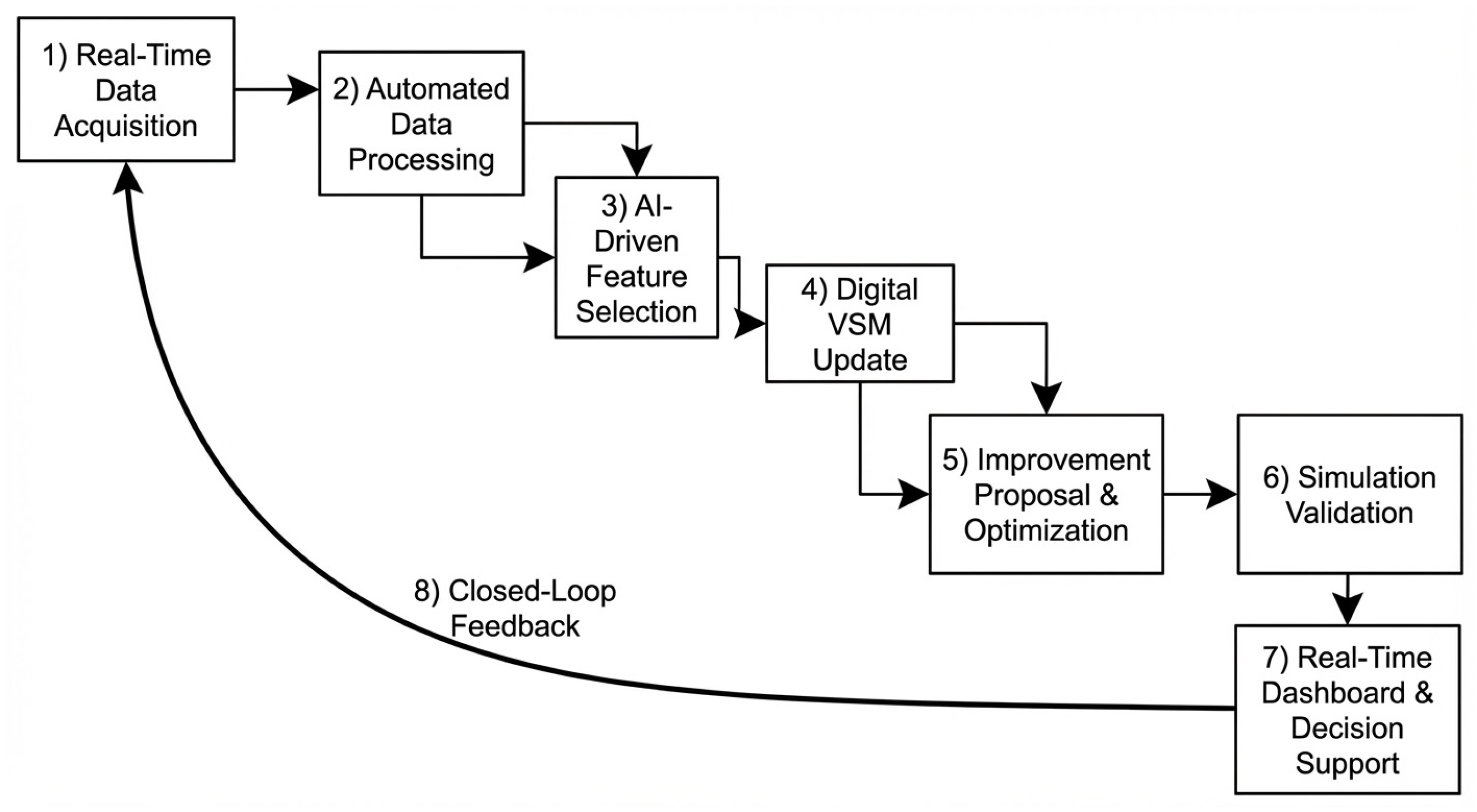
Figure 10 the presented framework illustrates an intelligent, AI-driven Digital Value Stream Mapping (Digital VSM) system designed to support continuous improvement within a closed-loop manufacturing environment. It integrates real-time data acquisition, automated data processing, artificial intelligence, optimization, simulation, and decision support into a single, structured architecture. Unlike traditional Value Stream Mapping, which is static and manually updated, this framework enables dynamic and real-time process evaluation, making it highly suitable for modern Industry 4.0 environments. The first stage, Real-Time Data Acquisition, focuses on continuously collecting operational data from production systems. Data sources may include machine sensors, programmable logic controllers (PLCs), SCADA systems, manufacturing execution systems (MES), enterprise resource planning (ERP) systems, and quality control databases. These data streams typically include cycle time, temperature, vibration, downtime events, defect rates, and throughput information. Because the data are captured in real time, the system reflects actual shop-floor conditions rather than relying on historical or manually recorded reports. This stage lays the foundation for the entire framework, as accurate, timely data are essential for meaningful analysis.
The second stage, Automated Data Processing, prepares raw data for analysis. Industrial data are often noisy, incomplete, or inconsistent. Therefore, automated preprocessing is necessary to handle missing values, filter outliers, normalize variables, and aggregate information across production intervals, such as hourly or batch metrics. Feature engineering may also be used to derive indicators such as Overall Equipment Effectiveness (OEE) or average downtime duration. By automating these tasks, the system reduces human intervention and ensures data reliability. The third stage, AI-Driven Feature Selection, represents the analytical core of the framework. Since manufacturing systems generate large volumes of variables, not all features significantly impact performance. Artificial intelligence algorithms identify which parameters most strongly influence key performance indicators such as lead time, bottlenecks, and defect rates. Techniques such as feature importance analysis, regression methods, or dimensionality reduction can be applied. This step improves computational efficiency and helps reveal root causes of inefficiencies.
In the fourth stage, Digital VSM Update, the system automatically updates the Value Stream Map based on real-time data. Key metrics such as cycle time, takt time, work-in-progress inventory, and waiting time are recalculated dynamically. This transforms VSM from a static visualization tool into a live operational monitoring system. Managers can immediately detect bottlenecks or flow disruptions. The fifth stage, Improvement Proposal and Optimization, uses mathematical models and optimization algorithms to generate alternative improvement scenarios. These may involve adjustments to production scheduling, line balancing, maintenance planning, or resource allocation strategies. Each scenario is evaluated based on predicted performance improvements.
Before implementation, the sixth stage, Simulation Validation, tests proposed solutions in a virtual environment, such as a digital twin or a discrete-event simulation model. This minimizes risk by ensuring that only validated improvements are deployed. The seventh stage delivers insights through a Real-Time Dashboard and Decision Support system. Key performance indicators, predictive insights, and recommended actions are presented visually, enabling faster and more informed decisions. Finally, the eighth stage establishes Closed-Loop Feedback. After improvements are implemented, new data are collected to evaluate results. The system continuously learns and updates its models, ensuring ongoing optimization and sustainable operational excellence.