1. Introduction
Microneedle arrays (MNAs) are devices that are composed of micron-sized needles that are engineered for drug delivery and diagnostic applications in a minimally invasive manner [
1,
2]. These devices are designed to penetrate only the tissue’s outermost layers and to avoid deeper regions that are rich in pain receptors, which enables painless administration and sampling [
3,
4]. Localized and controlled drug delivery is possible using MNAs, which can reduce systemic exposure and side effects [
5,
6,
7].
Production processes such as micromilling, lithography, and injection molding have been used for fabricating MNAs. While these methods are effective, they often include complicated and expensive multi-step processes, which limit scalability [
8,
9,
10,
11]. Three-dimensional (3D) printing is a transformative solution for the fabrication of MNAs, which has significantly revolutionized the production of MNAs by introducing a flexible, rapid, and cost-effective approach [
12,
13,
14,
15]. Three-dimensional printing includes different techniques that are based on a layer-by-layer consolidation of material to achieve the desired structure and shape of the components, allowing reproducibility and high accuracy in MNA fabrication [
16]. Particularly, two-photon polymerization (2PP), digital light processing (DLP), and stereolithography (SLA) are some of the 3D printing methods that enable the construction of complex MNA architectures by offering unprecedented control over MN shape and geometry [
11,
12,
17,
18,
19,
20,
21,
22]. Precision is very important for MNAs, wherein the lumen diameter, MN height, and the tip sharpness of the MNs significantly impact delivery efficiency and patient comfort [
8,
9].
One of the main advantages of 3D printing compared to conventional fabrication methods is the ability to achieve patient-specific customized designs, allowing the fabrication of MNAs that cater to individual patient needs or therapeutic requirements [
19,
21]. Furthermore, the progress made by introducing low-cost, high-resolution 3D printers has remarkably reduced financial and technical barriers, which has facilitated the broader adoption of MNA technology in both research and clinical settings [
23,
24]. Three-dimensional printing can facilitate the development of multifunctional MNAs by enabling the fabrication of dimensionally accurate MNAs, allowing precise drug release at target sites and supporting theranostic applications [
23,
25,
26]. Further, 3D printing technology can enable not only customizable geometries but also the integration of novel biomaterials and hybrid fabrication approaches, positioning 3D printing as a central driver in the next wave of minimally invasive therapeutics [
27].
Despite these advantages, the translation of 3D-printed MNAs into clinically viable devices depends a lot on the design’s optimization. The performance of an MNA is dictated not only by the choice of materials but also by geometric and architectural parameters such as the tip sharpness, aspect ratio, and base diameter. These features govern the mechanical strength, skin penetration efficiency, and drug delivery profiles of MNAs [
28]. The height of MNAs is a fairly critical parameter that influences their penetration depth and functionality. Shorter MNs are much less likely to cause discomfort and pain, making them suitable for applications like vaccine delivery. However, they may not penetrate deep enough to reach capillaries or targeted tissues. Conversely, taller MNs can achieve greater penetration but may increase the risk of skin irritation or bleeding [
12,
29]. Tip sharpness is another vital factor. Sharp tips reduce the insertion force required, which enhances patient comfort and improves the reliability of skin penetration. The aspect ratio, which is defined as the ratio of the height to the base width, must also be optimized for balancing penetration efficiency with mechanical stability. High aspect ratios facilitate deeper penetration but can compromise the structural integrity of the MN under stress [
21]. The arrangement and density of the MNs in an MNA affect drug loading and patient comfort [
30]. High-density arrays can increase the drug payload but may cause overlapping insertion sites, which lead to localized irritation.
Beyond conventional conical and pyramidal designs, morphology-customized MNAs, such as spiral, arrow-like, and tree-like structures, have been proposed to maximize the surface area, drug loading, and release kinetics [
31]. Beveled and pyramid-shaped geometries are widely studied due to their superior penetration efficiency and reduced risk of lumen clogging [
32,
33]. Studies have shown that bio-inspired designs, such as labrum-shaped tips, reduce insertion force quite significantly. For instance, Kawre et al. [
18] reported an insertion force as low as 1.54 N for labrum-shaped MNAs, which emphasizes their efficiency in creating skin microchannels. Penetration efficiency is often assessed by using porcine skin as a model. Studies by Zhang et al. [
34] showed that MNAs with optimized tip angles and uniform channel geometries achieved a consistent fluid delivery and also maintained structural integrity during penetration.
Drug release rate is another parameter that needs customized design within MNAs. For instance, for hollow MNAs, drug release rate is influenced by factors such as needle bore size, tip geometry, and applied infusion pressure [
19,
24]. Ghaznavi et al. [
24] demonstrated how varying tip shapes and interspacing in MNAs impact the release efficiency of fluids to the dermis. Additionally, hollow MNAs need precise control of internal channels to prevent clogging and ensure consistent flow [
14]. The integration of sensors into MNA platforms also requires fine morphological tuning to achieve reliable fluid sampling and analyte detection [
15].
Fabrication variables such as printing resolution, orientation, and layer thickness interact with design choices, influencing fidelity and reproducibility [
35]. Optimizing printing parameters, such as curing times and print angles, has been shown to improve structural quality and reduce defects [
33,
36,
37]. For instance, angled prints in DLP have been found to produce geometries closer to computer-aided designs (CADs), enhancing the mechanical strength and accuracy of MNAs [
37]. Moreover, experimental demonstrations have shown that printing orientation directly influences bevel sharpness and penetration force, underscoring the interplay among geometry and process settings [
38]. Advances in high-resolution printing techniques have further highlighted the significance of design strategies. New 3D printing techniques offer sub-micron precision, enabling the fabrication of MNAs with controlled bevel angles, hollow channels, and multi-scale morphologies [
39].
Early computational studies demonstrated the importance of geometric optimization in balancing sharpness and the mechanical integrity. Finite element analysis (FEA) has been instrumental in optimizing parameters, enabling precise simulation of MNAs’ functions, such as skin penetration and fluid dynamics [
40,
41]. For example, FEA revealed how varying the taper angle and tip radius can alter stress distribution during insertion [
42]. Recent efforts have extended this principle through a machine learning (ML) framework that predicts MNA dimensions based on fabrication inputs. By linking printing parameters and the post-processing steps to the final geometry, these approaches provide data-driven guidance for reproducible design [
43].
Thus, optimizing both design and process parameters is central to achieving robust and reliable MNA performance. The importance of design optimization also extends beyond mechanical reliability. Drug delivery efficiency, pharmacokinetics, and patient safety are directly linked to MNA architecture. Customized patterns, designed using CAD, allow for the optimization of MNA placement to maximize efficacy while minimizing adverse effects.
This review examines the key design strategies that govern the performance of 3D-printed MNAs. It covers the optimization of the individual MNs’ shape and size, ranging from the conventional conical, pyramidal, and cylindrical forms to more advanced hollow, beveled, latticed, and bio-inspired morphologies. Patch-level distribution—including array patterns, spacing, and density trade-offs in multi-array or multifunctional layouts—is also discussed. The pivotal role of CAD, FEA, computational fluid dynamics (CFD), and emerging AI/ML tools in enabling predictive and data-driven optimization is highlighted as well. Finally, this review summarizes manufacturing challenges, resolution and scalability limits, reproducibility concerns, and regulatory standardization, together with some promising directions. Overall, this work offers a compact roadmap for translating the flexibility of 3D printing into more clinically robust and patient-centered MNA technologies.
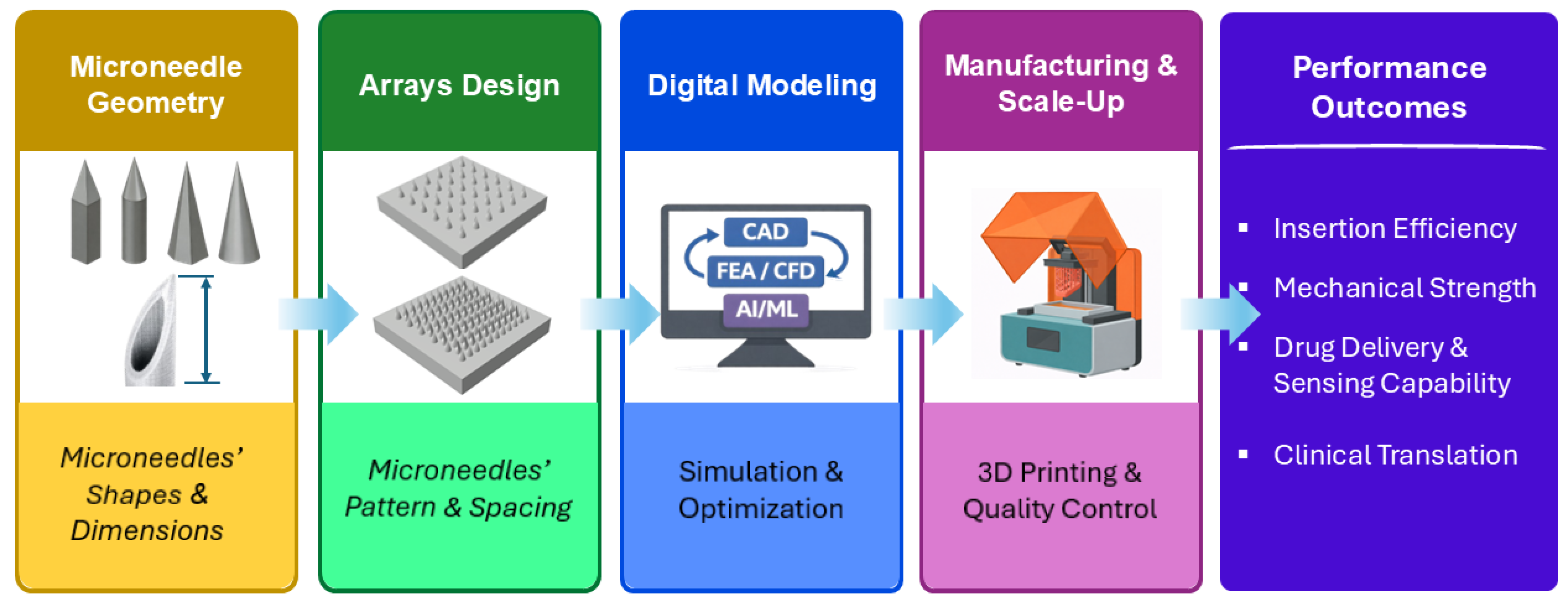
Figure 1 presents a design-centric framework for 3D-printed MNAs, illustrating how MN geometry, array-level distribution, digital modeling and optimization (CAD, FEA/CFD, and AI/ML), and 3D printing with quality control are integrated to govern mechanical performance, insertion efficiency, delivery/sensing capability, and translational potential.
2. Overview of 3D Printing Techniques
Three-dimensional printing has become a highly impactful approach for MNA fabrication. Building structures layer by layer from CADs enables high precision and extensive customization. Multiple 3D printing methods have been tailored for producing MNAs, with each technique providing distinct benefits that align with different application needs [
29,
44]. Among the range of 3D printing approaches, SLA, DLP, 2PP, and fused deposition modeling (FDM) are among the most used techniques for MN fabrication.
SLA is one of the most used 3D printing methods for producing MNAs. It uses an ultraviolet (UV) laser to selectively polymerize liquid photopolymer resins, forming accurately defined solid features. SLA is known for its fine printing resolution and smooth surface quality [
45]. This technique is especially effective for producing complex and detailed MNA geometries. Owing to its flexibility, it has been widely applied in biomedical fields, such as next-generation drug delivery platforms and diagnostic devices, where dimensional accuracy and high-quality surfaces are essential [
12,
29]. SLA has been extensively employed in the 3D printing of MNAs [
9,
45,
46,
47,
48,
49,
50,
51,
52,
53,
54,
55]. It has made it possible to produce a wide range of MNA designs, including hollow, dissolvable, and solid types, for use in transdermal drug delivery [
16,
52,
53,
54]. SLA-printed MNAs have been employed in innovative applications, such as hollow MNAs for transdermal electrochemical sensing [
56], and as base substrates for lab-on-a-microneedle systems capable of rapid biomarker detection in finger-prick blood samples.
DLP is another common 3D printing approach for MNA fabrication. As a derivative of SLA, DLP boosts manufacturing speed by solidifying whole resin layers at once using a digital light projector [
57]. Unlike SLA, which cures the resin one point at a time, DLP projects light over the entire cross-section of a layer in a single exposure. By polymerizing each layer all at once, it shortens curing time and greatly speeds up the overall printing process [
58,
59]. The DLP technique has been extensively utilized in the 3D printing of MNAs [
11,
23,
37,
55,
60,
61,
62,
63,
64]. This method offers a relatively high resolution, typically reaching the micron scale [
65]. DLP-fabricated MNAs made from polyethylene glycol diacrylate (PEGDA) have been developed for uses such as on-demand drug release and multiplex biomarker sensing, monitoring parameters like pH, glucose, and lactate in skin ISF [
23]. In addition, continuous glucose monitoring in interstitial fluid has been demonstrated using solid MNAs printed from biocompatible, photo-curable resins, with in vivo validation reported in mouse studies [
61].
Liquid crystal display (LCD) technology is another method employed for 3D printing MNAs [
33,
36,
54,
66]. Similar to SLA and DLP, LCD is a vat polymerization method that utilizes photopolymer resins to achieve the high accuracy required for fabricating intricate microstructures such as MNAs. What sets LCD apart is its ability to deliver satisfactory resolutions at significantly lower costs, making it an ideal choice for large-scale production of highly complex objects without compromising precision or affordability [
67]. Similar to DLP, the LCD method generally prints at a faster rate than SLA, as it cures an entire layer simultaneously rather than tracing each point individually. However, LCD 3D printing fundamentally differs from DLP in its approach to light projection. While DLP uses a digital micromirror device to project the entire image of a layer, LCD employs a liquid crystal display panel that shines light through its pixels to cure the resin layer by layer. This method minimizes pixel distortion, ensuring consistent quality, but it typically requires slightly more time for curing compared to DLP due to its reliance on pixel-by-pixel illumination [
68].
Static optical projection lithography (SOPL) is another 3D printing approach that has been applied to fabricate MNAs. In the SOPL method, a fixed digital light pattern is projected to trigger polymerization of monomer solutions with high spatial control, governed by the local light-intensity distribution. As SOPL does not require a mechanical motion system, it can produce MNAs extremely quickly, enabling exceptionally rapid MNA fabrication. Moreover, by changing the projected images, SOPL can tailor MNAs into a variety of multi-structure designs [
12]. Furthermore, compression testing has indicated that MNAs fabricated via this method can exhibit superior mechanical performance compared with DLP-printed counterparts. SOPL can also support the accurate fabrication of MNAs with intricate geometries. Its rapid customization capability can yield smooth-surfaced MNAs, which may lessen insertion-related tissue damage and enhance biocompatibility [
19].
As another technology that can fabricate MNAs, 2PP can create extremely sharp tips and intricate internal features. Although 2PP is costly and time-intensive, its ability to produce high-resolution structures makes it a promising choice for research and specialized applications [
12,
20]. Moreover, 2PP technology uses ultrashort laser pulses from a near-infrared femtosecond laser to selectively polymerize photosensitive resins. This process involves the nearly simultaneous absorption of two photons, which generates electronic excitation equivalent to that produced by a single photon with higher energy. This absorption results in a nonlinear energy distribution, focused precisely on the laser’s focal point, with minimal absorption outside the immediate focal volume. When this energy is absorbed, photoinitiator molecules in the resin initiate the polymerization process within localized areas known as “polymerization voxels,” where the energy exceeds a specific threshold. Compared to other techniques, 2PP offers superior geometry control and scalable resolution while reducing the costs associated with equipment, facilities, and maintenance in etching and lithography-based methods. This has made 2PP a versatile tool for fabricating solid and MNAs using materials such as modified ceramics, inorganic–organic hybrid polymers, acrylate-based polymers, polyethylene glycol, and, more recently, water-soluble materials, with highly promising results [
69].
One of the key advantages of 2PP is its ability to achieve resolutions as fine as 100 nm [
70]. Researchers have employed 2PP to mold dissolving and hydrogel-forming MNs using aqueous blends of polyvinylpyrrolidone (PVP) and polyvinyl alcohol (PVA) for controlled drug delivery through skin models [
69]. It has also been used to fabricate MNAs from organically modified ceramic hybrid materials (Ormocer
® , Fraunhofer-Gesellschaft, Würzburg, Germany) for transdermal drug delivery [
71].
FDM is another method that can be used for 3D printing of MNs. In FDM, thermoplastic filaments are melted and extruded through a heated nozzle to build structures layer by layer. While this method is economical and simple, its resolution is limited, making it less suitable for creating the fine details required for MNs [
72,
73]. Despite this, advances in FDM technology have enabled its use in prototyping MNs with relatively simple geometries. Also, although its resolution is lower compared to other 3D printing methods, post-processing techniques like chemical etching can improve its utility for MN fabrication. FDM is particularly suitable for biodegradable MNs [
74].
FDM has been utilized in several studies to produce MNAs [
75,
76,
77,
78]. This 3D printing technique is widely favored due to its rapid production, cost-effectiveness, accessibility, and versatility in material usage [
79]. Post-processing is essential in FDM because printed parts are typically not ready for immediate use. After fabrication, the piece is taken off the build plate, support material is removed, and additional finishing steps are applied to improve surface smoothness and overall quality [
80]. In 3D-printed MNA fabrication, some innovative strategies pair FDM with post-print etching to refine needle dimensions and geometry. The resulting MNA can pierce the skin, detach, and release small-molecule payloads without the need for a master template or molding step [
75]. Additionally, coated polylactic acid (PLA) MNAs have been developed for effective transdermal drug delivery [
78].
Overall, there is clear agreement that photopolymer-based methods (SLA/DLP/LCD/SOPL) and 2PP provide the resolution and surface quality needed for reliable polymeric MNAs, whereas FDM remains mainly useful for low-cost prototyping and simpler designs due to its lower feature fidelity. However, reported “best method” conclusions are sometimes conflicting because the outcomes depend strongly on resin chemistry, post-curing, and geometry, so nominal resolution or printing speed alone does not predict mechanical strength or insertion performance. Key unknowns include standardized head-to-head benchmarks, the impact of residual monomers/photoinitiators on long-term biocompatibility, and scalable quality control strategies that can preserve microscale features at high throughput. These issues matter for design because the printer choice must be matched to target feature size (tip/lumen), material safety, and production scale, with post-processing and verification built in to ensure consistent performance.
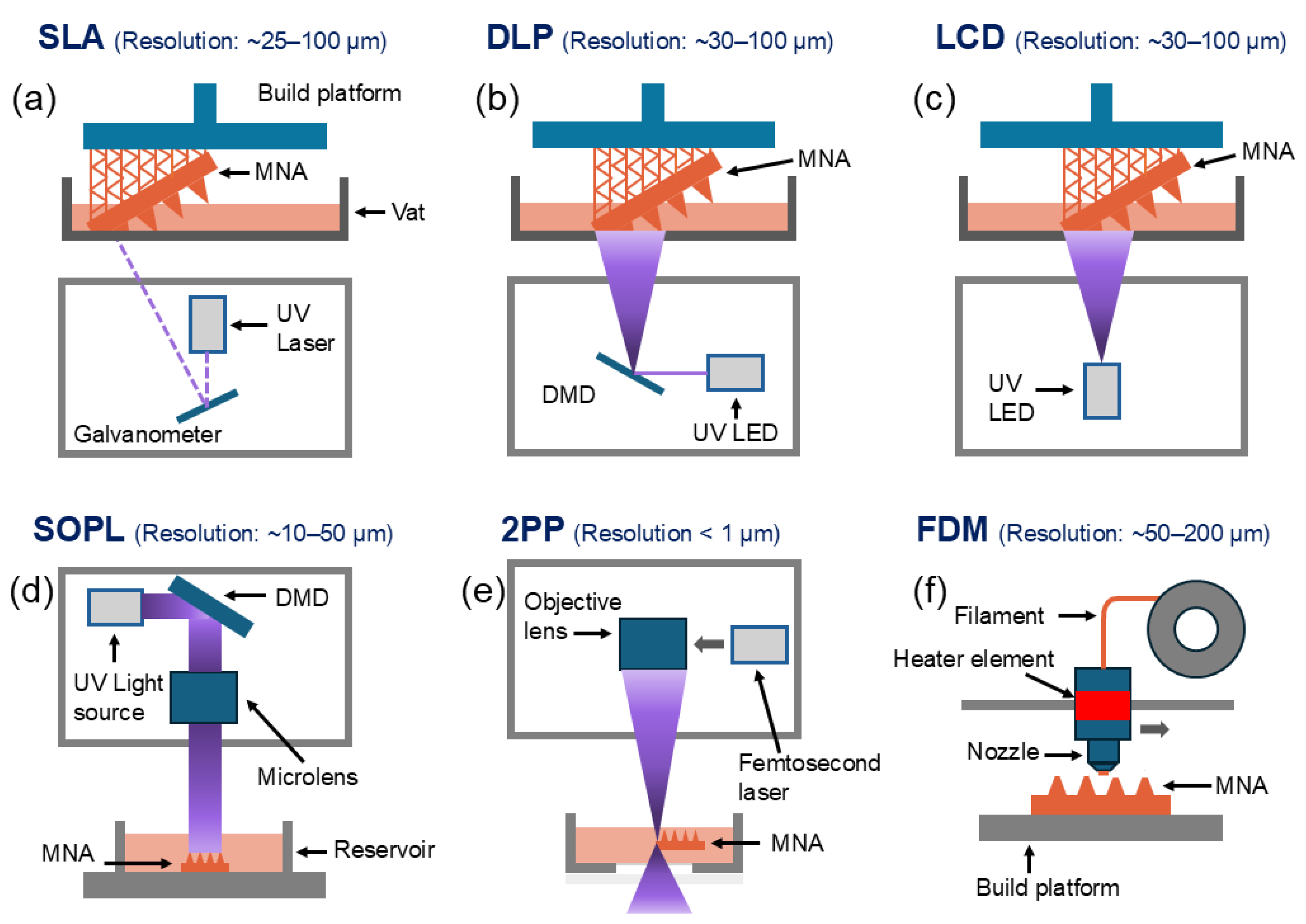
Figure 2 shows the fundamentals of the main 3D printing processes used in the fabrication of polymeric MNAs. These include extrusion-based (FDM), projection-based (DLP, LCD, SOPL), and laser-based (SLA, 2PP) techniques. Variations in light sources and achievable resolutions are highlighted in the schematic [
81].
3. Optimization of Microneedle Shape and Size
The performance of 3D-printed MNs is critically influenced by their shape and the size, which dictate mechanical integrity, insertion efficiency, and also user comfort. Optimizing these geometric parameters ensures that MNs can reliably penetrate the stratum corneum while minimizing pain, maximizing drug delivery efficiency, and avoiding structural failure. Recent advances in computational modeling, high-resolution 3D printing, and experimental validation have enabled a systematic exploration of how geometry translates into performance outcomes.
3.1. Common Geometries: Conical, Pyramidal, and Cylindrical
The most widely studied microneedle (MN) geometries are the conical, pyramidal, and cylindrical forms, with each one offering distinct advantages. Conical MNs are frequently used because their tapering profile provides sharp tips and a relatively uniform stress distribution during insertion. FEA has shown that conical MNs exhibit lower insertion forces compared to blunt-tipped alternatives, reducing the risk of tissue tearing [
35].
Pyramidal designs, including square and the triangular pyramids, are another common class. These shapes maximize penetration efficiency by concentrating the force at the sharp apex, but they are more prone to tip fracture due to the stress localization [
42]. Optimization studies have therefore focused on balancing the apex sharpness with base support to minimize breakage while maintaining efficient penetration.
Cylindrical MNs are less common but have been investigated for applications requiring robust structures. Their uniform cross-section improves resistance to buckling, making them suitable for hollow MNAs and drug reservoirs [
82]. However, their larger insertion area can increase patient discomfort and requires a higher insertion force compared to tapered geometries. High-resolution printing techniques such as SLA and projection micro-stereolithography (PµSL) have expanded the design space to include beveled, the beveled-conical, and the bioinspired forms [
39].
3.2. Advanced and Non-Conventional Microneedle Geometries
Beyond conventional conical, pyramidal, and cylindrical microneedles, a growing body of work has explored non-traditional geometrical configurations designed to impart additional mechanical functionality, anchorage, or fluid-handling capabilities. These advanced geometries leverage the design freedom of high-resolution 3D printing to address limitations associated with penetration stability, drug transport, and biosensing integration.
Barbed and arrowhead-inspired microneedles introduce backward-facing features that enhance mechanical interlocking with soft tissues or wound dressings. Inspired by natural stingers, Fu et al. developed monolithic barbed microneedles using projection micro-stereolithography, demonstrating significantly improved anchorage stability under dynamic conditions while maintaining smooth insertion behavior [
83]. Such designs are particularly advantageous for long-term wearable biosensing and wound care applications, where conventional smooth microneedles may gradually disengage.
Serrated microneedles represent another class of geometry aimed at improving tissue retention and penetration efficiency. Joshi et al. fabricated degradable polyethylene diacrylate microneedles with serrated side features using stereolithography, showing reduced penetration force and controlled degradation while preserving sufficient mechanical integrity for skin insertion [
84]. The presence of serrations alters local stress distributions during insertion, facilitating skin fracture at lower applied loads but introducing potential trade-offs related to stress concentration and print fidelity.
Grooved and open-channel microneedles enable passive fluid transport without fully enclosed lumens. Leng et al. reported 3D-printed microneedles with open surface grooves that exploit capillary forces to extract interstitial fluid from skin tissues [
85]. Unlike hollow microneedles, grooved designs reduce clogging risk and simplify fabrication, making them attractive for minimally invasive biosensing and point-of-care diagnostics.
Collectively, these advanced geometries highlight how geometrical tailoring beyond simple axisymmetric shapes can unlock new functional modalities, including enhanced anchorage, passive fluid handling, and device–tissue integration. However, their increased structural complexity also raises challenges related to mechanical robustness, reproducibility, and scalable manufacturing, underscoring the importance of CAD-guided design and simulation-based optimization.
3.3. Impact of Shape on Insertion Efficiency and Drug Delivery
The impact of MN shape on insertion efficiency is well documented. Conical and the pyramidal MNs generally outperform cylindrical designs in reducing insertion force and ensuring complete skin penetration [
35]. Experimental studies using porcine and human cadaver skin have demonstrated that sharp conical tips enable consistent penetration with reduced variability [
28]. In contrast, pyramidal needles, while sharp, are more sensitive to printing resolution; poorly resolved apexes can be blunt during fabrication, and they may compromise performance [
42].
Shape also governs drug delivery efficiency, particularly in coated and dissolving MNs. Conical and arrow-like geometries provide larger surface areas for drug coatings, improving payload capacity. Yang et al. [
31] designed morphology-customized MNs—spiral, arrow-like, and tree-like—that increased the surface-to-volume ratio, resulting in enhanced drug loading and sustained release. Similarly, beveled hollow MNAs with optimized channel placement demonstrated improved fluid delivery by preventing clogging and facilitating directional flow [
34].
A recent advance that directly links shape to delivery function is the latticed microneedle array patch (L-MAP) architecture, in which each MN contains tapered struts forming hollow cells. The lattice acts as a kind of hybrid “solid–hollow” structure: the strut surfaces accept conventional viscous solid coatings, while void cells physically trap liquid droplets, enabling dual-mode loading on the same patch [
86]. In a CAD-driven design study comprising 43 geometries with subsequent in silico down-selection, L-MAPs achieved greater cargo loading with fewer needles than solid controls and provided tunable release kinetics governed by the needle geometry and formulation; demonstrations included small molecules, protein ovalbumin, and messenger ribonucleic acid (mRNA)-loaded lipid nanoparticles [
86].
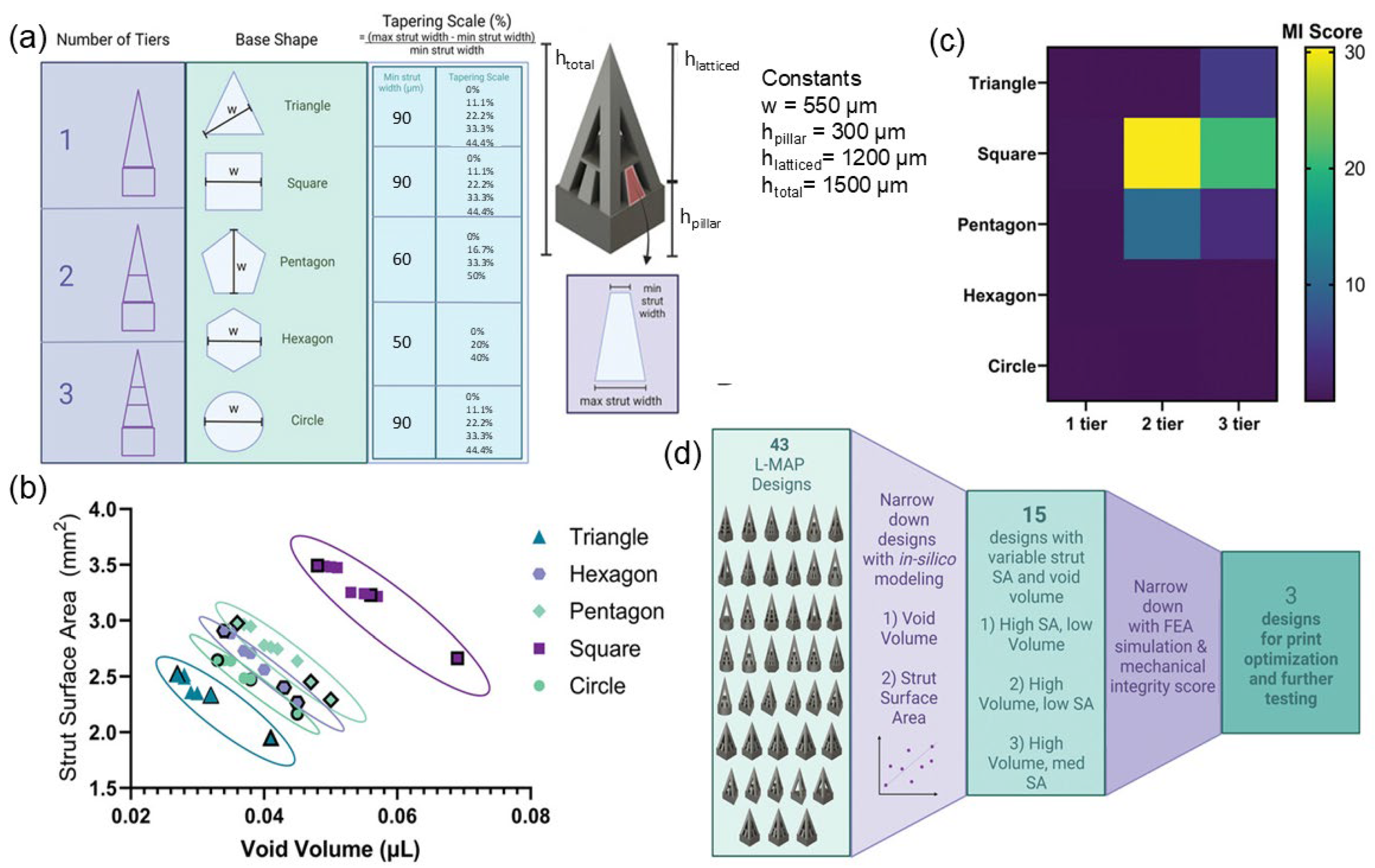
Figure 3 summarizes the CAD-to-experiment workflow for latticed microneedles from Rajesh et al.; the design variables, base shape, tier number, and strut tapering scale are parameterized (panel a); the CAD models are quantified on void volume and surface area to map design clusters and choose exemplars (panel b); the down-selected needles undergo FEA (0.85 N point load) to compute the safety factor, von Mises stress, and tip deformation; and these outputs are used to define an MI score used to prioritize the candidates for printing and testing [
86]. Design variables, base shape (including triangle, square, pentagon, hexagon, circle, and the number of lattice tiers), and strut tapering scale were enumerated, as shown in
Figure 3a. Also, each CAD file was quantified for void volume and strut surface area to map design space and guide selection, as shown in
Figure 3b. From these metrics, representative designs were down-selected and evaluated by FEA under a 0.85 N point load to estimate safety factor, von Mises stress, and tip deformation, which together informed a mechanical integrity (MI) score and experimental validation [
86]. Furthermore, compression testing on 40-needle patches corroborated simulation-predicted rankings and failure behaviors, reinforcing that lattice shape (e.g., base polygon and tiering) can be optimized without sacrificing robustness during insertion [
86].
Insertion reliability is also tied to shape fidelity. Jeong et al. [
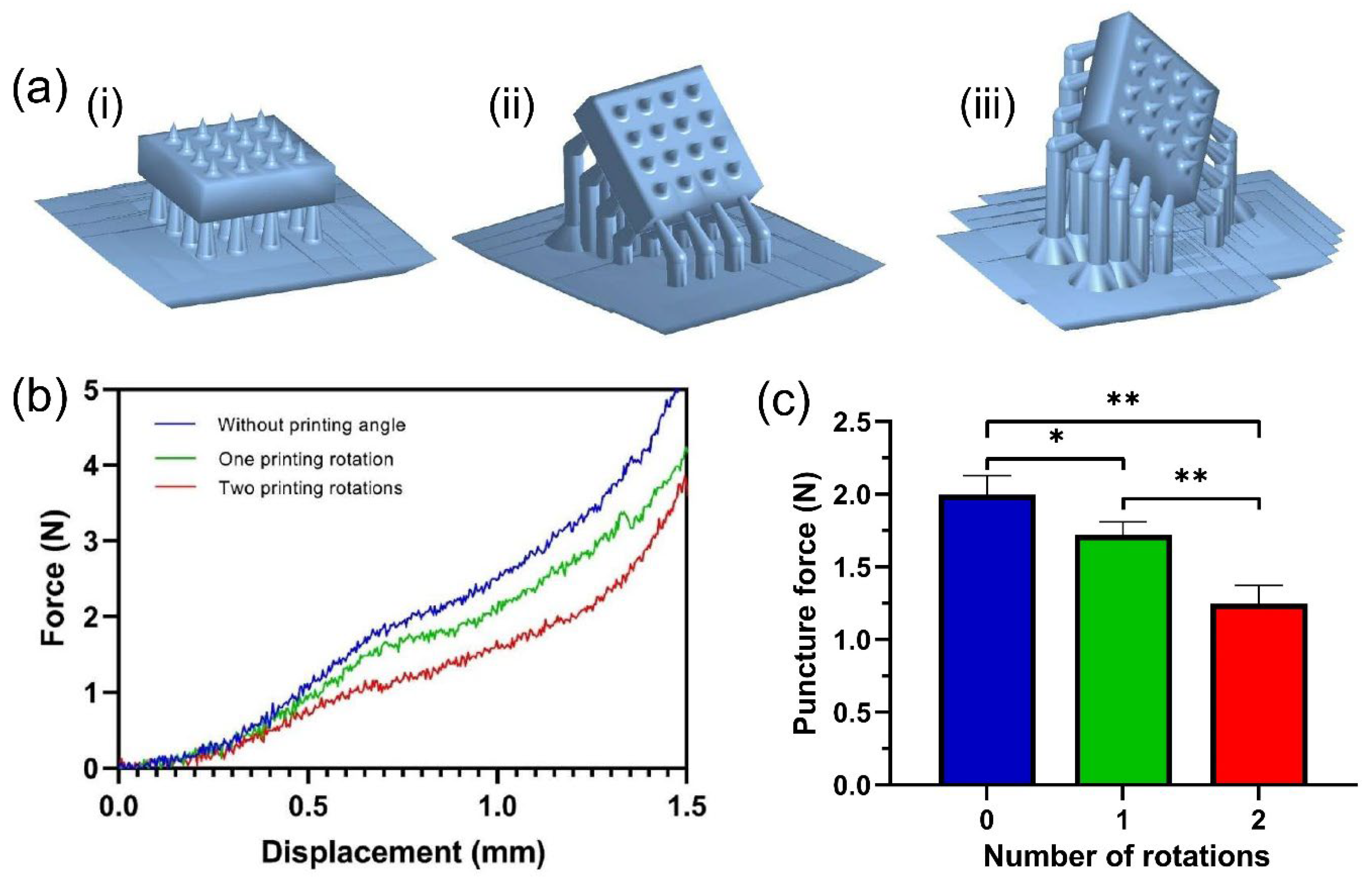
38] reported that the printing direction can significantly influence the bevel angle and tip sharpness, in which MNAs printed vertically achieved better insertion performance compared to inclined orientations. In another study, Razzaghi and Akbari [
63] further revealed that the tilt angle during 3D printing directly affects MNA penetration. The outcomes of this study revealed that tilting the MNA during DLP printing significantly improves penetration performance. Compared to printing without tilt, one and two printing rotations reduce puncture force due to sharper tip formation and reduced staircase effects.
Figure 4 depicts the results of this research [
63].
Computational and ML approaches have strengthened the predictive design of shapes. Rezapour Sarabi et al. [
43] demonstrated that ML models could predict final MNA features (height, base, and draft angle) based on FDM printing and etching parameters, enabling data-driven optimization of insertion efficiency.
3.4. Size Considerations for Structural Integrity and Patient Comfort
Beyond shape, size optimization (including height, base diameter, and aspect ratio) is vital for MNA performance. MNs that are very short may fail to breach the stratum corneum, while excessively long MNs have a risk of causing pain or reaching the dermal nerves and blood vessels. Previous studies report an optimal length between 300 and 900 µm is sufficient for penetrating the outermost layer of the tissue while avoiding deep tissue injury [
82]. Li et al. systematically investigated the influence of MNAs geometry on drug release efficiency, demonstrating that taller conical structures enhanced penetration depth but required optimization of tip sharpness to avoid excessive pain or tissue damage [
12].
Aspect ratio (the ratio of height-to-base width of MN) is a critical determinant of both penetration and structural integrity. High-aspect-ratio MNs achieve better penetration but are vulnerable to buckling. Krieger et al. [
30] developed a customizable fabrication method for high-aspect-ratio MNs that resisted fracture while maintaining sharp tips, demonstrating that mechanical reinforcement strategies are essential to balance performance.
Base diameter also plays a key role in structural stability. A broader base increases mechanical strength but reduces penetration efficiency and elevates insertion force. Finite element modeling by Abdullah et al. [
35] confirmed that small changes in the base dimensions can significantly affect stress distribution and the likelihood of failure. Similarly, Chang et al. used Taguchi optimization to identify ideal size parameters for PLA MNAs, achieving a balance between strength and insertion comfort [
42].
Patient comfort is linked to MN size. Sharper, smaller-diameter tips reduce pain perception, while larger tips can cause discomfort. Experimental transepidermal water loss (TEWL) studies have shown that tip diameters smaller than 20 µm correlate with minimally invasive insertion [
28]. Advancements in precision control have made it possible to tune size with remarkable fidelity. In one study, Jia et al. [
39] showed that the PµSL printing process can provide high resolution, enabling precise manipulation of the tip radius and needle height for optimizing both penetration and drug release.
Customization is another important feature in the design of MNAs. Some specific applications, such as ocular drug delivery, need tailored designs to provide unique anatomical and functional needs. For example, MNAs intended for suprachoroidal injections prioritize smaller tip diameters and sharper angles for navigating delicate ocular tissues, while transdermal MNAs for insulin delivery focus on maximizing flow rates without causing discomfort [
34,
87]. Parrila et al. [
47] developed SLA-printed MNAs with optimized dimensions and structural integrity for agricultural applications. These developed MNAs enable in situ plant health monitoring by facilitating the electrochemical analysis of biomarkers like hydrogen peroxide, glucose, and pH, advancing sustainable precision agriculture through efficient fluid extraction and robust penetration capabilities [
47]. Also, Sarker et al. [
88] evaluated the impact of MNA geometry on cell viability during cell delivery. Their outcomes showed that MNAs with internal diameters higher than 50 μm showed comparable viability to traditional needles, while hollow MNAs with an internal diameter of 25 μm showed significant viability reduction.
The optimization of MN shape and size is a cornerstone of enhancing performance in 3D-printed MNAs. Conical and pyramidal geometries remain the most effective MN shapes for minimizing insertion force and maximizing delivery efficiency, while cylindrical and hollow designs provide structural robustness. Customized morphologies and AI-assisted predictive modeling are expanding design strategies to achieve higher drug loading and controlled release. At the same time, size parameters such as height, aspect ratio, and base width must be carefully balanced to ensure structural integrity and patient comfort. As 3D printing technologies continue to advance, the capacity for finely tuning MNA geometries will play a pivotal role in bridging laboratory innovation with clinical translation.
Table 1 summarizes the major microneedle geometries reported in the literature, highlighting key CAD-controlled parameters, functional advantages, and inherent design trade-offs that guide rational MNA optimization.
Across studies, there is broad agreement that geometry is a primary lever controlling insertion force, failure mode (buckling vs. tip fracture), and payload capacity, with conical/pyramidal shapes generally enabling easier penetration and cylindrical/hollow forms improving structural robustness and active delivery. However, results are sometimes conflicting because reported performance depends strongly on print resolution/orientation, material choice, and post-processing, so the same “shape” can behave differently across platforms. The key unknowns include standardized design rules that link CAD parameters (tip radius, bevel/undercut features, lumen/groove dimensions, lattice porosity) to in vivo outcomes, as well as scalable manufacturability and quality control for complex features (barbs, serrations, lattices). These gaps matter for design because selecting an MNA architecture should balance insertion reliability, desired transport mechanism (coated/dissolving/hollow/capillary), and manufacturability, ensuring the intended geometry can be printed reproducibly without sacrificing safety or comfort.
4. Distribution of Microneedles on Microneedle Arrays
The distribution of MNs across an MNA is a crucial determinant of the MNA’s performance. While the individual MN geometry and size dictate penetration mechanics, the overall pattern, density, and arrangement of MNs within an MNA collectively influence the uniformity of skin penetration, therapeutic coverage, and also structural integrity. The optimization of MN distribution is particularly important in 3D-printed systems, where quite precise control over the array configuration enables a rational design strategy for improving patient outcomes.
Uniform penetration across an MNA requires careful design of the spatial arrangement for MNs. Common patterns include square, triangular, and hexagonal arrays, each offering some trade-offs in terms of the efficiency of packing and load distribution. Square arrangements, for example, are straightforward in design and print, but they may result in uneven force distribution if the patch bends or is applied inconsistently [
42]. In contrast, triangular or hexagonal arrangements enable tighter packing of MNs, reducing the likelihood of dead zones, where the skin remains unpierced [
28,
90].
The spacing between MNs is another critical feature. Highly close spacing between MNs may result in the skin deforming rather than puncturing, which can result in reduced penetration efficiency, while excessive spacing reduces drug delivery efficiency per unit area. Studies employing finite element modeling and insertion experiments have suggested optimal center-to-center spacing ratios that act to balance penetration force with coverage [
35]. Recent high-resolution printing approaches have enabled the fabrication of patches with precisely controlled distribution patterns. Irregular spacing patterns can sometimes be more beneficial, particularly in non-planar anatomical sites, where patch bending alters with penetration angles [
39].
An ideal MNA should maximize skin coverage while maintaining mechanical stability. High-density MNAs provide greater drug delivery capacity and broader coverage, but they can compromise MNA flexibility and increase the risk of MN breakage during insertion. MN density strongly affects both the penetration depth and overall reliability of insertion, with higher-density patches sometimes exhibiting incomplete penetration due to local skin compression [
82]. Economidou et al. [
28] demonstrated that patches with the overly dense arrays suffer from reduced coating uniformity on individual needles, directly impacting drug loading and release.
FEA and the experimental validation have shown that the baseplate of the MNA is as important as the MN density. A flexible baseplate allows conformal contact with curved skin surfaces, but excessive flexibility may reduce the uniform distribution of the force across the MNA, which can lead to partial penetration. Conversely, rigid baseplates ensure even force distribution but may cause some discomfort or even reduced adhesion [
14]. The challenge of balancing coverage with stability is particularly relevant for hollow MNAs. Zhang et al. [
34] showed that hollow MNAs for insulin delivery require optimized spacing to prevent channel collapse or clogging during insertion.
To balance coverage with structural stability, Dervisevic et al. [
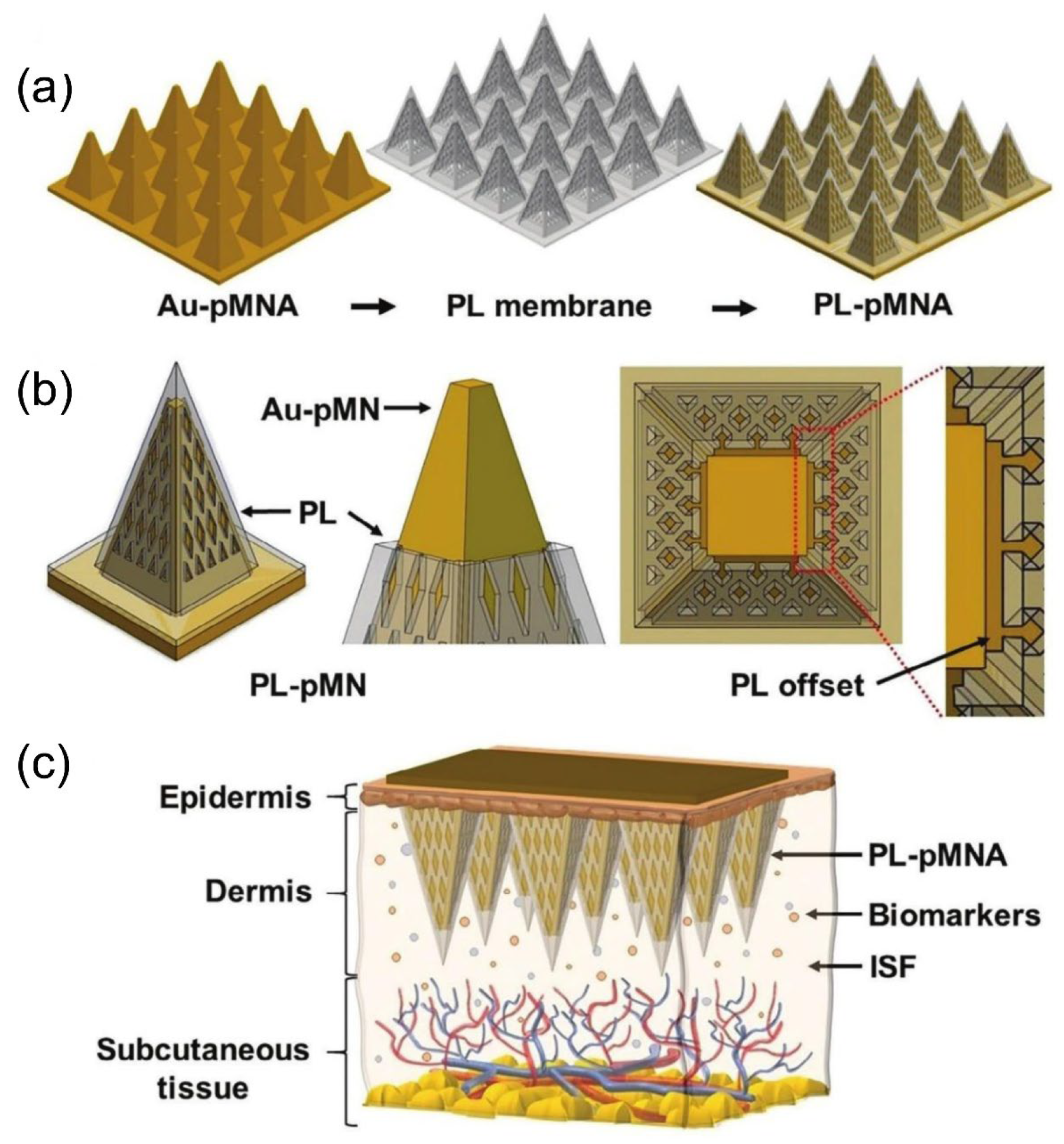
89] introduced a polymeric lattice microstructure-based microneedle array (PL-pMNA) that couples an Au-coated polymeric MNA with a free-standing polymeric lattice (PL) membrane. The PL membrane functions as a protective layer that can preserve the biosensing surface during insertion or removal while keeping the electroactive area accessible. They developed a 4 × 4 MNA layout with an approximately 800 µm pitch and 600 µm MN height, paired with an approximately 730 µm PL bearing the diamond micro-openings, thus achieving robust piercing without sacrificing spacing uniformity and addressing array density/robustness trade-offs.
Figure 5 depicts the PL-pMNA concept: (a) the assembly of an Au-coated polymeric MNA and a PL membrane; (b) a cross-section showing the deliberate offset between the PL membrane and the Au surface that protects the sensing layer; and (c) a skin-piercing schematic illustrating the interstitial fluid (ISF) interfacing, linking patch-level protection with reliable penetration [
89].
MNAs can be designed to cover larger surface areas or to incorporate distinct functional zones that are each optimized for a specific therapeutic task. Three-dimensional printing facilitates integration of multiple MNAs into a single patch, which enables hybrid designs that combine solid, hollow, and dissolving MNAs within one device [
15]. Rajesh et al. [
91] proposed MNAs with modular designs, where separate arrays could deliver different drugs or act as sensing modules alongside therapeutic needles.
In another study, Yang et al. [
31] demonstrated how morphology-customized MNs, when arranged in multi-array patches, enhanced both drug loading capacity and sustained release profiles. For example, tree-like MNs in one array could serve as high-capacity drug reservoirs, while conical MNs in an adjacent array ensured efficient penetration. Such hybrid arrays underscore the potential of 3D printing to produce patches with heterogeneous yet complementary designs. Hollow MNAs with distributed reservoirs have been developed for controlled insulin delivery, demonstrating that larger multi-array patches improve glucose regulation compared to single-array devices [
34]. Similarly, 3D-printed MNAs with separated sensing and delivery arrays are being explored for closed-loop systems, where one array monitors biomarkers while another delivers drugs in response [
14].
From a clinical perspective, MNAs can improve patient adherence by reducing application frequency. By combining high-density arrays with controlled release designs, therapeutic doses can be delivered over extended periods, minimizing the need for repeated applications.
The distribution of MNs on MNAs represents a key design dimension within the optimization of 3D-printed MNA systems. Array arrangement, density, and multi-array configurations collectively shape penetration uniformity, drug delivery capacity, and therapeutic outcomes. Square, triangular, and hexagonal arrangements offer different trade-offs in packing efficiency and penetration uniformity, while density optimization ensures a balance between coverage and structural integrity. MNAs, enabled by the versatility of 3D printing, extend these principles by integrating multiple geometries, functions, or drug reservoirs into a single device. Ultimately, rational distribution strategies link microscale geometry with macroscale therapeutic performance, positioning 3D-printed MNAs as versatile platforms for personalized medicine.
Overall, studies agree that the pattern of array and pitch/density strongly affect penetration uniformity and dose coverage, with triangular/hexagonal packing often improving coverage compared with simple square layouts. However, overly dense arrays can cause skin deformation, poorer coating uniformity, and higher breakage/clogging risk, so “more needles” is not always better. Key unknowns are robust design rules linking the density or pattern to skin site curvature, baseplate stiffness, and application force. This matters in design because array distribution must balance coverage with reliable and repeatable penetration and structural stability.
5. The Role of Computer-Aided Design and Simulation
The rapid advancement of 3D printing has transformed the fabrication of MNAs, allowing highly customized structures with almost unprecedented precision. Yet, the design space of MNs, encompassing geometrical parameters, material characteristics, and patch distribution, is vast and complex. To navigate this complexity, CAD, simulation models, and Artificial Intelligence (AI) are increasingly leveraged to optimize MNA performance. These digital approaches bridge the gap between theoretical design and experimental validation, reducing trial-and-error cycles, which improves reproducibility and accelerates clinical translation.
CAD platforms are central to the modern design of MNAs. They can enable the creation of highly detailed digital models that specify dimensions such as tip radius, base diameter, aspect ratio, and internal channel geometry. These models can then be directly translated into 3D-printable files, streamlining the transition from concept to prototype. By enabling high-resolution, reproducible digital models, CAD serves as the foundation for all subsequent simulation and optimization efforts in MNA design.
Advanced CAD tools also assist the exploration of non-traditional morphologies. Yang et al. [
31] extended this concept by designing morphology-customized MNs, including spiral, arrow-kind, and tree-kind geometries, using SolidWorks (Dassault Systèmes, Waltham, MA, USA). These CAD-guided designs offered increased surface area for drug loading and sustained release, highlighting the role of digital tools in widening the functional repertoire of MNAs. Also, Zhang et al. [
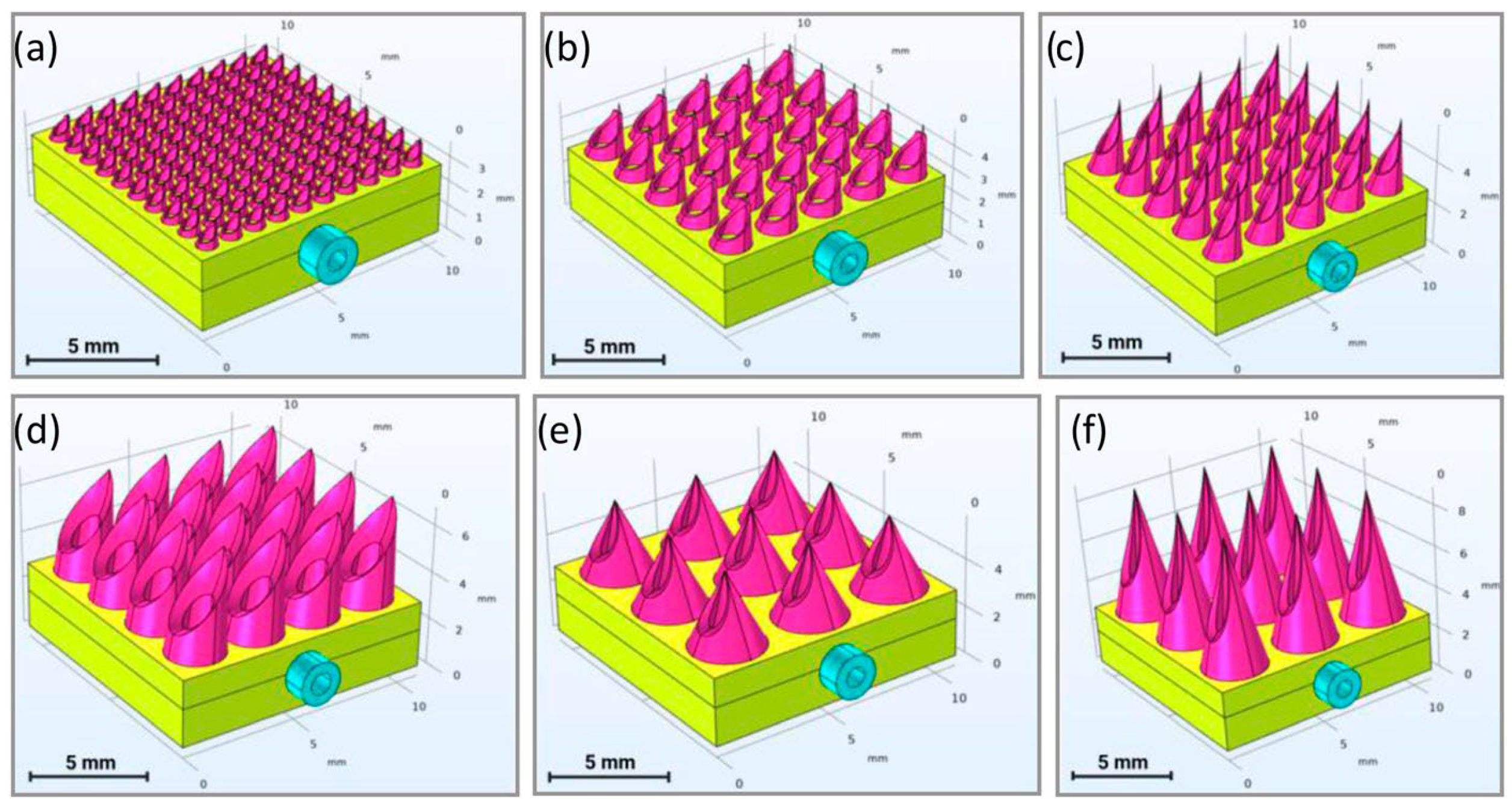
34] developed syringe-style hollow MN geometries and optimized the internal channel diameter using a COMSOL-based CAD/CAE workflow (COMSOL Multiphysics® 5.6). This study underscores the central role of CAD and simulation in rational MNA development: CAD-driven parametric modeling enables systematic variation of hollow MN geometry, array density, and channel dimensions, allowing rapid virtual screening before fabrication. Finite element analysis ensures that insertion loads remain well below measured fracture thresholds while maintaining sufficient penetration depth for transdermal insulin delivery. In parallel, CFD simulations of flow through syringe-shaped MNAs guide channel design to maximize flow rate while minimizing clogging risk. Notably, the availability of open design files further supports reproducibility, comparative evaluation, and iterative optimization toward translation.
Figure 6 summarizes the six COMSOL-based prototype array designs explored in this study [
34].
Jia et al. [
39] used the PµSL process to fabricate MNs with precisely handled tip sharpness and layer thickness. Their CAD workflow enabled the systematic tuning of parameters, such as exposure time and printing angle, which directly impacted the fidelity of the microstructures.
Chang et al. [
42] demonstrated how CAD-based design, combined with FEA, guided the fabrication of polylactic acid (PLA) MNAs. By iteratively refining the geometry, the study identified optimal taper angles and base support dimensions that minimized insertion force while maintaining mechanical integrity. Similarly, Abdullah et al. [
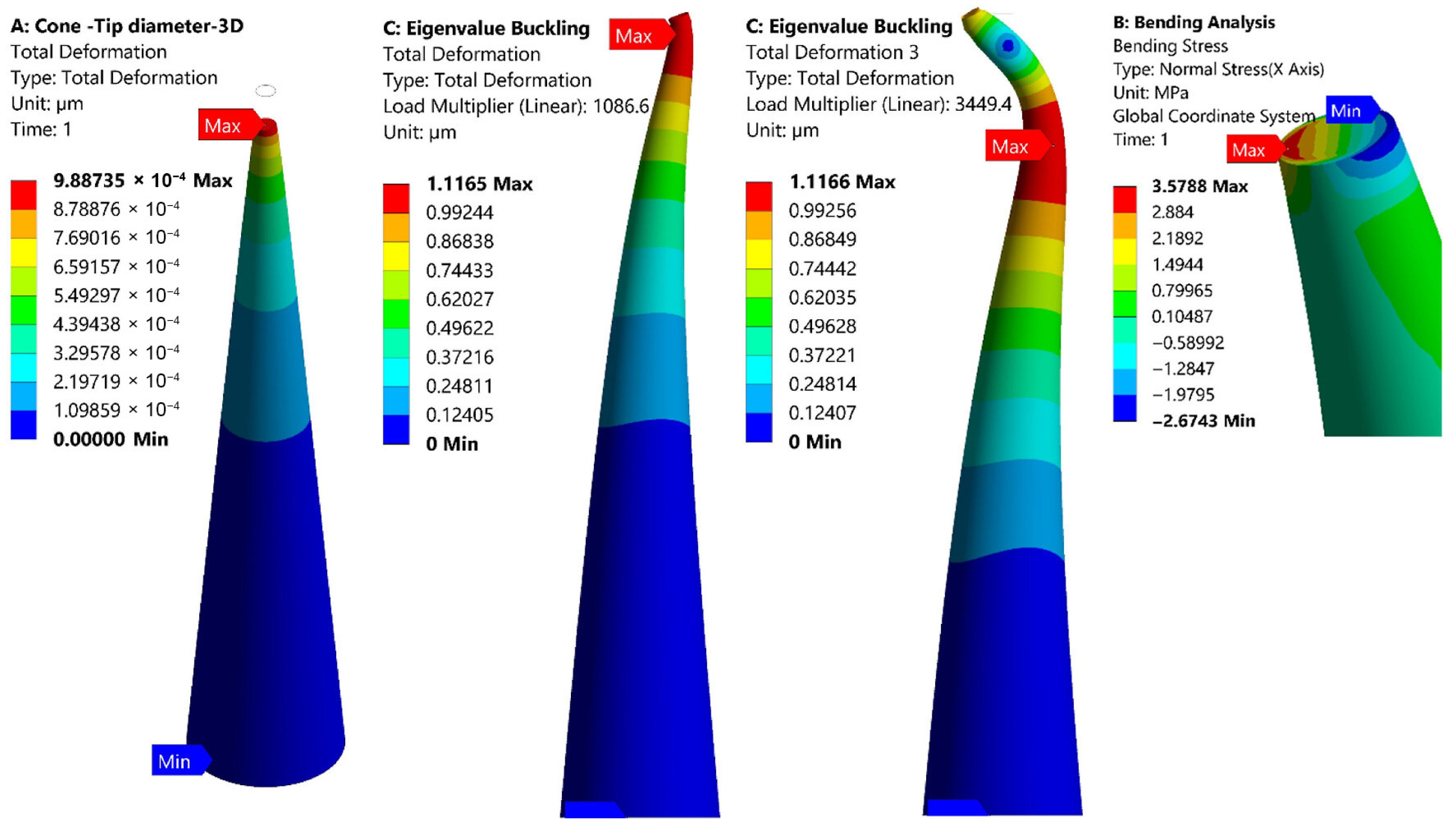
35] combined a design of experiments (DOE) framework with parametric CAD modeling to systematically optimize solid MN geometries, including conical, tapered–conical, square–base pyramidal, and triangular-base pyramidal designs. Finite element analysis was used to evaluate insertion-induced deformation and key failure modes, including critical buckling and bending. By integrating DOE sampling with machine learning-based surrogate models, the study efficiently explored a multidimensional design space while reducing computational cost. The optimized designs maintained insertion loads well below fracture thresholds, achieving high safety factors, which highlights how integrated CAD–FEA–ML pipelines enable the rational, data-driven development of mechanically robust MNs.
Figure 7 presents representative FEA outputs for a conical MN design, including deformation, eigenvalue buckling, and bending stress fields [
35].
CAD has also been pivotal in the design of hollow MNAs. Mathew et al. [
37] optimized DLP printing parameters for hollow MNA fabrication, showing how exposure time and layer thickness in CAD-generated models directly influence tip sharpness and dimensional fidelity.
Beyond design, simulation models provide predictive insight into MNA performance under physiological conditions. FEA and CFD are widely employed to estimate parameters such as insertion force, stress distribution, buckling resistance, and drug diffusion profiles [
92,
93].
Chang et al. [
42] applied FEA simulations to analyze stress distribution in PLA MNAs during skin insertion, showing that pyramidal designs concentrate stress at the apex, increasing fracture risk, while conical geometries provide more uniform stress fields. Abdullah et al. [
35] extended this approach by simulating multiple loading scenarios, including bending and buckling, to identify optimal geometries that balance sharpness with robustness. Economidou et al. [
28] emphasized the importance of simulating drug release in addition to mechanical behavior. Their work integrated coating morphology data with FEA to predict drug dissolution profiles, demonstrating how geometric variations influence pharmacokinetics. Similarly, Jeong et al. [
38] explored how printing orientation affects bevel sharpness and penetration force, using simulation data to guide experimental validation.
Azarikhah et al. [
94] presented the first age-dependent FEA of MNA penetration into human skin, examining the combined effects of age (29–68 years), insertion velocity (3 and 4.5 m/s), material (polyglycolic acid [PGA], Vectra MT-1300 (Celanese, Dallas, TX, USA), Zeonor 1060R (ZEON Corporation, Tokyo, Japan)), and geometry (cone-shaped vs. tapered cone-shaped) on insertion force.
Simulation models are particularly valuable for hollow MNAs, where fluid dynamics play a key role. Emerging approaches also combine structural and biological simulations. For example, Yang et al. [
31] correlated customized morphologies with in vivo drug delivery efficiency, linking CAD-based designs to experimental outcomes. Overall, simulation models serve as predictive engines that bridge digital design and experimental testing, allowing rapid iteration of designs with reduced material and labor costs.
While CAD and simulation tools provide deterministic design insights, AI and ML add a predictive, data-driven layer to MNA optimization. Rezapour Sarabi et al. [
43] demonstrated one of the earliest applications of ML in MNA design. Using FDM and chemical etching, they trained ML models to predict final geometric features, such as height, base width, and draft angle, from input parameters like layer height and etching time. The models achieved high predictive accuracy, enabling real-time optimization of fabrication settings.
Biswas et al. [
95] reviewed the integration of AI with the fabrication of MNAs, highlighting applications such as predictive modeling of drug release kinetics, quality control in 3D printing, and autonomous feedback loops for adaptive manufacturing. AI-driven generative design is another emerging area. By combining CAD with ML algorithms, researchers can explore vast design spaces that would be impractical through manual iteration. FEA data can be fed into neural networks to train surrogate models that predict mechanical behavior in milliseconds, accelerating optimization pipelines. The integration of AI also enhances clinical translation. Predictive models can simulate patient variability, such as differences in skin thickness, elasticity, or hydration, and generate MNA designs tailored to specific populations [
14].
CAD, simulation modeling, and AI integration are transforming the development of 3D-printed MNAs. CAD platforms enable precise and reproducible modeling of diverse geometries, from conventional conical tips to advanced bioinspired morphologies. Simulation models, ranging from mechanical stress analysis to fluid dynamics, provide predictive insights into MNA performance, reducing experimental burden and accelerating optimization. AI and ML extend these capabilities further, enabling data-driven prediction, generative design, and adaptive manufacturing. Together, these tools create a digital ecosystem for MNA innovation, linking microscale design decisions to macroscale therapeutic performance. By embedding computational intelligence into the design pipeline, the field moves closer to fully rational and personalized MNA systems, where every design iteration is informed by predictive models and optimized for both patient safety and therapeutic efficacy.
Overall, studies agree that CAD with FEA/CFD enables faster, more reproducible MNA optimization by virtually screening geometry and process parameters before printing. However, the optimal results can differ because simulations depend on non-standardized skin models, boundary conditions, and printer/material limits. The key unknowns are validated benchmarks that link in silico metrics to in vivo performance and ML datasets that generalize across platforms. This matters for design because digital tools should define testable design rules and quality control targets to ensure reliable insertion and predictable delivery.
6. Challenges and Future Directions
Three-dimensional printing has opened new possibilities for the design and fabrication of MNAs, which offer unprecedented control over geometry, distribution, and material composition. However, despite the rapid progress in this field, important challenges remain in design optimization, manufacturing reliability, and clinical translation. At the same time, emerging trends in customization of morphology, smart integration, and digital design frameworks are paving the way toward the next generation of MNA technologies. In this section, current limitations, ongoing innovations, and future applications are explored, with a particular emphasis on personalized medicine.
A central challenge in the development of 3D-printed MNAs is balancing structural precision with scalable fabrication. High-resolution 3D printing techniques, such as PµSL and 2PP, enable the fabrication of MNs with sharp tips and MNAs with complex geometries, but these methods often suffer from long fabrication times and limited throughput [
39]. On the other hand, faster and more accessible methods, such as FDM, provide scalability but lack the resolution required for sub-20 µm tips essential for minimally invasive skin penetration [
15].
Material selection can further complicate the manufacturing of MNAs. Photopolymer resins, widely used in SLA and DLP, offer excellent print fidelity but raise biocompatibility concerns because of the potential cytotoxicity of residual monomers [
28]. Biodegradable polymers, such as PLA and polycaprolactone (PCL), are biocompatible, but they lack the mechanical robustness needed to prevent buckling or fracture during insertion [
35]. Hydrogels provide a platform for biomarker sensing and drug dissolution, yet their mechanical weakness limits standalone use without reinforcement.
Reproducibility also remains a hurdle in the manufacturing of MNAs. Small deviations in 3D printing orientation, layer thickness, or curing parameters can significantly alter tip sharpness and penetration efficiency [
38]. This variability complicates regulatory approval, where consistent device performance is critical. Additionally, the surface roughness inherent in layer-by-layer 3D printing can reduce coating uniformity in drug-loaded MNAs [
72].
Scalability for mass production is severely limited by the high cost of equipment and materials, the slow speed of 3D printing in high-resolution systems, and reliance on skilled personnel [
32,
95,
96]. Although alternative high-throughput approaches such as dual molding have been explored, they require substantial new infrastructure [
97,
98].
The lack of standardized testing protocols is another critical barrier. Studies employ diverse skin models (porcine, murine, cadaveric, and synthetic), leading to inconsistent metrics for the penetration force, drug release, and safety [
14]. Without unified standards, cross-study comparison and regulatory approval become difficult.
Recent work has begun addressing these limitations. Antonara et al. [
99] proposed a rapid, reliable 3D printing method for MNA construction, addressing the challenge of throughput that often limits clinical translation. Kiliç et al. [
100] tackled plasmonic absorption issues in metal–nanoparticle-loaded 2PP resins by using non-plasmonic rhodium nanoparticles, achieving stable high metal loading (~2 wt%) without sacrificing sub-micron feature fidelity, opening routes to functional, conductive, or trackable MNAs.
Despite current challenges, several emerging trends are shaping the future of the MNA design. One such trend is the development of morphology-customized MNAs. Yang et al. [
31] introduced spiral, arrow-like, and tree-like geometries that significantly enhance drug loading capacity and sustain release profiles compared to conventional conical or pyramidal shapes. Similarly, in another study, Jia et al. [
39] demonstrated the use of PµSL to fine-tune bevel angles, tip sharpness, and overall morphology with sub-micron precision.
Theranostic and smart MNAs are gaining momentum. Systems now integrate real-time sensing with an on-demand or closed-loop delivery, as exemplified by remote-controlled hollow MNAs coupled to smartphone-enabled ultrasonic atomization [
23] and hydrogel-based platforms for ISF extraction and biomarker analysis [
64].
Digital technologies are transforming design pipelines. ML models now predict final geometry from printing parameters [
43], while broader AI integration enables predictive drug release modeling, quality control, and autonomous manufacturing [
95]. The convergence of AI, CFD, the finite element method (FEM), and big data analytics is accelerating patient-specific optimization [
20,
72,
95,
101].
New materials and hybrid composites are improving both biocompatibility and multifunctionality. Stimuli-responsive polymers, nanoparticle-reinforced resins, and advanced photo-curable biocompatible formulations are reducing cytotoxicity and adding triggered-release capabilities [
14,
15,
102,
103]. Multi-array, modular, and multifunctional patches are emerging as versatile platforms capable of simultaneous multi-drug delivery, sensing, and extended skin coverage [
91]. Non-transdermal applications are broadening clinical scope, with polymeric 3D-printed MNAs now developed for ocular, gastrointestinal, and reproductive routes [
3].
MNA-based wearables are extending beyond delivery into continuous personalized monitoring. Zhang et al. [
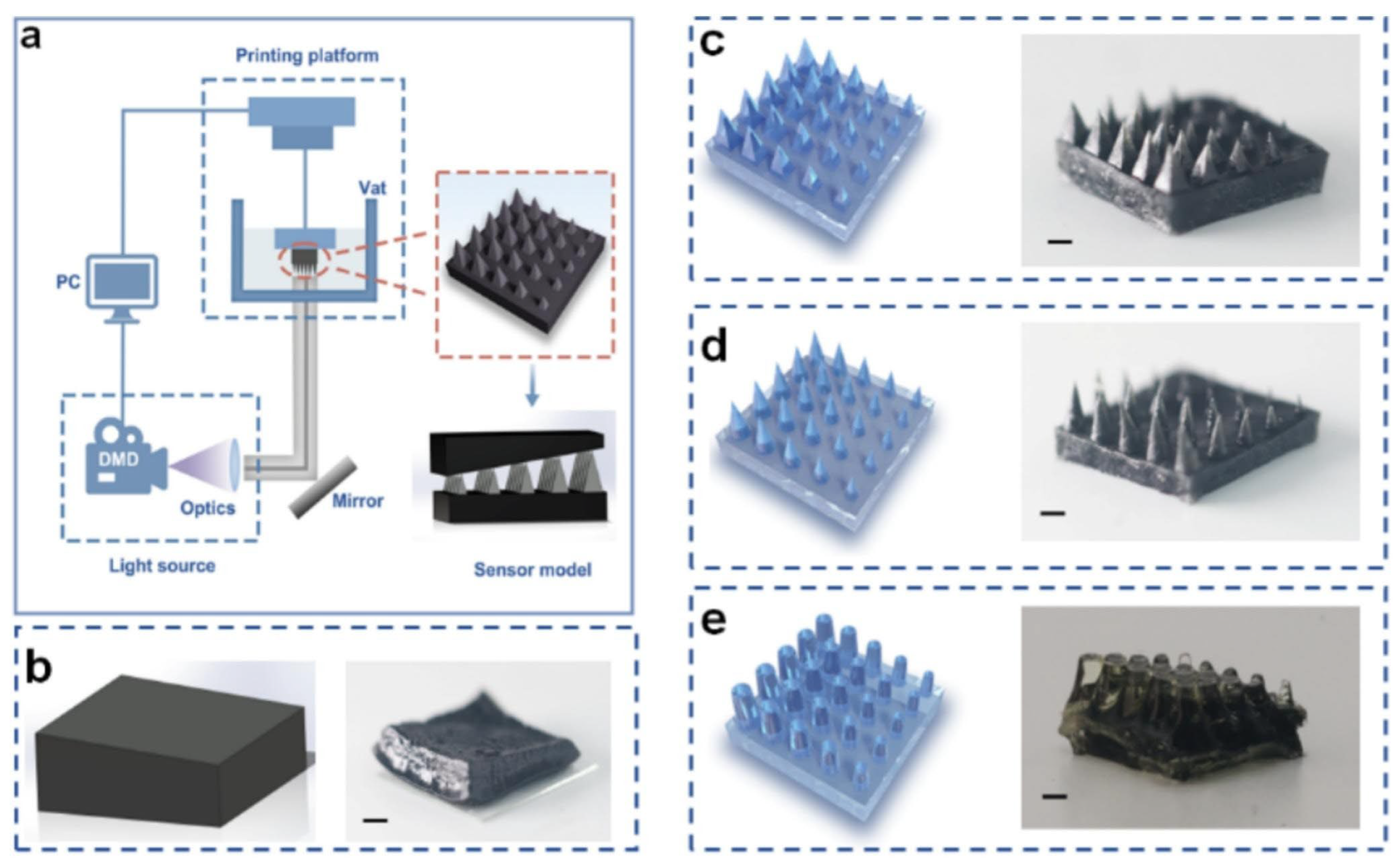
104] developed a DLP-printed hydrogel MNA sensor that translated subtle skin micromotions into measurable resistance changes for joint-motion tracking, with sensitivity tuned by the MN geometry (pyramid, cone, cylinder).
Figure 8 outlines the pathway from DLP 3D printing (a) and the inclined push-plate interface (b) to three MN geometries—pyramid, cone, cylinder—shown as schematics and micrographs (c–e). This design set underpins the latest performance comparison, where geometry governs sensitivity in micromotion detection [
104].
7. Conclusions
This review organizes design strategies for 3D-printed MNAs around four levers: geometry, distribution, digital design, and manufacturability. First, at the single-needle level, conical, pyramidal, and cylindrical morphologies—augmented by hollow channels, bevels, lattices, and bio-inspired features—are shown to tune insertion force, mechanical reliability, fluid transport, and payload capacity. The MN’s tip radius, aspect ratio, base diameter, and internal architecture jointly determine buckling resistance and patient comfort, with small geometric adjustments producing outsized performance shifts. Second, for a patch of MNA, the array spacing and patterns (square, triangular, hexagonal, and heterogeneous layouts) govern penetration uniformity, mitigate bed-of-nails effects, and balance coverage with structural stability. Multi-array and modular patches enable multiplexed functions (delivery + sensing) and tailored pharmacokinetics over larger areas. Third, CAD combined with finite element and fluidic simulations provides a predictive bridge from CAD parameters to in-skin behavior, while AI/ML models accelerate multi-objective optimization and link fabrication inputs to geometric and functional outputs. Finally, advances in materials and processes—from SLA/DLP/PµSL to 2PP and from photopolymers to hydrogels and composites—expand the design space but highlight constraints in throughput, reproducibility, biocompatibility, and regulatory readiness. Together, these insights define a practical, design-centric toolkit for engineering MNA systems with measurable, repeatable gains in clinical performance.
Three development priorities emerge, detailed as follows. (i) Standardization and benchmarking; Field-wide reference protocols, covering skin models, insertion metrics, mechanical testing, coating uniformity, and flow/transport assays are essential to compare designs, de-risk translation, and align with regulatory expectations. Shared CAD libraries, simulation datasets, and round-robin studies would raise reproducibility and shorten time to clinic. (ii) Multi-objective, data-driven optimization; Future workflows should couple CAD/FEA/CFD with automated experimentation and ML surrogate models to optimize across conflicting targets (sharpness vs. strength; density vs. comfort; flow vs. clogging; dose vs. stability). Digital twins of patient skin (thickness, elasticity, and hydration) can enable patient-specific tuning of geometry and patch distribution, while quality-by-design frameworks formalize parameter spaces for manufacturing scale-up. (iii) Integrated, multifunctional platforms: Converging MNAs with soft electronics, microfluidics, and responsive materials will unlock closed-loop theranostics, that is, real-time sensing, on-demand delivery, and adaptive control. This push will demand progress in long-term skin compatibility, anti-fouling surfaces, robust sterilization or packaging, and secure data pipelines for connected wearables.
Manufacturability should be treated as a design variable. Efforts to improve throughput and yield (parallelization, continuous printing, and mold-assisted replication), process control (in-situ monitoring, and feedback control), and material hygiene (post-cure detoxification, and leachable management) will directly impact regulatory acceptance. Equally important are studies of human factors, application force, adhesion, reusability, and user interface, so that engineering gains translate to adherence and real-world efficacy. Sustainability considerations (biodegradable substrates, solvent minimization, and recyclability of fixtures) should be embedded early to future-proof supply chains and align with global access goals.
Three-dimensional printing has shifted MNA development from trial-and-error fabrication to rational, model-guided design. The most durable path forward is to treat performance as an integrative outcome of geometry, distribution, materials, and process, each optimized with predictive tools and validated under standardized conditions. If the community commits to open CAD libraries, transparent datasets, interoperable test methods, and cross-disciplinary consortia spanning design, biology, manufacturing, and regulation, MNAs can mature from promising prototypes into clinically routine, patient-specific interfaces for drug delivery, sampling, and sensing. The opportunity is clear: we must leverage high-resolution 3D printing and smart materials, orchestrated by CAD/FEA/AI, to fabricate MNAs that have sharper tips; are stronger, safer, and smarter; and can be produced on a large scale. With deliberate attention to benchmarking, human factors, and equitable deployment, next-generation MNA systems will help to realize personalized medicine at the skin’s surface, turning sophisticated engineering into accessible care.