
Degradation and Long-Term Response Evaluation of Polymeric Components Produced by Additive Manufacturing
 , , ,
, , ,  ,
,  ,
, 
Abstract
1. Introduction
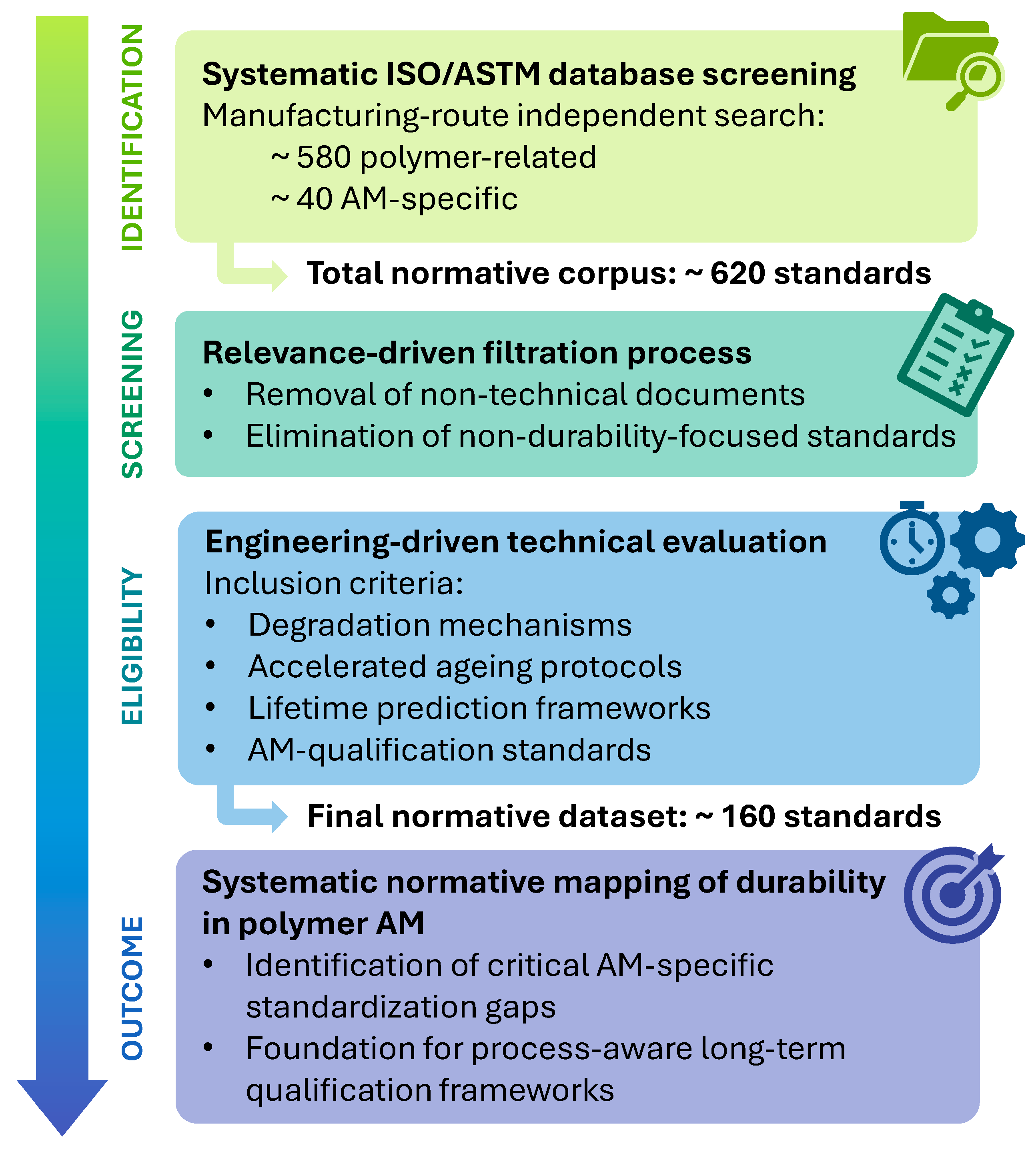
2. Methodological Approach for Standards Evaluation
3. Degradation Mechanisms
3.1. Effects of External Agents and Chemical Degradation Mechanisms
3.1.1. Moisture-Induced Plasticisation
3.1.2. Hydrolytic Degradation
3.1.3. Photo-Oxidative Degradation
3.1.4. Thermo-Oxidative Degradation
3.1.5. Biological Degradation
3.2. Physical Degradation Mechanisms
3.2.1. Viscoelastic Behaviour and Physical Ageing
3.2.2. Residual Stress and Relaxation Behaviour
3.2.3. Creep Deformation
3.2.4. Fatigue Degradation, Impact, Crack Initiation and Fracture Behaviour
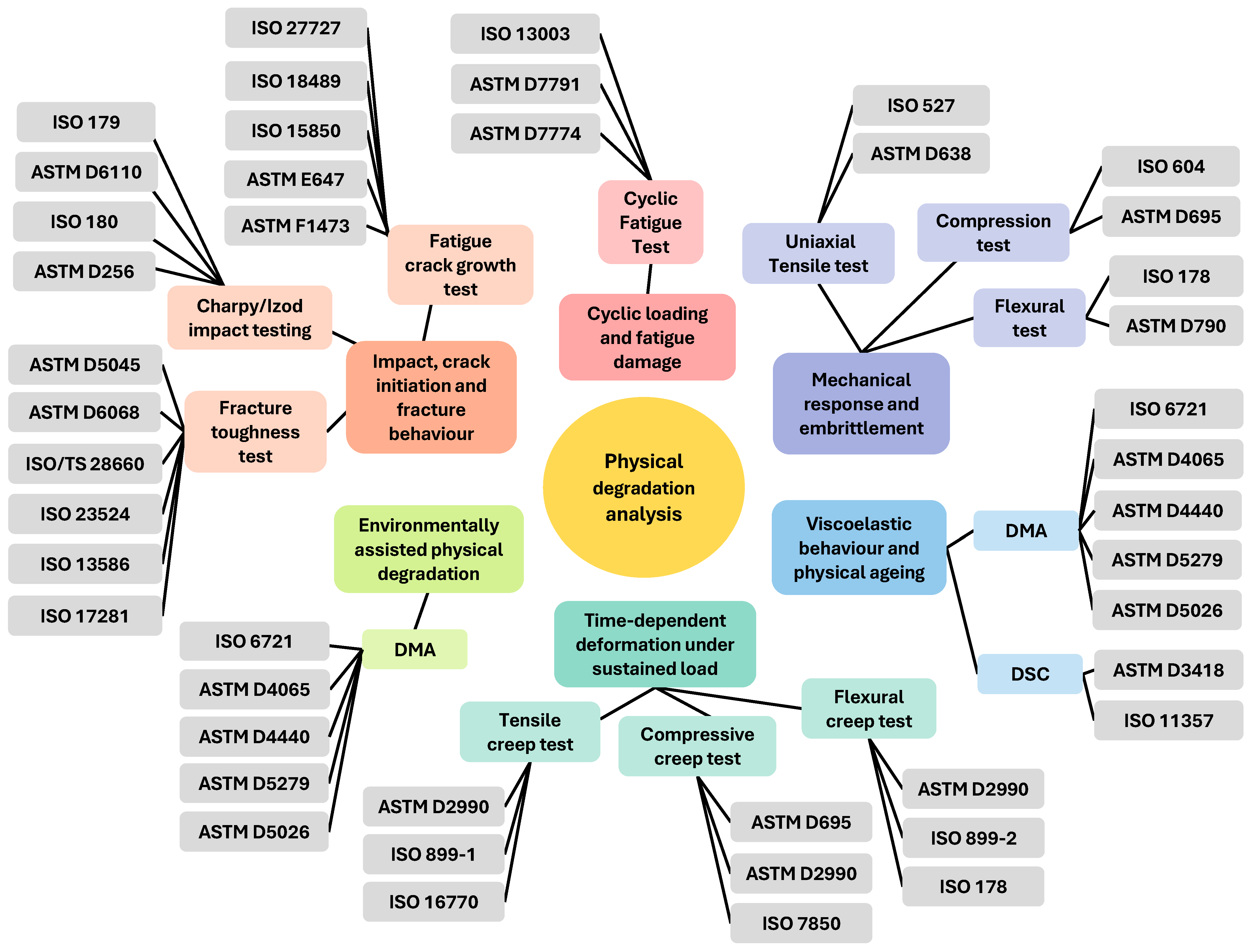
3.2.5. Environmentally Assisted Physical Degradation
4. Accelerated Ageing and Lifetime Prediction Methodologies
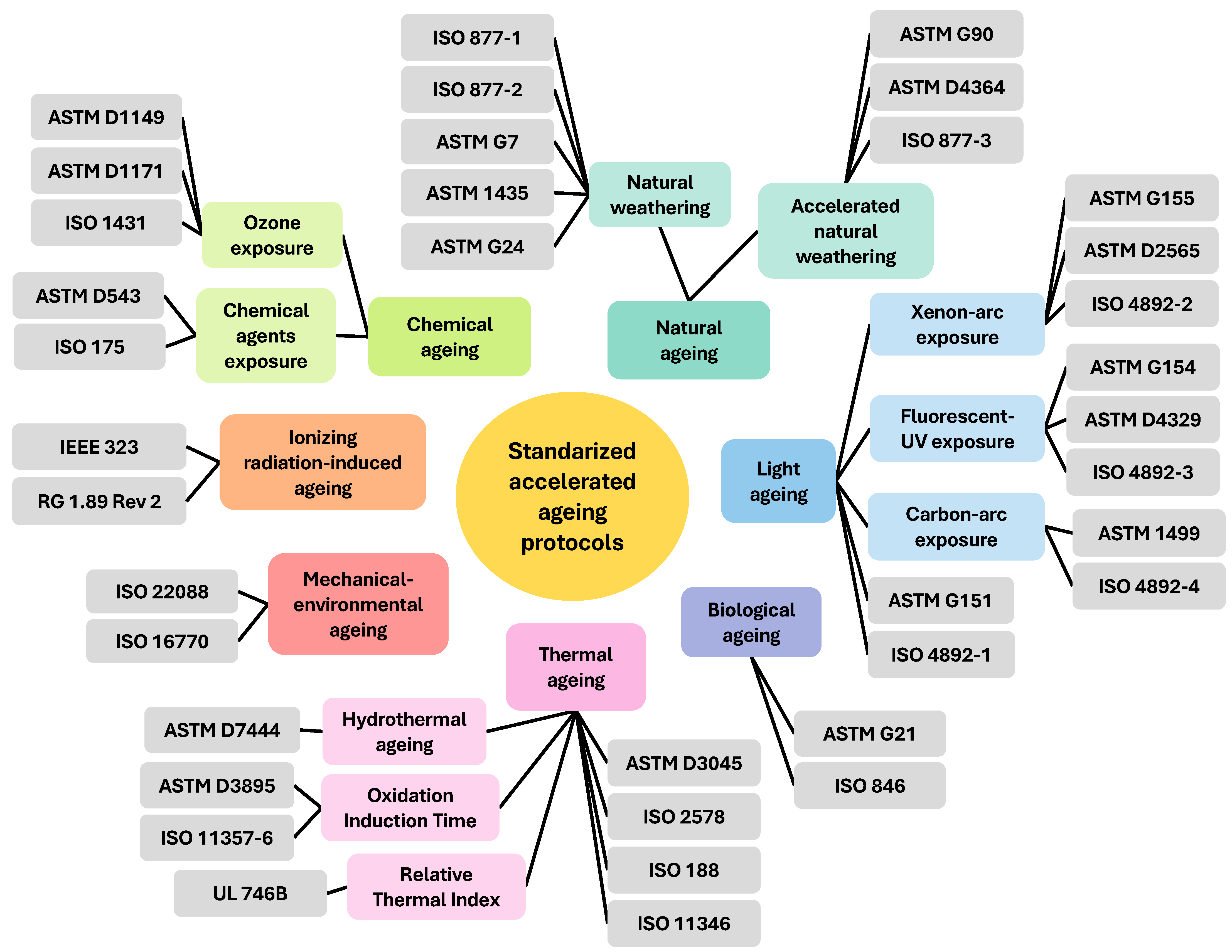
4.1. Standardised Accelerated Ageing Protocols
4.1.1. Natural Exposure
4.1.2. Artificial Weathering and Light Exposure
4.1.3. Thermal Ageing, Thermo-Oxidative Stability and Hydrothermal Ageing
4.1.4. Chemical, Biological and Radiation-Induced Ageing Environments
4.1.5. Mechanical-Environmental Accelerated Ageing
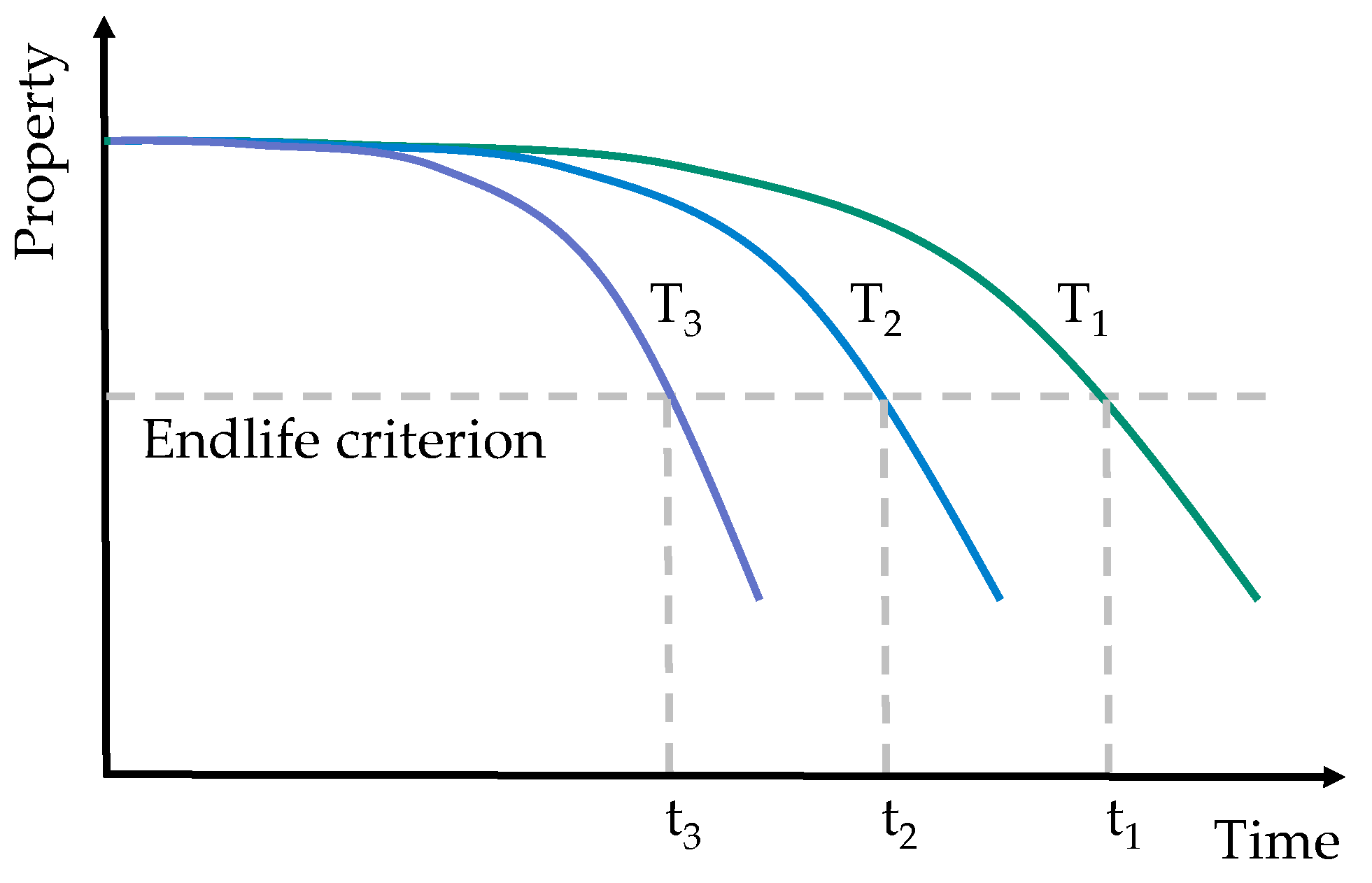
4.2. Lifetime Prediction Frameworks Based on Accelerated Ageing Data
4.2.1. Arrhenius-Based Lifetime Prediction Model
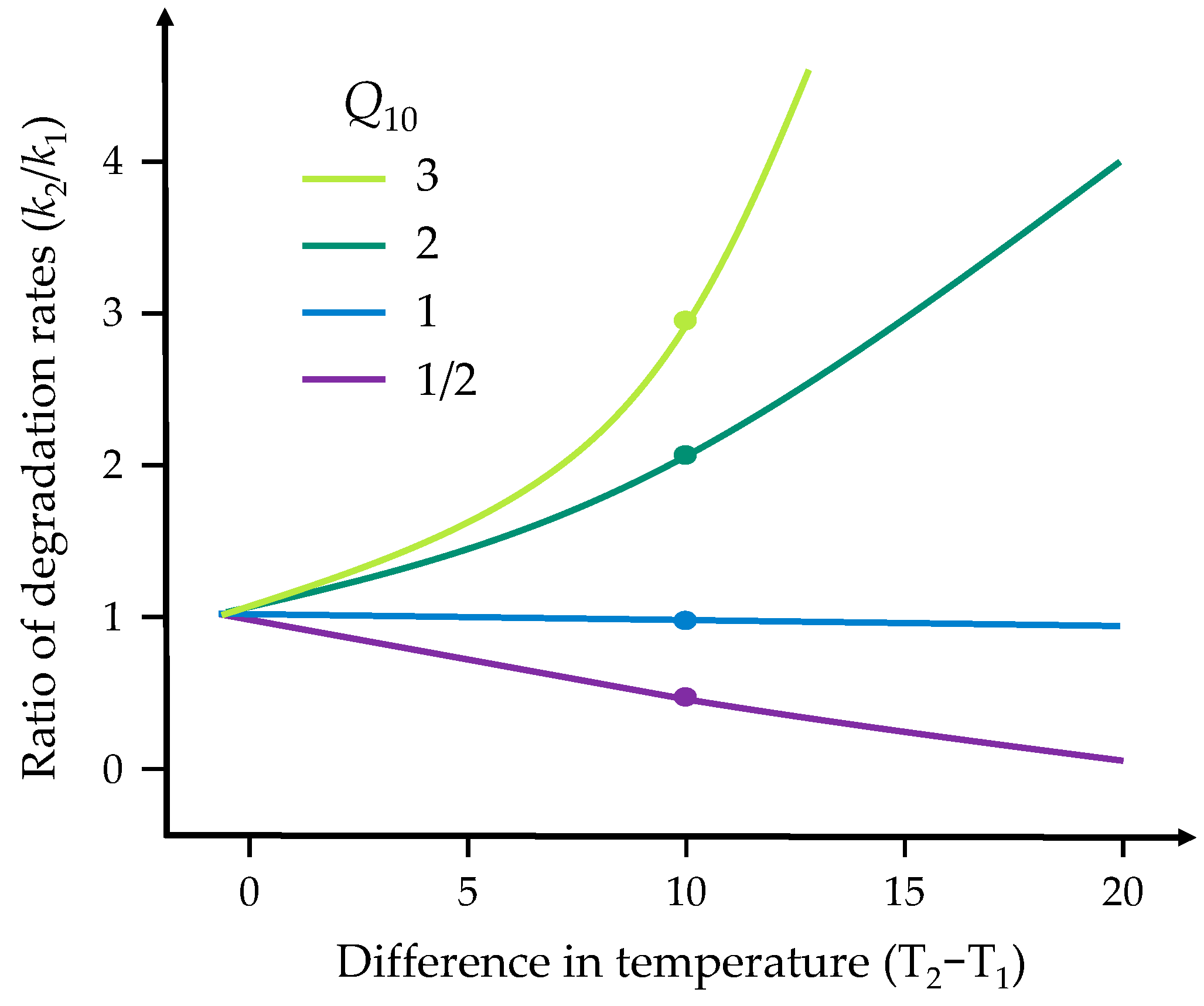
4.2.2. Empirical Q10 Rule
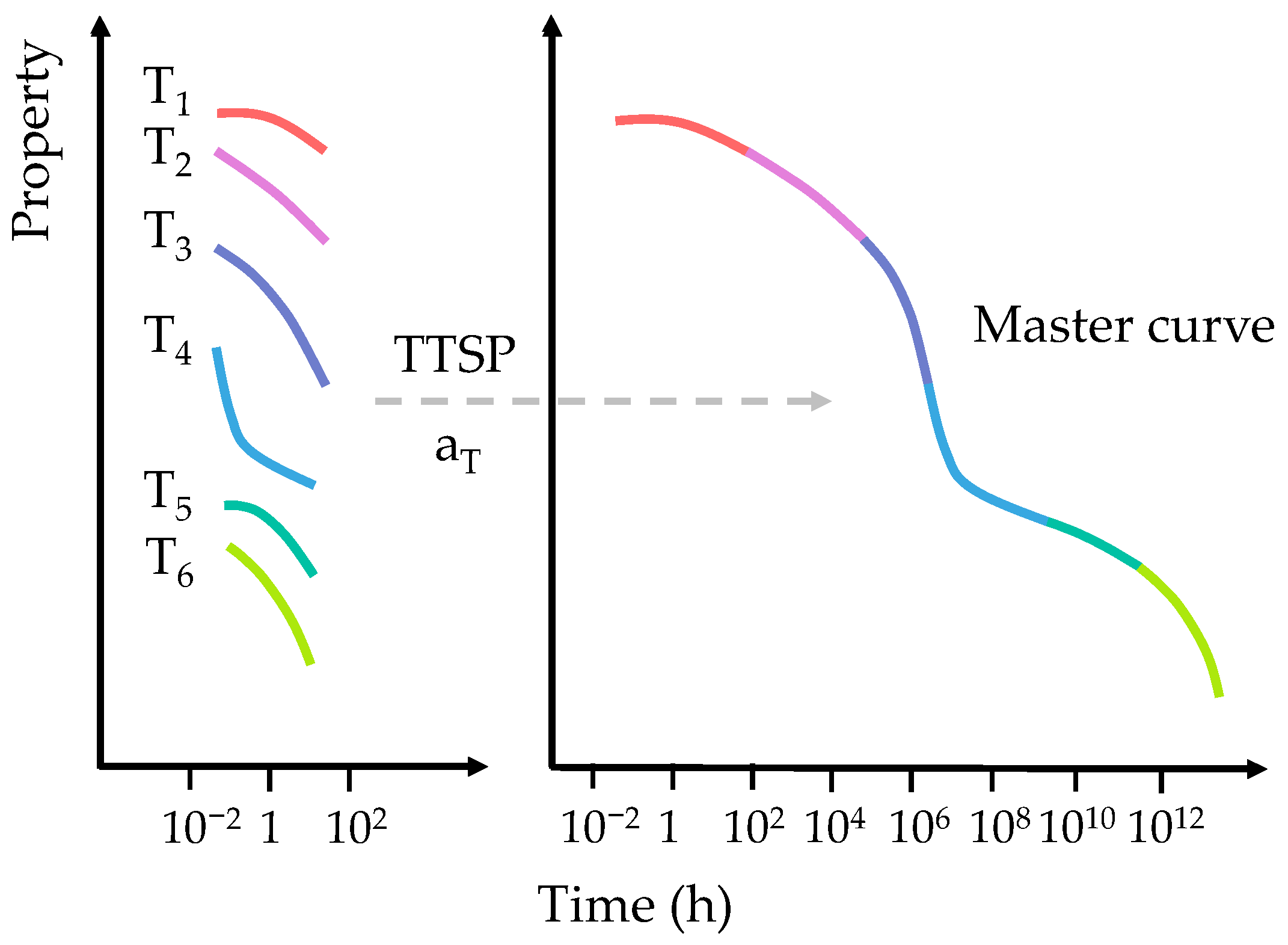
4.2.3. Time–Temperature Superposition Principle
4.2.4. Williams–Landel–Ferry Model
5. Normative Framework for the Assessment of Degradation and Durability in Additively Manufactured Polymer Components
6. Processing–Structure–Property Relationships in Polymer AM
7. Future Directions
8. Conclusions
- Current durability and lifetime assessment standards, largely developed for conventionally processed polymers, are not fully suitable for capturing the anisotropy and spatial heterogeneity inherent to polymer additive manufacturing.
- Printing parameters act as durability-defining variables, as they govern the formation of microstructural features that control degradation kinetics, damage accumulation, and long-term mechanical response across FFF, SLA, and SLS technologies.
- Long-term qualification of AM polymer components requires process-aware evaluation methodologies explicitly linking fabrication parameters with microstructural architecture and service-life performance.
Supplementary Materials
Author Contributions
Funding
Data Availability Statement
Acknowledgments
Conflicts of Interest
Abbreviations
| AM | Additive manufacturing |
| PRISMA | Preferred reporting items for systematic reviews and meta-analyses |
| FFF | Fused filament fabrication |
| SLA | Stereolithography |
| SLS | Selective laser sintering |
| ISO | International organisation for standardisation |
| ASTM | American society for testing and materials |
| DMA | Dynamic mechanical analysis |
| DSC | Differential scanning calorimetry |
| TGA | Thermogravimetric analysis |
| FTIR | Fourier transform infrared spectroscopy |
| UV-Vis | Ultraviolet-visible |
| NMR | Nuclear magnetic resonance |
| GPC/SEC | Gel permeation chromatography/Size exclusion chromatography |
| SEM | Scanning electron microscopy |
| OIT | Oxidation induction time |
| ESC | Environmental stress cracking |
| FNCT | Full notch creep test |
| RTI | Relative thermal index |
| TTSP | Time–temperature superposition principle |
| WLF | Williams–Landel–Ferry |
| Tg | Glass transition temperature |
References
- Geyer, R.; Jambeck, J.R.; Law, K.L. Production, use, and fate of all plastics ever made. Sci. Adv. 2017, 3, e1700782. [Google Scholar] [CrossRef] [PubMed]
- Hoornweg, D.; Bhada-Tata, P.; Kennedy, C. Environment: Waste production must peak this century. Nature 2013, 502, 615–617. [Google Scholar] [CrossRef]
- MacLeod, M.; Arp, H.P.H.; Tekman, M.B.; Jahnke, A. The global threat from plastic pollution. Science 2021, 373, 61–65. [Google Scholar] [CrossRef]
- Gibson, I.; Rosen, D.W.; Stucker, B. Additive Manufacturing Technologies: 3D Printing, Rapid Prototyping, and Direct Digital Manufacturing, 2nd ed.; Springer: New York, NY, USA, 2015; pp. 1–512. [Google Scholar] [CrossRef]
- Mami, F.; Revéret, J.-P.; Fallaha, S.; Margni, M. Evaluating Eco-Efficiency of 3D Printing in the Aeronautic Industry. J. Ind. Ecol. 2017, 21, S37–S48. [Google Scholar] [CrossRef]
- Mikula, K.; Skrzypczak, D.; Izydorczyk, G.; Warchoł, J.; Moustakas, K.; Chojnacka, K.; Witek-Krowiak, A. 3D printing filament as a second life of waste plastics-A review. Environ. Sci. Pollut. Res. 2021, 28, 12321–12333. [Google Scholar] [CrossRef]
- Garg, M.; Rani, R.; Meena, V.K.; Singh, S. Significance of 3D printing for a sustainable environment. Mater. Today Sustain. 2023, 23, 100419. [Google Scholar] [CrossRef]
- Prashar, G.; Vasudev, H.; Bhuddhi, D. Additive manufacturing: Expanding 3D printing horizon in Industry 4.0. Int. J. Interact. Des. Manuf. 2023, 17, 2221–2235. [Google Scholar] [CrossRef]
- Salvi, D.; Ucciardello, N.; Vesco, S. Multi-head MEX 3D printing of self-recoverable Joule-heating-based shape memory polymeric components. Arab. J. Sci. Eng. 2025, 1–15. [Google Scholar] [CrossRef]
- Liu, Y.; Xu, X. Industry 4.0 and Cloud Manufacturing: A Comparative Analysis. J. Manuf. Sci. Eng. 2017, 139, 034701. [Google Scholar] [CrossRef]
- Cheah, C.M.; Chua, C.K.; Lee, C.W.; Feng, C.; Totong, K. Rapid prototyping and tooling techniques: A review of applications for rapid investment casting. Int. J. Adv. Manuf. Technol. 2005, 25, 308–320. [Google Scholar] [CrossRef]
- Almonti, D.; Salvi, D.; Mingione, E.; Vesco, S. Lightweight and sustainable steering knuckle via topology optimization and rapid investment casting. J. Manuf. Mater. Process. 2025, 9, 252. [Google Scholar] [CrossRef]
- NISTIR 8059; Materials Testing Standards for Additive Manufacturing of Polymer Materials: State of the Art and Standards Applicability. National Institute of Standards and Technology: Gaithersburg, MD, USA, 2015. [CrossRef]
- Bae, C.-J.; Diggs, A.B.; Ramachandran, A. Quantification and certification of additive manufacturing materials and processes. In Additive Manufacturing; Öchsner, A., Merkel, M., Eds.; Elsevier: Amsterdam, The Netherlands, 2018; pp. 181–210. [Google Scholar] [CrossRef]
- Kawalkar, R.; Dubey, H.K.; Lokhande, S.P. A review for advancements in standardization for additive manufacturing. Mater. Today Proc. 2022, 50, 1983–1990. [Google Scholar] [CrossRef]
- Tofail, S.A.M.; Koumoulos, E.P.; Bandyopadhyay, A.; Bose, S.; O’Donoghue, L.; Charitidis, C. Additive manufacturing: Scientific and technological challenges, market uptake and opportunities. Mater. Today 2018, 21, 22–37. [Google Scholar] [CrossRef]
- Frigione, M. Assessment of the ageing and durability of polymers. Polymers 2022, 14, 1934. [Google Scholar] [CrossRef]
- Ceretti, D.V.A.; Edeleva, M.; Cardon, L.; D’hooge, D.R. Molecular pathways for polymer degradation during conventional processing, additive manufacturing, and mechanical recycling. Molecules 2023, 28, 2344. [Google Scholar] [CrossRef]
- Maxwell, A.S.; Broughton, W.R.; Dean, G.; Sims, G.D. Review of Accelerated Ageing Methods and Lifetime Prediction Techniques for Polymeric Materials; NPL Report DEPC-MPR 016; National Physical Laboratory: Teddington, UK, 2005; Available online: https://eprintspublications.npl.co.uk/3161/1/DEPC_MPR16.pdf (accessed on 13 February 2026).
- Broughton, W.R. Accelerated Ageing of Polymeric Materials; Good Practice Guide No. MGPG103; National Physical Laboratory: Teddington, UK, 2023; Available online: https://eprintspublications.npl.co.uk/3866/1/MGPG103.pdf (accessed on 13 February 2026).
- Frigione, M.; Rodríguez-Prieto, A. Can Accelerated Aging Procedures Predict the Long-Term Behavior of Polymers Exposed to Different Environments? Polymers 2021, 13, 2688. [Google Scholar] [CrossRef] [PubMed]
- Starkova, O.; Gagani, A.I.; Karl, C.W.; Rocha, I.B.C.M.; Burlakovs, J.; Krauklis, A.E. Modelling of Environmental Ageing of Polymers and Polymer Composites-Durability Prediction Methods. Polymers 2022, 14, 907. [Google Scholar] [CrossRef]
- Plota, A.; Masek, A. Lifetime Prediction Methods for Degradable Polymeric Materials-A Short Review. Materials 2020, 13, 4507. [Google Scholar] [CrossRef] [PubMed]
- Moher, D.; Liberati, A.; Tetzlaff, J.; Altman, D.G.; PRISMA Group. Preferred reporting items for systematic reviews and meta-analyses: The PRISMA statement. Int. J. Surg. 2010, 8, 336–341. [Google Scholar] [CrossRef] [PubMed]
- Hawkins, W.L. Polymer Degradation. In Polymer Degradation and Stabilization, 1st ed.; Polymers Properties and Applications; Springer: Berlin, Germany, 1984; Volume 8. [Google Scholar] [CrossRef]
- Schnabel, W. Polymer Degradation: Principles and Practical Applications; Walter de Gruyter GmbH & Co KG: Berlin, Germany, 1981. [Google Scholar]
- Nguyen, T.Q. Polymer degradation and stabilization. In Handbook of Polymer Reaction Engineering; Wiley-VCH: Weinheim, Germany, 2005; pp. 757–831. [Google Scholar]
- Udo, I.I. A comprehensive review on polymer degradation: Mechanisms, environmental implications, and sustainable mitigation strategies. Commun. Phys. Sci. 2025, 12, 799–807. [Google Scholar] [CrossRef]
- Sazali, N.; Ibrahim, H.; Jamaludin, A.S.; Mohamed, M.A.; Salleh, W.N.W.; Abidin, M.N.Z. Degradation and stability of polymer: A mini review. IOP Conf. Ser. Mater. Sci. Eng. 2020, 788, 012048. [Google Scholar] [CrossRef]
- Roy, S. Moisture-Induced Degradation. In Long-Term Durability of Polymeric Matrix Composites; Pochiraju, K., Tandon, G., Schoeppner, G., Eds.; Springer: Boston, MA, USA, 2012; pp. 141–174. [Google Scholar] [CrossRef]
- Brown, M. Moisture-Related Failure of Plastics. In Characterization and Failure Analysis of Plastics; ASM International: Materials Park, OH, USA, 2022; pp. 381–392. [Google Scholar] [CrossRef]
- Banjo, A.D.; Agrawal, V.; Auad, M.L.; Celestine, A.D.N. Moisture-induced changes in the mechanical behavior of 3D printed polymers. Compos. Part C Open Access 2022, 7, 100243. [Google Scholar] [CrossRef]
- Pickett, J.E.; Coyle, D.J. Hydrolysis kinetics of condensation polymers under humidity aging conditions. Polym. Degrad. Stab. 2013, 98, 1311–1320. [Google Scholar] [CrossRef]
- Antonowicz-Hüpsch, M.; Trębacz, P.; Piras, L.A.; Piątek, A.; Auguścik, A.; Cholewa, K.; Groelich, W.; Pawlik, M.; Manassero, L.; Kurkowska, A.; et al. Impact of multiple steam sterilizations on the mechanical properties of 3D-printed surgical items. Sci. Rep. 2025, 15, 41688. [Google Scholar] [CrossRef]
- ISO 6721:2019; Plastics—Determination of Dynamic Mechanical Properties (All Parts). International Organization for Standardization: Geneva, Switzerland, 2019. Available online: https://www.iso.org/standard/73142.html (accessed on 13 February 2026).
- ASTM D4065-20; Standard Practice for Plastics: Dynamic Mechanical Properties: Determination and Report of Procedures. ASTM International: Conshohocken, PA, USA, 2020. [CrossRef]
- ASTM D4440-15; Standard Test Method for Plastics: Dynamic Mechanical Properties-Melt Rheology. ASTM International: Conshohocken, PA, USA, 2023. [CrossRef]
- ASTM D5279-21; Standard Test Method for Plastics: Dynamic Mechanical Properties: In Torsion. ASTM International: Conshohocken, PA, USA, 2021. [CrossRef]
- ASTM D5026-15; Standard Test Method for Plastics: Dynamic Mechanical Properties: In Tension. ASTM International: Conshohocken, PA, USA, 2023. [CrossRef]
- ASTM D3418-21; Standard Test Method for Transition Temperatures and Enthalpies of Fusion and Crystallization of Polymers by Differential Scanning Calorimetry. ASTM International: Conshohocken, PA, USA, 2021. [CrossRef]
- ISO 11357-1:2023; Plastics—Differential Scanning Calorimetry (DSC)—Part 1: General Principles. International Organization for Standardization: Geneva, Switzerland, 2023. Available online: https://www.iso.org/standard/83904.html (accessed on 13 February 2026).
- ISO 62:2008; Plastics—Determination of Water Absorption. International Organization for Standardization: Geneva, Switzerland, 2008. Available online: https://www.iso.org/standard/41672.html (accessed on 13 February 2026).
- ASTM D570-22; Standard Test Method for Water Absorption of Plastics. ASTM International: Conshohocken, PA, USA, 2022. [CrossRef]
- Hofmann, D.; Entrialgo-Castaño, M.; Kratz, K.; Lendlein, A. Knowledge-based approach towards hydrolytic degradation of polymer-based biomaterials. Adv. Mater. 2009, 21, 3237–3245. [Google Scholar] [CrossRef] [PubMed]
- Sevim, K.; Pan, J. A model for hydrolytic degradation and erosion of biodegradable polymers. Acta Biomater. 2018, 66, 192–199. [Google Scholar] [CrossRef]
- Farrar, D.F.; Gillson, R.K. Hydrolytic degradation of polyglyconate B: The relationship between degradation time, strength and molecular weight. Biomaterials 2002, 23, 3905–3912. [Google Scholar] [CrossRef]
- Woodard, L.N.; Grunlan, M.A. Hydrolytic degradation and erosion of polyester biomaterials. ACS Macro Lett. 2018, 7, 976–982. [Google Scholar] [CrossRef]
- Ainin, F.N.; Azaman, M.D.; Abdul Majid, M.S.; Ridzuan, M.J.M. The influence of water absorption on the mechanical performance of 3D-printed sandwich composite structures made from PLA-based materials under quasi-static loading conditions. Polym. Compos. 2025, 46, 6221–6240. [Google Scholar] [CrossRef]
- Ayrilmis, N.; Kariz, M.; Kwon, J.H.; Kitek Kuzman, M. Effect of printing layer thickness on water absorption and mechanical properties of 3D-printed wood/PLA composite materials. Int. J. Adv. Manuf. Technol. 2019, 102, 2195–2200. [Google Scholar] [CrossRef]
- ASTM D5296-19; Standard Test Method for Molecular Weight Averages and Molecular Weight Distribution of Polystyrene by High Performance Size-Exclusion Chromatography. ASTM International: Conshohocken, PA, USA, 2020. [CrossRef]
- ISO 13885:2020; Gel Permeation Chromatography (GPC) (All Parts). International Organization for Standardization: Geneva, Switzerland, 2020. Available online: https://www.iso.org/standard/73850.html (accessed on 13 February 2026).
- ASTM E1252-98(2021); Standard Practice for General Techniques for Obtaining Infrared Spectra for Qualitative Analysis. ASTM International: Conshohocken, PA, USA, 2021. [CrossRef]
- ISO 10640:2011; Plastics—Methodology for Assessing Polymer Photoageing by FTIR and UV/Visible Spectroscopy. International Organization for Standardization: Geneva, Switzerland, 2011. Available online: https://www.iso.org/standard/46024.html (accessed on 13 February 2026).
- Rånby, B. Photodegradation and photo-oxidation of synthetic polymers. J. Anal. Appl. Pyrolysis 1989, 15, 237–247. [Google Scholar] [CrossRef]
- Michelas, M.; Wimberger, L.; Boyer, C. A General Approach for Photo-Oxidative Degradation of Various Polymers. Macromol. Rapid Commun. 2024, 45, 2400358. [Google Scholar] [CrossRef]
- Zjačić, J.P.; Vujasinović, M.; Kovačić, M.; Božić, A.L.; Kušić, H.; Katančić, Z.; Murgić, Z.H. From Macro to Micro Plastics; Influence of Photo-oxidative Degradation. Kem. Ind. 2023, 72, 463–471. [Google Scholar] [CrossRef]
- Gardette, J.L.; Rivaton, A.; Therias, S. Photodegradation processes in polymeric materials. In Photochemistry and Photophysics of Polymer Materials; Rabek, J.F., Ed.; Wiley: Hoboken, NJ, USA, 2010; pp. 569–601. [Google Scholar] [CrossRef]
- Zareanshahraki, F.; Davenport, A.; Cramer, N.; Seubert, C.; Lee, E.; Cassoli, M. Durability study of automotive additive manufactured specimens. SAE Int. J. Adv. Curr. Pract. Mobil. 2020, 2, 1659–1668. [Google Scholar] [CrossRef]
- Grassi, G.; Spagnolo, S.L.; Paoletti, I. Fabrication and durability testing of a 3D printed façade for desert climates. Addit. Manuf. 2019, 28, 439–444. [Google Scholar] [CrossRef]
- Amza, C.G.; Zapciu, A.; Baciu, F.; Vasile, M.I.; Popescu, D. Aging of 3D printed polymers under sterilizing UV-C radiation. Polymers 2021, 13, 4467. [Google Scholar] [CrossRef] [PubMed]
- Mahmud, M.S.; Delgadillo, A.; Urbay, J.E.; Hassan, M.S.; Zaman, S.; Dieguez, D.; Fontes, D.; Leyva, D.; Dantzler, J.; Lopez, A.; et al. Chemical aging and degradation of stereolithographic 3D-printed material: Effect of printing and post-curing parameters. Polym. Degrad. Stab. 2025, 232, 111151. [Google Scholar] [CrossRef]
- ASTM E169-16(2022); Standard Practices for General Techniques of Ultraviolet-Visible Quantitative Analysis. ASTM International: Conshohocken, PA, USA, 2022. [CrossRef]
- ASTM E2977-15; Standard Practice for Measuring and Reporting Performance of Fourier-Transform Nuclear Magnetic Resonance (FT-NMR) Spectrometers for Liquid Samples. ASTM International: Conshohocken, PA, USA, 2023. [CrossRef]
- ISO 24583:2022; Quantitative Nuclear Magnetic Resonance Spectroscopy—Purity Determination of Organic Compounds Used for Foods and Food Products—General Requirements for 1H NMR Internal Standard Method. International Organization for Standardization: Geneva, Switzerland, 2022. Available online: https://www.iso.org/standard/78997.html (accessed on 13 February 2026).
- ISO 4504:2025; Plastics—Polyethylene (PE)—Determination of Co-monomer Content by Solution State 13C-NMR Spectrometry. International Organization for Standardization: Geneva, Switzerland, 2025. Available online: https://www.iso.org/standard/88256.html (accessed on 13 February 2026).
- ISO 24076:2021; Plastics—Polypropylene (PP)—Determination of Isotactic Index by Low-Resolution Nuclear Magnetic Resonance Spectrometry. International Organization for Standardization: Geneva, Switzerland, 2021. Available online: https://www.iso.org/standard/77731.html (accessed on 13 February 2026).
- ISO 5260:2023; Epoxidized Natural Rubber—Determination of Epoxidation and Ring Opening Level by NMR Spectrometry. International Organization for Standardization: Geneva, Switzerland, 2023. Available online: https://www.iso.org/standard/81095.html (accessed on 13 February 2026).
- Kholodovych, V.; Welsh, W.J. Thermal-Oxidative Stability and Degradation of Polymers. In Physical Properties of Polymers Handbook, 2nd ed.; Mark, J.E., Ed.; Springer: New York, NY, USA, 2007; pp. 995–1007. [Google Scholar] [CrossRef]
- Cuadri, A.A.; Martín-Alfonso, J.E. Thermal, thermo-oxidative and thermomechanical degradation of PLA: A comparative study based on rheological, chemical and thermal properties. Polym. Degrad. Stab. 2018, 150, 37–45. [Google Scholar] [CrossRef]
- Gijsman, P.; Fiorio, R. Long term thermo-oxidative degradation and stabilization of polypropylene (PP) and the implications for its recyclability. Polym. Degrad. Stab. 2023, 208, 110260. [Google Scholar] [CrossRef]
- Gijsman, P. Review on the thermo-oxidative degradation of polymers during processing and in service. e-Polymers 2008, 8, 065. [Google Scholar] [CrossRef]
- Crespo-Miguel, J.; Garcia-Gonzalez, D.; Robles, G.; Hossain, M.; Martinez-Tarifa, J.M.; Arias, A. Thermo-electro-mechanical aging and degradation of conductive 3D printed PLA/CB composite. Compos. Struct. 2023, 316, 116992. [Google Scholar] [CrossRef]
- Boado-Cuartero, B.; Pérez-Álvarez, J.; Roibás-Millán, E. Material characterization of high-performance polymers for additive manufacturing (AM) in aerospace mechanical design. Aerospace 2024, 11, 748. [Google Scholar] [CrossRef]
- ISO 11358:2022; Plastics—Thermogravimetry (TG) of Polymers (All Parts). International Organization for Standardization: Geneva, Switzerland, 2022. Available online: https://www.iso.org/standard/79999.html (accessed on 13 February 2026).
- ASTM E1131-20; Standard Test Method for Compositional Analysis by Thermogravimetry. ASTM International: Conshohocken, PA, USA, 2025. [CrossRef]
- Samir, A.; Ashour, F.H.; Hakim, A.A.; Bassyouni, M. Recent advances in biodegradable polymers for sustainable applications. NPJ Mater. Degrad. 2022, 6, 68. [Google Scholar] [CrossRef]
- Ali, S.S.; Elsamahy, T.; Al-Tohamy, R.; Zhu, D.; Mahmoud, Y.A.G.; Koutra, E.; Sun, J. Plastic wastes biodegradation: Mechanisms, challenges and future prospects. Sci. Total Environ. 2021, 780, 146590. [Google Scholar] [CrossRef]
- Nizamuddin, S.; Baloch, A.J.; Chen, C.; Arif, M.; Mubarak, N.M. Bio-based plastics, biodegradable plastics, and compostable plastics: Biodegradation mechanism, biodegradability standards and environmental stratagem. Int. Biodeterior. Biodegrad. 2024, 195, 105887. [Google Scholar] [CrossRef]
- Andanje, M.N.; Mwangi, J.W.; Mose, B.R.; Carrara, S. Biocompatible and biodegradable 3D printing from bioplastics: A review. Polymers 2023, 15, 2355. [Google Scholar] [CrossRef]
- ISO 14855:2012; Determination of the Ultimate Aerobic Biodegradability of Plastic Materials under Controlled Composting Conditions (All Parts). International Organization for Standardization: Geneva, Switzerland, 2012. Available online: https://www.iso.org/standard/57902.html (accessed on 13 February 2026).
- ISO 14852:2021; Determination of the Ultimate Aerobic Biodegradability of Plastic Materials in an Aqueous Medium—Method by Analysis of Evolved Carbon Dioxide. International Organization for Standardization: Geneva, Switzerland, 2021. Available online: https://www.iso.org/standard/80303.html (accessed on 13 February 2026).
- ISO 17556:2019; Plastics—Determination of the Ultimate Aerobic Biodegradability of Plastic Materials in Soil by Measuring the Oxygen Demand in a Respirometer or the Amount of Carbon Dioxide Evolved. International Organization for Standardization: Geneva, Switzerland, 2019. Available online: https://www.iso.org/standard/74993.html (accessed on 13 February 2026).
- ISO 20200:2023; Plastics—Determination of the Degree of Disintegration of Plastic Materials under Composting Conditions in a Laboratory-Scale Test. International Organization for Standardization: Geneva, Switzerland, 2023. Available online: https://www.iso.org/standard/81932.html (accessed on 13 February 2026).
- ISO 23977:2020; Plastics—Determination of the Aerobic Biodegradation of Plastic Materials Exposed to Seawater (All Parts). International Organization for Standardization: Geneva, Switzerland, 2020. Available online: https://www.iso.org/standard/77499.html (accessed on 13 February 2026).
- ASTM D5338-15(2021); Standard Test Method for Determining Aerobic Biodegradation of Plastic Materials Under Controlled Composting Conditions, Incorporating Thermophilic Temperatures. ASTM International: Conshohocken, PA, USA, 2021. [CrossRef]
- ASTM D5511-18; Standard Test Method for Determining Anaerobic Biodegradation of Plastic Materials Under High-Solids Anaerobic-Digestion Conditions. ASTM International: Conshohocken, PA, USA, 2018. [CrossRef]
- ASTM D5988-18; Standard Test Method for Determining Aerobic Biodegradation of Plastic Materials in Soil. ASTM International: Conshohocken, PA, USA, 2025. [CrossRef]
- ISO/TS 21383:2021; Microbeam Analysis—Scanning Electron Microscopy—Qualification of the Scanning Electron Microscope for Quantitative Measurements. International Organization for Standardization: Geneva, Switzerland, 2021. Available online: https://www.iso.org/standard/70832.html (accessed on 13 February 2026).
- ASTM E986-04(2017); Standard Practice for Scanning Electron Microscope Beam Size Characterization. ASTM International: Conshohocken, PA, USA, 2024. [CrossRef]
- Bueche, F. Mechanical degradation of high polymers. J. Appl. Polym. Sci. 1960, 4, 101–106. [Google Scholar] [CrossRef]
- Naga, S.A.R.; El-Sayed, T.A. Fatigue Failure in Polymeric Materials: Insights from Experimental Testing. J. Fail. Anal. Prev. 2024, 24, 922–935. [Google Scholar] [CrossRef]
- Barrière, T.; Gabrion, X.; Imane, N.; Holopainen, S. Mechanical degradation and fatigue life of amorphous polymers. Procedia Struct. Integr. 2024, 52, 105–110. [Google Scholar] [CrossRef]
- Minguez, R.; Barrenetxea, L.; Solaberrieta, E.; Lizundia, E. A simple approach to understand the physical aging in polymers. Eur. J. Phys. 2018, 40, 015502. [Google Scholar] [CrossRef]
- Hutchinson, J.M. Physical aging of polymers. Prog. Polym. Sci. 1995, 20, 703–760. [Google Scholar] [CrossRef]
- Hay, J.N. The physical ageing of amorphous and crystalline polymers. Pure Appl. Chem. 1995, 67, 1855–1858. [Google Scholar] [CrossRef]
- Savvilotidou, M.; Vassilopoulos, A.P.; Frigione, M.; Keller, T. Effects of aging in dry environment on physical and mechanical properties of a cold-curing structural epoxy adhesive for bridge construction. Constr. Build. Mater. 2017, 140, 552–561. [Google Scholar] [CrossRef]
- ISO 527:2019; Plastics—Determination of Tensile Properties (All Parts). International Organization for Standardization: Geneva, Switzerland, 2019. Available online: https://www.iso.org/obp/ui/es/#iso:std:75824:en (accessed on 13 February 2026).
- ASTM D638-14; Standard Test Method for Tensile Properties of Plastics. ASTM International: Conshohocken, PA, USA, 2022. [CrossRef]
- ISO 604:2002; Plastics—Determination of Compressive Properties. International Organization for Standardization: Geneva, Switzerland, 2002. Available online: https://www.iso.org/standard/31261.html (accessed on 13 February 2026).
- ASTM D695-15; Standard Test Method for Compressive Properties of Rigid Plastics. ASTM International: Conshohocken, PA, USA, 2023. [CrossRef]
- ISO 178:2019; Plastics—Determination of Flexural Properties. International Organization for Standardization: Geneva, Switzerland, 2019. Available online: https://www.iso.org/standard/70513.html (accessed on 13 February 2026).
- ASTM D790-17; Standard Test Methods for Flexural Properties of Unreinforced and Reinforced Plastics and Electrical Insulating Materials. ASTM International: Conshohocken, PA, USA, 2017. [CrossRef]
- Kirve, S.G.; Kruse, J.; Hesse-Hornich, D.; Handge, U.A.; Stonis, M. Polymer Recycling and Production of Hybrid Components from Polypropylene and a Thermoplastic Elastomer Using Additive Manufacturing. J. Manuf. Mater. Process. 2025, 9, 175. [Google Scholar] [CrossRef]
- Alzyod, H.; Ficzere, P. Material-dependent effect of common printing parameters on residual stress and warpage deformation in 3D printing: A comprehensive finite element analysis study. Polymers 2023, 15, 2893. [Google Scholar] [CrossRef] [PubMed]
- El Moumen, A.; Tarfaoui, M.; Lafdi, K. Modelling of the temperature and residual stress fields during 3D printing of polymer composites. Int. J. Adv. Manuf. Technol. 2019, 104, 1661–1676. [Google Scholar] [CrossRef]
- Reiter, G.; Hamieh, M.; Damman, P.; Sclavons, S.; Gabriele, S.; Vilmin, T.; Raphaël, E. Residual stresses in thin polymer films cause rupture and dominate early stages of dewetting. Nat. Mater. 2005, 4, 754–758. [Google Scholar] [CrossRef] [PubMed]
- Turnbull, A.; Maxwell, A.S.; Pillai, S. Residual stress in polymers—Evaluation of measurement techniques. J. Mater. Sci. 1999, 34, 451–459. [Google Scholar] [CrossRef]
- Zhao, L.G.; Warrior, N.A.; Long, A.C. A micromechanical study of residual stress and its effect on transverse failure in polymer–matrix composites. Int. J. Solids Struct. 2006, 43, 5449–5467. [Google Scholar] [CrossRef]
- McKeen, L.W. The Effect of Creep and Other Time Related Factors on Plastics and Elastomers, 3rd ed.; William Andrew: Norwich, NY, USA, 2014. [Google Scholar]
- Fairhurst, A.; Thommen, M.; Rytka, C. Comparison of short and long term creep testing in high performance polymers. Polym. Test. 2019, 78, 105979. [Google Scholar] [CrossRef]
- Xiong, B.J.; Chen, Z.X.; Kang, J. Micr-Macro Scale Relationship in Creep Deformation of Ultra High Molecular Weight Polyethylene. Chin. J. Polym. Sci. 2021, 39, 1665–1672. [Google Scholar] [CrossRef]
- Wu, L.; Cai, W.; Yang, J. Temperature/Stress-Dependent Fractional Creep Models of Thermoplastic Polymers. Polymers 2025, 17, 1984. [Google Scholar] [CrossRef] [PubMed]
- Tezel, T.; Kovan, V.; Topal, E.S. Effects of the printing parameters on short-term creep behaviors of three-dimensional printed polymers. J. Appl. Polym. Sci. 2019, 136, 47564. [Google Scholar] [CrossRef]
- ISO 899-1:2017; Plastics—Determination of Creep Behaviour—Part 1: Tensile Creep. International Organization for Standardization: Geneva, Switzerland, 2017. Available online: https://www.iso.org/standard/72819.html (accessed on 13 February 2026).
- ISO 16770:2019; Plastics—Determination of Environmental Stress Cracking (ESC) of Polyethylene—Full-Notch Creep Test (FNCT). International Organization for Standardization: Geneva, Switzerland, 2019. Available online: https://www.iso.org/standard/70480.html (accessed on 13 February 2026).
- ASTM D2990-17; Standard Test Methods for Tensile, Compressive, and Flexural Creep and Creep-Rupture of Plastics. ASTM International: Conshohocken, PA, USA, 2017. [CrossRef]
- ISO 7850:1986; Cellular Plastics, Rigid—Determination of Compressive Creep. International Organization for Standardization: Geneva, Switzerland, 1986. Available online: https://www.iso.org/standard/14771.html (accessed on 13 February 2026).
- ISO 899-2:2024; Plastics—Determination of Creep Behaviour—Part 2: Flexural Creep by Three-Point Loading. International Organization for Standardization: Geneva, Switzerland, 2024. Available online: https://www.iso.org/standard/84391.html (accessed on 13 February 2026).
- Naebe, M.; Abolhasani, M.M.; Khayyam, H.; Amini, A.; Fox, B. Crack damage in polymers and composites: A review. Polym. Rev. 2016, 56, 31–69. [Google Scholar] [CrossRef]
- Hertzberg, R.W.; Vinci, R.P.; Hertzberg, J.L. Deformation and Fracture Mechanics of Engineering Materials, 5th ed.; John Wiley & Sons: Hoboken, NJ, USA, 2020. [Google Scholar]
- Crawford, R.J.; Benham, P.P. Some fatigue characteristics of thermoplastics. Polymer 1975, 16, 908–914. [Google Scholar] [CrossRef]
- Isaac, J.P.; Dondeti, S.; Tippur, H.V. Crack initiation and growth in additively printed ABS: Effect of print architecture studied using DIC. Addit. Manuf. 2020, 36, 101536. [Google Scholar] [CrossRef]
- Zolfagharian, A.; Khosravani, M.R.; Kaynak, A. Fracture resistance analysis of 3D-printed polymers. Polymers 2020, 12, 302. [Google Scholar] [CrossRef] [PubMed]
- ASTM D7791-17; Standard Test Method for Uniaxial Fatigue Properties of Plastics. ASTM International: Conshohocken, PA, USA, 2022. [CrossRef]
- ASTM D7774-17; Standard Test Method for Flexural Fatigue Properties of Plastics. ASTM International: Conshohocken, PA, USA, 2022. Available online: https://store.astm.org/d7774-17.html (accessed on 13 February 2026).
- ASTM D3479/D3479M-19; Standard Test Method for Tension-Tension Fatigue of Polymer Matrix Composite Materials. ASTM International: Conshohocken, PA, USA, 2023. [CrossRef]
- Rabinowitz, S.; Krause, A.R.; Beardmore, P. Failure of polystyrene in tensile and cyclic deformation. J. Mater. Sci. 1973, 8, 11–22. [Google Scholar] [CrossRef]
- Rabinowitz, S.; Beardmore, P. Cyclic deformation and fracture of polymers. J. Mater. Sci. 1974, 9, 81–99. [Google Scholar] [CrossRef]
- ASTM E647-24; Standard Test Method for Measurement of Fatigue Crack Growth Rates. ASTM International: Conshohocken, PA, USA, 2024. [CrossRef]
- ASTM F1473-18; Standard Test Method for Notch Tensile Test to Measure the Resistance to Slow Crack Growth of Polyethylene Pipes and Resins. ASTM International: Conshohocken, PA, USA, 2023. [CrossRef]
- ISO 27727:2008; Rubber, Vulcanized—Measurement of Fatigue Crack Growth Rate. International Organization for Standardization: Geneva, Switzerland, 2008. Available online: https://www.iso.org/standard/44288.html (accessed on 13 February 2026).
- ISO 18489:2015; Polyethylene (PE) Materials for Piping Systems—Determination of Resistance to Slow Crack Growth Under Cyclic Loading—Cracked Round Bar Test Method. International Organization for Standardization: Geneva, Switzerland, 2015. Available online: https://www.iso.org/standard/62593.html (accessed on 13 February 2026).
- ISO 15850:2014; Plastics—Determination of Tension-Tension Fatigue Crack Propagation—Linear Elastic Fracture Mechanics (LEFM) Approach. International Organization for Standardization: Geneva, Switzerland, 2014. Available online: https://www.iso.org/standard/63978.html (accessed on 13 February 2026).
- ASTM D5045-14(2022); Standard Test Methods for Plane-Strain Fracture Toughness and Strain Energy Release Rate of Plastic Materials. ASTM International: Conshohocken, PA, USA, 2022. [CrossRef]
- ASTM D6068-10(2018); Standard Test Method for Determining J-R Curves of Plastic Materials. ASTM International: Conshohocken, PA, USA, 2018. [CrossRef]
- ISO/TS 28660:2022; Plastics—Determination of J-R Curves—Fracture Toughness. International Organization for Standardization: Geneva, Switzerland, 2022. Available online: https://www.iso.org/standard/76546.html (accessed on 13 February 2026).
- ISO 23524:2022; Plastics—Determination of Fracture Toughness of Films and Thin Sheets—Essential Work of Fracture (EWF) Method. International Organization for Standardization: Geneva, Switzerland, 2022. Available online: https://www.iso.org/standard/75907.html (accessed on 13 February 2026).
- ISO 13586:2018; Plastics—Determination of Fracture Toughness (GIC and KIC)—Linear Elastic Fracture Mechanics (LEFM) Approach. International Organization for Standardization: Geneva, Switzerland, 2018. Available online: https://www.iso.org/standard/67721.html (accessed on 13 February 2026).
- ISO 17281:2018; Plastics—Determination of Fracture Toughness (GIC and KIC) at Moderately High Loading Rates (1 m/s). International Organization for Standardization: Geneva, Switzerland, 2018. Available online: https://www.iso.org/standard/68099.html (accessed on 13 February 2026).
- ISO 179:2023; Plastics—Determination of Charpy Impact Properties (All Parts). International Organization for Standardization: Geneva, Switzerland, 2023. Available online: https://www.iso.org/standard/84393.html (accessed on 13 February 2026).
- ASTM D6110-18; Standard Test Method for Determining the Charpy Impact Resistance of Notched Specimens of Plastics. ASTM International: Conshohocken, PA, USA, 2018. [CrossRef]
- ISO 180:2023; Plastics—Determination of Izod Impact Strength. International Organization for Standardization: Geneva, Switzerland, 2023. Available online: https://www.iso.org/standard/84394.html (accessed on 13 February 2026).
- ASTM D256-23e1; Standard Test Methods for Determining the Izod Pendulum Impact Resistance of Plastics. ASTM International: Conshohocken, PA, USA, 2025. [CrossRef]
- Hénaff, G.; Odemer, G.; Tonneau-Morel, A. Environmentally-assisted fatigue crack growth mechanisms in advanced materials for aerospace applications. Int. J. Fatigue 2007, 29, 1927–1940. [Google Scholar] [CrossRef]
- Gdoutos, E.; Konsta-Gdoutos, M. Fatigue and Environment-Assisted Testing. In Mechanical Testing of Materials; Solid Mechanics and Its Applications; Springer: Cham, Switzerland, 2024; Volume 275, pp. 155–178. [Google Scholar] [CrossRef]
- Verdu, J.; Colin, X.; Fayolle, B.; Audouin, L. Methodology of Lifetime Prediction in Polymer Aging. J. Test. Eval. 2007, 35, 289–296. [Google Scholar] [CrossRef]
- Blanco, I. Lifetime prediction of polymers: To bet, or not to bet—Is this the question? Materials 2018, 11, 1383. [Google Scholar] [CrossRef]
- Jacques, L.F.E. Accelerated and outdoor/natural exposure testing of coatings. Prog. Polym. Sci. 2000, 25, 1337–1362. [Google Scholar] [CrossRef]
- ASTM G7/G7M-21; Standard Practice for Natural Weathering of Materials. ASTM International: Conshohocken, PA, USA, 2021. [CrossRef]
- ASTM D1435-20; Standard Practice for Outdoor Weathering of Plastics. ASTM International: Conshohocken, PA, USA, 2020. [CrossRef]
- ASTM G24-21; Standard Practice for Conducting Exposures to Daylight Filtered Through Glass. ASTM International: Conshohocken, PA, USA, 2021. [CrossRef]
- ISO 877-1:2025; Plastics—Methods of Exposure to Solar Radiation—Part 1: General Guidance. International Organization for Standardization: Geneva, Switzerland, 2025. Available online: https://www.iso.org/standard/85969.html (accessed on 13 February 2026).
- ISO 877-2:2025; Plastics—Methods of Exposure to Solar Radiation—Part 2: Direct Weathering and Exposure Behind Window Glass. International Organization for Standardization: Geneva, Switzerland, 2025. Available online: https://www.iso.org/standard/85971.html (accessed on 13 February 2026).
- ASTM G90-17; Standard Practice for Performing Accelerated Outdoor Weathering of Materials Using Concentrated Natural Sunlight. ASTM International: Conshohocken, PA, USA, 2023. Available online: https://store.astm.org/g0090-17.html (accessed on 13 February 2026).
- ASTM D4364-13(2022)e1; Standard Practice for Performing Outdoor Accelerated Weathering Tests of Plastics Using Concentrated Sunlight. ASTM International: Conshohocken, PA, USA, 2022. [CrossRef]
- ISO 877-3:2018; Plastics—Methods of Exposure to Solar Radiation—Part 3: Intensified Weathering Using Concentrated Solar Radiation. International Organization for Standardization: Geneva, Switzerland, 2018. Available online: https://www.iso.org/standard/67566.html (accessed on 13 February 2026).
- Ward, D. Correlation of accelerated corrosion testing with natural exposure after 6+ years in a coastal environment. In CORROSION 2008; Association for Materials Protection and Performance: Houston, TX, USA, 2008; pp. 1–9. [Google Scholar] [CrossRef]
- Nguyen, T.V.; Le, X.H.; Dao, P.H.; Decker, C.; Nguyen-Tri, P. Stability of acrylic polyurethane coatings under accelerated aging tests and natural outdoor exposure: The critical role of the used photo-stabilizers. Prog. Org. Coat. 2018, 124, 137–146. [Google Scholar] [CrossRef]
- Kockott, D. Natural and artificial weathering of polymers. Polym. Degrad. Stab. 1989, 25, 181–208. [Google Scholar] [CrossRef]
- Santos, R.M.; Botelho, G.L.; Machado, A.V. Artificial and natural weathering of ABS. J. Appl. Polym. Sci. 2010, 116, 2005–2014. [Google Scholar] [CrossRef]
- ASTM G155-21; Standard Practice for Operating Xenon Arc Lamp Apparatus for Exposure of Materials. ASTM International: Conshohocken, PA, USA, 2025. [CrossRef]
- ASTM D2565-16; Standard Practice for Xenon-Arc Exposure of Plastics Intended for Outdoor Applications. ASTM International: Conshohocken, PA, USA, 2023. [CrossRef]
- ISO 4892-2:2013; Plastics—Methods of Exposure to Laboratory Light Sources—Part 2: Xenon-Arc Lamps. International Organization for Standardization: Geneva, Switzerland, 2013. Available online: https://www.iso.org/standard/55481.html (accessed on 13 February 2026).
- ASTM D4329-21; Standard Practice for Fluorescent Ultraviolet (UV) Lamp Apparatus Exposure of Plastics. ASTM International: Conshohocken, PA, USA, 2021. [CrossRef]
- ASTM G154-23; Standard Practice for Operating Fluorescent Ultraviolet (UV) Lamp Apparatus for Exposure of Materials. ASTM International: Conshohocken, PA, USA, 2023. [CrossRef]
- ISO 4892-3:2024; Plastics—Methods of Exposure to Laboratory Light Sources—Part 3: Fluorescent UV Lamps. International Organization for Standardization: Geneva, Switzerland, 2024. Available online: https://www.iso.org/standard/83802.html (accessed on 13 February 2026).
- ISO 4892-4:2024; Plastics—Methods of Exposure to Laboratory Light Sources—Part 4: Open-Flame Carbon-Arc Lamps. International Organization for Standardization: Geneva, Switzerland, 2024. Available online: https://www.iso.org/standard/88063.html (accessed on 13 February 2026).
- ASTM D1499-13(2021); Standard Practice for Filtered Open-Flame Carbon-Arc Exposures of Plastics. ASTM International: Conshohocken, PA, USA, 2021. [CrossRef]
- ASTM G151-19; Standard Practice for Exposing Nonmetallic Materials in Accelerated Test Devices that Use Laboratory Light Sources. ASTM International: Conshohocken, PA, USA, 2019. [CrossRef]
- ISO 4892:2024; Plastics—Methods of Exposure to Laboratory Light Sources (All Parts). International Organization for Standardization: Geneva, Switzerland, 2024. Available online: https://www.iso.org/standard/83801.html (accessed on 13 February 2026).
- Weon, J.I. Effects of thermal ageing on mechanical and thermal behaviors of linear low density polyethylene pipe. Polym. Degrad. Stab. 2010, 95, 14–20. [Google Scholar] [CrossRef]
- ASTM D3045-18; Standard Practice for Heat Aging of Plastics Without Load. ASTM International: Conshohocken, PA, USA, 2018. [CrossRef]
- ISO 2578:1993; Plastics—Determination of Time-Temperature Limits After Prolonged Exposure to Heat. International Organization for Standardization: Geneva, Switzerland, 1993. Available online: https://www.iso.org/standard/7547.html (accessed on 13 February 2026).
- ISO 188:2023; Rubber, Vulcanized or Thermoplastic—Accelerated Ageing and Heat Resistance Tests. International Organization for Standardization: Geneva, Switzerland, 2023. Available online: https://www.iso.org/standard/80468.html (accessed on 13 February 2026).
- ISO 11346:2023; Rubber, Vulcanized or Thermoplastic—Estimation of Life-Time and Maximum Temperature of Use. International Organization for Standardization: Geneva, Switzerland, 2023. Available online: https://www.iso.org/standard/80469.html (accessed on 13 February 2026).
- ASTM D5870-16; Standard Practice for Calculating Property Retention Index of Plastics. ASTM International: Conshohocken, PA, USA, 2016. [CrossRef]
- UL 746B; Polymeric Materials—Long-Term Property Evaluations. Underwriters Laboratories: Northbrook, IL, USA, 2013. Available online: https://www.ul.com/resources/standards-evaluating-plastic-products (accessed on 13 February 2026).
- ISO 11357-6:2025; Plastics—DSC—Part 6: Determination of Oxidation Induction Time and Temperature. International Organization for Standardization: Geneva, Switzerland, 2025. Available online: https://www.iso.org/standard/88108.html (accessed on 13 February 2026).
- ASTM D3895-19; Standard Test Method for Oxidative-Induction Time of Polyolefins by DSC. ASTM International: Conshohocken, PA, USA, 2019. [CrossRef]
- Celina, M.C. Review of polymer oxidation and its relationship with materials performance and lifetime prediction. Polym. Degrad. Stab. 2013, 98, 2419–2429. [Google Scholar] [CrossRef]
- Dobkowski, Z. Lifetime prediction for polymer materials using OIT measurements by the DSC method. Polimery 2022, 50, 213–215. Available online: https://polimery.ichp.vot.pl/index.php/p/article/view/1710 (accessed on 13 February 2026). [CrossRef]
- Sambha’a, E.L.; Lallam, A.; Jada, A. Effect of hydrothermal PLA degradation on polymer molecular weight and surface properties. J. Polym. Environ. 2010, 18, 532–538. [Google Scholar] [CrossRef]
- Ogunsona, E.O.; Misra, M.; Mohanty, A.K. Accelerated hydrothermal aging of biocarbon reinforced nylon biocomposites. Polym. Degrad. Stab. 2017, 139, 76–88. [Google Scholar] [CrossRef]
- Zhang, F.; Yang, R.; Lu, D. Investigation of polymer aging mechanisms using molecular simulations: A review. Polymers 2023, 15, 1928. [Google Scholar] [CrossRef]
- ASTM D7444-18a; Standard Practice for Heat and Humidity Aging of Oxidatively Degradable Plastics. ASTM International: Conshohocken, PA, USA, 2018. [CrossRef]
- ASTM D1149-18; Standard Test Methods for Rubber Deterioration—Cracking in an Ozone Controlled Environment. ASTM International: Conshohocken, PA, USA, 2025. [CrossRef]
- ASTM D1171-18; Standard Test Method for Rubber Deterioration—Surface Ozone Cracking Outdoors (Triangular Specimens). ASTM International: Conshohocken, PA, USA, 2025. [CrossRef]
- ISO 1431:2024; Rubber—Resistance to Ozone Cracking (All Parts). International Organization for Standardization: Geneva, Switzerland, 2024. Available online: https://www.iso.org/standard/86601.html (accessed on 13 February 2026).
- ISO 846:2019; Plastics—Evaluation of the Action of Microorganisms. International Organization for Standardization: Geneva, Switzerland, 2019. Available online: https://www.iso.org/standard/74599.html (accessed on 13 February 2026).
- ASTM G21-15(2021)e1; Standard Practice for Determining Resistance of Synthetic Polymeric Materials to Fungi. ASTM International: Conshohocken, PA, USA, 2021. [CrossRef]
- ASTM D543-21; Standard Practices for Evaluating the Resistance of Plastics to Chemical Reagents. ASTM International: Conshohocken, PA, USA, 2021. [CrossRef]
- ISO 175:2010; Plastics—Methods of Test for the Determination of the Effects of Immersion in Liquid Chemicals. International Organization for Standardization: Geneva, Switzerland, 2010. Available online: https://www.iso.org/standard/55483.html (accessed on 13 February 2026).
- IEEE 323-2003; IEEE Standard for Qualifying Class 1E Equipment for Nuclear Power Generating Stations. Institute of Electrical and Electronics Engineers: New York, NY, USA, 2003. Available online: https://standards.ieee.org/ieee/323/523/ (accessed on 13 February 2026).
- U.S. Nuclear Regulatory Commission (NRC). Environment Qualification of Certain Electric Equipment Important to Safety for Nuclear Plants; RG 1.89 Rev. 2; U.S. Nuclear Regulatory Commission: Rockville, Maryland, 2023. Available online: https://www.nrc.gov/docs/ML2227/ML22272A602.pdf (accessed on 13 February 2026).
- Jansen, J. The plastic killer. Adv. Mater. Process. 2004, 162, 50–53. Available online: https://madisongroup.com/wp-content/uploads/2022/09/Janse_ASM_ESC_TMG2011.pdf (accessed on 13 February 2026).
- Mittermayr, D.; Freud, P.J.; Fischer, J. Fatigue crack growth resistance of virgin and recycled polystyrene. Eng. Fract. Mech. 2025, 319, 111042. [Google Scholar] [CrossRef]
- ISO 13003:2003; Fibre-Reinforced Plastics—Determination of Fatigue Properties Under Cyclic Loading Conditions. International Organization for Standardization: Geneva, Switzerland, 2003. Available online: https://www.iso.org/standard/32190.html (accessed on 13 February 2026).
- Robeson, L.M. Environmental stress cracking: A review. Polym. Eng. Sci. 2013, 53, 453–467. [Google Scholar] [CrossRef]
- ISO/AWI 22088; Plastics—Determination of Resistance to Environmental Stress Cracking (ESC) (All Parts). International Organization for Standardization: Geneva, Switzerland, 2006. Available online: https://www.iso.org/standard/93720.html (accessed on 13 February 2026).
- Fleissner, M. Experience with a full notch creep test in determining the stress crack performance of polyethylenes. Polym. Eng. Sci. 1998, 38, 330–340. [Google Scholar] [CrossRef]
- Hamid, S.H.; Amin, M.B. Lifetime Prediction of Polymers. J. Appl. Polym. Sci. 1995, 55, 1385–1394. [Google Scholar] [CrossRef]
- Vyazovkin, S. Activation energies and temperature dependencies of the rates of crystallization and melting of polymers. Polymers 2020, 12, 1070. [Google Scholar] [CrossRef] [PubMed]
- Moon, B.; Kim, K.; Park, K.; Park, S.; Seok, C.S. Fatigue life prediction of tire sidewall using modified Arrhenius equation. Mech. Mater. 2020, 147, 103405. [Google Scholar] [CrossRef]
- Pecchiari, M.; Degli-Innocenti, F.; Tosin, M. Biodegradation rate and build-up of plastics in soil: A theoretical approach. Polym. Degrad. Stab. 2024, 228, 110900. [Google Scholar] [CrossRef]
- Foereid, B.; Ward, D.S.; Mahowald, N.; Paterson, E.; Lehmann, J. The sensitivity of carbon turnover in the community land model. Earth Syst. Dyn. 2014, 5, 211–221. [Google Scholar] [CrossRef]
- von Lützow, M.; Kögel-Knabner, I. Temperature sensitivity of soil organic matter decomposition. Biol. Fertil. Soils 2009, 46, 1–15. [Google Scholar] [CrossRef]
- Bartsev, S.I.; Gitelson, J.I. A mathematical model of the global processes of plastic degradation in the World Ocean with account for the surface temperature distribution. In Doklady Earth Sciences; Pleiades Publishing: Moscow, Russia, 2016; Volume 466, pp. 153–156. [Google Scholar] [CrossRef]
- Lee, L.S. Creep and time-dependent response of composites. In Durability of Composites for Civil Structural Applications; Karbhari, V.M., Ed.; Woodhead: Cambridge, UK, 2007; pp. 150–169. [Google Scholar] [CrossRef]
- Tsuji, T.; Mochizuki, K.; Okada, K.; Hayashi, Y.; Obata, Y.; Takayama, K.; Onuki, Y. Time-temperature superposition principle for the kinetic analysis of destabilization of pharmaceutical emulsions. Int. J. Pharm. 2019, 563, 406–412. [Google Scholar] [CrossRef]
- Krauklis, A.E.; Akulichev, A.G.; Gagani, A.I.; Echtermeyer, A.T. Time-temperature-plasticization superposition principle: Predicting creep of a plasticized epoxy. Polymers 2019, 11, 1848. [Google Scholar] [CrossRef]
- ISO 18437-6:2017; Mechanical Vibration and Shock—Dynamic Mechanical Properties—Part 6: Time-Temperature Superposition. International Organization for Standardization: Geneva, Switzerland, 2017. Available online: https://www.iso.org/standard/62485.html (accessed on 13 February 2026).
- Sopade, P.A.; Halley, P.; Bhandari, B.; D’arcy, B.; Doebler, C.; Caffin, N. Application of the Williams-Landel-Ferry model to the viscosity-temperature relationship of Australian honeys. J. Food Eng. 2003, 56, 67–75. [Google Scholar] [CrossRef]
- Christopher, W.W.; Wayne, D.C.; Andy, A.G. Chemico-diffusion kinetics of epoxy-amine resins. Polymer 1997, 38, 3251–3261. [Google Scholar] [CrossRef]
- Yildiz, M.E.; Kokini, J.L. Determination of WLF constants for a food polymer system. J. Rheol. 2001, 45, 903–912. [Google Scholar] [CrossRef]
- Ionita, D.; Cristea, M.; Gaina, C. Prediction of polyurethane behaviour via time-temperature superposition. Polym. Test. 2020, 83, 106340. [Google Scholar] [CrossRef]
- Nelson, K.A.; Labuza, T.P. Water activity and food polymer science: Implications of state on Arrhenius and WLF models in predicting shelf life. J. Food Eng. 1994, 22, 271–289. [Google Scholar] [CrossRef]
- Fabre, V.; Quandalle, G.; Billon, N.; Cantournet, S. Time-Temperature-Water content equivalence on dynamic mechanical response of polyamide 6,6. Polymer 2018, 137, 22–29. [Google Scholar] [CrossRef]
- Rodríguez-Prieto, A.; Primera, E.; Callejas, M.; Camacho, A.M. Reliability-Based Evaluation of the Suitability of Polymers for Additive Manufacturing Intended for Extreme Operating Conditions. Polymers 2020, 12, 2327. [Google Scholar] [CrossRef]
- ISO/ASTM 52900:2021; Additive Manufacturing—Fundamentals and Vocabulary. International Organization for Standardization: Geneva, Switzerland, 2021. Available online: https://www.iso.org/standard/74514.html (accessed on 13 February 2026).
- ISO/ASTM 52901:2017; Additive Manufacturing—Requirements for Purchased AM Parts. International Organization for Standardization: Geneva, Switzerland, 2017. Available online: https://www.iso.org/standard/67288.html (accessed on 13 February 2026).
- ISO/ASTM 52920:2023; Additive Manufacturing—Qualification Principles—Requirements for Industrial Additive Manufacturing Processes and Production Sites. International Organization for Standardization: Geneva, Switzerland, 2023. Available online: https://www.iso.org/standard/76911.html (accessed on 13 February 2026).
- ISO/ASTM 52927:2024; Additive Manufacturing—General Principles—Main Characteristics and Corresponding Test Methods. International Organization for Standardization: Geneva, Switzerland, 2024. Available online: https://www.iso.org/standard/81802.html (accessed on 13 February 2026).
- ISO/ASTM 52939:2023; Additive Manufacturing for Construction—Qualification Principles—Structural and Infrastructure Elements. International Organization for Standardization: Geneva, Switzerland, 2023. Available online: https://www.iso.org/standard/81177.html (accessed on 13 February 2026).
- ASTM F3572-22; Standard Practice for Additive Manufacturing—General Principles—Part Classifications for Additive Manufactured Parts Used in Aviation. ASTM International: Conshohocken, PA, USA, 2022. [CrossRef]
- ASTM F3674-24; Standard Practice for Additive Manufacturing—Part Grades for Automotive. ASTM International: Conshohocken, PA, USA, 2024. [CrossRef]
- ISO 5092:2025; Additive Manufacturing for Medical—General Principles—Additive Manufacturing of Non-Active Implants. International Organization for Standardization: Geneva, Switzerland, 2025. Available online: https://www.iso.org/standard/80762.html (accessed on 13 February 2026).
- ISO/ASTM 52910:2018; Additive Manufacturing—Design—Requirements, Guidelines and Recommendations. International Organization for Standardization: Geneva, Switzerland, 2018. Available online: https://www.iso.org/standard/67289.html (accessed on 13 February 2026).
- ISO/ASTM 52911-2:2019; Additive Manufacturing—Design—Part 2: Laser-Based Powder Bed Fusion of Polymers. International Organization for Standardization: Geneva, Switzerland, 2019. Available online: https://www.iso.org/standard/72952.html (accessed on 13 February 2026).
- ISO 17295:2023; Additive Manufacturing—General Principles—Part Positioning, Coordinates and Orientation. International Organization for Standardization: Geneva, Switzerland, 2023. Available online: https://www.iso.org/standard/76471.html (accessed on 13 February 2026).
- ISO/ASTM 52915:2020; Specification for Additive Manufacturing File Format (AMF) Version 1.2. International Organization for Standardization: Geneva, Switzerland, 2020. Available online: https://www.iso.org/standard/74640.html (accessed on 13 February 2026).
- ASTM F3488-22; Standard Guide for Additive Manufacturing—Design—Decision Support. ASTM International: Conshohocken, PA, USA, 2024. [CrossRef]
- ASTM F3529-21; Guide for Additive Manufacturing—Design—Material Extrusion of Polymer. ASTM International: Conshohocken, PA, USA, 2022. [CrossRef]
- ASTM WK83109; New Guide for Additive Manufacturing—Design—Vat Photopolymerization. ASTM International: Conshohocken, PA, USA, 2022. Available online: https://www.astm.org/membership-participation/technical-committees/workitems/workitem-wk83109 (accessed on 13 February 2026).
- ISO/ASTM 52903-1:2020; Additive Manufacturing—Material Extrusion-Based Additive Manufacturing of Plastic Materials—Part 1: Feedstock Materials. International Organization for Standardization: Geneva, Switzerland, 2020. Available online: https://www.iso.org/standard/67290.html (accessed on 13 February 2026).
- ISO/ASTM 52925:2022; Additive Manufacturing of Polymers—Feedstock Materials—Qualification of Materials for Laser-Based Powder Bed Fusion of Parts. International Organization for Standardization: Geneva, Switzerland, 2022. Available online: https://www.iso.org/standard/76910.html (accessed on 13 February 2026).
- ASTM F3606-22; Standard Guide for Additive Manufacturing—Feedstock Materials—Testing Moisture Content in Powder Feedstock. ASTM International: Conshohocken, PA, USA, 2022. [CrossRef]
- ASTM F3456-22; Standard Guide for Powder Reuse Schema in Powder Bed Fusion Processes for Medical Applications for Additive Manufacturing Feedstock Materials. ASTM International: Conshohocken, PA, USA, 2022. [CrossRef]
- ISO/ASTM 52903-2:2020; Additive Manufacturing—Material Extrusion-Based Additive Manufacturing of Plastic Materials—Part 2: Process Equipment. International Organization for Standardization: Geneva, Switzerland, 2020. Available online: https://www.iso.org/standard/69968.html (accessed on 13 February 2026).
- ASTM F3489-23; Standard Guide for Additive Manufacturing of Polymers—Material Extrusion—Recommendation for Material Handling and Evaluation of Static Mechanical Properties. ASTM International: Conshohocken, PA, USA, 2023. [CrossRef]
- ASTM F3091/F3091M-14(2021); Standard Specification for Powder Bed Fusion of Plastic Materials. ASTM International: Conshohocken, PA, USA, 2021. [CrossRef]
- ISO/ASTM 52902:2023; Additive Manufacturing—Test Artefacts—Geometric Capability Assessment of Additive Manufacturing Systems. International Organization for Standardization: Geneva, Switzerland, 2023. Available online: https://www.iso.org/standard/79683.html (accessed on 13 February 2026).
- ISO/ASTM 52924:2023; Additive Manufacturing of Polymers—Qualification Principles—Classification of Part Properties. International Organization for Standardization: Geneva, Switzerland, 2023. Available online: https://www.iso.org/standard/76909.html (accessed on 13 February 2026).
- ISO/ASTM 52936-1:2023; Additive Manufacturing of Polymers—Qualification Principles—Part 1: General Principles and Preparation of Test Specimens for PBF-LB. International Organization for Standardization: Geneva, Switzerland, 2023. Available online: https://www.iso.org/standard/79529.html (accessed on 13 February 2026).
- ISO/ASTM TR 52905:2023; Additive Manufacturing of Metals—Non-Destructive Testing and Evaluation—Defect Detection in Parts. International Organization for Standardization: Geneva, Switzerland, 2023. Available online: https://www.iso.org/standard/82539.html (accessed on 13 February 2026).
- ISO/ASTM TR 52906:2022; Additive Manufacturing—Non-Destructive Testing—Intentionally Seeding Flaws in Metallic Parts. International Organization for Standardization: Geneva, Switzerland, 2022. Available online: https://www.iso.org/standard/75716.html (accessed on 13 February 2026).
- ISO/ASTM 52909:2024; Additive Manufacturing of Metals—Finished Part Properties—Orientation and Location Dependence of Mechanical Properties for Metal Parts. International Organization for Standardization: Geneva, Switzerland, 2024. Available online: https://www.iso.org/standard/87956.html (accessed on 13 February 2026).
- ISO/ASTM 52928:2024; Additive Manufacturing of Metals—Feedstock Materials—Powder Life Cycle Management. International Organization for Standardization: Geneva, Switzerland, 2024. Available online: https://www.iso.org/standard/78527.html (accessed on 13 February 2026).
- Sola, A.; Chong, W.J.; Simunec, D.P.; Li, Y.; Trinchi, A.; Kyratzis, I.L.; Wen, C. Open challenges in tensile testing of additively manufactured polymers: A literature survey and a case study in fused filament fabrication. Polym. Test. 2023, 117, 107859. [Google Scholar] [CrossRef]
- Ferrell, W.H.; Clement, J.; TerMaath, S. Uniaxial tensile testing standardization for the qualification of fiber reinforced plastics for fused filament fabrication. Mech. Adv. Mater. Struct. 2021, 28, 1254–1273. [Google Scholar] [CrossRef]
- Zhou, L.; Miller, J.; Vezza, J.; Mayster, M.; Raffay, M.; Justice, Q.; Al Tamimi, Z.; Hansotte, G.; Sunkara, L.D.; Bernat, J. Additive manufacturing: A comprehensive review. Sensors 2024, 24, 2668. [Google Scholar] [CrossRef] [PubMed]
- Hollister, S.J.; Flanagan, C.L.; Zopf, D.A.; Morrison, R.J.; Nasser, H.; Patel, J.J.; Ebramzadeh, E.; Sangiorgio, S.N.; Wheeler, M.B.; Green, G.E. Design control for clinical translation of 3D printed modular scaffolds. Ann. Biomed. Eng. 2015, 43, 774–786. [Google Scholar] [CrossRef] [PubMed]
- Kumar, S.R.; Sridhar, S.; Venkatraman, R.; Venkatesan, M. Polymer additive manufacturing of ASA structure: Influence of printing parameters on mechanical properties. Mater. Today Proc. 2021, 39, 1316–1319. [Google Scholar] [CrossRef]
- de Macedo, R.Q.; Ferreira, R.T.L.; Gleadall, A.; Ashcroft, I. Optimisation of microstructures from filament extrusion additive manufacturing based on numerical simulation with VOLCO-X. Addit. Manuf. 2024, 94, 104430. [Google Scholar] [CrossRef]
- Menargues, S.; Navas, J.; Espinosa, I.; Baile, M.T.; Vaz, R.F.; Picas, J.A. Effect of additive manufacturing parameters on PLA, ABS, and PETG strength. Processes 2025, 13, 2733. [Google Scholar] [CrossRef]
- Goh, G.D.; Yap, Y.L.; Tan, H.K.J.; Sing, S.L.; Goh, G.L.; Yeong, W.Y. Process–structure–properties in polymer additive manufacturing via material extrusion: A review. Crit. Rev. Solid State Mater. Sci. 2020, 45, 113–133. [Google Scholar] [CrossRef]
- Cojocaru, V.; Frunzaverde, D.; Miclosina, C.O.; Marginean, G. The influence of the process parameters on the mechanical properties of PLA specimens produced by fused filament fabrication-A review. Polymers 2022, 14, 886. [Google Scholar] [CrossRef]
- Shaqour, B.; Abuabiah, M.; Abdel-Fattah, S.; Juaidi, A.; Abdallah, R.; Abuzaina, W.; Qarout, M.; Verleije, B.; Cos, P. Gaining a better understanding of the extrusion process in fused filament fabrication 3D printing: A review. Int. J. Adv. Manuf. Technol. 2021, 114, 1279–1291. [Google Scholar] [CrossRef]
- Saini, J.S.; Dowling, L.; Kennedy, J.; Trimble, D. Investigations of the mechanical properties on different print orientations in SLA 3D printed resin. Proc. Inst. Mech. Eng. C 2020, 234, 2279–2293. [Google Scholar] [CrossRef]
- Li, Y.; Teng, Z. Effect of printing orientation on mechanical properties of SLA 3D-printed photopolymer. Fatigue Fract. Eng. Mater. Struct. 2024, 47, 1531–1545. [Google Scholar] [CrossRef]
- Caulfield, B.; McHugh, P.E.; Lohfeld, S. Dependence of mechanical properties of polyamide components on build parameters in the SLS process. J. Mater. Process. Technol. 2007, 182, 477–488. [Google Scholar] [CrossRef]
- Pilipović, A.; Brajlih, T.; Drstvenšek, I. Influence of processing parameters on tensile properties of SLS polymer product. Polymers 2018, 10, 1208. [Google Scholar] [CrossRef]
- Hassanpour, M.; Narongdej, P.; Alterman, N.; Moghtadernejad, S.; Barjasteh, E. Effects of Post-Processing Parameters on 3D-Printed Dental Appliances: A Review. Polymers 2024, 16, 2795. [Google Scholar] [CrossRef]
- Beníček, L.; Vašina, M.; Hrbáček, P. Influence of 3D printing conditions on physical–mechanical properties of polymer materials. Polymers 2024, 17, 43. [Google Scholar] [CrossRef]
- Bedi, S.S.; M, V. Evaluating the effect of varying infill density and graphene reinforcement on water absorption properties of PETG composites fabricated via fused deposition modeling (FDM). Rapid Prototyp. J. 2026, 1–17. [Google Scholar] [CrossRef]
- Brackett, J.; Cauthen, D.; Condon, J.; Smith, T.; Gallego, N.; Kunc, V.; Duty, C. The impact of infill percentage and layer height in small-scale material extrusion on porosity and tensile properties. Addit. Manuf. 2022, 58, 103063. [Google Scholar] [CrossRef]
- Kim, E.; Shin, Y.J.; Ahn, S.H. The effects of moisture and temperature on the mechanical properties of additive manufacturing components: Fused deposition modeling. Rapid Prototyp. J. 2016, 22, 887–894. [Google Scholar] [CrossRef]
- Hungria, E.B.; Di Nisio, F.G.; Cano, F.C.; Voltolini, R.; Volpato, N. A study about weak intralayer bonding in extrusion-based additive manufacturing due to resumed extrusion during filling. Polym. Test. 2024, 140, 108595. [Google Scholar] [CrossRef]
- Duarte, F.M.; Covas, J.A.; da Costa, S.F. Predicting the effect of build orientation and process temperatures on the performance of parts made by fused filament fabrication. Rapid Prototyp. J. 2022, 28, 704–715. [Google Scholar] [CrossRef]
- Lepoivre, A.; Boyard, N.; Levy, A.; Sobotka, V. Methodology to assess interlayer quality in the material extrusion process: A temperature and adhesion prediction on a high performance polymer. Addit. Manuf. 2022, 60, 103167. [Google Scholar] [CrossRef]
- Sun, Q.; Rizvi, G.M.; Bellehumeur, C.T.; Gu, P. Effect of processing conditions on the bonding quality of FDM polymer filaments. Rapid Prototyp. J. 2008, 14, 72–80. [Google Scholar] [CrossRef]
- Eryıldız, M. Effect of build orientation on mechanical behaviour and build time of FDM 3D-printed PLA parts: An experimental investigation. Eur. Mech. Sci. 2021, 5, 116–120. [Google Scholar] [CrossRef]
- Liu, K.; Chen, W.; Shan, F.; Wang, H.; Li, K. Printing-path-dominated anisotropy in FDM-PEEK: Modulation by build orientation for tensile and shear performance. Polymers 2025, 18, 41. [Google Scholar] [CrossRef]
- Zohdi, N.; Yang, R. Material anisotropy in additively manufactured polymers and polymer composites: A review. Polymers 2021, 13, 3368. [Google Scholar] [CrossRef] [PubMed]
- Štaffová, M.; Ondreáš, F.; Svatík, J.; Zbončák, M.; Jančář, J.; Lepcio, P. 3D printing and post-curing optimization of photopolymerized structures: Basic concepts and effective tools for improved thermomechanical properties. Polym. Test. 2022, 108, 107499. [Google Scholar] [CrossRef]
- Uzcategui, A.C.; Muralidharan, A.; Ferguson, V.L.; Bryant, S.J.; McLeod, R.R. Understanding and improving mechanical properties in 3D printed parts using a dual-cure acrylate-based resin for stereolithography. Adv. Eng. Mater. 2018, 20, 1800876. [Google Scholar] [CrossRef]
- Mendes-Felipe, C.; Patrocinio, D.; Laza, J.M.; Ruiz-Rubio, L.; Vilas-Vilela, J.L. Evaluation of postcuring process on the thermal and mechanical properties of the Clear02™ resin used in stereolithography. Polym. Test. 2018, 72, 115–121. [Google Scholar] [CrossRef]
- Hinkley, J.A.; Connell, J.W. Resin systems and chemistry: Degradation mechanisms and durability. In Long-Term Durability of Polymeric Matrix Composites; Pochiraju, K., Tandon, G., Schoeppner, G., Eds.; Springer: Boston, MA, USA, 2012; pp. 1–40. [Google Scholar] [CrossRef]
- Zeng, Y.S.; Hsueh, M.H.; Lai, C.J.; Fang, T.H. Enhancing stiffness and strength in SLA-printed photopolymer composites through UV post-curing and thermal annealing. J. Reinf. Plast. Compos. 2025, 07316844251372320. [Google Scholar] [CrossRef]
- Riccio, C.; Civera, M.; Grimaldo Ruiz, O.; Pedullà, P.; Rodriguez Reinoso, M.; Tommasi, G.; Surace, C. Effects of curing on photosensitive resins in SLA additive manufacturing. Appl. Mech. 2021, 2, 942–955. [Google Scholar] [CrossRef]
- Coșa, A.-V.; Baban, M.-V.; Șerban, D.-A. Influence of curing time and temperature on the mechanical properties of resins manufactured through stereolithography. IOP Conf. Ser. Mater. Sci. Eng. 2024, 1319, 012001. [Google Scholar] [CrossRef]
- Chockalingam, K.; Jawahar, N.; Chandrasekhar, U. Influence of layer thickness on mechanical properties in stereolithography. Rapid Prototyp. J. 2006, 12, 106–113. [Google Scholar] [CrossRef]
- Saha, R.K.; Rahman, M.M.; Islam, M.T.; Mumin, M.M.; Ray, N.C. Investigating the impact of layer thickness and print orientation on strength and structural integrity of SLA 3D printed composites. Int. J. Light. Mater. Manuf. 2026, 9, 165–181. [Google Scholar] [CrossRef]
- Harwood, T.; Liu, G.; Reyes, A.; Slohoda, J.; Lynch, J. Effect of layer thickness and orientation of 3D printed parts on the mechanical properties. In Proceedings of the 2022 IEEE MIT Undergraduate Research Technology Conference (URTC), Cambridge, MA, USA, 7-9 October 2022; IEEE: Cambridge, MA, USA, 2022; pp. 1–5. [Google Scholar] [CrossRef]
- Al-Hamidi, Y.; Mohammed, A.; Albakri, M. Selective laser sintering of HDPE: Impact of process parameters on mechanical properties, microstructure, and dimensional accuracy. Results Mater. 2025, 28, 100785. [Google Scholar] [CrossRef]
- Williams, J.D.; Deckard, C.R. Advances in modeling the effects of selected parameters on the SLS process. Rapid Prototyp. J. 1998, 4, 90–100. [Google Scholar] [CrossRef]
- Tontowi, A.E.; Childs, T. Density prediction of crystalline polymer sintered parts at various powder bed temperatures. Rapid Prototyp. J. 2001, 7, 180–184. [Google Scholar] [CrossRef]
- Bourell, D.L.; Watt, T.J.; Leigh, D.K.; Fulcher, B. Performance limitations in polymer laser sintering. Phys. Procedia 2014, 56, 147–156. [Google Scholar] [CrossRef]
- Beal, V.E.; Paggi, R.A.; Salmoria, G.V.; Lago, A. Statistical evaluation of laser energy density effect on mechanical properties of polyamide parts manufactured by selective laser sintering. J. Appl. Polym. Sci. 2009, 113, 2910–2919. [Google Scholar] [CrossRef]
- Dadbakhsh, S.; Verbelen, L.; Verkinderen, O.; Strobbe, D.; Van Puyvelde, P.; Kruth, J.P. Effect of PA12 powder reuse on coalescence behaviour and microstructure of SLS parts. Eur. Polym. J. 2017, 92, 250–262. [Google Scholar] [CrossRef]
- Yang, F.; Schnuerch, A.; Chen, X. Quantitative influences of successive reuse on thermal decomposition, molecular evolution, and elemental composition of polyamide 12 residues in selective laser sintering. Int. J. Adv. Manuf. Technol. 2021, 115, 3121–3138. [Google Scholar] [CrossRef]
- de Sousa Alves, B.A.; Kontziampasis, D.; Soliman, A.H. Aging dynamics in polymer powder bed fusion systems: The case of selective laser sintering. Addit. Manuf. Front. 2025, 4, 200211. [Google Scholar] [CrossRef]
- Wegner, A.; Mielicki, C.; Grimm, T.; Gronhoff, B.; Witt, G.; Wortberg, J. Determination of robust material qualities and processing conditions for laser sintering of polyamide 12. Polym. Eng. Sci. 2014, 54, 1540–1554. [Google Scholar] [CrossRef]




| AM Domain | Standards | Scope/Purpose |
|---|---|---|
| Terminology and general principles | ISO/ASTM 52900 (General) [219] ISO/ASTM 52901 (General) [220] ISO/ASTM 52920 (Production Sites) [221] ISO/ASTM 52927 (General) [222] ISO/ASTM 52939 (Infrastructure) [223] ASTM F3572 (Aviation) [224] ASTM F3674 (Automotive) [225] ISO 5092 (Medicine) [226] | Establish a unified terminology and classification of AM processes and define general requirements for quality, documentation, and communication across AM supply chains. |
| Design for Additive Manufacturing and build orientation | ISO/ASTM 52910 (General) [227] ISO/ASTM 52911-2 (Powder bed fusión) [228] ISO 17295 (General) [229] ISO/ASTM 52915 (General) [230] ASTM F3488 (General) [231] ASTM F3529 (Material extrusion) [232] ASTM WK83109 (Vat photopolymerization) [233] | Specify requirements and characterization methods for polymer feedstocks to control material consistency, thermal stability, and reuse-induced degradation in AM processes. |
| Feedstock material specification and characterization | ISO/ASTM 52903-1 (Material extrusion) [234] ISO/ASTM 52925 (Powder bed fusion) [235] ASTM F3606 (Powder bed fusion) [236] ASTM F3456 (Powder bed fusión/Medicine) [237] | Specify requirements and characterization methods for polymer feedstock materials, supporting control of material consistency, thermal stability, and reuse-related degradation in AM processes. |
| Process-specific requirements by AM technology | ISO/ASTM 52903-2 (Material extrusion) [238] ASTM F3489 (Material extrusion) [239] ASTM F3091/F3091M (Powder bed fusion) [240] | Define technology-specific process requirements and qualification principles linking process control to part quality and performance. |
| Quality assurance, system qualification, and process performance | ISO/ASTM 52902 (General) [241] ISO/ASTM 52920 (General) [221] ISO/ASTM 52924 (General) [242] ISO/ASTM 52936-1 (Powder bed fusion) [243] | Address process performance, repeatability, system qualification, and geometric capability to ensure consistent AM manufacturing quality. |
| AM Technology | Processing-Induced Structural and Molecular Features | Critical Degradation Consequences for Long-Term Performance | Reference |
|---|---|---|---|
| FFF | Low infill density and positive air gaps promote the formation of interconnected porosity. | Accelerated moisture uptake enhances polymer plasticization and induces early stiffness loss, reducing load-bearing capability. | [264,265,266] |
| Insufficient extrusion temperature or excessive layer thickness restrict polymer chain interdiffusion across layers, resulting in weak interlayer bonding. | Interlayer interfaces act as preferential failure sites under cyclic and promoting delamination-controlled failure. | [267,268,269,270] | |
| Build orientation imposes pronounced mechanical anisotropy and defines preferential crack propagation paths. | Direction-dependent durability leads to unpredictable mechanical performance and reduced service life. | [271,272,273] | |
| SLA | Under-curing results in low crosslink density networks and heterogeneities across printed layers. | Moisture-sensitive under-cured regions undergo premature mechanical degradation. | [274,275,276,277] |
| Over-curing or aggressive post-curing increase crosslink density and generate high residual stress levels. | Brittle fracture behavior and accelerated crack growth occur under thermal or UV exposure. | [278,279,280] | |
| Large layer thicknesses promote cure gradients and lead to the accumulation of internal stresses. | Reduced fatigue resistance and shortened service life under sustained or cyclic mechanical loading. | [281,282,283] | |
| SLS | Inadequate bed temperature leads to crystallinity gradients. | Progressive stress relaxation, creep deformation and microcrack development. | [284,285,286] |
| Excessive energy input induces polymer chain degradation and high residual stress accumulation. | Accelerated loss of strength and ductility during service and thermal ageing. | [262,284,287,288] | |
| Repeated powder reuse causes cumulative feedstock ageing, altering molecular weight distribution and crystallinity. | Increased variability and uncertainty in long-term mechanical stability. | [289,290,291,292] |
Disclaimer/Publisher’s Note: The statements, opinions and data contained in all publications are solely those of the individual author(s) and contributor(s) and not of MDPI and/or the editor(s). MDPI and/or the editor(s) disclaim responsibility for any injury to people or property resulting from any ideas, methods, instructions or products referred to in the content. |
© 2026 by the authors. Licensee MDPI, Basel, Switzerland. This article is an open access article distributed under the terms and conditions of the Creative Commons Attribution (CC BY) license.
Share and Cite
Solek, C.; Crespo-Sánchez, J.; Fuentes del Toro, S.; Ayllón, J.; Frigione, M.; Camacho, A.M.; Rodríguez-Hernández, J.; Rodríguez-Prieto, A. Degradation and Long-Term Response Evaluation of Polymeric Components Produced by Additive Manufacturing. J. Manuf. Mater. Process. 2026, 10, 102. https://doi.org/10.3390/jmmp10030102
Solek C, Crespo-Sánchez J, Fuentes del Toro S, Ayllón J, Frigione M, Camacho AM, Rodríguez-Hernández J, Rodríguez-Prieto A. Degradation and Long-Term Response Evaluation of Polymeric Components Produced by Additive Manufacturing. Journal of Manufacturing and Materials Processing. 2026; 10(3):102. https://doi.org/10.3390/jmmp10030102
Chicago/Turabian StyleSolek, Claudia, Jorge Crespo-Sánchez, Sergio Fuentes del Toro, Jorge Ayllón, Mariaenrica Frigione, Ana María Camacho, Juan Rodríguez-Hernández, and Alvaro Rodríguez-Prieto. 2026. "Degradation and Long-Term Response Evaluation of Polymeric Components Produced by Additive Manufacturing" Journal of Manufacturing and Materials Processing 10, no. 3: 102. https://doi.org/10.3390/jmmp10030102
APA StyleSolek, C., Crespo-Sánchez, J., Fuentes del Toro, S., Ayllón, J., Frigione, M., Camacho, A. M., Rodríguez-Hernández, J., & Rodríguez-Prieto, A. (2026). Degradation and Long-Term Response Evaluation of Polymeric Components Produced by Additive Manufacturing. Journal of Manufacturing and Materials Processing, 10(3), 102. https://doi.org/10.3390/jmmp10030102