


Abstract
Adding Sc to 6xxx series alloys has led to inconsistent results due to the formation of the high-temperature, thermodynamically stable V-phase (AlSc2Si2). Thermo-Calc single-axis equilibrium and phase diagram calculations were employed to identify V-phase formation with varying Si and Zr concentrations, indicating that increasing Zr and decreasing Si lowered the V-phase equilibrium volume fraction. Increasing Zr also shifted the V-phase equilibrium to higher Si concentrations. To access real-world influences of Zr and Si, four compositions were cast with different Si and Zr concentrations: a high-Si, low-Zr alloy; a medium-Si, medium-Zr alloy; a low-Si, high-Zr alloy; and a baseline alloy without Zr and Sc. The compositions were DC-cast followed by multi-step isochronal and isothermal heat treatments, which revealed that increasing Zr concentration did not influence the formation of V-phase but did result in higher hardness at high temperatures, likely due to Al3Zr precipitation. In contrast, higher Si and lower Zr concentrations produced higher hardness in the peak-aged condition but lower hardness at homogenization temperatures in the 400 °C to 520 °C range. Given these conclusions, a new alloy and a multi-step homogenization process are proposed to further develop Sc- and Zr-containing 6xxx extrusion alloys.
1. Introduction
Automotive manufacturers seek lighter, more efficient vehicles to reduce carbon dioxide emissions [1]. Currently, 6xxx series aluminum extrusions are used as lightweight automotive impact structures due to their high specific strength and energy absorption [2]. Increasing the strength through composition modification enables the construction of thinner-walled, lighter components; however, typical modifications reduce formability. The addition of Sc and Zr significantly increases strength with minimal effect on ductility due to the formation of Al3Sc-Zr precipitates [3,4]. At typical extrusion temperatures, adding Sc and Zr has no impact on formability, thereby allowing the similar extrusion of complex shapes [5]. However, Sc additions can interact with Si to form V-phase (AlSc2Si2) rather than Al3Sc, thereby mitigating any increase in strength [6,7,8].
The formation of V-phase in 6xxx alloys containing Sc has produced mixed results among various researchers (Table 1). Røyset et al. found that adding Sc and Zr to 6082 increased extrusion pressure, produced a thickener peripheral coarse grain layer, and did not increase strength compared to traditional Mn and Cr additions [9]. However, they used a single-temperature homogenization and a high Si concentration, which favored V-phase formation. Litynska-Dobrzynska et al. added Sc and Zr to a base Al-Mg-Si alloy, which increased hardness due to grain refinement and precipitation of Al3Sc or Al3Zr between 400 °C and 540 °C [10]. Rokhlin et al. added Sc and Zr to an Al-Mg-Si alloy, but their single-step heat treatment and low Si content employed to prevent V-phase resulted in low overall mechanical properties, but did refine the as-cast grains and improve recrystallization resistance during homogenization [11,12]. Rometsch et al. found that adding Sc and/or Zr to various non-precipitation-hardened extrusion alloys resulted in a significant increase in strength; however, when added to 6xxx alloys, there was a negligible increase in strength and an increase in extrusion pressure [13]. Aryshenskii et al. employed a multi-step heat treatment on an Al-Mg-Si alloy containing Sc, which led to minimal V-phase formation but no precipitation of Al3Sc-Zr, resulting in negligible changes in hardness [14]. Lagan et al. showed that in a lean Al-Si-0.1Sc alloy, heat treatment and increasing Si content led to a significant decrease in hardness during aging at 300 °C due to V-phase formation [15]. The conflicting results reported by various authors were due to suboptimal heat treatment and compositional variation, which promoted V-phase and lower overall performance.
Table 1.
Summary of literature review on Sc and Zr additions to 6xxx alloys.
Extrusion ingots are homogenized to redistribute solute and form dispersoids to resist recrystallization when heated to a solutionizing temperature at the extrusion press exit, followed by rapid quenching to retain solute for further age hardening. Therefore, to mitigate new processing steps, a multi-step homogenization is a promising approach to avoid V-phase formation and form Al3Sc-Zr dispersoids that remain stable during extrusion to inhibit recrystallization. The additions of Mg and Si form β-Mg2Si in the 160 °C to 200 °C temperature range [16], while Sc and Si form V-phase between 300 °C and 540 °C [12,15], and Sc and Zr form Al3Sc-Zr between 300 °C and 400 °C [17]. Therefore, a multi-step heat treatment can exploit β-Mg2Si formation at 200 °C to consume matrix Si, thereby preventing V-phase formation and enabling the formation of Al3Sc at 300 °C and Al3Zr at 400 °C [18,19,20]. Given the effects described in the literature, a multi-step homogenization, given varying compositions and temperatures, should be assessed to determine its effectiveness in preventing V-phase and promoting Al3Sc-Zr formation.
To further understand the formation of V-phase, Al3Sc-Zr, and their impact on the properties of 6xxx series alloys, a Thermo-Calc analysis of the system investigated the effects of Si and Zr concentrations on equilibrium phase formation using single-axis equilibrium simulations and isopleth phase diagrams. Based on the Thermo-Calc analysis, selected alloys were cast and subjected to multi-step isochronal and isothermal heat treatments to assess the impact of varying Si and Zr concentrations on the hardness, conductivity, and microstructure. With this information, the time and temperature at which V-phase and Al3Sc-Zr form will be identified to propose optimal heat treatment conditions and compositions to support continued development of 6xxx series extrusion alloys containing Sc and Zr.
2. Methods
2.1. Casting
Billets were cast at Michigan Technological University using an McElvan industrial furnace with a 15 kg graphite crucible. The charge consisted of high-purity Al (99.9%) and Mg (99.9%), along with master alloys of Al-20wt% Cu, Al-25wt% Mn, Al-36wt% Si, Al-30wt% Fe, Al-5wt% Cr, Al-5wt% Zr, Al-2wt% Sc, and TiB rod of Al-5wt% Ti-1wt%B. Just prior to casting, TiB rod was added, and the melt was degassed with argon for fifteen minutes. Casting was performed at a superheat of 100 °C above the equilibrium liquidus temperature using a small-scale DC casting system that produced a 90 mm diameter billet at 100 mm/min, with a final length of 700 mm. The billet was cooled using directed water nozzles delivering 25 °C water at 30 L/min. Four alloys were cast: a baseline Al-Mg-Si alloy and three alloys with varying Si and Zr concentrations, aimed at understanding how high Si and/or Zr affect the formation of Al3Sc-Zr and V-phase. The composition of each cast alloy was measured using a Q4 Tasman optical emission spectrometer (Bruker, Billerica, MA, USA) using two standards: a 6061 type standard for measuring all elements except for Sc and Zr, and a Sc and Zr type standard to measure the Sc and Zr concentrations. Four measurements were taken per alloy, and the 95% standard deviation confidence interval is reported in wt%.
2.2. Hardness and Conductivity
Hardness and conductivity measurements were taken at the mid-radius of transverse billet sections after grinding with 120-, 320-, 600-, 800-, and 1200-grit silicon carbide paper. Hardness was measured using a V-100-C2 macro Vickers indenter (Leco, St. Joseph, MI, USA) with a 10 kgf load, a 10 s dwell time, and a 10× objective. Five measurements were taken for each condition to calculate the mean and 95% standard error. Conductivity measurements were performed with a SMP101 conductivity gauge (Fisher, Sindelfingen, Baden-Württemberg, Germany) in aluminum analysis mode, using five readings to determine the mean and the 95% standard error.
For the multi-step isochronal heat treatments, samples were heated in Thermolyne convection ovens to the target temperature within 1 h, held for 3 h, and quenched in a water bath. Hardness and conductivity were measured every 25 °C from 150 °C to 550 °C. For isothermal heat treatments, the same convection ovens were used, and samples underwent six different thermal cycles (Table 2). Conditions one, two, and three identified optimal temperature ranges for precipitation of Mg2Si, Al3Sc, Al3Zr, and V-phase. Condition four represents a traditional homogenization process for 6xxx series alloys, while condition five uses a quench-and-age sequence to identify peak hardness. The sixth condition builds on earlier isothermal experiments to propose an optimal multi-step heat treatment.
Table 2.
Conditions used for isothermal heat treatment cycles.
2.3. SEM Sample Preparation and Analysis
SEM samples were prepared using a Ecomet 4 variable-speed grinder and auto polisher (Buhler, Lake Bluff, IL, USA). After grinding to 1200 grit, a 1 μm diamond polish on a Kempad and Imperial pad was followed by a final polish of 0.02 μm non-crystalizing colloidal silica on a Final-P pad (Allied High Tech Product Inc., Cerretois, CA, USA). An Apereo 2 FE-SEM (Thermo Fisher Scientific, Whaltham, MA, USA) equipped with back-scattered electron (BSE) imaging (Table 3). Chemical analysis on the Apreo 2 utilized energy-dispersive spectroscopy (EDS) with an Ultim Max 170 EDS detector (Oxford Instruments, High Wycombe, England, UK), quantified with AZtec analysis software version 6.1.
Table 3.
Apereo 2 FE-SEM (Thermo Fisher Scientific) settings for BSE and EDS analysis.
3. Results
3.1. Thermo-Calc
3.1.1. Equilibrium Calculations
Equilibrium calculations were performed in Thermo-Calc 2022b version 2022.2.101125-437 using the TCAL8/Al-Alloys v8.1 and MOBAL7/Al-Alloys Mobility v7.0. Simulations identified variations in the volume fractions of Al3X, AlSc2Si2 “V-phase”, Si2Zr, Mg2Si, and Q-phase (AlCuMgSi) given different compositions and temperatures. A constant impurity composition of 0.2wt% Fe, 0.3wt% Cu, 0.55wt% Mg, and 0.05wt% Mn was used, consistent with 6005A alloys. The simulation temperature ranged from 100 °C to 500 °C, in 5 °C increments. Selected compositions were Sc 0.05wt% or 0.08 wt%, Zr 0.08 wt%, or 0.16wt%, and Si 0.45wt%, 0.55wt%, or 0.65wt%. Note that Thermo-Calc simulations do not accurately predict metastable phases for Mg- and Si-containing phases such as β”-Mg5Si6 or β’-Mg1.8Si or the formation of the metastable L12 structure for Al3X phases. The formation of metastable phase is the primary cause for strengthening in 6xxx series alloys from Mg, Si, Sc, and Zr; however, the equilibrium phase formation can be used as a guide to identify what phase could form over the homogenization range, just not their accurate volume fractions.
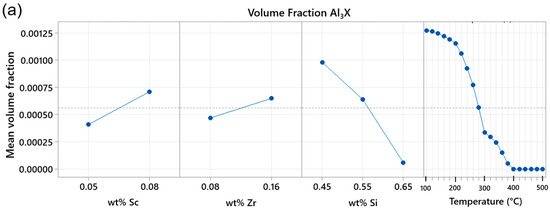
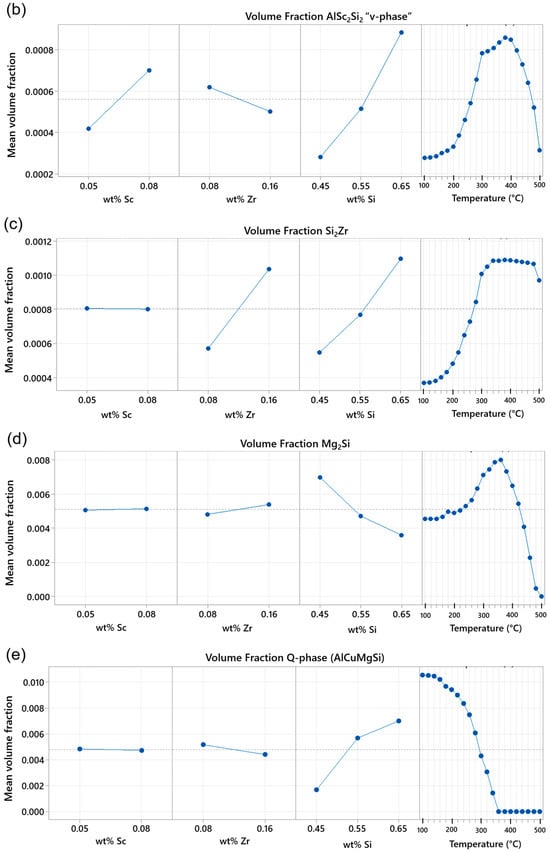
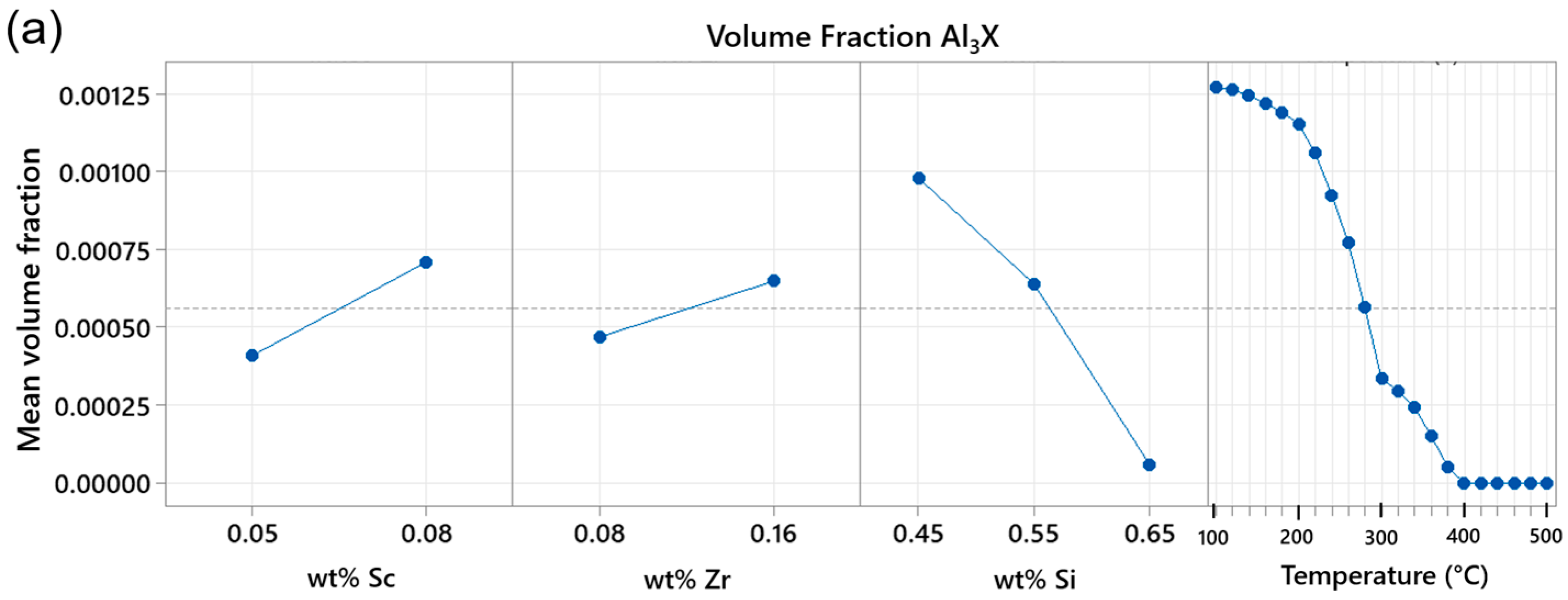
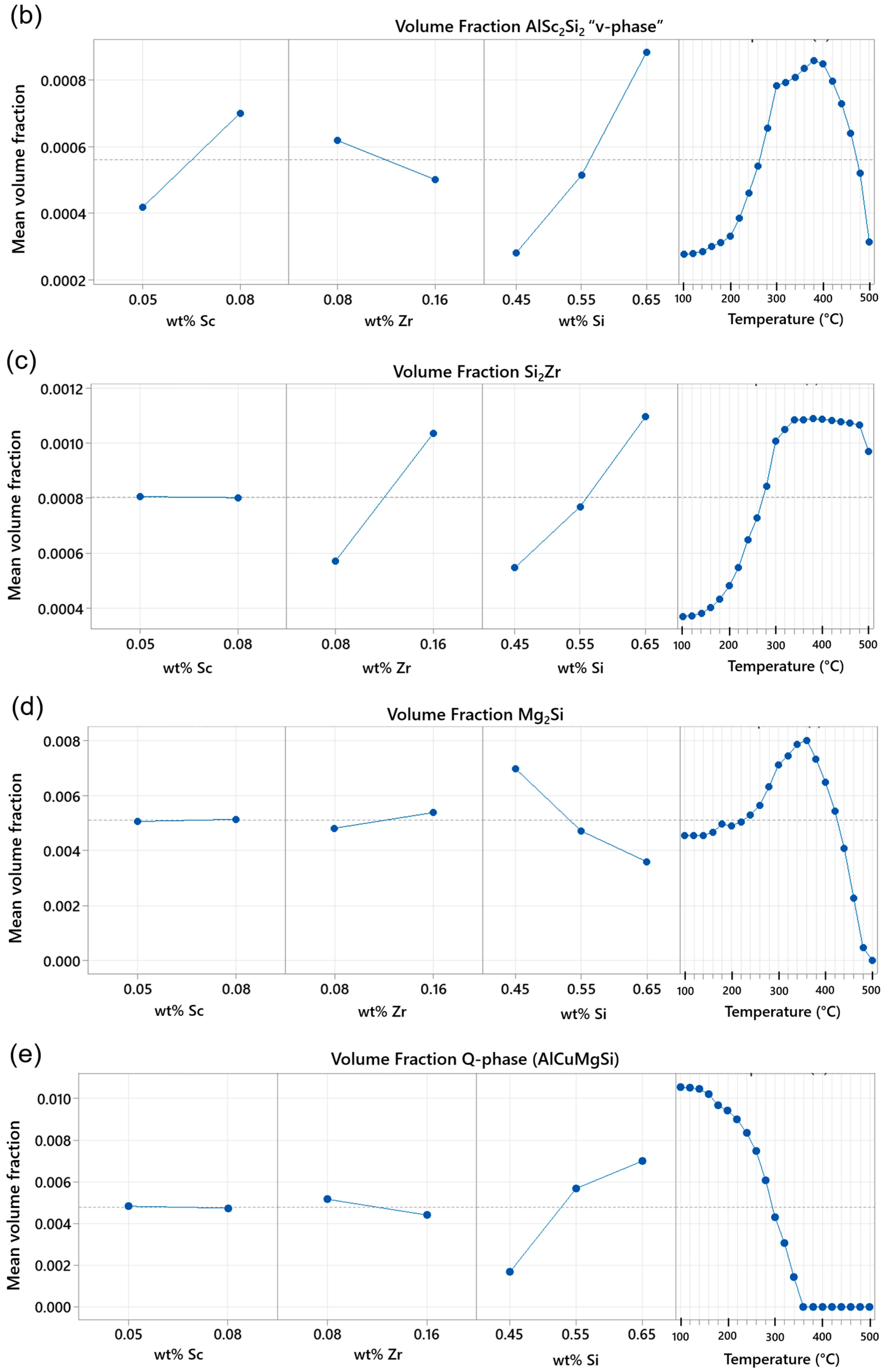
The results were assessed using a design of experiments (DOE) to identify broader trends across varying compositions and temperatures (Figure 1). Note that the DOE analysis only reports the mean concentrations of different phases over the various concentrations and temperatures. Increasing the Sc resulted in more Al3X and AlSc2Si2 while not affecting the formation of other precipitates. Increasing Zr from 0.08wt% to 0.16wt% increased the volume fraction of Al3X and Si2Zr, while decreasing AlSc2Si2. Increasing the Si content from 0.45wt% to 0.65wt% resulted in decreased volume fractions of Al3X and Mg2Si, while increasing the volume fractions of AlSc2Si2, Si2Zr, and Q-phase. Temperature variations are predicted when the mean volume fractions of the different equilibrium phases would form, given the varying composition:
Figure 1.
Design of experiments analysis of single-axis equilibrium simulations for varying factors of Sc, Zr, and Si (wt%) plus temperature, with responses of phase fractions of (a) Al3X, (b) AlSc2Si2 “V-phase”, (c) Si2Zr, (d) Mg2Si, and (e) Q-phase. Note that the results show the mean results to assess trends and the main effects.
- Al3X is stable between 100 °C and 400 °C;
- AlSc2Si2 is stable between 100 °C and 500 °C;
- Si2Zr is stable between 100 °C and 500 °C;
- Mg2Si stable between 100 °C and 480 °C;
- Q-phase (AlCuMgSi) is stable between 100 °C and 360 °C.
3.1.2. Isopleth Calculations
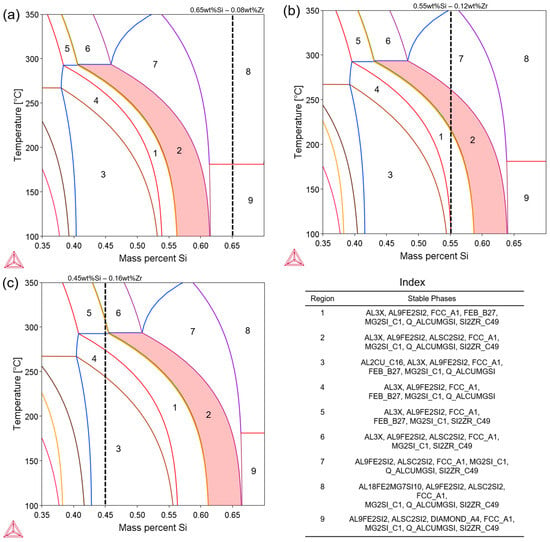
Isopleth phase diagram calculations identified the Si concentration and temperature at which AlSc2Si2 “V-phase” forms as a function of Zr concentrations of 0.16wt%, 0.12wt%, and 0.08wt%, with constant Fe at 0.2wt%, Cu at 0.3wt%, Mg at 0.55wt%, and Sc at 0.08wt%. Diagrams were created over a Si range of 0.35wt% to 0.7wt% and a temperature range of 100 °C to 350 °C to highlight the region where the AlSc2Si2 “V-phase” first appears as Si concentration increases (Figure 2). Nine regions of interest were highlighted on the isopleths; the first region where AlSc2Si2 “V-phase” begins to form is region 2 for all diagrams.
Figure 2.
Isopleth phase diagrams for three different Zr concentrations: (a) 0.08wt% Zr, (b) 0.12wt% Zr, and (c) 0.16 wt% Zr. Nine regions are highlighted within the index; note that the first region where AlSc2Si2 “V-phase” appears is region 2, highlighted in red. The black line highlights the composition of alloys that were cast.
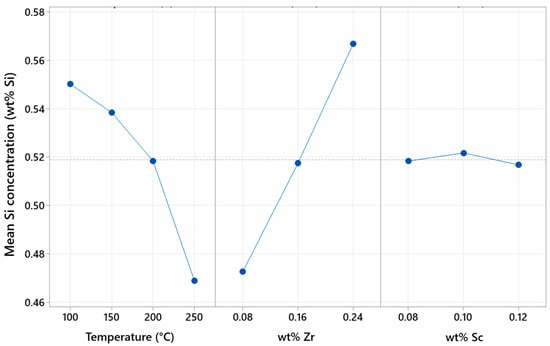
Based on the isopleth phase diagram calculation, increasing Zr shifted the boundary between regions 1 and 2 to higher Si concentrations. To determine how the Si concentration of the boundary varies with Sc and Zr concentrations, a DOE analysis was performed, with Sc content varied between 0.08wt% and 0.12wt% and Zr content between 0.08wt% and 0.24wt% (Figure 3). The analysis showed that increasing the Zr concentration increases the Si concentration at the phase boundary between regions 1 and 2. In contrast, the Sc concentration had no significant effect on the Si concentration of the boundary between regions 1 and 2. Therefore, increasing the Zr concentration enables higher Si additions without forming AlSc2Si2, resulting in a maximum Si concentration of 0.54wt% at 200 °C for the 0.08wt% Zr concentration (Figure 2a), 0.56wt% for 0.12wt% Zr concentration (Figure 2b), and 0.58wt% for 0.16wt% Zr concentration (Figure 2c).
Figure 3.
Main effects plot showing effects of temperature, Zr concentration, and Sc concentration on the Si concentration for the boundary between regions 1 and 2, where AlSc2Si2 “V-phase” first forms.
3.1.3. Proposed Compositions Based on Thermo-Calc Analysis
Based on equilibrium and isopleth Thermo-Clac simulations, increasing Zr and lowering the Si concentration reduced the volume fraction of AlSc2Si2 “V-phase” (Figure 1) by avoiding its equilibrium phase region (Figure 3) while increasing the volume fraction of Al3X (Figure 1). As the Sc concentration increased, both the fractions of Al3X and AlSc2Si2 were held constant at 0.08wt%, while the Si and Zr concentrations were varied to identify changes in microconstituents such as AlSc2Si2 “V-phase” and Al3X. Three compositions were selected: 0.45wt% Si–0.16wt% Zr, 0.55wt% Si–0.12wt% Zr, and 0.65wt% Si–0.08wt% Zr alloys.
Consequently, each composition targets different phase fields at temperatures associated with a multi-step heat treatment (Figure 2). The 0.45wt% Si alloy resides in regions 1, 3, 4, and 6, where region 6 is the only point in this composition that contains AlSc2Si2, and all regions contain Al3X. The 0.55wt% Si alloy resides in regions 1, 2, and 7, where regions 2 and 7 both contain AlSc2Si2, and region 7 does not contain Al3X. The high Si concentration of 0.65wt% is present in regions 9 and 8, which contain AlSc2Si2 rather than Al3X. Therefore, the selected compositions will exhibit a variety of microconstituents and physical properties given various heat treatments.
3.2. Casting Results
After assessing the Thermo-Calc results, three compositions plus a baseline were selected to quantify Si and Zr effects with similar concentrations of Fe, Cu, Mn, Mg, and Ti (Table 4). The four alloys had Si and Zr concentrations within 0.02wt% of the target compositions. The Mg, Cu, and Fe concentrations were within 0.03wt% of the target and were consistent across all four alloys. The Sc concentration target was 0.08wt%; however, as the Zr target increased, the Sc concentration drifted upward. This is due to aberrations in optical emission spectrometry measurements, which artificially increase the Sc concentration due to the Zr signal interacting with the Sc signal when both elements are added together. All alloys were charged with the appropriate amount of the Al-Sc master alloy to have 0.08wt% Sc; therefore, the variation in Sc is taken to be insignificant between the alloys.
Table 4.
Casting results of the four cast alloys in wt%.
3.3. Multi-Step Isochronal Results
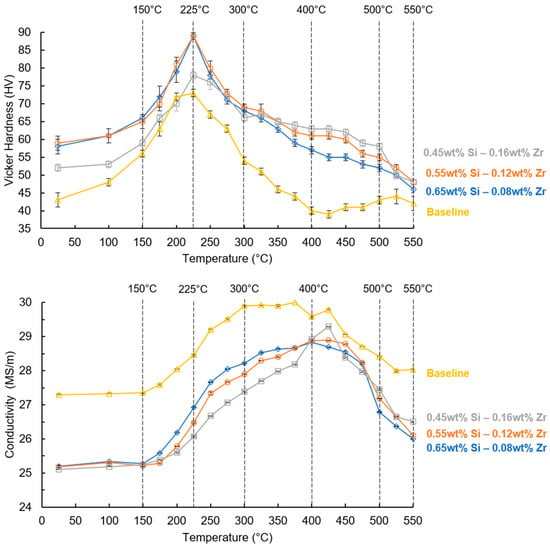
After casting and sectioning, all alloys were isochronally heat-treated from 150 °C to 500 °C in 25 °C increments, and hardness and conductivity were measured after each step (Figure 4). Five regions showed distinct changes in hardness and conductivity. The first region was between 150 °C and 225 °C, where all alloys, compared to the as-cast state, increased in hardness by at least 20 HV and in conductivity by 1.0 MS/m. The next region is between the peak hardness at 225 °C and 300 °C, where all alloys decreased in hardness by at least 16 HV and increased in conductivity by 1.3 MS/m. Beyond these temperature regions, the Sc- and Zr-containing alloys began to deviate from the baseline alloy.
Figure 4.
Hardness and conductivity from the multi-step isochronal study of the four cast alloys. Error bars are 95% standard error.
Consequently, from 300 °C to 400 °C, the 0.45wt% Si–0.16wt% Zr alloy showed no change in hardness, with an increase in conductivity of 1.5 MS/m. In this region, the 0.55wt% Si–0.12wt% Zr and 0.65wt% Si–0.08 wt% Zr alloys had a decrease in hardness of 11 HV and an increase in conductivity of 1.0 MS/m. In contrast, the baseline in this region showed a decrease in hardness to 40 HV and a decrease in conductivity to 29.6 MS/m. From 400 °C to 500 °C, all Sc- and Zr-containing alloys had a decrease in hardness of 11 HV and a reduction in conductivity of 2.0 MS/m. The baseline alloy had an increase in hardness of 8 HV and a reduction in conductivity of 1.2 MS/m. After 500 °C, all alloys continued to decrease in hardness and conductivity until 550 °C.
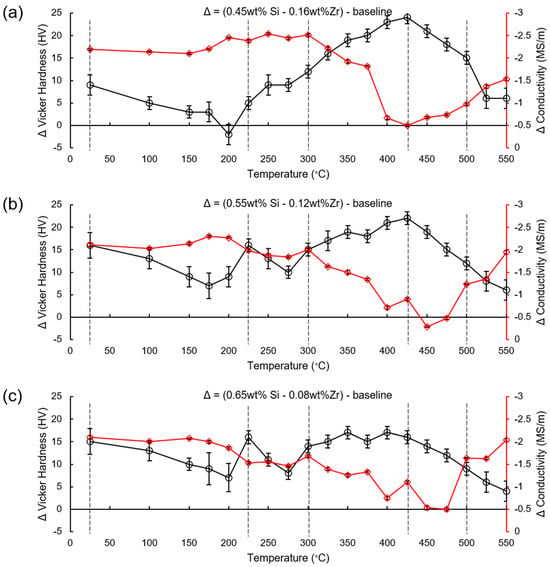
The hardness and conductivity of the baseline were subtracted from the Sc and Zr alloys to quantify the delta (Figure 5). Note that conductivity is reported in negative units, meaning the conductivity is lower for Sc- and Zr-containing alloys. Six temperatures of interest are highlighted to show the changes resulting from varying Si and Zr concentrations.
Figure 5.
Delta value in hardness “black” and conductivity “red” calculated by subtracting the baseline values from the (a) 45wt% Si–0.16wt% Zr alloy, (b) 55wt% Si–0.12wt% Zr alloy, and (c) 0.65wt% Si–0.08wt% Zr alloy. Note that error bars are 95% standard error after error propagation.
- At 25 °C, “as-cast”: The alloys had an average hardness delta of 12 HV and conductivity delta of −2.1 MS/m.
- At 225 °C: The hardness delta increased to 16 HV for the 0.65wt% Si–0.08wt% Zr alloy, but decreased to 5 HV for the 0.45wt% Si–0.16wt% Zr alloy. The conductivity delta was a maximum of −2.3 MS/m for the 0.45wt% Si–0.16wt% Zr alloy, and decreased with Zr concentration to −1.5 MS/m for the 0.65wt% Si–0.08wt% Zr alloy.
- At 300 °C: The 0.55wt% Si–0.12 wt% Zr and 0.65wt% Si–0.08 wt% Zr alloys had no change in the hardness delta compared to 225 °C, while the hardness delta for the 0.45wt% Si–0.16 wt% Zr alloy increased to 12 HV. The conductivity delta was the same for all alloys.
- At 425 °C: The Sc and Zr alloys reached their maximum hardness delta of 24 HV and minimum conductivity delta of −0.5 MS/m for the 0.45wt% Si–0.16wt% Zr alloy.
- At 500 °C: For all alloys, the hardness delta averaged 12 HV, and the conductivity delta was greater than −1.0 MS/m.
- At 550 °C: All alloys had an average hardness delta of 5 HV and conductivity delta of −1.8 MS/m.
Four temperatures were selected for isothermal analysis.
- At 190 °C, to assess the precipitation and growth of Mg2Si.
- At 300 °C, to quantify nucleation and growth of Al3Sc.
- At 400 °C, to include the nucleation and growth of Al3Zr or AlSc2Si2 “V-phase”.
- At 520 °C, to demonstrate the solutionizing effect.
Two thermal profiles designed to target key process steps:
- An aging treatment at 175 °C for 24 h was performed after solutionizing the samples at 520 °C for 48 h.
- A multistep heat treatment, holding at 190 °C, then 300 °C, and finally 400 °C, each for 24 h.
3.4. Isothermal Results
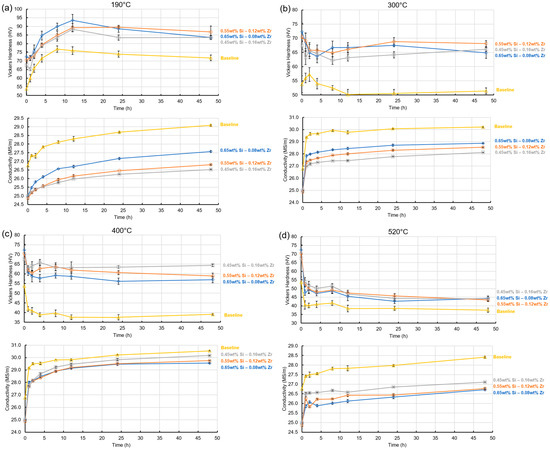
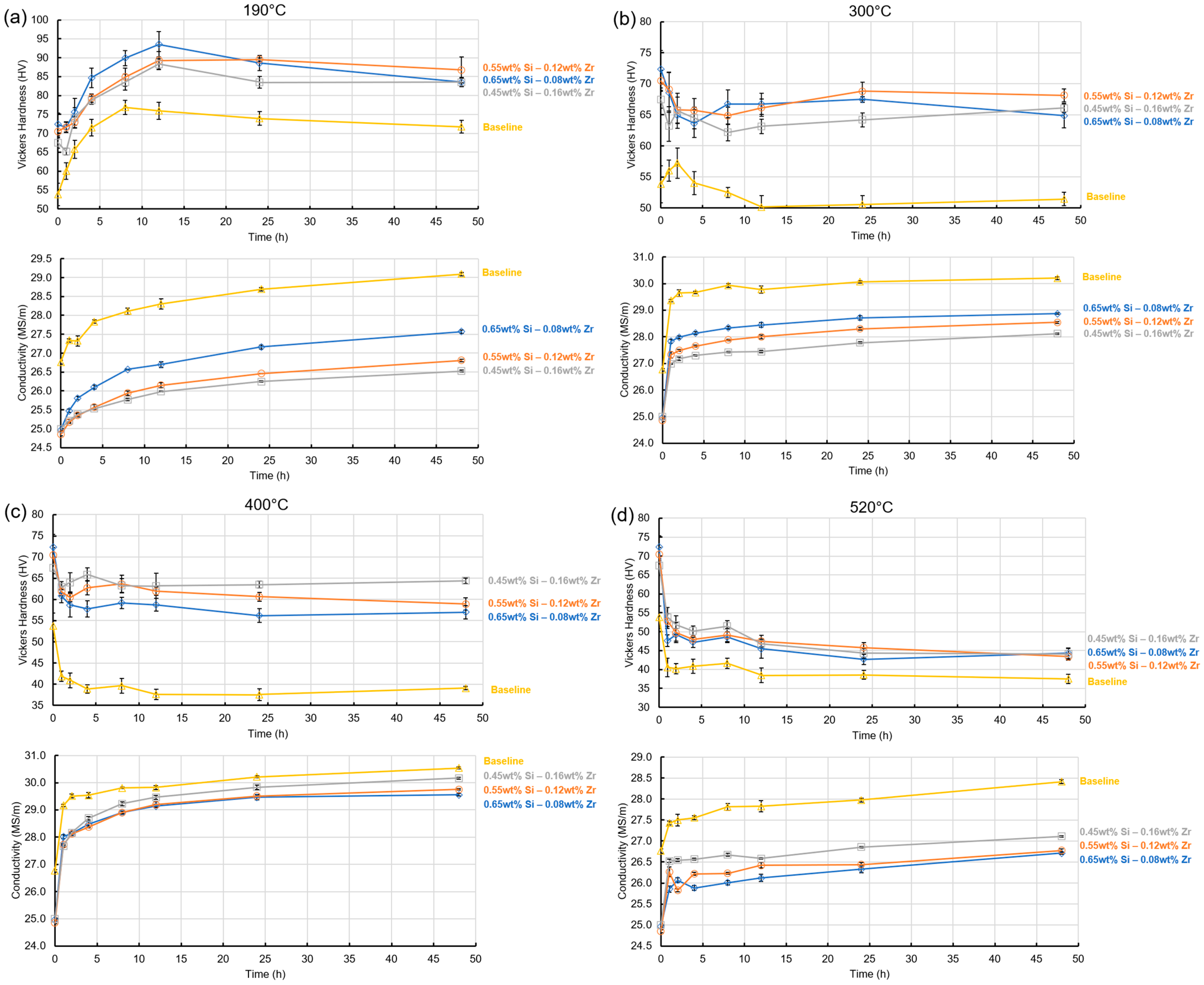
Isothermal experiments were performed at 190 °C, 300 °C, 400 °C, and 520 °C, with hardness and conductivity measured after 1, 2, 4, 8, 12, 24, and 48 h (Figure 6). All Sc-Zr alloys had higher hardness and lower conductivity than the baseline at every hold temperature and time. When held at 190 °C, hardness peaked at 12 h, with a minimum increase over the as-cast condition of 20 HV, with a conductivity increase of 1.0 MS/m for all alloys. After 12 h, all alloys except the 0.65wt% Si–0.08wt% Zr alloy showed no significant change in hardness but an increase in conductivity of 0.5 MS/m. Compared to the baseline, the 0.45wt% Si–0.16wt% Zr alloy exhibits a 12 HV increase in hardness and a 2.3 MS/m decrease in conductivity.
Figure 6.
Vickers hardness and conductivity plots after an isothermal hold at (a) 190 °C, (b) 300 °C, (c) 400 °C, and (d) 520 °C for 48 h. The error bars indicate the 95% confidence interval standard error of the mean.
Holding at 300 °C for 12 h resulted in all alloys, compared to the as-cast condition, having a minimum hardness decline of 4 HV and a conductivity increase of 2.5 MS/m. After 12 h, the hardness and conductivity plateaued. At the 48 h mark, there were no variations in hardness between the Sc- and Zr-containing alloys; however, when compared to the baseline, there was an increase in hardness of 15 HV and a reduction in conductivity of 2.1 MS/m.
After 48 h at 400 °C, all alloys, compared to the as-cast condition, exhibited decreased hardness and increased conductivity. Specifically, the 0.45wt% Si–0.16wt% Zr alloy had a hardness 4 HV lower and a conductivity 4.5 MS/m higher, while the 0.65wt% Si–0.08wt% Zr alloy had a hardness 16 HV lower and a conductivity 4.2 MS/m higher. Comparing the 0.45wt% Si–0.16wt% Zr alloy with the baseline after 48 h showed an increase in hardness of 25 HV and a decrease in conductivity of 0.4 MS/m. Also of interest is variation in hardness and conductivity with Si and Zr concentrations, where the 0.45wt% Si–0.16wt% Zr alloy has the highest hardness and conductivity, with values of 64 HV and 30.2 MS/m, respectively, which are 7 HV and 0.7 MS/m higher than the 0.65wt% Si–0.08wt% Zr alloy.
After treatment at 520 °C for 48 h, all alloys exhibit lower hardness and higher conductivity than in their as-cast state. The 0.65wt% Si–0.08wt% Zr alloy had the highest drop in hardness of 28 HV and the smallest drop in conductivity of 1.7 MS/m. Meanwhile, the 0.45wt%Si–0.16wt% Zr alloy showed a drop in hardness of 23 HV and an increase in conductivity of 2.1 MS/m. At the 48 h mark, there were no significant variations in hardness between Sc- and Zr-containing alloys, only a change in conductivity of 0.4 MS/m. However, compared to the baseline, the 0.45wt% Si–0.16wt% Zr alloy showed an increased hardness of 6 HV and a lower conductivity by 1.3 MS/m.
A unique note about the hardness and conductivity measured during isothermal analysis is the effects due to residual stress and defect recovery. Looking at the 300 °C, 400 °C, and 520 °C after the first hour, there is a sharp decrease in hardness and an increase in conductivity. The cause of this is often due to several factors, not limited to solutionizing effects, defect recovery, and the reduction in residual stresses. These effects were not investigated for this research as the material will be extruded, a process that significantly increases the concentration of defects and residual stress. At these temperatures, grain size will also vary due to recrystallization. The variance in grain size could have a minor impact on hardness and conductivity; however, this was not looked at to save time during the analysis.
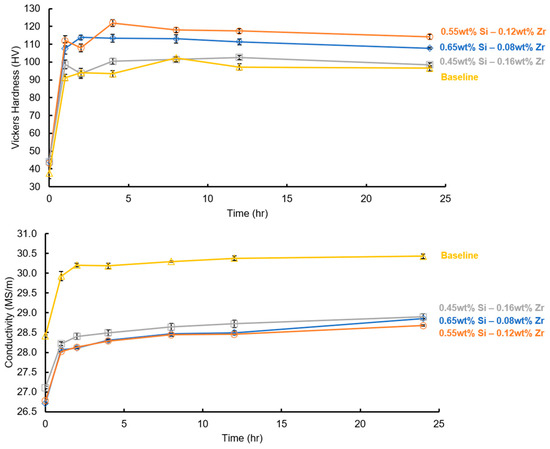
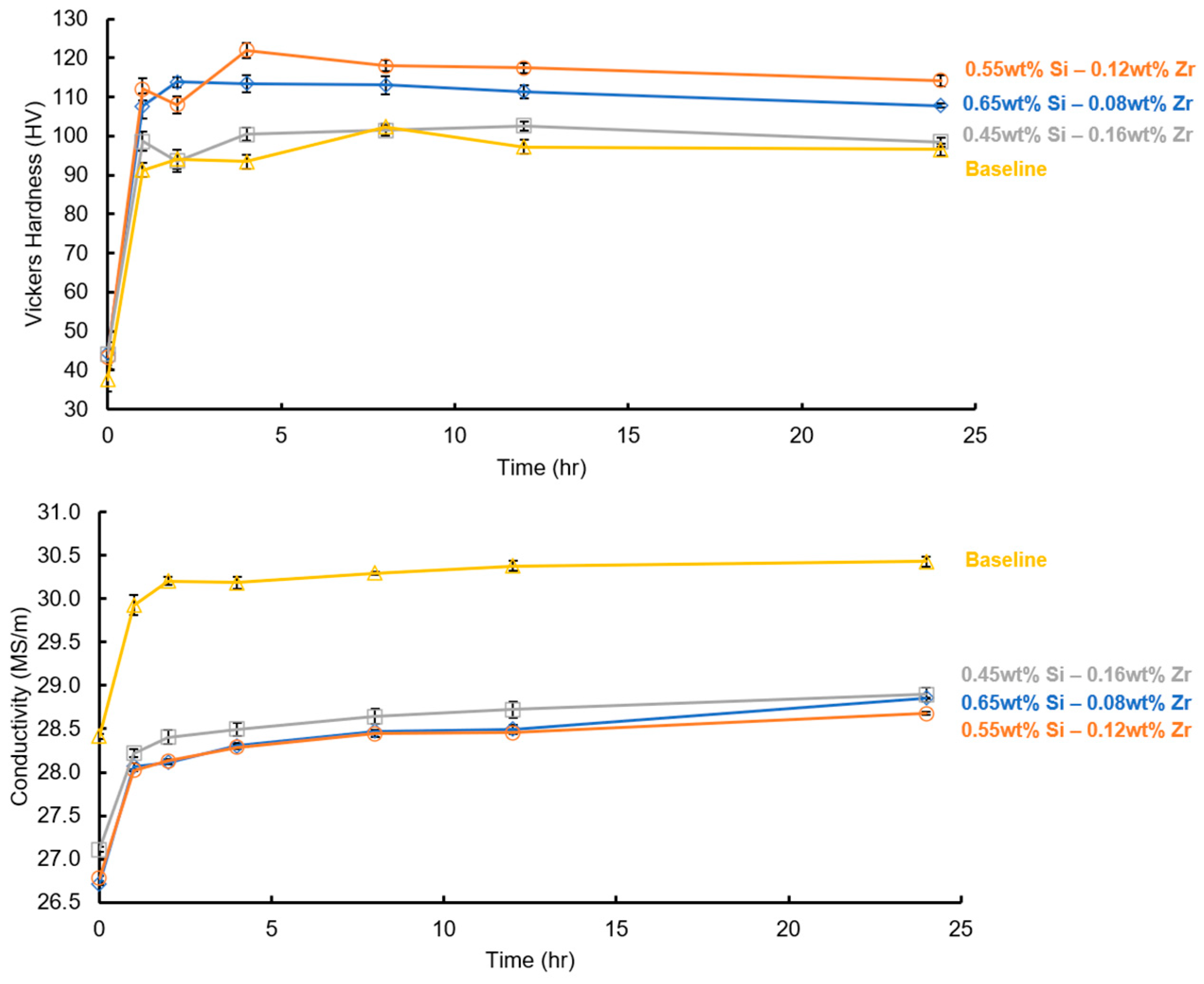
Isothermal analysis was also performed at 175 °C after 1, 2, 4, 8, 12, and 24 h holds following 48 h of solutionizing at 520 °C (Figure 7). All alloys exhibited a significant increase in hardness over the solutionized state; specifically, the 0.55wt% Si–0.12wt% Zr alloy had a maximum increase of 79 HV after 4 h, resulting in the highest hardness of all alloys. Comparing the baseline and 0.45wt% Si-0.16wt% Zr alloy showed similar hardness at 8 h and 24 h, with increases of less than 8 HV over the rest of the hold times.
Figure 7.
Vickers hardness and conductivity plots after an isothermal hold at 175 °C for 24 h, following solutionizing at 520 °C for 48 h. Error bars are the 95% confidence interval standard error.
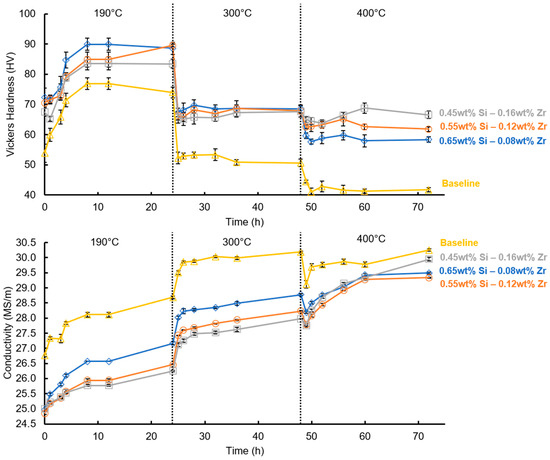
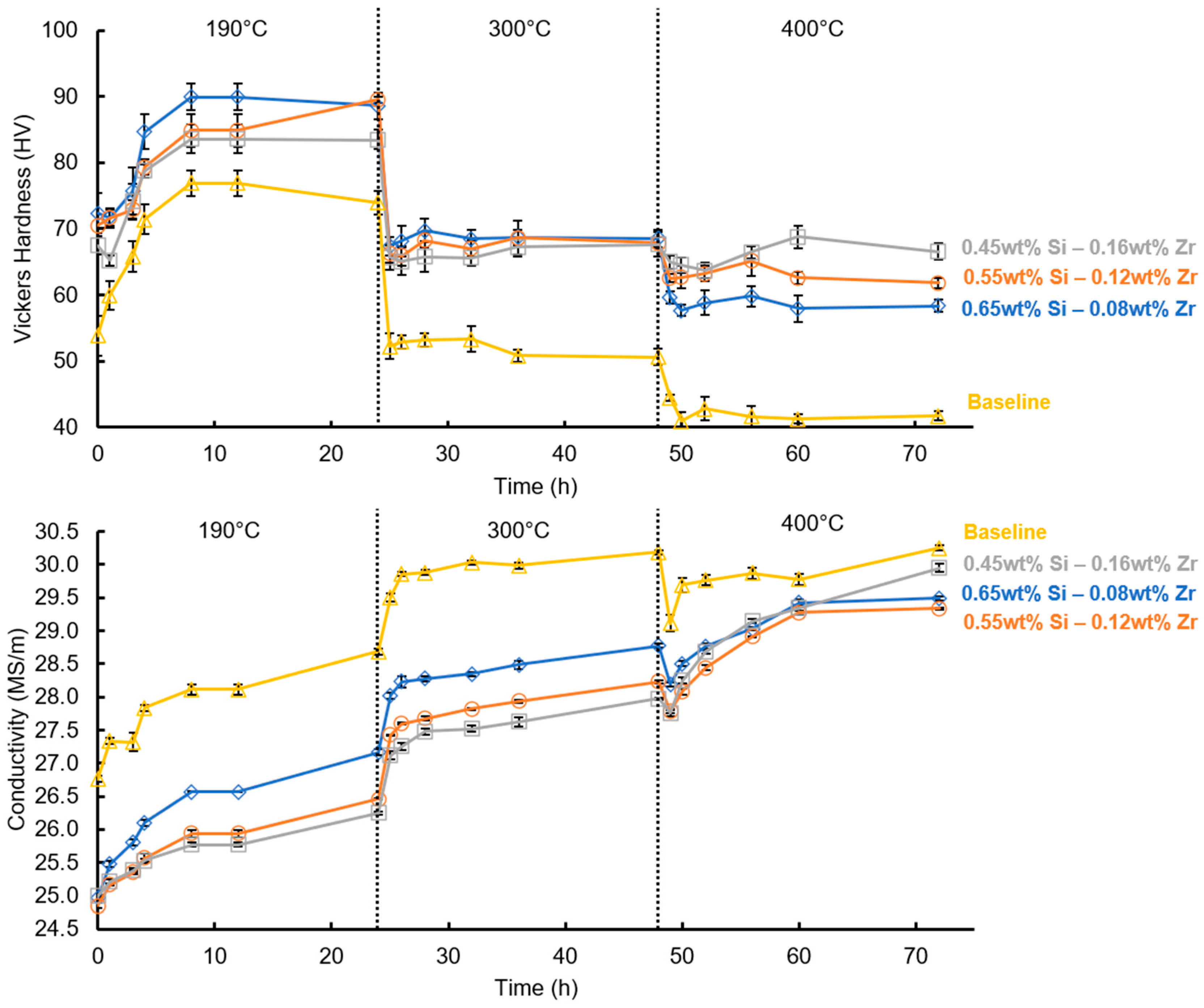
Isothermal analysis was performed with 24 h holds at 190 °C, followed by 300 °C, and finally 400 °C, with measurements taken at 1, 2, 4, 8, 12, and 24 h (Figure 8). After 12 h at 190 °C, hardness increased by an average of 17 HV and conductivity by 1.4 MS/m for all alloys. After 12 h, there were no changes in hardness but an increase in conductivity of 0.6 MS/m. Of the various Si and Zr concentrations, the 0.45wt% Si–0.16wt% Zr alloy had the lowest hardness of 84 HV after 24 h, 6 HV less than the other compositions. Comparing the 0.45wt% Si–0.16wt% Zr alloy to the baseline shows an increase in hardness of 10 HV and a decrease in conductivity of 2.4 MS/m after 24 h.
Figure 8.
Vickers hardness and conductivity plots after a multi-step heat treatment with 24 h holds at 190 °C, 300 °C, and 400 °C. Error bars are the 95% standard error.
At 300 °C, all alloys had a decrease in hardness of 24 HV from the maximum at 190 °C, which remained constant throughout the total 24 h. Conductivity increased by 1 MS/m in 12 h from the maximum at 190 °C and then continued to increase by 0.6 MS/m in the remaining 24 h. Compared to the baseline, the 0.45wt% Si–0.16wt% Zr alloy had increased hardness of 12 HV and lower conductivity of 2.4 MS/m after 24 h.
At 400 °C, there was an initial decrease in hardness of 5 HV and conductivity of 0.5 MS/m from the end of the 300 °C treatment. This was followed by a plateau in hardness and a continued reduction in conductivity by 1.6 MS/m, which continued through the end of the 24 h hold. After 12 h, the 0.45wt% Si–0.16wt% Zr alloy had the highest hardness, followed by the 0.55wt% Si–0.12wt%Zr with 6 HV less, and then the 0.65wt% Si–0.08wt% Zr with 11 HV less. Comparing the 0.45wt% Si–0.16wt% Zr alloy to the baseline after 12 h showed that hardness was 28 HV greater, and conductivity was 0.5 MS/m less; these differences did not change after 24 h.
3.5. Microstructural Analysis
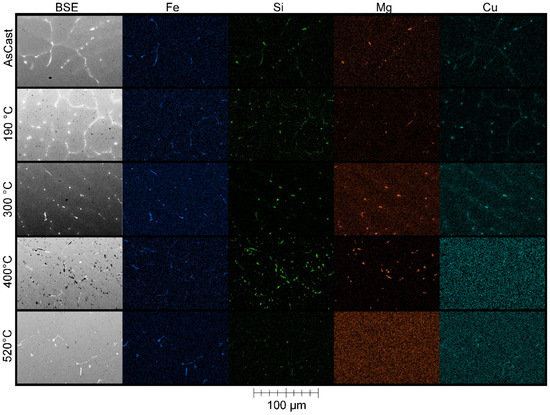
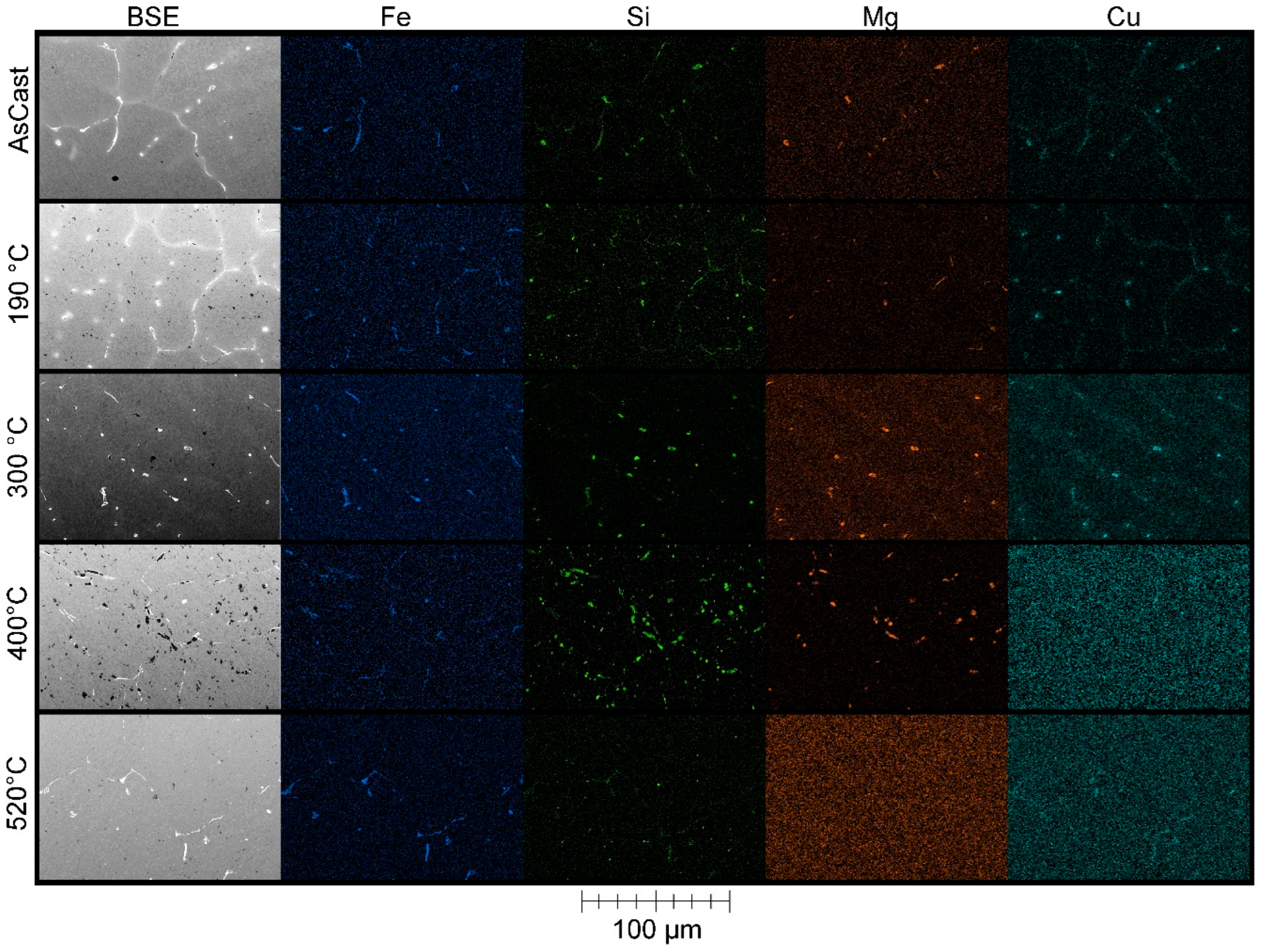
SEM analysis of the microstructure in the as-cast state and after selected multi-step isochronal holds was performed to examine changes in the Fe-, Si-, Mg-, and Cu-containing phases. No large precipitates with Sc or Zr were identified for any alloy in any condition. All alloys had a similar bulk microstructure, with little to no noticeable changes due to composition, but showed similar variations in response to the isothermal holds. For efficiency, only the 0.55wt% Si–0.12wt% Zr alloy microstructure was examined under different isothermal hold conditions (Figure 9). The as-cast condition revealed two distinct phases in the backscattered image: a light phase predominantly composed of Fe and Si, and a dark phase containing Si, Mg, and Cu. At 190 °C, the phase chemistries present remained unchanged compared to the as-cast condition. The 300 °C conditions had similar light and dark phases, again with no significant changes. At 400 °C, the dark Mg phase qualitatively increased. At the 520 °C conditions, there was a qualitative reduction in Si-, Mg-, and Cu-containing phases.
Figure 9.
SEM and EDS maps of Fe, Si, Mg, and Cu for the 0.55wt% Si–0.12wt%Zr alloy as-cast and after multi-step isochronal heat treating.
The effect of alloying on the formation of phases observable in SEM was minimal; however, the heat treatment temperature did qualitatively influence phase fraction. The dark phase decreased at 300 °C, and then increased at 400 °C, followed by a drop at 520 °C. These phases were primarily composed of Si, Mg, and Cu, consistent with the EDS maps, suggesting the formation of coarse Mg/Si-containing phases and Al/Mg/Si/Cu phases that consume matrix solutes. In these temperature ranges, no large precipitates containing Zr or Sc were identified, suggesting these elements form nano-scale precipitates or remained in solution throughout heat treatment. Further analysis with transmission electron microscopy (TEM) will be required to identify these phases.
4. Discussion
4.1. Integrating Thermo-Calc, Isochronal, and Isothermal Methods to Specify a Multi-Step Homogenization Process
The first step in the multi-step homogenization was to determine a temperature favorable for precipitating β-Mg2Si. Initial Thermo-Calc analysis identified a window between 100 °C and 200 °C, where β-Mg2Si formed and AlSc2Si2 “V-phase” did not (Figure 1). Considering this window and reviewing the isochronal results (Figure 5), the difference in hardness between the baseline and 0.45wt% Si–0.16wt% Zr alloy approached zero at 200 °C, suggesting that below this temperature Mg- and Si-containing phases were responsible for increased hardness, while Sc- and Zr-containing phases were not. Isothermal aging heat treatment at 175 °C (Figure 7) showed no significant difference in hardness between the Sc- and Zr-containing samples at 8 and 24 h. Therefore, an optimal range for forming Mg2Si was identified between 175 °C and 200 °C.
After precipitation of β-Mg2Si, the next step in the heat treatment was to precipitate Al3Sc and then Al3Zr. Initial Thermo-Calc simulations predicted that Al3X was stable between 100 °C and 400 °C (Figure 1). However, initial isochronal results (Figure 4) from 225 °C to 275 °C showed a decrease in the hardness delta for the 0.55wt% Si–0.12wt% Zr and 0.65wt% Si–0.08wt% Zr alloys, while the 0.45wt% Si–0.16wt% Zr alloy had an increase in the hardness delta. This temperature range should result in the coarsening of Mg- and Si-containing phases, resulting in a decrease in hardness for all alloys, and no significant variation in the hardness delta. The decreased hardness delta for the 0.55wt% Si–0.12wt% Zr and 0.65wt% Si–0.08wt% Zr alloy is due to Mg2Si coarsening, while the increased hardness delta for the 0.45wt%Si–0.16wt% Zr alloy is caused by Sc and Zr solute strengthening, as conductivity did not significantly change, suggesting Al3Sc or Al3Zr was not formed until after 275 °C. It is important to note that at 275 °C, the hardness delta for all Sc- and Zr-containing alloys was similar, while at 300 °C, the hardness delta increased for all alloys. Considering the increase in hardness delta from 275 °C, which is suspected of causing Mg- and Si-phase coarsening, the increase in hardness at 300 °C suggests the start of a precipitation reaction.
Now looking at the 300 °C to 400 °C temperature range, the hardness delta of the 0.45wt% Si–0.16wt% Zr increased with every time step. Specifically, at 300 °C, the 0.45wt% Si–0.16wt% Zr alloy exhibits a 10 HV increase in hardness and 2.5 MS/m decrease in conductivity compared to the baseline. Then, upon heating at 400 °C, the hardness delta increases to 23 HV, and the conductivity delta decreases to 0.7 MS/m (Figure 5). Similar magnitudes for the increase in hardness, but different magnitudes for the reduction in conductivity, suggested that precipitation reactions occurred at 300 °C and 400 °C. The isothermal hold at 300 °C resulted in the 0.45wt% Si–0.16wt% Zr alloy having a 15 HV hardness delta and a −2.1 MS/m delta in conductivity compared to the baseline. In comparison, the isothermal hold at 400 °C resulted in a 25 HV hardness delta and −0.4 MS/m conductivity delta when compared to the baseline (Figure 6). Conductivity differences can be used to determine the precipitation reaction, as both temperatures increased the hardness but produced different effects on conductivity. Metallurgically, it is known that Zr is detrimental to conductivity, causing a significant decrease when added in small amounts to the aluminum matrix, making a large conductivity delta when compared to a baseline alloy [21]. Therefore, looking at the conductivity delta at 400 °C suggested Zr is precipitating because the conductivity delta becomes the lowest, and the hardness delta increases, while Sc precipitates at 300 °C as the delta in conductivity remains high, but there is an increase in hardness compared to the baseline. Co-precipitation could be possible; however, it was shown by Abnar et al. that in an Al-Sc-Zr containing alloy, a Sc-containing phase will form first at 300 °C, followed by Zr-containing phases at 400 °C [22]. For the simultaneous multi-step treatment (Figure 8), there was no change in hardness given Zr concentration at 300 °C; however, when held at 400 °C, hardness increased with increasing Zr concentration. The similar hardness of all alloys at 300 °C was due to similar Sc concentrations, which led to similar formation of Al3Sc precipitates. In contrast, at 400 °C, the higher Zr content resulted in greater Al3Zr formation and increased hardness. Given these conclusions, 300 °C should be used to precipitate Al3Sc and 400 °C should be used to precipitate Al3Zr.
The final step in creating the proper heat treatment was to determine the times required for each step of the multi-step process. To do this, a multi-step treatment was performed to identify the ideal hold times for β-Mg2Si precipitation at 190 °C, Al3Sc precipitation at 300 °C, and Al3Zr precipitation at 400 °C (Figure 8). At 190 °C for up to 12 h, hardness and conductivity increased; however, between 12 h and 24 h, hardness was constant, but there was a slight increase in conductivity, consistent with coarsening of β-Mg2Si precipitates. At 300 °C, all Sc- and Zr-containing alloys had higher hardness than the baseline. Over time, hardness increased, reaching a maximum at 12 h, while conductivity decreased throughout the entire range. At 400 °C, the hardness of all Sc and Zr-containing alloys was greater than that of the baseline alloy, with the hardness reaching a maximum at 12 h and progressive conductivity reductions over time. Given diminishing returns, the hold times at each homogenization step were found to be between 8 and 12 h.
4.2. The Effect of Zr Additions on Phase Formation and Properties
The Zr level was varied between 0.08wt% and 0.16wt% to minimize and or eliminate AlSc2Si2 “V-phase” formation. Initial Thermo-Calc equilibrium and isopleth simulations showed that increased Zr reduced AlSc2Si2 “V-phase” (Figure 1) and pushed the AlSc2Si2 “V-phase” boundary to higher Si levels (Figure 3). Attempts to verify the behavior using the multi-step isochronal results showed that, for all alloys containing Zr, there was a trend of decreasing hardness above 225 °C, but always a delta above the base (Figure 4). Looking at the difference over baseline plots (Figure 5), for the 0.45wt% Si alloy, the hardness delta increased in the 225 °C to 400 °C region, suggesting that the AlSc2Si2 “V-phase” was not formed and instead formation of a hardening precipitate, such as Al3X, was (Figure 5). In the 0.65wt% Si and 0.55wt% Si alloys, there was a decrease in the hardness delta between 225 °C and 275 °C, followed by an increase at 300 °C, and no change after 400 °C, suggesting that if the V-phase had formed, it was not detrimental to the hardness.
Isothermal analysis at temperatures within the AlSc2Si2 “V-phase” stability range of 300 °C and 400 °C (Figure 6) showed a significant increase in hardness for all Zr-containing alloys compared to the baseline. Increasing Zr concentration resulted in increased hardness after 48 h of heat treatment, suggesting further precipitation of Al3Zr. These results contradict Thermo-Calc equilibrium simulations (Figure 1), which suggested that, in the 300 °C and 400 °C range, there was a reduction in Al3X hardening precipitates and an increase in the deleterious AlSc2Si2 “V-phase” for 0.55wt% Si and 0.65wt% Si alloys.
Considering Zr had no physically measurable effect on AlSc2Si2 “V-phase” formation, the Zr content in a new 6xxx series alloy should be tailored for optimal Al3Sc-Zr precipitation, rather than AlSc2Si2 “V-phase” mitigation. The three Zr concentrations resulted in the high Zr concentration having a higher hardness in the 375 °C to 520 °C range (Figure 4), suggesting that a Zr concentration of 0.16wt% and Sc concentration of 0.08wt% have improved Al3Sc-Zr precipitation hardening.
Also, within the 0.08wt% to 0.16wt% Zr range, there was no impact on the as-cast or heat-treated microstructures visible in SEM, such as large Zr precipitates, suggesting the Zr level was low enough to prevent primary Zr precipitate formation. The absence of Zr- or Si-containing precipitates also confirms that Si in the range of 0.45–0.65 wt% did not promote the formation of Si- and Zr-containing phases predicted by Thermo-Calc.
4.3. Si Concentration Influences on Age-Hardening and Microstructure
Increasing Si content should promote the formation of AlSc2Si2 “V-phase”, thereby decreasing hardness at high temperatures due to Si’s affinity for Sc. Thermo-Calc showed that as Si increased, the volume fraction of AlSc2Si2 increased while Al3X decreased (Figure 1). Isochronal results (Figure 4) in the 350 °C to 500 °C range show that lower Si alloys resulted in higher hardness. Similarly, the isothermal holds at 400 °C (Figure 6), and a multi-step treatment above 400 °C (Figure 8) showed that lower-Si alloys have higher hardness, while isothermal holds at 300 °C showed no significant change in hardness after 48 h among the three Sc- and Zr-containing alloys (Figure 6). The conflicting results observed across varying isothermal hold temperatures were due to a decrease in Zr content, which lowers hardness at high temperatures by reducing Al3X formation. Conductivity results confirm the behavior showing a significant decrease at 400 °C, indicative of Zr precipitation. Therefore, Si had no significant effects on AlSc2Si2 “V-phase” formation at the tested levels.
Decreasing Si would result in lower hardness under peak-aged conditions due to decreased β-Mg2Si formation. Initial Thermo-Clac analysis indicated that increasing Si from 0.45 to 0.55 wt% resulted in no change in the maximum amount of β-Mg2Si that could form (Figure 1). This calculation did not account for the kinetics of the reaction or the other metastable forms of β, such as β′′-Mg5Si6 or β′-Mg1.8Si, which are kinetically favorable and more effective hardening phases. The Thermo-Calc reactions suggest that, as Si increased from 0.55wt% to 0.65wt%, the fraction of Mg2Si decreased significantly, implying less hardening at Si concentrations above 0.55wt%; in reality, this behavior was not true. Multi-step isochronal analysis effectively demonstrated that peak hardness was higher for the 0.55wt% Si alloy compared to the 0.65wt% Si and 0.45wt% Si alloys (Figure 4). Therefore, the optimal Si concentration for the proposed composition was 0.55wt%, as confirmed by isothermal heat treatment at 175 °C after holding at 520 °C for 48 h (Figure 7), which produced the highest hardness of 122 HV.
There were no consistent Si effects on the microstructure visible in SEM analysis. Temperature did influence the formation of a Si-containing phase, as shown at 400 °C (Figure 9), where there was an increase in the dark Si-containing phase for all alloys. No Si and Zr phases were identified in the microstructure, suggesting that Si concentration did not affect the formation of Si2Zr as suggested by Thermo-Calc (Figure 1). All results indicate that microstructural effects were on the nano-scale level and will need to be assessed with TEM analysis.
5. Conclusions
The Si and Zr content of a new 6xxx series alloy was analyzed using Thermo-Calc and experimental heat treatments to optimize the composition and homogenization conditions to maximize Al3Sc-Zr precipitation and minimize AlSc2Si2 “V-phase” formation. Thermo-Calc equilibrium calculations predicted that lower Si and higher Zr concentrations would produce less V-phase and precipitate more Al3X. While isopleth diagrams showed that increasing Zr shifted the region containing the AlSc2Si2 “V-phase” to higher Si levels. However, isochronal and isothermal results showed that the Si content of Sc- and Zr-containing alloys did not cause a reduction in hardness compared to the baseline when heat-treated between 300 °C and 520 °C, suggesting that AlSc2Si2 “V-phase” did not form to the extent predicted by Thermo-Calc; instead, the Si content influenced peak age hardening, having the highest hardness at 0.55wt%. The increased Zr content did result in higher peak hardness at 400 °C, suggesting the formation of more Zr-containing precipitates, such as Al3X, predicted in Thermo-Calc.
From the isochronal and isothermal hardness results, the 180–200 °C temperature range caused an increase in hardness and reduced conductivity, suggesting the precipitation of Mg/Si-containing precipitates. Of all the alloys, the 0.55wt% Si–0.12wt% Zr showed the best age hardenability when solutionized, quenched, and aged at 175 °C. After multi-step isothermal treatment, the 0.45wt% Si–0.16wt% Zr alloy had similar conductivity to the baseline and the highest hardness, suggesting that a higher Zr concentration of 0.16wt% produced more/finer Al3Sc-Zr dispersoids. Isothermal analysis was not effective at detecting changes in V-phase formation between the selected alloys. Given the simulations and heat treatment analysis, a 0.16wt% Zr and 0.08wt% Sc concentration is recommended for increased Al3Sc-Zr precipitation, with a homage-aging heat treatment with four steps: a 12 h hold at 190 °C to precipitate Mg and Si, a 10 h hold at 300 °C to precipitate Al3Sc, a 10 h hold at 400 °C to precipitate Al3Zr, and a 2 h hold at 520 °C to redissolve Mg and Si before extrusion heating.
Author Contributions
Conceptualization, P.S., T.L. and E.H.; methodology, P.S. and E.H.; software, E.H.; validation, E.H.; formal analysis, E.H.; investigation, E.H.; resources, P.S.; data curation, E.H.; writing—original draft preparation, E.H.; writing—review and editing, P.S., T.L. and E.H.; visualization, T.L.; supervision, P.S.; project administration, P.S.; funding acquisition, P.S. and T.L. All authors have read and agreed to the published version of the manuscript.
Funding
Funding was provided by Sunrise Energy Metals. The electron microscopy research was performed at the Applied Chemical and Morphological Analysis Laboratory at Michigan Technological University; the electron microscopy facility is supported by NSF MRI 1429232.
Data Availability Statement
The original contributions presented in this study are included in the article. Further inquiries can be directed to the corresponding author.
Conflicts of Interest
Author Thimothy Langan is a consultant for the company Sunrise Energy Metals. The remaining authors declare that the research was conducted in the absence of any commercial or financial relationships that could be construed as a potential conflict of interest.
References
- Cecchel, S. Materials and Technologies for Lightweighting of Structural Parts for Automotive Applications: A Review. SAE Int. J. Mater. Manuf. 2020, 14, 81–97. [Google Scholar] [CrossRef] [Scilit]
- Parson, N.; Fourmann, J.; Beland, J.-F. Aluminum Extrusions for Automotive Crash Applications. In Proceedings of the SAE World Congress Experience, Detroit, MI, USA, 3–5 April 2017. [Google Scholar] [CrossRef] [Scilit]
- Decong, P.; Bing, L.; Quigbin, Y.; Weiyi w Ying, D.; Quinglin, P. Effect of Trace Amounts of Sc on the Microstructure and Mechnical Properties of 6005A Alloy. Jpn. Sci. Technol. Agency 2022, 32, 1855–1862. [Google Scholar]
- Langan, T.J.; Dorin, T. Scandium in Commercial Wrought Aluminum Alloys. In Rare Earth Metals and Minerals Industries; Murty, Y.V., Alvin, M.A., Lifton, J., Eds.; Springer: Cham, Switzerland, 2024. [Google Scholar] [CrossRef] [Scilit]
- Babaniaris, S.; Ramajayam, M.; Jiang, L.; Varma, R.; Langan, T.; Dorin, T. Effect of Al3(Sc,Zr) dispersoids on the hot deformation behaviour of 6xxx-series alloys: A physically based constitutive model. Mater. Sci. Eng. A 2020, 793, 139873. [Google Scholar] [CrossRef] [Scilit]
- Davydov, V.G.; Rostova, T.D.; Zakharov, V.V.; Filatov, Y.A.; Yelagin, V.I. Scientific principles of making an alloying addition of scandium to aluminium alloys. Mater. Sci. Eng. A 2000, 280, 30–36. [Google Scholar] [CrossRef] [Scilit]
- Pandee, P.; Gourlay, C.M.; Belyakov, S.A.; Patakham, U.; Zeng, G.; Limmaneevichitr, C. AlSi2Sc2 intermetallic formation in Al-7Si-0.3Mg-xSc alloys and their effects on as-cast properties. J. Alloys Compd. 2018, 731, 1159–1170. [Google Scholar] [CrossRef] [Scilit]
- Dumbre, J. Understanding the formation of (Al,Si)3Sc and V-phase (AlSc2Si2) in Al-Si-Sc alloys via ex situ heat treatments and in situ transmission electron microscopy studies. J. Alloys Compd. 2021, 861, 158511. [Google Scholar] [CrossRef] [Scilit]
- Røyset, J.; Tundal, U.; Skjervold, S.R.; Waterloo, G.; Braathen, C.; Reiso, O. An Investigation of Sc Addition on the Extrudability, Recrystallisation Resistance and Mechanical Properties of a 6082- and a 7108-Alloy. In Proceedings of the 9th International Conference on Aluminium Alloys, Brisbane, Australia, 2–5 August 2004. [Google Scholar]
- Litynska-Dobrzynska, L. Structure and Properties of Al-Mg-Si alloys with Zr and Sc additions produced by melt spinning and twin rolling casting techniques. Kov. Mater.—Met. Mater. 2010, 48, 9–15. [Google Scholar] [CrossRef] [Scilit]
- Rokhlin, L.L.; BocHVar, N.R.; Tarytina, I.E. Joint effect of scandium and zirconium on the structure and the strength properties of Al–Mg2Si–Based alloys. Russ. Metall. Met. 2015, 2015, 726–731. [Google Scholar] [CrossRef] [Scilit]
- Rokhlin, L.L.; BocHVar, N.R.; Leonova, N.P.; Sukhanov, A.V. Effect of additional doping with scandium and scandium with zirconium on strength properties of the alloys of Al–Mg2Si system. Inorg. Mater. 2016, 52, 1467–1471. [Google Scholar] [CrossRef] [Scilit]
- Rometsch, P.; Fourmann, J. Potential for Using Scandium in Extrusion Alloys. In Proceedings of the 2024 Aluminum Extrusion Technology Conference, Orlando, FL, USA, 30 April–2 May 2024. [Google Scholar]
- Aryshenskii, E.V.; Lapshov, M.A.; Rasposienko, D.Y.; Konovalov, S.V.; Drits, A.M.; Makarov, V.V. Study of minor Sc and Zr additions effect on silicon rich Al–Mg–Si aluminum alloy microstructure during Sc multistage thermal treatment. Phys. Met. Metallogr. 2024, 125, 158–171. [Google Scholar] [CrossRef] [Scilit]
- Langan, T.; Ramjayam, M.; Sanders, P.; Wood, T.; Dorin, T. Heat Treatments for Precipitation of Scandium-Containing Dispersoids in an Si-Containing Aluminum Alloys. In Light Metals 2019; Chesonis, C., Ed.; Springer International Publishing: Cham, Switzerland, 2019; pp. 1463–1467. [Google Scholar]
- Baruah, M.; Borah, A. Processing and precipitation strengthening of 6xxx series aluminium alloys: A review. Int. J. Mater. Sci. 2020, 1, 40–48. [Google Scholar] [CrossRef] [Scilit]
- Røyset, J.; Ryum, N. Scandium in aluminium alloys. Int. Mater. Rev. 2005, 50, 19–44. [Google Scholar] [CrossRef] [Scilit]
- Elasheri, A.; Elgallad, E.M.; Parson, N.; Chen, X.-G. Nucleation and transformation of Zr-bearing dispersoids in Al–Mg–Si 6xxx alloys. J. Mater. Res. 2023, 38, 696–707. [Google Scholar] [CrossRef] [Scilit]
- Shomali, A.; Langan, T.; Wood, T.; Sanders, P. Sc-Containing Al–Si–Mg (6xxx) Alloys for Automotive Extrusions. In Light Metals 2024; Wagstaff, S., Ed.; Springer Nature: Cham, Switzerland, 2024; pp. 1111–1119. [Google Scholar] [CrossRef] [Scilit]
- Babaniaris, S.; Ramajayam, M.; Jiang, L.; Langan, T.; Dorin, T. Developing an Optimized Homogenization Process for Sc and Zr Containing Al-Mg-Si Alloys. In Light Metals 2019; Chesonis, C., Ed.; Springer International Publishing: Cham, Switzerland, 2019; pp. 1445–1453. [Google Scholar] [CrossRef] [Scilit]
- Lunn, K.F.; Apelian, D. Thermal and Electrical Conductivity of Aluminum Alloys: Fundamentals, structure-property relationships, and pathways to enhance conductivity. Mater. Sci. Eng. A 2025, 924, 147766. [Google Scholar] [CrossRef] [Scilit]
- Abnar, B.; Gashtiazar, S.; Rometsch, P.; Javidani, M. Advanced thermal-resistant aluminum conductor alloys: A comprehensive review. Int. J. Miner. Metall. Mater. 2026, 33, 68–93. [Google Scholar] [CrossRef] [Scilit]

Disclaimer/Publisher’s Note: The statements, opinions and data contained in all publications are solely those of the individual author(s) and contributor(s) and not of MDPI and/or the editor(s). MDPI and/or the editor(s) disclaim responsibility for any injury to people or property resulting from any ideas, methods, instructions or products referred to in the content. |
© 2026 by the authors. Licensee MDPI, Basel, Switzerland. This article is an open access article distributed under the terms and conditions of the Creative Commons Attribution (CC BY) license.