
Article

Mechanical Characterization and Numerical Modeling of 316 Stainless Steel Specimens Fabricated Using SLM

1
Pitesti University Center, Faculty of Mechanics and Technology, National University of Science and Technology POLITEHNICA Bucharest, 1st Târgu din Vale, 110040 Pitesti, Romania
2
Regional Center of Research & Development for Materials, Processes and Innovative Products Dedicated to the Automotive Industry (CRCD-Auto), Pitesti University Center, National University of Science and Technology POLITEHNICA Bucharest, 1st Târgu din Vale, 110040 Pitesti, Romania
3
Technologies For Nuclear Energy State Owned Company, Campului Street No. 1, 115400 Mioveni City, Romania
*
Author to whom correspondence should be addressed.
J. Manuf. Mater. Process. 2026, 10(1), 29; https://doi.org/10.3390/jmmp10010029 (registering DOI)
Submission received: 29 November 2025 / Revised: 2 January 2026 / Accepted: 8 January 2026 / Published: 10 January 2026

Abstract

This study examines the influence of build orientation on the mechanical behavior of 316 stainless steel components fabricated by selective laser melting (SLM). Additively manufactured tensile specimens produced in different build orientations were experimentally analyzed and compared with reference specimens obtained from conventionally hot-rolled material and laser-cut to identical geometries. Uniaxial tensile testing combined with digital image correlation (DIC) was employed to evaluate the mechanical response and full-field strain evolution. Microstructural features were investigated using scanning electron microscopy (SEM), while phase composition was assessed by X-ray diffraction (XRD). The results reveal a pronounced orientation-dependent mechanical anisotropy in the SLM specimens, reflected in variations in yield strength, ultimate tensile strength, and ductility. Specimens loaded perpendicular to the build directions exhibited higher strength but reduced ductility compared to those loaded parallel to the build direction, whereas the rolled material showed a more isotropic mechanical response. Although the XYZ and XZY samples feature similar deposition patterns, the XRD analysis revealed a the existence of a 220 texture. Thus, the mechanical performances of XZY specimens are about 10 % lower compared to XYZ printed samples. The stress maximum–strain curves were extrapolated from the true data using the Swift model. The section dedicated to numerical modeling includes a failure model based on the traixility. The numerical models were validated for the range η 0.33 0.45 specific to uniaxial tension. Fractographic observations further confirmed the correlation between build orientation, microstructural features, and fracture behavior. The present study provides a multiscale experimental framework linking processing conditions, microstructure, and mechanical response in additively manufactured stainless steel.

1. Introduction

Additive manufacturing (AM), and, in particular, laser powder bed fusion (LPBF), commonly referred to as selective laser melting (SLM), has become a central technology for producing high-performance metallic components. The advantages are related to the tailored microstructures and complex geometries, capable of producing near-fully dense stainless steel components with tailored microstructures directly from a 3D CAD model [1,2,3]. Among the alloys frequently processed by LPBF, stainless steel 316 (1.4404) remains one of the most extensively studied due to its corrosion resistance, excellent processability, and widespread applicability in biomedical, aerospace, energy, and tooling applications [4,5,6]. However, the extreme thermo-physical conditions that characterize the SLM process—including rapid melting, directional solidification, steep thermal gradients, and repetitive thermal cycling—generate unique microstructural features that differ substantially from those of conventionally manufactured 316 alloys. Understanding the correlations between the SLM thermal history, microstructural evolution, build orientation, and resulting mechanical properties is therefore essential for the qualification and certification of SLM-produced 316 components.
Extensive studies have shown that 316 stainless steel fabricated by SLM exhibits a hierarchical microstructure consisting of melt pool scale solidification bands, elongated columnar grains preferentially aligned with the build direction, and submicron cellular or columnar subgrains enriched in solute elements. Investigations by Grech et al. [7], Geľatko et al. [8], and Santamaria et al. [9] demonstrated that these cellular subgrain structures originate from microsegregation during rapid solidification and contribute significantly to strengthening through dislocation–subgrain boundary interactions. High dislocation densities, often exceeding those observed in hot-rolled or annealed 316, were further reported by Cegan et al. [10] and Ara et al. [11] confirming the role of steep thermal gradients and constrained solidification in generating pronounced microstructural heterogeneity.
The SLM process can produce relative densities above 99%; however, the formation of process-induced defects remains a critical challenge. The influence of process parameters on porosity formation is extensively examined by Larimian et al. [12], which demonstrates that low volumetric energy density favors lack-of-fusion defects, whereas excessive energy density produces keyhole porosity due to vaporization instabilities. Melt pool morphology, laser energy absorption, and powder flow behavior jointly determine pore size distribution and morphology. These findings are consistent with microstructural evidence reported by Yan et al. [13], where melt pool boundaries and localized remelting are shown to generate heterogeneities that directly impact local mechanical response, as further discussed by Hu et al. [14] and Lamb et al. [15].
Another factor governing the performance of SLM-processed 316 is build orientation, which strongly affects the grain morphology, texture evolution, defect alignment, and anisotropy of mechanical properties. Studies such as those reported by Liu et al. [16] illustrate that vertically built specimens typically contain columnar grains aligned parallel to the build direction. In contrast, horizontally oriented specimens exhibit a more equiaxed or mixed texture depending on local thermal gradients. These orientation-dependent crystallographic features influence yield strength, ductility, and fracture behavior. Furthermore, SEM-based analyses by Güden et al. [17] and Laurence et al. [18] revealed pronounced microstructural anisotropy in SLM-fabricated 316 stainless steel, characterized by grains and fine substructures aligned by the build direction. Such anisotropic microstructures promote distinct deformation mechanisms, including deformation twinning under dynamic loading conditions, as reported by Enser et al. [19]. In addition, residual stresses generated during the SLM process concentrate strain in specific regions, leading to direction-dependent yielding and heterogeneous slip activity across different build orientations. These observations demonstrate that the interplay between the melt pool geometry and the in-layer thermal history governs both macroscopic anisotropy and microscale deformation mechanisms.
The mechanical behavior of SLM-fabricated 316 differs markedly from that of conventionally processed materials, as reported by Li et al. [20]. Enhanced yield strength—commonly attributed to subgrain boundaries, dislocation density, and fine microstructural features—is frequently accompanied by reduced strain hardening capability. These trends are extensively documented by Güden [17], which confirms that the alloy exhibits pronounced strain rate sensitivity and a characteristic flow behavior associated with the refinement of the cellular structure. Meanwhile, Ara et al. [11] reveal unconventional elastic–plastic transitions and nonlinear elastic responses, attributed to the highly heterogeneous distribution of internal stresses and to the presence of structurally constrained dislocation networks.
Deformation twinning, typically rare in coarse-grained 316 at room temperature, has been reported in several SLM studies. Santamaria et al. [9] and Yang et al. [21] observed the occurence of deformation twins in additively manufactured 316 stainless steel. The deformation twinning is commonly associated with nanoscale subgrain structures, high internal stress fields, and localized dislocation interactions within melt pool boundaries. These deformation mechanisms highlight that the SLM-induced microstructure significantly alters the fundamental plasticity pathways of 316 stainless steel.
Residual stresses represent another defining characteristic of the SLM process, arising from steep thermal gradients and constrained cooling during solidification. High-resolution neutron diffraction and X-ray diffraction studies conducted by Laurence et al. [18] revealed complex stress fields that depend strongly on scan strategy, part geometry, and thermal history. Excessive residual stresses may induce warping, distortions, or crack formation, making stress mitigation essential. Post-processing strategies such as stress-relief annealing and hot isostatic pressing (HIP) play a critical role in achieving acceptable mechanical stability. The influence of HIP and thermal treatments is comprehensively reviewed by Aziz et al. [22], demonstrating reductions in porosity and residual stress but also noting the potential coarsening of cellular structures and the associated reductions in strength.
Surface integrity is equally important, as non-uniform surface roughness, partially melted particles, and micro-notches can reduce fatigue performance. The electropolishing and machining processes documented by Geľatko et al. [8] show improvements in surface morphology and fatigue life, while also indicating that surface-initiated cracking often dominates fatigue failure in as-built components.
Collectively, these studies reveal that the mechanical properties of SLM-processed 316, such as yield strength, ultimate tensile strength, modulus, strain rate sensitivity, and fatigue behavior, are intimately linked to the process-controlled microstructure, build orientation, defect population, and post-processing history. The strong dependence of these properties on process parameters, thermal cycles, and melt pool geometry underscores the need for robust structure–process–property frameworks and comprehensive characterization approaches integrating SEM, EBSD, and mechanical testing.
Given the widespread industrial relevance of 316 stainless steel and the rapid evolution of AM technologies, a thorough understanding of microstructure development, defect formation mechanisms, anisotropy due to build orientation, and the resulting mechanical properties is essential. The studies analyzed highlight the necessity of establishing predictive models and optimization strategies for the SLM processing of 316 stainless steel, ultimately supporting the qualification and certification of AM components for critical applications.
Previous work consistently demonstrates that SLM 316 stainless steel exhibits higher yield and ultimate tensile strength when loaded perpendicular to the build direction. This behavior is attributed to the epitaxial formation of columnar grains aligned with the build axis, sustained by the steep thermal gradients inherent to AM solidification. The elevated density of grain boundaries perpendicular to the build direction loading promotes more effective barriers to dislocation motion, thereby enhancing both yield and plastic strength. Furthermore, model-based analyses performed by Wang et al. [23] indicated that heterogeneous grain distributions influence plastic anisotropy under both tensile and compressive regimes. The tension–compression asymmetry perpendicular to the build direction is amplified by residual stress-driven back stresses.
Previous studies show that anisotropic microstructures, residual stress gradients, and defect distributions jointly control the macroscopic mechanical response of SLM-fabricated 316 stainless steel. Crystal plasticity simulations performed by Laurence et al. [19] and Wang et al. [24] confirmed that the orientation of the columnar grains (parallel to the laser build direction) and the uneven internal stress fields are key factors that produce the tension–compression differences observed across various build directions. Furthermore, defect analyses reported by Zhang et al. [2] revealed that porosity, lack of fusion regions, and melt pool instabilities originate from insufficient energy input, powder–laser mismatch, and melt pool turbulence, all of which significantly affect fatigue and structural integrity. It is also demonstrated by Sithole et al. [1] that standard density cubes do not accurately represent the true porosity distribution in complex geometries, underscoring the need for geometry-specific quality assurance rather than cube-based approaches.
Furthermore, SLM components continue to exhibit microstructural heterogeneity, discontinuities, and distortion despite technological progress, emphasizing the ongoing need for improved processing–structure–property mapping in metal AM, as highlighted by Amstrong et al. [4]. Grain morphology remains highly heterogeneous, governed by directional solidification and local thermal gradients, resulting in marked mechanical anisotropy across build orientations, as discussed by Kok et al. [6]. Additional microstructural modifications occur in functionally graded composites, where Akbarzadeh et al. [24] showed that TiC (titanium carbide) particles undergo dissolution and nanoscale reprecipitation, facilitating grain refinement and strength improvements within the 316 matrix. Under dynamic loading conditions, Li et al. [25] demonstrated that SLM 316 exhibits significant strain rate sensitivity and temperature-dependent flow behavior. Finally, architected auxetic lattice designs fabricated from 316 were shown by Whang et al. [26] to achieve substantially improved compressive strength and energy absorption, enhancements of up to 20–24%, demonstrating the capability of AM to engineer superior performance through geometrical optimization.
The broader literature shows that the number and arrangement of grain boundaries formed during solidification influence both the start of yielding and the way plastic deformation develops in different loading directions in SLM 316 steel. Simulations also reveal that residual stresses can create additional internal stresses, causing the material to behave differently in tension than in compression. Together, these findings explain how variations in the material’s internal structure affect dislocation motion and strengthening.
Build orientation-induced anisotropy is a well known intrinsic characteristic of components fabricated by selective laser melting, arising from the layer-wise nature of the process and the associated directional thermal gradients. This behavior has been reported across a wide range of metallic materials processed by SLM. For example, Maamoun et al. [27] demonstrated pronounced orientation-dependent microstructural and mechanical anisotropy in SLM-fabricated aluminum alloys, while Moussaoui et al. [28] reported similar effects in Inconel 718 produced by SLM. Furthermore, Ni et al. [29] showed that build-induced material anisotropy significantly affects the mechanical and machining response of SLM-fabricated Ti-6Al-4V alloys. These studies indicate that anisotropy is not material-specific but rather an inherent feature of the SLM process, motivating further investigation of the orientation-dependent behavior of 316 stainless steel.
The effect of build orientation on the tensile properties of SLM-fabricated 316 stainless steel has been recognized since early investigations, including the widely cited study by Tolosa et al. [30]. However, these early works mainly addressed orientation-dependent strength variations, while the associated deformation and strain localization mechanisms have received less attention.
Given the significance of SLM 316 across structural and safety-critical applications, as highlighted by Maconachie et al. [31], together with the rapid evolution of AM technologies, a rigorous and up-to-date review of the microstructural evolution, build orientation effects, defect physics, SEM-characterized morphologies, and mechanical behavior remains essential. This work synthesizes insights from foundational AM studies, advanced characterization techniques, and high-resolution data from the uploaded literature. The goal is to provide a comprehensive framework for understanding structure–process–property relationships in SLM-manufactured 316 (1.4404) stainless steel and to outline pathways for improved process control, certification, and industrial deployment.

2. Manufacturing Process

2.1. Sample Design

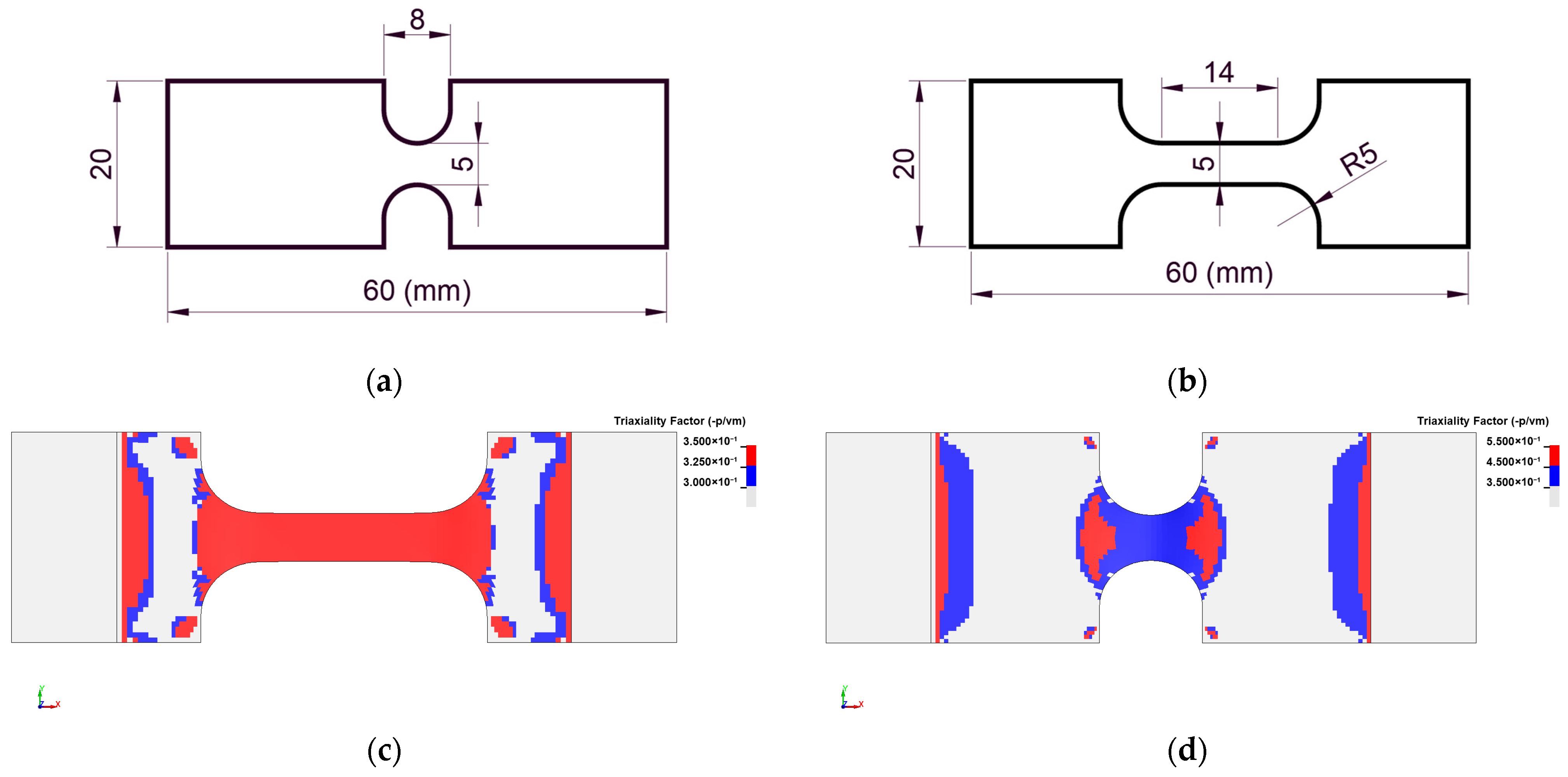
The shapes and sizes of the specimens analyzed are related to the investigation of the stress triaxiality. The value of the triaxiality η is defined as the ratio between the hydrostatic stress σ h and the Von Mises equivalent stress σ m :
η = σ h σ m
The hydrostatic stress is expressed in terms of principal stresses as follows:
σ h = σ 1 + σ 2 + σ 3 3
The Von Mises equivalent stress is defined as follows:
σ m = σ 1 σ 2 2 + σ 2 σ 3 2 + σ 3 σ 1 2 2
Thus, for the uniaxial tension σ 1 0 ; σ 2 = 0 ; σ 3 = 0 the theoretical value of triaxiality is equal to 1 / 3 . However, the existing ductility will determine the necking behavior before the structure fails. Thus, the average stress triaxiality under uniaxial tension is in the range of 1 / 3 2 / 3 [32,33,34].
Figure 1 presents the shapes and dimensions of the samples investigated in this study. Figure 1a,b presents the shapes and dimensions of the specimens, and Figure 1c,d presents the triaxility state induced by the configuration of the specimen [35,36].
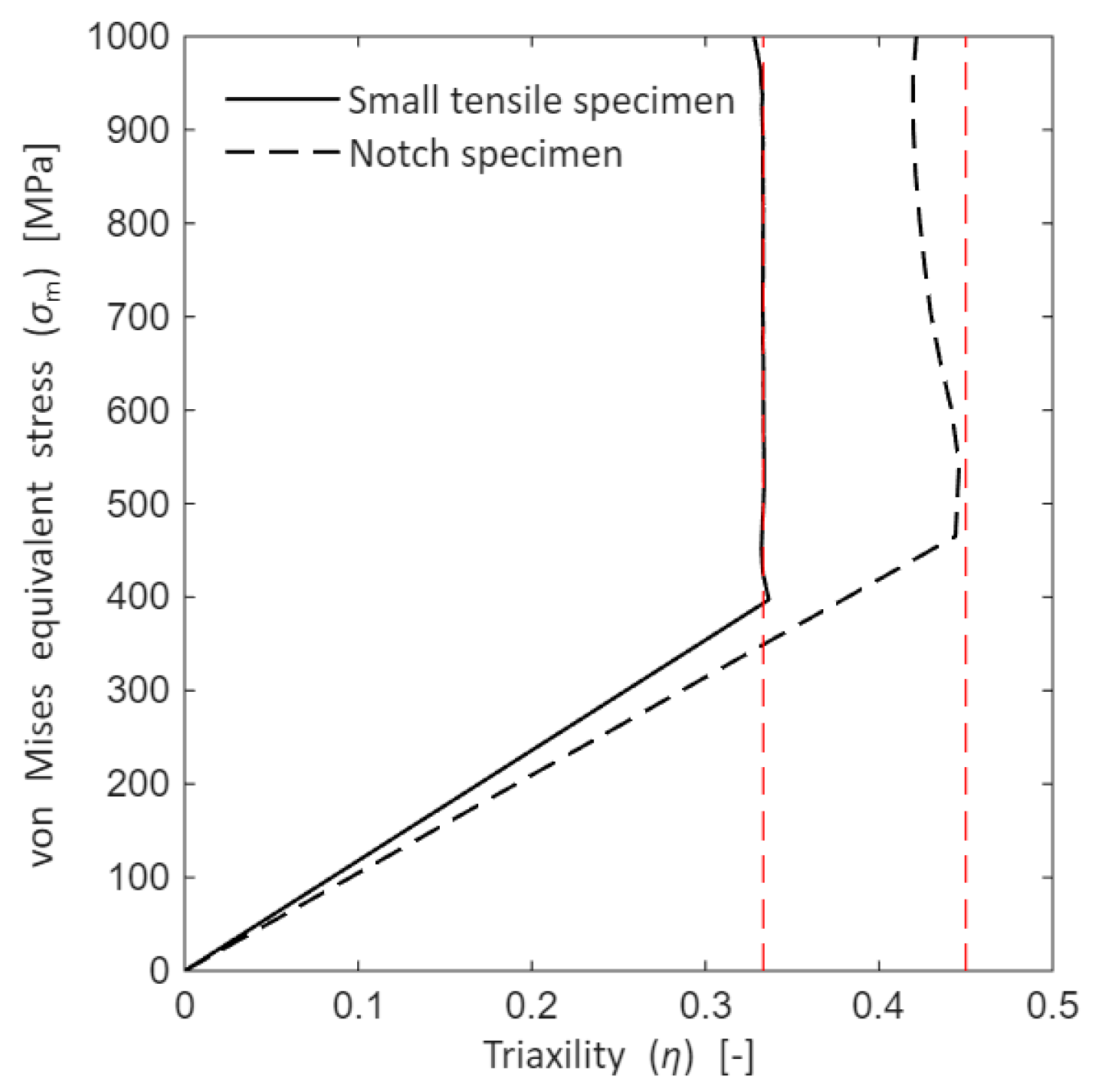
Figure 2 presents the evolution of stress as a function of triaxiality for the above-mentioned specimens under tensile loading.
To evaluate the effect of build orientation on the mechanical characteristics of metallic specimens, two categories of samples were considered: SLM-produced specimens and reference specimens manufactured by conventional methods. The conventionally produced specimens were obtained from hot-rolled stock, laser-cut to the required geometry, providing an industrially relevant baseline for comparison.

2.2. Parameters of the SLM Manufacturing Process

The set of additively manufactured specimens was requested from an external supplier. The parts were produced using a Sisma Mysint 100 Dual RM system (Sysma S.p.A, Italy), a laser powder bed fusion platform equipped with two 200 W fiber lasers. The machine operates in an inert argon atmosphere, ensuring low oxygen levels throughout fabrication.
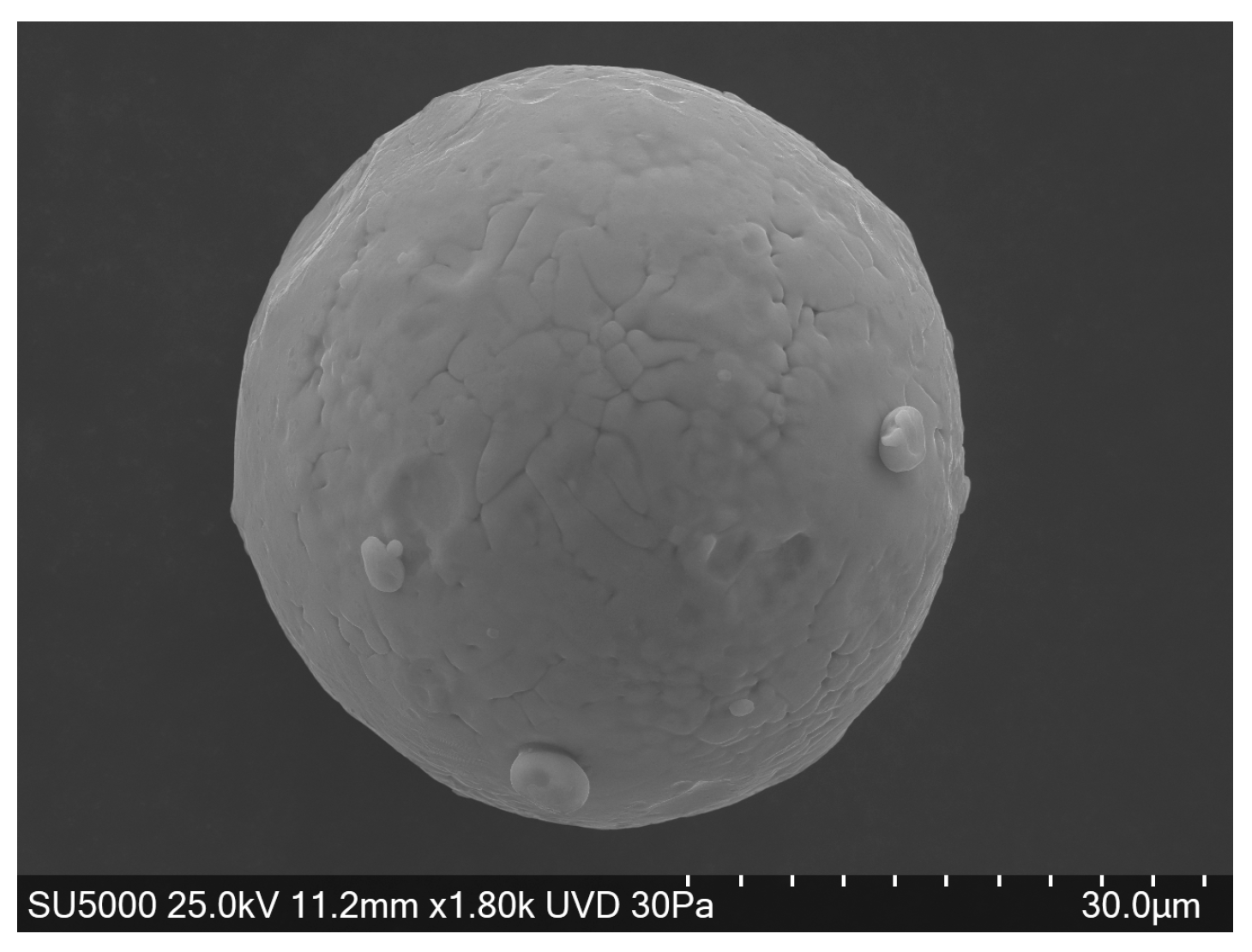
The feedstock material consisted of a SS316/1.4404 austenitic stainless steel powder, characterized by its spherical morphology (Figure 3), and a particle size distribution suitable for LPBF processing. Along with the specimens, a sample of the feedstock material was requested for investigations.
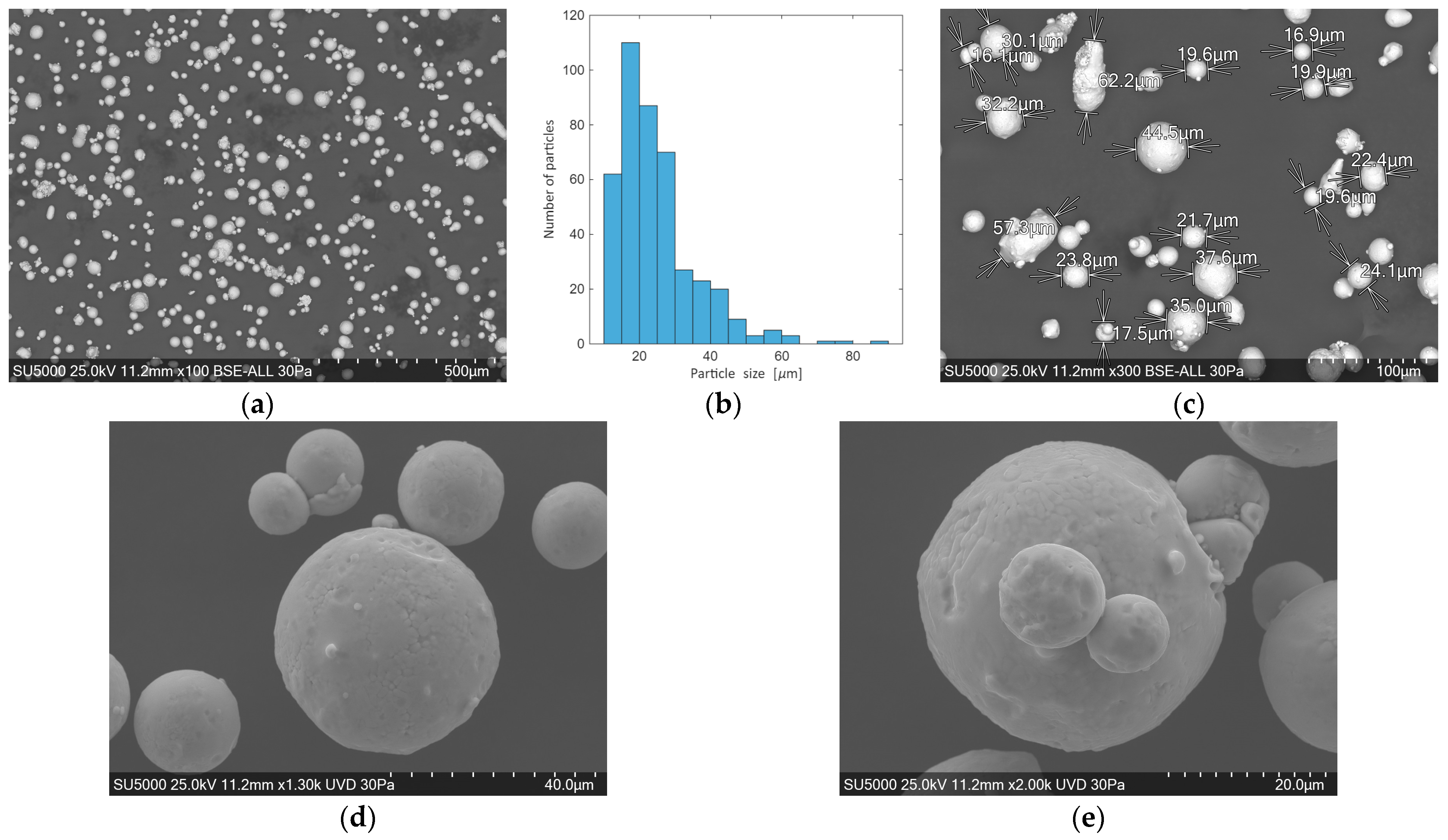
The raw powder was investigated to perform a statistical analysis of the particle dimensions.
The SEM images reveal that the particles have a spherical shape (Figure 4a), although a limited number are elongated (Figure 4c). The major dimension of the particles, as presented in Figure 4b, is mostly in the range of 10 30   μ m . The dimensions above 50   μ m are specific to non-spherical shapes. The PSD analysis revealed that 2.6 % of the particles (Figure 4e) exceed the size of the beam diameter 55   μ m , showing that the stockfeed does not consist only of virgin material (Figure 4d) [37]. The number of reuse cycles could not be provided to complete the feedstock analysis.
The process parameters are presented in Table 1.
The statistical analysis of the distribution (Figure 4b) shows compatibility between the laser beam diameter and the particle size.
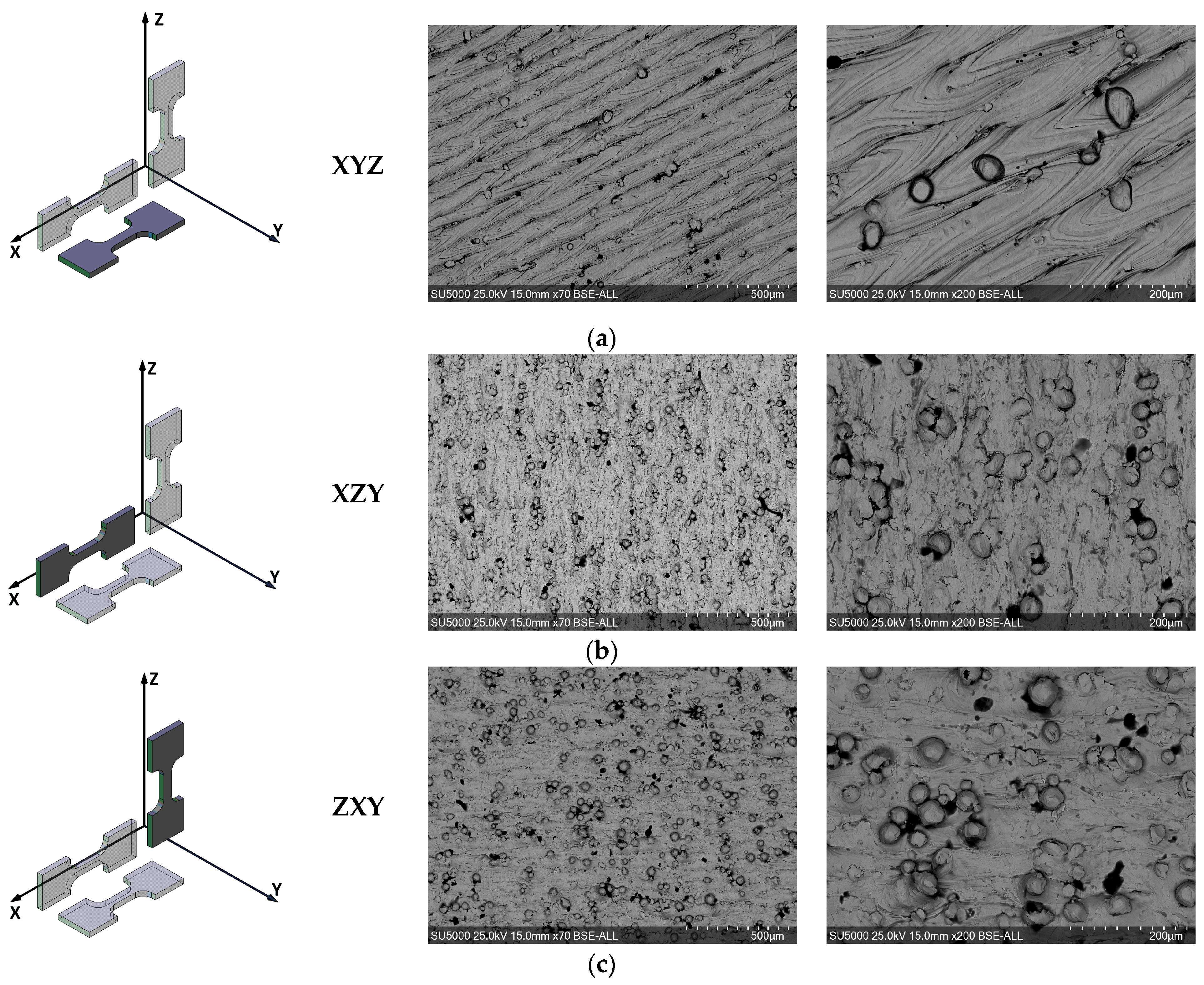
Figure 5 presents the orientation of the specimens during the printing process. The machine’s support plate is in the horizontal (XY) plane. The normal to the plane represents the Z axis. The coordinate system shown in Figure 5 follows the right-hand rule (ASTM 52921 [38]).
The images reveal the path of the laser beam during fabrication. The samples were positioned with the flat surface on the support. To highlight the relevant morphological features, the images in column 1 were acquired at a magnification of 70 X , while those in column 2 were acquired at a magnification of 200 X .
Figure 5a reveals the hatching pattern used to fill the contour. Figure 5b reveals the contour pattern for the samples built in the XZY direction. In contrast, Figure 5c shows the contour pattern for the samples built in the ZXY direction (the reader should correlate the observation plane with the surface image—sample XZY is rotated about the X axis, while sample ZXY is rotated first about the X axis and second about the Z axis). Four samples were manufactured for each direction listed in Figure 5.

2.3. Chemical Analysis

The chemical composition of the material samples investigated in this paper is presented in Table 2.
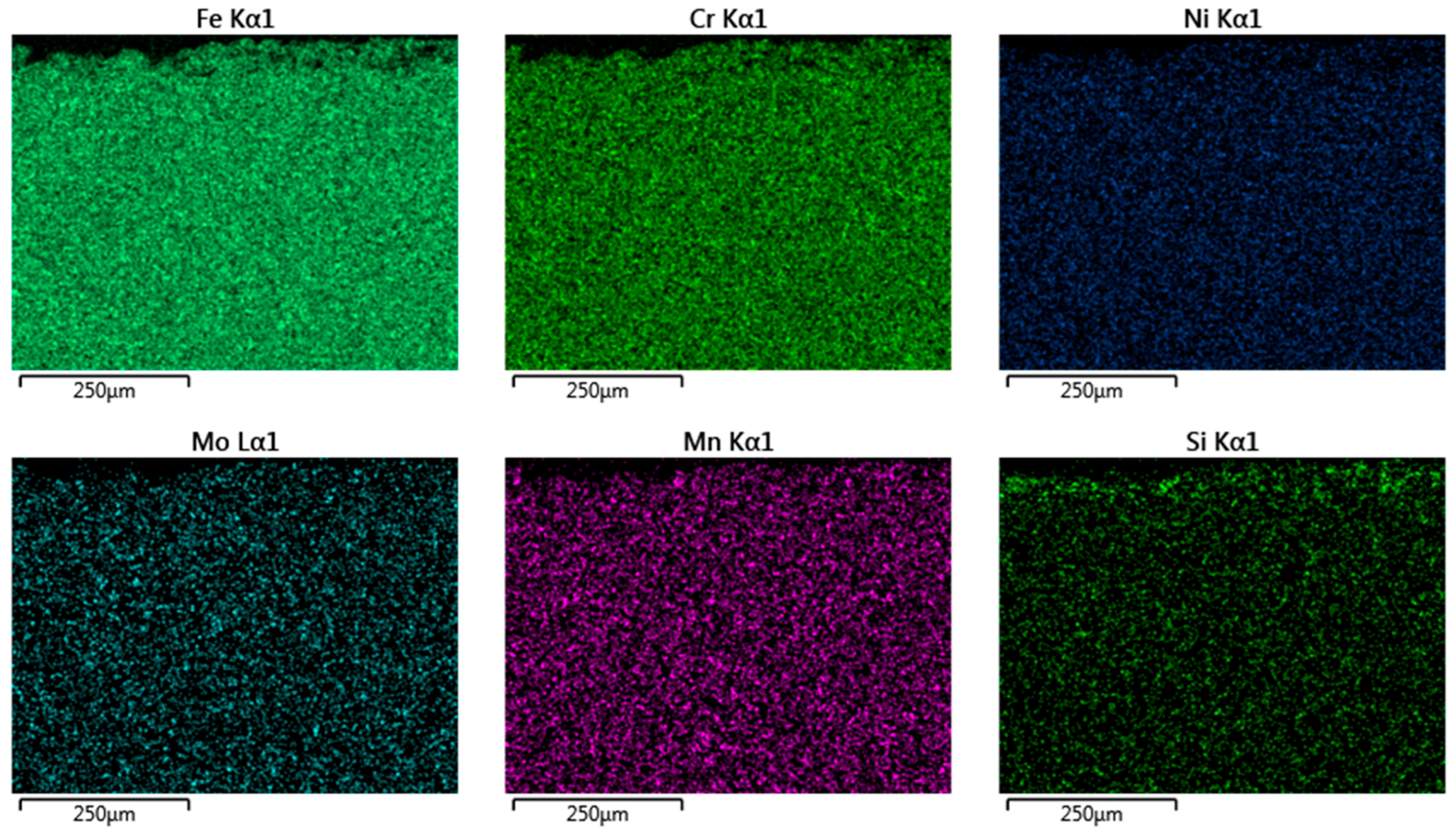
Scanning electron microscopy (SEM), combined with energy-dispersive X-ray spectroscopy (EDS) methods, was used to map a cross-section of the specimen. The elemental distribution is presented in Figure 6.
The results show that the elements are uniformly distributed, yielding a homogeneous structure in the parts manufactured by SLM.

2.4. Porosity

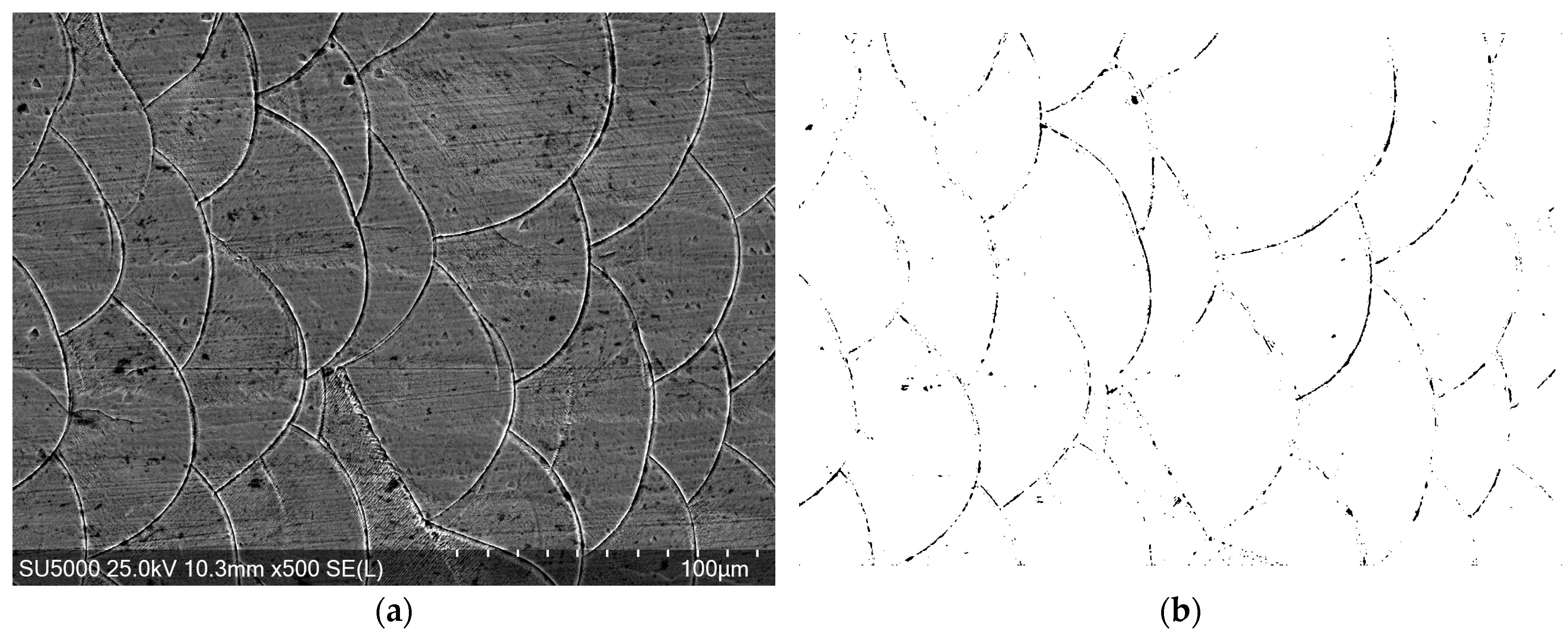
The porosity was evaluated using a MATLAB application developed based on the algorithm developed by Rabbani and Salehi [39]. Figure 7a presents an SEM image of the cross-section of sample ZXY recorded at a magnification of ×500. Figure 7b shows the resulting area considered for the porosity calculation.
The protocol was applied to the remaining samples fabricated in the XYZ and ZYX reference frames. The specimens are 99.98 ± 0.015 dense, with no lack of fusion identified in the acquired SEM images.

3. Mechanical Characterization

3.1. Experimental Work

A set of samples was extracted from a rolled blank sheet with a thickness of 3   m m The specimens were prepared for tensile testing accompanied by digital image correlation (DIC). The specimens were tested in traction (ASTM E8/E8M [40], ASTM F3122 [41]) at a displacement rate of 2   m m / m i n corresponding to a strain rate of 0.002   s 1 using a computerized electromechanical universal testing machine (WDW-50E, class 0.5). The specimens’ dimensions did not allow the use of a mechanical extensometer; thus, a custom virtual extensometer, adapted to the calibrated region, was constructed from the digital images during the analysis.
The images were captured using a digital camera driven by a software application that defined a time controller to trigger frame acquisition. The time step between successive photos was set to 10 s (the machine moves 0.33 mm between frames).
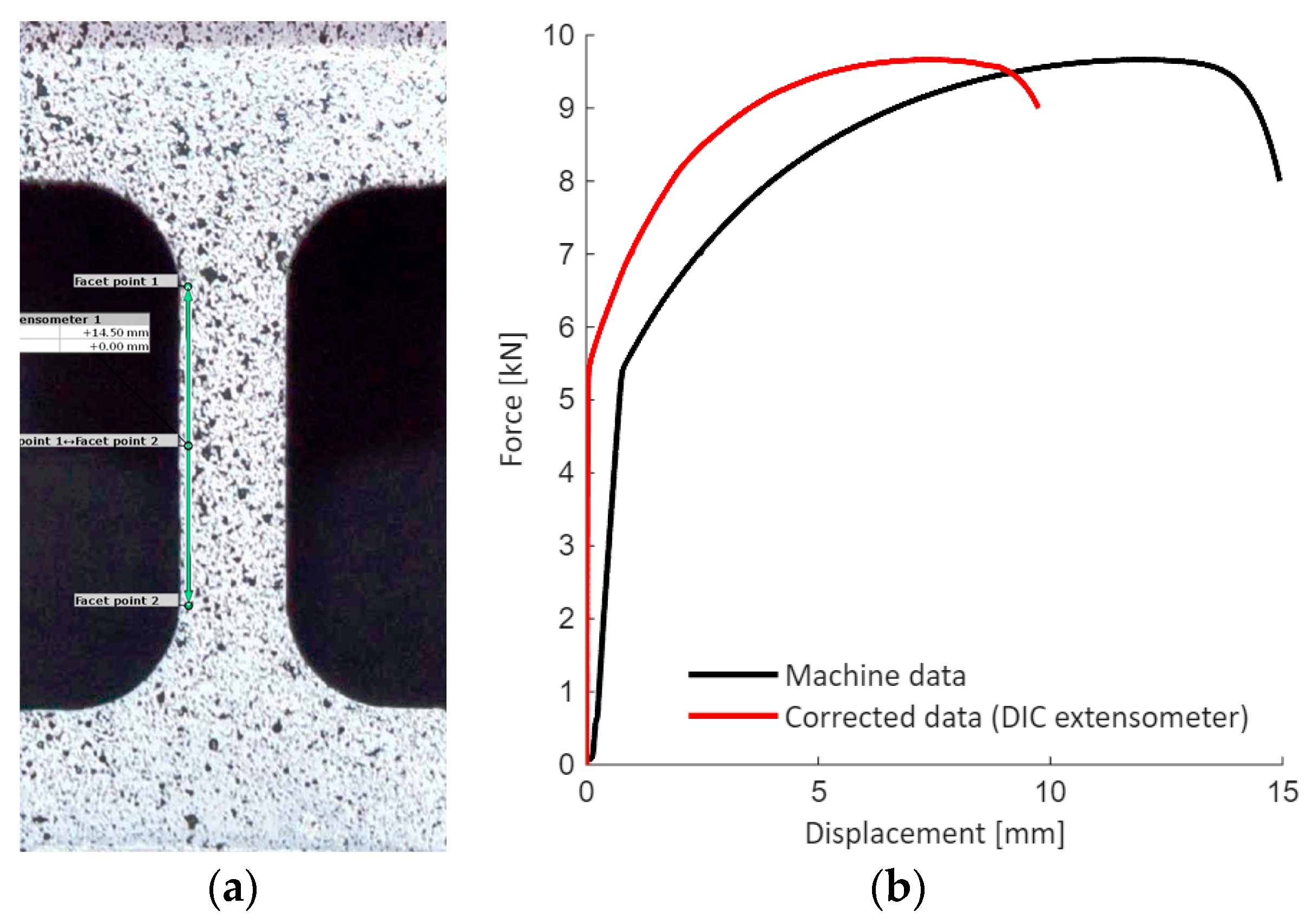
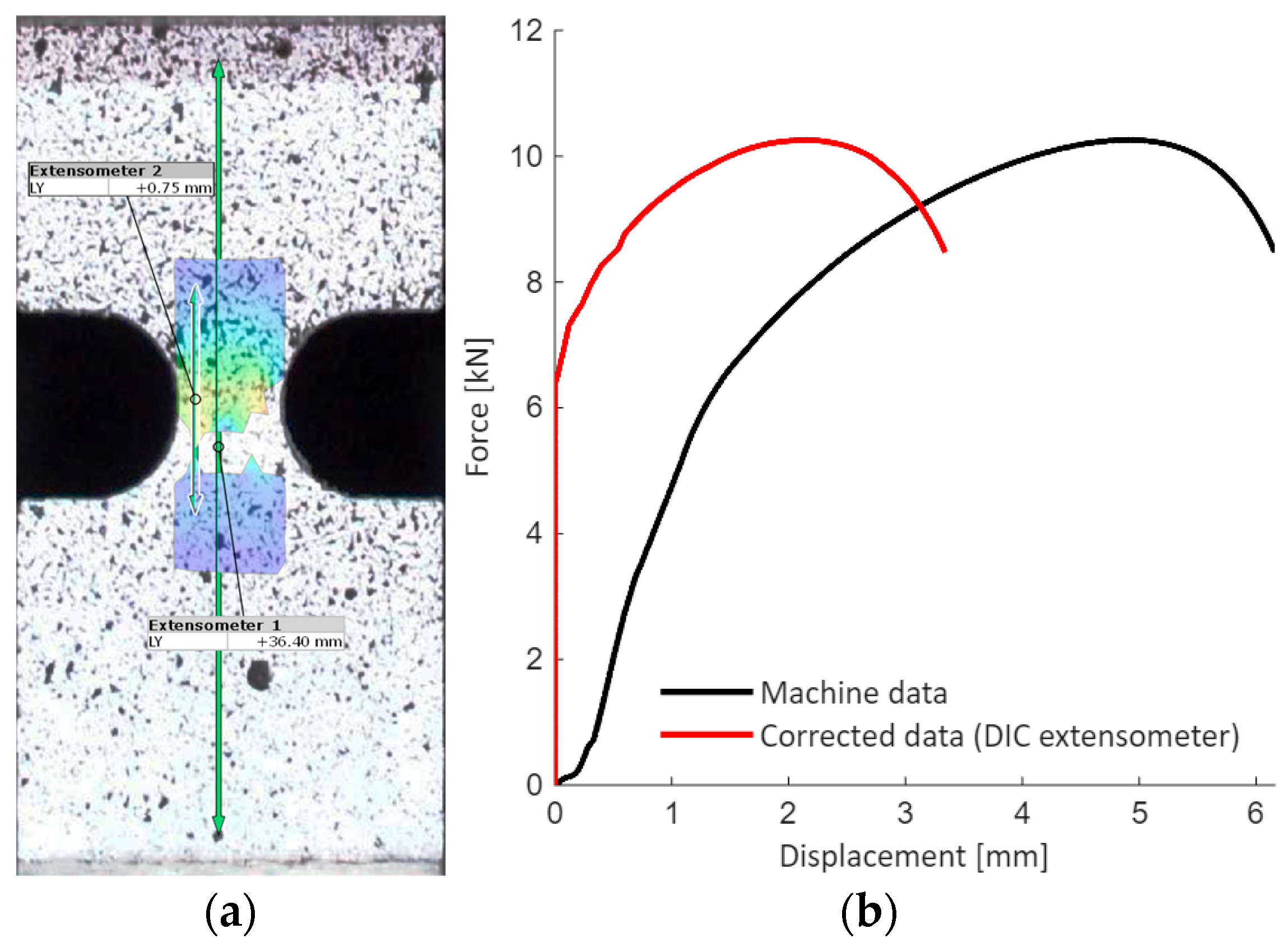
The images were processed using ZEISS Correlate v2025.1.0.1985. As a first step, two points were defined on the monitored surface to construct the digital extensometer as presented in Figure 8a. Using the time step between the acquired images, the deformation was correlated with the output data from the testing machine. Thus, the displacement field could be corrected and the force history updated, as shown in Figure 8b. These actions were repeated for the notch specimens as presented in Figure 9a,b. The procedure is necessary to obtain an accurate stress–strain curve for the material. The samples were monitored during loading to determine the strain evolution. These allow an accurate identification of the maximum capable strain before failure.
The engineering strain ε e is measured by the digital extensometer, considering the change in length of the gauge L L 0 over the initial length of the gauge L 0 :
ε e = L L 0 L 0
The stress σ e is measured from the force F recorded by the load cell divided by the area of the cross-section A 0 :
σ e = F A 0
Equation (6) provides the conversion method from engineering ε e , σ e to true strain and stress ε t , σ t .
ε t = l o g 1 + ε e σ t = σ e · 1 + ε e
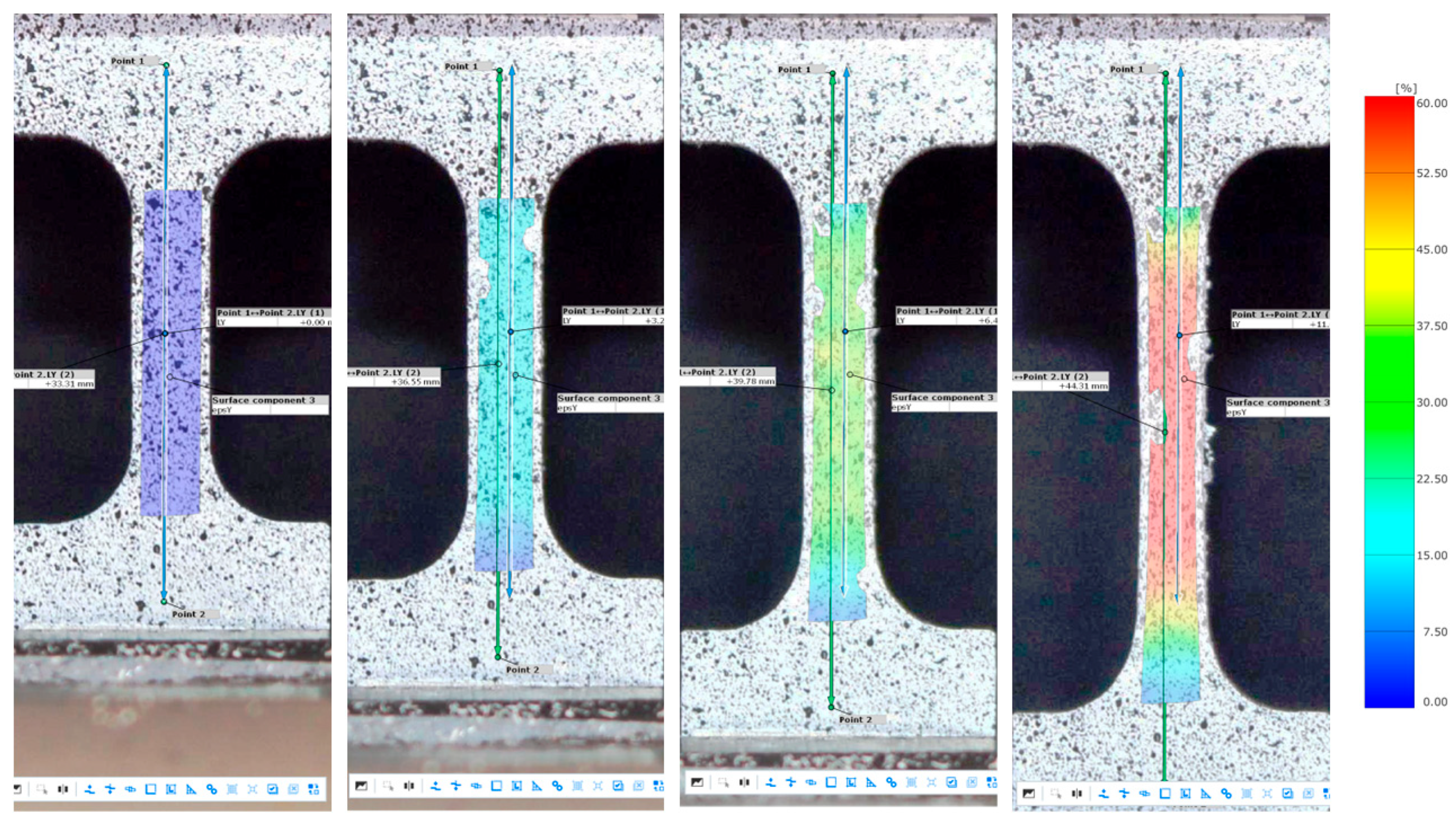
The strain can be corrected using digital images, as necking localizes the deformation, and evaluating the extensometer dimension can yield smaller values. Figure 10 shows successive images during the testing process of the tensile specimen extracted from the sheet. As shown in the processed images, the strain can exceed 0.6.
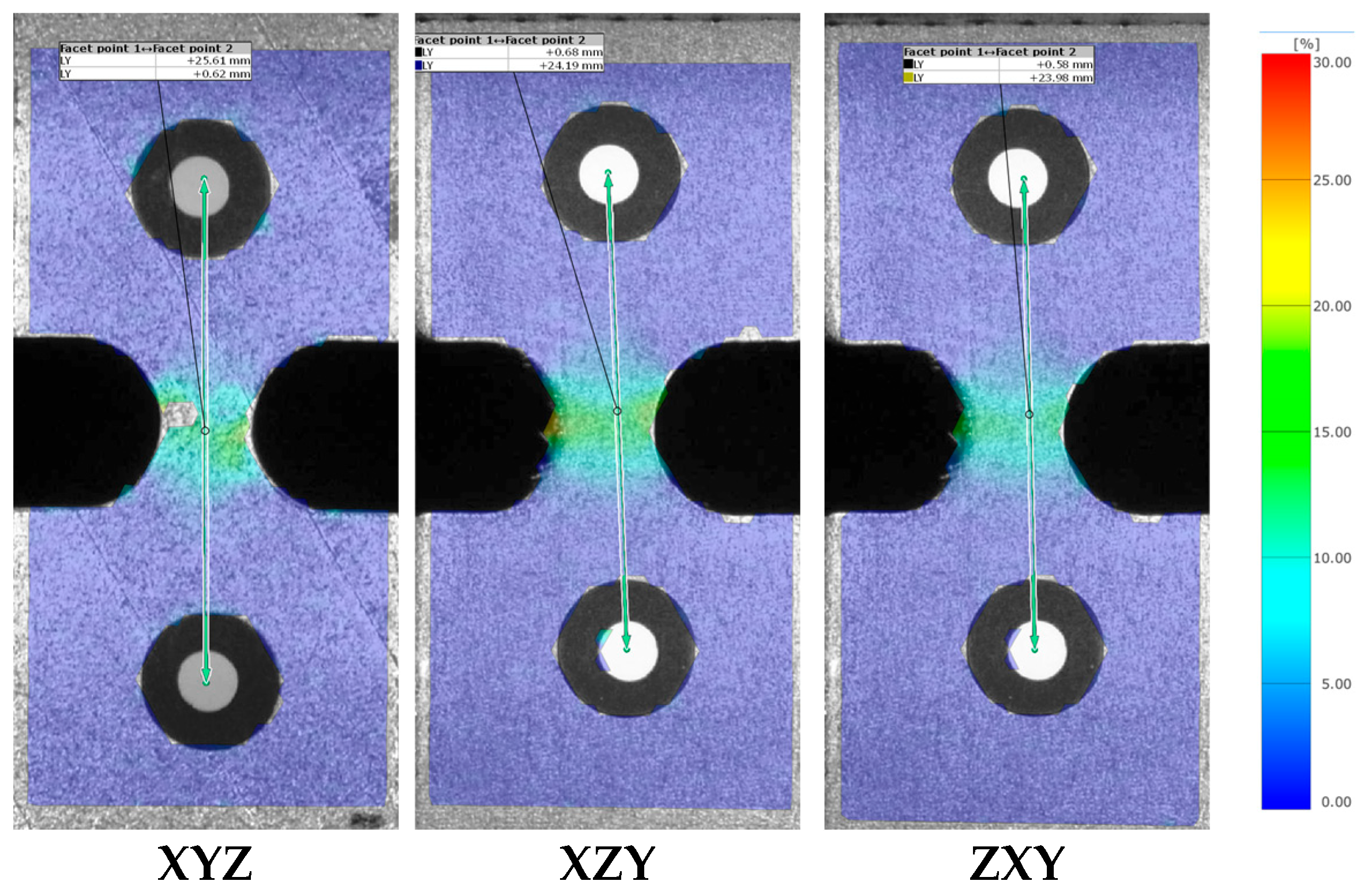
The process was repeated for each sample to extract valuable information for a correct definition of the stress–strain characteristics (Figure 10). Figure 11 presents the strain analysis for the notch specimens (XYZ, ZXY, XZY) manufactured using the SLM method. Results are presented for relatively similar displacement ( ~ 0.65   m m ).
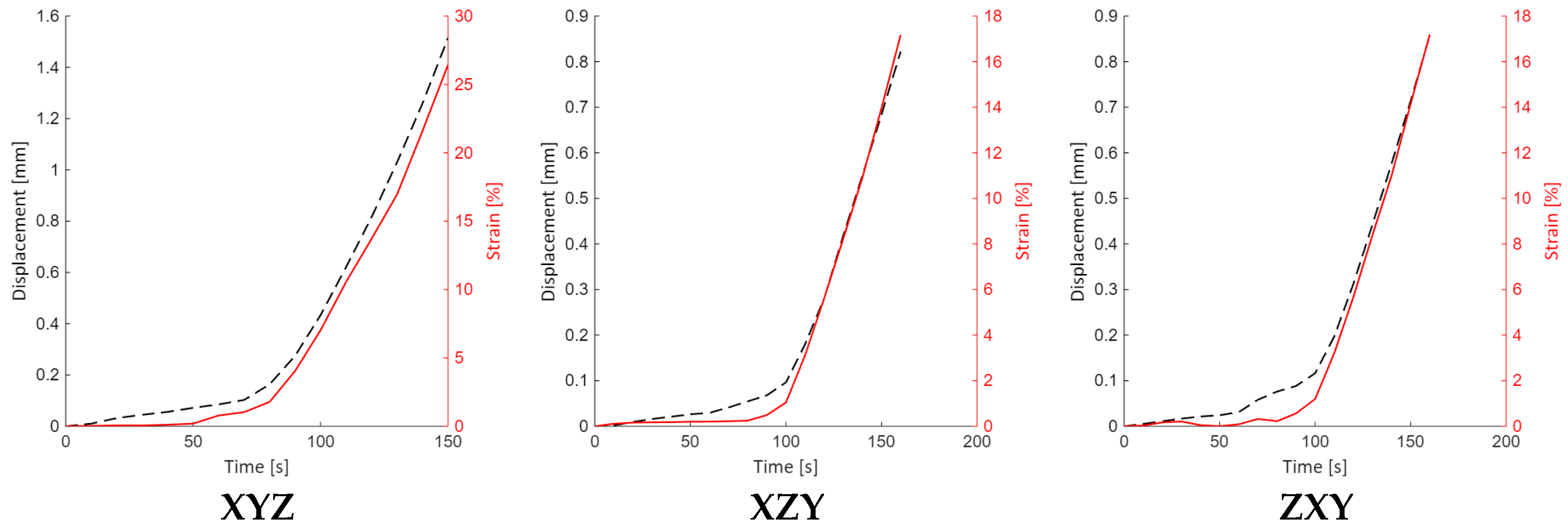
The strain can be correlated with the displacement as presented in Figure 12, as a measure of the accuracy of the virtual extensometer.
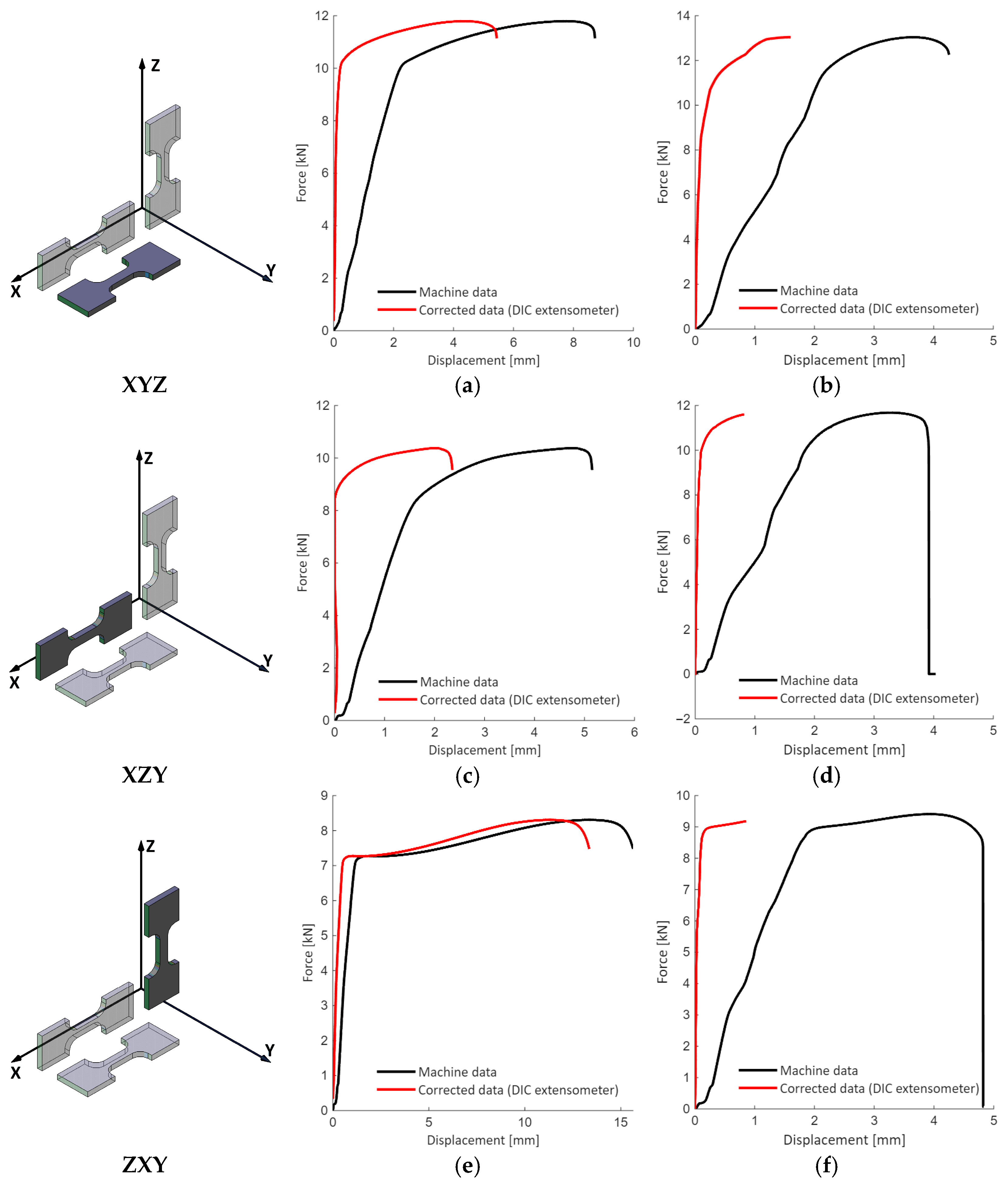
The data allow correction of the force–displacement results presented in Figure 13.
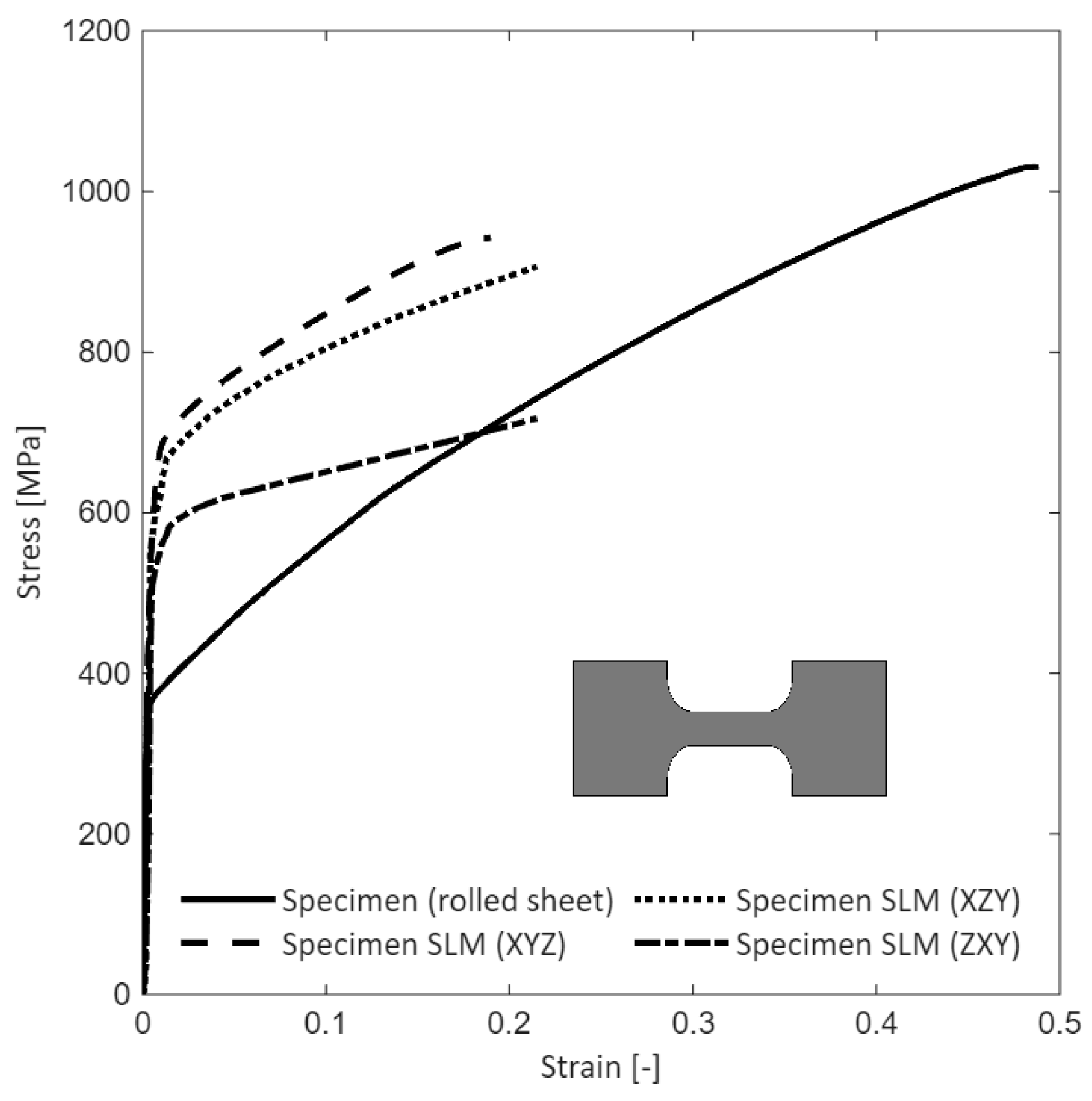
The stress–strain curves are constructed using force data and the corrected strain obtained from the digital images analysis. The current result can be investigated using existing material models to improve the accuracy [42]. Results are presented in Figure 14.
Representative stress and strain results are summarized in Table 3.
The results reveal that the yield stress for the SLM parts is higher compared to the value obtained for the samples extracted from rolled blanks [25,43]. Anisotropy is a characteristic of the additive-manufactured parts and affects the performance as determined by the building direction [15,23,46,47]. A comprehensive analysis based on reference datasets was performed by [48]. The report can be used to validate individual experimental datasets correlated to detailed structural investigations.
A solution for modeling the stress–strain curves is to assume that the strain hardening behavior can be adapted to the Swift power function.
σ = K · ε 0 + ε p n
where σ is the equivalent stress, K is the strain hardening parameter, ε 0 is the initial yield strain, and n is the hardening exponent.
The strain hardening parameter was determined from the yield stress (Table 3), the yield strain ε 0 extracted from Figure 14, and the hardening exponent. The hardening exponent was determined by an iterative process. The condition for the iterative process was to obtain the best match for the stress–strain curve corresponding to each build orientantion using a consistent fitting procedure.
The parameters used for the Swift power function are presented in Table 4.
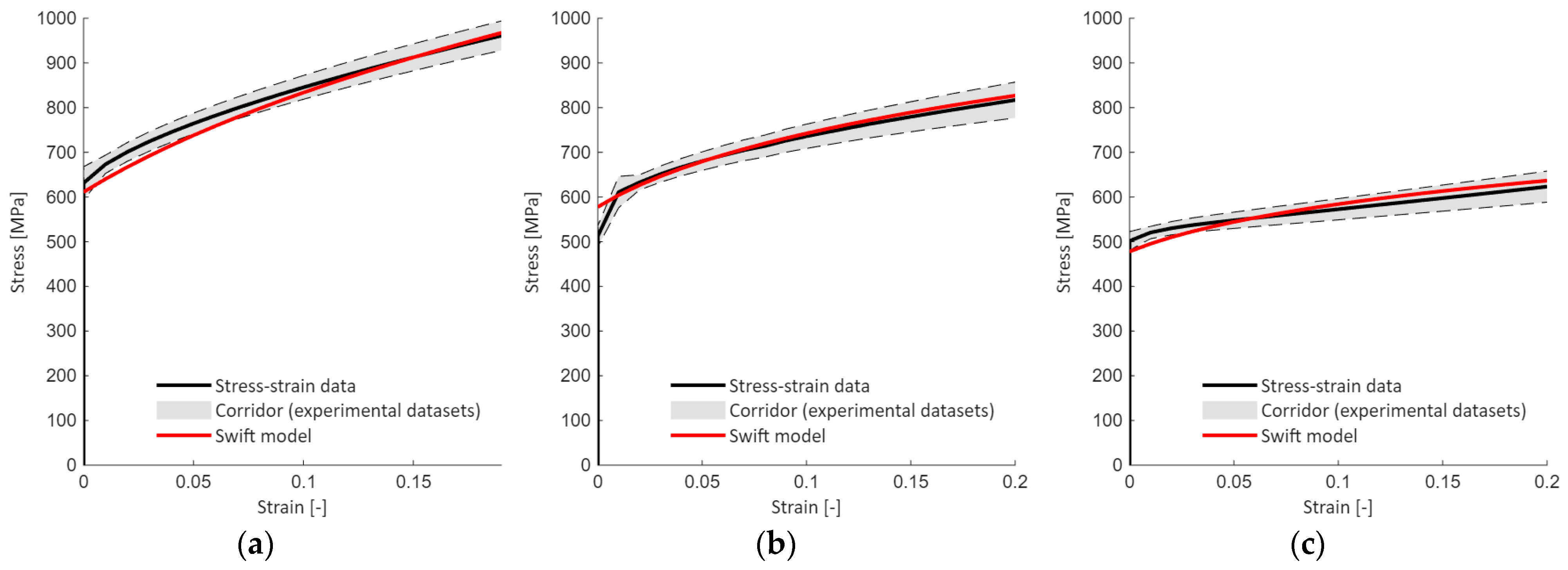
The performance of the implemented models was evaluated using the difference between the experimental σ e x p and estimated datasets σ S w i f t .
d i f f = σ e x p σ S w i f t σ e x p
The global difference was evaluated using the averaged value of point values:
g l o b a l _ d i f f = d i f f N
The results are presented in Table 5.
The stress–strain curves are presented in Figure 15.
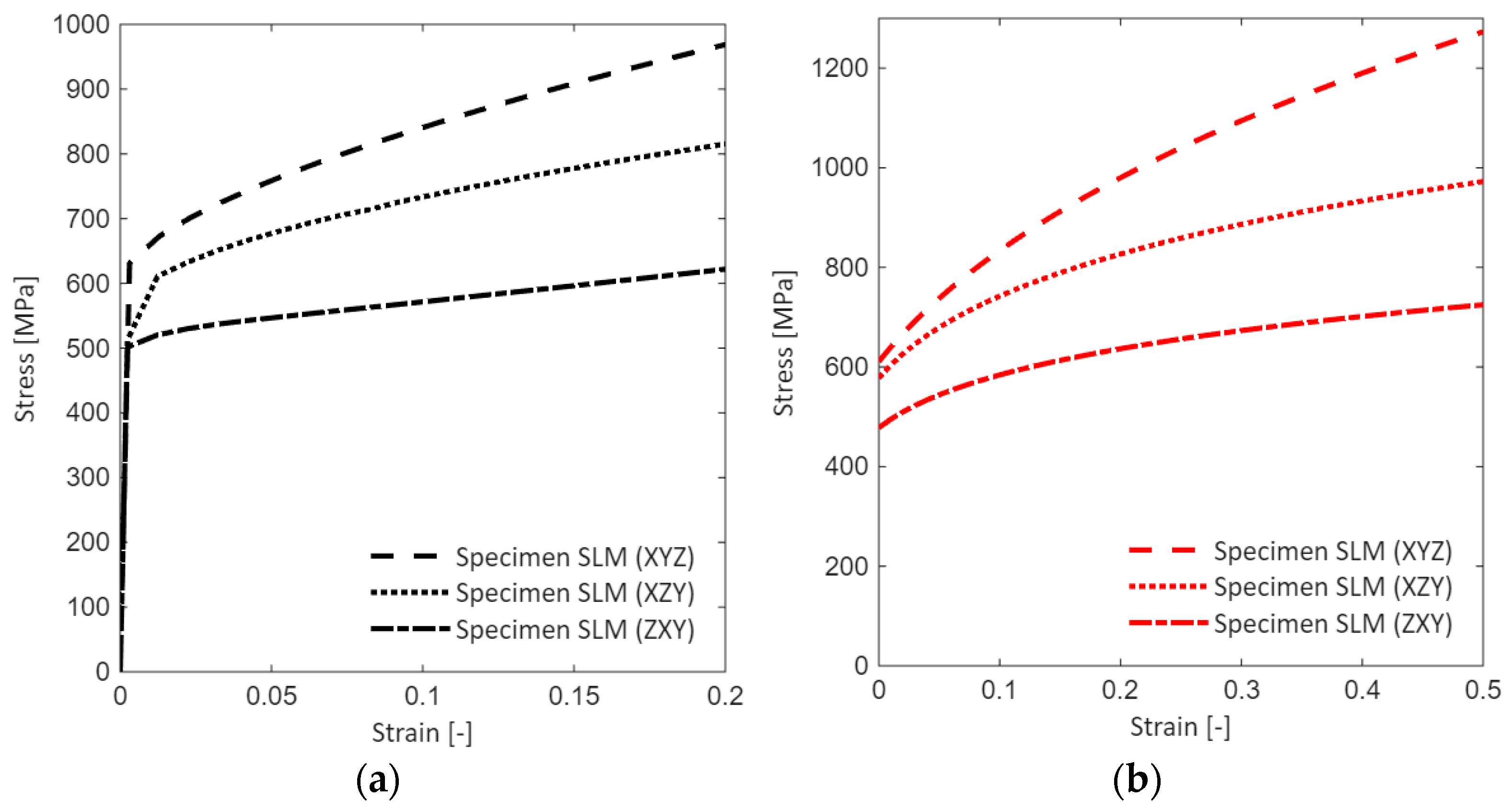
The strain interval was extended up to 0.5. Using the Swift model parameters presented in Table 4, the stress values were determined. Figure 16 presents the updated datasets.
These results can provide a facile solution to define the stress–strain data for the evaluation of the mechanical responses of the structures.

3.2. Numerical Modeling

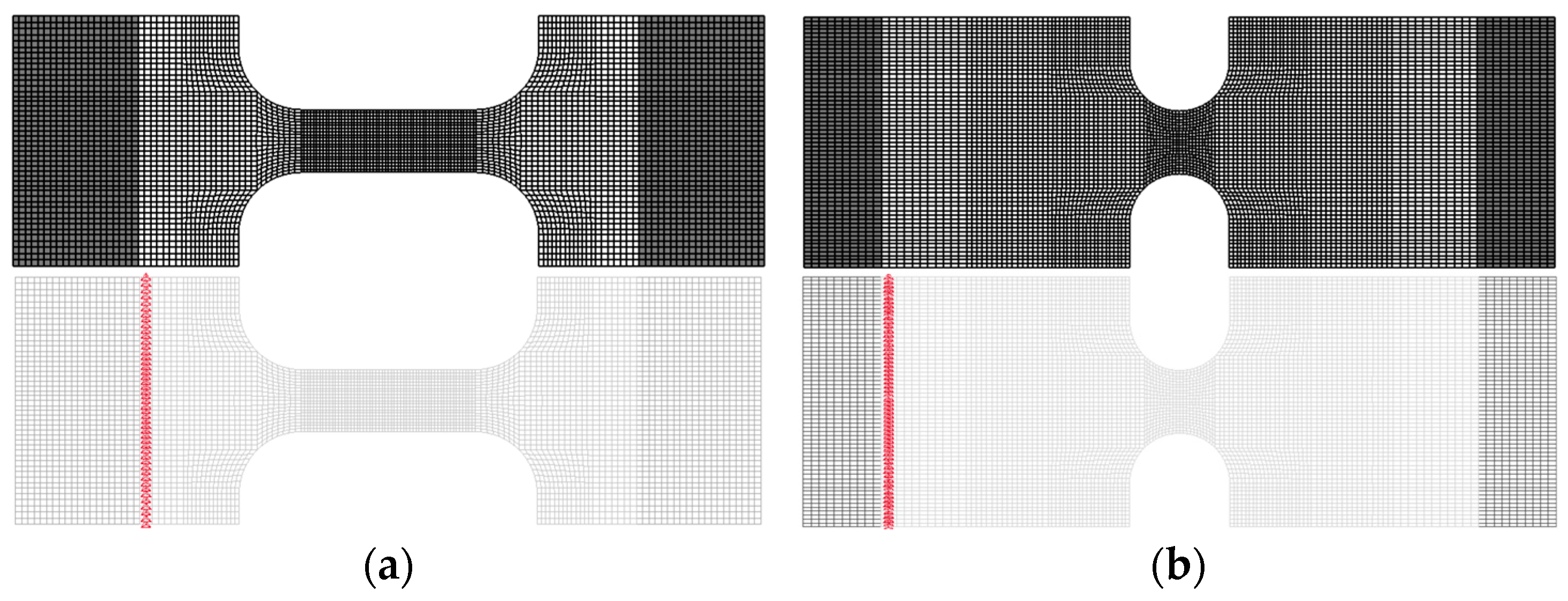
A numerical model of the samples (Figure 17a) for calibrating the material model was developed, following the LS-Dyna nomenclature [49]. Material *MAT_PIECEWISE_LINEAR_PLASTICITY was selected due to its versatility [50]. The implicit solver (*CONTROL_IMPLICIT) was used to solve the numerical model. The clamped ends were modeled as rigid bodies to impose both fixed and moving sections (Figure 17b).
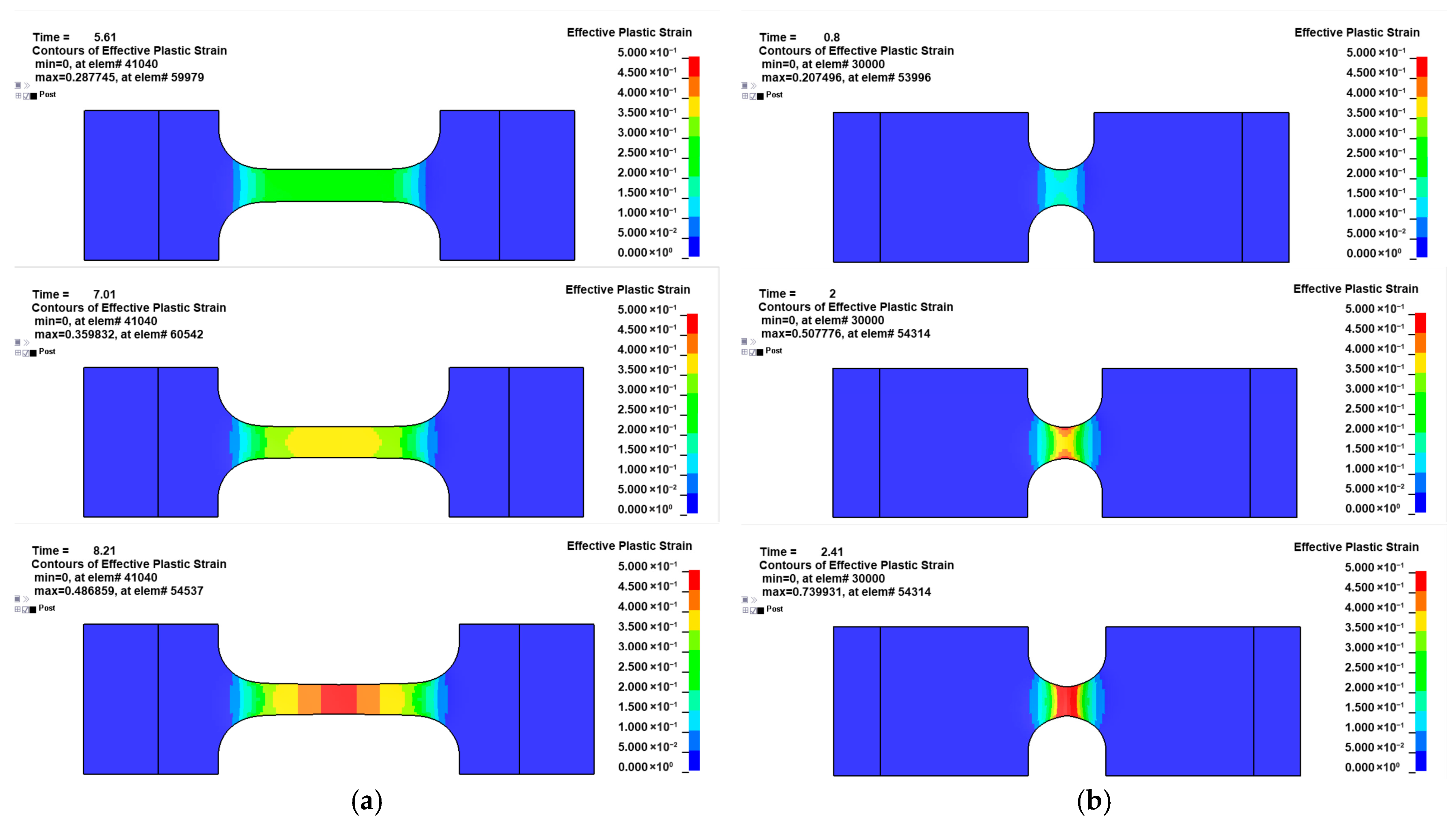
To measure the force, a set of nodes located in the vicinity of the fixed end was constrained (*BOUNDARY_SPC). Two nodes on the calibrated section of the specimen were selected to measure elongation during tensile loading. The simulation results (Figure 18) were compared with the measured dataset to evaluate the performance of the implemented material model. Figure 18 presents the strain evolution during the loading test. The results are presented for comparison with the data shown in Figure 10 and Figure 11.

4. Results and Discussion

4.1. Force–Displacement Results

The stress–strain curves presented in Figure 14 were prepared as input for the numerical analysis. Numerical simulations were performed for the entire batch of samples, including those manufactured from rolled sheets.
For each sample, a maximum displacement was imposed according to the experimental data. As the material was defined only for the increasing portion of the curve, the damage phenomena are not captured by these results.
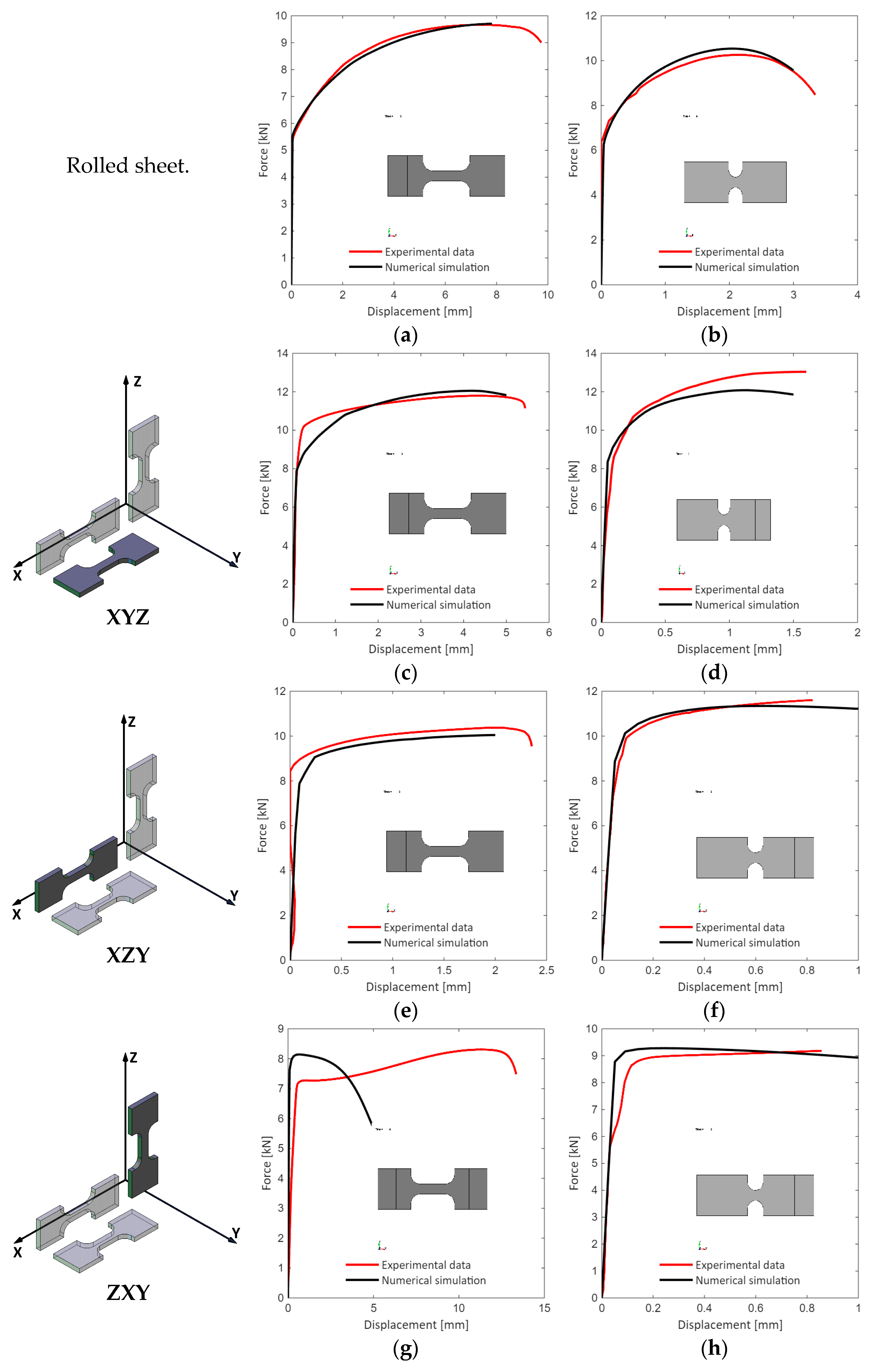
The cumulated results from the numerical analysis are presented in Figure 19.
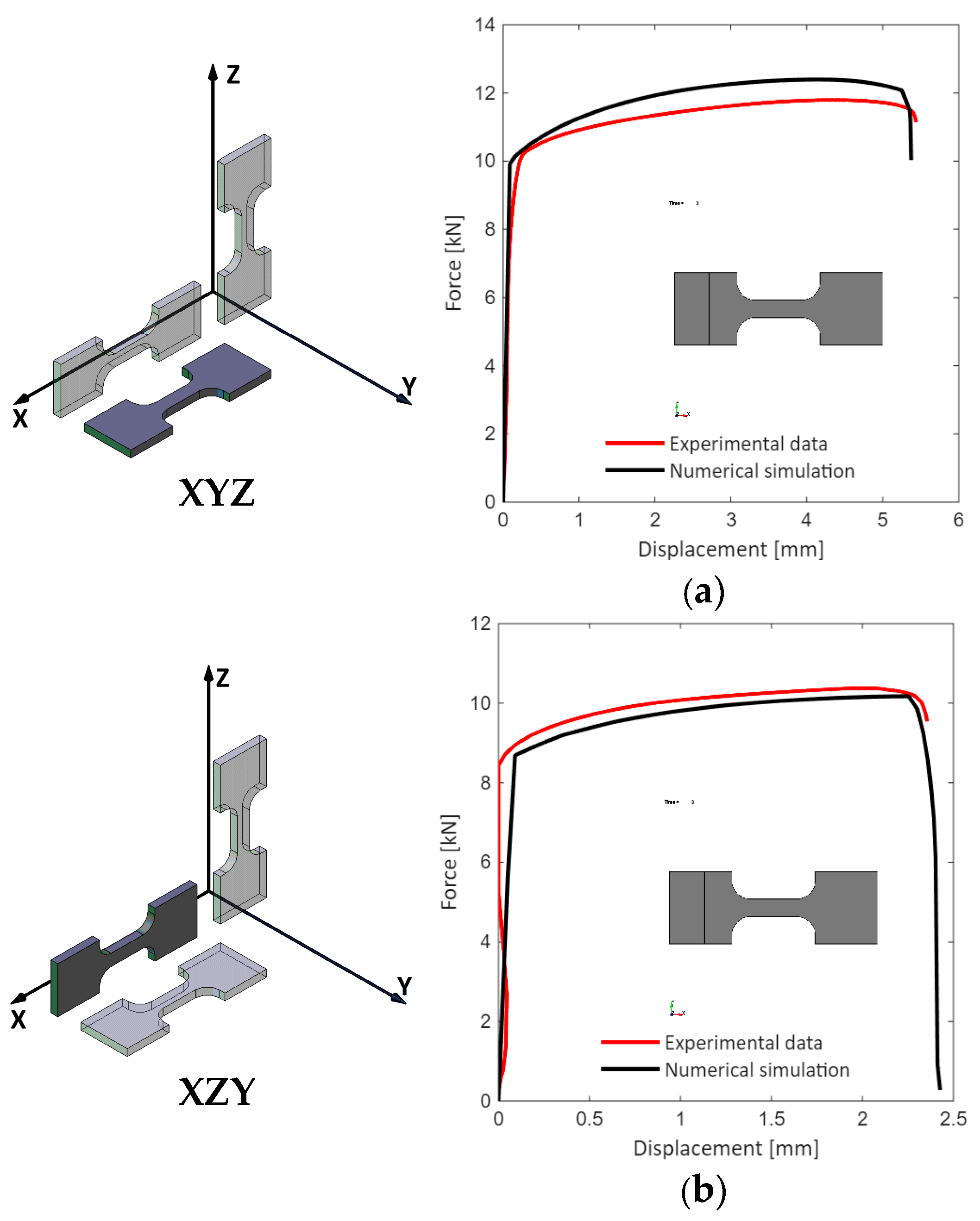
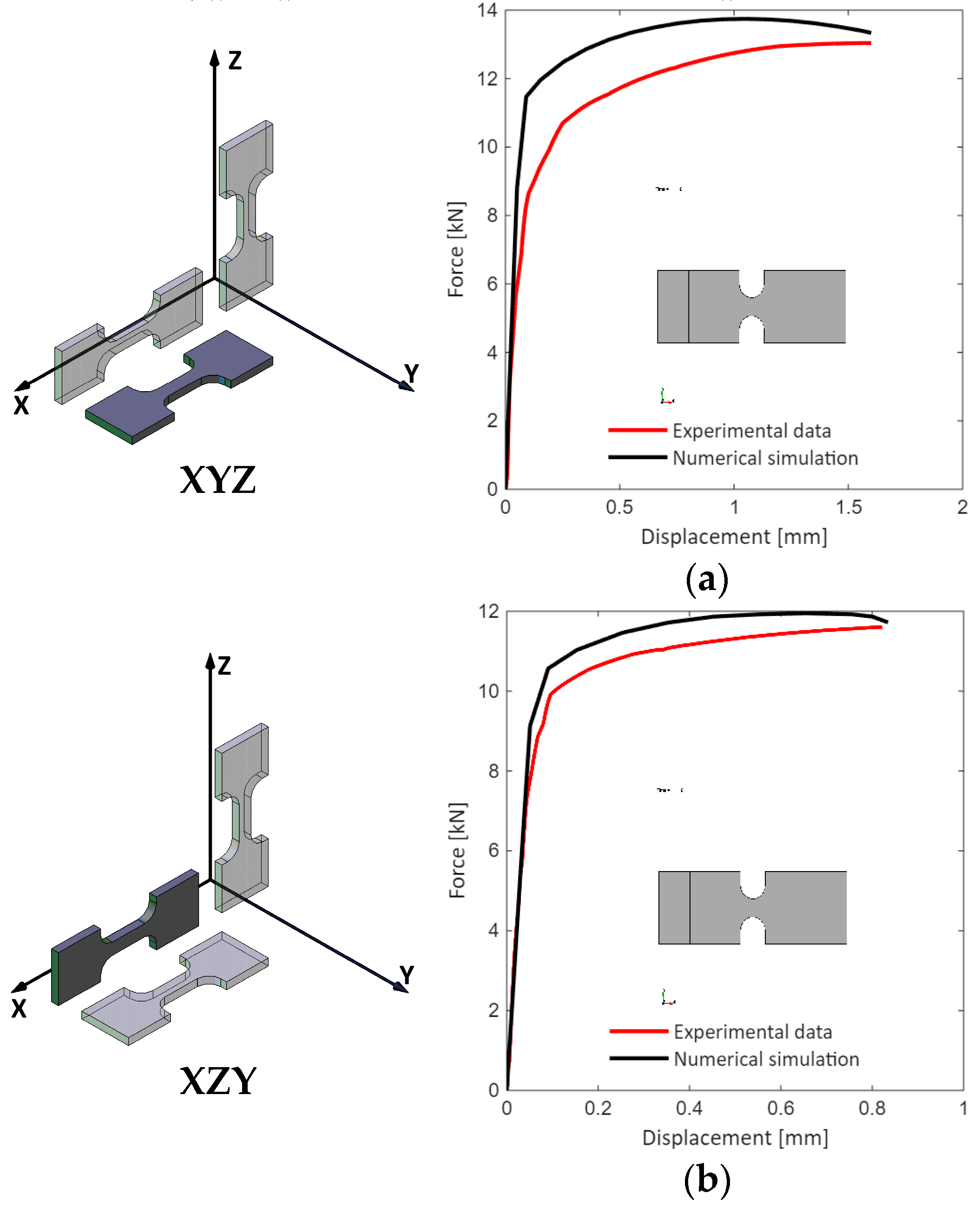
Except for a small tensile specimen manufactured in the XZY direction, the numerical values are well correlated with the experimental data. For thin sections, as in the case of the small tensile specimen, attention is required during the product design phase.
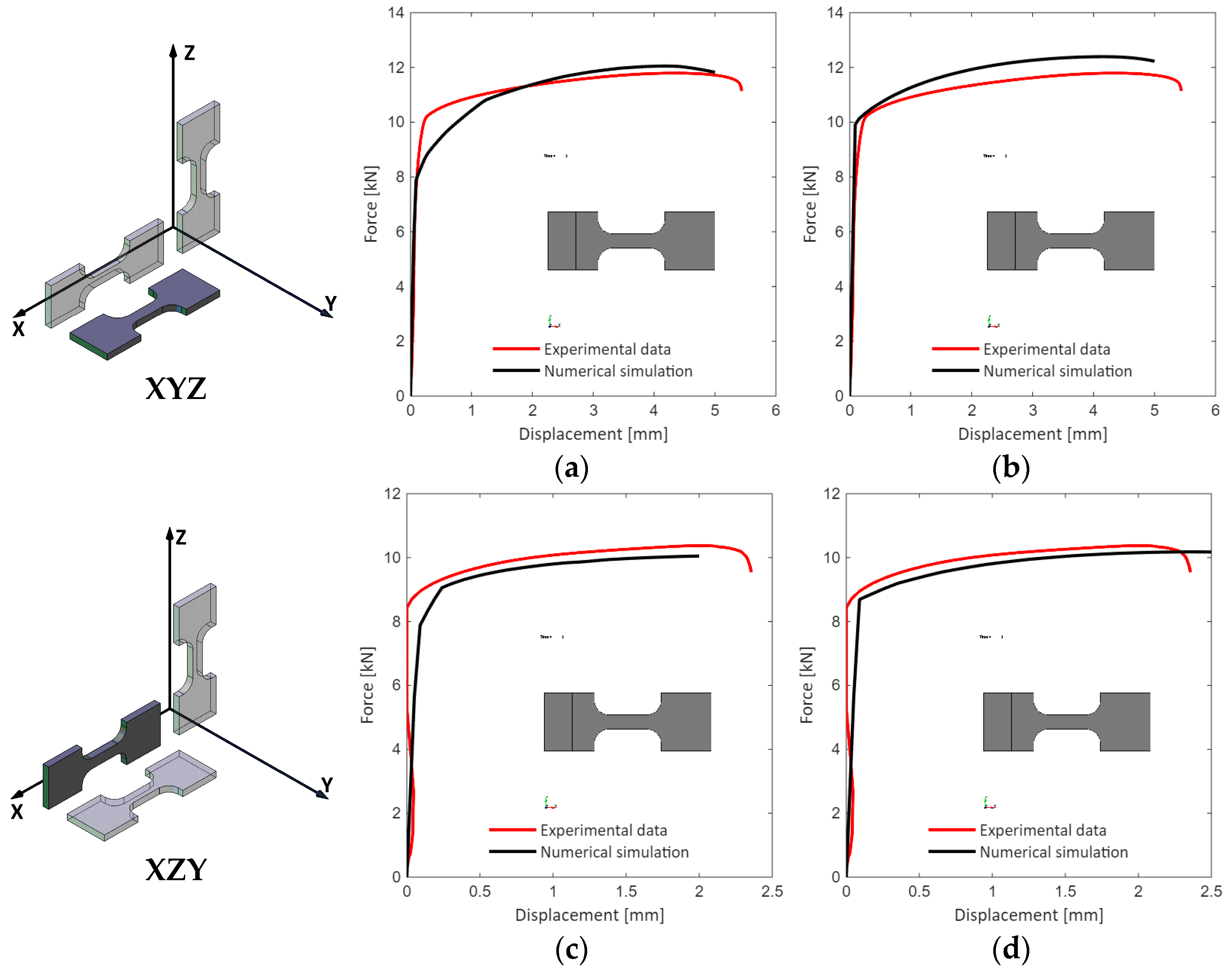
Figure 20 presents the force–displacement datasets obtained from the numerical simulation. The material follows both the true stress–strain curves and the Swift models.
The extrapolated datasets for the stress–strain can be used to implement a damage model to investigate the failure of the specimen.

4.2. Modeling Failure

The GISSMO (Generalized Incremental Stress State Dependent Damage Model) is based on the incremental formulation of the damage accumulation in the form of
D = ε ε f η · D 1 1 / D M G E X P · ε
where ε f η is the equivalent plastic strain to failure determined from the input curve (as a function of the triaxiality parameter), ε is the equivalent plastic strain increment, and D M G E X P is a specific parameter. The parameter D C R I T defines the minimum damage that must accumulate before the stress tensor is coupled with damage.
σ = σ ¯ · 1 D D C R I T 1 D C R I T F A D E X P
D C R I T is the critical damage when the instability parameter F = 1 . The instability parameter defines the initial state of the failure process. Once the critical value is reached, the structure is likely to fail under the prescribed load.
F = ε ε c r i t η D M G E X P
where ε c r i t η is the equivalent plastic strain to initiate the instability process.
The strain to failure ε f is determined from the experimental data. For this purpose, samples were prepared for DIC analysis and subsequently subjected to tensile loading (Figure 10). Furthermore, the triaxiality curve is defined to capture the effect of uniaxial loading.
ε f , η = 0.00 = 1.00 ε f , η = 0.33 = ε f , 0.33 ε f , η = 0.45 = ε f , 0.45 ε f , η = 1.00 = 1.00
The GISSMO parameters are presented in Table 6.
The results obtained from the numerical simulation are presented in Figure 21. There is good agreement between the experimental failure and that from the numerical investigation.
The updated stress–strain curves were used to investigate the numerical response of the notch-type specimens. The results are presented in Figure 22.
The results presented in Figure 22 show that the proposed stress–strain curve can be adapted by the traixility map to model the failure of specimens with various shapes.

4.3. Phase Constitution

X-ray diffraction (XRD) spectra were acquired using a Rigaku Ultima IV diffractometer (Tokyo, Japan) in the Bragg–Brentano geometry with a D/teX Ultra high-speed 1D detector. The measurements were performed under the following conditions: radiation—CuKα, angular range ( 2 θ )— 40 ° 150 ° , step size 0.05 ° , scan speed 2 ° / m i n , scanning direction—X direction of the sample. Qualitative phase analysis was performed using the Rigaku PDXL2 software and the ICDD PDF5+ 2025 database.
The 316 type is the austenitic stainless steel with the proportions of γ-Fe and δ-Fe phases influenced by the chromium equivalent (Creq) and nickel equivalent (Nieq). The calculated Cr and Ni were 18.71% and 12.45%, respectively, indicating that the phase composition of the material powder was γ-austenite (PDF5+ DB card number 01-081-8770) and Feα (PDF5+ DB card number 04-013-9827), consistent with the XRD results [51].
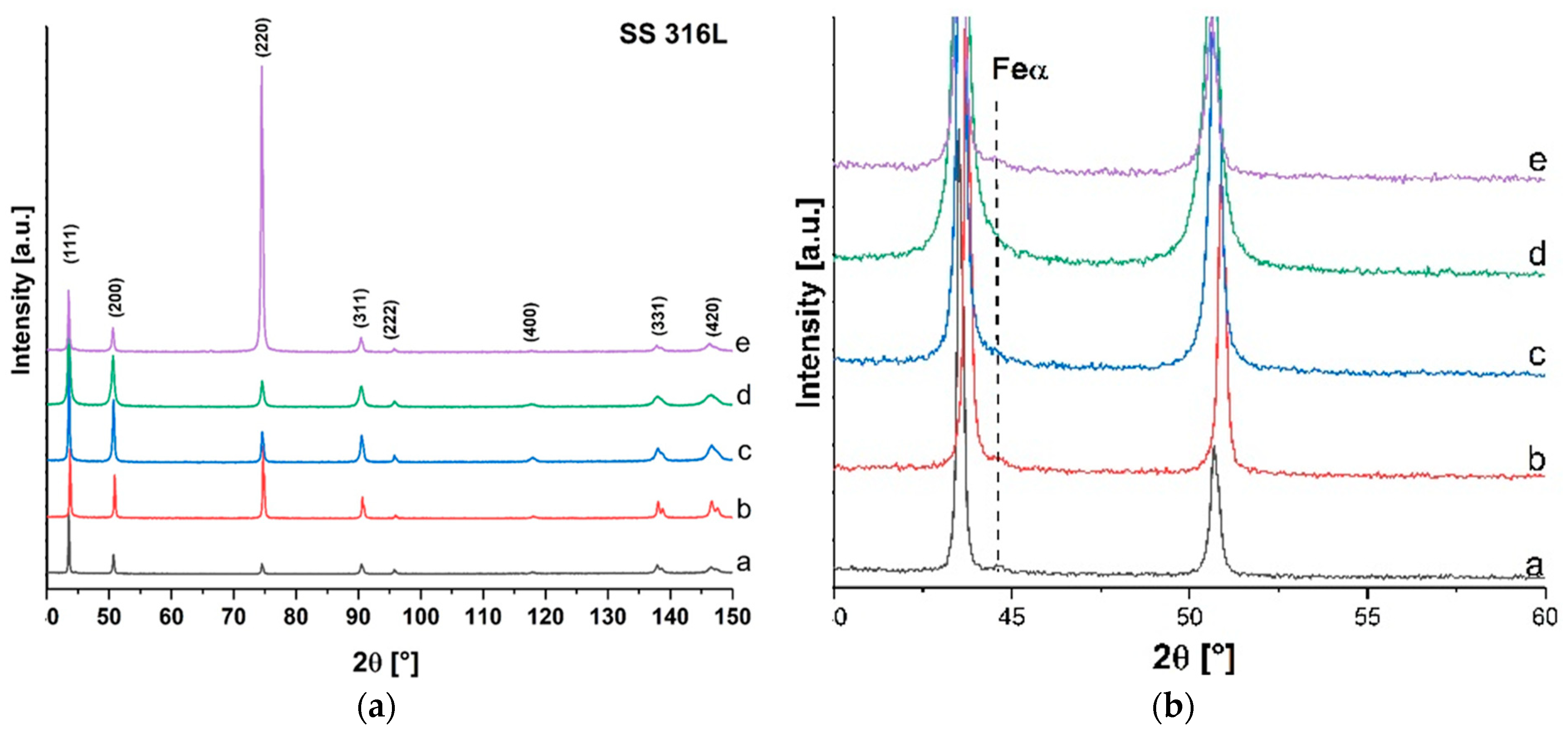
Figure 23a presents the XRD spectra of the analyzed samples: a powder sample used for SLM—curve a, a commercial 316 rolled sheet—curve b, an XY sample—curve c, a ZX-X sample—curve d, and a ZX-Z sample—curve e.
It can be observed that Figure 23 presents typical X-ray diffraction spectra characteristic of the austenitic structure (face-centered cubic (FCC), space group 225 :   F m 3 m ) related to a 316 sample. In the zoomed image (Figure 23b), the secondary Feα phase is observed, more pronounced in the powder, commercial, and Z direction printed samples. The ZXY printed sample shows a considerably more prominent texture along the 220 direction, as different building directions induce differences in the relative intensities of the austenite peaks [52]. The differences in relative peak intensities between the raw powders, rolled part, and SLM 316 could be attributed to the presence of crystallographic textures [53].
As presented in [54], the resulting crystallographic texture, manifesting as fiber textures (columnar crystals), is a consequence of two superimposed phenomena: intrinsic material properties—crystallographic features, such as the preferred direction of crystal growth, its multiplicity, and symmetry and process solidification conditions—gradient and movement speed of the solid–liquid interface, the melt pool shape, and the heat flow direction. Additionally, for FCC structures, the 100 z 110 x texture appears in the XY scanning strategy. This texture implies a preferential orientation along two axes: 100 along the Z axis (linked to the heat flow) and 110 on the X axis (dictated by the scan direction) [54]. Also, the columnar grains were observed to grow along the crystallographic direction, parallel to the Z-build axis, driven by stresses generated during solidification, as compression in FCC materials promotes grain rotation toward the <110> direction [55]. Due to the strong columnar texture (e.g., with the 110 orientation along the Z axis), the material often exhibits a higher yield strength and a higher ultimate tensile strength (UTS) when tested perpendicular to the growth direction (in the XY plane), and ductility is often lower along the build direction (Z) compared to the lateral directions (XY) [55].
The existence of 220 austenite (“soft orientation”) in the XZY sample gives a lower yield strength compared to the XYZ sample [56,57]. This result can be observed in the mechanical test data (Table 3).

4.4. Morphology

The morphology of the sample was investigated using SEM by secondary electrons scanning (SE) and back-scattered electrons (BSEs). Secondary electron emission arises due to loosely bound electrons in the valence or conduction band of the sample atoms. The back-scattered electrons are the high-energy primary-beam electrons that have lost energy due to inelastic interactions with the sample.
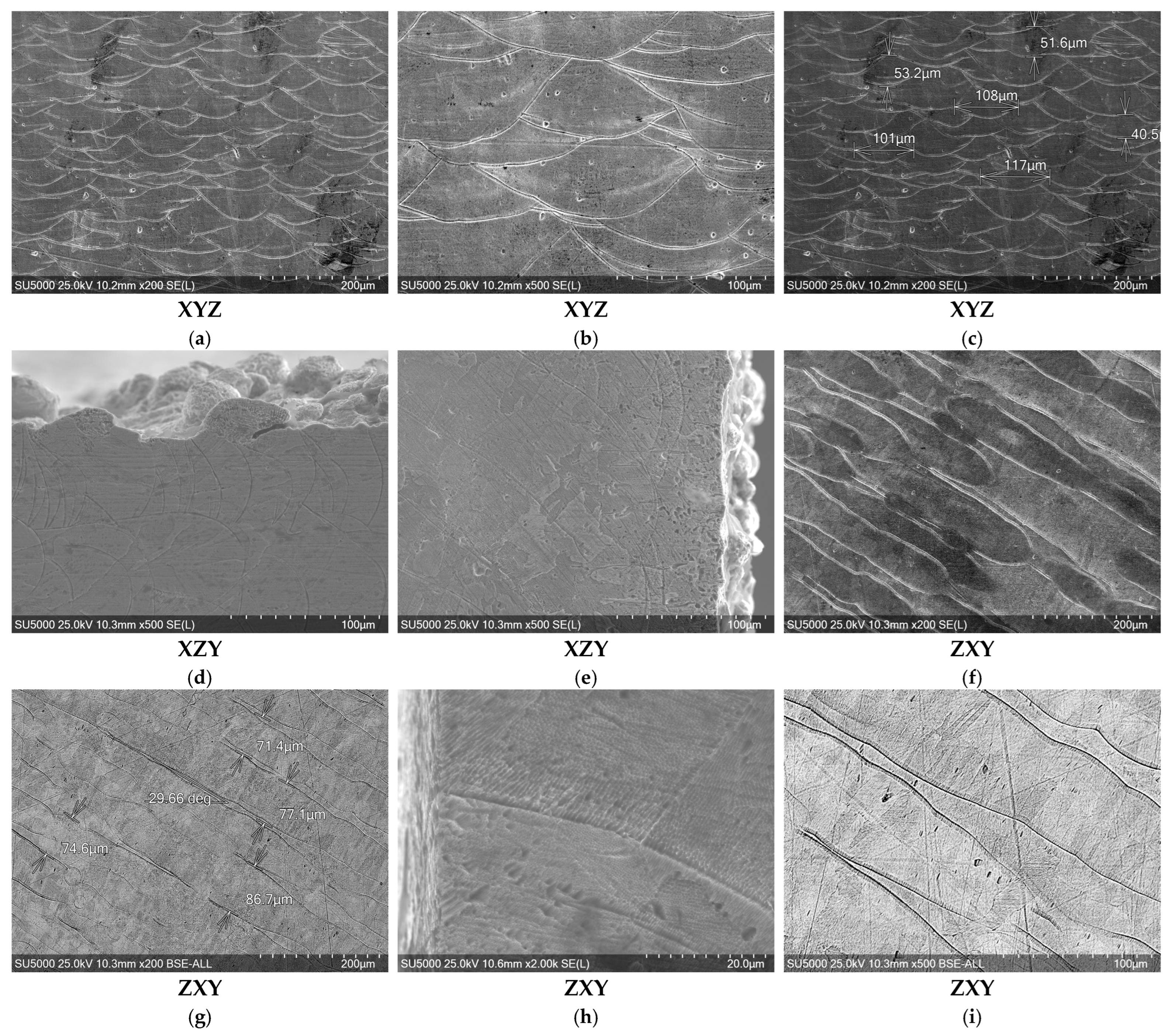
Samples were extracted from the specimens and prepared for SEM analysis. The results are presented in Figure 24.
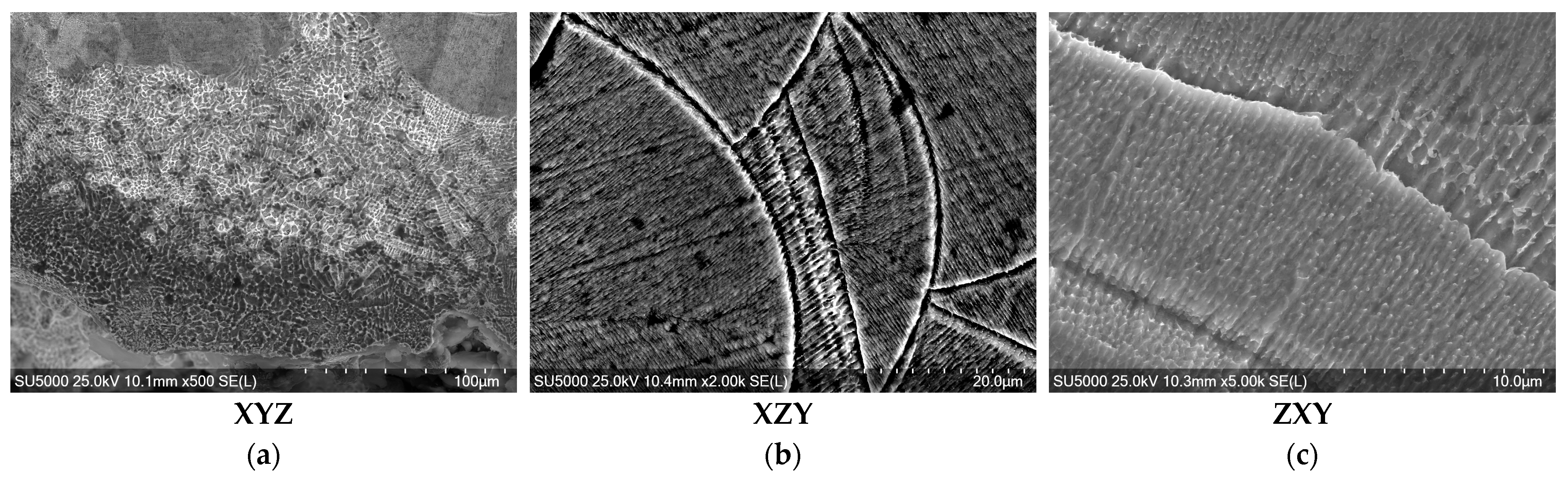
Figure 24a presents a layered microstructure typical of additive laser processes, characterized by melt pools generated by the laser beam. Figure 24b presents a high magnification (×500) image of the melt pools. The image reveals clear boundaries and the layered structure of the part. Figure 24c presents a series of measurements. It can be seen that the values are comparable to the machine parameters, including beam diameter, offsets, and layer thickness. Figure 24d,e shows the interface between the contour and the filling. The beam-moving strategy can be observed. Figure 24f gives another view of the filling pattern. The melted lines have a thickness comparable to the process parameters, as visible in Figure 24g. Figure 24h,i reveals the formation of columnar grains on the interface of the melt pools aligned in a radial direction as a result of the thermal gradient.
Figure 25 presents a series of structures located in the section of the investigated samples.
Figure 25a displays equiaxed grains at the interface to the powder bead. The temperature gradient raises no constraints, and thus the formation of such structures is allowed.
Figure 25b reveals the orientation of the dendrites for the successive tracks. Figure 25c shows the grains for successive layers. These issues can result from the time interval between the scan tracks during laser scanning [58]. The previously deposited material is still kept at a higher temperature, and there are a large number of nucleation cores, so a large number of crystal nuclei are generated at the interface [20].
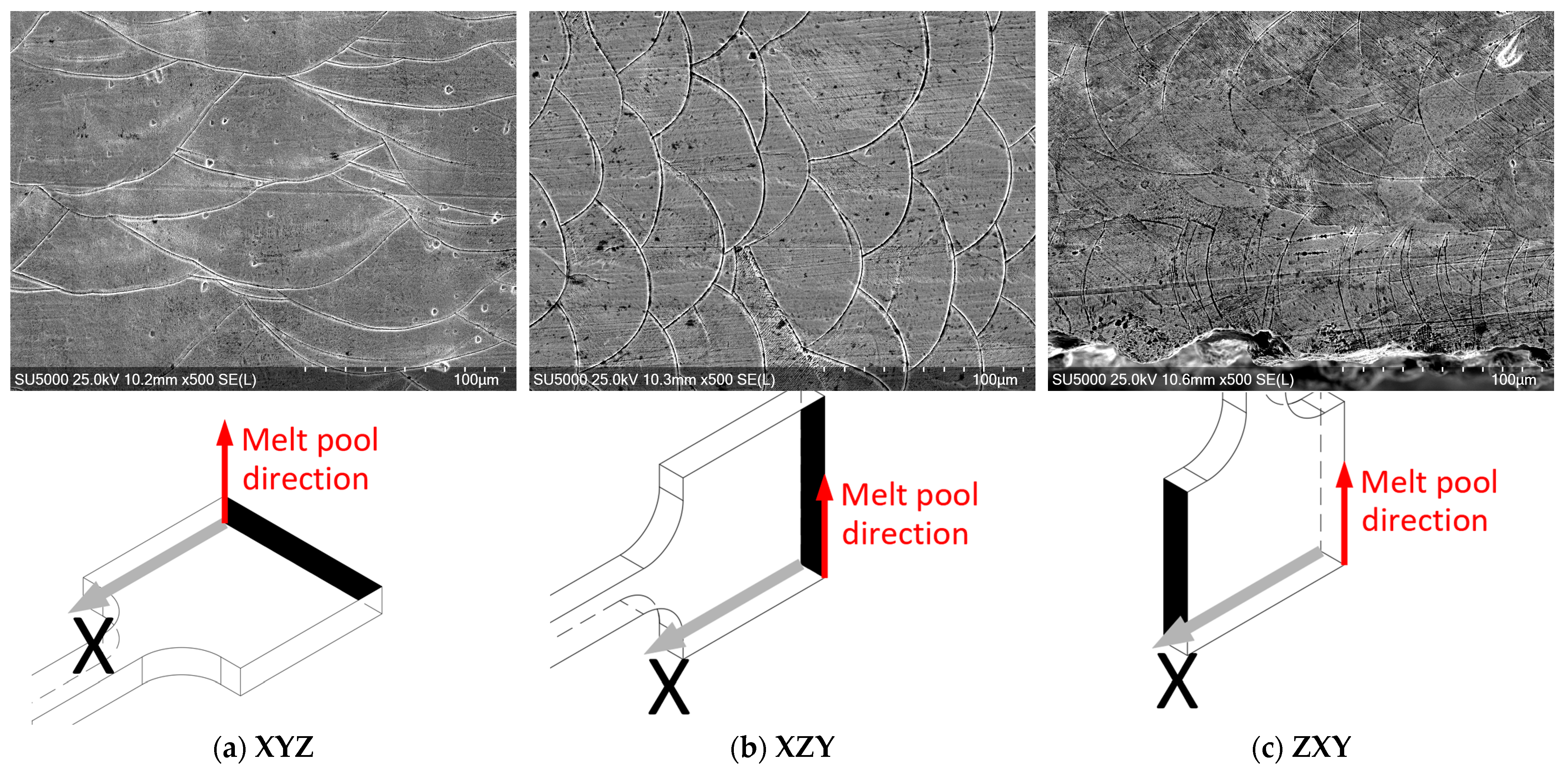
Figure 26 presents the melt pools for the manufactured samples. The manufacturing position is indicated on the figure. The view plane is determined by the microscope’s standard view plane.
Although the differences in the mechanical performance of samples printed in the Z direction compared to those printed in the X direction are also associated with the position of the loading axis relative to the melt pool plane, the results indicated differences between the XYZ and XZY samples.
The SEM images revealed that there are some differences between the distribution and sizes of the melt pools recorded for the XYZ sample (Figure 26a) compared to the melt pools recorded for the XZY sample (Figure 25b). This shows a higher interaction between the existing track and the current track, which can explain the dominant 220 texture determined for the XZY sample (Figure 26b).
Considering the projection of the shape onto the build plane, it is evident that the build time for a layer is lower compared to the time required to build a layer for the XYZ sample. The observed anisotropy between the XYZ and XZY samples can be associated with the thermal effects as a consequence of build time and melt pool cooling time.
The size of the melt pools obtained for the XZY sample is comparable to the size of the melt pools developed during the construction of the ZXY sample (Figure 26c).

4.5. Fracture Analysis

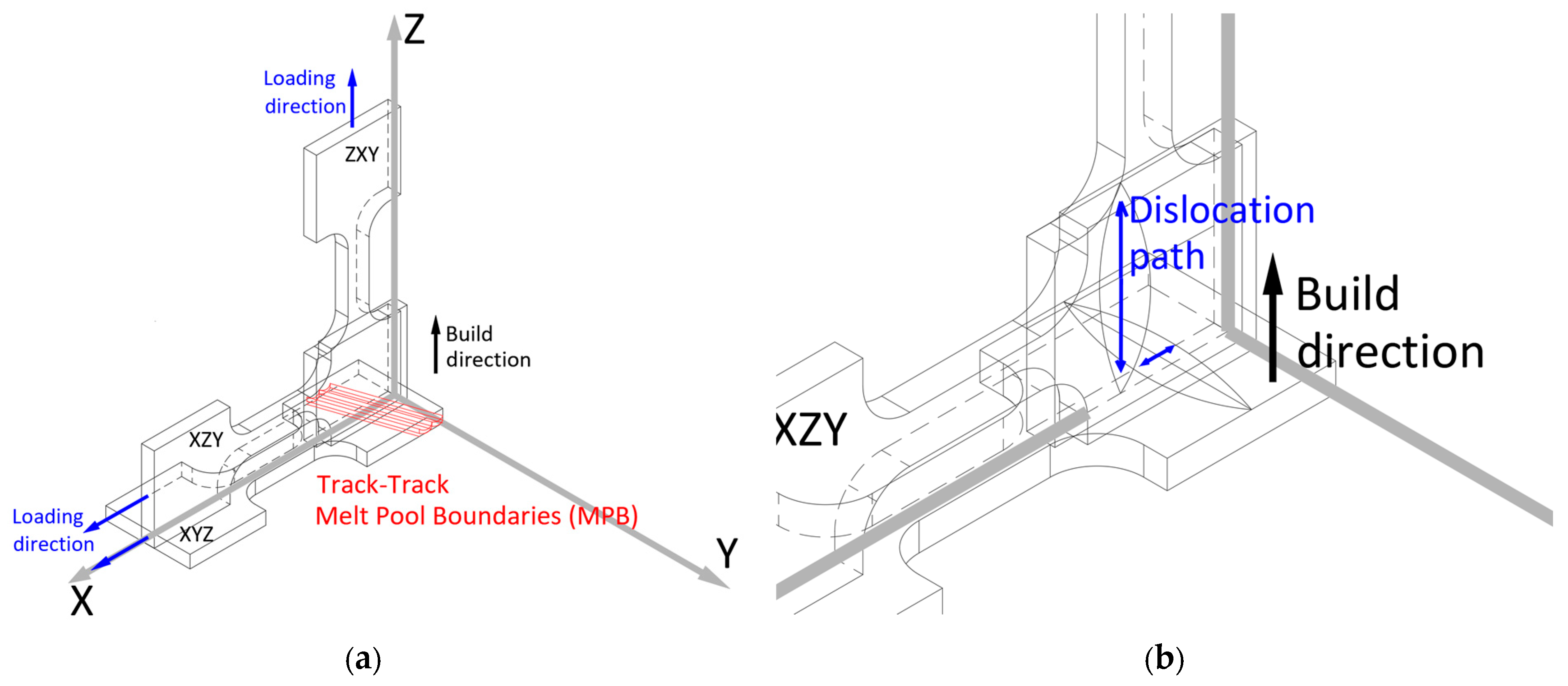
The fracture surface tends to follow the deposition path (track–track), and layer-to-layer melt pool boundaries (Figure 27a). The work of Shifeng et al. [59] and Rosenthal et al. [60] demonstrate that there is a significant difference between the horizontal fracture surfaces that can be affected by the scan strategy. In contrast, in the vertical direction, the fracture surface follows the melt pool boundaries.
In the LPBF process, the long columnar grains grow normal to the build plane (parallel to the build direction). The relationship between the loading direction and the corresponding grain size determines the mechanical response of the structure, thereby accounting for the anisotropy reported for AM structures. The work of Dixit et al. [45] demonstrated that dislocation motion is favorable when the loading axis is perpendicular to the long axis of the grains (Figure 27(b)). Thus, a higher yield stress is observed for the parts that have the calibrated section aligned to one of the axes of the horizontal (building) plane.
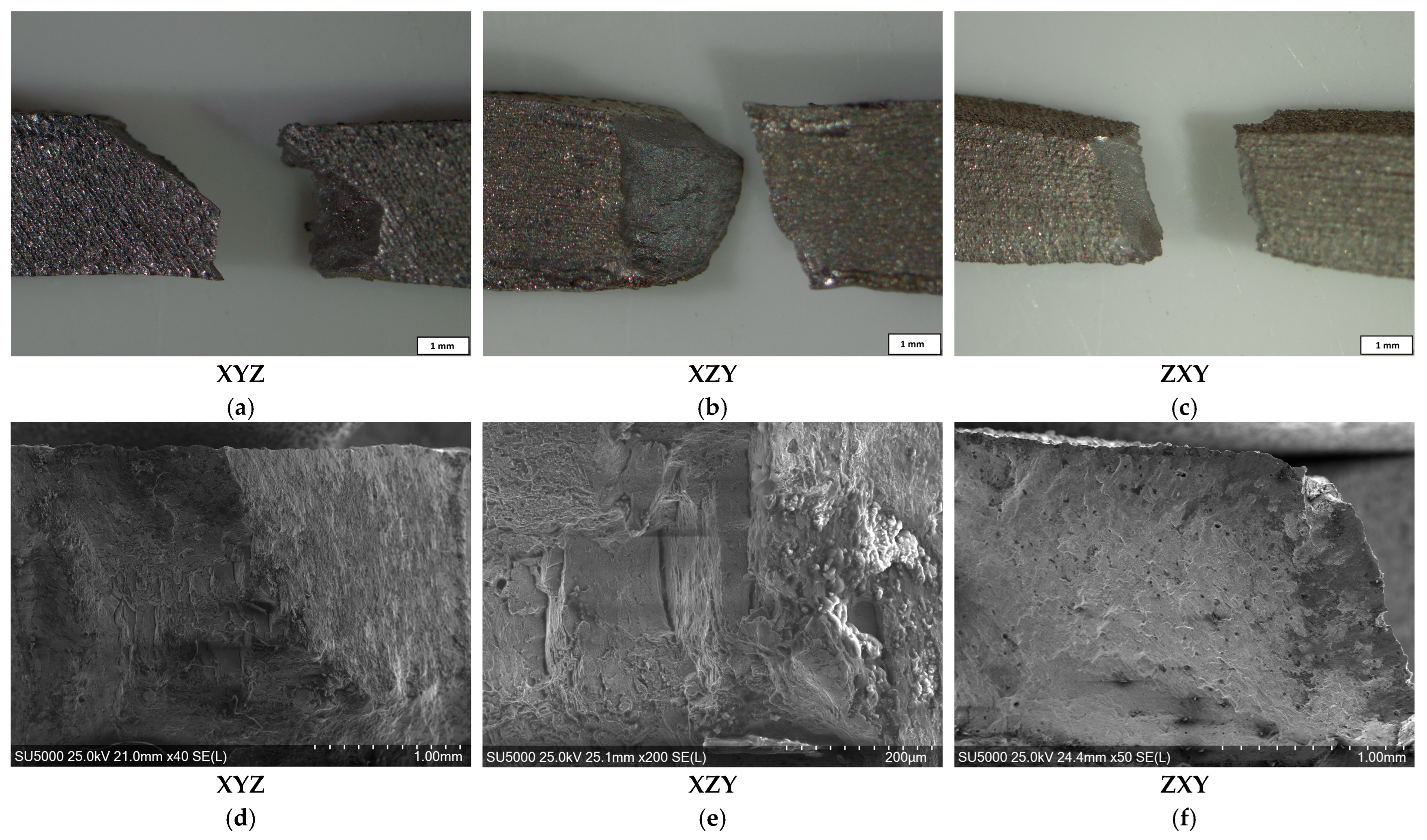
The section where the structural failure occurred was investigated on a macro scale using optical stereomicroscopy.
Figure 28a presents the failed section for the specimen XYZ. The fracture follows the hatching pattern, showing a section inclined at 45 ° . Figure 27b presents the fractured specimen built on XZY. The plane is inclined at 45 ° according to the hatching direction and building direction. Figure 28c displays the fractured section of the ZXY sample. The plane is close to the transverse plane (Figure 27(b)) according to the deposition path (melt pool boundaries). Both the contour and hatching lines are located on the transverse plane. Figure 28d,f reveals the void formation [61] as a component of the damage mechanism. Figure 28d,e shows the formation of cracks at the melt pools’ interfaces (in a transverse direction).

5. Conclusions

The paper presents a comprehensive analysis of samples manufactured from 316 steel. The samples used in this analysis are extracted from a rolled sheet and manufactured by the selective laser melting (SLM) method from powder.
The main topics presented in the paper can be summarized as follows:
  • Definition of the geometrical shapes of the samples based on the triaxiality parameter;
  • Presentation of the manufacturing process;
  • Analysis of the powder using SEM images and PSD;
  • Chemical analysis;
  • Porosity evaluation;
  • Mechanical characterization by tensile tests;
  • DIC analysis and correction algorithm for test data;
  • Implementation of a Swift model for material definition;
  • Numerical modeling;
  • Implementation of a damage model based on triaxiality state;
  • Validation of the numerical models;
  • XRD analysis;
  • SEM morphology;
  • Discussion of the mechanical response of samples based on SEM morphology;
  • Identification of a 220 texture for the XZY sample followed by a discussion of the mechanical response;
  • Fracture analysis correlated with optical microscopy and SEM images.
The samples were tested under tensile load to determine the material’s mechanical characteristics, accounting for the build orientation. The results agree with the literature data. The SLM-manufactured specimens exhibit higher yield stress than the samples extracted from rolled sheets.
The experimental methods include a digital image correlation process that provides information for correcting the machine-measured datasets.
Using the true stress–strain curves, the input data were prepared for finite element simulations. The numerical models were defined to mimic the experiments. The results from the simulations and experiments agree well with those from the force–displacement datasets.
The measured stress–strain datasets were subsequently adapted to the Swift model to account for larger strains. To capture the true behavior of the specimens under tensile loading, a damage mechanism was included for the material cards.
The section dedicated to numerical modeling includes a failure model based on the traixility. The numerical models were validated for the range η 0.33 0.45 specific to uniaxial tension. By appropriately adjusting the numerical model’s parameters, it can be used with sufficient accuracy to predict the mechanical response of complex structures.
X-ray diffraction was used to investigate the specimens. The results reveal differences in the structure, demonstrating anisotropy, as indicated by the mechanical investigations.
Although the XYZ and XZY samples feature similar deposition patterns, the XRD analysis revealed the existence of a 220 texture. Thus, the mechanical performances of XZY specimens are about 10 % lower compared to the XYZ printed sample. The samples were prepared for SEM using SE and BSE imaging. The morphology revealed a homogeneous structure. The cross-section analysis showed an increased number of melt pools for XZY and ZXY specimens compared to the XYZ specimen. The phenomena associated with melt pool overlapping can provide an explanation for the lower mechanical performances of the XZY samples.
The fracture analysis shows a correlation between the manufacturing direction and the fracture plane. The cross-section analysis indicates the presence of voids and cracks specific to the damage mechanism.
The results show that, on a macro scale, the SLM method can produce structures with good mechanical performance. In the design process, which is limited to the mechanical performance of the standard 316 material, the SLM structures can exceed the operating requirements.
The relevance of the present study extends beyond fundamental characterization, as the obtained results are directly applicable to the design and qualification of additively manufactured components intended for safety-critical applications. Austenitic 316 stainless steel is widely used in demanding fields such as nuclear engineering, energy systems, biomedical devices, and aerospace structures, where mechanical reliability and predictable deformation behavior are essential. In such applications, understanding the influence of the build orientation on mechanical anisotropy is essential for ensuring structural integrity under service loading conditions. The multiscale experimental approach adopted in this work provides valuable insight for optimizing build strategies and improving confidence in the use of SLM-fabricated 316 components in critical engineering environments.

Author Contributions

Conceptualization, A.-G.B., S.T., and C.D.; methodology, S.T., C.D., S.M., and D.N.; software, S.T.; validation, A.-G.B., A.-I.A., S.T., S.M., and D.N.; formal analysis, S.T. and C.D.; investigation, S.T., S.M., and D.N.; resources, A.-I.A. and S.T.; data curation, S.T., S.M., and D.N.; writing—original draft preparation, A.-G.B., A.-I.A., and S.T.; writing—review and editing, A.-G.B. and S.T.; visualization, S.T., S.M., and D.N.; supervision, A.-G.B., S.T., and C.D.; project administration, S.T. All authors have read and agreed to the published version of the manuscript.

Funding

This research received no external funding.

Data Availability Statement

The original contributions presented in this study are included in the article. Further inquiries can be directed to the corresponding author.

Conflicts of Interest

Author Catalin Ducu was employed by the Technologies For Nuclear Energy State Owned Company. The remaining authors declare that the research was conducted in the absence of any commercial or financial relationships that could be construed as a potential conflict of interest.

References

  1. Sithole, C.; Salaheldin, E.; Athena, A.; Sipke, J.; Ian, H. Are Density Cubes Sufficient to Measure Process Performance and Quality of Geometrically Complex Parts in Laser Powder Bed Fusion? Int. J. Adv. Manuf. Technol. 2025, 139, 4211–4231. [Google Scholar] [CrossRef]
  2. Zhang, B.; Li, Y.; Bai, Q. Defect Formation Mechanisms in Selective Laser Melting. Chin. J. Mech. Eng. 2017, 30, 515–527. [Google Scholar] [CrossRef]
  3. Roehling, J.D.; Khairallah, S.A.; Shen, Y.; Bayramian, A.; Boley, C.D.; Rubenchik, A.M.; Demuth, J.; Duanmu, N.; Matthews, M.J. Physics of Large-Area Pulsed Laser Powder Bed Fusion. Addit. Manuf. 2021, 46, 102186. [Google Scholar] [CrossRef]
  4. Armstrong, M.; Mehrabi, H.; Naveed, N. An Overview of Modern Metal Additive Manufacturing Technology. J. Manuf. Process. 2022, 84, 1001–1029. [Google Scholar] [CrossRef]
  5. Frazier, W.E. Metal Additive Manufacturing: A Review. J. Mater. Eng. Perform. 2014, 23, 1917–1928. [Google Scholar] [CrossRef]
  6. Kok, Y.; Tan, X.P.; Wang, P.; Nai, M.L.S.; Loh, N.H.; Liu, E.; Tor, S.B. Anisotropy and Heterogeneity of Microstructure and Mechanical Properties in Metal Additive Manufacturing: A Critical Review. Mater. Des. 2018, 139, 565–586. [Google Scholar] [CrossRef]
  7. Grech, I.S.; Sullivan, J.H.; Lancaster, R.J.; Plummer, J.; Lavery, N.P. The Optimisation of Hot Isostatic Pressing Treatments for Enhanced Mechanical and Corrosion Performance of Stainless Steel 316L Produced by Laser Powder Bed Fusion. Addit. Manuf. 2022, 58, 103072. [Google Scholar] [CrossRef]
  8. Geľatko, M.; Vandžura, R.; Botko, F.; Hatala, M. Electron Beam Welding of Dissimilar Stainless Steel and Maraging Steel Joints. Materials 2024, 17, 5769. [Google Scholar] [CrossRef]
  9. Santamaria, R.; Salasi, M.; Rickard, W.D.A.; Pojtanabuntoeng, K.; Leadbeater, G.; Iannuzzi, M.; Reddy, S.M.; Quadir, M.Z. Crystallographic Texture and Substructural Phenomena in 316 Stainless Steel Printed by Selective Laser Melting. Materials 2023, 16, 4289. [Google Scholar] [CrossRef]
  10. Cegan, T.; Pagac, M.; Jurica, J.; Skotnicova, K.; Hajnys, J.; Horsak, L.; Soucek, K.; Krpec, P. Effect of Hot Isostatic Pressing on Porosity and Mechanical Properties of 316 l Stainless Steel Prepared by the Selective Laser Melting Method. Materials 2020, 13, 4377. [Google Scholar] [CrossRef]
  11. Ara, I.; Eshkabilov, S.; Azarmi, F.; Sevostianov, I.; Tangpong, X.W. Investigation on Elastic Properties and Unconventional Plasticity of 316L Stainless Steel Processed by Selective Laser Melting Technology. Prog. Addit. Manuf. 2022, 7, 1169–1181. [Google Scholar] [CrossRef]
  12. Larimian, T.; Grzesiak, D.; Al-mangour, B. Effect of Energy Density and Scanning Strategy on Densification, Microstructure and Mechanical Properties of 316L Stainless Steel Processed via Selective Laser Melting. Mater. Sci. Eng. A 2019, 770, 138455. [Google Scholar] [CrossRef]
  13. Yan, X.; Pang, J.; Jing, Y. Ultrasonic Measurement of Stress in SLM 316L Stainless Steel Forming Parts Manufactured Using Different Scanning Strategies. Materials 2019, 12, 2719. [Google Scholar] [CrossRef] [PubMed]
  14. Hu, Z.; Yan, W.; Tsui, K.-H.; Fu, B.; Kuang, Y. A Comprehensive Experimental Study on the Elastic Anisotropy of Selective Laser Melting Manufactured 316 L Stainless Steel. Mater. Today Commun. 2025, 49, 113977. [Google Scholar] [CrossRef]
  15. Lamb, K.; Koube, K.; Kacher, J.; Sloop, T.; Thadhani, N.; Babu, S.S. Anisotropic Spall Failure of Additively Manufactured 316L Stainless Steel. Addit. Manuf. 2023, 66, 103464. [Google Scholar] [CrossRef]
  16. Liu, X.; Zhou, X.; Xu, B.; Ma, J.; Zhao, C.; Shen, Z.; Liu, W. Morphological Development of Sub-Grain Cellular/Bands Microstructures in Selective Laser Melting. Materials 2019, 12, 1204. [Google Scholar] [CrossRef]
  17. Güden, M.; Enser, S.; Bayhan, M.; Tas, A.; Yavas, H. Materials Science & Engineering A The Strain Rate Sensitive Flow Stresses and Constitutive Equations of a Selective-Laser-Melt and an Annealed-Rolled 316L Stainless Steel: A Comparative Study. Mater. Sci. Eng. A 2022, 838, 142743. [Google Scholar] [CrossRef]
  18. Laurence, R.C.; Emad, D.C.; Guilherme, M.; Faria, A.; Staron, P.; Schell, N.; Ramadhan, R.S.; Cabeza, S.; Paecklar, A.; Pirling, T.; et al. Determination of Residual Stress in Additively Manufactured 316L Stainless Steel Benchmark Parts Through Synchrotron X-Ray Diffraction and Neutron Diffraction. Strain 2025, 61, e70005. [Google Scholar] [CrossRef]
  19. Enser, S.; Güden, M.; Taşdemirci, A.; Davut, K. The Strain Rate History Effect in a Selective-Laser-Melt 316L Stainless Steel. Mater. Sci. Eng. A 2023, 862, 144439. [Google Scholar] [CrossRef]
  20. Li, Z.; Yang, Z.; Liu, B.; Yang, S.; Kuai, Z.; Li, J.; Li, H.; Chen, Y.; Wu, H.; Bai, P. Microstructure and Mechanical Properties of CNC-SLM Hybrid Manufacturing 316L Parts. J. Manuf. Process. 2022, 79, 432–441. [Google Scholar] [CrossRef]
  21. Yang, D.; Zhao, Y.; Kan, X.; Chu, X.; Sun, H.; Zhao, Z.; Sun, J.; Wang, H. Twinning Behavior in Deformation of SLM 316L Stainless Steel. Mater. Res. Express 2022, 9, 096502. [Google Scholar] [CrossRef]
  22. Aziz, U.; McAfee, M.; Manolakis, I.; Timmons, N.; Tormey, D. A Review of Optimization of Additively Manufactured 316/316L Stainless Steel Process Parameters, Post-Processing Strategies, and Defect Mitigation. Materials 2025, 18, 2870. [Google Scholar] [CrossRef]
  23. Wang, Z.; Jiang, B.; Wu, S.; Liu, W. International Journal of Mechanical Sciences Anisotropic Tension-Compression Asymmetry in SLM 316L Stainless Steel. Int. J. Mech. Sci. 2023, 246, 108139. [Google Scholar] [CrossRef]
  24. Akbarzadeh, E.; Yazdani, S.; Reza, M. Materials & Design In Situ Dissolution–Reprecipitation of TiC in SLM-Fabricated Functionally Graded 316L/TiC Composites: Microstructural Evidence and Strengthening Mechanisms. Mater. Des. 2025, 260, 115009. [Google Scholar] [CrossRef]
  25. Li, X.; Roth, C.C.; Tancogne-dejean, T.; Mohr, D. Rate- and Temperature-Dependent Plasticity of Additively Manufactured Stainless Steel 316L: Characterization, Modeling and Application to Crushing of Shell-Lattices. Int. J. Impact Eng. 2020, 145, 103671. [Google Scholar] [CrossRef]
  26. Wang, J.; Demartino, C.; Sberna, A.P.; Jiang, L.; Usmani, A. Enhanced Compressive Performance and Energy Absorption in SLM-Fabricated 316L Arrowhead Auxetics via Tendon and Stuffer Geometry Modification. Compos. Struct. 2025, 374, 119710. [Google Scholar] [CrossRef]
  27. Maamoun, A.H.; Xue, Y.F.; Elbestawi, M.A.; Veldhuis, S.C. The Effect of Selective Laser Melting Process Parameters on the Microstructure and Mechanical Properties of Al6061 and AlSi10Mg Alloys. Materials 2018, 12, 12. [Google Scholar] [CrossRef]
  28. Moussaoui, K.; Rubio, W.; Mousseigne, M.; Sultan, T.; Rezai, F. Effects of Selective Laser Melting Additive Manufacturing Parameters of Inconel 718 on Porosity, Microstructure and Mechanical Properties. Mater. Sci. Eng. A 2018, 735, 182–190. [Google Scholar] [CrossRef]
  29. Ni, C.; Zhu, L.; Zheng, Z.; Zhang, J.; Yang, Y.; Yang, J.; Bai, Y.; Weng, C.; Lu, W.F.; Wang, H. Effect of Material Anisotropy on Ultra-Precision Machining of Ti-6Al-4V Alloy Fabricated by Selective Laser Melting. J. Alloy Compd. 2020, 848, 156457. [Google Scholar] [CrossRef]
  30. Tolosa, I.; Garciandía, F.; Zubiri, F.; Zapirain, F.; Esnaola, A. Study of Mechanical Properties of AISI 316 Stainless Steel Processed by “Selective Laser Melting”, Following Different Manufacturing Strategies. Int. J. Adv. Manuf. Technol. 2010, 51, 639–647. [Google Scholar] [CrossRef]
  31. Maconachie, T.; Leary, M.; Lozanovski, B.; Zhang, X.; Qian, M.; Faruque, O.; Brandt, M. SLM Lattice Structures: Properties, Performance, Applications and Challenges. Mater. Des. 2019, 183, 108137. [Google Scholar] [CrossRef]
  32. Li, W.; Jing, Y. A Simple Calibrated Ductile Fracture Model and Its Application in Failure Analysis of Steel Connections. Buildings 2022, 12, 1358. [Google Scholar] [CrossRef]
  33. Wang, Y.Z.; Li, G.Q.; Wang, Y.B.; Lyu, Y.F.; Li, H. Ductile Fracture of High Strength Steel under Multi-Axial Loading. Eng. Struct. 2020, 210, 110401. [Google Scholar] [CrossRef]
  34. Wierzbicki, T.; Bao, Y.; Lee, Y.W.; Bai, Y. Calibration and Evaluation of Seven Fracture Models. Int. J. Mech. Sci. 2005, 47, 719–743. [Google Scholar] [CrossRef]
  35. Algarni, M. Notch Factor Correction Using Stress Triaxiality of Plane-Stress State in High-Cycle Fatigue. Int. J. Fatigue 2019, 128, 105204. [Google Scholar] [CrossRef]
  36. Yu, F.; Jar, P.Y.B.; Hendry, M. Fracture Behaviour at the Sharp Notch Tip of High Strength Rail Steels–Influence of Stress Triaxiality. Eng. Fract. Mech. 2017, 178, 184–200. [Google Scholar] [CrossRef]
  37. Mohammadhassan, T.; Gélinas, S.; Blais, C. An Investigation into the Recyclability of 316L Stainless Steel Gas-Atomized Powder Used in Laser Powder Bed Fusion Additive Manufacturing. J. Sustain. Metall. 2025, 11, 1704–1721. [Google Scholar] [CrossRef]
  38. ASTM 52921-13; Standard Terminology for Additive Manufacturing-Coordinate Systems and Test Methodologies. ASTM International: West Conshohocken, PA, USA, 2013.
  39. Rabbani, A.; Salehi, S. Dynamic Modeling of the Formation Damage and Mud Cake Deposition Using Filtration Theories Coupled with SEM Image Processing. J. Nat. Gas Sci. Eng. 2017, 42, 157–168. [Google Scholar] [CrossRef]
  40. ASTM E8/E82-09; Test Methods for Tension Testing of Metallic Materials. ASTM International: West Conshohocken, PA, USA, 2009.
  41. ASTM F3122-14; Guide for Evaluating Mechanical Properties of Metal Materials Made via Additive Manufacturing Processes. ASTM International: West Conshohocken, PA, USA, 2014.
  42. Kang, L.; Zhang, C.; Bradford, M.A.; Liu, X. Full-Range Stress–Strain Relationship and Fracture Model for Laser Cladding Additively Manufactured 316L Stainless Steel Sheets. Eng. Struct. 2023, 297, 116997. [Google Scholar] [CrossRef]
  43. Charmi, A.; Falkenberg, R.; Ávila, L.; Mohr, G.; Sommer, K.; Ulbricht, A.; Sprengel, M.; Saliwan Neumann, R.; Skrotzki, B.; Evans, A. Mechanical Anisotropy of Additively Manufactured Stainless Steel 316L: An Experimental and Numerical Study. Mater. Sci. Eng. A 2021, 799, 140154. [Google Scholar] [CrossRef]
  44. Ronneberg, T.; Davies, C.M.; Hooper, P.A. Revealing Relationships between Porosity, Microstructure and Mechanical Properties of Laser Powder Bed Fusion 316L Stainless Steel through Heat Treatment. Mater. Des. 2020, 189, 108481. [Google Scholar] [CrossRef]
  45. Dixit, S.; Liu, S.; Murdoch, H.A.; Smith, P.M. Investigating Build Orientation-Induced Mechanical Anisotropy in Additive Manufacturing 316L Stainless Steel. Mater. Sci. Eng. A 2023, 880, 145308. [Google Scholar] [CrossRef]
  46. Zeng, F.; Yang, Y.; Qian, G. Fatigue Properties and S-N Curve Estimating of 316L Stainless Steel Prepared by SLM. Int. J. Fatigue 2022, 162, 106946. [Google Scholar] [CrossRef]
  47. Zhang, Q.; Peng, J.; Li, M.; Miao, X.; Liu, X.; Zhu, X.; Lu, D. Anisotropy of Mechanical Property and Fracture Mechanism for SLM 316L Stainless Steel under Quasi-Uniaxial and Biaxial Tensile Loadings. Mater. Sci. Eng. A 2025, 926, 147960. [Google Scholar] [CrossRef]
  48. Weaver, J.S.; Rosenthal, I. Understanding Anisotropic Tensile Properties of Laser Powder Bed Fusion Additive Metals; National Institute of Standards and Technology: Gaithersburg, MD, USA, 2021. [CrossRef]
  49. Hallquist, J.O. LS-DYNA ® Theory Manual. Livermore Softw. Technol. Corp. 2006, 3, 25–31. [Google Scholar]
  50. Tabacu, S.; Ducu, C. Numerical Investigations of 3D Printed Structures under Compressive Loads Using Damage and Fracture Criterion: Experiments, Parameter Identification, and Validation. Extreme. Mech. Lett. 2020, 39, 100775. [Google Scholar] [CrossRef]
  51. Xu, W.; Wang, C.; Long, Y.; Li, C.; Li, G.; Ding, S. The Influence of Deformation Affected Region on Microstructure and Mechanical Property of 316L Fabricated by Hybrid Additive-Subtractive Manufacturing. J. Manuf. Process. 2024, 117, 154–169. [Google Scholar] [CrossRef]
  52. Liverani, E.; Toschi, S.; Ceschini, L.; Fortunato, A. Effect of Selective Laser Melting (SLM) Process Parameters on Microstructure and Mechanical Properties of 316L Austenitic Stainless Steel. J. Mater. Process. Technol. 2017, 249, 255–263. [Google Scholar] [CrossRef]
  53. Saeidi, K.; Gao, X.; Zhong, Y.; Shen, Z.J. Hardened Austenite Steel with Columnar Sub-Grain Structure Formed by Laser Melting. Mater. Sci. Eng. A 2015, 625, 221–229. [Google Scholar] [CrossRef]
  54. Nakano, T. Control of Crystallographic Textures by Metal Additive Manufacturing-A Review. IOP Conf. Ser. Mater. Sci. Eng. 2024, 1310, 012013. [Google Scholar] [CrossRef]
  55. Chaithanya Kumar, K.N.; Sharma, S.; Radhakrishnan, M.; Randhavan, R.; Verma, K.K.; Dowden, S.; Hughes, Z.W.; Banerjee, R.; Dahotre, N.B. Electron Beam Additive Manufacturing of SS316L with a Stochastic Scan Strategy: Microstructure, Texture Evolution, and Mechanical Properties. Metals 2024, 14, 1278. [Google Scholar] [CrossRef]
  56. Ma, Y.; Naeem, M.; Zhu, L.; He, H.; Sun, X.; Yang, Z.; He, F.; Harjo, S.; Kawasaki, T.; Wang, X.L. Microscopic Insights of the Extraordinary Work-Hardening Due to Phase Transformation. Acta Mater. 2024, 270, 119822. [Google Scholar] [CrossRef]
  57. Wang, C.; Wang, L.; Lin, X.; Liu, G.; Su, J.; Huang, W. Effect of the Cellular Structure on Austenite Distribution and Cryogenic Mechanical Properties of Maraging Stainless Steel Processed by Laser Powder Bed Fusion. Mater. Sci. Eng. A 2025, 947, 149243. [Google Scholar] [CrossRef]
  58. Hassanin, H.; El-Sayed, M.A.; Ahmadein, M.; Alsaleh, N.A.; Ataya, S.; Ahmed, M.M.Z.; Essa, K. Optimising Surface Roughness and Density in Titanium Fabrication via Laser Powder Bed Fusion. Micromachines 2023, 14, 1642. [Google Scholar] [CrossRef]
  59. Shifeng, W.; Shuai, L.; Qingsong, W.; Yan, C.; Sheng, Z.; Yusheng, S. Effect of Molten Pool Boundaries on the Mechanical Properties of Selective Laser Melting Parts. J. Mater. Process. Technol. 2014, 214, 2660–2667. [Google Scholar] [CrossRef]
  60. Rosenthal, I.; Stern, A.; Frage, N. Strain Rate Sensitivity and Fracture Mechanism of AlSi10Mg Parts Produced by Selective Laser Melting. Mater. Sci. Eng. A 2017, 682, 509–517. [Google Scholar] [CrossRef]
  61. Cao, T.S.; Mazière, M.; Danas, K.; Besson, J. A Model for Ductile Damage Prediction at Low Stress Triaxialities Incorporating Void Shape Change and Void Rotation. Int. J. Solids Struct. 2015, 63, 240–263. [Google Scholar] [CrossRef]
Figure 1. Sample dimensions and triaxiality state: (a) small tensile specimen; (b) notch specimen; (c) triaxiality dominant value η = 0.33 (d) triaxiality dominant value η = 0.45 .
Jmmp 10 00029 g001
Figure 2. Stress vs. triaxiality under tensile loading.
Jmmp 10 00029 g002
Figure 3. The morphology of the particle is spherical.
Jmmp 10 00029 g003
Figure 4. Statistical analysis of the powder: (a) SEM image of the powder (mag ×100); (b) histogram of the distribution of the dimensions; (c) detailed SEM image with measurements (mag ×300); (d) spherical shapes typical to virgin material (mag ×1300); (e) agglomerated particles typical to reused material (mag ×2000).
Jmmp 10 00029 g004
Figure 5. Orientation of the specimens during the printing process: (a) samples growing in the XY plane (horizontal plane); (b) samples growing in the ZX plane with the axis aligned along the X axis (XZY); (c) samples growing in the ZX plane with the axis aligned along the Z axis (ZXY).
Jmmp 10 00029 g005
Figure 6. SEM–EDS element mapping.
Jmmp 10 00029 g006
Figure 7. SEM images for porosity calculation: (a) acquired SEM image; (b) processed image following segmentation.
Jmmp 10 00029 g007
Figure 8. Small tensile sample (rolled/XY): (a) specimen; (b) force–displacement curves.
Jmmp 10 00029 g008
Figure 9. Notch sample (rolled/XY): (a) specimens; (b) force–displacement curves.
Jmmp 10 00029 g009
Figure 10. Strain distribution during the loading process (rolled sample).
Jmmp 10 00029 g010
Figure 11. Strain distribution for notch sample (SLM method).
Jmmp 10 00029 g011
Figure 12. Displacement vs. strain—showing a good correlation between displacement and strain.
Jmmp 10 00029 g012
Figure 13. Force–displacement data: (a) small tensile specimen—XYZ; (b) notch specimen—XYZ; (c) small tensile specimen (SLM)—XZY; (d) notch specimen (SLM)—ZXY; (e) small tensile specimen (SLM)—ZXY; (f) notch specimen (SLM)—ZXY.
Jmmp 10 00029 g013
Figure 14. Stress–strain (true) results for tested samples (small tensile).
Jmmp 10 00029 g014
Figure 15. Stress–strain data. True stress–strain vs. Swift model: (a) XYZ sample; (b) XZY sample; (c) ZXY sample.
Jmmp 10 00029 g015
Figure 16. Stress–strain data: experimental vs. analytical (Swift) models: (a) true stress–strain; (b) extrapolated Swift datasets.
Jmmp 10 00029 g016
Figure 17. Numerical models: (a) small tensile specimen; (b) notch specimen.
Jmmp 10 00029 g017
Figure 18. Strain analysis: (a) small tensile specimen; (b) notch specimen.
Jmmp 10 00029 g018
Figure 19. Force–displacement results: (a) small tensile specimen—rolled; (b) notch specimen—rolled; (c) small tensile specimen—XYZ; (d) notch specimen—XYZ; (e) small tensile specimen—XZY; (f) notch specimen—XZY; (g) small tensile specimen—ZXY; (h) notch specimen—ZXY.
Jmmp 10 00029 g019
Figure 20. Force–displacement data: (a) XYZ true stress–strain; (b) XYZ Swift model; (c) XZY true stress–strain; (d) XZY Swift model.
Jmmp 10 00029 g020
Figure 21. Force–displacement with failure model: (a) XYZ sample; (b) XZY sample.
Jmmp 10 00029 g021
Figure 22. Force–displacement with failure model for notch samples: (a) XYZ sample; (b) XZY sample.
Jmmp 10 00029 g022
Figure 23. XRD results analysis: (a) patterns: a—316 powder; b—316 rolled sheet; c—316 XYZ printed sample; d—316 ZXY printed sample; e—316 XZY printed sample; (b) detailed view showing Feα phase.
Jmmp 10 00029 g023
Figure 24. Representative SEM images: (a) sample XYZ—melt pools (SE/low magnification 200×); (b) sample XY—melt pools (SE/high magnification 500×); (c) XYZ—measurements; (d) the interface between contour and hatching lines, XZY direction; (e) the interface between contour and hatching lines, ZXY direction; (f) hatching lines (low magnification 200×); (g) melt pool (track–track) dimensions (BSE ×200); (h,i) columnar grains at the interface of the melt pools (SE ×2000/BSE ×500).
Jmmp 10 00029 g024
Figure 25. Detailed images of the microstructure: (a) grains on the interface between the structure and the powder bead (SE ×500 XYZ sample); (b) long grains developed in the melt pool (Se ×2000 XZY sample); (c) grains at the interface of the melt pools (SE ×5000 ZXY sample).
Jmmp 10 00029 g025
Figure 26. Melt pools: (a) XYZ specimen; (b) XZY specimen; (c) ZXY specimen.
Jmmp 10 00029 g026
Figure 27. Failure and damage mechanisms of AM structures: (a) melt pool boundaries’ location relative to the position of samples and loading direction; (b) schematic representation of the change in dislocation.
Jmmp 10 00029 g027
Figure 28. Fracture analysis: (a) fractured section of XY sample; (b) fractured section of ZX-X sample; (c) fractured section of ZX-Z sample; (d) SEM image of the fractured section—XY sample; (e) SEM image of the fractured section—ZX-Z sample; (f) SEM image of the fractured section—ZX-Z sample.
Jmmp 10 00029 g028
Table 1. Process parameters.
CategoryParameterValueUnits
GeneralLayer thickness20 μ m
Laser beam diameter55 μ m
Scan Pattern Scanning strategyChess, Zig-Zag
Hatch distance0.080 [ m m ]
Hatch offset0.050 [ m m ]
Laser—Core (Hatching)Laser power113 [ W ]
Scanning speed700 [ m m / s ]
Spot diameter55 μ m
Laser—Borders (In Skin/Core)Laser power70 [ W ]
Scanning speed500 [ m m / s ]
Number of contours1-
Overlap/OffsetBorder distance0.035 [ m m ]
Beam compensation0.075 [ m m ]
Exposure StrategyScan orderOut–In
Other Important SettingsJump path optimizationEnabled
Table 2. Chemical composition of 316 (wt %).
ElementFeCrNiMoMnSi
Samples65.1618.7112.452.190.860.63
AISI 316>6316.5–18.510–12.52–2.5<2<1
Table 3. Stress and strain results. Rolled vs. SLM parts.
SampleYield Stress (True)Maximum Stress (True)Strain at Maximum Stress
σ y M P a σ m M P a ε σ m
316 rolled 340 ± 10.4 650 ± 16.5 0.5 ± 0.05
XYZ [43,44,45] 600 ± 12.3 940 ± 30.7 0.20 ± 0.09
XZY 550 ± 11.7 825 ± 35.2 0.21 ± 0.11
ZXY [43,44,45] 500 ± 10.5 720 ± 33.7 0.21 ± 0.12
Table 4. Swift model stress and strain results. SLM parts.
SampleYield StrainHardening ParameterHardening Exponent
ε o K M P a n
XYZ0.0715500.35
XZY0.0411000.20
ZXY0.048000.16
Table 5. Differences between experimental and analytical datasets.
Sample Difference   %
GlobalMinimumMaximum
XYZ−0.5503.67
XZY−1.61014.05
ZXY−1.3304.10
Table 6. GISSMO.
Table 6. GISSMO.
SampleParameter
D M G E X P F A D E X P D C R I T ε c r i t
XYZ1.01.500.100.50
XZY1.01.500.100.15
Disclaimer/Publisher’s Note: The statements, opinions and data contained in all publications are solely those of the individual author(s) and contributor(s) and not of MDPI and/or the editor(s). MDPI and/or the editor(s) disclaim responsibility for any injury to people or property resulting from any ideas, methods, instructions or products referred to in the content.