Review

UAV Positioning Using GNSS: A Review of the Current Status

1
School of Geodesy and Geomatics, Wuhan University, Wuhan 430079, China
2
GNSS Research Center, Wuhan University, Wuhan 430079, China
*
Author to whom correspondence should be addressed.
Drones 2026, 10(2), 91; https://doi.org/10.3390/drones10020091
Submission received: 18 December 2025 / Revised: 19 January 2026 / Accepted: 26 January 2026 / Published: 28 January 2026

Highlights

What are the main findings?
  • Platform constraints: UAV GNSS performance is dominated by platform dynamics, including vibration, rapid attitude changes, and high dynamics, together with stringent SWaP limitations, rather than by atmospheric modeling errors alone.
  • Technique trade-offs: RTK and PPK provide centimeter-level accuracy for surveying, whereas PPP and PPP RTK enable infrastructure light operation but are practically constrained by long convergence relative to typical UAV mission durations.
What are the implications of the main findings?
  • Scenario-driven architectures: A modular fusion framework that uses GNSS and IMU as the backbone and integrates vision, LiDAR, and signals of opportunity supports robust switching between absolute and relative navigation in urban and GNSS challenged conditions.
  • Integrity-oriented roadmap: Safety-critical UAM requires a shift from accuracy-centric evaluation to UAV-specific integrity, multi-layer PNT that combines GNSS, LEO, and terrestrial signals, and AI-assisted signal processing with verifiability and explainability.

Abstract

Accurate and robust positioning is a critical enabler for Unmanned Aerial Vehicle (UAV) applications, ranging from mapping and inspection to emerging Urban Air Mobility (UAM). While Global Navigation Satellite Systems (GNSS) remain the backbone of absolute positioning, their performance is severely constrained by UAV platform characteristics and complex low-altitude environments. This paper presents a system-level review of GNSS-based UAV positioning. Instead of treating GNSS in isolation, we first link mission requirements and platform constraints, such as aggressive dynamics and Size, Weight, and Power (SWaP) limitations, to specific positioning challenges. We then critically evaluate the spectrum of GNSS techniques, from standalone and Satellite-Based Augmentation System (SBAS) modes to high-precision carrier-phase methods including Real-Time Kinematic (RTK), Post-Processed Kinematic (PPK), Precise Point Positioning (PPP), and PPP-RTK. Furthermore, we discuss multi-sensor fusion with inertial, visual, and Light Detection and Ranging (LiDAR) sensors to mitigate vulnerabilities in urban canyons and GNSS-denied conditions. Finally, we outline key challenges and future directions, highlighting integrity-aware architectures, Artificial Intelligence (AI)-enhanced signal processing, and multi-layer Positioning, Navigation, and Timing (PNT) concepts. The review provides a structured framework and system-level insights to guide resilient navigation for UAV operations in low-altitude airspace.

1. Introduction

Unmanned Aerial Vehicles (UAVs) are now widely used for mapping, infrastructure inspection, logistics, precision agriculture, and search-and-rescue operations [1,2,3]. The effectiveness and safety of these missions strongly depend on accurate and robust positioning, especially as flight profiles become more complex and levels of autonomy increase [4]. In fields such as structural health monitoring, precise and repeatable position information is required so that measurements can be compared consistently over time [5]. Similarly, in photogrammetry and remote sensing, low-cost consumer UAVs are a cost-effective alternative to conventional land surveying only if they deliver geospatial products with sufficient accuracy [1,2]. These diverse use cases highlight the central role of navigation and positioning systems in modern UAV operations [6].
Global Navigation Satellite Systems (GNSS) are currently the primary source of absolute positioning for UAVs because they offer global coverage, high accuracy, and relatively straightforward integration with onboard avionics [1,2]. Multi-constellation, multi-frequency receivers that track signals from Global Positioning System (GPS), Global‘naya Navigatsionnaya Sputnikovaya Sistema (GLONASS), Galileo satellite navigation system (Galileo), and BeiDou Navigation Satellite System (BDS) can significantly improve availability and robustness, especially under partial satellite outages or local degradations [7,8]. High-precision techniques such as Precise Point Positioning (PPP), Real-Time Kinematic (RTK) and Post-Processed Kinematic (PPK) further improve direct georeferencing in UAV photogrammetry and other geospatial applications by enabling centimeter-level positioning [8,9].
Despite these advantages, GNSS performance can degrade severely in challenging environments. Signal blockage, Non-Line-of-Sight (NLOS) propagation, and multipath effects in urban canyons, dense foliage, or under bridges can lead to frequent outages and large positioning errors [5,10,11]. In forested environments, for instance, continuous high-precision positioning is difficult to maintain because of strong multipath and persistent signal obstruction [12]. Moreover, GNSS receivers on UAVs are increasingly exposed to intentional and unintentional Radio-Frequency Interference, including jamming and spoofing, which can threaten navigation integrity [13,14]. These limitations motivate the use of error mitigation strategies such as improved atmospheric modeling, multi-constellation processing, and robust estimation algorithms, as well as the integration of complementary positioning technologies.
In this context, Inertial Measurement Units (IMUs), vision-based systems, Light Detection And Ranging (LiDAR), and radio-based technologies such as Ultra-wideband (UWB) have become important complements to GNSS [15,16,17]. IMUs provide high-rate motion information and are immune to external signal interference. However, they drift over time. Vision- and LiDAR-based navigation exploit environmental features to support relative positioning and mapping, but they are sensitive to illumination, texture, and scene structure [16,18]. Radio-based ranging systems such as UWB can deliver accurate positioning in indoor and GNSS-denied outdoor environments [15,19]. Multi-sensor fusion frameworks are typically implemented using Kalman filtering and its nonlinear variants, such as the Unscented Kalman Filter (UKF), or using optimization-based methods. These frameworks exploit the complementary characteristics of different sensors to bridge GNSS outages. In this way, they improve the accuracy, continuity, and robustness of navigation solutions in GNSS-challenging or GNSS-denied environments [19,20].
Methodologically, GNSS positioning for UAVs has evolved from code-based Single Point Positioning (SPP) to carrier-phase differential techniques, such as RTK and PPK, which enable centimeter-level direct georeferencing for mapping and surveying [21]. More recently, PPP and PPP-RTK have attracted increasing attention as precise positioning options with reduced reliance on dense local reference networks, although convergence time and rapid ambiguity resolution remain practical constraints for short UAV flights and low-altitude operations [22]. However, many UAV remote-sensing and georeferencing reviews mainly summarize nominal accuracy and processing workflows, whereas robustness to interference and integrity-related requirements are often discussed separately in studies on GNSS security and urban air mobility [23]. To address this gap, this review takes a system perspective and links mission requirements and platform constraints to technique selection, with particular attention to antenna installation effects, ground plane configuration, Electromagnetic Interference (EMI), and Size, Weight, and Power limitations. Accordingly, we consider three guiding questions:
  • Which GNSS technique is most suitable for different UAV missions and operating environments?
  • Which UAV-specific error mechanisms violate commonly used GNSS assumptions?
  • Which integrity, resilience, and multi-sensor strategies can maintain robust performance in obstacle-rich low-altitude airspace under interference?
Table 1 summarizes key classical GNSS assumptions, UAV-specific realities, and their implications for positioning system design.
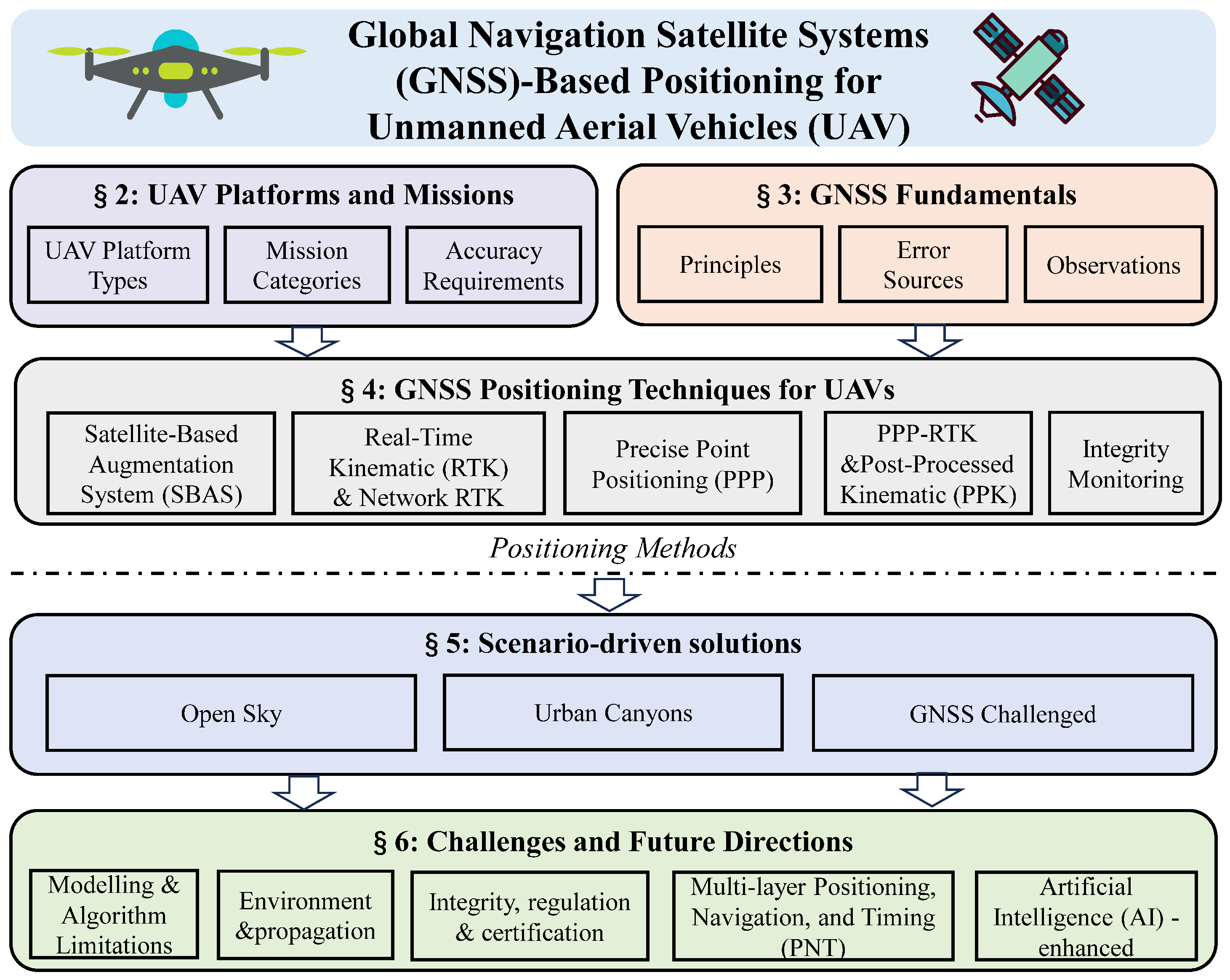
This paper aims to systematically review the current status of GNSS-based positioning for UAVs and outlines key challenges and future research directions. The overall structure of the review is summarized in Figure 1. The remainder of this paper is organized as follows: Section 2 analyzes the distinctive characteristics of UAV platforms and classifies mission requirements. Section 3 briefly reviews GNSS fundamentals relevant to UAVs, including error sources and observation models. Section 4 presents a critical evaluation of GNSS positioning techniques, including SBAS, RTK, PPK, and PPP-RTK. Furthermore, it examines key aspects of integrity, resilience to interference, and Artificial Intelligence (AI)-driven enhancements. Section 5 adopts a scenario-driven approach, discussing multi-sensor fusion strategies in open-sky, urban canyon, and GNSS-denied environments. Section 6 identifies key technical and regulatory challenges and outlines future research directions. Finally, Section 7 concludes the review with a summary and discussion.

Research Methodology

The following points details our search strategy, selection criteria, data extraction schema, and analysis plan.
Search strategy: We searched Scopus, IEEE Xplore, Google Scholar, Springer, MDPI, ScienceDirect for studies published between 1 January 2020 and 1 December 2025. The search was limited to English publications. The main query combined UAV-related and GNSS-related terms: (“unmanned aerial vehicle” OR UAV OR drone) AND (GNSS OR GPS OR BeiDou OR BDS OR Galileo) AND (RTK OR PPK OR PPP OR “PPP-RTK” OR “PPP RTK” OR NRTK OR “network RTK”) AND ( (“sensor fusion” OR “multi-sensor” OR GNSS/INS OR GNSS/IMU OR LiDAR OR vision OR camera OR UWB) OR (integrity OR RAIM OR ARAIM OR “protection level” OR “fault detection”) OR (jamming OR spoofing OR interference OR “resilient PNT”) OR (multipath OR NLOS OR “urban canyon”) OR (“direct georeferencing” OR photogrammetry OR mapping)).
Eligibility criteria: We included peer-reviewed journal articles that address GNSS-based positioning for UAVs, or treat GNSS as a core component within a multi-sensor navigation architecture. To support evidence-based comparisons, eligible studies were required to report quantitative performance indicators, such as positioning accuracy, convergence/TTFF, re-fix time, ambiguity-fixing success rate, time-in-fixed, or integrity-related metrics, and to evaluate these metrics through flight experiments or operationally relevant test conditions. We excluded purely indoor studies where GNSS is not a primary positioning source, conceptual papers without quantitative evaluation, and papers for which UAV relevance or evaluation settings could not be reliably verified.
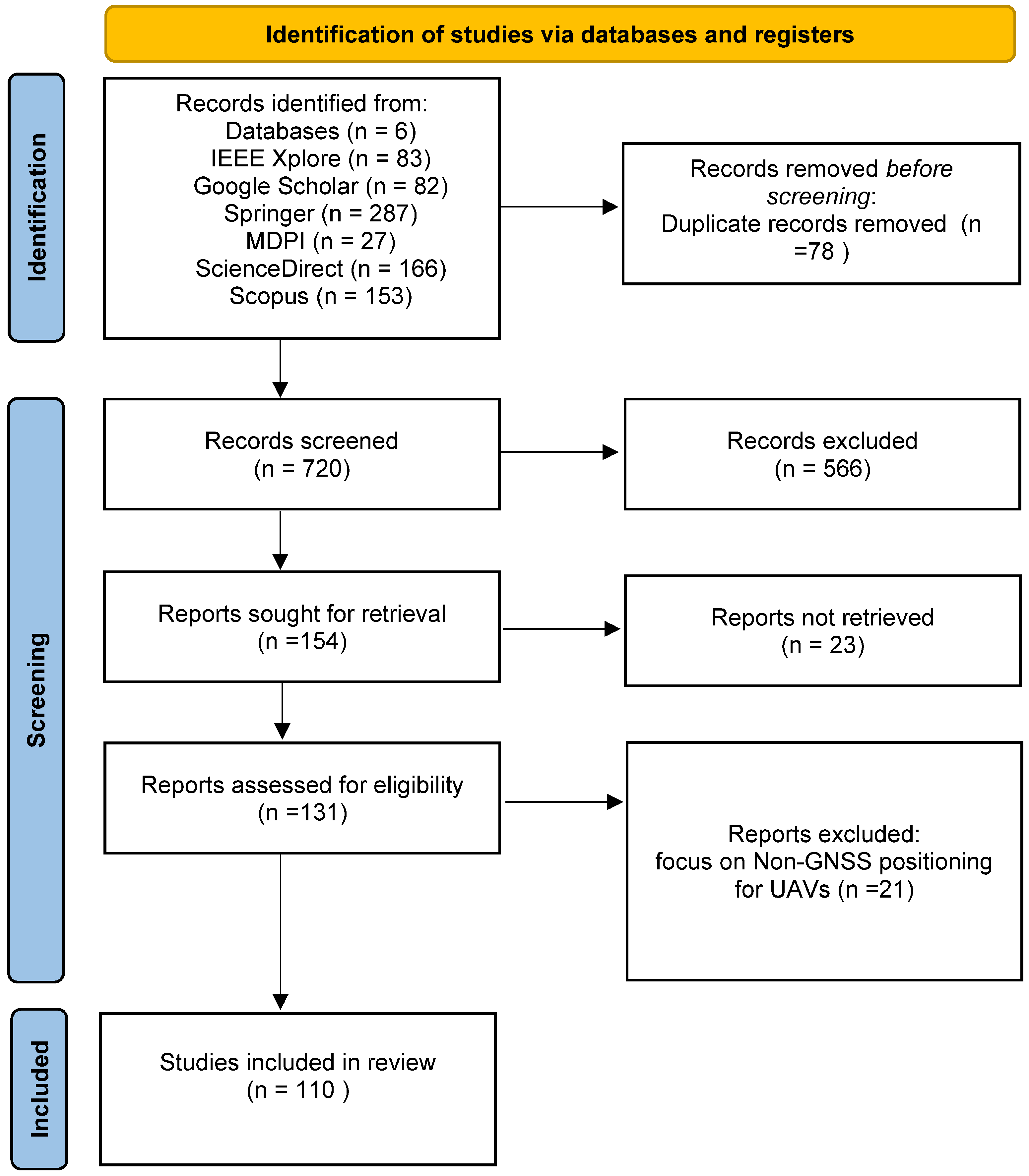
Study selection workflow: After removing duplicates, we screened titles and abstracts for relevance and then assessed the full text of the remaining records against the eligibility criteria. As shown in Figure 2, the overall selection process is summarized using a PRISMA 2020 [24]-inspired flow diagram, with quantified screening steps and categorized reasons for exclusion.
Data extraction and quality assessment: For each included study, we extracted key information in a standardized form, including UAV platform characteristics, receiver and signal configuration, the positioning method employed, the test environment, correction delivery and communication assumptions, and the reported performance metrics. In addition, we conducted a concise methodological quality and risk-of-bias appraisal using an engineering-oriented checklist to identify common limitations, such as non-representative test environments, incomplete reporting of failure cases, or insufficient description of ground truth.

2. UAV Platforms, Missions and Positioning Requirements

Unlike conventional manned aircraft or static receivers, UAVs operate at low altitude, in close proximity to structures and vegetation, and with highly heterogeneous platform designs and cost constraints. As a result, GNSS receivers on UAVs are simultaneously exposed to harsher propagation environments, stronger mechanical vibration, and tighter Size, Weight, and Power (SWaP) limits than most classical geodetic or aviation users. This section therefore focuses on those platform- and mission-specific aspects that distinguish UAV GNSS applications from ordinary GNSS use.

2.1. Distinctive Characteristics of UAV GNSS Applications

From a GNSS perspective, UAVs differ from conventional ground receivers and manned aircraft along four main axes:
  • Low-altitude, cluttered environments. Many UAV missions are flown below a few hundred meters above ground, where buildings, trees, and infrastructure create severe multipath, frequent Line-of-Sight (LOS) blockage, and rapidly changing satellite visibility. This contrasts with traditional high-altitude aviation or rooftop geodetic receivers, which see a mostly unobstructed sky.
  • Aggressive and platform-dependent dynamics. Multirotor and hybrid UAVs can execute rapid attitude changes, accelerations, and mode transitions between hover and forward flight. These dynamics stress carrier-phase tracking loops and cycle-slip detection algorithms that were originally tuned for slower terrestrial or high-altitude users.
  • SWaP-limited, low-cost hardware. Many UAVs rely on compact, low-cost GNSS chipsets integrated into autopilots rather than survey-grade receivers. Limited antenna aperture, simplified RF front-ends, and restricted processing resources exacerbate susceptibility to interference, multipath, and phase noise.
  • Tight coupling with onboard autonomy and safety requirements. GNSS outputs feed directly into flight-control loops, collision-avoidance logic, and higher-level autonomy. This makes continuity, latency, and integrity of the navigation solution critical, particularly for emerging logistics and UAM operations.
These characteristics motivate a dedicated discussion of UAV platform types (Section 2.2), platform-induced effects on GNSS measurements and system implementation (Section 2.3), and the mission-specific performance and integrity requirements summarized in Section 2.4.

2.2. UAV Platform Types and Flight Dynamics

UAV platforms can broadly be categorized into fixed-wing UAVs, multirotor UAVs, unmanned helicopters, and various hybrid configurations, each with characteristic flight envelopes and operational profiles. Fixed-wing UAVs typically offer longer endurance and higher cruise speeds and operate along relatively smooth trajectories, whereas multirotor platforms can hover and perform agile maneuvers at the cost of limited endurance and increased vibration. Unmanned helicopters combine Vertical Take-off and Landing (VTOL) and hovering capabilities with comparatively large payload capacity and good wind resistance, while hybrid UAVs integrate the advantages of both fixed-wing and multirotor designs in a single airframe. For the purposes of GNSS integration, the detailed aerodynamics of these platforms are less important than the way their kinematics, attitude profiles, and structural layouts shape the GNSS signal environment and the design of sensor fusion architectures. For clarity, Table 2 compares typical UAV platform categories and summarizes their implications for GNSS-based positioning.

2.3. Platform- and System-Level Constraints on GNSS Implementation

Beyond their flight dynamics, UAV platforms impose a number of hard engineering constraints on GNSS implementation that are less prominent in traditional geodetic or aviation settings. In particular, SWaP limitations, platform-induced RF and vibration environments, onboard processing and communication constraints, and autopilot and regulatory interfaces jointly determine which positioning strategies are feasible in practice.

2.3.1. SWaP and Platform-Induced RF Environment

The integration of GNSS into UAV systems is strongly influenced by the SWaP envelope of the platform. Limited payload mass and volume, power budgets, thermal considerations, and mechanical design constraints restrict antenna size and placement. Small airframes can cause self-shadowing and introduce strong platform-induced multipath, while compact electronics and power systems may create EMI in the GNSS frequency bands.
In practice, small UAVs can only accommodate compact patch or chip antennas mounted close to other structures, which limits the achievable gain and axial ratio and often prevents installation at aerodynamically and electromagnetically optimal locations [28,29]. Airframe elements such as rotors, booms, batteries and payload bays can obstruct parts of the sky view and create a strong, repeatable platform-induced multipath, while tightly packed avionics and power electronics are frequent sources of in-band and out-of-band interference in the GNSS frequency bands. Larger platforms with higher payload capacity offer more freedom for antenna siting and the use of multi-antenna arrays but still require careful electromagnetic compatibility (EMC) design to avoid self-generated interference.

2.3.2. Vibration, Dynamics and Their Impact on GNSS Measurements

Rotorcraft-type UAVs operate in a vibration-rich mechanical environment. Strong vibrations and rapid attitude changes induced by rotor operation can increase carrier-phase noise and the likelihood of cycle slips [30], especially for low-cost receivers with limited tracking loop bandwidth and simpler phase discriminators. The effective antenna phase center may move relative to the airframe under structural flexing, and cyclic rotor motion can periodically modulate signal amplitude and carrier-to-noise ratio (C/N0) [31].
These effects are rarely encountered in static geodetic receivers or large commercial aircraft and require careful mechanical design and algorithm tuning on UAVs. Methods such as vibration isolation mounts, robust cycle-slip detection, and adaptive carrier-tracking loops are therefore important components of UAV GNSS system design, particularly when high-rate kinematic positioning or RTK/PPP techniques are employed.

2.3.3. Onboard Processing and Communication Constraints

Power and onboard computing resources further constrain the choice of positioning strategy. High-rate, multi-constellation RTK, PPP or PPP-RTK processing, advanced integrity monitoring, and multi-sensor fusion algorithms can be computationally demanding, especially when implemented with sophisticated quality-control and fault-detection schemes [22,32]. On small, low-cost UAVs, it is often impractical to run such algorithms at high update rates alongside flight control, perception, and payload processing. As a result, many systems adopt a split architecture in which lightweight real-time navigation runs onboard, while more computationally intensive refinement is performed off-line using PPK or post-processed PPP on the ground [33].
Communication conditions impose another set of constraints, particularly for correction-based techniques. RTK and PPP-RTK solutions rely on a continuous, low-latency link to a reference station or correction service, typically via UHF radios or cellular networks [34]. In real deployments, bandwidth limitations, coverage gaps, latency spikes and packet loss are common, and can trigger frequent loss-of-fix or reconvergence events that degrade overall navigation performance [35]. These considerations motivate the use of correction schemes and filter designs that are tolerant to intermittent connectivity, and the careful selection of positioning technology according to the expected communications environment.

2.3.4. Autopilot Interfaces and Regulatory Aspects

GNSS implementation on UAVs must be compatible with the autopilot and higher-level command-and-control architecture, as well as regulatory requirements for safety-critical functions [36,37]. Commercial flight-control systems typically integrate GNSS with inertial sensors and barometric altimeters to provide navigation solutions to guidance and flight-management functions over standardized interfaces such as UART, CAN or Ethernet [38]. This constrains message formats, update rates, and the timing and integrity information that can be exchanged between the GNSS subsystem and the flight controller, and can limit the extent to which advanced multi-sensor fusion or integrity monitoring can be tightly integrated into existing avionics [39,40].
For safety-of-flight applications, additional certification and verification requirements further restrict allowable hardware and software changes, reinforcing the need to design GNSS solutions that respect both the physical SWaP limits and the system-integration and regulatory constraints of the target UAV platform [37]. These engineering constraints are a key reason why UAV GNSS system design cannot simply reuse solutions developed for conventional ground or aviation users.

2.3.5. Empirical Validation of Engineering Mitigation Measures

Several hardware-level studies have provided quantitative evidence for engineering countermeasures against UAV-induced multipath and signal modulation. Reported measures include installation-aware antenna placement, redundancy-based screening, and mechanical isolation.
  • Antenna placement and installed-performance-driven design. Installation-aware (digital-twin) workflows can predict airframe-induced pattern deformation and guide pre-flight placement. Hehenberger et al. [25] tested a 100 mm footprint, four-element GNSS array on a hex rotor UAV. Over 24 h, most signals had C / N 0 > 40 dB-Hz; the installed case showed ∼5 dB lower LHCP gain near nadir than standalone, consistent with changed ground-reflection contribution.
  • Empirical evidence in near-structure inspection. Tavasci et al. [41] reported frequent RTK fixing failures within 0–5 m of obstacles and typical re-fix times of 9–13 s after clearing the obstruction. Occasional false fixes reached ∼0.4 m in height, motivating conservative standoff distances and inertial cross-checks.
  • Low-complexity hardware augmentations. Liu et al. [42] validated controlled antenna jitter as a multipath mitigation method. A straight-line jitter of ±6.2 cm reduced the 3D RMS error from 2.45 m to 1.51 m on an open platform.

2.4. Mission Categories and GNSS Performance Requirements

UAV missions encompass a broad spectrum of operations, ranging from structured mapping and photogrammetry flights to on-demand infrastructure inspections, routine agricultural operations, emerging logistics services, and time-critical emergency response. From a GNSS perspective, these missions differ not only in required positioning accuracy but also in continuity, availability, and integrity targets.
High-precision topographic mapping and engineering surveys typically demand centimeter-level three-dimensional (3D) accuracy and strict temporal consistency to ensure reliable geospatial products. Infrastructure inspection and structural health monitoring emphasize the repeatability of flight paths and relative positioning accuracy across missions, often in geometrically and electromagnetically complex environments. Precision agriculture and environmental monitoring prioritize coverage efficiency and consistent track spacing, with moderate to high accuracy requirements depending on the application. Emerging logistics and urban air mobility concepts further introduce stringent requirements on safety, integrity, and continuous navigation under regulatory oversight.
The following subsections discuss representative mission categories and summarize their characteristic GNSS performance and integrity requirements.
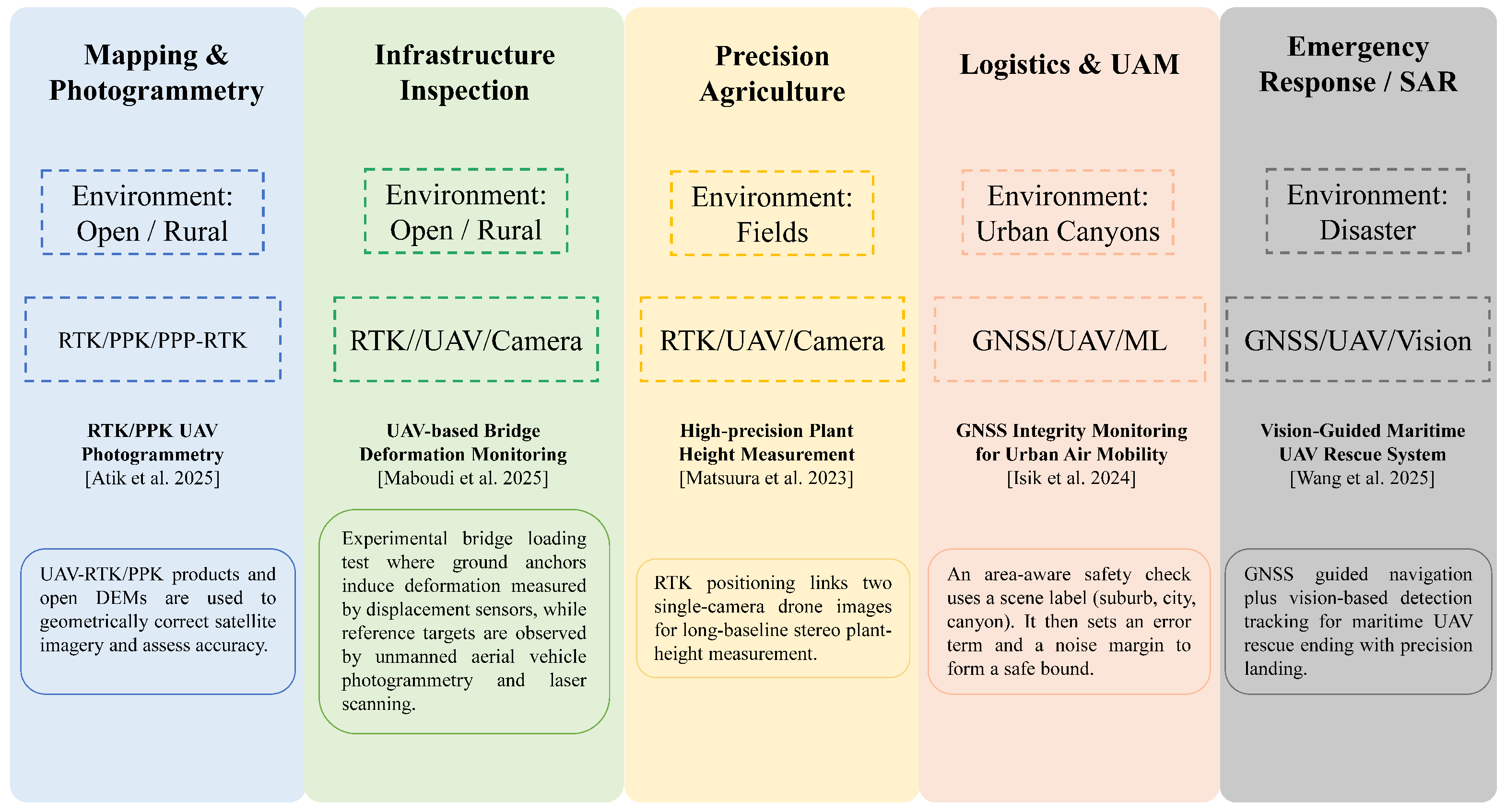
To connect mission objectives with navigation needs, Table 3 summarizes representative UAV mission categories, operating environments, performance requirements, and suitable positioning strategies. A complementary high-level mapping between mission environments and GNSS positioning modes is illustrated in Figure 3.

2.4.1. Mapping and Photogrammetry

Among UAV missions, mapping and photogrammetry are often the most demanding in terms of absolute positioning accuracy. Structured flight campaigns with regular flight-line spacing, high forward and side overlap, and carefully planned flying height are typically required to obtain reliable image blocks and dense surface models. When combined with RTK or PPK positioning and an appropriate distribution of ground control points, UAV photogrammetry can routinely achieve centimeter-level 3D accuracy for topographic mapping and engineering survey products [43,44,45]. In this context, strict temporal consistency between GNSS/IMU data and image exposure times is essential to ensure that camera stations and reconstructed point clouds are georeferenced with survey-grade accuracy [46].

2.4.2. Infrastructure Inspection and Structural Health Monitoring

Infrastructure inspection and structural health monitoring (SHM) place less emphasis on absolute geodetic accuracy at a single epoch and more on the repeatability of flight paths and relative positioning accuracy across missions. Typical use cases include the close-range inspection of bridges, tunnels, transmission lines, pipelines, and buildings [47,48]. UAVs are deployed to acquire high-resolution imagery, LiDAR, or thermal data in geometrically complex and electromagnetically harsh environments, often in close proximity to large structures where GNSS reception can be degraded by multipath and NLOS conditions [49]. For change detection and long-term SHM, it is therefore crucial that successive flights reconstruct the same structural elements with high relative accuracy so that subtle damage or deformation can be reliably identified.

2.4.3. Precision Agriculture and Environmental Monitoring

In precision agriculture and environmental monitoring, UAV missions typically prioritize coverage efficiency, consistent track spacing, and repeatable observation geometries over strict survey-grade accuracy at every point. Multirotor and fixed-wing platforms equipped with multispectral, hyperspectral, thermal, or LiDAR sensors are used to derive vegetation indices, biomass estimates, soil moisture proxies, and other biophysical parameters over large fields or natural ecosystems [50,51]. While meter-level accuracy may be sufficient for many management tasks, higher absolute and relative positioning accuracy is required when integrating UAV data with satellite imagery, field plots, or variable-rate application maps [52,53]. Mission planning in these applications therefore focuses on achieving uniform swath overlap, minimizing gaps, and ensuring that repeated surveys can be co-registered in space and time.

2.4.4. Logistics and Urban Air Mobility

Emerging UAV-based logistics and urban air mobility (UAM) operations raise a different set of requirements, in which the safety, integrity, and continuity of navigation become paramount. Parcel delivery drones and passenger-carrying UAM vehicles are expected to operate along predefined corridors and in dense urban airspace under stringent regulatory oversight, often sharing airspace with other manned and unmanned traffic. For such safety-critical operations, navigation systems must provide high accuracy together with very low probabilities of undetected faults and loss of function, typically quantified through integrity risk, protection levels, and stringent availability targets [54,55]. Standalone GNSS is generally insufficient in complex urban environments because of multipath, signal blockage, and vulnerability to interference, motivating tightly coupled GNSS/INS architectures and multi-sensor fusion with complementary radio navigation or vision-based systems [56].

2.4.5. Emergency Response and Search and Rescue

Emergency response and search-and-rescue missions are characterized by time-critical deployment, unpredictable operating environments, and often degraded or denied GNSS conditions. UAVs are increasingly used to support firefighting, flood response, earthquake damage assessment, and missing-person searches by providing rapid situational awareness through optical and thermal imaging, as well as payload delivery in areas that are difficult or dangerous for ground teams to access [57]. In such scenarios, the robustness and continuity of navigation typically take precedence over achieving centimeter-level accuracy, since operations may take place at low altitude, in dense smoke, heavy precipitation, or GNSS-challenged urban canyons. Resilient solutions therefore rely on multi-constellation, multi-frequency GNSS combined with inertial sensors and, where necessary, vision- or terrain-based navigation to bridge outages and maintain sufficient positional awareness for safe and effective mission execution.
Figure 3. Representative UAV mission categories, environments, and GNSS positioning modes. Representative studies include [58,59,60,61,62].
Drones 10 00091 g003

3. Fundamentals of GNSS-Based Positioning for UAVs

This section recalls only those GNSS fundamentals that are needed in the rest of the review and highlights aspects that are particularly relevant for UAV platforms. We briefly summarize the basic Position, Velocity, and Time (PVT) principle, the main error sources with emphasis on low-altitude and platform-induced effects, and the PPP and RTK observation models as they relate to UAV operations [44].

3.1. Principles of GNSS Positioning

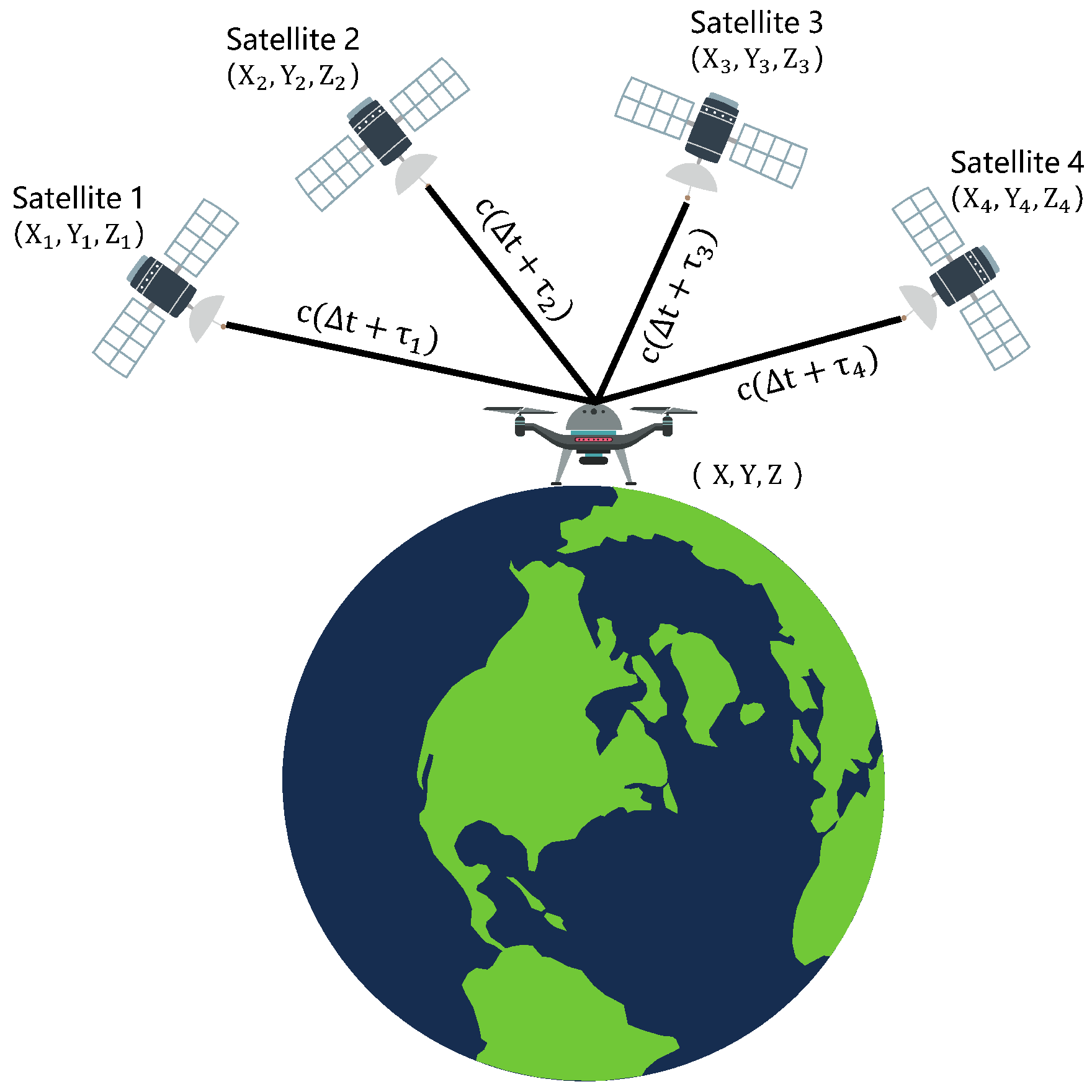
GNSS positioning is based on measuring the signal travel time from multiple satellites to a receiver and solving for the receiver’s PVT. Each satellite broadcasts a time-stamped navigation signal together with orbit information; the receiver compares the reception time with the embedded transmit time and, after multiplying the difference by the speed of light, obtains a pseudorange measurement to each satellite. Combining pseudoranges (and, for high-precision techniques, carrier-phase observations) to at least four satellites allows the receiver to estimate its 3D position and clock offset.
In the UAV context, these principles are used in two main ways. First, low-cost GNSS modules in autopilots deliver meter-level real-time navigation for basic flight control, geofencing, and return-to-home functions. Second, higher-grade receivers and more sophisticated models support centimeter-level trajectory reconstruction for mapping, inspection, and other demanding applications, often in combination with inertial and visual sensors [63]. Figure 4 illustrates the basic geometry of GNSS pseudorange positioning.

3.2. GNSS Error Sources and UAV-Specific Effects

Classical GNSS error sources can be grouped into four broad categories: (i) satellite-related errors (orbit and clock errors, hardware delays, antenna Phase Center Offset (PCO) and Phase Center Variation (PCV), and phase wind-up); (ii) signal propagation errors in the ionosphere and troposphere; (iii) receiver-related errors (receiver clock, hardware delays, multipath, receiver-antenna PCO/PCV, thermal noise); and (iv) other geophysical and relativistic effects such as solid Earth tides, ocean tide loading, pole tide, relativistic corrections, and Earth rotation [64,65].
For conventional geodetic or aviation users, atmospheric and satellite errors often dominate the error budget and can be effectively mitigated using multi-frequency observations, augmentation systems, or precise products. In UAV applications, however, low altitude, compact airframes, and aggressive dynamics introduce additional, often dominant, error mechanisms:
  • Self-shadowing and platform-induced multipath. Small UAVs typically use compact patch or chip antennas mounted close to rotors, arms, batteries, and payload bays. These structures obstruct parts of the sky view and create strong, repeatable multipath from blades, booms, and fuselage surfaces, even in otherwise benign environments.
  • Rotor-induced signal modulation. Rotating blades periodically intersect the antenna’s field of view and scatter incoming signals, which can cause amplitude and carrier-to-noise ratio ( C / N 0 ) fluctuations at the rotor frequency and its harmonics. This modulation increases carrier-phase noise and complicates cycle-slip detection, especially for low-cost receivers with limited tracking-loop bandwidth.
  • High dynamics and attitude changes. Rapid attitude maneuvers, transitions between hover and forward flight, and vibration-rich environments stress code and carrier-tracking loops and can lead to more frequent loss of lock than in static or high-altitude aviation receivers. The effective antenna phase center may move with respect to the airframe under structural flexing, introducing additional kinematic effects.
  • Low-altitude propagation environment. Operation in urban canyons, near infrastructure, or close to vegetation increases the occurrence of Non-Line-of-Sight (NLOS) signals and fast changes in satellite visibility, which in turn degrade the dilution of precision and continuity.
As a result, UAV GNSS system design places stronger emphasis on platform-specific antenna placement and shielding, multipath mitigation, robust tracking loops, and fusion with inertial and vision-based sensors than traditional textbook presentations of GNSS error budgets might suggest [64,65].

3.3. PPP for UAV Trajectories

Positioning techniques for UAVs have evolved from simple code-based SPP to carrier-phase-based methods such as RTK, PPK, and PPP, and from single-station to network-based configurations, as well as from post-processed to real-time applications [63]. SPP, based on code observations and broadcast ephemerides, typically yields meter-level accuracy because of limited orbit and clock precision and simple error handling [66]. This is adequate for basic navigation, geofencing, or emergency return-to-home, but insufficient for high-precision applications such as photogrammetry, corridor inspections, or precision landing [44,66].
PPP was introduced in the late 1990s as an alternative to relative positioning for achieving high-accuracy absolute positioning with a single GNSS receiver [67]. PPP combines code and carrier-phase observations with precise satellite orbits and clocks. When ionospheric and tropospheric delays are properly accounted for, and models for PCO/PCV, phase wind-up, relativistic effects, Earth tides, and ocean loading are applied, PPP can reach centimeter-level, and in some cases millimeter-level, accuracy [68]. In a general form, the code and carrier-phase observations of receiver r tracking satellite s on frequency j at epoch k can be written as:
P r , j s ( k ) = ρ r s ( k , k δ ) + c d t r ( k ) d t s ( k δ ) + D r , j ( k ) d j s ( k δ ) + ι r , j s ( k ) + τ r s ( k ) + M r , j s ( k ) + ε r , j s ( k ) ,
Φ r , j s ( k ) = ρ r s ( k , k δ ) + c d t r ( k ) d t s ( k δ ) + B r , j ( k ) b j s ( k δ ) + λ j N r , j s ι r , j s ( k ) + τ r s ( k ) + m r , j s ( k ) + ϵ r , j s ( k ) ,
where P r , j s and Φ r , j s are the pseudorange and carrier-phase observations, ρ r s is the geometric range, δ is the signal travel time, c is the speed of light, d t r and d t s are the receiver and satellite clock offsets, D r , j / d j s and B r , j / b j s are code/phase hardware delays at the receiver and satellite, ι r , j s and τ r s are ionospheric and tropospheric delays, λ j is the wavelength, N r , j s is the carrier-phase ambiguity, M r , j s and m r , j s are multipath terms, and ε r , j s and ϵ r , j s represent measurement noise.
On UAV platforms, PPP must deal with short mission durations, frequent maneuvers, platform-induced multipath, and non-trivial antenna lever arms [69]. Rapid attitude changes and rotor dynamics cause frequent cycle slips, while antenna offsets to cameras or IMUs must be modeled precisely to achieve consistent georeferencing. Therefore, PPP for UAVs is usually combined with: (i) dedicated cycle-slip detection and repair tuned for high dynamics, (ii) the explicit estimation of antenna offsets and possible residual biases, and (iii) tight integration with inertial and visual sensors to stabilize the solution during convergence and outages. For example, the P3-VINS system integrates PPP, INS, and Visual Simultaneous Localization and Mapping (V-SLAM) by fusing raw GNSS measurements with visual and inertial information to achieve high-precision and robust state estimation [70]. When Uncalibrated Phase Delays (UPDs) or Observable-Specific Biases (OSBs) are available, PPP with Ambiguity Resolution (PPP-AR) can significantly shorten the convergence time, which is particularly important for short UAV flights and real-time guidance [69].

3.4. RTK and Relative Positioning Considerations

RTK uses carrier-phase observations relative to one or more reference stations to achieve centimeter-level relative positioning. Assuming that two receivers observe the same set of satellites at the same nominal epochs, three types of single differences can be formed from the raw GNSS observations: between-receiver, between-satellite, and between-time differences. When two receivers simultaneously track two satellites, a double-difference observable is obtained by differencing two single differences, effectively eliminating receiver and satellite clock offsets and most hardware delays [66]. This error cancellation is fundamental to achieving high-precision relative positioning.
For UAV applications, the RTK observation model is standard, but several practical aspects deserve emphasis:
  • Baseline and geometry. Typical UAV baselines of a few to tens of kilometers allow high ambiguity-fix rates, but rapidly changing satellite geometry at low altitude can still impact reliability, especially in cluttered environments [63].
  • Communication link constraints. Continuous, low-latency transmission of corrections (from a single base or a network) is required to maintain an RTK fix. Cellular or radio links on small UAVs are prone to coverage gaps and latency spikes, leading to ambiguity resets and degraded trajectory segments.
  • Platform dynamics. Aggressive maneuvers and vibration increase the probability of cycle slips and temporary loss of lock, particularly for low-cost receivers. RTK filters and ambiguity-resolution strategies must therefore be tuned for high dynamics and may be complemented by inertial or vision-based aiding [69].
In practice, RTK and PPK have become the dominant techniques for UAV photogrammetry and inspection, with RTK providing real-time feedback to the autopilot and PPK offering robust, communication-independent refinement in post-processing [44]. The following sections build on these observation models to discuss UAV-oriented GNSS techniques, fusion architectures, and application scenarios in more detail.

4. GNSS-Based Positioning Techniques and Algorithms for UAVs

This section reviews the main GNSS positioning modes and algorithmic strategies that are currently used or emerging in UAV applications. The focus is on practically relevant techniques, ranging from low-cost standalone positioning to centimeter-level relative methods and integrity-augmented architectures, with an emphasis on their achievable performance, operational requirements, and suitability for different UAV mission profiles.

4.1. Standalone and SBAS-Based GNSS Positioning

Many commercial off-the-shelf UAVs, especially in consumer and prosumer segments, rely on an integrated GNSS module that provides standalone positioning and velocity solutions to the flight controller. With modern multi-constellation, sometimes multi-frequency, chipsets, single-point solutions typically achieve horizontal accuracies of a few meters under open-sky conditions and update rates of 5–20 Hz, which is adequate for basic navigation, stabilization, and many non-survey applications [71]. In practice, the error budget is dominated by atmospheric delays, satellite orbit and clock errors, and multipath due to low-altitude operations, so performance degrades significantly in urban canyons, forested environments, or near large structures.
SBAS and differential code-based corrections offer a low-complexity way to improve absolute accuracy and provide basic integrity information without modifying the onboard architecture. Experiments with European Geostationary Navigation Overlay Service (EGNOS) and multi-SBAS configurations on small UAVs have shown that SBAS corrections can often reduce horizontal and vertical position errors by a factor of two to three compared to standalone GPS, achieving sub-3 m accuracy in benign environments [72,73]. Such solutions have found widespread use in precision agriculture, basic environmental monitoring, and low-risk logistics, where meter-level accuracy and high availability are sufficient. However, standalone and SBAS-based modes generally cannot meet the centimeter-level georeferencing requirements of engineering surveys or the integrity demands of safety-critical operations, and they remain vulnerable to severe multipath, interference, and intentional or unintentional jamming.

4.2. RTK and Network RTK for UAVs

RTK techniques, based on carrier-phase observations relative to one or more reference stations, have become the de facto standard for high-accuracy UAV mapping and inspection whenever suitable infrastructure is available. Single-base RTK provides centimeter-level horizontal and few-centimeter vertical accuracy under favorable conditions, but the achievable performance and robustness are strongly dependent on baseline length, satellite geometry, and the quality of the reference data link [74,75]. For typical UAV altitudes and ranges, baseline lengths of 5–15 km are often recommended to maintain high ambiguity-fix rates, which constrains the spatial extent of operations around a given base station.
Network RTK approaches, such as Virtual Reference Station (VRS) or Master–Auxiliary Concept (MAC) architectures, aim to extend high-precision coverage by interpolating corrections from a dense array of continuously operating reference stations. When accessed via cellular or dedicated radio links, Network RTK can provide near-uniform centimeter-level accuracy over tens of kilometers and has been successfully applied to UAV photogrammetry and topographic mapping [76,77]. However, the reliance on a low-latency, two-way communication channel means that loss of connectivity, high latency, or packet drops can cause ambiguity resets, reduced fix rates, and degraded trajectory quality, with direct consequences for the consistency of derived orthomosaics and digital elevation models. For safety-critical or tightly scheduled operations, the design of the RTK link, including redundancy, fallback modes, and mission planning relative to network coverage, is thus as important as the nominal positioning accuracy.

4.3. PPK Workflows

PPK positioning has emerged as a robust alternative to real-time RTK in many UAV mapping and surveying workflows. A typical PPK-based photogrammetric workflow involves logging raw GNSS observations onboard the UAV and at one or more ground reference stations, performing differential carrier-phase processing after the flight to obtain a high-accuracy UAV trajectory, and synchronizing the resulting camera positions with image exposure times before bundle adjustment and block triangulation [33]. By decoupling high-precision positioning from real-time communication constraints, PPK can provide very stable centimeter-level camera station coordinates even in environments where real-time data links are unreliable or intermittently unavailable [58].
Comparative studies of RTK and PPK in UAV photogrammetry consistently show that, under similar observational conditions, both techniques can achieve comparable final mapping accuracies, with horizontal and vertical errors often in the 1–3 cm range when combined with appropriate ground control. RTK has the advantage of providing real-time feedback on positioning quality and can support safety-related functions during flight, such as geofencing or precise approach to a landing pad. In contrast, PPK cannot directly guarantee navigation safety in real time, and it requires a more elaborate post-processing toolchain and data management. For many survey-oriented applications where immediate georeferencing is not mandatory, PPK offers a pragmatic compromise: it relaxes the requirements on the communications infrastructure while still delivering survey-grade positioning for subsequent photogrammetric processing.

4.4. PPP and PPP-RTK

PPP provides absolute positioning using a single GNSS receiver by exploiting precise satellite orbits and clocks, together with multi-frequency observations to mitigate ionospheric delay. On UAV platforms, PPP has been demonstrated to achieve planimetric accuracies at the few-centimeter level and vertical accuracies at the decimeter level for photogrammetric mapping, once convergence has been reached [78]. However, the convergence time of classical PPP—often tens of minutes for full ambiguity resolution—is problematic for many short-duration UAV missions with total flight times of 20–40 min [32]. As a result, PPP has seen more use in longer-endurance fixed-wing operations, in deriving ground control point coordinates, or in hybrid workflows where PPP trajectories are further constrained in bundle adjustment [79].
PPP-RTK extends PPP by broadcasting satellite-specific, rather than user-specific, corrections, enabling rapid convergence to centimeter-level accuracy with ambiguity resolution over regional networks [22]. Recent studies have shown that low-cost multi-frequency receivers can benefit from PPP-RTK models that exploit all available observation frequencies, including mixed-frequency combinations, to improve robustness against signal outages and hardware limitations [80]. For UAVs, experimental evaluations of real-time PPP services such as BDS PPP–B2b indicate that sub-decimeter accuracies may be achievable with convergence times of a few minutes, making PPP-RTK a promising candidate for long range or Beyond Visual Line of Sight (BVLOS) operations where relative infrastructure is sparse [81]. Nonetheless, the dependency on precise correction services and the residual convergence time still limit the applicability of PPP-based methods in very short or highly time-critical missions compared to RTK/PPK. For a quantitative comparison, Table 4 summarizes the typical positioning performance of common GNSS techniques for UAV applications.
For BVLOS UAV operations, the practical differentiator between PPP-RTK and Network RTK is not only the achievable centimeter-level accuracy but also the initialization and reconvergence behavior under intermittent connectivity, changing network coverage, and disturbed atmospheric conditions. Network RTK can deliver fast ambiguity fixing when the aircraft remains within a well-instrumented CORS service area with low-latency data links; however, near-structure flights and temporary signal blockage may repeatedly interrupt carrier-phase tracking, leading to a frequent loss of fixed solutions and non-negligible re-fix delays observed in UAV field tests. PPP-RTK, in contrast, is attractive for corridor-style BVLOS missions where the ground infrastructure is sparse or the trajectory crosses network boundaries, but the Time To First Fix (TTFF) and convergence are more sensitive to the quality of atmospheric products and ionospheric activity, which may cause substantial performance degradation during disturbed periods. Table 5 summarizes recent field and service reports that quantify TTFF and ambiguity-fixing success for both approaches.

4.5. Relative and Cooperative GNSS Positioning for UAV Swarms

In multi-UAV systems and swarms, the primary navigation objective is often to maintain accurate relative positioning between vehicles, rather than absolute georeferencing against an external frame. Carrier-phase-based relative positioning, using single- or double-differenced measurements between UAVs (or between UAVs and a moving reference), can provide centimeter-level relative baselines even when absolute accuracy is lower [88]. Such techniques support formation flight, cooperative inspection, and collaborative mapping by ensuring that inter-vehicle distances and relative attitudes are tightly controlled.
Beyond classical differential methods, a growing body of work investigates cooperative and distributed navigation architectures, in which each UAV shares GNSS observations, inter-UAV ranges, or other relative measurements with its neighbors and jointly estimates the swarm state [89]. Centralized approaches solve a single estimation problem at a ground station or leader vehicle, which can exploit global information but introduces communication bottlenecks and single points of failure. In contrast, distributed and consensus-based filters allow each UAV to maintain its own state estimate while benefiting from shared measurements, enhancing robustness against local GNSS degradation and improving relative accuracy within the formation [90,91]. Field experiments with cooperative GNSS and UWB-assisted swarms report sub-decimeter relative positioning and improved resilience in GNSS-challenged environments, highlighting the potential of cooperative methods as UAV fleets and low-altitude traffic densities grow.

4.6. Integrity Monitoring and Safety Oriented Techniques

For safety-critical UAV and emerging UAM operations, the quality of a navigation solution must be characterized not only by accuracy but also by integrity, continuity, and availability. Integrity monitoring techniques aim to bound the probability that undetected navigation faults lead to hazardous position errors, typically by providing protection levels and alerting mechanisms based on statistical models of measurement errors and potential fault modes [92,93]. Receiver autonomous integrity monitoring (RAIM) and its advanced multi-constellation extension ARAIM, originally developed for aviation, provide a conceptual foundation for UAV integrity assessment and have recently been adapted to small-UAV scenarios [94].
In UAV-specific contexts, integrity monitoring is increasingly studied in combination with multi-sensor fusion and application-specific safety objectives. For example, GNSS/INS integration with integrity monitoring has been proposed for enforcing no-fly zones and geofencing, where the system must reliably detect when the UAV is approaching or violating protected airspace despite GNSS degradations [40]. Opportunistic integrity-monitoring techniques further exploit terrestrial signals of opportunity and environmental redundancy to detect GNSS faults and maintain reliable navigation in the presence of interference or spoofing. Recent surveys emphasize that the integrity requirements for small UAVs and UAM vehicles may differ from those in commercial aviation, necessitating tailored alert limits, protection level definitions, and fault hypotheses that reflect low-altitude operations, dense obstacles, and higher manoeuvrability.

4.7. Resilience to Jamming and Spoofing

GNSS-based UAV navigation is vulnerable to intentional radio interference and adversarial signal manipulation. Jamming reduces carrier-to-noise ratio and can trigger loss of lock, while spoofing can generate plausible measurements with biased code and carrier observables. These threats are increasingly relevant for low-altitude operations where an attacker may be close to the flight corridor [95].
A practical defence starts with rapid anomaly detection. Signal quality monitoring can flag correlation distortions and abnormal quadrature energy patterns that are difficult to reconcile with nominal tracking behavior [96]. Multi-antenna spatial processing offers an additional layer of protection by exploiting direction-of-arrival inconsistency across satellites and by suppressing dominant interferers [97]. Cross-validation with onboard inertial sensors can further strengthen spoofing detection since short-term vehicle dynamics are tightly constrained by inertial measurements. Kwon and Shim analyzed a direct GPS spoofing detection method using an AHRS and an accelerometer, and evaluated the detection performance under different motion and sensor-accuracy conditions [98].
Once interference is suspected, a UAV should transition to a controlled degradation mode. This includes down-weighting corrupted measurements, relying more on inertial propagation and other onboard sensors, and using alternative signals of opportunity when available [99]. For safety-critical operations, integrity monitoring is also required to bound the residual position error and to trigger timely alerts. Opportunistic advanced receiver autonomous integrity monitoring has been shown to tighten protection levels for UAV navigation by fusing GNSS with terrestrial signals [100].
For cooperative UAV swarms, navigation security extends beyond single-receiver interference, because falsified GNSS-derived states can propagate through inter-UAV state sharing and destabilize formation keeping. Recent work has specifically investigated detection and mitigation of position spoofing attacks in cooperative UAV swarm formations by exploiting cross-checks between reported positions and inter-UAV relative measurements, and by identifying malicious agents within the network [101]. More broadly, UAM-focused cybersecurity assessments highlight that GNSS is only one part of a wider attack surface that also includes c ommunication links and onboard computation, motivating cyber-resilient architectures that combine authenticated data exchange, consistency checks, and integrity monitoring with multi-layer PNT fallbacks.

4.8. AI- and Data-Driven Enhancements

AI- and data-driven methods are increasingly being explored as add-on components to enhance GNSS-based positioning, particularly in challenging environments where multipath, NLOS signals, and complex dynamics are prevalent. A major research thread focuses on classifying LOS versus NLOS/multipath-contaminated measurements using machine learning models trained on correlation shapes, carrier-to-noise ratios, and other signal features [102]. By excluding or down-weighting measurements identified as NLOS, such classifiers can substantially reduce positioning biases in urban or cluttered environments, with direct relevance to low-altitude UAV operations around buildings and infrastructure.
Beyond measurement selection, data-driven techniques have been proposed to adapt tracking loop parameters, tune cycle-slip detection thresholds, and design context-dependent measurement weighting schemes based on historical performance and environmental context [103]. In UAV applications, such approaches are particularly attractive when combined with multi-sensor fusion, where GNSS residuals, inertial data, and visual or LiDAR cues can be jointly exploited to learn patterns of degradation and compensate for them. Importantly, most of these methods are conceived as augmentations to, rather than replacements of, physically motivated models and estimators: they can be integrated as intelligent pre-filters, quality indicators, or adaptive tuning modules around classical RTK/PPP/INS frameworks, provided that their behavior is sufficiently interpretable and verifiable for the target safety and certification requirements.
A practical bottleneck for learning-based GNSS quality screening at low altitude is the scarcity of labeled training data that faithfully represent flight near buildings, vegetation, and infrastructure, where blockage and multipath vary rapidly with viewpoint and altitude. Recent studies therefore rely on hybrid data strategies, combining limited field measurements with controllable experiments and synthetic correlator-grid data to cover a broader range of delays, Doppler conditions, and reflection geometries, and then adapting the model to new sites and receivers using transfer and fine-tuning. Such data construction practices have been demonstrated for multipath detection using correlator outputs and convolutional networks, with validation on both simulated and real measurements [104,105]. For dense urban canyons, spatio-temporal learning can further exploit trajectory continuity to improve NLOS detection and reduce reliance on exhaustive per-epoch labels [106].
AI contributes to UAV navigation through complementary mechanisms. Convolutional Neural Network (CNN)-based visual perception facilitates object recognition, target tracking, and localization reinforcement via Visual Odometry and SLAM during intermittent GNSS availability [107]. Simultaneously, learning-based GNSS quality assessment, including LOS/NLOS and multipath classification from correlator features and C / N 0 patterns, enables adaptive measurement screening and weighting [105]. In practice, these AI modules are most effective when integrated as verifiable and explainable add-ons to classical estimators, providing quality indicators for RTK/PPP/INS fusion rather than replacing deterministic physical models [103].
Extending the scope from signal-level processing and estimation tuning to higher-level autonomy, AI has become tightly coupled with navigation. Recent surveys indicate that learning-based perception and decision modules are increasingly adopted for autonomous route planning and for obstacle detection and avoidance in complex environments. They enable real-time replanning while maintaining collision-free motion [108]. Such autonomy is particularly valuable for missions conducted in inaccessible or hazardous conditions. In precision agriculture, UAV imagery coupled with machine learning and deep learning supports crop and livestock monitoring and provides decision support for data-driven interventions [109]. These autonomy functions still rely on reliable positioning and situational awareness. They are therefore best developed together with robust GNSS-based and multi-sensor navigation architectures.
For safety-critical UAM, learning modules are additionally constrained by assurance and certification expectations, which require traceable requirements, bounded behavior, and auditable verification and validation evidence. This creates a tension between highly expressive black-box models and the need for interpretable failure modes and compliance-ready arguments. Safety-case oriented assurance processes have been proposed to structure the evidence needed across data management, training, verification, and deployment, and to connect ML evidence to system hazards and operational envelopes [110,111]. In parallel, the avionics community has highlighted that certification practices developed for conventional software do not directly transfer to ML, motivating additional analysis and, in some cases, formal verification of selected properties [112].

5. Navigation Solutions in Different Operational Environments

Adopting an environment-oriented perspective, this section reviews multi-sensor fusion strategies for UAV navigation. The discussion begins with open-sky conditions, where fusion backbones leveraging carrier-phase GNSS and inertial sensing ensure high accuracy and continuity. It then progresses to obstacle-rich urban settings, addressing the challenges of NLOS and severe multipath—factors that necessitate tighter coupling and explicit measurement validation to mitigate biased errors. Finally, the section synthesizes solutions for GNSS-challenged or denied operations, emphasizing the integration of alternative information sources and the importance of seamless mode transitions under varying availability.
Sensor fusion for UAV navigation aims to exploit the complementary properties of different sensors. GNSS provides globally referenced position and velocity but suffers from signal blockage, multipath and intentional interference. Inertial Measurement Units (IMUs) supply high-rate attitude and short-term motion information yet drift over time due to stochastic noise and bias accumulation, especially in low-cost MEMS devices [113,114,115,116]. Visual Odometry (VO) and LiDAR-based methods estimate relative motion with respect to the surrounding scene and can work when GNSS is degraded, but require sufficient texture or structure and may fail under poor visibility [117,118,119,120,121]. On many UAV platforms, the IMU package also includes magnetometers that supply additional heading information [122]. In addition, many UAV platforms integrate barometric and differential pressure sensors for altitude and airspeed estimation, which complement other navigation sensors in dynamic flight environments and can be fused with IMU and other measurements to improve state estimation accuracy. Barometric and differential pressure sensors provide atmospheric and dynamic pressure measurements needed for altitude and airspeed estimation on UAVs. These sensors have been used in the design of UAV airspeed measurement systems based on MEMS pressure sensors [123], and in GNSS-denied navigation algorithms where barometer and airspeed measurements are fused with IMU data [124].
To motivate the fusion design choices in different environments, Table 6 compares the key characteristics and constraints of IMU, visual, LiDAR, UWB sensing, magnetometer and pressure sensors for UAV navigation. Table 7 summarizes representative fusion algorithms for UAV navigation in typical operating scenarios, with emphasis on computational scaling and high-dynamics performance. In the following subsections, we focus on how these sensors are combined in representative UAV application scenarios.

5.1. Open-Sky and Sparsely Obstructed Environments

In open areas, the UAV typically has an unobstructed Line-of-Sight (LOS) to many satellites. Under such conditions, GNSS alone can already provide sub-meter accuracy and high availability, which makes it suitable for tasks such as agricultural monitoring, large-scale surveying and pipeline inspection [89,131]. The full potential of open-sky GNSS is exploited by high-precision carrier-phase techniques. Real-Time Kinematic (RTK) and Post-Processed Kinematic (PPK) methods deliver centimeter-level positioning by forming double-difference observables between the UAV and a reference station [132,133]. For example, RTK-assisted UAV photogrammetry has been successfully used for monitoring slope stability, where an RTK receiver tracks multiple satellites through a tripod-mounted antenna to georeference aerial images with high precision.
Even in open environments, however, several error sources limit performance. Ionospheric and tropospheric delays, satellite orbit and clock errors, and receiver hardware biases can degrade the absolute accuracy of GNSS measurements. In addition, spoofing and jamming attacks remain a concern for safety-critical operations [134]. Multi-UAV formations that rely solely on GNSS for relative positioning may experience abrupt degradation once signal blockage or interference occurs [89]. These factors motivate the fusion of GNSS with inertial and LiDAR sensors even in nominally benign environments.
A common configuration in open-sky scenarios is a loosely coupled GNSS/IMU integration implemented with a Kalman filter or one of its variants [113,114,135,136]. IMU measurements provide high-rate attitude and velocity estimates, which bridge short GNSS outages and smooth the trajectory, while GNSS updates periodically correct the inertial drift. This GNSS/IMU baseline is widely used in commercial UAV autopilots because it offers a good compromise between complexity and robustness.
For applications that demand dense 3D mapping, GNSS is further combined with LiDAR. UAV-borne LiDAR systems use RTK or PPK GNSS solutions to georeference point clouds and generate high-resolution Digital Elevation Models and 3D surface models [121,137,138,139]. Comparative studies show that integrated GNSS-LiDAR systems can achieve high accuracy in both horizontal and vertical components when referenced to total-station benchmarks [121]. In such open-sky mapping or corridor-surveying tasks, GNSS/IMU/ LiDAR integration effectively turns the UAV into a precise mobile mapping platform.

5.2. Urban Canyons and Low-Altitude Electromagnetically Complex Environments

Urban canyons represent one of the most challenging environments for GNSS-based UAV navigation. Tall buildings and narrow streets obstruct LOS signals, introduce severe multipath and reduce satellite visibility [140,141,142]. Multipath arises when signals reflect from façades or other structures before reaching the antenna, corrupting code and phase measurements and degrading the position solution [141]. Simulation studies indicate that multi-constellation and multi-frequency GNSS improves availability in cities, but residual multipath and Non-Line-of-Sight (NLOS) effects still limit performance [142]. At the same time, low-altitude urban airspace often contains dense wireless infrastructure and other sources of EMI, which further complicate GNSS reception [143,144].
In this context, GNSS-only navigation is rarely sufficient. Robust localization relies on multi-sensor fusion that can down-weight or replace corrupted GNSS measurements. One widely studied approach is tightly coupled GNSS/INS/vision integration. IMUs provide short-term motion and attitude, while VO or Visual Inertial Odometry (VIO) uses image sequences to estimate relative motion with respect to the surrounding scene [117,118,119,120]. Extended or Unscented Kalman Filters are commonly used to fuse these measurements in a single state vector [135,136,145,146]. Compared with a GNSS/IMU solution, adding VO or VIO reduces drift during GNSS outages and provides extra constraints to detect inconsistent GNSS updates.
Several works tailor this idea to urban canyons. For ground vehicles, upward facing cameras have been used to classify sky versus non-sky pixels and to identify NLOS satellites, which helps filter out contaminated GNSS signals and improve positioning accuracy in streets surrounded by high-rise buildings [147]. For UAVs, combining traditional feature-based VO with learning methods has been shown to accelerate image-based localization and increase robustness in complex GNSS environments [148]. Beyond navigation filters, path planning algorithms that account for predicted GNSS quality along candidate trajectories are being explored to increase mission success rates in urban canyons [149,150].
Low-altitude electromagnetic complex environments pose additional risks. Dense communication infrastructure, industrial equipment and intentional jammers can all degrade or deny GNSS signals [143,144]. In such settings, methods that rely less on GNSS become important. One line of work uses points of interest or store signage in UAV images for image-based localization, which can be effective when multipath and interference limit GNSS usability [143]. Another direction is to develop LiDAR datasets and tracking techniques that support robust UAV localization based on 3D geometry in GNSS-denied urban areas [151,152]. Deep learning and other machine learning approaches are also being investigated to adapt navigation and obstacle-avoidance strategies to complex urban environments [153].
The airspace structure further constrains the design of navigation solutions. In emerging urban air mobility concepts, low-speed small-UAS typically operate below about 61 m, sharing cluttered environments with buildings, trees and power lines, whereas higher-speed UAV traffic may be assigned to corridors between 61 m and 122 m, and conventional civil or military aircraft operate above 152 m [154]. Navigation architectures for these different altitude layers require different trade-offs between GNSS, inertial, visual and LiDAR sensing, as well as different levels of integrity monitoring.

5.3. GNSS-Challenged and GNSS-Denied Environments

In some missions, GNSS is severely degraded or completely unavailable. Examples include indoor inspections, operations under dense forest canopy, flights near large structures that permanently block satellite signals, and situations where GNSS is intentionally denied. In these cases, navigation must rely on opportunistic or non-GNSS sources.
One important class of methods is opportunistic navigation using Signals of Opportunity (SOPs), such as broadcast radio, television, cellular or Wi-Fi transmissions [134]. These signals can act as auxiliary beacons when their locations or characteristics are known, enabling pseudorange or time-difference measurements. Research on SOP-based navigation in urban environments aims to meet the required navigation performance across all flight phases for UAVs [155]. Integrating SOP measurements with inertial and sometimes visual sensors can provide a continuous position solution even when GNSS is absent.
Another line of work focuses on LiDAR and vision-only navigation. LiDAR SLAM and visual SLAM/VIO systems estimate the UAV trajectory while building a map of the environment, typically using tightly coupled fusion of IMU and camera or LiDAR measurements [119,120,151,152]. These techniques are particularly attractive for indoor, subterranean or heavily obstructed environments, where GNSS is not available at all. For example, ground-based UAV tracking systems using solid-state LiDARs that dynamically adjust integration time as a function of distance and speed have been proposed to support the non-GNSS-based monitoring of UAV trajectories [152]. Ultra-wideband (UWB) anchors and inter-UAV ranging can further enhance relative positioning among cooperating UAVs in GNSS-denied conditions.
Cloud and edge computing platforms offer additional capabilities in such scenarios. Context-adaptive positioning frameworks can offload computation, manage multiple sensor modalities and provide map matching or loop-closure detection based on pre-existing 3D city models or semantic maps [156]. Machine learning can be used to identify reliable measurements, detect anomalies and adapt fusion weights as the environment changes [153].
Overall, while GNSS offers reliable positioning in open environments, its performance degrades markedly in urban canyons and becomes unusable in GNSS-denied settings. These challenges motivate the development of multi-sensor fusion architectures that can gracefully switch between GNSS, GNSS-aided, and non-GNSS modes depending on the environment. Future UAV navigation systems are likely to rely on tightly integrated combinations of GNSS, inertial, visual, LiDAR, UWB, and SOP-based techniques, together with adaptive filtering and learning-based components, to ensure safe and robust operation across a wide range of application scenarios [157].

6. Challenges and Future Development Trends

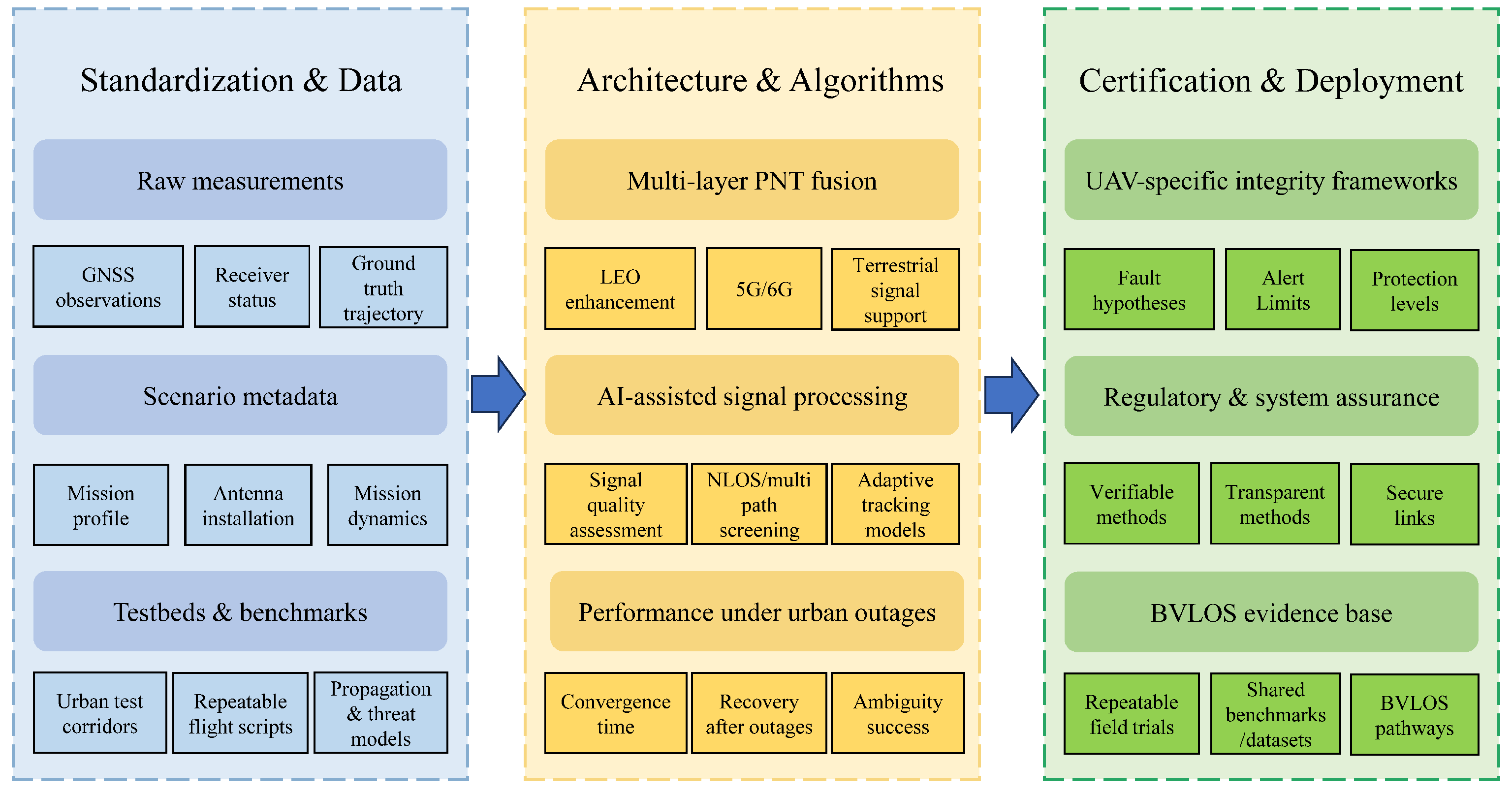
The transition of GNSS-based positioning from experimental demonstrations to routine and safety-critical deployment in UAV and emerging UAM operations reveals distinct structural impediments. These challenges encompass the physical propagation environment, platform and hardware constraints, algorithmic limitations, and system-level complexities pertaining to regulation. Concurrently, several promising research trajectories, such as multi-layer PNT architectures, learning-based processing, and high-fidelity digital twins, are emerging as pivotal enablers for robust GNSS–UAV integration [23].
In this section, we synthesize the key challenges restricting current GNSS-based UAV positioning and chart a course for future research. We first discuss the impact of low-altitude environments and high dynamics on error behavior and re-initialization, before highlighting the platform constraints that bound practical performance. Finally, we emphasize the necessity for integrity frameworks and explore how AI-assisted methods can be integrated with transparent performance guarantees.

6.1. Environmental and Propagation Challenges

Many high-value UAV applications operate in environments inherently hostile to satellite navigation. Dense urban canyons, forests, offshore platforms, and mountainous terrain induce frequent signal blockage, strong attenuation, and severe multipath effects. Consequently, Line-of-Sight (LOS) satellites become scarce, resulting in rapid fluctuations of dilution-of-precision values along the flight trajectory. Research on UAM and small-UAS operations indicates that, even with multi-constellation, multi-frequency GNSS, availability and accuracy degrade precipitously in deep urban environments absent the aid of 3D city models or supplementary sensors. Furthermore, ionospheric storms, scintillation in equatorial anomaly regions, and high-latitude auroral activity can trigger rapid fluctuations in signal amplitude and phase. These disturbances compromise precise techniques, such as PPP, RTK and PPP-RTK, whose convergence and ambiguity resolution depend heavily on stable ionospheric conditions [158,159,160].
Intentional or unintentional Radio-Frequency Interference (RFI) and spoofing further compound these environmental risks. Sources such as low-cost jammers, electromagnetic emissions from onboard avionics, and hostile spoofers are capable of degrading signal quality or manipulating GNSS measurements. While the survey literature documents the escalating prevalence of interference incidents and outlines various detection and mitigation strategies [161], UAV-specific experiments demonstrate that small UAS are susceptible to induced trajectory deviation or unauthorized capture in the absence of adequate safeguards [162]. Consequently, ensuring operational robustness necessitates not merely enhanced signal processing but also the integration of interference monitoring, spectrum management, and resilient PNT paradigms.

6.2. Platform and Hardware Limitations

The physical characteristics of UAV platforms impose strict SWaP constraints on GNSS hardware. Small airframes typically employ compact, low-gain patch antennas mounted close to arms, rotors, batteries, or payloads. Such placement distorts the radiation pattern, increases susceptibility to self-shadowing, and intensifies platform-induced multipath. Empirical studies on small UAVs indicate that antenna placement and local airframe geometry can dominate the error budget, even in benign environments [28,29]. Similar trade-offs affect receivers and inertial sensors: cost and power constraints require the use of low-cost multi-GNSS chipsets and MEMS-grade IMUs. These components exhibit higher measurement noise and poorer bias stability than survey-grade instruments, limiting accuracy and continuity during GNSS outages or high-dynamic maneuvers [71,163]. Furthermore, compact electronics bays with dense power electronics and radios create electromagnetic compatibility (EMC) challenges, where inadequate shielding and grounding can degrade the GNSS front end and increase vulnerability to external RFI.

6.3. Algorithmic and Modeling Challenges

Adapting high-precision GNSS techniques to UAV dynamics presents distinct algorithmic challenges. High-rate attitude changes, rapid acceleration, and aggressive maneuvers strain conventional code- and carrier-tracking loops, increasing the risk of loss of lock and cycle slips. While advanced architectures like vector tracking and deep-coupled GNSS/INS enhance robustness, they incur high computational costs and rely heavily on dynamic assumptions. For PPP and PPP-RTK, the disparity between long convergence times and short mission durations is critical. UAV flights often last only tens of minutes, which precludes full solution convergence and limits operational utility unless fast-convergence strategies are employed [76,78].
In complex environments, the lack of robust, generalizable models for NLOS propagation and multipath constitutes a major obstacle. Conventional techniques relying on elevation masks, SNR thresholds, or sidereal filtering offer only partial mitigation and often fail in 3D urban geometries. Recent research investigates machine learning-based methods for detection and classification, leveraging features derived from C/N0, residuals, 3D building models, or raw correlator outputs [164,165]. Concurrently, multi-sensor fusion architectures integrating GNSS, inertial, visual, and LiDAR data face critical trade-offs between robustness, explainability, and tuning complexity. Surveys of integrated systems underscore that achieving consistent, interpretable performance across diverse flight conditions remains an open research challenge [126,166].

6.4. System-Level, Regulatory and Certification Issues

At the system level, a critical gap remains the absence of widely accepted, UAV-specific PNT performance and integrity standards. Although existing frameworks like RAIM and ARAIM are being extended from manned aviation to UAV and UAM applications [167], their suitability is often limited. Research into UAM vertiport and deep-urban operations indicates that current integrity concepts and protection levels fail to satisfy the stringent, variable requirements of low-altitude flight. Consequently, the community is developing new threat models, fault hypotheses, and integrity metrics tailored to small vehicles in obstructed environments, as exemplified by opportunistic ARAIM concepts that fuse GNSS with terrestrial signals of opportunity [100].
Safety-critical UAV applications, such as cargo transport and passenger-carrying air taxis, require navigation systems to comply with rigorous standards analogous to DO-178C and DO-254. This requirement restricts the use of opaque or non-deterministic algorithms, prioritizing architectures that are verifiable and explainable to regulators [36,37]. Broader societal considerations, including airspace management, privacy, and liability, also shape technical design choices. Consequently, regulatory assessments for UAM emphasize that future communication, navigation, and surveillance architectures must integrate multiple PNT sources, explicit integrity monitoring, and secure links to meet certification mandates.

6.5. Integrity Gaps in Obstacle-Rich and Short-Duration UAV Missions

While RAIM and ARAIM provide a mature baseline for aviation, their direct application to low-altitude UAV operations is constrained by environment- and mission-driven factors absent in classical airborne scenarios [168]. A critical challenge arises from the prevalence of biased and non-stationary ranging errors in urban and near-structure flight. The rapid alternation between LOS and NLOS reception, coupled with strong multipath from nearby facades, yields heavy-tailed residuals and burst errors that undermine the Gaussian overbounding and independence assumptions inherent in conventional protection level computation [169]. High-fidelity AAM simulation studies further indicate that masking and multipath are strongly coupled to local topology and vehicle dynamics, necessitating predictive or map-informed integrity augmentation rather than purely receiver-internal consistency checks [170].
The temporal scale of UAV missions represents a further divergence from manned aviation standards. Integrity risk and continuity targets are traditionally defined over hour-scale exposure windows, whereas small-UAV sorties typically last only tens of minutes and involve frequent transitions between open-sky and deep-urban segments. In such contexts, the operational relevance of time-to-alert and alert limits is inherently tied to corridor clearance, obstacle proximity, and geofencing constraints rather than runway-based flight phases [170]. Recent requirements analyses imply that these parameters must be rigorously re-scaled for low-altitude operations. UAM safety assessments effectively reinforce this need for mission- and context-specific integrity allocation, noting that probability assumptions in risk models are strictly dependent on the evolving concept of operations [171].
Moreover, the fault hypotheses and redundancy patterns in obstacle-rich environments differ fundamentally from those in high-altitude aviation. In deep-urban corridors, receivers often track a limited satellite subset with rapidly degrading geometry, increasing the risk of simultaneous measurements being biased by the same reflector or consistent NLOS blockage. This geometric fragility is compounded by low-cost inertial sensors, which introduce distinct failure modes that must be modeled when integrity is extended to integrated navigation [54]. Recent UAV-oriented studies explicitly address the dual risks of GNSS geometry and IMU faults when constructing protection levels, investigating robust estimation within tightly coupled architectures to mitigate model mismatches [172]. Collectively, these limitations suggest a paradigm shift toward context-adaptive error overbounding and integrated multi-sensor fault hypotheses, supported by evaluation protocols tailored to representative urban environments [173].

6.6. Emerging Research Directions

Several emerging research directions address these challenges to enable resilient GNSS-UAV systems. To organize these efforts and move toward practical deployment, Figure 5 presents a research roadmap covering data standardization, system architecture, and certification. One primary approach involves multi-layer PNT architectures that integrate GNSS with Low Earth Orbit (LEO) satellites, terrestrial cellular networks (5G/6G), and local beacons. Reviews of LEO-based PNT indicate that LEO signals enhance satellite geometry, accelerate convergence, and provide redundancy in GNSS-challenged environments [174]. For UAVs, such architectures facilitate robust navigation along corridors or in urban canyons where standalone GNSS proves insufficient, albeit requiring increased receiver complexity and coordination among service providers.
A parallel development involves the adoption of AI and data-driven methods throughout the GNSS processing chain. Beyond NLOS classification, learning algorithms are now applied to signal quality assessment, adaptive tracking, multipath modeling, and end-to-end position correction. For UAVs, learning-based fusion frameworks exhibit improved robustness in urban environments. However, they introduce challenges regarding data coverage, overfitting, and explainability, which are critical for safety-sensitive applications. Finally, the field requires common benchmarks, standardized datasets, and high-fidelity simulation environments that incorporate realistic urban propagation and threat models. Such tools are essential to systematically evaluate UAV solutions and accelerate their operational deployment. Table 8 provides an overview of representative open source datasets and simulation tools relevant to GNSS and sensor fusion research for UAVs.

7. Discussion and Conclusions

7.1. Discussion

The synthesis of this review suggests that the usefulness of a positioning method is not determined only by its nominal steady-state accuracy. It is also shaped by mission duration, vehicle dynamics, and whether external infrastructure and stable communications are available. In open-sky environments with reliable links, carrier-phase differential methods can still provide centimeter-level performance. In infrastructure-light operations, PPP and PPP-RTK are attractive because they do not rely on dense local reference networks. However, for battery-limited UAV flights, their practical value is often limited by the time needed to reach a usable solution and by slow recovery after repeated outages caused by intermittent satellite visibility.
The gap between theoretical potential and field performance is largely explained by the low-altitude radio environment. Near buildings and terrain, Line-of-Sight reception can change quickly, and multipath becomes strong. This often leads to biased errors that vary over time and are hard to model and bound in a conservative way. At the same time, aggressive maneuvers and vibration can stress signal tracking and make ambiguity maintenance difficult, increasing the chance of cycle slips and repeated reconvergence. SWaP constraints further limit antenna options and onboard processing margin. Therefore, robust performance usually requires system-level design, such as reliable switching between absolute navigation and relative navigation modes, instead of relying on one fixed estimator setting for all flight phases.
These realities also highlight key trade-offs. Methods that depend on real-time corrections can achieve high accuracy when the communication link is stable, but they may fail when the link becomes unreliable. Multi-sensor fusion can improve continuity and provide cross-checks for detecting abnormal behavior, but it increases calibration effort and system verification workload, especially if learning-based modules are included. For safety-critical operations, the focus also shifts from accuracy to integrity, meaning that the system must quantify and control the risk of large, undetected errors. This motivates UAV-specific monitoring strategies and evidence-based safety arguments.
Another challenge is that the experimental results in the literature are difficult to compare. Reported performance depends strongly on the environment, flight dynamics, receiver and antenna installation, correction delivery conditions, and the assumed interference or spoofing threat model. To enable fair comparison, studies should report not only RMS accuracy but also convergence time, time to recover after outages, ambiguity resolution success rate, and, when relevant, integrity-related indicators, all with clear descriptions of the test scenario.
Finally, the current evidence base still has limitations. Large, repeatable field trials in representative low-altitude environments remain limited, and failure cases are often not reported in detail. In addition, integrity concepts and certification pathways for routine BVLOS operations are still developing. Progress will require shared benchmarks and open datasets that cover diverse urban and interference conditions, together with continued advances in resilient multi-layer PNT and verifiable system assurance.

7.2. Conclusions

This review provides a system-level view of GNSS positioning for UAVs by linking mission requirements and platform constraints with the challenges of low-altitude signal propagation. UAV applications require different levels of accuracy and continuity. In practice, solutions range from standalone and SBAS-supported positioning to high-precision carrier-phase methods, including RTK, PPK, PPP, and PPP-RTK. The literature also shows growing interest in cooperative architectures and integrity-oriented designs.
Despite progress in algorithms, routine deployment is still limited by SWaP-driven hardware constraints, non-ideal antenna installation, and electromagnetic compatibility issues. Key open problems include reliable operation under blockage, multipath, and interference; fast convergence and rapid recovery for short and highly dynamic missions; and UAV-specific integrity frameworks supported by a realistic certification pathway.
Looking ahead, robust low-altitude navigation will likely rely on multi-layer PNT architectures that combine GNSS with LEO and terrestrial signals, tighter multi-sensor fusion using inertial, vision, LiDAR, and UWB sensing, and selective use of AI modules whose behavior can be explained and verified. To support progress, the community also needs shared benchmarks, open datasets, and high-fidelity simulation and field evaluation workflows. Overall, GNSS should be treated as the main source of absolute reference within a multi-source navigation architecture designed to provide continuity and integrity.


Author Contributions

Conceptualization, C.J. and X.Z.; methodology, T.L.; validation, X.Z. and H.C.; formal analysis, C.J. and X.Z.; investigation, T.L.; resources, H.C. and T.L.; writing—original draft preparation, C.J.; writing—review and editing, C.J. and X.Z.; visualization, C.J.; supervision, X.Z. and H.C. All authors have read and agreed to the published version of the manuscript.

Funding

The research is supported by the National Natural Science Foundation of China [grant no. 42504023, 42574030, 42404031].

Data Availability Statement

No new data were created or analyzed in this study. Data sharing is not applicable to this article.

Conflicts of Interest

The authors declare no conflicts of interest.

References

  1. Partsinevelos, P.; Chatziparaschis, D.; Trigkakis, D.; Tripolitsiotis, A. A Novel UAV-Assisted Positioning System for GNSS-Denied Environments. Remote Sens. 2020, 12, 1080. [Google Scholar] [CrossRef]
  2. Tong, P.; Yang, X.; Yang, Y.; Liu, W.; Wu, P. Multi-UAV Collaborative Absolute Vision Positioning and Navigation: A Survey and Discussion. Drones 2023, 7, 261. [Google Scholar] [CrossRef]
  3. Yang, K. Research on Key Technologies Of UAV Navigation and Positioning System. In 2021 International Conference on Wireless Communications and Smart Grid (ICWCSG); IEEE: New York, NY, USA, 2021; pp. 29–33. [Google Scholar]
  4. Alotaibi, A.; Chatwin, C.; Birch, P. Evaluating Global Navigation Satellite System (GNSS) Constellation Performance for Unmanned Aerial Vehicle (UAV) Navigation Precision. J. Comput. Commun. 2024, 12, 39–62. [Google Scholar] [CrossRef]
  5. Zhou, J.; He, L.; Luo, H. Real-Time Positioning Method for UAVs in Complex Structural Health Monitoring Scenarios. Drones 2023, 7, 212. [Google Scholar] [CrossRef]
  6. Li, K.; Bu, S.; Li, J.; Xia, Z.; Wang, J.; Li, X. Distributed Relative Pose Estimation for Multi-UAV Systems Based on Inertial Navigation and Data Link Fusion. Drones 2025, 9, 405. [Google Scholar] [CrossRef]
  7. Haddadi Amlashi, H.; Samadzadegan, F.; Dadrass Javan, F.; Savadkouhi, M. Comparing the accuracy of GNSS positioning variants for UAV based 3D map generation. Int. Arch. Photogramm. Remote Sens. Spat. Inf. Sci. 2020, 43, 443–449. [Google Scholar] [CrossRef]
  8. Shang, J.; Li, B.; Ge, H. Multi-GNSS global ionosphere maps comparation based on three stochastic model: Equal weighting processing, single-differenced estimation and VCE. Adv. Space Res. 2025, 76, 3757–3767. [Google Scholar] [CrossRef]
  9. Kim, D.M. An Assessment of UAV Photogrammetry Based on GNSS Positioning Technology for Its Availability. J. Comput. Theor. Nanosci. 2021, 18, 1405–1410. [Google Scholar] [CrossRef]
  10. Kim, N.; Macciotta, R.; Jun, B. Time series analysis of slope displacements using UAV photogrammetry and its relationship with rainfall intensity. Landslides 2024, 21, 1673–1689. [Google Scholar] [CrossRef]
  11. Tang, C.; Wang, Y.; Zhang, L.; Zhang, Y. GNSS/Inertial Navigation/Wireless Station Fusion UAV 3-D Positioning Algorithm With Urban Canyon Environment. IEEE Sens. J. 2022, 22, 18771–18779. [Google Scholar] [CrossRef]
  12. Liang, S.; Zhao, W.; Lin, N.; Huang, Y. Adaptive Fusion Positioning Based on Gaussian Mixture Model for GNSS-RTK and Stereo Camera in Arboretum Environments. Agronomy 2023, 13, 1982. [Google Scholar] [CrossRef]
  13. Yao, L.; Qin, H.; Gu, B.; Shi, G.; Sha, H.; Wang, M.; Xian, D.; Chen, F.; Lu, Z. A Study on Anti-Jamming Algorithms in Low-Earth-Orbit Satellite Signal-of-Opportunity Positioning Systems for Unmanned Aerial Vehicles. Drones 2024, 8, 164. [Google Scholar] [CrossRef]
  14. Gao, Y.; Li, G. A GNSS Instrumentation Covert Directional Spoofing Algorithm for UAV Equipped With Tightly-Coupled GNSS/IMU. IEEE Trans. Instrum. Meas. 2023, 72, 8501413. [Google Scholar] [CrossRef]
  15. Wang, Z.; Yang, B.; Liu, H.; Tong, Z.; Shi, H. TDOA based Tightly Coupled Sensor Fusion for UAV Positioning in GPS-denied Environment. In 2024 3rd International Conference on Robotics, Artificial Intelligence and Intelligent Control (RAIIC); IEEE: New York, NY, USA, 2024; pp. 120–125. [Google Scholar]
  16. Elamin, A.; Abdelaziz, N.; El-Rabbany, A. A GNSS/INS/LiDAR Integration Scheme for UAV-Based Navigation in GNSS-Challenging Environments. Sensors 2022, 22, 9908. [Google Scholar] [CrossRef]
  17. Han, S.; Zhao, M.; Wang, K.; Dong, J.; Su, A. Cross-Modal Images Matching Based Enhancement to MEMS INS for UAV Navigation in GNSS Denied Environments. Appl. Sci. 2023, 13, 8238. [Google Scholar] [CrossRef]
  18. Hai, J.; Hao, Y.; Zou, F.; Lin, F.; Han, S. A Visual Navigation System for UAV under Diverse Illumination Conditions. Appl. Artif. Intell. 2021, 35, 1529–1549. [Google Scholar] [CrossRef]
  19. Di Pietra, V.; Dabove, P.; Piras, M. Loosely Coupled GNSS and UWB with INS Integration for Indoor/Outdoor Pedestrian Navigation. Sensors 2020, 20, 6292. [Google Scholar] [CrossRef]
  20. Zhang, J.; Zhou, W.; Wang, X. UAV Swarm Navigation Using Dynamic Adaptive Kalman Filter and Network Navigation. Sensors 2021, 21, 5374. [Google Scholar] [CrossRef]
  21. Tomaštík, J.; Mokroš, M.; Surovỳ, P.; Grznárová, A.; Merganič, J. UAV RTK/PPK method—An optimal solution for mapping inaccessible forested areas? Remote Sens. 2019, 11, 721. [Google Scholar] [CrossRef]
  22. Li, X.; Huang, J.; Li, X.; Shen, Z.; Han, J.; Li, L.; Wang, B. Review of PPP–RTK: Achievements, challenges, and opportunities. Satell. Navig. 2022, 3, 28. [Google Scholar] [CrossRef]
  23. Bijjahalli, S.; Sabatini, R.; Gardi, A. GNSS performance modelling and augmentation for urban air mobility. Sensors 2019, 19, 4209. [Google Scholar] [CrossRef] [PubMed]
  24. Page, M.J.; McKenzie, J.E.; Bossuyt, P.M.; Boutron, I.; Hoffmann, T.C.; Mulrow, C.D.; Shamseer, L.; Tetzlaff, J.M.; Akl, E.A.; Brennan, S.E.; et al. The PRISMA 2020 statement: An updated guideline for reporting systematic reviews. BMJ 2021, 372. [Google Scholar] [CrossRef] [PubMed]
  25. Hehenberger, S.P.; Elmarissi, W.; Caizzone, S. Design and installed performance analysis of a miniaturized all-GNSS bands antenna array for robust navigation on UAV platforms. Sensors 2022, 22, 9645. [Google Scholar] [CrossRef] [PubMed]
  26. Wang, X.; Ji, X.; Feng, S.; Calmettes, V. A high-sensitivity GPS receiver carrier-tracking loop design for high-dynamic applications. GPS Solut. 2015, 19, 225–236. [Google Scholar] [CrossRef]
  27. Osman, M.; Xia, Y.; Mahdi, M.; Ahmed, A. Hybrid VTOL UAV technologies: Efficiency, customization, and sector-specific applications. Alex. Eng. J. 2025, 120, 13–49. [Google Scholar] [CrossRef]
  28. Reis, S.; Silva, F.; Albuquerque, D.; Pinho, P. General Overview of Antennas for Unmanned Aerial Vehicles: A Review. Electronics 2025, 14, 3205. [Google Scholar] [CrossRef]
  29. Kandregula, V.R.; Zaharis, Z.D.; Ahmed, Q.Z.; Khan, F.A.; Loh, T.H.; Schreiber, J.; Serres, A.J.R.; Lazaridis, P.I. A review of unmanned aerial vehicle based antenna and propagation measurements. Sensors 2024, 24, 7395. [Google Scholar] [CrossRef]
  30. Pirsiavash, A.; Broumandan, A.; Lachapelle, G.; O’keefe, K. GNSS code multipath mitigation by cascading measurement monitoring techniques. Sensors 2018, 18, 1967. [Google Scholar] [CrossRef]
  31. O’Brien, A.J.; Hayhurst, K.; Gupta, I.J. Effects of rotor blade modulation on GNSS receiver measurements. In Proceedings of the 22nd International Technical Meeting of the Satellite Division of The Institute of Navigation (ION GNSS 2009); Savannah International Convention Center: Savannah, GA, USA, 2009; pp. 2352–2361. [Google Scholar]
  32. Erol, B.; Turan, E.; Erol, S.; Kucak, R.A. Comparative performance analysis of precise point positioning technique in the UAV-based mapping. Measurement 2024, 233, 114768. [Google Scholar] [CrossRef]
  33. Zhang, H.; Aldana-Jague, E.; Clapuyt, F.; Wilken, F.; Vanacker, V.; Van Oost, K. Evaluating the potential of post-processing kinematic (PPK) georeferencing for UAV-based structure-from-motion (SfM) photogrammetry and surface change detection. Earth Surf. Dyn. 2019, 7, 807–827. [Google Scholar] [CrossRef]
  34. Zeybek, M.; Taşkaya, S.; Elkhrachy, I.; Tarolli, P. Improving the spatial accuracy of UAV platforms using direct georeferencing methods: An application for steep slopes. Remote Sens. 2023, 15, 2700. [Google Scholar] [CrossRef]
  35. Boquet, G.; Vilajosana, X.; Martinez, B. Feasibility of Providing High-Precision GNSS Correction Data through Non-Terrestrial Networks. IEEE Trans. Instrum. Meas. 2024, 73, 5503915. [Google Scholar] [CrossRef]
  36. Hashim, H.A. Advances in UAV avionics systems architecture, classification and integration: A comprehensive review and future perspectives. Results Eng. 2024, 25, 103786. [Google Scholar] [CrossRef]
  37. Wanner, D.; Hashim, H.A.; Srivastava, S.; Steinhauer, A. UAV avionics safety, certification, accidents, redundancy, integrity, and reliability: A comprehensive review and future trends. Drone Syst. Appl. 2024, 12, 1–23. [Google Scholar] [CrossRef]
  38. Zhang, G.; Hsu, L.T. Intelligent GNSS/INS integrated navigation system for a commercial UAV flight control system. Aerosp. Sci. Technol. 2018, 80, 368–380. [Google Scholar] [CrossRef]
  39. Olesen, D.; Jakobsen, J.; Knudsen, P. Ultra-tightly coupled GNSS/INS for small UAVs. In Proceedings of the 30th International Technical Meeting of the Satellite Division of the Institute of Navigation (ION GNSS+ 2017); Oregon Convention Center: Portland, OR, USA, 2017; pp. 2587–2602. [Google Scholar]
  40. Sun, R.; Zhang, W.; Zheng, J.; Ochieng, W.Y. GNSS/INS integration with integrity monitoring for UAV no-fly zone management. Remote Sens. 2020, 12, 524. [Google Scholar] [CrossRef]
  41. Tavasci, L.; Nex, F.; Gandolfi, S. Reliability of real-time kinematic (RTK) positioning for low-cost drones’ navigation across global navigation satellite System (GNSS) critical environments. Sensors 2024, 24, 6096. [Google Scholar] [CrossRef]
  42. Liu, J.; Wang, F.; Tang, X.; Wang, S.; Yuan, M. A multipath error cancellation method based on antenna jitter. Commun. Eng. 2025, 4, 17. [Google Scholar] [CrossRef]
  43. Ferrer-González, E.; Agüera-Vega, F.; Carvajal-Ramírez, F.; Martínez-Carricondo, P. UAV photogrammetry accuracy assessment for corridor mapping based on the number and distribution of ground control points. Remote Sens. 2020, 12, 2447. [Google Scholar] [CrossRef]
  44. Kim, H.; Hyun, C.U.; Park, H.D.; Cha, J. Image Mapping Accuracy Evaluation Using UAV with Standalone, Differential (RTK), and PPP GNSS Positioning Techniques in an Abandoned Mine Site. Sensors 2023, 23, 5858. [Google Scholar] [CrossRef]
  45. Cryderman, C.; Mah, S.B.; Shufletoski, A. Evaluation of UAV photogrammetric accuracy for mapping and earthworks computations. Geomatica 2014, 68, 309–317. [Google Scholar] [CrossRef]
  46. Shan, J.; Li, Z.; Lercel, D.; Tissue, K.; Hupy, J.; Carpenter, J. Democratizing photogrammetry: An accuracy perspective. Geo-Spat. Inf. Sci. 2023, 26, 175–188. [Google Scholar] [CrossRef]
  47. Adibfar, A.; Razkenari, M.; Costin, A. Review and assessment of technical and legal challenges in application of unmanned aerial vehicles in monitoring and inspection of bridges. Intell. Transp. Infrastruct. 2023, 2, liad023. [Google Scholar] [CrossRef]
  48. Panigati, T.; Zini, M.; Striccoli, D.; Giordano, P.F.; Tonelli, D.; Limongelli, M.P.; Zonta, D. Drone-based bridge inspections: Current practices and future directions. Autom. Constr. 2025, 173, 106101. [Google Scholar] [CrossRef]
  49. Yang, Z.; Xu, Y.; Song, H.; Yu, K. Data-driven structural damage monitoring and assessment based on unmanned aerial vehicle images: A survey. Int. J. Digit. Earth 2025, 18, 2528617. [Google Scholar] [CrossRef]
  50. Guebsi, R.; Mami, S.; Chokmani, K. Drones in precision agriculture: A comprehensive review of applications, technologies, and challenges. Drones 2024, 8, 686. [Google Scholar] [CrossRef]
  51. Unde, S.S.; Kurkute, V.; Chavan, S.S.; Mohite, D.D.; Harale, A.A.; Chougle, A. The expanding role of multirotor UAVs in precision agriculture with applications AI integration and future prospects. Discov. Mech. Eng. 2025, 4, 38. [Google Scholar] [CrossRef]
  52. Bazrafkan, A.; Igathinathane, C.; Bandillo, N.; Flores, P. Optimizing integration techniques for UAS and satellite image data in precision agriculture—A review. Front. Remote Sens. 2025, 6, 1622884. [Google Scholar] [CrossRef]
  53. Gheorghe, G.V.; Dumitru, D.N.; Ciupercă, R.; Mateescu, M.; Mantovani, S.A.; Prisacariu, E.; Harabagiu, A. Advancing precision agriculture with UAV’s: Innovations in fertilization. INMATEH-Eng. 2024, 74, 1057–1072. [Google Scholar] [CrossRef]
  54. Wang, S.; Zhan, X.; Zhai, Y.; Zheng, L.; Liu, B. Enhancing navigation integrity for Urban Air Mobility with redundant inertial sensors. Aerosp. Sci. Technol. 2022, 126, 107631. [Google Scholar] [CrossRef]
  55. Tenny, R.; Humphreys, T.E. Robust navigation for urban air mobility via tight coupling of GNSS with terrestrial radionavigation and inertial sensing. In Proceedings of the 35th International Technical Meeting of the Satellite Division of the Institute of Navigation (ION GNSS+ 2022); Hyatt Regency Denver: Denver, CO, USA, 2022; pp. 1599–1609. [Google Scholar]
  56. Corraro, G.; Iudice, I.; Cuciniello, G.; Ciniglio, U.; Pascarella, D. GNSS Threat Simulator for Urban Air Mobility Scenarios. Aerospace 2025, 12, 787. [Google Scholar] [CrossRef]
  57. Quero, C.O.; Martinez-Carranza, J. Unmanned aerial systems in search and rescue: A global perspective on current challenges and future applications. Int. J. Disaster Risk Reduct. 2025, 118, 105199. [Google Scholar] [CrossRef]
  58. Atik, M.E.; Arkali, M.; Atik, S.O. Impact of UAV-Derived RTK/PPK Products on Geometric Correction of VHR Satellite Imagery. Drones 2025, 9, 291. [Google Scholar] [CrossRef]
  59. Maboudi, M.; Backhaus, J.; Mai, I.; Ghassoun, Y.; Khedar, Y.; Lowke, D.; Riedel, B.; Bestmann, U.; Gerke, M. Very high resolution bridge deformation monitoring using UAV-based photogrammetry. J. Civ. Struct. Health Monit. 2025, 15, 3489–3508. [Google Scholar] [CrossRef]
  60. Matsuura, Y.; Zhang, H.; Nakao, K.; Chang, Q.; Firmansyah, I.; Kawai, S.; Yamaguchi, Y.; Maruyama, T.; Hayashi, H.; Nobuhara, H. High-precision plant height measurement by drone with RTK-GNSS and single camera for real-time processing. Sci. Rep. 2023, 13, 6329. [Google Scholar] [CrossRef]
  61. Isik, O.K.; Petrunin, I.; Tsourdos, A. Machine Learning-Based Environment-Aware GNSS Integrity Monitoring for Urban Air Mobility. Drones 2024, 8, 690. [Google Scholar] [CrossRef]
  62. Wang, S.; Zhao, Y.; Zhou, C.; Ma, X.; Jiao, Z.; Zhou, Z.; Liu, X.; Peng, T.; Shao, C. Vision-Guided Maritime UAV Rescue System with Optimized GPS Path Planning and Dual-Target Tracking. Drones 2025, 9, 502. [Google Scholar] [CrossRef]
  63. Elsheikh, M.; Iqbal, U.; Noureldin, A.; Korenberg, M. The Implementation of Precise Point Positioning (PPP): A Comprehensive Review. Sensors 2023, 23, 8874. [Google Scholar] [CrossRef]
  64. Langley, R.B.; Teunissen, P.J.; Montenbruck, O. Introduction to GNSS. In Springer Handbook of Global Navigation Satellite Systems; Springer: Cham, Switzerland, 2017; pp. 3–23. [Google Scholar]
  65. Karaim, M.; Elsheikh, M.; Noureldin, A. GNSS Error Sources. In Multifunctional Operation and Application of GPS; Rustamov, R.B., Hashimov, A.M., Eds.; IntechOpen: London, UK, 2018; Chapter 4. [Google Scholar]
  66. Li, B.; Zhang, Z.; Miao, W. GNSS Error Sources in RTK. In GNSS Real-Time Kinematic Positioning: Theory and Applications; Springer: Cham, Switzerland, 2025; Volume 17, pp. 17–34. [Google Scholar]
  67. Zumberge, J.F.; Heflin, M.B.; Jefferson, D.C.; Watkins, M.M.; Webb, F.H. Precise point positioning for the efficient and robust analysis of GPS data from large networks. J. Geophys. Res. Solid Earth 1997, 102, 5005–5017. [Google Scholar] [CrossRef]
  68. Teunissen, P.J. GNSS Precise Point Positioning. In Position, Navigation, and Timing Technologies in the 21st Century: Integrated Satellite Navigation, Sensor Systems, and Civil Applications; John Wiley & Sons, Inc.: New York, NY, USA, 2020. [Google Scholar]
  69. Salazar-Cerreño, J.; Fulton, C.; Burdi, K.; Segales, A.; Schvartzman, D.; Palmer, R. Accuracy Assessment of Antenna Patterns Using Unmanned Aerial Vehicle (UAV) Platforms. In 2023 IEEE Conference on Antenna Measurements and Applications (CAMA); IEEE: New York, NY, USA, 2023. [Google Scholar]
  70. Li, T.; Pei, L.; Xiang, Y.; Yu, W.; Truong, T.K. P3-VINS: Tightly-Coupled PPP/INS/Visual SLAM Based on Optimization Approach. IEEE Robot. Autom. Lett. 2022, 7, 7021–7027. [Google Scholar] [CrossRef]
  71. Famiglietti, N.A.; Cecere, G.; Grasso, C.; Memmolo, A.; Vicari, A. A test on the potential of a low cost unmanned aerial vehicle RTK/PPK solution for precision positioning. Sensors 2021, 21, 3882. [Google Scholar] [CrossRef]
  72. Krasuski, K.; Wierzbicki, D.; Bakuła, M. Improvement of UAV positioning performance based on EGNOS+ SDCM solution. Remote Sens. 2021, 13, 2597. [Google Scholar] [CrossRef]
  73. Yoon, H.; Seok, H.; Lim, C.; Park, B. An online SBAS service to improve drone navigation performance in high-elevation masked areas. Sensors 2020, 20, 3047. [Google Scholar] [CrossRef] [PubMed]
  74. Eling, C.; Wieland, M.; Hess, C.; Klingbeil, L.; Kuhlmann, H. Development and evaluation of a UAV based mapping system for remote sensing and surveying applications. Int. Arch. Photogramm. Remote Sens. Spat. Inf. Sci. 2015, 40, 233–239. [Google Scholar] [CrossRef]
  75. Eling, C.; Klingbeil, L.; Wieland, M.; Kuhlmann, H. A precise position and attitude determination system for lightweight unmanned aerial vehicles. Int. Arch. Photogramm. Remote Sens. Spat. Inf. Sci. 2013, 40, 113–118. [Google Scholar] [CrossRef]
  76. Martínez-Carricondo, P.; Agüera-Vega, F.; Carvajal-Ramírez, F. Accuracy assessment of RTK/PPK UAV-photogrammetry projects using differential corrections from multiple GNSS fixed base stations. Geocarto Int. 2023, 38, 2197507. [Google Scholar] [CrossRef]
  77. Cledat, E.; Jospin, L.V.; Cucci, D.A.; Skaloud, J. Mapping quality prediction for RTK/PPK-equipped micro-drones operating in complex natural environment. ISPRS J. Photogramm. Remote Sens. 2020, 167, 24–38. [Google Scholar] [CrossRef]
  78. Grayson, B.; Penna, N.T.; Mills, J.P.; Grant, D.S. GPS precise point positioning for UAV photogrammetry. Photogramm. Rec. 2018, 33, 427–447. [Google Scholar] [CrossRef]
  79. Makineci, H.B.; Bilgen, B.; Bulbul, S. A new precise point positioning with ambiguity resolution (PPP-AR) approach for ground control point positioning for photogrammetric generation with unmanned aerial vehicles. Drones 2024, 8, 456. [Google Scholar] [CrossRef]
  80. Li, X.; Gou, H.; Li, X.; Shen, Z.; Lyu, H.; Zhou, Y.; Wang, H.; Zhang, Q. Performance analysis of frequency-mixed PPP-RTK using low-cost GNSS chipset with different antenna configurations. Satell. Navig. 2023, 4, 26. [Google Scholar] [CrossRef]
  81. Liu, Z.; Lv, Y.; Chen, G.; Zhao, L.; Wei, F.; Pan, Y. Analysis of real-time kinematic positioning of UAV based on BDS-3 PPP-B2b service. Adv. Space Res. 2025, 77, 232–245. [Google Scholar] [CrossRef]
  82. Sukhenko, A.; Meirambekuly, N.; Syzdykov, A.; Mukhamedgali, A.; Mellatova, Y. GNSS for High-Precision and Reliable Positioning: A Review of Correction Techniques and System Architectures. Appl. Sci. 2025, 15, 12304. [Google Scholar] [CrossRef]
  83. Niu, Z.; Xia, H.; Tao, P.; Ke, T. Accuracy assessment of UAV photogrammetry system with RTK measurements for direct georeferencing. ISPRS Ann. Photogramm. Remote Sens. Spat. Inf. Sci. 2024, 10, 169–176. [Google Scholar] [CrossRef]
  84. Yan, Z.; Zhang, X. Assessment of the performance of GPS/Galileo PPP-RTK convergence using ionospheric corrections from networks with different scales. Earth Planets Space 2022, 74, 47. [Google Scholar] [CrossRef]
  85. Wang, Z.; Yang, G.; Huang, R.; Li, M.; Zhu, M. Multi-GNSS Large Areas PPP-RTK Performance During Ionosphere Anomaly Periods. Sensors 2025, 25, 2200. [Google Scholar] [CrossRef] [PubMed]
  86. Shao, Z.F.; Gong, D.W.; Qu, Z.Y.; Xu, S.Y.; Lei, X.T.; Li, Z. Application of Atmospheric Augmentation for PPP-RTK with Instantaneous Ambiguity Resolution in Kinematic Vehicle Positioning. Remote Sens. 2024, 16, 2864. [Google Scholar] [CrossRef]
  87. Liu, H.; Zhang, Z.; Sheng, C.; Yu, B.; Gao, W.; Meng, X. Fast and reliable network RTK positioning based on multi-frequency sequential ambiguity resolution under significant atmospheric biases. Remote Sens. 2024, 16, 2320. [Google Scholar] [CrossRef]
  88. Yoon, H.; Lee, E.; Lim, C.; Park, B. Moving Base Precise Relative Position for Drone Swarm Flight Using Conventional RTK and NMEA Data. In Proceedings of the 33rd International Technical Meeting of the Satellite Division of the Institute of Navigation (ION GNSS+ 2020), Online, 22–25 September 2020; pp. 674–697. [Google Scholar]
  89. Shen, J.; Wang, S.; Zhai, Y.; Zhan, X. Cooperative relative navigation for multi-UAV systems by exploiting GNSS and peer-to-peer ranging measurements. IET Radar Sonar Navig. 2021, 15, 21–36. [Google Scholar] [CrossRef]
  90. Zhang, C.; Tang, C.; Wang, H.; Lian, B.; Zhang, L. Data set for UWB cooperative navigation and positioning of UAV cluster. Sci. Data 2025, 12, 486. [Google Scholar] [CrossRef]
  91. Li, C.; Wang, X.; Jiang, C.; Su, Z.; Chen, S.; Chen, Y. A Cooperative GNSS Vector-DLL (CoVDLL) Method for Multiple UAVs Positioning. Remote Sens. 2025, 17, 2156. [Google Scholar] [CrossRef]
  92. Pullen, S.; Joerger, M. GNSS integrity and receiver autonomous integrity monitoring (RAIM). In Position, Navigation, and Timing Technologies in the 21st Century: Integrated Satellite Navigation, Sensor Systems, and Civil Applications; John Wiley & Sons, Inc.: New York, NY, USA, 2020; Volume 1, pp. 591–617. [Google Scholar]
  93. Hewitson, S.; Wang, J. GNSS receiver autonomous integrity monitoring (RAIM) performance analysis. GPS Solut. 2006, 10, 155–170. [Google Scholar] [CrossRef]
  94. Snijders, M.; Engwerda, H.; Fidalgo, J.; Domínguez, E.; Moreno, G.; Buendía, F.; Duque, J.P.; Martínez, J.; Martini, I.; Sgammini, M.; et al. Advanced receiver autonomous integrity monitoring (araim) for unmanned aerial vehicles. Eng. Proc. 2023, 54, 46. [Google Scholar]
  95. Psiaki, M.L.; Humphreys, T.E. GNSS spoofing and detection. Proc. IEEE 2016, 104, 1258–1270. [Google Scholar] [CrossRef]
  96. Sun, C.; Cheong, J.W.; Dempster, A.G.; Zhao, H.; Bai, L.; Feng, W. Robust spoofing detection for GNSS instrumentation using Q-channel signal quality monitoring metric. IEEE Trans. Instrum. Meas. 2021, 70, 8504115. [Google Scholar] [CrossRef]
  97. Fernández-Prades, C.; Arribas, J.; Closas, P. Robust GNSS receivers by array signal processing: Theory and implementation. Proc. IEEE 2016, 104, 1207–1220. [Google Scholar] [CrossRef]
  98. Kwon, K.C.; Shim, D.S. Performance analysis of direct gps spoofing detection method with ahrs/accelerometer. Sensors 2020, 20, 954. [Google Scholar] [CrossRef]
  99. Kassas, Z.M.; Khalife, J.; Abdallah, A.A.; Lee, C. I am not afraid of the GPS jammer: Resilient navigation via signals of opportunity in GPS-denied environments. IEEE Aerosp. Electron. Syst. Mag. 2022, 37, 4–19. [Google Scholar] [CrossRef]
  100. Khalife, J.; Maaref, M.; Kassas, Z.M. Opportunistic autonomous integrity monitoring for enhanced UAV safety. IEEE Aerosp. Electron. Syst. Mag. 2022, 38, 34–44. [Google Scholar] [CrossRef]
  101. Bi, S.; Li, K.; Hu, S.; Ni, W.; Wang, C.; Wang, X. Detection and mitigation of position spoofing attacks on cooperative UAV swarm formations. IEEE Trans. Inf. Forensics Secur. 2023, 19, 1883–1895. [Google Scholar] [CrossRef]
  102. Suzuki, T.; Amano, Y. NLOS multipath classification of GNSS signal correlation output using machine learning. Sensors 2021, 21, 2503. [Google Scholar] [CrossRef]
  103. Maharmeh, E.; Alsayed, Z.; Nashashibi, F. A comprehensive survey on the integrity of localization systems. Sensors 2025, 25, 358. [Google Scholar] [CrossRef]
  104. Guillard, A.; Thevenon, P.; Milner, C. Using convolutional neural networks to detect GNSS multipath. Front. Robot. AI 2023, 10, 1106439. [Google Scholar] [CrossRef]
  105. Blais, A.; Couellan, N.; Munin, E. A novel image representation of GNSS correlation for deep learning multipath detection. Array 2022, 14, 100167. [Google Scholar] [CrossRef]
  106. Li, F.; Zhai, C.; Xie, T.; Dai, Z.; Zhu, X. GNSS positioning enhancement based on NLOS signal detection using spatio-temporal learning in urban canyons. GPS Solut. 2024, 28, 209. [Google Scholar] [CrossRef]
  107. Yin, J.; Li, T.; Yin, H.; Yu, W.; Zou, D. Sky-GVINS: A sky-segmentation aided GNSS-Visual-Inertial system for robust navigation in urban canyons. Geo-Spat. Inf. Sci. 2024, 27, 2257–2267. [Google Scholar] [CrossRef]
  108. Debnath, D.; Vanegas, F.; Sandino, J.; Hawary, A.F.; Gonzalez, F. A review of UAV path-planning algorithms and obstacle avoidance methods for remote sensing applications. Remote Sens. 2024, 16, 4019. [Google Scholar] [CrossRef]
  109. Istiak, M.A.; Syeed, M.M.; Hossain, M.S.; Uddin, M.F.; Hasan, M.; Khan, R.H.; Azad, N.S. Adoption of Unmanned Aerial Vehicle (UAV) imagery in agricultural management: A systematic literature review. Ecol. Inform. 2023, 78, 102305. [Google Scholar] [CrossRef]
  110. Paterson, C.; Hawkins, R.; Picardi, C.; Jia, Y.; Calinescu, R.; Habli, I. Safety assurance of Machine Learning for autonomous systems. Reliab. Eng. Syst. Saf. 2025, 264, 111311. [Google Scholar] [CrossRef]
  111. Ashmore, R.; Calinescu, R.; Paterson, C. Assuring the machine learning lifecycle: Desiderata, methods, and challenges. ACM Comput. Surv. (CSUR) 2021, 54, 1–39. [Google Scholar] [CrossRef]
  112. Ducoffe, M.; Gabreau, C.; Ober, I.; Ober, I.; Vidot, E.G. Certification of avionic software based on machine learning: The case for formal monotony analysis. Int. J. Softw. Tools Technol. Transf. 2024, 26, 189–205. [Google Scholar] [CrossRef]
  113. Cahyadi, M.N.; Asfihani, T.; Suhandri, H.F.; Navisa, S.C. Analysis of GNSS/IMU Sensor Fusion at UAV Quadrotor for Navigation. IOP Conf. Ser. Earth Environ. Sci. 2023, 1276, 012021. [Google Scholar] [CrossRef]
  114. Gao, J.; Sha, J.; Wang, Y.; Wang, X.; Tan, C. A fast and stable GNSS-LiDAR-inertial state estimator from coarse to fine by iterated error-state Kalman filter. Robot. Auton. Syst. 2024, 175, 104675. [Google Scholar] [CrossRef]
  115. Li, G.; Tang, F.; Sun, J.; Sun, Y.; Zhu, B. Implementation of ZUPT Aided GNSS/MEMS-IMU Deeply Coupled Navigation System. In 2023 International Conference on Microwave and Millimeter Wave Technology (ICMMT); IEEE: New York, NY, USA, 2023; pp. 1–3. [Google Scholar]
  116. Kumar Reddy Damagatla, R.; Atia, M. Improving EKF-Based IMU/GNSS Fusion Using Machine Learning for IMU Denoising. IEEE Access 2024, 12, 114358–114369. [Google Scholar] [CrossRef]
  117. Scaramuzza, D.; Fraundorfer, F. Tutorial: Visual odometry. IEEE Robot. Autom. Mag. 2011, 18, 80–92. [Google Scholar] [CrossRef]
  118. Rone, W.; Ben-Tzvi, P. Mapping, localization and motion planning in mobile multi-robotic systems. Robotica 2013, 31, 1–23. [Google Scholar] [CrossRef]
  119. Luo, H.; Li, G.; Zou, D.; Li, K.; Li, X.; Yang, Z. UAV Navigation With Monocular Visual Inertial Odometry Under GNSS-Denied Environment. IEEE Trans. Geosci. Remote Sens. 2023, 61, 1001615. [Google Scholar] [CrossRef]
  120. Elmi Tabassum, T.; Petrunin, I.; Rana, Z.A. A Comparative Analysis of Hybrid Sensor Fusion Schemes for Visual-Inertial Navigation. IEEE Trans. Instrum. Meas. 2025, 74, 8506415. [Google Scholar] [CrossRef]
  121. Romero, K.F.; Castillo, Y.; Quesada, M.; Zumbado, Y.; Jiménez, J.C. Development of a Testing Method for the Accuracy and Precision of GNSS and LiDAR Technology. AgriEngineering 2025, 7, 310. [Google Scholar] [CrossRef]
  122. Bai, T.; Chai, H.; Tian, X.; Guo, H.; Karimian, H.; Sun, J.; Dong, C. A shipboard integrated navigation algorithm based on smartphone built-in GNSS/IMU/MAG sensors. Adv. Space Res. 2024, 74, 4673–4687. [Google Scholar] [CrossRef]
  123. Chen, Z.; Li, H.; Yu, H.; Zhao, Y.; Ma, J.; Zhang, C.; Zhang, H. Designing of Airspeed Measurement Method for UAVs Based on MEMS Pressure Sensors. Sensors 2024, 24, 5853. [Google Scholar] [CrossRef]
  124. Ye, X.; Zeng, Y.; Zeng, Q.; Zou, Y. Airspeed-aided state estimation algorithm of small fixed-wing UAVs in GNSS-denied environments. Sensors 2022, 22, 3156. [Google Scholar] [CrossRef]
  125. Li, X.; Liang, J.; Huang, G.; Ma, S.; Li, H. Adaptive Invariant Extended Kalman Filter-Based Tightly-Coupled SINS/RTK Integrated Positioning for Rotor Unmanned Aerial Vehicle. IEEE Trans. Instrum. Meas. 2024, 73, 1007117. [Google Scholar] [CrossRef]
  126. Wang, P.; Gao, Y.; Zhao, Q.; Wang, Y.; Zhou, F.; Zhang, D. An Enhanced, Real-Time, Low-Cost GNSS/INS Integrated Navigation Algorithm and Its Platform Design. Sensors 2025, 25, 2119. [Google Scholar] [CrossRef] [PubMed]
  127. Cao, Z.; Li, D.; Zhang, B.; Gou, K. Multi-UAV Cooperative Navigation Method Based on Fusion of GNSSINSVCS Positioning Information. In International Conference on Autonomous Unmanned Systems; Springer: Singapore, 2023; pp. 309–320. [Google Scholar]
  128. Lu, B.X.; Tsai, Y.C.; Tseng, K.S. GRVINS: Tightly coupled GNSS-range-visual-inertial system. J. Intell. Robot. Syst. 2024, 110, 36. [Google Scholar] [CrossRef]
  129. Kang, J.; Park, K.; Arjmandi, Z.; Sohn, G.; Shahbazi, M.; Ménard, P. Ultra-wideband aided UAV positioning using incremental smoothing with ranges and multilateration. In 2020 IEEE/RSJ International Conference on Intelligent Robots and Systems (IROS); IEEE: New York, NY, USA, 2020; pp. 4529–4536. [Google Scholar]
  130. Chen, J.; Wang, H.; Yang, S. Tightly coupled LiDAR-inertial odometry and mapping for underground environments. Sensors 2023, 23, 6834. [Google Scholar] [CrossRef]
  131. Heidari, A.; Jafari Navimipour, N.; Unal, M.; Zhang, G. Machine Learning Applications in Internet-of-Drones: Systematic Review, Recent Deployments, and Open Issues. ACM Comput. Surv. 2023, 55, 1–45. [Google Scholar] [CrossRef]
  132. Jeong, H.; Suk, J.; Kim, S. Control of quadrotor UAV using variable disturbance observer-based strategy. Control Eng. Pract. 2024, 150, 105990. [Google Scholar] [CrossRef]
  133. Wang, N.; Yang, X.; Wang, T.; Xiao, J.; Zhang, M.; Wang, H.; Li, H. Collaborative path planning and task allocation for multiple agricultural machines. Comput. Electron. Agric. 2023, 213, 108218. [Google Scholar] [CrossRef]
  134. Yang, Y.; Khalife, J.; Morales, J.J.; Kassas, Z.M. UAV Waypoint Opportunistic Navigation in GNSS-Denied Environments. IEEE Trans. Aerosp. Electron. Syst. 2022, 58, 663–678. [Google Scholar] [CrossRef]
  135. Liu, W.; Song, D.; Wang, Z.; Fang, K. Comparative Analysis between Error-State and Full-State Error Estimation for KF-Based IMU/GNSS Integration against IMU Faults. Sensors 2019, 19, 4912. [Google Scholar] [CrossRef]
  136. Cahyadi, M.N.; Asfihani, T.; Suhandri, H.F.; Erfianti, R. Unscented Kalman filter for a low-cost GNSS/IMU-based mobile mapping application under demanding conditions. Geod. Geodyn. 2024, 15, 166–176. [Google Scholar] [CrossRef]
  137. Imani, D.; Cahyadi, M.N.; Farid, I.W.; Mardianto, R. Low-Cost LiDAR-GNSS-UAV Technology Development for PT Garam’s Three-Dimensional Stockpile Modelling Needs. Environ.-Behav. Proc. J. 2023, 8, 263–270. [Google Scholar] [CrossRef]
  138. Vu, N.Q.; Nguyen, V.H.; Ta, L.B.; Van, H.T. A Comparative Study of UAV Lidar, UAV, and GNSS RTK on Infrastructure Survey. IOP Conf. Ser. Mater. Sci. Eng. 2023, 1289, 012098. [Google Scholar] [CrossRef]
  139. França Pereira, F.; Sussel Gonçalves Mendes, T.; Jorge Coelho Simões, S.; Roberto Magalhães de Andrade, M.; Luiz Lopes Reiss, M.; Fortes Cavalcante Renk, J.; Correia da Silva Santos, T. Comparison of LiDAR- and UAV-derived data for landslide susceptibility mapping using Random Forest algorithm. Landslides 2023, 20, 579–600. [Google Scholar] [CrossRef]
  140. Hu, Y.; Gardi, A. Optimal Navigation and Obstacle Avoidance for UAV in Urban Canyons. In 2025 IEEE 12th International Workshop on Metrology for AeroSpace (MetroAeroSpace); IEEE: New York, NY, USA, 2025; pp. 262–267. [Google Scholar]
  141. Li, J.; Hwang, S.H. Improved GNSS Positioning Schemes in Urban Canyon Environments. IEEE Access 2025, 13, 112354–112367. [Google Scholar] [CrossRef]
  142. Hwang, S.H.; Maeng, J.H. Simulation Study of Multi-GNSS Positioning Systems in Urban Canyon Environments. Electronics 2025, 14, 3485. [Google Scholar] [CrossRef]
  143. Liu, Y.; Bai, J.; Wang, G.; Wu, X.; Sun, F.; Guo, Z.; Geng, H. UAV Localization in Low-Altitude GNSS-Denied Environments Based on POI and Store Signage Text Matching in UAV Images. Drones 2023, 7, 451. [Google Scholar] [CrossRef]
  144. Tang, T.; Gai, D.; Li, H. Research on low altitude electromagnetic environment monitoring based on unmanned aerial vehicle. In Proceedings Volume 12719, Second International Conference on Electronic Information Technology (EIT 2023); SPIE: Bellingham, WA, USA, 2023; p. 87. [Google Scholar]
  145. Mostafa, M.; Moussa, A.; El-Sheimy, N.; Sesay, A.B. A smart hybrid vision aided inertial navigation system approach for UAVs in a GNSS denied environment. Navigation 2018, 65, 533–547. [Google Scholar] [CrossRef]
  146. Huang, T.; Zhou, Y.; Zhang, B. Image Matching-Based Visual-Inertial Integrated Navigation for UAV in GNSS-Denied Environments. J. Phys. Conf. Ser. 2024, 2784, 012014. [Google Scholar] [CrossRef]
  147. Gakne, P.; O’Keefe, K. Tightly-Coupled GNSS/Vision Using a Sky-Pointing Camera for Vehicle Navigation in Urban Areas. Sensors 2018, 18, 1244. [Google Scholar] [CrossRef]
  148. Gao, H.; Yu, Y.; Huang, X.; Song, L.; Li, L.; Li, L.; Zhang, L. Enhancing the Localization Accuracy of UAV Images under GNSS Denial Conditions. Sensors 2023, 23, 9751. [Google Scholar] [CrossRef]
  149. Nanos, N.; Isik, O.K.; Verdeguer Moreno, R.; Petrunin, I.; Panagiotakopoulos, D.; Tsourdos, A. UAV Path Planning Optimization based on GNSS Quality and Mission Requirements. In AIAA Scitech 2021 Forum; American Institute of Aeronautics and Astronautics: New York, NY, USA, 2021. [Google Scholar]
  150. Causa, F.; Fasano, G.; Grassi, M. Multi-UAV Path Planning for Autonomous Missions in Mixed GNSS Coverage Scenarios. Sensors 2018, 18, 4188. [Google Scholar] [CrossRef] [PubMed]
  151. Catalano, I.; Yu, X.; Queralta, J.P. Towards Robust UAV Tracking in GNSS-Denied Environments: A Multi-LiDAR Multi-UAV Dataset. In 2023 IEEE International Conference on Robotics and Biomimetics (ROBIO); IEEE: New York, NY, USA, 2023; pp. 1–7. [Google Scholar]
  152. Catalano, I.; Sier, H.; Yu, X.; Westerlund, T.; Queralta, J.P. UAV Tracking with Solid-State Lidars: Dynamic Multi-Frequency Scan Integration. In 2023 21st International Conference on Advanced Robotics (ICAR); IEEE: New York, NY, USA, 2023; pp. 417–424. [Google Scholar]
  153. Zhang, D.; Xuan, Z.; Zhang, Y.; Yao, J.; Li, X.; Li, X. Path Planning of Unmanned Aerial Vehicle in Complex Environments Based on State-Detection Twin Delayed Deep Deterministic Policy Gradient. Machines 2023, 11, 108. [Google Scholar] [CrossRef]
  154. Butt, M.Z.; Nasir, N.; Rashid, R.B.A. A review of perception sensors, techniques, and hardware architectures for autonomous low-altitude UAVs in non-cooperative local obstacle avoidance. Robot. Auton. Syst. 2024, 173, 104629. [Google Scholar] [CrossRef]
  155. Kapoor, R.; Ramasamy, S.; Gardi, A.; Sabatini, R. UAV Navigation using Signals of Opportunity in Urban Environments: A Review. Energy Procedia 2017, 110, 377–383. [Google Scholar] [CrossRef]
  156. Quezada-Gaibor, D.; Torres-Sospedra, J.; Nurmi, J.; Koucheryavy, Y.; Huerta, J. Cloud Platforms for Context-Adaptive Positioning and Localisation in GNSS-Denied Scenarios—A Systematic Review. Sensors 2021, 22, 110. [Google Scholar] [CrossRef]
  157. Qu, Z.; Li, Y.; Rizos, C. Enhancing GNSS and INS Integration for High-Precision and Continuous Positioning Using Odometer Trained With TSFNN. IEEE Access 2024, 12, 7827–7840. [Google Scholar] [CrossRef]
  158. Hernández-Pajares, M.; Juan, J.M.; Sanz, J.; Aragón-Àngel, À.; García-Rigo, A.; Salazar, D.; Escudero, M. The ionosphere: Effects, GPS modeling and the benefits for space geodetic techniques. J. Geod. 2011, 85, 887–907. [Google Scholar] [CrossRef]
  159. Sreeja, V.; Aquino, M.; Elmas, Z.G.; Forte, B. Correlation analysis between ionospheric scintillation levels and receiver tracking performance. Space Weather 2012, 10, S06005. [Google Scholar] [CrossRef]
  160. Xue, D.; Jiang, C.; Yu, S.; Yang, Z.; Liu, J. Impacts of space weather-induced satellite navigation errors on UAV collision risk: An estimation for parallel and crossing routes. Space Weather 2025, 23, e2025SW004706. [Google Scholar] [CrossRef]
  161. Gao, G.X.; Sgammini, M.; Lu, M.; Kubo, N. Protecting GNSS receivers from jamming and interference. Proc. IEEE 2016, 104, 1327–1338. [Google Scholar] [CrossRef]
  162. Gaspar, J.; Ferreira, R.; Sebastião, P.; Souto, N. Capture of UAVs through GPS spoofing using low-cost SDR platforms. Wirel. Pers. Commun. 2020, 115, 2729–2754. [Google Scholar] [CrossRef]
  163. Eling, C.; Klingbeil, L.; Kuhlmann, H. Real-time single-frequency GPS/MEMS-IMU attitude determination of lightweight UAVs. Sensors 2015, 15, 26212–26235. [Google Scholar] [CrossRef] [PubMed]
  164. Pan, Y.; Möller, G.; Soja, B. Machine learning-based multipath modeling in spatial domain applied to GNSS short baseline processing. GPS Solut. 2024, 28, 9. [Google Scholar] [CrossRef]
  165. Pereira, P.M.C.; da Silva, H.D.M.; Lima, C.M.G.S. Advancements in Multipath Mitigation for GNSS Receivers: Review of Channel Estimation Techniques. Space Sci. Technol. 2025, 5, 0278. [Google Scholar] [CrossRef]
  166. Avola, D.; Cinque, L.; Foresti, G.L.; Lanzino, R.; Marini, M.R.; Mecca, A.; Scarcello, F. A novel transformer-based imu self-calibration approach through on-board rgb camera for uav flight stabilization. Sensors 2023, 23, 2655. [Google Scholar] [CrossRef]
  167. Yanyachi, P.R.; Mendoza-Chok, J.; Espinoza-Garcia, B.; Luque, J.C.C.; Cardenas, D.Y.A. OpenNavSense platform: A low-cost, open-source inertial navigation system for the evaluation of estimation algorithms. HardwareX 2025, 21, e00621. [Google Scholar] [CrossRef]
  168. Geng, C.; Fang, C.; Hu, Z.; Song, X.; Chen, L.; Wang, Z.; Cui, Y. Analysis of BDS ARAIM Integrity Support Data Parameters. NAVIGATION J. Inst. Navig. 2025, 72. [Google Scholar] [CrossRef]
  169. Wu, J.; Jiang, J.; Tang, Y.; Liu, J. Gaussian–Student’st Mixture Distribution-Based Robust Kalman Filter for Global Navigation Satellite System/Inertial Navigation System/Odometer Data Fusion. Remote Sens. 2024, 16, 4716. [Google Scholar] [CrossRef]
  170. Tarek, F.; Safwat, N.E.D.; Sabatini, R. GNSS Performance Monitoring and Augmentation for Advanced Air Mobility. Aerosp. Sci. Technol. 2026, 171, 111649. [Google Scholar] [CrossRef]
  171. García Crespillo, O.; Zhu, C.; Simonetti, M.; Gerbeth, D.; Lee, Y.H.; Hao, W. Vertiport navigation requirements and multisensor architecture considerations for urban air mobility. CEAS Aeronaut. J. 2024, 16, 993–1008. [Google Scholar] [CrossRef]
  172. Liu, S.; Wang, K.; Abel, D. Robust state and protection-level estimation within tightly coupled GNSS/INS navigation system. GPS Solut. 2023, 27, 111. [Google Scholar] [CrossRef]
  173. Xia, X.; Hsu, L.T.; Wen, W. Integrity-constrained factor graph optimization for GNSS positioning. In 2023 IEEE/ION Position, Location and Navigation Symposium (PLANS); IEEE: New York, NY, USA, 2023; pp. 414–420. [Google Scholar]
  174. Prol, F.S.; Ferre, R.M.; Saleem, Z.; Välisuo, P.; Pinell, C.; Lohan, E.S.; Elsanhoury, M.; Elmusrati, M.; Islam, S.; Çelikbilek, K.; et al. Position, navigation, and timing (PNT) through low earth orbit (LEO) satellites: A survey on current status, challenges, and opportunities. IEEE Access 2022, 10, 83971–84002. [Google Scholar] [CrossRef]
Figure 1. Main sections and overall structure of this review.
Drones 10 00091 g001
Figure 2. Searching and screening flow.
Drones 10 00091 g002
Figure 4. Geometry of GNSS pseudorange positioning.
Drones 10 00091 g004
Figure 5. Strategic research roadmap for resilient UAV navigation.
Drones 10 00091 g005
Table 1. Classical GNSS assumptions versus UAV-specific realities and implications for positioning design.
Classical Global Navigation Satellite Systems (GNSS) AssumptionUnmanned Aerial Vehicles (UAV) Specific RealityImplication
Predominantly Line-of-Sight (LOS) receptionFrequent blockage, None-Line-of-Sight (NLOS), and non-stationary multipath at low altitudeRobust quality control, environment-aware mitigation, and conservative integrity logic
Moderate dynamics and stable trackingHigh attitude rates, vibration, and frequent maneuversTracking robustness, inertial aiding, and rapid cycle-slip recovery
Benign antenna and Radio Frequency (RF) environmentSize, Weight, and Power (SWaP)-limited antennas, airframe shadowing, onboard Electromagnetic Interference (EMI)Installed-performance-driven antenna placement and RF management
Continuous corrections and long observation spansIntermittent links and short missions with frequent resetsFocus on Time To First Fix, re-fix time, and time-in-fixed performance
Rare intentional threatsJamming and spoofing risks in low-altitude corridorsInterference monitoring, spoofing detection, and multi-layer Positioning, Navigation, and Timing (PNT)
Approximately Gaussian residual behaviorBiased and heavy-tailed errors in cluttered scenesRobust estimation and UAV-tailored integrity frameworks
Table 2. Typical UAV platform categories and their implications for GNSS-based positioning [25,26,27].
CategoryCharacteristicsImplications for GNSS
Fixed-wing UAVForward-flight only, relatively high speed and long endurance, no hovering.Relatively smoother dynamics can relax carrier-tracking stress compared with rotorcraft platforms, whereas higher airspeed increases Doppler dynamics.
Multirotor UAVMultiple rotors for Vertical Take-off and Landing (VTOL) and hovering, easy to operate, low speed and limited endurance.Low-altitude hover in clutter; strong multipath and vibration-induced phase noise.
Unmanned helicopterMain and tail rotors, VTOL and hovering, large payload, good wind resistance.Rotor-induced multipath and C/N0 fluctuations; suitable for high-grade GNSS/Inertial Navigation System (INS).
Hybrid UAVRotors for VTOL/hovering and wings for efficient cruise, combining fixed-wing and multirotor capabilities.Mixed cruise/hover conditions; mode changes cause time-varying dynamics and blockage.
Table 3. Overview of UAV missions, environments, requirements, and positioning strategies.
Mission CategoryEnvironmentKey RequirementsTypical Techniques
Mapping and photogrammetryOpen/semi-obstructed sky; structured flight linesCentimeter-level; time-consistent georeferencingReal-Time Kinematic (RTK); Post-Processed Kinematic (PPK)
Infrastructure inspectionNear structures; blockage and multipathRepeatability; reliable relative positioningGNSS/INS + Vision/Light Detection and Ranging (LiDAR) fusion
Precision agricultureOpen fields; benign visibilityPass-to-pass; stable track spacingSatellite-Based Augmentation System (SBAS)/Differential GNSS; RTK (high precision)
Logistics and Urban Air Mobility (UAM)Urban canyons; interference risksIntegrity/safety; continuityGNSS/INS
Emergency and Search and Rescue (SAR)Degraded/unknown; time-criticalRobustness/availability; outage toleranceAdaptive fusion
Table 4. Typical positioning performance of GNSS techniques for UAV and close-range surveying applications [82,83,84].
TechniqueHorizontal AccuracyVertical AccuracyNotes
Single Point Positioning (SPP)2–5 m3–10 mOpen sky baseline.
SBAS/DGNSS1–2 m2–4 mAugmentation corrections.
RTK/Network RTK1–3 cm2–5 cmShort baseline, fixed ambiguities.
PPK2–3 cm3–5 cmPost processed carrier phase.
Precise Point Positioning (PPP)2–3 cm5–10 cmPrecise products, convergence required.
PPP-Ambiguity Resolution (AR)/PPP-RTK<10 cm<10 cmAmbiguity resolution, fast convergence.
Table 5. Comparison of and ambiguity-fixing performance between PPP-RTK and Network RTK for BVLOS UAV operations.
Ref.TechConditionTime To First Fix (TTFF)Fix RateImplication for Beyond Visual Line of Sight (BVLOS)
[85]PPP-RTKLarge-area network; active ionosphere0.8–1.8 min>90%Fast convergence is possible but degrades to tens of minutes under extreme ionosphere activities.
[86]PPP-RTKRegional dense network≈1 s98%Can match RTK performance if ground infrastructure is dense.
[87]Network RTKLong-baseline with atmospheric bias<5 epochs77–99%Fix rate is highly sensitive to atmospheric biases; risk of resets.
[41]Network RTKUAV inspection near structures9–13 s (re-fix)IntermittentObstacle blockage causes 9–13 s gaps; requires inertial coasting.
Table 6. Characteristics of complementary sensors for UAV multi-sensor fusion.
Sensor TypeKey MeasurementDrift CharacteristicsEnvironmental ConstraintsSWaP Impact
Inertial Measurement Unit (IMU) (MEMS)Specific force, angular rateUnbounded drift; bias/scale-factor grow over time (esp. low-cost)Insensitive to lighting; affected by vibration, shocks, temperatureVery small; low–moderate power
Camera/Visual (mono or stereo)Images, features, optical flowVisual Odometry (VO)/Visual-Inertial Odometry (VIO) drift grows with distance; reduced by loop closure or GNSS updatesNeeds texture and light; degrades in low light, blur, fog/rain, texture-less scenesLightweight; moderate compute and data rate
LiDAR3D range/point cloudSimultaneous Localization and Mapping (SLAM) drift; bounded when tied to maps or GNSS/INSDegrades in rain, fog, snow; limited range; reflective surfaces problematicHeavier; higher power; requires rigid mounting
Ultra-Wideband (UWB) radioInter-node ranges (sometimes angles)Small random errors; negligible long-term drift with calibrated anchorsRequires anchors or peers; sensitive to NLOS and RF interferenceSmall modules; low data rate; extra RF and antenna integration
MagnetometerMagnetic field vectorNo unbounded drift; Local biasSensitive to EMIVery small; low power
Pressure sensorsStatic pressure (altitude)/airspeedSmall bias drift; weather dependentSensitive to wind gusts and ground effectVery small; low power
Table 7. Quantitative comparison of representative fusion estimators tailored to UAV navigation scenarios [125,126,127,128,129,130].
Estimator FamilyPer-Update ComplexityDynamics RobustnessReal-Time FeasibilityBest-Fit Scenario
Extended Kalman filter (EKF) O ( n 3 ) (dense), lower with structureMediumHighOpen-sky, GNSS-aided
Unscented Kalman Filter (UKF) O ( ( 2 n + 1 ) n 2 ) to O ( ( 2 n + 1 ) n 3 ) Medium to highMediumGNSS-degraded with strong nonlinearity
Particle filter O ( N p n 2 ) to O ( N p n 3 ) HighLow to mediumAmbiguous or multimodal cases
Sliding-window optimization (factor graph)Superlinear in W n , depends on sparsityHighMediumUrban canyon VIO, GNSS intermittent
Incremental smoothingDepends on affected subgraph; fill-in sensitiveHighMedium to highLong missions with multimodal sensing
Table 8. Examples of open-source UAV datasets and simulation tools relevant to GNSS- and sensor-fusion research.
Dataset/Tool NamePlatformSensor SetupEnvironmentTypeLink/Reference (accessed on 1 December 2025)
EuRoC MAVMicro aerial vehicleStereo cameras + IMU + ground truth poseIndoor factory hall, Vicon roomDatasethttps://ethz-asl.github.io/datasets/euroc-mav/
NTU VIRALHexacopter UAV2 × 3D LiDAR, 2 global-shutter cameras, IMUs, UWBMixed indoor–outdoor campusDatasethttps://ntu-aris.github.io/ntu_viral_dataset
MARS-LVIGAerial robots (UAVs)Downward LiDAR, camera, IMU, GNSSOutdoor flights at 80–130 m above ground levelDatasethttps://doi.org/10.1177/02783649241227968
GrapeSLAMPhantom 4 RTK UAVMono RGB camera, IMU, RTK-GNSS trajectoryVineyards, varying illuminationDatasethttps://zenodo.org/records/14658376
AirSimUAVs/ground vehicles (simulated)Simulated GNSS, IMU, cameras, LiDARVirtual urban and rural scenesSimulation toolhttps://github.com/microsoft/AirSim
Disclaimer/Publisher’s Note: The statements, opinions and data contained in all publications are solely those of the individual author(s) and contributor(s) and not of MDPI and/or the editor(s). MDPI and/or the editor(s) disclaim responsibility for any injury to people or property resulting from any ideas, methods, instructions or products referred to in the content.