
Methods for GIS-Driven Airspace Management: Integrating Unmanned Aircraft Systems (UASs), Advanced Air Mobility (AAM), and Crewed Aircraft in the NAS



Highlights
- A Geographic Information System (GIS) framework successfully integrated diverse aviation data (Automatic Dependent Surveillance–Broadcast (ADS-B), Unmanned Aircraft System (UAS) flight logs, Federal Aviation Administration (FAA) data) into unified 2D and 3D models for the visualization and quantitative analysis of shared airspace operations.
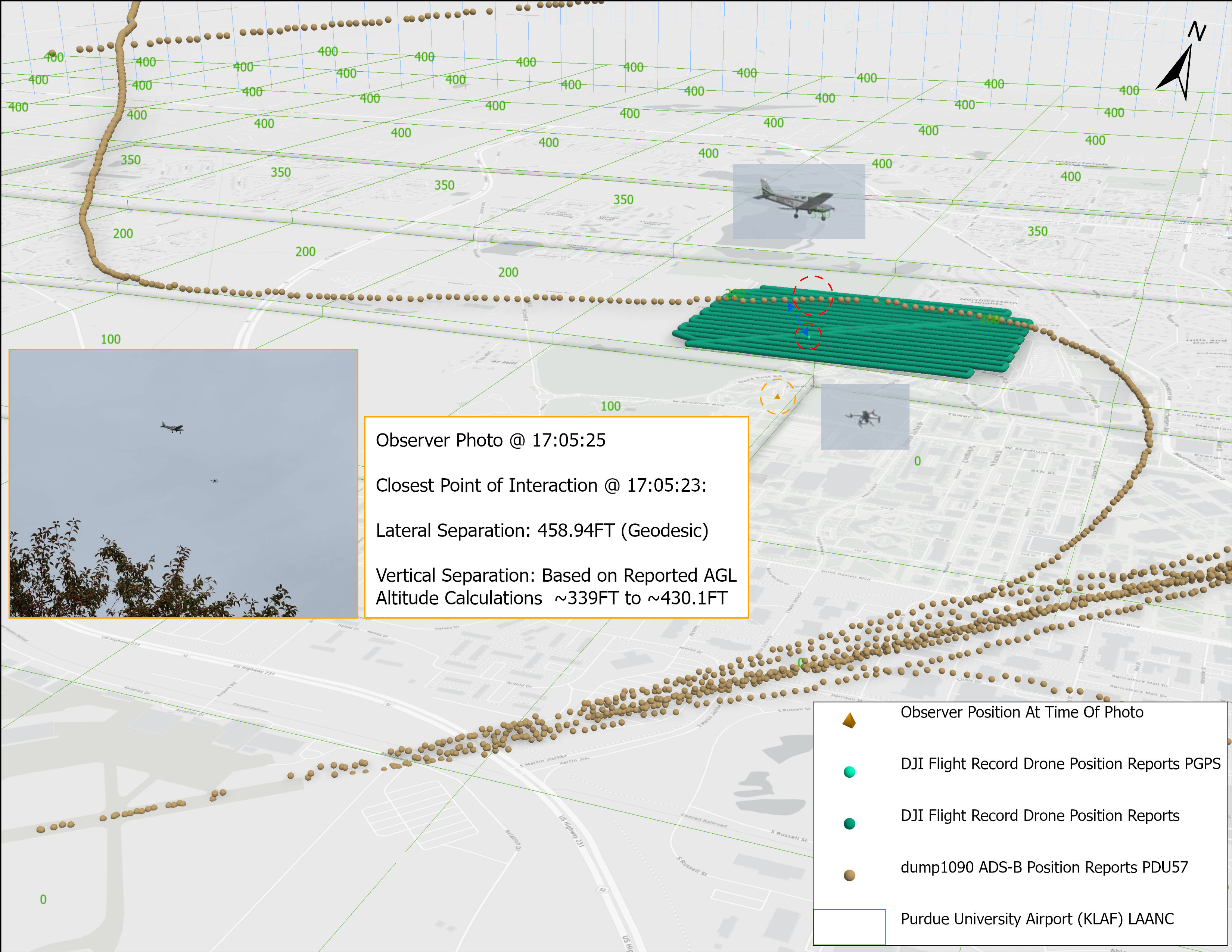
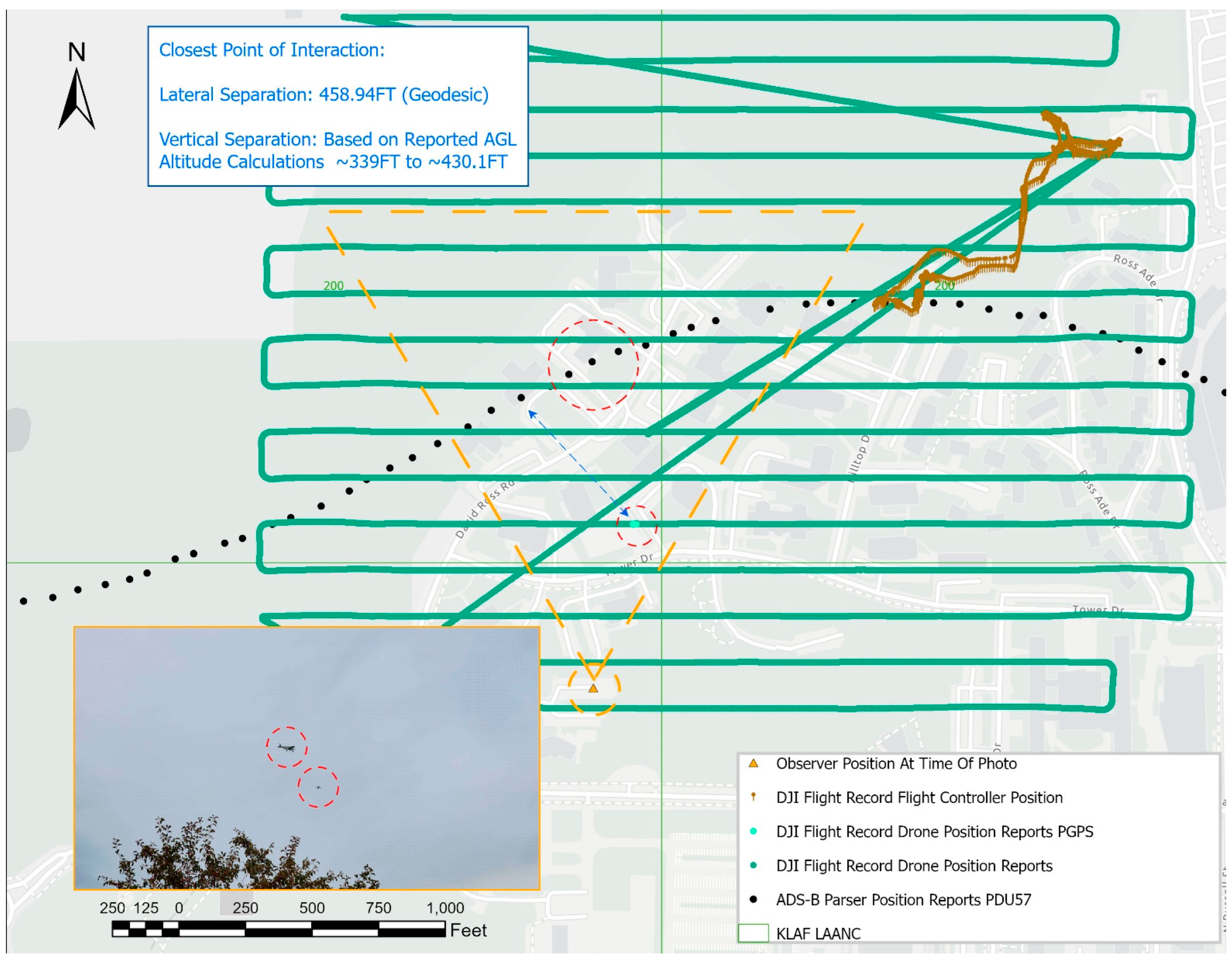
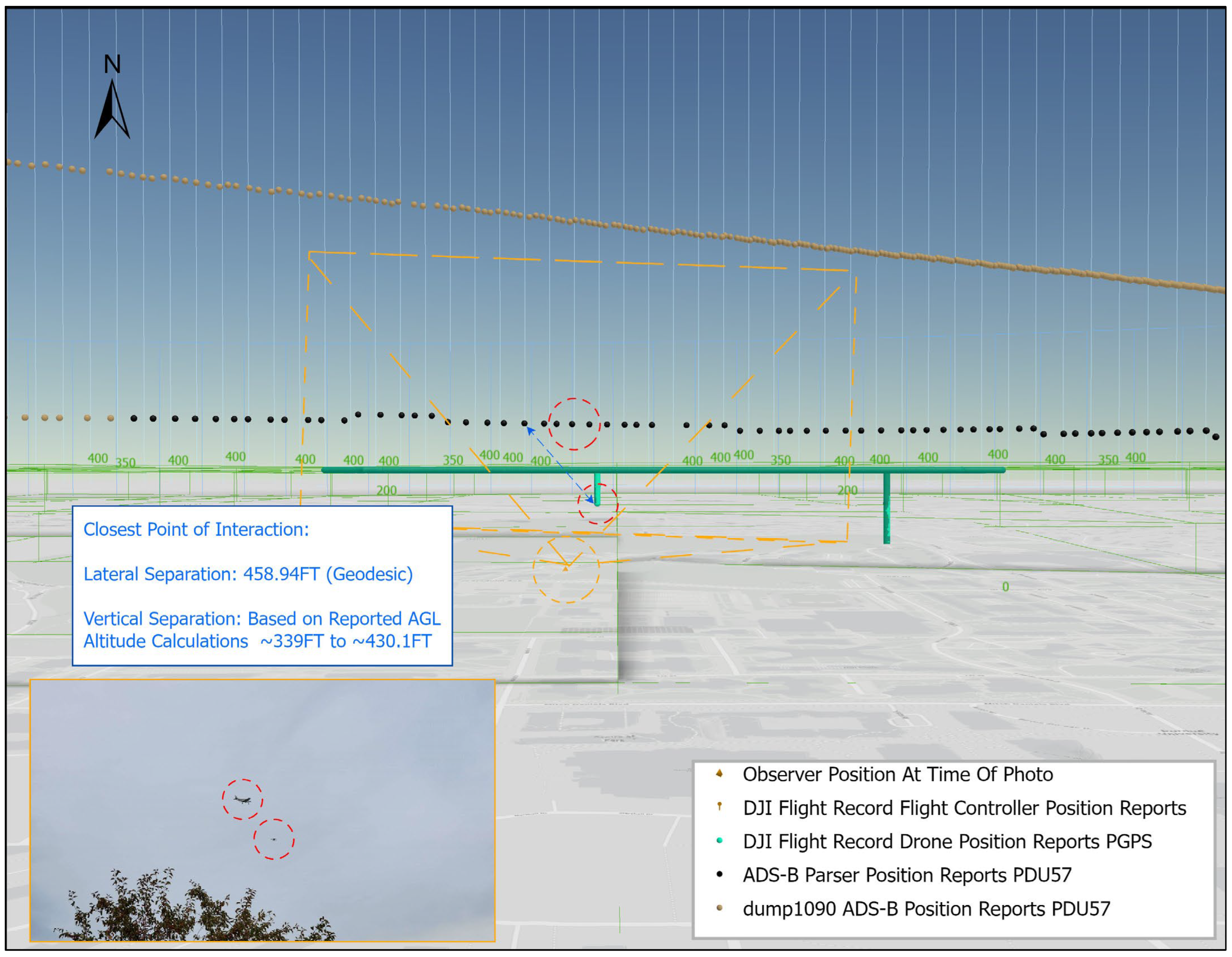
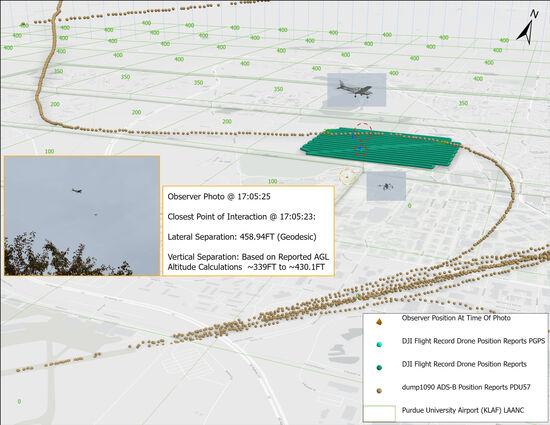
- A case study was utilized to apply the framework to analyze a critical UAS and crewed aircraft interaction near Purdue University Airport (KLAF), which confirmed the ability of GIS models to precisely measure spatial separation, finding a minimum separation of approximately 459 feet laterally and 339 feet vertically.
- GIS offered a scalable, centralized platform to address historical Air Traffic Management (ATM) and Unmanned Aircraft System (UAS) Traffic Management (UTM) integration deficiencies, significantly improving shared airspace safety oversight and situational awareness.
- The findings established that combining the GIS framework with Artificial Intelligence (AI) and advanced sensors was critical for modernizing the National Airspace System (NAS), supporting the future development of real-time risk prediction and dynamic airspace management.
Abstract
1. Introduction
- Modeling: Creating 2D maps, 3D scenes, and animation models of concurrent flight paths.
- Visualization: Generating spatial representations showing the proximity and separation distances between the two aircraft.
- Analysis: Using spatiotemporal analysis techniques to quantify the risk of operational conflict by identifying instances where the projected separation distance falls below defined safety margins, and assessing the efficiency of the airspace used during the interaction.
2. Materials and Methods
2.1. Study Area
2.2. Objective 1: Aviation Data Sources and GIS Integration Considerations
2.2.1. Data Sources for Airspace
2.2.2. Data Sources for ATM/UTM
2.2.3. Altitude Conversions
2.2.4. Time Conversions for Animation
2.3. Objective 2: GIS Methods for Modeling and Analyzing UAS Crewed Aircraft Interactions
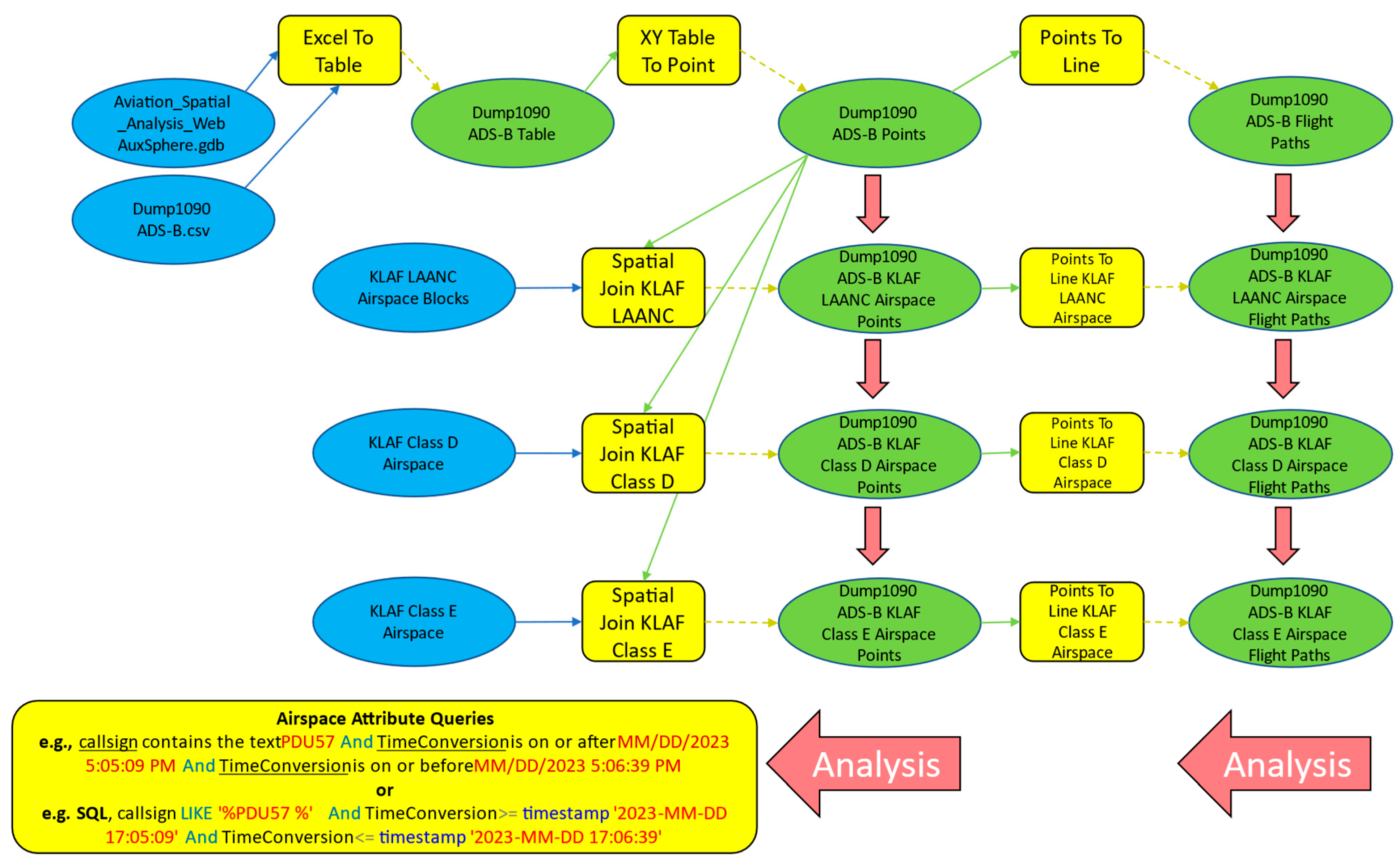
- Data ingestion and harmonization subsystem: Processes heterogeneous sources (ADS-B, UAS logs, FAA AIS) through format conversion (e.g., Excel to Table) and merging to resolve row-limit constraints.
- Spatiotemporal alignment subsystem: The core logical engine that executes Geometric Standardization (x, y), Vertical Normalization (z), and Temporal Synchronization (t) to unify disparate datums into a single 4D Coordinate Reference System.
- Visualization and analytical subsystem: Translates unified data into 2D maps and 3D scenes, enabling direct measurement of separation distances and ‘Pattern-of-Life’ analysis through time-series animation.
2.3.1. Airspace
2.3.2. ATM/UTM
2.3.3. Geoprocessing Tools
3. Results
3.1. Objective 1 Results: Aviation Data Sources and GIS Integration Considerations
3.1.1. Data Sources for Airspace
3.1.2. Data Sources for ATM/UTM
3.1.3. Altitude Conversions
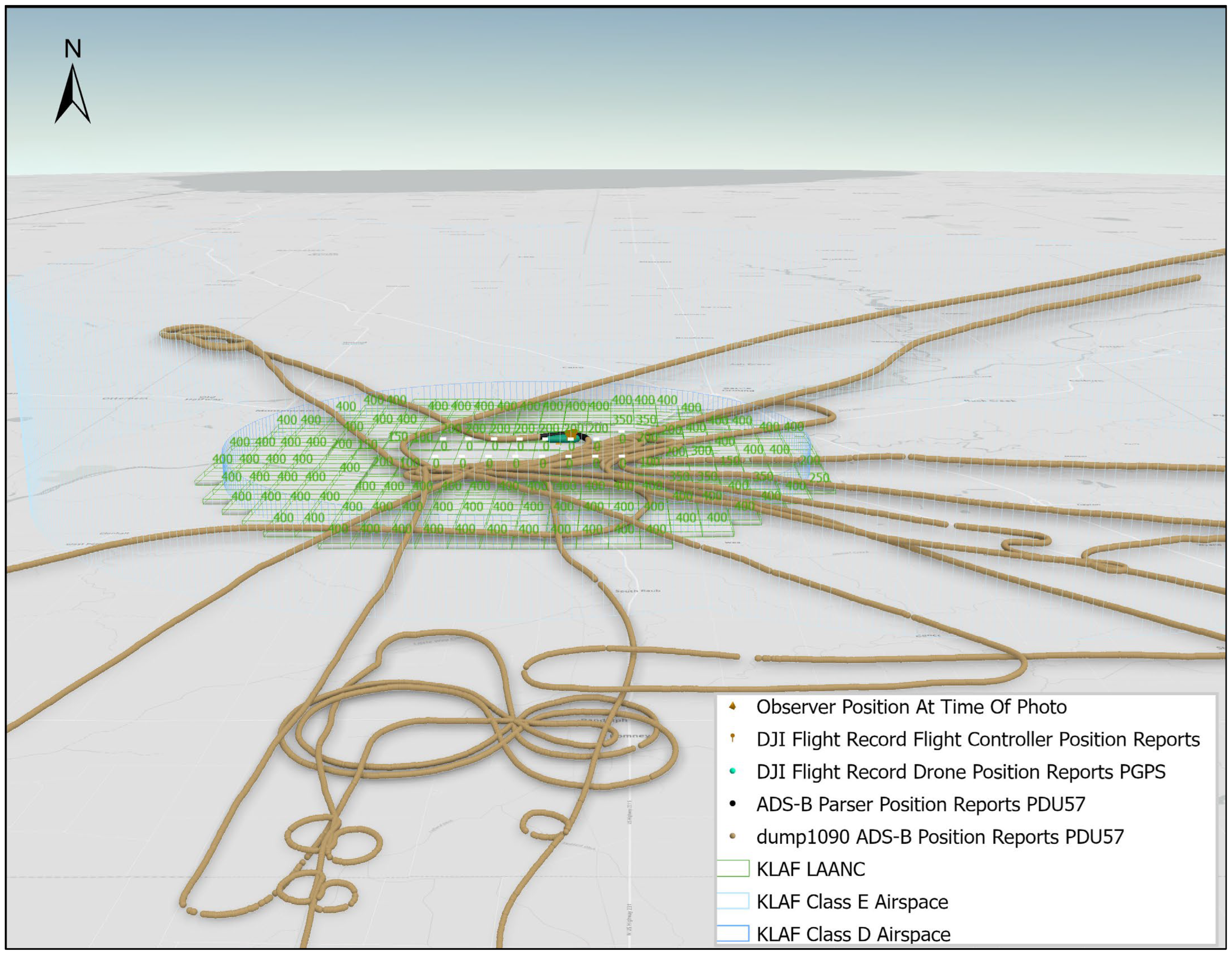
- Class D (Controlled): At KLAF, where the field elevation is 606 feet MSL, the Class D airspace extends from the surface up to 3106 feet MSL (or 2500 feet AGL). This defines the immediate controlled environment for the airport.
- Class E (Controlled): This class typically begins at 700 feet AGL or 1200 feet AGL and extends up to 17,999.99 feet MSL. Near KLAF, the Class E floor is at the surface (606 feet MSL), providing controlled protection for approach and departure procedures.
- Class G (Uncontrolled): Uncontrolled airspace exists from the surface up to the floor of the overlying controlled airspace. At KLAF, this Class G airspace extends from the surface (606 feet MSL) up to 1306 feet MSL (700 feet AGL).
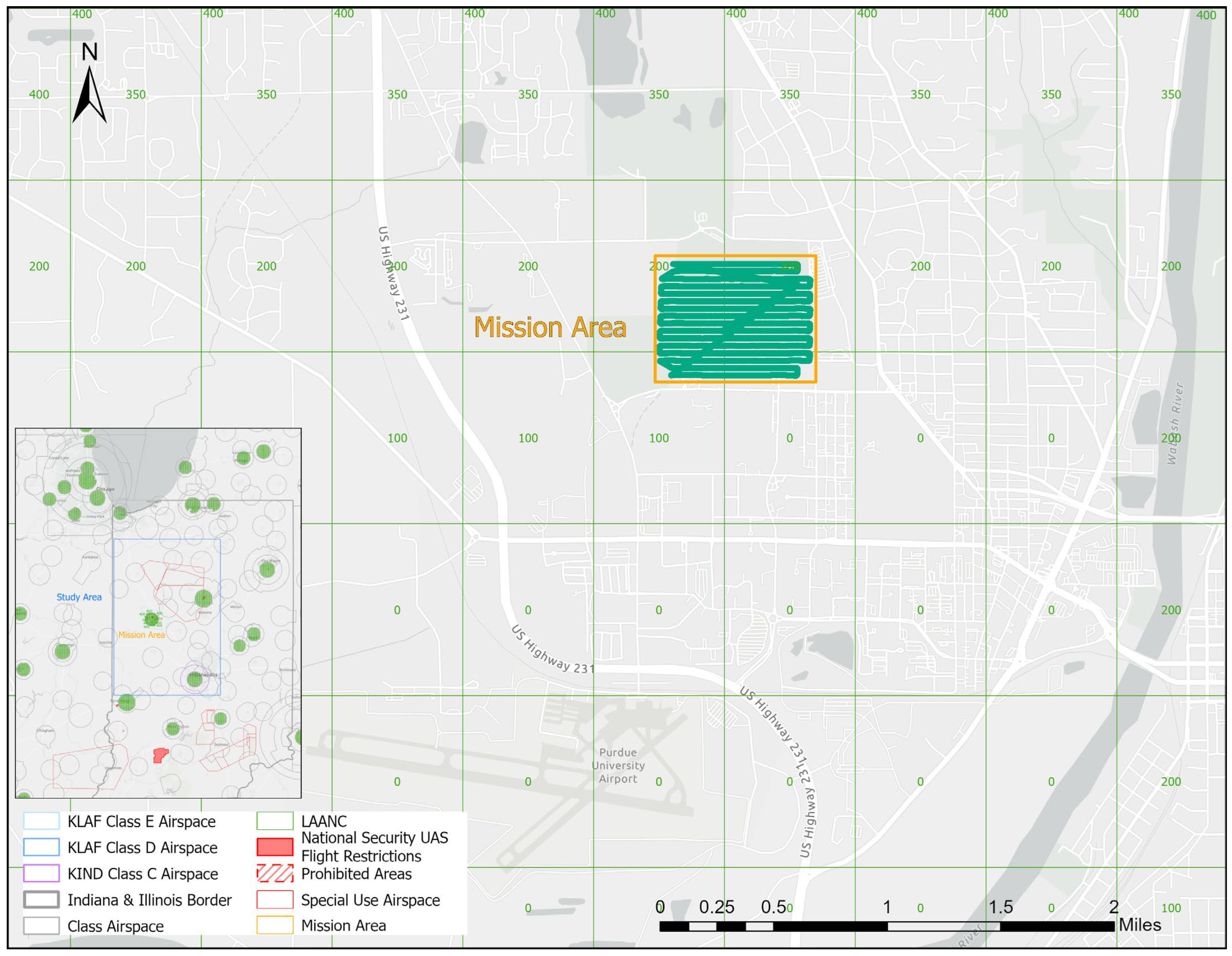
- These specific altitude shelves, alongside the LAANC grid and nearby Special Use Airspace, formed the foundation for the Class D, Class E, and Class G GIS layers created for the study area, enabling precise vertical analysis of the aircraft tracks.
3.1.4. Time Conversions for Animation
3.2. Objective 2 Results: GIS Methods for Modeling and Analyzing UAS-Crewed Aircraft Interactions
3.2.1. Airspace
3.2.2. ATM/UTM
3.2.3. Geoprocessing Tools
3.2.4. Narrative/Timeline
- At 5:02:09 PM, a Purdue University Piper PA-28-181 Archer TX, callsign “PDU57”, entered KLAF Class D airspace Inbound to the Southeast.
- At ~5:04:39 PM, PDU57 turned to the East for what appeared to be an extended circle to land or downwind to land on Runway 23 at KLAF.
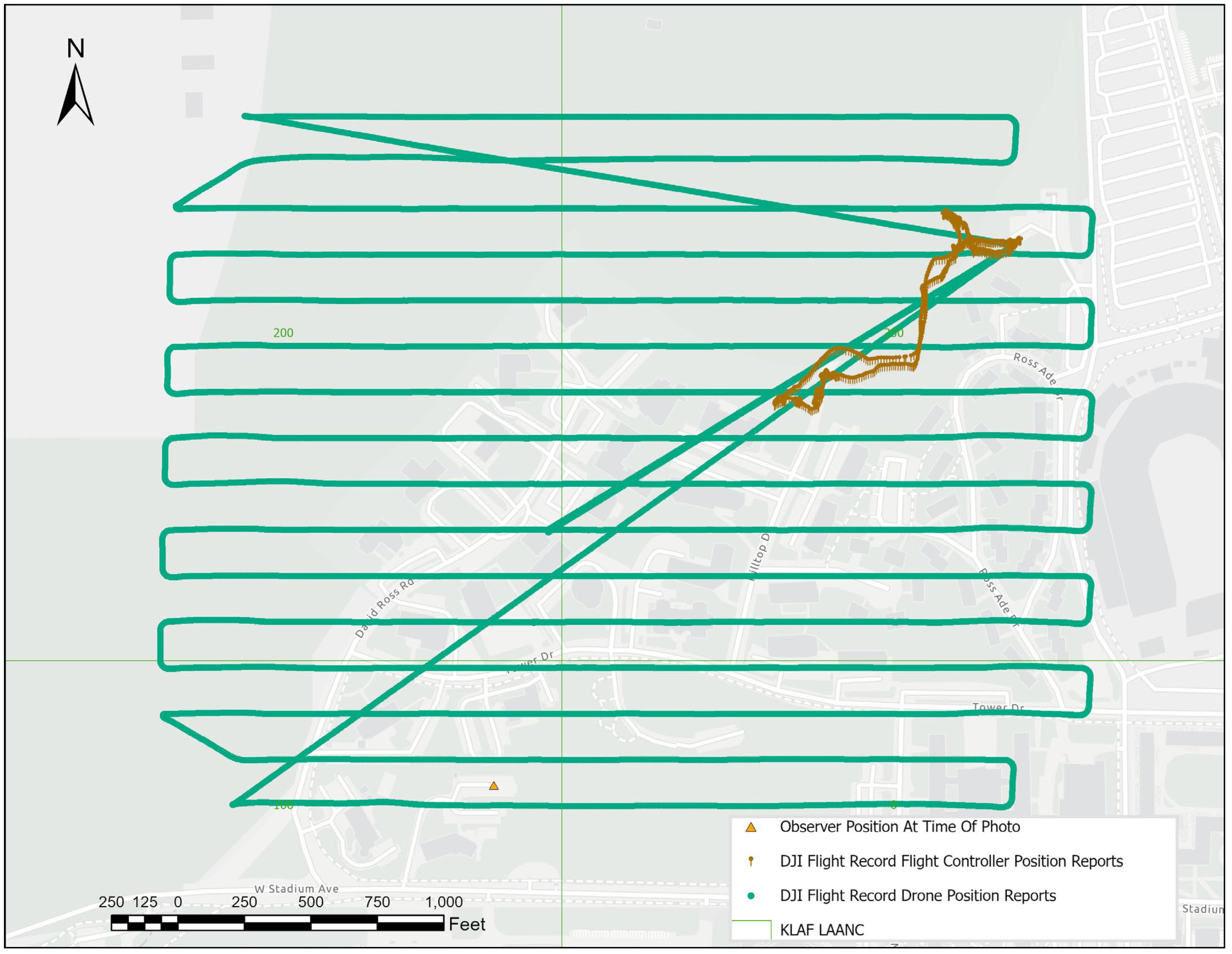
- At 5:05:09 PM, PDU57 was tracking 076 degrees with a groundspeed of 97 KTS at 1250 FT barometric altitude (~644 FT AGL… noting KLAF field elevation 606 FT). DJI M300 1047 FT altitude (350FT AGL… noting the DJI utilized the launch point elevation for reference, in this case 697 FT).
- ○
- Lateral separation: 2317.35 FT (geodesic) or 3040.42 FT (planar)
- ○
- Vertical separation: Based on reported AGL altitude calculations ~203 FT to ~294 FT
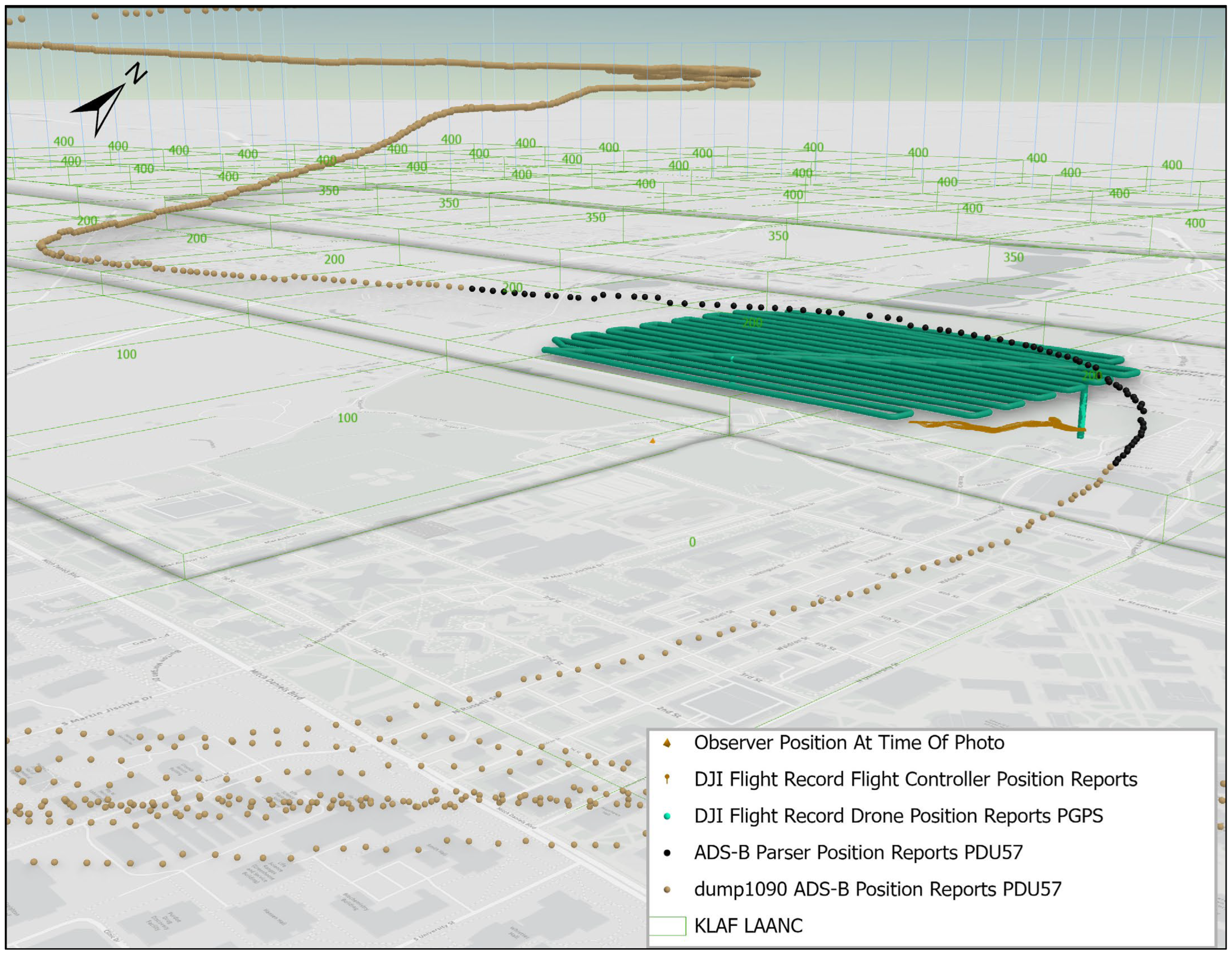
- Prior to 5:05:09 PM, the DJI M300 was operating off fly state “waypoints” at an altitude of 1047 FT (350 FT AGL… noting the DJI utilized the launch point elevation for reference, in this case 697 FT) as planned in the mapping mission. At 5:05:09 PM, the operator became concerned with the approaching aircraft and suspended the mission, changing the fly state to “P-GPS.” At 5:05:11 PM, the UAS began an 11 s descent to increase vertical separation down to an altitude of 911 FT (213.5–213.9 FT AGL) by 5:05:22 PM.
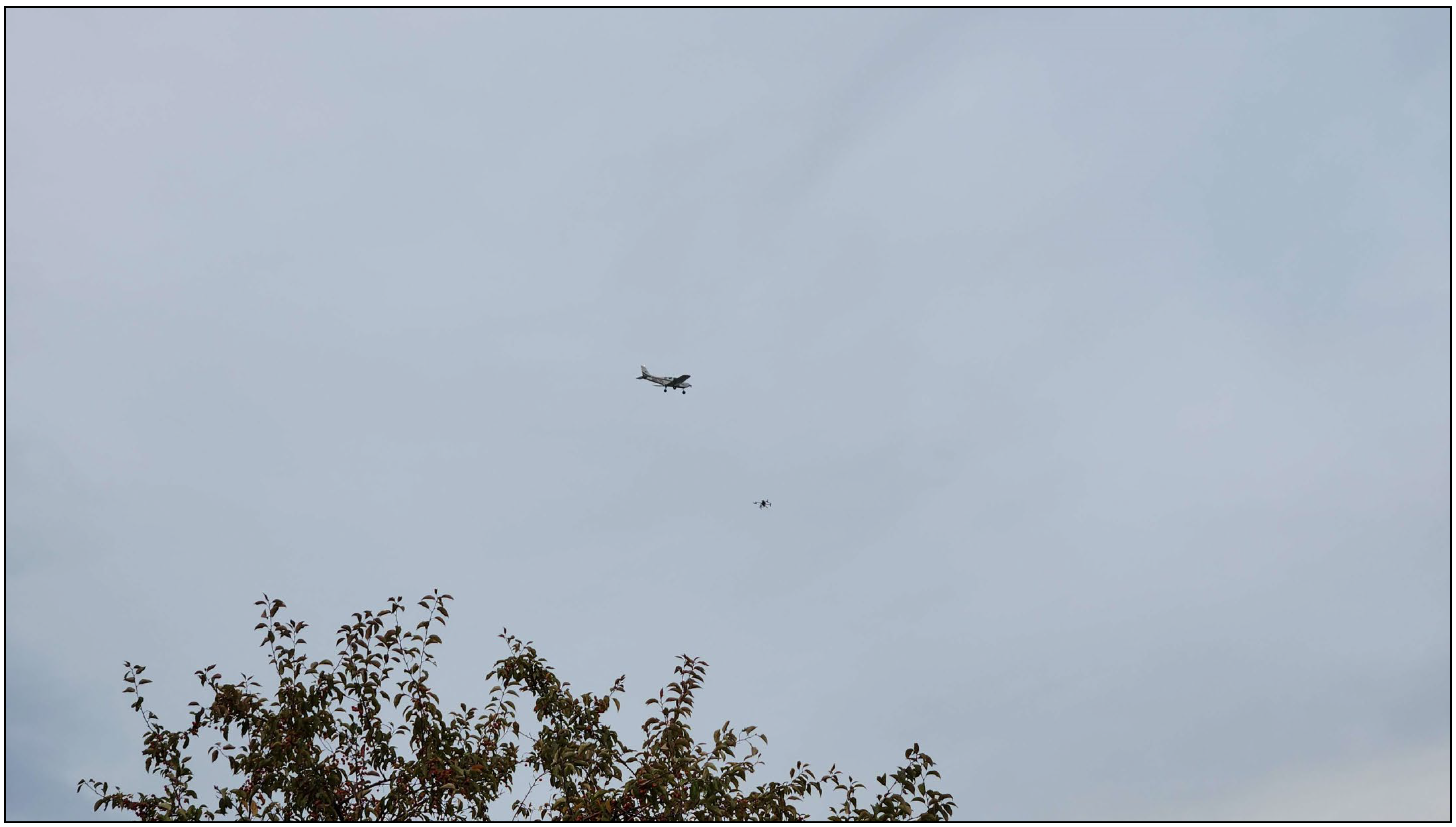
- 5:05:23 PM Closest point of interaction (lateral).
- ○
- PDU57 1250 FT barometric altitude (~644 FT AGL… noting KLAF field elevation 606 FT).
- ○
- DJI M300 911 FT altitude (213.9FT AGL… noting the DJI utilized the launch point elevation for reference, in this case 697 FT).
- ○
- Lateral separation: 458.94 FT (geodesic) or 603.84 FT (planar)
- ○
- Vertical separation: Based on reported AGL altitude calculations ~339 FT to ~430.1 FT
- ○
- The DJI M300 remained at this location and altitude until 5:06:39 PM when the aircraft had passed well clear, and then the operator resumed the mission back to a fly state “waypoint”.
- ○
- DJI M300 remained in PGPS mode for 1 min 30 s (5:05:09 PM to 5:06:39 PM) (907 position reports).
- At 5:06:39 PM, PDU57 was ~1623 FT from the threshold on final approach to runway 23 at 725 FT barometric altitude (~119 FT AGL… noting KLAF field elevation 606 FT). DJI M300 911 FT altitude (213.9FT AGL… noting the DJI utilized the launch point elevation for reference, in this case 697 FT).
- ○
- Lateral separation: 5703.34 FT (geodesic) or 7510.76 FT (planar)
- ○
- Vertical separation: Based on reported AGL altitude calculations ~94.9 FT to ~186 FT
- At 5:07:10 PM, PDU57 reported its last ADS-B track upon landing rollout on Runway 23 at KLAF.
4. Discussion
- Visualization of airspace conflicts and traffic patterns: Develop GIS-based visualizations, including temporal animations, heatmaps, and 3D models, to illustrate traffic density, potential conflicts, and areas of regulatory concern. Regulators and UTM providers could use these tools to monitor real-time and historical traffic patterns, identify congestion hotspots, and prioritize oversight or intervention.
- Analysis of airspace violations and safety risks: Use GIS to identify and assess historical and near-real-time violations, informing targeted safety measures, enforcement strategies, and operational policy. This enables regulators to take data-driven actions, such as issuing dynamic airspace restrictions or conducting focused safety campaigns.
- AI-enhanced advisory systems: Leverage GIS spatial context to improve AI detection of abnormal flight behavior, enabling actionable advisories for operators and supporting regulatory oversight. For UTM providers, these systems can provide early alerts when aircraft deviate from expected patterns, helping mitigate potential conflicts before they arise.
- Foundations for real-time risk prediction: Model spatial–temporal risk factors to inform future predictive safety systems and policy frameworks for dynamic airspace management. Regulators could apply these models to evaluate proposed BVLOS operations, manage multi-airport traffic, and guide the integration of new UAS and AAM operations into the NAS.
5. Conclusions
5.1. Achievement of Objectives
5.2. Summary of Implications
5.3. Future Research Directions
Author Contributions
Funding
Data Availability Statement
Acknowledgments
Conflicts of Interest
Abbreviations
| 2D | Two-dimensional |
| 3D | Three-dimensional |
| AAM | Advanced Air Mobility |
| ADDS | Aeronautical Data Delivery Service |
| AGL | Above Ground Level |
| AI | Artificial Intelligence |
| AIM | Aeronautical Information Manual |
| AIS | Aeronautical Information Services |
| API | Application Programming Interfaces |
| ATC | Air Traffic Control |
| ATIS | Automatic Terminal Information Service |
| ATM | Air Traffic Management |
| ADS-B | Automatic Dependent Surveillance–Broadcast |
| BLVO | Beyond Visual Line of Sight |
| BVT | Boiler VORTAC |
| CD&R | Conflict Detection and Resolution |
| CFR | Code of Federal Regulations |
| CRS | Coordinate Reference System |
| DJI | Da-Jiang Innovations |
| DVFR | Defense Visual Flight Rules |
| EFB | Electronic Flight Bag |
| EO/IR | Electro-Optical and Infrared |
| Esri | Environmental Systems Research Institute, Inc. |
| FAA | Federal Aviation Administration |
| FL | Flight Level |
| GIS | Geographic Information System |
| GNSS | Global Navigation Satellite System |
| GPS | Global Positioning System |
| IFR | Instrument Flight Rules |
| IGIC | Indiana Geographic Information Council |
| IOP | Integrated Oversight Philosophy |
| KDAB | Daytona Beach International Airport |
| KDFW | Dallas-Fort Worth Airport |
| KLAF | Purdue University Airport |
| LAANC | Low-Altitude Authorization and Notification Capability |
| MSL | Mean Sea Level |
| NACp | Navigation Accuracy Category-Position |
| NAS | National Airspace System |
| NATS | National Air Traffic Services |
| NextGen | Next Generation Air Transportation System |
| NIST | National Institute of Standards and Technology |
| NMAC | Near Mid-Air Collision |
| NOTAM | Notice to Airmen |
| OIS | Obstruction Identification Surfaces |
| PGPS | Precision GPS |
| RA | Resolution Advisories |
| RBDM | Risk-Based Decision Making |
| RTK | Real-Time Kinematic (RTK) |
| RF | Radio Frequency |
| RGB | Red, Green, Blue |
| SATCOM | Satellite Communications |
| SI | International Systems of Units |
| SVM | Support Vector Machines |
| TA | Traffic Advisories |
| TBO | Trajectory-Based Operations |
| TCAS | Traffic Collision Avoidance Systems |
| UAM | Urban Air Mobility |
| UAS | Unmanned Aircraft System |
| UDDS | UAS Data Delivery Service |
| URSA | Unmanned Robotic Systems Analysis |
| U.S. | United States |
| UTM | UAS Traffic Management |
| VFR | Visual Flight Rules |
| VORTAC | VHF Omnidirectional Range/Tactical Air Navigation |
| WAAS | Wide Area Augmentation System |
References
- Bartsch, R.; Coyne, J.; Gray, K. The rise of the drone: Introduction. In Drones in Society: Exploring the Strange New World of Unmanned Aircraft, 1st ed.; Taylor & Francis Group: Abingdon, UK, 2016; p. 3. [Google Scholar] [CrossRef]
- Federal Aviation Administration (FAA). Drones by the Numbers. 2025. Available online: https://www.faa.gov/node/54496 (accessed on 29 September 2025).
- Federal Aviation Administration (FAA). FAA Aerospace Forecast Fiscal Years 2025–2045. 2025. Available online: https://www.faa.gov/data_research/aviation/aerospace_forecasts/2025-uas-and-aam-summary.pdf (accessed on 25 October 2025).
- Federal Aviation Administration (FAA). Next Generation Air Transportation System (NextGen). Available online: https://www.faa.gov/nextgen (accessed on 25 October 2025).
- Wallace, R.; Winter, S.; Rice, S.; Kovar, D.; Lee, S.-A. Three Case Studies on Small Uncrewed Aerial Systems Near Midair Collisions with Aircraft: An Evidence-Based Approach for Using Objective Uncrewed Aerial Systems Detection Technology. SAE Int. J. Aerosp. 2023, 16, 263–278. [Google Scholar] [CrossRef]
- Federal Aviation Administration (FAA). UAS Data Exchange (LAANC). Available online: https://www.faa.gov/uas/getting_started/laanc (accessed on 5 December 2024).
- Wallace, R.; Loffi, J.; Holliman, J.; Metscher, D.; Rogers, T. Evaluating LAANC Utilization & Compliance for Small Unmanned Aircraft Systems in Controlled Airspace. Int. J. Aviat. Aeronaut. Aerosp. 2020, 7, 4. [Google Scholar] [CrossRef]
- C-UAS Hub. Report—Drone Flew Within 20 feet of Passenger Plane. C-UAS Hub. 25 November 2023. Available online: https://cuashub.com/en/content/report-drone-flew-within-20-feet-of-passenger-plane/ (accessed on 25 November 2023).
- Deliso, M. Drone operator charged for hitting “super scooper” plane during Palisades Fire: DOJ. ABC News. 31 January 2025. Available online: https://abcnews.go.com/US/drone-operator-charged-hitting-super-scooper-plane-palisades/story?id=118313936 (accessed on 31 January 2025).
- Moreno, A. Kerrville clarifies search and rescue drone caused military helicopter emergency landing. NEWS4SA. 30 July 2025. Available online: https://news4sanantonio.com/news/local/kerrville-clarifies-drone-involved-in-helicopter-incident-was-authorized-flooding-hunt-camp-mystic-search-and-rescue (accessed on 30 July 2025).
- Wallace, R.J.; Terwilliger, B.A.; Winter, S.R.; Rice, S.; Kiernan, K.M.; Burgess, S.S.; Anderson, C.L.; De Abreu, A.; Arboleda, G.; Gomez, L. Small Unmanned Aircraft System (sUAS) Traffic Analysis (A11L.UAS.91): Final Report; Alliance for System Safety of UAS Through Research Excellence (ASSURE), U.S. Department of Transportation, Federal Aviation Administration: Washington, DC, USA, 2025; Available online: https://assureuas.com/projects/suas-traffic-analysis/ (accessed on 13 March 2025).
- Shultz, A.; Seybert, M. Taking Flight: Real-Time Aircraft Tracking with ArcGIS Velocity and FlightAware. Industry Blogs. 2025. Available online: https://www.esri.com/en-us/industries/blog/articles/taking-flight-real-time-aircraft-tracking-with-arcgis-velocity-and-flightaware (accessed on 20 February 2025).
- Federal Aviation Administration (FAA); Air Information Publication (AIP). ENR 1.14 Air Traffic Incidents—3.2 Near Midair Collision Reporting Definition. Available online: https://www.faa.gov/air_traffic/publications/atpubs/aip_html/part2_enr_section_1.14.html (accessed on 22 January 2025).
- Environmental Systems Research Institute, Inc. (Esri). Living Atlas of the World. Available online: https://livingatlas.arcgis.com/en/home/ (accessed on 22 January 2025).
- Environmental Systems Research Institute, Inc. (Esri). ArcGIS Online. Available online: https://www.arcgis.com/home/index.html (accessed on 22 January 2025).
- Federal Aviation Administration (FAA). Aeronautical Information Services (AIS). Available online: https://faa.maps.arcgis.com/home/index.html (accessed on 22 January 2025).
- Federal Aviation Administration (FAA). Aeronautical Data Delivery Service (ADDS). Available online: https://adds-faa.opendata.arcgis.com/ (accessed on 22 January 2025).
- Federal Aviation Administration (FAA). UAS Data Delivery Service (UDDS). Available online: https://udds-faa.opendata.arcgis.com/ (accessed on 22 January 2025).
- Federal Aviation Administration (FAA). Air Traffic—Technology. Available online: https://www.faa.gov/air_traffic/technology (accessed on 12 September 2025).
- Federal Aviation Administration (FAA). Unmanned Aircraft System Traffic Management (UTM). Available online: https://www.faa.gov/uas/advanced_operations/traffic_management (accessed on 2 May 2025).
- U.S. Department of Transportation, Federal Aviation Administration (FAA). Unmanned Aircraft Systems (UAS) Traffic Management (UTM) Implementation Plan. Version 1.8. FAA Reauthorization Act of 2018. (Pub. L. No 115–254)—Section 376; U.S. Department of Transportation, Federal Aviation Administration (FAA): Washington, DC, USA, 2023. Available online: https://www.faa.gov/sites/faa.gov/files/PL_115-254_Sec376_UAS_Traffic_Management.pdf (accessed on 31 July 2023).
- Federal Aviation Administration (FAA). Air Traffic—Technology—Equip ADS-B—Ins and Outs. Available online: https://www.faa.gov/air_traffic/technology/equipadsb/capabilities/ins_outs (accessed on 7 February 2023).
- Federal Aviation Administration (FAA). Aeronautical Information Manual (AIM). Chapter 7 Safety of Flight. Section 2. Barometric Altimeter Errors and Setting Procedures. Available online: https://www.faa.gov/air_traffic/publications/atpubs/aim_html/chap7_section_2.html (accessed on 22 January 2025).
- National Archives eCFR Code of Federal Regulations. § 91.227 Automatic Dependent Surveillance-Broadcast (ADS-B) Out Equipment Performance Requirements; National Archives eCFR Code of Federal Regulations—Title 14 Aeronautics and Space (FAR); National Archives eCFR Code of Federal Regulations: Online, 2010. Available online: https://www.ecfr.gov/current/title-14/chapter-I/subchapter-F/part-91/subpart-C/section-91.227 (accessed on 20 January 2026).
- Da-Jiang Innovations (DJI). Support for Matrice 300 RTK—DJI United States. DJI. Available online: https://www.dji.com/support/product/matrice-300 (accessed on 22 January 2025).
- AeroDefense. A Technical Perspective on the DJI Aeroscope Drone Detection Solution. AeroDefense Blog. Available online: https://blog.aerodefense.tech/dji-aeroscope (accessed on 29 September 2025).
- Environmental Systems Research Institute, Inc. (Esri). An Overview of the Conversion Toolbox. Available online: https://pro.arcgis.com/en/pro-app/latest/tool-reference/conversion/an-overview-of-the-conversion-toolbox.htm (accessed on 21 July 2024).
- AirNAV.com. Airport Information. AirNav. Available online: https://www.airnav.com/airports/ (accessed on 22 January 2025).
- ForeFlight. Integrated Flight App for Pilots. Available online: https://foreflight.com/ (accessed on 22 January 2025).
- U.S. Department of Transportation, Federal Aviation Administration (FAA). Ch. 15 Airspace. In Pilot’s Handbook of Aeronautical Knowledge; U.S. Department of Transportation, Federal Aviation Administration (FAA): Washington, DC, USA, 2023; Volume FAA-H-8083-25C; pp. 1–11. Available online: https://www.faa.gov/regulations_policies/handbooks_manuals/aviation/faa-h-8083-25c.pdf (accessed on 31 July 2023).
- Case, R.P.; Hupy, J.P. Airport Cooperative Research Program Graduate Research Award 11-04: Geographic Information System Application to Unmanned Traffic Management within the National Airspace System. Transp. Res. Rec. J. Transp. Res. Board 2025, 2679, 1064–1078. [Google Scholar] [CrossRef]
- Environmental Systems Research Institute, Inc. (Esri). An Overview of the Data Management Toolbox. Available online: https://pro.arcgis.com/en/pro-app/latest/tool-reference/data-management/an-overview-of-the-data-management-toolbox.htm (accessed on 21 July 2024).
- Environmental Systems Research Institute, Inc. (Esri). Tools that are not available in ArcGIS Pro. Available online: https://pro.arcgis.com/en/pro-app/latest/tool-reference/appendices/unavailable-tools.htm (accessed on 21 July 2024).
- Environmental Systems Research Institute, Inc. (Esri). Esri Community. Available online: https://community.esri.com/ (accessed on 22 January 2025).
- Environmental Systems Research Institute, Inc. (Esri). Supported Field Formats. Available online: https://pro.arcgis.com/en/pro-app/latest/help/mapping/time/supported-field-formats.htm (accessed on 17 July 2024).
- Environmental Systems Research Institute, Inc. (Esri). Animate Through Time. Available online: https://pro.arcgis.com/en/pro-app/latest/help/mapping/animation/animate-through-time.htm (accessed on 17 July 2024).
- Environmental Systems Research Institute, Inc. (Esri). What Is ModelBuilder? Available online: https://pro.arcgis.com/en/pro-app/latest/help/analysis/geoprocessing/modelbuilder/what-is-modelbuilder-.htm (accessed on 25 July 2024).
- Environmental Systems Research Institute, Inc. (Esri). Measure. Available online: https://pro.arcgis.com/en/pro-app/latest/help/mapping/navigation/measure.htm (accessed on 25 July 2024).
- Environmental Systems Research Institute, Inc. (Esri). An Overview of the 3D Analyst Toolbox. Available online: https://pro.arcgis.com/en/pro-app/latest/tool-reference/3d-analyst/an-overview-of-the-3d-analyst-toolbox.htm (accessed on 25 July 2024).
- Environmental Systems Research Institute, Inc. (Esri). An Overview of the Analysis Toolbox. Available online: https://pro.arcgis.com/en/pro-app/latest/tool-reference/analysis/an-overview-of-the-analysis-toolbox.htm (accessed on 25 July 2024).
- Environmental Systems Research Institute, Inc. (Esri). An Overview of the Aviation Toolbox. Available online: https://pro.arcgis.com/en/pro-app/latest/tool-reference/aviation/an-overview-of-the-aviation-toolbox.htm (accessed on 25 July 2024).
- Environmental Systems Research Institute, Inc. (Esri). An Overview of the Spatial Statistics Toolbox. Available online: https://pro.arcgis.com/en/pro-app/latest/tool-reference/spatial-statistics/an-overview-of-the-spatial-statistics-toolbox.htm (accessed on 25 July 2024).
- Federal Aviation Administration (FAA). Unmanned Aircraft Systems (UAS)—Getting Started—Airspace 101—Rules of the Sky. Available online: https://www.faa.gov/uas/getting_started/where_can_i_fly/airspace_101 (accessed on 30 August 2021).
- Lercel, D.J.; Hupy, J.P. Exploring the Use of Geographic Information Systems to Identify Spatial Patterns of Remote UAS Pilots and Possible National Airspace Risk. Safety 2023, 9, 18. [Google Scholar] [CrossRef]
- Environmental Systems Research Institute, Inc. (Esri). Real-Time Visualization and Analytics. Available online: https://www.esri.com/en-us/capabilities/real-time/overview?rsource (accessed on 28 July 2024).
- Zhou, Y.; Fu, C.; Wei, L.; Zhou, W.; Li, X.; You, Y. An Integrated Approach for Addressing Data Imbalance in Predicting Fatality of Helicopter Accident. Reliab. Eng. Syst. Saf. 2026, 267, 111921. [Google Scholar] [CrossRef]
- Zheng, Y.; Le, Z.; Huanquan, X.; Junhao, L.; XuGuang, W.; Chuanjiang, P.; Wei, Y. Modeling and Detection of Low-Altitude Flight Conflict Network Based on SVM. Meas. Sens. 2024, 31, 100954. [Google Scholar] [CrossRef]
- Hildemann, M.; Verstegen, J.A. 3D-flight Route Optimization for Air-Taxis in Urban Areas with Evolutionary Algorithms and GIS. J. Air Transp. Manag. 2023, 107, 102356. [Google Scholar] [CrossRef]



| Types of GIS Data and Uses | ||||
|---|---|---|---|---|
| Data Type | Source | Purpose/Use in GIS | Notes on Quality/Preparation | Coordinate System/Units |
| Hosted Layers | Esri Living Atlas | Visualization | Generally Curated and Clean | WGS 84/Degrees |
| Base Map Reference | Projected Layers in Meters | |||
| Downloaded Spatial Data | Aviation Datasets | Feature Layer Creation | May Require Cleaning and Validation | WGS 84/Degrees |
| Shapefiles | Offline Analysis | Feet or Meters Depending on Dataset | ||
| Shapefiles | Offline Analysis | Custom Feature Layer Creation | May Require Cleaning, Validation, and Attribute Alignment | WGS 84 or Local Projected Coordinate System/International Systems of Units (SI) or Imperial Units as a part of the U.S. National Institute of Standards and Technology (NIST) |
| Offline Analysis | ||||
| Spatial Queries | ||||
| Tabular Data | Excel | Attribute Enrichment | Often Require Formatting and Alignment | N/A (Inherits Projection from Spatial Join) |
| CSV Files | Analysis | |||
| User-Hosted Layers | ArcGIS Online | Visualization | Quality Varies | WGS 84/Degrees |
| Analysis Reference | May Require Cleaning | |||
| Airspace Geospatial Datasets | ||||
|---|---|---|---|---|
| Source | Data | File Type | Name | Coordinate System/Units |
| U.S. Census Data—Topologically Integrated Geographic Encoding and Referencing (TIGER) Line Files | U.S. State Boundaries GIS Data | SHP | Continental US States | WGS 84/Degrees |
| Federal Aviation Administration (FAA) Aeronautical Information Services (AIS) Aeronautical Data Delivery Service (ADDS) | Aviation GIS Data | Airports | WGS 84/Degrees Or Feet or Meters Depending on Dataset | |
| Airspace Boundary | ||||
| Class Airspace | ||||
| National Defense Airspace TFR Areas | ||||
| Prohibited Areas | ||||
| Route Airspace | ||||
| Special Use Airspace | ||||
| Federal Aviation Administration (FAA) Aeronautical Information Services (AIS) UAS Data Delivery Service (UDDS) | Aviation GIS Data (Specific to UAS) | FAA UAS Facility Map Data | ||
| National Security UAS Flight Restrictions | ||||
| Prohibited Areas | ||||
| Airspace Geospatial Datasets for DJI M300 RGB and PDU57 Interaction Case Study | |||
|---|---|---|---|
| Source | Data | File Type | Name |
| U.S. Census Data—Topologically Integrated Geographic Encoding and Referencing (TIGER) Line Files | U.S. State Boundaries GIS Data | SHP | Continental US States → Indiana |
| Federal Aviation Administration (FAA) Aeronautical Information Services (AIS) Aeronautical Data Delivery Service (ADDS) | Aviation GIS Data | Airports → KLAF | |
| Class Airspace → KLAF Class D and KLAF Class E | |||
| Federal Aviation Administration (FAA) Aeronautical Information Services (AIS) UAS Data Delivery Service (UDDS) | Aviation GIS Data (Specific to UAS) | FAA UAS Facility Map Data → KLAF LAANC | |
| List of Available ATM/UTM Data Sources | ||||
|---|---|---|---|---|
| System Types | Applicable to | Typical File Type/Format | Source(s)/Examples | Coordinate System/Units |
| Acoustic Detection and Identification Systems | Crewed Aircraft Including AAM and UAS | Import .CSV Range/Bearing from Receiver | Local Cartesian (Meters) or System-Specific WGS 84/Degrees | |
| Communication Networks | Crewed Aircraft Including AAM and UAS | Import .CSV Latitude/Longitude | 5G, Satellite Communications (SATCOM), etc. | WGS 84/Degrees |
| Flight Plans and Reports | Crewed Aircraft Including AAM | Import .TXT Latitude/Longitude | Visual Flight Rule (VFR) Flight Plans | WGS 84/Degrees |
| Instrument Flight Rule (IFR) Flight Plans | ||||
| Composite (VFR/IFR) Flight Plans | ||||
| International Flight Plans | ||||
| Defense Visual Flight Rules (DVFR) Flight Plans | ||||
| UAS | Low-Altitude Authorization and Notification Capability (LAANC) Authorizations | |||
| Waivers | ||||
| Radar Systems | Crewed Aircraft Including AAM and UAS | Import .CSV Latitude/Longitude | Air Traffic Control (ATC) | WGS 84/Degrees; Local Projected Meters for Radar Grid, If Needed |
| Low-Altitude Detection and Identification Systems | ||||
| RF Detection and Identification Systems | UAS | Import .CSV Range/Bearing from Receiver | Dedrone by Axon | Local Cartesian (Meters) or Convert to WGS 84 Can be Converted to WGS 84 |
| DJI AeroScope | ||||
| Optical Detection and Identification | Crewed Aircraft Including AAM and UAS | Electro-Optical and Infrared (EO/IR) | System-Specific; Georeferenced to WGS 84, If Coordinates Available | |
| Self-Reported Aircraft Data | Crewed Aircraft Including AAM | Import .CSV Latitude/Longitude | Automatic Dependent Surveillance–Broadcast (ADS-B) | WGS 84/Degrees |
| UAS | Remote ID | |||
| Excel Time Conversions for Animation | |||
|---|---|---|---|
| Create “TimeConversion” Field | ADS-B Data | dump1090-127_0_0_1 (Full Receiver Range) | Sum (date + time) |
| Format to MM/DD/YY HH:MM | |||
| Format to YYYYMMDDhhmmss | |||
| data (Parser-Limited Geographic Area) | Format Field 6 Time HH:MM:SS | ||
| Sum (Field 5 + Field 6) | |||
| Format to YYYYMMDDhhmmss | |||
| DJI M300 Flight Record | DJIFlightRecord_(16-28-15) DJIFlightRecord_(16-57-58) | Sum (date [local] + updateTime [local]) | |
| Format to MM/DD/YY HH:MM | |||
| Format to YYYYMMDDhhmmss | |||
| List of ArcGIS Pro Geoprocessing Tools for Analysis | ||
|---|---|---|
| Toolbox | Analysis Use Description | Toolset Examples |
| Three-Dimensional Analyst Tools | Toolsets to analyze geometric relationships and feature properties | Three-Dimensional Proximity Toolset, Near 3D: Calculates 3D distance between feature and nearest feature |
| Visibility Toolset, Geodesic Viewshed: Utilized to determine surface locations visible from observer features, such as line of sight for sensor receiver | ||
| Analysis Tools | Toolsets to perform fundamental proximity analysis and calculate statistics | Overlay Toolset, Erase: Creates a feature class by removing a portion of the content. Useful for the creation of layered airspace such as Class B or Class C and allows for analysis of aircraft specifically operating within those layers |
| Overlay Toolset, Spatial Join: Joins one feature to another based on spatial relationships. Useful when associating multiple aircraft to specific airspace for analysis | ||
| Proximity Toolset, Near Table: Calculates distances and proximity information into a stand-alone table for multiple near features | ||
| Proximity Toolset, Near: Calculates distances and proximity information for closest feature class or layer | ||
| Statistics Toolset, Summary Statistics: Calculates summary statistics for fields in a table, such as max, min, mean, etc. Useful for determining statistical information in position reports including altitudes, speed, time, etc. | ||
| Aviation Tools | Toolsets for analysis of aviation content | Airports Toolset, Analyze Airport Features: Calculates information such as point feature distance from runway centerline or end of the nearest runway |
| Airports Toolset, Analyze Runway Obstacles: Determines if obstacles are penetrating the Obstruction Identification Surfaces (OIS) for a runway | ||
| Spatial Statistics Tools | Statistical toolsets for analysis of spatial distributions, patterns, processes, and relationships | Mapping Clusters Toolset, Hot Spot Analysis or Optimized Hot Spot Analysis: Identifies statistically significant hot spots and cold spots, potential to identify preferred routing for aircraft based on established and routine flight paths or identify areas of increased UAS activity |
| Utilities Toolset, Collect Events: Converts incidents to weighted point data, useful for aviation incident reporting such as UAS violating airfield airspace | ||
| ATM/UTM Geospatial Datasets for DJI M300 RGB and PDU57 Interaction Case Study | ||||||
|---|---|---|---|---|---|---|
| Data | File Type | File Size (KB) | Name | Dates | Duration | Reports/Lines |
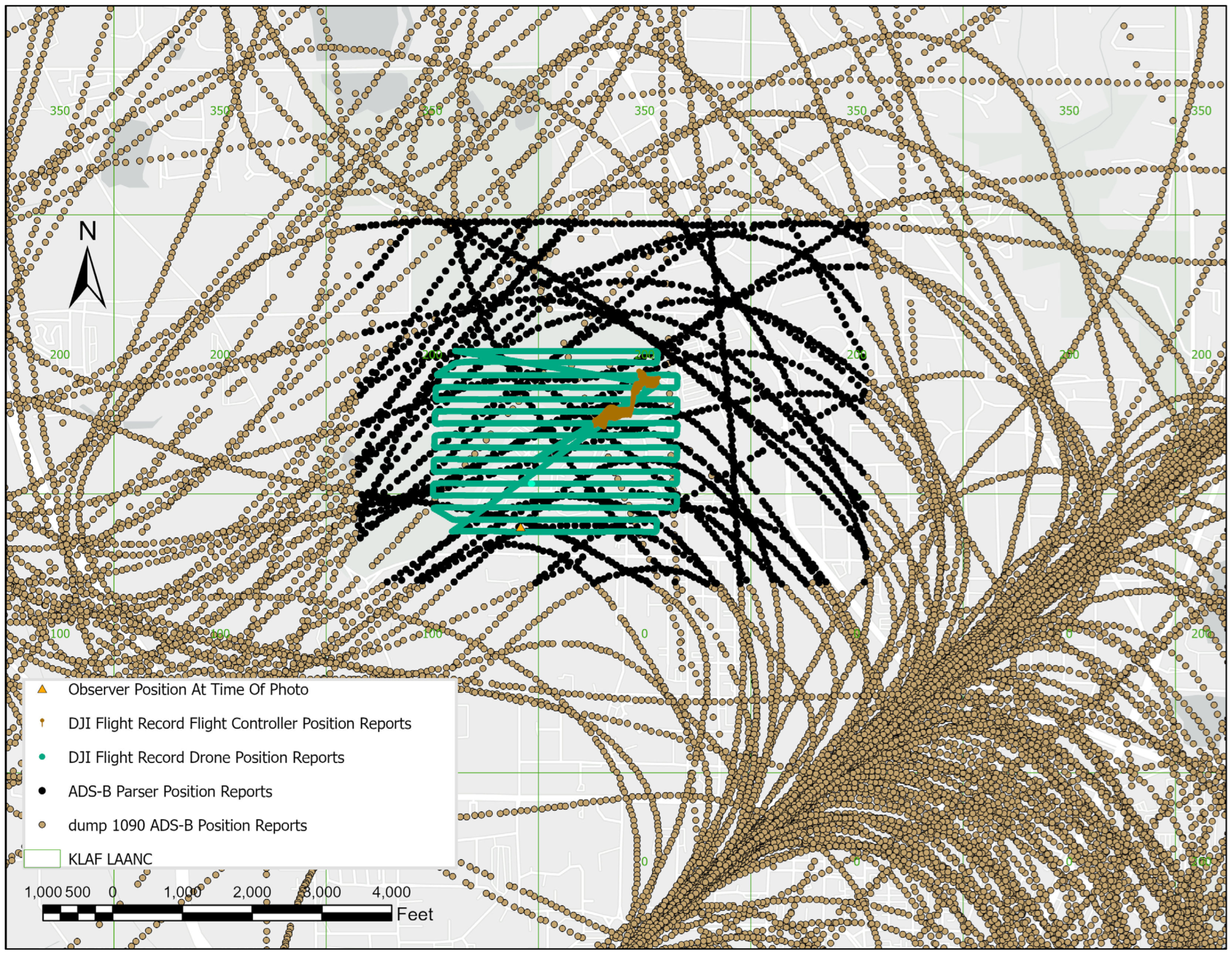
| ADS-B Tracks | .TXT | 178,575 | dump1090-127_0_0_1 (Full Receiver Range) | 0001 to 2359 | 24 h | 2,061,405 |
| .CSV | 188 | data (Parser-Limited Geographic Area) | 083728 to 211252 | 12 h 35 min | 2233 | |
| DJI UAS Position Reports DJI Controller (Operator) Position Reports | .CSV | 36,175 | DJIFlightRecord_(16-28-15) DJIFlightRecord_(16-57-58) | 162815 to 172618 | 58 min | 29,479 |
| DJI M300 Observer Photo | .JPG | 232 | 170525 | 170525 | N/A | N/A |
| DJI M300 Observer Position | .PNG | 770 | Screenshot 2024-05-29 101018 | 170525 | N/A | 1 |
| Airspace | Feet Bottom | Shelf | Feet Top |  | |||
| Class A | 18,000 MSL | 60,000 MSL | |||||
| Class B | Surface | 2+ Layers | 10,000 MSL | ||||
| Class C | Surface | 1200 AGL | 4000 AGL | ||||
| Class D | Surface | 2500 AGL | |||||
| Class E | 700 AGL | 17,999.99 MSL | |||||
| 1200 AGL | 17,999.99 MSL | ||||||
| 14,500 MSL | 17,999.99 MSL | ||||||
| Class G | Surface | 700 AGL | |||||
| Surface | 1200 AGL | ||||||
| KLAF | Field Elevation | 606 ft | Flight Chart Data for KLAF | ||||
| Airspace | Feet Bottom | Shelf | Feet Top | Feet Bottom | Shelf | Feet Top | |
| Class D | 606 FT | 3106 FT | Class D | Surface | 3100 MSL | ||
| Class E | 606 FT | 17,999.99 FT | Class E | Surface | 17,999 MSL | ||
| Class G | 606 FT | 1306 FT | Class G | Surface | 1306 MSL | ||
| List of Geoprocessing Tools for Analysis of M300 RGB and PDU57 Interaction Case Study | |||
|---|---|---|---|
| ArcGIS Pro—2D Maps and 3D Local Scenes | |||
| Toolbox | Toolset | Tool | Details |
| Three-Dimensional Analyst Tools | Three-Dimensional Proximity | Near 3D | Calculated 3D distances between DJI M300 and nearest PDU57 ADS-B position reports. Utilized the Measure feature to further refine points based on time |
| Analysis Tools | Proximity | Near | Calculated 3D distances between DJI M300 and nearest PDU57 ADS-B position reports. Utilized the Measure feature to further refine points based on time |
| Statistics | Summary Statistics | Utilized to find statistical information on speed, altitude, and times for DJI M300 UAS and PDU57 aircraft data | |
Disclaimer/Publisher’s Note: The statements, opinions and data contained in all publications are solely those of the individual author(s) and contributor(s) and not of MDPI and/or the editor(s). MDPI and/or the editor(s) disclaim responsibility for any injury to people or property resulting from any ideas, methods, instructions or products referred to in the content. |
© 2026 by the authors. Licensee MDPI, Basel, Switzerland. This article is an open access article distributed under the terms and conditions of the Creative Commons Attribution (CC BY) license.
Share and Cite
Case, R.P.; Hupy, J.P. Methods for GIS-Driven Airspace Management: Integrating Unmanned Aircraft Systems (UASs), Advanced Air Mobility (AAM), and Crewed Aircraft in the NAS. Drones 2026, 10, 82. https://doi.org/10.3390/drones10020082
Case RP, Hupy JP. Methods for GIS-Driven Airspace Management: Integrating Unmanned Aircraft Systems (UASs), Advanced Air Mobility (AAM), and Crewed Aircraft in the NAS. Drones. 2026; 10(2):82. https://doi.org/10.3390/drones10020082
Chicago/Turabian StyleCase, Ryan P., and Joseph P. Hupy. 2026. "Methods for GIS-Driven Airspace Management: Integrating Unmanned Aircraft Systems (UASs), Advanced Air Mobility (AAM), and Crewed Aircraft in the NAS" Drones 10, no. 2: 82. https://doi.org/10.3390/drones10020082
APA StyleCase, R. P., & Hupy, J. P. (2026). Methods for GIS-Driven Airspace Management: Integrating Unmanned Aircraft Systems (UASs), Advanced Air Mobility (AAM), and Crewed Aircraft in the NAS. Drones, 10(2), 82. https://doi.org/10.3390/drones10020082