
A Bigraph-Based Digital Twin for Multi-UAV Landing Management


Highlights
- A unified bigraph-based digital twin framework is developed to formally model, verify, and execute multi-UAV landing operations on modular UAV-tailored pads, integrating spatial representation and reaction rule-based behavior in a single formalism.
- The framework provides executable correctness guarantees through bigraph model checking and a cyber–physical synchronization control architecture, ensuring conflict-free UAV-pad allocation and safe multi-UAV landing across diverse pad layouts and fleet sizes.
- The proposed approach demonstrates that formal digital twins based on Bigraphical Reactive Systems (BRS) can effectively model multi-UAV operations while also bridging the gap between formal verification and runtime cyber–physical consistency.
- The framework offers a scalable and safety-proven foundation for future Innovative Air Mobility (IAM) operations, enabling reliable deployment of large numbers of autonomous UAVs on reconfigurable landing sites.
Abstract
1. Introduction
- Formal Specification: We present the first formally specified digital twin for automated UAV landing based on BRS. Our approach introduces a bigrid-based spatial abstraction that precisely models modular, UAV-tailored landing pads and encodes safety-critical reaction rules governing conflict-free landing behavior.
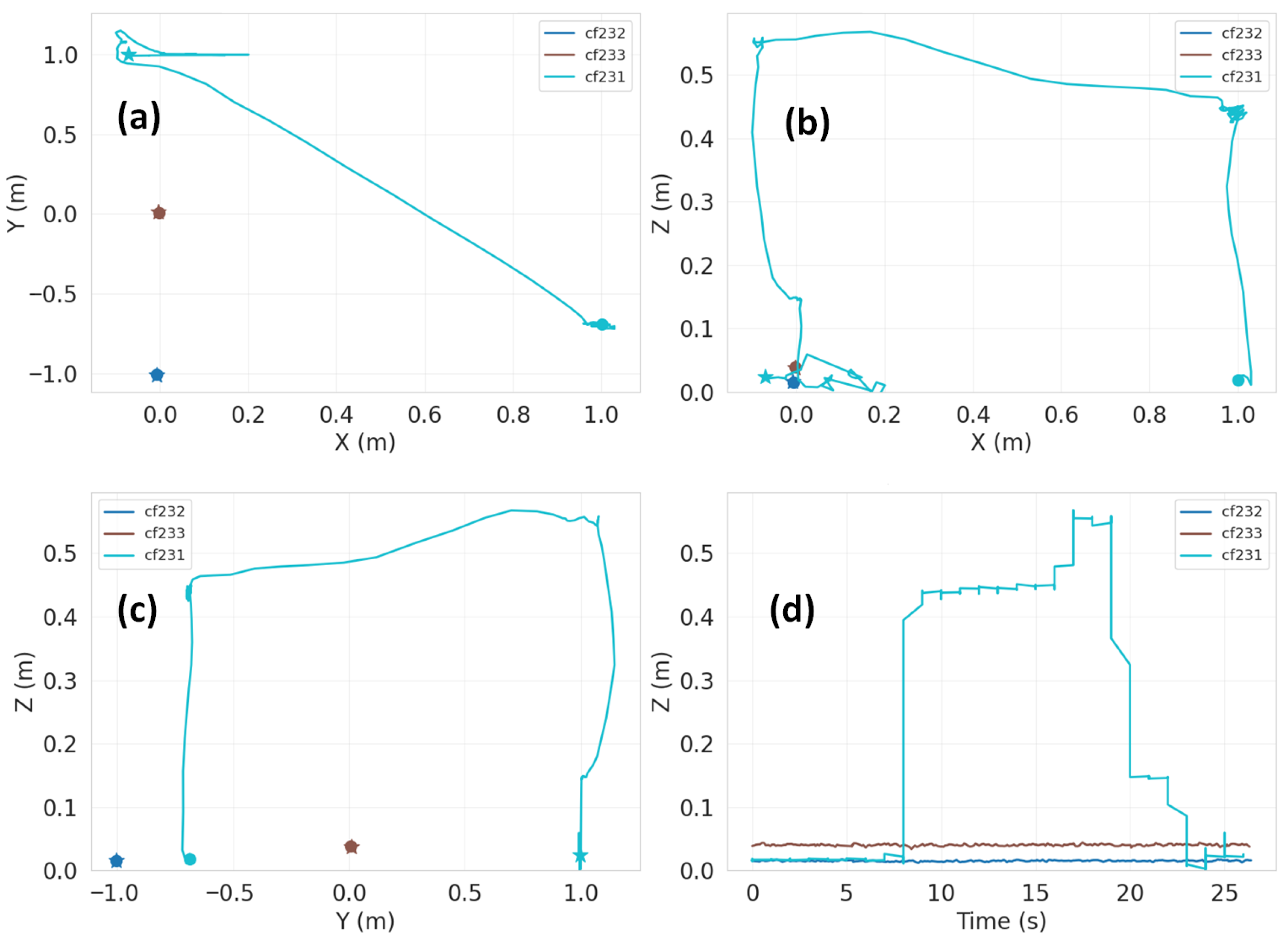
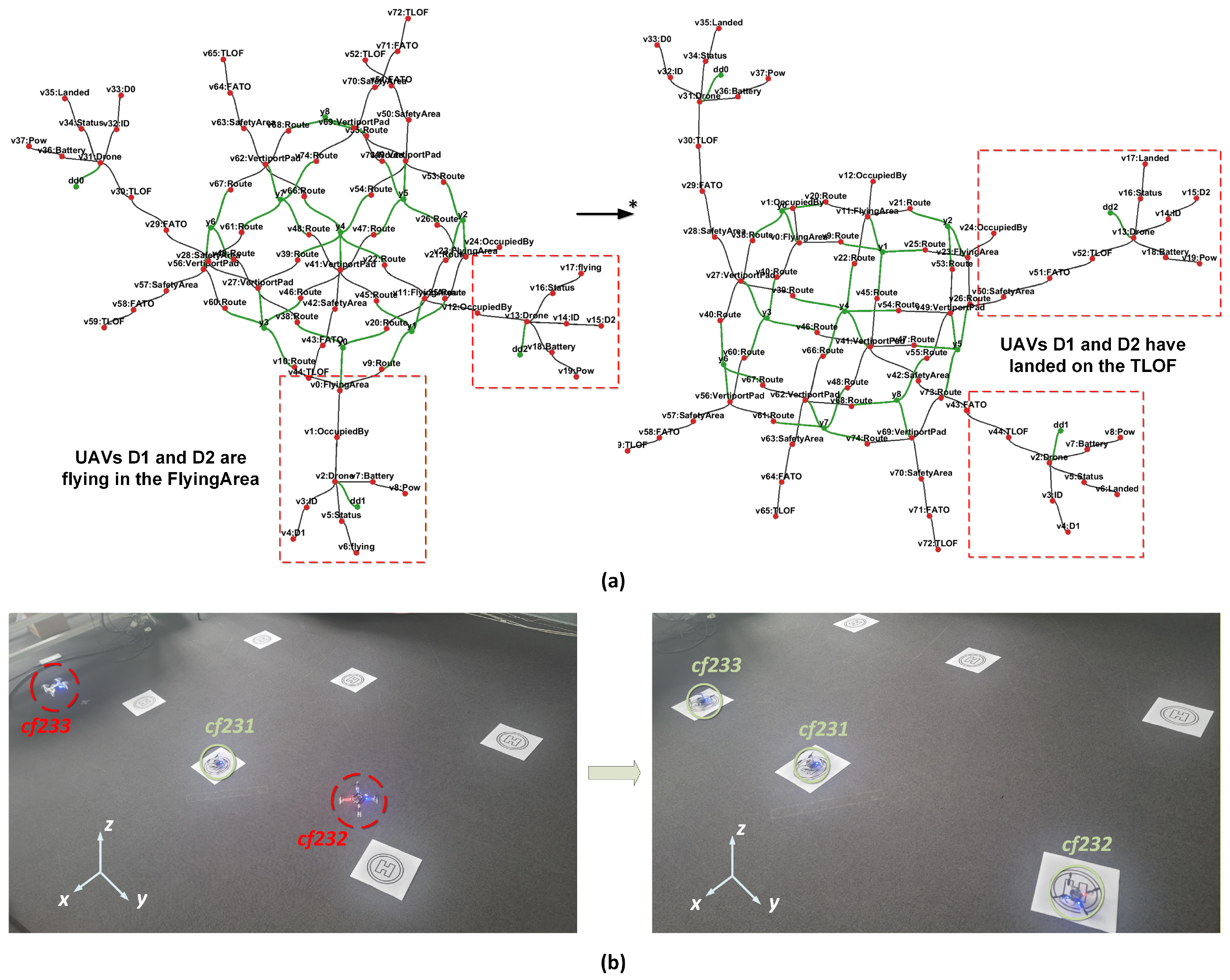
- Verification: We provide a comprehensive verification pipeline that combines exhaustive model checking with hardware-in-the-loop experiments. The formal model checking explores the entire state space, validating both safety and liveness properties. Our physical experiments demonstrate that the formally verified model can be executed on real platforms, achieving conflict-free landings under varied pad layouts and fleet sizes.
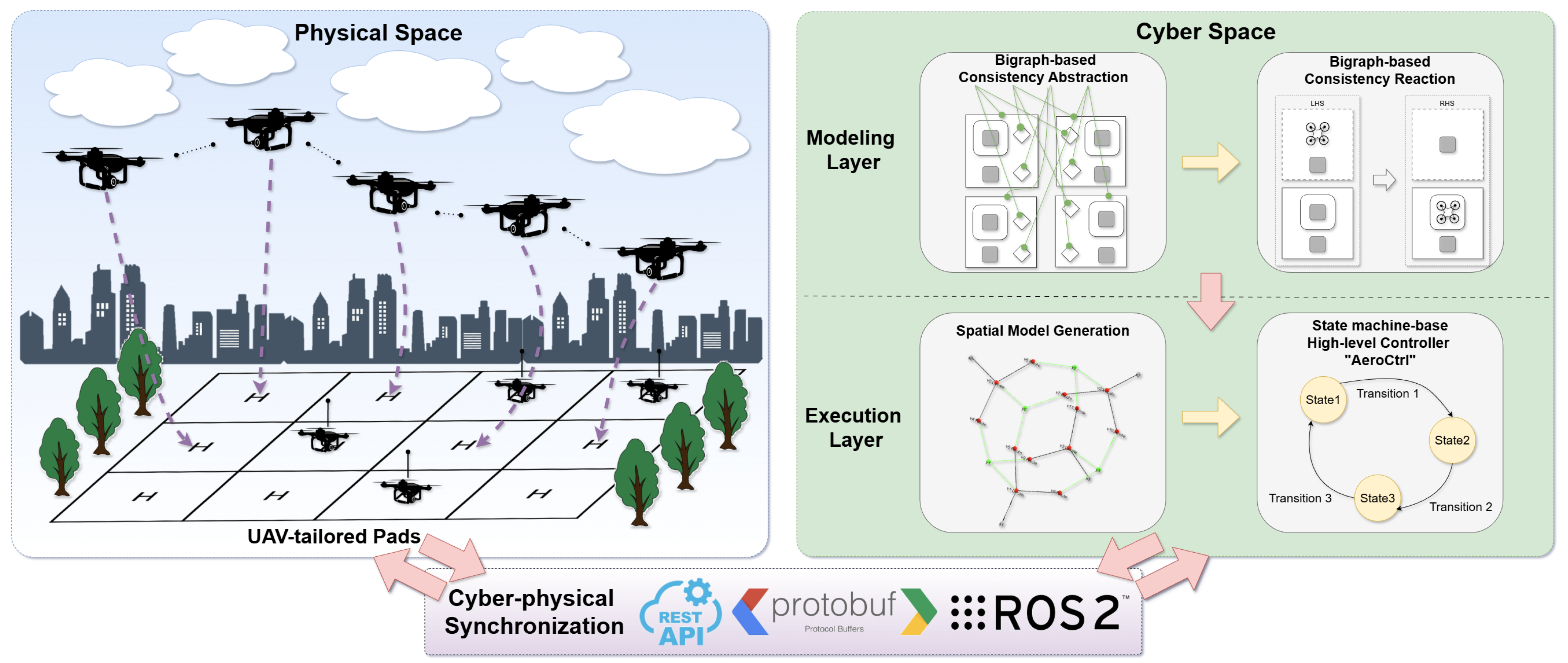
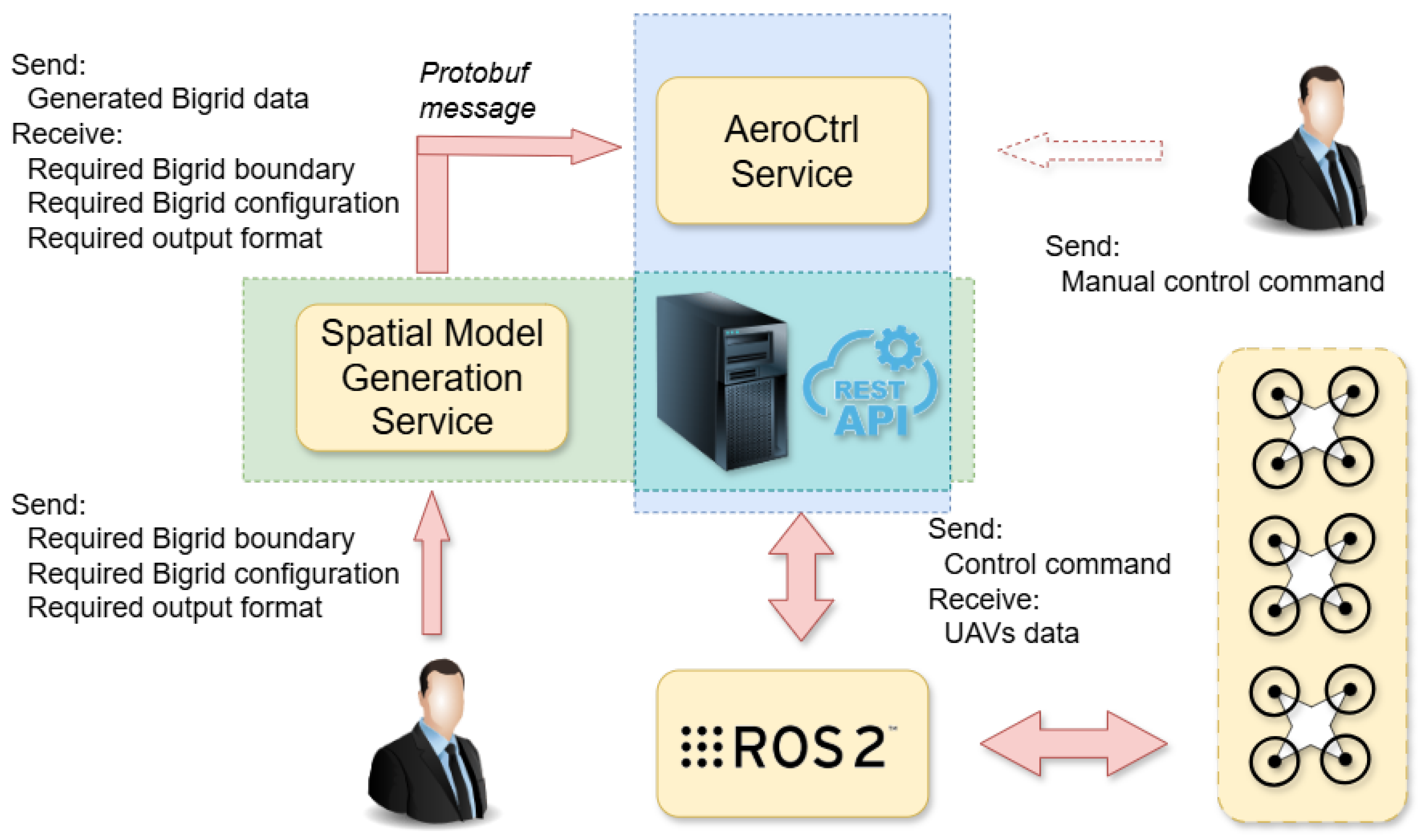
- Cyber–Physical Synchronization: We deliver the first integration of bigraph-based formal models with an executable digital twin for UAV landing operations. Our spatial model generation service enables reconfiguration of landing pads while supporting scalable instantiation of multiple UAV agents without modifying any underlying bigraph rules. Combined with the AeroCtrl controller, Protobuf message protocol, and ROS2 integration, this establishes a fully operational cyber–physical synchronization loop, turning the formal model into an executable digital twin.
Outline
2. Related Work
2.1. Digital Twin Applications in Innovative Air Mobility
2.2. Bigraph-Based Modeling for Multiple UAVs
3. Methodology
3.1. Bigraph-Based Digital Twin Framework for Coordinating and Managing Multiple UAV Flight Operations
3.2. Bigraphs and Bigraphical Reactive Systems
3.3. Bigraph-Based Landing Scenario Modeling for Multiple UAVs
3.3.1. World Model
3.3.2. Multi-UAV Model
3.3.3. Composition Model
3.3.4. Rule-Based Behavioral Specification
Additional Rules
3.4. Execution-Layer Components of the Digital Twin Framework
3.4.1. Spatial Model Generation
3.4.2. AeroCtrl
3.5. Execution by Cyber–Physical Synchronization
4. Experiments
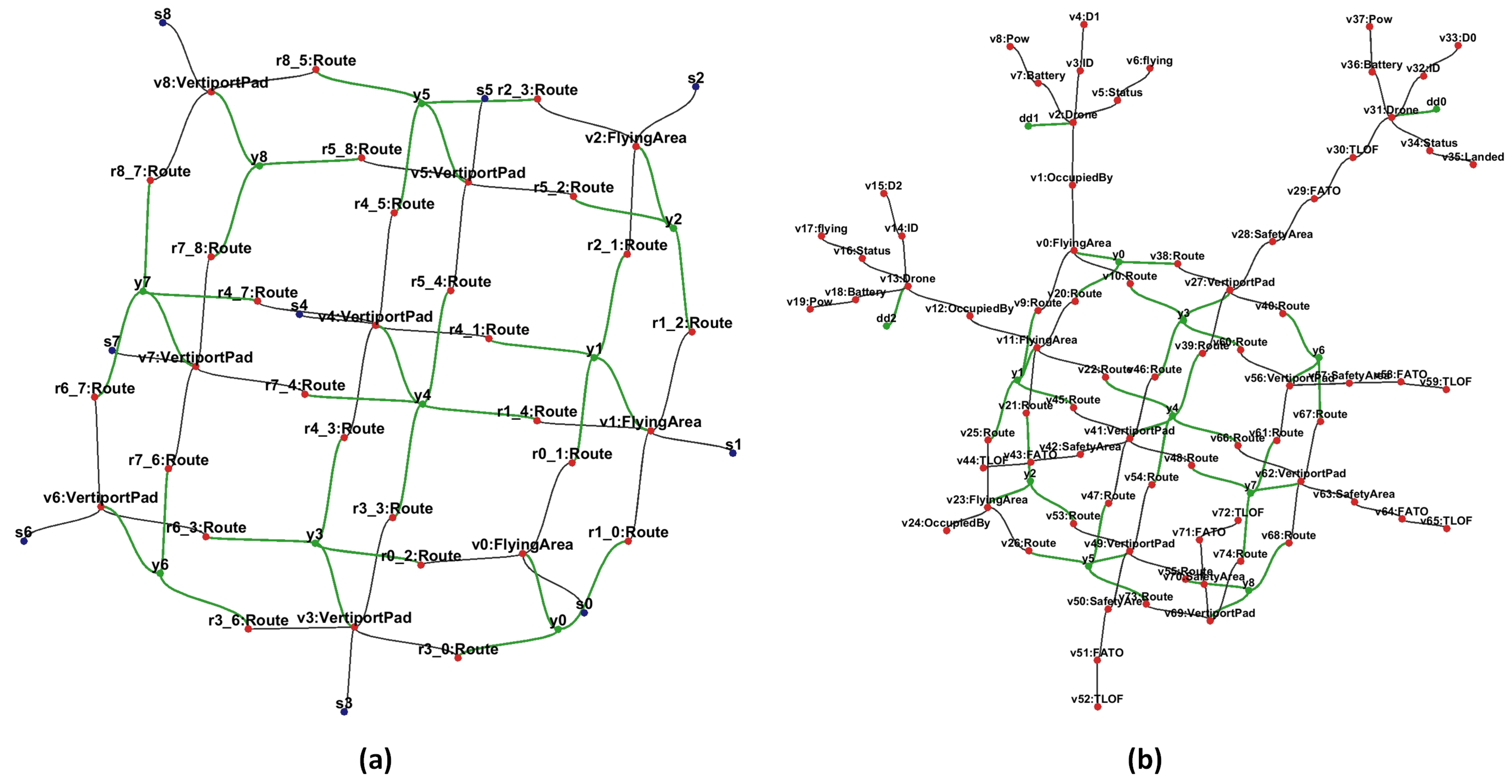
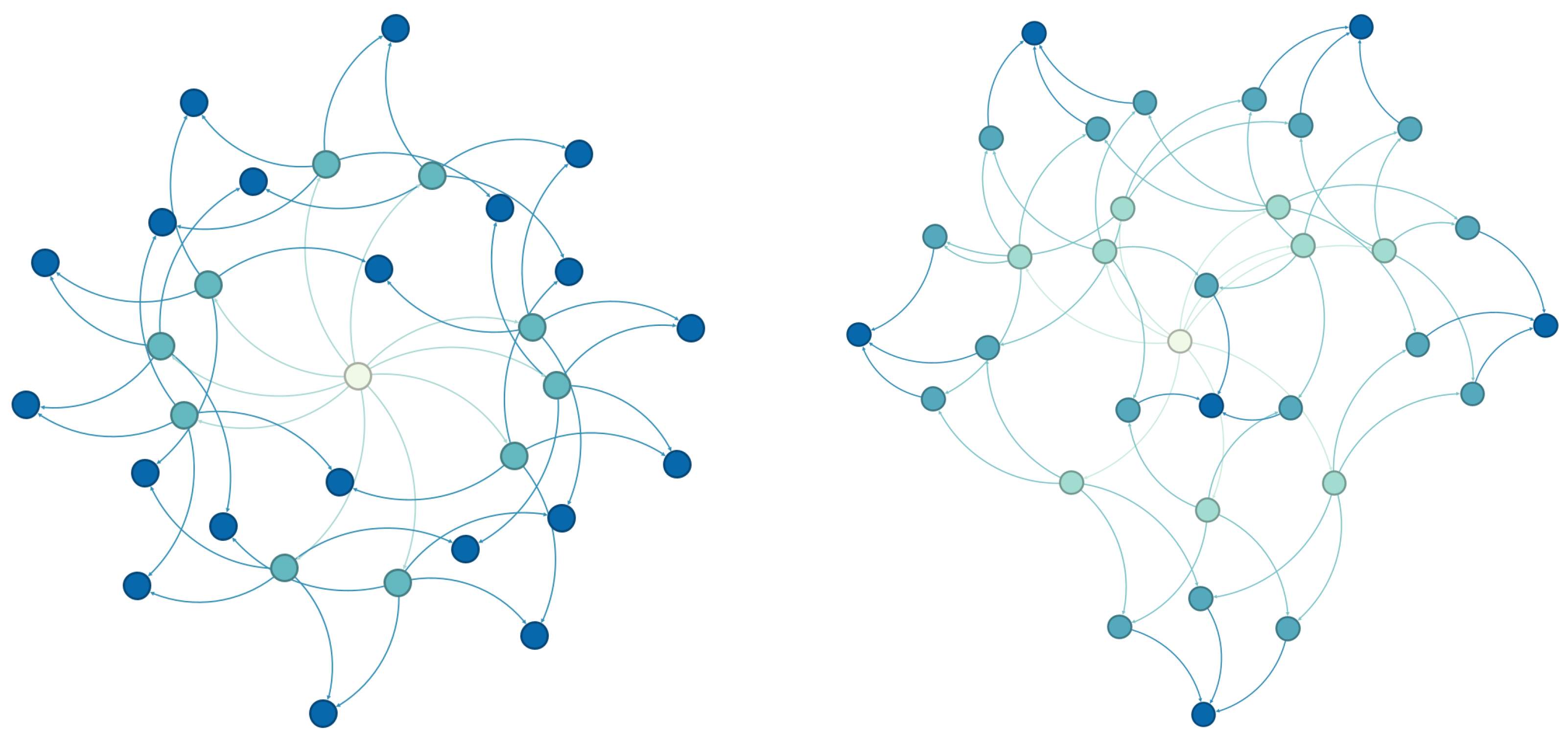
4.1. Bigraph Simulation and Model Checking
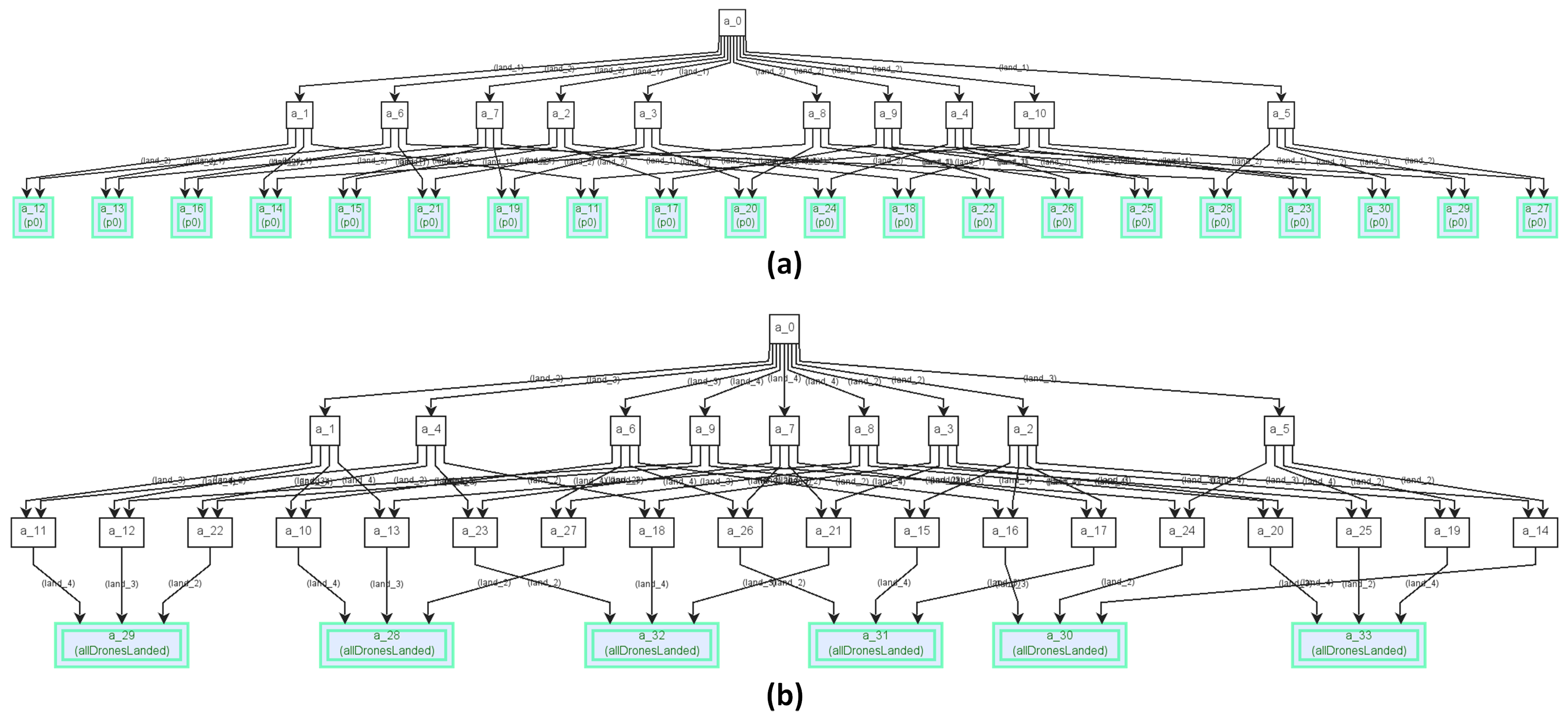
- Landing Reachability (Liveness Property): We verify that on all execution paths, all UAVs will eventually land.where denotes “for all paths” and denotes “eventually”. This liveness property ensures that the system will eventually reach a state where all UAVs have successfully completed their landing procedures, regardless of the execution path taken.
- Collision Avoidance (Safety Property): We verify that collisions never occur in any state along any execution path.where denotes “globally” (always) and ¬ denotes logical negation. This safety property ensures that at no point during system execution will two or more UAVs occupy the same node simultaneously, thereby guaranteeing collision-free operation.
- All terminal states (states with no outgoing edges) satisfy , confirming that holds.
- No state in the entire state space satisfies , confirming that holds.
4.2. Physical Experiments
5. Discussion
5.1. Relevance
5.2. Model Considerations
5.2.1. Underlying Assumptions
5.2.2. Top–Down vs. Bottom–Up
5.2.3. Cross-Formalism Comparison
5.3. Scalability
5.4. Extensibility
5.5. Cyber–Physical Synchronization
Temporal Resolution
6. Conclusions
Future Work
- Incorporate sensing uncertainties and dynamic constraints by integrating PBRS and SBRS into the model. More elaborate timed semantics will also be introduced, in combination with time bigraphs, to enable finer-grained behavioral modeling.
- Extend the proposed framework to scenarios with higher traffic densities, increased uncertainty, and more complex operational conditions, in order to further evaluate its robustness and scalability.
- Generalize the digital twin framework to other UAV missions, such as UAV navigation and cooperative task execution.
Author Contributions
Funding
Data Availability Statement
Conflicts of Interest
Appendix A. Bigraph Foundation
Appendix A.1. Notation
Appendix A.2. Composition
Appendix A.3. Dynamic Aspects
References
- Federal Aviation Administration (FAA). Urban Air Mobility (UAM) Concept of Operations. Available online: https://www.faa.gov/air-taxis/uam_blueprint (accessed on 18 July 2025).
- European Union Aviation Safety Agency (EASA). EASA Publishes World’s First Rules for Operation of Air Taxis in Cities. Available online: https://www.easa.europa.eu/en/newsroom-and-events/press-releases/easa-publishes-worlds-first-rules-operation-air-taxis-cities (accessed on 22 September 2025).
- Johnson, W.; Silva, C. NASA concept vehicles and the engineering of advanced air mobility aircraft. Aeronaut. J. 2022, 126, 59–91. [Google Scholar] [CrossRef]
- Doan, H.T.T.; Bonnet, F.; Ogata, K. Model Checking of Robot Gathering. LIPIcs 2018, 95, 12:1–12:16. [Google Scholar] [CrossRef]
- Zhang, H.; Fei, Y.; Li, J.; Li, B.; Liu, H. Method of vertiport capacity assessment based on queuing theory of unmanned aerial vehicles. Sustainability 2022, 15, 709. [Google Scholar] [CrossRef]
- Li, J.; Zhang, H.; Yi, J.; Deng, C.; Zhou, J. Capacity assessment of vertiports with a scheduling algorithm considering quality of service. Aeronaut. J. 2025, 129, 1791–1809. [Google Scholar] [CrossRef]
- Pang, Y.; Zhao, P.; Hu, J.; Liu, Y. Machine learning-enhanced aircraft landing scheduling under uncertainties. Transp. Res. Part C Emerg. Technol. 2024, 158, 104444. [Google Scholar] [CrossRef]
- Kumar, P.K.; Witter, J.; Paul, S.; Dantu, K.; Chowdhury, S. Graph learning based decision support for multi-aircraft take-off and landing at urban air mobility vertiports. In Proceedings of the AIAA Scitech 2023 Forum, National Harbor, MD, USA, 23–27 January 2023; p. 1848. [Google Scholar]
- Chen, J.; Liu, Y.; Chen, X.; Tang, L.; Xiong, Z. Dynamic Takeoff and Landing Control for Multi-Rotor eVTOL Aircraft. Int. J. Aeronaut. Space Sci. 2025, 26, 376–389. [Google Scholar] [CrossRef]
- Iqbal, D.; Buhnova, B. Model-based approach for building trust in autonomous drones through digital twins. In Proceedings of the 2022 IEEE International Conference on Systems, Man, and Cybernetics (SMC), Prague, Czech Republic, 9–12 October 2022; pp. 656–662. [Google Scholar]
- Gonçalves, P.; Sobral, J.; Ferreira, L.A. Unmanned aerial vehicle safety assessment modelling through petri Nets. Reliab. Eng. Syst. Saf. 2017, 167, 383–393. [Google Scholar] [CrossRef]
- Lee, E.B.K.; Van Bossuyt, D.L.; Bickford, J.F. Digital twin-enabled decision support in mission engineering and route planning. Systems 2021, 9, 82. [Google Scholar] [CrossRef]
- Zhang, T.; Grzelak, D.; Zhao, W.; Islam, M.A.; Fricke, H.; Aßmann, U. A Review on the Construction, Modeling, and Consistency of Digital Twins for Advanced Air Mobility Applications. Drones 2025, 9, 394. [Google Scholar] [CrossRef]
- Milner, R. Bigraphical reactive systems. In Proceedings of the International Conference on Concurrency Theory, Aalborg, Denmark, 20–25 August 2001; Springer: Berlin/Heidelberg, Germany, 2001; pp. 16–35. [Google Scholar]
- European Union Aviation Safety Agency (EASA). Prototype Technical Design Specifications for Vertiports. March 2022. Available online: https://www.easa.europa.eu/en/document-library/general-publications/prototype-technical-design-specifications-vertiports (accessed on 21 September 2025).
- Federal Aviation Administration (FAA). Engineering Brief No. 105A: Vertiports, U.S. Department of Transportation. December 2024. Available online: https://www.faa.gov/airports/engineering/engineering_briefs/eb_105a_vertiports (accessed on 17 August 2025).
- Grzelak, D.; Lindner, M.; Belov, M.; Aßmann, U.; Husak, O.; Fricke, H. A Bigraphical Framework for Modeling and Simulation of UAV-based Inspection Scenarios. Preprint (Revised). Technische Universität Dresden. 2024. Available online: https://nbn-resolving.org/urn:nbn:de:bsz:14-qucosa2-908655 (accessed on 11 September 2024).
- Grzelak, D. Programming Drone Collectives: Towards Safe Plug-And-Play Modularity. In Proceedings of the 1st German Robotics Conference (GRC), Nürnberg, Germany, 13–15 March 2025. [Google Scholar]
- Tao, F.; Xiao, B.; Qi, Q.; Cheng, J.; Ji, P. Digital twin modeling. J. Manuf. Syst. 2022, 64, 372–389. [Google Scholar] [CrossRef]
- Mei, H.; Wang, K.; Zhou, D.; Yang, K. Joint trajectory-task-cache optimization in UAV-enabled mobile edge networks for cyber-physical system. IEEE Access 2019, 7, 156476–156488. [Google Scholar] [CrossRef]
- Shen, G.; Lei, L.; Li, Z.; Cai, S.; Zhang, L.; Cao, P.; Liu, X. Deep reinforcement learning for flocking motion of multi-UAV systems: Learn from a digital twin. IEEE Internet Things J. 2021, 9, 11141–11153. [Google Scholar] [CrossRef]
- Lei, L.; Shen, G.; Zhang, L.; Li, Z. Toward intelligent cooperation of UAV swarms: When machine learning meets digital twin. IEEE Network 2020, 35, 386–392. [Google Scholar] [CrossRef]
- Fakhraian, E.; Semanjski, I.; Semanjski, S.; Aghezzaf, E.H. Towards safe and efficient unmanned aircraft system operations: Literature review of digital twins’ applications and european union regulatory compliance. Drones 2023, 7, 478. [Google Scholar] [CrossRef]
- Aláez, D.; Olaz, X.; Prieto, M.; Villadangos, J.; Astrain, J.J. VTOL UAV digital twin for take-off, hovering and landing in different wind conditions. Simul. Model. Pract. Theory 2023, 123, 102703. [Google Scholar] [CrossRef]
- Oh, C.G.; Lee, M. Approaches of Safe and Efficient 3D UAM Traffic Management Using VR, AR, and MR with AI; HCI Requirements for Digital Twin Application. In Proceedings of the International Conference on Intelligent Autonomous Systems, Qinhuangdao, China, 22–24 September 2023; Springer: Berlin/Heidelberg, Germany, 2023; pp. 169–177. [Google Scholar]
- Chen, H.; Liu, F.; Yang, Y.; Meng, W. Multivr: Digital twin and virtual reality based system for multi-people remote control unmanned aerial vehicles. In Proceedings of the 2022 17th International Conference on Control, Automation, Robotics and Vision (ICARCV), Singapore, 11–13 December 2022; pp. 647–652. [Google Scholar]
- Salinger, S.J.; Kapteyn, M.G.; Kays, C.; Pretorius, J.V.; Willcox, K.E. A hardware testbed for dynamic data-driven aerospace Digital Twins. In Proceedings of the Dynamic Data Driven Applications Systems: Third International Conference, DDDAS 2020, Boston, MA, USA, 2–4 October 2020; Proceedings 3. Springer: Berlin/Heidelberg, Germany, 2020; pp. 37–45. [Google Scholar]
- Li, Z.; Lei, L.; Shen, G.; Liu, X.; Liu, X. Digital Twin-Enabled Deep Reinforcement Learning for Safety-Guaranteed Flocking Motion of UAV Swarm. Trans. Emerg. Telecommun. Technol. 2024, 35, e70011. [Google Scholar] [CrossRef]
- Salinas, L.R.; Tzoumas, G.; Pitonakova, L.; Hauert, S. Digital twin technology for wildfire monitoring using UAV swarms. In Proceedings of the 2023 International Conference on Unmanned Aircraft Systems (ICUAS), Warsaw, Poland, 6–9 June 2023; pp. 586–593. [Google Scholar]
- Zhou, L.; Leng, S.; Quek, T.Q. Hierarchical Digital Twin Enhanced Cooperative Sensing for UAV Swarms. IEEE Internet Things J. 2024, 11, 33204–33216. [Google Scholar] [CrossRef]
- Fraser, B.; Al-Rubaye, S.; Aslam, S.; Tsourdos, A. Enhancing the security of unmanned aerial systems using digital-twin technology and intrusion detection. In Proceedings of the 2021 IEEE/AIAA 40th Digital Avionics Systems Conference (DASC), San Antonio, TX, USA, 3–7 October 2021; pp. 1–10. [Google Scholar]
- Tripura, T.; Desai, A.S.; Adhikari, S.; Chakraborty, S. Probabilistic machine learning based predictive and interpretable digital twin for dynamical systems. Comput. Struct. 2023, 281, 107008. [Google Scholar] [CrossRef]
- Birkedal, L.; Debois, S.; Elsborg, E.; Hildebrandt, T.; Niss, H. Bigraphical models of context-aware systems. In Proceedings of the International Conference on Foundations of Software Science and Computation Structures, Vienna, Austria, 25–31 March 2006; Springer: Berlin/Heidelberg, Germany, 2006; pp. 187–201. [Google Scholar]
- Tsigkanos, C.; Kehrer, T.; Ghezzi, C. Architecting dynamic cyber-physical spaces. Computing 2016, 98, 1011–1040. [Google Scholar] [CrossRef]
- Tsigkanos, C.; Pasquale, L.; Ghezzi, C.; Nuseibeh, B. On the interplay between cyber and physical spaces for adaptive security. IEEE Trans. Dependable Secur. Comput. 2016, 15, 466–480. [Google Scholar] [CrossRef]
- Tsigkanos, C.; Kehrer, T.; Ghezzi, C. Modeling and verification of evolving cyber-physical spaces. In Proceedings of the 2017 11th Joint Meeting on Foundations of Software Engineering, Paderborn, Germany, 4–8 September 2017; pp. 38–48. [Google Scholar]
- Archibald, B.; Calder, M.; Sevegnani, M.; Xu, M. Modelling and Verifying BDI Agents with Bigraphs. Sci. Comput. Program. 2022, 215, 102760. [Google Scholar] [CrossRef]
- Cybulski, P.; Zieliński, Z. A Comprehensive Framework for Designing Behavior of UAV Swarms. In Proceedings of the Annals of Computer Science and Information Systems, Belgrade, Serbia, 8–11 September 2022; Volume 32, pp. 173–180. [Google Scholar]
- Cybulski, P.; Zieliński, Z. UAV Swarms Behavior Modeling Using Tracking Bigraphical Reactive Systems. Sensors 2021, 21, 622. [Google Scholar] [CrossRef] [PubMed]
- Braun, S.; Dalibor, M.; Jansen, N.; Jarke, M.; Koren, I.; Quix, C.; Rumpe, B.; Wimmer, M.; Wortmann, A. Engineering digital twins and digital shadows as key enablers for industry 4.0. In Digital transformation: Core Technologies and Emerging Topics from a Computer Science Perspective; Springer: Berlin/Heidelberg, Germany, 2023; pp. 3–31. [Google Scholar]
- Milner, R. The Space and Motion of Communicating Agents, 1st ed.; Cambridge University Press: New York, NY, USA, 2009. [Google Scholar]
- Brunelli, M.; Ditta, C.C.; Postorino, M.N. New Infrastructures for Urban Air Mobility Systems: A Systematic Review on Vertiport Location and Capacity. J. Air Transp. Manag. 2023, 112, 102460. [Google Scholar] [CrossRef]
- Schweiger, K.; Preis, L. Urban Air Mobility: Systematic Review of Scientific Publications and Regulations for Vertiport Design and Operations. Drones 2022, 6, 179. [Google Scholar] [CrossRef]
- Neumann, P.P.; Hirschberger, P.; Bartholmai, M. Influence of rotor downwash on vertically displaced nanobots in flight. Mater. Today Proc. 2020, 32, 108–111. [Google Scholar] [CrossRef]
- Dilkas, P. Nondeterministic Bigraphical Reactive Systems for Markov Decision Processes; Technical Report; University of Glasgow: Glasgow, UK, 2018. [Google Scholar]
- Archibald, B.; Calder, M.; Sevegnani, M. Practical Modelling with Bigraphs. Form. Asp. Comput. 2025, 37, 20:1–20:36. [Google Scholar] [CrossRef]
- Archibald, B.; Calder, M.; Sevegnani, M. Probabilistic bigraphs. Form. Asp. Comput. 2022, 34, 1–27. [Google Scholar] [CrossRef]
- Calder, M.; Koliousis, A.; Sevegnani, M.; Sventek, J. Real-Time Verification of Wireless Home Networks Using Bigraphs with Sharing. Sci. Comput. Program. 2014, 80, 288–310. [Google Scholar] [CrossRef][Green Version]
- Albalwe, M.; Archibald, B.; Sevegnani, M. Modelling real-time systems with bigraphs. arXiv 2025, arXiv:2505.13449. [Google Scholar] [CrossRef]
- Perrone, G.; Debois, S.; Hildebrandt, T.T. A Model Checker for Bigraphs. In Proceedings of the Proceedings of the 27th Annual ACM Symposium on Applied Computing, New York, NY, USA, 25–29 March 2012; SAC’12. pp. 1320–1325. [Google Scholar] [CrossRef]
- Wolfram, S. A Class of Models with the Potential to Represent Fundamental Physics. Complex Syst. 2020, 29, 107–536. [Google Scholar] [CrossRef]
- Rosas, F.E.; Geiger, B.C.; Luppi, A.I.; Seth, A.K.; Polani, D.; Gastpar, M.; Mediano, P.A.M. Software in the Natural World: A Computational Approach to Hierarchical Emergence. arXiv 2024, arXiv:2402.09090. [Google Scholar] [CrossRef]







| Scenario | Execution Time (s) | Edges | Vertices |
|---|---|---|---|
| Scenario 1 | 79.84 | 50 | 31 |
| Scenario 2 | 113.54 | 63 | 34 |
| Experiment ID | Pad Configuration | Pre-Assigned UAVs (Occupied Pads) | Occupied Pads | Incoming UAVs | Initial Positions of Incoming UAVs | Assigned Pads | Conflict Occurred |
|---|---|---|---|---|---|---|---|
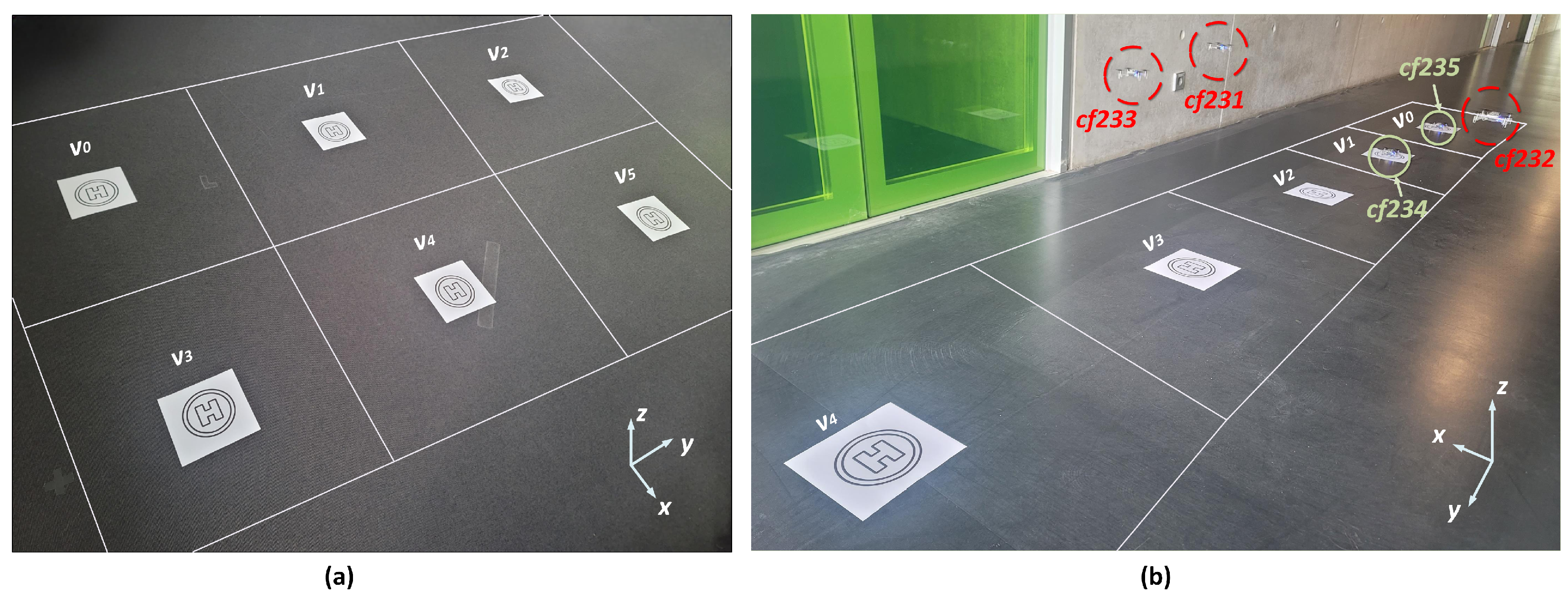
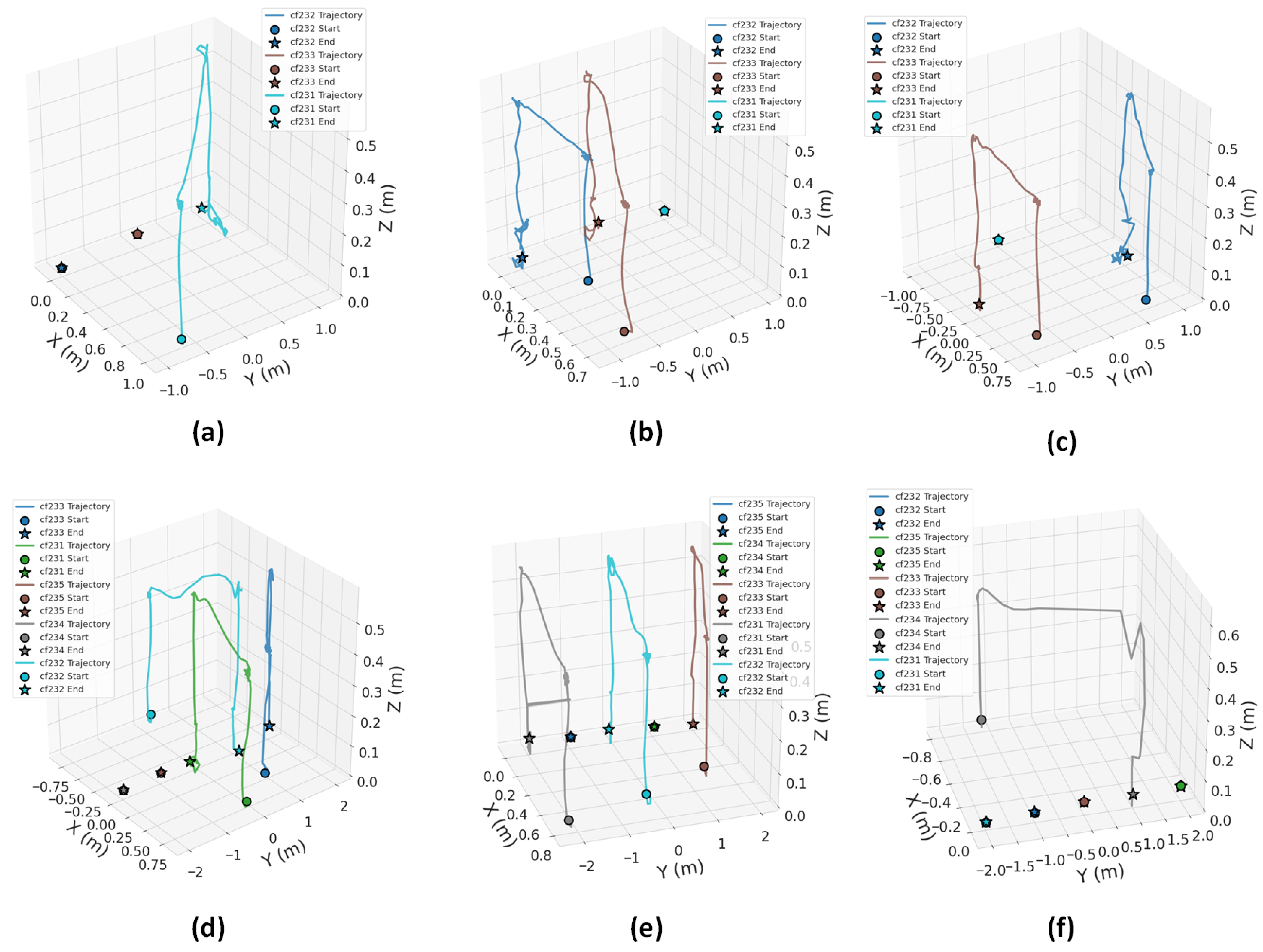
| Experiment 1-1 | 2 × 3 | cf232, cf233 | V5, V1 | cf231 | (1.0, 0.0, 0.0) | V3 | NO |
| Experiment 1-2 | 2 × 3 | cf232, cf233 | V3, V4 | cf231 | (1.0, 0.7, 0.0) | V5 | NO |
| Experiment 1-3 | 2 × 3 | cf232, cf233 | V5, V2 | cf231 | (0.8, 0.8, 0.0) | V4 | NO |
| Experiment 1-4 | 2 × 3 | cf232, cf233 | V3, V2 | cf231 | (0.3, −0.8, 0.0) | V4 | NO |
| Experiment 1-5 | 2 × 3 | cf232, cf233 | V1, V0 | cf231 | (0.8, −0.3, 0.0) | V4 | NO |
| Experiment 2-1 | 2 × 3 | cf231 | V4 | cf232, cf233 | (−0.4, −0.7, 0.0), (−0.4, −0.3, 0.0) | V0, V1 | NO |
| Experiment 2-2 | 2 × 3 | cf231 | V4 | cf232, cf233 | (0.3, 0.6, 0.0), (0.3, −0.8, 0.0) | V5, V3 | NO |
| Experiment 2-3 | 2 × 3 | cf231 | V5 | cf232, cf233 | (0.3, −0.6, 0.0), (0.7, −0.8, 0.0) | V3, V4 | NO |
| Experiment 2-4 | 2 × 3 | cf231 | V3 | cf232, cf233 | (0.6, 0.0, 0.0), (0.7, 0.8, 0.0) | V4, V5 | NO |
| Experiment 2-5 | 2 × 3 | cf231 | V1 | cf232, cf233 | (0.8, 0.6, 0.0), (0.7, −0.8, 0.0) | V5, V3 | NO |
| Experiment 3-1 | 1 × 5 | cf234, cf235 | V0, V1 | cf231, cf232, cf233 | (0.8, −0.2, 0.0), (−0.8, 0.2, 0.0), (0.6, 0.7, 0.0) | V2, V3, V4 | NO |
| Experiment 3-2 | 1 × 5 | cf234, cf235 | V1, V3 | cf231, cf232, cf233 | (0.8, −2.2, 0.0), (0.7, −0.3, 0.0), (0.6, 1.2, 0.0) | V0, V2, V4 | NO |
| Experiment 3-3 | 1 × 5 | cf234, cf235 | V4, V2 | cf231, cf232, cf233 | (−0.6, −2.0, 0.0), (−0.8, −0.7, 0.0), (−0.6, 1.2, 0.0) | V0, V1, V3 | NO |
| Experiment 3-4 | 1 × 5 | cf231, cf232, cf233, cf235 | V0, V1, V2, V4 | cf234 | (−0.8, −1.2, 0.0) | V3 | NO |
| Experiment 3-5 | 1 × 5 | cf231, cf232, cf233, cf234 | V1, V2, V3, V4 | cf235 | (0.7, −0.8, 0.0) | V0 | NO |
Disclaimer/Publisher’s Note: The statements, opinions and data contained in all publications are solely those of the individual author(s) and contributor(s) and not of MDPI and/or the editor(s). MDPI and/or the editor(s) disclaim responsibility for any injury to people or property resulting from any ideas, methods, instructions or products referred to in the content. |
© 2025 by the authors. Licensee MDPI, Basel, Switzerland. This article is an open access article distributed under the terms and conditions of the Creative Commons Attribution (CC BY) license.
Share and Cite
Zhang, T.; Grzelak, D.; Lindner, M.; Fricke, H.; Aßmann, U. A Bigraph-Based Digital Twin for Multi-UAV Landing Management. Drones 2026, 10, 12. https://doi.org/10.3390/drones10010012
Zhang T, Grzelak D, Lindner M, Fricke H, Aßmann U. A Bigraph-Based Digital Twin for Multi-UAV Landing Management. Drones. 2026; 10(1):12. https://doi.org/10.3390/drones10010012
Chicago/Turabian StyleZhang, Tianxiong, Dominik Grzelak, Martin Lindner, Hartmut Fricke, and Uwe Aßmann. 2026. "A Bigraph-Based Digital Twin for Multi-UAV Landing Management" Drones 10, no. 1: 12. https://doi.org/10.3390/drones10010012
APA StyleZhang, T., Grzelak, D., Lindner, M., Fricke, H., & Aßmann, U. (2026). A Bigraph-Based Digital Twin for Multi-UAV Landing Management. Drones, 10(1), 12. https://doi.org/10.3390/drones10010012