
Human-in-the-Loop Time-Varying Formation Tracking of Networked UAV Systems with Compound Actuator Faults


Highlights
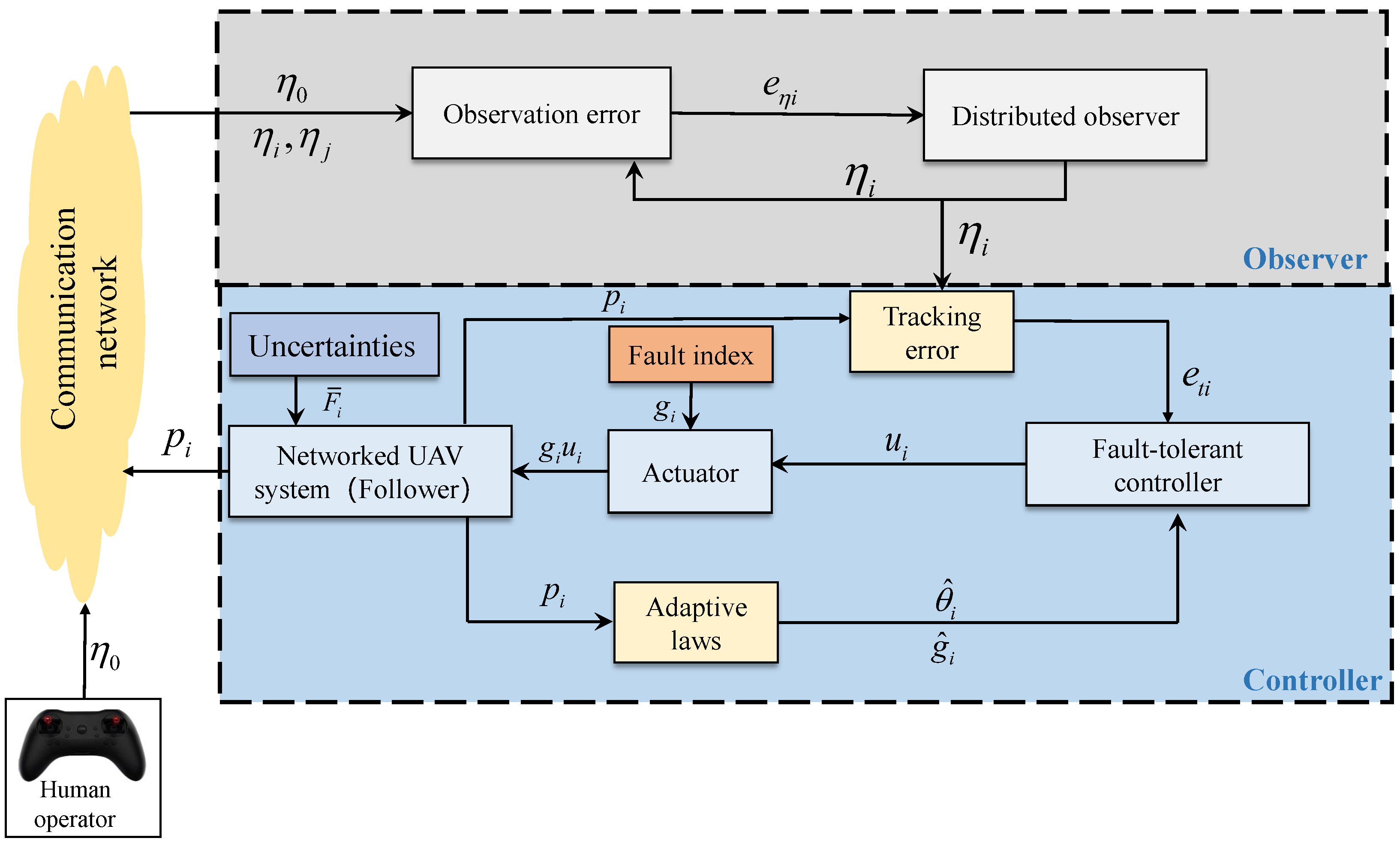
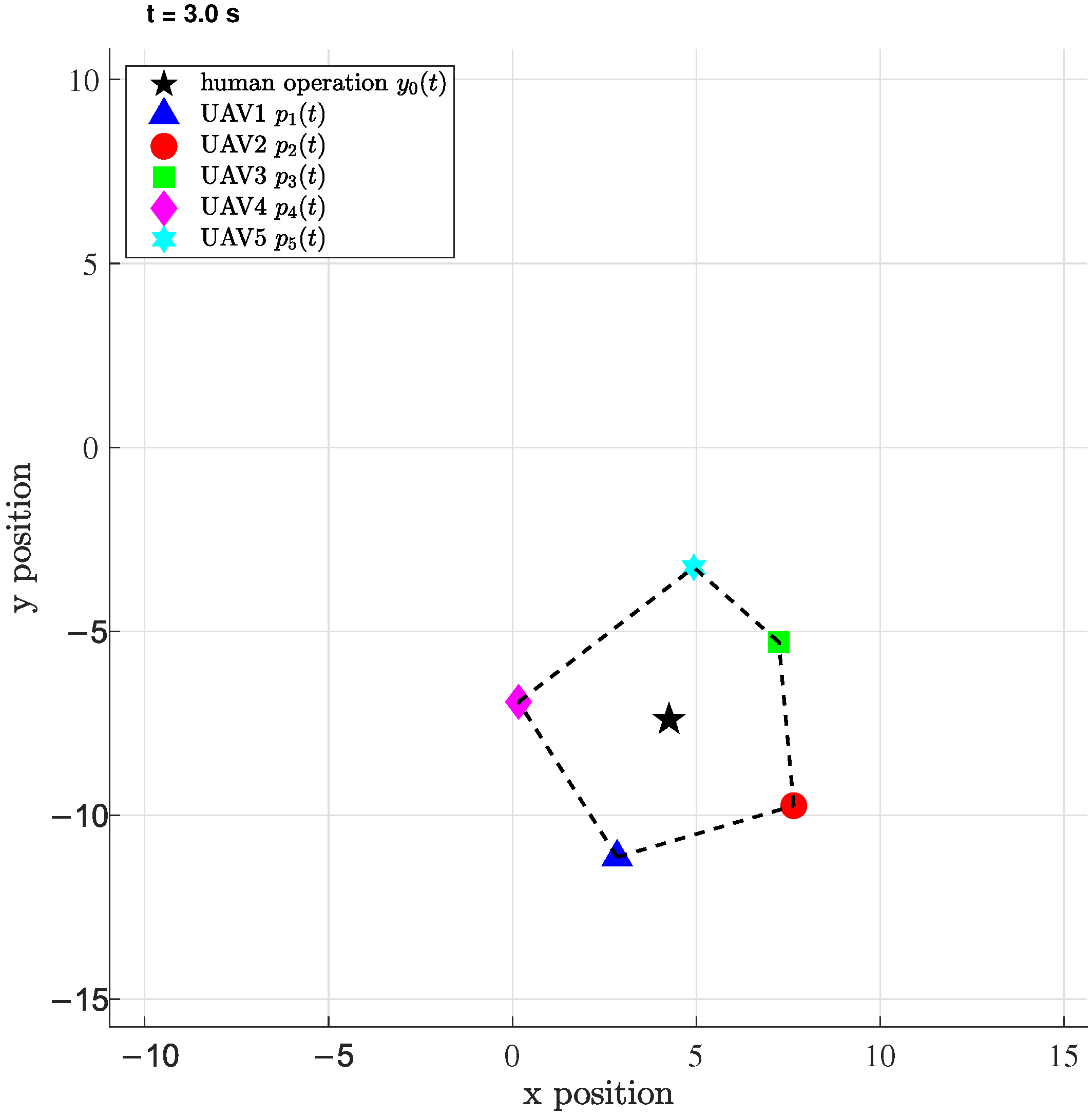
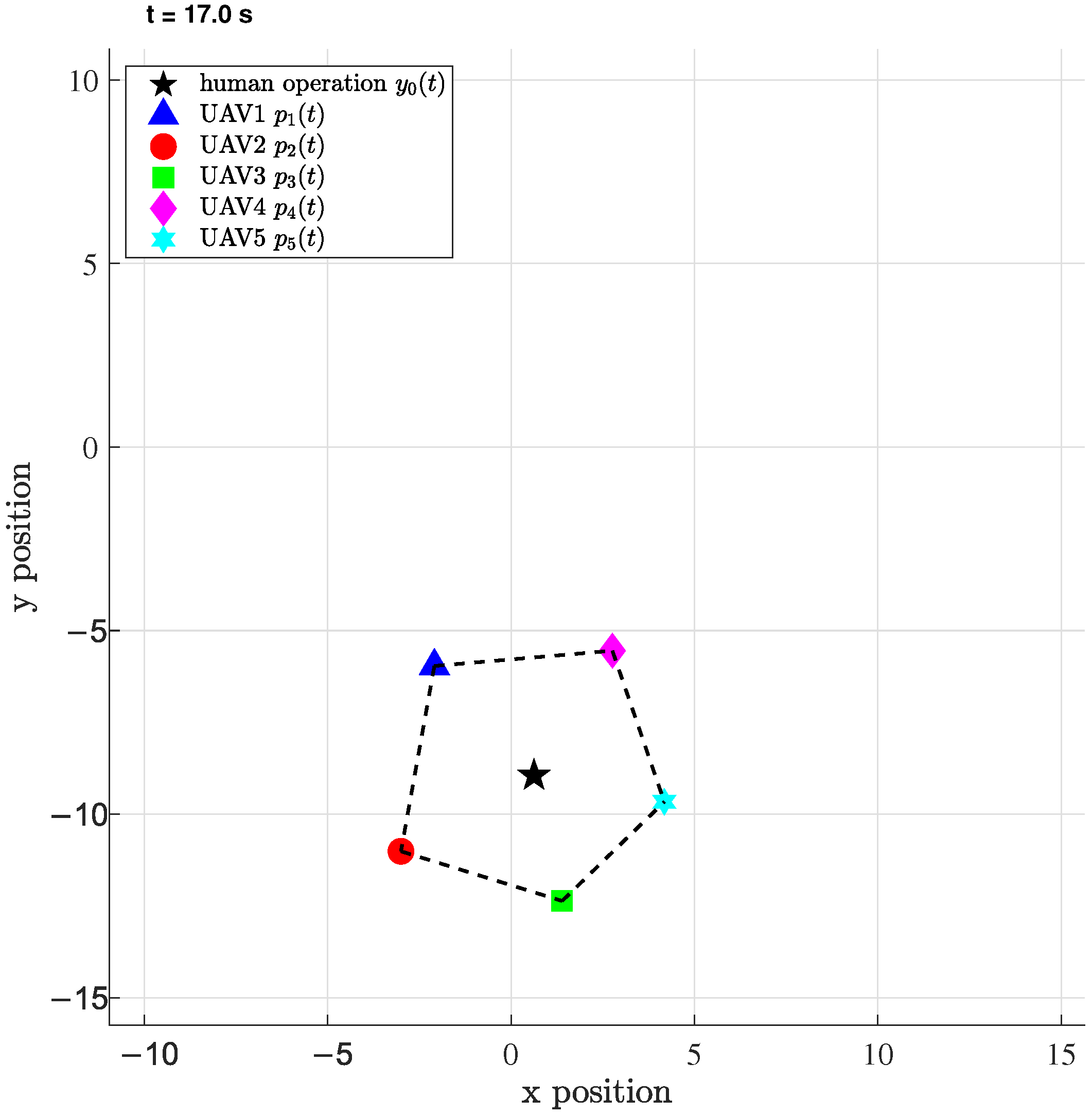
- A novel two-layer human-in-the-loop control framework is developed for time-varying formation tracking of networked UAVs under compound actuator faults and external disturbances.
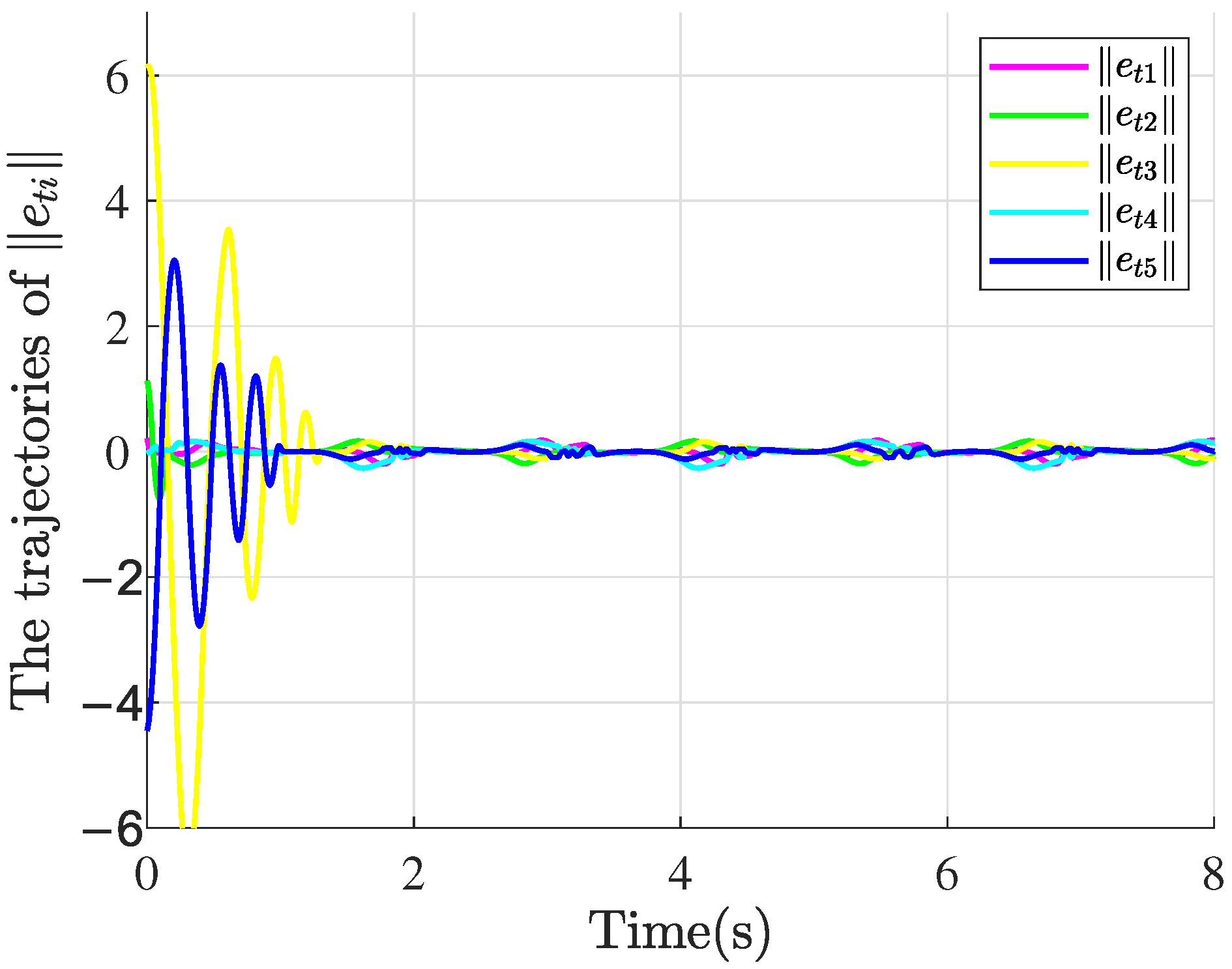
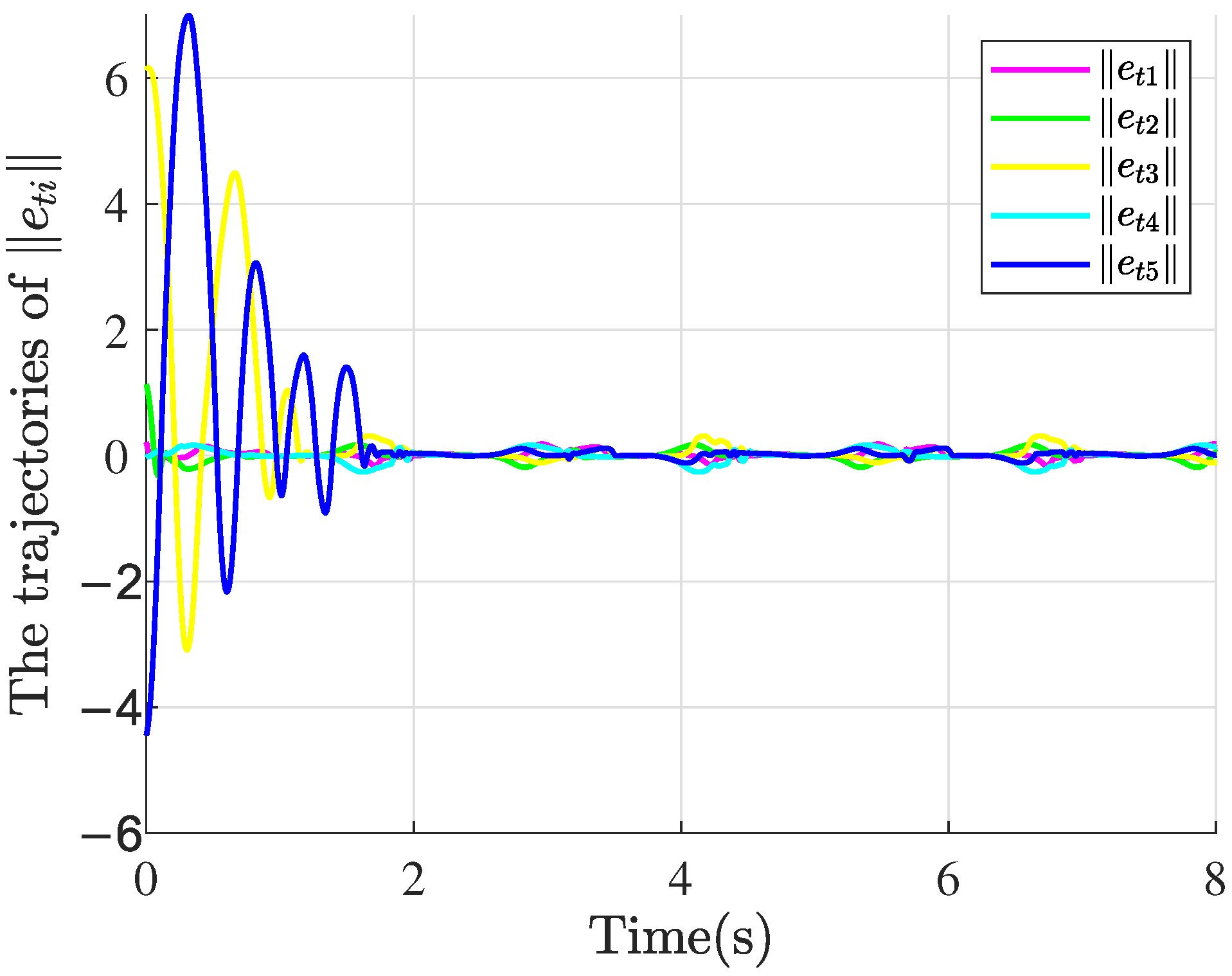
- A distributed observer and an adaptive fault-tolerant controller jointly ensure bounded convergence of formation tracking errors using only local information exchange.
- The proposed approach enhances the reliability and robustness of cooperative UAV missions involving human operators in fault-prone environments.
- The results provide a scalable and practical control solution for real-world multi-UAV applications such as surveillance, encirclement, and search-and-rescue operations.
Abstract
1. Introduction
2. Preliminaries and Problem Formulation
2.1. Graph Theory
2.2. Problem Description
3. Main Results
3.1. Distributed Observer Design
3.2. Fault-Tolerant Controller Design
4. Simulation Results
5. Conclusions
Author Contributions
Funding
Data Availability Statement
Conflicts of Interest
References
- Zhu, X.; Feng, H.; Cambria, E.; Huang, Y.; Ju, M.; Yuan, H.; Wang, R. EMVAS: End-to-end multimodal emotion visualization analysis system. Complex Intell. Syst. 2025, 11, 1–15. [Google Scholar] [CrossRef]
- Wang, J.; Gao, M.; Zhai, W.; Rida, I.; Zhu, X.; Li, Q. Knowledge Generation and Distillation for Road Segmentation in Intelligent Transportation Systems. IEEE Trans. Intell. Transp. Syst. 2025. [Google Scholar] [CrossRef]
- Wang, R.; Zhou, K.; Zhou, W.; Shi, K.; Pfaender, F.; Zhu, X. Multi-view residual spatio-temporal topology adaptive graph convolutional network for urban road traffic accident prediction with multi-source risks. Array 2025, 28, 100617. [Google Scholar] [CrossRef]
- Wu, J.; Luo, C.; Min, G.; McClean, S. Formation control algorithms for multi-UAV systems with unstable topologies and hybrid delays. IEEE Trans. Veh. Technol. 2024, 73, 12358–12369. [Google Scholar] [CrossRef]
- Zhu, L.; Ma, C.; Li, J.; Lu, Y.; Yang, Q. Connectivity-maintenance UAV formation control in complex environment. Drones 2023, 7, 229. [Google Scholar] [CrossRef]
- Zheng, Z.; Tong, S.; Wang, E.; Zhu, Y.; Shao, J. Robust Consensus Tracking Control for Multi-Unmanned-Aerial-Vehicle (UAV) System Subjected to Measurement Noise and External Disturbance. Drones 2025, 9, 61. [Google Scholar]
- Miao, Q.; Zhang, K.; Jiang, B. Fixed-time collision-free fault-tolerant formation control of multi-UAVs under actuator faults. IEEE Trans. Cybern. 2024, 54, 3679–3691. [Google Scholar] [CrossRef]
- Jin, Z.; Bai, L.; Wang, Z.; Zhang, P. Self-triggered distributed formation control of fixed-wing unmanned aerial vehicles subject to velocity and overload constraints. IEEE Trans. Autom. Sci. Eng. 2023, 21, 4082–4093. [Google Scholar] [CrossRef]
- Cui, Y.; Liang, Y.; Luo, Q.; Shu, Z.; Huang, T. Resilient consensus control of heterogeneous multi-UAV systems with leader of unknown input against Byzantine attacks. IEEE Trans. Autom. Sci. Eng. 2024, 22, 5388–5399. [Google Scholar] [CrossRef]
- Bu, Y.; Yan, Y.; Yang, Y. Advancement challenges in UAV swarm formation control: A comprehensive review. Drones 2024, 8, 320. [Google Scholar] [CrossRef]
- Huang, S.; Teo, R.S.H.; Tan, K.K. Collision avoidance of multi unmanned aerial vehicles: A review. Annu. Rev. Control 2019, 48, 147–164. [Google Scholar] [CrossRef]
- Li, S.; Chen, Z.; Zhang, Q.; Hu, T.; Zhu, B. Maneuver synchronization of networked rotating platforms using historical nominal command. Control Eng. Pract. 2024, 153, 106081. [Google Scholar] [CrossRef]
- Hu, Y.; Yan, H.; Zhang, Y.; Zhang, H.; Chang, Y. Event-triggered prescribed performance fuzzy fault-tolerant control for unknown Euler–Lagrange systems with any bounded initial values. IEEE Trans. Fuzzy Syst. 2022, 31, 2065–2075. [Google Scholar] [CrossRef]
- Chen, L.; Liang, H.; Pan, Y.; Li, T. Human-in-the-loop consensus tracking control for UAV systems via an improved prescribed performance approach. IEEE Trans. Aerosp. Electron. Syst. 2023, 59, 8380–8391. [Google Scholar] [CrossRef]
- Lin, G.; Li, H.; Ma, H.; Yao, D.; Lu, R. Human-in-the-loop consensus control for nonlinear multi-agent systems with actuator faults. IEEE/CAA J. Autom. Sin. 2020, 9, 111–122. [Google Scholar] [CrossRef]
- Ma, L.; Zhu, F.; Zhao, X. Human-in-the-loop formation-containment control for multiagent systems: An observer-based distributed unknown input reconstruction method. IEEE Trans. Control Netw. Syst. 2023, 10, 2178–2189. [Google Scholar] [CrossRef]
- Jiang, Y.; Niu, B.; Zong, G.; Zhao, X.; Zhao, P. Distributed adaptive secure consensus tracking control for asynchronous switching nonlinear MASs under sensor attacks and actuator faults. IEEE Trans. Autom. Sci. Eng. 2023, 21, 3253–3263. [Google Scholar] [CrossRef]
- Wang, Y.; Wang, Z. Distributed model free adaptive fault-tolerant consensus tracking control for multiagent systems with actuator faults. Inf. Sci. 2024, 664, 120313. [Google Scholar] [CrossRef]
- Gao, Y.; Zhou, W.; Niu, B.; Kao, Y.; Wang, H.; Sun, N. Distributed prescribed-time consensus tracking for heterogeneous nonlinear multi-agent systems under deception attacks and actuator faults. IEEE Trans. Autom. Sci. Eng. 2023, 21, 6920–6929. [Google Scholar] [CrossRef]
- Zhu, B.; Zhang, L.; Niu, B.; Zhao, N. Adaptive reinforcement learning for fault-tolerant optimal consensus control of nonlinear canonical multiagent systems with actuator loss of effectiveness. IEEE Syst. J. 2024, 18, 1681–1692. [Google Scholar] [CrossRef]
- Zhou, C.; Wang, Y.; Lv, M.; Wang, N. Neural-adaptive specified-time constrained consensus tracking control of high-order nonlinear multi-agent systems with unknown control directions and actuator faults. Neurocomputing 2023, 538, 126168. [Google Scholar] [CrossRef]
- Cheng, W.; Zhang, K.; Jiang, B. Fixed-time fault-tolerant formation control for a cooperative heterogeneous multiagent system with prescribed performance. IEEE Trans. Syst. Man Cybern. Syst. 2022, 53, 462–474. [Google Scholar] [CrossRef]
- Yang, S.; Pan, Y.; Cao, L.; Chen, L. Predefined-time fault-tolerant consensus tracking control for multi-UAV systems with prescribed performance and attitude constraints. IEEE Trans. Aerosp. Electron. Syst. 2024, 60, 4058–4072. [Google Scholar] [CrossRef]
- Tan, C.; Zhang, T.; Li, Y.; Liu, G.P. Time-varying group formation tracking control for uncertain nonlinear high-order fully actuated multiagent systems. Nonlinear Dyn. 2025, 113, 2293–2314. [Google Scholar] [CrossRef]
- Yu, H.; Miao, K.; He, Z.; Zhang, H.; Niu, Y. Fault-Tolerant Time-Varying Formation Trajectory Tracking Control for Multi-Agent Systems with Time Delays and Semi-Markov Switching Topologies. Drones 2024, 8, 778. [Google Scholar] [CrossRef]
- Du, J.; Li, J.; Lewis, F.L. Distributed 3-D time-varying formation control of underactuated AUVs with communication delays based on data-driven state predictor. IEEE Trans. Ind. Inform. 2022, 19, 6963–6971. [Google Scholar] [CrossRef]
- Hou, H.Q.; Liu, Y.J.; Lan, J.; Liu, L. Adaptive fuzzy fixed time time-varying formation control for heterogeneous multiagent systems with full state constraints. IEEE Trans. Fuzzy Syst. 2022, 31, 1152–1162. [Google Scholar] [CrossRef]
- Han, C.; Li, W.; Shi, M.; Li, M.; Lin, B.; Qin, K. Human-in-the-loop prescribed performance distributed formation tracking control of networked quadrotor UAVs. IEEE Trans. Veh. Technol. 2025. [Google Scholar] [CrossRef]
- Shao, K.; Tang, R.; Xu, F.; Wang, X.; Zheng, J. Adaptive sliding mode control for uncertain Euler–Lagrange systems with input saturation. J. Frankl. Inst. 2021, 358, 8356–8376. [Google Scholar] [CrossRef]
- Slotine, J.J.E.; Li, W. Applied nonlinear control; Prentice-Hall, Inc.: Englewood Cliffs, NJ, USA, 1991; Volume 2, pp. 1123–1131. [Google Scholar]
- Zhao, Y.; Zhu, F.; Xu, D. Event-triggered bipartite time-varying formation control for multiagent systems with unknown inputs. IEEE Trans. Cybern. 2022, 53, 5904–5917. [Google Scholar] [CrossRef]
- Li, W.; Yan, S.; Shi, L.; Yue, J.; Shi, M.; Lin, B.; Qin, K. Multiagent consensus tracking control over asynchronous cooperation–competition networks. IEEE Trans. Cybern. 2025, 55, 4347–4360. [Google Scholar] [CrossRef]
- Shi, L.; Yan, S.; Li, W. Consensus and Products of Substochastic Matrices: Convergence Rate With Communication Delays. IEEE Trans. Syst. Man Cybern. Syst. 2025, 55, 4752–4761. [Google Scholar] [CrossRef]
- Li, W.; Shi, M.; Shi, L.; Lin, B. Fixed-time bipartite flocking of perturbed networked UAV systems: A distributed optimization approach. Expert Syst. Appl. 2026, 299, 129979. [Google Scholar] [CrossRef]
- Li, W.; Shi, L.; Shi, M.; Lin, B.; Qin, K. Cooperative Formation Tracking of Multi-Agent Systems Over Switching Signed Networks. IEEE Trans. Control Netw. Syst. 2025, 12, 2581–2591. [Google Scholar] [CrossRef]








| Symbol | Dimension | Description |
|---|---|---|
| State matrix of the human-in-the-loop leader | ||
| Input matrix of the leader | ||
| Output matrix of the leader | ||
| Q | Observer gain matrix, | |
| Observer gain matrix | ||
| L | Laplacian matrix of the communication graph | |
| Z | Positive definite matrix satisfying | |
| T | Solution of the LMI in Equation (15) | |
| Positive definite matrix in Equation (16) |
| Category | Parameter | Value/Expression |
|---|---|---|
| Human-in-the-loop System | ||
| Initial States | ||
| Disturbances | ||
| Actuator Health Indices | (for all ) | |
| Observer Gains | ||
| 2 | ||
| Q | ||
| Controller Gains | 40 | |
| 1 | ||
| 20 | ||
| Formation Parameters | ||
| Rotation |
Disclaimer/Publisher’s Note: The statements, opinions and data contained in all publications are solely those of the individual author(s) and contributor(s) and not of MDPI and/or the editor(s). MDPI and/or the editor(s) disclaim responsibility for any injury to people or property resulting from any ideas, methods, instructions or products referred to in the content. |
© 2026 by the authors. Licensee MDPI, Basel, Switzerland. This article is an open access article distributed under the terms and conditions of the Creative Commons Attribution (CC BY) license.
Share and Cite
Lu, J.; Qin, K.; Shi, M. Human-in-the-Loop Time-Varying Formation Tracking of Networked UAV Systems with Compound Actuator Faults. Drones 2026, 10, 81. https://doi.org/10.3390/drones10020081
Lu J, Qin K, Shi M. Human-in-the-Loop Time-Varying Formation Tracking of Networked UAV Systems with Compound Actuator Faults. Drones. 2026; 10(2):81. https://doi.org/10.3390/drones10020081
Chicago/Turabian StyleLu, Jiaqi, Kaiyu Qin, and Mengji Shi. 2026. "Human-in-the-Loop Time-Varying Formation Tracking of Networked UAV Systems with Compound Actuator Faults" Drones 10, no. 2: 81. https://doi.org/10.3390/drones10020081
APA StyleLu, J., Qin, K., & Shi, M. (2026). Human-in-the-Loop Time-Varying Formation Tracking of Networked UAV Systems with Compound Actuator Faults. Drones, 10(2), 81. https://doi.org/10.3390/drones10020081