
Article

Thermal Drones Aid to Uncover Nocturnal Subgrouping Patterns of a Diurnal Primate

by
Eduardo José Pinel-Ramos
1,2,*,
Denise Spaan
2,3,
Serge Wich
4 and
Filippo Aureli
2,3,4,*
1
Escuela Nacional de Estudios Superiores, Universidad Nacional Autónoma de México, Mérida 97357, Yucatan, Mexico
2
ConMonoMaya, A.C., Km 5.4 Carretera Chemax-Coba, Chemax 97770, Yucatan, Mexico
3
Instituto de Neuroetología, Universidad Veracruzana, Av. Dr. Luis Castelazo, Industrial de las Ánimas, Xalapa 91190, Veracruz, Mexico
4
School of Biological and Environmental Sciences, Liverpool John Moores University, Liverpool L3 3AF, UK
*
Authors to whom correspondence should be addressed.
Drones 2026, 10(2), 114; https://doi.org/10.3390/drones10020114
Submission received: 19 December 2025 / Revised: 29 January 2026 / Accepted: 3 February 2026 / Published: 5 February 2026

Highlights

What are the main findings?
  • Thermal infrared drone footage revealed that Geoffroy’s spider monkey subgroups frequently change in size between sunset and sunrise, indicating that social organization continues to be dynamic during nighttime hours.
  • Changes in subgroup size occurred more frequently when sunset subgroups were relatively large, indicating that larger subgroups are more likely to undergo nocturnal reorganization, although the direction of these changes (fission or fusion) varied among cases.
What are the implications of the main findings?
  • These results challenge the assumption that diurnal primates exhibit limited activity at night and highlight the importance of considering the full 24 h cycle to understand primate social behavior and ecology.
  • The study demonstrates the value of thermal drone technology for documenting otherwise unobservable nocturnal social dynamics, providing information that is directly relevant for primate monitoring and conservation.

Abstract

Spider monkeys (Ateles spp.) have traditionally been described as strictly diurnal primates, with only low levels of activity during the night. Consequently, little attention has been given to the possibility of nocturnal movements and social dynamics occurring at sleeping sites. Recent advances in technologies, such as drone-based thermal infrared imaging (TIR), provide new opportunities to explore behavioral patterns that were previously undetectable through ground-based observations. In this study, we aimed to evaluate whether Geoffroy’s spider monkeys (Ateles geoffroyi) change their subgroup size once they are at their sleeping sites by comparing the numbers of monkeys detected after sunset with those detected before sunrise using TIR drone surveys. We conducted TIR drone flights over four sleeping sites of well-habituated Geoffroy’s spider monkey groups in Los Árboles Tulum in the Yucatán Peninsula, Mexico. We carried out 18 flight pairs—18 flights at sunset when the majority of individual spider monkeys were expected to have arrived at the sleeping sites, and 18 flights the next following morning at sunrise—before the monkeys began their daily movements. Our results revealed that in 12 out of the 18 flight pairs (67%), the number of monkeys counted at sunset differed from the number counted at sunrise. In 58% of these 12 flight pairs, more monkeys were counted at sunrise than at sunset. Furthermore, when changes in subgroup size occurred, they were more frequent (67%) when the subgroups at sleeping sites were larger (>10 monkeys). These changes in subgroup size are consistent with the occurrence of fissions and fusions continuing after dark. This study provides preliminary evidence that Geoffroy’s spider monkeys are more active during the night than generally assumed. Furthermore, our results highlight the value of TIR drones as an effective tool for studying primate social dynamics under low-light conditions. Unlike traditional ground-based observations, which depend on natural light, TIR drones allow for accurate and reliable monitoring throughout the night. By providing access to behavioral information that would otherwise remain hidden, this technology opens new possibilities for understanding the full temporal range of activity of diurnal species.

1. Introduction

In recent years, drones have increasingly been used to study animal behavior [1,2]. While most studies using this technology have been carried out on animals living in relatively open areas or forming very large groups [3], there is considerable potential for using drones to study the behavior of arboreal mammals by providing a unique aerial perspective [4,5]. One of the novel insights that remains largely unexplored is the nocturnal behavior of diurnal arboreal mammals. There is increasing evidence that diurnal mammals are more flexible in their activity patterns than previously thought, showing at least some level of activity throughout the night [6,7]. Low levels of nocturnal activity might be attributed to changes in position or sleep disturbances, but some diurnal mammals have even been observed to undertake foraging expeditions at night [8]. The advent of thermal infrared (TIR) cameras fitted to drones (hereafter TIR drones) has enabled the detection of arboreal mammals in dense tropical forests (e.g., Geoffroy’s spider monkeys, Ateles geoffroyi: [9,10]), improved group counts (e.g., Cao vit gibbons, Nomascus nasutus: [11]), and provided information on sleeping site selection (e.g., Hainan gibbons, Nomascus hainanus: [12]; black douc-shanked langurs, Pygathrix nigripes: [5]). Overall, TIR drone technology offers a novel means of monitoring nocturnal behavior in diurnal arboreal species, contributing to a more comprehensive understanding of their ecology and behavior across the full 24 h cycle.
Recent advances in TIR drone applications reflect a rapidly growing and methodologically rich field that extends well beyond basic wildlife detection. Optimized flight path design has been shown to significantly enhance detection efficiency and survey accuracy [13]. Methodological developments have also emphasized the importance of integrating ecological context, thermal contrast, and environmental conditions when assessing species detectability [14]. For example, the development of a global Thermal Detection Index provides a standardized framework to prioritize research with thermal drones based on species ecology, thermal properties, and climatic variables [14]. In parallel, recent work has highlighted how availability and observer errors influence primate detection in thermal drone surveys conducted in tropical forests, underscoring the need to account for detectability when interpreting TIR-based counts [15]. Other studies demonstrated how flight altitude, speed, camera angle, and sensor characteristics affect detection and classification accuracy in forested environments, reinforcing the importance of flight parameter optimization for wildlife monitoring at night and ecological inference [16,17]. Beyond detection, these advances enable the use of drones to quantify fine-scale movement, spatial organization, social interactions, and temporal activity patterns, including changes in group structure and coordination, through repeated and spatially-explicit observations that minimize disturbance when appropriate survey protocols are applied [2]. In particular, drone-based video data combined with automated tracking approaches allow multiple individuals to be monitored simultaneously while explicitly linking their movements and social dynamics to the surrounding environmental context [18]. Together, these advances consolidate thermal drone studies as a robust framework not only for improving detection but also for generating reliable behavioral data on arboreal mammals in dense forest canopies.
Group living not only provides benefits, such as enhanced defense from predators and improved foraging efficiency, but also entails costs, such as increased competition for resources and increased disease transmission, due to the close proximity with conspecifics [19,20,21]. Group cohesion (i.e., the tendency of group members to remain in close proximity) is a characteristic that influences the costs and benefits of group living [22]. The variation in group cohesion is captured by the degree of fission–fusion dynamics: groups characterized by a low degree of such dynamics are rather cohesive, whereas groups characterized by a high-degree split into subgroups that change in size and composition throughout the day [23]. Fissioning into smaller subgroups can be used to reduce competition for resources, whereas fusing into larger subgroups can enhance the defense from predators [24,25]. Although subgrouping patterns have been studied in several species characterized by a high degree of fission–fusion dynamics (e.g., African elephants, Loxodonta africana: [26]; spotted hyenas, Crocuta crocuta: [27]; chimpanzees, Pan troglodytes: [28]) during the day, we know very little about whether subgroup fissions and fusions occur at night in diurnal mammal species.
Geoffroy’s spider monkeys are a large-bodied diurnal arboreal primate characterized by a high degree of fission-fusion dynamics [29]. Groups of up to 50 individuals split into subgroups that change size and composition throughout the day. However, to date, little is known about the subgrouping patterns of spider monkeys once they settle at their night sleeping sites. Geoffroy’s spider monkeys use multiple sleeping sites within their home ranges [30,31]. Such sleeping sites are used repeatedly over a certain period of time (months, years, decades), but the same sleeping site is not used every night [31]. Given that all group members do not usually come together at night [31], members of a single group use multiple sleeping sites every single night as different subgroups are dispersed over different sleeping sites (Filippo Aureli, pers com). Behavioral observations at a sleeping site have provided evidence that Geoffroy’s spider monkeys display some level of activity throughout the night, including the production of whinny vocalizations [32]. The whinny is a contact call used to locate and identify individuals [33] and occurs typically during subgroup fissions and fusions [31,33]. Such production of whinnies therefore suggests that subgroup fissions and fusions may occur during the night.
In species with a high degree of fission–fusion dynamics, data on subgroup size and composition are needed to characterize the social context in which a behavior takes place. Hence, while following spider monkeys, researchers usually keep records of changes in subgroup size and composition due to fissions and fusions. When researchers follow spider monkeys to their sleeping sites, data on subgroup size and composition at sunset are therefore accurate. However, the accuracy of such types of data at sunrise is lower because it is still relatively dark (especially under the canopy) when researchers start to follow spider monkeys from a sleeping site early in the morning. Thus, it is difficult to individually identify each monkey and even simply count all subgroup members that were at a sleeping site. By the time reliable data on subgroup size and composition can be obtained, the subgroup that slept at a particular sleeping site may have split into two or more subgroups, or monkeys that had slept at a nearby sleeping site may have joined the followed subgroup. The potential occurrence of such subgroup fissions and fusions lowers the confidence of using the subgroup size and composition obtained sometime after the monkeys left the sleeping site for the subgroup that was at the sleeping site at sunrise.
In this study, we aimed to evaluate whether Geoffroy’s spider monkeys change their subgroup size during the night. Given the shortcomings explained above, we could not rely on data collected through direct observation. We therefore used TIR drones to detect spider monkeys at their night sleeping sites. To reliably determine whether subgroup size changed during the night, we compared the numbers of individuals detected in TIR footage taken after sunset with those taken before sunrise the following morning at the same sleeping site.

2. Methods

2.1. Study Area

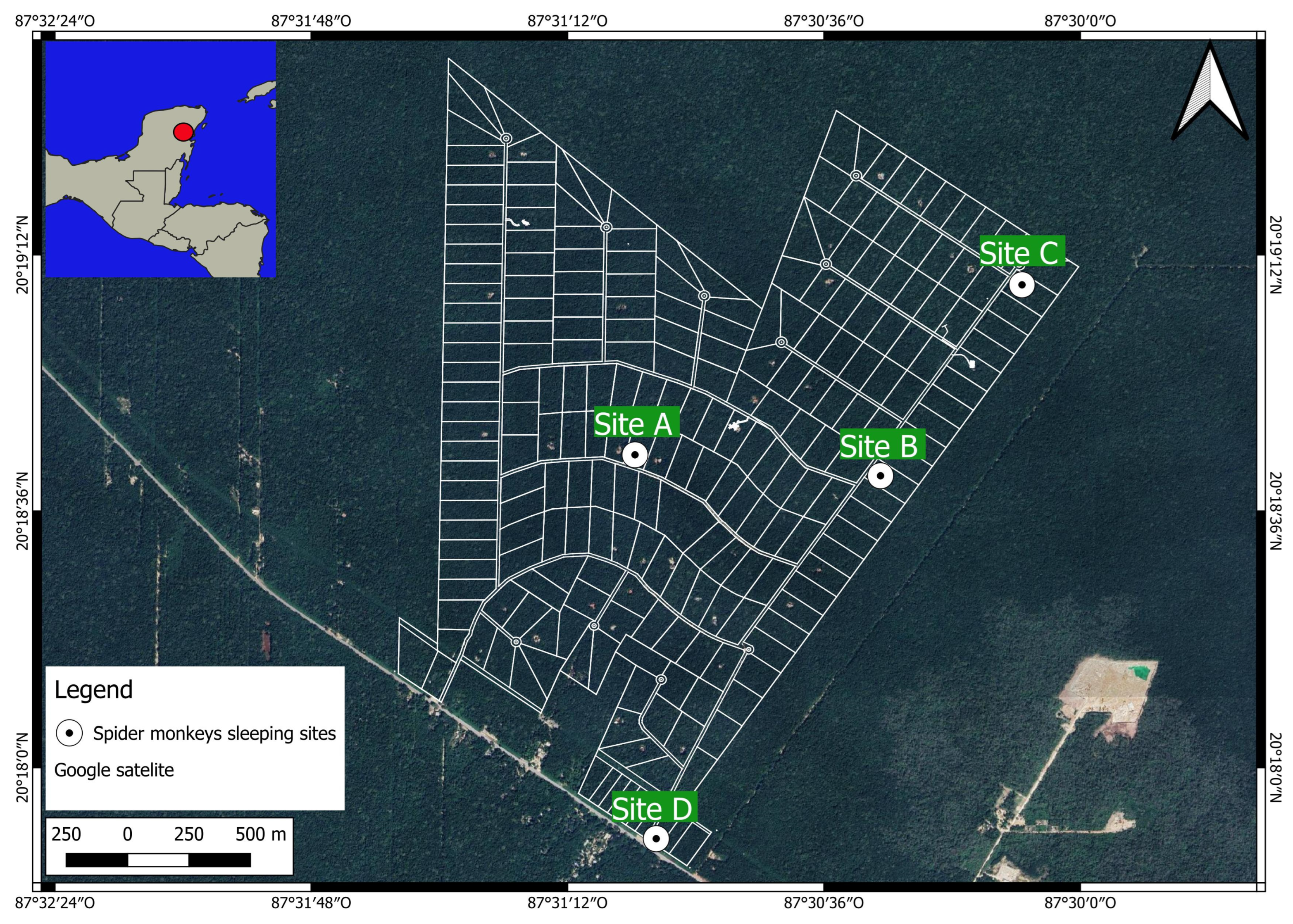
We conducted the study in Los Arboles Tulum (LAT; 20°17′50″ N, 87°30′59″ W), located in the municipality of Tulum, Quintana Roo, Mexico (Figure 1). LAT is a 400 ha sustainable residential development where only 5% of each 2 ha lot can be used for construction, and the remaining area is medium-stature evergreen forest (<30 m tall). We selected this study site to evaluate changes in spider monkey subgroup size during the night because a long-term research project on wild spider monkeys has been ongoing there since 2017 [34]. As a result, detailed information on the location of multiple sleeping sites (i.e., clusters of trees where spider monkeys pass the night) is available. All sleeping sites identified within the study area are located within approximately 50 m of residential houses, a distance at which artificial light and anthropogenic noise may influence nocturnal environmental conditions [32]. In addition, previous drone surveys have already been conducted in LAT [4,10,17,35], and as such, the spider monkeys living in LAT are habituated to both the presence of researchers and drone flights, reducing the potential disturbance associated with such monitoring [36]. Our previous flight experience and long-term study of spider monkeys at the site provided information on the vertical forest structure, facilitating the safety of night flights.

2.2. TIR Drone Flights

We conducted the TIR drone flights using two drone models: a custom-built quadcopter in June of 2018 and a Mavic 2 Enterprise Advanced (M2EA) in August of 2025. The custom-built drone used a 550 mm quadcopter frame made of extruded aluminum arms and fiberglass plates, providing an optimal strength-to-weight ratio [10]. It was powered by a 14.8 V lithium polymer (LiPo) battery, allowing for approximately 10 min of flight time. A Pixhawk 2.1 autopilot running ArduCopter open-source firmware provided flexible configuration and operation. The system carried a TeAx Fusion Zoom dual-vision camera, which combines a FLIR Tau2 640 core TIR camera (image size of 640 × 512 pixels) with a 19 mm lens. The camera assembly was attached to a gimbal to ensure image stability during flight. The M2EA was equipped with four rotors, allowing for stable flight and precise maneuverability. It was powered by a high-capacity LiPo 4S battery with a capacity of 3850 mAh and has a maximum flight time of 31 minutes. This model was equipped with a high-resolution TIR camera featuring a 9 mm focal length lens (38 mm for 35 mm equivalent) and an image size of 640 × 512 pixels. This camera records at 30 frames per second with a temperature measurement accuracy of ± 2 °C (DJI Technology Co., Shenzhen, China). We created the routes and performed the flights using Mission Planner software (v1.3.52.0; http://ardupilot.org/planner/) for the custom-built drone and the DJI Pilot application (version 1.1.5) for the M2EA flights. As we used two different drone models with different TIR sensors, we analyzed the data by drone model to address any potential influence of differences in optical or thermal characteristics.
We conducted 18 pairs of TIR drone flights over four different sleeping sites used by three well-habituated spider monkey groups (Figure 1). Eighteen flights were conducted after sunset (hereafter sunset flights), between 19:00 and 21:25 h (−6 h GMT), and 18 before sunrise the following morning (hereafter sunrise flights), between 4:30 and 5:45 h. Before each flight, we confirmed the presence of spider monkeys through direct visual detection or acoustic detection of their distinctive vocalizations. We performed the 18 sunset flights after the spider monkeys had settled at each sleeping site. The 18 sunrise flights were carried out the following morning when the monkeys were still at the same sleeping site before the monkeys began their daily activities. In 2018, the custom-built quadcopter flew a lawn-mower grid over the sleeping site at a height of 70 m above ground level (a.g.l.). We conducted each grid flight using two batteries, with flight duration ranging between 4 and 8 min, and overlap and sidelap fixed at 60% for all grid flights. In 2025, we flew the M2EA drone along a straight 120 m transect directly over the sleeping site at a height of 50 m a.g.l. for approximately 3–4 minutes, using one fully charged battery for each individual flight. For all flights in both years, we positioned the camera at a −90° nadir angle and maintained a constant flight speed of 2 m/s. We estimated the sampling area of each drone flight based on the ground-projected field of view (FOV) of the thermal sensor and the spatial extent of the flight trajectories. To project the sensor field of view onto the ground, we used the following formula:
F O V g r o u n d = 2 × H × t a n ( 2 F O V )
where H is the flight height above ground level, FOV is the sensor’s horizontal field of view in degrees and tan refers to the tangent trigonometric function. This formula is widely used to derive image footprint dimensions from sensor geometry and flight height in drone studies [37]. To estimate the sampling area, we projected the sensor’s field of view onto the ground and buffered the flight tracks accordingly, dissolving the resulting grid polygons into a single area per flight. This approach yielded a sampling area for the custom-built model of approximately 0.91 ha per flight at sleeping site A and 2.25 ha per flight at sleeping site B. The sampling area for the M2EA model was approximately 0.65 ha per flight at both sleeping sites C and D. All buffering, polygon generation, and area calculations were performed in QGIS (version 3.34.10).
We selected these flight parameters because previous studies have shown that this combination maximizes the detectability of spider monkeys and yields high agreement among coders during video review, ensuring consistent and reliable identification of individuals in TIR footage [17]. Moreover, the selected flight heights have been shown not to elicit strong behavioral responses in spider monkeys, minimizing potential disturbance during data collection [36]. During all flights, we recorded a continuous video that we later reviewed to count all spider monkey individuals.

2.3. Video Review

Video review was conducted by two researchers with extensive experience in detecting and tracking wild spider monkeys in both direct field observations and TIR drone footage. To minimize observer bias, the same researcher always reviewed both the sunset and sunrise recordings of the same flight pair. We reviewed the videos using VLC v3.0.12 (Video LAN Organization, Paris, France) media software, playing them at normal speed. When needed, we used the slow-motion playback and optical zoom functions to conduct a more exhaustive and detailed inspection. When we detected spider monkeys, we paused the footage and replayed the segment multiple times to ensure accurate counting of all visible individuals. This procedure was especially important when individuals were clustered together (i.e., in close proximity to one another) or partially overlapped in the canopy, conditions that could obscure heat signatures and lead to undercounting.

2.4. Data Analysis

To quantify how frequently subgroup size changed during the night we compared monkey counts obtained from videos recorded from sunset flights with those from the corresponding sunrise flights carried out the following morning. We calculated the percentage of flight pairs in which the number of detected individuals differed between the sunset and sunrise videos. To determine the direction of these changes, we categorized each pair of flights as having more individuals detected after sunset, more detected before sunrise, or the same number in both surveys, and calculated the percentage for each category. This approach allowed us to describe not only how often subgroup size changed overnight, but also whether these changes more commonly reflected fissions or fusions. In addition, during the video review, we classified each detected subgroup as small (<10 individuals) or large (≥10 individuals; [10], which allowed us to assess whether changes in subgroup size during the night differed between small and large subgroups.
To assess whether the observed changes in the number of spider monkeys between paired sunset and sunrise flights differed from random expectation, we conducted a binomial test. The binomial test evaluated whether the proportion of flights with more individuals at sunrise differed significantly from a 50:50 expectation. We performed the binomial test in R version 4.5.2 [38].

3. Results

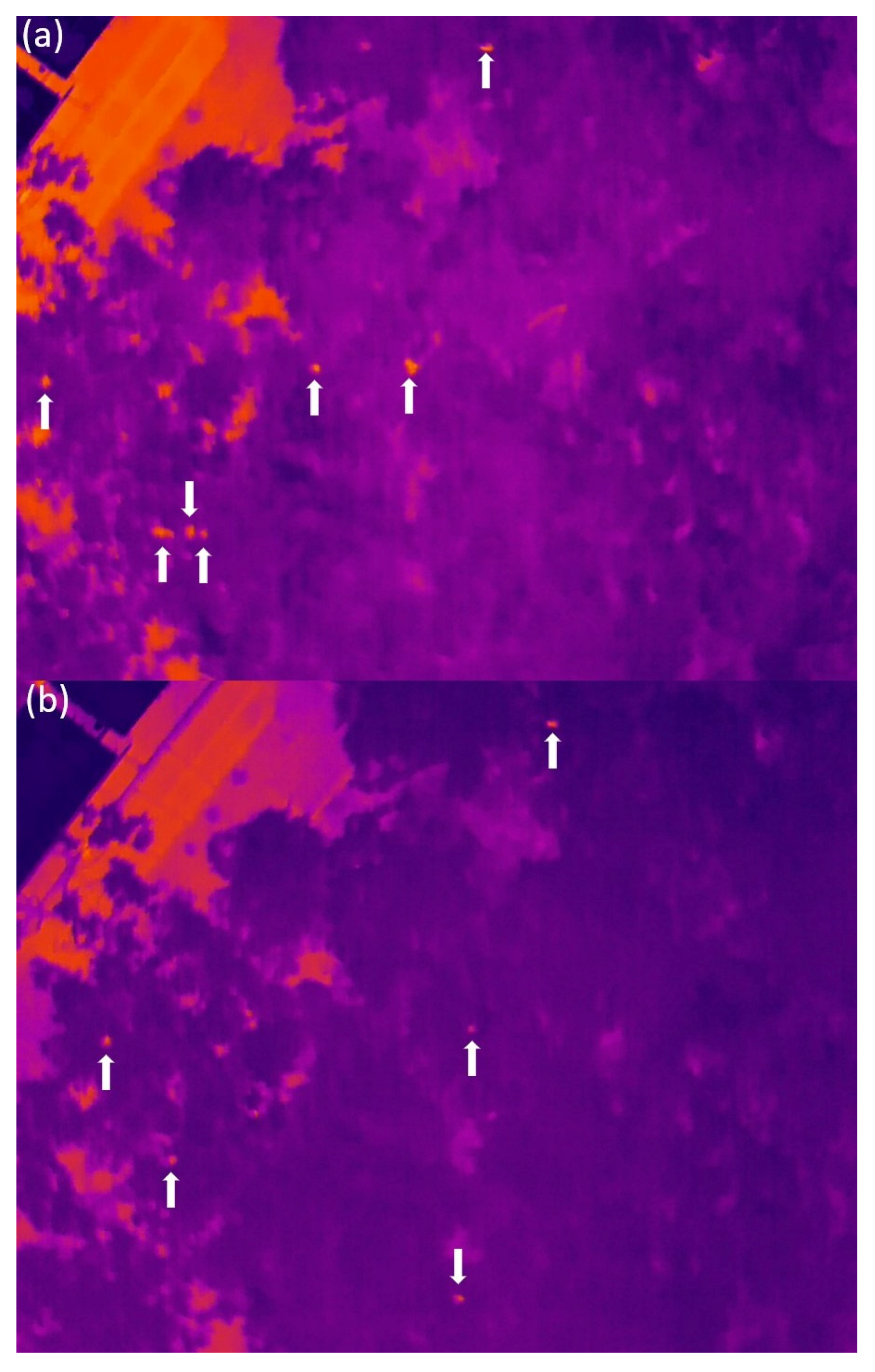
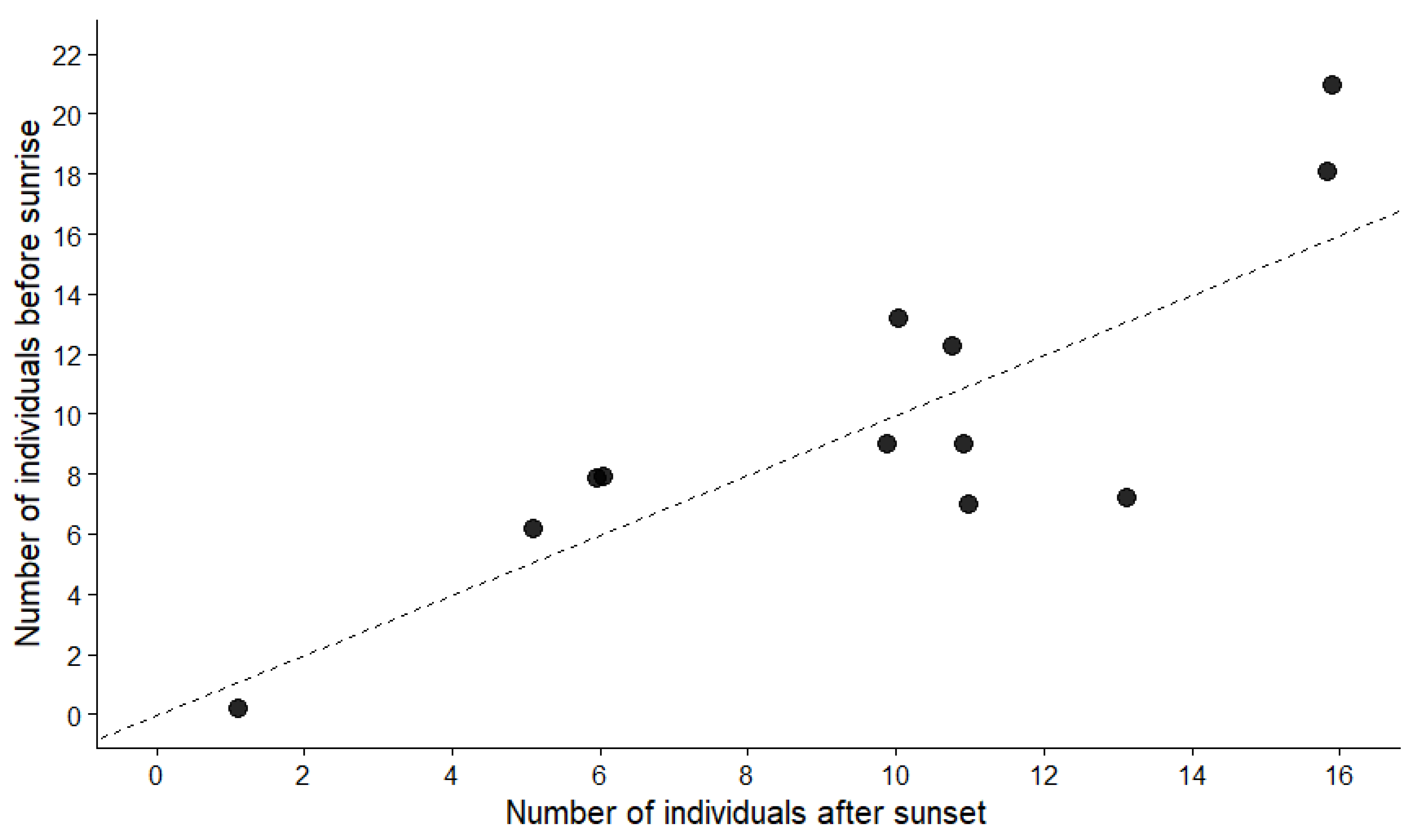
We detected monkeys in 35 of the 36 videos and found changes in spider monkey subgroup size at all four sleeping sites monitored (Figure 2). In 12 out of the 18 flight-pair comparisons (67%), the number of individuals recorded after sunset differed from the number detected before sunrise. In 58% of these cases (7 out of 12), we detected more individuals during sunrise flights than during sunset flights (Figure 3), which did not differ from a 50:50 expectation (binomial test: p = 0.77). When we separated the results by drone type, there were changes in the number of individuals between sunset and sunrise footages in all five custom-built drone flight pairs (100%) and in seven of the thirteen M2EA flight pairs (54%). Among the flight pairs in which there were changes in subgroup size, we detected more individuals before sunrise than after sunset in four of the five custom-built drone flight pairs (80%) and in three of the seven M2EA flight pairs (43%) (Figure 3). Additionally, when combining flights from both drones, changes in subgroup size were more frequent when the spider monkey subgroups were relatively large at sunset: in 67% of the cases where changes occurred (8 out of 12), the sunset subgroups contained 10 or more individuals (Figure 3). Interestingly, in the subset of relatively large sunset subgroups, subgroup size decreased in 4 cases and increased in the other 4 cases, with the two largest sunset subgroups becoming even larger at sunrise.

4. Discussion

In this study, we evaluated nighttime changes in Geoffroy’s spider monkey subgroup size using TIR drone footage collected at four sleeping sites. Across 18 paired flights conducted at sunset and at sunrise the following morning, we found that the number of monkeys differed between sunset and sunrise in 67% of cases, indicating that subgroup composition changed overnight. Moreover, changes in subgroup size were more frequent when sunset subgroups were relatively large; in 67% of the cases where changes occurred, the sunset subgroups contained 10 or more individuals, suggesting that larger subgroups are more prone to reorganization during the night.
The changes in subgroup size between sunset and sunrise reported here indicate that spider monkeys may continue to socially reorganize themselves at sleeping sites, suggesting that the processes characteristic of their daytime fission–fusion dynamics extend into the nighttime period. In 58% of the flight-pairs in which we found a subgroup change, we detected more monkeys during sunrise than during sunset flights, implying that additional individuals joined the sleeping sites during the night. In the remaining 42% of cases, fewer individuals were counted at sunrise, indicating that some spider monkeys left the sleeping sites during the night. When we separated the results by drone model, we observed changes in subgroup size in all flight pairs (100%) conducted with the custom-built drone and in 54% of the flight pairs conducted with the M2EA drone. Among the cases in which subgroup size changed, we detected more individuals before sunrise than after sunset in 80% of the custom-built drone flight pairs and in 43% of the M2EA flight pairs. Our results show that despite differences in drone models and TIR sensors, both systems revealed changes in subgroup size between sunset and sunrise, with subgroup sizes both increasing and decreasing overnight. This convergence across drone models suggests that the observed patterns are not solely attributable to detection characteristics, but are consistent with ongoing nocturnal social reorganization at sleeping sites.
A decrease in the number of individuals (fissions) might be expected, as larger subgroups inherently have more potential for internal rearrangement or temporary separations of subgroup members [23,39]. However, this pattern was not consistent in our dataset. While four of the large sunset subgroups decreased in size, the other four increased, and notably, the two largest sunset subgroups became even larger at sunrise. This variable pattern suggests that subgroup dynamics at sleeping sites do not only depend on the initial subgroup size. The occurrence of both fission and fusion events possibly reflects a combination of factors including food availability, predation risk, and individual social preferences, similar to what has been reported for spider monkey daytime fission–fusion dynamics [29,40,41,42].
An increase in the number of individuals (fusions) may be due to some subgroup members lagging behind during evening travel and joining the others later in the night. In fact, during some of the 2018 flights that covered a larger area than the sleeping site due to the lawn-mower grid patterns, we detected other monkeys nearby. An increase in subgroup size may reflect smaller subgroups joining others from nearby sleeping sites during the night. Such behavior could enhance safety through increased vigilance and reduce predation risk, as individuals in larger groups benefit from collective detection and deterrence of predators [43,44]. In addition, nighttime fusions may potentially have a thermoregulatory function, as sleeping in close proximity can reduce heat loss during cooler periods of the night or in different seasons [45]. In other Neotropical primates, nocturnal sleep behavior and sleeping site selection are often shaped by a balance between social relationships, predation risk, and thermoregulatory demands, particularly in cooler environments [46,47]. As we performed the flights in June and August, which are within the warmest period of the year in the region [48], thermoregulation is unlikely to be a primary driver of subgroup size changes in our study. Therefore, nighttime increases in subgroup size are best interpreted as the outcome of multiple interacting social and spatial processes, involving late arrivals and fusions between nearby subgroups.
Changes in spider monkey subgroup size at night is consistent with recent findings by Spaan et al. [32], who documented vocal and non-vocal activity throughout the night in the same population of Geoffroy’s spider monkeys. Nocturnal vocal exchanges may reflect communication among individuals at the sleeping site and those arriving (cf. [31]). This nighttime communication may facilitate subgroup reorganization, maintain coordination among dispersed individuals, or mediate late arrivals. The tendency for spider monkeys to select sleeping sites that are centrally located within their daily travel routes [31,49] implies that sleeping sites function as predictable meeting points for individuals returning from different foraging areas. Consequently, subgroup fusions at these sleeping sites may help reinforce social relationships by providing opportunities for social interactions, facilitate information exchange about food locations, and offer antipredator benefits through increased subgroup size at night [31,50,51].
A further factor that may influence nocturnal subgroup reorganization is nighttime visibility. Variation in lunar illumination, cloud cover, and artificial light could affect how spider monkeys navigate, coordinate movements, and reunite with conspecifics after dark [52,53]. Clear nights with higher moonlight illumination levels and low cloud cover may facilitate movement within and between sleeping sites and enhance visual detection of group members, whereas darker nights could constrain movement and increase reliance on vocal communication [26,45,46]. We could not assess whether nocturnal changes in subgroup size occurred more frequently in higher illumination conditions, due to lack of appropriate data. Although information on moon phase can be obtained from online sources, cloud cover data are not available at a sufficiently fine spatial and temporal resolution for our study site and for the exact time windows during which each drone flight was conducted. Importantly, lunar illumination depends on cloud cover, as high cloud cover can substantially attenuate moonlight; thus, even during phases of high lunar illumination (e.g., full moon), heavily overcast nights do not result in high visibility within the forest [54]. In addition, a substantial proportion of nighttime illumination at our study sites originates from artificial light sources associated with nearby houses, for which we have no quantitative data. Future studies integrating TIR drone surveys with detailed environmental data, including lunar and artificial light levels, would help clarify the role of nighttime visibility in shaping nocturnal social dynamics in spider monkeys.
Our results also have broader implications for understanding species traditionally classified as strictly diurnal. In such taxa, nocturnal behavior has often been assumed to consist exclusively of sleep; however, increasing evidence from direct observation [32], thermal imaging [12] and passive acoustic monitoring studies [55] suggests that low-level nocturnal activity, including social communication, may be more widespread than previously recognized. Our results support this view by demonstrating that spider monkeys exhibit social reorganization during nocturnal hours. From a conservation perspective, understanding how social organization varies at night is particularly relevant, as subgroup dynamics and sleeping-site selection can influence vulnerability to anthropogenic disturbances such as logging, hunting, and habitat fragmentation [56,57]. Spider monkeys rely on specific sleeping sites and use them repeatedly [30,31]. The subgrouping patterns we documented between sunset and sunrise suggest that these sites play an important role in social processes during the night. The removal of trees at these sites due anthropogenic activities could therefore disrupt these processes by forcing individuals to use unfamiliar or suboptimal sites, potentially decreasing coalescence of subgroups with negative consequences in terms of increased predation risk and reduced information-exchange opportunities. Such disruptions may also have broader consequences for the fission-fusion dynamics that characterize the species. In human-modified landscapes, expanding human activity can alter daytime habitat use and movement patterns, leading diurnal mammals to increase their use of nighttime periods [58]. In group-living species such as spider monkeys, this type of temporal shift in activity may alter social reorganization processes at night. Documenting nocturnal changes in subgroup sizes thus provides important insights into the role of sleeping sites as structural elements that support social dynamics, emphasizing the need to conserve them to maintain the social and ecological stability of spider monkey populations.
The use of TIR drones to document spider monkey subgroup-size changes during the night emphasizes the methodological advantages of remote-sensing technologies for primate research [59]. Traditional ground-based observation is effective for documenting daytime activities, but it is often constrained by limited visibility, canopy density, and the difficulty of accurately counting individuals that spend the majority of their time in the forest canopy [60]. At night, these limitations become even more pronounced, making direct observations nearly impossible. TIR drones overcome these limitations by capturing heat signatures that reveal the presence and number of individuals that are found in the upper canopy [9,61], as is the case with spider monkeys in their sleeping trees at night. When flown at appropriate height and flight speed, drones yield reliable and minimally invasive records of individual presence and subgroup size [36,62]. This is particularly valuable for species that are sensitive to human presence and where prolonged observation at sleeping sites could cause stress or influence group behavior. The use of TIR drones therefore opens new avenues to study fission–fusion dynamics at night. In addition, TIR drones enable repeated monitoring of multiple sleeping sites across a landscape, providing opportunities to examine spatial and temporal variation in subgrouping patterns at night. Such data can contribute to questions regarding habitat selection, home-range use, and responses to anthropogenic activities. For conservation management, knowing how many individuals are present at the sleeping sites provides valuable information to estimate population size if drone flights covering a large area (and thereby including all potential sleeping sites of one or multiple groups) are performed in a single night. Repeating such flights over time can aid detecting demographic changes, which is often challenging for arboreal primates [63].
When interpreting our results, it is important to consider how detection of individual spider monkeys is influenced by variation in thermal contrast, potential differences in sensor characteristics between drone models, and the manual processing of thermal videos. Previous studies have shown that the time of day at which TIR drone flights are conducted can affect individual detection [9], as background thermal conditions and thermal contrast vary throughout the diel cycle. Differences in thermal contrast have also been shown to influence the level of agreement among coders when manually processing TIR drone footage, with higher concordance reported in high-contrast environments and lower agreement in areas where heat-absorbing background elements may partially mask animal heat signatures [17]. Differences in the ambient temperature between sunset and sunrise flights likely resulted in differences in thermal contrast between animals and their surroundings, possibly facilitating the detection of monkeys at sunrise. However, we consider the likelihood that these differences in thermal contrast represented a critical source of bias in the spider monkey counts to be low. In fact, we did not systematically detect more monkeys in footage recorded at sunrise (39% of flight pairs) as we detected the same number of individuals in six flight pairs (33%) and more individuals at sunset in five flight pairs (28%). Furthermore, the binomial test on the 12 flight pairs in which we found a subgroup change did not reveal a significant difference, indicating that detectability was not consistently higher before sunrise.
Another factor to consider is that data were collected using two drone models with different sensors and flight designs, which resulted in differences in the sampling area among sleeping sites. However, these differences did not influence our paired comparisons because sunset and sunrise flights at each sleeping site were always conducted using the same drone model and the same flight pattern, thus sampling the same area in both flights. Night changes in subgroup size were detected regardless of the drone model, sensor characteristics, or flight type used, suggesting that the results are unlikely to be driven by methodological differences in detectability. In addition, it is unlikely that the spatial arrangement of individuals at sleeping sites influenced detectability in TIR imagery. Although several individuals may use the same sleeping site, at our study site spider monkeys usually sleep in multiple contiguous trees rather than clustering together within a single large tree, making their thermal signatures easily distinguishable. Therefore, the risk of underestimating group size due to merged thermal signatures is expected to be minor. While thermal contrast, sensor differences, and manual processing should be considered when interpreting TIR drone data, they are unlikely to have strongly biased detectability patterns and the main conclusions of our study.

5. Conclusions

Our finding that subgroup size can change between sunset and sunrise indicates that spider monkey social organization remains dynamic throughout the night. This insight contributes to a more complete understanding of spider monkey behavioral ecology, emphasizing that even species classified as strictly diurnal may engage in nighttime social reorganization. Our results indicate that subgroup changes are not restricted to daytime, but may also occur during the night, potentially facilitating information exchange and predator avoidance [31,43,44,46,47]. Our study uses TIR drones to explore the nocturnal activity of spider monkeys and lays the groundwork for future, more comprehensive research. Overall, our study highlights the importance of incorporating nighttime behavior into research on diurnal animals to avoid underestimating the temporal patterns of their social dynamics and its implications.
The use of TIR drone technology can play a crucial role in monitoring primate behavior, expanding the methodological toolkit available for arboreal mammal research and allowing researchers to overcome longstanding challenges of nocturnal observation in dense tropical forests. Beyond improving detectability, this technology also enhances our ability to document social dynamics across the full 24 h cycle. By enabling consistent, minimally invasive, and spatially comprehensive nocturnal data collection, TIR drone technology contributes to a more complete and accurate characterization of arboreal mammal ecology and behavior, ultimately informing more effective conservation strategies.

Author Contributions

Conceptualization, E.J.P.-R., D.S. and F.A.; Methodology, E.J.P.-R., D.S., S.W. and F.A.; Formal analysis, E.J.P.-R.; Investigation, E.J.P.-R., D.S. and F.A.; Resources, E.J.P.-R., D.S., S.W. and F.A.; Data curation, E.J.P.-R. and D.S.; Writing—original draft, E.J.P.-R., D.S. and F.A.; Writing—review and editing, S.W.; Supervision, D.S., S.W. and F.A.; Project administration, E.J.P.-R., D.S. and F.A.; Funding acquisition, E.J.P.-R., D.S., S.W. and F.A. All authors have read and agreed to the published version of the manuscript.

Funding

This work was possible thanks to the support of the Secretaría de Ciencia, Humanidades, Tecnología e Innovación [CECIHTI: CVU: 1107752], the Conservation Grant of the Primate Society of Great Britain, the Latin American Field Research Award of the American Society of Mammalogists, the Primate Action Fund of Re:Wild and the Margot Marsh Foundation (grant SMA-CCO-G0000000094), the National Geographic Society (WW-198EC-17) and the UK Science and Technology Facilities Council Global Challenges Research Fund (ST/R002673/1).

Institutional Review Board Statement

This research was conducted under the permit of the Secretaría del Medio Ambiente y Recursos Naturales of Mexico, SGPAIOGVSJ 10405 /15 (approval date: 28 September 2015) for 2018 flights and SEMARNAT:SPARN/DGVS/08608/23 (approval date: 16 August 2023) for 2025 flights. Individual home-owners in LAT provided permission to perform these flights over their properties.

Informed Consent Statement

Not applicable.

Data Availability Statement

The original data presented in the study (i.e., the number of monkey detections from the thermal videos) are openly available in FigShare at https://doi.org/10.6084/m9.figshare.30906932 accessed on 19 December 2025. The raw TIR videos can be made available upon reasonable request.

Acknowledgments

We would like to thank Monica Maravert Solano for their support as pilot during the drone flights. We thank Claire Burke, Owen McAree, Coral E. Rangel-Rivera, Anja Hutschenreiter and Cecilia Cahum Cahum for aiding in data collection and revision of the 2018 flights. We are thankful to Los Arboles Tulum for permission to conduct the study and for logistic and financial support.

Conflicts of Interest

The authors declare no conflicts of interest.

References

  1. Schad, L.; Fischer, J. Opportunities and risks in the use of drones for studying animal behaviour. Methods Ecol. Evol. 2023, 14, 1864–1872. [Google Scholar] [CrossRef] [Scilit]
  2. Pedrazzi, L.; Naik, H.; Sandbrook, C.; Lurgi, M.; Fürtbauer, I.; King, A.J. Advancing animal behaviour research using drone technology. Anim. Behav. 2025, 222, 123147. [Google Scholar] [CrossRef] [Scilit]
  3. Kline, J.; Afridi, S.; Rolland, E.G.A.; Maalouf, G.; Laporte-Devylder, L.; Stewart, C.; Crofoot, M.; Stewart, C.V.; Rubenstein, D.I.; Berger-Wolf, T. Studying collective animal behaviour with drones and computer vision. Methods Ecol. Evol. 2025, 16, 2229–2259. [Google Scholar] [CrossRef] [Scilit]
  4. Pinel-Ramos, E.J.; Aureli, F.; Wich, S.; Rodrigues de Melo, F.; Rezende, C.; Brandão, F.; de Melo, F.C.S.A.; Spaan, D. An Assessment of the Effectiveness of RGB-Camera Drones to Monitor Arboreal Mammals in Tropical Forests. Drones 2025, 9, 622. [Google Scholar] [CrossRef] [Scilit]
  5. Gazagne, E.; Goldblatt, C.; Trần Nguyễn, V.; Brotcorne, F.; Hambuckers, A. Utilizing Thermal Imaging Drones to Investigate Sleeping Site Selection in an Arboreal Primate. Curr. Zool. 2025, 71, 560–572. [Google Scholar] [CrossRef] [Scilit] [PubMed]
  6. Nichols, C.A.; Alexander, K. Creeping in the night: What might ecologists be missing? PLoS ONE 2018, 13, e0198277. [Google Scholar] [CrossRef] [Scilit] [PubMed]
  7. Devarajan, K.; Fidino, M.; Farris, Z.J.; Adalsteinsson, S.A.; Andrade-Ponce, G.; Angstmann, J.L.; Anthonysamy, W.; Aquino, J.; Asefa, A.; Avila, B.; et al. When the wild things are: Defining mammalian diel activity and plasticity. Sci. Adv. 2025, 11, eado3843. [Google Scholar] [CrossRef] [Scilit]
  8. Krief, S.; Cibot, M.; Bortolamiol, S.; Seguya, A.; Krief, J.-M.; Masi, S. Wild Chimpanzees on the Edge: Nocturnal Activities in Croplands. PLoS ONE 2014, 9, e109925. [Google Scholar] [CrossRef] [Scilit]
  9. Kays, R.; Sheppard, J.; Mclean, K.; Welch, C.; Paunescu, C.; Wang, V.; Kravit, G.; Crofoot, M. Hot monkey, cold reality: Surveying rainforest canopy mammals using drone-mounted thermal infrared sensors. Int. J. Remote Sens. 2019, 40, 407–419. [Google Scholar] [CrossRef] [Scilit]
  10. Spaan, D.; Burke, C.; McAree, O.; Aureli, F.; Rangel-Rivera, C.E.; Hutschenreiter, A.; Longmore, S.N.; McWhirter, P.R.; Wich, S.A. Thermal infrared imaging from drones offers a major advance for spider monkey surveys. Drones 2019, 3, 34. [Google Scholar] [CrossRef] [Scilit]
  11. Wearn, O.R.; Trinh-Dinh, H.; Le, Q.K.; Nguyen, T.D. UAV-assisted counts of group size facilitate accurate population surveys of the Critically Endangered cao vit gibbon Nomascus nasutus. Oryx 2024, 58, 183–186. [Google Scholar] [CrossRef] [Scilit]
  12. Zhang, H.; Wang, C.; Turvey, S.T.; Sun, Z.; Tan, Z.; Yang, Q.; Long, W.; Wu, X.; Yang, D. Thermal infrared imaging from drones can detect individuals and nocturnal behavior of the world’s rarest primate. Glob. Ecol. Conserv. 2020, 23, e01101. [Google Scholar] [CrossRef] [Scilit]
  13. Chang, B.; Hwang, B.; Lim, W.; Kim, H.; Kang, W.; Park, Y.-S.; Ko, D.W. Enhancing Wildlife Detection Using Thermal Imaging Drones: Designing the Flight Path. Drones 2025, 9, 52. [Google Scholar] [CrossRef] [Scilit]
  14. Gazagne, E.; Gray, R.J.; Wich, S.; Hambuckers, A.; Brotcorne, F. Development of a global thermal detection index to prioritize primate research with thermal drones. Sci. Rep. 2024, 14, 27963. [Google Scholar] [CrossRef] [Scilit]
  15. Reinegger, R.D.; Bissessur, P.; Meereechpersad, I.; Bhanda, G.; Gazagne, E.; Jones, G. Improving primate detection using thermal infrared imaging: Availability and observer errors in drone surveys of mixed tropical forests. Int. J. Remote Sens. 2025, 46, 4345–4373. [Google Scholar] [CrossRef] [Scilit]
  16. Whitworth, A.; Pinto, C.; Ortiz, J.; Flatt, E.; Silman, M. Flight speed and time of day heavily influence rainforest canopy wildlife counts from drone-mounted thermal camera surveys. Biodivers. Conserv. 2022, 31, 3179–3195. [Google Scholar] [CrossRef] [Scilit]
  17. Pinel-Ramos, E.J.; Aureli, F.; Wich, S.; Longmore, S.; Spaan, D. Evaluating Thermal Infrared Drone Flight Parameters on Spider Monkey Detection in Tropical Forests. Sensors 2024, 24, 5659. [Google Scholar] [CrossRef] [Scilit]
  18. Koger, B.; Deshpande, A.; Kerby, J.T.; Graving, J.M.; Costelloe, B.R.; Couzin, I.D. Quantifying the movement, behaviour and environmental context of group-living animals using drones and computer vision. J. Anim. Ecol. 2023, 92, 1357–1371. [Google Scholar] [CrossRef] [Scilit]
  19. Chapman, C.A.; Valenta, K. Costs and benefits of group living are neither simple nor linear. Proc. Natl. Acad. Sci. USA 2015, 112, 14751–14752. [Google Scholar] [CrossRef] [Scilit]
  20. Krause, J.; Ruxton, G.D. Living in Groups; Oxford University Press: Oxford, UK, 2002. [Google Scholar]
  21. Alexander, R.D. The Evolution of Social Behavior. Ann. Rev. Ecol. Syst. 1974, 5, 325–383. [Google Scholar] [CrossRef] [Scilit]
  22. Kappeler, P.M.; van Schaik, C.P. Evolution of Primate Social Systems. Int. J. Primatol. 2002, 23, 707–740. [Google Scholar] [CrossRef] [Scilit]
  23. Aureli, F.; Schaffner, C.M.; Boesch, C.; Bearder, S.K.; Call, J.; Chapman, C.A.; Connor, R.; Di Fiore, A.; Dunbar, R.I.M.; Peter Henzi, S.; et al. Fission-fusion dynamics new research frameworks. Curr. Anthropol. 2008, 49, 627–654. [Google Scholar] [CrossRef]
  24. Asensio, N.; Korstjens, A.H.; Aureli, F. Fissioning minimizes ranging costs in spider monkeys: A multiple-level approach. Behav. Ecol. Sociobiol. 2009, 63, 649–659. [Google Scholar] [CrossRef] [Scilit]
  25. Kummer, H. Primate Societies Group Techniques of Ecological Adaptation; Routledge: New York, NY, USA, 1971. [Google Scholar]
  26. Archie, E.A.; Moss, C.J.; Alberts, S.C. The ties that bind: Genetic relatedness predicts the fission and fusion of social groups in wild African elephants. Proc. R. Soc. B Biol. Sci. 2006, 273, 513–522. [Google Scholar] [CrossRef] [Scilit] [PubMed]
  27. Smith, J.E.; Kolowski, J.M.; Graham, K.E.; Dawes, S.E.; Holekamp, K.E. Social and ecological determinants of fission–fusion dynamics in the spotted hyaena. Anim. Behav. 2008, 76, 619–636. [Google Scholar] [CrossRef] [Scilit]
  28. Matthews, J.K.; Ridley, A.; Kaplin, B.A.; Grueter, C.C. Ecological and reproductive drivers of fission-fusion dynamics in chimpanzees (Pan troglodytes schweinfurthii) inhabiting a montane forest. Behav. Ecol. Sociobiol. 2021, 75, 23. [Google Scholar] [CrossRef] [Scilit]
  29. Aureli, F.; Schaffner, C.M. Social interactions, social relationships and the social system of spider monkeys. In Spider Monkeys; Cambridge University Press: Cambridge, UK, 2008; pp. 236–265. [Google Scholar]
  30. Asensio, N.; Lusseau, D.; Schaffner, C.M.; Aureli, F. Spider monkeys use high-quality core areas in a tropical dry forest. J. Zool. 2012, 287, 250–258. [Google Scholar] [CrossRef] [Scilit]
  31. Chapman, C.A. Spider monkey sleeping sites: Use and availability. Am. J. Primatol. 1989, 18, 53–60. [Google Scholar] [CrossRef] [Scilit]
  32. Spaan, D.; Guisneuf, N.; Rangel-Rivera, C.E.; Saldaña-Sánchez, A.A.; Aureli, F. Spider monkeys (Ateles geoffroyi) are vocally active throughout the night in a human-modified habitat. Primates 2025, 67, 77–87. [Google Scholar] [CrossRef] [Scilit]
  33. Briseño-Jaramillo, M.; Sosa-López, J.R.; Ramos-Fernández, G.; Lemasson, A. Flexible use of contact calls in a species with high fission–fusion dynamics. Philos. Trans. R. Soc. B Biol. Sci. 2022, 377, 20210309. [Google Scholar] [CrossRef] [Scilit]
  34. Pietrangeli, E.; Saldaña-Sánchez, A.A.; Spaan, D.; Aureli, F. Let’s not use it! A dynamic no-use zone between the home ranges of two spider monkey groups. Primates 2024, 65, 173–181. [Google Scholar] [CrossRef] [Scilit]
  35. Spaan, D.; Di Fiore, A.; Rangel-Rivera, C.E.; Hutschenreiter, A.; Wich, S.; Aureli, F. Detecting spider monkeys from the sky using a high-definition RGB camera: A rapid-assessment survey method? Biodivers. Conserv. 2022, 31, 479–496. [Google Scholar] [CrossRef] [Scilit]
  36. Pinel-Ramos, E.J.; Aureli, F.; Wich, S.; Petersen, M.F.; Dias, P.A.D.; Spaan, D. The Behavioral Responses of Geoffroy’s Spider Monkeys to Drone Flights. Drones 2024, 8, 500. [Google Scholar] [CrossRef] [Scilit]
  37. Battulwar, R.; Winkelmaier, G.; Valencia, J.; Naghadehi, M.Z.; Peik, B.; Abbasi, B.; Parvin, B.; Sattarvand, J. A Practical Methodology for Generating High-Resolution 3D Models of Open-Pit Slopes Using UAVs: Flight Path Planning and Optimization. Remote Sens. 2020, 12, 2283. [Google Scholar] [CrossRef] [Scilit]
  38. R Core Team. R: A Language and Environment for Statistical Computing. 2025. Available online: https://www.R-project.org/ (accessed on 1 December 2025).
  39. Chapman, C.A.; Chapman, L.J.; Wrangham, R.W. Ecological constraints on group size: An analysis of spider monkey and chimpanzee subgroups. Behav. Ecol. Sociobiol. 1995, 36, 59–70. [Google Scholar] [CrossRef]
  40. Symington, M.M.F. Fission-fusion social organization in Ateles and Pan. Int. J. Primatol. 1990, 11, 47–61. [Google Scholar] [CrossRef] [Scilit]
  41. Asensio, N.; Korstjens, A.H.; Schaffner, C.M. Intragroup Aggression, Fission-Fusion Dynamics and Feeding Competition in Spider Monkeys. Behaviour 2008, 145, 983–1001. [Google Scholar] [CrossRef] [Scilit]
  42. Busia, L.; Schaffner, C.M.; Aureli, F. Relationship quality affects fission decisions in wild spider monkeys (Ateles geoffroyi). Ethology 2017, 123, 405–411. [Google Scholar] [CrossRef] [Scilit]
  43. Beauchamp, G. Animal Vigilance: Monitoring Predators and Competitors; Academic Press: Cambridge, MA, USA, 2015. [Google Scholar]
  44. Stojan-Dolar, M.; Heymann, E.W. Vigilance in a Cooperatively Breeding Primate. Int. J. Primatol. 2010, 31, 95–116. [Google Scholar] [CrossRef] [Scilit]
  45. Ramanankirahina, R.; Joly, M.; Zimmermann, E. Seasonal Effects on Sleeping Site Ecology in a Nocturnal Pair-Living Lemur (Avahi occidentalis). Int. J. Primatol. 2012, 33, 428–439. [Google Scholar] [CrossRef] [Scilit]
  46. Brividoro, M.V.; Oklander, L.I.; Cantarelli, V.I.; Ponzio, M.F.; Ferrari, H.R.; Kowalewski, M.M. The Effects of Social Factors and Kinship on Co-sleeping of Black-and-Gold Howler Monkeys (Alouatta caraya). Int. J. Primatol. 2021, 42, 876–895. [Google Scholar] [CrossRef] [Scilit]
  47. Savagian, A.; Fernandez-Duque, E. Do Predators and Thermoregulation Influence Choice of Sleeping Sites and Sleeping Behavior in Azara’s Owl Monkeys (Aotus azarae azarae) in Northern Argentina? Int. J. Primatol. 2017, 38, 80–99. [Google Scholar] [CrossRef] [Scilit]
  48. CONAGUA. Normales Climatológicas por Estado. Available online: https://smn.conagua.gob.mx/es/climatologia/informacion-climatologica/normales-climatologicas-por-estado?estado=qroo (accessed on 15 December 2025).
  49. Di Fiore, A.; Campbell, C.J. The atelines: Variation in ecology, behavior, and social organization. In Primates in Perspective; Campbell, C., Fuentes, A., Mackinnon, K., Panger, M., Reader, S., Eds.; Oxford University Press: New York, NY, USA, 2007; pp. 155–185. [Google Scholar]
  50. Jablonski, N.G. Social and affective touch in primates and its role in the evolution of social cohesion. Neuroscience 2021, 464, 117–125. [Google Scholar] [CrossRef] [Scilit]
  51. van Schaik, C.P.; van Noordwijk, M.A.; de Boer, R.J.; den Tonkelaar, I. The effect of group size on time budgets and social behaviour in wild long-tailed macaques (Macaca fascicularis). Behav. Ecol. Sociobiol. 1983, 13, 173–181. [Google Scholar] [CrossRef] [Scilit]
  52. Fernández-Duque, E.; de la Iglesia, H.; Erkert, H.G. Moonstruck Primates: Owl Monkeys (Aotus) Need Moonlight for Nocturnal Activity in Their Natural Environment. PLoS ONE 2010, 5, e12572. [Google Scholar] [CrossRef] [Scilit] [PubMed]
  53. Bischof, R.; Vallejo-Vargas, A.F.; Semper-Pascual, A.; Schowanek, S.D.; Beaudrot, L.; Turek, D.; Jansen, P.A.; Rovero, F.; Johnson, S.E.; Guimarães Moreira Lima, M.; et al. The moon’s influence on the activity of tropical forest mammals. Proc. R. Soc. B Biol. Sci. 2024, 291, 20240683. [Google Scholar] [CrossRef] [Scilit]
  54. Krieg, J. Influence of moon and clouds on night illumination in two different spectral ranges. Sci. Rep. 2021, 11, 20642. [Google Scholar] [CrossRef] [Scilit]
  55. Do Nascimento, L.A.; Pérez-Granados, C.; Beard, K.H. Passive Acoustic Monitoring and Automatic Detection of Diel Patterns and Acoustic Structure of Howler Monkey Roars. Diversity 2021, 13, 566. [Google Scholar] [CrossRef] [Scilit]
  56. Brividoro, M.V.; Kowalewski, M.M.; Scarry, C.J.; Oklander, L.I. Patterns of Sleeping Site and Sleeping Tree Selection by Black-and-Gold Howler Monkeys (Alouatta caraya) in Northern Argentina. Int. J. Primatol. 2019, 40, 374–392. [Google Scholar] [CrossRef] [Scilit]
  57. Brotcorne, F.; Maslarov, C.; Wandia, I.N.; Fuentes, A.; Beudels-Jamar, R.C.; Huynen, M. The role of anthropic, ecological, and social factors in sleeping site choice by long-tailed Macaques ( Macaca fascicularis ). Am. J. Primatol. 2014, 76, 1140–1150. [Google Scholar] [CrossRef] [Scilit]
  58. Gaynor, K.M.; Hojnowski, C.E.; Carter, N.H.; Brashares, J.S. The influence of human disturbance on wildlife nocturnality. Science 2018, 360, 1232–1235. [Google Scholar] [CrossRef] [Scilit]
  59. Piel, A.K.; Crunchant, A.; Knot, I.E.; Chalmers, C.; Fergus, P.; Mulero-Pázmány, M.; Wich, S.A. Noninvasive Technologies for Primate Conservation in the 21st Century. Int. J. Primatol. 2022, 43, 133–167. [Google Scholar] [CrossRef] [Scilit]
  60. Whitworth, A.; Braunholtz, L.D.; Huarcaya, R.P.; MacLeod, R.; Beirne, C. Out on a Limb: Arboreal Camera Traps as an Emerging Methodology for Inventorying Elusive Rainforest Mammals. Trop. Conserv. Sci. 2016, 9, 675–698. [Google Scholar] [CrossRef] [Scilit]
  61. Seymour, A.C.; Dale, J.; Hammill, M.; Halpin, P.N.; Johnston, D.W. Automated detection and enumeration of marine wildlife using unmanned aircraft systems (UAS) and thermal imagery. Sci. Rep. 2017, 7, 45127. [Google Scholar] [CrossRef] [Scilit] [PubMed]
  62. Colombelli-Négrel, D.; Sach, I.Z.; Hough, I.; Hodgson, J.C.; Daniels, C.B.; Kleindorfer, S. Koalas showed limited behavioural response and no physiological response to drones. Appl. Anim. Behav. Sci. 2023, 264, 105963. [Google Scholar] [CrossRef] [Scilit]
  63. Wich, S.A.; Koh, L.P. Conservation drones: Mapping and monitoring biodiversity. In Conservation Drones: Mapping and Monitoring Biodiversity; Oxford Academic: Oxford, UK, 2018; pp. 1–118. [Google Scholar] [CrossRef] [Scilit]
Figure 1. Map of Los Arboles Tulum, Tulum, Mexico, with the grid of the 2 ha lots and the four Geoffroy’s spider monkey sleeping sites where TIR drone flights were carried out. Sites A, B, C, and D indicate the name of each sleeping site.
Drones 10 00114 g001
Figure 2. Geoffroy’s spider monkey individuals detected at the same sleeping site during sunset (a) and sunrise (b). TIR drone flights in Los Arboles Tulum, Mexico. White arrows indicate the location of detected individuals: 7 monkeys (a) and 5 monkeys (b). Both images were recorded using the M2EA drone.
Drones 10 00114 g002
Figure 3. Relation between the number of spider monkeys counted in the TIR footage recorded at sunset and the number of spider monkeys counted in the TIR footage recorded the following morning at sunrise at four sleeping sites at Los Arboles Tulum, Mexico. Each point represents detections in footage recorded in one of the 12 flight pairs in which the numbers of detected monkeys differed between sunset and sunrise at the same sleeping site. The points for two flight pairs that shared identical sunset and sunrise counts were slightly jittered. The dashed line represents the 1:1 relation, with points above the line indicating higher numbers at sunrise.
Drones 10 00114 g003
Disclaimer/Publisher’s Note: The statements, opinions and data contained in all publications are solely those of the individual author(s) and contributor(s) and not of MDPI and/or the editor(s). MDPI and/or the editor(s) disclaim responsibility for any injury to people or property resulting from any ideas, methods, instructions or products referred to in the content.