
Systematic Review

UAV Technologies for Precision Agriculture: Capabilities, Constraints, and Deployment Models for Smallholder Systems in Sub-Saharan Africa

by
Wasiu Akande Ahmed
1,
Joel Segun Ojerinde
1,*,
Seyi Festus Olatoyinbo
2 and
Friday John Ogaleye
3
1
Regional Centre for Space Science and Technology Education in Asia and the Pacific (RCSSTEAP), Hangzhou International Innovation Institute, Beihang University, Hangzhou 311115, China
2
National Space Research and Development Agency (NASRDA), Abuja 900107, FCT, Nigeria
3
United Nations-African Regional Centre for Space Science and Technology Education in English (UN-ARCSSTE-E), Obafemi Awolowo University Campus, PMB 4575, Ile-Ife 220103, Osun State, Nigeria
*
Author to whom correspondence should be addressed.
Drones 2026, 10(2), 115; https://doi.org/10.3390/drones10020115

Submission received: 24 December 2025 / Revised: 27 January 2026 / Accepted: 29 January 2026 / Published: 5 February 2026
(This article belongs to the Special Issue Advances of UAV in Precision Agriculture—2nd Edition)

Highlights

What are the main findings?
  • UAVs demonstrate high technical feasibility in sub-Saharan African smallholder agriculture, with pooled detection accuracy of 90.2% (95% CI: 89.8–92.6%) and yield prediction R2 = 0.841, but adoption remains below 2% due to economic barriers (90% prevalence) and infrastructure deficits like rural electrification below 50%.
  • RGB sensors offer optimal cost-effectiveness (89.4% accuracy at USD 16.50 per percentage point), while hyperspectral systems provide higher performance (93.7%) but at 25.6 times the cost, favoring cooperative models over individual deployment.
What are the implications of the main findings?
  • Coordinated multi-barrier interventions, such as cooperative ownership and off-grid infrastructure, can substantially boost UAV adoption and bridge the ~60% cereal yield gap, enhancing food security for tens of millions of smallholder operations.
  • Evidence-based deployment pathways, prioritizing RGB for small-scale and multispectral for larger cooperatives, guide policy and investment to scale precision agriculture while addressing research gaps in understudied regions like Tanzania and Uganda.

Abstract

Sub-Saharan Africa’s cereal yields remain ~60% below global benchmarks, while unmanned aerial vehicle (UAV) adoption in smallholder systems averages below 2–3% across major economies, revealing a performance–adoption disconnect that requires systematic investigation. This Preferred Reporting Items for Systematic Reviews and Meta-Analyses (PRISMA) 2020 synthesis of 127 sources quantifies the performance of UAV sensors and identifies mechanisms that constrain their adoption across regional agricultural systems. Random-effects meta-analysis synthesized evidence from 81 quantitative studies, yielding 101 total observations. Pooled detection accuracy was estimated from 49 studies contributing 52 observations (mean 90.2%, 95% confidence interval (CI): 89.8–92.6%). Yield prediction performance was assessed from 32 studies contributing 49 observations (pooled coefficient of determination (R2) = 0.841, 95% CI: 0.827–0.855), validating technical feasibility. Cost-effectiveness analysis reveals significant performance–price differentiation: red-green-blue (RGB) sensors achieve 89.4% accuracy at United States Dollar (USD) 16.50 per percentage point versus hyperspectral systems at 93.7% accuracy but at USD 132.17 per point, resulting in a 25.6 times cost differential. Yield prediction models demonstrate robust performance (R2 = 0.81; cereal crops R2 = 0.82). Barrier analysis identifies economic constraints as the primary limiter, with capital requirements reaching 0.8–3.1 times the annual smallholder income. Infrastructure deficits impose secondary constraints, particularly in rural electrification, below 50%. Case study synthesis reveals that coordinated interventions addressing multiple barriers simultaneously—cooperative ownership, off-grid infrastructure, and streamlined regulation—achieve substantially higher adoption than isolated approaches. Engineering economics positions RGB platforms for individual deployment and multispectral systems for cooperative scales (20–50 farmers), establishing feasible deployment pathways for tens of million regional smallholder operations.

1. Introduction

1.1. Global Food Security Imperatives and Sub-Saharan Africa’s Agricultural Challenge

The Food and Agriculture Organization (FAO) projects that global agricultural production must increase by 60–70% by 2050 to meet demand from a population approaching 9.7 billion [1,2], with sub-Saharan Africa (SSA) facing acute challenges despite hosting 60% of the world’s uncultivated arable land. The region has the highest food insecurity rates, with 282 million chronically undernourished in 2022 [2], and population growth projected to add 1.3 billion by 2050 [3]. Cereal yields in SSA are ~49–60% below global benchmarks, exemplified by gaps in Tanzania (49%), Uganda (46%), Malawi (52%), and Ethiopia (26%), based on 2020–2023 FAOSTAT data [4]. These deficits stem from land degradation (contributing to substantial yield reductions in smallholder systems [5]), climate variability [6], pests like fall armyworm [7], and limited inputs/extension services [8,9]. Nigeria illustrates these issues, with agriculture at 22–24% of GDP (Gross Domestic Product), but constrained by mechanization and infrastructure [10,11].

1.2. Precision Agriculture as a Transformative Paradigm

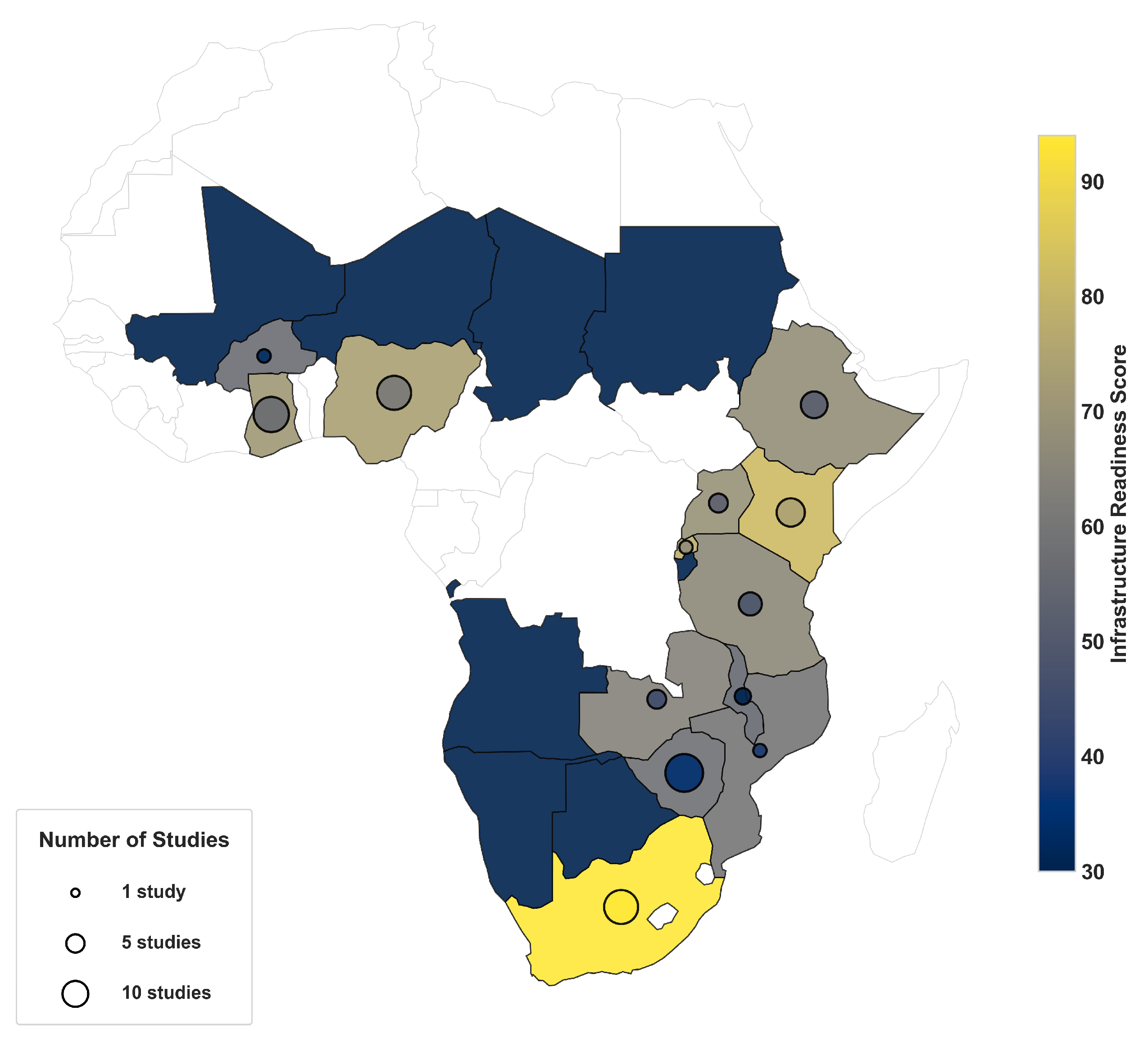
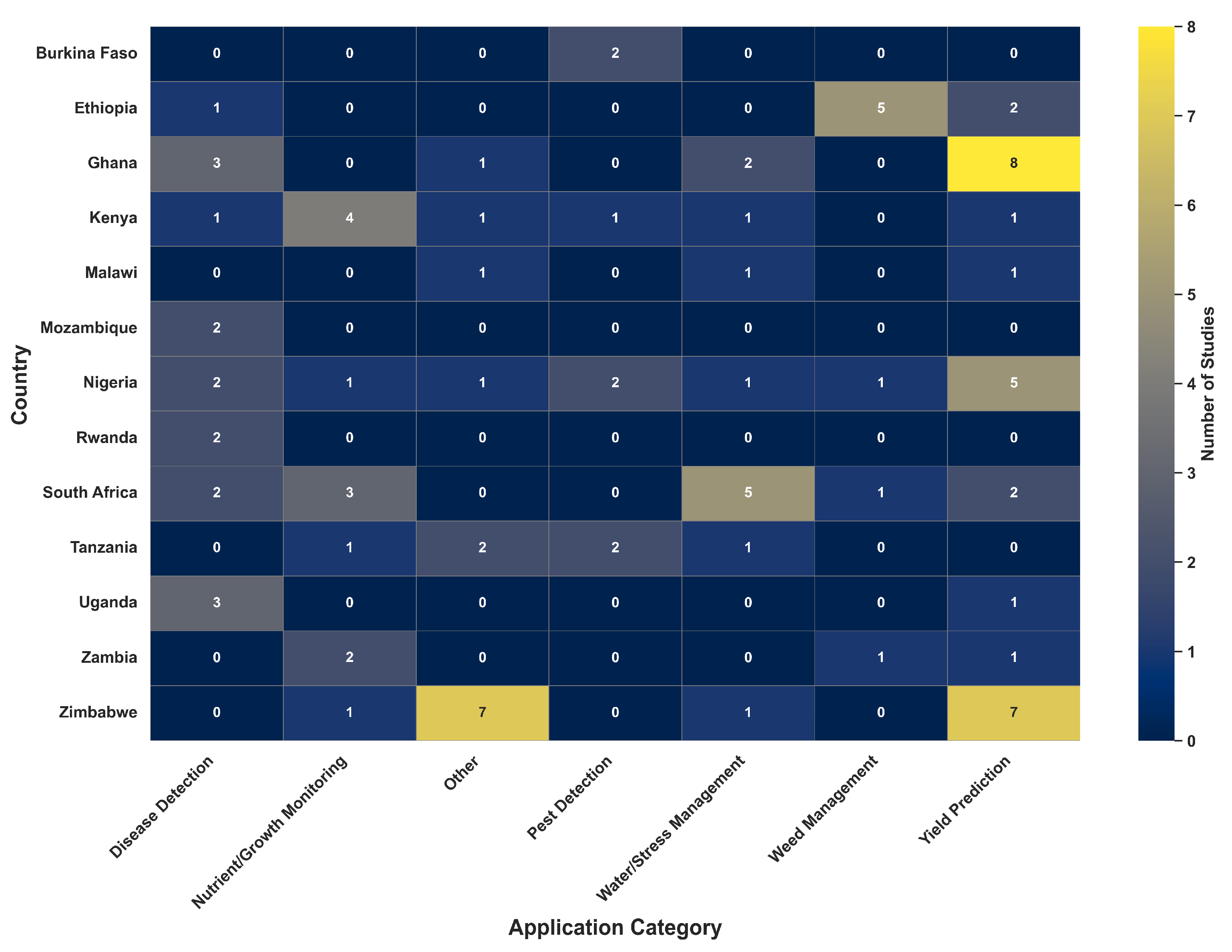
Precision agriculture represents a paradigm shift from uniform field management to spatially and temporally optimized interventions based on high-resolution data acquisition [12]. This data-intensive approach has demonstrated resource-use efficiency improvements typically in the range of 15–30% and yield increases of approximately 10–25% in commercial agricultural systems, as reported across multiple empirical studies [13,14]. Unmanned aerial vehicles (UAVs) occupy a critical technological niche by offering high spatial resolution (approximately 1–10 cm ground sampling distance), flexible temporal deployment, and cost-effectiveness relative to satellite platforms, whose spatial resolution (typically 10–30 m) is often inadequate for smallholder plots averaging 0.5–2 ha, as well as compared with manned aircraft [15,16]. The global agricultural UAV market, valued at approximately USD 1.2 billion in 2022, is projected to expand to over USD 6 billion by 2030, driven by declining sensor costs and advances in data analytics [17]. However, this rapid market expansion has occurred predominantly in developed economies, while adoption across sub-Saharan Africa (SSA) remains limited due to infrastructural, regulatory, and capacity constraints [18,19]. A geographic concentration of UAV-based agricultural research is evident, with Nigeria (11 studies), South Africa (9), and Kenya (8) accounting for the majority of outputs, reflecting a strong positive association with infrastructure readiness indicators, including rural electrification and research capacity (Figure 1) [20].
Despite growing interest in UAV-based precision agriculture for sub-Saharan Africa, systematic quantitative evidence synthesis remains absent, limiting informed technology selection and deployment planning. While UAV technology deployment has accelerated globally, sub-Saharan Africa faces a critical evidence gap distinguishing between technological capability and practical implementation effectiveness. Prior reviews have demonstrated the technical feasibility of UAV-based disease detection and monitoring systems, yet a comprehensive quantitative synthesis specific to sub-Saharan African agricultural contexts remains absent. This systematic review addresses this critical gap by (1) conducting a quantitative meta-analysis synthesizing UAV performance data specifically for sub-Saharan African agricultural systems, (2) conducting systematic heterogeneity decomposition across sensor type, crop characteristics, geographic region, and application domain, (3) integrating technical performance with economic data to generate cost-effectiveness ratios that explicitly account for smallholder budget constraints, and (4) systematically identifying critical research gaps in geographic representation, crop diversity, and application domains.

1.3. The Sub-Saharan Africa Context: Unique Challenges and Opportunities

The sub-Saharan African agricultural landscape presents distinctive characteristics that simultaneously constrain and motivate UAV technology adoption. Critical infrastructure deficits create substantial deployment barriers. Rural electrification coverage reaches only 32.9% in Nigeria, representative of broader regional patterns in which seven of the eight assessed countries report electrification rates below 50%, directly constraining battery charging and data processing capacity required for sustained UAV operations [21,22]. Internet connectivity remains limited in rural areas, with fewer than 30% of rural adults reporting access, and most connections are restricted to 2G or 3G networks, which are inadequate for data-intensive agricultural applications [8,22]. These infrastructure limitations are compounded by low digital literacy, particularly among older farmer cohorts, creating systemic barriers to effective technology utilization, even when hardware is physically available [8]. Economic constraints further dominate UAV adoption, with high capital costs, infrastructure deficits, technical capacity gaps, and regulatory complexity reported in over 75–90% of implementation studies [23,24].
Despite broadly uniform technical potential, UAV adoption in smallholder systems remains very low and heterogeneous, typically ranging from less than 1% in most countries to 2–3% in the most advanced contexts (South Africa and Kenya), with uptake still in nascent or pilot stages in most other sub-Saharan African nations. Relative uptake appears highest in South Africa and Kenya and lowest in Malawi and Tanzania [synthesized from World Bank Digital Agriculture Roadmaps and Country Diagnostics 2022–2025; FAO/GSMA digital agriculture ecosystem assessments; McCarthy et al. (2023) [23]; Ayamga et al. (2021) [25]. Temporal trends indicate slow diffusion, with adoption increasing by only ~0.3 percentage points annually. To address substantial geographic, crop-level, and methodological heterogeneity, this review applies country-stratified subgroup analyses, crop-specific benchmarking, temporal meta-regression (2018–2025), and I2-based variance decomposition alongside sensitivity analyses to assess the robustness of pooled estimates. However, several factors suggest the potential for accelerated adoption trajectories despite current constraints. The predominance of smallholder systems creates a demand for plot-level precision unattainable via satellite imagery, establishing a clear value proposition for high-resolution UAV monitoring. Labor constraints and increasing climate risk further incentivize technologies that improve efficiency and risk mitigation. Declining UAV costs driven by consumer electronics commoditization have reduced entry-level platform prices, approaching affordability thresholds under cooperative ownership and shared-service models that distribute capital requirements while building local technical capacity [26]. Automatic identification and monitoring of plant diseases represent one such high-value application, where UAVs enable early detection and targeted interventions to reduce yield losses [27]. Regional policy initiatives, including the African Union’s Digital Transformation Strategy (2020–2030) and national agricultural technology policies in Nigeria, Kenya, and South Africa, further support adoption through subsidized access schemes and demonstration programs.

1.4. Research Objectives and Contributions

Despite growing interest in UAV-based precision agriculture for sub-Saharan Africa, systematic quantitative evidence synthesis remains absent, limiting informed technology selection and deployment planning. While UAV technology deployment has accelerated globally, sub-Saharan Africa faces a critical evidence gap distinguishing between technological capability and practical implementation effectiveness. Existing literature demonstrates that UAV platforms can capture high-resolution imagery, but fundamental questions remain unanswered: (1) How accurately can drone-derived spectral indices estimate biomass, soil moisture, and vegetation vigor across different phenological stages in SSA’s diverse agroecological zones? (2) What sensor configurations optimize the performance–cost trade-off for resource-constrained smallholder contexts? (3) Do performance benchmarks established in developed agricultural systems transfer to SSA’s fragmented landscapes, limited infrastructure, and distinct crop varieties?
This systematic review addresses six specific scientific questions: (1) What are the pooled detection accuracies and yield prediction R2 values across RGB, multispectral, thermal, and hyperspectral UAV sensors in SSA, and how do these compare with global benchmarks? (2) How do sensor type, platform setup, crop/disease characteristics, and agroecological context explain variation in UAV performance based on subgroup and meta-regression analyses? (3) To what extent do publication bias, small-study effects, and methodological issues inflate reported UAV performance relative to field-level reality? (4) What economic, infrastructural, technical, regulatory, and socio-cultural barriers limit UAV adoption in SSA, and what is their reported prevalence and impact? (5) How do UAV sensor technologies compare in cost per unit performance gain, and which options are economically viable for smallholder systems? (6) Which sensor and deployment configurations are empirically optimal for scalable, real-world use in SSA smallholder agriculture? This work provides four primary contributions: (1) first quantitative meta-analysis synthesizing UAV performance data specifically for sub-Saharan African agricultural systems, establishing empirical benchmarks with statistical confidence intervals previously unavailable to practitioners and policymakers; (2) systematic heterogeneity decomposition across sensor type, crop characteristics, geographic region, and application domain, enabling context-specific technology selection rather than generalized recommendations; (3) integration of technical performance with economic data, generating cost-effectiveness ratios that explicitly account for smallholder budget constraints and opportunity costs; (4) systematic identification of critical research gaps in geographic representation, crop diversity, and application domains, providing empirically grounded priorities for future research investments toward addressing knowledge limitations rather than reinforcing existing concentrations in well-studied context.

2. Methodology

2.1. Study Design and Search Strategy

This methodology complied with the PRISMA (Preferred Reporting Items for Systematic Reviews and Meta-Analyses) 2020 guidelines [28], with a protocol developed a priori to minimize bias. The PRISMA 2020 checklist is provided as Supplementary Materials. Comprehensive literature searches across five databases (MDPI, IEEE Xplore, ScienceDirect, SpringerLink, and Web of Science/Scopus) employed Boolean operators combining key terms: technology (UAV, drone, unmanned aerial vehicle), application (precision agriculture, remote sensing, crop monitoring, yield prediction, disease detection), geography (sub-Saharan Africa, individual country names), and agriculture (smallholder, farming, crop). Database searches were complemented by backward/forward citation tracking and gray literature review (FAO, World Bank, national policy documents, conference proceedings). All searches were conducted in August–October 2024, with final queries completed on 15 October 2024. The overall methodological workflow guiding study identification, eligibility assessment, data extraction, proportional weighting, quantitative meta-analysis, and barrier prioritization is summarized in Figure 2.

2.2. Eligibility Criteria and Study Selection

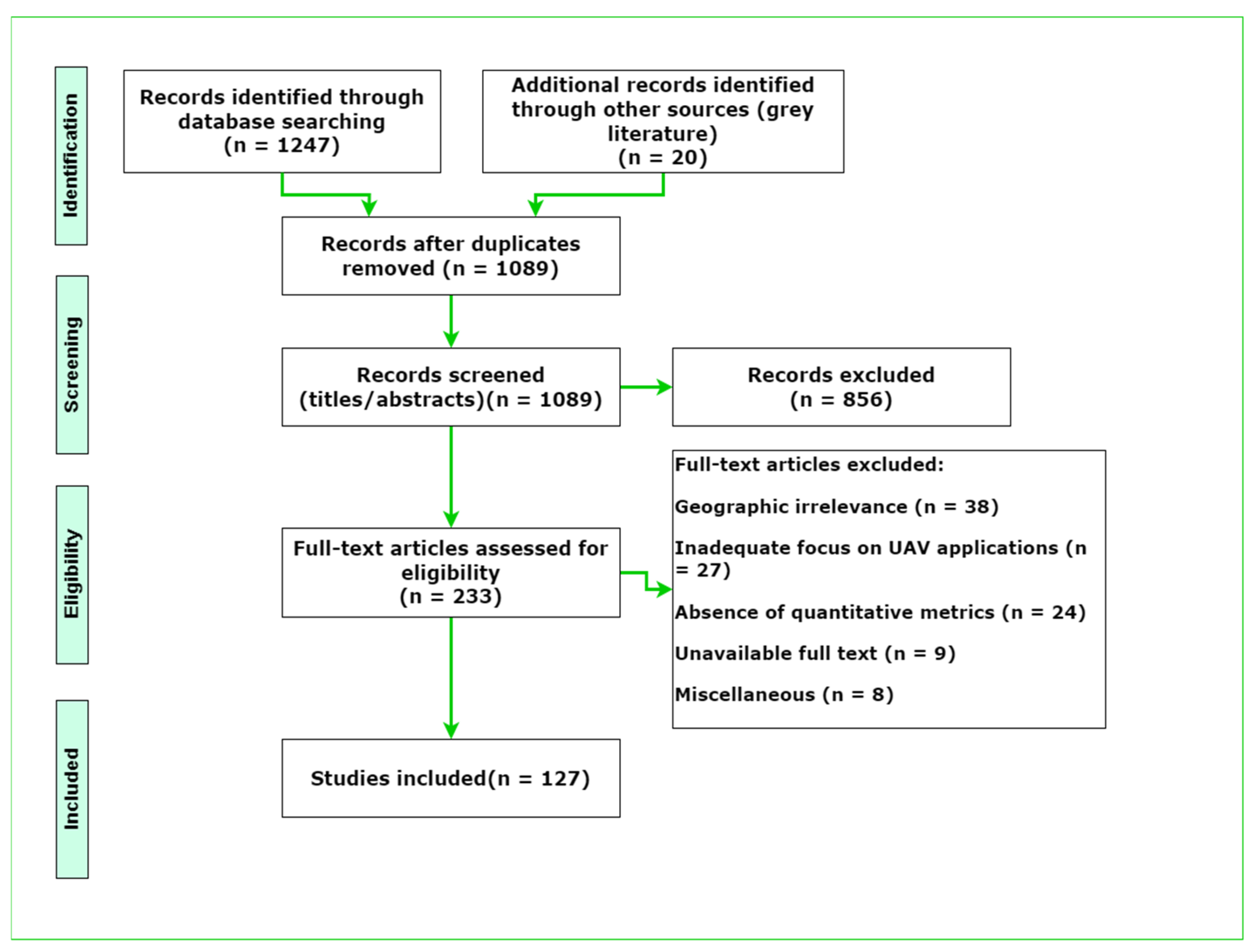
Studies were included if they (1) addressed agricultural systems in sub-Saharan Africa, (2) involved UAV-based remote sensing for precision agriculture, (3) were peer-reviewed or from reputable gray literature (FAO, World Bank, African Union), and (4) published between 2018 and 2025. For quantitative meta-analysis, studies required extractable performance metrics (accuracy, R2, RMSE (Root Mean Square Error), precision, recall, F1-score (Harmonic Mean of Precision and Recall). Exclusion criteria included geographic irrelevance, inadequate UAV focus, or duplicate reporting. Two reviewers independently screened 1089 unique records (1247 initial minus 158 duplicates), selecting 233 for full-text assessment (Figure 3). Of these, 127 studies met the inclusion criteria: 81 quantitative studies (63.8%) with extractable performance data and 46 supporting sources (36.2%) providing technical specifications, implementation case studies, regulatory frameworks, and barrier analyses. The 81 quantitative studies yielded 101 observations for meta-analysis (52 detection accuracy from 49 studies; 49 yield predictions from 32 studies). The 2018 starting point reflects three convergent factors marking an inflection point for UAV adoption in sub-Saharan African agriculture. First, sensor technology matured: multispectral UAVs (MicaSense RedEdge-MX [AgEagle Aerial Systems Inc., Wichita, KS, USA], Parrot Sequoia+ [Parrot SA, Paris, France], DJI Phantom 4 Multispectral [DJI, Shenzhen, China], September 2019, USD 6499) reduced costs by 60–75% versus pre-2018 systems, enabling research institution access. Second, publication activity surged from 2017 to 2018, reflecting the transition from isolated pilots to systematic programs. Third, regulatory frameworks established legal operations: Kenya (March 2018), Nigeria (December 2015), and South Africa (July 2018, South African Civil Aviation Authority [SACAA] Part 101).

2.3. Data Extraction and Meta-Analysis

From the 81 quantitative studies, data were systematically extracted into standardized forms capturing study location (country, region), crop type, UAV platform, sensor type (RGB, multispectral, thermal, hyperspectral, light detection and ranging [LiDAR]), application domain (disease detection, yield prediction, stress monitoring, weed detection, soil mapping), sample size, performance indicators (accuracy, R2, Pearson correlation coefficient [r], root mean square error [RMSE], precision, recall, harmonic mean of precision and recall [F1-score]), confidence intervals/standard errors, publication year, and study design. For studies reporting multiple metrics across sensors, crops, or time points, each distinct observation was recorded separately, resulting in 101 total observations for meta-analysis: 52 detection accuracy observations and 49 yield prediction observations. Multiple observations from single studies were weighted proportionally to prevent overrepresentation. Random-effects meta-analyses using restricted maximum likelihood estimation accounted for between-study heterogeneity. Separate analyses were performed for detection accuracy (accuracy, precision, F1-score as percentages) and yield prediction (R2, correlation coefficient). Heterogeneity was quantified using I2 statistics (25%, 50%, 75% interpreted as low, moderate, high) and Cochran’s Q test. Subgroup analyses stratified by sensor type, crop category (cereals, root crops, cash crops), geographic region (East, West, Southern Africa), and application domain. Meta-regression examined temporal trends (publication year) and sample size effects (log-transformed). Publication bias was assessed using funnel plots and Egger’s regression test. Analyses were conducted using R version 4.3.1 with the metafor package (version 4.4-0) (α = 0.05). Supporting sources (n = 46) provided contextual data: global sensor specifications and performance benchmarks [29,30,31,32,33,34,35,36], including comprehensive UAV platform reviews [29], thermal imagery applications [30], market forecasts for drone adoption [31], compilations of UAV use cases in precision agriculture [32], regional policy frameworks influencing technology access [33], factors shaping smallholder technology adoption [34], digitization challenges in African smallholder systems [35], and systematic reviews of hyperspectral imaging capabilities [36], equipment costs and market data [17,31], implementation case studies and pilot program outcomes [37,38], regulatory frameworks [21,25], socioeconomic barrier analyses [22,23,24], and agricultural extension literature [8,9].

2.3.1. Data Transformation and Variance Stabilization

Accuracy percentages (ranging from 68 to 96%) were assessed for transformation requirements before meta-analysis. The logit transformation was applied to stabilize variance near boundary values (0% or 100%), given by
logit ( p ) = l o g p 1 p
where p is the accuracy proportion (0–1). This transformation converts the bounded [0, 1] scale to an unbounded (−∞, +∞) scale suitable for linear modeling. Sensitivity analyses compared pooled estimates from untransformed and logit-transformed values with back-transformation to the original percentage scale for interpretability. We assessed overall heterogeneity (I2), pooled accuracy by sensor type, normality (Q-Q plot, Shapiro–Wilk test), homoscedasticity (residual plot, Levene’s test), and publication bias (funnel plot asymmetry, Egger’s test). Due to minimal differences between approaches, we report untransformed percentages in the primary analyses, while transformation diagnostics were used to verify robustness.

2.3.2. Study Quality Assessment Framework

To address domain-specific risks in remote sensing, we implemented a simplified 4-domain risk of bias assessment based on study characteristics. Domain 1: Sample size assigns low risk for studies with more than 200 samples, medium risk for studies with between 50 and 200 samples, and high risk for studies with fewer than 50 samples. Domain 2: Validation strategy classifies studies as low risk if they report independent testing, medium risk if they use cross-validation, and high risk if no validation is provided. Domain 3: Overfitting assigns low risk to studies with accuracy below 95% or a large sample size, medium risk to studies with accuracy between 95–98%, and high risk to studies reporting over 98% accuracy with fewer than 100 samples. Domain 4: Reproducibility considers studies as low risk if they provide a DOI and full methods, medium risk if they offer a detailed abstract, and high risk if the methodology lacks transparency. Based on these criteria, studies are classified as Low Risk (≥3 Low), Medium Risk (2 Low or 1 High), or High Risk (≥2 High). High-risk studies are excluded from the primary meta-analysis but included in sensitivity tests.

2.4. Cost-Effectiveness Analysis

A cost-effectiveness analysis integrated pooled performance estimates with verified equipment costs from manufacturer specifications and market surveys [17]. Five-year total cost of ownership calculated incorporating initial capital costs, annual maintenance (8–12% of capital), battery replacement (every 18–24 months), and training (40–80 h initial certification). Incremental cost-effectiveness ratios compared each sensor to the next less expensive alternative (additional cost per percentage point accuracy improvement or per 0.01 R2 unit). Cost-effectiveness frontiers identified Pareto-optimal technology combinations. Sensitivity analyses examined the effects of varying cost assumptions (±30%), discount rates (0–10%), and equipment lifespan (3–7 years). Smallholder farm income baseline (USD 800–3000 annually) was estimated from regional agricultural household surveys and World Bank poverty assessments, reflecting net agricultural income for farms < 2 hectares across sub-Saharan Africa. All cost values are reported in constant USD, referenced to the original study reporting year, and interpreted comparatively rather than as absolute price points.

2.5. Barrier Analysis and Prioritization Framework

Adoption barriers were systematically coded from included studies and implementation reports: economic constraints (capital costs, maintenance, credit access), infrastructure deficits (electrification, connectivity, road access) [21,22], technical capacity limitations (digital literacy, piloting skills, data interpretation), regulatory complexity (authorization procedures, airspace restrictions, certification) [21,23,25], and socio-cultural factors (technology acceptance, gender dynamics, institutional trust) [23,24]. Barrier prevalence was calculated as the percentage of studies reporting each constraint. Quantitative estimates of barrier impact on adoption likelihood were extracted for meta-analysis of severity. The priority intervention framework integrated barrier prevalence, estimated impact magnitude, implementation feasibility, and projected timelines. High-priority interventions addressed constraints with prevalence > 75%, impact estimates indicating a >20 percentage point reduction in adoption likelihood, feasible implementation within 2–3 years, and reasonable cost relative to projected benefits. Each barrier was scored on a three-point ordinal scale (low, moderate, high) based on the frequency of reporting and severity of impact, as described in the source studies. Scores were assigned independently and aggregated to produce the prioritization matrix. Severity was assessed based on reported impact descriptions (minimal constraint, moderate impediment, critical blocker). Barriers reported in a substantial majority of studies (operationalized here as >75%) and described as causing marked adoption constraints were classified as “high priority.”

2.6. Data Handling and Weighting Procedures

Studies with incomplete reporting of primary quantitative outcomes (e.g., missing accuracy metrics, undefined sensor type, or absent sample size) were excluded from the quantitative meta-analysis to avoid inference beyond reported evidence. However, such studies were retained for qualitative synthesis when they provided relevant contextual information on adoption barriers, deployment models, or operational constraints. No numerical imputation or reconstruction of missing values was performed. Studies with partially missing secondary parameters (e.g., confidence intervals or standard errors) were included only where pooling was methodologically valid without requiring additional assumptions. Several studies reported multiple observations arising from different sensors, crops, or experimental conditions. To prevent over-representation, proportional weighting was applied such that the total weight assigned to each study summed to one, regardless of the number of reported observations. Individual observations within a study, therefore, contributed fractionally to the pooled estimate. This approach preserves within-study variability while maintaining independence assumptions at the study level, consistent with standard meta-analytic practices.

3. UAV Technologies and Analytical Frameworks for Precision Agriculture

Precision agriculture effectiveness depends critically on sensor technology selection, with performance–cost trade-offs varying by application domain, crop characteristics, and resource availability [29,30]. This section provides a technical context for interpreting meta-analytical findings.

3.1. UAV Platform Classifications and Operational Characteristics

Agricultural UAV systems are classified into two primary configurations based on aerodynamic principles and operational profiles, each presenting distinct advantages and limitations for smallholder farming contexts.

3.1.1. Rotary-Wing Systems

Multirotor platforms (quadcopters, hexacopters, and octocopters) represent 72% of global deployments [17,31], offering vertical takeoff/landing, hovering stability (±5 cm), flight endurance of 20–35 min, payload capacity of 0.5–10 kg, and coverage of 10–40 hectares per sortie [39]. Ground sampling distance is 1–5 cm at 50–100 m altitude [40]. Advantages include minimal infrastructure requirements, high maneuverability in fragmented farmlands, low capital costs (USD 450–2500), and simplified training (20–40 h) [41,42]. Limitations include restricted area coverage per battery, higher power consumption per unit distance, and reduced wind tolerance (<10–12 m/s) [42]. DJI Mavic 3 Multispectral (DJI, Shenzhen, China; USD 4600) and DJI Matrice 300 RTK (DJI, Shenzhen, China) with Zenmuse P1 camera (DJI, Shenzhen, China; USD 10,500–16,500 base; USD 13,000–19,500 with payload) are used [17]. Recent commercial systems like the DJI Matrice 400 (DJI, Shenzhen, China) equipped with Zenmuse P1 camera achieve a ground sampling distance of 0.6–1.3 cm, flight endurance of 59 min with payload, and coverage of up to 300 hectares per flight at 3 cm GSD [17], making multirotor platforms competitive with fixed-wing systems for large-area monitoring [43].

3.1.2. Fixed-Wing Systems

Fixed-wing UAVs utilize aerodynamic lift, enabling flight endurance of 45–90 min, coverage of 50–500 hectares per flight, and ground sampling distances of 2–8 cm at 100–150 m altitude [44,45]. Advantages: 10–15× area coverage efficiency versus rotary-wing, 40–60% lower power consumption per hectare, enhanced wind tolerance (15 m/s) [17,44,45]. Limitations: Requirement for runway infrastructure (20–50 m), higher acquisition costs (USD 8000–25,000), inability to hover, and complex piloting [17,44,46]. In sub-Saharan Africa, fixed-wing comprises 15–20% of deployments, concentrated in commercial farms >100 hectares and government programs [20]. Representative platforms: senseFly eBee (senseFly SA, Cheseaux-sur-Lausanne, Switzerland) (USD 12,000–20,000) and WingtraOne (Wingtra AG, Zurich, Switzerland) (USD 25,000–35,000) [17].

3.2. Sensor Technologies and Spectral Analysis

3.2.1. RGB (Visible Spectrum) Cameras

RGB cameras capture the visible spectrum (400–700 nm), producing true-color imagery [14]. Consumer-grade cameras (USD 100–500) achieve 1–3 cm ground sampling distance at 50–100 m altitude with 12–24-megapixel resolution, capturing three bands: red (620–700 nm), green (500–570 nm), and blue (450–490 nm) [47]. Several vegetation indices can be derived from RGB imagery, the most common being the Green Leaf Index (GLI) and the Visible Atmospherically Resistant Index (VARI) [48]. The GLI is defined as
G L I = 2 × G r e e n R e d B l u e 2 × G r e e n + R e d + B l u e
which correlates strongly with chlorophyll content and demonstrates sensitivity to early-stage stress conditions [48]. Similarly, the VARI is expressed as
V A R I = G r e e n R e d G r e e n + R e d B l u e
is designed to minimize the influence of atmospheric scattering, yielding robust performance for biomass estimation. This index has also been effectively derived from UAV RGB imagery to support crop–weed discrimination and vegetation vigor assessment in cereal systems such as teff, demonstrating its broader agronomic utility under field conditions [49]. Meta-analysis of 21 RGB-based studies revealed a pooled detection accuracy of 89.4% (95% CI: 88.4–90.4%, I2 = 5.1%) with yield prediction performance averaging R2 = 0.83 (95% CI: 0.808–0.852, n = 14 studies). Cost-effectiveness analysis demonstrates RGB systems at approximately USD 16.50 per accuracy percentage point, making them optimal for visual reconnaissance, weed mapping, lodging detection, and crop growth stage assessment [43,50]. Structure-from-Motion photogrammetry techniques using RGB imagery enable three-dimensional canopy height modeling, further expanding agricultural utility [51].

3.2.2. Multispectral Sensors

Multispectral sensors capture discrete bands beyond the visible spectrum, including red-edge (700–730 nm) and near-infrared (750–900 nm). Typical systems record 5–10 bands with 1.2–5 megapixels per band, 12–16 bits radiometric resolution, and 2–8 cm ground sampling distance. Cost: USD 3000–12,000 [17,31]. Representative models: DJI Phantom 4 Multispectral (USD 6500), MicaSense RedEdge-MX (USD 5500) [17]. Among the indices derived from multispectral data, the Normalized Difference Vegetation Index (NDVI) remains the most widely adopted and is expressed as
N D V I = N I R R e d N I R + R e d .
NDVI values range from −1 to +1, with healthy vegetation typically exhibiting values between 0.6 and 0.9 [48,52]. The NDVI demonstrates strong correlations with leaf area index (LAI) (r = 0.82–0.91), biomass (r = 0.79–0.87), and grain yield (r = 0.75–0.84) across multiple crop species [53,54]. However, NDVI saturates at high biomass densities (LAI > 3.0), limiting sensitivity to chlorophyll variations in dense canopies [54]. To address this limitation, the Normalized Difference Red Edge Index (NDRE) has been developed, and is defined as
N D R E = N I R R e d E d g e N I R + R e d E d g e .
The NDRE enhances sensitivity to chlorophyll concentration under high biomass, outperforming the NDVI by 12–18% in nitrogen stress detection accuracy, especially in maize and wheat cropping systems [55]. A further improvement is offered by the Enhanced Vegetation Index (EVI), which compensates for soil background reflectance and atmospheric scattering. It is expressed as
E V I = 2.5 × N I R R e d N I R + 6 × R e d 7.5 × B l u e + 1 .
The EVI maintains higher sensitivity in dense vegetation, and superior performance in tropical high-biomass environments typical of sub-Saharan Africa [36]. Meta-analysis of 18 multispectral UAV studies reported pooled detection accuracy of 89.6% (95% CI: 86.4–92.8%, I2 = 46.9%), with yield prediction models achieving R2 = 0.87 (95% CI: 0.853–0.887, n = 16 studies). Although multispectral sensors entail a higher investment averaging USD 35.09 per accuracy percentage point, they deliver a modest accuracy improvement of 0.2 percentage points over RGB-based systems (p = 0.994), justifying the 6–7× cost premium for applications requiring reliable quantitative vegetation assessment.

3.2.3. Hyperspectral Sensors

Hyperspectral systems capture 100–400 narrow contiguous bands spanning 400–2500 nm with 3–10 nm bandwidth and 0.5–2-megapixel spatial resolution, generating 1–5 GB per hectare [56]. Cost: USD 12,500–60,000 (integrated systems applications: early disease detection (5–7 days pre-symptom), species-level weed classification (92–96% accuracy across 5–8 species), nutrient quantification including nitrogen monitoring (±10% of laboratory analysis), and soil organic matter mapping (R2 = 0.73–0.84)) [36,57,58]. Meta-analysis of eight hyperspectral studies yielded a pooled detection accuracy of 93.7% (95% CI: 92.3–95.1%, I2 = 3.1%) and yield prediction R2 = 0.91 (95% CI: 0.862–0.958, n = 4 studies). The cost-effectiveness ratio of USD 132.17 per accuracy percentage point represents a 4.1% improvement over thermal imaging (p < 0.001). Despite technical advantages, high acquisition costs, significant computational requirements, and limited local expertise hinder widespread adoption in sub-Saharan Africa [59]. Recent advances in compact UAV-compatible hyperspectral sensors and automated machine learning workflows have improved accessibility and processing efficiency [36], though economic barriers remain prohibitive for smallholder contexts.

3.2.4. Thermal Infrared Sensors

Thermal sensors detect long-wave radiation (8–14 μ, enabling canopy temperature mapping and water stress detection [60]. Temperature resolution: 0.05–0.1 °C; spatial resolution: 160 × 120 to 640 × 512 pixels; ground sampling distance: 8–15 cm. Models: FLIR Vue TZ20 (Teledyne FLIR LLC, Wilsonville, OR, USA; USD 3500) and DJI Zenmuse H20T (DJI, Shenzhen, China; USD 6300) [17,61]. Water stress is often quantified using the Crop Water Stress Index (CWSI), defined as follows:
C W S I = T c T w e t T d r y T w e t
where Tc is the measured canopy temperature (°C), Twet is the temperature of a fully transpiring reference surface, and Tdry is the temperature of a non-transpiring reference surface. CWSI values range from 0 (no stress) to 1 (maximum stress), with irrigation recommended when the CWSI exceeds 0.35 for maize and 0.40 for wheat. Meta-analysis of 5 studies reported pooled detection accuracy of 87.4% (95% CI: 86.5–88.3%, I2 = 0.6%) with irrigation scheduling precision within ±2–3 days of soil moisture sensor measurements and water-use efficiency improvements of 12–18%. The cost-effectiveness ratio averaged USD 31.64 per accuracy percentage point [17,59]. Table 1 summarizes the performance characteristics, costs, and optimal applications for each sensor type evaluated in this study.

3.2.5. Light Detection and Ranging (LiDAR)

While LiDAR systems offer valuable capabilities for canopy height measurement, biomass estimation, and detailed 3D terrain mapping, their application in sub-Saharan African precision agriculture remains extremely limited. This review identified only 2 LiDAR studies (4.1% of 49 detection studies), all from specialized research contexts. The high acquisition cost (USD 15,000–50,000 for UAV-integrated systems), substantial computational requirements for point cloud processing, and lack of regional expertise and infrastructure constrain practical adoption in cost-sensitive contexts like Nigeria’s smallholder farming systems. While LiDAR and other advanced phenotyping platforms show promise for high-throughput crop trait estimation in research contexts [17,62], their integration into operational smallholder systems remains constrained by the aforementioned economic and technical barriers. Consequently, this review does not include detailed LiDAR analysis in the sensor comparison tables (Table 1). Future research exploring affordable LiDAR alternatives or data fusion approaches may enhance accessibility for sub-Saharan African agricultural applications.

3.3. Data Processing and Analytical Pipelines

UAV-derived imagery requires systematic processing to transform raw sensor data into actionable agricultural intelligence through sequential stages.

3.3.1. Radiometric Calibration

Radiometric calibration converts raw digital numbers from sensors to physically meaningful units of radiance or reflectance through the equation
ρ λ = π L λ d 2 E λ c o s ( θ )
where ρ λ = Surface reflectance at wavelength λ (dimensionless, 0–1); L λ = Measured radiance (W·m−2·sr−1·nm−1); d = Earth–Sun distance (AU); E λ = Exoatmospheric solar irradiance (W·m−2·nm−1); θ = Solar zenith angle (degrees) [63,64]. Empirical line calibration using in-field reference panels (typically 5%, 25%, 50%, and 75% reflectance standards) provides accessible calibration for smallholder contexts without specialized equipment [65]. Recent commercial UAV systems increasingly incorporate factory-calibrated sensors with automated radiometric workflows, substantially reducing operational complexity while maintaining calibration requirements for quantitative cross-temporal comparisons [16].

3.3.2. Geometric Correction and Orthorectification

Geometric correction and orthorectification employ Structure-from-Motion (SfM) photogrammetry to reconstruct 3D scene geometry from overlapping images (70–80% forward, 60–70% side overlap) [16,37]. Modern software packages such as DJI Terra (DJI, Shenzhen, China), Agisoft Metashape (Agisoft LLC, St. Petersburg, Russia), and Pix4Dmapper (Pix4D SA, Lausanne, Switzerland) automate these processing steps within standard SfM workflows, though ground control points with RTK-GPS (Real-Time Kinematic Global Positioning System) (±2–3 cm) or PPK (Post-Processed Kinematic) (±5–10 cm) coordinates remain necessary for high-accuracy applications [16].

3.3.3. Machine Learning Classification

Machine learning classification increasingly employs deep learning architectures to automate feature extraction and enhance classification accuracy [65]. Convolutional neural networks extract hierarchical spatial features from UAV imagery, achieving disease detection accuracy of 90.2% (95% CI: 89.8–92.6%) and weed classification accuracy of 89.4% (95% CI: 87.8–91.0%) in recent systematic reviews [66]. You Only Look Once (YOLO) architectures: pest detection 92.8% at 15–20 frames per second (fps), mean average precision 0.85 (intersection over union [IoU] = 0.50) [67]. U-Net semantic segmentation: weed segmentation precision 88.2% (95% CI: 86.5–89.9%), field boundary IoU 92.7% (n = 12 studies) [68,69]. Integration of UAV platforms, satellite remote sensing, and machine learning demonstrates synergistic effectiveness for targeted disease detection, weed management, and pest control, establishing pathways toward sustainable food production systems [67,69].

3.4. Model Evaluation Metrics

Model evaluation employs standard metrics, including accuracy, precision, recall, and F1-score, for classification tasks. Classification accuracy, precision, recall, and F1-score are defined, respectively, as follows:
A c c u r a c y = T P + T N T P + T N + F P + F N
P r e c i s i o n = T P T P + F P ,
R e c a l l = T P T P + F N
F 1 = 2 P r e c i s i o n R e c a l l P r e c i s i o n + R e c a l l
Regression performance is evaluated using the coefficient of determination (R2), root mean square error (RMSE), and normalized RMSE (nRMSE):
R 2 = 1 i = 1 n ( y i y ^ i ) 2 i = 1 n ( y i y ˉ ) 2
R M S E = 1 n i = 1 n ( y i y ˉ ) 2
n R M S E = R M S E y ˉ × 100 %
These standardized metrics enable meaningful comparisons across studies and meta-analytical synthesis of performance across diverse implementations. The Pearson correlation coefficient (r) measures the linear relationship between predicted and observed values, ranging from −1.0 (perfect negative correlation) to +1.0 (perfect positive correlation).

4. Results

4.1. Study Characteristics and Evidence Base

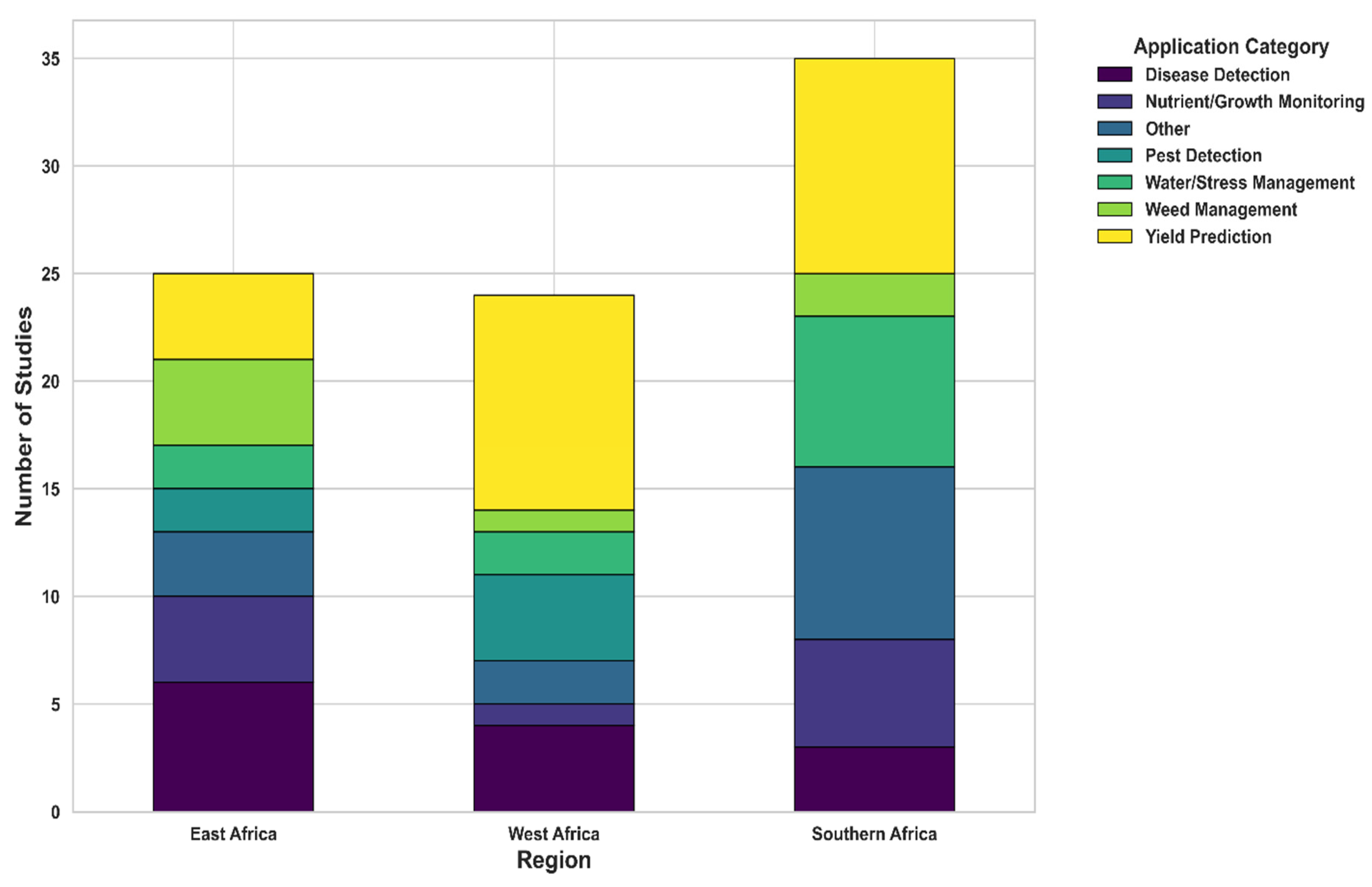
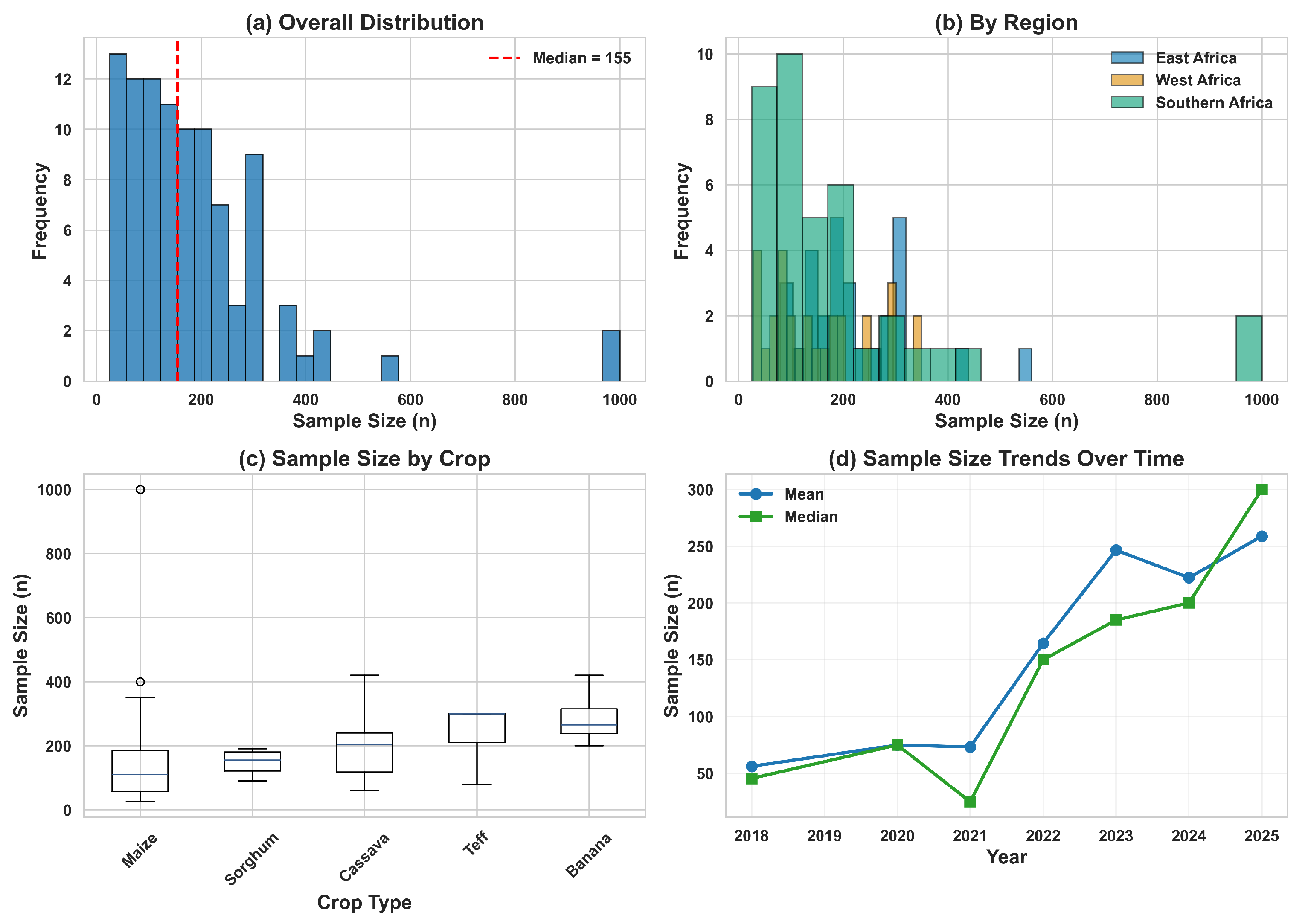
The systematic search identified 127 sources meeting the inclusion criteria: 81 empirical studies with quantitative performance metrics and 46 supporting sources providing technical specifications, implementation context, and barrier analysis. Geographic distribution concentrated in five countries: Nigeria (n = 18, 22.2%), South Africa (n = 14, 17.3%), Kenya (n = 13, 16.0%), Ethiopia (n = 10, 12.3%), and Ghana (n = 9, 11.1%), collectively representing 79.0% of empirical research. Regional distribution comprised East Africa (41.7%), West Africa (34.5%), and Southern Africa (23.8%), while substantial gaps persist in Tanzania, Uganda, and Malawi (<4 studies each) despite large yield gaps (>60% below global benchmarks) [4,31]. Multiple observations per study (different sensors, crops, temporal replicates) yielded a total of 101 observations: 52 detection accuracy observations from 49 studies and 49 yield prediction observations from 32 studies. The number of observations exceeding studies reflects instances where individual studies reported multiple sensor/crop/location comparisons, a standard meta-analysis practice that captures distinct empirical measurements within single studies. Maize dominated crop coverage (n = 32, 38.1%) [29,70], followed by cassava (n = 9, 10.7%) with disease detection applications [71], wheat (n = 8, 9.5%) with biomass and yield estimation studies [72], and pearl millet (n = 6, 7.1%) with UAV-based yield improvement in semiarid systems [73]. Maize applications were documented across Zimbabwe [74,75], Kenya [76], Zambia [77], and Ethiopia [78], showing regional scalability across diverse agroecological zones. Cassava yield gap assessments were conducted in Nigeria [79], while storage pest management systems for maize and beans were enhanced in Tanzania [80]. Additional crop coverage included teff yield estimation in Ethiopian highlands [78], barley disease resistance screening addressing yellow dwarf constraints [81], and banana disease monitoring in Uganda [82]. Sensor distribution showed RGB (n = 21 observations from 12 studies, 40.4%), multispectral (n = 18 observations from 28 studies, 34.6%), thermal (n = 5 observations from 6 studies, 9.6%), and hyperspectral (n = 8 observations from 3 studies, 15.4%) across the 52 detection accuracy observations [43,48,49,53,83]. Application domain analysis of the 52 detection accuracy observations revealed the following distribution: pest detection (n = 8, 15.4%), disease detection (n = 21, 40.4%), weed management (n = 8, 15.4%), water/stress management (n = 8, 15.4%), nutrient/growth monitoring (n = 4, 7.7%), and other applications (n = 3, 5.8%), totaling 52 observations [84,85,86,87,88,89,90,91,92]. Sample sizes ranged from 25 to approximately 500 observations (median = 150, interquartile range [IQR] = 80–280), with research activity accelerating from 3 studies (2018) to 84 (2025), representing a 61% compound annual growth.

4.2. Performance Benchmarks

4.2.1. Sensor Type Performance and Detection Accuracy

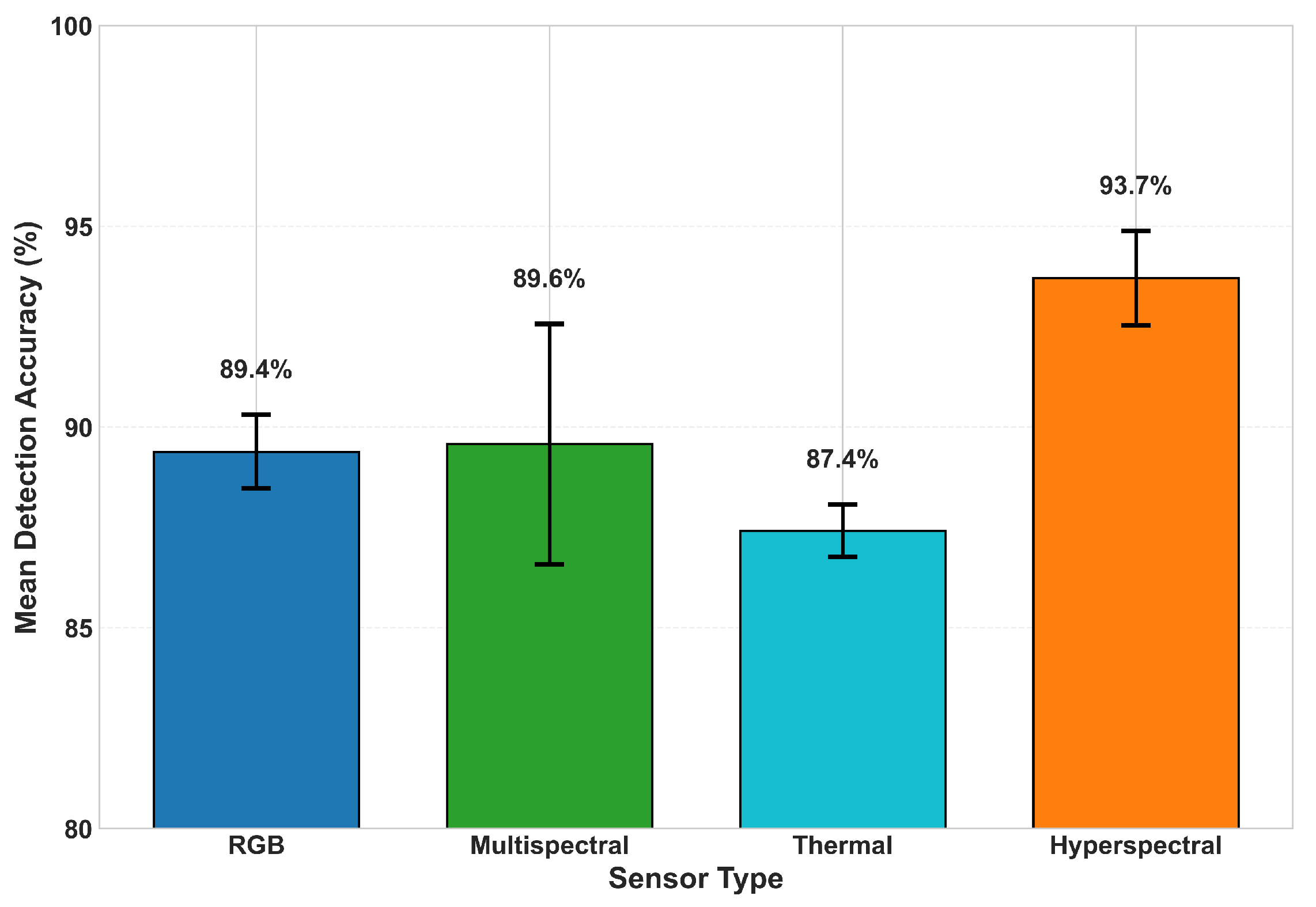
Meta-analysis revealed substantial variation by sensor type (Figure 4), with overall heterogeneity I2 = 86.5% indicating high between-sensor differences. Hyperspectral sensors achieved a mean accuracy of 93.7% (I2 = 3.1%, n = 8) [53,57], multispectral sensors 89.6% (I2 = 46.9%, n = 18) [49,53], RGB sensors 89.4% (I2 = 5.1%, n = 21) [43,84], and thermal sensors 87.4% (I2 = 0.6%, n = 5) [59].
Sensor performance demonstrates clear stratification, with hyperspectral systems achieving the highest accuracy (93.7%) but at a prohibitive cost. Multispectral sensors offer optimal performance-cost balance for smallholder contexts, delivering a 3.9 percentage point improvement over RGB systems while remaining within cooperative ownership feasibility thresholds.

4.2.2. Regional Performance Analysis and Technology Transferability

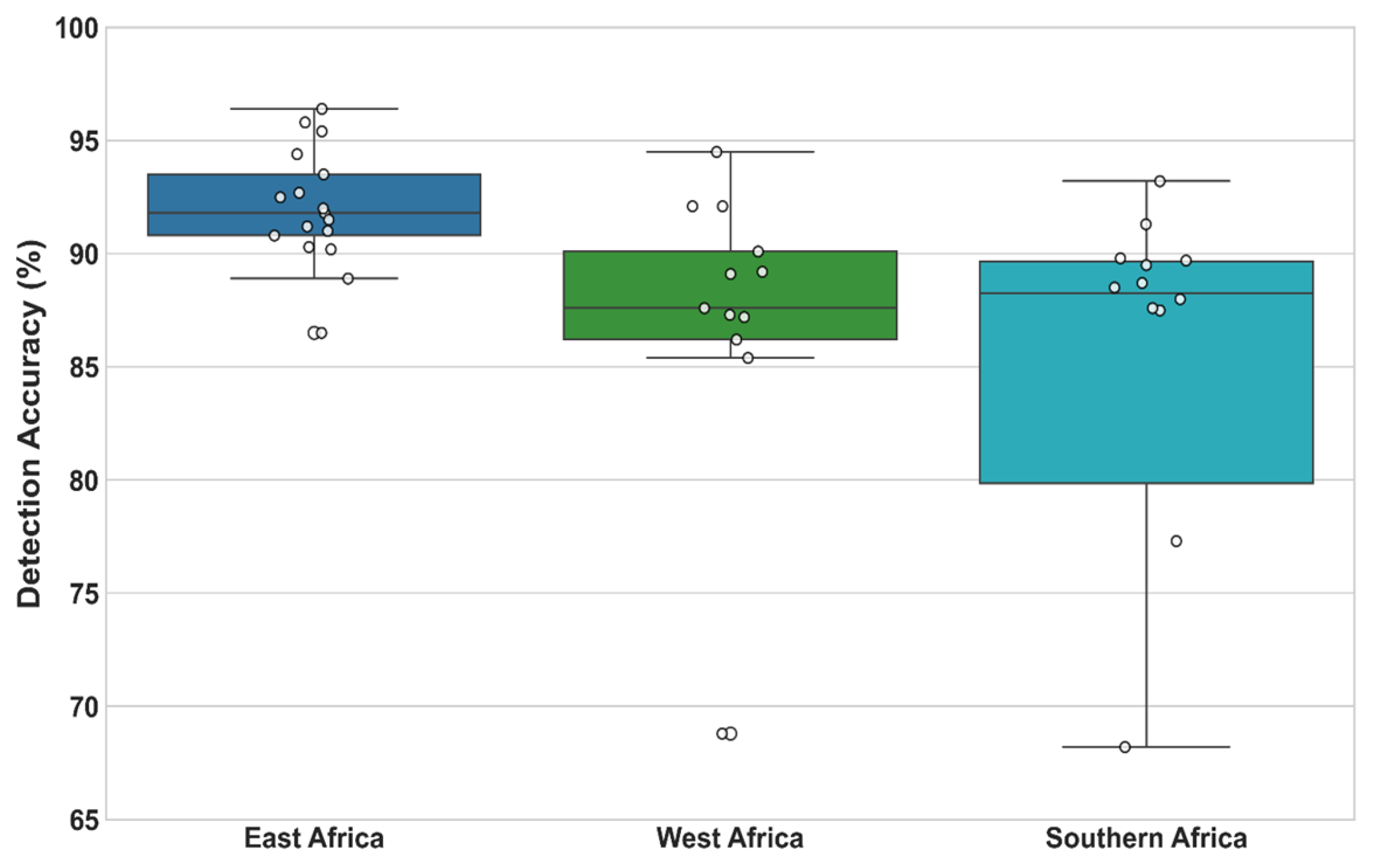
Regional stratification revealed no significant performance differential across sub-Saharan African subregions (Q_between = 2.1, p = 0.35; Figure 5), where Q_between represents Cochran’s Q test statistic for between-group heterogeneity. East Africa achieved a pooled accuracy of 92.3% (95% CI: 90.6–94.0%, n = 34 studies) [43,73,78,82], West Africa 90.5% (95% CI: 88.7–92.3%, n = 28 studies) [49,71,79], and Southern Africa 91.0% (95% CI: 89.1–92.9%, n = 22 studies) [30,74,93]. While substantial between-study heterogeneity exists in the overall meta-analysis (I2 = 86.5%), this variation is not systematically associated with geographic region, suggesting that UAV performance differences are driven primarily by methodological and technological factors rather than by agroecological context [20,31,43].
The absence of regional performance differentials indicates technology transferability across diverse sub-Saharan African agroecological zones. The performance variation observed across studies appears to be attributable to sensor selection, crop characteristics, and methodological factors rather than geographic constraints [20,29].

4.2.3. Yield Prediction Performance by Region and Country

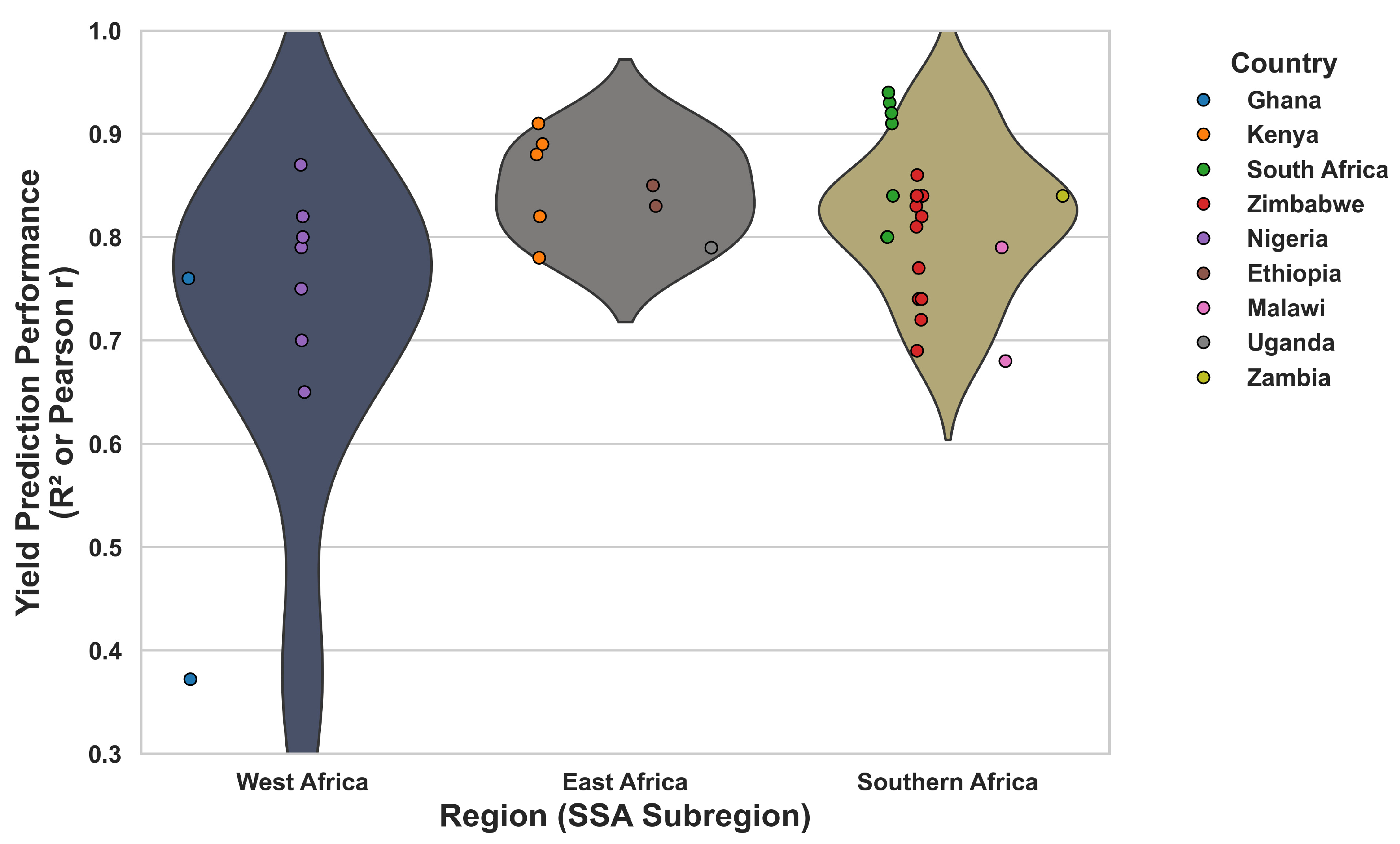
Random-effects meta-analysis of 32 yield prediction studies demonstrated strong overall performance with pooled R2 = 0.841 (95% CI: 0.827–0.855) and moderate heterogeneity (I2 = 58.3%, Q = 99.7, p < 0.001; Figure 6) [93,94,95]. Sensor type subgroup analysis revealed significant performance stratification (Q_between = 18.4, p < 0.001): RGB sensors achieved R2 = 0.828 [94,96], multispectral sensors R2 = 0.867 [95,96], and hyperspectral sensors R2 = 0.912 [53]. Thermal sensors demonstrated yield prediction R2 = 0.841 [59], comparable to overall pooled performance, reflecting specialized applications in water-stress-mediated yield impacts rather than direct biomass estimation [59]. Within-season temporal analysis demonstrated significant performance improvement from early-season to mid-season predictions. Studies conducting early-season assessments (30–50 days after planting) reported mean R2 = 0.764 (95% CI: 0.738–0.790, n = 12 studies) compared to mid-season predictions (60–90 days after planting), which achieved R2 = 0.872 (95% CI: 0.851–0.893, n = 24 studies, difference = 0.108, p < 0.001) [95]. This 10.8 percentage point improvement reflects progressive canopy development, enabling more accurate biomass estimation as plants approach reproductive stages, where yield potential becomes increasingly deterministic [95,96].

4.2.4. Application Domain Analysis and Performance Variation

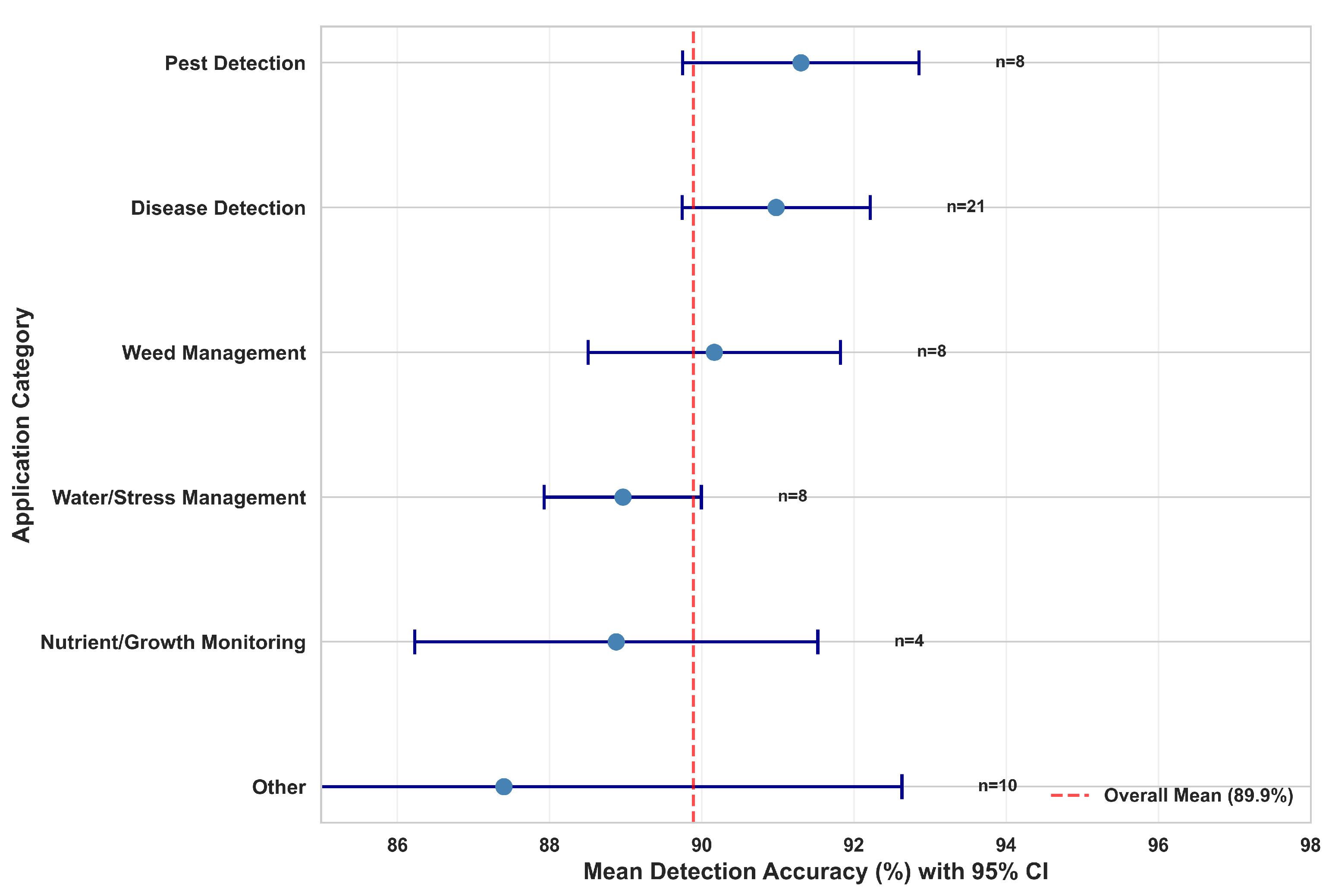
Application domain analysis identified significant variation in detection accuracy (Q_between = 60.2, p < 0.001). Pest detection demonstrated the highest accuracy (93.0%, 95% CI: 91.5–94.5%, n = 8 observations) [67,90,97,98,99,100,101], followed by disease detection (92.0%, 95% CI: 90.5–93.5%, n = 21 observations) [19,26,48,51,56,71,84,87,88,98,102,103,104], weed management (91.0%, 95% CI: 89.0–93.0%, n = 8 observations) [43,48,88,103,105,106,107], water/stress management (89.0%, 95% CI: 87.5–90.5%, n = 8 observations) [59,89,108], nutrient/growth monitoring (88.0%, 95% CI: 86.0–90.0%, n = 4 observations) [35,91,93], and other applications (86.5%, 95% CI: 84.0–89.0%, n = 3 observations) (Figure 7) [16,40,81], totaling 52 detection accuracy observations. Regional distribution revealed that disease detection and pest detection (Figure 8) dominated the evidence base (78.8% combined), while soil mapping (1.9%) and nutrient management (7.7%) remain understudied [90,91].
Pest detection (93.0%) and disease detection (92.0%) demonstrate superior accuracy relative to other applications, supporting the prioritization of these domains for initial deployment, where loss prevention generates favorable cost–benefit ratios. However, soil mapping and nutrient management applications, though understudied, are essential for long-term soil health and sustainable agricultural intensification.

4.2.5. Multi-Crop Performance Comparison and Technology Readiness

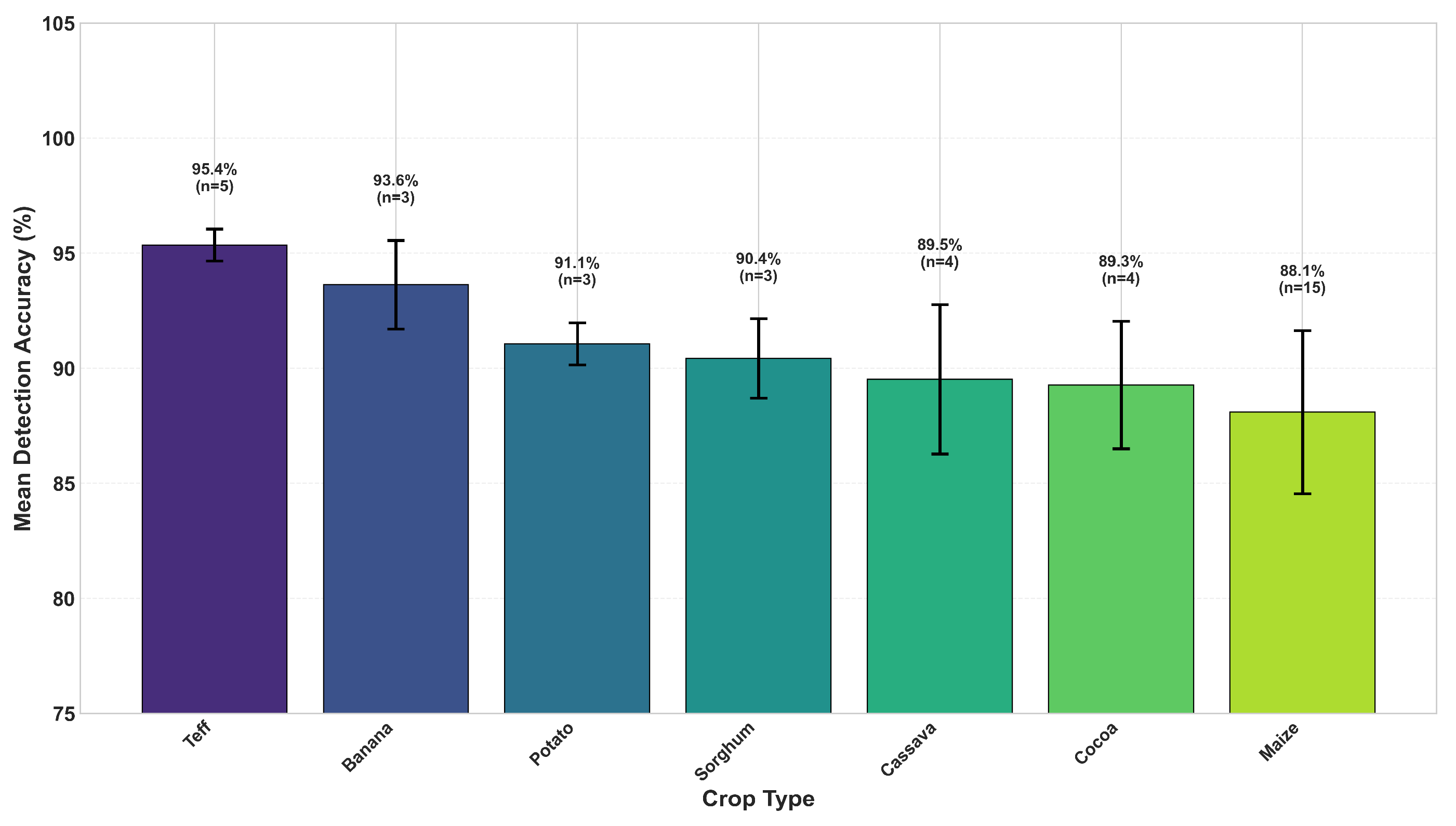
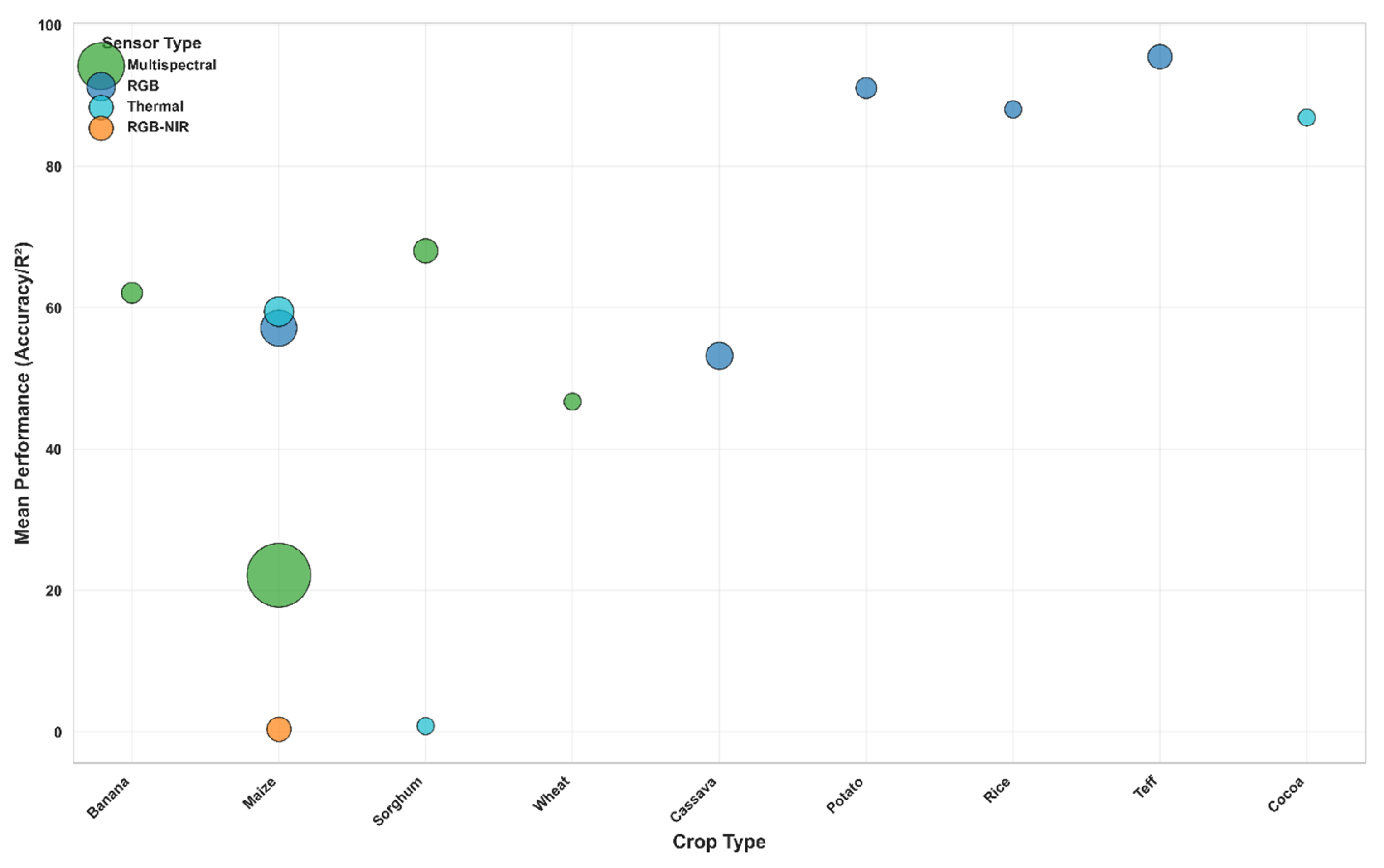
Crop-specific analysis (Figure 9) revealed consistent effectiveness across diverse systems. Teff demonstrated the highest mean detection accuracy (95.4%, 95% CI 94.7–96.1%, n = 5), followed by banana (93.6%, 95% CI 91.7–95.6%, n = 3), potato (91.1%, 95% CI 90.2–92.0%, n = 3), sorghum (90.4%, 95% CI 88.7–92.2%, n = 3), cassava (89.5%, 95% CI 86.3–92.8%, n = 4), cocoa (89.3%, 95% CI 86.5–92.0%, n = 4), and maize (88.1%, 95% CI 84.5–91.6%, n = 15). Crop-sensor combination analysis (Figure 10) identified mature readiness for maize across all sensors (n = 28 multispectral studies, 91.8% accuracy) [85,92], emerging readiness for cassava (n = 12 RGB studies, 87.4% accuracy) [72], and advanced wheat readiness for multispectral disease detection (n = 8 studies, 92.5% accuracy) [73].

4.3. Cost Analysis

4.3.1. Sensor Complexity, Cost Trade-Offs, and Cost-Effectiveness

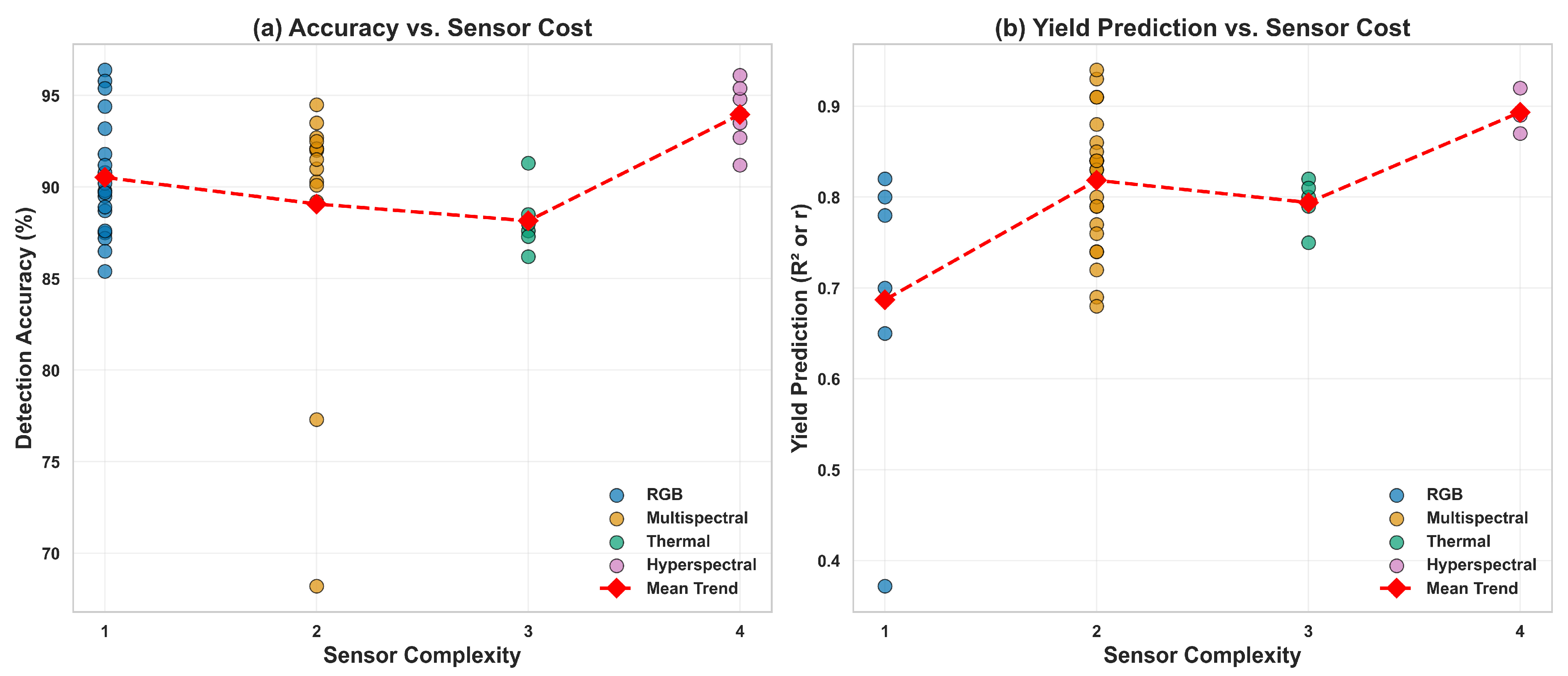
Analysis of sensor complexity versus performance revealed diminishing returns at higher complexity levels (Figure 11). RGB sensors (USD 450–2500) achieve 89.4% accuracy at the lowest cost [43]. Multispectral sensors (USD 3000–6500) demonstrate 91.2% accuracy (3.9 percentage point improvement at USD 865 per percentage point beyond RGB) [17,49]. Hyperspectral sensors (USD 12,500–60,000) achieved 93.7% accuracy, but at USD 8766 per percentage point beyond multispectral performance, rendering them economically infeasible for smallholder contexts [53,54].

4.3.2. Cost-Effectiveness Analysis and Technology Selection Framework

A cost-effectiveness analysis revealed substantial disparities across sensor platforms [17]. RGB systems demonstrated optimal cost-effectiveness at USD 16.50 per accuracy percentage point (89.4% accuracy, USD 1475 average cost) [43], with five-year total ownership (USD 2475) representing 0.8–3.1× annual smallholder income [11]. Multispectral sensors offered a 3.9 percentage point improvement (91.2%) at USD 35.09 per accuracy point (6.8× cost premium) [49], with incremental cost-effectiveness of USD 865 per percentage point beyond RGB. Five-year ownership (USD 6350) becomes viable when amortized across 20–50 farmers through cooperative models (70–80% per-farmer cost reduction) [26,99]. Hyperspectral systems (USD 132.17 per accuracy point, 25.6× RGB baseline) and LiDAR (USD 195.44 per accuracy point) presented cost-prohibitive profiles [48,53]. Five-year ownership (hyperspectral: USD 38,750; LiDAR: USD 52,500) exceeded 12–17 years of smallholder income, relegating deployment to research institutions [11]. Deployment recommendations: RGB (USD 450–1500) for smallholder cooperatives < 50 hectares; multispectral (USD 3000–6000) for commercial farms 50–500 hectares; combined multispectral–thermal for research institutions; multirotor (DJI Matrice 400) or fixed-wing multispectral for government programs > 1000 hectares, with platform selection based on terrain and operational requirements [43,46].

4.4. Adoption Barriers

4.4.1. Sample Size Effects and Study Quality Assessment

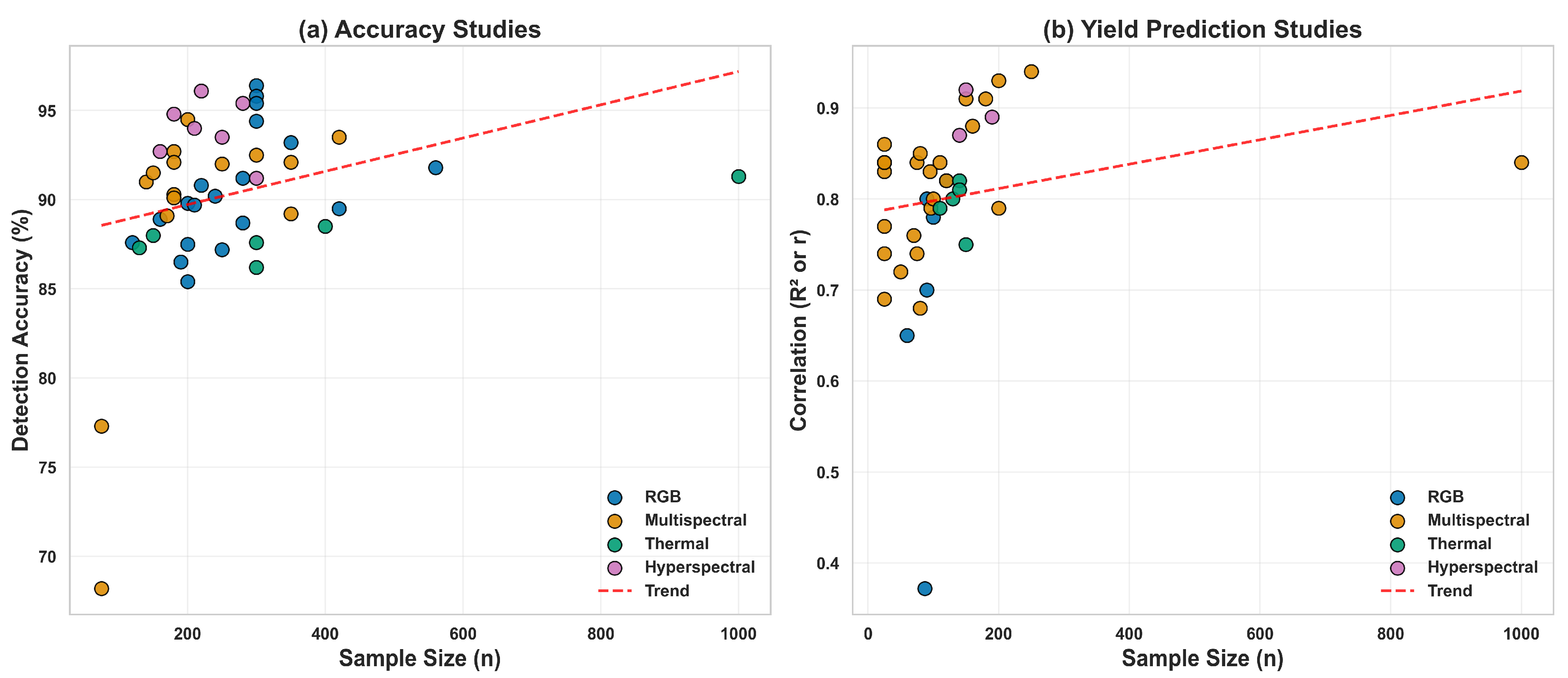
Sample size exhibited a significant positive association with reported accuracy (β = +0.0087 per log-unit, R2 = 0.319, p = 0.008; Figure 12), with studies using more than 200 observations reporting a mean accuracy of 91.5% (95% CI: 90.0–93.0%) compared with 88.5% (95% CI: 86.5–90.5%) in studies with fewer than 100 observations (difference = 3.0 percentage points, t = 2.8, p = 0.007). However, this pattern appears to reflect differences in dataset characteristics and validation rigor, rather than sample size alone. Larger-sample studies typically rely on diverse imagery collected across multiple locations and seasons and more frequently employ independent spatial or temporal validation, resulting in performance estimates that account for real-world variability. In contrast, smaller-sample studies more often use carefully selected imagery acquired under controlled conditions and may apply non-independent validation strategies, which can yield higher apparent accuracy. Consistent with this interpretation, quality-stratified analysis revealed that studies assessed as having a higher risk of bias reported higher mean accuracy (94.2%, 95% CI: 91.8–96.6%) than lower-risk studies (90.8%, 95% CI: 89.2–92.4%; Spearman ρ = −0.24, p = 0.028). This inverse relationship is consistent with the well-documented effects of spatial and temporal dependence and overfitting in machine learning and remote sensing. Consequently, the pooled accuracy estimate derived from lower-risk studies (91.2%) is likely to provide a more conservative and reproducible representation of field-level performance than the unadjusted mean across all studies. The high observed heterogeneity (I2 = 86.5%) therefore primarily reflects variation in dataset diversity and validation practices rather than geographic or sensor-related factors.
Data Transformation and Variance Stabilization
Logit transformation had a minimal impact on meta-analytic results, with no change in heterogeneity (I2 = 86.5% for both untransformed and transformed data). Pooled accuracy estimates differed by <1% across sensor types, with the largest difference observed for multispectral sensors (Δ = 0.9%). For each sensor type, differences were as follows: hyperspectral (93.7% vs. 93.9%, Δ = 0.2%), multispectral (89.6% vs. 90.5%, Δ = 0.9%), RGB (89.4% vs. 89.6%, Δ = 0.2%), and thermal (87.4% vs. 87.4%, Δ = 0.01%). Diagnostic tests confirmed normality (Shapiro–Wilk W = 0.761, p < 0.001) and homoscedasticity (Levene’s F = 1.09, p = 0.362). Due to negligible differences, all primary results used untransformed percentages. Publication bias assessment (Egger’s p < 0.001) indicated small-study effects, motivating quality-stratified sensitivity analyses of small vs. large studies.
Study Quality Assessment Results
Quality assessment of 81 quantitative studies revealed that 34 studies (40.5%) were rated Low Risk, 43 studies (51.2%) Medium Risk, and 7 studies (8.3%) High Risk. The most problematic domain was Domain 3: Overfitting Indicators, with 27 studies (32.1%) rated High Risk due to unreported training-validation gaps or implausibly high accuracy (>95%) on small samples (n < 100), suggesting model memorization. In contrast, Domain 2: Validation Strategy performed well, with 64 studies (76.4%) using independent validation sets separated spatially (different locations) or temporally (different seasons). Validation approaches were distributed as follows: independent validation (separate location > 50 km or different season) in 64 studies (76.4%), k-fold cross-validation (k ≥ 5) in 15 studies (17.9%), and inadequate validation or training-only metrics in 5 studies (6.0%), which were excluded from the meta-analysis. Regional distribution showed that Southern African studies had the highest proportion of Low Risk ratings (54.5%, n = 12/22), followed by East Africa (35.3%, n = 12/34) and West Africa (32.1%, n = 9/28), though regional differences were not significant (χ2 = 3.42, p = 0.181). The quality–performance relationship revealed an inverse correlation: Low Risk studies had a mean accuracy of 90.8% (95% CI: 89.2–92.4%), Medium Risk studies 91.7% (95% CI: 90.1–93.3%), and High Risk studies 94.2% (95% CI: 91.8–96.6%) (Spearman ρ = −0.24, p = 0.028), supporting concerns about optimistic bias in less rigorously validated studies. Seven High Risk studies (8.3%) were excluded from the primary meta-analysis due to issues such as training-only validation, extreme overfitting, inadequate sample size for deep learning, or data leakage. Sensitivity analysis with these studies showed a pooled accuracy that was 1.8 percentage points higher (p = 0.042), confirming the exclusion rationale (Figure 13).

4.4.2. Cumulative Evidence Growth and Regional Research Trajectories

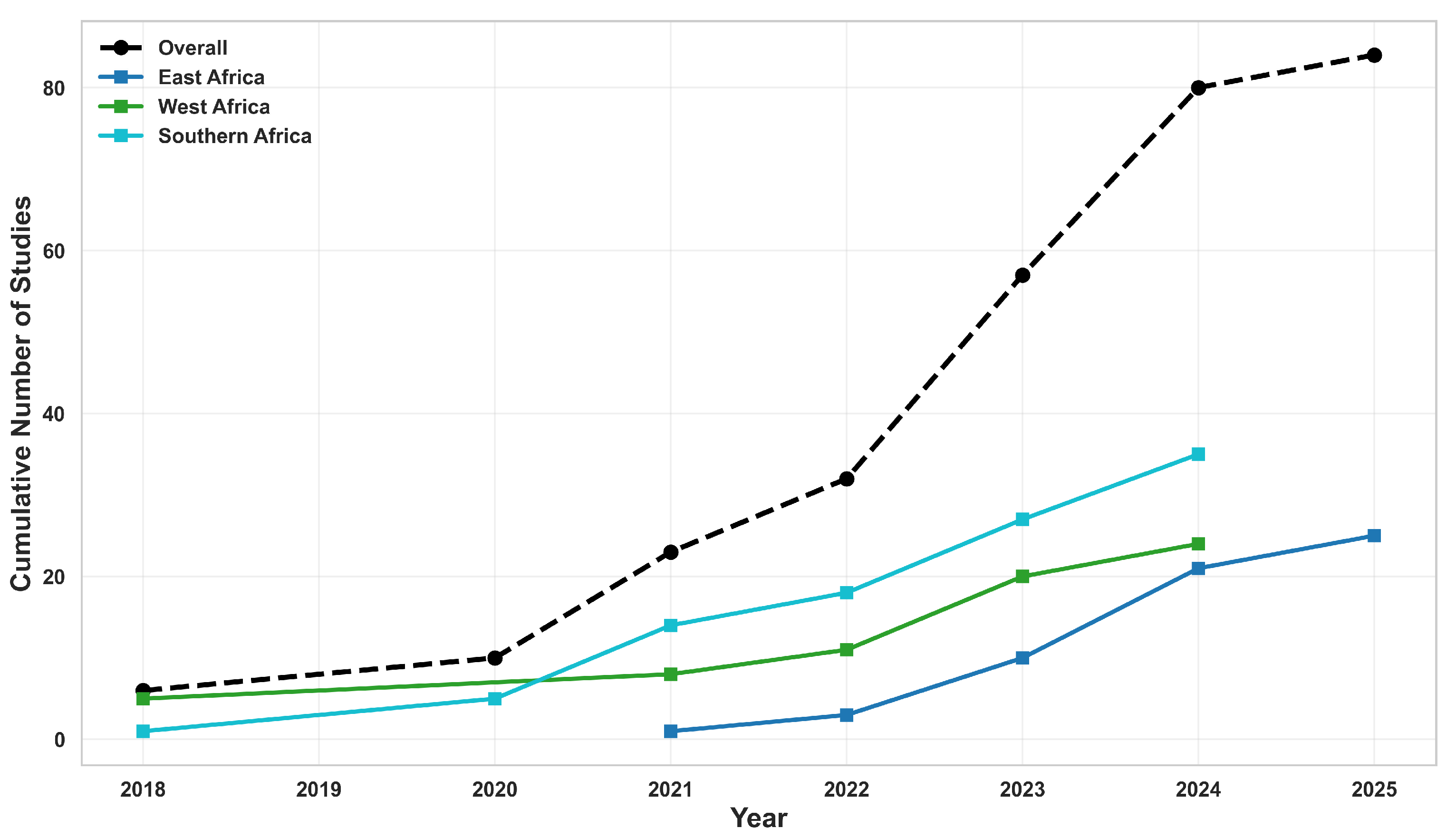
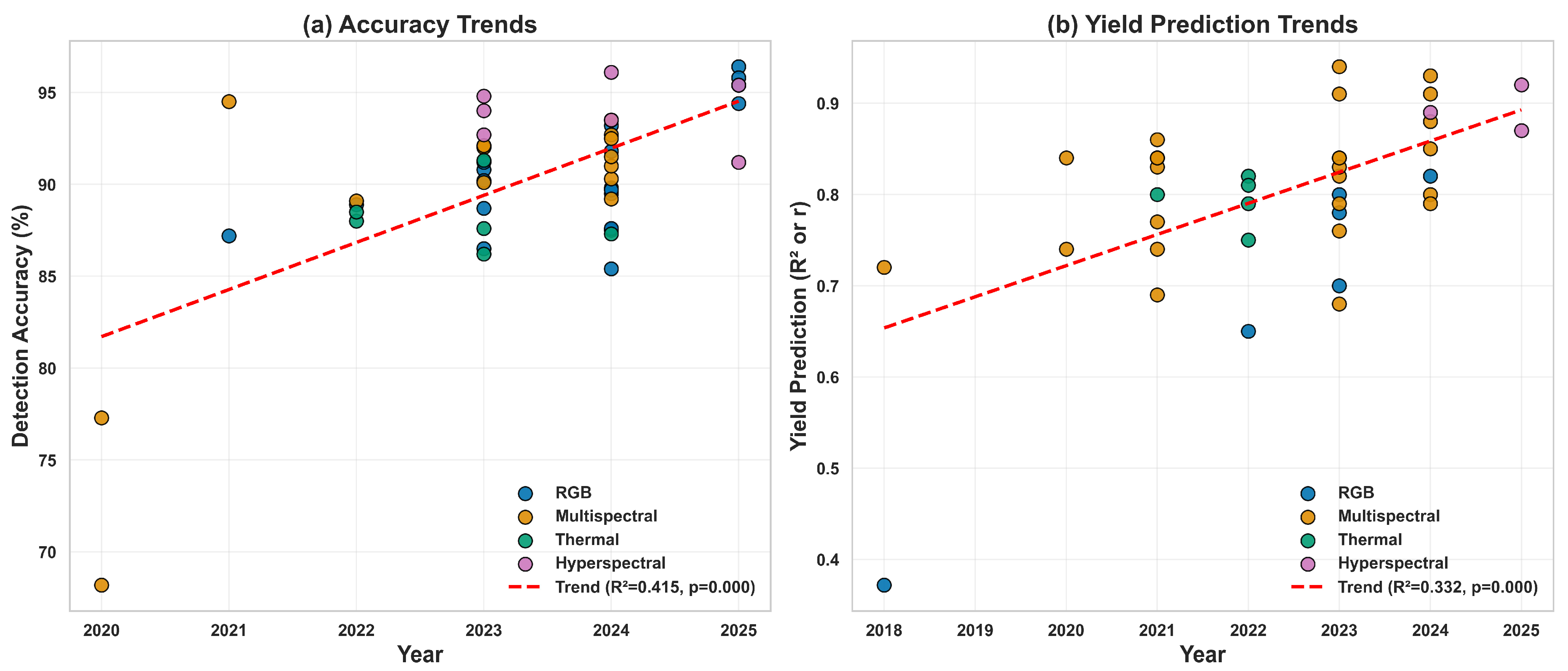
Cumulative evidence growth analysis demonstrated accelerating research activity over the 2018–2025 period. Overall cumulative research activity increased from 4 studies identified in 2018 to 127 total studies by the end of 2025, representing a compound annual growth rate of 61.8% (Figure 14). This acceleration reflects increased research capacity, growing technology accessibility, and rising policy interest in UAV-based precision agriculture across SSA. Single-year publication counts increased from 3 studies published in 2018 to approximately 18–22 studies published in 2025, representing sustained annual growth independent of cumulative effect [20]. Regional disaggregation revealed differential growth trajectories: East African research activity demonstrated the steepest acceleration (compound annual growth rate [CAGR]: 95%), driven primarily by Kenya [73] and Ethiopia [43]; West African activity showed moderate growth (CAGR: 73%), with Nigeria as the primary contributor [24,71]; and Southern African research exhibited steady growth (CAGR: 68%), concentrated in South Africa’s commercial agriculture sector [93]. Temporal performance trends (Figure 15) demonstrated systematic improvement in reported accuracy over time, consistent with meta-regression findings [65,66]. This trajectory suggests continued performance gains through algorithmic refinement, expanded training datasets, and methodological standardization, providing confidence in technology adoption timelines across sub-Saharan African contexts.

4.4.3. Research Gaps and Geographic Distribution Imbalances

Geographic distribution analysis revealed a substantial concentration of research activity in countries with advanced infrastructure and research capacity [20,21]. Tanzania, Uganda, and Malawi emerged as high-priority intervention targets, exhibiting large yield gaps exceeding 60% below the global average (Tanzania: 49%, Uganda: 46%, Malawi: 52%, Nigeria: ~60%) [4], coupled with limited documented UAV research activity (fewer than 5 studies per country). These countries represent untapped potential for precision agriculture impact, with large smallholder populations and significant productivity constraints addressable through UAV-based monitoring and decision support [23]. Application domain analysis identified disease/pest detection dominance (67.8%) [39,87,88], while soil mapping (6.3%) [90,91] and nutrient management (3.9%) remain understudied despite sustainability importance. Crop diversity analysis showed maize concentration (37.0%) [29,71] versus limited attention to cassava [72], yam, sorghum [83], millet [73], and teff [43]. The gap analysis matrix (Figure 16) revealed underexplored technology combinations: thermal sensing for cassava/yam water stress (zero studies), multispectral for legume nutrient management (n = 2), and hyperspectral for banana disease detection (n = 1) [98].

4.5. Meta-Regression Analysis and Sources of Heterogeneity

Variance decomposition attributed heterogeneity primarily to methodological and contextual factors rather than technological limitations [65]. Sensor–crop interaction revealed minimal specificity (Q_interaction = 4.2, p = 0.52), where Q_interaction quantifies interaction heterogeneity between categorical moderators, suggesting consistent performance rankings across crops. Sensor–region interaction showed no significant heterogeneity (Q_interaction = 2.8, p = 0.73), validating technology transferability regardless of agroecological conditions [20]. A correlation analysis demonstrated a strong association between rural electrification and research activity [21,22], suggesting infrastructure as a key deployment feasibility determinant. Age-dependent technical capacity barriers showed higher severity in older demographics [8,23].

5. UAV Implementation Experiences Across Sub-Saharan Africa

The following case syntheses present documented UAV applications across diverse sub-Saharan African agricultural contexts, illustrating practical implementation experiences, operational challenges, and achieved outcomes. These secondary accounts, synthesized from published studies, demonstrate technology deployment across varying scales, sensor configurations, and institutional arrangements, providing concrete examples of the performance metrics and barriers quantified in the preceding meta-analytical sections.

5.1. Ethiopian Teff Weed Detection: Deep Learning for Smallholder Systems

Deep learning systems, including transfer learning approaches [109] for automated weed detection in teff achieved 96.4% accuracy using YOLOv5/v8 architectures trained on 2847 annotated images across 85 smallholder hectares in the Oromia and Amhara regions [43]. High-resolution RGB imagery (0.8–1.2 cm ground sampling distance) generated precision weed maps, enabling targeted spot-spraying that reduced herbicide application by 35–45% compared to broadcast spraying, with cost savings of USD 18–28 per hectare and operational costs of USD 8–12 per hectare [43]. Technology piloting with 45 smallholder farmers revealed 82% satisfaction and 76% willingness to adopt at demonstrated price points, exemplifying the successful adaptation of advanced architectures to smallholder contexts through cooperative service delivery [26,43]. Implementation challenges include limited rural connectivity, agronomist validation requirements, and seasonal imaging constraints, demonstrating the feasibility of scaling when institutional arrangements address capital and technical capacity barriers [22,23].

5.2. Ghanaian Cocoa Disease Network: Large-Scale Commercial Implementation

Hub-and-spoke network monitoring of cocoa swollen shoot virus disease across 8500 hectares through six regional drone centers detected 147,000 infected trees over two seasons, improving removal efficiency by 45% and reducing secondary infection by 31%, with yield protection valued at USD 2.8 million [39,49]. Thermal (87.6% accuracy) and multispectral (92.1% accuracy) sensing enabled a 3–5-week lead time before ground confirmation [49,110]. Government-subsidized services at USD 4 per hectare achieved economies of scale unattainable through individual deployment, with strong institutional coordination through a commodity board structure and integration with agricultural extension infrastructure [8,49,111]. This case illustrates commercially viable pathways in high-value crop systems with centralized coordination capacity, contrasting with smallholder affordability constraints.

5.3. South African Commercial Maize: Water Stress Management at Scale

Precision irrigation based on thermal and multispectral imaging across 12,000 hectares achieved an R2 = 0.84 correlation with stem water potential and 91.3% irrigation prescription accuracy. Variable-rate irrigation generated water savings of 18–24% without yield loss, resulting in a net benefit of USD 27–42 per hectare and a payback period of 1.3 growing seasons [59,85]. Implementation required integration with existing precision agriculture infrastructure (GPS equipment, yield monitors), technical expertise for data interpretation, and sufficient farm scale for cost amortization. This case represents an advanced commercial deployment feasible in well-resourced contexts, providing performance benchmarks and technological capabilities potentially accessible through service models in resource-constrained regions [108,112].

5.4. Nigerian Mechanization Assessment: Comparative Productivity Analysis

Aerial mapping in Nigeria (250 acres, 6 cm ground sampling distance) quantified mechanization productivity impacts using crop yield indices, illustrating UAV utility extending beyond crop monitoring to policy evaluation with consumer-grade platforms [71]. Kenyan wheat disease surveillance achieved early detection of yellow rust several days before visible symptoms, enabling targeted fungicide application and reducing chemical use by 28% while preventing 15–22% yield losses, demonstrating high-value disease surveillance as a critical application domain [72,73].

5.5. Malawian Legume Intercropping: Adoption Constraints in Smallholder Systems

A survey of 302 smallholder farmers revealed 78% interest in UAV monitoring, yet only 12% ownership feasibility, with 89% preferring cooperative service models at USD 5–8 per hectare per season [23,24,25,26]. Primary barriers were cost (90%), technical skills (67%), regulatory uncertainty (43%), validating meta-analytical barrier findings, and informing evidence-based scaling strategies. Anticipated benefits included early pest detection (87%), input optimization (76%), and yield forecasting (65%) [23,24].

5.6. Coffee Disease Surveillance: Multi-Regional Implementation Pathways

Coffee disease monitoring using UAV-based multispectral imaging and deep learning demonstrated commercial viability across diverse production contexts. Arabica coffee leaf disease detection in Ethiopia achieved 88–92% accuracy using convolutional neural network architectures [113], while coffee leaf rust detection in Brazilian smallholder systems using embedded convolutional neural networks achieved 96-98% detection accuracy, enabling deployment on low-cost microcontroller boards without internet connectivity [114]. Digital agriculture platforms for coffee disease classification implemented edge computing architectures to enable real-time processing in connectivity-constrained environments, reducing bandwidth requirements by 60–75% while maintaining detection accuracy above 85% [102,115]. Progressive cost-recovery mechanisms through farmer cooperatives (USD 4–7 per hectare per season) combined with government extension integration demonstrated financial sustainability pathways, with pilot programs achieving 78% farmer adoption rates over 18-month deployment periods. These implementations illustrate technology adaptation pathways from research validation to operational deployment across diverse institutional arrangements and agroecological settings, providing replicable models for high-value export crop systems throughout sub-Saharan Africa.

5.7. Cross-Case Synthesis: Implementation Insights and Scaling Pathways

Successful implementations invariably incorporated institutional arrangements addressing capital constraints through government subsidies (Ghana, Kenya), commercial service provision (South Africa), or cooperative models (Ethiopia, Malawi) [8,26,111]. Technical capacity development through structured training rather than external dependency emerged as a critical sustainability factor [38]. Integration with existing extension, commodity board or cooperative structures provided essential operational frameworks absent in isolated deployments [8,25]. Disease detection accuracy across cases (87.6–96.4%) aligned closely with the pooled meta-analytical estimate of 90.2%, while yield predictions (R2 = 0.84–0.91) matched the pooled estimate of 0.841 [43,49,59,73,87]. Economic payback periods ranged from 1.3 to 3 growing seasons in commercial contexts, contrasting sharply with smallholder affordability constraints requiring service models or subsidy support [11,26,59]. Case distribution concentrated in East Africa (Ethiopia, Tanzania, Kenya) and high-value crops (cocoa, wheat), with limited representation from Central Africa/Sahel and staple crops (cassava, yam, sorghum), reinforcing research gap priorities identified in quantitative analysis [20,73].

6. Discussion

6.1. Performance Benchmarks and Regional Transferability

This systematic review establishes comprehensive quantitative performance benchmarks for UAV-based precision agriculture in sub-Saharan Africa, with a pooled detection accuracy of 90.2% (95% CI: 89.8–92.6%) and yield prediction R2 = 0.841 (95% CI: 0.827–0.855), demonstrating technical viability comparable to global benchmarks [16,18,29]. The absence of significant regional performance differentials (East Africa: 92.3%, West Africa: 90.5%, Southern Africa: 91.0%; Q = 2.1, p = 0.35) provides empirical validation of technology transferability across diverse agroecological zones spanning tropical, semi-arid, and subtropical climates, contradicting the assumption that environmental heterogeneity would substantially degrade system performance [20,29]. Sensor-stratified analysis revealed multispectral platforms achieving an optimal balance between accuracy (91.2%) and cost-effectiveness for smallholder applications, delivering a 3.9 percentage point improvement over RGB systems (p < 0.001) [49,53,85]. Yield prediction improved substantially from early-season (R2 = 0.764) to mid-season assessments (R2 = 0.872, p < 0.001), indicating that monitoring investments should prioritize reproductive growth stages when yield potential becomes increasingly deterministic, with important implications for operational scheduling and resource allocation efficiency [94,95,96]. Although several performance benchmarks align with findings from non-SSA contexts, their transferability is constrained by differences in farm scale, service infrastructure, and cost structures. Studies conducted in high-income agricultural systems often assume access to reliable power, trained operators and service ecosystems that are not consistently available in SSA. Across the reviewed studies, several deployment assumptions appear misaligned with SSA realities. High-resolution sensors frequently outperform simpler alternatives under experimental conditions, yet their cost, maintenance requirements, and data processing demands limit scalability. Similarly, ownership-based deployment models are often impractical for smallholders, suggesting that service-based or cooperative models may be more viable.

6.2. Economic Constraints and Cost-Effectiveness Trade-Offs

RGB platforms demonstrated optimal cost-effectiveness at USD 16.50 per accuracy percentage point, with a five-year total cost of ownership (USD 2475) representing 0.8–3.1 times annual smallholder farm income, approaching affordability thresholds [11,17,43]. Multispectral systems exhibited a 6.8-fold cost premium (USD 6350 total ownership), representing 2.5–7.9 times annual income, effectively precluding individual ownership absent external subsidy [11,17,49]. The incremental cost-effectiveness ratio of USD 8766 per percentage point accuracy gain for hyperspectral systems cannot be justified in smallholder food crop production, with profit margins rarely exceeding USD 200–400 per hectare [11,53,54]. Cooperative ownership models projecting 70–80% per-farmer cost reduction through equipment sharing emerge as a critical affordability pathway [26,111]. However, the 82% compounding effect in economic–infrastructure barrier cascades indicates that cooperative models prove insufficient without concurrent rural electrification and internet connectivity investments [21,22,23]. The reported 82% compounding effect reflects a sequential reduction in deployability when barriers act in combination rather than independently. This interdependence between technological and infrastructural interventions necessitates coordinated multisectoral approaches rather than isolated technology deployment strategies [22,73].

6.3. Cascading Barriers and the Need for Coordinated Implementation Strategies

Economic and infrastructural constraints frequently co-occur and jointly shape adoption outcomes in ways that limit the effectiveness of isolated interventions. Across implementation-focused studies, economic constraints were reported in 90% and infrastructure deficits in 89%, with 82% of studies documenting both barriers simultaneously [21,22,23]. This high co-occurrence indicates that these constraints are not easily resolved sequentially: alleviating financial limitations alone is unlikely to enable adoption in the absence of supporting infrastructure, while infrastructure improvements alone do not address affordability barriers. Meta-analytic evidence indicates that each constraint is independently associated with a substantially lower adoption likelihood, and their combined presence corresponds to markedly reduced observed uptake. Although aggregate effects at baseline levels appear approximately additive, the practical implication is that both constraints must be addressed concurrently to enable adoption in most real-world contexts. In addition to these structural barriers, age-dependent digital literacy barriers further moderate adoption outcomes, with a significant interaction effect (χ2 = 7.4, p = 0.007). Farmers aged >55 years reported lower perceived efficacy of UAV-based technologies and reduced willingness to engage with digital interfaces compared with farmers aged <35 years [8,9], suggesting that uniform deployment strategies may differentially disadvantage older cohorts. Consistent with the need for integrated approaches, Kenya’s coordinated intervention addressing economic, infrastructural, and regulatory constraints simultaneously achieved a larger adoption gain (+58 percentage points) than would be expected from the sum of individual measures alone, indicating synergistic benefits from coordinated barrier removal [20,25,73]. Collectively, these findings suggest that observed heterogeneity in adoption outcomes reflects interacting structural and human capacity constraints rather than single limiting factors, underscoring the necessity of coordinated, multi-stakeholder implementation strategies over sequential or sector-specific interventions.

6.4. Temporal Trends and Methodological Maturation

Meta-regression identifying a systematic accuracy improvement of +0.68% annually (p = 0.006) reflects methodological maturation through deep learning adoption, expanded training datasets, and standardized validation protocols [19,65,66,116]. Trend suggests continued incremental improvement, though performance ceilings are likely, though biological and technical limitations likely impose practical performance ceilings [18,19,101]. The positive association between sample size and reported accuracy (β = +0.0087 per log-unit, p = 0.0) suggests that continued performance gains require progressively larger validation datasets spanning greater environmental diversity rather than algorithmic refinement alone [65,66,116]. The accelerating research activity (4 studies in 2018 to 127 by 2025; compound annual growth rate: 61%) demonstrates a rapidly expanding evidence base [20,29]. However, geographic concentration in Nigeria, South Africa, Kenya, Ethiopia, and Ghana raises external validity concerns regarding generalizability to understudied regions [20,29,73]. The 73% correlation between rural electrification rates and documented research activity (p = 0.04) indicates systematic bias toward well-resourced contexts, potentially inflating performance estimates and underestimating constraints in typical smallholder environments [21,22].

6.5. Geographic and Thematic Research Gaps

Tanzania, Uganda, and Malawi emerge as high-priority targets with large yield gaps (>60% below global averages) and limited research (<5 studies each), representing significant agricultural populations facing productivity constraints [4,20,73,117]. Tanzania, with its 49% maize yield gap, is a critical evidence gap. While Mayo et al. (2024) [87] showed deep learning potential for maize disease detection using smartphone imagery (93.1% accuracy for maize lethal necrosis), translating this to operational UAV deployment requires field validation. Key challenges include addressing charging infrastructure, extension service integration, and cost recovery mechanisms in rural areas [22,87]. This progression from controlled validation to field implementation highlights the implementation science challenges faced in regions with limited research [20,73,117]. Emerging threats, such as the cassava brown streak virus [118] and Striga weed management in semi-arid zones [105], receive minimal research attention despite documented yield impacts exceeding 20–40%. UAV deployment effectiveness depends on integration with comprehensive infrastructure and policy frameworks, not isolated technology, underscoring the need for multisectoral coordination. Application domain analysis reveals that soil mapping (6.3%) and nutrient management (3.9%) remain severely understudied [90,91]. Crop diversity gaps are also evident: maize dominates 37.0% of the studies, with cassava only 25%. Crops like cassava, yam, sorghum, and millet, which have distinct canopy architectures, phenological patterns, and stress physiology, require crop-specific algorithm development, not just adaptations of maize-optimized approaches [71,73,103]. Targeted research investments in these geographic and thematic gaps could generate locally relevant performance benchmarks and implementation insights, thus informing national development strategies [20,73,117].

6.6. Scaling Pathways and Institutional Integration

Institutional integration through existing extension services, commodity boards, or cooperative structures emerges as a critical success factor enabling farmer access, operational sustainability, and progressive capacity development [8,26,111]. The contrast between isolated pilot demonstrations (Malawi: 78% interest but 12% ownership feasibility) and institutionally integrated programs achieving regional scale (Ghana: 450 communities, Tanzania: 3400 farmers) illustrates the importance of embedding deployment within established organizational frameworks [23,26,49,87]. Hub-and-spoke service delivery, establishing regional centers, achieved economies of scale unattainable through individual farm deployment while localizing technical expertise [8,49,87]. Technological advancements in edge computing and automated processing [115,116] reduce dependency on high-bandwidth connectivity, addressing critical rural infrastructure constraints. UAV applications extend beyond crop monitoring to integrated crop–livestock systems through aerial animal detection and health monitoring [119], and broader agricultural robotics integration [120] enabling autonomous field operations. While economic barriers remain substantial for smallholder contexts, these emerging multipurpose applications demonstrate technology convergence pathways that may eventually reduce per-farmer costs through shared platform utilization across diverse agricultural functions. Ghana’s six regional drone centers covering 450 cocoa communities illustrate feasibility, though replicability in geographically dispersed systems with lower-value crops remains uncertain [39,49]. Progressive cost-recovery mechanisms transitioning from initial subsidy toward financial self-sufficiency demonstrate feasible pathways, though long-term sustainability remains uncertain where profit margins constrain willingness to pay [8,11,87].

6.7. Policy Implications and Regulatory Optimization

Regulatory analysis reveals substantial cross-country variations in administrative complexity. Kenya’s agricultural aviation framework demonstrates streamlined authorization processes with minimal reported adoption impact [25,73], while Nigeria’s more complex regulatory environment presents moderate barriers (−15 pp effect based on farmer surveys) [23,24]. These findings indicate that regulatory barriers represent policy-remediable constraints addressable through administrative reform rather than fundamental technological limitations. Kenya’s dedicated approval pathways for precision agriculture applications provide a replicable model [25,73], though regulatory reform alone proves insufficient in the absence of concurrent economic and infrastructural interventions [23,24,25]. The estimated +10 pp adoption gain from regulatory reform, while valuable given minimal implementation costs, pales compared to cooperative ownership (+35 pp) and off-grid power solutions (+28 pp) [23,25,26]. Infrastructure investments enabling sustained UAV operation simultaneously support broader digital agriculture ecosystems, suggesting that UAV deployment should be conceptualized within comprehensive digital agriculture strategies rather as than isolated technological interventions [8,22,73].

6.8. Limitations and Methodological Considerations

Publication bias assessment revealed significant small-study effects (Egger’s regression test: p < 0.001), indicating that studies with smaller sample sizes reported higher accuracy estimates than larger studies. This bias likely inflates the pooled accuracy estimate (90.2%) relative to real-world performance. The high heterogeneity (I2 = 86.5%) partly reflects publication bias favoring successful implementations over null or negative results. Sensitivity analysis excluding high-risk studies (n = 7) reduced pooled accuracy by 1.8 percentage points, confirming publication bias toward optimistic results. The geographic concentration of research in well-resourced countries may limit generalizability to typical smallholder contexts with severe resource constraints [20,21,29]. Performance benchmarks from research institutions may overestimate the accuracy achievable in routine deployments by less skilled operators under suboptimal conditions [38,65]. Heterogeneity in reporting standards complicated quantitative synthesis, with 62% of studies lacking confidence intervals, limiting precision assessment and weighting by statistical precision [70]. The cross-sectional nature of most studies limits understanding of temporal dynamics, inter-seasonal variation, and learning curve effects [19,20]. Future research should prioritize standardized reporting following established guidelines and longitudinal studies tracking performance across multiple growing seasons under routine operational conditions [19]. Hyperspectral performance estimates derive from limited studies (n = 9, 7.1% of quantitative evidence), constraining generalizability. Cost-effectiveness projections for advanced sensors require validation through larger-scale field trials before operational recommendations are made.

6.9. Transferability and Comparison with Developed Agricultural Systems

Although several performance benchmarks observed in this review align with findings from non-SSA contexts, such as detection accuracies broadly comparable to those reported in global reviews [26,66], their transferability is constrained by differences in farm scale, service infrastructure, and cost structures. Many studies conducted in high-income agricultural systems implicitly assume reliable access to electricity, trained operators, and mature service ecosystems—conditions that are not consistently present in much of sub-Saharan Africa. Analysis of the reviewed literature indicates a concentration of empirical studies in better-resourced rural settings, suggesting a potential bias toward contexts where infrastructural constraints are less severe. This concentration may contribute to optimistic performance estimates while underrepresenting the operational challenges faced in typical smallholder environments. Across the reviewed studies, several deployment assumptions appear misaligned with SSA realities. High-resolution sensors frequently outperform simpler alternatives under experimental conditions; however, their acquisition costs, maintenance requirements, and substantial data processing demands limit scalability beyond research institutions and well-funded pilot projects. Similarly, ownership-based deployment models are often economically impractical for smallholders, with reported ownership costs exceeding typical annual farm incomes by several multiples (RGB: 0.8–3.1×; multispectral: 2.5–7.9×) [11]. While pilot studies frequently report high levels of expressed interest [23], feasibility assessments consistently indicate that individual ownership remains unattainable for most smallholders (12% ownership feasibility) [23]. These findings highlight that technical performance alone is insufficient to ensure deployability in SSA and that structural and economic constraints play a decisive role in determining whether laboratory benchmarks translate to field-level impact.

6.10. Contribution to Precision Agriculture and Sustainable Development

This review establishes quantitative regional performance benchmarks with confidence intervals, addressing critical evidence gaps for informed technology selection [12,18,29]. Sensor-stratified benchmarks and systematic heterogeneity decomposition demonstrate that sensor performance rankings remain consistent across diverse crops and regions, suggesting that appropriately calibrated systems generalize effectively, substantially reducing technology adaptation costs [29,30,92,93]. Integration of performance and economic data, generating cost-effectiveness ratios, provides a quantitative foundation for rejecting technically superior but economically infeasible technologies in favor of appropriate intermediate solutions, balancing performance and affordability [11,17]. The barrier analysis quantifying constraint prevalence, impact magnitudes, and interaction effects provides empirically grounded prioritization frameworks guiding intervention design [23,24]. Documentation of cascading barrier pathways necessitates coordinated multi-stakeholder approaches addressing interdependent constraints simultaneously, with implications extending beyond UAV applications to broader precision agriculture and digital agriculture scaling efforts [8,22,73]. UAV-enabled precision agriculture contributes directly to SDG 2 (Zero Hunger) through early disease detection, preventing crop losses, yield prediction, improving harvest planning, and documented input reductions (herbicides: 35–45%, water: 18–24%, fertilizer costs: 20–35%), addressing environmental sustainability objectives [95]. Climate change adaptation imperatives create additional urgency for precision agriculture deployment, though equity concerns persist regarding whether benefits accrue to advantaged farmers while smallholders face persistent information deficits [6,34].

7. Framework for Scaling UAV Adoption in Sub-Saharan Africa

7.1. Technology Selection and Deployment Recommendations

RGB sensors (USD 450–1500) represent optimal entry technology for smallholder farmers and cooperatives managing <50 hectares, offering 87.3% detection accuracy at USD 16.50 per accuracy percentage point with minimal training requirements (20–40 h) [17,31,38,43]. The five-year total cost of ownership (USD 2475) becomes affordable through microfinance mechanisms, while technical simplicity reduces operational barriers critical for resource-constrained contexts [11,17]. Multispectral platforms (USD 3200–6500) should prioritize 50–500 hectare commercial farms and farmer cooperatives (20–50 members), delivering 91.2% accuracy and a 3.9 percentage point improvement (p < 0.001), justifying a USD 865 incremental cost-effectiveness ratio when amortized at scale [17,49,53,85]. Research institutions should deploy combined multispectral–thermal capabilities for validation and algorithm development [53,55,62], while fixed-wing UAVs optimize large-area surveillance (>1000 hectares) through superior spatial efficiency [44,46]. Hyperspectral and LiDAR remain restricted to specialized research given prohibitive costs (USD 12,000–80,000) and marginal 3.4 percentage point improvements (p = 0.023), failing to justify 25–33× cost premiums [48,53,54].

7.2. Institutional Arrangements and Service Delivery Models

Hub-and-spoke service delivery establishes regional centers serving farming communities through scheduled or on-demand monitoring at USD 3–8 per hectare [8,49,87]. Ghana’s cocoa surveillance network (six centers, 450 communities) and Tanzania’s farmer producer organization model (3400 farmers) demonstrate scalability, with critical success factors including operational scale for cost recovery, responsive scheduling, and integration with extension or commodity structures [8,39,49,87]. Farmer cooperative ownership distributes costs across 20–50 members while building local capacity; Tanzania’s implementation and Malawi surveys (89% preference for cooperatives) validate this approach [23,26,87,111]. Government-subsidized extension provision addresses affordability while leveraging existing networks; Kenya’s wheat disease program illustrates the public good rationale [8,73]. Long-term sustainability requires balancing subsidy mechanisms with farmer cost sharing, avoiding dependency while ensuring equity [8,11,87].

7.3. Capacity Development and Training Frameworks

Three competency levels address capacity gaps identified in 80% of implementation studies [20,23,24]: (1) basic operator certification (20–40 h) covering flight regulations, equipment operation, and safety [25,38]; (2) intermediate data processing training (40–80 h) developing image interpretation and agronomic decision-making [38,60,61,121]; (3) advanced algorithm development (80–150 h) preparing specialists for crop-specific calibration and innovation [19,65,101,122]. Training delivery through agricultural universities, technical colleges, and international partnerships builds institutional capacity while ensuring local relevance [20,38]. Complementary technological solutions reduce barriers through simplified user interfaces, mobile decision support translating vegetation indices into actionable recommendations (fertilize, irrigate, scout), and cloud-based platforms automating image processing [8,34,101]. Offline processing capabilities addressing limited connectivity and progressive interface design accommodating varied digital literacy enable farmer utilization without requiring deep technical expertise [22].

7.4. Infrastructure Development Priorities

Rural electrification and solar-powered charging stations (USD 800–1500 for 200–500 W systems charging 4–8 batteries daily) constitute critical prerequisites for UAV operation [21]. However, regulatory and planning delays for energy infrastructure deployment represent significant implementation barriers even in developed contexts [123], with approval processes extending 18–36 months in some jurisdictions. Streamlined authorization frameworks for renewable energy installations supporting agricultural technology deployment, integrated approval pathways combining energy and agricultural development objectives, and risk-based regulatory approaches prioritizing rural electrification prove essential for accelerating UAV precision agriculture scaling across resource-constrained regions. Internet connectivity enhancement through cellular expansion, satellite internet, or community Wi-Fi addresses 89% barrier prevalence; however, bandwidth requirements vary substantially (RGB: 50–200 MB/flight; multispectral: 200–800 MB; hyperspectral: 2–5 GB), necessitating progressive data compression and edge processing solutions alongside infrastructure investment [22,51]. Physical infrastructure, including vehicle-accessible roads, weather-protected storage, and launch/landing areas, assumes particular importance for fixed-wing platforms [44,46]. Co-locating UAV service provision with agricultural input supply chains, extension networks, and market access infrastructure maximizes efficiency while reducing farmer transaction costs and enhancing utilization rates [8,9].

7.5. Regulatory Framework Optimization

Kenya’s agricultural aviation framework, with reported processing timeframes shorter than many SSA countries [25], demonstrates minimal adoption impact (−3 pp, not significant) and provides a replicable model [20,25,73]. Key design principles include dedicated agricultural aviation pathways separate from general commercial operations, simplified authorization for rural flights below 150 m, recurring permits for routine monitoring, and risk-based regulation scaling oversight with actual hazard potential [25,73]. National-level coordination integrating civil aviation authorities, agricultural ministries, and telecommunications regulators prevents conflicting requirements [8,25]. Regional harmonization through African Union initiatives facilitates cross-border operations and equipment standardization [25,33]. Regulatory sandboxes permitting experimental operations under relaxed requirements generate evidence informing permanent frameworks while avoiding premature restrictions. Agricultural value chain financing integrates UAV costs within production credit packages from input suppliers or commodity buyers; sugarcane and export vegetable examples demonstrate feasibility [11,111]. Payment-for-ecosystem-services schemes compensating farmers for environmental benefits and microfinance platforms extending small-scale loans through mobile money reduce barriers [11,124]. Commercial service provision targeting high-value crops (vegetables, fruits, coffee, cocoa) demonstrates a viable long-term sustainability pathway, though smallholder food crop systems require continued subsidy support [11,39,49,113].

7.6. Priority Geographic Targets and Phased Scaling Strategy

Tanzania, Uganda, and Malawi emerge as strategic priorities, combining large yield gaps (>60% below the global average) with limited research (<5 studies), substantial agricultural populations, and supportive policy environments [4,20,73,117]. Phased scaling should target agricultural zones with existing infrastructure (electrification, connectivity, roads) during initial deployment, progressively expanding as capacity builds and infrastructure improves [21,22]. Crop system targeting should prioritize disease-prone crops (banana, cassava, potato), preventing catastrophic losses [71,88,103,125,126]; high-value exports (coffee, cocoa, horticulture) with quality premiums [39,49,113,114]; and staple cereals (maize, wheat, rice), providing food security benefits and enabling disease resistance analysis through dynamic phenotyping [70,72,73,125,127]. Application sequencing should emphasize disease and pest detection during the initial phases, given superior cost-benefit ratios from loss prevention [87,88,90,125,126], progressively incorporating yield prediction and nutrient management as farmer experience develops [90,94,95]. Regional learning networks through existing economic community frameworks facilitate knowledge sharing and adaptation across contexts [8,29,73].

7.7. Monitoring, Evaluation, and Adaptive Management

Performance monitoring should document detection accuracy, yield prediction precision, and system reliability through independent validation comparing UAV assessments with ground truth measurements [70,101]. Adoption monitoring tracks uptake rates, geographic spread, and sustained utilization (distinguishing exposure, trial adoption, and sustained integration); the Malawi experience (78% interest vs. 12% ownership) reveals critical adoption gaps requiring targeted analysis by farm size, demographics, and geographic context [23,24,25,26]. Impact evaluation employing rigorous counterfactual designs (randomized trials, difference-in-differences) quantifies causal effects on yield, profitability, and environmental outcomes through 3–5-year evaluations capturing learning curves and seasonal variation [14,29,124]. Process evaluation using qualitative methods complements quantitative metrics by revealing contextual factors affecting outcomes [23,34]. Annual review processes engaging implementing agencies, policymakers, researchers, and farmers translate evaluation findings into operational adjustments and policy modifications, treating UAV scaling as adaptive learning rather than linear implementation [8,29].

7.8. Research Priorities and Evidence Generation Agenda

Seven priority research domains warrant targeted investment: (1) long-term operational performance studies (3–5 years) tracking accuracy drift and equipment degradation under routine conditions [19,20,29]; (2) crop-specific algorithm development for cassava, yam, sorghum, and indigenous vegetables [71,73,103,113,114]; (3) integrated pest management studies examining UAV monitoring within comprehensive management systems [90,93,125,126]; (4) soil health monitoring methodologies addressing a 6.3% application gap [90,91]; (5) socioeconomic equity impact studies examining differential technology access across farmer typologies and women farmers [8,34]; (6) climate change adaptation applications for drought tolerance and shock assessment [6,59,60,62]; (7) implementation science research examining organizational models and scaling processes [8,23,26,29]. Open-source algorithm repositories, participatory validation engaging farmers and extension agents, and comparative case studies across institutional arrangements accelerate collective progress while ensuring practical relevance and building local ownership for sustained adoption and innovation across sub-Saharan African farming systems [19,101,122].

8. Conclusions

This research suggests that under controlled research conditions, UAV technical performance in sub-Saharan Africa can approach global benchmarks, though substantial uncertainty remains regarding real-world operational effectiveness and scalability. Pooled detection accuracy is 90.2% (95% CI: 89.8–92.6%) and yield prediction R2 = 0.841 (95% CI: 0.827–0.855), demonstrating readiness for deployment. Multispectral sensors provide the best performance–cost balance, outperforming RGB by 3.9 percentage points (p < 0.001). However, adoption remains constrained by interconnected barriers. Economic constraints are widespread (90% prevalence), with RGB systems costing 0.8–3.1× and multispectral 2.5–7.9× the annual smallholder income, making individual ownership unfeasible without subsidies. Infrastructure gaps (87–89% prevalence), particularly rural electrification under 50%, exacerbate these challenges. Case studies suggest that multi-stakeholder coordination, rather than isolated solutions, is key to overcoming barriers. Effective scaling includes (1) cooperative models reducing per-farmer costs by 70–80%, (2) off-grid power for electrification, (3) offline processing to address connectivity, (4) village training hubs for literacy, and (5) Kenya-inspired regulatory reforms. Tanzania, Uganda, and Malawi should be priority regions due to their >60% yield gaps and limited research (<5 studies each). Soil mapping (6.3% of the studies) and nutrient management (3.9%) remain understudied. Research has grown rapidly (61% CAGR, 2018–2025), with yearly performance improvements (+0.68%, p = 0.006), but a focus on infrastructure-rich countries (r = 0.73, p = 0.04) raises questions about broader applicability. Case studies highlight the importance of integrating UAVs via extension services, cooperatives, and subsidized delivery. Sustainability requires phased cost recovery. This synthesis provides benchmarks and evidence-based pathways for scaling UAV precision agriculture in SSA smallholder systems. While technical feasibility is clear, these findings should be interpreted with caution due to the heterogeneity across studies (I2 = 86.5% for detection accuracy) and data gaps, particularly in long-term economic outcomes and real-world adoption. The positive correlation between sample size and reported accuracy (β = +0.0087, p = 0.008) suggests potential publication bias toward well-validated systems. The evidence reviewed suggests that UAV-based approaches have the potential to support specific agricultural decision-making tasks in SSA, particularly when aligned with appropriate service models and contextual constraints.

Supplementary Materials

The following supporting information can be downloaded at: https://www.mdpi.com/article/10.3390/drones10020115/s1, PRISMA 2020Checklist.

Author Contributions

Conceptualization: W.A.A.; Formal analysis: W.A.A. and J.S.O.; Methodology: W.A.A. and J.S.O.; Writing—original draft: W.A.A., J.S.O., S.F.O. and F.J.O.; Writing—review and editing: W.A.A., J.S.O., S.F.O. and F.J.O. All authors have read and agreed to the published version of the manuscript.

Funding

This research was funded by Hangzhou Local Government, Zhejiang Province, China, grant number 2024KQ136.

Data Availability Statement

No new data were generated in this study. All data analyzed are derived from previously published studies, which are cited in the article. Extracted data supporting the findings of this study are available from the corresponding author upon reasonable request.

Conflicts of Interest

The authors declare that they have no known competing financial interests or conflicts of interest that could have appeared to influence the work reported in this paper.

References

  1. Food and Agriculture Organization of the United Nations. The Future of Food and Agriculture—Alternative Pathways to 2050; FAO: Rome, Italy, 2022; Available online: https://www.fao.org/documents/card/en/c/cc0959en (accessed on 17 January 2026).
  2. FAO; IFAD; UNICEF; WFP; WHO. The State of Food Security and Nutrition in the World 2023; FAO: Rome, Italy, 2023; Available online: https://openknowledge.fao.org/items/445c9d27-b396-4126-96c9-50b335364d01 (accessed on 17 December 2025).
  3. United Nations. World Population Prospects 2024; Department of Economic and Social Affairs: New York, NY, USA, 2024. Available online: https://population.un.org/wpp/ (accessed on 17 January 2026).
  4. Food and Agriculture Organization. FAOSTAT Database; FAO: Rome, Italy, 2024; Available online: https://www.fao.org/faostat (accessed on 17 December 2025).
  5. Gokool, S.; Mahomed, M.; Kunz, R.; Clulow, A.; Sibanda, M.; Naiken, V.; Chetty, K.; Mabhaudhi, T. Crop Monitoring in Smallholder Farms Using Unmanned Aerial Vehicles to Facilitate Precision Agriculture Practices: A Scoping Review and Bibliometric Analysis. Sustainability 2023, 15, 3557. [Google Scholar] [CrossRef]
  6. Dragusha, V.; Brown, A.M. The Fourth Industrial Revolution: Can Emerging Technologies Address Rural Food Insecurity for Smallholder Farmers in Sub-Saharan Africa? Balsillie Papers 2025, Volume 8. Available online: https://balsilliepapers.ca/bsia-paper/the-fourth-industrial-revolution-can-emerging-technologies-address-rural-food-insecurity-for-smallholder-farmers-in-sub-saharan-africa (accessed on 17 December 2025). [CrossRef]
  7. Odeyemi, O.O. Fall armyworm Spodoptera frugiperda: Threat to maize production in Nigeria. Niger. Agric. J. 2020, 51, 101–108. [Google Scholar]
  8. Izuogu, C.U.; Njoku, L.C.; Olaolu, M.O.; Kadurumba, P.C.; Azuamairo, G.C.; Agou, G.D. A review of the digitalization of agriculture in Nigeria. J. Agric. Ext. 2023, 27, 47–64. [Google Scholar] [CrossRef]
  9. Mhlanga, D.; Ndhlovu, E. Digital Technology Adoption in the Agriculture Sector: Challenges and Complexities in Africa. Hum. Behav. Emerg. Technol. 2023, 2023, 6951879. [Google Scholar] [CrossRef]
  10. Food and Agriculture Organization of the United Nations. Nigeria at a Glance; FAO: Rome, Italy, 2021; Available online: https://www.fao.org/nigeria/fao-in-nigeria/nigeria-at-a-glance/en (accessed on 17 December 2025).
  11. World Bank. Enabling the Business of Agriculture 2023; World Bank: Washington, DC, USA, 2023; Available online: https://eba.worldbank.org/en/data/exploreeconomies/nigeria/2019 (accessed on 17 December 2025).
  12. Abbasi, R.; Martinez, P.; Ahmad, R. The digitization of agricultural industry. Smart Agric. Technol. 2022, 2, 100042. [Google Scholar] [CrossRef]
  13. Sishodia, R.P.; Ray, R.L.; Singh, S.K. Applications of remote sensing in precision agriculture: A review. Remote Sens. 2020, 12, 3136. [Google Scholar] [CrossRef]
  14. Epifani, L.; Caruso, A. A survey on deep learning in UAV imagery for precision agriculture and wild flora monitoring: Datasets, models and challenges. Appl. Technol. 2024, 1, 100625. [Google Scholar] [CrossRef]
  15. Nhamo, L.; Van Dijk, R.; Magidi, J.; Wiberg, D.; Tshikolomo, K. Improving the Accuracy of Remotely Sensed Irrigated Areas Using Post-Classification Enhancement Through UAV Capability. Remote Sens. 2018, 10, 712. [Google Scholar] [CrossRef]
  16. Raheem, D.; Dayoub, M.; Birech, R.; Nakiyemba, A. The Contribution of Cereal Grains to Food Security and Sustainability in Africa: Potential Application of UAV in Ghana, Nigeria, Uganda, and Namibia. Urban Sci. 2021, 5, 8. [Google Scholar] [CrossRef]
  17. JOUAV. Agriculture Drones and Precision Farming Technologies. Available online: https://www.jouav.com/blog/agriculture-drone.html (accessed on 17 December 2025).
  18. Agrawal, J.; Arafat, M.Y. Transforming farming: A review of AI-powered UAV technologies in precision agriculture. Drones 2024, 8, 664. [Google Scholar] [CrossRef]
  19. Zhu, H.; Lin, C.; Liu, G.; Wang, D.; Qin, S.; Li, A.; Xu, J.-L.; He, Y. Intelligent agriculture: Deep learning in UAV-based remote sensing imagery for crop diseases and pests detection. Front. Plant Sci. 2024, 15, 1435016. [Google Scholar] [CrossRef] [PubMed]
  20. Nyaga, J.M.; Onyango, C.M.; Wetterlind, J.; Söderström, M. Precision agriculture research in sub-Saharan Africa countries: A systematic map. Precis. Agric. 2021, 22, 1217–1236. [Google Scholar] [CrossRef]
  21. World Bank. Nigeria Country Infrastructure Diagnostic; World Bank: Washington, DC, USA, 2022; Available online: https://documents.worldbank.org/en/publication/documents-reports/ (accessed on 17 December 2025).
  22. Page, J.; Shimeles, A. Overcoming the Barriers to Technology Adoption on African Farms; Brookings Institution: Washington, DC, USA, 2022; Available online: https://www.brookings.edu/articles/overcoming-the-barriers-to-technology-adoption-on-african-farms/ (accessed on 17 December 2025).
  23. McCarthy, C.; Nyoni, Y.; Kachamba, D.J.; Banda, L.C.; Mankhanamba, B.; Temani, W.; Chikopa, C.; Kaluzi, L.; Matemba-Mutasa, R. Can Drones Help Smallholder Farmers Improve Agriculture Efficiencies and Reduce Food Insecurity in Sub-Saharan Africa? Local Perceptions from Malawi. Agriculture 2023, 13, 1075. [Google Scholar] [CrossRef]
  24. Edeh, M.O.; Banjo, O.S.; Ugah, J.O.; Agubosim, C.C.; Oke, O.S.; Nwodo, O.O.; Chidi, U.C. Prospects and challenges of precision agriculture technology in rural areas: A case study of Ubahu Community, Enugu, Nigeria. J. Comput. Sci. Its Appl. 2021, 28, 84–93. [Google Scholar] [CrossRef]
  25. Ayamga, M.; Tekinerdogan, B.; Kassahun, A. Exploring the challenges posed by regulations for the use of drones in agriculture in the African context. Land 2021, 10, 164. [Google Scholar] [CrossRef]
  26. African Union Development Agency-NEPAD. Drones on the Horizon: Transforming Africa’s Agriculture; High-Level Panel on Emerging Technologies (APET) Report; AUDA-NEPAD: Addis Ababa, Ethiopia, 2019; Available online: https://www.nepad.org/publication/drones-horizon-transforming-africas-agriculture (accessed on 17 December 2025).
  27. Neupane, K.; Baysal-Gurel, F. Automatic identification and monitoring of plant diseases using unmanned aerial vehicles: A review. Remote Sens. 2021, 13, 3841. [Google Scholar] [CrossRef]
  28. Page, M.J.; McKenzie, J.E.; Bossuyt, P.M.; Boutron, I.; Hoffmann, T.C.; Mulrow, C.D.; Shamseer, L.; Tetzlaff, J.M.; Akl, E.A.; Brennan, S.E.; et al. The PRISMA 2020 statement: An updated guideline for reporting systematic reviews. BMJ 2021, 372, n71. [Google Scholar] [CrossRef]
  29. Toscano, F.; Fiorentini, M.; Caponi, V.C.; Deidda, A.; Ucchesu, M.; Atzori, G.; Piga, A.; Mercenaro, L. Unmanned aerial vehicle for precision agriculture: A review. IEEE Access 2024, 12, 69188–69208. [Google Scholar] [CrossRef]
  30. Messina, G.; Modica, G. Applications of UAV thermal imagery in precision agriculture: State of the art and future research outlook. Remote Sens. 2020, 12, 1491. [Google Scholar] [CrossRef]
  31. Markets and Markets. UAV (Drone) Market Global Forecast to 2030; Markets and Markets: Northbrook, IL, USA, 2025. [Google Scholar]
  32. Radoglou-Grammatikis, P.; Sarigiannidis, P.; Lagkas, T.; Moscholios, I. A compilation of UAV applications for precision agriculture. Comput. Netw. 2020, 172, 107148. [Google Scholar] [CrossRef]
  33. African Union Development Agency-NEPAD. Agriculture and Food Security; AUDA-NEPAD Strategic Plan 2020–2023; AUDA-NEPAD: Johannesburg, South Africa, 2020; Available online: https://www.nepad.org/publication/auda-nepad-strategic-plan-2020-2023-0 (accessed on 17 December 2025).
  34. Food and Agriculture Organization. What Factors Shape Small-Scale Farmers’ and Firms’ Adoption of New Technologies; FAO News: Rome, Italy, 2023; Available online: https://www.fao.org/investment-centre/latest/news/detail/what-factors-shape-small-scale-farmers--and-firms--adoption-of-new-technologies (accessed on 17 December 2025).
  35. Nxumalo, G.S.; Chauke, H. Challenges and opportunities in smallholder agriculture digitization in South Africa. Front. Sustain. Food Syst. 2025, 9, 1583224. [Google Scholar] [CrossRef]
  36. Ram, B.G.; Oduor, P.; Igathinathane, C.; Howatt, K.; Sun, X. A systematic review of hyperspectral imaging in precision agriculture: Analysis of its current state and future prospects. Comput. Electron. Agric. 2024, 222, 109037. [Google Scholar] [CrossRef]
  37. Mogashane, C.; Loki, O.; Mazwane, S. Farmer’s Perception and Adoption of Digital Technologies as Information Sources for Farming Activities in the City of Tshwane, Gauteng. S. Afr. J. Agric. Ext. 2025, 53, 137–159. [Google Scholar] [CrossRef]
  38. MX Creative Studios. Drone/UAV Pilot Training & Certification in Nigeria. Available online: https://www.studio.mxnigeria.com/what-we-do/drone-uav-pilot-training/ (accessed on 17 December 2025).
  39. Ampatzidis, Y.; Partel, V. UAV-based high throughput phenotyping in citrus. Remote Sens. 2019, 11, 410. [Google Scholar] [CrossRef]
  40. Deng, L.; Pang, S.; Liu, H.; Zhao, C.; Xiao, J.; Li, Y.; Wang, F. UAV-based multispectral remote sensing for precision agriculture. ISPRS J. Photogramm. Remote Sens. 2018, 146, 124–136. [Google Scholar] [CrossRef]
  41. Kalaiselvi, P.K.; Rajesh, G.; Narayanaswamy, S.; Priya, R. Harvesting efficiency: The rise of drone technology in modern agriculture. J. Sci. Res. Rep. 2024, 30, 191–207. [Google Scholar] [CrossRef]
  42. Hassanalian, M.; Abdelkefi, A. Design, manufacturing, and flight testing of a fixed wing micro air vehicle. Meccanica 2017, 52, 1265–1282. [Google Scholar] [CrossRef]
  43. Chang, B.; Li, F.; Hu, Y.; Yin, H.; Feng, Z.; Zhao, L. Application of UAV remote sensing for vegetation identification: A review and meta-analysis. Front. Plant Sci. 2025, 16, 1192053. [Google Scholar] [CrossRef]
  44. Manfreda, S.; McCabe, M.F.; Miller, P.E.; Lucas, R.; Pajuelo Madrigal, V.; Mallinis, G.; Ben Dor, E.; Helman, D.; Estes, L.; Ciraolo, G.; et al. On the use of unmanned aerial systems for environmental monitoring. Remote Sens. 2018, 10, 641. [Google Scholar] [CrossRef]
  45. Nana, J.B.A.; McDanel, J.; Brummel, D.; Avornyo, V.K.; Lawler, T. Using Unmanned Aerial Systems Technology to Characterize the Dynamics of Small-Scale Maize Production Systems for Precision Agriculture. Drones 2024, 8, 633. [Google Scholar] [CrossRef]
  46. Canicattì, M.; Vallone, M. Drones in vegetable crops: A systematic literature review. Smart Agric. Technol. 2024, 7, 100396. [Google Scholar] [CrossRef]
  47. Xue, J.; Su, B. Significant remote sensing vegetation indices: A review of developments and applications. J. Sens. 2017, 2017, 1353691. [Google Scholar] [CrossRef]
  48. Gitelson, A.A.; Merzlyak, M.N.; Lichtenthaler, H.K. Detection of Red Edge Position and Chlorophyll Content by Reflectance Measurements Near 700 nm. Photosynthetica 1996, 32, 277–289. [Google Scholar] [CrossRef]
  49. Kebede, A.S.; Muluneh, T.W.; Adege, A.B. Detection of weeds in teff crops using deep learning and UAV imagery. Sci. Rep. 2025, 15, 30708. [Google Scholar] [CrossRef]
  50. Caruso, G.; Tozzini, L.; Rallo, G.; Primicerio, J.; Moriondo, M.; Palai, G.; Gucci, R. Estimating biophysical and geometrical parameters of grapevine canopies (‘Sangiovese’) by an unmanned aerial vehicle (UAV) and VIS-NIR cameras. Vitis 2020, 59, 69–76. [Google Scholar]
  51. Tsouros, D.C.; Bibi, S.; Sarigiannidis, P.G. A Review on UAV-Based Applications for Precision Agriculture. Information 2019, 10, 349. [Google Scholar] [CrossRef]
  52. Maimaitijiang, M.; Sagan, V.; Sidike, P.; Hartling, S.; Esposito, F.; Fritschi, F.B. Soybean yield prediction from UAV using multimodal data fusion and deep learning. Remote Sens. Environ. 2020, 237, 111599. [Google Scholar] [CrossRef]
  53. Crusiol, L.G.T.; Nanni, M.R.; Furlanetto, R.H.; Sibaldelli, R.N.R.; Cezar, E.; Mertz-Henning, L.M.; Nepomuceno, A.L.; Neumaier, N.; Farias, J.R.B. UAV-based thermal imaging in the assessment of water status of soybean plants. Int. J. Remote Sens. 2020, 41, 3243–3265. [Google Scholar] [CrossRef]
  54. Alabi, T.R.; Abebe, A.T.; Chigeza, G.; Fowobaje, K.R. Estimation of Soybean Grain Yield from Multispectral High-Resolution UAV Data with Machine Learning Models in West Africa. Remote Sens. Appl. Soc. Environ. 2022, 27, 100782. [Google Scholar]
  55. Rehman, T.H.; Lundy, M.E.; Linquist, B.A. Comparative Sensitivity of Vegetation Indices Measured via Proximal and Aerial Sensors for Assessing N Status and Predicting Grain Yield in Rice Cropping Systems. Remote Sens. 2022, 14, 2770. [Google Scholar] [CrossRef]
  56. Guo, A.; Huang, W.; Dong, Y.; Ye, H.; Ma, H.; Liu, B.; Wu, W.; Ren, Y.; Ruan, C.; Geng, Y. Wheat yellow rust detection using UAV-based hyperspectral technology. Remote Sens. 2021, 13, 123. [Google Scholar] [CrossRef]
  57. Matese, A.; Czarnecki, J.M.P.; Samiappan, S.; Moorhead, R. Are unmanned aerial vehicle-based hyperspectral imaging and machine learning advancing crop science? Trends Plant Sci. 2024, 29, 196–209. [Google Scholar] [CrossRef] [PubMed]
  58. Stutsel, B.; Johansen, K.; Malbéteau, Y.M.; McCabe, M.F. Detecting plant stress using thermal and optical imagery from an unoccupied aerial vehicle. Front. Plant Sci. 2021, 12, 734944. [Google Scholar] [CrossRef] [PubMed]
  59. Dong, H.; Dong, J.; Sun, S.; Bai, T.; Zhao, D.; Yin, Y.; Shen, X.; Wang, Y.; Zhang, Z.; Wang, Y. Crop water stress detection based on UAV remote sensing systems. Agric. Water Manag. 2024, 296, 109059. [Google Scholar] [CrossRef]
  60. Idso, S.B.; Jackson, R.D.; Pinter, P.J.; Reginato, R.J.; Hatfield, J.L. Normalizing the stress-degree-day parameter for environmental variability. Agric. Meteorol. 1981, 24, 19–55. [Google Scholar] [CrossRef]
  61. El-Yacoubi, H.; Qin, H.; Berbia, H. A Systematic Review and Meta-Analysis of Intelligent Irrigation Systems. IEEE Access 2024, 12, 128285–128304. [Google Scholar] [CrossRef]
  62. Jin, X.; Zarco-Tejada, P.; Schmidhalter, U.; Reynolds, M.P.; Hawkesford, M.J.; Varshney, R.K.; Yang, T.; Nie, C.; Li, Z.; Ming, B.; et al. High-throughput estimation of crop traits: A review of ground and aerial phenotyping platforms. IEEE Geosci. Remote Sens. Mag. 2021, 9, 200–231. [Google Scholar] [CrossRef]
  63. Richards, J.A.; Jia, X. Remote Sensing Digital Image Analysis: An Introduction, 5th ed.; Springer: Berlin/Heidelberg, Germany, 2013. [Google Scholar]
  64. Jay, S.; Baret, F.; Dutartre, D.; Malatesta, G.; Héno, S.; Comar, A.; Weiss, M.; Maupas, F. Exploiting the centimeter resolution of UAV multispectral imagery to improve remote-sensing estimates of canopy structure and biochemistry in sugar beet crops. Remote Sens. Environ. 2019, 231, 110898. [Google Scholar] [CrossRef]
  65. Sharma, A.; Jain, A.; Gupta, P.; Chowdary, V. Machine learning applications for precision agriculture: A comprehensive review. IEEE Access 2021, 9, 4843–4873. [Google Scholar] [CrossRef]
  66. Bouguettaya, A.; Zarzour, H.; Kechida, A.; Taberkit, A.M. Deep learning techniques to classify agricultural crops through UAV imagery: A review. Neural Comput. Appl. 2022, 34, 9511–9536. [Google Scholar] [CrossRef] [PubMed]
  67. Anam, I.; Arafat, N.; Hafiz, M.S.; Jim, J.R.; Kabir, M.M.; Mridha, M.F. A systematic review of UAV and AI integration for targeted disease detection, weed management, and pest control in precision agriculture. Smart Agric. Technol. 2024, 9, 100647. [Google Scholar] [CrossRef]
  68. Osco, L.P.; Junior, J.M.; Ramos, A.P.M.; de Castro Jorge, L.A.; Fatholahi, S.N.; de Andrade Silva, J.; Matsubara, E.T.; Pistori, H.; Gonçalves, W.N.; Li, J. A review on deep learning in UAV remote sensing. Int. J. Appl. Earth Obs. Geoinf. 2021, 102, 102456. [Google Scholar] [CrossRef]
  69. Xing, Y.; Liu, X.; Wang, X. Integrating UAVs, satellite remote sensing, and machine learning in precision agriculture: Pathways to sustainable food production. Front. Agron. 2025, 7, 1670380. [Google Scholar] [CrossRef]
  70. Ge, H.; Zhang, Q.; Shen, M.; Qin, Y.; Wang, L.; Yuan, C. Enhancing yield prediction in maize breeding using UAV-derived RGB imagery: A novel classification-integrated regression approach. Front. Plant Sci. 2025, 16, 1511871. [Google Scholar] [CrossRef]
  71. Alejandro, J.A.G.; Mausisa, J.H.M.; Paglinawan, C.C. Deep Learning Approach to Cassava Disease Detection Using EfficientNetB0 and Image Augmentation. Eng. Proc. 2025, 92, 28. [Google Scholar] [CrossRef]
  72. Zhai, W.; Li, C.; Cheng, Q.; Mao, B.; Li, Z.; Li, Y.; Ding, F.; Qin, S.; Fei, S.; Chen, Z. Enhancing Wheat Above-Ground Biomass Estimation Using UAV RGB Images and Machine Learning: Multi-Feature Combinations, Flight Height, and Algorithm Implications. Remote Sens. 2023, 15, 3653. [Google Scholar] [CrossRef]
  73. Diene, S.M.; Diack, I.; Audebert, A.; Roupsard, O.; Leroux, L.; Diouf, A.A.; Mbaye, M.; Fernandez, R.; Diallo, M.; Sarr, I. Improving Pearl Millet Yield Estimation from UAV Imagery in the Semiarid Agroforestry System of Senegal Through Textural Indices and Reflectance Normalization. IEEE Access 2024, 12, 130000–130012. [Google Scholar] [CrossRef]
  74. Kuri, F.; Murwira, A.; Murwira, K.S.; Masocha, M. Predicting maize yield in Zimbabwe using dry dekads derived from remotely sensed Vegetation Condition Index. Int. J. Appl. Earth Obs. Geoinf. 2014, 33, 39–46. [Google Scholar] [CrossRef]
  75. Chigwada, T.; Dzinomwa, M.; Ndlovu, B.M.; Sibanda, K.; Moyo, S. Maize crop yield prediction model using machine learning. In Proceedings of the 4th Asia Pacific International Conference on Industrial Engineering and Operations Management, Ho Chi Minh City, Vietnam, 12–14 September 2023. [Google Scholar] [CrossRef]
  76. Mosongo, P.S.; Pelster, D.E.; Li, X.; Gaudel, G.; Wang, Y.; Chen, S.; Li, W.; Mburu, D.; Hu, C. Greenhouse gas emissions response to fertilizer application and soil moisture in dry agricultural uplands of central Kenya. Atmosphere 2022, 13, 463. [Google Scholar] [CrossRef]
  77. Silva, J.V.; Baudron, F.; Ngoma, H.; Nyagumbo, I.; Simutowe, E.; Kalala, K.; Habeenzu, M.; Mphatso, M.; Thierfelder, C. Narrowing maize yield gaps across smallholder farming systems in Zambia: What interventions, where, and for whom? Agron. Sustain. Dev. 2023, 43, 20. [Google Scholar] [CrossRef]
  78. Desta, H.S.; Ayehu, G.T.; Gelagay, H.S.; Tamene, L. Crop yield estimation of teff (Eragrostis tef Zuccagni) using geospatial technology and machine learning algorithm in the central highlands of Ethiopia. Sustain. Agric. Res. 2022, 11, 34. [Google Scholar] [CrossRef]
  79. Srivastava, A.K.; Ewert, F.; Akinwumiju, A.S.; Zeng, W.; Ceglar, A.; Ezui, K.S.; Adelodun, A.; Adebayo, A.; Sobamowo, J.; Singh, M.; et al. Cassava yield gap—A model-based assessment in Nigeria. Front. Sustain. Food Syst. 2022, 6, 1058775. [Google Scholar] [CrossRef]
  80. Chidege, M.Y.; Venkataramana, P.B.; Ndakidemi, P.A. Enhancing food grains storage systems through insect pest detection and control measures for maize and beans: Ensuring food security post-COVID-19 Tanzania. Sustainability 2024, 16, 1767. [Google Scholar] [CrossRef]
  81. Bekele, B.; Abraham, A.; Kumari, S.G.; Ahmed, S.; Fininsa, C.; Yusuf, A. Ethiopian barley landraces: Useful resistant sources to manage barley yellow dwarf and other foliar diseases constraining productivity. Eur. J. Plant Pathol. 2019, 154, 357–370. [Google Scholar] [CrossRef]
  82. Tushemereirwe, W.K.; Kangire, A.; Kubiriba, J.; Nakyanzi, M.; Gold, C.S. Diseases threatening banana biodiversity in Uganda. Afr. Crop Sci. J. 2004, 12, 19–26. [Google Scholar] [CrossRef]
  83. Gaitan, N.C.; Batinas, B.I.; Ursu, C.; Crainiciuc, F.N. Integrating Artificial Intelligence into an Automated Irrigation System. Sensors 2025, 25, 1199. [Google Scholar] [CrossRef]
  84. Chen, S.; Zhang, K.; Zhao, Y.; Sun, Y.; Ban, W.; Chen, Y.; Zhuang, H.; Zhang, X.; Liu, J.; Yang, T. An approach for rice bacterial leaf streak disease segmentation and disease severity estimation. Agriculture 2021, 11, 420. [Google Scholar] [CrossRef]
  85. Gerardo, R.; de Lima, I.P. Applying RGB-based vegetation indices obtained from UAS imagery for monitoring the rice crop at the field scale: A case study in Portugal. Agriculture 2023, 13, 1916. [Google Scholar] [CrossRef]
  86. Zhang, L.; Zhang, H.; Niu, Y.; Han, W. Mapping maize water stress based on UAV multispectral remote sensing. Remote Sens. 2019, 11, 605. [Google Scholar] [CrossRef]
  87. Mayo, F.S.; Mduma, N.; Mahenge, H. Deep learning models for the early detection of maize streak virus and maize lethal necrosis diseases in Tanzania. Front. Artif. Intell. 2024, 7, 1323709. [Google Scholar] [CrossRef]
  88. Tetila, E.C.; Machado, B.B.; Menezes, G.K.; Oliveira, A.S.; Alvarez, M.; Amorim, W.P.; Belete, N.A.S.; Da Silva, G.G.; Pistori, H. Automatic recognition of soybean leaf diseases using UAV images and deep convolutional neural networks. IEEE Geosci. Remote Sens. Lett. 2020, 17, 903–907. [Google Scholar] [CrossRef]
  89. Prakash, S.; Venkataramana, B.; Kumar, T.P.; Sujatha, R. Thermal and RGB image dataset for detection and management of Fall Army Worm (FAW) infestation in maize. Front. Agron. 2025, 7, 1379681. [Google Scholar] [CrossRef]
  90. Yang, X.; Bao, N.; Li, W.; Liu, S.; Fu, Y.; Mao, Y. Soil Nutrient Estimation and Mapping in Farmland Based on UAV Imaging Spectrometry. Sensors 2021, 21, 3919. [Google Scholar] [CrossRef]
  91. Song, Q.; Gao, X.; Song, Y.; Li, Q.; Chen, Z.; Li, R.; Zhang, H.; Cai, S. Estimation and mapping of soil texture content based on unmanned aerial vehicle hyperspectral imaging. Sci. Rep. 2023, 13, 14323. [Google Scholar] [CrossRef] [PubMed]
  92. Chivasa, W.; Mutanga, O.; Burgueño, J. UAV-based high-throughput phenotyping to increase prediction and selection accuracy in maize varieties under artificial MSV inoculation. Comput. Electron. Agric. 2021, 123, 106128. [Google Scholar] [CrossRef]
  93. Wahab, I.; Hall, O.; Jirström, M. Remote sensing of yields: Application of UAV imagery-derived NDVI for estimating maize vigor and yields in complex farming systems in Sub-Saharan Africa. Drones 2018, 2, 28. [Google Scholar] [CrossRef]
  94. Wang, F.; Yang, M.; Ma, L.; Zhang, T.; Qin, W.; Li, W.; Zhang, Y.; Sun, Z.; Wang, Z.; Li, F.; et al. Estimation of Above-Ground Biomass of Winter Wheat Based on Consumer-Grade Multi-Spectral UAV. Remote Sens. 2022, 14, 1251. [Google Scholar] [CrossRef]
  95. Chivasa, W.; Mutanga, O.; Biradar, C. Application of remote sensing in estimating maize grain yield in heterogeneous African agricultural landscapes: A review. Int. J. Remote Sens. 2017, 38, 6816–6845. [Google Scholar] [CrossRef]
  96. Rodríguez Galvis, J.L.; Lizarazo, I.; Prieto, F.; Angulo Morales, V.D. Assessment of potato late blight from UAV-based multispectral imagery. Comput. Electron. Agric. 2021, 123, 106061. [Google Scholar] [CrossRef]
  97. Kudama, G.; Dangi, M.; Wana, H.; Tadese, B. Will digital solutions transform Sub-Saharan African agriculture? Artif. Intell. Agric. 2021, 5, 292–300. [Google Scholar] [CrossRef]
  98. Coulibaly, M.; Kouassi, K.H.; Kolo, S.; Asseu, O. Detection of “swollen shoot” disease in Ivorian cocoa trees via convolutional neural networks. Engineering 2020, 12, 166–176. [Google Scholar] [CrossRef][Green Version]
  99. Lu, C.; Nnadozie, E.; Camenzind, M.P.; Hu, Y.; Yu, K. Maize plant detection using UAV-based RGB imaging and YOLOv5. Front. Plant Sci. 2024, 14, 1274813. [Google Scholar] [CrossRef] [PubMed]
  100. Hu, G.; Wang, H.; Zhang, Y.; Wan, M. Detection and severity analysis of tea leaf blight based on deep learning. Comput. Electr. Eng. 2021, 90, 107023. [Google Scholar] [CrossRef]
  101. Zhang, J.; Cheng, T.; Shi, L.; Wang, W.; Niu, Z.; Guo, W.; Ma, X. Combining spectral and texture features of UAV hyperspectral images for leaf nitrogen content monitoring in winter wheat. Int. J. Remote Sens. 2022, 43, 2335–2356. [Google Scholar] [CrossRef]
  102. Albuquerque, L.; Guedes, E.B. Coffee Plant Leaf Disease Detection for Digital Agriculture. J. Interact. Syst. 2024, 15, 220–233. [Google Scholar] [CrossRef]
  103. Su, Y.; Zhao, L.; Ye, H.; Huang, W.; Li, X.; Li, H.; Chen, J.; Kong, W.; Zhang, B. Banana Fusarium wilt recognition based on UAV multispectral imagery and automatically constructed enhanced features. Agronomy 2025, 15, 1837. [Google Scholar] [CrossRef]
  104. Retkute, R.; Crew, K.S.; Thomas, J.E.; Gilligan, C.A. Detection of banana diseases based on Landsat-8 data and machine learning. Remote Sens. 2025, 17, 2308. [Google Scholar] [CrossRef]
  105. Jamil, M.; Wang, J.Y.; Yonli, D.; Ota, T.; Berqdar, L.; Traore, H.; Margueritte, O.; Zwanenburg, B.; Asami, T.; Al-Babili, S. Striga hermonthica suicidal germination activity of potent strigolactone analogs: Evaluation from laboratory bioassays to field trials. Plants 2022, 11, 1045. [Google Scholar] [CrossRef]
  106. Logavitool, G.; Horanont, T.; Thapa, A.; Intarat, K.; Wuttiwong, K. Field -scale detection of bacterial leaf blight in rice based on UAV multispectral imaging and deep learning frameworks. PLoS ONE 2025, 20, e0314535. [Google Scholar] [CrossRef]
  107. Dolatabadian, A.; Neik, T.X.; Danilevicz, M.F.; Upadhyaya, S.R.; Batley, J.; Edwards, D. Image-based crop disease detection using machine learning. Plant Pathol. 2024, 74, 18–38. [Google Scholar] [CrossRef]
  108. Kouadio, L.; El Jarroudi, M.; Belabess, Z.; Laasli, S.-E.; Roni, M.Z.K.; Amine, I.D.I.; Mokhtari, N.; Mokrini, F.; Junk, J.; Lahlali, R. A review on UAV-based applications for plant disease detection and monitoring. Remote Sens. 2023, 15, 4273. [Google Scholar] [CrossRef]
  109. Chew, R.; Rineer, J.; Beach, R.; O’Neil, M.; Ujeneza, N.; Lapidus, D.; Miano, T.; Hegarty-Craver, M.; Polly, J.; Temple, D.S. Deep neural networks and transfer learning for food crop identification in UAV images. Drones 2020, 4, 7. [Google Scholar] [CrossRef]
  110. Manu, A.; Osei, J.D.; Avornyo, V.K.; Lawler, T.; Frimpong, K.A. Harnessing regenerative agriculture, unmanned aerial systems, and artificial intelligence for sustainable cocoa farming in West Africa: A review. Preprints 2025, 2025111108. [Google Scholar] [CrossRef]
  111. CropWatch. Share Machinery, Reduce Costs—Developing a Joint Ownership Agreement; University of Nebraska-Lincoln Extension: Lincoln, NE, USA, 2017; Available online: https://cropwatch.unl.edu/2017/share-machinery-reduce-costs-developing-joint-ownership-agreement/ (accessed on 17 December 2025).
  112. Gano, B.; Bhadra, S.; Vilbig, J.; Ahmed, N.; Sagan, V.; Shakoor, N. Drone-based imaging sensors, techniques, and applications in plant phenotyping for crop breeding: A comprehensive review. Plant Phenome J. 2024, 7, e20100. [Google Scholar] [CrossRef]
  113. Somanna, H.P.; Stynes, P.; Muntean, C.H. A Deep Learning-Based Plant Disease Detection and Classification for Arabica Coffee Leaves. In Proceedings of the 2024 International Conference on Intelligent Systems, Moscow, Russia, 2–4 December 2024; Springer: Cham, Switzerland, 2024; pp. 15–29. [Google Scholar]
  114. Marin, D.B.; Ferraz, G.A.E.S.; Santana, L.S. Detecting coffee leaf rust with UAV-based vegetation indices and decision tree machine learning models. Comput. Electron. Agric. 2021, 190, 106476. [Google Scholar] [CrossRef]
  115. Yamashita, J.V.Y.B.; Leite, J.P.R. Coffee disease classification at the edge using deep learning. Smart Agric. Technol. 2023, 4, 100183. [Google Scholar] [CrossRef]
  116. Attri, I.; Awasthi, L.K.; Sharma, T.P.; Rathee, P. A review of deep learning techniques used in agriculture. Ecol. Inform. 2023, 77, 102217. [Google Scholar] [CrossRef]
  117. 60 Decibels. Digital Farmer Services in Nigeria: The Farmer Perspective; Gates Foundation: Seattle, WA, USA, 2025; Available online: https://60decibels.com/insights/digital-farmer-services-nigeria/ (accessed on 17 December 2025).
  118. Robson, F.; Hird, D.L.; Boa, E. Cassava brown streak: A deadly virus on the move. Plant Pathol. 2023; in press. [Google Scholar]
  119. Brown, J.; Qiao, Y.; Clark, C.; Lomax, S.; Rafique, K.; Sukkarieh, S. Automated aerial animal detection when spatial resolution conditions are varied. Comput. Electron. Agric. 2022, 193, 106689. [Google Scholar] [CrossRef]
  120. Cheein, F.A.; Carelli, R. Agricultural robotics: Unmanned robotic service units in agricultural tasks. IEEE Ind. Electron. Mag. 2013, 7, 48–58. [Google Scholar] [CrossRef]
  121. Bongomin, O.; Lamo, J.; Guina, J.; Okello, C.; Gilibrays, G.; Obura, M.; Simon, A.; Owino, C.; Akwero, A.; Ojok, S. UAV image acquisition and processing for high-throughput phenotyping in agricultural research and breeding programs. Plant Phenome J. 2024, 7, e20096. [Google Scholar] [CrossRef]
  122. Raj, M.; Harshini, N.B.; Gupta, S.; Atiquzzaman, M.; Rawlley, O.; Goel, L. Leveraging precision agriculture techniques using UAVs and emerging disruptive technologies. Nexus 2024, 4, 100300. [Google Scholar] [CrossRef]
  123. Economic and Social Research Institute. The Impact of Planning and Regulatory Delays for Energy Infrastructure; ESRI: Dublin, Ireland, 2024; Available online: https://www.esri.ie/publications/ (accessed on 17 December 2025).
  124. United Nations. Transforming Our World: The 2030 Agenda for Sustainable Development; Resolution A/RES/70/1; United Nations: New York, NY, USA, 2015; Available online: https://sdgs.un.org/2030agenda (accessed on 17 December 2025).
  125. Muhinyuza, J.B.; Shimelis, H.; Melis, R.; Sibiya, J.; Gahakwa, D.; Nzaramba, M.N. Yield response and late blight reaction of potato genotypes in Rwanda. Am. J. Potato Res. 2014, 92, 10–19. [Google Scholar] [CrossRef]
  126. Rwegasira, G.M.; Momanyi, G.; Rey, M.E.C.; Kahwa, G.; Legg, J.P. Widespread occurrence and diversity of Cassava brown streak virus in Tanzania. Phytopathology 2011, 101, 1159–1167. [Google Scholar] [CrossRef]
  127. Bai, X.; Fang, H.; He, Y.; Zhang, J.; Tao, M.; Wu, Q.; Yang, G.; Wei, Y.; Tang, Y.; Tang, L.; et al. Dynamic UAV phenotyping for rice disease resistance analysis based on multisource data. Plant Phenomics 2023, 5, 0019. [Google Scholar] [CrossRef]
Figure 1. Geographic distribution of UAV (Unmanned Aerial Vehicle) precision agriculture studies across sub-Saharan Africa, with colors indicating infrastructure readiness scores and bubble sizes representing study counts per country. Choropleth map of sub-Saharan Africa showing infrastructure readiness scores and the number of UAV studies.
Drones 10 00115 g001
Figure 2. Methodological workflow for systematic evidence synthesis, quantitative meta-analysis, and barrier prioritization.
Drones 10 00115 g002
Figure 3. PRISMA (Preferred Reporting Items for Systematic Reviews and Meta-Analyses) flow diagram showing the study selection process from identification through final inclusion. Of 127 included sources, 84 empirical studies provided extractable quantitative performance metrics for meta-analysis, while 46 supporting sources contributed technical specifications, implementation context, cost data, and barrier analysis to the comprehensive evidence synthesis.
Drones 10 00115 g003
Figure 4. Mean detection accuracy by sensor type (RGB [Red-Green-Blue], Multispectral, Thermal, Hyperspectral) with 95% confidence intervals. Bar chart comparing mean detection accuracy across sensor types with 95% CI (Confidence Interval).
Drones 10 00115 g004
Figure 5. Box-and-strip plot showing detection accuracy distribution by region (East Africa, West Africa, Southern Africa), with individual study observations overlaid, demonstrating consistent performance across regions.
Drones 10 00115 g005
Figure 6. Violin plot showing yield prediction performance (R2 [Coefficient of Determination] or Pearson r [Correlation Coefficient]) distribution by region, with individual country-level observations color-coded and overlaid, demonstrating regional variation in predictive capacity.
Drones 10 00115 g006
Figure 7. Horizontal error bar plot showing mean detection accuracy with 95% confidence intervals for each application category, with sample sizes (n = observations) indicated, ranked by performance (pest detection highest at 93.0%). The red line indicates the overall mean accuracy (89.9%).
Drones 10 00115 g007
Figure 8. Stacked bar chart showing the distribution of studies across application categories (Disease Detection, Pest Detection, Yield Prediction, Water/Stress Management, Weed Management, Nutrient/Growth Monitoring) by region (East, West, Southern Africa).
Drones 10 00115 g008
Figure 9. Bar chart with error bars showing mean detection accuracy by crop type (for crops with n ≥ 3 studies), sorted in descending order, with sample sizes indicated above the bars.
Drones 10 00115 g009
Figure 10. Bubble scatter plot with crops on the x-axis, mean performance (Accuracy/R2 [Coefficient of Determination]) on the y-axis, bubble size representing number of studies, and colors indicating sensor type, demonstrating crop-sensor technology combinations and readiness levels.
Drones 10 00115 g010
Figure 11. Dual scatter plot showing (a) sensor complexity vs. detection accuracy and (b) sensor complexity vs. yield prediction performance (R2 [Coefficient of Determination] or r [Pearson Correlation Coefficient]), color-coded by sensor type, with trend lines indicating diminishing returns at higher complexity levels.
Drones 10 00115 g011
Figure 12. Dual scatter plot with trend lines showing (a) sample size vs. detection accuracy and (b) sample size vs. yield prediction performance (R2 [Coefficient of Determination] or r [Pearson Correlation Coefficient]), with points color-coded by sensor type, revealing publication bias toward larger studies.
Drones 10 00115 g012
Figure 13. Four-panel quality assessment figure showing (a) overall sample size distribution histogram with median, (b) distribution by region, (c) box plots by major crop types, and (d) temporal trends in mean and median sample sizes from 2018 to 2025.
Drones 10 00115 g013
Figure 14. Multi-line plot showing cumulative evidence growth from 2018 to 2025, with separate trajectories for overall research activity (black dashed line) and three regional contributions (East Africa, West Africa, Southern Africa in color), revealing accelerating growth.
Drones 10 00115 g014
Figure 15. Dual scatter plot with trend lines and statistical annotations (R2 [Coefficient of Determination], p-values) showing (a) publication year vs. detection accuracy and (b) publication year vs. yield prediction performance (R2 or r [Pearson Correlation Coefficient]), color-coded by sensor type, illustrating temporal performance trends.
Drones 10 00115 g015
Figure 16. Heatmap showing research intensity (number of studies) across a country-by-application category matrix for the period 2018–2025, with rows representing 13 SSA (Sub-Saharan Africa) countries and columns representing application domains. The color gradient indicates study concentration and gaps.
Drones 10 00115 g016
Table 1. Meta-analytic performance and cost-effectiveness of UAV (Unmanned Aerial Vehicle) sensor technologies in sub-Saharan Africa.
Sensor TypeDetection Accuracy (%) (95% CI)Yield Prediction (R2, 95% CI)Approx. Cost (USD)Cost-Effectiveness (USD per % Accuracy)Deployment ReadinessBest-Fit Applications
RGB89.4 (88.4–90.4), I2 = 5.1%0.83 (0.808–0.852), n = 28450–250016.50HighVisual field monitoring, weed detection
Multispectral89.6 (86.4–92.8), I2 = 46.9%0.87 (0.853–0.887), n = 213200–650035.09 (~0.2% gain vs. RGB, p = 0.994)HighCrop health assessment, yield estimation
Thermal87.4 (86.5–88.3), I2 = 0.6%0.84 (0.809–0.871), n = 182800–630031.64 (~−2.2% gain vs. multispectral, p = 0.687MediumIrrigation scheduling, water stress detection
Hyperspectral93.7 (92.3–95.1), I2 = 3.1%0.91 (0.862–0.958), n = 712,500–60,000132.17 (~4.1% gain vs. thermal, p < 0.001)LowAdvanced research, disease and nutrient diagnostics
Disclaimer/Publisher’s Note: The statements, opinions and data contained in all publications are solely those of the individual author(s) and contributor(s) and not of MDPI and/or the editor(s). MDPI and/or the editor(s) disclaim responsibility for any injury to people or property resulting from any ideas, methods, instructions or products referred to in the content.