Thermal Drones Aid to Uncover Nocturnal Subgrouping Patterns of a Diurnal Primate



Highlights
- Thermal infrared drone footage revealed that Geoffroy’s spider monkey subgroups frequently change in size between sunset and sunrise, indicating that social organization continues to be dynamic during nighttime hours.
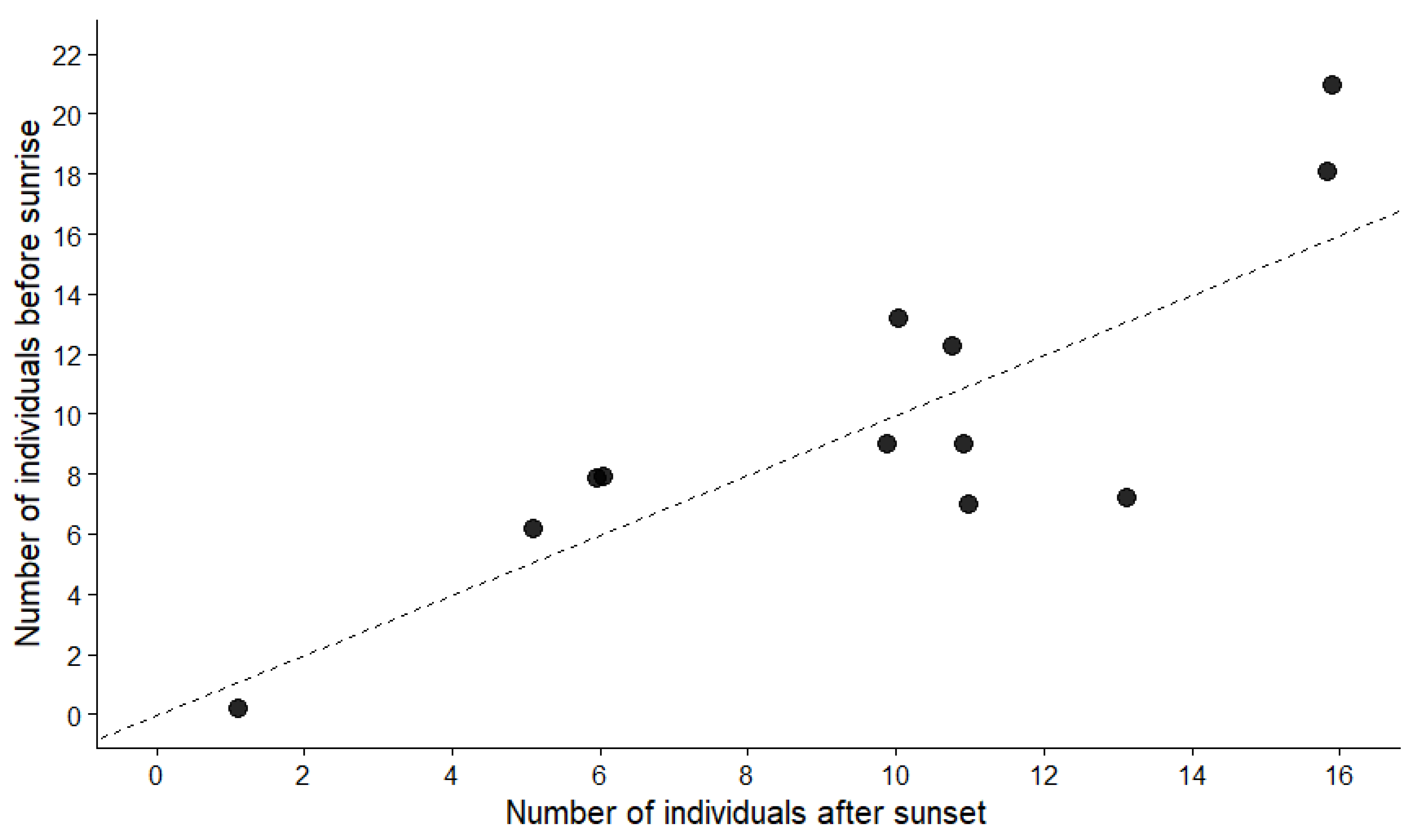
- Changes in subgroup size occurred more frequently when sunset subgroups were relatively large, indicating that larger subgroups are more likely to undergo nocturnal reorganization, although the direction of these changes (fission or fusion) varied among cases.
- These results challenge the assumption that diurnal primates exhibit limited activity at night and highlight the importance of considering the full 24 h cycle to understand primate social behavior and ecology.
- The study demonstrates the value of thermal drone technology for documenting otherwise unobservable nocturnal social dynamics, providing information that is directly relevant for primate monitoring and conservation.
Abstract
1. Introduction
2. Methods
2.1. Study Area
2.2. TIR Drone Flights
2.3. Video Review
2.4. Data Analysis
3. Results
4. Discussion
5. Conclusions
Author Contributions
Funding
Institutional Review Board Statement
Informed Consent Statement
Data Availability Statement
Acknowledgments
Conflicts of Interest
References
- Schad, L.; Fischer, J. Opportunities and risks in the use of drones for studying animal behaviour. Methods Ecol. Evol. 2023, 14, 1864–1872. [Google Scholar] [CrossRef] [Scilit]
- Pedrazzi, L.; Naik, H.; Sandbrook, C.; Lurgi, M.; Fürtbauer, I.; King, A.J. Advancing animal behaviour research using drone technology. Anim. Behav. 2025, 222, 123147. [Google Scholar] [CrossRef] [Scilit]
- Kline, J.; Afridi, S.; Rolland, E.G.A.; Maalouf, G.; Laporte-Devylder, L.; Stewart, C.; Crofoot, M.; Stewart, C.V.; Rubenstein, D.I.; Berger-Wolf, T. Studying collective animal behaviour with drones and computer vision. Methods Ecol. Evol. 2025, 16, 2229–2259. [Google Scholar] [CrossRef] [Scilit]
- Pinel-Ramos, E.J.; Aureli, F.; Wich, S.; Rodrigues de Melo, F.; Rezende, C.; Brandão, F.; de Melo, F.C.S.A.; Spaan, D. An Assessment of the Effectiveness of RGB-Camera Drones to Monitor Arboreal Mammals in Tropical Forests. Drones 2025, 9, 622. [Google Scholar] [CrossRef] [Scilit]
- Gazagne, E.; Goldblatt, C.; Trần Nguyễn, V.; Brotcorne, F.; Hambuckers, A. Utilizing Thermal Imaging Drones to Investigate Sleeping Site Selection in an Arboreal Primate. Curr. Zool. 2025, 71, 560–572. [Google Scholar] [CrossRef] [Scilit] [PubMed]
- Nichols, C.A.; Alexander, K. Creeping in the night: What might ecologists be missing? PLoS ONE 2018, 13, e0198277. [Google Scholar] [CrossRef] [Scilit] [PubMed]
- Devarajan, K.; Fidino, M.; Farris, Z.J.; Adalsteinsson, S.A.; Andrade-Ponce, G.; Angstmann, J.L.; Anthonysamy, W.; Aquino, J.; Asefa, A.; Avila, B.; et al. When the wild things are: Defining mammalian diel activity and plasticity. Sci. Adv. 2025, 11, eado3843. [Google Scholar] [CrossRef] [Scilit]
- Krief, S.; Cibot, M.; Bortolamiol, S.; Seguya, A.; Krief, J.-M.; Masi, S. Wild Chimpanzees on the Edge: Nocturnal Activities in Croplands. PLoS ONE 2014, 9, e109925. [Google Scholar] [CrossRef] [Scilit]
- Kays, R.; Sheppard, J.; Mclean, K.; Welch, C.; Paunescu, C.; Wang, V.; Kravit, G.; Crofoot, M. Hot monkey, cold reality: Surveying rainforest canopy mammals using drone-mounted thermal infrared sensors. Int. J. Remote Sens. 2019, 40, 407–419. [Google Scholar] [CrossRef] [Scilit]
- Spaan, D.; Burke, C.; McAree, O.; Aureli, F.; Rangel-Rivera, C.E.; Hutschenreiter, A.; Longmore, S.N.; McWhirter, P.R.; Wich, S.A. Thermal infrared imaging from drones offers a major advance for spider monkey surveys. Drones 2019, 3, 34. [Google Scholar] [CrossRef] [Scilit]
- Wearn, O.R.; Trinh-Dinh, H.; Le, Q.K.; Nguyen, T.D. UAV-assisted counts of group size facilitate accurate population surveys of the Critically Endangered cao vit gibbon Nomascus nasutus. Oryx 2024, 58, 183–186. [Google Scholar] [CrossRef] [Scilit]
- Zhang, H.; Wang, C.; Turvey, S.T.; Sun, Z.; Tan, Z.; Yang, Q.; Long, W.; Wu, X.; Yang, D. Thermal infrared imaging from drones can detect individuals and nocturnal behavior of the world’s rarest primate. Glob. Ecol. Conserv. 2020, 23, e01101. [Google Scholar] [CrossRef] [Scilit]
- Chang, B.; Hwang, B.; Lim, W.; Kim, H.; Kang, W.; Park, Y.-S.; Ko, D.W. Enhancing Wildlife Detection Using Thermal Imaging Drones: Designing the Flight Path. Drones 2025, 9, 52. [Google Scholar] [CrossRef] [Scilit]
- Gazagne, E.; Gray, R.J.; Wich, S.; Hambuckers, A.; Brotcorne, F. Development of a global thermal detection index to prioritize primate research with thermal drones. Sci. Rep. 2024, 14, 27963. [Google Scholar] [CrossRef] [Scilit]
- Reinegger, R.D.; Bissessur, P.; Meereechpersad, I.; Bhanda, G.; Gazagne, E.; Jones, G. Improving primate detection using thermal infrared imaging: Availability and observer errors in drone surveys of mixed tropical forests. Int. J. Remote Sens. 2025, 46, 4345–4373. [Google Scholar] [CrossRef] [Scilit]
- Whitworth, A.; Pinto, C.; Ortiz, J.; Flatt, E.; Silman, M. Flight speed and time of day heavily influence rainforest canopy wildlife counts from drone-mounted thermal camera surveys. Biodivers. Conserv. 2022, 31, 3179–3195. [Google Scholar] [CrossRef] [Scilit]
- Pinel-Ramos, E.J.; Aureli, F.; Wich, S.; Longmore, S.; Spaan, D. Evaluating Thermal Infrared Drone Flight Parameters on Spider Monkey Detection in Tropical Forests. Sensors 2024, 24, 5659. [Google Scholar] [CrossRef] [Scilit]
- Koger, B.; Deshpande, A.; Kerby, J.T.; Graving, J.M.; Costelloe, B.R.; Couzin, I.D. Quantifying the movement, behaviour and environmental context of group-living animals using drones and computer vision. J. Anim. Ecol. 2023, 92, 1357–1371. [Google Scholar] [CrossRef] [Scilit]
- Chapman, C.A.; Valenta, K. Costs and benefits of group living are neither simple nor linear. Proc. Natl. Acad. Sci. USA 2015, 112, 14751–14752. [Google Scholar] [CrossRef] [Scilit]
- Krause, J.; Ruxton, G.D. Living in Groups; Oxford University Press: Oxford, UK, 2002. [Google Scholar]
- Alexander, R.D. The Evolution of Social Behavior. Ann. Rev. Ecol. Syst. 1974, 5, 325–383. [Google Scholar] [CrossRef] [Scilit]
- Kappeler, P.M.; van Schaik, C.P. Evolution of Primate Social Systems. Int. J. Primatol. 2002, 23, 707–740. [Google Scholar] [CrossRef] [Scilit]
- Aureli, F.; Schaffner, C.M.; Boesch, C.; Bearder, S.K.; Call, J.; Chapman, C.A.; Connor, R.; Di Fiore, A.; Dunbar, R.I.M.; Peter Henzi, S.; et al. Fission-fusion dynamics new research frameworks. Curr. Anthropol. 2008, 49, 627–654. [Google Scholar] [CrossRef]
- Asensio, N.; Korstjens, A.H.; Aureli, F. Fissioning minimizes ranging costs in spider monkeys: A multiple-level approach. Behav. Ecol. Sociobiol. 2009, 63, 649–659. [Google Scholar] [CrossRef] [Scilit]
- Kummer, H. Primate Societies Group Techniques of Ecological Adaptation; Routledge: New York, NY, USA, 1971. [Google Scholar]
- Archie, E.A.; Moss, C.J.; Alberts, S.C. The ties that bind: Genetic relatedness predicts the fission and fusion of social groups in wild African elephants. Proc. R. Soc. B Biol. Sci. 2006, 273, 513–522. [Google Scholar] [CrossRef] [Scilit] [PubMed]
- Smith, J.E.; Kolowski, J.M.; Graham, K.E.; Dawes, S.E.; Holekamp, K.E. Social and ecological determinants of fission–fusion dynamics in the spotted hyaena. Anim. Behav. 2008, 76, 619–636. [Google Scholar] [CrossRef] [Scilit]
- Matthews, J.K.; Ridley, A.; Kaplin, B.A.; Grueter, C.C. Ecological and reproductive drivers of fission-fusion dynamics in chimpanzees (Pan troglodytes schweinfurthii) inhabiting a montane forest. Behav. Ecol. Sociobiol. 2021, 75, 23. [Google Scholar] [CrossRef] [Scilit]
- Aureli, F.; Schaffner, C.M. Social interactions, social relationships and the social system of spider monkeys. In Spider Monkeys; Cambridge University Press: Cambridge, UK, 2008; pp. 236–265. [Google Scholar]
- Asensio, N.; Lusseau, D.; Schaffner, C.M.; Aureli, F. Spider monkeys use high-quality core areas in a tropical dry forest. J. Zool. 2012, 287, 250–258. [Google Scholar] [CrossRef] [Scilit]
- Chapman, C.A. Spider monkey sleeping sites: Use and availability. Am. J. Primatol. 1989, 18, 53–60. [Google Scholar] [CrossRef] [Scilit]
- Spaan, D.; Guisneuf, N.; Rangel-Rivera, C.E.; Saldaña-Sánchez, A.A.; Aureli, F. Spider monkeys (Ateles geoffroyi) are vocally active throughout the night in a human-modified habitat. Primates 2025, 67, 77–87. [Google Scholar] [CrossRef] [Scilit]
- Briseño-Jaramillo, M.; Sosa-López, J.R.; Ramos-Fernández, G.; Lemasson, A. Flexible use of contact calls in a species with high fission–fusion dynamics. Philos. Trans. R. Soc. B Biol. Sci. 2022, 377, 20210309. [Google Scholar] [CrossRef] [Scilit]
- Pietrangeli, E.; Saldaña-Sánchez, A.A.; Spaan, D.; Aureli, F. Let’s not use it! A dynamic no-use zone between the home ranges of two spider monkey groups. Primates 2024, 65, 173–181. [Google Scholar] [CrossRef] [Scilit]
- Spaan, D.; Di Fiore, A.; Rangel-Rivera, C.E.; Hutschenreiter, A.; Wich, S.; Aureli, F. Detecting spider monkeys from the sky using a high-definition RGB camera: A rapid-assessment survey method? Biodivers. Conserv. 2022, 31, 479–496. [Google Scholar] [CrossRef] [Scilit]
- Pinel-Ramos, E.J.; Aureli, F.; Wich, S.; Petersen, M.F.; Dias, P.A.D.; Spaan, D. The Behavioral Responses of Geoffroy’s Spider Monkeys to Drone Flights. Drones 2024, 8, 500. [Google Scholar] [CrossRef] [Scilit]
- Battulwar, R.; Winkelmaier, G.; Valencia, J.; Naghadehi, M.Z.; Peik, B.; Abbasi, B.; Parvin, B.; Sattarvand, J. A Practical Methodology for Generating High-Resolution 3D Models of Open-Pit Slopes Using UAVs: Flight Path Planning and Optimization. Remote Sens. 2020, 12, 2283. [Google Scholar] [CrossRef] [Scilit]
- R Core Team. R: A Language and Environment for Statistical Computing. 2025. Available online: https://www.R-project.org/ (accessed on 1 December 2025).
- Chapman, C.A.; Chapman, L.J.; Wrangham, R.W. Ecological constraints on group size: An analysis of spider monkey and chimpanzee subgroups. Behav. Ecol. Sociobiol. 1995, 36, 59–70. [Google Scholar] [CrossRef]
- Symington, M.M.F. Fission-fusion social organization in Ateles and Pan. Int. J. Primatol. 1990, 11, 47–61. [Google Scholar] [CrossRef] [Scilit]
- Asensio, N.; Korstjens, A.H.; Schaffner, C.M. Intragroup Aggression, Fission-Fusion Dynamics and Feeding Competition in Spider Monkeys. Behaviour 2008, 145, 983–1001. [Google Scholar] [CrossRef] [Scilit]
- Busia, L.; Schaffner, C.M.; Aureli, F. Relationship quality affects fission decisions in wild spider monkeys (Ateles geoffroyi). Ethology 2017, 123, 405–411. [Google Scholar] [CrossRef] [Scilit]
- Beauchamp, G. Animal Vigilance: Monitoring Predators and Competitors; Academic Press: Cambridge, MA, USA, 2015. [Google Scholar]
- Stojan-Dolar, M.; Heymann, E.W. Vigilance in a Cooperatively Breeding Primate. Int. J. Primatol. 2010, 31, 95–116. [Google Scholar] [CrossRef] [Scilit]
- Ramanankirahina, R.; Joly, M.; Zimmermann, E. Seasonal Effects on Sleeping Site Ecology in a Nocturnal Pair-Living Lemur (Avahi occidentalis). Int. J. Primatol. 2012, 33, 428–439. [Google Scholar] [CrossRef] [Scilit]
- Brividoro, M.V.; Oklander, L.I.; Cantarelli, V.I.; Ponzio, M.F.; Ferrari, H.R.; Kowalewski, M.M. The Effects of Social Factors and Kinship on Co-sleeping of Black-and-Gold Howler Monkeys (Alouatta caraya). Int. J. Primatol. 2021, 42, 876–895. [Google Scholar] [CrossRef] [Scilit]
- Savagian, A.; Fernandez-Duque, E. Do Predators and Thermoregulation Influence Choice of Sleeping Sites and Sleeping Behavior in Azara’s Owl Monkeys (Aotus azarae azarae) in Northern Argentina? Int. J. Primatol. 2017, 38, 80–99. [Google Scholar] [CrossRef] [Scilit]
- CONAGUA. Normales Climatológicas por Estado. Available online: https://smn.conagua.gob.mx/es/climatologia/informacion-climatologica/normales-climatologicas-por-estado?estado=qroo (accessed on 15 December 2025).
- Di Fiore, A.; Campbell, C.J. The atelines: Variation in ecology, behavior, and social organization. In Primates in Perspective; Campbell, C., Fuentes, A., Mackinnon, K., Panger, M., Reader, S., Eds.; Oxford University Press: New York, NY, USA, 2007; pp. 155–185. [Google Scholar]
- Jablonski, N.G. Social and affective touch in primates and its role in the evolution of social cohesion. Neuroscience 2021, 464, 117–125. [Google Scholar] [CrossRef] [Scilit]
- van Schaik, C.P.; van Noordwijk, M.A.; de Boer, R.J.; den Tonkelaar, I. The effect of group size on time budgets and social behaviour in wild long-tailed macaques (Macaca fascicularis). Behav. Ecol. Sociobiol. 1983, 13, 173–181. [Google Scholar] [CrossRef] [Scilit]
- Fernández-Duque, E.; de la Iglesia, H.; Erkert, H.G. Moonstruck Primates: Owl Monkeys (Aotus) Need Moonlight for Nocturnal Activity in Their Natural Environment. PLoS ONE 2010, 5, e12572. [Google Scholar] [CrossRef] [Scilit] [PubMed]
- Bischof, R.; Vallejo-Vargas, A.F.; Semper-Pascual, A.; Schowanek, S.D.; Beaudrot, L.; Turek, D.; Jansen, P.A.; Rovero, F.; Johnson, S.E.; Guimarães Moreira Lima, M.; et al. The moon’s influence on the activity of tropical forest mammals. Proc. R. Soc. B Biol. Sci. 2024, 291, 20240683. [Google Scholar] [CrossRef] [Scilit]
- Krieg, J. Influence of moon and clouds on night illumination in two different spectral ranges. Sci. Rep. 2021, 11, 20642. [Google Scholar] [CrossRef] [Scilit]
- Do Nascimento, L.A.; Pérez-Granados, C.; Beard, K.H. Passive Acoustic Monitoring and Automatic Detection of Diel Patterns and Acoustic Structure of Howler Monkey Roars. Diversity 2021, 13, 566. [Google Scholar] [CrossRef] [Scilit]
- Brividoro, M.V.; Kowalewski, M.M.; Scarry, C.J.; Oklander, L.I. Patterns of Sleeping Site and Sleeping Tree Selection by Black-and-Gold Howler Monkeys (Alouatta caraya) in Northern Argentina. Int. J. Primatol. 2019, 40, 374–392. [Google Scholar] [CrossRef] [Scilit]
- Brotcorne, F.; Maslarov, C.; Wandia, I.N.; Fuentes, A.; Beudels-Jamar, R.C.; Huynen, M. The role of anthropic, ecological, and social factors in sleeping site choice by long-tailed Macaques ( Macaca fascicularis ). Am. J. Primatol. 2014, 76, 1140–1150. [Google Scholar] [CrossRef] [Scilit]
- Gaynor, K.M.; Hojnowski, C.E.; Carter, N.H.; Brashares, J.S. The influence of human disturbance on wildlife nocturnality. Science 2018, 360, 1232–1235. [Google Scholar] [CrossRef] [Scilit]
- Piel, A.K.; Crunchant, A.; Knot, I.E.; Chalmers, C.; Fergus, P.; Mulero-Pázmány, M.; Wich, S.A. Noninvasive Technologies for Primate Conservation in the 21st Century. Int. J. Primatol. 2022, 43, 133–167. [Google Scholar] [CrossRef] [Scilit]
- Whitworth, A.; Braunholtz, L.D.; Huarcaya, R.P.; MacLeod, R.; Beirne, C. Out on a Limb: Arboreal Camera Traps as an Emerging Methodology for Inventorying Elusive Rainforest Mammals. Trop. Conserv. Sci. 2016, 9, 675–698. [Google Scholar] [CrossRef] [Scilit]
- Seymour, A.C.; Dale, J.; Hammill, M.; Halpin, P.N.; Johnston, D.W. Automated detection and enumeration of marine wildlife using unmanned aircraft systems (UAS) and thermal imagery. Sci. Rep. 2017, 7, 45127. [Google Scholar] [CrossRef] [Scilit] [PubMed]
- Colombelli-Négrel, D.; Sach, I.Z.; Hough, I.; Hodgson, J.C.; Daniels, C.B.; Kleindorfer, S. Koalas showed limited behavioural response and no physiological response to drones. Appl. Anim. Behav. Sci. 2023, 264, 105963. [Google Scholar] [CrossRef] [Scilit]
- Wich, S.A.; Koh, L.P. Conservation drones: Mapping and monitoring biodiversity. In Conservation Drones: Mapping and Monitoring Biodiversity; Oxford Academic: Oxford, UK, 2018; pp. 1–118. [Google Scholar] [CrossRef] [Scilit]


Disclaimer/Publisher’s Note: The statements, opinions and data contained in all publications are solely those of the individual author(s) and contributor(s) and not of MDPI and/or the editor(s). MDPI and/or the editor(s) disclaim responsibility for any injury to people or property resulting from any ideas, methods, instructions or products referred to in the content. |
© 2026 by the authors. Licensee MDPI, Basel, Switzerland. This article is an open access article distributed under the terms and conditions of the Creative Commons Attribution (CC BY) license.
Share and Cite
Pinel-Ramos, E.J.; Spaan, D.; Wich, S.; Aureli, F. Thermal Drones Aid to Uncover Nocturnal Subgrouping Patterns of a Diurnal Primate. Drones 2026, 10, 114. https://doi.org/10.3390/drones10020114
Pinel-Ramos EJ, Spaan D, Wich S, Aureli F. Thermal Drones Aid to Uncover Nocturnal Subgrouping Patterns of a Diurnal Primate. Drones. 2026; 10(2):114. https://doi.org/10.3390/drones10020114
Chicago/Turabian StylePinel-Ramos, Eduardo José, Denise Spaan, Serge Wich, and Filippo Aureli. 2026. "Thermal Drones Aid to Uncover Nocturnal Subgrouping Patterns of a Diurnal Primate" Drones 10, no. 2: 114. https://doi.org/10.3390/drones10020114
APA StylePinel-Ramos, E. J., Spaan, D., Wich, S., & Aureli, F. (2026). Thermal Drones Aid to Uncover Nocturnal Subgrouping Patterns of a Diurnal Primate. Drones, 10(2), 114. https://doi.org/10.3390/drones10020114