Article

Deciphering Seed Pre-Treatment and Soil Amendment Effects on the Germination and Early Growth of Radhachura/Peacock Flower (Caesalpinia pulcherrima L.)


by
Most Annica Tabassum
1,†,
Md Mustafizur Rahman
2,† and
Md Abu Hanif
1,*
1
Ecology Lab, Department of Agroforestry and Environment, Hajee Mohammad Danesh Science and Technology University, Dinajpur 5200, Bangladesh
2
Graduate School of Green-Bio Science, Kyung Hee University, Yongin 17104, Republic of Korea
*
Author to whom correspondence should be addressed.
These authors contributed equally to this work.
Nitrogen 2026, 7(2), 50; https://doi.org/10.3390/nitrogen7020050
Submission received: 23 March 2026 / Revised: 30 April 2026 / Accepted: 1 May 2026 / Published: 3 May 2026

Abstract

Seed pre-treatment is imperative for breaking the seed dormancy of some perennial species. The addition of soil amendments might be helpful in supporting seed germination and growth by available essential plant nutrients. This research investigated the effects of different pre-treatment and soil amendments on the germination, growth, and physiological performance of radhachura (Caesalpinia pulcherrima L.), an important ornamental and multipurpose woody shrub. Four pre-treatments and five soil amendments were applied in a CRD (Completely Randomized Design) arrangement to evaluate their individual and combined impacts under controlled nursery conditions. The ANOVA result revealed that seed germination indices of radhachura were mostly influenced by soil amendment rather than the seed pre-treatment. Among the soil amendments, vermicompost had a more profound impact on germination speed, Timson’s index and peak value, which had a similar effect to NPK application. Soil organic amendments positively affected growth, with vermicompost exerting the greatest influence on multiple germination traits that may support the early growth of radhachura, while biochar and compost maximized certain root and plant-length traits. Pearson correlations and PCA (first seven PCs explaining 76.2% variation) revealed the strong integration of late biomass, plant length, and root development, identifying vermicompost as key enhancers of multivariate vigor in radhachura seedlings. It might be concluded that C. pulcherrima L. species germination and growth was mostly influenced by soil amendment rather than seed pre-treatment. The study highlights that integrated nursery practices combining appropriate pre-treatment and soil amendments can enhance the germination success of radhachura.

1. Introduction

Radhachura, or Peacock Flower (C. pulcherrima), is a tropical ornamental species that is highly valued for its colorful bloom and medicinal uses [1,2]. This woody shrub, a member of the family Fabaceae, is commonly planted as a live fence and for landscape beautification in urban environments, including institutional and roadside plantations [3]. The genus Caesalpinia L. comprises about 150 pantropical species of trees, shrubs, and thorny climbers, many of which hold substantial economic, pharmacological, and ecological value [4]. In Bangladesh, twelve species of Caesalpinia have been recorded, among which C. pulcherrima is distinguished by its long pedicels and stamens (>5 cm), stipel-bearing leaflets, and bright red-to-yellow flowers [4].
Radhachura leaves, flowers, and seeds have medicinal uses, including treating fever, sores, cough, breathing difficulties, and chest pain, while its root can induce early-term abortion [1]. The plant is also used for treating swellings, earaches, rheumatic pain, and cardiovascular diseases, and it is also used for the treatment of bronchial organs (asthma and bronchitis), gastrointestinal organs (cholera, diarrhea and dysentery) and liver complaints [2]. It contains bioactive compounds attributed to a diverse range of secondary metabolites such as cassane diterpenoids, flavonoids, glycosides, and steroids, which contribute to its antimicrobial and therapeutic properties [1]. Besides its medicinal and esthetic significance, radhachura is a common option for home gardens, roadside plantings, and urban landscaping because of its eye-catching, vibrant blooms and feathery leaves [5]. Integumentary dormancy has been found among the species of the Fabaceae family; thus, it would be imperative to decipher the response of seed germination with pre-treatment and soil amendments.
Seed germination is a vital stage in a plant’s life cycle and is highly influenced by environmental factors such as soil texture, temperature, moisture content, and nutrient availability [6]. Proper soil management enhances germination efficiency and seedling establishment, particularly for radhachura [7,8]. The seeds of radhachura are hard-coated, exhibiting physical dormancy that restricts water absorption and gas exchange, thus delaying germination [4]. To overcome these constraints and optimize early growth, soil fertility and amendment practices play an essential role. The potential amendments include both organic and inorganic chemical as well as biologically active additions, improving soil structure, nutrient availability, water retention, and aeration [9]. Organic amendments such as cow dung, compost, vermicompost, and biochar improve soil microbial activity and nutrient supply, promoting seedling vigor and sustained plant development [10,11,12]. Cowdung and compost progressively supply macro- and micronutrients, increase soil porosity, and promote root growth [13,14]. Vermicompost enriches soil with beneficial microorganisms and growth hormones, whereas biochar enhances cation exchange capacity and moisture retention [11,14,15]. In contrast, inorganic fertilizers like NPK provide fast-acting nutrients that stimulate early growth and biomass accumulation but may cause leaching and acidity when overapplied [16,17,18]. The integration of organic and inorganic amendments enhances nutrient cycling, soil fertility, and plant productivity in Fabaceae species [19], highlighting their importance for successful radhachura germination and sustainable management in agroforestry and restoration systems [20,21,22,23].
Pre-treatment of seeds is crucial for promoting germination and seedling establishment of some species. Radhachura produce seeds with hard, impermeable seed coverings that, by obstructing gas exchange and water absorption, result in physical dormancy and delayed or irregular germination in the wild [24]. Several pre-sowing methods have been investigated to overcome this restriction, such as chemical scarification (acid treatment with concentrated sulfuric acid), mechanical scarification (scratching or nicking the seed coat), and thermal treatments (soaking in hot or cold water) [25,26]. For instance, soaking radhachura seeds in hot water or treating them with sulfuric acid for a specified length has been shown to dramatically enhance germination percentage while decreasing mean germination time when compared to untreated or un-scarified seeds [27]. Other woody shrubs and leguminous trees, like Albizia lebbeck and Acacia nilotica, have shown similar favorable benefits from such treatments [28,29]. Effective species-dependent pre-treatment is essential for large-scale planting, nursery production, and ecological restoration projects since it not only guarantees consistent and quick germination but also increases seedling vigor [30,31]. Therefore, selecting appropriate pre-treatment methods based on species dormancy type and seed coat hardness is essential for the successful propagation and sustainable utilization of ornamental and multipurpose woody shrubs like radhachura.
This study was undertaken to examine the combined effects of seed pre-treatment methods and soil amendments on the germination and early growth of radhachura. The research specifically aimed to evaluate the impacts of different pre-treatment techniques, such as water soaking, hot-water soaking, and sulfuric acid treatment, with or without scarification, on seed germination indices; assess the influence of various soil amendments, both organic (compost, biochar, cow dung, vermicompost) and inorganic (NPK fertilizer), on seedling emergence and growth performance; and analyze both above- and below-ground physiological traits, including shoot and root growth, leaf number, and biomass allocation, in response to these treatments. Ultimately, this study seeks to optimize effective propagation and soil management practices for radhachura, contributing to its improvement in agroforestry, medicinal, and ornamental horticultural applications.

2. Materials and Methods

2.1. Plant Material and Experimental Condition

The radhachura seeds were collected from the Agroforestry Research Field, Department of Agroforestry and Environment, Hajee Mohammad Danesh Science and Technology University (HSTU), Dinajpur, Bangladesh, where the experiment was also conducted. The site is geographically located at 25°13′ N latitude and 88°23′ E longitude, approximately 37.5 m above sea level, and belongs to the Level Barind Tract (AEZ-25) based on its geological and environmental features. The study was carried out over a three-month period, from 28 February to 27 May 2025, to evaluate the effects of seed pre-treatments and soil amendments on the germination of Radhachura.

2.2. Seed and Soil Collection Material

Seeds used in this study were collected from mature radhachura trees growing on the HSTU campus during the late fall or winter season. After collection, the pods were sun-dried for a week to facilitate seed separation, and the extracted seeds were stored in airtight zip-lock bags prior to pre-treatment and sowing in pots. Soil used for pot filling was obtained from the experimental fields of the HSTU research farm. The collected soil was sieved thoroughly to remove debris and homogenized before being placed into pots measuring 18 cm height × 15 cm diameter. Each pot was filled uniformly to maintain consistency across all treatments. Different soil amendments were incorporated at specific ratios according to treatment requirements and mixed thoroughly before the seeds were placed for germination assessment.

2.3. Experimental Design and Treatments

The experiment was conducted using a Completely Randomized Design (CRD) with three replications to evaluate the combined effects of seed pre-treatments and soil amendment mixtures on seed performance. Four seed pre-treatments and five different soil mixtures were applied as treatments. The seed pre-treatments included un-scarified (control) seeds soaked in water for 24 h (T1); scarified seeds (with sandpaper) soaked in water for 24 h (T2); hot-water treatment for 2 min followed by seed soaking in water for 24 h with scarification (T3) [32]; and sulfuric acid (H2SO4) soaking for 2 min followed by seed soaking in water for 24 h with scarification (T4) [33]. The soil amendment treatments comprised five different soil mixtures: soil and cow dung (3:1) (F1) [34,35]; soil and compost (3:1) (F2) [36]; soil and vermicompost (3:1) (F3) [37]; soil amended with biochar (40 g/kg soil) (F4) [38]; and soil supplemented with NPK fertilizer (4 g/kg soil) (F5) [39]. For each treatment combination, 4 seeds were sown per pot at a depth of 2 cm, with three pots per combination; the pot was considered the experimental unit in all statistical analyses. Pots were kept in a nursery under a transparent polythene roof without side walls to provide shade and protection from rainfall, irrigated as needed to maintain adequate moisture, and grown in the amended soil mixtures without any additional fertilization to allow accurate assessment of the seed pre-treatments and soil amendments. Both seed and soil amendments were factorially combined to examine their interaction effects under controlled conditions.

2.4. Data Collection and Measurement Parameters

Following planting, observations were made on various germination and growth parameters, including germination percentage (GP), peak germination time (PGT), germination speed (GS), Timson’s index (TI), peak value (PV), plant height (PH), leaf number (LN), plant length (PL), root length (RL), ratio of plant height to root length (PH:RL), chlorophyll content (CC), shoot fresh weight (SFW), root fresh weight (RFW), shoot dry weight (SDW), root dry weight (RDW), ratio of shoot dry weight to root dry weight (SDW:RDW), leaf area index (LAI), specific leaf area (SLA).

2.5. Analysis of Germination Indices

Germination percentage (GP) refers to the percentage of seeds that successfully sprout within a given time frame. GP was calculated using the following formula [40]:
G P = N g N t × 100
where Ng is the number of germinated seeds and Nt is the total number of seeds.
Peak germination time (PGT) refers to the time in which the highest frequency of germinated seeds are observed and need not be unique. PGT was calculated using the following formula [41]:
T p e a k = { T i : N i = N m a x }
where Ti is the time from the start of the experiment to the ith interval, Ni is the number of seeds germinated in the ith time interval (not the accumulated number, but the number corresponding to the ith interval) and Nmax is the maximum number of seeds germinated per interval.
Germination speed (GS) is the rate of germination in terms of the total number of seeds that germinate in a time interval. GS was calculated using the following formula [42,43]:
G S = i = 1 k N i / T i
where Ti is the time from the start of the experiment to the ith interval, Ni is the number of seeds germinated in the ith time interval (not the accumulated number, but the number corresponding to the ith interval), and k is the total number of time intervals.
Timson’s index (TI) is the progressive total of cumulative germination percentage recorded at specific intervals for a set period and is estimated in terms of cumulative germination percentage (Gi) as the following formula [44,45]:
K = i 1 k G i
where Gi is the cumulative germination percentage in the time interval i and k is the total number of time intervals.
Peak value (PV) is the accumulated number of seeds germinated at the point on the germination curve at which the rate of germination starts to decrease. It is computed as the maximum quotient obtained by dividing successive cumulative germination values by the relevant incubation time. PV was calculated using the following formula [46]:
P V = max G 1 T 1 , G 2 T 2 , , G k T k
where Ti is the time from the start of the experiment to the ith interval, Gi is the cumulative germination percentage in the ith time interval, and k is the total number of time intervals.

2.6. Growth and Physiological Measurements

Plant height (PH) was measured from the base to the apical point of the plant using a centimeter-scale at 15-day intervals up to 90 DAS. The number of leaves (LN) was recorded manually at the same intervals by counting all visible leaves except immature ones at the shoot apex. Root length (RL) was measured from the base to the tip of the longest root after carefully washing adhering soil particles, while plant length (PL) was determined as the sum of PH and RL. The ratio of plant height to root length (PH:RL) was calculated using the mean PH and RL of each treatment. Chlorophyll content (CC) was assessed using a handheld Soil–Plant Analysis Development (SPAD) chlorophyll meter (SPAD-502, Konica Minolta, Osaka, Japan), which measures light transmittance at 660 and 940 nm to estimate relative chlorophyll concentration non-destructively. Shoot fresh weight (SFW) and root fresh weight (RFW) were measured immediately after carefully uprooting plants at 90 DAS using a precision balance. Shoots and roots were then oven-dried at 65 °C for 48 h to obtain shoot dry weight (SDW) and root dry weight (RDW). The ratio of shoot to root dry weight (SDW:RDW) was determined to assess biomass partitioning between above- and below-ground parts. Leaf area index (LAI) was quantified using a leaf area index meter (Model: LLAM-A10, Labtron Equipment Ltd., Camberley, Surrey, UK), and specific leaf area (SLA) was calculated as the ratio of total leaf area to leaf dry weight, following standard procedures [47].

2.7. Statistical Analysis

Germination indices were calculated in RStudio (version 4.2.3; 2023) using the germinationmetrics packages, which implement standard indices such as germination percentage, peak germination time, germination speed, Timson’s index, and peak values from cumulative germination counts. All subsequent statistical analyses were performed in Minitab 18 (version 21.4.3.0). A two-factor factorial ANOVA was used for each response variable, with seed pre-treatment and soil amendment as fixed factors and their interaction term included in the model. For plant height and leaf number, which were recorded at 15-day intervals, separate factorial ANOVAs were conducted at each time point. The Tukey HSD All-Pairwise Comparisons Test was employed to determine the statistical significance (p < 0.05) of the differences among the mean values. Significant differences were indicated by different letters in the table and figures. Graphs were prepared in Microsoft Excel (Microsoft Corporation, Redmond, WA, USA).

3. Results

3.1. Effects of Seed Pre-Treatments and Soil Amendments on the Germination Indices of Radhachura

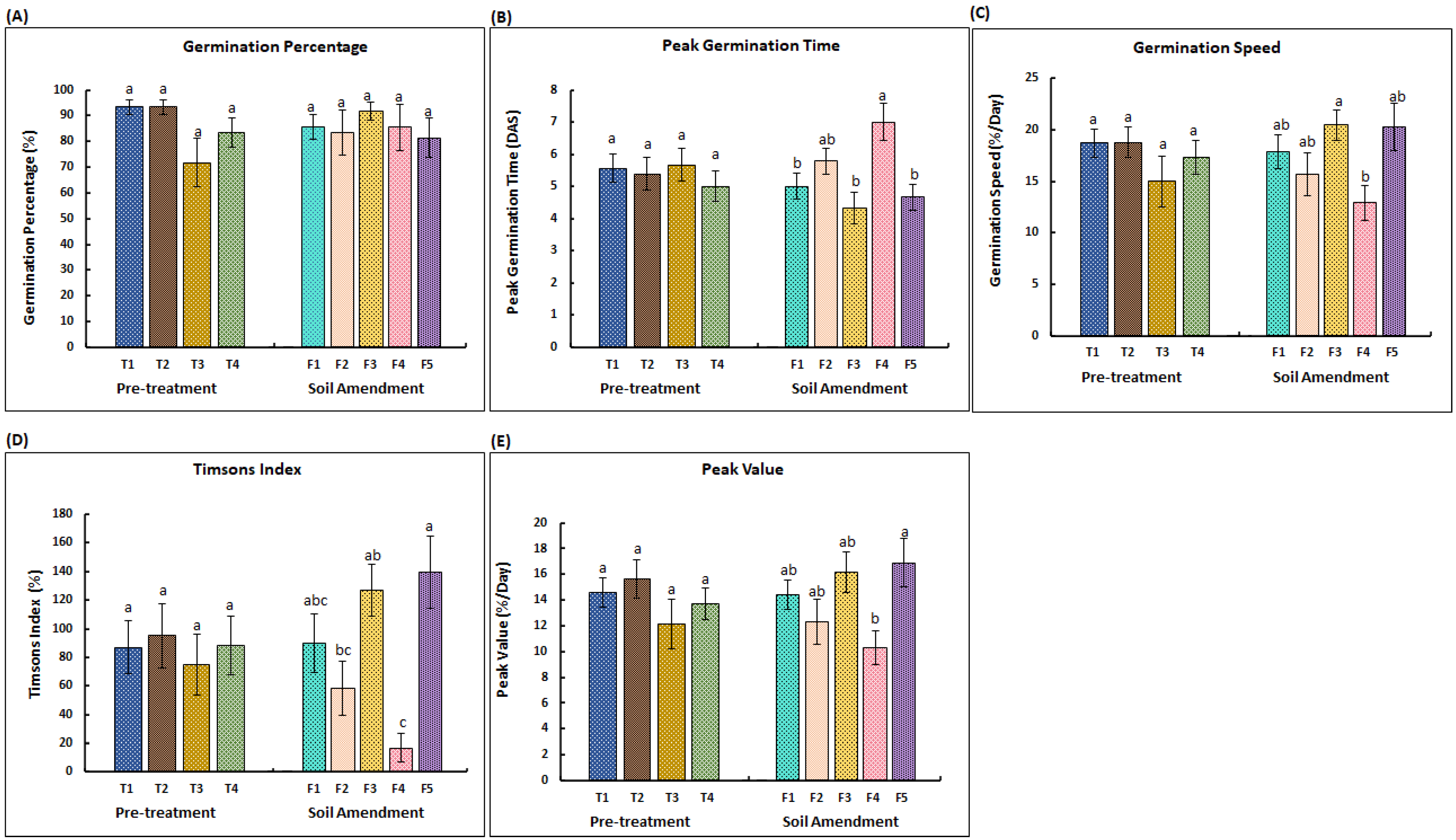
Germination percentage (GP) was significantly affected by seed pre-treatment, whereas peak germination time (PGT), germination speed (GS), Timson’s index (TI) and peak value (PV) were significantly affected by soil amendments, as reflected in the key germination indices (Tables S1 and S2). Germination percentage (GP) varied significantly under different pre-treatments (Figure 1A; p < 0.029), with the highest GP observed in both scarified and non-scarified treatments, i.e., T1 (93.33%) and T2 (93.33%), followed by T4 (83.33%), and it was the lowest in the seeds immersed in hot water after scarification, i.e., T3 (71.67%). Among soil amendments, vermicompost amended soil (F3) showed the maximum GP (91.67%) and F5 (NPK) the minimum (81.25%) (Figure 1A). Peak germination time (PGT) differed notably by soil amendment (p < 0.01), being longest in biochar treatment F4 (7.00 DAS) and shortest in F3 (4.33 DAS) (Figure 1B). Germination speed (GS) also varied significantly (p = 0.016), with the highest rates in F3 (20.47% day−1) and F5 (18.78% day−1) (Figure 1C, Table S2). The Timson’s index (TI) also showed a similar trend to GS (Figure 1D, Table S3). Peak value (PV) also responded significantly to soil amendments (p < 0.01), recording the highest in F5 (16.88% day−1) and F3 (15.65% day−1), and the lowest in F4 (10.28% day−1) (Figure 1E).
Overall, germination indices of C. pulcherrima were profoundly influenced by soil amendments rather than the seed pre-treatments, particularly vermicompost (F3), which consistently improved germination efficiency.

3.2. Effects of Seed Pre-Treatment and Soil Amendments on the Growth-Related Traits of Radhachura

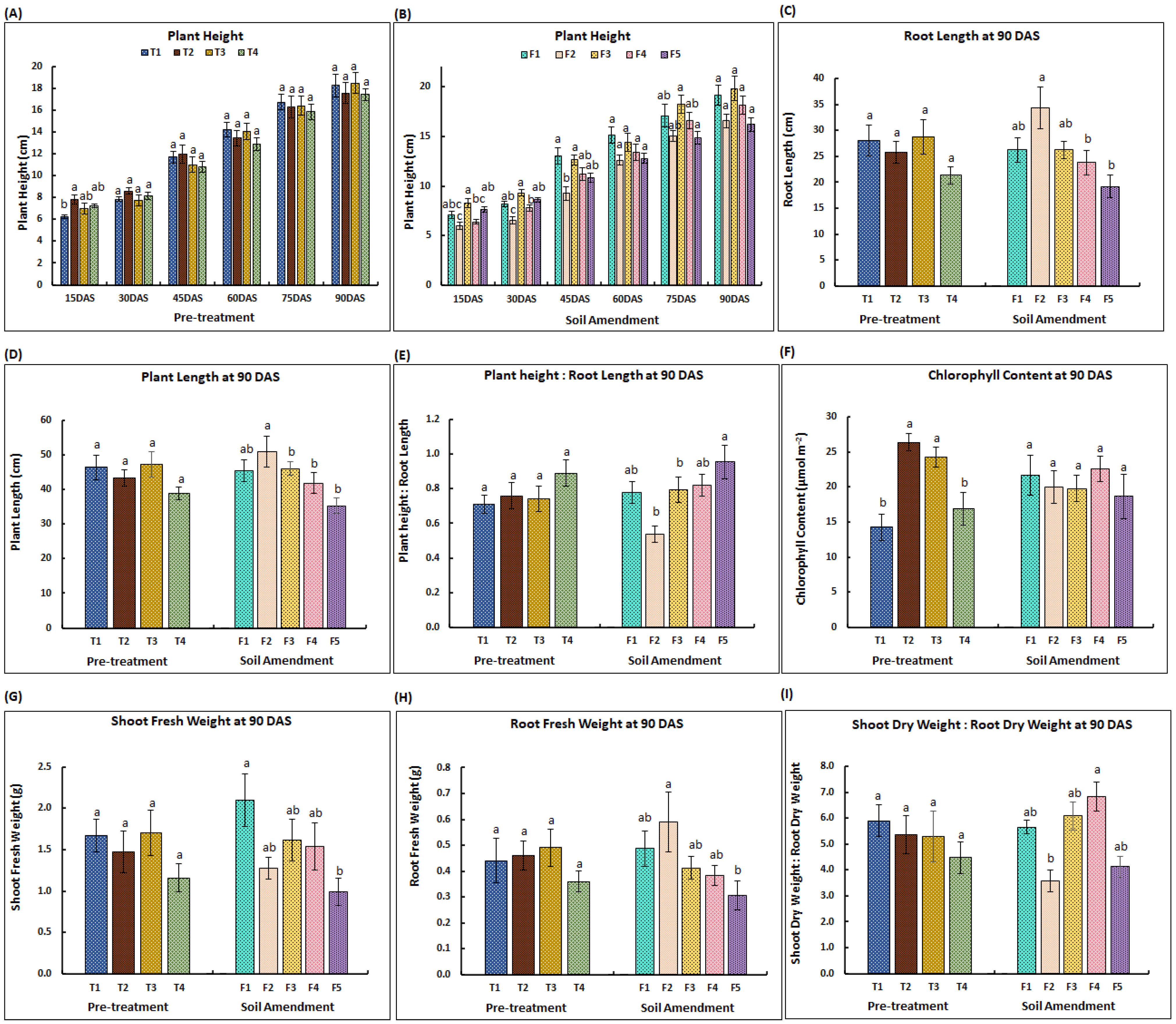
Seed pre-treatments caused significant plant height (PH) variation only at 15 DAS (Figure 1A, Tables S3 and S4), with no further effects. Soil amendments significantly increased PH at 15, 30, 45, and 75 DAS (Figure 1B), where F3 yielded the highest PH (8.27 cm at 15 DAS, 19.79 cm at 90 DAS), F1 the peak at 45–60 DAS (15.14 cm), and F2/F5 the lowest (F2: 6.03 cm at 15 DAS; F5: 14.83 cm at 75 DAS). Pre-treatments and amendments had non-significant effects on leaf number (LN), leaf area index (LAI), and specific leaf area (SLA) (Figure S1; Tables S3 and S4).
Soil amendments significantly increased root length at 90 DAS (RL90) (p = 0.004; F2: 34.40 cm; F5 lowest: 19.18 cm; Figure S1A; Table S3), plant length at 90 DAS (PL) (p = 0.017; F2: 50.94 cm; F5: 35.35 cm), ratio of plant height to root length at 90 DAS (PH:RL) (p = 0.002; F5: 0.96; F2: 0.54), and ratio of shoot dry weight to root dry weight at 90 DAS (SDW:RDW) (p = 0.040; F4: 6.83; F2: 2.97), with non-significant pre-treatment or interaction effects except for chlorophyll content at 90 DAS (CC) (pre-treatment p < 0.001, interaction p < 0.001; T2: 26.40 µmol m−2; T2F4: 30.90 µmol m−2) (Figure 2 and Figure S1; Tables S3 and S4). Root fresh weight at 90 DAS (RFW), shoot dry weight at 90 DAS (SDW), and root dry weight at 90 DAS (RDW) showed no significant main or interaction effects (p > 0.05), although trends favored F1–F4 over F5 (SFW F1: 2.10 g; SDW F4: 0.55 g) (Figure S1E,F; Tables S3 and S4).

3.3. Physicochemical Analysis of the Soil Amendments

The physicochemical analysis of the soil amendments revealed marked differences in nutrient composition compared with the base soil. Vermicompost exhibited the highest soil organic carbon (SOC) content (21.74%), followed by cowdung (12.46%) and compost (9.28%), whereas biochar and unamended soil contained comparatively lower SOC (8.16% and 1.66%, respectively) (Table 1). Total nitrogen was greatest in compost (1.54%), with moderate levels in vermicompost (0.84%), cowdung (0.75%), and biochar (0.70%), while the soil alone had very low nitrogen (0.10%) (Table 1). Available phosphorus ranged from 0.25% in biochar to 0.56% in vermicompost, with cowdung and compost also providing relatively high P compared with soil. Potassium content was highest in compost (2.65%), followed by biochar (2.32%), with cowdung and vermicompost each at 1.32%, all exceeding the K level in soil (0.43%) (Table 1). Sulfur content was moderate in cowdung (0.43%) and compost (0.38%), lower in soil (0.16%) and biochar (0.10%), and minimal in vermicompost (0.06%), indicating that each amendment contributed a distinct nutrient profile likely to differentially influence seedling growth and soil fertility (Table 1).

3.4. Pearson Correlations Coefficient Relationship Among Growth, Biomass, and Physiological Traits

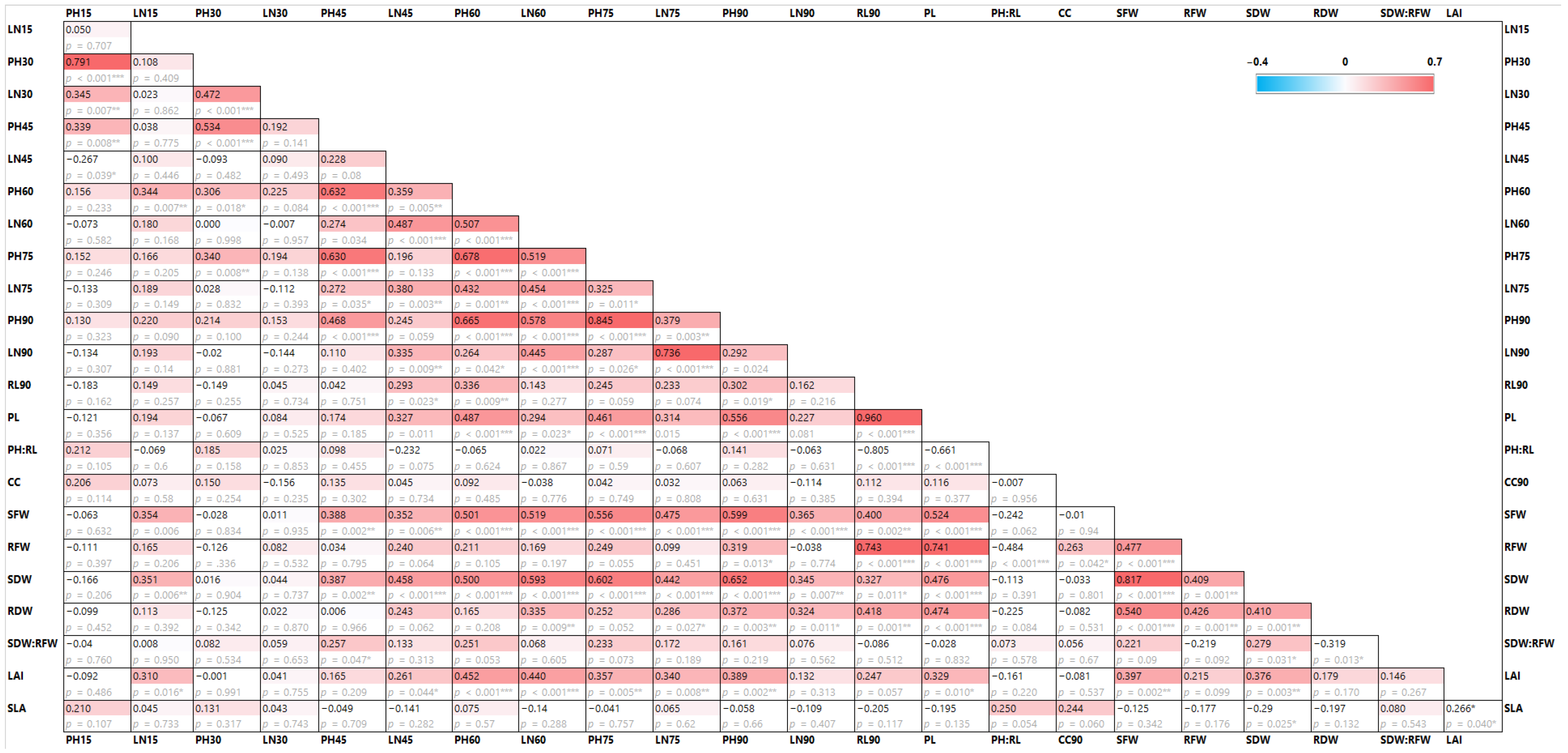
Across developmental stages, plant height exhibited strong positive temporal correlations, with particularly high coefficients among later measurements (PH60-PH90, r = 0.67–0.85, p < 0.001), indicating a stable ranking of treatments for vertical growth over time. Leaf number showed a comparable pattern (LN45-LN75, r = 0.38, p = 0.003; LN60-LN90, r = 0.45, p < 0.001), whereas cross-trait associations between height and leaf number were generally weak or non-significant, suggesting partially independent regulation of elongation and leaf production (Figure 3). Root length at 90 DAS (RL90) was strongly and positively correlated with plant length (PL, r = 0.96, p < 0.001) and later plant height measurements, while the ratio of plant height to root length (PH:RL) was negatively associated with both traits (PH:RL-PL, r = −0.66, p < 0.001), pointing to treatments that combine taller shoots with disproportionately longer roots (Figure 3). Plant length was further associated with shoot fresh and dry weight (PL-SFW, r = 0.52, p < 0.001; PL-SDW, r = 0.48, p < 0.001) and root dry weight (PL-RDW, r = 0.47, p < 0.001), highlighting tight coupling between the reproductive architecture and whole-plant biomass (Figure 3).
Biomass-related traits were highly inter-correlated: SFW, RFW, SDW, and RDW all showed strong positive relationships (SFW-SDW, r = 0.65, p < 0.001; SDW-RDW, r = 0.41, p = 0.001). Leaf area index (LAI) was moderately correlated with shoot biomass (LAI-SFW and LAI-SDW, r ≈ 0.40, p ≤ 0.003), consistent with a larger canopy supporting greater dry matter accumulation (Figure 3). Collectively, these patterns point to a suite of positively associated shoot and root traits, with plant length, biomass components, and LAI emerging as integrative indicators of plant vigor.

3.5. Principal Component Analysis (PCA) Among Growth, Biomass, and Physiological Traits

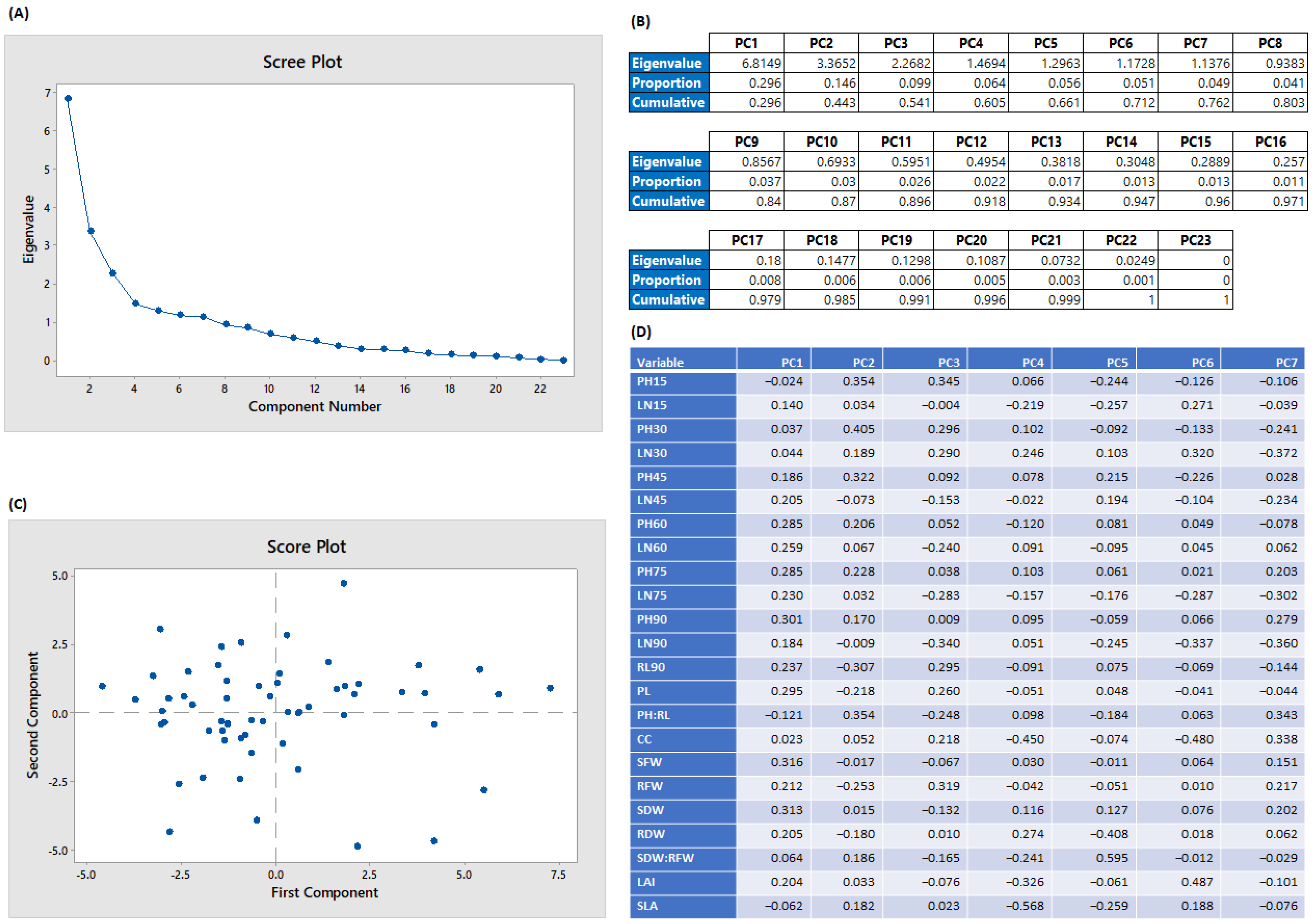
Principal component analysis (PCA) showed the first seven PCs with eigenvalues greater than one, collectively explaining 76.2% of total phenotypic variation among the 23 traits (Figure 4A–C). PC1 (29.6% variance) was dominated by late biomass and growth traits, with the highest loadings on PH90 (0.301), PH75/PH60 (0.285), PL (0.295), SFW (0.316), and SDW (0.313) (Figure 4B,D). PC2 (14.6%; cumulative 44.3%) highlighted early shoot elongation (PH30/PH15: 0.405/0.354; PH45: 0.322) and PH:RL (0.354), contrasting with negative root loadings (RL90: −0.307) (Figure 4B,D). PC3 (9.9%; cumulative 54.1%) emphasized root traits (RFW: 0.319; RL90/PL: 0.295/0.260), with score plots (Figure 4B–D) revealing clusters along vigor gradients, where high PC1-PC2 scores indicate integrated shoot–root performance.

4. Discussion

The present study analyzed the impact of various seed pre-treatments and soil amendments on the germination, growth, and biomass allocation of radhachura. The results indicate that both factors, individually, significantly influence seedling emergence and early growth performance.
Seed germination indices are key indicators of seed vigor and establishment potential, particularly in woody ornamentals. Pre-treatments and soil amendments differentially affected these indices, reflecting complex physiological responses to dormancy-breaking and nutrient conditions. Soft mechanical scarification maintained high germination percentage (GP) in line with the good natural viability of radhachura, and likely enhanced water uptake and embryo activation without severe seed coat damage [48]. Hot water and concentrated acid treatments, by contrast, risk thermal or chemical injury to embryos and seed coats, a concern previously noted for hard-coated seeds. Soil amendments did not markedly change GP, but vermicompost tended to increase emergence, consistent with evidence that organic inputs improve seedling establishment via enhanced soil moisture retention and structure [49]. Peak germination time and germination speed were sensitive to amendment type, indicating that nutrient status and microbial activity strongly influence the rate and uniformity of germination [50]. Vermicompost appeared to promote faster and more synchronized germination, likely through improved nutrient availability and rhizosphere activity, whereas biochar tended to delay and spread-out germination, suggesting that certain biochar properties may transiently alter water uptake or nutrient dynamics [51,52]. Timson’s index and peak value, which integrate the speed and extent of germination, were highest under chemical fertilizer and lowest under biochar, indicating that readily available nutrients can boost early metabolic activation, while some biochar formulations may temporarily restrict nutrient availability [53]. Overall, these patterns suggest that dormancy-breaking in radhachura is best achieved with untreated or gently scarified seeds, combined with organic amendments such as vermicompost to enhance germination speed and uniformity [54]. In contrast, harsh hot water or acid scarification should be used cautiously to avoid injury. These findings align with previous work showing that appropriate seed pre-treatment and sustainable soil management jointly improve germination and nursery performance in tree species [55,56].
Plant height is a widely used indicator of vigor and early growth potential in nursery and field conditions [57,58]. In radhachura, scarification promoted faster initial elongation, supporting the view that enhanced water imbibition after gentle seed coat disruption accelerates early growth [55,56]. However, differences among pre-treatments tended to diminish over time, suggesting that long-term height performance is more strongly determined by inherent plant physiology and environmental conditions than by dormancy-breaking alone [59,60]. Soil amendments significantly influenced height at multiple stages, emphasizing the importance of nutrient availability and organic matter for sustained growth. Vermicompost supported the greatest height growth, consistent with its role in enhancing mineralization, microbial activity, and nutrient supply, while cowdung provided intermediate but steady growth, in line with its slow-release nutrient profile [13,61,62]. NPK and compost were less effective under these conditions, possibly due to the mismatch between nutrient release patterns and seedling demand [63,64]. These results support combining gentle pre-treatments with nutrient-rich organic amendments to maximize early height growth and establishment, echoing previous reports on the benefits of integrating scarification with organics in tree nursery systems [65,66].
Leaf number is a significant morphological parameter which has a direct relation with photosynthesis capacity and biomass yield potentiality of plants [67,68]. In the present research work in radhachura, there was non-significant variation in leaf number were observed in response to seed pre-treatment and soil amendments. Previous studies suggests that extensive scarification stress or seed coat damage can suppress even emergence or seedling stress, resulting in suppressed leaf initiation [69,70]. However, studies reported of positive effect of soil organic amendments like biochar and vermicompost in enhancing soil structure, water holding capacity, and nutrient levels, thereby boosting vegetative growth [71,72,73]. Vermicompost is well-known for its beneficial microbial action and balanced provision of nutrients with the best support for profuse leaf growth [74]. In this study, the leaf numbers were monitored for a shorter period, but long-term observation for 12 months or more might assist in predicting the effects of soil amendments on the leaf characteristics. Researchers suggest that untreated or modestly treated seeds with good-quality organic amendments can be utilized to optimize leaf initiation and growth [21,75].
Shoot and root dry weights integrate the cumulative effects of pre-treatment and soil environment on early seedling performance. Although treatment differences were not always statistically significant at 90 DAS, trends indicated that biochar and cowdung produced higher biomass than other amendments, while NPK was the least favorable. The porous structure of biochar can improve water and nutrient retention and support long-term soil conditioning, whereas cowdung contributes organic matter and a gradual nutrient supply [76,77]. Seed pre-treatments had limited direct impact on biomass, but non-scarified and hot-water-treated seeds tended to produce slightly higher shoot and root dry weights than seeds subjected to harsh acid scarification, reinforcing the need for gentle dormancy-breaking [78]. Soil amendments also influenced shoot:root allocation, with biochar and vermicompost promoting higher shoot-to-root dry weight ratios (SDW:RDW), which may reflect improved photosynthetic efficiency and water use under enhanced soil physical and biological conditions [79,80]. Cumulatively, these findings highlight the utility of organic soil amendments such as cowdung, compost, vermicompost, and biochar in sustainable seedling production. When coupled with sensible seed pre-treatment, these inputs enhance root and shoot balance, a pre-requisite for healthy seedling establishment and field performance [81,82].
Chlorophyll content at 90 DAS responded mainly to seed pre-treatments and their interaction with soil amendments, rather than to amendments alone. Scarified and hot-water-treated seeds showed higher chlorophyll levels than untreated seeds, indicating that effective dormancy-breaking not only improves emergence but can enhance later photosynthetic capacity, likely via more uniform and vigorous seedling establishment [83,84]. Improved chlorophyll content may also reflect more efficient water and nutrient uptake by seedlings with better early root development, consistent with reports that high germination power is often associated with increased chlorophyll accumulation and biomass [85,86]. Among soil amendments, biochar and cowdung tended to support higher chlorophyll content than NPK, suggesting that organic inputs indirectly promote pigment maintenance through improved soil porosity, microbial activity, and nutrient cycling [87]. It is also a sign of the synergistic effect of dormancy-breaking treatment and organic soil management on seedling physiological quality [88]. Therefore, for optimal photosynthetic capacity and good seedling vigor, rightful pre-treatment in scarification could be supplemented with amendments in the soil such as biochar. Such an integrated practice is in line with sustainable nursery culture and facilitates healthy field establishment of the plant [73,89].
Leaf area index (LAI) and specific leaf area (SLA) are important markers of photosynthetic potential, resource use, and stress tolerance [90,91]. In radhachura, treatment effects on LAI and SLA were modest but showed consistent trends: cowdung-amended soils and un-scarified seeds tended to support larger leaf area, while harsh scarification and exclusive reliance on NPK coincided with lower LAI, echoing reports that organic matter enhances water holding capacity and nutrient supply to support leaf expansion [71,72,87]. Higher SLA under scarification and NPK suggests the development of thinner, fast-growing leaves often associated with nutrient-rich or more stressful environments, whereas lower SLA under biochar points to thicker, more structurally robust foliage [92,93,94]. These leaf trait patterns reinforce the advantage of organic amendments like cowdung, vermicompost, and biochar for building resilient leaf structures, while excessive dependence on mineral fertilizer may favor rapid but potentially less stress-tolerant foliage [95].
Pearson correlations revealed strong temporal stability in plant height (PH60-PH90) and high integration among biomass traits (SFW-SDW), with plant length tightly coupled to root length (RL90-PL) and shoot biomass, indicating that vigorous seedlings tend to maintain a balanced root–shoot allocation under the different soil amendment regimes. These patterns are consistent with previous reports in woody seedlings, where organic amendments such as vermicompost enhance coordinated growth through improved soil nutrient and water status. Principal component analysis (PCA) further supported these relationships, with PC1 (29.6%) largely driven by late plant height, plant length and biomass variables, and PC2/PC3 distinguishing early shoot and root traits, thereby clearly separating treatment combinations in the multivariate space. In this framework, vermicompost and gentle scarification emerged as key contributors to higher composite vigor scores, in line with biostimulant-like effects of organic inputs reported for other tree and agroforestry species.
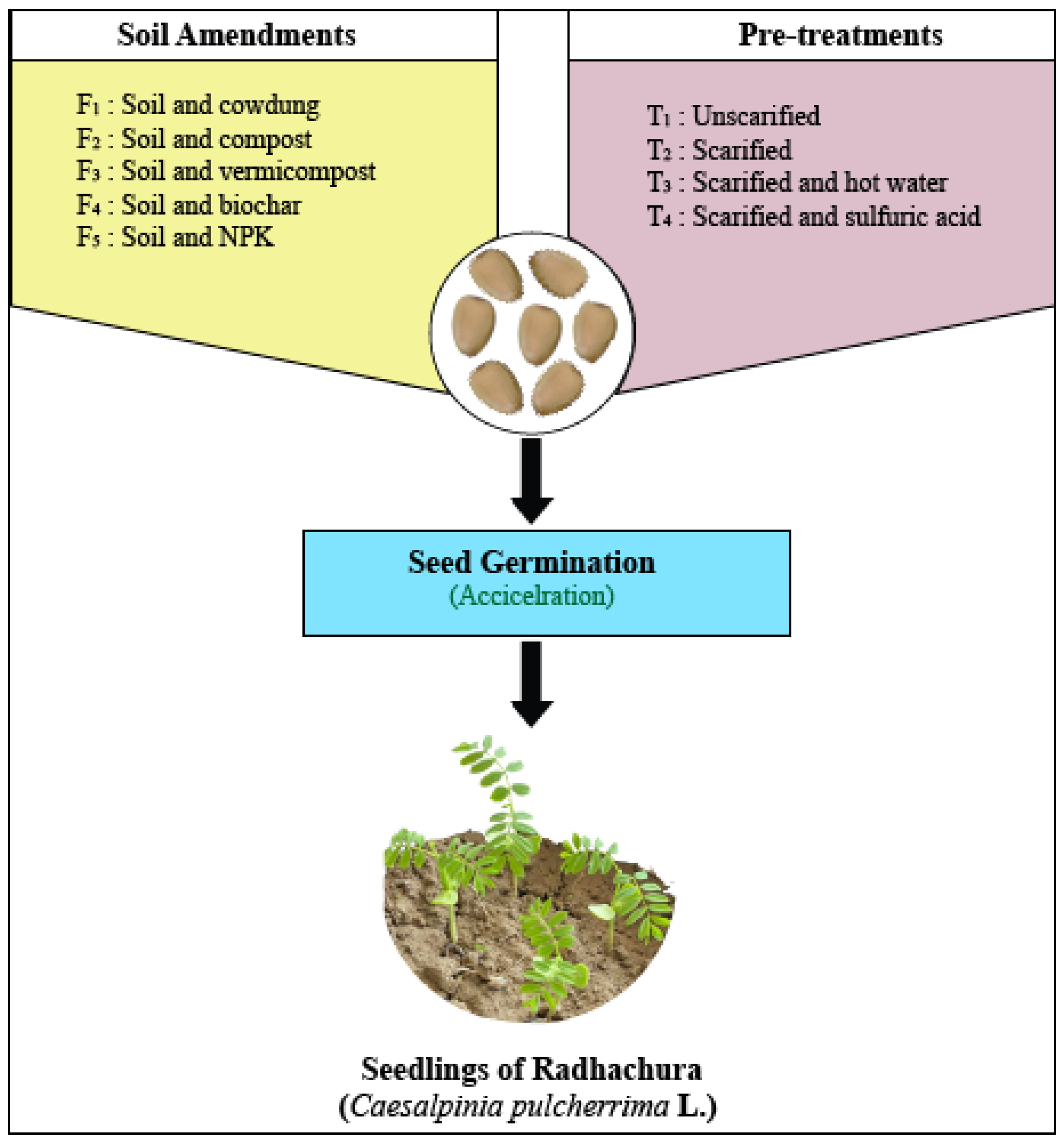
Overall, this study demonstrates that an integration of suitable seed pre-treatments and organic soil amendments can be employed to enhance early growth performance in radhachura (Figure 5).

5. Conclusions

In conclusion, this study demonstrates that soil amendments have a stronger influence than seed pre-treatments on the germination, growth, and physiological performance of radhachura. While seed scarification, particularly mechanical scarification, enhanced germination percentage and vigor, hot-water scarification negatively affected germination and growth responses. Soil amendments had a more substantial overall impact on seedling development: vermicompost proved most effective, likely due to its high nutrient availability and favorable microbial composition, followed by biochar, which improved soil structure and moisture retention. These findings emphasize that appropriate combinations of seed pre-treatment and soil amendments can improve the germination behavior and early growth of radhachura.

Supplementary Materials

The following supporting information can be downloaded at: https://www.mdpi.com/article/10.3390/nitrogen7020050/s1, Figure S1: Effects of soil amendments and seed pre-treatments on growth related non-significant traits of radhachura; Table S1: Analysis of Variance (ANOVA) for different germination indices with descriptive analysis; Table S2: Combined effect of pre-treatment and soil amendment on different germination indices of radhachura; Table S3: Analysis of Variance (ANOVA) for different growth morphology with descriptive analysis. Table S4: Combined effect of pre-treatment and soil amendment on growth related traits of radhachura.

Author Contributions

Conceptualization, M.A.H.; collection and analysis, M.A.T. and M.A.H.; writing—original draft preparation, M.A.T., M.M.R. and M.A.H.; writing—review and editing, M.A.T., M.M.R. and M.A.H. All authors have read and agreed to the published version of the manuscript.

Funding

This research received no external funding.

Informed Consent Statement

Not applicable.

Data Availability Statement

All the raw data in this research can be obtained from the corresponding authors upon reasonable request.

Acknowledgments

The authors are thankful to the Institute of Research and Training (IRT) for the strategic and logistical assistance. Authors acknowledge all the respondents for the time and information they have provided.

Conflicts of Interest

The authors declare no conflicts of interest.

References

  1. Kumbhare, M.R.; Sivakumar, T. Phytochemical and Pharmacological Properties of Caesalpinia pulcherrima (Caesalpiniaceae): A Review. Int. J. Nat. Prod. Mar. Biol. 2015, 1, 16–23. [Google Scholar]
  2. Sangeetha, S.; Saravanakumar, A.; Parthiban, P.; Kavinkumar, C.; Loganathan, M.; Heera, G.; Harshitha, S.T.; Pooja, S.; Mohan, S.R. An Overview of the Marvelous Plant: Caesalpinia pulcherrima. Int. J. Res. Pharmacol. Pharmacother. 2024, 13, 714–728. [Google Scholar] [CrossRef]
  3. Alves, M.M.; Alves, E.U.; Araújo, L.R.d.; Lima, M.d.L.d.S.; Ursulino, M.M. Germination and Vigor of Caesalpinia pulcherrima (L.) Sw. Seeds under Different Light and Temperature Conditions. Ciênc. Rural 2018, 48, 8. [Google Scholar] [CrossRef]
  4. Rezia Khatun, B.M.; Rahman, M.O. Taxonomic revision of the genus Caesalpinia l. (Caesalpiniaceae) for Bangladesh. Bangladesh J. Plant Taxon. 2006, 13, 93–109. [Google Scholar] [CrossRef]
  5. Pant, M.; Thakur, P. Forest-Based Plants in Beautification and Their Medicinal Significance. In Non-Timber Forest Products; Springer International Publishing: Cham, Switzerland, 2021; pp. 365–381. [Google Scholar]
  6. Lamichhane, J.R.; Debaeke, P.; Steinberg, C.; You, M.P.; Barbetti, M.J.; Aubertot, J.-N. Abiotic and Biotic Factors Affecting Crop Seed Germination and Seedling Emergence: A Conceptual Framework. Plant Soil 2018, 432, 1–28. [Google Scholar] [CrossRef]
  7. Donn, S.; Wheatley, R.E.; McKenzie, B.M.; Loades, K.W.; Hallett, P.D. Improved Soil Fertility from Compost Amendment Increases Root Growth and Reinforcement of Surface Soil on Slopes. Ecol. Eng. 2014, 71, 458–465. [Google Scholar] [CrossRef]
  8. Cortina, J.; Vilagrosa, A.; Trubat, R. The Role of Nutrients for Improving Seedling Quality in Drylands. New For. 2013, 44, 719–732. [Google Scholar] [CrossRef]
  9. Diacono, M.; Montemurro, F. Long-Term Effects of Organic Amendments on Soil Fertility. In Sustainable Agriculture; Springer: Dordrecht, The Netherlands, 2011; Volume 2, pp. 761–786. [Google Scholar] [CrossRef]
  10. Pan, C.; Huang, C. Cow Dung Compost and Vermicompost Amendments Promote Soil Carbon Stock by Enhancing Labile Organic Carbon and Residual Oxidizable Carbon Fractions in Maize Field Soil. Soil Use Manag. 2024, 40, e13122. [Google Scholar] [CrossRef]
  11. Singh Yadav, S.P.; Bhandari, S.; Bhatta, D.; Poudel, A.; Bhattarai, S.; Yadav, P.; Ghimire, N.; Paudel, P.; Paudel, P.; Shrestha, J.; et al. Biochar Application: A Sustainable Approach to Improve Soil Health. J. Agric. Food Res. 2023, 11, 100498. [Google Scholar] [CrossRef]
  12. Singh, N.K.; Sachan, K.; Ranjitha, G.; Chandana, S.; Manoj, B.P.; Panotra, N.; Katiyar, D. Building Soil Health and Fertility through Organic Amendments and Practices: A Review. Asian J. Soil Sci. Plant Nutr. 2024, 10, 175–197. [Google Scholar] [CrossRef]
  13. Oyege, I.; Balaji Bhaskar, M.S. Effects of Vermicompost on Soil and Plant Health and Promoting Sustainable Agriculture. Soil Syst. 2023, 7, 101. [Google Scholar] [CrossRef]
  14. Chatterjeea, P.; Mandala, P.; Mandal, S.; Chatterjeec, S. Vermicompost and Cow Dung Admixture Increases Rhizosphere Bacterial Population and Promotes Rapid Physiological Maturity in Maize (Zea mays L.). NASS J. Agric. Sci. 2020, 1, 27–36. [Google Scholar] [CrossRef]
  15. Gutiérrez-Miceli, F.A.; Santiago-Borraz, J.; Montes Molina, J.A.; Nafate, C.C.; Abud-Archila, M.; Oliva Llaven, M.A.; Rincón-Rosales, R.; Dendooven, L. Vermicompost as a Soil Supplement to Improve Growth, Yield and Fruit Quality of Tomato (Lycopersicum esculentum). Bioresour. Technol. 2007, 98, 2781–2786. [Google Scholar] [CrossRef]
  16. Kavvadias, V.; Ioannou, Z.; Vavoulidou, E.; Paschalidis, C. Short Term Effects of Chemical Fertilizer, Compost and Zeolite on Yield of Lettuce, Nutrient Composition and Soil Properties. Agriculture 2023, 13, 1022. [Google Scholar] [CrossRef]
  17. Krasilnikov, P.; Taboada, M.A.; Amanullah. Fertilizer Use, Soil Health and Agricultural Sustainability. Agriculture 2022, 12, 462. [Google Scholar] [CrossRef]
  18. Tasnim, U.F.; Shammi, M.; Uddin, M.K.; Akbor, M.A. Effect of Biochar Amended Vermicomposting of Food and Beverage Industry Sludge along with Cow Dung and Seed Germination Bioassay. Pollution 2021, 7, 355–365. [Google Scholar] [CrossRef]
  19. Sher, A.; Adnan, M.; Sattar, A.; Ul-Allah, S.; Ijaz, M.; Hassan, M.U.; Manaf, A.; Qayyum, A.; Elesawy, B.H.; Ismail, K.A.; et al. Combined Application of Organic and Inorganic Amendments Improved the Yield and Nutritional Quality of Forage Sorghum. Agronomy 2022, 12, 896. [Google Scholar] [CrossRef]
  20. Ellis, R.H. Seed and Seedling Vigour in Relation to Crop Growth and Yield. Plant Growth Regul. 1992, 11, 249–255. [Google Scholar] [CrossRef]
  21. Solaiman, Z.M.; Murphy, D.V.; Abbott, L.K. Biochars Influence Seed Germination and Early Growth of Seedlings. Plant Soil 2012, 353, 273–287. [Google Scholar] [CrossRef]
  22. Xiao, Q.; Zhu, L.-X.; Zhang, H.-P.; Li, X.-Y.; Shen, Y.-F.; Li, S.-Q. Soil Amendment with Biochar Increases Maize Yields in a Semi-Arid Region by Improving Soil Quality and Root Growth. Crop Pasture Sci. 2016, 67, 495–507. [Google Scholar] [CrossRef]
  23. Udawatta, R.P.; Rankoth, L.; Jose, S. Agroforestry and Biodiversity. Sustainability 2019, 11, 2879. [Google Scholar] [CrossRef]
  24. Wen, Z.; Lu, X.; Wen, J.; Wang, Z.; Chai, M. Physical Seed Dormancy in Legumes: Molecular Advances and Perspectives. Plants 2024, 13, 1473. [Google Scholar] [CrossRef]
  25. Cartes-Rodríguez, E.; Álvarez-Maldini, C.; Acevedo, M.; González-Ortega, M.; Urbina-Parra, A.; León-Lobos, P. Pre-Germination Treatments at Operational Scale for Six Tree Species from the Sclerophyll Forest of Central Chile. Plants 2022, 11, 608. [Google Scholar] [CrossRef]
  26. Giovanetti, G.; Marcellini, M.; Pergolotti, V.; Mecozzi, F.; Mezzetti, B.; Capocasa, F.; Sabbadini, S. Standardization of an Effective Scarification and Germination Protocol for Strawberry Seeds That Is Useful for Gamic Propagation. Horticulturae 2024, 10, 1345. [Google Scholar] [CrossRef]
  27. Amusa, N.A.; Muhammad, S.; Amusa, N.A. Effects of Sulphuric Acid and Hot Water Treatments on Seed Germination of Tamarind (Tamarindus indica L). Afr. J. Biotechnol. 2003, 2, 276–279. [Google Scholar]
  28. Talha Bin Yousaf, M.; Farrakh Nawaz, M.; Yasin, G.; Ahmad, I.; Gul, S.; Ijaz, M.; Zia-ur-Rehman, M.; Qi, X.; Ur Rahman, S. Effect of Organic Amendments in Soil on Physiological and Biochemical Attributes of Vachellia nilotica and Dalbergia sissoo under Saline Stress. Plants 2022, 11, 228. [Google Scholar] [CrossRef] [PubMed]
  29. Hafez, L.O.; Brito-Casillas, Y.; Abdelmageed, N.; Alemán-Cabrera, I.M.; Morad, S.A.F.; Abdel-Raheem, M.H.; Wägner, A.M. The Acacia (Vachellia nilotica (L.) P.J.H. Hurter & Mabb.): Traditional Uses and Recent Advances on Its Pharmacological Attributes and Potential Activities. Nutrients 2024, 16, 4278. [Google Scholar] [CrossRef]
  30. Simiele, M.; De Zio, E.; Montagnoli, A.; Terzaghi, M.; Chiatante, D.; Scippa, G.S.; Trupiano, D. Biochar and/or Compost to Enhance Nursery-Produced Seedling Performance: A Potential Tool for Forest Restoration Programs. Forests 2022, 13, 550. [Google Scholar] [CrossRef]
  31. Lamhamedi, M.S.; Pepin, S.; Khasa, D. The Production Chain of Tree Seedlings, from Seeds to Sustainable Plantations: An Essential Link for the Success of Reforestation and Restoration Programs in the Context of Climate Change. Forests 2023, 14, 1693. [Google Scholar] [CrossRef]
  32. Bera, A.; Mukhopadhyay, E.; Kar, C.S.; Kumar, M.; Bhandari, H.R. Efficacy of Scarification Treatments on Release of Seed Coat Imposed Dormancy in Five Wild Species of Genus Corchorus. S. Afr. J. Bot. 2020, 135, 144–147. [Google Scholar] [CrossRef]
  33. Mensah, S.I.; Ekeke, C. Effects of Different Pretreatments and Seed Coat on Dormancy and Germination of Seeds of Senna obtusifolia (L.) H.S. Irwin & Barneby (Fabaceae). Int. J. Biol. 2016, 8, 77. [Google Scholar] [CrossRef]
  34. Ashiono, F.A.; Wangechi, H.K.; Kinyanjui, M.J. Effects of Sawdust, Forest Soil and Cow Dung Mixtures on Growth Characteristics of Blue Gum (Eucalyptus saligna) Seedlings in South Kinangop Forest, Nyandarua, Kenya. Open J. For. 2017, 7, 373–387. [Google Scholar] [CrossRef][Green Version]
  35. Gupta, K.K.; Aneja, K.R.; Rana, D. Current Status of Cow Dung as a Bioresource for Sustainable Development. Bioresour. Bioprocess. 2016, 3, 28. [Google Scholar] [CrossRef]
  36. Anwar, Z.; Irshad, M.; Mahmood, Q.; Hafeez, F.; Bilal, M. Nutrient Uptake and Growth of Spinach as Affected by Cow Manure Co-Composted with Poplar Leaf Litter. Int. J. Recycl. Org. Waste Agric. 2017, 6, 79–88. [Google Scholar] [CrossRef]
  37. Aalok, A.; Tripathi, K.A. Influence of Different Leaf Litter Vermicompost Substitution on the Growth of Eucalyptus Hybrid (Eucalyptus camaldulensis Dehn x E. tereticornis Sm). Asian Australas. J. Plant Sci. Biotech. 2012, 6, 63–66. [Google Scholar]
  38. Verheijen, F.G.A.; Jeffery, S.; Van Der Velde, M.; Penížek, V.; Beland, M.; Bastos, A.C.; Keizer, J.J. Reductions in Soil Surface Albedo as a Function of Biochar Application Rate: Implications for Global Radiative Forcing. Environ. Res. Lett. 2013, 8, 44008. [Google Scholar] [CrossRef]
  39. El-Saady, W.A. Spinach (Spinacia oleracea L.) Growth, Yield and Quality Response to the Application of Mineral NPK Fertilizer Ratios and Levels. Middle East J. Agric. Res. 2016, 5, 908–917. [Google Scholar]
  40. Karrfalt, R.P. The Germination Test. ISTA International Seed Testing Rules 2025. Chapter 5: Seed Testing. 2025, 104. Available online: https://www.scribd.com/document/494612860/Chapter-5 (accessed on 22 March 2026).
  41. Ranal, M.A.; Santana, D.G.d. How and Why to Measure the Germination Process? Braz. J. Bot. 2006, 29, 1–11. [Google Scholar] [CrossRef]
  42. Throneberry, G.O.; Smith, F.G. Relation of Respiratory and Enzymatic Activity to Corn Seed Viability. Plant Physiol. 1955, 30, 337–343. [Google Scholar] [CrossRef] [PubMed]
  43. Maguire, J.D. Speed of Germination-Aid in Selection and Evaluation for Seedling Emergence and Vigor1. Crop Sci. 1962, 2, 176–177. [Google Scholar] [CrossRef]
  44. Grose, R.; Zimmer, W. Some Laboratory Germination Responses of the Seeds of River Red Gum, Eucalyptus camaldulensis Dehn. Syn. Eucalyptus rostrata Schlecht. Aust. J. Bot. 1958, 6, 129–153. [Google Scholar] [CrossRef]
  45. Timson, J. New Method of Recording Germination Data. Nature 1965, 207, 216–217. [Google Scholar] [CrossRef]
  46. Czabator, F.J. Germination Value: An Index Combining Speed and Completeness of Pine Seed Germination. For. Sci. 1962, 8, 386–396. [Google Scholar] [CrossRef]
  47. Garnier, E.; Shipley, B.; Roumet, C.; Laurent, G. A standardized protocol for the determination of specific leaf area and leaf dry matter content. Funct. Ecol. 2001, 15, 688–695. [Google Scholar] [CrossRef]
  48. Thapliyal, M.; Phular, K.; Namitha, N.K.; Rawat, S.; Chand, V.P. Forest Seed Technology: Seed Biology, Collection, Quality Evaluation, Storage and Certification. In Textbook of Forest Science; Springer Nature: Singapore, 2025; pp. 659–678. [Google Scholar] [CrossRef]
  49. Mulatu, G.; Bayata, A. Vermicompost as Organic Amendment: Effects on Some Soil Physical, Biological Properties and Crops Performance on Acidic Soil: A Review. Front. Environ. Microbiol. 2024, 10, 66–73. [Google Scholar] [CrossRef]
  50. Gardarin, A.; Dürr, C.; Colbach, N. Prediction of Germination Rates of Weed Species: Relationships between Germination Speed Parameters and Species Traits. Ecol. Model. 2011, 222, 626–636. [Google Scholar] [CrossRef]
  51. Büyükarslan, D.; Demir, H. Effects of Vermicompost as an Alternative Substrate on Yield and Quality of Cauliflower and Pepper Seedlings. Not. Bot. Horti Agrobot. Cluj Napoca 2024, 52, 13587. [Google Scholar] [CrossRef]
  52. Miransari, M. Soil Nutrients; Nova Science Publishers: Hauppauge, NY, USA, 2012. [Google Scholar]
  53. Farooq, M.; Basra, S.M.A.; Ahmad, N. Improving the Performance of Transplanted Rice by Seed Priming. Plant Growth Regul. 2007, 51, 129–137. [Google Scholar] [CrossRef]
  54. Utami, E.P.; Santika, E.; Hidayat, C. The Mechanical and Chemical Scarification to Break Dormancy and Increasing Vigor of Sunan Candlenut Seed. IOP Conf. Ser. Earth Environ. Sci. 2021, 694, 12028. [Google Scholar] [CrossRef]
  55. Reed, R.C.; Bradford, K.J.; Khanday, I. Seed Germination and Vigor: Ensuring Crop Sustainability in a Changing Climate. Heredity 2022, 128, 450–459. [Google Scholar] [CrossRef]
  56. Bewley, J.D.; Bradford, K.J.; Hilhorst, H.W.M.; Nonogaki, H. Seeds: Physiology of Development, Germination and Dormancy, 3rd ed.; Springer: New York, NY, USA, 2013. [Google Scholar] [CrossRef]
  57. Chandel, A.; Thakur, M.; Singh, G.; Dogra, R.; Bajad, A.; Soni, V.; Bhargava, B. Flower Regulation in Floriculture: An Agronomic Concept and Commercial Use. J. Plant Growth Regul. 2023, 42, 2136–2161. [Google Scholar] [CrossRef]
  58. Mahmood, S.H.; Qadir, S.A.; Mohammed, E.A.; Fathulla, C.N.; Ahmed, A.A. Effect of Organic Fertilizer on Growth and Physiology of Brachychiton Populneus (Schott& Endl) Seedlings under Drought Conditions. Zanco J. Pure Appl. Sci. 2024, 36, 87–95. [Google Scholar] [CrossRef]
  59. Kildisheva, O.A.; Dixon, K.W.; Silveira, F.A.O.; Chapman, T.; Di Sacco, A.; Mondoni, A.; Turner, S.R.; Cross, A.T. Dormancy and Germination: Making Every Seed Count in Restoration. Restor. Ecol. 2020, 28, S256–S265. [Google Scholar] [CrossRef]
  60. Ardiarini, N.; Lase, J.A.; Hidayat, Y.; Habeahan, K.B. The Effect of Seed Scarification on the Germination Process and the Growth of Long Bean (Vigna sinensis) Sprout. E3S Web Conf. 2021, 306, 01002. [Google Scholar] [CrossRef]
  61. Pathma, J.; Sakthivel, N. Microbial Diversity of Vermicompost Bacteria that Exhibit Useful Agricultural Traits and Waste Management Potential. SpringerPlus 2012, 1, 26. [Google Scholar] [CrossRef]
  62. Zaman, M.; Chowdhury, T.; Nahar, K.; Chowdhury, M. Effect of Cow Dung as Organic Manure on the Growth, Leaf Biomass Yield of Stevia Rebaudiana and Post Harvest Soil Fertility. J. Bangladesh Agric. Univ. 2017, 15, 206–211. [Google Scholar] [CrossRef]
  63. Bonanomi, G.; De Filippis, F.; Zotti, M.; Idbella, M.; Cesarano, G.; Al-Rowaily, S.; Abd-ElGawad, A. Repeated Applications of Organic Amendments Promote Beneficial Microbiota, Improve Soil Fertility and Increase Crop Yield. Appl. Soil Ecol. 2020, 156, 103714. [Google Scholar] [CrossRef]
  64. Kırmızı, S. Effects of Pre-Treatments on Seed Dormancy and Germination of Endemic Muscari bourgaei Baker. Agronomy 2023, 13, 2438. [Google Scholar] [CrossRef]
  65. Macera, L.G.; Pereira, S.R.; Souza, A.L.T. de Survival and Growth of Tree Seedlings as a Function of Seed Size in a Gallery Forest under Restoration. Acta Bot. Bras. 2017, 31, 539–545. [Google Scholar] [CrossRef]
  66. Moreira, G.G.; Hakamada, R.; Silva, R.M.L.d.; Lemos, C.C.Z.d.; Florentino, A.L.; Gonçalves, J.L.d.M. Seedling Morphological Characteristics on Survival, Uniformity, and Growth during a Full Short Rotation in Eucalyptus grandis x E. urophylla Plantation. Forests 2023, 14, 1756. [Google Scholar] [CrossRef]
  67. Qu, M.; Zheng, G.; Hamdani, S.; Essemine, J.; Song, Q.; Wang, H.; Chu, C.; Sirault, X.; Zhu, X.-G. Leaf Photosynthetic Parameters Related to Biomass Accumulation in a Global Rice Diversity Survey. Plant Physiol. 2017, 175, 248–258. [Google Scholar] [CrossRef]
  68. Rozentsvet, O.; Bogdanova, E.; Nesterov, V.; Bakunov, A.; Milekhin, A.; Rubtsov, S.; Dmitrieva, N. Physiological and Biochemical Parameters of Leaves for Evaluation of the Potato Yield. Agriculture 2022, 12, 757. [Google Scholar] [CrossRef]
  69. Finch-Savage, W.E.; Leubner-Metzger, G. Seed Dormancy and the Control of Germination. New Phytol. 2006, 171, 501–523. [Google Scholar] [CrossRef] [PubMed]
  70. Echeverry Holguín, J.; Crepy, M.; Striker, G.G.; Mollard, F.P.O. Dormancy Breakage and Germination are Tightly Controlled by Hypoxic Submergence Water on Echinochloa crus-galli Seeds from an Accession Resistant to Anaerobic Germination. Seed Sci. Res. 2020, 30, 262–267. [Google Scholar] [CrossRef]
  71. Cooper, J.; Greenberg, I.; Ludwig, B.; Hippich, L.; Fischer, D.; Glaser, B.; Kaiser, M. Effect of Biochar and Compost on Soil Properties and Organic Matter in Aggregate Size Fractions under Field Conditions. Agric. Ecosyst. Environ. 2020, 295, 106882. [Google Scholar] [CrossRef]
  72. Singh, T.B.; Ali, A.; Prasad, M.; Yadav, A.; Shrivastav, P.; Goyal, D.; Dantu, P.K. Role of Organic Fertilizers in Improving Soil Fertility. In Contaminants in Agriculture; Springer International Publishing: Cham, Switzerland, 2020; pp. 61–77. [Google Scholar] [CrossRef]
  73. Agegnehu, G.; Bass, A.M.; Nelson, P.N.; Bird, M.I. Benefits of Biochar, Compost and Biochar–Compost for Soil Quality, Maize Yield and Greenhouse Gas Emissions in a Tropical Agricultural Soil. Sci. Total Environ. 2016, 543, 295–306. [Google Scholar] [CrossRef] [PubMed]
  74. Manzoor, A.; Naveed, M.S.; Ali, R.M.A.; Naseer, M.A.; UL-Hussan, M.; Saqib, M.; Hussain, S.; Farooq, M. Vermicompost: A Potential Organic Fertilizer for Sustainable Vegetable Cultivation. Sci. Hortic. 2024, 336, 113443. [Google Scholar] [CrossRef]
  75. Roy, S.; Arunachalam, K.; Dutta, B.K.; Arunachalam, A. Effect of Organic Amendments of Soil on Growth and Productivity of Three Common Crops Viz. Zea mays, Phaseolus vulgaris and Abelmoschus esculentus. Appl. Soil Ecol. 2010, 45, 78–84. [Google Scholar] [CrossRef]
  76. Hossain, M.Z.; Bahar, M.M.; Sarkar, B.; Donne, S.W.; Ok, Y.S.; Palansooriya, K.N.; Kirkham, M.B.; Chowdhury, S.; Bolan, N. Biochar and its Importance on Nutrient Dynamics in Soil and Plant. Biochar 2020, 2, 379–420. [Google Scholar] [CrossRef]
  77. Kalu, S.; Simojoki, A.; Karhu, K.; Tammeorg, P. Long-Term Effects of Softwood Biochar on Soil Physical Properties, Greenhouse Gas Emissions and Crop Nutrient Uptake in Two Contrasting Boreal Soils. Agric. Ecosyst. Environ. 2021, 316, 107454. [Google Scholar] [CrossRef]
  78. Bewley, J.D.; Nonogaki, H. Seed Maturation and Germination. In Reference Module in Life Sciences; Elsevier: Amsterdam, The Netherlands, 2017. [Google Scholar] [CrossRef]
  79. Gao, Y.; Shao, G.; Lu, J.; Zhang, K.; Wu, S.; Wang, Z. Effects of Biochar Application on Crop Water Use Efficiency Depend on Experimental Conditions: A Meta-Analysis. Field Crops Res. 2020, 249, 107763. [Google Scholar] [CrossRef]
  80. Thomas, S.C.; Gale, N. Biochar and Forest Restoration: A Review and Meta-Analysis of Tree Growth Responses. New For. 2015, 46, 931–946. [Google Scholar] [CrossRef]
  81. Finch-Savage, W.E.; Bassel, G.W. Seed Vigour and Crop Establishment: Extending Performance beyond Adaptation. J. Exp. Bot. 2016, 67, 567–591. [Google Scholar] [CrossRef]
  82. Blunk, S.; de Heer, M.I.; Malik, A.H.; Fredlund, K.; Ekblad, T.; Sturrock, C.J.; Mooney, S.J. Seed Priming Enhances Early Growth and Improves Area of Soil Exploration by Roots. Environ. Exp. Bot. 2019, 158, 1–11. [Google Scholar] [CrossRef]
  83. Jabbour, A.A.; Alzahrani, A. The Impact of Chemical and Hormonal Treatments to Improve Seed Germination and Seedling Growth of Juniperus procera Hochst. Ex Endi. PeerJ 2024, 12, e17236. [Google Scholar] [CrossRef]
  84. Rogalski, J.M.; Baroni, T.; Rigo, L.H.; Balestrin, J.T.; Dorn, A.J.; Pasquetti, E.B. Evaluation of Scarification in Seed Germination and Characterization of the Early Stages of Seedling Development of Rubus erythroclados. Braz. J. Biol. 2025, 84, e285568. [Google Scholar] [CrossRef]
  85. Sankhalkar, S.; Komarpant, R.; Dessai, T.R.; Simoes, J.; Sharma, S. Effects of Soil and Soil-Less Culture on Morphology, Physiology and Biochemical Studies of Vegetable Plants. Curr. Agric. Res. J. 2019, 7, 181–188. [Google Scholar] [CrossRef]
  86. Liu, H.; Fu, Y.; Wang, M.; Liu, H. Green Light Enhances Growth, Photosynthetic Pigments and CO2 Assimilation Efficiency of Lettuce as Revealed by “knock out” of the 480–560 nm Spectral Waveband. Photosynthetica 2017, 55, 144–152. [Google Scholar] [CrossRef]
  87. Ighalo, J.O.; Ohoro, C.R.; Ojukwu, V.E.; Oniye, M.; Shaikh, W.A.; Biswas, J.K.; Seth, C.S.; Mohan, G.B.M.; Chandran, S.A.; Rangabhashiyam, S. Biochar for Ameliorating Soil Fertility and Microbial Diversity: From Production to Action of the Black Gold. iScience 2025, 28, 111524. [Google Scholar] [CrossRef] [PubMed]
  88. Stochi, I.S.; Silva, M.F.d.; Assunção, C.T.d.; Damião, V.H.B. Do Methods for Overcoming Dormancy Affect the Physiological Quality of Okra Seeds? Pesqui. Agropecu. Trop. 2023, 53, e75797. [Google Scholar] [CrossRef]
  89. Antonangelo, J.A.; Sun, X.; Eufrade-Junior, H.d.J. Biochar Impact on Soil Health and Tree-Based Crops: A Review. Biochar 2025, 7, 51. [Google Scholar] [CrossRef]
  90. Mog, B.; Nayak, M.G. Leaf Morphological and Physiological Traits and Their Significance in Yield Improvement of Fifteen Cashew Varieties in West Coast Region of Karnataka. Int. J. Curr. Microbiol. Appl. Sci. 2018, 7, 1455–1469. [Google Scholar] [CrossRef]
  91. Dookie, S.; Jaikishun, S.; Ansari, A.A. Morphological Traits and Chlorophyll Content of Laguncularia racemosa Leaves in Two Ecosystem Types along the Coastline of Guyana. Biodivers. J. 2023, 14, 571–584. [Google Scholar] [CrossRef]
  92. Fellner, H.; Dirnberger, G.F.; Sterba, H. Specific Leaf Area of European Larch (Larix decidua Mill.). Trees 2016, 30, 1237–1244. [Google Scholar] [CrossRef] [PubMed]
  93. Osone, Y.; Ishida, A.; Tateno, M. Correlation between Relative Growth Rate and Specific Leaf Area Requires Associations of Specific Leaf Area with Nitrogen Absorption Rate of Roots. New Phytol. 2008, 179, 417–427. [Google Scholar] [CrossRef] [PubMed]
  94. Joseph, S.; Cowie, A.L.; Van Zwieten, L.; Bolan, N.; Budai, A.; Buss, W.; Cayuela, M.L.; Graber, E.R.; Ippolito, J.A.; Kuzyakov, Y.; et al. How Biochar Works, and When It Doesn’t: A Review of Mechanisms Controlling Soil and Plant Responses to Biochar. GCB Bioenergy 2021, 13, 1731–1764. [Google Scholar] [CrossRef]
  95. Phares, C.A.; Akaba, S. Co-Application of Compost or Inorganic NPK Fertilizer with Biochar Influences Soil Quality, Grain Yield and Net Income of Rice. J. Integr. Agric. 2022, 21, 3600–3610. [Google Scholar] [CrossRef]
Figure 1. Effects of pre-treatments and soil amendment on germination indices of radhachura. (A) Germination percentage; (B) peak germination time; (C) germination speed; (D) Timson’s index; (E) peak value. The left graph represents different pre-treatments while the right graph has different soil amendments. Where T1 is un-scarified (control), T2 is sandpaper scarification, T3 is hot water with sandpaper scarification, T4 is sulfuric acid with sandpaper scarification, F1 is soil with cowdung, F2 is soil with compost, F3 is soil with vermicompost, F4 is soil with biochar, and F5 is soil with NPK. Error bars represent standard errors of the mean. Similar letter(s) found in a figure means they do not differ significantly. On the contrary, having different letter(s) in a figure (as per Tukey HSD test) signifies differences at a 5% level of probability.
Nitrogen 07 00050 g001
Figure 2. Effects of soil amendments and seed pre-treatments on growth related traits of radhachura. (A) Effects of seed pre-treatments on plant height; (B) effects of soil amendments on plant height; (C) effects of seed pre-treatments and soil amendments on root length at 90 DAS; (D) effects of seed pre-treatments and soil amendments on plant length at 90 DAS; (E) effects of seed pre-treatments and soil amendments on the ratio of plant height/root length at 90 DAS; (F) effects of seed pre-treatments and soil amendments on chlorophyll content at 90 DAS; (G) effects of seed pre-treatments and soil amendments on shoot fresh weight at 90 DAS; (H) effects of seed pre-treatments and soil amendments on root fresh weight at 90 DAS; and (I) effects of seed pre-treatments and soil amendments on the ratio of shoot dry weight/root dry weight at 90 DAS. (CI) The left graph represents different pre-treatments while the right graph has different soil amendments. Where T1 is un-scarified (control), T2 is sandpaper scarification, T3 is hot water with sandpaper scarification, T4 is sulfuric acid with sandpaper scarification, F1 is soil with cowdung, F2 is soil with compost, F3 is soil with vermicompost, F4 is soil with biochar, and F5 is soil with NPK. Error bars represent standard errors of the mean. Similar letter(s) found in a figure means they do not differ significantly. On the contrary, having different letter(s) in a figure (as per Tukey HSD test) signifies differences at a 5% level of probability.
Nitrogen 07 00050 g002
Figure 3. Pearson correlation coefficient relationship of pre-treatments and soil amendments on shoot and root traits of radhachura seedlings at 90 DAS. Phenotypic correlation matrix showing Pearson correlation coefficients (r) between plant height as PH (PH15, PH30, PH45, PH60, PH75, PH90), leaf number as LN (LN15, LN30, LN45, LN60, LN75, LN90), root length at 90 DAS (RL90), plant length at 90 DAS (PL), plant height-to-root length ratio at 90 DAS (PH:RL), chlorophyll content at 90 DAS (CC90), shoot fresh weight at 90 DAS (SFW), root fresh weight at 90 DAS (RFW), shoot dry weight at 90 DAS (SDW), root dry weight at 90 DAS (RDW), shoot dry weight-to-root fresh weight ratio at 90 DAS (SDW:RFW), leaf area index at 90 DAS (LAI), and specific leaf area at 90 DAS (SLA). Positive and negative correlations are indicated by color scale, with asterisks denoting significance levels (* p < 0.05, ** p < 0.01, *** p < 0.001).
Nitrogen 07 00050 g003
Figure 4. Principal component analysis (PCA) of phenotypic correlations among growth, biomass, and physiological traits of radhachura seedlings at 90 DAS. (A) Scree plot of principal component analysis, showing eigenvalues for each principal component. (B) Eigenanalysis of the correlation matrix. (C) Score plot for first two PCs. (D) Biplot of variable loadings (eigenvectors) on seven PCs.
Nitrogen 07 00050 g004
Figure 5. Schematic diagram of soil amendments and seed pre-treatments accelerating germination and seedling establishment of Radhachura (Caesalpinia pulcherrima L.).
Nitrogen 07 00050 g005
Table 1. Physicochemical analysis of the soil amendments used in this study.
VariablesSOC (%)N (%)P (%)K (%)S (%)
Cowdung12.460.750.551.320.43
Compost9.281.540.522.650.38
Vermicompost21.740.840.561.320.06
Biochar8.160.700.252.320.10
Soil1.660.100.360.430.16
Disclaimer/Publisher’s Note: The statements, opinions and data contained in all publications are solely those of the individual author(s) and contributor(s) and not of MDPI and/or the editor(s). MDPI and/or the editor(s) disclaim responsibility for any injury to people or property resulting from any ideas, methods, instructions or products referred to in the content.