Abstract
Nitrogen is the nutrient most required by plants and plays a central role in agricultural productivity due to its involvement in essential nutrients. This study evaluated the effects of different nitrogen sources on the physiological and morphological development of yellow passion fruit (Passiflora edulis Sims) seedlings. The experiment followed a randomized block design with six treatments (water, urea, ammonium sulfate, potassium nitrate, calcium nitrate, and magnesium nitrate), six replicates per treatment, and two plants per plot. An equal amount of nitrogen was supplied to all treatments, while the urea treatment excluded the additional macronutrients present in the other fertilizers (S, K, Ca, and Mg), allowing us to assess whether the benefits were exclusively attributable to the nitrogen source. The results indicated that ammonium sulfate and calcium nitrate promoted better root system development, while ammonium sulfate also improved shoot growth and physiological characteristics. Multivariate analysis revealed that CP1 explained most of the variability between treatments, highlighting the contribution of these sources compared to the control. Overall, fertilization with ammonium sulfate produced the best results, indicating that it is a more efficient nitrogen source for seedling development.
1. Introduction
Nitrogen is an essential element for plants, as its functions are linked to primary biochemical pathways that keep plant cells away from entropy by maintaining cellular order and increasing tissue complexity. This occurs because nitrogen promotes higher growth rates, given its direct involvement in the synthesis of proteins, enzymes, and pigments associated with primary metabolism [1].
Among all essential elements required by plants, nitrogen is the most demanded, as it is present in numerous molecules necessary for cellular function and plant tissue formation, such as nucleic and ribonucleic acids, chlorophylls, enzymes, and proteins. This means that achieving high agricultural productivity depends on supplying this element in adequate, and often elevated, quantities [2].
It is natural to expect that by making nitrogen available to plants, along with other essential elements, there will be an improvement in developmental physiology, as some of these elements work together in the construction of new tissues or even in the maintenance of plant tissues and organs, promoting a balance between essential elements [3]. This synergy increases the absorption and utilization of nitrogen, thus increasing its agronomic efficiency and resulting in differentiated growth rates and agricultural yields; in this way, the integrated application of nutrients helps to reduce fertilizer losses by improving plant physiology, increasing its efficiency [4].
Nitrogen is necessary at all stages of a plant’s life; however, in its initial phase, after germination, an adequate supply of nitrogen assumes even greater importance due to vegetative growth, expansion of leaf area, and development of the root system—factors that directly determine the productive potential of plants in later stages [5]. Deficiency of macronutrients such as nitrogen (N), sulfur (S), potassium (K), calcium (Ca), and magnesium (Mg) directly impairs plant metabolism, leading to reduced growth and, in agricultural crops, causes losses, as it results in fruits of lower physical, nutritional, and commercial quality. For this reason, balanced fertilization is essential to maximize fruit production, ensuring higher yields, better post-harvest quality, and greater competitiveness of agricultural crops [6].
In passion fruit seedlings, nitrogen fertilization has been reported to alter leaf structures, such as stem, number of leaves, leaf area and amount of chlorophyll in the leaves, and may also mitigate the effects of saline stress and promote greater biomass accumulation, thus it can be considered that an adequate supply of nitrogen supports the development of more vigorous and higher quality seedlings, thereby increasing their productive potential in the field [7].
The adequate supply of nutrients for Passiflora edulis cultivation depends directly on the type of fertilizer used (mineral or organic), the application method adopted, and the specific environmental conditions of the production system. According to Pereira et al. (2024) [8], the recommended dose of N and K is approximately 100 to 150 mg divided into seven applications per plant to maximize the biomass of the aerial parts of the seedlings. Regarding the supply of Ca and Mg, Zou et al. (2020) [9] recommend the application of 2.5 mmol L−1 of Ca, in the form of CaCl2·2H2O, and 0.25 mmol L−1 of Mg, supplied as MgSO4·7H2O, as they favor the development of the root system in seedlings.
Given this context, the present study aimed to evaluate the effects of five commercial nitrogen fertilizers, commonly used by farmers, on the physiological and morphological development of yellow passion fruit seedlings grown under greenhouse conditions between March and May 2024. The underlying hypothesis is that the composition of nitrogen sources, by providing additional macronutrients such as Ca, Mg, K, and S, can exert additive or complementary effects on plant performance, thus increasing seedling vigor. It is expected that the initial results will support future research aimed at improving nutritional management strategies, increasing fertilizer efficiency, and improving agronomic characteristics of interest in yellow passion fruit cultivation.
2. Materials and Methods
The experiment with yellow passion fruit seedlings was conducted in a greenhouse between March and May 2024 at the Instituto Federal do Espírito Santo (Ifes), Alegre Campus, Brazil (Latitude: −20.7633, Longitude: −41.5339; 20° 45′ 48″ S, 41° 32′ 2″ W, 134 m altitude). The protected environment was maintained at an average temperature of 27 ± 3 °C and humidity of 63 ± 5%. The experiment was conducted in a greenhouse to ensure greater control of microclimatic conditions and reduce experimental variability, with the water regime maintained by microsprinkling in three daily cycles, ensuring uniformity in water availability. The seedlings were produced in 0.5 L plastic containers filled with commercial Carolina Soil substrate, composed of sphagnum peat, vermiculite and basic nutrients, with the addition of carbonized rice husk to improve drainage and root aeration, an essential condition for the initial development of the passion fruit plant. A randomized block design was adopted, with six treatments, six replicates, and two seedlings per plot. Treatments consisted of applications of different nitrogen fertilizers, namely: urea (46.62% N); ammonium sulfate (21.19% N); potassium nitrate (13.85% N); calcium nitrate (17.06% N); magnesium nitrate (18.88% N), in addition to pure water as control.
The fertilizers were diluted in water, and the amount added to the solution was determined to achieve a nitrogen concentration of 13 mmol L−1, as described in Table 1, taking as reference the N levels of the treatments tested by Silva et al. (2020) [10]. No additional nutrients or fertilizers were provided, in order to isolate the effects of the applied treatments. Applications began 36 days after sowing and followed an adaptive volume protocol, adjusted to the water retention capacity of the substrate: 150 mL per plant during the first two weeks, reduced to 50 mL in the subsequent two weeks and, finally, 30 mL until the end of the trial.
Table 1.
Nitrogen sources applied to Passiflora edulis Sims seedlings and their respective molar concentrations.
At 60 days after the onset of treatments (99 days after sowing), when the seedlings had reached the transplanting stage, the following parameters were evaluated: number of leaves (NL); seedling height (SH, mm), measured with a graduated ruler; and stem diameter (DP, mm), measured with a ZAAS Precision digital caliper. Non-destructive measurements included the selection of one leaf per plant to assess chlorophyll (MCHL), flavonoids (FLVM), anthocyanins (ANTHM), and nitrogen balance index (NB) using the Opti-Sciences Multi Pigment Meter, model MPM-100 (Opti-Sciences, Hudson, NY, USA); relative chlorophyll content (SPAD) using the Minolta SPAD-502 portable chlorophyll meter (Konica Minolta, Tokyo, Japan); and chlorophyll (CHL) and total chlorophyll (YOTCH) using the AtLeaf Chlorophyll Meter, model CHL Plus (FT Green LLC, Wilmington, DE, USA).
After the non-destructive analyses, seedlings were taken to the laboratory for destructive evaluations, including leaf area (LA, cm2), measured with a LI-COR LI-3100c bench-top leaf area meter; and root length (RL, cm), root volume (RV, cm3), and mean root diameter (MRD, cm), measured using an EPSON STD 4800 root scanner (Seiko Epson Corporation, Suwa, Japan), coupled with WinRHIZOTRON software (MF version 2024a).
At the end of the experiment, chlorophyll was extracted from three 5 mm leaf discs, following the methodology described by Hiscox and Israelstam [11], with quantification based on Lichtenthaler’s formula [12]. Extractions were carried out using 80% dimethyl sulfoxide (DMSO) (10 mL per sample) and incubated in a water bath at 65 °C for one hour. Absorbance was measured with a UV-Vis spectrophotometer (Inolab V-1100PC) (Hinotek, Ningbo, China).
Biomass was determined by separating shoots and roots, recording their fresh mass, drying them in a forced-air oven at 65 °C until constant weight, and then reweighing on an analytical balance to obtain dry mass. Seedling quality was estimated using the Dickson Quality Index (DQI), an integrative metric that evaluates seedling vigor and survival potential based on height, stem diameter, and biomass partitioning between shoots and roots. This index is widely used in seedling production studies.
where MSPA is Shoot Dry Mass; MSR is Root Dry Mass; MST is Total Dry Mass; DIAM is Stem Diameter; and ALT is Seedling Height.
The collected data were subjected to analysis of variance (ANOVA) at p < 0.01. When significant differences were detected, treatment means were compared using Duncan’s and Tukey’s multiple range tests at p < 0.05. Statistical analyses were performed in RStudio, version 2024.04.02 Build 764.
3. Results
In general, nitrogen fertilization combined with another essential macronutrient showed significant differences for the vast majority of characteristics evaluated in this study, revealing a differentiated interaction between nitrogen and other essential macronutrients when fertilized in passion fruit seedlings.
3.1. Root System Analysis
Root system traits, presented in Table 2, were analyzed 99 days after planting. Nitrogen fertilization resulted in superior performance compared with the absence of fertilization, with increases in more than 50% over unfertilized seedlings for parameters showing significant differences. Among the treatments, calcium nitrate, ammonium sulfate, and agricultural urea promoted significantly greater development than the others.
Table 2.
Mean values of root length (RL), root surface projection (RSP), root surface area (RSA), mean root diameter (MRD), and root volume (RV) of Passiflora edulis Sims seedlings subjected to different nitrogen sources.
Treatments T5—Calcium Nitrate and T3—Ammonium Sulfate produced the best results in root analyses, while treatment T2—Urea also differed significantly, similar to treatments 3 and 5. The other treatments did not differ significantly from the control, which received no nitrogen fertilization. Root length measurements showed no significant differences between treatments.
3.2. Aerial Part Analysis
All shoot parameters evaluated at 99 days, as presented in Table 3, showed significant differences. The greatest shoot development was observed in T3—Ammonium Sulfate.
Table 3.
Mean values of stem diameter (SD), seedling height (SH), leaf area (LA), relative chlorophyll content (SPAD), chlorophyll (CHL), and total chlorophyll (YOTCH) of Passiflora edulis S. seedlings subjected to different nitrogen sources.
T3—Ammonium Sulfate produced the best results in shoot analyses, with values up to 213% higher than the control. T2—Urea also stood out, showing values comparable to those of T3—Ammonium Sulfate and reaching 198% above the unfertilized seedlings, ranking second in all analyses presented in Table 3. The other fertilized treatments also demonstrated improved physiological development, with increases of at least 6% compared with Treatment 1.
3.3. Leaf Analysis
As shown in Table 4, analyses performed with the Multi Pigment and UV-Vis equipment revealed no significant differences among the treatments.
Table 4.
Mean values of chlorophyll (CHLM), flavonoids (FLVM), anthocyanins (ANTHM), nitrogen balance index (NB), chlorophyll A (CA), chlorophyll B (CB), total chlorophyll (TC), and carotenoids (Car) of Passiflora edulis Sims seedlings subjected to different nitrogen sources.
However, in the chlorophyll A analysis, the control group showed a higher value, in contrast to the other analyses, where the treatments presented higher values.
3.4. Seedling Development Analysis
Fresh and dry mass analyses revealed significant differences between leaves and roots. However, the Dickson Quality Index showed no significant differences, as presented in Table 5.
Table 5.
Mean values of fresh mass of the aerial part (FMAP), dry mass of the aerial part (DMAP), fresh root mass (FRM), dry root mass (DRM), and Dickson quality index (DQI) of Passiflora edulis Sims seedlings subjected to different nitrogen sources.
In these analyses, T3—Ammonium Sulfate and T2—Urea showed significant differences in the fresh and dry mass of shoots and roots, compared with plants that did not receive nitrogen fertilization. Moreover, all treatments exceeded the unfertilized seedlings by at least 98% in fresh and dry mass accumulation.
3.5. Exploratory Analysis
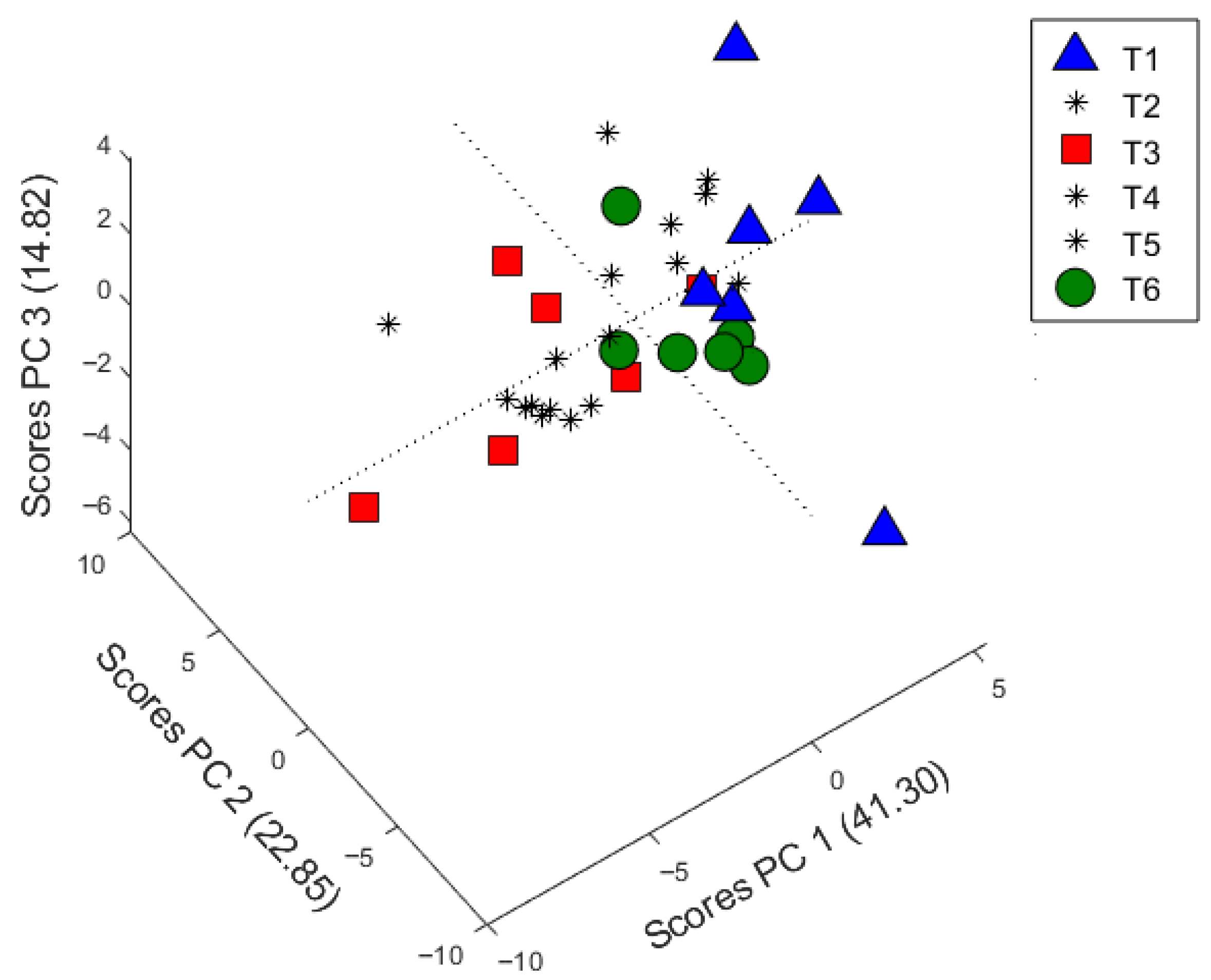
Principal Component Analysis (PCA) was used as an exploratory tool in this study, using auto-scaling as a data pre-processing step [13]. Five principal components were selected to describe the systematic information in the dataset, explaining 88.67% of the total variability. Most of this variance was explained by PC1 (41.30%), followed by PC2 (22.85%) and PC3 (14.82%).
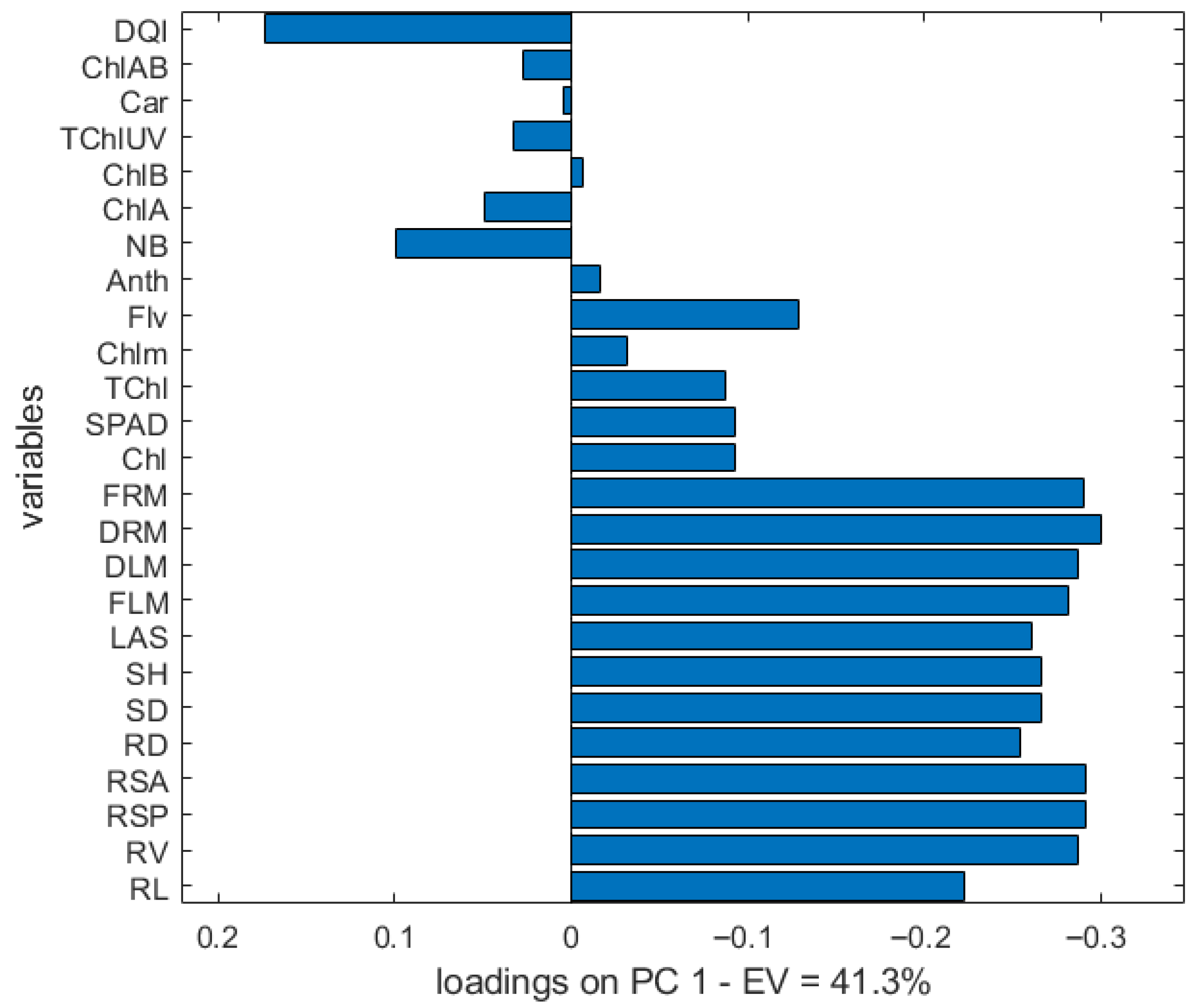
Figure 1 illustrates the 36 samples subjected to different treatments, projected along the new axes—PC1, PC2, and PC3. PC1 was primarily responsible for the differentiation between the treatments without nitrogen (T1—blue triangles), ammonium sulfate (T3—red squares), and magnesium nitrate (T6—green circles). Furthermore, it was possible to identify the variables that had the greatest influence on the projection of the samples, as indicated in the loadings plot (Figure 2).
Figure 1.
Score plot of the principal component analysis (PC1 vs. PC2 vs. PC3) for the different treatments: water (T1—blue triangles), ammonium sulfate (T3—red squares), and magnesium nitrate (T6—green circles). Urea, potassium nitrate and calcium nitrate (T2, T4, and T5, respectively) were marked with asterisks.
Figure 2.
Loading plot with variables used to separate the samples on PC1. RL—Root Length; RV—Root Volume; RSP—Root Surface Projection; RSA—Root Surface Area; RD—Root Diameter; SD—Seedling Diameter; SH—Seedling Height; LAS—Leaf Area Seedling; FLM—Fresh Leaf Mass; DLM—Dry Leaf Mass; DRM—Dry Root Mass; FRM—Fresh Root Mass; Chl—Chlorophyll (chlorophyll meter); SPAD—Relative Chlorophyll Content (SPAD meter); TChl—Total Chlorophyll (chlorophyll meter); Chlm—Chlorophyll (multipigment meter); Flv—Flavonoids (multipigment meter); Anth—Anthocyanins (multipigment meter); NB—Nitrogen Balance (multipigment meter); ChlA—Chlorophyll A (UV meter); ChlB—Chlorophyll B (UV meter); TChlUV—Total Chlorophyll (UV meter); Car—Carotenoids (UV meter); ChlAB—Chlorophyll A and B (UV meter); DQI—Dickson Quality Index).
Treatments T2, T4, and T5 did not show clear separation on any of the main axes of the PCA. For this reason, they were marked with asterisks only to facilitate the visualization of the other treatments in the graph.
The variables NB (Nitrogen Balance), ChlA (Chlorophyll A), TChlUV (Total Chlorophyll), Car (Carotenoids), ChlAB (Chlorophyll A and B), and DQI (Dickson Quality Index), represented in the positive loadings of PC1, contributed to the samples submitted to water (T1—blue) and Magnesium Nitrate (T6—green) being projected on the positive scores of PC1 (Figure 1). On the other hand, morphological variables such as RL (Root Length), RV (Root Volume), RSP (Root Surface Projection), RSA (Root Surface Area), among others, were associated with the negative loadings of this principal component. This positioning indicates that these morphological parameters did not influence the projection of samples T1 and T6, since both are found in the positive scores of PC1.
Based on the principal component analysis, it can be concluded that T6 (magnesium nitrate) was not effective in the morphological parameters evaluated, with results equivalent to those of T1 (water). These findings are consistent with the results of the Tukey test, presented in Table 1 and Table 4, which reinforces the consistency of the statistical analyses performed. In contrast, the samples treated with ammonium sulfate (T3—red) were projected on the negative scores of PC1, indicating that the morphological variables were decisive in this projection.
4. Discussion
The effects observed in treatments with the presence of nitrogen, whether in the form of urea, nitrate, or ammonium, confirmed the great need for this element by passion fruit seedlings, with a large advantage in development observed in most characteristics compared to pure water. This occurs due to its structural and functional importance in plant cells and tissues, so that nitrogen deficiency rapidly and severely compromises plant growth by limiting crucial metabolic processes of vegetative development [2].
The presence of nitrogen alone already ensured good development of passion fruit seedlings in the tested substrate; however, when it is added in association with calcium, there was a difference in the system for the root system. This effect was evident in the analyses of surface area and root projection, where seedlings fertilized with calcium nitrate showed 85% greater root performance than the control. These results can be explained by the fundamental role of calcium in root development and meristematic tissues, as it is a structural component of the cell wall and directly influences the number and length of roots and root hairs [14]. Root hairs are essential for the absorption of nutrients and water from the soil, contributing to the overall efficiency of the root system. Therefore, adequate calcium availability is crucial for root growth and functionality, directly affecting plant nutrition and development [15].
Still emphasizing the interference of nitrogen fertilizer associated with calcium in the development of passion fruit seedlings, the improved performance can be attributed to the dual role of calcium ions (Ca2+) in plants, since, structurally, Ca2+ binds to acidic groups of membrane lipids and forms cross-links between pectins, especially in the middle lamellae, thus ensuring cell stability, while as a secondary messenger, Ca2+ also mediates responses to environmental stimuli by binding to calmodulin, forming a complex that regulates key cellular processes, consolidating its essentiality to plants [2].
These findings are consistent with those of González et al. (2020) [14], who evaluated the effects of different calcium sources during the acclimation phase in nurseries by analyzing the root growth potential of Aextoxicon punctatum seedlings. The authors reported that the application of calcium increased both the number and length of roots, corroborating its essential role in root development, with its effect attributed to calcium’s ability to promote root elongation and expansion of root hairs, mainly in the initial stages of growth. In this way, the roots are able to explore the soil more efficiently, increasing the absorption capacity of other nutrients.
Another relevant factor is that nitrogen fertilizers associated with calcium increase the tolerance of seedlings to salinity and electrical conductivity, this increased tolerance being particularly beneficial for passion fruit, a species considered sensitive even to low soil salinity and prone to negative responses to conductivity fluctuations caused by external factors [16].
Root analyses also indicated favorable responses to ammonium sulfate, with significant increases in root diameter and volume of 194.02% and 53.57%, respectively, than the treatment without nitrogen. This treatment also produced the best results for fresh and dry root mass. The observed response in root growth can be attributed to the biochemical role of sulfur, which, in association with nitrogen, is incorporated into essential compounds of primary metabolism, including proteins, lipoic acids, coenzyme A, thiamine pyrophosphate, glutathione, biotin, 5′-adenyl sulfate and 3′-phosphoadenosine, since the increased synthesis of these molecules increases the energy efficiency of plants and promotes root growth [2].
The results are consistent with those reported by Grzebisz et al. [17], who observed increased crop productivity after fertilization with nitrogen combined with sulfur. In that study, tuber mass increased by 26% in plots that received nitrogen with sulfur compared to those fertilized with nitrogen alone. The authors attributed the effect of sulfur on yield formation to balanced growth during the vegetative and senescence development phases. They also observed that the stabilizing influence of sulfur promoted a gradual transition of stem biomass during the decline phase, contributing to more uniform plant development, a response that may also have occurred in the passion fruit seedlings evaluated in this experiment.
Tabak et al. (2020) [18] reported results consistent with those obtained in this study, indicating that the application of sulfur in the form of sulfate ions (SO42−) through nitrogen fertilizers increases the concentration of sulfate available for absorption. The authors observed that the high availability of sulfate ions allows plants to absorb amounts that exceed their immediate physiological needs, with the surplus stored in the vacuole. Under these conditions, unmetabolized sulfur is predominantly stored as sulfate ions (SO42−).
The improved root development of passion fruit seedlings observed in this study can be attributed to the direct supply of sulfate ions, in addition to nitrogen in the form of ammonium. By increasing their reserves of this nutrient, the seedlings reduce the likelihood of deficiency and ensure a faster supply of sulfur for metabolic processes [19]. Associated with this information, it is worth noting that the nitrogen source in the form of ammonium, due to the type of fertilizer, also makes nitrogen available to be incorporated into organic molecules more quickly (glutamate and glutamine) [20], which can accelerate the growth process by avoiding some metabolic pathways necessary for the incorporation of nitrate or urea and which are dependent on other chemical elements, such as molybdenum and nickel, respectively [21,22].
In time, the nitrogen supplied as ammonium contributed to the enhanced development of the seedlings, although NH4+ is potentially toxic to plants and, unlike nitrate (NO3−), cannot accumulate in high concentrations in plant tissues, its adverse effects usually only occur when ammonium represents more than 50% of the nitrogen source [23]. In this study, such conditions were not observed, as the growth medium contained high levels of organic matter.
In contrast, the assimilation of nitrate (NO3−) by plants requires a greater energy investment, as nitrate must first be reduced to nitrite (NO2−) and subsequently to ammonium (NH4+) before being incorporated into amino acids. This process involves sequential enzymatic reactions catalyzed by nitrate reductase and nitrite reductase, requiring significant amounts of NADH/NADPH and ATP as energy sources and reducing energy [24]. Consequently, seedlings fertilized with ammonium sulfate were able to redirect the energy needed for nitrate reduction to vegetative growth, thus promoting their development.
Although treatments with calcium and sulfur showed the best results for root development, only the fertilizer with sulfur stood out in the aerial part analyses, showing that ammonium sulfate was the fertilizer that contributed most to seedling height, stem diameter, leaf area, and fresh and dry leaf mass. This treatment also produced the highest values for relative chlorophyll content, chlorophyll, and total chlorophyll. The broad benefits of sulfur in multiple metabolic pathways are largely attributed to its ability to exist in several stable oxidation states, a property it shares with nitrogen [2], which helps explain the observed results, ranging from 22.00% to 285.53% above the control.
When comparing ammonium sulfate fertilization with urea-based fertilization, the combined supply of sulfur and nitrogen increased the overall effect of fertilization. Seedlings fertilized with ammonium sulfate showed results 2% to 66% higher than those fertilized with urea. This synergy is relevant because the absence of sulfur in fertilization reduces the synthesis of sulfur-containing amino acids, leading to the accumulation of nitrogen in non-metabolized forms, such as soluble amino acids, amines, and amides [24]. These compounds do not have active metabolic functions in plants, thus compromising the efficiency of primary metabolism [25].
Table 4 shows that the absence of significant differences between treatments regarding chlorophyll content (CHLM), flavonoids (FLVM), anthocyanins (ANTHM) and nitrogen balance index (NB) indicates that standardizing the nitrogen concentration at 13 mmol L−1 was effective in equalizing the supply of this nutrient between plants, reducing physiological variability. The stability in chlorophyll content suggests that nitrogen assimilation occurred similarly between the different sources (urea, ammonium and nitrate), since the synthesis of this pigment depends directly on the availability of N, which is essential for the tetrapyrolic structure of the molecule [10]. Similarly, the uniformity observed in the levels of flavonoids and anthocyanins, secondary metabolites related to redox balance and the carbon/nitrogen ratio, indicates the absence of oxidative stress or differential activation of phenylpropanoid pathways [26], corroborating that the nitrogen supply was sufficient and balanced in all treatments, regardless of whether it was made available in the form of ammonium or nitrate.
The exploratory analysis revealed that seedlings treated with magnesium nitrate did not separate from unfertilized seedlings in the PCA. According to Ahmed et al. (2023) [27], after absorption by the roots, Mg2+ is translocated to the leaves via the xylem; however, its redistribution to actively growing organs, such as young leaves, is limited. Considering that all plants in this study were in the seedling stage, this restricted mobility likely had a significant impact on overall development, explaining the similarity in performance between seedlings treated with magnesium nitrate and the control group.
The morphological and physiological parameters evaluated under nursery conditions are essential to ensure seedling quality and successful initial establishment after transplanting [28]. However, field environments differ substantially from the controlled conditions of a greenhouse, directly affecting the physiological performance of seedlings after transplanting [29]. Therefore, although nursery results are promising, further experiments under field conditions are needed to confirm whether the favorable characteristics are maintained in practice.
5. Conclusions
It can be concluded that for passion fruit seedlings, nitrogen supply is fundamental for enhanced growth, regardless of the form in which the nitrogen is made available (urea, ammonium, or nitrate), as evidenced by significant improvements in both morphological and physiological variables.
When nitrogen supplied to passionfruit seedlings is combined with other macronutrients, differentiated responses can be observed among the macronutrients. In particular, calcium nitrate promoted greater surface area and root projection, while ammonium sulfate significantly increased root diameter and volume, as well as fresh and dry biomass. For the shoot, ammonium sulfate also increased seedling height, stem diameter, leaf area, and biomass accumulation, in addition to increasing relative and total chlorophyll levels, suggesting a positive influence on photosynthetic performance. These findings highlight the potential synergistic effect of nitrogen fertilization combined with sulfur.
Principal Component Analysis (PCA) confirmed that PC1 explained most of the variability between treatments, clearly distinguishing seedlings irrigated with water, ammonium sulfate, and magnesium nitrate.
Author Contributions
Conceptualization, G.d.S.R. and T.d.S.P.; methodology, G.d.S.R., T.d.S.P., R.C.B.C. and V.R.F.; software, G.d.S.R., T.d.O.C. and M.d.O.S.; validation, T.d.O.C. and M.d.O.S.; formal analysis, G.d.S.R. and S.d.S.B.; investigation, G.d.S.R. and T.d.S.P.; resources, S.d.S.B. and M.d.O.S.; data curation, G.d.S.R.; writing—original draft preparation, G.d.S.R., T.d.S.P., R.C.B.C., V.R.F. and T.d.O.C.; writing—review and editing, G.d.S.R., T.d.S.P., R.C.B.C., V.R.F. and T.d.O.C.; visualization, G.d.S.R., T.d.S.P., R.C.B.C., V.R.F., T.d.O.C., M.d.O.S., A.P.C.G.B. and S.d.S.B.; supervision, S.d.S.B.; project administration, S.d.S.B.; funding acquisition, S.d.S.B. and A.P.C.G.B. All authors have read and agreed to the published version of the manuscript.
Funding
This work was supported with financial and material assistance from the Program for the Strengthening of Espírito Santo Agriculture (FortAC). This research was funded by the Federal Institute of Espírito Santo—Ifes, and the APC was funded by the Pro-Rectorate of Research and Postgraduate Studies.
Data Availability Statement
The data presented in this study are openly available in the Zenodo repository at https://doi.org/10.5281/zenodo.17087658, accessed on 30 November 2025.
Acknowledgments
The authors express their sincere gratitude to the Federal Institute of Espírito Santo (IFES) for the academic environment and institutional support that enabled the master’s-level training of its authors. Our gratitude also extends to the Sustainable Agriculture Laboratory (LAS), where the physiological and morphological analyses were performed; the Agricultural Waste Utilization Research Group (ResAgro), for their assistance with the analyses; and the Analytical, Metabolomics, and Chemometrics Laboratory (LaMeQui), for their assistance with data validation. Finally, we thank all individuals who, directly or indirectly, contributed to the successful completion of this work. During the preparation of this manuscript/study, the authors used Gemini 2.5 Flash for reference formatting purposes. The authors have reviewed and edited the output and take full responsibility for the content of this publication.
Conflicts of Interest
The authors declare no conflicts of interest.
Abbreviations
| ANTHM | anthocyanins |
| CA | chlorophyll A |
| Car | carotenoids |
| CB | chlorophyll B |
| CHL | chlorophyll |
| CHLM | chlorophyll |
| CV | coefficient of variation |
| DLM | dry leaf mass |
| DLM | dry root mass |
| DLM | Dickson quality index |
| FLM | fresh leaf mass |
| FLVM | flavonoids |
| FRM | fresh root mass |
| LA | leaf area |
| MRD | mean root diameter |
| NB | nitrogen balance index |
| PCA | principal component analysis |
| RL | root length |
| RSA | root surface area |
| RSP | root surface projection |
| RV | root volume |
| SD | stem diameter |
| SH | seedling height |
| SPAD | relative chlorophyll content |
| T1 | Water |
| T2 | Agricultural urea |
| T3 | Ammonium sulfate |
| T4 | Potassium nitrate |
| T5 | Calcium nitrate |
| T6 | Magnesium nitrate |
| TC | total chlorophyll |
| YOTCH | total chlorophyll |
References
- Ding, X.; Liu, J.; Wang, Y.; Wang, J.; Liu, C.; Qin, M.; Xu, Y.; Ma, Y.; Yang, J.; Xu, Z. Effects of nitrogen addition on the functional characteristics of leaves of dominant species in Bayanbulak pasture, Xinjiang, China. Plants 2025, 14, 597. [Google Scholar] [CrossRef]
- Taiz, L.; Zeiger, E. Plant Physiology and Development, 6th ed.; Artmed Editora: Porto Alegre, Brazil, 2017. [Google Scholar]
- Kamdi, P.J.; Swain, D.K.; Wani, S.P. Improvement of grain quality and nitrogen use efficiency of cereal-based cropping systems in vertisols in semi-arid tropics. Field Crops Res. 2024, 307, 109258. [Google Scholar] [CrossRef]
- Barłóg, P.; Grzebisz, W.; Łukowiak, R. Fertilizers and fertilization strategies mitigating soil factors that limit nitrogen efficiency in plant production. Plants 2022, 11, 1855. [Google Scholar] [CrossRef]
- Fidler, M.; Perez-Lugones, D.; Gómez, C. Effect of nitrogen concentration on compact tomato and pepper plants during the production and fruiting phases. HortTechnology 2025, 35, 52–61. [Google Scholar] [CrossRef]
- Cárdenas-Pira, W.T.; Torres-Moya, E.; Magnitskiy, S.; Melgarejo, L.M. Physiological responses of purple passion fruit plants (Passiflora edulis Sims f. edulis) to deficiencies of the macronutrients Fe, Mn and Zn during vegetative growth. Int. J. Fruit Sci. 2021, 21, 344–358. [Google Scholar] [CrossRef]
- Benigna Pereira, M.; Lima, L.R.; Guedes, J.J.; Dias, J.A.; Lima, V.S.; Bezerra, A.A. Growth and photosynthetic pigments of passion fruit (Passiflora edulis) seedlings under foliar fertilization with nitrogen and irrigated with saline water. Dyna 2022, 89, 58–65. [Google Scholar] [CrossRef]
- Pereira, M.B.; Nóbrega, J.S.; de Fátima, R.T.; de Queiroz Lopes, M.D.F.; Ferreira, J.T.A.; da Silva Ribeiro, J.E.; Figueiredo, F.R.A.; Pereira, W.E.; de Lima, G.S.; dos Anjos Soares, L.A. Effect of saline stress and nitrogen and potassium fertilization on the morphophysiology of Passiflora edulis Sims. f. flavicarpa Dreg. Braz. J. Agric. Sci. 2024, 19, 3696. [Google Scholar] [CrossRef]
- Zou, N.; Huang, L.; Chen, H.; Huang, X.; Song, Q.; Yang, Q.; Wang, T. Nitrogen form plays an important role in the growth of moso bamboo (Phyllostachys edulis) seedlings. PeerJ 2020, 8, 9938. [Google Scholar] [CrossRef]
- Silva Júnior, G.B.D.; De Mello Prado, R.; Silva, S.L.O.; Campos, C.N.S.; Castellanos, L.G.; Santos, L.C.N.D.; Pinceli, F.M.; Fernandes, L.J.T.; Fernandes, J.A.M. Nitrogen concentrations and ammonium and nitrate ratios in the nutrition and growth of yellow passion fruit seedlings. J. Plant Nutr. 2020, 43, 2533–2547. [Google Scholar] [CrossRef]
- Hiscox, J.D.; Israelstam, G.F. A method for chlorophyll extraction from leaf tissue without maceration. Can. J. Bot. 1979, 57, 1132–1334. [Google Scholar] [CrossRef]
- Lichtenthaler, H.K. Chlorophylls and carotenoids ± pigments of photosynthetic biomembranes. Enzym. Methods 1987, 148, 350–382. [Google Scholar]
- Picanço, T.S.; de Souza, M.C.R.; Figueiredo, A.P.S.; Urban, R.C.; Cabrero, B.S.; Canela, M.C.; Souza, M.O. Exploratory Study on the Impact of Climatic Factors and Vehicle Traffic on Ozone and BTEX Levels in Itaperuna, Brazil. J. Braz. Chem. Soc. 2025. [Google Scholar] [CrossRef]
- González, M.; Donoso, P.J.; Contreras, F.J.; Arriagada, L.L.; Espinosa, P.J. Effect of phosphorus and calcium concentration on morphophysiological attributes and root growth potential in Aextoxicon punctatum plants produced with coated roots at the hardening stage. Bosque 2020, 41, 137–146. [Google Scholar] [CrossRef]
- Vetterlein, D.; Kautz, T.; Heklau, H.; Gaiser, T.; Tappe, W.; Köhne, J.M. Root hairs are important at the field scale for maize shoot growth and nutrient uptake, but the plasticity of root characteristics is primarily triggered by texture and drought. Solo Veg. 2022, 478, 119–141. [Google Scholar]
- De Souza, T.M.A.; Santana, M.J.; Lima, M.A.; Ribeiro, S.B.; Bezerra, A.A.; Lopes, W.J.S.; Santos, S.H. Calcium silicate as an attenuator of saline stress in yellow passion fruit seedlings cv. BRS GA1. Rev. Caatinga 2020, 33, 509–517. [Google Scholar] [CrossRef]
- Grzebisz, W.; Łukowiak, R.; Barłóg, P. Does elemental sulfur act as an effective measure to control the seasonal growth dynamics of potato tubers (Solanum tuberosum L.). Plants 2022, 11, 248. [Google Scholar] [CrossRef]
- Tabak, M.; Gozdowski, D.; Grzebisz, W.; Łukowiak, R. Efficiency of nitrogen fertilization of winter wheat depending on sulfur fertilization. Agronomia 2020, 10, 1304. [Google Scholar] [CrossRef]
- Narayan, O.P.; Kumar, P.; Yadav, B.; Dua, M.; Johri, A.K. Sulfur nutrition and its role in plant growth and development. Plant Signal. Behav. 2023, 18, 2030082. [Google Scholar] [CrossRef]
- Zayed, O.; Hewedy, O.A.; Abdelmoteleb, A.; Ali, M.; Youssef, M.S.; Roumia, A.F.; Seymour, D.; Yuan, Z.C. Nitrogen journey in plants: From uptake to metabolism, stress response, and microbe interaction. Biomolecules 2023, 13, 1443. [Google Scholar] [CrossRef]
- Gadallah, F.M.; Nevein, A.; Belal, H.E.; Majrashi, A.; El-Tahan, A.M.; El-Saadony, M.T.; Elrys, A.S.; El-Saadony, F.M. Nitrogen-molybdenum-manganese co-fertilization reduces nitrate accumulation and enhances spinach (Spinacia oleracea L.) yield and its quality. Saudi J. Biol. Sci. 2022, 29, 2238–2246. [Google Scholar] [CrossRef]
- Rabinovich, A.; Di, R.; Lindert, S.; Heckman, J. Nickel and soil fertility: Review of benefits to environment and food security. Environments 2024, 11, 177. [Google Scholar] [CrossRef]
- Weil, S.; Watzke, M.; Kautz, T.; Schmidt, C. Plant growth and calcium and potassium accumulation in lettuce under different ammonium and nitrate nutrition regimes. J. Plant Nutr. 2021, 44, 270–281. [Google Scholar] [CrossRef]
- González-Moro, M.B.; González, A.; Menéndez, M.A.; Cárdenas, M.L.; González, G.; Muro-Pastor, A.M. A multispecies analysis defines anaplerotic enzymes and amides as metabolic markers for ammonium nutrition. Front. Plant Sci. 2021, 11, 632285. [Google Scholar] [CrossRef] [PubMed]
- Nasser, M.D.; Caires, E.F.; Zancanaro, L.; Sgarbi, C.G. Sulfur, gypsum and organic compost in cabbage production. Res. Desenvolv. Soc. 2020, 9, e029108316. [Google Scholar]
- Milagres, C.D.C.; Fontes, P.C.R.; Silveira, M.V.D.; Moreira, M.A.; Lopes, I.P.D.C. Índices de nitrogênio e modelo para prognosticar a produção de tubérculos de batata. Rev. Ceres 2018, 65, 261–270. [Google Scholar] [CrossRef][Green Version]
- Ahmed, N.; Ullah, R.; Naeem, M. The power of magnesium: Unlocking the potential for increased yield, quality and stress tolerance in horticultural crops. Front. Plant Sci. 2023, 14, 1285512. [Google Scholar] [CrossRef] [PubMed]
- Silva, P.D.D.S.; Batista, C.M.; Pimenta, S.; Pereira, M.C.T.; Nietsche, S.; Silva, J.F.; Martins, M.J.; de Souza, T.A.N.; Alves, R.M.; Batista, I.C.C.; et al. Quality index of passion fruit seedlings using physical parameters. Rev. De Ciência Agrícola 2022, 14, 136. [Google Scholar]
- Qi, Y.; Ma, L.; Ghani, M.I.; Peng, Q.; Fan, R.; Hu, X.; Chen, X. Effects of drought stress induced by hypertonic polyethylene glycol (PEG-6000) on the physiological properties of Passiflora edulis Sims. Plants 2023, 12, 2296. [Google Scholar] [CrossRef]
Disclaimer/Publisher’s Note: The statements, opinions and data contained in all publications are solely those of the individual author(s) and contributor(s) and not of MDPI and/or the editor(s). MDPI and/or the editor(s) disclaim responsibility for any injury to people or property resulting from any ideas, methods, instructions or products referred to in the content. |
© 2026 by the authors. Licensee MDPI, Basel, Switzerland. This article is an open access article distributed under the terms and conditions of the Creative Commons Attribution (CC BY) license.