Review

Optimizing Nitrogen Inputs for High-Yielding and Environmentally Sustainable Potato Systems

by
Ivana Varga
1,*,
Marina Bešlić
1,
Manda Antunović
1,
Jurica Jović
1 and
Antonela Markulj Kulundžić
2
1
Faculty of Agrobiotechnical Sciences Osijek, Josip Juraj Strossmayer University of Osijek, 31000 Osijek, Croatia
2
Department of Industrial Plants Breeding and Genetics, Agricultural Institute Osijek, 31000 Osijek, Croatia
*
Author to whom correspondence should be addressed.
Nitrogen 2025, 6(4), 117; https://doi.org/10.3390/nitrogen6040117
Submission received: 24 October 2025 / Revised: 8 December 2025 / Accepted: 9 December 2025 / Published: 16 December 2025
(This article belongs to the Special Issue Nitrogen Management in Plant Cultivation)

Abstract

For successful potato production, maintaining a proper balance of mineral nutrients is crucial, as high yields cannot be achieved in fields lacking essential elements. The exact amount of fertilizer should be determined based on the expected yield, crop nutrient requirements, soil analysis, cultivation technology, and specific growing conditions. N (N) plays a crucial role in potato tuber growth. It is involved in the synthesis of proteins that are stored in the tubers and helps prolong the lifespan of the leaf canopy. On average, potato crops require a N supply of 80–120 kg/ha. Based on several studies, N fertilization significantly increased potato tuber yield, while dry matter content showed a slight decline. This indicates that higher N rates can enhance yield but potentially decrease tuber quality. To achieve high tuber yields while preserving desirable dry matter and starch content, the optimal N rate is approximately 100–120 kg N/ha. Although higher N inputs (>150 kg N/ha) may temporarily boost vegetative growth, they ultimately delay tuber maturation, reduce dry matter and starch accumulation, and increase production costs due to inefficient fertilizer use. Excessive N fertilization accelerates soil degradation and contributes to environmental pollution (soil acidification, NO3 leaching, NH3 emissions, NO, N2O, and NO2, leading to additional long-term ecological burdens. Therefore, minimizing N losses through sustainable soil management is essential for maintaining both farm profitability and environmental protection. Integrating N fertilization with biofertilizers—such as beneficial bacteria that colonize roots, enhance nutrient uptake, and stimulate root development—can improve yields while reducing reliance on costly synthetic fertilizers. This supports both soil fertility and crop productivity.

1. Introduction

In the context of increasingly pronounced climate changes and the growing demand for sustainable agricultural intensification, N (N) management has become one of the central challenges in modern crop production. N is an essential macronutrient for plant growth and development, playing a key role in chlorophyll synthesis, protein formation, and enzymatic activity. However, its cycle in the soil is highly dynamic, increasing the risk of losses through volatilization, nitrate leaching, and emissions of the greenhouse gas nitrous oxide (N2O) [1,2,3]. Therefore, sustainable N fertilization strategies must meet multiple objectives: they must ensure high and stable yields, improve crop quality, and simultaneously reduce environmental impacts. Efficient N management is essential for sustainable production, particularly in systems aiming to improve yields while preserving soil quality and minimizing environmental impact [4,5,6,7,8].
Potato (Solanum tuberosum L.) grows best in environments with stable temperatures during the vegetation period as well as during tuber dormancy when they are in storage. Most commercial potato cultivars were developed in temperate regions and perform best when exposed to long days and moderate temperatures. The crop thrives in moderately humid climates, and a lack of water during the growing season leads to reduced yield and lower tuber quality [9,10,11]. Potato production reveals a combination of strong advantages and notable challenges within the sector. Among its main strengths are the profitability of production when managed effectively, favorable climatic conditions for potato cultivation, and good soil quality in many production areas. Additionally, the production systems have generally regulated various aspects of the process, from field production to purchase and processing, and offer the possibility of growing specialized varieties for different purposes (such as table potatoes, chips, or potatoes that can be used for industrial processing), and the increasing demand for high-quality domestic products. Furthermore, the potential application of modern technologies in cultivation and storage provides opportunities to improve efficiency and product quality.
However, several weaknesses limit the full realization of this potential. These include a lack of expertise and education among some producers; high input costs related to tubers for sowing, fertilizers, and plant protection; and high labor intensity during the production season. Potato production is also highly dependent on irrigation systems, particularly due to increasingly frequent droughts, while price fluctuations and market uncertainty further increase production risks. Competition from imported potatoes and limited investment in research and development of domestic varieties represent additional challenges.
Modern fertilization practices involve a wide range of N sources, from conventional mineral fertilizers (e.g., urea, ammonium nitrate) to organic amendments such as compost and farmyard manure, as well as advanced formulations including slow-release and stabilized N fertilizers [12,13,14,15,16,17]. Slow-release products typically include polymer-coated urea, sulfur-coated urea, and urea–urea–urea–formaldehyde or isobutylidene diurea (IBDU) types, which are designed to synchronize N release with crop demand and reduce losses through leaching and volatilization [18,19]. Scientific field trials and meta-analyses confirm that integrating organic and mineral N inputs not only enhances N use efficiency (NUE) but also contributes to improved soil structure and yield stability over time [20,21,22]. Kumar et al. [23] stated that increasing demand for chemical-free food has increased interest in plant endophytes, which enhance plant growth, stress resilience, and nutrient uptake—including N—through the production of bioactive compounds, phytohormones, and secondary metabolites. Combined with insights into N assimilation and signaling pathways, these eco-friendly microbes offer a sustainable strategy to improve crop productivity, nutrient use efficiency, and pest and disease management. For wheat, according to Kumar et al. [24], there are 103 genes in high-NUE wheat and 45 genes in low-NUE wheat. Upon nitrate availability, NIN-like proteins (NLPs) are activated and accumulate in the nucleus, where they bind to nitrate-responsive cis-elements in target gene promoters and induce the expression of genes involved in nitrate uptake. Thus, nitrate sensing via NIN-like proteins links external nitrate status to transcriptional reprogramming and NUE in plants. Recent mechanistic insights into N assimilation, transporter regulation, and signaling pathways—including nitrate sensing via NIN-like proteins (NLPs) [25]—provide a robust molecular basis for improving N use efficiency (NUE). These findings, supported by transcriptomic and metabolomic analyses in crops such as sorghum [26] and transcriptional studies in wheat [27], underscore how coordinated regulation of uptake, assimilation, and signaling can underlie more sustainable and efficient N management strategies. However, the effectiveness of these strategies can vary depending on agroecological conditions, soil properties, and crop-specific nutrient demands. In potato production systems, particularly in temperate and transitional climates, there is a need for a targeted synthesis of existing research to support site-specific N management [28,29,30].
Potato plants are highly vulnerable to a wide range of abiotic and biotic stresses, which impair photosynthesis, tuberization, and overall yield, making the development of stress-resilient cultivars a key priority for future food security. Yan et al. [31] found that N is essential for potato growth, with plants absorbing ammonium and nitrate through AMT and NRT transporters, which are then assimilated into amino acids via enzymes such as glutamine synthetase and nitrite reductase. Sutula et al. [32] stated that recent advances in CRISPR/Cas technologies enable precise, transgene-free genome editing in potatoes, providing new opportunities to enhance stress tolerance and improve nutritional and agronomic traits. Moreover, the authors stated that advances in CRISPR/Cas genome editing targeting key genes like StbHLH47, StLike3, and StDRO2 provide new opportunities to enhance root architecture, stress tolerance, and sustainability in potato production. Despite its agronomic importance, research in the area of N fertilization for potato remains limited, highlighting the need for further investigations to optimize N management in potato cultivation. Therefore, this review aimed to summarize the global relevance and uses of potatoes, assess the environmental implications of N fertilization—including nitrate leaching and groundwater pollution—and present current N management practices in potato production. Additionally, this review highlights beneficial microorganisms’ contribution to improving nutrient use efficiency and promoting more sustainable N fertilization strategies.

2. Worldwide Potato Production and Uses

2.1. Potato Production in the World

The potato is a species belonging to the nightshade family (Solanaceae) that includes approximately 100–180 species and cultivars worldwide. It represents one of the most important global food sources. Wild potato species originate from the heart of the South American Andes, specifically the Altiplano region of Peru and Bolivia [33]. Today, primitive native cultivated potatoes are widely distributed throughout the Andes, and the crop can be found from Venezuela and Argentina to south-central Chile. There are more than 5000 known potato varieties worldwide, with over 4500 found in South America and more than 100 wild species [34].
In the world, potatoes were grown on 16.6 million ha in the period from 2019 to 2023 [35]. According to Mickiewicz et al. [36], in many countries worldwide, potato cultivation represents one of the key sectors of crop production. For the nation’s population, potatoes serve as a fundamental component of food self-sufficiency.
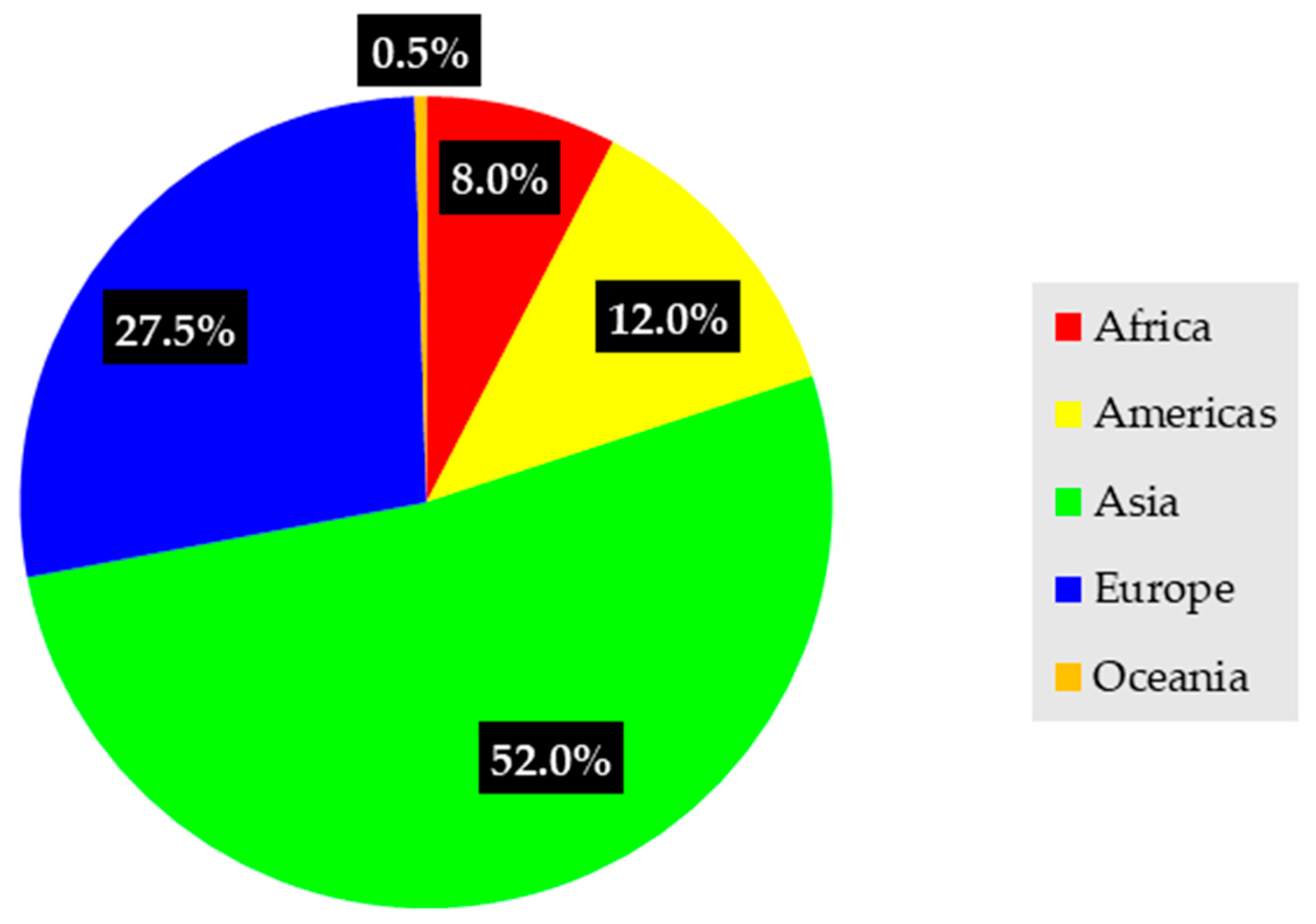
Although the potato originated in South America, this region currently has the lowest level of potato production globally (Figure 1). In South America, potatoes can be cultivated from coastal regions to high mountain areas, ranging from sea level up to altitudes above 4700 m. The crop is widely distributed throughout the Andes, with a large number of varieties and cultivars adapted to different climatic and soil conditions. In countries such as Peru, Chile, Bolivia, and Ecuador, potatoes are an economically and socially important crop [37,38]. Devaux et al. [39] states that potato production in Latin America and the Caribbean grew significantly, rising from 7 million tons in 1961–1963 to 21 million tons in 2020–2022, with an average annual increase of 2%, and that the majority of this output (76%) is destined for fresh consumption, while only about 1% is processed.
In Africa, potatoes are grown in a wide range of agroecological conditions, from irrigated commercial farms in Egypt and South Africa to tropical highland zones in East and Central Africa, where smallholder farmers dominate production. Potato cultivation is rapidly increasing in several African countries, including Algeria and Rwanda. Algeria is the leading producer on the continent, followed by Egypt, Malawi, South Africa, Rwanda, and Kenya [40]. Despite this growth, yields among smallholder farmers in Africa remain below their full potential, around 6 to 10 t/ha [41].
North America is the main source of potatoes in the United States. Potatoes are cultivated in nearly every U.S. state, although about half of the total crop comes from Idaho, Washington, Wisconsin, North Dakota, Colorado, Oregon, Maine, Minnesota, California, and Michigan [42]. Harvesting typically takes place in autumn, mainly in September and October. Only about one-third of potatoes produced in the U.S. are consumed fresh [43]. Approximately 60% are processed into frozen products (such as French fries), chips, dehydrated granules and flakes, and starch, while around 6% are used as seed potatoes.
More than 50% of global potato production is concentrated in Asia (Figure 1), making potatoes one of the most important field crops worldwide. China is the world’s largest potato producer, accounting for approximately one-third of global production, followed by India. According to a five-year average (2019–2023), China produces more than 92 million tons of potatoes annually, while India produces over 53 million tons [35].
In Asia, rapid economic growth has been accompanied by a significant rise in potato production. China became the world’s leading potato producer. According to Scott and Suarez [44], this growing importance highlights the crop’s potential for further expansion, particularly in developing Asian countries, amid rising incomes and urbanization. In Asia, significant emphasis is placed on developing potato varieties that are resistant to high temperatures and soil salinity, which enables the expansion of potato production in areas previously deemed unsuitable for cultivation [45,46,47]. For example, in coastal regions of Bangladesh, where cyclonic storm surges have rendered farmland too saline for most crops, these salt-tolerant varieties make cultivation possible. Additionally, biofortified potato varieties enriched with iron and zinc—micronutrients that are frequently deficient in human diets worldwide—have strong potential to improve the nutritional value of potato-based diets and help reduce micronutrient malnutrition [47].
Europe is the second-largest potato-growing region in the world. Globally, Europeans have the highest average per capita potato consumption per year (Figure 1). The main potato producers within Europe are Ukraine, Germany, Poland, France, the Netherlands, and the United Kingdom. During the analyzed period (2019–2023), Ukraine produced more than 21 million tons of potatoes annually, Germany produced more than 10 million tons, and France produced approximately 8.5 million tons, followed by Poland and the Netherlands with around 6.7 million tons. Germany, France, and the Netherlands recorded average yields of around 40 t/ha, whereas in Poland the average yield was approximately 30 t/ha.
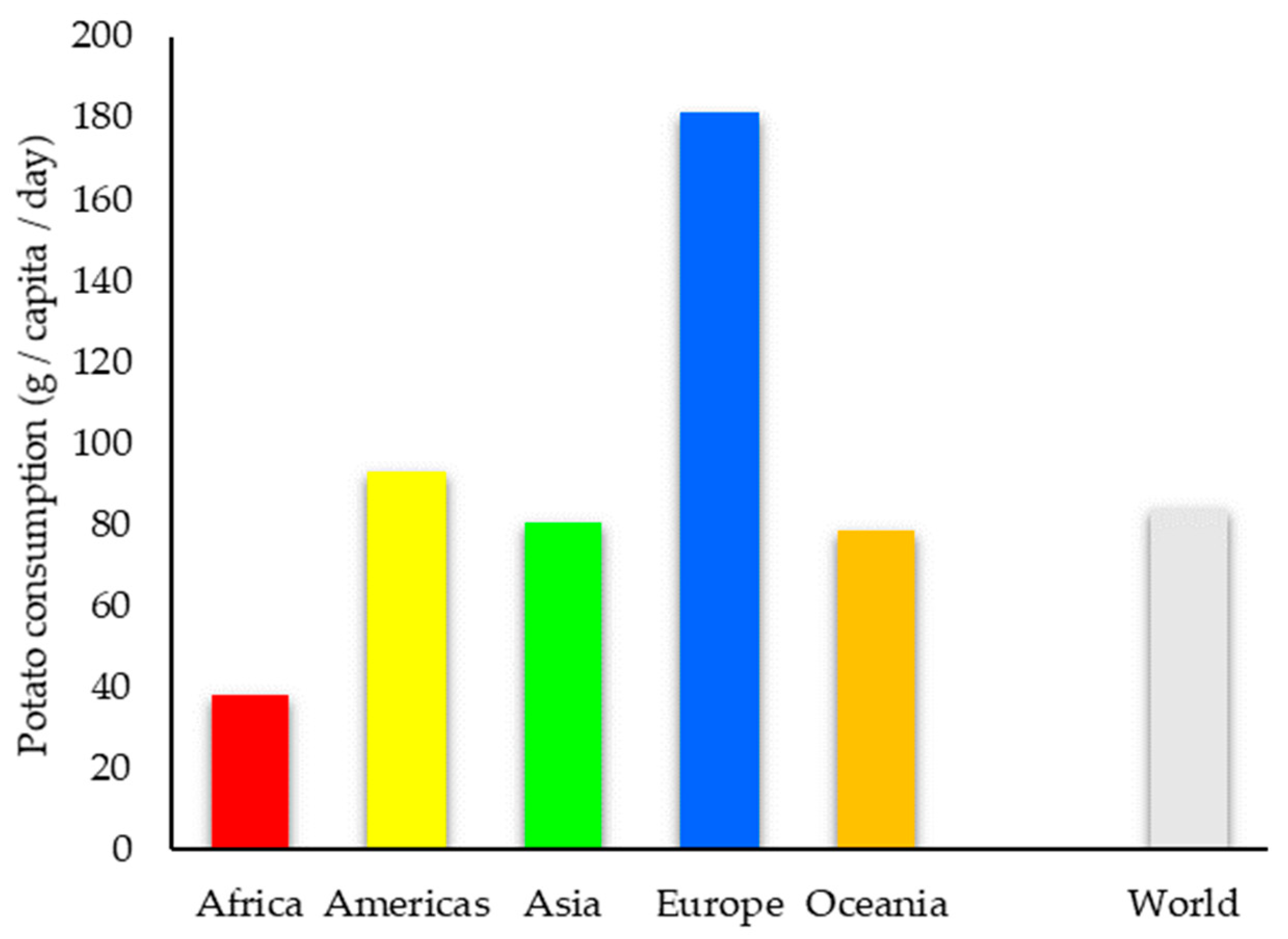
According to FAOStat [35], in the period from 2018 to 2022, Europe has by far the highest average daily potato consumption at 181.34 g per person per day, which is more than double the world average of 84 g/cap/d (Figure 2). This reflects the long tradition of potato consumption and its important role in European diets. The Americas (92.79 g/cap/d) and Asia (80.50 g/cap/d) follow, showing moderate levels of consumption. In contrast, Africa (38.03 g/cap/d) and Oceania (78.68 g/cap/d) have lower levels of daily consumption, likely reflecting differences in dietary habits, availability, and economic factors. Overall, the data indicate that potatoes remain a significant food source in many parts of the world, particularly in Europe, but their contribution to daily diets varies greatly by region. These differences may influence agricultural production strategies, trade flows, and nutritional policies. Additionally, daily potato consumption varies depending on a country’s level of economic development. For example, in Europe, the lowest average daily intake is recorded in the United Kingdom at 102 g per person, while Belarus has the highest intake at 181 g per person. In rural areas of the United States and Latin American countries, daily potato consumption among adults is five to six times higher compared to that in developed countries [48].

2.2. Uses and Importance of Potato Production

Potatoes are also frequently used as feed for livestock and are used in various industries for the manufacture of starch and alcohol. With the continuous increase in potato production and consumption worldwide, the amount of potato peel generated each year has also grown, making it one of the largest agro-industrial waste products [49]. Food supply chain waste—from farm to fork—significantly contributes to global warming. It is estimated that by 2030, approximately 8000 kilotons of potato peel waste could be generated, resulting in greenhouse gas emissions of around 5 million tons of CO2 equivalents [50].
Potato waste is an organic residue rich in phenolic compounds, antioxidants, vitamins, and minerals, and can be safely processed into products intended for human and animal use [51]. Potato peels can be used to produce high-value bioactive compounds such as polyphenols (phenolic acids and flavonoids), glycoalkaloids, and other natural antioxidants, in addition to polysaccharides (starch). Recovering these bioactive compounds not only helps protect the environment but also provides a significant economic opportunity for the food industry [52].
This has increased interest in the valorization of high-value bioproducts. Therefore, potato processing waste can be considered a promising raw material for the food, pharmaceutical, and biosynthetic industries.
Potato flesh is a rich source of antioxidants, vitamin C, and B-group vitamins (B1, B2, B6, and B9), along with numerous trace elements essential for human nutrition. It also plays an important functional role in maintaining human health [53]. Ascorbic acid and carotenoids, including lutein, zeaxanthin, and violaxanthin, act as antioxidants that help reduce oxidative stress in human cells. Chlorogenic acid and anthocyanins are phenolic compounds found mainly in potato skin in the form of phenolic acids. Both antioxidants and phenolic compounds have been shown to suppress cancer cell growth and improve cardiovascular health by lowering blood pressure and reducing the risk of hypertension [54]. Additionally, potatoes contain vitamins A, C, H, and E, as well as small amounts of B-group vitamins, along with more than 20 macro- and microelements (K, P, Mg, Fe, Cu, Zn, Mg, etc.) that play an important role in metabolism. In addition, potatoes also contain several enzymes. There are some positive implications of the use of potatoes in the diet. According to Arnesen et al. [55], in a Norwegian cohort study (1974–1988), including 78,400 adults consuming ≥14 potatoes per week, had a 12% lower risk of all-cause mortality compared to those consuming ≤6 per week. Each additional 100 g/day of potato intake was linked to a 4% lower risk of all-cause and cardiovascular disease mortality.
It is widely recognized that compounds present in potatoes—such as starch, proteins, fibers, minerals, ascorbic acid, alkaloids, phenols, flavonoids, and carotenoids—provide a range of health benefits for humans [56]. However, there is growing concern regarding potato consumption, as potatoes are carbohydrate-rich foods with a high glycemic index and glycemic load. These characteristics are associated with weight gain and an increased risk of type 2 diabetes.
According to Mattucumaru et al. [57] N fertilization in potato affects sugar and free amino acid concentrations, influencing food quality and safety by altering acrylamide-forming potential during high-temperature cooking, while sulfur (S) can mitigate some of these effects. In a field trial of 13 potato varieties, N generally increased acrylamide formation in a type- and variety-dependent manner, whereas S reduced glucose levels and lowered acrylamide risk in certain French fry-type potatoes. Sun et al. [58] stated that acrylamide formation in fried potato products is influenced by cultivar, nitrogen (N) fertilizer rate, and storage conditions, with low reducing sugar cultivars generally showing lower acrylamide levels. The study found that optimal N rates can maximize yield and quality while minimizing acrylamide, though responses varied by cultivar, storage time, and environmental conditions. According to De Wilde et al. [59], potato quality and acrylamide formation in French fries are influenced by N fertilization, with lower N levels increasing reducing sugar content and, consequently, acrylamide concentration. Balancing N fertilizer is therefore crucial to minimize acrylamide while maintaining acceptable tuber quality and considering environmental impacts. There are conflicting studies on this topic: some support the positive effects of potato consumption on health, while others directly associate it with an increased risk of hypertension, which is a major risk factor for cardiovascular diseases, including coronary heart disease, stroke, heart failure, and kidney disease. This may be one of the possible reasons for the decline in potato consumption over the past few decades.

3. Sources and Forms of N Fertilizers

N is one of the most important elements in the mineral nutrition of potato, with direct effects on vegetative growth, photosynthesis, tuber formation, and final yield. Various sources and forms of N fertilizers are used to ensure optimal N availability throughout the growing season. The most commonly applied are inorganic fertilizers such as urea (CO(NH2)2), ammonium nitrate (NH4NO3), ammonium sulfate, and calcium ammonium nitrate. These fertilizers are characterized by rapid N release, which ensures immediate plant uptake but also increases the risk of nitrate leaching and nitrous oxide emissions, particularly under conditions of high soil moisture and insufficient plant absorption [1].
In addition to inorganic sources, organic N sources are widely used, including farmyard manure, compost, biogas digestate, and green manures (e.g., legumes). Organic fertilizers enrich the soil with organic matter, enhance microbial activity, and improve soil structure. However, N from organic materials becomes available only after mineralization, which is time-dependent and less predictable. Nevertheless, numerous studies confirm the synergistic effect of combining organic and mineral N sources, whereby organic inputs provide a slow-release nutrient supply, and mineral fertilizers offer immediate availability [2].
To improve N use efficiency (NUE), the application of enhanced-efficiency fertilizers (EEF), including slow-release fertilizers (SRF) and stabilized fertilizers with urease and nitrification inhibitors, is becoming increasingly common. These products control the N release pattern, aligning nutrient availability with crop demand and thereby reducing losses and improving nutrient uptake efficiency [17]. Research shows that STF fertilizers can reduce nitrate leaching by up to 40% and increase N use efficiency by over 20% compared to conventional fertilizers [18].
In practice, especially in conventional production systems, a combined application of inorganic and organic sources is often used to achieve balanced N input, reduced environmental losses, and stable yields. Review studies indicate that the highest potato yields were obtained with 50–75% of N supplied through inorganic sources and 25–50% through organic amendments [1]. In organic farming, green manuring, compost, and extended crop rotation involving legumes are preferred strategies to ensure natural N supply without synthetic inputs [2].
Understanding the characteristics, mechanisms of action, and interactions of different N sources is crucial for optimizing fertilization in sustainable potato production. Appropriate selection and combination of fertilizers can increase yield, improve tuber quality, and simultaneously reduce environmental impacts.
Recent advances in precision N management and long-term meta-analyses have provided deeper insight into optimizing N use in potato cultivation. On-farm trials using enhanced-efficiency fertilizers (EEFs) with variable rate application demonstrated significant improvements under irrigated conditions [17]. These technologies align N release with plant demand, reducing excess availability and nitrate leaching. Complementary to this, large-scale meta-analyses confirmed that combining mineral fertilizers with organic inputs not only enhances N partial productivity but also contributes to higher yield stability and improved soil health indicators over time [19]. These findings support the integration of site-specific management with balanced fertilization strategies as a foundation of sustainable potato production.

4. Environmental Implications of N Fertilization

4.1. Nitrate Leaching and Groundwater Pollution

As noted by the author Hina [60], the importance of N in agricultural ecosystems cannot be overstated. We agree with that statement because N fertilization is a key factor in increasing agricultural yields, but its application carries significant environmental risks. Insufficient, but also excessive, N application in crop production can result in reduced yields and quality of plant production [61,62]. Moreover, N is one of the main limiting factors for sustainable agriculture and profitable crop production. By properly applying fertilizers, farmers can significantly enhance crop yields, thereby directly contributing to increased food production and meeting the demands of a growing global population [61]. Namely, knowledge and consultation with an expert are required when handling and incorporating N into the soil. It is first necessary to conduct a soil analysis to determine how much N to apply. Improper or excessive use of N fertilizers often leads to environmental pollution.
Moreover, N is one of the main limiting factors for sustainable agriculture and profitable crop production. Excessive application of N through fertilizers and manures that are not assimilated by plants can degrade soil and environmental quality by increasing soil acidification, nitrate leaching (NO3), and emissions of ammonia (NH3) and nitrous oxide (NO, N2O, and NO2). Among these gases, nitrous oxide (N2O) is a potent greenhouse gas that significantly contributes to global warming. At the same time, additional N inputs to agroecosystems come from atmospheric deposition, biological N fixation, and irrigation water. Crops typically utilize only about 40–60% of the applied N, while the remaining N in the soil (nitrate N [NO3 N] + ammonium N [NH4 N]) after harvest is prone to losses through leaching, denitrification, evaporation, surface runoff, soil erosion, and N2O emissions [61]. All of the above contribute to the contamination of surface and groundwater [62]. Namely, accumulated nitrates in the soil are often leached into groundwater during heavy rainfall or crop irrigation. Leaching is more significant in sandy and well-drained soils. This directly affects the health of aquatic ecosystems and biodiversity, which, in turn, can affect food quality and the availability of safe, natural resources. A meta-analysis published by Hina [60] covers 39 years of data and shows that the level of nitrate leaching varies significantly depending on the type of fertilizer (organic vs. synthetic), crop type, and soil texture. They found that synthetic fertilizers caused higher nitrate losses in vegetables than in grassy areas, and sandy soils had higher amounts of leaching compared to medium and fine-textured soils. Wen et al. [63] conducted a study in China to determine the effect of fertilization on reactive N losses through nitrate leaching. According to results from published papers, fertilizer application rate, timing, and soil pH are among the key factors affecting leaching in agricultural systems. They concluded that a combination of mineral fertilizers and organic materials (e.g., manure) can reduce the risk of nitrate leaching into the environment. Also, Muhammad et al. [64] tested soil nitrate (NO3 N) leaching, leached nitrate (LNO3 N) at low and high rates of corn irrigation. They found that low-water-holding-capacity irrigation, with the same level of nitrate in the fertilizer, significantly reduced NO3 N losses, without a significant loss in yield. Furthermore, long-term research conducted in uncontrolled (field) and controlled (laboratory) conditions has proven that the intake of N fertilizers, including urea, NH4+ N, and NO3 N, increases the leaching loss of base cations. This indicated that, like the decrease in soil pH, NO3 leaching loss also plays a major role in promoting Ca2+ and Mg2+ loss [65]. Thus, Peralta and Stockle [66], following a 30-year dynamic of nitrate leaching in irrigated potato rotations, determined that potatoes in years with increased soil fertilizer had the highest levels of nitrate leaching during the growing season. Conversely, at recommended fertilization rates, simulated nitrate leaching during potato growing seasons was low and did not differ from that during maize-growing seasons [67,68].

4.2. Nitrous Oxide (N2O) Emissions

Nitrous oxide (N2O) is a greenhouse gas that contributes to both ozone depletion and climate change [69]. The rapidity of process conditions changes led to a significant increase in N2O emissions [70]. Based on a 100-year global warming potential level, N2O emissions have been approximately 298 times as potent as CO2, which indicates that N2O plays a significant role in the global radiation balance [71]. Global N2O monitoring networks have reported increases in atmospheric N2O concentrations. Namely, record levels of N2O have been established in the last few years, which is very worrying. N2O is estimated to accumulate in the atmosphere and contributes approximately 6.4% to the total increase in the effective radiative forcing of greenhouse gases from 1750 to 2022. The rate of increase is currently around one ppb yr−1, with peaks exceeding 1.3 ppb yr−1 during 2020–2021 [72,73]. These steady increases in N2O concentrations highlight the growing importance of anthropogenic sources, primarily from agriculture and industry.
In terrestrial ecosystems, especially in agricultural soils, N2O is primarily produced during the processes of nitrification, nitrifier denitrification, and denitrification, processes that are improved by mineral fertilizers [74]. The process of nitrification is the microbial oxidation of ammonia (NH4+) to nitrate (NO3), whereby N2O is emitted as a byproduct. Nitrification denitrification is the reduction of nitrite (NO2) to N monoxide (NO), then to N2O, and finally to diN (N2). Denitrification is a two-step process in which NO3 is converted to N2O and then to inert N2 under anaerobic conditions. In the denitrification pathway, NO2, NO, and N2O are obligatory intermediates [75]. Dai et al. [76] conducted a meta-analysis on N in China and found that increasing N inputs significantly increased N2O emissions through increased nitrification activity. This emission is largely dependent on the genetic activity of microbes involved in nitrification. Due to widespread fertilizer application, agricultural soils are considered major “hotspots” of N2O emissions. Soil moisture, soil temperature, mineral N availability, oxygen concentration, and land use management interactively regulate the dominant microbial process and the total emission intensity [77]. Effective mitigation of N2O emissions in the agricultural sector requires an integrated site-specific approach. The “4R” N management strategy, which stands for the right amount, source, time, and placement, along with precise fertilization, can significantly reduce excess N and related emissions [71,78]. Lam et al. [79] claim that the use of nitrification inhibitors (NI, e.g., dicyandiamide—DCD and 3,4-dimethylpyrazole phosphate—DMPP) and enhanced efficiency fertilizers (EEFs) results in 30–40% lower N2O emissions. This should be approached with caution to avoid large amounts of NH3 evaporation [80]. Other means of environmental conservation, such as the use of cover crops and improved soil management, are showing variable effects depending on local conditions. Also, the application of biochar is associated with an average reduction of N2O up to 50%, but with significant heterogeneity [81].
On the other hand, industrial processes, mainly the production of nitric acid and adipic acid, are also significant sources of N2O. However, today, emissions of the mentioned acids can be effectively mitigated using secondary and tertiary catalytic reduction systems that achieve removal efficiencies of 90–99% [82,83]. The mentioned technologies are commercially available and represent one of the most cost-effective strategies for a rapid and significant reduction in emissions.
Record-high N2O concentrations continue to rise, posing an increasing risk to climate stabilization and ozone recovery goals. Urgent action is needed through improved N management in agriculture, and the widespread application of industrial emission-reduction technologies can deliver rapid, inexpensive, and highly secure emission reductions. Mitigation in agriculture should prioritize precise N management, appropriate use of NI and EEFs, and improved advisory support and monitoring systems. Industrial sectors can achieve rapid and significant emission reductions by adopting existing catalytic controls, thereby contributing to the short-term goals of protecting the climate and the ozone layer.
According to Braakhekke et al. [84], modeling with LPJ-GUESS showed that atmospheric nitrogen deposition is the largest global driver of increased N leaching, with an 88% rise compared to pre-industrial conditions, while climate change further enhances leaching depending on regional conditions. Elevated CO2 concentrations generally reduce N leaching, but the combined effect of all factors results in a global increase in leaching of 73%, especially in areas with the highest rates of N deposition. According to Gerthen et al. [85], climate model projects demonstrated increased winter precipitation in temperate ecosystems, which can influence N leaching to pollute ground and surface waters.
As summarized in the text, nitrate (NO3) is highly mobile in soil and therefore more prone to leaching, especially in sandy soils or under heavy rainfall or irrigation, whereas ammonium (NH4+) is retained longer on soil colloids. The timing and rate of fertilizer application strongly affect the synchrony between plant N demand and soil N availability; when N is applied in excess or at stages when crop uptake is low, more mineral N remains in the soil and becomes susceptible to leaching or gaseous loss. Mechanistically, N2O emissions arise from nitrification and denitrification processes, both of which intensify when mineral N availability increases and when soil moisture and oxygen conditions favor microbial activity. We have also clarified how nitrification inhibitors, by slowing the conversion of NH4+ to NO3, can reduce both nitrates leaching and N2O emissions. These mechanistic points have now been integrated into the section for improved clarity.
In potato production, the intensity of nitrate leaching and N2O emissions is closely linked to canopy development and the crop’s uneven temporal N demand, making precise split-application and synchronization of N supply with tuber bulking essential to minimize environmental losses. Cultivar-specific traits such as maturity type, root architecture, and uptake capacity should therefore guide N scheduling to reduce excess soil mineral N that drives both leaching and gaseous emissions.

4.3. Soil Health Impacts

Soil, due to its integrated function, production of food, medicines, and fiber, is the basis of human life, providing most of the food and nutrients that people need. It is a limited and non-renewable natural resource that is responsible for producing 95% of the food we eat [86]. According to the definition of Doran and Parkin [87], soil quality, or soil health, is the ability to function within the boundaries of ecosystems and land use, maintain biological productivity and environmental quality, and promote plant and animal health. Soil health is a key component of sustainable agricultural systems, directly affecting productivity, nutrient cycling, and ecosystem resilience. The term soil health refers to the chemical, physical, and biological components of soil, including soil pH, organic matter, microbial activity, soil structure, aggregates, water retention, and nutrients. Soil is the largest terrestrial carbon store on the planet and is home to 25% of the world’s biodiversity [88]. It plays a key role in the circular economy and climate change adaptation [89,90]. It is noticeable that intensive agricultural practice, which includes the excessive use of N fertilizers, has a profound effect on the biological, chemical, and physical properties of soil. Continuous application of synthetic N has led to increased N2O emissions, soil acidification, nutrient imbalances, and disruptions in microbial community structure [88,91]. The changes above are the cause of soil function changes because they affect soil’s ability to support healthy plant growth and regulate the flow of greenhouse gases. Zhang et al. [92] in a study of the effects of long-term application of N fertilizers on soil acidification and biological properties recorded an average decrease in soil pH of ~15% with long-term N fertilization, with a 9–22% decrease in the activity of key enzyme systems (ureases, nitrate reducers, catalase, etc.).
On the other hand, high rates of N input to the soil change the carbon to N (C:N) ratio of the soil. The result is the denitrification of microbial groups, which ultimately leads to the loss of gaseous N, including N2O and NO emissions [68,78]. Soil organic matter (SOM) is a store of N in the soil. Over time, these imbalances reduce soil organic carbon (SOC) stocks and aggregate stability, making soils more prone to erosion and compaction. Consequently, a loss of soil organic matter can be inherently detrimental to crop productivity [93]. Research by Ling et al. [94] revealed that SOC thresholds shape the response of active and stable carbon pools to N fertilization. Still, the consequences are evident in SOC’s accumulation in cropland soils worldwide.
Implementing strategies focused on soil health can counteract the adverse effects on soil health. Implementing crop diversification, using cover crops, and adding organic matter amendments can improve soil organic matter and microbial activity, soil structure, nutrient retention, and water-holding capacity [75].
Maintaining soil health is essential for achieving sustainable N management and mitigating challenges to agricultural productivity and environmental protection. By maintaining the biological integrity and functional diversity of soils, agricultural systems can achieve greater resilience to climate variability while reducing their greenhouse gas footprint. In the study of Ierna and Mauromicale [95], the genotype can play a crucial role in the amount of N that is applied. The authors state that early cultivars like Rubino and Sieglinde increase yield only up to 100 kg N/ha, while late cultivars such as Daytona, Ninfa, and Spunta respond up to 200 kg N/ha, achieving the highest N use efficiency at lower rates.

5. Mechanisms of Leaf Expansion, N Partitioning, and Enzymatic Activation

Potato is a dicotyledonous C3 species photosynthetic pathway, which is the most common form of photosynthesis where CO2 is first fixed into a three-carbon compound (3-phosphoglycerate) [96,97]. C3 plants typically perform best in cool, moist environments with normal light. According to Vos and van der Putten [98], despite large differences in N availability, the light-saturated rate of photosynthesis (Pmax) remained relatively stable across N treatments in the potato pot experiment, indicating that the potato adjusts its leaf area rather than its biochemical capacity to cope with N limitation. This suggests that under low N, potatoes may prioritize maintaining photosynthetic efficiency per unit leaf area, but the overall canopy carbon assimilation could be reduced due to smaller leaves. Therefore, N management strategies in potato should consider leaf expansion and canopy development, not just leaf N content, to optimize growth and yield.
In the pot experiment of Vos and Biemond [99], the number of potato leaves did not differ significantly in relation to N treatment, and higher N promoted larger leaves, and the number of the above-ground main stem leaves ranged between 17.2 and 17.7. The authors found that the total average number of leaves (excluding those on basal branches) was 28.8 in the N1 treatment (2.5 g N per pot), increasing to 47.5 and 53.9 in the N2 (8.0 g N per pot) and N3 treatments (16.0 g N per pot), respectively. Moreover, authors stated that for specific leaf area (SLA), clear differences were identified among the N treatments over time, with the highest values generally occurring under the medium N level (N2), while the lowest level (N1) often displayed higher SLA in later stages. The highest N supply (N3) maintained consistently lower SLA, indicating the formation of thicker, more resource-intensive leaves under high N availability. Villa et al. [100] use different N rates (N0, 133, and 400 kg N ha−1 as ammonium sulfate) and found maximum leaf area index (LAI) values occurred around 55 days after sowing (DAE), with 400-N (1.42 ± 0.16) showing the highest LAI, followed by 133-N (0.92 ± 0.21) and 0-N (0.34 ± 0.08), while the subsequent decline was likely due to leaf senescence. In Wadas and Dziugieł’s [101] study on very early potato cultivars (‘Aster’, ‘Fresco’, ‘Gloria’) grown in loamy sand soil, complex NPK MgS fertilizers (Nitrophoska HydroComplex, Nitrophoska Blue Special, and Viking 13) and Polimag S, as well as single-nutrient fertilizers, were applied; fertilizer type had a slight effect on plant growth and LAI, with the highest tuber yield achieved using Nitrophoska Blue Special (+21% compared to unfertilized control), while Polimag S and Viking 13 promoted larger tubers. None of the treatments affected tuber dry matter, starch, or vitamin C content.
Several studies have documented significant differences in NUE, N uptake, and N utilization efficiency across genotypes, often linked to maturity type, canopy development, and root architecture. Tiwari et al. [102] stated that several N transporter genes, including NRT1.1b, NRT2.1, NRT2.3, AMT1;1, and PTR9, as well as transcription factors such as MADS25 and NAC2-5A, have been shown to enhance N use efficiency (NUE) in crops like rice and wheat. Genetic engineering of these transporters and regulators has successfully improved plant growth, root architecture, N uptake, and total N content, offering insights applicable to improving NUE in potato. Yamaya [11] stated that N is essential for plant physiological and biochemical processes, including N absorption, transport, assimilation, and recycling, with key enzymes like NR, NiR, GS, GOGAT, and GDH converting nitrate and ammonium into amino acids. Potato, an ammonium-preferring crop, shows strong ammonium uptake, and the activity of these enzymes is positively correlated with N application and yield, while under low-N conditions, high-efficiency cultivars can maintain high enzyme activity. For genes which express NUE, Kollaricsné Horváth et al. [12] analyze potato cultivars White, Lady, Katica, H’opehely, Chipke, and breeding line S440. The authors stated that most cultivars show a similar expression pattern across treatments for the NR gene, except for the White Lady cultivar. NiR gene expression was similar under medium and high N, but at low N, the pattern differed. Getahun et al. [9] analyzed ninety-seven potato cultivars (88 European, 9 Ethiopian) showing significant genetic variation for N use efficiency (NUE) and related traits. Dutch cultivars had faster canopy development and earlier maturity than Ethiopian ones. High heritability for NUE, tuber number, and weight highlights strong genetic control, guiding selection of superior parental lines for breeding. Moreover, Jozefowicz et al. [10], who conducted proteomic investigations comparing N-deficiency-tolerant and -sensitive cultivars (“Topas” vs. “Lambada”), revealed distinct regulation of enzymes in key metabolic pathways—such as glutamine synthetase/GOGAT, TCA cycle, and amino acid synthesis—highlighting how genotype-specific enzymatic machinery tunes N assimilation. Barandalla et al. [13], stated that under N deficiency, cultivar Kennebec yield dropped by 29.22%, Monalisa by 26.58%, and Agria by 15.73%, while Agria showed the highest chlorophyll content (SPAD 47.93 in control, 40.18 under stress). Photosynthetic activity correlated with tuber quality traits such as vitamin C and amino acids, useful for breeding N-deficiency-tolerant potatoes.
A genome-wide analysis of N uptake and related genes provides insights into the genetic basis of N metabolism, transport, and regulation in plants, revealing key molecular mechanisms underlying growth and nutrient use efficiency. Using the RNA-Seq method, Guo et al., 2022 [103] explored genome-wide transcriptional regulation in Qinghai potato under N deficiency, revealing that metabolic pathways—including secondary metabolites, N metabolism, photosynthesis, and compounds like starch, lipids, amino acids, pigments, and vitamins—affect N transport and accumulation in roots, shoots, and leaves. Authors found that key hub genes, such as NRTs, NRT1.1, auxin-related genes, chloroplast pigment-binding proteins, ATP synthase, wall-associated kinases, and NADPH, contribute to reduced biomass under N deficiency. These findings enhance understanding of gene networks and regulatory elements in potato N metabolism, providing a foundation for improving growth, development, and N use efficiency (NUE). Han et al. [104] identified key enzyme genes and activities in different potato genotypes under varying N supply, revealing genotype-specific expression patterns, such as higher StNRT1.5, StNR, and StNiR in N-inefficient Atlantic (A) and higher StNRT2.5, StGS1-2, StGDH, and StNADH-GOGAT in N-efficient Yanshu 4 (Y). Enzyme activities, including GDH, NR, NiR, GS, and GOGAT, varied with N levels and showed coordinated changes during growth, reflecting the dynamic regulation of N metabolism. In a recent study, Xie et al. [105] provided a detailed description of a molecular landscape of NUE in potato under low N stress. The authors found that the high-NUE potato cultivar XS6 maintains higher chlorophyll and N content, greater tuber yield, and stronger N assimilation under low-N stress than the low-NUE cultivar NS7, supported by higher expression of key C and N metabolism genes, such as the high-affinity nitrate transporter.
Based on the reviewed studies, significant cultivar and genotype differences in NUE have been documented in potato, driven by variation in canopy development, maturity type, root architecture, and the regulation of N-uptake and assimilation genes. High-NUE cultivars maintain greater enzyme activity, photosynthetic stability, and biomass allocation under low N, while sensitive genotypes show stronger metabolic downregulation. These genotype × nitrogen interactions highlight strong genetic control over NUE and indicate that breeding should prioritize alleles and physiological traits linked to efficient N uptake, assimilation, and tuber filling under reduced N input. Such knowledge supports the development of potato varieties that maintain a high yield with lower fertilizer use.

6. N Management in Potato Production

N fertilization is one of the most important factors influencing potato growth, yield, and tuber quality. Adequate N supply promotes vigorous vegetative growth, chlorophyll synthesis, and efficient photosynthetic activity, resulting in optimal biomass accumulation and proper tuber development. In contrast, excessive N application may cause excessive canopy growth, delayed tuber initiation, and reduced dry matter and starch content in tubers [106]. N fertilization remains a key research area due to the need to maximize nutrient use efficiency (NUE) and reduce the amount of N lost to the environment. Environmental regulations in Europe limit N inputs and set water quality standards, making NUE a central production issue. Precision agriculture, supported by reliable diagnostic tools, offers the potential to optimize N use and sustain high potato yields. Recent fertilization strategies that combine humic acid applications with reduced N doses have demonstrated improved N use efficiency (NUE) and higher tuber protein content compared to conventional mineral fertilization [107]. Furthermore, precision N management is increasingly recommended to optimize spatial nutrient distribution and minimize environmental risks without reducing yield potential [108].
In Croatian potato production, N management practices vary considerably depending on soil fertility, irrigation availability, and climatic conditions. According to Bešlić et al. [109], in light-to-medium loamy soils in Eastern Croatia, the average N application rate ranges between 160 and 170 kg N/ha, distributed in three doses: basal fertilization and two topdressings during the growing season. Moreover, the authors stated that a common practice usually consists of autumn fertilization as 200–300 kg/ha of 0-20-30 enriched with microelements and potassium sulfate. During planting, 100 kg/ha of urea is applied, while two additional topdressings with Nitrabor (nitrate-based fertilizer) are performed during vegetative growth to ensure adequate N availability in critical tuber bulking stages.
Field trials have shown that moderate N rates (150–180 kg N/ha) typically result in average yields of around 50 t/ha, while in favorable years and under optimal management conditions, yields may reach up to 55 t/ha [110]. Balanced N application improves nutrient use efficiency and reduces nitrate leaching losses, particularly under irrigation [111]. On average, the dry matter content in properly fertilized tubers ranges between 20 and 23%, meeting the industrial quality standards for processing (chips and fries). However, excessive N fertilization may decrease tuber specific gravity, increase nitrate accumulation, and prolong vegetation, leading to delayed maturity [112].
Overall, balanced N management, which involves split application, the use of enhanced-efficiency fertilizers, and the adaptation of nutrient ratios to soil type and variety, remains the cornerstone of sustainable and economically efficient potato production in Croatia and beyond.
The studies included in Table 1 were selected based on their explicit evaluation of nitrogen fertilization and its impact on tuber yield and quality traits, which are central objectives in practical potato production. Only research providing clear N-dose treatments and measurable responses in yield, dry matter, or starch content was considered, ensuring comparability across locations and production systems.
In China, He et al. [112], stated that the gradual and phased application of N during the potato-growing season promotes higher yields. The lowest yield occurred with a single basal N application at sowing, while the highest yield was achieved with a split 1:1 application—half at sowing and half at the end of tuber formation. Thus, authors stated that the optimal N rate for maximum yield ranged from 275 to 330 kg·ha−1.
Based on research conducted in Poland (Kraków) on the luvic chernozem soil type, Kołodziejczyk 2014 [113] found that N fertilization significantly increased potato yield and improved yield components, with the highest effects observed up to 180 kg N/ha. In contrast, microbial preparations reduced marketable yield by 1.5–2.3 t/ha and negatively affected tuber development.
On the coastal plain of Siracusa in Italy, for the calcixerollic xerochrepts soil type, Lombardo et al. [120], found that applying 140 kg N ha−1 improved potato physiology, yield (59.1 t ha−1), and tuber quality—enhancing starch, polyphenols, and vitamin C while reducing nitrate content. In contrast, higher N input (280 kg N ha−1) provided no additional agronomic or qualitative benefits, indicating that moderate N fertilization optimizes yield, quality, and environmental sustainability.
Based on the field trials in Central Kazakhstan (2015–2017), Nurmanov et al. [114], showed that potato yield and quality depend strongly on soil nitrate levels and N (N) fertilization rates. Optimal yields were achieved by adjusting N application (60–90 kg N/ha) to initial soil nitrate content, revealing a clear quantitative relationship between soil nitrate-N and productivity. No single N rate ensured maximum yield in all cases; the best results occurred when soil nitrate-N reached about 22 mg/kg.
In an overview of several studies conducted in various parts of the world (Table 1), several studies were present that measured yield, dry matter, and starch content, because these parameters are the primary agronomic and economic indicators of potato production performance. Yield reflects overall productivity, while dry matter and starch content determine tuber processing quality, storage stability, and market value. A strong positive response of potato tuber yield to N fertilization up to moderate–high rates (typically 160–300 kg N/ha) was found. Based on data from Table 1, growers and fertilizer manufacturers can implement these findings by optimizing N (N) application rates to maximize tuber yield without compromising quality.
Across different countries, increasing N application generally enhanced tuber yield up to a certain threshold (e.g., 240 kg/ha in China, 160–200 kg/ha in Canada, 200–300 kg/ha in Italy and Egypt), beyond which additional N showed minimal or no further yield gain. This indicates that tailored N management—considering local soil, climate, and cultivar—can improve economic returns while avoiding over-fertilization. Fertilizer producers can use these results to formulate N fertilizers suited to specific potato-growing regions, promoting efficient uptake and higher NUE.
For example, in China, yield increased from 25.9 t/ha at 0 N to 45.4 t/ha at 240 kg N/ha, and the highest dry matter (25.4%) was at 185 kg N/ha, but declined at 240 kg N/ha. This high N certainly improves vegetative growth and water uptake, often diluting dry matter concentration in tubers. Moreover, this study indicates that moderate N rates can enhance starch accumulation, but excessive N often reduces it, as the starch content increased from 14.6% (0 N) to 17.7% (185 N), and then declined to 15.3% at 240 N. In Italy, tuber yield rose from 14.3 t/ha (0 N) to nearly 48.7 t/ha at 300 kg N/ha. Similar trends were observed in Canada, the USA, Egypt, and Poland, where yield plateaued or slightly declined at very high N rates, indicating diminishing returns beyond optimal levels (e.g., Canada 200 kg N/ha or Italy 400 kg N/ha). Proper N management is crucial—applying too little N limits yield, but applying too much can reduce quality (dry matter and starch) and waste fertilizer. The optimal N rate often lies between 150 and 250 kg N/ha, depending on cultivar and growing conditions. Abewoy [121], stated that the application of N fertilizer can boost potato yield, but rates that are too high or too low may negatively affect growth and tuber production. Many farmers do not apply the recommended fertilizer doses due to high costs, limited credit, or lack of knowledge about organic alternatives. Therefore, optimizing plant spacing and N application according to local conditions is essential to improve potato yield and quality and support long-term food security.
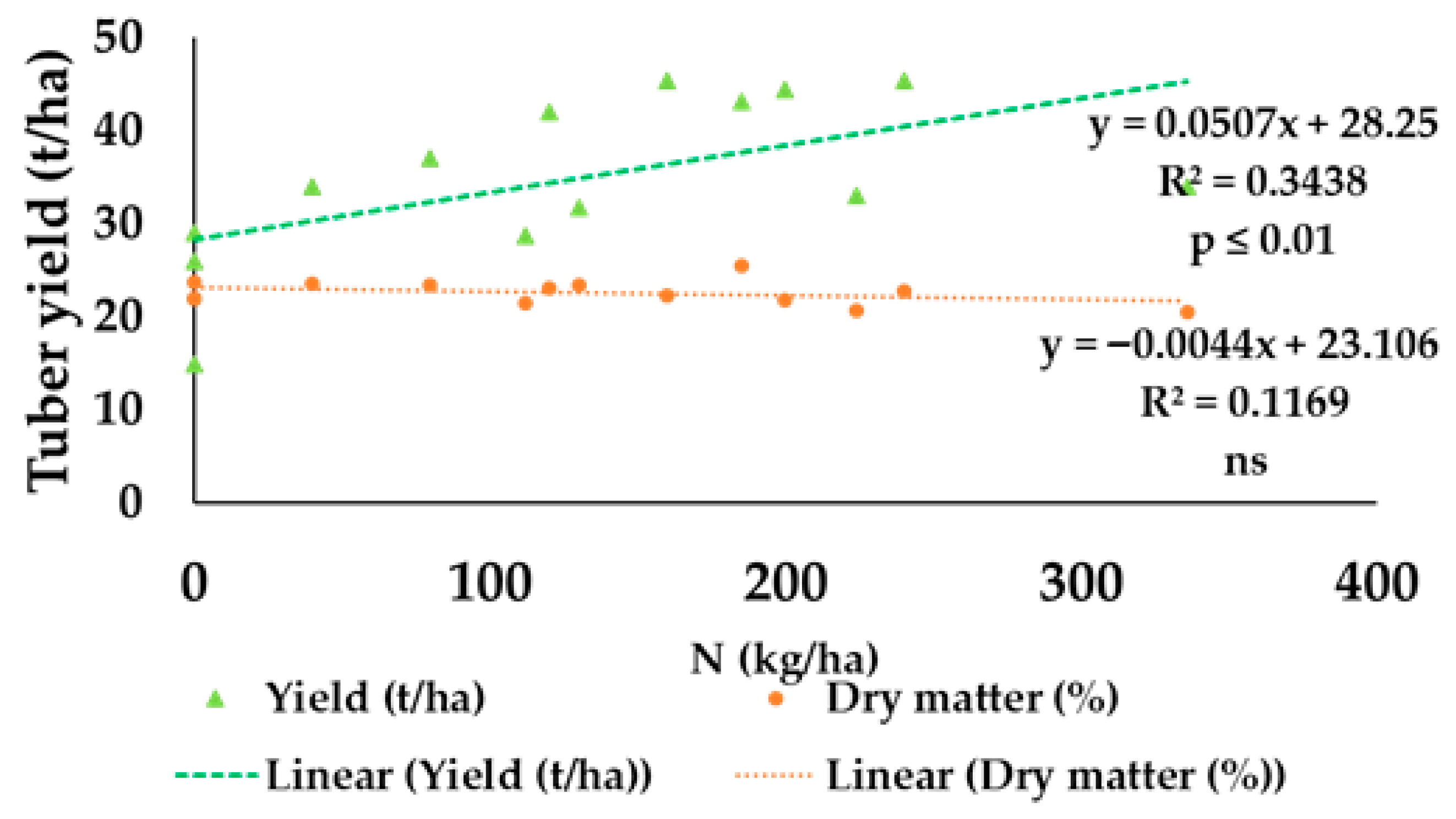
Based on several studies of N fertilization influence on the potato tuber yield and as well as dry matter content, a linear regression was performed (Figure 3). A significant positive linear relationship was observed between N application and tuber yield (y = 0.0507x + 28.25; R2 = 0.3438; p ≤ 0.01). This indicates that increasing N rates led to a gradual and consistent rise in yield, with an estimated increase of approximately 0.05 t/ha per kilogram of applied N.
In contrast, dry matter content showed a slight negative trend (Figure 3) with increasing N rates (y = −0.0044x + 23.106; R2 = 0.1169), but this relationship was not statistically significant (ns). This suggests that while N fertilization effectively enhanced yield, it did not have a significant impact on the dry matter content of the tubers.
Generally, in potato production, N fertilization has a significant effect on potato yield and tuber quality parameters, particularly dry matter and starch content. The yield increased with rising N rates up to an optimum level, after which further increases in N supply resulted in only minor yield gains accompanied by a decline in dry matter and starch concentration.

7. Beneficial Microorganisms

Improving soil productivity is a key objective of sustainable agriculture. While chemical fertilizers have traditionally been used to boost nutrient levels, their rising costs challenge farmers [122,123]. Lynch et al. [124] stated that losses caused by biotic factors (insects and pest damage) typically reduce organic potato yields to an average of 50–75% of conventional production.
The rhizosphere is rich with beneficial plant growth. Arbuscular mycorrhizal fungi (AMF) and Plant Growth-Promoting Rhizobacteria (PGPR) are often used as biofertilizers in organic potato production. By colonizing the root zone, they improve nutrient availability, stimulate root development, and increase crop yield, offering a sustainable alternative to high chemical fertilizer inputs. Harnessing rhizosphere bacteria is therefore a promising strategy for improving plant productivity and maintaining soil health [125,126,127,128].
Arbuscular mycorrhizas (AMs) represent a mutualistic interaction between soil fungi and the roots of woody and agricultural plant species. The majority of vascular plants (72–80%) have retained AM associations throughout their evolutionary history on land [124]. Many authors [129,130] documented that most crop plants establish symbiotic associations between their roots and arbuscular mycorrhizal fungi (AMF). The AMF hyphae explore the soil outside the rhizosphere, acting as a root system extension. In this symbiotic relationship, according to Bitterlich and Franken [131], host plants could gain improved access to soil water and slowly diffusing mineral compounds, particularly phosphorus and N ions, which results in better plant nutritional status and fitness. In return, the AMF receive free energy in the form of carbohydrates and lipids in order to complete their life cycle [132,133,134]. Moreover, it is stated that host plants often show higher tolerance to abiotic stress factors such as drought or salinity and increased resistance to both phytopathogen attack and related diseases [135,136], resulting in wider application of AMF-based natural biofertilizers to support the sustainable agriculture systems [137,138,139,140]. Potato production relies heavily on the consistent use of fertilizers to provide essential nutrients such as potassium (K), N (N), and phosphorus (P) [141]. P deficiency results in stunted growth, whilst a lack of N and K results in reduced tuber yield [142]. According to Jin et al. [143] and Shuab et al. [144] AMF can assist the potato in acquiring inorganic N present in the soil in the form of NO3 and NH4+ through the nitrate reductase pathway and glutamine synthetase pathways. Also, Jin et al. [143] reported that AMF can assimilate amino acids, such as arginine, via their extraradical mycelium and transport them intracellularly, where the amino acids are broken down to release available N. High N uptake ability by AM fungi was also confirmed using in vitro model systems [145]. Several authors [146,147,148,149,150] mentioned that AM can play an essential role in the plant’s acquisition of N from both organic and inorganic sources. Mycorrhization might also have an active influence on plant N transporters [147,151]. Consequently, the increase in plant N uptake due to AM symbiosis and the amount of N immobilized in fungal biomass can drastically reduce nutrient losses through different pathways in the agroecosystem [152,153,154]. However, AM fungi also demand a notable amount of N for their own metabolism [154], so the fungi can even compete with the host plant for soil N when the soil is deficient in [155]. Various AM fungal taxa have different functional responses to soil N availability and thus differentially affect plant and agroecosystem productivity [156]. Because of the small diameter of their extraradical mycelium, AMF can explore soil pores that are inaccessible to plant root hairs and absorb a portion of N retained by the exchange complex in the form of ammonium. This allows the two symbionts to acquire N from different N-pools in the soil, which can reduce competition between the plant and fungi [157,158,159,160,161].
Marjanović et al. [162] reported that alternative, beneficial soil microorganisms, such as Pseudomonas spp. and Rhizobium spp. enhance nutrient availability and root growth, offering a more sustainable and cost-effective solution. Rawaa et al. [163] stated that biofertilizers such as AMF and bacteria Bacillus halotolerans and Bacillus amyloliquefaciens (B1B2) improved potato growth, water status, photosynthesis, and yield under reduced irrigation (75% ETc) and lower fertilizer rates. Their effect, linked to enhanced antioxidant activity and osmotic adjustment, highlights their potential to alleviate water stress and decrease chemical fertilizer use. Tan et al. [164] found that replacing 70% of chemical fertilizer with bio-organic fertilizer increased potato yield by 10.4–155.4% without affecting quality. Moreover, the authors found that bio-organic fertilizer increased the abundance of Gemmatimonadota and Ascomycota, and decreased Acidobacteriota and Basidiomycota, and that microbes such as Arthrobacter, Parcubacteria, Lautropia, Luteimonas, and Brunneochlamydosporium were signatures of bio-organic fertilizer treatment and positively correlated with potato yield. Naqqash et al. [160] isolated five rhizosphere bacteria genera from potato (Azospirillum sp., Agrobacterium sp., Pseudomonas sp., Enterobacter sp., and Rhizobium sp.), which was shown to promote growth, fix N, and produce indole-3-acetic acid (IAA). The authors stated that Azospirillum sp. showed the highest increase in potato fresh and dry weight, N uptake, and rhizosphere colonization, making it a strong candidate for potato biofertilizer development.
While microbial and enzymatic processes—such as nitrification, denitrification, and root-associated enzyme activity—play central roles in N dynamics and N2O emissions, their impact is modulated by significant genotypic and physiological variability among potato cultivars. These molecular and physiological differences likely influence how each cultivar interacts with soil microbial communities (e.g., nitrifiers, denitrifiers) and how effectively they mitigate N losses via leaching or N2O emissions. Therefore, future research and management strategies should consider both microbial processes and cultivar-specific traits to optimize N efficiency and minimize environmental impacts.
For Sideritis syriaca subsp. syriaca, Paschalidis et al. [165] found DNA barcoding using seven cpDNA markers. In parallel, five fertilization schemes, including conventional, integrated nutrient management, and biostimulants, were tested, showing that foliar integrated nutrient management and soil conventional inorganic fertilizers applications enhanced yield, while foliar conventional inorganic fertilization maximized antioxidant content.
Beyond agronomic benefits, successful commercialization of AMF- and PGPR-based biofertilizers requires evaluating their scalability, regulatory status, and performance consistency across environments. Many of the microbial strains that are effective in potato also show strong potential for transferability to other Solanaceae crops such as tomato, pepper, and eggplant, where similar root–microbe interactions govern nutrient acquisition. However, large-scale application demands standardized production, quality control, and compliance with biofertilizer regulations, which vary across regions. Advancing these technologies toward market readiness will require coordinated efforts in strain stabilization, formulation development, field validation, and integration with existing fertilization guidelines.

8. Sustainable N Frameworks

Within the European Union, the Farm to Fork Strategy [166], which is a part of the European Green Deal [167], aims to halve nutrient losses by 2030 and achieve a 20% reduction in synthetic fertilizers in the EU, which would lower N surplus by only 10–16%; this is insufficient according to Batool et al. [168]. The authors also stated that a more ambitious approach is needed, and region-specific strategies—such as a 43% reduction in the use of synthetic fertilizers combined with improved management—are required to achieve meaningful N surplus reductions while maintaining productivity. Pugelnik et al. [169] stated that in the EU strategic documents, the approach to valuing organic production today differs significantly from the early 20th-century holistic perspective, emphasizing the protection of soil, water, air, biodiversity, and genetic resources while ensuring technical, economic, and social sustainability. The European Commission’s Organic Action Plan, together with the Green Deal and Farm to Fork Strategy, aims to boost consumer trust, promote the transition to organic farming, strengthen the value chain, and ensure that at least 25% of agricultural land is under organic management. Meng et al. [170] suggested that because N is highly mobile in soil, a systematic approach to reducing N losses is essential; the use of N stabilizers—such as urease and nitrification inhibitors—helps slow urea hydrolysis and nitrate formation, thereby lowering greenhouse gas emissions and minimizing leaching and volatilization. A recent overview by Vasile Scăețeanu and Madjar [171] highlights the behavior of different N forms in soil, the advantages and limitations of monitoring techniques, and the need for agronomic expertise to interpret results and guide precision fertilizer application. Moreover, the authors emphasize that sustainable strategies such as precision agriculture, optimized fertilization, and N inhibitors are key to reducing N losses and supporting regulatory objectives like the Nitrates Directive [172]. According to FAO [173], another important document is the United Nations’ Sustainable Development Goals (SDGs), which acknowledges the need for a comprehensive, full-chain approach to improving N use efficiency, encompassing technological innovations, policy measures, and behavioral interventions across N production, consumption, and recycling. In Sri Lanka, as in other parts of the world, increasing reactive N levels are contributing to environmental issues such as ozone depletion and climate change. Notably, nitrous oxide accounts for approximately 8% of global greenhouse gas emissions, with agriculture responsible for 90% of these emissions, while N oxide has been identified as a major air pollutant in Sri Lankan cities, with the agricultural sector contributing around 82% of total N emissions [174]

9. Conclusions and Recommendations

Potato, as a dicot C3 species, exhibits a relatively stable photosynthetic capacity under varying N supply but responds strongly through morphological adjustments, particularly in leaf expansion, specific leaf area, and canopy development. Numerous studies demonstrate that N availability affects leaf size, LAI dynamics, and overall canopy architecture, which in turn influence carbon assimilation and yield formation. Beyond physiological responses, substantial genotypic variation exists in NUE, N uptake, and N assimilation efficiency, driven by differences in maturity type, root architecture, metabolic regulation, and expression of key N-metabolism genes. Recent molecular and transcriptomic studies identify nitrate and ammonium transporters, regulatory transcription factors, and enzymes in the GS/GOGAT and related pathways as central components underlying NUE differences among cultivars. High-NUE genotypes maintain more efficient N assimilation, chlorophyll retention, and yield under low N, emphasizing their importance for sustainable, low-input production systems. Together, the accumulated evidence highlights that optimizing N management in potato requires an integrated approach that considers canopy development, cultivar-specific traits, and the genetic and molecular basis of NUE, providing a foundation for future breeding of varieties adapted to reduced nitrogen inputs.
Optimal N application for potatoes depends on the cultivar and initial soil N availability. Economically reducing fertilizer usage by 50%, combined with selecting cultivars with high agronomic N efficiency and conducting a pre-planting soil nitrate test, enables more sustainable and cost-effective N management with minimal yield loss.
The optimal N rate for achieving a high total yield while maintaining desirable tuber quality was determined to be approximately 100–120 kg N/ha. At this fertilization level, the marketable tuber yield was near its maximum, while dry matter and starch contents remained within ranges suitable for processing and storage. Higher N rates (>150 kg N/ha) led to excessive vegetative growth, delayed tuber maturation, and reduced accumulation of dry matter and starch in the tubers. Although there are cultivar-specific differences, the presented ranges and recommendations reflect standard practice and are widely used as a baseline in fertilization planning. Therefore, for balanced potato production aiming at both yield and quality, a N application rate of 100–120 kg N/ha is recommended, with possible adjustments depending on soil fertility, climatic conditions, and cultivar characteristics.
Future research should prioritize defining cultivar-specific N requirements and identifying physiological and microbial traits that enable maintaining high yield under reduced N inputs, supporting both productivity and environmental protection. There is a clear need for long-term field studies evaluating combined strategies—moderate N fertilization, biofertilizers, and precision management—to minimize N losses, nitrate leaching, and N2O emissions. Further development of scalable, standardized biofertilizer products and their integration with reduced-N regimes represents a key direction for sustainable potato production.

Author Contributions

Conceptualization, I.V., M.B. and A.M.K.; formal analysis, M.A. and A.M.K.; investigation, I.V., J.J. and M.B.; resources, M.A.; data curation, I.V. and A.M.K.; writing—original draft preparation, I.V.; writing—review and editing, M.A.; supervision, M.A.; project administration, M.A.; funding acquisition, M.A. All authors have read and agreed to the published version of the manuscript.

Funding

Josip Juraj Strossmayer University of Osijek, Internal project of Faculty of Agrobiotechnical Sciences Osijek: Growth and development of field crops under stress conditions (BiljkaStres).

Data Availability Statement

Data are contained within the article.

Conflicts of Interest

The authors declare no conflicts of interest.

References

  1. Haile, B. Biochar and Inorganic Fertilizers for Acidic Soil Management: Improving Soil Properties and Potato Productivity in Ethiopia. Curr. Trends Agron. Agric. Res. 2025, 1, 1–5. [Google Scholar] [CrossRef]
  2. Sharma, R.; Pande, K.R.; Upadhyay, K.; Gaihre, Y.K. Improving Nitrogen Use Efficiency and Yields of Potato through Integrated Use of nitrogen Fertilizer and Organic Manures under Irrigated Condition in Nepal. SAARC J. Agric. 2025, 23, 237–253. [Google Scholar] [CrossRef]
  3. Rapčan, I.; Radočaj, D.M.; Jurišić, M. Analiza duljine vegetativnoga perioda za uzgoj kukuruza iz fenoloških metrika određenih korištenjem satelitskih snimaka sa sentinela-2. Poljoprivreda 2025, 31, 92–98. [Google Scholar] [CrossRef]
  4. Ali, A.; Jabeen, N.; Farruhbek, R.; Chachar, Z.; Laghari, A.A.; Chachar, S.; Ahmed, N.; Ahmed, S.; Yang, Z. Enhancing nitrogen use efficiency in agriculture by integrating agronomic practices and genetic advances. Front. Plant Sci. 2025, 16, 1543714. [Google Scholar] [CrossRef]
  5. Benković, R.; Mirosavljević, K.; Brmež, M.; Etongo, D.; Zimmer, D.; Jug, D.; Benković-Lačić, T. Different Tillage Systems and Their Influence on Crops Yield Formation and Post-Harvest Residues. Poljoprivreda 2025, 31, 13–24. [Google Scholar] [CrossRef]
  6. Varga, I.; Markulj Kulundžić, A.; Tkalec Kojić, M.; Antunović, M. Does the Amount of Pre-Sowing Nitrogen Fertilization Affect Sugar Beet Root Yield and Quality of Different Genotypes? Nitrogen 2024, 5, 386–408. [Google Scholar] [CrossRef]
  7. Wang, D.; Xu, Z.; Zhao, J.; Wang, Y.; Yu, Z. Excessive nitrogen application decreases grain yield and increases nitrogen loss in a wheat–soil system. Acta Agric. Scand. Sect. B Soil Plant Sci. 2011, 61, 681–692. [Google Scholar] [CrossRef]
  8. Awadelkareem, W.; Haroun, M.; Wang, J.; Qian, X. Nitrogen Interactions Cause Soil Degradation in Greenhouses: Their Relationship to Soil Preservation in China. Horticulturae 2023, 9, 340. [Google Scholar] [CrossRef]
  9. Getahun, B.B.; Kassie, M.M.; Visser, R.G.F.; van der Linden, C.G. Genetic Diversity of Potato Cultivars for Nitrogen Use Efficiency Under Contrasting N Regimes. Potato Res. 2020, 63, 267–290. [Google Scholar] [CrossRef]
  10. Jozefowicz, A.M.; Hartmann, A.; Matros, A.; Schum, A.; Mock, H.-P. Nitrogen Deficiency Induced Alterations in the Root Proteome of a Pair of Potato (Solanum tuberosum L.) Varieties Contrasting for Their Response to Low N. Proteomics 2017, 17, 1700231. [Google Scholar] [CrossRef] [PubMed]
  11. Yamaya, T. Genetic manipulation and quantitative-trait loci mapping for nitrogen recycling in rice. J. Exp. Bot. 2002, 53, 917–925. [Google Scholar] [CrossRef] [PubMed]
  12. Kollaricsné Horváth, M.; Hoffmann, B.; Cernák, I.; Baráth, S.; Polgár, Z.; Taller, J. Nitrogen utilization of potato genotypes and expression analysis of genes controlling nitrogen assimilation. Biol. Futur. 2019, 70, 25–37. [Google Scholar] [CrossRef]
  13. Barandalla, L.; Alvarez-Morezuelas, A.; Iribar, C.; Ritter, E.; Riga, P.; Lacuesta, M.; de Galarreta, J.I.R. Physiological Response to nitrogen Deficit in Potato Under Greenhouse Conditions. Plants 2025, 14, 3237. [Google Scholar] [CrossRef]
  14. Varga, I.; Cerovečki, M.; Žulj, I.; Gantner, R.; Tadić, V.; Stošić, M. Redoslijed agrotehničkih mjera u proizvodnji krumpira za preradu u čips. Glas. Zaštite Bilja 2022, 45, 117–126. [Google Scholar] [CrossRef]
  15. Pospišil, A.; Vugrinec, J.; Pospišil, M. Gospodarska svojstva tradicijskih sorata krumpira Poli i Brinjak. Poljoprivreda 2023, 29, 9–15. [Google Scholar] [CrossRef]
  16. Sarajlić, A.; Štreitenberger, L.; Kajan, L.; Mak, M.K.; Martić, B.; Šmituc, I.; Majić, I. Perillus bioculatus (Pentatomidae) kao potencijalni biološki agens u suzbijanju krumpirove zlatice (Leptinotarsa decemlineata). Poljoprivreda 2025, 31, 51–59. [Google Scholar] [CrossRef]
  17. Flint, E.A.; Yost, M.A.; Hopkins, B.G. On-Farm Variable Rate Nitrogen Management in Irrigated Potato. Precis. Agric. 2025, 26, 62. [Google Scholar] [CrossRef]
  18. Trenkel, M.E. Slow- and Controlled-Release and Stabilized Fertilizers: An Option for Enhancing Nutrient Use Efficiency in Agriculture; International Fertilizer Industry Association (IFA): Paris, France, 2010. [Google Scholar]
  19. Shoji, S.; Delgado, J.; Mosier, A.; Miura, Y. Use of Controlled Release Fertilizers and Nitrification Inhibitors to Increase Nitrogen Use Efficiency and to Conserve Air and Water Quality. Commun. Soil Sci. Plant Anal. 2001, 32, 1051–1070. [Google Scholar] [CrossRef]
  20. Zareabyaneh, H.; Bayatvarkeshi, M. Effects of Slow-Release Fertilizers on Nitrate Leaching, Its Distribution in Soil Profile, N-Use Efficiency, and Yield in Potato Crop. Environ. Earth Sci. 2015, 74, 3385–3393. [Google Scholar] [CrossRef]
  21. Duan, Y.; Jiang, Y.; Ling, Y.; Chang, W.; Yin, M.; Kang, Y.; Ma, Y.; Wang, Y.; Qi, G.; Liu, B. Exploring the Potential of N Fertilizer Mixed Application to Improve Crop Yield and Nitrogen Partial Productivity: A Meta-Analysis. Plants 2025, 14, 2417. [Google Scholar] [CrossRef] [PubMed]
  22. Xu, G.; Fan, X.; Miller, A.J. Plant Nitrogen Assimilation and Use Efficiency. Annu. Rev. Plant Biol. 2012, 63, 153–182. [Google Scholar] [CrossRef] [PubMed]
  23. Kumar, A.; Sangwan, P.; Kumar, V.; Pandey, A.K.; Pooja; Kumar, A.; Chauhan, P.; Koubouris, G.; Fanourakis, D.; Parmar, K. Physio-Biochemical Insights of Endophytic Microbial Community for Crop Stress Resilience: An Updated Overview. J. Plant Growth Regul. 2025, 44, 2641–2664. [Google Scholar] [CrossRef]
  24. Kumar, V.; Rithesh, L.; Raghuvanshi, N.; Kumar, A.; Parmar, K. Advancing N use efficiency in cereal crops: A comprehensive exploration of genetic manipulation, N dynamics, and plant Nitrogen assimilation. S. Afr. J. Bot. 2024, 169, 486–498. [Google Scholar] [CrossRef]
  25. López Sámano, M.; Nanjareddy, K.; Arthikala, M.-K. NIN-like proteins (NLPs) as crucial nitrate sensors: An overview of their roles in N signaling, symbiosis, abiotic stress, and beyond. Physiol. Mol. Biol. Plants 2024, 30, 1209–1223. [Google Scholar] [CrossRef]
  26. Gu, W.; Feng, Y.; Liu, C.; Shi, X.; Han, L.; Liu, C.; Zhou, Y. Transcriptomic and Metabolomic Unraveling of Nitrogen Use Efficiency in Sorghum: The Quest for Molecular Adaptations to Low-N Stress. Plant Growth Regul. 2025, 105, 687–706. [Google Scholar] [CrossRef]
  27. Wang, H.; Ma, Q.; Shan, F.; Tian, L.; Gong, J.; Quan, W.; Yang, W.; Hou, Q.; Zhang, F.; Zhang, S. Transcriptional Regulation Mechanism of Wheat Varieties with Different Nitrogen Use Efficiencies in Response to N Deficiency Stress. BMC Genom. 2022, 23, 727. [Google Scholar] [CrossRef]
  28. Wang, Q.; Li, S.; Li, J.; Huang, D. The Utilization and Roles of Nitrogen in Plants. Forests 2024, 15, 1191. [Google Scholar] [CrossRef]
  29. The, S.V.; Snyder, R.; Tegeder, M. Targeting Nitrogen Metabolism and Transport Processes to Improve Plant Nitrogen Use Efficiency. Front. Plant Sci. 2021, 11, 628366. [Google Scholar] [CrossRef]
  30. Zebarth, B.J.; Rosen, C.J. Research perspective on nitrogen BMP development for potato. Am. J. Potato Res. 2007, 84, 3–18. [Google Scholar] [CrossRef]
  31. Yan, W.; Qin, J.; Jian, Y.; Liu, J.; Bian, C.; Jin, L.; Li, G. Analysis of Potato Physiological and Molecular Adaptation in Response to Different Water and Nitrogen Combined Regimes. Plants 2023, 12, 1671. [Google Scholar] [CrossRef]
  32. Sutula, M.; Tussipkan, D.; Kali, B.; Manabayeva, S. Molecular Mechanisms Underlying Defense Responses of Potato (Solanum tuberosum L.) to Environmental Stress and CRISPR/Cas-Mediated Engineering of Stress Tolerance. Plants 2025, 14, 1983. [Google Scholar] [CrossRef] [PubMed]
  33. Hawkes, J.G. History of the Potato. In The Potato Crop; Harris, P.M., Ed.; Springer: Boston, MA, USA, 1978. [Google Scholar] [CrossRef]
  34. Swamy, K.R.M. Origin, domestication, taxonomy, botanical description, genetics and cytogenetics, genetic diversity and breeding of potato (Solanum tuberosum L.). Int. J. Curr. Res. 2023, 15, 24352–24372. Available online: https://journalcra.com/article/origin-domestication-taxonomy-botanical-description-genetics-and-cytogenetics-genetc (accessed on 10 October 2025).
  35. FAOStat. Food and Agriculture Organization of the United Nations. Available online: https://www.fao.org/faostat/en/#home (accessed on 10 October 2025).
  36. Mickiewicz, B.; Volkova, E.; Jurczak, R. The Global Market for Potato and Potato Products in the Current and Forecast Period. Eur. Res. Stud. J. 2022, 25, 740–751. [Google Scholar] [CrossRef]
  37. Caldiz, D.O. Potato Production in South America. In Potato Production Worldwide; Elsevier: Amsterdam, The Netherlands, 2023; pp. 409–433. [Google Scholar] [CrossRef]
  38. Loayza Aguilar, J.; Villca Goméz, Z.; Canqui Villarroel, J.C. Producción de Papa (Solanum tuberosum) y Tizón Tardío en Bolivia. Rev. Cambios Permanencias 2024, 8, 12171–12181. [Google Scholar] [CrossRef]
  39. Devaux, A.; Ordinola, M.; Suarez, V.; Hareau, G. Current Status and Prospects of Potato Processing in the Andean Zone, Implications for Breeding and Variety Selection; International Potato Center (CIP); CGIAR: Lima, Peru; Available online: https://cgspace.cgiar.org (accessed on 16 October 2025).
  40. Muthoni, J.; Shimelis, H. An Overview of Potato Production in Africa. In Potato Production Worldwide; Elsevier: Amsterdam, The Netherlands, 2023; pp. 435–456. [Google Scholar] [CrossRef]
  41. Muthoni, J.; Shimelis, H.; Mashilo, J. Production and Availability of Good Quality Seed Potatoes in the East African Region: A Review. Aust. J. Crop Sci. 2022, 16, 907–915. [Google Scholar] [CrossRef]
  42. Barrett, R.; Robinson, A.; Thornton, M.; Vander Zaag, P. Potato Production in the United States and Canada. In Potato Production Worldwide; Elsevier: Amsterdam, The Netherlands, 2023; pp. 365–379. [Google Scholar] [CrossRef]
  43. Han, E.; Ines, A.V.M.; Fleisher, D.H. Past and Future Changes in Potato Production Vulnerabilities in Maine, U.S. Clim. Change 2025, 178, 140. Available online: https://link.springer.com/article/10.1007/s10584-025-03977-6 (accessed on 10 October 2025).
  44. Scott, G.J.; Suarez, V. The Rise of Asia as the Centre of Global Potato Production and Some Implications for Industry. Potato J. 2012, 39, 1–22. [Google Scholar]
  45. Levy, D.; Veilleux, R.E. Adaptation of Potato to High Temperatures and Salinity: A Review. Am. J. Potato Res. 2007, 84, 487–506. [Google Scholar] [CrossRef]
  46. Handayani, T.; Gilani, S.A.; Watanabe, K.N. Climatic Changes and Potatoes: How Can We Cope with the Abiotic Stresses? Breed. Sci. 2019, 69, 545–563. [Google Scholar] [CrossRef]
  47. CGIAR. Available online: https://www.cgiar.org/research/center/cip/ (accessed on 24 October 2025).
  48. Varga, I.; Đurović, V. Trendovi proizvodnje i konzumacije krumpira u svijetu. Glas. Zaštite Bilja 2023, 46, 62–70. [Google Scholar] [CrossRef]
  49. Rodríguez-Martínez, B.; Coelho, E.; Gullón, B.; Yáñez, R.; Domingues, L. Potato Peels Waste as a Sustainable Source for Biotechnological Production of Biofuels: Process Optimization. Waste Manag. 2023, 155, 320–328. [Google Scholar] [CrossRef]
  50. Khanal, S.; Karimi, K.; Majumdar, S.; Rodríguez-Martínez, B.; Coelho, E.; Gullón, B.; Yáñez, R.; Domingues, L. Sustainable Utilization and Valorization of Potato Waste: State of the Art, Challenges, and Perspectives. Biomass Convers. Biorefin. 2024, 14, 23335–23360. [Google Scholar] [CrossRef]
  51. Amicarelli, V.; Roe, B.E.; Bux, C. Measuring Food Loss and Waste Costs in the Italian Potato Chip Industry Using Material Flow Cost Accounting. Agriculture 2022, 12, 523. [Google Scholar] [CrossRef]
  52. Zhivkova, V. Potato Waste and Sweet Potato Waste Utilization—Some Research Trends. E3S Web Conf. 2024, 563, 03080. [Google Scholar] [CrossRef]
  53. Kowalczyk, T.; Muskała, M.; Merecz-Sadowska, A.; Sikora, J.; Picot, L.; Sitarek, P. Anti-Inflammatory and Anticancer Effects of Anthocyanins in In Vitro and In Vivo Studies. Antioxidants 2024, 13, 1143. [Google Scholar] [CrossRef] [PubMed]
  54. Andre, C.M.; Schafleitner, R.; Guignard, C.; Oufir, M.; Aliaga, C.A.; Nomberto, G.; Hoffmann, L.; Hausman, J.F.; Evers, D.; Larondelle, Y. Modification of the health-promoting value of potato tubers field grown under drought stress: Emphasis on dietary antioxidant and glycoalkaloid contents in five native Andean cultivars (Solanum tuberosum L.). J. Agric. Food Chem. 2009, 57, 599–609. [Google Scholar] [CrossRef] [PubMed]
  55. Arnesen, E.K.; Laake, I.; Carlsen, M.H.; Veierød, M.B.; Retterstøl, K. Potato Consumption and All-Cause and Cardiovascular Disease Mortality: A Long-Term Follow-Up of a Norwegian Cohort. J. Nutr. 2024, 154, 2226–2235. [Google Scholar] [CrossRef]
  56. Visvanathan, R.; Jayathilake, C.; Jayawardana, B.C.; Liyanage, R. Health-beneficial properties of potato and compounds of interest. J. Sci. Food Agric. 2016, 96, 4850–4860. [Google Scholar] [CrossRef]
  57. Muttucumaru, N.; Powers, S.J.; Elmore, J.S.; Mottram, D.S.; Halford, N.G. Effects of Nitrogen and Sulfur Fertilization on Free Amino Acids, Sugars, and Acrylamide-Forming Potential in Potato. J. Agric. Food Chem. 2013, 61, 6511–6520. [Google Scholar] [CrossRef] [PubMed]
  58. Sun, N.; Rosen, C.J.; Thompson, A.L. Acrylamide Formation in Processed Potatoes as Affected by Cultivar, Nitrogen Fertilization and Storage Time. Am. J. Potato Res. 2018, 95, 473–486. [Google Scholar] [CrossRef]
  59. De Wilde, T.; De Meulenaer, B.; Mestdagh, F.; Govaert, Y.; Vandeburie, S.; Ooghe, W.; Fraselle, S.; Demeulemeester, K.; Van Peteghem, C.; Calus, A.; et al. Influence of Fertilization on Acrylamide Formation during Frying of Potatoes Harvested in 2003. J. Agric. Food Chem. 2005, 54, 7010–7016. [Google Scholar] [CrossRef]
  60. Hina, N.S. Global Meta-Analysis of Nitrate Leaching Vulnerability in Synthetic and Organic Fertilizers over the Past Four Decades. Water 2024, 16, 457. [Google Scholar] [CrossRef]
  61. Kagan, K.; Jonak, K.; Wolińska, A. The Impact of Reduced N Fertilization Rates According to the “Farm to Fork” Strategy on the Environment and Human Health. Appl. Sci. 2024, 14, 10726. [Google Scholar] [CrossRef]
  62. Song, Q.; Zhang, J.; Zhang, F.; Shen, Y.; Yue, S.; Li, S. Optimized N Application for Maximizing Yield and Minimizing N Loss in Film Mulching Spring Maize Production on the Loess Plateau, China. J. Integr. Agric. 2024, 23, 1671–1684. [Google Scholar] [CrossRef]
  63. Wen, S.; Cui, N.; Wang, Y.; Gong, D.; Xing, L.; Wu, Z.; Zhang, Y.; Wang, Z. Determining Effect of Fertilization on Reactive Nitrogen Losses through Nitrate Leaching and Key Influencing Factors in Chinese Agricultural Systems. Agric. Water Manag. 2024, 303, 109055. [Google Scholar] [CrossRef]
  64. Muhammad, I.; Lv, J.; Yang, L.; Zhang, X.; Wang, Y.; Zhao, J.; Liu, H. Low Irrigation Water Minimizes the Nitrate Nitrogen Losses without Compromising the Soil Fertility, Enzymatic Activities and Maize Growth. BMC Plant Biol. 2022, 22, 159. [Google Scholar] [CrossRef] [PubMed]
  65. Zhou, W.; Wang, Q.; Chen, S.; Chen, F.; Lv, H.; Li, J.; Chen, Q.; Zhou, J.; Liang, B. Nitrate Leaching Is the Main Driving Factor of Soil Calcium and Magnesium Leaching Loss in Intensive Plastic-Shed Vegetable Production Systems. Agric. Water Manag. 2024, 293, 108708. [Google Scholar] [CrossRef]
  66. Peralta, J.M.; Stockle, C.O. Dynamics of Nitrate Leaching under Irrigated Potato Rotation in Washington State: A Long-Term Simulation Study. Agric. Ecosyst. Environ. 2002, 88, 23–34. [Google Scholar] [CrossRef]
  67. Martínez-Dalmau, J.; Berbel, J.; Ordóñez-Fernández, R. Nitrogen Fertilization. A Review of the Risks Associated with the Inefficiency of Its Use and Policy Responses. Sustainability 2021, 13, 5625. [Google Scholar] [CrossRef]
  68. Sainju, U.M.; Ghimire, R.; Pradhan, G.P. N Fertilization I: Impact on Crop, Soil, and Environment; IntechOpen: London, UK, 2020. [Google Scholar] [CrossRef]
  69. Kemmou, L.; Amanatidou, E. Factors Affecting Nitrous Oxide Emissions from Activated Sludge Wastewater Treatment Plants—A Review. Resources 2023, 12, 114. [Google Scholar] [CrossRef]
  70. Peng, L.; Ni, B.J.; Erler, D.; Ye, L.; Yuan, Z. The effect of dissolved oxygen on N2O production by ammonia-oxidizing bacteria in an enriched nitrifying sludge. Water Res. 2014, 66, 12–21. [Google Scholar] [CrossRef]
  71. IPCC. Climate Change 2021: The Physical Science Basis; Contribution of Working Group I to the Sixth Assessment Report of the Intergovernmental Panel on Climate Change; Masson-Delmotte, V., Zhai, P., Pirani, A., Connors, S.L., Péan, C., Berger, S., Caud, N., Chen, Y., Goldfarb, L., Gomis, M.I., et al., Eds.; Cambridge University Press: Cambridge, UK; New York, NY, USA, 2021; p. 2391. [Google Scholar]
  72. WMO. Greenhouse Gas Bulletin No. 20: The State of Greenhouse Gases in the Atmosphere Based on Global Observations Through 2023; World Meteorological Organization: Geneva, Switzerland, 2024; Available online: https://public.wmo.int/ (accessed on 10 October 2025).
  73. NOAA. Trends in Atmospheric Nitrous Oxide (N2O); Global Monitoring Laboratory, National Oceanic and Atmospheric Administration: Washington, DC, USA, 2024. Available online: https://gml.noaa.gov/ccgg/trends_n2o/ (accessed on 10 October 2025).
  74. Butterbach-Bahl, K.; Baggs, E.M.; Dannenmann, M.; Kiese, R.; Zechmeister-Boltenstern, S. Nitrous Oxide Emissions from Soils: How Well Do We Understand the Processes and Their Controls? Philos. Trans. R. Soc. B Biol. Sci. 2013, 368, 20130122. [Google Scholar] [CrossRef]
  75. Wang, L.; Lu, P.; Feng, S.; Hamel, C.; Sun, D.; Siddique, K.H.M.; Gan, G.Y. Strategies to Improve Soil Health by Optimizing the Plant–Soil–Microbe–Anthropogenic Activity Nexus. Agric. Ecosyst. Environ. 2024, 359, 108750. [Google Scholar] [CrossRef]
  76. Dai, Z.; Zhang, Y.; Li, Y.; Xiang, T.; Wang, F.; Peng, J.; Yang, S.; Cao, W. Nitrification regulates the responses of soil nitrous oxide emissions to N addition in China: A meta-analysis from a gene perspective. Environ. Sci. Process. Impacts 2025, 27, 2367–2378. [Google Scholar] [CrossRef] [PubMed]
  77. Signor, D.; Cerri, C.E.P. Nitrous oxide emissions in agricultural soils: A review. Pesqui. Agropecuária Trop. 2013, 43, 322–338. [Google Scholar] [CrossRef]
  78. Shcherbak, I.; Millar, N.; Robertson, G.P. Global metanalysis of the nonlinear response of soil nitrous oxide (N2O) emissions to fertilizer nitrogen. Proc. Natl. Acad. Sci. USA 2014, 111, 9199–9204. [Google Scholar] [CrossRef]
  79. Lam, S.K.; Suter, H.; Mosier, A.R.; Chen, D. Using nitrification inhibitors to mitigate agricultural N2O emission: A double-edged sword? Glob. Change Biol. 2017, 23, 485–489. [Google Scholar] [CrossRef]
  80. Akiyama, H.; Yan, X.; Yagi, K. Evaluation of effectiveness of enhanced-efficiency fertilizers as mitigation options for N2O and NO emissions from agricultural soils: Meta-analysis. Glob. Change Biol. 2010, 16, 1837–1846. [Google Scholar] [CrossRef]
  81. Cayuela, M.L.; van Zwieten, L.; Singh, B.P.; Jeffery, S.; Roig, A.; Sánchez-Monedero, M.A. Biochar’s role in mitigating soil nitrous oxide emissions: A review and meta-analysis. Agric. Ecosyst. Environ. 2014, 191, 5–16. [Google Scholar] [CrossRef]
  82. Reay, D.S.; Davidson, E.A.; Smith, K.A.; Smith, P.; Melillo, J.M.; Dentener, F.; Crutzen, P.J. Global agriculture and nitrous oxide emissions. Nat. Clim. Change 2012, 2, 410–416. [Google Scholar] [CrossRef]
  83. Tian, H.; Xu, R.; Canadell, J.G.; Thompson, R.L.; Winiwarter, W.; Suntharalingam, P.; Davidson, E.A.; Ciais, P.; Jackson, R.B.; Janssens-Maenhout, G.; et al. A comprehensive quantification of global nitrous oxide sources and sinks. Nature 2020, 586, 248–256. [Google Scholar] [CrossRef]
  84. Braakhekke, M.C.; Rebel, K.T.; Dekker, S.C.; Smith, B.; Beusen, A.H.W.; Wassen, M.J. Nitrogen Leaching from Natural Ecosystems under Global Change: A Modelling Study. Earth Syst. Dynam 2017, 8, 1121–1139. [Google Scholar] [CrossRef]
  85. Garthen, A.; Berg, J.P.; Ehrnsten, E.; Klisz, M.; Weigel, R.; Wilke, L.; Kreyling, J. High Nitrate and Sulfate Leaching in Response to Wetter Winters in Temperate Beech Forests. Basic. Appl. Ecol. 2024, 80, 120–127. [Google Scholar] [CrossRef]
  86. FAO. FAOSTAT: Crops; FAO: Rome, Italy, 2022; Available online: https://www.fao.org/faostat/en/#data/FBS (accessed on 21 October 2025).
  87. Doran, J.W.; Parkin, T.B. Defining and assessing soil quality. In Defining Soil Quality for a Sustainable Environment; SSSA Special Publication 35; Doran, J.W., Coleman, D.C., Bezdicek, D.F., Stewart, B.A., Eds.; Soil Science Society of America: Madison, WI, USA, 1994; pp. 1–21. [Google Scholar]
  88. FAO; ITPS; GSBI; SCBD; EC. State of Knowledge of Soil Biodiversity—Status, Challenges and Potentialities, Report 2020; FAO: Rome, Italy, 2020; Available online: https://openknowledge.fao.org/items/24035f6b-eed4-40a8-a838-b45b866c35c2 (accessed on 21 October 2025).
  89. Lal, R. Soil carbon sequestration impacts on global climate change and food security. Science 2004, 304, 1623–1627. [Google Scholar] [CrossRef]
  90. Guo, J.H.; Liu, X.J.; Zhang, Y.; Shen, J.L.; Han, W.X.; Zhang, W.F.; Christie, P.; Goulding, K.W.T.; Vitousek, P.M.; Zhang, F.S. Significant acidification in major Chinese croplands. Science 2010, 327, 1008–1010. [Google Scholar] [CrossRef] [PubMed]
  91. Geisseler, D.; Scow, K.M. Long-term effects of mineral fertilizers on soil microorganisms—A review. Soil Biol. Biochem. 2014, 75, 54–63. [Google Scholar] [CrossRef]
  92. Zhang, L.; Zhao, Z.; Jiang, B.; Baoyin, B.; Cui, Z.; Wang, H.; Li, Q.; Cui, J. Effects of Long-Term Application of N Fertilizer on Soil Acidification and Biological Properties in China: A Meta-Analysis. Microorganisms 2024, 12, 1683. [Google Scholar] [CrossRef]
  93. Singh, B. Are N Fertilizers Deleterious to Soil Health? Agronomy 2018, 8, 48. [Google Scholar] [CrossRef]
  94. Ling, J.; Dungait, J.A.J.; Delgado-Baquerizo, M.; Cui, Z.; Zhou, R.; Zhang, W.; Gao, Q.; Chen, Y.; Yue, S.; Kuzyakov, Y.; et al. Soil organic carbon thresholds control fertilizer effects on carbon accrual in croplands worldwide. Nat. Commun. 2025, 16, 3009. [Google Scholar] [CrossRef] [PubMed]
  95. Ierna, A.; Mauromicale, G. Sustainable and Profitable N Fertilization Management of Potato. Agronomy 2019, 9, 582. [Google Scholar] [CrossRef]
  96. Matsuoka, M.; Furbank, R.T.; Fukayama, H.; Miyao, M. Molecular engineering of C4 photosynthesis. Annu. Rev. Plant Physiol. Plant Mol. Biol. 2001, 52, 297–314. [Google Scholar] [CrossRef]
  97. Dahal, K.; Li, X.-Q.; Tai, H.; Creelman, A.; Bizimungu, B. Improving potato stress tolerance and tuber yield under a climate change scenario—A current overview. Front. Plant Sci. 2019, 10, 563. [Google Scholar] [CrossRef] [PubMed]
  98. Vos, J.; van der Putten, P.E.L. Effect of nitrogen supply on leaf growth, leaf nitrogen economy and photosynthetic capacity in potato. Field Crops Res. 1998, 59, 63–72. [Google Scholar] [CrossRef]
  99. Vos, J.; Biemond, H. N Nutrition Effects on Development, Growth and nitrogen Accumulation of Vegetables: Effects of nitrogen on the Development and Growth of the Potato Plant. 1. Leaf Appearance, Expansion Growth, Life Spans of Leaves and Stem Branching. Ph.D. Thesis, Wageningen Agricultural University, Wageningen, The Netherlands, 1995. [Google Scholar]
  100. Villa, P.M.; Sarmiento, L.; Rada, F.J.; Machado, D.; Rodrigues, A.C. Leaf area index of potato (Solanum tuberosum L.) crop under three N fertilization treatments. Agron. Colomb. 2017, 35, 171–175. [Google Scholar] [CrossRef]
  101. Wadas, W.; Dziugieł, T. Effect of complex fertilizers used in early crop potato culture on loamy sand soil. J. Cent. Eur. Agric. 2015, 16, 23–40. [Google Scholar] [CrossRef]
  102. Tiwari, J.K.; Buckseth, T.; Singh, R.K.; Kumar, M.; Kant, S. Prospects of improving nitrogen use efficiency in potato: Lessons from transgenics to genome editing strategies in plants. Front. Plant Sci. 2020, 11, 597481. [Google Scholar] [CrossRef]
  103. Guo, H.; Pu, X.; Jia, H.; Zhou, Y.; Ye, G.; Yang, Y.; Na, T.; Wang, J. Transcriptome analysis reveals multiple effects of nitrogen accumulation and metabolism in the roots, shoots, and leaves of potato (Solanum tuberosum L.). BMC Plant Biol. 2022, 22, 282. [Google Scholar] [CrossRef]
  104. Han, Z.; Lu, Y.; Zhao, Y.; Wang, Y.; Han, Z.; Han, Y.; Zhang, J. Analysis of Relative Expression of Key Enzyme Genes and Enzyme Activity in N Metabolic Pathway of Two Genotypes of Potato (Solanum tuberosum L.) under Different Nitrogen Supply Levels. Horticulturae 2022, 8, 769. [Google Scholar] [CrossRef]
  105. Xie, R.; Jin, X.; Fang, J.; Wei, S.; Ma, J.; Liu, Y.; Cheng, Y.; Chen, L.; Liu, J.; Liu, Y.; et al. Exploring the Molecular Landscape of Nitrogen Use Efficiency in Potato (Solanum tuberosum L.) under Low Nitrogen Stress: A Transcriptomic and Metabolomic Approach. Agronomy 2024, 14, 2000. [Google Scholar] [CrossRef]
  106. Tsibart, A.S.; Dillen, J.; Van Craenenbroeck, L.; Elsen, A.; Postelmans, A.; van De Ven, G.; Saeys, W. Scenarios for Precision Nitrogen Management in Potato: Impact on Yield, Tuber Quality and Post-Harvest Nitrate Residues in the Soil. Field Crops Res. 2024, 319, 109648. [Google Scholar] [CrossRef]
  107. Şanlı, A.; Cansever, G.; Ok, F.Z. Effects of Humic Acid Applications along with Reduced Nitrogen Fertilization on Potato Tuber Yield and Quality. Turk. J. Agric.-Food Sci. Technol. 2024, 12, 2895–2900. [Google Scholar] [CrossRef]
  108. Ma, Y.; Wang, H.; Liu, J.; Wang, R.; Che, Z. Effects of Root Trace N Reduction in Arid Areas on Sucrose–Starch Metabolism of Flag Leaves and Grains and Yield of Drip-Irrigated Spring Wheat. Agronomy 2024, 14, 312. [Google Scholar] [CrossRef]
  109. Bešlić, M.; Varga, I.; Antunović, M. Agrotechnical Approaches in Potato Production: A SWOT-Based Review. In Proceedings of the 60th Croatian & 20th International Symposium on Agriculture; Majić, I., Antunović, Z., Eds.; Faculty of Agrobiotechnical Sciences Osijek, University Josip Juraj Strossmayer in Osijek: Bol, Croatia, 2025; pp. 33–37. [Google Scholar]
  110. Zhang, X.; Zhou, Q.; Liu, L.; Yang, Y.; An, J. Plastic Film Mulching and Compound Fertilizer Ratios Synergistically Enhance Potato Yield, Quality, and Nutrient Use Efficiency in Alpine Regions of Southwestern China. Preprint 2025. [Google Scholar]
  111. Jhangiryan, T.; Hunanyan, S.; Markosyan, A.; Yeritsyan, S.; Eloyan, A.; Barseghyan, M.; Gasparyan, G. Assessing the Effect of Joint Application of Mineral Fertilizers and Biohumus on Potato Yield Quality Indicators. Funct. Food Sci. 2024, 4, 508–522. [Google Scholar] [CrossRef]
  112. He, Y.; Luo, S.; Zha, Y.; Jiang, X.; Wang, X.; Chen, H.; Han, S. Impacts of Multi-Strategy Nitrogen Fertilizer Management on Potato Yield and Economic Gains in Northeast China. Agronomy 2023, 13, 2920. [Google Scholar] [CrossRef]
  113. Kołodziejczyk, M.; Wszelaczyńska, E.; Flis, B. Effect of Nitrogen Fertilization and Microbial Preparations on Potato Yielding. Plant Soil Environ. 2014, 60, 322–327. Available online: https://pse.agriculturejournals.cz/artkey/pse-201408-0007_effect-of-nitrogen-fertilization-and-microbial-preparations-on-potato-yielding.php (accessed on 10 October 2025). [CrossRef]
  114. Nurmanov, Y.T.; Chernenok, V.G.; Kuzdanova, R.S. Potato in response to nitrogen nutrition regime and N fertilization. Field Crops Res. 2019, 231, 115–121. [Google Scholar] [CrossRef]
  115. Badr, M.A.; El-Tohamy, W.A.; Zaghloul, A.M. Yield and Water Use Efficiency of Potato Grown under Different Irrigation and Nitrogen Levels in an Arid Region. Agric. Water Manag. 2012, 110, 9–15. [Google Scholar] [CrossRef]
  116. Zewide, I.; Mohammed, A.; Tulu, S. Effect of different rates of nitrogen and phosphorus on yield and yield components of potato (Solanum tuberosum L.) at Masha District, Southwestern Ethiopia. Int. J. Soil Sci. 2012, 7, 146. [Google Scholar] [CrossRef]
  117. Porter, G.A.; Ocaya, P.C. N, Calcium, Boron, and Potassium Effects on Potato Quality; Progress Report to the Maine Potato Board; University of Maine, Aroostook Research Farm: Orono, ME, USA, 2018. Available online: https://www.mainepotatoes.com/wp-content/uploads/2019/04/Nitrogen-calcium-boron-and-potassium-effects-on-potato-quality.pdf (accessed on 10 October 2025).
  118. Su, W.; Ma, L.; Yang, J.; Li, J.; Song, W.; Gao, Y. Potato Growth, N Balance, Quality, and Productivity in Response to Different Nitrogen and Water Regimes. Front. Plant Sci. 2024, 15, 1451350. [Google Scholar] [CrossRef]
  119. Zebarth, B.J.; Leclerc, Y.; Moreau, G.; Lalonde, M. Rate and Timing of Nitrogen Fertilization of Russet Burbank Potato: Yield and Processing Quality. Can. J. Plant Sci. 2004, 84, 395–402. [Google Scholar] [CrossRef]
  120. Lombardo, S.; Pandino, G.; Mauromicale, G. Optimizing Nitrogen Fertilization to Improve Qualitative Performances and Physiological and Yield Responses of Potato (Solanum tuberosum L.). Agronomy 2020, 10, 352. [Google Scholar] [CrossRef]
  121. Abewoy, D. Plant spacing and nitrogen fertilizer effect on potato (Solanum tuberosum) growth, yield and quality: Review. Glob. Acad. J. Agri. Biosci. 2024, 6, 8–14. [Google Scholar] [CrossRef]
  122. Wang, X.; Duan, Y.; Zhang, J.; Ciampitti, I.A.; Cui, J.; Qiu, S.; Xu, X.; Zhao, S.; He, P. Response of potato yield, soil chemical and microbial properties to different rotation sequences of green manure–potato cropping in North China. Soil Tillage Res. 2022, 217, 105273. Available online: https://www.sciencedirect.com/science/article/abs/pii/S0167198721003469 (accessed on 10 October 2025).
  123. Jović, J.; Ivezić, V.; Popović, B.; Guberac, V.; Rastija, M.; Dujmović, L.; Kristek, S. Utjecaj primjene mikrobioloških preparata na odabrana svojstva kiselih tala. Poljoprivreda 2025, 31, 41–50. [Google Scholar] [CrossRef]
  124. Lynch, D.H.; Sharifi, M.; Hammermeister, A.; Burton, D. N Management in Organic Potato Production. In Sustainable Potato Production: Global Case Studies; He, Z., Ed.; Springer Science+Business Media B.V.: Dordrecht, The Netherlands, 2012; p. 209. [Google Scholar] [CrossRef]
  125. Chen, Q.; Song, Y.; An, Y.; Lu, Y.; Zhong, G. Soil Microorganisms: Their Role in Enhancing Crop Nutrition and Health. Diversity 2024, 16, 734. [Google Scholar] [CrossRef]
  126. Lončarić, Z.; Novaković, I.; Perić, K.; Nemet, F.; Ravnjak, B.; Tkalec Kojić, M.; Vinković, T. Biološki test s četiri biljne vrste za procjenu pogodnosti vermikomposta i komposta kao uzgojnog medija. Poljoprivreda 2024, 30, 25–38. [Google Scholar] [CrossRef]
  127. Țopa, D.-C.; Căpșună, S.; Calistru, A.-E.; Ailincăi, C. Sustainable Practices for Enhancing Soil Health and Crop Quality in Modern Agriculture: A Review. Agriculture 2025, 15, 998. [Google Scholar] [CrossRef]
  128. Brundrett, M.C.; Tedersoo, L. Evolutionary history of mycorrhizal symbioses and global host plant diversity. New Phytol. 2018, 220, 1108–1115. [Google Scholar] [CrossRef]
  129. Smith, F.A.; Smith, S.E. What is the significance of the arbuscular mycorrhizal colonisation of many economically important crop plants? Plant Soil 2011, 348, 63. [Google Scholar] [CrossRef]
  130. Van Geel, M.; De Beenhouwer, M.; Lievens, B.; Honnay, O. Crop-specific and single-species mycorrhizal inoculation is the best approach to improve crop growth in controlled environments. Agron. Sustain. 2016, 36, 37. [Google Scholar] [CrossRef]
  131. Bitterlich, M.; Franken, P. Connecting polyphosphate translocation and hyphal water transport points to a key of mycorrhizal functioning. New Phytol. 2016, 211, 1147–1149. [Google Scholar] [CrossRef]
  132. Mercy, L.; Lucic-Mercy, E.; Nogales, A.; Poghosyan, A.; Schneider, C.; Arnholdt-Schmitt, B. A functional approach towards understanding the role of the mitochondrial respiratory chain in an Endomycorrhizal symbiosis. Front. Plant Sci. 2017, 8, 417. [Google Scholar] [CrossRef] [PubMed]
  133. Rich, M.K.; Nouri, E.; Courty, P.E.; Reinhardt, D. Diet of Arbuscular Mycorrhizal Fungi: Bread and Butter? Trends Plant Sci. 2017, 22, 652–660. [Google Scholar] [CrossRef] [PubMed]
  134. Wang, W.; Shi, J.; Xie, Q.; Jiang, Y.; Yu, N.; Wang, E. Nutrient Exchange and Regulation in Arbuscular Mycorrhizal Symbiosis. Mol. Plant 2017, 10, 1147–1158. [Google Scholar] [CrossRef] [PubMed]
  135. Bücking, H.; Mensah, J.A.; Fellbaum, C.R. Common Mycorrhizal Networks and Their Effect on the Bargaining Power of the Fungal Partner in the Arbuscular Mycorrhizal Symbiosis. Commun. Integr. Biol. 2016, 9, e1107684. [Google Scholar] [CrossRef]
  136. Deja-Sikora, E.; Mercy, L.; Baum, C.; Hrynkiewicz, K. The Contribution of Endomycorrhiza to the Performance of Potato Virus Y-Infected Solanaceous Plants: Disease Alleviation or Exacerbation? Front. Microbiol. 2019, 10, 516. [Google Scholar] [CrossRef]
  137. Hart, M.; Ehret, D.L.; Krumbein, A.; Leung, C.; Murch, S.; Turi, C.; Franken, P. Inoculation with Arbuscular Mycorrhizal Fungi Improves the Nutritional Value of Tomatoes. Mycorrhiza 2015, 25, 359–376. [Google Scholar] [CrossRef]
  138. Rouphael, Y.; Franken, P.; Schneider, C.; Schwarz, D.; Giovannetti, M.; Agnolucci, M.; de Pascale, S.; Bonini, P.; Colla, G. Arbuscular Mycorrhizal Fungi Act as Biostimulants in Horticultural Crops. Sci. Hortic. 2015, 196, 91–108. [Google Scholar] [CrossRef]
  139. Basu, S.; Rabara, R.C.; Negi, S. AMF: The future prospect for sustainable agriculture. Physiol. Mol. Plant Pathol. 2018, 102, 36–45. [Google Scholar] [CrossRef]
  140. Bitterlich, M.; Rouphael, Y.; Graefe, J.; Franken, P. Arbuscular Mycorrhizas: A promising component of plant production systems provided favorable conditions for their growth. Front. Plant Sci. 2018, 9, 1329. [Google Scholar] [CrossRef]
  141. Jenkins, P.D.; Mahmood, S. Dry matter production and partitioning in potato plants subjected to combined deficiencies of N, phosphorus and potassium. Ann. Appl. Biol. 2003, 143, 215–229. [Google Scholar] [CrossRef]
  142. Potatoes South Africa. Multimedia Guide to Potato Production in South Africa. 2020. Available online: https://www.nbsystems.co.za/potato/ (accessed on 24 October 2025).
  143. Jin, H.; Pfeffer, P.E.; Douds, D.D.; Piotrowski, E.; Lammers, P.J.; Shachar-Hill, Y. The uptake, metabolism, transport and transfer of N in an arbuscular mycorrhizal symbiosis. New Phytol. 2005, 168, 687–696. [Google Scholar] [CrossRef]
  144. Shuab, R.; Lone, R.; Koul, K.K. Influence of arbuscular mycorrhizal fungi on storage metabolites, mineral nutrition, and N-assimilating enzymes in potato (Solanum tuberosum L.) plant. J. Plant Nutr. 2017, 40, 1386–1396. [Google Scholar] [CrossRef]
  145. Govindarajulu, M.; Pfeffer, P.E.; Jin, H.R.; Abubaker, J.; Douds, D.D.; Allen, J.W.; Bucking, H.; Lammers, P.J.; Shachar-Hill, Y. N transfer in the arbuscular mycorrhizal symbiosis. Nature 2005, 435, 819–823. [Google Scholar] [CrossRef] [PubMed]
  146. Hawkins, H.J.; Johansen, A.; George, E. Uptake and transport of organic and inorganic N by arbuscular mycorrhizal fungi. Plant Soil 2000, 226, 275–285. [Google Scholar] [CrossRef]
  147. Saia, S.; Rappa, V.; Ruisi, P.; Abenavoli, M.R.; Sunseri, F.; Giambalvo, D.; Frenda, A.S.; Martinelli, F. Soil inoculation with symbiotic microorganisms promotes plant growth and nutrient transporter genes expression in durum wheat. Front. Plant Sci. 2015, 6, 815. Available online: https://www.frontiersin.org/journals/plant-science/articles/10.3389/fpls.2015.00815/full (accessed on 10 October 2025). [CrossRef]
  148. Thirkell, T.J.; Cameron, D.D.; Hodge, A. Resolving the ‘N paradox’of Arbuscular mycorrhizas: Fertilization with organic matter brings considerable benefits for plant nutrition and growth. Plant Cell Environ. 2016, 39, 1683–1690. [Google Scholar] [CrossRef]
  149. Guether, M.; Balestrini, R.; Hannah, M.; He, J.; Udvardi, M.K.; Bonfante, P. Genome-wide reprogramming of regulatory networks, transport, cell wall and membrane biogenesis during arbuscular mycorrhizal symbiosis in Lotus japonicus. New Phytol. 2009, 182, 200–212. [Google Scholar] [CrossRef]
  150. Guether, M.; Neuhäuser, B.; Balestrini, R.; Dynowski, M.; Ludewig, U.; Bonfante, P. A mycorrhizal-specific ammonium transporter from Lotus japonicus acquires nitrogen released by arbuscular mycorrhizal fungi. Plant Physiol. 2009, 150, 73–83. [Google Scholar] [CrossRef]
  151. Asghari, H.R.; Cavagnaro, T.R. Arbuscular mycorrhizas reduce nitrogen loss via leaching. PLoS ONE 2012, 7, e29825. [Google Scholar] [CrossRef]
  152. Cavagnaro, T.R.; Bender, S.F.; Asghari, H.R.; van der Heijden, M.G. The role of Arbuscular mycorrhizas in reducing soil nutrient loss. Trends Plant Sci. 2015, 20, 283–290. [Google Scholar] [CrossRef]
  153. Köhl, L.; van der Heijden, M.G. Arbuscular mycorrhizal fungal species differ in their effect on nutrient leaching. Soil Biol. Biochem. 2016, 94, 191–199. [Google Scholar] [CrossRef]
  154. Hodge, A.; Fitter, A.H. Substantial nitrogen acquisition by arbuscular mycorrhizal fungi from organic material has implications for N cycling. Proc. Natl. Acad. Sci. USA 2010, 107, 13754–13759. [Google Scholar] [CrossRef]
  155. Treseder, K.K.; Allen, M.F. Direct nitrogen and phosphorus limitation of arbuscular mycorrhizal fungi: A model and field test. New Phytol. 2002, 155, 507–515. [Google Scholar] [CrossRef]
  156. Püschel, D.; Janoušková, M.; Hujslová, M.; Slavíková, R.; Gryndlerová, H.; Jansa, J. Plant–fungus competition for nitrogen erases mycorrhizal growth benefits of Andropogon gerardii under limited N supply. Ecol. Evol. 2016, 6, 4332–4346. [Google Scholar] [CrossRef]
  157. Treseder, K.K.; Allen, E.B.; Egerton-Warburton, L.M.; Hart, M.M.; Klironomos, J.N.; Maherali, H.; Tedersoo, L. Arbuscular mycorrhizal fungi as mediators of ecosystem responses to nitrogen deposition: A trait-based predictive framework. J. Ecol. 2018, 106, 480–489. [Google Scholar] [CrossRef]
  158. Ingraffia, R.; Amato, G.; Sosa-Hernández, M.A.; Frenda, A.S.; Rillig, M.C.; Giambalvo, D. N Type and Availability Drive Mycorrhizal Effects on Wheat Performance, N Uptake and Recovery, and Production Sustainability. Front. Plant Sci. 2020, 11, 760. [Google Scholar] [CrossRef]
  159. Kang, L.; Luo, W.; Hou, Z.; Min, W.; Liu, T. Effects of Nitrification Inhibitors on Nitrous Oxide Emissions, Main Crop Yield and N Use Efficiency in Cropland in China: A Meta-Analysis. Chin. Agric. Sci. Bull. 2024, 40, 107–115. [Google Scholar]
  160. Naqqash, T.; Hameed, S.; Imran, A.; Hanif, M.K.; Majeed, A.; van Elsas, J.D. Differential Response of Potato Toward Inoculation with Taxonomically Diverse Plant Growth Promoting Rhizobacteria. Front. Plant Sci. 2016, 7, 144. [Google Scholar] [CrossRef] [PubMed]
  161. Pilić, S.; Bešta-Gajević, R.; Dahija, S.; Grahić, J. Utjecaj fungicida i biopesticida na morfološke promjene na malini (Rubus ideaus L. „POLKA”) inficiranoj bakterijom Agrobaterium tumefaciens. Poljoprivreda 2023, 29, 12–19. [Google Scholar] [CrossRef]
  162. Marjanović, J.; Zubairu, A.M.; Varga, S.; Turdalieva, S.; Ramos-Diaz, F.; Ujj, A. Demonstrating Agroecological Practices in Potato Production with Conservation Tillage and Pseudomonas spp., Azotobacter spp., Bacillus spp. Bacterial Inoculants—Evidence from Hungary. Agronomy 2024, 14, 2979. [Google Scholar] [CrossRef]
  163. Rawaa, A.; Hichem, H.; Labidi, S.; Ben Jeddi, F.; Mhadhbi, H.; Naceur, D. Influence of biofertilizers on potato (Solanum tuberosum L.) growth and physiological modulations for water and fertilizers managing. S. Afr. J. Bot. 2024, 174, 125–137. [Google Scholar] [CrossRef]
  164. Tan, X.; Hu, X.; Liu, X.; Zhang, P.; Yang, S.; Xia, F. Bioorganic Fertilizer Can Improve Potato Yield by Replacing Fertilizer with IsoNous Content to Improve Microbial Community Composition. Agronomy 2024, 14, 2881. [Google Scholar] [CrossRef]
  165. Paschalidis, K.; Fanourakis, D.; Tsaniklidis, G.; Tsichlas, I.; Tzanakakis, V.A.; Bilias, F.; Samara, E.; Ipsilantis, I.; Grigoriadou, K.; Samartza, I.; et al. DNA Barcoding and Fertilization Strategies in Sideritis syriaca subsp. syriaca, a Local Endemic Plant of Crete with High Medicinal Value. Int. J. Mol. Sci. 2024, 25, 1891. [Google Scholar] [CrossRef] [PubMed]
  166. European Commission. Farm to Fork Strategy: For a Fair, Healthy and Environmentally-Friendly Food System; European Commission: Brussels, Belgium. Available online: https://food.ec.europa.eu/horizontal-topics/farm-fork-strategy_en (accessed on 23 November 2025).
  167. European Commission. The European Green Deal; European Commission: Brussels, Belgium, 2019. [Google Scholar]
  168. Batool, M.; Sarrazin, F.J.; Zhang, X.; Musolff, A.; Nguyen, T.V.; Attinger, S.; Kumar, R. Scenario analysis of N surplus typologies in Europe shows that a 20% fertilizer reduction may fall short of 2030 EU Green Deal goals. Nat. Food 2025, 6, 787–798. [Google Scholar] [CrossRef]
  169. Pugelnik, I.; Rebekić, A.; Jelić Milković, S.; Lončarić, R. Stavovi ekoloških proizvođača o ekološkoj poljoprivredi u Republici Hrvatskoj. Poljoprivreda 2024, 30, 91–99. [Google Scholar] [CrossRef]
  170. Meng, Y.; Wang, J.; Wei, Z.; Dodla, S.; Fultz, L.; Gaston, L.; Xiao, R.; Park, J.-H.; Scaglia, G. Nitrification inhibitors reduce N losses and improve soil health in a subtropical pastureland. Geoderma 2021, 388, 114947. [Google Scholar] [CrossRef]
  171. Vasile Scăețeanu, G.; Madjar, R.M. The Control of N in Farmlands for Sustainability in Agriculture. Sustainability 2025, 17, 5619. [Google Scholar] [CrossRef]
  172. Council of the European Union. Council Directive 91/676/EEC of 12 December 1991 Concerning the Protection of Waters Against Pollution Caused by Nitrates from Agricultural Sources. Off. J. Eur. Communities 1991, L 375, 1–8. [Google Scholar]
  173. FAO. Sustainable N Management in Agrifood Systems; FAO: Rome, Italy, 2025; Available online: https://openknowledge.fao.org/items/471bc50f-d855-47ff-80d8-361577cbed99 (accessed on 23 November 2025). [CrossRef]
  174. Action on N Vital for Efforts Across the Sustainable Development Goals. Available online: https://srilanka.un.org/en/126681-action-N-vital-efforts-across-sustainable-development-goals (accessed on 23 November 2025).
Figure 1. The share of potato production in the world from 2018 to 2023 [35].
Nitrogen 06 00117 g001
Figure 2. Trends in daily potato consumption worldwide, 2018–2022 [35].
Nitrogen 06 00117 g002
Figure 3. Linear regression showing the positive relationship between N fertilization and potato tuber yield [83,84,85].
Nitrogen 06 00117 g003
Table 1. Influence of N dose on the tuber yield, dry matter accumulation, and starch content of potato in the maturity stage after harvest.
LocationN Applied (kg/ha) Tuber Yield (t/ha)Dry Matter (%)Strach Reference
Italy014.3Ierna, Mauromicale [95]
10035.9
20046.7
30048.7
40048.5
Poland016.7Kołodziejczyk et al. [113]
6027.8
12035.2
18040.0
Kazahstan027.2Nurmanov et al. [114]
3034.9
6039.2
9036.4
Egypt16029.68Badr et al. [115]
22037.87
28043.76
34047.84
Ethiopia023.8 Zewide et al. [116]
5530.2
11034.6
16538.1
USA014.921.9Porter et al. [117]
11228.721.5
22433.020.6
33634.020.4
China (1)025.9121.9714.62Su et al. [118]
13031.6523.39 15.89
18543.1625.3817.66
24045.3722.7615.32
Canada028.923.6Zebarth et al. [119]
4033.923.5
8037.023.3
Italy (2)017.25640Lombardo et al. [120]
140 16.65635
280 16.45581
(1) Tuber starch content in % and (2) tuber starch content in g/kg.
Disclaimer/Publisher’s Note: The statements, opinions and data contained in all publications are solely those of the individual author(s) and contributor(s) and not of MDPI and/or the editor(s). MDPI and/or the editor(s) disclaim responsibility for any injury to people or property resulting from any ideas, methods, instructions or products referred to in the content.