1. Introduction
The Qingshankou Formation shale in the Changling Sag of the Songliao Basin hosts abundant shale-oil resources, with geological reserves on the order of tens of billions of tons [
1]. Unlike many documented shale-oil plays worldwide, the Qingshankou system represents a pure-shale-type accumulation: its reservoirs are tighter, richer in clay minerals, and more strongly laminated than those in most other fields [
2]. Consequently, the Qingshankou shale exhibits distinct pore-structure attributes and pronounced heterogeneity. Because pore architecture fundamentally governs storage capacity and flow behavior, robust characterization of shale pore systems is essential [
3]. Multiple analytical techniques have shown that shale reservoirs constitute a complex porous medium marked by high irregularity. Although previous studies have discussed the depositional setting and stratigraphic architecture of the Qingshankou Formation, the types of reservoir spaces and their quantitative description remain insufficiently constrained.
Conventional Euclidean-geometry-based approaches have a limited ability to quantify the heterogeneity of shale pore systems. In contrast, fractal theory, through the scale parameter of fractal dimension, effectively describes pore-surface roughness and pore-network complexity, offering a new framework for quantitative characterization of shale storage space. For example, Yang et al. employed the box-counting dimension to relate fracture-surface roughness to confining pressure; Chen Shangbin et al. derived fractal dimensions from nuclear magnetic resonance (NMR) analyses; and Zhu Hanqing and Duan Wengang documented the fractal characteristics and controlling factors of shales in the Wufeng–Longmaxi succession. While lithology, petrophysical properties, oiliness, and occurrence states of Qingshankou shales have been addressed, quantitative pore-structure metrics and fractal attributes remain underexplored—hindering deeper understanding of shale-oil occurrence.
Accordingly, this study targets the Qingshankou Formation shale and integrates X-ray diffraction (XRD), scanning electron microscopy (SEM), and low-temperature nitrogen adsorption to characterize pore types, pore-structure parameters, and their fractal behavior, as well as associated controlling factors. Our objective is to establish a quantitative pore-structure characterization for the Qingshankou shale reservoir and thereby provide a geological basis for exploration and development of shale oil in this formation.
2. Regional Geological Setting
The Songliao Basin, situated at the junction of the Eurasian continental plate and the Pacific tectonic domain, is a representative Mesozoic–Cenozoic continental petroliferous basin in northeastern China [
4]. It exhibits distinct dual structural features of fault depression and sag subsidence. The basin trends NNE, extending approximately 750 km in length and 330–370 km in width, with a total area of about 2.6 × 10
5 km
2. Based on structural characteristics, it can be subdivided into six primary tectonic units (
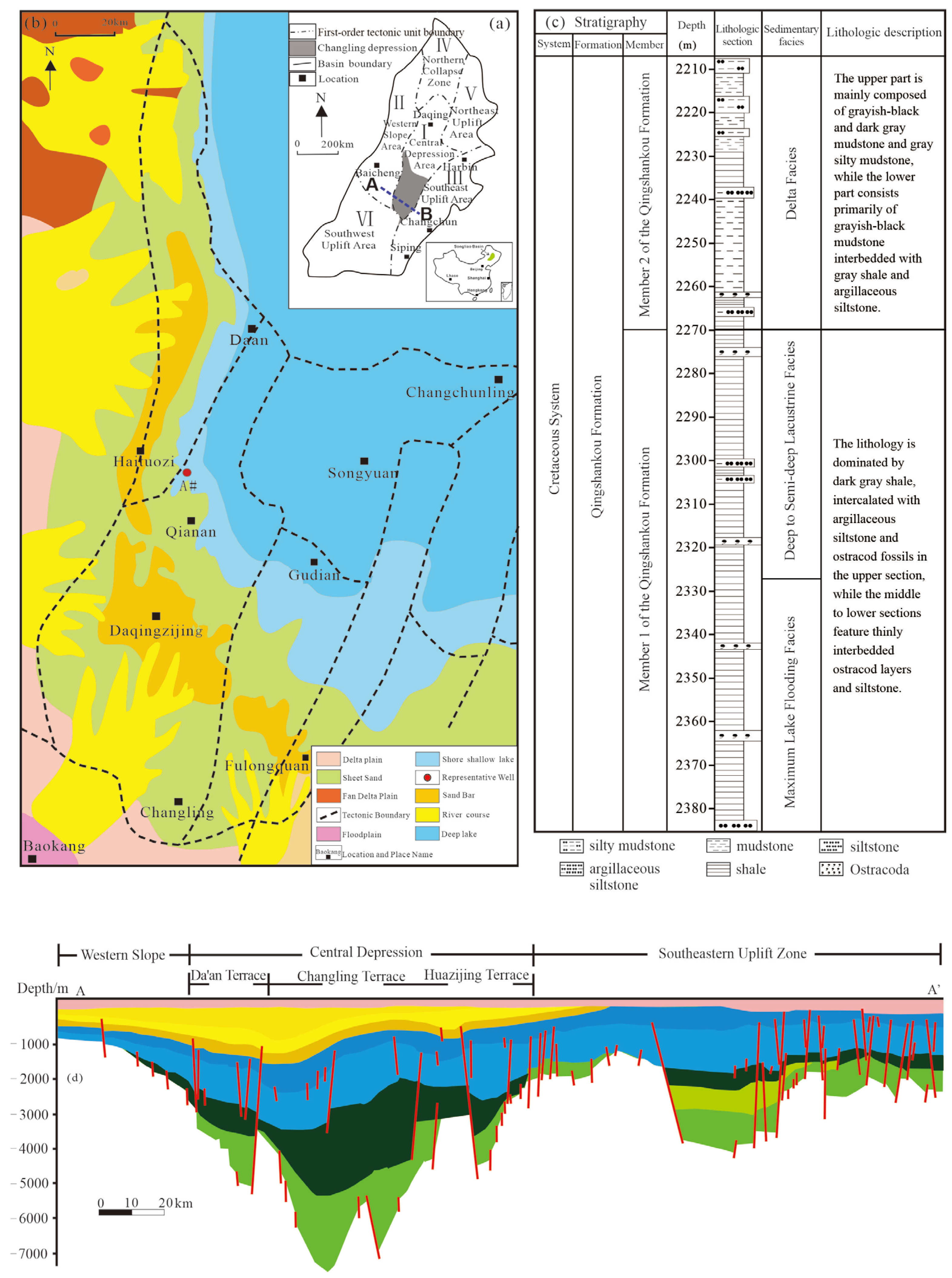
Figure 1a): the northern plunging zone, western slope zone, northeastern uplift, central depression, southeastern uplift, and southwestern uplift [
5]. Among them, the Changling Sag, located in the southern part of the central depression and covering an area of roughly 6500 km
2, represents one of the most significant hydrocarbon-generating depocenters of the basin. It borders the Gulong Sag to the north, the Honggang terrace and Huazijing terrace to the northwest and southeast, respectively, and gradually transitions eastward into the Fuxin uplift belt.
The stratigraphic succession of the Changling Sag is complete, comprising the Lower Cretaceous Quantou Formation and the Upper Cretaceous Qingshankou, Yaojia, Nenjiang, Sifangtai, and Mingshui formations [
6]. Within this sequence, the Qingshankou Formation—particularly its Member 1 (Q
1)—is dominated by dark lacustrine mudstone, serving as a key source rock. The Q
1 Member, along with the Fuyu reservoir in the Quantou Formation and the shale intervals of the Qingshankou Formation itself, constitutes the principal reservoir system in the area [
7]. The hydrocarbon accumulations are primarily lithologic–structural composite reservoirs, characterized by multi-layered systems of conventional oil, tight oil, and shale oil, collectively indicating enormous development potential.
The Qingshankou Formation (K
1qn), the focus of this study, was deposited during the subsidence (sag) stage and has a thickness of 260–500 m. It is subdivided into two members (
Figure 1d): the lower Member 1, a high-quality source-rock interval, and the upper Member 2, the main reservoir-bearing unit (Haitaizi oil layer;
Figure 1b) [
8]. Lithologically, the formation consists mainly of black mudstone and gray siltstone, interbedded with oil shale and sandstone. From basin center to margin, the depositional environments transition systematically from deep lacustrine to semi-deep lacustrine, and finally to deltaic facies (
Figure 1c) [
9].
Figure 1.
Location, Structural Framework, and Simplified Stratigraphic Profile of the Songliao Basin. (
a) Geographic location and structural division of the Songliao Basin: Shows the position of the Songliao Basin in northeastern China (inset, lower right) and the internal distribution of its major tectonic units. Six first-order structural zones are identified: I—Central Depression, II—Western Slope Zone, III—Southeastern Uplift, IV—Northern Plunging Zone, V—Northeastern Uplift, and VI—Southwestern Uplift. The dashed line A–B marks the trace of cross-section d across the study area. (
b) Sedimentary facies distribution in the Qian’an area: Illustrates the depositional facies belt of the Qingshankou Formation from basin margin to center, including alluvial fan, alluvial plain, deltaic, shore–shallow lacustrine, and semi-deep to deep lacustrine subfacies [
10]. The A# symbol marks the representative well selected for this study. (
c) Simplified stratigraphic column of the Cretaceous system in the Songliao Basin: Displays the major stratigraphic sequence, consisting of the Lower Cretaceous Quantou Formation and the Upper Cretaceous Qingshankou, Yaojia, Nenjiang, Sifangtai, and Mingshui formations. The section line corresponds to the location shown in panel (
b). (
d) Geological cross-section of the Songliao Basin: Depicts the basin’s structural–stratigraphic framework. The Qingshankou Formation (K
2qn) and Nenjiang Formation (K
2n) were deposited during the post-rift thermal-subsidence stage, forming a complete sedimentary sequence. Major structural boundaries and stratigraphic contacts are indicated in the diagram. The red lines represent the major faults developed along the section, indicating their distribution and structural control on the strata. A–A′ indicates the location and direction of the geological cross-section shown in this figure.
Figure 1.
Location, Structural Framework, and Simplified Stratigraphic Profile of the Songliao Basin. (
a) Geographic location and structural division of the Songliao Basin: Shows the position of the Songliao Basin in northeastern China (inset, lower right) and the internal distribution of its major tectonic units. Six first-order structural zones are identified: I—Central Depression, II—Western Slope Zone, III—Southeastern Uplift, IV—Northern Plunging Zone, V—Northeastern Uplift, and VI—Southwestern Uplift. The dashed line A–B marks the trace of cross-section d across the study area. (
b) Sedimentary facies distribution in the Qian’an area: Illustrates the depositional facies belt of the Qingshankou Formation from basin margin to center, including alluvial fan, alluvial plain, deltaic, shore–shallow lacustrine, and semi-deep to deep lacustrine subfacies [
10]. The A# symbol marks the representative well selected for this study. (
c) Simplified stratigraphic column of the Cretaceous system in the Songliao Basin: Displays the major stratigraphic sequence, consisting of the Lower Cretaceous Quantou Formation and the Upper Cretaceous Qingshankou, Yaojia, Nenjiang, Sifangtai, and Mingshui formations. The section line corresponds to the location shown in panel (
b). (
d) Geological cross-section of the Songliao Basin: Depicts the basin’s structural–stratigraphic framework. The Qingshankou Formation (K
2qn) and Nenjiang Formation (K
2n) were deposited during the post-rift thermal-subsidence stage, forming a complete sedimentary sequence. Major structural boundaries and stratigraphic contacts are indicated in the diagram. The red lines represent the major faults developed along the section, indicating their distribution and structural control on the strata. A–A′ indicates the location and direction of the geological cross-section shown in this figure.

3. Samples and Methods
A total of fifty-five core samples were collected for this study, and each specimen underwent a full suite of routine petrophysical measurements, whole-rock and clay-fraction XRD analyses, TOC determination, and SEM characterization. Based on the integrated mineralogical attributes (clay, felsic, and carbonate components), TOC abundance, and lithological features, a seven-fold lithofacies classification scheme (A–G) was established.
From these fifty-five samples, nineteen representative specimens were subsequently selected for high-pressure mercury intrusion (MICP) and low-temperature N2 adsorption measurements. The selection followed four rigorous criteria.
Lithofacies coverage: all seven lithofacies (A–G) were required to be represented. For shale-dominated facies (A–C) and clastic/carbonate facies (D–G), two to three samples from each category were included to capture both intra-facies variability and inter-facies contrasts.
Organic-matter abundance: within each lithofacies, samples were chosen to span high (TOC > 2%), medium (1–2%), and low (TOC < 1%) organic-matter intervals, enabling a robust assessment of TOC effects on pore structure and fractal behavior.
Mineralogical and textural diversity: guided by XRD data and microscopic observations, end-member compositions were preferentially selected, including clay-rich, quartz/feldspar-rich, and carbonate-rich types. Samples exhibiting visible fractures, weathering, or machining-related disturbances were excluded to minimize analytical artifacts.
Depth and stratigraphic representativeness: samples were distributed across submembers Q1–Q11 of the Qingshankou Formation and across different wells, avoiding over-representation of any single depth interval.
Among the nineteen specimens, seven (corresponding to lithofacies A–G) serve as the canonical representatives and are listed in
Table 1; their data form the basis for the detailed discussions of pore-throat structures and fractal characteristics in the main text. The remaining twelve samples were used for trend verification and statistical support, and their results are consistent with the representative set.
Mineralogical analyses of both whole-rock and clay fractions were performed using a D/max-2200 X-ray diffractometer (model 2035C4; Rigaku Corporation, Tokyo, Japan) following the Chinese National Standard GB/T 30904-2014 [
11]. SEM imaging was conducted on a Zeiss Gemini 300 field-emission scanning electron microscope (Carl Zeiss, Oberkochen, Germany) operated at 5–10 kV in accordance with GB/T 17359-2012 [
12]. High-pressure mercury intrusion porosimetry (MICP) was carried out using an AutoPore IV 9505 mercury porosimeter (Micromeritics Instrument Corp., Norcross, GA, USA) following GB/T 21650.1-2008 [
13], and low-temperature N₂ adsorption measurements were performed on an ASAP 2460 surface area and pore-structure analyzer (Micromeritics Instrument Corp., Norcross, GA, USA) in accordance with GB/T 21650.2-2008 [
14].
For SEM analysis, each specimen was cut into blocks approximately 10 × 10 × 5 mm. The surfaces were successively ground using 320, 600, 1200, and 2000-grit SiC papers, followed by final polishing with a 0.5 μm alumina suspension to obtain a flat, scratch-free surface. The polished blocks were ultrasonically cleaned in ethanol and then sputter-coated under vacuum with a 10–15 nm Au/Pt film to ensure surface conductivity and mitigate charging.
To avoid bias toward pore-rich areas and ensure statistical representativeness, each polished surface was divided into a 1 mm × 1 mm grid. Six to eight fields of view were systematically selected according to a pre-numbered sequence (top-to-bottom, left-to-right), rather than by visual pore abundance. Additional fields were incorporated as needed to capture key textural elements such as bedding interfaces, clay-rich laminae, and brittle-mineral clusters. Only images with sharp focus, intact coating, and no evidence of surface tearing or mechanical microcracks were used for qualitative and quantitative pore analysis. This SEM preparation and imaging protocol is consistent with the methodological frameworks adopted by recent high-quality microstructural studies [
15,
16], ensuring the reliability and comparability of pore-structure identification.
All specimens used for MICP analysis were prepared as cylindrical plugs with a diameter of 2.5 cm and a length of 2.5–3.0 cm, in order to ensure the stability and comparability of pore–throat characterization. For N2 adsorption, samples were crushed and sieved to 60–80 mesh (180–250 μm) to avoid systematic bias associated with macroscopic structural pores in intact blocks. To mitigate the ink-bottle effect during mercury intrusion, several control strategies were adopted: (i) only the intrusion branch of the MICP curve was used for pore–throat inversion; (ii) the Washburn equation was combined with the adopted fractal model to reduce overestimation of throat radii in pores with narrow necks and large bodies; and (iii) the results were cross-checked against the adsorption branch of the N2 isotherms to minimize misinterpretation of bottleneck structures as true pore sizes. Edge effects were alleviated by carefully trimming and polishing the outer surface of the core plugs to remove microfractures and irregular corners, and by discarding a few anomalous low-pressure data points (<0.05 MPa) where premature mercury entry along edge fractures could artificially increase the inferred pore radius. The smooth behaviour of the initial intrusion segment, the absence of abnormal negative pore volumes, and the high coefficients of determination (R2 > 0.96) obtained for fractal fitting in the low-pressure regime jointly confirm that no understain (incomplete saturation) or wetting deficiency occurred during the experiments. All measurements were conducted in the laboratories of the Unconventional Oil and Gas Research Institute, Northeast Petroleum University.
4. Reservoir Characteristics
4.1. Petrological Characteristics
4.1.1. Mineral Composition
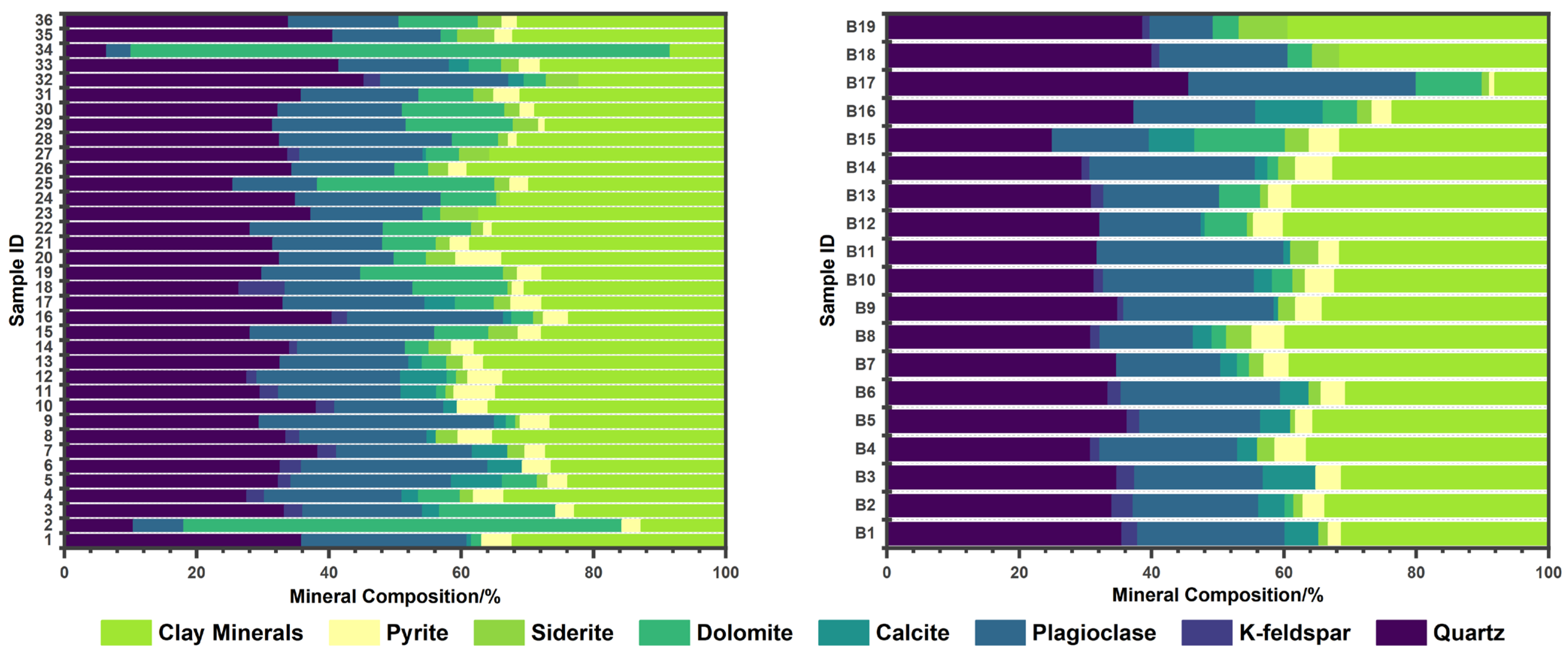
The shale of the Qingshankou Formation in the study area is dominated by quartz, clay minerals, feldspar, and carbonates, with minor amounts of pyrite (
Figure 2). Quantitative X-ray diffraction (XRD) analyses show that quartz is the most abundant component, with an average content of 32.70%. Clay minerals rank second, averaging 30.99%, followed by feldspar with an average content of 20.66%. Carbonate minerals—including calcite, dolomite, and aragonite—constitute the smallest proportion, averaging 15.62%. In addition, traces of pyrite occur locally, typically disseminated or framboidal in form.
This mineralogical composition indicates that the Qingshankou shale represents a mixed siliciclastic–carbonate sedimentary system [
17]. The dominance of quartz and feldspar reflects a significant terrigenous detrital input, whereas the abundance of clay minerals suggests quiet-water lacustrine sedimentation with potential for organic matter preservation. The occurrence of carbonate and pyrite implies periodic reducing conditions during deposition, highlighting the heterogeneous diagenetic evolution of the reservoir.
4.1.2. Organic Geochemical Characteristics
The abundance of organic matter fundamentally determines the hydrocarbon-generating potential of shale. In the Qingshankou Formation of the Songliao Basin, the total organic carbon (TOC) content ranges from 0.49% to 5.71%, with an average of 1.87%. The free hydrocarbon content (S1) varies between 0.27 mg/g and 2.88 mg/g, averaging 1.49 mg/g, while the total hydrocarbon generation potential (S1 + S2) ranges from 1.69 mg/g to 52.25 mg/g, with an average of 11.84 mg/g. These parameters collectively indicate that the Qingshankou shale possesses favorable hydrocarbon generation potential. The type of organic matter is primarily Type I and Type II1 kerogen, suggesting that the organic precursors were dominated by lacustrine algae and planktonic organisms. The vitrinite reflectance (Ro) values range from 0.86% to 0.89%, indicating that the shale is in the mature stage of thermal evolution, suitable for both oil generation and early expulsion. This combination of moderate to high TOC, hydrogen-rich kerogen, and optimal maturity confirms that the Qingshankou Formation is a high-quality source rock capable of sustaining self-generated and self-stored shale oil accumulation.
4.2. Types of Reservoir Space
SEM observations indicate that the Qingshankou shale in the study area hosts three principal categories of reservoir space: inorganic pores, organic-matter pores, and microfractures.
4.2.1. Inorganic Pores
Based on their occurrence relative to mineral grains, inorganic pores can be subdivided into intergranular, intragranular, and intercrystalline pores.
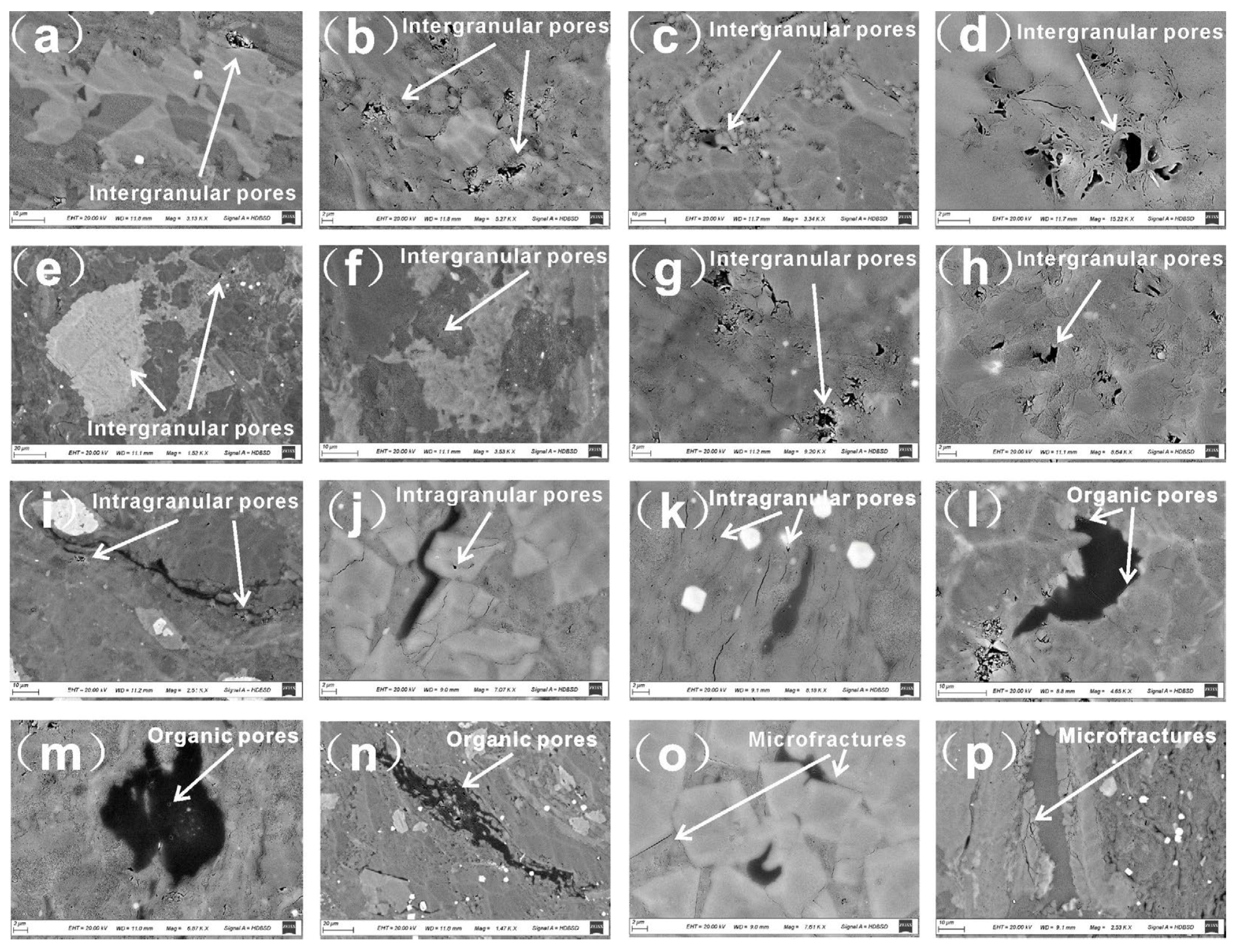
Intergranular pores are abundantly developed and constitute the most important pore type. They occur (i) along organic–inorganic contacts, (ii) at the boundaries of pyrite grains, clay minerals, and other detrital grains, (iii) in the pressure-shadow zones around rigid grains (e.g., quartz, feldspar, bioclastic fragments), and (iv) between platy clay aggregates, where numerous slit-like pores are commonly observed (
Figure 3a–h).
Intragranular pores are dominated by dissolution features within mineral grains, including feldspar intragranular dissolution pores and lithic-fragment dissolution pores (
Figure 3i–k). These pores form by the selective leaching of unstable minerals (e.g., feldspar, certain clays). They typically exhibit poor connectivity and thus exert limited influence on effective permeability.
Intercrystalline pores in the shale are primarily associated with pyrite, and their development is closely linked to organic matter. Most pyrite occurs as framboids, with a minor proportion showing anhedral habits; intercrystalline voids among pyrite microcrystals provide localized pore space that can contribute to nano-scale storage and, where connected, to limited flow pathways.
4.2.2. Organic-Matter Pores
The distribution of organic-matter (OM) pores is governed by OM abundance and type, as well as the presence of solid bitumen [
18]. In the study area, OM abundance is relatively high, and OM pores are discernible; however, their characteristic sizes are predominantly nano-scale, so their bulk contribution to effective storage and flow is limited.
Two genetic categories are recognized: Thermogenic OM pores produced during hydrocarbon generation; and Contraction-related microcracks formed by post-generation shrinkage of organic matter. Given the comparatively high maturity of the Qingshankou source rock here, OM pores are dominated by shrinkage microcracks, commonly developed along clay–organic interfaces, with individual crack lengths of ~5–10 μm.
Consistent with the predominance of Type IIa (oil-prone) kerogen, thermogenic OM pores are mainly nano-scale gas pores showing discrete, pitted, and irregular morphologies (
Figure 3l–n). While such pores enhance adsorptive capacity, their limited sizes and connectivity constrain their direct contribution to permeability.
4.2.3. Microfractures
Microfractures act as critical conduits linking microscopic pores and macroscopic fractures, thereby playing an essential role in both hydrocarbon storage and migration. In the Qingshankou Formation, two major types of microfractures are identified: tectonic fractures and diagenetic microfractures. Tectonic fractures are primarily governed by diagenetic compaction, mineral brittleness, formation pressure, and tectonic stress. Given the high content of brittle minerals (e.g., quartz and feldspar) in the Qingshankou shale, these fractures are the most common type in the study area, typically extending tens to several hundred micrometers in length (
Figure 3o,p). Diagenetic microfractures, by contrast, are closely associated with dehydration and shrinkage processes during burial and compaction. The most prominent type is the organic-matter shrinkage fracture (
Figure 3l), which develops as organic material contracts after hydrocarbon generation. These microfractures enhance pore connectivity at the nano- to micro-scale and provide migration pathways for fluids within the otherwise compact shale matrix.
5. Lithofacies Classification
Drawing upon both domestic and international lithofacies classification frameworks, this study establishes a lithofacies division scheme for the Qingshankou Formation shale based on total organic carbon (TOC) content and mineral composition. TOC thresholds of ≤1%, 1–2%, and ≥2% are used to categorize the shale into poorly organic, moderately organic, and highly organic types, respectively. Lithologically, five fundamental rock types were identified: shale, siltstone, calcareous siltstone, dolostone, and bioclastic limestone.
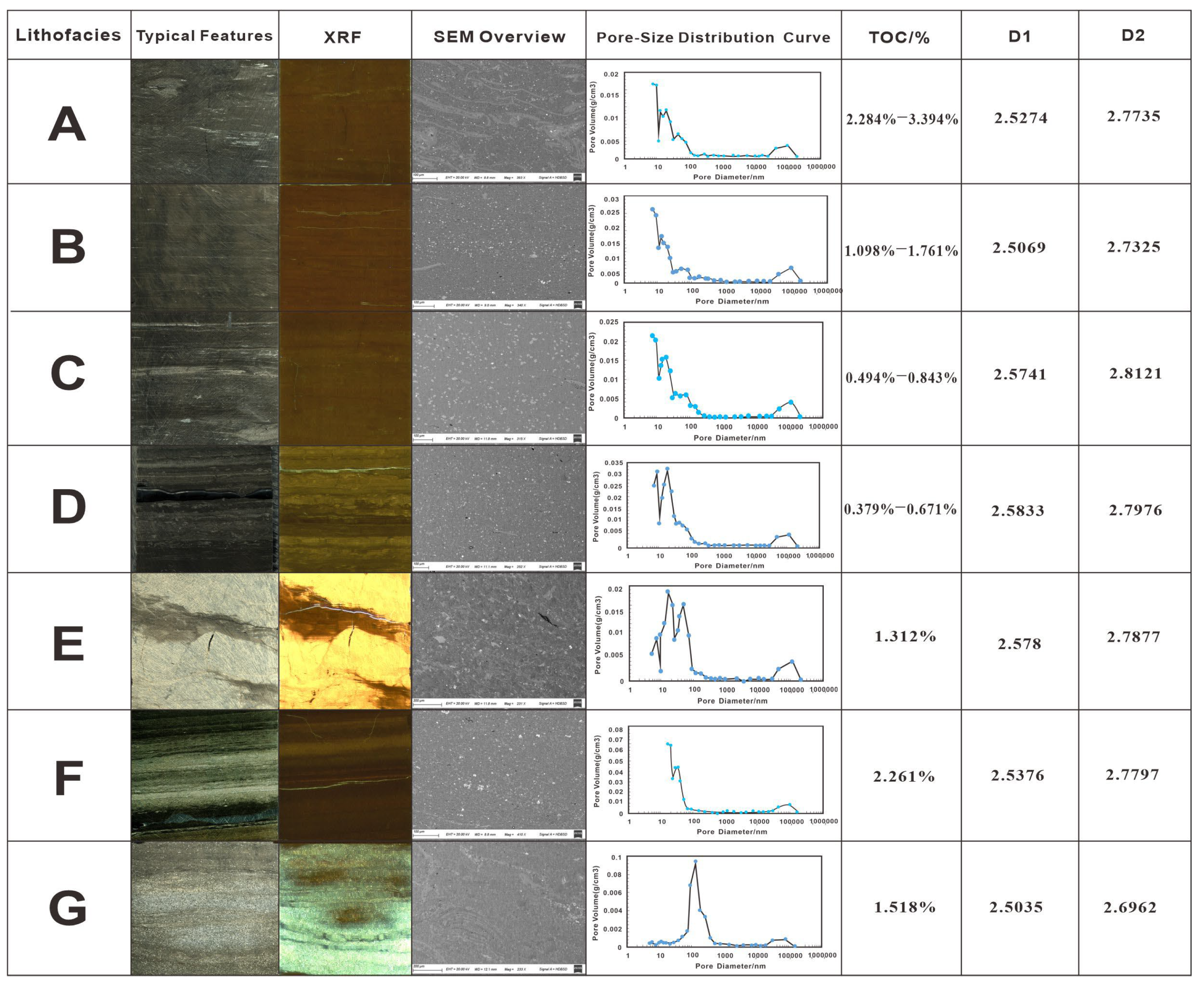
By integrating lithology and TOC data, seven distinct lithofacies were defined: Highly organic shale facies, Moderately organic shale facies, Poorly organic shale facies, Poorly organic calcareous siltstone facies, Moderately organic siltstone facies, Moderately organic bioclastic limestone facies, and Highly organic dolostone facies (
Figure 4).
A detailed quantitative summary of these lithofacies and their characteristic parameters is provided in
Table 1, and subsequent sections present a systematic analysis of each facies in terms of mineral composition, pore structure, and reservoir quality.
High-Organic Shale Facies (Type A): Core samples are generally dark to black, typically exhibiting laminated structures. Thin-section and SEM observations reveal well-developed organic laminae with locally distributed organic pores, accompanied by fine-grained quartz, clay minerals, and minor pyrite. Alternating laminae of clay-rich and organic-rich layers indicate a strongly reducing depositional environment favorable for organic matter preservation. TOC values commonly exceed 2%, suggesting high hydrocarbon generation potential. The porosity is generally low (<1%), and the permeability is extremely poor. Pores mainly consist of organic pyrolysis pores and interlayer clay pores. The surface fractal dimension (D1) ranges from 2.50 to 2.56, while the structural fractal dimension (D2) reaches 2.63–2.83, implying that although the pore surface complexity is moderate, the internal tortuosity is significantly enhanced, resulting in overall low reservoir quality.
Moderately Organic Shale Facies (Type B): Core samples are dark gray to gray-black, compact, and locally interbedded with silty or calcareous laminae. Thin-section and SEM analyses show fine-grained quartz, feldspar, and minor pyrite dispersed within a clayey matrix, with poorly sorted silt-sized particles. XRD results indicate that clay minerals and quartz dominate, with subordinate carbonates. The pore system is mainly composed of micropores and mesopores, commonly distributed within clay interlayers or organic matter. This facies was deposited in a relatively stable lacustrine environment with limited external input and strong reducing conditions. TOC values range from 1% to 2%, indicating moderate hydrocarbon generation potential. The fractal parameters (D1 = 2.48–2.59, D2 = 2.68–2.83) suggest moderate surface roughness and relatively complex internal structures with fair connectivity.
Poorly Organic Shale Facies (Type C): Cores are mainly dark gray and compact, locally containing fine silt interbeds. TOC values are below 1%, and the hydrochloric acid reaction is weak. XRD data show high contents of both clay minerals and quartz, with well-packed silt-sized quartz grains. Pores are mainly interlayer clay pores, microfractures, and minor dissolution pores. This facies developed under more energetic conditions with stronger detrital influx and limited organic preservation. Porosity (1–3%) and permeability are slightly improved compared with the high-organic shale. The fractal dimensions (D1 = 2.55–2.57, D2 = 2.79–2.81) indicate complex pore surfaces and internal geometries, suggesting that this facies represents a potential “sweet spot” within the shale sequence.
Poorly Organic Calcareous Siltstone Facies (Type D): Cores are generally gray and dense, with strong effervescence in hydrochloric acid, indicating intense calcite cementation. Thin-section and SEM observations show silt-sized quartz and feldspar grains filled with abundant calcite and minor clay minerals. The rock is framework-supported but heavily cemented; pores are mainly residual intergranular and local dissolution pores. TOC ranges from 1% to 2%, indicating limited organic matter preservation. Porosity is about 1%, and permeability is extremely low, with a poor sorting coefficient (~1.3), reflecting strong heterogeneity. The fractal dimensions (D1 ≈ 2.59, D2 ≈ 2.74) reveal rough pore surfaces and complex structures but poor connectivity.
Moderately Organic Siltstone Facies (Type E): Core samples are gray with a clearly developed granular framework dominated by quartz and minor clay minerals. TOC ranges between 1% and 2%. The absence of significant effervescence in hydrochloric acid indicates weak carbonate cementation. SEM observations show limited cement, with intergranular pores as the main pore type. However, overall porosity is extremely low (~0.1%), and permeability is negligible. The sorting coefficient is 0.65, indicating poorly sorted and unevenly distributed pores. Pore-size distribution suggests a significant contribution from large pores. The fractal parameters (D1 = 2.58, D2 ≈ 2.78) reveal a complex pore surface and structure, reflecting strong heterogeneity and limited reservoir quality.
Moderately Organic Dolostone Facies (Type F): Cores are grayish brown and display strong effervescence in hydrochloric acid, indicating high carbonate mineral content. Thin-section and SEM analyses reveal dolomite as the dominant mineral, with locally developed secondary dissolution and intercrystalline pores. XRD results show that carbonates are significantly more abundant than clay minerals and quartz. This facies exhibits the highest porosity (up to 8.63%) but extremely low permeability, suggesting that most pores are isolated dissolution pores with limited connectivity. The mercury intrusion saturation reaches 96%, indicating a relatively uniform pore distribution. Fractal analysis shows moderate values (D1 ≈ 2.54, D2 ≈ 2.78), implying abundant pores but limited structural complexity.
Moderately Organic Bioclastic Limestone Facies (Type G): Cores are gray and commonly contain bioclastic fragments such as ostracods, with evident effervescence in hydrochloric acid. SEM observations show that bioclastic grains and carbonate cement are interwoven, with locally developed intergranular and minor dissolution pores. TOC averages around 1.5%, indicating limited hydrocarbon generation potential. This facies exhibits relatively high porosity (4.3%), very low median displacement pressure (7.65 MPa), and high mercury intrusion saturation (95%), suggesting good pore connectivity. The fractal dimensions (D1 ≈ 2.50, D2 ≈ 2.69) are relatively low, indicating a simple and homogeneous pore structure. Overall, this facies possesses favorable reservoir potential.
6. Full-Scale Pore-Size Distribution and Fractal Characteristics of Different Lithofacies
To characterize the pore-scale effects across different lithofacies, this study employed high-pressure mercury intrusion (MIP) to analyze the medium-to-macropore throats and low-temperature nitrogen adsorption (N2GA) to determine the micro- to mesopore structures. Through domain-based comparison and integrated interpretation, an equivalent full-scale pore-size distribution was established. The Frenkel–Halsey–Hill (FHH) model was applied to the adsorption isotherms to calculate the surface fractal dimension (D1) in the low-pressure range and the structural fractal dimension (D2) in the high-pressure range.
Lithofacies were classified according to the “TOC level + lithology” scheme, including high-, medium-, and low-organic shale facies, calcareous siltstone facies, siltstone facies, dolostone facies, and bioclastic limestone facies. The following sections summarize the key results of the two experiments and the pore-structure characteristics of each lithofacies, followed by a comparative analysis of the FHH-derived fractal parameters.
6.1. High-Pressure Mercury Intrusion
Significant variations are observed in the mercury intrusion parameters among different lithofacies (
Table 2), reflecting clear differences in pore-throat structure types and heterogeneity characteristics. Overall, the measured porosity ranges from 0.1 to 8.63%, and permeability varies between 0.009 × 10
−3 and 3.155 × 10
−3 μm
2, indicating that the Qingshankou Formation reservoirs are generally characterized by low porosity and ultra-low permeability.
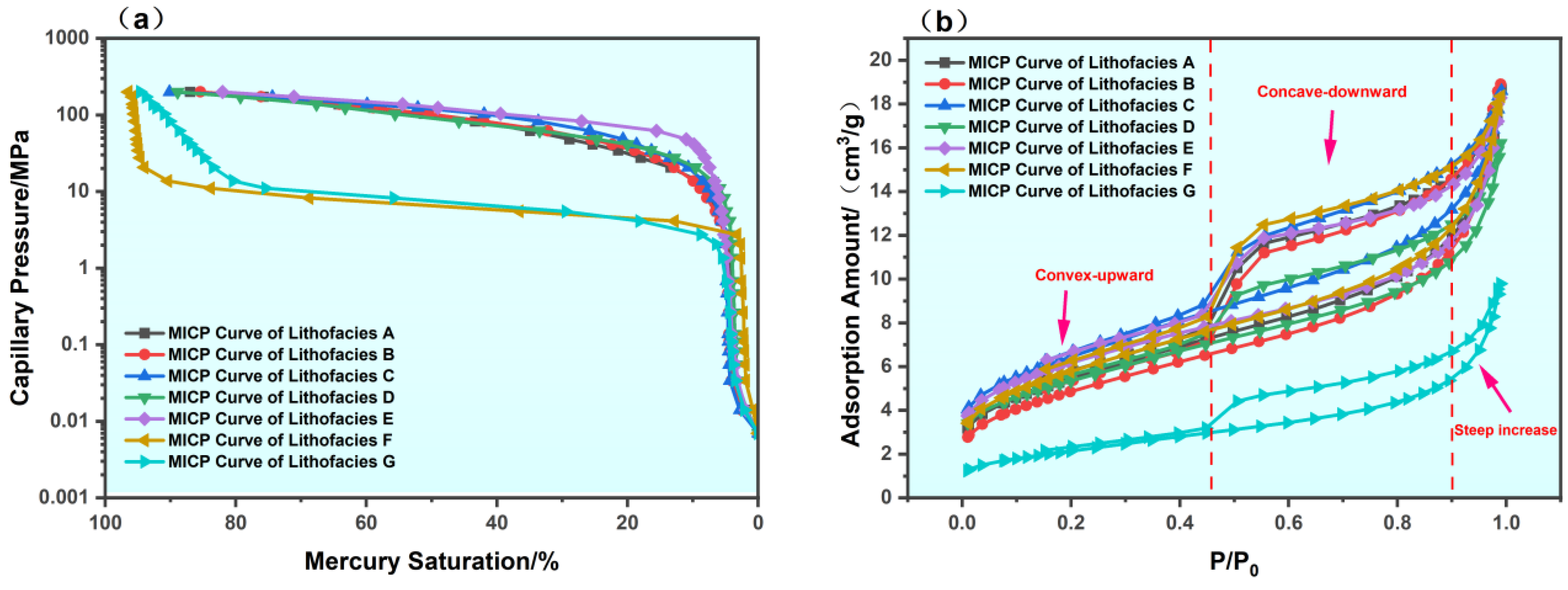
All lithofacies exhibit three distinct stages on their mercury intrusion curves (
Figure 5a): a low-pressure gradual-entry stage (<0.1 MPa), a medium-pressure rapid-intrusion stage (0.1–10 MPa), and a high-pressure stabilization stage (>10 MPa). At low pressure, mercury uptake is minimal, corresponding to the filling of a small number of large pore throats. In the medium-pressure range, the curve rises sharply, indicating that numerous medium- and small-sized pores are being invaded. As pressure continues to increase, the curve gradually flattens, suggesting that mercury can no longer penetrate the finest pores and the pore–throat system approaches saturation. Differences among lithofacies are primarily reflected in the position of the inflection point and the pressure range of the plateau segment, which together reveal variations in pore-size distribution and structural uniformity.
In the shale lithofacies (Types A–C), including high-, medium-, and low-organic shales, the mercury intrusion curves exhibit distinct characteristics of high initial pressure, high median pressure, and a pronounced rightward shift. The displacement pressures generally range between 13 and 15 MPa, median pressures cluster between 90 and 145 MPa, and maximum mercury saturation values fall within 80–90%, with sorting coefficients of 1.0–1.25. These features indicate that the pore–throat systems are dominated by submicron-sized fine throats with poor connectivity, where mercury entry is strongly constrained. The inflection point of the high-organic shale curve lies furthest to the right, reflecting the highest proportion of fine throats, whereas the low-organic shale curves shift slightly leftward, suggesting the presence of mesopores and relatively coarser throats.
In the clastic lithofacies (Types D–E), comprising calcareous siltstone and siltstone, the intrusion curves shift markedly to the left, with lower initial entry pressures and median pressures of approximately 60–127 MPa. The sorting coefficients vary considerably (0.65–1.31), implying the coexistence of coarser throats or macropores. Some samples exhibit bimodal pore-throat distributions due to calcite cementation or clay infilling, which enhances the overall heterogeneity.
In the carbonate lithofacies (Types F and G), represented by dolostone and bioclastic limestone, the mercury intrusion curves differ substantially from those of the shale facies. Rapid mercury entry occurs even at low pressures, with the lowest median pressures (approximately 6–8 MPa) and the highest maximum mercury saturation (94–96%). The curves are smooth with extended plateau segments, indicating pore–throat systems dominated by medium-to-large pores and good connectivity. These features are closely associated with the development of secondary dissolution pores and intergranular pores within bioclastic frameworks.
6.2. Nitrogen Adsorption
To elucidate the differences in pore structures at the micro–mesopore scale among various lithofacies, low-temperature nitrogen adsorption–desorption experiments were conducted on representative samples (
Figure 5b). The relationship between adsorption volume and relative pressure (P/P
0) exhibits a typical Type IV isotherm, indicating that mesopores dominate the pore systems of all lithofacies. The distinct variations observed in the shapes of the curves across the low-, medium-, and high-pressure regions reflect significant differences in pore-size distribution, pore–throat connectivity, and surface structural complexity.
In the low relative-pressure region, all curves display an upward-convex shape with a slow increase in adsorption volume, corresponding to monolayer molecular adsorption and reflecting the roughness and development of micropores on pore surfaces. The shale samples (Types A–C) show relatively higher adsorption capacities, suggesting abundant micropores and strong surface adsorption ability. The clastic samples (Types D and E) exhibit slightly lower values, indicating fewer micropores, whereas the carbonate samples (Types F and G) record the lowest adsorption, implying smoother surfaces and the poorest micropore development.
In the medium-pressure region, the curves display a pronounced concave pattern, where adsorption increases sharply with pressure, reflecting multilayer adsorption and capillary condensation. This process is primarily controlled by the volume distribution and connectivity of mesopores. The shale samples show the steepest rise, indicating a high abundance and narrow distribution of mesopores. The clastic samples display a broader inflection zone, implying a wide transition from mesopores to macropores and a heterogeneous pore–throat distribution. In contrast, the carbonate samples exhibit a gentler slope, suggesting fewer mesopores and a shift toward larger pore sizes.
In the high-pressure region, adsorption rises sharply, forming an evident steep segment that corresponds to capillary condensation and pore filling within medium–large pores and open connected channels. The dolostone and bioclastic limestone samples (Types F and G) show the most pronounced increase in this region, reflecting the presence of dissolution and intergranular pores with strong connectivity. The shale samples (Types A–C) exhibit a much gentler ascent, indicating limited macropore development and relatively closed pore networks. The siltstone sample (Type E) shows an intermediate behavior, suggesting a pore-size distribution spanning multiple scales from micropores to macropores.
Overall, the shale samples display smoother adsorption curves with pronounced hysteresis loops, indicating micropore–mesopore dominance and tortuous pore channels. The clastic samples exhibit moderate adsorption with a strong mesopore contribution, reflecting a mixed pore-type system. The carbonate samples show the lowest adsorption but the sharpest rise at high pressures, indicating meso- to macropore-dominated systems. From shale → clastic → carbonate lithofacies, adsorption capacity decreases, hysteresis weakens, and pore-size range widens, signifying a gradual transition from a closed to an open pore structure.
6.3. Fractal Characteristics Based on the FHH Model
In the fractal analysis of pore structures, the dominant pore sizes of the studied shale samples fall within the mesopore interval of 10–50 nm. Because nitrogen adsorption provides superior resolution and measurement stability in the 20–50 nm mesopore domain, the present study employs the Pfeifer-type Frenkel–Halsey–Hill (FHH) model to derive fractal dimensions from the N
2 adsorption isotherms. The FHH model describes the amount of gas adsorbed on a fractal surface as follows:
where V is the adsorbed volume (cm
3/g) corresponding to the equilibrium pressure P (MPa), P
0 is the saturation vapor pressure of the adsorbate (MPa), K is the slope of the linear relationship determined by the adsorption mechanism, and C is a constant. The fractal dimension (D) is defined as D = K + 3, with 2 ≤ D ≤ 3. A value of D approaching 2 indicates a smooth and simple pore surface, whereas a value approaching 3 suggests a highly complex and heterogeneous pore structure.
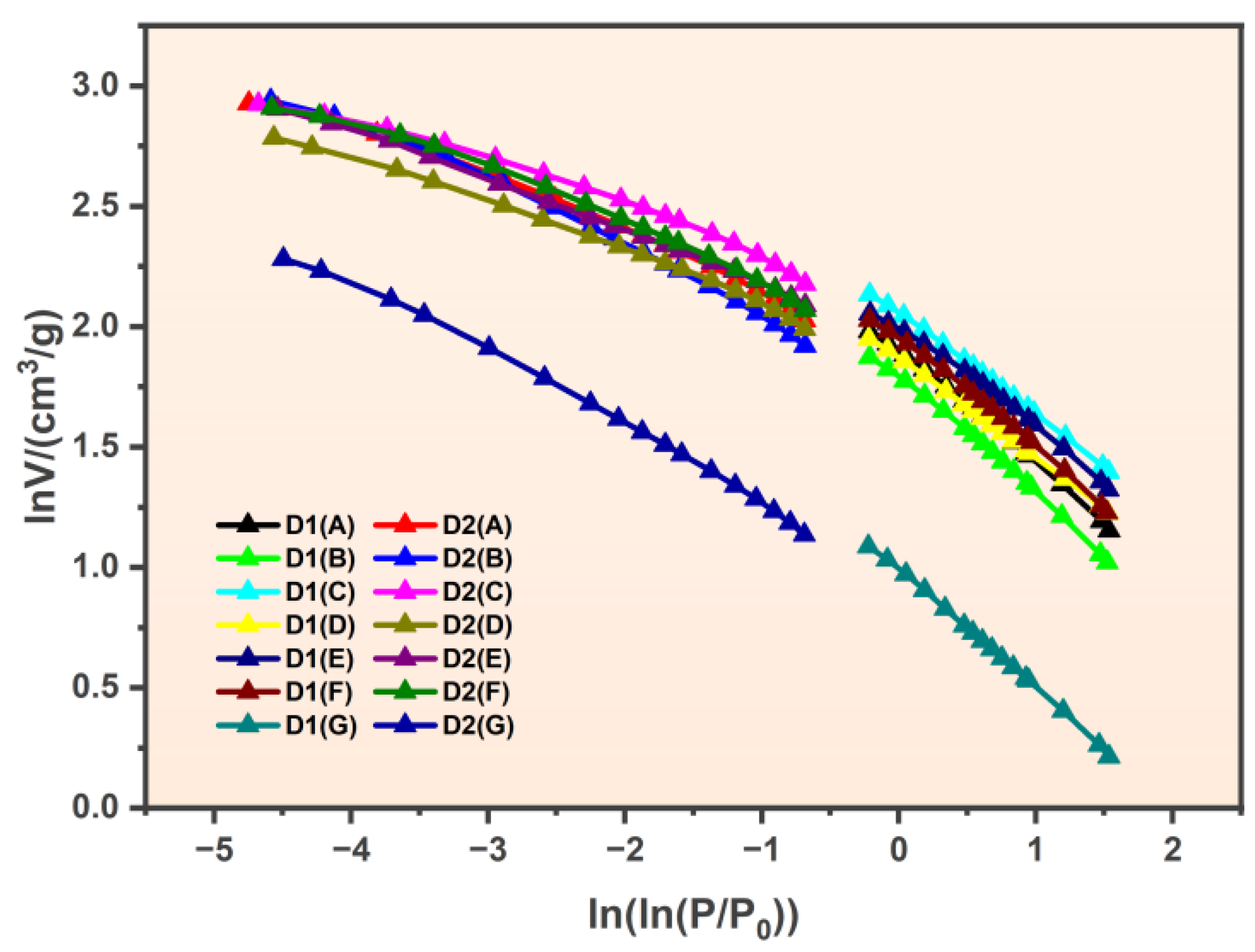
From the double-logarithmic plots of relative pressure versus adsorbed volume for each lithofacies (
Figure 6), the FHH-based fractal fitting exhibits consistently high linearity. All samples display a pronounced hysteresis loop beginning at approximately P/P
0 = 0.45. Accordingly, the fractal dimensions are partitioned into two distinct regimes using P/P0 = 0.45 as the boundary. The low-pressure region (P/P
0 < 0.45), dominated by van der Waals interactions and characterized by monolayer adsorption, reflects the fractal roughness of the pore surfaces and is denoted as D
1. The high-pressure region (P/P
0 > 0.45), controlled by capillary condensation and associated with multilayer adsorption, represents the fractal complexity of the pore–throat network and is denoted as D2.
To evaluate the robustness of D1 and D2 with respect to the selection of fitting windows and the number of data points, a sensitivity analysis was performed on representative samples. First, within the visually linear segments of the isotherms, the fitting intervals for both the low-pressure and high-pressure regions were shifted by approximately ±0.2–0.3 logPc units, followed by repeated linear regressions. The resulting variations in D1 and D2 were generally within 0.03–0.05, while the regression coefficients remained between 0.96 and 0.99. Second, within the defined linear segments, three sampling strategies—using all data points, alternate-point subsampling, and smoothed subsampling—were applied. The differences in the estimated fractal dimensions were typically less than 0.04.
Collectively, these results demonstrate that, within reasonable linear ranges, the fractal dimensions D1 and D2 are only weakly sensitive to moderate adjustments of the fitting window or data-point density. The associated uncertainties are substantially smaller than the systematic differences observed among the various lithofacies.
According to the calculated fractal dimensions (
Table 3), all samples exhibit a strong linear relationship in the double-logarithmic plots (R
2 > 0.98), indicating that the FHH model effectively characterizes the adsorption behavior of different lithofacies within the Qingshankou Formation. The regression slopes differ significantly between the low- and high-pressure regions, reflecting distinct fractal features between the pore surface and internal structure. Overall, the surface fractal dimensions (D
1) range from 2.50 to 2.58, while the structural fractal dimensions (D
2) vary from 2.69 to 2.81, both falling within the typical range for porous media (2 < D < 3). These results suggest that all lithofacies possess varying degrees of surface roughness and internal heterogeneity in their pore–throat systems.
In the shale lithofacies, the surface fractal dimensions (D1) range from 2.51 to 2.57, and the structural fractal dimensions (D2) range from 2.73 to 2.81. The high-TOC shale (Type A) exhibits a D1 of 2.5274 and a D2 of 2.7735, indicating a moderately rough surface and a relatively complex internal pore network. The low-TOC shale (Type C) shows the highest D2 value (2.8121), suggesting the most intricate pore structure and significant heterogeneity in connectivity. These shales are typically characterized by organic dissolution pores and interlayer clay pores with wide pore-size distributions and high irregularity, reflecting the coupling relationship between organic richness and complex pore–throat geometry.
For the clastic lithofacies, the fractal dimensions are slightly higher overall, with D1 = 2.57–2.58 and D2 = 2.78–2.80, implying rougher pore surfaces and more heterogeneous pore–throat systems. The calcareous siltstone (Type D) has a slightly higher D2 (2.7976) than the siltstone (Type E, 2.7877), indicating that cementation and interstitial fillings enhance the structural irregularity of the pore system. Compared with shale, clastic samples exhibit broader pore-size distributions, containing both micropores and interconnected meso- to macropores, which results in slightly higher overall D2 values.
The carbonate lithofacies display relatively lower fractal dimensions (D1 = 2.50–2.54, D2 = 2.69–2.78), suggesting smoother pore surfaces and more homogeneous internal structures. The dolostone (Type F, D2 = 2.7797) shows a slightly higher structural fractal dimension than the bioclastic limestone (Type G, D2 = 2.6960), likely due to dolomitization-induced dissolution that improves pore connectivity. Overall, the narrow variation in D1 and D2 among carbonate samples indicates a more orderly pore system and weaker heterogeneity compared with shale and clastic counterparts.
6.4. Statistical Significance Tests and Multivariate Analysis
To enhance the reliability of the relationships among pore–throat structure, fractal dimensions, and reservoir properties, this study conducted statistical significance tests on fractal dimensions (D
1 and D
2), porosity, permeability, mercury-intrusion parameters, and TOC. Pearson correlation analysis (
Table 4 and
Table 5) shows that D
2 is significantly negatively correlated with the sorting coefficient (r = −0.530,
p < 0.05), while permeability exhibits a significant positive correlation with TOC (r = 0.605,
p < 0.05). Median pressure is significantly negatively correlated with porosity (
p < 0.05), and the sorting coefficient is significantly negatively correlated with displacement pressure (
p < 0.01), collectively reflecting the consistency between pore–throat refinement and capillary-pressure responses.
Overall, both D1 and D2 exhibit measurable correlations with mercury-intrusion parameters, though with varying significance. D2 shows stronger significance, confirming its superiority in characterizing pore–throat geometric complexity, whereas D1 is more sensitive to pore-surface roughness and exhibits weaker correlations with porosity and capillary-pressure parameters.
To further disentangle the independent contributions of each factor, a multiple linear regression model was constructed with log10(permeability) as the dependent variable. The results indicate that TOC remains statistically significant (p = 0.046) even when controlling for porosity and D2, demonstrating its independent contribution to fluid-flow capacity. Although the coefficient of D2 is negative, it does not reach statistical significance (p = 0.30), implying that the fractal dimension primarily reflects structural trends rather than directly predicting permeability. D1 was not included in the final model due to its weaker statistical association compared to D2 and its predominant sensitivity to surface roughness, which limits its direct influence on flow capacity.
6.5. Multicollinearity and Redundant Representation Analysis
To distinguish the geological meaning and statistical independence of each reservoir parameter, this study performed a comprehensive multicollinearity diagnosis using variance inflation factors (VIFs) for fractal dimensions, porosity, mercury-intrusion parameters, sorting coefficient, and TOC (
Table 6). It must be emphasized that the magnitude of VIF reflects the degree of statistical coupling rather than the geological relevance of a parameter; thus, even parameters with relatively high VIF values should not be disregarded without geological justification.
First, the VIF values of fractal dimensions D1 and D2 are both below 2, indicating extremely weak multicollinearity and confirming that they serve as independent structural descriptors of pore–throat complexity. Although D2 shows moderate correlations with geometric parameters of pore–throat systems, such as the sorting coefficient and median pressure, it does not exhibit redundancy. In contrast, D1 displays even weaker correlations, reflecting its distinctive emphasis on pore-surface roughness rather than throat-scale geometry.
Displacement pressure and median pressure have VIF values between 3 and 4, representing moderate multicollinearity. This reflects their shared geological control by pore–throat size and capillary-force thresholds; however, their functional emphases differ—displacement pressure is more sensitive to the proportion of the finest throats, whereas median pressure captures the statistical peak of throat-size distribution. Both parameters remain indispensable in interpreting pore–throat evolution.
The sorting coefficient shows the highest VIF value (≈6), indicating strong coupling with displacement and median pressures and suggesting that it is a highly responsive indicator of pore–throat refinement and geometric dispersion. Nevertheless, its high VIF does not imply geologic redundancy. Sorting characterizes the distributional heterogeneity and uniformity of pore–throat sizes, which cannot be fully substituted by capillary-pressure parameters that primarily reflect throat-size thresholds. Thus, despite statistical coupling, sorting retains independent geological meaning.
TOC shows VIF values below 2 in all models, confirming its independence from pore–throat geometric and mechanical parameters. Together with its significant positive correlation with permeability, TOC clearly represents an independent dimension associated with organic-pore development and localized flow enhancement.
Collectively, all variables can be categorized into four geological dimensions: (1) structural complexity: D
1 and D
2; (2) capillary-mechanical response: displacement and median pressures; (3) geometric dispersion: sorting coefficient; and (4) organic contribution: TOC. Even though some variables (e.g., sorting coefficient) exhibit higher VIF values, their geological meaning is distinct from other parameters and therefore merits retention in subsequent interpretations. In statistical modeling, D
2, porosity, and TOC were selected to avoid redundancy, whereas the full suite of parameters remains essential for the geological discussion in
Section 6.
7. Relationship Between Fractal Dimension and Pore Structure
7.1. Relationship Between Fractal Dimension, Porosity, and Permeability
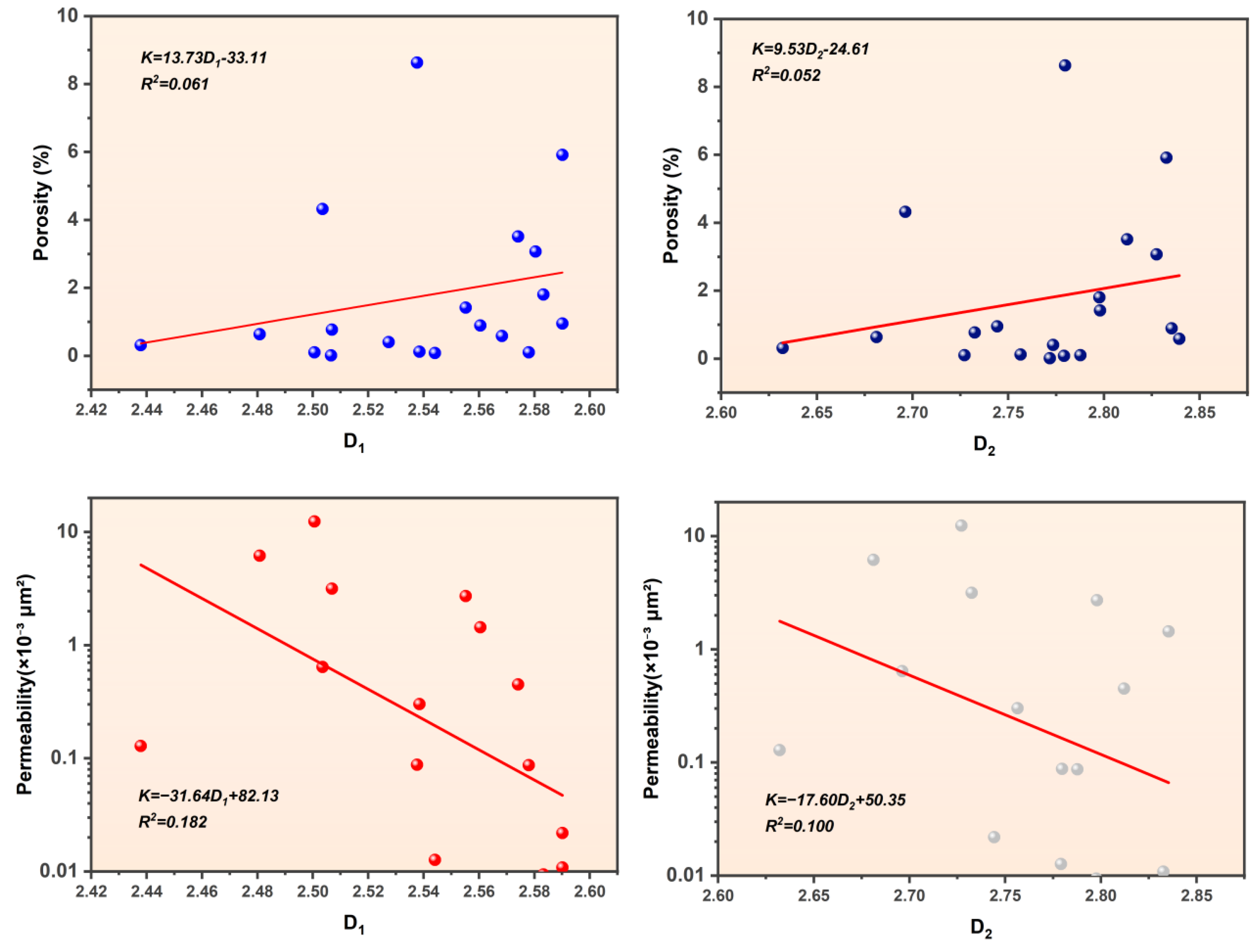
A clear correlation exists between fractal dimensions and reservoir physical properties (
Figure 7), reflecting the influence of pore–throat complexity on storage and flow behavior [
19]. The surface fractal dimension (D
1) shows a weak positive correlation with porosity (R
2 = 0.061), suggesting that enhanced surface roughness and micropore development may slightly increase the overall pore volume. Similarly, the structural fractal dimension (D
2) exhibits a minor positive relationship with porosity (R
2 = 0.052), indicating that pore–throat complexity tends to increase slightly with porosity growth, although the overall effect remains limited.
In contrast, both D
1 and D
2 show a more pronounced negative correlation with permeability. D
1 is moderately negatively correlated (R
2 = 0.182), while D
2 also decreases with increasing permeability (R
2 = 0.100) [
20]. This implies that as the pore–throat system becomes more intricate and the surface roughness increases, the fluid pathways become tortuous and less connected, leading to a marked decline in flow capacity. Overall, D
1 primarily reflects the surface roughness and micropore abundance, whereas D
2 characterizes the structural complexity and connectivity of the pore–throat network. Their inverse relationship with permeability reveals the intrinsic trend of increasing pore–throat complexity and decreasing flow efficiency during the reservoir compaction and densification process.
From the perspective of lithofacies characteristics, shale-type lithofacies (A–C) generally exhibit relatively high surface fractal dimensions (D1 = 2.51–2.57) and structural fractal dimensions (D2 = 2.73–2.81), corresponding to low porosity (0.4–3.5%, occasionally higher) and very low permeability (<0.05 × 10⁻³ μm2). This indicates that their pore systems are highly complex, with fine throats and poor connectivity. In contrast, siltstone and carbonate lithofacies (F–G) show lower D2 values (2.69–2.78) but significantly higher porosity and permeability, suggesting that their pore–throat networks are more uniform and better connected, resulting in superior reservoir quality.
7.2. Relationship Between Fractal Dimensions and Mercury-Injection Parameters
To further investigate the influence of pore–throat structural complexity on mercury-injection behavior, correlations were established between the surface fractal dimension (D
1) and structural fractal dimension (D
2) and the mercury-injection parameters [
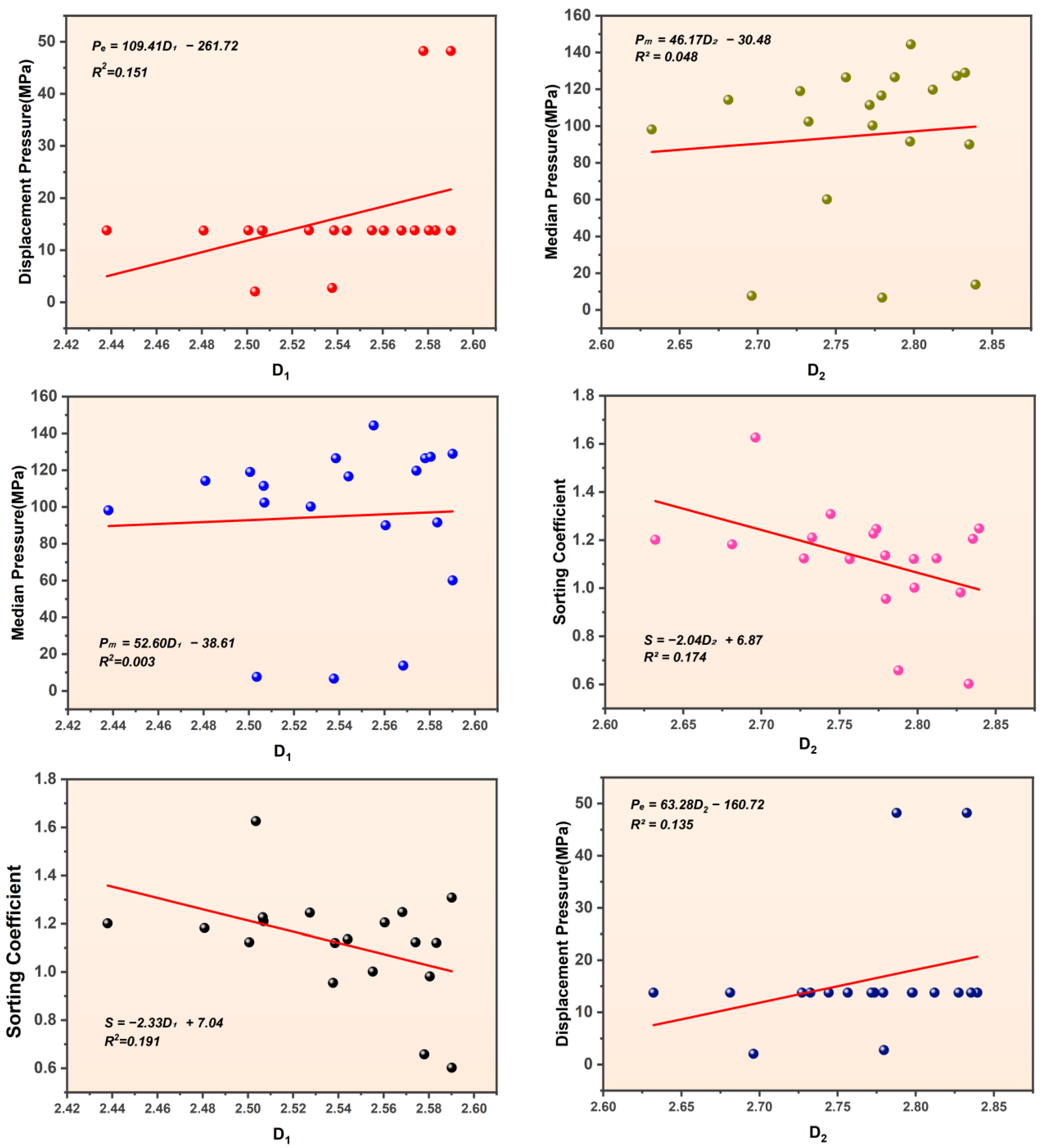
21], including displacement pressure (Pₑ), median pressure (Pₘ), and sorting coefficient (S) (
Figure 8). The results reveal a consistent relationship between the fractal dimensions and mercury-injection parameters, although distinct response patterns are observed among different lithofacies types.
From the overall trend, the surface fractal dimension (D
1) shows a positive correlation with displacement pressure (Pₑ = 109.41 D
1 − 261.72, R
2 = 0.151), indicating that a rougher pore surface and more developed micropores require higher initial pressure for mercury entry [
22], corresponding to smaller throat radii. This feature is particularly pronounced in shale lithofacies (Types A–C), where Pₑ values commonly exceed 13 MPa, suggesting fine pore throats and poor connectivity. In contrast, siltstone and carbonate lithofacies (Types F–G) exhibit lower D
1 values (≈2.53–2.56) and markedly lower displacement pressures (≈2–7 MPa), reflecting coarser throats and lower resistance to fluid invasion. The correlation between D
1 and median pressure (Pₘ = 52.60 D
1 − 38.61, R
2 = 0.003) is weak, implying that the distribution of dominant pore sizes is more strongly controlled by compaction and cementation rather than surface roughness. The sorting coefficient (S) displays a negative correlation with D
1 (S = −2.33 D
1 + 7.04, R
2 = 0.191), suggesting that as surface complexity increases, pore–throat size distribution becomes more concentrated, indicating enhanced internal convergence within high-fractal shale systems.
The structural fractal dimension (D
2) exhibits a clearer relationship with mercury-injection parameters, reflecting the geometric evolution of pore–throat systems [
23]. D
2 correlates positively with displacement pressure (Pₑ = 63.28 D
2 − 160.72, R
2 = 0.135), indicating that greater structural complexity and finer throats lead to higher capillary entry pressures and increased reservoir compactness. In organic-rich shales (Types A and B), where D
2 values reach 2.78–2.81, the corresponding high Pₑ and low permeability reflect well-developed micro–nano pores with constricted throats. In contrast, carbonate lithofacies (F–G) exhibit lower D
2 (2.69–2.75) and lower Pₑ, signifying coarser pore networks and superior reservoir quality. Although the correlation between D
2 and median pressure is weak (Pₘ = 46.17 D
2 − 30.48, R
2 = 0.048), the general upward trend implies that increased pore–throat complexity results in smaller dominant pores and stronger capillary forces. The sorting coefficient is negatively correlated with D
2 (S = −2.04 D
2 + 6.87, R
2 = 0.174), indicating that with increasing structural complexity, the internal pore–throat size distribution tends to become more uniform—a characteristic typical of compact mudstones and fine-grained siltstones.
Both D
1 and D
2 increase systematically as the pore–throat system evolves from coarse and simple to fine and complex [
24]. Their positive correlations with Pₑ and Pₘ reflect progressive compaction and reduced pore size, whereas their negative correlations with S reveal an internal trend toward geometrical homogenization during diagenetic evolution. The variations among lithofacies further demonstrate that fractal dimensions can not only quantify pore–throat geometric complexity but also serve as effective indicators for reservoir classification and pore connectivity prediction.
7.3. Relationship Between Fractal Dimensions and TOC Content
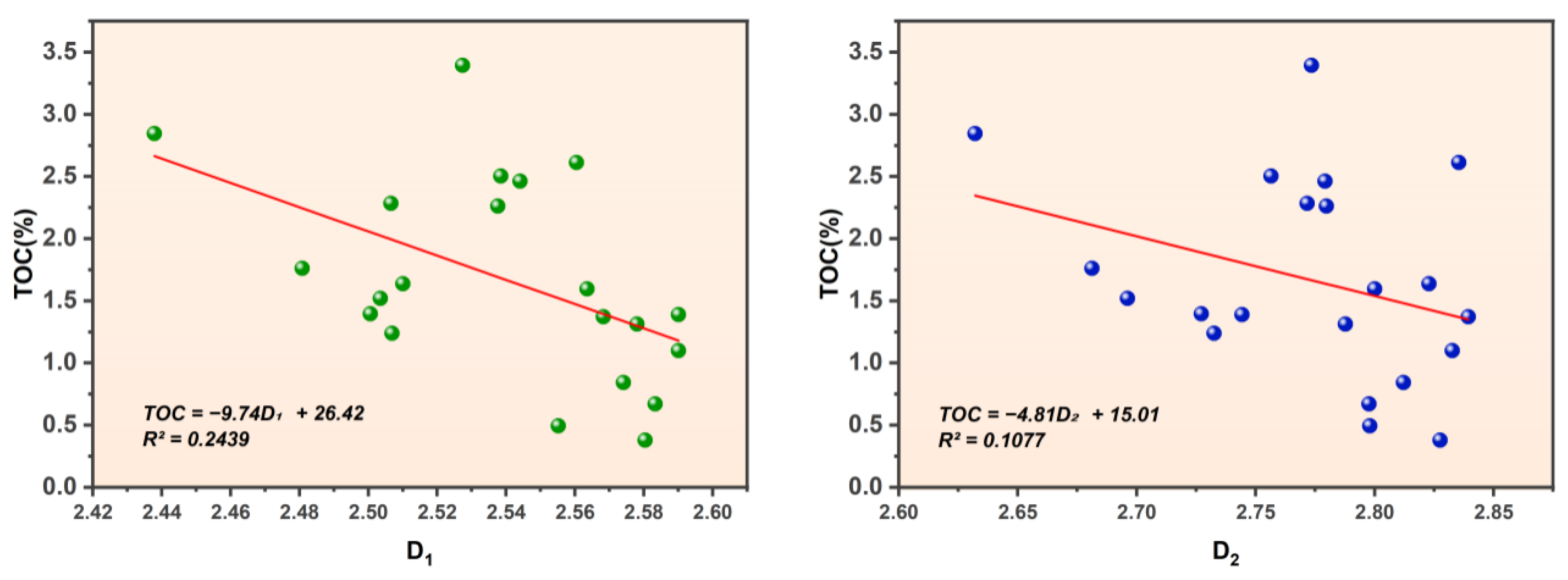
To analyze the influence of organic-matter abundance on pore–throat fractal characteristics, correlations between total organic carbon (TOC) content and both the surface fractal dimension (D
1) and structural fractal dimension (D
2) were examined (
Figure 9). The results show that TOC content exhibits a negative correlation with both fractal dimensions, indicating that as the organic-matter abundance increases, the overall complexity of the pore–throat system tends to decrease. This suggests that organic-rich intervals are dominated by relatively smooth pore surfaces and more uniform pore–throat geometries, likely due to organic-matter infilling or compaction effects that reduce the structural irregularity of the pore network.
From the overall trend, the relationship between TOC and D1 can be expressed as TOC = −9.74D1 + 26.42 (R2 = 0.2439), showing a clear negative correlation. The surface fractal dimension (D1) primarily reflects the roughness of the pore surface and the development of micropores. Samples with higher TOC values generally contain abundant organic-matter pores; however, these pores are mostly isolated or closed, with relatively smooth pore walls, resulting in reduced surface roughness and consequently lower D1 values. This phenomenon is particularly evident in shale lithofacies (Types A and B), where TOC contents commonly range between 1.5% and 3.0%, and D1 values are relatively low (≈2.50–2.56), indicating an inverse relationship between organic-matter abundance and surface fractal complexity.
The relationship between TOC and the structural fractal dimension (D
2) is described by TOC = −4.81D
2 + 15.01 (R
2 = 0.1077), suggesting a weak negative correlation [
25]. D
2 mainly characterizes the geometric configuration and connectivity of the pore–throat network. With increasing TOC, the proportion of organic-matter pores increases, but these nanopores are typically isolated or formed as secondary shrinkage cracks, which are poorly connected and contribute little to flow pathways. As a result, overall connectivity within the pore–throat system decreases, leading to slightly lower D
2 values. In contrast, carbonate lithofacies (Types F and G) exhibit lower TOC contents but higher D
2 values (≈2.75–2.80), reflecting well-developed, interconnected pore–throat networks dominated by inorganic pores.
In summary, increasing TOC content tends to promote pore refinement and closure, resulting in reduced surface and structural fractal dimensions [
26]. This indicates that organic-rich samples are characterized by simplified pore–throat geometries and diminished connectivity within the reservoir system.
7.4. Lithofacies Differences and Fractal Response Mechanisms
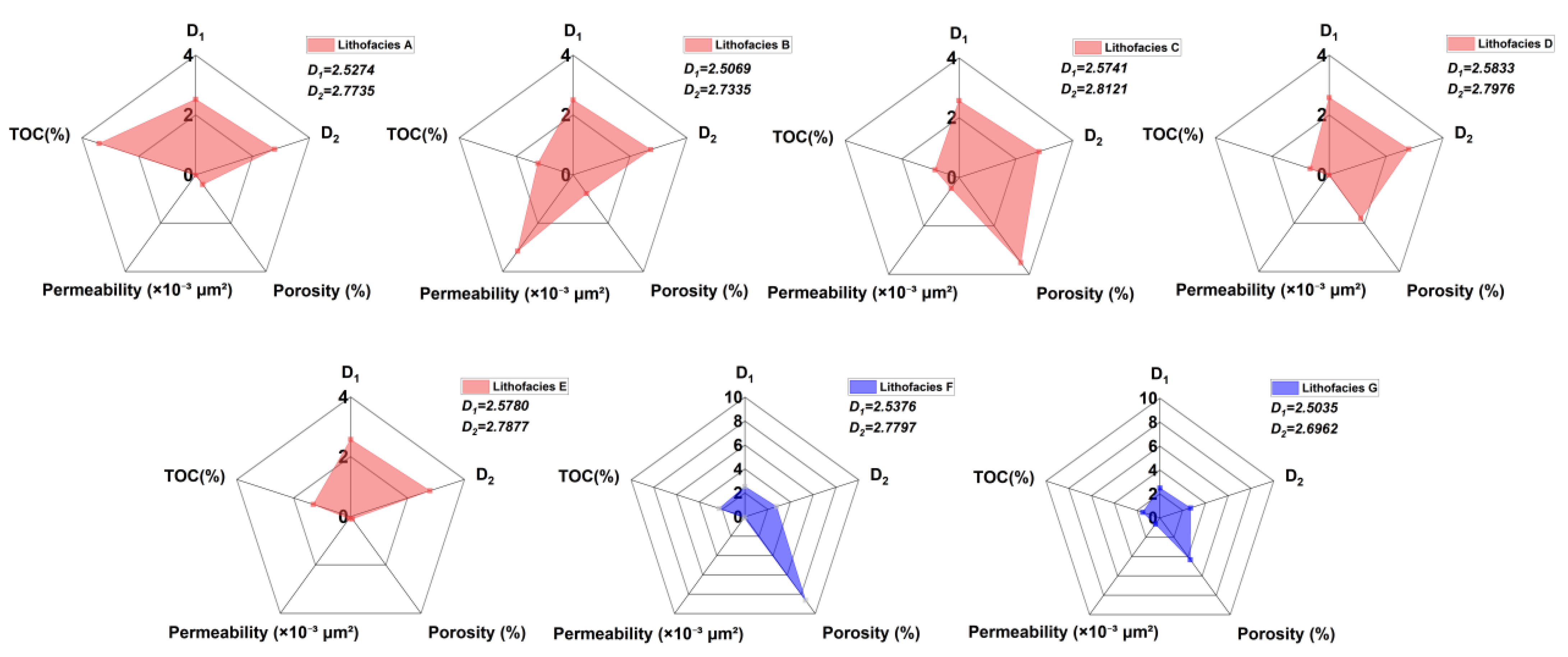
An integrated comparison of fractal dimensions and petrophysical parameters among different lithofacies types (A–G) reveals that fractal characteristics exhibit a pronounced response to lithofacies variations (
Figure 10). Shale lithofacies (Types A–C) are characterized by relatively high surface fractal dimensions D
1 = 2.51–2.58 and structural fractal dimensions D
2 = 2.73–2.81, corresponding to low porosity and permeability (0.4–0.8% for Types A–B; although Type C shows a porosity of ~3.5%, its permeability remains low) and high displacement and median pressures (Pₑ ≈ 13–14 MPa, Pₘ ≈ 100–120 MPa). These characteristics indicate that the shale system has undergone significant compaction and organic-matter infilling, producing rough pore walls [
27], abundant micropores, and narrow throats. Consequently, a high-fractal, poorly connected pore–throat network with strong capillary forces has developed.
In contrast, the siltstone and carbonate lithofacies (D–G) exhibit opposite fractal and petrophysical characteristics. The bioclastic limestone (G) and dolomite (F) show relatively low structural fractal dimensions (D
2 ≈ 2.70 ± 0.05), accompanied by markedly higher porosity and permeability (F: 8.63%, G: 4.32%; permeability on the order of 10
−1–10
0 × 10
−3 μm
2), as well as significantly lower displacement and median pressures (Pₑ ≈ 2–8 MPa, Pₘ ≈ 7–13 MPa). These features indicate that inorganic dissolution pores, intergranular/intercrystalline pores, and microfractures jointly construct a more regular and well-connected pore–throat network [
28]. Although the siltstone facies (E) does not display extreme D
1 or D
2 values, intense cementation and compaction result in the highest displacement pressure (48 MPa), revealing a local “inverse modulation” effect in which sealed throats disrupt the regular fractal–petrophysical relationship.
Overall, the following trends can be summarized:
D1–porosity/permeability relationship: With increasing D1, both porosity and permeability generally decrease, implying that greater surface roughness and micropore abundance weaken effective flow pathways.
D2–mercury intrusion relationship: D2 correlates positively with both displacement and median pressures, suggesting that structural complexity and throat refinement enhance capillary forces.
D2–TOC relationship: TOC content is typically negatively correlated with D2, indicating that nanopores within organic-rich samples are mostly isolated or closed, thereby reducing the overall complexity and connectivity of the pore–throat network.
In summary, the progression from shale (high D, low porosity/permeability, high Pₑ/Pₘ) → siltstone (moderate D, transitional parameters) → carbonate (low D, high porosity/permeability, low Pₑ/Pₘ) delineates a geometric evolution pathway from compaction-induced densification to reconstructive porosity development. The fractal dimensions thus serve not only as effective indicators for differentiating lithofacies-controlled reservoir types but also as quantitative descriptors of the connectivity and structural evolution of multiscale pore–throat systems.
8. Conclusions
Comprehensive analysis indicates that the Qingshankou Formation shale reservoir developed pronounced pore–throat heterogeneity and a multiscale pore system under the combined effects of intense compaction and organic matter thermal evolution. By integrating lithofacies classification with high-pressure mercury intrusion, low-temperature nitrogen adsorption, and the FHH fractal model, this study reveals the fractal characteristics of pore–throat systems and their intrinsic relationships with organic matter abundance and reservoir properties. Shale lithofacies (A–C) exhibit higher surface (D1) and structural (D2) fractal dimensions, indicating rough pore surfaces, complex throat geometries, and poor connectivity. In contrast, carbonate and clastic lithofacies (D–G) show lower fractal dimensions but higher porosity and permeability, implying that dissolution, cementation, and bioclastic processes collectively form more regular and well-connected pore–throat networks. These trends define a reservoir evolution pathway of shale densification → siltstone transition → carbonate reconstructive porosity enhancement.
The introduction of fractal theory enables a quantitative characterization of shale-reservoir heterogeneity. The results demonstrate that fractal dimensions are highly sensitive indicators of pore–throat structural variations and their influence on reservoir properties. Specifically, D1 exhibits a strong negative correlation with permeability, indicating that increased pore-surface roughness and the development of micropores tend to impair effective connectivity. In contrast, D2 shows positive correlations with displacement pressure and median pressure, suggesting that the refinement and geometric complexity of pore–throat systems enhance capillary forces and promote fluid retention. Meanwhile, the negative relationships observed between TOC and both D1 and D2 imply that although organic-rich shales contain abundant organic-hosted pores, many of these pores remain isolated and poorly connected, contributing little to macroscopic flow capacity.
It is important to emphasize that sensitivity tests—performed by varying the fitting interval and resampling the data—show that the intra-sample variability of D1 and D2 is significantly smaller than the systematic differences observed among the lithofacies. This confirms the robustness and reliability of the fractal parameters used for inter-facies comparison. Taken together, the results indicate that fractal attributes should be regarded as key descriptors for diagnosing reservoir densification and evaluating the effectiveness of pore–throat connectivity, rather than merely supplementary indicators of pore volume.
From a broader petroleum-geological perspective, the fractal response mechanisms identified in this study exhibit potential applicability to other shale and tight reservoirs. Previous investigations across multiple basins—including the marine Longmaxi shale [
29,
30], the Eagle Ford [
31] and Bakken systems in North America [
32], and lacustrine shales in the Ordos Basin [
33]—have consistently reported similar couplings between the fractal dimensions D
1 and D
2 and key pore–throat evolutionary processes such as pore–throat refinement, enhanced compaction, and deterioration of connectivity. Despite variations in lithologic assemblages and diagenetic pathways among different regions, the increase in pore–throat geometric complexity accompanying reservoir densification appears to be a broadly comparable fractal phenomenon.
Accordingly, the “fractal–pore–throat structure–reservoir performance” coupling framework proposed in this work may serve as a methodological reference for quantitative evaluation of other unconventional reservoirs. Nevertheless, its applicability remains conditional upon specific lithologic contexts and diagenetic evolution, and further validation across diverse datasets is required before broad generalization.