
Article

Sedimentary Paleo-Environment and Reservoir Heterogeneity of Shale Revealed by Fractal Analysis in the Inter-Platform Basin: A Case Study of Permian Shale from Outcrop of Nanpanjiang Basin

1
School of Petroleum Engineering, Chongqing University of Science and Technology, Chongqing 401331, China
2
National University Science Park, Southwest Petroleum University, Chengdu 610500, China
3
State Key Laboratory of Oil and Gas Reservoir Geology and Exploitation, Southwest Petroleum University, Chengdu 610059, China
4
Petroleum Industry Press Co., Ltd., Beijing 100083, China
*
Authors to whom correspondence should be addressed.
Fractal Fract. 2025, 9(12), 795; https://doi.org/10.3390/fractalfract9120795
Submission received: 8 September 2025 / Revised: 24 November 2025 / Accepted: 28 November 2025 / Published: 4 December 2025

Abstract

The Upper Permian marine shale of the inter-platform basin in the Nanpanjiang Basin are rich in organic matter, widely distributed, and relatively thick, indicating abundant resource potential for hydrocarbon exploration. To clarify the sedimentary condition and the variability of reservoir properties, the paleo-environment was reconstructed by using geochemical, mineralogical, rock-property, and pore-structure data. Building on a lithofacies classification, the development patterns of different shale lithofacies were revealed. Reservoir characteristics among lithofacies were compared using scanning electron microscopy (SEM), nuclear magnetic resonance (NMR), and low-temperature Nuclear Magnetic Resonance Cryoporometry (NMRC) experiments. A fractal analysis was performed based on NMR and NMRC data to quantify pore-scale heterogeneity, calculate fractal dimensions (D1, D2, and Dc), and evaluate the complexity of pore systems across lithofacies. Correlation analysis and redundancy analysis were applied to further explore the controlling factors of reservoir heterogeneity. The results showed that organic-rich shale in the Permian Linghao Formation occurred mainly in the 1st Member, with average total organic carbon (TOC) content of 2.57%, and the lower part of the 3rd Member (average TOC content 2.88%). In the 1st Member, high-carbon shale was deposited under humid conditions with intense weathering, abundant fine-grained clastic input from basin margins, strongly reducing (anoxic) bottom waters, vigorous phosphorus recycling, and moderate to low primary productivity. Using TOC and mineral composition, seven shale lithofacies were identified in the Linghao Formation, and their development patterns were established based on depositional paleo-environment characteristics and evolution. In the 1st Member, organic-rich shale was dominated by mixed lithofacies with moderate to high TOC. The paleo-environment exerted a primary control on reservoir properties, gas content, pore structure, and heterogeneity. The high-carbon lithofacies had the most favorable rock properties—higher porosity, greater pore volume, and higher gas content—and contained a larger proportion of well-developed organic pores. Fractal analysis revealed that seepage pores exhibited greater structural complexity than adsorption-related pores, with the high-carbon lithofacies showing the highest overall fractal dimensions and thus the strongest heterogeneity. Across the formation, higher clay content and TOC were the primary drivers of increased pore-scale heterogeneity, whereas greater feldspar and quartz contents tended to diminish it. Carbonates exerted a minor effect. Heterogeneity in adsorption pores exerted the strongest influence on differences among lithofacies. These results highlighted the utility of fractal analysis in quantitatively linking shale mineralogy and organic content to multiscale heterogeneity in inter-platform basin settings.

1. Introduction

Over the past decade, with advances in shale exploration and development in North America, China, and North Africa, shale oil and gas have emerged as major unconventional energy sources [1,2]. In Southern China, industrial-scale shale gas production from organic-rich Ordovician–Silurian shales has reached about 20 billion cubic meters annually [3]. The Nanpanjiang Basin is one of the most oil- and gas-rich basins in this region, containing thick, widespread Permian marine shales rich in organic matter [4,5]. Several studies have demonstrated their significant potential for hydrocarbon exploration [4,5,6,7]. However, exploration is still at an early stage, and knowledge gaps in geological characteristics, pore-scale structure, and heterogeneity continue to hinder progress.
Paleo-depositional environments are commonly reconstructed using elemental geochemical proxies and are widely applied to evaluate organic-matter enrichment conditions and predict the distribution of organic-rich shales [8,9]. In addition, variations in depositional environments can also control differences in mineral composition and organic-matter sources [10], thereby indirectly affecting reservoir pore structure and heterogeneity [11,12]. Marine shale usually contains more brittle minerals and exhibits better pore connectivity than lacustrine shale [13,14]. The Permian shale of the Nanpanjiang Basin meet the main conditions for shale gas accumulation, including high TOC, high maturity, and moderate burial depth [15]. However, variations in depositional settings lead to uneven distribution of organic-rich shale and marked variability in reservoir properties [5,6,7,15]. Based on geochemical analyses, Permian shale contain inputs of land-derived organic matter; sediment influx promoted the accumulation of organic matter, whereas paleo-productivity was not the primary control on total organic carbon (TOC) [7,16]. For the Linghao Formation, however, the link between sedimentary environment and reservoir development has not been systematically evaluated.
Conventional pore-structure characterization techniques mainly focus on describing pore-size distributions and are still limited in quantitatively capturing the internal heterogeneity of shale reservoirs [17,18]. By developing corresponding fractal models based on these methods, the heterogeneity and complexity of shale pore systems can be effectively quantified [19,20]. Previous studies have demonstrated that fractal theory has been widely applied to characterize pore structures in unconventional reservoirs [21] and to differentiate reservoir variations across distinct sedimentary environments [22]. It has also been employed to investigate the origins of pore-system complexity and heterogeneity within shale reservoirs [23,24]. He et al. [20] reported that higher fractal dimensions correspond to smaller pore sizes and poorer reservoir quality, reflecting increased structural complexity. Wang et al. [25] proposed a fractal quality index integrating porosity and connectivity to classify reservoir sweet spots, while Zhuang et al. [26] and Ciazela [27] further extended fractal applications to diagenetic evolution and exploration geophysics, respectively. Recent studies have also revealed close relationships between fractal dimensions, TOC, and mineral composition. For example, Guan et al. [17] reported that the pore structure of deep shales is primarily influenced by TOC, quartz, and clay mineral contents. Li et al. [23] proposed that siliceous shale with higher TOC and brittle mineral content exhibit larger fractal dimensions, and Zhang et al. [24] showed that TOC and clay content strongly influence shale pore fractal characteristics. These findings provided a solid foundation for the present study, which applied fractal analysis to link pore-scale heterogeneity with depositional mineral and organic variations in the Linghao shale.
Although fractal analysis has been widely applied to characterize pore systems and reservoir quality in shale, its integration with depositional models and compositional controls remains limited. Previous studies have seldom combined fractal characterization with paleo-environmental reconstruction to systematically assess shale-reservoir heterogeneity. To address this gap, this study employed fractal analysis to quantitatively link micro-scale heterogeneity with lithology, pore structure, and gas content and integrates fractal dimensions with TOC, mineral composition, and reservoir properties to evaluate the key controls on heterogeneity. Focusing on the Permian Linghao Formation shale in the Nanpanjiang Basin, the sedimentary condition—including sediment supply, paleo-climate, water salinity, productivity, and oxygenation—was reconstructed by combining sedimentologic observations with high-resolution geochemical data. Lithofacies were characterized and compared through X-ray diffraction (XRD), reservoir property measurements, field-emission scanning electron microscopy (FE-SEM), and both low-field Nuclear Magnetic Resonance (NMR) and Nuclear Magnetic Resonance Cryoporometry (NMRC) experiments. Fractal modeling of the NMR data was then used to quantify pore-scale heterogeneity across lithofacies, while correlation and redundancy analyses further clarified the influences of depositional and compositional factors. Overall, this study elucidated the controlling mechanisms of pore structure and fractal heterogeneity, providing a theoretical foundation for shale gas exploration in the Permian Linghao Formation.

2. Geological Setting

The Nanpanjiang Basin covers approximately 380,000 km2 and lies along the southwestern margin of the Upper Yangtze Craton [5,28]. Within the study area, the Linghao Formation shale was deposited in the Late Permian between isolated platforms in a deep-water setting (Figure 1a). The Linghao Formation is coeval with the Longtan, Dalong, and Changxing formations of the Sichuan Basin, but it records different depositional environments. After deposition of the Middle Permian Maokou Formation, regional extension uplifted the landward western margin into a paleo-land, while two episodes of rifting in the east produced a patchwork of platforms and intervening depressions [5]. From west to east, environments grade from paleo-uplift and marshes through tidal flats and platform interiors to platform-margin slopes, shelves, isolated platforms, and, finally, platform basins (Figure 1b). The Linghao Formation has conformable contacts with the underlying Maokou limestone or marl and the overlying Luolou Formation. It can be subdivided into three members (Figure 1b). The 1st Member contains fossil-rich black shales at its base and top, with a middle part dominated by shale interbedded with Emeishan basalts. This member accumulated in a basin between carbonate platforms (inter-platform basin). The 2nd Member consists mainly of mudstone, micritic limestone, and silty mudstone, indicating a shelf setting. Water depth on the shelf was shallower than in the inter-platform basin. The 3rd Member again records an inter-platform basin; its lower part comprises horizontally laminated black shale [4,5]. The studied outcrop lies in the central Nanpanjiang Basin, where the Linghao Formation records shelf to deep-basin facies during deposition (Figure 1b).

3. Materials and Methods

This study analyzed 79 shale samples from the Linghao Formation in the Nanpanjiang Basin using a suite of methods, including TOC, mineralogy, bulk and trace element geochemistry, petrophysical testing, NMR, and NMRC. Major and trace elements were measured in 63 samples by Wavelength-dispersive X-ray fluorescence spectrometer XRF-1800 (Shimadzu Corporation, Kyoto, Japan) and inductively coupled plasma mass spectrometry (ICP–MS; Analytik Jena AG, Jena, Germany) to reconstruct paleo-environmental variations across stratigraphic intervals. Samples were digested in sealed vessels with hydrofluoric acid, evaporated on a hot plate, redissolved in nitric acid, diluted, and then analyzed by ICP-MS. The analytical uncertainty is approximately 5%. TOC and mineralogy were determined for 59 samples. TOC was measured with CS230 carbon/sulfur analyzer (LECO Corporation, St. Joseph, MI, USA) (precision ±0.5%). Mineral phases were identified by XRD using X-ray diffractometer (Panaco, Almelo, The Netherlands) on powders finer than 200 mesh. To characterize pore structure and rock properties across depositional settings, 18 samples were examined by FE-SEM, 40 samples were tested for porosity and permeability, 13 samples underwent LF-NMR, and 5 samples were analyzed by NMRC. For high-resolution SEM imaging, samples were mechanically polished to 20 × 20 × 10 mm and sputter-coated with gold. Imaging was performed on an FEI Quanta 650 FEG scanning electron microscope (FEI Company, Hillsboro, OR, USA) with a resolution of up to 0.8 nm. Porosity and permeability measurements followed the GB/T 29172-2012 [29] core-analysis standard, using a QK-98 gas porosimeter and GDS-90F gas permeameter (China Coal Technology & Engineering Group, Beijing, China).
LF-NMR and NMRC measurements were obtained with NMRC12-010V NMR analyzer (NIUMAG Company, Suzhou, China). NMR measurements were performed using a system composed of a magnet, probe, signal control, and temperature control. The magnetic field strength was 0.28–0.31 T with a resonance frequency of 11.92–13.20 MHz and homogeneity ≤ 1 ppm. Stability tests showed < 3% relative deviation for the first-echo signal over 10 repetitions. T2 relaxation measurements used an echo spacing ≤ 0.1 ms, recovery time ≥ 3000 ms, and ≥4000 echoes. NMR measures the relaxation behavior of hydrogen nuclei in pore fluids, providing information on pore size distribution and fluid mobility. Before T2 relaxation measurements, core plugs were dried in a vacuum oven at 373.15 K for 24 h, evacuated, saturated with deionized water for 48 h, and then placed in the instrument coil. The T2 cutoff value was determined using a progressively accelerated centrifugation experiment combined with continuous NMR T2 measurements. When the centrifugation reached 13,000 rpm, the peak of the NMR T2 spectrum essentially stabilized, and the corresponding T2 value at this point was taken as the cutoff value. NMRC combines NMR with controlled freeze–thaw experiments, enabling quantitative characterization of pore-size distributions, particularly in the nanoscale range. For NMRC, crushed samples (40–60 mesh) were dried, evacuated, saturated with deionized water, and analyzed following established NMRC procedures. The saturated rock samples in PTFE tubes were first cooled to −35 °C in the probe and then heated stepwise to 0 °C. At each temperature, after stabilizing for 20 min, the NMR T2 spectrum was recorded. Temperature points near the probe fluid’s melting point were set more densely (0.1 °C steps above −2 °C for deionized water) to resolve larger pores. The measured signal was temperature-corrected using an empirical parameter, converted to fluid volume, and then transformed into pore size via the KGT constant, which represents the Gibbs–Thomson constant (also called the melting point depression constant, unit: nm·K). This empirical parameter relates the freezing-point depression of a confined liquid to the pore diameter and can be calibrated using porous materials with known pore sizes [30]. Pore-size distribution was obtained through numerical differentiation. Detailed methods and principles for both NMR approaches are from [30,31].

4. Results

4.1. Sedimentary Environments Conditions

4.1.1. Paleo-Climate, Paleoweathering, and Paleosalinity

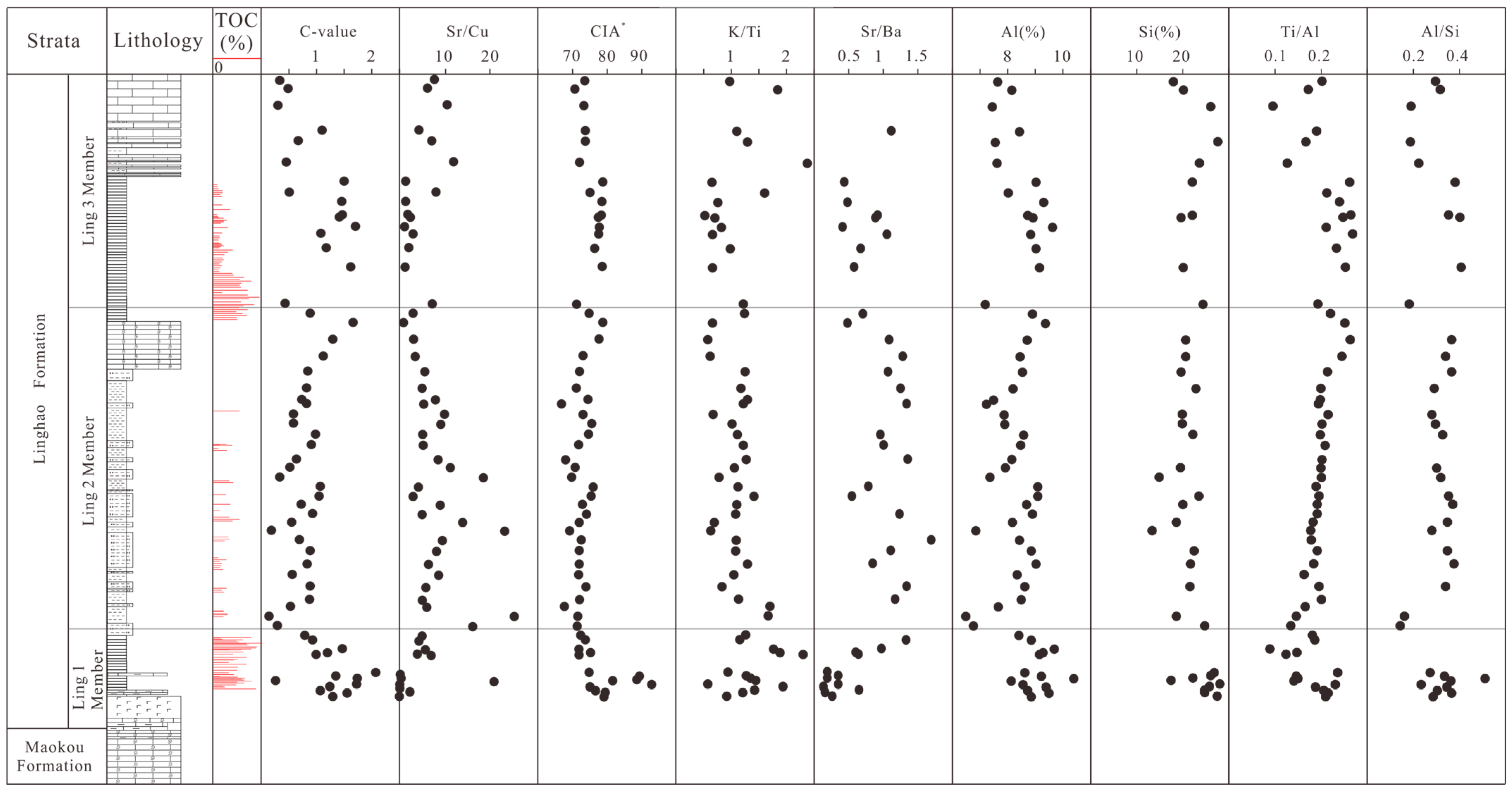
Based on how readily elements concentrate under wet versus dry conditions, the C-value is an effective paleo-climate indicator; its calculation follows [32]. Higher C-values generally signal wetter climates: >0.8 humid; 0.6–0.8 semi-humid; 0.4–0.6 intermediate between semi-arid and semi-humid; 0.2–0.4 semi-arid; and <0.2 arid. The shales in the 1st Member has the highest mean C-value (1.26), indicating the wettest climate during deposition. The 3rd Member is next (mean 0.92), whereas the 2nd Member is mainly semi-humid (mean 0.75). Figure 2 shows the same pattern and points to particularly wet conditions in the lower part of the 1st Member. As an additional indicator, the Sr/Cu ratio was applied in this study, given that Sr is preferentially enriched under dry conditions and Cu under wet conditions [33,34]. Ratios of 1.0–10.0 indicate warm, humid climates, whereas values >10 indicate hot, dry climates. The 1st Member has a mean Sr/Cu ratio of 3.81, with the lowest values in its lower part. The 2nd Member has the highest mean Sr/Cu ratio (8.35), clearly above the other intervals and consistent with a relatively drier climate (Figure 2). Taken together, both indicators consistently suggest the wettest conditions in the lower 1st Member, relatively dry conditions in the 2nd Member, and intermediate conditions in the 3rd Member.
The Chemical Index of Alteration (CIA) is widely used to assess the intensity of chemical weathering [34,35]. Low CIA values (50–65) indicate weak weathering under cold, arid climates; moderate values (65–85) reflect moderate weathering in warm, humid climates; and high values (85–100) indicate strong weathering in hot, humid climates. In our data, the lower part of Interval 1 has the highest average CIA within the moderate range (65–85). CIA values in the 2nd and 3rd Member are similar (69–79), consistent with warm, humid conditions. Overall, the lower 1st Member represents the warmest, wettest phase; conditions then become drier through the 2nd Member and return to more humid in the 3rd Member (Figure 2). The K/Ti ratio provides a complementary proxy for weathering: potassium is enriched in clay minerals, whereas titanium is concentrated in heavy minerals; higher K/Ti therefore implies stronger chemical weathering. The K/Ti profile peaks in the 1st Member, declines in the 2nd Member, and rises again in the 3rd Member, indicating maximum weathering in 1st Member and minimum in 2nd Member (Figure 2) [36]. Beyond weathering, the paleosalinity was estimated using the Sr/Ba ratio [37]. Values > 0.5 suggest saline waters; values between 0.2 and 0.5 indicate brackish conditions; and lower values point to freshwater deposition. In order to minimize the influence of carbonate rocks on Sr elements, this study only selected CaO content less than 10%. Average Sr/Ba is 0.48 in the 1st Member and 1.06 and 0.83 in the 2nd and 3rd Member, respectively, consistent with marine shale (Figure 2). The lower Sr/Ba in 1st Member indicates reduced salinity relative to the other intervals, likely due to dilution by gravity-flow deposits.

4.1.2. Input of Terrestrial Debris

Ti and Al are reliable proxies for detrital input. In sediments, Ti is mainly hosted by heavy minerals and clays, whereas Al is held by clays, feldspar, and other aluminosilicates. Their concentrations in shale are therefore widely used to assess terrigenous contributions [38]. The bar chart indicates that the 1st Member has the highest Al content (8.08 wt%), followed by the 3rd Member (6.86 wt%), with the 2nd Member lowest (Figure 2). This pattern suggests the strongest terrigenous input during deposition of the 1st Member. Compared with North American shale composite (8.45 wt%) and Post-Archean Australian shale (9.4 wt%) [39], the Linghao Formation has lower Al overall, implying a smaller net terrigenous contribution. In marine settings, silica may derive from biogenic production, hydrothermal fluids, or terrigenous input. An Al-SiO2 cross-plot helps distinguish these sources because purely detrital Si and Al typically show a strong positive correlation. In our dataset, Si and Al do not covary (R2 = 0.08; Figure 2), indicating substantial non-terrigenous silica during deposition of the Linghao Formation. The Ti/Al ratio is an effective indicator of changes in detrital flux from non-aluminosilicate sources; higher Ti/Al generally reflects coarser particles and relatively higher sedimentation rates [40]. Ti shows a good correlation with Ti/Al (R2 = 0.64), suggesting a relatively stable terrigenous supply. The Al/Si ratio is a proxy for hydraulic sorting and grain size [41]. Ti/Al, Al/Si, and the C-Value show broadly similar trends, indicating that increases in terrigenous input were linked to humid climate and gravity-flow activity and were accompanied by abundant fine-grained detritus (Figure 2).

4.1.3. Paleo-Redox Conditions

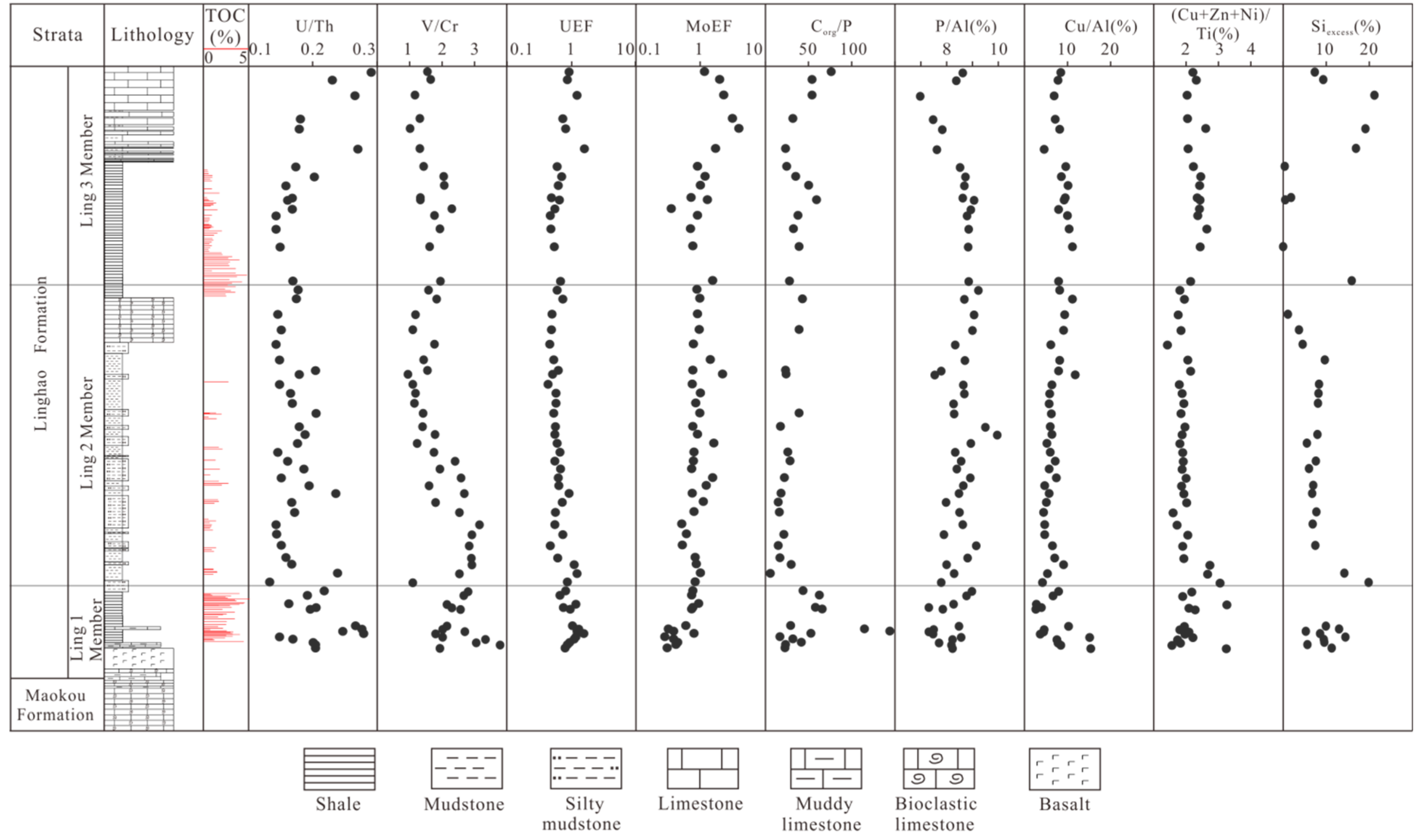
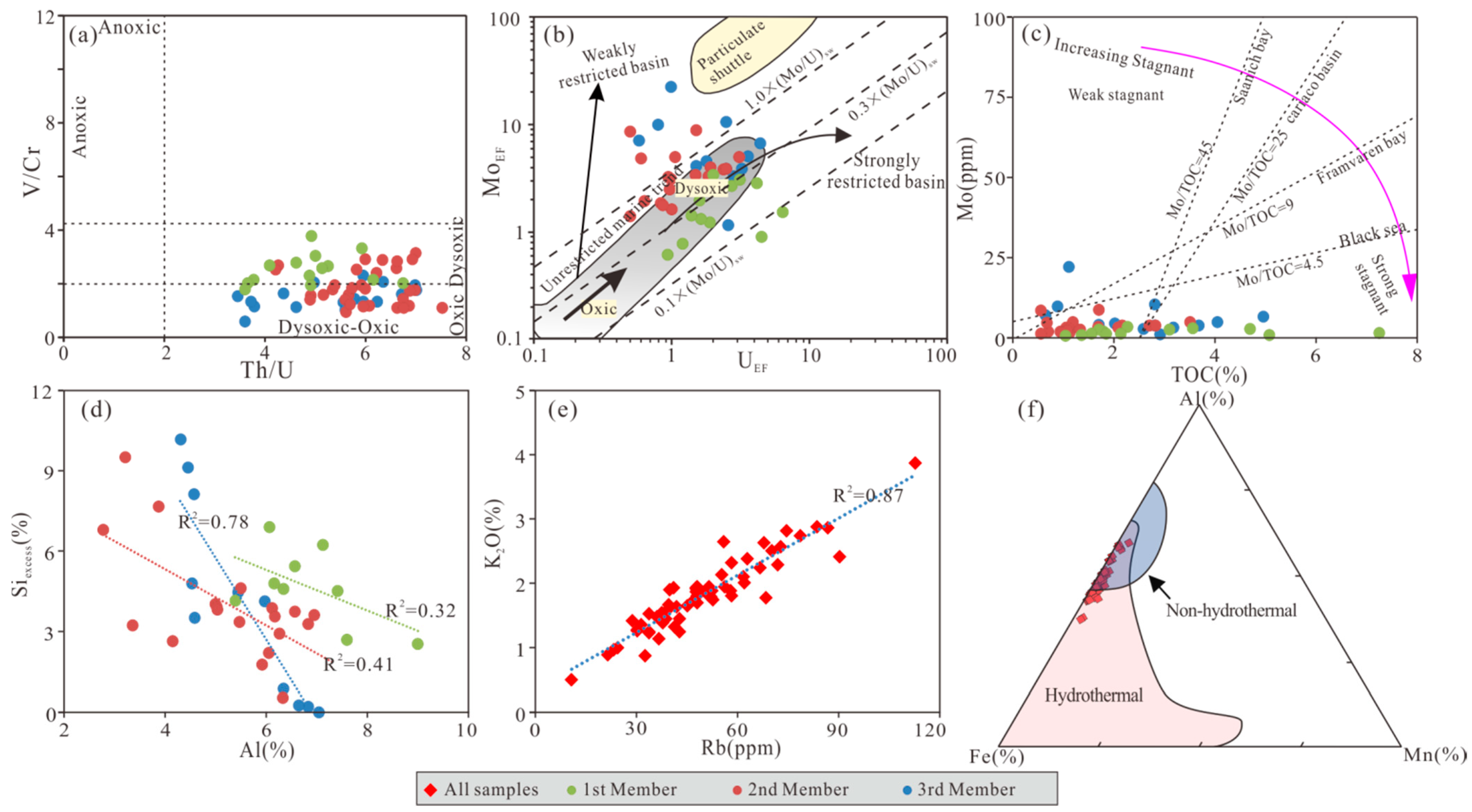
Redox-sensitive elements such as Mo, U, V, Cr, Ni, and Co are widely used to reconstruct bottom-water redox conditions [42]. These elements tend to be removed from solution and fixed in sediments under reducing conditions but remain more soluble under oxic conditions [42,43]. Accordingly, redox conditions were assessed using U/Th and V/Cr ratios, uranium and molybdenum enrichment factors (UEF, MoEF), and the ratio of organic carbon to total phosphorus (Corg/P) [43]. Bar charts show that both U/Th and V/Cr reach their highest values in the 1st Member, indicating the strongest reducing conditions there (Figure 3). Consistent with this, Figure 4a suggests that Linghao shale overall spans oxygenated to anoxic conditions, with the 1st Member being the least oxygenated. UEF values are mostly <1, implying that much of the Linghao shale was deposited under oxygenated waters (Figure 3). By contrast, the Mo-U covariation model indicates mainly anoxic conditions with intermittent reoxygenation [43] (Figure 4a). Taken together, these proxies point to fluctuating oxygen levels through time, with the 1st Member recording the most reducing bottom waters. The Corg/P (total organic carbon to total phosphorus) ratio is widely used to assess the intensity of phosphorus cycling and its relationship with organic matter accumulation. It is calculated by dividing the total organic carbon content by the total phosphorus content for each shale sample [42]. Under reducing conditions, phosphorus bound in organic matter and iron oxides is preferentially released back to the water column, whereas under oxic conditions it is retained more effectively in sediments; at the same time, organic matter is better preserved under reducing conditions [44]. As a result, Corg/P tends to be higher under anoxia. In modern sediments, Corg/P > 100 indicates strongly reducing conditions, 50–100 suggests anoxia, and <50 indicates oxic waters [44]. In the Linghao shale, Corg/P averages 54.04 in the 1st Member, 39.73 in the 3rd Member, and 22.06 in the 2nd Member, again identifying the 1st Member as the least oxygenated interval (Figure 4b).
Previous studies commonly used the Mo-TOC cross-plot to assess the degree of water-mass restriction [45]. The scatter plot shows that a subset of samples from the 1st and 3rd Members fall within the strongly restricted field (Figure 4c). In light of the depositional setting, the 1st Member formed during an extensional rift phase when continued uplift of surrounding paleo-uplifts and fault-controlled subsidence drove rapid relative sea-level rise and basin deepening. During deposition of the 2nd Member, sea level fell, weakening bottom-water oxygen depletion and reducing water-mass restriction. In the 3rd Member, renewed extensional activity triggered a rapid transgression, strengthening low-oxygen conditions and increasing restriction again. Notably, despite appreciable restriction, bulk TOC remains low, likely because the water column was only weakly oxygen-depleted overall. Such oxygenated to mildly oxygen-poor conditions inhibit the enrichment of molybdenum and organic matter, resulting in low Mo/TOC.

4.1.4. Paleo-Productivity

Phosphorus, copper, nickel, and zinc are essential nutrients for primary producers in depositional waters and serve as effective indicators of primary productivity [38,42,46]. To minimize the influence of terrigenous detritus, these elements were normalized to Al or Ti and used P/Al, Cu/Al, and (Cu + Ni + Zn)/Ti as paleo-productivity proxies. Upward through the Linghao Formation, P/Al first increases and then decreases. In the lower 1st Member, P/Al ranges from 1.06 to 2.06 (mean 1.63). The upper 1st Member has a mean P/Al of 1.80. The 2nd Member averages 2.07, and the 3rd Member averages 1.88. This pattern is broadly opposite to the trends of Cu/Al and (Cu + Ni + Zn)/Ti (Figure 3). In addition, the vertical variation in TOC does not track P/Al, but it aligns more closely with Cu/Al and (Cu + Ni + Zn)/Ti (Figure 3). This divergence likely reflects the control of redox conditions on phosphorus retention in sediments [45,47]. Under reducing conditions, phosphorus is released from sediments into the water column. Under oxic conditions, phosphorus is readily adsorbed onto iron oxides, which can produce intervals in the Linghao Formation with high TOC but low P/Al. Therefore, low P/Al values within high-TOC intervals in the Linghao Formation do not indicate low paleo-productivity; rather, they are consistent with elevated productivity.
Previous work on Ordovician–Silurian shales in the Sichuan Basin found that Siexcess is commonly biogenic and can be used to assess paleo-productivity [48]. However, in our samples Siexcess does not covary with TOC, indicating it is not primarily biogenic. Siexcess shows a negative correlation with Al (Figure 4d), suggesting it is also not chiefly derived from material eroded from land or from the alteration of clay minerals. The positive K2O-Rb correlation indicates that the excess silica is unrelated to magmatic inputs (Figure 4e). Moreover, the mean Rb and K2O contents of all samples are 49.99 and 1.83, both lower than the PAAS average shale benchmarks of 160 and 3.7. These patterns point to control by depositional and weathering processes rather than direct magmatic influence. Consistent with this, the Al-Fe-Mn plot places most samples in the hydrothermal field (Figure 4f), implying that hydrothermal activity contributed to the formation of excess silica [49].

4.2. Reservoir Characteristics

4.2.1. Shale Lithofacies Classification

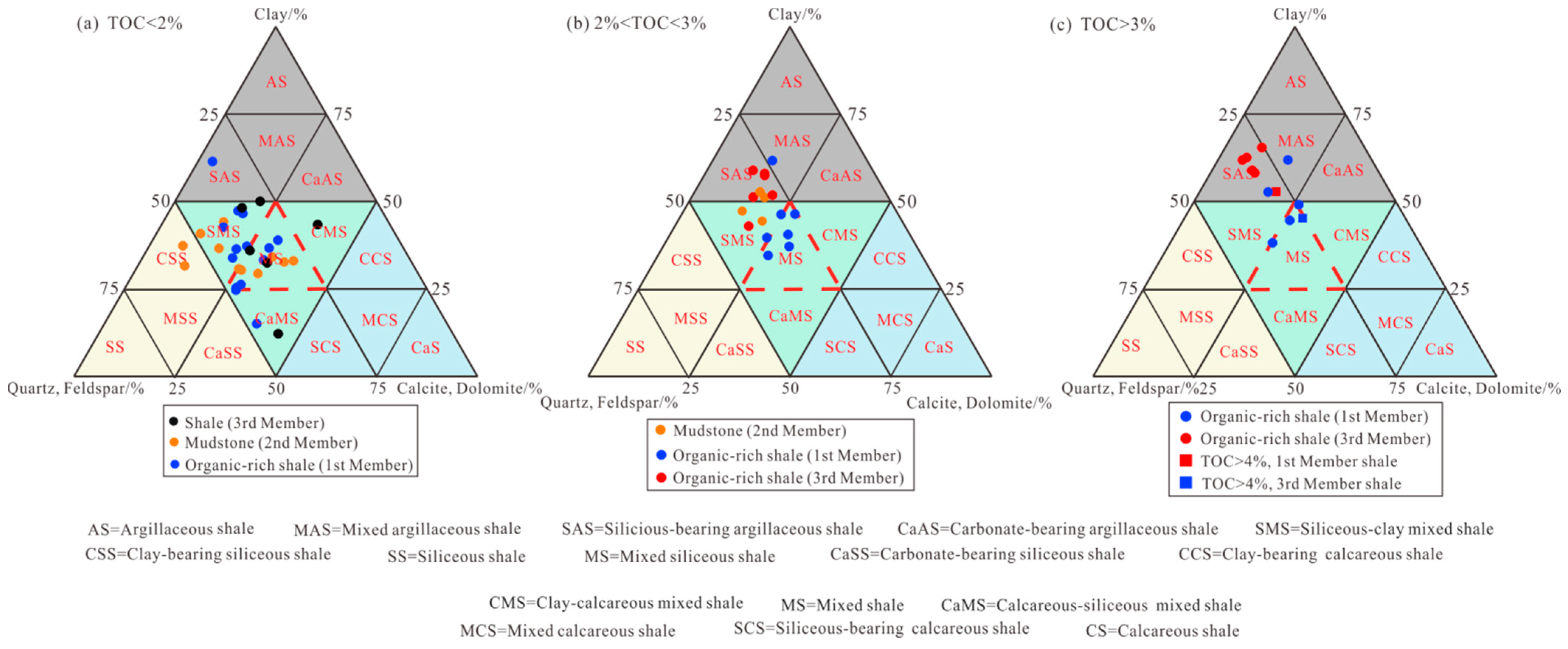
Considering the variations in the depositional environment and organic matter enrichment of the Linghao Formation shales, lithofacies classification in this study was based on total organic carbon (TOC) content and mineral composition. First, shales were categorized into three groups according to TOC content: high-carbon (>3%), medium-carbon (2–3%), and low-carbon (<2%) shales. Subsequently, using clay minerals, carbonates, and (quartz + feldspar) as the three end-members, lithofacies were defined according to mineral content boundaries of 50% and 25%. Based on these criteria, seven lithofacies types were identified within the Linghao Formation (Figure 5). The TOC and mineral composition for each lithofacies are summarized in Table 1.
Compared to the marine shale of the Silurian period [50], Linghao shale does not contain siliceous shale. Specifically, the total organic carbon (TOC) content of the 1st Member shale varies significantly, with organic-rich shale corresponding to medium-carbon and high-carbon mixed lithofacies (MM and HM). A small number of mudstone samples correspond to low-carbon mixed lithofacies (LM) and siliceous-clay mixed lithofacies (LSC). The lithology of the 2nd Member is similar to that of the 1st Member; however, due to lower TOC levels, it primarily corresponds to LM and LSC. A few samples fall within the medium-carbon silicious-bearing argillaceous lithofacies (MSA) and MM. The lower section of the 3rd Member contains organic-rich shale that is categorized as high-carbon silicious-bearing argillaceous lithofacies (HSA) and MSA, while the upper section consists of LM (Figure 5).

4.2.2. SEM Analysis

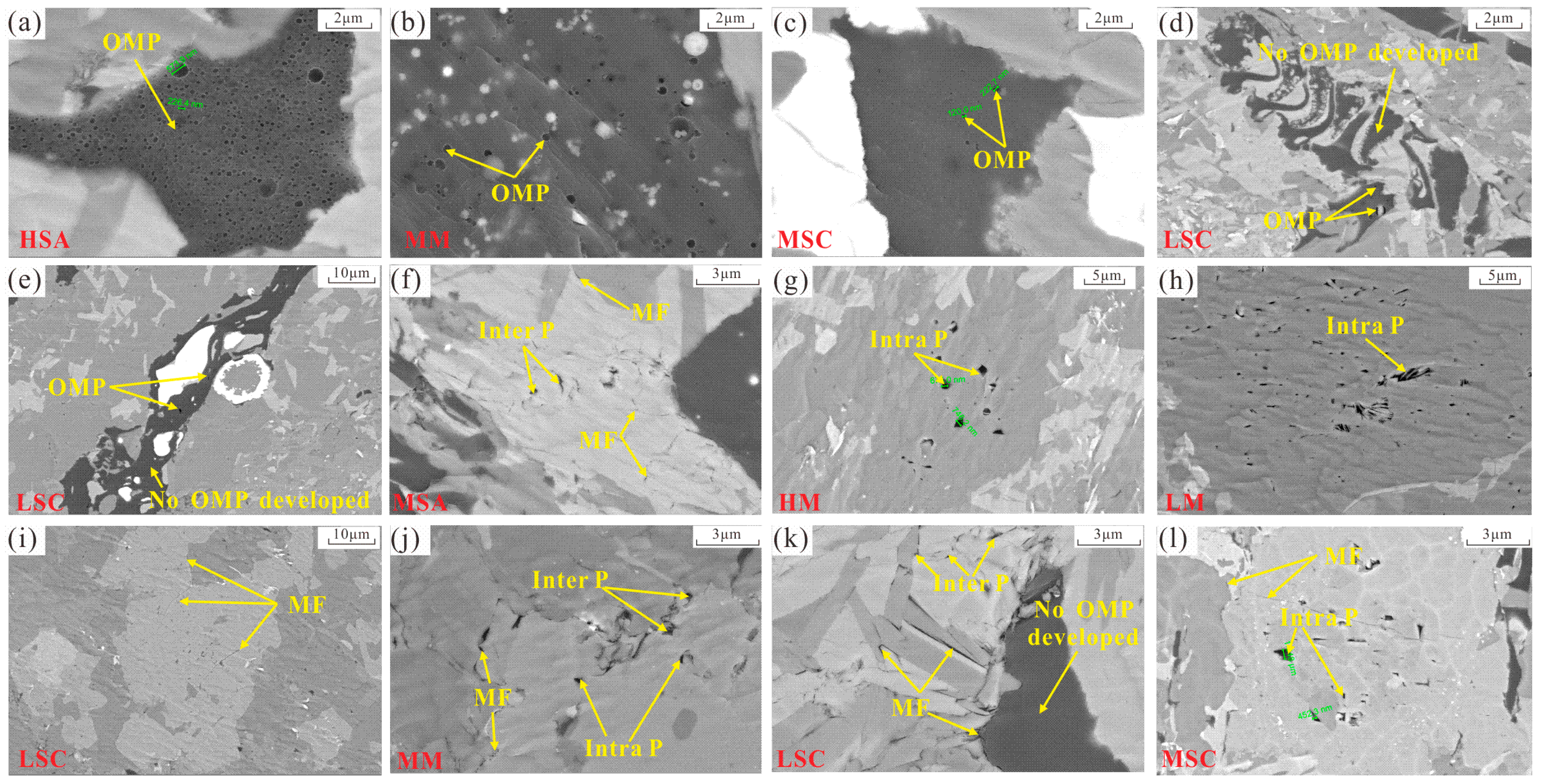
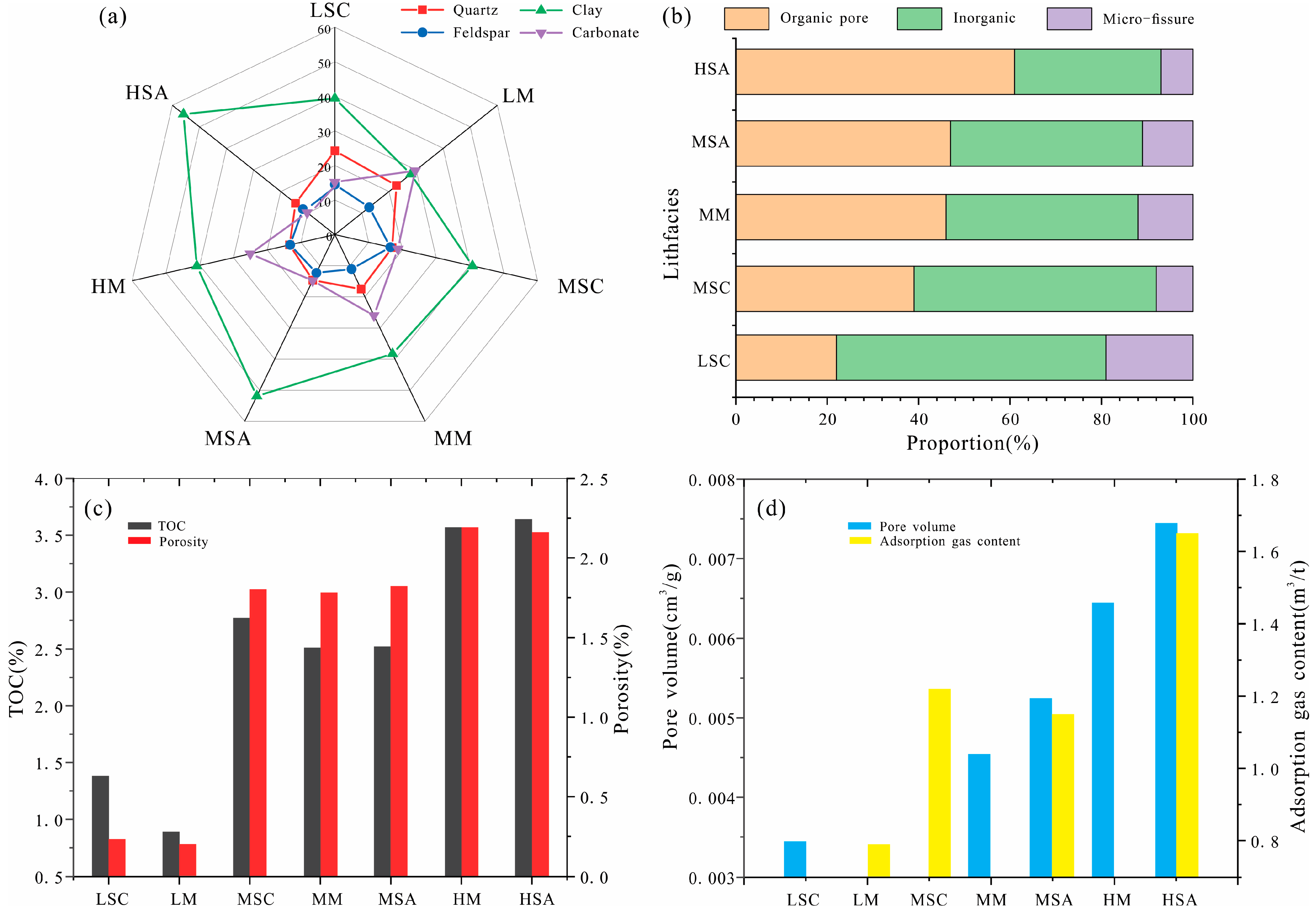
Based on previous classifications of shale pore [51], the pores in Linghao shale can be categorized into organic matter pores (OMP), intergranular pores (Inter P), intragranular pores (Intra P), and microfractures (MF). Utilizing Image-J image processing technology, the proportions of organic pores, inorganic pores, and microfractures were analyzed within a wide-field SEM view (Table 1). Overall, organic pores are more developed in high-carbon lithofacies, with the HSA exhibiting the highest development level at 61% (Figure 6a). This is likely related to its high TOC content. In medium-carbon lithofacies, the development of organic pores is moderate (Figure 6b,c), averaging around 45%. In low-carbon lithofacies (Figure 6d), the development of organic pores is limited, with only 22% in the LSC (Figure 6e). Additionally, some retained hydrocarbons fill inorganic pores, resulting in a lack of surface porosity. Intergranular pores, intragranular pores, and microfractures are present across various lithofacies of shale (Figure 6f–l). Notably, the low-carbon lithofacies exhibit the highest development of inorganic pores and microfractures, followed by the medium-carbon lithofacies. The LSC shows a high proportion of microfractures, accounting for 19% (Table 1). Specifically, intragranular pores primarily consist of solution pores on the surfaces of feldspar and calcite (Figure 6g,l), as well as interlayer pores within clay minerals (Figure 6h). Intergranular pores mainly include those between brittle minerals such as quartz, feldspar, and carbonate, as well as pores formed by differential shrinkage and compaction between brittle and clay minerals. Microfractures are predominantly found within and along the edges of inorganic minerals (Figure 6j,k), as well as at the interfaces between organic matter and inorganic minerals (Figure 6e,i–l). These occurrences are associated with differential compaction (Figure 6k,l), fracturing, inorganic diagenesis, and the contraction of organic matter.

4.2.3. Reservoir Parameter Characteristics

A comparison of porosity and permeability across various lithofacies indicates that high-carbon shale exhibits the best characteristics (Table 1). The average porosity of the HM lithofacies is the highest at 2.17%. In contrast, the LM lithofacies has the lowest porosity, measuring only 0.18%. The HSA lithofacies has the highest permeability at 0.036 mD, whereas the LSC lithofacies shows the lowest permeability at just 0.0015 mD. Using data from NMRC experiments, the pore volumes of five lithofacies were calculated. The results reveal that high-carbon shale has the largest pore volume, followed by medium-carbon shale, while low-carbon shale has the smallest volume (Table 1). The pore volume of the HSA lithofacies reaches as high as 0.0074 g/cm3. In comparison, the LSC lithofacies has a relatively low pore volume of only 0.0034 g/cm3. Drawing on previous experimental results [4], the gas content characteristics of four lithofacies were compared (Table 1). The findings indicate that the HSA lithofacies has the highest absolute gas adsorption capacity, reaching 1.64 m3/t. The gas contents for MSA and MSC are 1.14 m3/t and 1.21 m3/t, respectively. The LM lithofacies has the lowest gas content at just 0.78 m3/t. Both medium-carbon and high-carbon shales exceed the minimum standard for absolute gas adsorption set for commercial shale gas development in China (1.0 m3/t) [52]. Given that the proportion of adsorbed gas in marine shales in Southern China typically does not exceed 50%, assuming a 50% adsorbed gas ratio, the total gas content for HSA and MSC organic-rich shales could reach 3.28 m3/t and 2.28 m3/t, respectively.

4.3. Reservoir Heterogeneity Characterization

4.3.1. Calculation of Fractal Dimension Based on NMR Data

The interaction between hydrogen atom relaxation and pore surfaces depends on the roughness and complexity of shale pore surfaces. Therefore, the NMR relaxation curves of hydrogen-containing fluids can be used to calculate fractal dimensions and characterize the roughness and complexity of shale pores. Based on NMR data and following the established method [18,19,53], the fractal characteristics of shale pores at different scales can be characterized. The calculation formula is shown as follows:
S V = ( T 2 T 2   m a x ) 3 D
l o g S V = 3 D l o g T 2 + D 3 l o g T 2 m a x
T 2 represents the transverse relaxation time (in ms). S V represents the cumulative fraction of pore volume with   T 2 less than or equal to a given value. T 2   m a x represents the maximum value of   T 2 . D represents the fractal dimension. In the calculations, a scatter plot is created with l o g T 2 on the x-axis and l o g S V on the y-axis. The slope of the fitted line is then converted to obtain the desired D value. The fractal dimension of shale calculated using this model ranges between 2 and 3. A higher value indicates a more complex and irregular pore system.
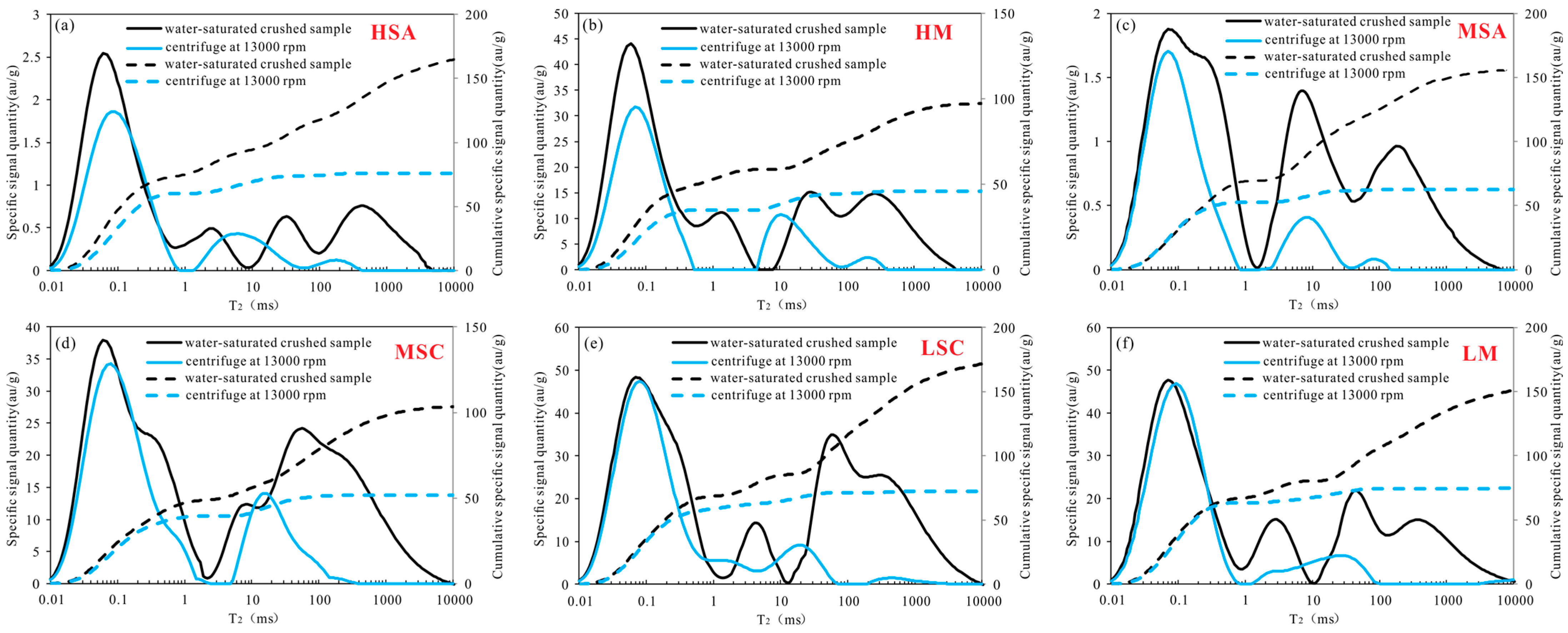
Based on differences in transverse relaxation time, the NMR T2 spectrum can qualitatively indicate pore size, with lower T2 times generally corresponding to smaller pores. Currently, researchers often use surface relaxivity and assume pore geometry (e.g., capillary bundles or spheres) to quantitatively convert the NMR T2 spectrum into a pore-size distribution. However, this method frequently encounters difficulties in accurately determining relaxivity and pore geometry due to variations in pore structure, resulting in large calculation errors. In this study, a centrifugation-based method was applied and used the cutoff value of the T2 spectrum, T2c, to cleverly divide the pores in shales of different lithofacies into bound (or adsorbed) pores and movable (or flow) pores (T2c, Figure 7) [19,53,54]. This approach avoids the high conversion errors associated with conventional pore-size calculations and effectively characterizes differences in pore structure between different lithofacies.
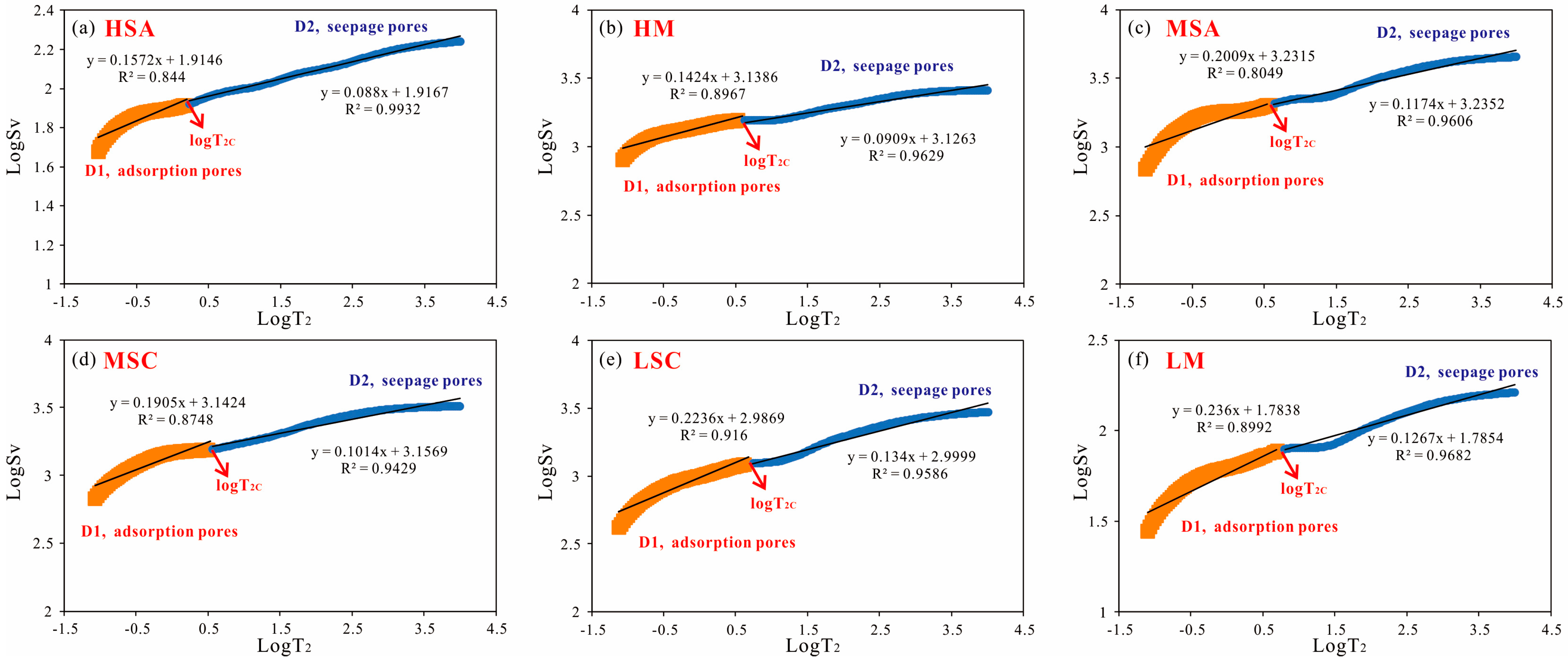
Using this method, the double-logarithmic relationship between the incremental pore volume per unit mass of the shale sample and T2 exhibits a clear inflection point (T2c). Using T2c as the boundary, the T2 spectrum is divided into bound fluid and movable fluid portions, and fractal dimensions can be calculated for different T2 ranges. In this study, the fractal dimension D is divided into D1 (T2 < T2c) and D2 (T2 > T2c), with the calculation performed separately for each portion. Taking D1 as an example, it is obtained from the double-logarithmic relationship between the T2 spectrum below the cutoff (T2 < T2c) and the corresponding incremental pore volume per unit mass (Figure 7). The slope of this line, subtracted from 3, gives the fractal dimension. D1 indicates the fractal dimension of the adsorption pore region (T2 < T2c), primarily reflecting the space where fluids exist in an adsorbed state within smaller pores. D1 can be used to characterize the irregularity, roughness, and complexity of smaller pores. D2 indicates the fractal dimension of the seepage pore region (T2 > T2c), characterizing the space where fluids exist in a movable/seepage state within larger pores (Figure 8). Higher values of both indicate greater heterogeneity and complexity of the corresponding pore structures.
The NMR experimental data show that the D1 values for shale samples range from 2.76 to 2.86, with an average of 2.82. The D2 values range from 2.87 to 2.91, with an average of 2.89 (Table 2). The goodness-of-fit (R2) values are generally high, ranging from 0.81 to 0.92 for D1 (average 0.88) and from 0.94 to 0.99 for D2 (average 0.97), demonstrating excellent linearity and reliability of the fitting results. These results further confirm that the pore structures of all shale samples exhibit distinct fractal characteristics. The average D1 value is lower than the average D2 value, suggesting that the internal structure of seepage pores is more complex than that of adsorption pores across different lithofacies. Compared with the literature values reported by Sun et al. [19], where D1 ranged from 2.28 to 2.35 and D2 from 2.97 to 2.99 of the marine shale, the D1 values in our study are significantly higher, whereas the D2 values are slightly lower. This suggests that the adsorption pores in the Linghao Formation are more geometrically complex than those reported in Sun et al., whereas the larger movable pores exhibit slightly lower complexity. Nevertheless, the general trend that D2 exceeds D1 is maintained, confirming that larger, movable pores are more heterogeneous than smaller adsorption pores. These differences likely reflect variations in sedimentary environment and basin-specific geological conditions, highlighting the context-dependence of fractal characteristics in shale reservoirs. Comparing different shale lithofacies, both D1 and D2 of the high-carbon shale are higher than those of other lithofacies, indicating that the pore structures of both the smaller adsorption pores and the larger seepage pores in the high-carbon shale are more complex. This suggests that within different lithofacies, variations in TOC and mineral composition, along with the resulting differences in pore types, have a significant impact on reservoir heterogeneity.

4.3.2. Fractal Dimension Based on NMRC

The method for calculating fractal dimensions based on NMRC data is outlined as follows [54]:
T m   m i n = K G T r m a x
T m is the temperature reduction of the melting point (measured in K). K G T is the Gibbs–Thomson constant, with units of nm · K. r is the pore diameter, where smaller pores correspond to lower melting points and more pronounced melting point depression. T m   m i n is the minimum melting point depression temperature corresponding to the largest pore diameter, with units of K.
S V = ( T m m i n T m ) 3 D
l o g S V = D 3 l o g ( T m ) + 3 D l o g ( T m m i n )
S V represents the cumulative pore volume percentage corresponding to the reduction in melting point temperature. D is the fractal dimension. Therefore, the fractal dimension D can be calculated from the slope of the l o g S V versus l o g ( T m ) plot.
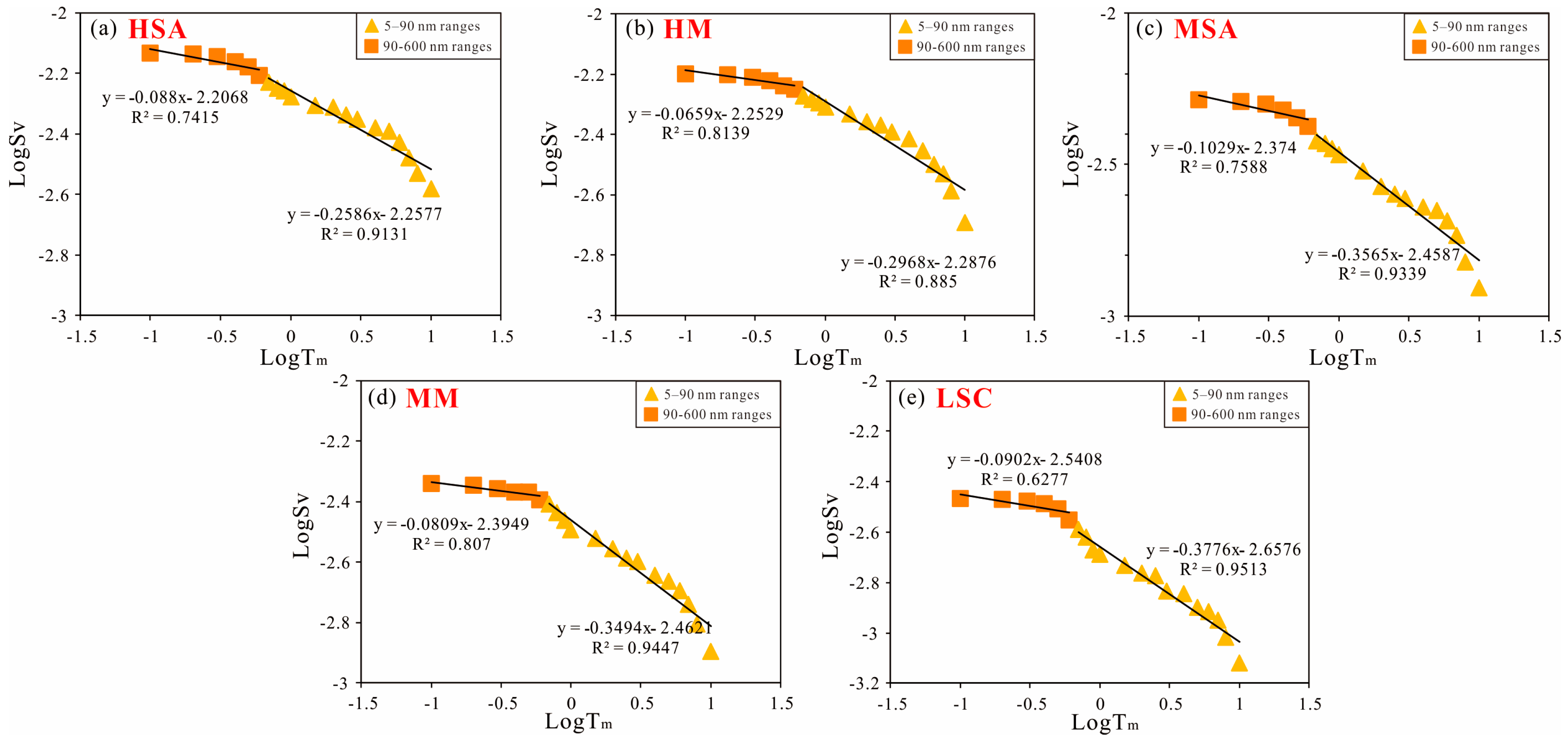
Since the NMRC experiment can quantitatively characterize pore sizes, this study performed fractal dimension fitting and calculation for pores in different pore-size intervals. The fitting results obtained from the NMRC model show the double-logarithmic relationship between T m and the cumulative pore volume percentage of the shale samples (Figure 9). Two distinct fractal features were identified for pore-size ranges of 5–90 nm and 90–600 nm. Therefore, NMRC data in these two pore-size intervals were fitted in this study. By fitting l o g ( T m   m i n ) versus l o g ( T m ) , the fractal dimensions Dc1 and Dc2 were calculated, respectively. Dc1 represents the fractal dimension of the low-pore-size region (r < 90 nm), while Dc2 represents that of the high-pore-size region (r > 90 nm). Following the method of Li et al. [55], the overall fractal dimension Dc is calculated by proportionally weighing the contributions from the two pore-size ranges based on their total pore volumes. Dc characterizes the overall heterogeneity of the reservoir and is derived from NMRC-based fractal analysis, and it is compared with results obtained from NMR data.
In this study, the calculated pore fractal dimensions Dc range from 2.70 to 2.79, with an average of 2.73 (Table 3). The R2 values range from 0.81 to 0.99 with an average of 0.92, further confirming the robustness and consistency of the fractal fitting method across different datasets. These values are lower than D1 and D2 (Table 2), indicating that the overall heterogeneity and pore complexity calculated by this method are relatively low. However, comparison across different lithofacies still shows that the fractal dimensions of high-carbon shale are higher than those of medium- and low-carbon shale (Table 3), confirming that the pore structures of high-carbon shale are more complex than those of low-carbon shale.

5. Discussion

5.1. Formation Model of Different Shale Lithofacies

5.1.1. Controlling Factors for the Organic-Rich Shale

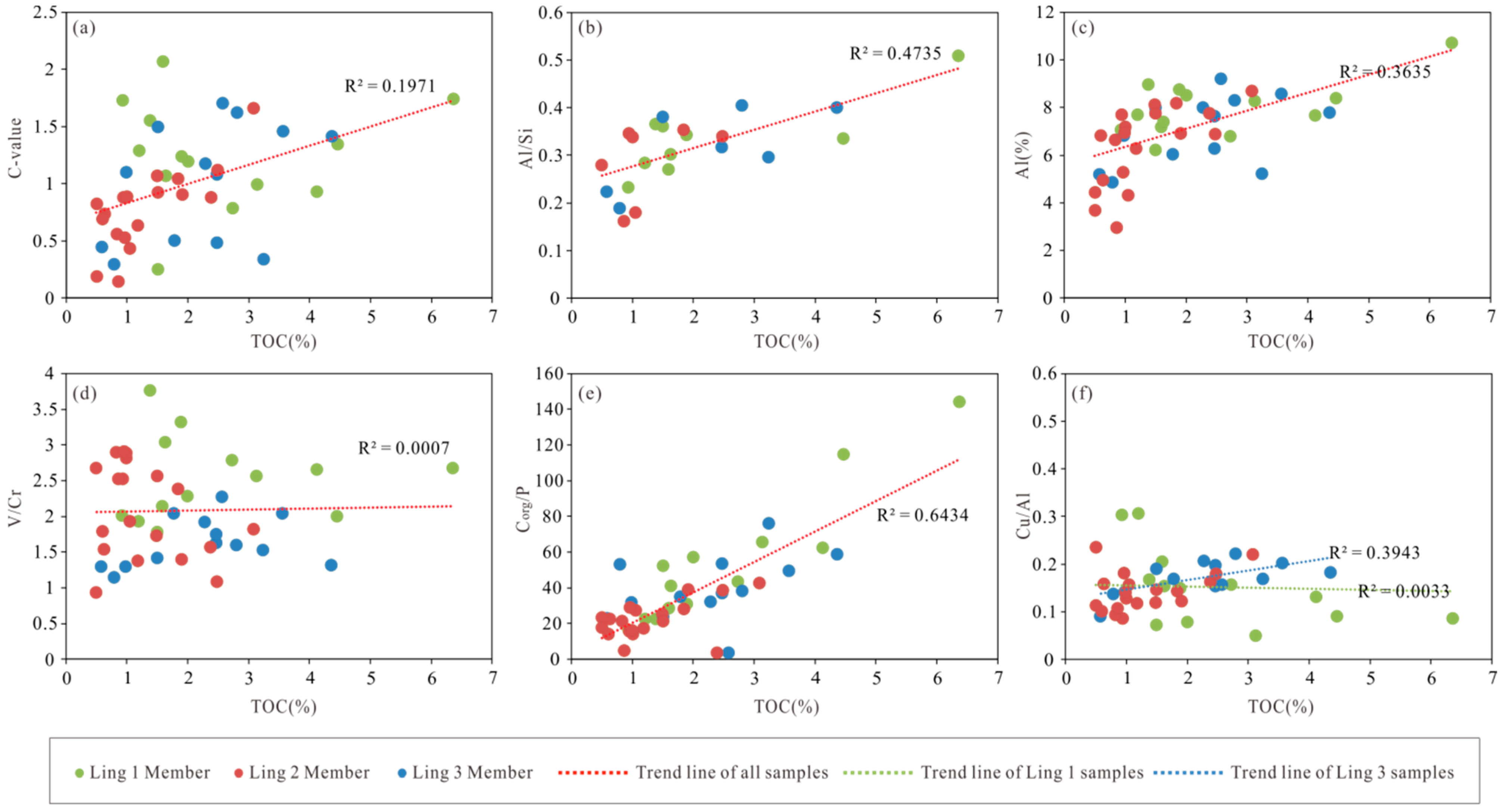
Organic-rich shales are the result of multiple paleo-environmental conditions, including paleo-productivity, terrestrial input, paleo-climate, paleosalinity, and redox conditions [34,38]. Vertically, organic-rich shales are distributed in the 1st Member (with an average TOC of 2.57%) and the lower part of the 3rd Member (with an average TOC of 2.88%). To investigate the controlling factors of organic-rich shale, cross-plots of paleo-climate, terrestrial input, redox conditions, and productivity indicators with TOC were created (Figure 10). The paleo-climate indicator (C-value) of the Linghao shale shows a weak positive correlation with TOC, indicating that humid climate conditions favor organic matter accumulation (Figure 10a). The sediment grain size indicator (Al/Si) shows a good positive correlation with TOC, suggesting that fine-grained clastic input is more conducive to organic matter accumulation (Figure 10b). The detrital input flux indicator (Ti) shows a positive correlation with TOC (Figure 10c), with higher detrital input corresponding to higher TOC values, demonstrating that terrestrial detrital input promotes organic matter accumulation. This may indicate that terrestrial input delivers a certain amount of marginal basin organic carbon or nutrients, which facilitate organic matter enrichment.
The redox indicator V/Cr shows only a moderate correlation with TOC within the Linghao Formation (Figure 10d). Specifically, it exhibits a negative correlation with the shales of the 1st and 2nd Members, but a weak positive correlation within the 3rd Member. These differences indicate that TOC enrichment is not solely influenced by redox conditions in the water column. Notably, the phosphorus cycling intensity indicator (Corg/P) shows a good correlation with TOC across different members (Figure 10e), suggesting that higher organic matter burial efficiency and phosphorus cycling intensity promote organic matter accumulation. The relationship between paleo-productivity indicators and TOC content varies across different members (Figure 10f). Only within the 3rd Member does TOC show a significant positive correlation with Cu/Al (R2 = 0.54), demonstrating that paleo-productivity plays a key role in organic matter enrichment in this member.

5.1.2. Formation Model of Organic-Rich Shale

Based on the analysis of sedimentary paleo-environment and factors influencing organic matter enrichment, combined with sedimentary–tectonic evolution [5], the formation model of organic-rich shale in the Linghao Formation has been reconstructed. Under the control of the Emeishan Taphrogenesis, two extensional phases (Capitanian-Wujiapingian early phase and Changhsingian mid-late phase) developed, leading to a complex sedimentary system and paleo-environment evolution in the Upper Yangtze region’s Linghao Formation. During the early 1st Member, influenced by contemporaneous basement-rooted faulting and extensional stress, the Linghao Formation developed a deep-water shelf environment [5]. During the 1st Member deposition period (especially the early phase), the paleo-climate was predominantly warm and humid with high rainfall; weathering intensity was generally moderate to strong, and water salinity was low (Figure 2). The strong weathering and erosion promoted the development of gravity flows during high lake levels and brought abundant terrigenous nutrients and organic matter. High Al and CIA values indicate that intense weathering increased the input of terrigenous clastics (Figure 2). Additionally, field outcrops show that basement-rooted faulting also triggered frequent gravity flows [5]. Increased terrigenous input brought basin-derived organic carbon, shallow water bioclasts [5], and nutrients such as P and Cu. This promoted the proliferation of lower organisms in the surface waters of the lake and moderately increased paleo-productivity, enhancing organic matter supply. Due to the predominantly oxic to suboxic conditions in the Linghao Formation, preservation conditions were poor. Dissolved or particulate organic carbon was likely oxidized during descent, creating anoxic to suboxic conditions favorable for organic matter preservation. High TOC shale in the 1st Member formed in a humid, fine-grained environment with high terrigenous input, high bottom-water reductivity, high phosphorus cycling, and moderate to low productivity. Despite the low water productivity, reactivation of buried organic carbon and recycling of nutrients like phosphorus enhanced productivity. Organic fragments produced by productivity consumed oxygen during sedimentation, increasing bottom-water reductivity and promoting nutrient recycling. Furthermore, basement-rooted faulting facilitated hydrothermal migration, leading to the accumulation of elements like silicon in some samples. This environment led to the formation of organic-rich HM and MM. Some low-carbon samples, with low allochthonous organic input and low phosphorus cycling intensity, were not conducive to organic matter accumulation, forming mainly LM and LSC.
During the deposition period of the 2nd Member, the foundational faults became dormant, allowing terrigenous clastic sediments to even out topographical differences under lowstand systems tract. The study area primarily transitioned back to a shallow-water platform. During this phase, carbonates developed extensively under hot and dry climatic conditions, with low weathering intensity and minimal terrigenous input. Salinity levels in the water significantly increased, limiting the development of aquatic organisms. Organic matter supply at the basin margins was restricted, with overall moderate to low bottom water reductive conditions and paleo-productivity levels and weak phosphorus cycling intensity. The water body was generally in a mildly reductive state, limiting the effective preservation of organic matter. The organic matter enrichment in the 2nd Member was significantly reduced compared to the 1st Member, primarily due to the lower reductive conditions of the water body which inhibited organic matter accumulation. Due to the low TOC, predominantly LM and LSC lithofacies developed, with a few samples showing MSA and MM lithofacies. In the early stage of the 3rd Member, the reactivation of foundational faults shifted the depositional environment back to a deep-water platform. The paleo-environment for organic-matter-rich shale deposition during this period was similar to that of the 1st Member, but with lower terrigenous input and weaker bottom-water reductive conditions. However, paleo-productivity was relatively high, significantly influencing organic matter enrichment. Notably, the early stage exhibited a high sedimentation rate (Figure 2), which helped mitigate the oxidative conditions that could degrade organic matter. During the early 3rd Member, HSA and MSA lithofacies predominantly developed.
In the late stage of the 3rd Member, the climate became increasingly arid, reducing weathering intensity and terrigenous input. Elemental cycling intensity also weakened significantly, leading to low organic matter supply. Despite the deep-water and relatively reductive environment, organic matter accumulation was low. Additionally, hydrothermal activity led to notable excess silicon development. Under these conditions, the shale primarily developed low-carbon mixed lithofacies.

5.2. Evaluation of Shale Reservoirs with Different Lithofacies and Heterogeneity

5.2.1. Comparison of Macroscopic Parameters of Reservoirs and Influencing Factors

The sedimentary paleo-environment not only influences the distribution and types of organic-rich shale but also significantly impacts the formation of shale reservoirs. Paleo-environmental characteristics have a clear impact on the mineral composition, types, and distribution of the Linghao shale. The HM and HSA lithofacies have high clay content, while quartz and feldspar contents are slightly lower than in other shale lithofacies (Figure 11a). High-carbon lithofacies are mainly distributed in the 1st Member and the early stage of the 3rd Member. During these periods, the climate was humid with high weathering intensity, which significantly promoted the development of large-scale clay-rich gravity flows. High values of Al and Al/Si (Figure 2) indicate substantial fine-grained clastic input, which facilitated the formation of carbon-rich, high-clay lithofacies. During the 2nd Member, the climate gradually became drier, reducing terrigenous input and leading to widespread carbonate deposition. As a result, medium-carbon, low-carbon, and carbonate-rich shale facies developed in the 2nd Member. In the late stage of the 3rd Member, the humidity decreased, and terrigenous input was reduced. However, the abundant supply of hydrothermal silicon promoted the development of medium-carbon and low-carbon siliceous clay-rich lithofacies. These findings indicate that paleo-environmental conditions directly determine the mineral composition and lithofacies types of the Linghao shale.
Research on Silurian marine shale in the Sichuan Basin indicated that organic-rich shale exhibited high pore volume, gas content, and porosity [56,57]. Comparing different lithofacies, key reservoir parameters, such as porosity, pore volume, gas content, and TOC, and organic pore proportion reveal that high-carbon lithofacies are superior, followed by medium-carbon shale facies (Figure 11b–d). The high organic content in high-carbon lithofacies significantly controls pore development. Previous studies proposed that the Linghao shale is predominantly composed of Type I kerogen [4], with the organic matter in an over-mature stage. The secondary cracking of kerogen organic pores and retained hydrocarbons formed numerous organic pores. This explains why high-carbon lithofacies have the highest proportion of organic pores, which aligns with the NMR results showing a high degree of organic pore development (Figure 11b). Additionally, the decomposition of organic matter releases large quantities of organic acids. These acids dissolve carbonate and aluminosilicate minerals, creating secondary pores (Figure 6g,l). This significantly benefits the pore volume and porosity of high-carbon lithofacies (Figure 11c,d). Furthermore, studies on Silurian shales generally agree that high brittle mineral content aids pore development and preservation, provided there are high TOC and biogenic silica [57]. Therefore, although the LM and LSC lithofacies have high quartz content, they do not exhibit high porosity or pore volume. The reason is that the silica is of hydrothermal origin, which does not directly aid in the retention of organic matter or promote organic pore development. Particularly in the low-carbon lithofacies of the 3rd Member, high quartz content is associated with low pore volume and porosity (Figure 11c). Nonetheless, the higher proportions of quartz, feldspar, and carbonate minerals in LSC and LM, being rigid minerals, have strong compaction resistance, which aids in the formation and preservation of inorganic pores. This is consistent with the high proportion of inorganic pores in the low-carbon lithofacies (Figure 11b). Additionally, biogenic silica in the Linghao shale forms internal cavities through dissolution during early burial diagenesis, which are later filled with retained hydrocarbons (Figure 6d,e). However, some retained hydrocarbons did not undergo secondary cracking, resulting in low organic pore development, especially in low-carbon lithofacies. In contrast, organic pores in high-carbon lithofacies are well developed, possibly due to the catalytic role of clay minerals in hydrocarbon generation (Figure 6a) [4]. The primary pores in clay minerals are interlayer pores in illite and mixed-layer illite/smectite. When these interlayer pores contain authigenic silica formed during clay transformation, they provide significant support to the clay layers, aiding in pore preservation. Regarding gas content, high-carbon lithofacies have a high proportion of organic pores and clay minerals, with well-developed porosity, leading to significantly higher adsorbed gas content (Figure 11d).

5.2.2. Relationships Between Fractal Dimension, Physical Properties, and Pore Structure

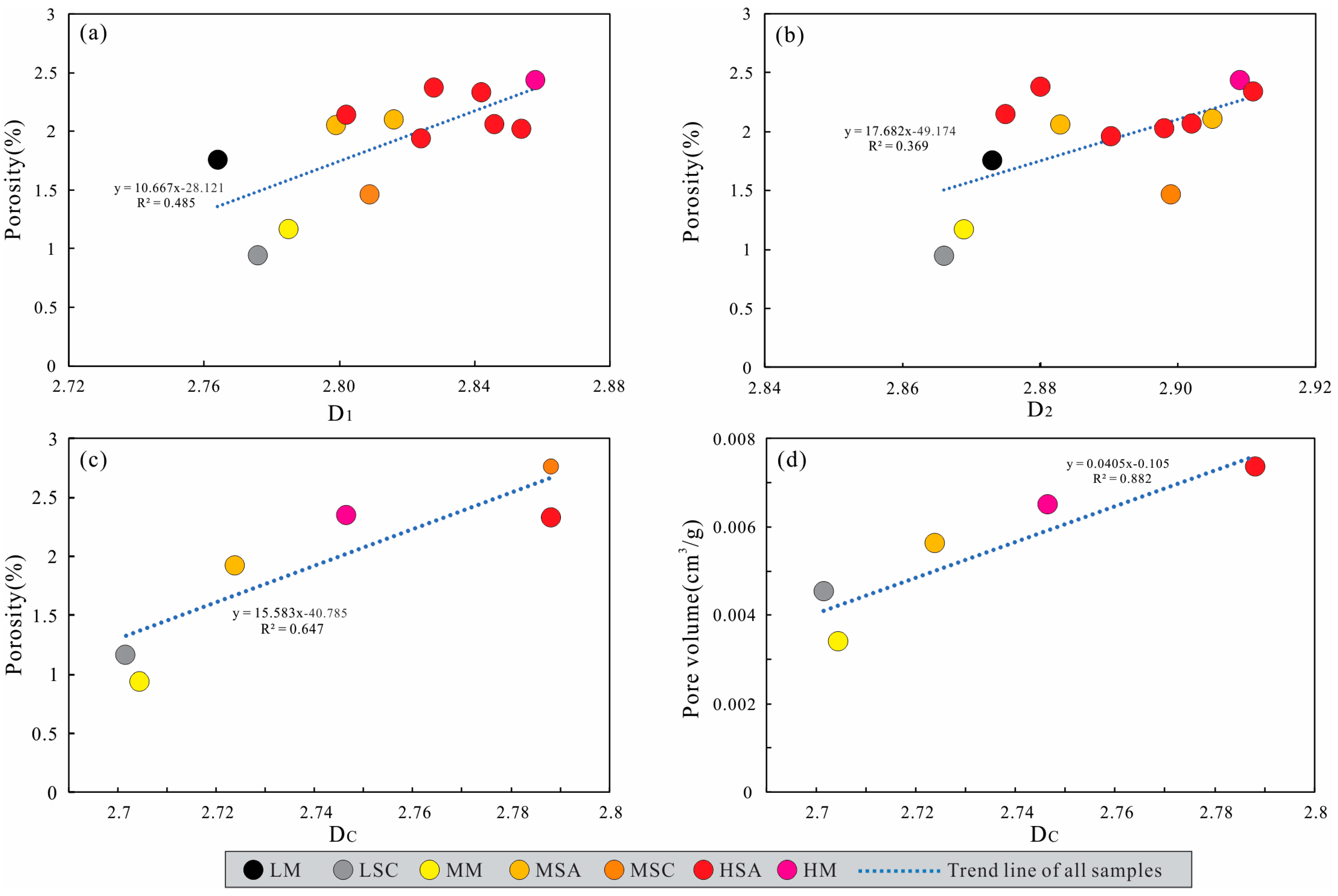
Differences in porosity and pore structure are strong indicators of reservoir heterogeneity. This study, utilizing NMR T2 and NMRC data, explores the relationship between porosity, pore volume, and fractal dimensions in different lithofacies (Figure 12). Our findings reveal that shale samples exhibit self-similarity and multifractality in their pore structures. D1 and D2 are positively correlated (R2 = 0.67), indicating that the complexity of adsorption pores is proportional to the complexity of flow pores in various lithofacies. Both D1 and D2 show positive correlations with porosity (Figure 12a,b), indicating that higher porosity is generally associated with greater roughness and complexity of both adsorption and seepage pores, as well as more developed pore structures. The correlation between D1 and porosity is slightly stronger than that of D2, implying that porosity exerts a greater influence on the heterogeneity of adsorption pores. NMRC data further demonstrate a positive correlation between the comprehensive fractal dimension (Dc) and both porosity and pore volume, with a particularly strong correlation with pore volume (Figure 12c). This suggests that pore heterogeneity is closely linked to total pore volume and overall pore development. However, it is suggested that the correlation between D2 and permeability is relatively weak (Table 1 and Table 2). This may be because permeability is primarily controlled by pore connectivity and effective throat size, while D2 mainly reflects the structural complexity of flow pores rather than their connectivity. In shales, even highly heterogeneous flow pores may not form continuous flow channels, resulting in limited permeability improvement despite high D2 values. In addition, variations in fractal dimensions among different shale lithofacies are mainly controlled by depositional environment, diagenetic compaction, and mineral composition. High-carbon lithofacies, characterized by high pore volume and porosity, also exhibit larger fractal dimensions (Figure 11 and Figure 12), indicating a more complex and heterogeneous pore network. Both NMR and NMRC analyses confirm that well-developed and large-volume pores contribute to higher structural complexity and heterogeneity. Consequently, high-carbon lithofacies possess stronger pore connectivity and larger adsorption capacity, which correspond well with their relatively high gas content.

5.2.3. Influencing Factors of Fractal Dimension

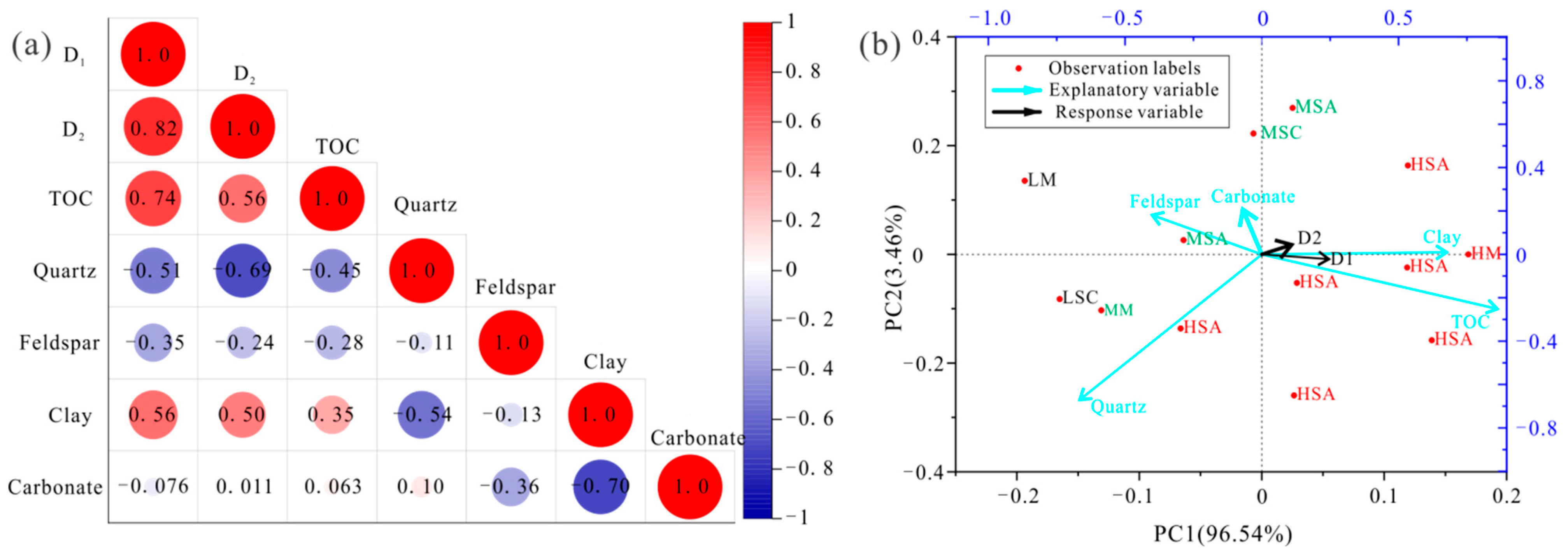
To clarify the primary factors controlling the fractal dimension of the shale reservoir, the relationships between TOC, mineral composition, and fractal dimensions (D1 and D2) were systematically analyzed. Previous studies have shown that pore structure in shales is governed by a combination of TOC and mineral composition, particularly quartz and clay minerals. Guan et al. [17] demonstrated that pore structure in deep marine shale is mainly controlled by TOC and brittle minerals, whereas Ning et al. [22] reported that in marine shale, the fractal dimension is positively correlated with TOC but negatively correlated with clay minerals and pyrite. In transitional shale, however, fractal dimension is more strongly influenced by Ro and clay minerals than by TOC. In this study, both D1 and D2 exhibit significant linear positive correlations with TOC content (Figure 13a), indicating that TOC is a key factor enhancing pore structure heterogeneity. Higher TOC promotes the development of nanoscale organic-matter-hosted pores during diagenesis and thermal evolution, leading to increased complexity in both adsorption and seepage pores. The stronger correlation between TOC and D1 suggests that TOC has a greater impact on smaller adsorption pores, which can be attributed to the dominance of type I kerogen with a highly irregular internal structure in the Linghao Formation. Samples with higher TOC also exhibit larger specific surface areas and more complex pore networks [23,24], further intensifying the fractal characteristics of the pore system. Moreover, organic acid released during hydrocarbon generation enhances the dissolution of inorganic minerals, forming organic–inorganic interfacial fractures and dissolution pores (Figure 6j–l), which significantly contribute to reservoir heterogeneity.
Quartz content shows a clear linear negative correlation with D1 and D2 (Figure 13a), suggesting that increasing quartz reduces the structural complexity of both bound and movable fluid pores. Unlike Sun et al. [19], who found quartz primarily affecting adsorption pores, the discrepancy may stem from the origin of quartz. Quartz in the Linghao Formation is predominantly hydrothermal rather than detrital or biogenic. Consequently, its role as a rigid framework mineral is limited under strong compaction, and high quartz content does not necessarily correspond to better pore development as in the Longmaxi shale [56,57]. Rigid minerals such as quartz and feldspar tend to fill or support pores during compaction, reducing the complexity of the pore system and thus lowering the fractal dimension. Therefore, samples with higher quartz content exhibit lower heterogeneity. Similarly, feldspar content is negatively correlated with D1 and D2 (Figure 13a), indicating that lower feldspar promotes the development of bound and free pores. This can be attributed to extensive feldspar dissolution by organic acids during the over-mature stage (Figure 6g), which generates secondary dissolution pores and facilitates clay mineral transformation, collectively enhancing pore complexity.
Clay mineral content shows a positive correlation with D1 and D2 (Figure 13a), indicating that clays enhance the overall structural complexity of the pore system, particularly influencing smaller adsorption pores. Due to their high specific surface area and interlayer structures, clay minerals provide abundant adsorption sites and seepage pathways (Figure 6h,k). The Linghao Formation is dominated by illite and chlorite, with a few samples containing high illite/smectite ratios. Different clay types exert distinct effects on pore structure: illite and chlorite act as intergranular fillers that increase the complexity of larger seepage pores, while high illite/smectite content enhances the heterogeneity of adsorption pore networks. Although carbonate dissolution pores are locally developed, no clear correlation is observed between carbonate content and fractal dimension (Figure 13a), suggesting that carbonates are not a major control on pore heterogeneity.
In summary, the fractal characteristics of the Linghao Formation shale are governed by the combined effects of TOC and mineral composition. TOC enhances pore heterogeneity by promoting organic-pore formation and inorganic diagenesis, while clay minerals increase structural complexity through interlayer structures and adsorption capacity. In contrast, rigid framework minerals such as quartz and feldspar suppress pore heterogeneity due to their compaction and infilling effects. Overall, TOC and clay minerals act as the principal positive contributors to the fractal dimension, whereas quartz and feldspar exhibit inhibitory effects.
The redundancy analysis method was employed to verify and explore the influence of TOC and mineral components on D1 and D2. This method primarily illustrates the relationship between microbial communities and environmental variables, following the methodology outlined in [58]. In Figure 13, the light blue arrows (representing mineral components and TOC) are the environmental explanatory variables (independent variables), the black arrows (representing fractal dimensions) are the response variables (dependent variables), and the red dots represent the sample points. The length of the arrows indicates the degree of correlation between the environmental variable and the sample distribution: the longer the arrow, the greater the correlation. The angles between the arrows and the PC axis, as well as the angles between the arrows themselves, indicate correlation: acute angles represent positive correlations, while obtuse angles represent negative correlations. Smaller angles signify higher correlations. Figure 13b shows that the PC1 axis accounts for 96.54% of the variance, indicating that PC1 represents the most significant characteristics of the samples. The analysis found that both the fractal dimension of adsorption pores (D1) and the fractal dimension of seepage pores (D2) are closely related to TOC and clay minerals, showing a positive correlation. This suggests that high clay mineral content and TOC are the primary factors contributing to increased pore heterogeneity in the Linghao shale. Conversely, an increase in feldspar and quartz content is unfavorable, while carbonate minerals have a minimal impact. These conclusions are consistent with Figure 13a. Projecting the samples onto the environmental variables revealed that the distribution of different lithofacies samples is closely related to TOC, clay, and feldspar content. This further indicates that differences in TOC, clay, and feldspar content are the primary reasons for lithofacies differences. Furthermore, projecting onto the D1 and D2 variables shows that D1 has a closer relationship with each sample. This implies that D1 better represents the differences in pore structure and heterogeneity among different lithofacies, indicating that the heterogeneity of adsorption pores has a greater impact on the reservoir development characteristics of different lithofacies.
Although this study is based on a limited number of NMR and NMRC samples, the fractal approach applied here effectively quantifies shale pore heterogeneity and links it to TOC, mineral composition, and depositional environment. The results highlight how adsorption and flow pores differ in complexity across lithofacies and demonstrate the primary controls of high-carbon content and clay minerals on pore heterogeneity. This methodology provides a robust framework for evaluating reservoir complexity and offers a quantitative tool for shale gas exploration in the Permian Linghao Formation. Future studies incorporating larger datasets and multifractal models will further refine these insights and enhance the predictive power of fractal-based reservoir characterization.

6. Conclusions

This study utilized elemental geochemistry, mineralogy, physical properties, and pore structure to reconstruct the paleo-environment and classify the lithofacies of the inter-platform basin shale. This study aimed to identify the development patterns of different lithofacies. Fractal dimension analysis was applied to investigate the reservoir characteristics and evaluate the heterogeneity of various lithofacies, as well as to explore the factors influencing this heterogeneity.
(1)
The Linghao organic-rich shale in the inter-platform basin was concentrated in the 1st Member (average 2.57%) and the lower part of the 3rd Member (average 2.88%). The high TOC shale in the 1st Member was formed in a humid environment with intense weathering, significant input of fine-grained clastic material from basin margins, high bottom-water reducibility, increased phosphorus cycling, and moderate to low productivity. The early paleo-environmental conditions of the 3rd Member were similar to those of the 1st Member, but its higher paleo-productivity and sedimentation rates significantly facilitated organic matter accumulation.
(2)
The inter-platform basin shale developed seven types of lithofacies. The organic-rich shale in the 1st Member mainly consisted of mixed lithofacies with medium to high carbon content, while those in the lower part of the 3rd Member were primarily composed of high-carbon silicious-bearing argillaceous lithofacies and medium-carbon silicious-bearing argillaceous lithofacies. The high-carbon lithofacies exhibited the most favorable reservoir properties, with an average porosity of 2.14%, permeability of 0.036 mD, and pore volume reaching 0.0074 g/cm3. The predicted total gas content can reach up to 3.28 m3/t, indicating that the HSA lithofacies represent the most prospective shale type in the study area.
(3)
Using a fractal model, this study fitted the NMR relaxation spectra and divided the fractal dimension D into D1 (T2 < T2c, indicating the fractal dimension of adsorption pores) and D2 (T2 > T2c, indicating the fractal dimension of seepage pores). D1 ranged from 2.76 to 2.86 (average 2.82), and D2 ranged from 2.87 to 2.91 (average 2.89). The higher average value of D2 suggested that the distribution of movable fluid pores in inter-platform basin shales were more complex. The fractal dimension Dc derived from NMRC varied from 2.70 to 2.79 (average 2.73), indicating a slightly lower degree of heterogeneity and pore complexity. Comparison among lithofacies revealed that both fractal models indicated higher fractal dimensions in high-carbon shale than in medium- and low-carbon lithofacies, implying that high-carbon shale possessed more complex pore structures.
(4)
A lithofacies development model for the Linghao Formation shale was established. The paleo-environment directly controlled the mineral composition and lithofacies types of the Linghao Formation, thereby influencing reservoir properties, gas-bearing capacity, and pore volume. High-carbon shale was characterized by higher pore volume and porosity, as well as larger fractal dimensions, indicating stronger heterogeneity. Correlation and redundancy analyses revealed that high clay mineral content and TOC were the primary factors increasing the pore heterogeneity in inter-platform basin shale. Conversely, higher feldspar and quartz content were detrimental, while carbonate minerals had a minor impact. Moreover, the heterogeneity of adsorption pores has a greater influence on the reservoir characteristics of different lithofacies.
(5)
This study demonstrated that fractal dimensions served as quantitative indicators of shale heterogeneity controlled by the interplay of mineral composition and TOC. Integrating fractal analysis with conventional reservoir parameters provided a novel tool for evaluating pore-scale complexity and understanding the depositional and compositional controlled on reservoir quality, offering new insights for shale gas exploration in the Permian Linghao Formation.

Author Contributions

Conceptualization, M.W. and X.Y.; methodology, S.L.; validation, Y.C.; formal analysis, J.G.; investigation, Z.W. and X.D.; data curation, M.W.; writing—original draft preparation, M.W. and X.Y.; writing—review and editing, S.L. and Y.C.; visualization, J.G.; supervision, Z.W. and X.D.; project administration, X.Y. and X.D. All authors have read and agreed to the published version of the manuscript.

Funding

This study was financially supported by the General Project of the Chongqing Natural Science Foundation (Grant No. CSTB2022NSCQ-MXS1642) and the Joint Fund for Innovation and Development of the Chongqing Natural Science Foundation (Grant No. CSTB2023NSCQ-LZX0078) and was also supported by the Science and Technology Research Program of the Chongqing Municipal Education Commission (Grant No. KJQN202401535) and the National Natural Science Foundation of China (No. 52174036), Sichuan Science and Technology Program (2024NSFSC2008).

Data Availability Statement

Data is contained within the article.

Conflicts of Interest

Author Yulin Cheng was employed by the company Petroleum Industry Press Co., Ltd. The remaining authors declare that the research was conducted in the absence of any commercial or financial relationships that could be construed as a potential conflict of interest.

References

  1. Zou, C.; Dong, D.; Wang, S.; Li, J.; Cheng, K. Geological characteristics and resource potential of shale gas in China. Petrol. Explor. Dev. 2010, 37, 641–653. [Google Scholar] [CrossRef]
  2. He, S.; Tan, W.C.; Li, H.; Wang, Y.; Niu, P.F.; Qin, Q.R. Mineralogical and lithofacies controls on gas storage mechanisms in organic-rich marine shales. Energy Fuels 2025, 39, 3846–3858. [Google Scholar] [CrossRef]
  3. Zou, C.; Zhao, Q.; Cong, L.Z.; Wang, H.Y.; Shi, Z.S.; Wu, J.; Pan, S. Development progress, potential and prospect of shale gas in China. Nat. Gas Ind. 2021, 41, 14. [Google Scholar]
  4. Gu, Y.; Cai, G.; Hu, D.; Wei, Z.; Liu, R.; Han, J.; Fan, Z.; Hao, J.; Jiang, Y. Geochemical and geological characterization of Upper Permian Linghao Formation shale in Nanpanjiang Basin, SW China. Front. Earth Sci. 2022, 10, 883146. [Google Scholar] [CrossRef]
  5. Gu, Y.; Hu, D.; Wei, Z.; Liu, R.; Hao, J.; Han, J.; Fan, Z.; Jiang, Y.; Wang, Y.; Xu, Q. Sedimentology and geochemistry of the Upper Permian Linghao Formation marine shale, central Nanpanjiang Basin, SW China. Front. Earth Sci. 2022, 10, 914426. [Google Scholar] [CrossRef]
  6. Sun, M.; Zhang, L.; Hu, Q.; Pan, Z.; Yu, B.; Sun, L.; Bai, L.; Connell, L.D.; Zhang, Y.; Cheng, G. Pore connectivity and water accessibility in Upper Permian transitional shales, southern China. Mar. Petrol. Geol. 2019, 107, 407–422. [Google Scholar] [CrossRef]
  7. He, Q.; Dong, T.; He, S.; Zhai, G.; Guo, X.; Hou, Y.; Yang, R.; Han, Y. Sedimentological and geochemical characterization of the Upper Permian transitional facies of the Longtan Formation, Northern Guizhou Province, Southwest China: Insights into paleo-environmental conditions and organic matter accumulation mechanisms. Mar. Petrol. Geol. 2020, 118, 104446. [Google Scholar] [CrossRef]
  8. Algeo, T.J.; Maynard, J.B. Trace-element behavior and redox facies in core shales of Upper Pennsylvanian Kansas-type cyclothems. Chem. Geol. 2004, 206, 289–318. [Google Scholar] [CrossRef]
  9. Sweere, T.; van den Boorn, S.; Dickson, A.J.; Reichart, G.J. Definition of new trace-metal proxies for the controls on organic matter enrichment in marine sediments based on Mn, Co, Mo and Cd concentrations. Chem. Geol. 2016, 441, 235–245. [Google Scholar] [CrossRef]
  10. Yu, K.; Gan, Y.; Ju, Y.; Shao, C. Influence of sedimentary environment on the brittleness of coal-bearing shale: Evidence from geochemistry and micropetrology. J. Petrol. Sci. Eng. 2020, 185, 106603. [Google Scholar] [CrossRef]
  11. Zhou, Y.; Wang, Z.; Hu, D.; Wei, Z.; Wei, X.; Liu, R.; Wang, D.; Jiang, Y. Nanoscale pore characteristics of the Jurassic Dongyuemiao Member lacustrine shale, Eastern Sichuan Basin, SW China: Insights from SEM, NMR, LTNA, and MICP experiments. Front. Earth Sci. 2023, 10, 1055541. [Google Scholar] [CrossRef]
  12. Chang, J.; Fan, X.; Jiang, Z.; Wang, X.; Chen, L.; Li, J.; Zhu, L.; Wan, C.; Chen, Z. Differential impact of clay minerals and organic matter on pore structure and its fractal characteristics of marine and continental shales in China. Appl. Clay Sci. 2022, 216, 106334. [Google Scholar] [CrossRef]
  13. Li, X.; Jiang, Z.; Wang, S.; Wu, F.; Miao, Y.; Wang, H.; Liu, X. Differences of marine and transitional shales in the case of dominant pore types and exploration strategies, in China. J. Nat. Gas Sci. Eng. 2022, 103, 104628. [Google Scholar] [CrossRef]
  14. Li, Z.; Oyediran, I.A.; Huang, R.; Hu, F.; Du, T.; Hu, R.; Li, X. Study on pore structure characteristics of marine and continental shale in China. J. Nat. Gas Sci. Eng. 2016, 33, 143–152. [Google Scholar] [CrossRef]
  15. Luo, W.; Hou, M.; Liu, X.; Huang, S.; Chao, H.; Zhang, R.; Deng, X. Geological and geochemical characteristics of marine-continental transitional shale from the Upper Permian Longtan Formation, Northwestern Guizhou, China. Mar. Petrol. Geol. 2018, 89, 58–67. [Google Scholar] [CrossRef]
  16. Liu, S.; Wu, C.; Li, T.; Wang, H. Multiple geochemical proxies controlling the organic matter accumulation of the marine-continental transitional shale: A case study of the Upper Permian Longtan Formation, Western Guizhou, China. J. Nat. Gas Sci. Eng. 2018, 56, 152–165. [Google Scholar] [CrossRef]
  17. Guan, Q.; Dong, D.; Sun, S.S.; Hu, L.; Qi, L.; Li, C.; Chen, C.; Chen, X. Fractal characteristics of organic-rich shale pore structure and its geological implications: A case study of the Lower Silurian Longmaxi Formation in the Weiyuan block, Sichuan Basin. Nat. Gas Ind. 2024, 44, 108–118. [Google Scholar]
  18. Ma, X.; Guo, S.; Shi, D.; Zhou, Z.; Liu, G. Investigation of pore structure and fractal characteristics of marine continental transitional shales from Longtan Formation using MICP, gas adsorption, and NMR (Guizhou, China). Mar. Petrol. Geol. 2019, 107, 555–571. [Google Scholar] [CrossRef]
  19. Sun, W.; Zuo, Y.; Wu, Z.; Liu, H.; Xi, S.; Shui, Y.; Wang, J.; Liu, R.; Lin, J. Fractal analysis of pores and the pore structure of the Lower Cambrian Niutitang shale in northern Guizhou province: Investigations using NMR, SEM and image analyses. Mar. Petrol. Geol. 2019, 99, 416–428. [Google Scholar] [CrossRef]
  20. He, T.; Zhou, Y.; Chen, Z.; Zhang, Z.; Xie, H.; Shang, Y.; Cui, G. Fractal characterization of the pore-throat structure in tight sandstone based on low-temperature nitrogen gas adsorption and high-pressure mercury injection. Fractal Fract. 2024, 8, 356. [Google Scholar] [CrossRef]
  21. Li, H.; He, S.; Radwand, A.E.; Xie, J.T.; Qin, Q.R. Quantitative analysis of pore complexity in lacustrine organic-rich shale and comparison to marine shale: Insights from experimental tests and fractal theory. Energy Fuels 2024, 38, 16171–16188. [Google Scholar] [CrossRef]
  22. Ning, S.; Xia, P.; Hao, F.; Tian, J.; Fu, Y.; Wang, K. Pore Fractal Characteristics between Marine and Marine–Continental Transitional Black Shales: A Case Study of Niutitang Formation and Longtan Formation. Fractal Fract. 2024, 8, 288. [Google Scholar] [CrossRef]
  23. Li, Y.; Liu, D.; Feng, X.; Zhao, F.; Chen, Y.; Wang, Y.; Lin, R.; Du, W.; Fan, Q.; Song, Y.; et al. Heterogeneity characteristics and its controlling factors of marine shale reservoirs from the Wufeng−Longmaxi Formation in the Northern Guizhou Area. Geol. China 2024, 51, 780–798. [Google Scholar]
  24. Zhang, J.; Han, D.; Lin, W.; Wang, C.; Wang, J.; Xiao, X.; Li, Y.; Zhang, X. Pore Structure and Fractal Characteristics of Coal-Bearing Cretaceous Nenjiang Shales from Songliao Basin, Northeast China. J. Nat. Gas Geosci. 2024, 9, 197–208. [Google Scholar] [CrossRef]
  25. Wang, Y.; Zhong, B.; Yang, L.; Zhu, Y.; Xiang, J.; Zhang, T.; Zhang, H. Multiscale Fractal Evolution Mechanism of Pore Heterogeneity in Hydrocarbon Source Rocks: A Thermal Simulation Experiment in the Xiamaling Formation. Fractal Fract. 2025, 9, 351. [Google Scholar] [CrossRef]
  26. Zhuang, H.; Jiang, Y.; Guan, Q.; Yin, X.; Gu, Y. Pore Evolution and Fractal Characteristics of Marine Shale: A Case Study of the Silurian Longmaxi Formation Shale in the Sichuan Basin. Fractal Fract. 2025, 9, 492. [Google Scholar] [CrossRef]
  27. Ciążela, J. Editorial for the Special Issue “Recent Advances in Exploration Geophysics”. Appl. Sci. 2025, 15, 1251. [Google Scholar] [CrossRef]
  28. Xia, W.; Yan, Q.; Xiang, Z.; Xia, L.; Jiang, W.; Wei, W.; Li, X.; Zhou, B. Sedimentary characteristics of the Early-Middle Triassic on the South Flank of the Xilin Faulted Block in the Nanpanjiang Basin and its tectonic implications. Acta Petrol. Sin. 2018, 34, 2119–2139. [Google Scholar]
  29. GB/T 29172-2012; Practices for Core Analysis. China Standards Press: Beijing, China, 2012.
  30. Mitchell, J.; Webber, J.B.W.; Strange, J.H. Nuclear magnetic resonance cryoporometry. Phys. Rep. 2008, 461, 1–36. [Google Scholar] [CrossRef]
  31. Zhang, H.; Jiang, Y.; Zhou, K.; Fu, Y.; Zhong, Z.; Zhang, X.; Qi, L.; Wang, Z.; Jiang, Z. Connectivity of pores in shale reservoirs and its implications for the development of shale gas: A case study of the Lower Silurian Longmaxi Formation in the southern Sichuan Basin. Nat. Gas Ind. 2019, 39, 22–31. [Google Scholar] [CrossRef]
  32. Zhao, Z.Y.; Zhao, J.H.; Wang, H.J.; Liao, J.D.; Liu, C.M. Distribution and application of trace elements in Junggar Basin. Nat. Gas Explor. Dev. 2007, 30, 4, (In Chinese with English abstract). [Google Scholar]
  33. Xie, G.; Shen, Y.; Liu, S.; Hao, W. Trace and rare earth element (REE) characteristics of mudstones from Eocene Pinghu Formation and Oligocene Huagang Formation in Xihu Sag, East China Sea Basin: Implications for provenance, depositional conditions and paleoclimate. Mar. Petrol. Geol. 2018, 92, 20–36. [Google Scholar] [CrossRef]
  34. Li, Q.; Wu, S.H.; Xia, D.L.; You, X.L.; Zhang, H.M.; Lu, H. Major and trace element geochemistry of the lacustrine organic-rich shales from the Upper Triassic Chang 7 Member in the southwestern Ordos Basin, China: Implications for paleoenvironment and organic matter accumulation. Mar. Petrol. Geol. 2020, 111, 852–867. [Google Scholar] [CrossRef]
  35. Nesbitt, H.W.; Young, G.M. Early Proterozoic climates and plate motions inferred from major element chemistry of lutites. Nature 1982, 299, 715–717. [Google Scholar] [CrossRef]
  36. Liu, R.P.; Hu, G.; Cao, J.; Yang, R.F.; Liao, Z.W.; Hu, C.W.; Pang, Q.; Pang, P. Enhanced hydrological cycling and continental weathering during the Jenkyns Event in a lake system in the Sichuan Basin, China. Glob. Planet. Change 2022, 216, 103915. [Google Scholar] [CrossRef]
  37. Wei, W.; Algeo, T.J. Elemental proxies for paleosalinity analysis of ancient shales and mudrocks. Geochim. Cosmochim. Acta 2020, 287, 341–366. [Google Scholar] [CrossRef]
  38. Wu, Z.Y.; Zhao, X.Z.; Li, J.Z.; Pu, X.G.; Tao, X.W.; Shi, Z.N.; Sun, Y.Z.; Wang, J.; Liu, R.; Lin, J. Paleoenvironmental modes and organic matter enrichment mechanisms of lacustrine shale in the Paleogene Shahejie Formation, Qikou Sag, Bohai Bay Basin. Energy Rep. 2021, 7, 9046–9068. [Google Scholar] [CrossRef]
  39. Condie, K.C. Chemical composition and evolution of the upper continental crust: Contrasting results from surface samples and shales. Chem. Geol. 1993, 104, 1–37. [Google Scholar] [CrossRef]
  40. Peng, J.W.; Hu, Z.Q.; Feng, D.J.; Wang, Q.R. Sedimentology and sequence stratigraphy of lacustrine deepwater fine-grained sedimentary rocks: The Lower Jurassic Dongyuemiao Formation in the Sichuan Basin, Western China. Mar. Petrol. Geol. 2022, 146, 105933. [Google Scholar] [CrossRef]
  41. Lupker, M.; France-Lanord, C.; Galy, V.; Lavé, J.; Kudrass, H. Increasing chemical weathering in the Himalayan system since the Last Glacial Maximum. Earth Planet. Sci. Lett. 2013, 365, 243–252. [Google Scholar] [CrossRef]
  42. Tribovillard, N.; Algeo, T.J.; Lyons, T.; Riboulleau, A. Trace metals as paleoredox and paleoproductivity proxies: An update. Chem. Geol. 2007, 232, 12–32. [Google Scholar] [CrossRef]
  43. Algeo, T.J.; Liu, J.S. A re-assessment of elemental proxies for paleoredox analysis. Chem. Geol. 2020, 540, 119549. [Google Scholar] [CrossRef]
  44. Algeo, T.J.; Ingall, E. Sedimentary Corg:P ratios, paleocean ventilation, and Phanerozoic atmospheric pO2. Palaeogeogr. Palaeoclimatol. Palaeoecol. 2007, 256, 130–155. [Google Scholar] [CrossRef]
  45. Algeo, T.J.; Lyons, T.W. Mo–total organic carbon covariation in modern anoxic marine environments: Implications for analysis of paleoredox and paleohydrographic conditions. Paleoceanography 2006, 21. [Google Scholar] [CrossRef]
  46. Fathy, D.; Wagreich, M.; Gier, S.; Mohamed, R.S.A.; Zaki, R.; El Nady, M.M. Maastrichtian oil shale deposition on the southern Tethys margin, Egypt: Insights into greenhouse climate and paleoceanography. Palaeogeogr. Palaeoclimatol. Palaeoecol. 2018, 505, 18–32. [Google Scholar] [CrossRef]
  47. Schoepfer, S.D.; Shen, J.; Wei, H.Y.; Tyson, R.V.; Ingall, E.; Algeo, T.J. Total organic carbon, organic phosphorus, and biogenic barium fluxes as proxies for paleomarine productivity. Earth Sci. Rev. 2015, 149, 23–52. [Google Scholar] [CrossRef]
  48. Dong, T.; Wang, C.; Liang, X.; Wang, G.; Jiang, S. Paleodepositional conditions and organic matter accumulation mechanisms in the Upper Ordovician-lower Silurian Wufeng-Longmaxi shales, Middle Yangtze region, South China. Mar. Petrol. Geol. 2022, 143, 105823. [Google Scholar] [CrossRef]
  49. Zhou, J.; Yang, H.; Liu, H.; Jiao, Y. The depositional mechanism of hydrothermal chert nodules in a lacustrine environment: A case study in the middle Permian Lucaogou Formation, Junggar Basin, Northwest China. Minerals 2022, 12, 1333. [Google Scholar] [CrossRef]
  50. Huang, Z.; Li, Z.; Shi, W.; Yang, X.; Wang, X.; Young, S. Differential sedimentary mechanisms of Upper Ordovician-lower Silurian shale in southern Sichuan Basin, China. Mar. Petrol. Geol. 2023, 148, 106040. [Google Scholar] [CrossRef]
  51. Loucks, R.G.; Reed, R.M.; Ruppel, S.C.; Hammes, U. Spectrum of pore types and networks in mudrocks and a descriptive classification for matrix-related mudrock pores. AAPG Bull. 2012, 96, 1071–1098. [Google Scholar] [CrossRef]
  52. Jiang, Y.; Zhang, Q.; Zhang, H.; Gan, H.; Luo, M.; Huang, Y. Gas-prospective area optimization for Silurian shale gas of Longmaxi Formation in southern Sichuan Basin, China. Interpretation 2015, 3, SJ49–SJ59. [Google Scholar] [CrossRef]
  53. Zhang, Z.Y.; Weller, A. Fractal dimension of pore-space geometry of an Eocene sandstone formation. Geophysics 2014, 79, 377–387. [Google Scholar] [CrossRef]
  54. Zhu, F.; Hu, W.; Cao, J.; Sun, F.; Liu, Y.; Sun, Z. Micro/nanoscale pore structure and fractal characteristics of tight gas sandstone: A case study from the Yuanba area, northeast Sichuan Basin, China. Mar. Petrol. Geol. 2018, 98, 116–132. [Google Scholar] [CrossRef]
  55. Li, P.; Zheng, M.; Bi, H.; Wu, S.; Wang, X. Pore throat structure and fractal characteristics of tight oil sandstone: A case study in the Ordos Basin, China. J. Pet. Sci. Eng. 2017, 149, 665–674. [Google Scholar] [CrossRef]
  56. Guo, X.; Wang, R.; Shen, B.; Wang, G.; Wan, C.; Wang, Q. Geological characteristics, resource potential, and development direction of shale gas in China. Petrol. Explor. Dev. 2025, 52, 15–28. [Google Scholar] [CrossRef]
  57. Hu, D.; Wei, Z.; Li, Y.; Liu, Z.; Yuan, T.; Liu, X. Deep shale gas exploration in complex structure belt of the southeastern Sichuan Basin: Progress and breakthrough. Nat. Gas Ind. 2022, 42, 35–44. [Google Scholar]
  58. Capblancq, T.; Luu, K.; Blum, M.G.B.; Bazin, E. Evaluation of redundancy analysis to identify signatures of local adaptation: A comparison with other genome-scan methods. Mol. Ecol. Resour. 2018, 18, 1223–1233. [Google Scholar] [CrossRef] [PubMed]
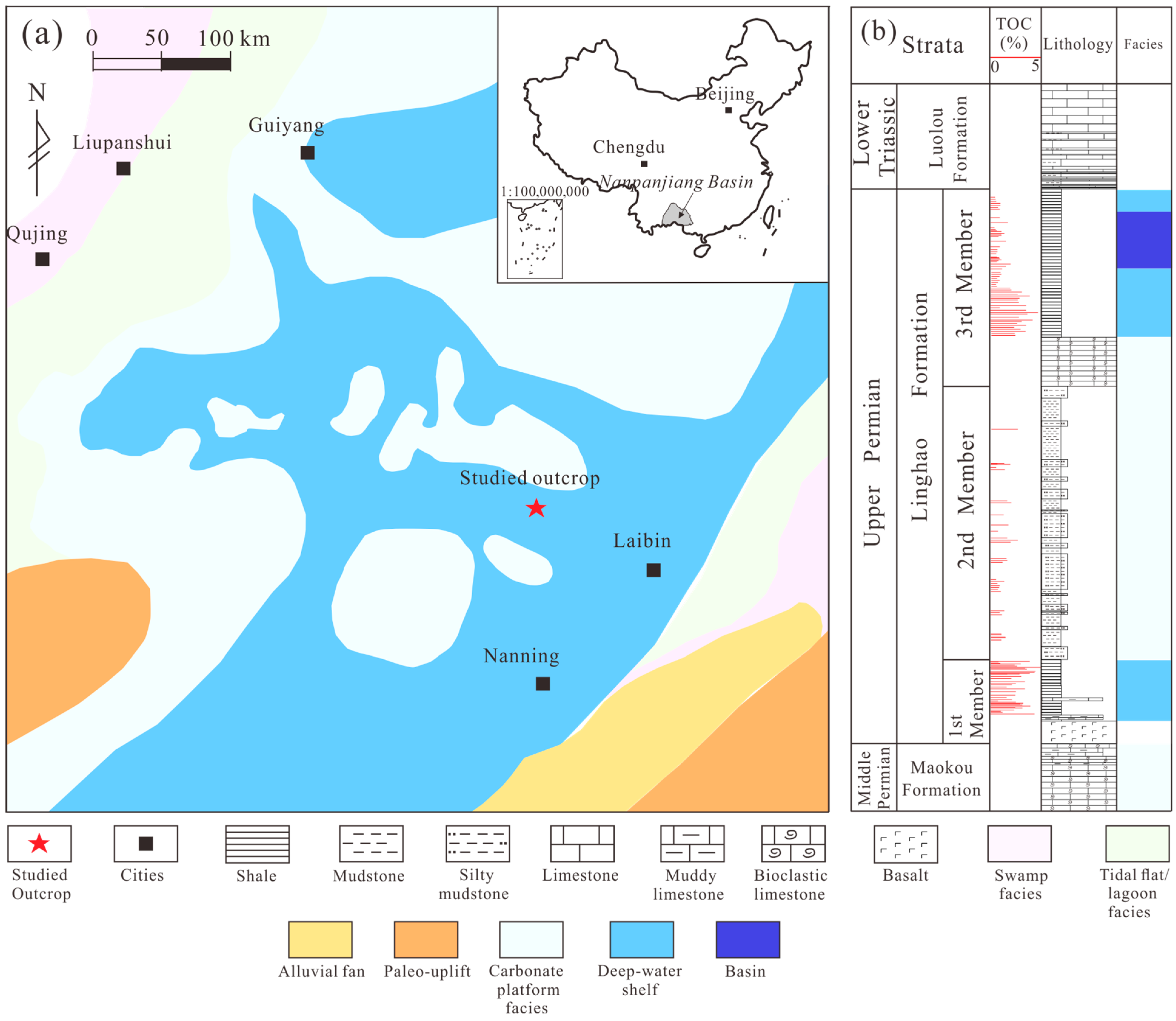
Figure 1. (a) Location of the Nanpanjiang Basin, Southwest China (Coordinates: 22.70–26.75° N, 103.68–108.10° E). (b) Generalized stratigraphy of the Upper Permian Linghao Formation in the study area (cited from Gu et al. [5]).
Fractalfract 09 00795 g001
Figure 2. Vertical variations characteristic of TOC and paleo-climate, paleoweather, paleosalinity, and detrital input of the Linghao Formation shale. The “*” in “CIA*” represents the CIA value corrected following the method of Nesbitt and Young [35].
Fractalfract 09 00795 g002
Figure 3. Vertical variations characteristic of TOC, redox, and paleo-productivity of the Linghao Formation shale.
Fractalfract 09 00795 g003
Figure 4. Correlation diagrams of geochemical elements. (ac) Paleoredox conditions discrimination diagrams; (df) silicon source discrimination diagrams.
Fractalfract 09 00795 g004
Figure 5. Lithofacies division diagram of Linghao shale.
Fractalfract 09 00795 g005
Figure 6. Microscopic features of shale in different lithofacies under microscope. Organic matter pores (OMP); interparticle pores (Inter P); intraparticle pores (Intra P); micro-fissure (MF). (a) OMP are more developed, HSA; (b,c) the development of OMP is moderate, MM; (d,e) the development of organic pores is limited, LSC; (f) Inter P and MF are developed, MSA; (g) Intra P, solution pores on the surfaces of calcite, HM; (h) Intra P develop within clay minerals under the influence of compaction and illitization, LM; (i) MF, mainly developed within and along the edges of inorganic minerals, LSC; (j,k) Inter P, Intra P, and MF, between brittle minerals and clay minerals, formed due to differential shrinkage and compaction. (l) MF at the edges of organic matter and inorganic minerals, MSC.
Fractalfract 09 00795 g006
Figure 7. Distribution and cumulative curve of saturated water, centrifugal 13,000 rpm T2 spectra of shale in different lithofacies, used to obtain T2C.
Fractalfract 09 00795 g007
Figure 8. Fractal characteristics of shale in different lithofacies based on NMR T2 spectra.
Fractalfract 09 00795 g008
Figure 9. Fractal characteristics of shale in different lithofacies based on NMRC data.
Fractalfract 09 00795 g009
Figure 10. Cross-plot of different paleo-environmental proxies and TOC in Linghao shales. (a) C-value vs TOC, paleo-climate; (b) Al/Si vs TOC, sediment grain size; (c) Al vs TOC, terrestrial input; (d) V/Cr vs TOC, redox; (e) Corg/P vs TOC, redox; (f) Cu/Al vs TOC, paleo-productivity.
Fractalfract 09 00795 g010
Figure 11. Comparison of main reservoir parameters of shale in different lithofacies of the Linghao Formation. (a) Mineral composition, (b) proportion of different types of pores, (c) TOC and porosity, (d) pore volume and adsorption gas content.
Fractalfract 09 00795 g011
Figure 12. The relationship between fractal dimension, porosity, and pore volume of shale in different lithofacies based on NMR T2 spectra and NMRC. (a) porosity vs D1, (b) porosity vs D2, (c) porosity vs DC, (d) pore volume and DC.
Fractalfract 09 00795 g012
Figure 13. Study on the influencing factors of fractal dimension based on TOC and mineral composition. (a) Correlation coefficient matrix; (b) redundancy analysis.
Fractalfract 09 00795 g013
Table 1. Reservoir parameter characteristics of shale in different lithofacies. LSC = low-carbon siliceous-clay mixed shale; LM = low-carbon mixed shale; MSC = medium-carbon siliceous-clay mixed shale; MM = medium-carbon mixed shale; MSA= medium-carbon siliceous-bearing argillaceous shales; HM = high-carbon mixed shale; HSA = high-carbon siliceous-bearing argillaceous shales. Gas content data are from [4].
LithofaciesTOC (%)Quartz (%)Feldspar (%)Clay (%)Carbonate (%)Organic PoreInorganic
Pore
Micro-FracturePorosity (%)Permeability (mD)Pore Volume Adsorption Gas Content
LSC1.35 24.25 14.49 39.42 15.19 2259190.210.00150.0034
LM0.86 22.76 12.69 28.05 29.67 0.180.0025 0.78
MSC2.74 16.97 16.43 40.73 18.67 395381.780.0022 1.21
MM2.48 17.54 11.08 38.32 26.00 4642121.760.00480.0045
MSA2.49 14.66 12.30 51.88 14.79 4742111.800.00230.00521.14
HM3.54 13.40 13.25 40.88 25.05 2.170.00630.0064
HSA3.61 14.49 11.81 55.89 10.21 613272.140.0360.00741.64
Table 2. Fractal parameters of shale in different lithofacies based on NMR T2 spectra.
Sample No.LithofaciesT2C (ms)T2 < T2cT2 > T2c
D1R2D2R2
S1LSC7.52.780.9162.870.959
S2LM2.72.840.8442.910.993
S3HSA1.82.850.8862.900.974
S4HSA2.12.820.8622.910.954
S5HSA2.42.850.8672.900.986
S6HSA5.52.800.8052.880.961
S7HSA3.72.830.8782.880.981
S8HSA4.22.820.8962.890.988
S9HM1.72.800.9122.880.993
S10MSA9.22.760.8992.870.968
S11MSA4.52.810.8752.900.943
S12MSC0.92.860.8972.910.963
S13MM3.62.790.9012.870.975
Table 3. Fractal parameters of shale in different lithofacies based on NMRC.
Sample IDLithofacies5 nm < r < 90 nm90 nm < r < 600 nmDc
Dc1R2Dc2R2
S1LSC0.3780.9160.090.9592.70
S3HSA0.2590.8860.0880.9742.79
S9HM0.2970.8620.0660.9542.75
S10MSA0.3570.8670.1030.9862.72
S13MM0.3490.8050.0810.9612.71
Disclaimer/Publisher’s Note: The statements, opinions and data contained in all publications are solely those of the individual author(s) and contributor(s) and not of MDPI and/or the editor(s). MDPI and/or the editor(s) disclaim responsibility for any injury to people or property resulting from any ideas, methods, instructions or products referred to in the content.