
Parameter Estimation of LFM Signals Based on PID-PSO-FRFT


Abstract
1. Introduction
2. LFM Signal Parameter Estimation Based on PID-PSO-FRFT
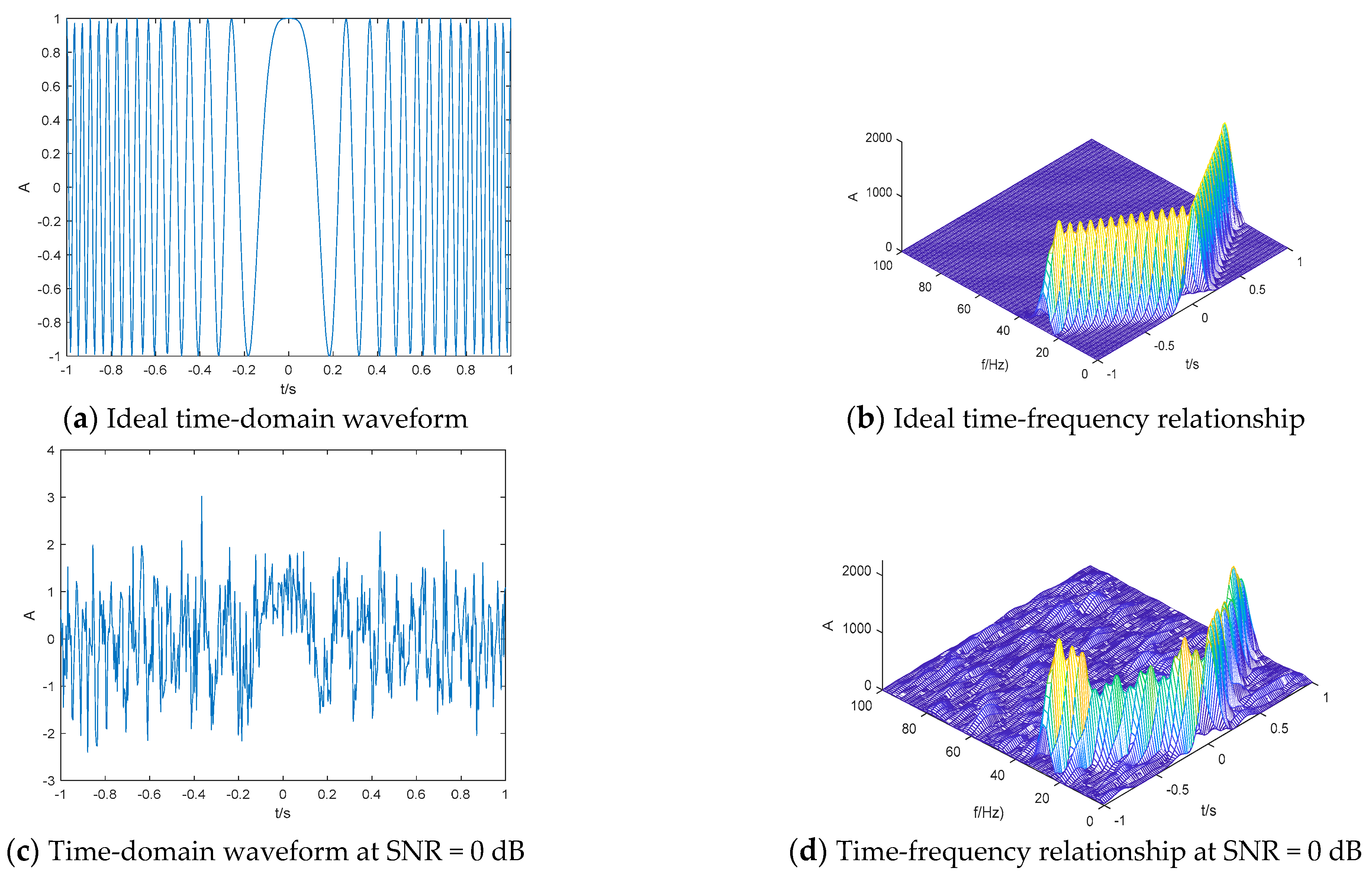
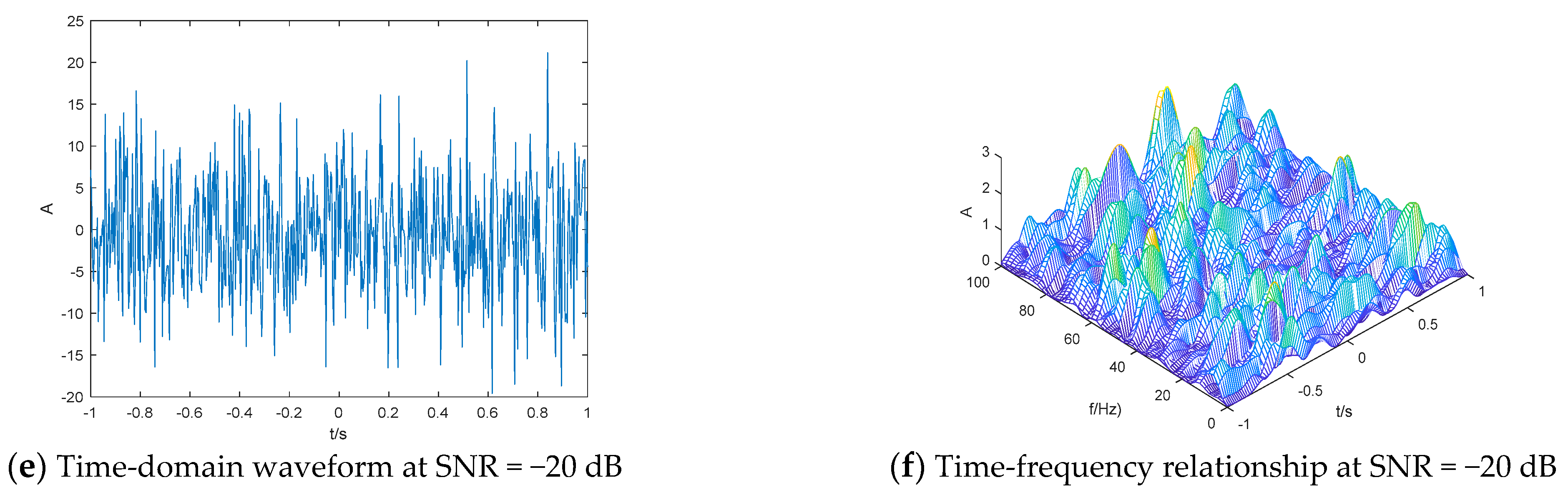
2.1. Signal Model
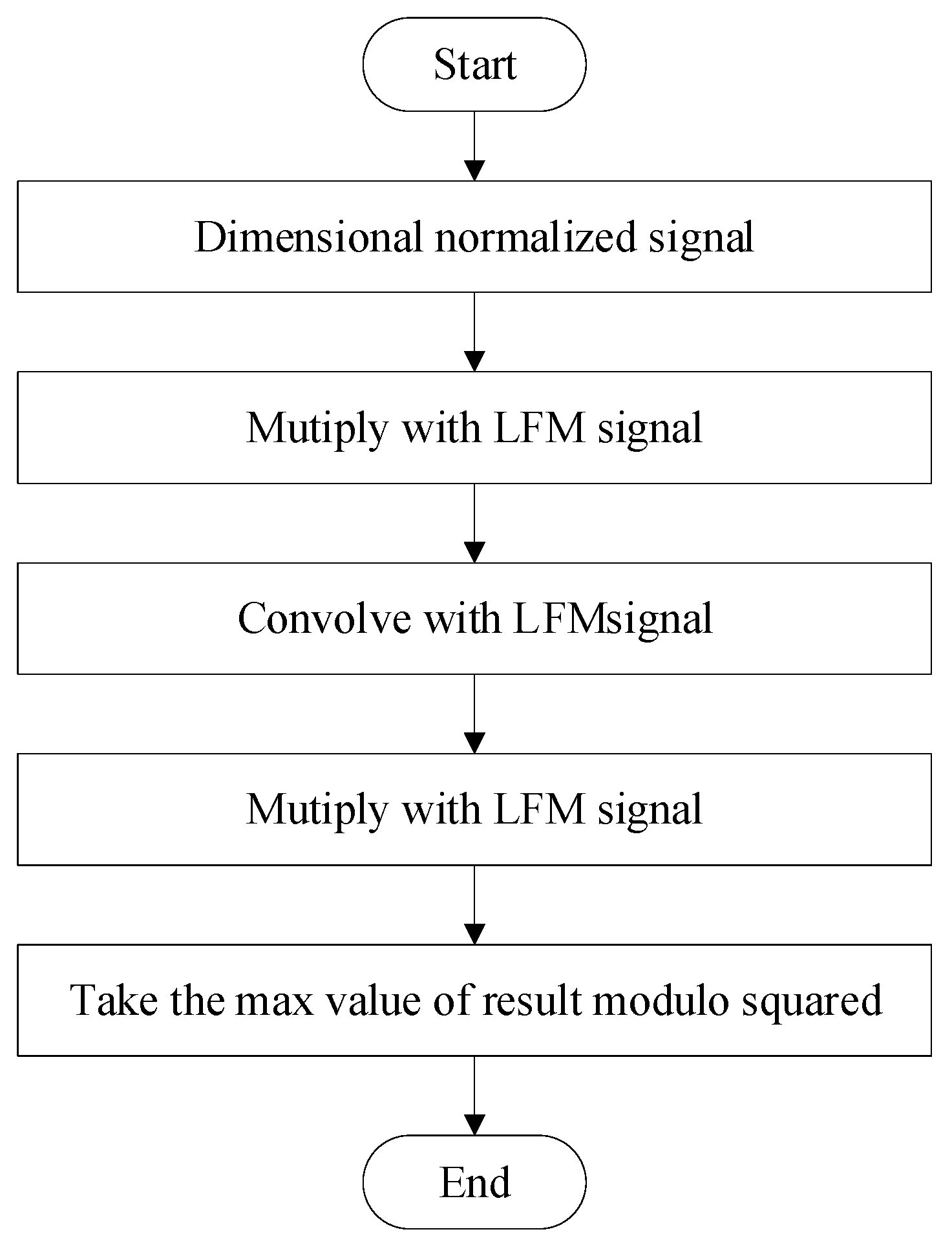
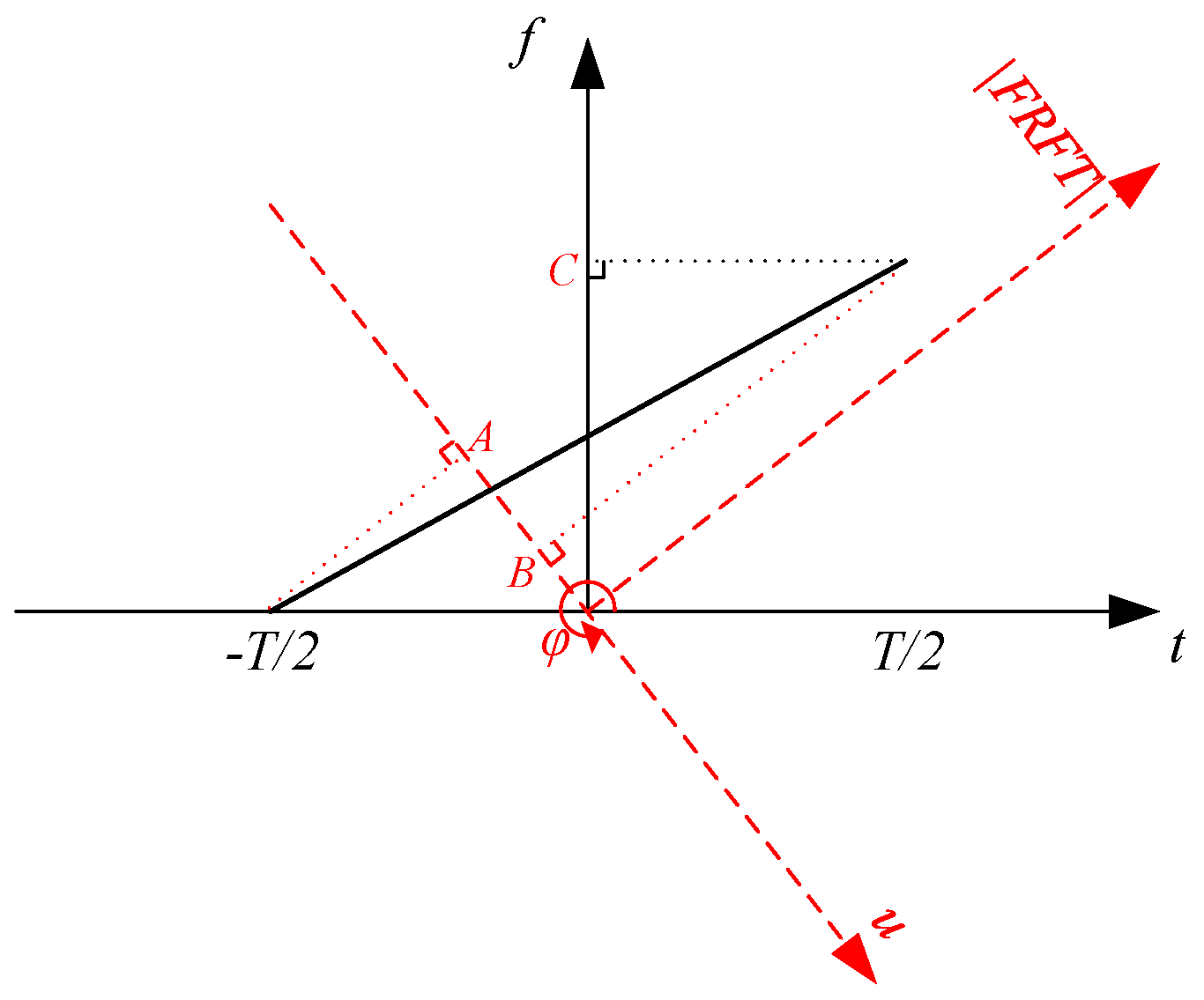
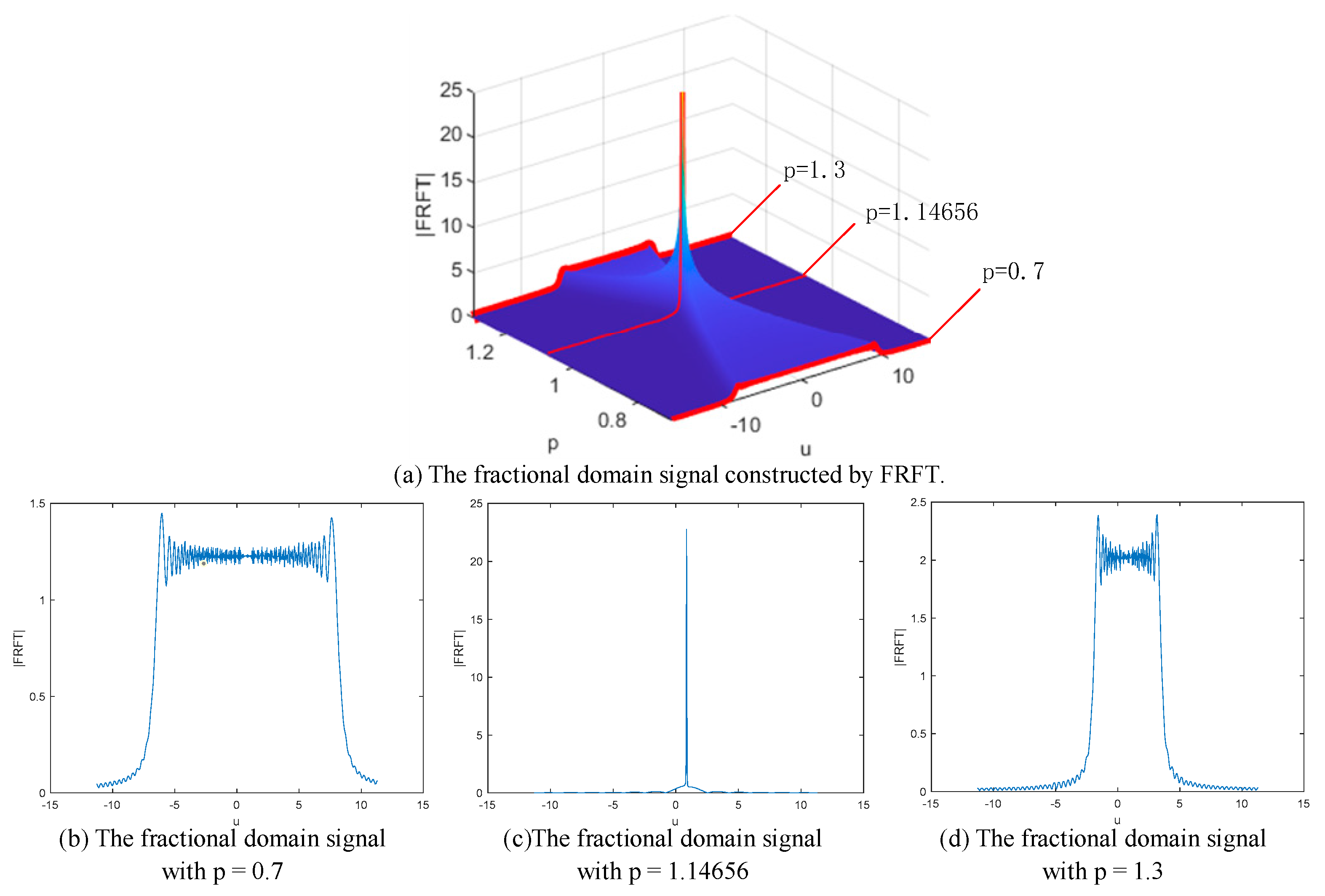
2.2. Principle of LFM Signal Parameter Estimation Based on FRFT
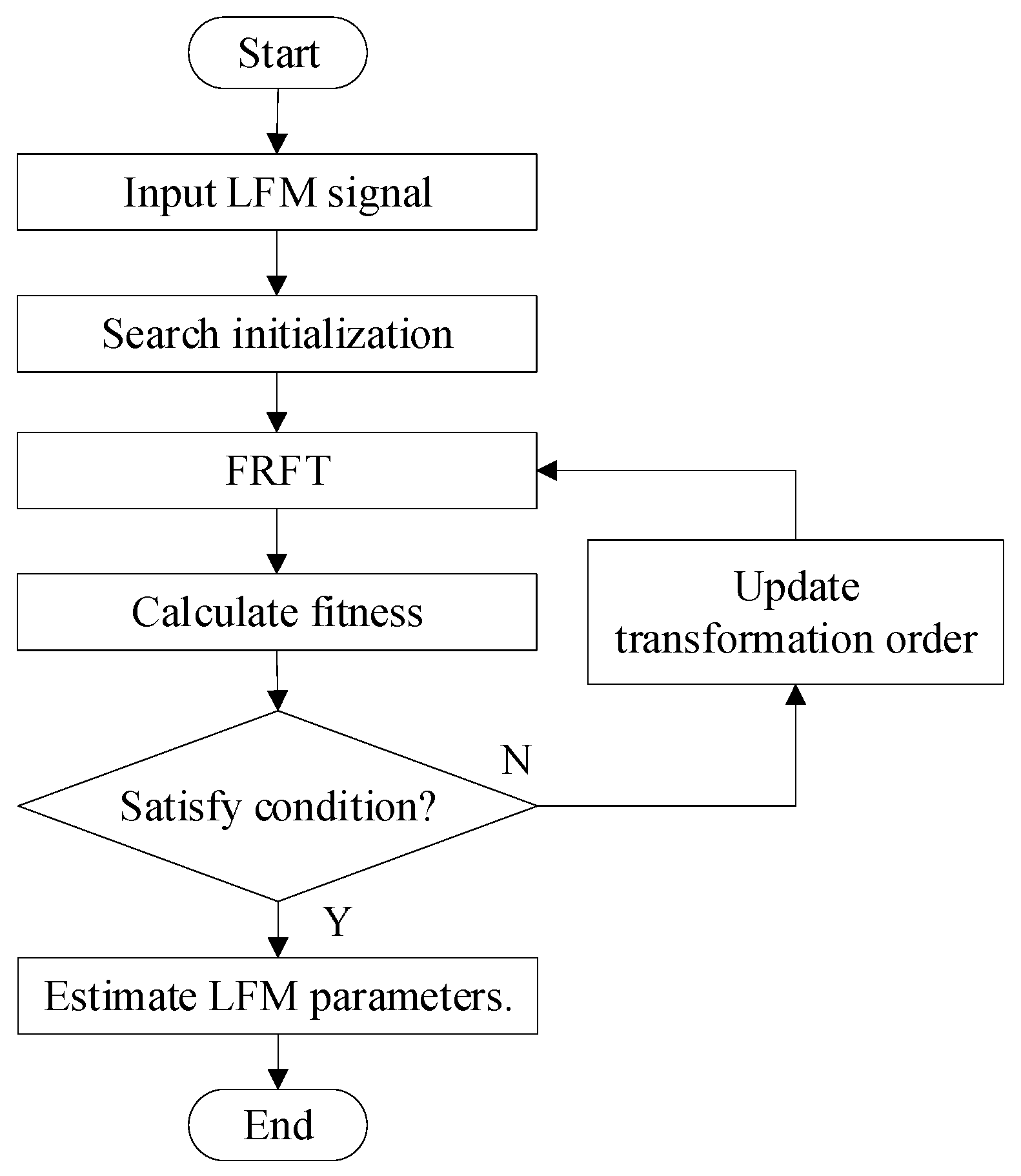
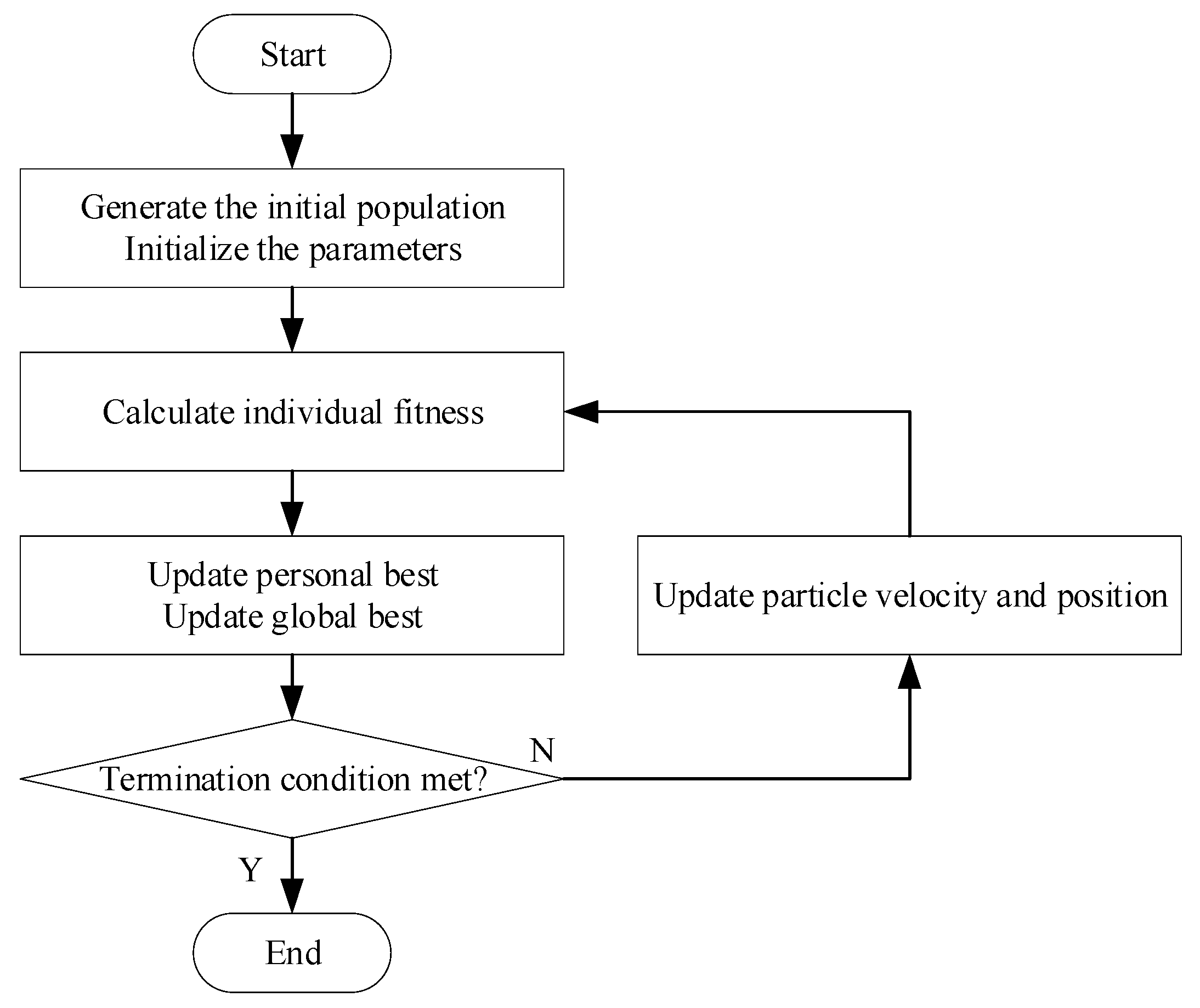
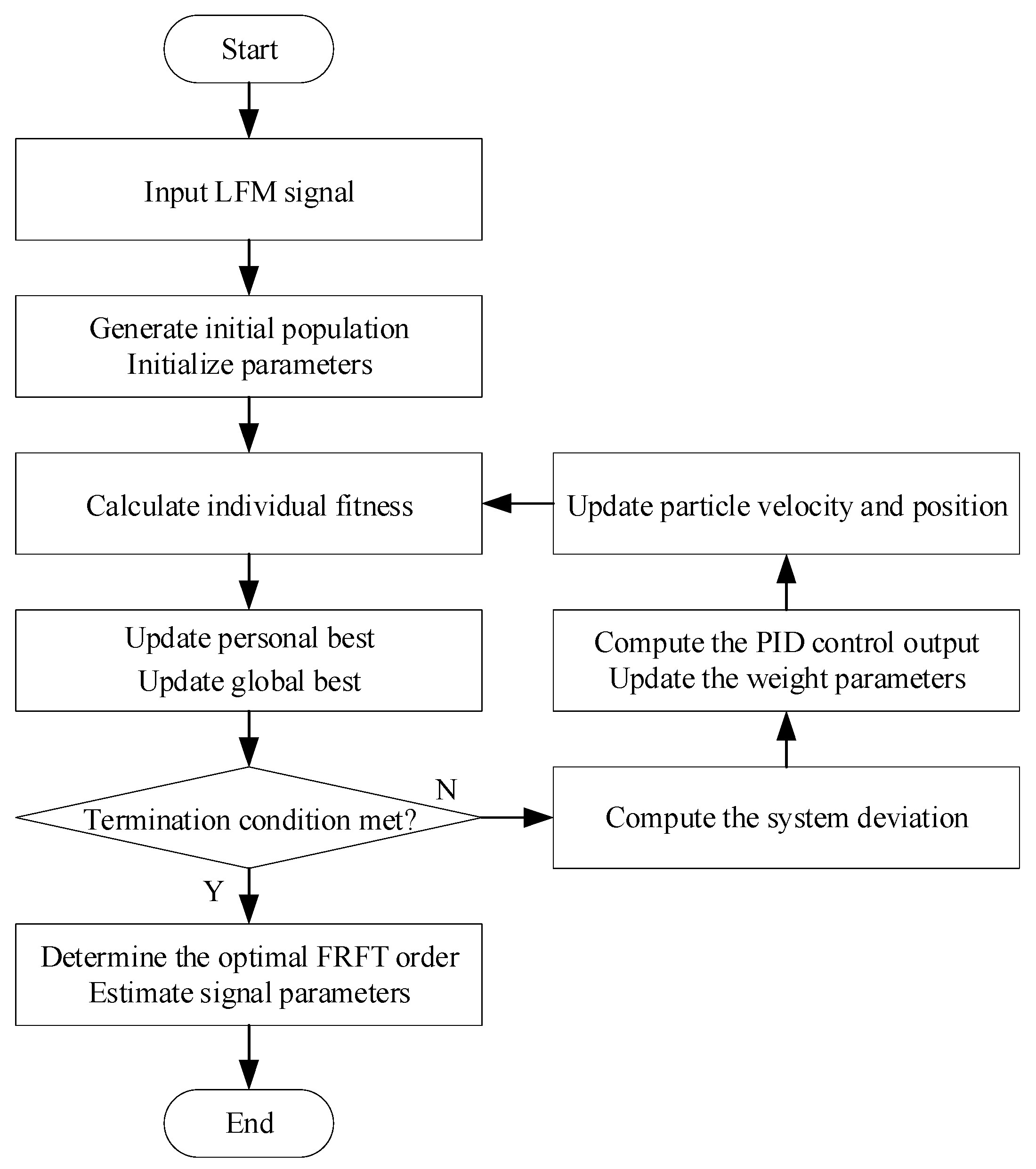
2.3. Principle of the PID-PSO-FRFT Algorithm
| Algorithm 1. PID-PSO-FRFT |
| Input: LFM signal s, The time series corresponding to the signal t of the LFM Signal 1: Initialization: Number of particles: n; Maximum iteration count: ; Position bounds: ; ; PID parameters: ; Inertia weight bounds: ; ∈ i = 1, …, n; ← 0; ; ←−∞; Initialize global best: gb←∅←−∞; ←0; 2: for iter = 1 to Tmax do 3: for i = 1 to n do 4: )|) //Calculate fitness 5: then //Update individual best 6: 7: end if 8: end for 9: ) //Update current best 10: 11: then 12: //Update historical best 13: end if 14: ≥ threshold then //Fitness threshold judgment 15: break 16: end if 17: // Adaptive PID adjustment 18: ← g-x //Current error 19: //Proportional term 20: 21: //Integral term 22: ) //Derivative term 23: ← P+I+D //PID correction term 24: 25: clip , ) //Boundary Constraint 26: // Particle Update 27: v ←·v+c_1·(p−x)+c_2·(g−x) 28: v ← clip(v, , ) 29: x ← x+v 30: x ← clip(x, , ) 31: //Update Error Record 32: end for 33: // Calculate the chirp rate and center frequency of the LFM signal based on gb 34: , ←calculate_lfmParam(gb) 35: return & |
3. Simulation Experiments and Analysis
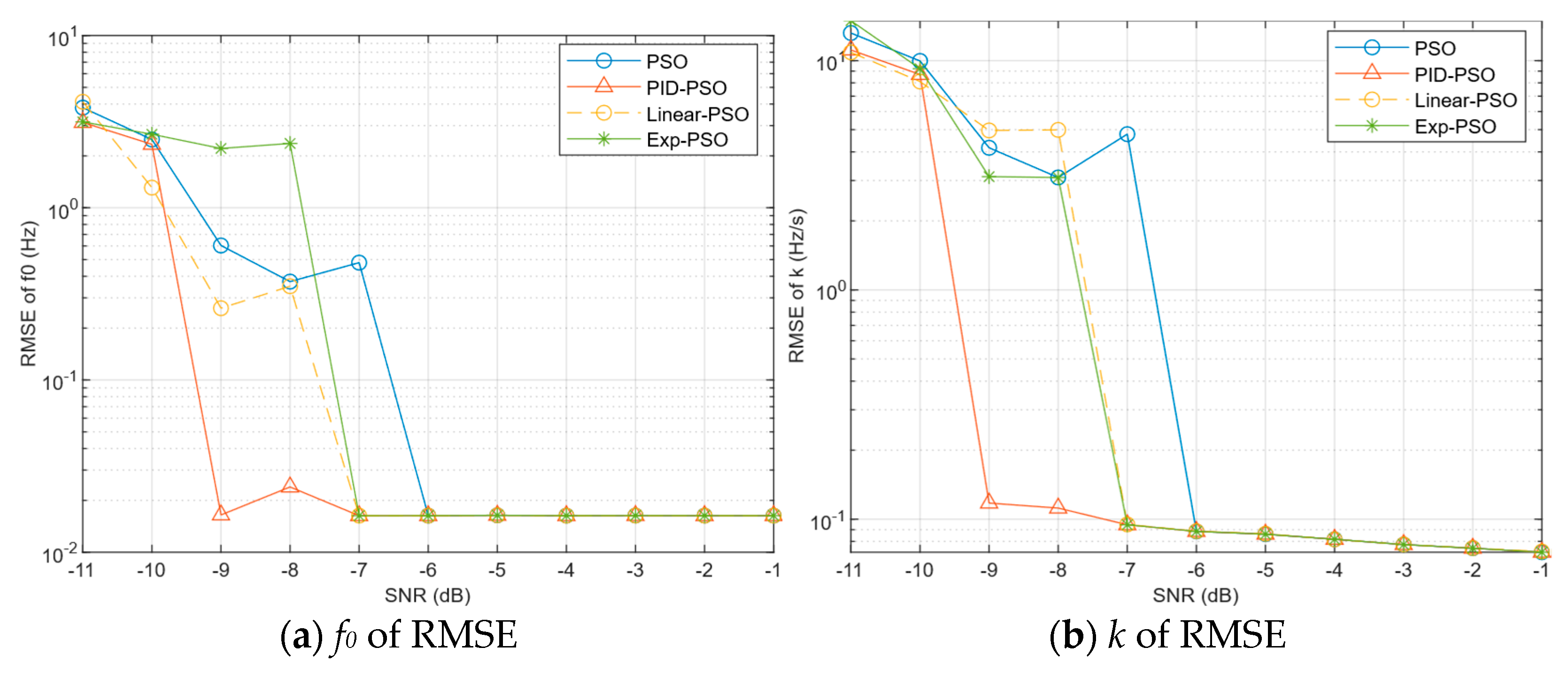
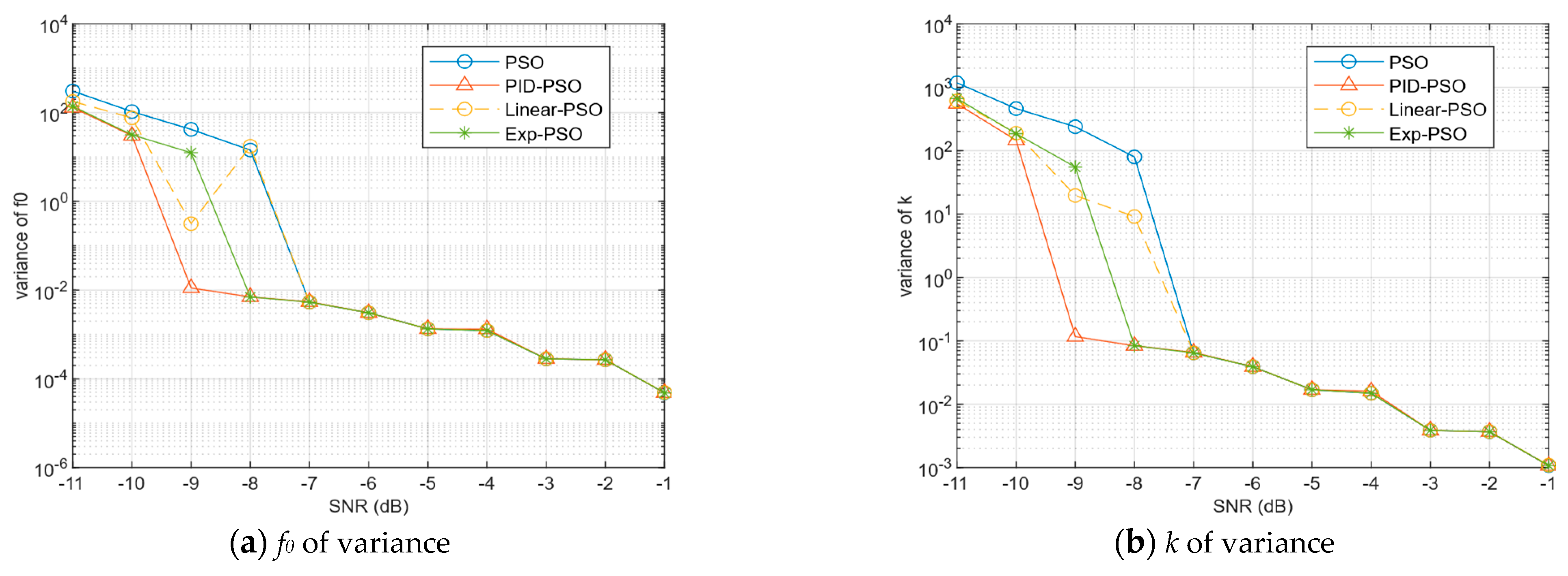
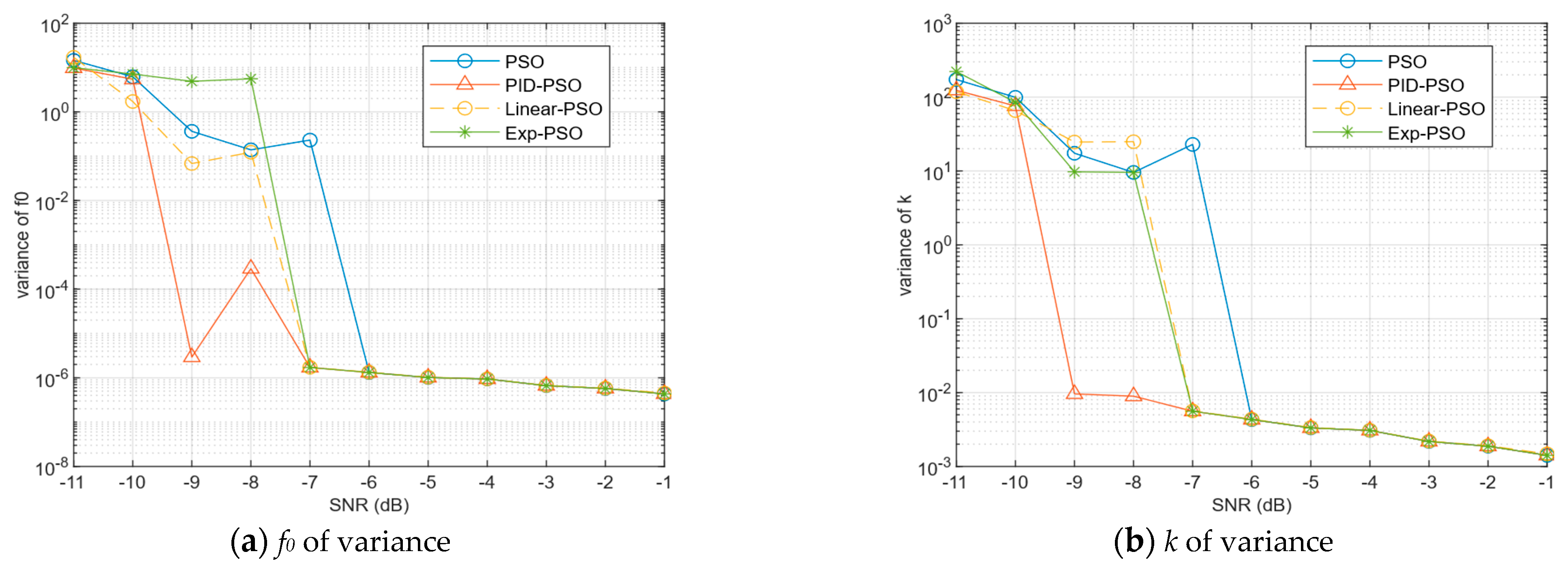
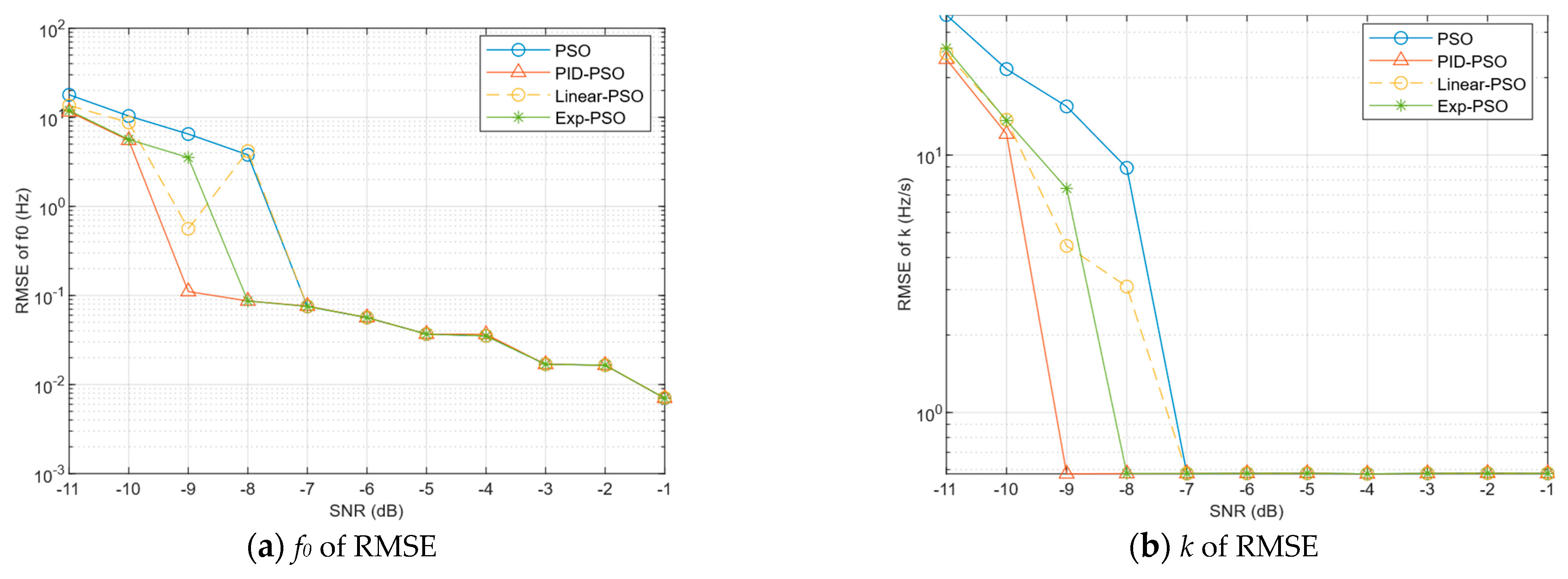
3.1. Experiment 1: Comparative Experiment on Anti-Noise Robustness of LFM Signal Parameter Estimation Algorithms Under Different SNRs

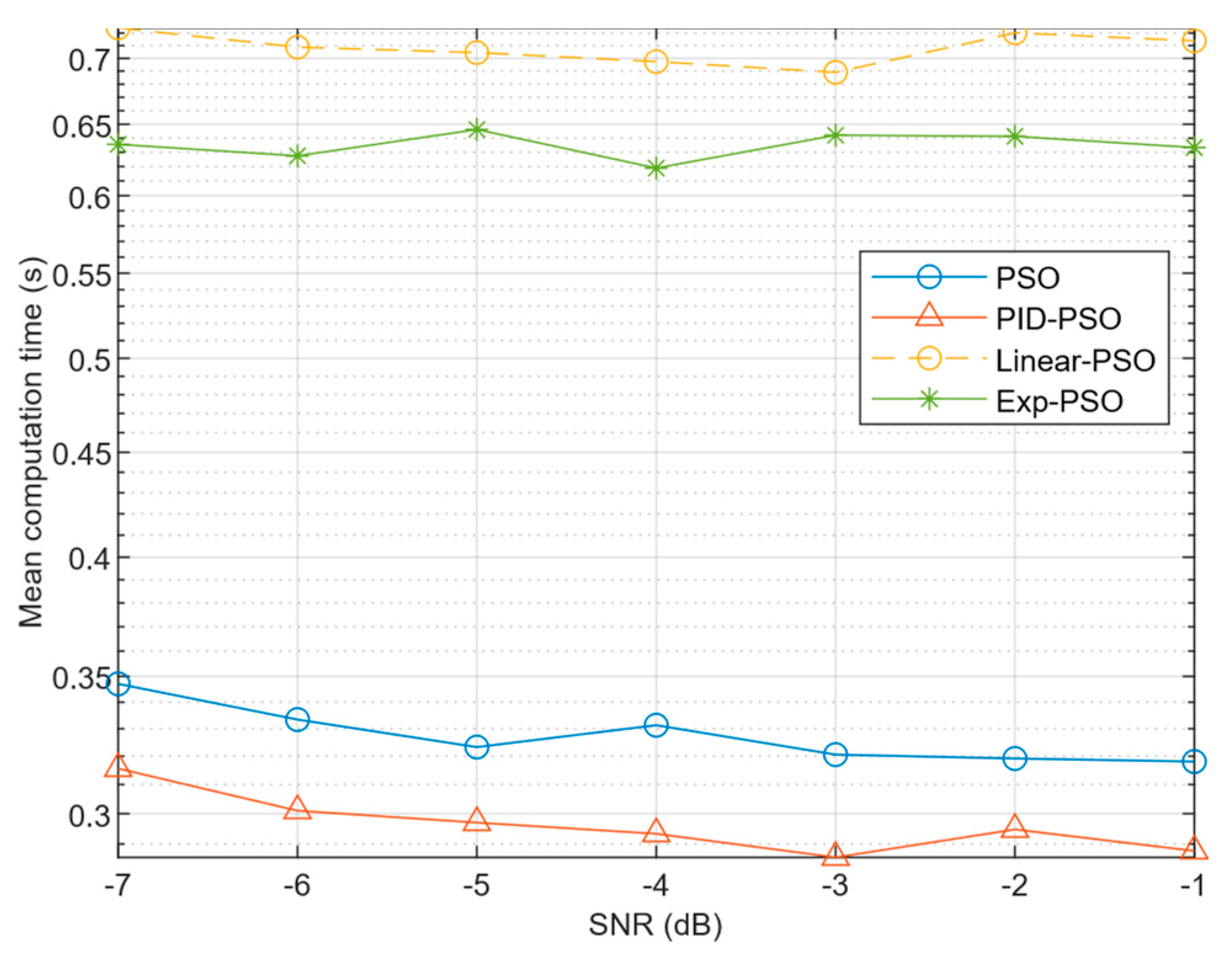
3.2. Experiment 2: Comparative Experiment on Convergence Speed of LFM Parameter Estimation Under Different SNRs
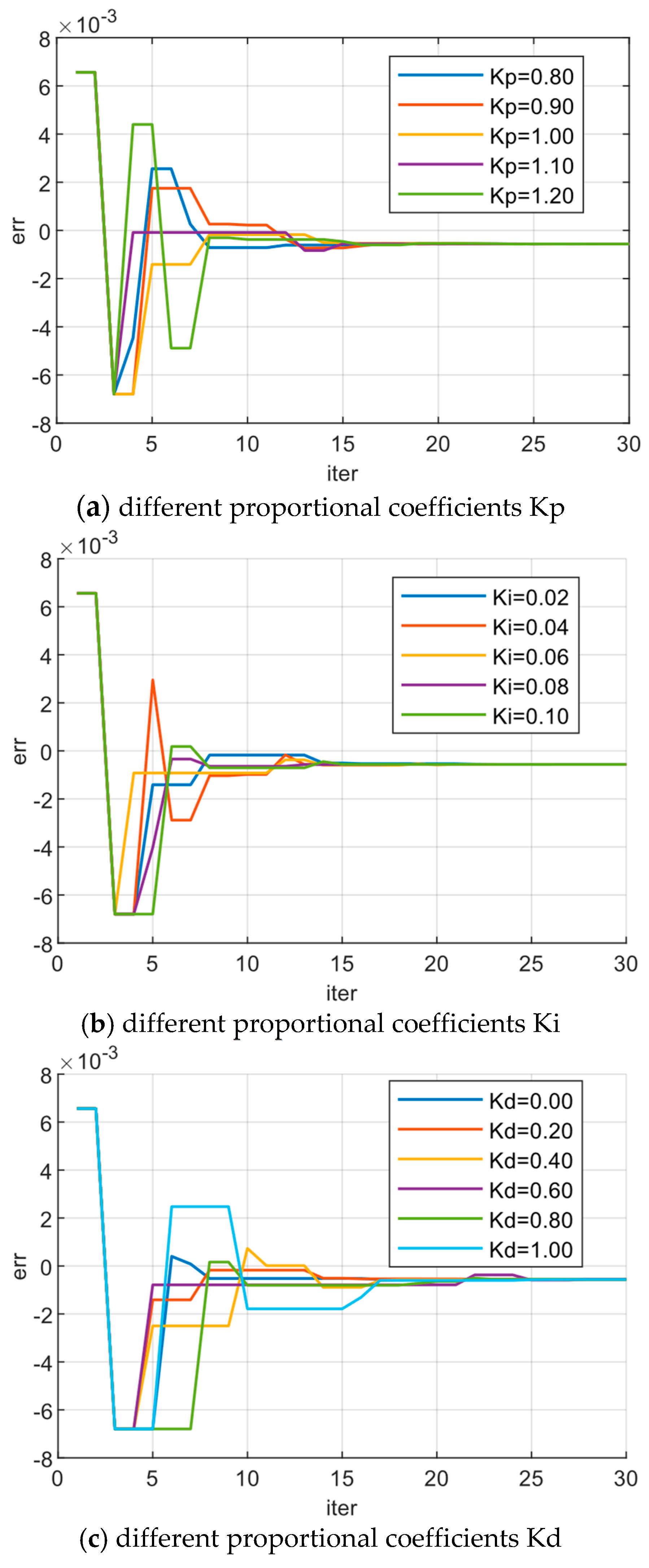
3.3. Experiment 3: Sensitivity Analysis of PID Control Parameters for the Proposed PID-PSO-FRFT Algorithm
4. Conclusions
Author Contributions
Funding
Data Availability Statement
Conflicts of Interest
References
- Zhu, W.T.; Su, T.; Yang, T.; Zheng, J.B.; Zhu, K.R. Parameter estimation of linear frequency modulated continuous wave signals under low signal-to-noise ratio. Chin. J. Radio Sci. 2013, 28, 1158–1164. [Google Scholar] [CrossRef]
- Stove, A.G. Linear FMCW radar techniques. IEE Proc. F Radar Signal Process. 1992, 139, 343–350. [Google Scholar] [CrossRef] [Scilit]
- Shi, C.; Wang, F.; Salous, S.; Zhou, J. Low probability of intercept-based radar waveform design for distributed multiple-radar systems. Entropy 2018, 20, 197. [Google Scholar] [CrossRef] [Scilit]
- Mao, Y.T. Generalized Linear Frequency-Domain Chirplet Transform and Its Application. Pure Math. 2024, 14, 642–648. [Google Scholar] [CrossRef]
- Zhou, Y.X.; Ma, Z.P.; Fu, L. A Review of Key Signal Processing Techniques for Structural Health Monitoring: Highlighting Non-Parametric Time-Frequency Analysis, Adaptive Decomposition, and Deconvolution. Algorithms 2025, 18, 318. [Google Scholar] [CrossRef] [Scilit]
- Morlet, J.; Arens, G.; Fourgeau, E.; Giard, D. Wave propagation and sampling theory—Part I: Complex signal and scattering in multilayered media. Geophysics 2012, 47, 203–221. [Google Scholar] [CrossRef] [Scilit]
- Mateo, C.; Talavera, A.J. Bridging the gap between the short-time Fourier transform (STFT), wavelets, the constant-Q transform and multi-resolution STFT. Signal Image Video Process. 2020, 14, 1535–1543. [Google Scholar] [CrossRef] [Scilit]
- Li, M.Y.; Chen, W.Z.; Zhang, T. Automatic epileptic EEG detection using DT-CWT-based non-linear features. Biomed. Signal Process. Control. 2017, 34, 114–125. [Google Scholar] [CrossRef] [Scilit]
- Sarna, M.; Hossian, M.R.; Islam, M.A. Comparative analysis of STFT and wavelet transform in time-frequency analysis of non-stationary signals. Nov. Trends Comput. 2024, 1, 72–78. [Google Scholar] [CrossRef]
- Huang, D.Z.; Han, L.G.; Li, H.F.; Yang, F.; Zhao, X.; Sun, N. Separation of multi-source seismic data based on S-transform adaptive filtering iteration. Pet. Geophys. Prospect. 2020, 55, 1253–1262. [Google Scholar] [CrossRef]
- Stockwell, R.G.; Mansinha, L.; Lowe, R.P. Localization of the complex spectrum: The S transform. IEEE Trans. Signal Process. 1996, 44, 998–1001. [Google Scholar] [CrossRef] [Scilit]
- Beuter, C.; Oleskovicz, M. S-transform: From main concepts to some power quality applications. IET Signal Process. 2020, 14, 115–123. [Google Scholar] [CrossRef] [Scilit]
- Wu, G.N.; Cao, S.Y.; Ma, N. Time-frequency analysis characteristics of the S-transform and its improvement. Prog. Geophys. 2011, 26, 1661–1667. [Google Scholar]
- Satyanarayana, V.V.S.; Krishna, M.B.; Satyanarayana, V.V.P.; Kumari, E.K. Reduction of Interference Terms in Wigner Ville Distribution using Machine Learning. Circuits Syst. Signal Process. 2024, 44, 2041–2072. [Google Scholar] [CrossRef] [Scilit]
- Zou, Y.; Li, X.; Yu, G. Adaptive WVD Cross-Term Removal Method Based on Multidimensional Property Differences. J. Mar. Sci. Appl. 2024, 24, 774–788. [Google Scholar] [CrossRef] [Scilit]
- Shekhar, C.; Raj, B.A.A. Time-optimised real-time time–frequency measurement technique for RoFSO applications. Measurement 2025, 253, 117698. [Google Scholar] [CrossRef] [Scilit]
- Ristic, B.; Boashash, B. Use of the cross polynomial Wigner-Ville distribution for instantaneous frequency estimation of nonlinear FM signals. In Proceedings of the IEEE-SP International Symposium on Time-Frequency and Time-Scale Analysis, Philadelphia, PA, USA, 25-28 October 1994; IEEE: Victoria, BC, Canada, 1994; pp. 252–255. [Google Scholar] [CrossRef] [Scilit]
- Lu, L.; Ren, W.X.; Wang, S.D. Fractional Fourier transform: Time-frequency representation and structural instantaneous frequency identification. Mech. Syst. Signal Process. 2022, 178, 109305. [Google Scholar] [CrossRef] [Scilit]
- Aldmashke, O.; Serbes, A. LFM signal parameter estimation in the fractional Fourier domains: Analytical models and a high-performance algorithm. Signal Process. 2024, 214, 109224. [Google Scholar] [CrossRef] [Scilit]
- Lu, Z.K.; Liu, S.H.; Qiu, J.; Huang, Q.; Yang, C. An efficient method for parameter estimation and separation of multi-component LFM signals. Signal Process. 2023, 207, 108964. [Google Scholar] [CrossRef] [Scilit]
- Xuelian, L.; Xiao, B.; Wang, C. Optimal target function for the fractional Fourier transform of LFM signals. Circuits Syst. Signal Process. 2022, 41, 4160–4173. [Google Scholar] [CrossRef] [Scilit]
- Xuelian, L.; Xiao, B.; Wang, C. Frequency estimation of chirp signals based on fractional fourier transform combined with Otsu’s method. Optik 2021, 240, 166945. [Google Scholar] [CrossRef] [Scilit]
- Yan, B.M.; Li, Y.; Cheng, W. High-resolution multicomponent LFM parameter estimation based on deep learning. Signal Process. 2025, 227, 109714. [Google Scholar] [CrossRef] [Scilit]
- Shen, L.; Yin, Q.; Lu, M.; Zhang, Q.; Guo, L.; Shen, T.; Zhao, G.; Ning, S. Linear FM Signal Parameter Estimation Using STFT and FRFT. Chin. J. Electron. 2013, 22, 301–307. [Google Scholar]
- Liu, X. Parameter estimation of LFM signal intercepted by Nyquist folding receiver based on particle swarm optimization and fractional Fourier transform. In Proceedings of the International Conference on Computer Application and Information Security (ICCAIS 2024), Wuhan, China, 20-22 December 2024; SPIE: Bellingham, WA, USA, 2025; Volume 13562, pp. 212–219. [Google Scholar] [CrossRef] [Scilit]
- Wang, H.; Guo, Y.; Yang, L. Parameter estimation of LFM signals based on FOTD-CFRFT under impulsive noise. Fractal Fract. 2023, 7, 822. [Google Scholar] [CrossRef] [Scilit]
- Guo, Y.; Yang, L. Method for parameter estimation of LFM signal and its application. IET Signal Process. 2019, 13, 538–543. [Google Scholar] [CrossRef] [Scilit]
- Kennedy, J.; Eberhart, R.C. Particle swarm optimization. In Proceedings of the ICNN’95—International Conference on Neural Networks, Perth, Australia, 27 November–1 December 1995; IEEE: New York, NY, USA, 1995; pp. 1942–1948. [Google Scholar] [CrossRef] [Scilit]
- Han, Y.; Lin, M.; Li, N.; Qi, Q.; Li, J.; Liu, Q. DCWPSO: Particle swarm optimization with dynamic inertia weight updating and enhanced learning strategies. PeerJ Comput. Sci. 2024, 10, e2253. [Google Scholar] [CrossRef] [Scilit]
- Sameh, K.; Dominique, B. Particle Swarm Optimization with Adaptive Inertia Weight. Int. J. Mach. Learn. Comput. 2015, 5, 368–373. [Google Scholar] [CrossRef] [Scilit]
- Saxena, S.; Pohit, M. A new non linear inertia weight approach in PSO for faster rigid image registration. In Proceedings of the 2019 6th International Conference on Signal Processing and Integrated Networks (SPIN), Noida, India, 7–8 March 2019; IEEE: New York, NY, USA, 2019; pp. 607–612. [Google Scholar] [CrossRef] [Scilit]
- Ratnawati, D.E.; Marjono, M.; Widodo, W.; Anam, S. PSO-ELM with time-varying inertia weight for classification of SMILES codes. Int. J. Intell. Eng. Syst. 2020, 18, 2146–2155. [Google Scholar] [CrossRef] [Scilit]
- Huang, C.; Zhao, Y.; Zhang, M.; Yang, H. APSO: An A*-PSO Hybrid Algorithm for Mobile Robot Path Planning. IEEE Access 2023, 11, 43248–43263. [Google Scholar] [CrossRef] [Scilit]
- Bharti, K.K.; Singh, K.P. Opposition chaotic fitness mutation based adaptive inertia weight BPSO for feature selection in text clustering. Appl. Soft Comput. 2016, 43, 20–34. [Google Scholar] [CrossRef] [Scilit]
- Zaineb, A.; Kamel, B. Fractional Fourier Transform, Signal Processing and Uncertainty Principles. Circuits Syst. Signal Process. 2022, 42, 892–912. [Google Scholar] [CrossRef] [Scilit]
- Chunyang, W.; Xuelian, L. Application of fractional Fourier transform in signal processing. J. Chang. Univ. Sci. Technol. (Nat. Sci. Ed.) 2015, 38, 1–8. [Google Scholar]
- Liu, X.; Han, J.; Wang, C.; Xiao, B. Parameter estimation of linear frequency modulation signals based on sampling theorem and fractional broadening. Rev. Sci. Instrum. 2019, 90, 014702. [Google Scholar] [CrossRef] [Scilit] [PubMed]
- Ozaktas, H.M.; Arikan, O.; Kutay, M.A.; Bozdagt, G. Digital computation of the fractional Fourier transform. IEEE Trans. Signal Process. 1996, 44, 2141–2150. [Google Scholar] [CrossRef] [Scilit]
- Zhao, X.H.; Deng, B.; Tao, R. Dimensional normalization in numerical computation of fractional Fourier transform. J. Beijing Inst. Technol. 2005, 25, 360–364. [Google Scholar] [CrossRef]
- Guan, J.; Jiang, X.Y.; Liu, N.B.; Ding, H.; Dong, Y.; Liu, T. Enhanced target detection using fractional Fourier transform features with threshold-modified normalization. Electron. Lett. 2024, 60, e13252. [Google Scholar] [CrossRef] [Scilit]








| Algorithm Parameter | Parameter Value |
|---|---|
| Learning Factor c1 | 1.4962 |
| Learning Factor c2 | 0.9 |
| Maximum Iterations | 50 |
| Search Dimension | 1 |
| Population Size | 50 |
| Initial Position | Randomly selected within the bounds |
| Initial v of PSO | Randomly selected within the bounds |
| Search Range | [0.7, 1.3] |
| v of Range | [−0.6, 0.6] |
| Algorithm | Inertia Weight ω Setting | Additional Tuning Parameters |
|---|---|---|
| Basic PSO | ω = 0.7 | \ |
| PID-PSO | Initial ω = 0.7, ω ∈ [0.4, 1.4] | P = 1; I = 0.02; D = 0.2. |
| Linear-PSO | Initial ω = 0.7, ω ∈ [0.4, 1.4] | \ |
| Exp-PSO | Initial ω = 0.7, ω ∈ [0.4, 1.4] | \ |
| SNR (dB) | −7 | −6 | −5 | −4 | −3 | −2 | −1 | |
|---|---|---|---|---|---|---|---|---|
| Mean Iteration Count | Basic PSO | 8.7500 | 8.4190 | 8.2180 | 8.3700 | 8.1370 | 8.0610 | 8.0620 |
| Linear-PSO | 18.3390 | 17.9920 | 17.8970 | 17. 7150 | 17.5380 | 18.2340 | 18.1470 | |
| Exp-PSO | 16.1320 | 15.8930 | 16.3940 | 15.7340 | 16.3230 | 16.1980 | 16.1020 | |
| PID-PSO | 7.9620 | 7.6140 | 7.5320 | 7.4420 | 7.2460 | 7.4200 | 7.2970 |
| SNR (dB) | −7 | −6 | −5 | −4 | −3 | −2 | −1 |
|---|---|---|---|---|---|---|---|
| Speed-up Ratio (%) | 9.00 | 9.56 | 8.35 | 11.09 | 10.95 | 7.95 | 9.49 |
Disclaimer/Publisher’s Note: The statements, opinions and data contained in all publications are solely those of the individual author(s) and contributor(s) and not of MDPI and/or the editor(s). MDPI and/or the editor(s) disclaim responsibility for any injury to people or property resulting from any ideas, methods, instructions or products referred to in the content. |
© 2026 by the authors. Licensee MDPI, Basel, Switzerland. This article is an open access article distributed under the terms and conditions of the Creative Commons Attribution (CC BY) license.
Share and Cite
Liu, X.; Zhou, T.; Wang, Y.; Xiao, B.; Chen, Y.; Wang, C. Parameter Estimation of LFM Signals Based on PID-PSO-FRFT. Fractal Fract. 2026, 10, 202. https://doi.org/10.3390/fractalfract10030202
Liu X, Zhou T, Wang Y, Xiao B, Chen Y, Wang C. Parameter Estimation of LFM Signals Based on PID-PSO-FRFT. Fractal and Fractional. 2026; 10(3):202. https://doi.org/10.3390/fractalfract10030202
Chicago/Turabian StyleLiu, Xuelian, Tianhang Zhou, Yuchao Wang, Bo Xiao, Yani Chen, and Chunyang Wang. 2026. "Parameter Estimation of LFM Signals Based on PID-PSO-FRFT" Fractal and Fractional 10, no. 3: 202. https://doi.org/10.3390/fractalfract10030202
APA StyleLiu, X., Zhou, T., Wang, Y., Xiao, B., Chen, Y., & Wang, C. (2026). Parameter Estimation of LFM Signals Based on PID-PSO-FRFT. Fractal and Fractional, 10(3), 202. https://doi.org/10.3390/fractalfract10030202