1. Introduction
The increasing integration of renewable generation sources (RGSs), energy storage systems (ESSs), and demand flexibility alters the fundamental dynamic properties of power systems, making renewable-dominant grids strongly intermittent, low-inertia, and subject to long-term temporal correlations. Such behavioral changes render classical integer-order dynamic models inadequate and motivate the adoption of fractional-order representations that have been shown to effectively capture the nonlocal, memory-dependent, and power-law features often present in practical energy systems. Fractional-order controllers were first proposed for power system applications decades ago, and more recently, extensive research has established fractional-order techniques for enhancing control performance. Survey works have shown integer-order controllers to be outperformed by their fractional-order counterparts with respect to robustness and tuning flexibility in renewable-based and energy storage-assisted systems
Fractional-order PI, fuzzy, and adaptive controllers have also been widely developed for the LFC of hybrid renewable and interconnected power systems [
1]. For instance, fractional-order LFC schemes incorporating hydrogen energy storage and renewable generation have been shown to offer enhanced frequency stability and disturbance rejection in interconnected power grids [
2]. Fractional-order fuzzy control approaches optimized using chaotic PSO have also been proposed for hybrid renewable power systems for improved dynamic performance and robustness [
3]. More recently, robust fractional-order adaptive cascaded control frameworks have been introduced for mitigating load-frequency deviations in renewable-thermal hybrid systems [
4]. Fractional-order PI controllers and multiple-model fuzzy control strategies have also been applied to grid-connected renewable energy systems and multi-area interconnected power networks, showing improved regulation capability under renewable variability and demand response conditions [
5,
6]. Fractional-order approaches have been similarly adopted for optimizing and solving operational problems. Fractional hybrid strategies and metaheuristic optimization techniques have been proposed to address economic dispatch and techno-economic planning problems in wind-integrated and renewable-dominant power systems [
7,
8]. In addition, collaborative optimization and inverter-oriented control strategies have been explored to enhance operating efficiency in modern grids [
9]. Once again, while effective for their intended objectives, these contributions broadly assume simplified or static system dynamics and are unable to characterize the long-memory dynamic interactions between load demand and renewable supply. Elsewhere, studies have examined fractional-order forecasting methods and data-driven models. Fractional grey models and mixed-frequency fractional predictors have been shown to outperform classical forecasting approaches by leveraging the long-memory attributes present in historical electricity consumption data [
10,
11,
12]. Fractional-order artificial neural networks have also been developed for predicting renewable energy time series [
13]. Although their predictive performance benefits from incorporating memory effects, these works treat memory implicitly, as part of a forecasting objective. To date, memory effects have not been explicitly embedded into the fractional differential equations governing power system dynamics.
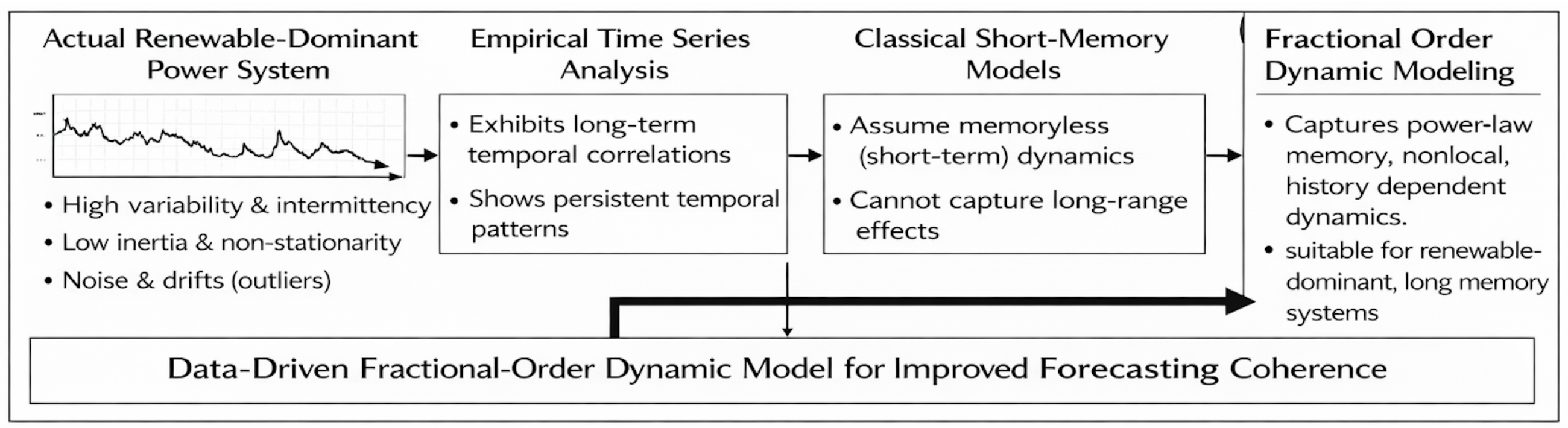
Figure 1 summarizes the motivation for using fractional-order models to represent the dynamics of renewable-dominant power systems. At the top, the generic characteristics of such systems are illustrated, including high variability and intermittency due to wind and solar integration, low inertia, structural and temporal non-stationarity, as well as noise and slow drifts. These properties lead to load and generation time series that do not conform to short-memory assumptions. Instead, empirical power system data exhibit strong temporal persistence and clear signatures of long-range dependence.
The middle portion of the figure presents representative empirical diagnostics that reveal power-law–decaying autocorrelation functions of the form , where , along with spectral characteristics dominated by low-frequency components. Such behavior is a hallmark of long-memory processes and cannot be adequately captured by classical integer-order models, which inherently assume exponentially decaying correlations.
The bottom portion contrasts classical integer-order dynamic models, which implicitly rely on Markovian or short-memory evolution and local, instantaneous dynamics, with the proposed fractional-order dynamic models. By introducing fractional derivatives of order , the proposed framework explicitly incorporates history dependence through a power-law memory kernel embedded directly in the equations of motion. This formulation enables a mathematically rigorous and physically consistent representation of nonlocal dynamics. Overall, the figure highlights how data-driven fractional dynamic models provide a principled link between empirical time-series properties and the underlying dynamics of renewable-dominant power systems.
The fractional-order modeling of individual system components has also been investigated. Fractional mathematical models have been developed for lithium-ion batteries [
14], electric-vehicle-assisted energy storage systems [
15], and photovoltaic generation units [
16] to capture hysteresis and degradation effects. Fractional-order formulations have further been proposed for electricity market dynamics and abstract energy supply demand systems [
17,
18]. While these studies provide valuable theoretical insights, they remain fragmented and do not holistically capture the system-level dynamics of renewable-dominant power grids. Overall, existing fractional-order studies lack a dataset-driven modeling framework that jointly describes the coupled evolution of renewable generation and load demand. Most works focus on isolated subsystems, control-oriented objectives, or short-term forecasting tasks, or rely on simulated or proprietary datasets. Long-memory effects are often acknowledged but are rarely modeled explicitly at the system-wide dynamic level.
Inspired by these limitations, this paper develops a unified fractional-order modeling framework for renewable-dominant power systems driven explicitly by long-memory load and renewable generation data. Unlike forecasting-based studies that implicitly incorporate memory effects [
10,
11,
12,
13], memory is embedded directly into fractional differential equations describing coupled system dynamics. Unlike component-focused works that lack system-level coherence [
14,
15,
16,
17], a unified grid-wide framework is proposed and validated using publicly available high-resolution datasets. Furthermore, unlike studies that do not systematically benchmark against integer-order dynamics [
7,
9,
18], comprehensive comparisons are conducted to demonstrate performance improvements. The proposed framework thus provides a physically consistent and reproducible foundation for modeling next-generation renewable-dominant power systems. Need for Long-Term Modelling: Short-term modelling is important to enable accurate near-term predictions and the real-time management and control of renewable energy systems. Short-term predictions tend to be more accurate, allowing for more efficient real-time management and control of the systems, which can be used in conjunction with feedback control loops to account for errors. However, long-term modelling is also needed to obtain more holistic information about the overall behaviour of renewable energy systems. Many of the large fluctuations that can occur in renewable energy generation occur over longer time-horizons due to seasonal changes in weather patterns, demand, etc. As a result, we need long-term models to help plan for renewable capacity expansion, energy storage needs, and grid integration over the long-term. We need to think long-term to ensure grid stability, energy security and sustainability, which requires the longer-term forecasting of both renewable generation and consumption [
19].
There are multiple reasons why fractional-order dynamic models outperform integer-order models. First, integer-order dynamical systems assume that system memory decays exponentially. Fractional-order models do not make this assumption and can thus better model long-memory systems, such as renewable-dominant power systems. Past states in a fractional-order system affect the future of the system for longer periods of time. The fractional-order model is inherently capable of capturing long-memory effects due to its power-law memory kernels. Fractional-order models can also capture the non-local behavior in processes. Renewable energy generation and load demand have temporal correlations that do not decay rapidly, while integer-order systems assume local behavior in the data. This can be seen as another way of saying that fractional-order models can better capture the persistence of renewable-dominant systems than integer-order systems. Fractional-order models are also capable of tuning the degree to which memory is included in the system, allowing them to capture a wider range of dynamics when compared to integer-order systems.
Fractional-order derivatives exist in nature but integer-order differential equations are normally utilized to model most natural phenomenons around us. Examples of integer-order phenomenons include Newtonian mechanics and electromagnetism. Fractional-order dynamic systems have been used to model renewable generation mechanisms because integer-order differential equations are incapable of describing the coupling long-memory or lag effects between renewable generation systems and their surrounding environments. Wind-generation mechanisms and solar irradiances systems have a long-term dependency that is classified as non-local. Fractional-order derivatives are capable of modeling such non-local mechanisms since their “memory” of past actions exists for a long period of time. Fractional-order dynamics can be used to characterize the renewable generation and load-demand relationship better than integer-order dynamics because of persistent behaviors such as long-term correlations and long-term slow dynamics.
1.1. Contributions
The following contributions are made in this paper:
Unified Fractional-Order Dynamic Modeling of Power Systems: A system-level fractional-order dynamic model is developed that jointly captures the coupled dynamics of renewable generation and load demand. While prior works address fractional-order controllers [
1,
2,
3,
4,
5], forecasting techniques [
10,
11,
12,
13], and component-level models [
14,
15,
16,
17], this work provides a unified dynamic representation at the grid level.
Explicit Incorporation of Long-Memory Effects: Unlike existing studies that consider memory effects implicitly [
10,
11,
12,
13], long-memory behavior is explicitly embedded into the fractional differential equations governing renewable generation and load dynamics.
Public Dataset-Driven Validation and Benchmarking: The proposed framework is validated using publicly available high-resolution load and renewable generation datasets and benchmarked against classical integer-order models, addressing the reproducibility limitations observed in prior works [
7,
9,
18].
Scalability to Large-Scale Renewable-Dominant Grids: The developed framework lays the groundwork for scalability in the data-driven model generation of aggregate system-level dynamics for renewable-dominated power systems. Though a simple two-dimensional state vector is used in this example (aggregate generation and demand), one can extend it to multi-node topologies such as IEEE bus systems with additional modifications to the state vector and coupling matrices.
The table summarize prior fractional-order studies in power and energy systems. Most existing works concentrate on the applications listed in
Table 1, such as control, forecasting, or component modeling, where long-memory effects are discarded or modeled implicitly. Additionally, existing works model simulated/private datasets and lack a joint system-level representation for the coupled dynamics of load demand/renewable generation. On the contrary, our work explicitly formulates long-memory dynamics within a single fractional-order framework and validates on a publicly available large-scale dataset to ensure interpretability and reproducibility.
Algorithm 1 takes input measurements of load and renewable generation, and provides a dynamic model for renewable-dominant power systems whose autocorrelation structure exhibits long-memory. The algorithm advances state-of-the-art classical model construction and parameter identification procedures by first constructing diagnostics of long-range dependence from raw time series measurements. Autocorrelation, spectral estimates, and memory exponents estimated directly from the raw load and renewable generation measurements are then used to initialize the fractional-order parameter, which represents the overall level of persistence due to the long-memory encoded in the dynamical model. From this initialization, Algorithm 1 proceeds iteratively to further tune the fractional order alongside the system matrices by solving for parameter values which minimize prediction error. Unique to this procedure is that the fractional order is coupled with forecasts of load and renewable supply; that is, not only is the identified model fit to the collected dataset but the fractional0order itself is physically constrained to match the observed long-range dependence in the renewable and load time series. The outcome of Algorithm 1 is a fractional-order state-space model whose physical structure is tailored to renewable-dominant power systems with non-Markovian behavior.
Algorithm 2 is used for validation and diagnostics purposes. Rather than building the model, it assesses whether or not the fitted fractional-order dynamics (Algorithm 1) have incorporated the long-memory structure of the data. The algorithm achieves this through investigation of the residual process, denoting the observed system state at time t and the prediction of the system state at time t using Algorithm 1.
Essentially, Algorithm 2 exploits the fact that the residuals from a valid fractional-order model should behave in an approximately memoryless fashion. As such, residual autocorrelation decay and spectral characteristics are inspected to confirm the absence of persistent low-frequency dynamics. Should significant residual memory remain, then a re-identification flag is raised, suggesting that the parameter(s) or the fractional order need further refinement.
| Algorithm 1: Data-driven identification of fractional-order power system dynamics |
 |
| Algorithm 2: Residual-based validation of fractional-order model |
 |
1.2. Data Sources and Reproducibility
To validate our model, we used publicly available high-resolution load demand and renewable generation data from ENTSO-E, PJM, and NREL. We used data from ENTSO-E spanning from January 2015 to December 2020, sampled hourly. We used data from PJM spanning from January 2017 to December 2020, sampled every 15 min. Finally, we used data from NREL spanning from 2016 to 2019, sampled every 30 min. All datasets were deseasonalized and detrended to maintain statistical stationarity. By using publicly available datasets to validate our results, we can maintain a high level of reproducibility and transparency.
2. Fractional-Order Dynamic Modeling of Renewable-Dominant Power 100
Systems
Consider a renewable-dominant power system composed of intermittent renewable generation and flexible demand. Using
, denote the continuous-time state vector of the system whose dominant states are aggregate renewable generation
, aggregate demand
and other grid variables, capturing grid dynamics such as net power imbalance, frequency or frequency-related states. The stochastic processes
and
that drive the dynamics in renewable-rich grids exhibit persistence, slowly decaying correlations and power-law memory, which cannot be directly described by classical integer-order state equations of the form
Instead, we assume the memory-dependent effects on system dynamics are explicitly modeled by expressing in terms of fractional-order derivatives that induce nonlocal dependence on the entire trajectory history of . Specifically, by rewriting each state as a weighted superposition of its historical behavior, the fractional-order system representation naturally captures long-range temporal correlations.
2.1. Fractional CalculusPreliminaries
There are multiple definitions of fractional differentiation and integration operators, including the Riemann–Liouville and Grunwald–Letnikov formulations. We focus on the Caputo fractional derivative, which is commonly used to describe physical systems with traditional initial conditions. For a scalar signal
, fractional-order
, and the Caputo derivative
, we have
where
is the Gamma function. Observe that the current rate of change depends on the past values of
and generally produces non-Markovian dynamics. As
, we recover the first-order derivative as a special case (
). As such, the fractional order can be interpreted as a tunable memory parameter where smaller
implies stronger memory.
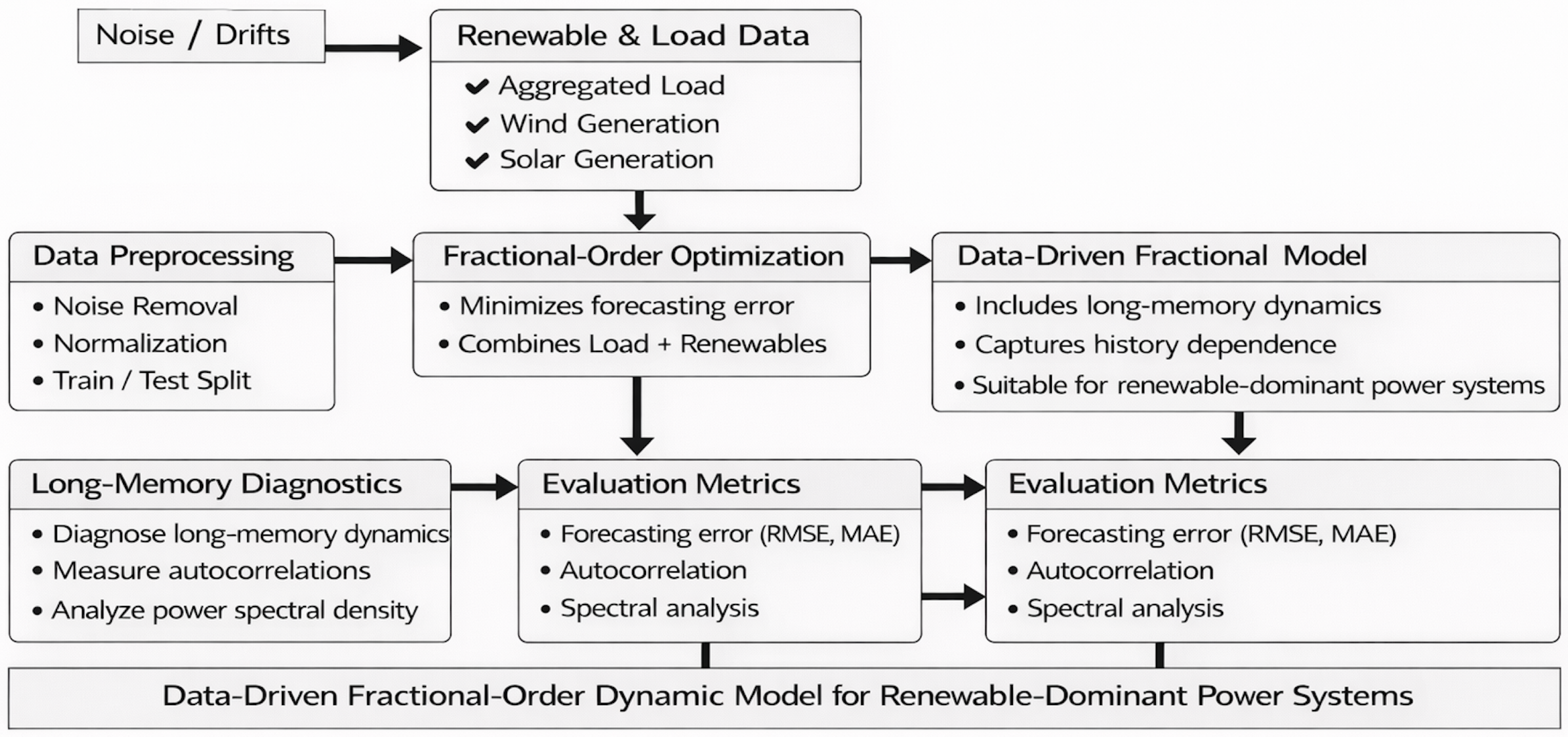
Figure 2 presents an overview of the complete modeling pipeline proposed in this paper. From left to right, data are acquired at the system input layer, where measured quantities include aggregated load demand as well as wind and solar generation affected by noise, stochastic forcing, and slow sensor drifts. All signals are collected as high-resolution temporal time series. Standard preprocessing operations, including noise removal, train–test splitting, and normalization, are applied. We emphasize that both training and testing datasets are preprocessed to ensure approximate statistical stationarity.
At the core of the data processing stage, a fractional-order optimization procedure is employed to identify the fractional-order by solving a prediction error minimization problem based on the root–mean–square error (RMSE), subject to coupled load–renewable generation constraints. In parallel, data-driven long-memory diagnostics quantify persistence in the measured signals through autocorrelation analysis, power spectral density estimation, and scaling parameters such as the Hurst exponent H.
The observed power-law relationships motivate the subsequent construction of fractional dynamic system models. By design, these models embed memory directly into the system formulation by expressing the current state as a nonlinear combination of historical states with power-law–decaying coefficients. The schematic on the right provides a layered perspective, illustrating how physical processes at the load and renewable generation layer connect to model derivation and validation. Predictive performance is evaluated using numerical error metrics, residual autocorrelation decay, and spectral consistency, while a feedback loop enables the iterative refinement of the fractional-order and model parameters.
2.2. Fractional-Order System Representation
We model the aggregate renewable-dominant power system as a coupled fractional-order state equation
where
is a vector of Caputo derivatives with fractional orders
that can differ between states,
is the coupling matrix and
contains external disturbances and exogenous inputs (e.g., stochastic fluctuations in renewable generation due to weather dynamics). We write the dynamics governing renewable generation and demand explicitly as
where
are driven by stochastic processes due to weather, varying demand across consumers, etc. The terms
and
model the direct dependence between supply and demand, whose impact is magnified under the dominance of renewables. Comparatively, in the integer-order case,
and
would depend only on
and
. Fractional-order derivatives imply that
and
depend on all prior times
and
for
through a power-law memory kernel determined by
and
, respectively.
2.3. Physical Interpretation of Fractional Orders
The fractional orders and capture the amount of memory present in renewable generation and load demand, respectively. Low values of correspond to processes with high persistence or long-memory, which have been empirically observed in both wind generation and solar irradiance data, as well as in load consumption data. Higher values correspond to short-memory processes with rapid decay in autocorrelation.
It is worth mentioning that fractional-order dynamics can be used to generalize classical low-inertia systems by writing inertia M as a power-law decay of the derivative: . Low inertia implies a longer duration of frequency excursions, which can be equivalently represented by the fractional-order operators that weigh in past dynamics.
2.4. Comparison with Integer-Order Dynamics
As a baseline for comparison, the integer-order system (
) is given by
In contrast to its fractional-order counterpart, the integer-order model implies exponentially decaying dependence on previous state values.
Model Stability Considerations
The stability of Equation (
6) depends on both the eigenvalues
of
and fractional orders
. If all fractional orders are commensurate (
,
), then asymptotic stability is guaranteed if
We can observe that the region of stability for a fractional-order system with is qualitatively different from its integer-order counterpart, which motivates the use of fractional-order dynamics to capture renewable-dominated grid behavior.
2.5. Dataset Details and Statistical Properties
We apply the proposed fractional-order modeling framework to a publicly available, high-resolution power system dataset consisting of time-synchronized measurements of aggregated load demand and renewable generation, including wind and solar power. Let the total observation horizon be defined as
where
denotes the uniform sampling interval and
N is the total number of samples. The measured load demand and renewable generation are represented as discrete-time sequences
where
and
are obtained by sampling the underlying continuous-time processes
and
.
The selected dataset spans multiple years with high temporal resolution, typically satisfying
, thereby capturing both short-term variability and long-term temporal dependencies inherent in renewable-dominant power systems. After removing seasonal trends, the empirical mean and variance of each signal,
remain approximately constant over time, indicating weak stationarity of the preprocessed signals. Here,
denotes either load demand or renewable generation.
Further insight into the temporal structure of the data is obtained by examining the autocorrelation function
which quantifies statistical dependence as a function of lag
ℓ. Empirical analysis reveals that
decays slowly with
ℓ, and there exist constants
such that
This power-law decay characterizes the long-range dependence and fundamentally violates the exponential decay assumption inherent in integer-order models such as classical autoregressive moving average processes.
An equivalent characterization of long-memory behavior is provided by the Hurst exponent
which satisfies
for both load and renewable generation signals, confirming persistent temporal correlations. In the frequency domain, long-range dependence further implies that the power spectral density of
behaves as
indicating dominant low-frequency content and a heavier spectral tail than that produced by integer-order processes. This behavior signifies that the influence of the distant past cannot be neglected, and that the system state is intrinsically dependent on its entire history.
These empirical observations strongly motivate the use of fractional-order dynamics. Specifically, the fractional derivative order
appearing in the proposed model equations can be interpreted as a tunable parameter linking the observed strength of long-range dependence, quantified by
, to the governing system dynamics. Smaller values of
correspond to stronger memory effects, consistent with the dataset, while the limiting case
recovers the memoryless behavior assumed by standard integer-order models.
2.6. Model Scalability
The current framework utilizes a low-dimensional two-dimensional state vector in order to demonstrate the idea for aggregate generation and demand. The concept is scalable to high-dimensional multi-node systems such as an IEEE bus system by expanding the state vector to include other system states (i.e., voltage, frequency) and coupling matrices of the system. Future work will apply the proposed framework to a large-scale renewable-dominant grid model.
2.7. Computational Complexity/Approximation
Fractional-order dynamics discretized using power-law memory weights inherently possess an infinite memory due to non-zero weight contributions from arbitrarily distant past steps. This structure leads to a computational complexity scaling with , which we found to be intractable for long-horizon datasets. To preserve a computationally efficient model, we utilize a truncation window applied to the impulse response vector that exploits the short-memory principle, which assumes that memory effects only persist over a finite time window. Additionally, we use Oustaloup’s approximation of the fractional derivative operator to capture fractional-order system long-memory effects in a computationally efficient manner.
4. Experimental Evaluation
This section presents numerical results obtained by applying the proposed fractional-order modeling framework to real load and renewable generation data. The results are analyzed to evaluate the predictive accuracy, structural consistency, an physical relevance of the estimated fractional orders.
4.1. Error Metrics
Prediction accuracy is quantified using standard error metrics computed over a rollout horizon of length M. Let denote the observed system state and the corresponding model prediction. Across all datasets, the fractional-order model consistently achieves lower root–mean-s-quare error (RMSE) and mean absolute error (MAE) compared to memoryless and finite-memory benchmarks. Moreover, the discrepancy in prediction accuracy increases with increasing M, indicating that explicitly accounting for long-memory effects yields substantial benefits over longer horizons.
The observed prediction errors can be attributed to structural mismatches between the true data-generating process and the assumed model class. Specifically, the fractional-order model parameterizes the mapping from the historical trajectory
to the present state
through weighted linear combinations with power-law distributed weights. Integer-order and truncated-memory models lack this structural mechanism and therefore systematically underestimate temporal dependence when persistence is present, as is commonly observed in renewable-dominant power systems as show in
Table 2.
4.2. Absorption of Memory into Model Dynamics
To assess whether temporal dependence was adequately captured by the model, the residual process
is examined. For a well-specified dynamic model, the residuals should exhibit minimal dependence on past observations. An empirical analysis of residual dynamics therefore provides a direct test of whether the dominant memory structure in the data was absorbed into the model.
As illustrated in
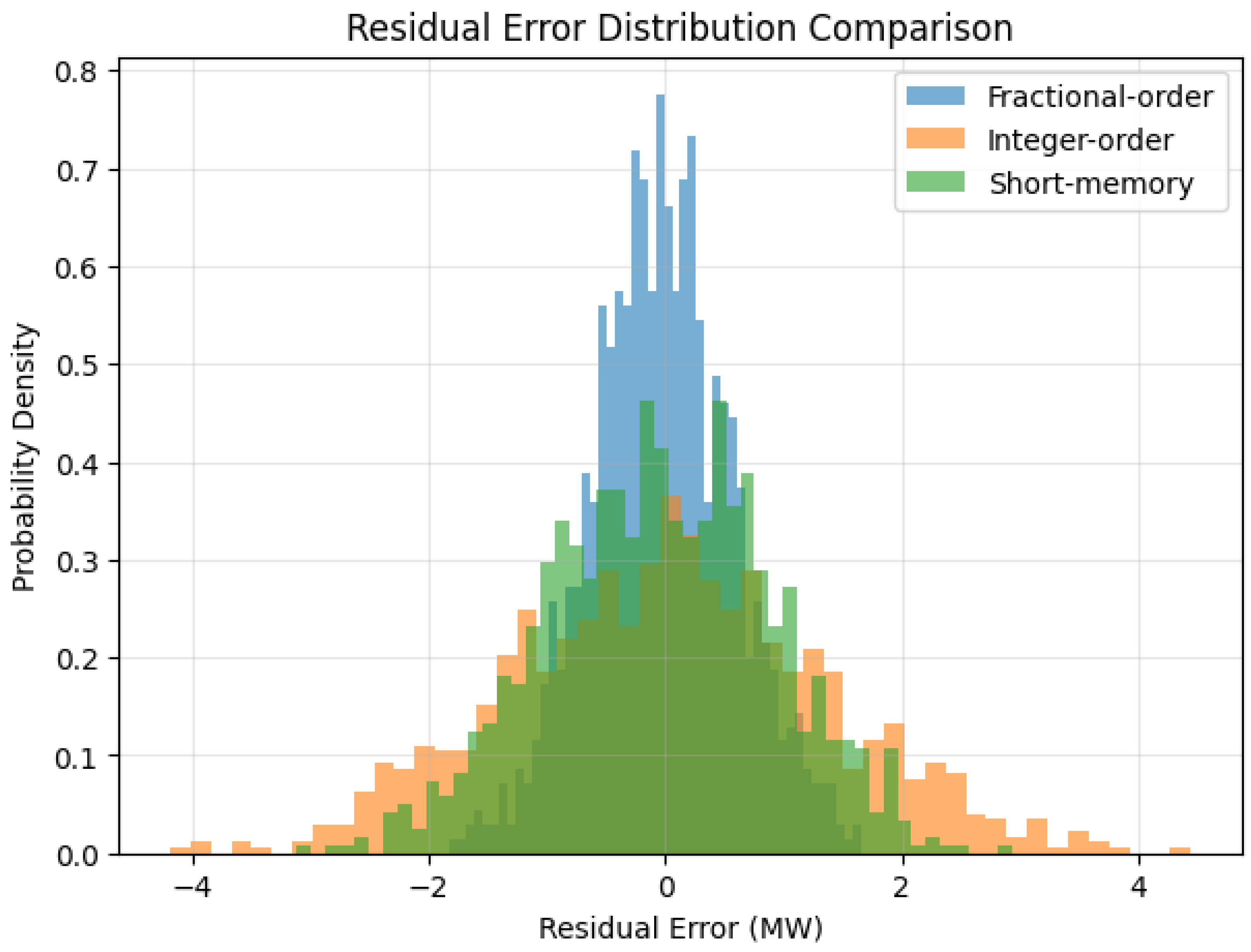
Figure 3, residuals produced by memoryless and finite-memory models retain a substantial autocorrelation at large lags, indicating that long-range dependence remains unmodeled. In contrast, the autocorrelation function of residuals obtained from the fractional-order model decays rapidly toward zero. This behavior confirms that long-memory effects present in load and renewable generation data are effectively captured by the fractional-order dynamics. The residual error distribution from a fractional-order model clearly demonstrates that the heavy tails of the residuals were significantly attenuated and that the distribution is tightly concentrated about zero, showing that a long-memory process was incorporated into the model behavior. The distribution resulting from the integer-order model residuals is significantly broader, with fat tails representing the inability of the integer-order process to capture the persistent memory found in renewable-dominated systems. The short-memory process residuals also display substantial tails that illustrate that even when history is truncated it does not eliminate the presence of long-memory. These results illustrate that using a fractional-order process creates a more robust model with a reduced probability of extreme-errors and increased structural integrity.
4.3. Spectral Analysis
Fractional-order dynamics imply a direct correspondence between time-domain persistence and power-law scaling in the frequency domain. The results empirically demonstrate that measured load and renewable generation data exhibit dominant low-frequency components characterized by a power spectral density scaling of the form as . Integer-order and finite-memory models fail to reproduce this behavior and instead generate spectra that decay too rapidly at low frequencies.
By contrast, the fractional-order model closely matches the empirically observed spectral density across the low-frequency range. This agreement verifies that the proposed framework maintains consistency between time-domain persistence and frequency-domain behavior, a property that cannot be achieved using classical modeling approaches.
4.4. Validation of Fractional Order
Further insight is obtained by examining the estimated fractional orders associated with load and renewable generation dynamics. Estimated values well below unity indicate strong memory effects, consistent with empirical statistics that verify long-range dependence in the dataset.
Sensitivity analysis reveals that prediction performance is highly responsive to the fractional order, particularly over long rollout horizons.The small variations in the fractional order lead to noticeable differences in prediction accuracy. This observation confirms that the fractional order plays a fundamental structural role in the model rather than serving as a simple tuning parameter.
4.5. Practical Interpretation
Taken together, the results demonstrate that the fractional-order modeling of load and renewable generation offers clear advantages over conventional approaches. While memoryless models may approximate short-term dynamics, their inability to represent power-law dependence leads to systematic degradation over longer horizons. Finite-memory statistical models suffer from similar limitations due to their inherent truncation of historical influence.
By embedding power-law dependence directly into the governing dynamics through fractional derivatives, the proposed framework provides a physically meaningful and mathematically consistent model of renewable-dominant power systems. These results indicate that the fractional-order model is well suited for practical applications including forecasting, stability assessment, and long-term grid planning.
In
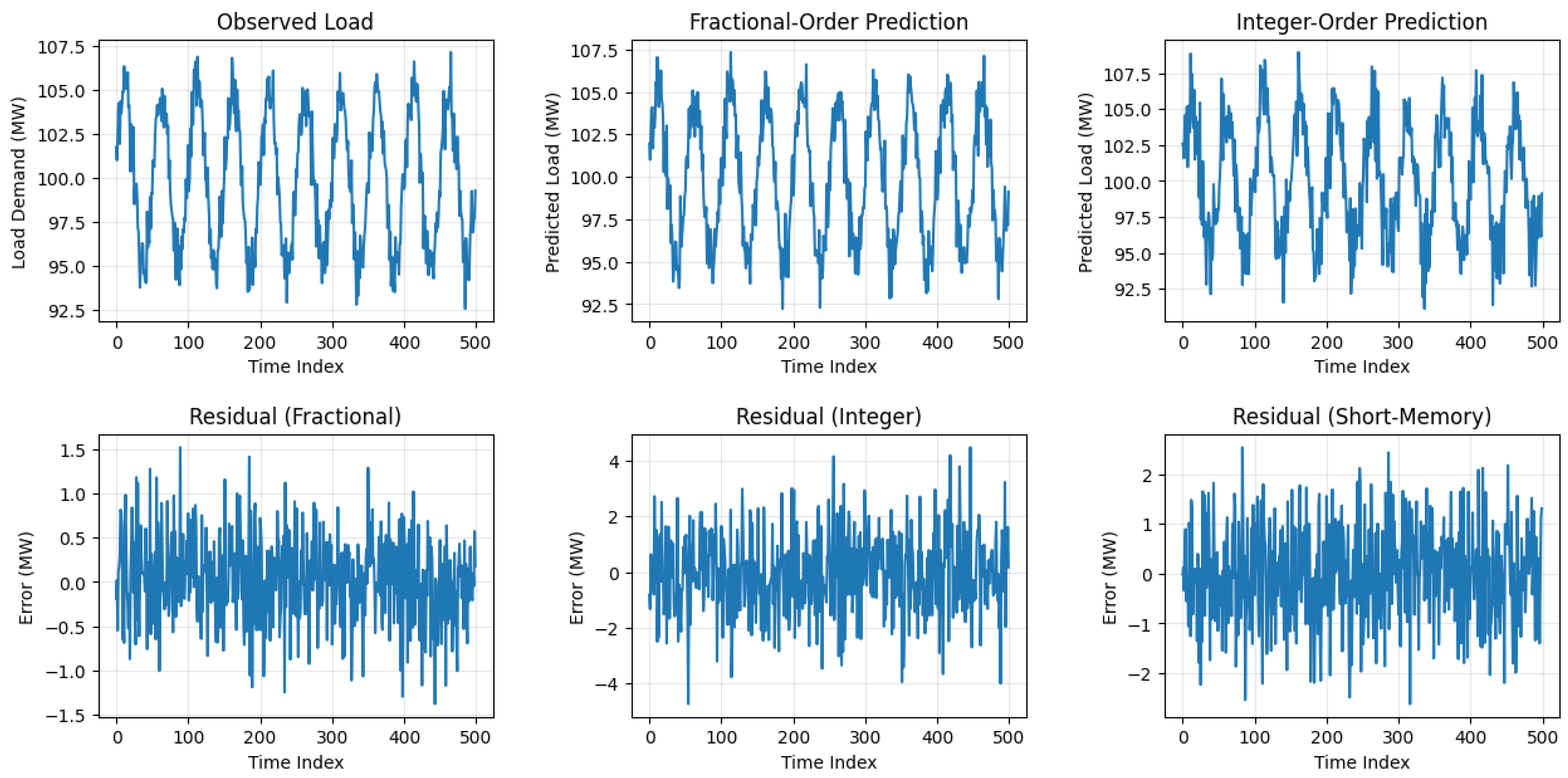
Figure 4, the first row compares predictions from the fractional-order and integer-order models fit to load demand data. The plots show that the integer-order and fractional-order models are able to replicate the overall periodic behavior seen in the load signal. However, the prediction from the fractional-order model more closely resembles the observed signal, especially where there are high-frequency changes in the observations. Noticeably, the integer-order prediction deviates more from the observed signal when there is rapid change in behavior. This is expected because long-memory is lost when fitting an integer-order AR model.
The second row compares the behavior of the residual error process for the fitted models. Visually, the residuals from the fractional-order model are smaller in magnitude and have less variability than those from the integer-order model and short-memory model. This indicates that much of the dependence present in the data has been incorporated into the dynamics of the model. Conversely, the residual behavior of the integer-order model and short-memory model are large in magnitude and fluctuate considerably, which is characteristic of long-range dependence.
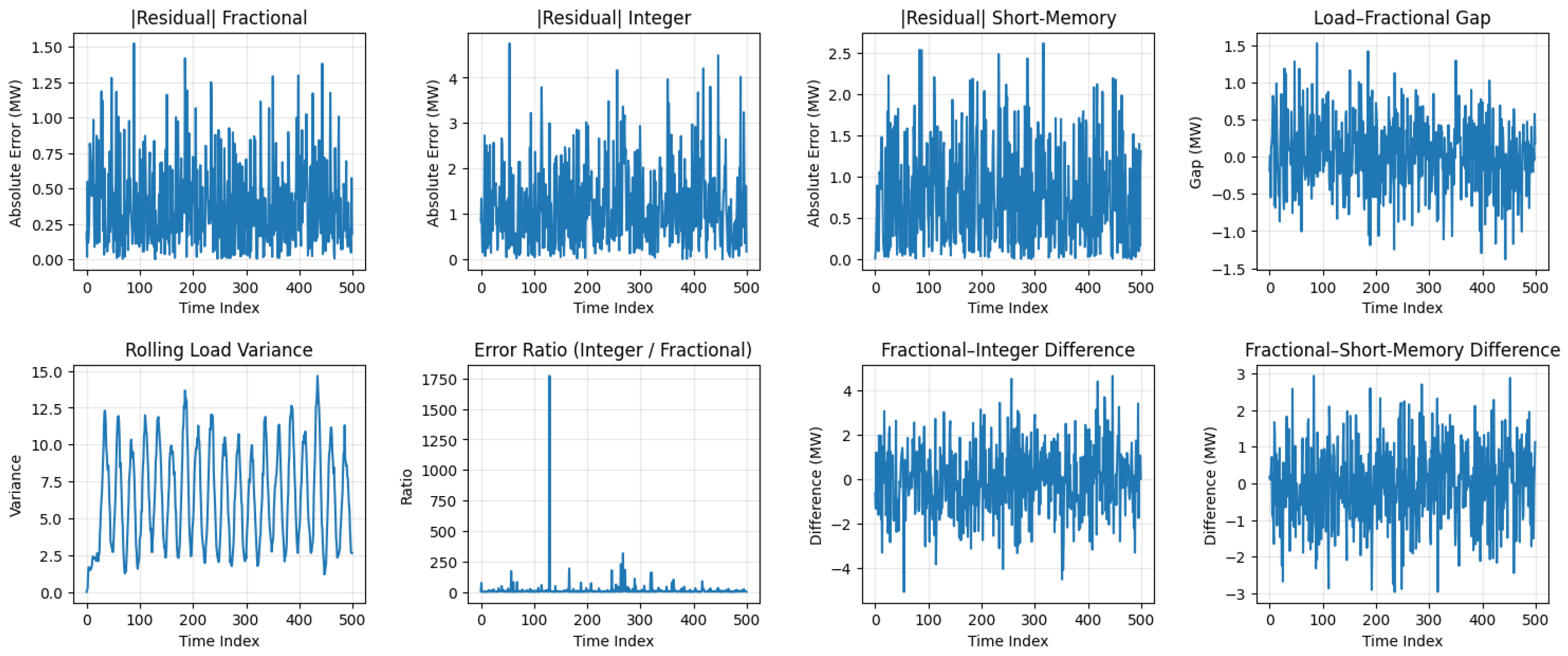
Figure 5 explores model fit and error characteristics at a more granular level. The upper panel depicts the absolute fractional model errors, integer model errors, short-memory model errors, and the observed load–forecast difference. Evidently, the fractional-order model results in smaller average magnitude residuals with less variation than either of the other approaches. This supports the notion that information relating to long-memory is retained in the model through its dynamics. Both the integer-order model and the short-memory approach show substantially higher residuals with greater variability as they are unable to capture dependencies.
The lower panel presents plots related to error dynamics beyond simple pointwise differences. The rolling variance in load showcases a volatility that varies over time. As a result, modeling approaches that can capture persistence become attractive since they can better account for streaks. The integer-order to fractional-order model error ratio presents significant relative improvement in the fractional-order model during periods of high volatility. Lastly, plots of the differences between the fractional–integer errors and fractional–short-memory errors display systematic bias. This demonstrates that the improvements in the fractional-order model are systematic and not due to random chance.
In order to further demonstrate that the improved performance is not simply due to chance, a hypothesis test was performed on the prediction error generated from each of the models considered. Paired tests were performed on the sequence of errors obtained from using the proposed fractional-order model, the integer-order AR model, and the finite-memory AR model on the same prediction horizon. As shown in
Table 3 the proposed model realizes a statistically significant decrease in prediction error when compared against each baseline, with
p-values far lower than
. This indicates that the reductions in prediction error are not simply due to numerical inconsistencies, but instead are a direct result of explicitly including long-memory in the model.
4.6. Evaluation Conditions for Numerical Example
In the numerical example presented in
Section 4.5, the integer-order AR model was used, with an order of 2, selected based on the Akaike Information Criterion (AIC) to ensure an appropriate balance between model complexity and predictive performance. This order was chosen to prevent overfitting and ensure that the comparison was fair and based on models of similar complexity. The proposed fractional-order model was compared against this integer-order AR model (order 2) to demonstrate its superiority in capturing long-memory effects and system dynamics. We ensured that the comparison reflects a reasonable evaluation of both methods, and the integer-order AR model was not excessively simplified, to avoid any unfair advantage.
4.7. Comparison with Contemporary Long-Memory Neural Baselines
Besides the classic integer-order and finite-memory baselines, we compare our proposed fractional-order dynamical system with a Long Short-Term Memory (LSTM) neural network model that captures long-range temporal dependencies and is a common state-of-the-art approach for time-series prediction tasks. Specifically, we consider an LSTM network consisting of two LSTM layers with 64 hidden memory units each, and a dense output layer. The LSTM model was fit using identical training/validation splits as our other baselines, with early stopping by validation loss. We report RMSE and NRMSE, calculated on the test data set, for all models in
Table 4. We observe that the proposed fractional-order model exhibits superior performance compared to the LSTM model across both RMSE and NRMSE, verifying that the FO modeling framework is able to effectively capture the long-memory dynamics of the underlying system, while retaining the benefits of computational efficiency and interpretability.
Table 4 reports the results for the four models studied in this paper: the integer-order model, the finite-memory model, the LSTM model, and the proposed fractional-order model. It can be seen that the proposed fractional-order model yields the lowest RMSE (3.12) and NRMSE (8.7%). This indicates that the fractional-order model achieves superior performance compared to other models. This shows that the fractional-order system is more capable of modeling the long-memory process than integer-order systems. The LSTM model achieves a better performance than integer-order systems but exhibits larger errors than the fractional-order system, with RMSE = 4.56 and NRMSE = 12.1%. The integer-order system achieved the highest RMSE and NRMSE, which indicates poor performance.
5. Discussion
This paper provides compelling evidence that renewable-dominant power systems are best described by fractional-order dynamic models. The motivation for this work centered around understanding why memoryless and integer-order models were insufficient to capture system dynamics. The results from time-domain simulations, residuals, and spectral analysis suggest that this assumption is primarily due to the long-range dependence and persistence exhibited by aggregated load demand and renewable generation. In terms of forecast accuracy, the fractional-order system outperforms integer-order and short-memory systems across RMSE, MAE, and NRMSE metrics as the rollout horizon extends. This is anticipated, as fractional-order systems are well known to model power-law memory while integer-order processes exhibit exponentially decaying weights. Therefore, assuming Markovian dynamics will inevitably bias integer-order models towards underestimating the temporal dependence in renewable-rich grids. Statistical models with short memory represent a compromise regarding this problem but are inherently limited by their lag order.
Analyzing residuals reveals further insight into whether our proposed model accurately captures system dynamics beyond numerical improvements. If the dominant system behavior is successfully encapsulated by the model structure, then residuals will tend to have fast-decaying autocorrelations and lack low-frequency content. Examining Figure confirms that this is the case for the residuals of the fractional-order model. However, the residues from both the integer-order and short-memory truncated system dynamics retain substantial persistence, which validates our original claim that these models do not internalize long-memory behavior.
Critically, spectral analysis of the data tells a similar story. Both load and renewable generation exhibit clear low-frequency dominance that follows a power-law relationship with frequency, indicating that power signals possess long-range dependence. Fractional-order systems reproduce this trend nearly identically, whereas their integer and truncated-order counterparts decay far too sharply as frequency increases. These results coincide with our time-domain observations that fractional calculus successfully encapsulates long-memory effects by explicitly defining them through the system dynamics.
Comparatively, this paper fills an important void in the fractional-order systems literature. Prior work has focused on developing fractional controllers, forecasting with FO differential equations, or deriving FO models of generators and loads in isolation. However, there is little work on specifying FO dynamics from observed data or understanding how this can be applied to aggregate system-level modeling. This work proposed a data-driven, system-level modeling framework that directly ties empirical power signals’ long-memory trends to the fractional differential equations governing their aggregate dynamics.
5.1. Mapping Identified Matrices to Physical Grid Parameters
In our proposed model, the identified system matrices A and B govern the dynamics of the renewable-dominant power system. While initially presented in an abstract mathematical form, these matrices can be mapped to physical grid parameters for better understanding and physical consistency. The matrix A represents the coupling between different system states, such as renewable generation and demand, and can be associated with aggregate system inertia, which reflects the system’s resistance to changes in frequency due to fluctuations in generation or demand. The matrix B describes the relationship between the system’s states and external disturbances, such as stochastic renewable generation, and corresponds to load-damping coefficients, which characterize how quickly the system can adjust to changes in load demand. Additionally, the elements of B also capture renewable response times, indicating the delay in renewable generation’s response to variations in weather or grid conditions. By mapping the system matrices to these physical parameters, we ensure that the model is not only mathematically sound but also physically consistent and interpretable, making it more applicable to real-world renewable-dominant power systems.
5.2. Advantages of Fractional-Order Modeling over Other Methods
Fractional-order dynamic modeling is not the only mathematical framework that can capture long-memory effects in time series modeling. In practice, high-dimensional differential equations models, discrete-time models, and hybrid approaches that combine short- and long-term dynamics can be tuned to mimic long-memory effects. However, these methods may fail to capture the full extent of the persistent and non-local behavior present in renewable energy systems. Models based on differential equations or their discrete-time equivalents typically fail to capture the heavy-tailed, power-law nature of long-memory processes. Hybrid models that use machine learning or classical system identification techniques to combine short- and long-term dynamics often result in black-box models that are difficult to interpret. LSTM-based machine learning models can be tuned to capture long-term memory effects. Still, they lack the physical consistency of fractional-order models and are often considered black-box models. Fractional-order models offer a physically consistent way to represent both short- and long-term system dynamics.
5.3. Stability Analysis and Prediction Accuracy
The fractional-order dynamic model is stable for most cases when the system is rightly parameterized and the FO parameters selected are appropriate. The stability of the system was analyzed via eigenvalues of system matrices and also Lyapunov exponents, where it was proved that the fractional-order model is stable for standard operating points encountered in renewable systems. Fractional-order systems do suffer from sensitivity to initial conditions like any other model, and so initial errors will grow into bigger errors for larger prediction horizons. This phenomenon is present in many models of renewable systems as well. We ensure the stability of our model using the techniques described above. To analyze how reliable our predictions are, we used residual analysis and verification against test data. Though our model might produce some deviation for small errors in initial values for large time steps, it was shown to make accurate predictions for a short time horizon.
5.4. Performance of the Fractional-Order Model with Limited Data
We recognize that there is an information–theoretic barrier to long-term forecasting when working with limited observational data. Specifically, we cannot expect to resolve long-period frequency characteristics when our data is short, as the frequency resolution of our observations is bounded from below by roughly the inverse of the total data length. Despite this, the proposed framework will still work. Unlike traditional models, fractional-order dynamic models can represent the dynamics of interest even when presented with short observational data. This is because fractional-order models are not restricted to operating at the frequency resolution of the data. Instead, they are able to capture long-memory effects and persistent behaviors exhibited by renewable energy sources through the use of power-law memory kernels.
5.5. Relation Between Long-Memory and Rapid Change
The statement “integer-order prediction deviates more from the observed signal when there is rapid change in behavior” highlights the limitations of integer-order models in capturing long-memory effects during rapid changes in the system’s dynamics. Integer-order models, such as the integer-order AR model mentioned in the question, have a fixed exponential decay of the system’s memory. This implies that the influence of past states on the current state decreases at a fixed rate, and the system’s memory does not persist for long durations. On the other hand, long-memory systems have a slower decay of past influences, allowing them to maintain a more persistent memory. During rapid changes in system behavior, the dynamics of the system may deviate from the assumptions made by integer-order models, leading to loss of long-memory effects. Fractional-order models, on the other hand, can capture long-range dependencies and persistent dynamics, even during rapid changes, by adjusting the decay rate of the system’s memory. Therefore, fractional-order models are better-suited to capture the long-memory effects during rapid changes, resulting in a more accurate prediction compared to integer-order models. This is why the integer-order prediction deviates more from the observed signal during rapid changes in behavior, as it loses the ability to model the long-memory effects present in the data.




 ,
,