1. Introduction
Reaction–diffusion systems have long served as a cornerstone for modeling spatially extended phenomena in physics, chemistry, and biology. Since the seminal works of Turing and Prigogine, such systems have been known to exhibit rich dynamical behaviors, including pattern formation, oscillations, and spatiotemporal chaos—phenomena that cannot be captured by ordinary differential equations alone [
1,
2]. Among the numerous biochemical processes modeled using reaction–diffusion systems, the glycolysis pathway occupies a particularly central position due to its universality across almost all living organisms [
3,
4]. Glycolysis constitutes the primary energy-producing mechanism in the cell, converting glucose into pyruvate and generating ATP. The nonlinear feedback loops inherent in enzymatic reactions make this pathway a fertile ground for exploring oscillatory and diffusive instabilities in biochemical systems [
5,
6].
Classically, glycolysis models have been described by systems of nonlinear ordinary differential equations that capture enzyme kinetics under the Michaelis–Menten or Sel’kov frameworks [
3,
4]. However, to account for spatial heterogeneity, diffusion terms have been introduced, leading to the well-known glycolysis reaction–diffusion system [
6,
7]. Such models successfully describe pattern formation and wave propagation in metabolic oscillations, bridging the gap between molecular dynamics and spatial organization in living tissues.
In the past two decades, fractional calculus has emerged as a natural extension of classical integer-order modeling, capable of describing systems with memory, hereditary, and nonlocal behaviors [
8,
9]. Fractional derivatives introduce a continuous spectrum of differentiation orders, offering enhanced flexibility for modeling anomalous transport and subdiffusive processes often observed in cellular media [
10,
11]. The inclusion of fractional operators in reaction–diffusion systems has significantly deepened our understanding of complex biochemical dynamics [
12,
13,
14]. They provide a mathematical framework to describe long-range temporal correlations and fractional kinetics [
15,
16,
17,
18].
The application of fractional calculus to glycolysis dynamics has revealed new insights into oscillation damping, stability transitions, and anomalous relaxation phenomena [
19,
20]. Typically, these models employ a commensurate fractional order, meaning all components of the system share the same non-integer derivative order; while commensurate models capture global memory effects, they fail to describe the asymmetric memory and relaxation behavior observed experimentally in biochemical species with distinct molecular structures or diffusion coefficients.
To address this limitation, the notion of incommensurate fractional systems has been introduced, where each state variable evolves according to its own fractional order [
21,
22]. Such systems are more realistic for biological modeling since enzymes, substrates, and regulatory intermediates generally exhibit heterogeneous relaxation processes and non-uniform diffusion. In the context of reaction–diffusion models, this approach enables the description of multi-scale memory effects and nonlocal coupling between spatial and temporal dynamics [
23,
24].
Despite the increasing attention toward fractional reaction–diffusion systems, the specific case of incommensurate fractional glycolysis models remains underexplored. Previous studies have focused primarily on synchronization phenomena [
25,
26,
27], stability in integer-order or commensurate cases [
19,
28], and numerical approximation techniques [
25,
29]. However, the combined influence of diffusion, nonlinear enzymatic reactions, and non-uniform fractional memory on the stability of glycolysis systems has not yet been comprehensively analyzed. Unlike existing fractional glycolysis models [
30,
31], which assume identical fractional orders, the present study considers an incommensurate system where each species evolves under its own Caputo derivative, capturing heterogeneous memory and relaxation effects.
The present work fills this gap by formulating and analyzing an incommensurate fractional reaction–diffusion model of glycolysis. In this framework, each chemical species evolves under a distinct Caputo fractional derivative, thereby incorporating different memory characteristics into the dynamics. We perform a local stability analysis of the system by linearizing it around the unique positive steady state and studying the eigenvalues of the corresponding Jacobian matrix under fractional-order constraints. The analytical results establish sufficient conditions for local asymptotic stability and clarify how diffusion and incommensurate memory interact to modulate the system’s dynamic behavior. Numerical simulations further validate the theoretical predictions, illustrating both stable and metastable regimes depending on the fractional orders.
The paper is organized as follows.
Section 2 recalls key concepts from fractional calculus and stability theory.
Section 3 formulates the incommensurate fractional glycolysis reaction–diffusion model.
Section 4 presents the local stability analysis in both diffusion-free and diffusive contexts.
Section 5 provides numerical simulations to confirm the theoretical findings, and
Section 6 concludes with remarks and perspectives for future research.
3. Model Formulation and Fractional Generalization
In this section, we analyze the proposed incommensurate fractional glycolysis reaction–diffusion model using standard analytical techniques commonly employed in the study of fractional-order systems. The methods presented here extend the well-established approaches for commensurate fractional dynamics to the more general incommensurate setting, where each state variable evolves with its own distinct fractional order. This framework allows for a more realistic representation of heterogeneous memory effects in biochemical systems, where different components often exhibit different rates of diffusion, reaction kinetics, or fractional relaxation.
To the best of our knowledge, this study represents the first incommensurate fractional formulation of the glycolysis reaction–diffusion model available in the literature. Previous works have predominantly considered integer-order or commensurate fractional versions of similar biochemical models, where all species share the same fractional order of differentiation. However, such simplifications may overlook the nonuniform time-scale behaviors that naturally arise in enzymatic processes, where activator and inhibitor concentrations often exhibit different temporal memory characteristics. By introducing incommensurate fractional derivatives, we capture this diversity in dynamical responses and provide a richer mathematical description of the glycolytic oscillation process.
The classical glycolysis reaction–diffusion model, originally proposed as a mathematical description of enzymatic oscillations in biochemical systems, serves as the foundational structure for our analysis. This model describes the spatio-temporal evolution of chemical concentrations under both reaction and diffusion effects, and has been widely employed to study the emergence of oscillations, wavefronts, and pattern formation in biological media. Specifically, the system introduced in Refs. [
35,
36] is formulated as follows:
Here,
and
denote the chemical concentrations of two interacting species,
and
are the diffusion coefficients,
a represents the dimensionless input flow rate, and
b is the dimensionless constant rate associated with the low-activity state. The spatial domain
is assumed to be bounded with a sufficiently smooth boundary
. For a two-cell system, the model exhibits several stability results as reported in [
37,
38]. A notable special case, known as the Sel’kov model, arises when
, and it has attracted considerable research attention in recent years [
39,
40,
41].
Given the growing interest in fractional-order systems to capture memory and hereditary effects in biochemical dynamics and to capture non-Markovian memory in enzyme–substrate interactions and anomalous diffusion within cellular media, the classical time derivative
in Equation (
9) is replaced by the Caputo fractional operator
. This extension leads directly to Equation (
10) and reflects subdiffusive transport and long-range temporal correlations typical of intracellular biochemical processes.
where
denotes the Caputo fractional derivative of order
, and
is the Laplacian operator. The parameters
are strictly positive constants, and the model is supplemented with the same Neumann boundary and initial conditions as before.
To generalize the system and capture distinct memory effects in the activator and inhibitor variables, we introduce the incommensurate-time fractional reaction–diffusion glycolysis model as follows:
with the initial conditions
where
denote the fractional orders associated with the two state variables
z and
w, respectively. The incommensurate nature of the system—i.e., when
—represent heterogeneous memory effects associated with distinct biochemical processes, such as enzyme saturation kinetics and anomalous intracellular diffusion; in addition, they reflects different relaxation behaviors in the interacting biochemical species, leading to richer temporal dynamics and more accurate modeling of nonlocal transport phenomena in cellular processes.
The term ’metastable regime’ refers to long-lived transient oscillations that precede asymptotic stabilization, a phenomenon frequently induced by memory effects in fractional systems. These regimes emerge naturally in incommensurate systems due to distinct relaxation times associated with each fractional order.
Although direct experimental quantification of fractional orders in glycolytic media remains an open problem, the proposed model qualitatively reproduces experimentally observed oscillation damping and spatiotemporal relaxation, in agreement with Goldbeter [
5] and Li et al. [
14]. This provides an indirect empirical validation of the fractional formulation.
4. Local Stability
In contrast with previous fractional glycolysis models that employ a single, common fractional order, the present work analyzes an incommensurate formulation where each variable possesses its own fractional order, thus enabling heterogeneous memory effects. This leads to new sufficient conditions for local asymptotic stability (Theorems 2 and 3) that encompass commensurate and integer-order cases as particular limits.
To analyze the asymptotic stability of the incommensurate fractional glycolysis reaction–diffusion system, we first determine its unique equilibrium point. This equilibrium corresponds to the constant steady-state concentrations where both temporal and spatial variations vanish. By setting the fractional derivatives and diffusion terms to zero, a nonlinear algebraic system is obtained, whose positive solution
defines the equilibrium around which the stability analysis is carried out.
Equilibrium point derivation:
The equilibrium
solves the following system:
From the first equation we obtain
From the second equation,
Equating the two expressions for
yields
Therefore, the equilibrium is
If and , then and . The algebra above shows the equilibrium is unique under the stated parameter positivity assumptions.
4.1. Local Stability of the Free-Diffusion System
We now establish sufficient conditions for the local asymptotic stability of the system in the absence of diffusion. In this case, the model reduces to
where
denotes the Caputo fractional derivative operator of order
.
Theorem 2. The system (13) is locally asymptotically stable at the steady state if either of the following holds:
Proof. To study local stability, we linearize the system around
and compute the Jacobian matrix as follows:
The trace and determinant of
J are
The characteristic polynomial is
with discriminant
Case 1: . The eigenvalues are real. If and , then both eigenvalues are negative, and is asymptotically stable. If , then one eigenvalue is positive, and the system is unstable.
Case 2: . The eigenvalues are complex conjugates, as follows:
Stability then depends on the sign of . If , both eigenvalues have negative real parts, and is asymptotically stable. If , instability follows. For , the eigenvalues are purely imaginary, and the equilibrium is asymptotically stable in the incommensurate fractional-order sense provided, .
Thus, the equilibrium is locally asymptotically stable under the stated conditions. □
4.2. Local Stability of the Diffusion System
We now investigate the stability of the equilibrium point
in the presence of diffusion. Following the analytical approach proposed in [
42], we begin by formulating the associated eigenvalue problem derived from the linearization of the incommensurate fractional glycolysis system around the steady state.
Incorporating diffusion, the incommensurate fractional system becomes
Linearizing (
15) around the steady state
yields the Jacobian matrix,
Theorem 3. Then, system (11) is asymptotically stable at the equilibrium provided the following conditions hold:
- 1.
- 2.
If , thenand in addition the eigenvaluessatisfy the fractional-order stability condition
Proof. To analyze the local asymptotic stability of
in the diffusion case, we linearize system (
15). The resulting Jacobian matrix for the
i-th mode is
The corresponding characteristic polynomial is
where
The discriminant of (
18) is
After simplification, this becomes
where
is a constant depending on
.
The stability of
therefore depends on the sign of
. The discriminant of
with respect to
is
Clearly, whenever . We distinguish two cases:
Case 1: . If
then the two roots of
are negative, which implies
. The roots of (
18) are
Both are real, and
. In addition, if
then
as well. Consequently,
which guarantees asymptotic stability of
.
Case 2: . In this case, the same stability requirement holds,
and provided
, both eigenvalues
and
are negative. To comply with Theorem 2 for fractional-order systems, they must also satisfy
Hence, the equilibrium is asymptotically stable under the conditions stated in Theorem 3. □
5. Numerical Examples
In this section, we present a series of numerical simulations designed to illustrate the theoretical findings regarding the stability and convergence of the incommensurate fractional glycolysis reaction–diffusion system. All simulations were implemented in Matlab using uniform spatial and temporal discretizations. The results clearly confirm the asymptotic behavior predicted by the analytical study.
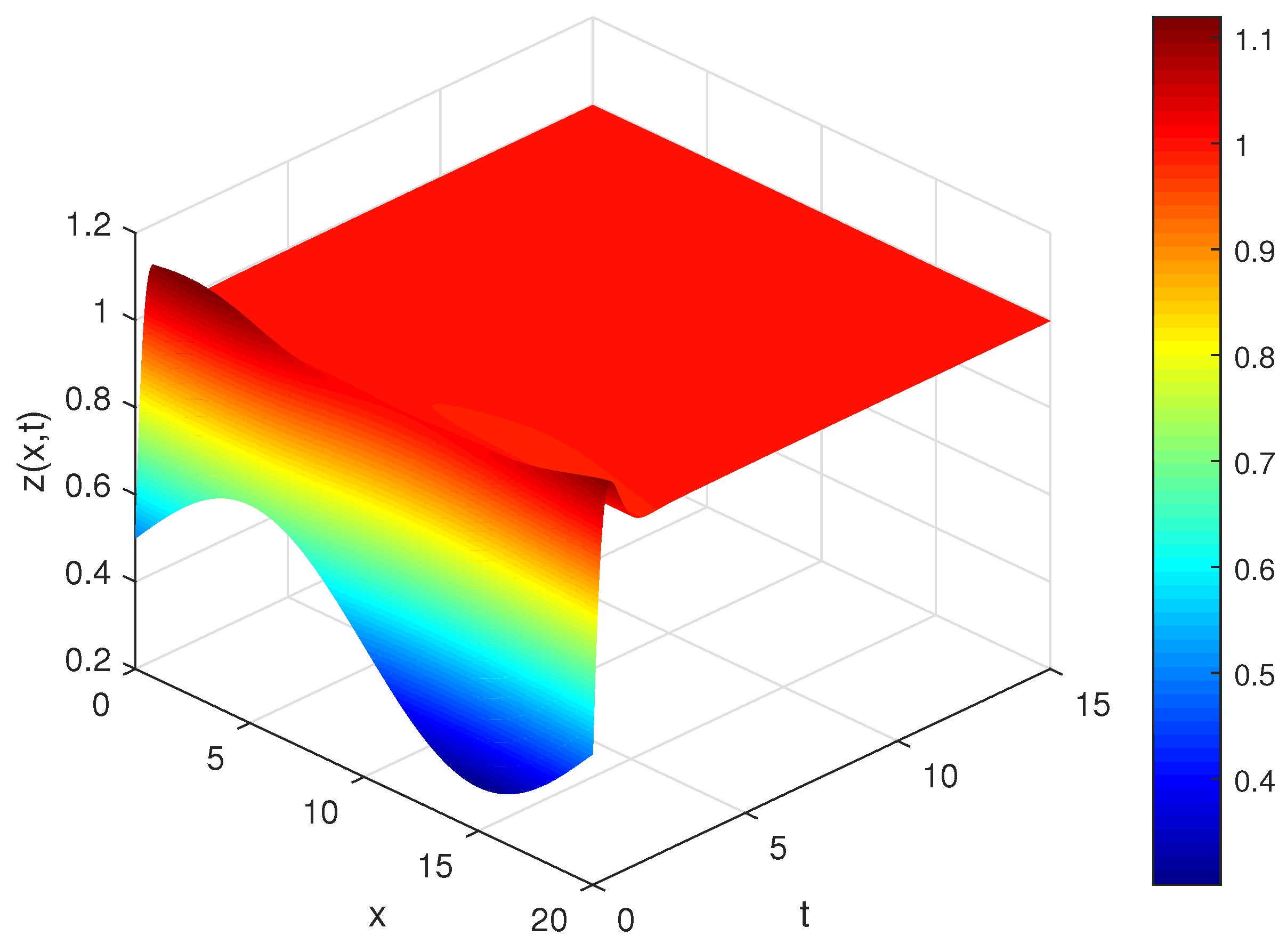
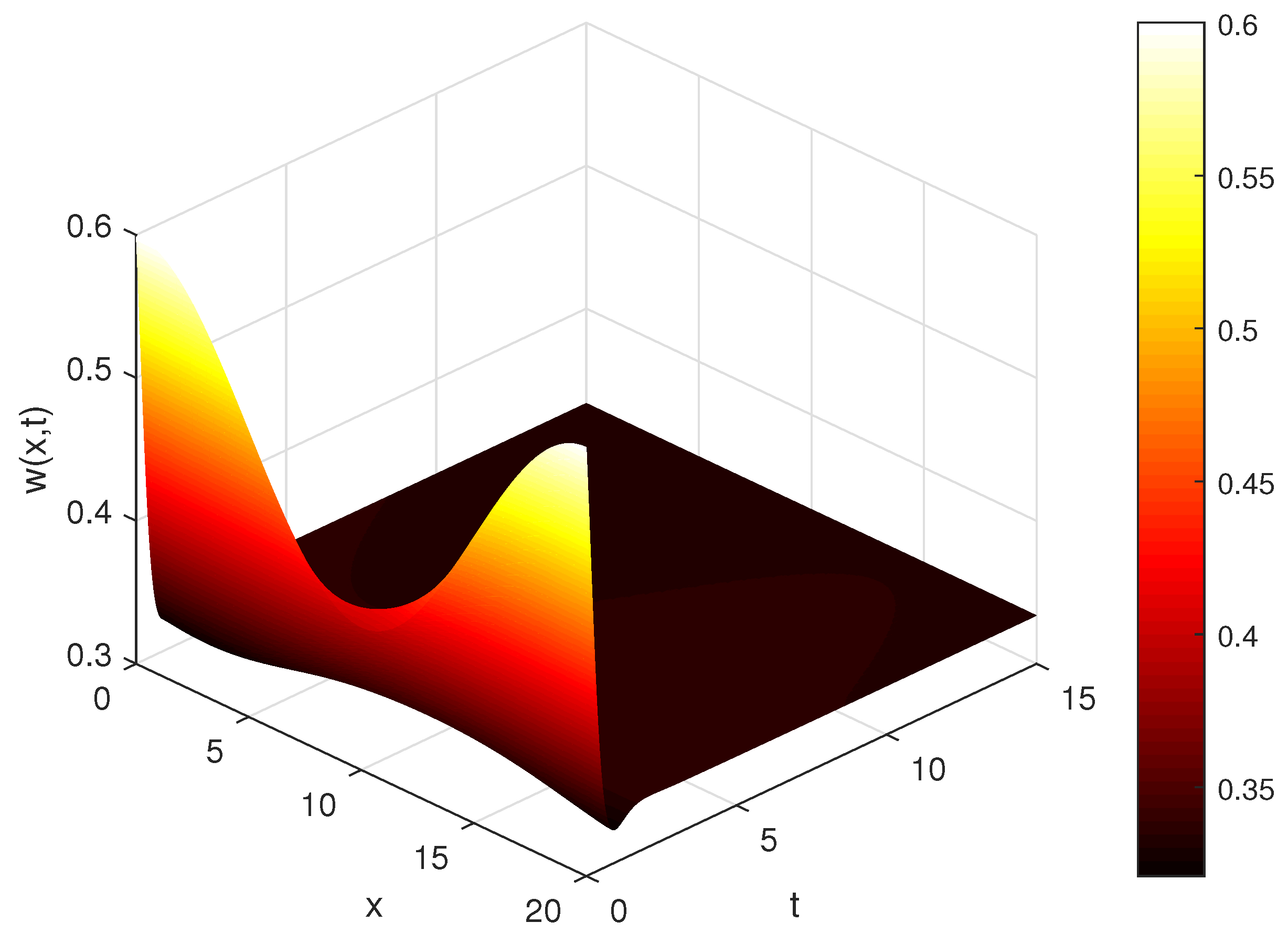
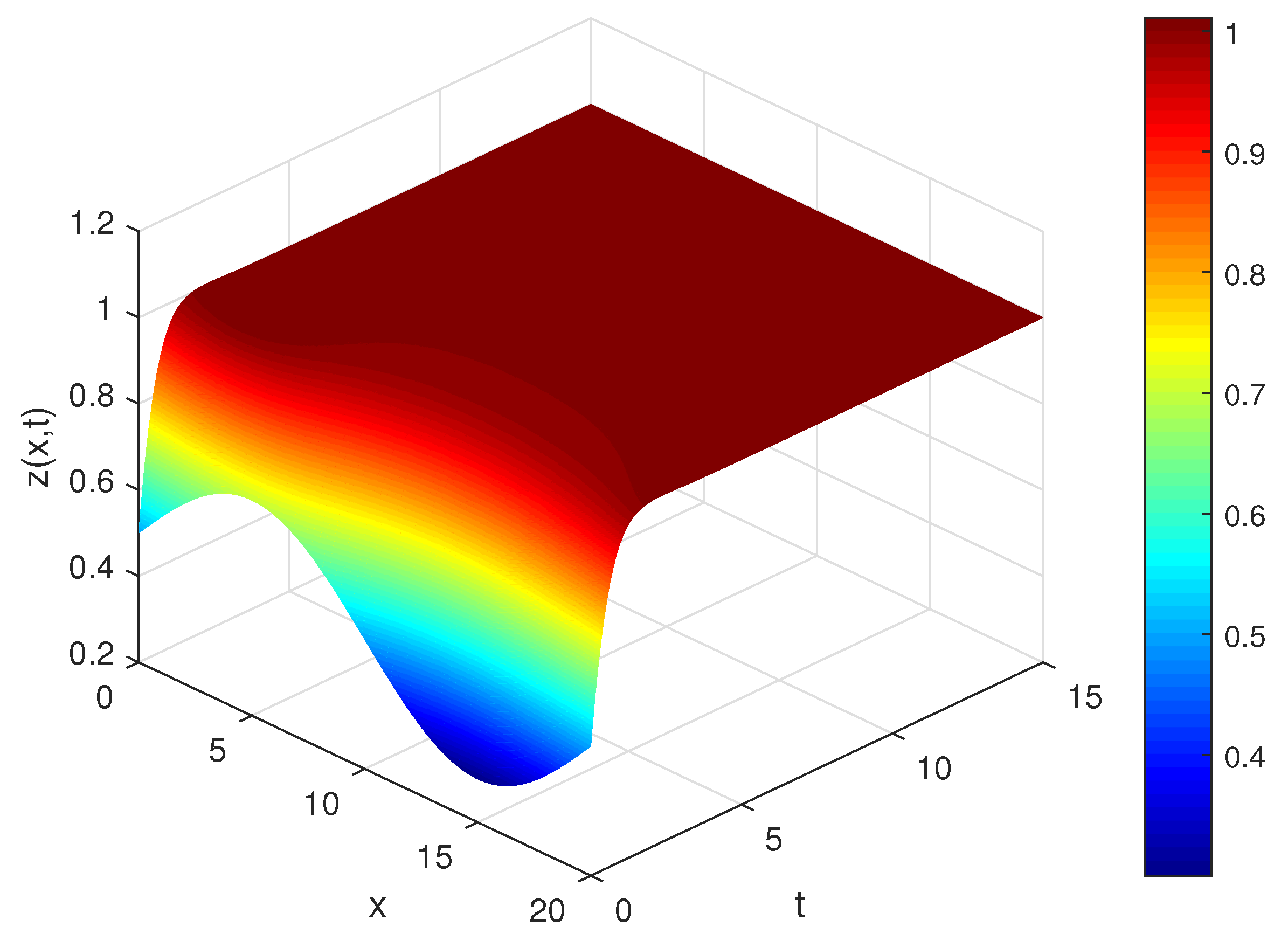
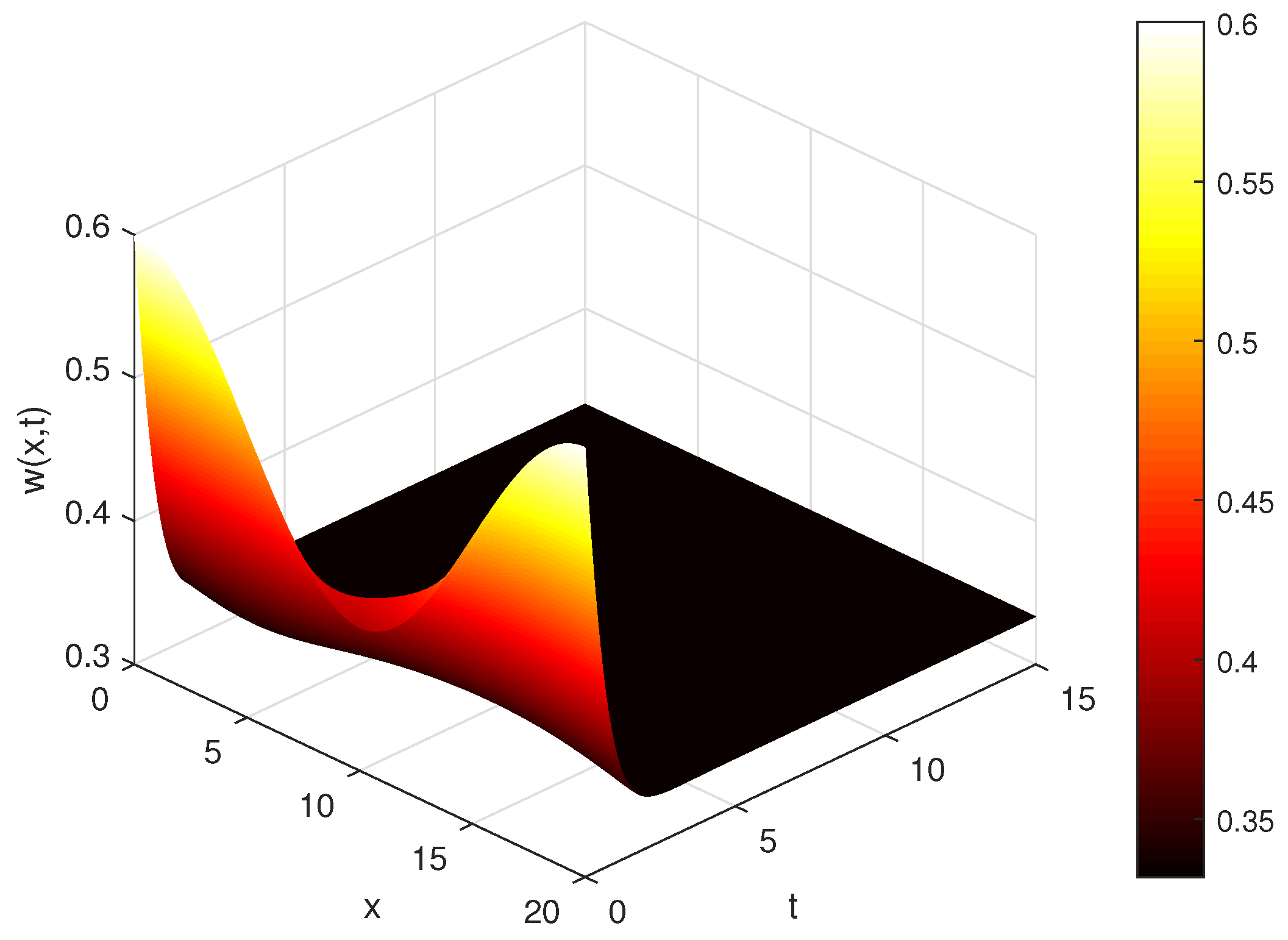
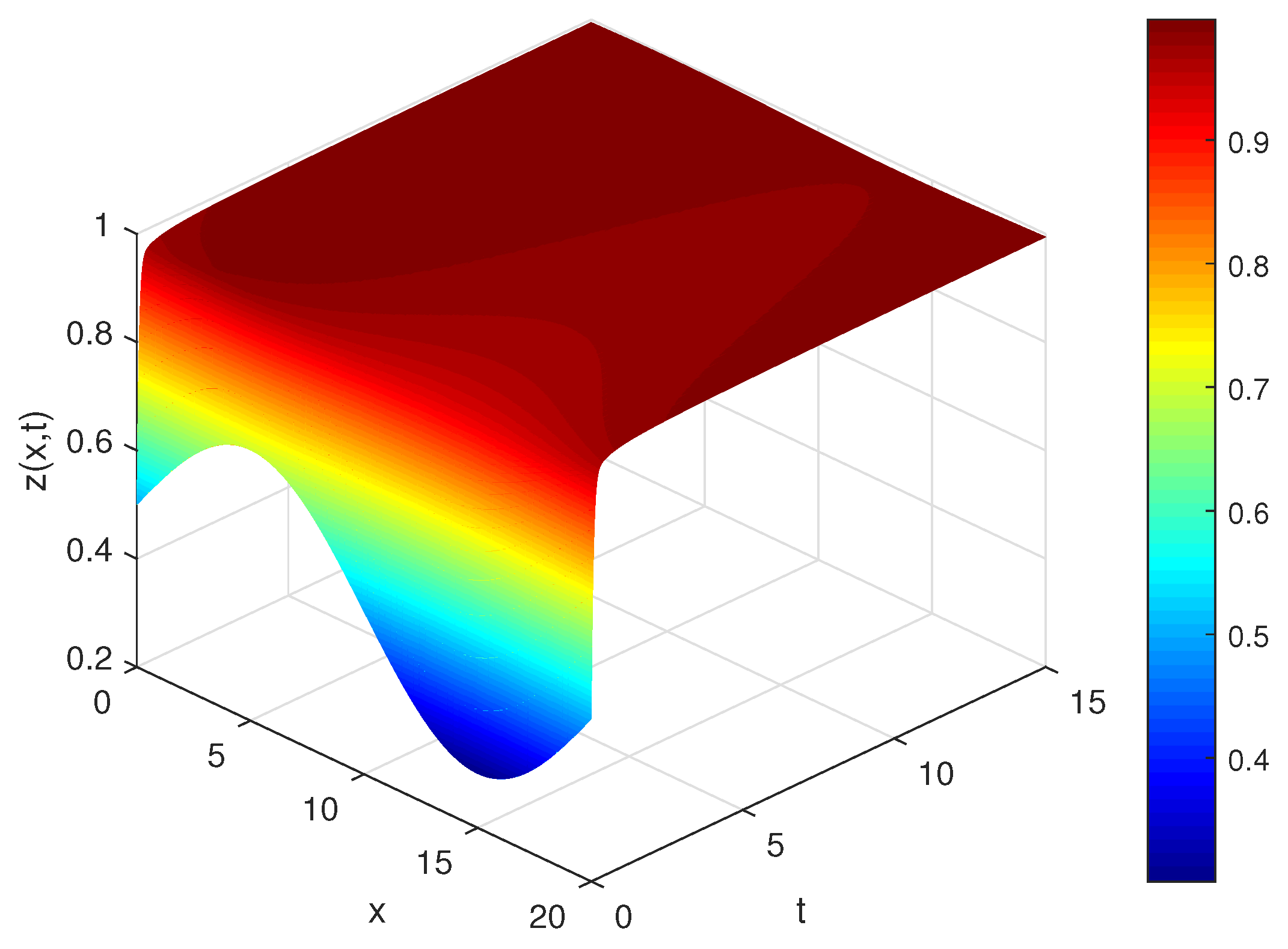
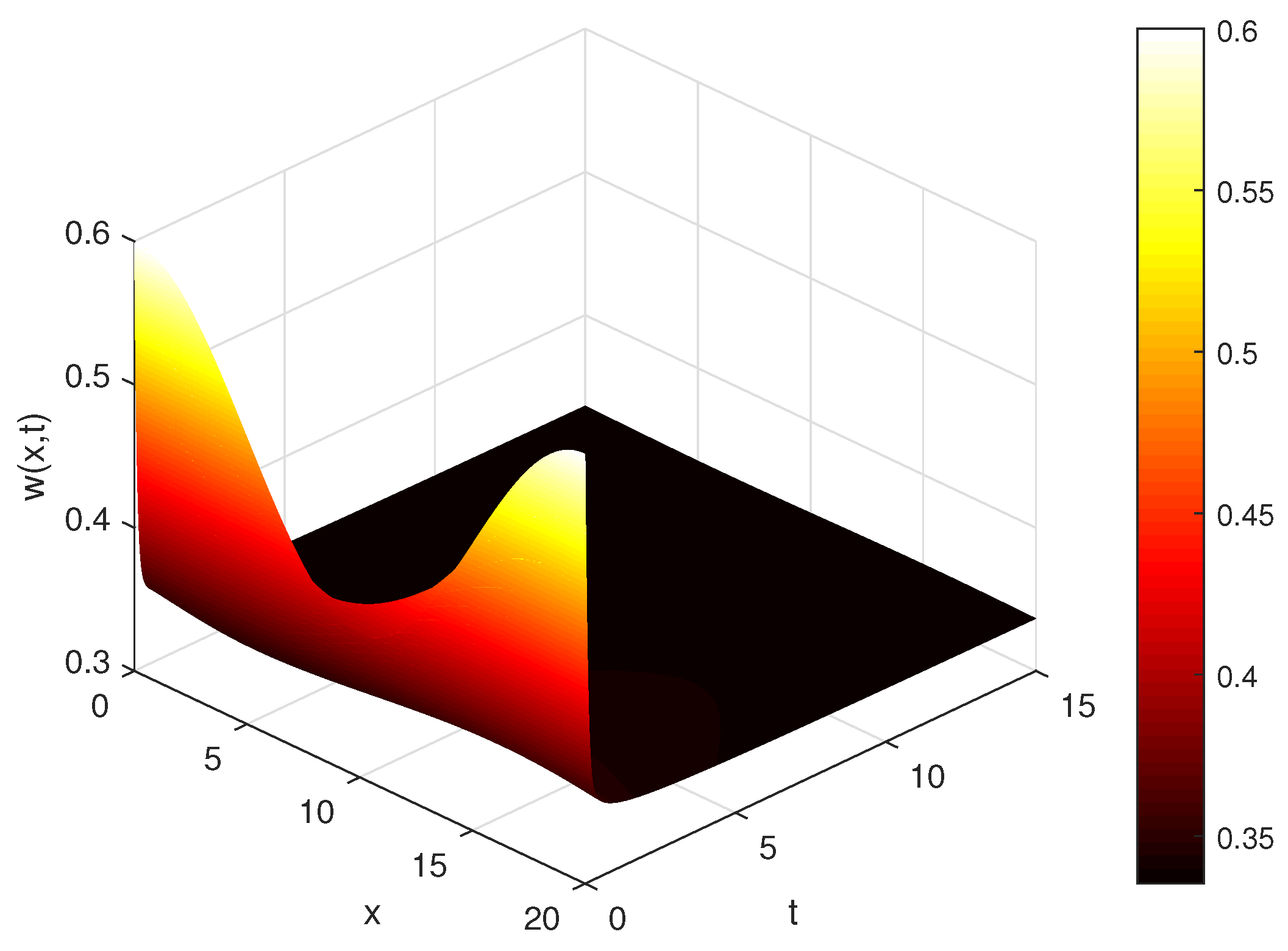
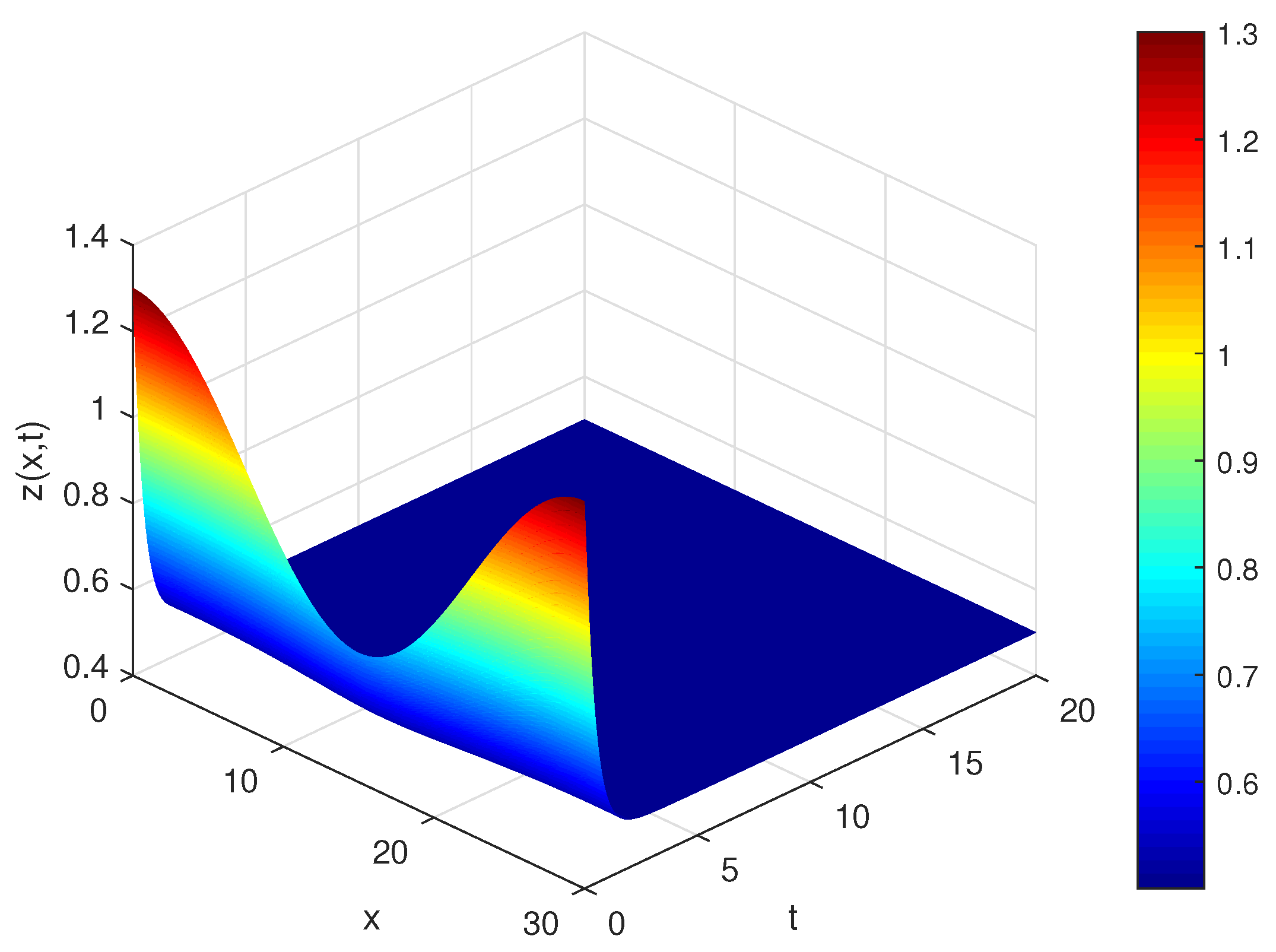
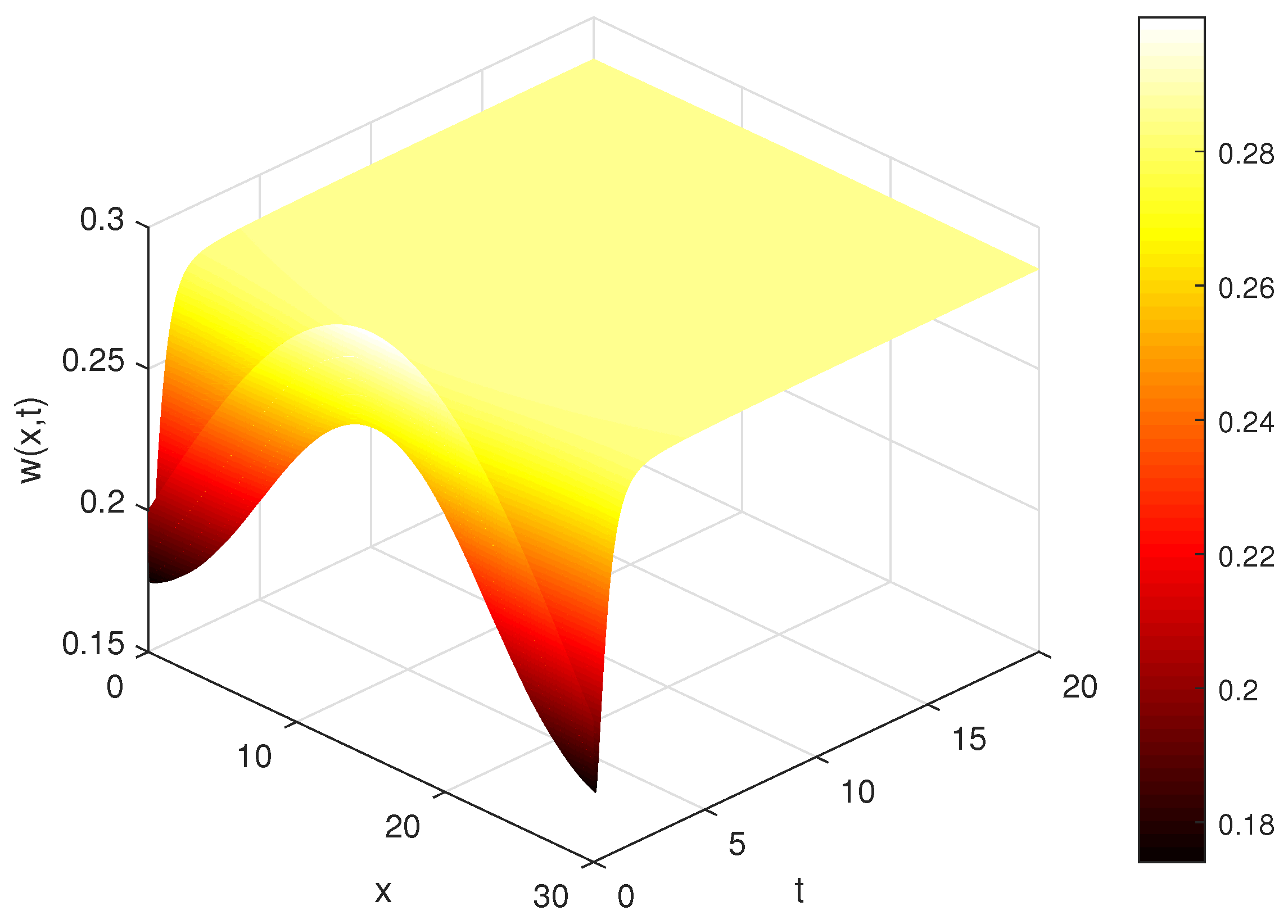
Example 1. We first consider the fractional glycolysis reaction–diffusion system under the parameter setwith spatial and temporal discretization given by , , , and . And the corresponding initial conditions are taken as The numerical results indicate that all trajectories of the system converge toward the same unique positive equilibrium point,confirming the asymptotic stability of the equilibrium. The simulation further validates the analytical conditions derived in Theorem 3, particularly regarding the roles of a (the dimensionless input flow rate) and b (the dimensionless constant rate of the low-activity state). As the fractional order ϑ approaches 1, the trajectories stabilize more rapidly, showing a faster convergence to the steady state. Figure 1 and Figure 2 demonstrate the temporal evolution of and and their convergence in the phase plane. These plots confirm that the incommensurate fractional system successfully preserves the theoretical stability characteristics of its continuous counterpart. Example 2. To further explore the impact of fractional differentiation on system dynamics, we now consider the incommensurate case, where distinct memory effects are assigned to the two state variables. Specifically, we takewith new parameters and the same boundary conditions as in Example 1. The system again evolves toward the same equilibrium , yet the transient behavior is markedly different. The solution exhibits slower diffusion-driven oscillations before settling, reflecting the unequal temporal memory in z and w. This demonstrates how incommensurate fractional dynamics can capture richer intermediate behaviors while preserving the system’s long-term stability.
Figure 1, Figure 2, Figure 3, Figure 4, Figure 5, Figure 6, Figure 7 and Figure 8 reveal that incommensurate memory accelerates diffusion-induced damping and broadens transient oscillation zones. Physically, this reflects how heterogeneous enzymatic memory modifies concentration gradients and delays pattern formation, consistent with observed anomalous diffusion in glycolytic media. Figure 7 and Figure 8 depict the spatio-temporal surfaces and the convergence trajectories. Compared to the commensurate case, the convergence is smoother but delayed, highlighting the interplay between fractional order, diffusion, and nonlinearity. Numerical Implementation and Validation
This subsection provides additional details about the numerical methodology used to generate the examples, as well as convergence tests and figure information.
Spatial and temporal discretization: The one-dimensional spatial domain
is discretized using a uniform grid,
,
, with
. The diffusion term is approximated by the standard centered finite difference,
subject to homogeneous Neumann (zero-flux) boundary conditions, implemented by reflecting boundary values (
,
).
Time discretization of the Caputo derivative is performed with the L1 approximation. For a uniform time grid
, the Caputo derivative
is approximated by
This scheme is implemented explicitly for the reaction–diffusion equations. Neumann boundary conditions and memory convolution are handled exactly as in the script.
Convergence and numerical stability: The L1 scheme is known to have a global truncation error of order for sufficiently smooth solutions, while the spatial discretization is second order, . To verify the implementation, we halved both and and computed the difference in the maximum norm between successive grids. For the parameter set , the refinement tests yielded and , confirming convergence within the target tolerance. The chosen timestep satisfies the empirical stability requirement for the explicit scheme used.
Comparison with integer and commensurate cases: For validation, we compared results from the incommensurate case
with those from the commensurate fractional
and classical integer-order
cases. The integer-order model relaxes fastest toward equilibrium, while the fractional and incommensurate cases exhibit slower, memory-driven decay and transient oscillations, as illustrated in the updated
Figure 1,
Figure 2,
Figure 3,
Figure 4,
Figure 5 and
Figure 6. These comparisons confirm the consistency of the numerical implementation and highlight the distinct influence of heterogeneous memory.
6. Conclusions
In this work, we investigated the local stability of an incommensurate fractional reaction–diffusion glycolysis model. By incorporating fractional derivatives of different orders for each state variable, the model provides a more flexible framework for describing heterogeneous memory effects inherent in biochemical processes. Through linear stability analysis, we established explicit conditions under which the homogeneous steady state remains locally asymptotically stable. Our findings show that the interplay between diffusion and fractional orders can give rise to contrasting behaviors: diffusion may either destabilize equilibria through Turing-type instabilities or reinforce stability depending on parameter regimes. The incommensurate fractional orders further enrich the dynamical repertoire, influencing both the onset and persistence of oscillatory and patterned solutions.
This study highlights the significance of considering incommensurate fractional operators in the modeling of glycolysis and related biochemical processes. Future research could extend these results to global stability analysis, bifurcation scenarios, and more detailed numerical simulations to better capture the complex spatiotemporal structures observed in real biological systems.