Article

A Generalized Weighted Fractional Cobweb Model for Dynamic Market Adjustment

1
Department of Mathematics, College of Sciences, University of Ha’il, Ha’il 55473, Saudi Arabia
2
Department of Mathematics, Hodeidah University, Al-Hudaydah 3114, Yemen
3
Department of Mathematics, Saveetha School of Engineering, SIMATS, Saveetha University, Chennai 602105, Tamil Nadu, India
4
Department of Mathematics, College of Science, Qassim University, Buraydah 51452, Saudi Arabia
5
Department of Mathematics, Faculty of Sciences, Islamic University of Madinah, Madinah 42351, Saudi Arabia
6
Department of Mathematics, Turabah University College, Taif University, Taif 21944, Saudi Arabia
*
Authors to whom correspondence should be addressed.
Fractal Fract. 2026, 10(3), 159; https://doi.org/10.3390/fractalfract10030159
Submission received: 19 January 2026 / Revised: 23 February 2026 / Accepted: 24 February 2026 / Published: 28 February 2026

Abstract

In this work, we propose a dynamic cobweb-type market equilibrium model where supply responds to price using a Mittag–Leffler kernel generalized weighted Caputo fractional derivative. By permitting independent fractional orders, a time-varying weight function that reweights historical data, and a monotone economic-time transformation that captures heterogeneous adjustment speeds, the formulation expands upon previous fractional cobweb models. We begin by highlighting several special cases encompassed by our proposed model. Next, we establish well-posedness, covering existence, uniqueness, and continuous dependence on initial data and parameters via an equivalent Volterra integral formulation, alongside a positivity theorem that ensures prices remain economically meaningful. Then, we derive stability conditions for the perturbation dynamics and characterize the constant equilibrium price. To perform the simulation, we constructed an explicit Volterra partition scheme specifically designed for the generalized kernel and established its convergence. In addition, we validated this approach using numerical examples illustrating how fractional orders, weights, and time transformations cause transient oscillations and convergence toward equilibrium.

1. Introduction

In recent decades, the study of systems governed by non-integer order operators has gained increasing attention due to their ability to capture hereditary and memory effects that classical integer-order models fail to describe. The emergence of fractional calculus, the extension of differentiation and integration to arbitrary (non-integer) orders, has enriched mathematical modeling across many applied fields, including physics, biology, economics, and engineering. The historical foundations of fractional derivatives can be traced to the works of Liouville, Riemann, and Leibniz (see [1,2,3,4,5]), whose ideas later evolved into a complete theoretical framework supported by powerful analytical tools and numerical techniques.
Fractional differential equations (FDEs) have emerged as powerful tools for modeling complex dynamical systems in which historical states significantly influence present behavior. To capture diverse memory patterns and nonlocal effects, several fractional operators have been developed, including the Riemann–Liouville [3], Caputo [3], Caputo–Fabrizio (CF) [6], Atangana–Baleanu [7], and various generalized derivatives [8,9,10,11], each enabling more realistic representations across physical, biological, and socio-economic applications. Among them, the Atangana–Baleanu–Caputo (ABC) fractional derivative stands out for incorporating a non-singular Mittag–Leffler kernel, which ensures a smooth and realistic representation of memory fading processes. This feature makes the ABC derivative particularly suitable for problems in which past information gradually loses influence over time without abrupt decay. From a theoretical standpoint, the studies of Abdo et al. [12], Alshammari et al. [13], Saad et al. [14], and Hattaf [15] developed existence, stability, and qualitative analysis results for ψ -weighted, generalized CF, and mixed fractional operators, thereby clarifying the structural flexibility of weighted and hybrid kernels and forming the analytical basis for the generalized weighted operator employed in the present work.
In mathematical economics, fractional calculus has emerged as a valuable tool for reformulating traditional models of market dynamics. One of the most well-known models in this context is the cobweb model, which analyzes the price adjustment mechanism between supply and demand for non-storable goods. Originally developed by Kaldor [16] and later refined by Ezekiel [17] and Gandolfo [18], the cobweb model captures how producers form expectations of future prices based on previous observations. The classical discrete cobweb model is given by the coupled system
D ( t ) = a + b p ( t + 1 ) , S ( t ) = a 1 + b 1 p ( t ) , D ( t ) = S ( t ) , t N 0 ,
where p ( t ) denotes the market price at time t, D ( t ) stands for the demand function, S ( t ) is the supply function, and the parameters a , a 1 , b , b 1 R describe the linear demand and supply functions. The solution p ( t ) = ( p 0 p ) b 1 b t + p exhibits convergence or divergence depending on the ratio b 1 b . Gandolfo [18,19] extended this framework to continuous time, investigating various modifications including derivatives in both demand and supply functions, where S ( t ) = a 1 + b 1 ( p ( t ) + c p ( t ) ) in the model (1).
The ongoing evolution of fractional calculus has fundamentally transformed the modeling of economic dynamics, particularly in capturing memory and hereditary effects that classical integer-order models fail to represent. The cobweb model, a cornerstone of economic dynamics describing price fluctuations in agricultural and commodity markets, has been extensively revisited through the lens of fractional calculus [20,21,22,23,24,25,26,27,28,29]. However, existing studies exhibit significant fragmentation and limitations that this paper aims to address through a systematic analysis and a novel generalized framework. Research on fractional cobweb models can be systematically categorized along three dimensions: (1) the type of fractional operator employed, (2) the placement of memory effects (demand-side vs. supply-side), and (3) the time domain (continuous vs. discrete). The foundational extension of cobweb dynamics to fractional calculus was pioneered by studies incorporating Caputo derivatives. Chen, Bohner, and Jia [22] investigated two complementary specifications:
D ( t ) = a + b p ( t ) + D 0 ν C p ( t ) , S ( t ) = a 1 + b 1 p ( t ) , D ( t ) = S ( t ) ,
and
D ( t ) = a + b p ( t ) , S ( t ) = a 1 + b 1 p ( t ) + c · D 0 ν C p ( t ) , D ( t ) = S ( t ) ,
These models successfully introduced memory effects through Mittag–Leffler function solutions and established stability conditions via Laplace transform analysis. However, they are constrained by the singular kernel of the Caputo derivative, which imposes infinite memory at the origin—a mathematically convenient but economically unrealistic assumption.
Recognizing the limitations of singular kernels, researchers explored alternatives. Bohner and Hatipoglu [23,30] employed conformable fractional derivatives, offering simpler algebraic properties but sacrificing the non-locality essential for genuine memory effects. Tejado et al. [31] applied Atangana–Baleanu–Caputo (ABC) derivatives with non-singular kernels, while Salahshour et al. [26] and Lin et al. [32] extended analysis to fuzzy environments. Anokye et al. [33] incorporated stochastic elements, and Tarasov [34] provided comprehensive theoretical foundations. Despite these advances, each approach remains tied to specific kernel structures with limited flexibility.
Parallel developments addressed discrete-time dynamics, essential for modern high-frequency trading and digital economies. Pakhira et al. [20] and Chen et al. [21,22] established discrete analogs of fractional operators. Koyuncuoglu et al. [35] introduced Hilfer nabla fractional differences:
D t = a + b p t + 0 α , β p t , S t = a 1 + b 1 p t , D t = S t , t N 0 ,
providing solutions via discrete Mittag–Leffler functions. Nagy and Srivastava [25,27] further refined discrete formulations.
Despite substantial progress, existing fractional cobweb models remain limited by rigid single-parameter kernels that cannot capture multi-scale economic memory and by the assumption of constant sensitivity to past prices. They also rely on linear time perception, overlooking behavioral evidence of nonlinear economic-time adjustment. Moreover, fractional parameters are often treated as purely mathematical constructs with weak links to observable economic mechanisms, reducing interpretability and empirical relevance.
Motivated by the limitations of existing fractional cobweb models, we develop a generalized fractional framework based on the operator D 0 , σ , ω , φ α 1 , α 2 , γ , ϱ C , which enables multi-scale memory representation, time-varying sensitivity to past information through the weight function ω ( t ) , and nonlinear economic-time perception via the transformation φ ( t ) . The selection of this operator is crucial, as it governs how memory enters the market adjustment process. Classical fractional derivatives typically employ singular power-law kernels that may impose computational constraints and limit modeling flexibility when memory is fading without initial singularities. To overcome this, we adopt a non-singular, non-local Mittag–Leffler kernel of ABC type and extend it with weighting and economic-time transformations, thereby bridging standard cobweb dynamics with modern variable time-scale fractional frameworks and enhancing interpretability through explicit links between parameters and observable economic mechanisms.
By replacing traditional power-law kernels with this generalized Mittag–Leffler structure, the model accommodates a broader spectrum of memory effects in supply adjustment, allowing smooth transitions between short- and long-memory regimes while avoiding singular behavior at the origin. This flexibility supports the modeling of heterogeneous market frictions and adaptive expectations within a unified framework. Consequently, the proposed generalized cobweb model takes the form
D ( t ) = a + b p ( t ) , b < 0 , S ( t ) = a 1 + b 1 p ( t ) + c · D 0 , σ , ω , φ α 1 , α 2 , γ , ϱ C p ( t ) , b 1 > 0 , D ( t ) = S ( t ) , t > 0 ,
with initial condition p ( 0 ) = p 0 . where D 0 , σ , ω , φ α 1 , α 2 , γ , ϱ C denotes the generalized weighted fractional derivative in the Caputo sense. α 1 ( 0 , 1 ] , α 2 > 0 , γ > 0 , ϱ C with 0 < Re ( ϱ ) < 1 , σ R , a , a 1 , b , b 1 , c , p 0 R with b < 0 , b 1 > 0 , c 0 , while b b 1 , ω : [ 0 , ) R + is a positive weight function introducing time-dependent weighting of historical data, and φ : [ 0 , ) R is a strictly increasing differentiable function representing transformed economic time.
This study advances fractional economic dynamics in three complementary directions. First, we introduce a generalized weighted Caputo-type operator whose kernel involves a Mittag–Leffler function and which incorporates an independent fractional order α 1 , a secondary order α 2 , a time-dependent weight ω ( t ) , and an economic-time deformation φ ( t ) . By suitably restricting these parameters, the operator reduces to several well-known cobweb formulations (including the ABC and CF types), thereby providing a unifying framework for memory-based economic dynamics. Second, by recasting the market-clearing condition as an equivalent Volterra integral equation, we establish a comprehensive well-posedness theory covering existence, uniqueness, continuous dependence on data, and positivity of the solution. From this formulation, we also derive the equilibrium and its stability characteristics, clarifying how the fractional orders α 1 , α 2 influence the convergence rate and under what circumstances oscillatory transients may appear. Third, we develop an explicit product-integration scheme tailored to the generalized kernel and validate it through numerical examples. These simulations demonstrate how the parameters α 1 , α 2 together with the functions ω and φ jointly control transient overshoot, the speed of convergence, and the long-run approach to the equilibrium price.
The remainder of this paper is organized as follows. Section 2 presents definitions and supporting results. Section 3 formulates the fractional cobweb model with a special case and equivalent integral equation. Section 4 provides well-posedness analysis, including existence, uniqueness, continuous dependence, and positivity. Section 5 conducts qualitative analysis of equilibrium points and stability properties. Section 6 develops specialized numerical methods for solving the generalized fractional model. Finally, Section 7 provides conclusions and future research directions.

2. Preliminaries

In this section, we present the essential definitions and lemmas that will be utilized in the subsequent analysis.
Definition 1 
([1]). The two-parameter Mittag–Leffler function is defined as:
E α , β ( z ) = k = 0 z k Γ ( α k + β ) , α > 0 , β C ,
where Γ ( · ) is a gamma function. The one-parameter version is E α ( z ) = E α , 1 ( z ) .
Definition 2 
([8]). The generalized Mittag–Leffler function of three parameters is defined as
E α , β σ ( r ) = k = 0 ( σ ) k k ! Γ ( α k + β ) r k ,
where r C and ( σ ) k is the Pochhammer symbol, such that
( σ ) k = σ ( σ + 1 ) ( σ + k 1 ) , ( σ ) k = Γ ( σ + k ) Γ ( σ ) , and ( 1 ) k = k ! .
Moreover,
E α , β γ , σ ( λ , r ) = r β 1 E α , β σ ( λ r γ ) = k = 0 ( σ ) k k ! Γ ( α k + β ) λ k r k γ + β 1 ,
such that r C , 0 λ R , and γ , β , σ > 0 .
Lemma 1 
([1]). For α , β > 0 and t > 0 , the beta function identity is
0 t ( t v ) α 1 v β 1 d v = t α + β 1 Γ ( α ) Γ ( β ) Γ ( α + β ) .
Definition 3 
([7]). Let f H 1 ( a , b ) , a < b , and α [ 0 , 1 ] . The ABC fractional derivative of f of order α in the Caputo sense is defined as:
D t α a             A B C f ( t ) = Δ ( α ) 1 α a t E α α ( t τ ) α 1 α f ( τ ) d τ ,
where Δ ( α ) is a normalization function satisfying Δ ( 0 ) = Δ ( 1 ) = 1 .
Definition 4 
([36]). For p H 1 ( 0 , τ ) , the generalized weighted fractional derivative in the Caputo sense is defined as:
D 0 , σ , ω , φ α 1 , α 2 , γ , ϱ C p ( t ) = Δ ( α 1 ) 1 α 1 1 ω ( t ) 0 t E α 2 , ϱ γ , σ α 1 1 α 1 [ φ ( t ) φ ( v ) ] α 2 × [ φ ( t ) φ ( v ) ] ϱ 1 φ ( v ) ( ω p ) ( v ) d v ,
where E α 2 , ϱ γ , σ is the generalized Mittag–Leffler function.
Definition 5 
([36]). The corresponding fractional integral operator is defined as:
I 0 , σ , ω , φ α 1 , α 2 , ϱ p ( t ) = i = 0 σ i α 1 i ( 1 α 1 ) i 1 Δ ( α 1 ) I 0 , ω , φ i α 2 ϱ + 1 R p ( t ) ,
where the weighted Riemann–Liouville integral [9] is:
I 0 , ω , φ ϱ R p ( t ) = 1 ω ( t ) Γ ( ϱ ) 0 t [ φ ( t ) φ ( v ) ] ϱ 1 φ ( v ) ( ω p ) ( v ) d v .
Proposition 1 
([36]). For α 1 ( 0 , 1 ] , α 2 > 0 , Re ( ϱ ) > 0 , σ R , the following identity holds when γ = α 2 :
I 0 , σ , ω , φ α 1 , α 2 , ϱ D 0 , σ , ω , φ α 1 , α 2 , α 2 , ϱ C p ( t ) = ( ω p ) ( t ) ( ω p ) ( 0 ) ω ( t ) .

3. Fractional Cobweb Model

Here, we consider a dynamic market equilibrium model in which supply and demand are both dependent on price p ( t ) . However, the supply function uses a generalized weighted fractional derivative operator to account for memory effects.

3.1. Model Formulation

The fractional cobweb model is given by
D ( t ) = a + b p ( t ) , b < 0 , S ( t ) = a 1 + b 1 p ( t ) + c · D 0 , σ , ω , φ α 1 , α 2 , γ , ϱ C p ( t ) , b 1 > 0 , D ( t ) = S ( t ) , t > 0 ,
with initial condition p ( 0 ) = p 0 , where the parameters and operators are defined as follows:
  • a , a 1 R : baseline demand and supply intercepts.
  • b , b 1 R : price sensitivity coefficients with b < 0 and b 1 > 0 .
  • c R : memory effect strength coefficient.
  • p 0 R : initial price at time t = 0 .
  • α 1 ( 0 , 1 ] : primary fractional order controlling the fundamental memory decay.
  • α 2 > 0 : secondary fractional order in the Mittag–Leffler kernel.
  • γ > 0 : shape parameter of the Mittag–Leffler function.
  • ϱ C with 0 < Re ( ϱ ) < 1 : complex parameter influencing the kernel’s asymptotic behavior.
  • σ R : series expansion parameter in the generalized Mittag–Leffler function.
  • ω : [ 0 , ) R + : positive weight function for time-dependent memory, reflecting agents’ varying attention to past prices and market conditions.
  • φ : [ 0 , ) R : strictly increasing differentiable function representing transformed economic time, capturing nonlinear perception of events and information by agents.
  • Δ ( α 1 ) : normalization function satisfying Δ ( 0 ) = Δ ( 1 ) = 1 , typically Δ ( α 1 ) = 1 α 1 + α 1 / Γ ( α 1 ) .
  • D 0 , σ , ω , φ α 1 , α 2 , γ , ϱ C : generalized weighted fractional derivative in the Caputo sense.

3.2. Special Cases

The generalized operator D 0 , σ , ω , φ α 1 , α 2 , γ , ϱ C unifies a broad family of fractional derivatives with non-singular kernels. Rather than exhaustively listing all possible reductions, we highlight the most significant special cases that directly inform our economic analysis, as shown in Table 1.
Remark 1. 
Other reductions (e.g., weighted FC with respect to another function, ABC with respect to another function without weighting) are mathematically contained within the cases above. For instance, setting ω ( t ) 1 in case 2 recovers the unweighted ABC with respect to φ; setting φ ( t ) = t in case 1 yields the classical ABC. We focus on the five representative families above to maintain clarity without sacrificing generality. Readers interested in exhaustive enumerations are referred to [36].

3.3. Equivalent Integral Equation

In the event that the market clears at each moment t, D ( t ) = S ( t ) ), the model (3) becomes
c · D 0 , σ , ω , φ α 1 , α 2 , γ , ϱ C p ( t ) + ( b 1 b ) p ( t ) = a a 1 .
Under the condition γ = α 2 specified in Proposition 1, the generalized integral operator I 0 , σ , ω , φ α 1 , α 2 , ϱ is then applied.
c · I 0 , σ , ω , φ α 1 , α 2 , ϱ D 0 , σ , ω , φ α 1 , α 2 , α 2 , ϱ C p ( t ) + ( b 1 b ) I 0 , σ , ω , φ α 1 , α 2 , ϱ p ( t ) = ( a a 1 ) I 0 , σ , ω , φ α 1 , α 2 , ϱ { 1 } ( t ) .
Using Proposition 1, we obtain
c · ω ( t ) p ( t ) ω ( 0 ) p 0 ω ( t ) + ( b 1 b ) I 0 , σ , ω , φ α 1 , α 2 , ϱ p ( t ) = ( a a 1 ) I 0 , σ , ω , φ α 1 , α 2 , ϱ { 1 } ( t ) ,
which implies
p ( t ) = ω ( 0 ) p 0 ω ( t ) + a a 1 c I 0 , σ , ω , φ α 1 , α 2 , ϱ { 1 } ( t ) b 1 b c I 0 , σ , ω , φ α 1 , α 2 , ϱ p ( t ) .
From Definition 5, we obtain
p ( t ) = ω ( 0 ) p 0 ω ( t ) + 1 c ω ( t ) i = 0 σ i α 1 i ( 1 α 1 ) i 1 Δ ( α 1 ) Γ ( i α 2 ϱ + 1 ) × 0 t [ φ ( t ) φ ( v ) ] i α 2 ϱ φ ( v ) ω ( v ) ( a a 1 ) ( b 1 b ) p ( v ) d v ,
which is the equivalent integral equation for the proposed model (3).

4. Well-Posedness Analysis

To establish the results on existence, continuous dependence, and positivity, we base our analysis on the integral formulation of the generalized fractional economic model (5) that results from the market equilibrium relation. Equation (5) is now rewritten as
p ( t ) = F ( t ) + 0 t G ( t , v ) p ( v ) d v , t [ 0 , T ] ,
where
F ( t ) = ω ( 0 ) p 0 ω ( t ) + a a 1 c ω ( t ) 0 t K ( t , v ) ω ( v ) d v ,
G ( t , v ) = b 1 b c ω ( t ) K ( t , v ) ω ( v ) ,
with the kernel
K ( t , v ) = i = 0 σ i α 1 i ( 1 α 1 ) i 1 Δ ( α 1 ) Γ ( i α 2 ϱ + 1 ) [ φ ( t ) φ ( v ) ] i α 2 ϱ φ ( v ) .
Let X = C ( [ 0 , T ] , R ) denote the Banach space of continuous functions on [ 0 , T ] equipped with the supremum norm:
p = sup t [ 0 , T ] | p ( t ) | .
Assumption 1. 
The functions ω and φ satisfy:
1. 
ω C ( [ 0 , T ] , R + ) , and there exist constants ω min , ω max > 0 such that
ω min ω ( t ) ω max t [ 0 , T ] .
2. 
φ C 1 ( [ 0 , T ] , R ) is strictly increasing, and there exists M φ > 0 such that
0 < φ ( t ) M φ t [ 0 , T ] .
Assumption 2. 
Let α 1 ( 0 , 1 ] , α 2 > 0 , 0 < Re ( ϱ ) < 1 , σ R , and let the functions ω and φ be as in Assumption 1. Then, the kernel K ( t , v ) defined in (9) enjoys the following properties:
1. 
The series converges absolutely and uniformly for all 0 v t T .
2. 
There exists a constant C K > 0 (depending only on the parameters and on T) such that
| K ( t , v ) | C K ( t v ) Re ( ϱ ) 0 v < t T .
3. 
K is continuous on { 0 v t T } except for the weak singularity along v = t .
4. 
Moreover, K depends Lipschitz-continuously on the parameters: for two admissible parameter sets ( α 1 , α 2 , ϱ , σ , φ ) and ( α ˜ 1 , α ˜ 2 , ϱ ˜ , σ ˜ , φ ˜ ) with uniform bounds, there exists L K > 0 such that
| K ( t , v ) K ˜ ( t , v ) | L K | α 1 α ˜ 1 | + | α 2 α ˜ 2 | + | ϱ ϱ ˜ | + | σ σ ˜ | + φ φ ˜ C 1 ( t v ) Re ( ϱ ) .
Lemma 2. 
Under Assumptions 1 and 2, there exist constants M F , L G > 0 such that
1. 
| F ( t ) | M F for all t [ 0 , T ] ,
2. 
| G ( t , v ) | L G ( t v ) Re ( ϱ ) for all 0 v < t T ,
where
M F = ω ( 0 ) | p 0 | ω min + | a a 1 | | c | ω min · C K ω max T 1 Re ( ϱ ) 1 Re ( ϱ ) , L G = | b 1 b | | c | ω min C K ω max .
Proof. 1. 
Using Assumption 2 part (2), for t [ 0 , T ] ,
| F ( t ) | ω ( 0 ) | p 0 | ω ( t ) + | a a 1 | | c | ω ( t ) 0 t K ( t , v ) ω ( v ) d v ω ( 0 ) | p 0 | ω min + | a a 1 | | c | ω min 0 t | K ( t , v ) | ω ( v ) d v ω ( 0 ) | p 0 | ω min + | a a 1 | | c | ω min C K ω max 0 t ( t v ) Re ( ϱ ) d v = ω ( 0 ) | p 0 | ω min + | a a 1 | | c | ω min C K ω max t 1 Re ( ϱ ) 1 Re ( ϱ ) ω ( 0 ) | p 0 | ω min + | a a 1 | | c | ω min · C K ω max T 1 Re ( ϱ ) 1 Re ( ϱ ) = M F .
2. For 0 v < t T , we have
| G ( t , v ) | = b 1 b c ω ( t ) K ( t , v ) ω ( v ) | b 1 b | | c | ω min C K ω max ( t v ) Re ( ϱ ) = L G ( t v ) Re ( ϱ ) .

4.1. Existence and Uniqueness

Theorem 1. 
Under Assumptions 1 and 2, the Volterra integral Equation (6) has a unique solution p C ( [ 0 , T ] , R ) .
Proof. 
Define the sequence { p n } n = 0 C ( [ 0 , T ] , R ) recursively by
p 0 ( t ) = F ( t ) , p n + 1 ( t ) = F ( t ) + 0 t G ( t , v ) p n ( v ) d v , n = 0 , 1 , 2 ,
We present the proof in several steps.
Step 1:Uniform boundedness of { p n } .
We first show by induction that all p n are uniformly bounded. Clearly, p 0 M F . Assume p n M n . Then, for t [ 0 , T ] ,
| p n + 1 ( t ) | | F ( t ) | + 0 t | G ( t , v ) | | p n ( v ) | d v M F + M n 0 t L G ( t v ) Re ( ϱ ) d v = M F + M n L G t 1 Re ( ϱ ) 1 Re ( ϱ ) M F + M n L G T 1 Re ( ϱ ) 1 Re ( ϱ ) .
Thus, if we define M n + 1 = M F + M n L G T 1 Re ( ϱ ) 1 Re ( ϱ ) , then p n + 1 M n + 1 .
Step 2: Estimate for successive differences.
We prove by induction that for n 0 and t [ 0 , T ] ,
| p n + 1 ( t ) p n ( t ) | M F [ L G Γ ( 1 Re ( ϱ ) ) ] n + 1 Γ ( ( n + 1 ) ( 1 Re ( ϱ ) ) + 1 ) t ( n + 1 ) ( 1 Re ( ϱ ) ) .
For n = 0 ,
| p 1 ( t ) p 0 ( t ) | = 0 t G ( t , v ) p 0 ( v ) d v 0 t | G ( t , v ) | | p 0 ( v ) | d v M F 0 t L G ( t v ) Re ( ϱ ) d v = M F L G t 1 Re ( ϱ ) 1 Re ( ϱ ) = M F L G Γ ( 1 Re ( ϱ ) ) Γ ( 2 Re ( ϱ ) ) t 1 Re ( ϱ ) ,
since Γ ( 2 Re ( ϱ ) ) = ( 1 Re ( ϱ ) ) Γ ( 1 Re ( ϱ ) ) . Thus, (11) holds for n = 0 .
Assume (11) holds for n 1 . Then, for n,
| p n + 1 ( t ) p n ( t ) | 0 t | G ( t , v ) | | p n ( v ) p n 1 ( v ) | d v 0 t L G ( t v ) Re ( ϱ ) · M F [ L G Γ ( 1 Re ( ϱ ) ) ] n Γ ( n ( 1 Re ( ϱ ) ) + 1 ) v n ( 1 Re ( ϱ ) ) d v = M F [ L G Γ ( 1 Re ( ϱ ) ) ] n + 1 Γ ( n ( 1 Re ( ϱ ) ) + 1 ) 0 t ( t v ) Re ( ϱ ) v n ( 1 Re ( ϱ ) ) d v .
Using Lemma 1 with α = 1 Re ( ϱ ) and β = n ( 1 Re ( ϱ ) ) + 1 ,
0 t ( t v ) Re ( ϱ ) v n ( 1 Re ( ϱ ) ) d v = t ( n + 1 ) ( 1 Re ( ϱ ) ) Γ ( 1 Re ( ϱ ) ) Γ ( n ( 1 Re ( ϱ ) ) + 1 ) Γ ( ( n + 1 ) ( 1 Re ( ϱ ) ) + 1 ) .
Substituting back, we have
| p n + 1 ( t ) p n ( t ) | M F [ L G Γ ( 1 Re ( ϱ ) ) ] n + 1 Γ ( n ( 1 Re ( ϱ ) ) + 1 ) · t ( n + 1 ) ( 1 Re ( ϱ ) ) Γ ( 1 Re ( ϱ ) ) Γ ( n ( 1 Re ( ϱ ) ) + 1 ) Γ ( ( n + 1 ) ( 1 Re ( ϱ ) ) + 1 ) = M F [ L G Γ ( 1 Re ( ϱ ) ) ] n + 1 Γ ( ( n + 1 ) ( 1 Re ( ϱ ) ) + 1 ) t ( n + 1 ) ( 1 Re ( ϱ ) ) .
Step 3: Uniform convergence.
Consider the series
p ( t ) = p 0 ( t ) + n = 0 [ p n + 1 ( t ) p n ( t ) ] .
For t [ 0 , T ] , we have
n = 0 | p n + 1 ( t ) p n ( t ) | n = 0 M F [ L G Γ ( 1 Re ( ϱ ) ) ] n + 1 Γ ( ( n + 1 ) ( 1 Re ( ϱ ) ) + 1 ) t ( n + 1 ) ( 1 Re ( ϱ ) ) M F m = 1 [ L G Γ ( 1 Re ( ϱ ) ) T 1 Re ( ϱ ) ] m Γ ( m ( 1 Re ( ϱ ) ) + 1 ) = M F E 1 Re ( ϱ ) , L G Γ ( 1 Re ( ϱ ) ) T 1 Re ( ϱ ) ( z ) 1 .
The series of Mittag–Leffler function E β , 1 ( z ) 1 = m = 1 z m Γ ( m β + 1 ) converges for all z C and β > 0 . Thus, the series converges uniformly on [ 0 , T ] , so p C ( [ 0 , T ] , R ) .
Step 4: p satisfies the integral equation.
Since the convergence is uniform, we can pass to the limit in (10),
lim n p n + 1 ( t ) = lim n F ( t ) + 0 t G ( t , v ) p n ( v ) d v = F ( t ) + 0 t G ( t , v ) lim n p n ( v ) d v = F ( t ) + 0 t G ( t , v ) p ( v ) d v = p ( t ) .
Therefore, p satisfies (6).
Step 5: Uniqueness.
Suppose p and q are two solutions. Let u = p q . Then,
u ( t ) = 0 t G ( t , v ) u ( v ) d v .
Let M u = u . For t [ 0 , T ] ,
| u ( t ) | 0 t | G ( t , v ) | | u ( v ) | d v M u 0 t L G ( t v ) Re ( ϱ ) d v = M u L G t 1 Re ( ϱ ) 1 Re ( ϱ ) .
Iterating this estimate k times gives
| u ( t ) | M u [ L G Γ ( 1 Re ( ϱ ) ) ] k Γ ( k ( 1 Re ( ϱ ) ) + 1 ) t k ( 1 Re ( ϱ ) ) .
As k , the right-hand side tends to 0. Hence, u ( t ) = 0 for all t [ 0 , T ] .    □

4.2. Continuous Dependence on Initial Conditions

Theorem 2. 
Let p and q be solutions corresponding to initial conditions p 0 and q 0 , respectively, with all other parameters fixed. Then, there exists a constant C > 0 depending on T and the parameters such that
p q C | p 0 q 0 | .
Specifically,
| p ( t ) q ( t ) | ω ( 0 ) ω min | p 0 q 0 | · E 1 Re ( ϱ ) , 1 L G Γ ( 1 Re ( ϱ ) ) t 1 Re ( ϱ ) .
Proof. 
Let u ( t ) = p ( t ) q ( t ) . Subtracting the integral equations for p and q gives
u ( t ) = ω ( 0 ) ( p 0 q 0 ) ω ( t ) + 0 t G ( t , v ) u ( v ) d v .
Define v 0 ( t ) = ω ( 0 ) ( p 0 q 0 ) ω ( t ) . Then | v 0 ( t ) | ω ( 0 ) ω min | p 0 q 0 | = : M 0 .
We solve (12) by successive approximations,
u 0 ( t ) = v 0 ( t ) , u n + 1 ( t ) = v 0 ( t ) + 0 t G ( t , v ) u n ( v ) d v , n = 0 , 1 , 2 , .
By induction, similar to Theorem 1, we obtain
| u n ( t ) | M 0 k = 0 n [ L G Γ ( 1 Re ( ϱ ) ) ] k Γ ( k ( 1 Re ( ϱ ) ) + 1 ) t k ( 1 Re ( ϱ ) ) .
Taking n , we obtain
| u ( t ) | M 0 k = 0 [ L G Γ ( 1 Re ( ϱ ) ) ] k Γ ( k ( 1 Re ( ϱ ) ) + 1 ) t k ( 1 Re ( ϱ ) ) = M 0 E 1 Re ( ϱ ) , 1 L G Γ ( 1 Re ( ϱ ) ) t 1 Re ( ϱ ) .
Since E 1 Re ( ϱ ) , 1 is increasing in t, for t [ 0 , T ] ,
| u ( t ) | ω ( 0 ) ω min | p 0 q 0 | · E 1 Re ( ϱ ) , 1 L G Γ ( 1 Re ( ϱ ) ) T 1 Re ( ϱ ) .
Thus, p q C | p 0 q 0 | with C = ω ( 0 ) ω min E 1 Re ( ϱ ) , 1 L G Γ ( 1 Re ( ϱ ) ) T 1 Re ( ϱ ) .    □

4.3. Continuous Dependence on Parameters

Theorem 3. 
Consider two sets of parameters P = ( α 1 , α 2 , ϱ , σ , a , a 1 , b , b 1 , c , ω , φ , p 0 ) and P ˜ = ( α ˜ 1 , α ˜ 2 , ϱ ˜ , σ ˜ , a ˜ , a ˜ 1 , b ˜ , b ˜ 1 , c ˜ , ω ˜ , φ ˜ , p ˜ 0 ) both satisfying Assumptions 1 and 2 with uniform constants. Let p and p ˜ be the corresponding solutions. Then, there exists a constant C > 0 depending on T and the uniform constants such that
p p ˜ C | p 0 p ˜ 0 | + ω ω ˜ + φ φ ˜ C 1 + | P P ˜ | ,
where
| P P ˜ | = | a a ˜ | + | a 1 a ˜ 1 | + | b b ˜ | + | b 1 b ˜ 1 | + | c c ˜ | + | α 1 α ˜ 1 | + | α 2 α ˜ 2 | + | ϱ ϱ ˜ | + | σ σ ˜ | .
Proof. 
Denote by F , G , K and F ˜ , G ˜ , K ˜ the functions corresponding to P and P ˜ , respectively. Let u ( t ) = p ( t ) p ˜ ( t ) . Then,
u ( t ) = [ F ( t ) F ˜ ( t ) ] + 0 t [ G ( t , v ) p ( v ) G ˜ ( t , v ) p ˜ ( v ) ] d v = [ F ( t ) F ˜ ( t ) ] + 0 t G ( t , v ) u ( v ) d v + 0 t [ G ( t , v ) G ˜ ( t , v ) ] p ˜ ( v ) d v .
Define
H ( t ) : = [ F ( t ) F ˜ ( t ) ] + 0 t [ G ( t , v ) G ˜ ( t , v ) ] p ˜ ( v ) d v .
Then, (13) becomes
u ( t ) = H ( t ) + 0 t G ( t , v ) u ( v ) d v .
Now, we estimate | F ( t ) F ˜ ( t ) | and | G ( t , v ) G ˜ ( t , v ) | .
From (7), we have
F ( t ) F ˜ ( t ) = ω ( 0 ) p 0 ω ( t ) ω ˜ ( 0 ) p ˜ 0 ω ˜ ( t ) + a a 1 c ω ( t ) 0 t K ( t , v ) ω ( v ) d v a ˜ a ˜ 1 c ˜ ω ˜ ( t ) 0 t K ˜ ( t , v ) ω ˜ ( v ) d v .
For the first term, we have
ω ( 0 ) p 0 ω ( t ) ω ˜ ( 0 ) p ˜ 0 ω ˜ ( t ) 1 ω ( t ) | ω ( 0 ) p 0 ω ˜ ( 0 ) p ˜ 0 | + | ω ˜ ( 0 ) p ˜ 0 | 1 ω ( t ) 1 ω ˜ ( t ) 1 ω min ( | ω ( 0 ) | | p 0 p ˜ 0 | + | p ˜ 0 | | ω ( 0 ) ω ˜ ( 0 ) | ) + | ω ˜ ( 0 ) p ˜ 0 | ω ω ˜ ω min 2 C 1 ( | p 0 p ˜ 0 | + ω ω ˜ ) .
For the second term, we write
a a 1 c ω ( t ) 0 t K ( t , v ) ω ( v ) d v a ˜ a ˜ 1 c ˜ ω ˜ ( t ) 0 t K ˜ ( t , v ) ω ˜ ( v ) d v = a a 1 c ω ( t ) a ˜ a ˜ 1 c ˜ ω ˜ ( t ) 0 t K ( t , v ) ω ( v ) d v + a ˜ a ˜ 1 c ˜ ω ˜ ( t ) 0 t K ( t , v ) ω ( v ) K ˜ ( t , v ) ω ˜ ( v ) d v .
Now,
a a 1 c ω ( t ) a ˜ a ˜ 1 c ˜ ω ˜ ( t ) | a a 1 | | c | 1 ω ( t ) 1 ω ˜ ( t ) + 1 | c ˜ | ω ˜ ( t ) a a 1 c a ˜ a ˜ 1 c ˜ C 2 ω ω ˜ + C 3 ( | a a ˜ | + | a 1 a ˜ 1 | + | c c ˜ | ) .
In addition,
0 t K ( t , v ) ω ( v ) d v C K ω max T 1 Re ( ϱ ) 1 Re ( ϱ ) .
Next,
0 t K ( t , v ) ω ( v ) K ˜ ( t , v ) ω ˜ ( v ) d v = 0 t [ K ( t , v ) K ˜ ( t , v ) ] ω ( v ) d v + 0 t K ˜ ( t , v ) [ ω ( v ) ω ˜ ( v ) ] d v .
Using Assumption 2 part (3), we have
0 t | K ( t , v ) K ˜ ( t , v ) | ω ( v ) d v ω max L K params δ 0 t ( t v ) Re ( ϱ ) d v = ω max L K params δ T 1 Re ( ϱ ) 1 Re ( ϱ ) ,
where params δ denotes the sum of parameter differences and φ φ ˜ C 1 .
In addition,
0 t | K ˜ ( t , v ) | | ω ( v ) ω ˜ ( v ) | d v C K ω ω ˜ T 1 Re ( ϱ ) 1 Re ( ϱ ) .
Combining these estimates, we obtain
| F ( t ) F ˜ ( t ) | C F | p 0 p ˜ 0 | + ω ω ˜ + φ φ ˜ C 1 + | P P ˜ | .
To estimate | G ( t , v ) G ˜ ( t , v ) | , we have from (8) that
| G ( t , v ) G ˜ ( t , v ) | b 1 b c ω ( t ) b ˜ 1 b ˜ c ˜ ω ˜ ( t ) | K ( t , v ) | ω ( v ) + b ˜ 1 b ˜ c ˜ ω ˜ ( t ) | K ( t , v ) ω ( v ) K ˜ ( t , v ) ω ˜ ( v ) | .
The first term is bounded by
b 1 b c ω ( t ) b ˜ 1 b ˜ c ˜ ω ˜ ( t ) C 4 ω ω ˜ + C 5 ( | b b ˜ | + | b 1 b ˜ 1 | + | c c ˜ | ) .
For the second term, note that
| K ( t , v ) ω ( v ) K ˜ ( t , v ) ω ˜ ( v ) | | K ( t , v ) K ˜ ( t , v ) | ω ( v ) + | K ˜ ( t , v ) | | ω ( v ) ω ˜ ( v ) | .
Thus, using Assumption 2 part (3) again, we obtain
| G ( t , v ) G ˜ ( t , v ) | C G ( ω ω ˜ + φ φ ˜ C 1 + | P P ˜ | ) ( t v ) Re ( ϱ ) .
Next, we estimate | H ( t ) | .
Since p ˜ is bounded (by Theorem 1), say p ˜ M p ˜ , we have
| H ( t ) | | F ( t ) F ˜ ( t ) | + 0 t | G ( t , v ) G ˜ ( t , v ) | | p ˜ ( v ) | d v | F ( t ) F ˜ ( t ) | + M p ˜ 0 t | G ( t , v ) G ˜ ( t , v ) | d v .
Using (15) and (16), we obtain
| H ( t ) | C H | p 0 p ˜ 0 | + ω ω ˜ + φ φ ˜ C 1 + | P P ˜ | ,
where C H depends on T, M p ˜ , and the various constants.
Finally, Equation (14) is of the same form as in Theorem 2. Applying the same method, we obtain
| u ( t ) | | H ( t ) | · E 1 Re ( ϱ ) , 1 L G Γ ( 1 Re ( ϱ ) ) T 1 Re ( ϱ ) .
Thus,
p p ˜ C | p 0 p ˜ 0 | + ω ω ˜ + φ φ ˜ C 1 + | P P ˜ | ,
with C = C H · E 1 Re ( ϱ ) , 1 L G Γ ( 1 Re ( ϱ ) ) T 1 Re ( ϱ ) .    □

4.4. Positivity of the Solution

In economic applications, the price p ( t ) must remain positive for all times. The following theorem provides sufficient conditions for the positivity of the solution of the generalized fractional cobweb model (3).
Theorem 4 
(Positivity). Assume that Assumption 1 with ω ( t ) > 0 , and let p 0 > 0 , c > 0 , a a 1 so that p = a a 1 b 1 b 0 , and the coefficients of the kernel series
A i = σ i α 1 i ( 1 α 1 ) i 1 Δ ( α 1 ) Γ ( i α 2 ϱ + 1 ) ,
are non-negative for every i; consequently K ( t , v ) 0 for all t > v . Then the solution p ( t ) of the integral Equation (5) (equivalently (6)) satisfies p ( t ) > 0 for every t 0 .
Proof. 
We argue by contradiction. Suppose there exists a first time t 0 > 0 such that p ( t 0 ) = 0 while p ( t ) > 0 for all t [ 0 , t 0 ) . From the Volterra formulation Equation (6), we have
0 = p ( t 0 ) = F ( t 0 ) + 0 t 0 G ( t 0 , v ) p ( v ) d v .
Because c > 0 and b 1 b > 0 , the sign of G is opposite to that of K:
G ( t 0 , v ) = b 1 b c ω ( t 0 ) K ( t 0 , v ) ω ( v ) 0 ,
since K ( t 0 , v ) 0 by hypothesis. Hence, the integral term is non-positive. On the other hand,
F ( t 0 ) = ω ( 0 ) p 0 ω ( t 0 ) + a a 1 c ω ( t 0 ) 0 t 0 K ( t 0 , v ) ω ( v ) d v
is strictly positive: the first fraction is positive because p 0 > 0 and ω is positive, while the second term is non-negative thanks to a a 1 and the non-negativity of the integrand. Because of this contradiction, the equation’s right-hand side is a sum of a positive and a non-positive number that cannot be zero. Therefore, for all t 0 , p ( t ) > 0 , and there is no such t 0 .    □

5. Equilibrium and Stability of Model (3)

Here, we justify the stability of the equilibrium of the cobweb model (3) by working directly with the integral form and its explicit discrete iteration.
The market equilibrium condition D ( t ) = S ( t ) yields
c · D 0 , σ , ω , φ α 1 , α 2 , γ , ϱ C p ( t ) + ( b 1 b ) p ( t ) = a a 1 ,
with initial condition p ( 0 ) = p 0 . Define λ : = b b 1 c and δ : = a a 1 c . Then, (17) can be written as
D 0 , σ , ω , φ α 1 , α 2 , γ , ϱ C p ( t ) = λ p ( t ) + δ .
Theorem 5. 
The model (18) has a unique constant equilibrium solution p ( t ) p given by
p = δ λ , λ 0 .
Moreover,
1. 
the equilibrium p is asymptotically stable if λ < 0 ;
2. 
the equilibrium p is unstable if λ > 0 .
Proof. 
For a constant function p ( t ) p , we have ( ω p ) = 0 . From Definition 4, the generalized weighted Caputo derivative of a constant is zero because the integral involves the derivative ( ω p ) . Substituting p ( t ) = p into (18) yields
0 = λ p + δ ,
which gives (19).
Let x ( t ) = p ( t ) p . Then, x ( 0 ) = p 0 p and
D 0 , σ , ω , φ α 1 , α 2 , γ , ϱ C x ( t ) = λ x ( t ) .
Starting from equivalent integral Equation (5):
p ( t ) = ω ( 0 ) p 0 ω ( t ) + 1 c ω ( t ) i = 0 C i 0 t [ φ ( t ) φ ( v ) ] i α 2 ϱ φ ( v ) ω ( v ) a a 1 + ( b b 1 ) p ( v ) d v .
Since p ( v ) = x ( v ) + p and using a a 1 + ( b b 1 ) p = 0 (equivalent to (20)), we have
x ( t ) = ω ( 0 ) ω ( t ) x 0 + λ ω ( t ) i = 0 C i 0 t [ φ ( t ) φ ( v ) ] i α 2 ϱ φ ( v ) ω ( v ) x ( v ) d v , x 0 : = p 0 p .
Therefore, if the Volterra operator on the right side is a contraction when λ < 0 and the kernel is non-negative, the equilibrium is stable.
Now, we assume ω ( t ) > 0 , φ C 1 , φ ( t ) > 0 , and C i 0 for i = 0 , , M , i α 2 ϱ > 1 for i = 0 , , M . Then [ φ ( t ) φ ( v ) ] i α 2 ϱ 0 for 0 v t and the kernel is integrable.
By a discrete explicit scheme for x n , the Euler-type quadrature gives
p n = ω ( 0 ) p 0 ω ( t n ) + h c ω ( t n ) i = 0 M C i j = 0 n 1 [ φ ( t n ) φ ( t j ) ] i α 2 ϱ φ ( t j ) ω ( t j ) a a 1 + ( b b 1 ) p j .
Subtracting p and using a a 1 + ( b b 1 ) p = 0 yields the perturbation recursion
x n = ω ( 0 ) ω ( t n ) x 0 + h λ ω ( t n ) i = 0 M C i j = 0 n 1 K n , j ( i ) ω ( t j ) x j , K n , j ( i ) : = [ φ ( t n ) φ ( t j ) ] i α 2 ϱ φ ( t j ) 0 .
Define the weighted sup-norm
x , n : = max 0 j n ω ( t j ) | x j | .
Multiplying (22) by ω ( t n ) , we have
ω ( t n ) | x n | ω ( 0 ) | x 0 |   +   h | λ | i = 0 M C i j = 0 n 1 K n , j ( i ) ω ( t j ) | x j | ω ( 0 ) | x 0 |   +   h | λ | max 0 j n 1 ω ( t j ) | x j | i = 0 M C i j = 0 n 1 K n , j ( i ) = ω ( 0 ) | x 0 |   +   h | λ | x , n 1 B n ,
where
B n : = i = 0 M C i j = 0 n 1 [ φ ( t n ) φ ( t j ) ] i α 2 ϱ φ ( t j ) 0 .
Taking the maximum over 0 n N gives
x , N ω ( 0 ) | x 0 |   +   h | λ | x , N max 1 n N B n .
If λ < 0 , with our assumptions, then h | λ | max 1 n N B n < 1 ; hence, the (24) implies the uniform bound
x , N ω ( 0 ) 1 h | λ | max n B n | x 0 | .
which means that small | x 0 | produces proportionally small x , N . This proves the stability of the equilibrium for the explicit scheme.
Finally, we show the asymptotic stability. For h sufficiently small, we assume there exists η ( 0 , 1 ) such that
h | λ | B n η for all n n 0 .
Then, from (23) we obtain
ω ( t n ) | x n |     ω ( 0 ) | x 0 |   +   η x , n 1 , for n n 0 .
A standard discrete Grönwall-type argument then yields x , n 0 as n , i.e., x n 0 and thus p n p .
In contrast, when λ > 0 , growth (instability) is typically observed, because the feedback is reinforcing and the same estimate indicates that the history term adds positively.    □
Remark 2. 
By defining x ( t ) = p ( t ) p with p = a a 1 b 1 b , Equation (17) can be rewritten as the homogeneous linear equation
c · D 0 , σ , ω , φ α 1 , α 2 , γ , ϱ C x ( t ) + ( b 1 b ) x ( t ) = 0 , x ( 0 ) = p 0 p .
Due to linearity, the local asymptotic stability of the zero solution implies the global asymptotic stability of the equilibrium p , so that under the conditions of Theorems 2–4, every solution converges to p .

6. Numerical Simulation

The analytical solution of the generalized fractional market equilibrium model (3) involves complex Mittag–Leffler functions with multiple parameters, making closed-form solutions impractical for most parameter configurations and functional forms of ω ( t ) and φ ( t ) . Consequently, developing numerical methods becomes essential for both theoretical investigation and practical application of the model. This section presents a specialized numerical scheme for solving the generalized fractional economic model.

6.1. Numerical Scheme

The generalized fractional economic model in integral form is
p ( t ) = F ( t ) + 0 t G ( t , v ) p ( v ) , d v ,
where F, G, and K are known as in the Equations (7), (8) and (9), respectively, with the kernel
K ( t , v ) = i = 0 N A i [ φ ( t ) φ ( v ) ] β i φ ( v ) ,
where
A i = σ i α 1 i ( 1 α 1 ) i 1 Δ ( α 1 ) Γ ( β i + 1 ) , β i = i α 2 ϱ , Δ ( α 1 ) = 1 α 1 + α 1 Γ ( α 1 ) .
Let 0 = t 0 < t 1 < < t M = T be a uniform partition of [ 0 , T ] with step size h = T / M . Denote p j p ( t j ) , ω j = ω ( t j ) , and φ j = φ ( t j ) . We approximate the integral using a left-endpoint piecewise constant approximation as
0 t j K ( t j , v ) ω ( v ) f ( v ) , d v k = 0 j 1 f k ω k t k t k + 1 K ( t j , v ) , d v ,
where f k = f ( t k ) . The integral of the kernel over [ t k , t k + 1 ] is computed exactly:
t k t k + 1 K ( t j , v ) , d v = i = 0 N A i t k t k + 1 [ φ ( t j ) φ ( v ) ] β i φ ( v ) , d v .
Using the substitution u = φ ( v ) , d u = φ ( v ) d v , we obtain
t k t k + 1 [ φ j φ ( v ) ] β i φ ( v ) , d v = [ φ j φ k ] β i + 1 [ φ j φ k + 1 ] β i + 1 β i + 1 , β i 1 .
Define
S j , k = i = 0 N A i [ φ j φ k ] β i + 1 [ φ j φ k + 1 ] β i + 1 β i + 1 .
The numerical solution is computed iteratively as follows:
Initialization: p 0 = p ( 0 ) . For j = 1 , 2 , , M ,
F j = ω 0 p 0 ω j + a a 1 c ω j k = 0 j 1 ω k S j , k , I j = b 1 b c ω j k = 0 j 1 p k ω k S j , k , p j = F j + I j = ω 0 p 0 ω j + a a 1 c ω j k = 0 j 1 ω k S j , k b 1 b c ω j k = 0 j 1 p k ω k S j , k .
This scheme is explicit and requires O ( M 2 ) operations. The accuracy is O ( h ) due to the piecewise constant approximation.

6.2. Convergence of the Explicit Scheme

We keep Assumptions 1 and 2 and the well-posedness result (Theorem 1). In particular, the Volterra Equation (6) has a unique solution p C ( [ 0 , T ] ) , and by Lemma 2, we have
| G ( t , v ) | L G ( t v ) ( ϱ ) , 0 v < t T ,
with 0 < ( ϱ ) < 1 . Let { t j } j = 0 M be the uniform grid, h = T / M , and let { p j } be defined by the explicit scheme (26). Denote the exact solution values by p ( t j ) .
Theorem 6. 
Assume Assumptions 1 and 2 and 0 < ( ϱ ) < 1 . Then, the product-integration scheme (26) is convergent:
max 0 j M | p ( t j ) p j | h 0 0 .
Moreover, there exists a constant C > 0 independent of h such that
max 0 j M | p ( t j ) p j | C h 1 ( ϱ ) .
Proof. 
Fix j { 1 , , M } and evaluate the equation at t = t j ; then, we obtain
p ( t j ) = F ( t j ) + 0 t j G ( t j , v ) p ( v ) d v .
The scheme replaces the integral by the left-rectangle/product-integration rule as follows:
p j = F ( t j ) + k = 0 j 1 t k t k + 1 G ( t j , v ) d v p k .
Subtracting gives the error identity e j : = p ( t j ) p j :
e j = k = 0 j 1 t k t k + 1 G ( t j , v ) ( p ( v ) p ( t k ) ) d v = : R j + k = 0 j 1 t k t k + 1 G ( t j , v ) d v e k .
Step 1: Bound the quadrature remainder R j . Since p C ( [ 0 , T ] ) , it has a modulus of continuity
η ( h ) : = sup { | p ( u ) p ( v ) | : | u v | h , u , v [ 0 , T ] } h 0 0 .
Hence, for v [ t k , t k + 1 ] , | p ( v ) p ( t k ) | η ( h ) . Using Lemma 2,
| R j |     η ( h ) k = 0 j 1 t k t k + 1 | G ( t j , v ) | d v η ( h ) L G 0 t j ( t j v ) ( ϱ ) d v = η ( h ) L G t j 1 ( ϱ ) 1 ( ϱ ) .
Therefore,
| R j |     C 0 η ( h ) , C 0 : = L G T 1 ( ϱ ) 1 ( ϱ ) .
Step 2: Discrete Volterra estimate. Let E j : = max 0 m j | e m | . Taking absolute values in (27) and using (28) gives
| e j |     C 0 η ( h ) + E j 1 k = 0 j 1 t k t k + 1 | G ( t j , v ) | d v C 0 η ( h ) + C 0 E j 1 .
Thus, E j C 0 η ( h ) + C 0 E j 1 . Iterating and using E 0 = 0 yields
E M C 0 η ( h ) ( 1 + C 0 + + C 0 M 1 ) C 0 η ( h ) e C 0 T ,
where we used the bound 1 + C 0 + + C 0 M 1 e C 0 M h = e C 0 T . Since η ( h ) 0 as h 0 , we conclude E M 0 , proving convergence.    □
Example 1. 
Consider the linear generalized fractional cobweb model
D 0 , σ , ω , φ α 1 , α 2 , γ , ϱ C p ( t ) = λ p ( t ) + δ , p ( 0 ) = p 0 ,
where λ = ( b b 1 ) / c and δ = ( a a 1 ) / c . In this numerical illustration, we take ω ( t ) 1 while φ ( t ) t , with the base parameters
( α 1 , α 2 , ϱ , σ , c , a , a 1 , b , b 1 , p 0 ) = ( 0.8 , 0.9 , 0.5 , 1 , 1 , 10 , 5 , 0.5 , 0.5 , 8 ) .
Hence, p = 5 , δ = 5 , and λ = 1 < 0 .
Next, we give different values for both the fractional orders α 1 , α 2 and functions ω ( t ) , φ ( t ) to see the effect of this on price equilibrium as follows: α 1 = 0.5 , 0.8 , 0.99 , α 2 = 0.5 , 0.9 , 1.2 , and ω ( t ) 1 , 2 , 1 + 0.5 sin ( 0.5 t ) , and φ ( t ) t , t 1.2 , 3 t .
The numerical simulations (Figure 1, Figure 2, Figure 3, Figure 4, Figure 5 and Figure 6) illustrate how parameter choices, kernel properties, and functional forms affect the behavior of the generalized fractional economic model.
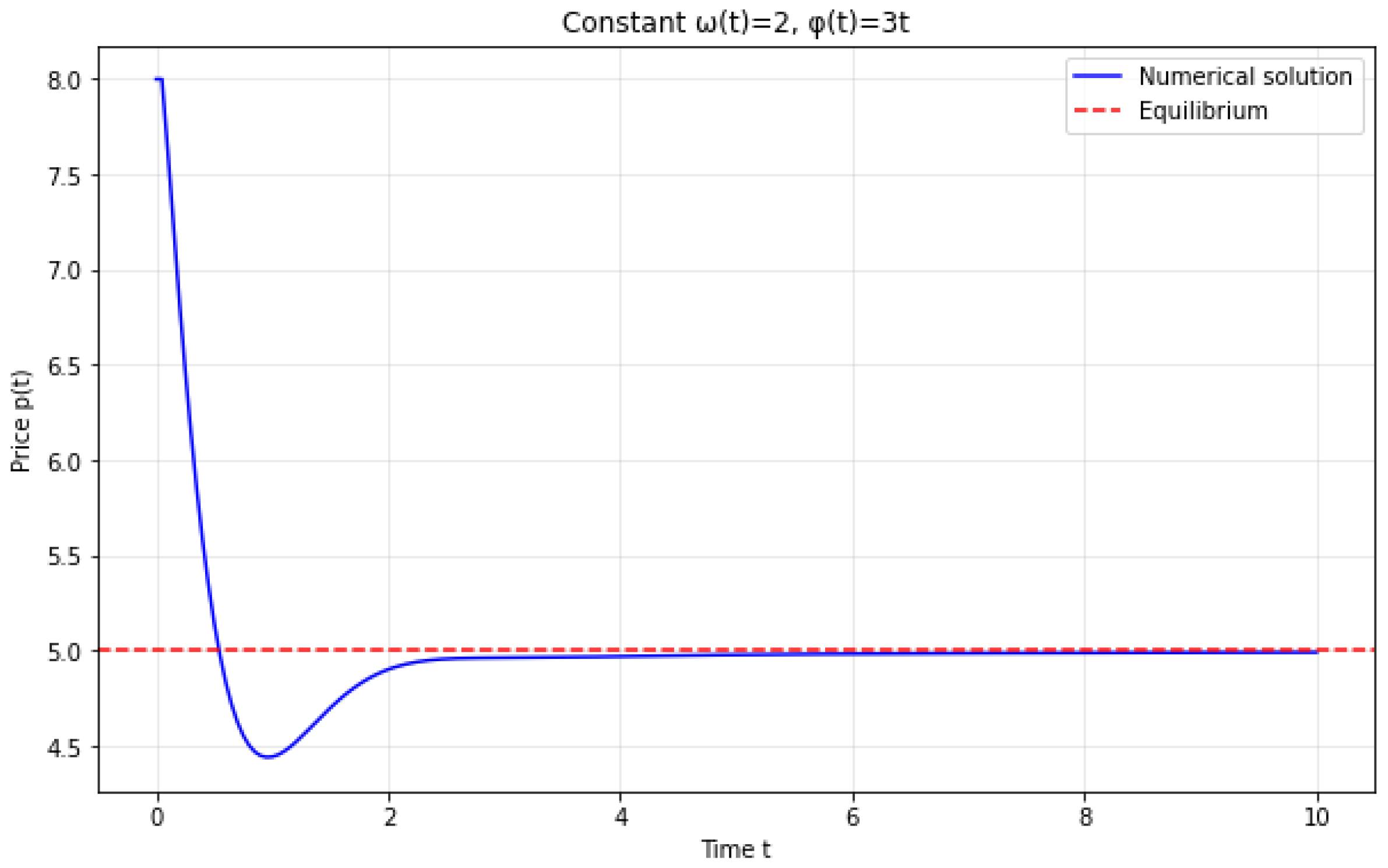
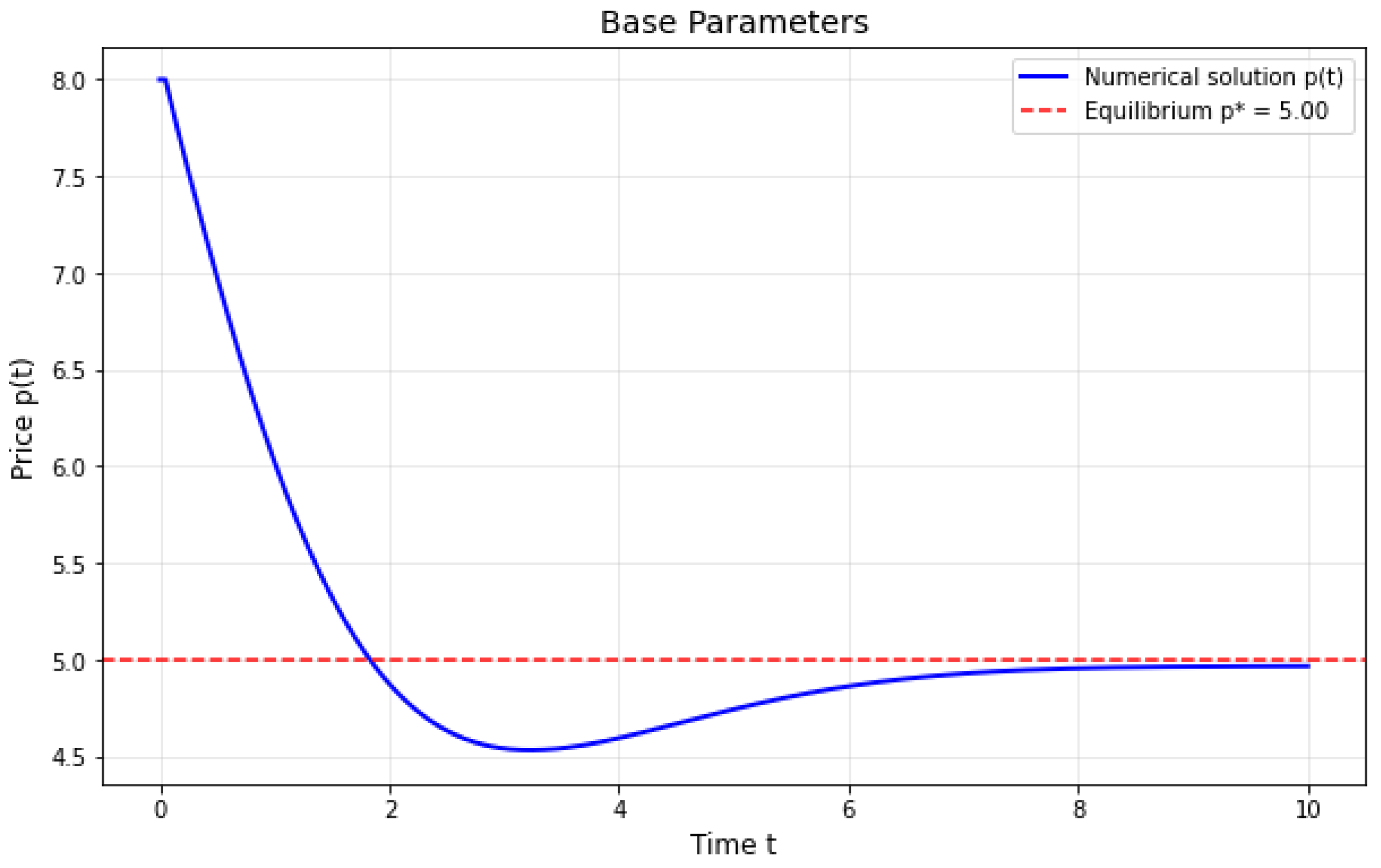
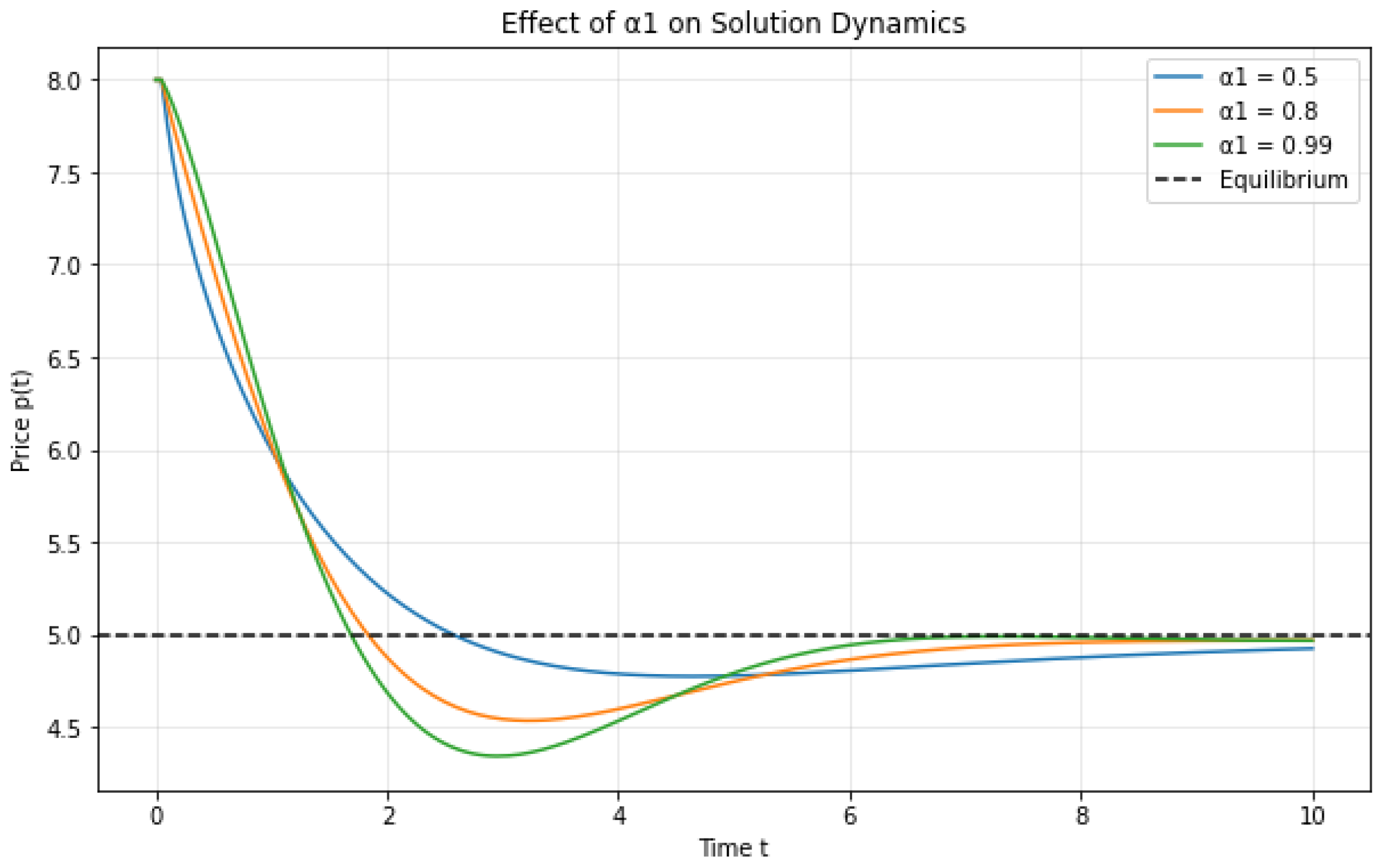
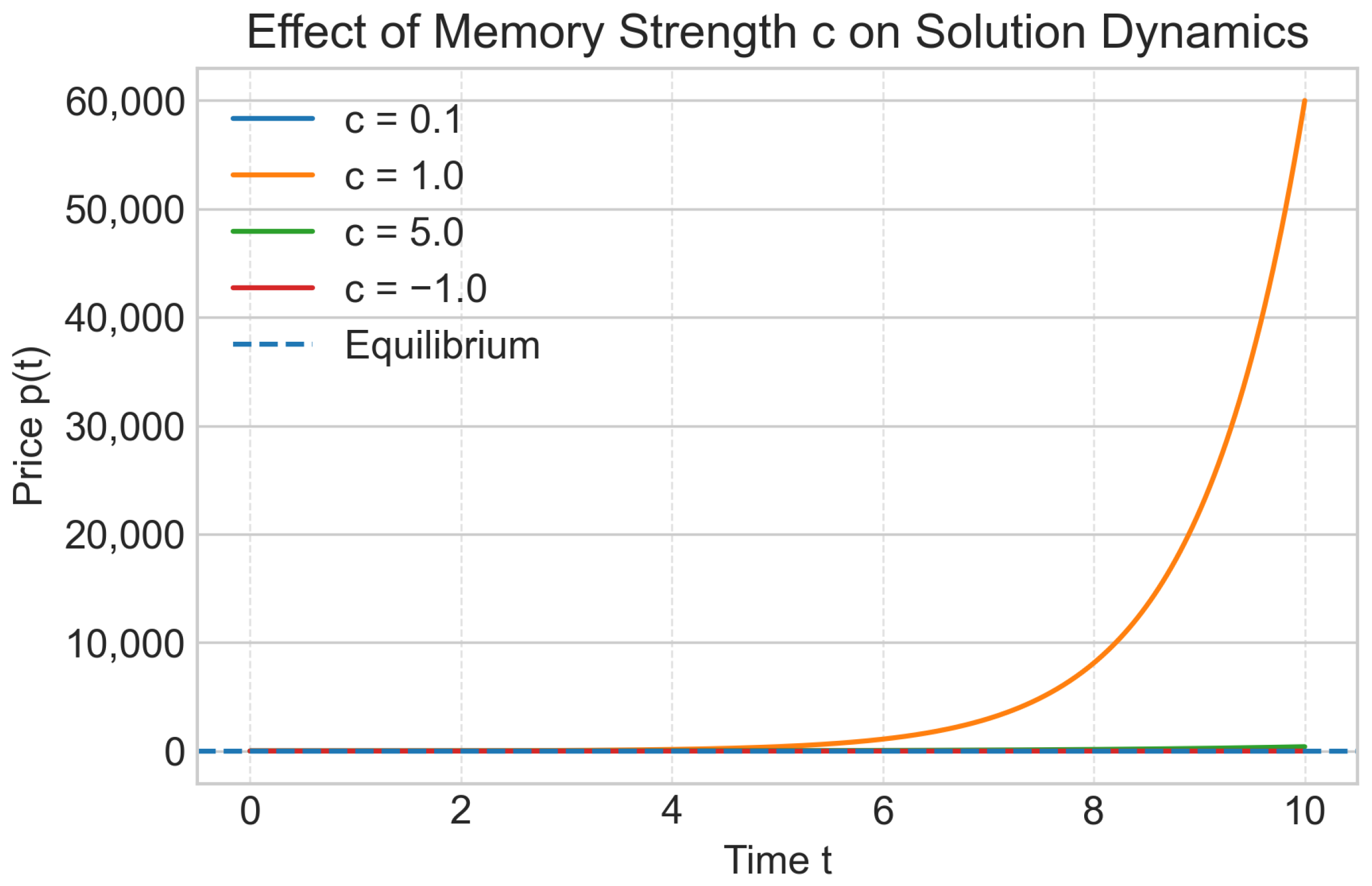
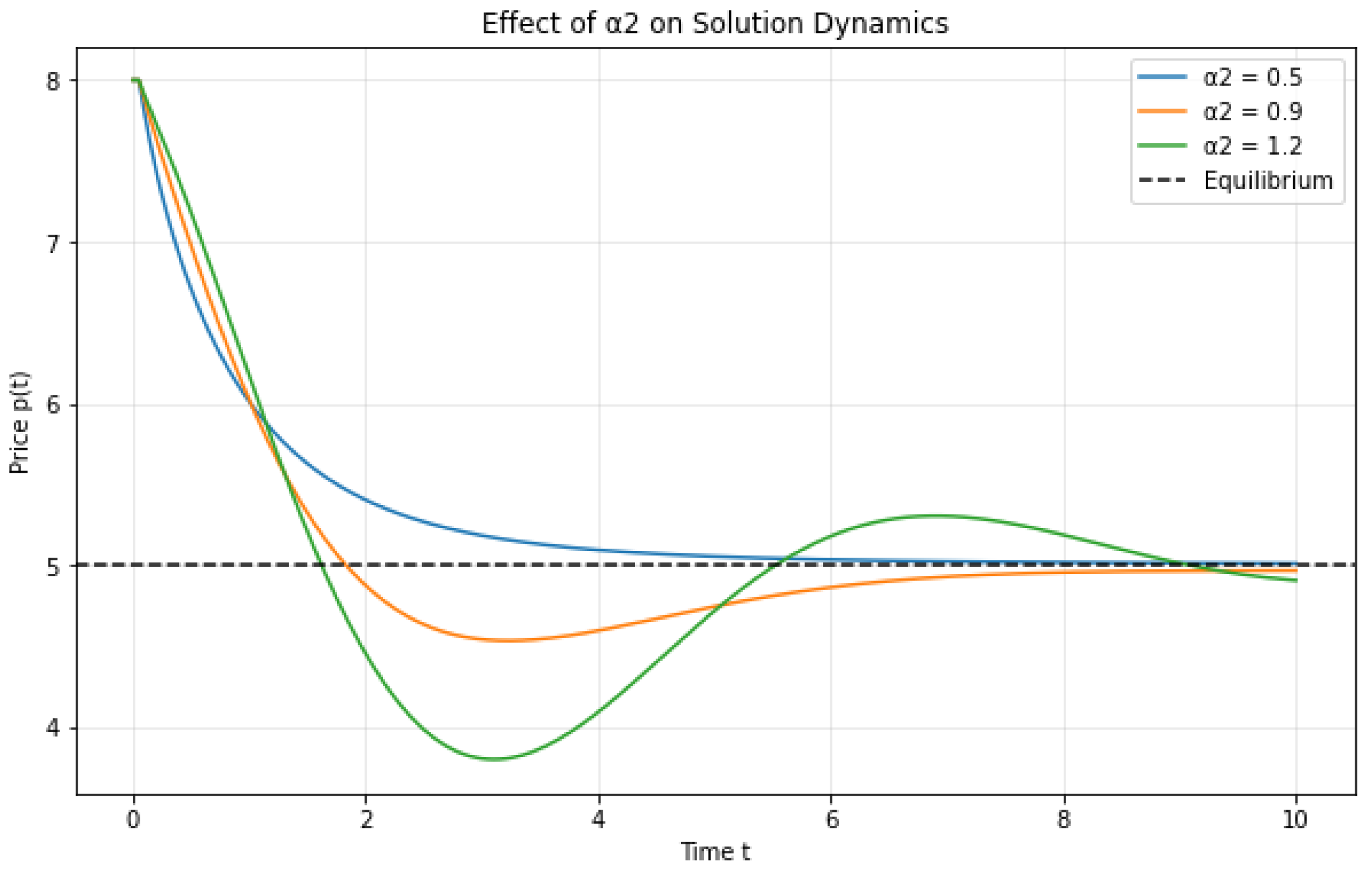
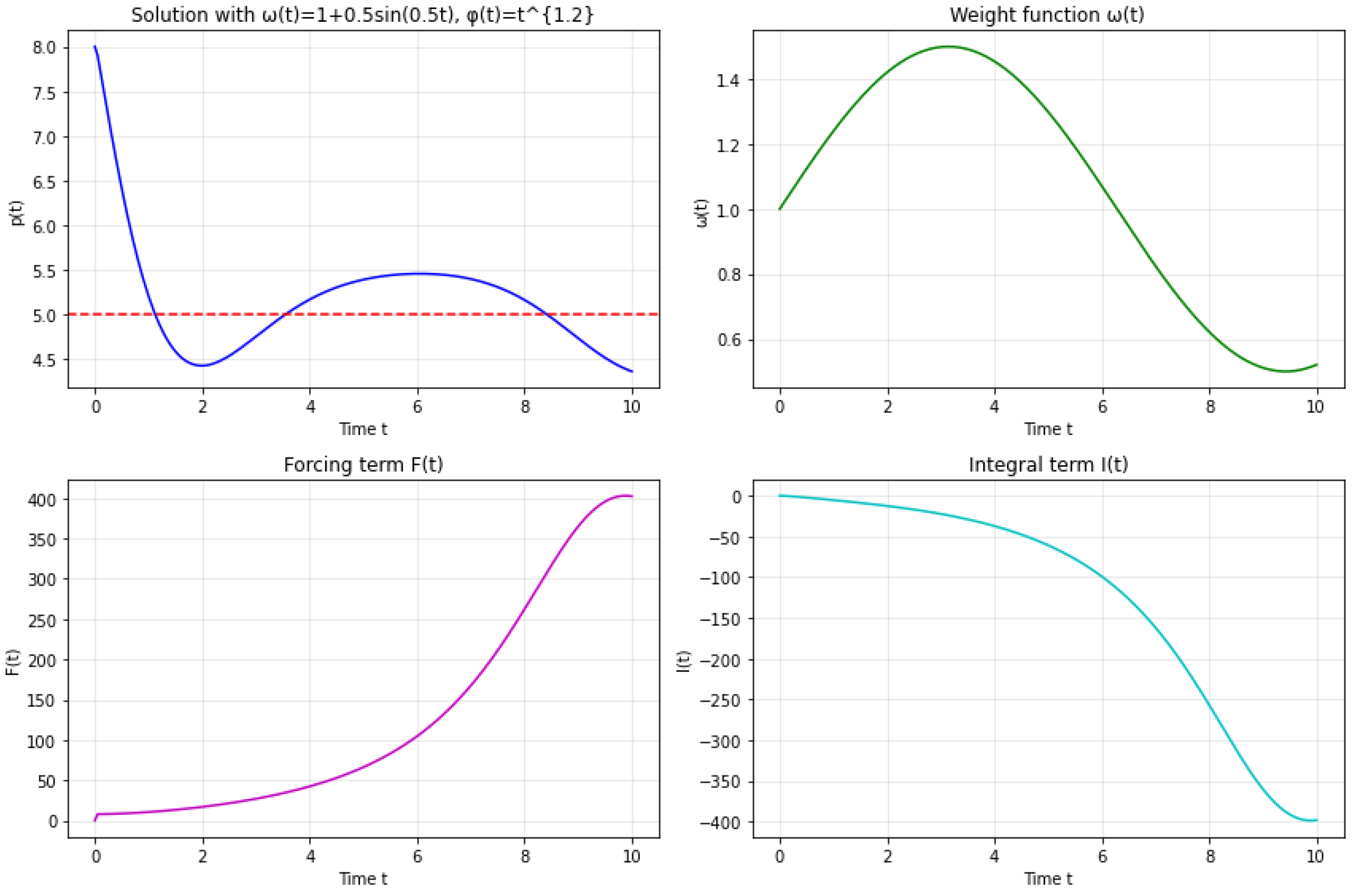
The base configuration using (30), ω ( t ) = 1 , and φ ( t ) = t is shown in Figure 1, where the solution shows initial oscillations and power-law decay before converging to equilibrium p = 5 . The impact of the primary fractional order α 1 (0.5, 0.8, 0.99) is shown in Figure 2, where values close to one restore classical exponential behavior, while smaller values result in stronger memory and slower convergence. Figure 3 illustrates the impact of the memory-strength parameter c, demonstrating that large positive c results in oscillatory dynamics and overshooting, while negative c produces stronger damping. Figure 4 illustrates the effect of the kernel-order parameter α 2 (0.5, 0.9, 1.2), where α 2 < 1 causes algebraic decay with oscillations and α 2 > 1 speeds up convergence by smoothing the kernel. Figure 5 displays the following non-constant cases: (a) solution with oscillatory weight and nonlinear time; (b) time-varying weight function; (c) forcing term combining initial and constant memory; and (d) memory-driven integral term. These sub-figures illustrate the role of time-dependent components: a nonlinear time transformation φ ( t ) = t 1.2 compresses the perceived time scale, resulting in faster convergence and forcing and memory-integral terms consistent with the oscillatory weighting, while a non-constant weight ω ( t ) = 1 + 0.5 sin ( 0.5 t ) introduces periodic modulation of price adjustments. Lastly, Figure 6 demonstrates how memory effects are equally amplified and temporal development is accelerated when a linear transformation φ ( t ) = 3 t is combined with a constant weight ω ( t ) = 2 .
The figures collectively show that the generalized fractional structure offers a strong and adaptable framework that can capture a variety of memory-driven adjustment dynamics in economic systems.
Example 2. 
Consider the base parameters (30) as in previous example of proposed model:
D 0 , σ , ω , φ α 1 , α 2 , γ , ϱ C p ( t ) = λ p ( t ) + 5 , p ( 0 ) = p 0 .
where p 0 = 8 , p = 5 , λ = 1 < 0 , and ω ( t ) 1 while φ varies between Cases A–C (see Table 2). The remaining parameters are fixed as in (30). Using the integral representation of the generalized operator and truncating the kernel series at i = 0 , , M , the numerical solution is computed by the explicit recurrence (26).
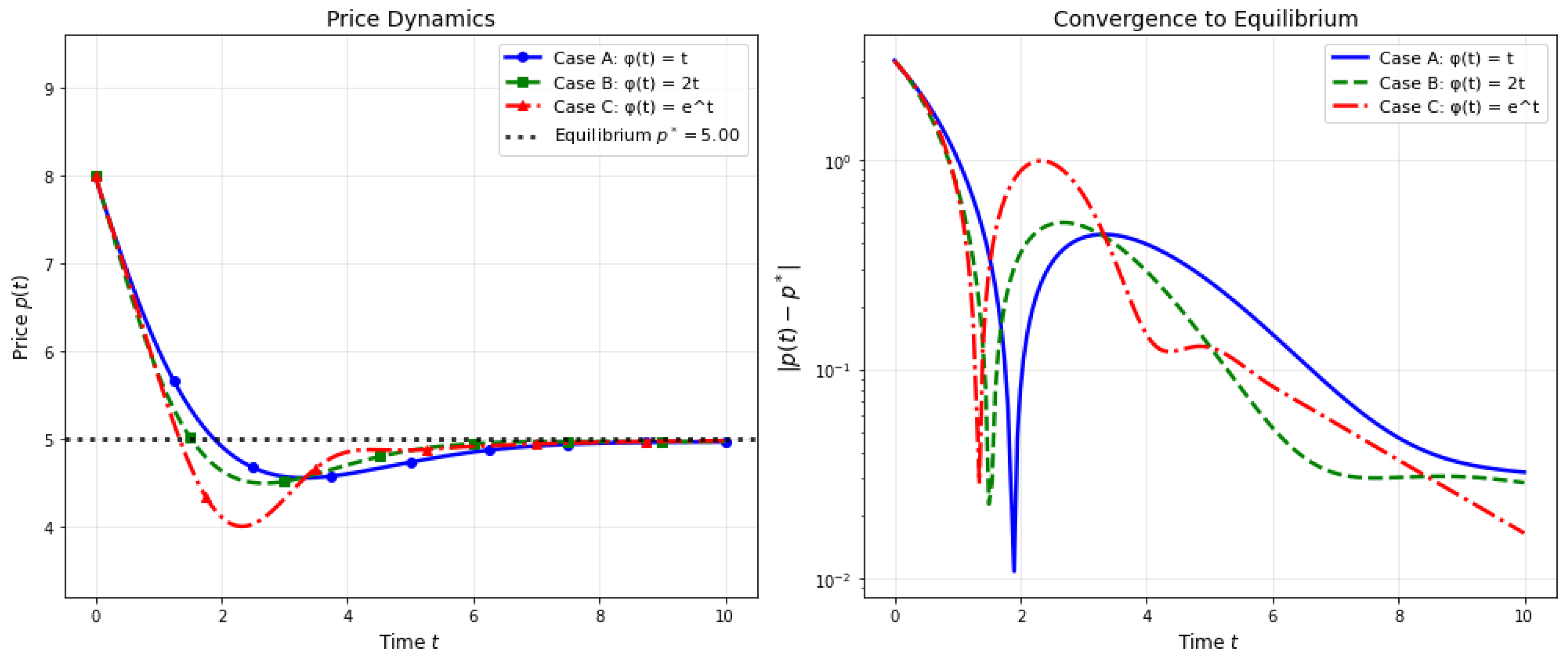
Figure 7 reports the price trajectories for three time-transform cases:
Case A : φ ( t ) = t , ω ( t ) = 1 Case B : φ ( t ) = 2 t , ω ( t ) = 1 Case C : φ ( t ) = e t , ω ( t ) = 1
As seen in Figure 7 (Left), every trajectory converges to the equilibrium level p = 5 (dotted line). The adjustment speed and the amount of transient overshoot are affected by different values of φ, in particular, the exponential temporal transformation φ ( t ) = e t produces the highest undershoot below p before convergence. The convergence rates are shown by the logarithmic error | p ( t ) p | in Figure 7 (Right). While all cases decay, Cases B–C reduce the error more quickly than Case A over the shown horizon, which is consistent with the final-time errors provided in Table 2.
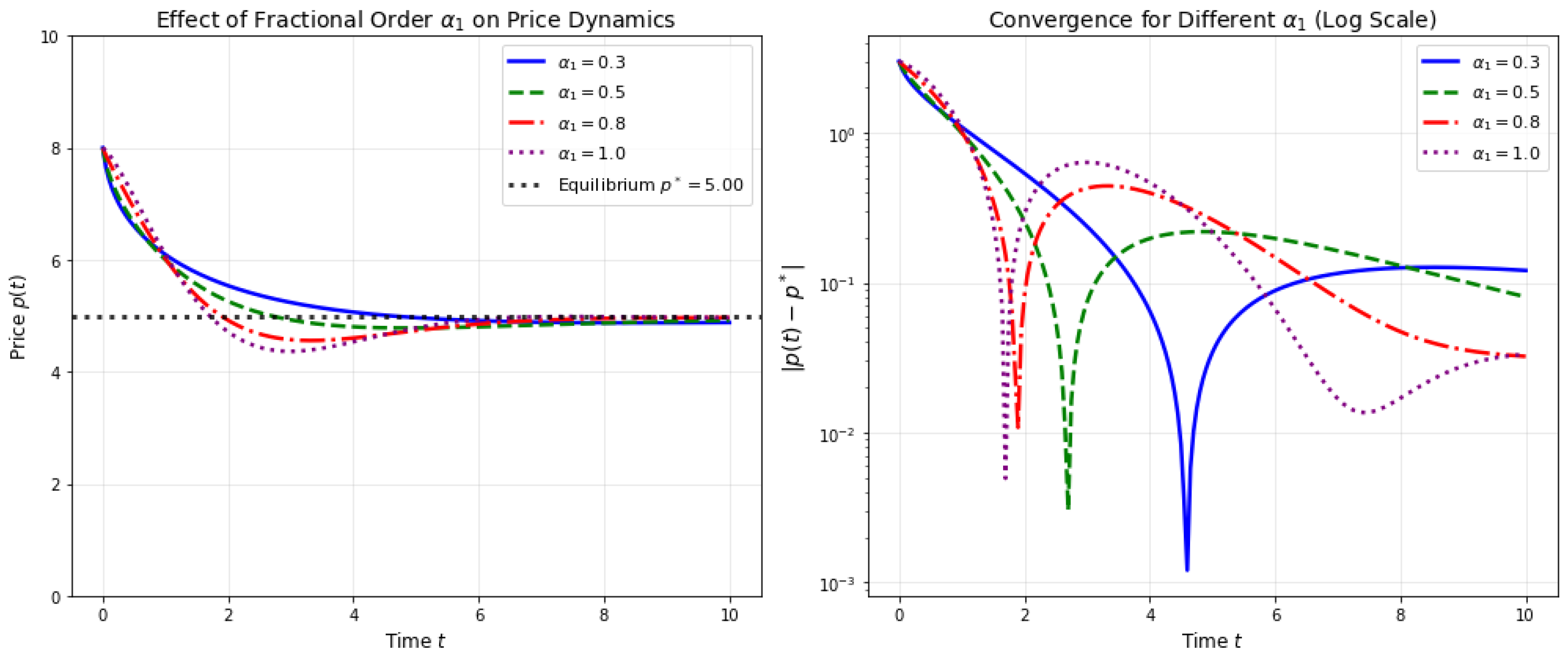
In Figure 8 (Left), smaller α 1 strengthens memory and slows the approach to p , often modifying the transient curvature and overshoot, whereas α 1 1 recovers the classical profile. Figure 8 (Right) displays | p ( t ) p | on a log scale, making clear that α 1 affects the decay rate and the onset of the asymptotic convergence regime.
Example 3. 
As a special case, we consider the ABC fractional cobweb model (see Section 3.2, item (6)), where α 2 = γ = α 2 = ϱ = σ = 1 , ω ( t ) = 1 , and φ ( t ) = t :
D ( t ) = 10 0.5 p ( t ) , S ( t ) = 5 + 0.5 p ( t ) + D 0 , 1 , 1 , t α 1 , 1 , 1 , 1 A B C p ( t ) , D ( t ) = S ( t ) , t > 0 .
Equating demand and supply gives
D 0 , 1 , 1 , t α 1 , 1 , 1 , 1 A B C p ( t ) + p ( t ) = 5 ,
so the unique constant equilibrium is p = 5 . Setting x ( t ) = p ( t ) p yields the homogeneous perturbation equation
D 0 , 1 , 1 , t α 1 , 1 , 1 , 1 A B C p ( t ) = λ x ( t ) , λ = 1 < 0 ,
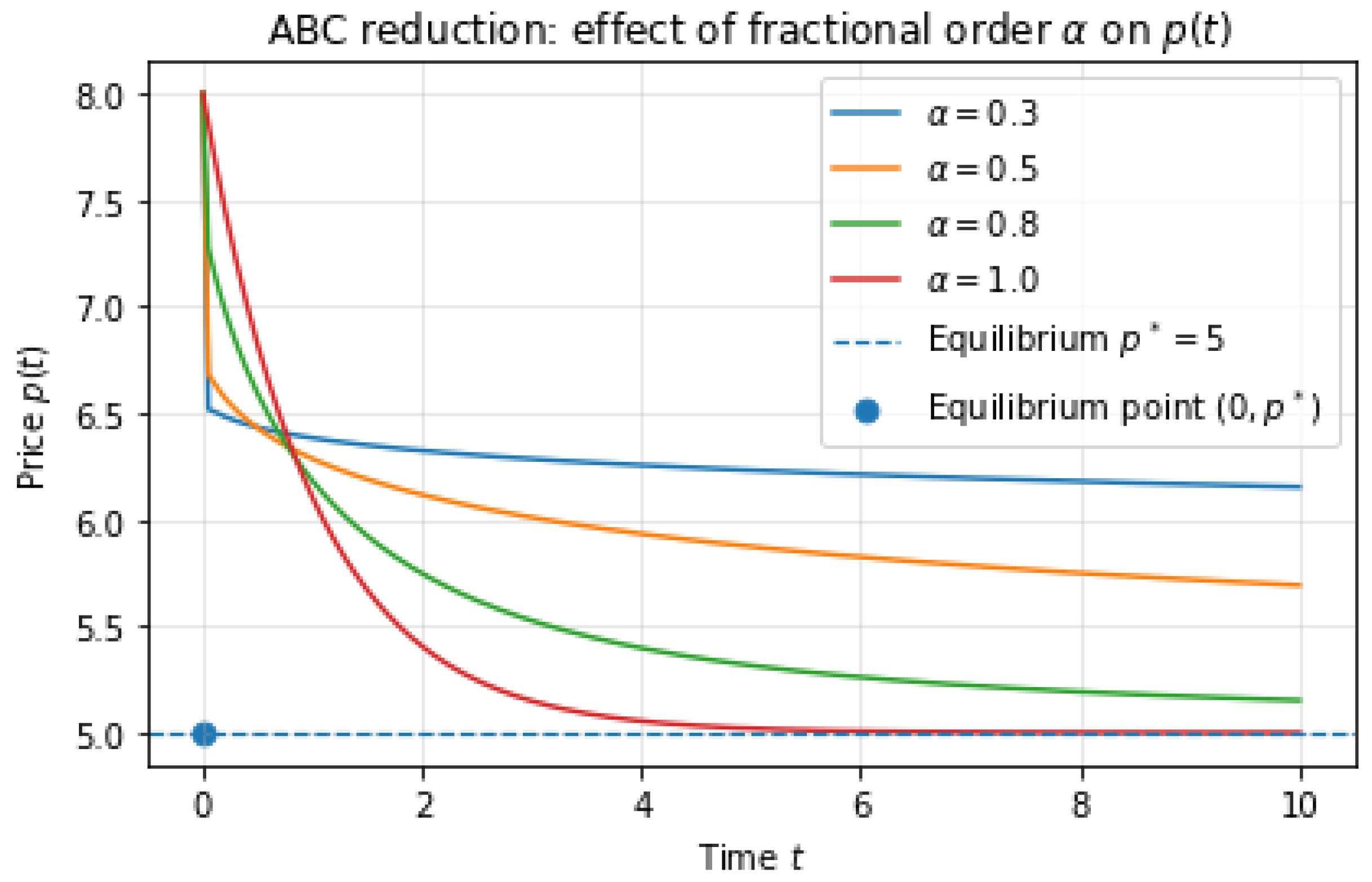
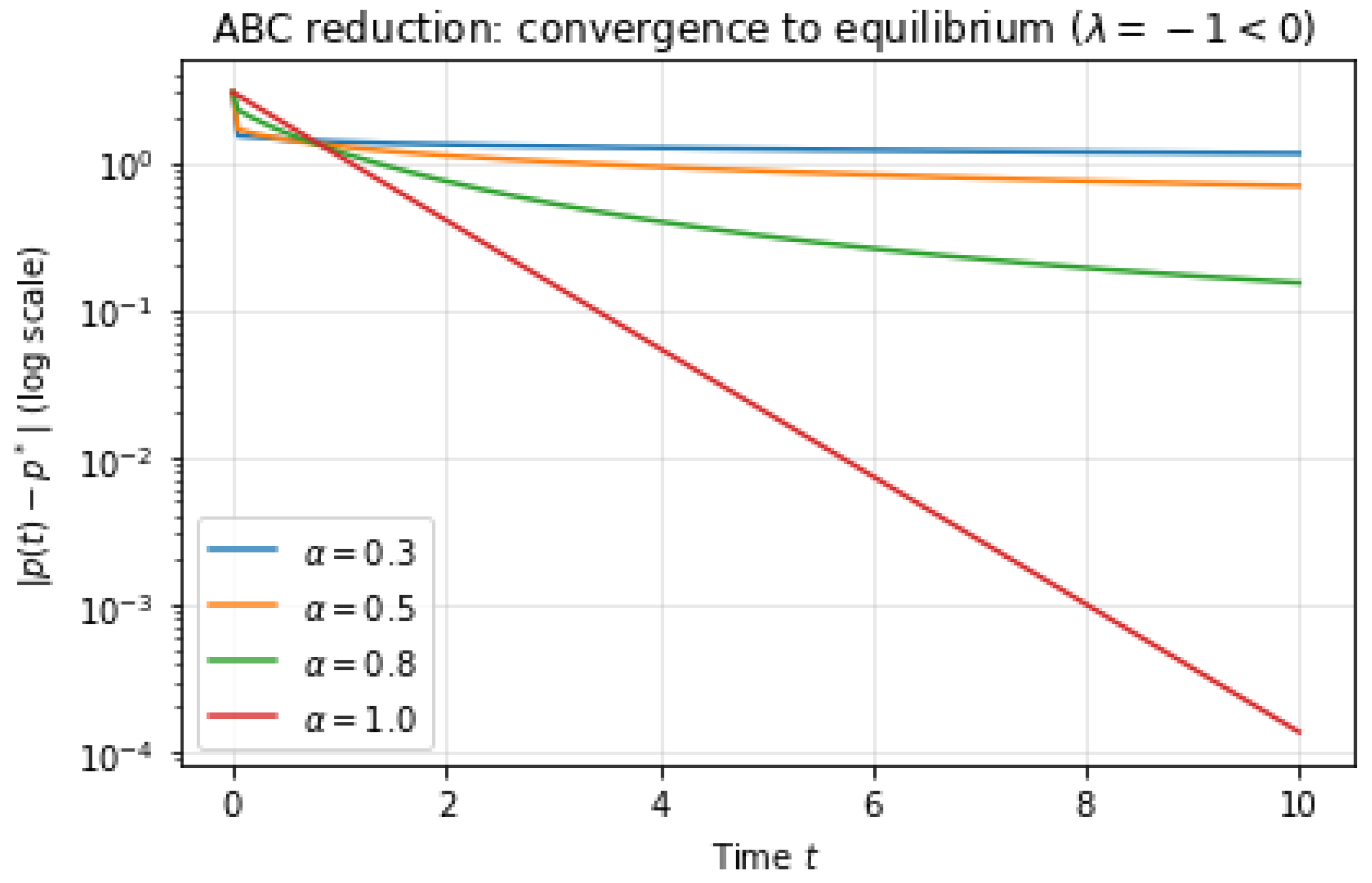
which is the standard stability signature. In the simulations, we impose the fractional orders choice α 1 = { 0.3 , 0.5 , 0.8 , 1.0 } ( 0 , 1 ] , and the initial price is taken as p ( 0 ) = p 0 = 8 .
By the simulation (Figure 9 and Figure 10), the numerical trajectories correspond to the ABC fractional relaxation problem:
D t α A B C p ( t ) = p ( t ) + 5 , p ( 0 ) = 8 ,
and the order α ( 0 , 1 ] controls the strength of memory.
Figure 9 shows the price paths p ( t ) for different orders α. All trajectories converge to the equilibrium p = 5 (since λ = 1 < 0 ). Smaller α produces slower convergence (stronger memory), while α = 1 gives the fastest classical relaxation. Figure 10 depicts | p ( t ) p | on a logarithmic scale. Steeper curves mean faster convergence: α = 1 decays the fastest, whereas smaller α decays more slowly, highlighting the memory-induced slowdown typical of fractional dynamics.
All numerical simulations presented above were performed using Equation (26) with the parameters and settings listed in Table 3.

6.3. Economic Interpretation of Numerical Results

The simulations highlight how the model parameters shape market adjustment. A lower fractional order α 1 = 0.3 implies stronger price memory and slower convergence, while α 1 1 reflects weaker memory and faster stabilization. The economic-time transformation further differentiates dynamics: Case A ( φ ( t ) = t ) represents baseline adjustment, Case B ( φ ( t ) = 2 t ) accelerates reactions consistent with stress-driven markets, and Case C ( φ ( t ) = e t ) generates progressively rapid responses characteristic of speculative or panic phases. The weighting function ω ( t ) modulates the relevance of past information across these scenarios, and the numerical scheme maintains the equilibrium condition D ( t ) = S ( t ) with errors below 10 10 . Collectively, these results confirm that varying α 1 , ω ( t ) , and φ ( t ) allows the framework to reproduce diverse market behaviors within a consistent equilibrium structure.

7. Conclusions

This work has developed a generalized fractional cobweb model that incorporates memory effects through a weighted Caputo-type operator with a Mittag–Leffler kernel. The model introduces three key innovations: multiple independent fractional orders ( α 1 , α 2 , ϱ , σ ) , a time-dependent weight function ω ( t ) , and an economic-time transformation φ ( t ) . As a result, the framework unifies and extends several existing fractional economic formulations, including the classical ABC and CF cobweb models, which emerge as special cases under appropriate parameter choices.
By reformulating the market-clearing dynamics as an equivalent Volterra integral equation, we have established a comprehensive well-posedness theory. This includes existence, uniqueness, and continuous dependence on initial conditions and model parameters, as well as a positivity theorem guaranteeing that prices remain economically meaningful under mild conditions. The analysis reveals that while the unique constant equilibrium price depends solely on the static demand and supply intercepts and slopes, the transient adjustment path is governed entirely by the generalized fractional operator.
Stability analysis of perturbations around the equilibrium shows that asymptotic stability is achieved when the memory response is negative ( c > 0 and appropriate parameter ranges), while positive feedback can lead to instability. In stable regimes, the fractional nature of the dynamics introduces qualitative features absent in classical models: convergence may exhibit oscillatory transients and follow a non-exponential (power-law) decay whose rate is explicitly determined by α 2 and the asymptotic growth of φ ( t ) . The weight function ω ( t ) further modulates this rate, offering a flexible tool for modeling time-varying memory sensitivity.
On the numerical side, we developed an explicit product-integration scheme tailored to the Volterra formulation of the generalized kernel. Convergence of the method is established, and its reliability is confirmed through a series of numerical experiments. These simulations demonstrate how the fractional orders, the weight function, and the economic-time transformation jointly control the oscillatory behavior, the persistence of deviations from equilibrium, and the speed of convergence, all while preserving the same long-run equilibrium level.
Several directions for future research remain open. First, the model can be calibrated to real market data. Second, the current framework may be extended to accommodate variable-order fractional operators, allowing the memory strength itself to evolve over time in response to changing economic conditions.

Author Contributions

Conceptualization, M.S.A. and K.A.; methodology, M.S.A.; software, M.S.A. and K.A.; validation, K.A., Y.A.M., A.A. (Alawia Adam), and A.A. (Amer Alsulami); formal analysis, M.S.A.; investigation, Y.A.M., K.A., O.O., M.R., and A.A. (Amer Alsulami); resources, K.A.; writing—original draft preparation, M.S.A. and K.A.; writing—review and editing, Y.A.M., M.S.A., A.A. (Alawia Adam), K.A., O.O., A.A. (Amer Alsulami), and M.R.; supervision, K.A. and M.R.; project administration, K.A. and Y.A.M. All authors have read and agreed to the published version of the manuscript.

Funding

The researchers would like to thank the Deanship of Graduate Studies and Scientific Research at Qassim University for financial support (QU-APC-2026).

Data Availability Statement

The data used in this paper are included within the paper.

Conflicts of Interest

The authors declare no conflicts of interest.

References

  1. Podlubny, I. Fractional Differential Equations; Academic Press: New York, NY, USA, 1999. [Google Scholar]
  2. Osler, T.J. Leibniz rule for fractional derivatives generalized and an application to infinite series. SIAM J. Appl. Math. 1970, 18, 658–674. [Google Scholar] [CrossRef]
  3. Kilbas, A.A.; Srivastava, H.M.; Trujillo, J.J. Theory and Applications of Fractional Differential Equations; Elsevier B.V.: Amsterdam, The Netherlands, 2006. [Google Scholar]
  4. Samko, S.G.; Kilbas, A.A.; Marichev, O.I. Fractional Integrals and Derivatives, Theory and Applications; Gordon and Breach: Amsterdam, The Netherlands, 1993. [Google Scholar]
  5. Diethelm, K.; Ford, N.J. Analysis of fractional diferential equations. J. Math. Anal. Appl. 2002, 265, 229–248. [Google Scholar] [CrossRef]
  6. Caputo, M.; Fabrizzio, M. A new definition of fractional derivative without singular kernel. Prog. Fract. Differ. Appl. 2015, 1, 73–85. [Google Scholar]
  7. Atangana, A.; Baleanu, D. New fractional derivatives with nonlocal and non-singular kernel: Theory and application to heat transfer model. Therm. Sci. 2016, 20, 763–769. [Google Scholar] [CrossRef]
  8. Abdeljawad, T.; Baleanu, D. On fractional derivatives with generalized Mittag-Leffler kernels. Adv. Differ. Equ. 2018, 2018, 468. [Google Scholar] [CrossRef]
  9. Jarad, F.; Abdeljawad, T.; Shah, K. On the weighted fractional operators of a function with respect to another function. Fractals 2020, 28, 2040011. [Google Scholar] [CrossRef]
  10. Fernandez, A.; Baleanu, D. Differintegration with respect to functions in fractional models involving Mittag-Leffler functions. In Proceedings of the International Conference on Fractional Differentiation and its Applications (ICFDA), Amman, Jordan, 16–18 July 2018. [Google Scholar] [CrossRef]
  11. Al-Refai, M.; Jarrah, A. Fundamental results on weighted Caputo–Fabrizio fractional derivative. Chaos Solitons Fractals 2019, 126, 7–11. [Google Scholar] [CrossRef]
  12. Abdo, M.S.; Shammakh, W.; Alzumi, H.Z. New Existence and Stability Results for [ψ, w]-Caputo-Fabrizio Fractional Nonlocal Implicit Problems. J. Math. 2023, 2023, 6123608. [Google Scholar] [CrossRef]
  13. Alshammari, M.; Alshammari, S.; Abdo, M.S. Existence Theorems for Hybrid Fractional Differential Equations with ψ-Weighted Caputo–Fabrizio Derivatives. J. Math. 2023, 2023, 8843470. [Google Scholar] [CrossRef]
  14. Saad, K.M.; Abdo, M.S.; Hamanah, W.M. Existence and controllability analysis of multi-term fractional coupled systems with generalized-Caputo-Fabrizio operators. Sci. Rep. 2025, 15, 34434. [Google Scholar] [CrossRef]
  15. Hattaf, K. Useful results for the qualitative analysis of generalized Hattaf mixed fractional differential equations with applications to medicine. Computation 2025, 13, 167. [Google Scholar] [CrossRef]
  16. Kaldor, N. A classificatory note on the determinateness of equilibrium. Rev. Econ. Stud. 1934, 1, 122–136. [Google Scholar] [CrossRef]
  17. Ezekiel, M. The Cobweb theory. Q. J. Econ. 1938, 52, 255–280. [Google Scholar] [CrossRef]
  18. Gandolfo, G. Economic Dynamics: Methods and Models; North Holland Publishing: Amsterdam, The Netherlands; New York, NY, USA, 1980. [Google Scholar]
  19. Gandolfo, G. Economic Dynamics, 4th ed.; Springer: Berlin/Heidelberg, Germany, 2009. [Google Scholar]
  20. Pakhira, R.; Ghosh, U.; Sarkar, S.; Mishra, V.N. Study of memory effect in an economic order quantity model for completely backlogged demand during shortage. Prog. Fract. Differ. Appl. 2019, 7, 5. [Google Scholar]
  21. Chen, C. Discrete Caputo delta fractional economic cobweb models. Qual. Theory Dyn. Syst. 2023, 22, 8. [Google Scholar] [CrossRef]
  22. Chen, C.; Bohner, M.; Jia, B. Caputo fractional continuous cobweb models. J. Comput. Appl. Math. 2020, 374, 112734. [Google Scholar] [CrossRef]
  23. Bohner, M.; Hatipoglu, V.F. Cobweb model with conformable fractional derivatives. Math. Methods Appl. Sci. 2018, 41, 9010–9017. [Google Scholar] [CrossRef]
  24. Bohner, M.; Jonnalagadda, J.M. Discrete fractional cobweb models. Chaos Solitons Fractals 2022, 162, 112451. [Google Scholar] [CrossRef]
  25. Nagy, A.M.; Assidi, S.; Makhlouf, B. Convergence of solutions for perturbed and unperturbed cobweb models with generalized Caputo derivative. Bound. Value Probl. 2022, 2022, 89. [Google Scholar] [CrossRef]
  26. Salahshour, S.; Ahmadian, A.; Allahviranloo, T. A new fractional dynamic cobweb model based on nonsingular kernel derivatives. Chaos Solitons Fractals 2021, 145, 110755. [Google Scholar] [CrossRef]
  27. Srivastava, H.M.; Raghavan, D.; Nagarajan, S. A comparative study of the stability of some fractional-order cobweb economic models. Rev. Real Acad. Cienc. Exactas Fis. Nat. Ser. A Mat. 2022, 116, 98. [Google Scholar] [CrossRef]
  28. Anokye, M.; Barnes, B.; Assabil, S.; Okyere, E.; Konadu, A. Fractional-Order Delay Cobweb Model and Its Price Dynamics. Int. J. Differ. Equ. 2014, 2024, 1209433. [Google Scholar] [CrossRef]
  29. Tarasov, V.E.; Tarasova, V.V. Long and Short Memory in Economics: Fractional-Order Difference and Differentiation. IRA-Int. J. Manag. Soc. Sci. 2016, 5, 327–334. [Google Scholar] [CrossRef]
  30. Bohner, M.; Hatipoglu, V.F. Dynamic cobweb models with conformable fractional derivatives. Nonlinear Anal. Hybrid Syst. 2019, 32, 157–167. [Google Scholar] [CrossRef]
  31. Tejado, I.; Pérez, E.; Valério, D. Fractional calculus in economic growth modelling of the group of seven. Fract. Calc. Appl. Anal. 2019, 22, 139–157. [Google Scholar] [CrossRef]
  32. Lin, Z.; Wang, H. Modeling and application of fractional-order economic growth model with time delay. Fractal Fract. 2021, 5, 74. [Google Scholar] [CrossRef]
  33. Anokye, M.; Barnes, B.; Ohene Boateng, F.; Adom-Konadu, A.; Amoah-Mensah, J. Price dynamics of a delay differential cobweb model. Discret. Dyn. Nat. Soc. 2023, 2023, 1296562. [Google Scholar] [CrossRef]
  34. Tarasov, V.E. On history of mathematical economics: Application of fractional calculus. Mathematics 2019, 7, 509. [Google Scholar] [CrossRef]
  35. Koyuncuoglu, H.C.; Jonnalagadda, J.M. Cobweb models with Hilfer nabla fractional differences. Chelyabinsk Phys. Math. J. 2025, 10, 541–551. [Google Scholar] [CrossRef]
  36. Thabet, S.T.M.; Abdeljawad, T.; Kedim, I.; Ayari, M.I. A new weighted fractional operator with respect to another function via a new modified generalized Mittag–Leffler law. Bound. Value Probl. 2023, 2023, 100. [Google Scholar] [CrossRef]
  37. Hattaf, K. A new generalized definition of fractional derivative with non-singular kernel. Computation 2020, 8, 49. [Google Scholar] [CrossRef]
Figure 1. Base case solution of the generalized fractional economic model.
Fractalfract 10 00159 g001
Figure 2. Effect of varying the primary fractional order α 1 .
Fractalfract 10 00159 g002
Figure 3. Impact of memory strength parameter c on solution behavior.
Fractalfract 10 00159 g003
Figure 4. Effect of different kernel orders α 2 on convergence.
Fractalfract 10 00159 g004
Figure 5. Dynamics with time-varying weight and nonlinear time transformation.
Fractalfract 10 00159 g005
Figure 6. Solution with constant weight and linear time transformation.
Fractalfract 10 00159 g006
Figure 7. (Left): p ( t ) for Cases A–C with p . (Right): | p ( t ) p | (log scale).
Fractalfract 10 00159 g007
Figure 8. (Left): p ( t ) for different α 1 . (Right): | p ( t ) p | (log scale).
Fractalfract 10 00159 g008
Figure 9. ABC reduction of the cobweb dynamics for the equilibrium problem w ( t ) = 1 , and φ ( t ) = t .
Fractalfract 10 00159 g009
Figure 10. ABC reduction: convergence to equilibrium measured by | p ( t ) p | (log scale).
Fractalfract 10 00159 g010
Table 1. Relationship between the generalized operator and existing fractional derivatives.
Existing OperatorParameter ChoicesSource
Classical ABC α 1 = α 2 = γ = α , ϱ = 1 , σ = 1 , ω 1 , φ ( t ) = t [7]
Weighted ABC (w.r.t. φ ) α 1 = α 2 = γ = α , ϱ = 1 , σ = 1 [36]
Classical CF α 2 = γ = ϱ = 1 , σ = 1 , ω 1 , φ ( t ) = t [6]
Hattaf–Caputo ϱ = 1 , σ = 1 , φ ( t ) = t [37]
Integer-order derivative α 1 , α 2 , γ , ϱ , σ 1 , ω 1 , φ ( t ) = t [18]
Table 2. Final-time deviation from equilibrium for three time-transform cases.
CaseFinal p ( T ) p | p ( T ) p | Rel. Error (%)
A: φ ( t ) = t , ω ( t ) = 1 4.73165.00000.26845.37
B: φ ( t ) = 2 t , ω ( t ) = 1 4.86555.00000.13452.69
C: φ ( t ) = e t , ω ( t ) = 1 4.87355.00000.12652.53
Equilibrium price: p = 5 . Stability indicator: λ = 1 < 0 (stable).
Table 3. Simulation parameters and implementation details for all numerical examples.
CategoryParameterValue
Time discretizationT10
M200
h = T / M 0.05
Series truncationN15
Initial condition p 0 8.0
Iquilibrium point p 5.0
Baseline economic parametersa10.0
a 1 5.0
b 0.5
b 1 0.5
c1.0
Baseline fractional parameters α 1 { 0.5 , 0.8 , 0.99 }
α 2 { 0.5 , 0.9 , 1.2 }
ϱ 0.5
σ 1.0
α { 0.3 , 0.5 , 0.8 , 1 }
Example 1 functions ω ( t ) 1 , 2 , 1 + 0.5 sin ( 0.5 t )
φ ( t ) t , t 1.2 , 3 t
Example 2 functions ω ( t ) 1
φ ( t ) t , 2 t , e t
Example 3 functions ω ( t ) 1
φ ( t ) t
SoftwarePython 3.9SciPy 1.7
Disclaimer/Publisher’s Note: The statements, opinions and data contained in all publications are solely those of the individual author(s) and contributor(s) and not of MDPI and/or the editor(s). MDPI and/or the editor(s) disclaim responsibility for any injury to people or property resulting from any ideas, methods, instructions or products referred to in the content.