1. Introduction
Energy and commodity price fluctuations can cause nonlinear influences on macroeconomic structure. Among these, oil price dynamics represent one of the most significant sources of macroeconomic instability by affecting both production structures and inflationary processes. Historically, oil price shocks triggered stagflationary effects and recessions, especially since the 1970s. Events such as the Iranian Revolution, the Iran–Iraq War, the Gulf War (1990–1991) and the Iraq War (2003) repeatedly reshaped global economic priorities and the policy environment by persistent oil-induced disruptions.
Early attempts incorporated expectations and inflation inertia [
1], while subsequent studies emphasized the presence of regime shifts and structural breaks in the oil price–inflation nexus [
2,
3,
4]. Traditional linear models have often fallen short in explaining the complex and irregular transmission of oil price shocks to macroeconomic aggregates. Nonlinear and chaos-based frameworks have gained attention. The explorations of the Phillips [
5] curve—such as those of [
6,
7,
8]—revealed complex feedback mechanisms, while [
9] demonstrated chaotic dynamics in a modified Goodwin model integrating a nonlinear Phillips curve. Papers including [
10,
11,
12,
13] explored its chaotic structure under certain conditions.
Despite these contributions, the relation between causality and chaotic behavior remains underexplored particularly within an entropy-based characterization. This paper aims to fill this gap by developing a chaotic empirical framework to examine the dynamic inter-relations among oil prices, inflation, unemployment and economic growth in Turkiye over the 1960–2024 period.
Methodologically, we proceed in three layers.
Some papers in the literature are designed to distinguish convex from concave segments and to map curve to macroeconomic costs under disinflationary and inflationary stances by using Markov-Switching and Smooth Transition models or NARDL etc. Although Markov-Switching or Transition models are standard nonlinear alternatives, they impose probabilistic or logistic regime structures that do not align with the chaotic deterministic patterns uncovered in the data. For this reason, we retained the exponential specification, which provides a more appropriate representation of the dynamics revealed by the chaos, macroeconomy and fractal diagnostics. Our model is an advanced model that combines chaos theory + econometrics. It includes both “dynamic instability” and “nonlinear amplification” concepts. Integrating deterministic chaos measures such as λ directly into regression is a powerful methodological innovation.
- 3.
Granger causality layer: Nonlinear Granger causality test (Hiemstra–Jones [
21]) are applied to assess the evidence of chaotic causality among the variables.
This paper makes several methodological and empirical contributions to the macroeconomics and nonlinear time-series literature. First, it develops the first regression framework that directly embeds chaotic sensitivity into macroeconomic dynamics. Unlike the existing literature, which typically treats the Lyapunov exponent as a purely descriptive diagnostic, the proposed model incorporates Lyapunov-based interaction terms into the regression structure, allowing chaotic divergence to functionally shape the transmission mechanisms among inflation, unemployment, economic growth and oil prices.
Second, the paper introduces a state-dependent chaos amplification mechanism, whereby the impact of macroeconomic shocks is rescaled according to the degree of chaotic sensitivity. This mechanism is fundamentally different from the nonlinear structures used in TAR, STAR, and MSAR models, which capture regime shifts and threshold effects but do not incorporate exponential divergence, an essential characteristic of chaotic dynamics.
Third, the model provides a parsimonious representation of nonlinear interactions through a standardized aggregate chaotic-interaction term. This approach substantially reduces parameter proliferation, enhances model stability and allows the nonlinear effects to be empirically tested through a single composite coefficient.
Fourth, by integrating chaotic dynamics, entrophy, and the results of Lorenz, and Rössler attractors and Julia Set into inflation, unemployment, growth and oil–price interactions, the paper proposes a chaos-augmented Phillips-type system, offering a conceptual innovation to the macroeconomic modeling of inflation, unemployment and energy–price pass-through.
Fifth, Hiemstra-jones method provide direction of Granger Causality.
Finally, the results generate a policy-relevant insight: macroeconomic shocks exert stronger and more asymmetric effects under chaotic regimes. This implies that policy interventions should be calibrated not only to shock magnitudes but also to the system’s underlying chaotic sensitivity, providing a novel normative contribution to the policy literature.
The design of this article is as follows: The second part is the literature section, while the third part defines the method, data and descriptive statistics. The fifth chapter covers discussion, while the fourth chapter gives econometric results. And last section gives the conclusion.
2. Literature Review
In the context of early modeling efforts, the Philips curve [
5] became very important. Phillips [
5] and then Lipsey [
22] proposed a nonlinear inverse relationship between unemployment and inflation in the form of the Phillips curve. However, the findings during the 1970s stagflation period revealed upward-shifting inflation–unemployment trade-offs. The incorporation of expected inflation rates and evolving production dynamics led researchers to adopt nonlinear semi-empirical models to capture this complex reality. In this context, the Phillips curve literature has been slow to incorporate structural instabilities and regime shifts associated with energy market transformations. The stagflation of the 1970s, however, exposed critical limitations: simultaneous increases in inflation and unemployment implied upward shifts in the curve and challenged the stability of the trade-off (Santomero and Seater [
23]). Subsequent modeling attempts incorporated additional factors, particularly expected inflation rates, to explain realized inflation (Friedman [
1]. Mork [
2], Hooker [
3], and Hamilton [
4] stressed the importance of identifying structural breaks and regime shifts (especially Hamilton [
4]) in oil price pass-through mechanisms. Fischer and Jammerneg [
6] discussed the catastrophe theory extension of the Phillips curve. Pohjola [
9] demonstrated chaotic behavior in a revised version of Goodwin’s model by extending the Phillips curve into a wage-switching framework and introducing nonlinearity through employment growth rates. Bildirici and Sonüstün [
10] found the evidence of chaotic Phillips Curve equation. Chichilnisky et al. [
13] explored the Phillips curve in the frame of Chaotic price dynamics and increasing returns. Fanti [
7], and Colombo and Weinrich [
12] discussed Philips Curve in the frame of chaos. Researchers such as Laxton et al. [
8], Bildirici and Sonüstün [
24], Stiglitz [
25] analyzed the Philips Curve relationship utilizing nonlinear models.
Beaudry et al. [
26] explored the apparent nonlinearity in the inflation–labor market tightness relationship. It was highlighted in Phillips curve studies by Fitzgerald et al. [
27], McLeay and Tenreyro [
28] as well as in the post-COVID-19 period by Gitti [
29]. The Phillips curve analysis was expanded by Guastello [
30] Hazell et al. [
31] and Benigno and Eggertsson [
32]. Reis [
33] discussesed which path to follow among various inflation expectation measures. Hasanov, et al. [
34] examined the structure of the relationship between inflation and output gap in their study covering the period 1980–2008 in the Turkish economy. The paper used a time-varying soft-transition regression (TV-STR) model and analyzed the dynamic effects through generalized impulse response functions.
3. Materials and Methods
3.1. Chaotic Regression Model
A chaotic regression model is also proposed in this article.
The larger λ is, the more “instable” the system. If λ is positive and high, the system is chaotic, and the effect of small shocks grows rapidly.
Here, the term (Xi·λi) allows the influence of the economic level to vary depending on the degree of chaos. γi shows the direct effect of chaotic violence, and δi shows the Multiplier Effect caused by the chaotic structure. δsum gives the average amplification effect of all interactions; interpretation is unit independent.
The model says that “economic relations work differently in non-chaotic periods and differently in chaotic periods”. This effect cannot be seen in classical regressions; it can only be captured by chaos-based models.
A behavior that the linear model does not allow is captured; unlike standard regression, in this model, the effects are not flat. There is a nonlinear transformation modulated by λ. Therefore, the model captures how the strength of macro-relations changes in the chaotic regime. This model also uses Lyapunov exponentials that are embedded directly into an exponential function. The model integrates exponential divergence, a key property of deterministic chaos, into the regression structure. It provides high novelty value. It presents a nonlinear, regime-dependent and dynamically complex structure.
Model Used in the Study
To capture the nonlinear and chaos-modulated transmission mechanisms among inflation, unemployment, economic growth and oil prices, we estimate a Lyapunov interaction model in which inflation is specified as the dependent variable. The model augments a standard autoregressive macroeconomic framework with time-varying maximum Lyapunov exponents, allowing the degree of chaotic divergence in each series to influence both the level effects and their interactions. For parsimony and to avoid scale-induced distortions, we aggregate the individual interaction terms into a single standardized composite interaction. Formally, the model for selected variables can be given as follows:
and
Here, we define the following variables:
Here, λi,t denotes the maximum Lyapunov exponent of variable i, computed using the Rosenstein algorithm. The inclusion of γi captures the direct contribution of chaotic intensity in each series to inflation dynamics, while the interaction terms governed by δi allow the marginal impact of macroeconomic variables to vary as a function of their underlying chaotic divergence.
Here, j ∈ {π,u,g,p} and denote the z-scored product Kj,t−1λj,t−1. The coefficient δsum therefore captures the common amplification (or attenuation) effect of variable-level dynamics interacting with their chaotic intensity. Lyapunov exponents are computed via the Rosenstein algorithm; parameters are estimated by OLS. If δsum is significant, we further decompose the aggregate effect to identify the main contributing variables.
This specification moves beyond linear or interaction-based chaos-augmented models by embedding the fundamental mathematical characteristic of chaotic systems—exponential divergence—directly into the regression mechanism. Thus, the model allows for the following:
Chaos-dependent elasticities;
Nonlinear propagation of shocks under chaotic conditions;
Endogenously shifting macroeconomic relationships driven by dynamic instability.
This framework provides a novel econometric integration of chaos theory into macroeconomic modeling and offers a more accurate representation of real-world economic processes during periods of heightened volatility or instability.
3.2. Nonlinear Granger Causality Tests
The methodology defines the mathematical and theoretical framework of the nonlinear Granger causality test. As stated, the fundamental mechanism of this test is to measures whether including the past values of the J series in the analysis significantly alter the “conditional probability distribution” of the current values of the F series. If our probability of predicting the current behavior of the F series changes when the past J series is known, then there is a relationship between them. The purpose of this methodology is to examine whether the oil price are nonlinear Granger causes of changes in relevant macroeconomic variables or reverse. In this context, the J series represents the “oil price” as the influencing factor, while the F series represents “relevant macroeconomic variables” as the affected factor. The aim of the analysis is to prove whether the past movements of oil price affect the current distribution of macroeconomic data. The statistical decision stage and reliability of the analysis are based on residual analysis. It is stated that if the W statistic (specified in Equation (4)) follows an asymptotic normal distribution, it will be concluded that macroeconomic variables do not affect oil prices in a nonlinear manner (there is no causality). However, the residual series obtained from the model used must be stable and dependent. Consequently, based on the references of Baek & Brock [
35] and Bildirici & Türkmen [
36] the calculated CS test statistic is converted to a standardized TVAL value, and a decision is made regarding the presence or absence of causality by examining whether this value falls within the limits of the
N (0, 1) standard normal distribution.
Our analysis regarding the Baek and Brock [
35] approach begins with a testable implication of the definition of strict Granger noncausality in Equation (3). Let us consider two strictly stationary and weakly dependent time series
and
,
; let us denote the
z length lead vector of
Jn by
; and let us denote the
-length and
-length lag vectors of
Jn and
Fn, respectively, by
and
. That is,
For given values of
z,
gJ and
gf ≥ 1 and for
e > 0, F does not strictly Granger cause if
J:
where
denotes probability, and
denotes the maximum norm. The probability on the Left-Hand Side of Equation (6) is the conditional probability that any two
z-length lead vectors of
Jn are within a distance
e of each other, given that the corresponding
gf-length lag vectors of
Fn are within a distance
e of each other and the corresponding
gJ-length lag vectors of
Jn are within a distance
e of each other. The probability on the Right-Hand Side of Equation (6) is the conditional probability that any two
z length lead vectors of
Jn are within a distance
e of each other, given that the corresponding
gJ length lag vectors of
Jn are within a distance
e of each other.
To apply a test based on Equation (6), it is useful to express the conditional probabilities as ratios of the corresponding joint probabilities. Suppose that the expressions
)/
and
represent the ratios of the joint probabilities corresponding to the left-hand side and right-hand side of Equation (6), respectively. These joint probabilities are defined as follows:
The Granger causality condition in Equation (4) can then be expressed as follows:
for given values of
z,
and
e > 0.
The correlation-integral estimators of the common probabilities in Equation (8) are used to test the condition in Equation (11). For the time series of realizations on
J and
F, for
n = 1, 2, …,
N, let
and
be defined as follows: let
,
and
denote the
z-length leading vector and
gJ-length lag vector of
Jn, and the
gf-length lag vector of
Fn, as defined in Equation (13). Furthermore, let
I(
,
,
e) denote a kernel equal to 1 if two suitable vectors
and
are within a maximum norm distance
e from each other and 0 otherwise. The correlation-integral estimators of joint probabilities in Equation (17) can then be written as follows:
Using the common probability estimators in Equation (13), the strict Granger causality condition in Equation (17) can be tested. Given values of
z,
,
≥1 and
e > 0, under the assumptions that
Jn and
Fn are stationary, weakly dependent and satisfy Denker and Keller’s [
37] mixing conditions, if
and
are not strong Granger causes, then:
Here,
) and its estimator are given in the Hiemstra & Jones [
21].
3.3. Data and Descriptive Statistics
The data are taken from the World Bank and Statista databases. The data cover the period 1960–2024.
Table 1 nomenclature exhibits definitions of data. All data are transformed into logarithmic form as
a = log (
A).
The results of BDS [
38] test for nonlinearity and independence were showed in
Table 2.
4. Results
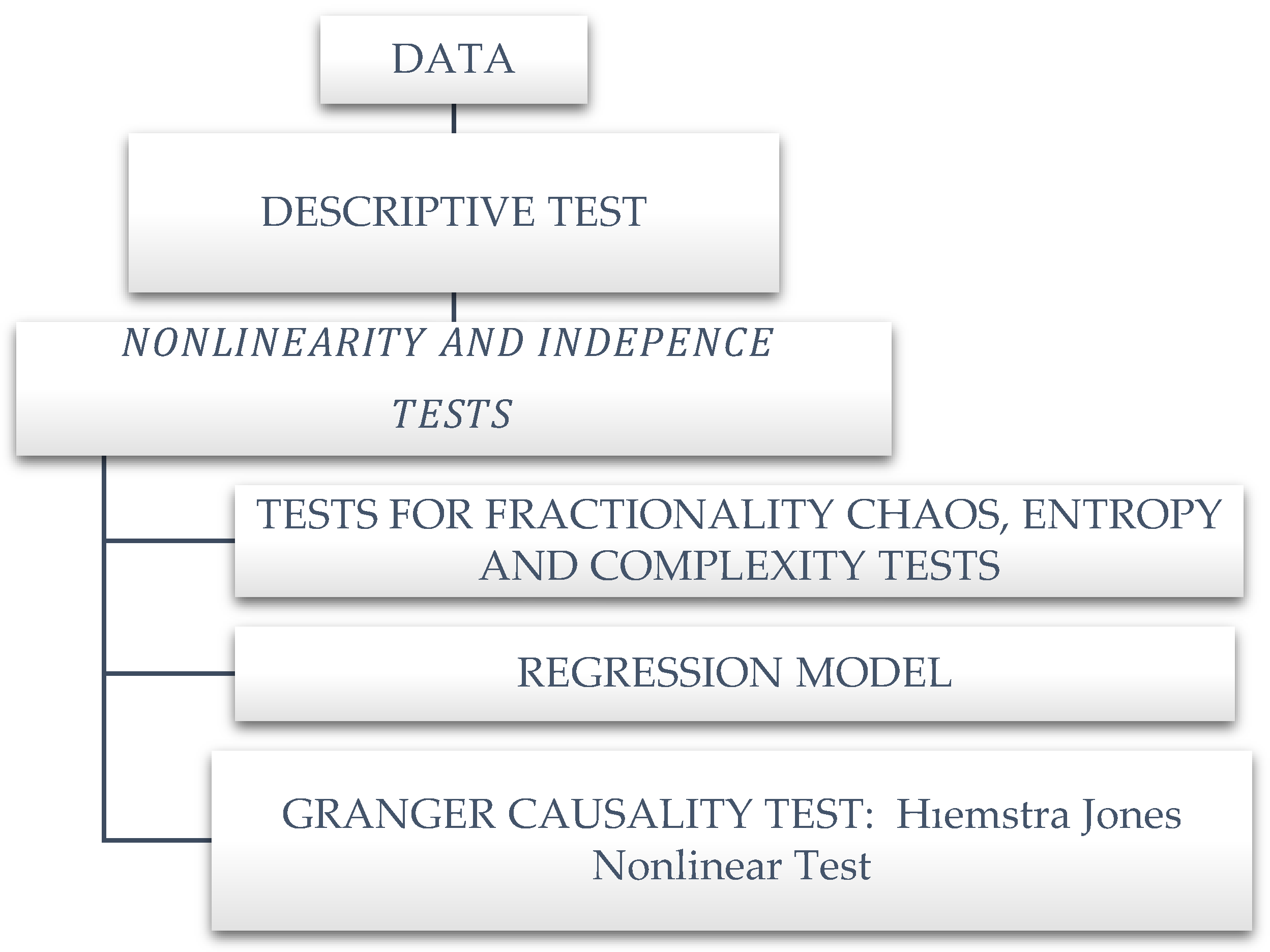
The results were obtained in five steps. Different package programs were used to analyze the results, including Python-3.14, Stata-19, EViews-10, R Studio-9.5 and MATLAB-R2013b. The empirical methodology follows the steps below.
The Lyapunov tests were used to find the presence of chaos. Rényi, Shannon and Tsallis entropy tests were used to determine the entropy of the system. Moreover, Lorenz and Rössler attractors and Julia sets were applied.
At this stage, the relationship among variables was analyzed through the application of chaotic regression models.
The direction of causality was assessed with Granger chaotic causality tests: the Hiemstra–Jones causality test.
These stages are given in the flow chart (
Figure 1).
Empirical Stages are given as follows
In the Experimental Phase, we considered the following four cases:
- i.
At this stage, the structure of the variables were analyzed. Lorenz [
18] and Rössler [
19] attractors and Julia [
20] sets were used. Chaotic dynamics, entropy, LLE and complexity were tested.
- ○
(Rényi [
15]), (Shannon [
14]) and (Tsallis [
16]) entropy that generalizes tests were employed to determine entropy.
- ○
The LLE(
λ) [
17] was computed.
The results of the Lorenz attractor gave information about chaotic characterization, but detailed information about the characterization can be obtained by calculating the Lyapunov exponent. The rule followed is as follows:
If λ ≤ 0 or λ > 1, modeling approaches cannot be utilized, and modeling and forecasting capabilities are drastically reduced. If 0 < λ < 1, the entropy and complexity yield significantly positive values by suggesting an acceptable degree of uncertainty or randomness
- ii.
The suggested chaotic regression method was applied.
- iii.
A chaotic Granger causality test was applied.
4.1. Chaotic Structures, Entropy, Fractals and Complexity
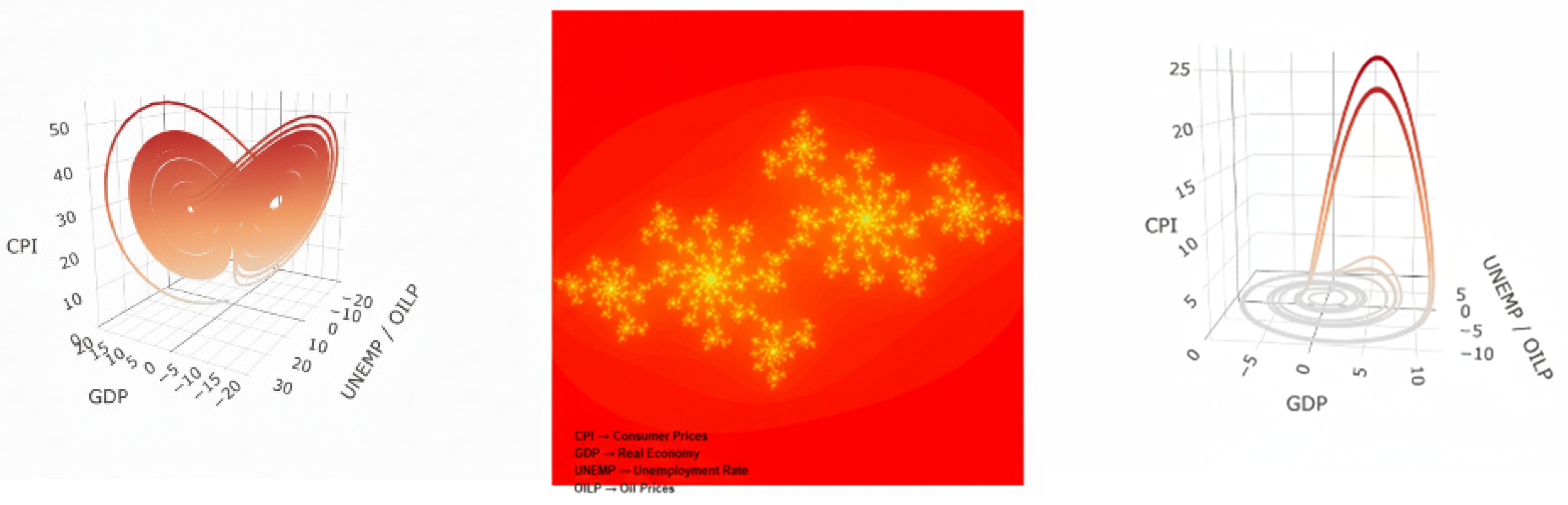
At this stage, the structure of the variables will be analyzed. Lorenz and Rossler attractors and Julia sets are given in
Figure 2.
The Lorenz attractor results show us the nonlinear dynamics of variables. Lorenz’s results show the shape of a “butterfly wing”. Each system has two different centers of gravity, which shows that the variables oscillate between two different equilibrium states. For inflation, the width of the wings shows that inflation can experience sudden jumps and falls. Density near the center indicates that inflation remains within the target range most of the time. As for unemployment, the narrower wings show that fluctuations in unemployment are more controlled than inflation. The double-center structure suggests that there may be two different points of stability around the natural rate of unemployment. Oil prices stand out as the most chaotic variable, suggesting that it may have an exogenous shock effect on other variables. The asymmetry between economic growth and inflation dynamics may indicate stagflation risks.
The Rössler results showed that economic growth fluctuates faster than other variables, is more sensitive to unexpected shocks and may be more difficult to control in the short term. It indicates that growth tends to show boom–bust cycles. Inflation, unemployment and oil prices have common features of a Slow Spiral Spread.
Economic growth can be defined by fragile growth and sudden changes, which have a high chaos value compared to others. While oil prices are open to external shocks, they have a lower chaotic structure than economic growth. However, it is higher than inflation and unemployment. Inflation, on the other hand, is the least chaotic variable. In short, it is stable but difficult to control. Unemployment, on the other hand, exhibits sticky behavior.
Table 3 show the Lyapunov exponent results.
In this paper, the Rosenstein algorithm was selected because it provides the most reliable estimation of the maximum (largest) Lyapunov exponent, λ1, in short and noisy macroeconomic time series. Macroeconomic variables such as unemployment, inflation and economic growth typically exhibit low-dimensional and short-lived dynamics; therefore, an algorithm with minimal parameter dependence and strong robustness to short samples is required. Unlike Wolf or Kantz methods—which require long trajectories to reconstruct the full Lyapunov spectrum—the Rosenstein approach computes λ1 directly from the local divergence of nearest-neighbor orbits in the reconstructed phase space. Since λ1 governs the dominant exponential separation rate of trajectories, it is the only exponent that can be robustly identified when the attractor is undersampled, as is typical in quarterly and monthly macroeconomic data. In such small datasets, neither the embedding delay nor the embedding dimension can be optimized with statistical confidence, making the full spectrum or long-horizon divergence infeasible. For this reason, the maximum Lyapunov exponent is the theoretically appropriate and empirically identifiable nonlinear indicator for short macroeconomic dynamics, and the Rosenstein method is the standard technique for extracting it.
Oil prices are slightly more chaotic than the variables of inflation and unemployment, and this reflects the nature of energy markets.
Table 4 presents the results obtained from the Shannon entropy (SE), Rényi and Tsallis analyses. The analytical methods used to capture the different dimensions of dynamics are designed to emphasize features of the data. Time series with high fractional dimensions and extended periods tend to be more predictable, as indicated by low entropy values. Conversely, chaotic systems tend to exhibit higher entropy due to their increased sensitivity to initial conditions and inherent unpredictability.
Shannon provides complementary insights by focusing on system complexity. If the value of 1/SE and the value of Tsallis are equal, it is an indication of the correctness of both results.
4.2. Chaotic Regression Model
The chaotic regression results reflect a complex system between oil price, inflation, unemployment and economic growth. The inclusion of lagged endogenous variables and oil prices as an exogenous shock variable in the model allows us to identify the potential chaotic behavior in the macroeconomic structure.
In the following three different models, equations were obtained by depending on the value of
λ. In the model, an exponential structure was formulated to reveal the relationship between the variables (
Table 5).
The above equations provide the equations of both the Philips curve and the macroeconomic structure. In the predicted model for inflation, it is noted that approximately 81% of the change in inflation is explained by independent variables. It is observed that there are strong nonlinear effects among unemployment, economic growth, oil price and inflation. For inflation equation, the values of γ show the direct contribution of chaotic intensity in each series to inflation dynamics, while the interaction terms governed by δ permit the marginal effect of the selected variables to change.
The unemployment equation has nonlinear properties, and 87% of the change in unemployment is explained by independent variables. The sensitivity to initial conditions confirms the theoretical underpinnings of chaotic dynamics. These results suggest that the system may not converge to a unique equilibrium but instead display bound yet unpredictable trajectories.
4.3. Granger Test Results
Table 6 summarizes the outcomes of the nonlinear Granger causality test suggested by the chaotic Granger causality test of Hiemstra and Jones [
21].
There is unidirectional causality from oil to both inflation, economic growth and unemployment. Likewise, the results show bidirectional causality between unemployment and inflation, and economic growth and unemployment.
5. Discussion
The results showed that policy recommendation must account for chaotic behavior. Regarding the functional form, we would like to clarify the rationale behind our exponential regression specification. The preliminary analysis—based on Lyapunov exponents, entropy measures (Shannon, Rényi and Tsallis), Lorenz and Rossler attractor and Julia Set indicated that the variables exhibit exponential divergence, nonlinear amplification and scale-dependent sensitivity, which are structural features of chaotic systems.
Unlike regime-switching models, which assume discrete or gradual structural shifts, the developed chaotic regression model displays continuous exponential responsiveness to perturbations, consistent with the properties of low-dimensional chaotic attractors.
So, our model provided five different contributions to the literature.
This study develops the first regression specification that embeds chaotic sensitivity directly into macroeconomic dynamics. Existing macro-economics literature typically has the following features:
Reports the Lyapunov exponent only as a descriptive statistic (mainly to test whether markets exhibit chaotic behavior);
Does not model how chaotic dynamics transmit into interactions among macroeconomic variables.
In contrast, the proposed model incorporates Lyapunov-augmented interaction terms of the form
Xt−1λt, embedding them directly into the regression structure. This amounts to functionally integrating chaos into econometric estimation. Consequently, the model substantially enhances the capacity to capture nonlinear and chaotic structure in macroeconomic series. This approach is extremely rare in the existing literature and is methodologically new for macroeconomic modeling.
- 2.
Rescaling the impact of shocks through chaotic sensitivity: the introduction of a new economic mechanism.
The model introduces a novel mechanism whereby the effect of macroeconomic shocks is scaled by the level of chaotic sensitivity. When Lyapunov exponents are high—indicating a chaotic regime—shocks to inflation, unemployment, economic growth and oil prices are mathematically represented as having amplified effects.
Conventional nonlinear models in the literature (TAR, STAR, and MSAR) capture regime shifts, thresholds or variance changes, but none incorporate the exponential divergence mechanism that reflects chaotic sensitivity. Although Markov-Switching or Smooth Transition models are standard nonlinear alternatives, they impose probabilistic or logistic regime structures that do not align with the chaotic patterns revealed in the data. Therefore, the model provides a theoretical contribution that can be described as a “state-dependent chaos amplification effect.”
- 3.
Parsimonious representation of high-dimensional nonlinearity via the δ-sum (aggregate chaotic interaction).
Nonlinear models in the literature typically suffer from excessive interaction terms, parameter proliferation and weak estimation performance in small samples. The proposed model overcomes this through a standardized aggregate chaotic interaction term, δsum. δsum reduces the parameter burden, improves model stability and allows the nonlinear effect to be tested via a single composite coefficient. This constitutes a new methodological contribution to nonlinear econometric modeling.
- 4.
A new dimension to inflation modeling and Phillips curve-type frameworks.
Chaos-based models have predominantly been applied to financial markets, stock returns, exchange rates and cryptocurrencies. They have been rarely applied to macroeconomic variables such as inflation, unemployment and growth. Thus, constructing a “chaos-augmented Phillips-type system” introduces a conceptual innovation to the macroeconomics literature, especially in areas such as inflation dynamics and energy price pass-through.
- 5.
Policy contribution: higher shock sensitivity under chaos provides new insights for policy design. So, the model yields the following policy-relevant insight: when the Lyapunov exponent is high (chaotic regime), inflation responds more strongly to oil price shocks, growth losses may become larger, and unemployment effects may intensify.
This implies that economic policy should be calibrated not only to the magnitude of shocks but also to the chaotic sensitivity of the system. Therefore, the model contributes to the literature by providing a novel normative (policy) dimension.
The results confirm that the exponential regression specification is well aligned with the chaotic and fractal behavior detected in the data. The presence of positive Lyapunov exponents, multifractal structure and nonlinear complexity indicates that the system evolves according to continuous exponential divergence rather than discrete regime changes. These results collectively support the methodological choice and reinforce the relevance of chaos- and fractal-based modeling in capturing complex economic dynamics.
According to the results of the Julia set, it has been determined that economic growth has self-reinforcing (positive feedback) dynamics. The large fractal density suggests that growth spurts and recessions exhibit multiscale behavior. Among the selected variables, the economic growth variable is the variable in which the dynamics of growth are the most difficult to control. The inflation variable, on the other hand, shows that the system tends to balance, and the narrow fractal structure shows that inflation dynamics remain within predictable ranges. The unemployment variable, on the other hand, includes balancing mechanisms like inflation. However, the results point to the effect of stickiness and especially hysteresis. Oil prices, on the other hand, seem to have the weakest balance mechanism (compared to inflation and unemployment). The narrow but sharp fractal structure foregrounds the expectation of sudden price jumps and sharp corrections.
The combined findings from the Lorenz, Rössler and Julia analyses reveal three key insights:
- (1)
The butterfly wing of the Lorenz attractor demonstrates that all variables oscillate between dual equilibria (such as high versus low growth or inflation versus deflation) by confirming that economic systems operate near unstable equilibria.
- (2)
The Julia set’s fractal patterns show that economic shocks recur at multiple scales, mathematically validating the butterfly effect, where minor perturbations can trigger large-scale crises.
- (3)
The branching, self-similar structures observed in inflation and unemployment confirm that the Phillips mechanism exhibits fractal equilibrium bands rather than a single NAIRU point.
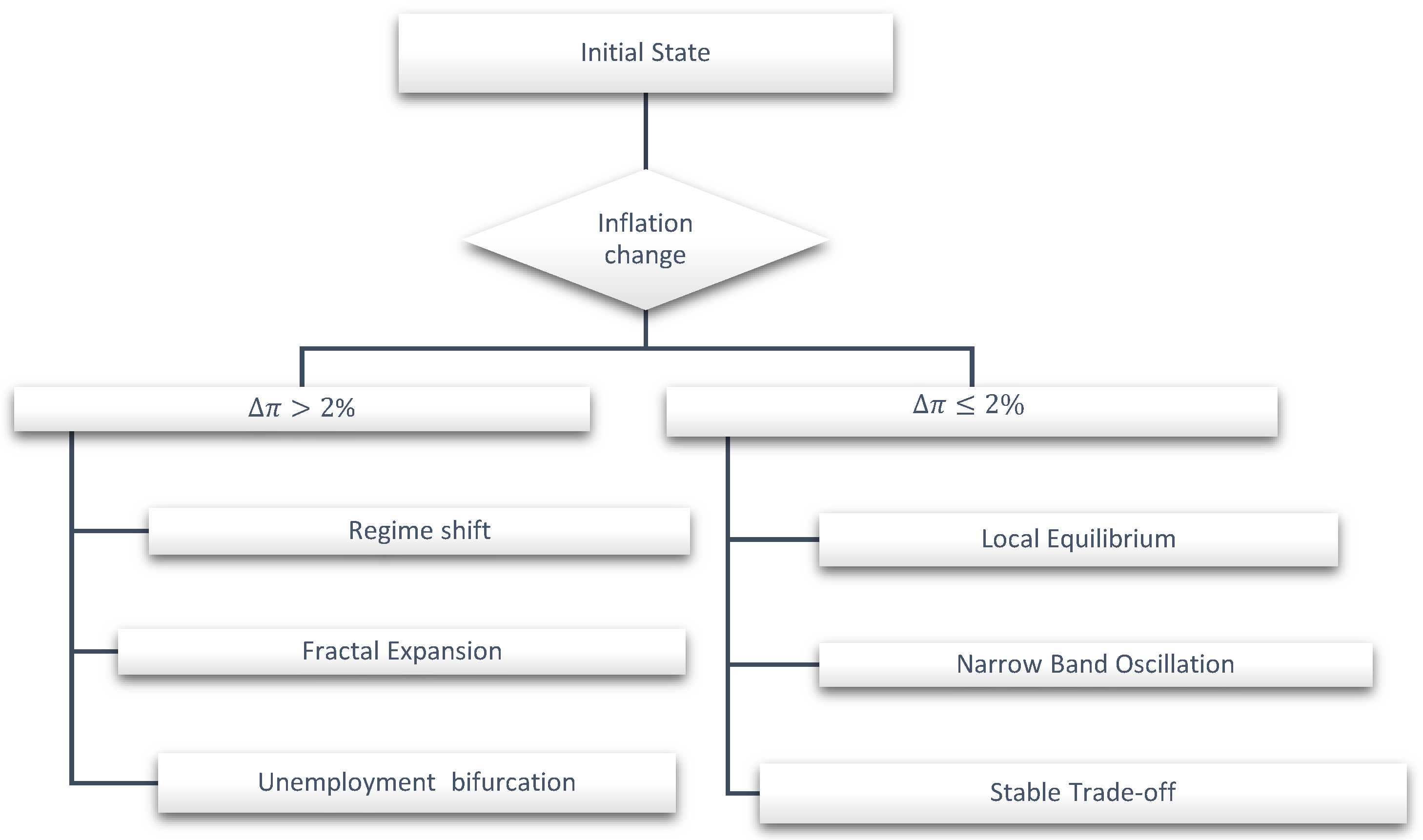
This formulation, derived from the Julia set, extends the classical Phillips curve into a chaos-consistent framework. Julia set results determined that unemployment can be explained by inflation fractal size.
It is defined as
λ = Lyapunov exponent and
Φ = inflation fractal size. The Julia set determined the unemployment equation. It rises as an improved form of the Phillips curve.
Figure 3 illustrates this situation.
By assessing the outcomes at the base, monetary and fiscal policies are shown to be useful instruments. Within the framework of fiscal policy, a tax multiplier may be suggested as part of the policy recommendations. In the framework of the Automatic Stabilizer Adjustment for Fiscal Policy, a tax multiplier can be established. The fractal tax multiplier is equal to 1/(1 + λ). It is important to have a dynamic fractal manifold rather than a static trade-off. It is important to consider regime transitions when designing policies.
When the Granger causality results are taken into account collectively, the following policy implications can be identified: Several significant dynamics among important macroeconomic variables are revealed by the results of the Hiemstra–Jones methodologies.
i. The bidirectional causality between GDP and unemployment is the most consistent finding across both models, suggesting the presence of a feedback mechanism in which economic output and labor market conditions affect each other. According to this, policies that target one of these indicators are likely to have an impact on the other, supporting the traditional economic theory that links business cycles and fluctuations in unemployment.
ii. Asymmetrical Impact of Oil Prices
These findings are in line with research showing that in economies that import energy, rising oil prices are more detrimental to economic stability than falling ones. The results highlight the need for policymakers to manage energy dependence and imply that changes in energy prices present unidirectional and asymmetric risks, particularly to the labor market and price stability.
iii. Bidirectional Causality Between Unemployment and Inflation
Causality results determine bidirectional causality between unemployment and inflation. This is consistent with economic theory.
These results show the importance of nonlinear and asymmetric modeling approaches in detecting complex interactions in macroeconomic systems.
6. Conclusions
This study investigates the nonlinear and potentially chaotic dynamics linking oil prices, inflation, unemployment and economic growth within a Phillips curve-based framework for Turkiye (1960–2024). Using chaotic regression and the Hiemstra–Jones causality test, the results provided strong evidence of nonlinear and asymmetric interactions by confirming sensitivity to initial conditions and chaotic dependence among variables.
By extending the Phillips framework with lagged endogenous variables and oil prices, the results showed complex feedback mechanisms. Entropy and Lyapunov exponents confirm chaotic structures by revealing that the system does not converge toward a single equilibrium. Hiemstra–Jones causality test found bidirectional causality between unemployment and GDP by emphasizing the interdependence of labor market dynamics and economic performance. Moreover it was determined bidirectional causality between unemployment and inflation.
The observed chaotic behavior suggested that traditional equilibrium-oriented models are inadequate for macroeconomic policy design. Instead, macroeconomic dynamics are better interpreted through complexity and chaos theory, which capture instability, path dependence and structural shocks. Policy implications include the following:
Labor markets: The bidirectional causality between unemployment and GDP showed the need for active labor market policies to mitigate hysteresis effects.
Inflation: One-way causality from inflation to GDP found inflation’s leading role. Thus, adaptive inflation targeting is essential to stabilize output.
Energy shocks: The asymmetric impact of oil prices confirms the vulnerability of macroeconomic stability to energy market fluctuations by emphasizing the importance of diversification, fiscal buffers and strategic reserves.
Chaotic and Fracral Structures, Entrophy: The results indicated dual equilibria and fractal equilibrium bands in inflation and unemployment. And they support coordinated fiscal–monetary actions to offset cyclical volatility.
Macro-stabilization strategies should incorporate real-time monitoring systems based on fractal dimension and Lyapunov diagnostics to enhance early warning capacity. Overall, the results accented that understanding chaotic macroeconomic structures enables more resilient, adaptive and complexity-aware policy frameworks.