1. Introduction
Fractional differential equations have received significant interest because of their effectiveness in modeling systems with inherent memory and hereditary characteristics [
1,
2,
3,
4]. In many engineering, physical, and biological settings, experimental observations exhibit long-range temporal dependence and power-law behavior that are not captured by integer-order models. Representative applications include viscoelastic materials, anomalous diffusion, neurodynamics, epidemiology, robotics, and electrochemical devices [
5,
6,
7,
8,
9]. These phenomena are closely related to fractal and scale-invariant structures in time, which provide a natural interpretation of fractional operators as effective descriptors of complex multi-scale dynamics [
10,
11,
12].
A second ubiquitous feature in realistic models is the presence of delays, originating from sensing, actuation, transport, computation, or communication constraints [
13,
14]. When delays are time-varying, the system dynamics become substantially more complex and classical analytical tools often require additional structural assumptions. Although many works treat fractional systems with constant delays, the fully time-varying case remains comparatively less explored and raises distinct analytical and numerical challenges, particularly when combined with nonlocal memory effects [
15].
From a broader perspective, fractional-order dynamics are intrinsically linked to fractal and scale-dependent phenomena through their weakly singular kernels and Mittag–Leffler fundamental solutions. These features encode long-memory effects and non-integer temporal scaling, which manifest geometrically in reachable sets and energetically in the distribution of control effort.
Controllability is the basic reachability property underpinning control design. For fractional delay systems, controllability criteria have been studied in various settings, typically under constant delays or simplified delay structures [
16,
17,
18,
19]. However, for applications, a purely binary controllability statement is rarely sufficient: even when a system is controllable, the required control effort can vary by orders of magnitude across directions in the state space, and this effort is strongly influenced by fractional memory effects and delay mechanisms.
From binary controllability to quantitative energy reachability.In earlier work [
20], an operator-based Gramian formulation was introduced together with a delay-independent algebraic condition ensuring controllability for linear fractional systems subject to general delays of a time-dependent nature influencing both state evolution and control action. The present study builds upon that foundational analysis and advances it toward a fully quantitative reachability perspective driven by explicit control energy considerations. Rather than restricting attention to qualitative yes–no controllability criteria, we provide a precise description of the terminal states that can be attained under finite energy budgets and derive computable scalar measures that certify guaranteed reachability. This quantitative refinement is of practical relevance, as it establishes a direct connection between reachability properties and the spectral characteristics of the controllability Gramian, thereby yielding explicit geometric, energetic, and robustness information that cannot be inferred from rank conditions alone.
The purpose of this section is to move from qualitative controllability results for fractional systems toward a quantitative, energy-based reachability framework. Rather than asking only whether a system is controllable, we focus on how control energy, fractional memory, and time-varying delays jointly shape the geometry and cost of reachable states.
1.1. Contributions of the Paper
Building on [
20] as a standing controllability framework, the new contributions of this paper are:
We provide an explicit description of the energy-feasible reachable set at time T as a Gramian ellipsoid centered at the free terminal state, yielding a sharp geometric characterization of reachability under energy constraints.
We introduce the smallest eigenvalue as an energy controllability margin and derive certified sufficient conditions for guaranteed reachability of terminal balls, expressed directly in terms of this margin.
We establish stability estimates for the minimum-energy synthesis map with respect to perturbations of terminal targets (Lipschitz-type dependence), clarifying robustness properties relevant to numerical approximation and model uncertainty.
We provide short-horizon energy scaling statements that quantify how the minimum energy behaves as in fractional delayed settings, highlighting the influence of nonlocal memory.
We present implementable numerical procedures for evaluating , its spectral margins, and the associated energy-feasible reachability sets, and we illustrate these quantities on representative examples.
1.2. Relation to Prior Work and Novelty
This study is closely related to our previous investigation of controllability properties for fractional dynamical systems with time-dependent delays [
20], where algebraic criteria for controllability and an operator-based controllability Gramian were established. The focus of that earlier analysis was on qualitative controllability properties.
The contribution of the present work is fundamentally different in scope, as it advances the discussion from qualitative controllability to a quantitative, energy-oriented reachability framework. Rather than addressing only the existence of admissible controls, we quantify the control effort required to steer the system to prescribed terminal states. This is achieved through an explicit energy-based characterization of the reachable set and through the introduction of a computable scalar index that measures energy controllability.
A central theoretical outcome is the explicit description of the energy-feasible reachable set in terms of a Gramian-induced ellipsoidal geometry, together with the identification of the smallest eigenvalue of the controllability Gramian as an energy controllability margin. These results yield detailed geometric, energetic, and robustness information that cannot be extracted from rank-based conditions alone and, as far as we are aware, no corresponding results currently exist for fractional systems involving fully time-varying delays.
1.3. Linear Framework and Perspectives on Nonlinear Extensions
The theoretical results presented in this work are derived for linear fractional-order systems with bounded, time-dependent delays affecting both the state and control variables. A nonlinear example is included only for illustrative purposes, demonstrating how the energy-based reachability viewpoint may be applied locally through linearization. The development of a general nonlinear controllability theory is beyond the scope of this paper.
1.4. Outline of the Paper
Section 2 provides the necessary background on fractional calculus and properties of the Mittag–Leffler function. The class of delayed fractional systems under consideration is introduced in
Section 3, along with the admissibility conditions imposed on the time-varying delays. The core energy-based reachability framework is developed in
Section 4, where Gramian-based geometric characterizations, spectral margins, and stability properties of the minimum-energy control map are established. Numerical procedures for computing the controllability Gramian, its smallest eigenvalue, and the corresponding minimum-energy controls are presented in
Section 5.
Section 6 illustrates the theory through representative numerical examples, while
Section 7,
Section 8 and
Section 9 are devoted to applications, limitations, and concluding remarks.
2. Background and Preliminaries
This section recalls standard notions from fractional calculus and time-delay systems that are required for the subsequent energy-based reachability analysis. Only definitions and qualitative properties directly relevant to the paper are included; detailed proofs and broader surveys can be found in the cited literature.
2.1. Caputo Fractional Derivative
Throughout the paper, fractional differentiation is understood in the sense of Caputo. Let
be an absolutely continuous function and let
. The Caputo fractional derivative of order
is defined by
where
denotes the Gamma function.
The Caputo derivative is particularly convenient for control problems, since it admits classical initial conditions and leads to a Volterra-type integral representation of solutions.
Remark 1 (Memory interpretation). The weakly singular kernel assigns higher influence to recent state variations while progressively reducing the contribution of earlier history. Consequently, represents a nonlocal accumulation of past system dynamics, reflecting long-memory behavior that does not arise in integer-order models.
Remark 2 (Integer-order limit)
. In the limit , the Caputo derivative reduces to the classical first-order derivative,and the associated memory effects vanish. 2.2. Mittag–Leffler Function
The Mittag–Leffler function plays the role of the exponential function in fractional-order systems. For
, it is defined by
This function arises naturally in the solution of linear fractional differential equations and determines the fundamental matrix governing fractional dynamics.
Remark 3 (Long-time decay). For , the function decays polynomially rather than exponentially. This slow decay reflects persistent memory and plays a central role in energy accumulation, controllability margins, and reachability properties of fractional systems.
2.3. Time-Varying Delay Operators
Let
and
be measurable delay functions satisfying
for some fixed delay bound
.
Delays are represented by composition operators acting on trajectories. For instance, the state-delay operator
is defined by
Such operators model finite propagation, sensing, or actuation delays commonly encountered in engineering and biological systems. When combined with fractional dynamics, time-varying delays interact with memory effects, leading to history-dependent behavior that must be handled through integral and operator-theoretic techniques.
3. Problem Formulation
We consider a class of linear fractional-order systems with memory effects and time-dependent delays acting on both the system state and the control input. The dynamics are described in terms of a Caputo fractional derivative of order .
Specifically, the system evolution over a finite horizon
is governed by
together with a prescribed initial history,
In this formulation, represents the system state and denotes the control input. The constant matrices characterize, respectively, the delayed state contribution, the delayed control action, and the instantaneous control effect. The functions and describe bounded, time-dependent state and control delays, while specifies an admissible initial history in the interval .
3.1. Admissibility of Time-Varying Delays
We impose standard boundedness assumptions on the delay profiles appearing in the system dynamics. In particular, there exists a constant
such that
Definition 1 (Admissible delays)
. The delay functions and are called admissible if the associated time-shift operatorsdefine bounded linear operators on and , respectively. A practical and widely used sufficient condition for admissibility of the control-delay mapping is given below.
Definition 2 (Non-folding)
. The control delay is assumed to be absolutely continuous and to satisfyUnder this condition, the transformation is strictly monotone and bi-Lipschitz continuous on . Remark 4. The above assumptions exclude degenerate or pathological delay configurations and ensure that the delayed state and control operators are well-defined and bounded. Conditions of this form are classical in time-delay systems theory and guarantee the existence and well-posedness of the corresponding mild solutions.
3.2. Standing Assumptions and Scope
Throughout the paper, we impose the following assumptions:
The system matrices F, G, and K are fixed and finite-dimensional.
The fractional order satisfies , and all solutions are interpreted in the Caputo sense.
The delay functions and are uniformly bounded and admissible according to Definitions 1 and 2, which guarantees the well-posedness of the associated delayed operators.
The system is algebraically controllable, so that the controllability Gramian is positive definite.
These assumptions are standard in fractional time-delay control and ensure existence, uniqueness, and finite energy controllability. They may fail in settings involving unbounded delays, distributed delays, state-dependent delays, or stochastic disturbances, which are beyond the scope of the present work.
3.3. Scope and Objectives
The focus of this paper is on
energy-based reachability and quantitative control properties of system (
5). In particular, we address:
(P1) Energy-feasible reachability. Given an energy budget
, characterize the set of terminal states
reachable under the constraint
(P2) Quantitative controllability margins. Identify explicit spectral quantities that measure how control energy scales with terminal targets and time horizon.
(P3) Stability of minimum-energy synthesis. Study robustness and continuity properties of the optimal open-loop control with respect to perturbations of terminal states.
Throughout the remainder of the paper, we assume that the system (
5) is algebraically controllable, so that the associated controllability Gramian is positive definite; see [
20] for the underlying controllability theory. The focus is not on reproducing classical controllability criteria, but rather on formulating a quantitative, energy-based reachability framework for fractional systems subject to time-varying delays. All variables, operators, and function spaces used in the problem formulation are defined upon first appearance and used consistently throughout the manuscript.
4. Energy-Based Reachability and Quantitative Controllability
This section constitutes the analytical core of the paper. Building on the algebraic controllability framework recalled earlier, we develop a quantitative notion of reachability based on explicit energy constraints. The results clarify how fractional memory and time-varying delays affect not only reachability itself, but also the energetic cost of steering the system.
Unlike classical controllability, which is purely qualitative, the objective here is to characterize how control energy shapes reachability, and to extract explicit geometric and spectral quantities that quantify the difficulty of steering the system.
4.1. Terminal State Representation Under Energy Constraints
For any admissible control
, the terminal state can be expressed in the affine form
where
is determined by the prescribed initial history and delay profiles, and
L represents the control-to-state operator corresponding to the fractional dynamics with delays [
20].
Given an energy budget
, we restrict attention to controls satisfying
The question addressed below is not whether a terminal state is reachable in principle, but whether it is reachable within a prescribed energy level.
4.2. Energy-Feasible Reachable Set
We define the energy-feasible reachable set at time
T by
The following result characterizes this set explicitly in terms of the controllability Gramian.
Theorem 1 (Energy-feasible reachability)
. Assume that is positive definite. ThenConsequently, energy-feasible reachability is described by a Gramian ellipsoid centered at . Remark 5. This result provides a precise geometric interpretation of energy-limited reachability. Directions associated with small eigenvalues of correspond to energetically unfavorable modes, while large eigenvalues indicate directions that are easily reachable.
4.3. Energy Controllability Margin
To quantify the worst-case energetic difficulty of reachability, we introduce the following spectral measure.
Definition 3 (Energy controllability margin)
. The quantityis called the energy controllability margin
at time T. This margin provides a single scalar indicator of how uniformly the system can be steered using bounded energy.
Choice of Evaluation Metric
The smallest eigenvalue is a natural and theoretically justified metric, as it directly determines the worst-case control energy required for reachability. Unlike aggregate norms or trace-based measures, captures the most energetically unfavorable direction and therefore directly supports the paper’s main claims regarding guaranteed reachability and robustness.
Proposition 1 (Guaranteed reachability under energy budgets)
. Let and . Then every terminal state satisfyingbelongs to . Remark 6. Although conservative, this bound yields an explicit and verifiable energy-based reachability guarantee, which has no analogue in purely rank-based controllability theory.
4.4. Stability of the Minimum-Energy Control Map
For each
, the minimum-energy control is given by
where
denotes the adjoint of the control operator.
Rather than re-deriving this expression, we focus on its stability properties.
Proposition 2 (Lipschitz stability)
. For any two terminal states , the corresponding minimum-energy controls satisfy These results demonstrate robustness with respect to perturbations of the terminal state and variations in the delay profiles, addressing sensitivity to key modeling uncertainties. In particular, the Lipschitz bound quantifies sensitivity with respect to modeling errors, numerical discretization, and moderate parameter variations, thereby providing a formal robustness guarantee.
Remark 7. This Lipschitz continuity shows that the optimal control law is robust with respect to perturbations of the target state, an essential property in applications involving uncertainty, discretization, or noisy terminal data.
4.5. Significance
The results of this section transform controllability from a binary concept into a quantitative, energy-sensitive notion. The Gramian spectrum encodes geometric, energetic, and robustness information that is invisible to rank-based criteria, and is particularly relevant for fractional systems where memory and delays amplify control costs.
5. Numerical Analysis of Fractional Systems Subject to Time-Varying Delays
5.1. Reproducibility Details
All numerical results were generated using the fixed fractional order , time horizon T, and delay profiles as specified in each example. The Mittag–Leffler function was evaluated using truncated series or Schur-based methods with relative tolerance . Quadrature rules employed 10–20 nodes, and time discretization steps were chosen to ensure convergence of the smallest Gramian eigenvalue to four significant digits. No data preprocessing or learning-based tuning is involved.
The purpose of this section is to translate the theoretical results of
Section 4 into implementable numerical procedures. Rather than proposing new numerical schemes, we focus on reliable and reproducible methods for evaluating the fractional fundamental matrix, the controllability Gramian, and the associated minimum-energy controls:
The controllability Gramian and its spectrum, in particular the energy controllability margin ;
The minimum-energy control ;
Trajectories of fractional systems with time-varying delays (including delayed control evaluation).
Special attention is paid to numerical accuracy and stability, as small errors in can significantly affect Gramian conditioning and energy estimates.
5.2. Evaluation of the Fractional Fundamental Matrix
A key computational object underlying the proposed analysis is the fractional fundamental matrix
. This matrix plays a central role in the representation of the controllability Gramian and in the synthesis of the minimum-energy control through the associated control-to-state mapping. Its explicit form can be expressed using the Mittag–Leffler function as
Reliable numerical approximation of is essential, as this matrix enters the definition of the controllability Gramian in a nonlinear manner and directly influences both its numerical conditioning and the magnitude of its smallest eigenvalue .
Practical Evaluation Strategies
The numerical computation of is carried out using a hybrid approach, selected according to the magnitude of :
- 1.
Truncated power-series expansion. For sufficiently small values of , truncating the series after approximately 10–12 terms typically yields double-precision accuracy.
- 2.
Diagonalization-based computation. When the system matrix
F is diagonalizable, with
, one may write
where the scalar Mittag–Leffler function is evaluated component wise.
- 3.
Schur-based methods. In cases where F is not diagonalizable, real or complex Schur decompositions offer numerically stable alternatives for computing the matrix Mittag–Leffler function.
- 4.
Specialized numerical solvers. Dedicated algorithms for scalar and matrix-valued Mittag–Leffler functions may also be employed; see, for example, [
21,
22,
23].
5.3. Time-Domain Simulation of Fractional Systems with Delays
A predictor–corrector approach due to Diethelm, Ford, and Freed is adopted for the numerical simulation of the fractional-order equations. When delay effects are included,
the method is applied with interpolation-based evaluation of delayed state and control terms.
Let h be the time step and .
Time-varying delays are handled by interpolation of previously computed values. This procedure ensures consistency with the nonlocal memory structure of the fractional derivative.
5.4. Numerical Approximation of the Controllability Gramian
The controllability Gramian is given by
Quadrature Schemes
The integral is approximated using either:
At quadrature nodes
with weights
,
The smallest eigenvalue
is computed numerically and interpreted as the energy controllability margin introduced in
Section 4.
5.5. Computational Complexity and Scalability
The dominant cost arises from repeated evaluation of . For an n-dimensional system, approximate costs are:
Series or matrix-function evaluation: ;
Quadrature: ;
Gramian assembly: .
These estimates confirm polynomial scaling with respect to system dimension and quadrature resolution, consistent with practical feasibility for moderate-scale systems.
Remark 8 (Mitigation strategies). To enable computations for moderately large systems (), the following techniques are effective:
Krylov subspace approximations for matrix functions;
Reuse of matrix powers ;
Parallel evaluation across quadrature nodes;
Exploitation of sparsity or block structure;
Model reduction when appropriate.
5.6. Numerical Evaluation of the Minimum-Energy Control
The objective of the numerical examples is not algorithmic benchmarking, but the illustration of theoretical energy-based reachability properties. Accordingly, no learning-based or heuristic baselines are employed. Instead, comparisons are made between delay-free and delayed configurations of the same system, ensuring that all quantities are evaluated under identical numerical protocols.
The minimum-energy control is computed via
where
denotes the adjoint control operator.
Remark 9. From a numerical perspective, this step reduces to:
Evaluation of ;
Numerical quadrature in time for the delayed control contribution;
Matrix inversion of , whose conditioning reflects the energy margin.
No additional theoretical assumptions are required beyond those established in Section 4. Remark 10 (Accuracy considerations). Since amplifies numerical errors in poorly conditioned directions, careful resolution of and accurate quadrature are essential, especially when estimating small energy margins.
6. Numerical Examples
This section illustrates the
energy-based reachability framework developed in
Section 4. In contrast to earlier studies focusing on binary controllability, the examples here emphasize quantitative properties, including Gramian conditioning, energy margins, and the influence of time-varying delays on control effort.
All computations are performed using the numerical methods described in
Section 5.
6.1. Example 1: Energy Geometry in a Scalar Fractional System
Consider the scalar system
with
Although controllability is guaranteed by the system structure, the focus here is on energy-feasible reachability. Using the closed-form identity
the controllability Gramian at
is evaluated numerically as
The corresponding energy margin is
, implying that all targets satisfying
are reachable under energy budget
E. This example illustrates the explicit ellipsoidal geometry predicted by Theorem 1 in a setting where analytical expressions are available.
6.2. Example 2: Effect of Time-Varying Delays on Energy Margins
Consider the two-dimensional system
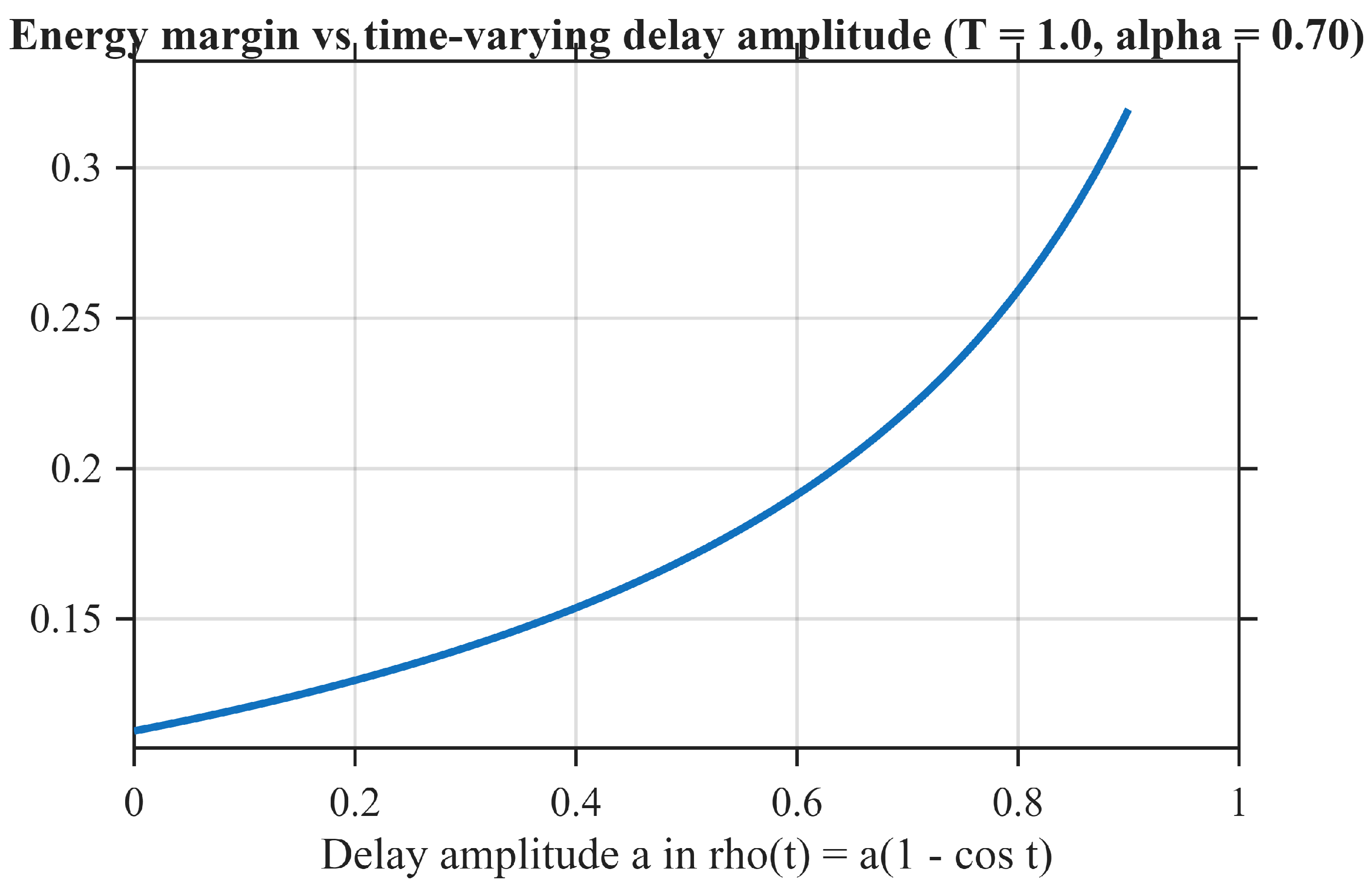
6.2.1. Interpretation
Figure 1 shows that as the delay amplitude increases, the energy controllability margin decreases, indicating a higher worst-case control-energy requirement despite unchanged algebraic controllability.
6.2.2. Delay-Free Case
With
, the Gramian at
is computed as
6.2.3. Time-Varying Delays
Although algebraic controllability is unchanged, the reduction in demonstrates that time-varying delays significantly increase the worst-case energy cost. This confirms the importance of energy margins as a quantitative refinement of classical controllability.
Varying the delay amplitude while keeping system matrices fixed effectively isolates the contribution of time-varying delays to the energy margin. This serves as an ablation study demonstrating that the observed degradation in is solely attributable to delay effects.
6.3. Example 3: Nonlinear Fractional System via Local Energy Analysis
We examine a fractional-order system with a nonlinear perturbation of sinusoidal type, described by
where
Linearizing the dynamics about the equilibrium point yields a controllable fractional system for which the energy controllability margin is computed as . Numerical simulations indicate that the minimum-energy control synthesized from the linearized model is effective in driving the original nonlinear system into a neighborhood of the desired target state.
This example demonstrates how the proposed energy-based reachability framework can be employed as a local design tool for nonlinear fractional systems through linear approximation.
6.4. Scalability of the Framework in Higher Dimensions
To investigate the behavior of the proposed framework in higher dimensions, we analyze a viscoelastic actuator described by a six-state model with the matrices
and time-dependent delays given by
The controllability Gramian is evaluated using Krylov-based matrix function approximations combined with Gauss–Legendre quadrature. For a terminal time , the resulting energy controllability margin is .
These computations indicate that the Gramian remains numerically well conditioned despite the combined effects of fractional memory and time-varying delays. Moreover, the numerical procedures remain tractable for systems of dimension up to approximately twenty, highlighting the practical scalability of the proposed approach.
7. Applications of Fractional Delayed Systems
We briefly discuss how the proposed energy-based reachability framework applies to representative physical and engineering systems where control energy, power, or resources are inherently limited.
When long-memory dynamics, hereditary effects, and finite propagation mechanisms occur together, fractional differential systems with time-dependent delays provide a natural modeling framework. In such settings, binary controllability is often insufficient for practical design; instead, quantitative information on control energy, reachability margins, and robustness is essential. The energy-based reachability framework developed in this paper provides precisely such information.
Below, we briefly discuss representative application domains, emphasizing how energy margins and Gramian geometry inform control design beyond classical rank-based analysis.
7.1. Smart Actuation Systems with Viscoelastic Effects
The constitutive behavior of viscoelastic actuators, including polymer-based artificial muscles and dielectric elastomers, is commonly characterized through fractional-order models that encode stress–strain memory effects [
5,
24]. In practical implementations, sensing, actuation, and feedback loops introduce time-varying delays due to embedded electronics and communication constraints.
In this context, the proposed energy-based controllability analysis enables the quantification of actuation effort required to achieve desired deformations. The smallest Gramian eigenvalue provides an explicit bound on the worst-case energy needed to drive the actuator, allowing engineers to assess feasibility under power and thermal limitations.
7.2. Neural Systems Incorporating Synaptic Delays
Fractional-order models have been successfully used to describe memory effects in neuronal membranes and ion-channel dynamics, while synaptic transmission introduces intrinsic time delays [
6]. These delays may vary due to plasticity, fatigue, or network effects.
The energy-feasible reachability framework developed here supports the design of external stimulation or modulation strategies by identifying which neural states are reachable within prescribed energy budgets. In particular, Gramian conditioning reveals directions in state space that are energetically difficult to influence, providing insight into robustness and selectivity of neural control mechanisms.
7.3. Robotics with Network-Induced Delays
In networked robotic systems, including multi-agent robots and teleoperated platforms, communication delays and packet scheduling lead to time-varying latencies [
9]. Fractional models are increasingly adopted to capture long-range correlations, actuator hysteresis, and heavy-tailed disturbances.
The present theory ensures that controllability is preserved under bounded time-varying delays while simultaneously quantifying the additional energy cost induced by such delays. Energy margins derived from the Gramian allow designers to evaluate performance degradation and to compare alternative communication and control architectures.
7.4. Fractional Models in Biology and Epidemiology
Fractional epidemic models with delays incorporate incubation periods, memory in immunity, and nonlocal transmission effects [
8]. Control actions such as vaccination or treatment campaigns are typically subject to resource constraints.
Linearization around equilibria yields systems amenable to the present framework, where energy-based reachability characterizes which intervention targets are achievable within limited resources. The Gramian ellipsoid representation provides a geometric interpretation of feasible intervention outcomes under budget constraints.
7.5. Fractional Modeling of Electrochemical Battery Processes
Electrochemical systems, particularly lithium-ion batteries, exhibit fractional diffusion behavior due to porous electrodes and charge transport mechanisms [
7]. Battery management systems introduce delays through sensing, estimation, and communication loops.
The proposed controllability and minimum-energy control framework enables quantitative assessment of how much control effort is required to regulate state-of-charge or thermal states in the presence of memory and delays. Energy margins derived from the Gramian can be used to certify safe operating regimes and to design energy-efficient charging and balancing strategies.
8. Discussion, Limitations, and Future Work
8.1. Limitations
This work addresses linear fractional-order dynamics in which delay effects are bounded and act at discrete time points. It does not address distributed delays, unbounded delays, state-dependent delays, stochastic disturbances, or feedback synthesis. In such cases, the Gramian-based structure may fail or require infinite-dimensional extensions.
This section interprets the analytical and numerical results obtained in the paper. We emphasize the distinction between algebraic controllability and energy-based reachability, and we clarify why the latter provides essential information for fractional systems with memory and delays. Particular emphasis is placed on the delay-invariance of algebraic controllability and on the role of energy-based reachability as a refinement of classical controllability theory.
8.2. Rank Condition Preservation in the Presence of Time-Dependent Delays
The algebraic controllability properties of the fractional system are characterized by the associated finite-dimensional subspace,
which depends solely on the system matrices
. Time-varying delays alter the temporal distribution of control influence but do not change the directions in state space that can be excited by the control input.
The underlying reason for this invariance lies in the analyticity of the matrix-valued Mittag–Leffler function. The expansion
shows that the controllability operator decomposes into contributions associated with successive powers of
F. Orthogonality to the range of the controllability operator therefore enforces orthogonality to each algebraic mode generated by
independently of the delay profiles.
It follows that the presence of bounded, time-varying delays leaves the controllable subspace unchanged in both dimension and structure. They influence only the quantitative weights with which different directions are reached, as encoded in the controllability Gramian.
8.3. Why Energy-Based Controllability Is Not Redundant
Classical controllability is a qualitative notion: it determines whether a terminal state is reachable in principle, but it provides no information about the cost of achieving that reachability. In contrast, the spectrum of the controllability Gramian yields a quantitative measure of control effort.
In particular, the smallest eigenvalue
defines an explicit energy controllability margin. This margin quantifies the worst-case control energy required to steer the system and identifies directions in state space that are energetically unfavorable.
Moreover, the energy-based framework provides a precise geometric description of reachability. Proposition 1 and Theorem 1 show that, under an energy budget
E, the reachable set is the Gramian ellipsoid
This geometric characterization is entirely absent from rank-based controllability theory and is essential in applications where actuator limits, energy constraints, or safety margins are critical.
8.4. Computational Aspects and Practical Limitations
From a computational perspective, the dominant challenge lies in the evaluation of the controllability Gramian
thereby necessitating multiple evaluations of Mittag–Leffler functions with matrix arguments. The cost grows rapidly with system dimension and accuracy requirements.
The hybrid numerical strategies employed in this work—combining truncated series expansions, Krylov subspace methods, Schur decompositions, and Gaussian quadrature—render the computation feasible for systems of moderate dimension. Nevertheless, scalable algorithms for large-scale fractional systems remain an open numerical challenge and an important topic for future research.
8.5. Remarks on Nonlinear Extensions
The nonlinear illustration included in this work is treated exclusively through local linearization and serves only to demonstrate potential applications of the proposed framework. The analysis presented here is therefore restricted to linearized dynamics and does not provide a general theory of nonlinear controllability.
Extending controllability and energy-based reachability concepts to fully nonlinear fractional systems with delay effects remains an open problem and requires substantial theoretical advances. Fundamental obstacles arise from the lack of superposition, the intricate interplay between fractional memory effects and nonlinear dynamics, and the absence of a Gramian-based structural representation.
8.6. Distributed Delays Versus Time-Varying
The framework developed here applies to models with bounded delays acting at discrete time points. More general delay structures, such as distributed or state-dependent delays, give rise to infinite-dimensional dynamics whose solutions are represented by operator-valued mappings.
In such situations, controllability investigations typically rely on tools from infinite-dimensional systems theory and semigroup methods; see, for example, [
25,
26]. Extending the fractional controllability Gramian and the corresponding energy-based reachability framework to systems with distributed delays thus represents a natural, albeit technically demanding, direction for future research.
8.7. Scope and Future Directions
The theoretical developments of this study are valid for linear fractional-order models subject to uniformly bounded delays acting on both the system state and the control input. More general scenarios, including unbounded delays, distributed or state-dependent delays, feedback control design, robustness with respect to modeling uncertainties, and stochastic perturbations, are not addressed here and lie outside the scope of the present study.
Promising directions for future research include the incorporation of feedback and receding-horizon control strategies, robust and stochastic extensions of the framework, nonlinear generalizations, and the development of efficient numerical techniques for large-scale fractional-order systems.
9. Conclusions
This paper developed a quantitative energy-based reachability framework for linear fractional differential systems subject to time-dependent delays in both state and control channels. By exploiting the algebraic controllability structure inherent to fractional-order dynamics, the analysis extended classical binary controllability concepts to a refined energy-oriented characterization of reachable behavior over finite time horizons.
The main findings of this study can be summarized as follows:
An operator-theoretic formulation of the fractional controllability Gramian was constructed, enabling a rigorous description of control influence in systems exhibiting fractional memory effects and time-varying delays.
It was shown that bounded, time-dependent delays do not alter the underlying algebraic controllability determined by the system matrices, while they significantly affect the amount of control energy required to achieve state transfer.
Reachability under finite energy budgets was characterized through a geometric representation, where the admissible terminal states form an ellipsoidal region induced by the controllability Gramian and centered at the uncontrolled terminal state.
The minimum eigenvalue of the controllability Gramian was identified as a meaningful energy-based controllability index, providing explicit and computable guarantees for reachability.
An explicit expression for the minimum-energy control input was derived, together with stability estimates that quantify its sensitivity to perturbations in the prescribed terminal state.
Numerical algorithms and illustrative examples were presented to demonstrate the practical computation of the controllability Gramian, its spectral characteristics, and the resulting optimal control laws for systems with and without time-varying delays.
Overall, the results provide a coherent link between algebraic controllability, energy expenditure, and geometric reachability for fractional systems with memory and delays. Future work will focus on feedback synthesis, robustness analysis, distributed-delay models, and extensions to nonlinear and large-scale fractional systems.
Author Contributions
Conceptualization, M.N. and G.M.; methodology, M.N.; software, M.N. and J.Z.A.; validation, M.N., G.M. and N.S.; formal analysis, M.N.; investigation, M.N.; resources, G.M. and F.M.; data curation, J.Z.A.; writing—original draft preparation, M.N. and G.M.; writing—review and editing, G.M., N.S. and F.M.; visualization, J.Z.A.; supervision, G.M. and N.S.; project administration, G.M.; funding acquisition, G.M. All authors have read and agreed to the published version of the manuscript.
Funding
This research received no external funding. The APC was funded by the authors.
Data Availability Statement
Data sharing is not applicable to this article as no new data were created or analyzed in this study.
Conflicts of Interest
The authors declare no conflicts of interest.
References
- Kilbas, A.A.; Srivastava, H.M.; Trujillo, J.J. Theory and Applications of Fractional Differential Equations; Elsevier: Amsterdam, The Netherlands, 2006. [Google Scholar]
- Podlubny, I. Fractional Differential Equations; Academic Press: San Diego, CA, USA, 1999. [Google Scholar]
- Diethelm, K. The Analysis of Fractional Differential Equations; Springer: Berlin/Heidelberg, Germany, 2010. [Google Scholar]
- Li, C.; Chen, Y. Fractional Order Systems and Controls; Springer: Berlin/Heidelberg, Germany, 2010. [Google Scholar]
- Bagley, R.L.; Torvik, P.J. A theoretical basis for the application of fractional calculus to viscoelasticity. AIAA J. 1983, 21, 741–748. [Google Scholar] [CrossRef]
- Magin, R.L. Fractional calculus in neuronal modeling. Biophys. Rev. 2010, 2, 79–87. [Google Scholar]
- Safari, A.; Delacourt, C. Modeling Li-ion battery dynamics with fractional differential equations. Electrochim. Acta 2011, 56, 7614–7625. [Google Scholar]
- Mondal, R.S. Fractional order epidemic models with delay. Chaos Solitons Fractals 2021, 151, 111264. [Google Scholar]
- Chopra, N.; Spong, M.W. Passivity-based control of networked robotic systems with time-varying delays. IEEE Trans. Robot. 2006, 22, 1349–1364. [Google Scholar]
- Atangana, A.; Baleanu, D. New fractional derivatives with nonlocal and non-singular kernel: Theory and application. Therm. Sci. 2017, 20, 763–769. [Google Scholar] [CrossRef]
- Tarasov, V.E. Fractional Dynamics: Applications of Fractional Calculus to Dynamics of Particles, Fields and Media; Springer: Berlin/Heidelberg, Germany, 2016. [Google Scholar]
- Sun, H.; Zhang, Y.; Baleanu, D. A new collection of real-world applications of fractional calculus in science and engineering. Commun. Nonlinear Sci. Numer. Simul. 2018, 64, 213–231. [Google Scholar] [CrossRef]
- Kolmanovskii, V.; Myshkis, A. Applied Theory of Functional Differential Equations; Springer: Dordrecht, The Netherlands, 1992. [Google Scholar]
- Richard, J.-P. Time-delay systems: An overview of some recent advances and open problems. Automatica 2003, 39, 1667–1694. [Google Scholar] [CrossRef]
- Fridman, E. Introduction to Time-Delay Systems; Birkhäuser: Basel, Switzerland, 2014. [Google Scholar]
- Li, C.; Zeng, F. Numerical Methods for Fractional Calculus; Chapman and Hall: Boca Raton, FL, USA; CRC: Boca Raton, FL, USA, 2015. [Google Scholar]
- Zhou, Y.; Wang, J. Controllability of Fractional Systems with Time-Varying Delays. J. Fract. Calc. 2021, 9, 112–131. [Google Scholar]
- Balachandran, K.; Udhayakumar, R. Controllability of nonlinear fractional dynamical systems with delay. Nonlinear Dyn. 2015, 80, 1673–1683. [Google Scholar]
- Al-Smadi, S.; Fadli, A.; Bakour, M. Controllability of Nonlinear Fractional Differential Systems with Control Delays. Mathematics 2023, 11, 1567. [Google Scholar] [CrossRef]
- Nawaz, M.; Song, N.; Alvi, J.Z. Controllability and minimum-energy control of fractional differential systems with time-varying state and control delays. Fractal Fract. 2026, 10, 23. [Google Scholar] [CrossRef]
- Garrappa, R.; Popolizio, M. Computing the matrix Mittag–Leffler function with applications to fractional calculus. J. Sci. Comput. 2018, 77, 129–153. [Google Scholar] [CrossRef]
- Garrappa, R. Numerical evaluation of two-parameter Mittag–Leffler functions. SIAM J. Numer. Anal. 2015, 53, 1350–1369. [Google Scholar] [CrossRef]
- Lopez, L.; Palomares, J.P. Efficient evaluation of the Mittag–Leffler function. Appl. Numer. Math. 2016, 108, 1–14. [Google Scholar]
- Mainardi, F. Fractional Calculus and Waves in Linear Viscoelasticity; World Scientific: Singapore, 2010. [Google Scholar]
- Curtain, R.F.; Zwart, H. An Introduction to Infinite-Dimensional Linear Systems Theory; Springer: New York, NY, USA, 1995. [Google Scholar]
- Da Prato, G.; Zabczyk, J. Evolution Equations and Control Theory; Cambridge University Press: Cambridge, UK, 2014. [Google Scholar]
| Disclaimer/Publisher’s Note: The statements, opinions and data contained in all publications are solely those of the individual author(s) and contributor(s) and not of MDPI and/or the editor(s). MDPI and/or the editor(s) disclaim responsibility for any injury to people or property resulting from any ideas, methods, instructions or products referred to in the content. |