
Article

Analysis of Stability and Quasi-Synchronization in Fractional-Order Neural Networks with Mixed Delays, Uncertainties, and External Disturbances

1
School of Mathematics and Statistics, Hainan Normal University, Haikou 571127, China
2
School of Mathematics and Statistics, Sichuan University of Science and Engineering, Zigong 643000, China
*
Author to whom correspondence should be addressed.
Fractal Fract. 2026, 10(1), 73; https://doi.org/10.3390/fractalfract10010073
Submission received: 29 December 2025 / Revised: 14 January 2026 / Accepted: 16 January 2026 / Published: 22 January 2026
(This article belongs to the Special Issue Advances in Dynamics and Control of Fractional-Order Systems)

Abstract

This study addresses the stability and quasi-synchronization of fractional-order neural networks that incorporate mixed delays, system uncertainties, and external disturbances. Accordingly, a more realistic neural network model is constructed. For fractional-order neural networks incorporating mixed delays and uncertainties (FONNMDU), this study establishes a criterion for uniform asymptotic stability and proves the existence and uniqueness of the equilibrium solution. Furthermore, it investigates the global uniform stability and stability regions of fractional-order neural networks with mixed delays, uncertainties, and external disturbances (FONNMDUED). Then, to address the quasi-synchronization problem, a controller is designed and some novel sufficient conditions for achieving quasi-synchronization are established. The results show that tuning the control parameters can adjust the error bound. These findings not only enrich the theoretical foundation of fractional-order neural networks but also offer practical insights for applications in complex systems.

1. Introduction

Within the research scope of artificial intelligence and complex systems, neural networks, as a key tool for mimicking the information processing mechanism of biological nervous systems, have achieved significant breakthroughs in both theoretical innovation and practical application in recent years. Conventional neural networks based on integer-order calculus have proven remarkably effective at modeling intricate patterns and dynamic systems. Their success can be attributed to the sophisticated combination of nonlinear activation functions and iterative weight matrix updates. These networks have demonstrated outstanding capabilities across diverse applications, including computer vision tasks [1], speech recognition systems [2], cryptographic communications [3], and control system optimization [4], as evidenced by numerous studies in the field. Such versatility highlights the robustness of integer-order neural network models in addressing complex real-world problems. Although traditional integer-order neural networks have made remarkable achievements in dealing with numerous practical problems, with the continuous deepening of research on natural and artificial systems, people have gradually realized that a large number of phenomena in the real world possess memory and heredity characteristics [5]. However, integer-order calculus has certain limitations in describing these characteristics. In neural networks, the dynamic behavior of the system is influenced not only by its current state but also by past states and trajectories. This phenomenon occurs because the finite conversion speed of amplifiers introduces inherent time delays, which may cause the model to exhibit instability, oscillations, chaos, and other behaviors [6,7,8]. These effects may further reduce the network prediction accuracy and operational reliability.
The rise of the fractional calculus theory has brought a ray of hope for breaking through this predicament. In contrast to the conventional integer order derivative, the fractional derivative demonstrates significantly superior accuracy in capturing the system’s memory effects and inherent characteristics. A fractional-order neural network is established by integrating the fractional-order derivative into the neural network framework, with its theoretical basis and practical applications substantially broadened [9]. Within the realm of fractional-order neural networks, researchers worldwide have conducted numerous fruitful studies. On the foundational theoretical front, scholars have focused on studying system stability. A host of researchers have applied diverse techniques, including Lyapunov stability theory and the Mittag–Leffler criterion, to analyze the robustness of differently structured models under various operational conditions and achieved a series of valuable results. For example, Kaslik, E. et al. [10], by carefully constructing an appropriate Lyapunov function and combining it with the unique properties of fractional calculus, derived sufficient conditions for a specific class of neural network systems to achieve global asymptotic stability. In synchronization studies, initial research efforts were primarily centered around the synchronization challenges related to integer order neural networks. With the significant ongoing advancement of research on fractional-order neural networks, the study of their synchronization has emerged as a key research direction in the field [11,12]. Notably, Yu et al. [13] designed a linear feedback-based synchronization controller for a specific type of fractional-order neural networks without delays, with synchronization between the master and slave systems thereby achieved.
Within the field of neural network research, the synchronization phenomenon remains a central and critical area of study. Initially, research into the synchronization of neural networks centered primarily on the stringent synchronization of classical integer-order neural systems. Strict synchronization refers to the state where the states of multiple neural networks or different parts of the same neural network can reach exactly the same state. For the past few years, the phenomenon of synchronization of fractional-order neural networks has garnered growing attention from researchers worldwide. Researchers have extensively investigated various forms of synchronization in contemporary studies, including finite-time synchronization [14], full synchronization [15], asymptotically stable synchronization [16], exponential synchronization [17], and so on. Quasi-synchronization is different from these common types of synchronization, and it has a unique and more targeted manifestation. In the state of quasi-synchronization, the error between the drive–response systems will not gradually approach zero over time, but will tend to be within a finite bounded region. Given this special property of quasi-synchronization, researchers have carried out comprehensive and in-depth studies on its application in neural networks and achieved a series of related results. For example, using the Laplace transform in conjunction with the Mittag–Leffler function properties, Wang et al. [18] analyzed quasi-synchronization dynamics in complex fractional-order neural networks featuring intermittent activation. In 2023, Zhang et al. [19] put forward a novel quasi-projective synchronization framework for discrete fractional-order delayed neural networks, thereby making transformative contributions to the discipline. In 2025, Wang et al. [20] addressed the challenge of finite-time quasi-projective synchronization in neural networks with delayed responses and fractional-order diffusions.
However, once the uncertain terms, external disturbances, and mixed time-delay factors that are widely present in practical systems are taken into consideration, the relevant research will face numerous challenges and have certain limitations. From the internal perspective of the system, there are various uncertain factors. These uncertain terms may stem from the uncertainty of model parameters, errors arising during the modeling process, and so on, as shown in References [21,22]. In terms of the external environment, various disturbing factors such as noise and electromagnetic interference will also affect the normal operation of the system, and you can refer to the relevant contents of References [23,24] for details. Furthermore, due to the complexity of signal transmission and processing itself, time delays (especially mixed time lags) are common in neural networks. Such unpredictable factors as uncertainties, external perturbations, and mixed delays pose significant challenges for fractional-order neural network stability and the optimization of their performance.
To address the above research, methods such as stability theory [25], differential inclusion theory [26], and feedback control strategies [27] are usually employed for handling. However, in a complex and constantly changing interference environment, the robustness and adaptability of these methods still need to be further enhanced and improved. Currently, although scholars both at home and abroad have achieved certain results in their respective research fields, existing studies still exhibit significant limitations when confronted with complex scenarios involving the coexistence of mixed time delays, uncertainties, and external disturbances. The following text will provide a comparative analysis, drawing on specific literature, to highlight the differences between existing research and the work presented in this paper: The research of Maharajan et al. [28] focused on neutral generalized neural networks with parameter uncertainty, and the core result is the exponential stability criterion of such systems. It can be seen from the comparison that the fractional calculus theory is not introduced in this study, and the influence of external disturbance on the dynamic characteristics of the system is not considered. Moreover, the constructed model is only applicable to a single system such as neutral generalized neural network, and the universality is insufficient, which cannot cover the research scope of fractional order neural network. Valiollah et al. [29] proposed a robust integral control strategy for uncertain time-delay systems, whose control objective is to achieve tracking compensation of time-varying reference signals and disturbance signals. The comparison shows that the research object of this strategy is an integer-order system, and the fractional-order dynamic characteristics are not involved. The research content focuses on the tracking control problem, and the synchronization characteristic analysis is not carried out, which is essentially different from the quasi-synchronization problem of fractional-order neural networks concerned in this paper. The research object of Yan et al. [30] is a fractional-order memristive neural network with parameter fluctuations and mixed delays. The research content is the function matrix projection synchronization problem. It can be seen from the comparison that this study ignores the external disturbance, which is a common key factor in the actual system, and the synchronization type is limited to the function matrix projection synchronization. The flexibility of the synchronization form is low, and it is difficult to meet the diversified synchronization requirements in complex engineering scenarios. In this paper, the synchronization analysis covers the external disturbance factors and focuses on the quasi-synchronization form with more practical application value. Shang Y [31] explored the consensus problem under the influence of Markov switching communication topologies, stochastic noise, and time-varying delays. The study derived necessary and sufficient conditions for achieving consensus in two types of delay scenarios and decoupled the consensus gain design from graph-theoretic properties. By comparison, the core focus of this research is the consensus problem in multi-agent systems, which belongs to a different research domain from the quasi-synchronization problem of fractional-order neural networks addressed in this paper. Its dynamic model is a linear time-invariant system that does not involve fractional-order characteristics or system parameter uncertainties. Furthermore, the noise considered is limited to stochastic noise types, without encompassing more complex forms of external disturbances. Additionally, it lacks an analysis of bounded-error synchronization forms such as quasi-synchronization, making it unsuitable for the complex dynamic scenarios of fractional-order neural networks.
This paper makes several significant contributions, outlined in the following. (1) We have introduced a more sophisticated and practical neural network model, which surpasses prior works. We delved into the stability and quasi-synchronization analysis of FONNMDUED. (2) The study has yielded notable findings in stability along with quasi-synchronization behaviors. For FONNMDU, global uniform asymptotic stability criteria were formulated, and the unique existence of steady states was verified for the system under study. Global uniform stability of solutions was established, and the boundaries of the stability domain were outlined for networks subject to mixed delays, uncertainties, and external perturbations. The quasi-synchronization challenge in fractional-order neural systems with such combined complexities was successfully addressed in this study. Through the integration of fractional calculus and Lyapunov direct method, we formulated novel sufficient conditions for quasi-synchronization in drive–response neural networks, strengthening the foundational theoretical framework. (3) The quasi-synchronization problem and stability analysis results studied in this paper effectively reduce the difficulty of actual control and significantly enhance the practicability of the research results. In practical engineering applications, complex interference factors and system uncertainties make strict synchronization difficult to achieve. The quasi-synchronization strategy and stability analysis method proposed in this paper can better cope with various challenges in the actual environment under the premise of ensuring system performance.
The remainder of this paper is structured as follows to systematically present the research findings: Section 2 introduces the preparation work. Section 3 conducts a comprehensive investigation into the stability and quasi-synchronization properties of FONNMDUED. In Section 4, numerical simulations are carried out to validate the theoretical results and illustrate the practical applicability of the proposed criteria. Section 5 summarizes the key conclusions of this study and proposes potential directions for future research.

2. Preliminaries

Definition 1 
([32]). The integral defines the Gamma function Γ ( z ) ,
Γ ( z ) = 0 e s z 1 d r , R ( z ) > 0 ,
in which z is a complex number, and R e ( z ) signifies its real component.
Definition 2 
([32]). The Caputo fractional derivative can be defined in the following manner:
D ψ ( t ) = 1 Γ ( α ) t 0 t ψ ( α ) ( ξ ) ( t ξ ) α + 1 d ξ ,
where the order > 0 , m is a positive integer fulfilling the condition m 1 < < m . Specifically, in the case where 0 < < 1 ,
D ψ ( t ) = 1 Γ ( 1 ) t 0 t ψ ( ξ ) ( t ξ ) d ξ .
Definition 3 
([32]). The definition of the Mittag–Leffler type function involves a single parameter and is given as
E β ( r ) = k = 0 r k Γ ( k β + 1 ) ,
where β > 0 , r C .
Definition 4 
([32]). Here is a description of the two-parameter Mittag–Leffler function
E β , γ ( r ) = h = 0 + r h Γ ( h β + γ ) ,
where β > 0 , γ > 0 , r C .
Lemma 1 
([33]). If ψ ( t ) C 1 ( [ 0 , + ) , R ) , the following inequality can be established:
D t 0 C | ψ ( t + ) | sgn ( ψ ( t ) ) 0 C D t ψ ( t ) ,
where 0 < < 1 , ψ ( t + ) lim σ t + ψ σ .
Lemma 2 
([34]). The delayed fractional differential inequality is considered:
D t C ς ( t ) a ς ( t ) + b ς ( t σ ) , 0 < 1 , ς ( t ) = φ ( t ) , t [ σ , 0 ] ,
and the corresponding time-delay fractional-order linear system:
D t C ϱ ( t ) = a ϱ ( t ) + b ϱ ( t σ ) , 0 < 1 , ϱ ( t ) = φ ( t ) , t [ σ , 0 ] ,
where ς ( t ) and ϱ ( t ) are nonnegative continuous functions defined on ( 0 , + ) , with φ ( t ) 0 for all t [ σ , 0 ] .
Given a > 0 , b > 0 , and σ > 0 , it is established that
ς ( t ) ϱ ( t ) , t [ σ , 0 ] .
Lemma 3 
([33]). Given a fractional-order system of order ( 0 , 1 ) . If every eigenvalue λ of the matrix H = A + B satisfy | arg ( λ ) | > π 2 , and the characteristic equation Δ ( s ) = s I A B e s σ possesses no pure imaginary roots for any σ > 0 , then the zero equilibrium of the delayed fractional differential equation D t ς ( t ) = A ς ( t ) + B ς ( t σ ) is asymptotically stable in the Lyapunov sense.
Lemma 4 
([33]). The fractional-order nonlinear system under consideration is described by the Equation D t 0 C ϱ ( t ) = f ( t , ϱ ( t ) ) , where ϱ ( t ) R m represents the state vector, and f : R + × R m R m describes the system’s nonlinear behavior. Suppose this system has an equilibrium point at ϱ ¯ = 0 . Stability can be established if there exist positive constants γ 1 , γ 2 , γ 3 , m , p and a continuously differentiable Lyapunov function V ( t , ϱ ( t ) ) satisfying the following conditions:
γ 1 ϱ ( t ) m V ( t , ϱ ( t ) ) γ 2 ϱ ( t ) m p , D t 0 C V ( t + , ϱ ( t + ) ) a . e . γ 3 ϱ ( t ) m p ,
for t 0 , ( 0 , 1 ) , and D R m as a neighborhood of the origin. The Lyapunov function V ( t , ϱ ( t ) ) : [ 0 , ) × D R must be locally Lipschitz in ϱ, with V ^ ( t , ϱ ( t ) ) piecewise continuous. Moreover, the right-hand limit lim τ t + V ^ ( t , ϱ ( τ ) ) must exist for all t [ 0 , ) , and V ( t + , ϱ ( t + ) ) lim τ t + V ( τ , ϱ ( τ ) ) . Thus, under these assumptions, the equilibrium ϱ ¯ = 0 is Mittag–Leffler stable within D . If D = R m , then the equilibrium is globally Mittag–Leffler stable.
Lemma 5 
([33]). Let γ 1 , γ 2 , γ 3 , γ 4 , m , and p be positive constants, and let V ( t , ϱ ( t ) ) be a continuous function satisfying the inequalities:
γ 1 ϱ ( t ) m V ( t , ϱ ( t ) ) γ 2 ϱ ( t ) m p , D t 0 C V ( t + , ϱ ( t + ) ) < a . e . γ 3 ϱ ( t ) m p + γ 4 ,
where t , , D , V ( t , ϱ ( t ) ) satisfy the same conditions as in Lemma 4. Under these conditions, every solution of the fractional-order system starting from D remains uniformly bounded within the domain D . Moreover, for any arbitrarily small ϵ > 0 , a finite time T exists such that for all t > T , the solutions ϱ ( t ) satisfy
ϱ ( t ) γ 2 γ 4 γ 1 γ 3 + ϵ γ 1 1 m .
Assumption 1 
([10]). The transfer function ȷ is continuous and globally Lipschitz, meaning there exists a positive constant K ȷ such that for any ς , ϱ R ,
| ȷ ( ϱ ) ȷ ( ς ) | K ȷ | ϱ ς | , ȷ = 1 , 2 , , m .

3. Main Results

This section investigates the stability and quasi-synchronization properties of FONNMDUED. Employing the Lyapunov direct method alongside fractional-order differential theory, we derive and validate the relevant theoretical framework. Our analysis provides a robust foundation for understanding these complex dynamical systems.

3.1. Stability Analysis of FONNMDU

Here, we establish criteria for global uniform asymptotic stability in FONNMDU systems and demonstrate the existence and uniqueness of the equilibrium. To this end, we examine the following fractional-order neural networks with mixed delays:
D t ς ı ( t ) = c ı ς ı ( t ) + ȷ = 1 m a ı ȷ ȷ ( ς ȷ ( t ) ) + ȷ = 1 m b ı ȷ ȷ ( ς ȷ ( t σ ) ) + ȷ = 1 m p ı ȷ t σ t ȷ ( ς ȷ ( s ) ) d s + Δ ı ( ς ı ) + d ı , ı = 1 , 2 , , m .
The vector expression of Equation (1) is:
D t ς ( t ) = C ς ( t ) + A ( ς ( t ) ) + B ( ς ( t σ ) ) + P t σ t ( ς ( s ) ) d s + Δ ( ς ) + d ,
where ( 0 , 1 ) is the fractional order, ȷ ( · ) is the activation function of the activation function of the j neurons and the activation function is a nonlinear continuous function, ς ( t ) = [ ς 1 ( t ) , ς 2 ( t ) , , ς m ( t ) ] T R m denotes the state vector, C = ( c ı ȷ ) m × m is a diagonal matrix with c ı > 0 (representing feedback connection weights), the matrices A = ( a ı ȷ ) m × m , B = ( b ı ȷ ) m × m , and P = ( p ı ȷ ) m × m are real-valued. They describe the coupling from the the j-th to the i-th neuron at times t, t σ , and over the interval [ t σ , t ] , respectively. The constant σ > 0 represents a fixed transmission delay, Δ i is the uncertain perturbation term of the activation function of the ı neurons, and d ı denotes a bounded external input signal.
To establish global uniform asymptotic stability for the mixed-delay fractional-order neural network, the following conditions are provided.
Assumption 2. 
The uncertainties Δ ı are presumed to meet the Lipschitz condition, meaning a positive constant L ı exists such that for all ς , ϱ R ,
| Δ ı ( ϱ ) Δ ı ( ς ) | L ı | ϱ ς | , ı = 1 , 2 , , m .
Assumption 3. 
Assume that c ı , a ı ȷ , b ı ȷ , p ı ȷ and positive constants K ı , L ı in Equation (1) satisfy
η < λ sin ( π 2 ) ,
where
λ = min 1 ı m ( c ı L ı ȷ = 1 m | a ȷ ı | K ı ȷ = 1 m | p ȷ ı | K ı σ )
and
η = max 1 ı m ( ȷ = 1 m | b ȷ ı | K ı ) .
Theorem 1. 
If Assumptions 1–3 hold, then Equation (1) has a unique equilibrium solution.
Proof. 
Let c ı ς ı * = μ ı * for ı = 1 , 2 , , m . Define the map ϝ : R m R m by
ϝ ı μ ı = ȷ = 1 m a ı ȷ ȷ ( μ ȷ * c ȷ ) + ȷ = 1 m b ı ȷ ȷ ( μ ȷ * c ȷ ) + ȷ = 1 m p ı ȷ t σ t ȷ ( μ ȷ * c ȷ ) d s + Δ ı ( μ ı * c ı ) + d ı ˜ ,
where ϝ ( μ ) = ( ϝ 1 ( μ ) , ϝ 2 ( μ ) , , ϝ m ( μ ) ) T .
It is proved that Φ ( μ ) is a contractive mapping. By Assumption 3, we observe that
max 1 ı m ( ȷ = 1 m | b ȷ ı | K ı ) < min 1 ı m ( c ı L ı ȷ = 1 m | a ȷ ı | K ı ȷ = 1 m | p ȷ ı | K ı σ ) .
Thus, we can obtain
max 1 ı m ( ȷ = 1 m | b ȷ ı | K ı ) < ( c ı L ı ȷ = 1 m | a ȷ ı | K ı ȷ = 1 m | p ȷ ı | K ı σ ) max 1 ı m ( ȷ = 1 m | b ȷ ı | K ı ) + L ı + ȷ = 1 m | a ȷ ı | K ı + ȷ = 1 m | p ȷ ı | K ı σ < c ı max 1 ı m ( ȷ = 1 m | b ȷ ı | K ı ) + L ı + ȷ = 1 m | a ȷ ı | K ı + ȷ = 1 m | p ȷ ı | K ı σ c ı < 1 .
Define
ϑ = max 1 ı m max 1 ı m ȷ = 1 m | b ȷ ı | K ı + ȷ = 1 m | a ȷ ı | K ı + ȷ = 1 m | p ȷ ı | K ı σ ) + L ı c ı ,
obviously, ϑ < 1 .
Between the unique vectors μ and ν , where μ = ( μ 1 , μ 2 , , μ m ) T and ν = ( ν 1 , ν 2 , , ν m ) T , the following holds:
ϝ ( μ ) ϝ ( ν ) = ı = 1 m | ϝ ı ( μ ) ϝ ı ( ν ) | = ı = 1 m ȷ = 1 m a ı ȷ ȷ ( μ ȷ c ȷ ) ȷ ( ν ȷ c ȷ ) + ȷ = 1 m b ı ȷ ȷ ( μ ȷ c ȷ ) ȷ ( ν ȷ c ȷ ) + ȷ = 1 m p ı ȷ t σ t ȷ ( μ ȷ c ȷ ) ȷ ( ν ȷ c ȷ ) d s + Δ ı ( μ ı c ı ) Δ ı ( ν ı c ı ) ı = 1 m ȷ = 1 m | a ȷ ı | K ȷ + | b ȷ ı | K ȷ + | p ȷ ı | K ȷ σ + L ı c ı | μ ȷ ( t ) ν ȷ ( t ) | ϑ ı = 1 m | μ ı ( t ) ν ı ( t ) | = ϑ μ ( t ) ν ( t ) .
Under Assumption 3, we can conclude that
ϝ ( μ ) ϝ ( ν ) < ϑ μ ( t ) ν ( t ) .
Since ϝ ( μ ) acts as a contraction mapping, the contraction mapping theorem applies, ensuring the existence and uniqueness of the fixed point. This theorem guarantees the existence of a singular equilibrium point, denoted μ * R m , which fulfills the condition ϝ ( μ * ) = μ * . Furthermore, each component satisfies the following equation:
μ ı * = ȷ = 1 m a ı ȷ ȷ ( μ ȷ * c ȷ ) + ȷ = 1 m b ı ȷ ȷ ( μ ȷ * c ȷ ) + ȷ = 1 m p ı ȷ t σ t ȷ ( μ ȷ * c ȷ ) d s + Δ ı ( μ ı * c ı ) + d ı ˜ .
Substituting μ ı * = c ı ς ı * , we obtain
c ı ς ı * + ȷ = 1 m a ı ȷ ȷ ( ς ȷ * ) + ȷ = 1 m b ı ȷ ȷ ( ς ȷ * ) + ȷ = 1 m p ı ȷ t σ t ȷ ( ς ȷ * ) d s + Δ ı ( ς ı * ) + d ı = 0 .
This shows that μ * = ς * is the equilibrium of Equation (1), ensuring a unique solution ς * . □
Theorem 2. 
If Assumptions 1–3 hold, Equation (1) is globally uniformly asymptotically stable, with all solutions approaching the unique equilibrium ς * .
Proof. 
First, it is shown that every solution of Equation (1) approaches the sole equilibrium ς * .
Let ς ( t ) = ( ς 1 ( t ) , ς 2 ( t ) , , ς m ( t ) ) T and ϱ ( t ) = ( ϱ 1 ( t ) , ϱ 2 ( t ) , , ϱ m ( t ) ) T represent the solutions of Equation (1) with any two different initial values. Define ψ ı ( t ) = ϱ ı ( t ) ς ı ( t ) , so ψ ı ( t σ ) = ϱ ı ( t σ ) ς ı ( t σ ) .
From Equation (1), it is deduced that
D t ψ ı ( t ) = c ı ψ ı ( t ) + ȷ = 1 m a ı ȷ [ ȷ ( ϱ ȷ ( t ) ) ȷ ( ς ȷ ( t ) ) ] + ȷ = 1 m b ı ȷ [ ȷ ( ϱ ȷ ( t σ ) ) ȷ ( ς ȷ ( t σ ) ) ] + ȷ = 1 m p ı ȷ [ t σ t ȷ ( ϱ ȷ ( s ) ) d s t σ t ȷ ( ς ȷ ( s ) ) d s ] + [ Δ ı ( ϱ ı ) Δ ı ( ς ı ) ] .
According to Lemma 1, for ( 0 , 1 ] , we have D t | ψ ı ( t ) | sgn ( ψ ı ( t ) ) D t ψ ı ( t ) . The Lyapunov function V ( t ) = ı = 1 m | ψ ı ( t ) | is constructed, and its fractional derivative satisfies:
D t V ( t ) = ı = 1 m ( D ( | ψ ı ( t ) | ) ) ı = 1 m sgn ( ψ ı ( t ) ) D t ψ ı ( t ) .
Combining Assumption 1 ( j satisfies the Lipschitz condition | ȷ ( ϱ ) ȷ ( ς ) | K ȷ | ϱ ς | ) and Assumption 2 ( Δ i satisfies the Lipschitz condition | Δ ı ( ϱ ) Δ ı ( ς ) | L ı | ϱ ς | ), the items are scaled:
D t V ( t ) ı = 1 m sgn ( ψ ı ( t ) ) D t ψ ı ( t ) = ı = 1 m sgn ( ψ ı ( t ) ) ( c ı ψ ( t ) + ȷ = 1 m a ı ȷ [ ȷ ( ϱ ȷ ( t ) ) ( ς ȷ ( t ) ) ] + ȷ = 1 m b ı ȷ [ ( ϱ ȷ ( t σ ) ) ( ς ȷ ( t σ ) ) ] + ȷ = 1 m p ı ȷ t σ t [ ȷ ( ϱ ȷ ( s ) ) ȷ ( ς ȷ ( s ) ) ] d s + Δ ı ( ϱ ı ) Δ ı ( ς ı ) ) ı = 1 m ( c ı | ψ ı ( t ) | + ȷ = 1 m | a ı ȷ K ȷ | | ψ ȷ ( t ) | + ȷ = 1 m | b ı ȷ K ȷ | | ψ ȷ ( t σ ) | + ȷ = 1 m | p ı ȷ K ȷ | σ | ψ ȷ ( t ) | + L ı | ψ ı ( t ) | ) = ı = 1 m ( c ı + L ı + ȷ = 1 m | a ȷ ı | K ı + ȷ = 1 m | p ȷ ı | K ı σ ) | ψ ı ( t ) | + ı = 1 m ȷ = 1 m | b ȷ ı | K ı | ψ ı ( t σ ) | λ V ( t ) + η V ( t σ ) ,
where
λ = min 1 ı m ( c ı L ı ȷ = 1 m | a ȷ ı | K ı ȷ = 1 m | p ȷ ı | K ı σ ) ,
and
η = max 1 ı m ( ȷ = 1 m | b ȷ ı | K ı ) .
Consider the following fractional order equation:
D t E ( t ) = λ E ( t ) + η E ( t σ ) , E ( t ) 0
where the initial condition of E ( t ) is the same as that of V ( t ) , that is, E ( t ) = V ( t ) holds for t [ σ , 0 ] .
According to the comparison principle for fractional-order differential equations, if for any t [ σ , 0 ] , the inequality V ( t ) E ( t ) holds, and the constraint on fractional derivatives Δ t V ( t ) Δ t E ( t ) is satisfied, then for all t 0 , the inequality 0 < V ( t ) E ( t ) holds uniformly. Therefore, it suffices to prove that lim t + E ( t ) = 0 , which then implies lim t + V ( t ) = 0 , and consequently, the system state converges to the equilibrium point.
To analyze the convergence of E ( t ) , we take the Laplace transform of the auxiliary equation:
L { D t E ( t ) } ( s ) = s L { E ( t ) } ( s ) s 1 E ( 0 ) .
Combining it with the Laplace transform of the time-delay term
L { E ( t σ ) } ( s ) = e σ s L { E ( t ) } ( s ) ,
we obtain the characteristic equation:
s + λ η e σ s = 0 .
The necessary and sufficient condition for the asymptotic stability of the zero solution of the auxiliary Equation (3) is that the characteristic equation has no pure imaginary roots, and the real parts of all characteristic roots are negative. The following two-step verification.
First, suppose there exists a pure imaginary root s = j ω ( ω > 0 , where j is an imaginary unit). Substituting it into the characteristic equation:
( j ω ) + λ η e ȷ σ ω = 0 .
Using Euler formula:
( j ω ) = ω e j π 2 = ω ( cos π 2 + j sin π 2 ) , η e j σ ω = η ( cos σ ω j sin σ ω ) .
Separating the real part and the imaginary part, we get the following equations:
ω cos π 2 + λ = η cos σ ω , ω sin π 2 = η sin σ ω .
Squaring both equations and adding them together to eliminate σ ω , we get:
ω 2 + 2 λ ω cos π 2 + λ 2 = η 2 .
Let x = ω > 0 . Then the equation becomes:
x 2 + 2 λ cos π 2 · x + ( λ 2 η 2 ) = 0 .
If η < λ sin π 2 , and considering that for 0 < 1 : when ( 0 , 0.5 ] , cos π 2 0 and when ( 0.5 , 1 ] , cos π 2 ( 1 , 0 ) .
It can be verified that this quadratic equation has no positive real roots for x (Note: When ( 0 , 1 ] , sin π 2 ( 0 , 1 ] , λ 2 η 2 > λ 2 λ 2 sin 2 π 2 = λ 2 cos 2 π 2 , The discriminant Δ = 4 λ 2 cos 2 π 2 4 ( λ 2 η 2 ) < 0 , so there are no real roots). Therefore, the assumption is false, and the characteristic equation has no purely imaginary roots.
Then, when σ = 0 , the characteristic equation simplifies to:
s + λ η = 0 , s = η λ .
Since η < λ sin π 2 λ ( 0 < 1 ), we have η λ < 0 . In this case, the characteristic roots are s = ( λ η ) 1 / e j π , and the real part of the principal-value branch is:
R e ( s ) = ( λ η ) 1 / cos π < 0 , ( ( 0 , 1 ] , π [ π , + ) , cos π 1 ) .
Combining this with the conclusion of “no purely imaginary roots”, according to the stability theory of fractional-order systems with time delays (note: if a time-delay fractional-order system is asymptotically stable when σ = 0 , and the characteristic equation has no purely imaginary roots for all σ > 0 , then the system is asymptotically stable for all σ > 0 ), we can conclude that the zero solution of the auxiliary equation is globally uniformly asymptotically stable, that is:
E ( t ) 0 ( t + ) .
Given that 0 < V ( t ) E ( t ) , V ( t ) exhibits global uniform stability, which implies V ( t ) 0 as t + . Consequently, the sum ı = 1 m | ψ ı ( t ) | tends to zero, and each individual term | ψ ı ( t ) | also approaches zero. This demonstrates that all solutions of Equation (1) asymptotically converge to a single, identical solution.
According to Theorem 1, Equation (1) possesses a unique equilibrium solution ς * ( t ) , to which all solutions of Equation ( 1 ) converge. Taking ς ( t ) = ς * ( t ) , we can get
ϱ ( t ) ς * ( t ) 0 ( t + ) .
The equation shows that ς * ( t ) is uniformly attractive, ensuring all solutions of Equation (1) converge to it.
Assume that all solutions of Equation (1) are bounded under Assumptions 1–3. Let ς ( t ) = ( ς 1 ( t ) , ς 2 ( t ) , , ς m ( t ) ) T be an arbitrary solution of Equation (1). We need to prove that ς ( t ) = ( ς 1 ( t ) , ς 2 ( t ) , , ς m ( t ) ) T is bounded.
Let V ˜ ( t ) = ı = 1 m | ς ı ( t ) | , which implies V ˜ ( t σ ) = ı = 1 m | ς ı ( t σ ) | . According to Lemma 1, the fractional derivative of V ˜ ( t ) can be formulated as:
D t V ˜ ( t ) = ı = 1 m D t ( | ς ı ( t ) | ) ı = 1 m sgn ( ς ı ( t ) ) D t ς ı ( t ) = ı = 1 m sgn ( ς ı ( t ) ) { c ı ς ( t ) + ȷ = 1 m a ı ȷ ( ς ȷ ( t ) ) + ȷ = 1 m b ı ȷ ( ς ȷ ( t σ ) ) + ȷ = 1 m p ı ȷ t σ t ȷ ( ς ȷ ( s ) ) d s + Δ ı ( ς ı ) + d ı ı = 1 m { c ı | ς ı ( t ) | + ȷ = 1 m | a ı ȷ K ȷ | | ς ȷ ( t ) | + ȷ = 1 m | b ı ȷ K ȷ | | ς ȷ ( t σ ) | + ȷ = 1 m | p ı ȷ K ȷ | σ | ς ȷ ( t ) | + L ı | ς ı ( t ) | + d } = ı = 1 m ( c ı + L ı + ȷ = 1 m | a ȷ ı K ȷ | + ȷ = 1 m | p ȷ ı K ȷ | σ ) | ς ı ( t ) | + ı = 1 m ȷ = 1 m | b ȷ ı K ȷ | | ς ı ( t σ ) | + d λ V ˜ ( t ) + η V ˜ ( t σ ) + d ,
where
λ = max 1 ı m ( c ı L ı ȷ = 1 m | a ȷ ı | K ı ȷ = 1 m | p ȷ ı | K ı σ ) ,
η = min 1 ı m ( ȷ = 1 m | b ȷ ı | K ı ) ,
and
d = max 1 ı m d ı .
Consider the subsequent system:
D t E ˜ ( t ) = λ E ˜ ( t ) + η E ˜ ( t σ ) + d .
The initial condition is that E ˜ ( t ) = V ˜ ( t ) holds for t [ σ , 0 ] . By the fractional-order comparison principle, we have V ˜ ( t ) E ˜ ( t ) for t 0 . To analyze the boundedness of E ˜ ( t ) , we first find its steady-state solution d ^ . When t + , D t E ˜ ( t ) 0 , E ˜ ( t ) d ^ , and E ˜ ( t σ ) d ^ . Substituting these into Equation (4), we get 0 = λ d ^ + η d ^ + d . Solving for d ^ = d λ η (since λ > η , d ^ is a positive constant).
Let E ¯ ( t ) = E ˜ ( t ) d ^ . Substituting it into Equation (4), we have:
D t E ¯ ( t ) = λ E ¯ ( t ) + η E ¯ ( t σ ) .
This equation has exactly the same form as the auxiliary Equation (3) in the first step. Therefore, E ¯ ( t ) 0 ( t + ), that is, E ˜ ( t ) d ^ ( t + ).
Because E ¯ ( t ) is globally uniformly asymptotically stable, for any ε > 0 , there is T > 0 , and when t > T , | E ¯ ( t ) | < ε , that is, E ˜ ( t ) < d ^ + ε . Because E ˜ ( t ) is continuous on the closed interval [ 0 , T ] (the continuity of the solution of the fractional differential equation), E ˜ ( t ) is bounded on [ 0 , T ] , and the maximum value is M. Take M max = max { M , d ^ + ε } , then for all t 0 , there is E ˜ ( t ) M max .
Combined with V ˜ ( t ) E ˜ ( t ) , ı = 1 m | ς ı ( t ) | M max is obtained, that is, ς ( t ) is bounded in the l 1 -norm. By the norm equivalence, ς ( t ) is bounded under any norm.
In summary, all solutions of Equation (1) are bounded and converge to the unique equilibrium point ς * , so Equation (1) is globally uniformly asymptotically stable. The proof is completed. □

3.2. Global Uniform Stability Analysis of FONNMDUED

This section examines the criteria for achieving global uniform stability in FONNMDUED. The system under investigation is characterized by the following fractional-order neural network model, which incorporates these intricate features:
D t ς ı ( t ) = c ı ς ı ( t ) + ȷ = 1 m a ı ȷ ȷ ( ς ȷ ( t ) ) + ȷ = 1 m b ı ȷ ȷ ( ς ȷ ( t σ ) ) + ȷ = 1 m p ı ȷ t σ t ȷ ( ς ȷ ( s ) ) d s + Δ ı ( ς ı ) + d ı δ ı ( t ) , ı = 1 , 2 , , m ,
where d ı is the coupling coefficient of external disturbance, δ ı ( t ) is the external disturbance function satisfying the constraint condition, and its amplitude satisfies | δ ı ( t ) | Z ı , Z ı is the perturbation boundary constant, which represents the upper bound of the maximum amplitude of the external disturbance, and the physical meaning of the remaining parameters is consistent with the Equation (1).
Theorem 3. 
Under Assumptions 1–3, the solution to Equation (6) is globally uniformly stable.
Proof. 
First, we process the external disturbance term in Equation (6). Given | δ ı ( t ) | Z ı , the disturbance term d ı δ ı ( t ) can be bounded by | d ı δ ı ( t ) | d ı Z ı . We denote N ı = d ı Z ı , so Equation (6) can be rewritten as an inequality form:
D t ς ı ( t ) = c ı ς ı ( t ) + ȷ = 1 m a ı ȷ ȷ ( ς ȷ ( t ) ) + ȷ = 1 m b ı ȷ ȷ ( ς ȷ ( t σ ) ) + ȷ = 1 m p ı ȷ t σ t ȷ ( ς ȷ ( s ) ) d s + Δ f ı ( ς ı ) + d ı δ ı ( t ) , c ı ς ı ( t ) + ȷ = 1 m a ı ȷ ȷ ( ς ȷ ( t ) ) + ȷ = 1 m b ı ȷ ȷ ( ς ȷ ( t σ ) ) + ȷ = 1 m p ı ȷ t σ t ȷ ( ς ȷ ( s ) ) d s + Δ ı ( ς ı ) + N ı .
From Theorem 2, we know that under Assumptions 1–3, all solutions of the Equation (7) are globally uniformly asymptotically stable. Specifically, this means two key properties hold for Equation (7): First, for any initial condition ς ı ( t ) = φ ı ( t ) ( t [ σ , 0 ] with bounded φ ı ( t ) , the solution ς ( t ) of Equation (7) remains bounded for all t 0 , i.e., there exists a constant M > 0 such that ς ( t ) M for all t 0 . Secondly, all solutions of Equation (7) converge to the unique equilibrium point ς * uniformly with respect to the initial conditions.
Next, we use the fractional-order comparison principle to relate the solutions of Equations (6) and (7). Let ς ( t ) be the solution of Equation (6) and ς ¯ ( t ) be the solution of Equation (7) with the same initial condition ς ı ( t ) = ς ¯ ı ( t ) = φ ı ( t ) ( t [ σ , 0 ] ).
By the comparison principle for fractional differential equations (Lemma 2), if D t ς ( t ) D t ς ¯ ( t ) for all t 0 and ς ( t ) = ς ¯ ( t ) on t [ σ , 0 ] , then ς ( t ) ς ¯ ( t ) for all t 0 . Since ς ¯ ( t ) is bounded, ς ( t ) is also bounded.
Because the global uniform stability is defined as follows: for any ϵ > 0 , there exists δ > 0 such that if the initial conditions satisfy φ 1 ( t ) φ 2 ( t ) < δ ( t [ σ , 0 ] ) for two solutions ς 1 ( t ) and ς 2 ( t ) of Equation (6), then ς 1 ( t ) ς 2 ( t ) < ϵ for all t 0 .
So, let ς ¯ 1 ( t ) and ς ¯ 2 ( t ) be the solutions of Equation (7) corresponding to the same initial conditions as ς 1 ( t ) and ς 2 ( t ) . By Theorem 2, ς ¯ 1 ( t ) and ς ¯ 2 ( t ) are globally uniformly stable, so there exists δ > 0 such that ς ¯ 1 ( t ) ς ¯ 2 ( t ) < ϵ for all t 0 when φ 1 ( t ) φ 2 ( t ) < δ .
From the comparison principle, ς 1 ( t ) ς ¯ 1 ( t ) and ς 2 ( t ) ς ¯ 2 ( t ) (by symmetry for the lower bound), so ς 1 ( t ) ς 2 ( t ) ς ¯ 1 ( t ) ς ¯ 2 ( t ) < ϵ . Thus, the solution of Equation (6) is globally uniformly stable. The proof is completed. □
Analyzing the solution properties of FONNMDUED is a challenging task. Therefore, when discussing its uniform stability, it is essential to construct a mixed-delay fractional-order neural network that meets the uniform asymptotic stability condition. This construction enables the evaluation of the stability range of the original system.
We consider systems with uncertainties, as follows:
D t ς ı ( t ) = c ı ς ı ( t ) + ȷ = 1 m a ı ȷ ( ς ȷ ( t ) ) + ȷ = 1 m b ı ȷ ( ς ȷ ( t σ ) ) + ȷ = 1 m p ı ȷ t σ t f ȷ ( ς ȷ ( s ) ) d s + Δ ı ( ς ı ) + κ ı , ı = 1 , 2 , , m ,
where κ ı = d ı Z ı , Z ı is the bound of δ ı ( t ) , and all other parameters are the same as Equation (6).
Theorem 4. 
Under the Assumptions marked 1, 2, and 3, then the solution of Equation (6) lies in the domain O ( ς * , ρ ˜ ) , where ς * is the equilibrium point of Equation (8), ρ ˜ = ρ λ η , ρ = max 1 ı m | d ı Z ı d ı δ ı ( t ) | ( t [ 0 , + ) ) .
Proof. 
Let ς ( t ) = ( ς 1 ( t ) , ς 2 ( t ) , , ς m ( t ) ) T and ϱ ( t ) = ( ϱ 1 ( t ) , ϱ 2 ( t ) , , ϱ m ( t ) ) T denote the solutions to Equation (6) and Equation (8), respectively. Define ψ ı ( t ) = ϱ ı ( t ) ς ı ( t ) , so ψ ı ( t σ ) = ϱ ı ( t σ ) ς ı ( t σ ) .
From Equations (6) and (8), we can get:
D t ψ ı ( t ) = c ı ψ ı ( t ) + ȷ = 1 m a ı ȷ [ ȷ ( ϱ ȷ ( t ) ) ȷ ( ς ȷ ( t ) ) ] + ȷ = 1 m b ı ȷ [ ȷ ( ϱ ȷ ( t σ ) ) ȷ ( ς ȷ ( t σ ) ) ] + ȷ = 1 m p ı ȷ [ t σ t f ȷ ( ϱ ȷ ( s ) ) d s t σ t ȷ ( ς ȷ ( s ) ) d s ] + [ Δ ı ( ϱ ı ) Δ ı ( ς ı ) ] + [ d ı Z ı d ı δ ı ( t ) ] .
Let us consider the Lyapunov functional given by V ( t ) = ı = 1 m | ψ ı ( t ) | , with V ( t σ ) = ı = 1 m | ψ ı ( t σ ) | . By evaluating the fractional derivative of V ( t ) and applying Lemma 1, we obtain the following inequalities:
D t V ( t ) = ı = 1 m ( D ( | ψ ı ( t ) | ) ) ı = 1 m sgn ( ψ ı ( t ) ) D t ψ ı ( t ) = ı = 1 m sgn ( ψ ı ( t ) ) ( c ı ψ ı ( t ) + ȷ = 1 m a ı ȷ [ ( ϱ ȷ ( t ) ) ( ς ȷ ( t ) ) ] + ȷ = 1 m b ı ȷ [ ( ϱ ȷ ( t σ ) ) ( ς ȷ ( t σ ) ) ] + ȷ = 1 m p ı ȷ t σ t [ ȷ ( ϱ ȷ ( s ) ) ȷ ( ς ȷ ( s ) ) ] d s + [ Δ ı ( ϱ ı ) Δ ı ( ς ı ) ) ] + [ d ı M ı d ı δ ı ( t ) ] ı = 1 m ( c ı | ψ ı ( t ) | + ȷ = 1 m | a ı ȷ K ȷ | | ψ ȷ ( t ) | + ȷ = 1 m | b ı ȷ K ȷ | | ψ ȷ ( t σ ) | + ȷ = 1 m | p ı ȷ K ȷ | σ | ψ ȷ ( t ) | + L ı | ψ ı ( t ) | ) + ρ = ı = 1 m ( c ı + L ı + ȷ = 1 m | a ȷ ı | K ı + ȷ = 1 m | p ȷ ı | K ı σ ) | ψ ı ( t ) | + ı = 1 m ȷ = 1 m | b ȷ ı | K ı | ψ ı ( t σ ) | + ρ λ V ( t ) + η V ( t σ ) + ρ ,
where
λ = min 1 ı m ( c ı L ı ȷ = 1 m | a ȷ ı | K ı ȷ = 1 m | p ȷ ı | K ı σ ) ,
η = max 1 ı m ( ȷ = 1 m | b ȷ ı | K ı ) ,
and the disturbance bound ρ is given by
ρ = max 1 ı m | d ı Z ı d ı ϕ ı ( t ) | ( t [ 0 , + ) ) .
Consider the subsequent system:
D t E ( t ) = λ E ( t ) + η E ( t σ ) + ρ ,
with the same initial condition as V ( t ) , i.e., E ( t ) = V ( t ) for t [ σ , 0 ] . By the fractional-order comparison principle, V ( t ) E ( t ) for all t 0 .
To analyze E ( t ) , we first find its steady-state solution E ^ . When t + , D t E ( t ) 0 , E ( t ) E ^ , and E ( t σ ) E ^ . Substituting into Equation (9), we get 0 = λ E ^ + η E ^ + ρ , so E ^ = ρ λ η (since λ > η from Assumption 3, E ^ is positive).
Define E ^ ( t ) = E ( t ) E ^ . Substitute into Equation (9): Equation (3) is identical to the auxiliary system in Theorem 2. By Theorem 2, the zero solution of Equation (3) is globally uniformly asymptotically stable, so E ^ ( t ) 0 as t + , which implies E ( t ) E ^ = ρ λ η as t + .
For any small ϵ > 0 , there exists T > 0 such that when t > T , | E ( t ) E ^ | < ϵ , i.e., E ( t ) < E ^ + ϵ . Since E ( t ) is continuous on [ 0 , T ] , it is bounded by M = max t [ 0 , T ] E ( t ) . Let M max = max { M , E ^ + ϵ } , then E ( t ) M max for all t 0 .
Since V ( t ) E ( t ) , we have V ( t ) = ı = 1 m | ψ ı ( t ) | = ı = 1 m | ϱ ı ( t ) ς ı ( t ) | E ^ + ϵ for t > T . Letting ϵ 0 , we get V ( t ) ρ ˜ = ρ λ η as t + .
By Theorem 1, Equation (8) has a unique equilibrium ς * , and all solutions of Equation (8) converge to ς * (Theorem 2). Setting ϱ ( t ) ς * as t + , we have ς ( t ) ς * ρ ˜ . Thus, the solution of Equation (6) lies in O ( ς * , ρ ˜ ) . The proof is completed. □

3.3. Analysis of Quasi-Synchronization for FONNMDUED

This section examines FONNMDUED. The drive system is defined as:
D t ς ı ( t ) = c ı ς ı ( t ) + ȷ = 1 m a ı ȷ ( ς ȷ ( t ) ) + ȷ = 1 m b ı ȷ ( ς ȷ ( t σ ) ) + ȷ = 1 m p ı ȷ t σ t ȷ ( ς ȷ ( s ) ) d s + Δ ı ( ς ı , t ) + d ı u ( t ) + I ı , ı = 1 , 2 , , m .
The vector expression of drive system ( 10 ) is:
D t ς ( t ) = C ς ( t ) + A ( ς ( t ) ) + B ( ς ( t σ ) ) + P t σ t ( ς ( s ) ) d s + Δ ( ς , t ) + d u ( t ) + I ,
where ( 0 , 1 ) is the fractional order, ȷ ( · ) is the activation function of the activation function of the j neurons and the activation function is a nonlinear continuous function, the external input is signified by I = [ I 1 , I 2 , , I m ] T , also within R m , the feedback weights matrix, C = ( c ı ȷ ) , constitutes a diagonal matrix where all c ı elements are positive, the constant matrices A = ( a ı ȷ ) m × m , B = ( b ı ȷ ) m × m , and P = ( p ı ȷ ) m × m describe the interconnections between neurons, the matrix P accounts for the time delay in transmission, Δ ( ς , t ) = [ Δ 1 ( ς 1 , t ) , Δ 2 ( ς 2 , t ) , , Δ m ( ς m , t ) ] T denotes the time-varying parameter uncertainty term of the activation function caused by system parameter perturbation, d u ( t ) = [ d 1 u ( t ) , d 2 u ( t ) , , d m u ( t ) ] T R m is the external disturbance term, which represents the influence of external random disturbance on the state of the ı neuron.
The system ( 10 ) commences with the following initial condition:
ς ı ( t ) = ξ ı ( t ) , t [ σ , 0 ) , ı = 1 , 2 , , m .
The corresponding response system of drive system ( 10 ) is:
D t ϱ ı ( t ) = c ı ϱ ı ( t ) + ȷ = 1 m a ı ȷ ȷ ( ϱ ȷ ( t ) ) + ȷ = 1 m b ı ȷ ȷ ( ϱ ȷ ( t σ ) ) + ȷ = 1 m p ı ȷ t σ t ȷ ( ϱ ȷ ( s ) ) d s + Δ ı ( ϱ ı , t ) + d ı v ( t ) + J ı ( t ) + I ı , ı = 1 , 2 , , m .
The vectorial expression of the above formula is:
D t ϱ ( t ) = C ϱ ( t ) + A ( ϱ ( t ) ) + B ( ϱ ( t σ ) ) + P t σ t ( ϱ ( s ) ) d s + Δ ( ϱ , t ) + d v ( t ) + J ( t ) + I ,
where ȷ is a nonlinear continuous activation function of the ȷ-th neuron in the response system, ϱ ( t ) = [ ϱ 1 ( t ) , ϱ 2 ( t ) , , ϱ m ( t ) ] T R m is the state vector of the response system, Δ i is the time-varying parameter uncertainty term of the activation function of the ı-th neurons in the response system, d ı v ( t ) the time-varying external disturbance term acting on the ı-th neurons in the response system, J ı ( t ) is applied to the feedback control input term of the ı-th neuron in the response system to achieve synchronous control between the drive system and the response system, with all remaining parameters matching those in the drive system.
The starting state of the response system ( 13 ) is:
ϱ ı ( t ) = ζ ı ( t ) , t [ σ , 0 ) , ı = 1 , 2 , , m .
Based on the system discussed in this section, the following hypothesis is proposed.
Assumption 4. 
Suppose that the uncertainties Δ ı ( ς , t ) , Δ ı ( ϱ , t ) and the external disturbances d ı u ( t ) , d ı v ( t ) are bounded. There exist positive constants l ı Δ ξ , l ı Δ ζ , l ı d u and l ı d v such that | Δ ı ( ς , t ) | l ı Δ ς , | Δ ı ( ϱ , t ) | l ı Δ ϱ , | d ı u ( t ) | l ı d u and | d ı v ( t ) | l ı d v .
Define the error vector as ψ ( t ) = ϱ ( t ) ς ( t ) , with ψ ( t ) = [ ψ 1 ( t ) , ψ 2 ( t ) , , ψ m ( t ) ] T R m . Analyzing the dynamics of systems ( 10 ) and ( 13 ) allows us to derive the error system.
D t ψ ( t ) = C ψ ( t ) + A [ ( ϱ ( t ) ) ( ς ( t ) ) ] + B [ ( ϱ ( t σ ) ) ( ς ( t σ ) ) ] + P [ t σ t ( ϱ ( s ) ) d s t σ t ( ς ( s ) ) d s ] + Δ ( ϱ , t ) Δ ( ς , t ) + d v ( t ) d u ( t ) + J ( t ) ,
To achieve the desired control effect, the controller J ( t ) is designed as:
J ( t ) = ε ψ ( t ) Q ψ ( t σ ) G t σ t ψ ( s ) d s ,
where ε = diag ( ε 1 , ε 2 , , ε m ) , ε ı > 0 , Q = ( q ı ȷ ) m × m = abs ( B ) · diag ( K ) , and G = ( g ı ȷ ) m × m = abs ( P ) · diag ( K ) .
The controller J ( t ) is designed based on the principle of “time-delay compensation + real-time feedback”: the linear feedback term ε ψ ( t ) rapidly suppresses the instantaneous synchronization error (as a basic strategy, see [13]); the time-delay compensation term Q ψ ( t σ ) and the integral term G t σ t ψ ( s ) d s counteract the error amplification effects caused by discrete and distributed time-delays, respectively. This design makes up for the limitations of the existing literature [13,29], which only consider a single feedback mechanism or integer-order systems. The proposed structure is compatible with the memory characteristics of fractional-order systems, and can simultaneously handle mixed time-delays, uncertainties and disturbances with flexible parameter tuning.
Due to uncertainties and disturbances, complete synchronization (error ψ ( t ) 0 ) is unattainable. Thus, we focus on quasi-synchronization, where the error is bounded by a small constant.
Based on the previous discussion, the following theorem can be derived.
Theorem 5. 
Given Assumptions 1 and 4 hold, let β ı ( ı = 1 , 2 , , m ) be positive constants such that
β ı = ε ı + c ı ȷ = 1 m | a ȷ ı | K ı > 0 .
Then systems ( 10 ) and ( 13 ) achieve quasi-synchronization. The synchronization error satisfies | ψ ( t ) | r β + ϵ for all t T , where β = min { β 1 , β 2 , , β m } , r = ı = 1 m ( l ı Δ ς + l ı Δ ϱ + l ı d u + l ı d v ) , and ϵ > 0 is arbitrarily small.
Proof. 
Construct the Lyapunov function V ( t ) = ı = 1 m | ψ ı ( t ) | for the error system ( 16 ) . By Lemma 1, the fractional derivative of V ( t ) satisfies:
D t V ( t ) = ı = 1 m D ( | ψ ı ( t ) | ) ı = 1 m sgn ( ψ ı ( t ) ) D t ψ ı ( t ) .
Substitute the controller J ( t ) (Equation (17)) into the error system ( 16 ) , and then substitute the result into the above inequality:
D t V ( t ) ı = 1 m sgn ( ψ ı ( t ) ) { c ı ψ ı ( t ) + ȷ = 1 m a ı ȷ [ ȷ ( ϱ ȷ ( t ) ) ȷ ( ς ȷ ( t ) ) ] + ȷ = 1 m b ı ȷ [ ȷ ( ϱ ȷ ( t σ ) ) ȷ ( ς ȷ ( t σ ) ) ] + ȷ = 1 m p ı ȷ t σ t [ ȷ ( ϱ ȷ ( s ) ) t σ t ȷ ( ς ȷ ( s ) ) ] d s + Δ ı ( ϱ ı , t ) Δ ı ( ς ı , t ) + d ı v ( t ) d ı u ( t ) ε ı ψ ı ( t ) ȷ = 1 m q ı ȷ ψ ȷ ( t σ ) ȷ = 1 m g ı ȷ t σ t ψ ȷ ( s ) d s } ı = 1 m sgn ( ψ ı ( t ) ) { ( ε ı c ı ) ψ ı ( t ) + ȷ = 1 m a ı ȷ K ȷ ψ ȷ ( t ) + ȷ = 1 m b ı ȷ K ȷ ψ ȷ ( t σ ) + ȷ = 1 m p ı ȷ t σ t K ȷ ψ ȷ ( s ) d s + Δ ı ( ϱ ı , t ) Δ ı ( ς ı , t ) + d ı v ( t ) d ı u ( t ) ȷ = 1 m q ı ȷ ψ ȷ ( t σ ) ȷ = 1 m g ı ȷ t σ t ψ ȷ ( s ) ) d s } ı = 1 m ( ε ı c ı + ȷ = 1 m a ȷ ı K ı ) | ψ ı ( t ) | + ı = 1 m ( l ı Δ ς + l ı Δ ϱ + l ı d u + l ı d v ) = ı = 1 m ( ε ı + c ı ȷ = 1 m a ȷ ı K ı ) | ψ ı ( t ) | + r β | ψ ( t ) | + r ,
where
β = min { β 1 , β 2 , , β m } ,
β ı = ε ı + c ı ȷ = 1 m | a ȷ ı | K ı > 0 ,
and
r = ı = 1 m ( l ı Δ ς + l ı Δ ϱ + l ı d u + l ı d v ) .
By Lemma 5 (stability criterion for fractional-order systems with bounded derivatives), for the inequality D t V ( t ) β V ( t ) + r , there exists T > 0 such that for any ϵ > 0 , V ( t ) r β + ϵ when t T . Since V ( t ) = ı = 1 m | ψ ı ( t ) | , this implies | ψ ( t ) | r β + ϵ (by norm equivalence in finite-dimensional spaces).
Thus, the drive and response systems achieve quasi-synchronization with the error bound r β + ϵ . The proof is completed. □
Remark 1. 
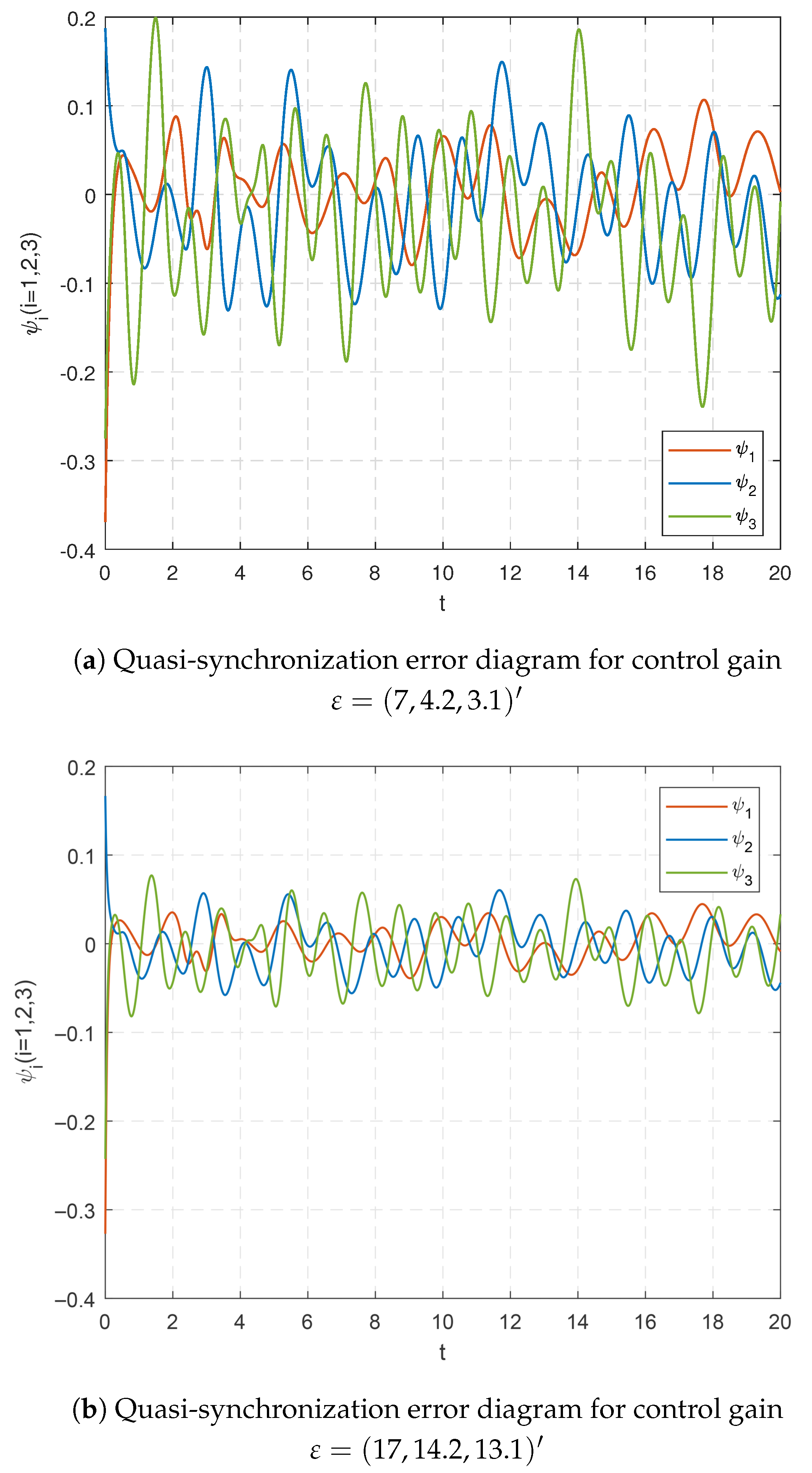
In the proof process, if a larger control parameter ε is selected, the quasi-synchronization error bound will be smaller. This allows the boundary of the quasi-synchronization error to be controlled according to practical standards, which is very important for the nonlinear control of chaotic synchronization.
Remark 2. 
Assumption 2 (Uncertainty Lipschitz): It is supplemented that “In engineering, uncertainties such as parameter perturbations and modeling errors mostly satisfy the local Lipschitz condition [21,22], reflecting the smoothness of system uncertainty with respect to state variations.” Assumption 3 (Parameter Inequality): It is supplemented that “This inequality ensures system dissipativity by balancing feedback gains against the impacts of coupling, delay, and uncertainty. Similar conditions are widely applied in the stability analysis of fractional-order networks [10,34].” Assumption 4 (Bounded Disturbance): It is supplemented that “In practical systems, the amplitudes of external disturbances (e.g., electromagnetic noise) and parameter uncertainties are constrained by hardware limitations [23,24], making the boundedness assumption consistent with engineering realities.”

4. Numerical Example

This section presents integrated numerical examples and comparative simulations to verify the effectiveness of the proposed theorems for fractional-order neural networks with mixed delays, uncertainties, and external disturbances. The prediction correction algorithm is used in the calculation process, and the initial conditions are set in a reasonable range to reflect the dynamic response of the system from different initial states.
Example 1. 
Consider the fractional-order neural network model with mixed delays, uncertainties, and external disturbances. The fractional-order equation is expressed as:
D t ς ı ( t ) = c ı ς ı ( t ) + ȷ = 1 m a ı ȷ ȷ ( ς ȷ ( t ) ) + ȷ = 1 m b ı ȷ ȷ ( ς ȷ ( t σ ) ) + ȷ = 1 m p ı ȷ t σ t ȷ ( ς ȷ ( s ) ) d s + Δ ı ( ς ı ) + d ı δ ı ( t ) , ı = 1 , 2 , , m ,
where ( ς ) = ( tanh ( ς 1 ) , tanh ( ς 2 ) , tanh ( ς 3 ) ) T (the activation function satisfies Lipschitz conditions with K ȷ = 1 , L ı = 1 for ȷ , ı = 1 , 2 , 3 ), = 0.8 , σ = 0.01 , δ ( t ) = ( sin ( t ) , sin ( 2 t ) , sin ( 3 t ) ) T , d = ( 0.1 , 0.2 , 0.3 ) T . The connection weight matrices and diagonal matrix are:
C = 2 0 0 0 2 0 0 0 2 , A = 0.1 0.05 0.05 0.05 0.1 0.05 0.05 0.05 0.1 ,
B = 0.05 0.02 0.02 0.02 0.05 0.02 0.02 0.02 0.05 , P = 0.02 0.01 0.01 0.01 0.02 0.01 0.01 0.01 0.02 .
The uncertainties are Δ 1 ( ς 1 ) = 0.1 sin ( 2 ς 1 ) , Δ 2 ( ς 2 ) = 0.2 sin ( 2 ς 2 ) , Δ 3 ( ς 3 ) = 0.3 sin ( 2 ς 3 ) .
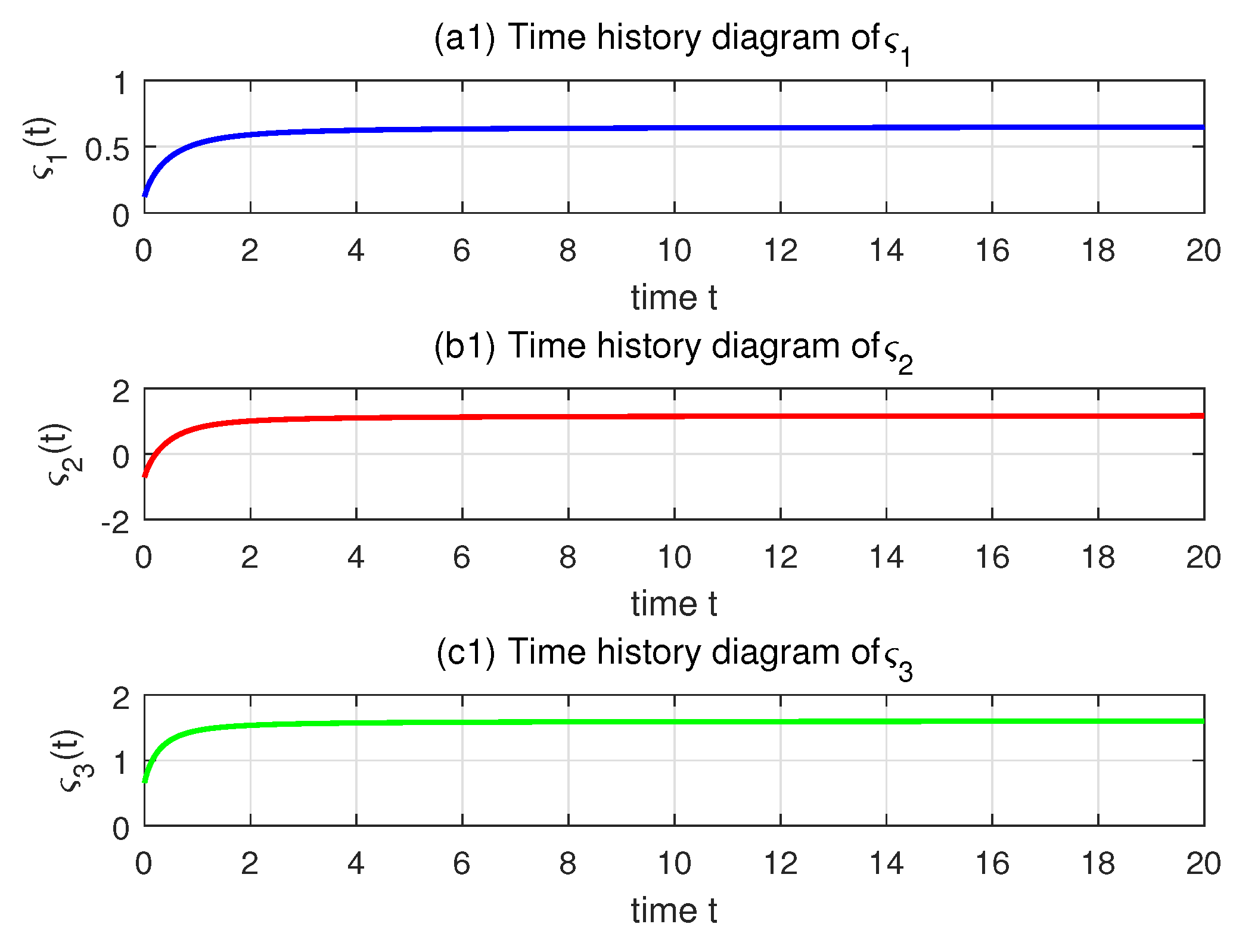
Initial conditions for t [ σ , 0 ] are set as ς 1 ( t ) = 0.8 , ς 2 ( t ) = 0.6 , ς 3 ( t ) = 0.6 . For the case without external disturbances ( d ı = 0 ), the equilibrium point of the system is calculated as ς * = ( 0.6406 , 1.1502 , 1.5923 ) .
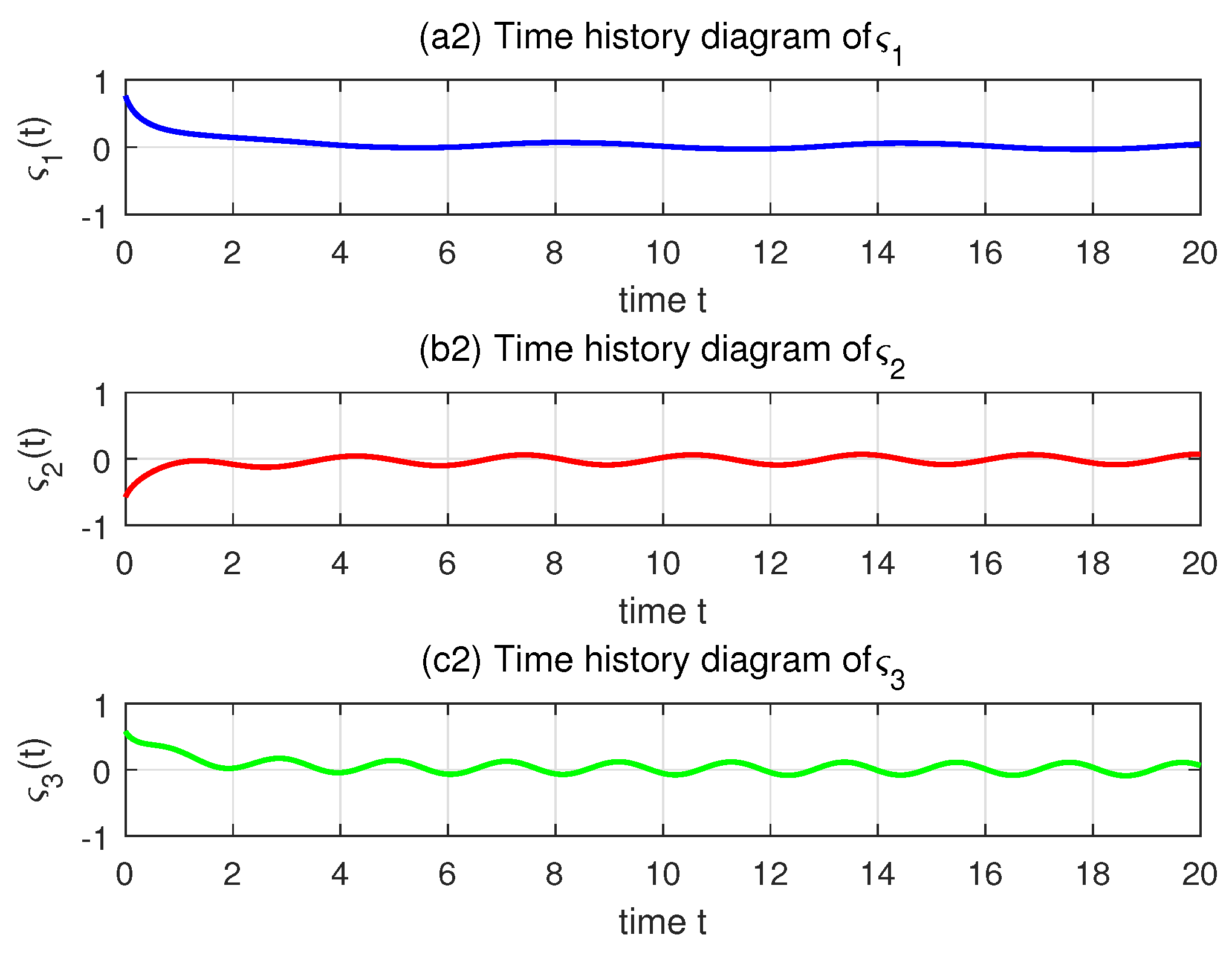
It can be readily confirmed that the above parameters fulfill the requirements of Theorem 1 (stability theorem) and Theorem 4 (disturbance-resistant stability theorem). The convergence time responses of the system with and without external disturbances are shown in Figure 1 and Figure 2, respectively. It can be observed that the system converges to the equilibrium point stably in the absence of disturbances, and maintains bounded convergence with ρ ˜ = ρ λ η = 0.28 under external disturbances, verifying the effectiveness of the stability theorems.
Example 2. 
To verify the quasi-synchronization performance, we consider the drive–response system with a controller. The drive system is:
D t ς ( t ) = C ς ( t ) + A ( ς ( t ) ) + B ( ς ( t σ ) ) + P t σ t ( ς ( s ) ) d s + Δ ( ς , t ) + d u ( t ) + I ,
and the response system with controller J ( t ) is:
D t ϱ ( t ) = C ϱ ( t ) + A ( ϱ ( t ) ) + B ( ϱ ( t σ ) ) + P t σ t ( ϱ ( s ) ) d s + Δ ( ϱ , t ) + d v ( t ) + J ( t ) + I ,
where the controller is:
J ( t ) = ε ψ ( t ) Q ψ ( t σ ) G t σ t ψ ( s ) d s ,
where the controller is designed as J ( t ) = ε ψ ( t ) Q ψ ( t σ ) G t σ t ψ ( s ) d s ( ψ ( t ) = ς ( t ) ϱ ( t ) is the error signal), and the control gains are
Q = 1.2 1 0.6 0.8 0.9 0.6 1.5 0.6 0.6 , G = 1.2 1 1.8 3 1 2 1.8 2 1.2 .
Other parameters: I 1 = I 2 = I 3 = 0 ,
C = 0.2 0 0 0 0.2 0 0 0 0.2 , A = 1.8 1.2 0 1.8 1.7 1.2 1.8 0 1.1 ,
B = 1.2 1 0.6 0.8 0.9 0.6 1.5 0.6 0.6 , P = 1.2 1 1.8 3 1 2 1.8 2 1.2 .
Uncertainties and disturbances for the drive system:
Δ 1 ( ς 1 , t ) = 0.1 sin ( 2 ς 1 ( t ) ) , Δ 2 ( ς 2 , t ) = 0.2 sin ( 2 ς 2 ( t ) ) , Δ 3 ( ς 3 , t ) = 0.3 sin ( 2 ς 3 ( t ) ) ,
and
d 1 u ( t ) = 0.1 sin ( t ) , d 2 u ( t ) = 0.2 sin ( 2 t ) , d 3 u ( t ) = 0.3 sin ( 3 t ) .
For the response system:
Δ 1 ( ϱ 1 , t ) = 0.4 sin 2 ϱ 1 ( t ) , Δ 2 ( ϱ 2 , t ) = 0.5 sin 2 ϱ 2 ( t ) , Δ 3 ( ϱ 3 , t ) = 0.6 sin 2 ϱ 3 ( t ) ,
and
d 1 v ( t ) = 0.4 sin ( 4 t ) , d 2 v ( t ) = 0.5 sin ( 5 t ) , d 3 v ( t ) = 0.6 sin ( 6 t ) .
Initial conditions for t [ 0.01 , 0 ] : ς 1 = 1 , ς 2 = 0.8 , ς 3 = 0.6 ; ϱ 1 = 0.6 , ϱ 2 = 1 , ϱ 3 = 0.3 .
In this paper, three sets of comparative experiments are set up to analyze the influence of , σ , and ε on the synchronization performance.
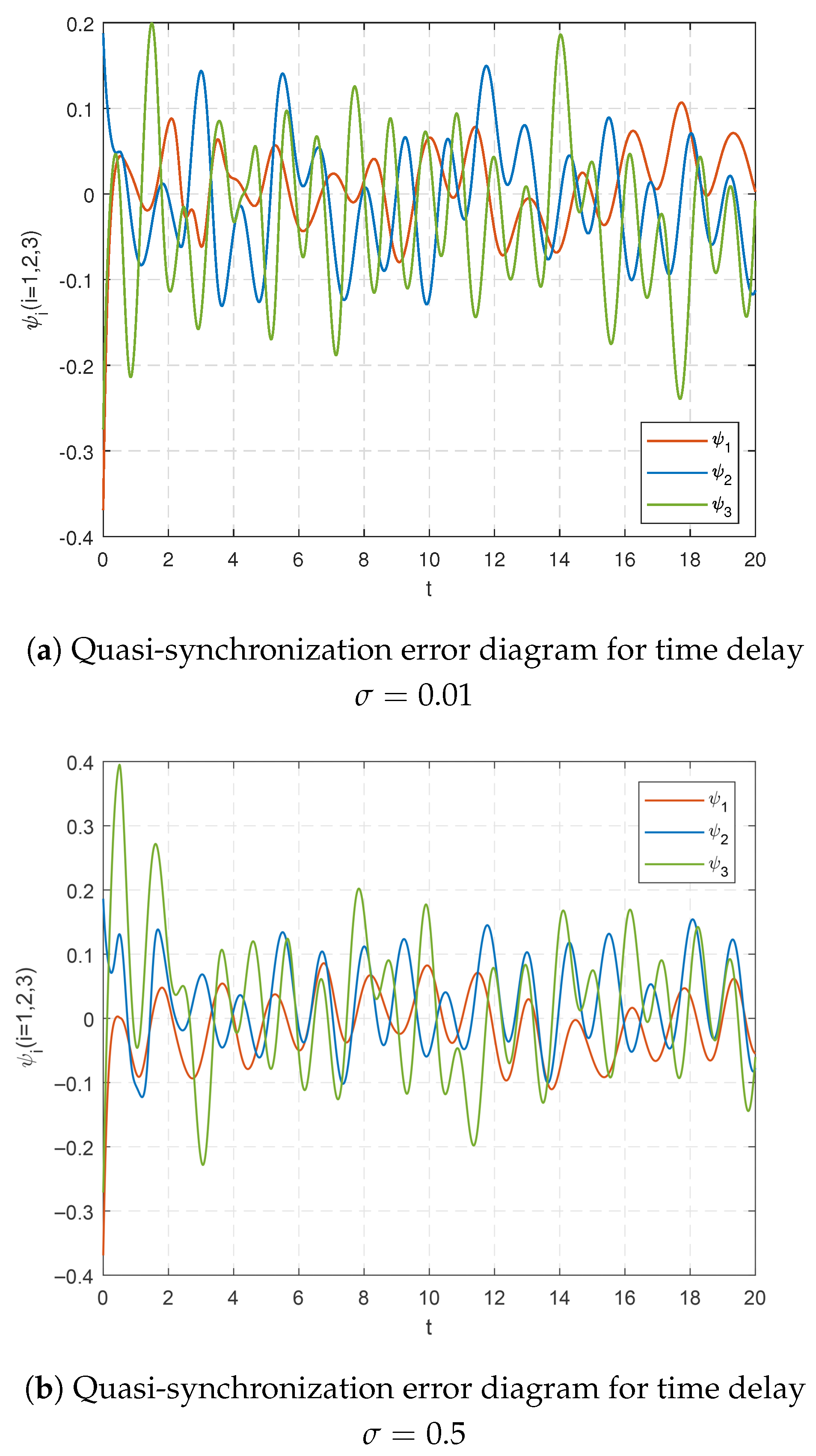
Experiment 1: By fixing the fractional order and control gain, only changing the size of time delay, the effect of time delay σ on the performance of quasi-synchronization is verified. The parameters are shown in Table 1.
The quasi-synchronous results under different time delays σ are shown in Figure 3. When σ = 0.01 , the synchronization error bound is α = 0.2 , as depicted in Figure 3a; when σ = 0.5 , the error bound expands to α = 0.85 , as also shown in Figure 3b. This verifies that an increase in time delay significantly degrades synchronization performance.
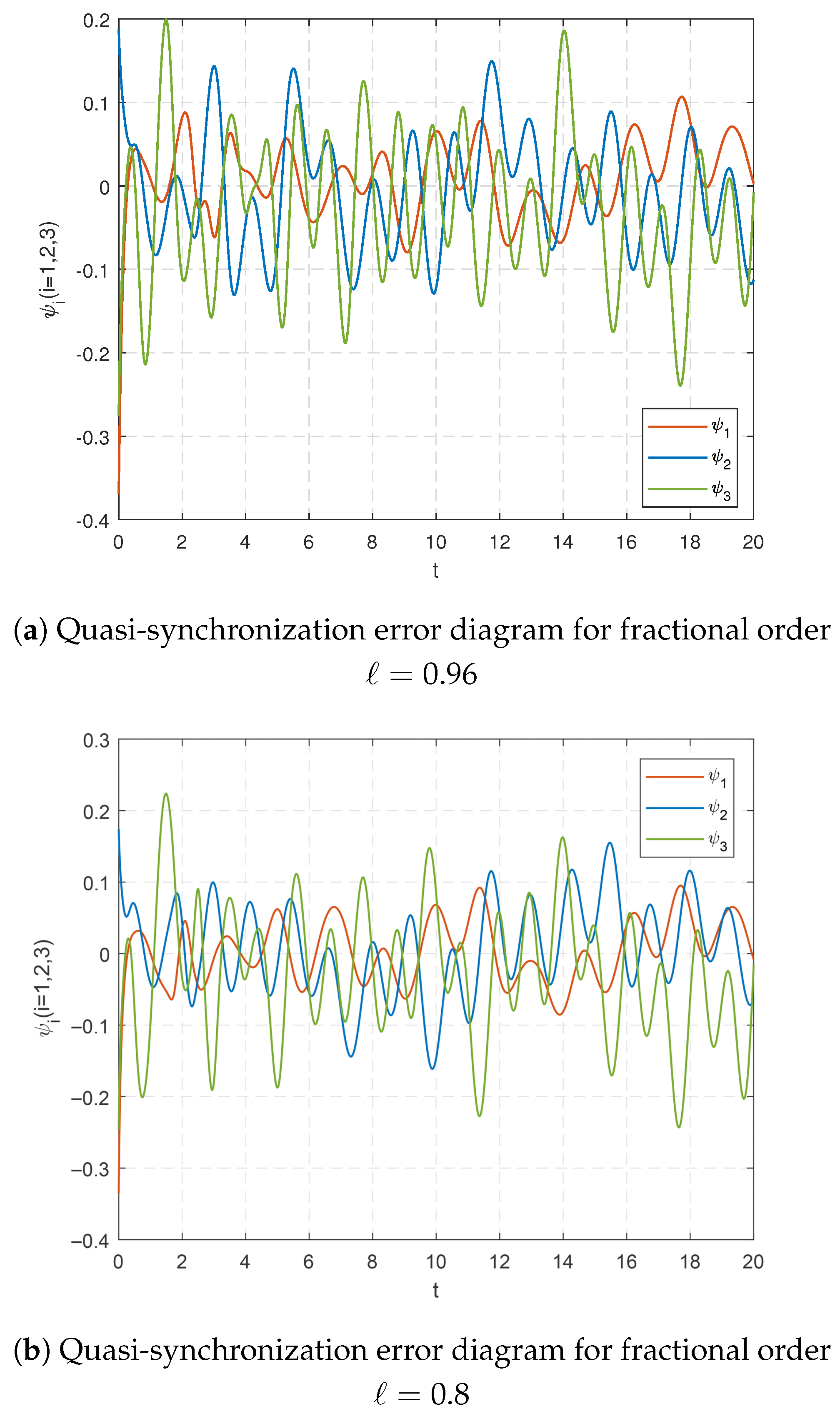
Experiment 2: By fixing the time delay and control gain, adjusting the fractional order, the influence of as the core parameter of fractional order neural network on the stability and error boundary of the system is analyzed. The parameters are shown in Table 2.
The quasi-synchronous results under different fractional-order exponents are shown in Figure 4. When = 0.96 , the synchronization error bound is α = 0.2 , as illustrated in Figure 4a; when = 0.8 , the error bound expands to α = 0.42 , as depicted in Figure 4b. This verifies that the fractional-order exponent is positively correlated with synchronization performance, and the closer the exponent is to 1, the better the synchronization effect.
Experiment 3: By fixing the fractional order and time delay, increasing the control gain, the optimization effect of ε on the synchronization performance is explored. The parameters are shown in Table 3.
The quasi-synchronization results under different control gains ε are shown in Figure 5. When ε = ( 7 , 4.2 , 3.1 ) T , the synchronization error bound is α = 6.31 , as shown in Figure 5a; when ε = ( 17 , 14.2 , 13.1 ) T , the error bound is reduced to α = 0.57 as shown in Figure 5b, which confirms that adjusting the control gain can effectively optimize the synchronization performance, consistent with Remark 1.

5. Conclusions

This study explores the stability and quasi-synchronization of FONNMDUED. The key findings are outlined below.
First, we establish the global asymptotic stability criteria for FONNMDU, and confirm the presence and uniqueness of its equilibrium point. We leverage the contraction mapping theorem and a Lyapunov function to deduce the result, which is then validated through numerical simulations.
Next, we examine the FONNMDUED system. By using Caputo fractional derivative and Lyapunov stability theory, the global uniform stability of the solution is established, and the corresponding stability region is determined. In order to verify the theoretical results, an example is given.
Lastly, we design a controller for the FONNMDUED system to explore the quasi-synchronization issue.Assuming limited uncertainties and external disturbances, we calculate the fractional derivative based on the Lyapunov function to determine the conditions for quasi-synchronization. By increasing the control parameters, we can decrease the error bound. The numerical examples demonstrate the theorem’s efficacy. This research deepens insights into fractional-order neural networks and offers theoretical backing and strategies for implementing quasi-synchronous control in real-world systems.
Future studies could explore time delay estimation and compensation methods to minimize sensitivity to temporal lags. Computational efficiency could also be improved by refining the algorithmic approach. While this paper primarily examines theoretical frameworks and numerical simulations, it lacks experimental validation. Subsequent research should establish a physical testbed for fractional-order neural networks to empirically verify both the theoretical models and control mechanisms, assessing their real-world viability and performance.
To summarize, this work establishes a crucial theoretical and practical foundation for addressing stability and quasi-synchronization in FONNMDUED system, while also outlining potential research directions. As investigations progress, neural networks with fractional dynamics are poised to become increasingly influential across diverse fields, offering robust solutions for controlling and optimizing complex neural network systems.

Author Contributions

Conceptualization, X.-W.T. and Y.W.; methodology, T.-Z.L.; software Q.-K.W.; writing—original draft preparation X.-W.T.; writing—review and editing, Y.W. and T.-Z.L.; Funding acquisition, Y.W. All authors have read and agreed to the published version of the manuscript.

Funding

This work is partly supported by the Talent Research Startup Foundation of Hainan Normal University (Grant No. HSZK-KYQD-202502).

Data Availability Statement

The data will be made available on reasonable request.

Conflicts of Interest

The authors declare that they have no competing interests.

References

  1. Gai, S.; Huang, X. Reduced biquaternion convolutional neural network for color image processing. IEEE Trans. Circuits Syst. Video Technol. 2021, 32, 1061–1075. [Google Scholar] [CrossRef]
  2. Basu, J.K.; Bhattacharyya, D.; Kim, T. Use of artificial neural network in pattern recognition. Int. J. Softw. Eng. Its Appl. 2010, 4, 23–33. [Google Scholar]
  3. Zhang, H.; Zeng, Z. Synchronization of recurrent neural networks with unbounded delays and time-varying coefficients via generalized differential inequalities. Neural Netw. 2021, 143, 161–170. [Google Scholar] [CrossRef] [PubMed]
  4. Kusumoto, D.; Yuasa, S. The application of convolutional neural network to stem cell biology. Inflamm. Regen. 2019, 39, 14. [Google Scholar] [CrossRef] [PubMed]
  5. Monje, C.A.; Chen, Y.Q.; Vinagre, B.M.; Xue, D.Y.; Feliu, V. Fractional-Order Systems and Controls: Fundamentals and Applications; Springer: London, UK, 2010. [Google Scholar]
  6. Li, X.; Song, S. Stabilization of delay systems: Delay-dependent impulsive control. IEEE Trans. Autom. Control 2016, 62, 406–411. [Google Scholar] [CrossRef]
  7. Huang, C.; Li, Z.; Ding, D.; Cao, J. Bifurcation analysis in a delayed fractional neural network involving self-connection. Neurocomputing 2018, 314, 186–197. [Google Scholar] [CrossRef]
  8. Ge, C.; Hua, C.; Guan, X. New delay-dependent stability criteria for neural networks with time-varying delay using delay-decomposition approach. IEEE Trans. Neural Netw. Learn. Syst. 2013, 25, 1378–1383. [Google Scholar]
  9. Li, H.L.; Jiang, H.; Cao, J. Global synchronization of fractional-order quaternion-valued neural networks with leakage and discrete delays. Neurocomputing 2020, 385, 211–219. [Google Scholar] [CrossRef]
  10. Kaslik, E.; Sivasundaram, S. Nonlinear dynamics and chaos in fractional-order neural networks. Neural Netw. 2012, 32, 245–256. [Google Scholar] [CrossRef]
  11. Yu, J.; Hu, C.; Jiang, H.; Fan, X. Projective synchronization for fractional neural networks. Neural Netw. 2014, 49, 87–95. [Google Scholar] [CrossRef]
  12. Chen, S.; Song, Q.; Zhao, Z.; Liu, Y.; Alsaadi, F.E. Global asymptotic stability of fractional-order complex-valued neural networks with probabilistic time-varying delays. Neurocomputing 2021, 450, 311–318. [Google Scholar] [CrossRef]
  13. Yu, J.; Hu, C.; Jiang, H. α-stability and α-synchronization for fractional-order neural networks. Neural Netw. 2012, 35, 82–87. [Google Scholar] [CrossRef] [PubMed]
  14. Xing, X.; Wu, H.; Cao, J. Event-triggered impulsive control for synchronization in finite time of fractional-order reaction-diffusion complex networks. Neurocomputing 2023, 557, 126703. [Google Scholar] [CrossRef]
  15. Zhang, W.; Zhang, H.; Cao, J.; Alsaadi, F.E.; Chen, D. Synchronization in uncertain fractional-order memristive complex-valued neural networks with multiple time delays. Neural Netw. 2019, 110, 186–198. [Google Scholar] [CrossRef] [PubMed]
  16. Li, Q.; Zhou, L. Global asymptotic synchronization of inertial memristive Cohen-Grossberg neural networks with proportional delays. Commun. Nonlinear Sci. Numer. Simul. 2023, 123, 107295. [Google Scholar] [CrossRef]
  17. Song, S.; Song, X.; Balsera, I.T. Mixed H∞ and passive projective synchronization for fractional-order memristor-based neural networks with time delays via adaptive sliding mode control. Mod. Phys. Lett. B 2017, 31, 1750160. [Google Scholar] [CrossRef]
  18. Wang, L.; Li, H.L.; Zhang, L.; Hu, C.; Jiang, H. Quasi-synchronization of fractional-order complex-value neural networks with discontinuous activations. Neurocomputing 2023, 560, 126856. [Google Scholar] [CrossRef]
  19. Zhang, X.L.; Li, H.L.; Yu, Y.; Zhang, L.; Jiang, H. Quasi-projective and complete synchronization of discrete-time fractional-order delayed neural networks. Neural Netw. 2023, 164, 497–507. [Google Scholar] [CrossRef]
  20. Wang, Z.; Zhang, W.; Zhang, H.; Chen, D.; Cao, J.; Abdel-Aty, M. Finite-time quasi-projective synchronization of fractional-order reaction-diffusion delayed neural networks. Inf. Sci. 2025, 686, 121365. [Google Scholar] [CrossRef]
  21. Kwon, O.M.; Park, J.H. Exponential stability of uncertain dynamic systems including state delay. Appl. Math. Lett. 2006, 19, 901–907. [Google Scholar] [CrossRef]
  22. Banu, N.A.; Banupriya, K.; Krishnasamy, R.; Vinodkumar, A. Robust stability of uncertain stochastic switched inertial neural networks with time-varying delay using state-dependent switching law. Math. Methods Appl. Sci. 2023, 46, 13155–13175. [Google Scholar] [CrossRef]
  23. Cai, Z.; Pan, X.; Huang, L.; Huang, J. Finite-time robust synchronization for discontinuous neural networks with mixed-delays and uncertain external perturbations. Neurocomputing 2018, 275, 2624–2634. [Google Scholar] [CrossRef]
  24. Yang, X.; Song, Q.; Liang, J.; He, B. Finite-time synchronization of coupled discontinuous neural networks with mixed delays and nonidentical perturbations. J. Frankl. Inst. 2015, 352, 4382–4406. [Google Scholar] [CrossRef]
  25. Deng, W.; Li, C.; Lü, J. Stability analysis of linear fractional differential system with multiple time delays. Nonlinear Dyn. 2007, 48, 409–416. [Google Scholar] [CrossRef]
  26. Yang, S.; Hu, C.; Yu, J.; Jiang, H. Projective synchronization in finite-time for fully quaternion-valued memristive networks with fractional-order. Chaos Solitons Fractals 2021, 147, 110911. [Google Scholar] [CrossRef]
  27. Qin, X.; Wang, C.; Li, L.; Peng, H.; Yang, Y.; Ye, L. Finite-time modified projective synchronization of memristor-based neural network with multi-links and leakage delay. Chaos Solitons Fractals 2018, 116, 302–315. [Google Scholar] [CrossRef]
  28. Maharajan, C.; Sowmiya, C. Exponential stability of delay dependent neutral-type descriptor neural networks with uncertain parameters. Frankl. Open 2023, 5, 100042. [Google Scholar] [CrossRef]
  29. Ghaffari, V. Robust ultimately boundedness control of uncertain delayed systems under time-varying reference and external disturbance. ISA Trans. 2024, 146, 114–126. [Google Scholar] [CrossRef]
  30. He, J.M.; Pei, L.J. Function matrix projection synchronization for the multi-time delayed fractional order memristor-based neural networks with parameter uncertainty. Appl. Math. Comput. 2023, 454, 128110. [Google Scholar] [CrossRef]
  31. Shang, Y. Consensus of Noisy Multiagent Systems with Markovian Switching Topologies and Time-Varying Delays. Math. Probl. Eng. 2015, 2015, 453072. [Google Scholar] [CrossRef]
  32. Podlubny, I. Fractional Differential Equations; Elsevier: Amsterdam, The Netherlands, 1999. [Google Scholar]
  33. Yu, Y.; Wang, H.; Zhang, S.; Gu, Y. Qualitative Analysis and Control of Fractional Order Neural Networks; Science Press: Christchurch, New Zealand, 2021. [Google Scholar]
  34. Wang, H.; Yu, Y.; Wen, G.; Zhang, S. Stability analysis of fractional-order neural networks with time delay. Neural Process. Lett. 2015, 42, 479–500. [Google Scholar] [CrossRef]
Figure 1. Time response curves of ς ı ( ı = 1 , 2 , 3 ) without external disturbances.
Fractalfract 10 00073 g001
Figure 2. Time response curves of ς ı ( ı = 1 , 2 , 3 ) under external disturbances.
Fractalfract 10 00073 g002
Figure 3. Influence of time delay σ on quasi-synchronization error.
Fractalfract 10 00073 g003
Figure 4. Influence of fractional order on quasi-synchronization error.
Fractalfract 10 00073 g004
Figure 5. The error time history diagrams of System (19) and System (20).
Fractalfract 10 00073 g005
Table 1. Experimental Parameter Settings for the Influence of Time Delay σ on Quasi-Synchronization Performance.
Experiment IDFractional Order Time Delay σ Control Gain ε
1-10.960.01 ( 7 , 4.2 , 3.1 ) T
1-20.960.5 ( 7 , 4.2 , 3.1 ) T
Table 2. Experimental Parameter Settings for the Influence of Fractional Order on Quasi-Synchronization Performance.
Experiment IDFractional Order Time Delay σ Control Gain ε
2-10.960.01 ( 7 , 4.2 , 3.1 ) T
2-20.80.01 ( 7 , 4.2 , 3.1 ) T
Table 3. Experimental Parameter Settings for the Influence of Control Gain ε on Quasi-Synchronization Performance.
Experiment IDFractional Order Time Delay σ Control Gain ε
3-10.960.01 ( 7 , 4.2 , 3.1 ) T
3-20.960.01 ( 17 , 14.2 , 13.1 ) T
Disclaimer/Publisher’s Note: The statements, opinions and data contained in all publications are solely those of the individual author(s) and contributor(s) and not of MDPI and/or the editor(s). MDPI and/or the editor(s) disclaim responsibility for any injury to people or property resulting from any ideas, methods, instructions or products referred to in the content.