Article

The Fractal Timoshenko Beam Equation

by
Helvio Mollinedo
1,
Ernesto Pineda León
2,
David De-León
3,
Andriy Kryvko
1,
Israel Miguel-Andrés
4,
Didier Samayoa
1 and
Lucero Damián-Adame
5,*
1
Departamento de Ingeniería, UPIITA/SEPI-ESIME Zacatenco, Instituto Politécnico Nacional, Unidad Profesional Adolfo López Mateos, Mexico City 07738, Mexico
2
ESIA Zacatenco, Instituto Politécnico Nacional, Unidad Profesional Adolfo López Mateos, Mexico City 07738, Mexico
3
Engineering School, Autonomous University of Mexico State, Cuidad Universitaria, Toluca 50000, Estado de México, Mexico
4
Laboratorio Nacional CONAHCYT en Biomecánica del Cuerpo Humano, CIATEC, León 37545, Guanajuato, Mexico
5
Computational Robotics Department, Universidad Politécnica de Yucatán, Carretera Mérida-Tetiz, Km. 4.5, Ucú 97357, Yucatán, Mexico
*
Author to whom correspondence should be addressed.
Fractal Fract. 2026, 10(1), 65; https://doi.org/10.3390/fractalfract10010065
Submission received: 12 November 2025 / Revised: 14 January 2026 / Accepted: 15 January 2026 / Published: 18 January 2026
(This article belongs to the Special Issue Fractional and Fractal Methods with Their Mechanics Applications)

Abstract

A fractal approach for the Timoshenko beam theory by applying differential vector calculus in a three-dimensional continuum with a fractal metric is developed. First, a summary of the tools needed, mathematical relationships, and background of fractal continuum mechanics is presented. Then, the static and dynamical parts of the Timoshenko beam equation are extended to fractal manifolds. Afterwards, an intrafractal beam constructed as a Cartesian product is suggested and the fractal dimensionalities of the Balankin beam are scrutinized. This allows comparing both intrafractal beams when they have the same Hausdorff dimension but different connectivity. Finally, the effects of fractal attributes on the mechanical properties of the deformable fractal medium are highlighted. Some applications of the developed tools are briefly outlined.

1. Introduction

Many dynamic systems found in nature and in engineering applications exhibit highly nonlinear behavior, characterized by complex dynamics, chaotic responses, and the presence of fractal structures [1]. A widely studied example is the Duffing system, whose nonlinear response can include chaotic attractors with fractal geometries [2,3]. Certain natural phenomena such as seismic wave propagation in heterogeneous rocks or soils may also exhibit fractal patterns in both space and time [4]. Similarly, some composite materials and micro-electromechanical systems (MEMS) have exhibited microstructures with fractal characteristics, which significantly influence their mechanical properties and wave propagation behavior [5,6,7,8].
There is a growing interest in understanding the relationship between fractal parameters of structural elements and their mechanical properties. Several studies have focused on exploring the potential characteristics of these fractal materials in the structural applications, aiming to improve their strength and optimization in weight [9,10,11]. Fractal geometries are present in natural structures such as bone tissue, plant structures, and mineral formations and can be intentionally replicated in engineered materials and composite systems across both macro- and micro-scales [12]. In particular, the analysis of structural vibrations of fractal materials is of great interest to explore how such properties affect the dynamics of classical structural elements.
In the classical theory of bending, the Euler–Bernoulli beam theory is the most widely used model in structural design; however, this model is suitable for most engineering applications where beam lengths are sufficiently long compared to their cross-sectional dimensions [13]. Nevertheless, the Euler–Bernoulli beam model has some drawbacks, since it assumes a rigid cross-section, neglecting rotational inertia and distortion of the cross-section due to shear stresses. This assumption of a rigid cross-section limits its accuracy for modeling high-frequency wave transmission. For this reason, the Euler–Bernoulli model is appropriate for calculating deflections under static loads and with good accuracy for analyzing vibrations at low frequencies. Therefore, it is inaccurate for modeling high frequencies.
Some shortcomings of the Euler–Bernoulli beam are addressed by the Rayleigh beam model, which introduces the effects of rotational inertia by allowing rotation of the cross-section during bending, but still does not consider deformation due to shear stresses on the cross-section. Timoshenko’s beam theory overcomes these limitations by taking into account both effects: rotational inertia and distortion due to shear stresses in the cross section. In the dynamic formulation, the Timoshenko beam considers the shear stiffness and rotational inertia of the cross section, making it much more accurate in the equations of motion at high frequencies [14].
The formulation of the Timoshenko beam theory leads to a system of two partial differential equations, in terms of transverse displacement and the angle of rotation of the cross section. This pair of differential equations can be combined to obtain a fourth-order partial differential equation. Several contributions have been devoted to the solution of the Timoshenko beam, with numerical approaches based mainly on the Finite Element Method (FEM) [15].
However, at very high frequencies the wavelength of the propagating wave is of a reduced order, which requires a greater number of finite elements to be able to capture waves of very short wavelength. Another formulation is an analytical continuous wave-based approach, based on solving the partial differential equation to obtain a closed form of the motion equation [16].
The analysis of free vibration in beams with complex geometrical and mechanical properties has attracted considerable attention in recent years, particularly in the context of advanced materials and multiscale structures [17,18]. Among the various beam theories, the Timoshenko beam model provides an accurate framework for describing the dynamic behavior of moderately thick beams by incorporating both shear deformation and rotary inertia effects.
However, when dealing with materials and structures exhibiting irregular, self-similar characteristics typical of natural and engineered fractal media, classical continuum models become inadequate for capturing their intrinsic scale-dependent behavior. To address this limitation, in this work the concepts of the fractal continuum mechanics suggested in [19,20,21] are used in the structural analysis.
This approach generalizes the classical continuum by embedding the fractal geometry of the material into its differential and integral operators, effectively introducing fractional measures and non-integer dimensional spaces. The resulting fractal continuum mechanics allows for the mechanical fields, such as displacement, strain, and stress, to be formulated consistently within a non-Euclidean metric that accounts for the fractal topology of the material domain.
In this study, the free vibration behavior of a Timoshenko fractal beam is investigated using Balankin’s approach [22]. In previous work only the static part was studied, whereas the present paper included dynamic behavior. Also, we introduced an intrafactal beam constructed as a Cartesian product between a real line and a Sierpinki carpet. The aim is to demonstrate that fractals exist with the same Hausdorff dimension but different topologies and morphologies. It is well known that the Weierstrass function, the Sierpinski folder, and the two-dimensional Cantor set have the same Hausdorff dimension ( log 8 / log 3 ) but different connectivity and branching. For this reason, we analyze two fractal beams with the same Hausdorff dimension but different fractal topologies. The structural response is completely different in both cases, as will be seen in Section 3.
The analysis aims to derive the governing equations of motion incorporating fractal metrics, evaluate their influence on natural frequencies and mode shapes, and elucidate the role of the different fractal dimensions in the dynamic response. This framework provides new insights into the vibration characteristics of beams with fractal geometries, contributing to the broader understanding of dynamic phenomena in complex, scale-dependent structures.
The present work is limited to problems of two-dimensional beams without axial loads, while the dynamic part covers only the behavior of free vibrations.

2. F α -Derivatives on Fractal Continuum Bodies

In this section, some basic tools in F α -calculus are defined for the fractal continuum framework.

2.1. The Fractal Space R F 3

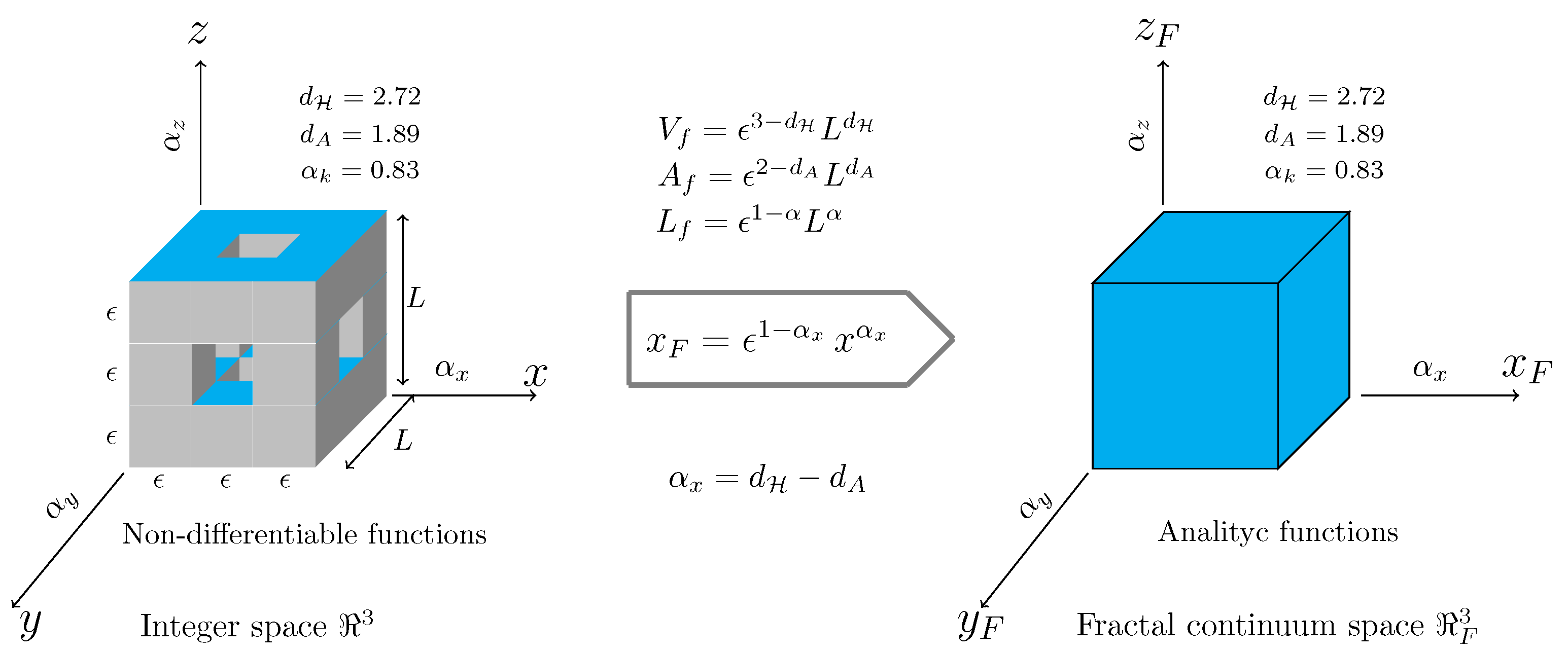
Consider two Euclidean spaces, R 3 with conventional coordinates ( x , y , z ) and R F 3 with fractal coordinates ( x F , y F , z F ) . Both are formally identical (see Figure 1). The first one is where the fractal is located. The second one is the space of the fractal continuum, which is a virtual fractal continuum filled with continuous material [23,24].
It is well known that functions defined in a fractal domain Ω D R 3 are non-differentiable using conventional calculus and its box-counting dimension exceeds its topological dimension, i.e., D > d t . On the other hand, the fractal continuum version of this domain Ω F D R F 3 has box-counting dimension less than its topological dimension, that is, D < d t . This is possible because the density of admissible states in the continuum fractal is scale-dependent [25]. The properties of Ω F D are defined as analytic envelopes of non-analytic functions, which describe the displacements, strain, temperature, density, etc., of the fractal set under study.
It had been proven that main features of a fractal object Ω D are described by several dimensional numbers as topological dimension d t , Hausdorff dimension D, connectivity dimension d , the fractal dimension of the minimum path d m i n and spectral dimension d s , among others.
Fractal geometry is characterized by Hausdorff dimension describing the fractal’s ability to fill the embedding space R 3 and topological dimension [26]. Generally, the box-counting dimension is used to compute the Hausdorff dimension due to the easy implementation of this method in numerical applications [1], which is defined by measurement at scale ϵ as
D = lim ϵ 0 log N ( ϵ ) log ϵ
if limit exists, where N ( ϵ ) is the smallest number of boxes of size ϵ needed to cover the studied domain.
Meanwhile, the topological dimension can be defined in inductive form using its cutting properties as follows: the empty set per definition has the topological dimension d t ( ) = 1 . The topological dimension of the fractal domain is given by
d t ( Ω D ) = d t c u t t + 1
if Ω D can be divided into two parts by excluding at least a d t c u t t -dimensional set of cutting points.
With respect to fractal topology of Ω D , it can be characterized by the connectivity dimension, defined as [27,28]
d = lim 0 log N ( ) log ,
where N ( ) denotes the number of fractal points connected with an arbitrary point inside of the ball of diameter around this point. From definitions of D and d it is possible to obtain ϵ D d [27]. The scale invariance implies that the minimum path between two points on a fractal scales with the Euclidean distance between these points as ϵ d m i n , where d m i n = D / d is the fractal dimension of the minimum path.
In addition, the fractal topology determines dynamical degrees of freedom called spectral dimension, which is defined by the relationship
Λ ω d s 1 ,
where d s represents the spectral dimension that is equal to the number of effective dynamical degrees of freedom on the fractal, Λ ( ω ) is the density of fractal vibration modes with frequency ω on the fractal domain, and the number of effective spatial degrees of freedom is given by n γ = 2 d d s , describing the number of independent directions in which a walker can move without violating any constraint imposed on it.
All these fractal properties are conserved in the fractal continuum Ω F D R F 3 . On the other hand, the fractal space R F 3 can be written in terms of the standard directions given in R 3 with the proportionality factor ϵ 1 α k introduced in [23] as follows:
x F = ϵ 1 α x x α x , y F = ϵ 1 α y y α y , z F = ϵ 1 α z z α z ,
being ϵ the lower cutoff of the fractal Ω D and α k 1 , with k = x , y , z , represents the Hausdorff dimension in each fractional direction of space R F 3 , which is defined as
α k = D d A
where d A is the fractal dimension of the cross-sectional area of Ω D . It can be observed in Equation (5) that when α x = α y = α z = 1 fractal and integer spaces are equal, R F 3 = R 3 .

2.2. Norm, Metric and Measure

In the fractal continuum approach Ω F D R F 3 is equipped with a fractional norm, metric, and measure. In addition, it has a set of rules for integro-differential calculus as well as a proper Laplacian. They are defined as follows [29]:
A = x F 2 γ + y F 2 γ + z F 2 γ 1 / 2 γ , Norm Δ ( A , B ) = Δ x 2 γ + Δ y 2 γ + Δ z 2 γ 1 / 2 γ , Metric V F = ϵ 3 D L D , A F = ϵ 2 d A L y d A , L F = ϵ 1 α L x α , Measure
where γ = d c h / 3 , Δ x = x F a x F b = ϵ 1 α x x a α x x b α x , Δ y = y F a y F b = ϵ 1 α y y a α y y b α y , Δ z = z F a z F b = ϵ 1 α z z a α z z b α z and V F , A F , L F denote the volume, area and length fractal, respectively.
The gradient operator is defined by D = e x x α + e y y α + e z z α being e k the basis vector; the divergence is given as D · F and the curl as D × F . Then the Laplacian operator is obtained by Δ D F = D ( D · F ) .

2.3. F α -Derivatives on Fractal Continuum

Consequently, the F α -derivatives are defined by [30]:
x F α = d f ( x ) d x F = lim x x f ( x ) f ( x ) Δ ( x , x ) = 1 α x x ϵ 1 α x d f ( x ) d x , t F β = d f ( t ) d t F = lim t t f ( t ) f ( t ) Δ ( t , t ) = t τ 1 β d f ( t ) d t ,
where β = d s / n ν [31] is the fractal dimension of time and τ is an adjustment parameter called characteristic time. Equation (8) represents a generalized derivative on fractal manifolds, whose particular case α k = β = 1 collapses with the normal derivative.
We would like to point out that in contrast to mathematical fractals, the real-world materials are pre-fractals, which possess self-similarity only within a bounded range of length scale ϵ < L , where ϵ is the size of building blocks from which the pre-fractal is made (e.g., the minimum pore size), while L is the sample size (length of fractal beam). The fractal continuum approach is applicable only if ϵ L , that is, the pre-fractal has several (at least more than 3) iterations.
Some alternative definitions of fractal derivatives with fractal continua approach can be found in [32,33,34,35].

2.4. Mechanics of Fractal Continuum

The equation of momentum conservation for the elastostatics regime for fractal continuum mechanics is defined as [29]
j α k σ i j + f b i = 0 ,
with σ i j as the stress tensor, f b i denotes the body forces and j α k = α k / x j α k , j , k = 1 , 2 , 3 ; whereas the strain tensor is given in Equation (10) as follows:
ε i j α = 1 2 j α u x F i + i α u x F j = 1 2 1 c 1 ( j ) u x F i x j + 1 c 1 ( i ) u x F j x i ,
where u x k is the fractal displacement and c 1 ( k ) = α k ϵ 1 α k x α k 1 (see [23]). The fractal displacement fields written in Cartesian coordinates are given by
u x F = α x x ϵ α x 1 u x , u y F = α y y ϵ α y 1 u y , u z F = α z z ϵ α z 1 u z .
It can be observed in Equations (9)–(11) that when α k = 1 , the fractal space is identical to the standard space.

3. Fractal Beams

This section is devoted to describing two types of fractal beams. The first one is constructed by the Cartesian product of the Sierpiński carpet and straight line, which is called a product-like beam. The second one is the well-known Balankin beam, constructed with Menger sponge cubes [23,36]. Both beams will be used to check fractal details of structural behavior with the fractal formulation proposed in the next section.

3.1. Cartesian Product-like Beam

The product-like beam denoted as Ω P D is an intrafractal beam with discontinuities along its longitudinal direction. Intrafractal beams have been adopted to describe disordered materials through fractal calculus [37,38].
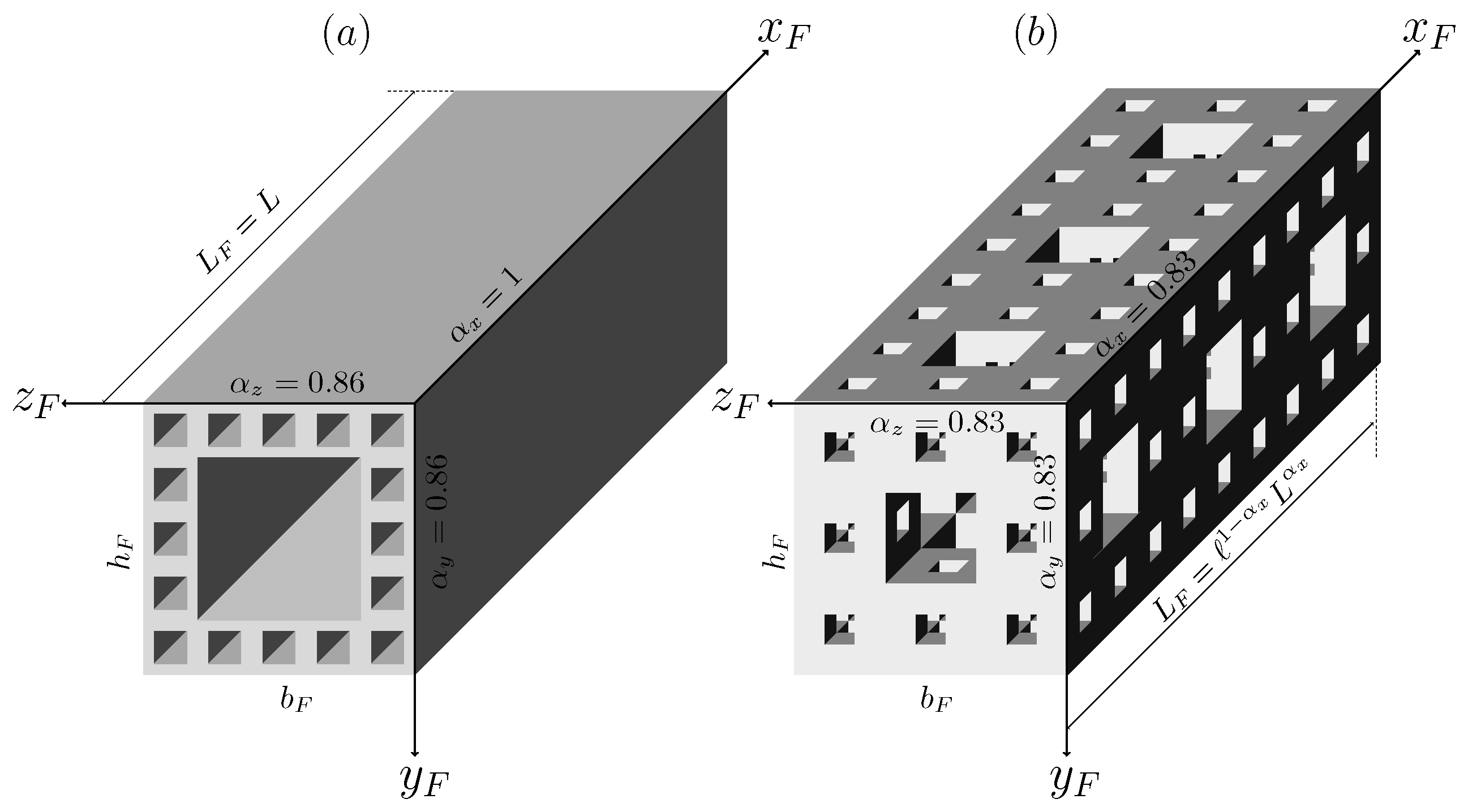
Many models of intrafractal beams can be designed (see Figure 2). Specifically, the product-like beam is constructed as a Cartesian product between the unit interval [ 0 , 1 ] on the real line x and the classical Sierpiński carpet S i D = log 8 / log 3 in the y z -plane, such that Ω P D = [ 0 , 1 ] × S i log 8 / log 3 . Its box-counting dimension is obtained by the sum of box-counting dimensions of the straight line and the Sierpiński carpet as follows [1]: D = 1 + log 8 / log 3 . Note that Sierpiński carpet can be 1 < D 2 . It depends on the number of boxes deleted in its generator (see [39]). Then, box-counting dimension of Ω P D can take values in the range 2 < D 3 . Some dimensional numbers used in the work for the product-like beams are shown in Table 1. Whereas in Figure 2a is presented a product-like beam with D = log 16 / log 5 .

3.2. Balankin Beam

The Balankin beam, represented here as Ω B D , is also an intrafractal beam presenting discontinuities along its longitudinal direction [36,40], which was introduced as a mathematical model in the fractal continuum framework [23] to describe mechanical stress/strain phenomena on self-similar beams.
Ω B D is extracted from the ith iteration of the Menger sponge and is built with n sub-cubes of smaller iteration along the x-axis (see Figure 2a), where all the sub-cubes are pre-fractals having the same box-counting dimension. The fractal length of the Balankin beam is given by L F = ϵ 1 α x L α x . Thus, the box-counting dimension of the Balankin beam is equal to that box-counting dimension of the Menger sponge, and its cross-section area is the Sierpiński’s carpet in the y z -plane. The classical Balankin beam has a fractal dimension D = log 20 / log 3 .
Fractal dimensions of Ω B D are computed with each one of the relationship defined in Section 2 due to self-similarity properties [36]. In Table 1 are given some dimensional numbers of this interfractal beam used in the work.

4. Governing Equation for Timoshenko’s Beams with Fractal Domains on  R ξ 3

It has been shown that R F 3 is formally identical to R 3 , where the operators given in Section 2 deal with the differential vector calculus in a three-dimensional continuum with fractal metric [41]. This makes it possible to write the Timoshenko beam equation in a fractal space-time as follows:
E I F 4 y F ( x F , t F ) x F 4 E I F ρ G k + I F ρ 4 y F ( x F , t F ) x F 2 t F 2 + I F ρ 2 G k 4 y F ( x F , t F ) t F 4 + ρ A F 2 y F ( x F , t F ) t F 2 = q ( x F , t F ) E I F G k A F 2 q ( x F , t F ) x F 2 + I ρ G k A F 2 q ( x F , t F ) t F 2 ,
where y F ( x F , t F ) represents the transverse displacement, q ( x F , t F ) is the load function, I F = b F h F 3 / 12 is the moment of inertia, A F = b F h F is the cross-sectional area with b F = ϵ 1 α z b α z and h F = ϵ 1 α y h α y as the base and the height of the fractal cross-section, meanwhile k is the shear stress correction factor and G and E are the shear and Young modulus, respectively. It is a straightforward matter to see that for a free vibration analysis, q ( x F , t F ) = 0 in the above equation. For a static bending analysis, the temporal terms are neglected.
On the other hand, Equation (12) can be written in terms of R 3 the generalized Timoshenko beam equation for fractal and non-fractal manifolds is expressed by
E I ϵ 4 α x 4 4 y ( x , t ) x 4 α x E I ρ G k + I ρ t τ 1 + 1 2 2 β ϵ 2 α x 2 4 y ( x , t ) x 2 α x t 2 + I ρ 2 G k t τ 1 + 1 4 4 β 4 y ( x , t ) t 4 + ρ [ ϵ 2 2 α y h 2 α y ] t τ 1 + 1 2 2 β 2 y ( x , t ) t 2 = q ( x , t ) E I G k [ ϵ 2 2 α y h 2 α y ] ϵ 2 α x 2 2 q ( x , t ) x 2 α x + I ρ G k [ ϵ 2 2 α y h 2 α y ] t τ 1 + 1 2 2 β 2 q ( x , t ) t 2 ,
where α and β are the fractal parameters that define the fractional order of the equation. In the special case when α = β = 1 , the cross-sectional area reduces to A F = ϵ 2 2 α y h 2 α y = A and the conventional Timoshenko beam equation is recovered.

4.1. Static Part

For the static bending analysis, Equation (13) is reduced to
d 4 y F ( x ) d x 4 α x = ϵ 4 4 α x q ( x ) E I 1 k A F G ϵ 2 2 α x d 2 q ( x ) d x 2 α x ,
as presented by [38]. Here, the transverse displacement y F ( x ) depends not only on the boundary conditions and the applied loads but also on the geometry and fractal topology of the self-similar beams under study.

4.2. Example 1

Consider two fractal beams, both with the same length, cross-sectional area and box-counting dimension, but with different spectral and connectivity dimensions. The first one is a product-like beam, and the second one is a Balankin-type beam, which are shown in Figure 2. Both beams are simply supported with the following boundary conditions:
y F ( x F = 0 ) = M F ( x F = 0 ) = y F ( x F = L F ) = M F ( x F = L F ) = 0 .
Fractal parameters for each self-similar beam are presented in Table 1, which contains the data of porosity for beams of different dimensions but the same number of iterations, e.g., 4. Therefore the length of beams will be different. The relative density of the beam is equal to (see Table 2)
ρ ρ 0 = b ϵ d A 2 , for   product - like   beam ρ ρ 0 = b ϵ D 3 , for   Balankin   beam
where d A is the fractal dimension of the cross-section area of the product-like beam equal to the Hausdorff dimension of the Sierpinski carpet, and D is the Hausdorff dimension of the Menger sponge. Notice that in the case under the study D = d 3. The beam porosity is equal to
p = 1 ρ ρ 0 .
Changing one fractal parameter in a self-similar beam or any fractal set leads to changes in all other fractal parameters, as they are all interrelated (see Section 2).
On the other hand, the mechanical properties of beams are shown in Table 3. From Equation (15), the vertical displacement is obtained as
y F ( x ) = q L 2 ϵ 1 α x x α x 4 ϵ 3 3 α x x 3 α x 48 E I + q ϵ 1 α x x α x 2 k G A for 0 x L / 2 y F ( x ) = q ( L α x x α x ) 48 E I ϵ 3 α x 3 3 L 2 α x 4 L α x x α x ϵ 1 α x + q ϵ 1 α x ( L α x x α x ) 2 k G A for L / 2 x L ,
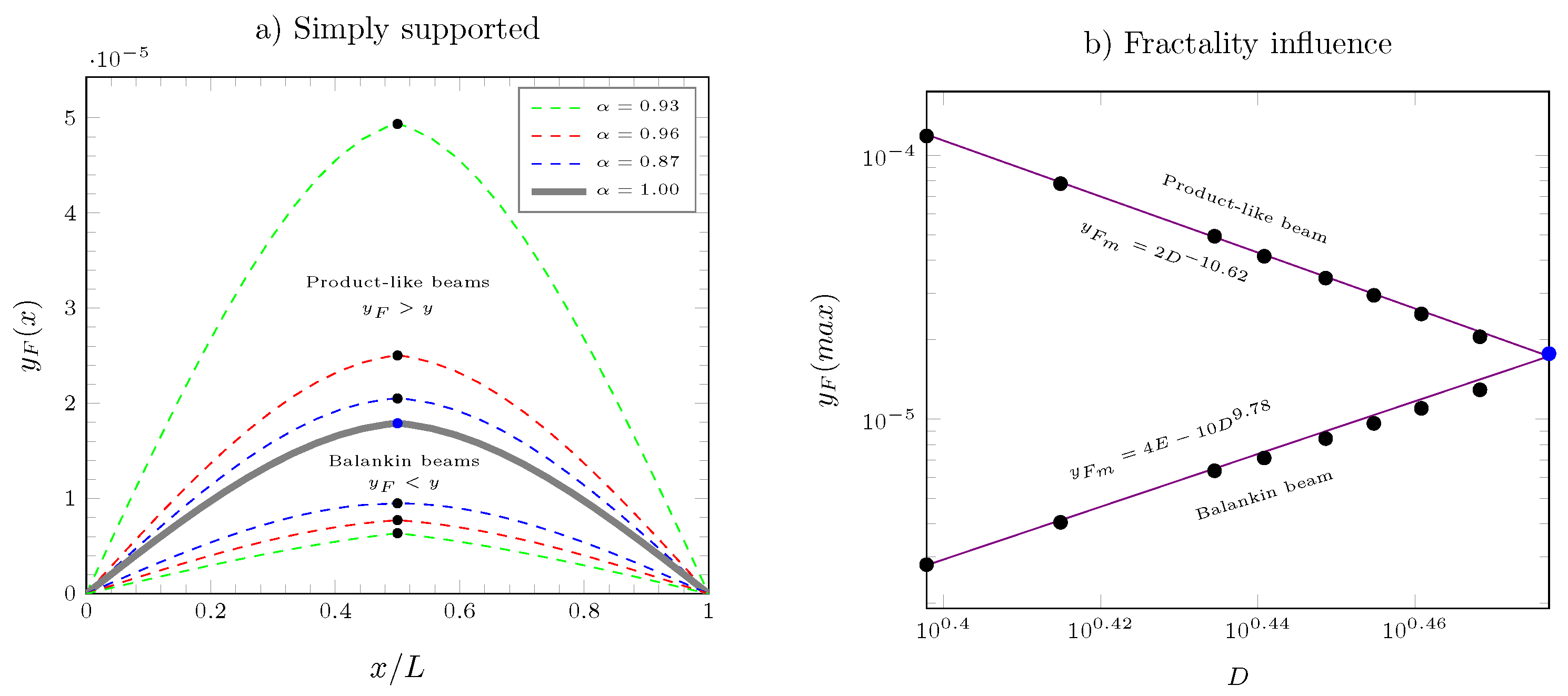
Figure 3 presents the total static response of the vertical fractal displacement. The results show that knowledge of the specific value of the fractal dimension D is not sufficient to characterize the structural behavior of a fractal beam, as suggested in [26].
When both fractal beams have the same D, the vertical displacement is very different, almost opposite, as can be observed in Figure 3a, where the gray curve represents the normal displacement, whereas the dashed curves are the fractal displacements. In a structural element type, Balankin beams, the stiffness is greater than product-like beams.
Specifically, the Balankin beam is stiffer than the normal (non-fractal) beam, whereas a product-like beam is less stiff than the normal beam. The mechanical behavior of vertical displacement y F can be summarized as follows:
if   α x < 1 α x = α y = α z then , d A < 2 y F ( x ) < y ( x ) if   α x = 1 α y = α z < 1 then ,   d A < 2 y F ( x ) > y ( x ) α y = α z = 1 then ,   d A = 2 y F ( x ) = y ( x )
The relationship of static behavior of displacement with respect to the Hausdorff (fractal mass) dimension is characterized by y F ( Ω P D ) D 10.62 for product-like beam, where y F decreases as D increases. In contrast, in the Balankin beam y F increases as D increases with the rate y F ( Ω B D ) D 9.78 . Both curves converge to the normal displacement y F = y when D = 3 (see Figure 3b).

4.3. Dynamical Part: Free Harmonic Vibration

In this work, a free harmonic vibration is studied, and the corresponding fractal mode shapes and natural frequencies are determined.
For the free vibration analysis, q ( x F , t F ) = 0 in Equation (12), such that it can be expressed as follows:
E I 4 y F ( x F , t F ) x F 4 E I ρ G k + I ρ 4 y F ( x F , t F ) x F 2 t F 2 + I ρ 2 G k 4 y F ( x F , t F ) t F 4 + ρ A F 2 y F ( x F , t F ) t F 2 = 0 ,
whose extended form for fractal manifolds can be expressed by applying Equations (5) and (8):
E I ϵ 4 α x 4 4 y ( x , t ) x 4 α x E I ρ G k + I ρ t τ 1 + 1 2 2 β ϵ 2 α x 2 4 y ( x , t ) x 2 α x t 2 + I ρ 2 G k t τ 1 + 1 4 4 β 4 y ( x , t ) t 4 + ρ [ ϵ 2 2 α y h 2 α y ] t τ 1 + 1 2 2 β 2 y ( x , t ) t 2 = 0 ,
the solution can be illustrated with an example of a fractal beam with well-defined boundary conditions.

4.4. Example 2

Consider the same fractal beams as in Example 1 with the same boundary conditions: y F ( 0 , t F ) = y F ( L F , t F ) = 0 and 2 θ ( 0 , t F ) / x F 2 = 2 θ ( L F , t F ) / x F 2 = 0 . It also holds
θ x F = 2 y F x F 2 ρ G k 2 y F t F 2 .
Thus, a harmonic solution can be assumed, which satisfies the boundary conditions
y F ( x F , t F ) = C sin n π x F L F cos ω F n t F .
where C is a constant, ω F n represents the n-th natural frequency in the fractal space, and L F is the length of the fractal beam. From Equation (23) and its derivatives is obtained
E I F n 4 π 4 L F 4 C sin n π x F L F cos ω F n t F E F ρ G k + I F ρ ω F n 2 n 2 π 2 L F 2 C sin n π x F L F cos ω F n t F ρ A F ω F n 2 C sin n π x F L F cos ω F n t F + I F ρ 2 G k ω F n 4 C sin n π x F L F cos ω F n t F = 0 ,
if y F ( x F , t F ) = C sin n π x F L F cos ω F n t F = 0 , the trivial solution is obtained in Equation (24). Then, the frequency equation is obtained by the characteristic polynomial as follows:
I F ρ 2 G k ω F 4 n 2 π 2 L F 2 E I F ρ G k + n 2 π 2 L F 2 I F ρ + ρ A F ω F 2 + E I F n 4 π 4 L F 4 = 0 ,
where the four roots are the fractal natural frequencies.
Equations (23) and (25) can be rewritten in terms of integer space as follows: for the fractal harmonic solution
y F ( x F , t F ) = C sin n π x α x L x α x cos ω F n t F .
and the characteristic polynomial is given by
ϵ 4 4 α y L y 4 α y ρ 2 12 G k ω F 4 n 2 π 2 ϵ 2 2 α x L x 2 E ϵ 4 4 α y L y 4 α y ρ 12 G k + n 2 π 2 ϵ 4 4 α y L y 4 α y ρ 12 ϵ 2 2 α x L x 2 + ρ ϵ 2 d A L y d A ω F 2 + n 4 π 4 E ϵ 4 4 α y L y 4 α y 12 ϵ 4 4 α x L x 4 = 0 ,
whose roots have the following form:
ω F , 1 = Ψ + Φ n 1 2 π 2 ϵ 2 2 α x L x 2 α x + ρ ϵ 2 d A L y d A + Ψ + Φ n 1 2 π 2 ϵ 2 2 α x L x 2 α x + ρ ϵ 2 d A L y d A 2 4 Ψ Φ n 4 π 4 ϵ 4 4 α x L x 4 α x 2 ϵ 4 4 α y L y 4 α y ρ 2 G k ω F , 2 = Ψ + Φ n 2 2 π 2 ϵ 2 2 α x L x 2 α x + ρ ϵ 2 d A L y d A + Ψ + Φ n 2 2 π 2 ϵ 2 2 α x L x 2 α x + ρ ϵ 2 d A L y d A 2 4 Ψ Φ n 4 π 4 ϵ 4 4 α x L x 4 α x 2 ϵ 4 4 α y L y 4 α y ρ 2 G k ω F , 3 = Ψ + Φ n 3 2 π 2 ϵ 2 2 α x L x 2 α x + ρ ϵ 2 d A L y d A Ψ + Φ n 3 2 π 2 ϵ 2 2 α x L x 2 α x + ρ ϵ 2 d A L y d A 2 4 Ψ Φ n 4 π 4 ϵ 4 4 α x L x 4 α x 2 ϵ 4 4 α y L y 4 α y ρ 2 G k ω F , 4 = Ψ + Φ n 4 2 π 2 ϵ 2 2 α x L x 2 α x + ρ ϵ 2 d A L y d A Ψ + Φ n 4 2 π 2 ϵ 2 2 α x L x 2 α x + ρ ϵ 2 d A L y d A 2 4 Ψ Φ n 4 π 4 ϵ 4 4 α x L x 4 α x 2 ϵ 4 4 α y L y 4 α y ρ 2 G k
where n 1 = 1 , n 2 = 2 , n 3 = 3 , n 4 = 4 and Ψ = E ϵ 4 4 α y L y 4 α y ρ / 12 Gk meanwhile Φ = ϵ 4 4 α y L y 4 α y ρ / 12 . Natural frequencies 1 to 4 correspond to the simply supported beam with the considered boundary conditions. As expected, the frequencies are higher for higher modes for both beam types, product-like and Balankin beams.
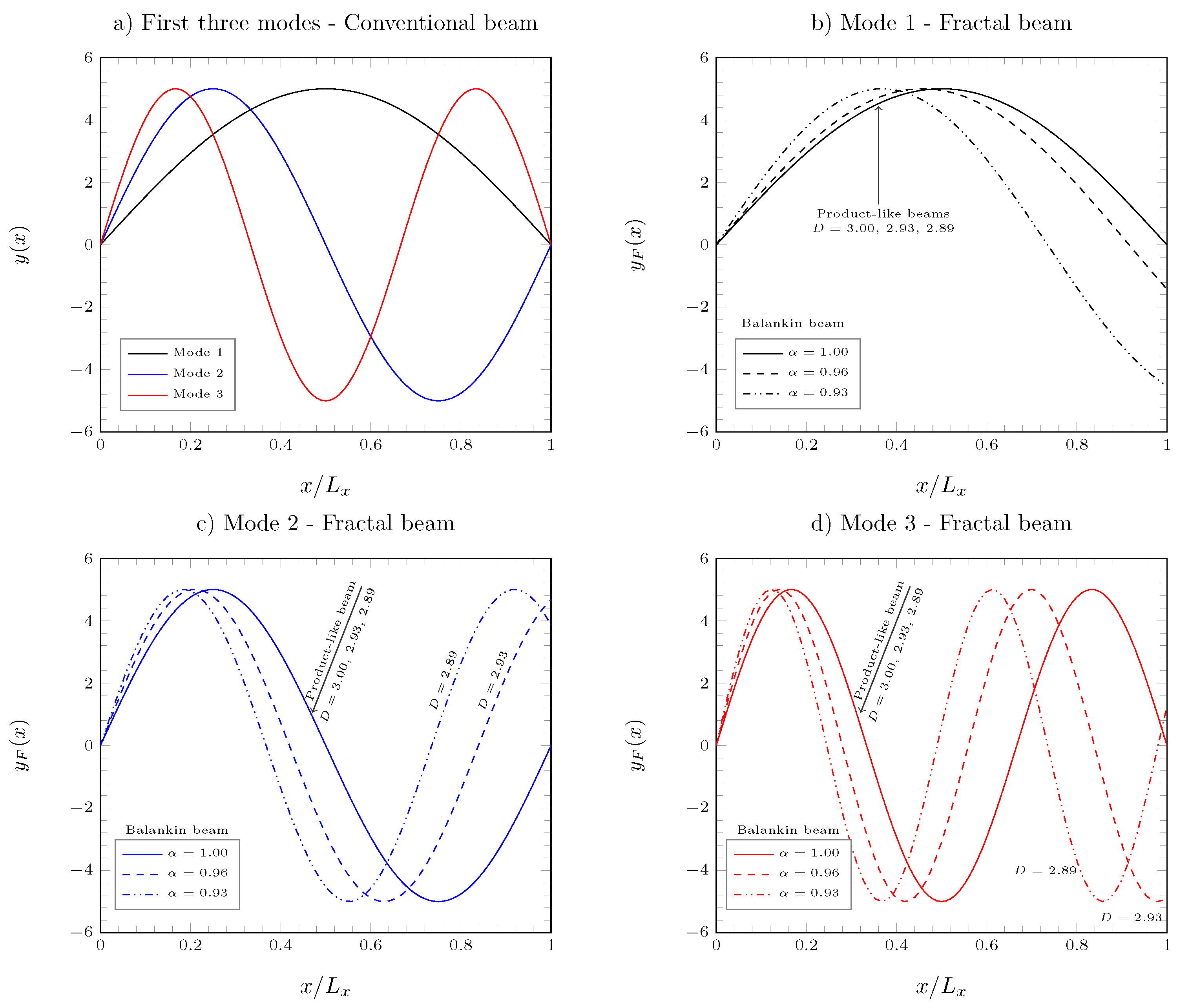
Figure 4 shows shapes of the first three modes for asimply supported fractal beam, and the natural frequencies are presented in Table 4.
For several fractal dimensions, the frequency for the Balankin beam is much higher than the one for the product-like beam, but as the fractal dimension grows, the difference becomes shorter, and for fractal dimension 3, they are the same, as seen in Table 4.

5. Discussions

The aim of this section is to discuss some engineering implications of the phenomenon under study based on the proposed fractal formulation.
The classical bending theory of Timoshenko beams involves, in addition to the bending stiffness term, the addition of the torsional stiffness of the cross section [42]. For industry, and for short-length and high-depth beams, the shear effect is important because this may be the governing failure model. Therefore, and particularly for beams under material degradation or porous conditions, design and maintenance standards need to be developed based on the Timoshenko beam models.
Deflection increases, but its effect is only noticeable in short beams in the static case. The results for fractal beams show that the Balankin beam becomes stiffer as the fractal dimension increases, whereas the product-like beam becomes less stiff as the fractal dimension decreases, contrary to the behavior of Balankin beams. For the dynamic case, the classical theory of the Timoshenko beam does show greater sensitivity to increased stiffness, manifested by a higher natural frequency compared to the Euler–Bernoulli theory [42].
Deflection in beams increases, but this effect is noticed more clearly for static loads and short-span beams. Also, when there are high concentrated loads, the deflection has a higher contribution of the shear effect than the bending effect. From the results developed here for fractal beams, the Balankin beam shows a lower deflection as the fractal dimension parameter increases. However, for product-like beams, the deflection increases as the fractal dimension decreases, contrary to the effect for Balankin-type beams. For dynamic loads the response is characterized mainly by the beam stiffness and frequency of motion. The natural frequency for the Balankin beam reduces as the fractal dimension grows, while in the product-like beam this frequency increases. For the fractal dimension 3, these frequencies converge to the same value. This occurs for the three modes shown in Table 4. Recent technologies like micro electro-mechanical systems or microbeams (with nanoengineering innovations); bridges with hollow and porous sections; composite beams, for example, made out of polymers with carbon fibers or new alloy metals; and products by civionics developments (civil engineering with electronics for health monitoring systems) are some applications that will require design and maintenance standards.
The obtained results emphasize the need for more in-depth studies for the seismic or dynamic forced response of this particular type of beam to explore the basis for optimal design, reinforcement and maintenance of beams that can experience corrosion, or other degradation processes, to prevent their excessive damage or failure and induce an enhanced behavior of either Balankin or product-like beams, according to the beam exposure and loading conditions. Timoshenko beams exhibit greater sensitivity to stiffness due to their higher slenderness and greater shear contribution, compared to Euler–Bernoulli beams, which have a dominant bending contribution. This is reflected in the larger natural frequency of the first ones with respect to the second ones.

6. Conclusions

A generalized formulation of the Timoshenko beam theory was developed using the fractal continuum mechanics approach. The static bending behavior and free vibration analysis of fractal and non-fractal beams were investigated by applying the kinematics of fractal continuum deformations within the fractal continuum framework. The following effects of the fractal parameters on the mechanical properties of self-similar beams were obtained:
1
Equations within the fractal framework were developed to predict the behavior of the Timoshenko beam for both static and free vibration (see Equations (12)–(14)).
2
A comparison between the product-like and Balankin beams under simply supported boundary conditions revealed contrasting behaviors. The Balankin beam exhibited lower static deflections and higher bending stiffness compared to the classical Timoshenko beam, with stiffness decreasing as the box-counting dimension D decreases. In contrast, the product-like beam displayed higher static deflections, and its bending stiffness increased as the box-counting dimension D increased.
3
For the free vibration beam response, the Timoshenko beam has a higher natural frequency as compared to the Euler–Bernoulli beam. This behavior can be explained by the higher stiffness of the first one and that the vibration is more sensitive to increments in the bending stiffness of the Timoshenko beam than in the Euler–Bernoulli beam.
4
The results shown in this work confirm the argument established in previous theoretical research [26], which suggests that the fractal mass (Hausdorff, box counting) dimension is insufficient to understand the physical phenomena occurring in a fractal object. Although both beams share the same fractal dimension, they exhibit different behaviors. Therefore, it is necessary to incorporate connectivity and spectral dimensions to model the mechanical behavior under study in more detail (see Equation (19) and Figure 3 and Figure 4).
5
The obtained results open the way for future studies aimed at identifying practical engineering scenarios in which the use of Timoshenko, product-like, or Balankin beams is most appropriate, particularly in seismic engineering and other industrial applications [43,44,45]. Furthermore, the anisotropy of the material will also be considered.

Author Contributions

Writing—original draft preparation, H.M. and D.S.; writing—review and editing, D.D.-L. and L.D.-A.; conceptualization, E.P.L. and I.M.-A.; methodology, A.K. and D.S.; software, I.M.-A. and L.D.-A.; formal analysis, D.D.-L. and H.M.; visualization, E.P.L.; supervision, D.S. and A.K. All authors have read and agreed to the published version of the manuscript.

Funding

This work was supported by the Instituto Politécnico Nacional under the research SIP-IPN grants Nos. 20250584, 20250854 and 20251086.

Institutional Review Board Statement

Not applicable.

Informed Consent Statement

Not applicable.

Data Availability Statement

The original contributions presented in this study are included in the article. Further inquiries can be directed to the corresponding author.

Conflicts of Interest

The authors declare no conflicts of interest.

Abbreviations

A F Fractal area of cross-secional
bBase of cross-section area
B o Bond number
C a Capillary number
d A Fractal dimension of cross-section area
d H Hausdorff dimension
d Connectivity dimension
d s Specral dimension
d m i n Hausdorff dimension of the minimum path
d t Topological dimension
EYoung modulus
FFractal curve
GShear modulus
Ball diameter
hHeight of cross-section area
IMoment of inertia
LLength of beam
L F Fractal length of beam
kShear correction factor
u k Displacement
V F Fractal volume
M Fractal mass
x F Fractal coordinate x
y F Fractal coordinate y
z F Fractal coordinate z
α k Fractal dimension of fractal coordinate
β k Fractal dimension of time
Λ Density of vibration
ρ Mass density
ω Frequency of vibration
ϵ Ball diameter with respect to the Euclidean metric

References

  1. Falconer, K. Fractal Geometry: Mathematical Foundations and Applications; John Wiley and Sons, Ltd.: Chichester, UK, 2014. [Google Scholar]
  2. Feng, G.Q. Dynamic analysis of coupling continuous and fractal space nonlinear vibrations in duffing system. Phys. Lett. A 2025, 558, 130901. [Google Scholar] [CrossRef]
  3. El-Dib, Y.O.; Elgazery, N.S. An efficient approach to converting the damping fractal models to the traditional system. Commun. Nonlinear Sci. Numer. Simul. 2023, 118, 107036. [Google Scholar] [CrossRef]
  4. Perfect, E. Fractal models for the fragmentation of rocks and soils: A review. Eng. Geol. 1997, 48, 185–198. [Google Scholar] [CrossRef]
  5. Ji, F.Y.; He, C.H.; Zhang, J.J.; He, J.H. A fractal Boussinesq equation for nonlinear transverse vibration of a nanofiber-reinforced concrete pillar. Appl. Math. Model. 2020, 82, 437–448. [Google Scholar] [CrossRef]
  6. Davey, K.; Rasgado, M. Analytical solutions for vibrating fractal composite rods and beams. Appl. Math. Model. 2011, 35, 1194–1209. [Google Scholar] [CrossRef]
  7. Chen, B.; Lu, J.; Chen, L. Numerical investigation of a fractal oscillator arising from the microbeams-based microelectromechanical system. Alex. Eng. J. 2025, 126, 53–59. [Google Scholar] [CrossRef]
  8. Hu, Y.C.; Bai, H.; Wang, W.H. Accessing versatile tensile ductility of amorphous materials by fractal nanoarchitecture design. Acta Mater. 2024, 276, 120100. [Google Scholar] [CrossRef]
  9. Pavón-Domínguez, P.; Portillo-García, G.; Rincón-Casado, A.; Rodríguez-Parada, L. Influence of the Fractal Geometry on the Mechanical Resistance of Cantilever Beams Designed through Topology Optimization. Appl. Sci. 2021, 11, 10554. [Google Scholar] [CrossRef]
  10. Casnedi, L.; Licheri, R.; Brun, M.; Pia, G. From nature geometry to material design: Advanced fractal nature analysis for predicting experimental elastic properties. Ceram. Int. 2020, 46, 23947–23955. [Google Scholar] [CrossRef]
  11. Bogahawaththa, M.; Mohotti, D.; Hazell, P.J.; Wang, H.; Wijesooriya, K.; Lee, C.K. Effect of fractal dimension on mechanical behaviour and energy absorption of Menger sponge-inspired fractal structures. Thin-Walled Struct. 2025, 206, 112704. [Google Scholar] [CrossRef]
  12. Coniglio, A.; De Arcangelis, L.; Herrmann, H. Fractals and multifractals: Applications in physics. Phys. Stat. Mech. Its Appl. 1989, 157, 21–30. [Google Scholar] [CrossRef]
  13. Wang, C.M.; Reddy, J.N.; Lee, K.H. Shear Deformable Beam and Plates; Elsevier: Oxford, UK, 2000. [Google Scholar]
  14. Farahani, A.; Samadzad, M.; Rafiee-Dehkharghani, R. An analytical approach for the analysis of stress wave transmission and reflection in waveguide systems based on Timoshenko beam theory. Wave Motion 2024, 126, 103247. [Google Scholar] [CrossRef]
  15. Zhang, X.; Thompson, D.; Sheng, X. Differences between Euler-Bernoulli and Timoshenko beam formulations for calculating the effects of moving loads on a periodically supported beam. J. Sound Vib. 2020, 481, 115432. [Google Scholar] [CrossRef]
  16. Luo, J.; Zhu, S.; Zhai, W. Exact closed-form solution for free vibration of Euler-Bernoulli and Timoshenko beams with intermediate elastic supports. Int. J. Mech. Sci. 2022, 213, 106842. [Google Scholar] [CrossRef]
  17. Aslam, M.; Park, J.; Lee, J. A comprehensive study on guided wave dispersion in complex structures. Int. J. Mech. Sci. 2024, 269, 109089. [Google Scholar] [CrossRef]
  18. Das, A. Fractal-property correlation of carbon nano-tubes in 3D truss-like network under stress/strain. Mater. Sci. Eng. B 2025, 311, 117771. [Google Scholar] [CrossRef]
  19. Balankin, A.S.; Elizarraraz, B.E. Hydrodynamics of fractal continuum flow. Phys. Rev. E 2012, 85, 025302. [Google Scholar] [CrossRef]
  20. Balankin, A.S.; Elizarraraz, B.E. Map of fluid flow in fractal porous medium into fractal continuum flow. Phys. Rev. E 2012, 85, 056314. [Google Scholar] [CrossRef]
  21. Balankin, A.S. Fractional space approach to studies of physical phenomena on fractals and in confined low-dimensional systems. Chaos Solitons Fractals 2020, 132, 109572. [Google Scholar] [CrossRef]
  22. Balankin, A.S. Stresses and strains in a deformable fractal medium and in its fractal continuum model. Phys. Lett. A 2013, 377, 2535–2541. [Google Scholar] [CrossRef]
  23. Balankin, A.S. A continuum framework for mechanics of fractal materials I: From fractional space to continuum with fractal metric. Eur. Phys. J. B 2015, 88, 90. [Google Scholar] [CrossRef]
  24. Balankin, A.S. A continuum framework for mechanics of fractal materials II: Elastic stress fields ahead of cracks in a fractal medium. Eur. Phys. J. B 2015, 88, 91. [Google Scholar] [CrossRef]
  25. Tarasov, V.E. General Fractional Vector Calculus. Phys. Lett. A 2005, 336, 167–178. [Google Scholar] [CrossRef]
  26. Balankin, A.; Patino, J.; Patino, M. Inherent features of fractal sets and key attributes of fractal models. Fractals 2022, 30, 2250082. [Google Scholar] [CrossRef]
  27. Bounde, A.; Sholomo, H. Fractals in Science; Springer: Berlin/Heidelberg, Germany, 1994. [Google Scholar]
  28. Gouyet, J.F. Physics and Fractal Structures; Springer: Berlin, Germany; Masson, France, 1996. [Google Scholar]
  29. Méndez-Márquez, E.; Reyes de Luna, E.; De León, D.; Carrión-Viramontes, F.J.; Kryvko, A.; Samayoa, D. Free vibration analysis on fractal beams. Eur. J. Mech. A/Solids 2025, 114, 105719. [Google Scholar] [CrossRef]
  30. Balankin, A.; Baltasar, M. Vector differential operators in a fractional dimensional space, on fractals, and in fractal continua. Chaos Solitons Fractals 2023, 168, 113203. [Google Scholar] [CrossRef]
  31. Kryvko, A.; Gutiérrez-Torres, C.d.C.; Jiménez-Bernal, J.A.; Susarrey-Huerta, O.; Reyes de Luna, E.; Samayoa, D. Fractal Continuum Maxwell Creep Model. Axioms 2025, 14, 33. [Google Scholar] [CrossRef]
  32. Chen, W. Time-space fabric underlying anomalous diffusion. Chaos Soliton Fractals 2006, 28, 923–929. [Google Scholar] [CrossRef]
  33. Chen, W.; Sun, H.; Li, X. Fractal and Fractional Calculus. In Fractional Derivative Modeling in Mechanics and Engineering; Springer Nature: Singapore, 2022; pp. 83–114. [Google Scholar] [CrossRef]
  34. Golmankhaneh, A. Fractal Calculus and Its Applications; World Scientific: Singapore, 2022. [Google Scholar]
  35. Tarasov, V.E. General Fractional Vector Calculus. Mathematics 2021, 9, 2816. [Google Scholar] [CrossRef]
  36. Samayoa, D.; Damián, L.; Kriyvko, A. Map of bending problem for self-similar beams into fractal continuum using Euler-Bernoulli principle. Fractal Fract. 2022, 6, 230. [Google Scholar] [CrossRef]
  37. Loong, C.; Dimitrakopoulos, E. The static stability of evolving fractal beams as a dynamical system. Proc. R. Soc. A 2025, 481, 20240918. [Google Scholar] [CrossRef]
  38. Alcántara, A.; Gutiérrez-Torres, C.d.C.; Jiménez-Bernal, J.A.; Barbosa-Saldaña, J.G.; Pascual-Francisco, J.B.; Samayoa, D. A Study of the Fractal Bending Behavior of Timoshenko Beams Using a Fourth-Order Single Equation. Buildings 2025, 15, 2172. [Google Scholar] [CrossRef]
  39. Balankin, A.; Ramirez-Joachim, J.; Gonzalez-Lopez, G.; Gutierrez-Hernandez, S. Formation factors for a class of deterministic models of pre-fractal pore-fracture networks. Chaos Soliton Fractals 2022, 162, 112452. [Google Scholar] [CrossRef]
  40. Samayoa, D.; Kriyvko, A.; Velázquez, G.; Mollinedo, H. Fractal Continuum Calculus of Functions on Euler-Bernoulli Beam. Fractal Fract. 2022, 6, 552. [Google Scholar] [CrossRef]
  41. Balankin, A.S.; Bory-Reyes, J.; Shapiro, M. Towards a physics on fractals: Differential vector calculus in three-dimensional continuum with fractal metric. Phys. A Stat. Mech. Its Appl. 2016, 444, 345–359. [Google Scholar] [CrossRef]
  42. Ochsner, A. Classical Beam Theories of Structural Mechanics; Springer: Cham, Switzerland, 2021. [Google Scholar]
  43. Damian-Adame, L.; Gutiérrez-Tores, C.; Figueroa-Espinoza, B.; Barbosa-Saldaña, J.; Jiménez-Bernal, J. A Mechanical Picture of Fractal Darcy’s Law. Fractal Fract. 2023, 7, 639. [Google Scholar] [CrossRef]
  44. Samayoa, D.; Alvarez-Romero, L.; Jiménez-Bernal, J.A.; Damián Adame, L.; Kryvko, A.; Gutiérrez-Torres, C.d.C. Torricelli’s Law in Fractal Space–Time Continuum. Mathematics 2024, 12, 2044. [Google Scholar] [CrossRef]
  45. Balankin, A.S. Imbibition in fractally permeable media. Phys. Rev. E 2025, 112, 045107. [Google Scholar] [CrossRef] [PubMed]
Figure 1. Geometrical interpretation of fractal continuum space using classical Menger sponge.
Fractalfract 10 00065 g001
Figure 2. Second iteration of two different fractal beams with the same Hausdorff dimension D = 2.72 , but with different topological, spectral and cross-sectional area dimensions: (a) product-like beam, d t = 2 , d s = 2.57 , d A = 1.72 , and (b) Balankin beam d t = 1 , d s = 2.54 , d A = 1.89 .
Fractalfract 10 00065 g002
Figure 3. Behavior of vertical displacement for fractal beams for several fractal dimensions. (a) The dashed lines represent the vertical fractal displacements ( y F ) for the two types of beams studied, the gray line implies the normal (non-fractal) vertical deformation (y) and the black circles indicate the maximum displacements. (b) Trendline of the maximum vertical displacements for both fractal beams.
Fractalfract 10 00065 g003
Figure 4. Shapes of the first three modes for a simply supported beam.
Fractalfract 10 00065 g004
Table 1. Dimensional numbers of intrafractal beams derived from Equations (1)–(4) and (6).
BeamParameter D 2.72 D 2.89 D 2.93 D = 3.00
d A 1.721.891.932.00
d 2.722.892.933.00
d s 2.572.802.883.00
Product-like α x 1.001.001.001.00
α y = α z 0.860.940.961.00
n γ 2.642.982.993.00
β 1.000.890.971.00
d A 1.891.951.972.00
d 2.722.892.933.00
Balankin d s 2.542.812.873.00
α x = α y = α z 0.830.930.961.00
n γ 2.912.972.993.00
β 0.880.940.961.00
Table 2. Physical properties of beams.
ParameterProduct-Like BeamBalankin Beam
Size of beam b × h × L = b × b × L b × b × b N = L ϵ
volume of beam V = b 2 L V = b 3 L ϵ
Material density ρ 0 ρ 0
Miminum pore size ϵ ϵ
Beam mass M = ρ 0 ϵ 3 b ϵ d A L ϵ M = ρ 0 ϵ 3 b ϵ D L ϵ
Beam density ρ = M V = ρ 0 b ϵ d A 2 ρ = M V = ρ 0 b ϵ D 3
Relative density ρ ρ 0 = b ϵ d A 2 ρ ρ 0 = b ϵ D 3
Porosity of the beam p = 1 ρ ρ 0 = 1 b ϵ d A 2 p = 1 ρ ρ 0 = 1 b ϵ D 3
Table 3. Mechanical parameters of intrafractal beams.
ParameterSymbolValueUnits
Young’s modulusE 2.07 × 10 11 N / m 2
Shear modulusG 7.96 × 10 10 N / m 2
Mass density ρ 7850 kg/m 3
Poisson ratio ν 0.3
Base b = L z 0.05 m
Height h = L y 0.05 m
Area A = L z L y 0.0025 m 2
Moment of inertia L z L y 3 / 12 5.2082 × 10 7 m 4
Shear correction factork 5 / 6
Radius of gyrationr 0.0144 m
Length of beam L x 1m
Table 4. Natural frequency (Hz).
ModeFractal DimensionProduct-LikeBalankin
1 2.72 095.45 404.25
1 2.89 106.67 194.06
1 2.93 109.68 155.64
1 3.00 115.94 115.94
2 2.72 378.59 1565.11
2 2.89 422.24 0762.01
2 2.93 433.87 0612.09
2 3.00 458.05 0458.05
3 2.72 0840.30 3353.80
3 2.89 0934.17 1665.58
3 2.93 0959.04 1345.56
3 3.00 1010.50 1010.50
Disclaimer/Publisher’s Note: The statements, opinions and data contained in all publications are solely those of the individual author(s) and contributor(s) and not of MDPI and/or the editor(s). MDPI and/or the editor(s) disclaim responsibility for any injury to people or property resulting from any ideas, methods, instructions or products referred to in the content.