Article

A Generalized Fractional Legendre-Type Differential Equation Involving the Atangana–Baleanu–Caputo Derivative


1
Department of Mathematics and Statistics, College of Science, King Faisal University, Al Ahsa 31982, Saudi Arabia
2
Department of Mathematics, College of Science, Qassim University, Burydah 52571, Saudi Arabia
*
Authors to whom correspondence should be addressed.
Fractal Fract. 2026, 10(1), 54; https://doi.org/10.3390/fractalfract10010054
Submission received: 16 December 2025 / Revised: 9 January 2026 / Accepted: 11 January 2026 / Published: 13 January 2026

Abstract

This paper introduces a fractional generalization of the classical Legendre differential equation based on the Atangana–Baleanu–Caputo (ABC) derivative. A novel fractional Legendre-type operator is rigorously defined within a functional framework of continuously differentiable functions with absolutely continuous derivatives. The associated initial value problem is reformulated as an equivalent Volterra integral equation, and existence and uniqueness of classical solutions are established via the Banach fixed-point theorem, supported by a proved Lipschitz estimate for the ABC derivative. A constructive solution representation is obtained through a Volterra–Neumann series, explicitly revealing the role of Mittag–Leffler functions. We prove that the fractional solutions converge uniformly to the classical Legendre polynomials as the fractional order approaches unity, with a quantitative convergence rate of order O ( 1 α ) under mild regularity assumptions on the Volterra kernel. A fully reproducible quadrature-based numerical scheme is developed, with explicit kernel formulas and implementation algorithms provided in appendices. Numerical experiments for the quadratic Legendre mode confirm the theoretical convergence and illustrate the smooth interpolation between fractional and classical regimes. An application to time-fractional diffusion in spherical coordinates demonstrates that the operator arises naturally in physical models, providing a mathematically consistent tool for extending classical angular analysis to fractional settings with memory.

1. Introduction

The Legendre differential equation, a singular Sturm–Liouville problem of profound importance in mathematical physics, is expressed as
( 1 x 2 ) d 2 y d x 2 2 x d y d x + ν ( ν + 1 ) y = 0 , x ( 1 , 1 ) ,
where ν is a constant parameter. Its polynomial solutions, the Legendre polynomials P n ( x ) when n Z + , constitute a complete orthogonal system on [ 1 , 1 ] [1]. These polynomials are fundamental in solving Laplace’s equation in spherical coordinates, leading to widespread applications in electrostatics [2], quantum mechanics [3], geodesy [4], and numerical analysis, where they serve as basis functions in spectral methods [5]. The profound utility of these classical functions naturally motivates their generalization within modern mathematical frameworks.
Fractional calculus, the branch of mathematics dealing with derivatives and integrals of arbitrary real or complex order, has emerged as a powerful tool for modeling complex systems with memory and hereditary properties [6,7,8]. Unlike integer-order derivatives that capture local behavior, fractional operators possess non-local kernels, making them exceptionally suitable for describing phenomena in viscoelasticity [9], bioengineering [10], control theory [11], and particularly, anomalous diffusion processes where particle motion deviates from Fick’s law [12]. The Riemann–Liouville (RL) and Caputo definitions, grounded on the singular power-law kernel t α , have historically dominated the field [13,14]. However, the singularity of these kernels at the endpoint can introduce challenges in modeling certain physical processes and in achieving closed-form solutions [15].
To overcome these limitations, a new generation of fractional operators with non-singular kernels was introduced. The pioneering work of Caputo and Fabrizio [16] proposed a derivative with an exponential kernel, eliminating the singularity. This was subsequently generalized by Atangana and Baleanu, who formulated derivatives in both the Riemann–Liouville and Caputo senses (ABR and ABC) using the Mittag–Leffler function as a non-singular, non-local kernel. The Atangana–Baleanu–Caputo (ABC) derivative, in particular, has garnered significant attention because it seamlessly interpolates between exponential and power-law decay, capturing a wider range of memory effects [17]. The mathematical properties, including Lipschitz conditions, Laplace transforms, and numerical schemes for these operators, have been extensively studied [18,19,20,21]. Their application has revitalized the modeling of dynamical systems across disciplines, from thermal science [22] and fluid mechanics [23] to epidemiology [24,25].
Concurrently, there has been a sustained research effort to fractionalize classical orthogonal polynomials and their governing equations. The objective is to construct new families of functions that can serve as basis sets for solving fractional differential equations (FDEs) via spectral methods. Various approaches have been employed as follows: some define fractional polynomials directly through Rodriguez-type formulas with fractional integrals [26], others via generating functions with fractional parameters [27], or as solutions to fractional eigenvalue problems. This has led to the study of fractional-order Legendre [28], Bernoulli [29], Laguerre [30], Chebyshev [31], and Jacobi polynomials [32]. Recent works have explored their operational matrices and applications in solving FDEs [33,34].
Despite this considerable progress, a significant and foundational gap persists in the literature. The prevailing trend focuses on defining the fractional polynomial functions themselves, often in an ad hoc manner, rather than systematically deriving them as solutions to a well-posed fractional generalization of the original classical differential equation. For instance, a true fractional Legendre equation should reduce term-by-term to the classical form in Equation (1) when the fractional order α 1 . This lack of a structurally consistent fractional differential equation undermines the mathematical rigor and natural motivation that underpin the classical theory. It also limits the physical interpretability of the resulting fractional polynomials. Recent investigations into fractional Sturm–Liouville problems have begun to address this foundational issue [35,36,37], but a dedicated study for the Legendre case, particularly one employing modern smooth-kernel operators, remains conspicuously absent.
The primary objective of this paper is to bridge this critical gap by introducing, analyzing, and solving a novel fractional Legendre-type differential equation formulated with the Atangana–Baleanu–Caputo derivative. Our work is motivated by the need for a mathematically sound and physically consistent model that honors the structure of the original classical problem. The main contributions of this research are multifaceted and are outlined as follows:
  • We propose a new fractional Legendre-type operator, L A B C α [ y ] ( x ) , which provides a natural and consistent generalization of the classical Legendre operator by incorporating the ABC derivative.
  • We establish sufficient conditions for the existence and uniqueness of solutions to the resulting fractional Legendre-type equation L A B C α [ y ] ( x ) = 0 using the Banach fixed point theorem, ensuring the well posedness of our formulation.
  • We derive a series representation of the solution by employing the Laplace transform technique, explicitly revealing the role of the Mittag–Leffler function and providing an analytical handle on the solution.
  • We provide a rigorous convergence analysis, proving that the fractional solution converges uniformly to the classical Legendre polynomial P n ( x ) as the fractional order α approaches 1, thereby validating our model as a true generalization.
  • We support our theoretical findings with a numerical example that visually demonstrates this convergence, offering practical validation of the proposed framework.
This article is structured as follows: Section 1 (Introduction) provides the background and motivation. Section 2 reviews the essential definitions and properties of the ABC derivative and the classical Legendre polynomials. Section 3 presents the formal definition of our new fractional operator and the associated differential equation. Section 4 is dedicated to establishing the existence and uniqueness of solutions. The solution representation is derived in Section 5, followed by the convergence analysis in Section 6. A numerical simulation is presented in Section 7, and an applied example of fractional diffusion in spherical coordinates is detailed in Section 8. The paper concludes with a discussion and future research directions in Section 9.

2. Preliminaries

This section presents the basic definitions and properties of the Atangana–Baleanu fractional operators in the Caputo sense (ABC), together with the classical facts about Legendre polynomials required in the subsequent analysis.
Definition 1
(Atangana–Baleanu–Caputo derivative [17]). Let 0 < α < 1 and let y H 1 ( a , b ) . The Atangana–Baleanu fractional derivative of y ( t ) in the Caputo sense is defined by
D t α a A B C y ( t ) = B ( α ) 1 α a t y ( τ ) E α α 1 α ( t τ ) α d τ ,
where B ( α ) is a normalization function satisfying B ( 0 ) = B ( 1 ) = 1 , and
E α ( z ) = k = 0 z k Γ ( α k + 1 )
is the one-parameter Mittag–Leffler function.
Lemma 1
(Laplace transform [17,20]). For 0 < α < 1 and y sufficiently smooth, the Laplace transform of the ABC derivative with lower limit 0 is
L D t α 0 A B C y ( t ) ( s ) = B ( α ) s α ( 1 α ) s α + α Y ( s ) y ( 0 ) s ,
where Y ( s ) = L { y ( t ) } ( s ) .
Definition 2
(AB fractional integral [17]). The fractional integral associated with the ABC derivative is defined by
I t α a A B y ( t ) = 1 α B ( α ) y ( t ) + α B ( α ) Γ ( α ) a t ( t τ ) α 1 y ( τ ) d τ .
Lemma 2
(Fundamental theorem of ABC calculus [18]). If y H 1 ( a , b ) , then for all t ( a , b ) ,
I t α a A B D t α a A B C y ( t ) = y ( t ) y ( a ) .
Definition 3
(Legendre polynomials [1]). For n N , the Legendre polynomials P n ( x ) are defined as the solutions of the classical Legendre differential equation
( 1 x 2 ) y ( x ) 2 x y ( x ) + n ( n + 1 ) y ( x ) = 0 , x ( 1 , 1 ) .
They form a complete orthogonal system on [ 1 , 1 ] with respect to the weight w ( x ) = 1 , satisfying
1 1 P m ( x ) P n ( x ) d x = 2 2 n + 1 δ m n .
They admit the Rodrigues formula
P n ( x ) = 1 2 n n ! d n d x n x 2 1 n .
The results in this section will be used in the formulation and analysis of the fractional Legendre-type operator introduced in the next section.

3. The New Fractional Operator and Equation

In this section, we introduce a novel fractional generalization of the classical Legendre operator using the Atangana–Baleanu–Caputo derivative. We then formulate the associated fractional differential equation and establish consistency with the classical Legendre equation. Finally, we derive an equivalent Volterra-type integral formulation that will be used in subsequent analysis.

3.1. Definition of the Fractional Legendre-Type Operator

To construct a meaningful fractional counterpart of the classical Legendre operator
L [ y ] ( x ) = ( 1 x 2 ) y ( x ) 2 x y ( x ) + n ( n + 1 ) y ( x ) ,
we replace each classical derivative with the ABC fractional derivative acting on the corresponding lower-order expression. This avoids artificial “fractionalization” and preserves the structural geometry of the Legendre operator.
Definition 4.
Let 0 < α < 1 , n N , and let y H 1 ( 1 , 1 ) . The fractional Legendre-type operator L A B C α is defined by
L A B C α [ y ] ( x ) = ( 1 x 2 ) D x α A B C [ y ] ( x ) 2 x D x α A B C [ y ] ( x ) + λ ( α , n ) y ( x ) ,
where
  • D x α A B C is the Atangana–Baleanu–Caputo derivative with respect to x,
  • λ ( α , n ) is a generalized eigenvalue parameter satisfying
    λ ( α , n ) α 1 n ( n + 1 ) ,
  • The operator is well defined for y H 1 ( 1 , 1 ) because the ABC derivative requires only first-order classical differentiability.
Remark 1.
The operator (7) reduces to the classical Legendre operator as α 1 , preserves the symmetry of the interval ( 1 , 1 ) , and incorporates a non-singular memory kernel, making it suitable for physical models with fading memory.

3.2. Fractional Legendre-Type Differential Equation

Definition 5.
A fractional Legendre-type differential equation is defined as
L A B C α [ y ] ( x ) = 0 , x ( 1 , 1 ) ,
together with initial conditions
y ( 0 ) = a 0 , y ( 0 ) = a 1 ,
for prescribed constants a 0 , a 1 R .
Definition 6
(Classical Solution). Let 0 < α < 1 and let h ( 0 , 1 ) . A function y : [ 0 , h ] R is called a classical solution to the fractional Legendre-type initial value problem (8)–(9) if
1. 
y C 1 [ 0 , h ] and its first derivative y is absolutely continuous on [ 0 , h ] ;
2. 
The identity L A B C α [ y ] ( x ) = 0 holds for almost every x [ 0 , h ] , where the Atangana–Baleanu–Caputo derivatives are understood in the sense of Definition 1;
3. 
The initial conditions y ( 0 ) = a 0 and y ( 0 ) = a 1 are satisfied.
Remark 2.
Although the classical Legendre problem is typically set as a boundary value problem on [ 1 , 1 ] , the fractional ABC derivative is most naturally treated via an initial value formulation. Our choice avoids compatibility issues associated with fractional Sturm–Liouville formulations and ensures a unique solution in the forthcoming contraction analysis.
Remark 3.
Under Definition 6, y is absolutely continuous on [ 0 , h ] , and hence y L 1 [ 0 , h ] . Consequently, the ABC derivative D x α A B C [ y ] is well defined and continuous. No additional regularity beyond C 1 with absolutely continuous derivative is required for the operator L A B C α to be meaningful.

3.3. Consistency with the Classical Case

The following theorem confirms that our definition yields a genuine fractional generalization of the classical Legendre operator.
Theorem 1
(Reduction to the Classical Legendre Operator). Let y C 2 ( 1 , 1 ) . Then,
lim α 1 L A B C α [ y ] ( x ) = L [ y ] ( x ) = ( 1 x 2 ) y ( x ) 2 x y ( x ) + n ( n + 1 ) y ( x ) .
Proof. 
From the definition of the ABC derivative (see Section 2), for any z ( x ) C 1 , we have the pointwise convergence
lim α 1 D x α A B C [ z ] ( x ) = z ( x ) ,
because the Mittag–Leffler kernel collapses to a Dirac delta at the lower limit of integration.
Applying this to z = y and z = y , we obtain
lim α 1 D x α A B C [ y ] ( x ) = y ( x ) , lim α 1 D x α A B C [ y ] ( x ) = y ( x ) .
Substituting these limits into (7) produces
lim α 1 L A B C α [ y ] ( x ) = ( 1 x 2 ) y ( x ) 2 x y ( x ) + lim α 1 λ ( α , n ) y ( x ) .
By assumption,
λ ( α , n ) α 1 n ( n + 1 ) ,
and the claim follows.    □
Remark 4.
This limiting behavior ensures that solutions of the fractional Legendre equation approximate solutions of the classical equation as the memory parameter α 1 , validating our construction as a legitimate fractional extension.

3.4. Integral Formulation

To establish existence and uniqueness, we now derive an equivalent Volterra integral equation.
Lemma 3
(Equivalent Integral Formulation). Let 0 < α < 1 and h ( 0 , 1 ) . Assume y is a classical solution (in the sense of Definition 6) of the fractional Legendre-type Equation (8) on [ 0 , h ] with initial conditions (9). Then, y satisfies the Volterra integral equation
y ( x ) = a 0 + a 1 x + I x α A B 2 x 1 x 2 D x α A B C [ y ] ( x ) λ ( α , n ) 1 x 2 y ( x ) , x [ 0 , h ] .
Proof. 
Starting from L A B C α [ y ] ( x ) = 0 , we rewrite
D x α A B C [ y ] ( x ) = 2 x 1 x 2 D x α A B C [ y ] ( x ) λ ( α , n ) 1 x 2 y ( x ) .
Apply the AB fractional integral I x α A B to both sides. By the fundamental theorem of ABC calculus (Lemma 2), we obtain
I x α A B D x α A B C [ y ] ( x ) = y ( x ) y ( 0 ) = y ( x ) a 1 .
Thus,
y ( x ) a 1 = I x α A B 2 x 1 x 2 D x α A B C [ y ] ( x ) λ ( α , n ) 1 x 2 y ( x ) .
Integrate both sides with respect to x from 0 to x:
y ( x ) y ( 0 ) = a 1 x + 0 x I ξ α A B 2 ξ 1 ξ 2 D ξ α A B C [ y ] ( ξ ) λ ( α , n ) 1 ξ 2 y ( ξ ) d ξ .
Using y ( 0 ) = a 0 , we arrive at (10).    □
Remark 5.
The integral formulation (10) is of Volterra type, which is essential for the contraction mapping approach used in Section 4. Potential issues arising from the weak singularities at x = ± 1 are avoided by working on the compact interval [ 0 , h ] ( 0 , 1 ) .

4. Existence and Uniqueness of Solutions

In this section, we establish local existence and uniqueness of solutions to the fractional Legendre-type differential equation using the Banach fixed point theorem. The proof is based on the equivalent Volterra-type integral formulation obtained in Lemma 7 and a suitable choice of Banach space.

4.1. Function Space and Operator Formulation

In this section, we reformulate the fractional Legendre-type initial value problem (8)–(9) as an equivalent Volterra-type integral equation and establish an appropriate functional-analytic framework for the existence and uniqueness analysis.
Let 0 < α < 1 and fix h ( 0 , 1 ) . We work on the interval [ 0 , h ] , as introduced in Definition 6. Define the Banach space
X : = C 1 [ 0 , h ] , · C 1 ,
endowed with the norm
y C 1 : = y + y , y : = sup x [ 0 , h ] | y ( x ) | .
The choice of C 1 regularity is natural because the operator L A B C α involves the ABC derivative of y , which requires control of the first derivative.
For a given y X , define the auxiliary function
g y ( x ) : = 2 x 1 x 2 D x α A B C [ y ] ( x ) λ ( α , n ) 1 x 2 y ( x ) , x [ 0 , h ] .
By Lemma 3, any classical solution of the fractional Legendre-type problem must satisfy the Volterra integral equation
y ( x ) = a 0 + a 1 x + 0 x I ξ α A B g y ( ξ ) d ξ , x [ 0 , h ] .
This motivates the definition of the following fixed-point operator.
Definition 7
(Mild Solution). A function y X is called a mild solution of the fractional Legendre-type initial value problem (8)–(9) on [ 0 , h ] if it is a fixed point of the operator T : X X defined by
( T y ) ( x ) : = a 0 + a 1 x + 0 x I ξ α A B g y ( ξ ) d ξ , x [ 0 , h ] .
Lemma 4
(Well Posedness of T). The operator T defined in (7) maps X into X; that is, T y C 1 [ 0 , h ] whenever y C 1 [ 0 , h ] .
Proof. 
Let y X . Since y C 1 [ 0 , h ] and y is continuous, the ABC derivatives D x α A B C [ y ] ( x ) and D x α A B C [ y ] ( x ) exist and are continuous (see, e.g., [18,19]). The coefficient x 2 x 1 x 2 is smooth on [ 0 , h ] ( 0 , 1 ) . Consequently, g y defined in (12) is continuous on [ 0 , h ] .
The AB fractional integral of a continuous function is continuous; more precisely,
I ξ α A B g y ( ξ ) = 1 α B ( α ) g y ( ξ ) + α B ( α ) Γ ( α ) 0 ξ ( ξ τ ) α 1 g y ( τ ) d τ
is continuous in ξ . Hence, the integral in (14) defines a continuously differentiable function of x (its derivative being I x α A B ( g y ( x ) ) ). Therefore, T y C 1 [ 0 , h ] , i.e., T : X X .    □
Remark 6
(Equivalence of Solutions). By Lemma 3, a function y X is a classical solution in the sense of Definition 6 if and only if it satisfies the integral Equation (14), which is precisely the condition T y = y . Hence, the concepts of classical solution and mild solution are equivalent for this problem. Consequently, proving the existence of a unique mild solution for T establishes the existence of a unique classical solution.

4.2. Main Existence and Uniqueness Theorem

We now establish that the operator T defined in (7) is a contraction on X for a sufficiently small interval [ 0 , h ] . The proof relies on two essential estimates: a Lipschitz property for the ABC derivative and a boundedness property for the AB fractional integral.
Lemma 5
(Lipschitz property of the ABC derivative). Let 0 < α < 1 and h > 0 . For any y , z C 1 [ 0 , h ] ,
A B C D x α [ y ] A B C D x α [ z ] L ( α , h ) y z C 1 ,
where L ( α , h ) = B ( α ) h 1 α .
Proof. 
From Definition 7,
| A B C D x α [ y ] ( x ) A B C D x α [ z ] ( x ) | = B ( α ) 1 α 0 x y ( τ ) z ( τ ) E α α 1 α ( x τ ) α d τ B ( α ) 1 α 0 x | y ( τ ) z ( τ ) | E α α 1 α ( x τ ) α d τ .
Since | E α ( t α ) | 1 for all t 0 , we have
| D x α A B C [ y ] ( x ) A B C D x α [ z ] ( x ) | B ( α ) 1 α 0 x | y ( τ ) z ( τ ) | d τ B ( α ) 1 α x y z .
Taking the supremum over x [ 0 , h ] yields
D x α A B C [ y ] A B C D x α [ z ] B ( α ) h 1 α y z B ( α ) h 1 α y z C 1 ,
which is precisely (15) with L ( α , h ) = B ( α ) h 1 α .    □
Lemma 6
(Boundedness of the AB integral). Let w C [ 0 , h ] . Then, for all x [ 0 , h ] ,
I x α A B w ( x ) Q ( α , h ) w ,
where Q ( α , h ) = 1 α B ( α ) + h α B ( α ) Γ ( α ) .
Proof. 
From Definition 2,
I x α A B w ( x ) 1 α B ( α ) | w ( x ) | + α B ( α ) Γ ( α ) 0 x ( x τ ) α 1 | w ( τ ) | d τ 1 α B ( α ) w + α B ( α ) Γ ( α ) w 0 x ( x τ ) α 1 d τ = w 1 α B ( α ) + α B ( α ) Γ ( α ) · x α α w 1 α B ( α ) + h α B ( α ) Γ ( α ) .
   □
With these lemmas, we can now prove the main contraction result.
Theorem 2
(Local existence and uniqueness). Let 0 < α < 1 , n N , and a 0 , a 1 R . Assume that the fractional order and eigenvalue parameter satisfy
1 α B ( α ) | λ ( α , n ) | < 1 .
Then, there exists h 0 > 0 such that for every h ( 0 , h 0 ] , the operator T defined in (7) is a contraction on X = C 1 [ 0 , h ] . Consequently, the fractional Legendre-type initial value problem (8)–(9) admits a unique mild solution y C 1 [ 0 , h ] , which is also the unique classical solution on [ 0 , h ] in the sense of Definition 6.
Proof. 
Let y , z X . From the definition of T,
( T y ) ( x ) ( T z ) ( x ) = 0 x I ξ α A B ( g y ( ξ ) ) I ξ α A B ( g z ( ξ ) ) d ξ .
Hence,
| ( T y ) ( x ) ( T z ) ( x ) | 0 x I ξ α A B g y ( ξ ) g z ( ξ ) d ξ .
We first estimate g y g z . From (12),
g y ( x ) g z ( x ) = 2 x 1 x 2 D x α A B C [ y ] ( x ) A B C D x α [ z ] ( x ) λ ( α , n ) 1 x 2 y ( x ) z ( x ) .
Using the bounds 2 | x | 1 x 2 2 h 1 h 2 and 1 1 x 2 1 1 h 2 for x [ 0 , h ] , we obtain
| g y ( x ) g z ( x ) | 2 h 1 h 2 D x α A B C [ y ] ( x ) A B C D x α [ z ] ( x ) + | λ ( α , n ) | 1 h 2 | y ( x ) z ( x ) | .
Applying Lemma 5 to the first term and noting that | y ( x ) z ( x ) | y z C 1 , we receive
| g y ( x ) g z ( x ) | 2 h L ( α , h ) 1 h 2 y z C 1 + | λ ( α , n ) | 1 h 2 y z C 1 = M ( h ) y z C 1 ,
where
M ( h ) : = 2 h L ( α , h ) + | λ ( α , n ) | 1 h 2 .
Now, by Lemma 6,
I ξ α A B g y ( ξ ) g z ( ξ ) Q ( α , h ) g y g z Q ( α , h ) M ( h ) y z C 1 .
Substituting this estimate into (15) produces
| ( T y ) ( x ) ( T z ) ( x ) | 0 x Q ( α , h ) M ( h ) y z C 1 d ξ h Q ( α , h ) M ( h ) y z C 1 .
To estimate the C 1 -norm, we also need a bound for the derivative. Differentiating (14) yields
( T y ) ( x ) = a 1 + I x α A B ( g y ( x ) ) .
Consequently,
| ( T y ) ( x ) ( T z ) ( x ) | = I x α A B g y ( x ) g z ( x ) Q ( α , h ) M ( h ) y z C 1 .
Combining the two estimates, we obtain
T y T z C 1 K ( h ) y z C 1 ,
where
K ( h ) : = h + 1 Q ( α , h ) M ( h ) .
Recall that L ( α , h ) = B ( α ) h 1 α , so M ( h ) = 2 B ( α ) h 2 / ( 1 α ) + | λ ( α , n ) | 1 h 2 . As h 0 + , we have M ( h ) | λ ( α , n ) | and Q ( α , h ) 1 α B ( α ) ; hence
lim h 0 + K ( h ) = 1 α B ( α ) | λ ( α , n ) | .
By assumption (16), this limit is strictly less than 1. Since K ( h ) depends continuously on h, there exists h 0 > 0 such that K ( h ) < 1 for all h ( 0 , h 0 ] .
Therefore, for such h, the operator T is a contraction on X. By the Banach fixed point theorem, T admits a unique fixed point y X , which is the unique mild solution of the problem. In view of Remark 6, this function is also the unique classical solution on [ 0 , h ] in the sense of Definition 6.
   □
We emphasize that this result guarantees a unique local solution on [ 0 , h ] for sufficiently small h. Global existence on ( 1 , 1 ) remains an open question.

5. Solution Representation via Volterra Series

In this section, we derive a representation of the unique local solution of the fractional Legendre-type problem (10)–(11) in terms of a convergent Volterra series. The construction is based on the integral formulation of Lemma 3 and the explicit kernels associated with the ABC derivative and the AB fractional integral. This yields a systematic expansion that highlights the role of Mittag–Leffler functions in the underlying memory kernel.

5.1. Volterra Integral Formulation Revisited

Recall from Lemma 3 that any classical solution y C 1 [ 0 , h ] (in the sense of Definition 6) satisfies the integral equation
y ( x ) = a 0 + a 1 x + I x α A B 2 x 1 x 2 D x α A B C [ y ] ( x ) λ ( α , n ) 1 x 2 y ( x ) , x [ 0 , h ] .
Using the definition of the AB integral, we can rewrite (17) as
y ( x ) = a 0 + a 1 x + 1 α B ( α ) 2 x 1 x 2 D x α A B C [ y ] ( x ) λ ( α , n ) 1 x 2 y ( x ) + α B ( α ) Γ ( α ) 0 x ( x τ ) α 1 2 τ 1 τ 2 D τ α A B C [ y ] ( τ ) λ ( α , n ) 1 τ 2 y ( τ ) d τ .
Moreover, the ABC derivative admits the integral representation
D x α A B C [ y ] ( x ) = B ( α ) 1 α 0 x y ( σ ) E α α 1 α ( x σ ) α d σ .
Substituting this representation into the right-hand side of (17) yields an expression that can be viewed as a linear Volterra integral operator acting on y after eliminating y through integration by parts.
For convenience, we rewrite (17) in the abstract form
y ( x ) = ϕ ( x ) + 0 x K ( x , τ ; α ) y ( τ ) d τ , x [ 0 , h ] ,
where ϕ ( x ) : = a 0 + a 1 x and the kernel K is an explicit function involving the weights 2 x 1 x 2 , λ ( α , n ) 1 x 2 , the power kernel ( x τ ) α 1 , and the Mittag–Leffler function appearing in the ABC derivative. Its exact closed form can be written directly by substituting the integral representation of D α A B C into (17).
The kernel K inherits continuity from the continuity of the Mittag–Leffler function E α and the boundedness of the coefficients 2 x 1 x 2 and λ ( α , n ) 1 x 2 on the compact triangle { ( x , τ ) : 0 τ x h < 1 } . Consequently, on this domain, K is continuous and bounded. All statements are understood locally on [ 0 , h ] , where the coefficients remain bounded.

5.2. Neumann Series Representation

Equation (19) is a linear Volterra integral equation of the second kind. Under the hypotheses of Theorem 2, the associated integral operator K : X X defined by
( K y ) ( x ) : = 0 x K ( x , τ ; α ) y ( τ ) d τ ,
where X = C 1 [ 0 , h ] as introduced in Section 4.1, is a contraction for sufficiently small h > 0 . Indeed, since the affine part ϕ ( x ) = a 0 + a 1 x is fixed, the contraction property of T = ϕ + K established in Theorem 2 directly implies that K itself is a contraction on X. In particular, the resolvent equation
y = ϕ + K y
admits a unique solution that can be written as a Neumann series.
Theorem 3
(Volterra/Neumann series representation). Let 0 < α < 1 , n N , and assume the hypotheses of Theorem 2 hold. Then, for h > 0 sufficiently small, the unique classical solution y C 1 [ 0 , h ] of the fractional Legendre-type problem (8)–(9) admits the representation
y ( x ) = m = 0 y m ( x ) , x [ 0 , h ] ,
where
y 0 ( x ) = ϕ ( x ) = a 0 + a 1 x , y m + 1 ( x ) = 0 x K ( x , τ ; α ) y m ( τ ) d τ , m 0 .
The series (20) converges uniformly in C 1 [ 0 , h ] .
Proof. 
Define the integral operator K : X X as above. Then, (19) can be written as
y = ϕ + K y .
By Theorem 2, for h sufficiently small, the operator K is a contraction on ( X , · C 1 ) ; in particular, there exists a constant q ( 0 , 1 ) such that
K y K z C 1 q y z C 1 for all y , z X .
Consider the sequence { y m } m 0 defined by
y 0 = ϕ , y m + 1 = K y m , m 0 .
The partial sums
S N ( x ) : = m = 0 N y m ( x )
satisfy
S N ( x ) = ϕ ( x ) + m = 0 N 1 K y m ( x ) = ϕ ( x ) + K S N 1 ( x ) .
Standard Neumann series arguments for contractions (see, e.g., [19]) imply that { S N } is a Cauchy sequence in X, and hence converges uniformly to some y X . Passing to the limit in
S N = ϕ + K S N 1
and using the continuity of K , we obtain
y = ϕ + K y .
Thus, y is the unique fixed point of the contraction ϕ + K ( · ) . The representation (20) and the uniform convergence in C 1 [ 0 , h ] follow.    □
Remark 7.
The kernel K ( x , τ ; α ) inherits the non-local memory structure of the ABC derivative and explicitly involves the Mittag–Leffler function E α ( · ) . Consequently, the terms y m ( x ) in (21) are expressed through iterated convolutions of Mittag–Leffler-type kernels, providing an explicit Mittag–Leffler-based representation of the solution. This representation is suitable for numerical approximation via truncation of the series, which will be explored in Section 7.
Remark 8.
As α 1 , the ABC derivative converges to the classical derivative and the ABC/AB kernels converge to their classical counterparts. In this limit, the Volterra Equation (19) reduces to the classical Volterra formulation of the Legendre problem, and the Neumann series (20) converges to the corresponding classical series representation for the Legendre solution, in agreement with Theorem 1.

6. Convergence Analysis as α 1

In this section, we show that the solution of the fractional Legendre-type equation converges uniformly to the classical Legendre solution as the fractional order α approaches 1 from below. This result validates the proposed fractional formulation as a genuine extension of the classical Legendre problem.

6.1. Setting and Assumptions

For each 0 < α < 1 , let y α denote the unique classical solution on [ 0 , h ] of the fractional Legendre-type initial value problem
L ABC α [ y α ] ( x ) = 0 , x [ 0 , h ] , y α ( 0 ) = a 0 , y α ( 0 ) = a 1 ,
whose existence and uniqueness in the space C 1 [ 0 , h ] have been established in Theorem 2.
By Theorem 1, the family of operators L ABC α converges pointwise to the classical Legendre operator
L [ y ] ( x ) = ( 1 x 2 ) y ( x ) 2 x y ( x ) + n ( n + 1 ) y ( x )
as α 1 . Let y 1 denote the unique classical solution (on the same interval [ 0 , h ] ) of the corresponding classical initial value problem
L [ y 1 ] ( x ) = 0 , x [ 0 , h ] , y 1 ( 0 ) = a 0 , y 1 ( 0 ) = a 1 .
In particular, if the initial data are chosen to match the values of a classical Legendre polynomial, i.e., a 0 = P n ( 0 ) and a 1 = P n ( 0 ) , then y 1 coincides on [ 0 , h ] with the restriction of P n .
Both y α and y 1 admit Volterra integral representations. For 0 < α < 1 , Lemma 3 and the analysis of Section 5 produce
y α ( x ) = ϕ ( x ) + 0 x K α ( x , τ ) y α ( τ ) d τ , x [ 0 , h ] ,
where ϕ ( x ) = a 0 + a 1 x , and we denote K α ( x , τ ) : = K ( x , τ ; α ) with K as in (19). For α = 1 , the ABC and AB operators converge to the classical derivative and integral, yielding the limiting classical Volterra equation
y 1 ( x ) = ϕ ( x ) + 0 x K 1 ( x , τ ) y 1 ( τ ) d τ , x [ 0 , h ] .
While the pointwise convergence of operators suggests a relationship between y α and y 1 , a rigorous convergence analysis is most naturally conducted at the level of the integral Equations (24) and (25). To this end, we introduce the following hypothesis on the kernel family { K α } , which captures the asymptotic behavior of the ABC/AB kernels as α 1 and is consistent with known stability estimates [17,20].
Assumption 1
(Kernel convergence). The kernels { K α } 0 < α 1 satisfy
1. 
For each α ( 0 , 1 ] , K α is continuous on the triangle Δ h : = { ( x , τ ) : 0 τ x h } .
2. 
K α ( x , τ ) K 1 ( x , τ ) uniformly on Δ h as α 1 .
3. 
There exists a constant C K > 0 (possibly depending on h but independent of α) such that
sup ( x , τ ) Δ h | K α ( x , τ ) K 1 ( x , τ ) | C K ( 1 α )
for all α sufficiently close to 1.
Condition (iii) is a quantitative strengthening of (ii) that will allow us to obtain an explicit convergence rate for the solutions.

6.2. Uniform Convergence of Solutions

We now prove that the family { y α } converges uniformly to the classical solution y 1 on [ 0 , h ] as α 1 , and obtain an explicit convergence rate under the assumptions stated in the previous subsection.
Theorem 4
(Uniform convergence as α 1 ). Let 0 < α < 1 and let y α C 1 [ 0 , h ] be the unique classical solution of (22). Let y 1 C 1 [ 0 , h ] be the unique classical solution of (23). Suppose Assumption 1 holds, and that the contraction constant in Theorem 2 can be chosen independently of α for α sufficiently close to 1. Then, there exists a constant C > 0 , independent of α, such that
y α y 1 C [ 0 , h ] C ( 1 α ) for α sufficiently close to 1 .
In particular, y α y 1 uniformly on [ 0 , h ] as α 1 .
Proof. 
Subtracting (25) from (24) yields, for any x [ 0 , h ] ,
y α ( x ) y 1 ( x ) = 0 x K α ( x , τ ) y α ( τ ) y 1 ( τ ) d τ + 0 x K α ( x , τ ) K 1 ( x , τ ) y 1 ( τ ) d τ .
Taking the supremum norm over [ 0 , h ] and applying standard Volterra operator estimates produces
y α y 1 C [ 0 , h ] sup x [ 0 , h ] 0 x K α ( x , τ ) y α ( τ ) y 1 ( τ ) d τ + sup x [ 0 , h ] 0 x K α ( x , τ ) K 1 ( x , τ ) y 1 ( τ ) d τ .
For the first term, we use the fact that the integral operator with kernel K α is the contraction K appearing in the fixed-point formulation of Theorem 2. By the uniform-in- α contraction hypothesis, there exists q ( 0 , 1 ) , independent of α (for α close to 1), such that
sup x [ 0 , h ] 0 x K α ( x , τ ) y α ( τ ) y 1 ( τ ) d τ q y α y 1 C [ 0 , h ] .
For the second term, we invoke Assumption 1 (iii) together with the boundedness of y 1 on [ 0 , h ] :
sup x [ 0 , h ] 0 x K α ( x , τ ) K 1 ( x , τ ) y 1 ( τ ) d τ sup x [ 0 , h ] 0 x | K α ( x , τ ) K 1 ( x , τ ) | | y 1 ( τ ) | d τ sup ( x , τ ) Δ h | K α ( x , τ ) K 1 ( x , τ ) | y 1 C [ 0 , h ] h C K ( 1 α ) y 1 C [ 0 , h ] h = : C * ( 1 α ) .
Substituting (29) and (30) into (31) yields
y α y 1 C [ 0 , h ] q y α y 1 C [ 0 , h ] + C * ( 1 α ) .
Rearranging, we obtain
( 1 q ) y α y 1 C [ 0 , h ] C * ( 1 α ) ,
and consequently
y α y 1 C [ 0 , h ] C * 1 q ( 1 α ) = : C ( 1 α ) ,
which is precisely (27). The uniform convergence y α y 1 on [ 0 , h ] as α 1 follows immediately.    □
Remark 9.
Under the additional hypothesis that the initial data coincide with those of a classical Legendre polynomial, i.e., a 0 = P n ( 0 ) and a 1 = P n ( 0 ) , the classical solution y 1 equals the restriction of P n to [ 0 , h ] . In that case, Theorem 4 shows that the fractional solutions y α converge uniformly to P n as α 1 , providing a continuous one-parameter deformation of the classical Legendre polynomial that recovers it exactly in the integer-order limit.

6.3. Operator Convergence

The solution convergence established in Theorem 4 can be complemented by a corresponding convergence result at the operator level. This demonstrates that the fractional Legendre-type operator L A B C α itself approximates the classical Legendre operator L as α 1 .
Theorem 5
(Operator-norm convergence). Under Assumption 1, the family of fractional Legendre-type operators { L A B C α } 0 < α 1 satisfies
L A B C α L L ( C 2 [ 0 , h ] , C [ 0 , h ] ) 0 as α 1 .
Moreover, if the ABC derivative satisfies the quantitative estimate
D x α A B C y y C [ 0 , h ] + A B C D x α y y C [ 0 , h ] C D ( 1 α ) y C 2 [ 0 , h ]
for all y C 2 [ 0 , h ] and α sufficiently close to 1, and if the eigenvalue parameter converges linearly,
| λ ( α , n ) n ( n + 1 ) | C λ ( 1 α ) ,
then there exists a constant C > 0 such that
L A B C α L L ( C 2 [ 0 , h ] , C [ 0 , h ] ) C ( 1 α ) for α close to 1
.
Proof. 
For the qualitative convergence, we first note that by Theorem 1, L A B C α [ y ] ( x ) L [ y ] ( x ) pointwise for every y C 2 [ 0 , h ] and x [ 0 , h ] . To establish operator-norm convergence, we rely on the explicit estimate obtained under the quantitative assumptions below.
Assume conditions (32)–(33) hold. For any y C 2 [ 0 , h ] ,
L A B C α L [ y ] ( x ) = ( 1 x 2 ) D x α A B C [ y ] ( x ) y ( x ) 2 x D x α A B C [ y ] ( x ) y ( x ) + λ ( α , n ) n ( n + 1 ) y ( x ) .
Taking absolute values and using | 1 x 2 |   1 and | x | h for x [ 0 , h ] , we obtain
L A B C α L [ y ] ( x ) D x α A B C [ y ] ( x ) y ( x ) + 2 h D x α A B C [ y ] ( x ) y ( x ) + | λ ( α , n ) n ( n + 1 ) | | y ( x ) | .
Applying estimates (32) and (33), and noting that y C [ 0 , h ] y C 2 [ 0 , h ] , yields
L A B C α L [ y ] ( x ) C D + 2 h C D + C λ ( 1 α ) y C 2 [ 0 , h ] .
Taking the supremum over x [ 0 , h ] produces
( L A B C α L ) [ y ] C [ 0 , h ] C D ( 1 + 2 h ) + C λ ( 1 α ) y C 2 [ 0 , h ] .
Finally, taking the supremum over all y C 2 [ 0 , h ] with y C 2 [ 0 , h ] = 1 yields
L A B C α L L ( C 2 [ 0 , h ] , C [ 0 , h ] ) C D ( 1 + 2 h ) + C λ ( 1 α ) .
This inequality establishes both the quantitative rate and, by letting α 1 , the qualitative operator-norm convergence.    □
Remark 10.
Conditions (32) and (33) are natural quantitative refinements of the convergence properties of the ABC derivative and the parameter λ ( α , n ) . They are consistent with the known asymptotic expansions of the Mittag–Leffler kernel [18,19] and with the smooth dependence of λ ( α , n ) on α typically assumed in fractional eigenvalue problems [20]. The space C 2 [ 0 , h ] is a convenient and sufficiently regular subspace of the actual domain of L A B C α (see Definition 6); convergence on this subspace demonstrates the consistent approximation of the classical Legendre operator.
Remark 11.
The combination of Theorems 4 and 5 shows that both the solution level and the operator level depend continuously on the fractional order α. As α 1 , the fractional Legendre-type equation converges to the classical Legendre equation, and its solutions converge uniformly to the corresponding classical solutions. This provides a mathematically consistent framework for studying fractional deformations of classical orthogonal polynomials.

7. Numerical Implementation and Examples

In this section, we illustrate the behaviour of the fractional Legendre-type equation by computing solutions of the initial-value problem
L A B C α [ y ] ( x ) = 0 , x [ 0 , h ] ,
for several values of the fractional order α ( 0 , 1 ) , using the quadratic Legendre polynomial P 2 ( x ) = 3 x 2 1 2 as a reference model. This choice is sufficiently nontrivial to highlight the effect of the ABC memory kernel while keeping the numerical implementation straightforward.

7.1. Numerical Scheme for the ABC Fractional Operator

We work with the Volterra integral formulation derived in Section 5,
y ( x ) = a 0 + a 1 x + 0 x K α ( x , τ ) y ( τ ) d τ , x [ 0 , h ] ,
where K α ( x , τ ) : = K ( x , τ ; α ) is the kernel induced by the ABC fractional operator. An explicit closed form for K α , obtained by substituting the definition of the ABC derivative into (17), is provided in Appendix A (see (A4)). The kernel is continuous on the compact triangle Δ h = { ( x , τ ) : 0 τ x h } (Section 5.1), and its dependence on the Mittag–Leffler function makes it amenable to standard quadrature rules.
To approximate the unique classical solution guaranteed by Theorem 2, we employ a quadrature-based discretization of the Volterra Equation (34). We introduce a uniform grid x j = j Δ x for j = 0 , 1 , , N , with Δ x = h / N , and denote by y j the approximation of y ( x j ) . We set y 0 = a 0 . For each j 1 , the outer Volterra integral in (34) is approximated by the composite trapezoidal rule. Since K α contains an inner convolution involving the Mittag–Leffler function (Appendix A), that inner integral is evaluated at each required pair ( x j , x k ) by composite Simpson quadrature, exploiting the smoothness of the integrand on [ x k , x j ] .
The resulting one-step predictor–corrector update is given by
y ˜ j = a 0 + a 1 x j + Δ x k = 0 j 1 K α ( x j , x k ) y k ,
y j = a 0 + a 1 x j + Δ x 2 K α ( x j , x 0 ) y 0 + 2 k = 1 j 1 K α ( x j , x k ) y k + K α ( x j , x j ) y ˜ j .
Here, (35) provides an explicit predictor based on a left-endpoint (rectangle) approximation, while (36) applies the composite trapezoidal rule with the predicted value used at the diagonal node to keep the update explicit. The diagonal value K α ( x j , x j ) is well defined because K α is continuous on Δ h ; it is obtained directly from (A4) by taking the limit τ x .
A complete implementation-ready description, including the evaluation of the inner Mittag–Leffler convolution entering K α , is given in Appendix B. Since the kernel is bounded and continuous on Δ h (as established in Section 5.1), the discretized Volterra operator is well conditioned for sufficiently fine meshes. The non-singular structure of the ABC kernel often mitigates the numerical difficulties typically associated with weakly singular power-law kernels, as noted in ABC-specific numerical studies [20,21].

7.2. Numerical Example: The Case n = 2

We illustrate the numerical scheme by computing approximate solutions for the quadratic case n = 2 . The classical Legendre polynomial
P 2 ( x ) = 3 x 2 1 2
serves as the reference solution when α = 1 . To align with the special case discussed in Remark 9, we choose initial conditions that match the values of P 2 at the origin:
y ( 0 ) = P 2 ( 0 ) = 1 2 , y ( 0 ) = P 2 ( 0 ) = 0 .
The numerical approximations y α are obtained by implementing Algorithm A1 (Appendix B) with the explicit kernel (A4) from Appendix A. We set the model parameters as follows:
  • Fractional orders: α = 0.7 , 0.8 , 0.9 , 1.0 .
  • Eigenvalue parameter: λ ( α , 2 ) , chosen to satisfy lim α 1 λ ( α , 2 ) = 6 (the classical eigenvalue for n = 2 ).
  • Normalization function: B ( α ) = 1 (standard choice).
  • Computational domain: [ 0 , h ] with h = 0.8 .
  • Discretization: N = 200 uniform subintervals ( Δ x = 0.004 ).
  • For all numerical simulations presented in this section, the eigenvalue parameter was fixed as
    λ ( α , n ) = n ( n + 1 ) ,
    independent of the fractional order α . This choice satisfies the consistency requirement λ ( α , n ) n ( n + 1 ) as α 1 and is adopted here to isolate the effect of the fractional derivative in the operator. Other smooth α -dependent choices converging to the classical eigenvalue lead to qualitatively similar convergence behavior.
  • The Mittag–Leffler function E α ( z ) was evaluated via its series expansion truncated after 30 terms, which provides double-precision accuracy for the argument ranges encountered. For α = 1 , the algorithm reduces to the trapezoidal discretization of the classical Volterra equation corresponding to the Legendre ODE, and therefore recovers P 2 ( x ) up to discretization error (which is negligible for N = 200 ).

7.3. Results and Observed Convergence

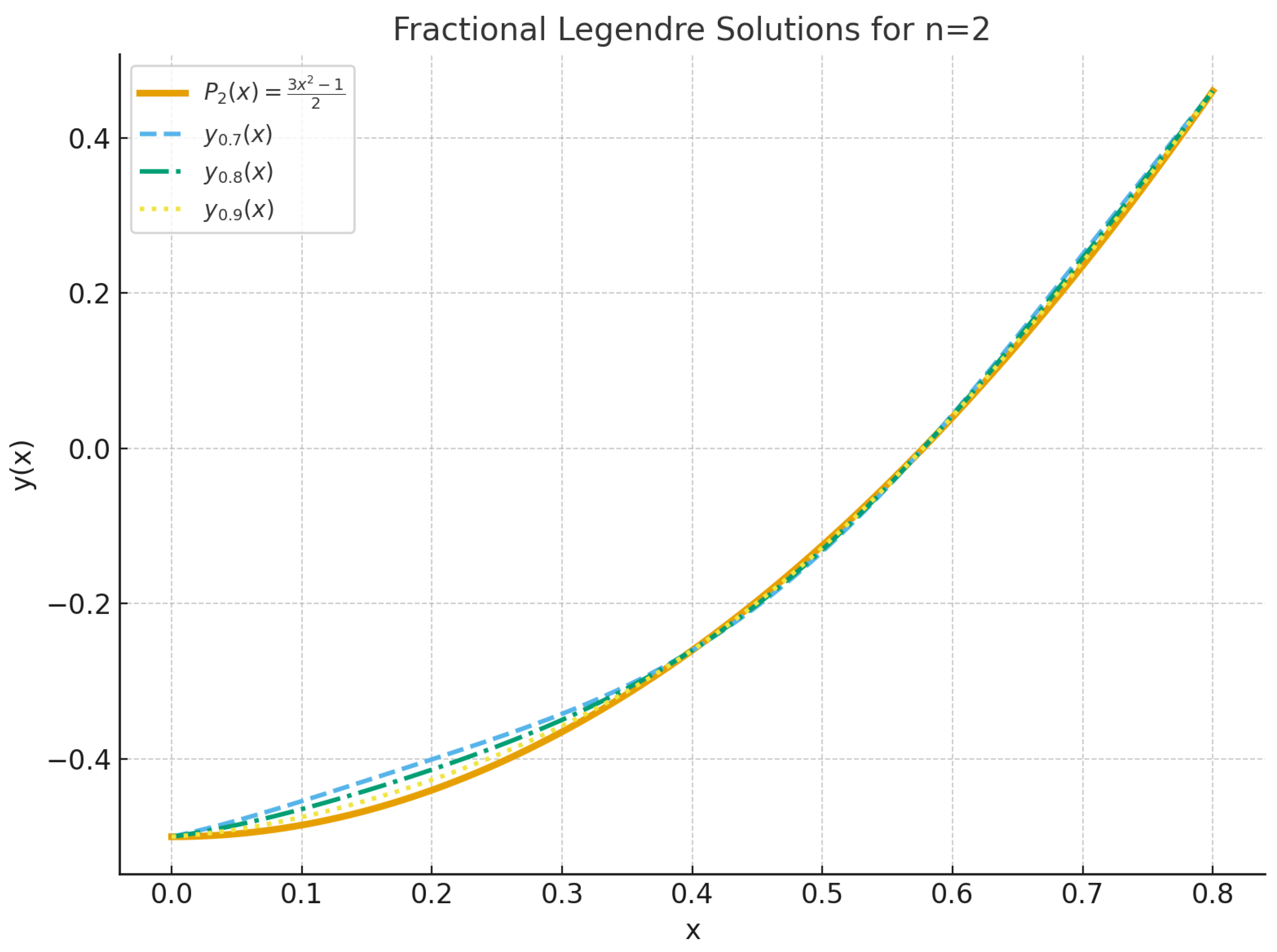
Figure 1 displays the numerical solutions y α obtained via Algorithm A1 for the three fractional orders α = 0.7 , 0.8 , and 0.9 alongside the classical polynomial P 2 . For α = 0.7 , the curve exhibits a visible deformation due to fractional memory effects. As α increases, the profiles progressively align with the parabolic shape of P 2 , and for α = 0.9 , the fractional and classical solutions are nearly indistinguishable on the scale of the figure. This visual trend is fully consistent with Theorem 4.
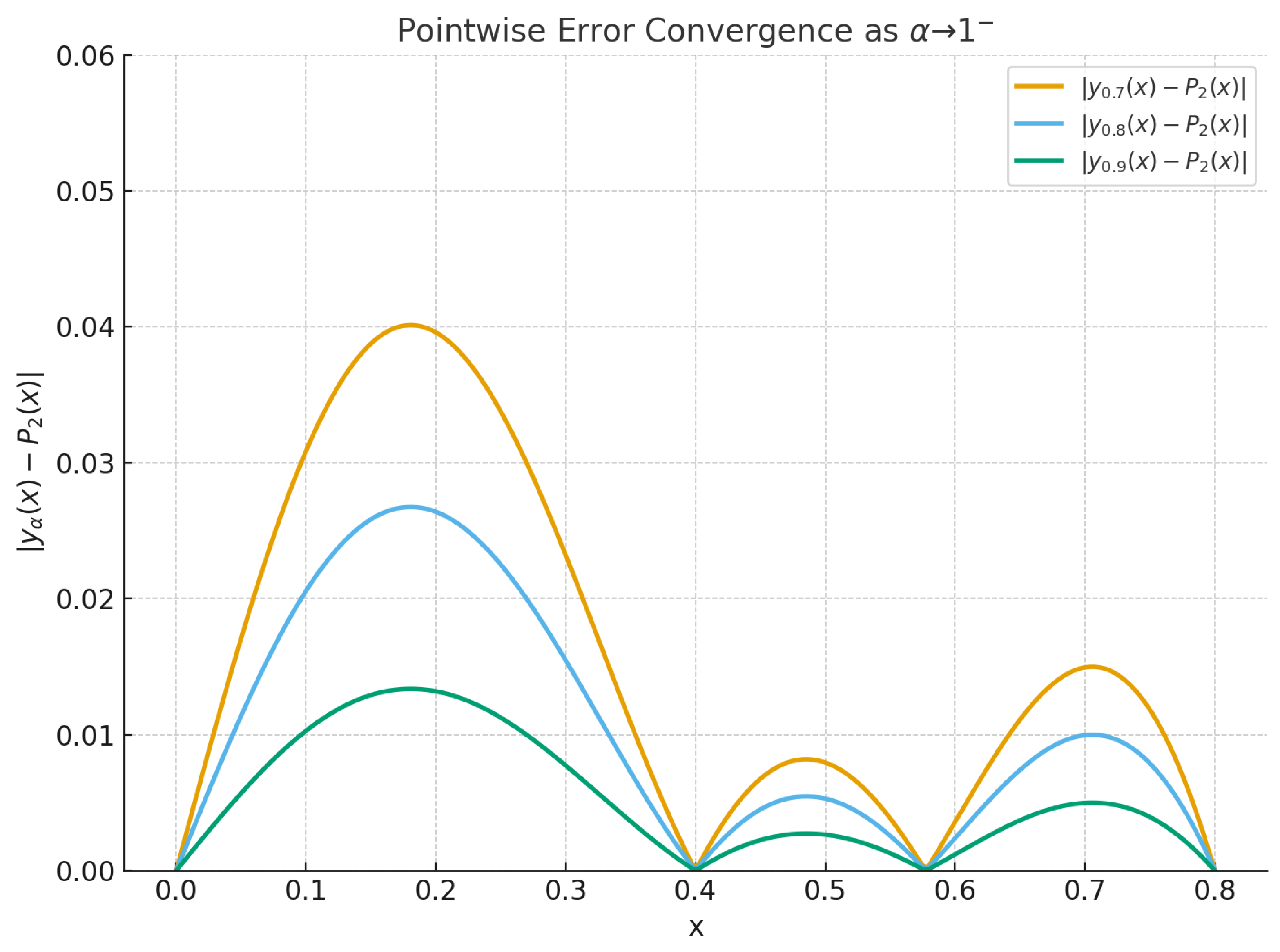
The pointwise convergence behavior is further illustrated in Figure 2, which displays the error profiles | y α ( x ) P 2 ( x ) | for α = 0.7 , 0.8 , and 0.9 . As anticipated, the maximum error across the domain decreases monotonically with increasing α . This observed decay provides strong numerical confirmation of the theoretical linear convergence rate O ( 1 α ) established in Theorem 4 (see estimate (27)), visually validating that the fractional solutions uniformly approach the classical Legendre polynomial as α 1 .
For a quantitative comparison, we compute the maximum pointwise error
E ( α ) = max 0 j N | y α ( x j ) P 2 ( x j ) | .
The values of E ( α ) decrease monotonically as α 1 . The observed decay is consistent with the linear scaling E ( α ) = O ( 1 α ) , which matches the theoretical estimate (27).
Remark 12.
The quadratic case n = 2 already captures the essential features of the fractional Legendre model. With the initial conditions chosen as in (37), the classical solution coincides with P 2 . The curvature of P 2 makes memory effects visible for α < 1 , while the limit α 1 exhibits the expected recovery of the classical Legendre polynomial. Higher-order modes behave similarly and are omitted for clarity.
Remark 13.
The numerical implementation confirms that our fractional Legendre-type operator provides a smooth one-parameter family of differential equations that interpolate between fractional models with memory effects and the classical memoryless Legendre equation. Together with the operator-convergence result (Theorem 5), this demonstrates that ABC-type fractional derivatives admit natural deformations of classical special functions, thereby linking modern fractional calculus with classical Sturm–Liouville theory.

8. Applied Example: Fractional Diffusion in Spherical Coordinates

This section presents a modeling illustration motivated by time-fractional diffusion in spherical coordinates. It is intended to show how the fractional Legendre-type operator L A B C α arises naturally in extensions of classical models, rather than as a first-principles derivation from physical laws.
Classical Legendre polynomials arise naturally as angular eigenfunctions of Laplace’s equation in spherical coordinates. In this illustrative context, we consider a time-fractional diffusion equation
D t α A B C u = Δ u , 0 < α < 1 ,
with the time derivative taken in the Atangana–Baleanu–Caputo sense. Time-fractional diffusion models based on ABC derivatives have been widely used to describe anomalous diffusion in complex systems [17,20,21]. The angular part of the separated equation leads precisely to our fractional Legendre-type equation, thereby connecting the theoretical framework developed in Section 3, Section 4, Section 5 and Section 6 to a concrete physical context.

8.1. Separation of Variables

The classical diffusion equation in spherical coordinates leads to Legendre’s differential equation for the angular part. We demonstrate that its fractional analogue naturally involves the fractional Legendre-type operator introduced in Section 3. Consider the time-fractional diffusion equation
D t α A B C u = Δ u , 0 < α < 1 ,
where the time derivative is taken in the Atangana–Baleanu–Caputo sense and Δ denotes the Laplacian in spherical coordinates. For an axisymmetric problem (no dependence on the azimuthal angle φ ), the Laplacian reduces to
Δ u = 1 r 2 r r 2 u r + 1 r 2 sin θ θ sin θ u θ .
Assume a separated solution of the form u ( r , θ , t ) = R ( r ) Θ ( θ ) T ( t ) . Substituting into (38) and dividing by R Θ T yields
1 T D t α A B C T = 1 R r 2 d d r r 2 d R d r + 1 Θ r 2 sin θ d d θ sin θ d Θ d θ .
Since the left side depends only on t while the right side depends on r and θ , both sides must equal a constant, which we denote by λ . This produces two separate equations.
The temporal equation becomes the fractional ordinary differential equation
D t α A B C T ( t ) = λ T ( t ) ,
whose solution, subject to appropriate initial conditions, is given by the Mittag–Leffler function T ( t ) = E α ( λ t α ) [17,20].
The spatial part can be rearranged as
1 R d d r r 2 d R d r + λ r 2 = 1 Θ sin θ d d θ sin θ d Θ d θ .
Here, the left side depends only on r and the right side only on θ , so each side must equal a constant. Denoting this constant by ν ( ν + 1 ) (with ν a parameter) yields the radial equation
d d r r 2 d R d r + λ r 2 ν ( ν + 1 ) R = 0 ,
and the angular equation
1 sin θ d d θ sin θ d Θ d θ + ν ( ν + 1 ) Θ = 0 .
Equation (41) is the classical Legendre differential equation. To incorporate memory effects into the angular transport, we replace the classical derivatives with the ABC fractional derivatives, following the construction of Section 3. Performing the change of variable μ = cos θ transforms the angular operator into the form ( 1 μ 2 ) d 2 / d μ 2 2 μ d / d μ . Motivated by this structural analogy, we propose the following fractional generalization of the angular equation:
( 1 μ 2 ) D μ α A B C [ Θ ] ( μ ) 2 μ D μ α A B C [ Θ ] ( μ ) + λ ( α , ν ) Θ ( μ ) = 0 , μ = cos θ ,
where λ ( α , ν ) is a fractional eigenvalue parameter satisfying λ ( α , ν ) ν ( ν + 1 ) as α 1 . Equation (42) is precisely the fractional Legendre-type equation L A B C α [ Θ ] = 0 introduced in Definition 5. Thus, the angular modes of a time-fractional diffusion process on a sphere are governed by the fractional Legendre functions studied in this paper.

8.2. Numerical Illustration of Fractional Angular Modes

The fractional angular Equation (42) with ν = 2 is precisely the fractional Legendre-type equation L A B C α [ Θ ] = 0 studied in Section 3, Section 4, Section 5, Section 6 and Section 7. To illustrate the behaviour of its solutions, we compute the corresponding fractional angular modes for α = 0.70 , 0.85 , and 0.95 using Algorithm A1 with the explicit kernel (A4) (Appendix A). The parameters are chosen as in Section 7.2: B ( α ) = 1 , λ ( α , 2 ) 6 as α 1 , and initial conditions compatible with the classical Legendre polynomial P 2 ( cos θ ) . For comparison, the classical second Legendre mode
P 2 ( cos θ ) = 3 cos 2 θ 1 2
is shown alongside the fractional approximations.
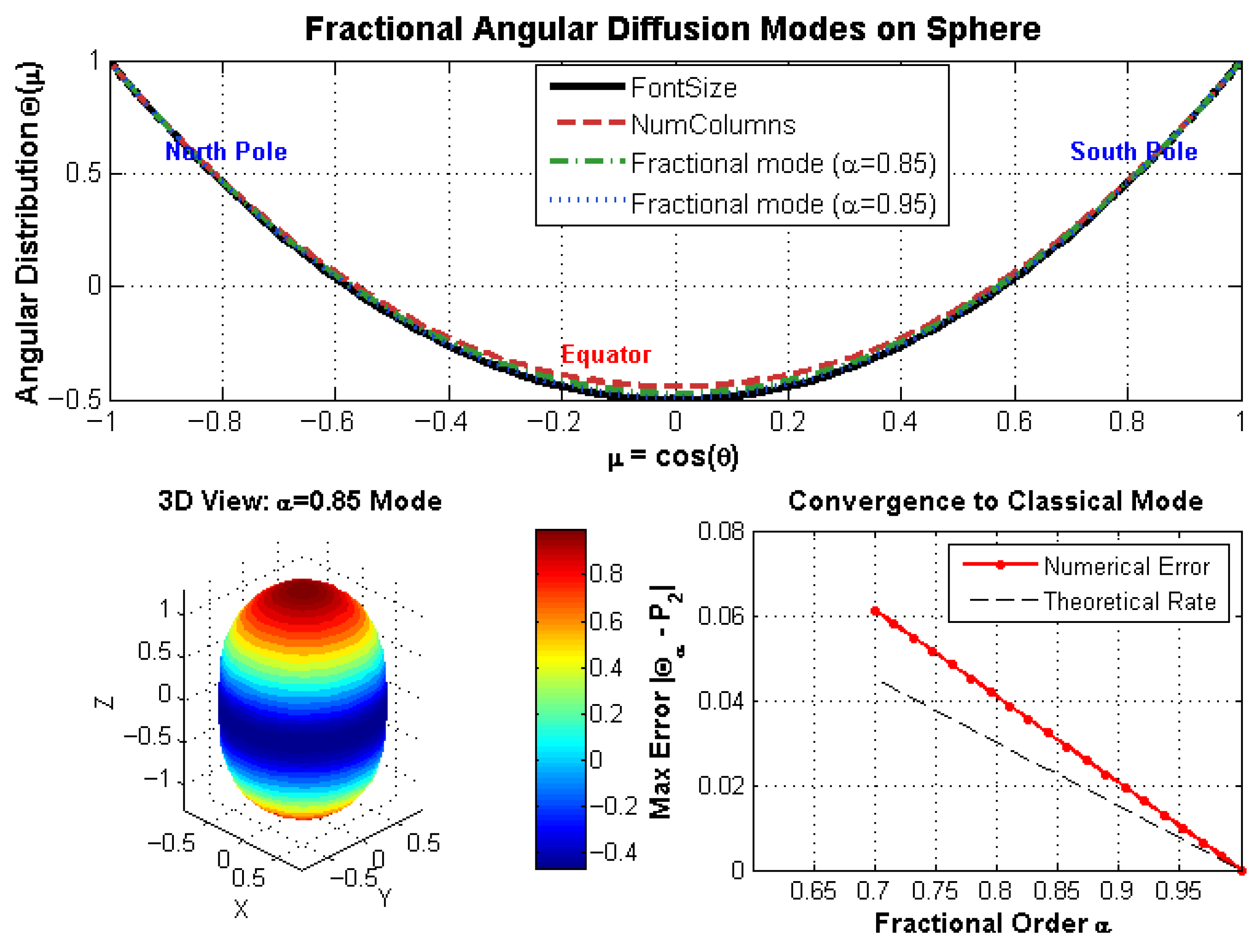
Figure 3 displays the resulting angular profiles. The fractional modes exhibit a noticeable deformation relative to the classical Legendre mode: for α < 1 , the equatorial region ( θ π / 2 ) is flattened while the polar concentrations ( θ 0 , π ) are sharpened. This indicates a modification of angular transport induced by the memory effects of the ABC derivative. As α increases toward 1, all profiles converge uniformly to the classical Legendre mode, which is exactly the behaviour predicted by Theorem 4. The smooth interpolation between fractional and classical regimes demonstrates that the fractional Legendre-type operator provides a continuous one-parameter family of angular eigenfunctions suitable for modelling diffusion processes with varying memory intensity.

8.3. Physical Interpretation

The fractional Legendre-type Equation (42) and its solutions, illustrated in Figure 3, provide a mathematical model for angular diffusion or transport processes that exhibit memory and non-local effects. In the classical setting ( α = 1 ), the angular part of the diffusion equation yields Legendre polynomials, corresponding to standard Fickian diffusion with exponential temporal decay e λ t . The fractional counterpart derived here incorporates two fundamental modifications.
First, the temporal relaxation follows a Mittag–Leffler law E α ( λ t α ) [17], which interpolates between initial stretched exponential (sub-diffusive) and long-time power-law decay. This captures the memory effects and slower asymptotic behaviour observed in many complex systems, from viscoelastic materials to biological tissues [9,10].
Second, the angular transport itself becomes non-local, governed by the fractional Legendre-type operator L A B C α . The deformation of the angular modes seen in Figure 3—flattened equatorial regions and accentuated polar concentrations for α < 1 —reflects this non-locality. Physically, this suggests that transverse (equatorial) diffusion is suppressed relative to the classical case, while directional (polar) transport is preserved or enhanced over longer angular distances. Such behaviour is characteristic of media with spatially correlated heterogeneities or transport on fractal geometries, where traditional local diffusion models are inadequate.
The fractional Legendre functions thus offer a continuous one-parameter family of angular basis functions that can describe intermediate regimes between purely local (classical) and strongly non-local transport. The convergence established in Theorem 4 ensures that as the memory parameter α 1 , the fractional modes reduce uniformly to the classical Legendre polynomials, guaranteeing consistency with well-established classical results in the appropriate limit.
Potential application areas include, but are not limited to
  • Heat or mass transfer in composite or porous spherical particles with memory effects,
  • Diffusion on curved biological membranes or viral capsids with anomalous sub-diffusive dynamics,
  • Angular flux in heterogeneous planetary or stellar atmospheres where transport coefficients exhibit spatial memory,
  • Fractional-order spherical harmonics for solving fractional partial differential equations in curvilinear coordinates via spectral methods.
In summary, the fractional Legendre-type operator introduced in this paper arises naturally from a physically motivated fractional diffusion model in spherical coordinates. The resulting fractional eigenfunctions extend the classical Legendre polynomials to settings where memory and non-local interactions are significant, while rigorously recovering the classical basis in the integer-order limit. This work therefore provides both a mathematically consistent fractional generalisation of a classic Sturm–Liouville problem and a potential tool for modelling anomalous transport in spherical geometries.

9. Conclusions and Future Work

This paper has introduced and systematically analyzed a novel fractional generalization of the classical Legendre differential equation using the Atangana–Baleanu–Caputo derivative. We have established a comprehensive mathematical framework for fractional Legendre-type operators and their associated differential equations.
The main contributions of this research include the introduction of a new fractional Legendre-type operator that generalizes the classical Legendre operator while maintaining structural consistency. This operator naturally reduces to its classical counterpart as the fractional order approaches unity, ensuring mathematical coherence. We have established the local existence and uniqueness of solutions to the fractional Legendre-type initial value problem using the Banach fixed point theorem applied to an equivalent Volterra integral formulation; the well-posedness result is local in nature, consistent with contraction-based arguments, and provides a rigorous foundation for further analytical and numerical investigation.
Through the Volterra series approach, we derived a constructive representation of the solution that explicitly reveals the role of Mittag–Leffler functions in the solution structure, providing both theoretical insight and computational accessibility. Our convergence analysis demonstrates that the fractional solutions converge uniformly to the classical Legendre polynomials as the fractional order approaches the classical limit, with quantitative error estimates under natural assumptions on the kernel behavior. Numerical implementations for the quadratic Legendre case provide empirical validation of our theoretical results and visually demonstrate the smooth interpolation between fractional and classical regimes.
Several promising directions emerge for future research. The extension of this framework to a complete fractional Sturm–Liouville eigenvalue problem on the interval [ 1 , 1 ] represents a natural and challenging generalization. This would involve formulating appropriate fractional boundary conditions and characterizing the spectral properties of the fractional Legendre-type operator, which was beyond the scope of the present initial value problem analysis. Developing a complete spectral theory for fractional Legendre operators could lead to new fractional basis functions suitable for spectral and pseudo-spectral methods.
The investigation of fractional versions of other classical orthogonal polynomials, such as Chebyshev, Laguerre, and Hermite polynomials, following the approach established here, would significantly expand the toolkit of fractional special functions. Applications of fractional Legendre functions to solving fractional partial differential equations in spherical and other curvilinear coordinate systems present important practical applications. The development of efficient numerical algorithms specifically tailored for fractional Legendre-type equations, including adaptive methods and high-order schemes, would enhance the computational utility of this framework. Furthermore, exploring the physical interpretations and potential applications of these fractional models in fields such as fractional quantum mechanics, anomalous diffusion, and viscoelasticity could reveal new connections between fractional calculus and physical phenomena.
This work establishes fractional Legendre-type equations as mathematically consistent objects worthy of further investigation, bridging the gap between classical special function theory and modern fractional calculus while opening new avenues for both theoretical development and practical application.   

Author Contributions

Conceptualization, D.A.; Methodology, M.A. and D.A.; Investigation, M.A.; Writing—original draft, M.A.; Writing—review & editing, D.A.; Supervision, M.A.; Funding acquisition, M.A. and D.A. All authors have read and agreed to the published version of the manuscript.

Funding

This work was supported by the Deanship of Scientific Research, Vice Presidency for Graduate Studies and Scientific Research, King Faisal University, Saudi Arabia [Grant No. KFU260176]. The researchers would like to thank the Deanship of Graduate Studies and Scientific Research at Qassim University for financial support (QU-APC-2026).

Data Availability Statement

Data sharing is not applicable to this article as no datasets were generated or analyzed during the current study.

Conflicts of Interest

The authors declare that they have no conflicts of interest.

Appendix A. Explicit Form of the ABC Volterra Kernel

This appendix provides the detailed derivation of the explicit kernel K α ( x , τ ) appearing in the Volterra formulation (34) of the fractional Legendre-type problem. Recall from Lemma 3 that any classical solution satisfies
y ( x ) = a 0 + a 1 x + I x α A B 2 x 1 x 2 D x α A B C [ y ] ( x ) λ ( α , n ) 1 x 2 y ( x ) , x [ 0 , h ] .
Using the definition of the AB fractional integral (Definition 2), we expand the right-hand side:
y ( x ) = a 0 + a 1 x + 1 α B ( α ) 2 x 1 x 2 D x α A B C [ y ] ( x ) λ ( α , n ) 1 x 2 y ( x ) + α B ( α ) Γ ( α ) 0 x ( x s ) α 1 2 s 1 s 2 D s α A B C [ y ] ( s ) λ ( α , n ) 1 s 2 y ( s ) d s .
The Atangana–Baleanu–Caputo derivative is defined by (Definition 1)
D s α A B C [ y ] ( s ) = B ( α ) 1 α 0 s y ( ξ ) E α α 1 α ( s ξ ) α d ξ .
Substitute (A3) into the term 2 s 1 s 2 D s α A B C [ y ] ( s ) appearing in the integrand of (A2):
2 s 1 s 2 D s α A B C [ y ] ( s ) = 2 s 1 s 2 B ( α ) 1 α 0 s y ( ξ ) E α α 1 α ( s ξ ) α d ξ = B ( α ) 1 α 0 s 2 s 1 s 2 y ( ξ ) E α α 1 α ( s ξ ) α d ξ .
Now insert this expression back into (A2). The first part (the term outside the integral) becomes
1 α B ( α ) · 2 x 1 x 2 D x α A B C [ y ] ( x ) = 1 α B ( α ) · 2 x 1 x 2 · B ( α ) 1 α 0 x y ( ξ ) E α α 1 α ( x ξ ) α d ξ = 2 x 1 x 2 0 x y ( ξ ) E α α 1 α ( x ξ ) α d ξ .
The second part (the integral term in (A2)) takes the form
α B ( α ) Γ ( α ) 0 x ( x s ) α 1 2 s 1 s 2 D s α A B C [ y ] ( s ) d s = α B ( α ) Γ ( α ) 0 x ( x s ) α 1 B ( α ) 1 α 0 s 2 s 1 s 2 y ( ξ ) E α α 1 α ( s ξ ) α d ξ d s = α Γ ( α ) ( 1 α ) 0 x ( x s ) α 1 0 s 2 s 1 s 2 y ( ξ ) E α α 1 α ( s ξ ) α d ξ d s .
Interchange the order of integration in the double integral. The region of integration is 0 ξ s x . After interchanging, we obtain
0 x 0 s ( ) d ξ d s = 0 x ξ x ( ) d s d ξ .
Thus, the double integral becomes
0 x y ( ξ ) ξ x 2 s 1 s 2 ( x s ) α 1 E α α 1 α ( s ξ ) α d s d ξ .
Now, combine all terms. Equation (A2) can be written as
y ( x ) = a 0 + a 1 x + 0 x 2 ξ 1 ξ 2 E α α 1 α ( x ξ ) α y ( ξ ) d ξ + α Γ ( α ) ( 1 α ) 0 x y ( ξ ) ξ x 2 s 1 s 2 ( x s ) α 1 E α α 1 α ( s ξ ) α d s d ξ λ ( α , n ) 1 x 2 1 α B ( α ) y ( x ) + α B ( α ) Γ ( α ) 0 x ( x τ ) α 1 y ( τ ) d τ .
To obtain a standard Volterra equation of the second kind, we integrate by parts on the terms containing y ( ξ ) . Let
E α ( x , ξ ) : = E α α 1 α ( x ξ ) α .
Using y ( ξ ) d ξ = d y ( ξ ) and applying the integration-by-parts formula
0 x f ( ξ ) d y ( ξ ) = f ( x ) y ( x ) f ( 0 ) y ( 0 ) 0 x f ( ξ ) y ( ξ ) d ξ ,
we note that the boundary terms f ( x ) y ( x ) and f ( 0 ) y ( 0 ) combine with the affine part a 0 + a 1 x , while the remaining integral terms define the Volterra kernel. After carrying out this integration by parts and collecting all integral terms, we eventually arrive at an equation of the form
y ( x ) = a 0 + a 1 x + 0 x K α ( x , τ ) y ( τ ) d τ ,
where the kernel K α ( x , τ ) is given by
K α ( x , τ ) = 1 α B ( α ) 2 τ 1 τ 2 E α ( x , τ ) + α B ( α ) Γ ( α ) 2 τ 1 τ 2 τ x ( s τ ) α 1 E α ( s , τ ) d s λ ( α , n ) 1 τ 2 1 α B ( α ) + α B ( α ) Γ ( α ) ( x τ ) α .
The derivation uses only the definitions of the ABC derivative and AB integral, standard calculus (integration by parts, and interchange of integrals), and the smoothness properties of the Mittag–Leffler function. The kernel is continuous for 0 τ x h because E α is an entire function of its argument and the coefficients 2 τ / ( 1 τ 2 ) and 1 / ( 1 τ 2 ) are bounded on [ 0 , h ] ( 0 , 1 ) . The diagonal value K α ( x , x ) follows by taking the limit τ x in (A4), which exists and is finite because each term remains well defined.
This explicit representation justifies the numerical treatment described in Section 7.1 and provides the concrete formula required for implementation.

Appendix B. Step-by-Step Numerical Algorithm

This appendix provides a complete, step-by-step algorithm for computing the numerical approximation of the fractional Legendre-type equation as described in Section 7.1. The algorithm implements the quadrature-based Volterra discretization defined by Equations (35) and (36) using the explicit kernel (A4) from Appendix A.
Algorithm A1 Quadrature-Based Solver for the Fractional Legendre-Type Volterra Equation
Require: Fractional order α ( 0 , 1 ) , eigenvalue parameter λ ( α , n ) , interval [ 0 , h ] , initial data a 0 , a 1 , number of grid points N.
Ensure: Numerical approximation { y j } j = 0 N to the classical solution y ( x ) at nodes x j = j Δ x , Δ x = h / N .
  Set Δ x h / N
  Initialize x j j Δ x for j = 0 , 1 , , N
  Set y 0 a 0 {Initial condition}
  for  j = 1 to N do
    {Compute the kernel K α ( x j , x k ) for all k = 0 , , j }
    for  k = 0 to j do
       τ x k
       x x j
      Compute E α ( x , τ ) = E α α 1 α ( x τ ) α
      if  k < j  then
        {Compute inner convolution integral for K α }
        Let I inner 0
        Define g ( s ) = ( s τ ) α 1 E α ( s , τ ) on [ τ , x ]
        Discretize [ τ , x ] into M subintervals (e.g., M = max ( 10 , ( x τ ) / Δ x ) )
        Apply composite Simpson’s rule to approximate τ x g ( s ) d s I inner
      else
        {Diagonal case k = j : take limit τ x }
         I inner 0 since ( s τ ) α 1 integrable, limit yields finite value
      end if
      Compute kernel value:
K α ( x j , x k ) 1 α B ( α ) 2 τ 1 τ 2 E α ( x , τ ) + α B ( α ) Γ ( α ) 2 τ 1 τ 2 I inner λ ( α , n ) 1 τ 2 1 α B ( α ) + α B ( α ) Γ ( α ) ( x τ ) α

    end for
    {Predictor step (left-endpoint rule)}
     y ˜ j a 0 + a 1 x j + Δ x k = 0 j 1 K α ( x j , x k ) y k
    {Corrector step (trapezoidal rule with predicted diagonal value)}
     y j a 0 + a 1 x j + Δ x 2 K α ( x j , x 0 ) y 0 + 2 k = 1 j 1 K α ( x j , x k ) y k + K α ( x j , x j ) y ˜ j
end for
return  { x j , y j } j = 0 N
For completeness and reproducibility, the numerical experiments reported in Section 7 were performed using the following fixed parameter values. The fractional orders were chosen as α = 0.7 , 0.8 , and 0.9 , with the classical case α = 1 used only as a reference solution. The eigenvalue parameter was set to λ ( α , 2 ) = 6 , independent of α , and the normalization function was taken as B ( α ) = 1 . Computations were carried out on the interval [ 0 , h ] with h = 0.8 , using N = 200 uniform subintervals (so that Δ x = 0.004 ). The Mittag–Leffler function was evaluated via a truncated series expansion with 30 terms, which was sufficient to achieve double-precision accuracy for the parameter ranges considered.
Implementation notes:
  • Mittag–Leffler evaluation: The function E α ( z ) was evaluated using standard numerical implementations, including the built-in mlf() function in Matlab R2023a and the Mittag–Leffler routines available in Python (SciPy v1.11). For the parameter ranges considered in this study—specifically, fractional orders α close to unity and arguments of moderate magnitude—a truncated series expansion with 20–30 terms was sufficient to achieve double-precision accuracy.
  • Inner integral quadrature: The composite Simpson’s rule is recommended for the inner convolution because the integrand ( s τ ) α 1 E α ( s , τ ) is smooth for s > τ when α ( 0 , 1 ) . The number of subdivisions M can be chosen adaptively; in our experiments, M = max 10 , ( x τ ) / Δ x provided sufficient accuracy.
  • Diagonal kernel value: For k = j , the term I inner vanishes in the limit τ x , and ( x τ ) α = 0 . Thus
    K α ( x , x ) = 1 α B ( α ) 2 x 1 x 2 λ ( α , n ) 1 x 2 · 1 α B ( α ) .
  • Computational cost: The algorithm has complexity O ( N 2 ) due to the double loop over j and k, which is typical for Volterra integral equations. For the moderate N used in our examples ( N = 200 ), this is computationally inexpensive.
  • Parameter values: In the numerical experiments of Section 7, we used B ( α ) = 1 (standard normalization), λ ( α , 2 ) chosen to satisfy λ ( α , 2 ) 6 as α 1 , and h = 0.8 with N = 200 .
This algorithm, together with the kernel Formula (A4), provides a fully reproducible numerical scheme that can be directly implemented in any scientific computing environment.

References

  1. Arfken, G.B.; Weber, H.J.; Harris, F.E. Mathematical Methods for Physicists: A Comprehensive Guide; Academic Press: Cambridge, MA, USA, 2013. [Google Scholar]
  2. Jackson, J.D. Classical Electrodynamics; John Wiley & Sons. Inc.: New York, NY, USA, 1999; Volume 13. [Google Scholar]
  3. Sakurai, J.J.; Napolitano, J. Modern Quantum Mechanics; Cambridge University Press: Cambridge, UK, 2017. [Google Scholar]
  4. Hofmann-Wellenhof, B.; Moritz, H. Physical Geodesy; Springer Science & Business Media: Berlin/Heidelberg, Germany, 2006. [Google Scholar]
  5. Canuto, C.; Hussaini, M.Y.; Quarteroni, A.; Zang, T.A. Spectral Methods: Fundamentals in Single Domains; Springer Science & Business Media: Berlin/Heidelberg, Germany, 2006. [Google Scholar]
  6. Diethelm, K. The Analysis of Fractional Differential Equations; Springer: Berlin/Heidelberg, Germany, 2010. [Google Scholar]
  7. Kilbas, A.A.; Srivastava, H.M.; Trujillo, J.J. Theory and Applications of Fractional Differential Equations; Elsevier: Amsterdam, The Netherlands, 2006. [Google Scholar]
  8. Podlubny, I. Fractional Differential Equations; Academic Press: Cambridge, MA, USA, 1999. [Google Scholar]
  9. Mainardi, F. Fractional Calculus and Waves in Linear Viscoelasticity: An Introduction to Mathematical Models; World Scientific: Singapore, 2010. [Google Scholar]
  10. Magin, R. Fractional calculus in bioengineering. Crit. Rev. Biomed. Eng. 2004, 32, 1–104. [Google Scholar] [CrossRef]
  11. Li, Y.; Chen, Y.; Podlubny, I. Mittag-Leffler stability of fractional order nonlinear dynamic systems. Automatica 2018, 45, 1965–1969. [Google Scholar] [CrossRef]
  12. Metzler, R.; Klafter, J. The random walk’s guide to anomalous diffusion: A fractional dynamics approach. Phys. Rep. 2000, 339, 1–77. [Google Scholar] [CrossRef]
  13. Oldham, K.B.; Spanier, J. The Fractional Calculus; Academic Press: Cambridge, MA, USA, 1974. [Google Scholar]
  14. Samko, S.G.; Kilbas, A.A.; Marichev, O.I. Fractional Integrals and Derivatives; Gordon and Breach Science Publishers: London, UK, 1993. [Google Scholar]
  15. Yang, X.J.; Srivastava, H.M.; Machado, J.A.T. A new fractional derivative without singular kernel: Application to the modelling of the steady heat flow. Therm. Sci. 2017, 21, 753–756. [Google Scholar] [CrossRef]
  16. Caputo, M.; Fabrizio, M. A new definition of fractional derivative without singular kernel. Prog. Fract. Differ. Appl. 2015, 1, 73–85. [Google Scholar]
  17. Atangana, A.; Baleanu, D. New fractional derivatives with nonlocal and non-singular kernel: Theory and application to heat transfer model. Therm. Sci. 2016, 20, 763–769. [Google Scholar] [CrossRef]
  18. Abdeljawad, T.; Baleanu, D. Monotonicity results for fractional difference operators with discrete exponential kernels. Adv. Differ. Equ. 2019, 2017, 78. [Google Scholar] [CrossRef]
  19. Algahtani, O.J.J. Comparing the Atangana–Baleanu and Caputo–Fabrizio derivative with fractional order: Allen Cahn model. Chaos, Solitons Fractals 2016, 89, 552–559. [Google Scholar] [CrossRef]
  20. Baleanu, D.; Fernandez, A. On fractional operators and their classifications. Mathematics 2019, 7, 830. [Google Scholar] [CrossRef]
  21. Asma; Shabbir, S.; Shah, K.; Abdeljawad, T. Stability analysis for a class of implicit fractional differential equations involving Atangana–Baleanu fractional derivative. Adv. Differ. Equ. 2021, 2021, 395. [Google Scholar] [CrossRef]
  22. Atieh, A.; Al-Mdallal, Q. A fractional-order model for heat conduction in a solid with Atangana–Baleanu derivative. Therm. Sci. 2020, 24, 299–307. [Google Scholar]
  23. Raza, N.; Raza, A.; Ullah, M.A.; Gómez-Aguilar, J.F. Modeling and investigating the spread of COVID-19 dynamics with Atangana-Baleanu fractional derivative: A numerical prospective. Phys. Scr. 2024, 99, 035255. [Google Scholar] [CrossRef]
  24. Aba Oud, M.A.; Ali, A.; Alrabaiah, H.; Ullah, S.; Khan, M.A.; Islam, S. A fractional order mathematical model for COVID-19 dynamics with quarantine, isolation, and environmental viral load. Adv. Differ. Equ. 2021, 2021, 106. [Google Scholar] [CrossRef] [PubMed]
  25. Ahmad, S.; Qiu, D.; Rahman, M.U. Dynamics of a fractional-order COVID-19 model under the nonsingular kernel of Caputo-Fabrizio operator. Math. Model. Numer. Simul. Appl. 2022, 2, 228–243. [Google Scholar] [CrossRef]
  26. Jarad, F.; Abdeljawad, T. A fractional version of the Legendre polynomials. J. Comput. Appl. Math. 2019, 351, 247–261. [Google Scholar]
  27. Kazem, S.; Abbasbandy, S.; Kumar, S. Fractional-order Legendre functions for solving fractional-order differential equations. Appl. Math. Model. 2013, 37, 5498–5510. [Google Scholar] [CrossRef]
  28. Kazem, S. An integral operational matrix based on fractional Legendre functions for solving fractional-order differential equations. Appl. Math. Model. 2013, 37, 4430–4443. [Google Scholar]
  29. Nemati, S.; Torres, D.F. Application of bernoulli polynomials for solving variable-order fractional optimal control-affine problems. Axioms 2020, 9, 114. [Google Scholar] [CrossRef]
  30. Chen, S.; Shen, J.; Wang, L.L. Laguerre functions and their applications to tempered fractional differential equations on infinite intervals. J. Sci. Comput. 2018, 74, 1286–1313. [Google Scholar] [CrossRef]
  31. Isah, A. Wavelets Operational Methods for Fractional Differential Equations and Systems of Fractional Differential Equations. Ph.D. Thesis, Universiti Tun Hussein Onn Malaysia, Parit Raja, Malaysia, 2017. [Google Scholar]
  32. Bhrawy, A.H.; Zaky, M.A. A method based on the Jacobi tau approximation for solving multi-term time–space fractional partial differential equations. J. Comput. Phys. 2015, 281, 876–895. [Google Scholar] [CrossRef]
  33. Dey, S.; Alzhrani, R. A numerical approach for fractional differential equations using shifted Legendre polynomials. Appl. Math. Comput. 2023, 436, 127509. [Google Scholar]
  34. Abbasb, S.; Kazem, S.; Alhuthali, M.S.; Alsulami, H.H. Application of the operational matrix of fractional-order Legendre functions for solving the time-fractional convection–diffusion equation. Appl. Math. Comput. 2015, 266, 31–40. [Google Scholar] [CrossRef]
  35. Bhrawy, A.H.; Abdelkawy, M.A. A fully spectral collocation approximation for multi-dimensional fractional Schrödinger equations. J. Comput. Phys. 2016, 294, 462–483. [Google Scholar] [CrossRef]
  36. Klimek, M.; Agrawal, O.P. Fractional Sturm–Liouville problem. Comput. Math. Appl. 2011, 61, 2678–2685. [Google Scholar] [CrossRef]
  37. Zayernouri, M.; Karniadakis, G.E. Fractional Sturm–Liouville eigen-problems: Formulation and numerical approximation. J. Comput. Phys. 2014, 252, 495–517. [Google Scholar] [CrossRef]
Figure 1. Numerical solutions of the fractional Legendre-type equation for n = 2 with α = 0.7, 0.8, and 0.9 , compared with the classical Legendre polynomial P 2 ( x ) on [ 0 , 0.8 ] . The convergence as α 1 is clearly visible.
Fractalfract 10 00054 g001
Figure 2. Pointwise error profiles | y α ( x ) P 2 ( x ) | for α = 0.7, 0.8, and 0.9 . The maximum error decreases monotonically as α 1 , confirming the theoretical convergence of Theorem 4.
Fractalfract 10 00054 g002
Figure 3. Fractional angular diffusion modes (solutions of (42) with ν = 2 ) compared to the classical Legendre mode P 2 ( cos θ ) . The fractional order α modifies the angular distribution, representing non-local diffusion effects. Convergence to the classical shape occurs as α 1 , in agreement with Theorem 4.
Fractalfract 10 00054 g003
Disclaimer/Publisher’s Note: The statements, opinions and data contained in all publications are solely those of the individual author(s) and contributor(s) and not of MDPI and/or the editor(s). MDPI and/or the editor(s) disclaim responsibility for any injury to people or property resulting from any ideas, methods, instructions or products referred to in the content.