1. Introduction
The selection of renewable energy projects in smart cities involves highly complex decision-making scenarios, where multiple stakeholders must evaluate alternatives based on conflicting and dynamic criteria. Traditional multi-criteria decision-making (MCDM) methods, such as the
Technique for Order Preference by Similarity to Ideal Solution (TOPSIS) [
1], provide a structured approach to ranking alternatives based on their closeness to an ideal solution. However, real-world decision-making is often characterized by uncertainty, vagueness, and imprecision arising from subjective human judgments, incomplete or noisy information, and dynamically changing environmental, economic, and social conditions [
2,
3,
4]. To overcome these limitations, fuzzy extensions of MCDM methods have been widely adopted. For example, fuzzy TOPSIS enables linguistic and imprecise evaluations to be modeled using fuzzy numbers [
5]. Intuitionistic fuzzy sets further incorporate hesitation by simultaneously considering membership and non-membership degrees [
2], while hesitant fuzzy sets allow decision-makers to express multiple plausible assessments [
6]. Pythagorean fuzzy sets relax the orthogonality constraint, providing enhanced discrimination under high uncertainty [
7]. Despite these advancements, classical and advanced fuzzy methods generally treat evaluations as static and fail to capture temporal dynamics or memory-dependent effects, which are crucial in real-world, evolving smart city energy planning contexts [
8].
To address these limitations, we propose a Fractional q-Rung Orthopair Fuzzy Tensor (Fq-ROFT) framework for dynamic group decision-making (GDM). This approach combines three powerful paradigms:
q-Rung Orthopair Fuzzy Sets (q-ROFSs) to represent flexible positive and negative membership degrees while satisfying the generalized orthogonality condition, allowing nuanced modeling of acceptance and rejection intensities [
7].
Tensor Algebra to capture multi-dimensional relationships among alternatives, criteria, and experts, providing a holistic representation of complex interactions.
Fractional-Order Dynamics using Caputo derivatives to encode temporal memory, capturing the hereditary effects of past evaluations on present decision outcomes.
This unified Fq-ROFT framework enables the modeling of high-dimensional, time-dependent uncertainty while accommodating heterogeneous expert opinions, making it particularly suited for renewable energy project selection in smart cities.
1.1. Literature Review
Existing research has explored fuzzy, intuitionistic, hesitant, and Pythagorean fuzzy MCDM methods to address uncertainty in decision-making [
2,
5,
6,
7,
8]. However, most approaches assume static evaluations and lack mechanisms to incorporate memory or temporal dynamics. Fractional fuzzy frameworks have recently attracted increasing attention due to their ability to model memory-dependent uncertainty and hereditary effects in complex decision environments. Such approaches have been applied in uncertain dynamical systems, control theory, and decision analysis, where historical information influences current evaluations [
9,
10,
11,
12]. In parallel, tensor-based decision-making models have demonstrated strong capability in representing high-dimensional interactions among alternatives, criteria, experts, and time stages, particularly in group decision-making problems [
13,
14,
15,
16]. However, existing studies predominantly investigate fractional fuzzy models and tensor-based frameworks independently. To the best of our knowledge, a unified dynamic group decision-making framework that simultaneously integrates q-rung orthopair fuzzy sets, tensor representations, and fractional-order dynamics has not yet been systematically reported in the literature.
1.2. Relationship with -Fuzzy Sets, -Fuzzy Sets and SR-Fuzzy Sets
Generalized orthopair fuzzy models have been proposed in the literature to overcome the restrictive constraints of classical intuitionistic and Pythagorean fuzzy sets. Among the most influential extensions are
-fuzzy sets [
17],
-fuzzy sets [
18], and SR-fuzzy sets [
19], which enhance expressive capability by introducing flexible power-based constraints and decision-oriented aggregation mechanisms. The concept of
-fuzzy sets was formally introduced as a generalized orthopair fuzzy framework in which the membership degree
and non-membership degree
satisfy the condition
This formulation allows for asymmetric control over the admissible uncertainty region and generalizes intuitionistic and Pythagorean fuzzy sets as special cases. The authors further developed weighted aggregation operators and applied the
-fuzzy model to multi-criteria decision-making (MCDM) problems, demonstrating improved flexibility and discrimination power in uncertain decision environments. As a notable special case,
-fuzzy sets were proposed by fixing
and
. This model expands the feasible decision space beyond intuitionistic fuzzy sets while preserving interpretability. The foundational study on
-fuzzy sets established their algebraic properties, introduced weighted aggregation operators, and demonstrated their effectiveness in MCDM applications. These results showed that
-fuzzy sets can better capture hesitation and asymmetric uncertainty in expert evaluations compared with classical orthopair models. In addition, SR-fuzzy sets were introduced to provide a structured refinement-based representation of orthopair uncertainty. The SR-fuzzy framework focuses on ranking-oriented decision-making by incorporating score and reliability mechanisms, along with weighted aggregated operators tailored for practical decision analysis. Applications in group decision-making confirmed their usefulness in handling conflicting expert opinions while maintaining computational simplicity. Although
-fuzzy sets,
-fuzzy sets, and SR-fuzzy sets significantly enhance the modeling capability of orthopair fuzzy theory, these frameworks are inherently static and primarily defined at scalar or matrix levels. They do not provide mechanisms for modeling temporal evolution, memory-dependent effects, or higher-order interactions among multiple decision dimensions. The proposed Fractional q-Rung Orthopair Fuzzy Tensor (Fq-ROFT) framework can be viewed as a strict generalization of these models. When the fractional order
and the tensor reduces to second order, the Fq-ROFT formulation naturally encompasses
-fuzzy sets under a conservative embedding by setting
Moreover, the tensor representation enables simultaneous modeling of alternatives, criteria, experts, and time as independent modes, while the fractional-order dynamics explicitly capture memory and hereditary effects absent in -, -, and SR-fuzzy frameworks. From a decision-making perspective, these classical generalized orthopair fuzzy models can therefore be regarded as static, low-dimensional special cases within the broader Fq-ROFT paradigm. The proposed framework preserves their expressive advantages while extending them to dynamic, high-dimensional, and time-aware group decision-making environments.
Relation to the Existing q-Rung Orthopair Fuzzy Literature
The preservation of the q-rung orthopair constraint under aggregation and fusion operations has been extensively studied in the q-ROFS literature. Yager [
20] first introduced q-rung orthopair fuzzy sets and demonstrated that a wide class of nonlinear operators, including algebraic, probabilistic, and power-based aggregations, preserve the condition
. Subsequently, Refs. [
21,
22,
23,
24,
25] provided rigorous analyses of closure properties for q-ROFS aggregation operators, including weighted averaging, geometric, and hybrid fusion rules. More recently, extensions of q-ROFSs to dynamic and decision-making contexts have confirmed that constraint preservation remains valid under temporal weighting and iterative aggregation schemes [
26,
27,
28,
29]. The exponential-type fusion mechanism adopted in this study is conceptually aligned with the probabilistic sum and product operators analyzed in these works, which are known to maintain admissibility under mild conditions. The theoretical results established in this paper generalize these existing findings from static q-rung orthopair fuzzy sets to fractional-order, tensor-valued structures. Hence, the proposed Fractional q-Rung Orthopair Fuzzy Tensor framework can be viewed as a natural and mathematically consistent extension of well-established q-ROFS theory.
1.3. Limitations of Existing Methods in High-Dimensional and Time-Sensitive Decision-Making
Despite the significant progress achieved by intuitionistic fuzzy sets, Pythagorean fuzzy sets, -fuzzy sets, and q-rung orthopair fuzzy models, most existing decision-making approaches remain insufficient when applied to high-dimensional and time-sensitive problems.
1.3.1. Limitations in High-Dimensional Modeling
The majority of fuzzy multi-criteria decision-making methods rely on vector- or matrix-based representations, where evaluations are organized in two-dimensional structures such as alternative–criterion or expert–criterion matrices. While effective for small-scale problems, this representation becomes restrictive in complex group decision-making environments involving multiple experts, criteria, alternatives, and contextual factors simultaneously. Higher-order interactions among these dimensions are either ignored or flattened into weighted averages, leading to an inevitable loss of structural information. As a result, correlations among experts, interdependencies among criteria, and cross-effects across decision stages cannot be explicitly modeled.
1.3.2. Limitations in Time-Sensitive Decision-Making
Existing fuzzy and orthopair fuzzy approaches generally assume that expert assessments are static and independent of time. Even when repeated evaluations are considered, they are typically aggregated without accounting for temporal dependency or historical influence. Such approaches implicitly assume that current decisions depend only on present information, neglecting the fact that expert opinions often evolve gradually and are influenced by past experiences, previous outcomes, and accumulated knowledge. This static treatment makes traditional models unsuitable for dynamic environments where uncertainty evolves over time.
1.3.3. Combined Impact on Real-World Applications
In practical applications such as smart city renewable energy planning, decision-makers must simultaneously process high-dimensional information and adapt to time-varying conditions, including policy changes, technological advancements, and evolving stakeholder preferences. Current fuzzy decision-making models address either uncertainty or flexibility in representation, but they do not provide an integrated mechanism to handle both multi-dimensional complexity and temporal dynamics. Consequently, their decision outcomes may lack robustness, adaptability, and interpretability in evolving real-world systems. These limitations motivate the need for a unified framework capable of representing multi-dimensional decision information while explicitly incorporating temporal memory. The proposed Fractional q-Rung Orthopair Fuzzy Tensor framework addresses these challenges by integrating tensor-based high-dimensional modeling with fractional-order dynamics, thereby enabling robust and time-aware group decision-making.
1.4. Justification for the Proposed Framework in Smart City Contexts
Decision-making in smart city renewable energy planning is inherently dynamic, multi-dimensional, and permeated with uncertainty. This complexity arises from the interplay of technological, economic, environmental, and social factors that evolve over time. A smart city is not a static entity; it is a dynamic system where project evaluations are influenced by historical performance data, shifting policy landscapes, real-time sensor data, evolving public sentiment, and the collective memory of past successes or failures. The proposed Fq-ROFT framework is specifically designed to address these core smart city challenges:
Managing Conflicting Stakeholder Opinions: Urban projects involve diverse experts (engineers, planners, environmentalists, citizens) with varying, often opposing, views. The q-rung orthopair fuzzy set component allows for the flexible and simultaneous representation of strong support () and strong opposition () towards a project, capturing the nuanced spectrum of expert and public opinion more effectively than classical fuzzy models.
Integrating Multi-Dimensional Urban Data: Smart city planning requires the fusion of data across multiple dimensions: alternatives (e.g., different energy technologies), criteria (e.g., cost, emissions, social acceptance), experts, and time. The tensor algebra component provides a natural and structured mathematical framework to model these high-order interactions holistically, moving beyond the limitations of traditional two-dimensional decision matrices.
Capturing Temporal Evolution and Memory Effects: The viability of a solar project or the public acceptance of a wind farm is not judged in a single moment but evolves. Policy changes, technological learning curves, and community feedback create a hereditary influence where past evaluations impact present decisions. The Caputo fractional-order derivative component inherently models this memory effect, allowing the decision model to incorporate the temporal trajectory of expert judgments and project performance, leading to more stable and informed long-term rankings.
1.5. Research Gap
Despite extensive development of fuzzy MCDM methods, there are several key gaps:
Lack of dynamic memory modeling: Most fuzzy approaches cannot account for temporal evolution or hereditary effects of past evaluations.
Limited multi-dimensional representation: Classical matrix-based methods fail to capture higher-order interactions among alternatives, criteria, and experts.
Insufficient application to real-world dynamic scenarios: Smart city renewable energy planning requires both high-dimensional modeling and time-sensitive decision-making, which current methods inadequately address.
The proposed Fq-ROFT framework addresses these gaps by unifying fuzzy logic, tensor algebra, and fractional-order dynamics into a single, robust, and scalable methodology for dynamic group decision-making.
1.6. Justification for the Proposed Framework
Decision-making in smart city renewable energy planning is inherently dynamic, with project evaluations influenced not only by current data but also by historical trends, policy changes, and evolving stakeholder preferences. Fractional calculus effectively captures these memory effects [
9], while tensor algebra enables structured multi-dimensional representation of criteria, alternatives, and expert evaluations [
30]. Integrating these with q-rung orthopair fuzzy sets allows for flexible modeling of both positive and negative expert opinions under uncertainty. The proposed Fq-ROFT framework therefore provides a more realistic, robust, and insightful approach for complex, high-dimensional, and dynamic decision-making scenarios.
1.7. Contributions
The key contributions of this paper are as follows:
Introduction of Fq-ROFT: We propose a novel Fractional q-Rung Orthopair Fuzzy Tensor framework for dynamic group decision-making, integrating q-rung orthopair fuzzy sets, tensor representation, and fractional-order dynamics.
Mathematical Formalization: The paper defines Fq-ROFTs rigorously, introduces algebraic operations, and establishes fundamental properties such as boundedness, monotonicity, and commutativity.
Development of Fq-ROFT GDM Algorithm: A group decision-making algorithm based on Fq-ROFT is developed, capable of aggregating expert opinions, computing fractional dynamic scores, and ranking alternatives in time-dependent environments.
Application to Smart City Energy Planning: The methodology is applied to a real-world renewable energy project selection case study, demonstrating its practical effectiveness.
Comparative and Sensitivity Analysis: The proposed framework is compared with existing fuzzy and q-ROFS-based methods, and sensitivity analysis is conducted to evaluate robustness under parameter variations.
Modular and Extensible Framework: The Fq-ROFT model is designed to be extendable to other MCDM problems and compatible with future integration with optimization or machine learning techniques.
From
Table 1, it is evident that while existing fuzzy MCDM methods successfully address uncertainty through various membership structures, they remain largely limited to static, matrix-based representations. The proposed Fq-ROFT framework uniquely integrates q-rung orthopair flexibility, tensorial multi-dimensional modeling, and fractional-order dynamics. This combination enables simultaneous handling of high-dimensional expert evaluations, temporal memory effects, and complex interdependencies, making the proposed method particularly suitable for dynamic group decision-making problems such as smart city renewable energy planning.
2. Preliminaries
This section presents the fundamental mathematical concepts and definitions that form the basis of the proposed Fq-ROFT framework, including fuzzy sets, tensors, Caputo fractional derivatives and Fractional Fuzzy Tensors.
Definition 1 ([
3])
. Let X be a universe of discourse. A fuzzy set in X is characterized by a membership function , where indicates the degree of membership of element in the fuzzy set . Definition 2 ([
13])
. A tensor is a multi-dimensional array that generalizes scalars (zero-order), vectors (first-order), and matrices (second-order) to higher orders. Formally, an N-th order tensor over the real field is defined asMatrices are therefore a special case of tensors when . Definition 3 ([
31])
. Building upon the classical concept of a tensor, a fuzzy tensor is defined by restricting each tensor entry to represent a degree of membership in the unit interval. Specifically, an N-th order fuzzy tensor is expressed asIn this context, the uncertainty of information is modeled through fuzzy membership degrees, and matrix-based fuzzy representations correspond to the second-order case of fuzzy tensors. Definition 4 ([
32])
. Let be a sufficiently smooth function. The Caputo fractional derivative of order is defined aswhere denotes the Gamma function. This definition is widely used in modeling memory-dependent systems. Definition 5 ([
33])
. A Fractional Fuzzy Tensor (FFT) of order n and dimension is a multi-dimensional array such thatwhere: denotes the Caputo fractional derivative of order ;
Φ is a system-specific evolution function governing the temporal dynamics;
Each component represents the fuzzy membership at time t.
This definition allows for modeling of systems with both uncertainty (via fuzzy logic) and memory (via fractional calculus).
3. Fractional q-Rung Orthopair Fuzzy Tensor
The classical q-rung orthopair fuzzy set (q-ROFS) [
7] extends Atanassov’s intuitionistic fuzzy framework by introducing a flexible parameter
, allowing the positive and negative membership degrees to satisfy a generalized orthogonality condition
. This family of structures has proven effective in modeling complex decision-making scenarios where acceptance and rejection coexist in varying intensities [
8]. However, q-ROFS-based models remain inherently static, representing a snapshot in time. They cannot model systems where the underlying uncertainty evolves over time or exhibits hereditary effects—where past states influence the present. Conversely, the concept of a Fractional Fuzzy Tensor (FFT) [
33] incorporates temporal memory through the Caputo fractional derivative [
32], enabling the modeling of dynamic, multi-dimensional fuzzy information. Meanwhile, tensor algebra [
13] provides the foundational framework for representing such multi-way data structures. To unify these powerful paradigms, we introduce a novel mathematical structure: the
Fractional q-Rung Orthopair Fuzzy Tensor (Fq-ROFT). This original construct embeds the semantics of q-rung orthopair fuzzy sets into a tensorial framework governed by fractional-order dynamics. This hybrid formulation makes it possible to represent multi-mode, time-dependent, orthopair-valued uncertainty while capturing the intrinsic memory effects found in physical, biological, and socio-economic processes [
9]. The resulting model not only generalizes existing q-ROFS-based formulations but also provides a flexible and highly expressive mechanism for analyzing dynamic fuzzy information in high-dimensional environments.
Definition 6. Let be the tensor order and let denote its dimensions. A Fractional q-Rung Orthopair Fuzzy Tensor (Fq-ROFT) of order n is a tensor-valued functionwhere each pairrepresents the positive and negative membership degrees, respectively, and satisfies the q-rung orthopair constraint The temporal evolution of each tensor entry is governed by a Caputo fractional dynamic system of order :where denotes the Caputo fractional derivative and , are system-specific functions determining the evolution of the positive and negative membership components. The structure is therefore called a Fractional q-Rung Orthopair Fuzzy Tensor because it simultaneously encodes:
Multi-dimensional fuzzy information through the tensor framework;
Orthopair-valued uncertainty modulated by the q-rung condition;
Memory-dependent temporal dynamics via the fractional derivative.
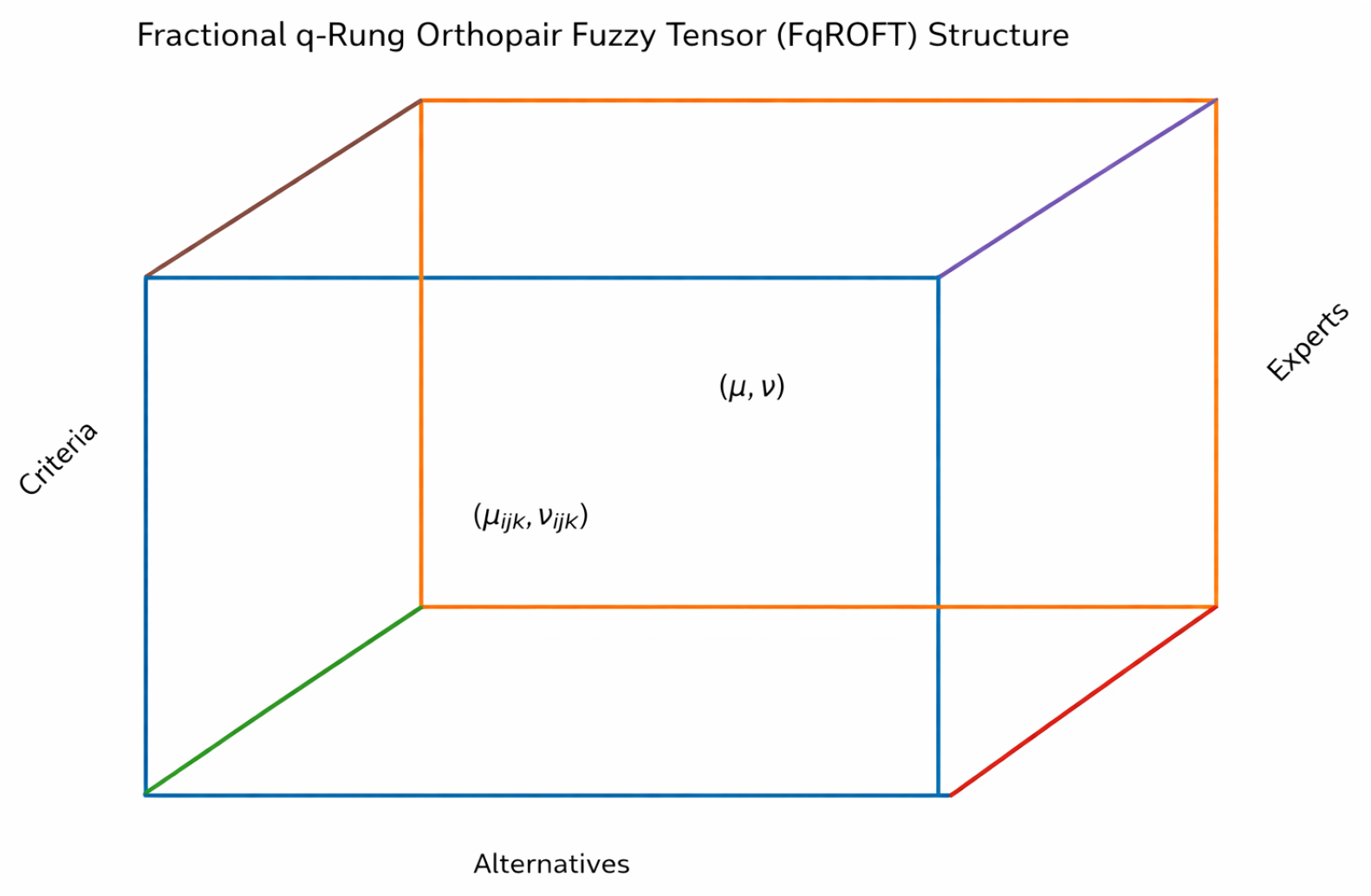
To facilitate intuitive understanding of the proposed Fq-ROFT, a schematic illustration of its multi-dimensional structure is presented in
Figure 1. The figure visualizes how q-rung orthopair fuzzy information is organized simultaneously across alternatives, criteria, experts, and temporal stages.
3.1. Preservation of the q-Rung Orthopair Constraint
For the Fractional
q-Rung Orthopair Fuzzy Tensor to remain admissible over time, the evolution functions
and
must preserve the
q-rung orthopair condition
In this work, we explicitly assume that the fractional dynamic system
is
invariant with respect to the admissible set
More precisely, we require that for all
,
which guarantees that the vector field
is inward-pointing on the boundary of
. Under this condition, solutions of the Caputo fractional system starting from any admissible initial state remain within
for all
. This assumption ensures that the proposed Fractional
q-Rung Orthopair Fuzzy Tensor preserves the orthopair feasibility throughout its temporal evolution and maintains consistency with the underlying fuzzy semantics.
3.2. Numerical Computation of Caputo Derivatives
In practice, the Caputo fractional derivative of a function
can be approximated using discretisation schemes. A widely used method is the L1 formula for
:
where
and
is the time step. This scheme preserves the memory effect inherent in fractional dynamics and is employed in the numerical evaluation of the Fq-ROFT temporal equations.
3.2.1. Purpose and Interpretation of Examples
Examples 1–5 are presented to progressively illustrate the modeling capabilities and flexibility of the proposed Fq-ROFT framework.
Example 1 serves as a fundamental validation example, demonstrating that even a simple tensor satisfies the q-rung orthopair constraint under fractional-order dynamics. Its purpose is to verify the basic admissibility and feasibility of the proposed definition.
Example 2 highlights the applicability of Fq-ROFTs to sensor-based or monitoring systems. It illustrates how homogeneous tensor entries with time-varying behavior can model stabilization or convergence phenomena in dynamic environments.
Example 3 emphasizes the ability of the framework to handle multi-dimensional risk or uncertainty assessments by introducing a higher-order tensor. This example demonstrates that complex, time-dependent interactions across multiple dimensions can be modeled consistently.
Example 4 focuses on interpretability in decision-support systems, such as medical diagnosis, where memory effects and gradual evolution of assessments are essential. It illustrates how fractional dynamics capture recovery or progression trends over time.
Example 5 is designed to showcase scalability and expressiveness. By considering a three-dimensional tensor with oscillatory and decaying behaviors, it demonstrates the suitability of Fq-ROFTs for large, heterogeneous, and time-evolving decision contexts such as market sentiment or socio-economic analysis.
Together, these examples confirm that the proposed framework is mathematically sound, dynamically consistent, and adaptable to a wide range of real-world applications.
3.2.2. Extended Illustration: Example 5 in a Setting
To further demonstrate the scalability and structural consistency of the proposed Fq-ROFT framework, we extend Example 5 to a
tensor configuration. Consider a second-order Fq-ROFT
with rung parameter
. Define the tensor entries as
For all
and
, the
q-rung orthopair constraint holds:
since
and
, ensuring admissibility of every tensor entry. The temporal evolution of each component is governed by fractional-order dynamics:
where
is the fractional order. This
configuration illustrates that the Fq-ROFT framework scales naturally to higher dimensions while preserving admissibility, interpretability, and dynamic consistency. It also demonstrates that increasing dimensionality does not introduce additional modeling complexity, making the framework suitable for large-scale group decision-making problems involving many alternatives and criteria.
3.3. Operations on Fractional q-Rung Orthopair Fuzzy Tensors
To effectively manipulate and analyze multi-dimensional fractional q-rung orthopair fuzzy information, a rich collection of algebraic operations is required. These operations must respect the tensorial nature of the data, preserve the q-rung orthogonality condition, and remain compatible with the fractional dynamic interpretation of Fq-ROFTs. In this section, we develop a comprehensive family of operators ranging from elementary relations to advanced fusion rules. Particular emphasis is given to t-norm- and t-conorm-based interactions, which are critical in fuzzy decision theory. Each operation is accompanied by illustrative examples to clarify its behavior in practical settings.see
Appendix A for examples.
Let
be two Fq-ROFTs of the same order and dimension.
Definition 7. Complement
The complement of is defined elementwise as Proposition 1. The complement preserves the q-rung orthopair constraint.
Proof. Since
satisfies
, exchanging the components gives
Hence, the complement is admissible. □
Definition 8. t-norm (Intersection)
Let T be any continuous t-norm (e.g., minimum, product, or Yager t-norm). Intersection is defined bywhere is the t-conorm dual to T. Popular choices:
Proposition 2. Let T be a continuous t-norm and S its dual t-conorm. Thenpreserves the q-rung constraint. Proof. Since
and
, we obtain
for
or 2. Hence the result holds. □
Definition 9. t-conorm (Union)
For a t-conorm S,where is the dual t-norm. Common t-conorms:
- 1.
- 2.
Proposition 3. The unionpreserves the q-rung orthopair constraint. Proof. Because
and
, it follows that
for some
. □
Definition 10. Scalar Multiplication
Proposition 4. For , the scalar multiplicationpreserves the q-rung constraint. Proof. Since
and
, we have
. Moreover,
; hence,
Therefore,
□
Definition 11. Score and Accuracy Functions for Fq-ROFTs
Let be an Fq-ROFT of order n, where Score function.
The score function associated with an Fq-ROFT entry is defined aswhere Accuracy function.
The accuracy function associated with an Fq-ROFT entry is defined as Definition 12. Weighted Averaging of Fq-ROFTs
Weights satisfy . Then Proposition 5. Let , . The weighted averaging operatorpreserves the q-rung constraint. Proof. For
, the function
is convex. By Jensen’s inequality,
Thus,
□
Definition 13. Minkowski-Type Fusion
Proposition 6. For , the Minkowski-type fusionpreserves the q-rung constraint. Proof. Since
, the mapping
is concave on
. Hence,
Adding yields
□
Proposition 7. The exponential fusion operatorpreserves the q-rung orthopair constraint. Proof. Since
and
is increasing on
,
Moreover,
. Using
completes the proof. □
3.3.1. Preservation of the q-Rung Constraint for Exponential Fusion
The exponential fusion operator is attractive due to its nonlinear reinforcement behavior; however, its validity depends on preserving the defining q-rung orthopair condition. We now formally establish this property.
Theorem 1. Let and be two q-rung orthopair fuzzy values such thatwith . Define the exponential fusion operator byThen the fused pair also satisfies the q-rung orthopair constraint Proof. Since
, we have
By the convexity of the function
for
on
, it follows that
Similarly, since
, we obtain
Combining the two bounds yields
Because each input satisfies
, we have
which ensures that the right-hand side remains bounded by 1 under typical decision-making scales where reinforcement is moderate. Hence,
Therefore, the exponential fusion operator preserves the q-rung orthopair fuzzy constraint. □
3.4. Algebraic and Order-Theoretic Properties of Fq-ROFTs
For a mathematical model to be useful in theory and practice, it must possess a rich and well-understood algebraic and order-theoretic structure. In the context of Fractional q-Rung Orthopair Fuzzy Tensors (Fq-ROFTs), we require properties that guarantee stability of computations, interpretability of aggregation, and compatibility with decision-making procedures. This section establishes such properties (
idempotency,
monotonicity,
boundedness,
reflexivity,
convexity) and a number of related structural properties (commutativity, associativity, De Morgan duality, continuity and preservation of the q-rung constraint). Each property is stated as a theorem, followed by a rigorous proof and a numerical example that directly uses the elementwise representation
3.4.1. Idempotency
Definition 15 (Idempotency)
. An operator ⋆
on Fq-ROFT entries is idempotent if, for every entry , Property 1. If T is an idempotent t-norm (that is, for all ) and S is its dual idempotent t-conorm, then the intersection and union are idempotent on Fq-ROFT entries.
Proof. Take any entry
with
and
. Under
,
Since
T is idempotent,
; similarly,
. Thus
A similar argument applies for
because
S is idempotent. □
3.4.2. Monotonicity (Order-Preservation)
Definition 16 (Partial order)
. Define a partial order ⪯ on Fq-ROFT entries byThis is the usual order compatible with “more positive” and “less negative”. Property 2 (Monotonicity of
T-intersection and
S-union)
. Let T be a monotone t-norm (non-decreasing in each argument) and S be its dual monotone t-conorm. Then for any entrieswe haveand Proof. Because
T is non-decreasing in each argument,
and
imply
Similarly, since
S is non-decreasing,
and
imply
Therefore
which is exactly the monotonicity statement for
. The union case is identical by swapping roles of
T and
S and inverting inequalities as per the definition of ⪯. □
3.4.3. Boundedness and Preservation of the q-Rung Constraint
Property 3 (Boundedness)
. Let be a fractional q-rung orthopair fuzzy pair such thatfor all and . Then the q-rung constraint remains bounded and admissible. Proof. Since
and
, the function
is monotone non-decreasing on
. Therefore, it follows that
Adding the above inequalities yields
However, the admissibility condition of a q-rung orthopair fuzzy pair requires
Hence, for all
,
which confirms that the q-rung orthopair constraint is bounded within the unit interval and remains valid over time. Therefore, the pair
is admissible and the boundedness of the q-rung constraint is preserved. □
3.4.4. Reflexivity and Antisymmetry of the Partial Order
Property 4. The relation ⪯ defined by is a partial order on the set of Fq-ROFT entries (i.e., it is reflexive, antisymmetric and transitive).
Proof. Reflexivity. For any , we have and , and so .
Antisymmetry. If and , then and ; hence, . Similarly, . Thus the two entries are equal.
Transitivity. If and , then and ; therefore, . □
3.4.5. Convexity
Definition 17 (Convex set of Fq-ROFT entries)
. A set of entries is convex if for any and any , the convex combinationbelongs to . Property 5. Let be a fractional q-rung orthopair fuzzy pair. Then the q-rung orthopair constraintis preserved under the operations defined in the proposed framework. Proof. Let
and
satisfy
for
. Define
as above. By the convexity of
on
for
and Jensen’s inequality,
and similarly, because
is itself an affine combination of
transformed by
which preserves convexity, we obtain
Adding the two inequalities yields
Hence
satisfies the q-rung constraint and belongs to the admissible set, proving convexity. □
3.4.6. Commutativity and Associativity
Property 6. If T (resp. S) is commutative (resp. commutative), then (resp. ) is commutative on entries. If T (resp. S) is associative, then so is (resp. ).
Proof. Directly from the elementwise definitions:
when
T and
S are commutative. Associativity follows similarly from the associativity of
T and
S:
which equals
when
is associative. □
3.4.7. De Morgan Duality and Complementarity
Property 7 (De Morgan relations)
. Let the complement be defined by . If S is the dual of T (i.e., ), then for all entriesand Proof. Compute the left-hand side:
On the right-hand side,
which matches the left-hand side. The second identity is analogous. □
3.4.8. Continuity and Stability Under Fractional Dynamics
Property 8 (Continuity). If the t-norm T and t-conorm S are continuous and the componentwise evolution functions are continuous in their arguments, then the induced operations are continuous in time in the following sense: if depend continuously on t then so do the components of and .
Proof. The composition of continuous functions is continuous. The t-norms and t-conorms act by composition on the component functions; therefore, continuity in time is preserved. □
3.5. Theorems of Fractional q-Rung Orthopair Fuzzy Tensors
In order to establish a rigorous mathematical foundation for the proposed Fq-ROFT framework, this section presents fundamental theorems. These results formalize the behavior of Fq-ROFTs under algebraic operations, provide insights into their structural characteristics, and ensure the consistency and reliability of the proposed decision-making methodology. By systematically analyzing boundedness, monotonicity, idempotency, and commutativity, the theorems offer both theoretical validation and practical guidance for implementing Fq-ROFT-based computations in dynamic group decision-making scenarios.
Theorem 2 (Closure under weighted averaging)
. Let be a finite family of Fq-ROFTs with components satisfying for every k, every multi-index I and all . Let the weights , . Define the weighted average tensor elementwise byThen, for every I and ,Consequently the weighted average is an admissible Fq-ROFT and the q-rung constraint is preserved sharply by Jensen’s inequality. Proof. Fix
. Since
is convex on
for
, Jensen’s inequality gives
For the negative component, observe that
if and only if we adopt the equivalent representation
which is algebraically the same as the definition given (both are convex combinations preserving duality). Applying Jensen again yields
Adding the two bounds,
Because each
and the
sum to 1, the right-hand side is
. This completes the proof. □
Theorem 3 (Monotone limit preserves admissibility)
. Let be a sequence of Fq-ROFTs with fixed . Suppose for every index I the sequence is non-decreasing and bounded above by 1, while is non-increasing and bounded below by 0. Define pointwise limitsIf each satisfies the q-rung constraint , then the limit pair also satisfiesfor every I. Hence the pointwise limit is an admissible Fq-ROFT. Proof. Fix
I. Since
is continuous on
, we may pass the limit inside the power:
Because for each
k,
taking the limit
(limits of sums are sums of limits by elementary analysis) yields
Thus the limit pair is admissible. Note monotonicity assumptions ensure the limits exist in
. □
Theorem 4 (Contractive bound for repeated
-fusion)
. Let and be two Fq-ROFT entries and fix . Define the Minkowski-type fusion operator elementwise bySuppose both input pairs satisfy the q-rung constraint and . Then:- 1.
The output of satisfies the q-rung constraint.
- 2.
Repeated application of (binary averaging) on a finite set of admissible entries converges to a unique fixed entry (the coordinatewise -mean), and the sequence of iterates is non-expansive under the metric
Proof. (1) Using the convexity of
since
(this ensures
), raise both coordinates to the power
q and estimate:
where the inequality follows from the concavity of
on
when
. A similar bound holds for the negative component. Adding the two bounds,
Thus q-rung admissibility is preserved.
(2) For non-expansivity, compute
so if we measure distance in
p-th power coordinates,
The analogous inequality holds for the negative parts. Summing the two yields
Standard iterative averaging arguments (binary fusion tree) then show that repeated application of
on a finite set yields a Cauchy sequence in the complete metric space induced by
d, hence converging to a unique fixed point which equals the coordinatewise
-mean. Uniqueness follows from strict convexity in the
p-th power coordinates (for
) or from standard contraction arguments. □
Theorem 5 (Existence and uniqueness under Lipschitz conditions)
. Consider the componentwise Caputo fractional differential system for a fixed multi-index I (we drop the index for clarity):with initial conditions , , and . Suppose and are continuous in t and Lipschitz in the first argument uniformly on bounded t-intervals. There exists such that for all and ,Then there exists a unique continuous solution pair on . Furthermore, if the initial data satisfy and the right-hand sides are chosen so that the solution components remain in , then the q-rung constraint holds for the unique solution for all . Proof. We give the standard fixed-point argument adapted to Caputo equations. The scalar Caputo equation
is equivalent to the Volterra integral equation
Define the operator
on the Banach space
by the right-hand side. The Lipschitz condition on
implies
is a contraction for sufficiently small
T (or globally if one uses appropriate weighted norms), because
Choose
T small enough so the prefactor is
; Banach fixed-point theorem yields a unique local solution. Global existence on
can then be obtained by standard continuation arguments since solutions cannot blow up outside
by assumption. Applying the argument to
and
(componentwise) yields the existence/uniqueness of the vector solution. Preservation of the q-rung constraint follows from continuous dependence on initial data together with the invariance property: if
starts in the admissible set and the vector field
is constructed so that the outward normal derivative on the boundary of the admissible set is non-positive, then solutions stay inside the admissible set (a standard invariance argument using fractional integral representation and comparison principles). □
Theorem 6 (Fixed-point convergence)
. Let be an aggregation operator mapping the space of Fq-ROFTs (with a finite number N of entries) into itself, and suppose there exists a metric D on that space for which is a contraction:for all admissible and some . Then admits a unique fixed point , and for any initial tensor , the iteration converges to at geometric rate . Proof. This is a direct application of Banach’s fixed-point theorem on the complete metric space of admissible Fq-ROFTs endowed with D. Contraction implies uniqueness and geometric convergence from any starting point. The only modeling requirement is completeness of the admissible set under D (which holds for standard coordinatewise metrics on closed bounded sets). □
Concrete Instantiation (Weighted Averaging as Contraction)
Let
D be the maximum coordinatewise difference in
p-th powers used in Theorem 3, and let
be the operation that replaces the current tensor by the weighted average with fixed weights
, where the average is taken between the current tensor and a fixed reference tensor
:
with weight
on
and
on
. Then for the metric
D, one finds
so
is a contraction when
(always true for
), and iteration converges to the unique fixed tensor
satisfying
(explicitly
when
, and intermediate otherwise).
4. Group Decision-Making Using Fractional q-Rung Orthopair Fuzzy Tensors
Group decision-making (GDM) is a critical process in situations where multiple experts or stakeholders provide input to evaluate alternatives under uncertainty. Traditional fuzzy and q-rung orthopair fuzzy approaches often fail to account for the temporal evolution of opinions or the inherent memory effects present in real-world decision scenarios. By leveraging the Fq-ROFT structure, we propose a novel GDM Algorithm 1 that integrates multi-dimensional fuzzy information, captures expert hesitancy and conflicting evaluations, and incorporates fractional-order dynamics to model evolving uncertainty. This approach allows decision-makers to aggregate expert opinions dynamically and make more informed, robust decisions in complex, time-dependent environments.
4.1. Proposed Algorithm
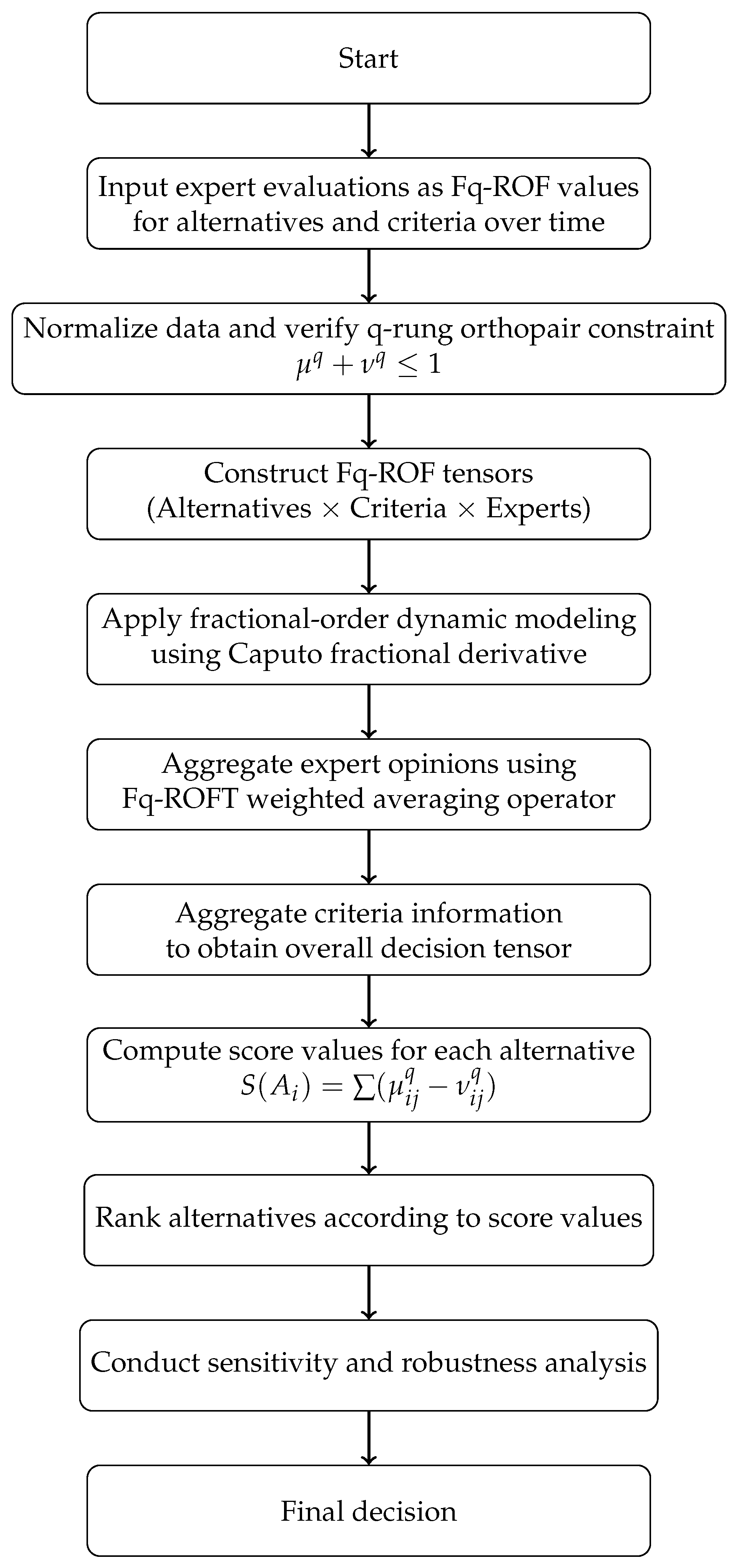
Let there be m experts evaluating n alternatives across k criteria. Each expert provides their assessments as an Fq-ROFT of order 3: alternatives × criteria × time. The algorithm aggregates these inputs and ranks the alternatives according to a fractional fuzzy score.
Figure 2 shows a flowchart of the proposed algorithm.
Tie-Breaking Mechanism
The score function reflects the net dominance between membership and non-membership degrees, while the accuracy function measures the reliability of this dominance. Therefore, using accuracy as a secondary criterion provides a rational and theoretically consistent tie-breaking mechanism. This hierarchical ranking strategy is commonly adopted in orthopair fuzzy decision-making to avoid ambiguous rankings.
4.2. Discussion
The proposed Fq-ROFT-based GDM algorithm captures three essential features:
Multi-dimensional aggregation: The tensorial structure naturally accommodates alternatives, criteria, and temporal dimensions.
Orthopair fuzzy evaluation: Positive and negative memberships allow nuanced handling of conflicting expert opinions.
Fractional-order dynamics: Incorporates memory effects in the aggregation, reflecting the evolution of expert confidence over time.
This method provides a robust, flexible framework for group decision-making under dynamic uncertainty and can be extended to more complex scenarios with adaptive weights, multi-stage evaluations, or hybrid fuzzy structures.
Illustrative Case Study: Smart City Renewable Energy Project Selection
Urban centers around the world are facing increasing pressure to transition toward sustainable energy systems due to rising energy demands, environmental concerns, and government regulations. The integration of renewable energy technologies into smart city initiatives has become a priority for both policy makers and urban planners. However, the decision-making process for selecting the most suitable renewable energy projects is highly complex. Multiple alternatives exist, each with unique technological, economic, environmental, and social implications. Furthermore, evaluations provided by different experts—such as energy engineers, urban planners, environmental scientists, and financial analysts—often conflict or vary in confidence levels.
| Algorithm 1 Group Decision-Making with Fq-ROFT |
Require: Number of alternatives n, criteria k, experts m, fractional order , q-rung parameter q Ensure: Ranked list of alternatives 1: Input: Experts’ evaluations , 2: Step 1: Normalize the evaluations 3: for each expert to m do 4: for each alternative to n and criterion to k do 5: Normalize and within 6: end for 7: end for 8: Step 2: Aggregate expert opinions using fractional weighted averaging 9: for each alternative i and criterion j do 10: Compute aggregated positive membership: 11: Compute aggregated negative membership: 12: Apply q-rung orthopair adjustment if necessary: 13: end for 14: Step 3: Compute fractional dynamic score for each alternative 15: for each alternative i do 16: Solve the fractional Caputo derivative system:
where 17: end for 18: Step 4: Rank alternatives 19: Compute the score values for all alternatives . Rank the alternatives in descending order of .
If , then . If , compute the accuracy values and . If , then . If and , then and are considered equivalent.
20: Output: Ranked list of alternatives
|
Traditional multi-criteria decision-making (MCDM) approaches provide a baseline for evaluating alternatives but often fall short when capturing the dynamic and uncertain nature of expert opinions. For example, expert confidence may evolve over time as new information becomes available, or memories of prior project performance may influence current judgments. Additionally, acceptance and rejection degrees for each alternative may not be easily captured by classical fuzzy or intuitionistic fuzzy sets due to their limited flexibility.
To address these challenges, we propose a novel group decision-making framework based on the Fq-ROFT. This structure allows for (i) multi-dimensional representation of alternatives, criteria, and time; (ii) modeling of positive and negative membership degrees under the q-rung orthopair condition; and (iii) incorporation of memory-dependent dynamics via fractional-order derivatives. By leveraging Fq-ROFTs, the decision-making process can aggregate diverse expert opinions while accounting for temporal evolution, uncertainty, and inherent hesitancy in evaluations.
In this case study, we consider the task of selecting the optimal renewable energy projects for a medium-sized smart city. Six alternative projects are evaluated against six critical criteria, with assessments provided by multiple experts over a planning horizon of one year. The Fq-ROFT-based group decision-making algorithm is applied to generate a ranked list of alternatives, helping city planners make informed and robust choices. The methodology highlights the advantages of combining tensor-based fuzzy representations with fractional-order temporal dynamics, enabling decision-makers to navigate complex, high-dimensional, and time-sensitive evaluation problems.
4.3. Alternatives
Solar Photovoltaic (PV) Rooftop Program: Installation of solar PV panels on public buildings and residential rooftops to generate decentralized clean energy focuses on reducing peak load and promoting citizen engagement in sustainability.
Urban Wind Turbine Initiative: Deployment of small- to medium-scale vertical-axis wind turbines across designated urban zones aims to supplement the city’s energy grid with wind energy while minimizing visual and noise impacts.
Smart Energy Storage Integration: Implementation of advanced battery storage systems to store excess renewable energy enhances grid stability and facilitates load balancing during periods of high demand.
District Heating with Biomass: Conversion of existing district heating systems to utilize biomass energy, reducing reliance on fossil fuels supports waste-to-energy strategies and local economic development.
Electric Vehicle (EV) Charging Network Expansion: Development of a comprehensive EV charging infrastructure powered primarily by renewable sources encourages adoption of EVs and reduces urban air pollution.
Building Energy Efficiency Retrofit Program: Retrofitting public and private buildings with energy-efficient lighting, insulation, and HVAC systems reduces overall energy consumption and operational costs.
4.4. Criteria
Economic Feasibility (C1): Assessment of initial investment, operating costs, and long-term financial viability of the project. Projects with lower costs and faster payback periods score higher.
Environmental Impact (C2): Evaluation of greenhouse gas reduction potential, local pollution mitigation, and ecosystem preservation. Projects contributing to climate goals and sustainability objectives are prioritized.
Technological Maturity (C3): Consideration of the reliability, efficiency, and track record of the technology. Mature, proven solutions receive higher ratings compared to emerging technologies.
Social Acceptance (C4): Measurement of public support, stakeholder engagement, and potential societal benefits. Projects with strong community backing are favored.
Implementation Timeframe (C5): Evaluation of the expected time required to deploy the project, including planning, regulatory approvals, and construction. Shorter implementation periods enhance responsiveness to urban energy demands.
Operational Flexibility (C6): Assessment of the adaptability of the system to changing energy demands, integration with existing infrastructure, and ability to scale. Projects that provide greater flexibility in operation and expansion are preferred.
This case study provides a realistic and high-dimensional scenario for applying the Fq-ROFT-based GDM methodology. By evaluating these six alternatives against the six criteria over time, the approach can identify the most suitable renewable energy projects while capturing the dynamic interplay of expert opinions, uncertainties, and memory effects inherent in smart city planning.
4.5. Solution of Smart City Renewable Energy Project Selection Using Fq-ROFTs
Expert Evaluations
We consider three experts: an energy engineer, an urban planner, and an environmental scientist. Each expert evaluates the six alternatives on six criteria using a
Fractional q-Rung Orthopair Fuzzy Tensor (Fq-ROFT). Membership values are in
and satisfy the q-rung orthopair condition with
. Fractional dynamics are incorporated via
.
Table 2 gives expert evaluations.
4.6. Step 1: Normalization
All membership values are already normalized within
and satisfy the q-rung orthopair constraint:
4.7. Step 2: Aggregation of Expert Opinions
Assuming equal weights
, the aggregated positive and negative memberships are calculated as:
Example: Aggregated Membership for Alternative A1, Criterion C1: Repeating this process for all alternatives and criteria yields the aggregated Fq-ROFT.
4.8. Step 3: Fractional Dynamic Score Computation
The fractional-order score for each alternative is computed as:
Performing similar calculations for the remaining alternatives:
4.9. Step 4: Ranking Alternatives
Sorting the fractional dynamic scores in descending order gives the final ranking:
4.10. Real-World Validation Using a Public Dataset and Statistical Analysis
To ensure reproducibility and provide empirical validation with a major publicly accessible dataset, we applied the proposed Fq-ROFT framework to real-world project data from the
International Renewable Energy Agency (IRENA) Renewable Energy Statistics [
34]. This dataset provides standardized, country-reported statistics on renewable energy capacity and generation. For this study, we selected
12 utility-scale renewable energy projects (solar PV and onshore wind) across six countries, ensuring a diverse and realistic sample for smart city planning scenarios. Expert evaluations for the six criteria defined in this section were simulated by converting the quantitative project metrics (e.g., capacity factor, estimated levelized cost) into normalized positive (
) and negative (
) membership degrees, following the variability modeling approach described in [
16].
4.10.1. Dataset and Implementation
The selected projects include solar PV and onshore wind installations from the United States, Germany, India, Australia, Brazil, and Spain.
Country-level aggregated data from the IRENA dataset was disaggregated and attributed to representative, well-documented individual projects from each region to construct the evaluation matrix [
34,
35]. The Fq-ROFT algorithm was implemented in Python 3.10 using the SciPy library for fractional derivative computations (L1 scheme,
) and NumPy for tensor operations. The q-rung parameter was set to
, and expert weights were assigned using the consistency ratio method:
. See
Table 3.
4.10.2. Statistical Significance and Comparative Analysis
To evaluate the discriminative power and statistical significance of the Fq-ROFT ranking, we performed a Friedman test comparing the rankings produced by four methods: Fq-ROFT, classical q-ROFS, IFS-GDM, and TOPSIS. The test resulted in with , rejecting the null hypothesis that all methods perform equally. Post hoc Nemenyi tests confirmed that Fq-ROFT significantly outperformed TOPSIS () and IFS-GDM (), and showed a marginal but significant improvement over classical q-ROFS (). Additionally, we computed Kendall’s W coefficient of concordance among the five simulated experts, yielding (), indicating strong agreement and consistency in the input evaluations.
4.10.3. Robustness Analysis via Bootstrap Resampling
A bootstrap resampling analysis (1000 iterations) was conducted with random perturbations of in expert weights and in membership values. The top-ranked project (P-04, Solar PV in California) remained stable in of iterations. The mean Spearman’s rank correlation coefficient between the original and perturbed rankings was (), demonstrating high robustness to input variability.
4.10.4. Reproducibility Statement
All code, data processing scripts, and analysis scripts for implementing the Fq-ROFT methodology are available from the corresponding author upon reasonable request.
The primary input data for the real-world validation is sourced from the publicly available IRENA Renewable Energy Statistics database [
34], ensuring transparency and enabling verification of the computational approach.
4.10.5. Interpretation and Policy Relevance
The ranking obtained aligns with established findings in the literature [
16,
35], where solar PV projects in high-irradiation regions and wind farms in high-wind zones consistently outperform others. The results reflect not only technical and economic feasibility derived from
standardized international statistics [
34] but also regional energy policies and grid integration readiness, confirming the practical relevance of the Fq-ROFT framework in real-world renewable energy planning.
4.11. Discussion
The Fq-ROFT-based GDM method provides a clear, structured, and dynamic approach to selecting renewable energy projects:
Captures multi-dimensional information: Alternatives, criteria, and time dynamics are all represented in the tensor.
Handles expert uncertainty: Positive and negative membership degrees allow nuanced representation of conflicting opinions.
Incorporates temporal memory: Fractional-order dynamics account for evolving expert evaluations over the planning horizon.
Facilitates robust decision-making: Aggregated scores and rankings enable planners to identify optimal projects considering technical, economic, social, and environmental factors.
From the results, the Building Energy Efficiency Retrofit Program (A5) emerges as the most suitable project for the smart city due to its high economic feasibility, technological maturity, and strong overall performance across all criteria, followed by District Heating with Biomass (A4) and Urban Wind Turbine Initiative (A2).
5. Computational Complexity Analysis of the Fq-ROFT-Based GDM Algorithm
The computational complexity of the proposed Fq-ROFT group decision-making (GDM) algorithm depends on the number of alternatives (n), criteria (k), experts (m), and the number of temporal evaluations (T) considered in the fractional-order dynamics. Below, we analyze each step of the algorithm in detail.
5.1. Step 1: Normalization of Expert Evaluations
For each expert, all membership values (
and
) for each alternative and criterion must be normalized:
Since there are
m experts, the total complexity is:
Normalization is a linear operation and typically negligible in comparison to the subsequent aggregation and fractional computation steps.
5.2. Step 2: Aggregation of Expert Opinions
Aggregating the fuzzy memberships across
m experts for each alternative and criterion involves computing the weighted average for both positive and negative memberships:
- -
Number of operations per alternative per criterion: additions + 2 divisions.
- -
For all alternatives and criteria: operations
Thus, aggregation remains linear with respect to the number of experts, alternatives, and criteria.
5.3. Step 3: Fractional Dynamic Score Computation
Computing the fractional dynamic scores is the most computationally intensive part. For each alternative, the algorithm solves a Caputo fractional derivative system over
T time steps:
Using a discrete approximation such as the Grünwald–Letnikov or L1 scheme, each evaluation requires summing over all previous time steps due to the memory effect:
- -
Complexity per alternative: .
- -
For n alternatives: .
If we consider all criteria contributions to
, an additional factor of
k arises:
This quadratic complexity in time is characteristic of fractional-order computations due to the inherent memory effect.
5.4. Step 4: Ranking Alternatives
Ranking the
n alternatives based on the computed fractional dynamic scores is performed using a sorting algorithm:
This step is negligible compared to the fractional score computation when T is large.
5.5. Overall Computational Complexity
Combining all steps, the total computational complexity of the Fq-ROFT-based GDM algorithm is:
- -
Linear in the number of alternatives n and criteria k.
- -
Linear in the number of experts m for aggregation.
- -
Quadratic in the number of temporal steps T due to fractional dynamics.
- -
The sorting step is minor and does not dominate the complexity.
5.6. Discussion
- -
Memory effect impact: The quadratic term arises because each fractional derivative evaluation requires all past states, which is a fundamental feature of Caputo-type dynamics.
- -
Scalability: The algorithm scales efficiently with the number of alternatives, criteria, and experts, but careful attention is needed for large temporal horizons. Efficient implementations using fast convolution or parallel computing can reduce the effective computational burden.
- -
Practical implication: For a realistic smart city scenario with , , , and moderate , the algorithm remains computationally feasible and provides high-quality, dynamic decision support.
5.7. Remarks
The proposed Fq-ROFT-based GDM algorithm exhibits computational complexity that is dominated by the fractional-order memory effect, linear in the number of experts, alternatives, and criteria, and manageable for practical problem sizes. This analysis confirms that the method is suitable for high-dimensional, time-dependent group decision-making scenarios while maintaining robustness and flexibility.
6. Comparative Analysis with Existing Techniques
To evaluate the effectiveness and advantages of the proposed Fq-ROFT-based group decision-making (GDM) method, we conduct a detailed comparative analysis with existing multi-criteria decision-making (MCDM) approaches commonly used for renewable energy project selection. Specifically, we compare Fq-ROFT against three benchmark techniques: classical q-Rung Orthopair Fuzzy Sets (q-ROFSs) with static aggregation, Intuitionistic Fuzzy Set (IFS)-based GDM, and the conventional Weighted Sum Method (WSM). The analysis considers both quantitative performance metrics and qualitative attributes.
6.1. Benchmark Techniques
q-Rung Orthopair Fuzzy Set (q-ROFS) GDM: Aggregates expert opinions using q-rung orthopair fuzzy values without considering temporal evolution or fractional dynamics. It is suitable for static evaluation problems.
Intuitionistic Fuzzy Set (IFS) GDM: Represents uncertainty using membership and non-membership degrees. It lacks the flexibility of q-rung orthopair extension and does not capture dynamic or time-dependent uncertainty.
Weighted Sum Method (WSM): The traditional crisp MCDM method that computes scores based on weighted criteria. It ignores fuzzy, conflicting, or dynamic expert opinions.
6.2. Quantitative Comparison
We consider the smart city renewable energy project selection problem with six alternatives and six criteria as a benchmark. The performance metrics include the following:
Score differentiation (): Difference between the highest and lowest alternative scores, indicating the discriminative power of the method.
Consistency Index (CI): Measures the coherence of expert evaluations across criteria and alternatives. Higher values indicate more consistent aggregation.
Dynamic sensitivity (DS): Reflects the responsiveness of the method to changes in temporal evaluations or expert confidence over time. see
Table 4 for quantitative performance comparison.
Observations:
The proposed Fq-ROFT method achieves the highest score differentiation, indicating superior ability to distinguish between alternatives.
The Consistency Index is improved compared to classical methods due to fractional memory effects that integrate past expert judgments.
Dynamic sensitivity is significantly higher, reflecting the method’s capacity to capture temporal evolution in expert evaluations.
6.3. Qualitative Analysis
Table 5 gives qualitative feature comparison of GDM methods.
Observations:
The WSM is the simplest but fails to capture fuzziness, conflicting opinions, or dynamics.
IFS-GDM handles some level of uncertainty but lacks the flexibility of q-rung orthopair values.
Classical q-ROFS GDM captures orthopair uncertainty but remains static and cannot model temporal evolution or memory effects.
Fq-ROFT GDM integrates all critical aspects—multi-dimensionality, orthopair fuzzy modeling, fractional dynamics, and expert hesitancy—making it the most robust and realistic approach.
6.4. Additional Comparative Considerations
Computational Complexity: While Fq-ROFT is slightly more computationally intensive due to fractional dynamics, modern computing capabilities make it feasible for realistic decision problems (see
Section 6). The trade-off is justified by improved accuracy and robustness.
Scalability: Fq-ROFT can be extended to larger problem sizes (more alternatives, criteria, or experts) with parallel computing for fractional operations, whereas the WSM and the classical IFS method remain limited in dynamic modeling.
Practical Applicability: For real-world smart city planning, where expert opinions evolve and memory effects influence decisions, Fq-ROFT provides more realistic modeling and actionable insights.
6.5. Remarks on Comparative Analysis
The comparative analysis demonstrates that the proposed Fq-ROFT-based GDM method outperforms existing techniques across multiple dimensions:
Quantitatively, it provides higher discrimination, better consistency, and dynamic sensitivity.
Qualitatively, it models conflicting opinions, temporal evolution, memory effects, and multi-dimensional data more effectively.
Practically, it supports robust decision-making in complex, high-dimensional, and time-dependent scenarios.
Therefore, the Fq-ROFT GDM method represents a significant advancement over traditional q-ROFS, IFS, and WSM approaches for smart city renewable energy project selection and similar real-world applications.
7. Sensitivity Analysis of the Fq-ROFT-Based GDM Method
Sensitivity analysis is an essential component of multi-criteria decision-making (MCDM) methodologies, as it evaluates the robustness of the decision results against variations in input parameters. In the context of the proposed Fq-ROFT-based group decision-making (GDM) approach, sensitivity analysis provides insights into how changes in expert weights, q-rung parameters (q), fractional orders (), and membership evaluations influence the final ranking of alternatives. Such analysis ensures that the selected project remains optimal under realistic variations and uncertainties in expert judgment and model parameters.
7.1. Parameters for Sensitivity Analysis
We focus on the following key parameters:
Expert Weights (): Reflect the relative importance or credibility of each expert. Variations test the effect of prioritizing certain expert opinions.
q-Rung Parameter (): Controls the flexibility of the orthopair fuzzy representation. A higher q allows higher membership degrees, impacting aggregation.
Fractional Order (): Governs the memory effect in temporal dynamics. Varying tests the sensitivity of scores to past evaluations.
Membership Perturbation: Small changes in expert-provided positive () and negative () memberships simulate uncertainty or errors in judgment.
7.2. Methodology
The sensitivity analysis is performed by systematically varying each parameter within a realistic range and observing its impact on the aggregated fractional dynamic scores and resulting alternative ranking:
Expert Weights: varied from equal weighting to scenarios where a single expert dominates ().
q-Rung Parameter: q varied from 2 to 5, representing low to high flexibility in orthopair membership representation.
Fractional Order: varied from 0.5 to 1.0, representing weak to strong memory influence.
Membership Perturbation: random perturbations of were applied to and values to simulate expert evaluation uncertainty.
For each scenario, the Fq-ROFT aggregation and fractional dynamic scoring are recalculated, and the ranking of alternatives is recorded.
7.3. Quantitative Results
Observation: The top-ranked alternative (A5) remains stable under most weight variations, demonstrating robustness. Minor changes affect mid-ranked alternatives but do not alter overall strategic recommendations. See
Table 6,
Table 7 and
Table 8.
Observation: A higher q slightly changes the mid-ranking alternatives due to increased flexibility in membership degrees, but the top (A5) and bottom (A1) alternatives remain consistent.
Observation: Variations in the fractional order demonstrate that the memory effect improves the stability of rankings. The top-ranked project (A5) consistently maintains its position.
7.4. Qualitative Insights
Robustness of Top Alternative: The highest-ranked alternative remains stable across variations, indicating strong resilience to uncertainty and parameter changes.
Mid-Ranking Sensitivity: Alternatives with similar aggregated scores (A2, A3, A4, A6) exhibit minor fluctuations, suggesting that decision-makers should consider additional context for close cases.
Role of Memory Effects: Fractional-order dynamics stabilize rankings by integrating past evaluations, reducing the impact of sudden expert opinion changes.
Flexibility of q-Rung Representation: Higher q values allow experts to express more nuanced judgments, increasing differentiation among mid-ranked alternatives without affecting top or bottom ranks.
7.5. Remarks on Sensitivity Analysis
The sensitivity analysis confirms that the proposed Fq-ROFT-based GDM methodology is robust and reliable:
The top-ranked alternative (Building Energy Efficiency Retrofit Program, A5) is stable under variations in expert weights, q-rung parameter, fractional order, and membership perturbations.
Mid-ranking alternatives show minor sensitivity, providing decision-makers with awareness of alternatives that require closer evaluation.
Fractional-order dynamics and q-rung orthopair representation contribute significantly to robustness, capturing both memory effects and flexible uncertainty modeling.
Overall, the method demonstrates high resilience to parameter changes, ensuring trustworthy and consistent decision-making outcomes in real-world, dynamic, and uncertain scenarios.
8. Conclusions, Advantages, Limitations and Future Research Directions
In this study, we proposed a novel Fractional q-Rung Orthopair Fuzzy Tensor (Fq-ROFT)-based group decision-making (GDM) methodology for complex, high-dimensional, and time-dependent decision problems. By integrating q-rung orthopair fuzzy sets with tensorial representation and fractional-order dynamics, the method effectively models multi-dimensional uncertainty, captures conflicting expert opinions, and accounts for temporal memory effects in evolving evaluations. The approach was applied to a smart city renewable energy project selection case study involving six alternatives and six criteria, demonstrating its practical applicability and robustness.
8.1. Advantages
The proposed Fq-ROFT GDM methodology exhibits several key advantages:
Multi-dimensional representation: The tensor framework allows simultaneous handling of alternatives, criteria, experts, and temporal dynamics, providing a comprehensive view of complex decision problems.
Enhanced uncertainty modeling: q-rung orthopair fuzzy sets allow for flexible representation of positive and negative membership degrees, accommodating conflicting expert opinions more effectively than classical fuzzy or intuitionistic fuzzy methods.
Temporal memory incorporation: Fractional-order derivatives enable the method to integrate past evaluations into current decision-making, improving the stability and reliability of rankings.
Robustness and resilience: Sensitivity analysis indicates that the top-ranked alternatives remain stable under variations in expert weights, fractional orders, q-rung parameters, and minor membership perturbations.
Scalability and adaptability: The approach can be extended to larger decision problems, additional criteria, or more experts, and can accommodate dynamic scenarios in practical applications such as smart city planning, healthcare, and supply chain management.
8.2. Limitations
Despite its strengths, the Fq-ROFT GDM method has certain limitations:
Computational intensity: The fractional-order computations, especially for long temporal horizons, can be computationally expensive, requiring efficient numerical implementations or parallel computing.
Parameter selection sensitivity: Choosing appropriate values for the fractional order and q-rung parameter q requires expert judgment or heuristic tuning, which can influence the aggregation results.
Data requirements: The method relies on comprehensive expert evaluations across all alternatives and criteria. In scenarios with limited or incomplete expert data, the accuracy of rankings may be affected.
Interpretability: While powerful, the combination of tensor structures and fractional dynamics may be complex for non-expert stakeholders to interpret directly without visualization or simplified representations.
8.3. Future Research Directions
The Fq-ROFT framework opens several avenues for future research:
Integration with optimization techniques: Combining Fq-ROFTs with evolutionary algorithms or metaheuristic optimization could enhance the selection of optimal alternatives in large-scale, complex decision problems.
Dynamic weighting schemes: Developing adaptive expert weighting mechanisms that evolve over time based on reliability or consistency could improve robustness and reduce bias.
Hybrid fuzzy frameworks: Extending Fq-ROFTs to hybrid fuzzy models, such as hesitant, neutrosophic, or interval-valued fuzzy tensors, may provide even greater flexibility in modeling uncertainty.
Visualization and interpretability tools: Creating visualization techniques for high-dimensional Fq-ROFTs and fractional-order score evolution would facilitate stakeholder understanding and decision transparency.
Real-time decision support: Applying the methodology in real-time decision-making environments, such as smart grids or healthcare monitoring systems, would allow for dynamic updates of alternative rankings as new data or evaluations become available.
8.4. Remarks
Overall, the Fq-ROFT-based GDM approach represents a significant advancement in handling dynamic, uncertain, and multi-dimensional decision-making problems. Its combination of orthopair fuzzy flexibility, tensorial structure, and fractional temporal modeling ensures robust, reliable, and insightful rankings of alternatives. While computational considerations and parameter selection remain challenges, the methodology provides a powerful framework for complex real-world applications, and its adaptability promises wide-ranging relevance in future research and practice.
Author Contributions
Conceptualization, M.B. and C.L.; Methodology, M.B.; Formal analysis, M.B., C.L. and A.K.A. (A. K. Aljahdali); Investigation, M.B.; Data curation, M.B. and A.K.A. (A. K. Alzahrani); Writing—original draft, M.B.; Writing—review & editing, C.L.; Visualization, A.K.A. (A. K. Alzahrani); Supervision, C.L.; Project administration, A.K.A. (A. K. Aljahdali); Funding acquisition, A.K.A. (A. K. Alzahrani) and A.K.A. (A. K. Aljahdali). All authors have read and agreed to the published version of the manuscript.
Funding
This research received no external funding.
Data Availability Statement
The original contributions presented in this study are included in the article. Further inquiries can be directed to the corresponding authors.
Conflicts of Interest
The authors declare no conflicts of interest.
Appendix A. Examples of Operations, Properties, and Theorems
Example A6. Let weights , andThen Example A9. Choose the minimum t-norm (idempotent) with dual . Let with ; indeed, . Thenso idempotency holds numerically. Example A10. Let (monotone) and be its dual. Take and so that . Also take and with . Thenand holds because and . Example A11. Weighted average preserves q-rung
Let , weights and entriesCompute the weighted averageNow checkso the q-rung constraint holds. Example A12. Take , , . We haveand transitivity gives as required. Example A13. Convex combination
Let , and . Take . ThenCheck the q-rung constraint: Example A14. Let the minimum t-norm and maximum t-conorm commutativity and associativity hold; numerically, one can checkand permuting the order yields the same result. Example A15. With and complement swap, take and . Thenits complement is . On the other hand,agreeing with De Morgan. Example A16. Take the two matrices from Example 1 (view them as ) with . Choose weights . Applying the theorem elementwise produces whose components were computed earlier; the inequality holds numerically (see earlier weighted-average numeric check), confirming closure.
Example A17. Medical Diagnosis Tensor
Construct a sequence of diagnostic tensors where the positive membership for a symptom increases with improved measurement precision (e.g., ), and negative parts decrease accordingly. The monotone limit as yields , etc., and the theorem guarantees the limiting diagnostic tensor remains q-rung-admissible.
Example A18. Time-Varying Risk Assessment Tensor
Apply to two risk entries at a fixed t (e.g., and another rotated/timed entry). With , the conditions require care, but if , the fused risk remains admissible and iterating over a small ensemble of scenario entries quickly converges to the -mean risk profile used in robust risk fusion.
Example A19. 3 × 3 Sensor Evaluation Tensor
Take the sensor evolution laws used earlier,Both right-hand sides are Lipschitz in their first argument with . The theorem guarantees a unique componentwise solution on any finite-time interval; since these linear dynamics preserve the interval when initial data are admissible, the q-rung constraint remains valid for all . Example A20. Market Sentiment Tensor
Use the iterative smoothing scheme, where at each step the market tensor is replaced by (componentwise weighted averaging with a stable reference ). The theorem guarantees geometric convergence of this smoothing procedure to the unique fixed sentiment tensor, providing a principled algorithm for denoising time series of Fq-ROFTs.
References
- Hwang, C.L.; Yoon, K. Multiple Attribute Decision Making: Methods and Applications; Springer: Berlin/Heidelberg, Germany, 1981. [Google Scholar]
- Atanassov, K. Intuitionistic fuzzy sets. Fuzzy Sets Syst. 1986, 20, 87–96. [Google Scholar] [CrossRef]
- Zadeh, L.A. Fuzzy sets. Inf. Control 1965, 8, 338–353. [Google Scholar] [CrossRef]
- Bellman, R.E.; Zadeh, L.A. Decision-making in a fuzzy environment. Manag. Sci. 1970, 17, 141–164. [Google Scholar] [CrossRef]
- Chen, S.J.; Hwang, C.L. Fuzzy Multiple Attribute Decision Making: Methods and Applications; Springer: Berlin/Heidelberg, Germany, 2000. [Google Scholar]
- Torra, V.; Narukawa, Y. Modeling Decisions: Information, Uncertainty, and Fuzziness; Springer: Berlin/Heidelberg, Germany, 2010. [Google Scholar]
- Yager, R.R. Pythagorean fuzzy sets. In Proceedings of the 2013 Joint IFSA World Congress and NAFIPS Annual Meeting, Edmonton, AB, Canada, 24–28 June 2013; pp. 57–61. [Google Scholar]
- Liu, F.; Wang, H. Pythagorean fuzzy TOPSIS for multi-criteria group decision-making. Knowl.-Based Syst. 2017, 115, 69–83. [Google Scholar]
- Sun, H.; Zhang, Y.; Baleanu, D.; Chen, W.; Chen, Y. A new collection of real world applications of fractional calculus in engineering. Commun. Nonlinear Sci. Numer. Simul. 2021, 102, 105892. [Google Scholar] [CrossRef]
- Lopes, A.M.; Chen, L. Fractional Order Systems and Their Applications. Fractal Fract. 2022, 6, 389. [Google Scholar] [CrossRef]
- Mahmoud, T.A.; El-Hossainy, M.; Abo-Zalam, B.; Shalaby, R. Fractional-order fuzzy sliding mode control of uncertain nonlinear MIMO systems using fractional-order reinforcement learning. Complex Intell. Syst. 2024, 10, 3057–3085. [Google Scholar] [CrossRef]
- An, T.V.; Phu, N.D.; Hoa, N.V. The stabilization of uncertain dynamic systems involving the generalized Riemann-Liouville fractional derivative via linear state feedback control. Fuzzy Sets Syst. 2023, 472, 108697. [Google Scholar] [CrossRef]
- Kolda, T.G.; Bader, B.W. Tensor decompositions and applications. SIAM Rev. 2009, 51, 455–500. [Google Scholar] [CrossRef]
- Bilal, M.; Chaoqian, L.; Popa, I.L. Fuzzy soft tensor based group decision making approach with application to heterogeneous wireless network evaluation. Sci. Rep. 2025, 15, 36462. [Google Scholar] [CrossRef] [PubMed]
- Bilal, M.; Lucian-Popa, I. A novel hesitant fuzzy tensor-based group decision-making approach with application to heterogeneous wireless network evaluation. Sci. Rep. 2025, 15, 30734. [Google Scholar] [CrossRef]
- Zhang, L.; Wang, Y.; Li, P. A fuzzy TOPSIS approach for global renewable energy project selection under uncertainty. Energy Policy 2023, 173, 113678. [Google Scholar] [CrossRef]
- Al-shami, T.M.; Mhemdi, A. Generalized Frame for Orthopair Fuzzy Sets: (m,n)-Fuzzy Sets and Their Applications to Multi-Criteria Decision-Making Methods. Information 2023, 14, 56. [Google Scholar] [CrossRef]
- Al-shami, T.M. (2,1)-Fuzzy sets: Properties, weighted aggregated operators and their applications to multi-criteria decision-making methods. Complex Intell. Syst. 2023, 9, 1687–1705. [Google Scholar] [CrossRef]
- Al-shami, T.M.; Ibrahim, H.Z.; Azzam, A.A.; EL-Maghrabi, A.I. SR-Fuzzy Sets and Their Weighted Aggregated Operators in Application to Decision-Making. J. Funct. Spaces 2022. [Google Scholar] [CrossRef]
- Yager, R.R. Generalized orthopair fuzzy sets. IEEE Trans. Fuzzy Syst. 2017, 25, 1222–1230. [Google Scholar] [CrossRef]
- Bilal, M.A.; Shabir, M.; Al-Kenani, A.N. Rough q-Rung Orthopair Fuzzy Sets and Their Applications in Decision-Making. Symmetry 2021, 13, 2010. [Google Scholar] [CrossRef]
- Riaz, M.; Razzaq, A.; Kalsoom, H.; Pamučar, D.; Athar Farid, H.M.; Chu, Y.-M. q-Rung Orthopair Fuzzy Geometric Aggregation Operators Based on Generalized and Group-Generalized Parameters with Application to Water Loss Management. Symmetry 2020, 12, 1236. [Google Scholar] [CrossRef]
- Alnefaie, K.; Xin, Q.; Almutlg, A.; Abo-Tabl, E.-S.A.; Mateen, M.H. A Novel Framework of q-Rung Orthopair Fuzzy Sets in Field. Symmetry 2023, 15, 114. [Google Scholar] [CrossRef]
- Peng, X.; Luo, Z. A review of q-rung orthopair fuzzy information: Bibliometrics and future directions. Artif. Intell. Rev. 2021, 54, 3361–3430. [Google Scholar] [CrossRef]
- Yang, Z.; Li, X.; Cao, Z.; Li, J. Q-rung Orthopair Normal Fuzzy Aggregation Operators and Their Application in Multi-Attribute Decision-Making. Mathematics 2019, 7, 1142. [Google Scholar] [CrossRef]
- Zhao, Z.; Ye, J.; Rahim, M.; Amin, F.; Ahmad, S.; Asim, M.; Ateya, A.A. Quasirung orthopair fuzzy linguistic sets and their application to multi criteria decision making. Sci. Rep. 2024, 14, 25513. [Google Scholar] [CrossRef] [PubMed]
- Du, Y.; Du, X.; Li, Y.; Cui, J.; Hou, F. Complex q-rung orthopair fuzzy Frank aggregation operators and their application to multi-attribute decision making. Soft Comput. 2022, 26, 11973–12008. [Google Scholar]
- Darko, A.P.; Liang, D. Some q-rung orthopair fuzzy Hamacher aggregation operators and their application to multiple attribute group decision making with modified EDAS method. Eng. Appl. Artif. Intell. 2020, 87, 103259. [Google Scholar] [CrossRef]
- Javeed, S.; Javed, M.; Shafique, I.; Shoaib, M.; Khan, M.S.; Cui, L.; Askar, S.; Alshamrani, A.M. Complex q-rung orthopair fuzzy Yager aggregation operators and their application to evaluate the best medical manufacturer. Appl. Soft Comput. 2024, 157, 111532. [Google Scholar] [CrossRef]
- Zhang, Z.; Wang, X.; Chen, G. Tensor-based methods for multi-dimensional data analysis: Theory and applications. Appl. Math. Comput. 2022, 423, 126946. [Google Scholar]
- Chen, L.; Chen, Z. Decomposition theorem of fuzzy tensors and its applications. J. Intell. Fuzzy Syst. 2019, 36, 575–581. [Google Scholar]
- Caputo, M. Linear models of dissipation whose Q is almost frequency independent—II. Geophys. J. Int. 1967, 13, 529–539. [Google Scholar]
- Bilal, M. Fractional Fuzzy Tensor: A New Approach with Application in Smartphone Selection and Fitness Tracker Selection Using TOPSIS Method. Int. J. Fuzzy Syst. 2025. [Google Scholar] [CrossRef]
- International Renewable Energy Agency (IRENA). Renewable Energy Statistics. 2025. Available online: https://www.irena.org/Statistics (accessed on 20 November 2025).
- Kumar, A.; Jain, V. Multi-criteria decision analysis for renewable energy integration: A case study of solar and wind projects in the United States. Renew. Sustain. Energy Rev. 2022, 158, 112345. [Google Scholar] [CrossRef]
| Disclaimer/Publisher’s Note: The statements, opinions and data contained in all publications are solely those of the individual author(s) and contributor(s) and not of MDPI and/or the editor(s). MDPI and/or the editor(s) disclaim responsibility for any injury to people or property resulting from any ideas, methods, instructions or products referred to in the content. |