Article

Stability for Caputo–Hadamard Fractional Uncertain Differential Equation

1
School of Information and Mathematics, Yangtze University, Jingzhou 434023, China
2
College of Resources and Environment, Yangtze University, Jingzhou 434023, China
*
Author to whom correspondence should be addressed.
Fractal Fract. 2026, 10(1), 50; https://doi.org/10.3390/fractalfract10010050
Submission received: 4 December 2025 / Revised: 28 December 2025 / Accepted: 7 January 2026 / Published: 12 January 2026
(This article belongs to the Section General Mathematics, Analysis)

Abstract

This paper focuses on the Caputo-Hadamard fractional uncertain differential equations (CH-FUDEs) governed by Liu processes, which combine the Caputo–Hadamard fractional derivative with uncertain differential equations to describe dynamic systems involving memory characteristics and uncertain information. Within the framework of uncertain theory, this Liu process serves as the counterpart to Brownian motion. We establish some new Bihari type fractional inequalities that are easy to apply in practice and can be considered as a more general tool in some situations. As applications of those inequalities, we establish the well-posedness of a proposed class of equations under specified non-Lipschitz conditions. Building upon this result, we establish the notions of stability in distribution and stability in measure solutions to CH-FUDEs, deriving sufficient conditions to ensure these stability properties. Finally, the theoretical findings are verified through two numerical examples.

1. Introduction

Within the framework of uncertain calculus, Liu [1] pioneered the formulation of UDEs driven by a canonical process C t . This foundational work has stimulated extensive research efforts in the field. For instance, refs. [2,3,4,5,6] on existence and uniqueness; refs. [7,8,9,10] on stability; refs. [11,12,13] on uncertain optimal control problems; refs. [14,15,16,17] on the numerical approximation scheme; and refs. [18,19,20,21] on the parameter estimation.
On the other hand, to characterize memory effects in uncertain dynamical systems, Zhu [22] introduced FUDEs incorporating Caputo and Riemann–Liouville derivatives of order q ( 0 , 1 ] , with applications in interest rate modeling. The existence and uniqueness of the solution for such equations were subsequently established in [23] via Schauder’s fixed point theorem. These foundations motivated several extensions: Lu et al. [24] generalized the derivative order to q ( n 1 , n ] and developed option pricing frameworks; Lu and Zhu [25] conceived α -paths for uncertain fractional differential equations (UFDEs), proving they provide inverse uncertainty distributions of solutions; Wang and Zhu [26] derived analytic solutions for delayed UFDEs; while Lu et al. [27] established stability criteria for Caputo-type UFDEs with q ( 0 , 1 ] .
Recently, Liu [28] introduced the following CH-FUDEs with the form
D a + p C H X s = f ( s , X s ) + g ( s , X s ) d C s d s , s a > 0 , δ k X s | s = a = x k , k N .
Here D a + p C H represents the Caputo–Hadamard fractional derivative of order p > 0 with p ( n 1 , n ] , n N + , δ = s d d s , C s is a Liu process and f, g: [ a , ) × R R are two continuous functions. In [28], the authors proved the well-posedness of the solution for (1) under the linear growth conditions and Lipschitz conditions. Following [28], a few papers were devoted to the investigation of Caputo–Hadamard fractional uncertain differential equations. We can refer to [29,30,31,32]. We notice that the Lipschitz continuity of the coefficients are both required in the above studies on CH-FUDEs. However, in some practical applications, the Lipschitz continuity is too strong to be satisfied. The primary objectives of this paper is to prove the existence and uniqueness of solutions to (1) under some non-Lipschitz conditions, which improves and generalizes the existence and uniqueness results obtained in [28]. To this end, we will establish some new fractional Bihari inequalities, which can relax many results of CH-FUDEs.
The stability analysis of solutions is the particular interest in uncertain differential equations since it has great practical and theoretical significance. At present, there are inconclusive results regarding the stability of Caputo–Hadamard fractional uncertain differential equations. So, the second goal of our work is to explore the stability of Caputo–Hadamard fractional uncertain differential Equation (1). We propose the concept of stability in measure for Caputo–Hadamard fractional uncertain differential equations and some sufficient conditions for stability in measure are obtained. Subsequently, we investigate the relations between the solution for Caputo–Hadamard fractional uncertain differential equations and the associated α -path. Based on the established relations, sufficient conditions for stability in distribution are obtained.
The remainder of this work is organized as follows. Essential notations and preliminary results are summarized in Section 2. Section 3 establishes the existence and uniqueness of solutions to System (1). Two stability concepts—stability in measure and stability in distribution for (1)—are examined in Section 4. Illustrative examples demonstrating the applicability of our theoretical findings are provided in Section 5.

2. Preliminaries

Define Γ as a nonempty set equipped with a σ -algebra L . Elements Λ L are designated as events. Define B R as a Borel set and A as an index set.
Definition 1
(Uncertain Measure [33,34]). An uncertain measure M : L [ 0 , 1 ] satisfies:
(N)
M ( Γ ) = 1
(D)
M ( Λ ) + M ( Λ c ) = 1 Λ L
(S)
M i = 1 Λ i i = 1 M ( Λ i ) for { Λ i } L
The triplet ( Γ , L , M ) forms an uncertainty space.
The product uncertain measure on k = 1 L k satisfies:
(P)
M k = 1 Λ k = k = 1 M k ( Λ k ) , for Λ k L k in spaces ( Γ k , L k , M k ) .
Definition 2
(Uncertain variable [1]). An uncertain variable μ is a measurable mapping μ : Γ R satisfies: B R , preimage
μ 1 ( B ) = { ψ Γ μ ( ψ ) B }
belongs to L .
Definition 3
(Uncertain process [1]). An uncertain process is a jointly measurable mapping u : A × Γ R . Equivalently, for all r A and B R , the section
u r 1 ( B ) = { ψ Γ u ( ψ ; r ) B }
belongs to L , and u ( · ; r * ) constitutes uncertain variable for every fixed r A .
Definition 4
(Liu process [34]). An uncertain process C r is said to be a Liu process if it satisfies:
(i)
C 0 = 0 with almost all sample paths Lipschitz continuous;
(ii)
Possesses stationary and independent increments;
(iii)
Each increment C r + s C r follows a normal uncertain distribution N ( 0 , s 2 ) with expectation 0 and variance s 2 .
Here, an uncertain variable ξ L ( μ , σ 2 ) possesses the normal uncertainty distribution:
Ψ ( z ) = M { ξ z } = 1 + exp π ( μ z ) 3 σ 1 , z R .
Definition 5.
(Uncertain integral) For uncertain process u r and canonical process C r , consider partitions a = r 1 < < r m + 1 = b of [ a , b ] with mesh Δ = max j | r j + 1 r j | . The uncertain integral is defined as
a b u r d C r = lim Δ 0 j = 1 m u r i · ( C r j + 1 C r j ) ,
provided this limit exists almost surely and is finite. Such X t is termed integrable with respect to C t .
Lemma 1
([35]). For an n-dimensional Liu process C t and m × n -dimensional integrable process Z t on [ a , b ] ,
a b Z t ( ω ) d C t ( ω ) K ( ω ) a b Z t ( ω ) d t ,
holds for M -a.e. ω Γ , where K ( ω ) is the Lipschitz constant of the sample path t C t ( ω ) . Furthermore, K is essentially bounded in the sense that
ε > 0 , H ε > 0 : M { ω Γ K ( ω ) H ε } > 1 ε .
Now, we recall some basic definitions related to Caputo–Hadamard fractional calculus. Let p > 0 and 0 < a < b + . Denote the space A C δ n [ a , b ] = { f : [ a , b ] R : δ n 1 f ( t ) A C [ a , b ] , δ = t d d t } , where A C [ a , b ] is the set of absolutely continuous functions on [ a , b ] .
Definition 6
([36]). The Hadamard integral of h ( r ) with order q > 0 is defined as
J a + q h ( r ) = 1 Γ ( q ) a r ln r u q 1 h ( u ) d u u , r ( a , b ) .
Definition 7
([36]). The Hadamard derivative of h ( r ) with order q > 0 is defined by
D a + q H h ( r ) = 1 Γ ( n q ) δ n a r ln r u n q 1 h ( u ) d u u , r ( a , b ) ,
here q ( n 1 , n ] , n N + , δ = r d d r and δ n = δ · δ n 1 . In particular, if q = n , D a + q H h ( r ) = δ n h ( r ) .
Definition 8
([36]). The Caputo–Hadamard derivative of h ( r ) with order q > 0 is defined by
D a + q C H h ( r ) = H D a + q [ h ( s ) k = 0 n 1 δ k h ( a ) k ! ( ln r s ) k ] ( r ) , r ( a , b ) .
When h A C δ n [ a , b ] ,
(i)
if q N + , the Caputo–Hadamard derivative can be represent as
D a + q C H f ( t ) = 1 Γ ( n q ) a r ln r s n q 1 δ n f ( s ) d s s , r ( a , b ) .
(ii)
if q N + ,
D a + q C H h ( r ) = δ n h ( r ) , r ( a , b ) .
This work investigates the CH-FUDE (1) under non-Lipschitz conditions, with the following coefficient assumptions:
Hypothesis 1.
There exist functions η : [ a , ) [ 0 , ) and ρ : R + R + such that for any s [ a , T ] and u , v R d ,
| f ( s , u ) f ( s , v ) | 2 | g ( s , u ) g ( s , v ) | 2 η ( s ) ρ ( | u v | 2 ) ,
where η is Lebesgue integrable on [ a , T ] , ρ is continuous and nondecreasing with ρ ( 0 ) = 0 , and for some β > 1 p ,
0 + d u ρ β ( u 1 / β ) = .
Hypothesis 2.
The functions f ( s , 0 ) and g ( s , 0 ) are continuous and admit a uniform bound M > 0 satisfying
sup s a | f ( s , 0 ) | sup s a | g ( s , 0 ) | M .
Remark 1.
Define ρ : R + R + by
ρ ( r ) = r ln r 1 1 / p , 0 r v , v ln v 1 1 / p + m ( r v ) , r > v ,
where m = ln v 1 1 / p 1 p ln v 1 1 / p 1 , parameters 0 < v < e 1 and p > 1 . This function satisfies condition (Hypothesis 1).

3. Well-Posedness

This section establishes the existence and uniqueness of solution to CH-FUDE (1) under non-Lipschitz assumptions. To derive the main results, we develop some Bihari type fractional inequalities which are essential in this work. The subsequent lemmas underpin our analysis:
Lemma 2.
Assume that  k > 0  and  f ( t )  and  u ( t )  are two continuous functions defined on  [ a , T )  ( a > 0 T + and  ψ : [ 0 , ) [ 0 , )  is a non-negative non-decreasing continuous function such that  ψ ( 0 ) = 0 If for  p > 0
u ( t ) k + a t ln t s p 1 f ( s ) ψ ( u ( s ) ) d s s , a t < T ,
then for all  a t < T ,
u ( t ) Ψ 1 Ψ ( 2 β k β ) + 2 β ln T a ( β / α + β ( p 1 ) ) [ 1 + α ( p 1 ) ] β / α a t f β ( s ) s d s 1 β .
where
Ψ ( z ) = k z d x ( ψ ( x β ) ) β , α > 0 , β > 0 , 1 α + 1 β , 1 + α ( p 1 ) > 0
and
Ψ ( 2 β k β ) + 2 β ln T a ( β / α + β ( p 1 ) ) [ 1 + α ( p 1 ) ] β / α a t f β ( s ) s d s Dom ( Ψ 1 ) .
Proof. 
From the Hölder inequality, we have
u ( t ) k + a t ln t s α ( p 1 ) d s s 1 α a t f β ( s ) ψ β ( u ( s ) ) d s s 1 β = k + ln t a 1 / α + ( p 1 ) [ 1 + α ( p 1 ) ] 1 / α a t f β ( s ) ψ β ( u ( s ) ) d s s 1 β k + ln T a 1 / α + ( p 1 ) [ 1 + α ( p 1 ) ] 1 / α a t f β ( s ) ψ β ( u ( s ) ) d s s 1 β .
Then, we have
u β ( t ) 2 β k β + 2 β ln T a ( β / α + β ( p 1 ) ) [ 1 + α ( p 1 ) ] β / α a t f β ( s ) ψ β ( u ( s ) ) d s s .
Hence
u ( t ) 2 k β + ln T a ( β / α + β ( p 1 ) ) [ 1 + α ( p 1 ) ] β / α a t f β ( s ) ψ β ( u ( s ) ) d s s 1 β .
Define the function
v ( t ) = 2 β k β + 2 β ln T a ( β / α + β ( p 1 ) ) [ 1 + α ( p 1 ) ] β / α a t f β ( s ) ψ β ( u ( s ) ) d s s .
Then
v ( t ) = 2 β ln T a ( β / α + β ( p 1 ) ) [ 1 + α ( p 1 ) ] β / α a t f β ( s ) ψ β ( u ( s ) ) d s s f β ( t ) ψ β ( u ( t ) ) 1 t .
By the definitions of Ψ and v, we can get
d Ψ ( v ( t ) ) d t = Ψ ( v ( t ) ) v ( t ) = v ( t ) ψ β v ( t ) β = 2 β ln T a ( β / α + β ( p 1 ) ) [ 1 + α ( p 1 ) ] β / α f β ( t ) ψ β ( u ( t ) ) ψ β v ( t ) β t .
Since ψ is nondecreasing, we obtain
d Ψ ( v ( t ) ) d t 2 β ln T a ( β / α + β ( p 1 ) ) [ 1 + α ( p 1 ) ] β / α f β ( t ) t .
Integrating this from a to t and using Ψ ( v ( a ) ) = Ψ ( 2 β k β ) , we have
Ψ ( v ( t ) ) Ψ ( 2 β k β ) + 2 β ln T a ( β / α + β ( p 1 ) ) [ 1 + α ( p 1 ) ] β / α a t f β ( s ) s d s .
As a result, since Ψ is strictly decreasing, we can get
v ( t ) Ψ 1 Ψ ( 2 β k β ) + 2 β ln T a ( β / α + β ( p 1 ) ) [ 1 + α ( p 1 ) ] β / α a t f β ( s ) s d s ,
which implies that the conclusion of the lemma holds. This completes the proof.   □
Lemma 3. 
Suppose that f, u are two continuous functions on  [ a , T ) ( a > 0 , T + ), ψ : [ 0 , ) [ 0 , ) is non-negative non-decreasing continuous function with  ψ ( 0 ) = 0 , and for any finite  r > 0 , ψ ( · )  satisfies  0 + r 1 ( ψ ( v β ) ) β d v = +  with  β > 1 p If  p > 0  such that
u ( t ) a t ln t s p 1 f ( s ) ψ ( u ( s ) ) d s s , a t < T ,
then for all  a t < T ,
u ( t ) 0 .
Proof. 
From the Hölder inequality, we get
u ( t ) a t ln t s α ( p 1 ) d s s 1 / α a t f β ( s ) ( ψ ( u ( s ) ) ) β d s s 1 / β ,
where 1 α + 1 β = 1 .
It follows that α ( p 1 ) + 1 > 0 since 1 α = 1 1 β > 1 p , which implies that
u ( t ) ln T a α ( p 1 ) + 1 α ( p 1 ) + 1 1 / α a t f β ( s ) ( ψ ( u ( s ) ) ) β d s s 1 / β ,
and then
u β ( t ) ln T a α ( p 1 ) + 1 α ( p 1 ) + 1 β / α a t f β ( s ) ( ψ ( u ( s ) ) ) β d s s .
Letting
v ( t ) = ln T a α ( p 1 ) + 1 α ( p 1 ) + 1 β / α a t f β ( s ) ( ψ ( u ( s ) ) ) β d s s ,
this implies that
v ( t ) = ln T a α ( p 1 ) + 1 α ( p 1 ) + 1 β / α f β ( t ) ( ψ ( u ( t ) ) ) β 1 t , v ( a ) = 0 .
Define
Φ ( x ) = 1 x 1 ( ψ ( v β ) ) β d v , x > a .
Then, we have
d Φ ( v ( t ) ) d t = Φ ( v ( t ) ) v ( t ) = v ( t ) ( ψ ( v ( t ) β ) ) β
Substituting (4) into (5) yields
d Φ ( v ( t ) ) d t = ln T a α ( p 1 ) + 1 α ( p 1 ) + 1 β / α f β ( t ) ( ψ ( u ( t ) ) ) β t ( ψ ( v ( t ) β ) ) β .
Since u ( t ) v 1 β ( t ) , ψ ( · ) is increasing, we have
d Φ ( v ( t ) ) d t ln T a α ( p 1 ) + 1 α ( p 1 ) + 1 β / α f β ( t ) t .
Integrating the (6) over a to t, we can get
Φ ( v ( t ) ) Φ ( v ( a ) ) ln T a α ( p 1 ) + 1 α ( p 1 ) + 1 β / α a T f β ( t ) t d t ,
yields
Φ ( v ( t ) ) Φ ( 0 ) + ln T a α ( p 1 ) + 1 α ( p 1 ) + 1 β / α a T f β ( t ) t d t .
By assuming a T f β ( t ) t d t < and 0 + r 1 ( ψ ( v β ) ) β d v = + , we have [ , 0 ] Dom ( Φ 1 ) with Φ 1 ( ) = 0 , and
Φ ( 0 ) = ,
then
Φ ( 0 ) + ln T a α ( p 1 ) + 1 α ( p 1 ) + 1 β / α a T f β ( t ) t d t = .
Note that Φ is an increasing function, which means its inverse function exists, it gives
v ( t ) Φ 1 Φ ( 0 ) + ln T a α ( p 1 ) + 1 α ( p 1 ) + 1 β / α a T f β ( t ) t d t .
This means that
u ( t ) Φ 1 Φ ( 0 ) + ln T a α ( p 1 ) + 1 α ( p 1 ) + 1 β / α a T f β ( t ) t d t 1 / β ,
this together with (8) implies that
0 u ( t ) Φ 1 ( ) 1 / β .
So, from (7) and (9), we have
u ( t ) 0 .
This concludes the proof. □
Now, we recall the definition of existence of the solution to (1).
Definition 9 
([28]). An  R d -valued uncertain process  { X t } t a  is termed a solution to (1) with initial values { x k } k = 0 n 1  if:
(i)
t X t  is pathwise continuous;
(ii)
For all  t a , M -almost surely:
X t = k = 0 n 1 ( ln t a ) k Γ ( k + 1 ) x k + 1 Γ ( p ) a t ln t s p 1 f ( s , X s ) d s s + g ( s , X s ) d C s s .
A solution X t is said to be unique if any other solution X ¯ t is indistinguishable from it, that is
M { X t = X ¯ t for any t 0 } = 1 .
Now, by utilizing the integral form of Equation (1) and applying the Picard iteration technique, we construct a sequence of uncertain processes X t 0 = k = 0 n 1 ln t a k Γ ( k + 1 ) x k , and for k 1
X k + 1 ( t ) = k = 0 n 1 ln t a k Γ ( k + 1 ) x k + 1 Γ ( p ) a t ln t s p 1 f ( s , X s k ) d s s + 1 Γ ( p ) a t ln t s p 1 g ( s , X s k ) d C s s .
Theorem 1. 
Suppose that (Hypothesis 1) and (Hypothesis 2) holds. Then, for any  T > 0 , and  p 1 Equation (1) admits a unique solution  X t and uncertain variable  C ( γ ) > 0  satisfying
sup a t T | X t | 2 C ( γ ) ,
where C ( γ ) depends on K ( γ ) , T, M, p, a and x k , k = 0 , 1 , n 1 .
Proof. 
We split the proof into two steps.
Step 1: (Existence) From (10) and the elementary inequality, we can get
| X t k + 1 | 2 3 | k = 0 n 1 ln T a k Γ ( k + 1 ) x k | 2 + 3 Γ 2 ( p ) | a t ln t s p 1 f ( s , X s k ) d s s | 2 + 3 Γ 2 ( p ) | a t ln t s p 1 f ( s , X s k ) d C s s | 2 = : 3 | k = 0 n 1 ln T a k Γ ( k + 1 ) x k | 2 + 3 I 1 ( t ) + 3 I 2 ( t ) .
For the term I 1 ( t ) , by using the Hölder inequality and (Hypothesis 1) and (Hypothesis 2), we obtain
I 1 ( t ) = 1 Γ 2 ( p ) | a t ln t s p 1 f ( s , X s k ) d s s | 2 1 Γ 2 ( p ) a t ln t s p 1 d s s · a t ln t s p 1 | f ( s , X s k ) | 2 d s s 1 p Γ 2 ( p ) ln T a p · a t ln t s p 1 | f ( s , X s k ) | 2 d s s M 2 p Γ 2 ( p ) ln T a p + 1 p Γ 2 ( p ) ln T a p a t ln t s p 1 η ( s ) ρ ( | X s k | 2 ) d s s .
For the term I 2 ( t ) , by using the Lemma 1, we get
I 2 ( t ) = 1 Γ 2 ( p ) | a t ln t s p 1 f ( s , X s k ) d C s s | 2 K 2 ( γ ) Γ 2 ( p ) | a t ln t s p 1 f ( s , X s k ) d s s | 2 ,
where K ( γ ) denotes the Lipschitz constant associated with the sample path t C t ( γ ) . Then, from the Hölder inequality, (Hypothesis 1) and (Hypothesis 2), we can get
I 2 ( t ) M 2 K 2 ( γ ) p Γ 2 ( p ) ln T a p + K 2 ( γ ) p Γ 2 ( p ) ln T a p a t ln t s p 1 η ( s ) ρ ( | X s k | 2 ) d s s .
Combining (13) and (14) with (12), we have
| X t k + 1 | 2 c 1 + c 2 a t ln t s p 1 η ( s ) ρ ( | X s k | 2 ) d s s .
where constant c 1 , c 2 > 0 are only dependent on M, a, T, p, K ( γ ) and x k , k = 0 , 1 , n 1 . Denote
Y t n = max 0 k n + 1 | X s k | 2 .
Obviously,
Y t n = max 0 k n | X s k + 1 | 2 | X t 0 | 2 .
Owing to the non-decreasing characteristic of ρ ( · ) , the following estimate for Equation (15) is derived:
| X t k + 1 | 2 c 1 + c 2 + a t ln t s p 1 η ( s ) ρ ( | Y s n | 2 ) d s s .
This leads to
max 0 k n | X t k + 1 | 2 c 1 + c 2 + a t ln t s p 1 η ( s ) ρ ( | Y s n | 2 ) d s s .
Combining (19) with the following fact that
| X t 0 | 2 c 1 + c 2 + a t ln t s p 1 η ( s ) ρ ( | Y s n | 2 ) d s s ,
we finally get
Y t n c 1 + c 2 + a t ln t s p 1 η ( s ) ρ ( | Y s n | 2 ) d s s .
Then, from Lemma 2, we can obtain that C ( γ ) > 0 satisfying t [ 0 , T ] :
| Y t n | 2 C ( γ ) ,
where C ( γ ) depends on M, a, T, p, K ( γ ) and x k , k = 0 , 1 , n 1 .
By virtue of the arbitrariness of n, we derive a uniformly bounded moment estimate for the sequence of iterates, namely:
| X t k | 2 C ( γ ) , t [ a , T ] , k 1 .
We now prove that the sequence { X k } k 1 constitutes a Cauchy sequence in the Banach space C ( [ a , T ] ; R d ) equipped with the uniform norm, and consequently converges uniformly to a limit function in this space. By using (10) we have for any m , l 1
| X t m + 1 X t l + 1 | 2 2 Γ 2 ( p ) | a t ln t s p 1 [ f ( s , X s m ) f ( s , X s l ) ] d s s | 2 + 2 Γ 2 ( p ) | a t ln t s p 1 [ g ( s , X s m ) g ( s , X s l ) ] d C s s | 2 = : 2 J 1 ( t ) + 2 J 2 ( t ) .
For J 1 ( t ) , from Hölder inequality and (Hypothesis 1), we get
J 1 ( t ) = 1 Γ 2 ( p ) | a t ln t s p 1 [ f ( s , X s m ) f ( s , X s l ) ] d s s | 2 1 Γ 2 ( p ) a t ln t s p 1 d s s · a t ln t s p 1 | f ( s , X s m ) f ( s , X s l ) | 2 d s s · ln T a p p Γ 2 ( p ) a t ln t s p 1 η ( s ) ρ ( | X s m X s l | 2 ) d s s .
For J 2 ( t ) , by using the Lemma 1, we have
J 2 ( t ) = 1 Γ 2 ( p ) | a t ln t s p 1 [ g ( s , X s m ) g ( s , X s l ) ] d C s s | 2 K 2 ( γ ) Γ 2 ( p ) | a t ln t s p 1 [ g ( s , X s m ) g ( s , X s l ) ] d s s | 2 ,
where K ( γ ) is a Lipschitz constant associated with C t . Employing (Hypothesis 1) together with Hölder inequality, we derive
J 2 ( t ) K 2 ( γ ) ln T a p p Γ 2 ( p ) a t ln t s p 1 η ( s ) ρ ( | X s m X s l | 2 ) d s s .
Combining (20) and (21) with (19), we have
| X t m + 1 X t l + 1 | 2 2 ln T a p ( 1 + K 2 ( γ ) ) p Γ 2 ( p ) a t ln t s p 1 η ( s ) ρ ( | X s m X s l | 2 ) d s s 2 ln T a p ( 1 + K 2 ( γ ) ) p Γ 2 ( p ) a t ln t s p 1 η ( s ) ρ ( sup a u s | X u m X u l | 2 ) d s s .
Taking ζ ( s ) = sup a u s | X u m X u l | 2 , then we obtain
| X t m + 1 X t l + 1 | 2 2 ln T a p ( 1 + K 2 ( γ ) ) p Γ 2 ( p ) a t ln t s p 1 η ( s ) ρ ( ζ ( s ) ) d s s .
We now direct our attention to the following conclusion
| X τ m + 1 X τ l + 1 | 2 2 ln T a p ( 1 + K 2 ( γ ) ) p Γ 2 ( p ) a t ln t s p 1 η ( s ) ρ ( ζ ( s ) ) d s s
for any a τ t .
From (22), we know that
| X τ m + 1 X τ l + 1 | 2 2 ln T a p ( 1 + K 2 ( γ ) ) p Γ 2 ( p ) a τ ln τ s p 1 η ( s ) ρ ( ζ ( s ) ) d s s ,
which reduces the proof to establishing the following result
a τ ln τ s p 1 η ( s ) ρ ( ζ ( s ) ) d s s a t ln t s p 1 η ( s ) ρ ( ζ ( s ) ) d s s .
Subtracting the respective sides of the equation and exploiting the condition that p > 1 , we obtain
a t ln t s p 1 η ( s ) ρ ( ζ ( s ) ) d s s a τ ln τ s p 1 η ( s ) ρ ( ζ ( s ) ) d s s = a τ ln t s p 1 ln τ s p 1 η ( s ) ρ ( ζ ( s ) ) d s s + τ t ln t s p 1 η ( s ) ρ ( ζ ( s ) ) d s s 0 .
Thus, we easily obtain that (24) holds, and then (23) holds. By using (23) we can get
sup a s t | X s m + 1 X s l + 1 | 2 2 ln T a p ( 1 + K 2 ( γ ) ) p Γ 2 ( p ) a t ln t s p 1 η ( s ) ρ ( ζ ( s ) ) d s s .
Then, by an application of Fatou’s Lemma and taking into account the continuity of ρ ( · ) , it follows that
lim sup m , n ζ ( t ) 2 ln T a p ( 1 + K 2 ( γ ) ) p Γ 2 ( p ) a t ln t s p 1 η ( s ) ρ ( lim sup m , n ζ ( s ) ) d s s .
Finally, by the Lemma 3, we obtain lim sup m , n ζ ( t ) = 0 , which implies that
lim sup m , n sup a s t | X s m X s l | 2 = 0 .
Consequently, the relation
lim m , n | X t m X t n | 2 = 0
implies that { X t k } k N + forms a Cauchy sequence on [ a , T ] . Denoting its limit by X t , passage to the limit k in (18) establishes the uniform bound
sup t [ a , T ] X t 2 C ( γ ) .
This concludes the existence proof.
Step 2 (Uniqueness) Assume that X t , X ^ t be two solutions for (1) with the same initial value, then, by the Lemma 1 and the assumption (Hypothesis 1) we have
sup a s t | X s X ^ s | 2 2 Γ 2 ( p ) sup a s t | a s ln s u p 1 ( f ( u , X u ) f ( u , X ^ u ) ) d u u | 2 + 2 Γ 2 ( p ) sup a s t | a s ln s u p 1 ( g ( u , X u ) g ( u , X ^ u ) ) d C u u | 2 2 ln T a p ( 1 + K 2 ( γ ) ) p Γ 2 ( p ) a t ln t u p 1 η ( u ) ρ sup a s u | X ( s ) X ^ ( s ) | 2 d u .
By using the Lemma 3 we known that for any t [ a , T ]
sup a s t | X s X ^ s | 2 = 0 .
The arbitrariness of T > 0 implies X t X ^ t for all t [ a , T ] , concluding the uniqueness argument. □
Theorem 2. 
Suppose that (Hypothesis 1) and (Hypothesis 2) holds and  η ( · )  is nondecreasing. Then, for any  T > 0 , p ( 0 , 1 ) Equation (1) admits a unique solution  X t and ∃ uncertain variable  C ( γ ) > 0  satisfying
sup a t T | X t | 2 C ( γ ) ,
where C ( γ ) depends on K ( γ ) , T, M, p, a and x k , k = 0 , 1 , n 1 .
Proof. 
By view of the proof of the Theorem 1, we only need to show that (24) holds for 0 < p < 1 when η ( · ) is a nondecreasing. Letting θ = ln s ln a ln t ln a , we get
a t ln t s p 1 η ( s ) ρ ( ζ ( s ) ) d s s = 0 1 ( 1 θ ) p 1 ln t a p η ( e θ ln t a + ln a ) ρ ( ζ ( e θ ln t a + ln a ) ) d θ .
On the other hand, letting θ = ln s ln a ln τ ln a , we get
a τ ln τ s p 1 η ( s ) ρ ( ζ ( s ) ) d s s = 0 1 ( 1 θ ) p 1 ln τ a p η ( e θ ln τ a + ln a ) ρ ( ζ ( e θ ln τ a + ln a ) ) d θ .
Since η ( · ) , ζ ( · ) and ρ ( · ) are nondecreasing, we know that (24) holds for all τ t . This completes the proof. □
As a specialization of Theorem 1, we derive a classical existence-uniqueness result under Lipschitz continuity:
Hypothesis 3. 
There exists  L > 0  such that for all  u , v R d  and  s [ a , T ] ,
| f ( s , u ) f ( s , v ) | | g ( s , u ) g ( s , v ) | L u v .
Obviously, the assumption (Hypothesis 3) is stronger than (Hypothesis 1) and so we immediately can get the following corollary.
Corollary 1. 
Under hypotheses (Hypothesis 3) and (Hypothesis 2), Equation (1) admits a unique solution  X t  satisfying for any  T > 0 :
sup a t T | X t | 2 C ( γ )
and
lim κ sup a s T | X s X s k | 2 = 0 ,
where  { X k } k 1  are defined by (10).
Remark 2. 
In [28], the authors considered the existence and uniqueness of the solutions to (1). The authors proved that there is a unique solution X t , t [ a , T ]  of (1) when the coefficients f and g satisfy the Lipschitz conditions (Hypothesis 3) and (Hypothesis 2). So, our Theorem 1 improves and generalizes the results of [28].
Remark 3. 
In the Theorem 2, the condition that η ( · ) is nondecreasing is sufficient but not necessary. Letting η ( s ) = ( l n s ) p  for all s > 0 . Obviously η ( · )  is not a nondecreasing. For the sake of simplicity, we assume that a = 1 . Letting θ = l n s l n t , we get
1 t ln t s p 1 η ( s ) ρ ( ζ ( s ) ) d s s = 0 1 ( 1 θ ) p 1 θ p ρ ( ζ ( e θ lnt ) ) d θ .
On the other hand, letting θ = l n s l n τ , we get
1 τ l n τ s p 1 η ( s ) ρ ( ζ ( s ) ) d s s = 0 1 ( 1 θ ) p 1 θ p ρ ( ζ ( e θ l n τ ) ) d θ .
Since ζ ( · ) and ρ ( · ) are nondecreasing, we know that (24) holds for all τ t . So, we can deduce that there exists a unique solution X t  for (1) when η ( s ) = ( l n s ) p  for all s > 0 .

4. Stability

We consider the stability in measure and distribution of CH-FUDE (1).

4.1. Stability in Measure

In this subsection, we will consider the stability in measure of (1). Inspired by the stability analysis for uncertain differential equations in [35], we first give the concept of the stability in measure for the Caputo–Hadamard fractional uncertain differential Equation (1).
Definition 10. 
A CH-FUDE (1) is said to be stable in measure, if for any solutions X t and Y t with initial values X a = k = 0 n 1 ( l n t a ) k Γ ( k + 1 ) x k and Y a = k = 0 n 1 ( l n t a ) k Γ ( k + 1 ) y k , respectively, we have
lim | X a Y a | 0 M { max t a | X t Y t | ε } = 1 ,
for any ε > 0 .
To explore the stability for CH-FUDE (1), we need establish the following lemma:
Lemma 4. 
Let p 1 and a > 0 . Suppose that the function η : [ a , ) [ 0 , ) , is nonnegative Lebesgue integrable. If sup t a a t η ( s ) l n t s 2 ( p 1 ) d s s K . Then, sup t a a t η ( s ) d s s K .
Proof. 
By using the integral transformation u = ln t s , we can get
a t η ( s ) d s s = 0 ln t a η ( t e u ) d u
and
a t η ( s ) ln t s 2 ( p 1 ) d s s = 0 ln t a u 2 ( p 1 ) η ( t e u ) d u .
Since p 1 , then p 1 0 . Thus, u 2 ( p 1 ) 1 when u is sufficiently large. So, we can obtain that the conclusions hold. This completes the proof. □
Theorem 3. 
Suppose that f, g satisfy the assumptions (Hypothesis 1) and (Hypothesis 2), n > 1 and p 1 . Then, the CH-FUDE (1) is stable in measure if there exists a constant K > 0 such that
sup t a a t η 1 / 2 ( s ) ln t s 2 ( p 1 ) d s s K .
Proof. 
Suppose that X t and Y t are two solutions of (1) with initial values X a and Y a , respectively. Then, by the Definition 9, we get
| X t Y t | 2 3 | X a Y a | 2 + 3 Γ 2 ( p ) | a t ln t s p 1 [ f ( s , X s ) f ( s , Y s ) ] d s s | 2 + 3 Γ 2 ( p ) | a t ln t s p 1 [ g ( s , X s ) g ( s , Y s ) ] d C s s | 2 = : 3 | X a Y a | 2 + 3 Γ 2 ( p ) ( Λ 1 ( t ) + Λ 2 ( t ) ) .
Then, from (Hypothesis 1), the Hölder inequality and (28), we have
Λ 1 ( t ) a t ln t s 2 p 2 η 1 / 2 ( s ) d s s a t η 1 / 2 ( s ) | f ( s , X s ) f ( s , Y s ) | 2 d C s s K a t η 1 / 2 ( s ) ρ ( | X s Y s | 2 ) d s s K a t η 1 / 2 ( s ) ρ ( max a u s | X u Y u | 2 ) d s s .
From Lemma 1, (Hypothesis 1), the Hölder inequality and (28), we have
Λ 2 ( t ) K 2 ( γ ) | a t ln t s p 1 [ g ( s , X s ) g ( s , Y s ) ] d s s | 2 K 2 ( γ ) a t ln t s 2 p 2 η 1 / 2 ( s ) d s s a t η 1 / 2 ( s ) | g ( s , X s ) g ( s , Y s ) | 2 d s s K 2 ( γ ) K a t η 1 / 2 ( s ) ρ ( | X s Y s | 2 ) d s s K 2 ( γ ) K a t η 1 / 2 ( s ) ρ ( max a u s | X u Y u | 2 ) d s s .
where K ( γ ) is the Lipschitz constant to C t and satisfies
lim x M { γ Γ | K ( γ ) x } = 1 .
Then, combining (30) and (31) with (29), we have
max a s t | X s Y s | 2 3 | X a Y a | 2 + 3 ( K 2 ( γ ) + 1 ) K a t η 1 / 2 ( s ) ρ ( max a u s | X u Y u | 2 ) d s s .
Apply generalization of Bihari’s inequality [37] path by path to yield
max a s t | X s Y s | 2 G 1 G ( 3 | X a Y a | 2 ) + 3 ( K 2 ( γ ) + 1 ) K a t η 1 / 2 ( s ) d s s ,
where
G ( r ) = 1 r 1 ρ ( u ) d u .
Furthermore, from Lemma 4, we have
max a s t | X s Y s | 2 G 1 G ( 3 | X a Y a | 2 ) + 3 ( K 2 ( γ ) + 1 ) K 2 .
The limit Property (32) implies that for every ε > 0 , there exists H ε > 0 such that
M { γ Γ | K ( γ ) H ε } > 1 ϵ .
Thus for all γ { γ Γ | K ( γ ) H ε } , since G is a monotonically increasing function, it could be derived
max a s t | X s Y s | 2 G 1 G ( 3 | X a Y a | 2 ) + 3 ( H ε 2 + 1 ) K 2 .
Moreover, we can obtain
max t a | X t Y t | 2 G 1 G ( 3 | X a Y a | 2 ) + 3 ( H ε 2 + 1 ) K 2 .
Taking δ = 1 3 G 1 G ( ε ) 3 ( H ε 2 + 1 ) K 2 , we can obtain
max t a | X t Y t | 2 < ε
holds when | X a Y a | < δ , which implies
{ γ Γ | K ( γ ) H ε } { γ Γ | max t a | X t Y t | 2 < ε }
holds when | X a Y a | < δ . Then, we obtain
M { γ Γ | max t a | X t Y t | 2 < ε } M { γ Γ | K ( γ ) H ε } > 1 ϵ
provided that | X a Y a | < δ . This is
lim | X a Y a | 0 M { γ Γ | max t a | X t Y t | 2 < ε } = 1 ,
holds for all ε > 0 , which implies that the Caputo–Hadamard fractional uncertain differential Equation (1) is stable in measure based on Definition 10. This completes the proof. □
Remark 4. 
Notably, (28) can be satisfied with a considerable number of functions η ( · ) . Obviously, we only need to prove that the condition (28) holds for q = 2 ( p 1 ) N + . For q = 1 , taking η ( s ) = s 2 e 2 s ( l n s a 1 s ) 2 and denoting F ( s ) = e s l n s a . Then we have F ( a ) = F ( + ) = 0 and
lim t a t η 1 / 2 ( s ) l n t s 2 ( p 1 ) d s s = lim t a t l n t s e s ( l n s a 1 s ) d s = lim t l n t s F ( s ) | a t + a t F ( s ) s d s = lim t a t F ( s ) s d s = lim t ( a t e s l n s a s d s ) 1 a a + e s d s = e a a .
Generally, for q > 1 , q N + , take F q ( s ) = e s ( s a ) q and define
F 0 2 ( s ) = η ( s ) , F 1 ( s ) = a s F 0 ( u ) u d u , F 2 ( s ) = a s F 1 ( u ) u d u , , F q ( s ) = a s F q 1 ( u ) u d u .
Then, we get
F q 1 ( s ) = s ( F q ( s ) ) = s e s ( s a ) q 1 ( q s + a ) = e s ( s a ) q 1 P q 1 ( s ) ,
F q 2 ( s ) = s ( F q 1 ( s ) ) = s e s ( s a ) q 2 ( ( q 1 + a s ) P q 1 ( s ) + ( s a ) P q 1 ( s ) ) = e s ( s a ) q 2 P q 2 ( s ) ,
,
F 1 ( s ) = e s ( s a ) P 1 ( s ) ,
where P 1 ( s ) , , P q 2 ( s ) , P q 1 ( s ) are some polynomial functions of s. Note that
F 1 ( a ) = F 1 ( + ) = 0 , F 2 ( a ) = F 2 ( + ) = 0 , , F q ( a ) = F q ( + ) = 0 .
Thus, letting η 1 / 2 ( s ) = s ( F 1 ( s ) ) = s e s ( ( s a ) P 1 ( s ) + ( 1 + a s ) P 1 ( s ) ) , we can get
lim t a t η 1 / 2 ( s ) l n t s q d s s = lim t ( l n t s q F 1 ( s ) | a t ) + q lim t a t F 1 ( s ) s l n t s q 1 d s = q lim t a t F 1 ( s ) s l n t s q 1 d s = q lim t l n t s q 1 F 2 ( s ) | a t + q ( q 1 ) lim t a t F 2 ( s ) s l n t s q 2 d s = = q ! a + F q ( s ) s d s = q ! a + e s ( s a ) q s d s q ! 0 + e s s q 1 d s = q ! Γ ( q ) .

4.2. Stability in Distribution

Next, we will consider the stability in distribution of the CH-FUDE (1) under the assumptions (Hypothesis 1) and (Hypothesis 2).
Inspired by the stability analysis for uncertain differential equations in [35], we first give the concept of the stability in distribution for the Caputo–Hadamard fractional uncertain differential Equation (1).
Definition 11. 
Let X t and Y t be the solution of the CH-FUDE (1) with initial value X a = k = 0 n 1 ( l n t a ) k Γ ( k + 1 ) x k and Y a = k = 0 n 1 ( l n t a ) k Γ ( k + 1 ) y k , respectively. Assume that their uncertainty distributions of X t and Y t are Φ t ( x ) and Ψ t ( x ) , respectively. Then the CH-FUDE (1) is said to be stable in distribution if
lim | X a Y a | 0 | Φ t ( x ) Ψ t ( x ) | = 0 , t > a
for all x at which Φ and Ψ are continuous.
Definition 12
([29]). Assume that α ( 0 , 1 ) . For p ( n 1 , n ] , n N + , a Caputo–Hadamard fractional uncertain differential equation with initial value conditions
D a + p C H X t = f ( t , X t ) + g ( t , X t ) d C t d t , t a > 0 , δ k X t | t = a = x k , k = 0 , 1 , n 1 .
is called to have an α-path X t α which is a function of t and solves the associated CH-FUDE
D a + p C H X t = f ( t , X t ) + | g ( t , X t ) | Φ 1 ( α ) , t a > 0 , δ k X t | t = a = x k , k = 0 , 1 , n 1 ,
where Φ 1 is an inverse standard normal uncertainty distribution, that is,
Φ 1 ( α ) = 3 π l n α 1 α .
Lemma 5 
([29]). Suppose that f, g are two continuous functions. Define X t and X t α be unique solution and α-path of the CH-FUDE (4.7) with initial value conditions, respectively. Then
M { X t X t α , t [ 0 , T ] } = α and M { X t > X t α , t [ 0 , T ] } = 1 α .
Moreover, there exists an inverse uncertainty distribution of X t that can be formulated as
Ψ t 1 ( α ) = X t α .
Definition 13 
([38]). Let ξ, ξ 1 , ξ 2 , be an uncertain sequence with regular uncertainty distributions Φ, Φ 1 , Φ 2 , , respectively. We say that { ξ n } converges in inverse distribution to ξ if
lim n Φ n 1 ( α ) = Φ 1 ( α )
for all α ( 0 , 1 ) .
Lemma 6 
([38]). Let ξ, ξ 1 , ξ 2 , be an uncertain sequence with regular uncertainty distributions Φ, Φ 1 , Φ 2 , , respectively. Then { ξ n } converges in inverse distribution to ξ if and only if it converges in distribution to ξ.
Theorem 4. 
Under the assumptions of Theorem 3, the unique solution of (1) is stable in distribution.
Proof. 
Assume that X t and Y t are two solutions of the CH-FUDE (1) with different initial value X a and Y a , respectively. That is,
D a + p C H X t = f ( t , X t ) + g ( t , X t ) d C t d t , t a > 0 , δ k X t | t = a = x k , k = 0 , 1 , n 1 .
and
D a + p C H Y t = f ( t , Y t ) + g ( t , Y t ) d C t d t , t a > 0 , δ k Y t | t = a = y k , k = 0 , 1 , n 1 .
Then for any sample path C t ( γ ) satisfying the Lipschitz continuity condition, we have
X t ( γ ) = k = 0 n 1 ln t a k Γ ( k + 1 ) x k + 1 Γ ( p ) a t ln t s p 1 f ( s , X s ( γ ) ) d s s + 1 Γ ( p ) a t ln t s p 1 g ( s , X s ( γ ) ) d C s s
and
Y t ( γ ) = k = 0 n 1 ln t a k Γ ( k + 1 ) x k + 1 Γ ( p ) a t ln t s p 1 f ( s , Y s ( γ ) ) d s s + 1 Γ ( p ) a t ln t s p 1 g ( s , Y s ( γ ) ) d C s s
By the Definition 12 and the Lemma 5, the inverse uncertainty distributions Φ t 1 ( α ) and Ψ t 1 ( α ) of X t and Y t satisfy the ordinary equations
Φ t 1 ( α ) = X a + 1 Γ ( p ) a t ln t s p 1 f ( s , Φ s 1 ( α ) ) d s s + 1 Γ ( p ) a t ln t s p 1 | g ( s , Φ s 1 ( α ) ) | Υ 1 ( α ) d s s
Ψ t 1 ( α ) = Y a + 1 Γ ( p ) a t ln t s p 1 f ( s , Ψ s 1 ( α ) ) d s s + 1 Γ ( p ) a t ln t s p 1 | g ( s , Ψ s 1 ( α ) ) | Υ 1 ( α ) d s s
respectively, here
Υ 1 ( α ) = 3 π ln α 1 α .
So, for any α ( 0 , 1 ) , we can get
| Φ t 1 ( α ) Ψ t 1 ( α ) | | X a Y a | + | 1 Γ ( p ) a t ln t s p 1 [ f ( s , Φ s 1 ( α ) ) f ( s , Ψ s 1 ( α ) ) ] d s s | + | Υ 1 ( α ) | Γ ( p ) | 0 t ln t s p 1 [ | g ( s , Φ s 1 ( α ) ) | | g ( s , Ψ s 1 ( α ) ) | ] d s s | | X a Y a | + 1 Γ ( p ) a t ln t s p 1 | f ( s , Φ s 1 ( α ) ) f ( s , Ψ s 1 ( α ) ) | d s s + | Υ 1 ( α ) | Γ ( p ) 0 t ln t s p 1 | g ( s , Φ s 1 ( α ) ) g ( s , Ψ s 1 ( α ) ) | d s s .
From Hölder inequality, (28) and (Hypothesis 1), we have
| Φ t 1 ( α ) Ψ t 1 ( α ) | 2 3 | X a Y a | 2 + 3 Γ 2 ( p ) a t ln t s 2 p 2 η 1 / 2 ( s ) d s s a t η 1 / 2 ( s ) | f ( s , Φ s 1 ( α ) ) f ( s , Ψ s 1 ( α ) ) | 2 d s s + 3 | Υ 2 ( α ) | Γ 2 ( p ) a t ln t s 2 p 2 η 1 / 2 ( s ) d s s a t η 1 / 2 ( s ) | f ( s , Φ s 1 ( α ) ) f ( s , Ψ s 1 ( α ) ) | 2 d s s 3 | X a Y a | 2 + 3 K ( 1 + | Υ 2 ( α ) | ) Γ 2 ( p ) a t η 1 / 2 ( s ) | Φ s 1 ( α ) Ψ s 1 ( α ) | 2 d s s .
Taking
| X a Y a | 0 and using the generalization of Bihari’s inequality [37], we can obtain
lim | X a Y a | 0 | Φ t 1 ( α ) Ψ t 1 ( α ) | = 0 , α ( 0 , 1 ] .
By the Lemma 6, we can get
lim | X a Y a | 0 | Φ r ( α ) Ψ r ( α ) | = 0 , r > 0 .
So, the CH-FUDE (1) is stable in distribution. This completes the proof. □
Theorem 5. 
Suppose that f, g satisfy (Hypothesis 1) and (Hypothesis 2) and 0 < p < 1 . Then, the unique solution of the CH-FUDE (1) is stable in distribution if there exists some constants K 1 > 0 and α such that
sup r a a r η α ( s ) l n r s 2 ( p 1 ) d s s K 1 .
Proof. 
Let X t and Y t are two solutions of the CH-FUDE (1) with different initial value X a and Y a , respectively. Following (35), the Hölder inequality, Inequality (36) and (Hypothesis 1), we have
| Φ t 1 ( α ) Ψ t 1 ( α ) | 2 3 | X a Y a | 2 + 3 Γ 2 ( p ) a t ln t s 2 p 2 η α ( s ) d s s a t η α ( s ) | f ( s , Φ s 1 ( α ) ) f ( s , Ψ s 1 ( α ) ) | 2 d s s + 3 | Υ 2 ( α ) | Γ 2 ( p ) a t ln t s 2 p 2 η α ( s ) d s s a t η 1 α ( s ) | f ( s , Φ s 1 ( α ) ) f ( s , Ψ s 1 ( α ) ) | 2 d s s 3 | X a Y a | 2 + 3 K 1 ( 1 + | Υ 2 ( α ) | ) Γ 2 ( p ) a t η 1 α ( s ) | Φ s 1 ( α ) Ψ s 1 ( α ) | 2 d s s .
Taking | X a Y a | 0 and using the generalization of Bihari’s inequality [37], we can obtain
lim | X a Y a | 0 | Φ t 1 ( α ) Ψ t 1 ( α ) | = 0 , α ( 0 , 1 ] .
By the Lemma 6, we obtain
lim | X a Y a | 0 | Φ t ( α ) Ψ t ( α ) | = 0 , t ( 0 , + ) .
So, the CH-FUDE (1) is stable in distribution. This completes the proof. □
Remark 5. 
Noticed, (36) can be satisfied with a considerable number of functions η ( · ) . Taking η ( s ) = ( l n s ) p for all s > 0 . According to the Remark 3, we know that (1) admits an unique solution X t . For the sake of simplicity, we assume that a = 1 . Letting θ = l n s l n t , we get
1 t l n t s 2 ( p 1 ) ( l n s ) p α d s s = 0 1 ( 1 θ ) 2 ( p 1 ) θ p α ( l n t ) p α + 2 p 1 d θ = ( l n t ) p α + 2 p 1 B ( 2 p 1 , p α + 1 ) ,
where B ( · , · ) is standard Beta function. So, we can easily check that (36) holds with η ( s ) = ( l n s ) p for all s > 0 and α 2 1 p .

5. Some Examples

This section presents two representative examples demonstrating the superiority of the proposed theoretical framework.
Example 1. 
Let p = 1 2 and consider the following Caputo–Hadamard fractional uncertain differential equation:
D 1 + p C H X t = ( l n t ) 1 2 l n | X t | d t + e 2 t ( l n t ) 1 2 X t d C t d t , t 1 .
Define
f ( s , y ) = ( l n s ) 1 2 l n | y | and g ( s , y ) = e 2 s ( l n s ) 1 2 e s 2 y .
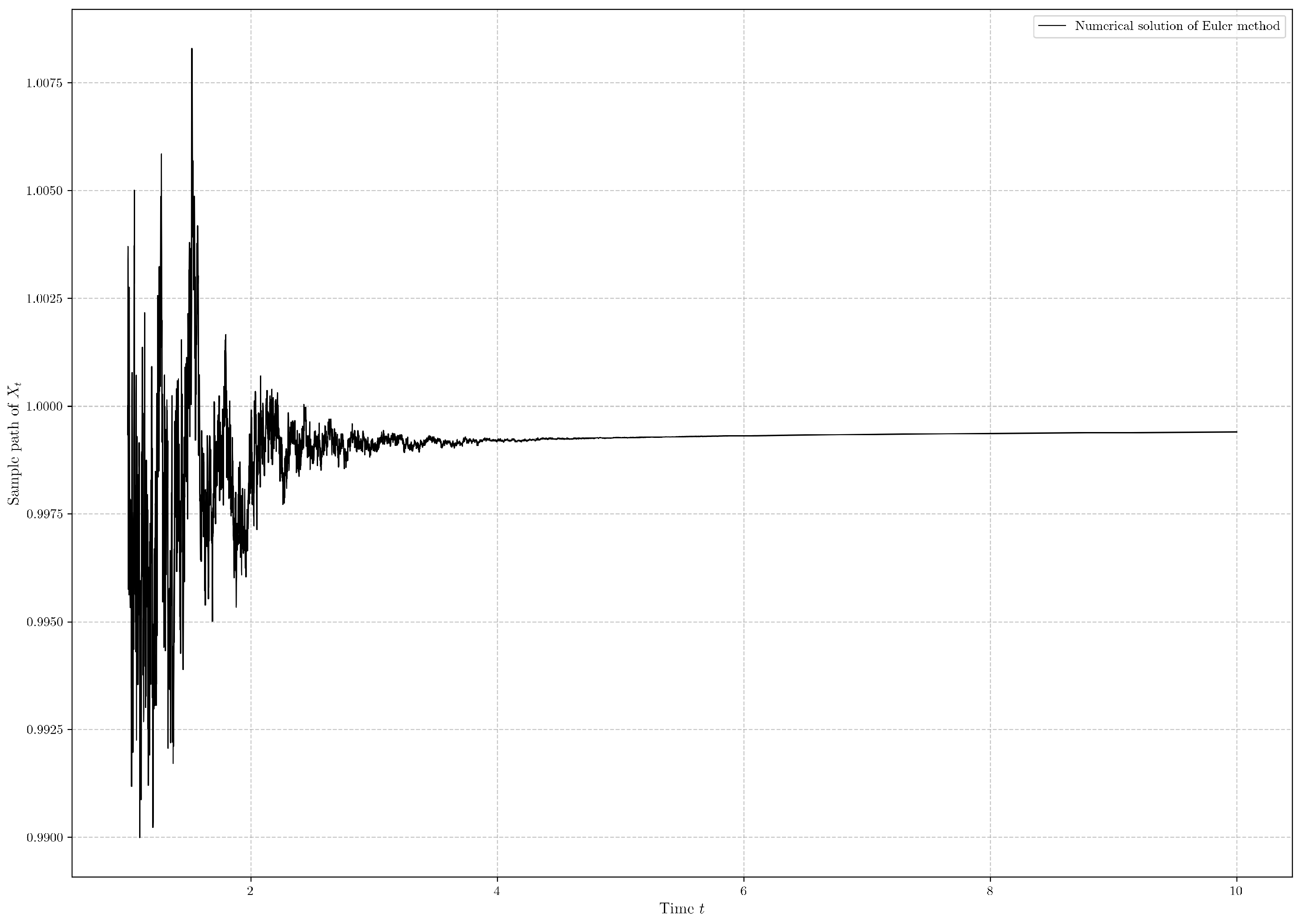
Direct verification confirms that (Hypothesis 1) and (Hypothesis 2) hold. So, by the Theorem 2 and the Remark 3 we deduce that there exists an unique solution for (37). For visual verification of the conclusions, numerical simulations employing Euler’s method were conducted (see Figure 1) with step size h = 2 10 and initial value X 0 = 1 .
Since
sup t 1 1 t 1 s ( l n s ) l n t s 1 / 2 d s 1 ,
we deduce that the unique solution of (37) is stable in distribution according to the Theorem 5.
Example 2. 
To demonstrate the broader applicability, consider the one-dimensional case with p = 3 2 :
D 1 + p C H X s = e s s ( 2 s ) X s d s + e 3 s 1 | X s | d C s d s , s 1 .
Define
f ( s , y ) = e 2 s s 2 ( 2 s ) 2 and g ( s , y ) = e 3 s 1 | y | .
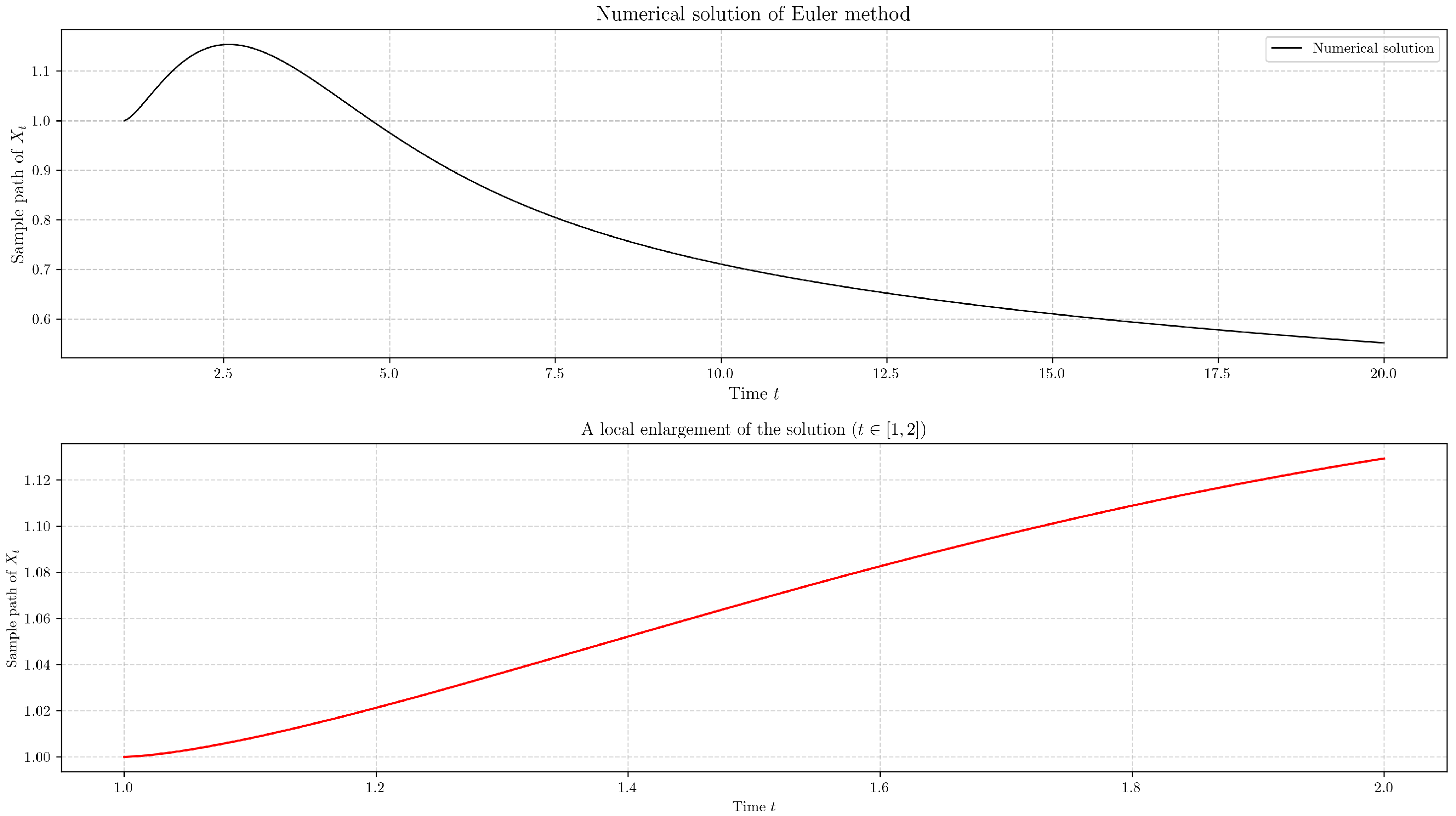
Direct verification confirms that hypotheses (Hypothesis 1) and (Hypothesis 2) hold, with η ( t ) = e 2 t t 2 ( 2 t ) 2 . So, from Theorem 1, (38) admits an unique solution. For visual verification of the conclusions, numerical simulations employing Euler’s method were conducted (see Figure 2) with step size h = 2 10 and initial value X 0 = 1 .
Furthermore, for a = 1 , p = 3 2 and η ( u ) = e 2 u u 2 ( 2 u ) 2 , we have
sup u a a u η 1 / 2 ( r ) ln u r 2 ( p 1 ) d r r = sup u 1 1 u l n u r e r ( r 2 ) d r = sup u 1 e r ( 1 r ) | 1 u + 1 u e r ( 1 r ) r d r e 1 .
Thus, we deduce that the unique solution of (38) is stable in measure by Theorem 3, while that of (37) is stable in distribution per the Theorem 5.

6. Conclusions

This work establishes some new Bihari type fractional inequalities that are easy to apply in practice and can be considered as a more general tool in some situations. By using some established inequalities, we establish the well-posedness of CH-FUDEs under specified non-Lipschitz conditions. Meanwhile, we propose the concepts of stability in distribution and stability in measure for solutions to CH-FUDEs, and derive sufficient conditions to ensure these stability properties. Future research will focus on developing numerical schemes for FUDEs.

Author Contributions

Writing—original draft, S.P., Z.L., J.Z., Y.Z. and L.X.; Writing—review & editing, S.P., Z.L., J.Z., Y.Z. and L.X.; Supervision, Z.L. and L.X. All authors have read and agreed to the published version of the manuscript.

Funding

This work is partially supported by the NNSF of China (No. 11901058) and the Natural Science Foundation of Hubei Province (No. 2021CFB543).

Data Availability Statement

No new data were created or analyzed in this study.

Conflicts of Interest

The authors declare that they have no competing interests.

References

  1. Liu, B. Uncertainty Theory, 2nd ed.; Springer: Berlin/Heidelberg, Germany, 2007. [Google Scholar]
  2. Chen, X.; Liu, B. Existence and uniqueness theorem for uncertain differential equations. Fuzzy Optim. Decis. Mak. 2010, 9, 69–81. [Google Scholar] [CrossRef]
  3. Fei, W.Y. Existence and uniqueness of solution for fuzzy random differential equations with non-Lipschitz coefficients. Inf. Sci. 2007, 177, 4329–4337. [Google Scholar] [CrossRef]
  4. Gao, Y. Existence and uniqueness theorem on uncertain differential equations with local Lipschitz condition. J. Uncertain Syst. 2012, 6, 223–232. [Google Scholar]
  5. Liu, H.; Fei, W. Existence and uniqueness of solutions to uncertain functional differential equations. In Proceedings of the 9th International Conference on Fuzzy Systems and Knowledge Discovery, Chongqing, China, 29–31 May 2012. [Google Scholar]
  6. Shu, Y.; Li, B. Existence and uniqueness of solutions to uncertain fractional switched systems with an uncertain stock model. Chaos Solitons Fractals 2022, 155, 111746. [Google Scholar] [CrossRef]
  7. Huang, Z.; Zhu, C.; Gao, J. Stability analysis for uncertain differential equation by Lyapunovs second method. Fuzzy Optim. Decis. Mak. 2021, 20, 129–144. [Google Scholar] [CrossRef]
  8. Jia, L.F.; Sheng, Y.H. Stability in distribution for uncertain delay differential equation. Appl. Math. Comput. 2019, 343, 49–56. [Google Scholar] [CrossRef]
  9. Li, Z.; Wen, X.Q.; Xu, L.P. Exponential stability of uncertain functional differential equations. Appl. Soft Comput. 2023, 147, 110816. [Google Scholar] [CrossRef]
  10. Sheng, Y.; Gao, J. Exponential stability of uncertain differential equation. Soft Comput. 2016, 20, 3673–3678. [Google Scholar] [CrossRef]
  11. Deng, L.B.; Chen, Y.F. Optimal control of uncertain systems with jump under optimistic value criterion. Eur. J. Control. 2017, 38, 7–15. [Google Scholar] [CrossRef]
  12. Jia, Z.F.; Liu, X.S. Optimal control of multifactor uncertain system with jumps. Int. J. Control. 2023, 96, 1272–1287. [Google Scholar] [CrossRef]
  13. Li, B.; Zhang, R.; Jin, T.; Shu, Y. Parametric approximate optimal control of uncertain differential game with application to counter terror. Chaos Solitons Fractals 2021, 146, 110940. [Google Scholar] [CrossRef]
  14. Gao, R. Milne method for solving uncertain differential equations. Appl. Math. Comput. 2016, 274, 774–785. [Google Scholar] [CrossRef]
  15. Ji, X.Y.; Zhou, J. Solving high-order uncertain differential equations via Runge-Kutta method. IEEE Trans. Fuzzy Syst. 2018, 26, 1379–1386. [Google Scholar] [CrossRef]
  16. Yang, X.F.; Shen, Y.Y. Runge-Kutta method for solving uncertain differential equations. J. Uncertain. Anal. Appl. 2015, 17, 5337. [Google Scholar] [CrossRef]
  17. Yao, K.; Chen, X.W. A numerical method for solving uncertain differential equations. J. Intell. Fuzzy Syst. 2013, 25, 825–832. [Google Scholar] [CrossRef]
  18. Liu, Z. Generalized moment estimation for uncertain differential equations. Appl. Math. Comput. 2021, 392, 125724. [Google Scholar] [CrossRef]
  19. Ning, J.; Li, Z.; Xu, L.P. Parameter estimation of fractional uncertain differential equations. Fractal Fract. 2025, 9, 138. [Google Scholar] [CrossRef]
  20. Sheng, Y.; Yao, K.; Chen, X. Least squares estimation in uncertain differential equations. IEEE Trans. Fuzzy Syst. 2019, 28, 2651–2655. [Google Scholar] [CrossRef]
  21. Tang, H.; Yang, X. Moment estimation in uncertain differential equations based on the Milstein scheme. Appl. Math. Comput. 2022, 418, 126825. [Google Scholar] [CrossRef]
  22. Zhu, Y.G. Uncertain fractional differential equations and an interest rate model. Math. Method. Appl. Sci. 2015, 38, 3359–3368. [Google Scholar] [CrossRef]
  23. Zhu, Y.G. Exitence and uniquence of the solution to uncertain fractional differential equation. J. Uncertain Anal. Appl. 2015, 3, 112. [Google Scholar] [CrossRef]
  24. Lu, Z.; Yan, H.; Zhu, Y. European option pricing model based on uncertain fractional differential equation. Fuzzy Optim. Decis. Mak. 2019, 18, 199–217. [Google Scholar] [CrossRef]
  25. Lu, Z.; Zhu, Y. Numerical approach for solution to an uncertain fractional differential equation. Appl. Math. Comput. 2019, 343, 137–148. [Google Scholar] [CrossRef]
  26. Wang, J.; Zhu, Y. Solution of linear uncertain fractional order delay differential equations. Soft Comput. 2020, 24, 17875–17885. [Google Scholar] [CrossRef]
  27. Lu, Z.; Zhu, Y.; Lu, Q. Stability analysis of nonlinear uncertain fractional differential equations with Caputo derivative. Fractals 2021, 29, 2150057. [Google Scholar] [CrossRef]
  28. Liu, Y.Y.; Zhu, Y.G.; Lv, Z.Q. On Caputo-Hadamard uncertain fractional differential equations. Chaos Solitons Fractals 2021, 146, 110894. [Google Scholar] [CrossRef]
  29. Liu, Y.Y.; Liu, H.J.; Zhu, Y.G. An approach for numerical solutions of Caputo-Hadamard uncertain fractional differential equations. Fractal Fract. 2022, 6, 693. [Google Scholar] [CrossRef]
  30. Liu, H.J.; Zhu, Y.G. Carbon option pricing based on uncertain fractional differential equation: A binomial tree approach. Math. Comput. Simul. 2024, 225, 13–28. [Google Scholar] [CrossRef]
  31. Liu, H.J.; Zhu, Y.G.; He, L. Extreme values of solution of Caputo-Hadamard uncertain fractional differential equation and applications. Math. Methods Appl. Sci. 2024, 47, 4105–4121. [Google Scholar] [CrossRef]
  32. Liu, H.J.; Zhu, Y.G.; Liu, Y.Y. European option pricing problem based on a class of Caputo-Hadamard uncertain fractional differential equation. AIMS Math. 2023, 8, 15633–15650. [Google Scholar] [CrossRef]
  33. Liu, B. Some research problems in uncertainty theory. J. Uncertain Syst. 2009, 3, 3–10. [Google Scholar]
  34. Liu, B. Uncertainty Theory: A Branch of Mathematics for Modeling Human Uncertainty; Springer: Berlin/Heidelberg, Germany, 2010. [Google Scholar]
  35. Yao, K.; JGao, J.; Gao, Y. Some stability theorems of uncertain differential equation. Fuzzy Optim. Decis. Mak. 2013, 12, 3–13. [Google Scholar] [CrossRef]
  36. Kilbas, A.A.; Srivastava, H.; Trujillo, J. Theory and Application of Fractional Differential Equation; Elsevier: Amsterdam, The Netherlands, 2006. [Google Scholar]
  37. Bihari, I. A generalization of a lemma of Bellman and its application to uniqueness problem of different equations. Acta Math. Acad. Sci. Hung. 1956, 7, 71–94. [Google Scholar] [CrossRef]
  38. Yang, X.; Ni, Y.; Zhang, Y. Stability in inverse distribution for uncertain differential equations. J. Intell. Fuzzy Syst. 2017, 32, 2051–2059. [Google Scholar] [CrossRef]
Figure 1. Numerical simulations for (37) with step size h = 2 10 and initial value X 0 = 1 .
Fractalfract 10 00050 g001
Figure 2. Numerical simulations for (38) with step size h = 2 10 and initial value X 0 = 1 .
Fractalfract 10 00050 g002
Disclaimer/Publisher’s Note: The statements, opinions and data contained in all publications are solely those of the individual author(s) and contributor(s) and not of MDPI and/or the editor(s). MDPI and/or the editor(s) disclaim responsibility for any injury to people or property resulting from any ideas, methods, instructions or products referred to in the content.