Article

Fractional Integral Estimates of Boole Type: Majorization and Convex Function Approach with Applications

by
Saad Ihsan Butt
1,
Mohammed Alammar
2 and
Youngsoo Seol
3,*
1
Department of Mathematics, COMSATS University Islamabad, Lahore Campus, Lahore 54000, Pakistan
2
Applied College, Shaqra University, Shaqra 11961, Saudi Arabia
3
Department of Mathematics, Dong-A University, Busan 49315, Republic of Korea
*
Author to whom correspondence should be addressed.
Fractal Fract. 2026, 10(1), 49; https://doi.org/10.3390/fractalfract10010049
Submission received: 3 December 2025 / Revised: 31 December 2025 / Accepted: 8 January 2026 / Published: 12 January 2026
(This article belongs to the Section General Mathematics, Analysis)

Abstract

The goal of this paper is to use a Boole-type inequality framework to provide better estimates for differentiable functions. Using majorization theory, fractional integral operators are incorporated into a new auxiliary identity. The method establishes sharp bounds by combining the properties of convex functions with classical inequalities like the Power mean and Hölder inequalities, as well as the Niezgoda–Jensen–Mercer (NJM) inequality for majorized tuples. Additionally, the study presents real-world examples involving special functions and examines pertinent quadrature rules. This work’s primary contribution is the extension and generalization of a number of results that are already known in the current body of mathematical literature.

1. Introduction and Preliminaries

Let’s start by reflecting on the relevant ideas related to convex mappings and other important concepts discussed in this paper.
Definition 1. 
Let F : [ ζ 1 , ζ 2 ] is convex hold for all a o , b o [ ζ 1 , ζ 2 ] and ω [ 0 , 1 ]
F ( ω a o + ( 1 ω ) b o ) ω F ( a o ) + ( 1 ω ) F ( b o ) .
Convex functions are particularly important in optimization theory because of their exceptional characteristics. Mathematical inequalities and the theory of convex functions are closely related.
Let 0 < b o 1 b o 2 b on and let ω = ( ω 1 , ω 2 , , ω λ ) be the weight which can not be negative such that i = 1 λ ω i = 1 and if the function F : [ ζ 1 , ζ 2 ] on the given interval is convex then Jensen’s inequality(JI) is given as
F λ i = 1 ω i b o i λ i = 1 ω i F b o i ,
for all b o i [ ζ 1 , ζ 2 ] ,   ω i 0 , 1 for i = 1 , 2 , , λ [1]. The JI has been applied to various disciplines, especially statistics, machine learning, and economics. It is also used in many fields to derive basic bounds and confirm some results. Applications of Jensen’s inequality are numerous in finances, optimization, economics, and statistics, but it is primarily useful in information theory regarding the forecasting of the estimation of the bounds of distance functions [2,3,4].
A fascinating perspective on Jensen’s inequality has been presented and designated as Jensen Mercer inequality (JMI) in [5] as
Let F be a convex function on [ ζ 1 , ζ 2 ] , then
F ζ 1 + ζ 2 λ i = 1 ω i b o i F ζ 1 + F ζ 2 λ i = 1 ω i F b o i ,
is valid for all finite positive increasing sequence b o i ζ 1 , ζ 2 , for i = 1 , 2 , , λ together with weights ω i 0 , 1 defined in (2).
Definition 2 
([6]). Let a o = ( a o 1 , , a o τ ) and b o = ( b o 1 , , b o τ ) be two tuples with its arrangements a o [ τ ] a o [ τ 1 ] a o [ 1 ] ,   b o [ τ ] b o [ τ 1 ] b o [ 1 ] where each of them is a real number, then a o is considered to be majorize b o (or b o is a said to be majorize by a o , in symbolic terms a o b o ) , i f :
j = 1 λ b o [ j ] j = 1 λ a o [ j ] , f o r λ = 1 , 2 , , τ 1
and
j = 1 τ b o [ j ] = j = 1 τ a o [ j ] .
In [7], an idea of extended JMI in context of majorization presented by Niezgoda is stated as follows:
Theorem 1. 
Let ( b o i j ) be a λ × τ real matrix and ζ = ( ζ 1 , ζ 2 , , ζ τ ) be τ tuple such that ζ j ,   b o i j , i = 1 , 2 , , λ , j { 1 , , τ } and function F be a convex defined in I. Moreover, ω i 0 for i = 1 , 2 , , λ with i = 1 λ ω i = 1 . If ζ majorizes each row of b o i j , then
F j = 1 τ ζ j j = 1 τ 1 i = 1 λ ω i b o i j j = 1 τ F ( ζ j ) j = 1 τ 1 i = 1 λ ω i F ( b o i j ) .
In recent years, there has been an astonishing extension of the research on different inequalities including Hermite Hadamard inequality, Newton type inequality, Ostrowski’s inequality and Simpson-type inequalities. Sarikaya et al. initiated the use of Riemann–Liouville fractional integrals (RLFIs) to obtain several inequalities of trapezoidal and Hermite-Hadamard-types. For differentiable s-convex functions and convex functions which are twice differentiable, Sarikaya et al. [8,9] proven the general form of a Simpson-type inequality. For instance, Hezanci et al. [10] introduced an identity regarding functions which are differentiable two times employing Riemann–Liouville fractional integral operators, leading to a series of inequalities of Simpson-type. In [11], Ali et al. established a generalized fractional integral identity and employed it to derive inequalities Simpson’s-formula-type for convex functions which are differentiable two times. These outcomes can be expressed in RL and k-RL fractional integral forms. Subsequently, Zhou et al. [12] utilized fractional integrals incorporating exponential kernels to present several parameterized integral inequalities associated with convex functions. These inequalities encompass the averaged midpoint-trapezoid inequality, the trapezoid inequality and Simpson’s inequality. Furthermore, Zhou et al. [13] proposed weighted parameterized integral inequalities relevant to twice differentiable functions, unifying Midpoint, Simpson, Bullen and trapezoid type inequalities and Faisal et al. established Hermite Hadamard inequality using the majorization technique in [14,15,16,17]. The most relevant contribution in recent years is the work on the upper bounds for the remainder term in Boole’s quadrature rule, which set very significant advancement in the study of numerical integration and its applications is given in [18].
The present study opens several promising directions for future investigations. One natural extension is to generalize the developed Boole-type inequalities from the framework of RLFIs spaces by incorporating the two-scale fractal derivative. As demonstrated in the work of Anjum et al. [19] and He and El-Dib [20], the two-scale fractal calculus provides an effective tool for modeling a non-smooth and scale-dependent phenomena in fractal media. Extending the proposed inequalities to this setting would significantly broaden their applicability, particularly in the analysis of complex systems such as porous structures, chaotic dynamics, and fractal mechanics.
Another promising direction is to explore deeper connections between the present framework and classical inequalities, especially He Chengtian’s inequality [21]. The rational approximation principle underlying this inequality is closely related to convexity and sharp bound estimation, which are central themes of the current work. Integrating He Chengtian’s inequality with fractional and fractal integral operators—possibly in conjunction with majorization techniques—may lead to new families of Boole-type inequalities with improved bounds and richer structural properties.
These potential extensions would not only enhance the theoretical depth of the present results but also establish new links between classical number-theoretic inequalities, fractional calculus, and fractal analysis, thereby offering a fertile ground for further interdisciplinary research.
We now turn to the Boole’s inequality, which is discussed as the following [22]:
| 1 90 7 F ζ 1 + 32 F 3 ζ 1 + ζ 2 4 + 12 F ζ 1 + ζ 2 2 + 32 F ζ 1 + 3 ζ 2 4 + 7 F ζ 2 1 ζ 2 ζ 1 ζ 1 ζ 2 F x d x | 1 2880 F 6 ζ 2 ζ 1 6 ,
where F : [ ζ 1 , ζ 2 ] is a mapping which is continuously differentiable six times on ( ζ 1 , ζ 2 ) and F ( 6 ) = sup x ζ 1 , ζ 2 F ( 6 ) x < .
The RLFIs operators are the first and foremost flexible in terms of local kernels are defined as
Let F be the integrable function on [ ζ 1 , ζ 2 ] , then RLFIs operator of order α such that α > 0 are stated subsequently:
J ζ 1 + α F x = 1 Γ α ζ 1 x x t α 1 F t d t , x > ζ 1 ,
and
J ζ 2 α F x = 1 Γ α x ζ 2 t x α 1 F t d t , x < ζ 2 .
where Γ is termed as Gamma function.

Motivation of the Study

This article primarily focus on the Boole’s inequality involving convex mappings through majorization, assisted by the RLFIs operator. To obtain the error terms for Boole’s rule, the mapping must be six times differentiable. In the given paper, we will show a way of dealing with the remainder of Boole’s rule in the case of first-order differentiable mappings. The paper is prepared as five sections in order to meet the objectives. The first section outlines the essential background and foundational details relating to the problem formulation. It introduces a new identity, called Boole’s Identity, for first-order differentiable mappings, which might be thought of as a milestone toward developing Boole-type inequalities within the fractional framework.
In particular, we now emphasize that the main motivation lies in extending Boole-type inequalities to the fractional integral setting while reducing the differentiability requirements on the underlying function. Unlike classical Boole’s inequality, which depends on sixth-order derivatives, the proposed Boole-type identity works for first-order differentiable mappings. This represents a meaningful advancement for numerical integration and approximation theory, especially when dealing with functions that lack higher-order smoothness. The role of generalized RLFIs is now explicitly highlighted as a flexible and powerful tool for obtaining sharper error estimates.

2. Main Results

This section contains Boole-type Lemma via majorization for the RL-integral operator for differentiable functions on the given interval. We start with the following Lemma:
Here ζ = ( ζ 1 , ζ 2 , , ζ τ ) , ( a o 1 , a o 2 , , a o τ ) and ( b o 1 , b o 2 , , b o τ ) are the three τ -tuples that will be used in this paper.
Lemma 1. 
Assuming that ζ j ,   a o j ,   b o j I for all j { 1 , 2 , 3 , , τ } are three tuples, such that a o τ > b o τ , α > 0 , and function F and are continuous as well as differentiable on I, such that I . If F L ( I ) and ζ majorizes both a o and b o , then the following identity occurs:
B α ( a o j , b o j , ζ j , τ ; F ) = 1 90 [ 7 F j = 1 τ ζ j j = 1 τ 1 a o j + 32 F j = 1 τ ζ j j = 1 τ 1 3 a o j + b o j 4 + 12 F j = 1 τ ζ j j = 1 τ 1 a o j + b o j 2 + 32 F j = 1 τ ζ j j = 1 τ 1 a o j + 3 b o j 4 + 7 F j = 1 τ ζ j j = 1 τ 1 b o j ] Γ ( α + 1 ) j = 1 τ 1 ( b o j a o j ) α × J j = 1 τ ζ j j = 1 τ 1 b o j + α F j = 1 τ ζ j j = 1 τ 1 a o j + J j = 1 τ ζ j j = 1 τ 1 a o j α F j = 1 τ ζ j j = 1 τ 1 b o j = j = 1 τ 1 ( b o j a o j ) 2 0 1 Φ α ( ω ) [ F j = 1 τ ζ j ω j = 1 τ 1 a o j + ( 1 ω ) j = 1 τ 1 b o j F j = 1 τ ζ j ω j = 1 τ 1 b o j + ( 1 ω ) j = 1 τ 1 a o j ] d ω ,
where Φ ( ω ) is defined as
Φ α ( ω ) = { ω α 7 90 0 ω < 1 4 ω α 39 90 1 4 ω < 1 2 ω α 51 90 1 2 ω < 3 4 ω α 83 90 3 4 ω < 1 .
Proof. 
By considering L.H.S
j = 1 τ 1 ( b o j a o j ) 2 0 1 Φ ( ω ) × [ F j = 1 τ ζ j ω j = 1 τ 1 a o j + ( 1 ω ) j = 1 τ 1 b o j F j = 1 τ ζ j ω j = 1 τ 1 b o j + ( 1 ω ) j = 1 τ 1 a o j ] d ω . = j = 1 τ 1 ( b o j a o j ) 2 { I 1 + I 2 + I 3 + I 4 } ,
where I 1 , I 2 , I 3 , I 4 is given as
I 1 = 0 1 4 ω α 7 90 × [ F j = 1 τ ζ j ω j = 1 τ 1 a o j + ( 1 ω ) j = 1 τ 1 b o j F j = 1 τ ζ j ω j = 1 τ 1 b o j + ( 1 ω ) j = 1 τ 1 a o j ] d ω ,
I 2 = 1 4 1 2 ω α 39 90 [ F j = 1 τ ζ j ω j = 1 τ 1 a o j + ( 1 ω ) j = 1 τ 1 b o j F j = 1 τ ζ j ω j = 1 τ 1 b o j + ( 1 ω ) j = 1 τ 1 a o j ] d ω ,
I 3 = 1 2 3 4 ω α 51 90 [ F j = 1 τ ζ j ω j = 1 τ 1 a o j + ( 1 ω ) j = 1 τ 1 b o j F j = 1 τ ζ j ω j = 1 τ 1 b o j + ( 1 ω ) j = 1 τ 1 a o j ] d ω , I 4 = 3 4 1 ω α 83 90 [ F j = 1 τ ζ j ω j = 1 τ 1 a o j + ( 1 ω ) j = 1 τ 1 b o j F j = 1 τ ζ j ω j = 1 τ 1 b o j + ( 1 ω ) j = 1 τ 1 a o j ] d ω .
Now by applying integrating by parts on I 1 , we have
I 1 = 1 4 α 7 90 F j = 1 τ ζ j j = 1 τ 1 a o j + 3 b o j 4 j = 1 τ 1 ( b o j a o j ) + 7 90 F j = 1 τ ζ j j = 1 τ 1 b o j j = 1 τ 1 ( b o j a o j ) α j = 1 τ 1 ( b o j a o j ) 0 1 4 F j = 1 τ ζ j ω j = 1 τ 1 a o j + ( 1 ω ) j = 1 τ 1 b o j ω α 1 d ω + 1 4 α + 7 90 F j = 1 τ ζ j j = 1 τ 1 3 a o j + b o j 4 j = 1 τ 1 ( b o j a o j ) + 7 90 F j = 1 τ ζ j j = 1 τ 1 b o j j = 1 τ 1 ( b o j a o j ) α j = 1 τ 1 ( b o j a o j ) 0 1 4 F j = 1 τ ζ j ω j = 1 τ 1 b o j + ( 1 ω ) j = 1 τ 1 a o j ω α 1 d ω .
By substituting the variables, we get
= 1 4 α 7 90 F j = 1 τ ζ j j = 1 τ 1 a o j + 3 b o j 4 j = 1 τ 1 ( b o j a o j ) + 7 90 F j = 1 τ ζ j j = 1 τ 1 b o j j = 1 τ 1 ( b o j a o j ) α j = 1 τ 1 ( b o j a o j ) j = 1 τ ζ j j = 1 τ 1 b o j j = 1 τ ζ j j = 1 τ 1 a o j + 3 b o j 4 ( P j = 1 τ ζ j j = 1 τ 1 b o j ) α 1 F ( P ) d P
+ 1 4 α 7 90 F j = 1 τ ζ j j = 1 τ 1 3 a o j + b o j 4 j = 1 τ 1 ( b o j a o j ) + 7 90 F j = 1 τ ζ j j = 1 τ 1 b o j j = 1 τ 1 ( b o j a o j ) α j = 1 τ 1 ( b o j a o j ) α + 1 j = 1 τ ζ j j = 1 τ 1 b o j j = 1 τ ζ j j = 1 τ 1 3 a o j + b o j 4 ( j = 1 τ ζ j j = 1 τ 1 b o j M ) α 1 F ( M ) d M .
Similarly, for I 2 , I 3 , I 4 , by applying integration by parts, we have
I 2 = 1 2 α 39 90 F j = 1 τ ζ j j = 1 τ 1 a o j + b o j 2 j = 1 τ 1 ( b o j a o j ) + 1 4 α + 39 90 F j = 1 τ ζ j j = 1 τ 1 a o j + 3 b o j 4 j = 1 τ 1 ( b o j a o j ) α j = 1 τ 1 ( b o j a o j ) j = 1 τ ζ j j = 1 τ 1 a o j + 3 b o j 4 j = 1 τ ζ j j = 1 τ 1 a o j + b o j 2 ( P j = 1 τ ζ j j = 1 τ 1 b o j ) α 1 F ( P ) d P + 1 2 α 39 90 F j = 1 τ ζ j j = 1 τ 1 a o j + b o j 2 j = 1 τ 1 ( b o j a o j ) + 1 4 α + 39 90 F j = 1 τ ζ j j = 1 τ 1 a o j + 3 b o j 4 j = 1 τ 1 ( b o j a o j ) α j = 1 τ 1 ( b o j a o j ) α + 1 j = 1 τ ζ j j = 1 τ 1 3 a o j + b o j 4 j = 1 τ ζ j j = 1 τ 1 a o j + b o j 2 ( j = 1 τ ζ j j = 1 τ 1 a o j M ) α 1 F ( M ) d M .
I 3 = 3 4 α 51 90 F j = 1 τ ζ j j = 1 τ 1 3 a o j + b o j 4 j = 1 τ 1 ( b o j a o j ) + 1 2 α + 51 90 F j = 1 τ ζ j j = 1 τ 1 a o j + b o j 2 j = 1 τ 1 ( b o j a o j ) α j = 1 τ 1 ( b o j a o j ) j = 1 τ ζ j j = 1 τ 1 a o j + b o j 2 j = 1 τ ζ j j = 1 τ 1 3 a o j + b o j 4 ( P j = 1 τ ζ j j = 1 τ 1 b o j ) α 1 F ( P ) d P + 3 4 α 51 90 F j = 1 τ ζ j j = 1 τ 1 a o j + 3 b o j 4 j = 1 τ 1 ( b o j a o j ) + 1 2 α + 51 90 F j = 1 τ ζ j j = 1 τ 1 a o j + b o j 2 j = 1 τ 1 ( b o j a o j ) α j = 1 τ 1 ( b o j a o j ) α + 1 j = 1 τ ζ j j = 1 τ 1 a o j + b o j 2 j = 1 τ ζ j j = 1 τ 1 a o j + 3 b o j 4 ( j = 1 τ ζ j j = 1 τ 1 a o j ) α 1 F ( M ) d M .
I 4 = 7 90 F j = 1 τ ζ j j = 1 τ 1 a o j j = 1 τ 1 ( b o j a o j ) + 3 4 α + 83 90 F j = 1 τ ζ j j = 1 τ 1 3 a o j + b o j 4 j = 1 τ 1 ( b o j a o j ) α j = 1 τ 1 ( b o j a o j ) α + 1 j = 1 τ ζ j j = 1 τ 1 3 a o j + b o j 4 j = 1 τ ζ j j = 1 τ 1 a o j ( P j = 1 τ ζ j j = 1 τ 1 b o j ) α 1 F ( P ) d P + 7 90 F j = 1 τ ζ j j = 1 τ 1 a o j j = 1 τ 1 ( b o j a o j ) + 3 4 α + 83 90 F j = 1 τ ζ j j = 1 τ 1 a o j + 3 b o j 4 j = 1 τ 1 ( b o j a o j ) α j = 1 τ 1 ( b o j a o j ) α + 1 j = 1 τ ζ j j = 1 τ 1 a o j + 3 b o j 4 j = 1 τ ζ j j = 1 τ 1 b o j ( j = 1 τ ζ j j = 1 τ 1 a o j M ) α 1 F ( M ) d M .
Before using the definition of majorization it is easy to prove that
j = 1 τ ζ j j = 1 τ 1 a o j > j = 1 τ ζ j j = 1 τ 1 b o j .
Adding I 1 ,   I 2 ,   I 3 and I 4 and by applying the definition of fractional integral the equality, becomes
= 2 90 j = 1 τ 1 ( b o j a o j ) { 7 F j = 1 τ ζ j j = 1 τ 1 a o j + 32 F j = 1 τ ζ j j = 1 τ 1 3 a o j + b o j 4 + 12 F j = 1 τ ζ j j = 1 τ 1 a o j + b o j 2 + 32 F j = 1 τ ζ j j = 1 τ 1 a o j + 3 b o j 4 + 7 F j = 1 τ ζ j j = 1 τ 1 b o j } 2 Γ ( α + 1 ) j = 1 τ 1 ( b o j a o j ) α + 1 × J j = 1 τ ζ j j = 1 τ 1 b o j + α F j = 1 τ ζ j j = 1 τ 1 a o j + J j = 1 τ ζ j j = 1 τ 1 a o j α F j = 1 τ ζ j j = 1 τ 1 b o j .
Now by substituting (16) in (7) we obtain (6). This completed the proof. □
Remark 1. 
By substituting τ = 2 in equation, the above-mentioned identity becomes:
B α ( a o j , b o j , ζ j , 2 ; F ) = 1 90 [ 7 F ( ζ 1 + ζ 2 a o 1 ) + 32 F ( ζ 1 + ζ 2 3 a o 1 + b o 1 4 ) + 12 F ( ζ 1 + ζ 2 a o 1 + b o 1 2 ) + 32 F ( ζ 1 + ζ 2 a o 1 + 3 b o 1 4 ) + 7 F ( ζ 1 + ζ 2 b o 1 ) ] Γ ( α + 1 ) ( b o 1 a o 1 ) α × [ J ζ 1 + ζ 2 a o α F ( ζ 1 + ζ 2 b o 1 ) + J ζ 1 + ζ 2 b o 1 + α F ( ζ 1 + ζ 2 a o 1 ) ] = ( b o 1 a o 1 ) 2 0 1 Φ α ( ω ) [ F ζ 1 + ζ 2 ω a o 1 + ( 1 ω ) b o 1 F ζ 1 + ζ 2 ω b o 1 + ( 1 ω ) a o 1 ] d ω .
The above-mentioned equality is known as the Boole’s Mercer equality pertaining to RLFIs and is a novel concept in the field of inequalities.
Remark 2. 
In above Remark 1, for α = 1 we attain the traditional Boole’s Mercer form given below:
B 1 ( a o j , b o j , ζ j , 2 ; F ) = ( b o 1 a o 1 ) 2 0 1 Φ ( ω ) × [ F ζ 1 + ζ 2 ω a o 1 + ( 1 ω ) b o 1 F ζ 1 + ζ 2 ω b o 1 + ( 1 ω ) a o 1 ] d ω ,
which constitutes a novel contribution to the literature.
Remark 3. 
Here for ζ 1 = a o 1 and ζ 2 = b o 1 in Remark 1, we obtain an equality via Riemann–Liouville which is proved in [23]:
B α ( a o 1 , b o 1 , ζ 2 , 2 ; F ) = 1 90 [ 7 F ( a o 1 ) + 32 F ( 3 a o 1 + b o 1 4 ) + 12 F ( a o 1 + b o 1 2 ) + 32 F ( a o 1 + 3 b o 1 4 ) + 7 F ( b o 1 ) ] Γ ( α + 1 ) ( b o 1 a o 1 ) α × [ J b o 1 α F ( a o 1 ) + J a o 1 + α F ( b o 1 ) ] = ( b o 1 a o 1 ) 2 0 1 Φ α ( ω ) [ F ω a o 1 + ( 1 ω ) b o 1 F ω b o 1 + ( 1 ω ) a o 1 d ω ] .
Remark 4. 
By using α = 1 , ζ 1 = a o 1 and ζ 2 = b o 1 in Remark 1, we obtain the traditional Boole’s Lemma which is proved in [24]:
1 90 [ 7 F ( a o 1 ) + 32 F ( 3 a o 1 + b o 1 4 ) + 12 F ( a o 1 + b o 1 2 ) + 32 F ( a o 1 + 3 b o 1 4 ) + 7 F ( b o 1 ) ] 1 ( b o 1 a o 1 ) a o 1 b o 1 F ( x ) d x = ( b o 1 a o 1 ) 2 0 1 Φ α ( ω ) [ F ω a o 1 + ( 1 ω ) b o 1 F ω b o 1 + ( 1 ω ) a o 1 d ω ] .
Here, based on Lemma 1, we provide some new results of majorization-based Boole-type inequalities for convex functions are given below.
Theorem 2. 
According to Lemma 1’s assumptions, if the function | F | on I is continuous as well as convex, then α > 0 , the subsequent inequality for fractional integral inequality:
| B α ( a o j , b o j , ζ j , τ ; F ) | j = 1 τ 1 ( b o j a o j ) ( α + 1 ) Y 1 ( α ) 2 j = 1 τ | F ζ j | j = 1 τ 1 | F a o j | + ( j = 1 τ 1 | F b o j | ,
where
Y 1 ( α ) = [ 1 4 α + 1 + 1 2 α + 1 + 3 4 α + 1 7 90 α + 1 39 90 α + 1 83 90 α + 1 51 90 α + 1 + 1 2 ] ,
satisfies for ω [ 0 , 1 ] .
Proof. 
By taking the modulus on both sides of Lemma 1, we have
| B α ( a o j , b o j , ζ j , τ ; F ) | j = 1 τ 1 ( b o j a o j ) 2 0 1 | Φ α ( ω ) | | F j = 1 τ ζ j ω j = 1 τ 1 a o j + ( 1 ω ) j = 1 τ 1 b o j | d ω + 0 1 | Φ α ( ω ) | | F j = 1 τ ζ j ω j = 1 τ 1 b o j + ( 1 ω ) j = 1 τ 1 a o j | d ω .
We will utilize the following computations throughout the paper to develop new inequalities,
0 1 | Φ α ( ω ) | d ω = 0 1 4 | ω α 7 90 | d ω + 1 4 1 2 | ω α 39 90 | d ω + 1 2 3 4 | ω α 51 90 | d ω + 3 4 1 | ω α 83 90 | d ω . H 1 = 0 1 4 | ω α 7 90 | = 2 7 90 α + 1 · 1 1 + α + 1 4 α + 1 · 1 α + 1 119 16200 . H 2 = 1 4 1 2 | ω α 39 90 | = 2 39 90 α + 1 · 1 1 + α + 1 4 α + 1 · 1 α + 1 + 1 2 α + 1 · 1 α + 1 91 1800 . H 3 = 1 2 3 4 | ω α 51 90 | d ω = 2 51 90 α + 1 · 1 1 + α + 1 2 α + 1 · 1 α + 1 + 3 4 α + 1 · 1 α + 1 119 1800 . H 4 = 3 4 1 | ω α 83 90 | d ω = 2 83 90 α + 1 · 1 1 + α + 3 4 α + 1 · 1 α + 1 + 1 α + 1 1411 16200 .
By using (5) with λ = 2 , ω 1 = ω and ω 2 = 1 ω , we have
| B α ( a o j , b o j , ζ j , τ ; F ) | j = 1 τ 1 ( b o j a o j ) ( α + 1 ) 0 1 | Φ α ( ω ) | × ( j = 1 τ | F ( ζ j ) | ( ω j = 1 τ 1 | F ( a o j ) | + ( 1 ω ) j = 1 τ 1 | F ( b o j ) | )                                                                               + j = 1 τ | F ( ζ j ) | ( ω j = 1 τ 1 | F ( b o j ) | + ( 1 ω ) j = 1 τ 1 | F ( a o j ) | ) ) d ω                                                                               = j = 1 τ 1 ( b o j a o j ) ( α + 1 ) Y 1 ( α ) ( 2 j = 1 τ | F ( ζ j ) | ( j = 1 τ 1 | F ( a o j ) | + j = 1 τ 1 | F ( b o j ) | ) ) .
This completed the proof. □
Remark 5. 
By substituting τ = 2 in Theorem 2, one can obtain Mercer estimates of inequality:
| B α ( a o 1 , b o 1 , ζ 2 , 2 ; F ) | ( b o 1 a o 1 ) ( α + 1 ) Y 1 ( α ) [ 2 | F ( ζ 1 ) | + 2 | F ( ζ 2 ) | | F ( a o 1 ) | | F ( b o 1 ) | ] ,
which constitutes a novel contribution to the literature.
Remark 6. 
For α = 1 , and τ = 2 in Theorem 2, we obtain the following classical Boole’s estimates:
| B 1 ( a o 1 , b o 1 , ζ 2 , 2 ; F ) | ( b o 1 a o 1 ) 239 6480 { 2 | F ( ζ 1 ) | + 2 | F ( ζ 2 ) | | F ( a o 1 ) | | F ( b o 1 ) | } .
which constitutes a novel contribution to the literature.
Remark 7. 
Here by using ζ 1 = a o 1 , ζ 2 = b o in Remark 5, one can recapture the traditional Boole-type estimates via Riemann–Liouville which is proved in [23].
Remark 8. 
Here by using ζ 1 = a o 1 , ζ 2 = b o in Remark 6, one can recapture the traditional Boole-type estimates which is proved in [24]:
| 1 90 [ 7 F ( a o 1 ) + 32 F ( 3 a o 1 + b o 1 4 ) + 12 F ( a o 1 + b o 1 2 ) + 32 F ( a o 1 + 3 b o 1 4 ) + 7 F ( b o 1 ) ] 1 ( b o 1 a o 1 ) a o 1 b o 1 F ( x ) d x | ( b o 1 a o 1 ) 239 6480 [ | F ( a o 1 ) | + | F ( b o 1 ) | ] .
Theorem 3. 
Based on the assumptions of Lemma 1, if the function | F | q on I is continuous convex for q > 1 , then the subsequent fractional integral inequality α > 0 holds:
| B α ( a o j , b o j , ζ j , τ ; F ) | j = 1 τ 1 ( b o j a o j ) 2 × [ { ( G 1 + G 4 ) ( 1 4 j = 1 τ | F ( ζ j ) | q 1 32 j = 1 τ 1 | F ( a o j ) | q + 7 32 j = 1 τ 1 | F ( b o j ) | q 1 / q 1 4 j = 1 τ | F ( ζ j ) | q 7 32 j = 1 τ 1 | F ( a o j ) | q + 1 32 j = 1 τ 1 | F ( b o j ) | q 1 / q ) + [ ( G 2 + G 3 ) ( 1 4 j = 1 τ | F ( ζ j ) | q 3 32 j = 1 τ 1 | F ( a o j ) | q + 5 32 j = 1 τ 1 | F ( b o j ) | q 1 / q 1 4 j = 1 τ | F ( ζ j ) | q 5 32 j = 1 τ 1 | F ( a o j ) | q + 3 32 j = 1 τ 1 | F ( b o j ) | q 1 / q ) ] ,
where ω [ 0 , 1 ] and 1 p + 1 q = 1 , also G 1 ,   G 2 ,   G 3 and G 4 is defined as
G 1 = 8 . ( 7 ) p + 1 α ( 7 ) p . 90 1 α 90 p + 1 α . 4 + 1 α p + 1 1 4 α p + 1 2 7 90 α p + 1 α 1 p , G 2 = 8 . ( 39 ) p + 1 α 3 . ( 39 ) p . 90 1 α 90 p + 1 α . 4 + 1 α p + 1 1 2 α p + 1 1 4 α p + 1 2 39 90 α p + 1 α 1 p , G 3 = 8 . ( 5 ) p + 1 α 5 . ( 51 ) p . 90 1 α 90 p + 1 α . 4 + 1 α p + 1 1 2 α p + 1 3 4 α p + 1 2 51 90 α p + 1 α 1 p , G 4 = 8 . ( 83 ) p + 1 α ( 83 ) p . 90 1 α 90 p + 1 α . 4 + 1 α p + 1 3 4 α p + 1 2 83 90 α p + 1 α + 1 1 p .
Proof. 
From Lemma 1, by taking modulus on both sides and then by applying Hölder’s inequality we have
| B α ( a o j , b o j , ζ j , τ ; F ) | j = 1 τ 1 ( b o j a o j ) 2 0 1 | Φ α ( ω ) | | F j = 1 τ ζ j ω j = 1 τ 1 a o j + ( 1 ω ) j = 1 τ 1 b o j | d ω + 0 1 | Φ α ( ω ) | | F j = 1 τ ζ j ω j = 1 τ 1 b o j + ( 1 ω ) j = 1 τ 1 a o j | d ω . = j = 1 τ 1 ( b o j a o j ) 2 × { [ 0 1 4 | ω α 7 90 | | F j = 1 τ ζ j ω j = 1 τ 1 a o j + ( 1 ω ) j = 1 τ 1 b o j | d ω + 0 1 4 | ω α 7 90 | | F j = 1 τ ζ j ω j = 1 τ 1 b o j + ( 1 ω ) j = 1 τ 1 a o j | d ω ] + [ 1 4 1 2 | ω α 39 90 | | F j = 1 τ ζ j ω j = 1 τ 1 a o j + ( 1 ω ) j = 1 τ 1 b o j | d ω + 1 4 1 2 | ω α 39 90 | | F j = 1 τ ζ j ω j = 1 τ 1 b o j + ( 1 ω ) j = 1 τ 1 a o j | d ω ] + [ 1 2 3 4 | ω α 51 90 | | F j = 1 τ ζ j ω j = 1 τ 1 a o j + ( 1 ω ) j = 1 τ 1 b o j | d ω + 1 2 3 4 | ω α 51 90 | | F j = 1 τ ζ j ω j = 1 τ 1 b o j + ( 1 ω ) j = 1 τ 1 a o j | d ω ] + [ 3 4 1 | ω α 83 90 | | F j = 1 τ ζ j ω j = 1 τ 1 a o j + ( 1 ω ) j = 1 τ 1 b o j | d ω + 3 4 1 | ω α 83 90 | | F j = 1 τ ζ j ω j = 1 τ 1 b o j + ( 1 ω ) j = 1 τ 1 a o j | d ω ] } .
This implies that
| B α ( a o j , b o j , ζ j , τ ; F ) | j = 1 τ 1 ( b o j a o j ) 2 × [ 0 1 4 | ω α 7 90 | p d ω 1 p 0 1 4 | F j = 1 τ ζ j ω j = 1 τ 1 a o j + ( 1 ω ) j = 1 τ 1 b o j | q d ω 1 q + 0 1 4 | ω α 7 90 | p d ω 1 p 0 1 4 | F j = 1 τ ζ j ω j = 1 τ 1 b o j + ( 1 ω ) j = 1 τ 1 a o j | q d ω 1 q + 1 4 1 2 | ω α 39 90 | p d ω 1 p 1 4 1 2 | F j = 1 τ ζ j ω j = 1 τ 1 a o j + ( 1 ω ) j = 1 τ 1 b o j | q d ω 1 q + 1 4 1 2 | ω α 39 90 | p d ω 1 p 1 4 1 2 | F j = 1 τ ζ j ω j = 1 τ 1 b o j + ( 1 ω ) j = 1 τ 1 a o j | q d ω 1 q + 1 2 3 4 | ω α 51 90 | p d ω 1 p 1 2 3 4 | F j = 1 τ ζ j ω j = 1 τ 1 a o j + ( 1 ω ) j = 1 τ 1 b o j | q d ω 1 q + 1 2 3 4 | ω α 51 90 | p d ω 1 p 1 2 3 4 | F j = 1 τ ζ j ω j = 1 τ 1 b o j + ( 1 ω ) j = 1 τ 1 a o j | q d ω 1 q + 3 4 1 | ω α 83 90 | p d ω 1 p 3 4 1 | F j = 1 τ ζ j ω j = 1 τ 1 a o j + ( 1 ω ) j = 1 τ 1 b o j | q d ω 1 q + 3 4 1 | ω α 83 90 | p d ω 1 p 3 4 1 | F j = 1 τ ζ j ω j = 1 τ 1 b o j + ( 1 ω ) j = 1 τ 1 a o j | q d ω 1 q ] .
We will utilize the following computations
G 1 = 0 1 4 | ω α 7 90 | p d ω 1 p = 0 ( 7 90 ) 1 α ω α 7 90 p d ω + 0 1 4 ω α 7 90 p d ω 1 p = 8 · ( 7 ) p + 1 α ( 7 ) p · 90 1 α 90 p + 1 α · 4 + 1 α p + 1 1 4 α p + 1 2 7 90 α p + 1 α 1 p , G 2 = 1 4 1 2 | ω α 39 90 | p d ω 1 p = 8 · ( 39 ) p + 1 α 3 · ( 39 ) p · 90 1 α 90 p + 1 α · 4 + 1 α p + 1 1 2 α p + 1 1 4 α p + 1 2 39 90 α p + 1 α 1 p ,
G 3 = 1 2 3 4 | ω α 51 90 | p d ω 1 p = 8 · ( 5 ) p + 1 α 5 · ( 51 ) p · 90 1 α 90 p + 1 α . 4 + 1 α p + 1 1 2 α p + 1 3 4 α p + 1 2 51 90 α p + 1 α 1 p , G 4 = 3 4 1 | ω α 83 90 | p d ω 1 p = 8 · ( 83 ) p + 1 α ( 83 ) p · 90 1 α 90 p + 1 α · 4 + 1 α p + 1 3 4 α p + 1 2 83 90 α p + 1 α + 1 1 p .
By using (5) for λ = 2 , ω 1 = ω , ω 2 = 1 ω and by using the above-mentioned substitution and simplifying, we obtain the desired inequality (17). This completes the proof. □
Remark 9. 
By substituting τ = 2 in Theorem 3, it reduces to new fractional Mercer estimates given as
| B α ( a o 1 , b o 1 , ζ 2 , 2 ; F ) | ( b o 1 a o 1 ) 2 × [ ( G 1 + G 4 ) ( ( 1 4 F ( ζ 1 ) q + 1 4 F ( ζ 2 ) q ( 7 32 F ( a o 1 ) q + 1 32 F ( b o 1 ) q ) ) 1 q + ( 1 4 F ( ζ 1 ) q + 1 4 F ( ζ 2 ) q ( 7 32 F ( b o 1 ) q + 1 32 F ( a o 1 ) q ) ) 1 q + ( G 2 + G 3 ) ( 1 4 F ( ζ 1 ) q + 1 4 F ( ζ 2 ) q ( 5 32 F ( a o 1 ) q + 3 32 F ( b o 1 ) q ) ) 1 q + ( 1 4 F ( ζ 1 ) q + 1 4 F ( ζ 2 ) q ( 5 32 F ( b o 1 ) q + 3 32 F ( a o 1 ) q ) ) 1 q ) ] .
Remark 10. 
By using ζ 1 = a o 1 and ζ 2 = b o 1 in the above-mentioned Remark 9, one can recapture estimates of the fractional Boole’s inequality for RLFIs operator, which is proved in [23].
Remark 11. 
For α = 1 in Remark 9, we find the bound for the traditional Mercer inequality:
| B 1 ( a o 1 , b o 1 , ζ 2 , 2 ; F ) | ( b o 1 a o 1 ) 2 × [ 14 1 + p + 31 1 + p 180 1 + p ( 1 + p ) ( ( F ( ζ 1 ) q + F ( ζ 2 ) q 4 ( 7 F ( a o 1 ) q + F ( b o 1 ) q 32 ) ) 1 q + ( F ( ζ 1 ) q + F ( ζ 2 ) q 4 ( 7 F ( b o 1 ) q + F ( a o 1 ) q 32 ) ) 1 q ) + 4 1 + p + 11 1 + p 60 1 + p ( 1 + p ) ( ( F ( ζ 1 ) q + F ( ζ 2 ) q 4 ( 5 F ( a o 1 ) q + F ( b o 1 ) q 32 ) ) 1 q
+ ( F ( ζ 1 ) q + F ( ζ 2 ) q 4 ( 5 F ( b o 1 ) q + F ( a o 1 ) q 32 ) ) 1 q ) ] ,
which constitutes a novel contribution to the literature.
Remark 12. 
For α = 1 , ζ 1 = a o 1 and ζ 2 = b o 2 we obtain classical Boole’s estimates which is proved in [24].
Theorem 4. 
Based on the assumptions of Lemma 1, if the function | F | q on I is continuous convex, then for q > 1 the subsequent inequality holds:
      | B α ( a o j , b o j , ζ j , τ ; F ) | j = 1 τ 1 ( b o j a o j ) 2       ( H 1 ) 1 1 q × [ ( H 1 j = 1 τ | F ( ζ j ) | q ( Q 1 j = 1 τ 1 | F ( a o j ) | q + R 1 j = 1 τ 1 | F ( b o j ) | q ) ) 1 q       + ( H 1 j = 1 τ | F ( ζ j ) | q ( R 1 j = 1 τ 1 | F ( a o j ) | q + Q 1 j = 1 τ 1 | F ( b o j ) | q ) ) 1 q ] + ( H 2 ) 1 1 q × [ ( H 2 j = 1 τ | F ( ζ j ) | q ( Q 2 j = 1 τ 1 | F ( a o j ) | q + R 2 j = 1 τ 1 | F ( b o j ) | q ) ) 1 q       + ( H 2 j = 1 τ | F ( ζ j ) | q ( R 2 j = 1 τ 1 | F ( a o j ) | q + Q 2 j = 1 τ 1 | F ( b o j ) | q ) ) 1 q ] + ( H 3 ) 1 1 q × [ ( H 3 j = 1 τ | F ( ζ j ) | q ( Q 3 j = 1 τ 1 | F ( a o j ) | q + R 3 j = 1 τ 1 | F ( b o j ) | q ) ) 1 q       + ( H 3 j = 1 τ | F ( ζ j ) | q ( R 3 j = 1 τ 1 | F ( a o j ) | q + Q 3 j = 1 τ 1 | F ( b o j ) | q ) ) 1 q ] + ( H 4 ) 1 1 q × [ ( H 4 j = 1 τ | F ( ζ j ) | q ( Q 4 j = 1 τ 1 | F ( a o j ) | q + R 4 j = 1 τ 1 | F ( b o j ) | q ) ) 1 q       + ( H 4 j = 1 τ | F ( ζ j ) | q ( R 4 j = 1 τ 1 | F ( a o j ) | q + Q 4 j = 1 τ 1 | F ( b o j ) | q ) ) 1 q ] ,
for ω [ 0 , 1 ] and 1 p + 1 q = 1 .
Proof. 
From Lemma 1, by taking modulus on both sides and applying Power’s mean inequality we have
                                                                                            | B α ( a o j , b o j , ζ j , τ ; F ) | j = 1 τ 1 ( b o j a o j ) 2 [ 0 1 4 | ω α 7 90 | d ω 1 1 q                                                                                             × 0 1 4 | ω α 7 90 | | F j = 1 τ ζ j ω j = 1 τ 1 a o j + ( 1 ω ) j = 1 τ 1 b o j | q d ω 1 q + 0 1 4 | ω α 7 90 | d ω 1 1 q × 0 1 4 | ω α 7 90 | | F j = 1 τ ζ j ω j = 1 τ 1 b o j + ( 1 ω ) j = 1 τ 1 a o j | q d ω 1 q + 1 4 1 2 | ω α 39 90 | d ω 1 1 q × 1 4 1 2 | ω α 39 90 | | F j = 1 τ ζ j ω j = 1 τ 1 a o j + ( 1 ω ) j = 1 τ 1 b o j | q d ω 1 q + 1 4 1 2 | ω α 39 90 | d ω 1 1 q × 1 4 1 2 | ω α 39 90 | | F j = 1 τ ζ j ω j = 1 τ 1 b o j + ( 1 ω ) j = 1 τ 1 a o j | q d ω 1 q + 1 2 3 4 | ω α 51 90 | d ω 1 1 q 1 2 3 4 | ω α 51 90 | | F j = 1 τ ζ j ω j = 1 τ 1 a o j + ( 1 ω ) j = 1 τ 1 b o j | q d ω 1 q + 1 2 3 4 | ω α 51 90 | d ω 1 1 q 1 2 3 4 | ω α 51 90 | | F j = 1 τ ζ j ω j = 1 τ 1 b o j + ( 1 ω ) j = 1 τ 1 a o j | q d ω 1 q + 3 4 1 | ω α 83 90 | d ω 1 1 q 3 4 1 | ω α 83 90 | | F j = 1 τ ζ j ω j = 1 τ 1 a o j + ( 1 ω ) j = 1 τ 1 b o j | q d ω 1 q + 3 4 1 | ω α 83 90 | d ω 1 1 q 3 4 1 | ω α 83 90 | | F j = 1 τ ζ j ω j = 1 τ 1 b o j + ( 1 ω ) j = 1 τ 1 a o j | q d ω 1 q ] .
By utilizing (5) for λ = 2 , ω 1 = ω and ω 2 = 1 ω , we have
| F ( j = 1 τ ζ j ( ω j = 1 τ 1 a o j + ( 1 ω ) j = 1 τ 1 b o j ) ) | q j = 1 τ | F ( ζ j ) | q [ ω j = 1 τ 1 | F ( a o j ) | q + ( 1 ω ) j = 1 τ 1 | F ( b o j ) | q ] ,
and
| F ( j = 1 τ ζ j ( ω j = 1 τ 1 b o j + ( 1 ω ) j = 1 τ 1 a o j ) ) | q j = 1 τ | F ( ζ j ) | q [ ω j = 1 τ 1 | F ( b o j ) | q + ( 1 ω ) j = 1 τ 1 | F ( a o j ) | q ] .
By utilizing the following substitution, we have
Q 1 = 0 1 4 ω | ω α 7 90 | d ω = 2 7 90 α + 2 α + 2 + 1 4 α + 2 α + 2 11401 5832000 , R 1 = 1 4 1 2 ( 1 ω ) | ω α 7 90 | d ω = 2 7 90 α + 1 α + 1 + 1 4 α + 1 α + 1 + 2 7 90 α + 2 α + 2 1 4 α + 2 α + 2 539 273375 , Q 2 = 1 4 1 2 ω | ω α 39 90 | d ω = 2 39 90 α + 2 α + 2 + 1 2 α + 2 α + 2 + 1 4 α + 2 α + 2 + 2951 216000 , R 2 = 1 4 1 2 ( 1 ω ) | ω α 39 90 | d ω = 2 39 90 α + 1 α + 1 + 1 4 α + 1 α + 1 + 1 2 α + 1 α + 1 + 2 39 90 α + 2 α + 2 1 4 α + 2 α + 2 1 2 α + 2 α + 2 + 7969 216000 , Q 3 = 1 2 3 4 ω | ω α 51 90 | d ω = 2 51 90 α + 2 α + 2 + 3 4 α + 2 α + 2 + 1 2 α + 2 α + 2 10421 216000 , R 3 = 1 2 3 4 ( 1 ω ) | ω α 51 90 | d ω = 2 51 90 α + 1 α + 1 + 1 2 α + 1 α + 1 + 3 4 α + 1 α + 1 + 2 51 90 α + 2 α + 2 1 2 α + 2 α + 2 3 4 α + 2 α + 2 + 3859 216000 , Q 4 = 3 4 1 ω | ω α 83 90 | d ω = 2 83 90 α + 2 α + 2 + 1 α + 2 + 3 4 α + 2 α + 2 372421 5832000 , R 4 = 3 4 1 ( 1 ω ) | ω α 51 90 | d ω = 2 83 90 α + 1 α + 1 + 3 4 α + 1 α + 1 + 1 α + 1 + 2 51 90 α + 2 α + 2 1 α + 2 3 4 α + 2 α + 2 + 135539 5832000 .
By using Equations (21) and (22) in (20), we obtain (19). This completed the proof. □
Remark 13. 
In above Theorem 4, for τ = 2 one can obtain the following inequality:
| B α ( a o 1 , b o 1 , ζ 2 , 2 ; F ) | ( b o 1 a o 1 ) 2 × [ ( H 1 ) 1 1 q ( ( H 1 F ( ζ 1 ) q + F ( ζ 2 ) q ( R 1 F ( a o 1 ) q + Q 1 F ( b o 1 ) q ) ) 1 q + ( H 1 F ( ζ 1 ) q + F ( ζ 2 ) q Q 1 F ( a o 1 ) q + R 1 F ( b o 1 ) q ) 1 q ) + ( H 2 ) 1 1 q × ( ( H 2 F ( ζ 1 ) q + F ( ζ 2 ) q ( R 2 F ( a o 1 ) q + Q 2 F ( b o 1 ) q ) ) 1 q + ( H 2 F ( ζ 1 ) q + F ( ζ 2 ) q Q 2 F ( a o 1 ) q + R 2 F ( b o 1 ) q ) 1 q ) + ( H 3 ) 1 1 q × ( ( H 3 F ( ζ 1 ) q + F ( ζ 2 ) q ( R 3 F ( a o 1 ) q + Q 3 F ( b o 1 ) q ) ) 1 q + ( H 3 F ( ζ 1 ) q + F ( ζ 2 ) q Q 3 F ( a o 1 ) q + R 3 F ( b o 1 ) q ) 1 q ) + ( H 4 ) 1 1 q × ( ( H 4 F ( ζ 1 ) q + F ( ζ 2 ) q ( R 4 F ( a o 1 ) q + Q 4 F ( b o 1 ) q ) ) 1 q + ( H 4 F ( ζ 1 ) q + F ( ζ 2 ) q Q 4 F ( a o 1 ) q + R 4 F ( b o 1 ) q ) 1 q ) ] ,
which constitutes a novel contribution to the literature.
Remark 14. 
If we substitute ζ 1 = a o 1 and ζ 2 = b o 1 in Remark 13, one can recapture estimates of the fractional Boole’s inequality for RLFIs operator which is proved in [23].
Remark 15. 
If α = 1 , is picked in Remark 13, one can recapture the traditional Boole’s estimates which is proved in [24].

3. Majorization Boole-Type Inequality for the Bounded Functions

Here, we derive a Boole’s type inequality for bounded functions.
Theorem 5. 
Based on the assumptions of Lemma 1, if there exist m , M such that m F ( x ) M for x I , we have the following Boole-type inequality:
| B α ( a o j , b o j , ζ j , τ ; F ) | j = 1 τ 1 ( b o j a o j ) ( α + 1 ) Y 1 ( α ) ( M m ) ,
where Y 1 ( α ) is defined as in Theorem 2.
Proof. 
From Lemma 1, we have
| B α ( a o j , b o j , ζ j , τ ; F ) | j = 1 τ 1 ( b o j a o j ) 2 × 0 1 Φ α ( ω ) m + M 2 F j = 1 τ ζ j ω j = 1 τ 1 a o j + ( 1 ω ) j = 1 τ 1 b o j d ω + 0 1 Φ α ( ω ) F j = 1 τ ζ j ω j = 1 τ 1 b o j + ( 1 ω ) j = 1 τ 1 a o j m + M 2 d ω = j = 1 τ 1 ( b o j a o j ) 2 × { [ 0 1 4 | ω α 7 90 | | m + M 2 F j = 1 τ ζ j ω j = 1 τ 1 a o j + ( 1 ω ) j = 1 τ 1 b o j | d ω + 0 1 4 | ω α 7 90 | | F j = 1 τ ζ j ω j = 1 τ 1 b o j + ( 1 ω ) j = 1 τ 1 a o j m + M 2 | d ω ] + [ 1 4 1 2 | ω α 39 90 | | m + M 2 F j = 1 τ ζ j ω j = 1 τ 1 a o j + ( 1 ω ) j = 1 τ 1 b o j | d ω + 1 4 1 2 | ω α 39 90 | | F j = 1 τ ζ j ω j = 1 τ 1 b o j + ( 1 ω ) j = 1 τ 1 a o j m + M 2 | d ω ] + [ 1 2 3 4 | ω α 51 90 | | m + M 2 F j = 1 τ ζ j ω j = 1 τ 1 a o j + ( 1 ω ) j = 1 τ 1 b o j | d ω + 1 2 3 4 | ω α 51 90 | | F j = 1 τ ζ j ω j = 1 τ 1 b o j + ( 1 ω ) j = 1 τ 1 a o j m + M 2 | d ω ] + [ 3 4 1 | ω α 83 90 | | m + M 2 F j = 1 τ ζ j ω j = 1 τ 1 a o j + ( 1 ω ) j = 1 τ 1 b o j | d ω + 3 4 1 | ω α 83 90 | | F j = 1 τ ζ j ω j = 1 τ 1 b o j + ( 1 ω ) j = 1 τ 1 a o j m + M 2 | d ω ] } .
From the supposition m F ( x ) M for x I , we get
| F j = 1 τ ζ j ω j = 1 τ 1 b o j + ( 1 ω ) j = 1 τ 1 a o j m + M 2 | M m 2 ,
and
| m + M 2 F j = 1 τ ζ j ω j = 1 τ 1 a o j + ( 1 ω ) j = 1 τ 1 b o j | M m 2 .
Now by using (24) and (25) in (23) we obtain
| B α ( a o j , b o j , ζ j , τ ; F ) | j = 1 τ 1 ( b o j a o j ) 2 ( M m ) × 0 1 4 | ω α 7 90 | d ω + 1 4 1 2 | ω α 39 90 | d ω + 1 2 3 4 | ω α 51 90 | d ω + 3 4 1 | ω α 83 90 | d ω = | B α ( a o j , b o j , ζ j , τ ; F ) | j = 1 τ 1 ( b o j a o j ) 2 Y 1 ( α ) ( M m ) .
This completed the proof. □
Remark 16. 
By using α = 1 in Theorem 5, one can recapture the classical estimates of Boole’s inequality, which is proved in [24]:
| B α ( a o j , b o j , ζ j , τ ; F ) | 239 j = 1 τ 1 ( b o j a o j ) 6480 ( M m ) .

4. Majorization Boole-Type Inequality for the Lipschitzian Functions

Here, we derive a Boole’s type inequality for Lipschitz functions.
Theorem 6. 
Based on the assumptions of Lemma 1, if F is a L -Lipschitzain function on I, then we have the following Boole-type inequality:
| B α ( a o j , b o j , ζ j , τ ; F ) | j = 1 τ 1 ( b o j a o j ) 2 L 2 K α ,
Proof. 
By using Lemma 1 and since F is L Lipschitzain function, we have
| B α ( a o j , b o j , ζ j , τ ; F ) | j = 1 τ 1 ( b o j a o j ) 2 × [ [ 0 1 4 | ω α 7 90 | | F j = 1 τ ζ j ω j = 1 τ 1 a o j + ( 1 ω ) j = 1 τ 1 b o j F j = 1 τ ζ j ω j = 1 τ 1 b o j + ( 1 ω ) j = 1 τ 1 a o j | d ω ] + [ 1 4 1 2 | ω α 39 90 | | F j = 1 τ ζ j ω j = 1 τ 1 a o j + ( 1 ω ) j = 1 τ 1 b o j F j = 1 τ ζ j ω j = 1 τ 1 b o j + ( 1 ω ) j = 1 τ 1 a o j | d ω ] + [ 1 2 3 4 | ω α 51 90 | | F j = 1 τ ζ j ω j = 1 τ 1 a o j + ( 1 ω ) j = 1 τ 1 b o j F j = 1 τ ζ j ω j = 1 τ 1 b o j + ( 1 ω ) j = 1 τ 1 a o j | d ω ] + [ 3 4 1 | ω α 83 90 | | F j = 1 τ ζ j ω j = 1 τ 1 a o j + ( 1 ω ) j = 1 τ 1 b o j F j = 1 τ ζ j ω j = 1 τ 1 b o j + ( 1 ω ) j = 1 τ 1 a o j | d ω ] ] .
It implies that
| B α ( a o j , b o j , ζ j , τ ; F ) | j = 1 τ 1 ( b o j a o j ) 2 2 × { 0 1 4 | ω α 7 90 | L ( 1 2 ω ) + 1 4 1 2 | ω α 39 90 | L ( 1 2 ω ) d ω + 1 2 3 4 | ω α 51 90 | L ( 2 ω 1 ) d ω + 3 4 1 | ω α 83 90 | L ( 2 ω 1 ) d ω } .
Let
K α = 0 1 4 | ω α 7 90 | ( 1 2 ω ) + 1 4 1 2 | ω α 39 90 | ( 1 2 ω ) d ω + 1 2 3 4 | ω α 51 90 | ( 2 ω 1 ) d ω + 3 4 1 | ω α 83 90 | ( 2 ω 1 ) d ω = [ 2 7 90 α + 1 · 1 α + 1 + 4 7 90 α + 2 · 1 α + 2 2 39 90 α + 1 · 1 α + 1 + 4 39 90 α + 2 · 1 α + 2 + 2 51 90 α + 1 · 1 α + 1 4 51 90 α + 2 · 1 α + 2 + 2 83 90 α + 1 · 1 α + 1 4 83 90 α + 2 · 1 α + 2 + 2 1 4 α + 1 · 1 α + 1 4 1 4 α + 2 · 1 α + 2 + 4 3 4 α + 2 · 1 α + 2 2 3 4 α + 1 · 1 α + 1 1 α + 1 + 2 α + 2 719 648000 ] .
By using the above-mentioned substitution in (30), we obtain
| B α ( a o j , b o j , ζ j , τ ; F ) | j = 1 τ 1 ( b o j a o j ) 2 L 2 K α .
This completed the proof. □
Remark 17. 
By using α = 1 in Theorem 6, one can recapture the classical estimates of Boole’s inequality which is proved in [24]:
| B α ( a o j , b o j , ζ j , τ ; F ) | 80627 j = 1 τ 1 ( b o j a o j ) 2 4374000 L .

5. Example with Numerical Analysis

Example 1. 
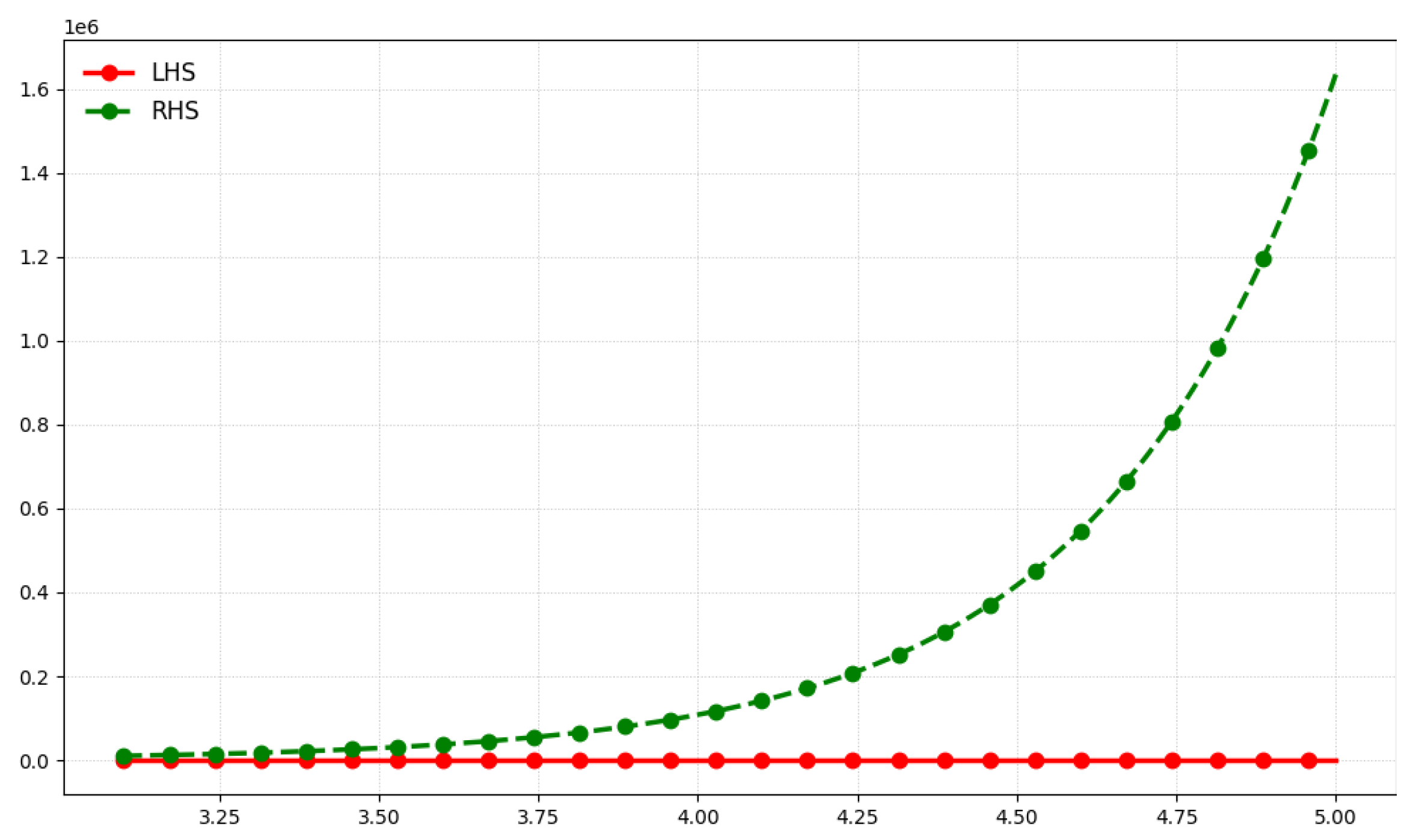
Case 1: Let F ( ϰ ) = e ϰ for all ϰ > 0 , ; then, F ( ϰ ) = e ϰ for all ϰ > 0 is a convex function. By picking τ = 2 , ζ 1 = 1 , ζ 2 = 2 , a o = 3 , α = 1 and b o [ 3.1 , 5 ] , it then follows that the left-hand side of Theorem 2 will transform into
| 1 90 7 + 32 e ( 3 b o 4 ) + 12 e ( 3 b o 2 ) + 32 e ( 9 3 b o 4 ) + 7 e ( 3 b o ) 2 ( e 3 b o 1 ) b o 1 | = L H S .
On the other hand, for b o [ 3.1 , 5 ] , since | F ( ζ 1 ) | = | e 1 | , | F ( ζ 2 ) | = | e 2 | , | g ( a o ) | = | e 3 | and | g ( b o ) | = | e b o | , it then follows that the right-hand side of Theorem 2 will transform into
= b o 3 2 1 4 2 + 1 2 2 + 3 4 2 7 90 2 39 90 2 83 90 2 51 90 2 + 1 2 × 2 | e 1 | + 2 | e 2 | | e 3 | | e b o | = R H S .
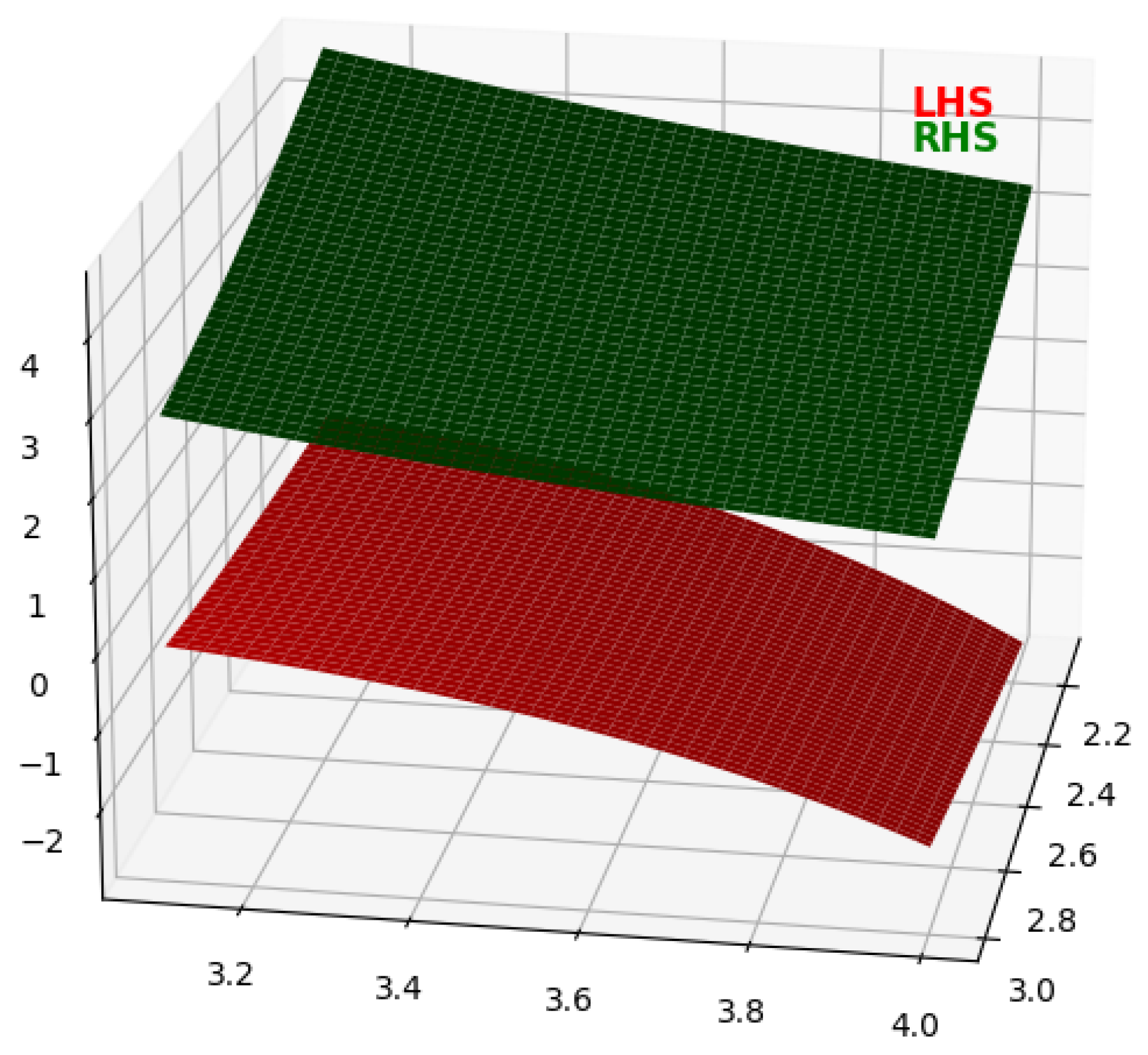
Case 2: Let F ( ϰ ) = e ϰ for all ϰ > 0 , ; then, F ( ϰ ) = e ϰ for all ϰ > 0 is a convex function. By picking τ = 2 , ζ 1 = 1 , ζ 2 = 2 , α = 1 , a o [ 2.1 , 3 ] , and b o [ 3.1 , 5 ] , it then follows that the left-hand side of Theorem 2 will transform into
| 1 90 7 e 3 a o + 32 e ( 12 ( 3 a o + b o ) 4 ) + 12 e ( 6 ( a o + b o ) 2 ) + 32 e ( 12 ( a o + 3 b o ) 4 ) + 7 e ( 3 b o ) 2 ( e 3 b o e 3 a o ) b o a o | = L H S .
On the other hand, for τ = 2 , since | F ( ζ 1 ) | = | e 1 | , | F ( ζ 2 ) | = | e 2 | , | g ( a o ) | = | e a o | and | g ( b o ) | = | e b o | , it then follows that the right-hand side of Theorem 2 will transform into
( b o a o ) 239 6480 2 | e 1 | + 2 | e 2 | | e a o | | e b o | = R H S .
It is clear from Figure 1 and Figure 2 that RHS ≥ LHS.

6. Applications

Here, we present some new applications of our previous results by using tools from majorization theory.

6.1. Boole’s Quadrature Formula

In this section we will investigate the application of the previously derived integral inequalities. Compared to traditional approaches, these inequalities can be used to improve the approximation of composite quadrature rules, resulting in a notable decrease in error.
Proposition 1. 
Let the function F : [ ζ 1 , ζ 2 ] be bounded. If I ı ζ 1 = ϑ 0 , ϑ 1 , , ϑ ı 1 , ϑ ı = ζ 2 is the interval and ϑ γ , 1 , ϑ γ , 2 [ ϑ γ , ϑ γ + 1 ] with χ γ = ϑ γ + 1 ϑ γ γ = 0 , 1 , , ı 1 , then we have
ϑ 0 + ϑ ı ϑ 2 ϑ 0 + ϑ ı ϑ 1 F ( P ) d P = B ( I ı , F ) + R ( I ı , F ) ,
where
B ( I ı , F ) = 1 90 [ 7 γ = 0 ı 1 F ϑ γ + ϑ γ + 1 ϑ γ , 1 χ γ + 32 γ = 0 ı 1 F ϑ γ + ϑ γ + 1 3 ϑ γ , 1 + ϑ γ , 2 2 χ γ + 12 γ = 0 ı 1 F ϑ γ + ϑ γ + 1 ϑ γ , 1 + ϑ γ , 2 2 χ γ + 32 γ = 0 ı 1 F ϑ γ + ϑ γ + 1 ϑ γ , 1 + 3 ϑ γ , 2 2 χ γ + 7 γ = 0 ı 1 F ϑ γ + ϑ γ + 1 ϑ γ , 2 χ γ ] ,
and the remainder term satisfies
R ( I ı , F ) 239 χ γ 2 6480 2 γ = 0 ı 1 ( F ( ϑ γ ) + F ( ϑ γ + 1 ) ) γ = 0 ı 1 ( F ( ϑ γ , 1 ) + F ( ϑ γ , 2 ) ) .
Proof. 
Applying the Theorem 2, with ı = 2 and α = 1 on interval [ ϑ γ , ϑ γ + 1 ] , γ = 0 , 1 , , ı 1 , we get
| 1 90 [ 7 γ = 0 ı 1 F ( ϑ γ + ϑ γ + 1 ϑ γ , 1 ) χ γ + 32 γ = 0 ı 1 F ϑ γ + ϑ γ + 1 3 ϑ γ , 1 + ϑ γ , 2 2 χ γ + 12 γ = 0 ı 1 F ϑ γ + ϑ γ + 1 ϑ γ , 1 + ϑ γ , 2 2 χ γ + 32 γ = 0 ı 1 F ϑ γ + ϑ γ + 1 ϑ γ , 1 + 3 ϑ γ , 2 2 χ γ + 7 γ = 0 ı 1 F ( ϑ γ + ϑ γ + 1 ϑ γ , 2 ) χ γ ] ϑ γ + ϑ γ + 1 ϑ γ , 2 ϑ γ + ϑ γ + 1 ϑ γ , 1 F ( P ) d P | 239 χ γ 2 6480 2 γ = 0 ı 1 ( F ( ϑ γ ) + F ( ϑ γ + 1 ) ) γ = 0 ı 1 ( F ( ϑ γ , 1 ) + F ( ϑ γ , 2 ) ) ,
γ = 0 , 1 , , ı 1 . Taking summation across 0 to ı 1 and considering the triangle inequality, we get the aforementioned outcome. □

6.2. q-Digamma Function (q-df)

Ψq-digamma function which is described as logarithmic derivative of q-df. Some studies were also used to investigate the monotonicity and full monotonicity features of functions associated with the q-gamma function (in short q-gf) and q-df, which result in surprising inequalities [25,26] given as follows: Suppose 0 < q < 1 , the
Ψ q = ln 1 q + ln q k = 0 q k + ξ 1 q k + ξ = ln 1 q + ln q k = 0 q k ξ 1 q k ξ .
q df Ψ q for ξ > 0 and q 1 can be given as
Ψ q = ln q 1 + ln q ξ 1 2 k = 0 q ( k + ξ ) 1 q ( k + ξ ) = ln q 1 + ln q ξ 1 2 k = 0 q k ξ 1 q k ξ ,
is monotonic on given interval ( 0 , ) and is convex.
Proposition 2. 
Let assume a o γ , b o γ , ζ γ I Let a o γ b o γ for all γ = { 1 , , ı } and 1 q 0 , then we have the below-mentioned inequality:
| B α ( a o γ , b o γ , ζ γ , 2 ; Ψ q ) | γ = 1 ı 1 ( b o γ a o γ ) ( α + 1 ) Y 1 ( α ) 2 γ = 1 ı Ψ q ζ γ γ = 1 ı 1 Ψ q a o γ + γ = 1 ı 1 Ψ q b o γ .
Proof. 
The definition of q-df implies the mapping F Ψ q on ( 0 , ) is completely monotonic. We can obtain the required result by utilizing this substitution in Theorem 2. □
Remark 18. 
If ı = 2 , ζ 1 = a o 1 and ζ 2 = b o 1 is picked in Proposition 2, then we have the subsequent inequality:
| B α ( a o 1 , b o 1 , ζ 2 , 2 ; Ψ q ) | ( b o 1 a o 1 ) ( α + 1 ) Y 1 ( α ) [ | Ψ q ( a o 1 ) | + | Ψ q ( b o 1 ) | ] ,
which constitutes a novel contribution to the literature.
Remark 19. 
If α = 1 is picked in Remark 18, then we have the subsequent inequality:
| 1 90 7 Ψ q a o 1 + 32 Ψ q 3 a o 1 + b o 1 2 + 12 Ψ q a o 1 + b o 1 2 + 32 Ψ q a o 1 + 3 b o 1 2 + 7 Ψ q b o 1 1 b o 1 a o 1 a o 1 b o 1 Ψ q ( ω ) d ω | 239 ( b o 1 a o 1 ) 6480 [ | Ψ q ( a o 1 ) | + | Ψ q ( b o 1 ) | ] ,
which constitutes a novel contribution to the literature.

7. Conclusions

To the best of our knowledge, this is the first attempt to investigate Boole-type inequality for differentiable functions within a majorization framework. In this paper, we have obtained a new fractional integral identity involving differentiable functions by making use of majorization theory. We derived Boole-type inequalities for mappings with first derivatives, pointing out that the absolute value of the derivatives to the power satisfy the convexity properties. These results extend the classical Boole’s inequalities and give more detailed information about their structure and applications. Moreover, some connections with special functions, such as q-dg functions, have been outlined in the application part, which further extends the theory of the special functions. This work opens new perspectives towards extending these results to more generalized integral operators.

Author Contributions

Conceptualization, S.I.B. and Y.S.; methodology, M.A. and S.I.B.; software, M.A.; validation, S.I.B. and Y.S.; formal analysis, M.A.; investigation, Y.S. and M.A.; writing—original draft preparation, S.I.B.; writing—review and editing, S.I.B. and M.A.; visualization, M.A.; supervision, Y.S.; project administration, Y.S.; funding acquisition, Y.S. All authors have read and agreed to the published version of the manuscript.

Funding

This work was supported by the Dong-A University research fund. This research was supported by the Global-Learning Academic Research Institution for Master’s·PhD Students and Postdocs (LAMP) Program of the National Research Foundation of Korea (NRF) grant funded by the Ministry of Education (RS-2025-25440216).

Data Availability Statement

No data were generated or analyzed during the current study.

Conflicts of Interest

The authors declare no conflicts of interest.

References

  1. Mitrinović, D.S.; Pečarić, J.E.; Fink, A.M. Classical and New Inequalities in Analysis; Mathematics and Its Applications (East European Series); Kluwer Academic Publishers Group: Dordrecht, The Netherlands, 1993. [Google Scholar]
  2. Mehmood, N.; Butt, S.I.; Pečarić, D.; Pečarić, J. Generalizations of cyclic refinements of Jensen’s inequality by Lidstone’s polynomial with applications in information theory. J. Math. Inequal. 2020, 14, 249–271. [Google Scholar] [CrossRef]
  3. Butt, S.I.; Bakula, M.K.; Pečarić, D.; Pečarić, J. Jensen-Grüss inequality and its applications for the Zipf-Mandelbrot law. Math. Methods Appl. Sci. 2021, 44, 1664–1673. [Google Scholar] [CrossRef]
  4. Rasheed, T.; Butt, S.I.; Pečarić, D.; Pečarić, J. Generalized cyclic Jensen and information inequalities. Chaos Solitons Fractals 2022, 163, 112602. [Google Scholar] [CrossRef]
  5. Mercer, A.M. A variant of Jensen’s inequality. J. Inequal. Pure Appl. Math. 2003, 4, 73. [Google Scholar]
  6. Wang, B.Y. Foundations of Majorization Inequalities; Beijing Normal University Press: Beijing, China, 1990; Volume 2. [Google Scholar]
  7. Niezgoda, M. A generalization of Mercer’s result on convex functions. Nonlinear Anal. Theory Methods Appl. 2009, 71, 2771–2779. [Google Scholar] [CrossRef]
  8. Sarikaya, M.Z.; Set, E.; Ozdemir, M.E. On new inequalities of Simpson’s type for s-convex functions. Comput. Math. Appl. 2010, 60, 2191–2199. [Google Scholar] [CrossRef]
  9. Sarikaya, M.Z.; Set, E.; Ozdemir, M.E. On new inequalities of Simpson’s type for functions whose second derivatives absolute values are convex. J. Appl. Math. Stat. Inform. 2013, 9, 37–45. [Google Scholar] [CrossRef]
  10. Hezenci, F.; Budak, H.; Kara, H. New version of fractional Simpson type inequalities for twice differentiable functions. Adv. Differ. Equ. 2021, 2021, 460. [Google Scholar] [CrossRef]
  11. Ali, M.A.; Kara, H.; Tariboon, J.; Asawasamrit, S.; Budak, H.; Hezenci, F. Some new Simpson’s-formula-type inequalities for twice-differentiable convex functions via generalized fractional operators. Symmetry 2021, 13, 2249. [Google Scholar] [CrossRef]
  12. Zhou, T.C.; Yuan, Z.R.; Yang, H.Y.; Du, T.S. Some parameterized inequalities by means of fractional integrals with exponential kernels and their applications. J. Inequal. Appl. 2020, 2020, 163. [Google Scholar] [CrossRef]
  13. Zhou, Y.; Liao, J.; Du, T. The weighted parameterized inequalities in relation to twice differentiable mappings in the fractal domains along with some applications. Fractals 2023, 31, 2350092. [Google Scholar] [CrossRef]
  14. Faisal, S.; Khan, M.A.; Khan, T.U.; Saeed, T.; Alshehri, A.M.; Nwaeze, E.R. New conticrete Hermite-Hadamard-Jensen-Mercer fractional inequalities. Symmetry 2022, 14, 294. [Google Scholar] [CrossRef]
  15. Faisal, S.; Khan, M.A.; Khan, T.U.; Saeed, T.; Sayed, Z.M.M.M. Unifications of continuous and discrete fractional inequalities of the Hermite-Hadamard-Jensen-Mercer type via majorization. J. Funct. Spaces 2022, 2022, 6964087. [Google Scholar] [CrossRef]
  16. Faisal, S.; Khan, M.A.; Iqbal, S. Generalized Hermite-Hadamard-Mercer type inequalities via majorization. Filomat 2022, 36, 469–483. [Google Scholar] [CrossRef]
  17. Saeed, T.; Khan, M.A.; Faisal, S.; Alsulami, H.H.; Alhodaly, M.S. New conticrete inequalities of the Hermite-Hadamard-Jensen-Mercer type in terms of generalized conformable fractional operators via majorization. Demonstr. Math. 2023, 56, 20220225. [Google Scholar] [CrossRef]
  18. Javed, M.Z.; Awan, M.U.; Bin-Mohsin, B.; Treanta, S. Upper bounds for the remainder term in Boole’s quadrature rule and applications to numerical analysis. Mathematics 2020, 12, 2920. [Google Scholar] [CrossRef]
  19. Anjum, N.; He, C.-H.; He, J.-H. Two-scale fractal theory for the population dynamics. Fractals 2021, 29, 2150182. [Google Scholar] [CrossRef]
  20. He, J.-H.; El-Dib, Y.O. A tutorial introduction to the two-scale fractal calculus and its application to the fractal Zhiber-Shabat oscillator. Fractals 2021, 29, 2150268. [Google Scholar] [CrossRef]
  21. He, J.-H. He Chengtian’s inequality and its applications. Appl. Math. Comput. 2004, 151, 887–891. [Google Scholar] [CrossRef]
  22. Davis, P.J.; Rabinowitz, P. Methods of Numerical Integration; Dover Publications: New York, NY, USA, 1975. [Google Scholar]
  23. Mateen, A.; Haider, W.; Shehzadi, A.; Budak, H.; Bin-Mohsin, B. Numerical approximations and fractional calculus: Extending Boole’s rule with Riemann–Liouville fractional integral inequalities. Fractal Fract. 2025, 9, 52. [Google Scholar] [CrossRef]
  24. Shehzadi, A.; Budak, H.; Haider, W.; Chen, H. Error bounds of Boole’s formula for different function classes. Appl. Math. J. Chin. Univ. 2025; accepted. [Google Scholar]
  25. Batir, N. Monotonicity properties of q-digamma and q-trigamma functions. J. Approx. Theory 2015, 192, 336–346. [Google Scholar] [CrossRef]
  26. Salem, A. Complete monotonicity properties of functions involving q-gamma and q-digamma functions. Math. Inequal. Appl. 2014, 17, 801–811. [Google Scholar] [CrossRef]
Figure 1. Analyzing the graphical result for Case 1 with b o [ 3.1 , 5 ] .
Fractalfract 10 00049 g001
Figure 2. Analyzing the graphical result for Case 2 with a o [ 2.1 , 3 ] a n d b o [ 3.1 , 4 ] .
Fractalfract 10 00049 g002
Disclaimer/Publisher’s Note: The statements, opinions and data contained in all publications are solely those of the individual author(s) and contributor(s) and not of MDPI and/or the editor(s). MDPI and/or the editor(s) disclaim responsibility for any injury to people or property resulting from any ideas, methods, instructions or products referred to in the content.