
Review

Fractal Analysis of Auditory Evoked Potentials: Research Gaps and Potential AI Applications

by
Svetlana Valjarevic
1,
Jovana Paunovic Pantic
2,
Jelena Cumic
3,
Peter R. Corridon
4,5,6 and
Igor Pantic
7,8,9,*
1
Clinical Hospital Center Zemun, Faculty of Medicine, University of Belgrade, Vukova 9, 11000 Belgrade, Serbia
2
Department of Pathophysiology, Faculty of Medicine, University of Belgrade, Dr. Subotica 9, 11129 Belgrade, Serbia
3
University Clinical Centre of Serbia, Faculty of Medicine, University of Belgrade, Dr. Koste Todorovića 8, 11129 Belgrade, Serbia
4
Department of Biomedical Engineering and Biotechnology, College of Medicine and Health Sciences, Khalifa University of Science and Technology, Abu Dhabi P.O. Box 127788, United Arab Emirates
5
Healthcare Engineering Innovation Group, Khalifa University of Science and Technology, Abu Dhabi P.O. Box 127788, United Arab Emirates
6
Center for Biotechnology, Khalifa University of Science and Technology, Abu Dhabi P.O. Box 127788, United Arab Emirates
7
Department of Medical Physiology, Faculty of Medicine, University of Belgrade, Visegradska 26/II, 11129 Belgrade, Serbia
8
Faculty of Social Sciences, University of Haifa, 199 Abba Hushi Blvd, Mount Carmel, Haifa 3498838, Israel
9
Faculty of Health Sciences, Ben-Gurion University of the Negev, Be’er Sheva 84105, Israel
*
Author to whom correspondence should be addressed.
Fractal Fract. 2026, 10(1), 20; https://doi.org/10.3390/fractalfract10010020
Submission received: 2 November 2025 / Revised: 16 December 2025 / Accepted: 27 December 2025 / Published: 29 December 2025
(This article belongs to the Special Issue Fractals in Physiology and Medicine)

Abstract

Auditory evoked potentials (AEPs) are electroencephalographic (EEG) responses to auditory stimuli and are frequently used to evaluate auditory processing and cognitive integrity. Interpretation of AEPs today predominantly relies on standard linear techniques such as time-domain averaging and frequency-domain spectral decomposition. These approaches may not always capture nonlinear, nonstationary, and scale-free characteristics of EEG signals; therefore, in contemporary neurophysiology research, there may be a need for the utilization of additional nonlinear frameworks. Fractal analysis may be a powerful tool for the quantification of subtle changes in EEG and AEP complexity, irregularity, and variability. This approach is often overlooked due to methodological and conceptual limitations but nevertheless holds significant potential in revealing alterations in geometrical and spatial complexity of AEPs under various physiological conditions. Here, we discuss potential applications and shortcomings of fractal AEP analysis, as well as its possible integration with supervised machine learning algorithms. We also focus on novel artificial intelligence-based concepts that could, in theory, utilize the power of fractal AEP and EEG analysis to improve the classification and prediction of neurophysiological processes and phenomena.

1. Introduction

Auditory evoked potentials (AEPs) are event-related potentials representing stimulus-locked components of the EEG signal that arise in response to acoustic stimulation. They are commonly classified into auditory brainstem responses (ABR), middle-latency responses (MLR), and long-latency responses (LLR) according to their latency and neural origin. The measurement and analysis of AEPs hold substantial importance in both clinical and research contexts, particularly for assessing auditory function and evaluating cognitive processes in patients [1,2,3]. Over the past several years, considerable effort has been directed toward enhancing the quantification and evaluation of AEPs, particularly through the integration of advanced machine learning and artificial intelligence techniques.
Conventional linear signal-processing methods used for EEG and AEP analysis have several important limitations that may hinder their broader application in clinical practice [2,4,5,6]. For example, traditional time-domain averaging and frequency-domain spectral decomposition may focus on only a fraction of the information contained in the EEG signal and may fail to reflect the nonlinear and nonstationary neural processes related to complex brain dynamics. Scale-free, fractal, and self-similar patterns in EEG signals are often overlooked by Fourier and short-time Fourier transforms, as well as by other linear analytical techniques. Consequently, the application of advanced nonlinear analytical methods may be needed to better capture the complex hierarchical organization underlying auditory processing in the brain. Over the past several decades, numerous fractal and nonlinear analytical frameworks have been developed and applied to the analysis of biological and medical signals and phenomena [7,8,9]. In biology, the concept of fractality views some organic structures and processes as highly interconnected and self-organizing systems that, in spatial and temporal sense, may exhibit self-similarity traits. Fractal analysis of medical signals can, in many cases, quantify structural or dynamical characteristics that traditional Euclidean geometry is unable to adequately describe. Quantitative features such as the fractal dimension, Hurst exponent, and multifractal spectrum width can capture changes in EEG irregularity, variability, and complexity, thereby providing valuable additional information for EEG research. Furthermore, with the rapid advancement of artificial intelligence and machine learning, fractal features have been proposed as particularly useful inputs for predictive modeling of complex medical signals [10,11].
In this narrative expert review, we focus on the methodological and conceptual gaps associated with the fractal evaluation of AEPs and offer suggestions for future methodological improvements. Although not designed as a systematic review of literature, targeted search of databases PubMed, Scopus and Web of Science was applied using search terms “auditory evoked potentials,” “EEG,” “fractal analysis,” “fractal dimension,” “nonlinear dynamics,” “entropy,” “complexity,” and “machine learning.” Inclusion criteria were focused on peer-reviewed articles published in English that addressed application of fractal analysis and related nonlinear methods in EEG changes associated with auditory stimulation. Review articles, methodological papers, and representative experimental studies were included to provide conceptual and technical context, while papers not directly related to EEG or auditory neurophysiology were excluded. No formal meta-analysis or quantitative synthesis was performed.
As an addition to the literature review, we propose a new theoretical framework that uses fractal indicators as potential input data for AEP classification purposes. This framework is based on a hybrid, tiered, late-fusion machine learning model that combines a decision tree algorithm, a convolutional neural network, a recurrent neural network, and a meta-classifier in the form of logistic regression. In addition to traditional fractal inputs, we hypothesize that the system could incorporate other nonlinear quantifiers, such as the Higuchi fractal dimension and the Hurst exponent, which, when integrated with advanced ML models, may, in theory, be applicable to large AEP datasets. Finally, we discuss the advantages and potential weaknesses of random forests, gradient boosting, and artificial neural networks in the context of AEP analysis.

2. Fractal and Complexity Metrics and Their Potential in AEP Research

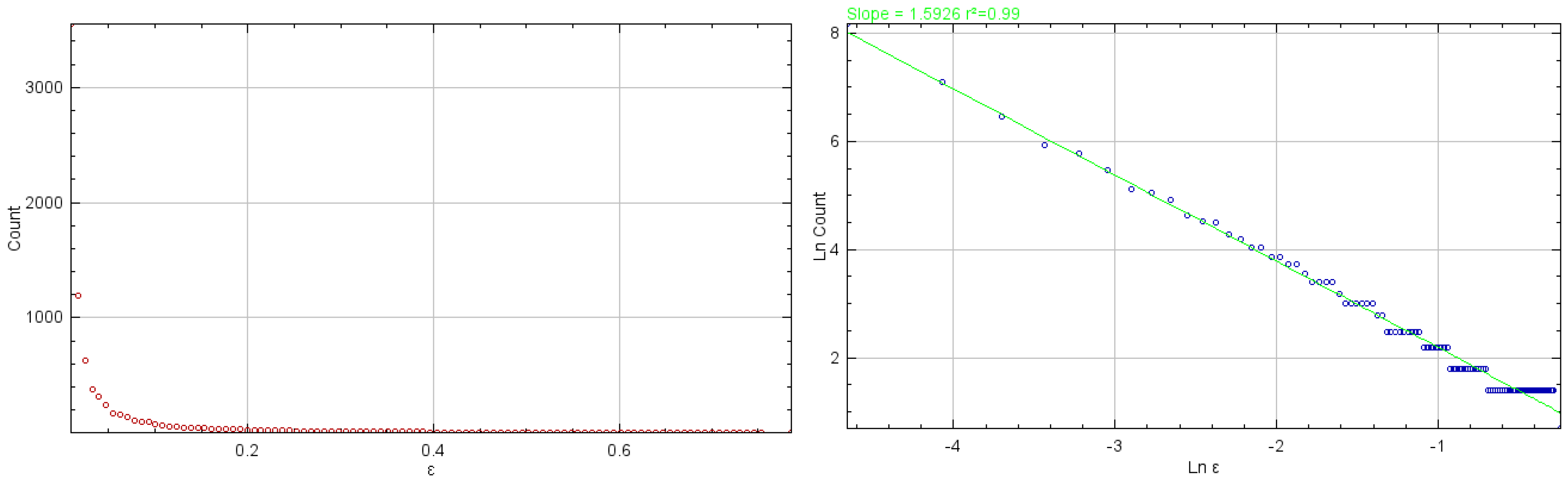
Fractal analysis is not a single method but rather a family of mathematical and biophysical algorithms designed to quantify self-similarity, complexity, and the level of detail within a dataset. Among the various quantified features, the fractal dimension (FD) is perhaps the most widely used parameter for measuring the degree of complexity in both one-dimensional and two-dimensional EEG signals [12,13,14,15]. There are multiple approaches for calculating the fractal dimension, including the box-counting, Higuchi, Katz, and Petrosian methods [12,16,17,18,19,20,21]. The box-counting technique involves covering the analyzed structure or signal with a number of boxes (N) of varying sizes (ε) and calculating the fractal dimension from the slope of the log–log regression line plotted between N and ε. The Higuchi technique relies on constructing k-length subsampled time series, where the fractal dimension is calculated from the relationship between the average curve length and the scale parameter k [18,22]. The Katz algorithm takes into account the relationship between the logarithmic value of the signal length and the maximum distance between data points. Finally, the Petrosian method considers local transitions related to the frequency of sign changes in the first derivative of the analyzed data. All of the aforementioned approaches can be applied to AEP analysis under various experimental or clinical conditions and hold significant potential for detecting subtle signal alterations that are imperceptible to the human eye. There are also numerous additional nonlinear methods that can quantify the complexity, irregularity, and long-range correlations present in EEG or AEP signals. These include, but are not limited to, detrended fluctuation analysis (DFA), the multifractal spectrum, the Hurst exponent, and entropy-based metrics such as sample, permutation, fuzzy, and spectral entropy [23,24,25,26,27,28,29,30,31]. Detrended fluctuation analysis (DFA) could be applied to nonstationary signals such as AEPs to assess long-range temporal correlations. This is accomplished by calculating the scaling exponent (α), which indicates whether the signal behaves like uncorrelated white noise or exhibits a more correlated structure. Multifractal analysis, on the other hand, would be based on the premise that AEPs may exhibit multiple scaling exponents and local singularities, which contribute to their higher dynamical richness when compared to monofractal models. Hurst exponent would be focused on the amplitude of signal fluctuations in temporal sense. Entropy-based metrics in turn, are diverse tools that are generally able to evaluate signal unpredictability or informational richness [28,32,33,34,35,36]. The particular value of these additional quantifiers lies in their ability to be used alongside fractal features for training machine learning models aimed at classifying EEG data and predicting neurophysiological processes associated with EEG changes.
Interpreting fractal and fractal-related changes in EEG/AEP from a physiological perspective is often challenging and requires substantial technical, mathematical, and medical expertise. High values of fractal dimension generally indicate greater signal complexity, irregularity, and diversity [8,9,37]. This may (or may not) reflect increased temporal variability and the engagement of more widely distributed cortical and subcortical networks during auditory task processing. Also, changes in neuronal synchrony and scale-free neural dynamics may be associated with higher or lower fractal dimension. In other words, the balance between stability and adaptability within auditory neural networks may significantly influence fractal dimension values. However, any interpretation of FD fluctuations is not specific to a single physiological state and should always be considered in context [38,39,40].
At present, only a limited number of studies have explicitly applied fractal or nonlinear complexity analysis to EEG data acquired under auditory stimulation or AEP-related paradigms, which stresses the exploratory nature of this research area. Historically, one of the most important studies on the modulation of EEG fractal dynamics by auditory stimulation is the work of Lee and Koo (2012) conducted on healthy volunteers. Participants listened to tones of 1000 Hz and 2000 Hz, and EEG was recorded under both waking and hypnotic conditions [41]. The data were subsequently analyzed using detrended fluctuation analysis (DFA), a monofractal scaling method used to quantify scale-free (fractal-like) temporal correlations. The authors found significant differences in DFA scaling exponents and related parameters between hypnosis and waking, suggesting that DFA may serve as a useful tool for evaluating the temporal organization of auditory processing.
When auditory stimulation is delivered using binaural beats (BBs)—tones of slightly different frequencies presented separately to each ear—EEG complexity tends to decrease. A study by Shamsi et al. (2021) proposed the Higuchi fractal dimension (HFD) as a potential nonlinear alternative to spectral power analysis under experimental conditions of binaural beat stimulation [42]. Using multichannel EEG recordings with an emphasis on temporal and parietal regions, the authors demonstrated that HFD achieved higher classification accuracy compared with traditional linear approaches. Moreover, in these regions, reductions in signal complexity measured by HFD appeared to occur more rapidly than changes detected by spectral power. If confirmed by future research, this would position HFD as a valuable quantitative marker of auditory-induced neural dynamics.
Changes in fractal dimension following auditory stimulation may depend on gender and even personality traits. One of the early studies on this reported that the Higuchi fractal dimension (HFD) tended to be higher in females, although this gender difference was not consistent across all measurement intervals [43]. Moreover, when personality traits were assessed using Eysenck’s Personality Questionnaire (EPQ), neuroticism appeared to be associated with higher HFD values.
In some cases, changes in fractal dimension can be bidirectional. For example, a study that applied detrended fluctuation analysis (DFA) to EEG activity following auditory stimulation with simple musical tones (a “Tanpura” drone) identified two distinct response patterns: an increase in fractal dimension, possibly reflecting enhanced emotional or cognitive engagement leading to greater variability, and a decrease in fractal dimension, likely associated with relaxation or attentional focus [44]. In either case, fractal analysis not only detected measurable changes in EEG following auditory stimulation but also revealed subtle shifts that remained undetected by traditional linear analyses such as Fourier-based power spectra.
Recent research by Tang and colleagues (2025) applied several fractal-related nonlinear complexity measures, beyond the traditional fractal dimension, to detect cortical responses to auditory stimulation [45]. In patients with disorders of consciousness, these features included the Lyapunov exponent (LE), approximate entropy (ApEn), Lempel–Ziv complexity (LZC), and correlation dimension (D2). EEG complexity was found to increase with both the level of consciousness and the degree of musical engagement, with ApEn and LZC capturing information richness and pattern diversity, while D2 reflected the spatial degrees of freedom of neural activity. Collectively, these features may represent valuable complements to conventional fractal indices for quantifying EEG complexity in both healthy individuals and across various central nervous system pathologies.
The above-mentioned nonlinear methods and algorithms are diverse and exhibit a range of potential advantages and limitations in AEP analysis. For example, while the traditional box-counting fractal dimension is simple to implement and applicable to both one-dimensional and two-dimensional signals, it may be overly sensitive to discrete changes in resolution and the size of the analyzed recording. The multifractal spectrum can evaluate multiple scaling exponents but frequently requires greater processing time and computational resources. In contrast, the Hurst exponent is less computationally demanding, although this quantifier may perform poorly in the presence of artifacts or when applied across varying window sizes. Some of the potential strengths and weaknesses of different fractal and related nonlinear quantifiers in the context of EEG and AEP analysis are summarized in Table 1.
Although it is often difficult to precisely associate fractal metrics with individual AEP components or specific functional processes, changes in the fractal characteristics of EEG signals induced by auditory stimulation may be interpreted in several ways. Early and mid-latency AEP components (e.g., N1, P2) are frequently influenced by short-term cortical synchrony and stimulus repetition. Increased phase locking and reduced trial-to-trial variability may therefore affect both the fractal dimension of EEG signals and the level of disorder quantified by entropy-based measures. Later components, such as mismatch negativity (MMN) and P300, are linked to higher-order processes involving novelty detection, attention, and prediction error, which engage distributed cortical networks and dynamic interactions across multiple temporal scales. These processes may, in turn, modulate fractal and entropy features of the signal. In this context, differences between stimulus-locked synchronization and more flexible, integrative network states may be reflected in distinct fractal and entropy characteristics, supporting the relevance of nonlinear methods in both AEP-specific and broader EEG research.

3. Methodological and Conceptual Gaps

Fractal analysis of EEG changes induced by auditory stimuli is faced with numerous methodological and conceptual gaps and challenges that need to be addressed before this family of methods is introduced into clinical practice. Technical gaps are mainly those related to the lack of standardized parameter sets for the analysis and the absence of a large benchmark dataset that would serve as a gold standard starting point. Also, when analyzing EEG signals, researchers are often faced with high variability of initially obtained raw data (because of varying conditions during measurement) as well as inconsistencies in data filtering and preprocessing. All these factors can influence the final value of fractal features and render the results difficult to reproduce and implement in future studies [15,46,47].
Second, in addition to the technical gaps, there is a significant lack of evidence that would strongly link features of EEG fractal analysis with specific neurophysiological processes and mechanisms. Although intuitively one may connect stimulation-induced changes in EEG complexity with certain aspects of neuronal synchrony and scale-free neural dynamics, the precise relationship between auditory-associated cognitive processes and EEG fractality remains unclear. Until these issues are fully resolved, the majority of research will likely continue to focus on methodological comparisons of fractal analysis with conventional EEG interpretation techniques.
Additionally, in general EEG research, there is a strong need to integrate fractal analysis methods with other linear and nonlinear techniques in order to produce more interpretable results. Performing fractal analysis alone on EEG recordings may not yield an adequate explanation of why complexity decreases (or increases) after auditory stimulation. Possible multimodal or cross-scale approaches that could provide such additional information include conventional time-frequency features, as well as entropic, texture-based extraction (e.g., co-occurrence matrix), and wavelet transform analyses [46,48,49,50].
Today, a large number of studies performing fractal analysis of EEG signals focus on perceiving the data in one-dimensional terms. For example, for a number of channels, the Higuchi, Katz, or DFA methods can be applied to sequences of voltage values (in microvolts) as functions of time. The fractal dimension may serve as an indicator of how the fluctuations of the sequence scale with time [16,51,52,53]. However, an important approach that is often overlooked is that the EEG signal can also be analyzed as a two-dimensional image or as a region of interest (ROI) within a two-dimensional representation. This two-dimensional aspect of fractal analysis remains a mostly untapped direction in both AEP and general EEG research.
Regarding AEPs, this two-dimensional type of fractal analysis could be applied to raw or minimally processed EEG waveforms during an event in order to evaluate geometric and morphological complexity rather than temporal dynamics. This could hypothetically be performed by plotting a section of a channel waveform on a white background and cropping or selecting a rectangular region of interest. The black line could then be binarized (converted to binary format) or transformed into grayscale, after which conventional box-counting or Minkowski–Bouligand fractal dimensions could be calculated. Additional features arising from the multifractal spectrum or lacunarity could also be computed. Potential benefits of this approach include the ability to assess visual-shape complexity and oscillatory pattern density—features that are difficult to capture using one-dimensional fractal analysis. Moreover, this strategy is relatively artifact-insensitive, since the researcher can manually and visually select the ROI of an artifact-free line segment. The main limitations are the lack of physiological interpretability, as it is difficult to link changes in image fractal geometry with specific neural processes, and issues with scalability, since even minor alterations in resolution or ROI size can affect the final result.
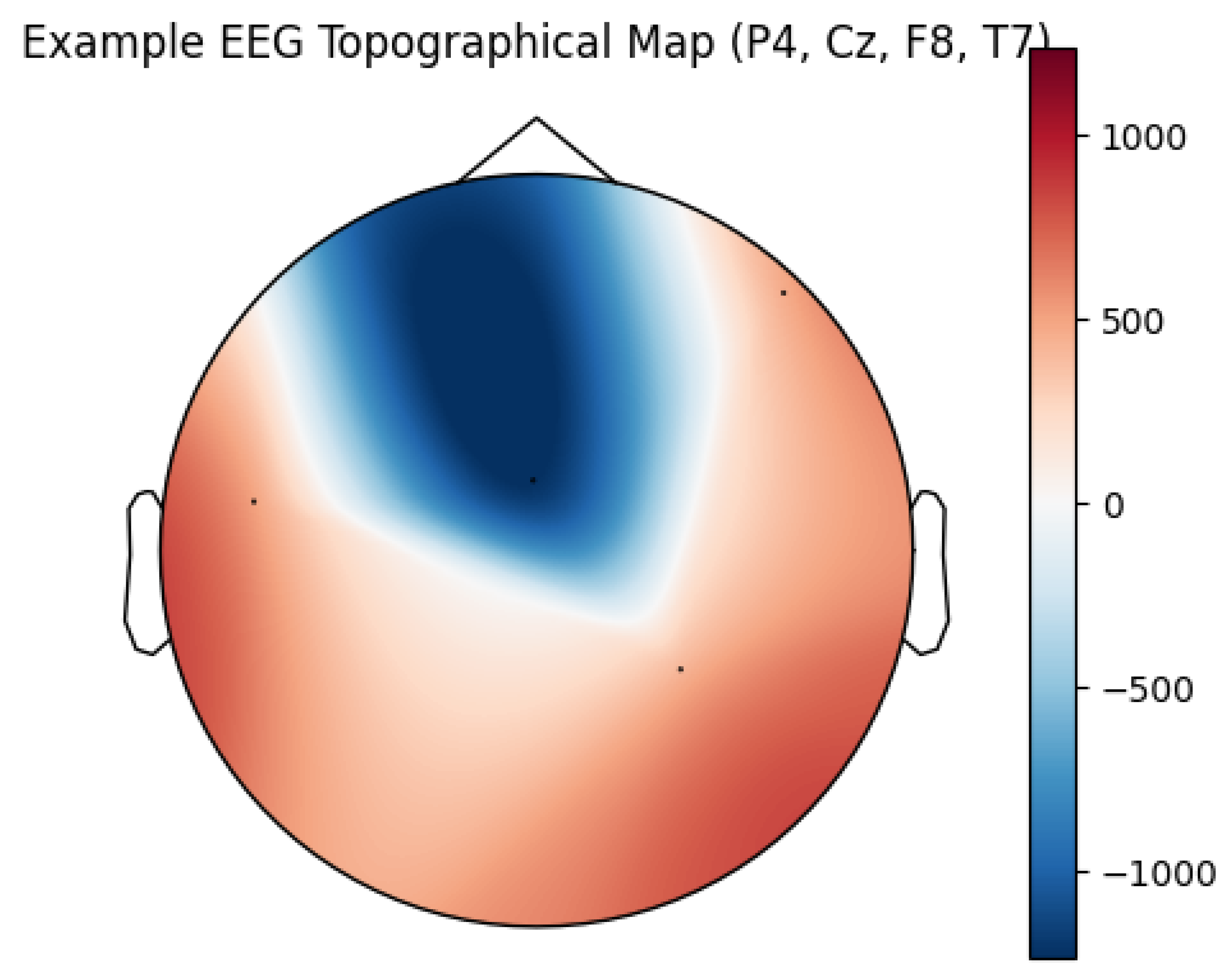
Second, another relatively unexplored aspect of two-dimensional fractal analysis in EEG AEPs is the quantification of features in EEG topographical maps. These are generally color-coded maps that serve as spatial representations of recorded signals across the scalp, or, in other words, interpolations of voltages over a circular projection of the scalp. Higher positive voltages are usually presented as warm colors (red), while cool colors (blue) refer to negative voltages. In a conventional two-dimensional box-counting approach, the computed fractal dimension of the map (or a region of interest within the map) would indirectly quantify the irregularity and roughness of the spatial voltage field. An example of such a map created using an open-source AEP dataset [54] is presented in Figure 1. High lacunarity would indicate the presence of patchy, focal activations, whereas lower values of this parameter would be associated with smoother and more global patterns in the two-dimensional spatial field. In AEP interpretation, it is possible that fractal changes could be related to discrete alterations in the distribution or clustering of cortical activation, although this assumption still requires validation through dedicated methodological research.
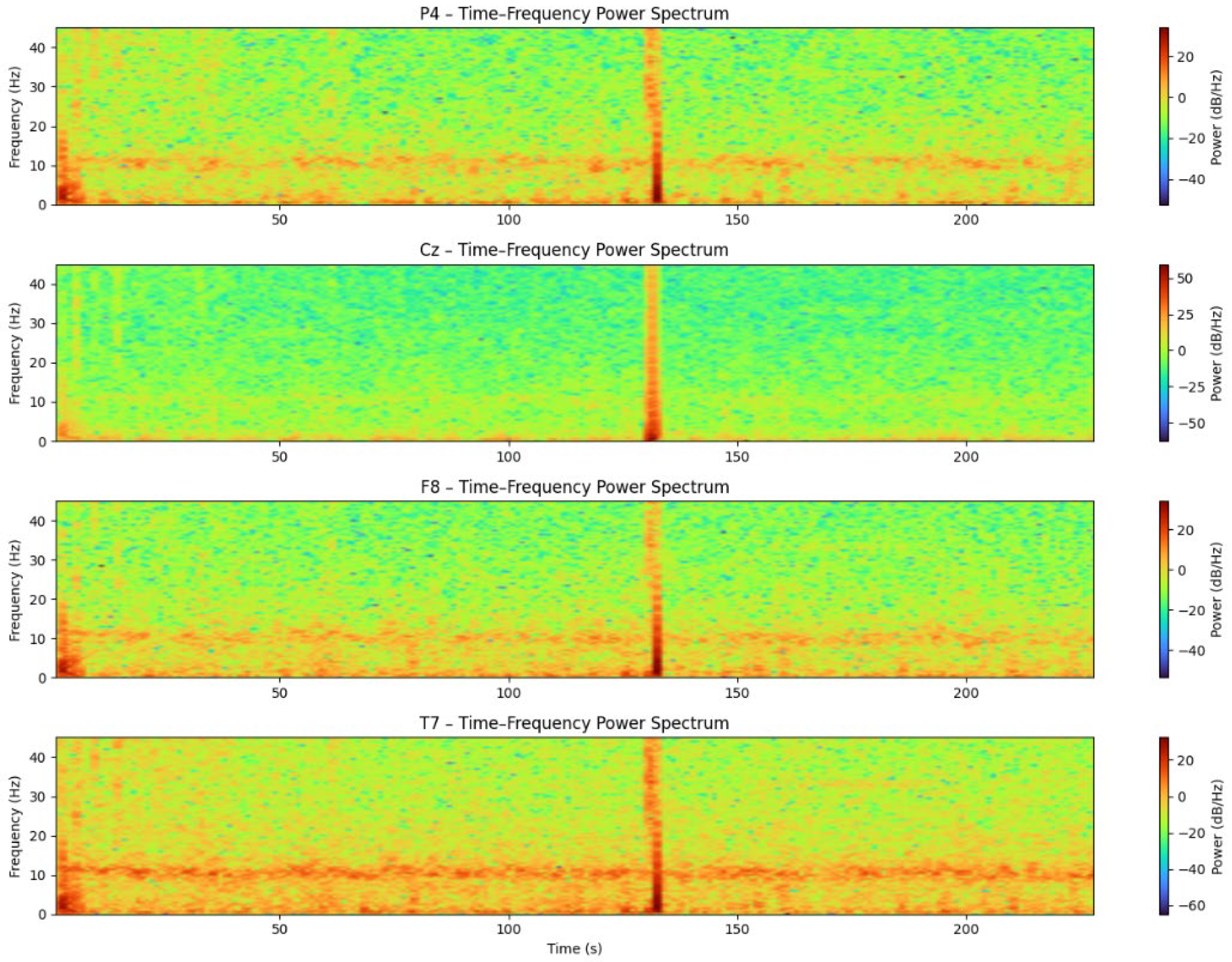
Finally, another, to our knowledge, uninvestigated area is two-dimensional fractal analysis of EEG channel spectra or power spectra per channel. Theoretically, in one dimension, this strategy could be applied to the frequency content of the AEP signal either at a single channel or averaged across multiple channels to study the spectral exponent (or spectral slope). This parameter indicates how quickly power, according to the power law, decays with frequency and can be mathematically related to the Hurst exponent (H) or the DFA scaling exponent. For example, after computing the power spectral density (e.g., via Fast Fourier Transform), conversion to log–log space and fitting a straight line yields a slope equal to the negative value of the spectral exponent. Low exponent values are typically associated with less correlated and more desynchronized neural activity. A two-dimensional fractal analysis although not focused on spectral scaling itself, could provide additional information on why such changes occur. For example, in Figure 2 we can see a hypothetical example of a power spectral density maps for four EEG channels created based on the data from the open-source AEP dataset [54], and each map or its segments can be analyzed as 2D data in standard fractal analysis platforms such as FracLac [55] (Figure 3). Performing 2D box-counting on a power-spectrum image, or treating the graph as a texture rather than as numerical data, would allow quantification of geometric complexity and shape irregularity. These data could further serve as input for machine learning models, such as artificial neural networks, for AEP classification or prediction of physiological and pathological EEG states.

4. Integrating Artificial Intelligence with Fractal AEP Analysis

Advancements in artificial intelligence (AI) and machine learning (ML) have provided new opportunities for EEG and AEP interpretation [56,57,58]. The rationale for integrating AI with fractal AEP analysis is based on the fact that, due to the abundance and complexity of the resulting data, traditional statistical approaches may be insufficient to detect subtle nonlinear differences and patterns. Furthermore, the fractal dimension of EEG signals, whether calculated from one-dimensional or two-dimensional representations, can serve as an input feature for training ML models designed for automated classification of auditory conditions, mental states, or pathological vs. control groups. The same applies to alternative nonlinear metrics, such as those derived from detrended fluctuation analysis, multifractal spectrum width, Hurst exponent calculations, and entropy-based measures.
Fractal features used for machine learning are typically extracted directly from EEG data following comprehensive preprocessing, which includes filtering, baseline correction, detection and exclusion of artifacts, and epoching [46]. Fractal dimension can be calculated within predefined latency windows, across entire channels, or across groups of channels. Based on the resulting values of fractal dimension, lacunarity, and related parameters, normalized feature vectors can be constructed for machine learning model training. Fractal features may also be organized as time-resolved sequences or spatial maps, or computed from two-dimensional image representations of EEG or AEP data [46]. This pipeline-oriented use of fractal indicators can be combined with other computational features, and the resulting model may function either as a classifier (e.g., assigning a class label to an AEP image) or as a regressor (e.g., predicting the value of a continuous physiological variable).
In the context of machine learning, fractal and other nonlinear quantifiers used as input data could be combined with statistical shape features that capture non-Gaussian characteristics of biosignals. Examples include kurtosis (as an indicator of tailedness in the amplitude distribution), skewness (as a measure of asymmetry), and the Temporal-Mean-Kurtosis (TMK) derived from channel-averaged kurtosis [59]. Furthermore, feature families such as Mel-Frequency Cepstral Coefficients (MFCCs), Gaussian Mixture Model (GMM) embeddings, Universal Background Models (UBMs), and pat-tern-recognition strategies inspired by voiceprint classification [60] could, in theory, provide additional shape-based and multiscale signal representations. These descriptors may serve as complementary inputs to fractal, entropy, or DFA features when training advanced supervised machine learning models for AEP analysis. Fractal features of AEPs can be used to train and develop both classical machine learning models and advanced deep learning or hybrid AI systems. Classical models include Support Vector Machines (SVMs), Random Forests, Gradient Boosting algorithms, and those based on k-Nearest Neighbors (kNNs) and Linear Discriminant Analysis (LDA) [46,56,59]. Convolutional Neural Networks (CNNs) and Recurrent Neural Networks (RNNs) can be employed for more demanding and complex tasks. In addition, there is potential to combine fractal analysis with unsupervised machine learning approaches for clustering, dimensionality reduction, and discovery of novel or most informative features. Finally, model fusion and multimodal feature integration would also be beneficial in terms of increasing the model’s classification accuracy and/or predictive power.
Considering the nature and quantity of today’s EEG and AEP research, models based on Random Forests (RFs) and Gradient Boosting (GB) may be particularly well suited for fractal and nonlinear EEG/AEP features, and there are several reasons for this assumption. First, both fractal dimension and other similar features are nonlinear, non-Gaussian, and often interact multiplicatively, which aligns with the nature of RF and GB models that do not assume linear or monotonic relationships between predictors and output data [46,61,62,63]. This represents a significant strength of RF and GB over linear regression, Linear Discriminant Analysis (LDA), or even logistic regression approaches. Second, RFs and GBs are relatively resilient to noise and scaling, and outlier data, which are often present in fractal analysis, may not significantly impact the model’s performance. Categorical variables and highly variable continuous values (such as lacunarity when quantified on a two-dimensional representation) can also be effectively handled by both algorithms. Third, RFs and GBs—unlike many other models—have the inherent ability to compute feature-importance scores (e.g., mean decrease in impurity or SHAP values), which can help determine whether fractal dimension is indeed a more informative feature compared with other nonlinear quantifiers. This property can also significantly enhance the physiological interpretability of results obtained in AEP analysis. Finally, and perhaps the most relevant advantage of RF and GB models, is their strong performance on small-to-medium datasets. Currently, the majority of AEP studies are conducted on relatively small samples of subjects, and under such constraints, cross-validation and hyperparameter tuning can be challenging to implement. This represents a clear advantage over multilayer perceptrons and other artificial neural networks, which often require thousands of observations to achieve adequate accuracy and discriminative power.
Random forests have been indicated to be particularly useful when fractal inputs are calculated from two-dimensional image representations. For example, in our recent research, box counting fractal dimension and lacunarity of regions of interest in cell digital micrographs were used to train a RF model for detection of subtle changes associated with toxin exposure [11]. Random forest outperformed the classification and regression tree (CART) and gradient boosting. Similar concept could be developed for analysis and classification of waveform images from raw channel EEG data resulting from auditory stimulation. By enabling quantification of waveform morphology in the spatial domain, methodologically, it would probably be the first study ever to perform ML and RF development in these settings.
At present, we are focused on developing a hybrid decision tree model for AEP-related EEG classification and artifact detection that integrates random forest and gradient boosting algorithms. In this exploratory project, fractal dimension measures of AEP activity are combined with additional nonlinear descriptors, such as permutation entropy, as input features for the model. Early, internally obtained results, although not yet publication-ready, indicate that this approach may achieve encouraging levels of discrimination, with preliminary receiver-operating-curve values in some configurations exceeding 0.8. These findings are presented only as an illustration of the potential applicability of nonlinear features within decision tree frameworks for AEP analysis. Future work will need to address challenges related to overfitting, interpretability, and generalizability in independent EEG datasets before any definitive conclusions can be drawn. In the era of deep learning, it is necessary to consider artificial neural networks for AEP analysis based on fractal features, despite the known methodological constraints related to required sample size. Convolutional Neural Networks (CNNs) may be particularly useful for analyzing two-dimensional EEG representations, as they are specifically designed to handle spatially structured data [61,64]. Almost all spatial textures with self-similar or multiscale structure can be analyzed by CNNs, including fractal-dimension or lacunarity maps of AEP components, FD values computed across time windows and trials, as well as box-counting FD applied to waveform morphology. CNN filters can be configured to detect discrete, local, scale-dependent patterns in the data, while pooling layers can integrate diverse information across scales. These and other characteristics make CNNs a valuable alternative or complement to tree-based models that rely on more traditional tabular fractal data.
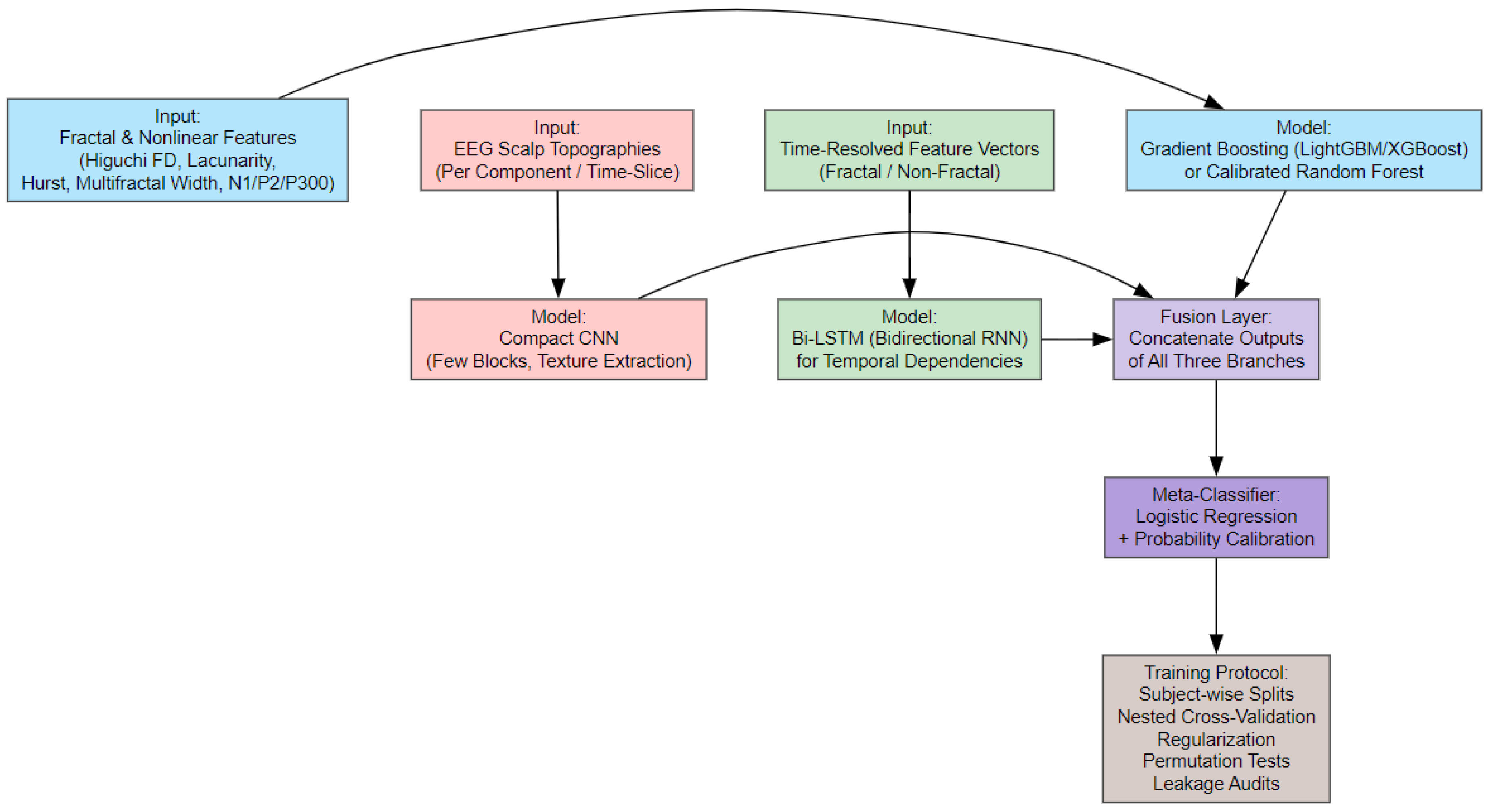
Finally, we would like to propose a theoretical concept of a hybrid, tiered, late-fusion model based on fractal AEP analysis, which in our opinion would represent the best fit for current research in this area (Figure 4, Table 2). The inputs of the model would consist of three parallel branches: a tabular branch, an image branch, and a sequence branch. The tabular branch would include fractal and other nonlinear features such as the Higuchi fractal dimension, lacunarity, Hurst exponent, multifractal width, as well as features extracted from specific latency windows (e.g., N1/P2/P300). The model responsible for this branch would be based on Gradient Boosting (LightGBM/XGBoost) or a calibrated Random Forest. The image branch would incorporate scalp topographies (per component/time-slice) analyzed by a small neural network, particularly a compact Convolutional Neural Network (CNN) with only a few blocks, suitable for relatively simple computer vision tasks. This branch would enable the identification of textural features that are undetectable by the tabular segment. The sequence branch would process input data from time-resolved vectors of fractal (or non-fractal) features and would use a Bi-LSTM (Bidirectional Long Short-Term Memory) type of Recurrent Neural Network (RNN) specifically tailored for sequential time-series data. The outputs of the three branches would then be fused (concatenated) into a meta-classifier, typically based on logistic regression with probability calibration. The training protocol could be implemented on data obtained from open-source data repositories such as PhysioNet auditory evoked potential database [54,65] and would include subject-wise splits, nested cross-validation, regularization, permutation tests, and leakage audits. This hybrid approach would be suitable for medium-to-large datasets, which in practice could be achieved through data augmentation strategies such as intensity jitter or mild time warping. For smaller samples, using only the tabular branch with RF and/or GB models could represent a more practical and stable option.
Because the proposed approach represents a deep, multi-branch architecture, its main limitation lies in the requirement for relatively large and sufficiently independent datasets of AEP recordings. In practice, the full hybrid model incorporating tabular, image, and sequence branches is most appropriate when large-scale datasets are available, such as multi-site EEG collections with strong control of heterogeneity or datasets comprising hundreds of participants and thousands of subject-independent recordings. When working with more limited datasets measured in the hundreds of participants or fewer, model development may rely on epoch- or trial-level features; however, subject-level independence must still be maintained during data splitting (i.e., training, validation, and testing should be performed by subject rather than by trial). Deep multi-branch architectures are generally not suitable for small participant-level datasets (e.g., fewer than 100 subjects) or for situations characterized by a large number of trials but low independence (e.g., thousands of epochs derived from only 10–40 participants). In addition, hybrid models should be avoided when there is limited novelty across representations, such as when image inputs are derived directly from the same data used for tabular features or when sequential representations are short or dominated by noise. In such cases, it is advisable to begin with simpler and more interpretable models, including random forests, gradient boosting, or support vector machines, and to assess their performance before considering neural networks as an alternative.
In the context of the proposed hybrid late-fusion model, the fractal dimension of an AEP signal may represent a particularly informative feature due to its potential sensitivity to changes in neuronal synchrony and hierarchical network organization. Electroencephalographic responses to auditory stimulation arise from the collective activity of diverse neuronal populations, ranging from local cortical microcircuits to large-scale networks spanning multiple spatial and temporal scales [43,44,45]. Phase-locked neural responses are often associated with increased neuronal synchrony, which in certain conditions may be reflected in reduced signal complexity. Even a relatively limited increase in ordered neuronal activity may lead to measurable decreases in EEG fractal dimension, although this relationship requires further empirical validation. If hierarchical neuronal organization and cross-scale interactions give rise to scale-free dynamics, then the use of fractal dimension as an input feature for training AEP classifiers is conceptually justified within this framework.

5. Conclusions

Fractal analysis of electroencephalographic changes induced by auditory stimulation remains an underexplored area of neurophysiology with significant potential to generate new insights and enhance contemporary research practices in this discipline. Discrete changes in EEG irregularity, variability, and complexity cannot be fully captured using traditional signal-processing techniques, largely due to the inherently nonlinear nature of neural data. Fractal and related nonlinear methods may bridge this gap and contribute to the development of advanced computational frameworks for the evaluation of auditory evoked potentials in both research and clinical contexts. However, numerous technical, conceptual, and methodological limitations currently hinder the broader adoption of fractal AEP analysis. Many of these limitations could, in the future, be mitigated by integrating fractal AEP features with supervised machine learning approaches, including those based on decision tree ensembles and artificial neural network architectures. Such integration would allow for more accurate classification, prediction, and interpretation of physiological and pathological processes underlying AEP dynamics.

Author Contributions

Conceptualization, S.V., P.R.C., J.C., J.P.P. and I.P.; writing—original draft preparation, I.P.; writing—review and editing, S.V., P.R.C., J.C., J.P.P. and I.P.; supervision, I.P.; project administration, I.P.; funding acquisition, I.P. All authors have read and agreed to the published version of the manuscript.

Funding

The authors acknowledge the support of the Ministry of Science, Technological Development and Innovation of the Republic of Serbia grant 451-03-66/2024-03/200110.

Data Availability Statement

No additional research data was generated in this research.

Acknowledgments

During the preparation of this work the authors used chat generative pre-training transformer technology for proofreading, style and grammar correction. The authors have reviewed and edited the output and take full responsibility for the content of this publication.

Conflicts of Interest

The authors declare no conflicts of interest.

Abbreviations

The following abbreviations are used in this manuscript:
ABRAuditory Brainstem Response
AEPAuditory Evoked Potential
AIArtificial Intelligence
ApEnApproximate Entropy
BBBinaural Beat
Bi-LSTMBidirectional Long Short-Term Memory
CNNConvolutional Neural Network
CNSCentral Nervous System
D2Correlation Dimension
DFADetrended Fluctuation Analysis
EEGElectroencephalography
EPQEysenck’s Personality Questionnaire
FDFractal Dimension
GBGradient Boosting
GLCMGray-Level Co-Occurrence Matrix
HHurst Exponent
HFDHiguchi Fractal Dimension
kNNsk-Nearest Neighbors
LDALinear Discriminant Analysis
LELyapunov Exponent
LLRLong-Latency Response
LZCLempel–Ziv Complexity
MLMachine Learning
MLPMultilayer Perceptron
MLRMiddle-Latency Response
MMNMismatch Negativity
RFRandom Forest
RNNRecurrent Neural Network
ROIRegion of Interest
SVMSupport Vector Machine
TMKTemporal-Mean-Kurtosis

References

  1. Zimmermann, F.; Ribeiro, G.E.; Hoffmann, J.; da Silva, D.P.C. Electrophysiological findings of brainstem auditory evoked potentials in infants with down syndrome: A systematic review and meta-analysis. Int. J. Pediatr. Otorhinolaryngol. 2025, 188, 112188. [Google Scholar] [CrossRef] [PubMed]
  2. Hajimohammadi, A.; Khodabandelu, S.; Heidari, F.; Khaleghi, S. Cortical auditory evoked potentials in the identification and monitoring of learning disorders: A systematic review and meta-analysis. J. Clin. Exp. Neuropsychol. 2025, 47, 218–235. [Google Scholar] [CrossRef] [PubMed]
  3. Wei, G.; Tian, X.; Yang, H.; Luo, Y.; Liu, G.; Sun, S.; Wang, X.; Wen, H. Adjunct Methods for Alzheimer’s Disease Detection: A Review of Auditory Evoked Potentials. J. Alzheimer’s Dis. 2024, 97, 1503–1517. [Google Scholar] [CrossRef] [PubMed]
  4. Potgurski, D.S.; Ribeiro, G.E.; Silva, D. Occurrence of changes in the auditory evoked potentials of smokers: Systematic review of the literature. CoDAS 2023, 35, e20210273. [Google Scholar] [CrossRef]
  5. Amaral, M.; Zamberlan-Amorin, N.E.; Mendes, K.D.S.; Bernal, S.C.; Massuda, E.T.; Hyppolito, M.A.; Reis, A. The P300 Auditory Evoked Potential in Cochlear Implant Users: A Scoping Review. Int. Arch. Otorhinolaryngol. 2023, 27, e518–e527. [Google Scholar] [CrossRef]
  6. Hadjidimitriou, S.K.; Zacharakis, A.I.; Doulgeris, P.C.; Panoulas, K.J.; Hadjileontiadis, L.J.; Panas, S.M. Revealing action representation processes in audio perception using fractal EEG analysis. IEEE Trans. Bio-Med. Eng. 2011, 58, 1120–1129. [Google Scholar] [CrossRef]
  7. Kumar, S.S.; Nagi, R.; Chacko, R.; Khan, J. The effectiveness of fractal analysis in diagnosing temporomandibular joint disorders: A systematic review of clinical studies. Oral Radiol. 2025, 41, 153–168. [Google Scholar] [CrossRef]
  8. Pirici, D.; Mogoanta, L.; Ion, D.A.; Kumar-Singh, S. Fractal Analysis in Neurodegenerative Diseases. Adv. Neurobiol. 2024, 36, 365–384. [Google Scholar] [CrossRef]
  9. Diaz Beltran, L.; Madan, C.R.; Finke, C.; Krohn, S.; Di Ieva, A.; Esteban, F.J. Fractal Dimension Analysis in Neurological Disorders: An Overview. Adv. Neurobiol. 2024, 36, 313–328. [Google Scholar] [CrossRef]
  10. Pantic, I.V.; Pantic, J.P.; Valjarevic, S.; Corridon, P.R.; Topalovic, N. Artificial intelligence—Based approaches based on random forest algorithm for signal analysis: Potential applications in detection of chemico—Biological interactions. Chem.-Biol. Interact. 2025, 418, 111624. [Google Scholar] [CrossRef]
  11. Pantic, I.; Topalovic, N.; Corridon, P.R.; Paunovic, J. Oxidopamine-Induced Nuclear Alterations Quantified Using Advanced Fractal Analysis: Random Forest Machine Learning Approach. Fractal Fract. 2023, 7, 771. [Google Scholar] [CrossRef]
  12. Colussi, F.; Favaro, J.; Ancona, C.; Passarotto, E.; Pelizza, M.F.; Lorenzon, E.; Ruzzante, S.; Masiero, S.; Perilongo, G.; Sparacino, G.; et al. EEG difference in the Higuchi fractal dimension of wakefulness and sleep from birth to adolescence. PLoS ONE 2025, 20, e0333903. [Google Scholar] [CrossRef] [PubMed]
  13. Tou, S.L.J.; Chau, T. The fractal dimension of resting state EEG increases over age in children. Cereb. Cortex 2025, 35, bhaf138. [Google Scholar] [CrossRef] [PubMed]
  14. Horváth, C.G.; Bodizs, R. Effect of sleep deprivation on fractal and oscillatory spectral measures of the sleep EEG: A window on basic regulatory processes. NeuroImage 2025, 314, 121260. [Google Scholar] [CrossRef] [PubMed]
  15. Lau, Z.J.; Pham, T.; Chen, S.H.A.; Makowski, D. Brain entropy, fractal dimensions and predictability: A review of complexity measures for EEG in healthy and neuropsychiatric populations. Eur. J. Neurosci. 2022, 56, 5047–5069. [Google Scholar] [CrossRef]
  16. Chandrasekharan, S.; Jacob, J.E.; Cherian, A.; Iype, T. Exploring recurrence quantification analysis and fractal dimension algorithms for diagnosis of encephalopathy. Cogn. Neurodynamics 2024, 18, 133–146. [Google Scholar] [CrossRef]
  17. Yazdi-Ravandi, S.; Mohammadi Arezooji, D.; Matinnia, N.; Shamsaei, F.; Ahmadpanah, M.; Ghaleiha, A.; Khosrowabadi, R. Complexity of information processing in obsessive-compulsive disorder based on fractal analysis of EEG signal. EXCLI J. 2021, 20, 462–654. [Google Scholar] [CrossRef]
  18. Vallesi, A.; Porcaro, C.; Visalli, A.; Fasolato, D.; Rossato, F.; Busse, C.; Cagnin, A. Resting-state EEG spectral and fractal features in dementia with Lewy bodies with and without visual hallucinations. Clin. Neurophysiol. Off. J. Int. Fed. Clin. Neurophysiol. 2024, 168, 43–51. [Google Scholar] [CrossRef]
  19. Ruiz de Miras, J.; Casali, A.G.; Massimini, M.; Ibanez-Molina, A.J.; Soriano, M.F.; Iglesias-Parro, S. FDI: A MATLAB tool for computing the fractal dimension index of sources reconstructed from EEG data. Comput. Biol. Med. 2024, 179, 108871. [Google Scholar] [CrossRef]
  20. Porcaro, C.; Marino, M.; Carozzo, S.; Russo, M.; Ursino, M.; Ruggiero, V.; Ragno, C.; Proto, S.; Tonin, P. Fractal Dimension Feature as a Signature of Severity in Disorders of Consciousness: An EEG Study. Int. J. Neural Syst. 2022, 32, 2250031. [Google Scholar] [CrossRef]
  21. Moctezuma, L.A.; Molinas, M. Classification of low-density EEG for epileptic seizures by energy and fractal features based on EMD. J. Biomed. Res. 2019, 34, 180–190. [Google Scholar] [CrossRef] [PubMed]
  22. Anderson, K.; Chirion, C.; Fraser, M.; Purcell, M.; Stein, S.; Vuckovic, A. Markers of Central Neuropathic Pain in Higuchi Fractal Analysis of EEG Signals From People With Spinal Cord Injury. Front. Neurosci. 2021, 15, 705652. [Google Scholar] [CrossRef] [PubMed]
  23. Gaurav, G.; Anand, R.S.; Kumar, V. EEG based cognitive task classification using multifractal detrended fluctuation analysis. Cogn. Neurodynamics 2021, 15, 999–1013. [Google Scholar] [CrossRef]
  24. Mesquita, V.B.; Oliveira Filho, F.M.; Rodrigues, P.C. Detection of crossover points in detrended fluctuation analysis: An application to EEG signals of patients with epilepsy. Bioinformatics 2021, 37, 1278–1284. [Google Scholar] [CrossRef] [PubMed]
  25. Zorick, T.; Landers, J.; Leuchter, A.; Mandelkern, M.A. EEG multifractal analysis correlates with cognitive testing scores and clinical staging in mild cognitive impairment. J. Clin. Neurosci. Off. J. Neurosurg. Soc. Australas. 2020, 76, 195–200. [Google Scholar] [CrossRef]
  26. Bisht, A.; Singh, P.; Kaur, P.; Dalal, G. Identification of ocular artifact in EEG signals using VMD and Hurst exponent. J. Basic Clin. Physiol. Pharmacol. 2024, 35, 353–359. [Google Scholar] [CrossRef]
  27. Stanyard, R.A.; Mason, D.; Ellis, C.; Dickson, H.; Short, R.; Batalle, D.; Arichi, T. Aperiodic and Hurst EEG exponents across early human brain development: A systematic review. Dev. Cogn. Neurosci. 2024, 68, 101402. [Google Scholar] [CrossRef]
  28. Shokouh Alaei, H.; Kouchaki, S.; Yogarajah, M.; Abasolo, D. EEG Complexity Analysis of Psychogenic Non-Epileptic and Epileptic Seizures Using Entropy and Machine Learning. Entropy 2025, 27, 1044. [Google Scholar] [CrossRef]
  29. Li, J.; Feng, G.; Ling, C.; Ren, X.; Zhang, S.; Liu, X.; Wang, L.; Vai, M.I.; Lv, J.; Chen, R. A Novel Multi-Scale Entropy Approach for EEG-Based Lie Detection with Channel Selection. Entropy 2025, 27, 1026. [Google Scholar] [CrossRef]
  30. Feng, G.; Li, J.; Zhong, Y.; Zhang, S.; Liu, X.; Vai, M.I.; Lin, K.; Zeng, X.; Yuan, J.; Chen, R. A Novel Co-Designed Multi-Domain Entropy and Its Dynamic Synapse Classification Approach for EEG Seizure Detection. Entropy 2025, 27, 919. [Google Scholar] [CrossRef]
  31. Arpaia, P.; Cacciapuoti, M.; Cataldo, A.; Criscuolo, S.; De Benedetto, E.; Masciullo, A.; Pesola, M.; Schiavoni, R.; Tedesco, A. A Novel Entropy Metric for Unified Analysis of Temporal, Spatial, and Spectral EEG Properties. IEEE Trans. Bio-Med. Eng. 2025, 1–15. [Google Scholar] [CrossRef] [PubMed]
  32. Latifoglu, F.; Orhanbulucu, F.; Murugappan, M.; Gurbuz, S.N.; Cayir, B.; Avci, F.Z. EEG signal analysis for the classification of Alzheimer’s and frontotemporal dementia: A novel approach using artificial neural networks and cross-entropy techniques. Int. J. Neurosci. 2025, 1–14. [Google Scholar] [CrossRef] [PubMed]
  33. Li, J.; Feng, G.; Lv, J.; Chen, Y.; Chen, R.; Chen, F.; Zhang, S.; Vai, M.I.; Pun, S.H.; Mak, P.U. A Lightweight Multi-Mental Disorders Detection Method Using Entropy-Based Matrix from Single-Channel EEG Signals. Brain Sci. 2024, 14, 987. [Google Scholar] [CrossRef] [PubMed]
  34. Yang, R.; Zhang, L.; Yang, R.; Hou, L.; Zhu, D.; Zhong, B. Multiple entropy fusion predicts driver fatigue using forehead EEG. Front. Neurosci. 2025, 19, 1567146. [Google Scholar] [CrossRef]
  35. Maheshwari, S.; Rajesh, K.; Kanhangad, V.; Acharya, U.R.; Kumar, T.S. Entropy difference-based EEG channel selection technique for automated detection of ADHD. PLoS ONE 2025, 20, e0319487. [Google Scholar] [CrossRef]
  36. Tenev, A.; Markovska-Simoska, S.; Muller, A.; Mishkovski, I. Entropy, complexity, and spectral features of EEG signals in autism and typical development: A quantitative approach. Front. Psychiatry 2025, 16, 1505297. [Google Scholar] [CrossRef]
  37. Di Ieva, A. Fractal Analysis in Clinical Neurosciences: An Overview. Adv. Neurobiol. 2024, 36, 261–271. [Google Scholar] [CrossRef]
  38. Ruiz de Miras, J. Fractal Analysis in MATLAB: A Tutorial for Neuroscientists. Adv. Neurobiol. 2024, 36, 815–825. [Google Scholar] [CrossRef]
  39. Di Ieva, A. Computational and Translational Fractal-Based Analysis in the Translational Neurosciences: An Overview. Adv. Neurobiol. 2024, 36, 781–793. [Google Scholar] [CrossRef]
  40. West, B.J. The Fractal Tapestry of Life: A Review of Fractal Physiology. Nonlinear Dyn. Psychol. Life Sci. 2021, 25, 261–296. [Google Scholar]
  41. Lee, J.S.; Koo, B.H. Fractal analysis of EEG upon auditory stimulation during waking and hypnosis in healthy volunteers. Int. J. Clin. Exp. Hypn. 2012, 60, 266–285. [Google Scholar] [CrossRef] [PubMed]
  42. Shamsi, E.; Ahmadi-Pajouh, M.A.; Seifi Ala, T. Higuchi fractal dimension: An efficient approach to detection of brain entrainment to theta binaural beats. Biomed. Signal Process. Control. 2021, 68, 102580. [Google Scholar] [CrossRef]
  43. Georgiev, S.; Minchev, Z.; Christova, C.; Philipova, D. EEG Fractal Dimension Measurement before and after Human Auditory Stimulation. Bioautomation 2009, 12, 70–81. [Google Scholar]
  44. Banerjee, A.; Sanyal, S.; Gupta, R.; Ghosh, D. Fractal analysis for assessment of complexity of electroencephalography signal due to audio stimuli. J. Harmon. Res. Appl. Sci. 2014, 2, 300–310. [Google Scholar]
  45. Tang, Y.; Sheng, Q.; Wu, X.; Zeng, F. Discriminative power of diverse nonlinear EEG dynamics across consciousness states during auditory stimulation in disorders of consciousness. Front. Hum. Neurosci. 2025, 19, 1640520. [Google Scholar] [CrossRef]
  46. Paunovic Pantic, J.; Valjarevic, S.; Cumic, J.; Pantic, I. AI-enhanced EEG signal interpretation: A novel approach using texture analysis with random forests. Med. Hypotheses 2024, 189, 111405. [Google Scholar] [CrossRef]
  47. Radhakrishnan, M.; Won, D.; Manoharan, T.A.; Venkatachalam, V.; Chavan, R.M.; Nalla, H.D. Investigating electroencephalography signals of autism spectrum disorder (ASD) using Higuchi Fractal Dimension. Biomed. Eng./Biomed. Tech. 2020, 66, 59–70. [Google Scholar] [CrossRef]
  48. Karakas, M.F.; Latifoglu, F. Distinguishing Parkinson’s Disease with GLCM Features from the Hankelization of EEG Signals. Diagnostics 2023, 13, 1769. [Google Scholar] [CrossRef]
  49. Onay, F.; Karacali, B. Task-specific dynamical entropy variations in EEG as a biomarker for Parkinson’s disease progression. GeroScience 2025, 1–23. [Google Scholar] [CrossRef]
  50. Edthofer, A.; Ettel, D.; Schneider, G.; Korner, A.; Kreuzer, M. Entropy of difference works similarly to permutation entropy for the assessment of anesthesia and sleep EEG despite the lower computational effort. J. Clin. Monit. Comput. 2025, 39, 655–668. [Google Scholar] [CrossRef]
  51. El-Yaagoubi, A.B.; Chung, M.K.; Ombao, H. Dynamic topological data analysis: A novel fractal dimension-based testing framework with application to brain signals. Front. Neuroinformatics 2024, 18, 1387400. [Google Scholar] [CrossRef] [PubMed]
  52. Khan, M.S.I.; Jelinek, H.F. Point of Care Testing (POCT) in Psychopathology Using Fractal Analysis and Hilbert Huang Transform of Electroencephalogram (EEG). Adv. Neurobiol. 2024, 36, 693–715. [Google Scholar] [CrossRef] [PubMed]
  53. Cukic, M.; Olejarzcyk, E.; Bachmann, M. Fractal Analysis of Electrophysiological Signals to Detect and Monitor Depression: What We Know So Far? Adv. Neurobiol. 2024, 36, 677–692. [Google Scholar] [CrossRef] [PubMed]
  54. Abo Alzahab, N.; Di Iorio, A.; Apollonio, L.; Alshalak, M.; Gravina, A.; Antognoli, L.; Baldi, M.; Scalise, L.; Alchalabi, B. Auditory evoked potential EEG-Biometric dataset (version 1.0.0). PhysioNet 2021. [Google Scholar] [CrossRef]
  55. Karperien, A. FracLac for ImageJ. Available online: http://rsb.info.nih.gov/ij/plugins/fraclac/FLHelp/Introduction.htm (accessed on 28 January 2023).
  56. Mouazen, B.; Bendaouia, A.; Abdelwahed, E.H.; De Marco, G. Machine learning and clinical EEG data for multiple sclerosis: A systematic review. Artif. Intell. Med. 2025, 166, 103116. [Google Scholar] [CrossRef]
  57. Lohani, D.C.; Chawla, V.; Rana, B. A systematic literature review of machine learning techniques for the detection of attention-deficit/hyperactivity disorder using MRI and/or EEG data. Neuroscience 2025, 570, 110–131. [Google Scholar] [CrossRef]
  58. Hosseini, M.P.; Hosseini, A.; Ahi, K. A Review on Machine Learning for EEG Signal Processing in Bioengineering. IEEE Rev. Biomed. Eng. 2021, 14, 204–218. [Google Scholar] [CrossRef]
  59. Ou, J.; Li, N.; He, H.; He, J.; Zhang, L.; Jiang, N. Detecting muscle fatigue among community-dwelling senior adults with shape features of the probability density function of sEMG. J. Neuroeng. Rehabil. 2024, 21, 196. [Google Scholar] [CrossRef]
  60. Zhao, K.; Wang, H.; Wang, X.-T.; An, L.-H.; Chen, L.; Zhang, Y.-P.; Lv, N.; Li, Y.; Ruan, J.-L.; He, S.-Y.; et al. Neutron-gamma discrimination method based on voiceprint identification. Radiat. Meas. 2025, 187, 107483. [Google Scholar] [CrossRef]
  61. Petrella, R.J. The AI Future of Emergency Medicine. Ann. Emerg. Med. 2024, 84, 139–153. [Google Scholar] [CrossRef]
  62. Kamarajan, C.; Ardekani, B.A.; Pandey, A.K.; Chorlian, D.B.; Kinreich, S.; Pandey, G.; Meyers, J.L.; Zhang, J.; Kuang, W.; Stimus, A.T.; et al. Random Forest Classification of Alcohol Use Disorder Using EEG Source Functional Connectivity, Neuropsychological Functioning, and Impulsivity Measures. Behav. Sci. 2020, 10, 62. [Google Scholar] [CrossRef]
  63. Wei, L.; Ventura, S.; Lowery, M.; Ryan, M.A.; Mathieson, S.; Boylan, G.B.; Mooney, C. Random Forest-based Algorithm for Sleep Spindle Detection in Infant EEG. In Proceedings of the Annual International Conference of the IEEE Engineering in Medicine and Biology Society, Montreal, QC, Canada, 20–24 July 2020; Volume 2020, pp. 58–61. [Google Scholar] [CrossRef]
  64. Pantic, I.V.; Paunovic Pantic, J. Advanced concept for identifying chemico-biological interactions associated with programmed cell death using a multi-scale attention residual convolutional neural network. Comput. Biol. Med. 2025, 198, 111186. [Google Scholar] [CrossRef]
  65. Goldberger, A.; Amaral, L.; Glass, L.; Hausdorff, J.; Ivanov, P.C.; Mark, R.; Mietus, G.E.; Moody, G.B.; Peng, C.-B.; Stanley, H.E. PhysioBank, PhysioToolkit, and PhysioNet: Components of a new research resource for complex physiologic signals. Circulation 2000, 101, e215–e220. [Google Scholar] [CrossRef]
Figure 1. Example EEG topographical map that can be analyzed as two-dimensional textures to quantify spatial irregularity or lacunarity in fractal analysis. Raw EEG signals were obtained from the PhysioNet auditory evoked potential database (record s01_ex07) and processed in a Google Colab environment using the WFDB and SciPy libraries. Signals were analyzed without additional artifact rejection to illustrate the concept, and spectrograms were computed using a short-time Fourier transform with a 2 s window and 50% overlap. Power was expressed in dB/Hz, and frequencies were limited to the EEG-relevant range (0–45 Hz). The figure is intended as a methodological illustration of two-dimensional signal representations suitable for subsequent fractal or texture-based analysis.
Fractalfract 10 00020 g001
Figure 2. Example EEG topographical map generated from the same open-access auditory evoked potential dataset shown in Figure 1. EEG data were obtained from the PhysioNet database (record s01_ex07) and visualized using the MNE-Python framework, version 1.8.0. Signals were converted to voltage units and assigned standard 10–20 electrode locations for spatial interpolation. Mean channel amplitudes across the recording were used to construct a representative scalp map. This topographical representation is shown as an example of a two-dimensional spatial signal that may be further analyzed using fractal dimension, lacunarity, or other texture-based metrics.
Fractalfract 10 00020 g002
Figure 3. Example of fractal dimension computation using the box-counting method in FracLac software. The analysis was performed on a selected segment of EEG spectral maps shown in Figure 2, version 2.5.
Fractalfract 10 00020 g003
Figure 4. Hybrid late-fusion model combining tabular, image, and sequence branches for fractal AEP analysis, with concatenated outputs integrated into a calibrated logistic regression meta-classifier.
Fractalfract 10 00020 g004
Table 1. Summary of advantages, limitations, and potential applications of selected nonlinear and fractal-based analytical methods in EEG and AEP research.
MethodAdvantagesLimitationsPotential Use in AEP/EEG Research
Box-Counting Fractal DimensionSimple implementation; applicable to one-dimensional and two-dimensional signalsSensitive to subtle changes in signal resolution; potential interpretability issues in physiologyQuantification of signal complexity; assessment of topographical irregularity in 2D representations
Higuchi Fractal Dimension (HFD)Suitable for short time series; relatively robust to amplitude scalingSensitive to noise and artifacts; relatively high inter-subject variabilityDetection of rapid complexity changes induced by auditory stimulation
Katz Fractal DimensionSimple, intuitive, and computationally efficientRelatively coarse measure; may fail to detect fine-scale nonlinear dynamicsGeneral-purpose complexity quantification of short AEP segments
Detrended Fluctuation Analysis (DFA)Powerful for detecting long-range temporal correlations in nonstationary signalsPerforms poorly on rapid, transient, or very short signal segmentsEvaluation of scale-free temporal structure in AEP responses
Multifractal Spectrum (MFDFA)Generates rich quantitative descriptors (spectrum width, singularity strength, asymmetry); high potential for ML pipelinesRequires longer continuous segments; computationally expensive; complex physiological interpretationAdvanced nonlinear auditory processing studies coupled with AI model development
Hurst Exponent (H)More interpretable than several other metrics; provides insight into persistence/anti-persistence; computationally efficientStrongly influenced by preprocessing; limited to monofractal characteristicsQuantification of temporal predictability and long-range structure in AEP changes
Entropy Measures (Sample, Permutation, Fuzzy, Spectral)Valuable complement to fractal indicators for ML input; quantify signal unpredictability and information richnessSensitive to artifacts; some techniques require large datasets for reliable estimationUseful addition to fractal methods to address interpretability challenges and enhance ML discriminative power
Table 2. Simplified comparison of one-dimensional and two-dimensional fractal analysis approaches applied to auditory evoked potential (AEP) data.
Aspect1-D Fractal Analysis2-D Fractal Analysis
Starting dataPreprocessed AEP/EEG time seriesPreprocessed AEP/EEG time series
Main transformationNone (direct analysis of waveform)Conversion to image representation
Representation analyzedTemporal signal (1-D)Image (2-D)
Typical inputsChannel waveforms, latency windowsTime–frequency maps, scalp topographies
Typical metricsFD (Higuchi, Katz), DFA, entropyFD (box-counting), lacunarity
What it capturesTemporal complexity and synchronySpatial or spectrotemporal structure
Role in ML modelsTabular or sequential featuresImage-based features
Disclaimer/Publisher’s Note: The statements, opinions and data contained in all publications are solely those of the individual author(s) and contributor(s) and not of MDPI and/or the editor(s). MDPI and/or the editor(s) disclaim responsibility for any injury to people or property resulting from any ideas, methods, instructions or products referred to in the content.