Article

A Finite Difference Method for Caputo Generalized Time Fractional Diffusion Equations

School of Mathematics and Statistics, Changsha University of Science and Technology, Changsha 410114, China
*
Author to whom correspondence should be addressed.
Fractal Fract. 2026, 10(1), 19; https://doi.org/10.3390/fractalfract10010019 (registering DOI)
Submission received: 20 November 2025 / Revised: 10 December 2025 / Accepted: 10 December 2025 / Published: 28 December 2025
(This article belongs to the Special Issue Advances in Fractional Modeling and Computation, Second Edition)

Abstract

This paper presents a finite difference method for solving the Caputo generalized time fractional diffusion equation. The method extends the L 1 scheme to discretize the time fractional derivative and employs the central difference for the spatial diffusion term. Theoretical analysis demonstrates that the proposed numerical scheme achieves a convergence rate of order 2 α in time and second order in space. These theoretical findings are further validated through numerical experiments. Compared to existing methods that only achieve a temporal convergence of order 1 α , the proposed approach offers improved accuracy and efficiency, particularly when the fractional order α is close to zero. This makes the method highly suitable for simulating transport processes with memory effects, such as oil pollution dispersion and biological population dynamics.

1. Introduction

Over the past few decades, fractional differential–integral equations have garnered significant attention among researchers for their ability to model complex natural phenomena that integer-order differential equations cannot adequately describe. These equations have been successfully applied in fluid mechanics [1], electromagnetism [2], control systems [3], viscoelastic materials [4], electrochemistry [5], population biology [6], and signal and image processing [7]. In particular, time-fractional differential equations incorporate memory kernels, making them highly suitable for characterizing evolutionary processes with memory and hereditary properties, including anomalous diffusion [8,9,10].
This paper develops a finite difference method for solving the Caputo generalized time fractional diffusion equation (TFDE).
D t ρ , α u ( x , t ) 2 u ( x , t ) x 2 = f ( x , t ) , 0 < t T , 0 < x < L ,
with the initial and boundary conditions
u ( x , 0 ) = u 0 ( x ) , 0 x L ,
u ( 0 , t ) = ϕ ( t ) , u ( L , t ) = ν ( t ) , 0 t T ,
where 0 < α < 1 , 0 < ρ 1 , f, u 0 , ϕ , ν are given smooth functions, and D t ρ , α u x , t denotes the Caputo generalized fractional derivative [11,12] defined by
D t ρ , α u x , t = 1 Γ 1 α 0 t t ρ ρ s ρ ρ α u ( x , s ) s d s .
The introduction of the parameter ρ in the Caputo generalized fractional derivative Equation (4) provides greater flexibility in modeling transport processes with memory effects. Unlike the classical Caputo derivative ( ρ = 1 ) , which corresponds to a uniform time-scaling, the generalized version allows for non-linear time transformations through the mapping t t ρ ρ . This is particularly useful in describing anomalous diffusion in media with spatially varying properties or under time-dependent external forces, as demonstrated in applications to oil pollution dispersion [13] and biological population dynamics [14]. Therefore, developing accurate and efficient numerical methods for the generalized case is of both theoretical and practical importance.
When L = + and T = + , ref. [15] provides an exact solution to the problem (Equations (1)–(3)) in a complex integral form by means of the ρ -Laplace transform and the Fourier sinusoidal transform. However, the exact solution to it on a general spatial domain can hardly be obtained yet, so we study numerical solution schemes for it in this paper.
The numerical solutions to the classical Caputo TFDEs ( ρ = 1 in Equation (1)) have been well studied: some are obtained by finite difference methods (see e.g., [16,17,18,19,20,21,22,23]), some by finite element methods (see e.g., [24,25,26,27,28]) and some by spectral methods (see e.g., [29,30,31]), among others.
In contrast, the Caputo generalized TFDEs present a more significant challenge. The replacement of the kernel ( t s ) α with ( ( t ρ s ρ ) / ρ ) α destroys the simple convolutional structure, making the accurate and efficient approximation of the history integral inherently difficult. Consequently, numerical studies for this generalized equation remain scarce. To our knowledge, the primary numerical work is the finite difference scheme proposed by Sene [12]. However, that scheme achieves only an O ( τ 1 α ) convergence order in time and lacks a rigorous theoretical convergence analysis.
To address these gaps, this paper develops a novel finite difference scheme for the Caputo generalized TFDEs. The key to enhancing accuracy lies in a new high-order composite quadrature rule (detailed in Section 2, Equation (19)) for approximating the generalized fractional integral. This approach effectively handles the non-standard kernel and overcomes the accuracy bottleneck of the existing method. Consequently, we establish a scheme that achieves an improved temporal convergence of order O ( τ 2 α ) —recovering the optimal order often seen in schemes for the classical Caputo case—while maintaining second-order spatial accuracy. The stability and convergence of the scheme are rigorously proven using a discrete maximum principle, and its superior performance is confirmed by extensive numerical experiments.
The rest of this paper is organized as follows: in Section 2, we present the finite difference method for solving the Caputo generalized TFDE and its convergence results; in Section 3, we prove the theoretical results proposed in Section 2; in Section 4, we conduct some numerical tests to support our theoretical analysis; in Section 5, we draw a conclusion.
We assume that the solution u is sufficiently smooth in the paper. We use C, which may take on different values at different places, to denote a mesh-independent generic positive constant.

2. The Numerical Solution Scheme and Its Theoretical Results

Let M and N be two positive integers, and define the spatial grid x i = i h ( i = 0 , 1 , 2 , , M ) with step size h = L / M and the temporal grid t n = n τ ( n = 0 , 1 , 2 , , N ) with step size τ = T / N . In the following, we write u i n = u ( x i , t n ) for short:
Taking ( x , t ) = ( x i , t n ) in Equation (1) gives
D t ρ , α u ( x i , t n ) 2 u ( x i , t n ) x 2 = f ( x i , t n ) , i = 1 , 2 , , M 1 , n = 1 , 2 , , N .
We write the time fractional derivative as
D t ρ , α u x i , t n = 1 Γ 1 α 0 t n t n ρ ρ s ρ ρ α u x i , s s d s = ρ α Γ 1 α k = 1 n t k 1 t k t n ρ s ρ α u x i , s s d s = ρ α Γ 1 α k = 1 n t k 1 t k t n ρ s ρ α u i k u i k 1 τ d s + R i , 1 ( n ) = μ k = 1 n b ˜ k ( n ) u i k u i k 1 τ + R i , 1 ( n ) ,
where μ = ρ α Γ 1 α , b ˜ k ( n ) = t k 1 t k t n ρ s ρ α d s and
R i , 1 ( n ) = μ k = 1 n t k 1 t k u x i , s s u i k u i k 1 τ t n ρ s ρ α d s .
Lemma 1. 
The truncation error R i , 1 ( n ) satisfies
R i , 1 ( n ) C τ 2 α .
Remark 1. 
The exact value of b ˜ k ( n ) cannot be obtained analytically. In [12], it is approximated as
b ˜ k ( n ) t k 1 t k t n ρ s ρ α s 1 ρ t k ρ 1 d s ,
with the error bound C τ 1 α . In the following, we present an approximation of b ˜ k ( n ) by developing an effective numerical integration method with the error bound of C τ 2 α .
Through the variable substitution s = s ^ t n , we have
0 t n t n ρ s ρ α d s = t n 1 α ρ 0 1 1 s ^ ρ α d s ^
and
b ˜ k ( n ) = t k 1 t k t n ρ s ρ α d s = t n 1 α ρ t k 1 t n t k t n 1 s ^ ρ α d s ^ .
Next, we will write 0 1 1 s ^ ρ α d s ^ as the sum of the integrals over a number of small intervals, approximating them separately, and then further obtain the approximations to b ˜ k ( n ) . Take
N ^ = N + 1 , if N is odd , N , if N is even .
Define the graded grid on [ 0 , 1 ]
t ^ j = ( j / N ^ ) r , j = 0 , 1 , , N ^ ,
with the exponent r 1 , and define t ^ j 1 2 = t ^ j 1 + t ^ j 2 and τ ^ j = t ^ j t ^ j 1 . Denote
I ^ j = t ^ j 1 t ^ j 1 s ^ ρ α d s ^ , j = 1 , 2 , , N ^ .
Then we have
0 1 1 s ^ ρ α d s ^ = j = 1 N ^ I ^ j .
Because the integrand 1 s ^ ρ α has singularities at s ^ = 0 and s ^ = 1 , we approximate I ^ j in the following two ways: when j N ^ / 2 , we use the trapezoidal formula
I ^ j I j : = τ ^ j 2 ( 1 t ^ j 1 ρ ) α + ( 1 t ^ j ρ ) α ,
when j > N ^ / 2 , we use the following midpoint-type formula
I ^ j I j : = t ^ j 1 t ^ j t ^ j 1 2 1 ρ s ^ ρ 1 1 s ^ ρ α d s ^ = 1 ρ ( 1 α ) t ^ j 1 2 1 ρ 1 t ^ j 1 ρ 1 α 1 t ^ j ρ 1 α .
Setting j k = max t ^ j t k t n { j } , we have
t k 1 t n < t ^ j k 1 + 1 < < t ^ j k t k t n .
Remark 2. 
We will not discuss how to approximate b ˜ k ( n ) related to the intervals ( t k 1 t n , t k t n ] which contain no integral node t ^ j , and readers can easily do it by referring to the following treatment.
Let
I ^ k , 1 ( n ) = t k 1 t n t ^ j k 1 + 1 1 s ^ ρ α d s ^ , I ^ k , 2 ( n ) = t ^ j k t k t n 1 s ^ ρ α d s ^ .
These two integrals are approximated as follows: when the upper limit of the integral is not larger than t ^ N ^ / 2 , we use the trapezoidal formula, and when the lower limit is not smaller than t ^ N ^ / 2 , we use the midpoint-type Formula (17). We denote the approximations of the two integrals as I k , 1 ( n ) and I k , 2 ( n ) , respectively, i.e.,
I ^ k , 1 ( n ) I k , 1 ( n ) , I ^ k , 2 ( n ) I k , 2 ( n ) .
Then we have the following approximation to b ˜ k ( n ) :
b ˜ k ( n ) = t n 1 α ρ I ^ k , 1 ( n ) + j = j k 1 + 2 j k I ^ j + I ^ k , 2 ( n ) b k ( n ) : = t n 1 α ρ I k , 1 ( n ) + j = j k 1 + 2 j k I j + I k , 2 ( n ) .
Combining the property of the kernel ( 1 s ^ ρ ) α and the numerical integration methods with Equation (11), we can verify that
b k 1 ( n ) < b k ( n ) , b 1 ( n ) > t n 1 α ρ n = τ t n α ρ .
Lemma 2. 
If r 2 1 + ρ , then
j = 1 N ^ I ^ j I j C τ 2 α ,
and
k = 1 n b ˜ k ( n ) b k ( n ) C τ 2 α .
Remark 3. 
The cost of computing b k ( n ) includes O ( N ) for computing I j ( j = 1 , 2 , , N ^ ); O ( n ) for computing I k , 1 ( n ) and I k , 2 ( n ) ( k = 1 , 2 , , n ), n = 1 , 2 , , N . Thus, the total cost of computing all b k ( n ) is equal to O ( N ) + O ( 1 ) + O ( 2 ) + + O ( N ) = O ( N 2 ) , which is negligible compared to the O ( M N 2 ) total cost required for computing the historical part of the fractional derivative.
Combining Equations (6) and (19), we obtain
D t ρ , α u ( x i , t n ) = μ k = 1 n b ˜ k ( n ) u i k u i k 1 τ + R i , 1 ( n ) = μ k = 1 n b k ( n ) u i k u i k 1 τ + R i , 1 ( n ) + R i , 2 ( n ) = μ τ b n ( n ) u i n k = 2 n b k ( n ) b k 1 ( n ) u i k 1 b 1 ( n ) u i 0 + R i , 1 ( n ) + R i , 2 ( n ) ,
where
R i , 2 ( n ) = μ k = 1 n b ˜ k ( n ) b k ( n ) u i k u i k 1 τ = μ k = 1 n b ˜ k ( n ) b k ( n ) u t ( x i , ξ k ) ,
ξ k ( t k 1 , t k ) . By Lemma 2,
R i , 2 ( n ) C τ 2 α .
In Equation (5), the second-order spatial derivative is expressed as
2 u ( x i , t n ) x 2 = u i + 1 n 2 u i n + u i 1 n h 2 + R i , 3 ( n ) ,
with
R i , 3 ( n ) C h 2 .
Substituting Equations (23) and (26) into Equation (5), we obtain
μ τ b n ( n ) u i n k = 2 n b k ( n ) b k 1 ( n ) u i k 1 b 1 ( n ) u i 0 = u i + 1 n 2 u i n + u i 1 n h 2 + f i n + R i ( n ) ,
where R i ( n ) = R i , 3 ( n ) R i , 1 ( n ) R i , 2 ( n ) . From Equations (8), (25) and (27), we have
R i ( n ) C τ 2 α + h 2 .
Denote λ = h 2 μ τ and write Equation (28) as the following form:
u i 1 n + 2 + λ b n ( n ) u i n u i + 1 n = λ k = 2 n b k ( n ) b k 1 ( n ) u i k 1 + λ b 1 ( n ) u i 0 + h 2 f i n + h 2 R i ( n ) .
Now we obtain the discretization of the considered problem
U i 1 n + 2 + λ b n ( n ) U i n U i + 1 n = λ k = 2 n b k ( n ) b k 1 ( n ) U i k 1 + λ b 1 ( n ) U i 0 + h 2 f i n ,
with i = 1 , 2 , , M 1 , n = 1 , 2 , , N .
Define error e i n = u i n U i n , e n = max 1 i M 1 e i n and R ( n ) = max 1 i M 1 | R i ( n ) | . Subtracting Equation (31) from Equation (30), we obtain the error equation
e i 1 n + 2 + λ b n ( n ) e i n e i + 1 n = λ k = 2 n b k ( n ) b k 1 ( n ) e i k 1 + λ b 1 ( n ) e i 0 + h 2 R i ( n ) .
Theorem 1. 
The error e i n ( n = 1 , 2 , , N ) satisfies
e n e 0 + C t n α ρ max p n R ( p ) ,
and
e n e 0 + C ( τ 2 α + h 2 ) .
By Theorem 1 and its proof (see Section 3), we have the following unconditionally stability.
Corollary 1. 
If f i n = 0 , i = 1 , , M 1 , n = 1 , , N .
U n U 0 .

3. The Proofs for the Theoretical Results

Proof of Lemma 1. 
We partition R i , 1 ( n ) into the following two terms and then estimate them separately:
R i , 1 ( n ) = R ˜ i , 1 ( n ) + R ^ i , 1 ( n ) ,
where
R ˜ i , 1 ( n ) = μ k = 1 n 1 t k 1 t k u x i , s s u i k u i k 1 τ t n ρ s ρ α d s ,
and
R ^ i , 1 ( n ) = μ t n 1 t n u x i , s s u i n u i n 1 τ t n ρ s ρ α d s .
For s ( t k 1 , t k ) , using the Taylor expansion as in [22], we have
u ( x i , s ) s u i k u i k 1 τ = 1 τ t k 1 t k 2 u x i , w w 2 w t k 1 d w s t k 2 u x i , w w 2 d w .
Substituting Equation (39) into Equation (37) gives
R ˜ i , 1 ( n ) = μ k = 1 n 1 t k 1 t k 1 τ t k 1 t k 2 u x i , w w 2 ( w t k 1 ) d w s t k 2 u ( x i , w ) w 2 d w ( t n ρ s ρ ) α d s = μ τ k = 1 n 1 t k 1 t k t k 1 t k 2 u ( x i , w ) w 2 w t k 1 d w t n ρ s ρ α d s μ k = 1 n 1 t k 1 t k s t k 2 u x i , w w 2 d w t n ρ s ρ α d s = μ τ k = 1 n 1 t k 1 t k t n ρ s ρ α d s t k 1 t k 2 u x i , w w 2 w t k 1 d w μ k = 1 n 1 t k 1 t k 2 u x i , w w 2 t k 1 w t n ρ s ρ α d s d w = μ τ k = 1 n 1 t n ρ ξ k ρ α t k t k 1 t k 1 t k 2 u x i , w w 2 w t k 1 d w μ k = 1 n 1 t k 1 t k 2 u x i , w w 2 t n ρ ξ k , w ρ α w t k 1 d w = μ k = 1 n 1 t k 1 t k 2 u x i , w w 2 w t k 1 t n ρ ξ k ρ α t n ρ ξ k , w ρ α d w ,
where the third equality is obtained by changing the order of integration and the fourth one by the mean-value theorem for integrals with ξ k ( t k 1 , t k ) , ξ k , w ( t k 1 , w ) (by comparing t k 1 w t n ρ s ρ α d s with t k 1 t k t n ρ s ρ α d s , we know ξ k , w ξ k ). Furthermore, we have
R ˜ i , 1 ( n ) μ M ( u ) τ 2 k = 1 n 1 ( t n ρ t k ρ ) α ( t n ρ t k 1 ρ ) α = μ M ( u ) τ 2 ( t n ρ t n 1 ρ ) α t n α ρ μ M ( u ) τ 2 ( t n ρ t n 1 ρ ) α = ρ α μ M ( u ) η n α α ρ τ 2 α C τ 2 α ,
where M ( u ) = max t [ 0 , T ] 2 u ( x , t ) t 2 , and the second equality is obtained by the differential mean-value theorem with η n ( t n 1 , t n ) .
For s t n 1 , t n , by the Taylor’s formula,
u ( x i , s ) s u i n u i n 1 τ C τ .
Substituting Equation (42) into Equation (38), we have
R ^ i , 1 ( n ) μ C τ t n 1 t n t n ρ s ρ α d s C ρ α τ Γ 1 α t n 1 t n t n 1 ρ s ρ 1 t n ρ s ρ α d s = C ρ α 1 τ Γ 2 α t n 1 ρ t n ρ t n 1 ρ 1 α .
For n = 1 ,
R ^ i , 1 ( n ) C ρ α 1 τ Γ 2 α t 1 1 ρ t 1 ρ 1 α C τ 2 α .
For n > 1 ,
R ^ i , 1 ( n ) = C τ 2 α Γ 2 α t n 1 ρ η n ρ 1 1 α C τ 2 α Γ 2 α t n 1 ρ t n 1 ρ 1 1 α = C τ 2 α Γ 2 α t n α ( 1 ρ ) t n t n 1 1 ρ 1 α C τ 2 α ,
where the first equality is obtained by using the differential mean-value theorem with η n ( t n 1 , t n ) and the last inequality by the relation t n / t n 1 2 . Combining Equations (41), (44) and (45), we obtain Lemma 1. □
Proof of Lemma 2. 
Do the following partition:
j = 1 N ^ I ^ j I j = j = 1 N ^ / 2 I ^ j I j + j = N ^ / 2 + 1 N ^ I ^ j I j .
First, we estimate j = 1 N ^ / 2 I ^ j I j . Using the differential mean-value theorem, we have
τ ^ j = t ^ j t ^ j 1 = j N ^ r j 1 N ^ r C N ^ j N ^ r 1 .
Applying the error estimation for trapezoidal formula (see e.g., [32])
a b f ( s ^ ) d s ^ = b a 2 f ( a ) + f ( b ) a b s ^ a + b 2 d d s ^ f s ^ d s ^ ,
we have
I ^ 1 I 1 t ^ 0 t ^ 1 | s ^ t ^ 1 / 2 | d d s ^ 1 s ^ ρ α d s ^ C τ ^ 1 1 t ^ 1 ρ α 1 C τ ^ 1 t ^ 1 ρ 1 t ^ 1 ρ α 1 C 1 N ^ 1 N ^ r 1 1 N ^ r ρ = C 1 N ^ r ( 1 + ρ ) C 1 N ^ 2 C τ 2 ,
where the first inequality is obtained by the relation d d s ^ ( 1 s ^ ρ ) α > 0 , the third inequality with the help of the differential mean-value theorem, the fourth one by Equation (47), the fifth one by r 2 1 + ρ , the sixth one by the relation 1 / N ^ C τ . By direct calculation,
d 2 d s ^ 2 1 s ^ ρ α = α ρ ρ 1 + α s ^ 2 ρ 2 1 s ^ ρ α 2 1 ρ s ^ ρ 2 1 s ^ ρ α 1 .
If 1 < j N ^ / 2 , for s ^ [ t ^ j 1 , t ^ j ] , it can be proved that
d 2 d s ^ 2 1 s ^ ρ C t ^ j 1 ρ 2 C t ^ j ρ 2 ,
where the first inequality is obtained by the relation 0 < s ^ t N ^ / 2 C < 1 (the C depends on r), and the last inequality by the relation t ^ j / t ^ j 1 2 r . Combining with the error estimation of the trapezoidal formula, we have
j = 2 N ^ / 2 I ^ j I j j = 2 N ^ / 2 τ ^ j 3 12 max s ϵ t ^ j 1 , t ^ j d 2 d s ^ 2 1 s ^ ρ C j = 2 N ^ / 2 τ ^ j 3 t ^ j ρ 2 C j = 2 N ^ / 2 1 N ^ 3 j N ^ 3 ( r 1 ) j N ^ r ( ρ 2 ) = C 1 N ^ 2 j = 2 N ^ / 2 1 N ^ j N ^ r ( 1 + ρ ) 3 C τ 2 ,
where the third inequality is obtained by Equation (47), and the last inequality by the relation 1 / N ^ C τ and
j = 2 N ^ / 2 1 N ^ j N ^ r ( 1 + ρ ) 3 C 0 1 s ^ r ( 1 + ρ ) 3 d s ^ .
By Equations (49) and (50), we obtain
j = 1 N ^ / 2 I ^ j I j C τ 2 .
Then we estimate j = N ^ / 2 + 1 N ^ I ^ j I j , i.e., the second term on the right-hand of Equation (46). For s ^ [ t ^ j 1 , t ^ j ] , the Taylor expansion of s ^ 1 ρ at the point t ^ j 1 2 is
s ^ 1 ρ = t ^ j 1 2 1 ρ + 1 ρ t ^ j 1 2 ρ s ^ t ^ j 1 2 ρ 1 ρ θ j ρ 1 2 s ^ t ^ j 1 2 2 ,
where θ j , dependent on s ^ , lies between s ^ and t ^ j 1 2 . It follows from Equation (17) that, for j > N ^ / 2 ,
I ^ j I j = t ^ j 1 t ^ j s ^ 1 ρ t ^ j 1 2 1 ρ s ^ ρ 1 1 s ^ ρ α d s ^ = ( 1 ρ ) t ^ j 1 2 ρ t ^ j 1 t ^ j s ^ t ^ j 1 2 s ^ ρ 1 1 s ^ ρ α d s ^ ρ ( 1 ρ ) t ^ j 1 t ^ j θ j ρ 1 2 s ^ t ^ j 1 2 2 s ^ ρ 1 1 s ^ ρ α d s ^ .
It can be shown that there exists a real t ^ * ( 0 , 1 ) such that the function s ^ ρ 1 ( 1 s ^ ρ ) α is monotonically decreasing for s ^ ( 0 , t ^ * ) and monotonically increasing for s ^ ( t ^ * , 1 ) . Denote j * the index such that t ^ * ( t ^ j * 1 , t ^ j * ] . Then we have for N ^ / 2 < j < N ^ ,
t ^ j 1 t ^ j ( s ^ t ^ j 1 2 ) s ^ ρ 1 1 s ^ ρ α d s ^ = t ^ j 1 t ^ j s ^ t ^ j 1 2 s ^ ρ 1 1 s ^ ρ α t ^ j 1 ρ 1 1 t ^ j 1 ρ α d s ^ τ ^ j 2 × t ^ j 1 ρ 1 1 t ^ j 1 ρ α t ^ j ρ 1 1 t ^ j ρ α , if j < j * t ^ j ρ 1 1 t ^ j ρ α t ^ j 1 ρ 1 1 t ^ j 1 ρ α , if j > j * t ^ j 1 ρ 1 1 t ^ j 1 ρ α t ^ * ρ 1 1 t ^ * ρ α + t ^ j ρ 1 1 t ^ j ρ α t ^ * ρ 1 1 t ^ * ρ α , if j = j *
where the equality is obtained by the fact that t ^ j 1 t ^ j s ^ t ^ j 1 2 ν d s ^ = 0 holds for any constant ν . Further, we have
j = N ^ / 2 + 1 N ^ 1 t ^ j 1 t ^ j s ^ t ^ j 1 2 s ^ ρ 1 1 s ^ ρ α d s ^ τ ^ N ^ 2 × t ^ N ^ 1 ρ 1 1 t ^ N ^ 1 ρ α t ^ N ^ / 2 ρ 1 1 t ^ N ^ / 2 ρ α , if j * N ^ / 2 t ^ N ^ 1 ρ 1 1 t ^ N ^ 1 ρ α 2 t ^ * ρ 1 1 t ^ * ρ α + t ^ N ^ / 2 ρ 1 1 t ^ N ^ / 2 ρ α , if j * > N ^ / 2 C τ ^ N ^ 2 t ^ N ^ 1 ρ 1 1 t ^ N ^ 1 ρ α C τ ^ N ^ 2 α t ^ N ^ 1 ρ 1 ρ α t ^ N ^ 1 α ( 1 ρ ) C τ ^ N ^ 2 α ,
where the third inequality is obtained with the help of the differential mean-value theorem and the last inequality by the relation t ^ N ^ 1 > C . It is direct to check
j = N ^ / 2 + 1 N ^ 1 t ^ j 1 t ^ j θ j ρ 1 2 s ^ t ^ j 1 2 2 s ^ ρ 1 1 s ^ ρ α d s ^ C τ ^ N ^ 2 j = N ^ / 2 + 1 N ^ 1 t ^ j 1 t ^ j s ^ ρ 1 ( 1 s ^ ρ ) d s ^ C τ ^ N ^ 2 ,
where the first inequality is obtained by the relation θ j t ^ N ^ / 2 C . Combining Equations (53), (55) and (56), we have
j = N ^ / 2 + 1 N ^ 1 | I ^ j I j | C τ ^ N ^ 2 α + C τ ^ N ^ 2 C τ 2 α ,
where the first inequality is obtained by using the relation t ^ j 1 / 2 t ^ N ^ / 2 C . It is direct to verify
I ^ N ^ I N ^ = t ^ N ^ 1 t ^ N ^ s ^ 1 ρ t ^ j 1 2 1 ρ s ^ ρ 1 1 s ^ ρ α d s ^ t ^ N ^ 1 ρ t ^ N ^ 1 1 ρ t ^ N ^ 1 t ^ N ^ s ^ ρ 1 1 s ^ ρ α d s ^ C τ ^ N ^ t ^ N ^ 1 ρ 1 t ^ N ^ 1 ρ 1 α C τ ^ N ^ t ^ N ^ 1 ρ τ ^ N ^ 1 α t ^ N ^ 1 ( ρ 1 ) ( 1 α ) C τ ^ N ^ 2 α C τ 2 α ,
where the second and third inequalities is obtained with the help of the differential mean-value theorem, and the fourth inequality by the relation t ^ N 1 C . By Equations (57) and (58), we obtain
j = N ^ / 2 + 1 N ^ | I j I j | C τ 2 α .
Combining Equations (46), (51) and (59), Lemma 2 is proved. □
Proof of Theorem 1 
From Equation (32), when n = 1 ,
e i 1 1 + 2 + λ b 1 ( 1 ) e i 1 e i + 1 1 = λ b 1 ( 1 ) e i 0 + h 2 R i ( 1 ) ;
when n > 1 ,
e i 1 n + 2 + λ b n ( n ) e i n e i + 1 n = λ k = 2 n b k ( n ) b k 1 ( n ) e i k 1 + λ b 1 ( n ) e i 0 + h 2 R i ( n ) .
Let l ( n ) { 1 , , M 1 } be the index that satisfies e l ( n ) n = e n . Now we prove the Equation (33) by recursion. When n = 1 ,
λ b 1 ( 1 ) e 1 = λ b 1 ( 1 ) e l ( 1 ) 1 = e l ( 1 ) 1 + 2 + λ b 1 ( 1 ) e l ( 1 ) 1 e l ( 1 ) 1 e l ( 1 ) 1 1 + 2 + λ b 1 ( 1 ) e l ( 1 ) 1 e l ( 1 ) + 1 1 e l ( 1 ) 1 1 + 2 + λ b 1 ( 1 ) e l ( 1 ) 1 e l ( 1 ) + 1 1 = λ b 1 ( 1 ) e l ( 1 ) 0 + h 2 R l ( 1 ) ( 1 ) λ b 1 ( 1 ) e 0 + C h 2 | R l ( 1 ) ( 1 ) | .
Combining Equation (62) with Equation (20) leads to
e 1 e 0 + C b 1 ( 1 ) 1 τ R ( 1 ) e 0 + C t 1 α ρ R ( 1 ) .
Suppose
e k e 0 + C t k α ρ max p k R ( p ) , k = 1 , 2 , , n 1 .
We have, by Equation (61),
λ b n ( n ) e n = λ b n ( n ) e l ( n ) n = e l ( n ) n + 2 + λ b n ( n ) e l ( n ) n e l ( n ) n e l ( n ) 1 n + 2 + λ b n ( n ) e l ( n ) n e l ( n ) + 1 n e l ( n ) 1 n + 2 + λ b n ( n ) e l ( n ) n e l ( n ) + 1 n = λ k = 2 n b k ( n ) b k 1 ( n ) e l ( n ) k 1 + λ b 1 ( n ) e l ( n ) 0 + h 2 R l ( n ) ( n ) λ k = 2 n b k ( n ) b k 1 ( n ) e l ( n ) k 1 + λ b 1 ( n ) e l ( n ) 0 + h 2 R l ( n ) ( n ) λ k = 2 n b k ( n ) b k 1 ( n ) e k 1 + λ b 1 ( n ) e 0 + C h 2 R ( n ) .
Dividing both sides of the above equation by λ , we have
b n ( n ) e n k = 2 n b k ( n ) b k 1 ( n ) e k 1 + b 1 ( n ) e 0 + C τ R ( n ) k = 2 n b k ( n ) b k 1 ( n ) e 0 + C t k 1 α ρ max p k 1 R ( p ) + b 1 ( n ) e 0 + C τ R ( n ) k = 2 n b k ( n ) b k 1 ( n ) e 0 + C t n α ρ max p n R ( p ) + b 1 ( n ) e 0 + C τ R ( n ) = b n ( n ) e 0 + C b n ( n ) b 1 ( n ) t n α ρ max p n R ( p ) + C b 1 ( n ) ( b 1 ( n ) ) 1 τ R ( n ) b n ( n ) e 0 + C b n ( n ) b 1 ( n ) t n α ρ max p n R ( p ) + C b 1 ( n ) t n α ρ R ( n ) b n ( n ) e 0 + C b n ( n ) t n α ρ max p n R ( p ) ,
where the fourth inequality is obtained by Equation (20). Dividing both sides of Equation (64) by b n ( n ) gives
e n e 0 + C t n α ρ max p n R ( p ) .
We prove Equation (33) by recursion. Combining with Equation (29), we prove Equation (34). □

4. Numerical Tests

We test the convergences of our numerical solutions using two examples: in the first one, we numerically solve Equation (1) with ρ = 1 , i.e., the classical Caputo TFDE; in the second one, we numerically solve Equation (1) with different ρ . In both examples, we set the exponent r = 2 in the definition of the graded grid Equation (13).
Example 1. 
Numerically solve
D t α u ( x , t ) 2 u ( x , t ) x 2 = 2 sin x Γ ( 3 α ) t 2 α + t 2 sin x , 0 < t 1 , 0 < x < π ,
with initial and boundary conditions
u ( x , 0 ) = 0 , 0 < x < π ,
u ( 0 , t ) = 0 , u ( π , t ) = 0 , 0 < t 1 .
The exact solution is u ( x , t ) = t 2 sin x .
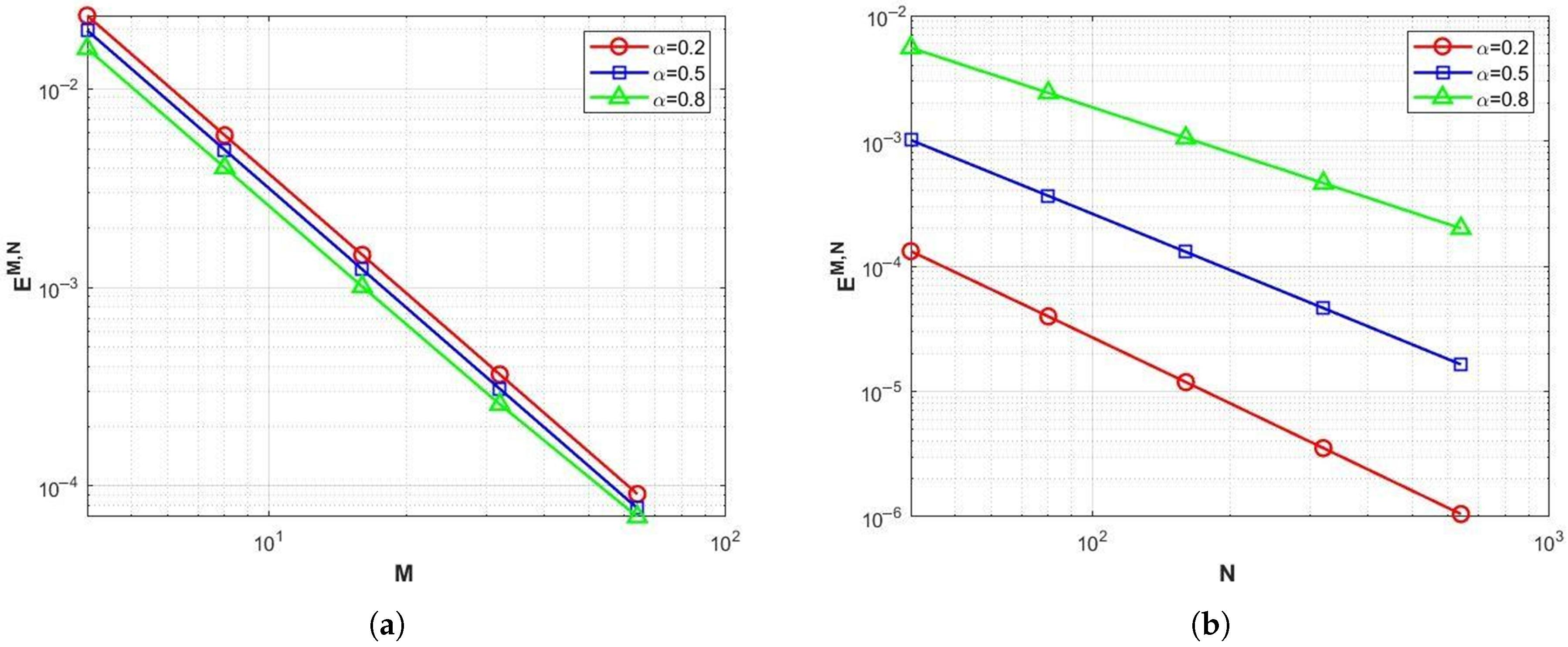
The numerical results are presented in Table 1 and Table 2, where E M , N , r s p a c e M , N and r t i m e M , N represent the error, the convergence rate in space and the convergence rate in time respectively, defined as
E M , N = max 1 i M 1 , 1 n N | u i n U i n | ,
r s p a c e M , N = l o g 2 E M , N E M / 2 , N , r t i m e M , N = l o g 2 E M , N E M , N / 2 .
The corresponding log-log plots visualizing these convergence behaviors are provided in Figure 1.
Example 2. 
Numerically solve
D t ρ , α u ( x , t ) 2 u ( x , t ) x 2 = 0 , 0 < t 1 , 0 < x < 1 ,
with initial and boundary conditions
u ( x , 0 ) = 0 , 0 < x < 1 ,
u ( 0 , t ) = 0 , u ( 1 , t ) = t 2 sin 1 , 0 < t 1 .
Since the exact solution is unknown, we use alternative error measures in the tests, and following [23], we define them as
E s p a c e p , q = max 1 i p 1 , 1 n q | U i n U ˜ 2 i n | , E t i m e p , q = max 1 i p 1 , 1 n q U i n U ^ i 2 n ,
where U denotes the numerical solution with { M = p , N = q }, U ˜ the numerical solution with { M = 2 p , N = q }, U ^ the numerical solution with { M = p , N = 2 q }. The convergence rates are correspondingly updated as
r s p a c e M , N = log 2 E s p a c e M , N E s p a c e M / 2 , N , r t i m e M , N = log 2 E t i m e M , N E t i m e M , N / 2 .
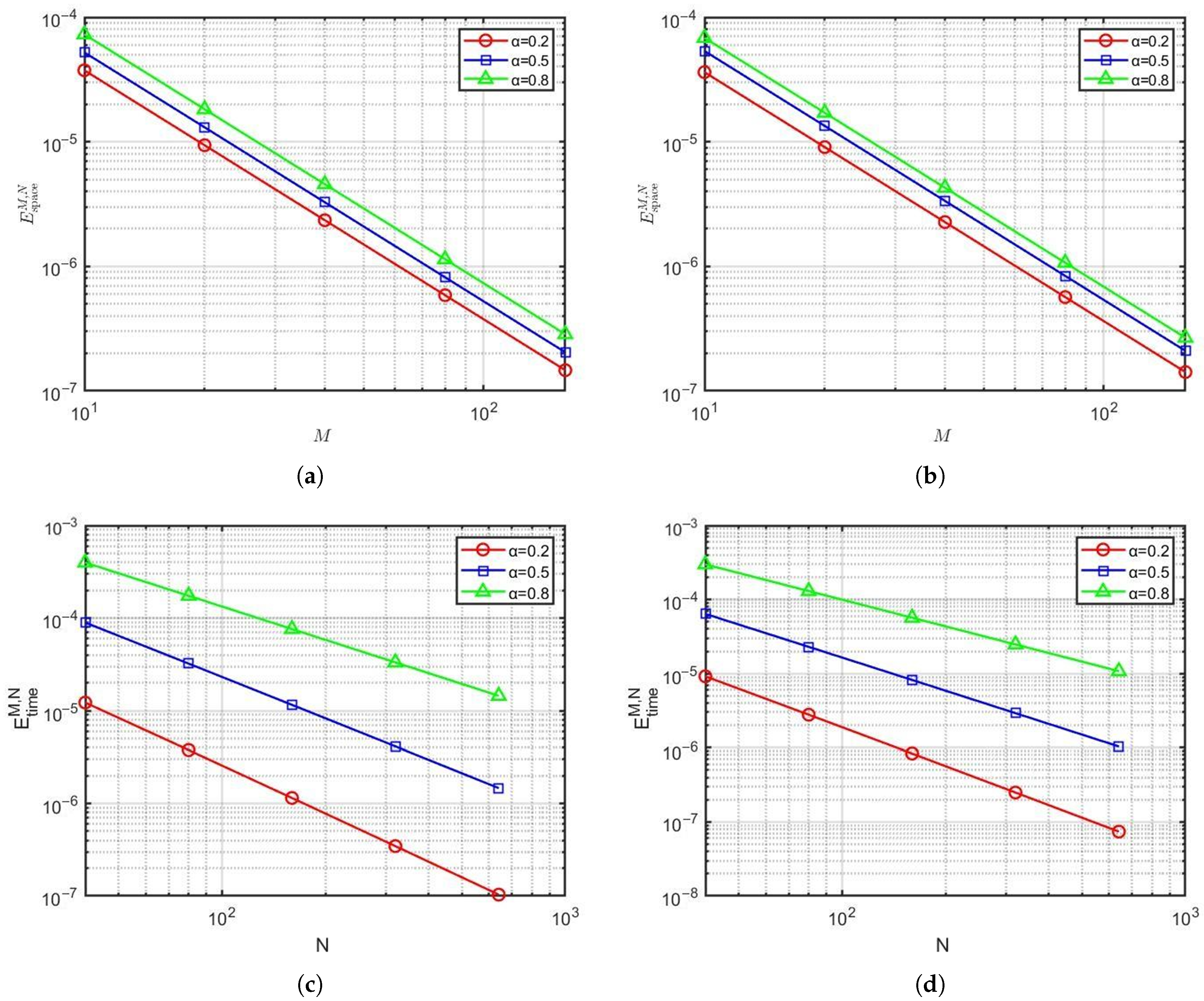
The numerical results are listed in Table 3, Table 4, Table 5 and Table 6 which support our theoretical analysis. The corresponding log-log plots of the errors E M , N with respect to M and N, for parameter values ρ = 0.2 and ρ = 0.8 , are shown in Figure 2.
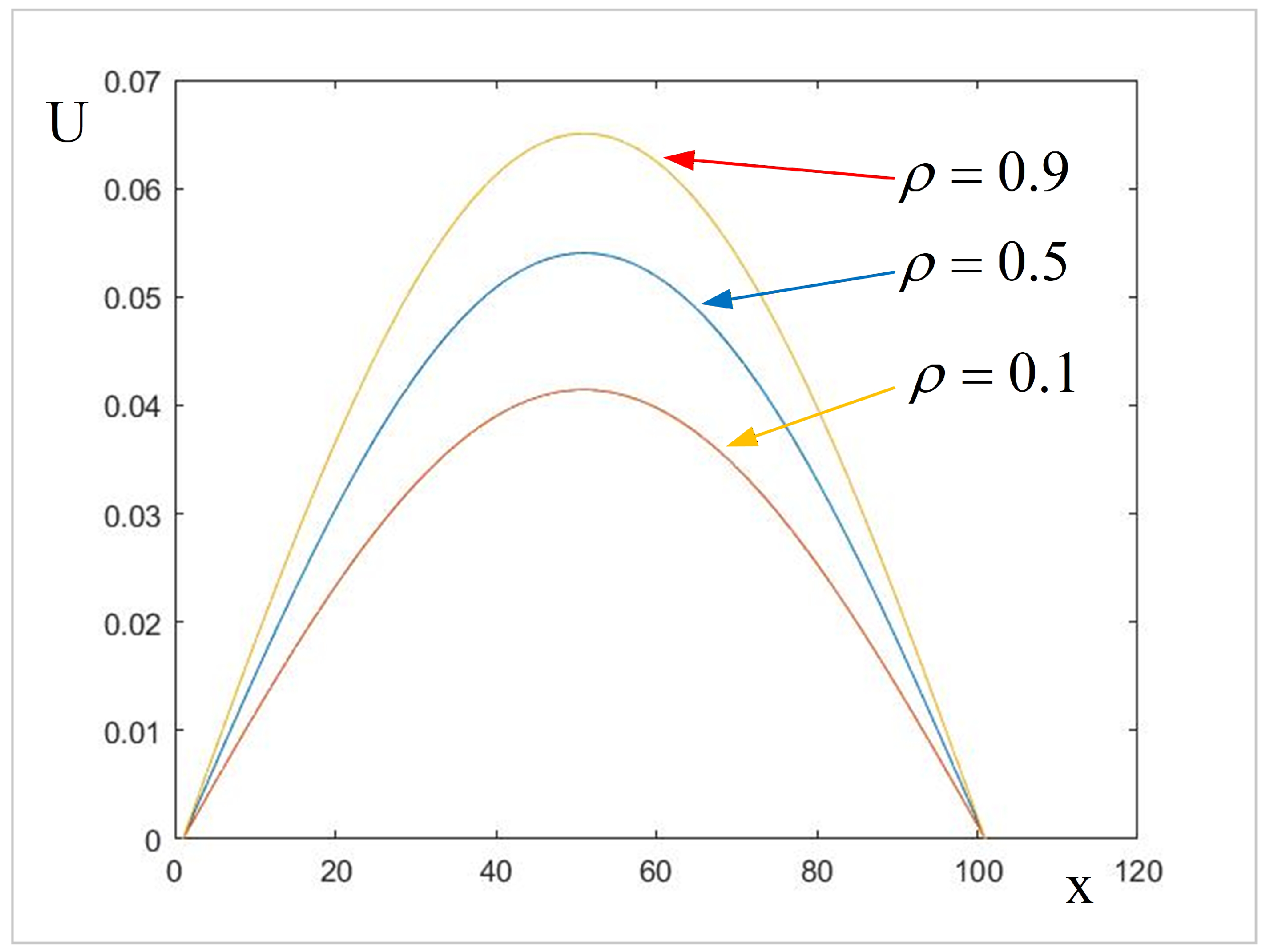
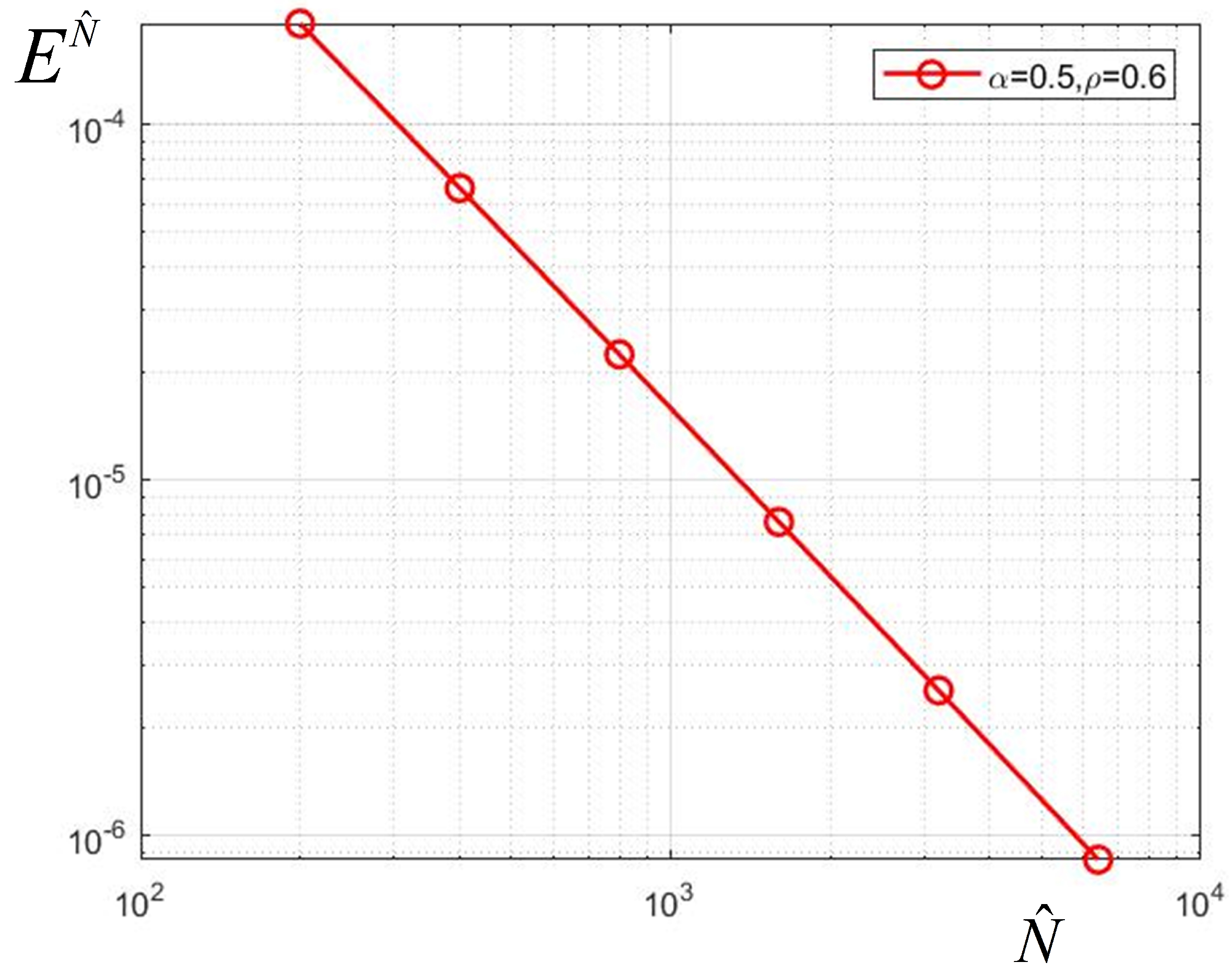
Finally, we present two additional numerical examples: the first one aims to demonstrate how the numerical solution varies with the parameter ρ , providing the corresponding solution plot; the second example verifies Lemma 2 by presenting a log-log plot of the error.
Example 3. 
To investigate the influence of the parameter ρ on the solution of Equation (1), we conducted numerical experiments. The fixed parameters were set as α = 0.5 , N = 500 , M = 100 , f = 0 , with the initial condition u 0 = sin ( π x ) . Finally, we plotted the numerical solution U at time t = 1 for a series of different values of ρ (see Figure 3).
Example 4. 
To verify the convergence accuracy of the numerical integration method designed in Lemma 2 for computing b k ( n ) , we present a log-log error plot (see Figure 4). The parameter values used are ρ = 0.6 , α = 0.5 , r = 1.25 and N = 10 . Here, b k ( n ) denotes the computed value when the graded mesh partition number is N ^ , and B k ( n ) denotes the corresponding value when the partition number is 2 N ^ . The error is defined as
E N ^ = max 1 k n , 1 n N B k ( n ) b k ( n ) .

5. Conclusions

This paper develops a finite difference scheme for numerically solving the Caputo generalized time fractional diffusion equation. Both the theoretical analysis and the numerical tests show that the numerical solution obtained by the method has the convergence of order ( 2 α ) in time and order 2 in space. For the fractional diffusion equation investigated in this study, the numerical solution faces two key challenges: first, the reduced numerical accuracy due to the initial singularity, and second, the high computational cost associated with the history part of the temporal fractional derivative. Future research efforts will focus on in-depth exploration of these two aspects.

Author Contributions

Conceptualization, J.L. and Y.J.; methodology, J.L. and Y.J.; software, J.L. and J.Z.; validation, J.L., J.Z. and Y.J.; investigation, J.L., J.Z. and Y.J.; writing—original draft preparation, J.L.; writing—review and editing, J.L., J.Z. and Y.J.; visualization, J.Z. and J.L.; project administration, J.L.; funding acquisition, J.L. and Y.J. All authors have read and agreed to the published version of the manuscript.

Funding

This work was supported by the National Natural Science Foundation of China (Grant No. 11571053). This work was supported by the Postgraduate Scientific Research Innovation Project of Hunan Province (Project No. CX20230923).

Data Availability Statement

The data and code that support the findings of this study are available from the corresponding author upon request.

Conflicts of Interest

The authors declare that the research was conducted in the absence of any commercial or financial relationships that could be construed as a potential conflict of interest.

References

  1. Kulish, V.; Jose, L. Application of Fractional Calculus to Fluid Mechanics. J. Fluids Eng. 2002, 124, 803–806. [Google Scholar] [CrossRef]
  2. Stefański, T.; Gulgowski, J. Signal propagation in electromagnetic media described by fractional-order models. Commun. Nonlinear Sci. Numer. Simul. 2019, 82, 105029. [Google Scholar] [CrossRef]
  3. Cai, X.; Liu, F. Numerical simulation of the fractional-order control system. J. Appl. Math. Comput. 2007, 23, 229–241. [Google Scholar] [CrossRef]
  4. Metzler, R.; Nonnenmacher, T. Fractional relaxation processes and fractional rheological models for the description of a class of viscoelastic materials. Int. J. Plast. 2003, 19, 941–959. [Google Scholar] [CrossRef]
  5. Martynyuk, V.; Ortigueira, M. Fractional model of an electrochemical capacitor. Signal Process. 2015, 107, 355–360. [Google Scholar] [CrossRef]
  6. Jiang, X.; Qi, H. Thermal wave model of bioheat transfer with modified Riemann-Liouville fractional derivative. J. Phys. A Math. Theor. 2012, 45, 485101. [Google Scholar] [CrossRef]
  7. Bosch, J.; Stoll, M. A Fractional Inpainting Model Based on the Vector-Valued Cahn–Hilliard Equation. SIAM J. Imaging Sci. 2015, 8, 2352–2382. [Google Scholar] [CrossRef]
  8. Benson, D.; Wheatcraft, S.; Meerscheart, M. Application of a fractional advection-dispersion equation. Water Resour. Res. 2000, 36, 1403–1412. [Google Scholar] [CrossRef]
  9. Dagan, G. Theory of Solute Transport by Groundwater. Annu. Rev. Fluid Mech. 1987, 19, 183–215. [Google Scholar] [CrossRef]
  10. Bouchaud, J.; Georges, A. Anomalous diffusion in disordered media: Statistical mechanisms, models and physical applications. Phys. Rep. 1990, 195, 127–293. [Google Scholar] [CrossRef]
  11. Katugampola, U.N. New approach to a generalized fractional integral. Appl. Math. Comput. 2011, 218, 860–865. [Google Scholar] [CrossRef]
  12. Zeng, S.; Baleanu, D.; Bai, Y.; Wu, G. Fractional differential equations of Caputo-Katugampola type and numerical solutions. Appl. Math. Comput. 2017, 315, 549–554. [Google Scholar] [CrossRef]
  13. Singh, J.; Alshehri, A.M.; Momani, S.; Hadid, S.; Kumar, D. Computational analysis of fractional diffusion equations occurring in oil pollution. Mathematics 2022, 10, 3827. [Google Scholar] [CrossRef]
  14. Bhangale, N.; Kachhia, K.B.; Gómez-Aguilar, J.F. A new iterative method with Laplace transform for solving fractional differential equations with Caputo generalized fractional derivative. Eng. Comput. 2022, 38, 2125–2138. [Google Scholar] [CrossRef]
  15. Sene, N. Analytical solutions and numerical schemes of certain generalized fractional diffusion models. Eur. Phys. J. Plus 2019, 134, 199. [Google Scholar] [CrossRef]
  16. Li, C.; Zeng, F. Finite difference methods for fractional differential equations. Int. J. Bifurc. Chaos 2012, 22, 1230014. [Google Scholar] [CrossRef]
  17. Rahman, K.; Hussain, S.; Wei, X. An Efficient High-Accuracy RBF-HFD Scheme for Caputo Time-Fractional Sub-Diffusion Problems with Integral Boundaries. Fractal Fract. 2025, 9, 694. [Google Scholar] [CrossRef]
  18. Sontakke, B.R.; Shelke, A.S. Approximate scheme for time fractional diffusion equation and its applications. Glob. J. Pure Appl. Math. 2017, 13, 4333–4345. [Google Scholar]
  19. Wang, J.; Meng, X.; Yu, Y. Local error estimate of L1 scheme for time-fractional convection–diffusion-reaction equation on a star-shaped pipe network. Chin. J. Phys. 2025, 97, 44–66. [Google Scholar] [CrossRef]
  20. Zhuang, P.; Liu, F. Implicit difference approximation for the time fractional diffusion equation. J. Appl. Math. Comput. 2006, 22, 87–89. [Google Scholar] [CrossRef]
  21. Zhang, Y.; Sun, Z.; Liao, H. Finite difference methods for the time fractional diffusion equation on non-uniform meshes. J. Comput. Phys. 2014, 265, 195–210. [Google Scholar] [CrossRef]
  22. Liu, L.B.; Xu, L.; Zhang, Y. Error analysis of a finite difference scheme on a modified graded mesh for a time-fractional diffusion equation. Math. Comput. Simul. 2023, 209, 87–101. [Google Scholar] [CrossRef]
  23. Stynes, M.; O’Riordan, E.; Gracia, J.L. Error analysis of a finite difference method on graded meshes for a time-fractional diffusion equation. SIAM J. Numer. Anal. 2017, 55, 1057–1079. [Google Scholar] [CrossRef]
  24. Ford, N.J.; Xiao, J.; Yan, Y. A finite element method for time fractional partial differential equations. Fract. Calc. Appl. Anal. 2011, 14, 454–474. [Google Scholar] [CrossRef]
  25. Iweobodo, D.C.; Abanum, G.C.; Ochonogor, N.I.; Njoseh, I.N. A Galerkin finite element technique with Iweobodo-Mamadu-Njoseh wavelet (IMNW) basis function for the solution of time-fractional advection–diffusion problems. Part. Differ. Equ. Appl. Math. 2024, 12, 100965. [Google Scholar] [CrossRef]
  26. Jiang, Y.J.; Ma, J.T. Moving finite element methods for time fractional partial differential equations. Sci. China Math. 2013, 56, 1287–1300. [Google Scholar] [CrossRef]
  27. Jin, B.; Lazarov, R.D.; Pasciak, J.E.; Zhou, Z. Error analysis of semidiscrete finite element methods for inhomogeneous time-fractional diffusion. IMA J. Numer. Anal. 2014, 35, 561–582. [Google Scholar] [CrossRef]
  28. Zeng, F.; Li, C.; Liu, F.; Turner, L. The use of finite difference/element approaches for solving the time-fractional subdiffusion equation. SIAM J. Sci. Comput. 2013, 35, A2976–A3000. [Google Scholar] [CrossRef]
  29. Cao, J.Y.; Xu, C.J.; Wang, Z.Q. A high order finite difference/spectral approximations to the time fractional diffusion equations. Adv. Mater. Res. 2014, 875, 781–785. [Google Scholar] [CrossRef]
  30. Lin, Y.; Xu, C. Finite difference/spectral approximations for the time-fractional diffusion equation. J. Comput. Phys. 2007, 225, 1533–1552. [Google Scholar] [CrossRef]
  31. Lv, C.; Xu, C. Improved error estimates of a finite difference/spectral method for time-fractional diffusion equations. Int. J. Numer. Anal. Model. 2015, 12, 384–400. [Google Scholar]
  32. Ujevic, N. Error inequalities for a generalized trapezoid rule. Appl. Math. Lett. 2006, 19, 32–37. [Google Scholar] [CrossRef]
Figure 1. (a): log-log plot of E M , 10,000 vs. M; (b): log-log plot of E 6000 , N vs. N.
Fractalfract 10 00019 g001
Figure 2. (a): log-log plot of E M , 1000 vs. M with ρ = 0.2 ; (b): log-log plot of E M , 1000 vs. M with ρ = 0.8 ; (c): log-log plot of E 1000 , N vs. N with ρ = 0.2 ; (d): log-log plot of E 1000 , N vs. N with ρ = 0.8 .
Fractalfract 10 00019 g002
Figure 3. Numerical solution U at time t = 1 for a series of different values of ρ .
Fractalfract 10 00019 g003
Figure 4. log-log plot of E N ^ vs. N ^ .
Fractalfract 10 00019 g004
Table 1. Errors E M , N and convergence rates r s p a c e M , N with N = 10,000 for Example 1.
α M = 4 M = 8 M = 16 M = 32 M = 64
0.2 2.3384 × 10 2 5.8354 × 10 3 1.4582 × 10 3 3.6450 × 10 4 9.1128 × 10 5
2.00262.00072.00022.0000
0.5 1.9682 × 10 2 4.9275 × 10 3 1.2325 × 10 3 3.0834 × 10 4 7.7287 × 10 5
1.99801.99931.99901.9962
0.8 1.5938 × 10 2 4.0096 × 10 3 1.0091 × 10 3 2.5791 × 10 4 7.0032 × 10 5
1.99091.99031.96821.8808
Table 2. Errors E M , N and convergence rates r t i m e M , N with M = 6000 for Example 1.
α N = 40 N = 80 N = 160 N = 320 N = 640
0.2 1.3165 × 10 4 3.9673 × 10 5 1.1862 × 10 5 3.5288 × 10 6 1.0494 × 10 6
1.73051.74181.74911.7496
0.5 1.0150 × 10 3 3.6381 × 10 4 1.2985 × 10 4 4.6212 × 10 5 1.6418 × 10 5
1.48021.48641.49051.4930
0.8 5.5196 × 10 3 2.4149 × 10 3 1.0541 × 10 3 4.5950 × 10 4 2.0018 × 10 4
1.19261.19601.19781.1988
Table 3. Errors E s p a c e M , N and convergence rates r s p a c e M , N with N = 1000 for Example 2 with ρ = 0.2 .
α M = 10 M = 20 M = 40 M = 80 M = 160
0.2 3.7481 × 10 5 9.3829 × 10 6 2.3465 × 10 6 5.8677 × 10 7 1.4671 × 10 7
1.99811.99951.99971.9998
0.5 5.2191 × 10 5 1.3069 × 10 5 3.2684 × 10 6 8.1719 × 10 7 2.0432 × 10 7
1.99771.99941.99991.9998
0.8 7.2866 × 10 5 1.8249 × 10 5 4.5644 × 10 6 1.1412 × 10 6 2.8531 × 10 7
1.99741.99941.99982.0000
Table 4. Errors E s p a c e M , N and convergence rates r s p a c e M , N with N = 1000 for Example 2 with ρ = 0.8 .
α M = 10 M = 20 M = 40 M = 80 M = 160
0.2 3.6210 × 10 5 9.0647 × 10 6 2.2669 × 10 6 5.6687 × 10 7 1.4173 × 10 7
1.99811.99951.99971.9998
0.5 5.3575 × 10 5 1.3413 × 10 5 3.3545 × 10 6 8.3873 × 10 7 2.0972 × 10 7
1.99791.99951.99981.9997
0.8 6.8292 × 10 5 1.7093 × 10 5 4.2744 × 10 6 1.0692 × 10 6 2.6730 × 10 7
1.99831.99961.99922.0000
Table 5. Errors E t i m e M , N and convergence rates r t i m e M , N with M = 1000 for Example 2 with ρ = 0.2 .
α N = 40 N = 80 N = 160 N = 320 N = 640
0.2 1.2195 × 10 5 3.7599 × 10 6 1.1455 × 10 6 3.4575 × 10 7 1.0345 × 10 7
1.69751.71471.72821.7407
0.5 8.9291 × 10 5 3.2183 × 10 5 1.1530 × 10 5 4.1139 × 10 6 1.4638 × 10 6
1.47221.48101.48681.4908
0.8 3.9717 × 10 4 1.7397 × 10 4 7.5986 × 10 5 3.3138 × 10 5 1.4440 × 10 5
1.19091.19501.19721.1985
Table 6. Errors E t i m e M , N and convergence rates r t i m e M , N with M = 1000 for Example 2 with ρ = 0.8 .
α N = 40 N = 80 N = 160 N = 320 N = 640
0.2 9.1679 × 10 6 2.7819 × 10 6 8.3620 × 10 7 2.4951 × 10 7 7.3991 × 10 8
1.72051.73411.74471.7537
0.5 6.3940 × 10 5 2.2940 × 10 5 8.1930 × 10 6 2.9172 × 10 6 1.0365 × 10 6
1.47891.48541.48981.4928
0.8 2.9789 × 10 4 1.3011 × 10 4 5.6743 × 10 5 2.4725 × 10 5 1.0769 × 10 5
1.19501.19721.19851.1991
Disclaimer/Publisher’s Note: The statements, opinions and data contained in all publications are solely those of the individual author(s) and contributor(s) and not of MDPI and/or the editor(s). MDPI and/or the editor(s) disclaim responsibility for any injury to people or property resulting from any ideas, methods, instructions or products referred to in the content.