Article

p, q, r-Fractional Fuzzy Frank Aggregation Operators and Their Application in Multi-Criteria Group Decision-Making

by
Abid Khan
1,
Ashfaq Ahmad Shah
2 and
Muhammad Zainul Abidin
1,*
1
School of Artificial Intelligence, Taizhou University, Taizhou 318000, China
2
College of Humanities and Development Studies, China Agricultural University, Beijing 100193, China
*
Author to whom correspondence should be addressed.
Fractal Fract. 2026, 10(1), 11; https://doi.org/10.3390/fractalfract10010011
Submission received: 19 November 2025 / Revised: 21 December 2025 / Accepted: 23 December 2025 / Published: 25 December 2025

Abstract

This paper presents new aggregation operators for p , q , r -fractional fuzzy sets based on the Frank t-norm and t-conorm. We introduce the p , q , r -fractional fuzzy Frank weighted average and p , q , r -fractional fuzzy Frank weighted geometric operators and discuss their algebraic properties, including closure, boundedness, idempotency, and monotonicity. Based on new operations, we develop a multi-criteria group decision-making framework that integrates the evaluations of multiple experts via the proposed Frank operators and ranks the alternatives under p , q , r -fractional fuzzy information. The model is applied to a cryptocurrency stability assessment problem, where four coins are evaluated with respect to six criteria. The results show that both aggregation operators yield consistent rankings with good discriminatory power among the alternatives. A sensitivity analysis is conducted to check the stability of the model under parameter variations. A comparative study further demonstrates the compatibility and advantages of the proposed method over several existing decision-making approaches. The proposed framework is well suited to decision-making scenarios in which multiple experts’ opinions must be integrated within a complex fuzzy information environment.

1. Introduction

Multi-criteria decision making (MCDM) provides a structured way to select alternatives when several, possibly conflicting, criteria are involved [1]. It has become indispensable across a broad spectrum of application areas, spanning engineering design [2], business management [3], risk management [4,5] and public policy making [6]. In practice, however, such judgments are rarely crisp: real problems are riddled with complexity, partial information, measurement noise, and subjective views, so sound decisions demand advanced mathematical formalisms capable of handling uncertainty and imprecision [7]. Since its introduction by Zadeh [8] in 1965, fuzzy set theory has provided exactly such a toolkit, offering a principled way to represent ambiguity and vagueness inherent in human cognition and linguistic assessments. Its key strength in decision contexts is the ability to encode graded truth values, with membership levels ranging continuously from 0 to 1, thereby capturing nuanced evidence and improving both the realism and robustness of decision models. Classical fuzzy sets, although widely used, cannot represent membership ( μ ), non-membership ( ν ) and hesitation degrees as three separate components at the same time, which has motivated a range of fuzzy set extensions designed to capture more complex forms of uncertainty. The first extension in this series was the intuitionistic fuzzy set (IFS) of Atanassov [9], which augments the classical model by recording both μ and ν , thereby offering a more expressive description of uncertainty. While IFSs are effective when μ + ν 1 , real assessments sometimes violate this bound. To enlarge the admissible region, Yager [10] introduced the concept of Pythagorean fuzzy set (PyFS), where μ 2 + ν 2 1 . PyFSs have been widely adopted in MCDM but can still be restrictive in certain cases. Yager [11] later generalized this series of extension via the q-rung orthopair fuzzy set (q-ROFS), allowing μ q + ν q 1 (for q > 2 ) and thus providing added flexibility in expressing preferences. Later, Abdullah et al. [12] introduced the concept of fractional fuzzy set (FFS) that generalized the q-ROFS condition by μ f + ν f 1 , where f = p q 1 .
All the earlier studies mainly focus on membership and non-membership degrees, and they overlook the role of the neutral degree ( η ), which also matters in the decision-making process. Cuong [13] and Cuong and Kreinovich [14] introduced picture fuzzy sets (PFSs) to address these gaps, where the three grades μ , η , and ν satisfy the condition μ + η + ν 1 . Cuong and Kreinovich [15] studied several properties and adopted distance measures for PFSs. Cuong and Hai [16] introduced picture fuzzy logic operators; Cuong et al. [17] investigated picture fuzzy t-norms and t-conorms, while Phong et al. [18] studied picture fuzzy relations. Later, Kutlu Gündogdu and Kahraman [19] introduced spherical fuzzy sets (SFSs), in which the three components satisfy μ 2 + η 2 + ν 2 1 , providing a more flexible way to deal with uncertainty. SFSs can be viewed as a generalization of PFSs, though some limitations remain. For example, if μ = 0.8 , η = 0.3 , and ν = 0.6 , then 0.8 2 + 0.3 2 + 0.6 2 > 1 , so the condition of SFSs fails. Addressing this limitation, Mahmood et al. [20] introduced T-spherical fuzzy sets (T-SFSs), requiring the condition μ t + η t + ν t 1 where t represents a positive integer. Ali and Naeem [21] extended the idea of T-SFSs by introducing r , s , t -spherical fuzzy sets ( r , s , t -SFSs), in which the triplet ( μ , η , ν ) satisfies μ r + η s + ν t 1 for r , s , t N .
Sometimes, decision-makers have absolute confidence in a specific alternative and may therefore assign it the highest possible grade of 1. For instance, if we consider the assessments ( 1.0 , 0.8 ) and ( 1.0 , 0.3 , 0.5 ) , then the standard normalization constraints of the classical fuzzy extensions (such as IFSs, q-ROFSs, FFSs, SFSs, T-SFSs and r , s , t -SFSs) are violated, and these evaluations cannot be handled directly within those models. To address this limitation, more flexible fractional frameworks have been proposed. In particular, q-fractional fuzzy sets (q-FFSs), introduced by Gulistan and Pedrycz [22], relax the quadratic-type constraints of the above models by incorporating a single parameter q 2 that controls the admissible region via
1 q μ + 1 q ν 1 ,
thereby allowing expert opinions with extreme membership grades to be represented in a controlled way. Building on this idea, Gulistan et al. [23] proposed p , q , r -fractional fuzzy sets ( p , q , r -FFSs) as a three-parameter generalization of the triplet structures (PFSs, SFSs and T-SFSs). In a p , q , r -FFS, the degrees of membership, neutrality and non-membership form a triplet ( μ , η , ν ) constrained by
1 p μ + 1 r η + 1 q ν 1 ,
where p , q N with p , q 1 and r = LCM ( p , q ) . This fractional condition enlarges the feasible domain of ( μ , η , ν ) and provides additional flexibility to capture heterogeneous expert attitudes and highly informative assessments, including those with full membership or non-membership grades. In this setting, several algebraic operations have been proposed for p , q , r -FFSs, and their usefulness in decision-making has been illustrated in a number of applications [23,24,25]. However, these constructions are essentially algebraic and do not incorporate a tunable notion of compromise or compensation. Frank t-norms and t-conorms, governed by a parameter ζ > 0 , provide precisely such a mechanism: by adjusting ζ , one can move continuously between different aggregation behaviours, ranging from strict conjunction to more compensatory modes. To the best of our knowledge, no Frank-based aggregation operators have yet been developed within the p , q , r -FFS framework. This leaves a methodological gap in multi-criteria group decision making (MCGDM), especially for problems such as cryptocurrency stability evaluation, where multiple experts’ opinions need to be considered under uncertain, extreme and often incomplete information. In this paper, we address this gap by introducing p , q , r -fractional fuzzy Frank aggregation operators, deriving their main algebraic and order-theoretic properties, and incorporating them into an MCGDM procedure. Finally, we demonstrate the practical relevance of the proposed operators through a cryptocurrency stability assessment problem.

1.1. Literature Review on Aggregation Operators

Aggregation operators (AOs) are a basic tool in multi-criteria analysis: they compress a series of criterion values into a single overall score that can be used to rank or compare alternatives. In this way, AOs provide a common numerical scale for evaluation, help analysts make consistent comparisons, and support reasoned judgments. Fuzzy-based aggregation is particularly attractive when the underlying information is vague or imprecise, while still preserving desirable properties such as monotonicity and boundedness and allowing the use of importance weights. Moreover, AO schemes can be applied to problems with many criteria and alternatives, facilitate group assessments, and make the decision procedure more transparent and replicable. Because of these advantages, a wide variety of AO constructions has appeared in the literature.
Within this line of work, Garg and Rani [26] formulated operational rules and aggregation mechanisms for complex IFSs in order to better capture uncertainty in decision processes. Garg [27] later proposed sine-trigonometric AOs tailored to MCGDM applications. Liu and Wang [28], and Ashraf et al. [29] introduced averaging and geometric AOs for q-ROFSs, and SFSs, respectively. Within the spherical and T-spherical fuzzy environments, a variety of aggregation mechanisms have been proposed. For instance, Akram et al. [30] formulated complex fuzzy prioritized weighted aggregation tools, while Jin et al. [31] analysed linguistic spherical fuzzy models and derived several practically useful aggregation schemes. Ahmad et al.’s [32] introduced Dombi-based Aos for p , q , r -SFSs and established their main operational properties. Additional developments include Aczel-Alsina-type intuitionistic fuzzy AOs introduced by Senapati et al. [33], and Pythagorean fuzzy Dombi operators proposed by Akram et al. [34]. Rahim et al. [35] and Amin et al. [36] proposed Bonferroni-mean-type and Dombi AOs for cubic and generalized cubic PyFSs. Karaaslan and Karamaz [37] defined arithmetic and geometric AOs for interval-valued r , s , t -SFSs and discussed their applications in multi-criteria group decision-making (MCGDM). Similarly, Karamaz and Karaaslan [38] introduced several set and arithmetic operations for r , s , t -SFSs and applied them to MCGDM problems. Additional developments on fuzzy AOs and their decision-making applications can be found in [39,40,41].
Frank t-norms and t-conorms are fundamental fuzzy logic operators that provide a highly adjustable way to model fuzzy “and” and “or” behavior. Each operation is controlled by a real parameter, so its behavior can move smoothly between logical styles as the parameter changes. Building on this idea, researchers have designed aggregation operators that use the Frank pair to combine several fuzzy values into one score for decision making. Decision makers can use these Frank operators to adjust how strongly the fuzzy “and” and “or” behaviors act, since their interaction is directly controlled by the tunable Frank t-norm and t-conorm. Compared with traditional aggregators, Frank AOs give extra freedom through parameter adjustment, keep basic properties such as associativity, commutativity, and monotonicity, and work well when uncertainty, criterion interdependence, and varied scenarios are present. For these reasons, Frank AOs fit complex MCGDM tasks in fuzzy environments and often yield more accurate and realistic outcomes than classical methods. Recently, Frank AOs have been developed for various fuzzy frameworks, including T-SFSs [42], q-ROFSs [43], probabilistic hesitant [44], and interval-valued PyFSs [45]. These operators have further been applied to MCGDM problems involving Pythagorean cubic [46] and PFSs [47], as well as their complex-valued extensions such as complex q-ROFSs [48], complex T-SFSs [42,49], and complex IFSs [50]. Practical implementations range from renewable energy classification [51,52] and soil-fertility assessment [53] to electric-vehicle evaluation [54]. Overall, these studies confirms the effectiveness of Frank-type AOs in handling imprecise and uncertain information across diverse MCGDM contexts.

1.2. Research Gaps

Despite the extensive literature on AOs in different fuzzy set environments, there is still no research on designing and applying Frank-type AOs for p , q , r -FFSs. This omission is important because p , q , r -FFSs offer greater modelling freedom, allowing information patterns to be represented that conventional fuzzy set models cannot handle effectively. In particular, there is very less information about how Frank-type t-norms and t-conorms could be integrated into this tri-grade structure to exploit that flexibility. Systematically developing such aggregation operators would clarify how they can strengthen the descriptive power and precision of p , q , r -FFS models in demanding MCGDM problems. This is particularly relevant in applications such as cryptocurrency stability evaluation, where the available information is highly uncertain and assessments must reflect clear differences between alternatives.

1.3. Research Contribution

Building on the gaps identified in Section 1.2, this study develops Frank-type aggregation operations for p , q , r -FFSs. These operators are intended to combine p , q , r -fractional fuzzy information, which are described through their membership degree (MD), neural degree (ND), and non-membership degree (NMD). In doing so, the proposed framework enables a more reliable aggregation of fuzzy information and enhances MCGDM in settings where the available data are uncertain or imprecise. The main contributions of this study are outlined below.
  • We reformulate the Frank t-norm and t-conorm within the p , q , r -fractional fuzzy environment, and introduce two new AOs for p , q , r -FFNs: the p , q , r -fractional fuzzy Frank weighted averaging (FFFWA) operator and the p , q , r -fractional fuzzy Frank weighted geometric (FFFWG) operator.
  • We conduct a detailed theoretical analysis of the proposed AOs, establishing fundamental properties such as closure in the class of p , q , r -FFSs, idempotency, boundedness and monotonicity.
  • Based on the newly introduced operators, we propose a novel MCGDM framework that aggregates multiple experts’ assessments using the p , q , r -FFFWA and p , q , r -FFFWG operators and ranks the alternatives under p , q , r -fractional fuzzy information.
  • The practical usefulness of the framework is illustrated through a cryptocurrency stability assessment problem.
  • We conduct sensitivity and comparative analyses showing that the proposed framework produces stable rankings and offers improved discrimination and robustness compared with existing fuzzy aggregation methods.
The paper is structured as follows: Section 2 introduces the fundamentals of p , q , r -FFSs, the admissibility condition, and Frank-type operations. Section 3 defines Frank-type operations on p , q , r -fractional fuzzy numbers and develops the FFFWA and FFFWG operators with their basic properties. Section 4 builds an MCGDM scheme based on these operators and applies it to a cryptocurrency stability problem with sensitivity and comparative analyses. Section 5 then discusses the numerical findings, while Section 6 presents the paper’s conclusions and outlines directions for future research.

2. Preliminaries

This section first reviews some fuzzy-set extensions and then establishes the p , q , r -fractional fuzzy framework, including its admissibility condition, basic operations, and ranking functionals. Let X be a nonempty universe and x X , we denote the MD, ND, and NMD by μ ( x ) , η ( x ) , and ν ( x ) in [ 0 , 1 ] , respectively.
Definition 1
([9]). An intuitionistic fuzzy set (IFS) on X is a collection
I = { x , μ I ( x ) , ν I ( x ) : x X } ,
with μ I , ν I : X [ 0 , 1 ] such that μ I ( x ) + ν I ( x ) 1 for all x X .
Definition 2
([13,15]). A Picture fuzzy set (PFS) on X is
P = { x , μ P ( x ) , η P ( x ) , ν P ( x ) : x X } ,
with μ P , η P , ν P : X [ 0 , 1 ] satisfying for all x X ,
μ P ( x ) + η P ( x ) + ν P ( x ) 1 .
Definition 3
([19]). A Spherical fuzzy set (SFS) on X is
S = { x , μ S ( x ) , η S ( x ) , ν S ( x ) : x X } ,
with μ S , η S , ν S : X [ 0 , 1 ] such that for all x X ,
μ S ( x ) 2 + η S ( x ) 2 + ν S ( x ) 2 1 .
Definition 4
([20]). A T-spherical fuzzy set (T-SFS) on X is
T = { x , μ T ( x ) , η T ( x ) , ν T ( x ) : x X } ,
with μ T , η T , ν T : X [ 0 , 1 ] such that for all x X ,
μ T ( x ) t + η T ( x ) t + ν T ( x ) t 1 ,
where t is a positive integer.
Definition 5
([23]). A p , q , r -fractional fuzzy set ( p , q , r -FFS) on X is
F = { x , μ F ( x ) , η F ( x ) , ν F ( x ) : x X } ,
with μ F , η F , ν F : X [ 0 , 1 ] such that for all x X ,
μ F ( x ) p + η F ( x ) r + ν F ( x ) q 1 ,
where p , q N with p , q 1 and r = LCM ( p , q ) .
For convenience, any single triple μ F ( x ) , η F ( x ) , ν F ( x ) satisfying (1) is called the p , q , r -fractional fuzzy number ( p , q , r -FFN) and it is simply denoted by ω ˜ = ( μ , η , ν ) p , r , q .
Consider the triple ( 1 , 0.5 , 0.4 ) with μ = 1 , η = 0.5 , and ν = 0.4 . This triple is not admissible for a PFS because 1 + 0.5 + 0.4 = 1.9 > 1 . It also violates the SFS constraint since 1 2 + 0.5 2 + 0.4 2 = 1 + 0.25 + 0.16 = 1.41 > 1 . More generally, it fails for any T-SFS because 1 t + 0.5 t + 0.4 t > 1 for every t 1 . In contrast, if we consider it as a p , q , r -FFN and take p = q = r = 2 , then
μ p + η r + ν q = 1 2 · 1 + 1 2 · 0.5 + 1 2 · 0.4 = 0.95 1 .
This shows that the p , q , r -FFS offers a stronger and more flexible ability to capture the vagueness present in real-world problems as compared to the other classical fuzzy extensions.
Definition 6
([23]). Let  ω ˜ = ( μ , η , ν ) p , r , q , ω ˜ 1 = ( μ 1 , η 1 , ν 1 ) p , r , q , and ω ˜ 2 = ( μ 2 , η 2 , ν 2 ) p , r , q are p , q , r -FFNs and α > 0 . Then:
ω ˜ 1 ω ˜ 2 = 1 p μ 1 + 1 p μ 2 1 p μ 1 μ 2 , 1 r η 1 η 2 , 1 q ν 1 ν 2 .
ω ˜ 1 ω ˜ 2 = 1 p μ 1 μ 2 , 1 r η 1 + 1 r η 2 1 r η 1 η 2 , 1 q ν 1 + 1 q ν 2 1 q ν 1 ν 2 .
α ω ˜ = 1 1 1 p μ α , 1 1 1 r η α , 1 1 1 q ν α .
ω ˜ α = 1 p μ α , 1 r η α , 1 1 1 q ν α .
Definition 7
([23]). The score of ω ˜ = ( μ , η , ν ) p , r , q is defined by
Sc ( ω ˜ ) = 1 + μ p + η r ν q 3 ,
where 0 Sc ( ω ˜ ) 1 .
Definition 8
([23]). The accuracy of  ω ˜ = ( μ , η , ν ) p , r , q is defined by
Ac ( ω ˜ ) = 1 + μ p + η r + ν q 3 ,
where 0 Ac ( ω ˜ ) 1 .
Definition 9.
Let  ω ˜ 1 and ω ˜ 2 be two p , q , r -FFNs with score values Sc ( ω ˜ 1 ) , Sc ( ω ˜ 2 ) and accuracy values Ac ( ω ˜ 1 ) , Ac ( ω ˜ 2 ) . Then
(i)
  if  Sc ( ω ˜ 1 ) < Sc ( ω ˜ 2 ) , then ω ˜ 1 ω ˜ 2 ;
(ii)
 if  Sc ( ω ˜ 1 ) > Sc ( ω ˜ 2 ) , then ω ˜ 1 ω ˜ 2 ;
(iii)
if Sc ( ω ˜ 1 ) = Sc ( ω ˜ 2 ) , then
  • if Ac ( ω ˜ 1 ) < Ac ( ω ˜ 2 ) , we set ω ˜ 1 ω ˜ 2 ;
  • if Ac ( ω ˜ 1 ) > Ac ( ω ˜ 2 ) , we set ω ˜ 1 ω ˜ 2 ;
  • if Ac ( ω ˜ 1 ) = Ac ( ω ˜ 2 ) , then ω ˜ 1 = ω ˜ 2 .
Definition 10
([55,56]). The Frank t-norm and t-conorm are defined for  x , y [ 0 , 1 ] as follows:
1. 
Frank t-norm:
T ζ ( x , y ) = log ζ 1 + ( ζ x 1 ) ( ζ y 1 ) ζ 1
2. 
Frank t-conorm:
S ζ ( x , y ) = 1 log ζ 1 + ( ζ 1 x 1 ) ( ζ 1 y 1 ) ζ 1 = 1 T ζ ( 1 x , 1 y )
where ζ > 0 , ζ 1 . The limiting cases yield:
lim ζ 1 T ζ ( x , y ) = x y , lim ζ 1 S ζ ( x , y ) = x + y x y
lim ζ T ζ ( x , y ) = max { 0 , x + y 1 } , lim ζ S ζ ( x , y ) = min { 1 , x + y }
Additional properties and proofs can be found in [55,56].

3. Frank Operations on p , q , r -Fractional Fuzzy Numbers

This section introduces Frank-type operational laws for p , q , r -FFNs. The laws are applied componentwise to the membership, neutrality, and nonmembership degrees using the parameters ( p , r , q ) to preserve the class of p , q , r -FFNs.
Definition 11.
Let  ω ˜ 1 = ( μ 1 , η 1 , ν 1 ) p , r , q , ω ˜ 2 = ( μ 2 , η 2 , ν 2 ) p , r , q , and ω ˜ = ( μ , η , ν ) p , r , q are p , q , r -FFNs, with p , q 1 , and r = LCM ( p , q ) . With the Frank parameter ζ > 0 , ζ 1 , and with α > 0 , we define the following four fundamental operations.
ω ˜ 1 ω ˜ 2 = 1 log ζ 1 + ( ζ 1 μ 1 / p 1 ) ( ζ 1 μ 2 / p 1 ) ζ 1 , log ζ 1 + ( ζ η 1 / r 1 ) ( ζ η 2 / r 1 ) ζ 1 , log ζ 1 + ( ζ ν 1 / q 1 ) ( ζ ν 2 / q 1 ) ζ 1
ω ˜ 1 ω ˜ 2 = log ζ 1 + ( ζ μ 1 / p 1 ) ( ζ μ 2 / p 1 ) ζ 1 , log ζ 1 + ( ζ η 1 / r 1 ) ( ζ η 2 / r 1 ) ζ 1 , 1 log ζ 1 + ( ζ 1 ν 1 / q 1 ) ( ζ 1 ν 2 / q 1 ) ζ 1
α · ω ˜ = 1 log ζ 1 + ( ζ 1 μ / p 1 ) α ( ζ 1 ) α 1 , log ζ 1 + ( ζ η / r 1 ) α ( ζ 1 ) α 1 , log ζ 1 + ( ζ ν / q 1 ) α ( ζ 1 ) α 1
ω ˜ α = log ζ 1 + ( ζ μ / p 1 ) α ( ζ 1 ) α 1 , log ζ 1 + ( ζ η / r 1 ) α ( ζ 1 ) α 1 , 1 log ζ 1 + ( ζ 1 ν / q 1 ) α ( ζ 1 ) α 1
Example 1.
Consider the two  p , q , r -FFNs ω ˜ 1 = ( 1 , 0.4 , 0.2 ) 2 , 2 , 2 and ω ˜ 2 = ( 0.7 , 0.3 , 1 ) 2 , 2 , 2 with Frank parameter ζ = 2 and constant α = 5 . The operational laws in Definition 11 can be computed as follows:
ω ˜ 1 ω ˜ 2 = 1 log 2 1 + 2 1 1 / 2 1 2 1 0.7 / 2 1 2 1 , log 2 1 + 2 0.4 / 2 1 2 0.3 / 2 1 2 1 , log 2 1 + 2 0.2 / 2 1 2 1 / 2 1 2 1 ( 0.6946 , 0.0233 , 0.0423 ) 2 , 2 , 2 ,
ω ˜ 1 ω ˜ 2 = log 2 1 + 2 1 / 2 1 2 0.7 / 2 1 2 1 , log 2 1 + 2 0.4 / 2 1 2 0.3 / 2 1 2 1 , 1 log 2 1 + 2 1 0.2 / 2 1 2 1 1 / 2 1 2 1 ( 0.1554 , 0.0233 , 0.5577 ) 2 , 2 , 2 ,
5 · ω ˜ 1 = 1 log 2 1 + 2 1 1 / 2 1 5 ( 2 1 ) 4 , log 2 1 + 2 0.4 / 2 1 5 ( 2 1 ) 4 , log 2 1 + 2 0.2 / 2 1 5 ( 2 1 ) 4 ( 0.9825 , 0.0001 , 0.0000 ) 2 , 2 , 2 ,
ω ˜ 1 5 = log 2 1 + 2 1 / 2 1 5 ( 2 1 ) 4 , log 2 1 + 2 0.4 / 2 1 5 ( 2 1 ) 4 , 1 log 2 1 + 2 1 0.2 / 2 1 5 ( 2 1 ) 4 ( 0.0175 , 0.0001 , 0.4273 ) 2 , 2 , 2 .
Clearly, all four outcomes are again p , q , r -FFNs. Hence the operations in (4)–(7) preserve the class of p , q , r -FFNs.
Theorem 1.
Let  ω ˜ = ( μ , η , ν ) p , r , q , ω ˜ 1 = ( μ 1 , η 1 , ν 1 ) p , r , q and ω ˜ 2 = ( μ 2 , η 2 , ν 2 ) p , r , q are p , q , r -FFNs. Then for any α , α 1 , α 2 1 , the following statements hold:
1. 
ω ˜ 1 ω ˜ 2 = ω ˜ 2 ω ˜ 1 ,
2. 
ω ˜ 1 ω ˜ 2 = ω ˜ 2 ω ˜ 1 ,
3. 
α · ω ˜ 1 ω ˜ 2 = α · ω ˜ 1 α · ω ˜ 2 ,
4. 
( α 1 + α 2 ) · ω ˜ = α 1 · ω ˜ α 2 · ω ˜ ,
5. 
ω ˜ 1 ω ˜ 2 α = ω ˜ 1 α ω ˜ 2 α ,
6. 
ω ˜ α 1 ω ˜ α 2 = ω ˜ α 1 + α 2 .
Proof.  
1.
Take ω ˜ 1 = ( μ 1 , η 1 , ν 1 ) p , r , q and ω ˜ 2 = ( μ 2 , η 2 , ν 2 ) p , r , q , then by (4)
ω ˜ 1 ω ˜ 2 = 1 log ζ 1 + ( ζ 1 μ 1 / p 1 ) ( ζ 1 μ 2 / p 1 ) ζ 1 , log ζ 1 + ( ζ η 1 / r 1 ) ( ζ η 2 / r 1 ) ζ 1 , log ζ 1 + ( ζ ν 1 / q 1 ) ( ζ ν 2 / q 1 ) ζ 1
= 1 log ζ 1 + ( ζ 1 μ 2 / p 1 ) ( ζ 1 μ 1 / p 1 ) ζ 1 , log ζ 1 + ( ζ η 2 / r 1 ) ( ζ η 1 / r 1 ) ζ 1 , log ζ 1 + ( ζ ν 2 / q 1 ) ( ζ ν 1 / q 1 ) ζ 1 = ω ˜ 2 ω ˜ 1 .
Thus ⊕ is commutative.
2.
Let ω ˜ 1 = ( μ 1 , η 1 , ν 1 ) p , r , q and ω ˜ 2 = ( μ 2 , η 2 , ν 2 ) p , r , q . By (5),
ω ˜ 1 ω ˜ 2 = log ζ 1 + ( ζ μ 1 / p 1 ) ( ζ μ 2 / p 1 ) ζ 1 , log ζ 1 + ( ζ η 1 / r 1 ) ( ζ η 2 / r 1 ) ζ 1 , 1 log ζ 1 + ( ζ 1 ν 1 / q 1 ) ( ζ 1 ν 2 / q 1 ) ζ 1 .
Interchanging the roles of the indices 1 and 2 leaves each component invariant, hence
log ζ 1 + ( ζ μ 2 / p 1 ) ( ζ μ 1 / p 1 ) ζ 1 , log ζ 1 + ( ζ η 2 / r 1 ) ( ζ η 1 / r 1 ) ζ 1 , 1 log ζ 1 + ( ζ 1 ν 2 / q 1 ) ( ζ 1 ν 1 / q 1 ) ζ 1 = ω ˜ 2 ω ˜ 1 .
Therefore, ⊗ is commutative.
3.
Let α > 0 . Using (4) and then applying (6) componentwise to α · ( ω ˜ 1 ω ˜ 2 ) gives
α · ( ω ˜ 1 ω ˜ 2 ) = 1 log ζ 1 + ζ 1 1 log ζ ( 1 + ( ζ 1 μ 1 / p 1 ) ( ζ 1 μ 2 / p 1 ) ζ 1 ) 1 α ( ζ 1 ) α 1 , log ζ 1 + ζ log ζ ( 1 + ( ζ η 1 / r 1 ) ( ζ η 2 / r 1 ) ζ 1 ) 1 α ( ζ 1 ) α 1 , log ζ 1 + ζ log ζ ( 1 + ( ζ ν 1 / q 1 ) ( ζ ν 2 / q 1 ) ζ 1 ) 1 α ( ζ 1 ) α 1
= 1 log ζ 1 + ( ζ 1 μ 1 / p 1 ) ( ζ 1 μ 2 / p 1 ) ζ 1 α ( ζ 1 ) α 1 , log ζ 1 + ( ζ η 1 / r 1 ) ( ζ η 2 / r 1 ) ζ 1 α ( ζ 1 ) α 1 , log ζ 1 + ( ζ ν 1 / q 1 ) ( ζ ν 2 / q 1 ) ζ 1 α ( ζ 1 ) α 1
= 1 log ζ 1 + ( ζ 1 μ 1 / p 1 ) α ( ζ 1 μ 2 / p 1 ) α ( ζ 1 ) α · 1 ( ζ 1 ) α 1 , log ζ 1 + ( ζ η 1 / r 1 ) α ( ζ η 2 / r 1 ) α ( ζ 1 ) α · 1 ( ζ 1 ) α 1 , log ζ 1 + ( ζ ν 1 / q 1 ) α ( ζ ν 2 / q 1 ) α ( ζ 1 ) α · 1 ( ζ 1 ) α 1
= 1 log ζ 1 + ( ζ 1 μ 1 / p 1 ) α ( ζ 1 ) α 1 · ( ζ 1 μ 2 / p 1 ) α ( ζ 1 ) α 1 ζ 1 , log ζ 1 + ( ζ η 1 / r 1 ) α ( ζ 1 ) α 1 · ( ζ η 2 / r 1 ) α ( ζ 1 ) α 1 ζ 1 , log ζ 1 + ( ζ ν 1 / q 1 ) α ( ζ 1 ) α 1 · ( ζ ν 2 / q 1 ) α ( ζ 1 ) α 1 ζ 1 .
On the other hand, using (6) followed by (4),
( α · ω ˜ 1 ) ( α · ω ˜ 2 ) = 1 log ζ 1 + ( ζ 1 μ 1 / p 1 ) α ( ζ 1 ) α 1 · ( ζ 1 μ 2 / p 1 ) α ( ζ 1 ) α 1 ζ 1 , log ζ 1 + ( ζ η 1 / r 1 ) α ( ζ 1 ) α 1 · ( ζ η 2 / r 1 ) α ( ζ 1 ) α 1 ζ 1 , log ζ 1 + ( ζ ν 1 / q 1 ) α ( ζ 1 ) α 1 · ( ζ ν 2 / q 1 ) α ( ζ 1 ) α 1 ζ 1 .
Hence α · ( ω ˜ 1 ω ˜ 2 ) = ( α · ω ˜ 1 ) ( α · ω ˜ 2 ) .
4.
Let α 1 , α 2 1 and set β = α 1 + α 2 . Using (6), we can write
( α 1 + α 2 ) · ω ˜ = β · ω ˜ = 1 log ζ 1 + ( ζ 1 μ / p 1 ) β ( ζ 1 ) β 1 , log ζ 1 + ( ζ η / r 1 ) β ( ζ 1 ) β 1 , log ζ 1 + ( ζ ν / q 1 ) β ( ζ 1 ) β 1 .
Rewrite the powers in each component as
( ζ 1 μ / p 1 ) β = ( ζ 1 μ / p 1 ) α 1 ( ζ 1 μ / p 1 ) α 2 ,
( ζ η / r 1 ) β = ( ζ η / r 1 ) α 1 ( ζ η / r 1 ) α 2 ,
( ζ ν / q 1 ) β = ( ζ ν / q 1 ) α 1 ( ζ ν / q 1 ) α 2 ,
and similarly
( ζ 1 ) β 1 = ( ζ 1 ) α 1 1 ( ζ 1 ) α 2 1 ( ζ 1 ) .
Hence
( α 1 + α 2 ) · ω ˜ = 1 log ζ 1 + ( ζ 1 μ / p 1 ) α 1 ( ζ 1 ) α 1 1 · ( ζ 1 μ / p 1 ) α 2 ( ζ 1 ) α 2 1 ζ 1 , log ζ 1 + ( ζ η / r 1 ) α 1 ( ζ 1 ) α 1 1 · ( ζ η / r 1 ) α 2 ( ζ 1 ) α 2 1 ζ 1 , log ζ 1 + ( ζ ν / q 1 ) α 1 ( ζ 1 ) α 1 1 · ( ζ ν / q 1 ) α 2 ( ζ 1 ) α 2 1 ζ 1 .
On the other hand, by (6) we have
α j · ω ˜ = 1 log ζ 1 + ( ζ 1 μ / p 1 ) α j ( ζ 1 ) α j 1 , log ζ 1 + ( ζ η / r 1 ) α j ( ζ 1 ) α j 1 , log ζ 1 + ( ζ ν / q 1 ) α j ( ζ 1 ) α j 1 , j = 1 , 2 .
Applying (4) to ( α 1 · ω ˜ ) ( α 2 · ω ˜ ) yields
( α 1 · ω ˜ ) ( α 2 · ω ˜ ) = 1 log ζ 1 + ( ζ 1 μ / p 1 ) α 1 ( ζ 1 ) α 1 1 · ( ζ 1 μ / p 1 ) α 2 ( ζ 1 ) α 2 1 ζ 1 , log ζ 1 + ( ζ η / r 1 ) α 1 ( ζ 1 ) α 1 1 · ( ζ η / r 1 ) α 2 ( ζ 1 ) α 2 1 ζ 1 , log ζ 1 + ( ζ ν / q 1 ) α 1 ( ζ 1 ) α 1 1 · ( ζ ν / q 1 ) α 2 ( ζ 1 ) α 2 1 ζ 1 ,
which coincides exactly with (8). Hence
( α 1 + α 2 ) · ω ˜ = ( α 1 · ω ˜ ) ( α 2 · ω ˜ ) .
5.
Let α 1 . We need to show that
ω ˜ 1 ω ˜ 2 α = ω ˜ 1 α ω ˜ 2 α .
First, using (5) we have
ω ˜ 1 ω ˜ 2 = log ζ 1 + ( ζ μ 1 / p 1 ) ( ζ μ 2 / p 1 ) ζ 1 , log ζ 1 + ( ζ η 1 / r 1 ) ( ζ η 2 / r 1 ) ζ 1 , 1 log ζ 1 + ( ζ 1 ν 1 / q 1 ) ( ζ 1 ν 2 / q 1 ) ζ 1 .
Denote
A μ : = ( ζ μ 1 / p 1 ) ( ζ μ 2 / p 1 ) ζ 1 , A η : = ( ζ η 1 / r 1 ) ( ζ η 2 / r 1 ) ζ 1 , A ν : = ( ζ 1 ν 1 / q 1 ) ( ζ 1 ν 2 / q 1 ) ζ 1 .
Then the above triple can be written as
ω ˜ 1 ω ˜ 2 = log ζ ( 1 + A μ ) , log ζ ( 1 + A η ) , 1 log ζ ( 1 + A ν ) .
Applying (7) to this triple gives
ω ˜ 1 ω ˜ 2 α = log ζ 1 + ζ log ζ ( 1 + A μ ) / p 1 α ( ζ 1 ) α 1 , log ζ 1 + ζ log ζ ( 1 + A η ) / r 1 α ( ζ 1 ) α 1 , 1 log ζ 1 + ζ 1 1 log ζ ( 1 + A ν ) / q 1 α ( ζ 1 ) α 1 .
Using ζ log ζ ( 1 + A ) = 1 + A and the same algebraic simplifications as in part (3), the above equation becomes
ω ˜ 1 ω ˜ 2 α = log ζ 1 + A μ α ( ζ 1 ) α 1 , log ζ 1 + A η α ( ζ 1 ) α 1 , 1 log ζ 1 + A ν α ( ζ 1 ) α 1 .
On the other hand, by (7) we have
ω ˜ j α = log ζ 1 + ( ζ μ j / p 1 ) α ( ζ 1 ) α 1 , log ζ 1 + ( ζ η j / r 1 ) α ( ζ 1 ) α 1 , 1 log ζ 1 + ( ζ 1 ν j / q 1 ) α ( ζ 1 ) α 1 , j = 1 , 2 .
Applying (5) to ω ˜ 1 α ω ˜ 2 α , and using
( ζ μ 1 / p 1 ) α ( ζ μ 2 / p 1 ) α ( ζ 1 ) α 1 ( ζ 1 ) α 1 ( ζ 1 ) = A μ α ( ζ 1 ) α 1 ,
and the analogous identities for A η and A ν , we obtain exactly the same triple as in (9). Therefore
ω ˜ 1 ω ˜ 2 α = ω ˜ 1 α ω ˜ 2 α .
6.
Finally, let α 1 , α 2 1 and denote β = α 1 + α 2 . Using (7) we have
ω ˜ β = log ζ 1 + ( ζ μ / p 1 ) β ( ζ 1 ) β 1 , log ζ 1 + ( ζ η / r 1 ) β ( ζ 1 ) β 1 , 1 log ζ 1 + ( ζ 1 ν / q 1 ) β ( ζ 1 ) β 1 .
As in part (4), we factor
( ζ μ / p 1 ) β = ( ζ μ / p 1 ) α 1 ( ζ μ / p 1 ) α 2 , ( ζ 1 ) β 1 = ( ζ 1 ) α 1 1 ( ζ 1 ) α 2 1 ( ζ 1 ) ,
and similarly for the η - and ν -components, to obtain
ω ˜ β = log ζ 1 + ( ζ μ / p 1 ) α 1 ( ζ 1 ) α 1 1 · ( ζ μ / p 1 ) α 2 ( ζ 1 ) α 2 1 ζ 1 , log ζ 1 + ( ζ η / r 1 ) α 1 ( ζ 1 ) α 1 1 · ( ζ η / r 1 ) α 2 ( ζ 1 ) α 2 1 ζ 1 , 1 log ζ 1 + ( ζ 1 ν / q 1 ) α 1 ( ζ 1 ) α 1 1 · ( ζ 1 ν / q 1 ) α 2 ( ζ 1 ) α 2 1 ζ 1 .
On the other hand, using (7) with α = α j we have
ω ˜ α j = log ζ 1 + ( ζ μ / p 1 ) α j ( ζ 1 ) α j 1 , log ζ 1 + ( ζ η / r 1 ) α j ( ζ 1 ) α j 1 , 1 log ζ 1 + ( ζ 1 ν / q 1 ) α j ( ζ 1 ) α j 1 , j = 1 , 2 .
Applying (5) to ( ω ˜ α 1 ) ( ω ˜ α 2 ) yields
( ω ˜ α 1 ) ( ω ˜ α 2 ) = log ζ 1 + ( ζ μ / p 1 ) α 1 ( ζ 1 ) α 1 1 · ( ζ μ / p 1 ) α 2 ( ζ 1 ) α 2 1 ζ 1 , log ζ 1 + ( ζ η / r 1 ) α 1 ( ζ 1 ) α 1 1 · ( ζ η / r 1 ) α 2 ( ζ 1 ) α 2 1 ζ 1 , 1 log ζ 1 + ( ζ 1 ν / q 1 ) α 1 ( ζ 1 ) α 1 1 · ( ζ 1 ν / q 1 ) α 2 ( ζ 1 ) α 2 1 ζ 1 ,
which coincides exactly with (10). Therefore
( ω ˜ α 1 ) ( ω ˜ α 2 ) = ω ˜ α 1 + α 2 .
The proof is completed. □

p , q , r -Fractional Fuzzy Frank AOs

In the earlier part of this section, we adapted the Frank t-norm and t-conorm to the p , q , r -fractional fuzzy environment by introducing the sum, product, scalar multiplication and power operations in Definition 11 and proving their basic algebraic properties in Theorem 1. These results show that the Frank-type operations are closed in the class of p , q , r -FFNs and provide an algebraic basis for constructing AOs on p , q , r -FFNs. In particular, properties such as commutativity, associativity and compatibility of the scalar multiplication and power operations with the Frank sum and product ensure that weighted combinations of p , q , r -FFNs can be formed in a consistent way and remain within the admissible domain. In MCGDM, AOs are needed to combine the evaluations given by different experts for different criteria into a single p , q , r -FFN that represents the overall assessment. The Frank parameter ζ acts as a compromise parameter and allows the decision maker to control how strongly high and low evaluations are emphasized in this combination. Motivated by these considerations, we now introduce two p , q , r -fractional fuzzy Frank aggregation operators: the p , q , r -fractional fuzzy Frank weighted averaging ( p , q , r -FFFWA) operator and the p , q , r -fractional fuzzy Frank weighted geometric ( p , q , r -FFFWG) operator, both explicitly constructed from the operations in Definition 11. We then investigate their main properties, in particular closure on B , idempotency, boundedness, and monotonicity.
Definition 12.
Let  B denote the set of all p , q , r -FFNs, and let ( ω ˜ 1 , , ω ˜ n ) B n with ω ˜ i = ( μ i , η i , ν i ) p , r , q for i = 1 , , n . Let w = ( w 1 , , w n ) be the corresponding weights, where w i [ 0 , 1 ] and i = 1 n w i = 1 . The p , q , r -fractional fuzzy Frank weighted averaging ( p , q , r -FFFWA) operator is the mapping p , q , r - FFFWA : B n B given by
p , q , r - FFFWA ω ˜ 1 , , ω ˜ n = i = 1 n w i ω ˜ i .
Theorem 2
(Closure of p , q , r -FFFWA). Let  ω ˜ i = ( μ i , η i , ν i ) p , r , q ( i = 1 , , n ) be p , q , r -FFNs and w = ( w 1 , , w n ) a weight vector with w i [ 0 , 1 ] and i = 1 n w i = 1 . The aggregated value
p , q , r - FFFWA ω ˜ 1 , , ω ˜ n = i = 1 n w i ω ˜ i = 1 log ζ 1 + i = 1 n ζ 1 μ i / p 1 w i , log ζ 1 + i = 1 n ζ η i / r 1 w i , log ζ 1 + i = 1 n ζ ν i / q 1 w i .
is again a p , q , r -FFN; that is, the p , q , r -FFFWA operator is closed on the class of p , q , r -FFNs.
Proof. 
We use induction on n. Let n = 2 , then by Definition 12
i = 1 2 w i ω ˜ i = ( w 1 · ω ˜ 1 ) ( w 2 · ω ˜ 2 ) .
Using (6) in each component and then (4), we obtain
( w 1 · ω ˜ 1 ) ( w 2 · ω ˜ 2 ) = 1 log ζ 1 + ζ 1 μ 1 / p 1 w 1 ( ζ 1 ) w 1 1 , log ζ 1 + ζ η 1 / r 1 w 1 ( ζ 1 ) w 1 1 , log ζ 1 + ζ ν 1 / q 1 w 1 ( ζ 1 ) w 1 1 1 log ζ 1 + ζ 1 μ 2 / p 1 w 2 ( ζ 1 ) w 2 1 , log ζ 1 + ζ η 2 / r 1 w 2 ( ζ 1 ) w 2 1 , log ζ 1 + ζ ν 2 / q 1 w 2 ( ζ 1 ) w 2 1 = 1 log ζ 1 + ζ 1 μ 1 / p 1 w 1 ( ζ 1 ) w 1 1 · ζ 1 μ 2 / p 1 w 2 ( ζ 1 ) w 2 1 · 1 ζ 1 , log ζ 1 + ζ η 1 / r 1 w 1 ( ζ 1 ) w 1 1 · ζ η 2 / r 1 w 2 ( ζ 1 ) w 2 1 · 1 ζ 1 , log ζ 1 + ζ ν 1 / q 1 w 1 ( ζ 1 ) w 1 1 · ζ ν 2 / q 1 w 2 ( ζ 1 ) w 2 1 · 1 ζ 1 .
Since w 1 + w 2 = 1 , the factors ( ζ 1 ) w 1 + w 2 1 = ( ζ 1 ) 0 = 1 cancel, hence
i = 1 2 w i ω ˜ i = 1 log ζ 1 + i = 1 2 ζ 1 μ i / p 1 w i , log ζ 1 + i = 1 2 ζ η i / r 1 w i , log ζ 1 + i = 1 2 ζ ν i / q 1 w i ,
Thus (12) holds for n = 2 . Assume that for some k 2 , we have
i = 1 k w i ω ˜ i = 1 log ζ 1 + i = 1 k ζ 1 μ i / p 1 w i , log ζ 1 + i = 1 k ζ η i / r 1 w i , log ζ 1 + i = 1 k ζ ν i / q 1 w i .
Now, consider n = k + 1 . Using associativity of ⊕ and Definition 12,
i = 1 k + 1 w i ω ˜ i = i = 1 k w i ω ˜ i ( w k + 1 · ω ˜ k + 1 ) .
Apply (6) to w k + 1 · ω ˜ k + 1 and then (4) to the pair i = 1 k w i ω ˜ i , w k + 1 · ω ˜ k + 1 . For the three components we obtain
1 log ζ 1 + i = 1 k ( ζ 1 μ i / p 1 ) w i · ( ζ 1 μ k + 1 / p 1 ) w k + 1 ( ζ 1 ) w k + 1 1 ζ 1 , log ζ 1 + i = 1 k ( ζ η i / r 1 ) w i · ( ζ η k + 1 / r 1 ) w k + 1 ( ζ 1 ) w k + 1 1 ζ 1 , log ζ 1 + i = 1 k ( ζ ν i / q 1 ) w i · ( ζ ν k + 1 / q 1 ) w k + 1 ( ζ 1 ) w k + 1 1 ζ 1 .
Since i = 1 k + 1 w i = 1 , so the ( ζ 1 ) -factors will be canceled and hence
i = 1 k + 1 w i ω ˜ i = 1 log ζ 1 + i = 1 k + 1 ζ 1 μ i / p 1 w i , log ζ 1 + i = 1 k + 1 ζ η i / r 1 w i , log ζ 1 + i = 1 k + 1 ζ ν i / q 1 w i .
The last expression is a p , q , r -FFN and (12) holds for all n. □
Theorem 3
(Idempotency of p , q , r -FFFWA). If  ω ˜ k = ω ˜ = ( μ , η , ν ) p , r , q for all k = 1 , , n , then 
p , q , r - FFFWA ω ˜ 1 , , ω ˜ n = i = 1 n w i ω ˜ i = ω ˜ .
Proof. 
As ω ˜ k = ω ˜ for every k, by Theorem 2 we have
i = 1 n w i ω ˜ i = 1 log ζ 1 + i = 1 n ζ 1 μ / p 1 w i , log ζ 1 + i = 1 n ζ η / r 1 w i , log ζ 1 + i = 1 n ζ ν / q 1 w i .
Since i = 1 n w i = 1 , we obtain
i = 1 n ζ 1 μ / p 1 w i = ζ 1 μ / p 1 i = 1 n w i = ζ 1 μ / p 1 ,
and similarly i = 1 n ζ η / r 1 w i = ζ η / r 1 and i = 1 n ζ ν / q 1 w i = ζ ν / q 1 . Therefore
i = 1 n w i ω ˜ i = 1 log ζ 1 + ζ 1 μ / p 1 , log ζ 1 + ζ η / r 1 , log ζ 1 + ζ ν / q 1 = 1 log ζ ζ 1 μ / p , log ζ ζ η / r , log ζ ζ ν / q
= 1 ( 1 μ p ) , η r , ν q . = μ p , η r , ν q .
Thus,
i = 1 n w i ω ˜ i = ( μ , η , ν ) p , r , q = ω ˜ .
Theorem 4
(Boundedness of p , q , r -FFFWA). Let  ω ˜ k = ( μ k , η k , ν k ) p , r , q ( k = 1 , , n ) be a family of p , q , r -FFNs and w = ( w 1 , , w n ) a weight vector with w i [ 0 , 1 ] and i = 1 n w i = 1 . Assume that
ω ˜ = min k μ k , min k η k , max k ν k p , r , q ,
and
ω ˜ + = max k μ k , max k η k , min k ν k p , r , q .
Then
ω ˜ p , q , r - FFFWA ( ω ˜ 1 , , ω ˜ n ) ω ˜ + .
Proof. 
Let
ω ˜ = ( μ , η , ν ) p , r , q = min k μ k , min k η k , max k ν k p , r , q ,
and
ω ˜ + = ( μ + , η + , ν + ) p , r , q = max k μ k , max k η k , min k ν k p , r , q .
Since μ + μ i μ , η + η i η and ν ν i ν + for all i, and the scalar maps
x 1 log ζ 1 + ( ζ 1 x 1 ) α , a n d x log ζ 1 + ( ζ x 1 ) α
are increasing on [ 0 , 1 ] for ζ > 1 , α > 0 , we have
1 log ζ 1 + i = 1 n ζ 1 μ + / p 1 w i , log ζ 1 + i = 1 n ζ η + / r 1 w i , log ζ 1 + i = 1 n ζ ν + / q 1 w i 1 log ζ 1 + i = 1 n ζ 1 μ i / p 1 w i , log ζ 1 + i = 1 n ζ η i / r 1 w i , log ζ 1 + i = 1 n ζ ν i / q 1 w i
1 log ζ 1 + i = 1 n ζ 1 μ / p 1 w i , log ζ 1 + i = 1 n ζ η / r 1 w i , log ζ 1 + i = 1 n ζ ν / q 1 w i .
Since i = 1 n w i = 1 ,
i = 1 n ζ 1 μ ± / p 1 w i = ζ 1 μ ± / p 1 , i = 1 n ζ η ± / r 1 w i = ζ η ± / r 1 , i = 1 n ζ ν ± / q 1 w i = ζ ν ± / q 1 .
Hence, the outer brackets simplify to
μ + p , η + r , ν + q p , q , r - FFWA ( ω ˜ 1 , , ω ˜ n ) μ p , η r , ν q .
That is, ω ˜ p , q , r - FFFWA ( ω ˜ 1 , , ω ˜ n ) ω ˜ + .
Theorem 5
(Monotonicity of p , q , r -FFFWA). Let { ω ˜ k } k = 1 n and { ω ˜ k } k = 1 n be two families of p , q , r -FFNs with ω ˜ k = ( μ k , η k , ν k ) p , r , q , and ω ˜ k = ( μ k , η k , ν k ) p , r , q . If μ k μ k , η k η k , and ν k ν k for all k = 1 , , n , then
p , q , r - FFFWA ( ω ˜ 1 , , ω ˜ n ) p , q , r - FFFWA ( ω ˜ 1 , , ω ˜ n ) .
Proof. 
Let w = ( w 1 , , w n ) with w i [ 0 , 1 ] , i = 1 n w i = 1 . Since
μ k μ k ζ 1 μ k / p 1 ζ 1 μ k / p 1 , η k η k ζ η k / r 1 ζ η k / r 1 ,
and x x w i is increasing on [ 0 , ) with w i 0 , we have
k = 1 n ζ 1 μ k / p 1 w k k = 1 n ζ 1 μ k / p 1 w k , k = 1 n ζ η k / r 1 w k k = 1 n ζ η k / r 1 w k .
Since log ζ ( 1 + · ) is increasing and x 1 log ζ ( 1 + x ) is decreasing while x log ζ ( 1 + x ) is increasing, we obtain
1 log ζ 1 + k = 1 n ζ 1 μ k / p 1 w k , log ζ 1 + k = 1 n ζ η k / r 1 w k 1 log ζ 1 + k = 1 n ζ 1 μ k / p 1 w k , log ζ 1 + k = 1 n ζ η k / r 1 w k .
Similarly, from ν k ν k we get
k = 1 n ζ ν k / q 1 w k k = 1 n ζ ν k / q 1 w k ,
and since x log ζ ( 1 + x ) is increasing,
log ζ 1 + k = 1 n ζ ν k / q 1 w k log ζ 1 + k = 1 n ζ ν k / q 1 w k .
Hence,
1 log ζ 1 + k = 1 n ζ 1 μ k / p 1 w k , log ζ 1 + k = 1 n ζ η k / r 1 w k , log ζ 1 + k = 1 n ζ ν k / q 1 w k 1 log ζ 1 + k = 1 n ζ 1 μ k / p 1 w k , log ζ 1 + k = 1 n ζ η k / r 1 w k , log ζ 1 + k = 1 n ζ ν k / q 1 w k
By Theorem 2, each bracket equals the corresponding p , q , r -FFFWA output; therefore
p , q , r - FFFWA ( ω ˜ 1 , , ω ˜ n ) p , q , r - FFFWA ( ω ˜ 1 , , ω ˜ n ) .
Definition 13.
Let  B denote the set of all p , q , r -FFNs, and let ( ω ˜ 1 , , ω ˜ n ) B n with ω ˜ i = ( μ i , η i , ν i ) p , r , q for i = 1 , , n . Let w = ( w 1 , , w n ) be the corresponding weights, where w i [ 0 , 1 ] and i = 1 n w i = 1 . The p , q , r -fractional fuzzy Frank weighted geometric ( p , q , r -FFFWG) operator is a mapping p , q , r - FFFWG : B n B given by
p , q , r - FFFWG ω ˜ 1 , , ω ˜ n = i = 1 n ω ˜ i w i .
Theorem 6
(Closeness of p , q , r -FFFWG). Let  ω ˜ i = ( μ i , η i , ν i ) p , r , q ( i = 1 , , n ) be p , q , r -FFNs and w = ( w 1 , , w n ) a weight vector with w i [ 0 , 1 ] and i = 1 n w i = 1 . Then the aggregated value obtained by the p , q , r -FFFWG operator is again a p , q , r -FFN, and
p , q , r - FFFWG ω ˜ 1 , , ω ˜ n = i = 1 n ω ˜ i w i = log ζ 1 + i = 1 n ζ μ i / p 1 w i 1 log ζ 1 + i = 1 n ζ 1 η i / r 1 w i 1 log ζ 1 + i = 1 n ζ 1 ν i / q 1 w i .
Proof. 
Similar to the proof of Theorem 2, replacing the averaging composition ⊕ by the geometric composition ⊗. □
Theorem 7
(Idempotency of p , q , r -FFFWG). If  ω ˜ k = ω ˜ = ( μ , η , ν ) p , r , q for all k = 1 , , n , then
p , q , r - FFFWG ω ˜ 1 , , ω ˜ n = k = 1 n ω ˜ k w k = ω ˜ .
Proof. 
Similar to the proof of Theorem 3. □
Theorem 8
(Boundedness of p , q , r -FFFWG). Let ω ˜ k = ( μ k , η k , ν k ) p , r , q ( k = 1 , , n ) be a family of p , q , r -FFNs and w = ( w 1 , , w n ) a weight vector with w i [ 0 , 1 ] and i = 1 n w i = 1 . Assume that
ω ˜ = min k μ k , min k η k , max k ν k p , r , q ,
and
ω ˜ + = max k μ k , max k η k , min k ν k p , r , q .
Then
ω ˜ p , q , r - FFFWG ( ω ˜ 1 , , ω ˜ n ) ω ˜ + .
Proof. 
Similar to the proof of Theorem 4. □
Theorem 9
(Monotonicity of p , q , r -FFFWG). Let { ω ˜ k } k = 1 n and { ω ˜ k } k = 1 n be two families of p , q , r -FFNs with ω ˜ k = ( μ k , η k , ν k ) p , r , q , and ω ˜ k = ( μ k , η k , ν k ) p , r , q . If μ k μ k , η k η k , and ν k ν k for all k = 1 , , n , then
p , q , r - FFFWG ( ω ˜ 1 , , ω ˜ n ) p , q , r - FFFWG ( ω ˜ 1 , , ω ˜ n ) .
Proof. 
Similar to the proof of Theorem 5. □

4. The Proposed MCGDM Methodology

This section develops a novel multi-criteria group decision-making (MCGDM) framework for p , q , r -FFN evaluations using the proposed Frank AOs. The methodology is subsequently demonstrated through a numerical example.
Let Δ = { Δ 1 , Δ 2 , , Δ m } be the set of alternatives assessed on the criteria C = { C 1 , C 2 , , C n } . The criterion weights are w = ( w 1 , , w n ) with w j 0 and j = 1 n w j = 1 . Assume the evaluation of Δ i on C j is recorded as a p , q , r -FFN
ω ˜ i j = ( μ i j , η i j , ν i j ) p , r , q ( i = 1 , , m ; j = 1 , , n ) ,
where μ i j is the MD, η i j is the ND, and ν i j is the NMD with respect to C j . These entries satisfy
μ i j p + η i j r + ν i j q 1 ,
where p , q N , p , q 1 r = LCM ( p , q ) . These data will be processed using the proposed Frank-based AOs to determine the optimal alternative(s) within the MCGDM framework. The MCGDM methodology proceeds as follows:
  • Step 1: Construct individual decision matrices from expert evaluations of alternatives against each criterion. Each entry records the assessment of Δ i on C j in the p , q , r -FFN form ω ˜ i j .
  • Step 2: Normalize the assessments when both benefit and cost criteria appear, since they have opposite preference directions and may use different measurement scales. Without this adjustment, directly aggregating raw values would mix incompatible directions and scales, producing misleading comparisons. Normalization yields a consistent basis for combining conflicting criteria and leads to a clearer, more reliable ranking of the alternatives. The normalized process is given by
    x i j = ( μ i j , η i j , ν i j ) p , r , q , j B , ( ν i j , η i j , μ i j ) p , r , q , j C .
  • Step 3: Combine the individual decision matrices into a single aggregated decision matrix by applying one of the newly proposed AOs such as p , q , r -FFFWA or p , q , r -FFFWG. If experts have unequal weights, use an expert weight vector α = ( α 1 , , α h ) with α e [ 0 , 1 ] and e = 1 h α e = 1 during this aggregation.
  • Step 4: Obtain the criterion weights. The weights w = ( w 1 , , w n ) may be (i) subjectively assigned by the experts, or (ii) objectively derived from the aggregated decision matrix using any standard objective weighting scheme. In all cases w j [ 0 , 1 ] , and j = 1 n w j = 1 .
  • Step 5: Apply the criteria weights to the aggregated expert assessments from Step 3 using the same aggregation operator to construct the weighted decision matrix.
  • Step 6: Calculate the performance value for each alternative and determine their scores using (2).
  • Step 7: Rank the alternative according to their scores in descending order. For alternatives with identical scores, apply the accuracy function in (3) to resolve ties.

4.1. Application to Cryptocurrency Stability Assessment

The stability of a cryptocurrency is shaped by several interacting forces and cannot be summarized by a single factor [57]. Prices react to liquidity conditions, market depth, news, technology updates, and policy signals; adoption and developer activity influence resilience over longer horizons; security incidents and governance quality may trigger abrupt regime changes [58]. A multi-criteria evaluation scheme is therefore appropriate. In what follows, we apply the proposed MCGDM model to a cryptocurrency stability problem, illustrating how it can be used to compare and rank different coins in a transparent and reproducible way.
Let Δ = { Δ 1 , , Δ 4 } be the set of coins under consideration and let C = { C 1 , , C 6 } denote the evaluation criteria, where
1.
Price stability ( C 1 ): measures the regularity of the price path (lower volatility, fewer large drawdowns). A higher assessment means more stable fluctuations and milder shocks.
2.
Market size ( C 2 ): proxies breadth and endurance through market capitalization. Larger capitalization typically reflects wider usage and reduces exposure to price manipulation.
3.
Trading activity ( C 3 ): summarizes liquidity via traded volume. Deep, active markets are less fragile and support orderly price discovery.
4.
Team reputation ( C 4 ): reflects the track record of the core developers and stewards. Credible teams are better positioned to handle incidents, deliver upgrades, and sustain the project.
5.
Network resilience ( C 5 ): captures the robustness of the underlying protocol, including consensus security, decentralization, and resistance to attacks or outages. A higher value indicates a more technically resilient infrastructure.
6.
Adoption and utility ( C 6 ): evaluates real-world usage through user base, on-chain activity, and integration in exchanges, payment systems, or DeFi ecosystems. Strong adoption and diversified use-cases support long-term stability.
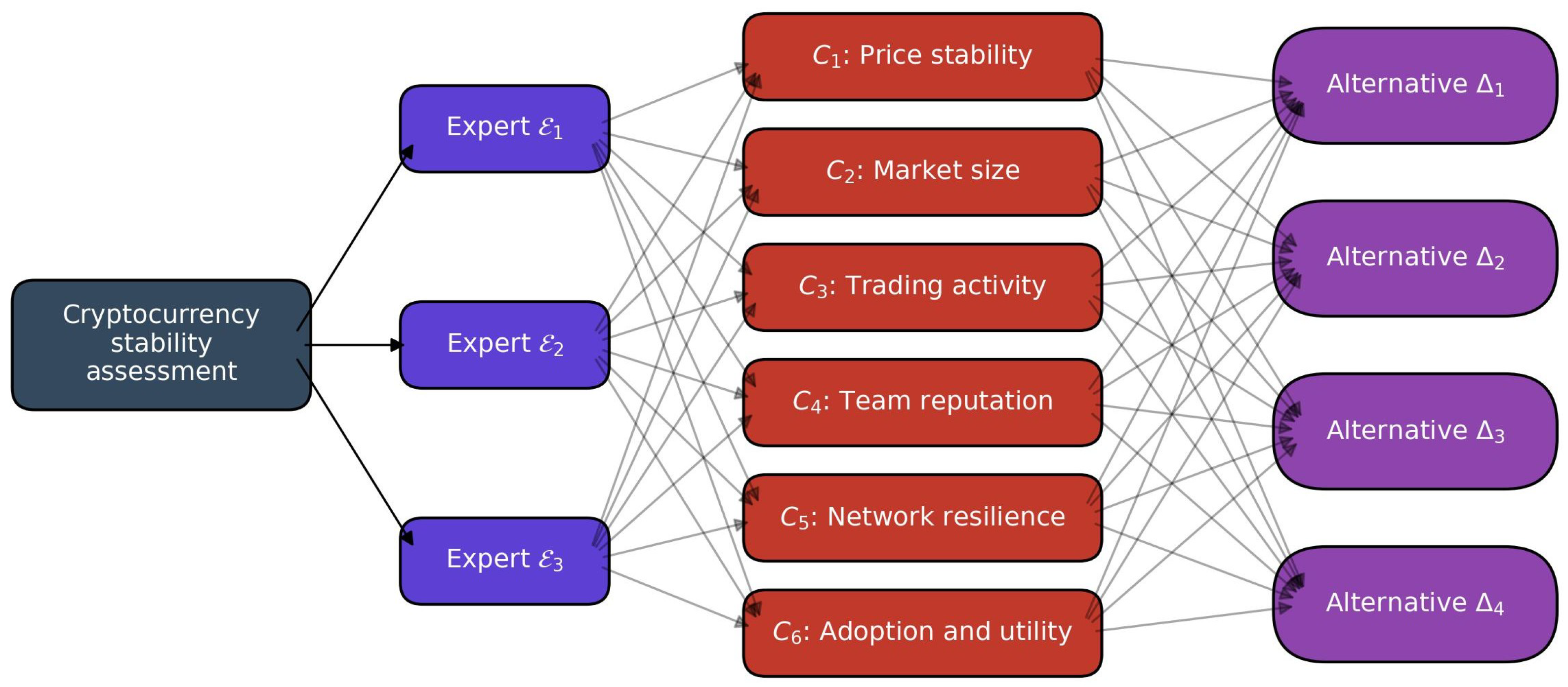
All six criteria are benefit-type criteria and together capture short-run behaviour, structural strength, market quality, and governance credibility. If a cost-type criterion were present (for example, fee volatility or security incident frequency), then its evaluations would first be normalised according to (16). Our aim is to identify the most stable coin(s) among the four alternatives Δ = { Δ 1 , , Δ 4 } on the basis of available criteria and experts’ ratings. The overall structure of the proposed cryptocurrency stability assessment problem is depicted in Figure 1.
Suppose that the experts’ ratings for each alternative under every criterion are given in Table 1, Table 2 and Table 3, where each entry is expressed as a p , q , r -FFN. Following Step 3, these three expert decision matrices are first aggregated into a single aggregated decision matrix by means of the p , q , r -FFFWA operator in (11) with uniform expert weights ( α 1 , α 2 , α 3 ) = 1 3 . The resulting aggregated matrix is reported in Table 4. Let the six criteria be associated with the weight vector ( 0.25 , 0.20 , 0.15 , 0.10 , 0.20 , 0.10 ) , respectively. Applying the p , q , r -FFFWA operator row-wise to Table 4 with these criterion weights yields a single weighted aggregated p , q , r -FFN for each alternative Δ i . The corresponding score values are then computed via (2), and the four alternatives are ranked in descending order of their scores. The final aggregated p , q , r -FFNs, together with their score values and ranking positions for the p , q , r -FFFWA operator, are summarised in Table 5.
A similar procedure is employed for the p , q , r -FFFWG operator. Using the same expert weights ( α 1 , α 2 , α 3 ) = 1 3 and matrices in Table 1, Table 2 and Table 3, first we obtained the aggregated matrix shown in Table 6 using the p , q , r -FFFWG operator in (13). Next, we apply the p , q , r -FFFWG operator to each row of Table 6 with the criterion weight vector ( 0.25 , 0.20 , 0.15 , 0.10 , 0.20 , 0.10 ) to compute the overall weighted aggregated p , q , r -FFN for each alternative. Their score values are again evaluated using (2), and the alternatives are ordered according to these scores. The final aggregated p , q , r -FFNs and their score values are reported in Table 7.
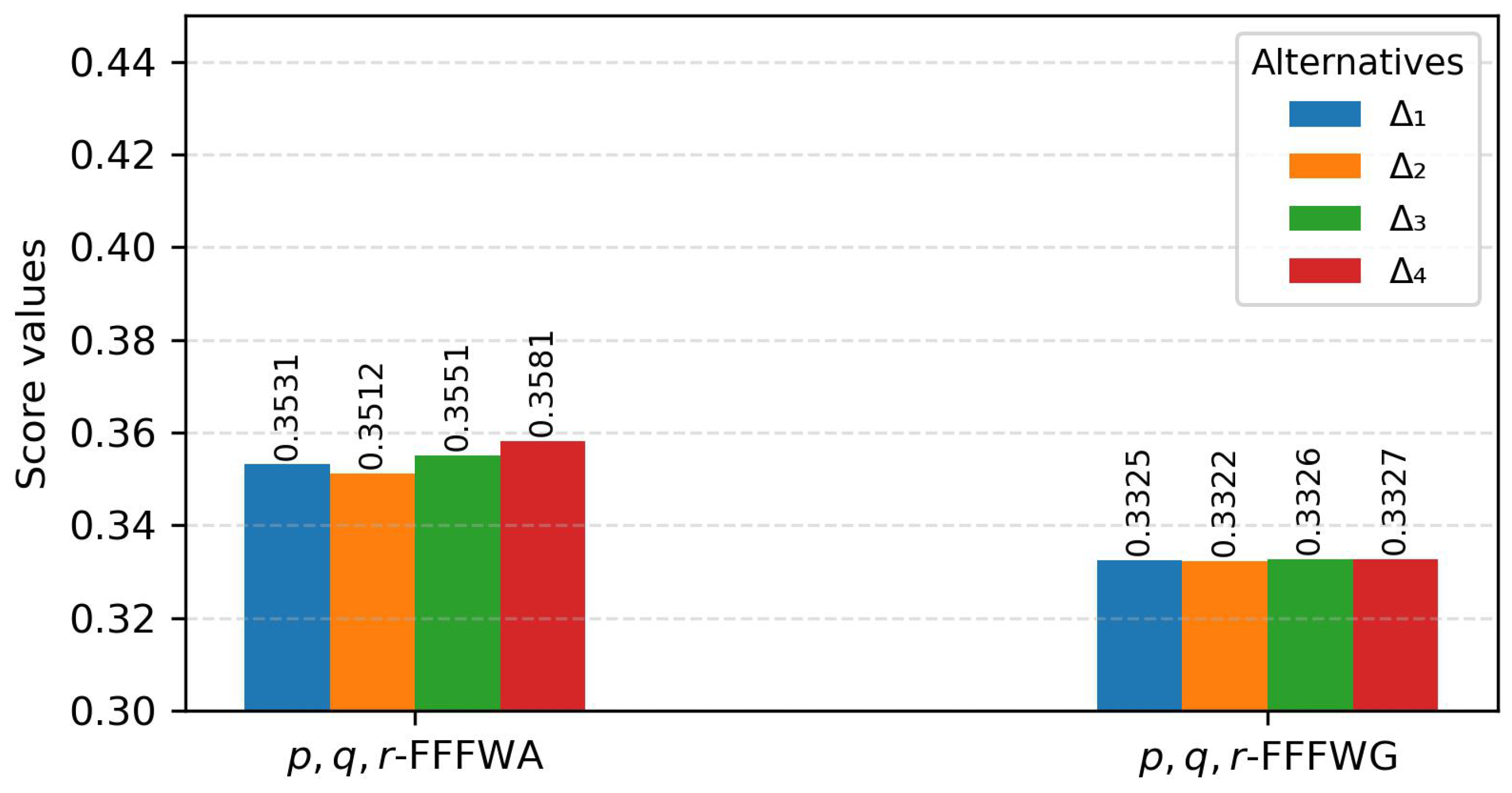
It is evident from Figure 2 that the same alternative (coin), namely Δ 4 , is identified as the most desirable option under both the AOs. Moreover, the remaining alternatives exhibit very similar score patterns and ranking positions under the two operators, indicating a high degree of consistency between the averaging- and geometric-type aggregations. These findings confirm the effectiveness of the proposed framework in addressing the cryptocurrency stability evaluation problem.
Remark 1.
The data reported in Table 1, Table 2 and Table 3, as well as the criterion and expert weights, are not real data. They are only used as an example to explain how the proposed approach works. Throughout the above numerical computations, we kept p = q = 2 , r = LCM ( p , q ) , and fixed the Frank parameter at ζ = 2 .

4.2. Sensitivity Analysis

In this section, we evaluate the influence of the parameters p, q and the Frank parameter ζ on the ranking results. We select the p , q , r -FFFWA operator and carry out three experiments, varying p, q and ζ respectively. In all experiments, we retain the same expert weights and criterion weights as in the baseline case.
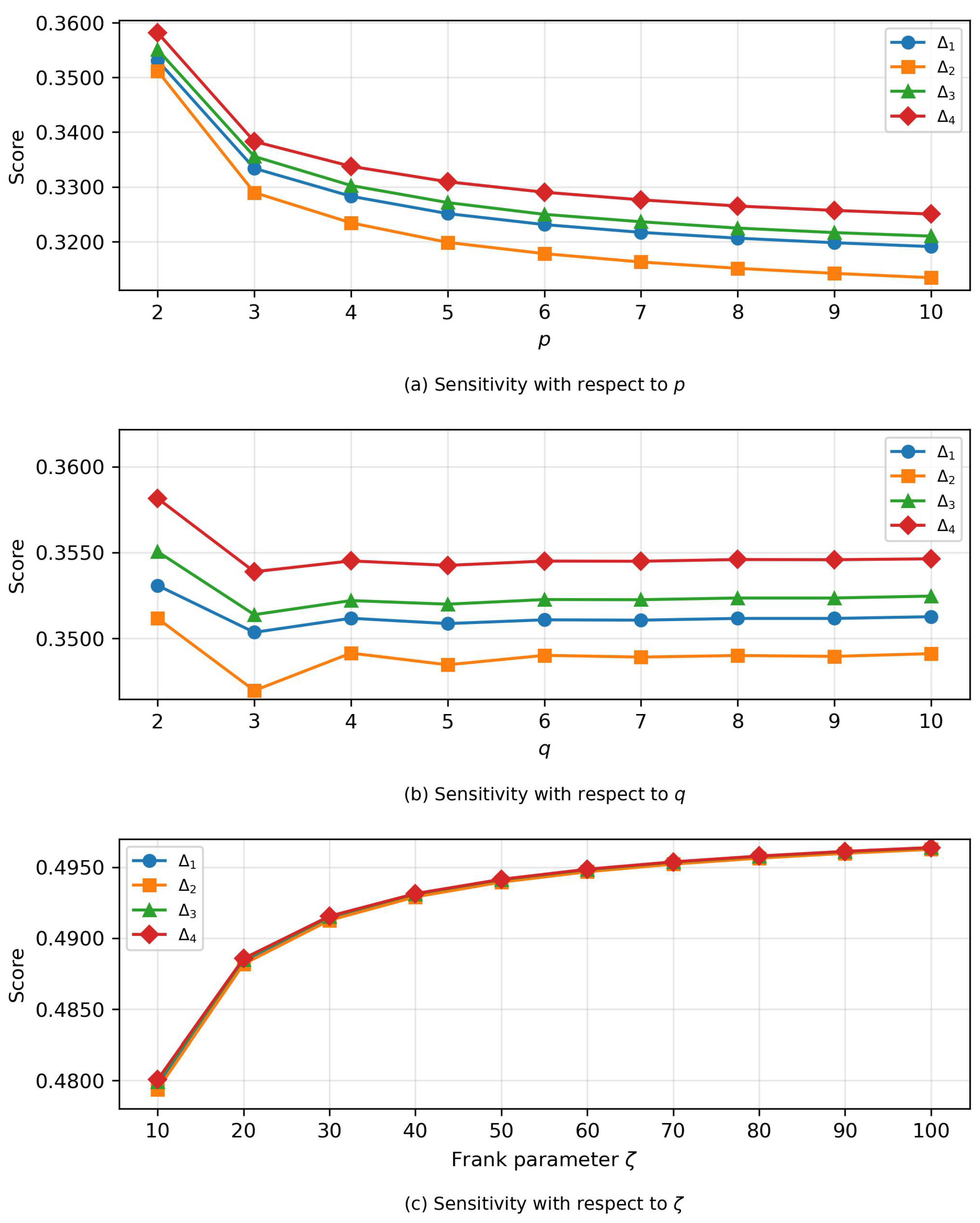
In the first experiment, we fix q = 2 and the Frank parameter ζ = 2 , and allow p to vary from 2 to 10, choosing r = LCM ( p , q ) so that the three exponents remain compatible; the corresponding score values of all alternatives are listed in Table 8. In the second experiment, we again fix ζ = 2 and take p = 2 while varying q between 2 and 10, with r = LCM ( p , q ) ; the resulting scores are summarised in Table 9. In the third experiment, we keep p = q = r = 2 fixed and vary the Frank parameter in the range ζ { 10 , 20 , , 100 } ; the corresponding score values are reported in Table 10. For a visual comparison, Figure 3 displays the evolution of the four score profiles under these three parameter variations.
A careful inspection of Table 8, Table 9 and Table 10 shows that, for all tested combinations of p, q and ζ , the ranking of the alternatives is preserved, that is Δ 4 Δ 3 Δ 1 Δ 2 . This behaviour highlights the robustness and resilience of the proposed approach. The stability of rankings under variations in p, q and ζ suggests that performance evaluation is robust to the specific choice of these parameters. Consequently, different decision-makers may adopt slightly different parameter values to encode their individual attitudes (for instance, more optimistic or more cautious views) without altering the recommended ordering of cryptocurrencies. Such stability is particularly important in multi-expert decision processes, where stable rankings are essential for drawing well-supported conclusions.
Hence, the numerical evidence in Table 8, Table 9 and Table 10 confirms that the proposed model provides reliable rankings that remain trustworthy under reasonable variations of the model parameters.

4.3. Comparative Study

The aim of this subsection is to compare the behaviour of the proposed model with several existing fuzzy decision-making approaches on a common data set. The evaluation data in Table 1, Table 2 and Table 3 have a specific structure that cannot be processed by the usual picture, spherical, or T-spherical fuzzy AOs. Because of the algebraic restrictions inherent in those models, the classical operators associated with them are not suitable for our original cryptocurrency dataset. For example, consider the p , q , r -FFN ( μ , η , ν ) = ( 0.7 , 0.5 , 1.0 ) , which appears in our decision matrices. For PFSs one must have μ + η + ν 1 , for SFSs the condition is μ 2 + η 2 + ν 2 1 , and for T-SFSs it is μ t + η t + ν t 1 for some t 1 . In this case we obtain μ + η + ν = 2.2 > 1 , μ 2 + η 2 + ν 2 = 1.74 > 1 , and, for instance with t = 3 , μ 3 + η 3 + ν 3 = 1.468 > 1 . Thus this rating does not belong to the admissible domain of picture, spherical or T-spherical fuzzy sets, and the original example cannot be used for a direct numerical comparison with those models.
To conduct a fair comparative analysis, we therefore employ an additional case study adapted from [52], which deals with the selection of a suitable renewable energy source. In this problem, there are four alternatives (hydro, wind, solar and biomass energy) evaluated under four criteria: cost ( C 1 ), environmental impact ( C 2 ), reliability ( C 3 ) and scalability ( C 4 ). The evaluations are provided by three experts (an environmental scientist, an economist and an energy engineer) and are expressed in the form of p , q , r -SFNs, as reported in Table 11, Table 12 and Table 13. In this setting, C 1 and C 2 are treated as cost-type criteria, whereas C 3 and C 4 are treated as benefit-type criteria. The experts are assigned the weight vector ( 0.35 , 0.30 , 0.35 ) , and the criteria weights are chosen as ( 0.2432 , 0.2347 , 0.2716 , 0.2505 ) . We applied our proposed method using the p , q , r -FFFWA operator with p = q = r = 2 and ζ = 10 (as in [52]), and compared the resulting scores and rankings with those produced by several established approaches on the same data set. The final score values and ranking orders are summarised in Table 14.
The results demonstrate that the ranking order generated by our method is almost the same as those obtained by the existing approaches, confirming strong alignment with established techniques. This consistency validates the proposed framework’s reliability and demonstrates its robustness across diverse decision-making scenarios. In this framework, the parameters p, q, and r provide enhanced flexibility by independently adjusting the MD, ND, and NMD. By selecting appropriate values for these parameters, decision-makers can calibrate the aggregation process to better reflect both underlying uncertainties and their personal preference structures. This flexibility enhances assessment accuracy, ensuring selected alternatives align with both traditional methods and the problem’s specific criteria.

4.4. Advantages of the Proposed Approach

The main advantages of the proposed p , q , r -fractional fuzzy Frank aggregation framework can be summarised as follows:
1.
The p , q , r -FFSs provide a solid basis for dealing with vague, incomplete or partially inconsistent information, making the approach suitable for many real-world decision-making problems.
2.
The proposed Frank-based aggregation operators provide a transparent method for combining expert opinions, facilitating consensus-building and stable alternative rankings.
3.
By changing p, q and r, decision-makers can control the shape and behaviour of the underlying membership functions, which leads to more precise and problem-oriented preference information in multi-criteria evaluations.
4.
Supports sensitivity analysis to track parameters effects on outcomes, ensuring robustness and identifying critical elements.
5.
The proposed framework generalizes several classical fuzzy models as special cases, thereby providing a unified approach for handling diverse uncertainty types.

4.5. Limitations

Although the proposed approach exhibits several attractive features, it also has some limitations that should be kept in mind. First, the use of multiple parameters (namely p, q, r and the Frank parameter ζ ) inevitably increases the complexity of the modelling stage. In practical applications, this requires a certain level of expertise and a careful calibration procedure in order to select parameter values that are both meaningful and consistent with the decision-makers’ preferences.
Second, the computational complexity of our proposed model increase with larger numbers of experts, criteria, and alternatives. While this is not an issue for small to medium-sized problems, the evaluation of many nested Frank-based operations may become relatively expensive for large-scale decision matrices, which could restrict the direct use of the approach in very high-dimensional settings.
Finally, the present study has focused on a specific application scenario (the stability assessment and ranking of cryptocurrencies based on multiple expert opinions). Although the framework is in principle applicable to other domains, its performance in different types of decision-making problems still needs to be tested. In particular, additional case studies in areas with different uncertainty structures and criteria interactions would be useful to confirm the generality of the approach and, if necessary, to adapt the modelling choices or parameter selection strategies to other contexts.

5. Discussion

The aim of this work was to develop a family of p , q , r -fractional fuzzy Frank AOs for multi-expert decision-making and to demonstrate their behaviour on a cryptocurrency stability assessment and a benchmark example. Within this framework, p, q, and r parameters regulate MD, ND, and NMD respectively, while ζ governs the Frank t-norm/t-conorm operations. Building on this setting, we introduced two operators, p , q , r -FFFWA, and p , q , r -FFFWG, and embedded them in a MCGDM procedure that aggregates individual expert evaluations into a collective decision. The model encompasses several existing fuzzy structures as special or limiting cases, but retains additional flexibility through the adjustable exponents and the Frank parameter, allowing decision-makers to tune the sensitivity of the aggregation to different components of the ( μ , η , ν ) triplets.
In the cryptocurrency case study, the three expert matrices were constructed under six criteria and then aggregated across experts and criteria using fixed weights. With the p , q , r -FFFWA operator at p = q = r = 2 and ζ = 2 , the resulting ranking identified Δ 3 as the most stable alternative and Δ 2 as the least attractive, with Δ 1 and Δ 4 in intermediate positions. The two proposed operators produced very close score values and identical rankings, indicating that the overall decision is not overly sensitive to the specific Frank-based aggregation pattern. The sensitivity analysis in Table 8 and Table 9 confirms this robustness: for a wide range of p and q (with r = LCM ( p , q ) and ζ = 2 ) the ranking Δ 4 > Δ 3 > Δ 1 > Δ 2 remains unchanged, so the best and worst options are stable under moderate parameter variations.
The comparative analysis further links the proposed model to existing fuzzy aggregation schemes based on ( p , q , r ) -SFSs and T-SFSs. For the benchmark problem in Table 11, Table 12 and Table 13, all approaches, including our p , q , r -FFFWA-based MCGDM model, agree on the optimal choices Δ 3 and Δ 4 and differ only in the ordering of Δ 1 and Δ 2 . Therefore, the ranking produced by our method is almost the same as those of the existing approaches (see Table 14). Although the numerical score levels differ, this agreement supports the validity and reliability of the proposed method and shows that it is compatible with recent fuzzy extensions while offering additional parameter flexibility. Overall, the numerical results indicate that the proposed model provides a robust and adaptable tool for group decision-making where expert judgements are imprecise and extreme.

6. Conclusions

In this study we have developed a new class of p , q , r -fractional fuzzy Frank AOs and incorporated them into a multi-expert decision-making scheme. By combining the p , q , r -fractional fuzzy structure with Frank operations, we developed two AOs: p , q , r -FFFWA and p , q , r -FFFWG. These AOs were then employed to construct a novel MCGDM framework in which multiple, and even extreme, expert opinions can be represented and processed via p , q , r -FFNs in complex decision-making problems. The cryptocurrency stability problem further illustrated how the proposed model can be implemented in practice when multiple experts evaluate alternatives with respect to several criteria under uncertain and possibly extreme information. It also showed that the two operators yield the same ranking and can therefore be used interchangeably to support robust and consistent decision making. The sensitivity experiments with respect to p and q for the Frank-type p , q , r -FFFWA operator (with ζ = 2 ) showed that the ranking of the four cryptocurrencies is preserved over a broad range of parameter choices. A further sensitivity analysis in the Frank parameter ζ (for p = q = r = 2 ) led to the same ranking pattern, confirming that the proposed model is robust with respect to both the fractional exponents and the Frank parameter. A comparative study further showed that the proposed method was compatible with several existing decision-making approaches, while still providing additional flexibility and robustness in MCGDM. Overall, the results indicate that the p , q , r -fractional fuzzy Frank framework provides a coherent and flexible alternative to existing aggregation paradigms in MCGDM.
Future work may include extending the present construction to dynamic or time-varying decision environments, and applying the proposed operators to other application domains such as supply-chain risk, medical diagnosis or sustainable investment evaluation.


Author Contributions

Conceptualization, A.K.; formal analysis, A.K., A.A.S. and M.Z.A.; funding acquisition, A.K.; investigation, A.K. and M.Z.A.; methodology, A.K.; resources, A.A.S. and M.Z.A.; software, A.K.; validation, A.A.S. and M.Z.A.; visualization, A.A.S. and M.Z.A.; writing—original draft, A.K.; writing—review and editing, A.A.S. and M.Z.A. All authors have read and agreed to the published version of the manuscript.

Funding

This research is supported by the Research Start-Up Fund of Taizhou University.

Data Availability Statement

All data generated or analyzed during this study are included in the article.

Conflicts of Interest

The authors declare no conflicts of interest.

References

  1. Wang, Y.; Yan, L.; Zhang, X. Pythagorean Fuzzy Overlap Functions and Corresponding Fuzzy Rough Sets for Multi-Attribute Decision Making. Fractal Fract. 2025, 9, 168. [Google Scholar] [CrossRef]
  2. Renzi, C.; Leali, F.; Di Angelo, L. A review on decision-making methods in engineering design for the automotive industry. J. Eng. Des. 2017, 28, 118–143. [Google Scholar] [CrossRef]
  3. Canco, I.; Kruja, D.; Iancu, T. AHP, a reliable method for quality decision making: A case study in business. Sustainability 2021, 13, 13932. [Google Scholar] [CrossRef]
  4. Khan, A.; Gong, Z.; Shah, A.A.; Haq, M. A Comprehensive Assessment Model for Livelihood Vulnerability Using Fuzzy TOPSIS Technique: A Case of 2022 Flood in Pakistan. Int. J. Disaster Risk Reduct. 2024, 103, 104351. [Google Scholar] [CrossRef]
  5. Khan, A.; Gong, Z.; Shah, A.A.; Haq, M. A Multi-Criteria Decision-Making Approach to Vulnerability Assessment of Rural Flooding in Khyber Pakhtunkhwa Province, Pakistan. Environ. Sci. Pollut. Res. 2023, 30, 56786–56801. [Google Scholar] [CrossRef]
  6. Khan, A.; Shah, A.A.; Alotaibi, B.A.; Khan, I. Prioritizing Resource and Policy Barriers to Post-Disaster Recovery in Pakistan: A Multi-Expert Fermatean Fuzzy AHP Analysis. Sustainability 2024, 16, 10414. [Google Scholar] [CrossRef]
  7. Khan, A.; Abidin, M.Z.; Sarwar, M.A. Another View on Soft Expert Set and Its Application in Multi-Criteria Decision-Making. Mathematics 2025, 3, 252. [Google Scholar] [CrossRef]
  8. Zadeh, L. Fuzzy sets. Inf. Control 1965, 8, 338–353. [Google Scholar] [CrossRef]
  9. Atanassov, K. Intuitionistic fuzzy sets. Fuzzy Sets Syst. 1986, 20, 87–96. [Google Scholar] [CrossRef]
  10. Yager, R. Pythagorean fuzzy subsets. In Proceedings of the 2013 Joint IFSA World Congress and NAFIPS Annual Meeting (IFSA/NAFIPS), Edmonton, AB, Canada, 24–28 June 2013; IEEE: Piscataway, NJ, USA, 2013; pp. 57–61. [Google Scholar]
  11. Yager, R. Generalized orthopair fuzzy sets. IEEE Trans. Fuzzy Syst. 2016, 25, 1222–1230. [Google Scholar] [CrossRef]
  12. Abdullah, S.; Al-Shomrani, M.M.; Liu, P.; Ahmad, S. A new approach to three-way decisions making based on fractional fuzzy decision-theoretical rough set. Int. J. Intell. Syst. 2022, 37, 2428–2457. [Google Scholar] [CrossRef]
  13. Cuong, B. Picture Fuzzy Sets—First Results. Part 1, Seminar Neuro-Fuzzy Systems with Applications; Institute of Mathematics: Hanoi, Vietnam, 2013. [Google Scholar]
  14. Cuong, B.; Kreinovich, V. Picture fuzzy sets—A new concept for computational intelligence problems. In Proceedings of the 2013 Third World Congress on Information and Communication Technologies (WICT 2013), Hanoi, Vietnam, 15–18 December 2013; IEEE: Piscataway, NJ, USA, 2013. [Google Scholar]
  15. Cuong, B.; Kreinovich, V. Picture fuzzy sets. J. Comput. Sci. Cybern. 2014, 30, 409–420. [Google Scholar]
  16. Cuong, B.; Pham, V. Some fuzzy logic operators for picture fuzzy sets. In Proceedings of the 2015 Seventh International Conference on Knowledge and Systems Engineering (KSE), Ho Chi Minh City, Vietnam, 8–10 October 2015; IEEE: Piscataway, NJ, USA, 2015; pp. 132–137. [Google Scholar]
  17. Cuong, B.; Kreinovitch, V.; Ngan, R. A classification of representable t-norm operators for picture fuzzy sets. In Proceedings of the 2016 Eighth International Conference on Knowledge and Systems Engineering (KSE), Hanoi, Vietnam, 6–8 October 2016; IEEE: Piscataway, NJ, USA, 2016; pp. 19–24. [Google Scholar]
  18. Phong, P.; Hieu, D.; Ngan, R.; Them, P. Some compositions of picture fuzzy relations. In Proceedings of the 7th National Conference on Fundamental and Applied Information Technology Research (FAIR’7), Thai Nguyen, Vietnam, 19–20 June 2014; pp. 19–20. [Google Scholar]
  19. Kutlu Gündogdu, F.; Kahraman, C. Spherical fuzzy sets and spherical fuzzy TOPSIS method. J. Intell. Fuzzy Syst. 2019, 36, 337–352. [Google Scholar] [CrossRef]
  20. Mahmood, T.; Ullah, K.; Khan, Q.; Jan, N. An approach toward decision-making and medical diagnosis problems using the concept of spherical fuzzy sets. Neural Comput. Appl. 2019, 31, 7041–7053. [Google Scholar] [CrossRef]
  21. Ali, J.; Naeem, M. r, s, t-spherical fuzzy VIKOR method and its application in multiple criteria group decision making. IEEE Access 2023, 11, 46454–46475. [Google Scholar] [CrossRef]
  22. Gulistan, M.; Pedrycz, W. Introduction to q-fractional fuzzy set. Int. J. Fuzzy Syst. 2024, 26, 1399–1416. [Google Scholar] [CrossRef]
  23. Gulistan, M.; Ying, H.; Pedrycz, W.; Rahim, M.; Amin, F.; Khalifa, H.W. p,q,r–Fractional fuzzy sets and their aggregation operators and applications. Artif. Intell. Rev. 2024, 57, 346. [Google Scholar] [CrossRef]
  24. Samad, A.; Muhammad, J.; Ali, R. Enhancing business system performance through confidence-based algebraic aggregation and the p, q, r-Fraction Fuzzy model for robust decision-making. J. Intell. Manag. Decis. 2025, 4, 78–91. [Google Scholar] [CrossRef]
  25. Sarwar, M.A.; Gong, Y.; Alzakari, S.A.; Alhussan, A.A. A novel Fractional fuzzy approach for multi-criteria decision-making in medical waste management. Sci. Rep. 2025, 15, 23999. [Google Scholar] [CrossRef]
  26. Garg, H.; Rani, D. Novel aggregation operators and ranking method for complex intuitionistic fuzzy sets and their applications to decision-making proces. Artif. Intell. Rev. 2020, 53, 3595–3620. [Google Scholar] [CrossRef]
  27. Garg, H. Sine trigonometric operational laws and their based Pythagorean fuzzy aggregation operators for group decision-making process. Artif. Intell. Rev. 2021, 54, 4421–4447. [Google Scholar] [CrossRef]
  28. Liu, P.; Wang, P. Some q-rung orthopair fuzzy aggregation operators and their applications to multiple-attribute decision making. Int. J. Intell. Syst. 2018, 33, 259–280. [Google Scholar] [CrossRef]
  29. Ashraf, S.; Abdullah, S.; Mahmood, T.; Ghani, F.; Mahmood, T. Spherical fuzzy sets and their applications in multi-attribute decision-making problems. J. Intell. Fuzzy Syst. 2019, 36, 2829–2844. [Google Scholar] [CrossRef]
  30. Akram, M.; Khan, A.; Alcantud, J.; Santos-García, G. A hybrid decision-making framework under complex spherical fuzzy prioritized weighted aggregation operators. Expert Syst. 2021, 38, e12712. [Google Scholar] [CrossRef]
  31. Jin, H.; Ashraf, S.; Abdullah, S.; Qiyas, M.; Bano, M.; Zeng, S. Linguistic spherical fuzzy aggregation operators and their applications in multi-attribute decision making problems. Mathematics 2019, 7, 413. [Google Scholar] [CrossRef]
  32. Akhtar, M.; Rahim, M.; Alanzi, A.M.; Ahmad, S.; Fatlane, J.M.; Aphane, M.; Khalifa, H.A.E.W. Dombi aggregation operators for p, q, r-spherical fuzzy sets with an application to stability assessment of cryptocurrencies. IEEE Access 2023, 12, 10366–10382. [Google Scholar] [CrossRef]
  33. Senapati, T.; Chen, G.; Yager, R. Aczel-Alsina aggregation operators and their application to intuitionistic fuzzy multiple attribute decision making. Int. J. Intell. Syst. 2022, 37, 1529–1551. [Google Scholar] [CrossRef]
  34. Akram, M.; Khan, A.; Borumand Saeid, A. Complex Pythagorean Dombi fuzzy operators and their decision-making applications. Expert Syst. 2021, 38, e12626. [Google Scholar] [CrossRef]
  35. Rahim, M.; Amin, F.; Ali, A.; Shah, K. An extension of Bonferroni mean under cubic Pythagorean fuzzy environment and its applications in selection-based problems. Math. Probl. Eng. 2022, 2022, 9735100. [Google Scholar] [CrossRef]
  36. Amin, F.; Rahim, M.; Ali, A.; Ameer, E. Generalized cubic Pythagorean fuzzy aggregation operators and their application to multi-attribute decision-making problems. Int. J. Comput. Intell. Syst. 2022, 15, 92. [Google Scholar] [CrossRef]
  37. Karaaslan, F.; Karamaz, F. Interval-valued (p, q, r)-spherical fuzzy sets and their applications in MCGDM and MCDM based on TOPSIS method and aggregation operators. Expert Syst. Appl. 2024, 255, 124575. [Google Scholar] [CrossRef]
  38. Karamaz, F.; Karaaslan, F. Distance measures of r, s, t-spherical fuzzy sets and their applications in MCGDM based on TOPSIS. J. Supercomput. 2025, 81, 173. [Google Scholar] [CrossRef]
  39. Liu, P.; Naz, S.; Akram, M.; Muzammal, M. Group decision-making analysis based on linguistic q-rung orthopair fuzzy generalized point weighted aggregation operators. Int. J. Mach. Learn. Cybern. 2022, 13, 2069–2089. [Google Scholar] [CrossRef]
  40. Rahman, K.; Muhammad, J. Enhanced decision making through induced confidence-level complex polytopic fuzzy aggregation operators. Int. J. Knowl. Innov. Stud. 2024, 2, 11–18. [Google Scholar] [CrossRef]
  41. Ahmed, M.; Ashraf, S.; Mashat, D. Complex intuitionistic hesitant fuzzy aggregation information and its application in decision-making problems. Acadlore Trans. Appl. Math. Stat. 2024, 2, 1–21. [Google Scholar] [CrossRef]
  42. Mahnaz, S.; Ali, J.; Malik, M.; Bashir, Z. T-Spherical Fuzzy Frank Aggregation Operators and Their Application to Decision Making with Unknown Weight Information. IEEE Access 2021, 10, 7408–7438. [Google Scholar] [CrossRef]
  43. Seikh, M.; Mandal, U. Q-Rung Orthopair Fuzzy Frank Aggregation Operators and Its Application in Multiple Attribute Decision-Making with Unknown Attribute Weights. Granul. Comput. 2022, 7, 709–730. [Google Scholar] [CrossRef]
  44. Yahya, M.; Abdullah, S.; Chinram, R.; Al-Otaibi, Y.; Naeem, M. Frank Aggregation Operators and Their Application to Probabilistic Hesitant Fuzzy Multiple Attribute Decision-Making. Int. J. Fuzzy Syst. 2021, 23, 194–215. [Google Scholar] [CrossRef]
  45. Mahmood, T.; Waqas, H.; Ali, Z.; Ullah, K.; Pamucar, D. Frank Aggregation Operators and Analytic Hierarchy Process Based on Interval-Valued Picture Fuzzy Sets and Their Applications. Int. J. Intell. Syst. 2021, 36, 7925–7962. [Google Scholar] [CrossRef]
  46. Rahim, M. Multi-Criteria Group Decision-Making Based on Frank Aggregation Operators under Pythagorean Cubic Fuzzy Sets. Granul. Comput. 2023, 8, 1429–1449. [Google Scholar] [CrossRef]
  47. Seikh, M.; Mandal, U. Some Picture Fuzzy Aggregation Operators Based on Frank t-Norm and t-Conorm: Application to MADM Process. Informatica 2021, 45, 447–461. [Google Scholar] [CrossRef]
  48. Du, Y.; Du, X.; Li, Y.; Cui, J.X.; Hou, F. Complex q-Rung Orthopair Fuzzy Frank Aggregation Operators and Their Application to Multi-Attribute Decision Making. Soft Comput. 2022, 26, 11973–12008. [Google Scholar] [CrossRef] [PubMed]
  49. Ali, J.; Naeem, M.; Al-Kenani, A. Complex t-Spherical Fuzzy Frank Aggregation Operators and Their Application to Decision Making. IEEE Access 2023, 11, 88971–89023. [Google Scholar] [CrossRef]
  50. Yang, X.; Mahmood, T.; Ali, Z.; Hayat, K. Identification and classification of multi-attribute decision-making based on complex intuitionistic fuzzy frank aggregation operators. Mathematics 2023, 11, 3292. [Google Scholar] [CrossRef]
  51. Naeem, M.; Mahmood, T.; Rehman, U.; Mehmood, F. Classification of Renewable Energy and Its Sources with Decision-making Approach based on Bipolar Complex Fuzzy Frank Power Aggregation Operators. Energy Strategy Rev. 2023, 49, 101162. [Google Scholar] [CrossRef]
  52. Alballa, T.; Rahim, M.; Alburaikan, A.; Almutairi, A.; Khalifa, H. MCGDM approach based on (p, q, r)-spherical fuzzy Frank aggregation operators: Applications in the categorization of renewable energy sources. Sci. Rep. 2024, 14, 23576. [Google Scholar] [CrossRef]
  53. Hussain, A.; Ullah, K.; Khan, M.; Senapati, T.; Moselm, S. Complex t-Spherical Fuzzy Frank Aggregation Operators with Application in the Assessment of Soil Fertility. IEEE Access 2023, 11, 103132–103145. [Google Scholar] [CrossRef]
  54. Ullah, K.; Naeem, M.; Hussain, A.; Waqas, M.; Haleemzai, I. Evaluation of Electric Motor Cars Based on Frank Power Aggregation Operators under Picture Fuzzy Information and a Multi-Attribute Group Decision-Making Process. IEEE Access 2023, 11, 67201–67219. [Google Scholar] [CrossRef]
  55. Frank, M. On the Simultaneous Associativity of F(x, y) and G(x, y). Aequationes Math. 1979, 19, 194–226. [Google Scholar] [CrossRef]
  56. Klement, E.; Mesiar, R.; Pap, E. Triangular Norms; Kluwer Academic Publishers: Dordrecht, The Netherlands, 2000. [Google Scholar]
  57. Cabezas-Rivas, E.; Sanchez-Coll, F.; Tormo-Xaixo, I. Chance or Chaos? Fractal Geometry Aimed to Inspect the Nature of Bitcoin. Fractal Fract. 2023, 7, 870. [Google Scholar] [CrossRef]
  58. Seabe, P.; Moutsinga, C.; Pindza, E. Forecasting Cryptocurrency Prices Using LSTM, GRU, and Bi-Directional LSTM: A Deep Learning Approach. Fractal Fract. 2023, 7, 203. [Google Scholar] [CrossRef]
  59. Liu, P.; Wang, D.; Zhang, H.; Yan, L.; Li, Y.; Rong, L. Multi-attribute decision-making method based on normal T-spherical fuzzy aggregation operator. J. Intell. Fuzzy Syst. 2021, 40, 9543–9565. [Google Scholar] [CrossRef]
  60. Garg, H.; Munir, M.; Ullah, K.; Mahmood, T.; Jan, N. Algorithm for T-spherical fuzzy multi-attribute decision making based on improved interactive aggregation operators. Symmetry 2018, 10, 670. [Google Scholar] [CrossRef]
  61. Garg, H.; Ullah, K.; Mahmood, T.; Hassan, N.; Jan, N. T-spherical fuzzy power aggregation operators and their applications in multi-attribute decision making. J. Ambient Intell. Hum. Comput. 2021, 12, 9067–9080. [Google Scholar] [CrossRef]
  62. Munir, M.; Mahmood, T.; Hussain, A. Algorithm for T-spherical fuzzy MADM based on associated immediate probability interactive geometric aggregation operators. Artif. Intell. Rev. 2021, 54, 6033–6061. [Google Scholar] [CrossRef]
Figure 1. Description of the proposed problem.
Fractalfract 10 00011 g001
Figure 2. Score values for the p , q , r -FFFWA and p , q , r -FFFWG operators.
Fractalfract 10 00011 g002
Figure 3. Alternative score values under varying parameters p, q and ζ .
Fractalfract 10 00011 g003
Table 1. Ratings provided by expert E 1 .
C 1 C 2 C 3 C 4 C 5 C 6
Δ 1 ( 0.7 , 0.8 , 1.0 ) ( 0.3 , 0.4 , 0.4 ) ( 0.7 , 0.5 , 1.0 ) ( 0.5 , 0.3 , 0.6 ) ( 0.6 , 0.4 , 0.2 ) ( 0.5 , 0.2 , 0.4 )
Δ 2 ( 0.3 , 0.9 , 0.5 ) ( 0.4 , 0.5 , 0.7 ) ( 0.4 , 0.8 , 0.3 ) ( 0.4 , 0.5 , 0.5 ) ( 0.3 , 0.6 , 0.9 ) ( 0.7 , 0.8 , 0.7 )
Δ 3 ( 0.2 , 0.3 , 0.4 ) ( 0.4 , 0.4 , 0.6 ) ( 0.6 , 0.4 , 0.7 ) ( 0.7 , 0.4 , 0.8 ) ( 0.4 , 0.3 , 0.3 ) ( 0.6 , 0.5 , 0.2 )
Δ 4 ( 0.8 , 0.4 , 1.0 ) ( 0.3 , 0.4 , 0.2 ) ( 0.2 , 0.3 , 0.1 ) ( 1.0 , 0.3 , 0.4 ) ( 0.7 , 0.3 , 0.3 ) ( 0.6 , 0.4 , 0.5 )
Table 2. Ratings provided by expert E 2 .
C 1 C 2 C 3 C 4 C 5 C 6
Δ 1 ( 0.5 , 0.4 , 0.5 ) ( 0.3 , 0.5 , 0.5 ) ( 0.5 , 0.3 , 0.4 ) ( 0.5 , 0.9 , 0.5 ) ( 0.6 , 0.3 , 0.3 ) ( 0.4 , 0.5 , 0.7 )
Δ 2 ( 0.2 , 1.0 , 0.9 ) ( 0.3 , 0.7 , 0.4 ) ( 0.6 , 0.7 , 0.4 ) ( 0.5 , 0.2 , 0.6 ) ( 0.4 , 0.7 , 0.8 ) ( 0.8 , 0.4 , 0.5 )
Δ 3 ( 0.3 , 0.4 , 0.5 ) ( 0.6 , 0.5 , 0.7 ) ( 0.5 , 0.3 , 0.2 ) ( 0.7 , 0.4 , 0.3 ) ( 0.6 , 0.6 , 0.3 ) ( 0.4 , 0.2 , 0.2 )
Δ 4 ( 0.3 , 0.4 , 0.2 ) ( 0.8 , 0.4 , 0.3 ) ( 0.2 , 0.1 , 0.5 ) ( 1.0 , 0.6 , 0.2 ) ( 0.4 , 0.3 , 0.1 ) ( 0.2 , 0.1 , 0.4 )
Table 3. Ratings provided by expert E 3 .
C 1 C 2 C 3 C 4 C 5 C 6
Δ 1 ( 0.2 , 0.4 , 0.5 ) ( 0.4 , 0.5 , 0.4 ) ( 0.6 , 0.5 , 0.1 ) ( 0.5 , 0.1 , 0.3 ) ( 0.5 , 0.4 , 0.6 ) ( 0.3 , 0.5 , 0.1 )
Δ 2 ( 0.3 , 0.4 , 1.0 ) ( 0.4 , 0.5 , 0.7 ) ( 0.6 , 0.6 , 0.4 ) ( 0.8 , 0.5 , 0.2 ) ( 0.4 , 0.3 , 0.5 ) ( 0.7 , 0.4 , 0.3 )
Δ 3 ( 0.7 , 0.4 , 0.3 ) ( 0.4 , 0.4 , 0.2 ) ( 0.3 , 0.2 , 0.4 ) ( 0.5 , 0.4 , 0.3 ) ( 1.0 , 0.4 , 0.3 ) ( 0.5 , 0.4 , 0.7 )
Δ 4 ( 0.5 , 0.4 , 0.2 ) ( 0.3 , 0.2 , 0.3 ) ( 0.4 , 0.5 , 0.5 ) ( 0.6 , 0.4 , 0.3 ) ( 0.7 , 0.3 , 0.1 ) ( 1.0 , 0.4 , 0.6 )
Table 4. Experts’ aggregated decision matrix using p , q , r -FFFWA operator.
C 1 C 2 C 3 C 4 C 5 C 6
Δ 1 ( 0.24 , 0.25 , 0.32 ) ( 0.17 , 0.23 , 0.22 ) ( 0.30 , 0.21 , 0.18 ) ( 0.25 , 0.15 , 0.22 ) ( 0.28 , 0.18 , 0.17 ) ( 0.20 , 0.19 , 0.15 )
Δ 2 ( 0.13 , 0.36 , 0.39 ) ( 0.18 , 0.28 , 0.29 ) ( 0.27 , 0.35 , 0.18 ) ( 0.29 , 0.19 , 0.20 ) ( 0.18 , 0.25 , 0.36 ) ( 0.37 , 0.25 , 0.24 )
Δ 3 ( 0.21 , 0.18 , 0.20 ) ( 0.23 , 0.22 , 0.22 ) ( 0.24 , 0.14 , 0.19 ) ( 0.32 , 0.20 , 0.21 ) ( 0.34 , 0.21 , 0.15 ) ( 0.25 , 0.17 , 0.15 )
Δ 4 ( 0.27 , 0.20 , 0.17 ) ( 0.24 , 0.16 , 0.13 ) ( 0.13 , 0.12 , 0.15 ) ( 0.44 , 0.21 , 0.14 ) ( 0.30 , 0.15 , 0.07 ) ( 0.32 , 0.13 , 0.25 )
Table 5. Overall aggregated p , q , r -FFNs, score values and ranking using p , q , r -FFFWA operator.
AlternativeAggregated p , q , r -FFNsScoreRank
Δ 1 ( 0.1202 , 0.1045 , 0.1062 ) 0.35313
Δ 2 ( 0.1068 , 0.1433 , 0.1431 ) 0.35124
Δ 3 ( 0.1299 , 0.0938 , 0.0933 ) 0.35512
Δ 4 ( 0.1369 , 0.0806 , 0.0686 ) 0.35811
Table 6. Experts’ aggregated decision matrix using p , q , r -FFFWG operator.
C 1 C 2 C 3 C 4 C 5 C 6
Δ 1 ( 0.01 , 0.01 , 0.11 ) ( 0.01 , 0.01 , 0.07 ) ( 0.01 , 0.01 , 0.07 ) ( 0.01 , 0.01 , 0.07 ) ( 0.01 , 0.01 , 0.07 ) ( 0.01 , 0.01 , 0.06 )
Δ 2 ( 0.01 , 0.02 , 0.16 ) ( 0.01 , 0.01 , 0.11 ) ( 0.01 , 0.02 , 0.06 ) ( 0.01 , 0.01 , 0.07 ) ( 0.01 , 0.01 , 0.12 ) ( 0.02 , 0.01 , 0.08 )
Δ 3 ( 0.01 , 0.01 , 0.06 ) ( 0.01 , 0.01 , 0.07 ) ( 0.01 , 0.01 , 0.07 ) ( 0.01 , 0.01 , 0.07 ) ( 0.01 , 0.01 , 0.05 ) ( 0.01 , 0.01 , 0.08 )
Δ 4 ( 0.01 , 0.01 , 0.07 ) ( 0.01 , 0.01 , 0.05 ) ( 0.01 , 0.01 , 0.07 ) ( 0.02 , 0.01 , 0.05 ) ( 0.01 , 0.01 , 0.03 ) ( 0.01 , 0.01 , 0.09 )
Table 7. Overall aggregated p , q , r -FFNs, score values and ranking using p , q , r -FFFWG operator.
AlternativeAggregated p , q , r -FFNsScoreRank
Δ 1 ( 0.0000 , 0.0000 , 0.0048 ) 0.33253
Δ 2 ( 0.0000 , 0.0000 , 0.0067 ) 0.33224
Δ 3 ( 0.0000 , 0.0000 , 0.0046 ) 0.33262
Δ 4 ( 0.0000 , 0.0000 , 0.0041 ) 0.33271
Table 8. Alternative scores and rankings under different parameter p settings.
pq r = LCM ( p , q ) ζ Score ValuesRank
Δ 1 Δ 2 Δ 3 Δ 4
22220.35310.35120.35510.3581 Δ 4 > Δ 3 > Δ 1 > Δ 2
32620.32220.31560.32470.3291 Δ 4 > Δ 3 > Δ 1 > Δ 2
42420.32030.31470.32240.3264 Δ 4 > Δ 3 > Δ 1 > Δ 2
521020.31700.31080.31930.3234 Δ 4 > Δ 3 > Δ 1 > Δ 2
62620.31700.31100.31910.3232 Δ 4 > Δ 3 > Δ 1 > Δ 2
721420.31610.31000.31830.3225 Δ 4 > Δ 3 > Δ 1 > Δ 2
82820.31620.31010.31840.3225 Δ 4 > Δ 3 > Δ 1 > Δ 2
921820.31590.30970.31800.3222 Δ 4 > Δ 3 > Δ 1 > Δ 2
1021020.31590.30980.31810.3222 Δ 4 > Δ 3 > Δ 1 > Δ 2
Table 9. Alternative scores and rankings under different parameter q settings.
pq r = LCM ( p , q ) ζ Score ValuesRank
Δ 1 Δ 2 Δ 3 Δ 4
22220.35310.35120.35510.3581 Δ 4 > Δ 3 > Δ 1 > Δ 2
23620.34880.34500.35100.3533 Δ 4 > Δ 3 > Δ 1 > Δ 2
24420.35330.35110.35500.3564 Δ 4 > Δ 3 > Δ 1 > Δ 2
251020.35240.34980.35410.3555 Δ 4 > Δ 3 > Δ 1 > Δ 2
26620.35340.35110.35500.3562 Δ 4 > Δ 3 > Δ 1 > Δ 2
271420.35300.35060.35470.3559 Δ 4 > Δ 3 > Δ 1 > Δ 2
28820.35340.35110.35500.3562 Δ 4 > Δ 3 > Δ 1 > Δ 2
291820.35320.35090.35480.3560 Δ 4 > Δ 3 > Δ 1 > Δ 2
2101020.35340.35110.35500.3562 Δ 4 > Δ 3 > Δ 1 > Δ 2
Table 10. Alternative scores and rankings under different Frank parameter ζ settings.
pq r = LCM ( p , q ) ζ Score ValuesRank
Δ 1 Δ 2 Δ 3 Δ 4
222100.479690.479360.479900.48005 Δ 4 > Δ 3 > Δ 1 > Δ 2
222200.488380.488170.488490.48856 Δ 4 > Δ 3 > Δ 1 > Δ 2
222300.491420.491260.491510.49155 Δ 4 > Δ 3 > Δ 1 > Δ 2
222400.493040.492910.493110.49314 Δ 4 > Δ 3 > Δ 1 > Δ 2
222500.494070.493950.494120.49415 Δ 4 > Δ 3 > Δ 1 > Δ 2
222600.494780.494680.494830.49486 Δ 4 > Δ 3 > Δ 1 > Δ 2
222700.495310.495220.495360.49538 Δ 4 > Δ 3 > Δ 1 > Δ 2
222800.495730.495640.495770.49579 Δ 4 > Δ 3 > Δ 1 > Δ 2
222900.496060.495980.496100.49612 Δ 4 > Δ 3 > Δ 1 > Δ 2
2221000.496340.496260.496370.49639 Δ 4 > Δ 3 > Δ 1 > Δ 2
Table 11. Decision matrix provided by expert E 1 .
C 1 C 2 C 3 C 4
Δ 1 ( 0.55 , 0.10 , 0.30 ) ( 0.50 , 0.15 , 0.20 ) ( 0.40 , 0.20 , 0.30 ) ( 0.70 , 0.50 , 0.50 )
Δ 2 ( 0.60 , 0.15 , 0.35 ) ( 0.55 , 0.30 , 0.40 ) ( 0.60 , 0.10 , 0.35 ) ( 0.45 , 0.30 , 0.20 )
Δ 3 ( 0.80 , 0.50 , 0.60 ) ( 0.65 , 0.10 , 0.50 ) ( 0.75 , 0.15 , 0.20 ) ( 0.75 , 0.40 , 0.30 )
Δ 4 ( 0.35 , 0.40 , 0.60 ) ( 0.40 , 0.20 , 0.15 ) ( 0.25 , 0.30 , 0.25 ) ( 0.65 , 0.50 , 0.40 )
Table 12. Decision matrix provided by expert E 2 .
C 1 C 2 C 3 C 4
Δ 1 ( 0.45 , 0.20 , 0.30 ) ( 0.35 , 0.40 , 0.10 ) ( 0.35 , 0.20 , 0.10 ) ( 0.25 , 0.10 , 0.20 )
Δ 2 ( 0.35 , 0.30 , 0.20 ) ( 0.25 , 0.10 , 0.10 ) ( 0.45 , 0.15 , 0.25 ) ( 0.40 , 0.20 , 0.15 )
Δ 3 ( 0.65 , 0.10 , 0.30 ) ( 0.55 , 0.15 , 0.25 ) ( 0.55 , 0.10 , 0.40 ) ( 0.55 , 0.20 , 0.50 )
Δ 4 ( 0.25 , 0.15 , 0.10 ) ( 0.65 , 0.35 , 0.15 ) ( 0.35 , 0.30 , 0.20 ) ( 0.45 , 0.30 , 0.20 )
Table 13. Decision matrix provided by expert E 3 .
C 1 C 2 C 3 C 4
Δ 1 ( 0.65 , 0.15 , 0.30 ) ( 0.50 , 0.30 , 0.30 ) ( 0.45 , 0.15 , 0.30 ) ( 0.50 , 0.25 , 0.30 )
Δ 2 ( 0.55 , 0.25 , 0.20 ) ( 0.45 , 0.10 , 0.20 ) ( 0.40 , 0.10 , 0.40 ) ( 0.45 , 0.30 , 0.20 )
Δ 3 ( 0.70 , 0.10 , 0.55 ) ( 0.65 , 0.35 , 0.40 ) ( 0.75 , 0.55 , 0.50 ) ( 0.60 , 0.80 , 0.50 )
Δ 4 ( 0.65 , 0.40 , 0.20 ) ( 0.50 , 0.35 , 0.30 ) ( 0.45 , 0.30 , 0.20 ) ( 0.40 , 0.50 , 0.50 )
Table 14. Alternative scores and their rankings under different methodological frameworks.
ApproachScore ValuesRank
Δ 1 Δ 2 Δ 3 Δ 4
Liu et al. [59]0.43790.41280.46520.4496 Δ 3 > Δ 4 > Δ 1 > Δ 2
Garg et al. [60]0.36220.34140.39710.3874 Δ 3 > Δ 4 > Δ 1 > Δ 2
Jan et al. [61]0.41800.39410.44580.4386 Δ 3 > Δ 4 > Δ 1 > Δ 2
Munir et al. [62]0.47820.46260.50150.4893 Δ 3 > Δ 4 > Δ 1 > Δ 2
Alballa et al. [52]0.68110.65100.88230.7396 Δ 3 > Δ 4 > Δ 1 > Δ 2
The proposed approach0.478850.478870.479940.47888 Δ 3 > Δ 4 > Δ 2 > Δ 1
Disclaimer/Publisher’s Note: The statements, opinions and data contained in all publications are solely those of the individual author(s) and contributor(s) and not of MDPI and/or the editor(s). MDPI and/or the editor(s) disclaim responsibility for any injury to people or property resulting from any ideas, methods, instructions or products referred to in the content.