Article

Investigation of Solutions for m-Dimensional Singular Fractional Pseudo-Hyperbolic Equations

Mathematics Department, College of Science, King Saud University, P.O. Box 22452, Riyadh 11495, Saudi Arabia
Fractal Fract. 2026, 10(1), 10; https://doi.org/10.3390/fractalfract10010010
Submission received: 15 November 2025 / Revised: 20 December 2025 / Accepted: 23 December 2025 / Published: 24 December 2025
(This article belongs to the Special Issue Women’s Special Issue Series: Fractal and Fractional, 2nd Edition)

Abstract

In this work, we investigate the solutions of fractional singular m-dimensional pseudo-hyperbolic equations. To address these equations effectively, we generalise the Natural transform to the multi-dimensional case and examine several of its essential properties. By integrating this transform with the Adomian Decomposition Method, we formulate the Multi-Dimensional Natural Adomian (MNA) Method, which provides a systematic framework for solving the considered equations under given initial conditions. The resulting solutions are expressed as rapidly convergent series that approach either exact or highly accurate approximations. To illustrate the practicality and robustness of the proposed method, two representative examples are included, demonstrating the construction of the solution series and the derivation of approximate or exact solutions.

1. Introduction

Fractional partial differential equations have become increasingly prevalent in various applications across the physical sciences, engineering, and finance. Indeed, numerous real-world problems, including those in fluid mechanics, viscoelasticity, biology, engineering, and physics, are often modeled using fractional partial differential equations. The need to solve and investigate these complex problems has made fractional calculus an active and impactful area of research. In particular, fractional PDEs have attracted significant interest from researchers, leading to the development of various solution methods. In recent years, several effective techniques have been developed to investigate both computational and exact solutions to fractional differential equations. Notable methods include the Method of Homotopy Analysis [1], the Operational Matrix Method [2], the Iterative Reproducing Kernel Method [3], an approximate analytical technique proposed in [4], the Fractional Laplace Transform [5], the Natural Decomposition Transform Technique [6], a modification of the Adomian Decomposition Method [7], the Differential Transform Method [8], the Variational Iteration Method [9], the Residual Power Series Method [10], the Homotopy Perturbation Method [11], the q-Homotopy Analysis Method [12], Meshless Radial Basis Function (RBF) Methods [13], Adam Bashforth’s Moulton Method [14], and the Series Expansion Method [15]. Furthermore, some studies have focused on examining fractional derivatives and their properties [16,17,18,19], while other researchers have focused on applications involving fractional derivatives [20,21,22].
The combined application of the Natural transform and the Adomian Decomposition Method has proven effective in solving various fractional partial differential equations. This approach has been widely investigated in numerous studies [23,24,25,26,27,28] and become commonly applied in the analysis of fractional PDEs, as demonstrated in various research works. For example, in [29], the one-dimensional linear and nonlinear singular Boussinesq equations were examined using a double Natural transform alongside the Adomian Decomposition Method. Similarly, in [30], the Natural Decomposition Method was employed to provide solutions to nonlinear PDEs, and in [31], the method was applied effectively to both linear and nonlinear fractional telegraph equations. Additionally, this method has also been employed to solve coupled nonlinear PDE systems [32] and to address fractional systems of nonlinear equations describing the unsteady flow of a polytropic gas using the Fractional Natural Decomposition Method [33]. Other applications include solving the fractional coupled KdV equation with the Natural Decomposition Method [34], analyzing solutions of fractional-order heat and wave equations via the Natural Transform Decomposition Method [35], and solving the fractional Klein-Gordon equation using the same method [36]. Furthermore, the application of the Natural Transform Method to fractional higher-dimensional equations remains an active area of research.
One equation that has attracted significant attention from researchers and has been the subject of numerous studies is the pseudo-hyperbolic equation. It is well known that pseudo-hyperbolic equations arise frequently in applied mathematics due to their wide range of applications; see, for example, [37,38,39]. In [40], two-dimensional (2-D) pseudo-hyperbolic equations are analyzed, focusing on the existence and uniqueness of approximate solutions. In [41], a study of the one-dimensional pseudohyperbolic equation is presented, along with the derivation of a numerical solution using the finite-difference method. Additionally, in [42], the two least-squares Galerkin method is applied to present numerical solutions for two-dimensional pseudo-hyperbolic equations. Further research on this topic can be seen in [43,44]. Regarding fractional Pseudo-hyperbolic equations, ref. [45] uses the double conformable Laplace transform to solve singular fractional pseudo-hyperbolic equations, while [46] employs the multi-dimensional Laplace Adomian decomposition method to derive approximate solutions for fractional singular m-dimensional pseudo-hyperbolic equations. However, the m-dimensional form of this equation has not yet been investigated using the Natural transform, which generalizes the Laplace transform. Among the broad class of integral transforms, the Natural transform has attracted considerable attention owing to its properties and wide-ranging applications. For recent studies on these equations, we refer to [47,48,49] and the references therein.
Since multi-dimensional Natural transformations have not been extensively studied and remain an area of ongoing research, this article generalizes the Natural transform to the multi-dimensional case and presents some of their properties. Moreover, this multi-dimensional transform is applied to fractional singular m-dimensional pseudo-hyperbolic equations with initial conditions. Approximate solutions are provided in the form of a rapidly converging series that approaches either the exact or an approximate solution. These solutions are derived using a combination of the multi-dimensional Natural transform and the Adomian Decomposition Method. The structure of the article is as follows: Section 2 provides a brief overview of the fundamental definitions of natural transforms and the Caputo fractional derivative. In Section 3, the Multi-Dimensional Natural transform is introduced, along with two theorems detailing results relevant to both multi-dimensional and one-dimensional Natural transforms. Section 4 presents the Multi-Dimensional Natural Adomian Method for solving singular m-dimensional fractional pseudo-hyperbolic equations, with examples illustrating the method.

2. Basic Definitions and Properties of the Natural Transform (NT)

This section summarizes the basic definitions of the Natural transform and its inverse, along with the Caputo fractional derivative. For detailed information on the function spaces and properties of the operators used in these definitions, readers are referred to the corresponding references cited therein.
Definition 1
([24,25,26]). The Natural transform of a function f ( t ) is defined by the integral
N + f t = R s ; v = 1 v 0 e s v t f ( t ) d t , R e s , R e v > 0 ,
where R e · is the Reynolds number. Over the set of functions
A = f ( t ) : M , τ 1 , τ 2 > 0 , such that | f ( t ) | < M e t τ j , , if t ( 1 ) j × [ 0 , ) , j = 1 , 2 .
the Natural transform is defined by
N + f t = R s ; v = 0 e s t f ( t v ) d t , s > 0 , v > 0 ,
where s and v are transform variables.
Definition 2.
The inverse Natural transform of R s ; u is defined by
N 1 R s ; v = f ( t ) = 1 2 π i ϵ i ϵ + i R s ; v e s t v d s , v > 0 s > 0 .
Definition 3
([31]). If n N , where n 1 < γ n and R s ; v is Natural transform of a function f ( t ) , then the Natural transform of Caputo fractional derivative of γ f ( ζ , t ) t γ is denoted by
N + γ f ( ζ , t ) t γ = s γ v γ R s ; v k = 0 n 1 s γ ( k + 1 ) v γ k k f ( ζ , t ) t k t = 0 .
Definition 4
([27]). The Caputo time-fractional derivative operator of order γ > 0 is given by
D t γ f ( ζ , t ) = γ f ( ζ , t ) t γ = 1 Γ ( n γ ) 0 t ( t x ) n γ 1 n f ( ζ , x ) x n d x n 1 < γ < n n f ( ζ , t ) t n γ = n N

3. The Multi-Dimensional Natural Transform and Some of Its Properties

The ( m + 1 ) -dimensional Natural transform and its inverse will be defined in this section, along with some of their properties.
Definition 5.
Let f ( x 1 , ··· , x m , t ) be a continuous function of the variables x 1 , ··· , x m and t, then the ( m + 1 ) -dimensional Natural transform of f is defined by
N m + f = u 1 ··· u m v 1 0 ··· 0 e s v t i = 1 m p i u i x i f ( x 1 , ··· , x m , t ) d t d x 1 ··· d x m
where R e s , R e p i , R e u i , and R e v > 0 , i = 0 , ··· m . The ( m + 1 ) -dimensional Natural transform of the function f will be denoted by
N m + f x 1 , ··· , x m , t = R p 1 ··· , p m , s , u 1 , ··· , u m , v .
Similarly, we define the multi-dimensional inverse Natural transform N m 1
Definition 6.
The inverse Natural transform of R p 1 ··· , p m , s , u 1 , ··· , u m , v = R ( w m ) is defined by
N m R w m = 1 2 π i m α 1 i α 1 i ··· α m + 1 i α m + 1 i e s v t + j = 1 m p j u j x j R ( w m ) d s , d p 1 ··· d p m ,
where
N m N m + f x 1 , ··· , x m , t = N m R p 1 ··· , p m , s , u 1 , ··· , u m , v = f x 1 , ··· , x m , t .
The following theorem presents several properties of the multi-dimensional Natural transform and its inverse. Furthermore, it establishes the relationship between the multi-dimensional Natural transform and the one-dimensional Natural transform. Here, the one-dimensional Natural transform with respect to x i is represented by N x i + and its inverse is denoted by N p i .
Theorem 1.
(i)
N m + g x 1 , ··· , x m , t + f x 1 , ··· , x m , t = N m + g x 1 , ··· , x m , t + N m + f x 1 , ··· , x m , t .
(ii)
N m + i = 1 m x i f x 1 , ··· , x m , t = u 1 ··· u m 1 ( 1 ) m m p m ··· p 1 f x 1 , ··· , x m , t .
(iii)
N m + g 1 x 1 ··· g m x m h ( t ) = N x 1 + g 1 x 1 ··· N x m + g m x m N t + h ( t ) .
(iv)
N m G 1 p 1 , u 1 ··· G m p m , u m H ( s , v ) = N p 1 G 1 p 1 , u 1 ··· N p m G m p m , u m N s H ( s , v ) .
(v)
N m v k s k N m + g x i h ( t ) = g x i N m v k s k N m + h ( t ) .
(vi)
N m v k s k N m + t n Γ ( n + 1 ) = t k + n Γ ( K + n + 1 )
Proof. 
The results stated in the theorem can be directly verified using the definitions of the m-dimensional Natural transform and its inverse. However, the proof of ( v ) will be provided in detail. Using result ( i i i ) , we obtain
N m + g x i h ( t ) = N x 1 + 1 ··· N x i + g x i ··· N t + h ( t ) v k s k N m + g x i h ( t ) = N x 1 + 1 ··· N x i + g x i ··· v k s k N t + h ( t )
Using ( i v ) we have
N m v k s k N m + g x i h ( t ) = N p 1 N x 1 + 1 ··· N p i N x i + g x i ··· N s v k s k N t + h ( t ) = N p 1 N x 1 + 1 ··· g x i ··· N s v k s k N t + h ( t )
Since N p i N x i + 1 = 1 then we get
N m v k s k N m + g x i h ( t ) = g x i N p 1 N x 1 + 1 ··· N p i N x i + 1 ··· N s v k s k N t + h ( t )
Using ( i v ) again and ( i i i ) , we have
N m v k s k N m + g x i h ( t ) = g x i N m N x 1 + 1 ··· N x i + 1 ··· v k s k N t + h ( t ) = g x i N m v k s k N m + h ( t ) .
The ( m + 1 ) -Natural transform N m + of the Caputo fractional derivative D t α f = γ f t γ satisfying the following equation, whose proof is provided in the subsequent theorem. The notation f ( x 1 , ··· , x m , t ) = f ( x , t ) = f will be used for simplicity.
Theorem 2.
If 1 < γ 2 , then
N m + D t γ f = s γ v γ N m + f x 1 , ··· , x m , t f x 1 , ··· , x m , 0 s γ 1 v γ 1 N m + f t x 1 , ··· , x m , 0
Proof. 
Starting from Definition 2, the Natural transform of D t γ f is given by
N + D t γ f ( x , t ) = s γ v γ N + f ( x , t ) s γ 1 v γ f ( x , 0 ) s γ 2 v γ 1 f ( x , t ) t t = 0 .
Since the ( m + 1 ) -Natural transform is given by
N m + D t γ f = u 1 ··· u m 1 0 ··· 0 e i = 1 m p i u i x i 1 v 0 e s v t D t γ f ( x , t ) d t d x 1 ··· d x m = u 1 ··· u m 1 0 ··· 0 e i = 1 m p i u i x i N + D t γ f ( x , t ) d x 1 ··· d x m .
then, using Equation (8), we obtain
N m + D t γ f = u 1 ··· u m 1 s γ v γ 0 ··· 0 e i = 1 m p i u i x i N + f ( x , t ) d x 1 ··· d x m . u 1 ··· u m 1 s γ 1 v γ 0 ··· 0 e i = 1 m p i u i x i f ( x , 0 ) d x 1 ··· d x m . u 1 ··· u m 1 s γ 2 v γ 1 0 ··· 0 e i = 1 m p i u i x i f ( x , t ) t t = 0 d x 1 ··· d x m .
Using this result 0 e t s v d t = v s and the definition of the Natural transform, we obtain
N m + D t γ f = u 1 ··· u m v 1 s γ v γ 0 ··· 0 e t s v i = 1 m p i u i x i f ( x , t ) d t d x 1 ··· d x m . u 1 ··· u m v 1 s γ v γ 0 ··· 0 e t s v i = 1 m p i u i x i f ( x , 0 ) d t d x 1 ··· d x m . u 1 ··· u m v 1 s γ 1 v γ 1 0 ··· 0 e t s v i = 1 m p i u i x i f ( x , t ) t t = 0 d t d x 1 ··· d x m .
Hence, we have
N m + D t γ f = s γ v γ N m + f x 1 , ··· , x m , t f x 1 , ··· , x m , 0 s γ 1 v γ 1 N m + f t x 1 , ··· , x m , 0

4. Analysis of the Multi-Dimensional Natural Adomian Decomposition (MNA) Method

This section describes the methodology to solve the singular m-dimensional fractional pseudo-hyperbolic equation. The approach is based on a systematic integration of the ( m + 1 ) -Natural transform defined in the previous section with the Adomian Decomposition Method. The procedure follows a structured sequence of steps, applied sequentially to the equation: beginning with the application of the ( m + 1 ) -Natural transform and its associated properties, followed by its inversion. The solution is then formulated through the Adomian Decomposition Method, where it is expressed as a series. By combining these techniques within a unified framework, the proposed method provides an effective approach for obtaining the analytical solution of the general formulation of the fractional singular m-dimensional pseudo-hyperbolic equation:
D t α ψ = j = 1 m 1 x j x j x j x j ψ + j = 1 m 1 x j 2 x j t x j x j ψ + g x 1 , ··· , x m , t ,
where x i 0 , 1 < α 2 , D t α = α t α with the conditions
ψ x 1 , ··· , x m , 0 = g 1 x 1 , ··· , x m ψ t x 1 , ··· , x m , 0 = g 2 x 1 , ··· , x m ,
where g , g 1 and g 2 are given functions. The steps of the MNA method applied to Equation (9) to obtain its solution are as follows:
  • Step 1: 
    Applying the ( m + 1 ) -dimensional Natural transform on Equation (9), we get
    N m + D t α ψ = N m + j = 1 m 1 x j x j x j x j ψ + N m + j = 1 m 1 x j 2 x j t x j x j ψ + N m + g x 1 , ··· , x m , t ,
  • Step 2: 
    By employing the differentiation property of the Natural transform and using the result in Theorem 2, Equation (10) becomes
    N m + ψ x 1 , ··· , x m , t = N m + g 1 x 1 , ··· , x m + v s N m + g 2 x 1 , ··· , x m + v α s α N m + j = 1 m 1 x j x j x j x j ψ + v α s α N m + j = 1 m 1 x j 2 x j t x j x j ψ + v α s α N m + g x 1 , ··· , x m , t ,
  • Step 3: 
    By employing the inverse of ( m + 1 ) -dimensional Natural transform on Equation (11), one can obtain
    ψ x 1 , ··· , x m , t = g 1 x 1 , ··· , x m + N m v s N m + g 2 x 1 , ··· , x m + N m v α s α N m + j = 1 m 1 x j x j x j x j ψ + v α s α N m + j = 1 m 1 x j 2 x j t x j x j ψ + N m v α s α N m + g x 1 , ··· , x m , t ,
  • Step 4: 
    Using the Adomian Decomposition Method, the solution ψ x 1 , ··· , x m , t is described by the following infinite series:
    ψ x 1 , ··· , x m , t = n = 0 ψ n x 1 , ··· , x m , t ,
    then Equation (12) becomes
    n = 0 ψ n x 1 , ··· , x m , t = g 1 x 1 , ··· , x m + N m v s N m + g 2 x 1 , ··· , x m + N m v α s α N m + j = 1 m 1 x j x j x j x j n = 0 ψ n + 1 x j 2 x j t x j x j n = 0 ψ n + N m v α s α N m + g x 1 , ··· , x m , t ,
Let the function g = n = 0 g ˜ n , then we get
n = 0 ψ n = g 1 x 1 , ··· , x m + N m v s N m + g 2 x 1 , ··· , x m + n = 0 N m v α s α N m + j = 1 m 1 x j x j x j x j ψ n + 1 x j 2 x j t x j x j ψ n + n = 0 N m v α s α N m + g ˜ n x 1 , ··· , x m , t .
Step 5:
We define the repetition relation
ψ 0 = g 1 x 1 , ··· , x m + N m v s N m + g 2 x 1 , ··· , x m ψ n + 1 = N m v α s α N m + j = 1 m 1 x j x j x j x j ψ n + 1 x j 2 x j t x j x j ψ n . + N m v α s α N m + g ˜ n x 1 , ··· , x m , t .
Therefore, the solution is given by
ψ x 1 , ··· , x m , t = ψ 0 x 1 , ··· , x m , t + ψ 1 x 1 , ··· , x m , t + ψ 2 x 1 , ··· , x m , t + ···
Example 1.
Consider the 2-D pseudo-hyperbolic equation
D t α ψ = j = 1 2 1 x j x j x j x j ψ + j = 1 2 1 x j 2 x j t x j x j ψ 8 t ,
where x j 0 1 < α 2 , and with the conditions
ψ x 1 , x 2 , 0 = 0 ψ t x 1 , x 2 , 0 = x 1 2 + x 2 2 + 8 .
Then
ψ 0 = g 1 x 1 , ··· , x m + N m v s N m + g 2 x 1 , ··· , x m = N 2 v s N 2 + x 1 2 + x 2 2 + 8 = x 1 2 + x 2 2 + 8 N 2 v s N 2 + 1 = x 1 2 + x 2 2 + 8 t
Next, since g = 8 t then g ˜ 0 = 8 t and g ˜ n = 0 for all n > 0 . After some calculation we get
ψ 1 = N 2 v α s α N 2 + j = 1 2 1 x j x j x j x j ψ n + 1 x j 2 x j t x j x j ψ n + N 2 v α s α N 2 + g ˜ 0 x 1 , x 2 , t . = N 2 v α s α N 2 + 8 t + 8 8 t = N 2 v α s α N 2 + 8 = 8 t α Γ ( α + 1 )
For ψ 2 , ψ 3 , ··· they are all zero, and hence
ψ = ψ 0 + ψ 1 + ψ 2 + ψ 3 + ··· ψ = x 1 2 + x 2 2 + 8 t + 8 t α Γ ( α + 1 ) + 0 + ···
and the exact solution at α = 2 , is given by
ψ ( x 1 , x 2 , t ) = x 1 2 + x 2 2 + 8 t + 4 t 2
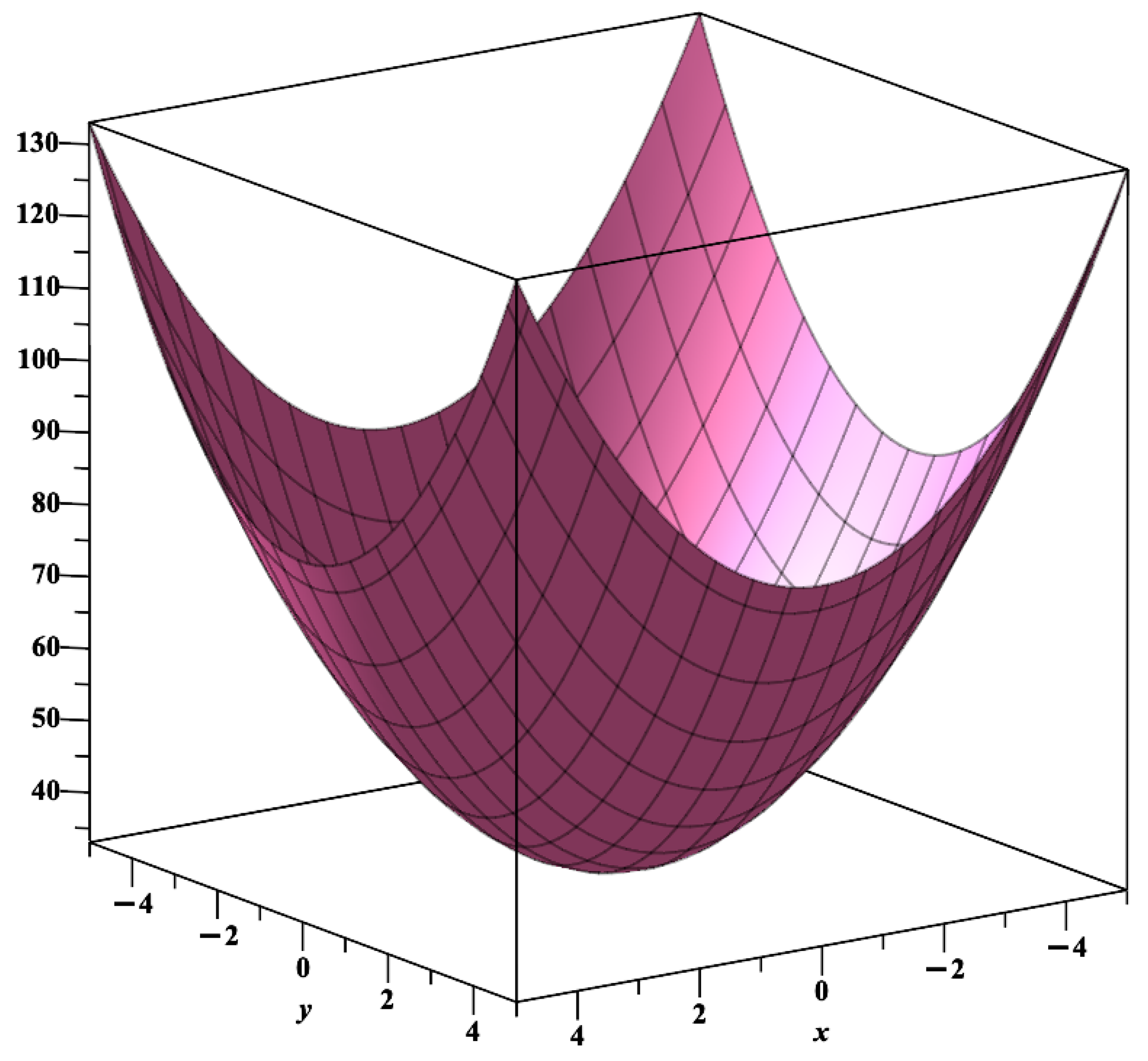
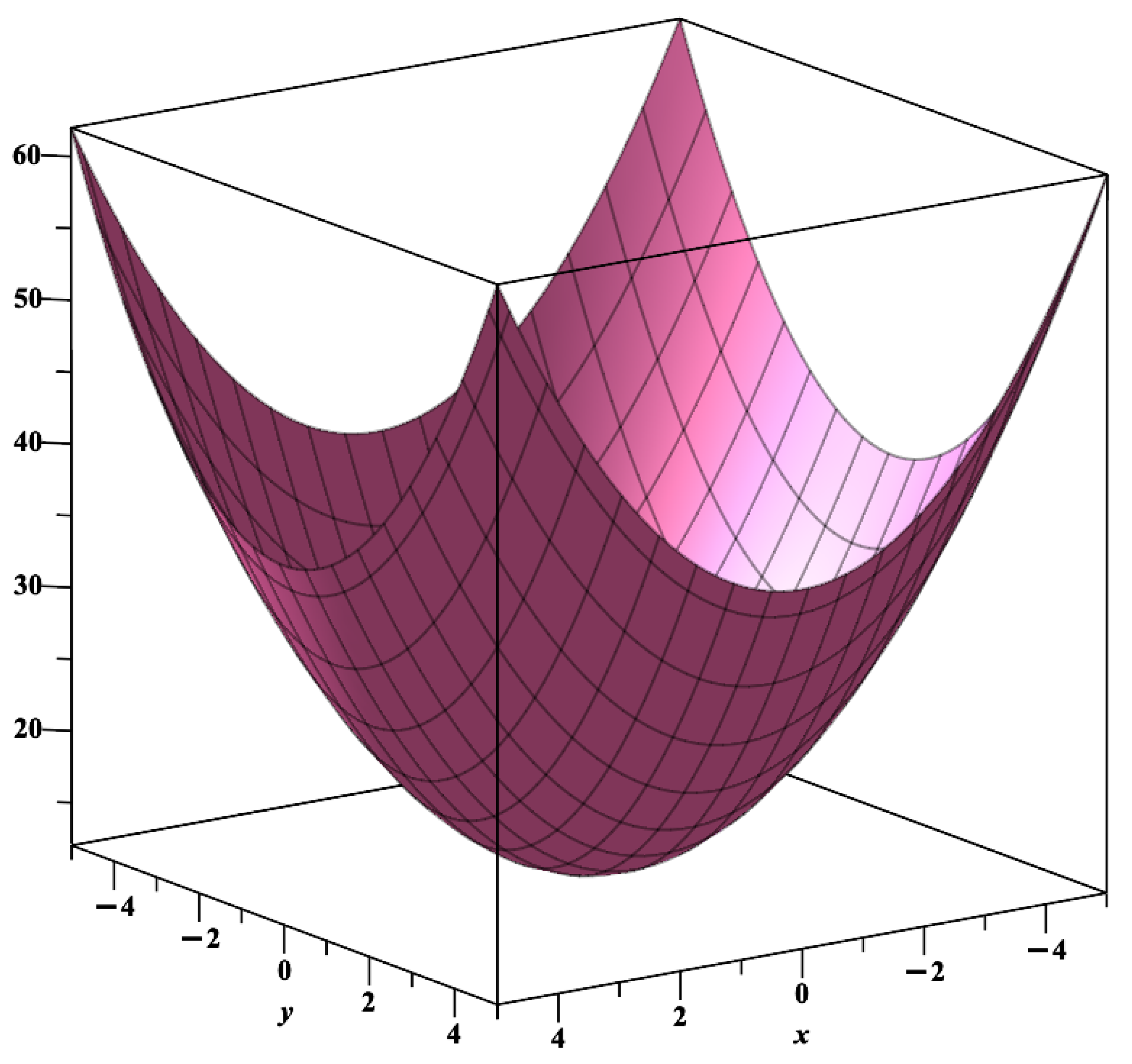
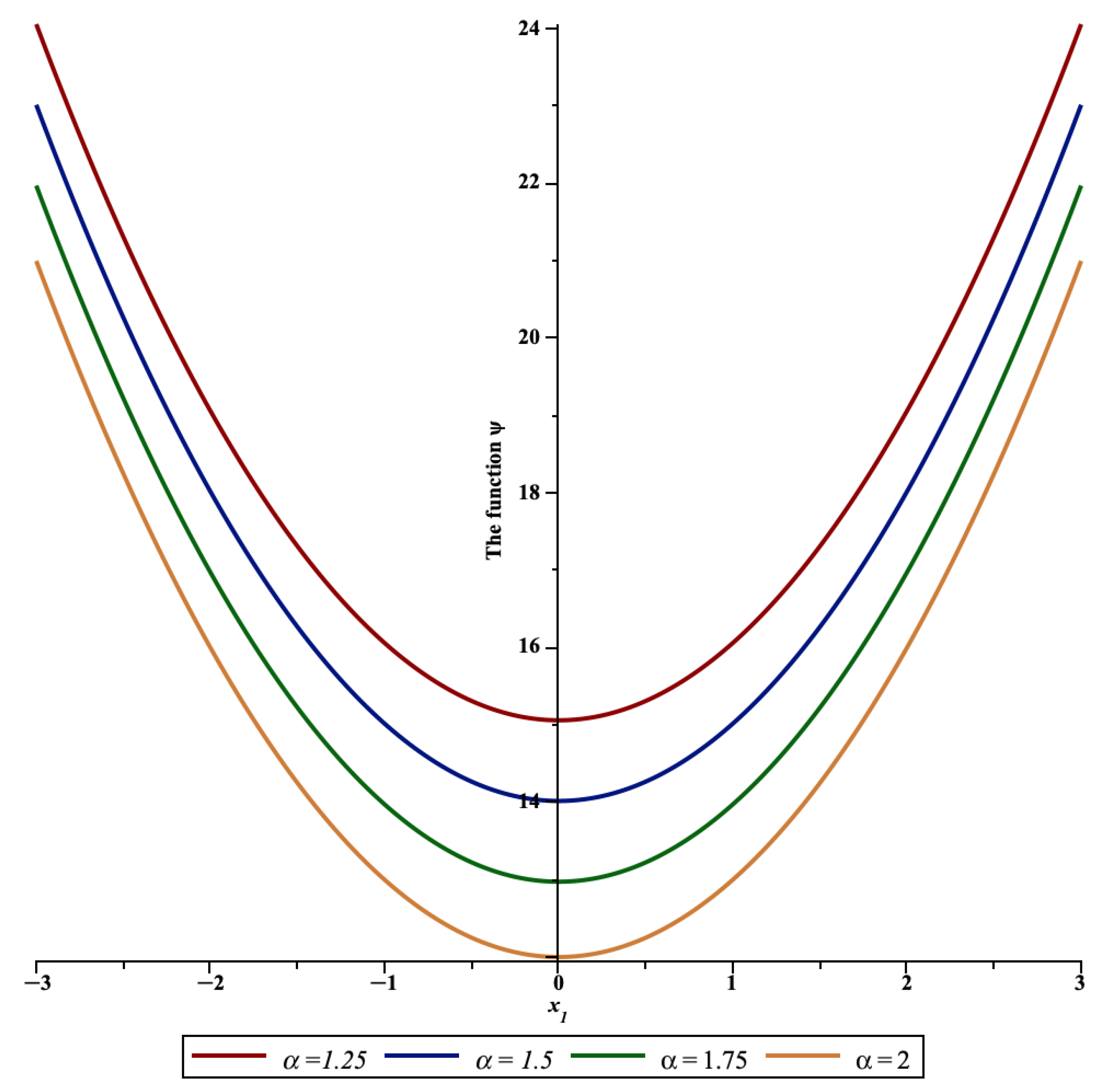
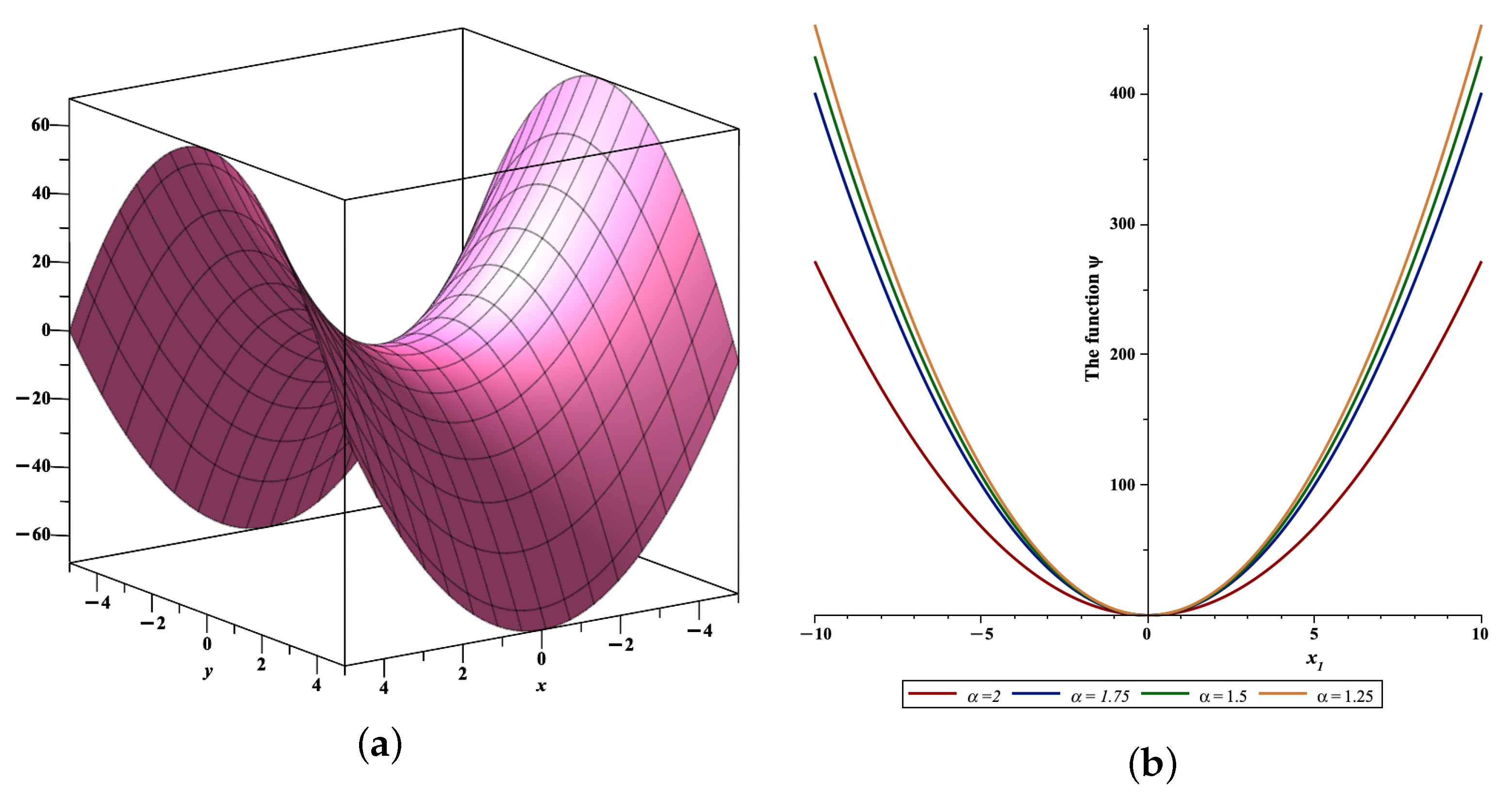
Although the differential equation possesses a singularity, the obtained solution remains regular and well defined. The approximate solutions for the functions ψ x 1 , x 2 , t at t = 1 are shown in Figure 1 and Figure 2 for α = 1.25 and α = 2 , respectively. Furthermore, Figure 3 presents the approximate solutions of the function ψ for various value of α at t = 1 and x 2 = 0 . This figure demonstrates that as α approaches 2, the function ψ at fractional values of α converges to the function ψ at α = 2 .
Example 2.
Consider the 2-D pseudo-hyperbolic equation
D t α ψ = j = 1 2 1 x j x j x j x j ψ + j = 1 2 1 x j 2 x j t x j x j ψ + e t x 1 2 x 2 2 ,
where x j 0 1 < α 2 , and with the conditions
ψ x 1 , x 2 , 0 = x 1 2 x 2 2 ψ t x 1 , x 2 , 0 = x 1 2 x 2 2 .
Then
ψ 0 = g 1 x 1 , ··· , x m + N m v s N m + g 2 x 1 , ··· , x m = ( x 1 2 x 2 2 ) + N 2 v s N 2 + x 1 2 x 2 2 = x 1 2 x 2 2 + x 1 2 x 2 2 N 2 v s N 2 + 1 = ( x 1 2 x 2 2 ) ( t + 1 ) .
Next, computing ψ 1 using Equation (16) and Theorem we get
ψ 1 = N 2 v α s α N 2 + j = 1 2 1 x j x j x j x j ψ 0 + 1 x j 2 x j t x j x j ψ 0 + N m v α s α N m + g ˜ 0 x 1 , ··· , x m , t . = N m v α s α N m + g ˜ 0 x 1 , ··· , x m , t .
Since the function g ( x 1 , x 2 , t ) = ( x 1 2 x 2 2 ) n = 0 t n n ! , the function ψ 1 equals
ψ 1 = N 2 v α s α N 2 + x 1 2 x 2 2 . = x 1 2 x 2 2 N 2 v α s α N 2 + 1 . = x 1 2 x 2 2 t α Γ ( α + 1 ) .
Similarly, ψ 2 and ψ 3 equal
ψ 2 = N 2 v α s α N 2 + j = 1 2 1 x j x j x j x j ψ 1 + 1 x j 2 x j t x j x j ψ 1 + N 2 v α s α N 2 + g ˜ 1 x 1 , ··· , x m , t = N 2 v α s α N 2 + g ˜ 1 x 1 , ··· , x m , t = N 2 v α s α N 2 + x 1 2 x 2 2 t = x 1 2 x 2 2 N 2 v α s α N 2 + t = x 1 2 x 2 2 t α + 1 Γ ( α + 2 )
ψ 3 = N 2 v α s α N 2 + j = 1 2 1 x j x j x j x j ψ 2 + 1 x j 2 x j t x j x j ψ 2 + N 2 v α s α N 2 + g ˜ 2 x 1 , ··· , x 2 , t = N 2 v α s α N 2 + g ˜ 2 x 1 , ··· , x 2 , t = N 2 v α s α N 2 + x 1 2 x 2 2 t 2 2 ! = x 1 2 x 2 2 N 2 v α s α N 2 + t 2 2 ! = x 1 2 x 2 2 t α + 2 Γ ( α + 3 )
Hence, the function ψ is given by
ψ ( x 1 , x 2 , t ) = ψ 0 ( x 1 , x 2 , t ) + ψ 1 ( x 1 , x 2 , t ) + ψ 2 ( x 1 , x 2 , t ) + ··· ψ x 1 , x 2 , t = x 1 2 x 2 2 1 + t + t α Γ ( α + 1 ) + t α + 1 Γ ( α + 2 ) + t α + 2 Γ ( α + 3 ) + ···
and the exact solution at α = 2 is given by
ψ x 1 , x 2 , t = x 1 2 x 2 2 1 + t + t 2 2 ! + t 3 3 ! + t 4 4 ! + ··· = x 1 2 x 2 2 e t .
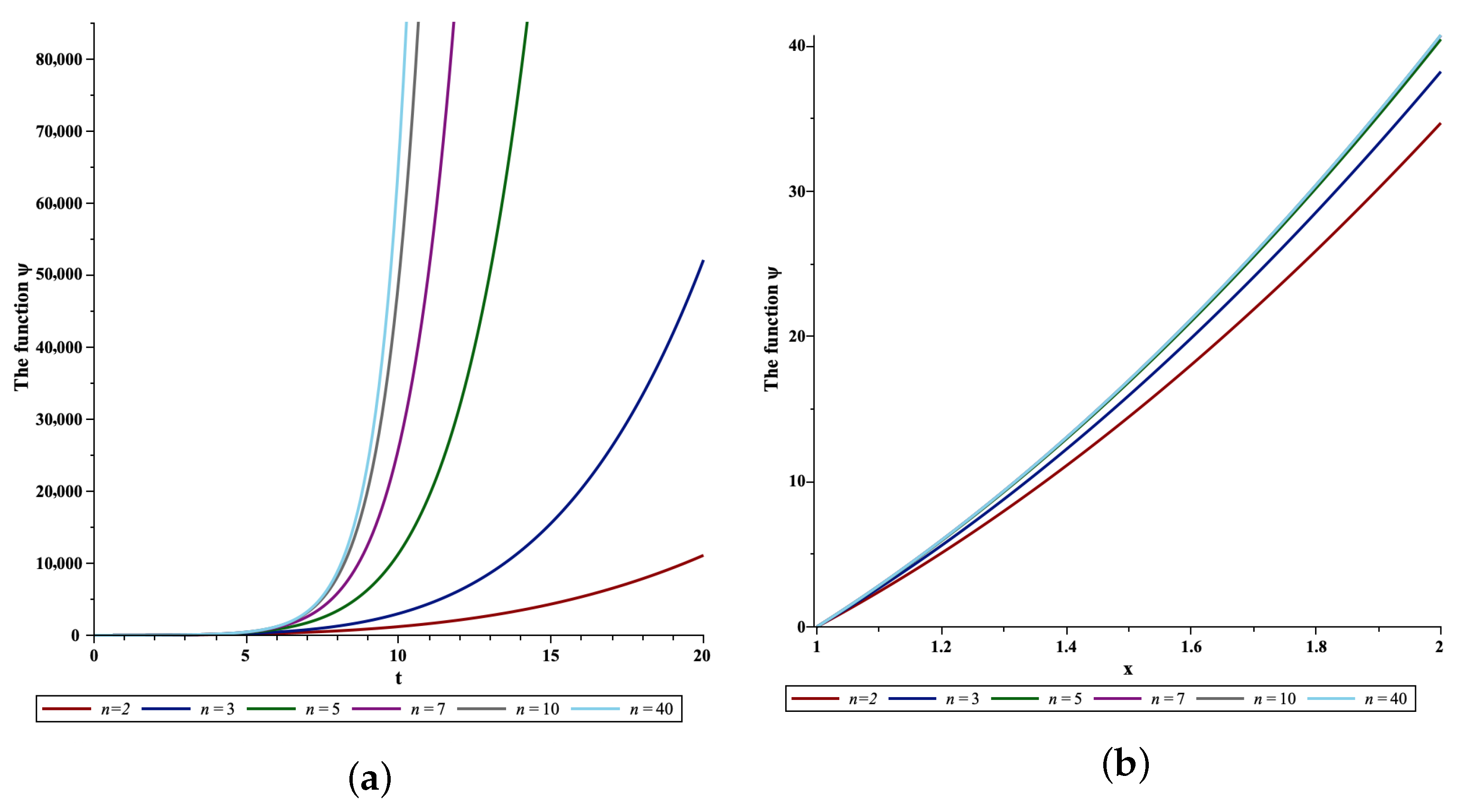
Similarly, even though the differential equation exhibits a singularity, the resulting solution remains regular and well defined. For 1 < α 2 , using the ratio test and the property Γ ( x + 1 ) = x Γ ( x ) , it can be proven that the series in Equation (28) is absolutely convergent. Figure 4a,b depict the convergence of the series representing the function ψ ( x 1 , x 2 , t ) when α = 1.5 and with respect to t at x 1 = 2 , x 2 = 1 and with respect to x at t = 2.5 , x 2 = 1 , respectively, showing rapid convergence to the exact solution after a few terms.
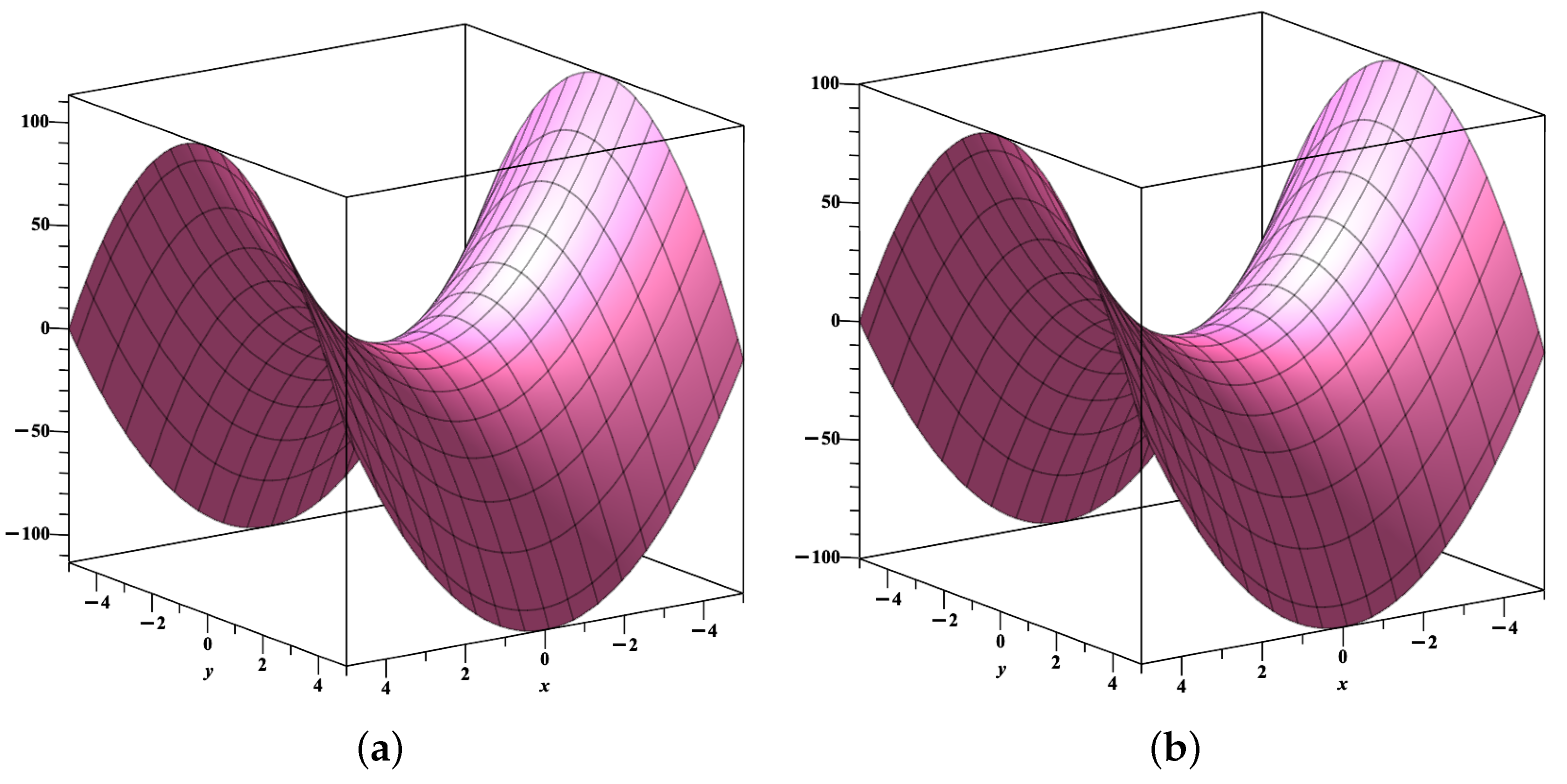
Moreover, Figure 5a displays ψ x 1 , x 2 , t at t = 1 , and α = 2 , while Figure 5b presents the approximate solutions of function ψ for various values of α at t = 1 and x 2 = 0 . This figure illustrates that as α approaches 2, the function ψ at fractional values of α converges to the function ψ at α = 2 . Additionally, Figure 6a,b show the approximate solutions for the function ψ x 1 , x 2 , t at t = 1 for α = 1.25 and α = 1.75 , respectively.
Figure 4. (a) The convergence of the series representing ψ with respect to t at α = 1.5 . (b) The convergence of the series representing ψ with respect to x at α = 1.5 .
Fractalfract 10 00010 g004
Figure 5. (a) The function ψ ( x 1 , x 2 , t ) at t = 1 , α = 2 . (b) The function ψ ( x 1 , x 2 , t ) at t = 1 , x 2 = 0 .
Fractalfract 10 00010 g005
Figure 6. (a) The function ψ ( x 1 , x 2 , t ) at t = 1 , α = 1.25 . (b) The function ψ ( x 1 , x 2 , t ) at t = 1 , α = 1.75 .
Fractalfract 10 00010 g006

5. Conclusions

This study introduces the multi-dimensional Natural transform and explores some of its key properties. By combining this method with the Adomian decomposition method, we obtain approximate and series solutions for the singular m-dimensional fractional pseudo-hyperbolic equation. Two examples demonstrate that this approach provides a series solution that converges quickly to an exact or approximate solution with only a few computational steps. This method presents a numerical approach for solving multi-dimensional fractional differential equations and demonstrates significant potential for application to a wide range of real-world problems. Future research could explore the stability and error analysis of this method and extend its applicability to the initial boundary value problem of the pseudo-hyperbolic equation and other, more complex problems. Additionally, the MNA method may be further developed by applying it to other fractional multi-dimensional partial differential equations, which could contribute to addressing real-world challenges modeled by these equations.

Funding

This research received no external funding.

Data Availability Statement

Data is contained within the article.

Acknowledgments

The author would like to extend her sincere appreciation to Ongoing Research Funding Program (ORF-2025-472), King Saud University, Riyadh, Saudi Arabia.

Conflicts of Interest

The authors declare no conflicts of interest.

References

  1. Liao, S.J. Beyond Perturbation: Introduction to the Homotopy Analysis Method; CRC Press: Boca Raton, FL, USA, 2003. [Google Scholar]
  2. Mirzaee, F.; Samadyar, N. On the numerical solution of stochastic quadratic integral equations via operational matrix method. Math. Methods Appl. Sci. 2018, 41, 4465–4479. [Google Scholar] [CrossRef]
  3. Li, X.Y.; Wu, B.Y. Iterative reproducing kernel method for nonlinear variable-order space fractional diffusion equations. Int. J. Comput. Math. 2018, 95, 1210–1221. [Google Scholar] [CrossRef]
  4. Thabet, H.; Kendre, S.D.; Peters, J.F. Travelling wave solutions for fractional Korteweg-de Vries equations via an approximate-analytical method. AIMS Math. 2019, 4, 1203. [Google Scholar] [CrossRef]
  5. Abdeljawad, T. On conformable fractional calculus. J. Comput. Appl. Math. 2015, 279, 57–66. [Google Scholar] [CrossRef]
  6. Shah, R.; Khan, H.; Baleanu, D. Fractional Whitham-Broer-Kaup equations within modified analytical approaches. Axioms 2019, 8, 125. [Google Scholar] [CrossRef]
  7. Duan, J.S.; Rach, R. A new modification of the Adomian decomposition method for solving boundary value problems for higher order nonlinear differential equations. Appl. Math. Comput. 2011, 218, 4090–4118. [Google Scholar] [CrossRef]
  8. Aljahdaly, N.H. New application through multistage differential transform method. AIP Conf. Proc. 2020, 2293, 420025. [Google Scholar] [CrossRef]
  9. Wu, G.C.; Baleanu, D. Variational iteration method for fractional calculus-a universal approach by Laplace transform. Adv. Differ. Equ. 2013, 2013, 18. [Google Scholar] [CrossRef]
  10. Bayrak, M.A.; Demir, A. A new approach for space-time fractional partial differential equations by residual power series method. Appl. Math. Comput. 2018, 336, 215–230. [Google Scholar] [CrossRef]
  11. Elbeleze, A.; Kılıçman, A.; Taib, B.M. Note on the Convergence Analysis of Homotopy Perturbation Method for Fractional Partial Differential Equations. Abstr. Appl. Anal. 2014, 2014, 803902. [Google Scholar] [CrossRef]
  12. Prakash, A.; Goyal, M.; Gupta, S. q-homotopy analysis method for fractional Bloch model arising in nuclear magnetic resonance via the Laplace transform. Indian J. Phys. 2020, 94, 507–520. [Google Scholar] [CrossRef]
  13. Sarra, S.A.; Kansa, E.J. Multiquadric radial basis function approximation methods for the numerical solution of partial differential equations. Adv. Comput. Mech. 2009, 2, 220. [Google Scholar]
  14. Sohail, A.; Maqbool, K.; Ellahi, R. Stability analysis for fractional-order partial differential equations by means of space spectral time Adams Bashforth Moulton method. Numer. Methods Partial. Differ. Equ. 2018, 34, 19–29. [Google Scholar] [CrossRef]
  15. Yan, S.P.; Zhong, W.P.; Yang, X.J. A novel series method for fractional diffusion equation within Caputo fractional derivative. Therm. Sci. 2016, 20, 695–699. [Google Scholar] [CrossRef]
  16. Shiri, B.; Baleanu, D. All linear fractional derivatives with power functions convolution kernel and interpolation properties. Chaos Soliton Fract. 2023, 170, 113399. [Google Scholar] [CrossRef]
  17. Anderson, D.R.; Ulness, D.J. Newly Defined Conformable Derivatives. Adv. Dyn. Syst. Appl. 2015, 10, 109–137. [Google Scholar]
  18. Baleanu, D.; Fernandez, A. On fractional operators and their classifications. Mathematics 2019, 7, 830. [Google Scholar] [CrossRef]
  19. Baleanu, D.; Fernandez, A.; Akgül, A. On a Fractional Operator Combining Proportional and Classical Differintegrals. Mathematics 2020, 8, 360. [Google Scholar] [CrossRef]
  20. Barakat, M.A.; Almoneef, A.A.; Hyder, A.A.; Aboelenen, T. Exploring climate- induced oxygen–plankton dynamics through proportional–Caputo fractional modeling. Mathematics 2025, 13, 980. [Google Scholar] [CrossRef]
  21. Barakat, M.A.; Saadeh, R.; Hyder, A.A.; Qazza, A.; Aly, A.M. A novel fractional model combined with numerical simulation to examine the impact of lockdown on COVID-19 spread. Fractal Fract. 2024, 8, 702. [Google Scholar] [CrossRef]
  22. Xu, C.; Farman, M.; Liu, Z.; Pang, Y. Numerical approximation and analysis of epidemic model with constant proportional Caputo operator. Fractals 2024, 32, 2440014. [Google Scholar] [CrossRef]
  23. Shiri, B. A note on using the Differential Transformation Method for the Integro-Differential Equations. Appl. Math. Comput. 2013, 219, 7306–7309. [Google Scholar] [CrossRef]
  24. Khan, Z.H.; Khan, W.A. N-Transform Properties and Applications. NUST J. Eng. Sci. 2008, 1, 127–133. [Google Scholar]
  25. Srivastava, H.M.; Luo, M.; Raina, R.K. A new integral transform and its applications. Acta Math. Sci. 2015, 35B, 1386–1400. [Google Scholar] [CrossRef]
  26. Belgacem, F.B.M.; Silambarasan, R. Theory of Natural Transform. Math. Eng. Sci. Aerosp. (MESA) J. 2012, 3, 99–124. [Google Scholar]
  27. Rawashdeh, M.S.; Al-Jammal, H. Theories and Applications of the Inverse Fractional Natural Transform Method. Adv. Differ. Equ. 2018, 2018, 222. [Google Scholar] [CrossRef]
  28. Belgacem, F.B.M.; Silambarasan, R. Advances in the Natural Transform. AIP Conf. Proc. 2012, 1493, 106. [Google Scholar] [CrossRef]
  29. Eltayeb, H. Application of Double Natural Decomposition Method for Solving Singular One Dimensional Boussinesq Equation. Filomat 2018, 32, 4389–4401. [Google Scholar] [CrossRef]
  30. Rawashdeh, M.; Maitama, S. Finding exact solutions of nonlinear PDEs using the natural decomposition method. Math. Methods Appl. Sci. 2017, 40, 223–236. [Google Scholar] [CrossRef]
  31. Eltayeb, H.; Abdalla, Y.T.; Bachar, I.; Khabir, M.H. Fractional telegraph equation and its solution by natural transform decomposition method. Symmetry 2019, 11, 334. [Google Scholar] [CrossRef]
  32. Rawashdeh, M.S.; Maitama, S. Solving coupled system of nonlinear PDE’s using the natural decomposition method. Int. J. Pure Appl. Math. 2014, 92, 757–776. [Google Scholar] [CrossRef]
  33. Cherif, M.H.; Ziane, D.; Belghaba, K. Fractional natural decomposition method for solving fractional system of nonlinear equations of unsteady flow of a polytropic gas. Nonlinear Stud. 2018, 25, 753–764. [Google Scholar]
  34. Elbadri, M.; Ahmed, S.A.; Abdalla, Y.T.; Hdidi, W. A New Solution of Time-Fractional Coupled KdV Equation by Using Natural Decomposition Method. Abstr. Appl. Anal. 2020, 2020, 3950816. [Google Scholar] [CrossRef]
  35. Khan, H.; Shah, R.; Kumam, P.; Arif, M. Analytical Solutions of Fractional-Order Heat and Wave Equations by the Natural Transform Decomposition Method. Entropy 2019, 21, 597. [Google Scholar] [CrossRef] [PubMed]
  36. Elbadri, M. The Natural Transform Decomposition Method for Solving Fractional Klein-Gordon Equation. Appl. Math. 2023, 14, 230–243. [Google Scholar] [CrossRef]
  37. Fedotov, I.; Marais, J.; Shatalov, M.; Tenkam, H.M. Hyperbolic models arising in the theory of longitudinal vibration of elastic bars. Aust. J. Math. Anal. Appl. 2011, 7, 14. [Google Scholar]
  38. Fedotov, I.; Shatalov, M.; Marais, J. Hyperbolic and pseudo-hyperbolic equations in the theory of vibration. Acta Mech. 2016, 227, 3315–3324. [Google Scholar] [CrossRef]
  39. Korpusov, M.O.; Sveshnikov, A.G. Three-dimensional nonlinar evolution equations of pseudo-parabolic type in problems of mathematicial physics. Comput. Math. Math. Phys. 2004, 44, 2041–2048. [Google Scholar]
  40. Zhao, Z.; Li, H. A continuous Galerkin method for pseudo-hyperbolic equations with variable coefficients. J. Math. Anal. Appl. 2019, 473, 1053–1072. [Google Scholar] [CrossRef]
  41. Mesloub, S.; Aboelrish, M.R.; Obaidat, S. Well posedness and numerical solution for a non-local pseudohyperbolic initial boundary value problem. Int. J. Comput. Math. 2019, 96, 2533–2547. [Google Scholar] [CrossRef]
  42. Guo, H.; Rui, H. Least-squares Galerkin procedures for pseudohyperbolic equations. Appl. Math. Comput. 2007, 189, 425–439. [Google Scholar] [CrossRef]
  43. Liu, Y.; Li, H.; Wang, J.; He, S. Splitting positive definite mixed element methods for pseudo-hyperbolic equations. Num. Methods Partial. Diff. Equat. 2012, 28, 670–688. [Google Scholar] [CrossRef]
  44. Modanli, M.; Abdulazeez, S.T.; Husien, A.M. A residual power series method for solving pseudo hyperbolic partial differential equations with nonlocal conditions. Num. Methods Part. Differ. Equ. 2021, 37, 2235–2243. [Google Scholar] [CrossRef]
  45. Osman, W.M.; Elzaki, T.M.; Siddig, N.A.A. Modified Double Conformable Laplace Transform and Singular Fractional Pseudo-Hyperbolic and Pseudo-Parabolic Equations. J. King Saud Univ. 2021, 33, 101378. [Google Scholar] [CrossRef]
  46. Eltayeb, H.; Kılıçman, A.; Bachar, I. On the Application of Multi-Dimensional Laplace Decomposition Method for Solving Singular Fractional Pseudo-Hyperbolic Equations. Fractal Fract. 2022, 6, 690. [Google Scholar] [CrossRef]
  47. Qing, L.; Li, X. Meshless analysis of fractional diffusion-wave equations by generalized finite difference method. Appl. Math. Lett. 2024, 157, 109–204. [Google Scholar] [CrossRef]
  48. Qing, L.; Li, X. Analysis of a meshless generalized finite difference method for the time-fractional diffusion-wave equation. Comput. Math. Appl. 2024, 172, 134–151. [Google Scholar] [CrossRef]
  49. Serikbaev, D.; Tokmagambetov, N. Determination of Initial Data in the Time-Fractional Pseudo-Hyperbolic Equation. Symmetry 2024, 16, 1332. [Google Scholar] [CrossRef]
Figure 1. The function ψ ( x 1 , x 2 , t ) at t = 1 , α = 1.25 .
Fractalfract 10 00010 g001
Figure 2. The function ψ ( x 1 , x 2 , t ) at t = 1 , α = 2 .
Fractalfract 10 00010 g002
Figure 3. The function ψ ( x 1 , x 2 , t ) at t = 1 , x 2 = 0 .
Fractalfract 10 00010 g003
Disclaimer/Publisher’s Note: The statements, opinions and data contained in all publications are solely those of the individual author(s) and contributor(s) and not of MDPI and/or the editor(s). MDPI and/or the editor(s) disclaim responsibility for any injury to people or property resulting from any ideas, methods, instructions or products referred to in the content.