Article

Surface Heat Island and Its Link to Urban Morphology: Multitemporal Analysis with Landsat Images in an Andean City in Peru


by
José De-La-Cruz
1,
Walter Solano-Reynoso
2,
Wilmer Moncada
2,*,
Renato Soca-Flores
2,
Carlos Carrasco-Badajoz
3,
Carolina Rayme-Chalco
3,
Hemerson Lizarbe-Alarcón
1,
Edward León-Palacios
1,
Diego Tenorio-Huarancca
1 and
Jorge Lozano
4
1
Faculty of Mining, Geological and Civil Engineering, Universidad Nacional de San Cristóbal de Huamanga, Ayacucho 05000, Peru
2
Laboratorio de Teledetección y Energías Renovables (LABTELER), Universidad Nacional de San Cristóbal de Huamanga, Ayacucho 05000, Peru
3
Laboratorio de Biodiversidad y Sistema de Información Geográfica (BioSIG), Universidad Nacional de San Cristóbal de Huamanga, Ayacucho 05000, Peru
4
Faculty of Engineering and Management, Universidad Autónoma de Huanta, Ayacucho 05121, Peru
*
Author to whom correspondence should be addressed.
Urban Sci. 2025, 9(12), 507; https://doi.org/10.3390/urbansci9120507
Submission received: 31 October 2025 / Revised: 22 November 2025 / Accepted: 24 November 2025 / Published: 29 November 2025

Abstract

The urban heat island (UHI) effect in Andean cities is a critical yet understudied phenomenon, where complex topography and rapid urbanization uniquely alter local climates. This research analyzes the spatiotemporal evolution of the surface UHI and its linkage to urban morphology in Ayacucho, Peru, through a 40-year multi-temporal analysis (1986–2016) using Landsat images. We developed a synthetic Urban Heat Island Index (UHII) through Principal Component Analysis (PCA), integrating land surface temperature (LST), spectral indices, and urban morphological parameters. Our results identify a critical transition in 2006, with the emergence of persistent heat spots driven by unplanned expansion. The surface UHI intensity reached urban-rural differences of 4.31 °C (day) and 5.82 °C (night), showing a positive trend. Urban morphology was a key determinant, with high-density blocks exhibiting a minimum nocturnal LST 3.53 °C higher than low-density areas. Statistical trend tests confirmed a significant intensification, while a strong negative correlation with vegetation indices (R2 = 0.97) underscored the vital mitigation role of green infrastructure. This study provides academics with a robust methodological framework for UHI analysis in complex terrains. For public and private urban managers, it offers spatially explicit evidence to prioritize actionable strategies, such as integrating green infrastructure and regulating urban form, to enhance climate resilience in Andean cities.

1. Introduction

The urban heat island (UHI) is a common climatic disturbance in densely populated cities, characterized by elevated land surface temperature (LST) and air temperature compared to their outskirts [1] and the microclimate of rural areas [2]. In general, the most important parameters determining the magnitude of UHI effects are reduced evaporation in the city, increased roughness, the thermal properties of building materials and pavement, and wind speed [3].
Furthermore, UHIs are a direct consequence of the rapid and often disorderly growth of cities driven by migration and demographic pressure, replacing natural surfaces with impermeable materials, altering energy balances and local heat flows. This not only raises temperatures, but also increases energy consumption for ventilation, exacerbates climate risks, and affects public health with diseases related to climatic and environmental factors [4]. In addition, the thermal comfort of the population alters energy flow and generates UHI strongly influenced by the geometry of urban canyons, defined by the relationship between the height of buildings and the width of the street (aspect ratio), which is key to understanding its relationship with population density and thermal differences [5,6]. For this reason, understanding the dynamics of UHI is crucial for sustainable urban planning and climate change adaptation.
It is essential to mention the existence of other variables involved, such as urban form, Sky View Factor (SVF), and Impervious Surface Fraction (ISF). The relationship between building height and UHI is complex and non-linear. While tall buildings can provide shading that reduces LST during the day, they can also trap radiated heat and restrict ventilation, exacerbating nighttime UHI [7]. The SVF is a critical determinant of UHI intensity. A low SVF (greater sky obstruction) is generally associated with an intensification of the UHI, particularly at night, as it limits heat loss by longwave radiation to the atmosphere [8].
For their part, building density and configuration significantly affect LST, where compact Local Climate Zones (LCZ) with high building density have high LST values compared to open LCZs (Xi’an, China). In order to control the effects of the UHI, [9] suggests organizing the distribution of buildings in specific shapes, such as “L” or “I” in compact areas. This improves the urban climate, which is essential for promoting a healthy environment and preventing the effects of unplanned urban growth, generating climate changes at the local level that impact the immediate environment [10].
On the other hand, one of the most important factors in reducing LST in urban areas is increasing vegetation or vegetation cover as a strategy to improve urban climate resilience and mitigate UHI. In this regard, it is necessary to evaluate Vegetation Cover Fraction (VCF) on a consecutive basis [9]. Another method of significantly reducing LST was the replacement of asphalt with cooler paving materials, such as concrete, reducing LST by up to 8 °C, as proposed by [11], demonstrating the impact of surface cover on UHI.
Scientific literature has consistently shown that the composition and configuration of the urban landscape are the main factors that modulate the energy balance at the surface [12]. Thus, areas with high ISF and average building height show a high level of UHI, especially during heat waves [13]. However, three main factors have been identified that contribute to the UHI: anthropogenic heat (human activities), impervious surfaces (roads, sidewalks, and buildings), and urban geometry [14]. It is also claimed that low-albedo materials contribute to UHI by increasing heat absorption, along with other urban characteristics, such as density and building design, which together shape the city’s thermal microclimate [15]. Another assertion is that urban geometric factors (aspect ratio of urban canyons and VCF) exert a more intense thermal influence in summer (daytime) due to the increase in solar radiation incident on vertical and horizontal surfaces; and at night, a slow release of heat stored in building materials [16].
Andean cities, such as Ayacucho, Peru, have higher solar radiation, complex topography, valley and mountain winds, and favorable microclimates due to the presence of wetlands (bofedales), such as those located in the Apacheta micro-basin, where the effects of climate change have raised the LST by 4.9 °C, with higher trends (5.8 °C) in snowy areas [17]. Rapid and informal urbanization and the combined effects on UHI dynamics are poorly understood in Andean urban cities, especially in static or short-term analyses [18], making it difficult to understand the emergence and long-term evolution of the UHI phenomenon and preventing the identification of inflection points in morphological changes that generate significant local climate impacts [19]. This knowledge gap suggests the need to use satellite imagery (visible, near-infrared, and thermal), especially in regions where the scarcity of weather stations limits conventional in situ monitoring [20]. By combining these data with urban parameters and spectral indices, a better understanding of the UHI and its link to climate change can be achieved, generating useful knowledge for Andean cities with rapid and disorderly urban growth [21,22,23].
Satellite remote sensing techniques have become established as the main tool for monitoring the UHI, allowing analysis of the intrinsic relationship between its intensity and urban morphology [24]. Therefore, it is necessary to supplement this information with data on the composition and configuration of the urban landscape, such as building density, proportion of impervious surfaces, vegetation abundance, and urban canyon geometry, which are the main factors that modulate the energy balance of the soil [12]. Although it is recognized that the UHI is a direct result of urban planning and design decisions, the scientific literature presents a geographical bias, with an overwhelming concentration of studies in large metropolises at mid-latitudes and low altitudes, and few studies for Andean cities, especially in cities with high mountain environments, such as the Andes Mountain range in Peru [25].
To operationalize UHI analysis using remote sensing, specific land cover indicators must be calculated. Indices such as SAVI [26] are suitable for areas with sparse vegetation, MNDWI [27] quantifies soil moisture and vegetation, while indices such as EBBI [28] and NDBuI [29] allow for effective mapping of built-up areas and bare soil in heterogeneous urban environments. The integration of these indices with LST and morphological parameters such as SVF allows for a comprehensive characterization of the UHI phenomenon.
Therefore, the objective of the research was to analyze the spatial-temporal evolution of the UHI and its link to urban morphology in an Andean city in Ayacucho, Peru, using satellite images to extract information from spectral indicators such as the Soil Adjusted Vegetation Index (SAVI), Modified Normalized Difference Water Content Index (MNDWI), Normalized Difference Vegetation Index (NDVI), Leaf Water Content Index (LWCI), and the calculation of LST with thermal bands [30]. Altitude, slope, and aspect of the relief are extracted from the Digital Elevation Model (DEM). Meteorological information such as wind speed, relative humidity, atmospheric water vapor pressure, and surface albedo is also required [31,32]. This objective is addressed by answering the following scientific questions (SQ):
SQ1: What has been the spatiotemporal evolution of the intensity and extent of surface UHIs in the city of Ayacucho during the period 1986–2016?
SQ2: How does urban morphology (building density, vegetation) relate to the spatial patterns of LST and UHI?
In addition, urban parameters such as the SVF, Urbanization Index (UI), Normalized Difference Built-up Area Index (NDBuI), Enhanced Building and Bare Area Index (EBBI), Bare Land Index (BI), and Normalized Difference Bare Land Index (NDBaI). The application of Principal Component Analysis (PCA) allows the creation of an Urban Heat Island Index (UHII), which quantifies and maps the spatial and temporal evolution of the UHI, correlating its intensity with urban expansion and specific morphological typologies validated with field data [33,34].
This research provides crucial evidence for decision-makers to design effective mitigation strategies, such as green infrastructure and adapted building codes, promoting resilient and sustainable urban development. This contribution is expected to provide long-term empirical evidence on the genesis and consolidation of the UHI in an Andean city, opening up new scientific research challenges with direct implications for urban planning and climate change adaptation in different Andean cities with similar characteristics [35].
Unplanned urban expansion in the city of Ayacucho has generated a defined spatial pattern of UHIs, where urban morphology (high density, low SVF) is the determining factor in the intensification of the effect, surpassing the influence of topography in this high-altitude context.

2. Materials and Methods

2.1. Study Area

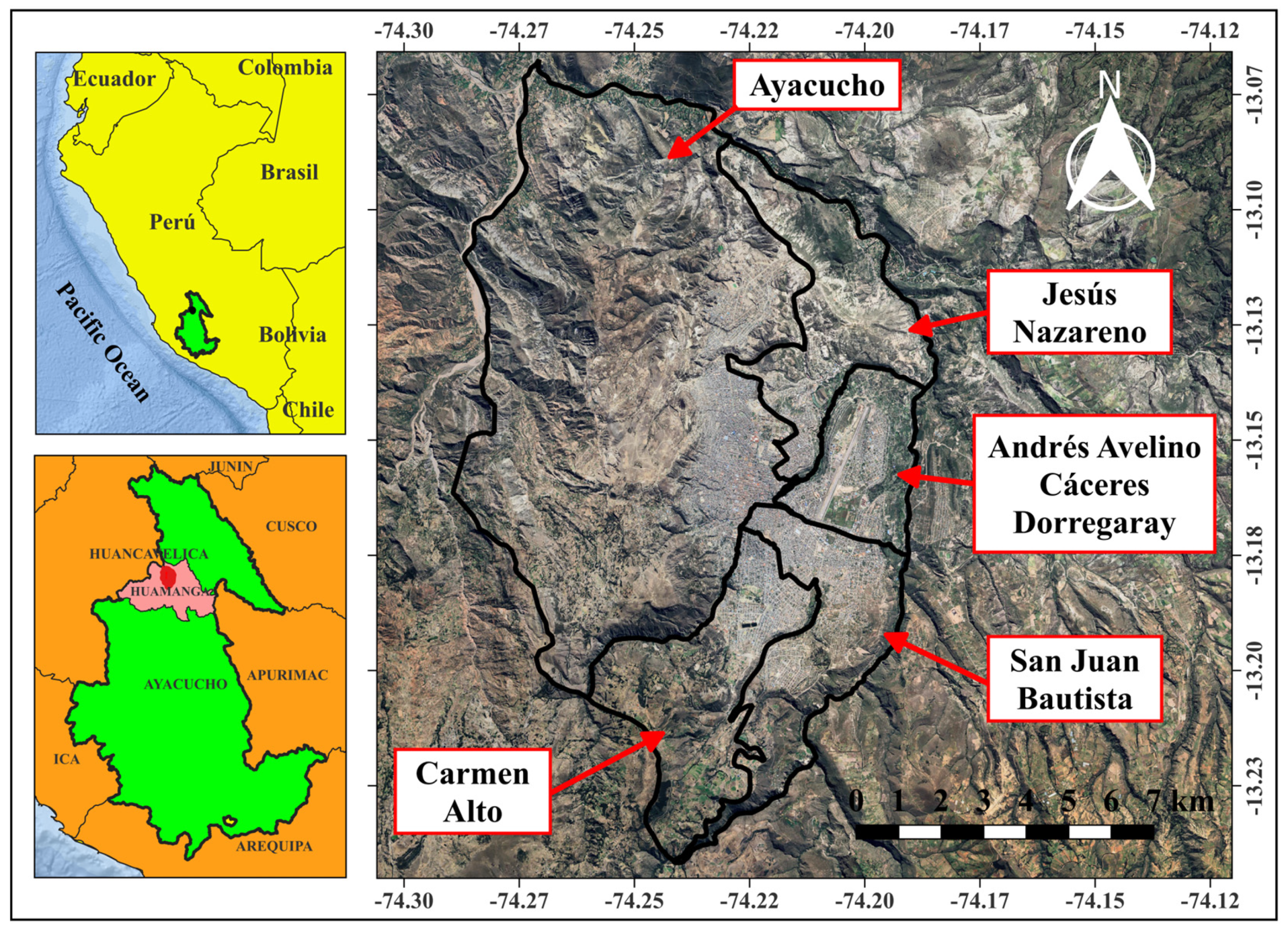
The city of Ayacucho (Figure 1) is located in the province of Huamanga, Ayacucho Region, on the eastern slope of the Andes Mountain range, in south-central Peru, at an average altitude of 2774 ma.s.l. Latitude South: 13°08′51′′ and Longitude West: 74°13′06′′. It is bordered to the northwest by the province of Angaraes, in the region of Huancavelica; to the north by the province of Huanta; to the northeast by the province of La Mar; to the east by the province of Chincheros, in the department of Apurímac; to the south by the provinces of Vilcashuamán and Cangallo; to the southwest by the province of Cangallo and the province of Huaytará, in the region of Huancavelica.
The urban Andean city of Ayacucho consists of the districts of Ayacucho (83.11 km2), Carmen Alto (17.52 km2), San Juan Bautista (15.19 km2), Jesús Nazareno (16.12 km2), and Andrés Avelino Cáceres Dorregaray (9.28 km2).
Of the entire population in the Ayacucho region, 26% is concentrated in the city of Ayacucho, according to figures projected by the National Institute of Statistics and Informatics (INEI, Peru) for 2014, which represents 73% of the provincial population of Huamanga. Currently, the urban center has approximately 200,296 inhabitants within an area of 141.22 km2, with a population density of 1776.2 inhabitants/km2. This city, like others in Latin America, has experienced unplanned radial growth toward the peripheries, with significant changes in its environmental and climatic configuration, which has caused various social, economic, and environmental problems [36].
Its climate is characterized as local steppe, classified as BSk-Cold Steppe according to the Köppen classification. The average annual temperature is 15.4 °C, average annual precipitation is 575 mm, average temperature is 17.5 °C, and average relative humidity is 56% [37]. It occupies a region with marked seasonal climate, dry air conditions, and clear skies during the winter, which favors nocturnal radiative cooling and the occurrence of frost in rural and peri-urban areas [38]. Likewise, summer rains are used for agriculture, in addition to being stored in the Cuchoquesera dam located at 3730 ma.s.l and at an ambient temperature of 10 °C, which supplies water to the population of the city of Ayacucho, 18 million cubic meters (MCM), with a reservoir capacity of 80 MCM and an average inflow of 10 m/s3 [39].
Its soil is rocky, of sedimentary and volcanic origin, ranging in age from the Upper Tertiary to the Recent Quaternary. The lithological units are volcanic tuffs, tuffaceous sandstones, lavas and pyroclastics, diatomites, Tertiary-Quaternary pyroclastics, Pleistocene deposits, and recent deposits of colluvial, alluvial, and fluvial origin [40].

2.2. Acquisition of Satellite and in Situ Data

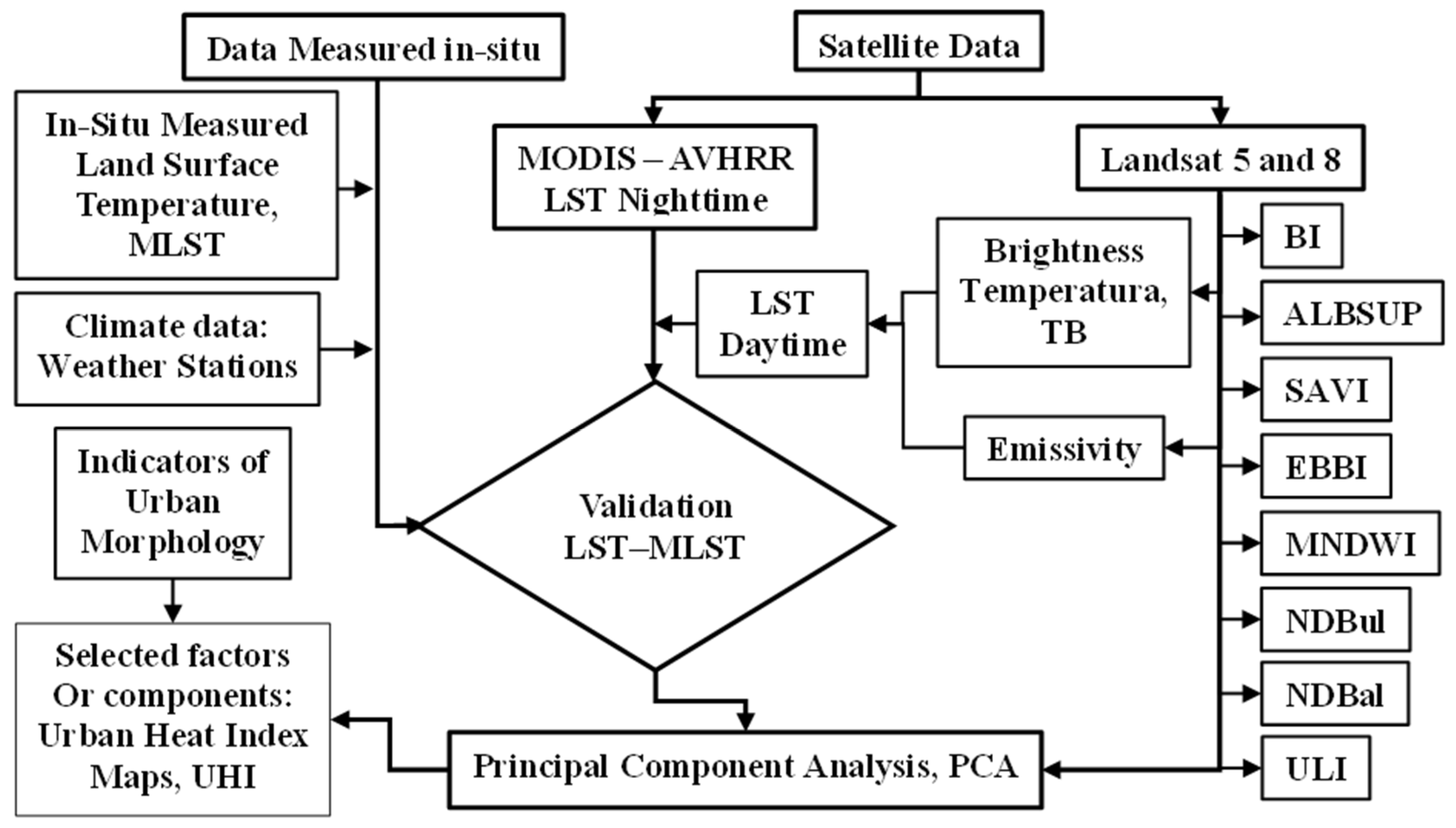
The morphological and climatic conditions make the Andean city of Ayacucho a representative case for analyzing the Urban Heat Island (UHI) phenomenon, which allowed for the evaluation of the spatiotemporal evolution of the UHI through the use of multitemporal images from Landsat 5 TM and 8 OLI/TIRS sensors. On average, three cloud-free images per year were acquired for each sensor during the dry season (May-August) for the years 1986, 1996, 2006, and 2016. The selection of images ensures interannual comparability by minimizing seasonal and interannual variability in plant phenology and soil moisture. Figure 2 shows the methodological scheme describing the procedure from satellite data acquisition, processing and calculation of spectral indices and urban parameters, estimation of LST and in situ measurements, to the generation of daytime and nighttime Urban Heat Island Index (UHII) maps.
Landsat images in L1TP processing level format were obtained from the USGS (United States Geological Survey, http://glovis.usgs.gov/ (accessed on 7 October 2024)) satellite data platform, which ensures accurate radiometric and atmospheric correction. In addition, LST products derived from MODIS (MOD11A1) and AVHRR were used, which allow for the evaluation of daytime and nighttime thermal dynamics with higher temporal resolution [41]. The satellite data were supplemented with in situ LST measurements at representative points of urban and peri-urban coverage, recorded with portable infrared thermometers, and with meteorological information on maximum and minimum air temperature, relative humidity, wind speed, and atmospheric pressure from 21 local weather stations [14]. These measurements were used to validate the LST and UHII estimation algorithms [42].
The validation points for LST were selected to represent the predominant land cover types (asphalt, concrete, green areas, bare soil) and were distributed in a stratified manner along an urban-peri-urban-rural gradient. On-site measurements of air temperature and relative humidity were taken using the HOBO U23 Pro v2 sensor (Onset, Bourne, MA, USA), with an accuracy of ±0.2 °C. Land surface temperature (LST) was measured using a Fluke 62 Max portable infrared thermometer, with an accuracy of ±1.5 °C.

2.3. Spectral Indices (SI), Land Surface Temperature (LST) and Urban Parameters (UP)

The Landsat images underwent radiometric and atmospheric corrections, converting the digital number (DN) values to spectral radiance and subsequently to ground surface reflectance for the subsequent calculation of spectral indices linked to land cover and land use [43]. Table 1 shows the SI, LST and UP selected for the PCA model.

2.4. Urban Heat Island Index (UHII)

This was carried out by applying Principal Component Analysis (PCA), a statistical technique widely used in remote sensing to reduce the dimensionality of correlated multivariate data, while maintaining most of the explanatory variance of the original set. This procedure made it possible to transform the spectral indices (BI, NDVI, SAVI, MNDWI, ALBSUP, LST) and urban parameters (EBBI, NDBuI, NDBaI, ULI) into a set of uncorrelated components that synthesize the essential information of the urban system. The analysis was implemented in TerrSet software (v20.04), considering the covariance matrix as the data was non-standardized, and under a Forward T-Mode scheme. Component retention was performed following the criterion of eigenvalues greater than unity, so that each selected component absorbed a significant percentage of the explained variance of the initial set, ensuring the statistical consistency of the model [55].
The selected components are interpreted according to their factor loadings and ordered according to cumulative variance. In this way, five representative synthetic factors are determined for each time period analyzed. These were used to construct the UHII, which reflects the intensity and spatial distribution of the surface heat island phenomenon in the Andean city. The advantage of this approach lies in its ability to identify latent variables that are not directly observed, eliminate redundancies in the original variables, and generate a robust index that is comparable over time. This procedure has proven to be effective where morphological heterogeneity and the interaction between atmospheric and urban parameters condition local thermal dynamics [56].

3. Results

3.1. Variables Influencing the Urban Heat Island (UHI) Phenomenon

Table 2 shows a total of 17 processed variables, including in situ data, morphological data, spectral indices, and urban parameters, of which 12 were selected for the application of the UHI model adapted to the study area corresponding to an Andean city in the Ayacucho region. To address the multicollinearity between these variables, a principal component (PC) regression was performed, considered superior in the estimation and prediction of many multicollinear variables [57].
Geographic variables such as altitude, slope, and orientation were discarded due to their excessively high variance (64,035.996; 209.778; 12,868.488), even after normalization, indicating a high dispersion of data around the mean that could distort the model PCA. Although these variables influence solar radiation, wind regime, and environmental humidity, key factors for UHI generation, they were mainly used to derive intermediate variables, for example, altitude for wind speed adjustment. Similarly, NDVI was discarded despite its high correlation with LWCI (R2 = 0.675) and MNDWI (R2 = 0.861). SAVI was preferred because of its higher correlation with LWCI (R2 = 0.722) and MNDWI (R2 = 0.916), in addition to being a better indicator of vegetation for mountainous areas with sparse vegetation cover [26]. MNDWI was selected instead of LWCI as it is a better indicator of moisture saturation levels in vegetation and soil. Despite the correlations between Albedo and NDBaI, and between EBBI, BI, and NDBuI, these indices were retained for analysis because they use different wavelengths of the electromagnetic spectrum and are considered complementary in urban studies [58].

3.2. Estimation of the Urban Heat Island Index (UHII)

Obtaining Synthetic Factors Using Principal Component Analysis (PCA)

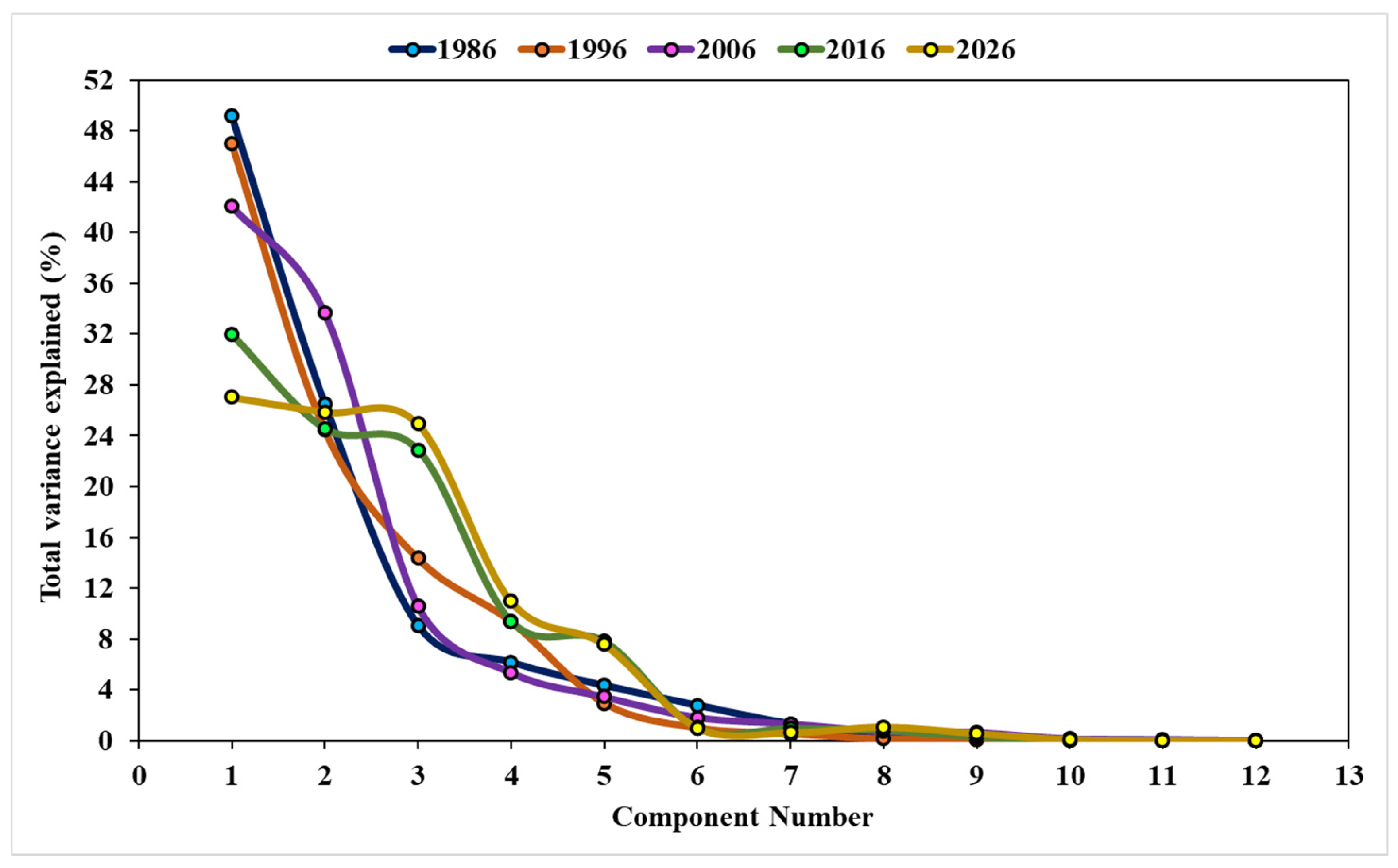
PCA was used to reduce the dimensionality of the dataset, preserving most of the original variability [59]. Table 3 shows the results of the total explained variance obtained from PCA for the years 1986, 1996, 2006, 2016 and projected to 2026, based on the eigenvalues obtained from the variance-covariance matrix for those years [57]. The physical interpretation of the components was performed by analyzing the eigenvectors, which act as weighting coefficients in a linear combination that transforms the original variables into the new principal components [59]. This analysis revealed expected correlations between the following thematic variables: ALBsup with NDBaI; BI with EBBI and NDBuI; MNDWI with SAVI; PvWreal with WindSpeed and SVF. Despite these correlations, all variables were retained in the analysis because they capture complementary spectral information essential for urban studies with high variance-covariance.
Therefore, the proportion of total variance explained by each successive component was the values of the first five principal components (PC1 to PC5) that were most important in capturing most of the relevant information from the main structures and patterns of the data (95.31% of the variance) before the curve flattened (Figure 3). The remaining components, which together explained less than 2.5% of the total variance, are usually discarded to simplify the model. Figure 3 visualizes the explained variance presented numerically in Table 3, showing the inflection point used to select the first five components. Therefore, this subset of components was selected for the construction of the UHII model, as it represents most of the information contained in the original dataset with a drastic reduction in dimensionality [60].
The physical interpretation of the first five PC, based on their factor loadings, allowed five synthetic factors (Fc) to be defined for each period. For 1986, five factors had been established:
Fc1: urban morphology related to thermal storage and ventilation of urban public space, positive contribution to UHI.
Fc2: urban buildings and impervious surfaces, negative contribution to UHI due to low building density and the predominance of mud and stone constructions.
Fc3: surface reflectivity and material properties for thermal behavior conducive to heat storage and emission, positive contribution to UHI.
Fc4: variations—dimensions, vegetation mass and soil moisture, negative contribution to UHI.
Fc5: Thermal emissivity capacity of the surface for soil-air energy exchange, positive contribution to UHI.
For 1996, a new factor emerged, atmospheric conditions and urban climate (Fc1), which showed a positive contribution linked to the vertical temperature gradient. For 2006 and 2016, the factors were reconfigured, but the role of urban morphology, atmospheric conditions, surface properties, and vegetation/soil moisture continued to be systematically highlighted. This evolution of the factors reflects changes in urban structure and its growing influence on local climate over time [61].
A weighted linear combination of the five synthetic factors was used to create the UHI for each period. The percentage of variance explained by each component in Table 3 was used as its weight, and depending on its contribution, it was assigned a positive (+) or negative (−) sign based on the physical interpretation of the factor. The equations were:
U H I I 1986 = [ 49.198 ( F c 1 ) 26.515 ( F c 2 ) + 9.083 ( F c 3 ) 6.172 ( F c 4 ) + 4.346 ( f c 5 ) ] 100
  U H I I 1996 = [ 47.042 F c 1 + 24.44 F c 2 + 14.348 F c 3 9.37 F c 4 2.954 ( f c 5 ) ] 100
U H I I 2006 = [ 42.116 F c 1 + 33.682 ( F c 2 ) + 10.599 ( F c 3 ) 5.366 ( F c 4 ) + 3.448 ( f c 5 ) ] 100
U H I I 2016 = [ 31.969 ( F c 1 ) 24.558 ( F c 2 ) + 22.902 ( F c 3 ) + 9.417 ( F c 4 ) 7.847 ( F c 5 ) ] 100
U H I I 2026 = [ 27.046 ( F c 1 ) 25.872 ( F c 2 ) + 24.936 ( F c 3 ) + 10.967 ( F c 4 ) 7.579 ( F c 5 ) ] 100
The resulting scores were normalized on a scale from 0 to 1, where 0 represents the absence of UHII and 1 represents high intensity of UHII. Next, the normalized index was reclassified into six intensity categories: null (0–0.25), very weak (0.25–0.35), weak (0.35–0.50), moderate (0.50–0.65), strong (0.65–0.75), and very strong (0.75–1).

3.3. Spatio-Temporal Characterization of the Urban Heat Island (UHI)

3.3.1. Temporal Variability of UHI

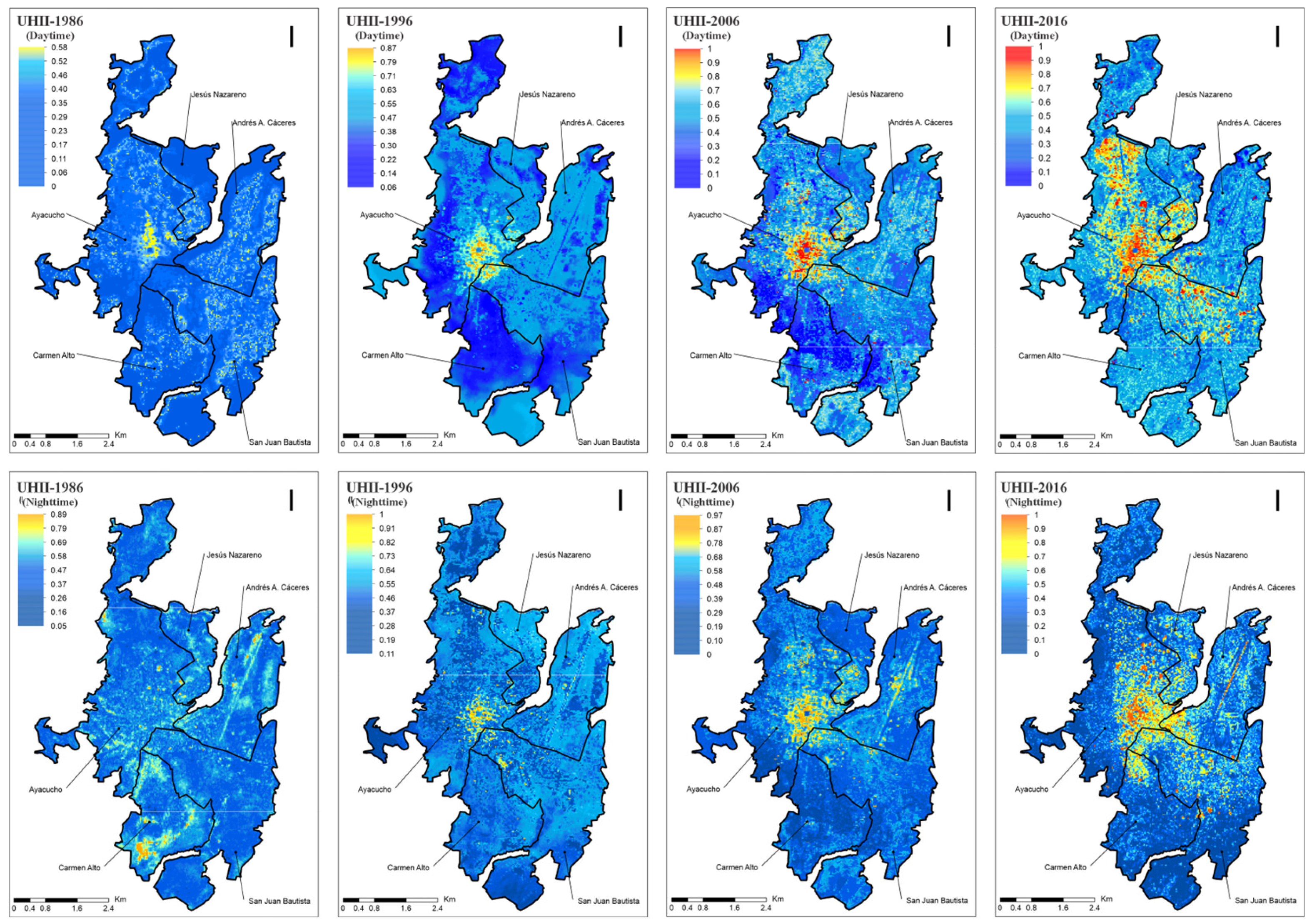
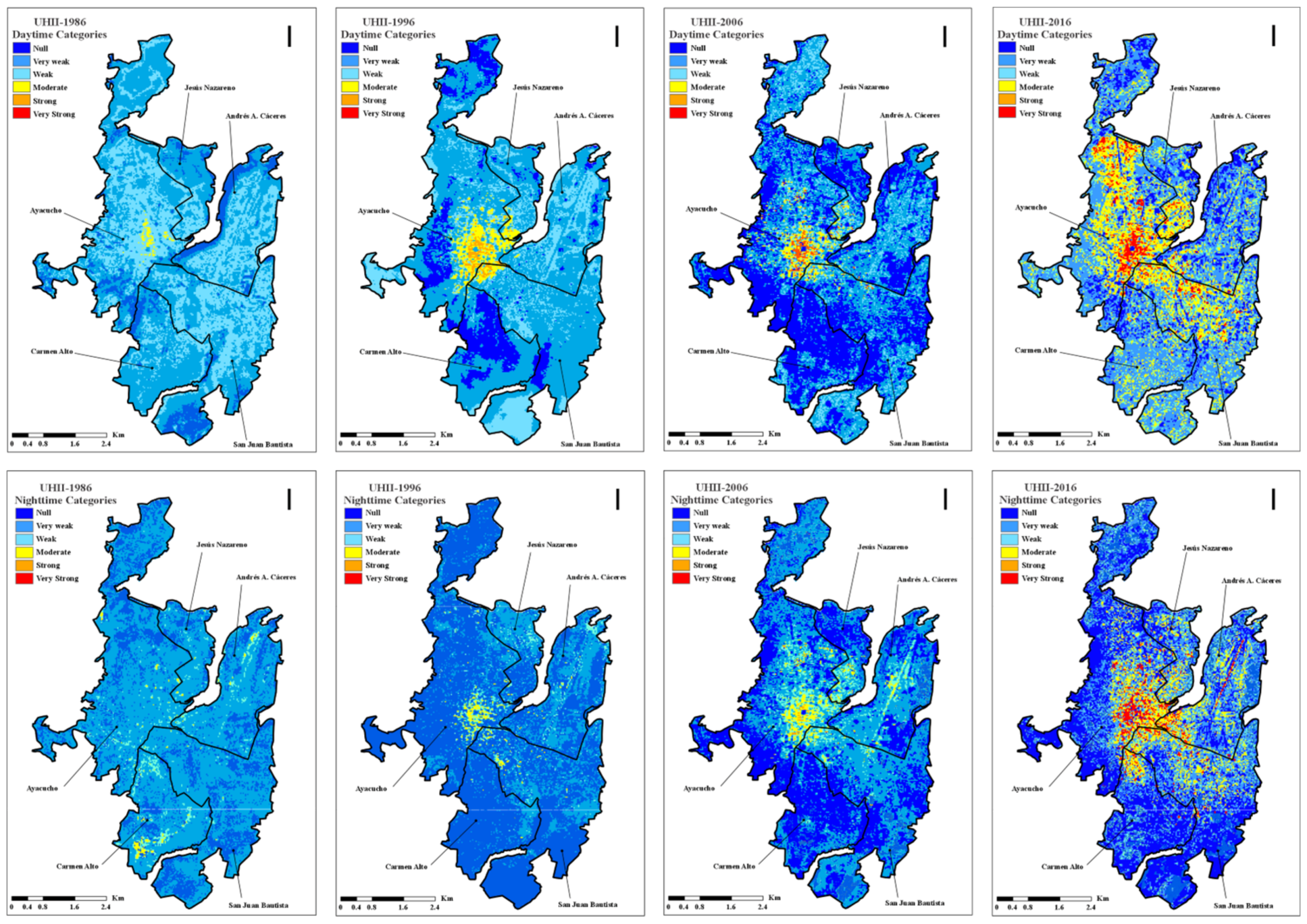
Visual comparison of the UHI maps (Figure 4) revealed a significant change in the urban climate configuration between 1986 and 2016, with the 1986 and 1996 maps showing a diffuse heat pattern associated with the atmospheric urban heat island (UHIa), with a temperature difference based on air temperature [62]. This phenomenon is usually weaker during the day and more intense at night due to the release of heat stored in urban materials.
In 2006, a fundamental change occurred, with the clear emergence of a surface urban heat island (UHIs), identified by well-defined thermal hotspots based on LST. These hot spots intensified and expanded significantly in 2016, adopting the orthogonal layout of the historic center of the Andean city and the irregular layout of unplanned urban expansions towards the peripheral areas.
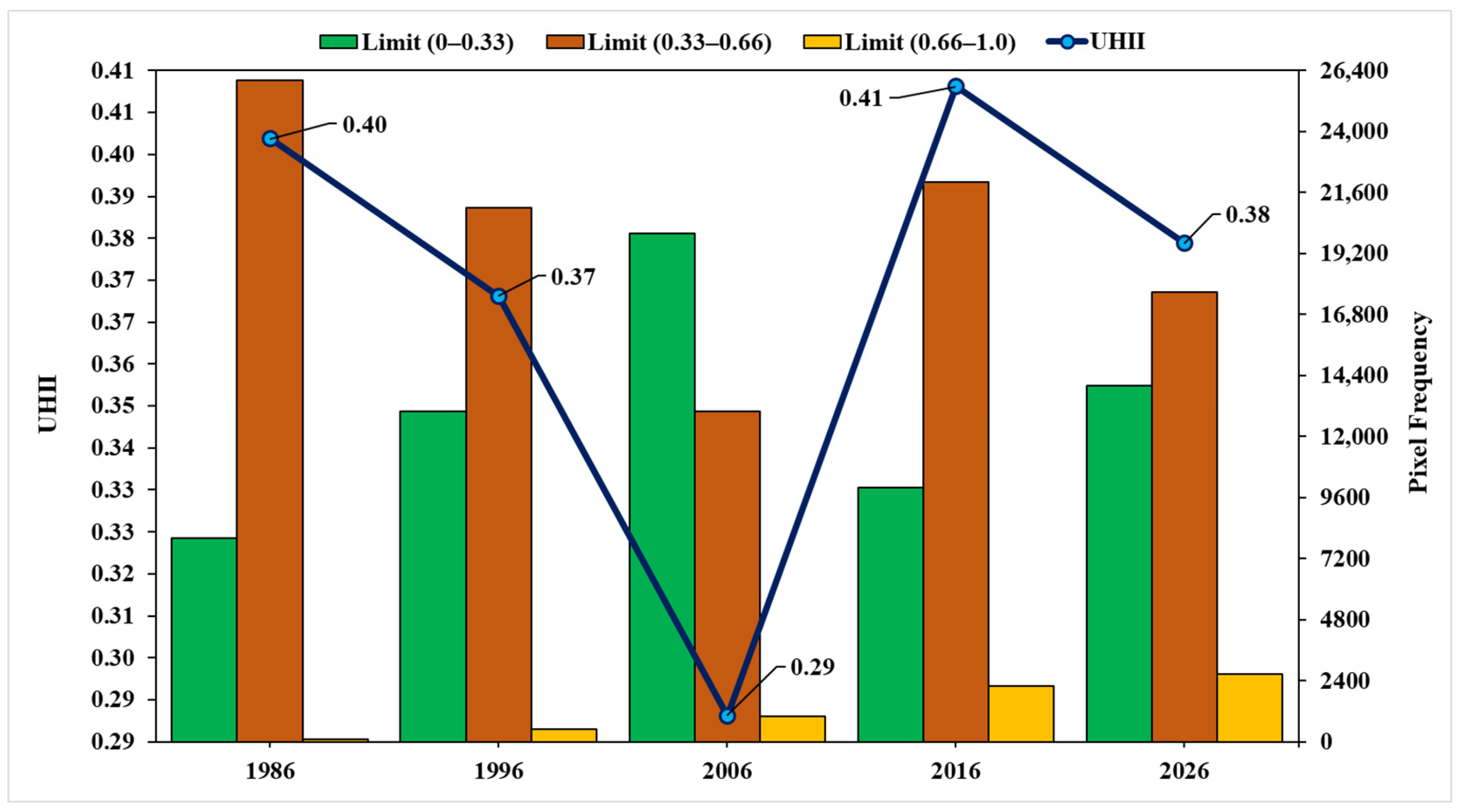
The quantitative analysis (Figure 5) shows a substantial increase in the frequency of pixels in the high (0.66–1.0) and medium (0.33–0.66) intensity ranges of the daytime UHI index since 2006, while the low intensity range (0–0.33) showed a negative variation. This confirms that the urban climate began a significant transformation around 2006, with a positive trend set to continue increasing through 2026.
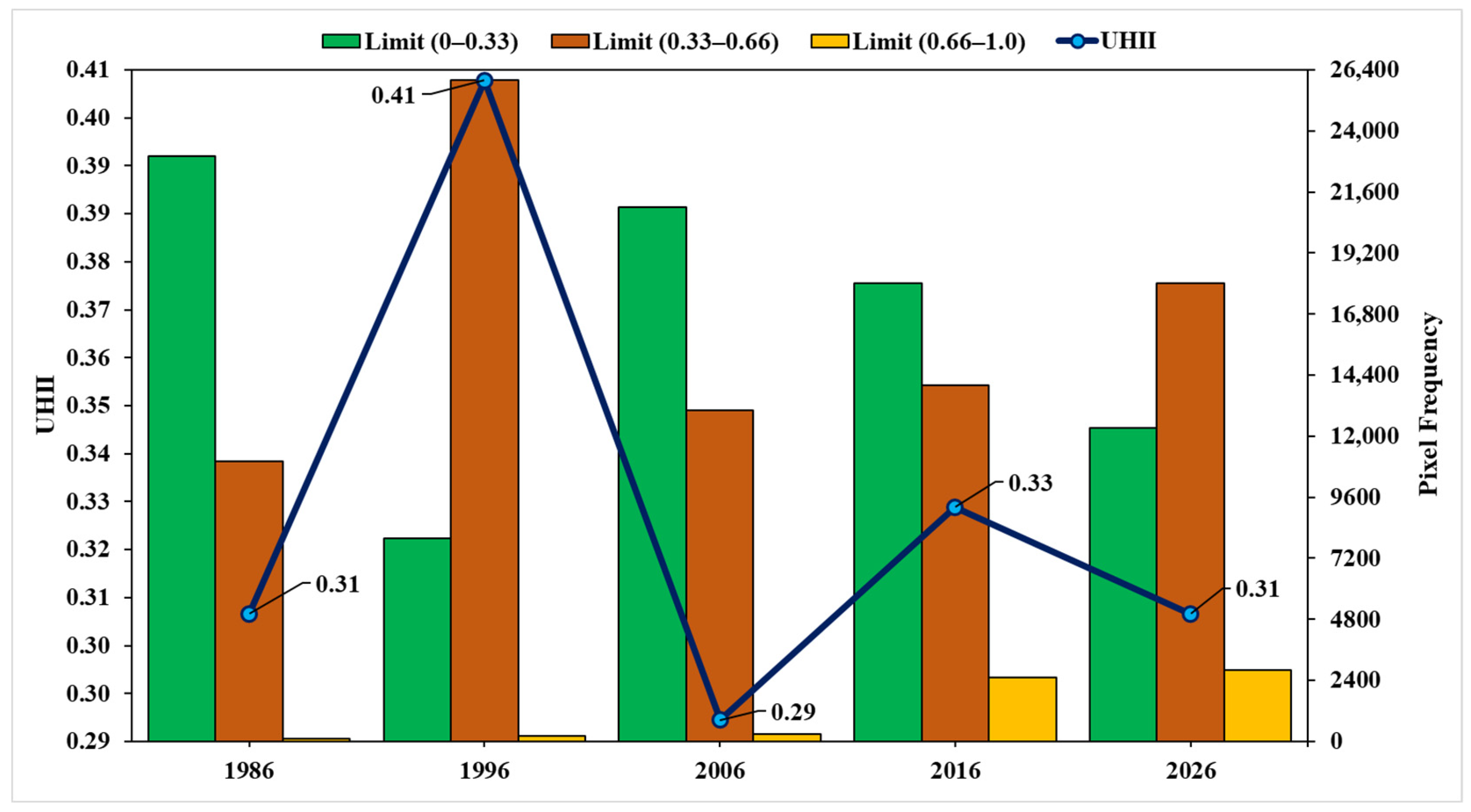
The nighttime UHII (Figure 6) also showed a positive trend in its averages and range limits, corroborating the establishment of UHIs, since daytime heat gradients are maintained throughout the night, unlike the UHIa observed in previous periods, maintaining an upward trend through 2026.

3.3.2. Spatial Distribution of the UHII

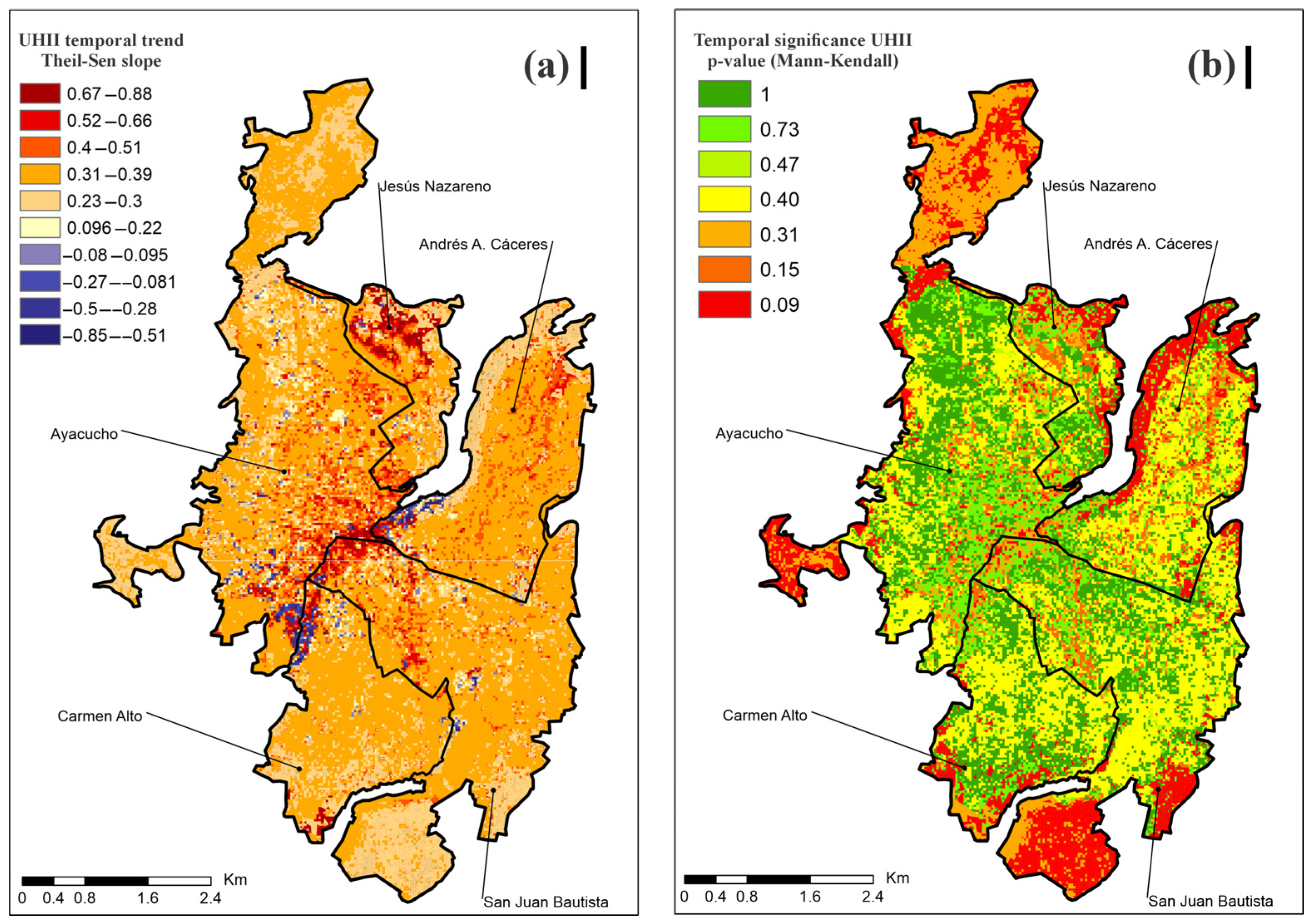
The Theil-Sen slope map (Figure 7a) shows the existence of a UHI trend in the time series analyzed with a confidence level of 90%. Areas with positive trends are represented in orange to dark red, while light-colored areas show no trend. However, blue indicates areas with a negative trend. The spatial distribution of the UHII, analyzed using the Mann–Kendall test (Figure 7b), showed a statistically significant positive trend (90% confidence level) in much of the urban area, confirming the existence of a monotonic increase in the intensity of the UHII over time.
The distribution of the UHII is radiocentric, radiating from the historic center of the province of Huamanga to the periphery. In 1986 and 1996, the UHIa was concentrated in the historic center. In 2006, the UHIs expanded northward and eastward. In 2016, the critical UHI areas were consolidated, mainly in the border areas between the districts of Ayacucho, Jesús Nazareno, San Juan Bautista, and Andrés Avelino Cáceres (Figure 8).
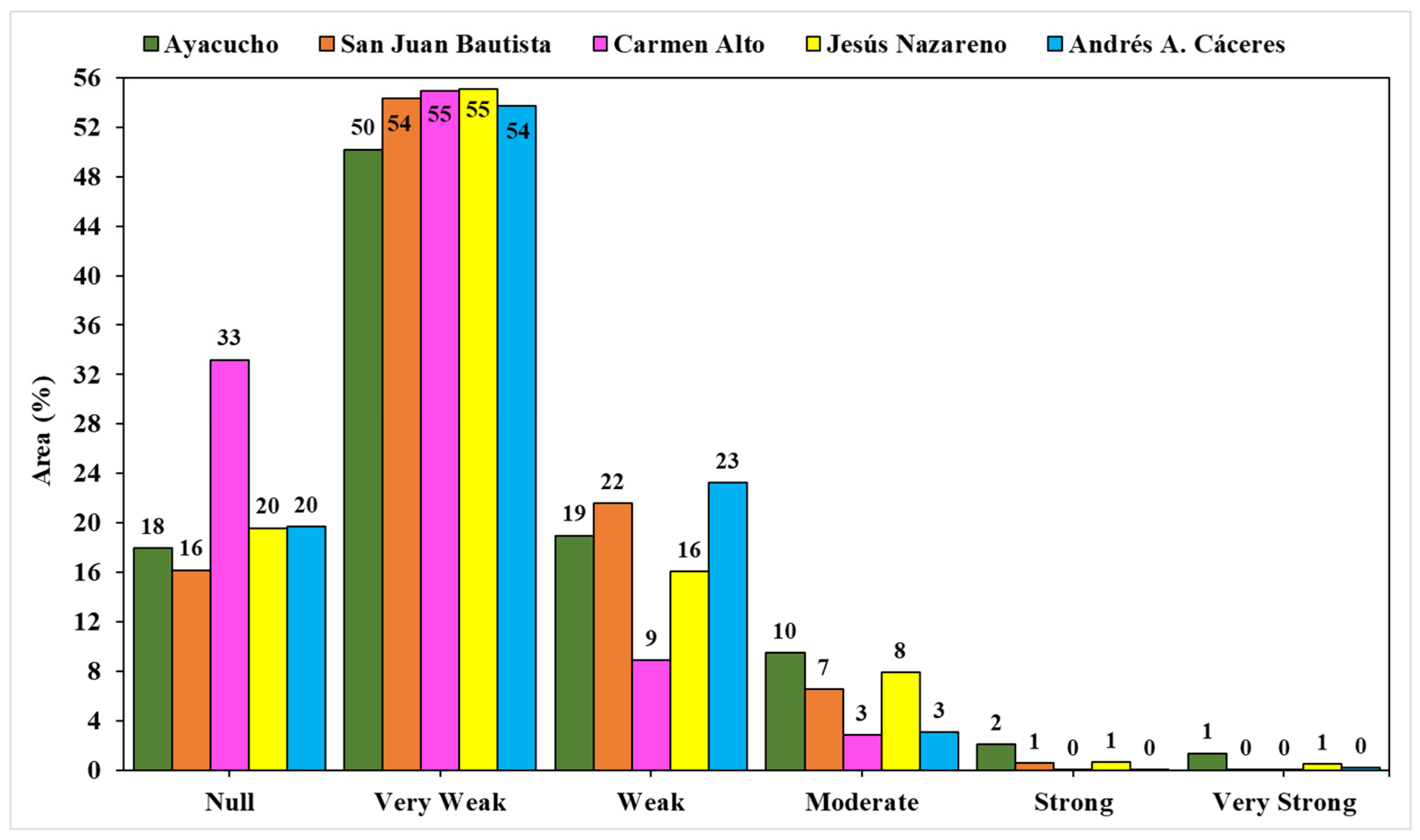
The spatial distribution of daytime UHI intensity categories by district (Figure 9) revealed that Carmen Alto, characterized by low building density, abundant green spaces, and a topography favorable to ventilation, had the highest proportion of area with “zero” UHI (33.2%). In contrast, the district of Ayacucho had the largest areas of “moderate” (9.5%), ‘strong’ (2.1%), and “very strong” (1.6%) UHI intensities, associated with its denser urban fabric. For its part, the district of Jesús Nazareno has the largest area of “very weak” UHI (55.1%).
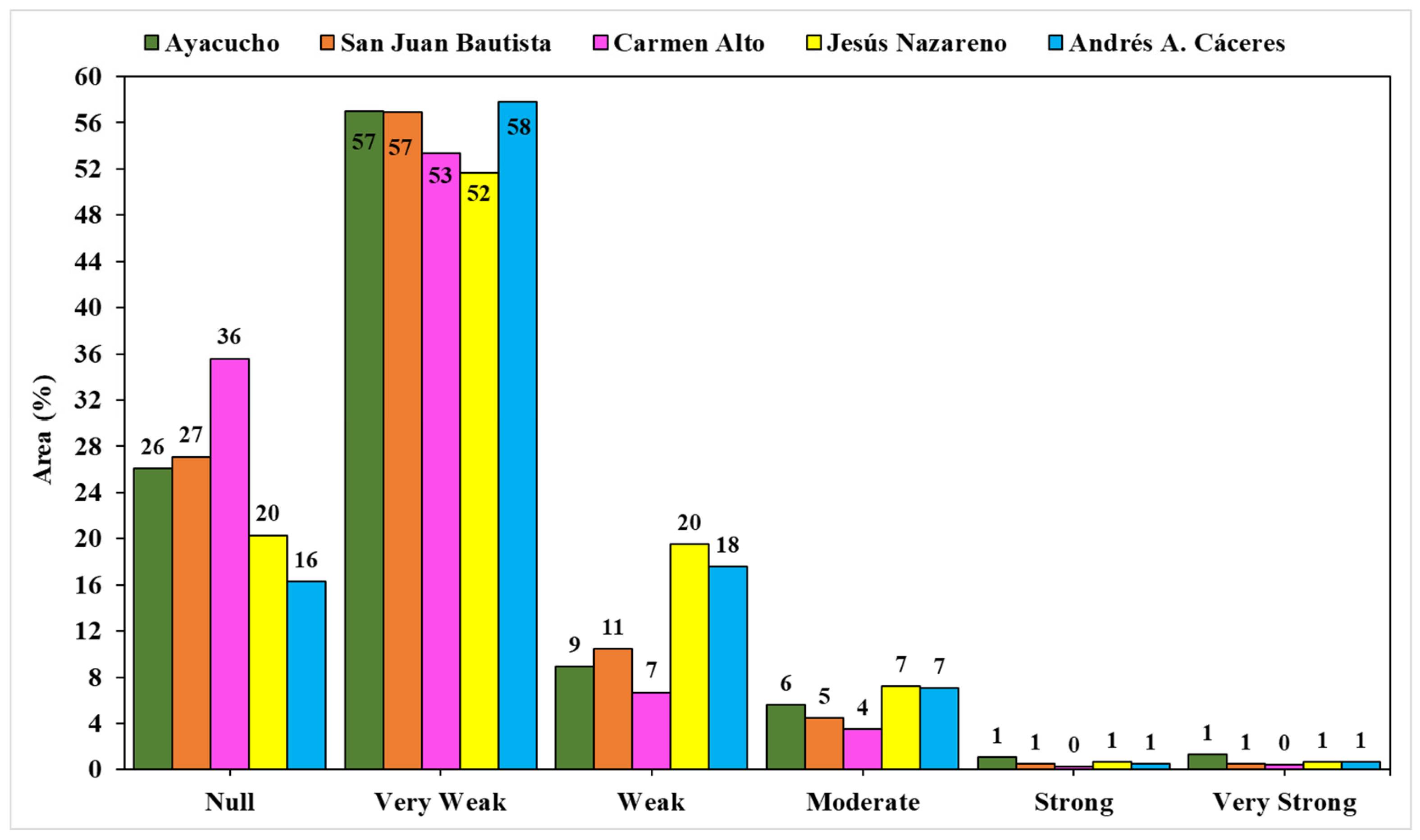
The spatial distribution of nighttime UHI intensity categories by district (Figure 10) revealed that Carmen Alto has the highest proportion of “Null” UHI area (33.2%). In contrast, the district of Ayacucho had the largest areas of “strong” (1.1%) and “very strong” (1.3%) UHI intensity, associated with its denser urban fabric. For its part, the district of Andrés A. Cáceres has the largest “very weak” UHI area (57.8%).

3.4. Mapping of Land Surface Temperature (LST) and Urban Growth

LST was validated with in situ measurements and meteorological data, with high coefficients of determination (0.88 ≤ R 2 ≤ 0.96) and a Root Mean Square Error (RMSE) in the range of 4.3–4.8 °C, confirming the acceptability of LST maps derived from satellite images. The difference between LST and air temperature (10 °C to 18 °C) was within the expected range for this type of study [63].

3.4.1. Spatio-Temporal Patterns of LST

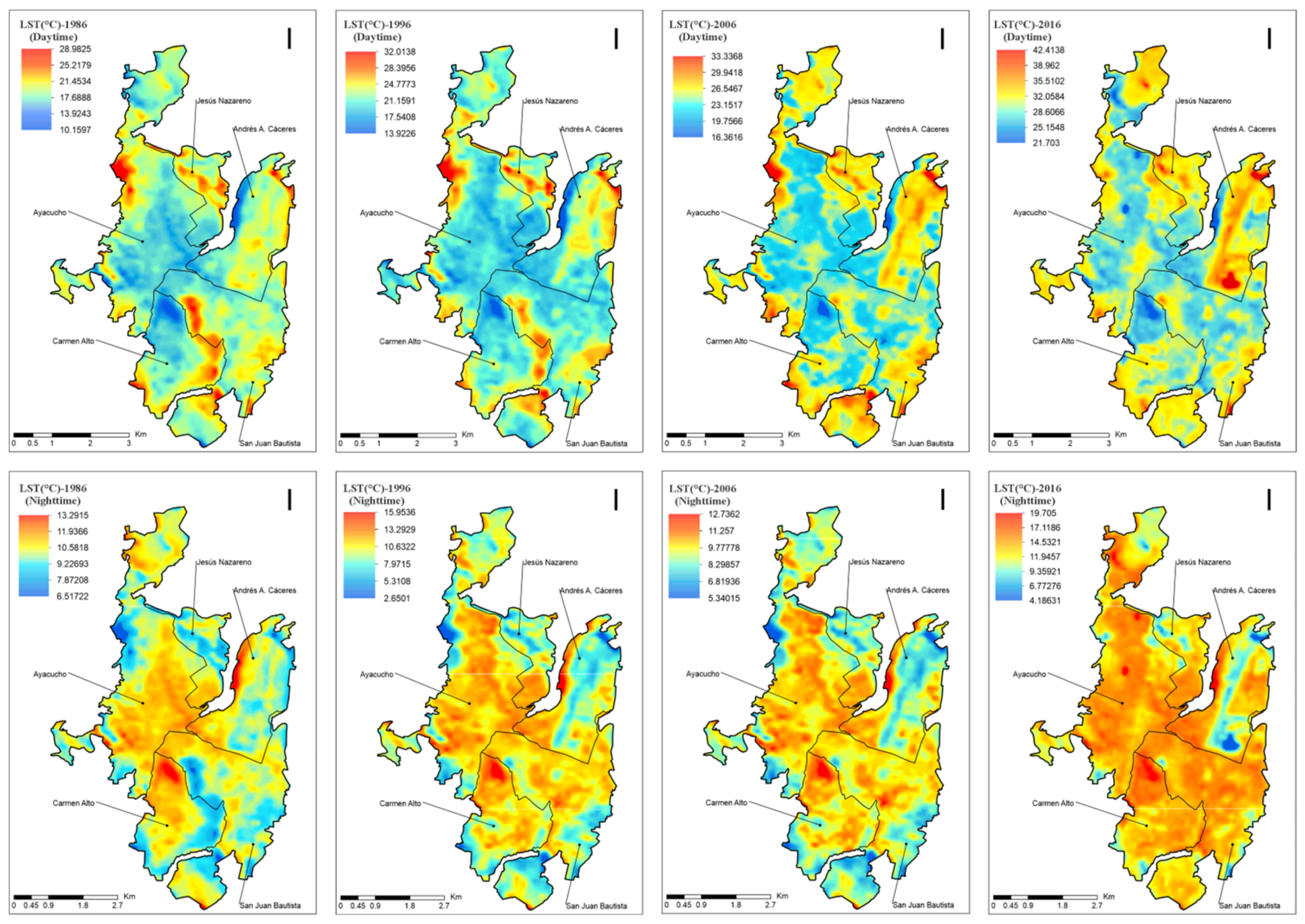
The temporal analysis of LST (Figure 11) showed higher temperatures in years with low precipitation in 1996. A marked increase in maximum LST was observed between 2006 and 2016 (10.2 °C for daytime LST). Peri-urban areas with bare soil and rocky outcrops (La Picota) often had higher daytime LST than the urban center due to greater sun exposure. However, the urban core retains heat more efficiently, resulting in higher nighttime LST.
The difference between urban and rural LST (UHI intensity) was 4.31 °C during the day and 5.82 °C at night, with the largest differences recorded in 2016 (Table 4), which are within the range recorded for medium-sized cities worldwide [64]. The difference between urban and peri-urban areas also increased over time, reaching 3.84 °C (daytime) and 4.64 °C (nighttime) in 2016, highlighting the intensification of the UHI effect.
However, the greater intensity observed at night is a constant feature of UHIs and is attributed to the slow release of heat stored during the day in urban materials such as asphalt and concrete, a process modulated by the properties of urban canyons [3]. The greater nighttime intensity of UHIs observed in this study underscores the role of urban energy balance in Andean cities in the Ayacucho region.
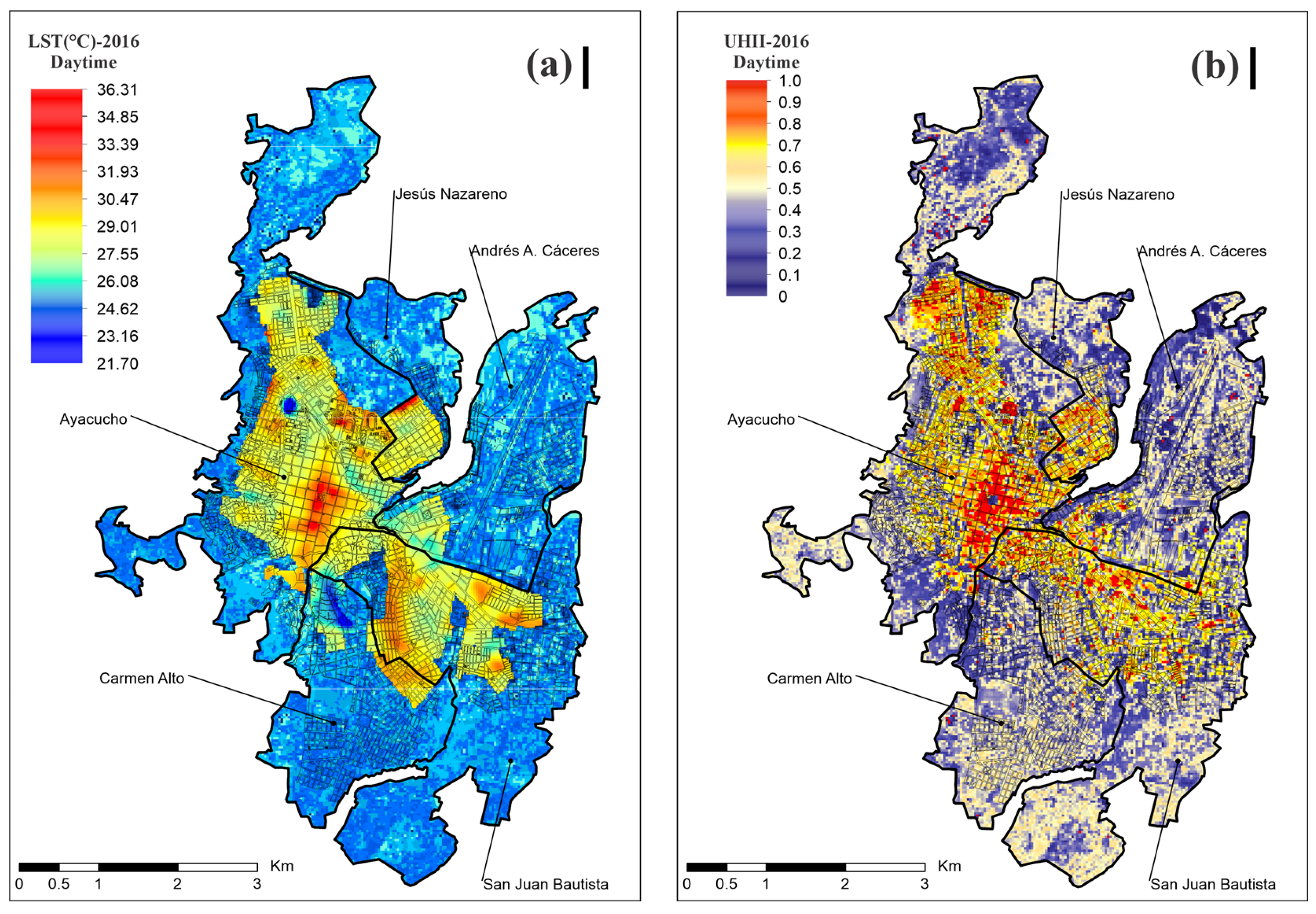
Figure 12 compares the spatial distribution of LST with the UHII for 2016, showing that the areas with the highest LST correspond to the same UHII values (red) within the urban area or main road of each district, excluding the periphery.
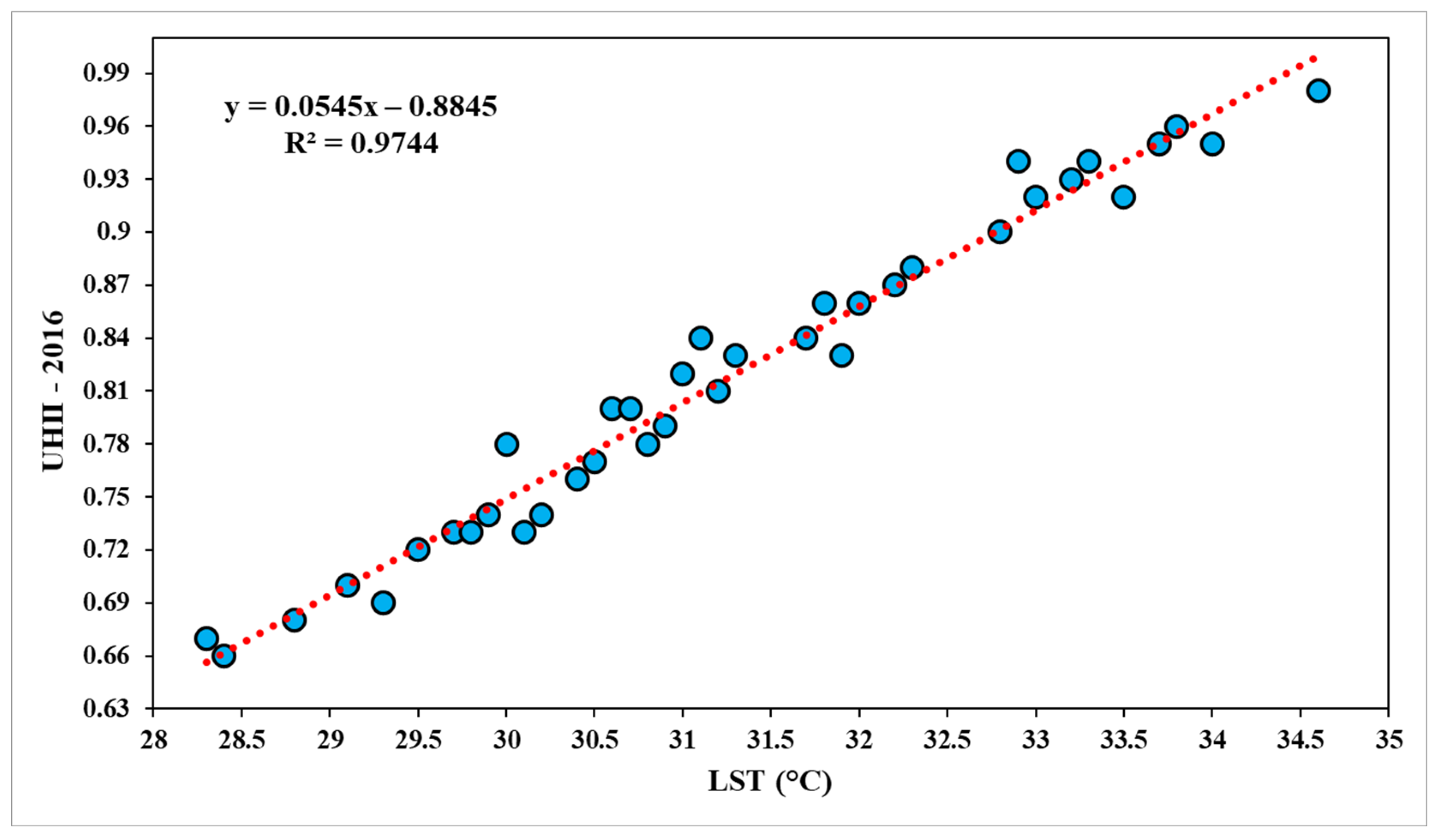
In fact, the urban area has a considerable percentage of points with L S T 29   ° C , which suggests that these areas have much greater thermal inertia than the peri-urban area. Figure 13 shows a significant correlation between the spatial distribution of LST and the UHII (R2 = 0.97), suggesting that the highest LST values are recorded in areas with high building density, impervious surfaces, and minimal vegetation, while the lowest values are associated with green areas, close to water and well ventilated, according to the model:
U H I I = 0.0545 L S T 0.8845

3.4.2. Thermal Gradient and Its Relationship with Urban Expansion and Morphology

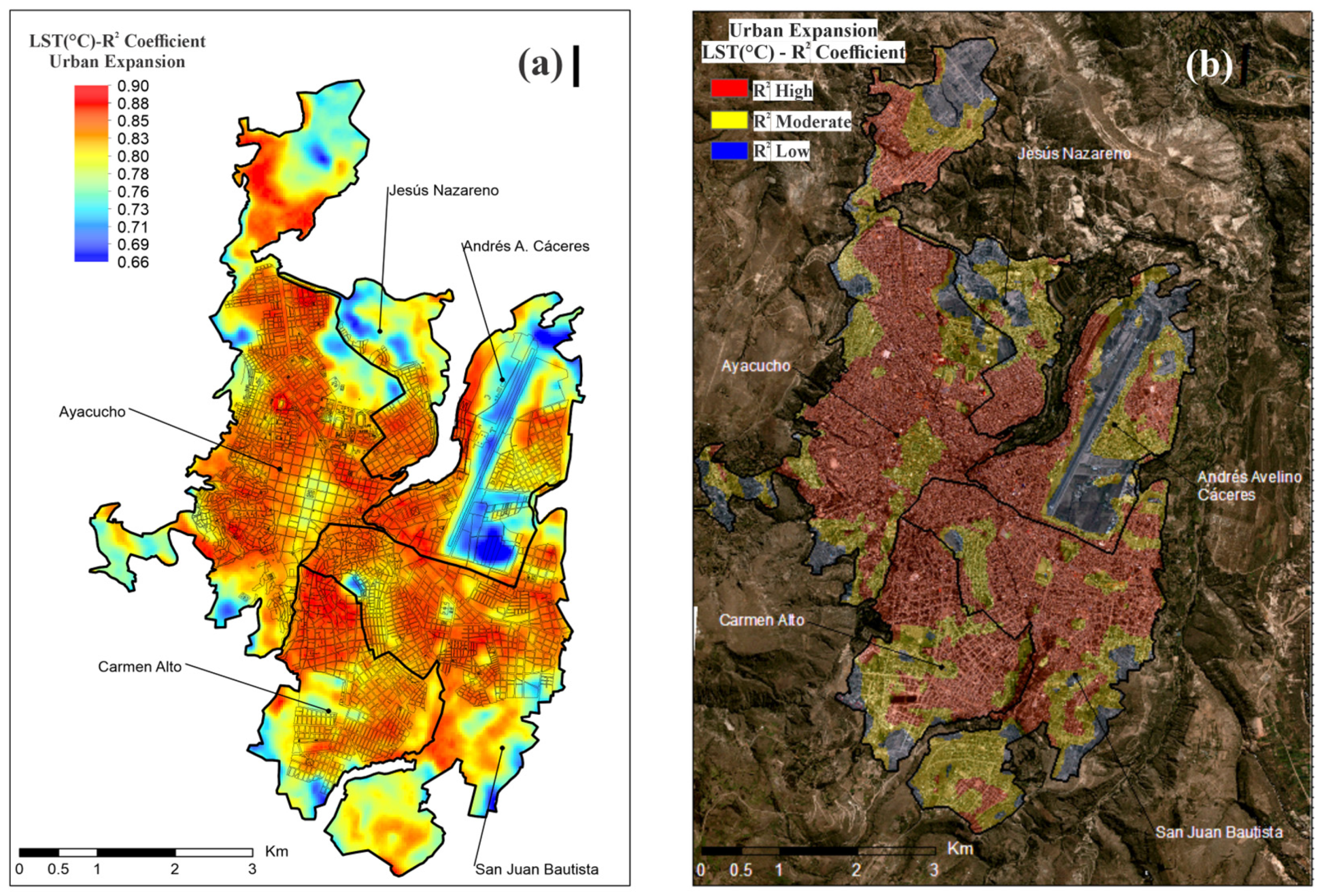
The city of Ayacucho has experienced rapid and often disorderly urban expansion since the 1980s, driven by sociopolitical violence and rural migration to urban areas. The statistical significance established by the Mann–Kendall test confirmed a significant positive trend p = 0.07 < 0.1 between urban expansion and LST, rejecting the idea that daytime LST and its nighttime thermal inertia are associated with urban sprawl, leaving little doubt that urban form is a critical modulator of the thermal environment. The Theil-Sen slope statistic (0.43 to 0.84) and the coefficients of determination 0.66 R 2 0.9 further reinforced this finding (Figure 14). High correlations were found in densely built-up areas ( 0.84 R 2 0.9 ) , while peri-urban and vegetated parks showed lower correlations ( 0.66 R 2 0.79 ) . This confirms that urbanization density is a key factor in the increase in LST, possibly due to the alteration of thermal properties and the release of anthropogenic heat [16].
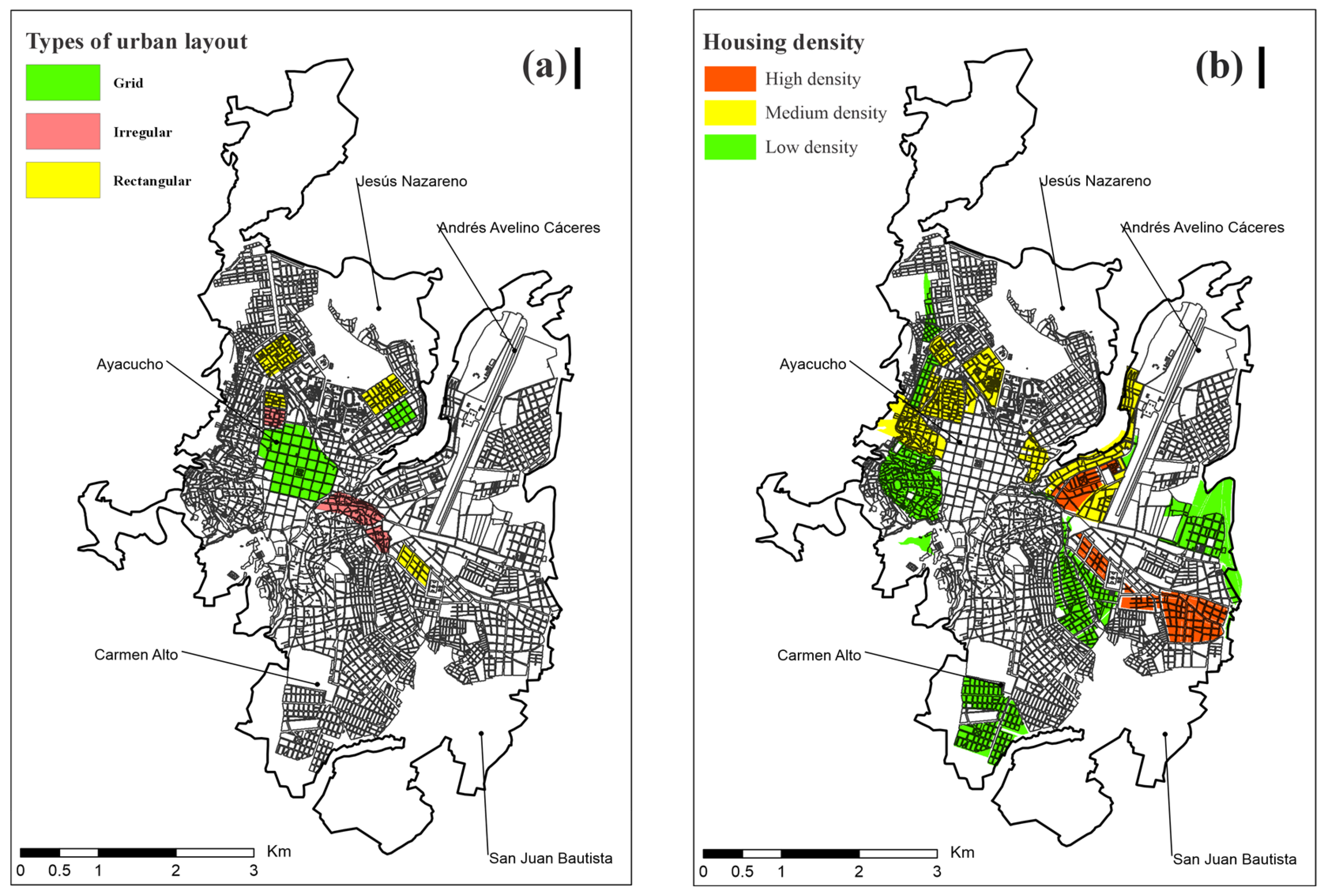
Urban morphology, defined by urban layout (grid, irregular, rectangular), land use, and building typology, significantly influences LST, for which three morphological blocks were defined (Figure 15): High (irregular layout, high density, low vegetation, obstructed ventilation), Medium, and Low (grid layout, low density, high vegetation, good ventilation).
Multiple linear regression models were developed for each type of block, using factors derived from PCA and spectral separation (Fc1: ventilation, Fc2: paved surface, Fc3: urban layout/density, Fc4: vegetation/soil moisture). The models showed a good fit, with values of 0.85 R 2 0.94 .
(a)
High morphological block
L S T d a y = 44.0857 + 17.7664 F c 1 11.0698 F c 2 13.6494 F c 3 21.5448 F c 4
L S T n i g h t = 2.9336 13.3124 F c 1 + 8.2947 F c 2 + 10.2275 F c 3 + 16.1435 F c 4
(b)
Middle morphological block
L S T d a y = 55.1956 + 12.4133 F c 1 22.4922 F c 2 17.0987 F c 3 25.2479 F c 4
L S T n i g h t = 5.39112 9.3013 F c 1 + 16.8534 F c 2 + 12.8121 F c 3 + 18.918 F c 4
(c)
Low morphological block
L S T d a y = 56.8413 + 12.7952 F c 1 24.8878 F c 2 18.2598 F c 3 26.0208 F c 4
L S T n i g h t = 6.6242 9.5874 F c 1 + 18.6484 F c 2 + 13.6821 F c 3 + 19.4974 F c 4
The thermal assessment (Table 5) revealed that the difference in average LST between high and low morphological blocks was 1.08 °C during the day and 0.11 °C during the night. However, the difference in minimum LST was more substantial: 5.53 °C during the day and 3.53 °C at night. This indicates that urban morphology significantly modulates the thermal environment, as dense and irregular blocks have lower cooling capacity and higher minimum temperatures, exacerbating the nighttime UHI effect. Key morphological descriptors, such as the SVF and urban canyon geometry, are crucial in this process, as they control heat loss through radiation and wind ventilation.

4. Discussion

The analysis of variable incidence (Table 2), rated from highest (1) to lowest (5), reveals a consistent hierarchy across the four study periods (1986, 1996, 2006, and 2016), where the variables BI, EBBI, NDBuI, PvWreal, and Windspeed systematically had the highest incidence (order 1), followed by ULI and SVF (order 2). This pattern indicated that urban areas, bare soil, atmospheric humidity, and ventilation are the most important determinants in the formation of the UHI in the Andean city of Ayacucho. The secondary position of albedo and NDBaI (order 3), LST (order 4), and finally MNDWI and SAVI (order 5) complete the hierarchy, underscoring the modulating role of surface reflectivity, temperature, and vegetation/water content in shaping the phenomenon. Variables that do not fall within this hierarchical order are discarded [58].
The temporal evolution of the UHI (Figure 3) shows a critical transition towards 2006, characterized by the appearance of persistent thermal hotspots that intensify in densely urbanized areas. These hotspots remain present both during the day and at night, with a nocturnal contraction towards the center of the districts that generates well-defined thermal gradients that are clearly differentiated from rural areas or urban peripheries [14]. The change is directly linked to the rapid and often unplanned urban expansion that the district of Ayacucho has experienced since the 1980s, a common factor driving the intensification of UHIs in developing cities [16]. Of course, according to [65], the radiocentric pattern observed in the expansion of UHIs, which reflects urban expansion, in many cases towards areas with steep slopes, reinforces the well-established principle that the growth of the urban footprint is a major determinant of thermal characteristics.
The strong negative correlation between LST and vegetation indices (SAVI, MNDWI) in the period 1986 to 2016 confirms that the reduction in vegetation cover and soil sealing associated with urban growth contributes directly to the increase in LST [66]. This reinforces the idea that vegetation, through shading and evapotranspiration cooling, is a key mitigating factor against the effects of UHIs, even in high-altitude environments such as the Andean areas of Peru. Therefore, the progressive loss of green spaces due to urban densification, as observed in the expansion of urban areas in the districts of the Ayacucho region, is a factor that probably contributes to the strengthening of the positive trend of UHIs after 2006.
The morphological findings (Table 5) are consistent with previous studies showing that high-density areas with complex urban canyon geometry exhibit greater heat retention at night due to reduced radiative heat loss [3], which causes the most pronounced difference in minimum temperatures (3.53 °C), particularly at night between high and low morphological blocks, highlights the critical role of morphology in exacerbating the UHI effect at night, limiting the ability of urban materials to dissipate accumulated heat [62].
The results of this study on the effect of UHIs in Andean cities in Ayacucho provide valuable information on the spatial and temporal dynamics of urban thermal environments in Andean cities, confirming the significant influence of urban morphology with disordered growth, consistent with a growing number of studies conducted in various climatic contexts, where urban geometry and impervious surface cover are identified as dominant controls of UHIs magnitude [67].
Multitemporal analysis confirms the dynamic nature of UHIs in the districts of the Ayacucho region, which intensifies and evolves with urban growth, contextualized in areas characterized by high building density, irregular layout, low SVF, and reduced vegetation cover (high morphological block) with significantly lower cooling capacity, especially at night, with higher minimum LSTs than in low morphological blocks [62]. This is a direct consequence of reduced heat loss through radiation and obstruction of ventilation in dense urban canyons [68,69].
Our findings are consistent with studies in other Latin American cities; for example, [70] also establishes direct correlations between building density, loss of vegetation, and increased LST in metropolises in the region, indicating that this is a common pattern in the Global South despite differences in altitude. Among the limitations of this study, it is recognized that Landsat’s 30 m spatial resolution may not capture micro-scale thermal heterogeneity, such as that of individual courtyards or narrow streets. Furthermore, although atmospheric corrections were made, the complex Andean topography may introduce residual variations in the LST estimate that must be considered.
Another limitation of this study is the exclusion of other potentially relevant variables, such as air pollution from particulate matter (PM), which could interact with the UHI by altering local radiative forcing [71]. Future research could integrate these data for a more holistic understanding.
From a planning perspective, our methodology aligns with the territorial ecological capacity approach proposed by [72], which integrates quantitative environmental diagnostics into planning tools. The application of our UHII at scales compatible with regional planning (1:20,000) can directly strengthen Ayacucho’s urban resilience by quantifying thermal degradation and guiding the preservation of ecosystem services critical to UHI mitigation.
When comparing the magnitude of our UHIs (urban-rural difference of ~5 °C) with studies in other high Andean cities such as Cusco [73] or Quito [74], it is possible to explore whether the specific morphological configuration of Ayacucho, or its smaller size, results in a more or less intense heat island effect, despite sharing similar altitudinal conditions.
The UHI is not a static phenomenon, but rather a dynamic one that intensifies and evolves with the urban growth of Ayacucho’s districts. In this sense, the results emphasize the critical need to integrate morphological planning strategies and fundamental urban designs for the adaptation of Andean cities to climate change. Mitigation measures should prioritize the preservation and integration of green infrastructure, the promotion of urban forms that facilitate ventilation (by regulating street proportions and the SVF), and the implementation of high-albedo materials [15]. The methodological approach combining remote sensing, PCA, and spatial statistics has proven effective in quantifying these relationships in such a way that they can be extended and applied to other intermediate Andean cities experiencing similar urban growth pressures.
The methodology used, which combines multitemporal remote sensing and PCA, offers significant advantages for studying UHIs in complex environments. The main advantage is the ability to synthesize multiple urban dimensions (spectral, thermal, morphological) into a comprehensive index (UHII), enabling robust analysis of spatiotemporal patterns. The use of Landsat images ensures extensive and accessible temporal coverage. However, the approach also has limitations. Landsat’s 30 m spatial resolution can smooth temperatures in highly heterogeneous areas, underestimating microclimatic hot spots. Furthermore, LST estimation is subject to uncertainties related to atmospheric correction and emissivity, especially in mountainous regions. While PCA identifies dominant patterns, the physical interpretation of synthetic components (Fc) requires care and validation with in situ data.
These results provide quantitative input for municipal planning. For example, UHI maps can be used to identify critical ventilation corridors to protect, prioritize districts for urban reforestation programs, and update building codes to promote the use of high-albedo materials in areas identified as having very high intensity.

5. Conclusions

This study confirms the rapid development of a significant urban heat island effect (UHIs) in the main districts of the Ayacucho region, Peru, driven by accelerated urban expansion toward the peripheries and areas with steep slopes. Multitemporal analysis of Landsat images revealed a critical transition from a weak and diffuse atmospheric urban heat island before 2006 to a well-defined and intense UHIs from that year onwards. This change is characterized by the appearance of persistent thermal hotspots, with a temperature difference between urban and rural areas reaching an average of 4.31 °C (during the day) and 5.82 °C (during the night), a trend strongly correlated with the increase in impervious surfaces and loss of vegetation.
It was demonstrated that urban morphology plays a decisive role as the main determinant of thermal variation, with districts characterized by high building density, irregular layout, and low sky visibility factor presenting significantly higher LST, with minimum nighttime temperatures up to 3.53 °C warmer than less dense areas. This is attributed to the obstruction of radiative cooling and reduced ventilation. Conversely, the strong negative correlation between LST and vegetation indices underscores the critical mitigating effect of green infrastructure.
These findings underscore the urgent need to integrate climate change adaptation strategies into urban planning in Andean cities. Mitigation measures should prioritize the preservation and creation of green spaces, the regulation of urban form to maintain ventilation corridors, and the promotion of high-albedo materials. Future research should address the microscale factors that drive the UHI effect through quantitative analysis of the thermo-optical properties of materials. The integration of hyperspectral or high-resolution images taken from drones with a model based on the use of satellite images would allow for the precise determination of specific materials to modulate thermal patterns at a granular level, providing useful information for prescribing specific interventions with cooling materials in Andean cities.
The findings and methodology of this study contribute directly to the United Nations Sustainable Development Goals (SDGs). By quantifying UHIs and their morphological drivers, tools are provided to design more inclusive, safe, resilient, and sustainable cities (SDG 11). Mitigating UHIs through green infrastructure and better urban planning can reduce health risks associated with heat stress, such as cardiovascular and respiratory diseases, thus supporting SDG 3 (Good Health and Well-being). Finally, by offering strategies for climate change adaptation at the local level, this research aligns with SDG 13 (Climate Action), demonstrating how informed urban planning can be an effective tool for combating the effects of global warming.
This study has limitations, mainly associated with the spatial resolution of satellite data, which highlights the need for future research that integrates drone imagery for micro-spatial validation and hyperspectral imagery to accurately characterize the thermal properties of urban materials. This line of work would allow mitigation interventions to be prescribed with unprecedented accuracy in the Andean context.

Author Contributions

Conceptualization, J.D.-L.-C., W.S.-R. and W.M.; methodology, C.C.-B. and W.M.; software, D.T.-H., R.S.-F. and E.L.-P.; validation, J.D.-L.-C., C.C.-B., W.M. and C.R.-C.; formal analysis, C.R.-C., J.L. and D.T.-H.; investigation, W.M., W.S.-R., H.L.-A. and D.T.-H.; resources, J.L., E.L.-P., H.L.-A. and C.C.-B.; data curation, J.D.-L.-C., R.S.-F. and W.M.; writing—original draft preparation, C.C.-B., R.S.-F., J.L. and W.M.; writing—review and editing, C.C.-B., W.M., H.L.-A. and D.T.-H.; visualization, J.D.-L.-C., W.S.-R., E.L.-P. and C.R.-C.; supervision, W.M., R.S.-F. and C.C.-B. All authors have read and agreed to the published version of the manuscript.

Funding

This research received no external funding.

Data Availability Statement

The data provided can be found within the article. The original contributions made in this study are included in the document; any additional inquiries can be directed to the author or authors responsible.

Acknowledgments

This research was made possible thanks to the support provided by the Remote Sensing and Renewable Energy Laboratory, the Biodiversity and Geographic Information System Laboratory (BioSIG) at the National University of San Cristóbal de Huamanga (UNSCH) and Faculty of Engineering and Management, Universidad Autónoma de Huanta (UNAH), in Ayacucho, Peru.

Conflicts of Interest

The authors declare no conflicts of interest.

Abbreviations

The following abbreviations are used in this manuscript:
AlbsupLand surface albedo
BIBare land index
EBBIEnhanced Building and Bare Land Index
DNDigital Number
ULIUrbanized land index
LWCILeaf Water Content Index
MNDWIModified normalized difference water index
NDBalNormalized difference Bare land index
NDBuINormalized difference building index
NDVINormalized Difference Vegetation Index
PvWrealActual Water vapor Pressure
SAVISoil Adjusted Vegetation Index
SVFSky Visibility Factor
LSTLand Surface Temperature
MLSTMeasured Land Surface Temperature
UHIUrban Heat Island
UHIIUrban Heat Island Index
PCAPrincipal Component Analysis
PCPrincipal Component
LCZLocal Climate Zones
VCFVegetation Cover Fraction
DEMDigital Elevation Model
UHIaAtmospheric Urban Heat Island
UHIsSurface Urban Heat Island
ε Emissivity
BTBrightness temperature
ma.s.lmeters above sea level
MCMMillion Cubic Meters
L1TPLevel 1, Terrain Corrected and Precision

References

  1. Feranec, J.; Kopecká, M.; Szatmári, D.; Holec, J.; Šťastný, P.; Pazúr, R.; Bobáľová, H. A Review of Studies Involving the Effect of Land Cover and Land Use on the Urban Heat Island Phenomenon, Assessed by Means of the MUKLIMO Model. Geografie 2019, 124, 83–101. [Google Scholar] [CrossRef]
  2. Jiang, Y.; Luo, Z.; Wang, Z.; Lin, B. Review of Thermal Comfort Infused with the Latest Big Data and Modeling Progresses in Public Health. Build. Environ. 2019, 164, 106336. [Google Scholar] [CrossRef]
  3. Oke, T.R. The Energetic Basis of the Urban Heat Island. Q. J. R. Meteorol. Soc. 1982, 108, 1–24. [Google Scholar] [CrossRef]
  4. Romero, H.; Salgado, M.; Smith, P. Cambios Climáticos y Climas Urbanos: Relaciones Entre Zonas Termales y Condiciones Socioeconómicas de La Población de Santiago de Chile. Rev. INVI 2010, 25, 151–179. [Google Scholar] [CrossRef]
  5. Gümüş, M.G.; Gümüş, K. Assessment of the Impact of Impervious Surface Increase on Urban Heat Island and Vegetation by Remote Sensing and Statistical Analysis: The Case of Türkiye/Niğde City Center (2013–2024). Turk. J. Remote Sens. 2025, 7, 69–90. [Google Scholar] [CrossRef]
  6. Bek, M.A.; Azmy, N.; Elkafrawy, S. The Effect of Unplanned Growth of Urban Areas on Heat Island Phenomena. Ain Shams Eng. J. 2018, 9, 3169–3177. [Google Scholar] [CrossRef]
  7. Lu, H.; Gaur, A.; Lacasse, M. Climate Data for Building Simulations with Urban Heat Island Effects and Nature-Based Solutions. Sci. Data 2024, 11, 731. [Google Scholar] [CrossRef]
  8. Ramírez-Aguilar, E.A.; Lucas-Souza, L.C. Urban Form and Population Density: Influences on Urban Heat Island Intensities in Bogotá, Colombia. Urban Clim. 2019, 29, 100497. [Google Scholar] [CrossRef]
  9. Wang, C.; Zhang, H.; Ma, Z.; Yang, H.; Jia, W. Urban Morphology Influencing the Urban Heat Island in the High-Density City of Xi’an Based on the Local Climate Zone. Sustainability 2024, 16, 3946. [Google Scholar] [CrossRef]
  10. Moreno García, M.C.; Serra Pardo, J.A. El estudio de la isla de calor urbana en el ámbito mediterráneo: Una revisión bibliográfica. Biblio3W Rev. Bibliográfica Geogr. Cienc. Soc. 2016, XXI, 34. [Google Scholar]
  11. Vásquez-Álvarez, P.E.; Flores-Vázquez, C.; Cobos-Torres, J.-C.; Cobos-Mora, S.L. Urban Heat Island Mitigation Through Planned Simulation. Sustainability 2022, 14, 8612. [Google Scholar] [CrossRef]
  12. Wetherley, E.B.; Roberts, D.A.; Tague, C.L.; Jones, C.; Quattrochi, D.A.; McFadden, J.P. Remote Sensing and Energy Balance Modeling of Urban Climate Variability Across a Semi-Arid Megacity. Urban Clim. 2021, 35, 100757. [Google Scholar] [CrossRef]
  13. Esposito, A.; Pappaccogli, G.; Donateo, A.; Salizzoni, P.; Maffeis, G.; Semeraro, T.; Santiago, J.L.; Buccolieri, R. Urban Morphology and Surface Urban Heat Island Relationship During Heat Waves: A Study of Milan and Lecce (Italy). Remote Sens. 2024, 16, 4496. [Google Scholar] [CrossRef]
  14. Voogt, J.A.; Oke, T.R. Thermal Remote Sensing of Urban Climates. Remote Sens. Environ. 2003, 86, 370–384. [Google Scholar] [CrossRef]
  15. Santamouris, M. Cooling the Cities—A Review of Reflective and Green Roof Mitigation Technologies to Fight Heat Island and Improve Comfort in Urban Environments. Sol. Energy 2014, 103, 682–703. [Google Scholar] [CrossRef]
  16. Zhou, D.; Zhao, S.; Liu, S.; Zhang, L.; Zhu, C. Surface Urban Heat Island in China’s 32 Major Cities: Spatial Patterns and Drivers. Remote Sens. Environ. 2014, 152, 51–61. [Google Scholar] [CrossRef]
  17. Moncada, W.; Willems, B. Spatial and Temporal Analysis of Surface Temperature in the Apacheta Micro-Basin Using Landsat Thermal Data. Rev. Teledetección 2020, 57, 51–63. [Google Scholar] [CrossRef]
  18. Breen, I.; Richmond, J. Why Is Skin Cancer Risk Elevated at Higher Altitudes? Available online: https://kids.frontiersin.org/articles/10.3389/frym.2022.615634/full (accessed on 11 August 2025).
  19. Ma, Z.; Fu, H.; Wen, J.; Chen, Z. Evaluating Urban Heat Island Effects in the Southwestern Plateau of China: A Comparative Analysis of Nine Estimation Methods. Land 2025, 14, 37. [Google Scholar] [CrossRef]
  20. Menacho, E.; Teruya, S. Análisis de la relación de la isla de calor urbano con factores demográficos, espaciales y ambientales de Lima metropolitana usando sensores remotos. An. Científicos 2019, 80, 60–75. [Google Scholar] [CrossRef]
  21. Wu, C.; Murray, A.T. Estimating Impervious Surface Distribution by Spectral Mixture Analysis. Remote Sens. Environ. 2003, 84, 493–505. [Google Scholar] [CrossRef]
  22. Moncada, W.; Willems, B.; Pereda, A.; Aldana, C.; Gonzales, J. Tendencia anual, anomalías y predicción del comportamiento de cobertura de vegetación con imágenes Landsat y MOD13Q1, microcuenca Apacheta, Región Ayacucho. Rev. Teledetección 2022, 59, 73–86. [Google Scholar] [CrossRef]
  23. Wang, W.; Liu, K.; Tang, R.; Wang, S. Remote Sensing Image-Based Analysis of the Urban Heat Island Effect in Shenzhen, China. Phys. Chem. Earth Parts A/B/C 2019, 110, 168–175. [Google Scholar] [CrossRef]
  24. Equere, V.; Mirzaei, P.A.; Riffat, S. Definition of a New Morphological Parameter to Improve Prediction of Urban Heat Island. Sustain. Cities Soc. 2020, 56, 102021. [Google Scholar] [CrossRef]
  25. Vargas Leon, A.E. Análisis Espacio-Temporal de la Isla de Calor Urbano en Chachapoyas (2000–2022) a Través de Imágenes Landsat. Ph.D. Thesis, Universidad Nacional Toribio Rodriguez de Mendoza de Amazonas, Chachapoyas, Peru, 2025. [Google Scholar]
  26. Huete, A.R. A Soil-Adjusted Vegetation Index (SAVI). Remote Sens. Environ. 1988, 25, 295–309. [Google Scholar] [CrossRef]
  27. Xu, H. Modification of Normalised Difference Water Index (NDWI) to Enhance Open Water Features in Remotely Sensed Imagery. Int. J. Remote Sens. 2006, 27, 3025–3033. [Google Scholar] [CrossRef]
  28. As-syakur, A.R.; Adnyana, I.W.S.; Arthana, I.W.; Nuarsa, I.W. Enhanced Built-Up and Bareness Index (EBBI) for Mapping Built-Up and Bare Land in an Urban Area. Remote Sens. 2012, 4, 2957–2970. [Google Scholar] [CrossRef]
  29. Rogers, A.S.; Kearney, M.S. Reducing Signature Variability in Unmixing Coastal Marsh Thematic Mapper Scenes Using Spectral Indices. Int. J. Remote Sens. 2004, 25, 2317–2335. [Google Scholar] [CrossRef]
  30. Renard, F.; Alonso, L.; Fitts, Y.; Hadjiosif, A.; Comby, J. Evaluation of the Effect of Urban Redevelopment on Surface Urban Heat Islands. Remote Sens. 2019, 11, 299. [Google Scholar] [CrossRef]
  31. Zhou, D.; Zhao, S.; Zhang, L.; Sun, G.; Liu, Y. The Footprint of Urban Heat Island Effect in China. Sci. Rep 2015, 5, 11160. [Google Scholar] [CrossRef]
  32. Li, J.; Song, C.; Cao, L.; Zhu, F.; Meng, X.; Wu, J. Impacts of Landscape Structure on Surface Urban Heat Islands: A Case Study of Shanghai, China. Remote Sens. Environ. 2011, 115, 3249–3263. [Google Scholar] [CrossRef]
  33. Rizwan, A.M.; Dennis, L.Y.C.; Liu, C. A Review on the Generation, Determination and Mitigation of Urban Heat Island. J. Environ. Sci. 2008, 20, 120–128. [Google Scholar] [CrossRef] [PubMed]
  34. Norton, B.A.; Coutts, A.M.; Livesley, S.J.; Harris, R.J.; Hunter, A.M.; Williams, N.S.G. Planning for Cooler Cities: A Framework to Prioritise Green Infrastructure to Mitigate High Temperatures in Urban Landscapes. Landsc. Urban Plan. 2015, 134, 127–138. [Google Scholar] [CrossRef]
  35. Seto, K.C.; Shepherd, J.M. Global Urban Land-Use Trends and Climate Impacts. Curr. Opin. Environ. Sustain. 2009, 1, 89–95. [Google Scholar] [CrossRef]
  36. Santana, L.M. Landsat ETM+ Image Applications to Extract Information for Environmental Planning in a Colombian City. Int. J. Remote Sens. 2007, 28, 4225–4242. [Google Scholar] [CrossRef]
  37. Peel, M.C.; Finlayson, B.L.; McMahon, T.A. Updated World Map of the Köppen-Geiger Climate Classification. Hydrol. Earth Syst. Sci. 2007, 11, 1633–1644. [Google Scholar] [CrossRef]
  38. Oke, T.R. Boundary Layer Climates, 2nd ed.; Routledge: London, UK, 2002; ISBN 978-0-203-40721-9. [Google Scholar]
  39. Cordero Mancilla, M.A.; Moncada, W.; Silva Alvarado, V.L. A New Machine Learning Algorithm to Simulate the Outlet Flow in a Reservoir, Based on a Water Balance Model. Limnol. Rev. 2025, 25, 29. [Google Scholar] [CrossRef]
  40. Morche, W.; Albán Avila, C.A.; De la Cruz Wetzell, J.S.; Cerrón Zeballos, F. Geología del Cuadrángulo de Ayacucho. Hoja: 27-ñ—[Boletín A 61]; Instituto Geológico, Minero y Metalúrgico—INGEMMET: Lima, Peru, 1995. [Google Scholar]
  41. Weng, Q.; Lu, D.; Schubring, J. Estimation of Land Surface Temperature–Vegetation Abundance Relationship for Urban Heat Island Studies. Remote Sens. Environ. 2004, 89, 467–483. [Google Scholar] [CrossRef]
  42. Kardinal Jusuf, S.; Wong, N.H.; Hagen, E.; Anggoro, R.; Hong, Y. The Influence of Land Use on the Urban Heat Island in Singapore. Habitat Int. 2007, 31, 232–242. [Google Scholar] [CrossRef]
  43. Soufiane, I.M.; Djaouad, R.D.; Farah, B.; Djamel, S. Spatiotemporal Impact of Urbanization on Urban Heat Island Using Landsat Imagery in Oran, Algeria: 1984–2024. Urban Sci. 2025, 9, 95. [Google Scholar] [CrossRef]
  44. Zha, Y.; Gao, J.; Ni, S. Use of Normalized Difference Built-up Index in Automatically Mapping Urban Areas from TM Imagery. Int. J. Remote Sens. 2003, 24, 583–594. [Google Scholar] [CrossRef]
  45. Zhao, H.; Chen, X. Use of Normalized Difference Bareness Index in Quickly Mapping Bare Areas from TM/ETM+. In Proceedings of the 2005 IEEE International Geoscience and Remote Sensing Symposium, 2005. IGARSS ’05, Seoul, Republic of Korea, 29 July 2005; Volume 3, pp. 1666–1668. [Google Scholar]
  46. Bastiaanssen, W.G.M. SEBAL-Based Sensible and Latent Heat Fluxes in the Irrigated Gediz Basin, Turkey. J. Hydrol. 2000, 229, 87–100. [Google Scholar] [CrossRef]
  47. Liang, S. Narrowband to Broadband Conversions of Land Surface Albedo I: Algorithms. Remote Sens. Environ. 2001, 76, 213–238. [Google Scholar] [CrossRef]
  48. Chen, X.-L.; Zhao, H.-M.; Li, P.-X.; Yin, Z.-Y. Remote Sensing Image-Based Analysis of the Relationship between Urban Heat Island and Land Use/Cover Changes. Remote Sens. Environ. 2006, 104, 133–146. [Google Scholar] [CrossRef]
  49. Kawamura, M.; Jayamana, S.; Tsujiko, Y. International Archives of the Photogrammetry and Remtesensing. Int. Arch. Photogramm. Remtesensing 1996, 31, 321–326. [Google Scholar]
  50. Huete, A.; Didan, K.; Miura, T.; Rodriguez, E.P.; Gao, X.; Ferreira, L.G. Overview of the Radiometric and Biophysical Performance of the MODIS Vegetation Indices. Remote Sens. Environ. 2002, 83, 195–213. [Google Scholar] [CrossRef]
  51. Aldana, C.; Saavedra, Y.; Gonzales, J.; Gálvez, D.; Palacios, C.; Aldana, W.; Moncada, W. Producción agrícola espacial-temporal del Citrus x limon y Mangifera indica, mediante firmas espectrales e imágenes de satélite. Sci. Agropecu. 2021, 12, 557–570. [Google Scholar] [CrossRef]
  52. Zhang, A.; Liu, X.; Di, W. Derivation of the Green Vegetation Fraction from TM Data of Three Gorges Area. Procedia Earth Planet. Sci. 2009, 1, 1152–1157. [Google Scholar] [CrossRef][Green Version]
  53. Carlson, T.N.; Ripley, D.A. On the Relation between NDVI, Fractional Vegetation Cover, and Leaf Area Index. Remote Sens. Environ. 1997, 62, 241–252. [Google Scholar] [CrossRef]
  54. Sobrino, J.A.; Jiménez-Muñoz, J.C.; Paolini, L. Land Surface Temperature Retrieval from LANDSAT TM 5. Remote Sens. Environ. 2004, 90, 434–440. [Google Scholar] [CrossRef]
  55. Yan, H.; Zhang, L.; Ding, X.; Zhang, Z.; Qi, Z.; Jiang, L.; Bu, D. Multi-Objective Optimization of Outdoor Thermal Comfort and Sunlight Hours in Elderly Residential Areas: A Case Study of Beijing, China. Buildings 2024, 14, 3770. [Google Scholar] [CrossRef]
  56. Zhou, D.; Xiao, J.; Bonafoni, S.; Berger, C.; Deilami, K.; Zhou, Y.; Frolking, S.; Yao, R.; Qiao, Z.; Sobrino, J.A. Satellite Remote Sensing of Surface Urban Heat Islands: Progress, Challenges, and Perspectives. Remote Sens. 2019, 11, 48. [Google Scholar] [CrossRef]
  57. Jolliffe, I.T.; Cadima, J. Principal Component Analysis: A Review and Recent Developments. Philosophical Transactions of the Royal Society A: Mathematical. Phys. Eng. Sci. 2016, 374, 20150202. [Google Scholar] [CrossRef]
  58. Weng, Q. Remote Sensing of Impervious Surfaces in the Urban Areas: Requirements, Methods, and Trends. Remote Sens. Environ. 2012, 117, 34–49. [Google Scholar] [CrossRef]
  59. Abdi, H.; Williams, L.J. Principal Component Analysis. WIREs Comput. Stat. 2010, 2, 433–459. [Google Scholar] [CrossRef]
  60. Wold, S.; Esbensen, K.; Geladi, P. Principal Component Analysis. Chemom. Intell. Lab. Syst. 1987, 2, 37–52. [Google Scholar] [CrossRef]
  61. Shanmugapriya, P.; Mahamad, S.; Manivel, P. Temporal Analysis of Land Surface Temperature Dynamics and Urban Heat Islands in Chennai Using Geo-Spatial Technology. Appl. Ecol. Environ. Sci. 2023, 10, 828–836. [Google Scholar] [CrossRef]
  62. Arnfield, A.J. Two Decades of Urban Climate Research: A Review of Turbulence, Exchanges of Energy and Water, and the Urban Heat Island. Int. J. Climatol. 2003, 23, 1–26. [Google Scholar] [CrossRef]
  63. Sandholt, I.; Rasmussen, K.; Andersen, J. A Simple Interpretation of the Surface Temperature/Vegetation Index Space for Assessment of Surface Moisture Status. Remote Sens. Environ. 2002, 79, 213–224. [Google Scholar] [CrossRef]
  64. Clinton, N.; Gong, P. MODIS Detected Surface Urban Heat Islands and Sinks: Global Locations and Controls. Remote Sens. Environ. 2013, 134, 294–304. [Google Scholar] [CrossRef]
  65. Chen, W.; Zhang, Y.; Gao, W.; Zhou, D. The Investigation of Urbanization and Urban Heat Island in Beijing Based on Remote Sensing. Procedia-Soc. Behav. Sci. 2016, 216, 141–150. [Google Scholar] [CrossRef]
  66. Yuan, F.; Bauer, M.E. Comparison of Impervious Surface Area and Normalized Difference Vegetation Index as Indicators of Surface Urban Heat Island Effects in Landsat Imagery. Remote Sens. Environ. 2007, 106, 375–386. [Google Scholar] [CrossRef]
  67. Estoque, R.C.; Murayama, Y.; Myint, S.W. Effects of Landscape Composition and Pattern on Land Surface Temperature: An Urban Heat Island Study in the Megacities of Southeast Asia. Sci. Total Environ. 2017, 577, 349–359. [Google Scholar] [CrossRef] [PubMed]
  68. Unger, J. Connection Between Urban Heat Island and Sky View Factor Approximated by a Software Tool on a 3D Urban Database. Int. J. Environ. Pollut. 2009, 36, 59–80. [Google Scholar] [CrossRef]
  69. Masoudi, M.; Tan, P.Y. Multi-Year Comparison of the Effects of Spatial Pattern of Urban Green Spaces on Urban Land Surface Temperature. Landsc. Urban Plan. 2019, 184, 44–58. [Google Scholar] [CrossRef]
  70. Palme, M.; Carrasco, C. Urban Heat Island in Latin American Cities. In Global Urban Heat Island Mitigation; Elsevier: Amsterdam, The Netherlands, 2022; pp. 251–267. ISBN 978-0-323-85539-6. [Google Scholar] [CrossRef]
  71. Cao, C.; Lee, X.; Liu, S.; Schultz, N.; Xiao, W.; Zhang, M.; Zhao, L. Urban Heat Islands in China Enhanced by Haze Pollution. Nat. Commun. 2016, 7, 12509. [Google Scholar] [CrossRef]
  72. Córdoba Hernández, R.; Camerin, F. The Application of Ecosystem Assessments in Land Use Planning: A Case Study for Supporting Decisions toward Ecosystem Protection. Futures 2024, 161, 103399. [Google Scholar] [CrossRef]
  73. Suazo, J.A.; Rojas, J.L.F.; Vásquez, R.A.; Karam, H.A. Isla de calor urbana superficial en el área metropolitana de Cuzco. Prism. Tecnológico 2021, 12, 65–70. [Google Scholar] [CrossRef]
  74. Baño, D.; Salazar, J.; Delgado, M. Remote Sensing in the Design of Urban Planning Strategies, Case Study Urban Heat Island of the Metropolitan District of Quito, Ecuador. Lat. Am. J. Comput. 2018, 5, 17–26. Available online: https://lajc.epn.edu.ec/index.php/LAJC/article/view/143 (accessed on 11 August 2025).
Figure 1. Geographic location of the city of Ayacucho, with its respective districts Carmen Alto, San Juan Bautista, Jesús Nazareno, and Andrés Avelino Cáceres Dorregaray, Ayacucho Region, Peru.
Urbansci 09 00507 g001
Figure 2. Methodological scheme for mapping urban heat islands in the Andean city of Ayacucho, Peru.
Urbansci 09 00507 g002
Figure 3. Scree plot showing the percentage of variance explained by each principal component (PC) for the years studied 1986, 1996, 2006, and 2016. The dotted line indicates the retention criterion (eigenvalue > 1).
Urbansci 09 00507 g003
Figure 4. Daytime and nighttime urban heat island index (UHI) maps of the Andean city of Ayacucho.
Urbansci 09 00507 g004
Figure 5. Temporal variation of the average daytime UHII and range limits.
Urbansci 09 00507 g005
Figure 6. Temporal variation of the average nighttime UHII and range limits.
Urbansci 09 00507 g006
Figure 7. Map of monotonous trend of UHII, (a) Theil-Sen slope, (b) Mann–Kendall test.
Urbansci 09 00507 g007
Figure 8. Maps of intensity categories for the daytime and nighttime Urban Heat Island Index (UHII).
Urbansci 09 00507 g008
Figure 9. Spatial distribution of daytime UHI intensity categories by district.
Urbansci 09 00507 g009
Figure 10. Spatial distribution of nighttime UHI intensity categories by district.
Urbansci 09 00507 g010
Figure 11. Maps of the spatiotemporal behavior of daytime and nighttime LST for the period 1986 to 2016.
Urbansci 09 00507 g011
Figure 12. Comparison of the spatial distribution of LST and areas with UHII for 2016. (a) LST daytime and (b) UHII daytime.
Urbansci 09 00507 g012
Figure 13. Correlation between UHII and LST for 2016.
Urbansci 09 00507 g013
Figure 14. (a) Coefficient of determination R2 in association with LST and urban expansion in 2016. (b) Classification of R2 into high, moderate, and low categories.
Urbansci 09 00507 g014
Figure 15. (a) Types of urban layout and (b) housing density.
Urbansci 09 00507 g015
Table 1. Indices and parameters selected for the PCA model. B: blue; R: Red; G: Green; NIR: near-infrared; SWIR: Shortwave infrared; L: Ground adjustment factor; TIR: thermal infrared; h: altitude; L λ : spectral radiance; K 1 and K 2 : calibration constants.
Indices and ParametersEquationRangeReference
1Bare land index (BI) ( S W I R 1 + R ) ( N I R + B ) S W I R 1 + R + ( N I R + B ) 1 ; + 1 [44,45]
2Surface albedo (ALBSUP) α t o a 0.03 0.75 + 2 h 10 5 2 0 ; + 1 [46,47]
3Planetary albedo ( α t o a ) 0.356 B + 0.13 R + 0.373 N I R + 0.085 S W I R 1 + 0.072 S W I R 2 0.0018 / 1.016 No range[46,47]
4Soil Adjusted Vegetation Index (SAVI) N I R R N I R + R + L 1 + L 1 ; + 1 [26]
5Modified Normalized Difference Water Index (MNDWI) G S W I R 2 G + S W I R 2 1 ; + 1 [27]
6Enhanced Building and Bare Land Index (EBBI) S W I R N I R 10 S W I R + T I R 1 ; + 1 [28]
7Normalized Difference Building Index (NDBuI) S W I R 1 N I R S W I R 1 + N I R 1 ; + 1 [29,44]
8Normalized Difference Bare Land Index (NDBaI) S W I R T I R S W I R + T I R 1 ; + 1 [28,48]
9Urbanized Land Index (ULI) ( S W I R 2 N I R ) ( S W I R 2 + N I R ) 1 ; + 1 [28,49]
10Normalized Difference Vegetation Index (NDVI) N I R R N I R + R 1 ; + 1 [50,51]
11Vegetation Cover Fraction (VCF) N D V I 0.2 0.3 2 No range[17,52,53]
12Emissivity (ε)Water = 0.99 0 ; 0.1 [17,54]
Sand = 0.974 0.1 ; 0
Arid soil = 0.958 0 ; 0.1
Organic soil = 0.976 0.1 ; 0.157
Bare soil = 0.935 0.157 ; 0.2
Heterogeneous soil ε s = 0.966 and compound roughness from vegetation ε v = 0.973 : ε = ε v ε s V C F + ε s = 0.966 + 0.007 ( V C F ) 0.2 ; 0.6
Soil with dense vegetation = 0.985 0.6 ; 0.727
Soil with flooded vegetation = 0.986 0.727 ; 1
13Brightness temperature (BT) K 2 L n K 1 L λ + 1 No range[17,23]
14Land Surface Temperature (LST) B T 1 + λ σ B T h c L n ( ε ) 273.15 No range[17,41]
Table 2. Selection of variables according to order of incide nce for UHI analysis, period 1986–2016.
VariablesCodeRating1986199620062016
Land surface albedoAlbsupSelected3433
Digital elevation modelAltitudeDiscarded0000
Appearance of the terrainAspectDiscarded0000
Bare land indexBISelected2211
Enhanced Building and Bare Land IndexEBBISelected2211
Urbanized land indexULISelected1314
Leaf Water Content IndexLWCIDiscarded0000
Modified normalized difference water indexMNDWISelected4545
Normalized difference Bare land indexNDBalSelected3433
Normalized difference building indexNDBuISelected2211
Normalized difference vegetation indexNDVIDiscarded0000
Actual water vapor pressurePvWrealSelected1122
Soil adjusted vegetation indexSAVISelected4545
Slope of the terrainSlopeDiscarded0000
Sky visibility factorSVFSelected1314
Land surface temperatureLSTSelected5253
Wind speedWindSpeedSelected1122
Total1712
Table 3. Percentage of total variance explained by each component, obtained from the results of the principal component analysis (PCA) for the years 1986, 1996, 2006, and 2016.
Component
Number
Variable CodeTotal Variance Explained (%)
19861996200620162026
1Albsup49.19847.04242.11631.96927.046
2BI26.51524.44033.68224.55825.872
3EBBI9.08314.34810.59922.90224.936
4ULI6.1729.3705.3669.41710.967
5MNDWI4.3462.9543.4487.8477.579
6NDBal2.7821.0041.8321.0271.023
7NDBuI1.3360.5301.3300.9900.626
8PvWreal0.3330.1380.7280.8311.079
9SAVI0.1170.0890.6470.3490.569
10SVF0.0820.0540.1490.0940.095
11LST0.0340.0220.0770.0110.010
12WindSpeed0.0000.0090.0260.0050.008
Table 4. Variation in daytime and nighttime LST by type of area, period 1986 to 2016.
Zone TypeDaytime LST (°C)Nighttime LST (°C)
19861996200620161986199620062016
Rural18.720.120.624.33.74.05.67.0
Peri-urban19.822.023.326.65.88.48.68.5
Urban22.223.425.030.59.011.110.413.1
LST (Urban–Rural)3.483.234.316.205.257.154.786.10
LST (Urban–Peri-urban)2.371.341.703.843.162.741.784.64
Table 5. Daytime and nighttime temperature difference by morphological block type.
Day/
Night
LST
Range
Morphological Block Type
LST (°C) LST Difference (°C)
HighMiddleLowHigh-MiddleHigh-LowMiddle-Low
DayMinimum28.5524.6123.013.935.531.60
Maximum44.0443.4242.400.621.651.02
Average30.7730.7029.690.071.081.01
NightMinimum11.479.427.942.053.531.48
Maximum23.4623.1022.720.360.740.38
Average13.0212.9612.910.060.110.05
Disclaimer/Publisher’s Note: The statements, opinions and data contained in all publications are solely those of the individual author(s) and contributor(s) and not of MDPI and/or the editor(s). MDPI and/or the editor(s) disclaim responsibility for any injury to people or property resulting from any ideas, methods, instructions or products referred to in the content.