1. Introduction
The urban expansion projected at approximately 1.2 million km
2 by 2030 places differential pressure on terrestrial carbon reservoirs and global biodiversity [
1], generating spatial gradients in which light pollution, anthropogenic noise, and vegetation cover loss intensify toward urban centers and diminish toward the rural periphery [
2]. Nocturnal artificial illumination alters bat foraging schedules, shifting activity toward more pronounced crepuscular peaks in urban areas [
3], producing an ecological filter that negatively selects against slow-flying species dependent on dense vegetation and emitting low-intensity echolocation calls [
2]—suggesting that insectivorous bats may serve as empirical models for tracking functional landscape degradation.
That pressure is reconfigured in arid landscapes, where bat communities already face baseline physiological and ecological constraints absent in more productive biomes. Species adapted to these systems operate under narrow energetic and hydric margins—smaller bodies, lower energy consumption, greater renal water retention, and reliance on ambient heat for torpor recovery [
4]—and their distribution responds to two interrelated spatial scales: at the regional level, water availability and temperature define which areas can sustain viable populations; at the local level, the size and accessibility of water bodies regulate how many species can share these areas [
5,
6]. This balance is maintained through vertical space partitioning and selective use of water source types, a pattern further shaped by non-desert species expanding into arid zones through human land-use change [
5,
7]. Urbanization thus does not simply add pressure onto a resilient system: it compounds pre-existing constraints already operating near species tolerance limits.
Insectivorous bats are not only taxonomically but also ecologically diverse, occupying multiple trophic levels. Their differential sensitivity to habitat loss and fragmentation makes them particularly suitable landscape change indicators. Urban bat assemblages respond differentially to landscape configuration, roost availability, proximity to foraging areas, and anthropogenic disturbance, and in highly populated areas, the near-complete occupation of space for housing and economic activities leaves little room for roosting or foraging [
8]. These responses are acoustically detectable: land-use change and degradation reduce biophonic complexity and increase anthropogenic noise, reflecting declines in species richness and disruptions in ecological interactions [
9]. Given their particular sensitivity to habitat conversion and climate change [
10], bats constitute the taxonomic group most extensively studied using passive acoustic monitoring [
9].
Passive acoustic monitoring (PAM) has broad applicability across all major terrestrial vertebrate classes [
11]; bats account for 50% of the terrestrial PAM literature—far exceeding birds (20%), anurans (12%), and non-flying mammals (6%) [
12]—because detailed species richness data from PAM exist primarily for bats and birds, while automated identification methods for other groups remain under development [
11,
12]. This methodological maturity and the nocturnal and cryptic habits of bats make them uniquely suited for acoustic surveys in logistically constrained environments, especially in South America, identified as a major gap in global PAM coverage [
12], where acoustic monitoring enables estimation of bat richness and activity across large areas without capture limitations in arid landscapes [
13,
14]. Low-cost recorders increase detectability of rare species and discriminate up to 18 sonotypes in savannas [
14,
15]. However, call identification remains a limitation, as overlapping or low-intensity signals require DFA validation [
16,
17]. Echolocation libraries allow species confirmation without capture—the Sonozotz Project documented 50% of Mexico’s species [
18]—but equivalent resources in South American urban deserts remain scarce, limiting identification accuracy and understanding of urban responses.
The diversity of bat foraging strategies—from open-air hunters to substrate gleaners—implies differentiated responses to urban landscape structure [
19,
20]. Community richness tends to decline with increasing urban intensity through loss of sensitive species and the concentration of acoustic activity in few tolerant ones, although richness peaks may occur in suburban zones [
21]; however, that pattern is not universal: Starik et al. [
22] documented an unexpected richness increase near the urban core interpreted as a peri-urban buffer zone effect, and Briones-Salas et al. [
23] found maximum taxonomic and functional diversity at the most urbanized site—evidence that urbanization does not follow a single predictable pattern but rather produces context-dependent outcomes shaped by local biogeographic conditions, making assessment of both richness and functional composition necessary in each study system.
Globally, urban bat studies have evolved toward analytical frameworks integrating Hill numbers [
24], but in South America, that advance has not been distributed uniformly: research has concentrated in tropical and Amazonian ecosystems, leaving Pacific desert landscapes systematically underrepresented. Diversity indices calibrated exclusively in tropical systems may not capture the ecological dynamics of arid systems, where baseline constraints on richness and activity are structurally different. Alencastre-Santos et al. [
25] documented urbanization effects on community composition in the Brazilian Cerrado, and Mena et al. [
26] represent the only prior PAM study along an arid coastal urban gradient in Peru; in the Tacna region specifically, records remain limited to rural faunal inventories: Aragón & Aguirre [
27] reported eight species, and Flores-Quispe et al. [
28] described aspects of
Mormopterus kalinowskii’s natural history, with neither incorporating an urban gradient perspective. This city concentrates these absences acutely: a biogeographically relevant border city with Chile and Bolivia, with 396,180 inhabitants across four districts [
29] and extreme aridity that may function as an ecological barrier structuring assemblages differently from other Neotropical systems—making it not merely a geographic extension of existing gradients but a structurally distinct context where the interaction between aridity and urbanization as compounding filters remains empirically uncharacterized.
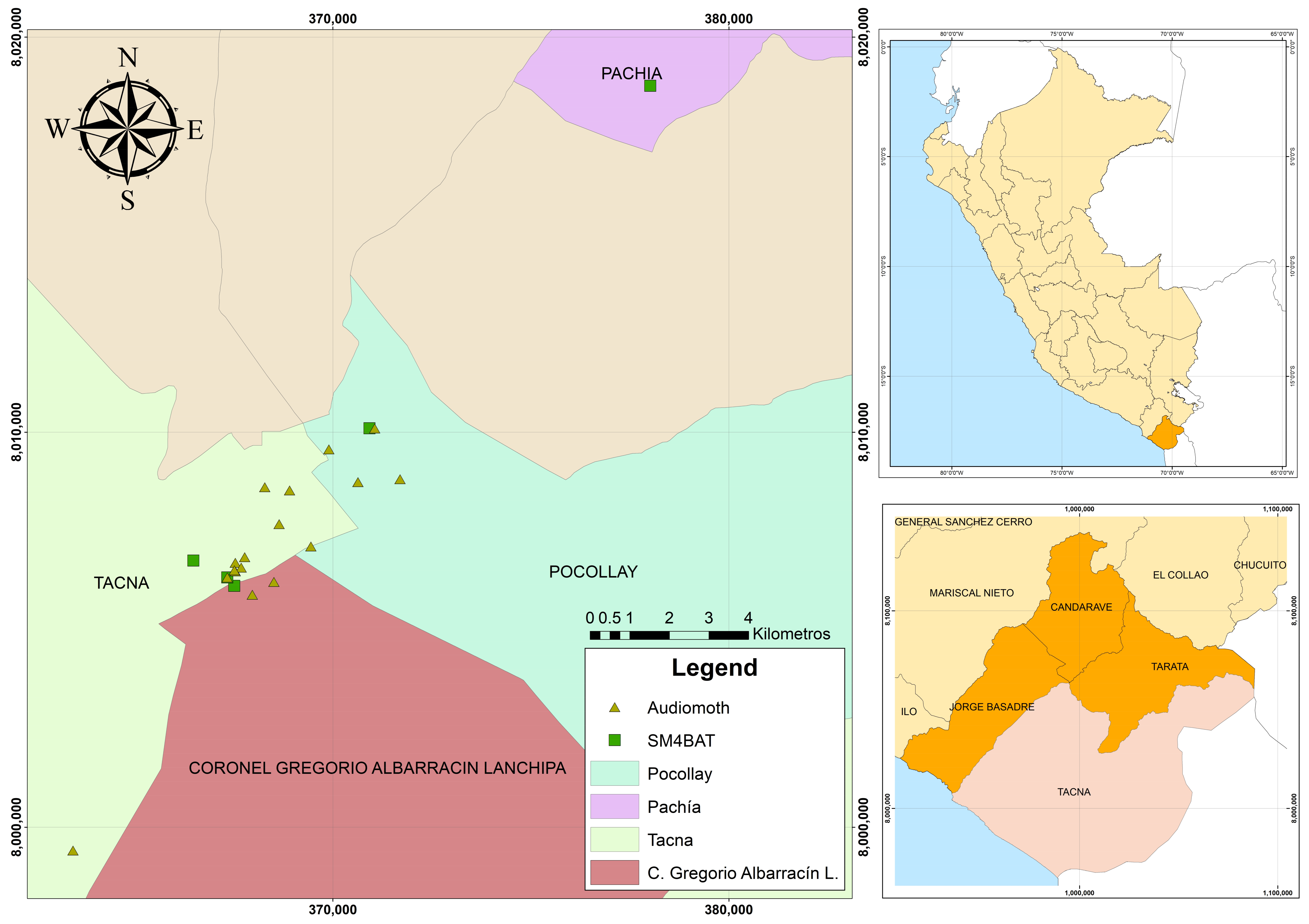
Mena et al. [
26] documented that bat richness and occupancy decrease with increasing artificial light intensity along arid coastal urban gradients in central Peru. Based on this evidence, we hypothesized that bat acoustic diversity and community composition would differ among districts according to urbanization intensity estimated from existing demographic and land-use data, with higher sonotype richness and assemblage evenness in rural and peri-urban districts (Pachía and Pocollay) than in intermediate and consolidated urban districts (Gregorio Albarracín and Tacna). To test this hypothesis, this study characterized the acoustic diversity and community composition of insectivorous bat assemblages along an urban–rural gradient in Tacna, Peru, using passive acoustic monitoring. The specific objectives were (1) to identify the sonotypes present in four districts with varying degrees of urbanization through bioacoustic characterization and the construction of a local sound library, addressing the critical deficit of acoustic reference repositories for bat sonotypes in arid South America; (2) to evaluate acoustic separability among sonotypes using Discriminant Function Analysis (DFA) with Leave-One-Out Cross-Validation (LOOCV), providing a statistically robust framework for call identification in desert urban environments; (3) to compare alpha diversity among districts using classical indices and rarefaction of Hill numbers standardized by acoustic detections, enabling unbiased diversity comparisons across districts with unequal sampling effort; and (4) to describe beta diversity patterns in community composition among districts using the Bray–Curtis dissimilarity matrix.
4. Discussion
This study recorded nine of the twenty sonotypes documented for Tacna, representing 45% of the sonotypes identified in southwestern Peru [
16]. Although direct comparison between species identified by conventional methods and acoustically defined sonotypes requires caution—as both represent operationally distinct units—previous inventories had identified up to 11 species in the department [
27,
54,
55,
56], none of which included
N. laticaudatus or
N. macrotis, both acoustically detected here for the first time in the urban area of Tacna. This finding extends the known chiropterological records for the department and underscores the utility of bioacoustic monitoring for detecting rare or difficult-to-sample species that conventional methods may overlook. These results also suggest the feasibility of passive acoustic methods in complex urban environments, despite the structural challenges of artificial surfaces, physical barriers, and habitat fragmentation characteristic of such ecosystems [
20,
26].
The sonotype richness recorded in this study is higher than that reported in individual tropical cities surveyed in Vietnam—six species in Ho Chi Minh City and four in Tra Vinh—although Pham et al. [
57] themselves note that urban species richness in those systems is low relative to forested or protected areas. In contrast, Starik et al. [
22] identified nine species and three additional sonotypes (12 acoustic entities in total) in the Berlin–Brandenburg urban gradient, a figure somewhat higher than the richness recorded here, though direct comparison is constrained by the marked differences in landscape context and bat fauna between both regions. While comparisons across biogeographic regions must be interpreted with caution given differences in sampling effort, methods, and baseline species pools, these contrasts suggest that hyperaridity may impose structural constraints on assemblage richness that compound the effects of urbanization—a hypothesis that warrants explicit testing in future studies incorporating environmental variables. A notable feature of the Tacna assemblage in this context is the strong representation of Molossidae, a pattern that may help explain its compositional distinctiveness relative to both tropical and temperate urban systems.
High Molossidae representation is consistent with observations from arid zones in northern Chile, where fast-flying bats with low-frequency calls constitute an important component of local assemblages [
58], and aligns with reports along urban–natural gradients in Latin America: in Mexico, Sánchez et al. [
59] recorded high acoustic activity of
Promops centralis, a species typical of open spaces, suggesting that such environments may favor bats adapted to fast flight and aerial foraging. The relevance of Tacna as a study system lies therefore not only in its methodology but in the geographic and biogeographic gap it addresses: a hyperarid coastal urban system in southern Peru with a Molossidae-prevalent assemblage for which no prior acoustic baseline existed—a gap consistent with the exclusively conventional methods reported for the region [
27,
56].
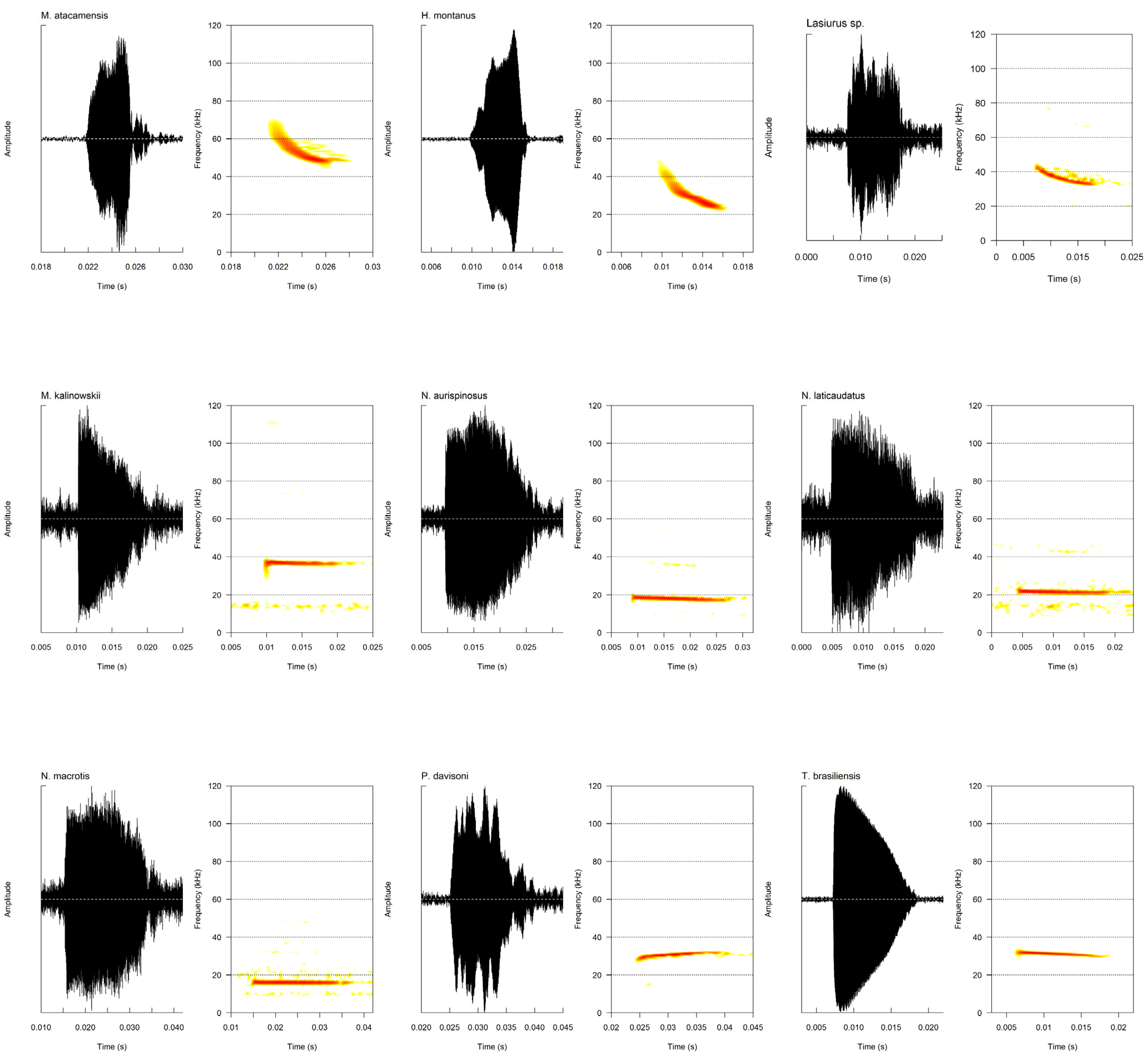
The acoustic parameters recorded for each sonotype were consistent with published descriptions for their respective families [
16,
19,
28,
45,
60,
61], supporting the validity of the assignments. The acoustic parameters of the
Lasiurus sp. sonotype are consistent with those of the family Vespertilionidae; given prior records of
L. arequipae in urban environments of the region [
56,
62], assignment at the genus level was based on these acoustic characteristics, although the scarcity of acoustic detections prevented identification at the species level [
55]. Regarding
H. montanus, the PF recorded in this study differs from previously reported descriptions for this parameter, which indicate mean values close to 30 kHz [
16,
45]; however, considerable acoustic variability has been documented within the group, with PF values between 24.9 and 36 kHz [
63], suggesting notable plasticity in this trait.
H. montanus is also the only species of the genus reported acoustically in southwestern Peru [
16]. Despite the low number of acoustic detections and the observed difference in PF, the acoustic and biogeographic evidence supports the probable assignment of the sonotype defined in this study to that species.
Although the limited number of acoustic detections means that the taxonomic assignment of these sonotypes should be considered preliminary, the available ecological evidence and regional acoustic surveys support their plausible occurrence within the study area. Dietary studies have shown that
H. montanus exhibits a marked preference for Lepidoptera, whereas
M. atacamensis and
M. kalinowskii have more generalized diets [
64], a difference that may contribute to the lower detectability of
H. montanus in urban environments. Likewise, an acoustic survey conducted in southwestern Peru reported similarly low detection frequencies for both
Nyctinomops and
Lasiurus, suggesting that these genera are naturally infrequent in acoustic inventories of the region [
16]. For
Nyctinomops, this pattern is consistent with its high-altitude flight behavior, apparent preference for lepidopteran prey, and use of buildings and rock crevices as roosts [
55]. In the case of
Lasiurus, the genus has been documented using tree branches as temporary roosts in agricultural and riparian habitats, including urban areas [
56], which are habitat characteristics that resemble those of Pocollay, where the sonotype was recorded. Collectively, these ecological traits and regional acoustic records indicate that the occasional detection of these sonotypes is consistent with their known natural history, although their taxonomic identity should be confirmed through additional acoustic detections or complementary evidence.
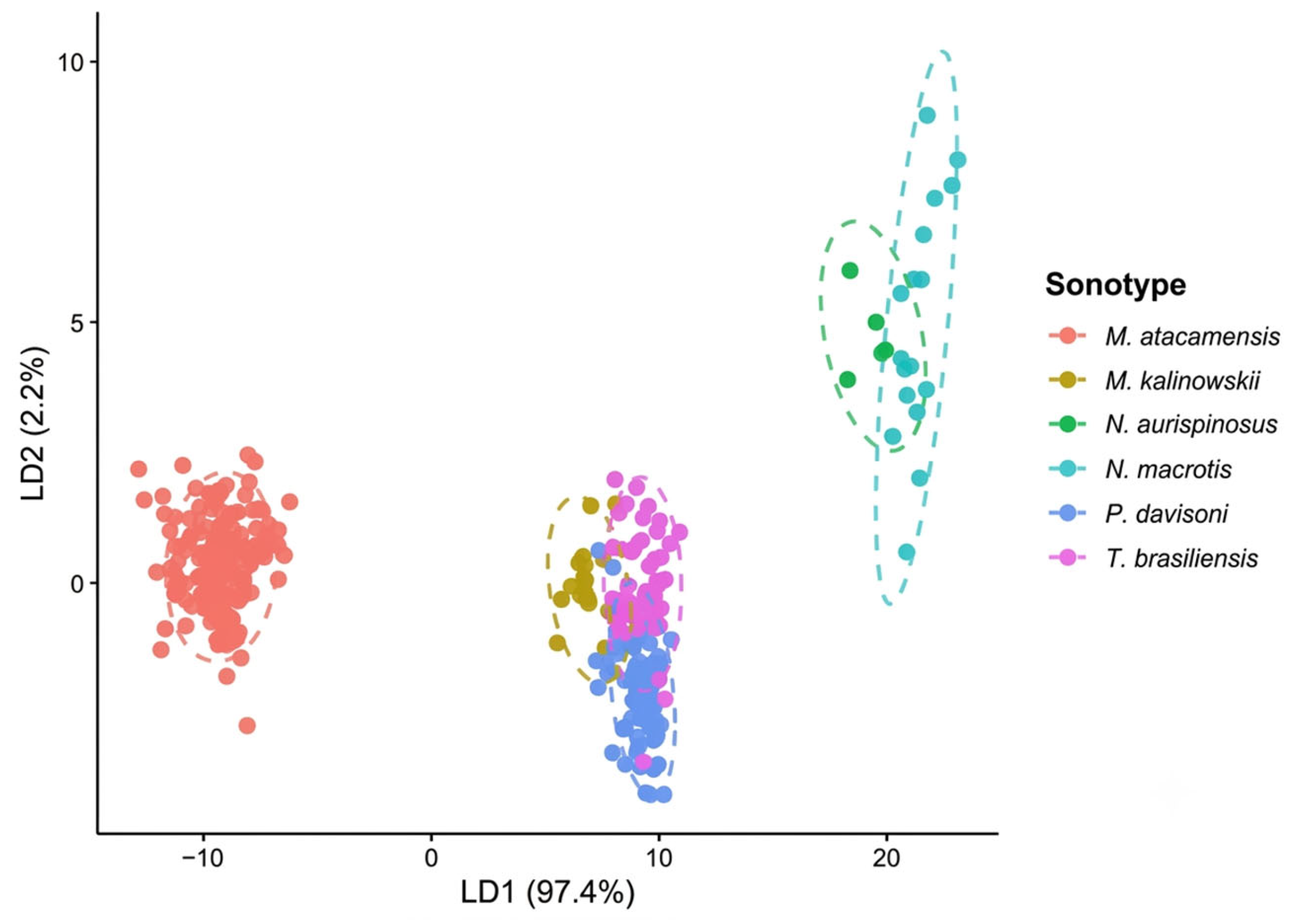
The discriminant model achieved an overall accuracy of 94.47% under LOOCV, consistent with recent studies of acoustic reference libraries in the region where LOOCV has confirmed the robustness of LDA models at similar accuracy levels and where FF, PF, and PD have been identified as the parameters with the greatest separatory capacity among sonotypes [
47]; comparable studies in other regions have achieved even higher levels of separation at the functional group level [
65]. Among these variables, PF is the most widely used acoustic parameter for sonotype identification in Neotropical bats and has been described as apparently less susceptible to biases derived from recording technique and technology [
17]. The consistency of these parameters as discriminatory variables suggests their robustness for acoustic monitoring across urbanization gradients in arid environments. The perfect classification obtained for
M. atacamensis may be associated with its being the smallest species among
Myotis inhabiting Chile, with records from Arequipa in southern Peru to northern Chile, in xeric and desert zones between 990 and 3475 m a.s.l. [
66]; given that body size is inversely proportional to echolocation frequencies, smaller species tend to reach higher PF values [
67]. The high classification accuracy achieved for
P. davisoni and
T. brasiliensis may be associated with the morphological distinctiveness of their call components relative to other molossids recorded in the study [
16]. In contrast, the lower classification accuracy observed for
M. kalinowskii and sonotypes of the genus
Nyctinomops reflects the acoustic similarity among their representatives—a known limitation in molossid identification that has been documented in other regional studies [
16].
The discriminant analysis recovered clear separation between both families, determined primarily by spectral variables along LD1. Pulse duration was the trait that most sharply distinguished them: Vespertilionidae sonotypes combined shorter pulses with higher peak and final frequencies, while Molossidae sonotypes presented systematically longer pulses at lower frequencies. This contrast follows the well-documented link between higher-frequency, shorter calls and foraging in structurally complex spaces, as opposed to lower-frequency, longer-duration signals characteristic of open-space foraging [
17,
60]. The family-level separation recovered here therefore reflects an ecological adaptation linked to habitat use and foraging strategy, rather than taxonomic identity alone [
19].
Since environmental variables such as vegetation cover, artificial light intensity, water availability, and habitat connectivity were discussed but not directly quantified, the associations described below are interpreted as a working hypothesis of environmental filtering rather than as demonstrated causal effects. Unlike the negative responses documented for the genus
Myotis under anthropogenic disturbance in wetter Neotropical contexts [
68],
M. atacamensis showed a concentration of acoustic activity in the urban core—a divergence that does not appear to be a sampling artifact but rather reflects a set of functional traits that may favor its persistence in transformed environments: broad ecological plasticity; documented foraging around artificial lighting; use of crevices and abandoned structures as roosts; and slow, highly maneuverable flight that allows operation in both vegetated and open spaces [
69]. Its distribution is restricted to arid and semi-arid environments of southern Peru and northern Chile, where natural habitats are already severely fragmented [
45], suggesting differential tolerance to disturbance relative to its congeners in wetter environments—a hypothesis that could not be tested here because landscape variables were not measured. Taken together, the species-specific response to urbanization, conditioned by wing morphology, foraging strategy, and flexibility in roost use [
21,
26], positions
M. atacamensis among urban adapter species capable of persisting up to certain disturbance thresholds [
22].
The acoustic presence of molossids such as
T. brasiliensis,
P. davisoni,
M. kalinowskii, and
Nyctinomops spp. aligns with the broader tolerance attributed to this family [
19,
70]. In such contexts, urban structures may act as alternative roosts when fragmentation and loss of vegetation cover reduce the availability of natural sites [
71].
Across the four districts, alpha diversity appears to vary in association with the degree of habitat transformation, consistent with urbanization intensity as a structuring factor [
72]. The gradient does not follow a simple linear progression, as the diversity peak occurs in the peri-urban zone rather than at the rural extreme, with the minimum corresponding to the most urbanized districts.
Pocollay emerged as the most diverse district along the gradient. Its peri-urban character—combining active cultivation of vegetables, grapes, maize, and alfalfa [
73] with incipient urban development—appears to support a more balanced distribution of acoustic activity among sonotypes than observed in consolidated urban districts, encompassing sonotypes characteristic of both urban districts and the rural extreme. This pattern aligns with the higher diversity documented in peri-urban landscapes relative to consolidated urban cores [
22,
25], although direct extrapolation of findings obtained in humid tropical biomes to an arid coastal landscape requires interpretive caution. In arid environments, prey availability may be enhanced by the concentration of insects associated with nearby crops [
74] and by the presence of riparian habitats and water bodies, which aggregate nocturnal insect biomass and constitute preferred foraging areas [
75]; additionally, urban–rural transition zones exhibit some of the highest foraging activity rates, possibly due to the concentration of insects attracted to lighting at landscape edges [
19]. The presence of adobe or rammed-earth structures (4%) and precarious buildings (9.6%) [
30] could offer potential roost sites with physical characteristics similar to those used by bats in other urban contexts [
71], although this association remains speculative in the absence of direct roost surveys. Collectively, Pocollay functions as a transition zone in which peri-urban environmental heterogeneity sustains both foraging and the movement of disturbance-sensitive sonotypes among habitat patches [
8,
22].
Pachía, at the rural end, shows the most equitable distribution of acoustic activity among sonotypes, consistent with its low population density and agricultural matrix: in arid ecosystems, rural sites tend to exhibit greater richness and a broader acoustic space, as urbanization fragments habitat, increases light pollution, and reduces connectivity among green areas [
26], such that habitat heterogeneity under low urban pressure favors coexistence without any sonotype showing prevalent acoustic activity [
21]. At the opposite end of the gradient, Gregorio Albarracín—with approximately 99.73% of its territory under urban land-use following rapid residential expansion [
30]—represents the most transformed condition: habitat reduction and fragmentation limit both foraging sites and available roosts [
76], and the loss of vegetation cover restricts food resources and shelter, leaving only sonotypes with greater functional tolerance to maintain appreciable activity, while disturbance-sensitive sonotypes face progressive exclusion from the most transformed sectors of the gradient [
72,
77,
78].
Tacna occupies an intermediate position that introduces an important distinction within the gradient: despite exhibiting relatively high sonotype richness—exceeded only by Pocollay—it shows the lowest evenness, with acoustic activity concentrated in a reduced number of sonotypes. This decoupling between richness and evenness is consistent with patterns documented in highly urbanized environments, where a reduced number of tolerant sonotypes account for the majority of acoustic detections [
21,
72]: richness may remain relatively high, but assemblage structure is simplified. With more than 99% of its population in urban areas [
29] and scarce native vegetation, persistent activity appears to be sustained by urban parks and green spaces, which, albeit limited in extent, increase habitat quality and accessibility within the matrix [
25,
72,
79], and by prey concentration around artificial lighting, which benefits sonotypes capable of exploiting such aggregations [
21,
25]. The contrast between Tacna’s richness and its low evenness, against Pocollay’s combination of high richness and high evenness, suggests that along the gradient, urbanization may not only reduce sonotype numbers in its most consolidated sectors but also reorganize prevalence within the assemblage, favoring a reduced core of tolerant sonotypes—a pattern that warrants formal testing in future studies incorporating landscape variables.
Beta diversity patterns complemented this picture by revealing marked differences in acoustic community composition among districts. The lowest dissimilarity observed in this study was recorded between Gregorio Albarracín and Pocollay: the sonotypes registered in the most urbanized district were also present in Pocollay, although the latter encompassed additional sonotypes absent from Gregorio Albarracín. This pattern may be interpreted as a progressive loss of sonotypes toward more urbanized environments without incorporation of new ones, consistent with an impoverishment process associated with the selective non-random exclusion of sensitive sonotypes documented along bat urbanization gradients [
78] and with processes in which sites with fewer sonotypes constitute subsets of those with greater sonotype richness—a pattern analogous to that documented at the species level [
80].
Pachía exhibited the greatest compositional differences relative to urban districts, including the exclusive record of H. montanus and the absence of sonotypes with high acoustic representation in consolidated urban districts. This differentiation suggests qualitatively distinct assemblages at each extreme of the gradient. In arid environments, where native vegetation is scarce even outside the city, differences between the rural and urban extremes of the gradient could be particularly pronounced, given that baseline conditions may already limit regional diversity.
Pocollay showed intermediate dissimilarity values relative to both extremes, encompassing sonotypes present in urban districts as well as sonotypes recorded in the rural district—reflecting the characteristic heterogeneity of peri-urban landscapes, where sonotypes with differing habitat requirements may coexist [
21]. Compositional variation among districts suggests a directional shift along the gradient, with more urbanized districts tending toward assemblages with higher representation of sonotypes with broader habitat tolerance—a trend consistent with the taxonomic homogenization documented in Neotropical bat assemblages under urbanization gradients [
23]. The absence of a formal beta diversity partition analysis prevents definitively distinguishing between differential loss and compositional replacement components, an avenue that future studies with broader sampling coverage per district could formally evaluate.
The results should be interpreted considering that acoustic activity does not directly reflect population abundance and that sampling corresponded to a single temporal period. Acoustic identification may additionally involve uncertainty for some assigned sonotypes, particularly sonotypes of the genus
Nyctinomops, for which classification accuracy was comparatively lower. The environmental variables that could mediate the observed patterns, including vegetation cover, artificial light intensity, water availability, and habitat connectivity, were inferred from district-level demographic and land-use data and published evidence but were not directly measured at each sampling station; for this reason, the gradient among districts is treated as a proxy for urbanization intensity, and the diversity differences reported here should be read as associations rather than effects directly attributable to a single environmental factor. The unequal distribution of stations among districts, with Pachía represented by a single station, could introduce sampling biases in diversity comparisons; to minimize this potential bias, all alpha diversity estimates were standardized to a minimum of 27 acoustic detections—corresponding to Pachía—ensuring that comparisons reflect differences in assemblage composition rather than sampling effort. A further limitation concerns recording equipment: deployment was conditioned by theft and vandalism risk, with AudioMoth units placed in exposed public areas of highly urbanized zones, while SM4BAT-FS units were restricted to secured urban parks. As device type was not distributed uniformly along the gradient, differences in microphone sensitivity and noise filtering [
81] are partially confounded with urbanization intensity, and contrasts in acoustic activity and sonotype richness between more urbanized matrices and sites with greater vegetation cover should be read within the detection limits of the equipment deployed at each site.
Future studies incorporating a greater number of sampling units per district, direct measurements of landscape attributes, and a balanced allocation of device types along the gradient could contribute to clarifying the mechanisms that structure bat assemblages along urban gradients in arid zones. Integrating environmental variables such as vegetation cover, artificial light intensity, and habitat connectivity as explicit predictors—rather than as district-level proxies—would allow the filtering processes suggested here to be formally tested.
The confirmed presence of bat assemblages within the urban matrix of Tacna points to a broader management gap: standardized protocols for human–bat conflict situations in urban environments remain limited in Peru, and the acoustic baseline documented here could provide technical grounding for national and local conservation authorities seeking to develop evidence-based urban bat management guidelines.



 ,
,