1. Introduction
Cities are at the forefront of global sustainability challenges and opportunities. According to the United Nations projections, nearly 70% of the world’s population will live in urban areas by 2050, increasing pressure on natural resources, infrastructure, public services, and environmental quality [
1]. Although urban tourism generates significant economic and social benefits, it also contributes to environmental challenges such as increased resource consumption, waste generation, pollution, congestion, and pressure on local ecosystems [
2]. Consequently, ensuring that urban tourism develops in a sustainable manner has become a priority for policymakers, destination managers, and researchers.
The importance of sustainable urban development is reflected in the United Nations 2030 Agenda for Sustainable Development, particularly Sustainable Development Goal 11 (SDG 11), which seeks to make cities and human settlements inclusive, safe, resilient, and sustainable [
3]. SDG 11 emphasizes environmentally responsible urban planning, sustainable transportation systems, reduced environmental impacts, protection of cultural and natural heritage, and enhanced quality of life for residents [
4]. Tourism can contribute to SDG 11 through urban regeneration, cultural preservation, and economic development [
2,
5]. However, achieving these outcomes requires more than effective governance and planning. Long-term sustainability also depends on the attitudes and behaviors of local residents, whose daily actions directly influence the environmental performance of urban destinations [
6,
7].
Recent studies indicate that residents’ sustainability-oriented behaviour is shaped by both individual and community-level factors. Community attachment has been associated with stronger environmental stewardship and support for environmental protection, while community involvement can enhance participation in sustainability initiatives and local decision-making processes [
6,
8]. Destination social responsibility has also emerged as an important factor influencing residents’ perceptions of sustainability and community well-being [
9,
10].
Recent international studies have further reinforced the importance of residents’ perceptions, community participation, and environmental engagement in achieving sustainable urban tourism, highlighting the need to balance tourism growth with environmental protection and residents’ well-being [
11,
12,
13]. Although these factors have received growing attention individually, limited research has examined their combined influence on environmental participation, environmental advocacy, perceived environmental benefits, and support for sustainable behaviour within urban tourism destinations. While sustainable urban tourism has received considerable scholarly attention, much of the existing literature has primarily focused on tourists’ perceptions, attitudes, and behavioral intentions. Comparatively less attention has been devoted to residents, despite their essential role in supporting environmentally responsible practices and the long-term sustainability of tourism destinations. Furthermore, existing studies examining residents often investigate only selected determinants of environmentally responsible behavior rather than offering a holistic examination of the psychological and environmental drivers underlying environmentally responsible behaviour [
11,
12,
13]. Addressing this gap, the present study adopts a residents’ perspective and develops an integrated framework to examine the determinants of environmentally responsible behavior in the urban tourism context of Novi Sad, Serbia.
Beyond its rapid tourism growth, Novi Sad represents a particularly relevant setting for examining residents’ sustainability-oriented perceptions and behaviours due to its distinctive urban development trajectory. As a post-socialist city undergoing continuous transformation, Novi Sad has experienced increased international visibility following its designation as the 2022 European Capital of Culture, while major events such as the EXIT Festival have substantially expanded tourism demand and intensified pressure on urban infrastructure, public spaces, and environmental resources. These developments highlight the importance of understanding how residents perceive destination social responsibility, engage with their local community, and support environmentally responsible practices in balancing tourism development with environmental protection and community well-being. Consequently, Novi Sad provides an appropriate empirical context for investigating the factors shaping residents’ support for sustainable urban tourism [
14,
15].
Integrated models linking these constructs remain scarce, particularly in the context of implementing SDG 11. Therefore, this study adopts the perspective of local residents to investigate environmentally responsible behavior in Novi Sad. By integrating environmental awareness, environmental attachment, community attachment, and support for sustainable tourism into a single structural model, the study provides a more comprehensive understanding of the factors influencing residents’ environmentally responsible behavior than has commonly been addressed in previous research [
11].
Unlike much of the existing literature, which predominantly examines tourists’ perspectives, the present study adopts a residents’ perspective to investigate how community-related and environmental factors jointly influence environmentally responsible behaviour in an urban tourism destination. By integrating these constructs into a single conceptual model, the research offers empirical evidence from Novi Sad, Serbia, and provides further insight into the mechanisms through which local communities can support sustainable urban tourism and broader sustainability objectives.
2. Literature Review and Hypothesis Development
2.1. Sustainable Urban Tourism and SDG 11
Sustainable urban tourism seeks to balance economic development, environmental protection, and social well-being within urban destinations [
16]. While tourism contributes to local economies and urban regeneration, it can also generate environmental challenges, including resource consumption, waste generation, transportation emissions, overcrowding, and pressure on infrastructure and ecosystems [
5,
17,
18].
The concept is closely linked to Sustainable Development Goal 11 (SDG 11), which promotes inclusive, resilient, and sustainable cities and communities. Tourism can support SDG 11 through heritage preservation, infrastructure development, and economic opportunities for residents [
4,
19]. However, achieving sustainable urban tourism depends not only on planning and governance but also on the active engagement of local communities. Residents influence environmental quality and destination sustainability through their attitudes and behaviours [
6,
7]. Consequently, understanding the factors that encourage residents’ environmental engagement and support for sustainable behaviour is essential for advancing sustainable urban tourism and achieving SDG 11 objectives.
2.2. Residents’ Environmental Engagement and Support for Sustainable Behaviour
Although previous studies [
11] have increasingly recognized the importance of residents in sustainable tourism development, research examining the determinants of residents’ environmentally responsible behavior remains comparatively limited and fragmented. The active participation of residents is fundamental to sustainable urban tourism, as their everyday behaviours contribute to environmental quality, resource conservation, and the long-term sustainability of destinations. Environmental engagement and support for sustainable behaviour encompass participation in environmental initiatives, advocacy for environmental protection, recognition of environmental benefits associated with tourism development, and support for sustainability-oriented practices [
20,
21,
22,
23].
The Theory of Planned Behavior and the Value–Belief–Norm framework suggest that individuals are more likely to engage in pro-environmental actions when they hold positive environmental attitudes and perceive environmental issues as important [
20,
24]. Previous studies have shown that environmental attitudes, place attachment, social responsibility, and community engagement can encourage participation in sustainability initiatives and environmentally responsible behaviour [
7,
25,
26].
In tourism destinations, residents experience both the benefits and costs of tourism development and therefore represent key stakeholders in sustainability initiatives. Their environmental engagement contributes to support for sustainable behaviour and broader sustainability objectives [
7,
25,
27]. Building on previous research, this study examines environmental participation, environmental advocacy, perceived environmental benefits, and support for sustainable behaviour within an integrated framework that incorporates destination social responsibility, community attachment, community involvement, and environmental attitudes. This perspective is particularly relevant in rapidly developing urban destinations where tourism growth generates both opportunities and sustainability challenges. Novi Sad, as a post-socialist city that has experienced increasing international recognition following its designation as the 2022 European Capital of Culture, has undergone accelerated tourism development in recent years. In addition, major events such as the EXIT Festival generate substantial seasonal visitor flows, placing increased pressure on urban infrastructure, public spaces, and environmental resources [
14,
15]. These local characteristics underscore the importance of understanding residents’ perceptions of destination social responsibility, community engagement, and environmental stewardship, as they play a crucial role in balancing tourism development with environmental protection and long-term urban sustainability.
2.3. Destination-Level Social Responsibility
Destination social responsibility (DSR) can be understood as the coordinated commitment of stakeholders within a tourism destination to promote social and economic well-being while limiting the environmental and social costs of tourism development [
9,
10]. As an extension of corporate social responsibility to the destination level, DSR promotes sustainable management practices that enhance residents’ quality of life, support environmental conservation, and strengthen stakeholder relationships.
According to Stakeholder Theory and Social Exchange Theory, residents are more likely to respond positively to tourism development when they perceive destination stakeholders as acting responsibly and contributing to community well-being [
28,
29]. Such perceptions may strengthen community attachment, reflecting residents’ emotional bonds with their community, and encourage greater community involvement in local activities and decision-making processes [
30,
31].
Previous studies indicate that socially responsible destination practices can enhance both community attachment and community involvement among residents [
9,
10]. Accordingly, the following hypotheses are proposed:
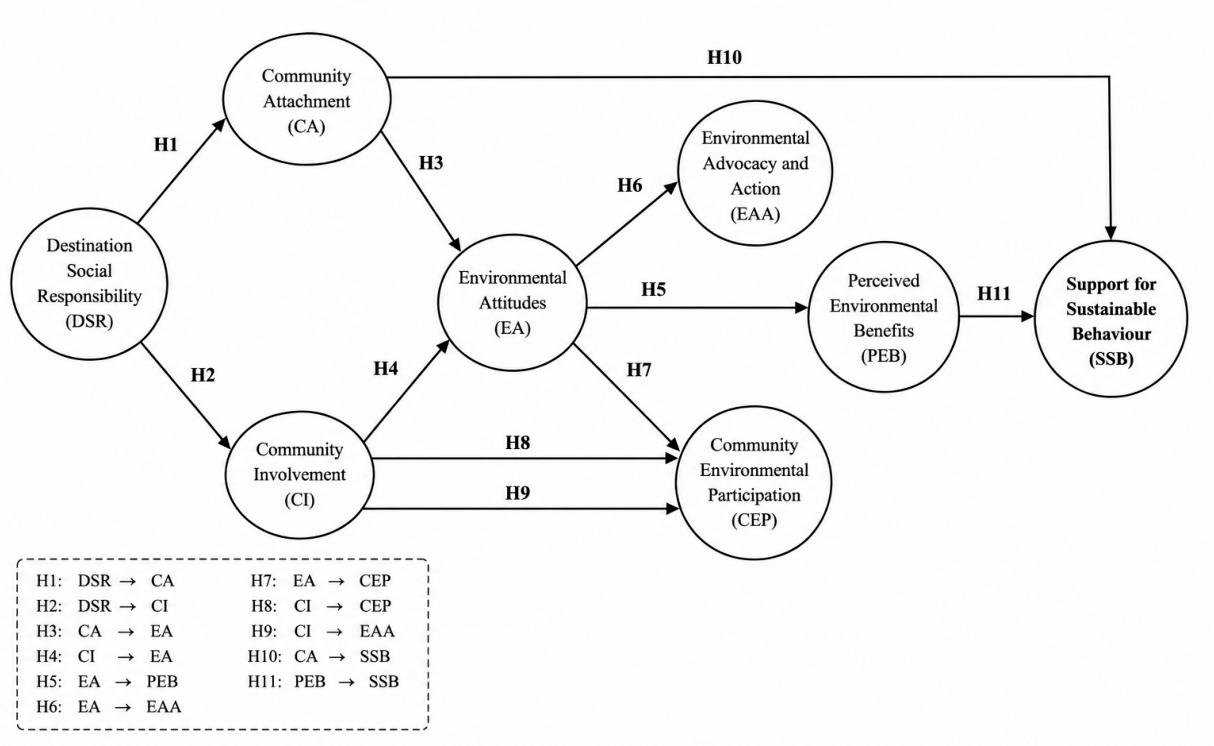
H1. Destination social responsibility positively influences community attachment.
H2. Destination social responsibility positively influences community involvement.
2.4. Community Attachment and Support for Sustainable Behaviour
Community attachment (CA) refers to the emotional bond and sense of belonging that individuals develop with their place of residence and community [
30,
32]. Within tourism destinations, community attachment influences residents’ perceptions of tourism development and their willingness to support destination-related initiatives [
6,
33].
Place Attachment Theory suggests that strong emotional bonds with a place encourage individuals to engage in behaviours that protect its environmental and social resources [
34,
35]. Residents who feel attached to their community often perceive local environmental resources as important components of their identity and quality of life, which can strengthen positive environmental attitudes and support for sustainability initiatives.
Previous studies have shown that community attachment is positively associated with environmental stewardship, pro-environmental attitudes, and support for sustainable practices [
7,
36,
37]. Therefore, residents with stronger community attachment are expected to exhibit more positive environmental attitudes and greater support for sustainable behaviour.
Accordingly, the following hypotheses are proposed:
H3. Community attachment positively influences environmental attitudes.
2.5. Community Involvement and Environmental Attitudes
Community involvement (CI) refers to residents’ participation in community activities, local decision-making processes, and initiatives that influence community development [
30,
31]. In tourism destinations, community involvement is considered an important component of sustainable development because it promotes stakeholder participation, social cohesion, and shared responsibility for destination management [
8,
38].
Participatory development and collaborative governance perspectives suggest that residents who actively engage in community affairs become more aware of local challenges and are more likely to develop a sense of responsibility toward community well-being [
25,
39]. Through participation in local initiatives and environmental programs, residents gain greater awareness of environmental issues and sustainable resource management practices [
40,
41].
Previous studies have shown that community involvement positively influences environmental concern and support for sustainability-oriented initiatives [
7,
25,
42]. Therefore, residents who are more actively involved in community affairs are expected to exhibit more positive environmental attitudes.
Accordingly, the following hypothesis is proposed:
H4. Community involvement positively influences environmental attitudes.
2.6. Environmental Attitudes, Environmental Engagement, Perceived Environmental Benefits, and Support for Sustainable Behaviour
Environmental attitudes (EAs) refer to individuals’ beliefs and evaluations regarding environmental issues and environmental protection [
43,
44]. Previous research has consistently identified environmental attitudes as important predictors of pro-environmental behaviour and support for environmental sustainability [
45].
The Theory of Planned Behavior and the Value–Belief–Norm framework suggest that positive environmental attitudes increase individuals’ willingness to adopt behaviours that contribute to environmental protection and sustainable development [
20,
24].
Within tourism destinations, residents with positive environmental attitudes are more likely to participate in environmental initiatives, engage in environmental advocacy and action, and recognize the environmental benefits associated with sustainable tourism development [
7,
25]. Positive evaluations of environmental benefits, such as environmental conservation, resource protection, and improvements in environmental quality, can further strengthen support for sustainable behaviour [
46].
In addition, community involvement may directly encourage environmental participation and environmental advocacy by increasing residents’ awareness of environmental issues and engagement in local sustainability initiatives [
25,
47].
Based on these arguments, the following hypotheses are proposed:
H5. Environmental attitudes positively influence perceived environmental benefits.
H6. Environmental attitudes positively influence environmental advocacy and action.
H7. Environmental attitudes positively influence community environmental participation.
H8. Community involvement positively influences community environmental participation.
H9. Community involvement positively influences environmental advocacy and action.
H10. Community attachment positively influences support for sustainable behaviour.
H11. Perceived environmental benefits positively influence support for sustainable behaviour.
Drawing on the literature and theoretical arguments presented in the preceding sections, a conceptual model was developed to explain residents’ environmental engagement and support for sustainable behaviour in the context of sustainable urban tourism.
Figure 1 presents the proposed conceptual model and the hypothesized relationships among the study constructs.
3. Materials and Methods
3.1. Case Study Context
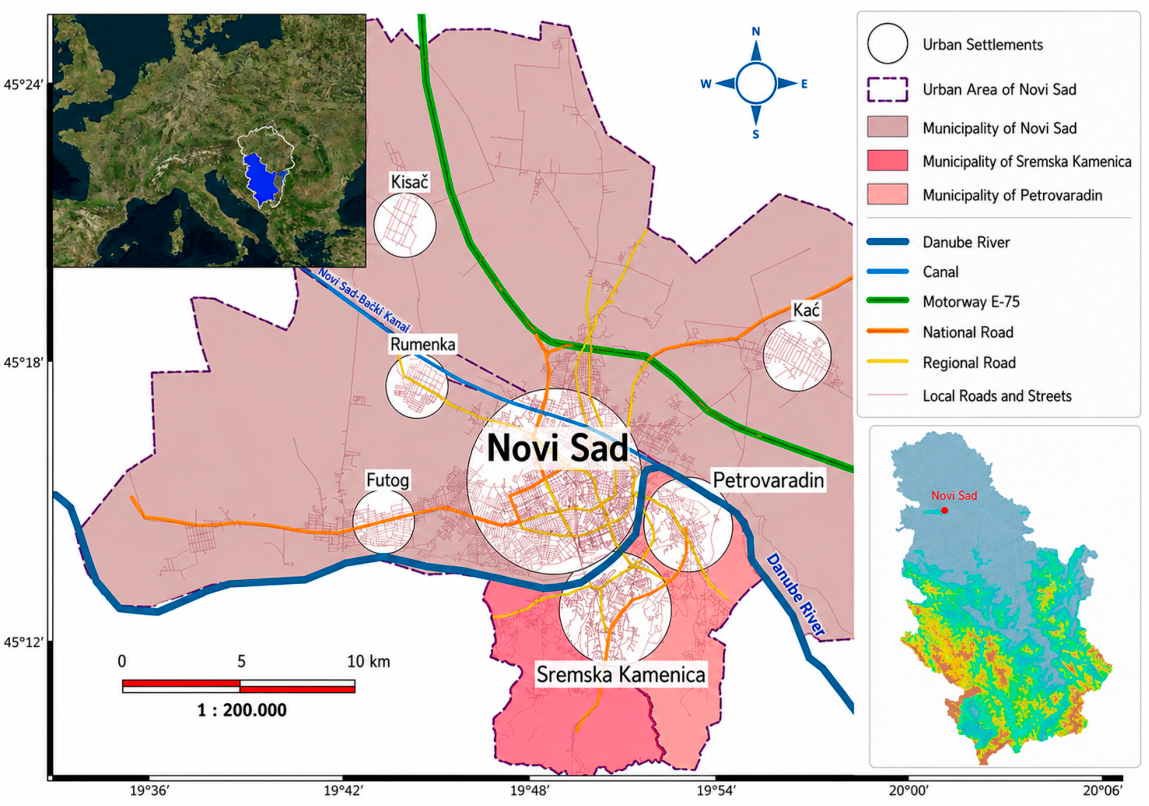
The research was conducted in Novi Sad, the administrative centre of the Autonomous Province of Vojvodina and Serbia’s second-largest city. The city was selected because of its growing role as an urban tourism destination and its increasing emphasis on sustainable urban development (
Figure 2). According to the 2022 Census [
48], the city has a population of 368,967 residents and represents an important cultural, economic, and administrative center in Serbia.
Over the past decade, Novi Sad has strengthened its position as one of Serbia’s leading urban tourism destinations. International visibility increased following its designation as the European Capital of Culture in 2022, while events such as the EXIT Festival have further enhanced its tourism profile. According to national tourism statistics, Novi Sad is the second most visited urban destination in Serbia, attracting approximately 234,708 tourists annually [
49].
The continued growth of tourism presents challenges related to infrastructure, resource management, environmental protection, and residents’ quality of life. In response, the city has incorporated sustainability principles into its strategic development policies, emphasizing environmental protection, sustainable mobility, responsible tourism development, and improvements in urban quality of life [
14,
15].
Given its growing tourism sector and commitment to sustainable urban development, Novi Sad provides an appropriate context for examining residents’ environmentally responsible behaviour and support for sustainable urban tourism.
3.2. Participants and Data Collection
The study population comprised adult residents of Novi Sad, Serbia. According to the 2022 Population Census, Novi Sad has a population of 368,967 inhabitants, making it the second-largest city in Serbia. To examine residents’ perceptions of destination social responsibility, community attachment, community involvement, environmental attitudes, perceived environmental benefits, and support for sustainable behaviour, a total of 1038 valid questionnaires were collected and included in the final analysis.
A purposive sampling approach was employed to recruit respondents who met the study criteria. Specifically, participants were required to be permanent residents of Novi Sad and at least 18 years of age. This sampling strategy was considered appropriate because the study focused on residents’ perceptions and attitudes regarding sustainable urban tourism and environmental sustainability.
Data were collected using a mixed-mode survey approach that combined online and face-to-face administration. A total of 138 questionnaires were obtained through online distribution via social media platforms and community networks targeting Novi Sad residents, while 900 questionnaires were collected through in-person administration at various locations throughout the city. The combination of online and face-to-face data collection facilitated broader demographic coverage and enhanced the diversity of the sample.
The final sample size exceeded the minimum requirements for Structural Equation Modeling (SEM). According to recommendations in the SEM literature, samples exceeding 500 observations are considered highly satisfactory for complex models involving multiple latent constructs and pathways [
50]. The final dataset comprised 1038 valid responses, providing sufficient statistical power for estimating the proposed structural model and evaluating the hypothesized relationships among the study constructs.
The survey instrument was constructed by adapting measurement scales that had previously been validated in studies on tourism, sustainability, and environmental behaviour. Before the main survey was conducted, the questionnaire underwent a careful review to improve its clarity and appropriateness for the Novi Sad context. Only minor wording adjustments were made to facilitate respondents’ understanding without altering the conceptual meaning of the original items. Data collection was conducted between June and October 2023 using a mixed-mode survey approach that combined online and face-to-face administration. The online questionnaire was created using Google Forms and distributed through social media platforms (Facebook and Instagram) and community networks targeting residents of Novi Sad. To increase participation and improve sample coverage, additional questionnaires were administered in person at various locations throughout the city.
The target population consisted of adult residents of Novi Sad aged 18 years and older. Before completing the questionnaire, all participants received information regarding the objectives of the study, the voluntary nature of their involvement, and the confidentiality of the collected data. Participation was anonymous, and respondents were assured that the collected data would be used exclusively for scientific purposes. Completion of the questionnaire was considered to constitute informed consent. The study adhered to the ethical principles of voluntary participation, anonymity, confidentiality, and informed consent throughout the research process.
Following data collection, the questionnaires were screened for completeness and consistency before being coded and prepared for statistical analysis.
3.3. Measurement Instrument
Data were collected using a structured questionnaire designed to measure residents’ perceptions, attitudes, environmental engagement, and support for sustainable behaviour in the context of sustainable urban tourism. To ensure content validity, the questionnaire incorporated measurement items adapted from well-established instruments reported in the tourism, sustainability, and environmental behaviour literature. The initial questionnaire consisted of 46 measurement items adapted from previously validated scales. Following the exploratory and confirmatory factor analyses, items with unsatisfactory psychometric properties were removed and regrouped where appropriate, resulting in the final measurement model used for hypothesis testing.
Table 1 summarizes the constructs included in the final measurement model, the number of retained items used to operationalize each construct, and their corresponding literature sources.
At the beginning of the questionnaire, participants provided basic demographic information, including their age, gender, highest educational qualification, and current employment status. The remaining sections measured eight constructs included in the conceptual model: Destination Social Responsibility (DSR), Community Attachment (CA), Community Involvement (CI), Environmental Attitudes (EAs), Community Environmental Participation (CEP), Environmental Advocacy and Action (EAA), Perceived Environmental Benefits (PEBs), and Support for Sustainable Behaviour (SSB).
DSR was measured using six items adapted from Su and Swanson [
9], CA was measured using ten items adapted from Lee [
30], while CI was assessed using four items from the same source. To capture environmental attitudes (EAs), the study employed four adapted items based on the measurement scales proposed by Choi and Murray [
52] and Dunlap et al. [
51]. CEP, EAA, PEB, and SSB were measured using items adapted from Lee et al. [
53]. Consistent with the original conceptualization, these dimensions captured different aspects of residents’ environmental engagement and support for sustainability, including participation in environmental activities, advocacy for environmental protection, perceptions of environmental benefits associated with tourism development, and support for sustainable behaviour.
All measurement items were evaluated using a five-point Likert scale ranging from 1 (strongly disagree) to 5 (strongly agree). Prior to data collection, minor wording modifications were made to ensure the suitability of the items for the urban tourism context of Novi Sad while preserving the original meaning of the constructs. Following exploratory and confirmatory factor analyses, items with unsatisfactory psychometric performance were removed, resulting in the final measurement model used for Structural Equation Modeling (SEM).
3.4. Data Analysis
The statistical analyses were carried out with IBM SPSS Statistics (version 21.0) and IBM SPSS AMOS (version 21.0). SPSS was employed for descriptive statistical analysis, reliability assessment, exploratory factor analysis, and preliminary data screening, while AMOS was used to perform Confirmatory Factor Analysis (CFA) and Structural Equation Modeling (SEM) to test the proposed conceptual model and research hypotheses [
54,
55].
Before conducting the main analyses, the adequacy of the dataset for factor analysis was evaluated using the Kaiser–Meyer–Olkin (KMO) statistic and Bartlett’s Test of Sphericity. The KMO coefficient reached 0.888, exceeding the recommended cut-off value of 0.60 and indicating meritorious sampling adequacy [
56]. In addition, Bartlett’s Test of Sphericity was statistically significant (χ
2 = 37,031.463, df = 1035,
p < 0.001), confirming that the correlation matrix was appropriate for factor analysis.
Common method bias (CMB) was examined using Harman’s single-factor test. Following the recommendation of Fuller et al. [
57], common method bias is not considered problematic when a single factor accounts for less than 50% of the total variance. In the present study, the first factor explained 25.64% of the total variance, indicating that common method bias was unlikely to affect the results.
The normality of the data was assessed through skewness and kurtosis statistics. According to Brown [
58], acceptable values range between −3 and +3 for skewness and between −10 and +10 for kurtosis. All measurement items fell within these recommended thresholds, indicating acceptable univariate normality.
An Exploratory Factor Analysis (EFA) was initially conducted to identify the underlying factor structure. The resulting factor solution was then validated through Confirmatory Factor Analysis (CFA) before proceeding with structural model testing. Reliability and validity were assessed through Cronbach’s alpha, composite reliability, AVE, the Fornell–Larcker criterion, and the HTMT ratio [
50].
Structural Equation Modeling (SEM) was subsequently applied to examine the hypothesized relationships among the study constructs. Overall model adequacy was assessed using multiple goodness-of-fit indices: Goodness-of-Fit Index (GFI), Adjusted Goodness-of-Fit Index (AGFI), Normed Fit Index (NFI), Incremental Fit Index (IFI), Tucker–Lewis Index (TLI), Relative Fit Index (RFI), Comparative Fit Index (CFI), Root Mean Square Error of Approximation (RMSEA), and Standardized Root Mean Square Residual (SRMR). The recommended threshold values proposed in previous SEM studies were used to evaluate model adequacy [
50]. The results of the exploratory, measurement, and structural model assessments are presented in the following section.
4. Results
4.1. Respondents’ Sociodemographic Characteristics
Table 2 presents the sociodemographic characteristics of the respondents. A total of 1038 residents of Novi Sad participated in the study. Of these, 56.0% were female (n = 581) and 44.0% were male (n = 457). Respondents ranged in age from 19 to 84 years, with a mean age of 43 years (SD = 12.56).
In terms of educational attainment, respondents with a bachelor’s degree represented the largest group (46.8%), followed by participants with a high school education, a master’s degree, and a doctoral degree. Regarding employment, 72.4% of respondents were employed, whereas the remainder comprised unemployed individuals (9.4%), retirees (10.5%), and students (7.7%).
Overall, the sample comprised individuals with diverse educational and employment backgrounds, providing a broad representation of adult residents of Novi Sad and supporting the suitability of the sample for examining residents’ perceptions of sustainable urban tourism and environmental sustainability.
4.2. Exploratory Factor Analysis of the Measurement Items
Exploratory Factor Analysis (EFA) was performed to identify the latent structure underlying the environmental behaviour measurement items and to improve the measurement model. Sampling adequacy was assessed using the Kaiser–Meyer–Olkin (KMO) statistic and Bartlett’s Test of Sphericity. The obtained KMO value (0.869) exceeded the recommended threshold of 0.60, indicating that the data were suitable for factor analysis. In addition, Bartlett’s Test of Sphericity was statistically significant (χ
2 = 10,327.937, df = 120,
p < 0.001), confirming the appropriateness of the correlation matrix for factor extraction. Using Principal Axis Factoring with Promax rotation, four factors with eigenvalues greater than one were extracted, jointly explaining 61.48% of the total variance. During the purification process, items with low communalities, weak factor loadings, or substantial cross-loadings were removed to improve the psychometric properties of the scale. To improve the transparency of the measurement model refinement, the measurement items removed during the exploratory and confirmatory factor analyses are summarized in
Table 3.
The exploratory factor analysis of the Environmentally Responsible Behavior (ERB) construct resulted in four distinct dimensions, namely Community Environmental Participation (CEP), Environmental Advocacy and Action (EAA), Perceived Environmental Benefits (PEBs), and Support for Sustainable Behaviour (SSB). All retained items exhibited satisfactory factor loadings on their respective dimensions and demonstrated strong conceptual coherence. Collectively, these findings support the multidimensional nature of residents’ environmentally responsible behaviour and provide preliminary evidence of construct validity. The retained factor structure served as the foundation for the subsequent confirmatory factor analysis (CFA) and structural equation modeling (SEM) analyses.
4.3. Preliminary Analysis
Prior to testing the measurement and structural models, the dataset was screened for completeness, descriptive characteristics, and distributional assumptions. The final dataset consisted of 1038 valid responses, with no missing values detected across the analyzed variables.
Table 4 presents the descriptive statistics, reliability coefficients, and convergent validity measures for all study constructs. Among the examined constructs, EA recorded the highest mean value (M = 4.39, SD = 0.77), indicating that respondents generally exhibited strong pro-environmental attitudes. Relatively high mean scores were also observed for SSB (M = 3.76, SD = 0.98) and PEB (M = 3.73, SD = 0.97), suggesting favorable perceptions of environmental benefits and a strong willingness to support sustainable behaviour.
CA exhibited a moderate mean value (M = 3.53, SD = 1.06), reflecting a moderate level of emotional attachment to the local community. Similarly, EAA (M = 3.21, SD = 1.10) indicated a moderate tendency among residents to engage in environmental advocacy and action. In contrast, CI recorded the lowest mean score (M = 2.28, SD = 1.01), indicating relatively limited participation in community-related activities and decision-making processes. DSR (M = 2.75, SD = 1.10) and CEP (M = 2.83, SD = 1.05) also displayed comparatively modest mean values.
The reliability analysis demonstrated satisfactory internal consistency for all constructs, with Cronbach’s alpha values ranging from 0.786 to 0.947. CR values exceeded the recommended threshold of 0.70, while AVE values were above the recommended threshold of 0.50, providing evidence of satisfactory convergent validity.
Assessment of skewness and kurtosis indicated that all values fell within the recommended thresholds, supporting the assumption of normality and confirming the suitability of the dataset for subsequent multivariate analyses.
4.4. Measurement Model Assessment
The measurement model was evaluated using CFA to assess construct validity and overall model adequacy. The results indicated an acceptable fit to the data (χ2 = 2159.52, df = 402, χ2/df = 5.37, GFI = 0.888, AGFI = 0.853, IFI = 0.935, TLI = 0.920, CFI = 0.935, RMSEA = 0.065), supporting the suitability of the measurement model for subsequent structural analysis.
All standardized factor loadings exceeded the recommended threshold of 0.60, ranging from 0.636 to 0.983. Furthermore, CR values ranged from 0.780 to 0.950, while AVE values ranged from 0.551 to 0.827, exceeding the recommended cut-off values of 0.70 and 0.50, respectively. These findings provide evidence of satisfactory convergent validity.
Discriminant validity was assessed using the Fornell–Larcker criterion. As presented in
Table 5, the square roots of the AVE values exceeded the corresponding inter-construct correlations, supporting the distinctiveness of the study constructs. Although relatively strong correlations were observed between CEP and EAA, as well as between CEP and CI, these relationships remained below levels typically associated with multicollinearity and therefore did not indicate concerns regarding discriminant validity.
4.5. Structural Model Assessment and Hypothesis Testing
The structural model was evaluated using Structural Equation Modeling (SEM) with maximum likelihood estimation. The results indicated an acceptable model fit (χ2 = 2586.204, df = 420, χ2/df = 6.158, GFI = 0.874, AGFI = 0.841, NFI = 0.906, IFI = 0.920, TLI = 0.906, CFI = 0.920, RMSEA = 0.071). Although the chi-square statistic was statistically significant (p < 0.001), this outcome was expected given the relatively large sample size.
The standardized path coefficients and hypothesis testing results are presented in
Table 6.
The results revealed that DSR did not significantly influence either CA (β = −0.004, p = 0.901) or CI (β = 0.010, p = 0.765), leading to the rejection of H1 and H2. Likewise, the effect of CI on EA was not statistically significant (β = 0.055, p = 0.102), resulting in the rejection of H4.
In contrast, CA exerted a significant positive effect on EA (β = 0.261, p < 0.001), supporting H3. EA emerged as a key predictor within the model, significantly influencing PEB (β = 0.592, p < 0.001), EAA (β = 0.371, p < 0.001), and CEP (β = 0.196, p < 0.001), thereby supporting H5, H6, and H7.
CI also demonstrated significant positive effects on both CEP (β = 0.569, p < 0.001) and EAA (β = 0.411, p < 0.001), providing support for H8 and H9. Furthermore, CA positively influenced SSB (β = 0.286, p < 0.001), while PEB had a significant positive effect on SSB (β = 0.441, p < 0.001), supporting H10 and H11, respectively.
Overall, the findings indicate that EA, CI, and CA play important roles in shaping residents’ environmental engagement and support for sustainable behaviour, whereas DSR did not exhibit significant direct effects on either CA or CI within the proposed model.
4.6. Explanatory Power of the Structural Model
The explanatory power of the structural model was assessed using Squared Multiple Correlations (R
2), which indicate the proportion of variance explained in each endogenous construct by its predictor variables. The results are presented in
Table 7.
The results indicate that DSR explained virtually no variance in either CA or CI (R2 = 0.000), which is consistent with the non-significant structural relationships identified in the hypothesis testing phase. The model explained 7.1% of the variance in EA, indicating that CA and CI accounted for a modest proportion of residents’ environmental attitudes.
Higher levels of explanatory power were observed for the remaining endogenous constructs. Specifically, the model explained 34.6% of the variance in PEB, 34.3% in CEP, and 30.0% in EAA. Furthermore, 17.4% of the variance in SSB was explained by its antecedent variables. Overall, the findings indicate that the proposed model demonstrates modest to moderate explanatory power, with the strongest explanatory capacity observed for PEB, CEP, and EAA.
4.7. Indirect Effects Analysis
Indirect effects were examined to assess the mediating role of EA and PEB within the proposed structural model. The results are presented in
Table 8.
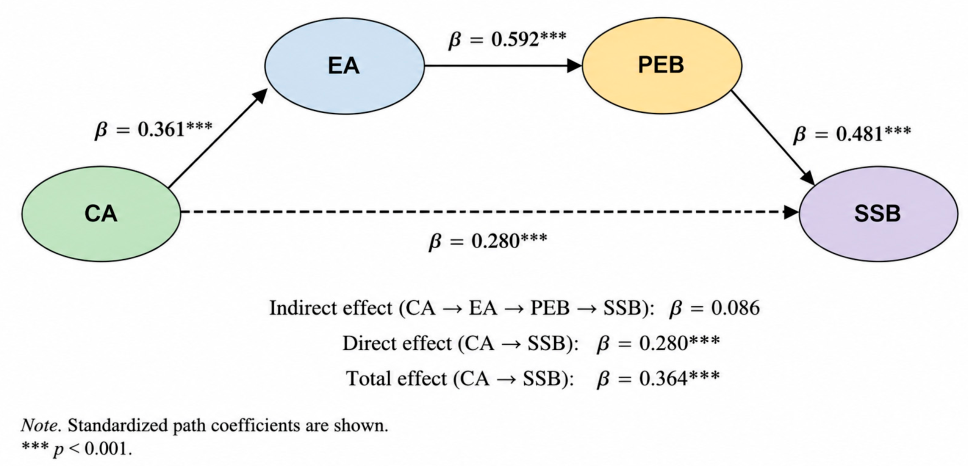
The results indicate that CA exerted an indirect positive effect on PEB through EA (β = 0.154). Furthermore, CA indirectly influenced SSB through the sequential pathway involving EA and PEB (β = 0.068). In addition to this indirect effect, CA maintained a significant direct effect on SSB (β = 0.286, p < 0.001), indicating partial mediation.
CI also demonstrated indirect effects on PEB (β = 0.033) and SSB (β = 0.014) through EA and PEB, although these effects were substantially weaker than those observed for CA. In addition, EA exerted a notable indirect influence on SSB through PEB (β = 0.261), highlighting the importance of positive environmental attitudes in shaping support for sustainable behaviour.
Overall, the findings suggest that EA and PEB serve as important mediating mechanisms through which community-related factors influence residents’ support for sustainable behaviour. Residents with stronger attachment to their community are more likely to develop positive environmental attitudes, perceive greater environmental benefits, and ultimately demonstrate stronger support for sustainable behaviour.
To further illustrate the mediating mechanism identified in the structural model,
Figure 3 presents the direct and indirect effects of CA on SSB through EA and PEB. The results indicate partial mediation, as both the direct effect of CA on SSB and the indirect pathway through EA and PEB remained significant.
5. Discussion
The present research explored the mechanisms that shape residents’ environmental engagement and support for sustainable behaviour in the urban tourism destination of Novi Sad. By integrating destination social responsibility, community attachment, community involvement, environmental attitudes, perceived environmental benefits, and multiple dimensions of environmental engagement into a single framework, the study contributes to a better understanding of how local communities can support sustainable urban tourism and the achievement of SDG 11. Overall, the results suggest that community attachment, community involvement, and environmental attitudes play important roles in shaping residents’ sustainability-oriented actions, whereas destination social responsibility does not exert a significant influence within the proposed model.
The first two hypotheses proposed that DSR would positively influence CA and CI. However, both relationships were statistically insignificant. These findings are contrary to the assumptions of Stakeholder Theory and Social Exchange Theory, which suggest that residents are more likely to develop stronger community ties and become more involved in local affairs when they perceive destination stakeholders as acting responsibly and contributing to community well-being [
29,
30]. The results also differ from previous studies reporting positive effects of DSR on residents’ attitudes and behavioural responses [
9,
25]. One possible explanation is that residents of Novi Sad may not strongly perceive local tourism stakeholders as actively addressing environmental and social concerns. This interpretation is supported by the relatively low mean score recorded for DSR. Consequently, residents’ attachment to their community and their willingness to engage in community activities appear to be influenced by factors other than perceived destination-level social responsibility. The non-significant effects of destination social responsibility on community attachment and community involvement may further suggest that residents do not automatically translate destination-level sustainability initiatives into stronger psychological attachment or greater community engagement. This may reflect the limited visibility of such initiatives in residents’ everyday lives or a degree of caution regarding whether they generate tangible local benefits. Although the present study did not directly examine residents’ trust or perceptions of greenwashing, future research could explore whether skepticism toward top-down sustainability initiatives influences residents’ responses to destination social responsibility. The findings further demonstrate the importance of CA in promoting sustainability-oriented outcomes. Consistent with Place Attachment Theory, residents who reported stronger attachment to their community also exhibited more positive environmental attitudes and greater support for sustainable behaviour. These findings support H3 and H10 and are consistent with previous research emphasizing that emotional bonds with place encourage environmental stewardship and sustainable actions [
7,
34,
36]. Individuals who identify strongly with their community are more likely to value local environmental resources and perceive environmental protection as essential for preserving the character and quality of life of the place to which they belong. Consequently, community attachment appears to function as an important psychological mechanism encouraging residents to support sustainability initiatives and environmentally responsible behaviour.
The role of CI produced mixed results. While the relationship between CI and EA was not significant, resulting in the rejection of H4, community involvement exerted strong positive effects on both CEP and EAA, supporting H8 and H9. These findings suggest that participation in community affairs may not necessarily alter residents’ underlying environmental beliefs or values. Environmental attitudes may be shaped more strongly by personal experiences, education, or broader societal influences than by community participation alone. Nevertheless, involvement in community activities appears to encourage concrete environmental actions. Residents who participate more actively in local affairs are also more likely to engage in environmental initiatives and advocate for environmental protection. This finding supports participatory development and collaborative governance perspectives, which emphasize that active involvement strengthens collective responsibility and encourages residents to contribute to community goals [
8,
39]. Therefore, community involvement appears to stimulate environmental action even when it does not directly influence environmental attitudes.
Environmental attitudes emerged as one of the most influential constructs in the model. Consistent with the Theory of Planned Behavior and the Value–Belief–Norm framework, residents with stronger pro-environmental attitudes were more likely to recognize environmental benefits, participate in environmental activities, and engage in environmental advocacy and action. Accordingly, H5, H6, and H7 were supported. These findings reinforce previous studies showing that environmental attitudes serve as a key predictor of environmentally responsible behaviour and sustainability-oriented actions [
7,
45]. Residents who are concerned about environmental issues appear more willing to engage in activities that support environmental protection and sustainability. Notably, the strongest effect observed in the model was the influence of EA on PEB, indicating that environmental attitudes strongly shape how residents evaluate the environmental consequences of tourism development.
The positive relationship between PEB and SSB further highlights the importance of residents’ perceptions of tourism-related environmental outcomes. Consistent with H11, residents who perceived tourism development as contributing to environmental conservation, resource protection, and environmental quality were more likely to support sustainable behaviour. This finding aligns with Social Exchange Theory, which suggests that individuals are more likely to support development initiatives when they perceive positive outcomes resulting from them. When residents recognize tangible environmental benefits associated with tourism development, they become more willing to support sustainable practices and policies that contribute to the long-term sustainability of the destination.
The indirect effects analysis provides additional insight into the mechanisms linking community-related factors and sustainable behaviour. The results revealed that CA exerted both direct and indirect effects on SSB through EA and PEB. This finding suggests that emotionally attached residents not only support sustainable behaviour directly but also develop stronger environmental attitudes and perceive greater environmental benefits, which further reinforce their willingness to support sustainability initiatives. The presence of both direct and indirect effects indicates partial mediation and highlights the central role of environmental attitudes and perceived environmental benefits in translating emotional attachment into sustainability-oriented behaviour.
Overall, the findings underscore the importance of community-based and psychological factors in fostering environmental engagement and support for sustainable behaviour in urban tourism destinations. While DSR did not significantly influence residents’ community-related responses, CA, CI, and EA emerged as important drivers of sustainability-oriented outcomes. These results suggest that efforts to strengthen residents’ emotional connections to their community, increase opportunities for participation in local affairs, and promote environmental awareness may be particularly effective in encouraging environmental engagement and sustainable behaviour. Such initiatives can contribute directly to the objectives of SDG 11 by supporting more resilient, environmentally responsible, and sustainable urban communities.
Beyond their theoretical implications, the findings also provide several practical recommendations for destination managers, urban planners, and policymakers seeking to promote environmentally responsible behaviour and sustainable urban tourism. First, strengthening residents’ attachment to their community may encourage greater support for sustainable behaviour and environmental protection initiatives. Policies and programs that foster a sense of belonging, local identity, and community pride may therefore contribute indirectly to sustainability objectives. Second, increasing opportunities for residents to participate in community activities and decision-making processes may promote environmental participation and advocacy. Local authorities should encourage citizen engagement through environmental campaigns, volunteer programs, public consultations, and sustainability-oriented community projects. Third, the strong influence of environmental attitudes suggests that educational initiatives and awareness campaigns remain essential tools for promoting environmental engagement and sustainable behaviour. Finally, although destination social responsibility was not found to exert significant effects within the proposed model, destination stakeholders should continue investing in socially and environmentally responsible practices, particularly given the relatively low evaluations of DSR reported by residents. Improving communication, transparency, and stakeholder engagement may strengthen residents’ perceptions of destination responsibility and contribute to more positive community outcomes in the future.
6. Conclusions
This study investigated the factors influencing residents’ environmental engagement and support for sustainable behaviour within the context of sustainable urban tourism. Drawing upon Stakeholder Theory, Social Exchange Theory, Place Attachment Theory, the Theory of Planned Behavior, and the Value–Belief–Norm framework, the study developed and tested an integrated model linking destination social responsibility, community attachment, community involvement, and environmental attitudes with community environmental participation, environmental advocacy and action, perceived environmental benefits, and support for sustainable behaviour. Using Novi Sad, Serbia, as an empirical setting, the findings provide new insights into the ways local communities can contribute to sustainable urban development and support the achievement of Sustainable Development Goal 11. The findings demonstrate that community attachment, community involvement, and environmental attitudes play important roles in shaping residents’ sustainability-oriented responses. Community attachment positively influenced environmental attitudes and support for sustainable behaviour, while community involvement significantly enhanced community environmental participation and environmental advocacy and action. Environmental attitudes emerged as one of the strongest predictors in the model, positively affecting community environmental participation, environmental advocacy and action, and perceived environmental benefits. In turn, perceived environmental benefits significantly strengthened support for sustainable behaviour. Conversely, destination social responsibility did not significantly influence either community attachment or community involvement.
From a theoretical perspective, the study extends existing knowledge by shifting attention from tourists to residents, who remain comparatively underrepresented in research on sustainable tourism and environmental behaviour. Furthermore, the study contributes to the literature by integrating destination social responsibility, community attachment, community involvement, environmental attitudes, environmental engagement, and support for sustainable behaviour into a single conceptual framework. The findings highlight the importance of community-based and psychological factors in explaining sustainability-oriented outcomes and provide additional evidence regarding the mechanisms through which residents contribute to sustainable urban tourism development.
The findings are particularly relevant for cities pursuing sustainable urban development strategies. As urban tourism continues to expand, environmental sustainability increasingly depends on the active participation of local communities. By strengthening community attachment, encouraging involvement in local affairs, and promoting environmental awareness, cities can foster greater environmental engagement and support for sustainable behaviour among residents. Such efforts may contribute directly to the objectives of SDG 11 by supporting more inclusive, resilient, and environmentally responsible urban communities.
Several limitations should be acknowledged. First, the study focused exclusively on residents of Novi Sad, which may limit the generalizability of the findings to other urban destinations. Second, the cross-sectional design restricts the ability to establish causal relationships over time. Third, the use of self-reported measures may introduce social desirability bias, potentially leading respondents to overstate their environmental attitudes and behaviours. Finally, although the model explained a substantial proportion of variance in several endogenous constructs, other factors influencing environmental engagement and support for sustainable behaviour were not examined.
Future research could address these limitations by applying the model to different urban and cultural contexts, conducting longitudinal studies, and incorporating qualitative approaches to obtain deeper insights into residents’ perceptions and motivations. Additional variables such as environmental knowledge, place identity, community satisfaction, perceived tourism impacts, trust in local institutions, and support for tourism development may further enrich understanding of residents’ sustainability-oriented behaviour. Comparative studies involving residents and tourists may also provide valuable insights into the different mechanisms that influence environmental engagement and support for sustainability within urban tourism destinations.