Review

A Review of Performance, Constraints and Policy Pathways to Reframe Phytocapping as a Nature-Based Strategy for Climate-Resilient Urban Landfill Closure


by
Nadun Bulathge
1,
Shameen Jinadasa
1,*,
T. G. Suntharavadivel
1,
Benjamin Taylor
1 and
Richard Koech
2
1
School of Engineering and Technology, Central Queensland University, Bundaberg 4670, Australia
2
College of Science and Sustainability, Central Queensland University, Bundaberg 4670, Australia
*
Author to whom correspondence should be addressed.
Urban Sci. 2026, 10(7), 374; https://doi.org/10.3390/urbansci10070374
Submission received: 7 April 2026 / Revised: 8 June 2026 / Accepted: 25 June 2026 / Published: 2 July 2026
(This article belongs to the Special Issue Urban Resilience to Climate Change Through Nature-Based Solutions)

Abstract

With rapid urbanization, the generation of municipal solid waste is growing, placing ever-increasing pressure on cities to close, remediate and repurpose landfill sites in environmentally sustainable and climate-adaptive ways. Traditional landfill final covers such as compacted clay and geosynthetic systems are intended to limit infiltration; yet their conceptual designs often fail in performance longevity due to effects such as desiccation, settlement, root intrusion, freeze–thaw cycling and extreme rainfall. Phytocapping, or evapotranspiration/store-and-release cover technology is the use of vegetated soil profiles to provide storage for percolating rainfall, return water to the atmosphere through evapotranspiration and support biologically mediated oxidation of methane. Phytocapping is a green-inclusive nature-based climate adaptation strategy for urban landfill closure. This study explores hydrological performance, methane mitigation, ecological co-benefits, economic feasibility, climate sensitivity, monitoring requirements and regulatory barriers linked to phytocapping systems. Field evidence is strongest in Australia and the United States, especially through ACAP- and A-ACAP-style programs, while evidence from humid tropical, monsoon, freeze–thaw and low-resource urban contexts is comparatively lacking. As reported in published studies, well-designed phytocaps can result in reduced percolation compared to traditional clay caps. Reported publications also mention considerable construction-cost savings, depending on site conditions and design assumptions. Methane-related outcomes vary by measurement method and site context, with studies reporting surface flux reductions, methane oxidation and landfill gas attenuation as distinct performance indicators. These advantages are counter-balanced by design uncertainties that vary from site to site, limited long-term monitoring data, climate transferability concerns, and regulatory systems still firmly anchored in prescriptive low-permeability barriers. This review proposes a policy-oriented analytical framework that bridges the gap between technical performance evidence, urban co-benefits, staged monitoring and performance-based landfill closure regulation. As such, phytocapping should be considered not as a general-purpose substitute for engineered covers, but as a climate-responsive nature-based solution that can complement urban waste servicing infrastructure, ecological restoration and adaptive governance of landfills when properly designed, monitored and regulated.

1. Introduction

The global MSW crisis highlights the importance of an integrated, climate-conscious approach to waste management. Despite the increasing volumes of waste generated worldwide, governments need to invest in waste reduction, segregation, recycling, and infrastructure and policies for safe disposal [1]. The shift of waste from landfills to recycling and incineration can reduce environmental footprints in high-income countries. Still, such solid waste management practices must be adapted to low- and middle-income countries with financial aids, technology transfer and local implementation [2]. Sustainable MSW management is therefore essential for public health, environmental preservation and the global climate objective.

1.1. Urbanization and Environmental Impacts

The rapid global urbanization has led to an unprecedented municipal solid waste (MSW) crisis, with cities globally producing about 2.1 billion tonnes of MSW per year, a number expected to increase to 3.4 billion tonnes by 2050 [3]. Mismanaged waste contributes to climate change. When organic waste decomposes anaerobically in landfills, it produces methane-rich biogas. Landfills are responsible for over 15% of worldwide anthropogenic methane emissions and for 17–19% of greenhouse-gas emissions in the United States [4]. Methane, a greenhouse gas, is far more potent than CO2 (with a global warming potential 28–36 times that of CO2 over 100 years) [5]. Managing emissions is complex because it depends on waste composition, climate and gas collection efficiency. Landfill gas migration may be dangerous to human health, as methane and trace amounts of volatile organic compounds can accumulate in buildings near a landfill or, under certain conditions, form an explosive mixture [4].
Urbanization also exacerbates soil and water contamination through leachate formation (polluted liquid that results when rainwater runs through waste). Dump moisture content, infiltration rates and cover quality govern both the amount and character of leachate. High precipitation or poor covers lead to increased leachate output [6]. Traditional caps (clay, geomembranes) aim to minimize infiltration, but inadequate maintenance and subsequent cracking can increase infiltration and leachate production [7]. Leachate thus generated passes into the topsoil strata, while unlined/unsealed sites allow percolation beneath, resulting in groundwater that carries heavy metals and pathogens [6]. Consequently, poorly sealed landfills not only allow for greater leachate generation but also pose a greater danger to surrounding human populations and natural systems.
In turn, environmentally friendly options like evapotranspiration covers (phytocaps) are being developed. These nature-based systems utilize a layer of vegetated soil to maximize rainfall interception and storage, whilst minimizing infiltration, and release the captured rainfall back into the atmosphere through evaporation and plant transpiration [7]. Well-designed phytocaps can reduce leachate generation, increase methane oxidation in the cover, and also provide ecosystem services—creating habitats and sequestering carbon. Introduction of such holistic strategies could help to alleviate some of the environmental repercussions of the urban waste crisis.
The present paper is an integrative literature review which highlights the application and progress of phytocapping as a sustainable nature-based solution for climate-resilient landfill closure in various MSW management contexts. The specific objectives of this review are to: (i) collate published evidence on hydrological performance, design parameters and ecological co-benefits of phytocaps across different climatic contexts; (ii) examine field-scale case studies—including the United States Alternative Cover Assessment Program (ACAP) and the Australian Alternative Cover Assessment Program (A-ACAP), assessing implementation experience and regulatory uptake in these countries; (iii) identify technical challenges, climate vulnerabilities and institutional barriers that constrain more widespread adoption of phytocapping technology; and finally, (iv) identifying priority research directions to promote sustainable, adaptive waste management practices.

1.2. Landfill as a Predominant Strategy

Generation of municipal solid waste has been increasing rapidly, and landfilling is a dominant method of disposal. According to a recent waste management guide, sanitary landfills are proven technologies in low- and middle-income countries because of the high costs of infrastructure and operations for other strategies [3]. Transport and disposal of waste by means such as incineration or anaerobic digestion involve significant capital costs and operational requirements, and are consequently rarely used in low-income areas [8].
Landfilling is favored due to cost and simplicity. The cost of integrated waste management operations in high-income countries exceeds USD 100 per tonne, whereas in lower-income countries it is approximately USD 35 per tonne [3]. The operation and maintenance of incineration and other advanced technologies are complicated, so they are not readily affordable for many municipalities. Therefore, landfills offer a relatively inexpensive and straightforward means of disposing of residual waste and by-products from other treatment operations [9]. But when sanitary landfills are not constructed as engineered facilities, they rapidly transform into open dumps, leaking hazardous materials into the soil and groundwater and emitting greenhouse gases [3].
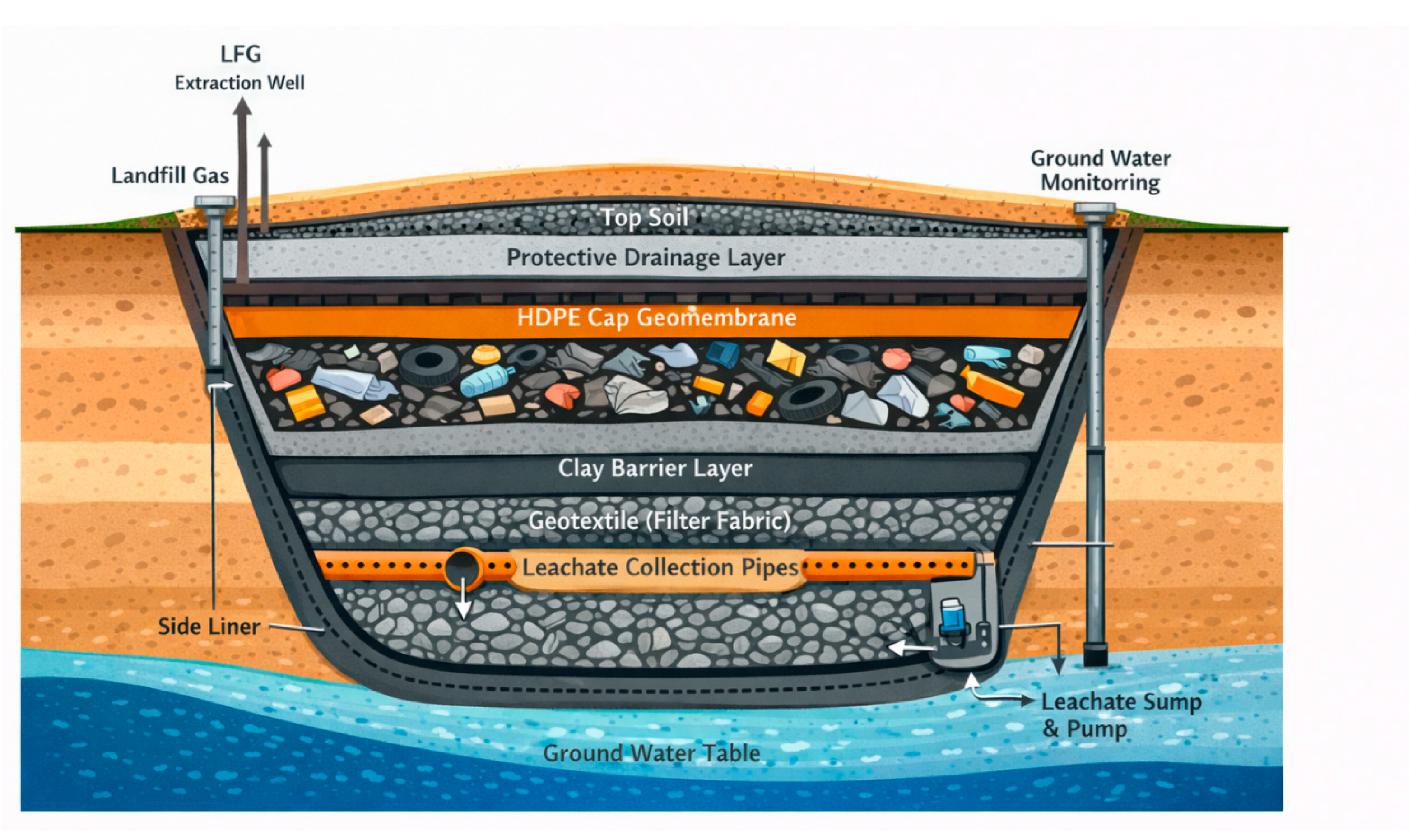
As shown in Figure 1, a well-designed sanitary landfill is lined with an impermeable (compacted clay and/or a synthetic geomembrane) liner to prevent leachate migration into groundwater, has leachate collection and treatment systems, gas control systems, and daily cover [6].
Conventional caps are built using low-permeability materials (such as compacted clay layers or geosynthetic membranes, for example, high-density polyethylene) to isolate the waste, limit water infiltration and reduce gas release. If not maintained after closure, stormwater can percolate through the waste, creating leachate and increasing methane production [6]. Accordingly, good post-closure monitoring and capture are necessary to safeguard human health and the environment. In general, landfilling will remain a key component of waste management because it is a low-cost, straightforward method of disposal [10].

1.3. Limitations of Conventional Covers

In conventional landfill closure, compacted clay caps or geomembrane liners are used to form a low-permeability cover that isolates the waste. The production of such materials is expensive and requires strict quality control, even though their long-term performance is unknown [11]. A pilot field project conducted by the Maine Department of Environmental Protection in the US on four municipal landfill covers found that, over time, the hydraulic performance of all soil barriers decreased. The study also found that compacted soils alone are insufficient for high containment, as most barrier soils ultimately degrade to a hydraulic conductivity of approximately 1 × 10⁻⁵ cm s−1, which is somewhat less than regulatory targets [12]. Clay caps are more expensive than natural covers. Research undertaken in Australia showed that phytocaps cost 35–72% less than a traditional compacted clay cap while providing equivalent or superior containment and protection [13].
Seasonal water deficiencies and long-term desiccation cause shrinkage cracks in clay caps, which remain open even after re-wetting, thereby promoting hydraulic conductivity [12]. In addition, frost and thaw, root penetration and differential settlement accelerate deterioration. Cyclic freezing causes pore-water expansion and soil matrix relaxation. Thus, freeze–thaw cycles increase void ratios and enhance hydraulic degradation [14]. When vegetation is added on top of the compacted clay layers, roots can take up soil moisture, which then dries, creating preferential flow paths [15]. Settlement of the waste layer induces flexure and shear stresses in the capping layer, leading to cracking and adversely affecting the cap’s performance [16].
Very low cracking resistance of compacted clay was observed in bentonite–sand liners, where minor bending and slight variations in moisture content induced fractures that became channels for surface water and landfill gas—differences in settlement led to tension fractures due to deformations [17]. Field measurements revealed that conventional covers often do not perform as anticipated in semi-arid and arid areas; desiccation cracks and plant-root holes significantly enhance permeability [18]. Climate-induced drying, freeze–thaw cycling, root ingress and settlement can cause barrier layers to deteriorate over several decades, potentially leading to higher leachate and gas emissions [14]. Construction of long-lasting, nature-based (resilient) covers that support evapotranspiration, such as phytocaps, is crucial to maintaining advanced landfill security in a changing climate.
As such, closed and closing landfills should not simply be considered as engineered containment systems but rather more holistically as persistent elements of municipal land use, climate-risk and green-infrastructure planning from an urban science perspective. Many landfill sites are within or near urban centers that have recently expanded, and their continued management after closure often influences groundwater protection, greenhouse-gas mitigation, ecological restoration, public amenity and the reuse of disturbed land. This means that landfill closure is primarily an urban sustainability challenge involving multiple disciplines instead of a specialty geotechnical or waste-engineering problem. Phytocapping is pertinent to this issue as it integrates hydrological regulation, vegetation-mediated restoration and potential landfill gas attenuation into one living cover system. Nonetheless, its applicability is variable and context-dependent, hinging on local climate, soil properties and vegetation performance as well as monitoring capability and regulatory acceptance. This paper reviews phytocapping both as a landfill cover technology and nature-based urban waste-management strategy that necessitates performance-based assessment and adaptive governance.

2. Methodology

2.1. Review Design and Reporting Framework

This study took the form of an integrative literature review to synthesize evidence on phytocapping as a nature-based solution for climate-resilient landfill closure in urban and municipal solid waste management applications. Due to the multidisciplinary nature of phytocapping research, which involves aspects from environmental engineering, soil science, hydrology, plant ecology, landfill gas management, climate adaptation, urban land-use planning and regulatory policy, an integrative review approach was chosen. In contrast to systematic reviews or meta-analyses that pertain to a designated intervention–effect relationship and similar quantitative outcomes, an integrative review can incorporate empirical field trials, modeling studies, technical guidance documents, policy reports and theoretical contributions into a single synthesis. This, therefore, seemed a valuable approach to assess phytocaps not only in terms of their technical function but also in terms of ecological co-benefits, climate sensitivities regarding barriers and feasibility for incorporation into performance-based landfill closure governance.
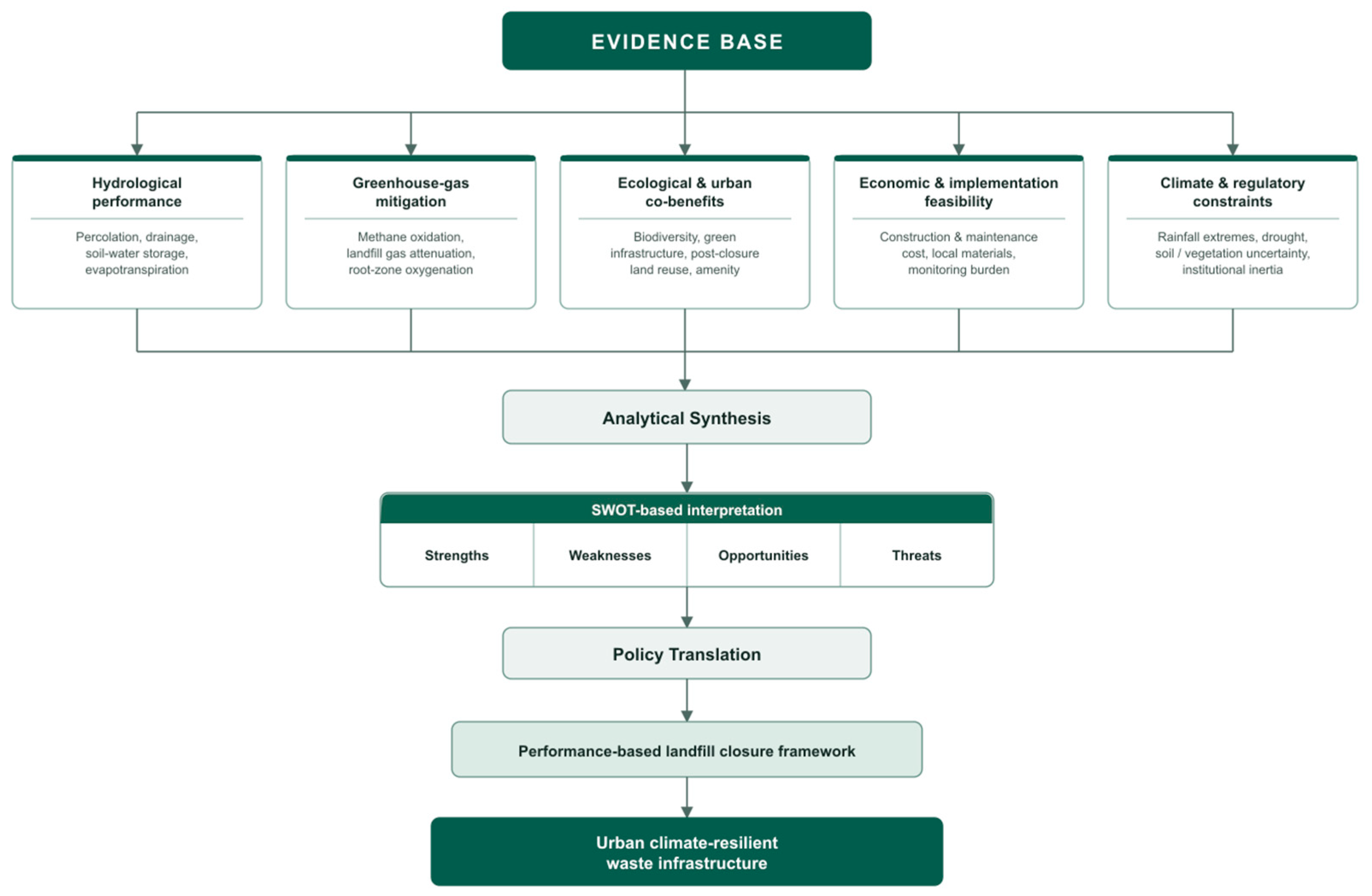
The integrative review framework of Whittemore and Knafl was utilized to guide the process, including five main stages: problem identification; literature search; data evaluation; data analysis and presentation of findings [19]. We used this framework to move the review beyond a descriptive listing of studies and into a structured synthesis of the evidence base. The problem-identification stage in this study used phytocapping as a climate-responsive alternative to conventional low-permeability landfill cover that needs evaluation. The literature-search stage produced peer-reviewed and grey-literature sources of evidence relating to phytocap performance, design, monitoring and uptake by policy-makers. The data-evaluation stage evaluated the relevance and evidence strength of the retained sources. The data-analysis phase arranged the disaggregated evidence according to thematic classifications: hydrological effectiveness; methane mitigation potential; eco- and urban co-benefits; economics (costs); climate vulnerability knowledge gaps and regulatory constraints. Finally, the results are presented in a more conceptual and policy-wise synthesis bolstered by an adjusted SWOT-based analytical framework.
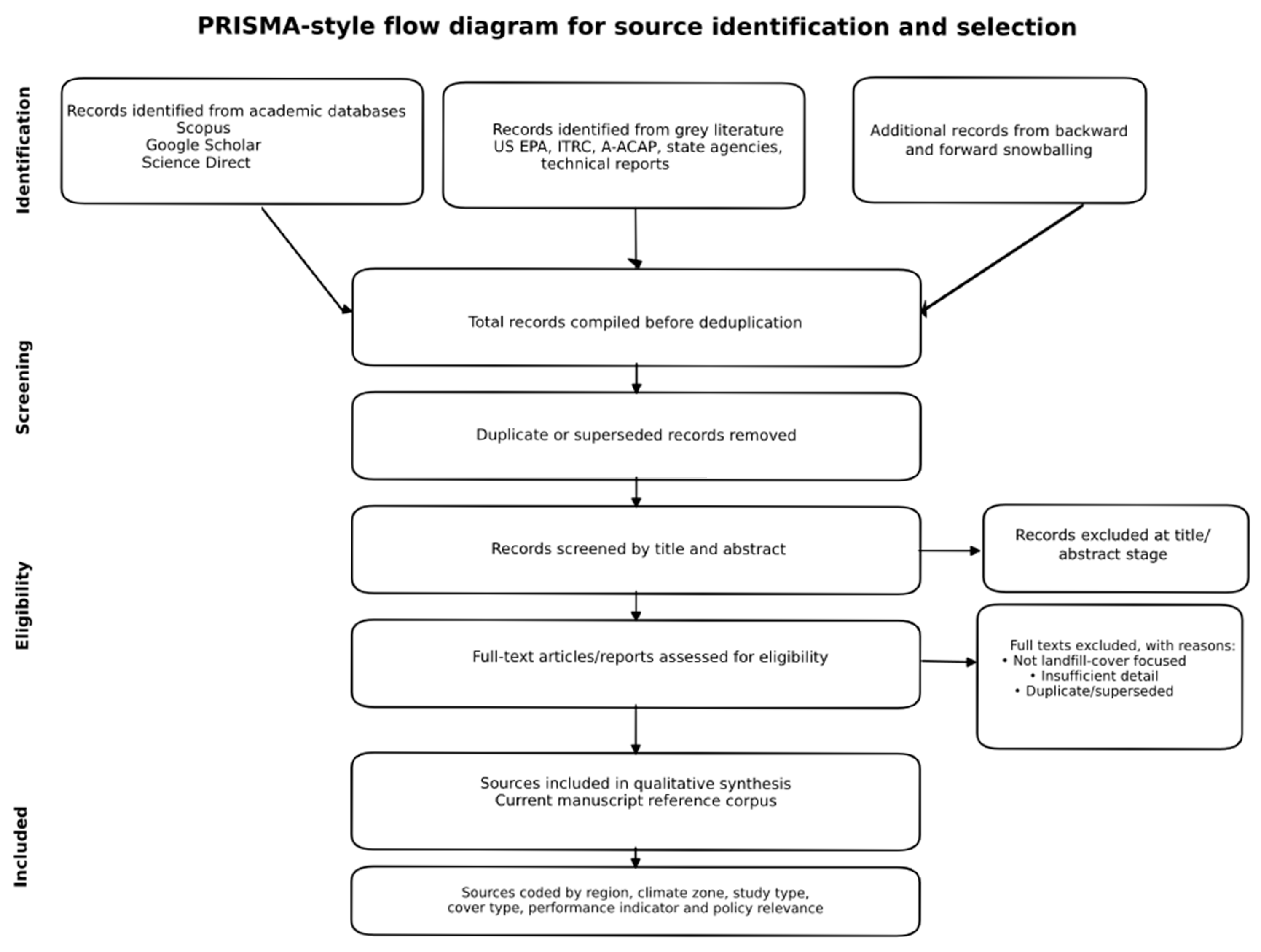
The guidelines for the identification and selection of literature were guided by PRISMA 2020 to enhance readability and reproducibility. PRISMA was not used to define the review as a systematic review or meta-analysis, but rather it was employed as reporting guidance for documenting the incubation identification and screening process (how records were identified, screened, excluded and included). Therefore, a PRISMA-style flow diagram was prepared to illustrate the number of records identified from databases and grey-literature sources, and the number of duplicates removed, the total number hand-screened by title and abstract only, the total amount studied in full-text format, along with reasons for exclusion and how many sources were included in the synthesis [20]. Combining these approaches allowed the review to have the balance of flexibility and breadth associated with an integrative review, while addressing some of the need for a transparent and auditable search and resource selection process.
The methodology was thus built around four principles that (a) explicit review questions were created to guide the synthesis, (b) database and grey-literature searches were recorded using defined search terms, Boolean combinations and search dates, (c) inclusion, exclusion as well as screening and data-extraction procedures were specified clearly; (d) the literature retained was identified with region of study, study type or climatic context. It offers a clearly justified basis for determining how phytocapping may fit into climate-resilient urban waste management policy.

2.2. Research Questions

The questions were defined to capture the articles beyond a mere descriptive catalogue of landfill engineering studies, instead probing how evidence on phytocapping can help facilitate the transition from prescriptive barrier-based landfill closure systems towards performance-based climate-resilient and nature-based approaches in municipal waste infrastructure.
The primary research questions were:
RQ1. How to position phytocapping as a nature-based climate-resilient solution for landfill closures in an urban municipal solid waste and policy framework?
RQ2. What are the knowledge gaps regarding hydrological, landfill gas, ecologic and economic performance of phytocaps relative to conventional cover systems?
RQ3. Under what climatic, soil, vegetation and landfill-management contexts do phytocaps perform well or poorly?
RQ4. What are the existing technical, climatic, monitoring and institutional barriers to wider uptake of phytocapping practice for landfill closure?
RQ5. What performance-based evidence, designs and regulatory pathways can support integration of phytocapping into wider practice?
These questions, taken together, formed the analytical framework of this review. RQ1 was guided by the research questions and helped situate contributions of the overall paper to urban science by connecting phytocapping with climate-resilient municipal infrastructure and nature-based solutions. RQ2 provided a basis for the synthesis of evidence on percolation control, methane mitigation and ecological restoration, and cost reduction. The third research question (RQ3) examined whether phytocap performance is site-specific and sensitive to climate, particularly the transferability of findings from well-studied sites in Australia and the United States to humid tropics, monsoon, freeze–thaw or low-resource contexts. The review was guided by practical implementation constraints (RQ4) related to uncertainty in soil and vegetation design, long-term monitoring requirements and institutional resistance to non-prescriptive landfill closure methods. RQ5 focused the synthesis on policy-related outcomes of phased monitoring, performance indicators and adaptive management that could enhance regulation confidence in phytocapping as a long-term closure alternative.

2.3. Search Strategy and Information Sources

A systematic literature search was conducted to identify peer-reviewed studies, technical reports, regulatory guidance documents and policy-relevant literature on phytocapping and similar evapotranspiration-based landfill cover systems. The search focused on three major domains of evidence: (1) the technical evidence addressing landfill cover hydrology, percolation and leachate control; methane oxidation; and vegetation or soil media/ecological restoration/climate resilience studies; (2) studies relevant to waste management addressing landfill closure regulation, monitoring requirements, infrastructure, cost implications and performance-based policy.
Scopus, Science Direct and Google Scholar databases were searched for peer-reviewed literature. The phytocapping literature is scattered across environmental engineering, waste management, soil science, hydrology, ecological engineering, nature-based solutions and urban sustainability journals, which would have affected the results if a specific journal database were used. Google Scholar was the additional source used to find out interdisciplinary publications, conference papers and reports that perhaps were not indexed in Scopus or Science Direct.
The searches went from March 2025 to 25 January 2026, and an update verification search was carried out on 10 March 2026 to reflect newer literature published later in 2026. The searches were restricted to publications in English only. No geographical limitation was set, as the objective of the review was to compare evidence from diverse climatic and socio-economic contexts.
Grey literature was also included because landfill closure practice is heavily influenced by technical guidance, regulatory programs and government-sponsored demonstration projects. Grey-literature sources were identified using institutional and regulatory websites and included the United States Environmental Protection Agency (US EPA), Interstate Technology and Regulatory Council (ITRC), Australian Alternative Cover Assessment Program (A-ACAP), as well as various Australian state environmental protection agencies and selected waste-management authority reports.
Grey-literature retrieval was carried out alongside controlled database searching. Search terms were applied to titles, abstracts and keywords in bibliographic databases where the database allowed. The search terms included varieties of: phytocapping, evapotranspiration cover, ET cover, alternative landfill cover (e.g., store-and-release cover), landfill final cover, municipal solid waste landfill, leachate, percolation, methane oxidation, landfill gas, nature-based solution, climate resilience in urban waste management, ecological restoration and performance-based regulation. The search strategy was deliberately broad as phytocapping is described using various terms in different regions and disciplines.
Additional sources were identified through a manual screening of the reference lists contained within key review papers, field trials, technical guidance documents and program reports. The ability to track these backward snowball works was especially important for identifying relevant foundational studies associated with the US Alternative Cover Assessment Program (ACAP), Australian Alternative Cover Assessment Program (A-ACAP) and early evapotranspiration-cover design studies and landfill gas bio-oxidation literature. Forward citation checking was also conducted selectively on highly relevant foundational papers to identify recent applications, critiques or re-evaluations. The information sources used in the review is tabulated in Table 1.
The completed search strategy was therefore a combination of database searching, grey-literature retrieval and citation tracking. This method was deemed suitable for an integrative review as the evidence base consists of peer-reviewed articles, technical program outputs, design guidance and regulatory documents rather than solely standard journal articles.

2.4. Eligibility Criteria

Gathered literature is screened before seclection using the eligibility criteria as shown in Table 2.

2.5. Screening and Selection

All the literature retrieved as discussed above was stored in a reference management software (EndNote 21.2) as a single library, and the duplicates were omitted. Further manual screening was conducted to check if the same studies appeared in more than one format, and the most technically detailed one was retained.
In the literature retrieval, screening was conducted in two stages. First, the topic and abstracts were screened according to the eligibility criteria described in Section 2.4 above. Then, the full texts were assessed to determine whether they provided usable evidence in at least one major synthesis domain.
The following PRISMA-style source selection flow diagram as shown in Figure 2 summarizes the number of records identified, duplicates removed, records screened, full texts assessed and records excluded with reasons and final sources included in the synthesis.

2.6. Data Extraction

Data extraction was performed using the following template as shown in Table 3 and then grouped thematically to support the identification of relevant sections of each extraction within the manuscript.

2.7. Quality and Relevance Appraisal

Sources were assessed for relevance, credibility and applicability to the review questions instead of undergoing a formal quantitative risk-of-bias assessment because the review included a wide range of evidence types (field trials, modeling studies, technical guidance documents, regulatory reports and review papers). For each source, their relevance to phytocapping or evapotranspiration-based landfill covers, how clearly the methodology was reported, whether performance evidence was available, if they reported site and climate context and whether they contributed to understanding practices for design, monitoring or policy was evaluated. Higher weight was assigned to peer-reviewed field studies, long-term monitoring programmes or published guidelines and regulatory documents that reported methods and performance data clearly. Sources which provided little methodological detail or were limited to particular site-specific findings but offered useful contextual/conceptual insights were retained, though synthesis incorporated their limitations.

2.8. Evidence Synthesis and Analytical Framework

The owing Figure 3 shows the analytical framework used to synthesize the phytocapping literature and translate technical evidence into climate-resilient urban landfill closure policy.

2.9. Corpus Characteristics

The final review corpus comprised 67 peer-reviewed journal articles, technical reports, regulatory guidance documents and conference papers. The majority of the robust field-based evidence was based in Australia and US, primarily through assessments conducted by the A-ACAP and ACAP programs, while supplementary evidence was identified from Europe, Asia and other regions. Retained settings included arid, semi-arid, subtropical, temperate and humid climatic conditions, but humid tropical, monsoon, freeze–thaw and low-resource urban data were limited. The corpus comprised studies related to hydrological performance, methane emissions, mitigation potential, soil/vegetation design, ecological restoration, cost implications, monitoring requirements, and regulatory limits.

3. Phytocapping Technology as a Nature-Based Solution

3.1. Concept and Mechanism

“Phytocapping” is a type of landfill cover that allows a soil–plant system to manipulate water and gas fluxes. It can replace the low-permeability barrier layers seen in traditional covers. The key notion is that rainwater infiltrates into the soil layer, where it accumulates and is subsequently lost by evaporation from plant activities and transpiration, gradually moving toward an impermeable line [21]. This capping system is identified as evapotranspiration (ET) covers, soil-plant covers, and store-and-release covers, since the cover acts as a ‘bio-pump’ in which soil acts as a pump, absorbs and retains rainwater, and releases it back to the atmosphere through evapotranspiration, preventing further percolation of water into the waste layer [13]. The plant community becomes a “biological pump,” returning retained water to the surface and facilitating soil dry-out between rains. This is a significant difference from standard landfill covers, which depend on compacted clay or plastic barriers to reduce water infiltration. Compacted clay barriers deteriorate over time due to repeated shrinkage cracking and root penetration [10]. The barrier’s efficacy deteriorates, leading to increased leachate formation and higher greenhouse-gas emissions. This structural problem is less likely in phytocaps, and it has additional ecological benefits [10].
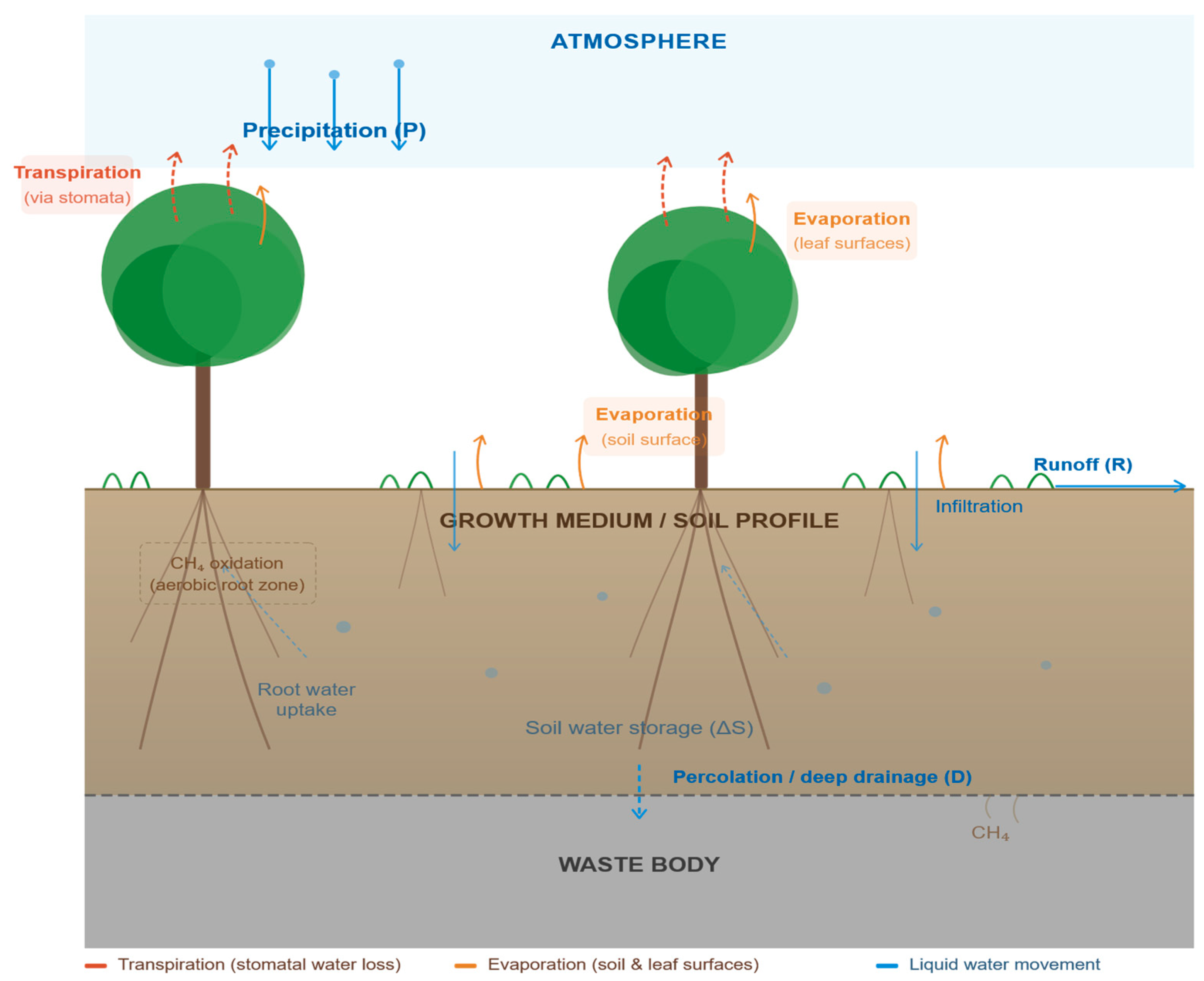
The hydrological mechanism of a phytocap is regulated by the site’s water balance. Rainfall that lands on a phytocap can take several pathways; some are intercepted by vegetation and evaporated directly from plant surfaces, some infiltrate the soil where they are stored in pore spaces, and some run off the surface or are lost as transpiration. In traditional hydrology, the water balance is defined as
P = ET + R + D + ∆S
where P is precipitation, ET is evapotranspiration, R is runoff, D is percolation and ∆S is the change in soil water storage [13]. Phytocapping aims to maximize the water loss components, using ET and soil storage, while minimizing drainage flow into waste. Field studies have documented that ET frequently accounts for >75% of annual rainfall, while runoff accounts for <10%; this leaves <20% of the year’s rainfall available to percolate into the waste layer [10]. An experiment carried out at a semiarid landfill in Colorado revealed that a phytocap using a 1.22 m clay loam and local native prairie grasses produced negligible deep drainage when modeled over many years [22].
Another case from Australia reported that 1.4 m and 0.7 m phytocaps achieved percolation rates of 16.7 and 23.8 mm yr−1, respectively, far lower than the 78 mm yr−1 for a conventional clay-capped landfill site [10]. Figure 4 schematically shows the hydrological process of a phytocap.
Soil selection and thickness are also crucial for the function of a phytocap. An effective phytocap utilizes a porous substrate with sufficient water-holding capacity; thicker soils can store water during wet periods and release it slowly through evapotranspiration [13]. Soil properties such as texture and available storage capacity allow phytocap covers to store water until it is transpired or evaporated [23]. Thickness must be optimally adjusted to prevent saturation and percolation-free water during the dormant season when plant demand is low. For instance, a study conducted of a Fort Carson phytocap cover showed during winter it stored water and released it back during the growing season [24]. Conversely, excessively thick soil may delay the return of water back to the atmosphere and lead to anaerobic conditions that inhibit methane oxidation [25]. Therefore, site-specific design is required: the phytocap must be transferred, not replicated, because every landfill has unique climate, soil and vegetation conditions [26].
Vegetation has several hydrological functions. First, the canopy intercepts rainfall, reducing the amount that reaches the soil [10]. Second, roots take up soil water and transpire it back to the atmosphere. Third, root growth enhances soil structure and porosity, promoting infiltration and oxygen diffusion [27]. Vegetation offers more than just aesthetic appeal; it also plays a crucial role in improving phytocap performance. For instance, in the semiarid Fort Carson phytocap cover, warm and cool season prairie grasses, which together achieve maximum transpiration throughout the year, were selected [24]. Biosolids applications, mulching and supplemental irrigation were used as management practices to ensure rapid and sustained establishment of the plant cover [28]. Most native species have high transpiration rates and deep roots, making them suitable for phytocaps across a range of climates. A variety of plant species enhances the system’s stability and resilience, ensuring continuous water uptake. An Australian trial found that trees on a 1.4 m phytocap intercept about 30% of rainfall and transpire at rates of 1–2 mm d−1, reducing infiltration [10]. The selection of appropriate species and proper maintenance are essential considerations for a phytocap. In addition to hydrological control, phytocaps mitigate landfill gas emissions.
For the traditional barrier caps, landfill gases accumulate beneath the cap, requiring active collection and release systems. But the phytocap soil layer serves as a biofilter, creating aerobic conditions ideal for methane-oxidizing bacteria [29]. Porous biotic covers facilitate methane oxidation, thereby reducing greenhouse-gas emissions [30]. Root activity promotes soil microbial action, enhancing gas diffusion and boosting methane oxidation rates [31] (Preprint). Phytocaps reduced methane emissions by four to five times more compared to conventional caps [10]. This combined function of preventing percolation and mitigating landfill gas emissions underscores the sustainability and suitability of nature-based solutions over synthetic approaches for addressing environmental concerns.
Despite the multiple benefits, phytocap performance is climate-dependent. In arid and semi-arid climatic regions, evapotranspiration is comparable to the annual rainfall, making phytocaps effective [25]. In humid climates, thick soils or auxiliary drainage are preferred to avoid saturation due to higher rainfall [26]. In either case, site-specific design ensures that the soil storage capacity and vegetation transpiration are equal to the local precipitation regime. Severe events, such as prolonged droughts or heavy rainfall, may stress vegetation, temporarily increasing percolation. Designers may schedule supplemental irrigation or drought-tolerant species to maintain vegetation during dry periods and to provide some porosity to absorb rainfall without excessive leakage. To ensure the long-term performance of phytocaps, regular monitoring of soil moisture, percolation, and vegetation health is recommended for adaptive management.
In conclusion, phytocapping, as a nature-based closure solution, is indeed climate-resilient. Instead of an impermeable barrier, phytocaps use a living mechanism that includes soil and plants to store and discharge water through evapotranspiration, keeping landfills dry. In addition, with a porous cover medium and a plant system adapted to the environment, phytocaps act as a bio-cover, oxidizing methane and reducing greenhouse-gas emissions [10]. Properly designed phytocaps can achieve hydrological performance equal to or better than conventional clay caps while costing less to build and maintain. However, their success is subject to site-specific design, meaning that the optimum soil thickness and substrate, and the native or drought-tolerant vegetation community in the design are responsive to local climate conditions. Hence, when appropriately configured, phytocapping can be a sustainable solution for managing MSW landfills in a changing climate.

3.2. Design Elements

The success of a phytocap stems from the soil layer’s capacity to temporarily retain incoming rainfall and from vegetation’s subsequent removal of this water through evapotranspiration [26,32]. In typical layouts, the growth medium or soil cover is a deep layer of local soil material that covers the waste. Indigenous grasses, shrubs and trees are then planted [25]. The soil is like a storage tank, and the plants are a biological pump; when functioning as they usually do, the system maintains a near-net-zero water balance by taking in rain through the soil and returning it through evapotranspiration [27]. This section summarizes technical guidance on these design elements and discusses climate adaptation to illustrate how they combine to deliver the hydrological and ecological performance of a phytocap.

3.2.1. Growth Medium

A primary objective in designing phytocaps is to engineer a growth medium with adequate water-holding capacity that releases water at the desired rate of plant removal [33]. The research conducted within Australia’s A-ACAP (Australia’s Alternative Cap Assessment Program) highlights that the ideal media must have a high storage capacity; given the range of available local soil types, designers can modify the depth of growth media to provide this necessary amount of critical storage in seasons where plant transpiration is low [34]. The depths of soil employed in experimental caps range from 0.7 to 1.5 m, with thicker profiles affording more storage but also bringing higher material costs. In other words, the designers must ensure a trade-off between hydraulic storage and cost/stability [26]. The root systems of plants shall grow to the full depth of the growth medium so that water in storage can be extracted; percolation is minimized by efficient water removal and a well-developed root system [10].
A higher amount of clay may lead to shrinkage or cracking, and too much sand may lead to drainage too quickly. A “medium” texture is necessary to provide the benefits of storage and release [32]. Compaction level is an essential design parameter. Researchers found that ideal compaction for phytocap soils occurs at 70–83% of modified proctor maximum dry density (target 77%) [25]. This range provides enough pores to support root development and water storage, but not so many macropores that the soil drains too quickly. Over-compaction (>85% relative compaction) restricts root growth and plant water use, while inadequate compaction (<70%) may require greater soil depth to accommodate settlement. Field experiments on soil density showed that plant water use reached a maximum at 76.5% relative compaction, and root length density at ~79.5%, suggesting the specific window of refinements was reasonable, as validated by corresponding empirical data [27]. Particle size distribution is based on the characteristics of the borrow pit. Typically, 65% fines and 35% clay for fines-rich clayey soils is recommended for phytocapping [26]. For typical Australian phytocaps, typical Atterberg limits are LL: 31–39%, PL:21–24%, PI: 10–16% with linear shrinkage 2.5–5.5%. These numerical values are benchmarks for engineering a suitable soil mix for phytocaps [26].
Hydrologists also analyze the soil-moisture characteristic curve to determine the available storage at field capacity and below which plants cannot extract water [33]. The soil’s moisture content at 10–30 kPa matric suction, marks the maximum storage of water without any gravitational drainage (field capacity), and the wilting point at ~1500 kPa identifies the minimum boundaries for plant withdrawal of water. The selection of a specific type of soil that has a field capacity corresponding to the local rainfall regime, and plant needs is important. For example soil with a field capacity of 20–30% can hold more water than one with a capacity of 10–15% [35]. As many disposal/reclamation sites have extremely nutrient-poor soils, it is imperative to determine their chemical properties, including pH, electrical conductivity, and nutrient content (organic carbon, nitrogen, phosphorus and micronutrients). Too much of some nutrient amendments can promote weeds, so typically, just low-fertility soils are suitable if selecting plants that like conditions to be dry and lean. Heavy metal concentrations should also be determined in the growth medium to avoid potential phytotoxicity [28].

3.2.2. Plant Community

Phytocaps depend both on plant canopies, which intercept rainfall and reduce the amount of available precipitation relative to actual precipitation, and on root systems, which extract water from the soil [27]. Plant species selection should be adapted to the soil substrate and its microclimate, and the community composition should incorporate species with varying rooting depths and transpiration rates to optimize water extraction [10]. Understanding soil constraints, acknowledging indigenous plant assemblages, considering site-specific factors (topography, microclimate and gas emissions), and identifying ecological and social co-benefits are salient considerations in the selection process [36]. Species indigenous to the area usually require minimal maintenance and are drought- and nutrient-stress-resistant. Mixtures of C3 and C4 grass species may sustain year-round evapotranspiration, with C3 grasses predominant during cooler, more humid months and C4 species dominant in warmer months [37]. Adding shrubs and deep-rooted trees can tap into moisture in deeper soil layers, while grasses provide fast canopy cover and erosion control. Biodiversity supports resilience: a plant community with greater variety is better able to cope with pests, diseases and severe weather, for sustainable long-term-ecosystem function [27].
Plants considered for covers need to be durable enough to survive and flourish in landfill cover conditions. Plants may be subjected to high temperatures from recycling decayed waste, fluctuating water conditions, low nutrient concentrations and gas emissions in the form of landfill (methane and CO2) [29]. The Australian government advises that drought-, flood-, alkali-, and low-fertility-tolerant species should be preferred [10]. Drought-tolerant shrubs and grasses are preferred in semi-arid climates, while species with high transpiration capacity and tolerance to occasional waterlogging are required in humid climates. Some (e.g., halophytic shrubs) may be more salt-tolerant, and legumes can increase soil fertility from nitrogen fixation [10].

3.2.3. Climate Adaptation

Phytocap design cannot be universal for all climates but depends on site-specific weather conditions. The quantity of rainfall penetration and potential evapotranspiration (PET) govern the depth of the soil and the types of species to plant [26]. In regions with much higher annual rainfall than Potential ET, thicker soils and high-transpiration species are necessary. In arid climates, the soil may be thinner, since evapotranspiration naturally exceeds precipitation [32]. For example, the A-ACAP trials conducted across Australia’s rainfall zones demonstrated that a 1.4 m thick cover planted with native Eucalyptus and Acacia in a humid subtropical climate resulted in percolation of less than 5% of rainfall. In comparison, a 0.7 m cover was sufficient in the semi-arid region [34].
Factors related to topography and microclimate affect design. Erosion-controlling species with firm root anchorage should be used on steeper slopes. Exposure influences the availability of solar radiation and soil moisture; thus, in the Southern Hemisphere, north-facing slopes receive more heat, making it necessary to use species resistant to drought, while south-facing slopes may be seeded with species with a higher humidity requirement [27]. It is necessary to integrate landfill gas and leachate collection systems with vegetative cover material to prevent roots from growing into the holes of gas or piping wells. Moisture loss and soil cracking can be inhibited with organic mulches or surface treatments; the media should also buffer temperature swings to shield plant roots and underlying waste.

3.2.4. Performance Monitoring

The design of a phytocap includes selecting soil and vegetation within the framework of local climate and site limitations. An interdisciplinary team, including soil scientists, ecologists and engineers, is needed to design nature-based solutions that achieve hydraulic performance while also providing ecosystem services. Monitoring post-construction soil moisture, percolation, gas emissions and vegetation health is necessary to confirm performance and inform adaptive management [30]. Information from A-ACAP and other field demonstrations indicates that properly designed phytocaps can equal or surpass compacted clay caps, provide ecological benefits and offer cost savings. Nonetheless, long-term research is required to develop design parameters further and to consider how climate change, specifically, intensified flooding events and extended periods of drought, might impact the functioning of phytocaps. In the future, further work should test biochar or other soil treatments to increase water retention [38], employ mixtures of species to improve resilience, and predict performance by developing dynamic simulations driven by data.

3.3. Maintaining Cover Integrity

Phytocapping provides a living soil–plant system attached to the landfill cap, which could mitigate potential breakdown of its integrity due to climatic factors [27,39]. Traditional waste barrier caps made of compacted clay or geomembranes tend to deteriorate over time due to differential settlement, freeze–thaw cycles, and desiccation-induced cracking, thereby increasing permeability [26,40]. A study conducted by Phytolink Australia Pty Ltd. with Central Queensland University and Rockhampton Regional Council suggests that, as deep-rooted species mature and soil organic matter (derived from leaf litter and root turnover) increases, nature itself will enhance water-holding capacity [25,27]. This restorative response places the cap in a more harmonious relationship with natural ecosystem dynamics [26,39].
Vegetation also enables the cap to adjust to climate variability. Sap flow in 15 native trees at a phytocapped landfill in Rockhampton (Queensland, Australia) was measured during a field study, and it was found that particular species, including Hibiscus tiliaceus, could transpire the most, ranging from 15 L day−1 after rainfall to 0.4 L day−1 during drought [10]. This rapid response to wet–dry cycles facilitates the rapid depletion of water reserves in trees and prevents oversaturation. Although plants allow phytocaps to operate as an essentially self-sustaining system, a brief period of additional watering may be necessary until the plant cover becomes established; once established, maintenance is low, but clearing may be needed on occasion [36,39]. During extended dry periods, irrigation may need to be reinstated to maintain viable vegetation [36,39]. In total, inclusion of a vegetative soil layer provides a carbon-based impervious barrier that retains moisture, making it a long-term, stable restoration component, and also benefits the development of green cover in post-closure landscapes [27,36].

4. Benefits and Co-Benefits of Phytocapping

4.1. Hydrological Control

The viability of evapotranspiration covers (“phytocaps”) has been demonstrated at pilot and full scale in several different climate zones [26,32]. In the USA, the Environmental Protection Agency’s ACAP (Alternative Cover Assessment Program) assessed field-scale water balance at several landfills. At Polson, Montana, the trial compared a conventional composite (geomembrane/clay) and a vegetated capillary barrier system. The capillary barrier showed only 0.8 mm of percolation over 5 years, whereas the composite barrier showed 2.3 mm [32]. The evapotranspiration cover at Helena, Montana, a phytocap receiving approx. 290 mm yr−1 of precipitation allowed only 0.1 mm over five years. In Sacramento, California, a 2.45 m thick monolithic cover over five years passed only 9 mm, whilst a thin (1.08 m full growth) cover passed 100 mm, underscoring the importance of sufficient storage capacity with thickness in these managed soil covers. From these and other ACAP sites, it was determined that ET covers can achieve percolation rates < 1 mm yr−1 in semi-arid or sub-humid climates when precipitation is less than 600 mm yr−1, and the ratio of actual precipitation to potential evapotranspiration (P/PET) is <0.6 [26].
Australia’s Alternative Cover Assessment Program (A-ACAP) confirmed the feasibility of this nature-based solution under more significant rainfall [13,27]. Large-scale tests in five landfills (rainfall around 1900–6600 mm) monitored water balance from 2007 to 2010. Taylors Road in Victoria, Australia (3347 mm yr−1) phytocap drained 59.9 mm (1.8%) rainfall over 2007–2010; drainage in the final year was only 8.9 mm (0.8%) [13]. Drainage was 30.6 mm (1.6%) over 2007–2010 and 10.7 mm (1.7%) in 2010 at Southern Waste Depot, where rainfall is 1875 mm yr−1. Stuart Landfill received 6639 mm yr−1 and drained only 141.1 mm (2.1%; falling to 70.1 mm or 2.5% in 2010). At Wetter Lismore (5133 mm yr−1), drainage was 140.9 mm (2.7%), decreasing to an impressive 7.3 mm (0.6%) during the final year. Henderson (2171 mm yr−1) initially intercepted 342.2 mm (15.8%) since vegetation was not fully developed but reduced to 15.3 mm (3.2%) after it matured. These studies demonstrate that well-designed phytocaps can maintain percolation <3% of annual precipitation at a greater than typical regulatory requirement of <5% [41].
These findings are also consistent with other international studies. Based on a U.S. water-balance investigation, alternative covers in humid climates led to percolation between 33 and 160 mm year−1 (6–18% of precipitation), but the bottom line for arid or semi-arid climates is that the median annual percolation level was less than 2.2 mm year−1 (≈0.4%); half of the investigated cover systems allowed only <0.1 mm yr−1. Very low values include a phytocap near Albuquerque, New Mexico, with 0.04 mm yr−1 percolation and a humid-climate cover in Hamburg, Germany, which allowed only 3.1 mm yr−1 [32]. At semi-arid Rockhampton, Australia, modeling and monitoring predicted percolation of 16.7 mm yr−1 for a 1.4 m cap and 23.8 mm yr −1 for a 0.7 m cap are substantially below the expected value of 78 mm yr −1 for a conventional compacted clay cap [10].
Together, these studies show that phytocaps are not only feasible but also have hydraulic performance equivalent to or better than that of conventional clay and geomembrane barriers across a range of climates.

4.2. Greenhouse-Gas Mitigation

Vegetated landfill covers may serve as bio-attenuation barriers, using soil microbes and plants to mitigate greenhouse-gas emissions [36]. Traditional clay capping rarely removes methane (CH4), so landfill gas must be effectively collected and flared; extensive methane releases to the atmosphere occur in systems lacking active extraction [42,43]. The aerobic conditions in the root zone of a phytocap support methanotrophic bacteria [44]. These organisms oxidize CH4 to carbon dioxide (CO2), which has a much lower global-warming potential [43]. An engineered cover oxidizes only ~10% of methane, whereas bio-cover systems can achieve approximately 90% methane oxidation by supporting methanotrophs [44,45]. Including ET functions in the bio-cover decreases percolation but retains the methane-oxidizing potential [45].
Field trials in Queensland have shown that phytocaps work well. A trial monitored the performance of two vegetated covers over waste at the Rockhampton landfill. In this trial, the bare area emitted 0.0036 gm−2 d−1, and the phytocapped area with similar conditions emitted 0.0007 gm−2 d−1 [27]. This is a 75–85% reduction in surface methane fluxes. CH4 concentrations dropped from 240 ppm at 900 mm depth to <0.1 ppm at the surface under vegetation, and the thicker cap reduced emissions by 45% more than the other cap. This decrease is thought to be caused by increased oxygen availability in the root zone, which promotes methanotrophic oxidation and carbon storage in above-ground plant tissues [27]. Long-term monitoring at other sites has also found comparable results. For instance, a (ET) landfill pilot project in Saskatchewan demonstrated 71–97% in situ methane oxidation [44,45].
Such values should be interpreted carefully in that they refer to different methane-related performance indicators. Surface methane flux reduction indicates the amount of gas reduced at the cover surface; methane oxidation efficiency represents a measurement of how much gas is biologically oxidized within the cover soil, and net greenhouse-gas mitigation reflects larger site-specific context such as: total gas generation, fraction of generated gas collected, oxidation capacity, vegetation condition and monitoring method.
The plants of a phytocap represent an additional carbon store. Trees and grasses take up CO2 during photosynthesis to form carbon in above-ground biomass and roots [27]. Although the long-term sequestration potential of carbon in phytocaps is not well documented, it supplements methane emissions mitigation [27]. These co-benefits (passive methane oxidation and long-term carbon sequestration) could provide a net reduction in greenhouse-gas emissions from phytocapping, even without additional active gas collection [27], which is especially important in developing countries where landfill gas infrastructure may be inadequate [42,43].
The ability of phytocaps to mitigate methane is related to the interactions between vegetation and soil structure and microbes in it. It is known that plant roots can enhance soil aggregation, generate preferential oxygen-transfer pathways and have an inevitably more aerated rhizosphere to support the survival of methanotrophic bacteria that oxidize methane before it emits to the atmosphere. Dense fibrous roots will improve very-near-surface soil structure and erosion control, while shrubs or trees of deeper rooting depth may help remove moisture from the cover. Nevertheless, the vegetation needs to be carefully selected as inappropriate species, excessive density of woody debris or direct gas pathways along stems and roots can reduce oxidation potential or create unintended bypass pathways for methane [43,44].

4.3. Ecological and Aesthetic Gains

Phytocaps allow us to close the landfill with a living landscape rather than a lifeless engineering structure [27,46]. Phytocaps are a soil–plant–atmosphere system that includes trees, grasses and shrubs, offering more possibilities for re-establishment than other capping techniques [47]. Vegetation supports a very diverse group of animals, providing shelter and food for mammals, birds, reptiles, amphibians, invertebrates and fungi [27]. Phytocaps help to re-establish plant communities that promote such ecological interfacing and achieve biodiversity in urban environments [7,48].
The benefits extend beyond ecology. There is also a social and recreational value of the plant community, where, with thoughtful development effort, phytocapped landfills can be developed on site as natural parks, walking trails or playing fields [7]. Green spaces of this kind are significant in highly populated areas where open space is limited. In South East Queensland, a GIS-based study found that many closed waste disposal sites can provide habitat for endangered species and enhance connectivity in ecological corridors [49]. Phytocaps transform bare land sites into visually attractive, multifunctional landscapes that enhance acceptance among local communities [27].
These qualities of life and environmental enhancements emphasize the overall sustainability advantages of phytocapping [7]. Instead of fencing off capped landfills, they are woven into the city as green infrastructure. They provide habitat restoration and increased biodiversity, as well as recreational and social benefits [7,27]. In these respects, phytocapping is a nature-based solution bringing waste management closer to eco- and community-friendly goals [49].

4.4. Economic Benefits

Phytocapping can also reduce capping costs by replacing costly engineered layers with local soil and plants [27]. Clay-capped cells in Queensland were constructed at AUD 233,000–350,000/ha (depending on the thickness and quality of the clay) [34]. The cost was reduced to AUD 31,000–139,000/ha when sites were closed with phytocaps, and it is estimated that phytocaps are up to 50% cheaper than traditional clay caps [34]. This is made possible by the absence of expensive drainage layers, geomembranes and compacted clay, and by the ability to use onsite soil combined with compost or quarry scalpings for phytocaps [34].
More detailed cost analyses in the US offer a similar picture. On the Southern Great Plains comparison between a constitutive clay-based cap and an evapotranspiration (ET) cap has been carried out. The first, the conventional case, was constructed with a geosynthetic barrier, drainage, and gas-collection layers, totaling an overall cost of USD 1.37 million per hectare. The ET system, in contrast, had no geomembrane, compacted clay or drainage layers, at a price of USD 725,000 per hectare, with average savings of approximately 47%. ET covers saved 35–72% of construction costs compared to clay caps, depending on site and local material conditions [26]. In addition, conventional liners incur ongoing maintenance costs. It was also observed that clay caps become desiccated and can crack over time, leading to frequent repairs. But established vegetative covers need only be monitored, with annual weed control conducted. So, the long-term maintenance costs of an ET cover would be 50% or more lower than those of conventional caps [27].
The phytocapping technique offers up to 72% cost savings when construction and leachate management are factored in [27,34]. Phytocapping can significantly reduce both capital and ongoing costs, mainly when local soils and plants are used [7].
The vegetated soil profile of a phytocap also provides commercial potential that is not possible with non-vegetated clay caps. Phytocap sites can be used for growing cut flowers, hardwood timber and biofuel feedstocks (e.g., biodiesel or bioethanol) [7,28]. Since phytocaps are engineered with deep, unconsolidated soil and a diverse plant community, the cover supports woody biomass and ornamental species that community members can adopt to generate income from land that was previously useless [7].

5. Applications and Case Studies

5.1. United States Alternative Cover Assessment Program (ACAP)

The U.S. Environmental Protection Agency’s Alternative Cover Assessment Program (ACAP) is acknowledged as the first national field initiative to evaluate ET covers (phytocaps) against conventional capping technologies. Over the period 1998 to 2002, ACAP constructed 11 sites throughout seven states representing arid, semi-arid, sub-humid and humid environments [7,12]. Each demonstration site featured a side-by-side comparison of conventional covers (compacted clay caps or geomembrane composites) with alternative design covers. The purpose was to obtain long-term percolation, runoff and climate measurements as well as develop design tools and equivalency guidance for ET covers [12].

5.1.1. Performance Across Climates

ACAP results showed that well-designed ET covers perform comparably or better than traditional barriers in semi-arid and arid regions [12]. After 2 to 4 years of observation at semi-arid sites, all ET covers transmitted less than 1 mm/yr of percolation. The average percolation rates were 0.09 mm/yr for conventional composite covers, 0.16 mm/yr for monolithic covers and 0.36 mm/yr for capillary barriers [12]. These low rates, which are several orders of magnitude below the commonly used regulatory criterion of 5 mm/yr, indicate that ET covers can suppress infiltration at least as well as clay or composite covers in arid climates [12]. In wet areas, percolation rates were greater when precipitation exceeded potential evapotranspiration and ranged from 12.2 to 128 mm/yr with alternative covers, 3.1 to 315 mm/yr with clay covers, and 1.0 to 7.1 mm/yr with composite covers. From these data, ACAP suggested similar target percolation figures, of 1 mm/yr for semi-arid/arid sites and 5 mm/yr for humid locations [12].
An additional compilation of ACAP, as well as similar studies, demonstrated that ET covers in arid and semi-arid regions, on average, transmit to the underground less than 2.2 mm/yr (0.4% of the precipitation), and half of the covers even <0.1 mm/yr [50]. In contrast, conventional soil covers in arid environments averaged 52–195 mm/yr (6–17%). While in wet climates, ET covers may not always reach low percolation values, they are competitive with clay caps and can provide other benefits, such as improved vegetation growth and enhanced methane oxidation [50].

5.1.2. Case Studies and Regulatory Acceptance

ACAP also looked at particular projects. For example, the Oil Landfill in Monterey Park, California, which was the first ET cover approved for a hazardous waste site, was designed through a stepwise process to ensure that subsurface flow through the ET cover was no greater than that through a prescriptive barrier [51]. The structure included a 1200 mm thick vegetated cover containing compacted clay and a foundation layer [50]. The cover was adapted to local climate conditions by assessing site-specific hydraulic properties, rooting depth and possible supplementary irrigation. The successful operation of this cover demonstrated that vegetated covers could comply with stringent hazardous waste regulations [51].
Field evidence gathered by ACAP helped drive the shift in U.S. regulations. Solid-waste agencies now acknowledge ET covers as an acceptable final closure option. Guidance materials (such as United States Environmetal Protection Act 2014’s fact sheet on ET cover systems) highlight that ET covers may provide performance similar to or better than conventional covers in arid and semiarid climates, with a lower risk of underperformance due to desiccation and freeze–thaw cycles. Water-balance data from the field indicate that ET cover designs need to be site-specific and that performance improves as vegetation matures [12], underscoring the importance of long-term monitoring. As shown in Table 4, experience with ACAP demonstrates that robust multi-site monitoring can build regulatory confidence in the adoption of nature solutions such as phytocapping [7].

5.2. Australian Alternative Cover Assessment Program (A-ACAP)

The Australian Alternative Cover Assessment Program (A-ACAP) was established in the mid-2000s as a multi-agency undertaking to evaluate phytocaps across a range of climates and conditions within Australia [7,13]. The program was funded jointly by the Waste Management Association of Australia and research partners with the aim of determining whether soil–vegetation covers could achieve landfill performance standards more sustainably and cost-effectively than conventional barriers [10,13]. A-ACAP was adopted under the U.S. Alternate Cover Assessment Program (ACAP), however, tailored to represent Australia’s diverse climate profile from maritime temperate in the south, to tropical monsoonal rainfall in the north [7,53]. The program aimed to monitor water balance, plant survival and landfill gas emissions, improve modeling tools and public national guidelines [13,41].

5.2.1. Field Trials Across Five States

Full-scale trial sites were set up by A-ACAP in five landfills; Taylors Road landfill in Melbourne (Victoria), Southern Waste Depot in Adelaide (South Australia), Stuart landfill in Townsville (Queensland), Henderson Waste Recovery Park in Perth (Western Australia) and Lismore Waste Facility in New South Wales [10,13]. All sites were unique in climate, being maritime (Melbourne), Mediterranean-type (Adelaide and Perth), tropical monsoonal (Townsville), or subtropical (Lismore) [13]. Traditional capping systems used in these generally included a shallow layer of soil on top of a compacted clay barrier (e.g., 0.5 m soil + 0.5 m clay, for Taylors Road) or were made with composite profiles of the above components [13]. On the other hand, the A-ACAP phytocaps were constructed with much thicker monolithic soil profiles, ranging from 1.3 to 1.7 m in depth, consisting of loam, sandy loam, and clayey sand, in which were planted native trees, shrubs, and grasses to maximize evapotranspiration [13]. The Townsville trial replaced a conventional cover of 0.3 m soil/0.5 m clay with an equivalent 1.5 m loam phytocap planted with native species, and the Perth site was planted with a 1.6 m clayey sand cap and local vegetation [13].
Precipitation (P), potential evapotranspiration (PET), runoff (R), drainage (D) and change in soil moisture were used to quantify the water balance in the trials. The differences in climate allowed examination of whether thick soil covers serve as reservoirs for wet-season rainfall and release it through evapotranspiration during dry periods [13]. Phytocaps need storage and release capacity, so the soil profile’s porosity must be adequate to store rainfall until plants can transpire it [53]. According to the ACAP findings, a thickness of 1–1.5 m is recommended to provide sufficient rooting depth and soil-moisture storage for indigenous plants [41].

5.2.2. Performance Criteria and Guidance

A-ACAP validated the hydrological performance in accordance with Australian landfill guidelines [13]. According to the NSW EPA’s capping guidelines, infiltration through the base of a final cap must be <5% of annual rainfall [13]. At the landfill in New South Wales, for instance, water-balance modeling shows that alternative covers transmit percolation at ≤5% of the average annual rainfall [13]. Over the course of an ACAP, phytocap percolation was monitored using lysimeters and soil moisture sensors [41,53]. The results suggested that thick vegetation cover can be as adequate as, or more effective than, compacted clay caps [13]. Anecdotally, percolation was frequently <20 mm/yr, which is <2% of annual rainfall at sites receiving around 1000 mm/yr [10,13].
Design guidance within the program was oriented towards the use of modeling tools to predict cap performance [41]. Although traditional U.S. models (e.g., HELP) tended to overpredict percolation in the case of ET covers [41,54], A-ACAP instead suggested using unsaturated flow simulations (e.g., HYDRUS-1D or SWAP) to better capture the impact on soil–plant–atmosphere interactions [7,41]. Model simulations of different climate scenarios can provide optimal soil depth and plant choice [41]. A-ACAP guidelines also highlighted the necessity of choosing indigenous plants that are well adjusted to the weather and soil conditions in a region, and to include native deep-rooted vegetation with high rates of evapotranspiration [7,13]. A diversity of plants (by intercropping trees, shrubs and grasses) increases resilience to pests and a changing climate [10]. A further design suggestion is that if soils have a low content of water-holding capacity, they might be amended with organic (compost) or mineral (clay) additives to promote storage [13].

5.2.3. Influence and Adoption

The A-ACAP results served as the scientific foundation of national phytocap design guidance [13]. They showed that a full vegetative cover could provide satisfactory water infiltration prevention while remaining stable under the temperature and climatic conditions typical of Australian locations [41]. In response, state regulators began to allow phytocaps instead of prescriptive clay liners in landfill closure permits [13]. Since then, several landfills in Queensland, New South Wales and Western Australia have implemented phytocapping for final closure using the design specifications established by A-ACAP for soil thickness, vegetation type and monitoring [10,13]. It has also prompted research to develop hybrid designs combining ET and capillary barriers, as well as the use of numerical modeling (e.g., HYDRUS-1D) to optimize covers [7,41]. In general, the program exemplifies the importance of science-based field experiments in creating regulatory confidence in nature-based waste management systems [13].

5.3. Other International Initiatives

Outside the US and Australia, the use of ET covers for landfills has steadily increased [7,27]. Many national programs and local experiments are examining phytocapping as a cost-effective alternative to non-permeable clay or geomembrane caps [21,42]. This section reviews published academic literature to summarize these international efforts, with a specific focus on those in Europe and the developing world.

5.3.1. Europe—Pilot Projects and Water-Balance Studies

Several European countries have tried vegetated covers [7,55]. A water-balance model analysis from northern Germany focused on a short-term mineral capping with a 1 m thick recultivation layer consisting of topsoil and sandy loam at the Rastorf landfill site [56]. Planting suitable vegetation enhanced soil physical structures and played an essential role in reducing runoff and erosion of the covered bed [56]. This was a short-term cap, but such a voluntary initiative shows the European commitment to recultivate closed landfills with vegetation communities to control hydrology and erosion [55,57].
Studies also provide helpful discussions of the continued use of compacted clay or geomembrane liners in developed countries and of their inadequacy in reducing percolation [26,32]. In addition to hydrological management, other positive aspects that attract European policy-makers are increased cap stability, reduced erosion, increased biodiversity, opportunities to grow commercial plants, carbon sequestration and improved methane oxidation [7,27,55].

5.3.2. Asia and Africa—Low-Cost Opportunities for Developing Countries

Phytocaps offers a potential low-cost solution for countries where engineered liners are too expensive [13,42]. Only a small proportion of waste disposal in developing countries is undertaken through sanitary landfills, while most of the cities continue to practice open dumping [27,58]. The merits of using natural soil–plant alternatives include lower engineering inputs and lower costs than those of impermeable barrier caps [13,37]. The method uses on-site materials, such as soil and plants, which could help developing countries change how they cap waste sites [42]. This cost–benefit analysis, along with the potential for methane oxidation in the vegetated cover layer, makes phytocapping an attractive option for landfill closure in low-income areas [10,27].
It has been noted that, landfilling remains the most common method of municipal waste disposal, and that many landfills are found in both developed and developing countries [58]. Since traditional caps are now deemed inadequate, water storage in waste is being addressed through plants to reduce and restrict its ingress [26,32]. Phytocapping can provide additional value, such as commercial (bioenergy crops, timber), biodiversity and carbon sequestration [27]. In southeast Asia and Africa, where pilot projects have been initiated to rehabilitate older dumps using evapotranspiration (ET) covers to control leachate and enhance vegetation, such co-benefits are particularly welcome [21,58]. Although the results from these trials have not been widely released, they illustrate that phytocaps can be applied, from high-income areas seeking green technologies to low-income regions where cost and design adaptability are paramount [27].

6. Discussion

6.1. Technical Challenges in Design

Constructing a phytocap is more than merely placing soil and plants on top of waste; it involves much larger site-specific factors, such as soil thickness, compaction and vegetation type. It can capture rainfall, grow plants and support evapotranspiration [7,27]. A central problem is quantifying growth-layer thickness. The soil layer needs to be sufficiently deep to accommodate local precipitation patterns. For instance, it can range from 0.5 m to 3 m in North American ET covers (snowmelt, storms or dormant seasons) [5]. The compaction is essential; if it is too much, it reduces water storage and inhibits root growth, while if not enough, and the material settles too much, a space is left between the aggregate particles through which water will percolate [53,59]. Laboratory and field trials in Australia showed that optimal relative compaction was 76% for plant water use and 79% for root length density [53]. Phytocap performance declines outside the 70–83% range. Wet or monsoonal environments may require deeper profiles, whereas far shallower covers might be sustainable within arid regions [41,53,59].
Vegetation selection presents further trade-offs. It is recommended to plant a yard mixture of grasses, shrubs and trees appropriate to the relevant region’s climate [5]. Warm and cool season species mixes can extend the period of transpiration across the growing season [60]. Trees with deep roots may penetrate the waste if the underlying soil is shallow, whereas grasses most often have lateral root systems that may not remove water in sufficient quantity [7]. Designers must also evaluate root penetration risks—vegetation can cause contaminants to be moved into biomass—and should select species resistant to landfill gases [27]. A significant design challenge that remains is to balance plant density, root depth and transpiration capacity with ecological resilience [13].
Modeling and data constraints also complicated the design. Soil water-balance models, such as HYDRUS-1D, can also be used to estimate storage and drainage requirements. Still, their accuracy depends on local climate patterns and geography, as well as soil hydraulic properties and biotic parameters [41]. Design must take into account climate (rainfall quantity and timing), soil type, thickness and vegetation type [37]. Most phytocap tests have been small-scale or short-term, and have not resolved which soil mix is best or how thick it should be in tropical monsoonal versus temperate climates [13]. There is a need for rigorous sensitivity analyses of soil thickness, degree of compaction and plant traits across climatic scenarios to build the necessary confidence among engineers and regulators [53,61].

6.2. Performance Under Climate Extremes

ET cover effectiveness may be reduced under climate extremes, which include long drought periods, heat waves and significant precipitation events [7,62]. Research on ET in semi-arid Australia found that species varied in water use, such as Senna artemisioides, which lost the most water quickly after rainfall and is ideal for regions with frequent low-intensity storms. In contrast, Sclerolaena birchii extracted water from deeper soil layers with its deep roots and was used during prolonged dry periods followed by high-intensity storms [62,63]. These results underscore that species choice must align with local rainfall patterns. However, establishing vegetation on arid and semi-arid lands is difficult: transpiration must dominate over bare-soil evaporation, so achieving this requires a minimum survival rate above ~50% cover; nevertheless, water-limited ecosystems seldom support such high values [42,62]. During an extended drought, vegetation can become stressed, and when rain comes, it will infiltrate in pulses. On the other hand, heavy rainfall can saturate the soil, leading to temporary ponding when soil storage capacity is exceeded [7,64].
Trade-offs are therefore involved in creating climate-resilient phytocaps. Event-tree analyses for landfill covers which conceptually analyze climate extremes such as droughts and storms aid decision-makers in assessing specific site scenarios and identifying key thresholds for intervention (e.g., drainage) [65]. For adaptation, planting drought-tolerant species, adding deeper soil profiles or mulches to increase available water capacity, and installing supplemental irrigation are recommended in tropical climates [7]. In established areas, irrigation or drought-tolerant grasses and shrubs may help alleviate plant stress and reduce erosion. However, such interventions add complexity and expense [27,64].
More long-term work is necessary, according to current research. Most trials are short-term or performed in benign climates, and few trials have evaluated performance under simultaneous stress, such as drought followed by heavy rain [7]. It is advocated that in situ measurements and controlled experiments be used to advance the understanding of soil–vegetation–atmosphere interactions, while developing modeling frameworks that optimize soil thickness, texture and species composition for specific climates [41,63]. In the absence of these data, engineers and regulators will need to develop designs with significant safety factors, extensive monitoring programs and contingencies (e.g., irrigation) that keep phytocapping systems functioning efficiently under more extreme conditions [7,27].

6.3. Monitoring and Performance Evaluation of Phytocaps

The behavior of a phytocap, in contrast to barrier caps, cannot be predicted from material properties alone and requires long-term field monitoring to confirm effectiveness [7,27]. Percolation is usually expressed as a flux (mm yr−1) based on water flow through the cover bottom [41]. For direct measurements, pan lysimeters are mounted below the cover so they intercept all percolating water and deliver it to a tipping bucket for measurement. Lysimeters were also used in the U.S. Alternative Cover Assessment Program (ACAP) and other field trials [32]. But lysimeters are costly and invasive [60]. Instead, indirect means of estimating percolation can be made using soil-moisture sensors (e.g., time-domain reflectometry, resistivity probes) [53]. Indirect methods are sensitive to sensor precision and depend on modeling assumptions [41].
Soil-moisture profiles, root zone status, settlement, gas emissions, erosion and slope stability are all measured with a range of instruments (settlement gauges, erosion pins, etc., gas wells and remote sensing such as LiDAR) [13,66]. Vegetation cover is evaluated using ground or remote sensing methods, and high coverage is essential to retain a store-and-release function; reductions could indicate functional degradation [27]. Innovative tools such as low-cost capacitive moisture sensors, wireless data loggers and remote sensing are being explored, but require calibration and validation [37,66]. Numerical simulations based on Richards’ equation (e.g., HYDRUS-1D) are used to predict water balances and verify design assumptions. However, models can fall short in predicting how covers perform across different environments [41].
Phytocapping has yet to receive widespread regulatory acceptance as a treatment option. Insufficient long-term data and a lack of universal regulation hinder its adoption [7,27]. Direct measurement of low percolation fractions is costly and laborious; therefore, regulators may require an additional barrier or repeated testing/monitoring [37]. It has been suggested that a standardized procedure combining lysimeter measurements, soil water content monitoring, and vegetation surveys should be used [13]. Transparent performance criteria (e.g., annual percolation <5% of rainfall) and robust real-time monitoring systems would help build trust and expedite approval processes [13]. Until that guidance arrives, every phytocap project is subject to site-specific review and an added delay in adoption [27].

6.4. Regulatory and Institutional Barriers

In many countries, the limitation is that customary landfill regulations (in particular, leachate and gas control, as well as monetary duties for aftercare) are anchored in conventional low-permeability lining caps (clay or geomembrane), thereby acting as institutional barriers [27]. The U.S. RCRA (Resource Conservation and Recovery Act) requires final covers to be less permeable than the landfill liner (or ≤10−5 cm s−1) [26]. These prescriptive measures are aimed at avoiding the “store and release effect” and obviate the use of ET covers due to their performance, which is based on permeability rather than prevention [12]. The United States only began authorizing research, development and demonstration permits in 2004 to explore alternative cover options; such design changes must be site-specifically modeled with demonstrated infiltration containment [67]. The acquisition of such permits requires experience and long-term observation, qualities many landfill operators lack [27].
Regulators require field evidence for approval. For instance, at the Lopez Canyon municipal landfill in California, an ET cover design did not receive final approval; a regulator demanded 2 years of performance data to verify the model’s efficacy before granting final approval [5]. Gathering and analyzing performance data is necessary to achieve guaranteed fault tolerance, but it adds to deployment costs and time, leading to institutional resistance [7,12]. Cap thickness is also specified by regulations, usually 0.3–1 m, depending on waste category [26]. Designers say they are concerned that tree roots may work their way up through thin caps, establishing preferential flow paths and liability for leachate leakage [27,42]. This is the fear behind regulators’ reluctance to consider woody plants on caps. Still, a series of field studies has shown that hybrid poplars and grasses can be used successfully, and US regulators have approved hybrid poplars for phytoremediation projects [67].
Another obstacle is the need for several permits and public consultations. Guidance from the Interstate Technology and Regulatory Council of the US suggests that cap construction may require solid-waste construction permits, stormwater discharge permits, and compliance with federal and state environmental laws [67]. These hoops of regulation also add cost. Where there is no standard for composted biosolids in a state, the use of biosolids for enhancing phytocaps is challenged by regulatory uncertainty [26]. It has been emphasized that percolation rates during establishment or following damage can exceed regulatory limits [10]. Ultimately, the degree of allowable recycling of organic soil amendments in landfill caps depends on the national regulatory context [27,67]. Harmonized guidelines that acknowledge nature-based covers and disseminate good practices are therefore critical to breaking down such institutional barriers and unlocking the climate-resilience potential of phytocapping [7].
In general, landfill closure regulations were explicitly developed for traditional low-permeability caps and therefore introduce substantial institutional momentum against the use of phytocapping. Prescriptive criteria, such as the US RCRA requirement for a final cover with permeability similar to the liner, discourage the use of ET covers [5]. Because of the scarcity of research, development and demonstration permits, operators are required to undertake extensive performance monitoring and modeling to demonstrate equivalency—hurdles that many companies are not equipped to clear [67]. Specific case examples, such as the Lopez Canyon ET cover, demonstrate that regulators require multi-year data before granting full approval, further delaying approvals [5].
Regulatory frameworks control cap thickness and, in some cases, prohibit woody vegetation due to concerns about root penetration or preferential flow, despite empirical evidence of the effectiveness of species such as hybrid poplars [27]. Multiple permits—for cover construction, stormwater discharge and public consultation—complicate and raise costs. Furthermore, the application of organic amendments is frequently limited by different regulations [67]. These factors cumulatively delay the adoption of nature-based landfill closures, highlighting the requirement for harmonized guidance and wider promotion of successful phytocapping case studies.

6.5. Strategic SWOT Synthesis

In order to consolidate the above evidence and translate it into policy-relevant implications, a SWOT-based synthesis was developed. The SWOT framework as Shown in Table 5 was used as an analytical tool that helped to connect technical, ecological and economic evidence on phytocapping with practical implications for urban landfill closure. The synthesis reveals strengths and weaknesses internal to phytocapping systems as well as external opportunities and threats affecting their larger adoption. This structure clarifies where field evidence supports phytocapping, remaining uncertainties and what combination of monitoring, regulation and further research is needed for wider implementation.
However, from the perspective of the SWOT synthesis, it seems to indicate that the optimal adoption pathway stems primarily from a synergism between phytocap strengths and external opportunities. The common systems for hydrological regulation, methane attenuation, cost reduction and ecological co-benefits facilitate a transition toward performance-based landfill closure, but only if regulators are open to evaluating outcomes rather than dictating material uses. But the weaknesses–threat interaction is equally relevant. Climate extremes and prescriptive regulations can further complicate design for a specific site, uncertainty about establishment success, create an excessive monitoring burden due to limited long-term data or even lead to institutional inertia. This advocates for a progressive approval framework for phytocapping based on site-specific modeling, pilot-scale testing, defined performance indicators and adaptive monitoring followed by periodic regulatory review. This framing positions phytocapping as a climate-responsive nature-based solution complementary to engineered cover systems, rather than a generalized replacement.

7. Conclusions

Municipal solid waste (MSW) is still on the rise worldwide, and the waste industry as a whole remains a major contributor to greenhouse-gas emissions. Landfill closures close landfills and use low-permeability clay or synthetic caps to prevent water from entering the waste, but they tend to crack over time and do not work well in extreme weather. Phytocaps utilize soil as a water storage system and plants as bio-pumps, to minimize leachate production and promote evapotranspiration. This method connects engineering with ecology and offers a route to climate-resilient waste management by working with natural processes rather than relying solely on impermeable barriers.
Field trials in Australia show that well-designed phytocaps can be as, or even more, hydrologically effective than a clay cap. It has also been found that vegetated caps decreased surface methane fluxes by 75–85% compared to adjacent unvegetated cells. These differences can be explained by the fact that plant roots and porous soil create aerobic conditions, which favor methanotrophic oxidation. Phytocaps also capture rainwater (20–30%) and support a high transpiration rate (1–2 mm/d), further restricting percolation. Such performance could help reduce GHG emissions from landfills, which are estimated to account for approximately 18% of global anthropogenic methane emissions. Vegetation stabilizes the cover soils, reduces erosion and windblown dust, increases biological diversity, is available for commercial plantings, stores carbon and supports methane oxidation.
Construction costs are generally 35–72% lower than for traditional clay covers, and maintenance is also reduced because they utilize local soils, require less engineering and add fewer artificial materials. When combined with a compost-like growth media, phytocaps capture organic waste for composting, and waste biodegrades it further, minimizing the escape of methane, a potent greenhouse gas.
However, phytocapping has limitations; it is not always feasible. The success of a phytocap relies on a specific design tailored to local climate conditions, soil properties and plant communities. Soil depth must store enough water for a wet season, and plants must be able to transpire water year-round to avoid percolation. Resilience and ecological function can be supported by diverse species. Tree stems can act as conduits for methane, outgassing from a sealed landfill. This shows that inappropriate selection of species or density can unintentionally bypass methane oxidation. Furthermore, long-run actual performance data for phytocaps are limited. Programs such as the A-ACAP in Australia have begun developing design guidelines and demonstrating regulatory compliance across several climate zones. But more field studies and monitoring are necessary to create a working understanding of cap longevity and plant survival. With enabling institutions and further analysis, phytocapping has the potential to transform landfilling from engineered isolation to a regenerative, climate-resilient landscape.
Policy support and additional field research, especially in diverse climates, are essential to produce regulations that foster regulatory acceptance. Bearing this in mind, the ‘phytocapping’ option emerges as a promising ‘soft’ technology and nature-based solution for turning leachate-stressed landfills from liabilities into climate-smart assets.
There is an urgent need to support long-term monitoring of established and new phytocaps to generate data on their performance over decades and under changing climatic conditions. Future scientific investigations at long-term experimental sites should be established across various climatic zones (humid tropics, arid deserts, temperate regions, etc.), and parameters such as percolation, gas fluxes and vegetation dynamics should be monitored throughout the observation period. These studies would validate predictions and refine design standards (e.g., ascertain what depth of soil works best in a given rainfall zone). Crucially, extended periods of data collection enable the relationship between system changes and climate to be observed over time scales relevant to adaptive management.
Further research and development should target enhancing phytocap design to increase climate resilience. This extends to identifying drought-resistant and salt-tolerant plants or cultivars (in arid or semi-arid conditions) or high-transpiration species (for wet conditions). Mixtures of species in the phytocaps (biodiverse plantings) might be trialed to see whether they are more stable (diversity can provide resilience against pests, diseases and extreme events; if one species fails, others can step in). Intelligent irrigation systems can be implemented as technology solutions (based on soil-moisture sensors) to protect vegetation from extreme droughts and reduce water consumption. It may be worth considering soil amendments (e.g., hydrogel polymers or biochar) to promote water retention in sandy soils or during dry seasons. By considering future climate stresses, these research directions aim to make phytocapping more resilient to the more extreme weather conditions expected in the coming decades.
As more data accumulate, one significant future step is to extract results and develop clear guidelines for phytocapping. With all the resources and work already invested in capping design, designer manuals for “traditional” waste-disposal caps exist, and a similar effort should be conducted for the overall phytocaps, led by environmental or international bodies. These guidelines would include preferred soil properties, a matrix of vegetation choices by climate zone, minimum thickness for satisfactory cover, slope design to prevent erosion and so forth, based on all available research and previous test results. They would also establish performance standards that all landfill operators would be expected to achieve (e.g., the <5% infiltration criteria), as well as testing protocols. It may be helpful to develop international standards (ISO or ASTM), so these ‘phytocapping’ systems designs have a standards-based analogue, which can then be accepted for regulatory submission anywhere in the world. The A-ACAP and U.S. ACAP assumptions will be a primary source of input, but additional contributions would need to be considered.
To become more widely adopted in our industries, phytocapping must be integrated into regulatory frameworks and perhaps incentivized. Opportunities for the future include writing policy guidance or model regulations that specifically approve vegetative covers as an alternative method of landfill closure (with reasonable performance assurance). Environmental agencies could create pilot funding or incentive programs to encourage municipalities to experiment with phytocapping at appropriate sites, particularly in developing areas where financing is a problem. It could also be bolstered through linkages to climate policy—for example, by counting the methane avoided from phytocaps in greenhouse gas accounting or carbon credit schemes. If landfill operators can get carbon credits for the methane oxidized by their phytocap, that would create a financial incentive to adopt the technology. Moreover, linking phytocapping to city-green agendas or disaster risk reduction (e.g., using closed landfills as flood attenuation green spaces) might mobilize new financial sources and partners.
Future research and applications of phytocapping by researchers and practitioners could consider hybrid or novel utilization of the technique. For instance, the use of phytocaps and renewable energy installations (such as solar panels raised above a vegetated cap or agrovoltaic systems) to double-use the closed landfill site may be considered. Another line of work is the application of phytocapping for the remediation of polluted sites other than MSW landfills (e.g., covering mine tailings or industrial waste with vegetation to reduce dust emission and water infiltration). Socio-economic research on how communities view phytocapped landfills redeveloped into parks/resource sites, and on the use of these facilities, should be conducted to verify that the facilities/services are providing social value. By expanding the application and demonstrating other areas of improvement, the approach of phytocapping can gain greater interest.
In conclusion, accelerating the adoption of phytocaps will require a multifaceted approach that includes science, engineering, policy and education disciplines. Phytocapping could transform from a niche solution to the bedrock of climate-resilient municipal waste management, representing a shift toward working with nature rather than against it for environmental solutions. Phytocapping technology will continue to evolve, protecting ecosystems from landfill contamination while also advancing a global shift in waste management towards a more sustainable, circular and resilient future. These results indicate phytocaps delay water movement and can reduce cumulative deep drainage, meaning that they should only be promoted as a generalized landfill closure technology with climate-adaptive potential but designed for local performance with long-term monitoring and regulatory acceptance. The most compelling contribution of the study to urban science is its linkages between closure of landfills with green infrastructure, ecological restoration, climate adaptation and performance-based municipal waste governance.

Author Contributions

Conceptualization, S.J. and N.B.; methodology, N.B.; software, N.B.; validation, S.J., T.G.S., B.T. and R.K.; formal analysis, N.B.; investigation, N.B.; resources, S.J.; data curation, N.B.; writing—original draft preparation, N.B.; writing—review and editing, N.B., S.J., T.G.S., B.T. and R.K.; visualization, N.B.; supervision, S.J., T.G.S., B.T. and R.K.; project administration, S.J. and T.G.S.; funding acquisition, S.J. All authors have read and agreed to the published version of the manuscript.

Funding

This research received no external funding.

Institutional Review Board Statement

Not applicable.

Informed Consent Statement

Not applicable.

Data Availability Statement

No new data were created or analyzed in this study. This article is a review of previously published literature, and all data supporting the findings are available in the cited references.

Acknowledgments

The authors gratefully acknowledge Central Queensland University and the Australian Government’s Destination Australia Scholarship Scheme for funding the research higher degree candidature that supported this work. During the preparation of this manuscript, the authors used ChatGPT-5.2 (OpenAI) for the purposes of generating illustrative images, summarizing gathered information, and assisting with text presentation. The authors have reviewed and edited all output and take full responsibility for the content of this publication.

Conflicts of Interest

The authors declare no conflicts of interest.

Abbreviations

The following abbreviations are used in this manuscript:
ACAPAlternative Cover Assessment Program
ASTMAmerican Society of Testing and Materials
ETEvapotranspiration
ISOInternational Organization for Standards
LLLiquid Limit
MSWMunicipal Solid Waste
PLPlastic Limit
PETPotential Evapotranspiration

References

  1. Zurbrugg, C. Urban solid waste management in low-income countries of Asia how to cope with the garbage crisis. In Proceedings of the Scientific Committee on Problems of the Environment (SCOPE) Urban Solid Waste Management Review Session, Durban, South Africa, 27–30 November 2002; Volume 6, pp. 1–13. [Google Scholar]
  2. Monni, S. From landfilling to waste incineration: Implications on GHG emissions of different actors. Int. J. Greenh. Gas Control 2012, 8, 82–89. [Google Scholar] [CrossRef]
  3. Kaza, S.; Yao, L.; Bhada-Tata, P.; Van Woerden, F. What a Waste 2.0: A Global Snapshot of Solid Waste Management to 2050; World Bank Publications: Washington, DC, USA, 2018. [Google Scholar]
  4. Khoiron, K.; Probandari, A.N.; Setyaningsih, W.; Kasjono, H.S.; Setyobudi, R.H.; Anne, O. A review of environmental health impact from municipal solid waste (MSW) landfill. Ann. Trop. Med. Public Health 2020, 23, 60–67. [Google Scholar] [CrossRef]
  5. Cusworth, D.H.; Duren, R.M.; Ayasse, A.K.; Jiorle, R.; Howell, K.; Aubrey, A.; Green, R.O.; Eastwood, M.L.; Chapman, J.W.; Thorpe, A.K.; et al. Quantifying methane emissions from United States landfills. Science 2024, 383, 1499–1504. [Google Scholar] [CrossRef] [PubMed]
  6. Vaverková, M.D. Landfill impacts on the environment. Geosciences 2019, 9, 431. [Google Scholar] [CrossRef]
  7. Arifuzzaman; Rahman, M.M.; Karim, M.R.; Hewa, G.A.; Rawlings, R.; Iqbal, A. Phytocapping for Municipal Solid Waste Landfills: A Sustainable Approach. Sustainability 2024, 16, 8230. [Google Scholar] [CrossRef]
  8. Kaza, S.; Bhada-Tata, P. Decision Maker’s Guides for Solid Waste Management Technologies; World Bank: Washington, DC, USA, 2019. [Google Scholar]
  9. Singh, A. Managing the uncertainty problems of municipal solid waste disposal. J. Environ. Manag. 2019, 240, 259–265. [Google Scholar] [CrossRef]
  10. Ashwath, N.; Venkatraman, K. Phytocapping: An alternative technique for landfill remediation. Int. J. Environ. Waste Manag. 2010, 6, 51–70. [Google Scholar] [CrossRef]
  11. Shaikh, J.; Bordoloi, S.; Yamsani, S.K.; Sekharan, S.; Rakesh, R.R.; Sarmah, A.K. Long-term hydraulic performance of landfill cover system in extreme humid region: Field monitoring and numerical approach. Sci. Total Environ. 2019, 688, 409–423. [Google Scholar] [CrossRef] [PubMed]
  12. Benson, C.H.; Albright, W.H.; Roesler, A.C.; Abichou, T. Evaluation of final cover performance: Field data from the alternative cover assessment program (ACAP). Proc. Waste Manag. 2002, 2, 1–15. [Google Scholar]
  13. Yuen, S.; Salt, M.; Sun, J.; Benaud, P.; Zhu, G.; Jaksa, M.; Ghadiri, H.; Greenway, M.; Ashwath, N.; Fourie, A. Phytocapping as a sustainable cover for waste containment systems: Experience of the A-ACAP study. In Proceedings of the Sardinia, Cagliari, Italy, 3–7 October 2011. [Google Scholar]
  14. LaPlante, C.M.; Zimmie, T.F. Freeze/Thaw Effects on the Hydraulic Conductivity of Compacted Clays; Transportation Research Board: Washington, DC, USA, 1992. [Google Scholar]
  15. Bi, Y.-Z.; Fu, X.-L.; Zhou, S.-J.; Ni, J.; Du, Y.-J. Field investigation of effect of plants on cracks of compacted clay covers at a contaminated site. Int. J. Environ. Res. Public Health 2022, 19, 7248. [Google Scholar] [CrossRef] [PubMed]
  16. Wan, Y.; Xue, Q.; Liu, L.; Wang, S. Relationship between the shrinkage crack characteristics and the water content gradient of compacted clay liner in a landfill final cover. Soils Found. 2018, 58, 1435–1445. [Google Scholar] [CrossRef]
  17. Xu, S.; Li, C.; Liu, J.; Bian, M.; Wei, W.; Zhang, H.; Wang, Z. Deformation and hydraulic conductivity of compacted clay under waste differential settlement. Processes 2018, 6, 123. [Google Scholar] [CrossRef]
  18. Sadek, S.; Ghanimeh, S.; El-Fadel, M. Predicted performance of clay-barrier landfill covers in arid and semi-arid environments. Waste Manag. 2007, 27, 572–583. [Google Scholar] [PubMed]
  19. Whittemore, R.; Knafl, K. The integrative review: Updated methodology. J. Adv. Nurs. 2005, 52, 546–553. [Google Scholar] [CrossRef] [PubMed]
  20. Page, M.J.; McKenzie, J.E.; Bossuyt, P.M.; Boutron, I.; Hoffmann, T.C.; Mulrow, C.D.; Shamseer, L.; Tetzlaff, J.M.; Akl, E.A.; Brennan, S.E. The PRISMA 2020 statement: An updated guideline for reporting systematic reviews. BMJ 2021, 372, n71. [Google Scholar] [CrossRef] [PubMed]
  21. Yuen, S.; Michael, R.; Salt, M.; Jaksa, M.; Sun, J. Phytocapping as a cost-effective and sustainable cover option for waste disposal sites in developing countries. In Proceedings of the International Conference on Sustainable Built Environment (ICSBE-2010), Kandy, Sri Lanka, 13–14 December 2010. [Google Scholar]
  22. McGuire, P.E.; England, J.A. The Design of an Evapotranspiration Landfill Cover for a Semiarid Site. In Proceedings of the 17th Annual National Meeting of the American Society for Surface Mining and Reclamation, Tampa, FL, USA, 11–15 June 2000; pp. 178–182. [Google Scholar]
  23. Barnswell, K.D.; Dwyer, D.F. Assessing the performance of evapotranspiration covers for municipal solid waste landfills in Northwestern Ohio. J. Environ. Eng. 2011, 137, 301–305. [Google Scholar] [CrossRef]
  24. Albright, W.H.; Benson, C.H.; Gee, G.W.; Abichou, T.; McDonald, E.V.; Tyler, S.W.; Rock, S.A. Field performance of a compacted clay landfill final cover at a humid site. J. Geotech. Geoenviron. Eng. 2006, 132, 1393–1403. [Google Scholar] [CrossRef]
  25. Benson, C.; Abichou, T.; Albright, W.; Gee, G.; Roesler, A. Field evaluation of alternative earthen final covers. Int. J. Phytoremediation 2001, 3, 105–127. [Google Scholar] [CrossRef]
  26. Hauser, V.L.; Weand, B.L.; Gill, M.D. Natural covers for landfills and buried waste. J. Environ. Eng. 2001, 127, 768–775. [Google Scholar] [CrossRef]
  27. Lamb, D.T.; Venkatraman, K.; Bolan, N.; Ashwath, N.; Choppala, G.; Naidu, R. Phytocapping: An alternative technology for the sustainable management of landfill sites. Crit. Rev. Environ. Sci. Technol. 2014, 44, 561–637. [Google Scholar] [CrossRef]
  28. Lamb, D.T.; Heading, S.; Bolan, N.; Naidu, R. Use of biosolids for phytocapping of landfill soil. Water Air Soil Pollut. 2012, 223, 2695–2705. [Google Scholar] [CrossRef]
  29. Spokas, K.A.; Bogner, J.E. Limits and dynamics of methane oxidation in landfill cover soils. Waste Manag. 2011, 31, 823–832. [Google Scholar] [CrossRef] [PubMed]
  30. Abichou, T.; Kormi, T.; Wang, C.; Melaouhia, H.; Johnson, T.; Dwyer, S. Use of evapotranspiration (ET) landfill covers to reduce methane emissions from municipal solid waste landfills. J. Water Resour. Prot. 2015, 7, 1087–1097. [Google Scholar]
  31. Zhang, X.; Zhou, X.; Xiao, W.; Cheng, L.; Jiang, L.; Peñuelas, J. Evaluating Methane Mitigation Technologies in Landfills: Effectiveness and Patent Innovations. Available at SSRN 5275750. Available online: https://ssrn.com/abstract=5275750 (accessed on 30 November 2025).
  32. Albright, W.H.; Benson, C.H.; Gee, G.W.; Roesler, A.C.; Abichou, T.; Apiwantragoon, P.; Lyles, B.F.; Rock, S.A. Field water balance of landfill final covers. J. Environ. Qual. 2004, 33, 2317–2332. [Google Scholar] [CrossRef] [PubMed]
  33. Khire, M.V.; Benson, C.H.; Bosscher, P.J. Water balance modeling of earthen final covers. J. Geotech. Geoenviron. Eng. 1997, 123, 744–754. [Google Scholar] [CrossRef]
  34. Wong, J.; Yuen, S.; Davey, R.; Baker, A.; Bogner, J. The Australian alternative covers assessment program (A-ACAP). In Proceedings of the Eleven International Waste Management and Landfill Symposium in Sardinia, Cagliari, Italy, 1–5 October 2007. [Google Scholar]
  35. Hazelton, P.; Murphy, B. Interpreting Soil Test Results: What Do All the Numbers Mean? CSIRO Publishing: Clayton, VIC, Australia, 2025. [Google Scholar]
  36. Khapre, A.; Kumar, S.; Rajasekaran, C. Phytocapping: An alternate cover option for municipal solid waste landfills. Environ. Technol. 2019, 40, 2242–2249. [Google Scholar] [PubMed]
  37. Michael, R.N. Phytocap soil density specification for optimum plant water use and root growth. In Proceedings of the Closed Cycles and the Circular Society 2023 The Power of Ecological Engineering: International Conference of the International Ecological Engineering Society, Chania, Greece, 1–5 October 2023. [Google Scholar]
  38. Kabir, E.; Kim, K.-H.; Kwon, E.E. Biochar as a tool for the improvement of soil and environment. Front. Environ. Sci. 2023, 11, 1324533. [Google Scholar] [CrossRef]
  39. Nagendran, R.; Selvam, A.; Joseph, K.; Chiemchaisri, C. Phytoremediation and rehabilitation of municipal solid waste landfills and dumpsites: A brief review. Waste Manag. 2006, 26, 1357–1369. [Google Scholar] [CrossRef] [PubMed]
  40. Yesiller, N.; Miller, C.; Inci, G.; Yaldo, K. Desiccation and cracking behavior of three compacted landfill liner soils. Eng. Geol. 2000, 57, 105–121. [Google Scholar] [CrossRef]
  41. Venkatraman, K.; Ashwath, N.; Su, N. Predicting the site water balance of a phytocapped landfill using HYDRUS 1D. Int. J. Environ. Technol. Manag. 2011, 14, 269–281. [Google Scholar] [CrossRef]
  42. Venkatraman, K.; Ashwath, N. Can phytocapping technique reduce methane emission from municipal landfills? Int. J. Environ. Technol. Manag. 2009, 10, 4–15. [Google Scholar] [CrossRef]
  43. Bian, R.; Shi, W.; Chai, X.; Sun, Y. Effects of plant radial oxygen loss on methane oxidation in landfill cover soil: A simulative study. Waste Manag. 2020, 102, 56–64. [Google Scholar] [CrossRef] [PubMed]
  44. Scheutz, C.; Kjeldsen, P.; Bogner, J.E.; De Visscher, A.; Gebert, J.; Hilger, H.A.; Huber-Humer, M.; Spokas, K. Microbial methane oxidation processes and technologies for mitigation of landfill gas emissions. Waste Manag. Res. 2009, 27, 409–455. [Google Scholar] [CrossRef] [PubMed]
  45. Bartholameuz, E.; Hettiaratchi, J.; Steele, M.; More, T.; Gunasekera, S. Evapotranspiration landfill biocover to control atmospheric release of landfill methane. In Proceedings of the CSCE Annual Conference/15th International Environmental Engineering Conference, Vancouver, BC, Canada, 31 May–3 June 2017; pp. 1–11. [Google Scholar]
  46. Rawlinson, H.; Dickinson, N.; Nolan, P.; Putwain, P. Woodland establishment on closed old-style landfill sites in NW England. For. Ecol. Manag. 2004, 202, 265–280. [Google Scholar]
  47. Kim, T.D.H.; Yu, B.; Srichandra, J.; Low-Choy, S.; Michael, R.N. Water flux and biomass production of native plants at different substrate compactions for landfill phytocaps in Southeast Queensland, Australia. Ecol. Eng. 2022, 183, 106745. [Google Scholar] [CrossRef]
  48. Camerini, G.; Groppali, R. Landfill restoration and biodiversity: A case of study in Northern Italy. Waste Manag. Res. 2014, 32, 782–790. [Google Scholar] [CrossRef] [PubMed]
  49. Chulliparambil, V.R.; Shearer, H.; Cortes-Ramirez, J.; Matthews, T.; Michael, R.N. Identifying the potential for ecological rehabilitation of landfills in Queensland: A spatial analysis. Australas. J. Environ. Manag. 2024, 31, 64–82. [Google Scholar] [CrossRef]
  50. Zornberg, J.G. Equivalence demonstration of an alternative cover system. In Proceedings of the Symposium Contamination of Soils and Subterranean Waters, Amherst, MA, USA, 22–25 October 2001; pp. 307–320. [Google Scholar]
  51. Zornberg, J.G.; LaFountain, L.; Caldwell, J.A. Analysis and design of evapotranspirative cover for hazardous waste landfill. J. Geotech. Geoenviron. Eng. 2003, 129, 427–438. [Google Scholar] [CrossRef]
  52. Michael, R.N.; Yu, B.; Wintle, B.A.; Doronila, I.A.; Yuen, S.T. The effect of substrate compaction on plant water use and the implications for phytocap design specifications. Ecol. Eng. 2019, 127, 195–203. [Google Scholar] [CrossRef]
  53. Jalilzadeh, H.; Hettiaratchi, J.P.A.; Fleming, I.; Pokhrel, D. Effect of soil type and vegetation on the performance of evapotranspirative landfill biocovers: Field investigations and water balance modeling. J. Hazard. Toxic Radioact. Waste 2020, 24, 04020046. [Google Scholar] [CrossRef]
  54. Huber-Humer, M.; Röder, S.; Lechner, P. Approaches to assess biocover performance on landfills. Waste Manag. 2009, 29, 2092–2104. [Google Scholar] [CrossRef] [PubMed]
  55. Simon, F.-G.; Müller, W.W. Standard and alternative landfill capping design in Germany. Environ. Sci. Policy 2004, 7, 277–290. [Google Scholar] [CrossRef]
  56. Ettala, M.O.; Yrjönen, K.M.; Rossi, E.J. Vegetation coverage at sanitary landfills in Finland. Waste Manag. Res. 1988, 6, 281–289. [Google Scholar] [CrossRef]
  57. Ferronato, N.; Torretta, V. Waste mismanagement in developing countries: A review of global issues. Int. J. Environ. Res. Public Health 2019, 16, 1060. [Google Scholar] [CrossRef] [PubMed]
  58. Michael, R.N.; Cortes-Ramirez, J.; Omidvar, N.; Horsfall, K.; Fernando, R.A. Soil density specification ranges to optimise plant water use and root growth for phytocapping and urban greening projects. Nat.-Based Solut. 2024, 6, 100188. [Google Scholar] [CrossRef]
  59. Michael, R.N.; Kim, T.; Fernando, R. Plant selection for landfill phytocaps: Australian Case Studies. In Proceedings of the Sardinia 2023: 19th International Symposium on Waste Management and Sustainable Landfilling, Sardinia, Italy, 9–13 October 2023. [Google Scholar]
  60. Venkatraman, K.; Ashwath, N. Phytocapping: An alternative technique to reduce leachate and methane generation from municipal landfills. Environmentalist 2007, 27, 155–164. [Google Scholar] [CrossRef]
  61. Arnold, S.; Schneider, A.; Doley, D.; Baumgartl, T. The limited impact of vegetation on the water balance of mine waste cover systems in semi-arid Australia. Ecohydrology 2015, 8, 355–367. [Google Scholar]
  62. Schneider, A.; Arnold, S.; Doley, D.; Mulligan, D.; Baumgartl, T. The importance of plant water use on evapotranspiration covers in semi-arid Australia. Hydrol. Earth Syst. Sci. Discuss. 2012, 9, 11911–11940. [Google Scholar]
  63. Sinnathamby, G.; Phillips, D.H.; Sivakumar, V.; Paksy, A. Landfill cap models under simulated climate change precipitation: Impacts of cracks and root growth. Géotechnique 2014, 64, 95–107. [Google Scholar] [CrossRef]
  64. Allen, A. Containment landfills: The myth of sustainability. Eng. Geol. 2001, 60, 3–19. [Google Scholar] [CrossRef]
  65. Venkatraman, K. Phytocapping of Municipal Landfills: Evaluating the Performance of 21 Tree Species and Two Soil Depths. Ph.D. Thesis, Engineering and Health CQUniversity Australia, Rockhampton, QLD, Australia, 2013. [Google Scholar]
  66. Henry, H.F.; Burken, J.G.; Maier, R.M.; Newman, L.A.; Rock, S.; Schnoor, J.L.; Suk, W.A. Phytotechnologies–preventing exposures, improving public health. Int. J. Phytoremediat. 2013, 15, 889–899. [Google Scholar]
  67. Venkatraman, K.; Ashwath, N. Field performance of a phytocap at Lakes Creek landfill, Rockhampton, Australia. Manag. Environ. Qual. Int. J. 2010, 21, 237–252. [Google Scholar] [CrossRef]
Figure 1. Schematic diagram of a sanitary landfill.
Urbansci 10 00374 g001
Figure 2. PRISMA-style source-selection workflow used to document the identification, screening, eligibility assessment and inclusion of sources for the integrative review.
Urbansci 10 00374 g002
Figure 3. Analytical framework used to synthesize the phytocapping literature and translate technical evidence into climate-resilient urban landfill closure policy.
Urbansci 10 00374 g003
Figure 4. Soil–plant–water–atmosphere flow diagram.
Urbansci 10 00374 g004
Table 1. Information sources used in the review.
SourceCategoryPurposeApproach
ScopusPeer-reviewed literaturePhytocapping, landfill closure, environmental engineering, hydrology, landfill management, waste management, soil engineeringTitle, abstract, keywords using Boolean combinations
Google scholarPeer-reviewed, supplementary literatureInterdisciplinary coursesKeyword search, screened by relevance
Science DirectPeer-reviewed literaturePhytocapping, landfill closure, environmental engineering, hydrology, landfill management, waste management, soil engineeringTitle, abstract, keywords using Boolean combinations
US EPA, ITRC, A-ACAPRegulatory documents, technical guidance, program evidenceField-trial data, alternative landfill cover guidance, landfill closure policy, performance-based regulations, closure standardsTargeted search, snowballing
Reference list and citations trackingPeer-reviewed and supplementary literatureAdditional sources identificationSnowballing
Table 2. Eligibility criteria for screening sources.
TypeIncluded SourcesExcluded Sources
Topic relevancePhytocapping, landfill management, evapotranspiration covers, alternative landfill final covers, solid waste management, landfill regulationsLeachate treatment, recycling and waste processing, and conventional landfill liner designs
EvidenceNumerical values on percolation, methane ingress, drainage, soil-water storage and cost of constructionGeneralization without evidence support
LanguageEnglish language sourcesNon-English-language sources
LocationAll regionsNo exclusion by geography
Study modeReviews, field trials, empirical formations, lab works, modeling studies, policy formulations, design criteriaDocuments without clear provenance
Policy documentsLandfill closure, performance-based regulationsWaste policies unrelated to landfill closures or phytocapping
Table 3. Data extraction template.
CategoryExtracted InformationPurpose Within the
Manuscript
Study typeReview, modeling work, regulatory documents, field studies, technical documents, program reportsStrengthening with evidence in each section
Cover/closure systemsCharacteristics, limitations, costs, and maintenance requirements of each cover typeCompare and contrast against ET covers throughout the manuscript, SWOT analysis
Geography and climateClimatic region, potential evapotranspiration, geographic regionAssess the transferability across different climatic and geographic zones
Bibliographic informationAuthor, year, title, journal/report type, publication outletSource tracking and snowballing
Hydrological performancePercolation, soil-water storage, evapotranspiration, and leachateStrengthening the applicability of alternative cover systems
Methane-related factsMethane oxidation, gas attenuationStrengthening the applicability of alternative cover systems
Regulatory and policyPerformance-based criteria, compliance requirements, threshold limits, monitoring and testing requirementsSWOT analysis, compare alternative covers; performance against traditional covers
Ecological and urban co-benefitsPost-closure land use, green space, biodiversity, erosion control, rehabilitationStrengthening the phytocaps paradigm in urban science
Economic implicationsCapital investment, monitoring requirements, and maintenance costsEconomic adoption potential
LimitationsLack of long-term evidence, study duration, modeling assumptions, climate specificity, etc. Balanced discussion and SWOT analysis
Table 4. Summary of performance standards (proven and expected) for a phytocap.
Region/ClimateStandard/KPINumerical ValueReference
VariousTarget annual percolation rate<30 mm/year[25]
Subtropical
Australia
Achieved annual percolation rate16.7 mm/year
(1400 mm soil)
[52]
Humid subtropical
USA
Achieved annual percolation rate20–30 mm/year[32]
AustraliaPerformance-based: minimize infiltration<30 mm/year[34]
Table 5. SWOT-based analysis of phytocapping.
CategoryEvidence-Based FindingImplication for Design, Monitoring or PolicyKey Supporting Evidence
Strength: Hydrological regulationBio-pump action facilitates percolation reduction by store and release principle. Field trials conducted in Australia and the USA confirm that carefully designed evapotranspiration covers can achieve low drainage rates when appropriate climatic and design conditions are established.Phytocapping as a performance-based low-permeability cover alternative where soil depth, climate and vegetation are appropriately matched[12,13,32,34]
Strength: Greenhouse-gas mitigationVegetated covers are designed to provide aerobic root-zone conditions and promote microbial activity which can support methane oxidation. Methane surface flux reduction; however, methane oxidation efficiency and net greenhouse-gas reduction need to be considered as independent parameters.Methane claims must be scrutinized using definitive performance measures, such as surface flux, vertical concentration gradients and oxidation efficiency.[29,42,44]
Strength: Ecological and urban co-benefitsFacilitating vegetation establishment and controlling erosion, phytocaps can improve biodiversity, be utilized for ecological restoration purposes, serve as an aesthetic enhancement and support the reuse of land after closure.Ecological restoration and provision of public amenity make possible new framings of closed landfills as urban green infrastructure.[27,49]
Strength: Economic feasibilityPublished studies claim lower construction costs relative to standard clay or composite covers, especially where local soils and native vegetation are used.Cost savings are needed to underpin adoption, particularly in municipal and low-resource contexts, but all estimates should explicitly state assumptions about the site.[21,27]
Weakness: Site-specific performanceThe performance of phytocap is highly dependent on rainfall regime, potential evapotranspiration, soil texture, soil depth, landfill settlement and vegetation establishment.Phytocapping cannot be claimed as a generalized solution; site- and climate-specific design, modeling and monitoring of each implementation remains critical.[13,41]
Weakness: Limited long-term evidence Long-term data are still lacking—especially in regions other than Australia and the US and particularly under humid tropical, monsoon, freeze–thaw and low-maintenance conditions.Phased transition follows the idea that regulators may require to monitor it is fully accepted. There is a need for longer-term field trials across under-represented climate zones.[12,13,34]
Weakness: Monitoring burdenPercolation and gas flux will need direct measurement, but this could be done by means of lysimeters, soil-moisture sensors, gas chambers and long-term data collecting.Realistic monitoring protocols that balance scientific confidence with municipal cost limitations must accompany performance-based approval.EPA/ITRC/NSW EPA/A-ACAP guidance
Opportunity: Performance-based regulationPhytocapping is more closely aligned with performance-based closure criteria than with prescriptive low-permeability rules.Regulations might move from specifying cap material or thickness to demonstrable parameters such as percolation percentage, vegetation cover and soil-water storage and methane flux.EPA/ITRC/NSW EPA/A-ACAP guidance
Opportunity: Urban climate adaptationThe phytocapped landtype has several functions that are relevant to urban green infrastructure, ecological corridors, carbon storage, heat mitigation and adaptive land reuse.Landfill closure should become integrated into urban sustainability & biodiversity and climate-resilience planning.[1,49]
Opportunity: Phased approval pathwayStaged demonstration can help address the evidentiary burden on regulators: monitoring and adaptive management.A phased framework would start with modeling and design review, followed by pilot-scale testing, full-scale implementation and finally, long-term auditing of performance.[12,34]
Threat: Climate extremesExtreme rainfall could exceed storage potential while prolonged drought can decrease vegetation health and evapotranspiration.Climate-stress testing should be factored in the design by selecting drought-tolerant species, providing adequate storage depth, and erosion control and contingency monitoring.[37,53,60]
Threat: Institutional inertiaMany landfill regulations still focus on traditional clay or geomembrane barriers, which can impede the implementation of nature-based closure systems.Regulatory confidence requires clear performance metrics, monitoring evidence and recognized guidance documentsEPA/ITRC/NSW EPA/A-ACAP guidance
Threat: Inappropriate vegetation or designHydrological or gas-control performance can be inadequate as a result of poor species selection, too high rooting risk, insufficient soil depth or improper maintenance.Design guidance should also include which specific vegetation traits, rooting depth capability, compatibility with soils, requirements for establishment and long-term maintenance.[60]
Disclaimer/Publisher’s Note: The statements, opinions and data contained in all publications are solely those of the individual author(s) and contributor(s) and not of MDPI and/or the editor(s). MDPI and/or the editor(s) disclaim responsibility for any injury to people or property resulting from any ideas, methods, instructions or products referred to in the content.