

A Literature Review on Challenges and Solutions for Smart and Sustainable Urban Mobility



Abstract
1. Introduction
2. Methodology
3. Systematic Challenges in Smart and Sustainable Urban Mobility
3.1. Infrastructure Rigidity and Lifecycle Mismatch
3.2. Energy–Mobility Integration Complexity
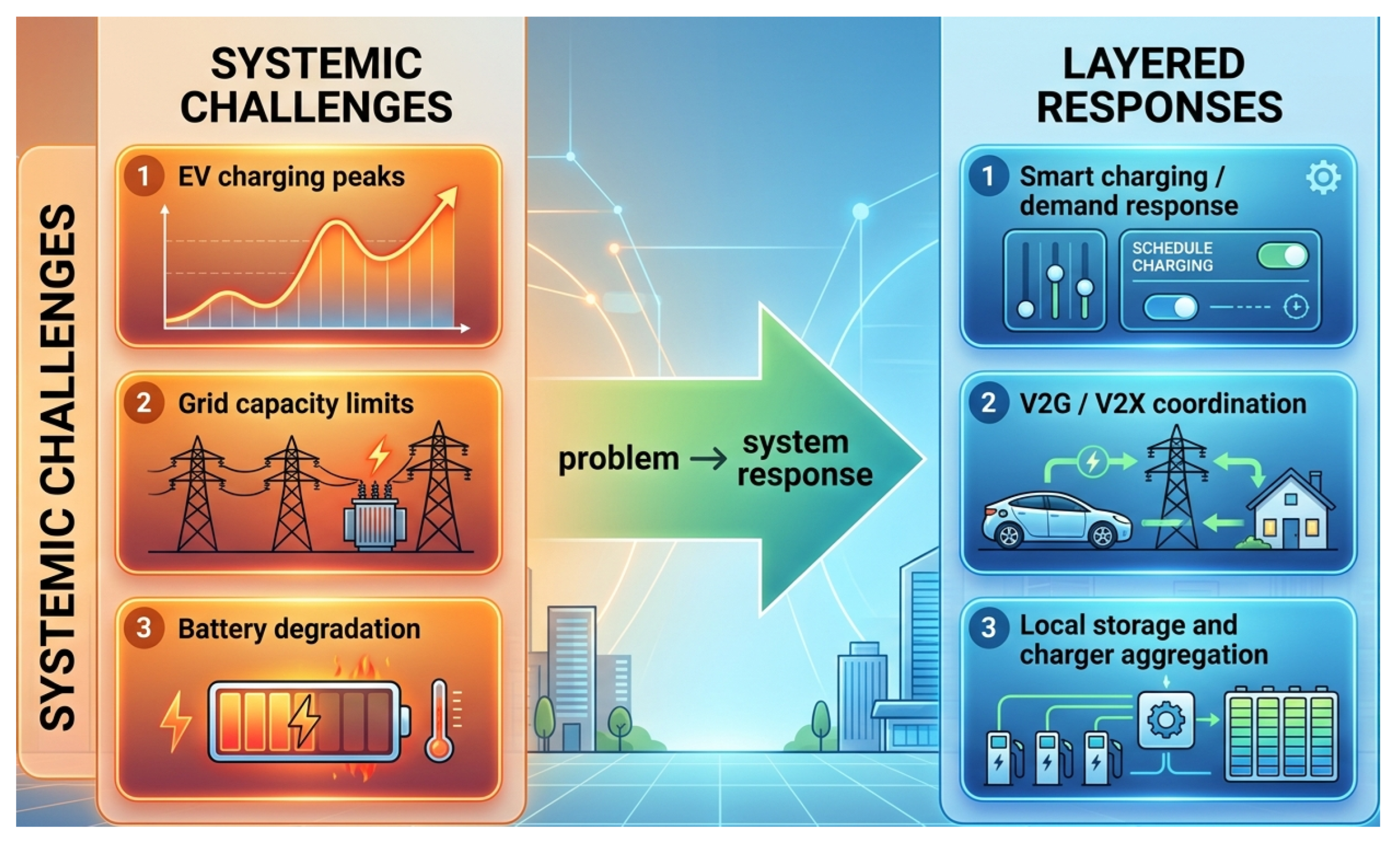
- Variability and peak demand: Charging patterns are highly heterogeneous. Many users prefer to charge after work, concentrating demand into a few evening hours and creating new load peaks that local distribution networks were not sized for. Unmanaged, these peaks can lead to grid instability and accelerated asset aging. Simultaneously, the growing penetration of intermittent renewable energy (such as solar and wind) means that low-carbon energy is variable. As smart grids integrate these fluctuating sources to reduce CO2 emissions [58], traditional energy flows are fundamentally modified, often changing direction suddenly. Furthermore, the replacement of traditional synchronous generators with these distributed systems removes inherent inertial responses, exacerbating grid stability issues related to voltage control and load flows [59]. While matching EV charging to times of high renewable generation is technically attractive, it remains operationally complex.
- Grid capacity and hardware limits [60]: Traditional distribution networks (transformers, low-voltage lines) were designed for one-way electricity flows from the grid to the consumer. Two emerging trends complicate this legacy architecture: the bidirectional flows required by V2G and the clustering of EV chargers at public hubs or depots. Enabling V2G requires specialized bidirectional Electric Vehicle Supply Equipment (EVSE) and advanced control systems to regulate electricity flow [61,62]. Furthermore, repeated battery cycling for grid services risks accelerating battery degradation, creating economic disincentives for vehicle owners.
- Coordination and business models: A critical barrier is determining who controls the charging schedules: utilities, charging operators, mobility platforms, or the users themselves. Currently, incentives are misaligned. Drivers prioritize convenience and low costs; in particular, overcoming “range anxiety” [63] is paramount for V2G adoption [64]. Studies indicate that guaranteeing a “minimum range” for drivers is a far more critical factor for their participation than financial remuneration. Utilities need to flatten demand peaks to stabilize voltage, and cities aim for equitable access and low emissions. While emerging theoretical concepts like Mobile-Energy-as-a-Service (MEaaS) [39,65] offer promising frameworks to coordinate these actors, they currently lack large-scale empirical validation. Furthermore, regulatory frameworks, tariffs, and commercial contracts severely lag behind these conceptual technological capabilities. This regulatory lag, alongside an insufficiently developed charging infrastructure, currently hinders the widespread application of otherwise mature V2G technologies [66].
- Smart charging and demand response: Implementing intelligent charging protocols [67] can dynamically adjust charging rates based on grid conditions. By leveraging real-time monitoring and automation [68], these systems can lower system costs and allow EVs to absorb excess renewable energy as distributed storage [59].
- Local storage and charger aggregation: Deploying off-grid or hybrid charging stations equipped with local renewable generation (e.g., solar canopies) and stationary battery storage can buffer the grid from sudden peak demands caused by fast-charging clusters [49].
- Time-of-use tariffs and incentive design: Creating dynamic pricing mechanisms and incentive-based coordination schemes is essential to align user behavior with grid needs, encouraging off-peak charging or discharging. While conceptual models such as the MEaaS framework propose viable theoretical pathways for this coordination, their practical efficacy remains to be rigorously tested and validated in real-world deployment settings.
- Standards and interoperability: A fragmented hardware and software landscape prevents seamless integration. Adopting universal communication protocols and robust, multi-layer security frameworks (such as the NIST cybersecurity framework) is critical to protect bidirectional energy networks from vulnerabilities and ensure network security [59].
- Pilot projects and staged upgrades: Given the high costs of grid upgrades, cities must transition from purely simulation-based planning to real-world, large-scale field trials. Staged infrastructure rollouts, tailored to specific city archetypes, can help municipalities test viability before committing to massive capital investments [69].
3.3. Data Fragmentation and ITS Scaling Limits
3.4. Connected and Automated Vehicles
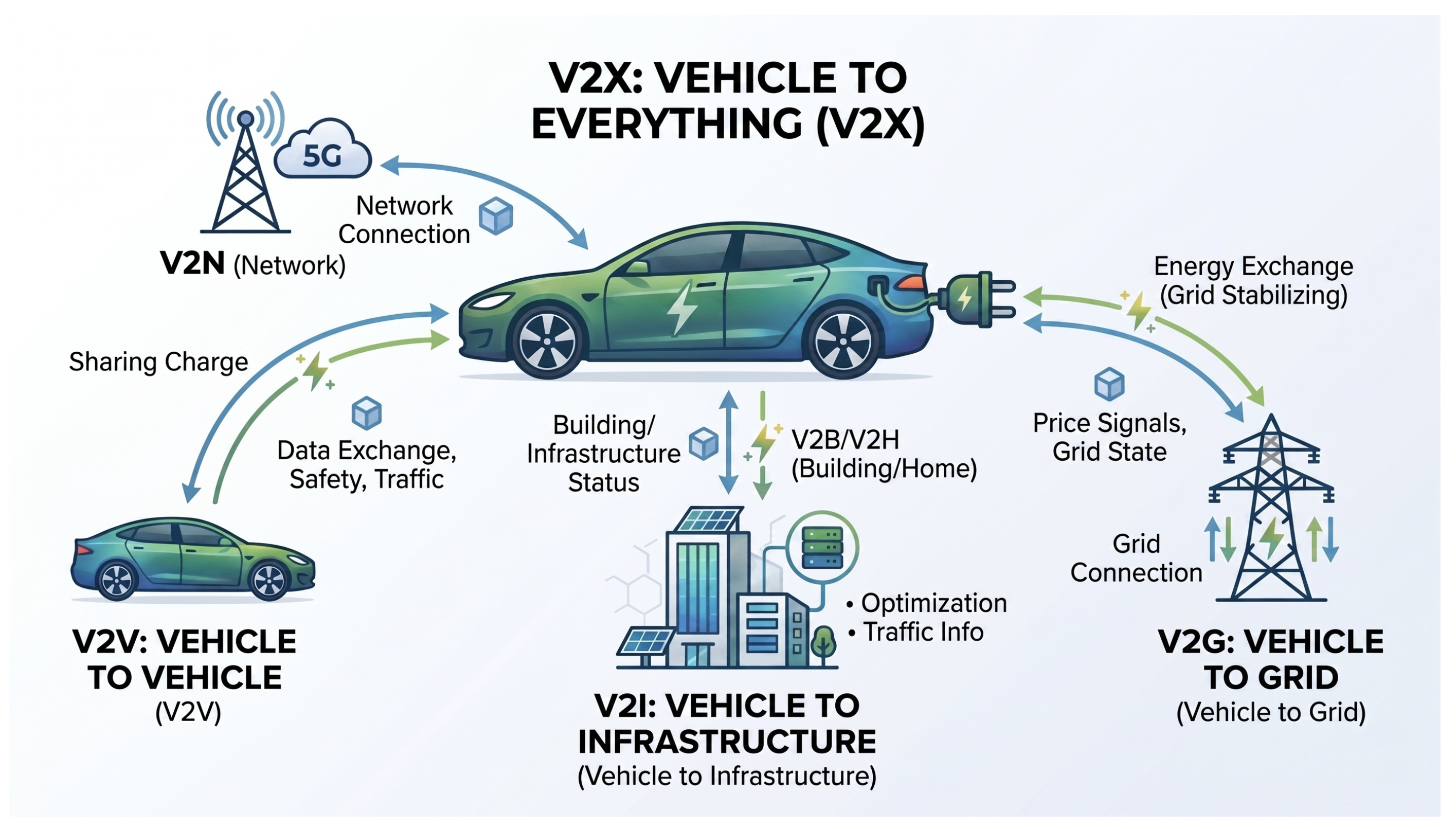
- Vehicle-to-Infrastructure (V2I): Connects vehicles with elements like smart traffic signals. The integration of V2I with big data analytics has demonstrated tangible results in optimizing traffic flow; for example, data-driven synchronization of traffic lights has been shown to reduce gas emissions and wait times by up to 20%, while real-time predictive models in cities like Vienna successfully manage parking occupancy [78,100].
- Vehicle-to-Grid (V2G): Allows EV batteries to safely supply electricity back to the grid, helping to balance peak renewable energy loads without compromising mobility [54]. Standardized protocols, such as ISO 15118, are crucial in this context to ensure smooth, automated interactions between the vehicle and the energy network during smart charging events [99].
- Vehicle-to-Pedestrian (V2P) and Vehicle-to-Network (V2N): V2P systems detect vulnerable road users to provide collision warnings, while V2N connects vehicles to cloud services for remote diagnostics and advanced routing [100].

3.5. Governance and Institutional Barriers
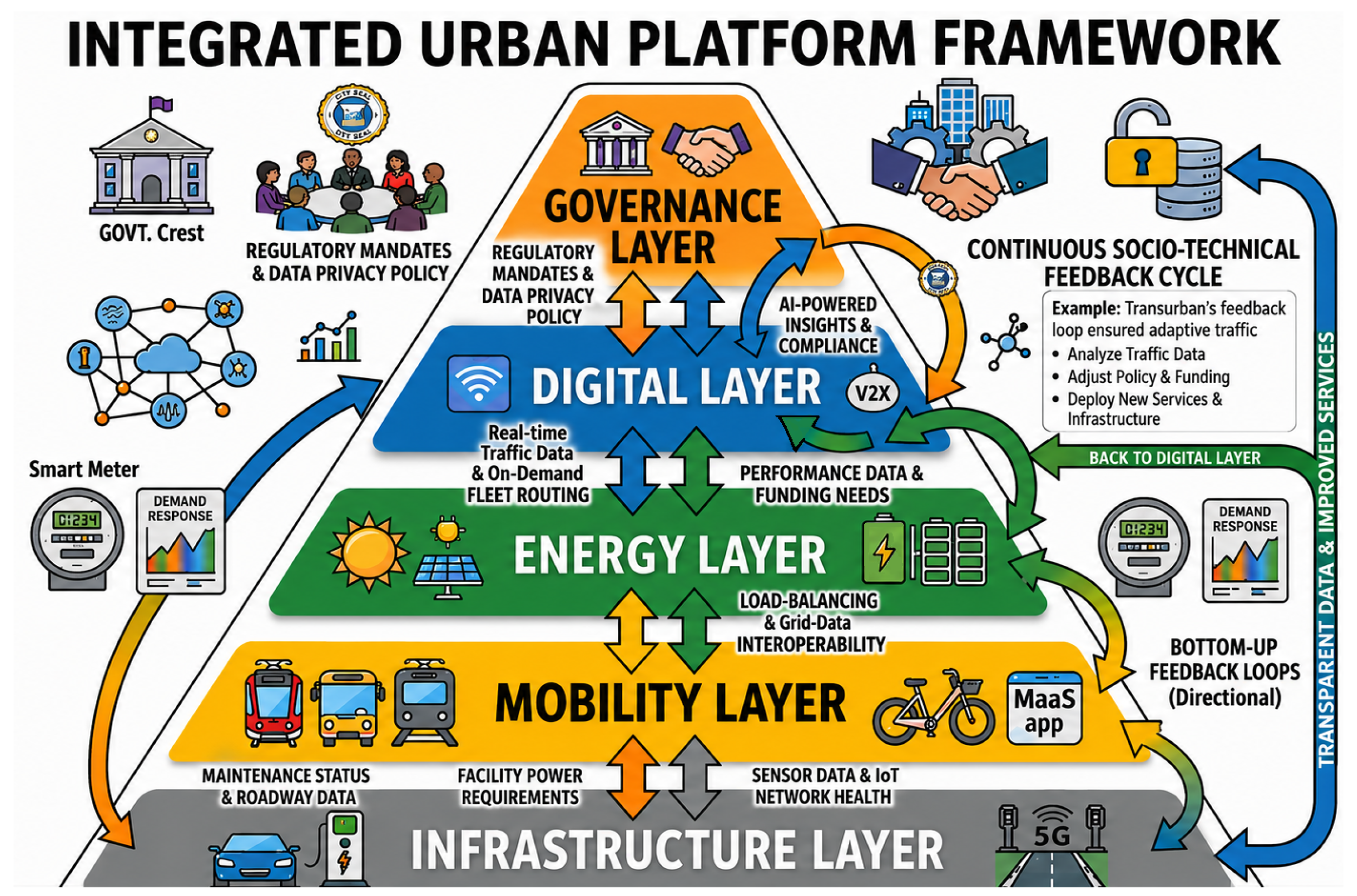
4. Integrated Smart Mobility Solutions
4.1. The Infrastructure Layer
4.2. The Mobility Layer
4.3. The Energy Layer
4.4. The Digital Layer
- Resource Integration and Automation (ITS Perspective): In the context of Intelligent Transportation Systems, the digital layer serves as a centralized collector for information from physical infrastructure, such as cameras, IoT sensors, and traffic lights. By fueling technologies such as artificial intelligence and the Urban Digital Twin [97], this layer enables autonomous traffic optimization and predictive emergency management, effectively overcoming the limitations and potential errors associated with human intervention alone. Functioning as a dynamic virtual mirror of the physical environment, a digital twin fuses real-time telemetry, simulation algorithms, and analytical tools to facilitate urban forecasting and decision-making [153].
- Resilience and Predictive Urban Planning (Smart City Perspective): At a more advanced level of maturity, the digital layer relies on layered digital architectures that include 5G networks, big data analytics, and edge-to-cloud computing [154,155] to enable distributed processing and real-time decision-making. Far exceeding the capabilities of a static digital replica, it establishes a multidimensional testing ground where city authorities can evaluate complex planning strategies, across various temporal and spatial scales, prior to physical deployment. This systemic maturity makes the digital layer a true predictive urban planning tool, giving cities the resilience needed to adapt and rapidly redeploy resources during crises, pandemics, or infrastructure disasters [156].
4.5. The Governance Layer
5. Conclusions
5.1. Limitations of the Study
5.2. Future Works
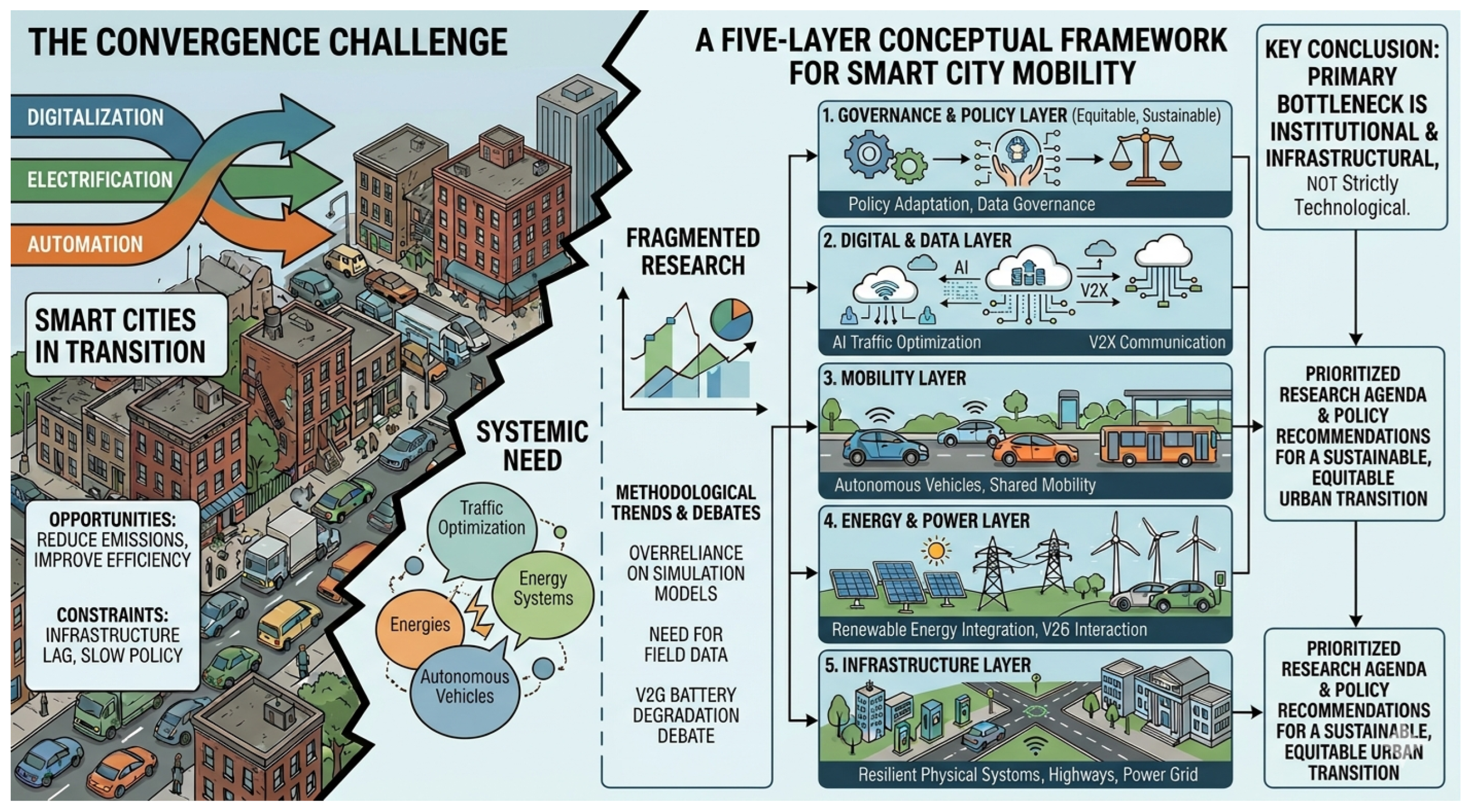
- Infrastructure Layer: Future research must focus on modular and adaptive construction techniques (e.g., 3D printing of infrastructure) and evaluate strategies for retrofitting legacy road networks to support bidirectional V2I communications.
- Mobility Layer: There is a critical need for empirical studies assessing the spatial equity of Mobility-as-a-Service (MaaS) and Mobility-on-Demand (MOD) deployments, ensuring that algorithmic routing does not systematically marginalize peripheral urban districts.
- Energy Layer: Research priorities include large-scale field validations of Mobile-Energy-as-a-Service (MEaaS) concepts and the optimization of V2G charging schedules to definitively quantify and mitigate long-term battery degradation.
- Digital Layer: Practitioners must prioritize the development of open, interoperable “Mobility Data Spaces” to overcome proprietary silos, alongside the implementation of Explainable AI (XAI) and rigorous bias audits in traffic optimization algorithms.
- Governance Layer: Future studies should employ structured analytical approaches (e.g., TISM-MICMAC) to formally quantify the severity of institutional barriers. Additionally, research must explore agile procurement models and regulatory sandboxes capable of accommodating rapid software lifecycles.
Author Contributions
Funding
Institutional Review Board Statement
Informed Consent Statement
Data Availability Statement
Acknowledgments
Conflicts of Interest
Abbreviations
| ABCO | Artificial Bee Colony Optimization |
| AI | Artificial Intelligence |
| API | Application Programming Interface |
| AV | Autonomous Vehicle |
| DAG | Directed Acyclic Graph |
| DL | Deep Learning |
| DSRC | Dedicated Short-Range Communication |
| EV | Electric Vehicle |
| EVSE | Electric Vehicle Supply Equipment |
| G2V | Grid-to-Vehicle |
| GHG | Greenhouse Gas |
| GNSS | Global Navigation Satellite Systems |
| ICT | Information and Communication Technology |
| IEA | International Energy Agency |
| IoT | Internet of Things |
| IoV | Internet of Vehicles |
| ITS | Intelligent Transportation Systems |
| KPI | Key Performance Indicator |
| LiDAR | Light Detection and Ranging |
| MaaS | Mobility as a Service |
| MEaaS | Mobile-Energy-as-a-Service |
| ML | Machine Learning |
| MOD | Mobility-on-Demand |
| NIST | National Institute of Standards and Technology |
| PV | Photovoltaic |
| RADAR | Radio Detection and Ranging |
| SoC | State of Charge |
| UMii | Urban Mobility Innovation Index |
| V2B | Vehicle-to-Building |
| V2G | Vehicle-to-Grid |
| V2H | Vehicle-to-Home |
| V2I | Vehicle-to-Infrastructure |
| V2V | Vehicle-to-Vehicle |
| V2X | Vehicle-to-Everything |
| VPP | Virtual Power Plant |
| XAI | Explainable AI |
References
- Jaller, M.; Otero-Palencia, C.; Pahwa, A. Automation, electrification, and shared mobility in urban freight: Opportunities and challenges. Transp. Res. Procedia 2020, 46, 13–20. [Google Scholar] [CrossRef]
- Butler, L.; Yigitcanlar, T.; Paz, A. Smart Urban Mobility Innovations: A Comprehensive Review and Evaluation. IEEE Access 2020, 8, 196034–196049. [Google Scholar] [CrossRef]
- Iqbal, A.; Nazir, H.; Qazi, A.W. Exploring the 15-Minutes City Concept: Global Challenges and Opportunities in Diverse Urban Contexts. Urban Sci. 2025, 9, 252. [Google Scholar] [CrossRef]
- Zhang, L.; Long, R.; Li, W.; Wei, J. Potential for reducing carbon emissions from urban traffic based on the carbon emission satisfaction: Case study in Shanghai. J. Transp. Geogr. 2020, 85, 102733. [Google Scholar] [CrossRef]
- Andrei, N.; Scarlat, C. AI-Driven Urban Mobility Solutions: Shaping Bucharest as a Smart City. Urban Sci. 2025, 9, 335. [Google Scholar] [CrossRef]
- Sayed, S.A.; Abdel-Hamid, Y.; Hefny, H.A. Artificial intelligence-based traffic flow prediction: A comprehensive review. J. Electr. Syst. Inf. Technol. 2023, 10, 13. [Google Scholar] [CrossRef]
- Viadero-Monasterio, F.; Meléndez-Useros, M.; Jiménez-Salas, M.; Boada, M.J.L. Fault-Tolerant Robust Output-Feedback Control of a Vehicle Platoon Considering Measurement Noise and Road Disturbances. IET Intell. Transp. Syst. 2025, 19, e70007. [Google Scholar] [CrossRef]
- Ru, J.; Gillott, M.; Shipman, R. Vehicle-to-Grid (V2G) Research: A Decade of Progress, Achievements, and Future Directions. Energies 2025, 18, 6148. [Google Scholar] [CrossRef]
- Ruggieri, R.; Ruggeri, M.; Vinci, G.; Poponi, S. Electric Mobility in a Smart City: European Overview. Energies 2021, 14, 315. [Google Scholar] [CrossRef]
- Mojumder, M.R.H.; Ahmed Antara, F.; Hasanuzzaman, M.; Alamri, B.; Alsharef, M. Electric Vehicle-to-Grid (V2G) Technologies: Impact on the Power Grid and Battery. Sustainability 2022, 14, 13856. [Google Scholar] [CrossRef]
- Viadero-Monasterio, F.; Meléndez-Useros, M.; Zhang, N.; Zhang, H.; Boada, B.L.; Boada, M.J.L. Motion Planning and Robust Output-Feedback Trajectory Tracking Control for Multiple Intelligent and Connected Vehicles in Unsignalized Intersections. IEEE Trans. Veh. Technol. 2025, 74, 18543–18555. [Google Scholar] [CrossRef]
- Wang, J.; Shao, Y.; Ge, Y.; Yu, R. A Survey of Vehicle to Everything (V2X) Testing. Sensors 2019, 19, 334. [Google Scholar] [CrossRef]
- Viadero-Monasterio, F.; Nguyen, A.T.; Lauber, J.; Boada, M.J.L.; Boada, B.L. Event-Triggered Robust Path Tracking Control Considering Roll Stability Under Network-Induced Delays for Autonomous Vehicles. IEEE Trans. Intell. Transp. Syst. 2023, 24, 14743–14756. [Google Scholar] [CrossRef]
- Viadero-Monasterio, F.; Meléndez-Useros, M.; Boada, B.L.; Boada, M.J.L. Static Output-Feedback LQR Control for Predecessor-Leader Following Vehicle Platooning With Energy Efficiency Analysis via Aerodynamic Drag Reduction. IEEE Open J. Intell. Transp. Syst. 2026, 7, 1329–1340. [Google Scholar] [CrossRef]
- Aziz, K.M.A.; Daoud, A.O.; Singh, A.K.; Alhusban, M. Integrating digital mapping technologies in urban development: Advancing sustainable and resilient infrastructure for SDG 9 achievement—A systematic review. Alex. Eng. J. 2025, 116, 512–524. [Google Scholar] [CrossRef]
- Ganin, A.A.; Mersky, A.C.; Jin, A.S.; Kitsak, M.; Keisler, J.M.; Linkov, I. Resilience in Intelligent Transportation Systems (ITS). Transp. Res. Part C Emerg. Technol. 2019, 100, 318–329. [Google Scholar] [CrossRef]
- Ramkumar, G.; Kannan, S.; Mohanavel, V.; Karthikeyan, S.; Titus, A. The future of green mobility: A review exploring renewable energy systems integration in electric vehicles. Results Eng. 2025, 27, 105647. [Google Scholar] [CrossRef]
- Alam, M.S.; Georgakis, P. The State of the Art of Cooperative and Connected Autonomous Vehicles from the Future Mobility Management Perspective: A Systematic Review. Future Transp. 2022, 2, 589–604. [Google Scholar] [CrossRef]
- Viadero-Monasterio, F.; Meléndez-Useros, M.; Jiménez-Salas, M.; Boada, B.L. Robust Adaptive Heterogeneous Vehicle Platoon Control Based on Disturbances Estimation and Compensation. IEEE Access 2024, 12, 96924–96935. [Google Scholar] [CrossRef]
- Maldonado Silveira Alonso Munhoz, P.A.; da Costa Dias, F.; Kowal Chinelli, C.; Azevedo Guedes, A.L.; Neves dos Santos, J.A.; da Silveira e Silva, W.; Pereira Soares, C.A. Smart Mobility: The Main Drivers for Increasing the Intelligence of Urban Mobility. Sustainability 2020, 12, 10675. [Google Scholar] [CrossRef]
- Wawer, M.; Grzesiuk, K.; Jegorow, D. Smart Mobility in a Smart City in the Context of Generation Z Sustainability, Use of ICT, and Participation. Energies 2022, 15, 4651. [Google Scholar] [CrossRef]
- Patel, A.R.; Ahuja, R.; Roscia, M. Facilitating Citizen Engagement in Smart City Mobility. In Proceedings of the 2024 IEEE 4th International Conference on Sustainable Energy and Future Electric Transportation (SEFET), Hyderabad, India, 31 July–3 August 2024; pp. 1–6. [Google Scholar] [CrossRef]
- Borruso, G.; Balletto, G. The Image of the Smart City: New Challenges. Urban Sci. 2022, 6, 5. [Google Scholar] [CrossRef]
- Dixit, V.K.; Malviya, R.K.; Patil, S.K.; Prajapati, H.; Agarwal, A. Analysing the empirical research in digital supply chain: A state of art literature review and future research directions. Oper. Res. 2026, 26, 17. [Google Scholar] [CrossRef]
- Yang, Y.; Wang, W.; Qin, J.; Wang, M.; Ma, Q.; Zhong, Y. Review of vehicle to grid integration to support power grid security. Energy Rep. 2024, 12, 2786–2800. [Google Scholar] [CrossRef]
- Leippi, A.; Fleschutz, M.; Murphy, M.D. A Review of EV Battery Utilization in Demand Response Considering Battery Degradation in Non-Residential Vehicle-to-Grid Scenarios. Energies 2022, 15, 3227. [Google Scholar] [CrossRef]
- Ginigeme, K.; Wang, Z. Distributed Optimal Vehicle-To-Grid Approaches With Consideration of Battery Degradation Cost Under Real-Time Pricing. IEEE Access 2020, 8, 5225–5235. [Google Scholar] [CrossRef]
- Mavlutova, I.; Atstaja, D.; Grasis, J.; Kuzmina, J.; Uvarova, I.; Roga, D. Urban Transportation Concept and Sustainable Urban Mobility in Smart Cities: A Review. Energies 2023, 16, 3585. [Google Scholar] [CrossRef]
- Paiva, S.; Ahad, M.A.; Tripathi, G.; Feroz, N.; Casalino, G. Enabling Technologies for Urban Smart Mobility: Recent Trends, Opportunities and Challenges. Sensors 2021, 21, 2143. [Google Scholar] [CrossRef]
- Wolniak, R.; Stecuła, K. Artificial Intelligence in Smart Cities—Applications, Barriers, and Future Directions: A Review. Smart Cities 2024, 7, 1346–1389. [Google Scholar] [CrossRef]
- Mitieka, D.; Luke, R.; Twinomurinzi, H.; Mageto, J. Mapping the Institutional and Socio-Political Barriers to Smart Mobility Adoption: A TISM-MICMAC Approach. Smart Cities 2025, 8, 182. [Google Scholar] [CrossRef]
- Jørgensen, B.N.; Ma, Z.G. Impact of EU Regulations on AI Adoption in Smart City Solutions: A Review of Regulatory Barriers, Technological Challenges, and Societal Benefits. Information 2025, 16, 568. [Google Scholar] [CrossRef]
- Razmjoo, A.; Østergaard, P.A.; Denaï, M.; Nezhad, M.M.; Mirjalili, S. Effective policies to overcome barriers in the development of smart cities. Energy Res. Soc. Sci. 2021, 79, 102175. [Google Scholar] [CrossRef]
- Wang, A.; Wang, J.; Zhang, R.; Cao, S.J. Mitigating urban heat and air pollution considering green and transportation infrastructure. Transp. Res. Part A Policy Pract. 2024, 184, 104079. [Google Scholar] [CrossRef]
- Xie, R.; Fang, J.; Liu, C. The effects of transportation infrastructure on urban carbon emissions. Appl. Energy 2017, 196, 199–207. [Google Scholar] [CrossRef]
- Kussl, S.; Wald, A. Smart Mobility and its Implications for Road Infrastructure Provision: A Systematic Literature Review. Sustainability 2023, 15, 210. [Google Scholar] [CrossRef]
- Katontoka, M.; Orsi, F.; Bakker, M.; Hocks, B. Toward sustainable transportation: A systematic review of EV charging station locations. Int. J. Sustain. Transp. 2025, 19, 881–893. [Google Scholar] [CrossRef]
- Aguilar-Jiménez, J.A.; Hernández-Callejo, L.; Suástegui-Macías, J.A.; Alonso Gómez, V.; García-Álvaro, A.; Maján-Navalón, R.; Obregón, L.J. Energy and Economic Analysis of Renewable Energy-Based Isolated Microgrids with AGM and Lithium Battery Energy Storage: Case Study Bigene, Guinea-Bissau. Urban Sci. 2023, 7, 66. [Google Scholar] [CrossRef]
- Vilathgamuwa, M.; Mishra, Y.; Yigitcanlar, T.; Bhaskar, A.; Wilson, C. Mobile-Energy-as-a-Service (MEaaS): Sustainable Electromobility via Integrated Energy–Transport–Urban Infrastructure. Sustainability 2022, 14, 2796. [Google Scholar] [CrossRef]
- Saunders, M.J.; Kuhnimhof, T.; Chlond, B.; da Silva, A.N.R. Incorporating transport energy into urban planning. Transp. Res. Part A Policy Pract. 2008, 42, 874–882. [Google Scholar] [CrossRef]
- Prasittisopin, L. How 3D Printing Technology Makes Cities Smarter: A Review, Thematic Analysis, and Perspectives. Smart Cities 2024, 7, 3458–3488. [Google Scholar] [CrossRef]
- Kantaros, A.; Zacharia, P.; Drosos, C.; Papoutsidakis, M.; Pallis, E.; Ganetsos, T. Smart Infrastructure and Additive Manufacturing: Synergies, Advantages, and Limitations. Appl. Sci. 2025, 15, 3719. [Google Scholar] [CrossRef]
- Bresciani, S.; Ferraris, A.; Del Giudice, M. The management of organizational ambidexterity through alliances in a new context of analysis: Internet of Things (IoT) smart city projects. Technol. Forecast. Soc. Chang. 2018, 136, 331–338. [Google Scholar] [CrossRef]
- Kantaros, A.; Petrescu, F.I.T.; Brachos, K.; Ganetsos, T.; Petrescu, N. Leveraging 3D Printing for Resilient Disaster Management in Smart Cities. Smart Cities 2024, 7, 3705–3726. [Google Scholar] [CrossRef]
- Alanazi, F. Development of Smart Mobility Infrastructure in Saudi Arabia: A Benchmarking Approach. Sustainability 2023, 15, 3158. [Google Scholar] [CrossRef]
- Inac, H.; Oztemel, E. An Assessment Framework for the Transformation of Mobility 4.0 in Smart Cities. Systems 2022, 10, 1. [Google Scholar] [CrossRef]
- Oad, A.; Ahmad, H.G.; Talpur, M.S.H.; Zhao, C.; Pervez, A. Green smart grid predictive analysis to integrate sustainable energy of emerging V2G in smart city technologies. Optik 2023, 272, 170146. [Google Scholar] [CrossRef]
- Szpilko, D.; Fernando, X.; Nica, E.; Budna, K.; Rzepka, A.; Lăzăroiu, G. Energy in Smart Cities: Technological Trends and Prospects. Energies 2024, 17, 6439. [Google Scholar] [CrossRef]
- Al-Thani, H.; Koç, M.; Isaifan, R.J.; Bicer, Y. A Review of the Integrated Renewable Energy Systems for Sustainable Urban Mobility. Sustainability 2022, 14, 10517. [Google Scholar] [CrossRef]
- Viadero-Monasterio, F.; Meléndez-Useros, M.; Zhang, H.; Boada, B.L.; Boada, M.J.L. Signalized Traffic Management Optimizing Energy Efficiency Under Driver Preferences for Vehicles With Heterogeneous Powertrains. IEEE Trans. Consum. Electron. 2025, 71, 3454–3464. [Google Scholar] [CrossRef]
- Silva, W.N.; Bitencourt, L.D.A.; Bandória, L.H.T.; Ramos, P.V.B.; Dias, B.H.; De Almeida, M.C. Structuring Smart Cities From an Electrical Perspective: An Integrative Framework. IEEE Access 2025, 13, 183184–183199. [Google Scholar] [CrossRef]
- Jahic, A.; Eskander, M.; Schulz, D. Charging Schedule for Load Peak Minimization on Large-Scale Electric Bus Depots. Appl. Sci. 2019, 9, 1748. [Google Scholar] [CrossRef]
- Jahic, A.; Heider, F.; Plenz, M.; Schulz, D. Flexibility Quantification and the Potential for Its Usage in the Case of Electric Bus Depots with Unidirectional Charging. Energies 2022, 15, 3639. [Google Scholar] [CrossRef]
- Rao, S.P.; Olusegun, T.S.; Ranganathan, P.; Kose, U.; Goveas, N. Vehicle-to-Grid technology: Opportunities, challenges, and future prospects for sustainable transportation. J. Energy Storage 2025, 110, 114927. [Google Scholar] [CrossRef]
- Ou, S. Estimate long-term impact on battery degradation by considering electric vehicle real-world end-use factors. J. Power Sources 2023, 573, 233133. [Google Scholar] [CrossRef]
- Saldaña, G.; San Martin, J.I.; Zamora, I.; Asensio, F.J.; Oñederra, O. Electric Vehicle into the Grid: Charging Methodologies Aimed at Providing Ancillary Services Considering Battery Degradation. Energies 2019, 12, 2443. [Google Scholar] [CrossRef]
- Etxandi-Santolaya, M.; Mora-Pous, A.; Canals Casals, L.; Corchero, C.; Eichman, J. Quantifying the Impact of Battery Degradation in Electric Vehicle Driving through Key Performance Indicators. Batteries 2024, 10, 103. [Google Scholar] [CrossRef]
- Prakash, S.N.; Kumarappan, N. Renewable Energy Sources and Electric Vehicle for Optimal Energy Management of Micro Grids with the Aim of CO2 Emission Reduction. In Proceedings of the 2022 International Conference on Electronic Systems and Intelligent Computing (ICESIC), Chennai, India, 22–23 April 2022; pp. 382–386. [Google Scholar] [CrossRef]
- Silva, N.S.e.; Castro, R.; Ferrão, P. Smart Grids in the Context of Smart Cities: A Literature Review and Gap Analysis. Energies 2025, 18, 1186. [Google Scholar] [CrossRef]
- van Sambeek, H.L.; Zweistra, M.; Hoogsteen, G.; Varenhorst, I.A.M.; Janssen, S. GridShield—Optimizing the Use of Grid Capacity during Increased EV Adoption. World Electr. Veh. J. 2023, 14, 68. [Google Scholar] [CrossRef]
- Chu, X.; Ge, Y.; Zhou, X.; Li, L.; Yang, D. Modeling and Analysis of Electric Vehicle-Power Grid-Manufacturing Facility (EPM) Energy Sharing System under Time-of-Use Electricity Tariff. Sustainability 2020, 12, 4836. [Google Scholar] [CrossRef]
- Nelson, K.; Mohammadi, J.; Chen, Y.; Blasch, E.; Aved, A.; Ferris, D.; Cruz, E.A.; Morrone, P. Electric Vehicle Aggregation Review: Benefits and Vulnerabilities of Managing a Growing Fleet. In Proceedings of the 2024 IEEE Texas Power and Energy Conference (TPEC), College Station, TX, USA, 12–13 February 2024; pp. 1–6. [Google Scholar] [CrossRef]
- Esmaili, M.; Shafiee, H.; Aghaei, J. Range anxiety of electric vehicles in energy management of microgrids with controllable loads. J. Energy Storage 2018, 20, 57–66. [Google Scholar] [CrossRef]
- Lu, C.F.; Liu, G.P.; Yu, Y.; Cui, J. A Coordinated Model Predictive Control-Based Approach for Vehicle-to-Grid Scheduling Considering Range Anxiety and Battery Degradation. IEEE Trans. Transp. Electrif. 2025, 11, 5688–5699. [Google Scholar] [CrossRef]
- Yigitcanlar, T. Towards Smart and Sustainable Urban Electromobility: An Editorial Commentary. Sustainability 2022, 14, 2264. [Google Scholar] [CrossRef]
- Geske, J.; Schumann, D. Willing to participate in vehicle-to-grid (V2G)? Why not! Energy Policy 2018, 120, 392–401. [Google Scholar] [CrossRef]
- Baharom, R.; Hayroman, M.H. A Comprehensive Review on Advancements in Battery Charger Technologies for Electric Vehicles. In Proceedings of the 2024 IEEE Industrial Electronics and Applications Conference (IEACon), Kuala Lumpur, Malaysia, 4–5 November 2024; pp. 190–195. [Google Scholar] [CrossRef]
- Li, X.; Wang, H.; Zhang, B. Coordinated Optimization of Distributed Energy Resources in Virtual Power Plants Considering Electric Vehicle Penetration. In Proceedings of the 2024 IEEE 8th Conference on Energy Internet and Energy System Integration (EI2), Shenyang, China, 29 November–2 December 2024; pp. 629–636. [Google Scholar] [CrossRef]
- Wang, C.; Xie, Y.; Huang, H.; Liu, P. A review of surrogate safety measures and their applications in connected and automated vehicles safety modeling. Accid. Anal. Prev. 2021, 157, 106157. [Google Scholar] [CrossRef] [PubMed]
- Qiao, S.; Yeh, A.G.O. Mobility-on-demand public transport toward spatial justice: Shared mobility or Mobility as a Service. Transp. Res. Part D Transp. Environ. 2023, 123, 103916. [Google Scholar] [CrossRef]
- Karger, E.; Rothweiler, A.; Brée, T.; Ahlemann, F. Building the Smart City of Tomorrow: A Bibliometric Analysis of Artificial Intelligence in Urbanization. Urban Sci. 2025, 9, 132. [Google Scholar] [CrossRef]
- Almulhim, A.I.; Aina, Y.A. Achieving Human-Centered Smart City Development in Saudi Arabia. Urban Sci. 2025, 9, 393. [Google Scholar] [CrossRef]
- Becker, H.; Balac, M.; Ciari, F.; Axhausen, K.W. Assessing the welfare impacts of Shared Mobility and Mobility as a Service (MaaS). Transp. Res. Part A Policy Pract. 2020, 131, 228–243. [Google Scholar] [CrossRef]
- Tang, S.; Shelden, D.R.; Eastman, C.M.; Pishdad-Bozorgi, P.; Gao, X. A review of building information modeling (BIM) and the internet of things (IoT) devices integration: Present status and future trends. Autom. Constr. 2019, 101, 127–139. [Google Scholar] [CrossRef]
- Viadero-Monasterio, F.; García, J.; Meléndez-Useros, M.; Jiménez-Salas, M.; Boada, B.L.; López Boada, M.J. Simultaneous Estimation of Vehicle Sideslip and Roll Angles Using an Event-Triggered-Based IoT Architecture. Machines 2024, 12, 53. [Google Scholar] [CrossRef]
- Goumopoulos, C. Smart City Middleware: A Survey and a Conceptual Framework. IEEE Access 2024, 12, 4015–4047. [Google Scholar] [CrossRef]
- binti Mohamad Noor, M.; Hassan, W.H. Current research on Internet of Things (IoT) security: A survey. Comput. Netw. 2019, 148, 283–294. [Google Scholar] [CrossRef]
- Mahrez, Z.; Sabir, E.; Badidi, E.; Saad, W.; Sadik, M. Smart Urban Mobility: When Mobility Systems Meet Smart Data. IEEE Trans. Intell. Transp. Syst. 2022, 23, 6222–6239. [Google Scholar] [CrossRef]
- Yang, D.H.; Choi, S.S.; Kang, Y.S. Modeling of Traffic Information and Services for the Traffic Control Center in Autonomous Vehicle-Mixed Traffic Situations. Appl. Sci. 2023, 13, 10719. [Google Scholar] [CrossRef]
- Cordoș, N.; Duma, I.; Moldovanu, D.; Todoruț, A.; Barabás, I. An Overview of Intelligent Transportation Systems in Europe. World Electr. Veh. J. 2025, 16, 387. [Google Scholar] [CrossRef]
- Tripathi, P.S.M.; Kumar, A.; Chandra, A. An Overview of Intelligent Transport System (ITS) and its Applications. J. Mob. Multimed. 2021, 17, 79–114. [Google Scholar] [CrossRef]
- Avcı, I.; Koca, M. Intelligent Transportation System Technologies, Challenges and Security. Appl. Sci. 2024, 14, 4646. [Google Scholar] [CrossRef]
- Zhang, N.; Viadero-Monasterio, F.; Chen, J.; Zhang, H. On-Line Distributed Model Predictive Scheduling for Multi-Vehicle Routing Problems With Lane-Change and Platoon Maneuvers. IEEE Trans. Intell. Transp. Syst. 2026, 27, 5988–6001. [Google Scholar] [CrossRef]
- Kloeker, L.; Joeken, G.; Eckstein, L. Economic Analysis of Smart Roadside Infrastructure Sensors for Connected and Automated Mobility. In Proceedings of the 2023 IEEE 26th International Conference on Intelligent Transportation Systems (ITSC), Bilbao, Spain, 24–28 September 2023; pp. 2331–2336. [Google Scholar] [CrossRef]
- Viadero-Monasterio, F.; Alonso-Rentería, L.; Pérez-Oria, J.; Viadero-Rueda, F. Radar-Based Pedestrian and Vehicle Detection and Identification for Driving Assistance. Vehicles 2024, 6, 1185–1199. [Google Scholar] [CrossRef]
- Jeong, S.; Kim, S.; Kim, J. City Data Hub: Implementation of Standard-Based Smart City Data Platform for Interoperability. Sensors 2020, 20, 7000. [Google Scholar] [CrossRef]
- Bellini, P.; Bilotta, S.; Collini, E.; Fanfani, M.; Nesi, P. Data Sources and Models for Integrated Mobility and Transport Solutions. Sensors 2024, 24, 441. [Google Scholar] [CrossRef]
- Vellinga, N.E.; Hailevich, E. The legal framework for sharing mobility data: On the road to an EU mobility data space. Comput. Law. Secur. Rev. 2025, 58, 106188. [Google Scholar] [CrossRef]
- Pretzsch, S.; Drees, H.; Rittershaus, L. Mobility Data Space. In Designing Data Spaces: The Ecosystem Approach to Competitive Advantage; Springer International Publishing: Cham, Switzerland, 2022; pp. 343–361. [Google Scholar] [CrossRef]
- Ji, B.; Zhang, X.; Mumtaz, S.; Han, C.; Li, C.; Wen, H.; Wang, D. Survey on the Internet of Vehicles: Network Architectures and Applications. IEEE Commun. Stand. Mag. 2020, 4, 34–41. [Google Scholar] [CrossRef]
- Kashem, M.A.; Shamsuddoha, M.; Nasir, T. Digitalization in Sustainable Transportation Operations: A Systematic Review of AI, IoT, and Blockchain Applications for Future Mobility. Future Transp. 2025, 5, 157. [Google Scholar] [CrossRef]
- Mostardinha, T.; Gameiro, J.; Valente, P.; Rito, P.; Raposo, D.; Sargento, S.; Marques, C.; Mesquita, M.; Pinto, F. Perception Offloading for Autonomous Mobility in a Beyond-5G Edge-enabled Environment. In Proceedings of the 2025 IEEE Future Networks World Forum (FNWF), Bangalore, India, 10–12 November 2025; pp. 1–7. [Google Scholar] [CrossRef]
- Hasan, M.; Mohan, S.; Shimizu, T.; Lu, H. Securing Vehicle-to-Everything (V2X) Communication Platforms. IEEE Trans. Intell. Veh. 2020, 5, 693–713. [Google Scholar] [CrossRef]
- Gupta, S.; Maple, C.; Passerone, R. An Investigation of Cyber-Attacks and Security Mechanisms for Connected and Autonomous Vehicles. IEEE Access 2023, 11, 90641–90669. [Google Scholar] [CrossRef]
- Viadero-Monasterio, F.; Meléndez-Useros, M.; Jiménez-Salas, M.; López Boada, B.; Jesús López Boada, M. Key influencing factors in vehicle platoons: A systematic study and review. Evol. Syst. 2025, 16, 116. [Google Scholar] [CrossRef]
- Mkhitaryan, K.; Sanamyan, A.; Mnatsakanyan, M.; Kirakosyan, E.; Ratner, S. Integrating AI and Geospatial Technologies for Sustainable Smart City Development: A Case Study of Yerevan. Urban Sci. 2025, 9, 389. [Google Scholar] [CrossRef]
- Rudskoy, A.; Ilin, I.; Prokhorov, A. Digital Twins in the Intelligent Transport Systems. Transp. Res. Procedia 2021, 54, 927–935. [Google Scholar] [CrossRef]
- Mirindi, D.; Khang, A.; Mirindi, F. Artificial Intelligence (AI) and Automation for Driving Green Transportation Systems: A Comprehensive Review. In Driving Green Transportation System Through Artificial Intelligence and Automation: Approaches, Technologies and Applications; Springer Nature: Cham, Switzerland, 2025; pp. 1–19. [Google Scholar] [CrossRef]
- Mishra, P.; Singh, G. Internet of Vehicles for Sustainable Smart Cities: Opportunities, Issues, and Challenges. Smart Cities 2025, 8, 93. [Google Scholar] [CrossRef]
- Sharma, G. SecureV2X: Overview of Secure Cellular based Vehicle-to-Everything Communication in Intelligent Transportation System. In Proceedings of the 2024 12th International Conference on Internet of Everything, Microwave, Embedded, Communication and Networks (IEMECON), Jaipur, India, 24–26 October 2024; pp. 1–6. [Google Scholar] [CrossRef]
- Alkaabi, K.; Sarrau, J. Modeling sea level rise scenarios and their effects on smart mobility infrastructure using GIS. Transp. Res. Interdiscip. Perspect. 2025, 34, 101667. [Google Scholar] [CrossRef]
- Yang, Z.; Barroca, B.; Bony-Dandrieux, A.; Dolidon, H. Resilience Indicator of Urban Transport Infrastructure: A Review on Current Approaches. Infrastructures 2022, 7, 33. [Google Scholar] [CrossRef]
- Taslimasa, H.; Dadkhah, S.; Neto, E.C.P.; Xiong, P.; Ray, S.; Ghorbani, A.A. Security issues in Internet of Vehicles (IoV): A comprehensive survey. Internet Things 2023, 22, 100809. [Google Scholar] [CrossRef]
- Loussaief, I.; Ksibi, S.; Jaidi, F.; Nouri, K. A Comprehensive Multi-Layered Cybersecurity Framework for Internet of Vehicles: Securing Vulnerable Nodes of V2X Communication Systems. In Proceedings of the 2025 International Wireless Communications and Mobile Computing (IWCMC), Abu Dhabi, United Arab Emirates, 12–16 May 2025; pp. 1597–1603. [Google Scholar] [CrossRef]
- Apata, O.; Bokoro, P.N.; Sharma, G. The Risks and Challenges of Electric Vehicle Integration into Smart Cities. Energies 2023, 16, 5274. [Google Scholar] [CrossRef]
- Viadero-Monasterio, F.; Meléndez-Useros, M.; Jiménez-Salas, M.; Boada, B.L. Robust Adaptive Control of Heterogeneous Vehicle Platoons in the Presence of Network Disconnections With a Novel String Stability Guarantee. IEEE Trans. Intell. Veh. 2026, 11, 63–75. [Google Scholar] [CrossRef]
- Alladi, T.; Kohli, V.; Chamola, V.; Yu, F.R. Securing the Internet of Vehicles: A Deep Learning-Based Classification Framework. IEEE Netw. Lett. 2021, 3, 94–97. [Google Scholar] [CrossRef]
- Ahmed, I.; Jeon, G.; Ahmad, A. Deep Learning-Based Intrusion Detection System for Internet of Vehicles. IEEE Consum. Electron. Mag. 2023, 12, 117–123. [Google Scholar] [CrossRef]
- Ahmed, H.U.; Huang, Y.; Lu, P.; Bridgelall, R. Technology Developments and Impacts of Connected and Autonomous Vehicles: An Overview. Smart Cities 2022, 5, 382–404. [Google Scholar] [CrossRef]
- Docherty, I.; Marsden, G.; Anable, J. The governance of smart mobility. Transp. Res. Part A Policy Pract. 2018, 115, 114–125. [Google Scholar] [CrossRef]
- Yoon, G.; Choi, M.i.; Cho, K.; Kim, S.; Lee, A.; Park, S. Enabling Low-Carbon Transportation: Resilient Energy Governance via Intelligent VPP and Mobile Energy Storage-Driven V2G Solutions. Buildings 2025, 15, 2045. [Google Scholar] [CrossRef]
- Chen, M.; Peng, P.; Li, Y.; Deng, C.; Yang, X.; He, J. Investment Benefit Evaluation Model of New Electric Vehicle Charging Station in Old Town. In Proceedings of the 2020 IEEE Sustainable Power and Energy Conference (iSPEC), Chengdu, China, 23–25 November 2020; pp. 2097–2103. [Google Scholar] [CrossRef]
- Chiradeja, P.; Yoomak, S.; Sottiyaphai, C.; Ngaopitakkul, A.; Klomjit, J.; Ananwattanaporn, S. Analysis of Investment Feasibility for EV Charging Stations in Residential Buildings. Appl. Sci. 2025, 15, 9716. [Google Scholar] [CrossRef]
- Vuelvas, J.; Ruiz, F.; Gruosso, G. A time-of-use pricing strategy for managing electric vehicle clusters. Sustain. Energy Grids Netw. 2021, 25, 100411. [Google Scholar] [CrossRef]
- Kucuksari, S.; Erdogan, N. EV Specific Time-of-use Rates Analysis for Workplace Charging. In Proceedings of the 2021 IEEE Transportation Electrification Conference & Expo (ITEC), Chicago, IL, USA, 21–25 June 2021; pp. 783–788. [Google Scholar] [CrossRef]
- Ruan, G.; Qiu, D.; Sivaranjani, S.; Awad, A.S.; Strbac, G. Data-driven energy management of virtual power plants: A review. Adv. Appl. Energy 2024, 14, 100170. [Google Scholar] [CrossRef]
- Richter, M.A.; Hagenmaier, M.; Bandte, O.; Parida, V.; Wincent, J. Smart cities, urban mobility and autonomous vehicles: How different cities needs different sustainable investment strategies. Technol. Forecast. Soc. Chang. 2022, 184, 121857. [Google Scholar] [CrossRef]
- Marian, A.R.; Serdar, M.Z.; Masad, E. Developing enhanced road network vulnerability assessment using simulation-informed weighted graphs. Transp. Res. Interdiscip. Perspect. 2025, 34, 101726. [Google Scholar] [CrossRef]
- Georgouli, C.; Cornet, Y.; Petrov, T.; Malichová, E.; Števárová, L.; Yiangou, G.; Sbirrazzuoli, K.; Kováčiková, T. Sustainable and smart: The paradoxes of urban mobility innovations. Transp. Res. Procedia 2023, 72, 4239–4246. [Google Scholar] [CrossRef]
- Colvile, R.; Kaur, S.; Britter, R.; Robins, A.; Bell, M.; Shallcross, D.; Belcher, S. Sustainable development of urban transport systems and human exposure to air pollution. Sci. Total Environ. 2004, 334–335, 481–487. [Google Scholar] [CrossRef] [PubMed]
- Bıyık, C.; Abareshi, A.; Paz, A.; Ruiz, R.A.; Battarra, R.; Rogers, C.D.F.; Lizarraga, C. Smart Mobility Adoption: A Review of the Literature. J. Open Innov. Technol. Mark. Complex. 2021, 7, 146. [Google Scholar] [CrossRef]
- Mitieka, D.; Luke, R.; Twinomurinzi, H.; Mageto, J. Smart Mobility in Urban Areas: A Bibliometric Review and Research Agenda. Sustainability 2023, 15, 6754. [Google Scholar] [CrossRef]
- Földes, D.; Csiszár, C. Conception of future integrated smart mobility. In Proceedings of the 2016 Smart Cities Symposium Prague (SCSP), Prague, Czech Republic, 26–27 May 2016; pp. 1–6. [Google Scholar] [CrossRef]
- Dimitrakopoulos, G.; Demestichas, P. Intelligent Transportation Systems. IEEE Veh. Technol. Mag. 2010, 5, 77–84. [Google Scholar] [CrossRef]
- Serdar, M.Z.; Marian, A.R.; Masad, E. A multi-strategy percolation framework for road network robustness under projected sea-level rise. J. Environ. Manag. 2026, 403, 129196. [Google Scholar] [CrossRef]
- Das, D.; Banerjee, S.; Chatterjee, P.; Ghosh, U.; Biswas, U. Blockchain for Intelligent Transportation Systems: Applications, Challenges, and Opportunities. IEEE Internet Things J. 2023, 10, 18961–18970. [Google Scholar] [CrossRef]
- Malik, R.Q.; Ramli, K.N.; Kareem, Z.H.; Habelalmatee, M.I.; Abbas, H. A Review on Vehicle-to-Infrastructure Communication System: Requirement and Applications. In Proceedings of the 2020 3rd International Conference on Engineering Technology and its Applications (IICETA), Najaf, Iraq, 6–7 September 2020; pp. 159–163. [Google Scholar] [CrossRef]
- Rainer, B.; Petscharnig, S. Challenges and Opportunities of Named Data Networking in Vehicle-To-Everything Communication: A Review. Information 2018, 9, 264. [Google Scholar] [CrossRef]
- Mutoki, S.M.M.a.; Al-sharhanee, K.; Faisal, N.; Alkhayyat, A.; Abbas, F.H. Mobility Based Improved Q-Learning Approach for RPL Routing Based Vehicular Adhoc Networks. In Proceedings of the 2023 6th International Conference on Engineering Technology and its Applications (IICETA), Al-Najaf, Iraq, 15–16 July 2023; pp. 623–628. [Google Scholar] [CrossRef]
- Fedorovich, O.; Lukhanin, M.; Krytskyi, D.; Prokhorov, O. Modeling Strategies for Conducting Wave Surveillance Using a Swarm of Security Drones. Computation 2025, 13, 193. [Google Scholar] [CrossRef]
- Bai, Y.; Lee, S.; Seo, S.H. A Survey on Directed Acyclic Graph-Based Blockchain in Smart Mobility. Sensors 2025, 25, 1108. [Google Scholar] [CrossRef]
- Rivai, M.; Purwanto, D.; Razak, A.; Hutabarat, D.; Aulia, D. Implementation of Light Detection and Ranging in Vehicle Braking System. In Proceedings of the 2021 International Seminar on Intelligent Technology and Its Applications (ISITIA), Surabaya, Indonesia, 21–22 July 2021; pp. 256–260. [Google Scholar] [CrossRef]
- Sliwa, B.; Piatkowski, N.; Wietfeld, C. The Channel as a Traffic Sensor: Vehicle Detection and Classification Based on Radio Fingerprinting. IEEE Internet Things J. 2020, 7, 7392–7406. [Google Scholar] [CrossRef]
- Stefanov, S.; Markova, V.; Markov, M. Evaluating Global Navigation Satellite System (GNSS) Performance for Autonomous Vehicle Navigation in Urban Environments. In Proceedings of the 2025 6th International Conference on Communications, Information, Electronic and Energy Systems (CIEES), Ruse, Bulgaria, 26–28 November 2025; pp. 1–6. [Google Scholar] [CrossRef]
- Zadobrischi, E. Traffic and Vehicle Management in Roundabouts Through Systems Based on Dedicated Short-Range Communications and Visible Light Communications. Electronics 2025, 14, 317. [Google Scholar] [CrossRef]
- Kavitha, Y.; Satyanarayana, P.; Mirza, S.S. Sensor based traffic signal pre-emption for emergency vehicles using efficient short-range communication network. Meas. Sens. 2023, 28, 100830. [Google Scholar] [CrossRef]
- Kanthavel, D.; Sangeetha, S.; Keerthana, K. An empirical study of vehicle to infrastructure communications—An intense learning of smart infrastructure for safety and mobility. Int. J. Intell. Netw. 2021, 2, 77–82. [Google Scholar] [CrossRef]
- Arias-Molinares, D.; Carlos García-Palomares, J. Shared mobility development as key for prompting mobility as a service (MaaS) in urban areas: The case of Madrid. Case Stud. Transp. Policy 2020, 8, 846–859. [Google Scholar] [CrossRef]
- Hsieh, F.S. Emerging Research Issues and Directions on MaaS, Sustainability and Shared Mobility in Smart Cities with Multi-Modal Transport Systems. Appl. Sci. 2025, 15, 5709. [Google Scholar] [CrossRef]
- Narayanan, S.; Antoniou, C. Shared mobility services towards Mobility as a Service (MaaS): What, who and when? Transp. Res. Part A Policy Pract. 2023, 168, 103581. [Google Scholar] [CrossRef]
- Viadero-Monasterio, F.; Meléndez-Useros, M.; Zhang, H.; Boada, B.L.; Boada, M.J.L. Low-Cost vehicle rebalancing control for an autonomous mobility on demand system. J. Frankl. Inst. 2026, 363, 108333. [Google Scholar] [CrossRef]
- Hua, M.; Zhang, X.; Chen, J.; Yang, Z.; Zhong, G.; Chen, X. Bike-sharing demand estimation and supply allocation under the MaaS platform establishment: Case study in Nanjing. Case Stud. Transp. Policy 2026, 24, 101801. [Google Scholar] [CrossRef]
- Brennenstuhl, M.; Elangovan, P.K.; Pietruschka, D.; Otto, R. Investigating the Impact of E-Mobility on Distribution Grids in Rural Communities: A Case Study. Energies 2025, 18, 5819. [Google Scholar] [CrossRef]
- Doğan, Y.; Ünlü, R. Machine Learning for V2X-Enabled Microgrids: A Bibliometric and Thematic Review of Intelligent Energy Management Applications. Arab. J. Sci. Eng. 2026, 51, 10429–10465. [Google Scholar] [CrossRef]
- Zinoviev, V.; Koeva, D.; Ivanova, Z. Charging Infrastructure and E-mobility Integration: Economic and Energy Benefits for Sustainable Grid Management. In Proceedings of the 2024 5th International Conference on Communications, Information, Electronic and Energy Systems (CIEES), Veliko Tarnovo, Bulgaria, 20–22 November 2024; pp. 1–4. [Google Scholar] [CrossRef]
- Bonfiglio, A.; Minetti, M.; Loggia, R.; Mascioli, L.F.; Golino, A.; Moscatiello, C.; Martirano, L. Integrated Vehicle-to-Building and Vehicle-to-Home Services for Residential and Worksite Microgrids. Smart Cities 2025, 8, 101. [Google Scholar] [CrossRef]
- Finecomess, S.A.; Gebresenbet, G.; Zada, W.Y.; Mulugeta, Y.; Addisie, A. Optimization of Vehicle-to-Grid, Grid-to-Vehicle, and Vehicle-to-Everything Systems Using Artificial Bee Colony Optimization. Energies 2025, 18, 2046. [Google Scholar] [CrossRef]
- Farook, S.; Sai Thrinath, B.; Lakshmi, U.R.; Likhitha, N. An Integrated Vehicle-To-Grid And Solar System For Energy Management And Optimization. In Proceedings of the 2024 Second International Conference on Smart Technologies for Power and Renewable Energy (SPECon), Ernakulam, India, 2–4 April 2024; pp. 1–6. [Google Scholar] [CrossRef]
- Khosrojerdi, F.; Akhigbe, O.; Gagnon, S.; Ramirez, A.; Richards, G. Integrating artificial intelligence and analytics in smart grids: A systematic literature review. Int. J. Energy Sect. Manag. 2021, 16, 318–338. [Google Scholar] [CrossRef]
- Entezari, A.; Aslani, A.; Zahedi, R.; Noorollahi, Y. Artificial intelligence and machine learning in energy systems: A bibliographic perspective. Energy Strategy Rev. 2023, 45, 101017. [Google Scholar] [CrossRef]
- Jumah, S.; Elezab, A.; Zayed, O.; Ahmed, R.; Narimani, M.; Emadi, A. State of Charge Estimation for EV Batteries Using Support Vector Regression. In Proceedings of the 2022 IEEE/AIAA Transportation Electrification Conference and Electric Aircraft Technologies Symposium (ITEC+EATS), Anaheim, CA, USA, 15–17 June 2022; pp. 964–969. [Google Scholar] [CrossRef]
- Philip, A.O.; Saravanaguru, R. Blockchain based Framework for Investigating Pedestrian and Cyclist Hit and Run Cases in the Internet of Vehicles Era. In Proceedings of the 2021 Fifth International Conference on I-SMAC (IoT in Social, Mobile, Analytics and Cloud) (I-SMAC), Palladam, India, 11–13 November 2021; pp. 110–118. [Google Scholar] [CrossRef]
- Deng, T.; Zhang, K.; Shen, Z.J.M. A systematic review of a digital twin city: A new pattern of urban governance toward smart cities. J. Manag. Sci. Eng. 2021, 6, 125–134. [Google Scholar] [CrossRef]
- Domazetovska Markovska, S.; Gavriloski, V.; Pecioski, D.; Anachkova, M.; Shishkovski, D.; Angjusheva Ignjatovska, A. Urban Sound Classification for IoT Devices in Smart City Infrastructures. Urban Sci. 2025, 9, 517. [Google Scholar] [CrossRef]
- Agbo, B.; Al-Aqrabi, H.; Hill, R.; Alsboui, T. Missing Data Imputation in the Internet of Things Sensor Networks. Future Internet 2022, 14, 143. [Google Scholar] [CrossRef]
- Kalfas, D.; Kalogiannidis, S.; Spinthiropoulos, K.; Chatzitheodoridis, F.; Ziouziou, E. Enhancing Predictive Urban Planning in European Smart Cities Through AI-Driven Digital Twin Technology: A Case Study of Greece. Urban Sci. 2025, 9, 267. [Google Scholar] [CrossRef]
- Dembski, F.; Wössner, U.; Letzgus, M.; Ruddat, M.; Yamu, C. Urban Digital Twins for Smart Cities and Citizens: The Case Study of Herrenberg, Germany. Sustainability 2020, 12, 2307. [Google Scholar] [CrossRef]
- Fian, T.; Hauger, G. Developing a Mobility as a Service Status Index: A Quantitative Approach Using Mobility Market and Macroeconomic Metrics. Future Transp. 2024, 4, 1247–1265. [Google Scholar] [CrossRef]
- Rehm, S.V.; McLoughlin, S.; Maccani, G. Experimentation Platforms as Bridges to Urban Sustainability. Smart Cities 2021, 4, 569–587. [Google Scholar] [CrossRef]
- Chen, G.K.H.; Taeihagh, A. Designing regulatory sandboxes: A comprehensive framework for aligning functionalities and objectives. Policy Des. Pract. 2026, 9, 1–15. [Google Scholar] [CrossRef]
- Stazi, A.; Jovine, R. A Comparative Analysis of Regulatory Sandboxes: Models, Evolution, and Strategic Implications in the UAE and Singapore. Riv. Dirit. Dei Media 2026. [Google Scholar] [CrossRef]
- Ebe-Güzgü, P.; Cammers-Goodwin, S. What roadblocks prevent realizing the smart city for all? An Amsterdam case study. Cities 2026, 173, 107003. [Google Scholar] [CrossRef]



| Author | Intersecting Layer | Main Contribution | Key Limitation |
|---|---|---|---|
| F. Alanazi [45] | Infrastructure and Digital Layers | Highlights the need for physical upgrades (e.g., bidirectional chargers, adaptive signals) and evaluates large scale ITS implementations like the Riyadh Metro. | Capital intensive upgrades face structural inertia; massive infrastructure alone struggles to solve congestion without systemic integration. |
| H. Inac et al. [46] | Infrastructure and Mobility Layers | Proposes a 4 tier conceptual framework tracking the evolution from traditional road networks to fully autonomous “Mobility 4.0” systems. | Limited by a significant lifecycle mismatch (temporal asymmetry) between rapidly evolving technologies and long-lived physical infrastructures. |
| A. Oad et al. [47] | Infrastructure and Energy Layers | Analyzes the operational prerequisites for smart microgrids, focusing on the physical availability and deployment challenges of public charging stations. | The massive physical rollout of charging infrastructure faces severe logistical bottlenecks and hardware limitations within legacy distribution networks. |
| Author | Intersecting Layer | Main Contribution | Limitation |
|---|---|---|---|
| H. Becker et al. [73] | Mobility Layer | Demonstrates that integrated MaaS credits reduce private car usage and adjust travel demand. | Highlights context-dependent ecological impacts but lacks a comprehensive life-cycle assessment to quantify the exact net emission changes. |
| S. Qiao; A.G.O. Yeh [70] | Mobility and Governance Layers | Exposes spatial justice issues in Mobility-on-Demand (MOD), showing how shared services directly compete with public transit in urban centers. | Identifies severe user inequality in core areas but fails to empirically model the exact transit accessibility gaps in underserved peripheral districts. |
| N.S.e. Silva et al. [59] | Energy and Digital Layers | Analyzes power system modernization via ICT and distributed EV storage to absorb fluctuating renewable energy. | Replacement of synchronous generators removes inertial response, exacerbating grid stability, voltage control, and bidirectional flow issues. |
| J. Geske et al. [66] | Energy and Mobility Layers | Identifies that guaranteeing a “minimum range” is a stronger driver for V2G user participation. | Low penetration rates of EVs and insufficiently developed charging infrastructure currently hinder widespread V2G application. |
| Author | Intersecting Layer | Main Contribution | Key Limitation |
|---|---|---|---|
| L. Kloeker et al. [84] | Digital and Infrastructure Layers | Evaluates economic trade-offs of roadside ITS sensors (LiDAR vs. thermal/radar) for automated driving. | Evaluates hardware trade-offs without empirically quantifying the specific impact of degraded data on overall system reliability. |
| S. Pretzsch et al. [89] | Digital and Governance Layers | Proposes the “Mobility Data Space” framework for secure, national-level data sharing. | Presents a conceptual architecture but lacks a quantitative assessment of the latency required for real-time data exchange. |
| Z. Mahrez et al. [78] | Digital and Mobility Layers | Demonstrates V2I big data applications achieving tangible emission and wait-time reductions. | Models rely heavily on high-density pre-existing digital infrastructure. |
| A. Rudskoy et al. [97] | Digital Layer | Conceptualizes the Urban Digital Twin integrating real-time telemetry and simulation. | Remains highly conceptual; does not provide empirical frameworks to resolve interoperability issues across vendor-specific legacy systems. |
| D. Mirindi et al. [98] | Digital and Governance Layers | Identifies algorithmic bias risks in AI-driven traffic optimization models on affluent district data. | Diagnoses spatial inequality risks but does not empirically validate a specific XAI methodology to audit these biases. |
| Author | Intersecting Layer | Main Contribution | Key Limitation |
|---|---|---|---|
| O. Apata et al. [105] | Digital and Energy Layers | Identifies EVs as potential malware vectors for utility servers. | Lacks quantitative risk assessment for cascading grid failures originating from public EVSE nodes. |
| K. Alkaabi; J. Sarrau [101] | Digital and Mobility Layers | Maps hardware sensor suites (LiDAR, RADAR) to V2X navigation protocols. | Relies on idealized sensor performance; fails to empirically model data degradation under adverse meteorological conditions. |
| B. Ji et al. [90] | Digital and Mobility Layers | Demonstrates V2V data exchange effectiveness in reducing chain collision risks. | Strict interoperability standards, communication reliability, and robust cybersecurity. |
| Z. Yang et al. [102] | Mobility and Infrastructure Layers | Frames autonomous vehicles as active nodes for dynamic traffic disruption adaptation. | Focuses on conceptual network topology without providing empirical stress-testing for legacy infrastructure integration. |
| P. Mishra; G. Singh [99] | Digital and Governance Layers | Highlights IEEE/ISO protocols for interoperability and emergency response management. | Underestimates the computational overhead and latency introduced by DL-based security architectures on edge devices. |
| G. Sharma [100] | Digital and Infrastructure Layers | Classifies V2X spectrums and highlights the necessity of 5G C-V2X chipsets for ADAS. | Overlooks network fallback strategies and latency mitigation during 5G coverage dropouts in peri-urban zones. |
| Author | Intersecting Layer | Main Contribution | Key Limitation |
|---|---|---|---|
| I. Docherty et al. [110] | Governance Layer | Identifies the smart-mobility transition as a governance challenge driven by the lag between lawmaking and technology cycles. | Outlines the regulatory timing paradox but lacks a quantitative policy-evaluation framework to determine the optimal intervention window. |
| S. Kussl; A. Wald [36] | Governance and Infrastructure Layers | Highlights how rigid infrastructure procurement practices hamper digital transformation, advocating for performance-based investments. | Diagnoses municipal financing barriers but does not empirically test a specific agile procurement model to overcome risk aversion. |
| M.A. Richter et al. [117] | Governance and Mobility Layers | Demonstrates that optimal smart mobility investments are context-dependent and vary by specific city archetypes. | Generic, one-size-fits-all policy solutions frequently fail; strategies must be strictly localized, complicating the broad, standardized scaling of smart technologies. |
| C. Georgouli et al. [119] | Governance Layer | Advocates for innovation into urban planning via active citizen participation. | Emphasizes collaborative frameworks but fails to provide a standardized, reproducible metric to quantify the impact of public legitimacy on policy success. |
Disclaimer/Publisher’s Note: The statements, opinions and data contained in all publications are solely those of the individual author(s) and contributor(s) and not of MDPI and/or the editor(s). MDPI and/or the editor(s) disclaim responsibility for any injury to people or property resulting from any ideas, methods, instructions or products referred to in the content. |
© 2026 by the authors. Licensee MDPI, Basel, Switzerland. This article is an open access article distributed under the terms and conditions of the Creative Commons Attribution (CC BY) license.
Share and Cite
Verde, A.; Meléndez-Useros, M.; Viadero-Monasterio, F. A Literature Review on Challenges and Solutions for Smart and Sustainable Urban Mobility. Urban Sci. 2026, 10, 326. https://doi.org/10.3390/urbansci10060326
Verde A, Meléndez-Useros M, Viadero-Monasterio F. A Literature Review on Challenges and Solutions for Smart and Sustainable Urban Mobility. Urban Science. 2026; 10(6):326. https://doi.org/10.3390/urbansci10060326
Chicago/Turabian StyleVerde, Antonio, Miguel Meléndez-Useros, and Fernando Viadero-Monasterio. 2026. "A Literature Review on Challenges and Solutions for Smart and Sustainable Urban Mobility" Urban Science 10, no. 6: 326. https://doi.org/10.3390/urbansci10060326
APA StyleVerde, A., Meléndez-Useros, M., & Viadero-Monasterio, F. (2026). A Literature Review on Challenges and Solutions for Smart and Sustainable Urban Mobility. Urban Science, 10(6), 326. https://doi.org/10.3390/urbansci10060326